


Abstract
The potential energy curves and spectroscopic constants of the ground and several low-lying excited states of the Caq+-Kr (q = 0, 1, 2) van der Waals complexes were investigated using one- and two-electron pseudopotential approaches. This treatment effectively reduces the number of active electrons in Caq+-Kr to a single valence electron for q = 1 and two valence electrons for q = 0, allowing the use of large and flexible basis sets for both Ca and Kr atoms. Within this work, potential energy curves (PECs) were calculated at the SCF level for the Ca+-Kr system, while both SCF and full configuration interaction (FCI) calculations were performed for the neutral Ca-Kr. Spin–orbit coupling effects were explicitly included in all calculations to accurately describe the fine-structure splitting of the asymptotic atomic states. The short-range core–core interaction for Ca2+-Kr was obtained using high-level CCSD(T) calculations. Spectroscopic constants were derived from the computed PECs and compared with available theoretical and experimental results, showing consistent trends. Furthermore, the transition dipole moments (TDM) were evaluated as a function of internuclear distances, including spin–orbit effects, to provide a comprehensive description of the electronic structure and radiative properties of these weakly bound systems.
1. Introduction
Theoretical and experimental studies of alkali and alkaline-earth metals interacting with rare-gas atoms have attracted the interest of a significant number of researchers. This scientific focus is motivated, in part, by the critical necessity of comprehending the behaviors of these metals within van der Waals complexes and, in part, by the interest in testing theoretical predictions against real experimental data on interatomic potentials [1,2,3,4,5,6,7,8,9,10,11,12].
Alkali–rare-gas collisions have been widely explored through processes such as charge transfer, energy and fine-structure exchange, and radiation redistribution. Alkaline-earth–rare-gas systems, on the other hand, offer additional richness: their stronger bonding with noble gases and the presence of multiple fine-structure components, which open distinct interaction pathways, make them especially valuable for probing collisional dynamics and benchmarking theoretical models [13,14,15,16,17]. Atomic collision processes continue to attract considerable attention, as they provide essential insight into the fundamental mechanisms of atomic interactions and enable the determination of accurate interatomic potentials [18,19,20,21]. Such potentials are particularly valuable in spectroscopy, where they form the basis for interpreting and analyzing experimental spectra.
In this context, collisional effects on the resonance line shape of the calcium atom have been investigated experimentally through absorption coefficient measurements [22] and by determining collisional redistribution of light [23]. Laser-induced excitation spectra of CaAr, SrAr, and BaAr in the vicinity of the resonance lines produced in a supersonic jet expansion were investigated by Kowalski et al. [24]. Kaup and Breckenridge have conducted pioneering investigations into metastable Ca-RG complexes (RG = Ar, Kr, Xe), utilizing two-color photoionization to precisely determine ionization thresholds and dissociation energies for both neutral and ionic species. Their findings revealed a clear trend of increasing bonding strength with the atomic mass of the rare gas, and they offered insightful comparisons to related systems such as Be+RG, Mg+RG, and Ba+RG [25]. Building on this foundation, Kaup and Breckenridge applied Resonance-Enhanced Two-Photon Ionization (R2PI) spectroscopy to probe a variety of excited valence states in the CaAr complex, beginning from the metastable Ca(4s4p 3P0)Ar state. Among these, the singly excited Ca(4s4d 3D1)Ar state is notable for its stronger bonding, primarily due to reduced electronic repulsion. Even more remarkable is the doubly excited Ca(4p4p 3S2)Ar state, which exhibits strong binding as a result of the missing 4s electron that allows the Ar atom to approach the calcium core more closely. Despite its strong bonding, this doubly excited state is short-lived, with an ultrashort predissociation lifetime [26]. Further studies of metastable Ca-Rg complexes, both in their ground state and in the Ca(4s5s) Rydberg state via R2PI spectroscopy, reveal that Ca-Rg complexes possess weaker bonds and larger bond lengths compared to their Mg-RG counterparts. This is explained by repulsive interactions manifesting at larger internuclear separations due to the larger size of calcium. Interestingly, the Ca(4s5s) Rydberg states show binding strengths comparable to their ionic analogs, reflecting the effective penetration of the Ca(5s) orbital by the rare-gas atoms. Moreover, the higher vibrational frequencies observed in these neutral Rydberg states versus the ions are linked to narrower potential wells, a consequence of limited rare-gas penetration of the Ca(4s) orbital [27].
Cationic Ca+-RG (RG = Ar, Kr, Xe) complexes have also been generated using a pulsed nozzle/laser vaporization cluster source and characterized through mass-selected photodissociation spectroscopy. The molecular spectra associated with the Ca+ (2P ← 2S) atomic resonance line were observed to be red-shifted, indicating stronger binding in the excited 2P state than in the ground state. They have determined the ground state dissociation energies, vibrational constants, and the spin–orbit splittings within the 2P1/2,3/2 state [28]. Buthelezi et al. further investigated the electronic transitions of isolated Ca+-Kr ions via resonant photodissociation spectroscopy, identifying an excited 2Σ+ state correlating with the Ca+3p63d [2D] + Kr [1S] atomic limit. The derived vibrational constants and diabatic binding energies were found to be consistent with analogous Ca+-Ar results, confirming similar ground-state bonding characteristics between Ca+-Kr and Ca+-Ar [29].
In this work, Section II outlines the computational methods employed. Section III presents and discusses the results for both ground and excited states, highlighting the effects of spin–orbit coupling. Finally, Section IV offers concluding insights and perspectives.
2. Computational Methods
The main objective of this work is to provide a detailed theoretical description of the electronic structure and dipole moment functions of the calcium atom and ion interacting with a krypton atom. The study is conducted within a model-potential framework, in which the total interaction energy is represented as the sum of three fundamental contributions: the core–core interaction between Ca2+ and Kr, the interaction of the valence electron(s) with the ionic core, and the spin–orbit coupling term.
2.1. The Core–Core Interaction ()
The core–core Ca2+-Kr interaction is computed over a wide and dense range of internuclear distances at the CCSD(T) level of theory implemented in the Molpro package [30] using aug-cc-pv5z basis sets for the Ca and Kr atoms, respectively [31,32]. The resulting CCSD(T) interaction potentials were fitted to an analytical form using a standard nonlinear least-squares procedure, facilitating their implementation within the simulation code. Within this framework, the core–core interaction is described using a generalized Buckingham-type potential [33], which effectively combines short-range repulsion, ion-induced dipole attraction, and higher-order dispersion terms. The potential takes the following form:
Here, the parameters A and b describe the short-range Born–Mayer repulsion [34], while the D2n (n = 2–5) terms capture long-range electrostatic and dispersion contributions. The fitted parameters of the ground state of Ca2+-Kr are summarized in Table 1
Table 1.
Fitted parameters for Ca2+-Kr.
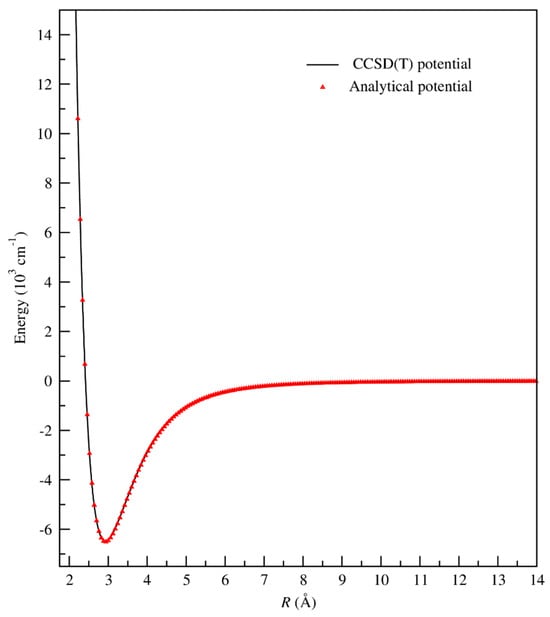
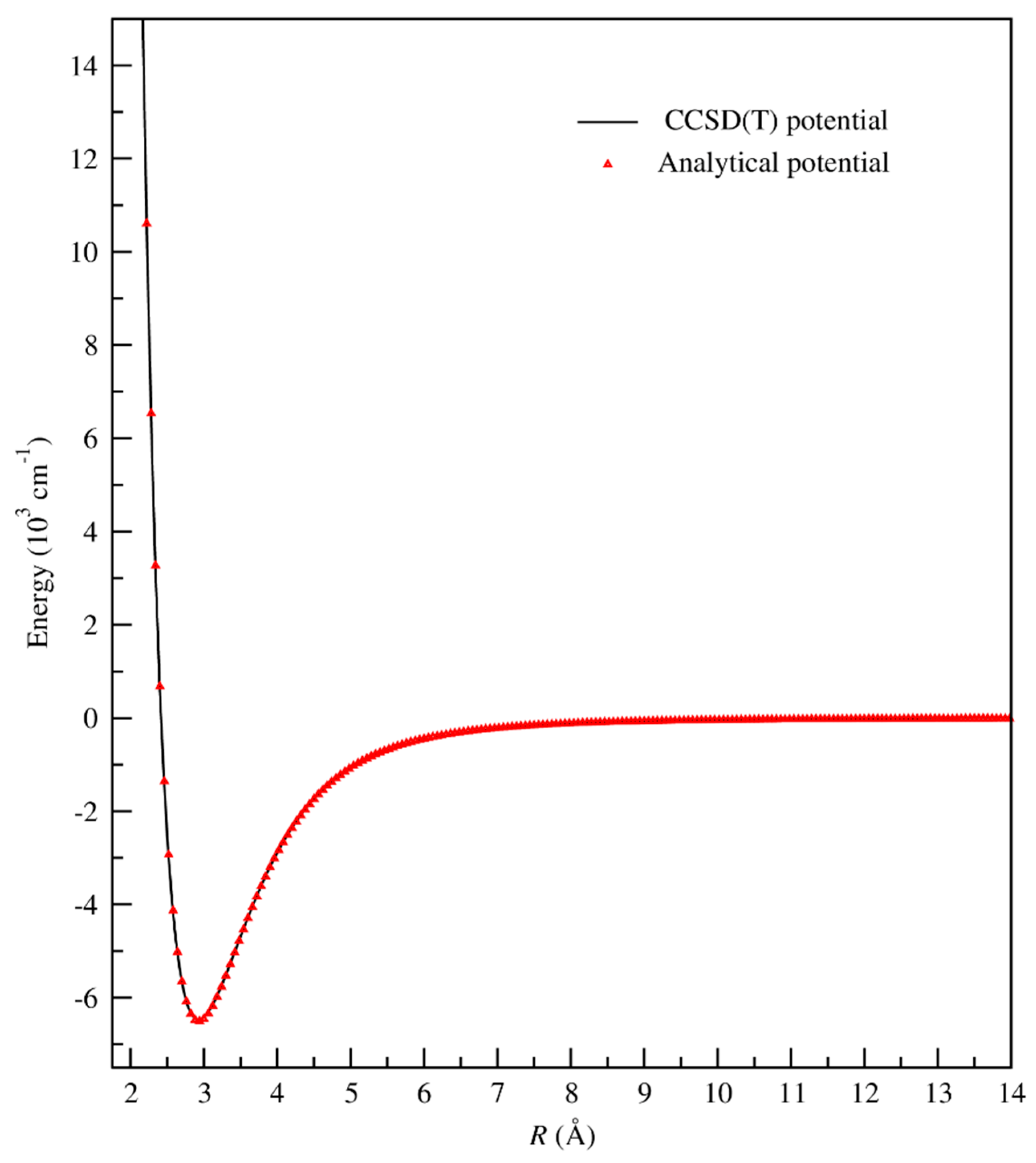
Figure 1 compares the ab initio CCSD(T) potential energy with the analytical fit using Equation (2). To assess the quality of the fits, we calculated the root mean square error (RMSE), defined as follows [35]:
where Np is the number of ab initio data points, and represent the fitted and computed potential energies, respectively. The resulting RMSE for the Ca2+ Kr is approximately 1.05 × 10⁻⁴ Hartree, confirming the excellent agreement between the analytical representation and the high-level ab initio data. This high degree of accuracy ensures that the fitted potential can reliably describe the core–core interaction, which plays a central role in modeling the ground and excited states of the Caq+-Kr (q = 0, 1) systems.
Figure 1.
Comparison of numerical CCSD(T) and analytical potentials for the Ca2+-Kr molecules.
Table 2 compares the spectroscopic constants obtained in this work for the ground state of Ca2+-Kr with those reported by Adrian et al. [36]. As shown, the equilibrium bond distance Re ranges between 2.87 and 2.93 Å, showing good consistency among the different methods. However, the potential well depth De shows more variation: the MRCI + Q method predicts the shallowest well (6264 cm−1), and the CCSD(T) approach yields a slightly deeper value (6500 cm−1), while Adrian et al. [36] reported the largest depth (7320 cm−1) using the RCCSD(T) method. The calculated harmonic vibrational frequencies (ωe), and rotational constants (Be) are in close agreement across methods, with RCCSD(T) predicting the highest ωe values.
Table 2.
Spectroscopic constants for Ca2+-Kr. All constants are expressed in cm−1 except Re in Å.
Overall, the CCSD(T) results consistently predict strong binding energies and short equilibrium distances for the Ca2+-Kr system. Compared with MRCI + Q, CCSD(T) provides a balanced compromise between computational cost and accuracy.
The basis set superposition error for related weakly bound van der Waals systems has been previously assessed [37] and found to be negligible, and it is known to decrease further when larger, augmented basis sets are employed. Accordingly, since all calculations for the Ca2+-Kr system were performed using the aug-cc-pV5Z basis set, no explicit BSSE correction was applied.
2.2. The Interaction Between the Electron and Ca2+-Kr Denoted as Vqe-Ca2+-Kr (q = 0 or 1)
To describe the Vqe-Ca2+-Kr interactions for q = 0 or 1, we used the pseudopotential of Barthelat and Durand [38] to reduce the number of active electrons. This approach provides both computational efficiency and high accuracy by restricting the electronic treatment to the valence electrons only. In the Ca+-Kr system, a single valence electron is active, whereas in the neutral Ca-Kr complex, two valence electrons are explicitly considered. For the one-electron Ca+-Kr system, calculations were performed at the SCF level of theory, while the two-electron Ca-Kr system was treated using a FCI approach. The Caq+-Kr complexes (considered as core–core interactions) involve three charge situations (q = 0, 1, 2); each is treated according to its electronic nature and complexity: substantial CCSD(T)/aug-cc-pV5Z for Ca2+-Kr, pseudopotential-based SCF + core–core interactions for Ca+-Kr, and core–core interactions + FCI using pseudopotentials for the neutral Ca-Kr complex. Each method is chosen to provide an accurate and balanced description of the interactions, ensuring that the resulting potential energy curves and spectroscopic constants are reliable across all charge states.
To incorporate polarization effects, we included core polarization pseudopotentials (VCPP) following the l-dependent formulation of Foucrault et al. [39], which extends the original framework by Müller and Meyer [40]. These pseudopotentials simulate the polarization response of both the Ca2+ ionic core and the krypton atom. For each atom center (Ca or Kr), core polarization is represented by an effective potential that depends on the core polarizability:
where αλ is the static dipole polarizability of core λ and denotes the electric field created at center λ produced by the valence electrons and all other atomic cores.
The core polarizabilities of Ca2+ and Kr, αCa2+ = 3.1717, and αKr = 16.763, were taken from Refs. [41,42].
The electric field acting on each center λ is given by the following:
The parameters riλ, Rλλ′, and Zλ represent, respectively, the distance between the valence electron and the core λ, the distance separating the two cores λ and λ′, and the corresponding nuclear charge.
The valence electrons were described with large Gaussian basis sets. For the Ca atom, we employed the (8s, 7p, 7d)/(8s, 7p, 5d) basis set, with cut-off parameters () [41]. For krypton, we used the uncontracted (4s, 3p) Gaussian-type basis set from Refs. [43,44] comprising s-functions with exponents 0.36894, 0.1444, 0.05, and 0.02, and p-functions with exponents 0.39486, 0.12650, and 0.02.
The inclusion of Kr basis functions is essential to properly describe the distortion of the Ca valence orbitals arising from orthogonality to the rare-gas closed shell (represented by its pseudopotential). Since krypton contributes no active electrons, its exponents were optimized to reproduce the overlap with the 3s and 3p orbitals of the rare gas and to extend toward the diffuse region. The employed Kr pseudopotential has been successfully applied in previous studies of rare-gas–metal and rare-gas–cation complexes [42,44,45], demonstrating reliable performance in describing both short-range repulsion and long-range dispersion interactions, which supports its accuracy for the weakly bound systems considered here.
Finally, for the e–Kr interaction, the analytical pseudopotential form is given by the following:
The above formula includes the parameters α, Ci, and ni for the different s, p, and d orbitals listed in Table 3 [45,46].
Table 3.
Pseudopotential parameters of e–Kr.
2.3. The Spin–Orbit Interaction
The spin–orbit interaction was incorporated using the semi-empirical method originally proposed by Cohen and Schneider [46], which has been successfully applied to the 2p5 and 2p5 3s configurations of Ne+ and Ne*, respectively. Within this framework, the spin–orbit coupling Hamiltonian is expressed as follows:
where ξ denotes the spin–orbit coupling constant, L is the orbital angular momentum operator, and S is the spin angular momentum operator. For the electronic states of the Ca+-Kr system correlating to the Ca+ (4p) atomic asymptote, the spin–orbit interaction is represented by the eigenvalues of the following coupling matrix:
Here, and correspond to the spin-free electronic energies and denotes the spin–orbit coupling constant. Diagonalization of the spin–orbit Hamiltonian yields the fine-structure splitting associated with the S1/2, P1/2, and P3/2 atomic limits. The explicit forms of the spin–orbit coupling matrices for the np and nd configurations have been reported elsewhere [43,46,47,48,49] and are not reproduced here. The spin–orbit coupling constants used in the present work are as follows: ξ4p (Ca+) = 148.6 cm−1, ξ3d (Ca+) = 24.3 cm−1, ξ4p (Ca) = 105.8 cm−1, ξ3d (Ca) = 13.9 cm−1 [49].
Furthermore, the intensity of electronic transitions, whether in absorption or emission, is proportional to the square of the vibrational overlap integral, which quantifies the coupling between the initial and final vibrational wavefunctions:
where χv and χv′ are the vibrational wavefunctions of the initial and final electronic states, respectively, and μ is the electric dipole moment operator. According to the Franck–Condon principle, the intensity of a transition reaches its maximum when the vibrational wavefunctions of the two states exhibit significant overlap.
In addition, the radiative lifetimes of vibrational levels belonging to the 22Π electronic state were determined by considering two distinct types of electronic transitions: bound–bound and bound–free [41,43]. The lifetime associated with bound–bound transitions can be expressed as follows:
where is the Einstein coefficient for the transition between v′ and v vibrational states.
For bound-free transition, the spontaneous emission rate, was determined within the framework of the Franck–Condon approximation, following the formulation proposed by Zemke et al. [50], and is given by the following:
and
represents the energy difference between the vibrational level v′ and the corresponding asymptotic dissociation limit. The term denotes the transition dipole moment evaluated at the outer turning point of the vibrational state v′.
3. Results and Discussion
3.1. Spectroscopic Investigation of the Ca+-Kr System
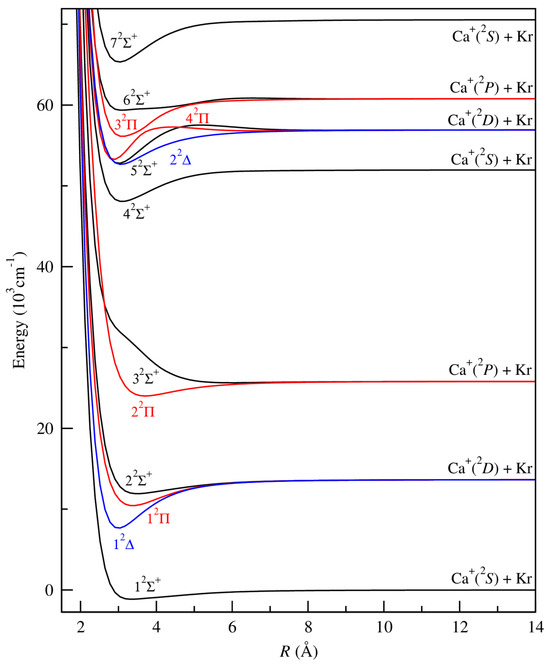
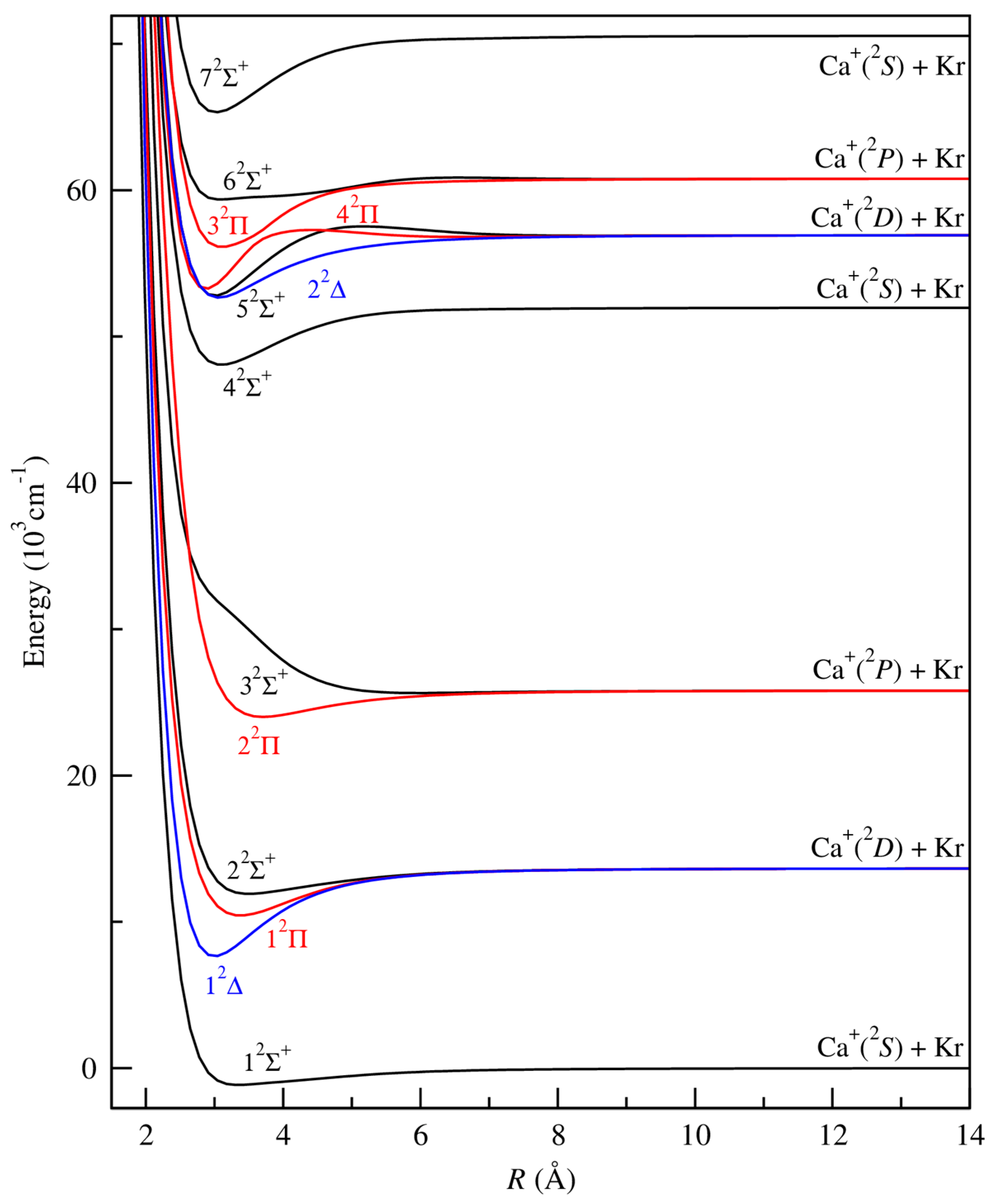
Using the pseudopotential technique, we computed potential energy curves for thirteen electronic states of the Ca+-Kr system, possessing 2Σ+, 2Π, and 2Δ symmetries. These states correlate asymptotically with the atomic limits Ca+ (4s, 3d, 4p, 5s, 4d, 5p, and 6s) + Kr. The calculations were performed over a wide and finely sampled range of internuclear distances ranging from 1.5 to 50 Å, ensuring an accurate description of both short- and long-range interactions.
The potential energy curves for both ground and excited states are presented in Figure 2. To validate the accuracy of our calculated potential energy curves, we derived their spectroscopic constants: equilibrium distance (Re), well depth (De), vertical transition energy (Te), harmonic (ωe) and anharmonic (ωeχe) frequencies, and rotational constant (Be). These constants are presented in Table 4. The Ca+-Kr system features an attractive ground state, 12Σ+, characterized by a potential well depth of 1141 cm−1 located at an equilibrium distance of Re = 3.34 Å. This state corresponds to a relatively stable interaction between the Ca+ ion and the Kr atom. In contrast, the excited state 32Σ+, which dissociates into Ca+(2P) + Kr, exhibits a much shallower potential well De = 170 cm−1, indicating a significantly weaker interaction. On the other hand, the 22Σ+ and 42Σ+ states have deeper potential wells, with depths of De = 1736 cm−1 and 3898 cm−1, respectively, suggesting greater stability.
Figure 2.
Potential energy curves of the Ca+-Kr molecule for excited states in 2Σ+, 2Π, and 2Δ symmetries.
For higher excited electronic states, such as 52Σ+ and 62Σ+, the potential energy curves show distinct potential barriers due to the repulsive interaction between the electron and the krypton atom. Nonetheless, these states remain more attractive than the lower 12Σ+ and 32Σ+ states, with potential wells reaching several thousand cm−1 in depth. Among all calculated states, the 72Σ+ state is the deepest, with a well depth of De = 5232 cm−1, making it the most strongly bound excited state of the Ca+-Kr complex. A comparative analysis with available experimental and theoretical literature reveals reasonable agreement for the ground state of the Ca+-Kr system.
For instance, as presented in Table 4, the equilibrium bond distance (Re) and well depth (De) of the ground state 12Σ+ of Ca+-Kr are found to be 3.34 Å and 1141 cm−1, respectively. The equilibrium bond length Re is approximately 0.035–0.040 Å longer than both the experimental value (3.30 ± 0.15 Å) and the theoretical range (3.202–3.305 Å) reported in references [36,51,52]. The present Re remains well within the experimental uncertainty and shows very good agreement with the Rydberg-state estimation and the RCCSD(T) results reported previously [36,51]. The calculated dissociation energy, De = 1141 cm−1, also lies within the broad experimental range of 840 ± 100 to 1400 ± 150 cm−1 [25,28,29,52] showing slightly better consistency with the lower experimental and theoretical estimates (1200 and 1376 cm−1, respectively [36,51]). This moderate underestimation can be attributed to the approximate nature of the pseudopotential, the limitations of the employed basis sets, and the level of theory adopted. However, it remains below the mean values of both experimental and theoretical predictions.
Table 4.
Spectroscopic constants for the 2Σ+, 2Π, and 2Δ states of the Ca+-Kr ionic system (neglecting spin–orbit coupling). All constants are given in cm−1 except Re in Å.
The calculated harmonic frequency of the ground electronic state of Ca+–Kr, ωe = 65.35 cm−1, is slightly lower than both the experimental values (74–77 cm−1 [29,52]) and the theoretical predictions (68–69.7 cm−1 [36,51]). This deviation mainly reflects subtle differences in the curvature of the potential energy well near the equilibrium distance Re, which determines the vibrational stiffness of the bond. Since pseudopotential methods simplify the treatment of core–valence correlation and short-range repulsion, small discrepancies in the potential shape may propagate into the calculated vibrational frequencies. Consequently, the lower value of ωe can be attributed to the combined influence of potential curvature and the approximations inherent in the pseudopotential representation.
Similarly, the computed anharmonicity constant (ωeχe = 0.94 cm−1) is somewhat smaller than theoretical values reported in the range of 1.3–1.5 cm−1 [36,52]. The rotational constant (Be = 0.055683 cm−1) agrees well with the theoretical estimate of 0.0570 cm−1, confirming that the equilibrium geometry is well reproduced. Overall, the agreement between our calculated spectroscopic parameters and previously reported data is satisfactory. However, the remaining differences, particularly in ωe, and ωeχe, suggest that the pseudopotential model employed may slightly underestimate the strength of the Ca+-Kr interaction, likely due to its limited treatment of short-range repulsion and electronic correlation effects. Additionally, differences in computational methods and basis sets contribute to the observed deviations, further influencing the accuracy of the predicted molecular constants. As no reliable spectroscopic data could be found for the excited states, our comparison is limited to the ground state, and we present only our theoretical predictions for the excited electronic states.
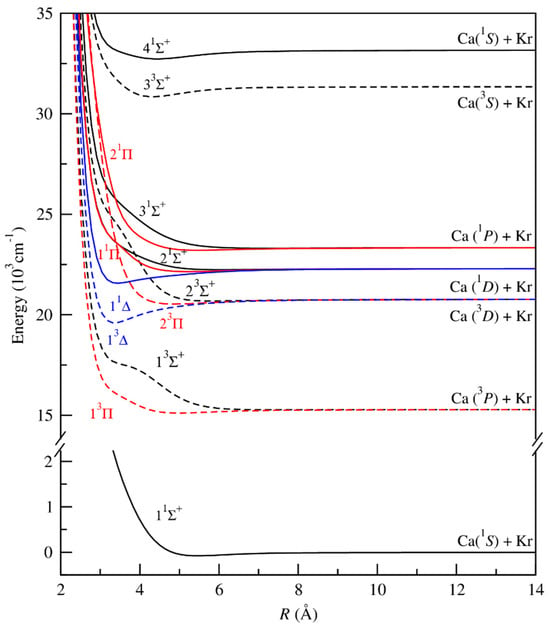
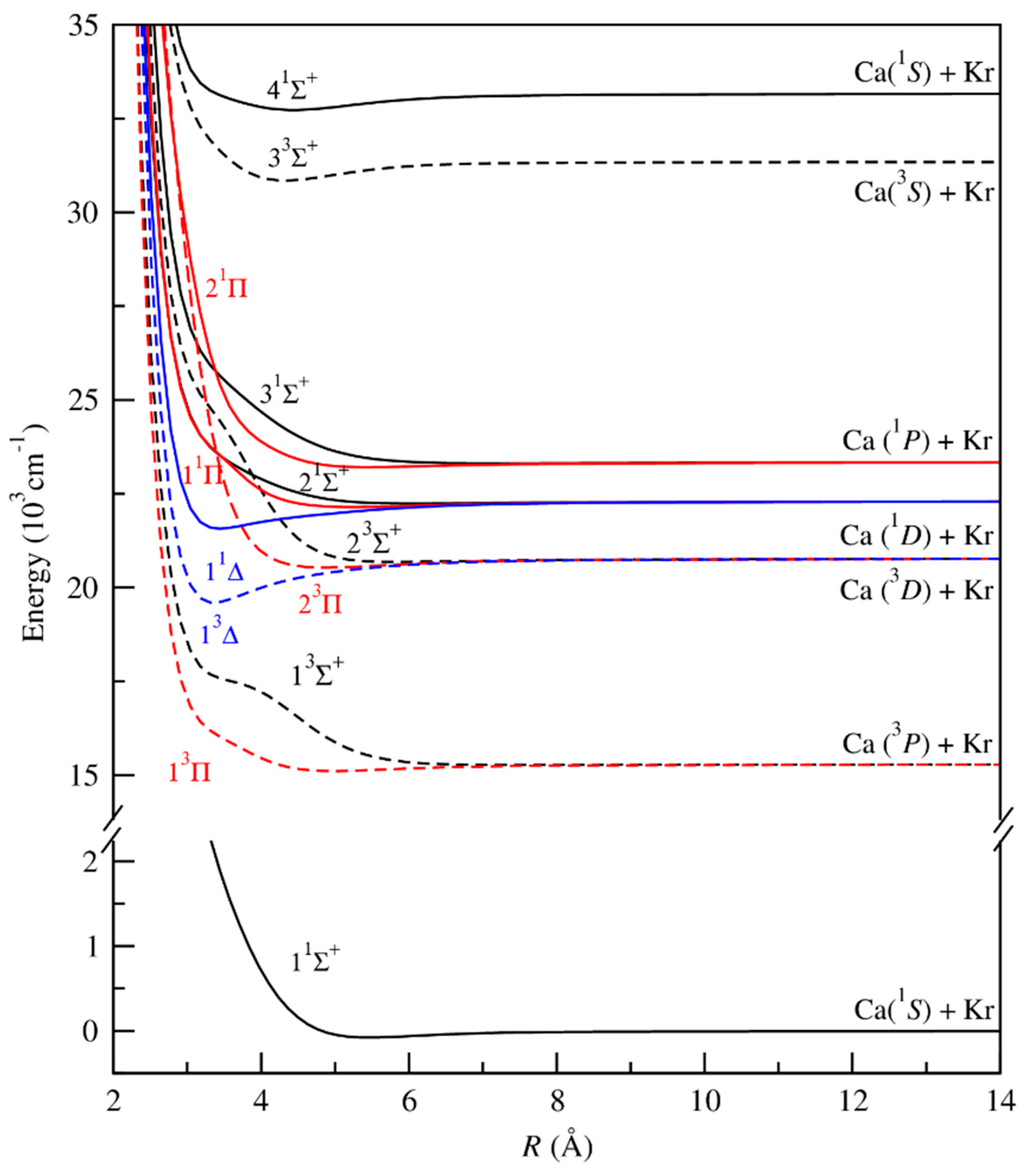
For the neutral Ca-Kr molecule, Figure 3 displays the adiabatic potential energy curves for all states dissociating into the Ca(4s2, 4s4p (1,3P), 4s3d (1,3D), and 4s4p (1,3S)) + Kr atomic limits. These include the 1,3Σ+, 1,3Π, and 1,3Δ symmetries, mapped over an internuclear distance range of 1.5 to 50 Å. The corresponding spectroscopic constants are summarized in Table 5.
Figure 3.
Potential energy curves of the Ca-Kr molecule for excited states in 1,3Σ+, 1,3Π, and 1,3Δ symmetries.
Table 5.
Spectroscopic constants for the 1,3Σ+, 1,3Π, and 1,3Δ states of the Ca-Kr neutral system without spin–orbit coupling. All constants are expressed in cm−1 except Re in Å.
To the best of our knowledge, theoretical spectroscopic data for Ca-Kr remain limited. Therefore, we compare the present results for the ground electronic state 11Σ+ and selected excited states with the available theoretical studies reported in references [16,35]. In particular, reference [16] employed CCSD(T) calculations, while reference [35] used Tang–Toennies potentials truncated at different dispersion orders, nmax = 5 (denoted (a)) and nmax = 8 (denoted (b)). For the ground state, our calculated equilibrium distance (Re = 5.46 Å) is slightly longer than the theoretical values, which range from 5.05 to 5.11 Å. The dissociation energy (De = 79 cm−1) is smaller than the reported 97.5 and 111.9 cm−1 [16,35]. The computed vibrational frequency (ωe = 15.56 cm−1) is also lower than those predicted for nmax = 5 (18.98 cm−1) and nmax = 8 (20.10 cm−1), showing better agreement with the latter. The anharmonic constant (ωexe = 0.72 cm−1) follows a similar trend, being slightly smaller than the values of 0.96 and 0.98 cm−1 reported in [35]. Beyond the ground state, a comparison for selected low-lying excited states reveals generally consistent trends. For instance, in the 31Σ+ state, the calculated Re = 7.31 Å is somewhat longer than the RCCSD(T) value (6.33 Å), while the dissociation energy (De = 26 cm−1) agrees reasonably well with the reported 31.9 cm−1 [16]. In the case of the 13Σ+ state, our Re = 7.42 Å again exceeds the theoretical value (6.51 Å), whereas De = 12 cm−1 is notably smaller than the 39.6 cm−1 reported in [16]. The vibrational frequency (ωe = 5.01 cm−1) for this state is also lower than the RCCSD(T) result (8.06 cm−1). Such deviations likely arise from differences in the curvature of the potential energy wells, while variations in the pseudopotential and basis set choices may further contribute to these discrepancies. For the 21Π and 13Π states, similar patterns are observed. In the 21Π, our calculated Re = 5.44 Å and De = 128 cm−1 contrast with 4.42 Å and 216.2 cm−1 from Ref. [16]. For the 13Π state, the deviation in Re is more pronounced (4.97 Å vs. 3.8 Å), accompanied by a shallower potential well (De = 177 cm−1 vs. 267.7 cm−1).
Overall, despite some underestimations in binding energies and slightly longer equilibrium bond lengths, the general trends remain consistent with high-level theoretical predictions. This consistency confirms the reliability of the present approach in describing the essential features of the ground and low-lying excited electronic states of the Ca-Kr van der Waals system.
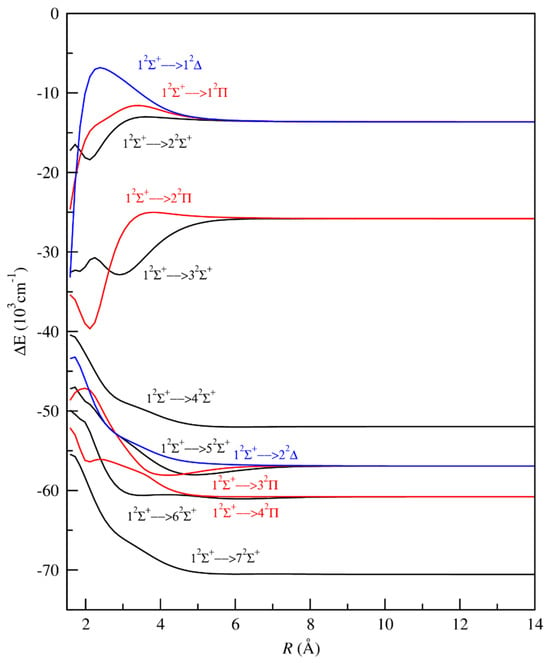
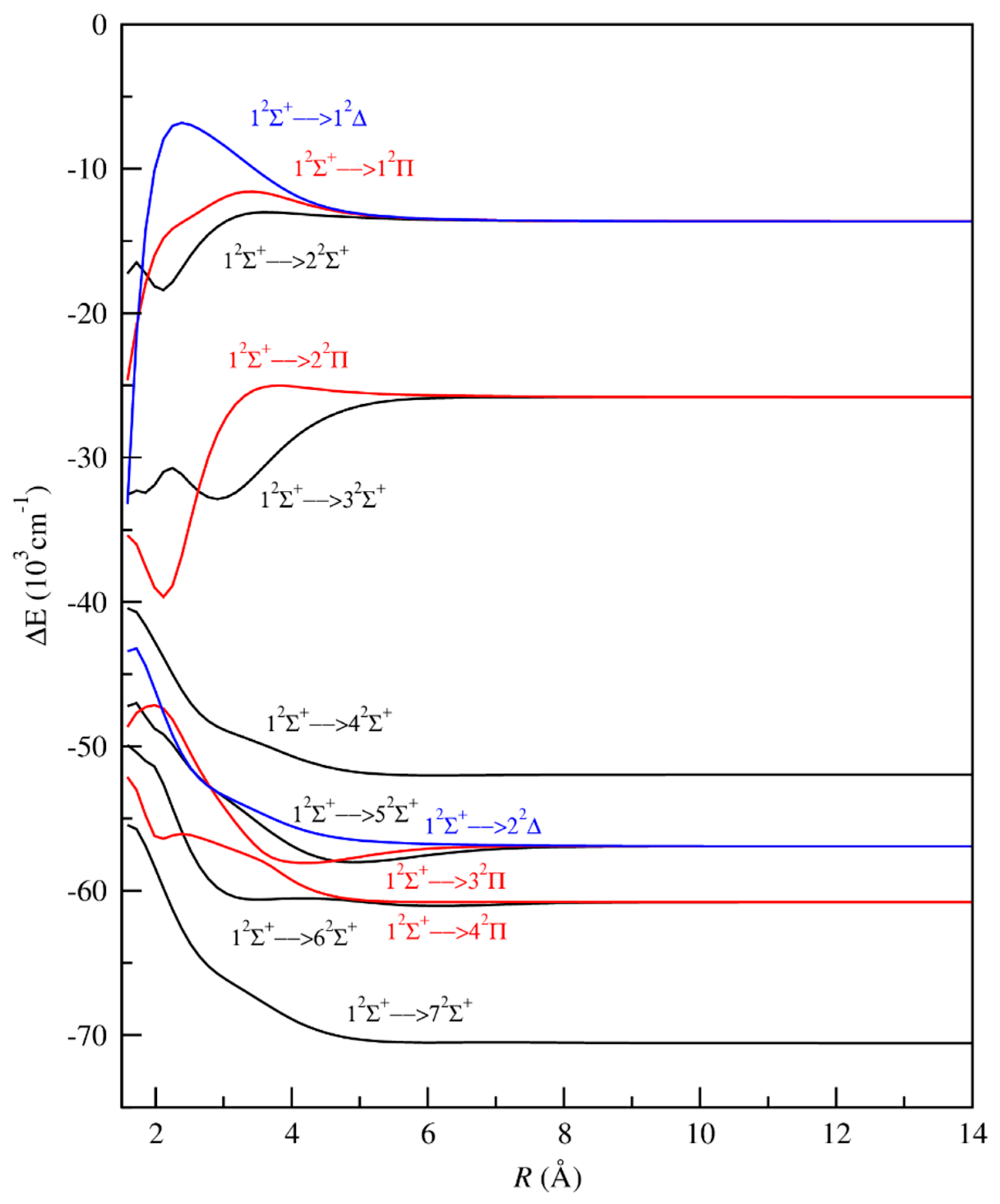
We have explored the difference potentials associated with transitions from the ground electronic states ns 2Σ+ [n(Ca) = 4] to the excited states ns 2Σ+ [n(Ca) = 5, 6], np 2Σ+ [n(Ca) = 4, 5], and nd (Ca) = 3, 4] in the Ca+-Kr complex. The resulting curves, shown in Figure 4, reveal that the ns 2Σ+ [n(Ca) = 4 → 6] transition is almost a flat difference potential, reflecting weak distance dependence. In contrast, the remaining transitions display pronounced maxima at shorter internuclear separations. These variations are directly related to the underlying potential energy surfaces, where humps and avoided crossings play a decisive role in shaping the difference potential profiles.
Figure 4.
Excitation energies from ns 2Σ+ [n(Ca) = 4] to ns 2Σ+ [n(Ca) = 5, 6], np 2Σ+ [n(Ca) = 4, 5], and nd2Σ+ [n (Ca) = 3, 4] in the Ca+-Kr molecule.
3.2. Spectroscopic Investigation of the Caq+-Kr(q = 0,1) with Spin–Orbit Coupling
3.2.1. Excited States 4p (32Σ+, 22Π) and 3d (22Σ+, 12Π, and 12Δ)
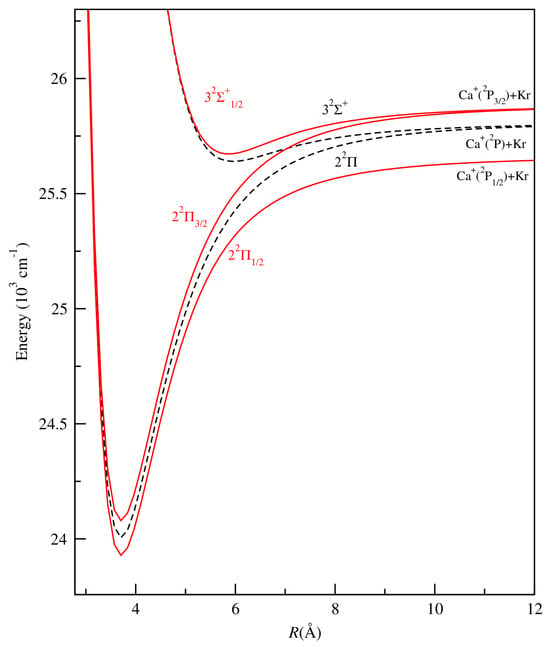
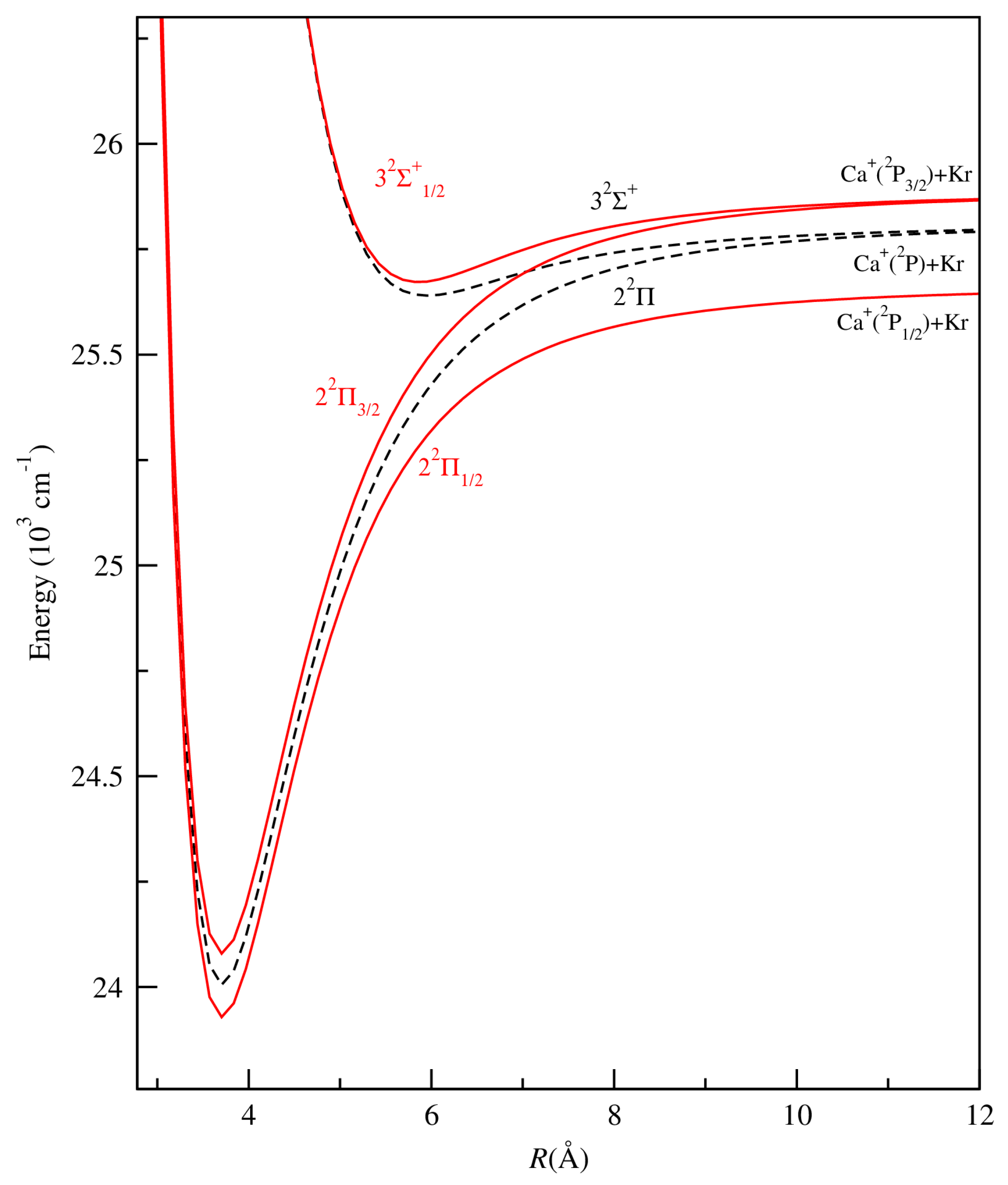
The spin–orbit interaction was introduced for the molecular states correlating with the Ca+(4p) + Kr and Ca+(3d) + Kr asymptotes. The atomic spin–orbit constants used in this treatment were taken from Ref [49], with ζ4p (Ca+) = 148.6 cm−1 and ζ3d (Ca+) = 24.3 cm−1. Diagonalization of the spin–orbit coupling matrix results in the splitting of the 32Σ+, 22Π states into fine-structure components. The resulting potential energy curves, corresponding to the Ca+-Kr system dissociating into Ca+ (42P1/2) + Kr and Ca+ (42P3/2) + Kr, are presented in Figure 5, and the associated spectroscopic parameters are summarized in Table 6. The magnitude of the spin–orbit splitting reflects the combined influence of the intrinsic atomic spin–orbit constant and the molecular interaction strength. For the states correlated with Ca+(4p) + Kr, the potential well depths differ by approximately 72 cm−1, with De = 1733 cm−1 for the 22Π1/2 state and De = 1805 cm−1 for the 22Π3/2 state. While the excitation energy (Te) is notably affected by the inclusion of spin–orbit coupling, the vibrational constants and equilibrium bond lengths of the 22Π states remain essentially unchanged, indicating that the overall shape of the potential is preserved. In contrast, the 32Σ+ state exhibits more pronounced spin–orbit effects. Upon inclusion of spin–orbit coupling, the equilibrium bond length contracts from 5.96 Å to 5.86 Å, while the dissociation energy increases from 170 cm−1 to 213 cm−1. The excitation energy (Te) is also shifted by approximately 43 cm−1 (see Table 5). These variations highlight the sensitivity of the Σ states to relativistic effects and demonstrate the subtle interplay between electrostatic and spin–orbit interactions in the Ca+-Kr system.
Figure 5.
The potential energy curves of Ca+-Kr correlating to Ca+(42P1/2) + Kr and Ca+(42P3/2) + Kr after including the spin–orbit coupling.
Table 6.
Spectroscopic constants for the 2Σ+, 2Π, and 2Δ states of the Ca+-Kr ionic system with spin–orbit coupling. All constants are expressed in cm−1, except Re in Å.
Spin-orbit coupling was also included for the molecular states correlated with the Ca+(3d) + Kr dissociation limit, which give rise to the 2Σ+, 2Π, and 2Δ symmetries. Near the equilibrium geometry, these states follow the energetic order 2Δ < 2Π < 2Σ+. At large internuclear separations, they correlate asymptotically with the fine-structure components of the Ca+(3d) atomic term: 3d 2D1/2, 3d 2D3/2, and 3 d2D5/2. The corresponding spectroscopic constants for the molecular states (22Σ+1/2, 12Π1/2, 3d 2D3/2, 12Π3/2, 12Δ3/2, 3d 2D5/2, and 12Δ5/2) are presented in Table 6 and compared with the spin-free results.
The inclusion of spin–orbit coupling produces only minor changes in the spectroscopic parameters of these states. The equilibrium bond lengths remain essentially unchanged, while the potential well depths differ slightly by about 29, 2, 32, and 5 cm−1 for the 22Σ+1/2, 12Π1/2, 12Δ3/2, and 12Δ5/2 states, respectively. The excitation energies Te are shifted by 13, 12, 24, and 25 cm−1 for the 22Σ+1/2, 12Π1/2, 12Π3/2, 12Δ3/2, and 12Δ5/2 states, respectively. These small energy shifts confirm that the spin–orbit interaction has only a modest influence on the potential energy surfaces associated with the Ca+(3d) + Kr asymptote. This weak effect is consistent with the relatively small atomic spin–orbit constant of the Ca+(3d) state (ξ3d = 24.3 cm−1), compared with that of Ca+(4p). Consequently, the splitting of the molecular potential curves correlating with Ca+(3d) + Kr is considerably smaller than that found for the Ca+(4p) + Kr limit. Notably, the energetic ordering of the 2Δ, 2Π, and 2Σ+ states remain unchanged upon inclusion of spin–orbit coupling, confirming the stability of the electronic structure in this region of the potential surface.
3.2.2. Excited States 4p (13Σ+, 13Π, 31Σ+, 21Π) and 3d (23Σ+, 23Π, 13Δ, 21Σ+, 11Π, and 11Δ)
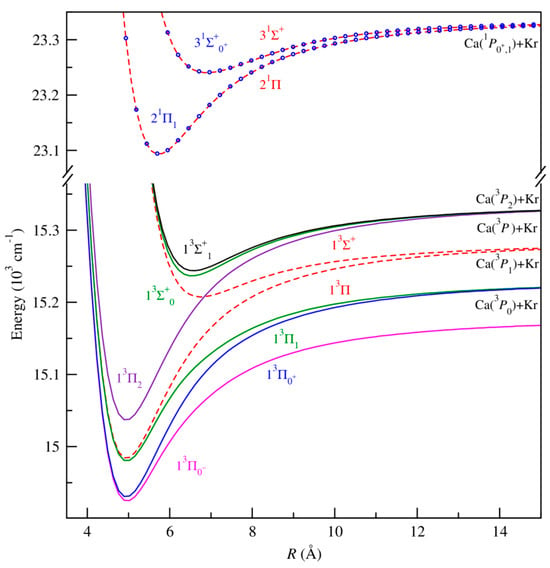
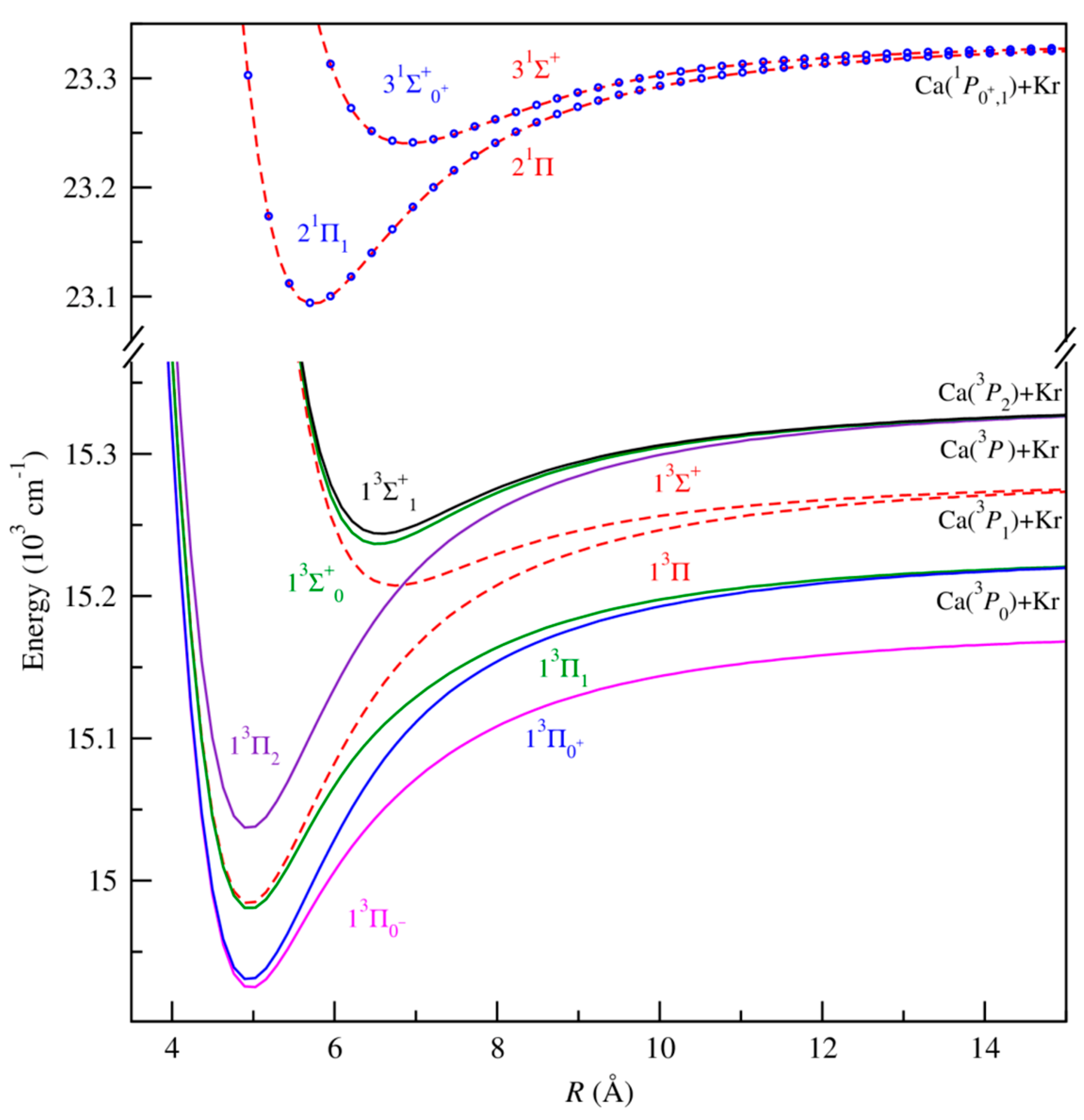
The potential energy curves (PECs) of the Ω states for the Ca-Kr molecule were determined by including spin–orbit coupling over a wide range of internuclear separations. The results show that the molecule dissociates into eight states for each of the Ω = 0− and 0+ symmetries, and into seven, four, and one states for Ω = 1, 2, and 3, respectively. Figure 6 presents the PECs corresponding to the electronic states dissociating into Ca(4s4p 3P0, 1, 2) + Kr and Ca(4s4p 1P1) + Kr, respectively. These curves are predominantly attractive and display several avoided crossings, resulting in a complex pattern characterized by multiple shallow wells. As shown in Figure 6, the 13Π state splits into four components; 13Π0−, 13Π0+, 13Π1, and 13Π2, with an overall energy difference of approximately 55 cm−1 between the lowest and highest components. In contrast, the spin–orbit interaction has a much weaker influence on the 31Σ+ and 21Π states, resulting in comparatively minor splittings and preserving the general shape of the potential curves.
Figure 6.
The potential energy curves of the electronic states for Ca-Kr including spin–orbit coupling. The full line represents states with spin–orbit coupling, while the dashed line represents states without spin–orbit coupling.
The 13Π state exhibits the largest spin–orbit splitting, consistent with its relatively high spin–orbit constant. However, the states dissociating into Ca(4s3d 3D1, 2, 3) and Ca(4s3d 1D2) + Kr, (Ω = 0+, 0−, 1, 2, and 3) display much weaker splittings than those correlating with Ca(4s4p 3P0, 1, 2) + Kr and Ca(4s4p 1P1) + Kr. This reduction arises from the smaller atomic spin–orbit constant of the 3d shell (ξ4p(Ca) = 105.8 cm−1 vs. ξ3d(Ca) = 13.9 cm−1 [49]). Table 7 summarizes the spectroscopic constants, including spin–orbit coupling effects, for the corresponding Ω excited states derived from the parent singlet and triplet states (13Σ+, 13Π, 31Σ+, 21Π, 23Σ+, 23Π, 13Δ, 21Σ+, 11Π, and 11Δ). Overall, our results for the low-lying states of Ca-Kr are in reasonable agreement with those reported in Ref. [16], though some notable differences are apparent. For instance, the equilibrium bond lengths Re for the 31Σ+0+ and 21Π1 states are predicted here as 7.21 Å and 5.44 Å, compared with 6.29 Å and 4.37 Å in Ref. [16], indicating slightly longer bonds. Likewise, the dissociation energies De are also smaller (26.4 cm−1 versus 62.1 cm−1 for the 31Σ+0+ state and 128 cm−1 versus 226.9 cm−1 for the 21Π1 state) suggesting weaker binding predicted by our approach. In contrast, the 13Σ+1 state shows good agreement, with Re differing by only ~0.47 Å and De values of 28 and 33.9 cm−1. Overall, while both studies predict similar state ordering and vibrational behavior, our calculations yield slightly longer bond lengths and smaller well depths.
Table 7.
Spectroscopic constants for Ca(4s4p 1,3PJ)Kr and Ca(4s3d 1,3DJ)Kr with spin–orbit coupling; all constants are expressed in cm−1 except Re in Å.
3.3. Permanent and Transition Dipole Moments for Ca+-Kr and Ca-Kr Systems
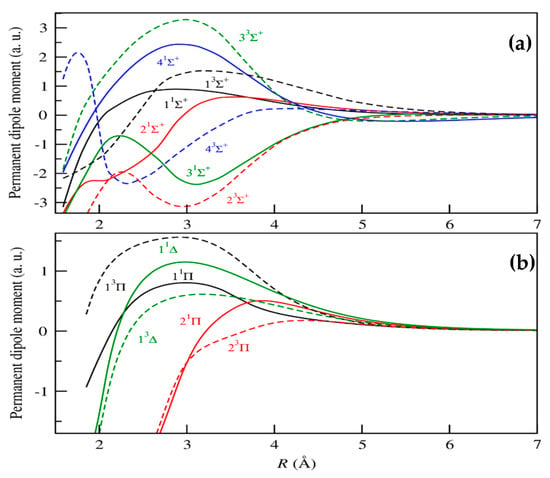
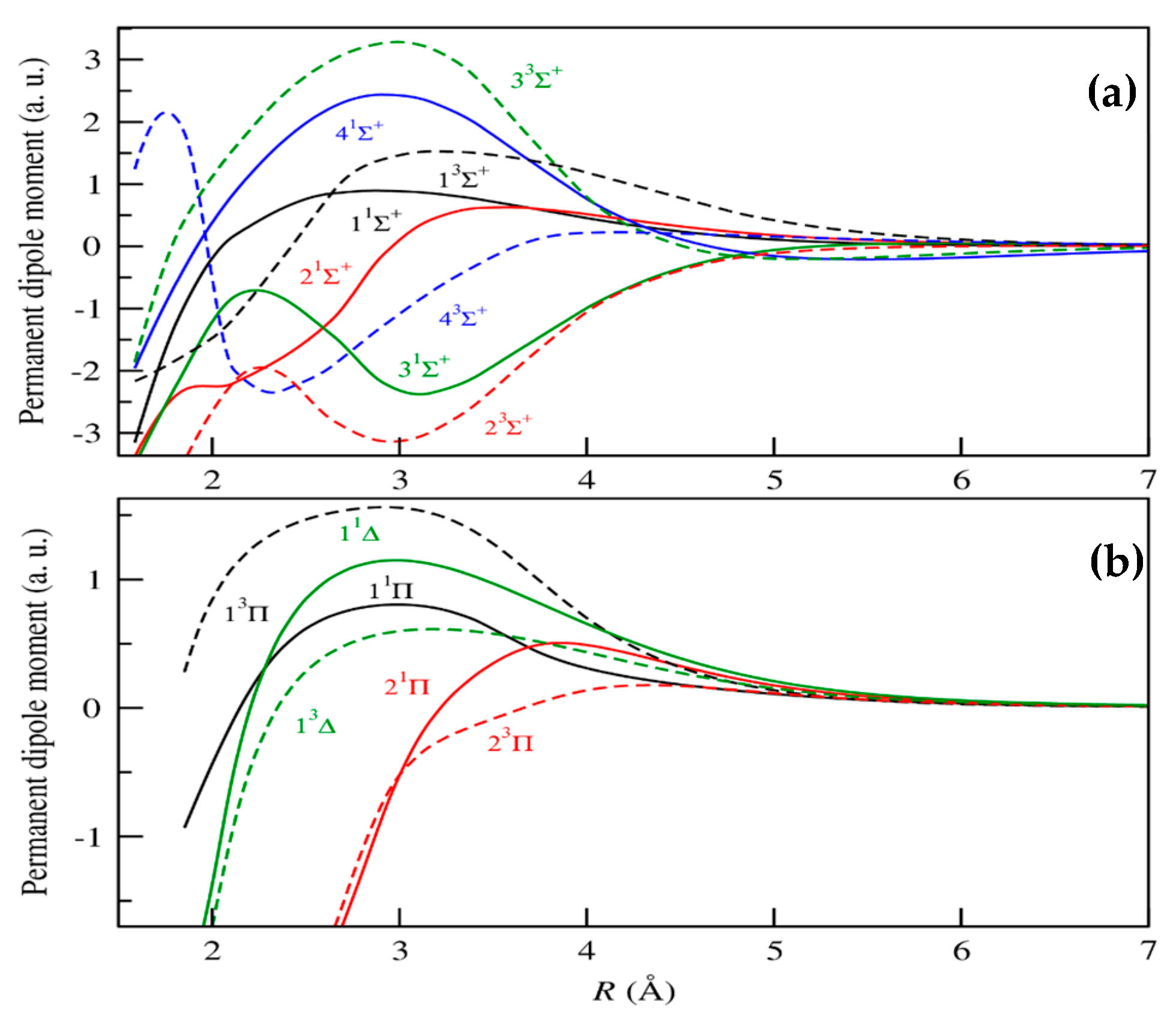
Understanding transition and permanent electric dipole moments (TEDMs and PEDMs) is crucial for predicting lifetimes and analyzing molecular spectra and devising strategies for molecular formation. In this work, we calculate and analyze the permanent (PEDMs) and transition (TEDMs) electric dipole moments of the Ca+-Kr and Ca-Kr systems in their ground and low-lying electronic states. The calculations were carried out across an extensive range of internuclear distances (1.6 to 50 Å) for all considered electronic states. Specifically, the transition dipole moments were determined from the ground state (12Σ+) to the excited states (32Σ+ and 22Π) with the inclusion of spin–orbit coupling. Figure 7 depicts the variation of these transition dipole moments with internuclear distance for the 22Π and 32Σ+ states. The transition dipole from the ground state to both 22Π and 32Σ+ states exhibit a peak of 2.27 a.u, occurring at 4.57 Å internuclear distance. When spin–orbit coupling is included, the 12Σ+ → 22Π transition splits into two components, 12Σ+ → 22Π1/2 and 12Σ+ → 22Π3/2, which show noticeable differences at intermediate distances. At long range, transitions 12Σ+ → 22Π1/2, 12Σ+ → 22Π3/2, and 12Σ+ → 32Σ+1/2 converge toward the Ca+(4s) → Ca+(4p) atomic transition limit. In addition, the permanent and transition dipole moments of the 1,3Σ+, 1,3Π, and 1,3Δ symmetries of the Ca-Kr neutral system were examined over the same distance range (1.6 to 50 Å). The permanent dipole moment curves for the 1,3Σ+ states are presented in Figure 7a, while Figure 7b illustrates those of the 1,3Π and 1,3Δ symmetries. In general, the triplet 3Σ+ states exhibit larger permanent dipole moments than their singlet counterparts, although this trend does not consistently extend to the Π and Δ symmetries. At short internuclear separations, the permanent dipole moment curves show marked variations, before smoothly approaching zero at long range. This trend reflects the weakly bound van der Waals nature of the system and confirms the absence of charge transfer between Ca and Kr atoms.
Figure 7.
Permanent dipole moments of the Ca-Kr molecular system for the 1,3Σ+ (a), 1,3Π, and 1,3Δ (b) symmetries.
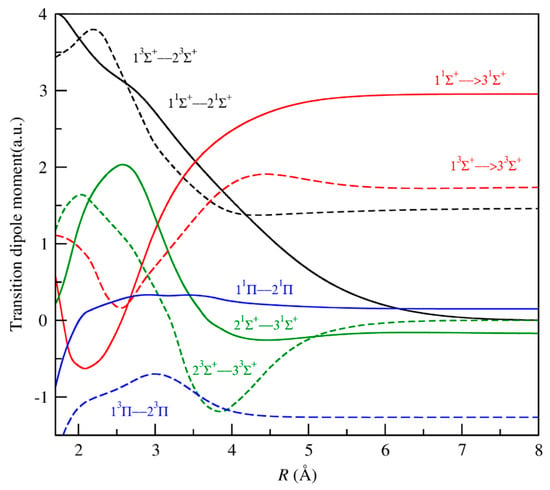
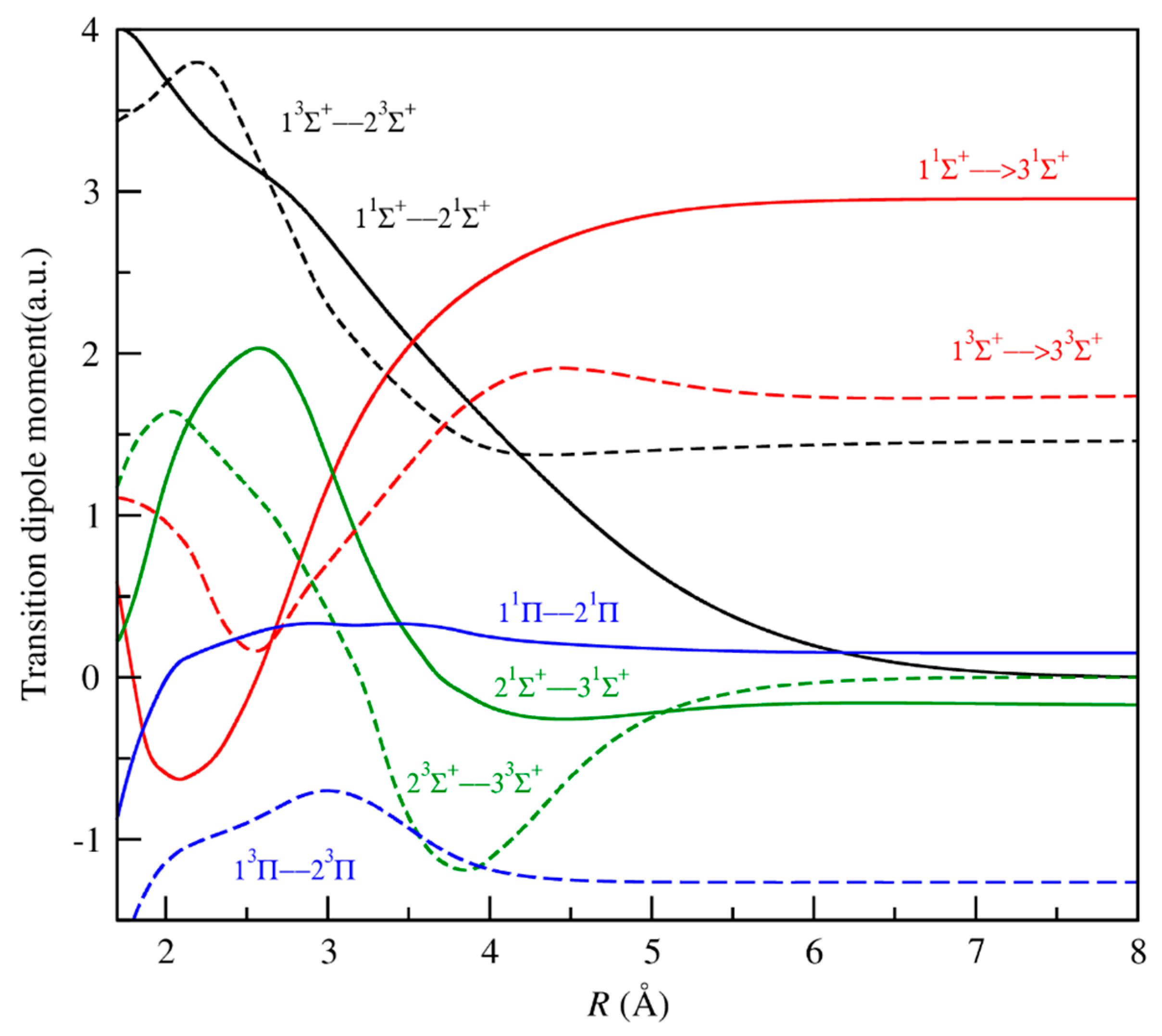
Figure 8 depicts the transition dipole moments between the 1,3Σ+, 1,3Π, and 1,3Δ states. The curves display pronounced maxima at short and intermediate distances, then gradually decay to zero or reach a nearly constant value at large separations, reflecting the transition to pure atomic character.
Figure 8.
Transition dipole moments for the Ca-Kr molecular system in the 1,3Σ+, 1,3Π, and 1,3Δ symmetries.
3.4. Vibrational Level Spacings, Absorption Spectra, and Radiative Lifetimes
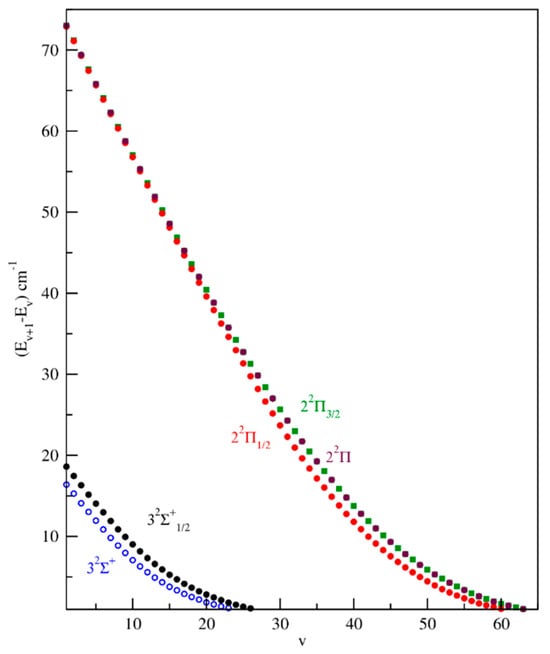
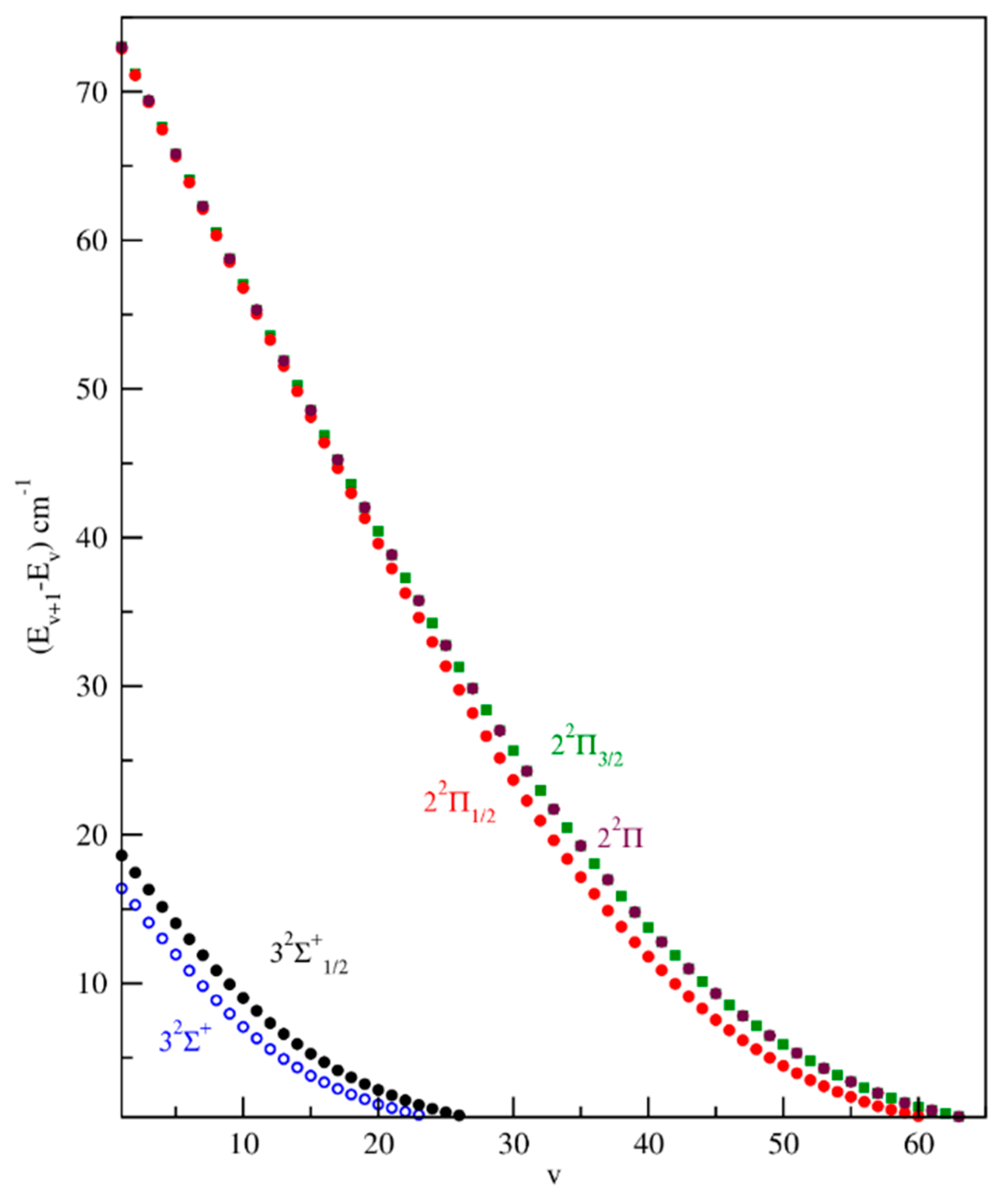
By solving the radial Schrödinger equation, we have computed the vibrational energy levels of the Ca+-Kr systems with spin–orbit effects. The vibrational energy level spacing (Ev+1 − Ev) as a function of v for Ca+-Kr in the 32Σ+and 22Π states, correlating with the Ca+(4p) + Kr limit, is shown in Figure 9. The common behavior is a decrease as v rises and when approaching the dissociation limit, the energy level spacing vanishes. For the 32Σ+ and 22Π states, 26 and 65 vibrational levels were identified, with well depths of De = 267 cm−1 and 1846 cm−1, respectively. The spin–orbit components 32Σ+1/2, 22Π1/2, and 22Π3/2 exhibit the same ordering.
Figure 9.
Vibrational energy level spacing (Ev+1 − Ev) in terms of the vibrational number v of Ca+-Kr.
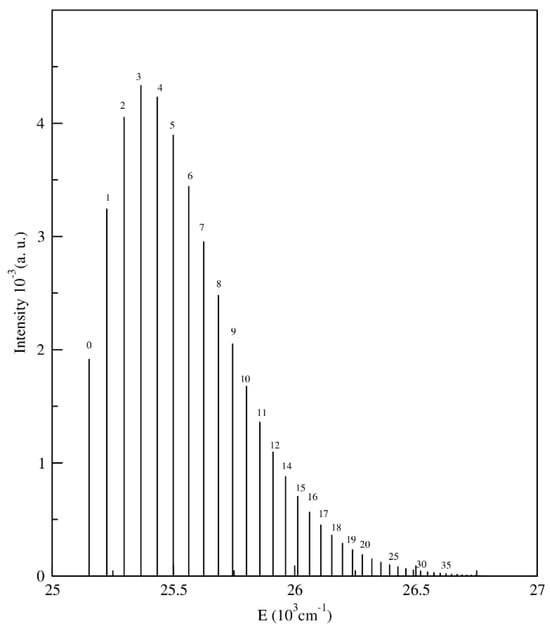
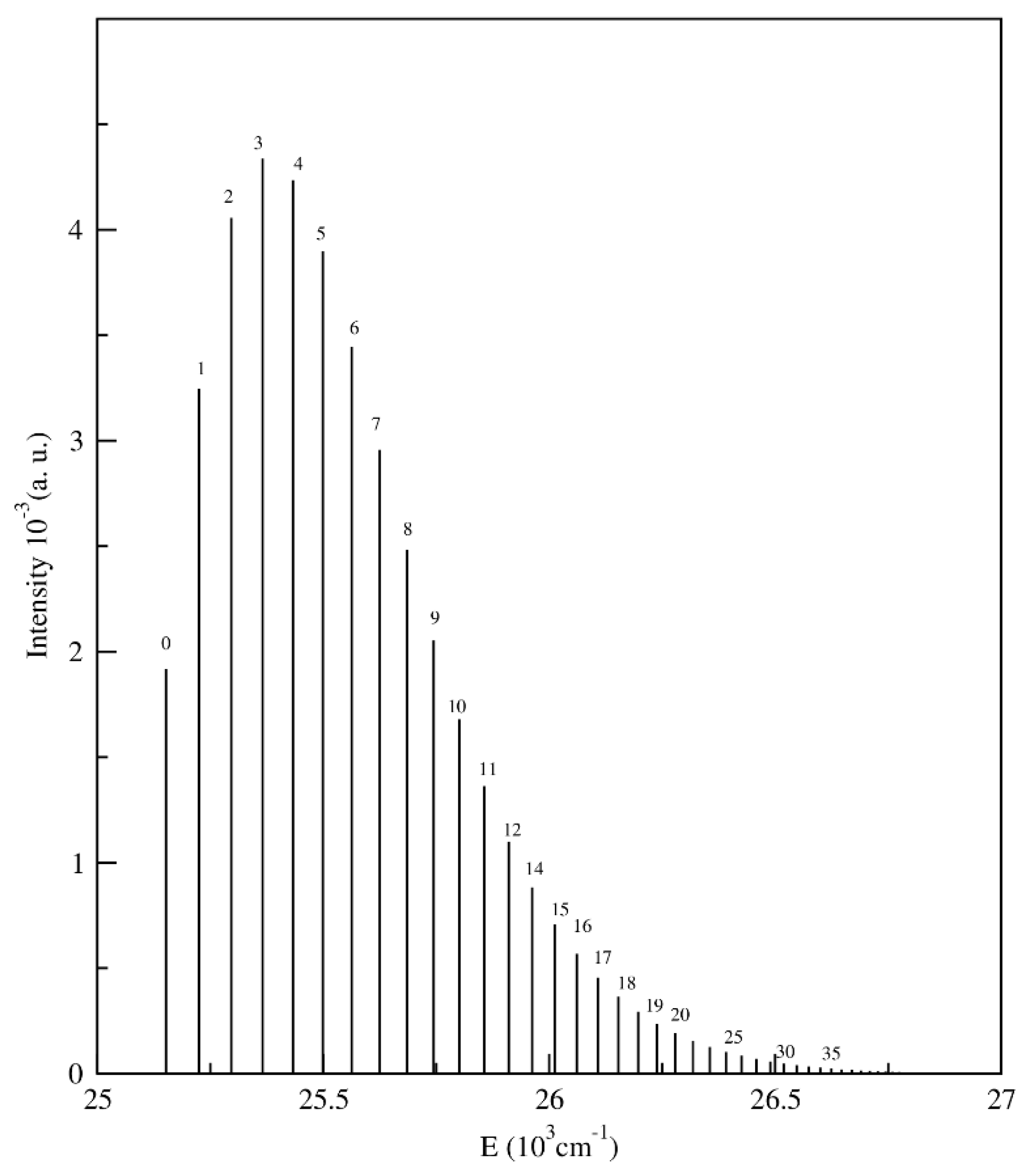
Figure 10 displays the absorption spectrum of the Ca+-Kr molecule for transitions from the ground vibrational level (v = 0) of the 12Σ+ state to the vibrational levels of the 22Π state. As can be seen, the absorption intensity increases from v = 0 to v = 3, where it reaches its maximum, and then gradually decreases and becomes very weak for higher levels. This behavior is a direct consequence of the Franck–Condon principle. Because the potential well of the excited state (22Π) is slightly displaced relative to that of the ground state (12Σ+) and their equilibrium bond lengths are relatively close (Re = 3.34 Å and 3.70 Å for 12Σ+ and 22Π, respectively), significant vibrational overlap occurs only for the lowest levels. As a result, absorption is restricted to transitions involving the lowest v, producing the intense peaks observed at the beginning of the spectrum. These spectral features clearly highlight how strongly the absorption intensities depend on the shapes and relative positions of the potential energy curves.
Figure 10.
Absorption spectrum 12Σ+ (v = 0) → 22 (v = 0–65) of the Ca+-Kr molecule.
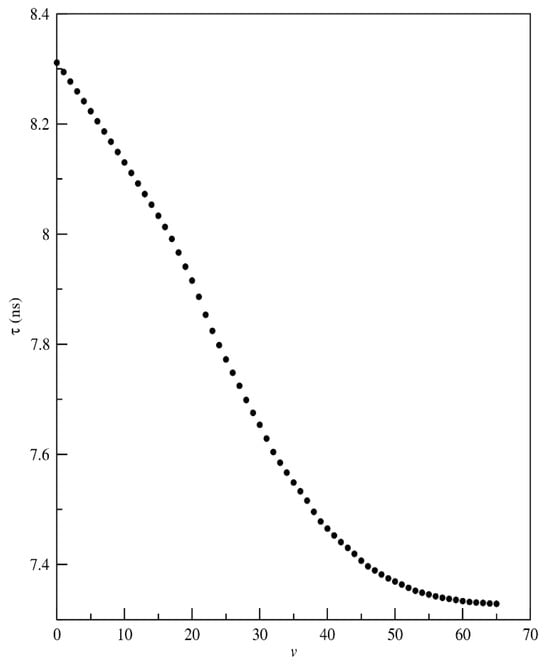
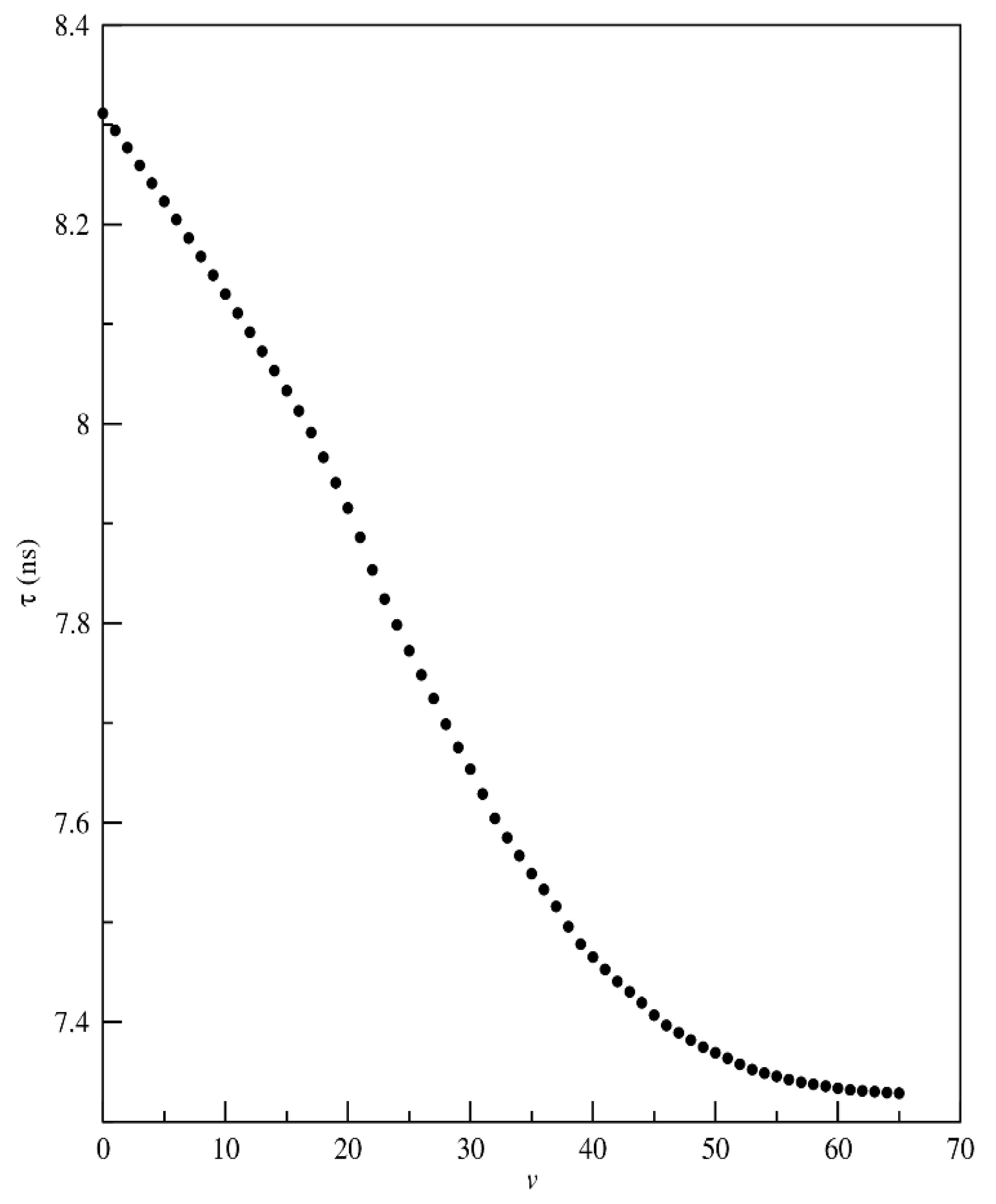
Figure 11 presents the vibrational radiative lifetimes calculated for the first excited 22Π state of Ca+-Kr. In these calculations, both bound–bound and bound–free transitions (12Σ+ → 22Π) were taken into account to properly describe the decay of all vibrational levels supported by the potential well. As shown in Figure 12, the vibrational radiative lifetime of the lowest vibrational level (v′ = 0) of the 22Π state is approximately 8.3 ns. The vibrational lifetimes remain on the nanosecond scale, decreasing gradually from about 8.3 ns and approaching near 7.3 ns for higher vibrational levels (v′ ≈ 60–65). At these high levels, the molecule behaves nearly atom-like, and the corresponding lifetimes converge toward the atomic Ca+(4p) → Ca+(4s) transition. The agreement with the experimental lifetime of the Ca+ 42P state, τ = (6.72 ± 0.20) × 10−9 s [53], is good.
Figure 11.
Radiative lifetimes of the vibrational levels of the first excited 22Π state of the Ca+-Kr system.
Figure 12.
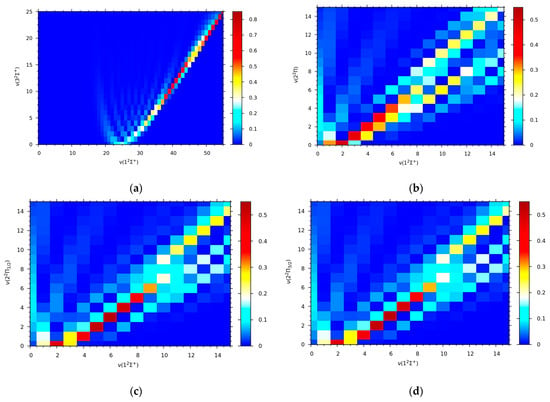
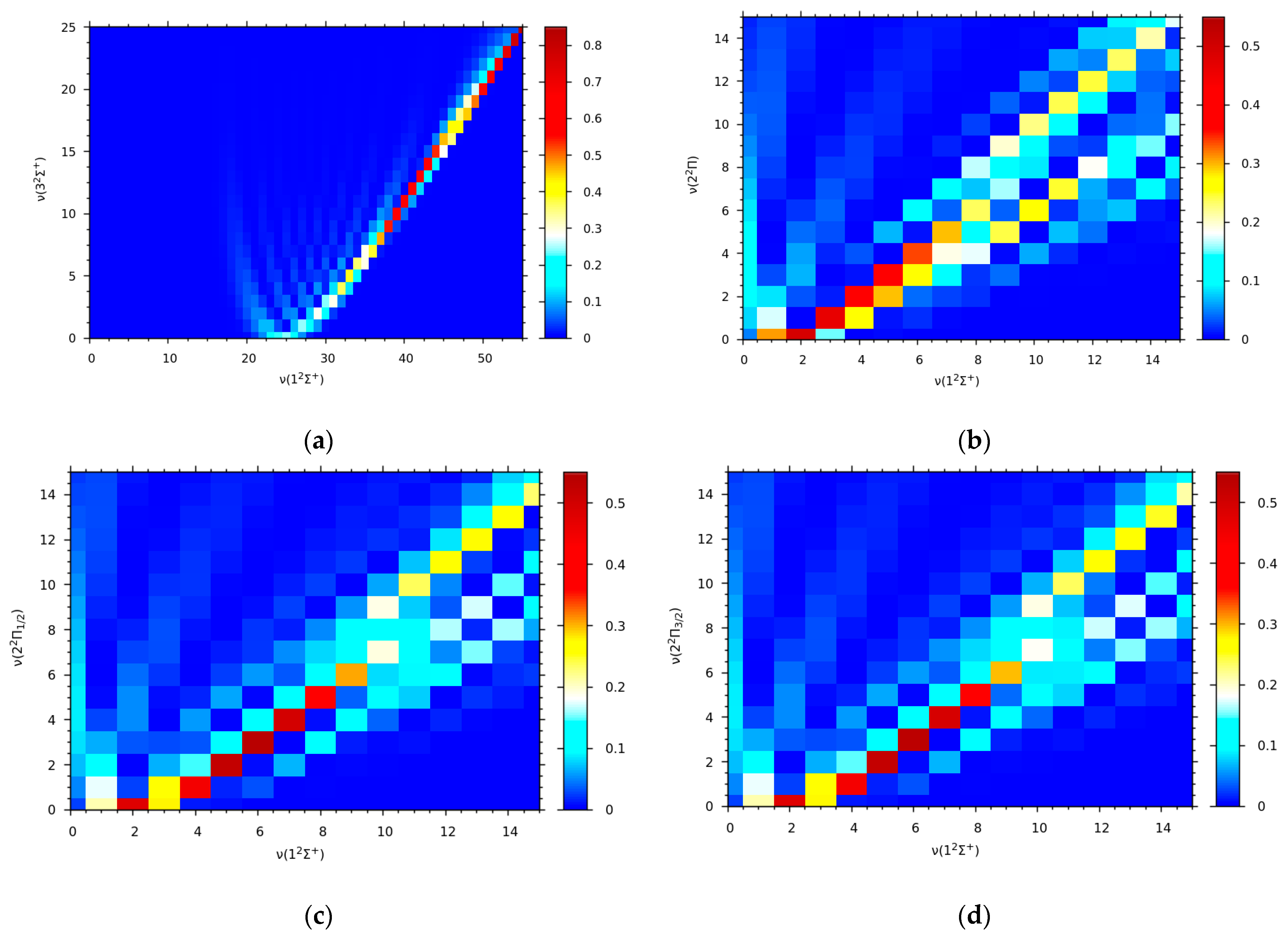
Franck–Condon factors between vibrational levels of the ground state 12Σ+ and the first excited 32Σ+ (a), 22∏ (b), 22∏1/2 (c), and 22∏3/2 (d) states of the Ca+-Kr system.
In addition, we computed the Franck–Condon factors (FCFs) for the Ca+-Kr system, including spin–orbit (SO) coupling (22Π1/2, 22Π3/2). The resulting three-dimensional intensity maps are presented in Figure 12. These FCFs quantify the overlap between the vibrational wavefunctions of the ground 12Σ+ state and those of the spin–orbit split excited states. The inclusion of SO coupling leads to Franck–Condon patterns that remain very similar to those obtained in the spin-free case, indicating that SO effects only weakly perturb the vibrational structure of the Ca+-Kr system. The FCFs display predominantly off-diagonal transitions, with the strongest contributions occurring at intermediate and high vibrational levels of the excited states, consistent with the relative displacement of the 12Σ+ and 22Π/32Σ+ potential wells.
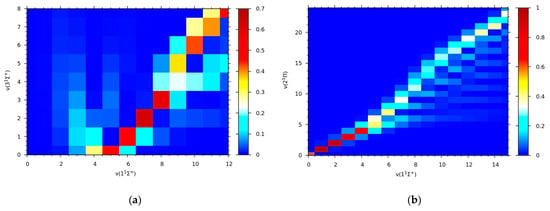
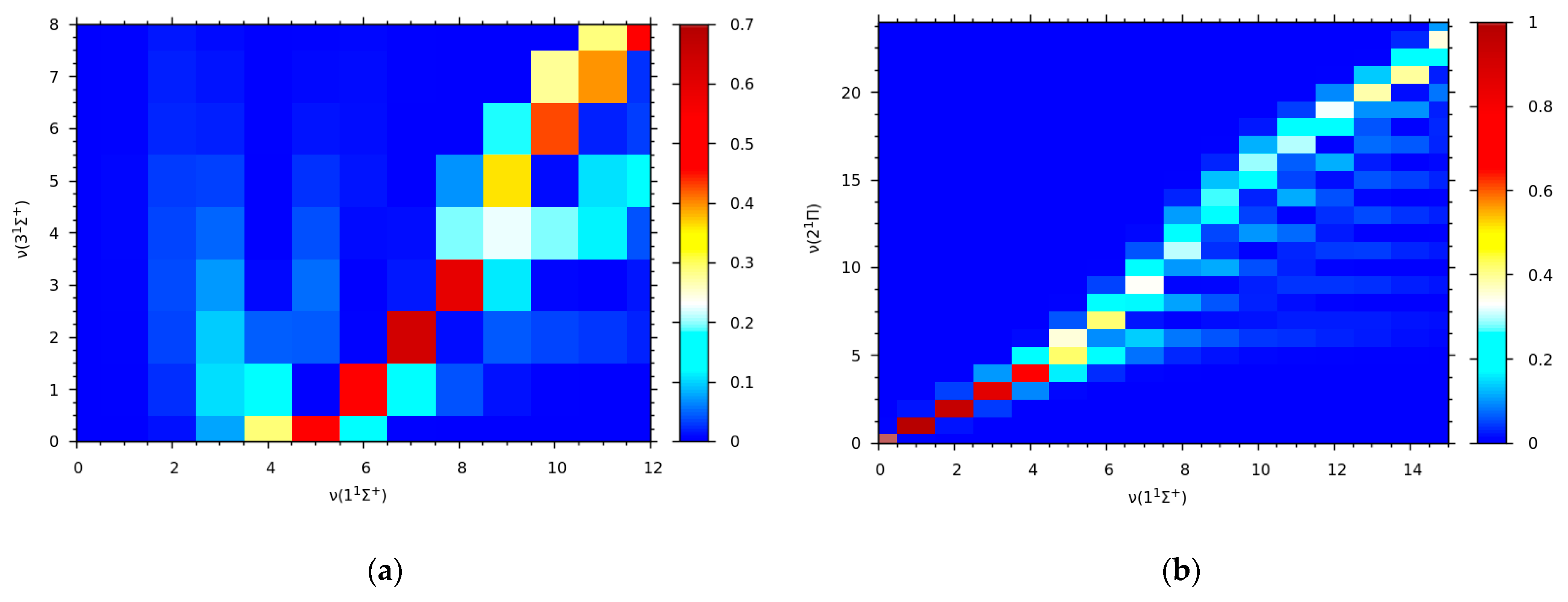
For the neutral Ca-Kr system, the Franck–Condon factors were also evaluated. As presented in Figure 13, the FCFs are off-diagonal and the vibrational overlap is weak for the (1-3) 1Σ+ states. In contrast, for the 1 1Σ+-2 1Π transition, the FCFs are predominantly diagonal, with values close to 1 (f00 = 0.995, f11 = 0.978, f22 = 0.940, and f33 = 0.856) for the (0-0), (1-1), (2-2), and (3-3) transitions, respectively.
Figure 13.
Franck–Condon factors between vibrational levels of the ground state 11Σ+ and the first excited 22∏ (a) and 32Σ+ (b) states of the Ca-Kr system.
4. Conclusions
We have carried out a theoretical investigation of the interactions between alkaline-earth species (Ca2+, Ca+, and Ca) and a krypton atom. Semi-local pseudopotentials were employed to model the Ca2+ cores and electron–Kr interactions. For the Ca+-Kr system, electronic structure calculations were carried out using the one-electron SCF method. In the case of the neutral Ca-Kr system, the treatment was further refined with FCI calculations. From these calculations, we obtained PECs and the associated spectroscopic constants, which had shown good agreement with available experimental and theoretical results. The resulting spectroscopic constants and vibrational spacings obtained for the 22Π1/2, 22Π3/2, and 32Σ+1/2 states are in reasonably good agreement with available experimental and theoretical [25,28,29,36,50,51] results. Importantly, the inclusion of spin–orbit coupling has also induced a splitting of the transition dipole moment. Only a limited number of theoretical works have addressed excited Ca-Kr states [16,35]. The present work extends these efforts by providing transition dipole moments near avoided crossings and offering spectroscopic data that can guide future experiments. These findings can be expanded to incorporate a more systematic treatment of spin–orbit effects or to explore larger van der Waals clusters (Ca2+-Krn, Ca+-Krn, Ca-Krn). Moreover, the accurate PECs and dipole moments obtained for Ca+-Kr will be valuable for modeling Ca+ line broadening in collisions with Kr atoms and for evaluating transport coefficients relevant to Ca+ propagation in a krypton environment.
Requests for data on potential energy curves and permanent and transition electric dipole moments as a function of interatomic distance can be made to the authors.
Author Contributions
Conceptualization, W.Z., M.B., H.L. and H.B.; methodology, W.Z., M.B., H.L., J.D. and H.B.; software, W.Z., M.B. and J.D.; validation, W.Z., M.B. and H.B.; writing—original draft preparation, W.Z.; writing—review and editing, W.Z., H.B. and H.L.; visualization, W.Z., H.L. and M.B.; supervision, H.B.; project administration, W.Z. and H.B. All authors have read and agreed to the published version of the manuscript.
Funding
This research received no external funding.
Data Availability Statement
Data are contained within the article.
Conflicts of Interest
The authors declare no conflict of interest.
References
- Brust, J.; Greene, C.H. Theoretical investigation of barium–helium collisions. I. The adiabatic potential curves. Phys. Rev. A 1997, 56, 2005–2012. [Google Scholar] [CrossRef] [Scilit]
- Blank, L.; Weeks, D.E. Impact broadening, shifting, and asymmetry of the D1 and D2 lines of alkali-metal atoms colliding with noble-gas atoms. Phys. Rev. A 2014, 90, 022510. [Google Scholar] [CrossRef] [Scilit]
- Merkt, F.; Willitsch, S.; Hollenstein, U. High-resolution photoelectron spectroscopy. In Handbook of High-Resolution Spectroscopy; Wiley: Hoboken, NJ, USA, 2011; Volume 3, pp. 1617–1654. [Google Scholar]
- Kreis, C.; Schmitz, J.R.; Merkt, F. High-resolution photoelectron spectroscopy of the very weakly bound MgNe molecule. Mol. Phys. 2024, 122, e2297814. [Google Scholar] [CrossRef] [Scilit]
- Kreis, C.; Holdener, M.; Génévriez, M.; Merkt, F. High-resolution photoelectron spectroscopy of the ground and first excited electronic states of MgKr+. Mol. Phys. 2023, 121, e2152746. [Google Scholar] [CrossRef] [Scilit]
- Kreis, C.; Schmitz, J.R.; Merkt, F. High-resolution photoelectron spectroscopy of the ground and first excited electronic states of MgXe+. J. Phys. Chem. A 2024, 128, 3149–3157. [Google Scholar] [CrossRef] [Scilit]
- Díaz-Torrejón, C.C.; Espinosa-Magaña, F.; Kaplan, I.G. Comparative theoretical study of the electron affinities of alkaline-earth clusters Ben, Mgn, and Can (n = 2, 3). Int. J. Quantum Chem. 2011, 111, 103–110. [Google Scholar] [CrossRef] [Scilit]
- Mitroy, J.; Zhang, J.Y. Long-range dispersion interactions. II. Alkali-metal and rare-gas atoms. Phys. Rev. A 2007, 76, 032706. [Google Scholar] [CrossRef] [Scilit]
- Reddic, J.E.; Pullins, S.H.; Duncan, M.A. Photodissociation spectroscopy of the Ca+–Ne complex. J. Chem. Phys. 2000, 112, 4974–4982. [Google Scholar] [CrossRef] [Scilit]
- Le Roy, R.J. Near-dissociation expansions and dissociation energies for Mg+–rare-gas dimers. J. Chem. Phys. 1994, 101, 10217–10228. [Google Scholar] [CrossRef] [Scilit]
- Liu, D.; Yang, Y.; Wang, T.; Yu, M.; Zhang, D.; Yan, B. Ab initio calculations on spectroscopic and transition properties of NaHe including spin–orbit coupling. J. Quant. Spectrosc. Radiat. Transf. 2024, 317, 108924. [Google Scholar] [CrossRef] [Scilit]
- Liu, D.; Li, X.; Li, L.; Yan, B. Ab initio interaction potentials of alkali-metal–rare-gas complexes. Mol. Phys. 2024, 122, e2266064. [Google Scholar] [CrossRef] [Scilit]
- Kleinekathöfer, U. Ground-state potentials for alkaline-earth–helium diatoms calculated by the surface integral method. Chem. Phys. Lett. 2000, 324, 403–410. [Google Scholar] [CrossRef] [Scilit]
- Czuchaj, E.; Rebentrost, F.; Stoll, H.; Preuss, H. Semi-local pseudopotential calculations for CaHe and CaNe systems. Chem. Phys. 1989, 138, 303–314. [Google Scholar] [CrossRef] [Scilit]
- Czuchaj, E.; Rebentrost, F.; Stoll, H.; Preuss, H. Pseudopotential SCF/CI calculations for the CaHe pair. Chem. Phys. Lett. 1991, 182, 191–199. [Google Scholar] [CrossRef] [Scilit]
- Czuchaj, E.; Krosnicki, M.; Stoll, H. Valence ab initio calculations for Ca–rare-gas van der Waals molecules. Chem. Phys. 2003, 292, 101–110. [Google Scholar] [CrossRef] [Scilit]
- Brust, J.; Greene, C.H. Theoretical investigation of barium–helium collisions. II. Excitation transfer cross sections. Phys. Rev. A 1997, 56, 2013–2021. [Google Scholar] [CrossRef] [Scilit]
- Olsgaard, D.A.; Lasell, R.A.; Havey, M.D.; Sieradzan, A. Polarization and intensity spectra for Mg–Ne and Mg–Ar collisions. Phys. Rev. A 1993, 48, 1987–1994. [Google Scholar] [CrossRef] [Scilit] [PubMed]
- Philip, G.; Connerade, J.P. Controlled excitation of forbidden transitions in strontium. Opt. Commun. 2007, 279, 141–149. [Google Scholar] [CrossRef] [Scilit]
- Ni, N.S.; Goetz, W.; Meijer, H.A.J.; Andersen, N. Far-wing collisional redistribution of light in barium–rare-gas systems. Z. Phys. D 1996, 38, 303–308. [Google Scholar] [CrossRef] [Scilit]
- Smedley, J.E.; Coulter, S.K.; Felton, E.J.; Zomlefer, K.S. Collisional deactivation of Ba 5d7p 3D1 by noble gases. J. Phys. Chem. A 2008, 112, 9526–9530. [Google Scholar] [CrossRef] [Scilit]
- Harima, H.; Yanagisawa, T.; Tachibana, K.; Urano, Y. Absorption coefficients of the Ca resonance line broadened by rare gases. J. Phys. B 1983, 16, 4529–4537. [Google Scholar] [CrossRef] [Scilit]
- Alford, W.J.; Burnett, K.; Cooper, J. Polarization of collisionally redistributed light from Sr–rare-gas systems. Phys. Rev. A 1983, 27, 1310–1316. [Google Scholar] [CrossRef] [Scilit]
- Kowalski, A.; Funk, D.J.; Breckenridge, W.H. Excitation spectra of CaAr, SrAr, and BaAr molecules. Chem. Phys. Lett. 1986, 132, 263–268. [Google Scholar] [CrossRef] [Scilit]
- Kaup, J.G.; Breckenridge, W.H. Bond energies of CaAr+, CaKr+, and CaXe+. J. Chem. Phys. 1997, 107, 4451–4457. [Google Scholar] [CrossRef] [Scilit]
- Kaup, J.G.; Breckenridge, W.H. Spectroscopic characterization of excited CaAr states. J. Chem. Phys. 1997, 107, 5676–5683. [Google Scholar] [CrossRef] [Scilit]
- Kaup, J.G.; Breckenridge, W.H. Spectroscopy of CaAr, CaKr, and CaXe van der Waals molecules. J. Chem. Phys. 1997, 107, 5283–5289. [Google Scholar] [CrossRef] [Scilit]
- Pullins, S.H.; Scurlock, C.T.; Reddic, J.E.; Duncan, M.A. Photodissociation spectroscopy of Ca+–rare-gas complexes. J. Chem. Phys. 1996, 104, 7518–7525. [Google Scholar] [CrossRef] [Scilit]
- Buthelezi, T.; Bellert, D.; Lewis, V.; Brucat, P.J. The C–X transition in CaKr+ and CaAr+. Chem. Phys. Lett. 1995, 246, 145–149. [Google Scholar] [CrossRef] [Scilit]
- Werner, H.J.; Knowles, P.J.; Knizia, G.; Manby, F.R.; Schutz, M.; Celani, P.; Korona, T.; Lindh, R.; Mitrushenkov, A.; Rauhut, G.; et al. MOLPRO, Version 2010.1, A Package of ab Initio Programs. 2010. Available online: http://www.molpro.net (accessed on 26 December 2015).
- Dunning, T.H. Gaussian basis sets for correlated molecular calculations. I. J. Chem. Phys. 1989, 90, 1007–1023. [Google Scholar] [CrossRef] [Scilit]
- Burkatzki, M.; Filippi, C.; Dolg, M. Exponents of uncontracted primitives (taken from Woon, D.E.; Dunning, T.H., Jr. Gaussian basis sets for use in correlated molecular calculations. IV. Calculation of static electrical response properties. J. Chem. Phys. 1994, 100, 2975–2988. [Google Scholar]
- Buckingham, R.A. The repulsive interaction of atoms in S states. Trans. Faraday Soc. 1958, 54, 453–459. [Google Scholar] [CrossRef] [Scilit]
- Born, M.; Mayer, J.E. Zur Gittertheorie der Ionenkristalle. Z. Phys. 1932, 75, 1–18. [Google Scholar] [CrossRef] [Scilit]
- Yang, C.L.; Zhang, X.; Han, K.L. Analytical potential function for CaF. J. Mol. Struct. THEOCHEM 2004, 678, 183–188. [Google Scholar] [CrossRef]
- Gardner, A.M.; Withers, C.D.; Wright, T.G.; Kaplan, K.I.; Chapman, C.Y.; Viehland, L.A.; Breckenridge, W. HBonding in Mn+–rare-gas complexes. J. Chem. Phys. 2010, 132, 054305. [Google Scholar]
- Bejaoui, M. Modélisation de la Structure et de la Spectroscopie des Systèmes MRg et Leurs Ions (M: Alcalinoterreux, Rg: Gaz rare). Ph.D. Thesis, University of Monastir, Monastir, Tunisia, 2017. [Google Scholar]
- Durand, P.; Barthelat, J.C. Atomic pseudopotentials for molecular calculations. Theor. Chim. Acta 1975, 38, 283–302. [Google Scholar] [CrossRef] [Scilit]
- Foucrault, M.; Millié, P.; Daudey, J.P. Core–valence correlation in pseudopotential calculations. J. Chem. Phys. 1992, 96, 1257–1264. [Google Scholar] [CrossRef] [Scilit]
- Müller, W.; Flesch, J.; Meyer, W. Core polarization potentials in ab initio calculations. J. Chem. Phys. 1984, 80, 3297–3310. [Google Scholar] [CrossRef] [Scilit]
- Zrafi, W.; Ladjimi, H.; Said, H.; Berriche, H.; Tomza, M. Ultracold calcium–alkali-metal molecular ions. New J. Phys. 2020, 22, 073015. [Google Scholar] [CrossRef] [Scilit]
- Hibbert, A.; Bell, K.L.; Berrington, K.A. Atomic polarizability of krypton and xenon. J. Phys. B 1987, 20, L349–L353. [Google Scholar] [CrossRef] [Scilit]
- Zrafi, W.; Dhiflaoui, J.; Bejaoui, M.; Berriche, H. Spectroscopic investigation of Mg–Kr and its cations. J. Phys. Chem. A 2025, 129, 5709–5721. [Google Scholar] [CrossRef] [Scilit]
- Gadea, F.X.; Spiegelmann, F.; Castex, M.C.; Morlais, M. Excited states of the Kr2* excimer. J. Chem. Phys. 1983, 78, 7270–7283. [Google Scholar] [CrossRef] [Scilit]
- Yuan, J.; Zhang, Z. Low-energy electron scattering from Kr and Xe atoms. J. Phys. B 1989, 22, 2581–2590. [Google Scholar] [CrossRef] [Scilit]
- Dhiflaoui, J.; Bejaoui, M.; Berriche, H. Alkali–krypton van der Waals systems with spin–orbit coupling. J. Phys. Chem. A 2023, 127, 5299–5311. [Google Scholar] [CrossRef] [Scilit] [PubMed]
- Cohen, J.S.; Schneider, B. Ground and excited states of Ne2 and Ne2+. J. Chem. Phys. 1974, 61, 3230–3239. [Google Scholar] [CrossRef] [Scilit]
- Zrafi, W.; Bejaoui, M.; Dhiflaoui, J.; Farjallah, M.; Berriche, H. Electronic states of SrXe-related systems. Eur. Phys. J. D 2019, 73, 60. [Google Scholar] [CrossRef] [Scilit]
- Spiegelman, F.; Maron, L.; Breckenridge, W.H.; Mestdagh, J.M.; Visticot, J.P. Electronic structure of CaAr. J. Chem. Phys. 2002, 117, 7534–7550. [Google Scholar] [CrossRef] [Scilit]
- Zemke, W.T.; Stwalley, W.C. Radiative transition probabilities of KRb. J. Chem. Phys. 2004, 120, 88–92. [Google Scholar] [CrossRef] [Scilit]
- Heinemann, C.; Koch, W.; Partridge, H. Low-lying states of CaAr+ and CaKr+. Chem. Phys. Lett. 1998, 286, 131–137. [Google Scholar] [CrossRef] [Scilit]
- Bellert, D.; Breckenridge, W.H. Bonding in van der Waals ions. Chem. Rev. 2002, 102, 1595–1622. [Google Scholar] [CrossRef] [Scilit]
- Smith, W.W.; Gallagher, A. Radiative lifetimes of ionized calcium and magnesium. Phys. Rev. 1966, 145, 26–32. [Google Scholar] [CrossRef] [Scilit]

Disclaimer/Publisher’s Note: The statements, opinions and data contained in all publications are solely those of the individual author(s) and contributor(s) and not of MDPI and/or the editor(s). MDPI and/or the editor(s) disclaim responsibility for any injury to people or property resulting from any ideas, methods, instructions or products referred to in the content. |
© 2026 by the authors. Licensee MDPI, Basel, Switzerland. This article is an open access article distributed under the terms and conditions of the Creative Commons Attribution (CC BY) license.