
Abstract
Through the relationship between dispersion measures (DM) and redshifts, fast radio bursts (FRBs) are considered to be very promising cosmological probes. In this paper, we attempted to use the DM-z relationship of FRBs to study the helium abundance () in the universe. First, we used 17 current FRBs with known redshifts for our study. Due to their low redshifts and the strong degeneracy between and , however, this catalog could not provide a good constraint on the helium abundance. Then, we simulated 500 low redshift FRB mock data with to forecast the constraining ability on . In order to break the degeneracy between and further, we introduced the shift parameters of the Planck measurement as a prior, where represents the baryon density parameter, and R and correspond to the scaled distance to recombination and the angular scale of the sound horizon at recombination, respectively. We obtained the standard deviation for the helium abundance: . Finally, we considered 2000 higher redshift FRB data with the redshift distribution of and found that the constraining power for would be improved by more than 2 times, , which indicates that the FRB data with high redshift can provide a better constraint on the helium abundance. Hopefully, large FRB samples with high redshift from the Square Kilometre Array can provide high-precision measurements of the helium abundance in the near future.
1. Introduction
Fast radio bursts (FRBs) are very short (ms) transients observed in frequencies from ∼100 MHz up to a few GHz [1,2,3]. The triggering mechanisms of FRBs are mysterious and still highly debated, but at least some FRBs can be produced by magnetar engins [4,5,6,7], also possibly by superconducting strings [8], or even by mysterious objects concerning strange quark stars [9]. The first FRB was discovered by Lorimer et al. [1], and hundreds of FRBs have been observed since then from several radio surveys, such as CHIME [10], Parkes [11], and ASKAP [12]. In the future, the Square Kilometre Array (SKA) is expected to detect ∼ FRBs per decade [13]. Among those discovered FRBs, one repeating burst FRB121102 localized at z ∼ 0.19 established the cosmological origin of these events [14]. Furthermore, most FRBs have anomalously large dispersion measures (DM), which are related to their high redshifts. Through the relationship between DM and redshifts, FRBs are considered to be very promising cosmological probes. Several studies have been conducted to forecast the determinations of cosmological parameters using the future mock FRBs, such as the Hubble Constant [15,16], the dark energy equation of state [17], the fraction of baryon mass in the intergalactic medium (IGM) [18,19], the reconstruction of reionization using FRBs [20], and so on.
The helium abundance, , can be measured by the cosmic microwave background (CMB) since the damped tail of the CMB anisotropies is affected by the free electron density between the helium and hydrogen recombination, which is modified by variations in [21]. Using this method and allowing to vary as a derived parameter in the framework of CDM model, Planck Collaboration et al. [22] gave the following constraints from the Planck TT, TE, EE, and lowE datasets at a 95% confidence level:
In addition to the CMB anisotropies, the helium abundance can also affect the stellar evolution and galactic chemical evolution. Traditional measurements of the helium abundance are mainly based on the big bang nucleosynthesis (BBN) theory [23,24,25]. In this paper, we take the results of Aver et al. [23] as a reference, giving a slightly tighter constraint
Several approaches also have been employed to constrain the helium abundance, by using the integrated spectra to infer the helium abundance of extragalactic globular clusters [26], via observations of metal poor HII regions to determine the primordial Helium abundance [27], by observations of the Extremely Metal-Poor Galaxies to determine the primordial helium abundance [28], and so on. However, these methods suffer from several uncontrolled systematic errors.
It is well known that the electron fraction, , is directly related to the original hydrogen and helium abundances and . Using the electron fraction, we can see that there is a strong degeneracy between the DM of the FRB and . Therefore, if we can measure the DM of FRBs and establish a relationship between the DM and redshift and, in the meantime, use observations to precisely constrain other cosmological parameters, the helium abundance can also be measured by FRBs, avoiding large systematic errors. In this paper, we investigate the measurement of helium abundance using current and future FRB samples. We present methods for probing cosmological parameters via the DM-z relationship in Section 2. In Section 3, we present the constraint results on from 17 current FRB samples. In Section 4, by introducing the shift parameters of the Planck measurements, we explore the possibilities of the helium abundance measurements by simulating future FRB samples. Finally, we present our conclusions in Section 5.
2. Properties of FRBs
The observed dispersion measure, , is defined as the integral of the free electrons number density along the line of sight, which consists of the contributions from the IGM, ; the FRB host galaxy, ; and the Milky Way, [2,29]. from a fixed source redshift z is given by:
where represents the baryon density parameter, is the dimensionless expansion function , and represents the fraction of electrons in the IGM. Since we only consider the FRB sample with and assume that both hydrogen and helium are fully ionized, the cosmic electron density can be expressed as a function of the baryon abundance, . Here, is the baryon mass density, is the proton mass, and the electron fraction is:
which is related to the primordial hydrogen and helium abundances. At present the CMB measurement provides the constraint on the helium abundance, [22]. Since there is little star formation at low redshifts, the overall fraction of electrons in the IGM does not evolve significantly over the redshift range covered by the FRB sample [18,19], and we simply keep constant.
Finally, we can write the relation between the DM and redshifts as:
where c represents the speed of light, and G is the gravitational constant.
The distribution of electrons in the IGM is inhomogeneous, and there is a stochastic contribution to the dispersion measure of a large scale structure, both of which lead to the complicated uncertainty of . In this paper, for simplicity, we consider a Gaussian distribution around the mean value of , and we interpolate the standard deviation linearly from the values found in simulations, using and . Due to the lack of understanding of the high redshift universe, we naively extend this relation, , to the high redshift, which is roughly similar to the numerical simulation results [30] at . Since most of the FRB samples we have detected and the simulated samples that appear below lay at redshifts , the linear relationship we assume for affects the results very little.
For typical FRBs, there are two objects along the line of sight: the host halo and the Milky Way. The Milky Way DM can be predicted and removed with the help of models of the galactic electron distribution. We use the NE2001 model [31] to subtract the Milky Way contribution for each FRB position in the sky. For sources at high galactic latitude where most FRBs are detected, the average uncertainty of the DM contribution from the Milky Way, , is about 30 [32]; therefore, we take as a measure for the uncertainty of the model.
The host galaxy properties are more uncertain, due to the dependence on the type of the host galaxy, the relative orientations, and the near-source plasma, which are poorly known. Macquart et al. [33] estimated theoretically from the localized FRBs. However, in our analysis, we further assume that the host halos are more or less similar to the Milky Way, , conservatively, due to the large value of DM of FRB 121102, and allow for a large scatter [29,34].
Of the hundreds of verified FRBs publicly available, only 19 FRBs have been localized at present, including the nearest repeating FRB 200110E [35] and FRB 181030A [36]. In our analysis, we mainly used the 17 localized FRBs1, which are listed in Table 1, to perform the numerical constraints and neglected the nearest FRB 200110E and FRB 181030A.
Table 1.
Overview of all 17 FRBs with the measured redshift. The Milky Way DM is predicted by using the NE2001 model.
3. Constraints from Current Data
Assuming the flat CDM model, in our calculations, we performed a global fitting analysis using the public CosmoMC software package [49], to constrain three parameters: the helium abundance , the Hubble constant , and the dimensionless baryon density . Since we are studying the constraints on the helium abundance from FRBs, we set the choice of not using BBN consistency in our analysis, and our most general parameter space was:
where and are the baryon and cold dark matter densities relative to the critical density, is the ratio (multiplied by 100) of the sound horizon at decoupling to the angular diameter distance to the last scattering surface, is the optical depth to reionization, is the helium abundance, and and are the amplitude and the tilt of the power spectrum of the primordial scalar perturbations, respectively. Here, we set , , , and as fixed values and varied , , and in our analysis.
For the data analysis, we assumed Gaussian individual likelihoods to observe a dispersion measure at a given redshift :
The total variance for the DM measurement of each FRB follows from the individual uncertainties accounting for the scatter of the IGM contribution, the MW electron distribution model, and the host galaxy:
Apparently, at high redshifts, the uncertainty of will dominate the whole variance of the DM.
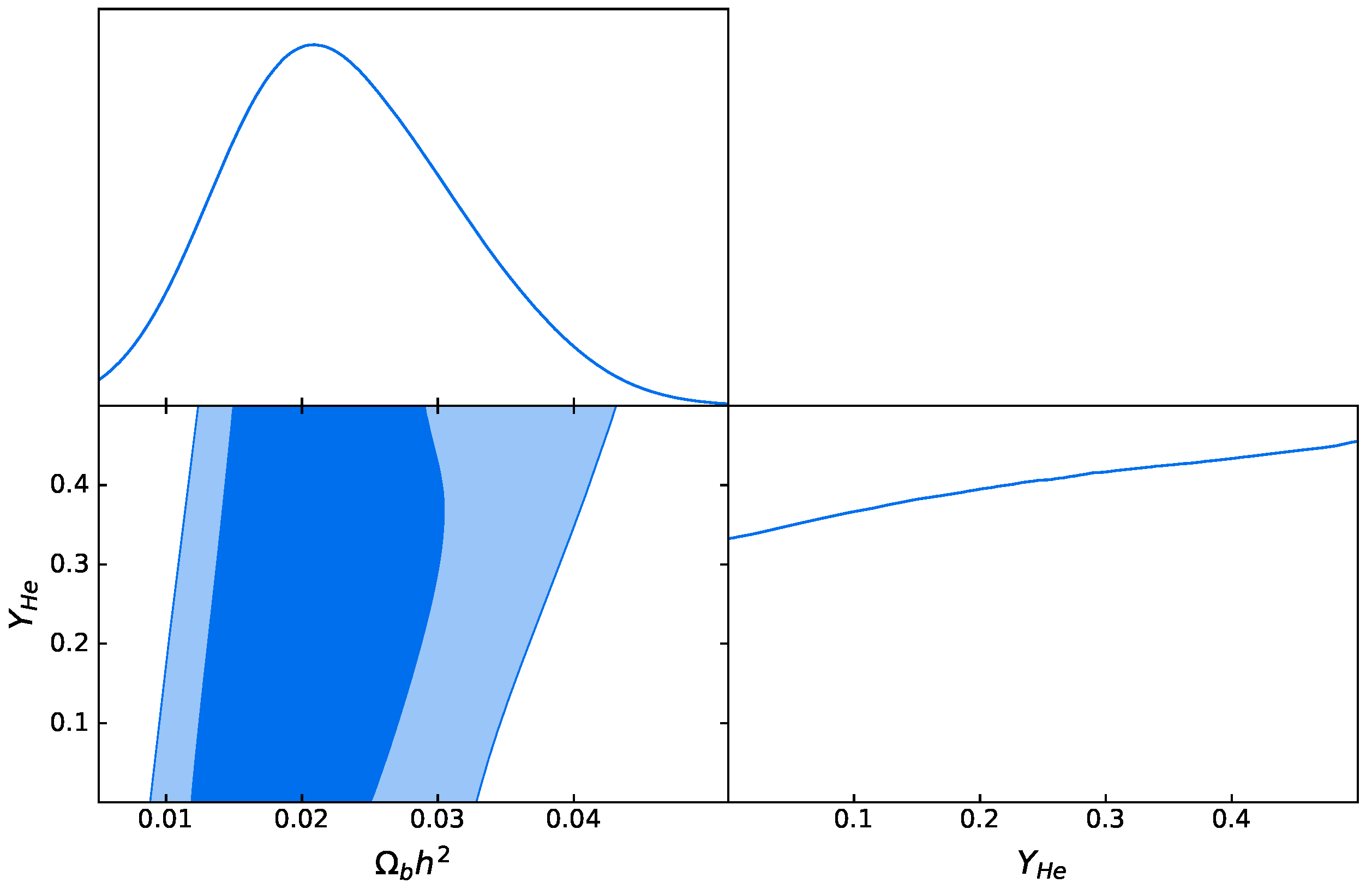
In Figure 1, we see that the current 17 FRB data had very limited constraining ability for the helium abundance, whose posterior distribution was almost flat. The main reason is that the redshifts of these 17 FRBs are relatively low, while the helium abundance is associated with the universe at higher redshifts. Therefore, it is impossible to understand cosmological information at high redshifts through these FRBs with low redshifts. Second, in Figure 1, we also show the constraint on the baryon energy density , which was also very weak compared to other observations. According to Equation (5), there is a strong degeneracy between and , which was also confirmed in the two-dimensional constraint of Figure 1. Therefore, it is very difficult to obtain useful results only from the 17 current FRBs’ data.
Figure 1.
One-dimensional and two-dimensional constraints on the and from the 17 current FRBs.
4. Future Prospects
The current limited FRB data can not provide precise constraints on the helium abundance. Fortunately, the amount of available FRBs is expected to grow quickly over the next few years. In this section, we investigate the constraining ability of FRBs on the helium abundance from a future mock sample.
4.1. Mock Data
Qiang and Wei [50] studied the effect of the FRB redshift distribution on cosmological constraints in detail. However, the current limited samples can not provide us with the accurate information of FRBs’ redshift distribution. For simplicity, we generated the mock data from the FRB redshift distribution following the galaxy distribution, which can be written as:
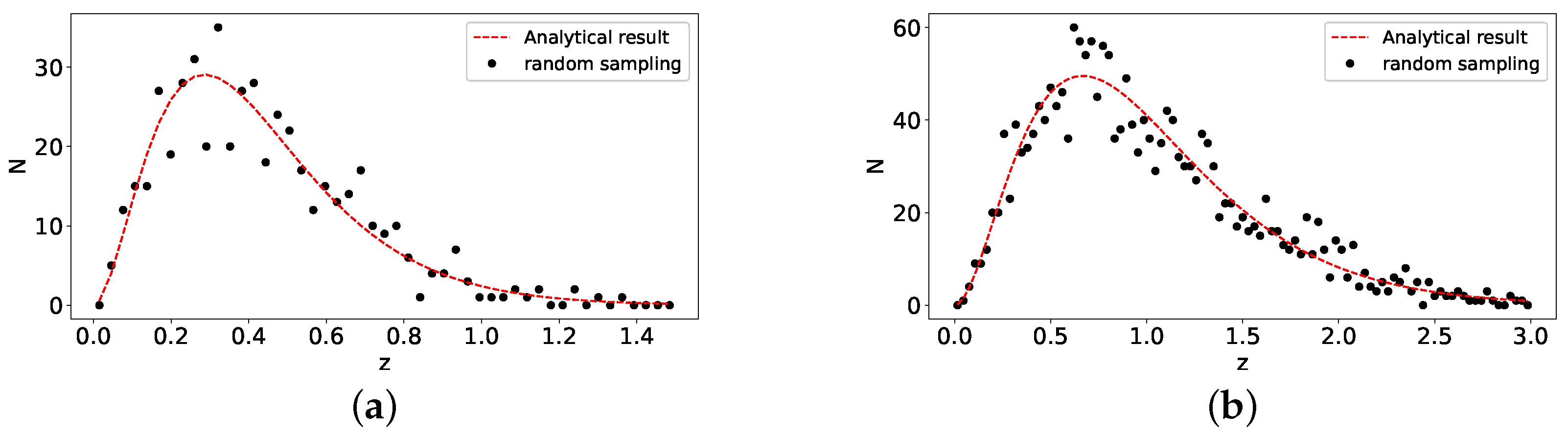
where denotes the effective depth of the sample. Considering that the majority of FRB detection lies most likely at lower redshifts , we firstly created a sharp cutoff with and, conservativelym generated 500 samples up to (the conservative case). On the other hand, since the future SKA measurement has sufficient sensitivity to detect high-redshift FRBs, we also set to generate 2000 samples up to for comparison (the high-redshift case). The fiducial values of the related parameters were: , , , , and to generate , and the obtained sampling results are shown in Figure 2 for these two cases.
Figure 2.
Redshift distributions of the simulated FRBs samples. (a) Conservative case: 500 FRBs with . (b) High-redshift case: 2000 FRBs with .
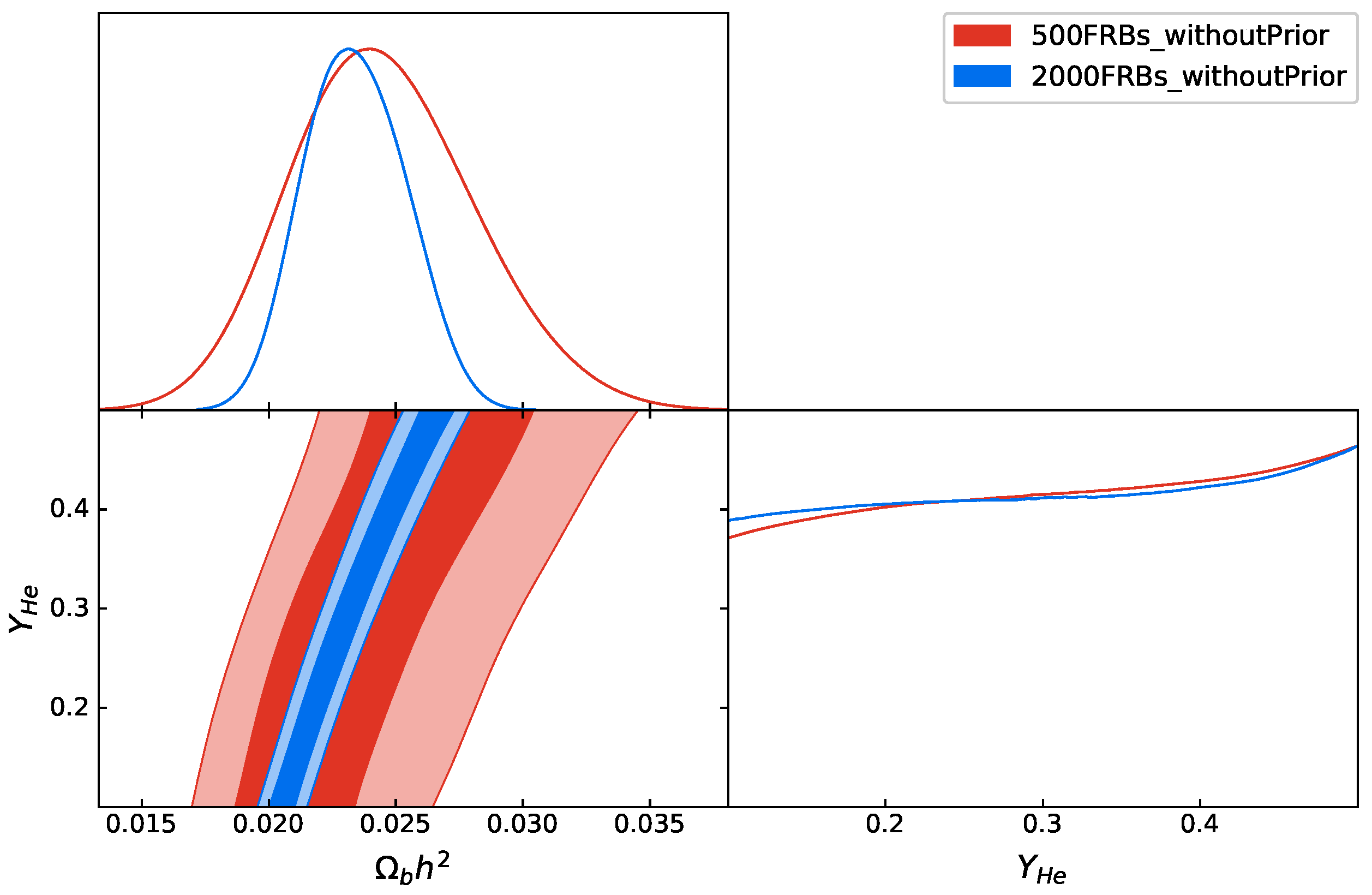
Extrapolating from the current uncertainty of the measurement, the constraint on the baryon energy density was improved by a factor of 2, when considering the conservative case with . If we further consider the higher redshift case with FRB data, the limit on would further improved, and the standard deviation is about . However, as can be seen in Figure 3, unfortunately, no matter what kind of mock data we consider, it is still impossible to give a reasonably restricted result for the helium abundance. This is because although the number of mock data has enlarged, if we cannot provide better constraints on by using other independent observations, the strong degeneracy between the helium abundance and the baryon energy density still cannot be broken, and the constraints on the helium abundance also will not be improved.
Figure 3.
One-dimensional and two-dimensional constraints on the and from the conservative case with (red) and the high-redshift case with (blue).
4.2. Shift Parameters
There are several studies on the degeneracies between cosmological parameters [51,52,53], and one way to break the degeneracy between and is usually to use a Gaussian prior on , as given by Cooke et al. [54]. In this paper, we introduce the shift parameters from the CMB measurements, which provides partial information of the CMB anisotropies, especially the distance information, which can provide constraints of cosmological parameters to some extent without using the CMB full power spectra [55,56]. When compared with the CMB full data, we can obtain similar results on parameters by using the shift parameter method, without consuming too much time. In practice, we firstly used the full CMB power spectrum from Planck to obtain the best-fit values and the inverse covariance matrix of these shift parameters, and then input them into our calculations as a prior to break the degeneracy. It is worth noting that breaking the degeneracy with a Gaussian prior gives about the same effect; we introduced the method of shift parameters, since our calculations of the inverse covariance matrix among these shift parameters can also be applied in constraining other models.
The shift parameters, R and , correspond to the scaled distance to recombination and the angular scale of the sound horizon at recombination, respectively, given by
where denotes the comoving distance to , and denotes the comoving sound horizon at . Furthermore, the decoupling epoch, , is given by [57]
where
The comoving sound horizon is given by
where for , and
where is the dark energy density parameter, and the radiation density parameter, , is the sum of photons and relativistic neutrinos,
where is the effective number of neutrino species.
We performed a global fitting analysis using the CosmoMC package to constrain R, , and from the CMB power spectrum of the Planck measurement in the framework of the standard CDM model. Our most general parameter space follows Equation (6), fixes , and varies , , , , , and in our analysis. In Table 2, we list the mean values of R, , and and the inverse covariance matrix among them. It is worth noting that the matrix we used was based on a fixed , and the result did not change significantly if we vary .
Table 2.
The mean values of shift parameters: and from the Planck measurement and the corresponding inverse covariance matrix among them.
Since we put the information of the shift parameters into the calculations, which is independent on the DM of the FRBs, the joint likelihood of the sample is then the product of the individual likelihoods, and the corresponding function becomes:
where the function of shift parameters can be written as:
where is the parameter vector, and is the inverse covariance matrix among these shift parameters, which is shown in Table 2. In our analysis, we adopted this updated likelihood function, which included the information of , to break the degeneracy between and .
4.3. Results from DM and Shift Parameters
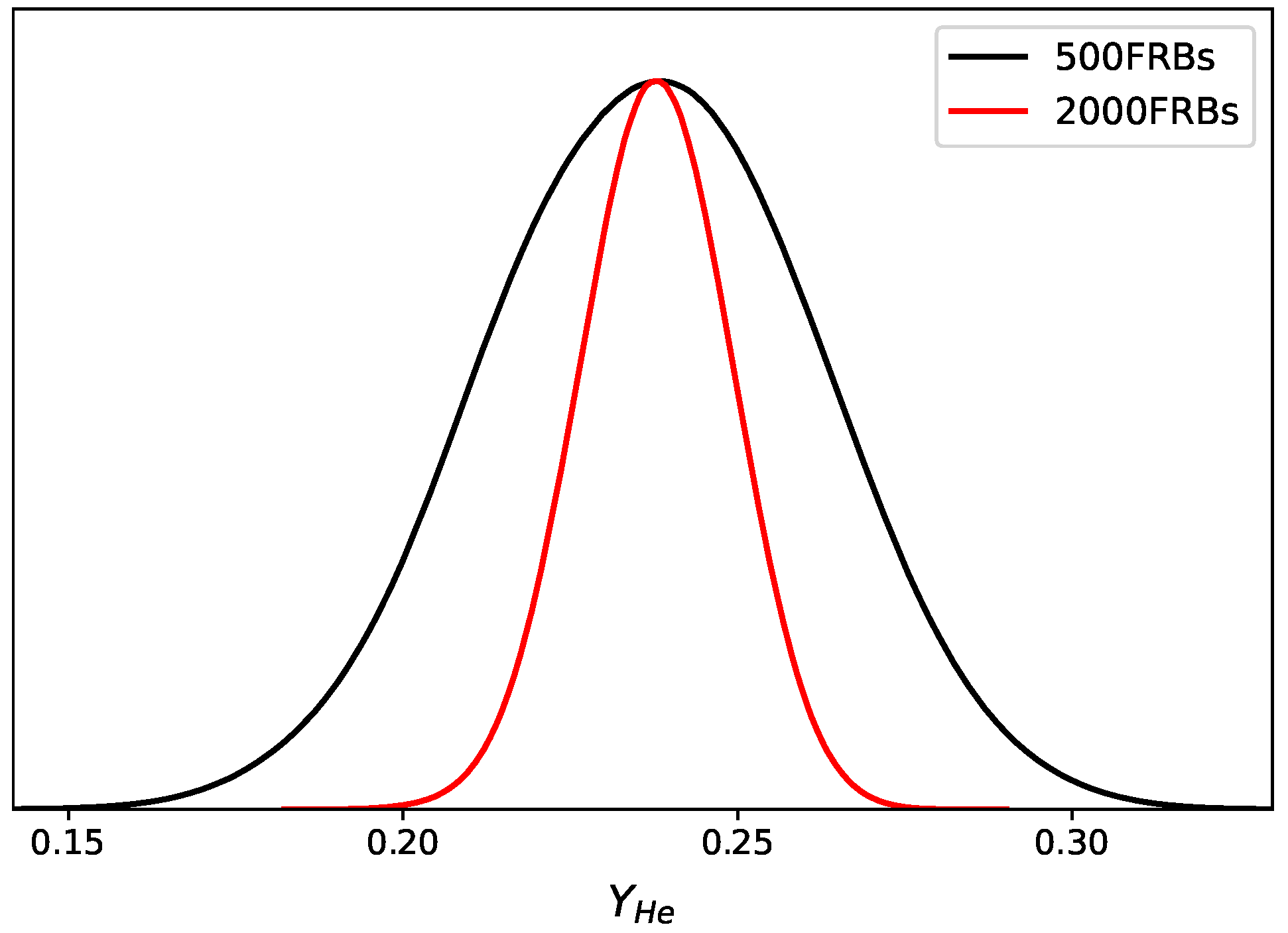
Firstly, we considered the conservative case with mock data. In Figure 4, we present the one-dimensional constraint on the helium abundance from the FRB DM data, together with the prior of shift parameters. We can clearly see that, due to the tight constraint on the baryon energy density, , the degeneracy between and has been broken entirely. The consequent constraint on the helium abundance becomes reasonable with the standard deviation , instead of an almost flat distribution, as shown in Figure 3. Furthermore, this constraint is not much different from the current CMB constraint at a 95% confidence level and BBN constraint . This result indicates that with the help of external shift parameters information, we can use the DM of FRBs mock data to provide a good constraint on the helium abundance.
Figure 4.
One-dimensional constraints on the helium abundance from the conservative case (black line) and the high-redshift case (red line), respectively.
Then, we moved to the high-redshift case with more FRB data and a higher redshift distribution up to . Since the obtained error bar on the parameters should be smaller with , we expect that the constraint on the helium abundance would be improved by a factor of 2. In practice, we used the 2000 mock FRBs and the shift parameters to perform the analysis and obtain the standard deviation of the helium abundance , which was slightly better than we expected, as shown in the red line of Figure 4. We think that this is due to the redshift distribution of these mock data, which was higher than the conservative case. We could have more information from the high redshift universe to study the helium abundance, which would be helpful to improve the constraint on . In the future, the SKA project expects to detect FRB samples with redshifts up to 14 [58], which implies FRB could be a very promising probe to study the high-redshift universe.
5. Conclusions
In this paper, we performed an analysis to study the helium abundance by using current and future FRB data, based on the DM-z relation. Here, we summarize our main conclusions:
- Since the 17 current FRB samples have low redshift, resulting in poor quality of the samples, we could not obtain a useful constraint on the helium abundance, which is associated with the universe at higher redshifts.
- Then we simulated two mock data: the conservative case at low redshift and the high-redshift case. However, due to the strong degeneracy between the helium abundance and the baryon energy density, the constraints on were still very weak from the mock FRB data.
- Therefore, we introduced the distance information of shift parameters, derived from the CMB full power spectra of the Planck measurement. With this help, the constraint on the baryon energy density was significantly improved, and the degeneracy with was broken.
- Consequently, the constraints on the helium abundance were also improved with the standard deviation and for two FRBs’ mock data, respectively. As can be seen from the current CMB constraint at a 95% confidence level and BBN constraint , the constraints from the FRBs are comparable. Hopefully, large FRB samples with high redshift from the Square Kilometre Array will provide high-precision measurements of the helium abundance in the near future.
Author Contributions
Formal analysis, J.-Q.X.; investigation, L.J.; Writing—original draft preparation, L.J.; Writing—review and editing, J.-Q.X. All authors have read and agreed to the published version of the manuscript.
Funding
J.-Q.X. is supported by the National Science Foundation of China under grants No. U1931202 and 12021003; the National Key R&D Program of China No. 2020YFC2201603.
Institutional Review Board Statement
Not applicable.
Informed Consent Statement
Not applicable.
Data Availability Statement
Data relevant to this study are available on request to the corresponding author.
Acknowledgments
We thank Zheng-Xiang Li, Yang-Jie Yan, Ji-Ping Dai, and Ran Gao for useful discussions.
Conflicts of Interest
The authors declare no conflict of interest.
Note
| 1 | http://frbhosts.org (accessed on 17 April 2022). |
References
- Lorimer, D.R.; Bailes, M.; McLaughlin, M.A.; Narkevic, D.J.; Crawford, F. A Bright Millisecond Radio Burst of Extragalactic Origin. Science 2007, 318, 777. [Google Scholar] [CrossRef] [Green Version]
- Thornton, D.; Stappers, B.; Bailes, M.; Barsdell, B.; Bates, S.; Bhat, N.D.R.; Burgay, M.; Burke-Spolaor, S.; Champion, D.J.; Coster, P.; et al. A Population of Fast Radio Bursts at Cosmological Distances. Science 2013, 341, 53–56. [Google Scholar] [CrossRef] [PubMed]
- Petroff, E.; Bailes, M.; Barr, E.D.; Barsdell, B.R.; Bhat, N.D.R.; Bian, F.; Burke-Spolaor, S.; Caleb, M.; Champion, D.; Chandra, P.; et al. A real-time fast radio burst: Polarization detection and multiwavelength follow-up. MNRAS 2015, 447, 246–255. [Google Scholar] [CrossRef] [Green Version]
- CHIME/FRB Collaboration; Andersen, B.C.; Bandura, K.M.; Bhardwaj, M.; Bij, A.; Boyce, M.M.; Boyle, P.J.; Brar, C.; Cassanelli, T.; Chawla, P.; et al. A bright millisecond-duration radio burst from a Galactic magnetar. Nature 2020, 587, 54–58. [Google Scholar] [CrossRef]
- Metzger, B.D.; Margalit, B.; Sironi, L. Fast radio bursts as synchrotron maser emission from decelerating relativistic blast waves. MNRAS 2019, 485, 4091–4106. [Google Scholar] [CrossRef] [Green Version]
- Kumar, P.; Bošnjak, Ž. FRB coherent emission from decay of Alfvén waves. MNRAS 2020, 494, 2385–2395. [Google Scholar] [CrossRef]
- Lu, W.; Kumar, P.; Zhang, B. A unified picture of Galactic and cosmological fast radio bursts. MNRAS 2020, 498, 1397–1405. [Google Scholar] [CrossRef]
- Vachaspati, T. Cosmic Sparks from Superconducting Strings. Phys. Rev. Lett. 2008, 101, 141301. [Google Scholar] [CrossRef] [Green Version]
- Geng, J.; Li, B.; Huang, Y. Repeating fast radio bursts from collapses of the crust of a strange star. Innovation 2021, 2, 100152. [Google Scholar] [CrossRef]
- CHIME/FRB Collaboration; Amiri, M.; Bandura, K.; Berger, P.; Bhardwaj, M.; Boyce, M.M.; Boyle, P.J.; Brar, C.; Burhanpurkar, M.; Chawla, P.; et al. The CHIME Fast Radio Burst Project: System Overview. ApJ 2018, 863, 48. [Google Scholar] [CrossRef]
- Petroff, E.; Barr, E.D.; Jameson, A.; Keane, E.F.; Bailes, M.; Kramer, M.; Morello, V.; Tabbara, D.; van Straten, W. FRBCAT: The Fast Radio Burst Catalogue. PASA 2016, 33, e045. [Google Scholar] [CrossRef] [Green Version]
- Johnston, K.; Oswalt, T.; Valls-Gabaud, D. Statistical Modeling and Analysis of Wide Binary Star Systems. In Binary Stars as Critical Tools & Tests in Contemporary Astrophysics; Hartkopf, W.I., Harmanec, P., Guinan, E.F., Eds.; Cambridge University Press: Cambridge, UK, 2007; Volume 240, p. 429. [Google Scholar]
- Fialkov, A.; Loeb, A. A Fast Radio Burst Occurs Every Second throughout the Observable Universe. Astrophys. J. Lett. 2017, 846, L27. [Google Scholar] [CrossRef]
- Spitler, L.G.; Scholz, P.; Hessels, J.W.T.; Bogdanov, S.; Brazier, A.; Camilo, F.; Chatterjee, S.; Cordes, J.M.; Crawford, F.; Deneva, J.; et al. A repeating fast radio burst. Nature 2016, 531, 202–205. [Google Scholar] [CrossRef] [Green Version]
- Hagstotz, S.; Reischke, R.; Lilow, R. A new measurement of the Hubble constant using fast radio bursts. MNRAS 2022, 511, 662–667. [Google Scholar] [CrossRef]
- Wu, Q.; Zhang, G.Q.; Wang, F.Y. An 8 per cent determination of the hubble constant from localized fast radio bursts. Mon. Not. R. Astron. Soc. Lett. 2022, slac022. [Google Scholar] [CrossRef]
- Gao, H.; Li, Z.; Zhang, B. Fast Radio Burst/Gamma-Ray Burst Cosmography. ApJ 2014, 788, 189. [Google Scholar] [CrossRef]
- Li, Z.; Gao, H.; Wei, J.J.; Yang, Y.P.; Zhang, B.; Zhu, Z.H. Cosmology-independent Estimate of the Fraction of Baryon Mass in the IGM from Fast Radio Burst Observations. ApJ 2019, 876, 146. [Google Scholar] [CrossRef]
- Dai, J.P.; Xia, J.Q. Reconstruction of baryon fraction in intergalactic medium through dispersion measurements of fast radio bursts. Mon. Not. Roy. Astron. Soc. 2021, 503, 4576–4580. [Google Scholar] [CrossRef]
- Dai, J.P.; Xia, J.Q. Reconstruction of reionization history through dispersion measurements of fast radio bursts. J. Cosmol. Astropart. Phys. 2021, 2021, 050. [Google Scholar] [CrossRef]
- Planck Collaboration; Ade, P.A.R.; Aghanim, N.; Arnaud, M.; Ashdown, M.; Aumont, J.; Baccigalupi, C.; Banday, A.J.; Barreiro, R.B.; Bartlett, J.G.; et al. Planck 2015 results. XIII. Cosmological parameters. Astron. Astrophys. 2016, 594, A13. [Google Scholar] [CrossRef] [Green Version]
- Planck Collaboration; Aghanim, N.; Akrami, Y.; Ashdown, M.; Aumont, J.; Baccigalupi, C.; Ballardini, M.; Banday, A.J.; Barreiro, R.B.; Bartolo, N.; et al. Planck 2018 results. VI. Cosmological parameters. Astron. Astrophys. 2020, 641, A6. [Google Scholar] [CrossRef] [Green Version]
- Aver, E.; Olive, K.A.; Skillman, E.D. The effects of He I λ10830 on helium abundance determinations. J. Cosmol. Astropart. Phys. 2015, 2015, 011. [Google Scholar] [CrossRef] [Green Version]
- Peimbert, A.; Peimbert, M.; Luridiana, V. The primordial helium abundance and the number of neutrino families. Rev. Mexicana Astron. Astrofis. 2016, 52, 419. [Google Scholar]
- Izotov, Y.I.; Thuan, T.X.; Guseva, N.G. A new determination of the primordial He abundance using the He I λ10830 Å emission line: Cosmological implications. MNRAS 2014, 445, 778–793. [Google Scholar] [CrossRef]
- Leath, H.J.; Beasley, M.A.; Vazdekis, A.; Salvador-Rusiñol, N.; Gvozdenko, A. Inferring the helium abundance of extragalactic globular clusters using integrated spectra. MNRAS 2022, 512, 548–562. [Google Scholar] [CrossRef]
- Aver, E.; Olive, K.A.; Porter, R.L.; Skillman, E.D. The primordial helium abundance from updated emissivities. J. Cosmol. Astropart. Phys. 2013, 2013, 017. [Google Scholar] [CrossRef] [Green Version]
- Matsumoto, A.; Ouchi, M.; Nakajima, K.; Kawasaki, M.; Murai, K.; Motohara, K.; Harikane, Y.; Ono, Y.; Kushibiki, K.; Koyama, S.; et al. EMPRESS. VIII. A New Determination of Primordial He Abundance with Extremely Metal-Poor Galaxies: A Suggestion of the Lepton Asymmetry and Implications for the Hubble Tension. arXiv 2022, arXiv:2203.09617. [Google Scholar]
- Deng, W.; Zhang, B. Cosmological Implications of Fast Radio Burst/Gamma-Ray Burst Associations. ApJ 2014, 783, L35. [Google Scholar] [CrossRef] [Green Version]
- McQuinn, M. Locating the “Missing” Baryons with Extragalactic Dispersion Measure Estimates. ApJ 2014, 780, L33. [Google Scholar] [CrossRef] [Green Version]
- Cordes, J.M.; Lazio, T.J.W. NE2001.I. A New Model for the Galactic Distribution of Free Electrons and its Fluctuations. arXiv 2002, arXiv:astro-ph/0207156. [Google Scholar]
- Manchester, R.N.; Hobbs, G.B.; Teoh, A.; Hobbs, M. The Australia Telescope National Facility Pulsar Catalogue. AJ 2005, 129, 1993–2006. [Google Scholar] [CrossRef]
- Macquart, J.P.; Prochaska, J.X.; McQuinn, M.; Bannister, K.W.; Bhandari, S.; Day, C.K.; Deller, A.T.; Ekers, R.D.; James, C.W.; Marnoch, L.; et al. A census of baryons in the Universe from localized fast radio bursts. Nature 2020, 581, 391–395. [Google Scholar] [CrossRef] [PubMed]
- Ioka, K. The Cosmic Dispersion Measure from Gamma-Ray Burst Afterglows: Probing the Reionization History and the Burst Environment. ApJ 2003, 598, L79–L82. [Google Scholar] [CrossRef] [Green Version]
- Kirsten, F.; Marcote, B.; Nimmo, K.; Hessels, J.W.T.; Bhardwaj, M.; Tendulkar, S.P.; Keimpema, A.; Yang, J.; Snelders, M.P.; Scholz, P.; et al. A repeating fast radio burst source in a globular cluster. Nature 2022, 602, 585–589. [Google Scholar] [CrossRef] [PubMed]
- Bhardwaj, M.; Kirichenko, A.Y.; Michilli, D.; Mayya, Y.D.; Kaspi, V.M.; Gaensler, B.M.; Rahman, M.; Tendulkar, S.P.; Fonseca, E.; Josephy, A.; et al. A Local Universe Host for the Repeating Fast Radio Burst FRB 20181030A. ApJ 2021, 919, L24. [Google Scholar] [CrossRef]
- Chatterjee, S.; Law, C.J.; Wharton, R.S.; Burke-Spolaor, S.; Hessels, J.W.T.; Bower, G.C.; Cordes, J.M.; Tendulkar, S.P.; Bassa, C.G.; Demorest, P.; et al. A direct localization of a fast radio burst and its host. Nature 2017, 541, 58–61. [Google Scholar] [CrossRef] [Green Version]
- Marcote, B.; Nimmo, K.; Hessels, J.W.T.; Tendulkar, S.P.; Bassa, C.G.; Paragi, Z.; Keimpema, A.; Bhardwaj, M.; Karuppusamy, R.; Kaspi, V.M.; et al. A repeating fast radio burst source localized to a nearby spiral galaxy. Nature 2020, 577, 190–194. [Google Scholar] [CrossRef]
- Bannister, K.W.; Deller, A.T.; Phillips, C.; Macquart, J.P.; Prochaska, J.X.; Tejos, N.; Ryder, S.D.; Sadler, E.M.; Shannon, R.M.; Simha, S.; et al. A single fast radio burst localized to a massive galaxy at cosmological distance. Science 2019, 365, 565–570. [Google Scholar] [CrossRef] [Green Version]
- Prochaska, J.X.; Macquart, J.P.; McQuinn, M.; Simha, S.; Shannon, R.M.; Day, C.K.; Marnoch, L.; Ryder, S.; Deller, A.; Bannister, K.W.; et al. The low density and magnetization of a massive galaxy halo exposed by a fast radio burst. Science 2019, 366, 231–234. [Google Scholar] [CrossRef] [Green Version]
- Bhandari, S.; Sadler, E.M.; Prochaska, J.X.; Simha, S.; Ryder, S.D.; Marnoch, L.; Bannister, K.W.; Macquart, J.P.; Flynn, C.; Shannon, R.M.; et al. The Host Galaxies and Progenitors of Fast Radio Bursts Localized with the Australian Square Kilometre Array Pathfinder. ApJ 2020, 895, L37. [Google Scholar] [CrossRef]
- Ravi, V.; Catha, M.; D’Addario, L.; Djorgovski, S.G.; Hallinan, G.; Hobbs, R.; Kocz, J.; Kulkarni, S.R.; Shi, J.; Vedantham, H.K.; et al. A fast radio burst localized to a massive galaxy. Nature 2019, 572, 352–354. [Google Scholar] [CrossRef] [PubMed]
- Heintz, K.E.; Prochaska, J.X.; Simha, S.; Platts, E.; Fong, W.f.; Tejos, N.; Ryder, S.D.; Aggerwal, K.; Bhandari, S.; Day, C.K.; et al. Host Galaxy Properties and Offset Distributions of Fast Radio Bursts: Implications for Their Progenitors. ApJ 2020, 903, 152. [Google Scholar] [CrossRef]
- Chittidi, J.S.; Simha, S.; Mannings, A.; Prochaska, J.X.; Ryder, S.D.; Rafelski, M.; Neeleman, M.; Macquart, J.P.; Tejos, N.; Jorgenson, R.A.; et al. Dissecting the Local Environment of FRB 190608 in the Spiral Arm of its Host Galaxy. ApJ 2021, 922, 173. [Google Scholar] [CrossRef]
- Law, C.J.; Butler, B.J.; Prochaska, J.X.; Zackay, B.; Burke-Spolaor, S.; Mannings, A.; Tejos, N.; Josephy, A.; Andersen, B.; Chawla, P.; et al. A Distant Fast Radio Burst Associated with Its Host Galaxy by the Very Large Array. ApJ 2020, 899, 161. [Google Scholar] [CrossRef]
- Day, C.K.; Bhandari, S.; Deller, A.T.; Shannon, R.M.; Moss, V.A. ASKAP localisation of the FRB 20201124A source. Astron. Telegr. 2021, 14515, 1. [Google Scholar]
- Ravi, V.; Law, C.J.; Li, D.; Aggarwal, K.; Burke-Spolaor, S.; Connor, L.; Lazio, T.J.W.; Simard, D.; Somalwar, J.; Tendulkar, S.P. The host galaxy and persistent radio counterpart of FRB 20201124A. arXiv 2021, arXiv:2106.09710. [Google Scholar] [CrossRef]
- Bhandari, S.; Heintz, K.E.; Aggarwal, K.; Marnoch, L.; Day, C.K.; Sydnor, J.; Burke-Spolaor, S.; Law, C.J.; Xavier Prochaska, J.; Tejos, N.; et al. Characterizing the Fast Radio Burst Host Galaxy Population and its Connection to Transients in the Local and Extragalactic Universe. AJ 2022, 163, 69. [Google Scholar] [CrossRef]
- Lewis, A.; Bridle, S. Cosmological parameters from CMB and other data: A Monte Carlo approach. Phys. Rev. D 2002, 66, 103511. [Google Scholar] [CrossRef] [Green Version]
- Qiang, D.C.; Wei, H. Effect of redshift distributions of fast radio bursts on cosmological constraints. Phys. Rev. D 2021, 103, 083536. [Google Scholar] [CrossRef]
- Scóccola, C.G.; Sánchez, A.G.; Rubiño-Martín, J.A.; Génova-Santos, R.; Rebolo, R.; Ross, A.J.; Percival, W.J.; Manera, M.; Bizyaev, D.; Brownstein, J.R.; et al. The clustering of galaxies in the SDSS-III Baryon Oscillation Spectroscopic Survey: Constraints on the time variation of fundamental constants from the large-scale two-point correlation function. MNRAS 2013, 434, 1792–1807. [Google Scholar] [CrossRef] [Green Version]
- Keisler, R.; Reichardt, C.L.; Aird, K.A.; Benson, B.A.; Bleem, L.E.; Carlstrom, J.E.; Chang, C.L.; Cho, H.M.; Crawford, T.M.; Crites, A.T.; et al. A Measurement of the Damping Tail of the Cosmic Microwave Background Power Spectrum with the South Pole Telescope. ApJ 2011, 743, 28. [Google Scholar] [CrossRef]
- Caramete, A.; Popa, L.A. Cosmological evidence for leptonic asymmetry after Planck. J. Cosmol. Astropart. Phys. 2014, 2014, 012. [Google Scholar] [CrossRef]
- Cooke, R.J.; Pettini, M.; Steidel, C.C. One Percent Determination of the Primordial Deuterium Abundance. ApJ 2018, 855, 102. [Google Scholar] [CrossRef] [Green Version]
- Wang, Y.; Mukherjee, P. Observational constraints on dark energy and cosmic curvature. Phys. Rev. D 2007, 76, 103533. [Google Scholar] [CrossRef] [Green Version]
- Li, H.; Xia, J.Q.; Zhao, G.B.; Fan, Z.H.; Zhang, X. On Using the WMAP Distance Information in Constraining the Time-evolving Equation of State of Dark Energy. ApJ 2008, 683, L1. [Google Scholar] [CrossRef] [Green Version]
- Eisenstein, D.J.; Hu, W. Baryonic Features in the Matter Transfer Function. ApJ 1998, 496, 605–614. [Google Scholar] [CrossRef]
- Fialkov, A.; Loeb, A. Constraining the CMB optical depth through the dispersion measure of cosmological radio transients. J. Cosmol. Astropart. Phys. 2016, 2016, 004. [Google Scholar] [CrossRef] [Green Version]
Publisher’s Note: MDPI stays neutral with regard to jurisdictional claims in published maps and institutional affiliations. |
© 2022 by the authors. Licensee MDPI, Basel, Switzerland. This article is an open access article distributed under the terms and conditions of the Creative Commons Attribution (CC BY) license (https://creativecommons.org/licenses/by/4.0/).