


Abstract
In recent years, NICER data have been extensively used to determine neutron star masses and radii via pulse profile modeling. Pulse profile modeling is implemented with the X-PSI package, and the best-fit parameters are typically obtained using Bayesian inference. Using simulated data, we demonstrate the first ever application of frequentist inference to determine the neutron star radius, where the nuisance parameters are treated using profile likelihood. We find that the profile likelihood technique can recover the true radius to <. The uncertainty in the estimated radius is also comparable to that obtained from Bayesian analysis while being computationally much faster. Therefore, this work serves as a proof-of-principle application of frequentist inference to estimate neutron star radii using pulse profile modeling and complements the Bayesian inference technique currently used. We have also made our analysis codes for frequentist inference using X-PSI publicly available.
1. Introduction
The Neutron Star Interior Composition Explorer (NICER) is an X-ray satellite that has facilitated precise measurements of neutron star masses and radii through its timing precision since its launch in 2017 [1]. The mass and radius have been determined through detailed analysis of the associated X-ray emissions via pulse profile modeling for a large number of neutron stars [2,3]. The mass and radius measurements can provide stringent constraints on the neutron star equation of state [4]. The analysis of the X-ray pulse profiles is usually performed using the X-ray Pulse Simulation and Inference package (X-PSI) [5]. This package is a ray-tracing code that models the phase- and energy-dependent emission from hot spots and the bulk of the rotating neutron star surface. This package enables simultaneous modeling of hot-spot geometry and atmospheric emission while incorporating both special and general relativistic effects within the oblate Schwarzschild framework. More details of the physics inputs used in X-PSI are described elsewhere [6,7]. This package provides parameter estimates for a neutron star’s mass, radius, and emission geometry using Bayesian inference [8]. The sampling of posteriors required for Bayesian inference is performed using the MultiNest [9] and UltraNest [10] software packages, both based on nested sampling. The X-PSI package has been widely used in a number of works, e.g., [3,11,12,13] (and also the references therein).
However, discrepancies in the inferred radius have been found in the literature among different studies using this package. For instance, Ref. [11] obtained an equatorial radius of km for PSR J0740+6620, whereas a value of km was obtained for the same source in Ref. [12]. The discrepancy was attributed to a combination of multiple factors: the choice of priors, the posterior sampler used, and a lack of convergence due to improper settings used in the samplers [11,14]. Similar differences in results from nested samplers have also been found in the posteriors obtained from merging compact binaries [15].
To test this conjecture, the parameter estimation accuracy of MultiNest was compared with that of another sampler, namely, UltraNest, with synthetic (simulated) data that mimic the real NICER data of PSR J0740+6620 [14] (H25, hereafter). UltraNest is based on the Sliced Sampling Technique [16] and is known to be more robust than MultiNest, although it is much slower. Using numerical experiments, it was shown that both samplers produced unbiased results for parameter estimation [14]. Subsequently, it was also shown that both samplers produce consistent credible intervals on real data from PSR J0740+6620. Nevertheless, some concerns about the convergence of MultiNest were raised in H25. This work found that convergence was challenging due to the flat likelihood surface for radii km, which makes it difficult to constrain the upper limit. Furthermore, as the radius increases, additional degeneracies arise. They also cautioned that higher sampling settings are needed for real data to fully explore the parameter space. Such tests require more computational resources and hence were not carried out in H25. Furthermore, another caveat relating to Bayesian parameter inference is that, when the prior ranges for the free parameters are broad, the marginalization needed for parameter estimation can be affected by volume effects, which could introduce a non-negligible bias into the parameter estimates [17].
In order to alleviate the aforementioned concerns regarding Bayesian parameter estimation in X-PSI, we demonstrate how one can use frequentist techniques based on profile likelihood to infer the neutron star radius. Although Bayesian statistics have been the industry standard in astrophysics and cosmology for the past two decades, in recent years, there has been a resurgence of interest in the application of profile likelihood in parameter estimation [18,19,20,21,22,23]. We note, however, that particle physics and particle astrophysics still mostly use frequentist inference for parameter estimation [24]. Frequentist parameter estimation does not require the specification of priors or entail the use of a sampler, and hence one does not need to worry about convergence issues. Therefore, frequentist inference should be immune to the inconsistencies found in Bayesian determinations of neutron star radii. However, frequentist inference techniques also make implicit assumptions [22], and the minimization algorithms implemented could become trapped in local minima when dealing with a large multidimensional parameter space. Therefore, given the importance of results from X-PSI for fundamental physics, it is incumbent upon us to compare the results obtained using Bayesian and frequentist inference, which is the goal of this work.
2. Analysis
We describe the methodology used in both the standard Bayesian and frequentist inference pipelines to compare and contrast the estimated parameter values along with their associated uncertainties.
All analyses were performed using the X-PSI pulse profile modeling framework. The Bayesian and frequentist pipelines share an identical likelihood implementation and astrophysical model configuration, thereby ensuring a consistent basis for comparison between the two methodologies. We describe each of them below.
2.1. Bayesian Analysis
For Bayesian analysis, we followed the same settings as in H25. We provide a brief description of Bayesian parameter inference below. More details can be found in [25]. The posterior probability for the dataset d can be written as follows:
where is the likelihood used, denotes the parameter vector containing the free parameters used in the model, and Pr() denotes the prior for each of the free parameters in . X-PSI uses a Poisson likelihood, whose details can be found elsewhere [26]. X-PSI allows for up to 16 free parameters, as tabulated in Table 1 of [26]. For this work, the Bayesian posterior was sampled using MultiNest interfaced with X-PSI. The adopted pulse profile model was the ST-U configuration, consisting of two single-temperature, simply connected circular hot regions with independent parameters. The neutron star atmosphere was modeled using the NSX fully ionized hydrogen atmosphere model [27,28], while photon propagation was calculated using general-relativistic ray tracing in the oblate Schwarzschild spacetime approximation.
2.2. Frequentist Analysis
Frequentist parameter estimation was performed using a profile likelihood framework implemented directly on top of the X-PSI likelihood evaluation module. No modifications were made to the underlying physical model. All settings were kept unchanged from H25, ensuring that differences between the Bayesian and frequentist analyses arose solely from the inference methodology. We provide a brief outline of parameter estimation using profile likelihood. More details and applications to astrophysics and cosmology can be found in [22,23] (and the references therein).
Let us consider a parameter estimation problem where the parameter vector () consists of two parameters: . Here, denotes the parameter of interest and the nuisance parameter. In frequentist statistics, the profile likelihood is calculated by maximizing the likelihood with respect to :
This method is sometimes referred to as graphical profile likelihood in the literature [22]. The parameter estimate for can be obtained from the distribution of . For computational simplicity, we define , and the frequentist confidence intervals are constructed from , where is the global minimum of . To obtain confidence intervals, we use Wilks’ theorem, which states that follows a distribution with one degree of freedom [22,29].
For our particular problem, the parameter of interest, the equatorial radius , was fixed, while the likelihood was maximized over the remaining 12 free nuisance parameters. These nuisance parameters included the neutron star mass, source distance, cosine of the observer inclination, primary and secondary hot-spot phase shifts, colatitudes, angular radii, temperatures, and the interstellar hydrogen column density. Hence, we obtained a likelihood profile for the equatorial radius where each point on the profile represents the maximum likelihood obtained after optimizing over all other free model parameters. The optimization was carried out using the Nelder–Mead simplex algorithm [30] as implemented in scipy.optimize.minimize.
3. Results
The Bayesian and frequentist inference procedures were applied to the same synthetic NICER and XMM-Newton datasets discussed in H25. H25 provides 10 synthetic PSR J0740+6620-like NICER and XMM-Newton datasets. For this analysis, we used the dataset in the first column in Table 1 of H25 [14], labeled (syntX1). In Appendix A, we perform a similar test with another such synthetic dataset.
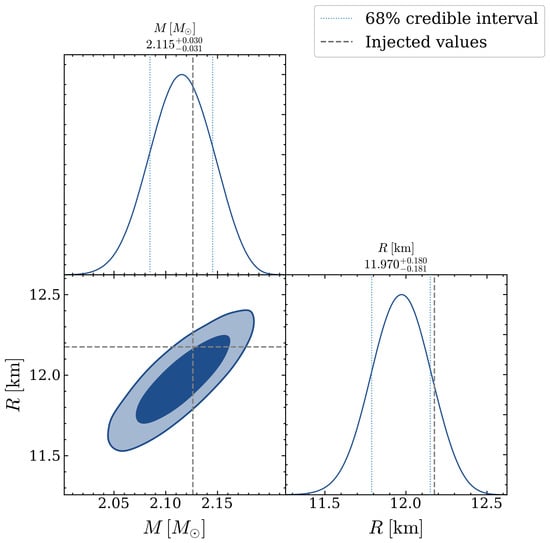
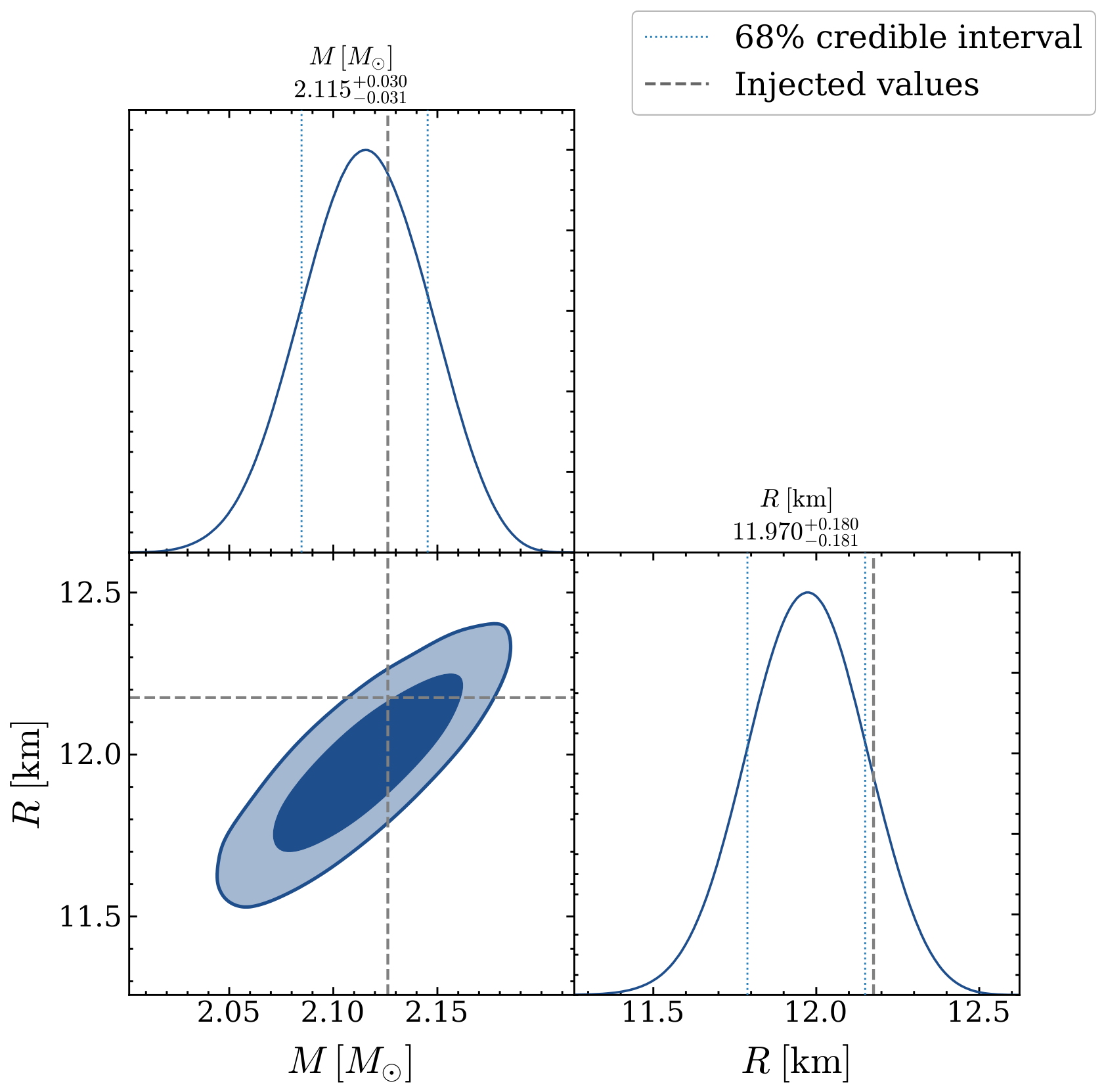
The resulting Bayesian credible intervals for the mass and radius, together with the frequentist profile likelihood, are shown in Figure 1 and Figure 2, respectively. We now present the results for each analysis.
Figure 1.
The blue shaded regions represent the marginalized (68% and 95%) credible intervals (obtained using the MultiNest sampler) for neutron star mass and equatorial radius , along with the 1-D 68% credible intervals, inferred from X-ray pulse profile modeling using the synthetic data subset syntX1. The gray dashed line indicates the injected (true) parameter values. The corner plots were obtained using the getdist package [31].
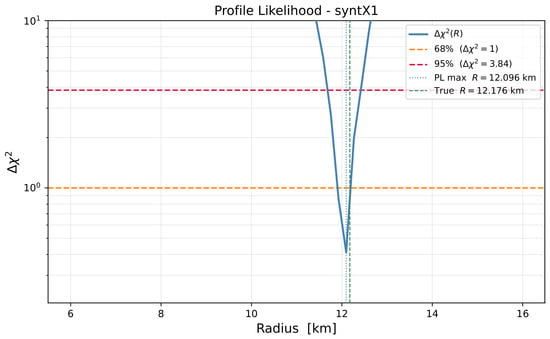
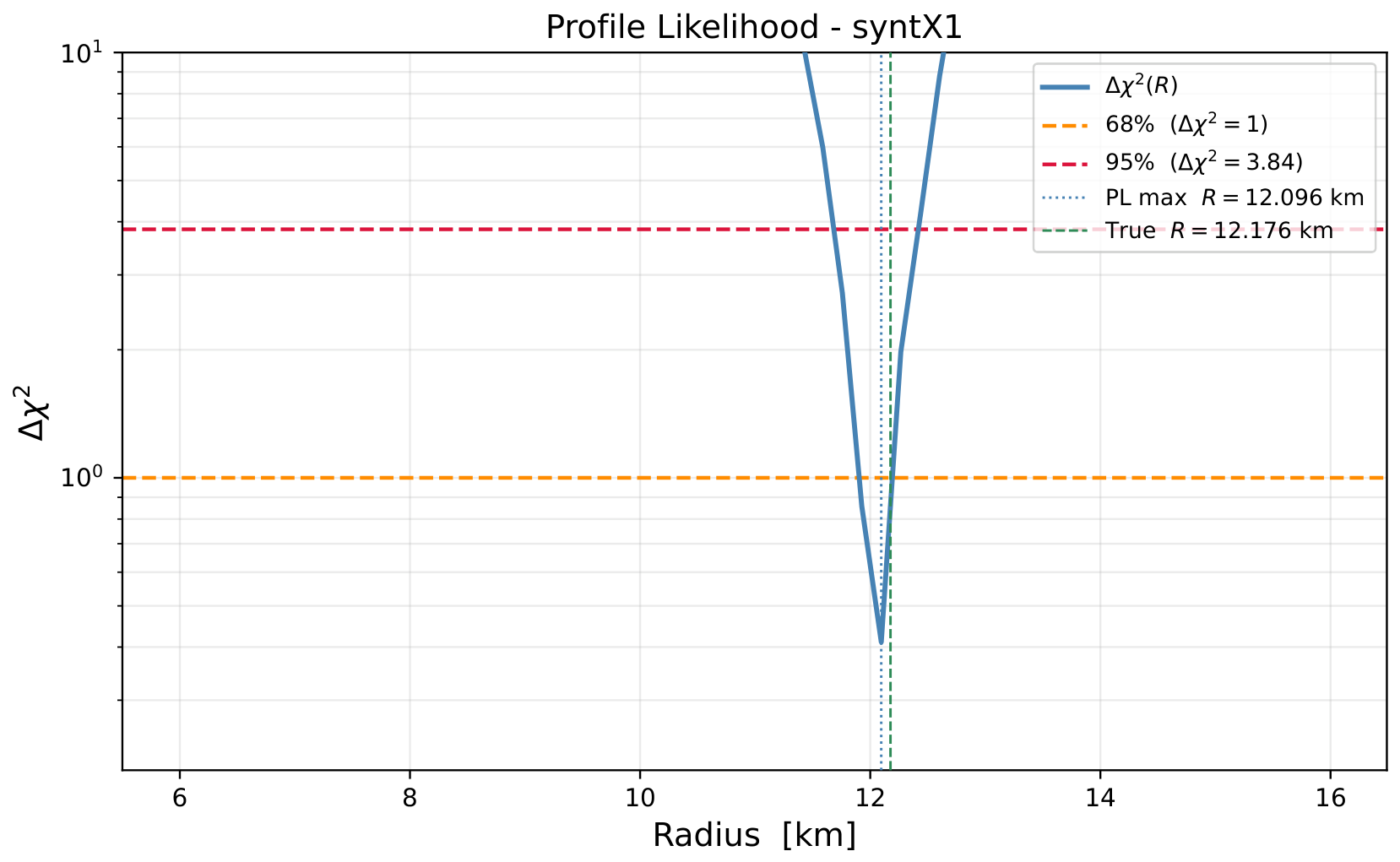
Figure 2.
as a function of the neutron star radius, inferred from X-ray pulse profile modeling using the synthetic data subset syntX1, where . The profile likelihood () is defined in Equation (2), and is the global maximum of the likelihood. The horizontal dashed lines mark the 68% () and 95% () confidence thresholds. The dotted green vertical line denotes the true injected radius, while the blue dotted line illustrates the recovered best-fit radius from the profile likelihood analysis.
Figure 1 shows the 68% and 95% credible intervals for two parameters, namely, the mass and the radius of the neutron star, obtained from the MultiNest nested sampling analysis. The joint mass–radius posterior is marginalized over the remaining 11 nuisance parameters. The true injected radius corresponding to the truth value in the simulated data and specific to syntX1 is also overlaid for comparison. The posterior distributions for the neutron star mass and the equatorial radius are well localized around the injected values, indicating successful recovery of the underlying model parameters. Hence, we obtain 68% credible intervals for the neutron star mass and equatorial radius. The 68% marginalized credible interval for the radius is km, whereas the injected radius is 12.176 km. Therefore, the radius inferred using Bayesian analysis agrees with the injected radius to within .
Figure 2 presents the frequentist profile likelihood as a function of the neutron star equatorial radius, obtained by maximizing the likelihood for each radius value over all other model parameters. We observe a single, well-defined minimum at km, in the vicinity of the true injected radius. Furthermore, the injected radius, km, lies close to the profile likelihood estimate, and is consistent with the inferred confidence intervals from the profile. The confidence interval for the radius is km, and the confidence interval for the radius is km. Therefore, the frequentist estimate for the radius agrees with the injected radius to within , assuming the larger of the two 68% confidence interval uncertainties. This significance of is based on the difference between the frequentist and Bayesian estimates divided by the uncertainty in the Bayesian estimate. This precision is also comparable to that of the Bayesian estimate.
To quantify the computational efficiency of the two inference frameworks, we compare their total computational costs for completing an inference run. For this comparison, we consider only the analysis runs using the low-resolution settings for X-PSI, as described in H25 [14]. The frequentist profile likelihood analysis required approximately 9 CPU-core hours, while the Bayesian analysis required wall-clock hours on a 48-core computing node. This corresponds to approximately 3840 CPU-core hours and is of the same order of magnitude as the computational cost reported in H25 (4.8K CPU-core hours). Despite the lower computational cost, the profile likelihood approach yielded parameter constraints that are comparable in precision with the Bayesian estimate. Further, the difference from the injected value is smaller for the frequentist estimate () than for the Bayesian estimate (). Therefore, our results demonstrate that frequentist parameter estimation can complement Bayesian estimates of neutron star radii using pulse profile modeling.
4. Conclusions
For this comparison, we present a proof-of-principle determination of a neutron star radius via pulse profile modeling with the X-PSI package using a frequentist profile likelihood framework to complement the Bayesian inference technique normally used. Using synthetic data, we demonstrate that frequentist inference can recover the true neutron star radius to an accuracy of <. Its precision based on synthetic data is comparable to that of Bayesian analysis while requiring substantially less computational time than the MultiNest-based Bayesian inference used in X-PSI. We caution, however, that all our tests are based only on data simulated using the X-PSI package. This package does not simulate the full NICER observing pipeline or the detector environment. A non-exhaustive list of systematics that are not included in this package but affect real NICER observations includes particle-induced background, diffuse X-ray background, unresolved astrophysical sources, time-variable or orbit-dependent background, solar activity, and geomagnetic effects, among others [32]. We have not yet applied this frequentist technique to real NICER or XMM-Newton data. Therefore, it remains to be determined whether the conclusions drawn from the application to synthetic data can be extrapolated to real observations. In future work, we shall investigate this by applying the technique to real pulsar data from NICER, XMM-Newton, and other observatories.
In the spirit of open science, we have made our profile likelihood-based modification to X-PSI publicly available, and it can be found at https://github.com/vyaas3305/xpsi-frequentist-inference (accessed on 28 August 2026).
Author Contributions
Conceptualization, S.D. and V.R.; methodology, V.R.; software, V.R.; validation, V.R.; formal analysis, V.R.; writing—original draft preparation, S.D. and V.R.; writing—review and editing, S.D. and V.R. All authors have read and agreed to the published version of the manuscript.
Funding
This research received no external funding.
Data Availability Statement
No real observational data were used for this analysis. The synthetic data used for the analysis are available at https://zenodo.org/records/17776943 (accessed on 28 August 2026). The analysis codes used for this work have been made available at https://github.com/vyaas3305/xpsi-frequentist-inference (accessed on 28 August 2026).
Acknowledgments
During the preparation of this manuscript/study, the author(s) used Anthropic Claude and OpenAI ChatGPT for help with code changes. The authors have reviewed and edited the output and take full responsibility for the content of this publication. The authors also thank Mariska Hoogkamer for her valuable assistance in resolving installation issues encountered during the setup of X-PSI. We are also grateful to the anonymous referees for the constructive feedback on our manuscript. Computational work was supported by the National Supercomputing Mission (NSM) of the Government of India through access to the “PARAM SEVA” facility at IIT Hyderabad. The NSM is implemented by the Centre for Development of Advanced Computing (C-DAC) with funding from the Ministry of Electronics and Information Technology (MeitY) and the Department of Science and Technology (DST).
Conflicts of Interest
The authors declare no conflicts of interest.
Appendix A. Test with Additional Synthetic Dataset
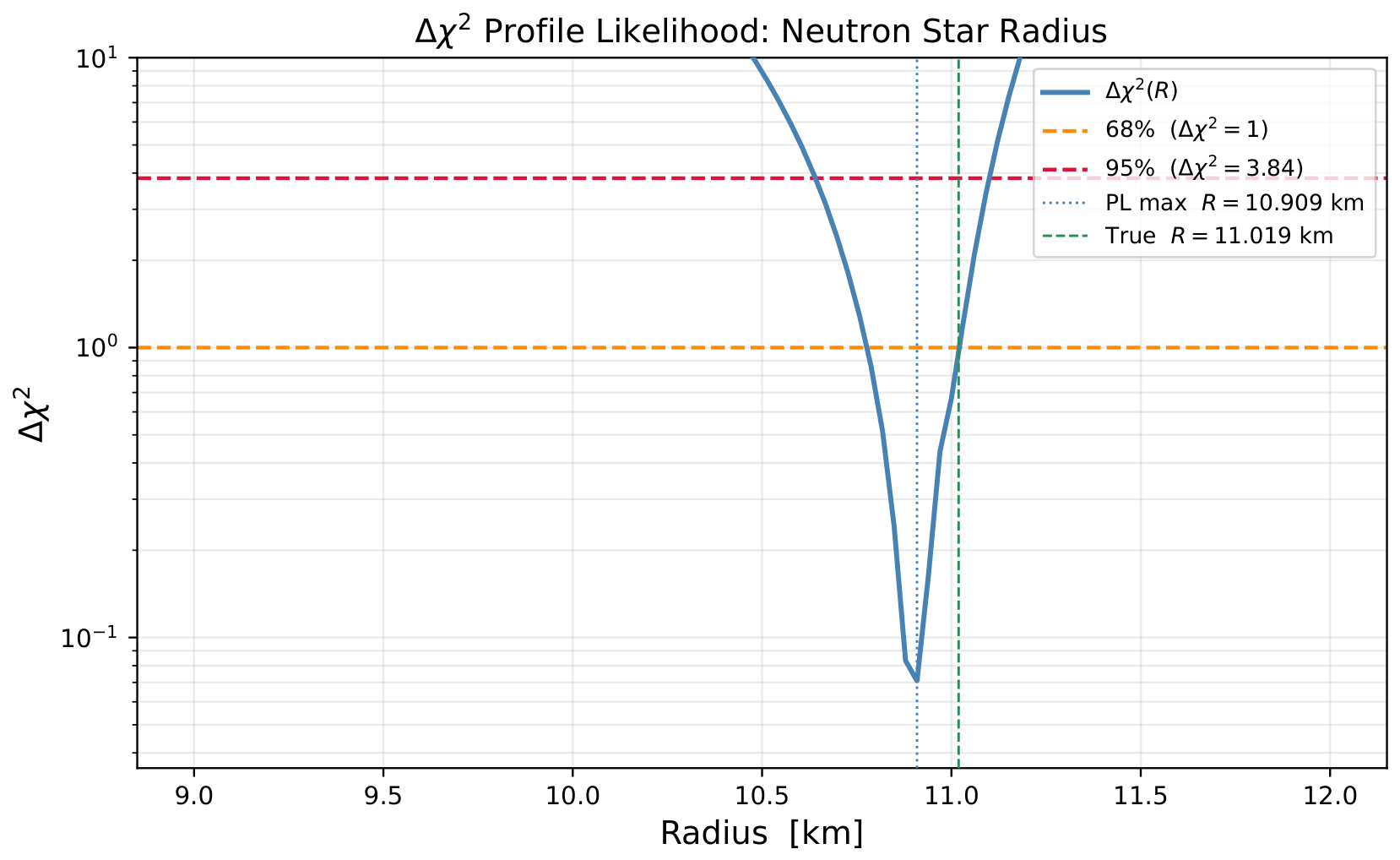
We now perform the same analysis as in the main manuscript for an additional synthetic dataset. The second dataset we use is described in the second column of Table 1 of H25 [14] and is labeled syntX2. The injected radius for this dataset is equal to 11.019 km. The Bayesian posterior credible intervals obtained using MultiNest are shown in Figure A1. The marginalized 68% credible interval value for the radius is km. The corresponding profile likelihood plot is shown in Figure A2. We find that the frequentist estimate of the radius at the 68% confidence level is km. Therefore, the radius estimated using the profile likelihood agrees with the injected radius to within . However, for this dataset, the Bayesian estimate is closer to the injected radius than the frequentist value.
Figure A1.
Marginalized (68% and 95%) credible intervals (obtained using the MultiNest sampler) for neutron star mass and equatorial radius , along with the 1-D 68% credible intervals, inferred from X-ray pulse profile modeling of synthetic data subset syntX2. The gray vertical dashed line indicates the injected (true) parameter values. The corner plots were obtained using the getdist package.
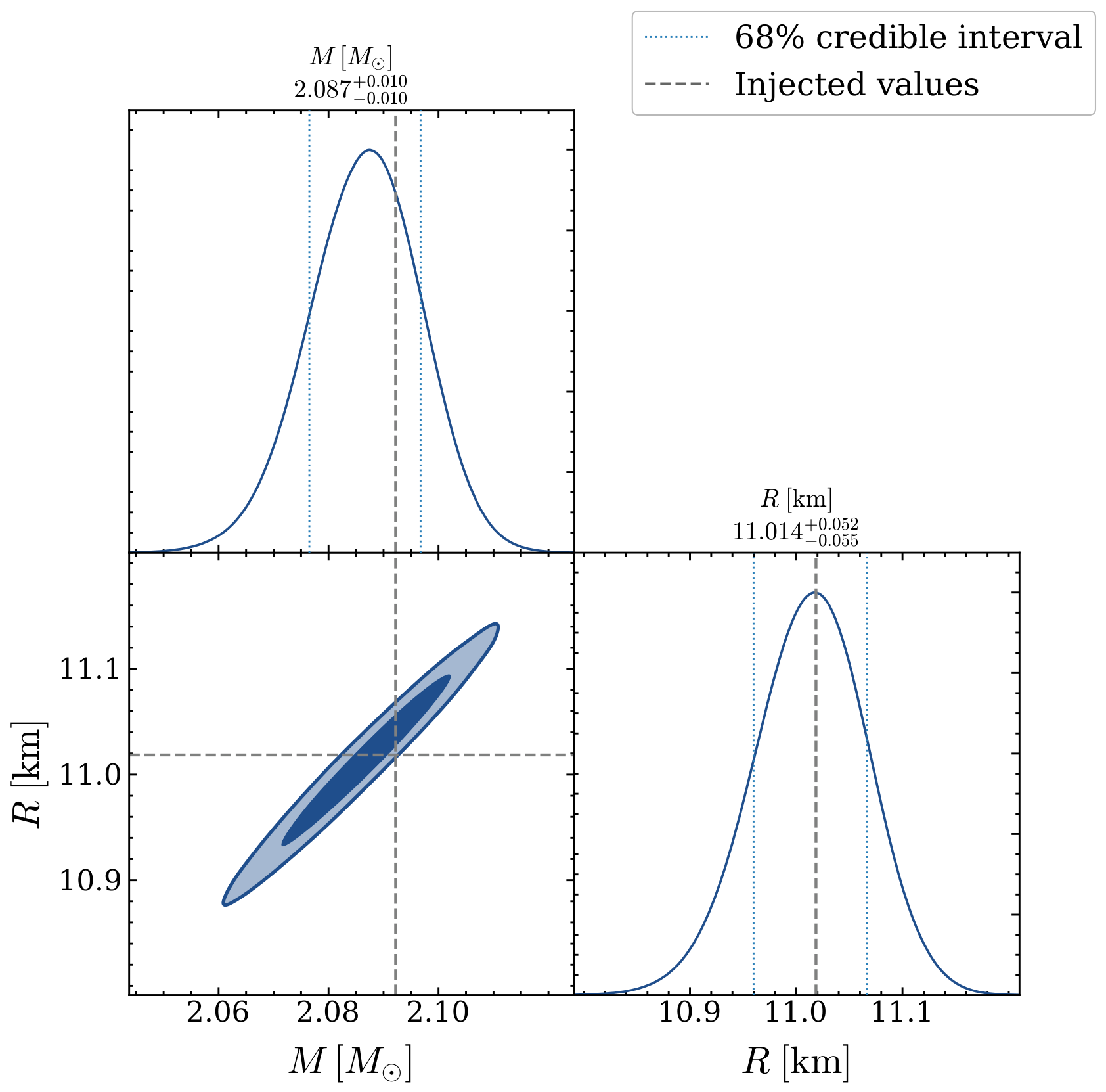
Figure A2.
as a function of the neutron star radius, inferred from X-ray pulse profile modeling of synthetic data subset syntX2, where , similar to Figure 2. The horizontal dashed lines mark the 68% () and 95% () confidence thresholds. The dotted green vertical line denotes the true injected radius, while the blue dotted line illustrates the recovered best-fit radius from the profile likelihood analysis.
References
- Gendreau, K.C.; Arzoumanian, Z.; Adkins, P.W.; Albert, C.L.; Anders, J.F.; Aylward, A.T.; Baker, C.L.; Balsamo, E.R.; Bamford, W.A.; Benegalrao, S.S.; et al. The Neutron star Interior Composition Explorer (NICER): Design and development. In Proceedings of the Space Telescopes and Instrumentation 2016: Ultraviolet to Gamma Ray; Society of Photo-Optical Instrumentation Engineers (SPIE) Conference Series; den Herder, J.W.A., Takahashi, T., Bautz, M., Eds.; SPIE: Bellingham, WA, USA, 2016; Volume 9905, p. 99051H. [Google Scholar] [CrossRef] [Scilit]
- Watts, A.L.; Andersson, N.; Chakrabarty, D.; Feroci, M.; Hebeler, K.; Israel, G.; Lamb, F.K.; Miller, M.C.; Morsink, S.; Özel, F.; et al. Colloquium: Measuring the neutron star equation of state using x-ray timing. Rev. Mod. Phys. 2016, 88, 021001. [Google Scholar] [CrossRef] [Scilit]
- González-Caniulef, D.; Guillot, S.; Stammler, P.; Mauviard, L.; Kazantsev, C.; Watts, A.L.; Choudhury, D.; Dorsman, B.; Hoogkamer, M.; Huppenkothen, D.; et al. A NICER view of the millisecond pulsar PSR J2124-3358: Evidence for a helium atmosphere. arXiv 2026, arXiv:2607.03721. [Google Scholar]
- Özel, F.; Freire, P. Masses, Radii, and the Equation of State of Neutron Stars. Annu. Rev. Astron. Astrophys. 2016, 54, 401–440. [Google Scholar] [CrossRef] [Scilit]
- Riley, T.E.; Choudhury, D.; Salmi, T.; Vinciguerra, S.; Kini, Y.; Dorsman, B.; Watts, A.L.; Huppenkothen, D.; Guillot, S. X-PSI: A Python Package for Neutron Star X-Ray Pulse Simulation and Inference. 2023. Available online: https://zenodo.org/records/7632629 (accessed on 28 August 2026).
- AlGendy, M.; Morsink, S.M. Universality of the Acceleration due to Gravity on the Surface of a Rapidly Rotating Neutron Star. Astrophys. J. 2014, 791, 78. [Google Scholar] [CrossRef] [Scilit]
- Bogdanov, S.; Rybicki, G.B.; Grindlay, J.E. Constraints on Neutron Star Properties from X-Ray Observations of Millisecond Pulsars. Astrophys. J. 2007, 670, 668–676. [Google Scholar] [CrossRef] [Scilit]
- Trotta, R. Bayesian Methods in Cosmology. arXiv 2017. [Google Scholar] [CrossRef] [Scilit]
- Feroz, F.; Hobson, M.P. Multimodal nested sampling: An efficient and robust alternative to Markov Chain Monte Carlo methods for astronomical data analyses. Mon. Not. R. Astron. Soc. 2008, 384, 449–463. [Google Scholar] [CrossRef] [Scilit]
- Buchner, J. UltraNest-a robust, general purpose Bayesian inference engine. J. Open Source Softw. 2021, 6, 3001. [Google Scholar] [CrossRef] [Scilit]
- Salmi, T.; Choudhury, D.; Kini, Y.; Riley, T.E.; Vinciguerra, S.; Watts, A.L.; Wolff, M.T.; Arzoumanian, Z.; Bogdanov, S.; Chakrabarty, D.; et al. The Radius of the High-mass Pulsar PSR J0740+6620 with 3.6 yr of NICER Data. Astrophys. J. 2024, 974, 294. [Google Scholar] [CrossRef] [Scilit]
- Dittmann, A.J.; Miller, M.C.; Lamb, F.K.; Holt, I.M.; Chirenti, C.; Wolff, M.T.; Bogdanov, S.; Guillot, S.; Ho, W.C.G.; Morsink, S.M.; et al. A More Precise Measurement of the Radius of PSR J0740+6620 Using Updated NICER Data. Astrophys. J. 2024, 974, 295. [Google Scholar] [CrossRef] [Scilit]
- Mauviard, L.; Guillot, S.; Salmi, T.; Choudhury, D.; Dorsman, B.; González-Caniulef, D.; Hoogkamer, M.; Huppenkothen, D.; Kazantsev, C.; Kini, Y.; et al. A NICER View of the 1.4 M⊙ Edge-on Pulsar PSR J0614-3329. Astrophys. J. 2025, 995, 60. [Google Scholar] [CrossRef] [Scilit]
- Hoogkamer, M.; Kini, Y.; Salmi, T.; Watts, A.L.; Buchner, J. Cross-comparison of sampling algorithms for pulse profile modeling of PSR J0740+6620. Phys. Rev. D 2025, 112, 023008. [Google Scholar] [CrossRef] [Scilit]
- Ashton, G.; Talbot, C. BILBY-MCMC: An MCMC sampler for gravitational-wave inference. Mon. Not. R. Astron. Soc. 2021, 507, 2037–2051. [Google Scholar] [CrossRef] [Scilit]
- Buchner, J. Comparison of Step Samplers for Nested Sampling. Phys. Sci. Forum 2022, 5, 46. [Google Scholar] [CrossRef] [Scilit]
- Gómez-Valent, A. Fast test to assess the impact of marginalization in Monte Carlo analyses and its application to cosmology. Phys. Rev. D 2022, 106, 063506. [Google Scholar] [CrossRef] [Scilit]
- Herold, L.; Ferreira, E.G.M.; Komatsu, E. New Constraint on Early Dark Energy from Planck and BOSS Data Using the Profile Likelihood. Astrophys. J. Lett. 2022, 929, L16. [Google Scholar] [CrossRef] [Scilit]
- Campeti, P.; Komatsu, E. New Constraint on the Tensor-to-scalar Ratio from the Planck and BICEP/Keck Array Data Using the Profile Likelihood. Astrophys. J. 2022, 941, 110. [Google Scholar] [CrossRef] [Scilit]
- Karwal, T.; Patel, Y.; Bartlett, A.; Poulin, V.; Smith, T.L.; Pfeffer, D.N. Procoli: Profiles of cosmological likelihoods. arXiv 2024. [Google Scholar] [CrossRef] [Scilit]
- Barua, S.; Desai, S.; Lopez-Hernandez, M.; Ó Colgáin, E. On frequentist confidence intervals in a non-Gaussian regime. Eur. Phys. J. C 2026, 86, 47. [Google Scholar] [CrossRef] [Scilit]
- Herold, L.; Ferreira, E.G.M.; Heinrich, L. Profile likelihoods in cosmology: When, why, and how illustrated with ΛCDM, massive neutrinos, and dark energy. Phys. Rev. D 2025, 111, 083504. [Google Scholar] [CrossRef] [Scilit]
- Ramakrishnan, V.; Desai, S. Constraints on Lorentz Invariance Violation from Gamma-Ray Burst Rest-Frame Spectral Lags Using Profile Likelihood. Universe 2025, 11, 183. [Google Scholar] [CrossRef] [Scilit]
- Navas, S.; Amsler, C.; Gutsche, T.; Hanhart, C.; Hernandez-Rey, J.J.; Lourenco, C.; Masoni, A.; Mikhasenko, M.; Mitchell, R.E.; Patrignani, C.; et al. Review of particle physics. Phys. Rev. D 2024, 110, 030001. [Google Scholar] [CrossRef] [Scilit]
- Trotta, R. Bayes in the sky: Bayesian inference and model selection in cosmology. Contemp. Phys. 2008, 49, 71–104. [Google Scholar] [CrossRef] [Scilit]
- Riley, T.E.; Watts, A.L.; Ray, P.S.; Bogdanov, S.; Guillot, S.; Morsink, S.M.; Bilous, A.V.; Arzoumanian, Z.; Choudhury, D.; Deneva, J.S.; et al. A NICER View of the Massive Pulsar PSR J0740+6620 Informed by Radio Timing and XMM-Newton Spectroscopy. Astrophys. J. Lett. 2021, 918, L27. [Google Scholar] [CrossRef] [Scilit]
- Ho, W.C.G.; Lai, D. Atmospheres and spectra of strongly magnetized neutron stars. Mon. Not. R. Astron. Soc. 2001, 327, 1081–1096. [Google Scholar] [CrossRef] [Scilit]
- Ho, W.C.G.; Heinke, C.O. A neutron star with a carbon atmosphere in the Cassiopeia A supernova remnant. Nature 2009, 462, 71–73. [Google Scholar] [CrossRef] [Scilit] [PubMed]
- Wilks, S.S. The large-sample distribution of the likelihood ratio for testing composite hypotheses. Ann. Math. Stat. 1938, 9, 60–62. [Google Scholar] [CrossRef] [Scilit]
- Press, W.H.; Teukolsky, S.A.; Vetterling, W.T.; Flannery, B.P. Numerical Recipes in C: The Art of Scientific Computing; Cambridge University Press: Cambridge, UK, 1992. [Google Scholar]
- Lewis, A. GetDist: A Python package for analysing Monte Carlo samples. J. Cosmol. Astropart. Phys. 2025, 2025, 025. [Google Scholar] [CrossRef] [Scilit]
- Remillard, R.A.; Loewenstein, M.; Steiner, J.F.; Prigozhin, G.Y.; LaMarr, B.; Enoto, T.; Gendreau, K.C.; Arzoumanian, Z.; Markwardt, C.; Basak, A.; et al. An Empirical Background Model for the NICER X-Ray Timing Instrument. Astron. J. 2022, 163, 130. [Google Scholar] [CrossRef] [Scilit]
Disclaimer/Publisher’s Note: The statements, opinions and data contained in all publications are solely those of the individual author(s) and contributor(s) and not of MDPI and/or the editor(s). MDPI and/or the editor(s) disclaim responsibility for any injury to people or property resulting from any ideas, methods, instructions or products referred to in the content. |
© 2026 by the authors. Licensee MDPI, Basel, Switzerland. This article is an open access article distributed under the terms and conditions of the Creative Commons Attribution (CC BY) license.