


Abstract
We review the properties of strongly interacting matter under the influence of an external magnetic field, with emphasis on results obtained using the Nambu–Jona–Lasinio model and its variants. Strong magnetic fields, relevant for heavy-ion collisions and magnetars, introduce modifications to the phase structure of quantum chromodynamics. In the first half of the review, we discuss the Nambu–Jona–Lasinio model and its major variants, including Polyakov loop extended model, Kobayashi–Masakawa–’tHooft extended model, entangled model, and nonlocal formulations, highlighting their successes and limitations. Particular attention is given to magnetic catalysis and inverse magnetic catalysis and the tension between model predictions and lattice simulation results. We further review the emergence of phases at high density and low temperature such as the magnetic color–flavor locked phase, the magnetic two-flavor superconducting phase, the crystalline color superconductor and magnetized quarkyonic matter, along with possible mesonic and meson condensation channels. Implications for strongly magnetized neutron stars are discussed wherever relevant. This review aims to provide a focused overview of the capabilities and limitations of approaches within the Nambu–Jona–Lasinio model and to outline open challenges in understanding strongly interacting magnetized matter at intermediate densities.
1. Introduction
Strongly interacting matter (SIM) under extreme conditions exhibits a rich phase structure, and intense effort has been invested in understanding the details of the phase diagram of quantum chromodynamics (QCD). The phase structure of QCD bears direct relevance to heavy-ion collisions, the early universe, and compact astrophysical objects such as magnetars where intense magnetic fields are naturally involved. The vast literature on this subject suggests that at low temperature and sufficiently high baryon density (equivalently, large baryon chemical potential), quarks can form color superconducting phases [1,2] with many variants, e.g., a two-flavor color superconductor (2SC) [2], a crystalline color superconductor (CCS) or LOFF phase [3,4,5], a color–flavor locked phase (CFL) [2] or a color-spin-locked phase [6]. Another interesting suggestion at intermediate baryon density is that of quarkyonic matter [7].
Among the various external conditions that can significantly influence the phase structure of SIM, strong magnetic fields play a particularly important role. There are numerous compelling reasons to expect that very strong magnetic fields existed in the early universe [8] and we may expect similar environments in relativistic heavy ion colliders [9], making these studies relevant across both cosmological and terrestrial laboratory settings. A clear motivation for studying magnetized SIM comes from Astrophysics. Neutron stars serve as natural astrophysical testing grounds that harbor extreme magnetic fields, and even more so in case of magnetars, whose surface magnetic fields can reach up to while internal fields can potentially reach up to . If the core density of these systems is sufficiently high to support superconducting quark phases, it can potentially have macroscopic influence, meaning that compact stars can serve as natural laboratories for dense matter in the presence of strong magnetic fields. Additional motivation arises from ultra relativistic heavy-ion collisions (RHIC), where extremely intense magnetic fields are created during collisions of ions for a very short time. Calculations of such spontaneously generated magnetic fields [9,10,11,12,13] estimate the magnitude of these magnetic fields to be as large as [14].
Moreover, magnetic fields introduce an additional scale in the system that can significantly modify the nature of chiral symmetry breaking. This is exemplified by the phenomenon of magnetic catalysis (MC) [15], where the chiral condensate is enhanced due to dimensional reduction [15] of quark dynamics. Many studies based on effective models of SIM have consistently predicted MC. However, lattice QCD (LQCD) results at finite temperature reveal a qualitatively different behavior of inverse magnetic catalysis (IMC) [16]. Reconciling these two seemingly contradictory phenomena is essential for constructing a consistent picture of the QCD phase diagram in extreme magnetic fields, and also for interpreting the imprints of such phases in magnetars and heavy-ion collisions. To investigate this rich phase structure, it is pertinent to ask which theoretical frameworks may be chosen that can reliably describe these phenomena.
Below a density , where is the nuclear saturation density, such systems can be described fairly accurately by chiral perturbation theory [17]. Beyond this density regime, predictions from the chiral expansion scheme come with large uncertainties. On the other extreme , perturbative QCD [18] gives accurate results but densities reached in RHIC or inside the core of magnetars fall in the regime of “intermediate densities” where neither of these formalisms are reliable. Effective models of QCD have emerged as a versatile framework to investigate these effects across a wide range of temperatures, densities, and magnetic field strengths. These models include the magnetized versions of Nambu–Jona–Lasinio (NJL) model [19,20], quark-meson model [21] and their Polyakov loop corrected versions [22,23] and Kobayashi–Maskawa–’t Hooft (KMT) extensions [24,25], nonlocal NJL model [26] as well as approaches based on Dyson–Schwinger formalism [27] and functional renormalization group techniques [28].
Given the multitude of competing and often seemingly contradictory effects induced by strong magnetic fields, a completely exhaustive review of recent developments based on existing literature is a daunting task. Therefore, the scope of this review is rather modest. We focus on summarizing the principal results obtained using the NJL model and its extensions that include magnetic fields. Wherever relevant, implications for strongly magnetized compact objects are also highlighted. This review is broadly organized into two parts. The first part presents the theoretical framework of NJL model and its extensions in the presence of a constant and uniform magnetic field. These include the Polyakov loop extended NJL (PNJL) model (Section 3.3), the entangled Polyakov loop extended NJL (EPNJL) model (Section 3.4), the NJL model with the KMT interaction (Section 3.5), the nonlocal NJL (NNJL) model (Section 3.6), its Polyakov loop extension (Section 3.7), and finally its KMT extension (Section 3.8).
The second part focuses on physical phenomena and phases of QCD in strong magnetic fields. We first discuss MC and IMC in Section 5.1, respectively. This is followed by a review of magnetized phases of QCD, including the magnetized CFL (MCFL) phase (Section 5.3), the magnetized 2SC phase, CCS/LOFF phase, and the associated chromomagnetic instability (Section 5.4), as well as magnetized quarkyonic matter (Section 5.5). We then examine the effects of magnetic fields on mesonic masses and condensates, e.g., pion and -meson condensates (Section 5.6 and Section 5.7). Finally, in Section 6, we present concluding remarks and highlight some avenues to add to the existing literature on the subject of this review.
2. Notations and Conventions
An inherent challenge in any wide survey of evolving research is the wide variety of notational conventions used across different works. In this review, we adhere to a single set of conventions wherever possible unless explicitly specified. We use the natural units with ℏ = c = = 1. All effective field-theoretic models are treated within the relativistic mean-field (RMF) approximation. A generic fermion multiplet is denoted by . We denote by , , and the number of colors, flavors, and spin degeneracies, respectively. The fields , , , and represent the scalar, vector, isovector, and pseudoscalar mesons. The chiral and diquark condensates are denoted by and , respectively. For fermions of flavor f, and (m and M in flavor degenerate case) denote the current and dynamical masses, respectively. In the absence of a magnetic field, the single-fermion dispersion relation will be written as and in the flavor-degenerate case, will be used.
In the presence of a uniform and static magnetic field of strength B (which will be assumed to be in the z-direction), the energy spectrum of charged fermions is quantized into Landau levels, and the corresponding dispersion relation should be changed as in terms of rotated charge of quarks and the Landau level index . However, wherever possible, we will use where a are the possible rotated charges of quarks in units of . The quantity , the momentum transverse to , is defined as if (in which case the index k will be dropped and will be written as ) and if . The Landau level degeneracy factor is defined as for a fermion of flavor f. Moreover, we will use , and where will denote the chemical potential of a fermion flavor f. The symbol will denote the highest occupied Landau level, where a momentum cut-off scale 0.6–0.7 GeV is introduced due to non-renormalizable interactions present in the NJL model. The inverse temperature will be written as , T being the temperature of the system. The quantities and will represent the Polyakov loop operator and its conjugate, respectively, while will denote the associated Polyakov loop potential. The thermodynamic grand potential will be denoted by , with or without subscripts and superscripts, depending on context. For magnetized systems, we will define . The Hurwitz zeta function will be denoted by , and its derivative with respect to the first argument by .
3. Nambu–Jona–Lasinio Model and Its Variants
A wide range of effective models have been proposed to capture the essential features of QCD in regimes relevant to nuclear and quark matter. These models, while not derived directly from first principles, incorporate key symmetries of QCD and often provide valuable insights into the phase structure, the thermodynamic properties of SIM, and possible astrophysical consequences. While no single model should be expected to capture all the symmetries of QCD, the NJL model and its variants have been used for decades and have been reasonably successful in understanding the properties of SIM under such circumstances. In the following subsections, we briefly describe such variations of the NJL model, leading up to the inclusion of magnetic fields.
3.1. The Nambu–Jona-Lasinio Model
The NJL model [19,20] was proposed in the 1960s, well before the advent of QCD, in order to explain the origin of the nucleon mass using spontaneous chiral symmetry breaking. The NJL model offers a schematic picture of the basic dynamics behind the spontaneous breaking of chiral symmetry, with pions as Goldstone bosons emerging from a local four-point interaction between quarks. Given the wide range of extensions and variants, we start with the simplest NJL model, also called the NJL model with only the scalar, pseudoscalar and diquark channels. The Lagrangian in the mass degenerate case ( = = m) is given as [29]
where and are the effective couplings in the (pseudo)scalar and diquark channels, respectively. The gap equations dynamically generate the quark mass even if the current quark mass , breaking chiral symmetry spontaneously, and one obtains the pseudoscalar pions () in the theory. After a Hubbard–Stratonovich transformation, the Lagrangian takes a more tractable form,
where and are auxiliary scalar and pseudoscalar meson fields, respectively, and in the mean field approximation. The grand potential in the mass degenerate case ( = ) is given by [29]
Here, . In the presence of an electromagnetic field , the bosonized Lagranian can be obtained from Equation (2) by replacing the ordinary derivative by the covariant derivative, where and are rotated charge and rotated charge matrix, respectively. Upon activation of magnetic fields, the momentum integral measure is discretized as [30,31,32,33,34,35,36,37]
where . Notice that this replacement of the momentum integral measure has reduced the fermion dynamics from dimensions to dimensions. This is termed as dimensional reduction, which plays a decisive roles in the phenomenon of magnetic catalysis, to be discussed in later sections. The grand potential changes as follows:
Here, . The function f is defined as .
3.2. Regularization Schemes
As the NJL model is fundamentally non-renormalizable, it is only ready for application only after it is coupled with a regularization scheme. Many such schemes are used, with their own merits and limitations. In the present section, we present the basic philosophy of such regularization schemes and present examples wherever necessary.
3.2.1. Three-Momentum Sharp Cut-Off, Dimensional Regularization and Three-Momentum Sharp Cut-Off
The most straightforward such schemes are dimensional regularization and three momentum cutoff scheme [23,38,39,40,41,42]. In the former scheme, one first analytically continues dimensional phase space integral
( is the renormalization scale) while in the latter case, one replaces [41,43]
being the regularization scale applied so that it removes states and vacuum contributions are finite.
These two schemes are simple to implement, and hence, widely used. However, there are considerable problems with this scheme. There is no first principle way of justifying the widely used choice of GeV which is obtained from fitting vacuum observables. The four-point fermion coupling G depends strongly on the , being a much more meaningful quantity compared to G. Lorentz invariance is explicitly broken and physical quantities contain regulator artifacts, e.g., unphysical oscillations and artifact of large critical temperatures for small chemical potentials [39]. Moreover, at very high densities and temperatures, the quark Fermi momentum may exceed and occupied quark states would be thrown out. To preserve Lorentz invariance, one uses a four momentum cut-off scheme in the Euclidean space where one uses and one integrates over a four-sphere of radius . In the Wick rotated framework, one replaces
and similar replacements can be made for finite temperatures [43]. However, that does not deal with the fundamental limitation that NJL model is non-renormalizable and physical results still remain dependent on the cutoff .
3.2.2. Smooth Cut-Off Scheme
Soft cut-off scheme [44,45] addresses the issue and gradually suppresses contributions from the large momenta using decaying weight functions as [26,39,44,46] as follows
The removal of sharp cut-off artifacts is necessary for analytic continuation of functions given on imaginary Matsubara frequencies. However, the choice of is not dictated by any first principles arguments. Moreover, apart from , usually there are other parameters involved in and usage of such requires justification of the choice of these parameters. As changing changes physical quantities, e.g., condensates and mesons masses, the parameters, e.g., parameters, e.g., G, and must be refitted.
3.2.3. Pauli–Villars Regularization
The Pauli–Villars regularization scheme introduces fictitious heavy regulators to cancel out the UV divergences and replaces
As a example, consider again the unregularized part of the vacuum contribution to the ferrmionic condensate in the NJL model in the presence of a magnetic field. By the above prescription, one defines a modified version
where and . The divergent pieces are
and cancellation criteria, e.g and conditions lead to vanishing of the divergent terms. However, this scheme does not preserve gauge invariance in chiral and non-abelian gauge theories. Although generalizations of the scheme for such field theories exist [47], they are fairly complicated compared to the original scheme. Moreover, depending on the divergence structure, loop calculations require several regulator scales and carefully chosen coefficients , which can lead to very computationally complicated structures. Moreover, there is no all-agreed-upon choice of regulator masses, coefficients, number of regulators.
3.2.4. Proper Time Regularization
The basic idea behind this proper time regularization is the following manipulation of the Gamma function
As an example [48], one can show that the vacuum part of the two-fermion condensate in the NJL model can be written as
being the upper incomplete gamma function. In this scheme, ultraviolet contributions are damped by the factor and the cutoff happens smoothly. However, in the presence of a magnetic field, an important subtlety arises. One can show that , when expanded around , leads to
showing that only the first term needs to be regularized and the B-dependent part is finite. Therefore, to prevent artificial regularization of B-dependent parts, it is essential to first separate the B-independent and B-dependent terms in all physical quantities. This is one of the principal motivators of MFIR and zMFIR schemes, which we discuss in the next subsection.
3.2.5. MFIR and zMFIR Schemes
Choice of a proper regularization in the presence of strong magnetic fields scheme is of particular importance. We have already demonstrated in the context of proper time regularization procedure that the magnetic field dependent contributions are artificially regularized unless separation of physical quantities in B-independent and B-dependent parts are made, which actually turns out to be unique, evident from identical results in completely different regularization schemes used in [49,50,51]. Therefore, it is important to devise regularization schemes that can separate magnetic and nonmagnetic effects in a clean way. This is achieved in MFIR and zMFIR schemes.
The MFIR scheme [51,52] separates all physical quantities in three parts: a vacuum part, a B-dependent part and a medium part. For instance, the pressure contributed by a quark of flavor f [51] can be obtained as
where is the finite medium dependent part. In order to regularize the last term, one adds and subtracts the lowest Landau level (LLL) term . Afterwards, one analytically continues the integral to d dimensions, sets , , uses the definition of Hurwitz-Zeta function, expands around and adds and subtracts the vacuum contribution to the pressure, , to get rid of the divergence to finally obtain the total pressure as
where the fininte magnetic contribution
In this expansion, only the vacuum contribution need regularization, usually done using sharp cut-off scheme. However, the decomposition of physical quantities into vacuum and magnetic contributions is not always straightforward for models beyond the mean-field approximation. Furthermore, its implementation can become involved for certain observables, e.g., for the calculation of meson pole masses in a magnetized medium which require calculation of mesonic polarization loops [49,51]. To overcome these difficulties, Ref. [52] introduced the zMFIR scheme, a framework where summations over Landau levels are absorbed inside the definitions of the Hurwitz-Zeta functions. In a large class of effective models in the RMF approximation, one can write the grand canonical potential and the thermodynamical properties in the following general form
The integral I usually contains divergent parts that need to be regularized. In the presence of magnetic field, is changed to
One introduces a non-normalized density of states and writes as
In order to dissect into non-magnetic contribution and purely magnetic contribution one takes the limit and uses the asymptotic expansion of [53]. In the end, can also be dissected as . Applying these results to thermodynamic potential NJL model model one can show that the magnetic contribution to the vacuum part of the grand potential [51] is
Just as MFIR, zMFIR scheme isolates all ultraviolet divergences into the pure vacuum contribution, B-dependent contribution is finite and spurious oscillations are eliminated. Instead of writing the magnetic contribution using summation over Landau levels, it is written in terms of Hurwitz-Zeta functions which are much more convenient to tackle numerically and also provides closed form expressions. This is particularly powerful for calculating meson masses, polarization functions and screening masses, where the zeta-function representation considerably simplifies intermediate expressions.
However, one needs to keep in mind that zMFIR is completely equivalent to the MFIR scheme Ref. [52]. It only provides a different mathematical representation useful in calculating certain quantities described above. The vacuum contribution in the zMFIR result is still cut-off dependent. The closed-form expressions in terms of Hurwitz-Zeta functions are valid only in the RMF approximation and in the presence of constant magnetic field. For more involved extensions of the NJL model it can not be used so directly.
3.3. Polyakov-Loop Corrected NJL (PNJL) Model
One of the most serious limitations of the local NJL model, namely the lack of a confinement mechanism, can be addressed by including the Polyakov loop potential [54] induced by quark one-loop vacuum fluctuation [55]. The operator describing such fluctuations is related to the trace over the Polyakov loop operator [56,57] which serves as an order parameter for color confinement-deconfinement phase transition [58] in the pure gauge sector. Various functional forms of have been used, with their own successes [59] and shortcomings [60]. Incorporating the Polyakov loop potential in the NJL model accounts for introducing confinement effects phenomenologically. However, this simple addition shows excellent agreement with LQCD calculations [61,62,63]. The PNJL model reads [64]
In the flavor symmetric case, the thermodynamic potential in the mean field approximation becomes [65]
where contains the quardratic contributions from the scalar (and other) condensate. In the presence of a magnetic field, the grand potential [66,67] can be obtained using Equation (24), using the replacement Equation (4) and replacing by . After proper regularization of the vacuum part, the quark part becomes [68]
3.4. Entangled Poylakov Loop Extended NJL (EPNJL) Model
Although chiral and deconfinement transitions take place (nearly) at the same temperature [69], it is not obvious that the two phenomena should be so connected. To understand whether this is coincidence or correlation, a conjecture of entanglement between these two transitions [70,71], implemented within the entangled PNJL (EPNJL) model [70,72], is proposed. The origin of the four-quark vertex is the one-gluon exchange diagram between two quarks and its higher-order diagrams in QCD. On the other hand, the relativistic mean field value of the temporal component of the gluons plays a crucial role as it couples to the quarks through the covariant derivative. Moreover, the Polyakov loop operator is defined in terms of . However, as gluons are colored, gluon dynamics itself is affected by this uniform background temporal gluon field. Hence, (and all other effective couplings) can be elevated from the status of a constant parameter to an entanglement vertex, a function of the Polyakov loop operator , , chosen in such a way that the functional form is symmetric. For phenomenological studies, the most popular functional form [73] of these couplings is
With these choices of and , the model has four free parameters given that is independent of and . The EPNJL model with MeV and reproduces well the full LQCD results for the deconfinement and chiral transition lines at zero and imaginary [70]. The thermodynamic potential for the EPNJL model same as that of PNJL model with only the coupling replaced by the entangled vertex . The effective mas and because of the presence of vector interaction, the quark chemical potential is replaced by the effective chemical potential . The same logic of replacement remains valid for evaluating the grand potential for EPNJL model in the presence of a magnetic field. The details of the calculations can be found in ref. [74].
3.5. NJL Model with Kobayashi–Maskawa–’t Hoof (KMT) Interaction
The global symmetry of the QCD Lagrangian (for massless quarks) is broken by the Adler–Bell–Jackiw anomaly of the singlet axial current . It has also been seen from the mesonic spectrum that the symmetry of the QCD Lagrangian is severely broken. The SU(3) singlet pseudoscalar is too heavy to be the ninth Goldstone boson. Moreover, the anomaly is responsible for the , K, splitting [75]. In instanton studies [76], it has been realized that this anomaly has physical effects with the result that the theory contains neither a conserved quantum number, nor an extra Goldstone boson. Instead, effective quark interactions arise, which are known as Kobayashi–Maskawa–’t Hooft (KMT) interactions [24],
To break the symmetry of the NJL model, the ’t Hooft term is added by hand, mimicking the axial anomaly of QCD. In the mean field approximation [77], the quark masses are dynamically modified in terms of quark condensates and using , and one gets the dynamical mass of a single quark of flavor f as and in the presence of the thermal bath, the vacuum expectation value is replaced by the thermal average : , , and . The grand potential becomes [78]
where V is the volume of the system. Furthermore,
is the vacuum energy term. In the presence of a constant, uniform magnetic field [79],
where the expressions of and can be found in [79].
3.6. Nonlocal Nambu–Jona-Lasinio (NNJL) Model
Although the local NJL model is simple yet powerful, results of observables derived from this model strongly depend on the regularization procedure used [80]. Apart from not having any mechanism for confinement, the usual procedure of putting a sharp cutoff in the momentum space misses the running of the QCD coupling, and hence, the reduction in the coupling constant as a function of magnetic field needs to be put in by hand, which will be described in more detail in the context of IMC in a later section. Also, in the local version of the NJL model, it is impossible to describe radial excitations of mesons.
Such drawbacks of the standard NJL model can be rectified satisfactorily in the framework of nonlocal models [81] which naturally arise in the context of several successful approaches to low-energy quark dynamics as, for example in the instanton liquid model [82] and the Schwinger–Dyson resummation techniques [83]. It captures the essence of the running of the QCD couplings using form factors which lead to IMC effect naturally without introducing an explicit magnetic field dependent coupling [84]. Moreover, appropriate choices of form factors regularizes the model in such a way that anomalies are preserved [85]. It also addresses some issues associated with confinement as well [86]. In terms of the form factors and nonlocal quark currents
where the matrix is defined as and , the action for the approximate -symmetric nonlocal NJL model motivated by the instanton theories [87] is given by [88]:
The form factors capture the nonlocal nature of the four-point interaction. Different phenomenological functional forms of these form factors have been used for different purposes in the literature, such as, gaussian [26], Lorentzian [89], Woods–Saxon [89] and sharp cutoff [89]. The thermodynamic free energy for nonlocal PNJL model is given by
where and , are the Matsubara frequencies. This entire formalism can be extended to cases with external magnetic field [90]. We present here only the final important mathematical result obtained using the Ritus eigenfunction method [84]. The mean field approximated bosonised action per unit four-volume can be expressed as
where
where stands for the Fourier transform of and are Laguerre polynomials. can be used to obtain the grand canonical partition function and hence the grand potential as .
3.7. Polyakov Loop Extended Nonlocal NJL Model
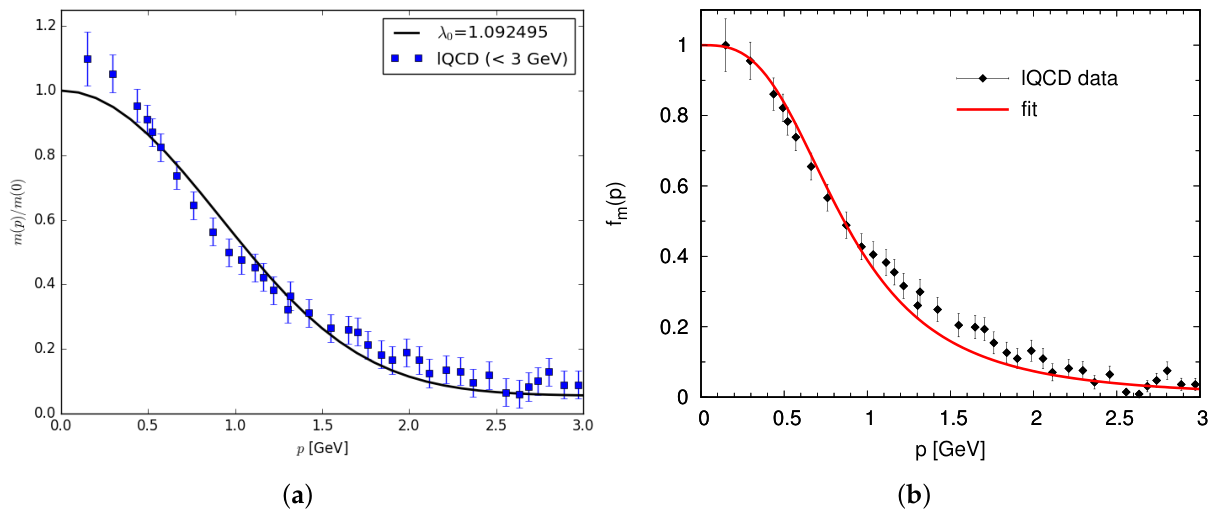
One of the advantages of nonlocal PNJL model [91] is that the critical temperature for deconfinement transition can be made naturally compatible with lattice QCD estimates, as shown in Figure 1, without spoiling the entanglement between deconfinement and chiral restoration transition temperatures even for imaginary chemical potential. Moreover, it shows robust consistency for non-perturbative meson masses with lattice QCD results.
As a simple example, the Euclidean action for the model with the scalar/pseudoscalar interactions, is as follows
where is the quark current mass matrix. In the process of bosonisation one introduces two scalars and a pseudoscalar . The mean field thermodynamical potential at finite temperature and arbitrary (in general, complex) chemical potential in the Polyakov gauge is given by [92]
Figure 1.
(a) Fit of lattice data from [93] for the momentum dependent non-perturbative meson mass function in the nonlocal PNJL model [94]. (b) Fit of lattice data from [93] for in the ansatz for the momentum dependent non-perturbative meson mass in the nonlocal PNJL model [95].
Here and where and are fourier transforms of the form factors and [92] for the currents and respectively. Additionally,
where the quantities are defined as and , and in the Polyakov gauge where can be written as . Now formally is divergent and has to be regularized. It is shown that the properly regularized potential [96]
where the regularized expression of is given by
In the presence of an applied magnetic field, the grand potential in the mean field approximation becomes [97]
where the expressions of and can be found in [97]. The quantity . The subscripts stand for color index. Using the techniques in [98], the regularized thermodynamic potential is given by [97]
Here, is evaluated at , keeping the interaction with the magnetic field and the Polyakov loop. The term corresponding to can be written as
with and can be found in [97].
3.8. KMT Interactions and Polyakov Loop Corrected Nonlocal NJL Model
The KMT (to take care of the anomaly of QCD) and Polyakov loop (to take care of confinement) corrected NNJL model is given by the following Euclidean action
where the term involving the coupling H is the nonlocal ’tHooft term and are the structure constants of . The grand potential for the model at finite temperature is as follows:
Here, , and are auxiliary fields. The constituent masses are defined as
As the first term of is formally divergent, it needs to be regularized. Authors of [99] have used the strategy used in [100] to regularize the potential.
4. Effects of Magnetic Field on the EoS: Anisotropic Pressure
Although many works have been done on the effects of magnetic fields on neutron stars [101,102,103,104,105] and quark stars [51,106,107,108], no consistent scheme was followed in these works and hence, such works have different opinions about what the correct magentic field contributions to the pressure and energy density should be. However, it is well known that in the presence of a magnetic field, the pressure splits into components transverse () and parallel () to the field direction. Many works, in fact, have ignored the pressure anisotropy even at very strong magnetic fields where such effect is most relevant. Ref. [109] has formalized a systematic approach to calculate the EoS of such magnetized system where the main quantity of interest is the Maxwell part of the energy-momentum tensor
where , is the four velocity vector of the medium which in the rest frame of the system becomes , and are the longditudinal and transverse metrics. The energy-momentum tensor of the Dirac field is given by
The quantum statistical average of the energy momentum tensor is
where
is the canonical partition function and denotes the field content of the lagrangian. The energy density is given by
The and is obtained as
where is the magnetization of the system. Ref. [110] shows that the compressibility of the system also splits into parallel and perpendicular components as
Moreover, in an anisotropic medium, it is essential to distinguish between longditudial and transverse speed of sound as
and for large magnetic fields, they are expected to differ, as shown in Ref. [111].
A detailed analysis of the magnetic field dependence of and has been done in Ref. [45] in the context of PNJL model both in the presence and in the absence of the anomalous magnetic moment (AMM) of quarks. Figure 2 shows the variation of and as a function of magnetic field for the quark chemical potential MeV for and , being the chiral restoration temperature. For small field strengths, almost coincides with , irrespective of the AMM of quarks and only begin to be diverging from each other for GeV2. At even higher values of , shows slight oscillatory behavior but its magnitude remains more or less unchanged when the quark AMM is switched off but increases for finite quark AMM. Conversely, the , becomes highly oscillatory for large values of , similar to the results shown in Refs. [111,112] in the context of NNJL model (and shown in Figure 3), and the amplitude of oscillation increases for increasing quark AMM. For these oscillations are absent and and diverge from each other even for small values of . The de Haas–van Alphen oscillations are reflected in oscillation of magnetization for large enough magnetic fields, similar to the results in Ref. [111].
Figure 2.
(a) Normalized longitudinal () and (b) transverse () pressure as a function of for temperature (a) and (b) for vanishing and finite values of AMM for quark chemical potential MeV. Taken from Ref. [45].
Figure 3.
Caption describing both panels. (a) as functions of for various benchmark values of quark chemical potential. Solid lines (broken lines) correspond to the chiral symmetry broken (restored phase) phase. (b) System magnetization to the applied magnetic field where De Haas-Van Alphen effect is manifested in oscillation of as function of magnetic field. Taken from [112].
5. Phases of QCD Matter with Magnetic Fields
Following the discussion of the NJL model and its variants, we now turn to the rich phase structure and emergent phenomena predicted within these frameworks. Of particular interest is the behavior of the chiral condensate in the presence of external magnetic fields. Effective theories generally predict MC (magnetic catalysis)—an enhancement of chiral symmetry breaking in the presence of a magnetic field. However, finite-temperature lattice QCD simulations reveal an opposite trend near the chiral crossover region, where the condensate is suppressed with increasing magnetic field—a phenomenon known as inverse magnetic catalysis or IMC [113]. Reconciling these two competing effects is, therefore, essential for a consistent description of magnetized SIM. Moreover, strong magnetic fields can induce mesonic condensation channels, notably , and perhaps somewhat controversially, condensates, which, depending on the density, could be favored or disfavored.
The phase structure becomes even richer at high baryon density and low temperature, where various color superconducting phases are expected to emerge. At asymptotically high densities, the ground state is predicted to be the CFL phase, characterized by symmetric pairing among u, d, and s quarks. In the presence of a magnetic field, the CFL phase is modified into the magnetic CFL (MCFL) phase, which retains the pairing structure but exhibits reduced symmetry. At intermediate densities, less symmetric phases such as the 2SC phase become relevant, dominated by pairing between up and down quarks. In electrically neutral 2SC matter, Fermi-surface mismatch between pairing quarks can generate imaginary Meissner masses for certain gluons, signaling chromomagnetic instability and potentially favoring inhomogeneous phases such as the CCS phase or the Larkin–Ovchinnikov–Fulde–Ferrell (LOFF) phase. At even lower densities, where hadronic degrees of freedom become as important as quark degrees of freedom, quarkyonic phases dominate and understanding their magnetic properties could be relevant for better understanding of highly magnetized neutron star properties. The competition between these phases leads to a very complex phase structure where MC and IMC further modify the phase boundaries. The magnetic behavior of the chiral condensate is primarily governed by the phenomenon of MC, which predicts an enhancement of chiral symmetry breaking in the presence of a magnetic field. However, this expectation is challenged by lattice QCD results at finite temperature, which indicate a suppression of the condensate near the transition region, the IMC effect. Understanding the origin and interplay of these two competing mechanisms is, therefore, essential for a consistent description of phases of QCD.
5.1. Magnetic Catalysis (MC) Effect
The MC effect is the enhancement of the expectation value under conditions of a strong external magnetic field. Within the context of the NJL model, magnetic fields have a tendency to enhance spin-zero condensates associated with the breaking of chiral symmetry, leading to dynamical generation of fermion masses. This behavior contrasts sharply with ordinary superconductivity. Unlike conventional superconductors, a state with nonzero does not exhibit the Meissner effect. Furthermore, in a neutral spin-zero quark–antiquark pair, the magnetic moments of the fermion and antifermion align parallel to the external field, making the condensate energetically favored in strong magnetic backgrounds, unlike fermion–fermion Cooper pairs in ordinary superconductors. Before describing the varieties of works that have been done on MC, we want to introduce the concepts of dimensional reduction of quarks [114] in the presence of strong magnetic fields and how MC can be obtained in simple models.
In the expression of , where is the orbital quantum number whereas is the spin projection quantum number in the direction of the applied magnetic field. The spin polarized lowest Landau level (LLL) corresponds to and only. For , the minimum of the first excited LL has energy , which is large for large magnetic field. On the other hand, the LLL has the energy . So for large magnetic fields, the energy gap between these two levels is approximately for large magnetic field. Hence for large magnetic fields, the LLL decouples from the higher levels and the low energy physics is solely determined by the level . The spectrum of LLL is identical to that of a -dimensional field theory with a single spatial coordinate identified with the z direction. The dynamics of LLL changes to -dimensional. This phenomenon is termed as dimensional reduction. It is essentially a consequence of restricted fermion motion in a plane perpendicular to the magnetic field.
Having explained the concept of dimensional reduction, we try to explain how dimensional reduction plays a role in MC. The easiest way to illustrate this effect is in dimensions. Consider the fermionic condensate in the presence of a magnetic field
The replacement of the two-dimensional momentum integral measure by just a summation on the LLs reflects dimensional reduction where the dynamics has shifted from to dimensions. Now in the limit of large magnetic field, i.e., , the condensate is dominated by the lowest Landau level k
which is precisely the phenomenon of magnetic catalysis: the magnitude of the condensate increasing with the magnetic field, linearly in this specific case. Similar behavior can be shown in the most general dimensions.
The robustness of this phenomenon has been tested numerous times within the framework of NJL model [107,115,116,117,118] and within LQCD frameworks as well [16,119,120,121,122,123,124,125,126,127]. The phenomenon of MC appears in other formalisms of QCD as well. For example, within the Dyson–Schwinger framework, one finds in the mean-field, large-, and weak-coupling (G) limit that the dynamical mass scales as, , demonstrating that the magnetic field enhances chiral symmetry breaking through dimensional reduction and Landau-level dynamics [114]. In the massless NJL model, the following non-trivial solution of the gap equation shows the MC effect
Various nuances in the phenomena have been unraveled in further investigation of MC and IMC [128,129,130,131]. Using the NJL model, Ref. [132] shows that in the presence of a strong magnetic field, quark fluctuations would enhance the chiral symmetry breaking, while the effect of neutral mesons is to dampen it. This result is supported by Ref. [133] where it was shown that in comparison with mean field approximation containing quarks only, including mesons in the model leads to a transition from inverse magnetic catalysis (IMC, to be discussed in the next subsection), to delayed MC at finite temperature [129]. Inclusion of mesons is reflected in the medium-dependent coupling , and it is shown that , indicative of magnetic inhibition that leads to IMC [134], as shown in Figure 4a,b. However, after a critical value of the magnetic field is reached, the MC effect dominates the magnetic inhibition; hence, MC is delayed.
Figure 4.
(a) Magnetic inhibition of the effective coupling due to the presence of mesons, (b) MC of the current quark mass and (c) Delayed MC of the transition temperature . These results have been taken from [134].
Ref. [135] demonstrates that a vector–vector contact interaction produces MC; however, when a lattice-inspired running coupling that decreases with magnetic field strength is introduced, IMC emerges instead. In a related development, Refs. [136,137] show that the explicit breaking of rotational symmetry by the magnetic field gives rise via Fierz transformations to new tensor interaction channels. This framework also predicts that MC induces not only the conventional chiral condensate but an additional spin-one condensate, both of which characterize the chirally broken phase.
The role of tensor structures is further emphasized in Ref. [138], where incorporating tensor spin polarization for heavy quarks enhances MC (see Figure 5). Similarly, within a two-flavor NJL model, Ref. [139] finds MC when tensor-type and axial-vector-type four-point interactions are included. The sensitivity of magnetic behavior to microscopic inputs is highlighted by Ref. [140], which shows that the sign of the quark anomalous magnetic moment determines whether the interaction acts as a catalyzer or inhibitor.
Figure 5.
The dependence of dynamical quark mass M on temperature (T) for four different magnetic fields without considering TSP in (a) and with considering TSP in (b). MC upon inclusion of TSP is clearly observed. Figs. (a) is for the quark chemical potential and (b) is for . These results are taken from [138].
MC has also been explored in non-extensive frameworks. For instance, Ref. [78] reports that, with a constant coupling, MC persists but with reduced strength compared to the extensive case. When the coupling depends on the magnetic field, a competition arises between the Tsallis non-extensive parameter q and , leading to the suppression of IMC at sufficiently large q. Along similar lines, Ref. [141] finds that, within Tsallis statistics, the chiral chemical potential can significantly modify the magnetic response, even driving a transition from MC to IMC.
Although MC emerges as a robust, model-independent feature, lattice QCD simulations at finite temperature have revealed a qualitatively different phenomena of IMC in the vicinity of the pseudo-critical region, where the chiral condensate is suppressed rather than enhanced as the magnetic field increases, indicating that additional dynamics beyond those captured in simple effective descriptions become relevant near the transition. We, therefore, turn now to a discussion of IMC.
5.2. Inverse Magnetic Catalysis
IMC [142], opposite to magnetic catalysis, is characterized by a decrease in the pseudo-critical temperature with increasing magnetic-field strength, or equivalently, by the leftward shift of the chiral susceptibility peak as a function of temperature [143]. Although IMC is believed to arise from a subtle interplay of competing effects [144], active only within certain temperature ranges and predominantly affecting light quarks, its complete theoretical understanding remains unresolved. Most phenomenological models predict MC at all temperatures. However, high-precision lattice QCD simulations for with physical pion masses, [16,124], revealed a more intricate behavior (Figure 6): while MC persists at low temperatures, at sufficiently high temperatures the condensates exhibit a non-monotonic dependence on and eventually decrease with increasing magnetic field.
Figure 6.
Results (a) [124] and (b) [16], although show MC at low temperature, for sufficiently high temperatures the condensates develop a complex, non-monotonic relationship and even decrease with , showing IMC. Here and is the magnetic flux quanta, which counts how number of elementary magnetic flux quanta in the lattice.
Variations of the NJL model have motivated extensive efforts to explain the discrepancy between MC predicted by effective models and IMC observed in lattice QCD [84,98,118,133,145,146,147,148,149,150,151,152,153,154,155,156,157,158,159,160]. One prominent explanation is the sea effect [161], illustrated in Figure 7, where lattice results are decomposed into valence and sea contributions to the condensate [122,162,163]. While the valence contribution enhances the condensate at all temperatures, the sea contribution enhances it only well below and suppresses it near . Close to the pseudo-critical temperature, this suppression dominates over the valence enhancement, leading to IMC [124,164,165,166].
Figure 7.
Valence (a) and sea (b) contributions to the up quark condensate as a function of , calculated at , which is well below and , very close to . Near , the decreasing negative contribution of the sea contribution overwhelms the increasing positive contribution of the valence contribution, interpreted as the mechanism behind IMC. Taken from [161].
Several alternative mechanisms have also been proposed. Ref. [153] adds vector-isovector channels
with , () on top of KMT corrected NJL model and shows a new a first-order phase transition around the toward a phase without chiral condensates, but with nontrivial dynamic chiral chemical potentials for the light quarks. The corresponding critical temperature of the transition decreases with the magnetic field and it gives a natural explanation to the inverse magnetic catalysis effect for light quarks when incorporating a reasonable value of the coupling constant in the isoscalar axial-vector channel. Ref. [167] adds repulsive iso-scalar axial-vector interactions channels
and shows that a reasonable strength of the repulsive interaction in the iso-scalar axial-vector channel can naturally explain the inverse magnetic catalysis around the critical temperature under external magnetic fields. Ref. [146] uses EPNJL model with the KMT interaction term and entangled scalar channel coupling as shown in Equation (26) and shown that with a magnetic field dependent scale parameter of the form
( and being model parameters) it is possible to obtain IMC due to entanglement between chiral and deconfinment transition.
In Ref. [143], IMC was demonstrated in the NJL model framework, by arguing that the running of the model couplings with the magnetic field strength [168,169] was not considered. However, alternate prescriptions, e.g., inclusion of screening effects [170] also remain valid. The authors of Ref. [124] used the standard NJL model with scalar and pseudoscalar channels and used the following ansatz for the magnetic field-dependent coupling
and
with , and and being free parameters to obtain a reasonable description of the lattice average. Decreasing the profile of produces IMC [24,171]. In [172] within the nonlocal NJL approach, it is shown that whether IMC will be observed actually depends on the strength of the magnetic field, with IMC at low and moderately strong magnetic fields [173], in contrast to LQCD results in [174] where it is observed that even at extremely strong magnetic fields, IMC prevails. Similar temperature and magnetic field dependent ansatz had been made for finite temperature scenarios [175,176] which are in reasonable agreement with lattice results. Although various other fitting ansatz exist [143,155,165,176] such expressions are essentially phenomenological and not unique. Any fitting model consistent with the lattice data would give the same qualitative results in suitable ranges of magnetic field and temperature, e.g., done in Ref. [165] by using the running coupling obtained by fitting with LQCD data [124].
Extensions of the conventional NJL model, e.g., vector–vector contact interactions [135] significantly influence IMC. The work uses the standard NJL model with the standard scalar channel with the mass gap equations
with being full quark propagator in the presence of magnetic field
Considering a lattice inspired running coupling which monotonically decreases with , IMC takes place in this model. Ref. [177] shows that, in the presence of a repulsive vector coupling , the IMC behavior observed at is strongly suppressed at low temperatures, since the vector interaction counteracts the magnetic-field effect (Figure 8). Several studies [138,160,178,179,180,181] have further demonstrated that including the anomalous magnetic moment (AMM) of quarks
where , the charge matrix of quarks and , can generate IMC. However, Ref. [179] found that for sufficiently small AMM, MC persists over the entire magnetic-field range. Using a Pauli–Villars regularized PNJL model, Refs. [180,182] show that a sufficiently large quark AMM converts MC into IMC throughout the plane. In particular, Refs. [180,183] demonstrate that the AMM reduces the effective quark mass according to , thereby mimicking the IMC effect. Other studies have explored IMC in diverse contexts, including the electric-charge (EC) phase transition and the BEC-BCS crossover [184], the correlation between -IMC and IMC [185], and the influence of IMC on the Mott transition of pseudo-Goldstone modes [169,186], only to name a few.
Figure 8.
Phase diagram in the plane from [177] for (a) , and (b) , . The solid symbols represent the critical points. The action of the magnetic field and the repulsive vector interaction are in opposite directions.
MC and IMC underscore that the response of the chiral condensate to external magnetic fields is highly nontrivial and till date, no widely accepted consensus for these phenomena exists. Nevertheless, the chiral condensate captures only one facet of QCD matter. At sufficiently large baryon density, the dominant dynamics shifts to pairing dynamics at the Fermi surface, where quark degrees of freedom reorganize themselves into various pairing patterns. This leads to the emergence of color superconducting phases characterized by distinct gap structures. We now turn to a brief overview of these phases, their key properties, and their response in a magnetic field.
5.3. Magnetic Color–Flavor Locked Phase
We now discuss the regime of the QCD phase diagram. In this limit a very rich school of symmetry breaking patterns are observed. Moreover, cold neutron stars, whose environment is expected to reside in this regime, are an excellent candidate where occurrence of such exotic phases are expected to exist. In this regime, one expects to find quark Cooper pairing near the Fermi surface that spontaneously breaks the color symmetry, forming a color superconductor with various pairing patterns.
In a color superconductor, the quark–quark cooper pair can be characterized by the condensate where and are color indices of quarks, i and j are flavor indices and a and b are spinor indices. The color–flavor–spin matrix P characterizes a particular pairing channel, and is the gap parameter which gives the strength of the pairing in this channel. Now at very high densities where u, d and s quarks are present, and the effect of strange quark mass can be neglected, the completely symmetric pairing in both color and the flavor space occur and produces the CFL phase [187,188,189,190,191]. In the CFL phase, quarks of all three flavors and all three colors form zero-momentum spinless Cooper pairs described by the two point correlation function
where is called the CFL gap parameter. The condensate is invariant only under simultaneous rotations in both color and flavor spaces.
The structure of the CFL phase is significantly modified in the presence of strong magnetic fields. Since a rotated magnetic field can penetrate a spin-zero color superconductor [192,193,194], its effects on color-superconducting matter become particularly important. Ref. [195] argues that neutral Cooper pairs may be formed either from -neutral quarks or from quarks carrying opposite charges. When the magnetic length, becomes smaller than the coherence length of the Cooper pair, the magnetic field significantly alters the pairing structure of the condensate.
In particular, Refs. [195,196,197] show that the magnetic field splits the CFL gap into two distinct gaps: , which receives contributions from both oppositely charged and neutral quark pairs, and , which receives contributions only from neutral quark pairs. The resulting phase retains CFL-type pairing but possesses a reduced symmetry group, , compared to the ordinary CFL phase. This less symmetric phase is known as the MCFL phase. While Cooper pairs composed of quarks with zero rotated charge remain largely unaffected by the magnetic field, condensates containing charged constituents are modified into the MCFL state [192,198,199,200], as illustrated in Figure 9. In the following, we present a brief digression on the thermodynamics of the MCFL phase [201].
Figure 9.
(a) Gap parameters (), () and () pairing as a function of (b) Same variations with neutrality. Taken from [192].
The rotated magnetic field couples to the charged quarks through the covariant derivative of the NJL Lagrangian. The magnetic field separates the original quark representation to neutral, positively and negatively charged spinors according to the quark rotated charges in units of , with being the mixing angle of the rotated fields. The rotated charges of these fields are shown in the table below
| ine 0 | 1 | 1 | −1 | 0 | 0 | −1 | 0 | 0 |
This separation makes it convenient to define separate Nambu–Gorkov spinors for positive, negative and neutral fields. The detailed procedures on the Ritus method [202] used to transform the charged spinor fields to momentum space is presented in [196]. One can show that the MCFL thermodynamic potential can be written as the sum of contributions due to charged () and neutral () quarks: where and is given by the following expressions
with
being the dispersion relations of the charged (labled by c) and neutral (labled by 0) quarks and
The MCFL gaps and correspond to the case where the pairing gap, which takes place only between neutral quarks, is , while the and pairing gaps, which receive contribution from pairs of charged and neutral quarks, become . The separation of the gap in two different parameters in the MCFL case, as compared to the CFL, where , reflects the symmetry difference between these two phases [195]. The effect of confinement can be taken into account by a bag constant . On the other hand, in a magnetized system, the pure Maxwell contribution should also be added [109], making the total thermodynamic potential as
The gap equations for the system are given by
In the strong field limit, the MCFL gap has the following solution [195,196,197]
which reduces to the usual CFL gap in the limit. Here, , being the ultraviolet cutoff and is the baryon chemical potential. On the other hand, the gap , formed only by pairs of neutral quarks, in the strong field approximation, becomes [203]
where and . The effect of the strong magnetic field is producing MCFL gap enhancement.
Numerous works on the stability of MCFL matter have been done [204,205,206,207,208,209] claiming that MCFL matter is more stable than other phases within a proper magnitude of the external magnetic field. Ref. [200] shows using the NJL model the emergence of a new condensate associated with magnetic moment of the Cooper pairs with no de Haas–van Alphen oscillations [200]. The condensate assists in enhancing the magnitude of as well [30] which, combined with the increase of at strong fields, makes the MCFL phase more stable than the regular CFL. Other interesting works on the nature of MCFL matter within the context of NJL model include, but are not restricted to, the studies of the Debye and Meissner screening masses [210], quark dynamics and effect of regularization schemes [210], competition between MC and gap splitting [211], effects on equations of state [212] and new channels of interaction and chromomagnetic instability [200].
However, although appearance of MCFL in the core of NS is definitely a theoretical possibility and next generation gravitational wave detectors, e.g., the Einstein Telescope and Cosmic Explorer may look for their signatures [208], there is no consensus yet in the community as to the MCFL phase in NS core. Results in Ref. [213] are consistent with strange MCFL stars with low magnetic fields but do not seem consistent with hybrid MCFL stars. On the other hand, Ref. [214] claims that the CFL/MCFL phases are the energetically favored phases only at densities which are just reachable in the inner core of NS. This motivates the search for other phases at intermediate densities where the system may favor less symmetric pairing patterns involving a reduced number of quark flavors, such as the 2SC phase. We conclude this section by touching upon the issue of absolute stability of MCFL phase.
One should check the stability and thermodynamic self-consistency of the MCFL phase by verifying that the baryon density at the point of minimum energy per baryon at zero temperature is equal to the baryon density at the zero-pressure point, formally established by the Hugenholtz–Van Hove (HVH) theorem [215,216]. However, barring a few exceptions, e.g., [217], most studies of the NJL and PNJL models do not explicitly check this condition, and hence, there is always a chance of internal inconsistency in such results. However, one may make a fairly reasonable assumption that since the models described here derive all thermodynamic quantities from the same grand potential, the HVH theorem is satisfied. As long as all physical quantities are derived from the stationary approximation to the same grand potential, without ad-hoc phenomenological parameter values, this is a valid assumption.
Nevertheless, a general statement about absolute stability of MCFL phase and that of SQM is difficult, mainly because such conclusions are sensitive to the underlying model used, so this warrants further investigation in the field. As an example, Ref. [201] takes into account pressure anisotropy due to strong magnetic field and shows that a stability window for MCFL matter exists only under very specific assumptions, e.g., a magnetic field dependent bag constant. Also, Ref. [206] shows in the MIT bag model setting, using variation of the strange quark mass, that MCFL matter is more stable compared to unpaired magnetized strange quark matter. Gluon effects complicate the situation even further. For further discussion of absolute stability of SQM or MCFL phases, interested readers are referred to [203,204,218,219,220].
5.4. Two-Flavor and Crystralline Color Superconductors, Chromomagnetic Instability
At intermediate densities, the CFL phase suffers from stresses induced by a non-zero strange quark mass; combined with -equilibrium, the 2SC phase [221] is the most straightforward, less symmetrically paired form of quark matter in this regime [2,187,188,222]. In the 2SC phase, quarks with two out of three colors, and only u and d quarks, pair in the standard BCS fashion, with the condensate . The NJL models with strong couplings leave the possibility of a 2SC window in the non-CFL region of the phase diagram [223]. It is a conductor with respect to the unbroken gauge symmetry, as some of the ungapped blue and strange quarks are -charged. Similar to the gapless CFL (gCFL) phase, the gapless 2SC (g2SC) phase [224] is unstable at zero temperature [225,226,227].
Studies of diverse nature have been performed on the 2SC phase under magnetic fields, including Ref. [32], which shows delayed MC of the 2SC phase for large [228] (Figure 10a); studies on electrical and thermal conductivities and color-magnetic flux tubes [229]; demonstrations of the roles of various regularization schemes and the removal of unphysical oscillations using the MFIR-MSS scheme of regularization, which are often wrongly claimed as de Haas–van Alphen oscillations [230,231]; compact star studies [232]; mixed non-uniform phases [233]; coexistence of inhomogeneous chiral and the 2SC condensate [233,234]; and classification of vortices in a mixed phase of 2SC condensates and P-wave diquark condensates [235,236], which demonstrates both superconductivity and superfluidity, as well as a confinement mechanism in such a phase [237], only to name a few. Ref. [32] shows that in the charge-neutral g2SC, a large magnetic field drives the color-superconducting phase transition to a crossover, while the chiral phase transition is first order, as shown in Figure 10b. Ref. [33] reports that for , the 2SC gap in the strong-coupling regime is abruptly quenched at ultra-high magnetic fields due to the mismatched Fermi surfaces of up and down quarks imposed by charge neutrality, and oscillations of the gap due to Landau level quantization. The dynamical quark mass also displays de Haas–van Alphen oscillations and MC at high magnetic fields (supporting the result from [228] and shown in Figure 10c), although the latter effect is suppressed by nonzero temperature.
Figure 10.
(a) Illustration of delayed MC in magnetized 2SC matter [228]. (b) For electric and color charge neutral quark matter with large magnetic field the dependence of m, , and (diquark gap without charge neutrality) on for taking [32]. (c) The constituent quark mass m as a function of at in the chirally broken phase, showing MC [33].
Several works attempt to identify possible astrophysical implications of the 2SC phase as well [238,239,240,241]. Refs. [241,242] show that in the interior of compact magnetized stars, a stellar magnetic field stitching a CFL/2SC core is likely to do so by forming an array of color-magnetic quantized vortices. Ref. [243] points out the possibility of creating a large deformation in a neutron star’s CFL/2SC core due to gluonic field degrees of freedom of the color-magnetic vortices. Ref. [243] also investigates implications of the 2SC phase for gravitational waves from color-magnetic “mountains” in NSs. However, there are also counterclaims [244] suggesting that the physically allowed parameter space for stable 2SC quark stars may not exist.
Having described the basic physics and relevance of the 2SC phase, we now comment on one of the primary threats to its stability: chromomagnetic instability [225,245] arising from the mismatch between the Fermi surfaces of pairing quarks and heralded by imaginary Meissner screening masses of certain gluons [225,245,246], thereby necessitating searches for possible remedies of the situation. Several attempts have been made to resolve this issue and reinterpret this phenomenon, e.g., showing that the CCS phase is energetically favored over the 2SC phase [247], resolution by minimal cylindrical gluonic phase II [248,249], inhomogeneous condensate of charged gluons [250] and charged gluon vortices [251], only to summarize a few. However, a consensus explanation of this phenomenon is yet to be reached.
The CSS phase [252] represents a possible resolution of the chromomagnetic instability, which allows different quark flavors to have different Fermi momenta so that stress of the strange quark mass could be tolerated, and to allow Cooper pairs with nonzero momentum. A significant amount of progress has been made in determining the properties of this phase. This includes the BCC structure of the LOFF phase [253,254], bosonic excitations in the cubic three-flavor LOFF phase and meson condensation phases [255], calculation of the shear viscosity for two-flavor plane-wave color superconducting quark matter [256], and self-consistent evaluation of the constituent quark masses and stability window of the LOFF phase [257]. It also includes astrophysical studies such as [258,259] on the consistency of inhomogeneous CCS phases and consistency with universal relations (with Figure 11 and Figure 12 showing contradictory results), glitch phenomena [260], the possibility of the Einstein Telescope detecting torsional oscillation signals modified by the CCS/LOFF phase [261], and cooling studies [262], only to name a few.
Figure 11.
(a) The -, (b) (c) - universal relations for APR EoS and models described by a hybrid EoS constructed using constant speed of sound parametrization. The shear modulus coefficient , shear modulus and energy density are related as . The brown solid curves represent the fitting formulae [263], and the maximal variability of the fitting formulae for fluid NSs (- relations: 0.7%; -Q relations: 2%; - relations: 2%) is further shaded in the lower panels. These results have been taken from [258].
Figure 12.
(a) is plotted against for bare solid quark stars and hybrid stars with a solid quark-matter core and compared with universal relations proposed by Yagi and Yunes [263] (solid line). Two values of the gap parameter are used for quark star models, as opposed to a single value of for hybrid star models. These results are taken from [259]. (b) Similar relations for HS1–HS3 models (refer to [264] for information about parameters about the model) and solid quark star (SQS) model are shown together with the fitting formula of the universal relation [263]. These results are taken from [264].
The influence of strong magnetic fields on CCS remains a relatively unexplored compared to other phases. Given that magnetars can host magnetic fields as large as , understanding how such strong fields affect the stability, pairing structure, and electromagnetic response of the LOFF phase is essential. Moreover, CSS remain rooted in the paradigm of only quark and gluonic degrees of freedom, which may be insufficient at intermediate densities where confinement effects persist and hadronic degrees are still present. This motivates the consideration of an alternative phases of QCD matter beyond conventional superconductivity: the quarkyonic phase.
5.5. Quarkyonic Matter
An important measure for determining a change of phase from a non-relativistic fluid to an ultra-relativistic system is the speed of sound . Around saturation density, matter is a non-relativistic liquid of nucleons with a sound velocity, . However, there is sufficient amount of evidence in the literature [265,266,267] that should violate the conformal limit and attain a peak near . At such density regimes of transition, quarkyonic phase of matter [268,269,270,271] becomes relevant where quarks reside deep within in the Fermi sea while hardons live near the Fermi surface. Since the foundational work [7,272,273,273], different theoretical frameworks have been used to explain various aspects of quarkyonic matter related to, for example, its Bremsstrahlung photon spectrum during dynamical evolution [274,275], thermal properties [276] and various astrophysical consequences [277,278,279,280,281,282,283,284,284].
Literature on magnetic properties of quarkyonic matter is limited, providing only a fragmented picture. For instance, Ref. [45] analyzes the magnetic response of quarkyonic matter within the context of two-flavor PNJL model with AMM interaction and it is found to be paramagnetic in nature, with positive normalized susceptibility. From a more microscopic perspective, Ref. [285] demonstrates that incorporating spin-one polarization can impart ferromagnetic instabilities at low densities, as shown in Figure 13a before reverting to paramagnetic behavior at higher densities. In Ref. [131], in the context of the PNJL model, it is shown that strong magnetic fields enlarge the possible quarkyonic phase window where the coupling runs with the field, as shown in Figure 13b.
Figure 13.
(a) Spin susceptibility for spin-polarized quarkyonic matter. The parameter represents the energy contribution from spin polarization. Ferromagnetic instability is observed from negative susceptibility for some choices of . Taken from [285]. (b) Enlargement of the quarkyonic phase window under a running coupling interaction, with coupling varying with magnetic field. Taken from [131].
5.6. Pion Condensate
Pions play a central role in low-energy QCD [286] as the pseudo-Goldstone bosons associated with the spontaneous breaking of chiral symmetry, with small masses compared to other hadrons. In the NJL model, pions emerge naturally, providing a consistent framework to describe both their Goldstone nature, their in-medium modifications and how pion properties evolve under strong magnetic fields. Among various studies related to pions in a hot, dense and magnetized medium, the in-medium behavior of pion masses has been extensively studied in the literature showing that charged pion masses usually increase with magnetic field strength, while the neutral pion mass exhibits a much weaker dependence, as shown in Figure 14. Ref. [287] calculates the pion masses using NJL polarization function and uses as the order parameter for pion superfluid phase transition. It starts from the normal phase with neutral chiral condensate and determine the critical point of superfluid phase transition by the appearance of Goldstone boson, massless meson. Mesons are constructed above the mean mean field model by through quark bubble summations in the frame of random phase approximation [39,288]. Following Ref. [289], meson propagator can be expressed in terms of the meson polarization function as
being the conserved Ritus momentum. The meson pole mass is defined as
Based on the Goldstone’s theorem, massless Goldstone mode exists in the pion superfluid phase. Therefore, the critical isospin chemical potential for pion superfluid can be identified by the condition . For meson, one can show that where
where represents the Fermi Dirac distribution and
where
The expressions for are given in detail in Refs. [289,290].
Figure 14.
(a) The mass square of neutral meson with fixed MeV with different quark chemical potential . Taken from [291]. (b) The mass square of neutral meson with fixed MeV with different T. Taken from [291]. (c) The blue curve shows normalized mass from [292] as functions of in the NJL model with . Similar results are reported in [293].
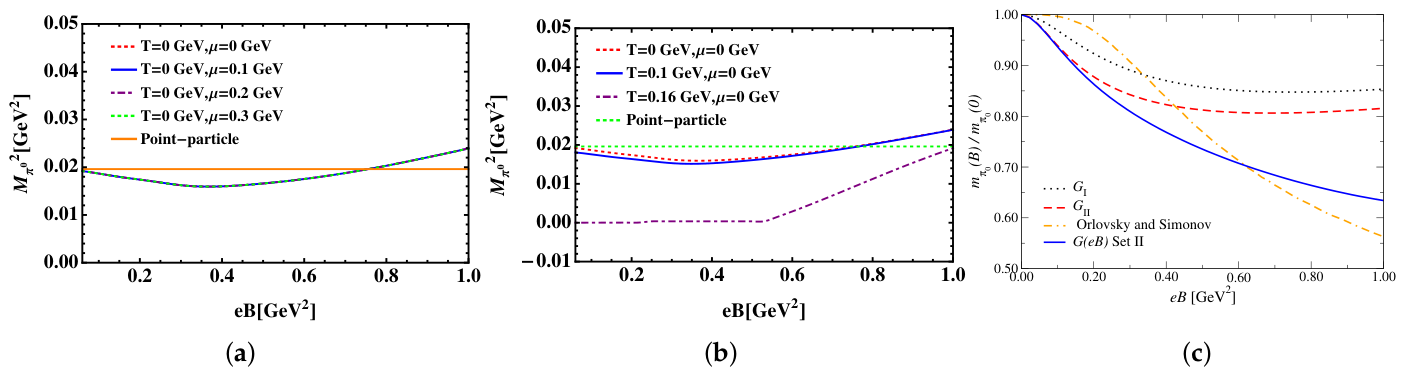
These trends are shown to be consistent for curvature, pole, and screening masses using the two-flavor NJL model [294] at , where it is shown that the curvature and pole masses of increase with B, the same for remain almost the same, and the screening masses for decrease, supported by LQCD results [295], as shown in Figure 15c. The approximate constancy of the neutral pion mass with magnetic field is also demonstrated in Ref. [291] using the random phase approximation at leading order in within the two-flavor NJL model, as shown in Figure 14a,b. Similar results have been confirmed in [296,297]. Moreover, Ref. [298] shows that, because of the explicit breaking of Lorentz invariance by the magnetic field, the screening mass of neutral mesons exhibits a certain anisotropy in the transverse and longitudinal directions with respect to the direction of the external magnetic field. Ref. [291] also shows that the mass increases with magnetic field due to quark–antiquark loop contributions, the same as in [294].
Figure 15.
(a) Temperature variation of curvature mass of . Taken from [294]. (b) Same result from [298]. (c) Masses of , , , as a function of normalized by their corresponding masses at . Taken from [295].
The inclusion of IMC modifies this picture substantially. By introducing a magnetic-field-dependent coupling that decreases with , Ref. [292] found that the neutral-pion pole mass decreases with magnetic field (Figure 14c), a trend also observed in [293] and related models. At extremely strong magnetic fields, however, the behavior changes again. Ref. [299] showed that for , the neutral-pion mass increases with and exhibits delayed MC, contrasting with earlier results where remained nearly constant or displayed IMC, while consistently showed MC.
Moreover, at finite temperature, depending on B, the curvature masses of , as a function of temperature, develop minima as a function of temperature, whereas the curvature mass of increases, as shown in Figure 15. A similar qualitative trend of the temperature profile of mass has been found in Ref. [300] for studies of screening masses of neutral pions in hot, magnetized quark matter in the presence of IMC in the context of the lattice-improved PNJL model, although the nature of the temperature variation has been found to be different compared to the standard NJL model.
The NJL model is capable of describing chiral restoration, where the dynamical quark masses drop as a function of temperature and chemical potential, thus, restoring the mass degeneracy of the chiral partner states. At the same time, the continuum thresholds for quark–antiquark scattering channels drop, which results in a lowering of the binding energy for the pseudoscalar meson bound states and, finally, in their dissociation when they enter the continuum and change their character to resonances with a finite lifetime. This is called the Mott transition effect. This is usually identified by mass poles for mesons becoming complex, with the real part being the “mass” of the resonance and the imaginary part being related to a finite width due to its decay into the quark constituents. Following early works in pion dissociation in quark matter [301,302,303,304,305,306,307,308,309], numerous works have been done on the Mott transition of pions. Some relatively recent works include, but are not restricted to, Refs. [169,310,311,312,313], where in the presence of a strong magnetic field a sudden jump in the mass of the Goldstone mode at the Mott transition temperature is observed, as shown in Figure 16.
Figure 16.
(a) Normalized meson mass (upper panel) as a function of temperature with fixed magnetic field and different current quark mass within the context of NJL model. The results are plotted with black, blue, red, cyan and magenta lines, respectively, corresponding to MeV. These results have been taken from [169], (b) Similar results from [169] for meson mass , (c) Mott transition temperature of of as a function of with different current quark mass . The results are plotted with black, blue, red, cyan, and magenta lines, corresponding to MeV, respectively, showing much more intricate behavior than IMC. Taken from [169].
It has been shown many times in the literature that inclusion of AMM can significantly affect the pion mass profiles (although there are counterclaims as well [314]), as shown in Figure 17. Some of the recent works include Ref. [315], which discusses the effects of AMM and IMC and shows that the neutral pion is very sensitive to the AMM term, with its mass decreasing rapidly with magnetic field and even leading to collapse of the neutral pion mass under sufficient conditions [316,317] (Figure 17a), whereas the charged pion mass is much less sensitive to AMM (Figure 17b). Ref. [318], which also includes contributions from the tensor-type spin polarization (TSP), shows a similar decreasing behavior of the neutral pion mass, while the charged pion mass is shown to behave non-monotonically (Figure 17c), similar to the former results, whereas the TSP induces MC of both neutral and charged pion masses. Ref. [160] shows that, for non-zero values of the magnetic field, the strength of the Mott transition decreases substantially with increasing magnetic field when the AMM is included.
Figure 17.
(a) Neutral and (b) charged pion mass as functions of the magnetic field with different AMM coupling . Taken from [315], (c) Charged pion mass as a function of with TSP and AMM [318].
Also, pion superfluid phase [319,320,321,322,323,324] has attracted much attention due to its impact on compact stars, isospin asymmetric nuclear matter, and heavy-ion collisions at intermediate energies. A few recent works include Ref. [287] on pion superfluid phase diagram within the Pauli–Villars regularized NJL model (Figure 18a,b) which applies Goldstone’s theorem to determine and obtain the phase diagram in B, T, and space, Ref. [325] which studies the de Hass–van Alphen oscillation of pion superfluid phase, and Ref. [326] which includes, on top of external magnetic field, the effect of rotation (Figure 18e,f) finding that charged-pion condensation takes place only when both a strong coupling constant and negatively large baryon chemical potential are applied. Ref. [327] shows that the combined effects of a rotation and a magnetic field can cause charged pion condensation. Ref. [328] studies vortex lattice structures in the condensates under conditions of small rotation and strong coupling constant in the context of a relativistic complex scalar field model with a repulsive self-interaction. These vortex lattices can be thought of as electrical superconductors which are created to better adapt to changes in rotation and interaction. However, there are counterclaims against the salability of the magnetic pion superfluid as well, e.g., Ref. [329] (Figure 18c,d) which shows that magnetic field disfavors the pion superfluid phase.
Figure 18.
(a) Pion superfluid phase diagram in plane with and fixed magnetic field [287]. (b) The same diagram on plane with and fixed magnetic field [287]. (c) Pion superfluid phase diagram in plane with and fixed magnetic field [329]. On the left side of the phase transition line, it is the normal phase, and on the right side, it is the pion superfluid phase. (d) The same diagram on plane [329]. As is increased the critical isospin chemical potential or pion superfluid phase transition increases, implying that magnetic field disfavors the pion superfluid phase. (e) The Ginzburg–Landau coefficient as a function of the angular velocity with with at zero temperature [326]. is the UV cutoff scale. (f) for and [326]. Negativity of indicates appearance of pion superfluidity.
Different works [330,331] have tried to come up with the possible mechanisms of charged pion condensation by a softening of the pion spectrum by the p-wave pion-nucleus interaction. A transition to a superfluid phase was expected just above the nuclear saturation density. However, Ref. [332] that the repulsive interaction would tilt the preference towards condensation. The problem of -condensation is still an open problem. However, outside the so called -equilibrium sheet , finite QCD has been studies very extensively [333,334] using chiral perturbation theory () starting from pioneering work by Son and Stephanov [335], a low energy EFT of QCD which describes the dynamics of the pseudo-Goldstone bosons resulting from spontaneous symmetry breaking of global symmetries in the QCD vacuum. At large and positive isospin chemical potential , on expects to populate the u and states with the color interaction inducing the formation of states. On the flip side, a large negative will instead favor the states. It is established from both LQCD and that at at [335,336], the vacuum makes a second order phase transition to the pion condensate phase. On the other hand, for MeV, thermal fluctuations destroy the condensate phase.
In principle, any information on the QCD phase diagram can be obtained by introducing in the QCD action a chemical potential for a certain charge by changing the covariant derivative as , being the chemical potential matrix is defined as
and and where , and are baryon, isospin and strangeness chemical potential. The pion condensates are defined as as a functions of T, and and being Pauli matrices. Now, because studies of pions correspond to non-perturbative regime of QCD, the QCD lagrangian is practically is of no use here. Instead of effective model, e.g., linear sigma models [337,338] and [336,339,340,341,342,343,344,345,346], NJL models [320,347,348,349,350,351,352,353,354,355,356], quark–meson models [323,357], random matrix models [358,359], ADS/QCD [360] and pQCD [361] are used. Apart from strong guidance from LQCD for , the most widely used and NJL model give fairly good qualitative description of the meson condensed phase. However, the controversy around meson condensation revolve around three basic requirements: the particles must be bosons, the system has to be sufficiently cold and the particles must be stable. Mesons satisfy the first two requirements in sufficiently cold system. However, all mesons are unstable in vacuum. Then the next question is whether medium effects and/or presence of magnetic field can change the situation.
Before discussing the condensation mechanism we point out that group theoretic considerations provide a very simple explanation for condensation. As pions are part of an isospin triplet with , they are the three eigenstates with different values. The degeneracy of vacuum pion masses is lifted by . In fact, we expect the dispersion relations to be and . These expression are valid only for , otherwise, one of the charged pions becomes massless and further increase of makes the energy of the particle negative. This suggest a spontaneous symmetry breaking with the massless pion associated to the Nambu–Goldstone boson associated to a broken generator. This means as hits the vacuum pion mass, it becomes energetically favorable for the vacuum to rearrange itself and the charged pion field acquired a non-zero expectation value, indicating condensation. Now we explain two different approaches to meson condensation.
The global symmetry of QCD for constructing the model is the chiral symmetry , being the relevant number of quark flavors and the meson fields are collected in a unimodular field transforming as where . The leading order chiral perturbation theory Lagrangian is given by
where the trace is taken in the flavor space, the auxiliary field X transforms as and the covariant derivative is defined as
where is the external current. This leading order model is enough to describe the QCD phase for . The RMF lagrangian is obtained by replacing , the RMF expectation value of and , where is the quark mass matrix and is a free parameter
In terms of the parameterization , in principle, one should try to extremize with the eight-dimensional vector , called the tilting vector. However, as it can be shown that each meson could be rotated by different , attempting this problem could be computationally challenging. For pions however ( and ), one can show that
which is independent of and . Then to maximize , one can set and one has the freedom of setting and . Extremizing with these values leads to two vacuum solutions: which leads to the trivial QCD vacuum, and the non-trivial vacuum which forces the condition , which is precisely the pion condensation condition. More details on the condensation mechanism can be found in Ref. [362]. In the presence of sufficiently large magnetic fields, and at low-to-moderate isospin chemical potential, the ground state of QCD is expected to be a spatially modulated condensate of neutral pions termed as the chiral soliton lattice (CSL). In this setting, the model is modified by inclusion of the Wes–Zumino–Witten term [363]
where being the dimensionless neutral pion field. The chiral soliton lattice (CSL) is a spatially inhomogeneous condensate. One can parametrize this solution as and the solution for ultimately show elliptic modulations with period [363,364] where is the complete elliptic integral of the first kind and . Pion condensation can also be studied using the NJL model [362]
To obtain the properties of the vacuum, one bosonizes the model and introduces collective auxiliary variables and corresponding to scalar and pseudoscalar channels respectively. At vanishing temperature, the grand potential has a fairly simple expression
where . So, the effect of the pion condensate is to create a gap between the quasiparticle energies. This is the typical signature of formation of correlated pairs of fermions as now it costs additional energy to break the quark–antiquark pairs to produce quasi-particle fermionic excitations.
5.7. Vector Meson Condensate
Despite counterclaims from QCD [365] as well as sign-problem-free LQCD simulations [365,366,367], the QCD vacuum is shown to be unstable against very strong magnetic fields and to make a transition to neutral and charged rho mesons condensates [368,369], as shown in Figure 19, in contradiction to Vafa–Witten Theorem [365]. In fact, there are works which suggest that electromagnetic superconductivity of vacuum in strong magnetic background is actually not in conflict [370] with the Vafa–Witten and Elitzur Theorem and results of [365] are consistent with inhomogeneous -meson condensation [371]. This can be understood in a simple way: the dispersion relation of a free particle of the mass m in a magnetic field involves three parameters: the Landau level index , the spin projection in the direction of the magnetic field , and the particle momentum along the field’s axis, : . Therefore, for pions and mesons, we have the magnetic dependent masses as
where the zero-field vacuum masses of and are given by and . For the meson at the lowest Landau level with zero longitudinal momentum (), the meson mass becomes purely imaginary when B exceeds , suggesting that QCD vacuum is unstable against charged condensation [372,373,374].
Figure 19.
(a) The mass square of charged with spin component as a function of , obtained in the context of NJL model where mesons are constructed by infinite sum of quark-loop chains by using random phase approximation. Taken from [368], (b) The mass of states with in a magnetic field with fixed temperature MeV with different quark chemical potentials . Taken from [369], (c) Same results from [369] at finite temperatures.
It is shown that even if the -meson mass increases with the magnetic field because of MC, for sufficiently large value of the magnetic field, can actually vanishes and a transition to a superconducting state [375] that is built out of charged as well as neutral -meson condensates can occur. But before discussing -meson condensation, we first present a brief survey of how the existing literature describes the behavior of the -meson mass in a magnetic field.
Using lattice gauge theory, Ref. [376] calculates the masses of mesons with different spin projections along the magnetic-field direction. It finds that the mass of the state with spin projection decreases with increasing magnetic field (Figure 20a). However, this behavior is contradicted by NJL-model calculations in Ref. [368], where the mass increases with B (Figure 20c), and by Ref. [377], which reports a non-monotonic dependence (Figure 20d).
In contrast, there is broader agreement regarding the states with . Ref. [376] shows that their masses increase with (Figure 20b), consistent with the results of Refs. [368,377] (Figure 20c,d). Ref. [368] further shows that the masses of charged vector mesons with increase with magnetic field, whereas the masses of () with () decrease approximately linearly with and vanish at (Figure 19a). This behavior suggests the possibility of charged vector–meson condensation, a controversial conjecture discussed later. Similar conclusions are obtained in Ref. [369] (Figure 19b).
On the other hand, Ref. [378], including an additional interaction in weak magnetic fields, finds that both and masses decrease with magnetic field in vacuum. Furthermore, Ref. [379] reports discontinuities in the masses of mesonic excitations in a thermo-magnetic background for nonzero magnetic field, signaling a Mott transition (Figure 20e), analogous to the pion mass behavior shown in Figure 16.
Figure 20.
(a) Mass of meson with spin for various lattice volumes and lattice spacings obtained by use of the Maximal Entropy Method [376]. (b) Same masses from [376] with spin . (c) Masses of charged vector meson with and neutral vector meson with calculated within the NJL model [368], (d) mass with different spin projections at finite magnetic field in the two-flavor NJL model [377]. (e) Variation of masses of as a function of temperature for different values of an external magnetic field in the presence of vector and axial-vector channels in NJL model. Mott transition is easily seen [379]. (f) The superconducting condensate of the charged mesons. The red arrow marks the point of the insulator–superconductor phase transition [380].
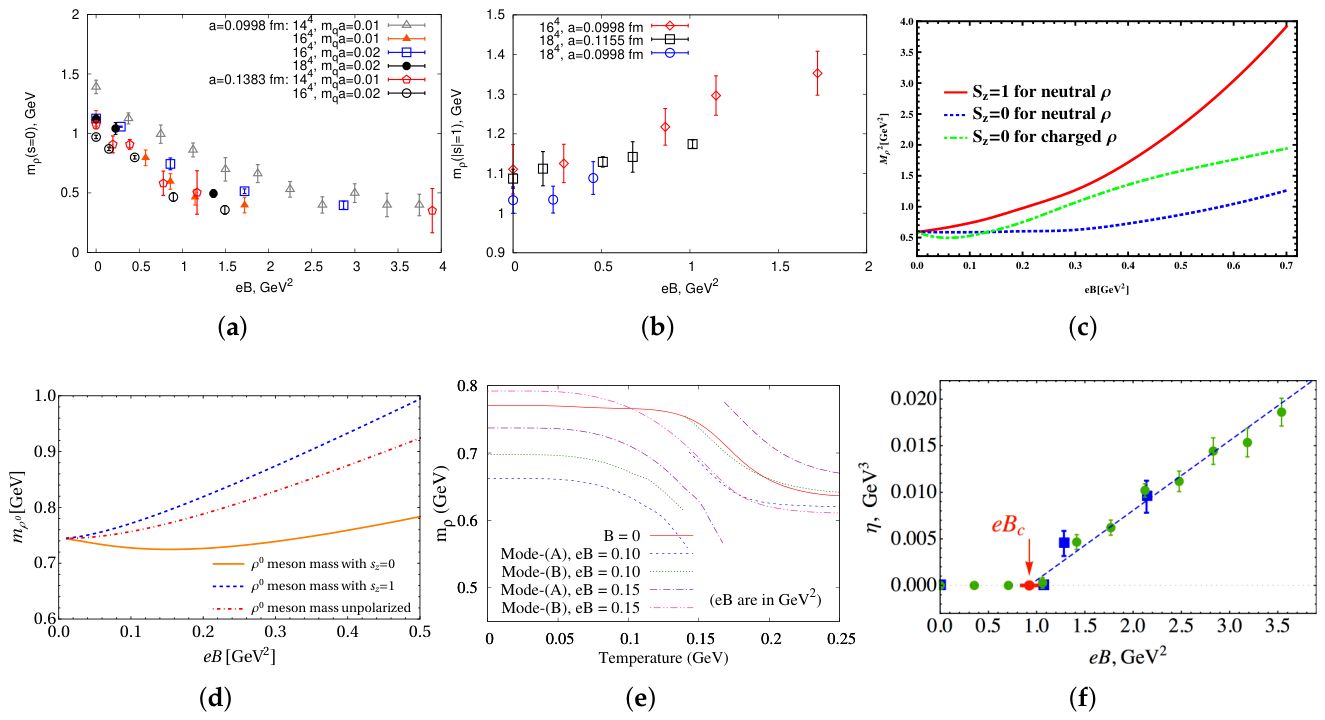
The existing literature on magnetized mesons shows no consensus regarding their behavior in strong magnetic fields. While some studies find that the -meson mass decreases and may vanish at sufficiently large B, others report an increasing mass. Nevertheless, results supporting a vanishing -meson mass motivate investigations of vacuum instability and possible -meson condensation. Since its proposal, condensation remains controversial, with some works [365] arguing that mesons cannot condense even in the presence of a magnetic field. QCD inequalities imply that massless mesons are possible only if the neutral pion mass also vanishes. Consequently, the existence of a nonzero minimum in the profile, discussed earlier, disfavors -meson condensation.
However, studies of quenched overlap quarks in QCD, based on spatial vector correlators, report a critical magnetic field of approximately , above which condensation appears [380] (Figure 20f). Despite persistent doubts about its existence, the possibility of magnetized -meson condensation continues to attract considerable attention. Ref. [374] demonstrates within the NJL model that the QCD vacuum can transit into an anisotropic and inhomogeneous electromagnetically superconducting phase carrying the quantum numbers of charged mesons. Ref. [369] further shows, after including axial-vector channels, that the charged -meson mass decreases with magnetic field and vanishes at a critical field, signaling vector-meson condensation that survives even at high temperature and density (Figure 19b,c). Ref. [381] finds that increasing isospin chemical potential favors superfluidity at weak magnetic fields but superconductivity at strong magnetic fields (Figure 21a,b). In contrast, Ref. [382] identifies the superconducting phase as the robust ground state of SIM only in the simultaneous presence of strong magnetic fields and rapid rotation (Figure 21c,d).
Figure 21.
(a) The phase transition lines for pion superfluidity (red solid) and superconductivity (blue dashed) in the plane. The notations , , and correspond to the normal chiral symmetry breaking phase, pion superfluidity, and rho superconductivity, respectively. The thin dashed line is just for demonstration of the boundary between pion superfluidity and rho superconductivity. For large , -superfluidity is favored for a small while -superconductivity is favored for a large [381]. (b) The Ginzburg–Landau (GL) coefficients (solid lines) and (dashed lines) as functions of isospin chemical potential for three magnetic fields, GeV (black), GeV (red), and GeV (blue) calculated within the context of NJL model with vector and axial-vector interactions [381]. For large , the GL coefficient of vanishes for smaller values of compared to that of , confirming the results of Figure 21a. (c) The GL coefficients of charged condensation are compared to those of charged for both choices of Schwinger phase in Minkowski space and Schwinger phase in curved space, denoted by “M” and “C”, respectively for . Notice that for condensate in Minkowski spacetime is favored over all other condensates [382]. (d) Same results as (c) but for . As is increased, condensate sets in for smaller values of angular velocity , potentially making the relevant for astrophysical compact objects with strong magnetic fields.
Despite controversies, given a considerable body of evidence in the support of meson condensation under sufficiently strong magnetic fields, whether alone or combined with rotation, this raises a natural question of whether the onset of this condensation can be captured by an effective field theoretic description. The conventional superconductivity could be modeled in the framework of both microscopic fermionic model, e.g., Bardeen–Cooper–Schrieffer (BCS) theory or involving bosonic degrees of freedom, e.g., the Landau–Ginzberg framework. Although these two approaches are different from one another, both are capable of describing superconductivity with fairly good quantitative accuracy. These two descriptions are in fact equivalent near the superconducting phase transition. In a similar manner, transition of vacuum to -supersonducting phase can be described by a Landau–Ginzburg type formalism. Here, we very briefly describe the electrodynamics of -mesons using the Djukanovic, Schindler, Gegelia, and Scherer (DSGS) lagrangian [383] and the condensation mechanisms in the RMF approximation. The bosonic part of the model is given by [373]
where is the photon field, and are fields associated with charged and neutral vector mesons with degenerate mass .
- The ground state energy turns out to be
Figure 22.
(a) Abrikosov lattice structure for the -meson condensates in the ground state at . The plots show the behavior of (in MeV), while the projection onto the plane is a density plot of the corresponding condensate phases. Taken from [384]. (b) Vortex lattice structure for the triangular lattice in the x–y plane obtained in the holographic model. The contour plot is shown below. The condensate vanishes at the core of each vortex. Taken from Ref. [386].
Ref. [387] has observed the presence of the vortices in numerical simulations of the vacuum of the quenched two-color LQCD in strong magnetic field background forming a liquid. Ref. [388] finds a hexagonal pattern of vortices obtained in a two–parameter Abrikosov ansatz. Ref. [373] shows that condensate is an anisotropic and inhomogeneous superconductor along the axis of the magnetic field and in the plane transverse to the magnetic field the superconductivity is absent. Ref. [384] shows that this exotic superconductor induces an even more exotic superfluid phase of the neutral mesons given by
Charged condensates have also been studied within the context of holographic models [386] showing that there is a critical temperature below which the charged vector condenses via a second order phase transition and forming a vortex lattice structure in the spatial directions perpendicular to the magnetic field. Ref. [389] shows in the context of Sakai-Sugimoto model that when the isospin chemical potential reaches a critical value , meson state becomes massless and it condenses. Using NJL effective model with vector channel, Ref. [390] shows that in the presence of global rotation, scalar channel pion condensate is suppressed and the condensate is enhanced. Ref. [391] specifically shows that in the presence of IMC that the charged condensation can exist in the temperature region of ( being the temperature of chiral phase transition) with critical magnetic field , suggesting that that high temperature superconductor might be created through non-central heavy ion collisions at LHC energies.
Although rho meson condensate has been shown to have observable astrophysical signatures [392,393,394,395], a corresponding body of work in the presence of a magnetic field still needs to be developed. Ref. [396] shows that -meson condensates can appear in the core of the neutron star as the mass decreases with density and magnetic field. Moreover, the condensate can appear at the density , as shown in Figure 23a,b.
Figure 23.
The electron chemical potential and effective mass (dashed lines) are plotted as functions of normalized density [396]. Within the relativistic mean field approach, the effective meson mass is assumed to varry as , being the scalar meson field, g is a dimensionless constant and MeV is the vacuum mass of the rho meson. Under the influence of a constant magnetic field, transforms as . The crossing points of with the lines mark the density at which meson the condensation appears.
6. Discussion and Concluding Remarks
Studies of SIM using effective field-theoretic models in the presence of magnetic fields have provided a very rich picture of the QCD phase diagram. However, the extensive body of work on this subject done by employing a wide variety of frameworks, makes the task of producing a comprehensive review extremely formidable. Instead, we work with a much more modest goal and summarize the leading results obtained using the NJL model and its extensions including magnetic fields.
Although the NJL model and its extensions provide valuable tools for exploring the intermediate-density regime inaccessible to first-principles methods, their predictions depend strongly on the chosen model variant and regularization scheme, and often disagree with lattice QCD results. A prominent example is the MC–IMC debate: while finite-temperature lattice QCD supports IMC, different NJL variants yield conflicting outcomes, with some predicting MC and others, such as the EPNJL and lattice-improved NJL models, reproducing IMC.
Model dependence also affects studies of confinement. PNJL and EPNJL models partially mimic the confinement–deconfinement transition through the Polyakov loop operator and , but the associated potentials and and -dependent couplings are largely ad hoc, causing predictions to vary with their parametrization. In contrast, nonlocal NJL models incorporate confinement more naturally.
Another major limitation is the strong regularization dependence of the NJL framework, which can generate unphysical oscillations mistaken for de Haas–van Alphen oscillations. Although schemes such as MFIR-MSS reduce these artifacts, the non-renormalizable nature of the NJL model makes regulator dependence unavoidable. Nonlocal PNJL models improve this behavior, but introduce additional uncertainty through the choice of form factors.
Such model sensitivity propagates over to the phase structure of magnetized dense quark matter, making it an area of serious debate. While phases, e.g., MCFL and magnetized 2SC phases are well established in asymptotically large and intermediate dense regimes, respectively, their stability, the true ground state of magnetized QCD matter and the resolution of chromomagnetic instabilities are far from settled. Moreover, despite a considerable amount of progress in studying the properties of magnetized -condensates, -meson condensation under strong magnetic fields still remains a very controversial proposition. These theoretical uncertainties can lead to significant ambiguities in astrophysical predictions.
Taken together, these considerations indicate that no single variation of the NJL-type model currently provides a fully reliable description of magnetized SIM. Progress, therefore, requires a complementary approach in which different effective models are used to capture different aspects of the physics, and their predictions are systematically compared. Whenever possible, these results should also be confronted with LQCD calculations and astrophysical observations of compact stars.
Within such a framework, features that remain stable across different models and agree with external constraints can be considered more robust and less sensitive to model-specific assumptions, leading to a more coherent, though still model-dependent, understanding of magnetized QCD matter.
Author Contributions
Conceptualization, P.J.; literature survey, A.D.; synthesis, A.D.; writing—original draft preparation, A.D.; writing—review and editing, A.D., P.J. and T.M.; supervision, P.J. and T.M. All authors have read and agreed to the published version of the manuscript.
Funding
T.M. acknowledges partial support from the SERB/ANRF, Government of India, through the Core Research Grant (CRG) No. CRG/2023/007031. P.J. is supported by a grant from the U.S. National Science Foundation Grant No. PHY-2310003.
Data Availability Statement
No new data were created or analyzed in this study. Data sharing is not applicable to this article.
Conflicts of Interest
The authors declare no conflicts of interest. The funders had no role in the selection, interpretation, or synthesis of the literature, in the writing of the manuscript, or in the decision to publish the results.
References
- Barrois, B.C. Superconducting Quark Matter. Nucl. Phys. B 1977, 129, 390–396. [Google Scholar] [CrossRef] [Scilit]
- Bailin, D.; Love, A. Superfluidity and Superconductivity in Relativistic Fermion Systems. Phys. Rept. 1984, 107, 325. [Google Scholar] [CrossRef] [Scilit]
- Larkin, A.I.; Ovchinnikov, Y.N. Nonuniform state of superconductors. Zh. Eksp. Teor. Fiz. 1964, 47, 1136–1146. [Google Scholar]
- Fulde, P.; Ferrell, R.A. Superconductivity in a Strong Spin-Exchange Field. Phys. Rev. 1964, 135, A550–A563. [Google Scholar] [CrossRef] [Scilit]
- Alford, M.G.; Bowers, J.A.; Rajagopal, K. Crystalline color superconductivity. Phys. Rev. D 2001, 63, 074016. [Google Scholar] [CrossRef] [Scilit]
- Marhauser, F.; Nickel, D.; Buballa, M.; Wambach, J. Color-spin locking in a selfconsistent Dyson-Schwinger approach. Phys. Rev. D 2007, 75, 054022. [Google Scholar] [CrossRef] [Scilit]
- McLerran, L.; Pisarski, R.D. Phases of cold, dense quarks at large N(c). Nucl. Phys. A 2007, 796, 83–100. [Google Scholar] [CrossRef] [Scilit]
- Grasso, D.; Rubinstein, H.R. Magnetic fields in the early universe. Phys. Rept. 2001, 348, 163–266. [Google Scholar] [CrossRef] [Scilit]
- Skokov, V.; Illarionov, A.Y.; Toneev, V. Estimate of the magnetic field strength in heavy-ion collisions. Int. J. Mod. Phys. A 2009, 24, 5925–5932. [Google Scholar] [CrossRef] [Scilit]
- Kharzeev, D.E.; McLerran, L.D.; Warringa, H.J. The Effects of topological charge change in heavy ion collisions: ‘Event by event P and CP violation’. Nucl. Phys. A 2008, 803, 227–253. [Google Scholar] [CrossRef] [Scilit]
- Bzdak, A.; Skokov, V. Event-by-event fluctuations of magnetic and electric fields in heavy ion collisions. Phys. Lett. B 2012, 710, 171–174. [Google Scholar] [CrossRef] [Scilit]
- Shen, D.; Chen, J.; Huang, X.G.; Ma, Y.G.; Tang, A.; Wang, G. A Review of Intense Electromagnetic Fields in Heavy-Ion Collisions: Theoretical Predictions and Experimental Results. Research 2025, 8, 0726. [Google Scholar] [CrossRef] [Scilit] [PubMed]
- Sun, J.A.; Yan, L. Estimating the magnetic field strength in heavy-ion collisions via direct photon elliptic flow. Phys. Rev. C 2024, 109, 034917. [Google Scholar] [CrossRef] [Scilit]
- Lasky, P.D.; Melatos, A. Tilted torus magnetic fields in neutron stars and their gravitational wave signatures. Phys. Rev. D 2013, 88, 103005. [Google Scholar] [CrossRef] [Scilit]
- Gusynin, V.P.; Miransky, V.A.; Shovkovy, I.A. Dimensional reduction and catalysis of dynamical symmetry breaking by a magnetic field. Nucl. Phys. B 1996, 462, 249–290. [Google Scholar] [CrossRef] [Scilit]
- Bali, G.S.; Bruckmann, F.; Endrodi, G.; Fodor, Z.; Katz, S.D.; Krieg, S.; Schafer, A.; Szabo, K.K. The QCD phase diagram for external magnetic fields. J. High Energy Phys. 2012, 2, 044. [Google Scholar] [CrossRef] [Scilit]
- Andersen, J.O. Chiral perturbation theory in a magnetic background—finite-temperature effects. J. High Energy Phys. 2012, 10, 5. [Google Scholar] [CrossRef] [Scilit]
- Fraga, E.S.; Palhares, L.F.; Restrepo, T.E. Susceptibilities and Taylor coefficients of magnetic QCD from perturbation theory. Phys. Rev. D 2026, 113, 014014. [Google Scholar] [CrossRef] [Scilit]
- Nambu, Y.; Jona-Lasinio, G. Dynamical Model of Elementary Particles Based on an Analogy with Superconductivity. I. Phys. Rev. 1961, 122, 345–358. [Google Scholar] [CrossRef] [Scilit]
- Nambu, Y.; Jona-Lasinio, G. Dynamical model of elementary particles based on an analogy with superconductivity. II. Phys. Rev. 1961, 124, 246–254. [Google Scholar] [CrossRef] [Scilit]
- Berges, J.; Rajagopal, K. Color superconductivity and chiral symmetry restoration at nonzero baryon density and temperature. Nucl. Phys. B 1999, 538, 215–232. [Google Scholar] [CrossRef] [Scilit]
- Schaefer, B.J.; Pawlowski, J.M.; Wambach, J. The Phase Structure of the Polyakov–Quark-Meson Model. Phys. Rev. D 2007, 76, 074023. [Google Scholar] [CrossRef] [Scilit]
- Fukushima, K. Chiral effective model with the Polyakov loop. Phys. Lett. B 2004, 591, 277–284. [Google Scholar] [CrossRef] [Scilit]
- Moreira, J.; Costa, P.; Restrepo, T.E. Magnetic field dependent ’t Hooft determinant extended Nambu–Jona-Lasinio model. Phys. Rev. D 2020, 102, 014032. [Google Scholar] [CrossRef] [Scilit]
- Rai, S.K.; Tiwari, V.K. Exploring axial U(1) restoration in a modified 2+1 flavor Polyakov quark meson model. Eur. Phys. J. Plus 2020, 135, 844. [Google Scholar] [CrossRef] [Scilit]
- Bowler, R.D.; Birse, M.C. A Nonlocal, covariant generalization of the NJL model. Nucl. Phys. A 1995, 582, 655–664. [Google Scholar] [CrossRef] [Scilit]
- Maskawa, T.; Nakajima, H. Spontaneous Symmetry Breaking in Vector-Gluon Model. Prog. Theor. Phys. 1974, 52, 1326–1354. [Google Scholar] [CrossRef] [Scilit]
- Guan, Y.; Yamada, M. QCD chiral phase diagram from weak functional renormalization group. Eur. Phys. J. C 2025, 85, 1428. [Google Scholar] [CrossRef] [Scilit]
- Huang, M.; Zhuang, P.F.; Chao, W.Q. Massive quark propagator and competition between chiral and diquark condensate. Phys. Rev. D 2002, 65, 076012. [Google Scholar] [CrossRef] [Scilit]
- Noronha, J.L.; Shovkovy, I.A. Color-flavor locked superconductor in a magnetic field. Phys. Rev. D 2007, 76, 105030, Erratum in Phys. Rev. D 2012, 86, 049901. [Google Scholar] [CrossRef] [Scilit]
- Mandal, T.; Jaikumar, P.; Digal, S. Chiral and Diquark condensates at large magnetic field in two-flavor superconducting quark matter. arXiv 2009, arXiv:0912.1413. [Google Scholar]
- Mandal, T.; Jaikumar, P. Neutrality of a magnetized two-flavor quark superconductor. Phys. Rev. C 2013, 87, 045208. [Google Scholar] [CrossRef] [Scilit]
- Mandal, T.; Jaikumar, P. Effect of temperature and magnetic field on two-flavor superconducting quark matter. Phys. Rev. D 2016, 94, 074016. [Google Scholar] [CrossRef] [Scilit]
- Mandal, T.; Jaikumar, P. Effect of strong magnetic field on competing order parameters in two-flavor dense quark matter. Adv. High Energy Phys. 2017, 2017, 6472909. [Google Scholar] [CrossRef] [Scilit]
- Avancini, S.S.; Farias, R.L.S.; Scoccola, N.N.; Tavares, W.R. NJL-type models in the presence of intense magnetic fields: The role of the regularization prescription. Phys. Rev. D 2019, 99, 116002. [Google Scholar] [CrossRef] [Scilit]
- Aguirre, R.M. Regularization of the Nambu–Jona-Lasinio model under a uniform magnetic field and the role of the anomalous magnetic moments. Phys. Rev. D 2020, 102, 096025. [Google Scholar] [CrossRef] [Scilit]
- Mei, J.; Wen, R.; Mao, S.; Huang, M.; Xu, K. Magnetic catalysis and diamagnetism from pion fluctuations. Phys. Rev. D 2024, 110, 034024. [Google Scholar] [CrossRef] [Scilit]
- Klevansky, S.P. The Nambu-Jona-Lasinio model of quantum chromodynamics. Rev. Mod. Phys. 1992, 64, 649–708. [Google Scholar] [CrossRef] [Scilit]
- Buballa, M. NJL model analysis of quark matter at large density. Phys. Rept. 2005, 407, 205–376. [Google Scholar] [CrossRef] [Scilit]
- Ratti, C.; Thaler, M.A.; Weise, W. Phases of QCD: Lattice thermodynamics and a field theoretical model. Phys. Rev. D 2006, 73, 014019. [Google Scholar] [CrossRef] [Scilit]
- Inagaki, T.; Kimura, D.; Kohyama, H.; Kvinikhidze, A. Phase Diagram of Nambu-Jona-Lasinio Model with Dimensional Regularization. Phys. Rev. D 2012, 86, 116013. [Google Scholar] [CrossRef] [Scilit]
- Garibli, A.A.; Jafarov, R.G.; Rochev, V.E. Mean-Field Expansion, Regularization Issue, and Multi-Quark Functions in Nambu–Jona-Lasinio Model. Symmetry 2019, 11, 668. [Google Scholar] [CrossRef] [Scilit]
- Kohyama, H.; Kimura, D.; Inagaki, T. Regularization dependence on phase diagram in Nambu–Jona-Lasinio model. Nucl. Phys. B 2015, 896, 682–715. [Google Scholar] [CrossRef] [Scilit]
- Liu, X.Q. Thermomagnetic Effects of Quark Matter in the NJL Model: Application of Regularization Schemes. arXiv 2024, arXiv:2412.08674. [Google Scholar]
- Chaudhuri, N.; Ghosh, S.; Roy, P.; Sarkar, S. Anisotropic pressure of magnetized quark matter with anomalous magnetic moment. Phys. Rev. D 2022, 106, 056020. [Google Scholar] [CrossRef] [Scilit]
- Xue, K.; Yu, X.; Wang, X. Do we need to use regularization for the thermal part in the NJL model? Chin. Phys. C 2022, 46, 013103. [Google Scholar] [CrossRef] [Scilit]
- Okuyama, K.; Suzuki, H. Gauge invariant Pauli-Villars regularization for chiral fermion. Prog. Theor. Phys. 1997, 98, 463–484. [Google Scholar] [CrossRef] [Scilit]
- Wang, Q.; Shi, C.; Zong, H.S. Nonstrange quark stars from an NJL model with proper-time regularization. Phys. Rev. D 2019, 100, 123003, Erratum in Phys. Rev. D 2019, 100, 129903. [Google Scholar] [CrossRef] [Scilit]
- Ebert, D.; Klimenko, K.G. Quark droplets stability induced by external magnetic field. Nucl. Phys. A 2003, 728, 203–225. [Google Scholar] [CrossRef] [Scilit]
- Avancini, S.S.; Tavares, W.R.; Pinto, M.B. Properties of magnetized neutral mesons within a full RPA evaluation. Phys. Rev. D 2016, 93, 014010. [Google Scholar] [CrossRef] [Scilit]
- Menezes, D.P.; Benghi Pinto, M.; Avancini, S.S.; Perez Martinez, A.; Providencia, C. Quark matter under strong magnetic fields in the Nambu-Jona-Lasinio Model. Phys. Rev. C 2009, 79, 035807. [Google Scholar] [CrossRef] [Scilit]
- Avancini, S.S.; Farias, R.L.S.; Tavares, W.R. Neutral meson properties in hot and magnetized quark matter: A new magnetic field independent regularization scheme applied to NJL-type model. Phys. Rev. D 2019, 99, 056009. [Google Scholar] [CrossRef] [Scilit]
- Dib, C.O.; Espinosa, O.R. The Magnetized electron gas in terms of Hurwitz zeta functions. Nucl. Phys. B 2001, 612, 492–518. [Google Scholar] [CrossRef] [Scilit]
- Dexheimer, V.A.; Schramm, S. A Novel Approach to Model Hybrid Stars. Phys. Rev. C 2010, 81, 045201. [Google Scholar] [CrossRef] [Scilit]
- Skokov, V.; Friman, B.; Nakano, E.; Redlich, K.; Schaefer, B.J. Vacuum fluctuations and the thermodynamics of chiral models. Phys. Rev. D 2010, 82, 034029. [Google Scholar] [CrossRef] [Scilit]
- Quandt, M.; Reinhardt, H. Effective potential of the Polyakov loop in the Hamiltonian approach to QCD. Phys. Rev. D 2022, 106, 114001. [Google Scholar] [CrossRef] [Scilit]
- McLerran, L.D.; Svetitsky, B. Quark Liberation at High Temperature: A Monte Carlo Study of SU(2) Gauge Theory. Phys. Rev. D 1981, 24, 450. [Google Scholar] [CrossRef] [Scilit]
- Fukushima, K.; Skokov, V. Polyakov loop modeling for hot QCD. Prog. Part. Nucl. Phys. 2017, 96, 154–199. [Google Scholar] [CrossRef] [Scilit]
- Lo, P.M.; Friman, B.; Kaczmarek, O.; Redlich, K.; Sasaki, C. Polyakov loop fluctuations in SU(3) lattice gauge theory and an effective gluon potential. Phys. Rev. D 2013, 88, 074502. [Google Scholar] [CrossRef] [Scilit]
- Mueller, N.; Bonnet, J.A.; Fischer, C.S. Dynamical quark mass generation in a strong external magnetic field. Phys. Rev. D 2014, 89, 094023. [Google Scholar] [CrossRef] [Scilit]
- Borsanyi, S.; Endrodi, G.; Fodor, Z.; Katz, S.D.; Krieg, S.; Ratti, C.; Szabo, K.K. QCD equation of state at nonzero chemical potential: Continuum results with physical quark masses at order mu2. J. High Energy Phys. 2012, 8, 53. [Google Scholar] [CrossRef] [Scilit]
- Miyahara, A.; Torigoe, Y.; Kouno, H.; Yahiro, M. Equation of state and transition temperatures in the quark-hadron hybrid model. Phys. Rev. D 2016, 94, 016003. [Google Scholar] [CrossRef] [Scilit]
- Bhattacharyya, A.; Deb, P.; Ghosh, S.K.; Ray, R. Investigation of Phase Diagram and Bulk Thermodynamic Properties using PNJL Model with Eight-Quark Interactions. Phys. Rev. D 2010, 82, 014021. [Google Scholar] [CrossRef] [Scilit]
- Ratti, C.; Roessner, S.; Thaler, M.A.; Weise, W. Thermodynamics of the PNJL model. Eur. Phys. J. C 2007, 49, 213–217. [Google Scholar] [CrossRef] [Scilit]
- Sakai, Y.; Kashiwa, K.; Kouno, H.; Yahiro, M. Phase diagram in the imaginary chemical potential region and extended Z(3) symmetry. Phys. Rev. D 2008, 78, 036001. [Google Scholar] [CrossRef] [Scilit]
- Mao, S. Correlations and fluctuations in a magnetized PNJL model with and without the inverse magnetic catalysis effect. Chin. Phys. C 2025, 49, 063106. [Google Scholar] [CrossRef] [Scilit]
- Shao, G.Y.; He, W.B.; Gao, X.Y. Deformed QCD phase structure and entropy oscillation in the presence of a magnetic background. Phys. Rev. D 2019, 100, 014020. [Google Scholar] [CrossRef] [Scilit]
- Andersen, J.O.; Cruz, A.A. Two-color QCD in a strong magnetic field: The role of the Polyakov loop. Phys. Rev. D 2013, 88, 025016. [Google Scholar] [CrossRef] [Scilit]
- Aoki, Y.; Fodor, Z.; Katz, S.D.; Szabo, K.K. The QCD transition temperature: Results with physical masses in the continuum limit. Phys. Lett. B 2006, 643, 46–54. [Google Scholar] [CrossRef] [Scilit]
- Sakai, Y.; Sasaki, T.; Kouno, H.; Yahiro, M. Entanglement between deconfinement transition and chiral symmetry restoration. Phys. Rev. D 2010, 82, 076003. [Google Scholar] [CrossRef] [Scilit]
- Sugano, J.; Takahashi, J.; Ishii, M.; Kouno, H.; Yahiro, M. Determination of the strength of the vector-type four-quark interaction in the entanglement Polyakov-loop extended Nambu–Jona-Lasinio model. Phys. Rev. D 2014, 90, 037901. [Google Scholar] [CrossRef] [Scilit]
- Sakai, Y.; Sasaki, T.; Kouno, H.; Yahiro, M. Equation of state in the PNJL model with the entanglement interaction. J. Phys. G 2012, 39, 035004. [Google Scholar] [CrossRef] [Scilit]
- Mattos, O.A.; Frederico, T.; Lourenço, O. Thermodynamical phases in a PNJL model at zero temperature. Eur. Phys. J. C 2021, 81, 24. [Google Scholar] [CrossRef] [Scilit]
- Ferreira, M.; Costa, P.; Providência, C. Deconfinement, chiral symmetry restoration and thermodynamics of (2+1)-flavor hot QCD matter in an external magnetic field. Phys. Rev. D 2014, 89, 036006. [Google Scholar] [CrossRef] [Scilit]
- Polyakov, A.M. Compact Gauge Fields and the Infrared Catastrophe. Phys. Lett. B 1975, 59, 82–84. [Google Scholar] [CrossRef] [Scilit]
- Diakonov, D. Chiral symmetry breaking by instantons. Proc. Int. Sch. Phys. Fermi 1996, 130, 397–432. [Google Scholar] [CrossRef] [Scilit]
- Steiner, A.W. The Color-superconducting ’t Hooft interaction. Phys. Rev. D 2005, 72, 054024. [Google Scholar] [CrossRef] [Scilit]
- Islam, C.A. An NJL model analysis of a magnetised nonextensive QCD medium. Eur. Phys. J. A 2024, 60, 114. [Google Scholar] [CrossRef] [Scilit]
- Chatterjee, B.; Mishra, H.; Mishra, A. Vacuum structure and chiral symmetry breaking in strong magnetic fields for hot and dense quark matter. Phys. Rev. D 2011, 84, 014016. [Google Scholar] [CrossRef] [Scilit]
- Avancini, S.S.; Farias, R.L.S.; Pinto, M.B.; Restrepo, T.E.; Tavares, W.R. Regularizing thermo and magnetic contributions within nonrenormalizable theories. Phys. Rev. D 2021, 103, 056009. [Google Scholar] [CrossRef] [Scilit]
- Dumm, D.G.; Carlomagno, J.P.; Scoccola, N.N. Strong-interaction matter under extreme conditions from chiral quark models with nonlocal separable interactions. Symmetry 2021, 13, 121. [Google Scholar] [CrossRef] [Scilit]
- Schäfer, T.; Shuryak, E.V. Instantons in QCD. Rev. Mod. Phys. 1998, 70, 323–426. [Google Scholar] [CrossRef] [Scilit]
- Roberts, C.D.; Schmidt, S.M. Dyson-Schwinger equations: Density, temperature and continuum strong QCD. Prog. Part. Nucl. Phys. 2000, 45, S1–S103. [Google Scholar] [CrossRef]
- Pagura, V.P.; Gomez Dumm, D.; Noguera, S.; Scoccola, N.N. Magnetic catalysis and inverse magnetic catalysis in nonlocal chiral quark models. Phys. Rev. D 2017, 95, 034013. [Google Scholar] [CrossRef] [Scilit]
- Ruiz Arriola, E.; Salcedo, L.L. Chiral and scale anomalies of nonlocal Dirac operators. Phys. Lett. B 1999, 450, 225–233. [Google Scholar] [CrossRef] [Scilit]
- Plant, R.S.; Birse, M.C. Meson properties in an extended nonlocal NJL model. Nucl. Phys. A 1998, 628, 607–644. [Google Scholar] [CrossRef] [Scilit]
- Anikin, I.V.; Dorokhov, A.E.; Tomio, L. Pion structure in the instanton liquid model. Phys. Part. Nucl. 2000, 31, 509–537. [Google Scholar]
- Volkov, M.K.; Radzhabov, A.E. The Nambu-Jona-Lasinio model and its development. Phys. Usp. 2006, 49, 551–561. [Google Scholar] [CrossRef]
- Grigorian, H. Parametrization of a nonlocal, chiral quark model in the instantaneous three-flavor case: Basic formulas and tables. Phys. Part. Nucl. Lett. 2007, 4, 223–231. [Google Scholar] [CrossRef] [Scilit]
- Pagura, V.P.; Dumm, D.G.; Noguera, S.; Scoccola, N.N. Strongly interacting matter under external magnetic fields within nonlocal NJL-type models. EPJ Web Conf. 2017, 137, 13012. [Google Scholar] [CrossRef] [Scilit]
- Carlomagno, J.P.; Ferraris, S.A.; Gomez Dumm, D.; Grunfeld, A.G. T-μ quark matter phase transitions and critical endpoint in nonlocal PNJL models under a strong magnetic field. Phys. Rev. D 2023, 108, 056029. [Google Scholar] [CrossRef] [Scilit]
- Contrera, G.A.; Grunfeld, A.G.; Blaschke, D. Supporting the search for the CEP location with nonlocal PNJL models constrained by Lattice QCD. Eur. Phys. J. A 2016, 52, 231. [Google Scholar] [CrossRef] [Scilit]
- Parappilly, M.B.; Bowman, P.O.; Heller, U.M.; Leinweber, D.B.; Williams, A.G.; Zhang, J.B. Scaling behavior of quark propagator in full QCD. Phys. Rev. D 2006, 73, 054504. [Google Scholar] [CrossRef] [Scilit]
- Carlomagno, J.P.; Izzo Villafañe, M.F. Properties of vector and axial-vector mesons in a nonlocal SU(2) PNJL model. Phys. Rev. D 2019, 100, 076011. [Google Scholar] [CrossRef] [Scilit]
- Carlomagno, J.P. Meson properties and phase diagrams in a SU(3) nonlocal PNJL model with lattice-QCD-inspired form factors. Phys. Rev. D 2018, 97, 094012. [Google Scholar] [CrossRef] [Scilit]
- Pagura, V.; Gomez Dumm, D.; Scoccola, N.N. Deconfinement and chiral restoration in nonlocal PNJL models at zero and imaginary chemical potential. Phys. Lett. B 2012, 707, 76–82. [Google Scholar] [CrossRef] [Scilit]
- Carlomagno, J.P.; Ferraris, S.A.; Gómez Dumm, D.; Grunfeld, A.G. Quark matter phase diagram under the influence of strong magnetic fields with a nonlocal chiral model. Astron. Nachr. 2023, 344, e220085. [Google Scholar] [CrossRef] [Scilit]
- Gómez Dumm, D.; Izzo Villafañe, M.F.; Noguera, S.; Pagura, V.P.; Scoccola, N.N. Strong magnetic fields in nonlocal chiral quark models. Phys. Rev. D 2017, 96, 114012. [Google Scholar] [CrossRef] [Scilit]
- Contrera, G.A.; Gomez Dumm, D.; Scoccola, N.N. Nonlocal SU(3) chiral quark models at finite temperature: The Role of the Polyakov loop. Phys. Lett. B 2008, 661, 113–117. [Google Scholar] [CrossRef] [Scilit]
- Gomez Dumm, D.; Scoccola, N.N. Characteristics of the chiral phase transition in nonlocal quark models. Phys. Rev. C 2005, 72, 014909. [Google Scholar] [CrossRef] [Scilit]
- Martinez, A.P.; Rojas, H.P.; Mosquera Cuesta, H.J. Magnetic collapse of a neutron gas: Can magnetars indeed be formed? Eur. Phys. J. C 2003, 29, 111–123. [Google Scholar] [CrossRef] [Scilit]
- Yue, P.; Yang, F.; Shen, H. Properties of hyperonic matter in strong magnetic fields. Phys. Rev. C 2009, 79, 025803. [Google Scholar] [CrossRef] [Scilit]
- Chen, W.; Zhang, P.Q.; Liu, L.G. The Influence of the magnetic field on the properties of neutron star matter. Mod. Phys. Lett. A 2007, 22, 623–630. [Google Scholar] [CrossRef] [Scilit]
- Harding, A.K.; Lai, D. Physics of Strongly Magnetized Neutron Stars. Rept. Prog. Phys. 2006, 69, 2631. [Google Scholar] [CrossRef] [Scilit]
- Wei, F.X.; Mao, G.J.; Ko, C.M.; Kisslinger, L.S.; Stoecker, H.; Greiner, W. Effect of isovector-scalar meson on neutron star matter in strong magnetic fields. J. Phys. G 2006, 32, 47. [Google Scholar] [CrossRef] [Scilit]
- Rabhi, A.; Pais, H.; Panda, P.K.; Providencia, C. Quark-hadron phase transition in a neutron star under strong magnetic fields. J. Phys. G 2009, 36, 115204. [Google Scholar] [CrossRef] [Scilit]
- Menezes, D.P.; Benghi Pinto, M.; Avancini, S.S.; Providencia, C. Quark matter under strong magnetic fields in the su(3) Nambu-Jona-Lasinio Model. Phys. Rev. C 2009, 80, 065805. [Google Scholar] [CrossRef] [Scilit]
- Felipe, R.G.; Martinez, A.P.; Rojas, H.P.; Orsaria, M. Magnetized strange quark matter and magnetized strange quark stars. Phys. Rev. C 2008, 77, 015807. [Google Scholar] [CrossRef] [Scilit]
- Ferrer, E.J.; de la Incera, V.; Keith, J.P.; Portillo, I.; Springsteen, P.L. Equation of State of a Dense and Magnetized Fermion System. Phys. Rev. C 2010, 82, 065802. [Google Scholar] [CrossRef] [Scilit]
- Yang, L.; Wen, X.J. Compressibility of quark matter under strong magnetic field in the NJL model. Phys. Rev. D 2021, 104, 114010. [Google Scholar] [CrossRef] [Scilit]
- Ferraris, S.A.; Carlomagno, J.P.; Contrera, G.A.; Grunfeld, A.G. Exploring anisotropic effects in magnetized quark matter. Phys. Rev. D 2026, 113, 034026. [Google Scholar] [CrossRef] [Scilit]
- Ferraris, S.A.; Carlomagno, J.P.; Contrera, G.A.G.; Grunfeld, A.G. Anisotropy in Magnetized Quark Matter in the Chiral Limit. Astron. Nachr. 2025, 346, e20250020. [Google Scholar] [CrossRef] [Scilit]
- Li, X.; Fu, W.J.; Liu, Y.X. Thermodynamics of 2+1 Flavor Polyakov-Loop Quark-Meson Model under External Magnetic Field. Phys. Rev. D 2019, 99, 074029. [Google Scholar] [CrossRef] [Scilit]
- Shovkovy, I.A. Magnetic Catalysis: A Review. Lect. Notes Phys. 2013, 871, 13–49. [Google Scholar] [CrossRef] [Scilit]
- Fayazbakhsh, S.; Sadooghi, N. Phase diagram of hot magnetized two-flavor color superconducting quark matter. Phys. Rev. D 2011, 83, 025026. [Google Scholar] [CrossRef] [Scilit]
- Chatterjee, B.; Mishra, H.; Mishra, A. Chiral symmety breaking in 3-flavor Nambu-Jona Lasinio model in magnetic background. Nucl. Phys. A 2011, 862–863, 312–315. [Google Scholar] [CrossRef] [Scilit]
- Avancini, S.S.; Menezes, D.P.; Pinto, M.B.; Providencia, C. The QCD Critical End Point Under Strong Magnetic Fields. Phys. Rev. D 2012, 85, 091901. [Google Scholar] [CrossRef] [Scilit]
- Ferrari, G.N.; Garcia, A.F.; Pinto, M.B. Chiral Transition Within Effective Quark Models Under Magnetic Fields. Phys. Rev. D 2012, 86, 096005. [Google Scholar] [CrossRef] [Scilit]
- Buividovich, P.V.; Chernodub, M.N.; Kharzeev, D.E.; Kalaydzhyan, T.; Luschevskaya, E.V.; Polikarpov, M.I. Magnetic-Field-Induced insulator-conductor transition in SU(2) quenched lattice gauge theory. Phys. Rev. Lett. 2010, 105, 132001. [Google Scholar] [CrossRef] [Scilit] [PubMed]
- Cea, P.; Cosmai, L.; Giudice, P.; Papa, A. Lattice Planar QED in external magnetic field. PoS 2011, 139, 307. [Google Scholar] [CrossRef] [Scilit]
- D’Elia, M.; Mukherjee, S.; Sanfilippo, F. QCD Phase Transition in a Strong Magnetic Background. Phys. Rev. D 2010, 82, 051501. [Google Scholar] [CrossRef] [Scilit]
- D’Elia, M.; Negro, F. Chiral Properties of Strong Interactions in a Magnetic Background. Phys. Rev. D 2011, 83, 114028. [Google Scholar] [CrossRef] [Scilit]
- Bali, G.S.; Bruckmann, F.; Endrodi, G.; Fodor, Z.; Katz, S.D.; Krieg, S.; Schafer, A.; Szabo, K.K. The finite temperature QCD transition in external magnetic fields. PoS 2011, 139, 192. [Google Scholar] [CrossRef] [Scilit]
- Bali, G.S.; Bruckmann, F.; Endrodi, G.; Fodor, Z.; Katz, S.D.; Schafer, A. QCD quark condensate in external magnetic fields. Phys. Rev. D 2012, 86, 071502. [Google Scholar] [CrossRef] [Scilit]
- Frasca, M.; Ruggieri, M. Magnetic Susceptibility of the Quark Condensate and Polarization from Chiral Models. Phys. Rev. D 2011, 83, 094024. [Google Scholar] [CrossRef] [Scilit]
- Bruckmann, F.; Endrodi, G. Dressed Wilson loops as dual condensates in response to magnetic and electric fields. Phys. Rev. D 2011, 84, 074506. [Google Scholar] [CrossRef] [Scilit]
- Fraga, E.S.; Palhares, L.F. Deconfinement in the presence of a strong magnetic background: An exercise within the MIT bag model. Phys. Rev. D 2012, 86, 016008. [Google Scholar] [CrossRef] [Scilit]
- Shi, S.; Yang, Y.C.; Xia, Y.H.; Cui, Z.F.; Liu, X.J.; Zong, H.S. Dynamical chiral symmetry breaking in the NJL model with a constant external magnetic field. Phys. Rev. D 2015, 91, 036006. [Google Scholar] [CrossRef] [Scilit]
- Mueller, N.; Pawlowski, J.M. Magnetic catalysis and inverse magnetic catalysis in QCD. Phys. Rev. D 2015, 91, 116010. [Google Scholar] [CrossRef] [Scilit]
- Cao, G. Magnetic catalysis effect prevents vacuum superconductivity in strong magnetic fields. Phys. Rev. D 2019, 100, 074024. [Google Scholar] [CrossRef] [Scilit]
- Wang, Y.; Wen, X.J. Thermodynamics of PNJL model at zero temperature in a strong magnetic field. Phys. Rev. D 2022, 105, 074034. [Google Scholar] [CrossRef] [Scilit]
- Fukushima, K.; Hidaka, Y. Magnetic Catalysis Versus Magnetic Inhibition. Phys. Rev. Lett. 2013, 110, 031601. [Google Scholar] [CrossRef] [Scilit] [PubMed]
- Mao, S. Inverse magnetic catalysis in Nambu–Jona-Lasinio model beyond mean field. Phys. Lett. B 2016, 758, 195–199. [Google Scholar] [CrossRef] [Scilit]
- Mao, S. From inverse to delayed magnetic catalysis in a strong magnetic field. Phys. Rev. D 2016, 94, 036007. [Google Scholar] [CrossRef] [Scilit]
- Ahmad, A.; Raya, A. Inverse magnetic catalysis and confinement within a contact interaction model for quarks. J. Phys. G 2016, 43, 065002. [Google Scholar] [CrossRef] [Scilit]
- Ferrer, E.J.; de la Incera, V.; Portillo, I.; Quiroz, M. New look at the QCD ground state in a magnetic field. Phys. Rev. D 2014, 89, 085034. [Google Scholar] [CrossRef] [Scilit]
- Ferrer, E.J.; de la Incera, V. Induced magnetic moment in the magnetic catalysis of chiral symmetry breaking. Nucl. Part. Phys. Proc. 2016, 273–275, 2717–2719. [Google Scholar] [CrossRef] [Scilit]
- Qiu, Y.W.; Feng, S.Q. Spin polarization and anomalous magnetic moment in a (2+1)-flavor Nambu–Jona-Lasinio model in a thermomagnetic background. Phys. Rev. D 2023, 107, 076004. [Google Scholar] [CrossRef] [Scilit]
- Tsue, Y.; da Providencia, J.; Providencia, C.; Yamamura, M.; Bohr, H. Spin polarization in high density quark matter under a strong external magnetic field. Int. J. Mod. Phys. E 2016, 25, 1650106. [Google Scholar] [CrossRef] [Scilit]
- Kawaguchi, M.; Huang, M. Restriction on the form of the quark anomalous magnetic moment from lattice QCD results. Chin. Phys. C 2023, 47, 064103. [Google Scholar] [CrossRef] [Scilit]
- Liu, X.Q.; Feng, S.Q. Non-extensive NJL model study of QCD phase structure with chiral imbalance and strong magnetic fields. arXiv 2025, arXiv:2509.24611. [Google Scholar]
- Andersen, J.O. QCD phase diagram in a constant magnetic background: Inverse magnetic catalysis: Where models meet the lattice. Eur. Phys. J. A 2021, 57, 189. [Google Scholar] [CrossRef] [Scilit]
- Farias, R.L.S.; Gomes, K.P.; Krein, G.I.; Pinto, M.B. Importance of asymptotic freedom for the pseudocritical temperature in magnetized quark matter. Phys. Rev. C 2014, 90, 025203. [Google Scholar] [CrossRef] [Scilit]
- Endrodi, G.; Giordano, M.; Katz, S.D.; Kovács, T.G.; Pittler, F. Magnetic catalysis and inverse catalysis for heavy pions. J. High Energy Phys. 2019, 7, 7. [Google Scholar] [CrossRef] [Scilit]
- Fukushima, K.; Ruggieri, M.; Gatto, R. Chiral magnetic effect in the PNJL model. Phys. Rev. D 2010, 81, 114031. [Google Scholar] [CrossRef] [Scilit]
- Ferreira, M.; Costa, P.; Menezes, D.P.; Providência, C.; Scoccola, N. Deconfinement and chiral restoration within the SU(3) Polyakov–Nambu–Jona-Lasinio and entangled Polyakov–Nambu–Jona-Lasinio models in an external magnetic field. Phys. Rev. D 2014, 89, 016002, Addendum in Phys. Rev. D 2014, 89, 019902. [Google Scholar] [CrossRef] [Scilit]
- Tawfik, A.N.; Diab, A.M.; Hussein, M.T. SU(3) Polyakov linear-sigma model: Magnetic properties of QCD matter in thermal and dense medium. J. Exp. Theor. Phys. 2018, 126, 620–632. [Google Scholar] [CrossRef] [Scilit]
- Tawfik, A.N.; Diab, A.M.; Hussein, M.T. Chiral phase structure of the sixteen meson states in the SU(3) Polyakov linear-sigma model for finite temperature and chemical potential in a strong magnetic field. Chin. Phys. C 2019, 43, 034103. [Google Scholar] [CrossRef] [Scilit]
- Farias, R.L.S.; Gomes, K.P.; Krein, G.; Pinto, M.B. The role of asymptotic freedom for the pseudocritical temperature in magnetized quark matter. J. Phys. Conf. Ser. 2015, 630, 012046. [Google Scholar] [CrossRef] [Scilit]
- Ferreira, M.; Costa, P.; Providência, C. Strange quark chiral phase transition in hot 2+1-flavor magnetized quark matter. Phys. Rev. D 2014, 90, 016012. [Google Scholar] [CrossRef] [Scilit]
- Cao, G.; He, L.; Zhuang, P. Collective modes and Kosterlitz-Thouless transition in a magnetic field in the planar Nambu-Jona-Lasino model. Phys. Rev. D 2014, 90, 056005. [Google Scholar] [CrossRef] [Scilit]
- Pagura, V.P.; Gomez Dumm, D.; Noguera, S.; Scoccola, N.N. Inverse magnetic catalysis in nonlocal chiral quark models. J. Phys. Conf. Ser. 2018, 1024, 012042. [Google Scholar] [CrossRef] [Scilit]
- Yu, L.; Van Doorsselaere, J.; Huang, M. Inverse Magnetic Catalysis in the three-flavor NJL model with axial-vector interaction. Phys. Rev. D 2015, 91, 074011. [Google Scholar] [CrossRef] [Scilit]
- Li, C.F.; Yang, L.; Wen, X.J.; Peng, G.X. Magnetized quark matter with a magnetic-field dependent coupling. Phys. Rev. D 2016, 93, 054005. [Google Scholar] [CrossRef] [Scilit]
- Ferreira, M.; Costa, P.; Lourenço, O.; Frederico, T.; Providência, C. Inverse magnetic catalysis in the (2+1)-flavor Nambu-Jona-Lasinio and Polyakov-Nambu-Jona-Lasinio models. Phys. Rev. D 2014, 89, 116011. [Google Scholar] [CrossRef] [Scilit]
- Farias, R.L.S.; Timóteo, V.S.; Avancini, S.; Pinto, M.B.; Krein, G. Impact of a magnetic field on the thermodynamics of magnetized quark matter. J. Phys. Conf. Ser. 2016, 706, 052029. [Google Scholar] [CrossRef] [Scilit]
- Mao, S. Chiral Symmetry Restoration and Quark Deconfinement beyond Mean Field in a Magnetized PNJL Model. Phys. Rev. D 2018, 97, 011501. [Google Scholar] [CrossRef] [Scilit]
- Ayala, A.; Dominguez, C.A.; Hernandez, L.A.; Loewe, M.; Raya, A.; Rojas, J.C.; Villavicencio, C. Thermomagnetic properties of the strong coupling in the local Nambu–Jona-Lasinio model. Phys. Rev. D 2016, 94, 054019. [Google Scholar] [CrossRef] [Scilit]
- Feng, B.; Hou, D.; Ren, H.C.; Wu, P.P. Bose-Einstein Condensation of Bound Pairs of Relativistic Fermions in a Magnetic Field. Phys. Rev. D 2016, 93, 085019. [Google Scholar] [CrossRef] [Scilit]
- Chaudhuri, N.; Ghosh, S.; Sarkar, S.; Roy, P. Effect of the anomalous magnetic moment of quarks on the phase structure and mesonic properties in the NJL model. Phys. Rev. D 2019, 99, 116025. [Google Scholar] [CrossRef] [Scilit]
- Bruckmann, F.; Endrodi, G.; Kovacs, T.G. Inverse magnetic catalysis and the Polyakov loop. J. High Energy Phys. 2013, 4, 112. [Google Scholar] [CrossRef] [Scilit]
- Sharpe, S.R. Applications of Chiral Perturbation theory to lattice QCD. In Proceedings of the Workshop on Perspectives in Lattice QCD, Nara, Japan, 31 October–11 November 2005; World Scientific Publishing Company Incorporated: Singapore, 2006. [Google Scholar]
- Verbaarschot, J.J.M.; Wettig, T. Random matrix theory and chiral symmetry in QCD. Ann. Rev. Nucl. Part. Sci. 2000, 50, 343–410. [Google Scholar] [CrossRef] [Scilit]
- Allen, P.G.; Scoccola, N.N. Quark matter under strong magnetic fields in SU(2) NJL-type models: Parameter dependence of the cold dense matter phase diagram. Phys. Rev. D 2013, 88, 094005. [Google Scholar] [CrossRef] [Scilit]
- Endrodi, G.; Markó, G. Magnetized baryons and the QCD phase diagram: NJL model meets the lattice. J. High Energy Phys. 2019, 8, 36. [Google Scholar] [CrossRef] [Scilit]
- Tomiya, A.; Ding, H.T.; Wang, X.D.; Zhang, Y.; Mukherjee, S.; Schmidt, C. Phase structure of three flavor QCD in external magnetic fields using HISQ fermions. PoS 2019, 334, 163. [Google Scholar] [CrossRef] [Scilit]
- Yu, L.; Liu, H.; Huang, M. Spontaneous generation of local CP violation and inverse magnetic catalysis. Phys. Rev. D 2014, 90, 074009. [Google Scholar] [CrossRef] [Scilit]
- Ferreira, M.; Costa, P.; Providência, C. Magnetized QCD Phase Diagram. Acta Phys. Pol. Supp. 2017, 10, 1197–1202. [Google Scholar] [CrossRef] [Scilit]
- Li, L.; Mao, S. Inverse magnetic catalysis effect and current quark mass effect on mass spectra and Mott transitions of pions under external magnetic field. Phys. Rev. D 2023, 108, 054001. [Google Scholar] [CrossRef] [Scilit]
- Ayala, A.; Hernández, L.A.; Loewe, M.; Villavicencio, C. QCD phase diagram in a magnetized medium from the chiral symmetry perspective: The linear sigma model with quarks and the Nambu–Jona-Lasinio model effective descriptions. Eur. Phys. J. A 2021, 57, 234. [Google Scholar] [CrossRef] [Scilit]
- Ghosh, S.; Bandyopadhyay, A.; Farias, R.L.S.; Dey, J.; Krein, G. Anisotropic electrical conductivity of magnetized hot quark matter. Phys. Rev. D 2020, 102, 114015. [Google Scholar] [CrossRef] [Scilit]
- Ferraris, S.A.; Dumm, D.G.; Grunfeld, A.G.; Scoccola, N.N. Cold magnetized quark matter at finite density in a nonlocal chiral quark model. Eur. Phys. J. A 2021, 57, 141. [Google Scholar] [CrossRef] [Scilit]
- Abhishek, A.; Mishra, H. Chiral symmetry breaking, color superconductivity, and equation of state for magnetized strange quark matter. Phys. Rev. D 2019, 99, 054016. [Google Scholar] [CrossRef] [Scilit]
- Endrodi, G. Critical point in the QCD phase diagram for extremely strong background magnetic fields. J. High Energy Phys. 2015, 7, 173. [Google Scholar] [CrossRef] [Scilit]
- Yang, L.; Wen, X.J. Effects of the temperature and magnetic-field dependent coupling on the properties of QCD matter. Phys. Rev. D 2017, 96, 056023. [Google Scholar] [CrossRef] [Scilit]
- Farias, R.L.S.; Timoteo, V.S.; Avancini, S.S.; Pinto, M.B.; Krein, G. Thermo-magnetic effects in quark matter: Nambu–Jona-Lasinio model constrained by lattice QCD. Eur. Phys. J. A 2017, 53, 101. [Google Scholar] [CrossRef] [Scilit]
- Denke, R.Z.; Pinto, M.B. Influence of a repulsive vector coupling in magnetized quark matter. Phys. Rev. D 2013, 88, 056008. [Google Scholar] [CrossRef] [Scilit]
- Chaudhuri, N.; Ghosh, S.; Sarkar, S.; Roy, P. Effects of quark anomalous magnetic moment on the thermodynamical properties and mesonic excitations of magnetized hot and dense matter in PNJL model. Eur. Phys. J. A 2020, 56, 213. [Google Scholar] [CrossRef] [Scilit]
- Farias, R.L.S.; Tavares, W.R.; Nunes, R.M.; Avancini, S.S. Effects of the quark anomalous magnetic moment in the chiral symmetry restoration: Magnetic catalysis and inverse magnetic catalysis. Eur. Phys. J. C 2022, 82, 674. [Google Scholar] [CrossRef] [Scilit]
- Mao, S. Inverse catalysis effect of the quark anomalous magnetic moment to chiral restoration and deconfinement phase transitions at finite baryon chemical potential. Phys. Rev. D 2022, 106, 034018. [Google Scholar] [CrossRef] [Scilit]
- Wen, X.J.; He, R.; Liu, J.B. Effect of the anomalous magnetic moment on the chiral transition in a strong magnetic field. Phys. Rev. D 2021, 103, 094020. [Google Scholar] [CrossRef] [Scilit]
- Fayazbakhsh, S.; Sadooghi, N. Anomalous magnetic moment of hot quarks, inverse magnetic catalysis, and reentrance of the chiral symmetry broken phase. Phys. Rev. D 2014, 90, 105030. [Google Scholar] [CrossRef] [Scilit]
- Mei, J.; Mao, S. Inverse catalysis effect of the quark anomalous magnetic moment to chiral restoration and deconfinement phase transitions. Phys. Rev. D 2020, 102, 114035. [Google Scholar] [CrossRef] [Scilit]
- Duarte, D.C.; Allen, P.G.; Farias, R.L.S.; Manso, P.H.A.; Manso, P.H.A.; Scoccola, N.N. Exploring the BEC-BCS Crossover in a Cold and Magnetized 2-Color QCD. Int. J. Mod. Phys. Conf. Ser. 2017, 45, 1760066. [Google Scholar] [CrossRef] [Scilit]
- Wang, Y.; Matsuzaki, S. Axial inverse magnetic catalysis. Phys. Rev. D 2022, 105, 074015. [Google Scholar] [CrossRef] [Scilit]
- Mao, S. Chiral crossover characterized by Mott transition at finite temperature. Chin. Phys. C 2021, 45, 021004. [Google Scholar] [CrossRef] [Scilit]
- Alford, M.G.; Rajagopal, K.; Wilczek, F. QCD at finite baryon density: Nucleon droplets and color superconductivity. Phys. Lett. B 1998, 422, 247–256. [Google Scholar] [CrossRef] [Scilit]
- Rapp, R.; Schäfer, T.; Shuryak, E.V.; Velkovsky, M. Diquark Bose condensates in high density matter and instantons. Phys. Rev. Lett. 1998, 81, 53–56. [Google Scholar] [CrossRef] [Scilit]
- Alford, M.G.; Rajagopal, K.; Wilczek, F. Color flavor locking and chiral symmetry breaking in high density QCD. Nucl. Phys. B 1999, 537, 443–458. [Google Scholar] [CrossRef] [Scilit]
- Gastineau, F.; Nebauer, R.; Aichelin, J. Thermodynamics of the three flavor NJL model: Chiral symmetry breaking and color superconductivity. Phys. Rev. C 2002, 65, 045204. [Google Scholar] [CrossRef] [Scilit]
- Bitaghsir Fadafan, K.; Cruz Rojas, J.; Evans, N. Holographic description of color superconductivity. Phys. Rev. D 2018, 98, 066010. [Google Scholar] [CrossRef] [Scilit]
- Fukushima, K.; Warringa, H.J. Color superconducting matter in a magnetic field. Phys. Rev. Lett. 2008, 100, 032007. [Google Scholar] [CrossRef] [Scilit] [PubMed]
- Ferrer, E.J.; de la Incera, V.; Manuel, C. Dense quark matter in a magnetic field. PoS 2006, 22, 22. [Google Scholar] [CrossRef] [Scilit]
- Manuel, C. Color superconductivity in a strong external magnetic field. Nucl. Phys. A 2007, 785, 114–117. [Google Scholar] [CrossRef] [Scilit]
- Ferrer, E.J.; de la Incera, V.; Manuel, C. Magnetic color flavor locking phase in high density QCD. Phys. Rev. Lett. 2005, 95, 152002. [Google Scholar] [CrossRef] [Scilit] [PubMed]
- Ferrer, E.J.; de la Incera, V.; Manuel, C. Color-superconducting gap in the presence of a magnetic field. Nucl. Phys. B 2006, 747, 88–112. [Google Scholar] [CrossRef] [Scilit]
- Ferrer, E.J.; de la Incera, V.; Manuel, C. Colour superconductivity in a strong magnetic field. J. Phys. A 2006, 39, 6349–6356. [Google Scholar] [CrossRef] [Scilit]
- Sen, S. Anisotropic Propagator for the Goldstone Modes in Color-flavor Locked Phase in the Presence of a Magnetic Field. Phys. Rev. D 2015, 92, 025004. [Google Scholar] [CrossRef] [Scilit]
- Zhang, X.B.; Bu, Z.C.; Peng, F.P.; Zhang, Y. Magnetic effects on color–flavor-locked quark matter and non-Abelian vortices via Ginzburg–Landau approach. Nucl. Phys. A 2015, 938, 1–13. [Google Scholar] [CrossRef] [Scilit]
- Feng, B.; Ferrer, E.J.; de la Incera, V. Cooper Pair’s Magnetic Moment in MCFL Color Superconductivity. Nucl. Phys. B 2011, 853, 213–239. [Google Scholar] [CrossRef] [Scilit]
- Paulucci, L.; Ferrer, E.J.; de la Incera, V.; Horvath, J.E. Equation of state for the MCFL phase and its implications for compact star models. Phys. Rev. D 2011, 83, 043009. [Google Scholar] [CrossRef] [Scilit]
- Elizalde, E.; Ferrer, E.J.; de la Incera, V. Neutrino selfenergy and index of refraction in strong magnetic field: A New approach. Ann. Phys. 2002, 295, 33–49. [Google Scholar] [CrossRef] [Scilit]
- Ferrer, E.J.; de la Incera, V. Magnetism in Dense Quark Matter. Lect. Notes Phys. 2013, 871, 399–432. [Google Scholar] [CrossRef] [Scilit]
- Wen, X.J. Color-flavor locked strange quark matter in a strong magnetic field. Phys. Rev. D 2013, 88, 034031. [Google Scholar] [CrossRef] [Scilit]
- Cui, S.S.; Peng, G.X.; Lu, Z.Y.; Peng, C.; Xu, J.F. Properties of color-flavor locked strange quark matter in an external strong magnetic field. Nucl. Sci. Tech. 2015, 26, 40503. [Google Scholar] [CrossRef] [Scilit]
- Felipe, R.G.; Paret, D.M.; Martınez, A.P. Magnetized color flavor locked state and compact stars. Eur. Phys. J. A 2011, 47, 1. [Google Scholar] [CrossRef] [Scilit]
- Gonzales Felipe, R.; Lopez Fune, E.; Manreza Paret, D.; Perez Martinez, A. Magnetized strangelets at finite temperature. J. Phys. G 2012, 39, 045006. [Google Scholar] [CrossRef] [Scilit]
- Sahoo, R.; Thiyagarajan, A.; Panda, A.; Mukhopadhyay, S. Mass-radius relationship and gravitational wave emission from magnetized spheroidal quark stars. arXiv 2025, arXiv:2510.20459. [Google Scholar]
- Celi, M.O.; Mariani, M.; Orsaria, M.G.; Tonetto, L. Oscillating Magnetized Color Superconducting Quark Stars. Universe 2022, 8, 272. [Google Scholar] [CrossRef] [Scilit]
- Feng, B.; Ferrer, E.J.; de la Incera, V. Photon Self-Energy and Electric Susceptibility in a Magnetized Three-flavor Color Superconductor. Phys. Rev. D 2012, 85, 103529. [Google Scholar] [CrossRef] [Scilit]
- Ren, C.F.; Zhang, X.B.; Zhang, Y. Magnetic Effects in Color-Flavor Locked Superconducting Phase with the Additional Chiral Condensates. Chin. Phys. Lett. 2014, 31, 062501. [Google Scholar] [CrossRef] [Scilit]
- Ferrer, E.J. EoS’s of different phases of dense quark matter. arXiv 2017, arXiv:1703.09270. [Google Scholar]
- Paulucci, L.; Ferrer, E.J.; de la Incera, V.; Horvath, J.E. Magnetic Color-flavor-locked Stars. IAU Symp. 2013, 291, 465–467. [Google Scholar] [CrossRef] [Scilit]
- Ferrer, E.J.; de la Incera, V.; Sanson, P. Quark matter contribution to the heat capacity of magnetized neutron stars. Phys. Rev. D 2021, 103, 123013. [Google Scholar] [CrossRef] [Scilit]
- Hugenholtz, N.M.; van Hove, L. A theorem on the single particle energy in a Fermi gas with interaction. Physica 1958, 24, 363–376. [Google Scholar] [CrossRef] [Scilit]
- Nayak, R.C.; Pattnaik, S. Hugenholtz-Van Hove Theorem for Multi-Component Fermi Systems with Multi-body Forces. DAE Symp. Nucl. Phys. 2011, 56, 236–237. [Google Scholar]
- Chu, P.C.; Cao, Q.; Liu, H.; Li, X.H.; Ju, M.; Wu, X.H.; Zhou, Y. Properties of color-flavor locked matter in a quasiparticle model. Eur. Phys. J. C 2023, 83, 858. [Google Scholar] [CrossRef] [Scilit]
- Isayev, A.A.; Yang, J. Anisotropic pressure in strange quark matter under the presence of a strong magnetic field. J. Phys. G 2013, 40, 035105. [Google Scholar] [CrossRef] [Scilit]
- Isayev, A.A. Absolute stability window and upper bound on the magnetic field strength in a strongly magnetized strange quark star. Int. J. Mod. Phys. A 2014, 29, 1450173. [Google Scholar] [CrossRef] [Scilit]
- Bozzo, E.; den Herder, J.W.; Feroci, M.; Stella, L. LOFT, the Large Observatory for X-ray Timing. arXiv 2011, arXiv:1112.5473. [Google Scholar]
- Reddy, S.; Rupak, G. Phase structure of 2-flavor quark matter: Heterogeneous superconductors. Phys. Rev. C 2005, 71, 025201. [Google Scholar] [CrossRef] [Scilit]
- Bailin, D.; Love, A. Superfluid Quark Matter. J. Phys. A 1979, 12, L283. [Google Scholar] [CrossRef] [Scilit]
- Ruester, S.B.; Werth, V.; Buballa, M.; Shovkovy, I.A.; Rischke, D.H. The Phase diagram of neutral quark matter: Self-consistent treatment of quark masses. Phys. Rev. D 2005, 72, 034004. [Google Scholar] [CrossRef] [Scilit]
- Shovkovy, I.; Huang, M. Gapless two flavor color superconductor. Phys. Lett. B 2003, 564, 205. [Google Scholar] [CrossRef] [Scilit]
- Huang, M.; Shovkovy, I.A. Screening masses in neutral two-flavor color superconductor. Phys. Rev. D 2004, 70, 094030. [Google Scholar] [CrossRef] [Scilit]
- Huang, M. Spontaneous current generation in the 2SC phase. Phys. Rev. D 2006, 73, 045007. [Google Scholar] [CrossRef] [Scilit]
- Iida, K.; Fukushima, K. Instability of a gapless color superconductor with respect to inhomogeneous fluctuations. Phys. Rev. D 2006, 74, 074020. [Google Scholar] [CrossRef] [Scilit]
- Fayazbakhsh, S.; Sadooghi, N. Two-flavor color superconductivity at finite temperature, chemical potential and in the presence of strong magnetic fields. PoS 2012, 171, 294. [Google Scholar] [CrossRef] [Scilit]
- Alford, M.G.; Nishimura, H.; Sedrakian, A. Transport coefficients of two-flavor superconducting quark matter. Phys. Rev. C 2014, 90, 055205. [Google Scholar] [CrossRef] [Scilit]
- Allen, P.G.; Grunfeld, A.G.; Scoccola, N.N. Magnetized color superconducting cold quark matter within the SU(2)f NJL model: A novel regularization scheme. Phys. Rev. D 2015, 92, 074041. [Google Scholar] [CrossRef] [Scilit]
- Azeredo, F.X.; Duarte, D.C.; Farias, R.L.S. Medium separation scheme effects on the magnetized and cold two-flavor superconducting quark matter. arXiv 2026, arXiv:2601.21042. [Google Scholar]
- Coppola, M.; Allen, P.; Grunfeld, A.G.; Scoccola, N.N. Phase structure of magnetized 2SC quark matter under compact star conditions. In Proceedings of the 14th International Workshop on Hadron Physics, Florianópolis, Brazil, 18–23 March 2018. [Google Scholar]
- Sadzikowski, M. Coexistence of pion condensation and color superconductivity in two flavor quark matter. Phys. Lett. B 2003, 553, 45–50. [Google Scholar] [CrossRef] [Scilit]
- Lakaschus, P.; Buballa, M.; Rischke, D.H. Competition of inhomogeneous chiral phases and two-flavor color superconductivity in the NJL model. Phys. Rev. D 2021, 103, 034030. [Google Scholar] [CrossRef] [Scilit]
- Fujimoto, Y.; Nitta, M. Non-Abelian Alice strings in two-flavor dense QCD. Phys. Rev. D 2021, 103, 054002. [Google Scholar] [CrossRef] [Scilit]
- Fujimoto, Y. Continuity from neutron matter to color-superconducting quark matter with 3P2 superfluidity. Nucl. Phys. A 2021, 1005, 121757. [Google Scholar] [CrossRef] [Scilit]
- Fujimoto, Y.; Nitta, M. Topological confinement of vortices in two-flavor dense QCD. J. High Energy Phys. 2021, 9, 192. [Google Scholar] [CrossRef] [Scilit]
- Shovkovy, I.; Hanauske, M.; Huang, M. Nonstrange hybrid compact stars with color superconducting matter. Phys. Rev. D 2003, 67, 103004. [Google Scholar] [CrossRef] [Scilit]
- Yuan, S.; Feng, B.; Ferrer, E.J.; Pinero, A. Magnetized neutral 2SC color superconductivity and possible origin of the inner magnetic field of magnetars. Phys. Rev. D 2024, 110, 114038. [Google Scholar] [CrossRef] [Scilit]
- Glampedakis, K.; Gualtieri, L. Gravitational waves from single neutron stars: An advanced detector era survey. Astrophys. Space Sci. Libr. 2018, 457, 673–736. [Google Scholar] [CrossRef] [Scilit]
- Alford, M.G.; Sedrakian, A. Color-magnetic flux tubes in quark matter cores of neutron stars. J. Phys. G 2010, 37, 075202. [Google Scholar] [CrossRef] [Scilit]
- Iida, K.; Baym, G. Superfluid phases of quark matter. 3. Supercurrents and vortices. Phys. Rev. D 2002, 66, 014015. [Google Scholar] [CrossRef] [Scilit]
- Glampedakis, K.; Jones, D.I.; Samuelsson, L. Gravitational waves from color-magnetic ‘mountains’ in neutron stars. Phys. Rev. Lett. 2012, 109, 081103. [Google Scholar] [CrossRef] [Scilit] [PubMed]
- Yuan, W.L.; Li, A. Two-flavor Color Superconducting Quark Stars May Not Exist. Astrophys. J. 2024, 966, 3. [Google Scholar] [CrossRef] [Scilit]
- Huang, M.; Shovkovy, I.A. Chromomagnetic instability in dense quark matter. Phys. Rev. D 2004, 70, 051501. [Google Scholar] [CrossRef] [Scilit]
- Rischke, D.H.; Son, D.T.; Stephanov, M.A. Asymptotic deconfinement in high density QCD. Phys. Rev. Lett. 2001, 87, 062001. [Google Scholar] [CrossRef] [Scilit] [PubMed]
- Giannakis, I.; Hou, D.F.; Ren, H.C. A Neutral two flavor LOFF color superconductor. Phys. Lett. B 2005, 631, 16–21. [Google Scholar] [CrossRef] [Scilit]
- Kiriyama, O.; Rischke, D.H.; Shovkovy, I.A. Gluonic phase versus LOFF phase in two-flavor quark matter. Phys. Lett. B 2006, 643, 331–335. [Google Scholar] [CrossRef] [Scilit]
- Hashimoto, M.; Jia, J. Meissner screening masses in gluonic phase. Phys. Rev. D 2007, 76, 114019. [Google Scholar] [CrossRef] [Scilit]
- Ferrer, E.J.; de la Incera, V. Chromomagnetic Instability and Induced Magnetic Field in Neutral Two-Flavor Color Superconductivity. Phys. Rev. D 2007, 76, 114012. [Google Scholar] [CrossRef] [Scilit]
- Ferrer, E.J.; de la Incera, V. Magnetic fields boosted by gluon vortices in color superconductivity. Phys. Rev. Lett. 2006, 97, 122301. [Google Scholar] [CrossRef] [Scilit] [PubMed]
- Buzdin, A.I. Proximity effects in superconductor-ferromagnet heterostructures. Rev. Mod. Phys. 2005, 77, 935–976. [Google Scholar] [CrossRef] [Scilit]
- Cao, G.; He, L.; Zhuang, P. Solid-state calculation of crystalline color superconductivity. Phys. Rev. D 2015, 91, 114021. [Google Scholar] [CrossRef] [Scilit]
- Cao, G.; He, L. Ginzburg-Landau free energy of crystalline color superconductors: A matrix formalism from solid-state physics. Commun. Theor. Phys. 2015, 64, 687–696. [Google Scholar] [CrossRef] [Scilit]
- Anglani, R.; Gatto, R.; Ippolito, N.D.; Nardulli, G.; Ruggieri, M. Superfluid and pseudo-goldstone modes in three flavor crystalline color superconductivity. Phys. Rev. D 2007, 76, 054007. [Google Scholar] [CrossRef] [Scilit]
- Sarkar, S.; Sharma, R. The shear viscosity of two-flavor crystalline color superconducting quark matter. Phys. Rev. D 2017, 96, 094025. [Google Scholar] [CrossRef] [Scilit]
- Ippolito, N.D.; Nardulli, G.; Ruggieri, M. Self-consistent evaluation of quark masses in three flavor crystalline color superconductivity. J. High Energy Phys. 2007, 4, 36. [Google Scholar] [CrossRef] [Scilit]
- Yip, C.M.; Lau, S.Y.; Yagi, K. Universal Relations for Elastic Hybrid Stars and Quark Stars. arXiv 2025, arXiv:2510.15149. [Google Scholar]
- Lau, S.Y.; Leung, P.T.; Lin, L.M. Tidal deformations of compact stars with crystalline quark matter. Phys. Rev. D 2017, 95, 101302. [Google Scholar] [CrossRef] [Scilit]
- Zhou, S.; Gügercinoğlu, E.; Yuan, J.; Ge, M.; Yu, C. Pulsar Glitches: A Review. Universe 2022, 8, 641. [Google Scholar] [CrossRef] [Scilit]
- Lin, L.M. Torsional oscillations of crystalline color-superconducting hybrid stars: Possible sources for Advanced LIGO? Phys. Rev. D 2013, 88, 124002. [Google Scholar] [CrossRef] [Scilit]
- Sedrakian, A. Cooling compact stars and phase transitions in dense QCD. Eur. Phys. J. A 2016, 52, 44. [Google Scholar] [CrossRef] [Scilit]
- Yagi, K.; Yunes, N. Approximate Universal Relations for Neutron Stars and Quark Stars. Phys. Rept. 2017, 681, 1–72. [Google Scholar] [CrossRef] [Scilit]
- Lau, S.Y.; Leung, P.T.; Lin, L.M. Two-layer compact stars with crystalline quark matter: Screening effect on the tidal deformability. Phys. Rev. D 2019, 99, 023018. [Google Scholar] [CrossRef] [Scilit]
- Marczenko, M.; McLerran, L.; Redlich, K.; Sasaki, C. Reaching percolation and conformal limits in neutron stars. Phys. Rev. C 2023, 107, 025802. [Google Scholar] [CrossRef] [Scilit]
- Altiparmak, S.; Ecker, C.; Rezzolla, L. On the Sound Speed in Neutron Stars. Astrophys. J. Lett. 2022, 939, L34. [Google Scholar] [CrossRef] [Scilit]
- Chatterjee, S.; Sudhakaran, H.; Mallick, R. Analyzing the speed of sound in neutron star with machine learning. Eur. Phys. J. C 2024, 84, 1291. [Google Scholar] [CrossRef] [Scilit]
- Mclerran, L. Inhomogeneous and Quarkyonic phases of High Density QCD. PoS 2015, 217, 046. [Google Scholar] [CrossRef] [Scilit]
- Fujimoto, Y.; Kojo, T.; McLerran, L.D. Momentum Shell in Quarkyonic Matter from Explicit Duality: A Dual Model for Cold, Dense QCD. Phys. Rev. Lett. 2024, 132, 112701. [Google Scholar] [CrossRef] [Scilit] [PubMed]
- Folias, K.; Moustakidis, C. Quarkyonic matter and applications in neutron stars. EPJ Web Conf. 2024, 304, 02008. [Google Scholar] [CrossRef] [Scilit]
- Folias, K.; Moustakidis, C. Quarkyonic matter and applications in neutron stars. HNPS Adv. Nucl. Phys. 2024, 30, 89–95. [Google Scholar] [CrossRef] [Scilit]
- McLerran, L. Quarkyonic Matter and the Phase Diagram of QCD. In Proceedings of the 8th Workshop on Continuous Advances in QCD (CAQCD-08), Minneapolis, MN, USA, 15–18 May 2008; pp. 125–134. [Google Scholar] [CrossRef] [Scilit]
- McLerran, L. Quarkyonic Matter and the Revised Phase Diagram of QCD. Nucl. Phys. A 2009, 830, 709C–712C. [Google Scholar] [CrossRef] [Scilit]
- Torrieri, G.; Vogel, S.; Bäuchle, B. Photon Signals from Quarkyonic Matter. Phys. Rev. Lett. 2013, 111, 012301. [Google Scholar] [CrossRef] [Scilit] [PubMed]
- Vogel, S. Studying quarkyonic matter at FAIR energies with electromagnetic probes. Nucl. Phys. A 2014, 932, 224–229. [Google Scholar] [CrossRef] [Scilit]
- Sen, S.; Warrington, N.C. Finite-temperature quarkyonic matter with an excluded volume model. Nucl. Phys. A 2021, 1006, 122059. [Google Scholar] [CrossRef] [Scilit]
- Margueron, J.; Hansen, H.; Proust, P.; Chanfray, G. Quarkyonic stars with isospin-flavor asymmetry. Phys. Rev. C 2021, 104, 055803. [Google Scholar] [CrossRef] [Scilit]
- Cao, G. Quarkyonic matter state of neutron stars. Phys. Rev. D 2022, 105, 114020. [Google Scholar] [CrossRef] [Scilit]
- Fujimoto, Y.; Kojo, T.; McLerran, L. Quarkyonic matter pieces together the hyperon puzzle. arXiv 2024, arXiv:2410.22758. [Google Scholar]
- Jeong, K.S.; McLerran, L.; Sen, S. Dynamically generated momentum space shell structure of quarkyonic matter via an excluded volume model. Phys. Rev. C 2020, 101, 035201. [Google Scholar] [CrossRef] [Scilit]
- Duarte, D.C.; Hernandez-Ortiz, S.; Jeong, K.S. Excluded-volume model for quarkyonic matter. II. Three-flavor shell-like distribution of baryons in phase space. Phys. Rev. C 2020, 102, 065202. [Google Scholar] [CrossRef] [Scilit]
- Gärtlein, C.; Ivanytskyi, O.; Sagun, V.; Lopes, I. Color-superconducting quarkyonic matter. Phys. Rev. D 2026, 113, 034017. [Google Scholar] [CrossRef] [Scilit]
- Sun, W.; Xia, C.J.; Sun, T.T. Quarkyonic matter with strangeness in an extended RMF model. arXiv 2026, arXiv:2601.17300. [Google Scholar]
- Pang, P.T.H.; Sivertsen, L.; Somasundaram, R.; Dietrich, T.; Sen, S.; Tews, I.; Coughlin, M.W.; Van Den Broeck, C. Probing quarkyonic matter in neutron stars with the Bayesian nuclear-physics multimessenger astrophysics framework. Phys. Rev. C 2024, 109, 025807. [Google Scholar] [CrossRef] [Scilit]
- Gao, B.; Yoshida, K. Ferromagnetic instabilities in quarkyonic matter. arXiv 2025, arXiv:2507.06577. [Google Scholar]
- Cao, G.; Zhuang, P. Effects of chiral imbalance and magnetic field on pion superfluidity and color superconductivity. Phys. Rev. D 2015, 92, 105030. [Google Scholar] [CrossRef] [Scilit]
- Mao, S. Magnetic field effect on the pion superfluid. Phys. Rev. D 2020, 102, 114006. [Google Scholar] [CrossRef] [Scilit]
- Hatsuda, T.; Kunihiro, T. QCD phenomenology based on a chiral effective Lagrangian. Phys. Rept. 1994, 247, 221–367. [Google Scholar] [CrossRef] [Scilit]
- Mao, S. Pions in magnetic field at finite temperature. Phys. Rev. D 2019, 99, 056005. [Google Scholar] [CrossRef] [Scilit]
- Mei, J.; Wen, R.; Zhou, M.; Mao, S.; Huang, M. Spectral function for pions in a magnetic field. Phys. Rev. D 2026, 113, 074031. [Google Scholar] [CrossRef] [Scilit]
- Liu, H.; Wang, X.; Yu, L.; Huang, M. Neutral and charged scalar mesons, pseudoscalar mesons, and diquarks in magnetic fields. Phys. Rev. D 2018, 97, 076008. [Google Scholar] [CrossRef] [Scilit]
- Avancini, S.S.; Farias, R.L.S.; Benghi Pinto, M.; Tavares, W.R.; Timóteo, V.S. π0 pole mass calculation in a strong magnetic field and lattice constraints. Phys. Lett. B 2017, 767, 247–252. [Google Scholar] [CrossRef] [Scilit]
- Gómez Dumm, D.; Izzo Villafañe, M.F.; Scoccola, N.N. Neutral meson properties under an external magnetic field in nonlocal chiral quark models. Phys. Rev. D 2018, 97, 034025. [Google Scholar] [CrossRef] [Scilit]
- Wang, Z.; Zhuang, P. Meson properties in magnetized quark matter. Phys. Rev. D 2018, 97, 034026. [Google Scholar] [CrossRef] [Scilit]
- Ding, H.T.; Li, S.T.; Tomiya, A.; Wang, X.D.; Zhang, Y. Chiral properties of (2+1)-flavor QCD in strong magnetic fields at zero temperature. Phys. Rev. D 2021, 104, 014505. [Google Scholar] [CrossRef] [Scilit]
- Li, J.; Cao, G.; He, L. Gauge independence of pion masses in a magnetic field within the Nambu–Jona-Lasinio model. Phys. Rev. D 2021, 104, 074026. [Google Scholar] [CrossRef] [Scilit]
- Coppola, M.; Gómez Dumm, D.; Scoccola, N.N. Charged pion masses under strong magnetic fields in the NJL model. Phys. Lett. B 2018, 782, 155–161. [Google Scholar] [CrossRef] [Scilit]
- Fayazbakhsh, S.; Sadeghian, S.; Sadooghi, N. Properties of neutral mesons in a hot and magnetized quark matter. Phys. Rev. D 2012, 86, 085042. [Google Scholar] [CrossRef] [Scilit]
- Das, A.; Haque, N. Neutral pion mass in the linear sigma model coupled to quarks at arbitrary magnetic field. Phys. Rev. D 2020, 101, 074033. [Google Scholar] [CrossRef] [Scilit]
- Sheng, B.k.; Wang, X.; Yu, L. Impacts of inverse magnetic catalysis on screening masses of neutral pions and sigma mesons in hot and magnetized quark matter. Phys. Rev. D 2022, 105, 034003. [Google Scholar] [CrossRef] [Scilit]
- Hufner, J.; Klevansky, S.P.; Zhuang, P.; Voss, H. Thermodynamics of a quark plasma beyond the mean field: A generalized Beth-Uhlenbeck approach. Ann. Phys. 1994, 234, 225–244. [Google Scholar] [CrossRef] [Scilit]
- Zhuang, P.; Hufner, J.; Klevansky, S.P. Thermodynamics of a quark - meson plasma in the Nambu-Jona-Lasinio model. Nucl. Phys. A 1994, 576, 525–552. [Google Scholar] [CrossRef] [Scilit]
- Blaschke, D.; Buballa, M.; Dubinin, A.; Roepke, G.; Zablocki, D. Generalized Beth–Uhlenbeck approach to mesons and diquarks in hot, dense quark matter. Ann. Phys. 2014, 348, 228–255. [Google Scholar] [CrossRef] [Scilit]
- Dubinin, A.; Blaschke, D.; Kalinovsky, Y.L. Pion and sigma meson dissociation in a modified NJL model at finite temperature. Acta Phys. Pol. Supp. 2014, 7, 215–223. [Google Scholar] [CrossRef] [Scilit]
- Wergieluk, A.; Blaschke, D.; Kalinovsky, Y.L.; Friesen, A. Pion dissociation and Levinson‘s theorem in hot PNJL quark matter. Phys. Part. Nucl. Lett. 2013, 10, 660–668. [Google Scholar] [CrossRef] [Scilit]
- Yamazaki, K.; Matsui, T. Quark-Hadron Phase Transition in the PNJL model for interacting quarks. Nucl. Phys. A 2013, 913, 19–50. [Google Scholar] [CrossRef] [Scilit]
- Yamazaki, K.; Matsui, T. Quark-hadron phase transition in a three flavor PNJL model for interacting quarks. Nucl. Phys. A 2014, 922, 237–261. [Google Scholar] [CrossRef] [Scilit]
- Blaschke, D.; Dubinin, A.; Buballa, M. Polyakov-loop suppression of colored states in a quark-meson-diquark plasma. Phys. Rev. D 2015, 91, 125040. [Google Scholar] [CrossRef] [Scilit]
- Torres-Rincon, J.M.; Aichelin, J. Equation of state of a quark-Polyakov loop-meson mixture in the PNJL model at finite temperature. arXiv 2016. [Google Scholar] [CrossRef] [Scilit]
- Mao, S.; Wang, Y. Effect of discrete quark momenta on the Goldstone mode in a magnetic field. Phys. Rev. D 2017, 96, 034004. [Google Scholar] [CrossRef] [Scilit]
- Sheng, B.; Wang, Y.; Wang, X.; Yu, L. Pole and screening masses of neutral pions in a hot and magnetized medium: A comprehensive study in the Nambu–Jona-Lasinio model. Phys. Rev. D 2021, 103, 094001. [Google Scholar] [CrossRef] [Scilit]
- Gómez Dumm, D.; Izzo Villafañe, M.F.; Scoccola, N.N. Properties of magnetized neutral pions at zero and finite temperature in nonlocal chiral quark models. Phys. Rev. D 2020, 101, 116018. [Google Scholar] [CrossRef] [Scilit]
- Mei, J.; Xia, T.; Mao, S. Mass spectra of neutral mesons K0, π0, η, η’ at finite magnetic field, temperature and quark chemical potential. Phys. Rev. D 2023, 107, 074018, Erratum in Phys. Rev. D 2024, 110, 119901. [Google Scholar] [CrossRef] [Scilit]
- Ferrer, E.J.; de la Incera, V.; Manreza Paret, D.; Pérez Martínez, A.; Sanchez, A. Insignificance of the anomalous magnetic moment of charged fermions for the equation of state of a magnetized and dense medium. Phys. Rev. D 2015, 91, 085041. [Google Scholar] [CrossRef] [Scilit]
- Xu, K.; Chao, J.; Huang, M. Effect of the anomalous magnetic moment of quarks on magnetized QCD matter and meson spectra. Phys. Rev. D 2021, 103, 076015. [Google Scholar] [CrossRef] [Scilit]
- Aguirre, R.M. Effects of the anomalous magnetic moments of the quarks on the neutral pion properties within a SU(2) Nambu–Jona Lasinio model. Eur. Phys. J. A 2021, 57, 166. [Google Scholar] [CrossRef] [Scilit]
- Yang, C.Y.; Feng, S.Q. Quark anomalous magnetic moments and neutral pseudoscalar meson dynamics with the three-flavor NJL model in magnetized quark matter. Phys. Rev. D 2025, 112, 036008. [Google Scholar] [CrossRef]
- Lin, F.; Xu, K.; Huang, M. Magnetism of QCD matter and the pion mass from tensor-type spin polarization and the anomalous magnetic moment of quarks. Phys. Rev. D 2022, 106, 016005. [Google Scholar] [CrossRef] [Scilit]
- Mu, C.f.; He, L.y.; Liu, Y.x. Evaluating the phase diagram at finite isospin and baryon chemical potentials in the Nambu-Jona-Lasinio model. Phys. Rev. D 2010, 82, 056006. [Google Scholar] [CrossRef] [Scilit]
- Xia, T.; He, L.; Zhuang, P. Three-flavor Nambu–Jona-Lasinio model at finite isospin chemical potential. Phys. Rev. D 2013, 88, 056013. [Google Scholar] [CrossRef] [Scilit]
- Ueda, H.; Nakano, T.Z.; Ohnishi, A.; Ruggieri, M.; Sumiyoshi, K. QCD phase diagram at finite baryon and isospin chemical potentials in Polyakov loop extended quark meson model with vector interaction. Phys. Rev. D 2013, 88, 074006. [Google Scholar] [CrossRef] [Scilit]
- Mao, S. Structure of compact stars in a pion superfluid phase. Phys. Rev. D 2014, 89, 116006. [Google Scholar] [CrossRef] [Scilit]
- Adhikari, P.; Andersen, J.O.; Kneschke, P. Pion condensation and phase diagram in the Polyakov-loop quark-meson model. Phys. Rev. D 2018, 98, 074016. [Google Scholar] [CrossRef] [Scilit]
- Dantas, R.M.A.; Peña-Benitez, F.; Roy, B.; Surówka, P. Non-Abelian anomalies in multi-Weyl semimetals. Phys. Rev. Res. 2020, 2, 013007. [Google Scholar] [CrossRef] [Scilit]
- Kang, X.; Jin, M.; Xiong, J.; Li, J. The influence of magnetic field on the pion superfluidity and phase structure in the NJL model. arXiv 2013, arXiv:1310.3012. [Google Scholar]
- Chen, H.L.; Huang, X.G.; Mameda, K. Do charged-pions condense in a magnetic field with rotation? J. High Energy Phys. 2024, 2, 216. [Google Scholar] [CrossRef] [Scilit]
- Liu, Y.; Zahed, I. Pion Condensation by Rotation in a Magnetic field. Phys. Rev. Lett. 2018, 120, 032001. [Google Scholar] [CrossRef] [Scilit] [PubMed]
- Guo, T.; Xiao, Y. Quantum vortex phases of charged pion condensates induced by rotation in a magnetic field. Phys. Rev. D 2024, 109, 056024. [Google Scholar] [CrossRef] [Scilit]
- Mao, S.; Tian, Y. Pion superfluid phase transition under an external magnetic field including the inverse magnetic catalysis effect. Phys. Rev. D 2022, 106, 094017. [Google Scholar] [CrossRef] [Scilit]
- Sawyer, R.F. Condensed π- phase in neutron star matter. Phys. Rev. Lett. 1972, 29, 382–385. [Google Scholar] [CrossRef] [Scilit]
- Scalapino, D.J. π- condensate in dense nuclear matter. Phys. Rev. Lett. 1972, 29, 386–388. [Google Scholar] [CrossRef] [Scilit]
- Migdal, A.B. Pi condensation in nuclear matter. Phys. Rev. Lett. 1973, 31, 257–260. [Google Scholar] [CrossRef] [Scilit]
- Brandt, B.B.; Endrodi, G.; Schmalzbauer, S. QCD at finite isospin chemical potential. EPJ Web Conf. 2018, 175, 07020. [Google Scholar] [CrossRef] [Scilit]
- Brandt, B.B.; Endrodi, G.; Schmalzbauer, S. QCD phase diagram for nonzero isospin-asymmetry. Phys. Rev. D 2018, 97, 054514. [Google Scholar] [CrossRef] [Scilit]
- Son, D.T.; Stephanov, M.A. QCD at finite isospin density. Phys. Rev. Lett. 2001, 86, 592–595. [Google Scholar] [CrossRef] [Scilit] [PubMed]
- Kogut, J.B.; Toublan, D. QCD at small nonzero quark chemical potentials. Phys. Rev. D 2001, 64, 034007. [Google Scholar] [CrossRef] [Scilit]
- Dominguez, C.A.; Loewe, M.; Rojas, J.C. Pion and nucleon thermal widths in the linear sigma model. Phys. Lett. B 1994, 320, 377–380. [Google Scholar] [CrossRef] [Scilit]
- Tawfik, A.N.; Diab, A.M.; Ghoneim, M.T.; Anwer, H. SU(3) Polyakov Linear-Sigma Model With Finite Isospin Asymmetry: QCD Phase Diagram. Int. J. Mod. Phys. A 2019, 34, 1950199. [Google Scholar] [CrossRef] [Scilit]
- Birse, M.C.; Cohen, T.D.; McGovern, J.A. Phases of QCD with nonvanishing isospin density. Phys. Lett. B 2001, 516, 27–32. [Google Scholar] [CrossRef] [Scilit]
- Loewe, M.; Villavicencio, C. Thermal pions at finite isospin chemical potential. Phys. Rev. D 2003, 67, 074034. [Google Scholar] [CrossRef] [Scilit]
- Loewe, M.; Villavicencio, C. Thermal pion masses in the second phase |μI| > mπ. Phys. Rev. D 2004, 70, 074005. [Google Scholar] [CrossRef] [Scilit]
- Loewe, M.; Villavicencio, C. Pion stability in a hot dense media. arXiv 2011, arXiv:1107.3859. [Google Scholar]
- Mammarella, A.; Mannarelli, M. Intriguing aspects of meson condensation. Phys. Rev. D 2015, 92, 085025. [Google Scholar] [CrossRef] [Scilit]
- Loewe, M.; Raya, A.; Villavicencio, C. Metastable pions in dense media. Phys. Rev. D 2017, 95, 096013. [Google Scholar] [CrossRef] [Scilit]
- Carignano, S.; Lepori, L.; Mammarella, A.; Mannarelli, M.; Pagliaroli, G. Scrutinizing the pion condensed phase. Eur. Phys. J. A 2017, 53, 35. [Google Scholar] [CrossRef] [Scilit]
- Lepori, L.; Mannarelli, M. Multicomponent meson superfluids in chiral perturbation theory. Phys. Rev. D 2019, 99, 096011. [Google Scholar] [CrossRef] [Scilit]
- Barducci, A.; Casalbuoni, R.; Pettini, G.; Ravagli, L. Pion and kaon condensation in a 3-flavor NJL model. Phys. Rev. D 2005, 71, 016011. [Google Scholar] [CrossRef] [Scilit]
- He, L.Y.; Jin, M.; Zhuang, P.F. Pion superfluidity and meson properties at finite isospin density. Phys. Rev. D 2005, 71, 116001. [Google Scholar] [CrossRef] [Scilit]
- Ebert, D.; Klimenko, K.G. Gapless pion condensation in quark matter with finite baryon density. J. Phys. G 2006, 32, 599–608. [Google Scholar] [CrossRef] [Scilit]
- Ebert, D.; Klimenko, K.G. Pion condensation in electrically neutral cold matter with finite baryon density. Eur. Phys. J. C 2006, 46, 771–776. [Google Scholar] [CrossRef] [Scilit]
- He, L.; Jin, M.; Zhuang, P. Pion Condensation in Baryonic Matter: From Sarma Phase to Larkin-Ovchinnikov-Fudde-Ferrell Phase. Phys. Rev. D 2006, 74, 036005. [Google Scholar] [CrossRef] [Scilit]
- Andersen, J.O.; Kyllingstad, L. Pion Condensation in a two-flavor NJL model: The role of charge neutrality. J. Phys. G 2009, 37, 015003. [Google Scholar] [CrossRef] [Scilit]
- Abuki, H.; Ciminale, M.; Gatto, R.; Ippolito, N.D.; Nardulli, G.; Ruggieri, M. Electrical neutrality and pion modes in the two flavor PNJL model. Phys. Rev. D 2008, 78, 014002. [Google Scholar] [CrossRef] [Scilit]
- Abuki, H.; Anglani, R.; Gatto, R.; Pellicoro, M.; Ruggieri, M. The Fate of pion condensation in quark matter: From the chiral to the real world. Phys. Rev. D 2009, 79, 034032. [Google Scholar] [CrossRef] [Scilit]
- Chao, J.; Huang, M.; Radzhabov, A. Charged pion condensation in anti-parallel electromagnetic fields and nonzero isospin density. Chin. Phys. C 2020, 44, 034105. [Google Scholar] [CrossRef] [Scilit]
- Khunjua, T.; Klimenko, K.; Zhokhov, R. Charged Pion Condensation in Dense Quark Matter: Nambu–Jona-Lasinio Model Study. Symmetry 2019, 11, 778. [Google Scholar] [CrossRef] [Scilit]
- Andersen, J.O.; Kneschke, P. Chiral density wave versus pion condensation at finite density and zero temperature. Phys. Rev. D 2018, 97, 076005. [Google Scholar] [CrossRef] [Scilit]
- Klein, B.; Toublan, D.; Verbaarschot, J.J.M. The QCD phase diagram at nonzero temperature, baryon and isospin chemical potentials in random matrix theory. Phys. Rev. D 2003, 68, 014009. [Google Scholar] [CrossRef] [Scilit]
- Klein, B.; Toublan, D.; Verbaarschot, J.J.M. Diquark and pion condensation in random matrix models for two color QCD. Phys. Rev. D 2005, 72, 015007. [Google Scholar] [CrossRef] [Scilit]
- Lv, M.; Li, D.; He, S. Pion condensation in a soft-wall AdS/QCD model. J. High Energy Phys. 2019, 11, 026. [Google Scholar] [CrossRef] [Scilit]
- Graf, T.; Schaffner-Bielich, J.; Fraga, E.S. Perturbative thermodynamics at nonzero isospin density for cold QCD. Phys. Rev. D 2016, 93, 085030. [Google Scholar] [CrossRef] [Scilit]
- Mannarelli, M. Meson condensation. Particles 2019, 2, 411–443. [Google Scholar] [CrossRef] [Scilit]
- Grønli, M.S.; Brauner, T. Competition of chiral soliton lattice and Abrikosov vortex lattice in QCD with isospin chemical potential. Eur. Phys. J. C 2022, 82, 354. [Google Scholar] [CrossRef] [Scilit]
- Brauner, T.; Yamamoto, N. Chiral Soliton Lattice and Charged Pion Condensation in Strong Magnetic Fields. J. High Energy Phys. 2017, 4, 132. [Google Scholar] [CrossRef] [Scilit]
- Hidaka, Y.; Yamamoto, A. Charged vector mesons in a strong magnetic field. Phys. Rev. D 2013, 87, 094502. [Google Scholar] [CrossRef] [Scilit]
- Luschevskaya, E.V.; Solovjeva, O.E.; Teryaev, O.V. Determination of the properties of vector mesons in external magnetic field by Quenched SU(3) Lattice QCD. J. High Energy Phys. 2017, 9, 142. [Google Scholar] [CrossRef] [Scilit]
- Bali, G.S.; Brandt, B.B.; Endrődi, G.; Gläßle, B. Meson masses in electromagnetic fields with Wilson fermions. Phys. Rev. D 2018, 97, 034505. [Google Scholar] [CrossRef] [Scilit]
- Liu, H.; Yu, L.; Huang, M. Charged and neutral vector ρ mesons in a magnetic field. Phys. Rev. D 2015, 91, 014017. [Google Scholar] [CrossRef] [Scilit]
- Liu, H.; Yu, L.; Huang, M. Survival of charged rho condensation at high temperature and density. Chin. Phys. C 2016, 40, 023102. [Google Scholar] [CrossRef] [Scilit]
- Chernodub, M.N. Vafa-Witten theorem, vector meson condensates and magnetic-field-induced electromagnetic superconductivity of vacuum. Phys. Rev. D 2012, 86, 107703. [Google Scholar] [CrossRef] [Scilit]
- Chernodub, M.N. Comment on “Charged vector mesons in a strong magnetic field”. Phys. Rev. D 2014, 89, 018501. [Google Scholar] [CrossRef] [Scilit]
- Callebaut, N.; Dudal, D.; Verschelde, H. Holographic rho mesons in an external magnetic field. J. High Energy Phys. 2013, 3, 033. [Google Scholar] [CrossRef] [Scilit]
- Chernodub, M.N. Superconductivity of QCD vacuum in strong magnetic field. Phys. Rev. D 2010, 82, 085011. [Google Scholar] [CrossRef] [Scilit]
- Chernodub, M.N. Spontaneous electromagnetic superconductivity of vacuum in strong magnetic field: Evidence from the Nambu–Jona-Lasinio model. Phys. Rev. Lett. 2011, 106, 142003. [Google Scholar] [CrossRef] [Scilit] [PubMed]
- Chernodub, M.N.; Van Doorsselaere, J.; Verschelde, H. Electromagnetically superconducting phase of vacuum in strong magnetic field: Structure of superconductor and superfluid vortex lattices in the ground state. Phys. Rev. D 2012, 85, 045002. [Google Scholar] [CrossRef] [Scilit]
- Luschevskaya, E.V.; Larina, O.V. The ρ and A mesons in a strong abelian magnetic field in SU(2) lattice gauge theory. Nucl. Phys. B 2014, 884, 1–16. [Google Scholar] [CrossRef] [Scilit]
- Avancini, S.S.; Farias, R.L.S.; Tavares, W.R.; Timóteo, V.S. Magnetized pole-mass of neutral ρ meson within full RPA evaluation. Nucl. Phys. B 2022, 981, 115862. [Google Scholar] [CrossRef] [Scilit]
- Ghosh, S.; Mukherjee, A.; Mandal, M.; Sarkar, S.; Roy, P. Spectral properties of ρ meson in a magnetic field. Phys. Rev. D 2016, 94, 094043. [Google Scholar] [CrossRef] [Scilit]
- Ghosh, S.; Mukherjee, A.; Chaudhuri, N.; Roy, P.; Sarkar, S. Thermo-magnetic spectral properties of neutral mesons in vector and axial-vector channels using NJL model. Phys. Rev. D 2020, 101, 056023. [Google Scholar] [CrossRef] [Scilit]
- Braguta, V.V.; Buividovich, P.V.; Chernodub, M.N.; Kotov, A.Y.; Polikarpov, M.I. Electromagnetic superconductivity of vacuum induced by strong magnetic field: Numerical evidence in lattice gauge theory. Phys. Lett. B 2012, 718, 667–671. [Google Scholar] [CrossRef] [Scilit]
- Ke, C.; Cao, G. QCD phase transition at finite isospin density and magnetic field. arXiv 2026, arXiv:2603.01061. [Google Scholar]
- Cao, G. Charged rho superconductor in the presence of magnetic field and rotation. Eur. Phys. J. C 2021, 81, 148. [Google Scholar] [CrossRef] [Scilit]
- Djukanovic, D.; Schindler, M.R.; Gegelia, J.; Scherer, S. Quantum electrodynamics for vector mesons. Phys. Rev. Lett. 2005, 95, 012001. [Google Scholar] [CrossRef] [Scilit] [PubMed]
- Chernodub, M.N.; Van Doorsselaere, J.; Verschelde, H. Spontaneous electromagnetic superconductivity and superfluidity of QCDxQED vacuum in strong magnetic field. PoS 2012, 157, 109. [Google Scholar] [CrossRef] [Scilit]
- Chernodub, M.N.; Van Doorsselaere, J.; Verschelde, H. Magnetic-field-induced superconductivity and superfluidity of W and Z bosons: In tandem transport and kaleidoscopic vortex states. Phys. Rev. D 2013, 88, 065006. [Google Scholar] [CrossRef] [Scilit]
- Cai, R.G.; He, S.; Li, L.; Li, L.F. A Holographic Study on Vector Condensate Induced by a Magnetic Field. J. High Energy Phys. 2013, 12, 036. [Google Scholar] [CrossRef] [Scilit]
- Braguta, V.V.; Buividovich, P.V.; Chernodub, M.; Polikarpov, M.I.; Kotov, A.Y. Vortex liquid in magnetic-field-induced superconducting vacuum of quenched lattice QCD. PoS 2012, 171, 083. [Google Scholar] [CrossRef] [Scilit]
- Van Doorsselaere, J. Properties of the electroweak vacuum versus the QCD-vacuum in strong magnetic fields. PoS 2011, 136, 047. [Google Scholar] [CrossRef] [Scilit]
- Aharony, O.; Peeters, K.; Sonnenschein, J.; Zamaklar, M. Rho meson condensation at finite isospin chemical potential in a holographic model for QCD. J. High Energy Phys. 2008, 2, 071. [Google Scholar] [CrossRef] [Scilit]
- Zhang, H.; Hou, D.; Liao, J. Mesonic Condensation in Isospin Matter under Rotation. Chin. Phys. C 2020, 44, 111001. [Google Scholar] [CrossRef] [Scilit]
- Liu, H.; Yu, L.; Chernodub, M.; Huang, M. Possible formation of high temperature superconductor at an early stage of heavy-ion collisions. Phys. Rev. D 2016, 94, 113006. [Google Scholar] [CrossRef] [Scilit]
- Maslov, K.A.; Kolomeitsev, E.E.; Voskresensky, D.N. Charged ρ Meson Condensate in Neutron Stars within RMF Models. Universe 2017, 4, 1. [Google Scholar] [CrossRef] [Scilit]
- Kolomeitsev, E.E.; Maslov, K.A.; Voskresensky, D.N. Charged ρ-meson condensation in neutron stars. Nucl. Phys. A 2018, 970, 291–315. [Google Scholar] [CrossRef] [Scilit]
- Shivam; Kumar, A. Possibility of ρ meson condensation in neutron stars: Unified approach of chiral SU(3) model and QCD sum rules. Eur. Phys. J. Plus 2019, 134, 592. [Google Scholar] [CrossRef] [Scilit]
- Pradhan, K.K.; Sahu, D.; Sahoo, R. Emergent spin polarization from ρ meson condensation in rotating hadronic matter. Phys. Lett. B 2026, 872, 140090. [Google Scholar] [CrossRef] [Scilit]
- Mallick, R.; Schramm, S.; Dexheimer, V.; Bhattacharyya, A. On the possibility of rho-meson condensation in neutron stars. Mon. Not. Roy. Astron. Soc. 2015, 449, 1347–1351. [Google Scholar] [CrossRef] [Scilit]
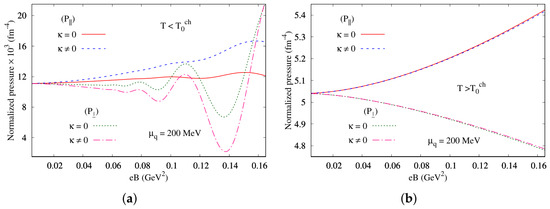
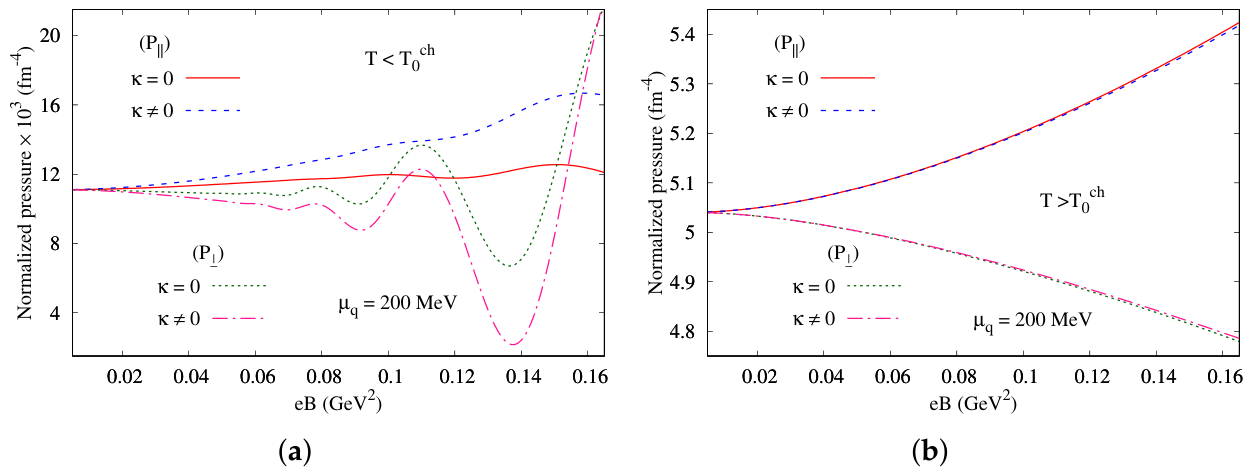
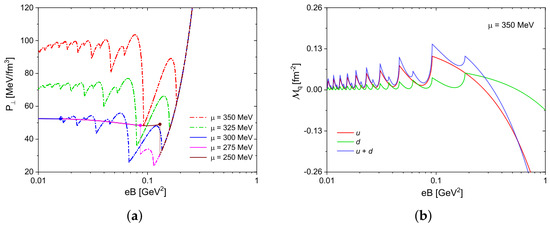
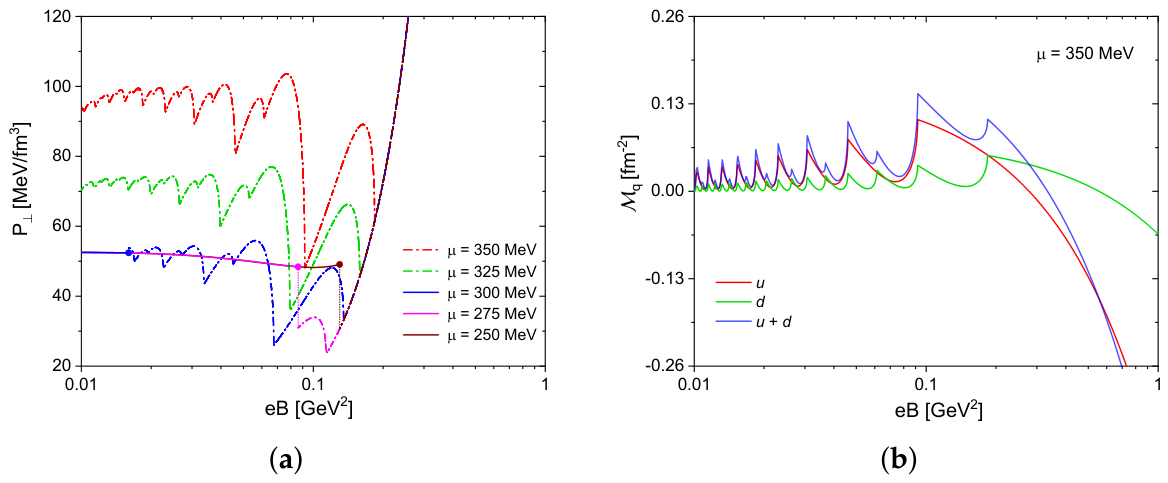
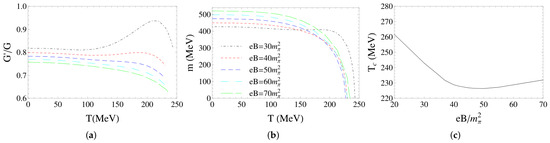
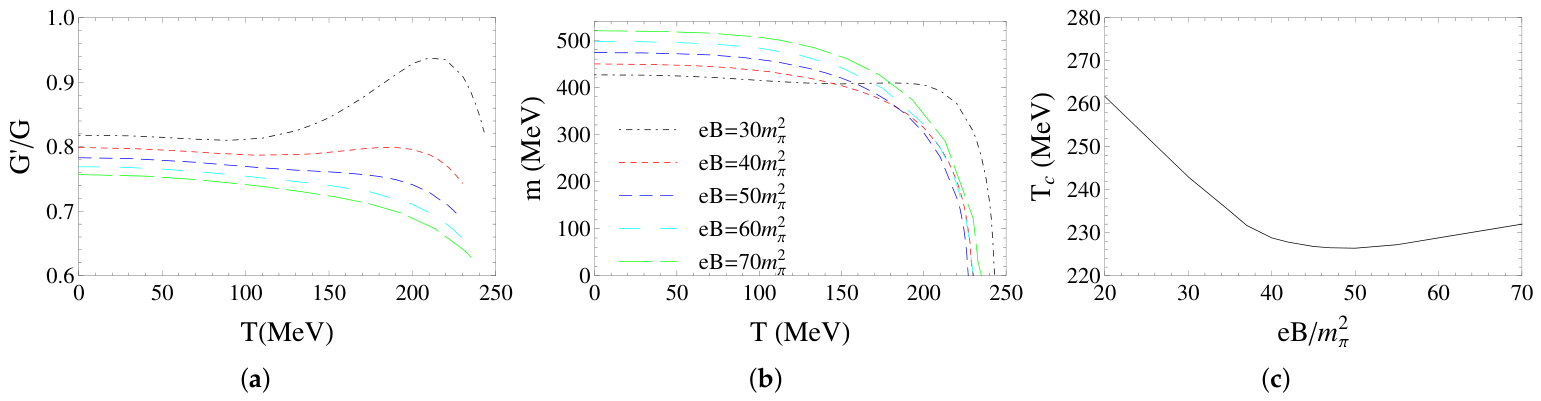
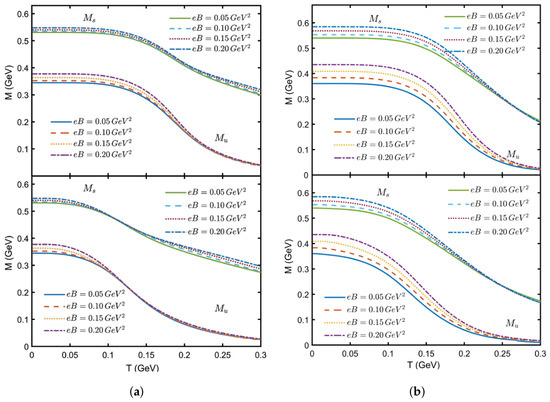
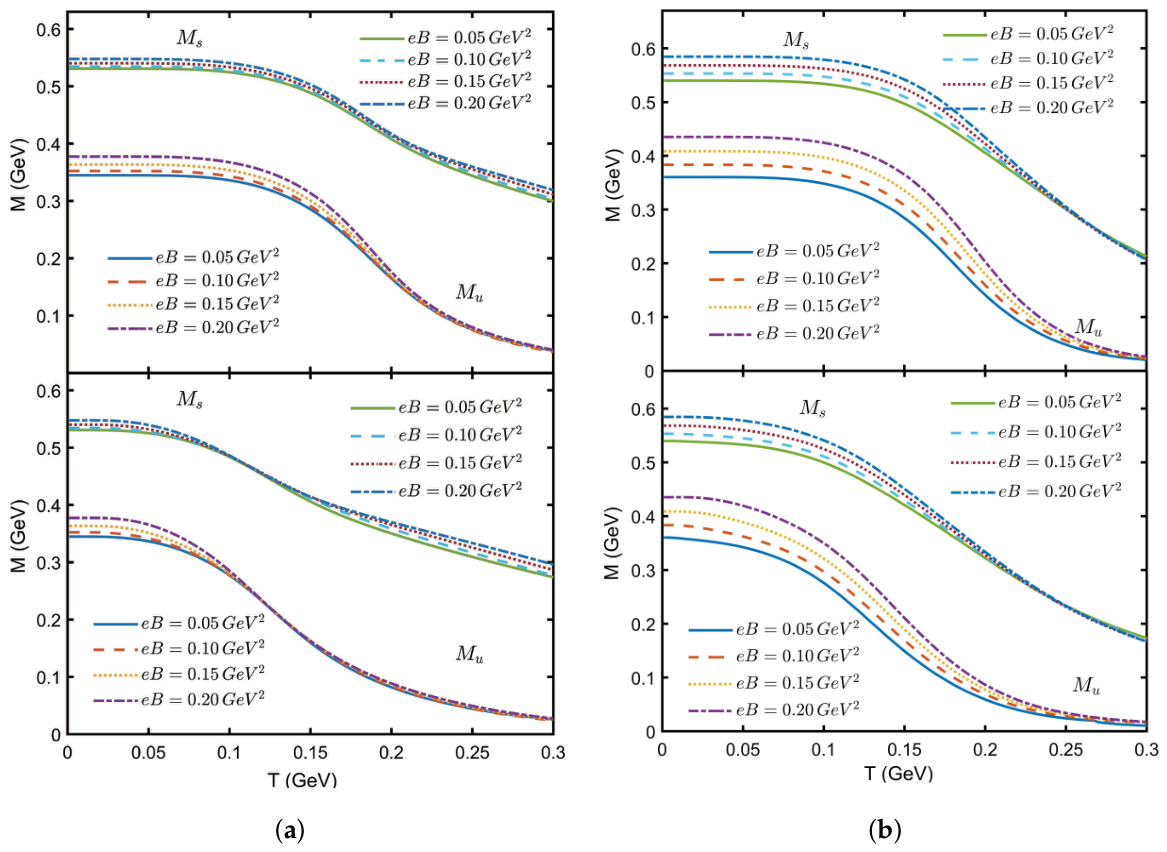
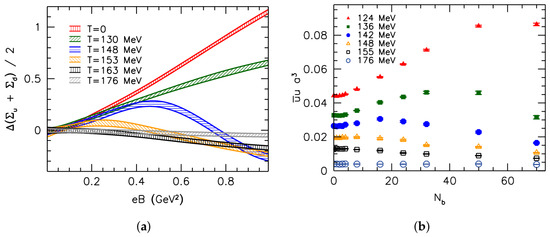
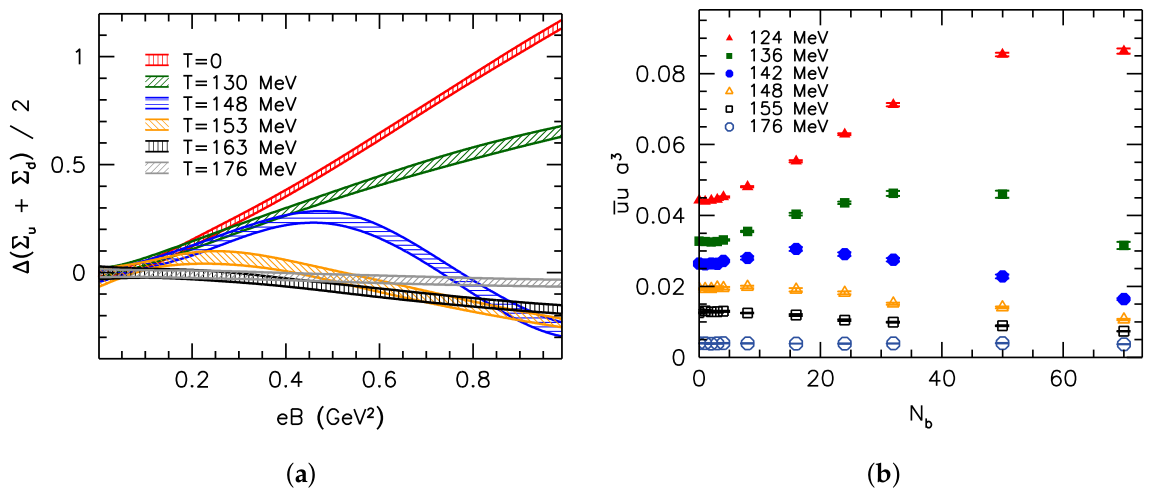
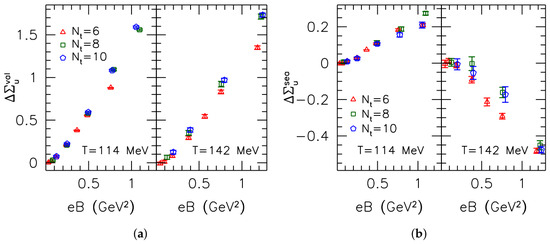
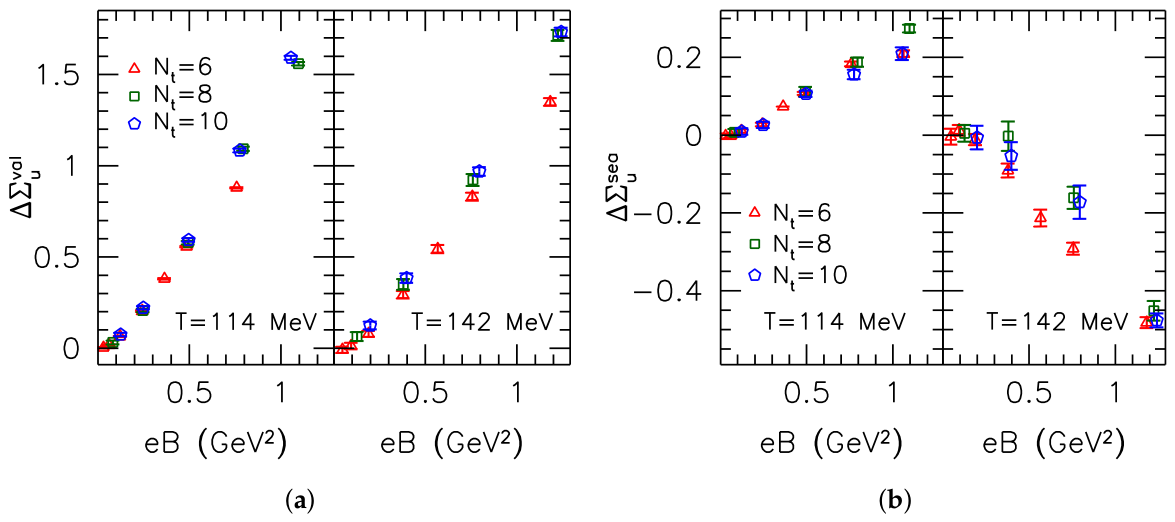
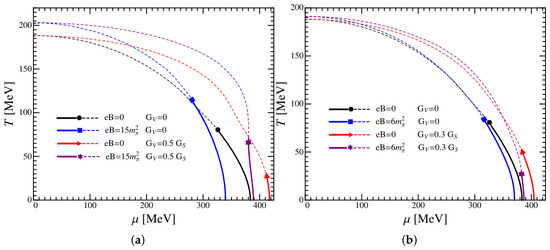
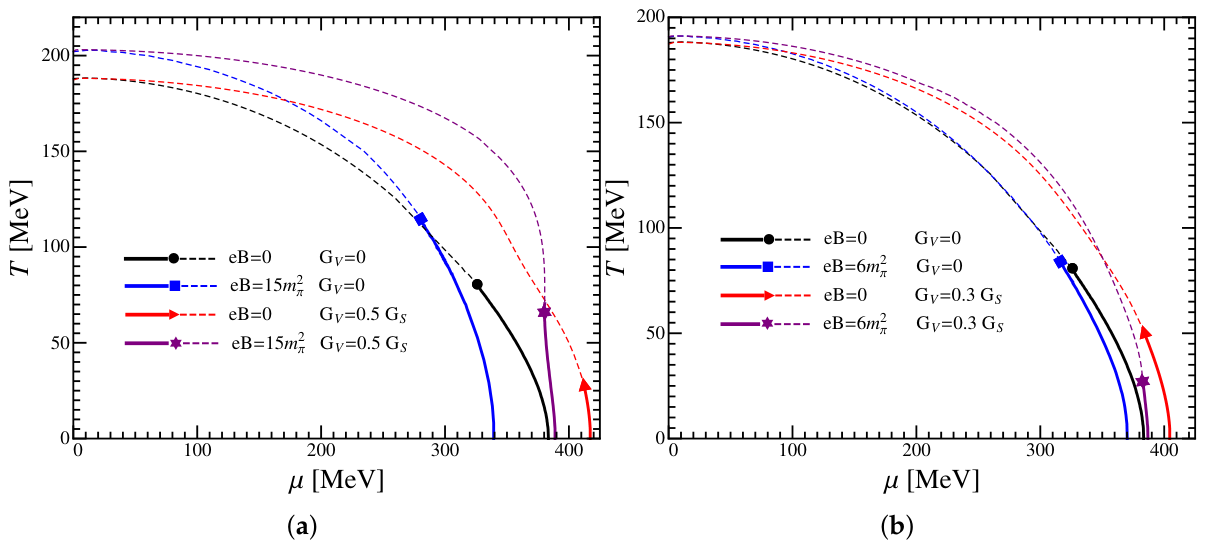
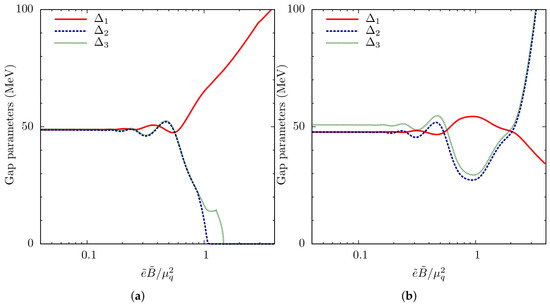
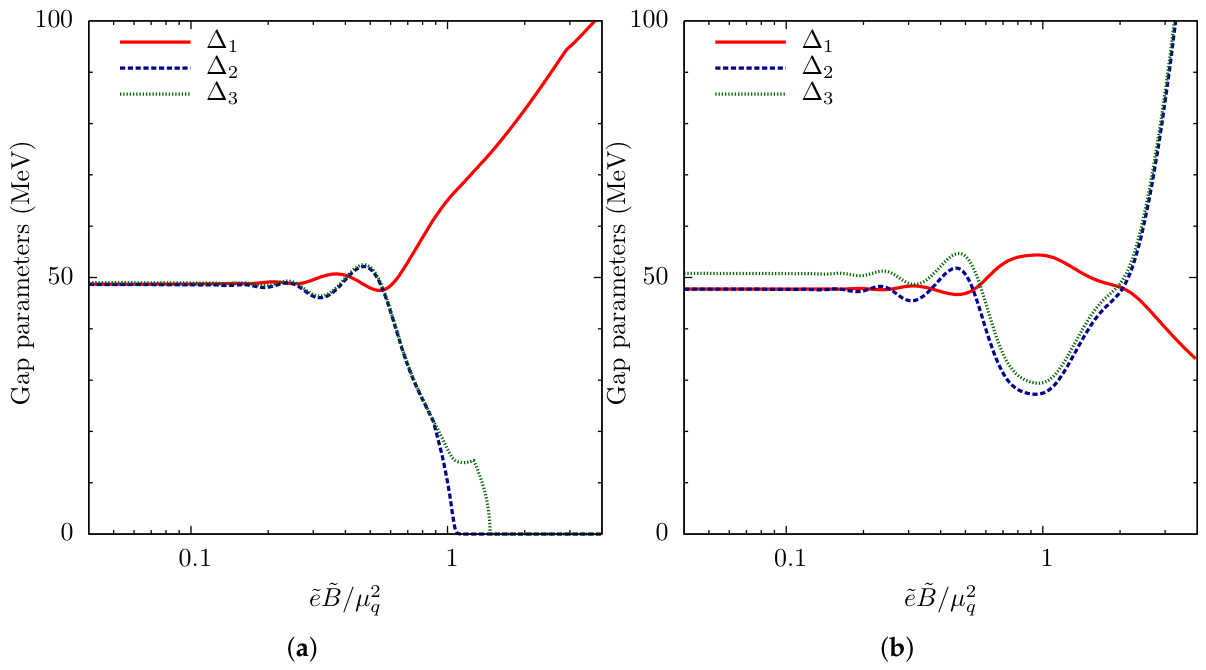
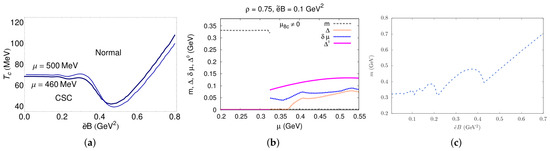
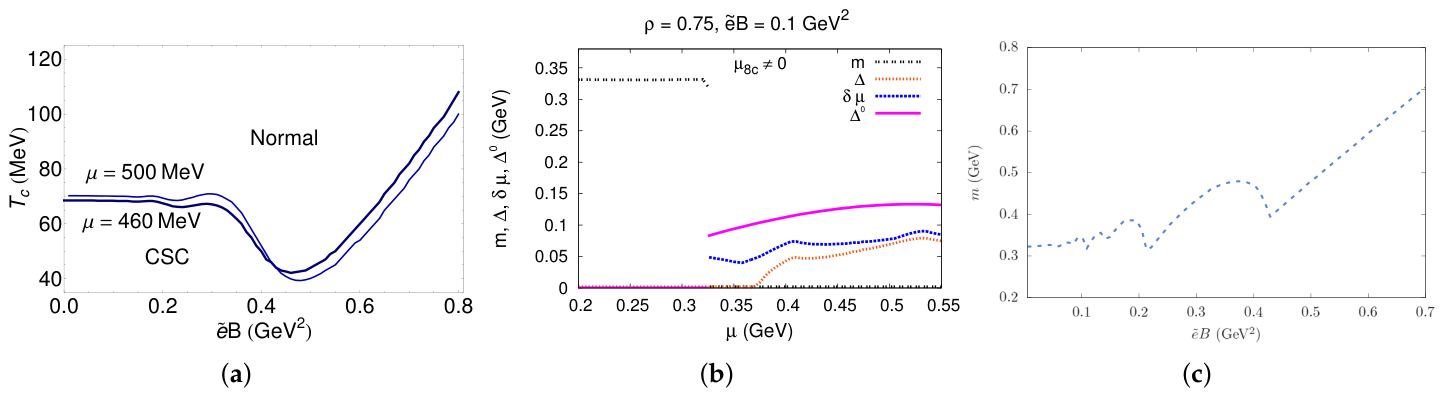
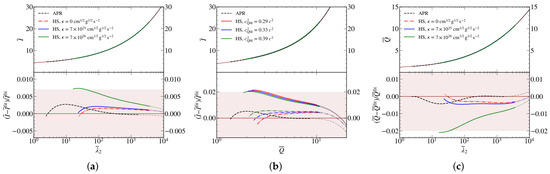
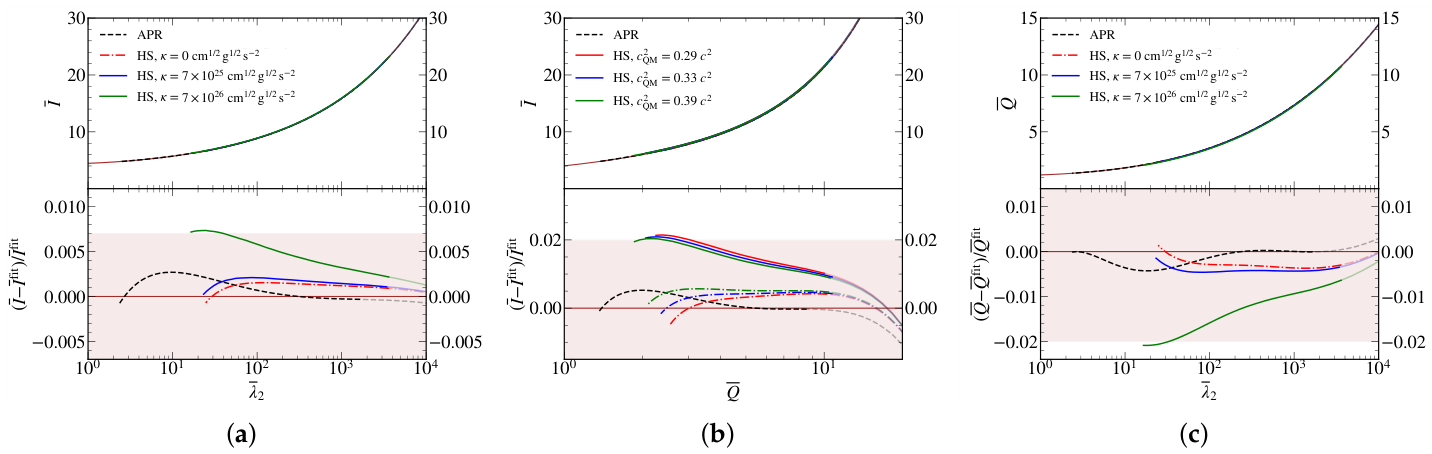
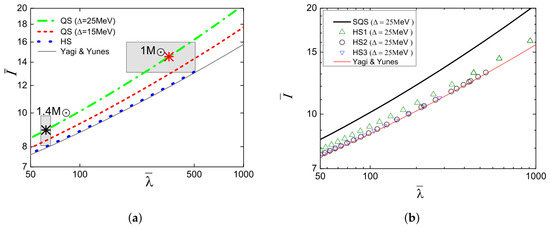
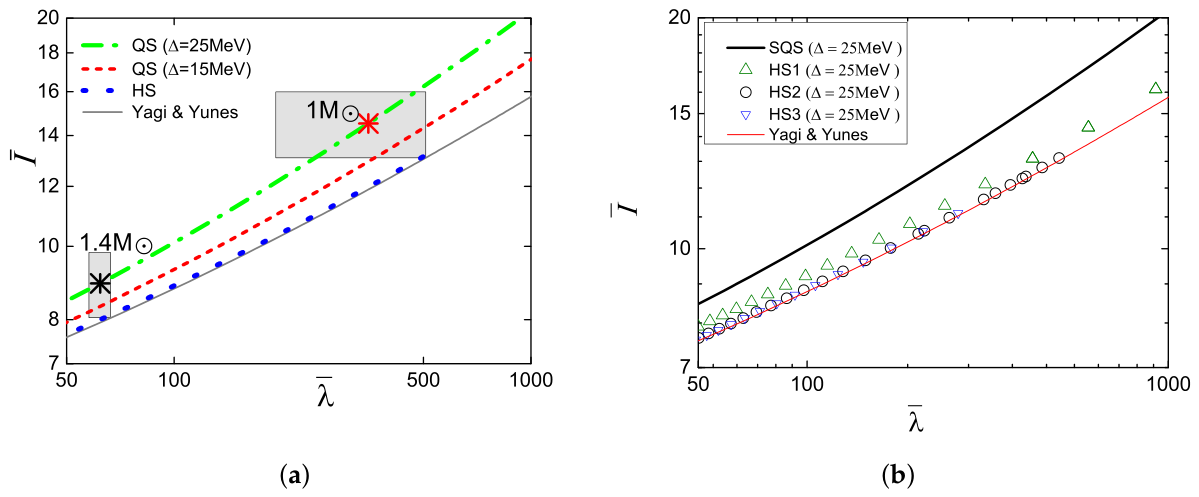
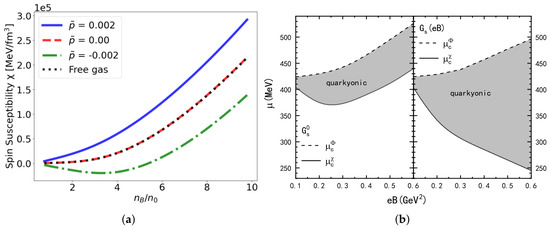
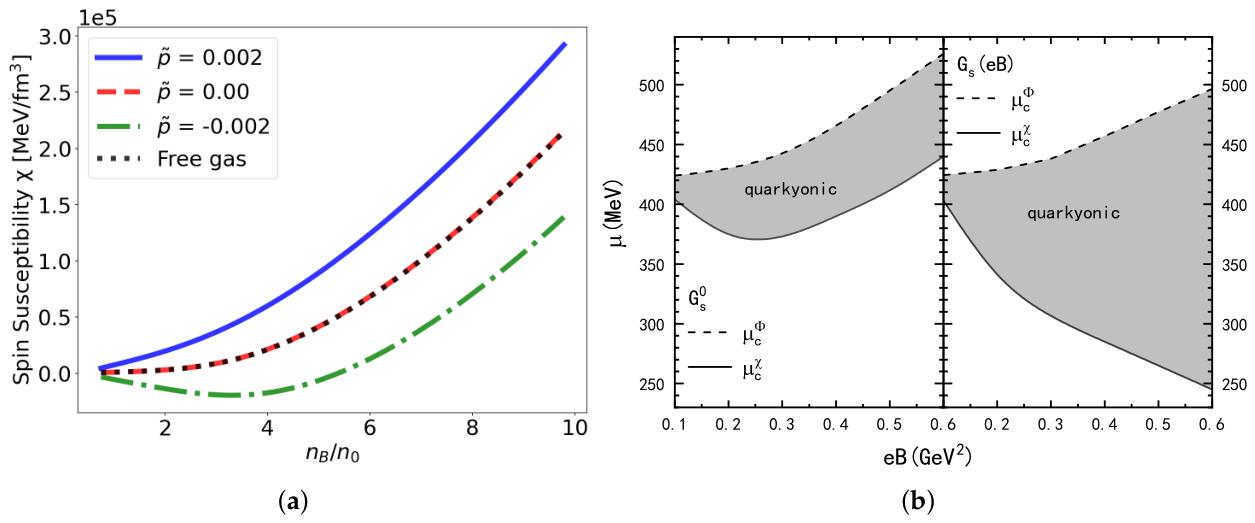
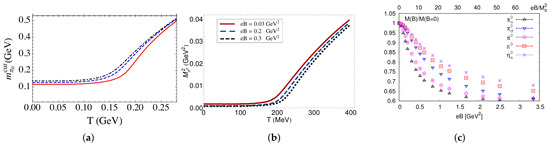
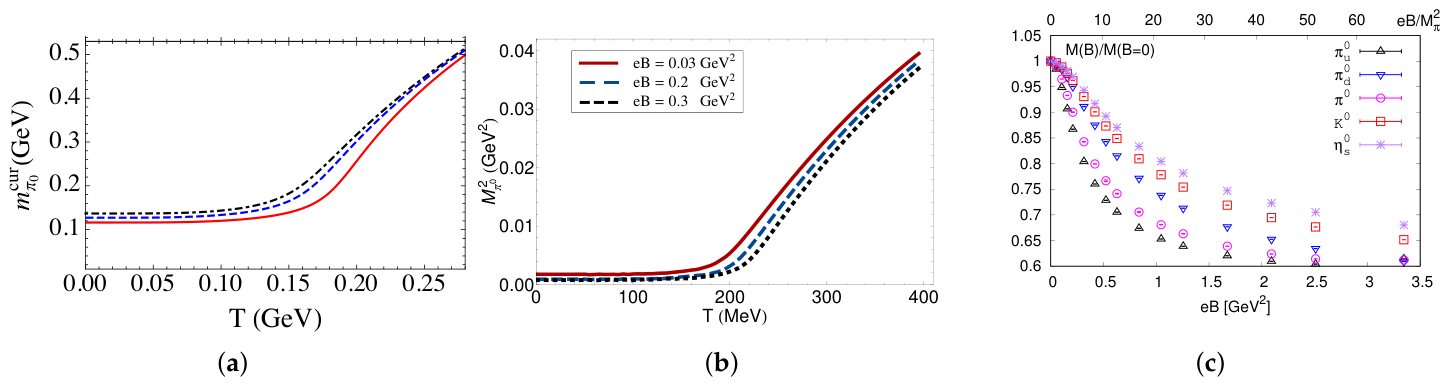
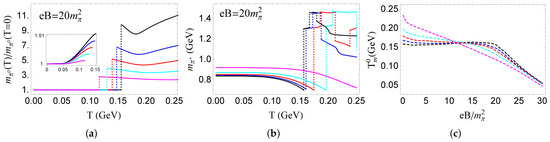
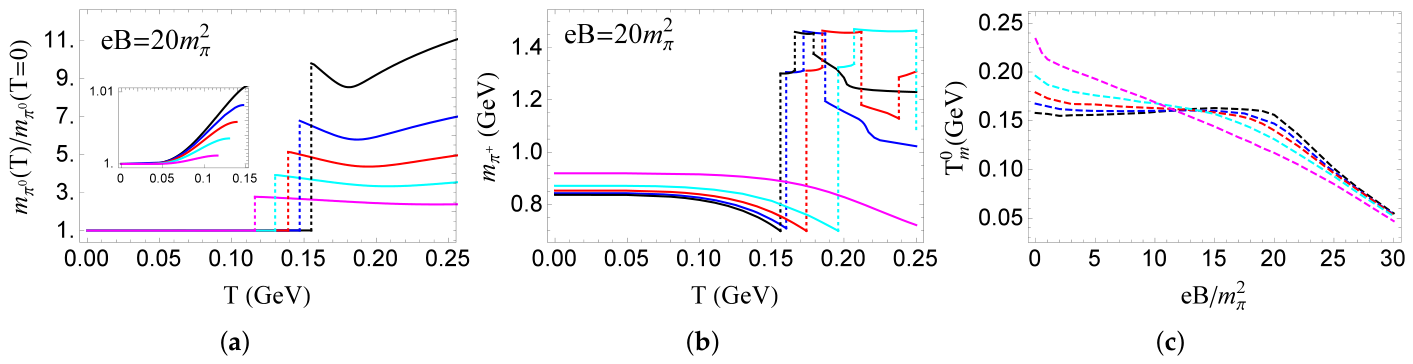
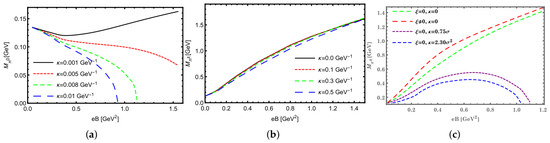
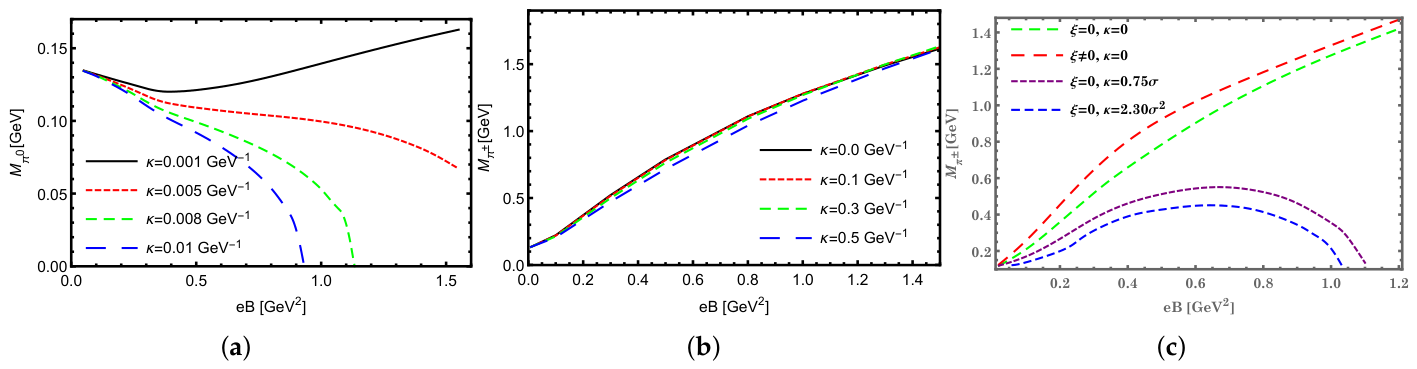
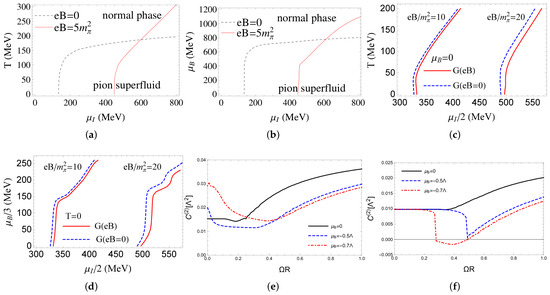
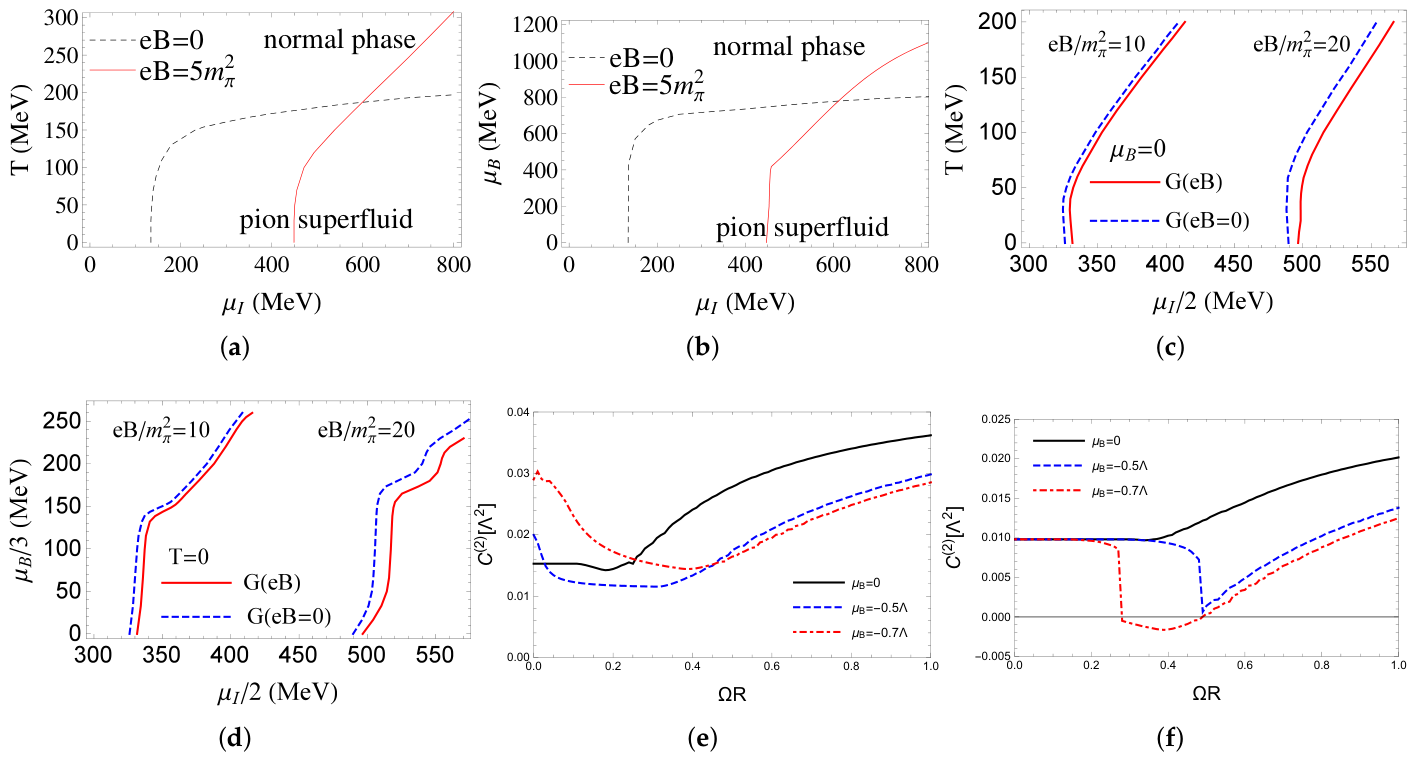
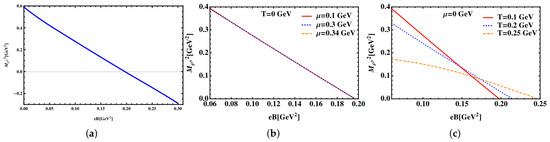
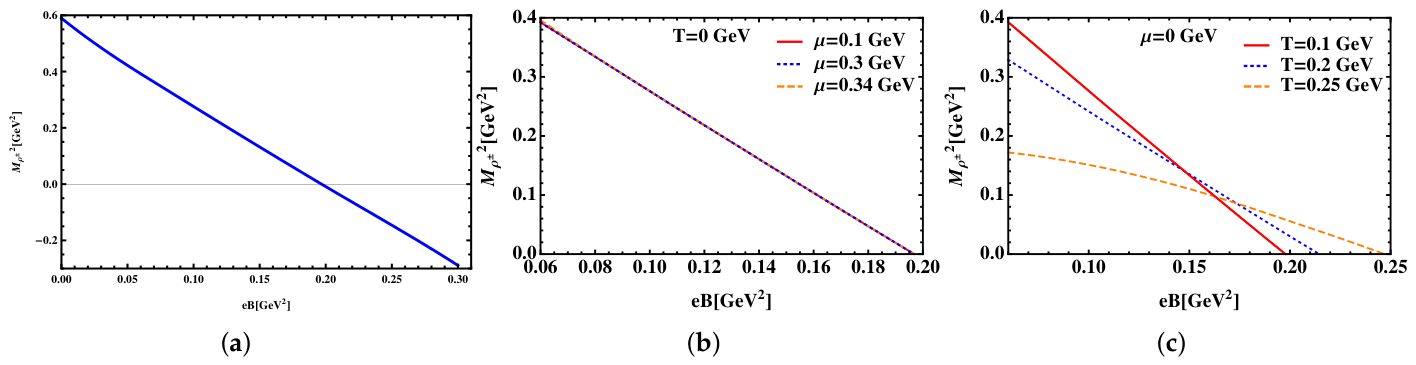
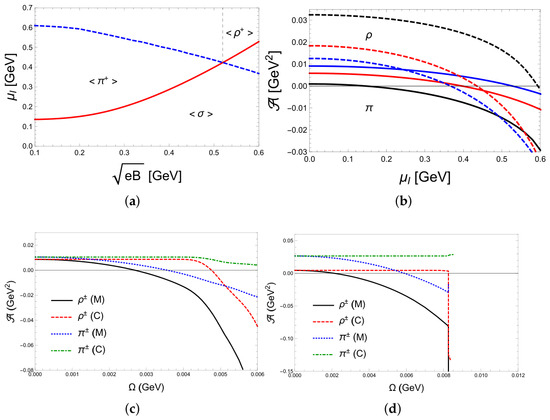
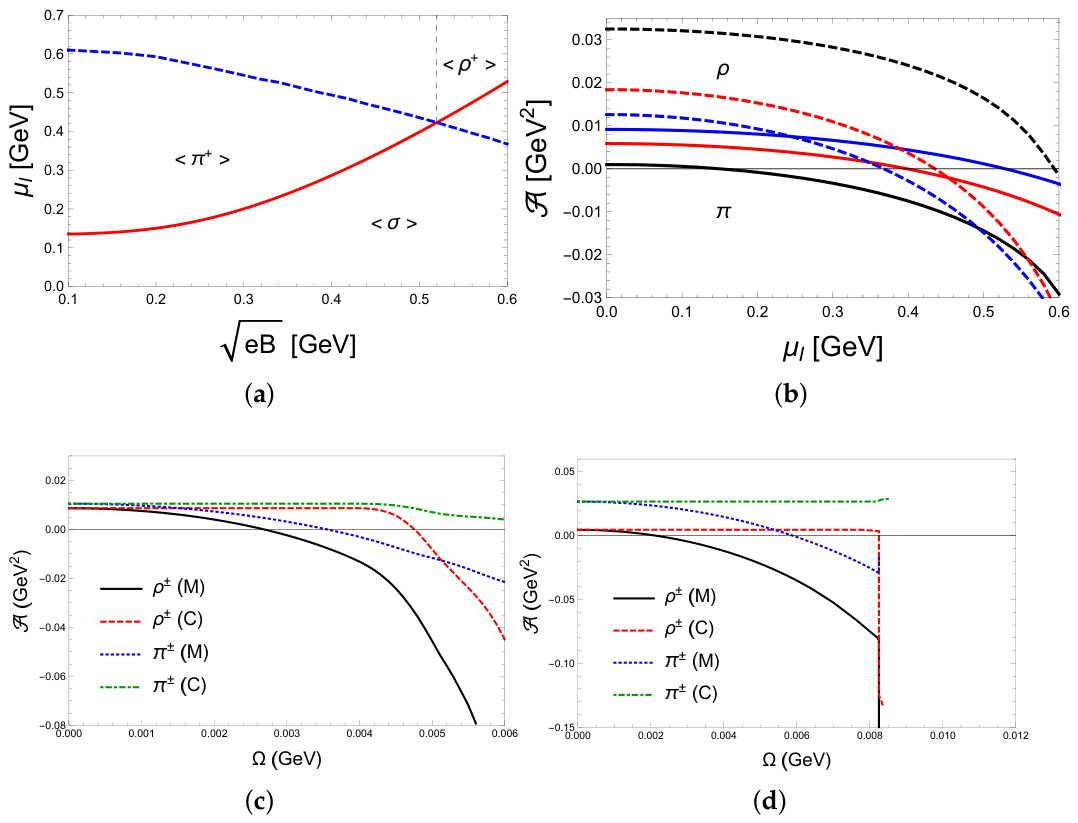
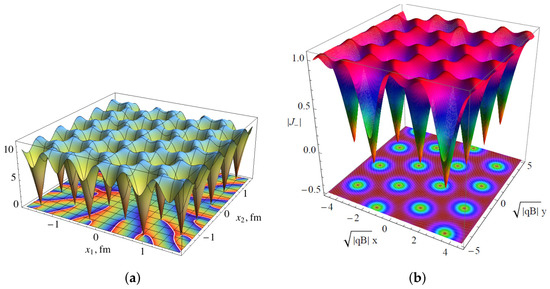
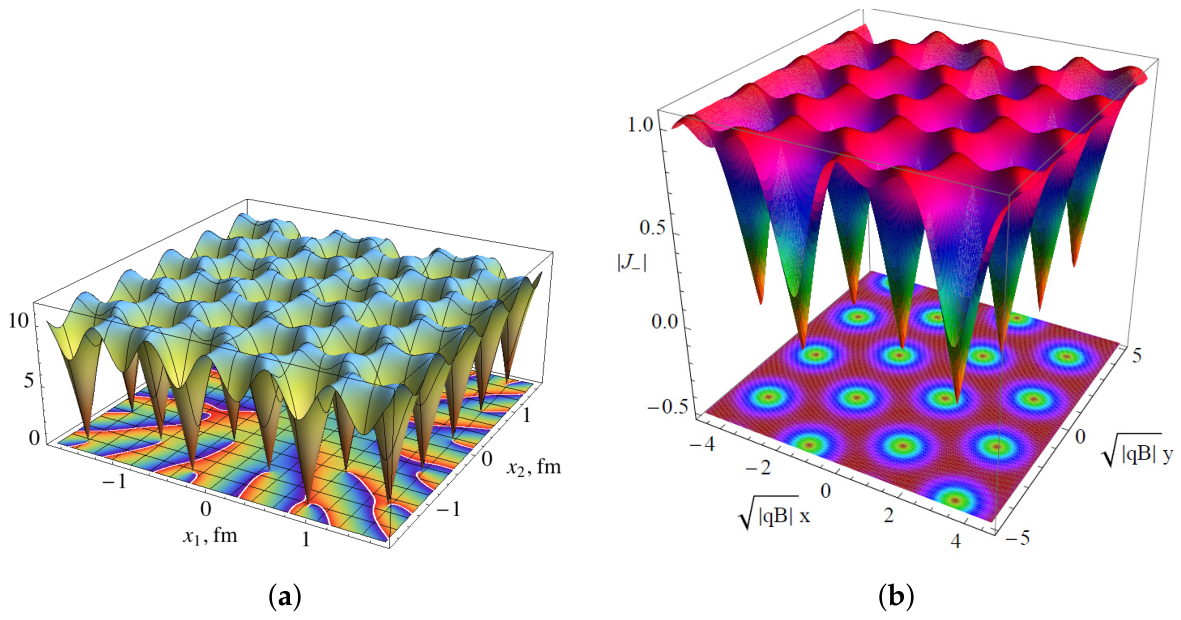
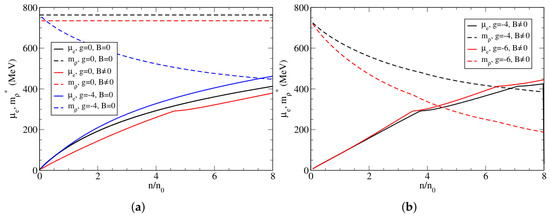
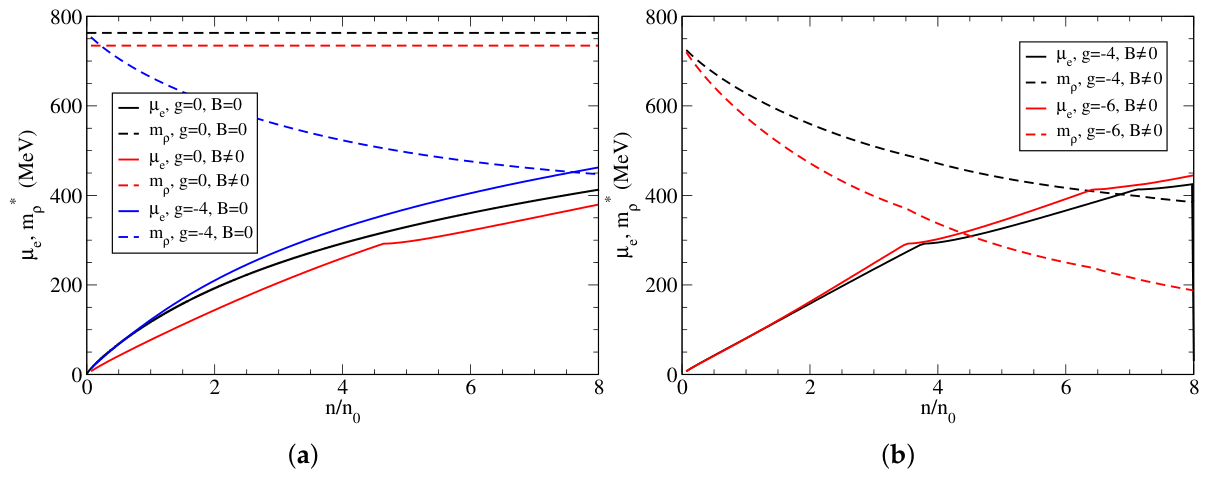
Disclaimer/Publisher’s Note: The statements, opinions and data contained in all publications are solely those of the individual author(s) and contributor(s) and not of MDPI and/or the editor(s). MDPI and/or the editor(s) disclaim responsibility for any injury to people or property resulting from any ideas, methods, instructions or products referred to in the content. |
© 2026 by the authors. Licensee MDPI, Basel, Switzerland. This article is an open access article distributed under the terms and conditions of the Creative Commons Attribution (CC BY) license.