


Abstract
Despite a decade’s worth of gravitational wave observations, the origin of the binary black hole (BBH) mergers detected by the LIGO–Virgo–KAGRA (LVK) collaboration remains an open question. Towards assessing the feasibility and prevalence of the many proposed BBH formation channels, the spin properties of the merging black holes (BHs) hold significant promise, particularly their orientations. Moderate preferential alignment of BH spins with their orbit normals, as well as an apparent anti-correlation between the BBH effective spin parameters and their mass ratios, would appear to disfavor purely dynamical BBH formation mechanisms, as they lack a preferred orientation to the system. However, alternatives are filled with physical and modeling uncertainties. In this paper, we highlight a dynamical route to easily characterizable spin evolution that results in analytically predictable spin distributions. We show that, when a stellar binary forms a BBH through two phases of stable mass transfer, and the BBH is subsequently driven to merger by the gravitational perturbation of a distant massive object (such as a supermassive black hole), the resulting may be anti-correlated with the binary mass ratio. While the mechanism as proposed only operates in a modest region of parameter space, it also predicts significantly tighter correlations than are seen in the GWTC-4.0 systems. We discuss avenues for future work that may significantly expand the parameter space of our mechanism while still remaining broadly consistent with observations.
1. Introduction
With the conclusion of the first part of the fourth LIGO–Virgo–KAGRA (LVK) observing run, 218 detected events have likely astrophysical origins [1], and the large majority of these are thought to be due to merging binary black holes (BBHs). Many properties of these systems can be discerned from their gravitational wave (GW) waveform, such as the binaries’ component masses, mass ratios, and spin properties. In principle, these properties should carry information about the formation mechanism(s) of BBHs. In practice, such an inference has proven difficult despite extensive efforts. Broadly, three classes of formation channels can be identified. The first is the class of isolated BBH formation, where an isolated stellar binary evolves into a merging BBH in isolation from any additional perturbations (e.g., [2,3,4,5,6,7,8,9,10,11,12,13,14]). The second is the class of hydrodynamically-assisted BBH mergers, typically in the disks of active galactic nuclei (AGN), where the BBH is formed and/or driven towards merger due to interactions with the dense surrounding gas (e.g., [15,16,17,18,19,20,21,22,23,24,25,26,27]). The third is the class of dynamically-assisted BBH mergers, where an initially wide binary is induced to merge via interactions with either a few (e.g., [28,29,30,31,32,33,34,35,36,37,38,39,40,41,42,43,44,45,46,47,48]) or many (e.g., [49,50,51,52,53,54,55,56,57,58,59,60,61,62]) bodies, including many studies on BBH mergers in nuclear star clusters (e.g., [17,30,36,63,64,65,66]; see [67] for a review). The question of which of these channels contributes what fraction of the observed BBH mergers remains an open question [68,69], and there is an ever-expanding effort to understand both the predicted properties of BBHs formed via each formation mechanism and the observed properties of the merging systems in the LVK data.
One strong discriminant among these channels is the spin orientation of the merging BBHs. In previous iterations of the LVK data releases, the best constraints on BBH spin properties came from parameter [70]
and the somewhat less intuitive parameter [71]. Here, the are the BH masses, their dimensionless spin magnitudes, and the angles between their spin axes and the binary orbit normal. With the recent release of the fourth Gravitational Wave Transient Catalog [GWTC-4.0] [72,73], direct constraints on the spin properties of the component black holes (BHs) are available. Reassuringly, the salient features of these constraints are in broad agreement with studies performed on the GWTC-3 catalog [70]. A few of those relevant to the current work are: (i) BH spin orientations are broadly distributed, but with a positive bias [70,74,75]—the GWTC-4.0 constraint is that ∼34% of BBH systems have . (ii) The mass ratios and appear to be correlated. However, there is some debate whether this correlation is the initially-reported q- anticorrelation [70,76] or instead a broadening of with decreasing q [75]. GWTC-4.0 does not substantially resolve this ambiguity [73].
The natural next question is: which BBH formation channels satisfy these two constraints? Isolated evolution is manifestly capable of producing BBHs with aligned spins, and more recent work suggests that sufficient spin–orbit misalignment can also be generated via isolated evolution to ensure consistency with the LVK data (e.g., [77,78]). BBH formation in AGN disks can also introduce a preferred orientation for the spins and orbit of the BBH, leading to preferential spin–orbit alignment (e.g., [79,80]). However, studies generally find that BBHs experiencing dynamically violent evolution result in roughly isotropic distributions of ((e.g., [34,39,42,59,67,81,82,83]), but see [84]). As such, at first glance, it would appear that dynamically-induced BBH mergers are disfavored by the GWTC-4.0 constraints on the spin properties of merging BBHs.
This is not necessarily the case. Within the class of dynamically-driven BBH merger channels, those involving just a single tertiary companion (“tertiary-induced mergers”) can produce sharp features in the distribution of BH spin orientations under the right conditions—this was first pointed out in the numerical work as a “90° attractor” of spin–orbit misalignment [34,42,82]. Subsequent work showed that this attractor arises due to a dynamical invariant linking the initial and final spin orientations of the BHs [42,85]. Importantly, this process prefers specific spin orientations despite being a dynamically-driven BBH merger channel. Note that the direct connection to is not immediate, as depends on the combination of the spin–orbit misalignment and the BH spin magnitudes. In this work, we will focus on predictions of alone. Several studies (e.g., [78,86,87]) have considered the role of spin magnitude on the q- anti-correlation.
In this work, we suggest that tertiary-induced mergers, specifically driven by a supermassive BH (SMBH) tertiary, may be able to reproduce many of the features of the spin distribution observed by LVK. Notably, the resulting spin–orbit misalignment angles are preferentially prograde, and their cosines may be anti-correlated with the mass ratio of the BBH. In Section 2, we review the orbital and spin evolution of a BBH in the tertiary-induced merger channel, including the dynamical invariant that gives rise to the spin attractor, and we discuss our semi-analytical model of the binary stellar evolution giving rise to the BBHs we consider. In Section 3, we show that the combined stellar and dynamical evolution can give rise to unexpected correlations in the spin properties of merging BBHs, and we discuss the feasibility and efficiency of our mechanism when taking into account the nuclear star cluster that typically surrounds SMBHs. We discuss and conclude in Section 4.
2. Methods
2.1. Tertiary-Induced Mergers and Spin Dynamics
In a tertiary-induced merger channel, two black holes orbit each other on a compact orbit while they together are in a distant orbit with a tertiary companion. The orbit of the two inner black holes, with masses and , is described by the Keplerian orbital elements , , , , and , corresponding to the binary’s semi-major axis, eccentricity, inclination, argument of pericenter, and longitude of the ascending node respectively. The outer orbit, of the two black holes about the tertiary with mass , is analogously described by , , , , and . The reference frame is oriented with the total angular momentum pointed along the polar axis (which is nearly equal to the outer orbit’s angular momentum). Finally, call I the mutual inclination between the two orbits.
Without an outer companion, the inner binary will merge due to emission of GWs on a characteristic timescale (assuming a circular orbit, e.g., [34]) of
where and is the reduced mass. Thus, binaries with will take longer than a Hubble time () to merge in isolation. Such binaries can nevertheless be induced to merge due to gravitational interactions with their tertiary companion—such mergers are termed “tertiary-induced mergers.” In this section, we review the orbital and spin evolution of the inner black holes ( and ) in a tertiary-induced merger.
2.1.1. Orbital Evolution: Von Zeipel–Lidov–Kozai Effect
The tertiary companion can accelerate the merger of the inner binary by exciting its eccentricity due to the von Zeipel–Lidov–Kozai [ZLK, [88,89,90]] effect: when the inner and outer orbits are misaligned (when the mutual inclination I is between and ), the eccentricity and inclination of the inner binary will oscillate. As , the maximum of these eccentricity oscillations can approach near-unity, resulting in efficient GW radiation at each pericenter passage (e.g., [91,92]).
The orbital evolution of the two binaries is due to a combination of Newtonian and General Relativistic (GR) effects. We implement the Newtonian evolution of the inner and outer binaries by expanding their mutual gravitational interaction to the octupole order, double-averaging (over both the inner and outer orbits), and including the leading-order corrections to the double-averaged approximation via “Brown’s Hamiltonian” [as given by Equation (64) of [93]]. The conservative components of the equations of motion are most succinctly derived from the interaction potential between the two orbits using the Milankovitch equations (e.g., [91,94]); in conjunction with the dissipative effect of gravitational wave (GW) emission, the equations of motion are:
where the detailed forms of the and the GW terms are well-known [34,93,95,96] and are reproduced in Appendix A for simplicity. Above, the denote the two orbits’ eccentricity vectors, the orbital angular momentum vectors (oriented along the orbit normal), and the are oriented along and have magnitude (see Appendix A for precise definitions). We implement these gradients using the computer algebra system sympy [97].
An example of this evolution is shown in Figure 1, where the enhanced GW radiation due to eccentricities generated by the ZLK effect are able to drive the BBH to merge in ≲0.1 Gyr despite it being too wide to merge in isolation (Equation (2)). For computational efficiency, the full spin–orbit evolution is replaced with a simplified evolution consisting of just GW emission at late times () when the binary evolution is fully decoupled from the effect of the SMBH; this is shown as the orange lines in all panels of Figure 1. The evolution is truncated when ; note that the binary is still well outside the LVK frequency band (GW frequency , or ) but will merge shortly.
Figure 1.
A binary’s semi-major axis (top left), eccentricity (top right), inclination (bottom left), and spin–orbit misalignment angle (bottom right) as it coalesces via the tertiary-induced merger channel in the vicinity of a SMBH. As the eccentricity and inclination oscillate periodically due to the ZLK effect, the enhanced emission of GW induces the BBH to merge. Note that experiences significant oscillations but eventually converges to the prediction of Equation (11) (horizontal red line). For computational efficiency, the late stages of inspiral are performed in the absence of the tertiary and without tracking the spin phase; this is denoted by the orange line in all four panels. Parameters used are: , , , , , , and .
2.1.2. Spin Evolution: An Adiabatic Invariant
As the BBH gradually coalesces, the spins of the component black holes also evolve. At leading 1-PN order, spin–spin coupling can be neglected [34,98], so the evolution of the two BHs can be treated independently. Thus, we will study the evolution of the spin of , though the evolution of proceeds analogously. For brevity, we will drop the subscript. The de Sitter precession of about is given by (e.g., [34,99])
Note that the misalignment angle is precisely the angle constrained by the GWTC-4.0 catalog. The evolution of is shown in the bottom-right panel of Figure 1 (see also [34,42]). While appears to converge to its mean value by the end of the evolution, such a behavior is not an obvious consequence of the spin evolution given by Equation (8): there is no dissipation.
Instead, the mechanism for this convergence is due to an unexpected adiabatic invariant ([34,42]; see also [82]). Given that the analytical origins of this mechanism were previously derived in extensive detail in our previous work [42], we omit a full rederivation here. For interested readers, we provide an alternative derivation with a greater physical emphasis in Appendix B. For the purposes of this paper, the key result is as follows: if a binary black hole is formed with spin–orbit alignment and undergoes a sufficiently adiabatic (merger time ≫ the ZLK cycle time) merger, then the final spin–orbit misalignment angle is given by:
where is some dimensionless function of order unity (that primarily depends on the detailed value of ). The accuracy of Equation (11) is illustrated as the horizontal red line in the bottom-right panel of Figure 1. We see that in the limit and that we recover the attractor result. However, for more compact binaries, is not so small, and a positive bias in the observed distribution arises, consistent with the LVK constraints (as discussed in Section 1).
We compare these analytical results to direct numerical integrations performed with a few values of in Figure 2. In the top panel, we show the merger times of the BBH systems that successfully merge within the duration of the numerical integration, . In the middle panel, we show that the resulting misalignment angles can be well-described by Equation (11). The central dip is because as , and the effective precession axis is aligned with at all times [42]. Other deviations from the analytical result likely arise from non-adiabaticity or resonances, both of which can be obtained from a more careful analysis than presented here [42]. Finally, in the bottom panel, we show the spin–orbit misalignment angle distributions at each . The distributions follow the naive predicted by Equation (11) quite well. Small deviations arise when , which violates the approximation used to derive Equation (11).
Figure 2.
In these plots, we show how the final spin orientations of tertiary-induced BBH mergers change with their initial semi-major axis (we choose to vary ) across a range of initial mutual inclinations between the inner and outer orbits. In the top panel, we show the merger times as a function of and (legend), where systems that evolve for longer than are labeled with triangles (and likely become unbound by relaxation processes in the NSC). In the middle panel, we show the resulting misalignment angles for all merging systems. For each value of , we also show the numerical evaluation of Equation (11) in the correspondingly colored dashed lines; good agreement is seen. Finally, in the bottom panel, we show the histograms of obtained at each value of , and we have overlaid an arbitrary line (predicted by Equation (11)) to guide the eye. All parameters other than those labeled are the same as in Figure 1.
It is important to note that the anti-correlation between and , a result of Equation (11), relies on the assumption that , a limiting assumption that was also pointed out in Yu et al. [82]. For dynamically-assembled BBHs, such an assumption cannot be made, as the component BH spins are randomly oriented upon capture. For BBHs born from wide stellar binaries, there are two issues with this initial condition: the spins of the stars need not be aligned with the orbits of their wide binary companions at birth, and the birth of the BHs will significantly modify the orbit due to supernova (SN) kicks (e.g., [100]). On the other hand, for more compact BBHs, this is a sensible initial condition because the Keplerian orbital velocity of the binary becomes larger than the natal kick velocity, and because the stellar spins are likely well-aligned with the orbit (whether because the stars are co-natal or due to alignment processes such as mass transfer).
On its own, a correlation between and is not so useful, as is a property of the BBH at its formation rather than when it is observed by LVK. However, if is correlated with other properties of the BBH, then the mechanism we’ve discussed can introduce additional structures to the observed parameters of BBH systems. In the next section, we show that a preceding phase of binary stellar evolution can introduce such correlations.
2.2. Stellar Binary Evolution
As the origin of the BBHs considered in the previous section, we consider that they may be the final evolutionary stage of stellar binaries orbiting a SMBH. Observationally, stellar binaries have been found within ∼0.1 pc of Sgr A∗ [101,102,103], consistent with the binary fraction of young star clusters [104]. On the other hand, more recent studies identify a deficit of massive stellar binaries within the central of Sgr A∗ [105]. Nevertheless, as the formation of nuclear star clusters (NSCs) is not well understood [see, e.g., [106] for a recent review], it appears plausible that massive stellar binaries can be formed as close in as ∼0.04 pc to a central SMBH (corresponding to our fiducial parameters, see Figure 1) on eccentric orbits [107]. Additionally, due to the low efficiency of dynamical binary formation so near an SMBH, where the velocity dispersion is very large (e.g., [108,109]), it is likely that any BBHs so close to their central SMBHs either formed as a primordial stellar binary or formed via gas-assisted capture in an active galactic nucleus (AGN) disk (e.g., [110]). In this section, we focus on the former possibility and defer discussion of the latter to many other excellent works (see Section 4).
In this section, we consider an initial stellar binary with total mass at semi-major axis , and with the same outer orbital parameters used above in Section 2.1.2. We will study the resulting spin misalignment of the merging BBH as a function of the BBH mass ratio by varying the mass ratio of the initial stellar binary .
2.2.1. Short-Range Force Suppression of ZLK
First, we address one key ingredient for this mechanism. In order for the stellar binary to form a BBH that subsequently merges, two conditions must be met: the binary must not experience ZLK-driven coalescence on the stellar phase, but the subsequent BBH must reach sufficiently large eccentricities via ZLK to be driven towards merger. One way that this can be accomplished is by reorienting the binary between its stellar and BH phases, either via collective effects such as resonant relaxation [111] or via natal kicks (e.g., [112]). We consider a second possibility, that the additional sources of apsidal precession present in stellar binaries (often simply referred to as short-range forces, or SRFs) are able to suppress ZLK (e.g., [91,113,114,115]) while those in the subsequent BBH cannot. Since these results are well-established, we defer their discussion to Appendix C and quote the key results here.
For two stars on sufficiently wide orbits that their spins do not tidally synchronize on their main sequence lifetimes (), the dominant source of apsidal precession is due to the non-Newtonian potential generated by their rotational bulges. This precession can suppress ZLK oscillations if the sums of the dimensionless parameters (e.g., [91]), where
On the other hand, in binary black hole systems, the dominant source of apsidal precession is general relativistic pericenter advance, a first-order post-Newtonian effect. This effect will suppress ZLK oscillations if the parameter [91], where
2.2.2. Binary Stellar Evolution: Double Stable Mass Transfer
Given that the stellar binary, consisting of two stars with zero-age main sequence (ZAMS) masses and , does not experience ZLK oscillations, it will evolve according to standard theories of isolated binary evolution. In traditional prescriptions, such evolution results in one phase of stable mass transfer followed by a second phase of unstable mass transfer (a common envelope phase), leading to a very compact binary that may even successfully merge in isolation (e.g., [6,116]). However, more recent studies suggest that, except for very extreme mass ratios (), many stellar binaries that form compact object binaries may instead undergo two phases of stable mass transfer (MT) (e.g., [117,118]). As the detailed physics of these two phases of MT are still filled with uncertainties, we can gain some qualitative understanding of the parameter space that can result by implementing simple analytical prescriptions. In general, the final outcome of MT will depend on the stellar properties, and will introduce correlations between the initial of the BBH and its various other physical properties. We describe the double MT phase using the formalism of Soberman et al. [119] (S97) and use similar parameters as modern works (e.g., [118,120]).
In the S97 formalism, as a star initiates MT, the mass lost from the star follows one of three modes. The first is called Jeans’s mode or the fast mode [119], in which a spherically symmetric outflow directly removes matter from , carrying away the specific angular momentum of the donor star. The second is called isotropic re-emission, in which matter is first transferred to the vicinity of the accretor before being rapidly, isotropically ejected; matter lost in this fashion carries away the specific angular momentum of the accretor instead. The third is accretion, in which the matter lost from is deposited onto , conserving the total angular momentum of the system. A given MT phase can be parameterized by the fractions , , and , which denote the fraction of matter lost from the primary via either the fast mode, isotropic re-emission, or accretion respectively; note that (we do not consider mass loss through L2, which becomes important for rapid mass loss, [119,121]).
In this work, we will assume that, between the zero-age main sequence and the end of the mass transfer phase, the primary loses the entirety of its radiative envelope, and we denote to be the core mass fraction of the primary [see, e.g., [118]]. For the high-mass stars we consider, (broadly consistent with the MIST stellar evolution tracks, [122,123]), and as a first approximation we take this to be a constant; we will explore a mass-dependent shortly. Then, the evolution from a ZAMS binary to a BBH is modeled in four separate stages:
- During the first phase, the primary ejects some fraction of its envelope mass, , due to stellar winds. The exact value of is currently not well-known for massive stars, but it is likely subdominant to binary-driven mass loss [124,125], implying that . We take as a fiducial value.Among this wind-ejected matter, we approximate that half will be unbound from the binary, and the other half will be accreted by the secondary [as seen in high-mass x-ray binaries, e.g., [126]]. Thus, we take as fiducial values for this wind-driven mass loss phase.
- During the second phase, the primary ejects the remainder of its envelope (consisting of mass ) on a thermal timescale. As such, the fast mode of mass loss is sufficiently weak to be neglected (e.g., [118]). Of the remaining mass, all of which reaches the vicinity of the secondary, some fails to be accreted and experiences isotropic re-emission.For simplicity, let us define , and similarly for . As such, the three quantities satisfyingdenote the mass fractions of the primary’s ejected envelope lost via stellar winds, isotropic re-emission during stable MT, and accretion during stable MT respectively. To account for this, we take fiducial values for this mass transfer phase. This is implemented taking .After this phase, we model that the remaining mass of the primary, experiences direct collapse to a BH with no natal kick (e.g., [127,128]). The secondary has attained a new mass . Its new core mass is then , i.e., the convective–radiative boundary of the accretor adjusts to its new mass (and possibly “rejuvenating” the core, e.g., [129,130], but see also [131]).
- During the third phase, the secondary also experiences wind-driven mass loss. It also loses of its envelope, with .
- During the fourth phase, the secondary initiates a second phase of stable MT. Again, the fast mode is too slow to contribute to mass loss. However, additionally, the primary (which is now a BH) likely does not accrete efficiently, i.e., not much more rapidly than the strongly constraining Eddington limit [118]; note that even sustained accretion at , as suggested by recent three-dimensional radiation hydrodynamics simulations [132], only leads to modest accretion during a stable MT episode. Due to the low accretion efficiency, almost all of the mass transferred from the secondary experiences isotropic re-emission. As such, we take and as fiducial values.
In summary, the four phases of the mass transfer procedure depend on a total of five free parameters: , , , and the two values for the stars (recall that and similarly for ). By fixing and enforcing a shared prescription for the two stars (either constant or mass-dependent), the number of free parameters is reduced to just three.
Regarding the spin evolution, we assume that the binary stars form with exact spin–orbit alignment (which is expected at such close separations, though there may be evidence for misalignment in eccentric binaries, [133]). Then, subsequent evolution does not change the orbit orientation (natal kicks are neglected), and the spin orientation also does not change (the secondary is aligned by accretion from the primary during the second MT phase, while the primary never accretes much mass during the fourth MT phase and retains its primordial orientation).
By applying this four-phase prescription for mass transfer, we obtain a relation between the stellar binary’s semi-major axis and that of the BBH (for consistency with the notation in Section 2.1, we omit the BH subscripts for quantities describing the BBH) as well as between the stellar binary’s mass ratio and that of the BBH . In Figure 3, we show the binary evolution resulting from the four-phase MT prescription detailed above. First, we note in the top panel that mass ratio inversions are seen for near-equal-mass binaries (red line). Since the spins of the first and second-formed BHs are sometimes expected to differ (e.g., [86]), we will keep track of mass ratio inversions. Note that the MT prescription we’ve proposed is scale-free and only yields predictions for the semi-major axis ratios rather than their specific values. Of course, physical models of MT yield dramatically different results depending on binary orbital separation, which would be modeled in our formalism as dependencies of and other parameters on .
Figure 3.
In the top-left panel, we show the final mass ratio (i.e., that of the binary black hole) as a function of obtained after the four-step mass transfer prescription discussed in Section 2.2.2. The red line denotes systems that experience mass ratio inversion, where the more massive BH is formed from the initially less massive star, and the black line denotes systems that do not experience this inversion. In the bottom-left panel, we illustrate the three pairwise ratios of the binary’s initial semi-major axis , its intermediate value (after the formation of the first BH, i.e., at the end of the second phase) , and its final value (after the formation of both BHs) also as functions of . In the bottom-right panel, we show the resulting correlation between and , where the black and red lines have the same meaning as in the top panel. A positive correlation is seen, as depicted by the linear fit shown as the green dashed line. The parameters used here are , , , and .
There are two features about the evolution above that are essential to our subsequent discussion. First, note that , i.e., the binary does not shrink appreciably during its evolution to a BBH, and GR precession does not suppress ZLK oscillations. Second, the last panel of Figure 3 shows that and are positively correlated. Then, application of Equation (11) suggests that the final will be negatively correlated with ; this will be shown in Section 3.
To understand the robustness of these two features as a function of the three free parameters of the system, we study the dependence of the mean slope (defined as the best fit line as shown in Figure 3) and the mean semi-major axis change on the free parameters of the MT prescription. In Figure 4, we show the dependence of these two quantities on , for three different prescriptions: , , and a mass-dependent fraction
This simple prescription is in coarse agreement with asteroseismic and spectroscopic observations for lower masses [134,135,136] and with the MIST evolutionary tracks at higher masses [122,123]. Broadly, it can be seen that a positive correlation between and , as well as a gentle orbital softening, are robust features of our MT model.
Figure 4.
The left column of plots shows the values of the mean correlation and the mean semi-major axis change as a function of and , two of the three free parameters of the MT prescription laid out in Section 2.2.2; the third, , is fixed at . The upper-right triangle in both plots is forbidden due to the requirement that (Equation (14)) and that . The middle column of plots shows the same but for . The final column of plots shows the same but for a mass-dependent (Equation (15)). In all panels, a value of 1 is shown as a black contour when within the scale of the color plot.
As a final note, we comment on the intuitive reason for the observed correlation between and during our double MT prescription. First, conservative mass transfer generally drives small-mass-ratio systems closer to equal mass ratios. This effect is preferentially stronger for more unequal initial mass ratios. Since conservative mass transfer conserves , it can be seen that a larger increase in corresponds to a larger decrease of . Accordingly, we find that BBHs formed with small should also have small . Second, isotropic re-emission leads to a similar correlation: since the ejected matter leaves with the specific angular momentum of the accretor, a smaller mass ratio ejects more angular momentum and results in more binary hardening. Finally, fast mode mass loss has a smaller effect on the orbital separation (since it is typically ejected from the more massive donor, and as such it carries away little angular momentum) but broadly leads to binary widening. Thus, the combination of all three mass loss mechanisms results in a combination of mass-ratio-dependent binary hardening and general wind-driven binary softening.
3. Results
As shown in the previous section, a population of stellar binaries with fixed semi-major axis and varying mass ratios may yield a population of BBHs with positively correlated and . Such a result can then produce an anti-correlation between and following the results of Section 2.1.2, namely Equation (11). In this section, we use numerical integrations to explore the strength of this correlation and substantiate the analytical arguments made above.
For clarity, we consider a population of nearly-circular () stellar binaries with fixed total mass , fixed semi-major axis , and with [a standard MT stability threshold, e.g., [137,138]]. Using the results of the previous section, these stellar binaries evolve into BBHs via the MT prescription of Section 2.2.2 with semi-major axes and mass ratios . Then, for the orbital dynamics phase of evolution, these BBHs are assumed to have a random initial inclination with respect to the plane of their orbit around a central SMBH (though for computational efficiency we restrict I to values within the window of inclinations that can drive successful mergers as shown in the upper panels of Figure 2). The remaining orbital elements are held fixed for simplicity: , , and . Finally, the initial spins of the BHs are aligned with the inner orbit normal, due to the multiple phases of MT. The inner and outer orbits and the spins of the BHs are then evolved following the equations of motion as described in Section 2.1 for , which is significantly longer than the expected unbinding time for such binaries in typical NSC models (see Section 3). For systems that successfully merge, we record their merger time and final spin–orbit misalignment angle.
Note that we must account for the possibility that the rotational SRF (Equation (12)) may be too weak to suppress ZLK excitation after the formation of the first BH. To do so, we evaluate Equation (12) at the end of the second MT phase (i.e., using from Figure 3) but, for simplicity, we hold the stellar parameters and constant at their fiducial values (which avoids having to introduce detailed stellar modeling, beyond the scope of this paper), and we set for the secondary (which is spun up to near critical rotation by the MT from the primary). We then keep track of systems that pass through a state with . While our crude approximations are unable to definitively conclude that such systems experience strong ZLK oscillations between the formation of the first and second BH, it suffices as a first estimate of susceptibility.
The properties of the systems that successfully merge are shown in Figure 5, where blue points denote systems that may experience ZLK oscillations between the formation of the two compact objects based on the discussion immediately above. Such objects tend to have larger initial mass ratios, leading to more orbital expansion during the formation of the first BH (Figure 3). A clear anti-correlation between and can be seen both in the black points alone and in the entire population. The inferred fraction of systems (among all misalignment angles I between the inner and outer orbits, uniformly weighted in ) that successfully merge within is ≈6%, falling to ≈4% when restricting to systems merging within ; approximately of these systems are susceptible to ZLK between the formation of the first and second BHs.
Figure 5.
The properties of successfully merging BBH systems after the combined double mass transfer and orbital evolution summarized in Section 3, corresponding to the MT prescription shown in the left panels of Figure 3. Black markers denote systems that successfully merge. Blue markers denote systems that merged but may be susceptible to ZLK during the double MT phase, during the interval between the formation of the first and second BHs (see Section 3). Circular markers denote systems merging within , while crossed markers denote systems merging between and , the maximum length of the orbital integration.
Feasibility in Astrophysical Settings
Above, we have shown that binary stars within the central regions of their SMBH may form merging BBHs with correlations in their spin–orbit misalignment thanks to their other physical properties due to two phases of stable MT. In this section, we assess the feasibility of the proposed mechanism in typical NSCs.
We first evaluate the dynamical lifetime of the binaries we consider. In order to do so, we adopt an NSC stellar density profile in line with recent studies (e.g., [139,140]). While the standard theoretical result, the Bahcall–Wolf profile [141,142] gives that with , observations of the Milky Way galactic center suggest a shallower profile, – [143], so we instead adopt a value of . Then, when accounting for the standard M- relation [144], we obtain the following stellar density profile
where and are the standard normalization, and is the typical mass of stars in the NSC. In such a cluster, the velocity dispersion that our fiducial binary experiences is
From this, we can calculate the characteristic binary dissociation/evaporation timescale
Here, is the Coulomb logarithm, and we take to be the mass of flyby stars (corresponding to the simplifying assumption that stars in the NSC all have mass regardless of whether they are in a binary). For our fiducial parameters, this yields .
Another constraint on the system properties arises from enforcing dynamical stability of the triple. For dynamical stability, we adopt the often used [145] condition for dynamical stability:
For our fiducial parameters, the right-hand side of this expression is ∼1500 (taking , and adopting , the final BH value), while the left-hand side is ∼4000. While alternative criteria are available (see [146] for a comparison of stability criteria as well as the most updated criteria), our systems are sufficiently far from the dynamical stability boundary that the detailed choice of criterion does not affect our result.
Finally, for our mechanism, we require that to suppress eccentricity oscillations on the stellar phase, while we require that in order for eccentricity oscillations to gradually induce merger of the BBH. The combination of the four conditions listed above results in the parameter space shown in Figure 6. While the parameter space satisfying all four requisite conditions is modest, it is straightforward to dramatically expand the allowed parameter space by invoking other mechanisms to suppress ZLK oscillations on the stellar binary phase; we discuss this more below in Section 4. Note that for larger-mass SMBHs, the binary dissociation time is longer, but this is due to a lower stellar density which has an adverse effect on event rates.
Figure 6.
Parameter space available for the mechanism in this paper to form black hole binaries around a SMBH (left) and around a SMBH (right). The blue dotted line denotes the condition for dynamical instability (Equation (19)), the black dashed and dotted lines denote the condition for binary dissociation/evaporation timescale to be longer than and (Equation (18)), and the green and orange lines denote the required conditions on the SRFs in the system (Equations (12) and (13)). The green shaded region denotes the region of parameter space satisfying all of our constraints. For simplicity, we hold a few parameters fixed: , , , , and we take and , typical values for stars. The fiducial parameters used in this study are labeled by the horizontal and vertical dotted lines, located at and . Note that, for the stellar density profiles given in Equation (16), there are ∼200 stars in the green shaded region on the left and ∼40 stars in the right.
Finally, we use the above results to briefly discuss the possible event rates via this mechanism. As the properties of binary mass transfer and the properties of NSCs (and particularly binarity in NSCs) are not well constrained, we can do little more than provide a very coarse estimate. As a point of reference, we note that typical estimates of the number density of NSCs are in the mass range [147,148]. By comparison to the latest BBH merger rate from GWTC-4.0 (14–, [1]), we find that we need . Turning to our mechanism, the typical number of stars in the favorable region of parameter space when taking typical stellar density profiles is ∼100. (Figure 6), of which only some unknown fraction will have the correct to participate in the mechanism discussed here, and of which only will have mutual inclinations with the outer tertiary within (Figure 2). Taken together, the proposed mechanism is likely a subdominant contribution to the observed LVK mergers, though various efficiency-enhancing mechanisms (e.g., outer binary reorientation, orbital evolution during stellar binary evolution) can dramatically enhance this inferred rate.
4. Discussion
Above, we have proposed a possible mechanism consisting of a combination of a simplified binary stellar evolution and a subsequent dynamically-driven merger mechanism that may play a role in explaining structures in the observed parameters of merging binary black holes. In this section, we discuss these results in the context of the existing literature. We first point out the unique constraints our mechanism aims to satisfy, then we discuss the numerous points of further study that would strengthen the various assumptions made throughout the current work.
4.1. Comparison to Other Mechanisms
We begin by reviewing the most recent results on the spin statistics as of GWTC-5.0 [149], which are not significantly different to those reported as of GWTC-4.0 [72]. First, it has now become clear that BH spins are preferentially more aligned than anti-aligned with their orbits [70,73,150,151]. However, the detailed shape of the distribution continues to be refined: statistical analyses uncover a tentative, broad peak in the distribution around [73,74,152,153,154] that may be more pronounced in the low-mass bulk population of BBH mergers [85] and a general lack of significantly anti-aligned systems (; [73]). Both of these features are consistent with our mechanism, which preferentially produces systems with (see, e.g., Figure 2), though mildly negative can easily be produced as well [34,42].
At the same time, the nature of the q- anti-correlation [76] has changed character over time: while there is growing evidence for correlation between the two quantities [70,73], an emerging debate is whether this correlation is with the mean or width of the distribution [73,75]. This work provides a plausible dynamical origin for an anticorrelation between q and the mean (see Figure 5). A correlation between q and the width of the distribution can also be obtained dynamically (e.g., [34]). Note that, as of GWTC-5.0, the data seem to prefer a anti-correlation of q with the width of the distribution rather than its mean [see Appendix C of [151]].
While the efficiency of the mechanism as presented is modest (Section 3), it also poses several advantages compared to existing mechanisms in the literature:
- Compared to previous studies of tertiary-induced mergers, our mechanism has a physical mechanism for the BBH’s initial spin–orbit alignment, namely the preceding MT phase. This primordial alignment is put in by fiat in existing studies of tertiary-driven mergers that report strongly-peaked spin distributions [34,42,155], and the spin–orbit misalignments become isotropic when these initial conditions are not well-obeyed [82,83].Naively, it would be expected that the orbital orientations of wider stellar binaries () likely have no correlation with the stellar spin directions due to the vast difference in spatial scales. However, recent observations of exoplanetary systems suggest that the spins of stars may sometimes be aligned with the orbital planes of their binary companions out to several hundreds of AU, likely as a consequence of their formation [156]. As such, we can speculate that the assumption of initial spin alignment in previous studies may be somewhat justified.Our work also differs from studies where the tertiary is a stellar-mass companion. In such systems, the octupole-order effects in the hierarchical expansion (Equation (A7)) are much stronger and more efficiently produce extreme eccentricities in BBHs with unequal mass ratios [32,92,157]. Some studies find that such an enhancement is incompatible with LVK data [45], though comparison with other studies suggests that this conclusion may be dependent on the inner binary separation [46]. When the tertiary is an SMBH, the octupole-order effects are much weaker due to the large value of (Equation (A10)).Finally, a common obstacle in tertiary-induced mergers is modification (and even unbinding) of the inner and outer orbits during BH formation, both due to natal kicks and Blaauw kicks (e.g., [44,48,83]). In our mechanism, the large Keplerian orbital velocities of both the inner and outer orbits (∼ and ∼) allow us to neglect the effect of natal kicks during the formation of the BHs (which are poorly constrained but are typically assumed to be ≲100 km/s if not substantially lower, e.g., [100]).
- Compared to formation channels where BBHs are dynamically assembled, our channel provides mechanisms for introducing preferred spin orientations (via MT) and matching the correlations found in the LVK observations. The spins of BHs in dynamically assembled binaries are typically thought to be isotropically oriented at formation [69], leading to a uniform distribution of (and a triangular distribution in , [83]). Note that late-stage general relativistic effects can drive the in-plane components of BH spins from isotropy towards [anti-]alignment [158,159,160], but this does not affect . However, recent work suggests that BBHs in dense stellar environments may have their component spins realigned with their orbits if they experience collisions with nearby stars [84]. Furthermore, a natural correlation between q and the width of the distribution can naturally be obtained via hierarchical mergers in such dense environments [161].
- Compared to BBH formation via isolated binary evolution, our mechanism does not require rather precise amounts of orbital shrinkage via a common envelope phase. The stellar binaries we consider experience only moderate orbital evolution during their two phases of stable MT. On the other hand, recent works suggest that the LVK spin signatures, including the q- correlation, may be reproducible with isolated binary evolution alone [78,86,154].
- Compared to BBH formation and merging in the disks of active galactic nuclei (AGN), our mechanism is less sensitive to the details of the local environment and highly uncertain hydrodynamical effects [see [162] for a recent review]. Nevertheless, the AGN channel currently provides many prospects for reproducing the observed spin signatures as well as the high-mass end of merging BBH systems, and its detailed quantitative predictions are still being better understood (e.g., [20,24,79,80,163]). Moreover, if indeed SMBHs grow due to episodic bursts of accretion from AGN disks that persist only for a characteristic lifetime [as suggested by [164]], then the gas-free dynamics explored in this work and the AGN disk-driven mechanism may be complementary, alternately active in driving BBH mergers in the innermost regions of galaxies.
Finally, it must be noted that the entire LVK catalog may arise from multiple formation channels, and recent work presents growing evidence for this possibility [68,165,166,167,168,169,170,171,172,173]. For instance, recent results using the data from GWTC-5.0 suggest that the structure in the q– distribution may be due to a combination of a slowly-spinning bulk centered on and a positive-skewed distribution at specific primary masses originating from a wide range of merger channels [174].
4.2. Caveats and Future Work
Due to the broad scope of our work and the approximate treatments contained within it, there are numerous caveats and avenues for future work. We first briefly enumerate them as follows for convenience: (i) In deriving the relation between the initial and final spin orientations of tertiary-induced mergers, we have assumed initial spin–orbit alignment of the BBH upon its formation, and we have assumed that the tertiary is sufficiently distant that single-averaged and octupole-order effects can be neglected, allowing for the application of Equation (11). (ii) In our subsequent results, we have shown that a population of stellar binaries with fixed initial and varying undergoing two phases of stable mass transfer can give rise to correlated values of and for the subsequent BBH formed at the end of binary stellar evolution when assuming a simple mass transfer prescription that does not vary for different stellar masses and separations. (iii) In studying the possibility of nuclear star clusters as natural astrophysical locations for this process to occur, we suggest that potential ZLK oscillations during the stellar phase are suppressed by apsidal precession due to the stars’ rotational bulges and assume that the stars in nuclear star clusters are born in situ and all in binaries. We discuss the motivations and consequences of these assumptions in greater detail below.
First, we discuss the details of the spin and orbital evolution. In expanding the interaction potential to octupole order and performing a double averaging over the inner and outer orbits, we have neglected terms of the hexadecapole order and higher [175,176,177] as well as neglected effects due to the breakdown of the outer orbit’s averaging [178,179]. For the extreme orbital hierarchies we consider (), both of these approximations are well-justified: indeed, the evolution is dominated by the quadrupole-order ZLK evolution, and both the octupole-order and Brown’s Hamiltonians already only contribute negligibly. However, if the spin dynamics considered in this work and preceding ones [34,42] is to be extended to lower-mass tertiary companions or to other regions of the nuclear star cluster where these effects are not so negligible, the spin adiabatic invariant must be quantitatively re-examined, as the ZLK cycles are no longer sufficiently regular to justify the assumptions of Section 2.1.2. A similar issue may likely arise due to the breakdown of double averaging alone, a phenomenon coined relativistic phase space diffusion [180] that can also lead to significant variations to ZLK cycles [181]. Generally, as these higher-order effects become marginally important, one expects conservation of the adiabatic invariant (Equation (11)) to become poorer, broadening the resulting distribution without significant effects on the mean [e.g., Figure 20 of [34]].
Next, we discuss our treatment of binary stellar evolution (BSE). Note that, notwithstanding the many simplifying assumptions we have made, the key objective with our evolution was to determine the strength of any correlation between the BBH’s initial semi-major axis and mass ratio1. We encourage investigation of such correlations with more sophisticated BSE models, in particular with modern binary evolution codes such as POSYDON [12,14] that correctly capture the double mass transfer we invoke (as opposed to older codes based on [116] that likely overpredict the onset of common envelope evolution, e.g., [117]). Even so, we discuss some uncertainties in our parameter choices below. First, we have chosen a moderate amount of wind-powered mass loss () reflecting the recent prevailing wisdom that winds are likely subdominant to binary mass transfer in stripping massive stars [124,125]. On the other hand, is likely larger for higher-metallicity stars, and the mean metallicity in the Milky Way’s NSC appears to be solar to super-solar [184,185,186], so we have chosen not to fully neglect it. The details of whether MT in a binary is stable or unstable are uncertain, and likely depend on both mass ratio and orbital separation (e.g., [137,187]) as well as the specifics of stellar evolution (e.g., [138,188,189,190,191]). Furthermore, note that while our adopted accretion efficiency during the first stable MT phase () is standard [5,118,187,192], the most physical values for may be substantially smaller if rotationally-enhanced stellar winds efficiently re-emit material from the accretor during the MT phase ([14,193], but see [125]). Additionally, may vary as a function of mass ratio (e.g., [137]), and more sophisticated population synthesis codes contain more extensive and well-calibrated, albeit less interpretable, results for the effect of double mass transfer (e.g., [14,194]). Nevertheless, Figure 3 suggests that the correlation we seek may be relatively insensitive to these uncertainties considered above. As another caveat to our treatment of the stellar binary phase, we remark that our justification of suppressed ZLK oscillations on the stellar phase relies on evaluation at ZAMS (see Section 2.2.1). Of course, these parameters change as the stars evolve: stellar rotation rates slow down as they expand, but their radii also grow, having opposite effects on the suppression effect (Equation (12)). In general, one might expect the net effect of post-MS expansion to be an increase suppression of ZLK as the star expands, since its rotational quadrupole is concentrated at its surface [195]. Finally, our neglect of BH natal kicks was made under the assumption that the kick velocities are ≲100 km/s, in agreement with both standard population synthesis prescriptions [100,127] and recent observational constraints [112,196,197,198].
One assumption made in this work, for simplicity, is a unimodal initial stellar semi-major axis distribution . While certainly oversimplified, a preferred semi-major axis for BBH progenitors may be well-justified: compact binaries experience strong SRFs that suppress ZLK oscillations, while wide binaries can merge on the main sequence after reaching sufficiently high eccentricities (e.g., [64,199,200]). Furthermore, star formation is thought not to be particularly efficient at scales [201], introducing another characteristic scale to the distribution. Nevertheless, comparative studies with different distributions should certainly be incorporated before quantitative comparisons to observation are made, which we defer to future work.
Finally, we discuss the uncertainties regarding the feasibility of our mechanism in galactic center environments. While the formation of NSCs remains an open question (being primarily attributed to either infalling globular clusters or in situ formation, see [106] for a recent review), the young inferred age of stars in the Milky Way NSC [185,202,203] and several observed binaries near Sgr A∗ [Refs. [101,102,103] with parameters similar to our fiducial ones] suggest that there may be a continually-replenished population of massive stellar binaries like those considered in this work [but see also [105]].
In addition, we remark that line-of-sight acceleration of the BBH center-of-mass introduces corrections to the GW waveform [204,205], an important and testable prediction of BBH merger mechanisms in the vicinity of SMBHs [206] that also carries implications for comparison to the inferred properties of the merging BBHs, which use isolated binary waveforms [149]. Here, we report the effect of these results on our mechanism using the results of Vijaykumar et al. [207], who perform detectability studies of the center-of-mass acceleration experienced by the BBH in units of . For our fiducial parameters, the binaries we study experience an acceleration . Such a small acceleration is suggested to remain undetectable even to the next generation of GW detectors (Cosmic Explorer and Einstein Telescope, specifically) [207]. While we have also considered broader regions of parameter space (see Figure 6), regions corresponding to significantly larger generally will result in either mergers on the stellar phase (due to ) or suffer from a lack of available binary stars (the stellar number density given in Equation (16)), often both. On the other hand, the acceleration parameter [206] for our fiducial parameters takes on value , which appears to roughly marginally detectable for systems with chirp masses detected by the combined LISA + LIGO pipeline [206]. For completeness, we remark that gravitational redshift [208] is not expected to be important given that where is the Schwarzschild radius of a SMBH.
It is worth noting that, in the dense stellar environments of NSCs, a key constraint of the mechanism as proposed in this work can be relaxed. The small parameter space shown in Figure 6 is most strongly constrained by the requirement that the primordial stellar binary avoid ZLK via strong SRFs, while the resulting BBH merges efficiently via ZLK-driven eccentricity oscillation. We made this choice in order to most clearly illustrate the properties of the BH spin distributions that can result from our mechanism. However, it can instead be the case that the initial stellar binary is either initially compact or aligned with the outer orbit, and relaxation effects drive the binary into a ZLK-active configuration. This can be either due to two-body relaxation that softens the binary orbit (e.g., [209,210,211,212] or due to resonant relaxation [111,213]). We defer the inclusion of these effects to future work, as the impulsive nature of each successive close encounter likely complicates the spin evolution of the BBH components, broadening their observed distributions but potentially retaining some fundamental correlation driven by the mechanism introduced here.
4.3. Conclusions
In this paper, we have studied the formation of merging binary black holes (BBHs) formed from stellar binaries in the vicinity of a supermassive black hole. We have shown that the combination of stellar and coupled spin–orbit evolution can give rise to unexpected correlations in the observed spin distributions of BBHs. To be precise, the analytically tractable spin evolution of a BBH from formation to merger (Section 2.1, and Equation (11)) combines with the stellar evolution of the progenitor binary (Section 2.2) to yield an anti-correlation between the mass ratio q and the cosines of the spin–orbit misalignment angles of the merging BBHs (Section 3 and Figure 5). This correlation is reminiscent of the observed q- correlation [76,150]2. Altogether, our work represents an important step in identifying possible sources of structure in the distribution of BH spins formed in gravitationally-driven BBH merger channels.
Funding
Y.S. acknowledges support by the Lyman Spitzer Jr. Postdoctoral Fellowship at Princeton University and by the Natural Sciences and Engineering Research Council of Canada (NSERC) [funding reference CITA 490888-16]. This work used NSF ACCESS allocations on Expanse at the San Diego Supercomputer Center (SDSC) at UC San Diego through allocation PHY230201 from the Advanced Cyberinfrastructure Coordination Ecosystem: Services & Support (ACCESS) program [217], which is supported by U.S. National Science Foundation grants #2138259, #2138286, #2138307, #2137603, and #2138296.
Data Availability Statement
The raw data supporting the conclusions of this article will be made available by the author on request.
Acknowledgments
We thank the reviewers for helpful and insightful comments that improved the quality of this paper. Y.S. thanks Lieke van Son for many long discussions about the intricacies of binary evolution. Y.S. also thanks Mark Dodici, Will Farr, Saavik Ford, Evgeny Grishin, Chris Hamilton, Vicky Kalogera, Barry McKernan, Dong Lai, Bin Liu, Shaunak Modak, Carl Rodriguez, Connar Rowan, Mor Rozner, Eliot Quataert, Lucas M. de Sá, and Sylvia Biscoveanu for helpful comments.
Conflicts of Interest
The author declares no conflicts of interest.
Appendix A. Equations of Motion
Here, we give the equations of motion describing the double-averaged orbital evolution of the black hole triple system to octupolar order (e.g., [92]), including “Brown’s Hamiltonian” [93,96], general relativistic apsidal precession of the inner binary [91], and gravitational wave (GW) emission [95]. We adopt the common vectorial formulation, where the inner and outer orbits are described by their orbital angular momentum and eccentricity vectors (e.g., [34,42])
Here, and , and where (and analogously for ).
Then, the interaction potential between the two orbits is given by [34,93,96]
We have defined the standard quantities (e.g., [91,96])
Finally, describes general relativistic pericenter advance, and is given by
where is the mean motion of the inner binary. As described in the main text, can be used to generate the equations of motion for the conservative dynamics via the Milankovich equations (Equations (4) and (5)), most robustly via computer algebra.
Finally, the equations of motion describing GW emission are well-known [95]
Since GW emission is not conservative, its effect must be added by hand to the result of the Milankovich equations.
Appendix B. Derivation of Spin Evolution Adiabatic Invariant
In this section, we present a simplified qualitative derivation illustrating the evolution of the spin–orbit misalignment angle during the course of a tertiary-driven merger; see Su et al. [42] for a more rigorous discussion, and see also Liu and Lai [34], Yu et al. [82] for other discussions of this mechanism.
For simplicity, we will assume that is approximately fixed and that , , well satisfied for our fiducial parameters. Note that, as precesses about due to de Sitter precession, the orientation of itself also changes over the characteristic quadrupole-order ZLK timescale
where . Specifically both precesses and nutates (changing I) about .
Depending on the value of , there can be two regimes of evolution:
- First, if (GR effects are weak), then de Sitter precession is too slow to drive precession of about the instantaneous orientation of the rapidly-varying . As a result, instead precesses about some suitably time-averaged axis, which we discuss below.
- Second, if (GR effects are strong), then de Sitter precession is sufficiently rapid that can efficiently follow the slow variations of . As a result, remains approximately constant, as an action of the spin Hamiltonian [218].
In the first regime, the appropriate time averaging can be identified by treating the spin evolution as an iterative map over successive ZLK cycles.
where the angle brackets denote averaging over a ZLK cycle. Thus, over timescales , the average spin evolution can be described by
However, this expression is still difficult to analyze, since the orientation of still varies on timescales : Namely, while its nutation has been eliminated by the averaging, it will continue to precess about at a rate dominated by the quadrupolar-order ZLK evolution (e.g., [42,91]):
where is the argument of pericenter of the inner binary. To eliminate this precession, we perform a change of reference frame from Equation (A18) to the co-precessing frame, obtaining
In this reference frame, varies little over successive ZLK cycles, and only evolves gradually due to GW emission3. Thus, as long as the GW-driven evolution of the system (Equation (A13)) is much slower than , the angle
is an adiabatic invariant.
With this adiabatic invariant, it proves straightforward to understand the final spin–orbit misalignment angle . First, note that
where , the average rate of change of in an orbital period. At late times, when , we see that . Thus, the final spin–orbit misalignment angle can be well-predicted by the initial value of (denoted ) and its subsequent conservation.
To understand the scalings that govern , we will specialize to the case where (a common assumption, e.g., [33,34,39]). For the wide binaries studied in the literature, and the “ attractor” [34,42], initially, and Equation (A23) immediately implies that , which is nearly zero for nearly-perpendicular mutual inclinations of the inner and outer orbits necessary to drive wide binaries to extreme, merger-capable eccentricities.
Figure A1.
Notation of angles used to describe the adiabatic invariant in Appendix B. is the effective spin precession axis, given by Equation (A21). Note that initially, , and so , as shown.
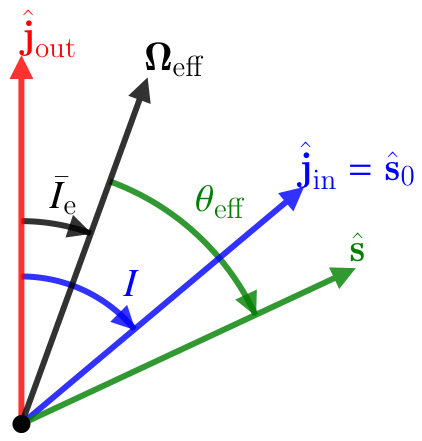
In this paper, we will consider the regime where is not so much smaller than initially, and so we must be more precise. When also adopting initial spin–orbit alignment (well-justified in our mechanism, see Section 2.2), we have that , , and are all coplanar (in the co-precessing frame). Then, since the angle between and is just , it proves easiest to evaluate the angle between and ( in the notation of [42]) in order to constrain (see Figure A1). This is straightforward:
Here, the ⊥ and ‖ subscripts denote the components of normal to and parallel to . To obtain an even simpler expression at the cost of some accuracy, we can further approximate (corresponding to large and weak spin–orbit coupling) and to obtain
where is some dimensionless function that primarily captures the scaling of and with . This recovers the key result (Equation (11)) used in the text.
Appendix C. Suppression of ZLK Cycles During the Stellar Phase via Extra Apsidal Precession
In this appendix, we delineate the conditions necessary such that a black hole binary subject to the mechanism proposed in the current work would not have experienced substantial ZLK-driven coalescence during its stellar phases of evolution.
In a stellar binary, Equation (5) for the evolution of has two extra terms due to apsidal precession driven by the rotational and tidal bulges of the two stars (e.g., [91]). Given the combination of the three SRFs (GR, tides, and rotation), the maximum eccentricity that can be attained via the ZLK effect (when ) is given by [91]
where the three dimensionless parameters quantifying the relative strengths of the general relativistic, tidal, and rotational apsidal precession effects are given by
and . Here, is the apsidal motion constant, while is the tidal Love number, is the spin frequency of the primary, and is its radius. Equation (A29) can be straightforwardly generalized to include the contributions from the secondary (i.e., and ). However, while the combined precessional effects will further suppress eccentricity excitation, the disparate mass ratios in our considered systems imply that the SRFs due to either the primary or the secondary (after the primary has evolved into a BH) will dominate the apsidal precession of the binary. As such, it is sufficient to consider only one set of SRFs at a time.
In a stellar binary, the dominant SRF is apsidal precession driven by either the rotational or tidal bulges of the stars. For our fiducial parameters, the stellar tidal synchronization timescale due to the equilibrium tide is [219,220,221]:
As such, the stars remain rapidly rotating throughout their MS lifetimes (), and the rotational bulge provides the dominant source of apsidal precession to truncate the ZLK cycles. Note that, when other SRFs are negligible, Equation (A29) reduces to
Thus, we conclude that suppresses ZLK oscillations entirely (; see Figure 6 of [91]). For our fiducial parameters,
where is the dynamical frequency of the primary and is also its maximal spin frequency. We have taken values for the stellar structure from numerical simulations using Modules for Experiments in Stellar Astrophysics [MESA [193,222,223,224,225,226]] representative of a star for solar and sub-solar metallicities along its main sequence. As such, we conclude that the rotational bulge of the primary is able to suppress ZLK oscillations for our fiducial parameters. As will become clear below, this suppression is active until both stars collapse to BHs.
To complete the picture, once the stellar binary forms a BBH, the only SRF is the apsidal precession due to first-order post-Newtonian effects. In the absence of other SRFs, Equation (A29) reduces to
Thus, we find that suppresses ZLK entirely (see again Figure 6 of [91]). For fiducial parameters, evaluates to
Note that due to mass loss during binary stellar evolution. Thus, we find that eccentricity excitation via the ZLK effect can be achieved during the BH phase even as it is suppressed during the stellar phase.
Notes
| 1 | Note that a positive correlation between the binary semi-major axis and mass ratio has also been reported in common envelope binary evolution [182,183]. This suggests that stable mass transfer may not be a necessary component for reproducing the final correlations in this work. |
| 2 | Direct comparison of the two trends is complicated by the unknown BH spin magnitudes ( in Equation (1)). These are expected to be slow based on theoretical arguments [214,215], but other studies suggest more rapid rotation based on helioseismic constraints [216], and inferences from the LVK data find [73]. |
| 3 | Note that large , large , or spin–orbit resonances also result in substantial variation of between successive ZLK cycles. These all result in non-conservation of , which leads to unpredictable spin evolution [34,39,42]. |
References
- Abac, A.G. et al. [The LIGO Scientific Collaboration; the Virgo Collaboration; the KAGRA Collaboration] GWTC-4.0: Updating the Gravitational-Wave Transient Catalog with Observations from the First Part of the Fourth LIGO-Virgo-KAGRA Observing Run. arXiv 2025, arXiv:2508.18082. [Google Scholar] [CrossRef] [Scilit]
- Lipunov, V.; Postnov, K.; Prokhorov, M. Black holes and gravitational waves: Possibilities for simultaneous detection using first-generation laser interferometers. Astron. Lett. 1997, 23, 492–497. [Google Scholar]
- Podsiadlowski, P.; Rappaport, S.; Han, Z. On the formation and evolution of black hole binaries. Mon. Not. R. Astron. Soc. 2003, 341, 385–404. [Google Scholar] [CrossRef] [Scilit]
- Belczynski, K.; Dominik, M.; Bulik, T.; O’Shaughnessy, R.; Fryer, C.; Holz, D.E. The effect of metallicity on the detection prospects for gravitational waves. Astrophys. J. Lett. 2010, 715, L138. [Google Scholar] [CrossRef] [Scilit]
- Dominik, M.; Belczynski, K.; Fryer, C.; Holz, D.E.; Berti, E.; Bulik, T.; Mandel, I.; O’Shaughnessy, R. Double compact objects. I. The significance of the common envelope on merger rates. Astrophys. J. 2012, 759, 52. [Google Scholar] [CrossRef] [Scilit]
- Belczynski, K.; Holz, D.E.; Bulik, T.; O’Shaughnessy, R. The first gravitational-wave source from the isolated evolution of two stars in the 40–100 solar mass range. Nature 2016, 534, 512–515. [Google Scholar] [CrossRef] [Scilit] [PubMed]
- Mandel, I.; De Mink, S.E. Merging binary black holes formed through chemically homogeneous evolution in short-period stellar binaries. Mon. Not. R. Astron. Soc. 2016, 458, 2634–2647. [Google Scholar] [CrossRef] [Scilit]
- De Mink, S.; Mandel, I. The chemically homogeneous evolutionary channel for binary black hole mergers: Rates and properties of gravitational-wave events detectable by advanced LIGO. Mon. Not. R. Astron. Soc. 2016, 460, 3545–3553. [Google Scholar] [CrossRef] [Scilit]
- Marchant, P.; Langer, N.; Podsiadlowski, P.; Tauris, T.M.; Moriya, T.J. A new route towards merging massive black holes. Astron. Astrophys. 2016, 588, A50. [Google Scholar]
- Belczynski, K.; Klencki, J.; Fields, C.E.; Olejak, A.; Berti, E.; Meynet, G.; Fryer, C.L.; Holz, D.E.; O’Shaughnessy, R.; Brown, D.A.; et al. Evolutionary roads leading to low effective spins, high black hole masses, and O1/O2 rates for LIGO/Virgo binary black holes. Astron. Astrophys. 2020, 636, A104. [Google Scholar] [CrossRef] [Scilit]
- Riley, J.; Mandel, I.; Marchant, P.; Butler, E.; Nathaniel, K.; Neijssel, C.; Shortt, S.; Vigna-Gómez, A. Chemically homogeneous evolution: A rapid population synthesis approach. Mon. Not. R. Astron. Soc. 2021, 505, 663–676. [Google Scholar] [CrossRef] [Scilit]
- Fragos, T.; Andrews, J.J.; Bavera, S.S.; Berry, C.P.L.; Coughlin, S.; Dotter, A.; Giri, P.; Kalogera, V.; Katsaggelos, A.; Kovlakas, K.; et al. POSYDON: A General-purpose Population Synthesis Code with Detailed Binary-evolution Simulations. Astrophys. J. Suppl. Ser. 2023, 264, 45. [Google Scholar] [CrossRef] [Scilit]
- Marchant, P.; Bodensteiner, J. The Evolution of Massive Binary Stars. Annu. Rev. Astron. Astrophys. 2024, 62, 21–61. [Google Scholar] [CrossRef] [Scilit]
- Andrews, J.J.; Bavera, S.S.; Briel, M.; Chattaraj, A.; Dotter, A.; Fragos, T.; Gallegos-Garcia, M.; Gossage, S.; Kalogera, V.; Kasdagli, E.; et al. POSYDON Version 2: Population Synthesis with Detailed Binary-Evolution Simulations across a Cosmological Range of Metallicities. arXiv 2024, arXiv:2411.02376. [Google Scholar] [CrossRef] [Scilit]
- McKernan, B.; Ford, K.E.S.; Lyra, W.; Perets, H.B. Intermediate mass black holes in AGN discs—I. Production and growth. Mon. Not. R. Astron. Soc. 2012, 425, 460–469. [Google Scholar] [CrossRef] [Scilit]
- Stone, N.C.; Metzger, B.D.; Haiman, Z. Assisted inspirals of stellar mass black holes embedded in AGN discs: Solving the ‘final au problem’. Mon. Not. R. Astron. Soc. 2017, 464, 946–954. [Google Scholar] [CrossRef] [Scilit]
- Leigh, N.W.; Geller, A.M.; McKernan, B.; Ford, K.; Mac Low, M.; Bellovary, J.; Haiman, Z.; Lyra, W.; Samsing, J.; O’Dowd, M.; et al. On the rate of black hole binary mergers in galactic nuclei due to dynamical hardening. Mon. Not. R. Astron. Soc. 2018, 474, 5672–5683. [Google Scholar]
- Secunda, A.; Bellovary, J.; Mac Low, M.M.; Ford, K.E.S.; McKernan, B.; Leigh, N.W.C.; Lyra, W.; Sándor, Z. Orbital Migration of Interacting Stellar Mass Black Holes in Disks around Supermassive Black Holes. Astrophys. J. 2019, 878, 85. [Google Scholar] [CrossRef] [Scilit]
- Tagawa, H.; Haiman, Z.; Kocsis, B. Formation and evolution of compact-object binaries in AGN disks. Astrophys. J. 2020, 898, 25. [Google Scholar] [CrossRef] [Scilit]
- Li, Y.P.; Dempsey, A.M.; Li, S.; Li, H.; Li, J. Orbital Evolution of Binary Black Holes in Active Galactic Nucleus Disks: A Disk Channel for Binary Black Hole Mergers? Astrophys. J. 2021, 911, 124. [Google Scholar] [CrossRef] [Scilit]
- Li, R.; Lai, D. Hydrodynamical evolution of black-hole binaries embedded in AGN discs. Mon. Not. R. Astron. Soc. 2022, 517, 1602–1624. [Google Scholar] [CrossRef] [Scilit]
- Li, J.; Lai, D.; Rodet, L. Long-term Evolution of Tightly Packed Stellar Black Holes in AGN Disks: Formation of Merging Black Hole Binaries via Close Encounters. Astrophys. J. 2022, 934, 154. [Google Scholar] [CrossRef] [Scilit]
- Samsing, J.; Bartos, I.; D’Orazio, D.; Haiman, Z.; Kocsis, B.; Leigh, N.; Liu, B.; Pessah, M.; Tagawa, H. AGN as potential factories for eccentric black hole mergers. Nature 2022, 603, 237–240. [Google Scholar] [CrossRef] [Scilit]
- McKernan, B.; Ford, K.E.S.; Callister, T.; Farr, W.M.; O’Shaughnessy, R.; Smith, R.; Thrane, E.; Vajpeyi, A. LIGO-Virgo correlations between mass ratio and effective inspiral spin: Testing the active galactic nuclei channel. Mon. Not. R. Astron. Soc. 2022, 514, 3886–3893. [Google Scholar] [CrossRef] [Scilit]
- Rowan, C.; Boekholt, T.; Kocsis, B.; Haiman, Z. Black hole binary formation in AGN discs: From isolation to merger. Mon. Not. R. Astron. Soc. 2023, 524, 2770–2796. [Google Scholar] [CrossRef] [Scilit]
- Whitehead, H.; Rowan, C.; Boekholt, T.; Kocsis, B. Gas assisted binary black hole formation in AGN discs. Mon. Not. R. Astron. Soc. 2024, 531, 4656–4680. [Google Scholar] [CrossRef] [Scilit]
- McKernan, B.; Ford, K.E.S.; Cook, H.E.; Delfavero, V.; McPike, E.; Nathaniel, K.; Postiglione, J.; Ray, S.; O’Shaughnessy, R. McFACTS I: Testing the LVK AGN Channel with Monte Carlo for AGN Channel Testing and Simulation (McFACTS). Astrophys. J. 2025, 990, 217. [Google Scholar] [CrossRef] [Scilit]
- Miller, M.C.; Hamilton, D.P. Four-body effects in globular cluster black hole coalescence. Astrophys. J. 2002, 576, 894. [Google Scholar] [CrossRef] [Scilit]
- Wen, L. On the eccentricity distribution of coalescing black hole binaries driven by the Kozai mechanism in globular clusters. Astrophys. J. 2003, 598, 419. [Google Scholar] [CrossRef] [Scilit]
- Antonini, F.; Perets, H.B. Secular Evolution of Compact Binaries near Massive Black Holes: Gravitational Wave Sources and Other Exotica. Astrophys. J. 2012, 757, 27. [Google Scholar] [CrossRef] [Scilit]
- Antonini, F.; Murray, N.; Mikkola, S. Black Hole Triple Dynamics: A Breakdown of the Orbit Average Approximation and Implications for Gravitational Wave Detections. Astrophys. J. 2014, 781, 45. [Google Scholar] [CrossRef] [Scilit]
- Silsbee, K.; Tremaine, S. Lidov–Kozai Cycles with Gravitational Radiation: Merging Black Holes in Isolated Triple Systems. Astrophys. J. 2017, 836, 39. [Google Scholar] [CrossRef] [Scilit]
- Liu, B.; Lai, D. Spin–Orbit Misalignment of Merging Black Hole Binaries with Tertiary Companions. Astrophys. J. Lett. 2017, 846, L11. [Google Scholar] [CrossRef] [Scilit]
- Liu, B.; Lai, D. Black Hole and Neutron Star Binary Mergers in Triple Systems: Merger Fraction and Spin–Orbit Misalignment. Astrophys. J. 2018, 863, 68. [Google Scholar] [CrossRef] [Scilit]
- Randall, L.; Xianyu, Z.Z. Induced Ellipticity for Inspiraling Binary Systems. Astrophys. J. 2018, 853, 93. [Google Scholar] [CrossRef] [Scilit]
- Hoang, B.M.; Naoz, S.; Kocsis, B.; Rasio, F.A.; Dosopoulou, F. Black hole mergers in galactic nuclei induced by the eccentric Kozai–Lidov effect. Astrophys. J. 2018, 856, 140. [Google Scholar] [CrossRef] [Scilit]
- Fragione, G.; Loeb, A. Black hole–neutron star mergers from triples. Mon. Not. R. Astron. Soc. 2019, 486, 4443–4450. [Google Scholar] [CrossRef] [Scilit]
- Liu, B.; Lai, D. Enhanced black hole mergers in binary-binary interactions. Mon. Not. R. Astron. Soc. 2019, 483, 4060–4069. [Google Scholar] [CrossRef] [Scilit]
- Liu, B.; Lai, D.; Wang, Y.H. Black Hole and Neutron Star Binary Mergers in Triple Systems. II. Merger Eccentricity and Spin-Orbit Misalignment. Astrophys. J. 2019, 881, 41. [Google Scholar] [CrossRef] [Scilit]
- Liu, B.; Lai, D.; Wang, Y.H. Binary Mergers near a Supermassive Black Hole: Relativistic Effects in Triples. Astrophys. J. Lett. 2019, 883, L7. [Google Scholar] [CrossRef] [Scilit]
- Liu, B.; Lai, D. Merging compact binaries near a rotating supermassive black hole: Eccentricity excitation due to apsidal precession resonance. Phys. Rev. 2020, 102, 023020. [Google Scholar] [CrossRef] [Scilit]
- Su, Y.; Lai, D.; Liu, B. Spin-orbit misalignments in tertiary-induced binary black-hole mergers: Theoretical analysis. Phys. Rev. 2021, 103, 063040. [Google Scholar] [CrossRef] [Scilit]
- Michaely, E.; Perets, H.B. High rate of gravitational waves mergers from flyby perturbations of wide black hole triples in the field. Mon. Not. R. Astron. Soc. 2020, 498, 4924–4935. [Google Scholar] [CrossRef] [Scilit]
- Liu, B.; Lai, D. Hierarchical black hole mergers in multiple systems: Constrain the formation of GW190412-, GW190814-, and GW190521-like events. Mon. Not. R. Astron. Soc. 2021, 502, 2049–2064. [Google Scholar] [CrossRef] [Scilit]
- Su, Y.; Liu, B.; Lai, D. The mass-ratio distribution of tertiary-induced binary black hole mergers. Mon. Not. R. Astron. Soc. 2021, 505, 3681–3697. [Google Scholar] [CrossRef] [Scilit]
- Martinez, M.A.S.; Rodriguez, C.L.; Fragione, G. On the Mass Ratio Distribution of Black Hole Mergers in Triple Systems. Astrophys. J. 2022, 937, 78. [Google Scholar] [CrossRef] [Scilit]
- Grishin, E.; Perets, H.B. Chaotic dynamics of wide triples induced by galactic tides: A novel channel for producing compact binaries, mergers, and collisions. Mon. Not. R. Astron. Soc. 2022, 512, 4993–5009. [Google Scholar] [CrossRef] [Scilit]
- Su, Y.; Liu, B.; Xu, S. Revisiting the Tertiary-induced Binary Black Hole Mergers: The Role of Superthermal Wide Tertiary Eccentricity Distributions. Astrophys. J. 2024, 971, 139. [Google Scholar] [CrossRef] [Scilit]
- Portegies Zwart, S.F.; McMillan, S.L.W. Black Hole Mergers in the Universe. Astrophys. J. Lett. 2000, 528, L17–L20. [Google Scholar] [CrossRef] [Scilit] [PubMed]
- O’leary, R.M.; Rasio, F.A.; Fregeau, J.M.; Ivanova, N.; O’Shaughnessy, R. Binary mergers and growth of black holes in dense star clusters. Astrophys. J. 2006, 637, 937. [Google Scholar] [CrossRef] [Scilit]
- Miller, M.C.; Lauburg, V.M. Mergers of stellar-mass black holes in nuclear star clusters. Astrophys. J. 2009, 692, 917. [Google Scholar] [CrossRef] [Scilit]
- Banerjee, S.; Baumgardt, H.; Kroupa, P. Stellar-mass black holes in star clusters: Implications for gravitational wave radiation. Mon. Not. R. Astron. Soc. 2010, 402, 371–380. [Google Scholar] [CrossRef] [Scilit]
- Downing, J.; Benacquista, M.; Giersz, M.; Spurzem, R. Compact binaries in star clusters–I. Black hole binaries inside globular clusters. Mon. Not. R. Astron. Soc. 2010, 407, 1946–1962. [Google Scholar] [CrossRef] [Scilit]
- Ziosi, B.M.; Mapelli, M.; Branchesi, M.; Tormen, G. Dynamics of stellar black holes in young star clusters with different metallicities–II. Black hole–black hole binaries. Mon. Not. R. Astron. Soc. 2014, 441, 3703–3717. [Google Scholar] [CrossRef] [Scilit]
- Rodriguez, C.L.; Morscher, M.; Pattabiraman, B.; Chatterjee, S.; Haster, C.J.; Rasio, F.A. Binary black hole mergers from globular clusters: Implications for Advanced LIGO. Phys. Rev. Lett. 2015, 115, 051101. [Google Scholar] [CrossRef] [Scilit] [PubMed]
- Antonini, F.; Rasio, F.A. Merging Black Hole Binaries in Galactic Nuclei: Implications for Advanced-LIGO Detections. Astrophys. J. 2016, 831, 187. [Google Scholar] [CrossRef] [Scilit]
- Samsing, J.; Ramirez-Ruiz, E. On the assembly rate of highly eccentric binary black hole mergers. Astrophys. J. Lett. 2017, 840, L14. [Google Scholar] [CrossRef] [Scilit]
- Samsing, J.; D’Orazio, D.J. Black Hole Mergers From Globular Clusters Observable by LISA I: Eccentric Sources Originating From Relativistic N-body Dynamics. Mon. Not. R. Astron. Soc. 2018, 481, 5445–5450. [Google Scholar] [CrossRef] [Scilit]
- Rodriguez, C.L.; Amaro-Seoane, P.; Chatterjee, S.; Rasio, F.A. Post-Newtonian Dynamics in Dense Star Clusters: Highly Eccentric, Highly Spinning, and Repeated Binary Black Hole Mergers. Phys. Rev. Lett. 2018, 120, 151101. [Google Scholar] [CrossRef] [Scilit] [PubMed]
- Gondán, L.; Kocsis, B.; Raffai, P.; Frei, Z. Eccentric Black Hole Gravitational-wave Capture Sources in Galactic Nuclei: Distribution of Binary Parameters. Astrophys. J. 2018, 860, 5. [Google Scholar] [CrossRef] [Scilit]
- Barber, J.; Antonini, F. Formation and evolution of binary black holes in N-body simulations of star clusters with up to two million stars. arXiv 2024, arXiv:2410.03832. [Google Scholar] [CrossRef] [Scilit]
- Bruel, T.; Rodriguez, C.L.; Lamberts, A.; Grudić, M.Y.; Hafen, Z.; Feldmann, R. Great Balls of FIRE. III. Modelling black hole mergers from massive star clusters in simulations of galaxies. Astron. Astrophys. 2024, 686, A106. [Google Scholar] [CrossRef] [Scilit]
- Antonini, F.; Faber, J.; Gualandris, A.; Merritt, D. Tidal Breakup of Binary Stars at the Galactic Center and Its Consequences. Astrophys. J. 2010, 713, 90. [Google Scholar] [CrossRef] [Scilit]
- Leigh, N.W.C.; Antonini, F.; Stone, N.C.; Shara, M.M.; Merritt, D. On the origins of enigmatic stellar populations in Local Group galactic nuclei. Mon. Not. R. Astron. Soc. 2016, 463, 1605–1623. [Google Scholar] [CrossRef] [Scilit]
- Fragione, G.; Grishin, E.; Leigh, N.W.C.; Perets, H.B.; Perna, R. Black hole and neutron star mergers in galactic nuclei. Mon. Not. R. Astron. Soc. 2019, 488, 47–63. [Google Scholar] [CrossRef] [Scilit]
- Chattopadhyay, D.; Stegmann, J.; Antonini, F.; Barber, J.; Romero-Shaw, I.M. Double black hole mergers in nuclear star clusters: Eccentricities, spins, masses, and the growth of massive seeds. Mon. Not. R. Astron. Soc. 2023, 526, 4908–4928. [Google Scholar] [CrossRef] [Scilit]
- Arca Sedda, M.; Mapelli, M.; Benacquista, M.; Spera, M. Isolated and dynamical black hole mergers with B-POP: The role of star formation and dynamics, star cluster evolution, natal kicks, mass and spins, and hierarchical mergers. Mon. Not. R. Astron. Soc. 2023, 520, 5259–5282. [Google Scholar] [CrossRef] [Scilit]
- Zevin, M.; Bavera, S.S.; Berry, C.P.L.; Kalogera, V.; Fragos, T.; Marchant, P.; Rodriguez, C.L.; Antonini, F.; Holz, D.E.; Pankow, C. One Channel to Rule Them All? Constraining the Origins of Binary Black Holes Using Multiple Formation Pathways. Astrophys. J. 2021, 910, 152. [Google Scholar] [CrossRef] [Scilit]
- Costa, G.; Chruślińska, M.; Klencki, J.; Broekgaarden, F.S.; Rodriguez, C.L.; Joseph, T.D.; Saracino, S. Stellar Black Holes and Compact Stellar Remnants. arXiv 2023, arXiv:2311.15778. [Google Scholar] [CrossRef] [Scilit]
- Abbott, R.; Abbott, T.D.; Acernese, F.; Ackley, K.; Adams, C.; Adhikari, N.; Adhikari, R.X.; Adya, V.B.; Affeldt, C.; Agarwal, D.; et al. Population of Merging Compact Binaries Inferred Using Gravitational Waves through GWTC-3. Phys. Rev. X 2023, 13, 011048. [Google Scholar] [CrossRef] [Scilit]
- Schmidt, P.; Ohme, F.; Hannam, M. Towards models of gravitational waveforms from generic binaries: II. Modelling precession effects with a single effective precession parameter. Phys. Rev. 2015, 91, 024043. [Google Scholar] [CrossRef] [Scilit]
- Abac, A.G.; Abouelfettouh, I.; Acernese, F.; Ackley, K.; Adhicary, S.; Adhikari, D.; Adhikari, N.; Adhikari, R.X.; Adkins, V.K.; Afroz, S.; et al. GWTC-4.0: An Introduction to Version 4.0 of the Gravitational-Wave Transient Catalog. Astrophys. J. Lett. 2025, 995, L18. [Google Scholar] [CrossRef] [Scilit]
- The LIGO Scientific Collaboration; The Virgo Collaboration; The KAGRA Collaboration; Abac, A.G.; Abouelfettouh, I.; Acernese, F.; Ackley, K.; Adamcewicz, C.; Adhicary, S.; Adhikari, D.; et al. GWTC-4.0: Population Properties of Merging Compact Binaries. arXiv 2025, arXiv:2508.18083. [Google Scholar] [CrossRef] [Scilit]
- Callister, T.A.; Farr, W.M. Parameter-Free Tour of the Binary Black Hole Population. Phys. Rev. X 2024, 14, 021005. [Google Scholar] [CrossRef] [Scilit]
- Heinzel, J.; Vitale, S.; Biscoveanu, S. Probing correlations in the binary black hole population with flexible models. Phys. Rev. 2024, 109, 103006. [Google Scholar] [CrossRef] [Scilit]
- Callister, T.A.; Haster, C.J.; Ng, K.K.Y.; Vitale, S.; Farr, W.M. Who Ordered That? Unequal-mass Binary Black Hole Mergers Have Larger Effective Spins. Astrophys. J. Lett. 2021, 922, L5. [Google Scholar] [CrossRef] [Scilit]
- Steinle, N.; Kesden, M. Pathways for producing binary black holes with large misaligned spins in the isolated formation channel. Phys. Rev. 2021, 103, 063032. [Google Scholar] [CrossRef] [Scilit]
- Banerjee, S.; Olejak, A. On the effective spin-mass ratio ‘χeff − q’ relation of binary black hole mergers that evolved in isolation. arXiv 2024, arXiv:2411.15112. [Google Scholar] [CrossRef] [Scilit]
- Wang, Y.H.; McKernan, B.; Ford, S.; Perna, R.; Leigh, N.W.C.; Mac Low, M.M. Symmetry Breaking in Dynamical Encounters in the Disks of Active Galactic Nuclei. Astrophys. J. Lett. 2021, 923, L23. [Google Scholar] [CrossRef] [Scilit]
- Cook, H.E.; McKernan, B.; Ford, K.E.S.; Delfavero, V.; Nathaniel, K.; Postiglione, J.; Ray, S.; O’Shaughnessy, R. McFACTS II: Mass Ratio–Effective Spin Relationship of Black Hole Mergers in the AGN Channel. arXiv 2024, arXiv:2411.10590. [Google Scholar] [CrossRef] [Scilit]
- Antonini, F.; Toonen, S.; Hamers, A.S. Binary black hole mergers from field triples: Properties, rates, and the impact of stellar evolution. Astrophys. J. 2017, 841, 77. [Google Scholar] [CrossRef] [Scilit]
- Yu, H.; Ma, S.; Giesler, M.; Chen, Y. Spin and eccentricity evolution in triple systems: From the Lidov-Kozai interaction to the final merger of the inner binary. Phys. Rev. 2020, 102, 123009. [Google Scholar] [CrossRef] [Scilit]
- Fragione, G.; Kocsis, B. Effective spin distribution of black hole mergers in triples. Mon. Not. R. Astron. Soc. 2020, 493, 3920–3931. [Google Scholar] [CrossRef] [Scilit]
- Kıroğlu, F.; Lombardi, J.C., Jr.; Kremer, K.; Vanderzyden, H.D.; Rasio, F.A. Spin-Orbit Alignment in Merging Binary Black Holes Following Collisions with Massive Stars. arXiv 2025, arXiv:2501.09068. [Google Scholar] [CrossRef] [Scilit]
- Stegmann, J.; Antonini, F.; Olejak, A.; Biscoveanu, S.; Raymond, V.; Rinaldi, S.; Flanagan, E. Gravitational-wave Observations Suggest Most Black Hole Mergers Form in Triples. Astrophys. J. Lett. 2026, 1000, L59. [Google Scholar] [CrossRef] [Scilit]
- Olejak, A.; Klencki, J.; Xu, X.T.; Wang, C.; Belczynski, K.; Lasota, J.P. Unequal-mass highly spinning binary black hole mergers in the stable mass transfer formation channel. Astron. Astrophys. 2024, 689, A305. [Google Scholar] [CrossRef] [Scilit]
- Wang, Z.Y.; Qin, Y.; Hu, R.C.; Wang, Y.Z.; Meynet, G.; Song, H.F. Reassessing the spin of second-born black holes in coalescing binary black holes and its connection to the χeff − q correlation. Astron. Astrophys. 2026, 708, A62. [Google Scholar] [CrossRef] [Scilit]
- von Zeipel, H. Sur l’application des séries de M. Lindstedt à l’étude du mouvement des comètes périodiques. Astron. Nachrichten 1910, 183, 345. [Google Scholar] [CrossRef] [Scilit]
- Lidov, M.L. The evolution of orbits of artificial satellites of planets under the action of gravitational perturbations of external bodies. Planet. Space Sci. 1962, 9, 719–759. [Google Scholar] [CrossRef] [Scilit]
- Kozai, Y. Secular perturbations of asteroids with high inclination and eccentricity. Astron. J. 1962, 67, 591. [Google Scholar] [CrossRef] [Scilit] [PubMed]
- Liu, B.; Muñoz, D.J.; Lai, D. Suppression of extreme orbital evolution in triple systems with short-range forces. Mon. Not. R. Astron. Soc. 2015, 447, 747–764. [Google Scholar] [CrossRef] [Scilit]
- Naoz, S. The eccentric Kozai-Lidov effect and its applications. Annu. Rev. Astron. Astrophys. 2016, 54, 441–489. [Google Scholar] [CrossRef] [Scilit]
- Tremaine, S. The Hamiltonian for von Zeipel-Lidov-Kozai oscillations. Mon. Not. R. Astron. Soc. 2023, 522, 937–947. [Google Scholar] [CrossRef] [Scilit]
- Tremaine, S.; Touma, J.; Namouni, F. Satellite Dynamics on the Laplace Surface. Astron. J. 2009, 137, 3706–3717. [Google Scholar] [CrossRef] [Scilit]
- Peters, P.C. Gravitational radiation and the motion of two point masses. Phys. Rev. 1964, 136, B1224. [Google Scholar] [CrossRef] [Scilit]
- Grishin, E. Irregular fixation: I. Fixed points and librating orbits of the Brown Hamiltonian. Mon. Not. R. Astron. Soc. 2024, 533, 486–496. [Google Scholar] [CrossRef] [Scilit]
- Meurer, A.; Smith, C.P.; Paprocki, M.; Čertík, O.; Kirpichev, S.B.; Rocklin, M.; Kumar, A.; Ivanov, S.; Moore, J.K.; Singh, S.; et al. SymPy: Symbolic computing in Python. PeerJ Comput. Sci. 2017, 3, e103. [Google Scholar] [CrossRef] [Scilit]
- Racine, É. Analysis of spin precession in binary black hole systems including quadrupole-monopole interaction. Phys. Rev. 2008, 78, 044021. [Google Scholar] [CrossRef] [Scilit]
- Barker, B.M.; O’Connell, R.F. Gravitational two-body problem with arbitrary masses, spins, and quadrupole moments. Phys. Rev. 1975, 12, 329–335. [Google Scholar] [CrossRef] [Scilit]
- Rodriguez, C.L.; Chatterjee, S.; Rasio, F.A. Binary black hole mergers from globular clusters: Masses, merger rates, and the impact of stellar evolution. Phys. Rev. 2016, 93, 084029. [Google Scholar] [CrossRef] [Scilit]
- Martins, F.; Trippe, S.; Paumard, T.; Ott, T.; Genzel, R.; Rauw, G.; Eisenhauer, F.; Gillessen, S.; Maness, H.; Abuter, R. GCIRS 16SW: A Massive Eclipsing Binary in the Galactic Center. Astrophys. J. Lett. 2006, 649, L103–L106. [Google Scholar] [CrossRef] [Scilit] [PubMed]
- Pfuhl, O.; Alexander, T.; Gillessen, S.; Martins, F.; Genzel, R.; Eisenhauer, F.; Fritz, T.K.; Ott, T. Massive Binaries in the Vicinity of Sgr A*. Astrophys. J. 2014, 782, 101. [Google Scholar] [CrossRef] [Scilit]
- Peißker, F.; Zajaček, M.; Labadie, L.; Bordier, E.; Eckart, A.; Melamed, M.; Karas, V. A binary system in the S cluster close to the supermassive black hole Sagittarius A*. Nat. Commun. 2024, 15, 10608. [Google Scholar] [CrossRef] [Scilit] [PubMed]
- Alexander, T. Stellar Dynamics and Stellar Phenomena Near a Massive Black Hole. Annu. Rev. Astron. Astrophys. 2017, 55, 17–57. [Google Scholar] [CrossRef] [Scilit]
- Chu, D.S.; Do, T.; Ghez, A.; Gautam, A.K.; Ciurlo, A.; O’neil, K.K.; Hosek, M.W.; Hees, A.; Naoz, S.; Sakai, S.; et al. Evidence of a Decreased Binary Fraction for Massive Stars within 20 milliparsecs of the Supermassive Black Hole at the Galactic Center. Astrophys. J. 2023, 948, 94. [Google Scholar] [CrossRef] [Scilit]
- Neumayer, N.; Seth, A.; Böker, T. Nuclear star clusters. Astron. Astrophys. Rev. 2020, 28, 4. [Google Scholar] [CrossRef] [Scilit]
- Ali, B.; Paul, D.; Eckart, A.; Parsa, M.; Zajacek, M.; Peißker, F.; Subroweit, M.; Valencia-S., M.; Thomkins, L.; Witzel, G. Kinematic Structure of the Galactic Center S Cluster. Astrophys. J. 2020, 896, 100. [Google Scholar] [CrossRef] [Scilit]
- Hut, P. Binary formation and interactions with field stars. In Proceedings of the Dynamics of Star Clusters; Goodman, J., Hut, P., Eds.; IAU Symposium: Dordrecht, The Netherlands, 1985; Volume 113, pp. 231–247. [Google Scholar]
- Quinlan, G.D.; Shapiro, S.L. Dynamical Evolution of Dense Clusters of Compact Stars. Astrophys. J. 1989, 343, 725. [Google Scholar] [CrossRef] [Scilit] [PubMed]
- Bartos, I.; Kocsis, B.; Haiman, Z.; Márka, S. Rapid and Bright Stellar-mass Binary Black Hole Mergers in Active Galactic Nuclei. Astrophys. J. 2017, 835, 165. [Google Scholar] [CrossRef] [Scilit]
- Rauch, K.P.; Tremaine, S. Resonant relaxation in stellar systems. New Astron. 1996, 1, 149–170. [Google Scholar] [CrossRef] [Scilit]
- Vigna-Gómez, A.; Willcox, R.; Tamborra, I.; Mandel, I.; Renzo, M.; Wagg, T.; Janka, H.T.; Kresse, D.; Bodensteiner, J.; Shenar, T.; et al. Constraints on Neutrino Natal Kicks from Black-Hole Binary VFTS 243. Phys. Rev. Lett. 2024, 132, 191403. [Google Scholar] [CrossRef] [Scilit] [PubMed]
- Kiseleva, L.G.; Eggleton, P.P.; Mikkola, S. Tidal friction in triple stars. Mon. Not. R. Astron. Soc. 1998, 300, 292–302. [Google Scholar] [CrossRef] [Scilit]
- Eggleton, P.P.; Kiseleva-Eggleton, L. Orbital Evolution in Binary and Triple Stars, with an Application to SS Lacertae. Astrophys. J. 2001, 562, 1012–1030. [Google Scholar] [CrossRef] [Scilit] [PubMed]
- Wu, Y.; Murray, N. Planet Migration and Binary Companions: The Case of HD 80606b. Astrophys. J. 2003, 589, 605–614. [Google Scholar] [CrossRef] [Scilit] [PubMed]
- Hurley, J.R.; Tout, C.A.; Pols, O.R. Evolution of binary stars and the effect of tides on binary populations. Mon. Not. R. Astron. Soc. 2002, 329, 897–928. [Google Scholar] [CrossRef] [Scilit]
- Gallegos-Garcia, M.; Berry, C.P.L.; Marchant, P.; Kalogera, V. Binary Black Hole Formation with Detailed Modeling: Stable Mass Transfer Leads to Lower Merger Rates. Astrophys. J. 2021, 922, 110. [Google Scholar] [CrossRef] [Scilit]
- van Son, L.A.C.; de Mink, S.E.; Renzo, M.; Justham, S.; Zapartas, E.; Breivik, K.; Callister, T.; Farr, W.M.; Conroy, C. No Peaks without Valleys: The Stable Mass Transfer Channel for Gravitational-wave Sources in Light of the Neutron Star-Black Hole Mass Gap. Astrophys. J. 2022, 940, 184. [Google Scholar] [CrossRef] [Scilit]
- Soberman, G.E.; Phinney, E.S.; van den Heuvel, E.P.J. Stability criteria for mass transfer in binary stellar evolution. Astron. Astrophys. 1997, 327, 620–635. [Google Scholar] [CrossRef] [Scilit]
- Riley, J.; Agrawal, P.; Barrett, J.W.; Boyett, K.N.K.; Broekgaarden, F.S.; Chattopadhyay, D.; Gaebel, S.M.; Gittins, F.; Hirai, R.; Howitt, G.; et al. Rapid Stellar and Binary Population Synthesis with COMPAS. Astrophys. J. Suppl. Ser. 2022, 258, 34. [Google Scholar] [CrossRef] [Scilit]
- Lu, W.; Fuller, J.; Quataert, E.; Bonnerot, C. On rapid binary mass transfer—I. Physical model. Mon. Not. R. Astron. Soc. 2023, 519, 1409–1424. [Google Scholar] [CrossRef] [Scilit]
- Dotter, A. MESA Isochrones and Stellar Tracks (MIST) 0: Methods for the Construction of Stellar Isochrones. Astrophys. J. Suppl. Ser. 2016, 222, 8. [Google Scholar] [CrossRef] [Scilit]
- Choi, J.; Dotter, A.; Conroy, C.; Cantiello, M.; Paxton, B.; Johnson, B.D. Mesa Isochrones and Stellar Tracks (MIST). I. Solar-scaled Models. Astrophys. J. 2016, 823, 102. [Google Scholar] [CrossRef] [Scilit]
- Smith, N. Mass Loss: Its Effect on the Evolution and Fate of High-Mass Stars. Annu. Rev. Astron. Astrophys. 2014, 52, 487–528. [Google Scholar] [CrossRef] [Scilit]
- Vinciguerra, S.; Neijssel, C.J.; Vigna-Gmez, A.; Mandel, I.; Podsiadlowski, P.; Maccarone, T.J.; Nicholl, M.; Kingdon, S.; Perry, A.; Salemi, F. Be X-ray binaries in the SMC as indicators of mass-transfer efficiency. Mon. Not. R. Astron. Soc. 2020, 498, 4705–4720. [Google Scholar] [CrossRef] [Scilit]
- Fornasini, F.; Antoniou, V.; Dubus, G. High-mass X-ray Binaries. In Handbook of X-Ray and Gamma-Ray Astrophysics; Springer: Berlin/Heidelberg, Germany, 2024; pp. 3719–3773. [Google Scholar]
- Giacobbo, N.; Mapelli, M. Revising Natal Kick Prescriptions in Population Synthesis Simulations. Astrophys. J. 2020, 891, 141. [Google Scholar] [CrossRef] [Scilit]
- De, K.; MacLeod, M.; Jencson, J.E.; Lovegrove, E.; Antoni, A.; Kara, E.; Kasliwal, M.M.; Lau, R.M.; Loeb, A.; Masterson, M.; et al. The disappearance of a massive star marking the birth of a black hole in M31. arXiv 2024, arXiv:2410.14778. [Google Scholar] [CrossRef] [Scilit]
- Hellings, P. Phenomenological Study of Massive Accretion Stars. Astrophys. Space Sci. 1983, 96, 37–54. [Google Scholar] [CrossRef] [Scilit]
- Renzo, M.; Götberg, Y. Evolution of Accretor Stars in Massive Binaries: Broader Implications from Modeling ζ Ophiuchi. Astrophys. J. 2021, 923, 277. [Google Scholar] [CrossRef] [Scilit]
- Braun, H.; Langer, N. Effects of accretion onto massive main sequence stars. Astron. Astrophys. 1995, 297, 483. [Google Scholar]
- Toyouchi, D.; Hotokezaka, K.; Inayoshi, K.; Kuiper, R. Radiation hydrodynamical simulations of super-Eddington mass transfer and black hole growth in close binaries. Mon. Not. R. Astron. Soc. 2024, 532, 4826–4841. [Google Scholar] [CrossRef] [Scilit]
- Marcussen, M.L.; Albrecht, S.H.; Winn, J.N.; Su, Y.; Lundkvist, M.S.; Schlaufman, K.C. The BANANA Project. VII. High Eccentricity Predicts Spin–Orbit Misalignment in Binaries. Astrophys. J. 2024, 975, 149. [Google Scholar] [CrossRef] [Scilit]
- Tkachenko, A.; Pavlovski, K.; Johnston, C.; Pedersen, M.G.; Michielsen, M.; Bowman, D.M.; Southworth, J.; Tsymbal, V.; Aerts, C. The mass discrepancy in intermediate- and high-mass eclipsing binaries: The need for higher convective core masses. Astron. Astrophys. 2020, 637, A60. [Google Scholar] [CrossRef] [Scilit]
- Johnston, C. One size does not fit all: Evidence for a range of mixing efficiencies in stellar evolution calculations. Astron. Astrophys. 2021, 655, A29. [Google Scholar] [CrossRef] [Scilit]
- Pedersen, M.G.; Aerts, C.; Pápics, P.I.; Michielsen, M.; Gebruers, S.; Rogers, T.M.; Molenberghs, G.; Burssens, S.; Garcia, S.; Bowman, D.M. Internal mixing of rotating stars inferred from dipole gravity modes. Nat. Astron. 2021, 5, 715–722. [Google Scholar] [CrossRef] [Scilit]
- Schneider, F.R.N.; Izzard, R.G.; Langer, N.; Mink, S.E.d. Evolution of Mass Functions of Coeval Stars through Wind-Mass Loss and Binary Interactions. Astrophys. J. 2015, 805, 20. [Google Scholar] [CrossRef] [Scilit]
- Temmink, K.D.; Pols, O.R.; Justham, S.; Istrate, A.G.; Toonen, S. Coping with loss—Stability of mass transfer from post-main-sequence donor stars. Astron. Astrophys. 2023, 669, A45. [Google Scholar] [CrossRef] [Scilit]
- Rose, S.C.; Naoz, S.; Gautam, A.K.; Ghez, A.M.; Do, T.; Chu, D.; Becklin, E. On Socially Distant Neighbors: Using Binaries to Constrain the Density of Objects in the Galactic Center. Astrophys. J. 2020, 904, 113. [Google Scholar] [CrossRef] [Scilit]
- Jurado, C.; Naoz, S.; Lam, C.Y.; Hoang, B.M. Natal Kicks from the Galactic Center and Implications on Their Environment and for the Nancy Grace Roman Space Telescope. Astrophys. J. 2024, 971, 95. [Google Scholar] [CrossRef] [Scilit]
- Bahcall, J.N.; Wolf, R.A. Star distribution around a massive black hole in a globular cluster. Astrophys. J. 1976, 209, 214–232. [Google Scholar] [CrossRef] [Scilit] [PubMed]
- Binney, J.; Tremaine, S. Galactic Dynamics: Second Edition; Princeton University Press: Princeton, NJ, USA, 2008. [Google Scholar]
- Gallego-Cano, E.; Schödel, R.; Dong, H.; Nogueras-Lara, F.; Gallego-Calvente, A.T.; Amaro-Seoane, P.; Baumgardt, H. The distribution of stars around the Milky Way’s central black hole. I. Deep star counts. Astron. Astrophys. 2018, 609, A26. [Google Scholar] [CrossRef] [Scilit]
- Tremaine, S.; Gebhardt, K.; Bender, R.; Bower, G.; Dressler, A.; Faber, S.M.; Filippenko, A.V.; Green, R.; Grillmair, C.; Ho, L.C.; et al. The Slope of the Black Hole Mass versus Velocity Dispersion Correlation. Astrophys. J. 2002, 574, 740–753. [Google Scholar] [CrossRef] [Scilit] [PubMed]
- Mardling, R.A.; Aarseth, S.J. Tidal interactions in star cluster simulations. Mon. Not. R. Astron. Soc. 2001, 321, 398–420. [Google Scholar] [CrossRef] [Scilit]
- Vynatheya, P.; Hamers, A.S.; Mardling, R.A.; Bellinger, E.P. Algebraic and machine learning approach to hierarchical triple-star stability. Mon. Not. R. Astron. Soc. 2022, 516, 4146–4155. [Google Scholar] [CrossRef] [Scilit]
- Baldry, I.K.; Driver, S.P.; Loveday, J.; Taylor, E.N.; Kelvin, L.S.; Liske, J.; Norberg, P.; Robotham, A.S.G.; Brough, S.; Hopkins, A.M.; et al. Galaxy And Mass Assembly (GAMA): The galaxy stellar mass function at z < 0.06. Mon. Not. R. Astron. Soc. 2012, 421, 621–634. [Google Scholar] [CrossRef] [Scilit]
- Wright, A.H.; Robotham, A.S.G.; Driver, S.P.; Alpaslan, M.; Andrews, S.K.; Baldry, I.K.; Bland-Hawthorn, J.; Brough, S.; Brown, M.J.I.; Colless, M.; et al. Galaxy And Mass Assembly (GAMA): The galaxy stellar mass function to z = 0.1 from the r-band selected equatorial regions. Mon. Not. R. Astron. Soc. 2017, 470, 283–302. [Google Scholar] [CrossRef] [Scilit]
- Abac, A.G. et al. [The LIGO Scientific Collaboration; the Virgo Collaboration; the KAGRA Collaboration] GWTC-5.0: An Introduction to Version 5.0 of the Gravitational-Wave Transient Catalog. arXiv 2026, arXiv:2605.27223. [Google Scholar] [CrossRef] [Scilit]
- Callister, T.A. Observed Gravitational-Wave Populations. arXiv 2024, arXiv:2410.19145. [Google Scholar] [CrossRef] [Scilit]
- Abac, A.G. et al. [The LIGO Scientific Collaboration; the Virgo Collaboration; the KAGRA Collaboration] GWTC-5.0: Population Properties of Merging Compact Binaries. arXiv 2026, arXiv:2605.27226. [Google Scholar] [CrossRef] [Scilit]
- Vitale, S.; Biscoveanu, S.; Talbot, C. Spin it as you like: The (lack of a) measurement of the spin tilt distribution with LIGO-Virgo-KAGRA binary black holes. Astron. Astrophys. 2022, 668, L2. [Google Scholar] [CrossRef] [Scilit]
- Edelman, B.; Farr, B.; Doctor, Z. Cover Your Basis: Comprehensive Data-driven Characterization of the Binary Black Hole Population. Astrophys. J. 2023, 946, 16. [Google Scholar] [CrossRef] [Scilit]
- Baibhav, V.; Kalogera, V. Revising the Spin and Kick Connection in Isolated Binary Black Holes. arXiv 2024, arXiv:2412.03461. [Google Scholar] [CrossRef] [Scilit]
- Antonini, F.; Rodriguez, C.L.; Petrovich, C.; Fischer, C.L. Precessional dynamics of black hole triples: Binary mergers with near-zero effective spin. Mon. Not. R. Astron. Soc. Lett. 2018, 480, L58–L62. [Google Scholar] [CrossRef] [Scilit]
- Rice, M.; Gerbig, K.; Vanderburg, A. The Orbital Geometries and Stellar Obliquities of Exoplanet-hosting Multistar Systems. Astron. J. 2024, 167, 126. [Google Scholar] [CrossRef] [Scilit]
- Ford, E.B.; Kozinsky, B.; Rasio, F.A. Secular evolution of hierarchical triple star systems. Astrophys. J. 2000, 535, 385. [Google Scholar] [CrossRef] [Scilit]
- Schnittman, J.D. Spin-orbit resonance and the evolution of compact binary systems. Phys. Rev. 2004, 70, 124020. [Google Scholar] [CrossRef] [Scilit]
- Gerosa, D.; Kesden, M.; Berti, E.; O’Shaughnessy, R.; Sperhake, U. Resonant-plane locking and spin alignment in stellar-mass black-hole binaries: A diagnostic of compact-binary formation. Phys. Rev. 2013, 87, 104028. [Google Scholar] [CrossRef] [Scilit]
- Gerosa, D.; Fumagalli, G.; Mould, M.; Cavallotto, G.; Monroy, D.P.; Gangardt, D.; De Renzis, V. Efficient multi-timescale dynamics of precessing black-hole binaries. Phys. Rev. 2023, 108, 024042. [Google Scholar] [CrossRef] [Scilit]
- Vijaykumar, A.; Farah, A.M.; Fishbach, M. The Maximum Mass Ratio of Hierarchical Binary Black Hole Mergers May Cause the q − χeff Correlation. Astrophys. J. Lett. 2026, 999, L30. [Google Scholar] [CrossRef] [Scilit]
- Lai, D.; Muñoz, D.J. Circumbinary Accretion: From Binary Stars to Massive Binary Black Holes. Annu. Rev. Astron. Astrophys. 2023, 61, 517–560. [Google Scholar] [CrossRef] [Scilit]
- Santini, A.; Gerosa, D.; Cotesta, R.; Berti, E. Black-hole mergers in disklike environments could explain the observed q-χeff correlation. Phys. Rev. 2023, 108, 083033. [Google Scholar] [CrossRef] [Scilit]
- Schawinski, K.; Koss, M.; Berney, S.; Sartori, L.F. Active galactic nuclei flicker: An observational estimate of the duration of black hole growth phases of ∼105 yr. Mon. Not. R. Astron. Soc. 2015, 451, 2517–2523. [Google Scholar] [CrossRef] [Scilit]
- Kimball, C.; Talbot, C.; Berry, C.P.L.; Zevin, M.; Thrane, E.; Kalogera, V.; Buscicchio, R.; Carney, M.; Dent, T.; Middleton, H.; et al. Evidence for Hierarchical Black Hole Mergers in the Second LIGO—Virgo Gravitational Wave Catalog. Astrophys. J. Lett. 2021, 915, L35. [Google Scholar] [CrossRef] [Scilit]
- Li, Y.J.; Wang, Y.Z.; Tang, S.P.; Fan, Y.Z. Resolving the Stellar-Collapse and Hierarchical-Merger Origins of the Coalescing Black Holes. Phys. Rev. Lett. 2024, 133, 051401. [Google Scholar] [CrossRef] [Scilit] [PubMed]
- Li, Y.J.; Tang, S.P.; Gao, S.J.; Wu, D.C.; Wang, Y.Z. Exploring Field-evolution and Dynamical-capture Coalescing Binary Black Holes in GWTC-3. Astrophys. J. 2024, 977, 67. [Google Scholar] [CrossRef] [Scilit]
- Hussain, A.; Isi, M.; Zimmerman, A. Hints of spin-magnitude correlations and a rapidly spinning subpopulation of binary black holes. arXiv 2024, arXiv:2411.02252. [Google Scholar] [CrossRef] [Scilit]
- Li, Y.J.; Wang, Y.Z.; Tang, S.P.; Chen, T.; Fan, Y.Z. Resolving the χeff-q correlation among Coalescing Binary Black Holes and Evidence for AGN-driven Hierarchical Mergers. arXiv 2025, 987, 65. [Google Scholar] [CrossRef] [Scilit]
- Banagiri, S.; Thrane, E.; Lasky, P.D. Evidence for Three Subpopulations of Merging Binary Black Holes at Different Primary Masses. arXiv 2025, arXiv:2509.15646. [Google Scholar] [CrossRef] [Scilit]
- Farah, A.M.; Vijaykumar, A.; Fishbach, M. The Steep Redshift Evolution of the Hierarchical Binary Black Hole Merger Rate May Cause the z-χeff Correlation. Astrophys. J. Lett. 2026, 1001, L40. [Google Scholar] [CrossRef] [Scilit]
- Ray, A.; Mukherjee, S.; Zevin, M.; Kalogera, V. On the Astrophysical Origin of Binary Black Hole Subpopulations: A Tale of Three Channels? arXiv 2026, arXiv:2603.17987. [Google Scholar] [CrossRef] [Scilit]
- Plunkett, C.; Callister, T.; Zevin, M.; Vitale, S. Signatures of a subpopulation of hierarchical mergers in the GWTC-4 gravitational-wave dataset. arXiv 2026, arXiv:2601.07908. [Google Scholar] [CrossRef] [Scilit]
- Alvarez-Lopez, S.; Heinzel, J.; Vitale, S. Evidence for additional structure in the effective spin distribution hints at multiple formation pathways in GWTC-5.0. arXiv 2026, arXiv:2606.12205. [Google Scholar] [CrossRef] [Scilit]
- Will, C.M. Orbital flips in hierarchical triple systems: Relativistic effects and third-body effects to hexadecapole order. Phys. Rev. 2017, 96, 023017. [Google Scholar] [CrossRef] [Scilit]
- Will, C.M. Higher-order effects in the dynamics of hierarchical triple systems: Quadrupole-squared terms. Phys. Rev. 2021, 103, 063003. [Google Scholar] [CrossRef] [Scilit]
- Conway, L.; Will, C.M. Higher-order effects in the dynamics of hierarchical triple systems. II. Second-order and dotriacontapole-order effects. Phys. Rev. 2024, 110, 083022. [Google Scholar] [CrossRef] [Scilit]
- Luo, L.; Katz, B.; Dong, S. Double-averaging can fail to characterize the long-term evolution of Lidov-Kozai Cycles and derivation of an analytical correction. Mon. Not. R. Astron. Soc. 2016, 458, 3060–3074. [Google Scholar] [CrossRef] [Scilit]
- Grishin, E.; Perets, H.B.; Fragione, G. Quasi-secular evolution of mildly hierarchical triple systems: Analytics and applications for GW sources and hot Jupiters. Mon. Not. R. Astron. Soc. 2018, 481, 4907–4923. [Google Scholar] [CrossRef] [Scilit]
- Hamilton, C.; Rafikov, R.R. Relativistic Phase Space Diffusion of Compact Object Binaries in Stellar Clusters and Hierarchical Triples. Astrophys. J. 2024, 961, 237. [Google Scholar] [CrossRef] [Scilit]
- Klein, Y.Y.; Hamilton, C. Short-Range Forces Can Catalyze Extreme Orbital Evolution in Hierarchical Triples. arXiv 2026, arXiv:2606.19456. [Google Scholar] [CrossRef] [Scilit]
- Sand, C.; Ohlmann, S.T.; Schneider, F.R.N.; Pakmor, R.; Röpke, F.K. Common-envelope evolution with an asymptotic giant branch star. Astron. Astrophys. 2020, 644, A60. [Google Scholar] [CrossRef] [Scilit]
- Borges, S.V. A Correlation between the Final Separation and Mass Ratio from Common-envelope Simulations. Astrophys. J. 2026, 998, 34. [Google Scholar] [CrossRef] [Scilit]
- Lépine, J.R.D.; Cruz, P.; Scarano, S., Jr.; Barros, D.A.; Dias, W.S.; Pompia, L.; Andrievsky, S.M.; Carraro, G.; Famaey, B. Overlapping abundance gradients and azimuthal gradients related to the spiral structure of the Galaxy. Mon. Not. R. Astron. Soc. 2011, 417, 698–708. [Google Scholar] [CrossRef] [Scilit]
- Do, T.; Kerzendorf, W.; Winsor, N.; Ststad, M.; Morris, M.R.; Lu, J.R.; Ghez, A.M. Discovery of Low-Metallicity Stars in the Central Parsec of the Milky Way. Astrophys. J. 2015, 809, 143. [Google Scholar] [CrossRef] [Scilit]
- Schödel, R.; Nogueras-Lara, F.; Gallego-Cano, E.; Shahzamanian, B.; Gallego-Calvente, A.T.; Gardini, A. The Milky Way’s nuclear star cluster: Old, metal-rich, and cuspy—Structure and star formation history from deep imaging★. Astron. Astrophys. 2020, 641, A102. [Google Scholar] [CrossRef] [Scilit]
- Schürmann, C.; Langer, N. Exploring the boundary between stable mass transfer and L2 overflow in close binary evolution. Astron. Astrophys. 2024, 691, A174. [Google Scholar] [CrossRef] [Scilit]
- Passy, J.C.; Herwig, F.; Paxton, B. The Response of Giant Stars to Dynamical-Timescale Mass Loss. Astrophys. J. 2012, 760, 90. [Google Scholar] [CrossRef] [Scilit]
- Pavlovskii, K.; Ivanova, N. Mass transfer from giant donors. Mon. Not. R. Astron. Soc. 2015, 449, 4415–4427. [Google Scholar] [CrossRef] [Scilit]
- Agrawal, P.; Hurley, J.; Stevenson, S.; Szcsi, D.; Flynn, C. The fates of massive stars: Exploring uncertainties in stellar evolution with metisse. Mon. Not. R. Astron. Soc. 2020, 497, 4549–4564. [Google Scholar] [CrossRef] [Scilit]
- Klencki, J.; Istrate, A.; Nelemans, G.; Pols, O. Partial-envelope stripping and nuclear-timescale mass transfer from evolved supergiants at low metallicity. Astron. Astrophys. 2022, 662, A56. [Google Scholar] [CrossRef] [Scilit]
- Meurs, E.J.A.; van den Heuvel, E.P.J. The number of evolved early-type close binaries in the galaxy. Astron. Astrophys. 1989, 226, 88–107. [Google Scholar]
- Paxton, B.; Marchant, P.; Schwab, J.; Bauer, E.B.; Bildsten, L.; Cantiello, M.; Dessart, L.; Farmer, R.; Hu, H.; Langer, N.; et al. Modules for Experiments in Stellar Astrophysics (MESA): Binaries, Pulsations, and Explosions. Astrophys. J. Suppl. Ser. 2015, 220, 15. [Google Scholar] [CrossRef] [Scilit]
- Breivik, K.; Coughlin, S.; Zevin, M.; Rodriguez, C.L.; Kremer, K.; Ye, C.S.; Andrews, J.J.; Kurkowski, M.; Digman, M.C.; Larson, S.L.; et al. COSMIC Variance in Binary Population Synthesis. Astrophys. J. 2020, 898, 71. [Google Scholar] [CrossRef] [Scilit]
- Eggleton, P. Evolutionary Processes in Binary and Multiple Stars; Cambridge University Press: Cambridge, UK, 2006; Volume 40. [Google Scholar]
- Kimball, C.; Imperato, S.; Kalogera, V.; Rocha, K.A.; Doctor, Z.; Andrews, J.J.; Dotter, A.; Zapartas, E.; Bavera, S.S.; Kovlakas, K.; et al. A Black Hole Kicked at Birth: MAXI J1305-704. Astrophys. J. Lett. 2023, 952, L34. [Google Scholar] [CrossRef] [Scilit]
- Banagiri, S.; Doctor, Z.; Kalogera, V.; Kimball, C.; Andrews, J.J. Direct Statistical Constraints on the Natal Kick Velocity of a Black Hole in an X-Ray Quiet Binary. Astrophys. J. 2023, 959, 106. [Google Scholar] [CrossRef] [Scilit]
- Burdge, K.B.; El-Badry, K.; Kara, E.; Canizares, C.; Chakrabarty, D.; Frebel, A.; Millholland, S.C.; Rappaport, S.; Simcoe, R.; Vanderburg, A. The black hole low-mass X-ray binary V404 Cygni is part of a wide triple. Nature 2024, 635, 316–320. [Google Scholar] [CrossRef] [Scilit] [PubMed]
- Stephan, A.P.; Naoz, S.; Ghez, A.M.; Witzel, G.; Sitarski, B.N.; Do, T.; Kocsis, B. Merging binaries in the Galactic Center: The eccentric Kozai-Lidov mechanism with stellar evolution. Mon. Not. R. Astron. Soc. 2016, 460, 3494–3504. [Google Scholar] [CrossRef] [Scilit]
- Fragione, G.; Antonini, F. Massive binary star mergers in galactic nuclei: Implications for blue stragglers, binary S-stars, and gravitational waves. Mon. Not. R. Astron. Soc. 2019, 488, 728–738. [Google Scholar] [CrossRef] [Scilit]
- Offner, S.S.R.; Moe, M.; Kratter, K.M.; Sadavoy, S.I.; Jensen, E.L.N.; Tobin, J.J. The Origin and Evolution of Multiple Star Systems. In Proceedings of the Protostars and Planets VII; Inutsuka, S., Aikawa, Y., Muto, T., Tomida, K., Tamura, M., Eds.; Astronomical Society of the Pacific Conference Series; Astronomical Society of the Pacific: San Francisco, CA, USA, 2023; Volume 534, p. 275. [Google Scholar] [CrossRef] [Scilit]
- Figer, D.F.; Rich, R.M.; Kim, S.S.; Morris, M.; Serabyn, E. An Extended Star Formation History for the Galactic Center from Hubble Space Telescope NICMOS Observations. Astrophys. J. 2004, 601, 319. [Google Scholar] [CrossRef] [Scilit]
- Rossa, J.; van der Marel, R.P.; Bker, T.; Gerssen, J.; Ho, L.C.; Rix, H.W.; Shields, J.C.; Walcher, C.J. Hubble Space Telescope STIS Spectra of Nuclear Star Clusters in Spiral Galaxies: Dependence of Age and Mass on Hubble Type. Astron. J. 2006, 132, 1074. [Google Scholar] [CrossRef] [Scilit]
- Yunes, N.; Miller, M.C.; Thornburg, J. Effect of massive perturbers on extreme mass-ratio inspiral waveforms. Phys. Rev. 2011, 83, 044030. [Google Scholar] [CrossRef] [Scilit]
- Bonvin, C.; Caprini, C.; Sturani, R.; Tamanini, N. Effect of matter structure on the gravitational waveform. Phys. Rev. 2017, 95, 044029. [Google Scholar] [CrossRef] [Scilit]
- Inayoshi, K.; Tamanini, N.; Caprini, C.; Haiman, Z. Probing stellar binary black hole formation in galactic nuclei via the imprint of their center of mass acceleration on their gravitational wave signal. Phys. Rev. 2017, 96, 063014. [Google Scholar] [CrossRef] [Scilit]
- Vijaykumar, A.; Tiwari, A.; Kapadia, S.J.; Arun, K.G.; Ajith, P. Waltzing Binaries: Probing the Line-of-sight Acceleration of Merging Compact Objects with Gravitational Waves. Astrophys. J. 2023, 954, 105. [Google Scholar] [CrossRef] [Scilit]
- Chen, X.; Li, S.; Cao, Z. Mass-redshift degeneracy for the gravitational-wave sources in the vicinity of supermassive black holes. Mon. Not. R. Astron. Soc. 2019, 485, L141–L145. [Google Scholar] [CrossRef] [Scilit]
- Collins, B.F.; Sari, R. Lévy Flights of Binary Orbits due to Impulsive Encounters. Astrophys. J. 2008, 136, 2552. [Google Scholar] [CrossRef] [Scilit]
- Naoz, S.; Rose, S.C.; Michaely, E.; Melchor, D.; Ramirez-Ruiz, E.; Mockler, B.; Schnittman, J.D. The Combined Effects of Two-body Relaxation Processes and the Eccentric Kozai—Lidov Mechanism on the Extreme-mass-ratio Inspirals Rate. Astrophys. J. Lett. 2022, 927, L18. [Google Scholar] [CrossRef] [Scilit]
- Winter-Granic, M.; Petrovich, C.; Peña-Donaire, V.; Hamilton, C. Binary Mergers in the Centers of Galaxies: Synergy between Stellar Flybys and Tidal Fields. Astrophys. J. 2024, 973, 53. [Google Scholar] [CrossRef] [Scilit]
- Hamilton, C.; Modak, S. Eccentricity dynamics of wide binaries—II. The effect of stellar encounters and constraints on formation channels. Mon. Not. R. Astron. Soc. 2024, 532, 2425–2440. [Google Scholar] [CrossRef] [Scilit]
- Hamers, A.S.; Bar-Or, B.; Petrovich, C.; Antonini, F. The Impact of Vector Resonant Relaxation on the Evolution of Binaries near a Massive Black Hole: Implications for Gravitational-wave Sources. Astrophys. J. 2018, 865, 2. [Google Scholar] [CrossRef] [Scilit]
- Fuller, J.; Ma, L. Most Black Holes Are Born Very Slowly Rotating. Astrophys. J. Lett. 2019, 881, L1. [Google Scholar] [CrossRef] [Scilit]
- Marchant, P.; Podsiadlowski, P.; Mandel, I. An upper limit on the spins of merging binary black holes formed through isolated binary evolution. Astron. Astrophys. 2024, 691, A339. [Google Scholar] [CrossRef] [Scilit]
- Eggenberger, P.; Buldgen, G.; Salmon, S.J.A.J. Rotation rate of the solar core as a key constraint to magnetic angular momentum transport in stellar interiors. Astron. Astrophys. 2019, 626, L1. [Google Scholar] [CrossRef] [Scilit]
- Boerner, T.J.; Deems, S.; Furlani, T.R.; Knuth, S.L.; Towns, J. ACCESS: Advancing innovation: NSF’s advanced cyberinfrastructure coordination ecosystem: Services & support. In Practice and Experience in Advanced Research Computing 2023: Computing for the Common Good; ssociation for Computing Machinery: New York, NY, USA, 2023; pp. 173–176. [Google Scholar]
- Landau, L.D.; Lifshitz, E.M. Mechanics; Wesley Publishing Company, Inc.: Reading, MA, USA, 1969. [Google Scholar]
- Alexander, M. The weak friction approximation and tidal evolution in close binary systems. Astrophys. Space Sci. 1973, 23, 459–510. [Google Scholar] [CrossRef] [Scilit]
- Hut, P. Tidal evolution in close binary systems. Astron. Astrophys. 1981, 99, 126–140. [Google Scholar]
- Lai, D. Tidal dissipation in planet-hosting stars: Damping of spin-orbit misalignment and survival of hot Jupiters. Mon. Not. R. Astron. Soc. 2012, 423, 486–492. [Google Scholar] [CrossRef] [Scilit]
- Paxton, B.; Bildsten, L.; Dotter, A.; Herwig, F.; Lesaffre, P.; Timmes, F. Modules for Experiments in Stellar Astrophysics (MESA). Astrophys. J. Suppl. Ser. 2011, 192, 3. [Google Scholar] [CrossRef] [Scilit]
- Paxton, B.; Cantiello, M.; Arras, P.; Bildsten, L.; Brown, E.F.; Dotter, A.; Mankovich, C.; Montgomery, M.H.; Stello, D.; Timmes, F.X.; et al. Modules for Experiments in Stellar Astrophysics (MESA): Planets, Oscillations, Rotation, and Massive Stars. Astrophys. J. Suppl. Ser. 2013, 208, 4. [Google Scholar] [CrossRef] [Scilit]
- Paxton, B.; Schwab, J.; Bauer, E.B.; Bildsten, L.; Blinnikov, S.; Duffell, P.; Farmer, R.; Goldberg, J.A.; Marchant, P.; Sorokina, E.; et al. Modules for Experiments in Stellar Astrophysics (MESA): Convective Boundaries, Element Diffusion, and Massive Star Explosions. Astrophys. J. Suppl. Ser. 2018, 234, 34. [Google Scholar] [CrossRef] [Scilit]
- Paxton, B.; Smolec, R.; Schwab, J.; Gautschy, A.; Bildsten, L.; Cantiello, M.; Dotter, A.; Farmer, R.; Goldberg, J.A.; Jermyn, A.S.; et al. Modules for Experiments in Stellar Astrophysics (MESA): Pulsating Variable Stars, Rotation, Convective Boundaries, and Energy Conservation. Astrophys. J. Suppl. Ser. 2019, 243, 10. [Google Scholar] [CrossRef] [Scilit]
- Jermyn, A.S.; Bauer, E.B.; Schwab, J.; Farmer, R.; Ball, W.H.; Bellinger, E.P.; Dotter, A.; Joyce, M.; Marchant, P.; Mombarg, J.S.G.; et al. Modules for Experiments in Stellar Astrophysics (MESA): Time-dependent Convection, Energy Conservation, Automatic Differentiation, and Infrastructure. Astrophys. J. Suppl. Ser. 2023, 265, 15. [Google Scholar] [CrossRef] [Scilit]
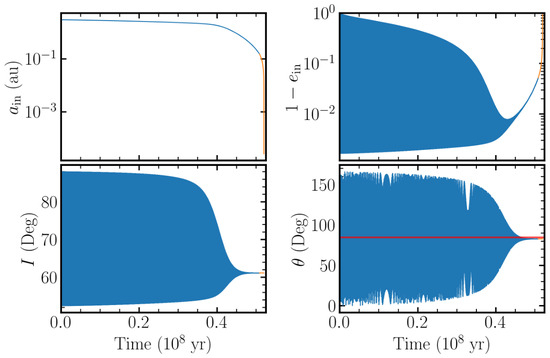
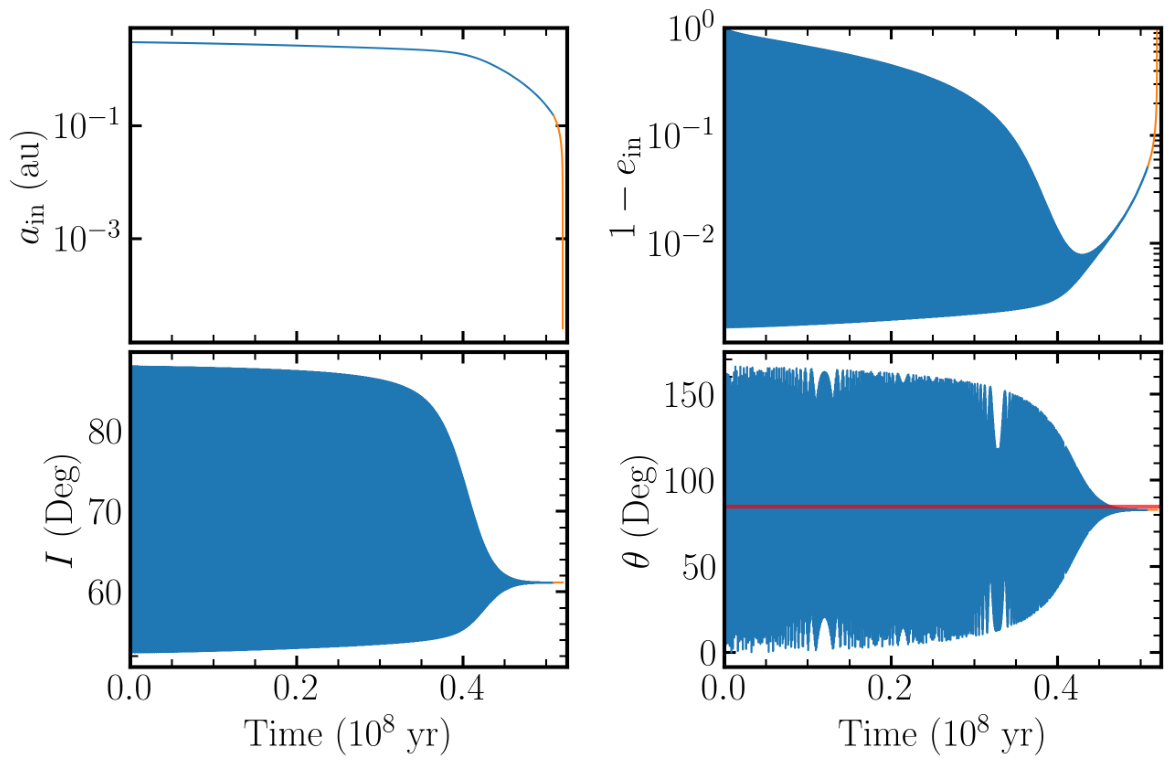
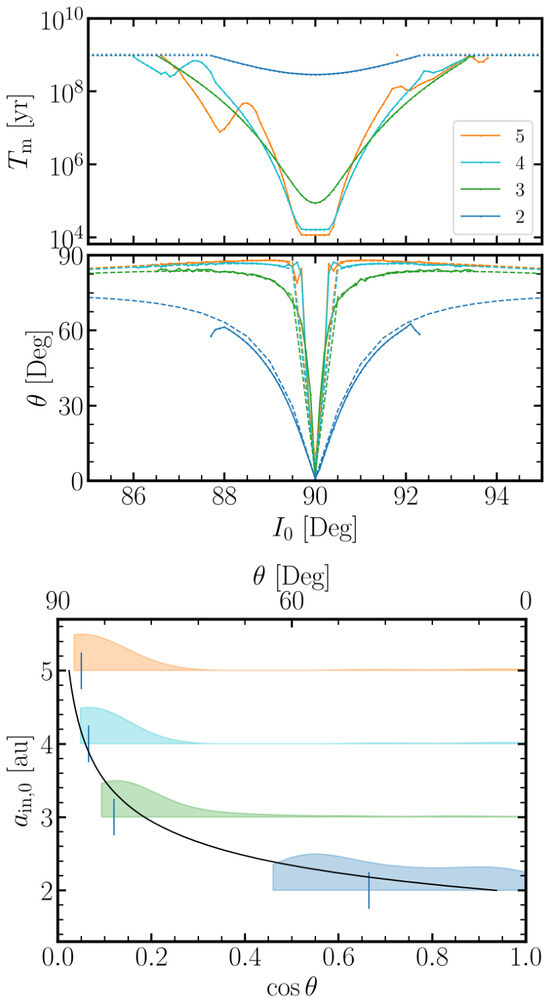
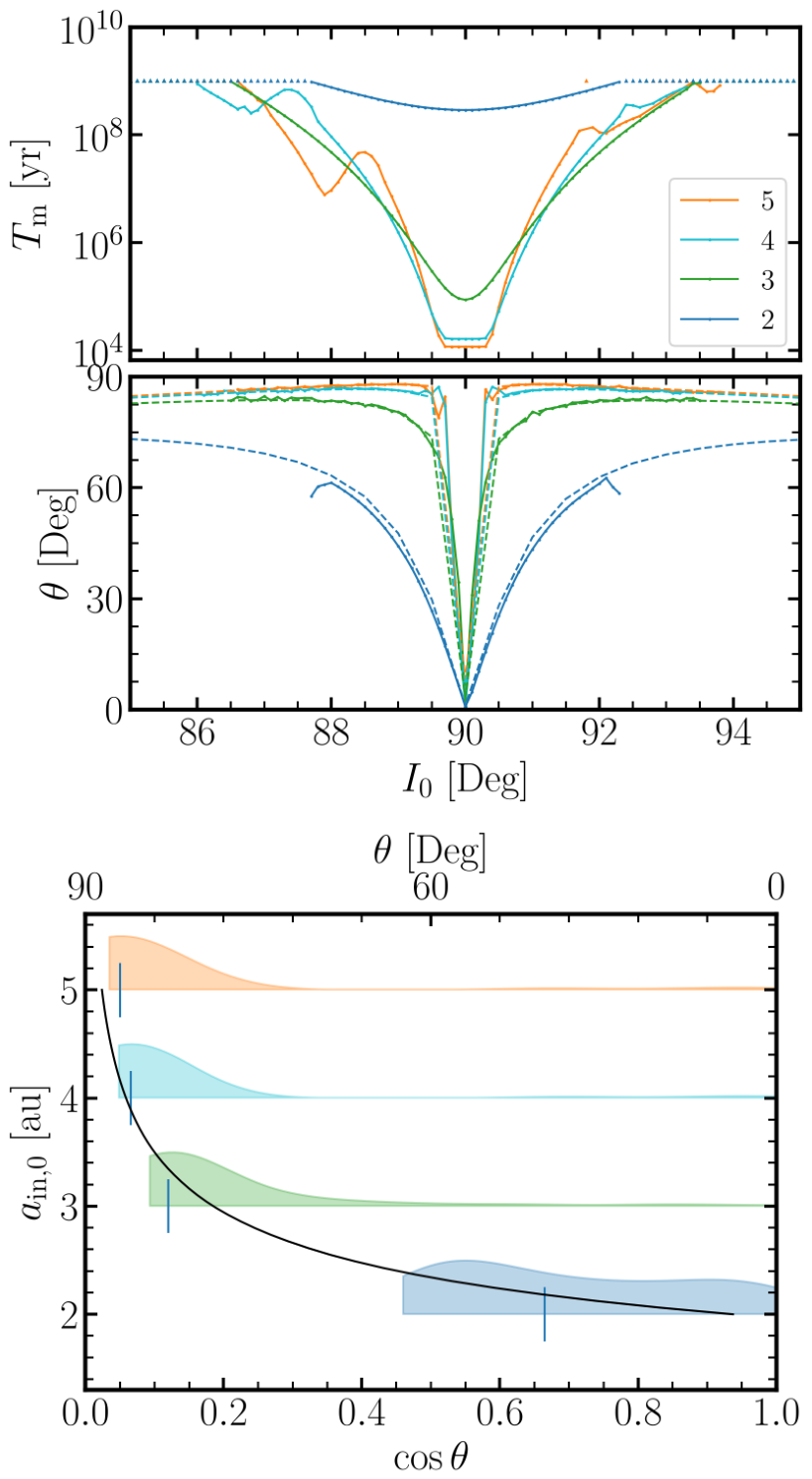
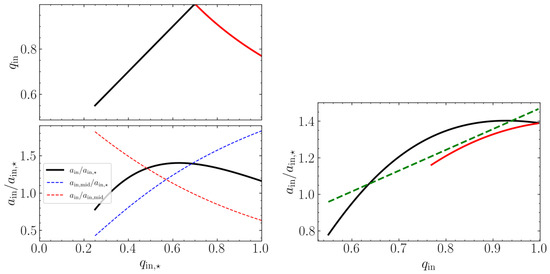
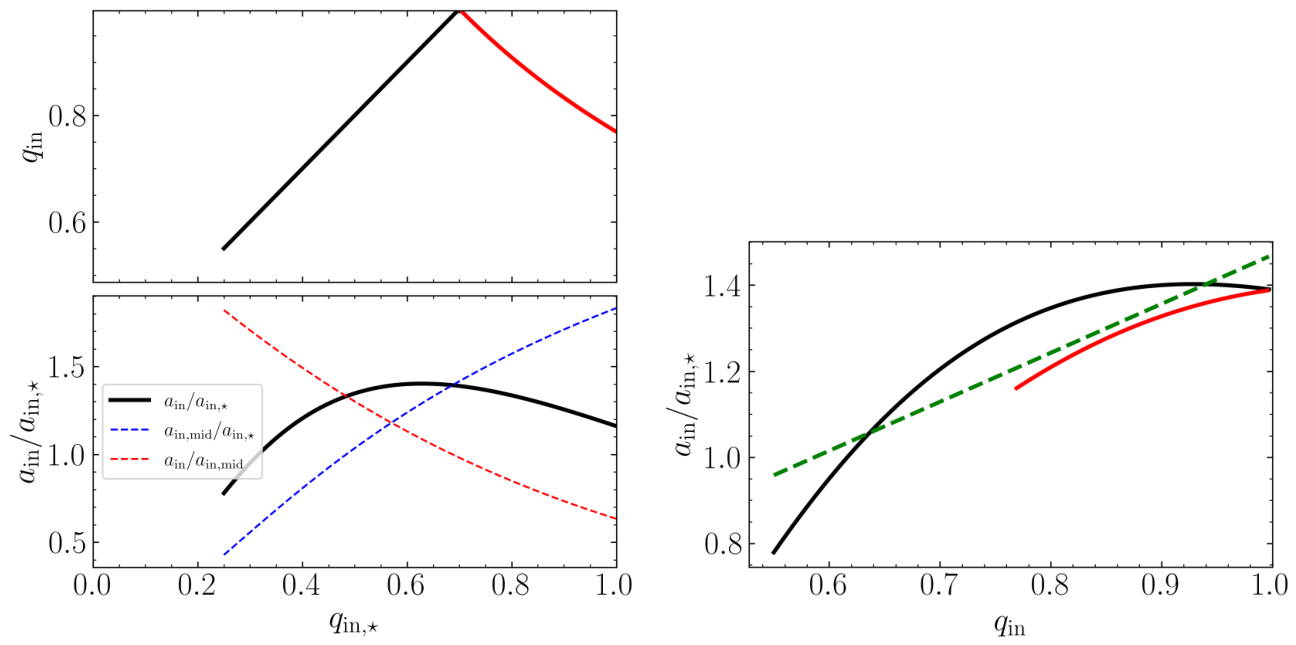
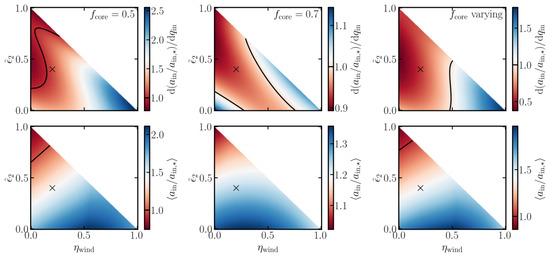
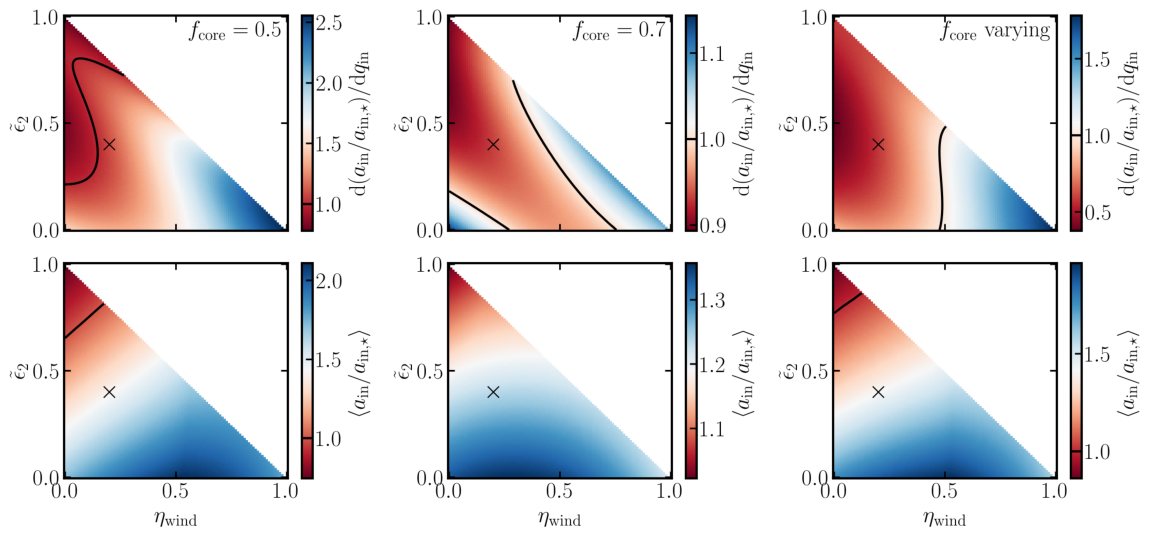
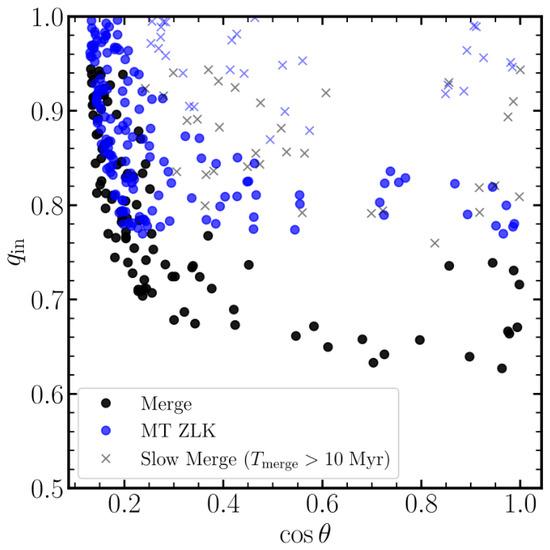
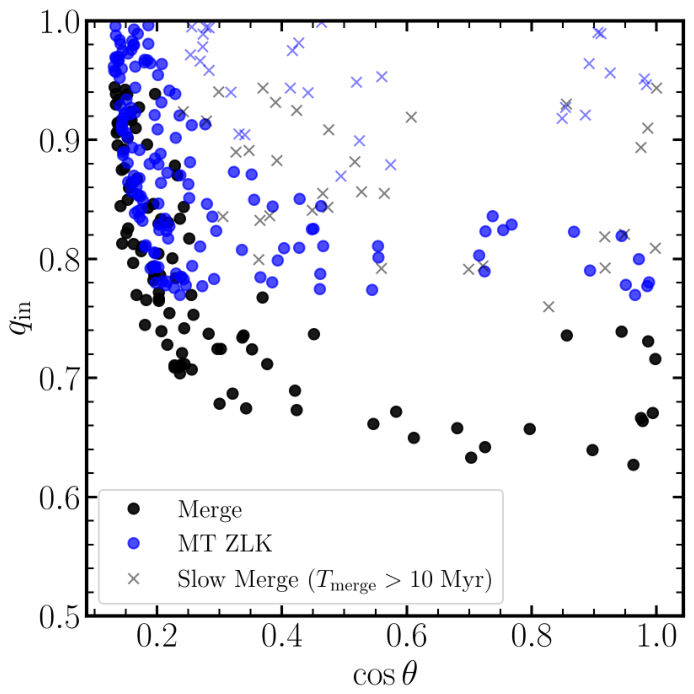
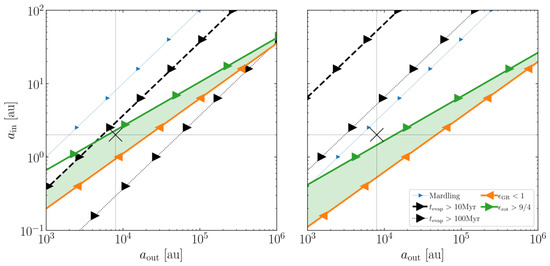
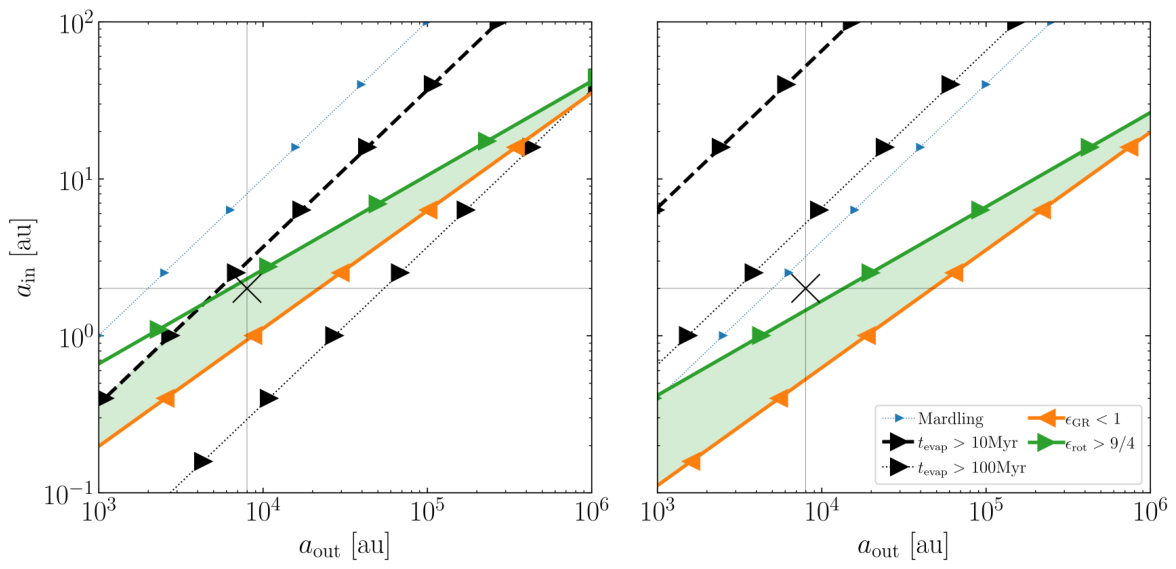
Disclaimer/Publisher’s Note: The statements, opinions and data contained in all publications are solely those of the individual author(s) and contributor(s) and not of MDPI and/or the editor(s). MDPI and/or the editor(s) disclaim responsibility for any injury to people or property resulting from any ideas, methods, instructions or products referred to in the content. |
© 2026 by the author. Licensee MDPI, Basel, Switzerland. This article is an open access article distributed under the terms and conditions of the Creative Commons Attribution (CC BY) license.