


Abstract
We propose an infrared mechanism for alleviating the Hubble constant tension, based on a small departure from entanglement equilibrium at the cosmological apparent horizon. If the horizon entanglement entropy falls slightly below the Bekenstein–Hawking value, we parametrize the shortfall by a fractional deficit evolving with the FLRW scale factor a. The associated equipartition deficit at the Gibbons–Hawking temperature then sources a smooth, homogeneous component whose density scales as , with a dimensionless coefficient of order unity times . Because this component tracks , it is negligible at early times but can activate at redshifts , raising the late-time expansion rate by a few percent without affecting recombination or the sound horizon. We present a minimal three-parameter activation model for and derive its impact on the background expansion, the effective equation of state, and linear growth for a smooth entanglement sector. The framework predicts a small boost in , a mild suppression of , and a corresponding modification of the low–z distance–redshift relation. We test these predictions against current low–redshift data sets, including SN Ia distance moduli, baryon acoustic oscillation distance measurements, cosmic chronometer data, and redshift space distortion constraints. We then discuss whether the tension can be consistently interpreted as a late–time, horizon–scale information deficit rather than an early universe modification.
1. Introduction
A persistent discrepancy has emerged between the Hubble constant inferred from early universe probes and the value obtained from late-time distance ladders, a percent level tension that, if not due to unrecognized systematics, hints at new physics in the cosmic expansion history. Concretely, the CMB anisotropy spectrum tightly constrains the angular acoustic scale and, within a specified background model, translates this into an inferred through the sound horizon and the late–time distance to last scattering. For example, Planck 2018 (under CDM) finds [1], whereas local distance ladder calibrations anchored by geometric and stellar standardization methods yield higher values; in particular, SH0ES reports [2]. At intermediate redshifts, baryon acoustic oscillations (BAOs) provide a robust standard ruler that strongly constrains the late-time distance-redshift relation; recent DESI BAO constraints favor values closer to the Planck inferred scale [3,4], sharpening the question of whether a consistent cosmological history can reconcile early- and late-time determinations. Explanations proposed so far broadly fall into two classes. Early-time modifications (e.g., early dark energy, extra radiation, or altered recombination) reduce the sound horizon so the CMB can accommodate a larger , while late-time ideas (e.g., evolving dark energy or modified gravity) adjust the low-z Hubble rate with minimal impact on recombination; see Refs. [5,6,7,8,9,10,11] for reviews. Both directions face tight joint constraints from CMB anisotropies, BAO, Type-Ia supernova distances, and structure growth observables: DESI BAO remain consistent with flat CDM and bound w near , Pantheon+ tightens the low-z distance–redshift relation, and redshift distortion (RSD) growth measurements strongly restrict early-time solutions such as EDE when combined with CMB data [3,4,9,12,13,14,15,16].
In parallel, advances in quantum information and gravity have reshaped how we think about spacetime: horizons carry entropy and temperature; entanglement can encode geometry; and thermodynamic reasoning can reproduce gravitational dynamics. However, naive free-field entanglement in curved spacetime contributes only to the vacuum energy, which is far too small to matter cosmologically, and the ultra violet (UV) area law renormalizes rather than producing a new fluid. Any entanglement-driven mechanism relevant to the Hubble tension must therefore be infrared (IR) and horizon tied, not a re-counting of UV modes.
We develop and assess such an IR mechanism: the horizon entanglement equipartition deficit (HEED). The core hypothesis is that the quantum state of our late-time universe is slightly out of entanglement equilibrium at the apparent (Hubble) horizon. If the actual horizon entanglement entropy falls short of the Bekenstein–Hawking value by a fractional deficit , then when treating the horizon as an entanglement screen at the Gibbons–Hawking temperature , the resulting equipartition deficit translates into a homogeneous bulk component of density
where stand for the Hubble rate evolving with the FLRW scale factor a. This is the familiar holographic [17,18,19,20], but with a time-dependent coefficient tied to horizon entanglement rather than an ad hoc constant.
Two features make HEED cosmologically attractive. First, because , it is automatically negligible at high redshift relative to matter and radiation, thereby preserving recombination physics and the sound horizon. Second, we model a late–time activation of the HEED amplitude by letting
where the dimensionless switch function interpolates smoothly from at early times () to at late times (). The parameter sets the characteristic activation epoch (equivalently ), while k controls the sharpness of the transition (larger k corresponds to a steeper switch). This late activation can yield a few percent increase in the low–z Hubble rate, sufficient to ease the tension while remaining consistent with SN/BAO distances. Interpreted as a smooth, non–clustering sector (rest–frame sound speed ), HEED modestly suppresses structure growth through , providing additional levers beyond purely geometric constraints.
Conceptually, HEED can be read in two equivalent ways. In a fluid picture, adds to the stress–energy budget and the Friedmann equation becomes
where is the (pressureless) matter density, and is the vacuum energy density associated with the cosmological constant. The entanglement deficit therefore appears as a multiplicative correction to the expansion rate. In a modified gravity reading, the same factor reshapes the effective Planck mass, , while matter remains covariantly conserved. Either view preserves the Bianchi identity and avoids ghost/gradient instabilities so long as the entanglement sector is treated as smooth and non–propagating (an effective IR dressing of the background rather than a new field).
This paper makes the following contributions. We formalize HEED from horizon thermodynamics and entanglement equilibrium, clarifying the UV/IR split: UV area law pieces renormalize , whereas the IR deficit sources . We derive background relations’ closed form, an instantaneous effective , and the logarithmic derivative needed for growth under a minimal three parameter activation . We analyze linear perturbations with a smooth entanglement sector, predicting a characteristic pattern: small late-time boosts to and mild suppression of . We confront the model with low–redshift data by fitting SN Ia, BAO, and cosmic chronometer (CC) constraints together with a CMB distance prior that keeps the sound horizon fixed, and by testing the resulting growth history against RSD measurements, while imposing the early-time safety condition at recombination.
HEED sits at the intersection of holographic dark energy (HDE)-type scalings and entanglement equilibrium thinking. Unlike standard HDE with a constant , HEED explains the coefficient as a dynamical horizon information shortfall that can switch on at . Unlike free field “entanglement dark energy,” it avoids the suppression by tying directly to the horizon’s IR thermodynamics.
It is important to note that the present work should be viewed as an effective IR cosmological parametrization motivated by horizon thermodynamics and entanglement equilibrium, rather than as a complete microscopic holographic dual or a UV-complete local field theory. Its purpose is to isolate the phenomenological consequences of a small late-time horizon entanglement deficit, clarify the associated UV/IR split, and test whether such a component can remain consistent with current low-redshift distance and growth data. This effective IR status is not unusual in cosmology: many dark-energy and modified-gravity models were analyzed extensively at the phenomenological level before any full UV completion or microscopic derivation was available, including early dark energy, interacting dark energy, phenomenological growth frameworks, gravity, emergent dark energy, modified-gravity interpretations of late-time data, effective running Hubble constant, and slow-rolling scalar dynamics [21,22,23,24,25,26,27,28,29,30,31,32,33,34,35,36,37,38].
Recent alternatives to standard EDE include positive pressure barotropic components [39], transition-based dynamical dark energy with AdS-to-dS or dS-to-dS evolution [40], and HDE models with different infrared cutoffs [41]. HEED is also infrared-motivated, but it is tied to the apparent horizon and interprets the late-time correction as a finite entanglement equipartition deficit.
This paper is organized as follows. Section 2 derives HEED from horizon thermodynamics and entanglement considerations, establishes the characteristic scaling, and clarifies the required UV/IR separation; it also presents the background dynamics, the instantaneous effective equation of state, and the minimal activation parameterization. Section 3 confronts the HEED activation parameters with a combination of four low-z probes. The Bayesian inference framework is described in Section 3.1, where the posterior is sampled with the affine-invariant ensemble sampler emcee. Marginalized constraints and triangle plots are obtained with GetDist and interpreted in Section 3.2, which discusses posterior constraints and the internal consistency of the HEED picture. Section 4 summarizes the main results and outlines directions for future work.
2. Horizon Entanglement Equipartition Deficit
The HEED framework starts from the observation that, in a spatially flat FLRW universe, the apparent (Hubble) horizon behaves thermodynamically: it has a well-defined area and an associated temperature and entropy, in direct analogy with de Sitter and black hole horizons [42,43,44,45]. We posit that the renormalized bulk entanglement entropy of quantum fields across this horizon is slightly below the Bekenstein–Hawking value [42,43,44,45]. This small shortfall, which we call an “entanglement deficit”, encodes a departure from entanglement equilibrium and, when translated through horizon equipartition [46,47,48,49], manifests as an infrared, horizon-tied contribution to the cosmic energy budget whose magnitude tracks the square of the expansion rate as . Because this contribution is naturally tiny at early times and only becomes relevant as the universe accelerates, it can modify the late-time expansion without upsetting recombination physics, unlike free field vacuum effects whose influence scales much more weakly with the Hubble rate (see Appendix A for details).
Let denote the apparent (Hubble) horizon on a constant time FLRW slice, and decompose the Cauchy slice into an inside region bounded by and its complement . In a QFT without gauge constraints, one may (formally) factorize the Hilbert space as ; with gauge or gravitational constraints, it is cleaner to work with local operator algebras (possibly with a shared center or edge modes on ) that reproduce the usual reduced-state construction [50,51,52]. The global (total) state is a positive, unit-trace operator on the full Hilbert space, . Tracing out exterior degrees of freedom defines the reduced inside state
and the entanglement entropy across is
As in flat space, vacuum entanglement entropy across a smooth surface exhibits an area-law divergence [50,53,54],
with nonuniversal coefficient and cutoff . In semiclassical gravity, the same UV modes that produce the area term renormalize the Einstein–Hilbert coupling, so the generalized entropy relevant for horizon thermodynamics reads
where the divergence has been absorbed into , and is the finite, IR-renormalized bulk entropy term associated with quantum fields across [55,56,57,58]. In what follows, denotes this renormalized IR contribution,
which we compare to the Bekenstein–Hawking value . Departures from entanglement equilibrium are then captured by the fractional deficit
with expected in exact de Sitter and natural out of equilibrium at late times [59,60]. In this sense, the entanglement deficit is not introduced as an additional UV area-law contribution, which is already absorbed into , but as a finite infrared departure from horizon entanglement saturation. The proposal is therefore intrinsically an effective late-time parametrization of nonequilibrium horizon thermodynamics. Using the apparent horizon temperature [42], we will map this deficit to a smooth IR component scaling as .
To construct the HEED term, we treat the apparent horizon as an entanglement screen with area and temperature
and Bekenstein–Hawking entropy [42,43,44,45]. Calling it an entanglement screen means we regard the horizon as the codimension one surface across which we compute the (renormalized) bulk entanglement of quantum fields. The screen then supplies a “bookkeeping device” for associating a surface energy via equipartition to the bulk IR component. This language is in line with horizon thermodynamics, holographic ideas, and (membrane paradigm) coarse graining of horizon effective surface degrees of freedom dofs [46,47,48,49,61,62,63,64].
Following the emergent gravity/equipartition literature, we count the dofs as1
which follows directly from the area law for [43,45]. This is a coarse grained count that does not assume a specific microscopic model and is routinely employed in horizon equipartition derivations of gravitational dynamics [46,47,48,49]. We then assume equipartition on the screen,
with de Sitter temperature [42]. If only a fraction of these dofs are entanglement active, the missing (deficit) energy on the screen is
where the last equality follows from inserting in Equation (11) and . Associating this with a homogeneous bulk component within the Hubble volume gives
up to an overall numerical convention of order unity. This realizes the familiar holographic scaling while anchoring it to IR horizon entanglement rather than to the UV area law, whose divergence renormalizes and therefore does not represent a dynamical fluid [55,56,57]. Our statement that HEED “anchors” this scaling to IR entanglement means the following: instead of postulating , we derive it from the horizon’s thermodynamics and a finite, IR-entanglement deficit , via the equipartition argument in the text. By contrast, the UV area law term in is regulator dependent and simply renormalizes ; it is not a dynamical fluid [55,56,57]. Thus, HEED ties the coefficient to a physical deficit , rather than treating as an external constant.
There are two equivalent but conceptually distinct embeddings of Equation (14) in FLRW. In a fluid (additive) view one writes
which leads to the relation
Alternatively, in a modified-gravity (multiplicative) view, one moves the factor to the geometric side and interprets it as a slowly varying Planck mass [65,66], . In either interpretation the Bianchi identity is respected and matter remains covariantly conserved, 2. Early-time safety is guaranteed by requiring at recombination so the sound horizon and CMB acoustic physics remain unchanged.
For phenomenology we model a smooth late-time activation as follows,
with , and . The normalization makes the present day HEED fraction. Equation (16) rescales the Friedman equation by the factor
An instantaneous effective equation of state for the HEED sector follows from ,
with
Once has saturated (), one finds , i.e., quintessence-like behavior today for . It is important to stress that this equation of state is not introduced as an independent microphysical assumption. Once is fixed by the horizon equipartition ansatz, the effective pressure is determined by the continuity equation. The HEED sector is therefore covariantly conserved at the homogeneous level by construction. A derivation of from a microscopic covariant action or entropy functional remains an open theoretical problem.
During the switch on (), a transient can occur. This phantom behavior pertains only to the background effective equation of state, and, because HEED introduces no propagating field, it does not signal a ghost. A ghost is a propagating mode with a negative kinetic term, which renders the Hamiltonian unbounded. In a canonical single field, achieving indeed requires the wrong sign kinetic term and is pathological [69], and k-essence generically cannot stably cross without ghost/gradient problems [70]. By contrast, within the EFT/Horndeski framework one can realize an effective while remaining ghost free provided the kinetic matrices are positive, the scalar sound speed satisfies , and the effective Planck mass remains positive (), e.g., in the -parameterization [65,66,71,72,73,74]. HEED belongs to this safe class: it is an effective, nonpropagating IR sector equivalent to a mild time variation of with , so any transient during the switch-on of is a kinematic background effect rather than a ghost instability. Taking and 3 keeps the extra scalar nondynamical while satisfying standard no-ghost/no-gradient conditions [65,66].
In the HEED framework we treat the entanglement sector as smooth (non-clustering) and work in GR for linear perturbations. The matter growth factor (normalized so that ) obeys the standard ODE
with primes denoting and initial conditions set deep in matter domination4. Defining the dimensionless logarithmic growth rate
and the fluctuation amplitude within spheres (with the reduced Hubble constant),
the RSD observable is the product which is robust to linear galaxy bias and is widely used to test late-time dynamics [77,78]. For HEED backgrounds,
so the “friction” term in Equation (21) is slightly enhanced during the HEED switch on (), yielding a mild suppression of growth relative to CDM at . Once saturates (), the growth history closely tracks that of a smooth dark energy model with the same . A useful approximation for intuition is the growth index form with in GR and small, -dependent corrections for smooth dark energy [77]. The HEED behaves like such a smooth sector and therefore predicts percent-level shifts in concentrated at low redshift (as illustrated in Figure 1).
Figure 1.
HEED’s linear growth impact illustrated for three sets of the activation parameters.
These features have clear observational implications. At , Equation (18) gives , so the inferred Hubble constant is boosted by , as illustrated in Figure 2. A modest yields a increase, while gives . Because , recombination era distances and the sound horizon remain essentially unchanged, providing exactly the lever arm required by the early–late discrepancy. Low-redshift distance indicators (SN/BAO) can be matched with gentle adjustments driven by the amplitude of and parameters and k describing the activation history. A practical data strategy is to fit SN + BAO + CC backgrounds with a CMB distance prior to keep the sound horizon standard; then, test RSD [78,79], enforcing the early-time prior at recombination.
Figure 2.
HEED-corrected low-redshift Hubble constant related via its residuals relative to the CDM calculations.
The construction developed above is restricted to homogeneous, spatially flat FLRW cosmology and the apparent (Hubble) horizon. No fully covariant extension to generic spacetimes is assumed here; the present aim is instead to formulate and test the corresponding effective infrared cosmological dynamics in the simplest setting relevant to the Hubble tension.
Finally, we note relationships and distinctions with neighboring ideas. Modular Hamiltonian first-law analyses for ball regions show that free or conformal fields produce corrections [80,81,82,83,84,85] (see Appendix A for details), which are far too small to be cosmologically relevant; HEED avoids this suppression by tying the effect to IR horizon thermodynamics. Standard holographic dark energy simply posits with a constant coefficient; HEED explains the coefficient as a time-dependent horizon entanglement shortfall with a natural late-time activation. The framework is local in time (apparent horizon) and thus avoids teleological issues associated with future event horizons [42,46,49,86]. In sum, HEED constitutes a thermodynamically motivated, IR-entanglement mechanism that is internally consistent (conservation, stability, and horizon thermodynamics), naturally small at high redshift, and predictive for late-time expansion and linear growth [86].
3. Observational Consistency Analysis
In this section we confront the HEED activation parameter triplet with a combination of four low-z probes, treated as independent Gaussian constraints. We use SN Ia distance moduli from Pantheon+ [12,87]; cosmic–chronometer (CC) determinations of from differential age measurements of passively evolving early-type galaxies [88,89,90,91,92,93,94]; compressed BAO measurements of the transverse comoving distance and the radial comoving Hubble distance from BOSS DR12 [13], eBOSS DR16 [14] and DESI DR2 [4], adopting a fixed sound horizon [1]; and RSD measurements of the growth rate from BOSS/eBOSS [13,95,96,97,98,99,100], together with WiggleZ [101], VIPERS [102,103,104,105,106,107], supplemented by very low-z [108,109,110,111,112] and high-z [113,114,115,116] constraints.
For the CC sample we employ the community “classic” 31-point set, typically treated as uncorrelated and assembled from DA measurements (see Table A1 in Appendix B); in this approach the redshift–age relation yields , which is converted to the Hubble parameter via . The BAO observables used here are compiled from Refs. [4,13,14], with the full list of points provided in Table A2 of Appendix B. Finally, Table A3 of Appendix B presents a consolidated set of 63 RSD measurements of the linear growth rate, reported as with 1 uncertainties and spanning –, compiled in Ref. [117]. This compilation includes very low-z peculiar velocity and Tully–Fisher constraints from 2MTF [108], 2MRS [109,110], and 6dFGS/6dFGS+SNe [111,112]; early RSD determinations from SDSS–LRG [118] (including the SDSS–LRG–200/60 re-analyses [119]) and DR7–LRG [120]; low-z galaxy-survey results from SDSS–MGS [121], SDSS–veloc [122], DR13 [123], and GAMA [124]; the WiggleZ three-point set [101]; extensive BOSS measurements, namely LOWZ/CMASS and DR10–DR12 from Refs. [13,14,95,96,97,98,99,100]; multiple VIPERS determinations (including v7 and PDR–2) [102,103,104,105,106,107]; additional SDSS DR7 peculiar-velocity work [125]; the FastSound high-z constraint [113]; and the SDSS–IV QSO tomographic measurements at [114,115,116].
Distances follow the standard flat FLRW relations with defined in Equations (17) and (18):
BAO observables are and with .
We analyze HEED in the additive embedding at the level of the homogeneous background, in which the entanglement sector contributes an algebraic -proportional term to the Friedmann equation expressed by Equation (15). Eliminating gives the closed background relation expressed by Equation (18). We normalize the activation so that , and parameterize
with and a late-time switch-on controlled by , as in Equation (17). In this embedding it is convenient to define the effective late-time Hubble scale,
which is the quantity constrained by local measurements. Linear growth assumes a smooth, non-clustering HEED sector in general relativity (GR) so that the growth factor satisfies Equation (21) integrated from matter domination with . The RSD prediction is
with held fixed as a Gaussian prior.
3.1. Bayesian Formulation
The baseline parameter vector in use is
where is the underlying Hubble constant entering Equation (18), while is given by Equation (27). The data vector collects SN Ia distance moduli , BAO points , CC measurements , and RSD growth measurements . For a given , the corresponding predictions , , , and are computed from via Equations (21), (25) and (28).
We define the posterior as
with the total quadratic statistic
assuming Gaussian errors and (for this baseline analysis) independence between data blocks.
The SN term uses Hubble diagram residuals and profiles out a single additive offset , encoding the absolute magnitude (distance zero-point) degeneracy with the Hubble scale. With diagonal errors the raw statistic is
where is evaluated from . Minimization of Equation (32) with respect to yields the analytic profiler
which is equivalent to analytically marginalizing over a constant offset with a flat prior. Operationally, we profile separately for each cosmological model (HEED and CDM), so each curve is shifted by its own , consistent with standard practice in compressed SN likelihood applications [12,87]. Consequently, SN data alone do not fix ; the absolute scale is set only when combined with an absolute ruler such as CC or BAO (through ), or by including an explicit external anchor.
The BAO and CC blocks adopt diagonal Gaussian forms,
which are the diagonal-covariance limits of the standard Gaussian likelihood
where is the covariance matrix of the corresponding data vector. Equations (34) and (35) therefore amount to taking to be diagonal, with entries given by the reported variances.
The corresponding growth log-likelihood is taken as
with diagonal errors in this baseline implementation. In practice, the RSD block provides the primary handle on late-time structure growth in our low-z data combination, since the predicted is obtained by solving the linear growth equation with coefficients determined by the background expansion . Within the assumptions of GR growth and a smooth (non-clustering) HEED sector, this term therefore links the background parameters controlling to the growth history encoded in and .
To regularize the growth sector, we include a weak Gaussian prior on ,
which may be chosen to be broad enough to avoid importing CMB-dominated information, yet prevents unphysical excursions when the RSD block alone is insufficient to pin down in combination with .
We include three priors/guards, assembled as
The early-time prior enforces negligible HEED at recombination,
where and the wall prior penalizes approaching (where the effective Planck mass would vanish) over the redshift range of the data,
with and being the largest redshift used in the likelihood.
Finally, in anchored analysis we impose an external Gaussian prior on the effective Hubble scale , not on ,
This prior is not used to infer the Hubble scale from low-z probes alone. Rather, it enables a consistency test: we ask whether HEED can accommodate a locally inferred high late-time expansion rate while remaining compatible with SN, BAO, CC, and RSD constraints that jointly probe distances and growth.
We sample the posterior using the affine-invariant ensemble sampler emcee [126], and compute marginalized constraints and triangle plots using GetDist [127].
For a simple model-comparison diagnostic, we quote the Akaike and Bayesian information criteria [128,129,130,131],
where is the number of fitted parameters, and is the number of data points entering the simplified likelihood. We report and relative to the corresponding CDM fit. Since the likelihood used here neglects some covariance matrices, these values should be interpreted as indicative rather than as a final Bayesian model selection result. The numerical results of the consistency analysis are collected in Table 1 and Table 2. Table 1 reports the adopted priors, marginalized constraints, and best-fit values for the HEED parameters, while Table 2 gives the data set by data set contributions and the corresponding , AIC and BIC comparison with CDM. These model-comparison indicators are computed within the simplified diagonal likelihood and should therefore be regarded as indicative rather than definitive.
Table 1.
Summary of priors, marginalized constraints, and best-fit values for the HEED analysis. The quoted intervals correspond to the marginalized 68% credible ranges. Approximate marginalized constraints read from the one-dimensional posterior marginals in Figure 3.
Table 2.
Goodness of fit and information criterion comparison between HEED and CDM. The values are computed with the simplified diagonal likelihood used in this work and should therefore be interpreted as indicative.
The HEED model, as indicated in Table 2, reduces the total data chi-square by . This improvement is driven mainly by the supernova and BAO contributions, , whereas the changes in the CC and RSD sectors are small, . Thus, the raw goodness of fit is mildly improved relative to CDM. However, HEED contains three additional free parameters relative to CDM. The corresponding AIC difference is
A negative value of indicates that the improvement in only mildly compensates for the additional HEED parameters. In contrast, the BIC difference is
The positive value of favors CDM, reflecting the stronger BIC penalty for additional parameters when the number of data points is large. We therefore interpret the fit as an indicative improvement in raw goodness of fit, but not as a robust model selection preference for HEED.
The likelihood adopted in this exploratory analysis treats the compressed SN, BAO, CC, and RSD data points as independent Gaussian measurements. Equivalently, the full covariance expression in Equation (36) is approximated by retaining only the diagonal variances. Neglecting off-diagonal covariances can misestimate both the constraining power of the data and the relative weights of the different data blocks, especially for Pantheon+, correlated BOSS/eBOSS/DESI BAO products, and RSD compilations assembled from partially overlapping galaxy samples.
As a first diagnostic, we repeated the fit including the CC covariance induced by stellar population synthesis systematics, following Ref. [132]. The resulting change in the RSD related fit quality is at the level of approximately . This suggests that the qualitative HEED trends are stable against this particular covariance source. Nevertheless, modern large scale structure (LSS) analyses show that covariance modeling can affect projected uncertainties at the few-percent level. For example, the DESI 2024 covariance validation study of Ref. [133] finds that analytical and mock-based covariance estimates agree well for BAO distance-scale errors, while full shape analyses require a more careful covariance treatment.
Because Pantheon+, BAO, and RSD data products contain non-trivial internal and cross-survey correlations, we conservatively expect a full covariance treatment to affect selected contributions and marginalized uncertainties at the few-percent-to- level. The present diagonal treatment should therefore be regarded as a first consistency test rather than as a definitive quantitative model-selection analysis. A full covariance treatment will be required before claiming a statistical preference for HEED over CDM.
3.2. Posterior Constraints and Internal Consistency of HEED
Figure 3 presents the marginalized one- and two-dimensional posterior distributions for the HEED parameter vector Equation (29), obtained from the joint SN+BAO+CC+RSD likelihood with the priors and profiling procedure specified in Section 3.1. The shaded contours enclose the 68% and 95% credible regions, while the diagonal panels show the corresponding one-dimensional marginals. Complementary to these parameter constraints, the data space fits shown in Figure 4, Figure 5, Figure 6, Figure 7 and Figure 8 demonstrate that the best-fit HEED and CDM predictions are nearly indistinguishable across the low-redshift observables considered here (Pantheon+ , CC , BAO and , and RSD ), with no systematic preference visible at the level of current uncertainties. We therefore interpret the posterior in Figure 3 primarily as a consistency statement: within the adopted additive HEED embedding and priors, a late-time entanglement-driven modification of the expansion history can be introduced without spoiling established low-z distance and growth constraints.
Figure 3.
Triangle plot for the HEED parameterization showing the marginalized posterior distributions of obtained from the joint SN + BAO + CC + RSD likelihood. Shaded contours indicate the 68% and 95% credible regions, while the diagonal panels show the corresponding one-dimensional marginals. In the anchored analysis, the external Gaussian prior is applied to the effective late-time Hubble scale rather than directly to , which induces the characteristic degeneracy direction in the plane.
Figure 4.
Pantheon+ SN Ia distance moduli compared to the best-fit HEED (solid) and CDM (dashed) predictions. The fits are shown after profiling over the nuisance offset (absolute-magnitude/zero-point) as described in the text.
Figure 5.
CC measurements of with uncertainties compared to the best-fit HEED (solid) and CDM (dashed) predictions.
Figure 6.
BAO measurements of the radial (line-of-sight) comoving distance, with , compared to the best-fit HEED (solid) and CDM (dashed) predictions.
Figure 7.
BAO measurements of the transverse comoving distance, , compared to the best-fit HEED (solid) and CDM (dashed) predictions.
Figure 8.
RSD growth constraints in the HEED framework. Measurements of with uncertainties compared to the best-fit predictions for HEED (additive embedding) and CDM. Model curves are obtained by solving the linear growth equation Equation (21) assuming a smooth (non-clustering) HEED sector, normalizing , and computing at .
A number of qualitative and quantitative features demonstrate that the inferred constraints are internally consistent with the physical assumptions underlying HEED.
3.2.1. Hubble Constant
As pointed in Section 3.1, in the present analysis, the posterior is conditioned on an external Gaussian prior (“anchor”) on the effective late-time Hubble scale centered at as inferred from [2]. Accordingly, the chains do not infer an upward shift of the Hubble scale relative to CMB-only analyses; rather, they test whether the HEED background and growth sector can remain compatible with SN + BAO + CC + RSD while accommodating a high locally inferred expansion rate. This is because in the additive HEED embedding Equation (27), the anchor does not force the sampled parameter itself to be large. Rather, the posterior realizes with moderate values of provided , leading to a pronounced anti-correlation between and in the marginalized posterior shown in Figure 3.
3.2.2. Matter Density
The matter density parameter is constrained at the level typical of low-redshift analyses, with a clear anti-correlation with . This degeneracy is expected: an increase in the late-time expansion rate induced by HEED must be compensated by a corresponding adjustment in in order to preserve the BAO distance measurements. The inferred values of the matter density parameter remain within the range allowed by late-time LSS probes, including BAO geometry, RSD measurements, and galaxy clustering with weak lensing combinations. In particular, the moderate increase in relative to CDM is compensated by the HEED-induced suppression of late-time growth, so that the predicted remains consistent with current observational constraints.
3.2.3. Present-Day HEED Amplitude
A central result of the analysis is that the posterior for the HEED amplitude peaks decisively away from zero. Pure CDM, corresponding to , lies in the tail of the posterior. At the same time, the data strongly disfavor values approaching the physical wall , ensuring a positive effective Planck mass and the absence of instabilities. This provides direct phenomenological support for a nonvanishing late-time horizon entanglement deficit.
3.2.4. Activation Epoch and Sharpness
The activation scale factor is constrained to lie in the range ∼ , corresponding to a redshift ∼ . This places the onset of HEED squarely in the late universe, well after recombination and the baryon-drag epoch. As a result, early universe observables such as the sound horizon remain unaffected, while the late-time expansion history is modified in precisely the redshift range probed by SN, BAO, and CC data.
The shape parameter k, which controls the sharpness of the HEED switch-on, is only weakly constrained by current data and exhibits broad, possibly multi-modal posteriors. This behavior is expected: existing low-redshift probes are primarily sensitive to the integrated effect of the late-time expansion rate rather than to the detailed functional form of the transition. Consequently, k effectively plays the role of a nuisance parameter at present precision.
The weak constraints on the activation parameters have a simple origin. The data used here are mostly sensitive to the integrated impact of the HEED sector on distances and growth, rather than to the detailed time profile of the transition. Schematically, the activation history enters through , but SN and BAO observables depend mainly on integrals of the form , while RSD measurements constrain combinations such as that also respond to the cumulative expansion history. Consequently, different pairs can generate nearly the same integrated distance and growth response once , , and are adjusted. The parameter is therefore constrained mainly by the requirement that HEED remain inactive before recombination and the baryon-drag epoch, while the sharpness parameter k remains only weakly determined by present low-redshift data. More direct constraints on the transition profile would require observables with finer redshift resolution or additional probes of late-time potentials, such as weak lensing, CMB lensing, or ISW cross-correlations.
3.2.5. Growth Amplitude
The posterior for is mildly shifted toward lower values compared to the Planck CDM determination [1]. This reflects the fact that the enhanced late-time expansion induced by HEED leads to a modest suppression of structure growth at . The resulting values of and the correlated predictions for remain compatible with RSD measurements, while potentially easing the weak-lensing clustering-amplitude () tension, i.e., the preference of several stage-III cosmic-shear analyses for values lower than the CMB-inferred Planck CDM prediction (e.g., KiDS-1000 and DES Y3) [134,135,136].
3.2.6. Correlation Structure
The two-dimensional marginalized posteriors exhibit a pattern of correlations that can be understood directly from the structure of the HEED background and from the combination of the low-redshift probes employed. Because the analysis is conditioned on an external prior on the effective late-time Hubble scale , the sampled parameters and are strongly anti-correlated. This follows from the additive HEED relation Equation (27): for a fixed , a larger entanglement deficit requires a smaller underlying . The corresponding elongated contours in the plane therefore reflect a purely kinematic degeneracy rather than a physical instability.
A positive correlation is observed between and . In the anchored analysis, increasing lowers the sampled value of , which tends to increase comoving distances at fixed dimensionless expansion rate. To preserve the BAO and CC constraints on distances and , the fit compensates by increasing , which raises at intermediate redshifts and reduces the integrated distances. This correlation therefore encodes the geometric balance required to maintain consistency with BAO measurements in the presence of a late-time entanglement contribution.
The correlation between and reflects the expansion–growth interplay probed by RSDs. A larger entanglement deficit enhances the late-time expansion rate, which mildly suppresses the growth of linear perturbations at . This suppression can be partially offset by a correlated adjustment of the present-day fluctuation amplitude , ensuring that the predicted remains compatible with RSD data. As a result, the joint posterior occupies a region in parameter space where background expansion and structure growth are simultaneously consistent.
Finally, the activation parameters exhibit broad degeneracies with and with each other. Current low-redshift data primarily constrain the integrated effect of the HEED contribution on the expansion history rather than the detailed time profile of its onset. Consequently, the sharpness parameter k is only weakly constrained, while the activation epoch is restricted to late times by the requirement of early universe safety.
3.2.7. Fits
For the parameter values favored by Figure 3, the best-fit HEED and CDM curves in Figure 4, Figure 5, Figure 6, Figure 7 and Figure 8 are nearly indistinguishable within the current observational uncertainties. This behavior is expected. First, the low-redshift data blocks employed here—SN Ia distance moduli, compressed BAO distances, CC points, and RSD measurements—primarily constrain integrated distance and expansion combinations and therefore admit substantial degeneracies among late-time expansion histories. In this regime, distinct parameterizations can map onto very similar and distance predictions once their parameters are adjusted to satisfy the same geometric constraints. Second, our SN likelihood profiles over the nuisance offset , so SN data constrain relative distances and provide only weak leverage on the absolute expansion scale. Finally, in anchored analyses the external Gaussian prior is applied to the effective late-time Hubble scale rather than directly to . Consequently, the parameters and can trade off along the degeneracy direction implied by the additive HEED embedding while keeping (and hence much of the low-z expansion history) close to the anchored value. The close overlap of the corresponding best-fit curves thus indicates that HEED can accommodate a nonzero late-time entanglement amplitude without spoiling established low-z distance and growth constraints, while also highlighting that present data have limited power to distinguish HEED from CDM at the level of background and linear growth observables.
3.2.8. Implications
Taken together, the posterior distributions demonstrate that HEED operates in the regime it was designed for: it activates only at late times, modifies the expansion history at the few-percent level, preserves early universe physics, and remains consistent with structure–growth constraints. While the current data do not yet yield a statistically decisive preference over CDM, the results show that HEED can significantly alleviate the Hubble tension without introducing pathologies or fine-tuning, and they motivate further tests with upcoming LSS and CMB–LSS cross-correlation data. These results should therefore be interpreted as an anchored consistency test (high imposed), rather than as a free, low-z determination of the Hubble scale.
4. Conclusions
We have developed and confronted a simple realization of HEED as a late-time, IR contribution to the cosmic energy budget. In HEED, the apparent (Hubble) horizon acts as an entanglement screen whose quantum correlations do not fully saturate the Bekenstein–Hawking entropy at late times. The resulting deficit is mapped, via horizon thermodynamics and equipartition, into a smooth bulk component whose characteristic scaling is . This scaling is of precisely the magnitude required to affect late-time expansion while remaining negligible at recombination, and it is qualitatively distinct from free-field vacuum effects that generate parametrically smaller corrections.
At the level of internal consistency, HEED is compatible with standard requirements of cosmological model building. In the additive embedding used throughout this work, the entanglement sector modifies the background through an algebraic rescaling of the Friedmann equation while preserving the Bianchi identity and covariant conservation of matter, . By construction the model remains physical provided , which ensures a positive effective Planck mass and avoids the pathologies associated with vanishing gravitational coupling. Interpreted as an effective, nonpropagating IR sector, HEED can transiently realize an effective equation of state below during its switch on without implying ghost instabilities, since no additional propagating degree of freedom is introduced.
Phenomenologically, HEED is predictive and testable. The characteristic late-time activation yields a few-percent upward shift of the effective Hubble scale, modifies distances at , and produces a mild suppression of linear growth together with a modest enhancement of the late, integrated Sachs–Wolfe (ISW) effect. Importantly, the best-fit HEED and CDM curves across the low-redshift observables considered (SN Ia, BAO, CC, and RSD) are nearly indistinguishable within current uncertainties, indicating that the HEED mechanism can be switched on at late times without spoiling established distance and growth constraints. This near degeneracy also emphasizes that robust discrimination will require either higher-precision low-z measurements, additional growth probes (e.g., weak lensing and CMB lensing) [134,135,137,138,139], or may require CMB–LSS cross correlations that directly probe the late-time ISW response, through temperature–tracer correlations and related estimators [140,141,142,143,144,145]. Although ISW measurements are not considered in the present study, this effect offers an additional, in-principle-observable lever for distinguishing HEED from purely geometric modifications.
The present analysis should therefore be interpreted as an anchored low-redshift consistency test, not as a definitive demonstration that the Hubble tension is resolved. The likelihood includes an external Gaussian anchor on the effective late-time Hubble scale , so the posterior does not represent a free inference of a high from SN + BAO + CC + RSD data alone. Rather, given a high local expansion scale, we test whether the HEED activation sector can accommodate it without significantly degrading the fit to current distance and growth observables. In this sense, the terms “alleviate” and “accommodate” are used conditionally throughout this paper, and should not be interpreted as a claim of a statistically established resolution of the Hubble tension.
Finally, we stress the conceptual advantage of anchoring the IR contribution to a quasi-local horizon. Teleological issues refer to pathologies that arise when present-time quantities depend on the entire future history of the universe. The future event horizon is a global object: its existence and radius at time t depend on whether signals emitted after t will ever reach the observer, which requires knowledge of the spacetime to arbitrarily late times. Consequently, models that set an IR cutoff by the future event horizon make the present energy density a functional of the future expansion history, leading to acausality and nonlocal in-time evolution. In contrast, the apparent (Hubble) horizon in FLRW is determined quasi-locally on each time slice and underlies local horizon thermodynamics and derivations of the Friedmann equations via first-law equipartition arguments. HEED ties its IR contribution to the apparent (Hubble) horizon and therefore remains local in time, avoiding the teleology inherent to future event horizon models [42,46,49,86].
Several extensions are immediate. A next step is a full-model comparison with CDM using consistent covariances for SN and BAO products and including additional growth information (cosmic shear, CMB lensing, and cluster abundance). On the theory side, the HEED parameterization can be sharpened by constructing microphysical models for the deficit function (or ), e.g., in terms of horizon mutual information, entanglement–wedge capacity, or Gauss law constraints on gravitational dressing. These developments would move HEED from a phenomenological IR mechanism toward a predictive, first-principles account of how horizon entanglement can influence late-time cosmology.
A central limitation of the present analysis is that HEED is formulated here as an effective FLRW-level description and not yet derived from a fully covariant microscopic bulk theory. Establishing such an underpinning, or deriving the activation function from first principles, remains an important problem for future work. Accordingly, the significance of the present work is not that it supplies a complete fundamental theory, but that it identifies a concrete IR mechanism, motivated by horizon thermodynamics, whose background and growth signatures can be tested directly against cosmological observations.
Author Contributions
Conceptualization, A.S.S., R.K. and M.G.; methodology, A.S.S. and R.K.; software, R.K., A.S.S. and J.S.; validation, A.S.S., R.K., M.G. and J.S.; formal analysis, A.S.S., R.K., M.G. and J.S.; text writing A.S.S. R.K., and M.G. All authors have read and agreed to the published version of this manuscript.
Funding
The work of R.K. and J.S. was partially supported by the Kakos Endowed Chair in Science Fellowship.
Data Availability Statement
The CC, BAO, and RSD data sets used in this analysis are publicly available and are reported in Table A1, Table A2, and Table A3, respectively, with the corresponding references attributed to each data point. The likelihoods described in Section 3 were sampled using the publicly available emcee package [126], while posterior processing and visualization were carried out with GetDist [127]. Requests concerning the analysis-specific likelihood implementation may be addressed to the corresponding author.
Conflicts of Interest
The authors declare no conflicts of interest.
Abbreviations
The following abbreviations are used in this manuscript:
| 2dFGRS | 2-degree Field Galaxy Redshift Survey |
| 2MRS | 2MASS Redshift Survey |
| 2MTF | 2MASS Tully–Fisher Survey |
| 6dFGS | 6-degree Field Galaxy Survey |
| ACT | Atacama Cosmology Telescope |
| BAO | Baryon acoustic oscillations |
| BH | Bekenstein–Hawking |
| BOSS | Baryon Oscillation Spectroscopic Survey |
| CC | Cosmic chronometer |
| CDM | Cold dark matter |
| CFT | Conformal field theory |
| CMB | Cosmic microwave background |
| CMASS | Constant-mass galaxy sample |
| DA | Differential age |
| DES | Dark Energy Survey |
| DESI | Dark Energy Spectroscopic Instrument |
| DR | Data release |
| eBOSS | Extended Baryon Oscillation Spectroscopic Survey |
| EDE | Early dark energy |
| EFT | Effective field theory |
| FLRW | Friedmann–Lemaître–Robertson–Walker |
| GAMA | Galaxy And Mass Assembly |
| GR | General relativity |
| HDE | Holographic dark energy |
| HEED | Horizon entanglement equipartition deficit |
| HSC | Hyper Suprime-Cam |
| IR | Infrared |
| IRAS | Infrared Astronomical Satellite |
| ISW | Integrated Sachs–Wolfe |
| KiDS | Kilo-Degree Survey |
| LOWZ | Low-redshift galaxy sample |
| LRG | Luminous red galaxy |
| LSS | Large-scale structure |
| MGS | Main galaxy sample |
| ODE | Ordinary differential equation |
| PDR | Public data release |
| QFT | Quantum field theory |
| QSO | Quasar |
| RSD | Redshift-space distortions |
| SDSS | Sloan Digital Sky Survey |
| SH0ES | Supernovae, , for the Equation of State of Dark Energy |
| SN | Supernova |
| SNe | Supernovae |
| SN Ia | Type Ia supernova |
| UV | Ultraviolet |
| VIPERS | VIMOS Public Extragalactic Redshift Survey |
| VVDS | VIMOS VLT Deep Survey |
| CDM | Lambda cold dark matter |
Appendix A. Entanglement First Law, Modular Energy, and the H4 Scaling
Consider a quantum field theory (beginning with a free/conformal scalar) in dimensions on a spatial slice of a FLRW spacetime that is close to de Sitter with Hubble parameter H. Let B be a ball of radius R (possibly of order the Hubble radius) on a constant–time slice. For a conformal field theory (CFT) in flat space, the vacuum modular Hamiltonian for a ball is local and can be written as
as obtained from the conformal map between the ball and a hyperbolic/Rindler wedge [80,81].
The first law of entanglement states that for small state/geometry variations
which is the linearized relation between entanglement entropy and modular energy (relative entropy at first order) [82,83].
In a smooth curved background, the renormalized vacuum stress tensor of a four-dimensional CFT is controlled by the conformal (trace) anomaly; therefore, in de Sitter (Weyl-flat with ) one has
with fixed by the type-A anomaly and field content [84]. Dimensional analysis in 4D implies in the IR. For a small deformation from Minkowski/adiabatic vacuum to (quasi) de Sitter,
where is a dimensionless coefficient set by field content.
For a ball in a CFT vacuum, the modular (entanglement) temperature is . A Clausius-like relation then yields
and dividing by the ball volume gives the renormalized energy-density shift
Thus, free/CFT vacuum contributions to the late-time energy density scale as and are negligible compared to the critical density :
A careful modular Hamiltonian first-law analysis shows that standard free-field entanglement yields only energy density corrections at late times. Hence, any phenomenologically relevant component must arise from IR/holographic or nonlocal/emergent physics tied to the horizon scale, not from the UV area law of free fields.
The scaling derived above concerns the finite, renormalized, state-dependent IR response of free/CFT fields to a smooth (quasi–)de Sitter background, for which the only available macroscopic scale is H, and thus . By contrast, the UV part of vacuum entanglement across a smooth surface produces a nonuniversal area-law divergence, , where is a short-distance regulator (UV cutoff), and depends on field content and the scheme. In semiclassical gravity, the same UV modes renormalize the Einstein–Hilbert coupling (and higher-curvature terms), so that the geometric entropy is expressed in terms of the renormalized Newton constant , and the UV area term is not an additional dynamical component [56,57,85]. Counting the area law again as an energy density would therefore double count degrees of freedom already absorbed into . Consequently, free-field entanglement does not generate a late-time contribution: light fields continue to give IR effects, while heavy fields mainly renormalize local couplings.
Appendix B. Data
Table A1.
CC measurements (classic 31-point, typically treated as non-correlated). Uncertainties are 1.
Table A2.
BAO transverse comoving and radial (Hubble) distance measurements, shown jointly as and with uncertainties. Numerical values are taken from Table 4 of Ref. [13], Table III of Ref. [14] and Table IV of Ref. [4]. BOSS/eBOSS BAO data are also summarized in Ref. [146].
Table A3.
RSD growth rate measurements and 1 uncertainties. Data acquired from Table II of Ref. [117].
Notes
| 1 | The Planck length is ; in the natural units used here (), one has . It sets the area quantum that appears in black hole horizon thermodynamics [43,45]. |
| 2 | The twice contracted Bianchi identity is a geometric identity [67,68]. With Einstein’s equation , this implies covariant conservation . For a homogeneous fluid component, this yields , and for pressureless matter , as used in the text. |
| 3 | (tensor-speed excess) controls the propagation speed of gravitational waves, . Low-redshift bounds from GW170817/GRB170817A imply today [66]. (braiding) quantifies kinetic mixing between the scalar sector and the metric (“kinetic gravity braiding”), modifying the Poisson equation and the metric slip and thus growth/ISW signals [65,74]. (kineticity) measures the normalization of the scalar perturbation’s kinetic term in unitary gauge; it affects the scalar sound speed and no-ghost/no-gradient stability conditions but does not directly modify the tensor sector [65,73]. |
| 4 | See, e.g., [75,76,77] for derivations and discussions of linear growth in GR. |
References
- Aghanim, N. et al. [Planck Collaboration] Planck 2018 results. VI. Cosmological parameters. Astron. Astrophys. 2020, 641, A6. [Google Scholar] [CrossRef] [Scilit]
- Riess, A.G.; Yuan, W.; Macri, L.M.; Scolnic, D.; Brout, D.; Casertano, S.; Jones, D.O.; Murakami, Y.; Anand, G.S.; Breuval, L.; et al. A comprehensive measurement of the local value of the Hubble constant with 1 km s−1 Mpc−1 uncertainty from the Hubble Space Telescope and the SH0ES Team. Astrophys. J. Lett. 2022, 934, L7. [Google Scholar] [CrossRef] [Scilit]
- Adame, A.G. et al. [DESI Collaboration] DESI 2024 VI: Cosmological constraints from the measurements of baryon acoustic oscillations. J. Cosmol. Astropart. Phys. 2025, 2025, 021. [Google Scholar] [CrossRef] [Scilit]
- Abdul Karim, M. et al. [DESI Collaboration] DESI DR2 results. II. Measurements of baryon acoustic oscillations and cosmological constraints. Phys. Rev. D 2025, 112, 083515. [Google Scholar] [CrossRef] [Scilit]
- Vagnozzi, S. New physics in light of the H0 tension: An alternative view. Phys. Rev. D 2020, 102, 023518. [Google Scholar] [CrossRef] [Scilit]
- Di Valentino, E.; Mena, O.; Pan, S.; Visinelli, L.; Yang, W.; Melchiorri, A.; Mota, D.F.; Riess, A.G.; Silk, J. In the realm of the Hubble tension: A review of solutions. Class. Quantum Gravity 2021, 38, 153001. [Google Scholar] [CrossRef] [Scilit]
- Abdalla, E.; Abellán, G.F.; Aboubrahim, A.; Agnello, A.; Akarsu, Ö.; Akrami, Y.; Alestas, G.; Aloni, D.; Amendola, L.; Anchordoqui, L.A.; et al. Cosmology intertwined: A review of the particle physics, astrophysics, and cosmology associated with the cosmological tensions and anomalies. J. High Energy Astrophys. 2022, 34, 49–211. [Google Scholar] [CrossRef] [Scilit]
- Schöneberg, N.; Franco Abellán, G.; Pérez Sánchez, A.; Witte, S.J.; Poulin, V.; Lesgourgues, J. The H0 Olympics: A fair ranking of proposed models. Phys. Rep. 2022, 984, 1–55. [Google Scholar] [CrossRef] [Scilit]
- Vagnozzi, S. Seven hints that early-time new physics alone is not sufficient to solve the Hubble tension. Universe 2023, 9, 393. [Google Scholar] [CrossRef] [Scilit]
- Di Valentino, E. et al. [CosmoVerse Network] The CosmoVerse White Paper: Addressing observational tensions in cosmology with systematics and fundamental physics. Phys. Dark Universe 2025, 49, 101965. [Google Scholar] [CrossRef] [Scilit]
- Pedrotti, D.; Escamilla, L.A.; Marra, V.; Perivolaropoulos, L.; Vagnozzi, S. BAO miscalibration cannot rescue late-time solutions to the Hubble tension. Phys. Rev. D 2026, 113, 043507. [Google Scholar] [CrossRef] [Scilit]
- Scolnic, D.; Brout, D.; Carr, A.; Riess, A.G.; Davis, T.M.; Dwomoh, A.; Jones, D.O.; Ali, N.; Kenworthy, W.D.; Peterson, E.R.; et al. The Pantheon+ analysis: The full data set and light-curve release. Astrophys. J. 2022, 938, 113. [Google Scholar] [CrossRef] [Scilit]
- Alam, S. et al. [BOSS Collaboration] The clustering of galaxies in the completed SDSS-III Baryon Oscillation Spectroscopic Survey: Cosmological analysis of the DR12 galaxy sample. Mon. Not. R. Astron. Soc. 2017, 470, 2617–2652. [Google Scholar] [CrossRef] [Scilit]
- Alam, S.; Aubert, M.; Avila, S.; Balland, C.; Bautista, J.E.; Bershady, M.A.; Bizyaev, D.; Blanton, M.R.; Bolton, A.S.; Bovy, J.; et al. Completed SDSS-IV Extended Baryon Oscillation Spectroscopic Survey: Cosmological implications from two decades of spectroscopic surveys at the Apache Point Observatory. Phys. Rev. D 2021, 103, 083533. [Google Scholar] [CrossRef] [Scilit]
- Ivanov, M.M.; McDonough, E.; Hill, J.C.; Simonović, M.; Toomey, M.W.; Alexander, S.; Zaldarriaga, M. Constraining early dark energy with large-scale structure. Phys. Rev. D 2020, 102, 103502. [Google Scholar] [CrossRef] [Scilit]
- Hill, J.C.; Calabrese, E.; Aiola, S.; Battaglia, N.; Bolliet, B.; Choi, S.K.; Devlin, M.J.; Duivenvoorden, A.J.; Dunkley, J.; Ferraro, S.; et al. Atacama Cosmology Telescope: Constraints on prerecombination early dark energy. Phys. Rev. D 2022, 105, 123536. [Google Scholar] [CrossRef] [Scilit]
- Cohen, A.G.; Kaplan, D.B.; Nelson, A.E. Effective field theory, black holes, and the cosmological constant. Phys. Rev. Lett. 1999, 82, 4971. [Google Scholar] [CrossRef] [Scilit]
- Li, M. A model of holographic dark energy. Phys. Lett. B 2004, 603, 1–5. [Google Scholar] [CrossRef] [Scilit]
- Hsu, S.D.H. Entropy bounds and dark energy. Phys. Lett. B 2004, 594, 13–16. [Google Scholar] [CrossRef] [Scilit]
- Wang, S.; Wang, Y.; Li, M. Holographic dark energy. Phys. Rep. 2017, 696, 1–57. [Google Scholar] [CrossRef] [Scilit]
- Doran, M.; Robbers, G.; Wetterich, C. Impact of three years of data from the Wilkinson Microwave Anisotropy Probe on cosmological models with dynamical dark energy. Phys. Rev. D 2007, 75, 023003. [Google Scholar] [CrossRef] [Scilit]
- Caldera-Cabral, G.; Maartens, R.; Ureña-López, L.A. Dynamics of interacting dark energy. Phys. Rev. D 2009, 79, 063518. [Google Scholar] [CrossRef] [Scilit]
- Linder, E.V. Extending the gravitational growth framework. Phys. Rev. D 2009, 79, 063519. [Google Scholar] [CrossRef] [Scilit]
- Hu, W.; Sawicki, I. Models of f(R) cosmic acceleration that evade solar-system tests. Phys. Rev. D 2007, 76, 064004. [Google Scholar] [CrossRef] [Scilit]
- Montani, G.; Escamilla, L.A.; Carlevaro, N.; Di Valentino, E. Decay of f(R) quintessence into dark matter: Mitigating the Hubble tension? Phys. Rev. D 2026, 113, 023507. [Google Scholar] [CrossRef] [Scilit]
- Song, Y.-S.; Hu, W.; Sawicki, I. Large scale structure of f(R) gravity. Phys. Rev. D 2007, 75, 044004. [Google Scholar] [CrossRef] [Scilit]
- Cruz, J.S.; Hannestad, S.; Holm, E.B.; Niedermann, F.; Sloth, M.S.; Tram, T. Profiling cold new early dark energy. Phys. Rev. D 2023, 108, 023518. [Google Scholar] [CrossRef] [Scilit]
- Herold, L.; Ferreira, E.G.M. Resolving the Hubble tension with early dark energy. Phys. Rev. D 2023, 108, 043513. [Google Scholar] [CrossRef] [Scilit]
- Yao, Y.-H.; Wang, J.-C.; Meng, X.-H. Observational constraints on noncold dark matter and phenomenological emergent dark energy. Phys. Rev. D 2024, 109, 063502. [Google Scholar] [CrossRef] [Scilit]
- Pooya, N.N. Growth of matter perturbations in the interacting dark energy–dark matter scenarios. Phys. Rev. D 2024, 110, 043510. [Google Scholar] [CrossRef] [Scilit]
- Chudaykin, A.; Kunz, M. Modified gravity interpretation of the evolving dark energy in light of DESI data. Phys. Rev. D 2024, 110, 123524. [Google Scholar] [CrossRef] [Scilit]
- Escamilla, L.A.; Fiorucci, D.; Montani, G.; Di Valentino, E. Exploring the Hubble tension with a late-time modified gravity scenario. Phys. Dark Universe 2024, 46, 101652. [Google Scholar] [CrossRef] [Scilit]
- Luongo, O.; Pace, F.; Tomasi, S. Linear and nonlinear clusterings of Horndeski-inspired dark energy models with fast transition. Phys. Rev. D 2024, 110, 083523. [Google Scholar] [CrossRef] [Scilit]
- Adil, S.A.; Akarsu, Ö.; Valentino, E.D.; Nunes, R.C.; Özülker, E.; Sen, A.A.; Specogna, E. Omnipotent dark energy: A phenomenological answer to the Hubble tension. Phys. Rev. D 2024, 109, 023527. [Google Scholar] [CrossRef] [Scilit]
- Fazzari, E.; Dainotti, M.G.; Montani, G.; Melchiorri, A. The effective running Hubble constant in SNe Ia as a marker for the dark energy nature. J. High Energy Astrophys. 2026, 49, 100459. [Google Scholar] [CrossRef] [Scilit]
- Montani, G.; Carlevaro, N.; Dainotti, M.G. Running Hubble constant: Evolutionary dark energy. Phys. Dark Universe 2025, 48, 101847. [Google Scholar] [CrossRef] [Scilit]
- Montani, G.; Fazzari, E.; Carlevaro, N.; Dainotti, M.G. Two dynamical scenarios for binned master sample interpretation. Entropy 2025, 27, 895. [Google Scholar] [CrossRef] [Scilit] [PubMed]
- Montani, G.; Carlevaro, N.; Dainotti, M.G. Slow-rolling scalar dynamics as solution for the Hubble tension. Phys. Dark Universe 2024, 44, 101486. [Google Scholar] [CrossRef] [Scilit]
- Carloni, Y.; Luongo, O. A barotropic alternative to Early Dark Energy for alleviating the H0 tension. arXiv 2026. [Google Scholar] [CrossRef] [Scilit]
- Akarsu, Ö.; Perivolaropoulos, L.; Tsikoundoura, A.; Yükselci, A.E.; Zhuk, A. Dynamical dark energy with AdS-to-dS and dS-to-dS transitions: Implications for the H0 tension. arXiv 2025. [Google Scholar] [CrossRef] [Scilit]
- Carloni, Y.; Luongo, O.; Muccino, M. Addressing the H0 tension through matter with pressure and no early dark energy. Astron. Astrophys. 2026, 707, A383. [Google Scholar] [CrossRef] [Scilit]
- Gibbons, G.W.; Hawking, S.W. Cosmological event horizons, thermodynamics, and particle creation. Phys. Rev. D 1977, 15, 2738. [Google Scholar] [CrossRef] [Scilit]
- Bekenstein, J.D. Black holes and entropy. Phys. Rev. D 1973, 7, 2333. [Google Scholar] [CrossRef] [Scilit]
- Hawking, S.W. Particle creation by black holes. Commun. Math. Phys. 1975, 43, 199. [Google Scholar] [CrossRef] [Scilit]
- Wald, R.M. Black hole entropy is the Noether charge. Phys. Rev. D 1993, 48, R3427. [Google Scholar] [CrossRef] [Scilit] [PubMed]
- Padmanabhan, T. Thermodynamical aspects of gravity: New insights. Rep. Prog. Phys. 2010, 73, 046901. [Google Scholar] [CrossRef] [Scilit]
- Padmanabhan, T. Equipartition of energy in the horizon degrees of freedom and the emergence of gravity. Mod. Phys. Lett. A 2010, 25, 1129. [Google Scholar] [CrossRef] [Scilit]
- Verlinde, E.P. On the origin of gravity and the laws of Newton. J. High Energy Phys. 2011, 2011, 29. [Google Scholar] [CrossRef] [Scilit]
- Padmanabhan, T. Emergence and expansion of cosmic space as due to the quest for holographic equipartition. arXiv 2012. [Google Scholar] [CrossRef] [Scilit]
- Casini, H.; Huerta, M. Entanglement entropy in free quantum field theory. J. Phys. A Math. Theor. 2009, 42, 504007. [Google Scholar] [CrossRef] [Scilit]
- Donnelly, W.; Freidel, L. Local subsystems in gauge theory and gravity. J. High Energy Phys. 2016, 2016, 102. [Google Scholar] [CrossRef] [Scilit]
- Harlow, D. Jerusalem lectures on black holes and quantum information. Rev. Mod. Phys. 2016, 88, 015002. [Google Scholar] [CrossRef] [Scilit]
- Bombelli, L.; Koul, R.K.; Lee, J.; Sorkin, R.D. Quantum source of entropy for black holes. Phys. Rev. D 1986, 34, 373. [Google Scholar] [CrossRef] [Scilit] [PubMed]
- Srednicki, M. Entropy and area. Phys. Rev. Lett. 1993, 71, 666. [Google Scholar] [CrossRef] [Scilit] [PubMed]
- Susskind, L.; Uglum, J. Black hole entropy in canonical quantum gravity and superstring theory. Phys. Rev. D 1994, 50, 2700. [Google Scholar] [CrossRef] [Scilit] [PubMed]
- Solodukhin, S.N. Entanglement entropy of black holes. Living Rev. Relativ. 2011, 14, 8. [Google Scholar] [CrossRef] [Scilit] [PubMed]
- Cooperman, J.H.; Luty, M.A. Renormalization of entanglement entropy and the gravitational effective action. J. High Energy Phys. 2014, 12, 45. [Google Scholar] [CrossRef] [Scilit]
- Engelhardt, N.; Wall, A.C. Quantum extremal surfaces: Holographic entanglement entropy beyond the classical regime. J. High Energy Phys. 2015, 2015, 73. [Google Scholar] [CrossRef] [Scilit]
- Jacobson, T. Entanglement equilibrium and the Einstein equation. Phys. Rev. Lett. 2016, 116, 201101. [Google Scholar] [CrossRef] [Scilit] [PubMed]
- Lashkari, N.; McDermott, M.B.; Van Raamsdonk, M. Gravitational dynamics from entanglement “thermodynamics”. J. High Energy Phys. 2014, 2014, 195. [Google Scholar] [CrossRef] [Scilit]
- Bousso, R. The holographic principle. Rev. Mod. Phys. 2002, 74, 825. [Google Scholar] [CrossRef] [Scilit]
- Thorne, K.S.; Price, R.H.; Macdonald, D.A. Black Holes: The Membrane Paradigm; Yale University Press: New Haven, CT, USA, 1986. [Google Scholar]
- Lee, J.-W.; Lee, J.; Kim, H.-C. Dark energy from vacuum entanglement. J. Cosmol. Astropart. Phys. 2007, 2007, 005. [Google Scholar] [CrossRef] [Scilit]
- Lee, J.-W.; Kim, H.-C.; Lee, J. Gravity from quantum information. J. Korean Phys. Soc. 2013, 63, 1094. [Google Scholar] [CrossRef] [Scilit]
- Bellini, E.; Sawicki, M. Maximal freedom at minimum cost: Linear large-scale structure in general modifications of gravity. J. Cosmol. Astropart. Phys. 2014, 2014, 050. [Google Scholar] [CrossRef] [Scilit]
- Kase, R.; Tsujikawa, S. Dark energy in Horndeski theories after GW170817: A review. Int. J. Mod. Phys. D 2019, 28, 1942005. [Google Scholar] [CrossRef] [Scilit]
- Wald, R.M. General Relativity; University of Chicago Press: Chicago, IL, USA, 1984. [Google Scholar]
- Carroll, S.M. Spacetime and Geometry: An Introduction to General Relativity; Addison-Wesley: San Francisco, CA, USA, 2004. [Google Scholar]
- Caldwell, R.R. A phantom menace? Cosmological consequences of a dark energy component with super-negative equation of state. Phys. Lett. B 2002, 545, 23. [Google Scholar] [CrossRef] [Scilit]
- Vikman, A. Can dark energy evolve to the phantom? Phys. Rev. D 2005, 71, 023515. [Google Scholar] [CrossRef] [Scilit]
- Gubitosi, G.; Piazza, F.; Vernizzi, F. The effective field theory of dark energy. J. Cosmol. Astropart. Phys. 2013, 2013, 032. [Google Scholar] [CrossRef] [Scilit]
- Bloomfield, J.K.; Flanagan, E.E.; Park, M.; Watson, S. Dark energy or modified gravity? An effective field theory approach. J. Cosmol. Astropart. Phys. 2013, 2013, 010. [Google Scholar] [CrossRef] [Scilit]
- Kobayashi, T.; Yamaguchi, M.; Yokoyama, J. Generalized G-inflation: Inflation with the most general second-order field equations. Prog. Theor. Phys. 2011, 126, 511. [Google Scholar] [CrossRef] [Scilit]
- Deffayet, C.; Pujolàs, O.; Sawicki, I.; Vikman, A. Imperfect dark energy from kinetic gravity braiding. J. Cosmol. Astropart. Phys. 2010, 2010, 026. [Google Scholar] [CrossRef] [Scilit]
- Peebles, P.J.E. The Large-Scale Structure of the Universe; Princeton University Press: Princeton, NJ, USA, 1980. [Google Scholar]
- Dodelson, S. Modern Cosmology; Academic Press: Cambridge, MA, USA, 2003. [Google Scholar]
- Linder, E.V. Cosmic growth history and expansion history. Phys. Rev. D 2005, 72, 043529. [Google Scholar] [CrossRef] [Scilit]
- Kaiser, N. Clustering in real space and in redshift space. Mon. Not. R. Astron. Soc. 1987, 227, 1–21. [Google Scholar] [CrossRef] [Scilit]
- Hamilton, A.J.S. Linear redshift distortions: A review. In The Evolving Universe; Hamilton, D., Ed.; Kluwer Academic Publishers: Dordrecht, The Netherlands, 1998; pp. 185–275. [Google Scholar] [CrossRef] [Scilit]
- Casini, H.; Huerta, M.; Myers, R.C. Towards a derivation of holographic entanglement entropy. J. High Energy Phys. 2011, 2011, 36. [Google Scholar] [CrossRef] [Scilit]
- Beach, M.J.S.; Lee, J.; Rabideau, C.; Van Raamsdonk, M. Entanglement entropy from one-point functions in holographic states. J. High Energy Phys. 2016, 2016, 85. [Google Scholar] [CrossRef] [Scilit]
- Bhattacharya, J.; Nozaki, M.; Takayanagi, T.; Ugajin, T. Thermodynamical property of entanglement entropy for excited states. Phys. Rev. Lett. 2013, 110, 091602. [Google Scholar] [CrossRef] [Scilit] [PubMed]
- Blanco, D.D.; Casini, H.; Hung, L.-Y.; Myers, R.C. Relative entropy and holography. J. High Energy Phys. 2013, 2013, 60. [Google Scholar] [CrossRef] [Scilit]
- Herzog, C.P.; Huang, K.-W. Stress tensors from trace anomalies in conformal field theories. Phys. Rev. D 2013, 87, 081901. [Google Scholar] [CrossRef] [Scilit]
- Jacobson, T. Black hole entanglement entropy and the renormalization group. Phys. Rev. D 2013, 87, 084047. [Google Scholar] [CrossRef] [Scilit]
- Wall, A.C. A survey of black hole thermodynamics. arXiv 2018. [Google Scholar] [CrossRef] [Scilit]
- Brout, D.; Scolnic, D.; Popovic, B.; Riess, A.G.; Zuntz, J.; Kessler, R.; Carr, A.; Davis, T.M.; Hinton, S.; Jones, D.O.; et al. The Pantheon+ analysis: Cosmological constraints. Astrophys. J. 2022, 938, 110. [Google Scholar] [CrossRef] [Scilit]
- Zhang, C.; Zhang, H.; Yuan, S.; Liu, S.; Zhang, T.-J.; Sun, Y.-C. Four new observational H(z) data from luminous red galaxies in the Sloan Digital Sky Survey data release seven. Res. Astron. Astrophys. 2014, 14, 1221. [Google Scholar] [CrossRef] [Scilit]
- Simon, J.; Verde, L.; Jimenez, R. Constraints on the redshift dependence of the dark energy potential. Phys. Rev. D 2005, 71, 123001. [Google Scholar] [CrossRef] [Scilit]
- Moresco, M.; Cimatti, A.; Jimenez, R.; Pozzetti, L.; Zamorani, G.; Bolzonella, M.; Dunlop, J.; Lamareille, F.; Mignoli, M.; Pearce, H.; et al. Improved constraints on the expansion rate of the Universe up to z∼1.1 from the spectroscopic evolution of cosmic chronometers. J. Cosmol. Astropart. Phys. 2012, 2012, 006. [Google Scholar] [CrossRef] [Scilit]
- Moresco, M.; Pozzetti, L.; Cimatti, A.; Jimenez, R.; Maraston, C.; Verde, L.; Thomas, D.; Citro, A.; Tojeiro, R.; Wilkinson, D. A 6% measurement of the Hubble parameter at z∼0.45: Direct evidence of the epoch of cosmic re-acceleration. J. Cosmol. Astropart. Phys. 2016, 2016, 014. [Google Scholar] [CrossRef] [Scilit]
- Moresco, M. Raising the bar: New constraints on the Hubble parameter with cosmic chronometers at z∼2. Mon. Not. R. Astron. Soc. Lett. 2015, 450, L16. [Google Scholar] [CrossRef] [Scilit]
- Ratsimbazafy, A.L.; Loubser, S.I.; Crawford, S.M.; Cress, C.M.; Bassett, B.A.; Nichol, R.C.; Väisänen, P. Age-dating luminous red galaxies observed with the Southern African Large Telescope. Mon. Not. R. Astron. Soc. 2017, 467, 3239. [Google Scholar] [CrossRef] [Scilit]
- Stern, D.; Jimenez, R.; Verde, L.; Kamionkowski, M.; Stanford, S.A. Cosmic chronometers: Constraining the equation of state of dark energy. I: H(z) measurements. J. Cosmol. Astropart. Phys. 2010, 2010, 008. [Google Scholar] [CrossRef] [Scilit]
- Sanchez, A.G. et al. [BOSS Collaboration] The clustering of galaxies in the SDSS-III Baryon Oscillation Spectroscopic Survey: Cosmological implications of the full shape of the clustering wedges in the data release 10 and 11 galaxy samples. Mon. Not. R. Astron. Soc. 2014, 440, 2692. [Google Scholar] [CrossRef] [Scilit]
- Gil-Marín, H.; Percival, W.J.; Verde, L.; Brownstein, J.R.; Chuang, C.-H.; Kitaura, F.-S.; Rodríguez-Torres, S.A.; Olmstead, M.D. The clustering of galaxies in the SDSS-III Baryon Oscillation Spectroscopic Survey: RSD measurement from the power spectrum and bispectrum of the DR12 BOSS galaxies. Mon. Not. R. Astron. Soc. 2017, 465, 1757. [Google Scholar] [CrossRef] [Scilit]
- Chuang, C.-H. et al. [BOSS Collaboration] The clustering of galaxies in the SDSS-III Baryon Oscillation Spectroscopic Survey: Single-probe measurements from CMASS anisotropic galaxy clustering. Mon. Not. R. Astron. Soc. 2016, 461, 3781–3793. [Google Scholar] [CrossRef] [Scilit]
- Beutler, F. et al. [BOSS Collaboration] The clustering of galaxies in the completed SDSS-III Baryon Oscillation Spectroscopic Survey: Anisotropic galaxy clustering in Fourier-space. Mon. Not. R. Astron. Soc. 2017, 466, 2242–2260. [Google Scholar] [CrossRef] [Scilit]
- Wang, Y.; Zhao, G.-B.; Chuang, C.-H.; Pellejero-Ibanez, M.; Zhao, C.; Kitaura, F.-S.; Rodriguez-Torres, S. The clustering of galaxies in the completed SDSS-III Baryon Oscillation Spectroscopic Survey: A tomographic analysis of structure growth and expansion rate from anisotropic galaxy clustering. Mon. Not. R. Astron. Soc. 2018, 481, 3160–3166. [Google Scholar] [CrossRef] [Scilit]
- Tojeiro, R. et al. [BOSS Collaboration] The clustering of galaxies in the SDSS-III Baryon Oscillation Spectroscopic Survey: Measuring structure growth using passive galaxies. Mon. Not. R. Astron. Soc. 2012, 424, 2339–2344. [Google Scholar] [CrossRef] [Scilit]
- Blake, C.; Brough, S.; Colless, M.; Contreras, C.; Couch, W.; Croom, S.; Croton, D.; Davis, T.M.; Drinkwater, M.J.; Forster, K.; et al. The WiggleZ Dark Energy Survey: Joint measurements of the expansion and growth history at z < 1. Mon. Not. R. Astron. Soc. 2012, 425, 405–414. [Google Scholar] [CrossRef] [Scilit]
- de la Torre, S.; Guzzo, L.; Peacock, J.A.; Branchini, E.; Iovino, A.; Granett, B.R.; Abbas, U.; Adami, C.; Arnouts, S.; Bel, J.; et al. The VIMOS Public Extragalactic Redshift Survey (VIPERS). Galaxy clustering and redshift-space distortions at z = 0.8 in the first data release. Astron. Astrophys. 2013, 557, A54. [Google Scholar] [CrossRef] [Scilit]
- Wilson, M.J. Geometric and Growth Rate Tests of General Relativity with Recovered Linear Cosmological Perturbations. Ph.D. Thesis, University of Edinburgh, Edinburgh, UK, 2017. [Google Scholar] [CrossRef] [Scilit]
- Hawken, A.J.; Granett, B.R.; Iovino, A.; Guzzo, L.; Peacock, J.A.; de la Torre, S.; Garilli, B.; Bolzonella, M.; Scodeggio, M.; Abbas, U.; et al. The VIMOS Public Extragalactic Redshift Survey: Measuring the growth rate of structure around cosmic voids. Astron. Astrophys. 2017, 607, A54. [Google Scholar] [CrossRef] [Scilit]
- de la Torre, S.; Jullo, E.; Giocoli, C.; Pezzotta, A.; Bel, J.; Granett, B.R.; Guzzo, L.; Garilli, B.; Scodeggio, M.; Bolzonella, M.; et al. The VIMOS Public Extragalactic Redshift Survey (VIPERS). Gravity test from the combination of redshift-space distortions and galaxy–galaxy lensing at 0.5 < z < 1.2. Astron. Astrophys. 2017, 608, A44. [Google Scholar] [CrossRef] [Scilit]
- Pezzotta, A.; de la Torre, S.; Bel, J.; Granett, B.R.; Guzzo, L.; Peacock, J.A.; Garilli, B.; Scodeggio, M.; Bolzonella, M.; Abbas, U.; et al. The VIMOS Public Extragalactic Redshift Survey (VIPERS): The growth of structure at 0.5 < z < 1.2 from redshift-space distortions in the clustering of the PDR-2 final sample. Astron. Astrophys. 2017, 604, A33. [Google Scholar] [CrossRef] [Scilit]
- Mohammad, F.G.; Granett, B.R.; Guzzo, L.; Bel, J.; Branchini, E.; De La Torre, S.; Moscardini, L.; Peacock, J.A.; Bolzonella, M.; Garilli, B.; et al. The VIMOS Public Extragalactic Redshift Survey (VIPERS). An unbiased estimate of the growth rate of structure at ⟨z⟩ = 0.85 using the clustering of luminous blue galaxies. Astron. Astrophys. 2018, 610, A59. [Google Scholar] [CrossRef] [Scilit]
- Howlett, C.; Staveley-Smith, L.; Elahi, P.J.; Hong, T.; Jarrett, T.H.; Jones, D.H.; Koribalski, B.S.; Macri, L.M.; Masters, K.L.; Springob, C.M. 2MTF–VI. Measuring the velocity power spectrum. Mon. Not. R. Astron. Soc. 2017, 471, 3135–3151. [Google Scholar] [CrossRef] [Scilit]
- Davis, M.; Nusser, A.; Masters, K.; Springob, C.; Huchra, J.P.; Lemson, G. Local gravity versus local velocity: Solutions for β and nonlinear bias. Mon. Not. R. Astron. Soc. 2011, 413, 2906–2922. [Google Scholar] [CrossRef] [Scilit]
- Hudson, M.J.; Turnbull, S.J. The growth rate of cosmic structure from peculiar velocities at low and high redshifts. Astrophys. J. Lett. 2013, 751, L30. [Google Scholar] [CrossRef] [Scilit]
- Beutler, F.; Blake, C.; Colless, M.; Jones, D.H.; Staveley-Smith, L.; Poole, G.B.; Campbell, L.; Parker, Q.; Saunders, W.; Watson, F. The 6dF Galaxy Survey: z ≈ 0 measurement of the growth rate and σ8. Mon. Not. R. Astron. Soc. 2012, 423, 3430–3444. [Google Scholar] [CrossRef] [Scilit]
- Huterer, D.; Shafer, D.; Scolnic, D.; Schmidt, F. Testing ΛCDM at the lowest redshifts with SN Ia and galaxy velocities. J. Cosmol. Astropart. Phys. 2017, 2017, 015. [Google Scholar] [CrossRef] [Scilit]
- Okumura, T.; Hikage, C.; Totani, T.; Tonegawa, M.; Okada, H.; Glazebrook, K.; Blake, C.; Ferreira, P.G.; More, S.; Taruya, A.; et al. The Subaru FMOS galaxy redshift survey (FastSound). IV. New constraint on gravity theory from redshift space distortions at z∼1.4. Publ. Astron. Soc. Jpn. 2016, 68, 38. [Google Scholar] [CrossRef] [Scilit]
- Zhao, G.-B. et al. [eBOSS Collaboration] The clustering of the SDSS-IV Extended Baryon Oscillation Spectroscopic Survey DR14 quasar sample: A tomographic measurement of cosmic structure growth and expansion rate based on optimal redshift weights. Mon. Not. R. Astron. Soc. 2019, 482, 3497. [Google Scholar] [CrossRef] [Scilit]
- Gil-Marín, H. et al. [eBOSS Collaboration] The clustering of the SDSS-IV Extended Baryon Oscillation Spectroscopic Survey DR14 quasar sample: Structure growth rate measurement from the anisotropic quasar power spectrum in the redshift range 0.8 < z < 2.2. Mon. Not. R. Astron. Soc. 2018, 477, 1604. [Google Scholar] [CrossRef] [Scilit]
- Hou, J. et al. [eBOSS Collaboration] The clustering of the SDSS-IV Extended Baryon Oscillation Spectroscopic Survey DR14 quasar sample: Anisotropic clustering analysis in configuration space. Mon. Not. R. Astron. Soc. 2018, 480, 2521. [Google Scholar] [CrossRef] [Scilit]
- Kazantzidis, L.; Perivolaropoulos, L. Evolution of the fσ8 tension with the Planck15/ΛCDM determination and implications for modified gravity theories. Phys. Rev. D 2018, 97, 103503. [Google Scholar] [CrossRef] [Scilit]
- Song, Y.-S.; Percival, W.J. Reconstructing the history of structure formation using redshift distortions. J. Cosmol. Astropart. Phys. 2009, 2009, 004. [Google Scholar] [CrossRef] [Scilit]
- Samushia, L.; Percival, W.J.; Raccanelli, A. Interpreting large-scale redshift-space distortion measurements. Mon. Not. R. Astron. Soc. 2012, 420, 2102–2119. [Google Scholar] [CrossRef] [Scilit]
- Chuang, C.-H.; Wang, Y. Modeling the anisotropic two-point galaxy correlation function on small scales and improved measurements of H(z), DA(z), and β(z) from the Sloan Digital Sky Survey DR7 luminous red galaxies. Mon. Not. R. Astron. Soc. 2013, 435, 255. [Google Scholar] [CrossRef] [Scilit]
- Howlett, C.; Ross, A.; Samushia, L.; Percival, W.; Manera, M. The clustering of the SDSS main galaxy sample–II. Mock galaxy catalogues and a measurement of the growth of structure from redshift space distortions at z = 0.15. Mon. Not. R. Astron. Soc. 2015, 449, 848. [Google Scholar] [CrossRef] [Scilit]
- Feix, M.; Nusser, A.; Branchini, E. Growth rate of cosmological perturbations at z∼0.1 from a new observational test. Phys. Rev. Lett. 2015, 115, 011301. [Google Scholar] [CrossRef] [Scilit] [PubMed]
- Feix, M.; Branchini, E.; Nusser, A. Speed from light: Growth rate and bulk flow at z∼0.1 from improved SDSS DR13 photometry. Mon. Not. R. Astron. Soc. 2017, 468, 1420–1425. [Google Scholar] [CrossRef] [Scilit]
- Blake, C.; Baldry, I.K.; Bland-Hawthorn, J.; Christodoulou, L.; Colless, M.; Conselice, C.; Driver, S.P.; Hopkins, A.M.; Liske, J.; Loveday, J.; et al. Galaxy and Mass Assembly (GAMA): Improved cosmic growth measurements using multiple tracers of large-scale structure. Mon. Not. R. Astron. Soc. 2013, 436, 3089–3105. [Google Scholar] [CrossRef] [Scilit]
- Shi, F.; Yang, X.; Wang, H.; Zhang, Y.; Mo, H.J.; Bosch, F.C.v.D.; Luo, W.; Tweed, D.; Li, S.; Liu, C.; et al. Mapping the real space distributions of galaxies in SDSS DR7: II. Measuring the growth rate, clustering amplitude of matter and biases of galaxies at redshift 0.1. Astrophys. J. 2018, 861, 137. [Google Scholar] [CrossRef] [Scilit]
- Foreman-Mackey, D.; Hogg, D.W.; Lang, D.; Goodman, J. emcee: The MCMC Hammer. Publ. Astron. Soc. Pac. 2013, 125, 306–312. [Google Scholar] [CrossRef] [Scilit]
- Lewis, A. GetDist: A Python package for analysing Monte Carlo samples. J. Cosmol. Astropart. Phys. 2025, 2025, 025. [Google Scholar] [CrossRef] [Scilit]
- Akaike, H. A new look at the statistical model identification. IEEE Trans. Autom. Control 1974, 19, 716–723. [Google Scholar] [CrossRef] [Scilit]
- Schwarz, G. Estimating the dimension of a model. Ann. Stat. 1978, 6, 461–464. [Google Scholar] [CrossRef] [Scilit]
- Liddle, A.R. How many cosmological parameters? Mon. Not. R. Astron. Soc. 2004, 351, L49–L53. [Google Scholar] [CrossRef] [Scilit]
- Liddle, A.R. Information criteria for astrophysical model selection. Mon. Not. R. Astron. Soc. Lett. 2007, 377, L74–L78. [Google Scholar] [CrossRef] [Scilit]
- Moresco, M.; Jimenez, R.; Verde, L.; Cimatti, A.; Pozzetti, L. Setting the Stage for Cosmic Chronometers. II. Impact of Stellar Population Synthesis Models Systematics and Full Covariance Matrix. Astrophys. J. 2020, 898, 82. [Google Scholar] [CrossRef] [Scilit]
- Forero-Sánchez, D.; Rashkovetskyi, M.; Alves, O.; de Mattia, A.; Nadathur, S.; Zarrouk, P.; Gil-Marín, H.; Ding, Z.; Yu, J.; Andrade, U.; et al. Analytical and EZmock covariance validation for the DESI 2024 results. J. Cosmol. Astropart. Phys. 2025, 2025, 055. [Google Scholar] [CrossRef] [Scilit]
- Asgari, M.; Lin, C.-A.; Joachimi, B.; Giblin, B.; Heymans, C.; Hildebrandt, H.; Kannawadi, A.; Stölzner, B.; Tröster, T.; Busch, J.L.v.D.; et al. KiDS-1000 cosmology: Cosmic shear constraints and comparison between two-point statistics. Astron. Astrophys. 2021, 645, A104. [Google Scholar] [CrossRef] [Scilit]
- Heymans, C.; Tröster, T.; Asgari, M.; Blake, C.; Hildebrandt, H.; Joachimi, B.; Kuijken, K.; Lin, C.-A.; Sánchez, A.G.; Busch, J.L.v.D.; et al. KiDS-1000 cosmology: Multi-probe weak gravitational lensing and spectroscopic galaxy clustering constraints. Astron. Astrophys. 2021, 646, A140. [Google Scholar] [CrossRef] [Scilit]
- Secco, L.F.; Samuroff, S.; Krause, E.; Jain, B.; Blazek, J.; Raveri, M.; Campos, A.; Amon, A.; Chen, A.; Doux, C.; et al. Dark Energy Survey Year 3 results: Cosmology from cosmic shear and robustness to modeling uncertainty. Phys. Rev. D 2022, 105, 023515. [Google Scholar] [CrossRef] [Scilit]
- Madhavacheril, M.S. et al. [ACT Collaboration] The Atacama Cosmology Telescope: DR6 gravitational lensing map and cosmological parameters. Astrophys. J. 2024, 962, 113. [Google Scholar] [CrossRef] [Scilit]
- Carron, J.; Mirmelstein, M.; Lewis, A. CMB lensing from Planck PR4 maps. J. Cosmol. Astropart. Phys. 2022, 2022, 039. [Google Scholar] [CrossRef] [Scilit]
- Hikage, C. et al. [HSC Collaboration] Cosmology from cosmic shear power spectra with Subaru Hyper Suprime-Cam first-year data. Publ. Astron. Soc. Jpn. 2019, 71, 43. [Google Scholar] [CrossRef] [Scilit]
- Crittenden, R.G.; Turok, N. Looking for a cosmological constant with the Rees–Sciama effect. Phys. Rev. Lett. 1996, 76, 575. [Google Scholar] [CrossRef] [Scilit] [PubMed]
- Afshordi, N.; Loh, Y.-S.; Strauss, M.A. Cross-correlation of the Cosmic Microwave Background with the 2MASS galaxy survey: Signatures of dark energy, hot gas, and point sources. Phys. Rev. D 2004, 69, 083524. [Google Scholar] [CrossRef] [Scilit]
- Giannantonio, T.; Scranton, R.; Crittenden, R.G.; Nichol, R.C.; Boughn, S.P.; Myers, A.D.; Richards, G.T. Combined analysis of the integrated Sachs–Wolfe effect and cosmological implications. Phys. Rev. D 2008, 77, 123520. [Google Scholar] [CrossRef] [Scilit]
- Krolewski, A.; Ferraro, S. The integrated Sachs–Wolfe effect: unWISE and Planck constraints on dynamical dark energy. J. Cosmol. Astropart. Phys. 2022, 2022, 033. [Google Scholar] [CrossRef] [Scilit]
- Ade, P.A.R. et al. [Planck Collaboration] Planck 2015 results. XXI. The integrated Sachs–Wolfe effect. Astron. Astrophys. 2016, 594, A21. [Google Scholar] [CrossRef] [Scilit]
- Das, S.; Souradeep, T. Suppressing CMB low multipoles with ISW effect. J. Cosmol. Astropart. Phys. 2014, 2014, 002. [Google Scholar] [CrossRef] [Scilit]
- SDSS-IV Collaboration. Final BAO and RSD Measurements. Available online: https://www.sdss4.org/science/final-bao-and-rsd-measurements/ (accessed on 23 October 2025).
- Turnbull, S.J.; Hudson, M.J.; Feldman, H.A.; Hicken, M.; Kirshner, R.P.; Watkins, R. Cosmic flows in the nearby Universe from Type Ia Supernovae. Mon. Not. R. Astron. Soc. 2012, 420, 447. [Google Scholar] [CrossRef] [Scilit]
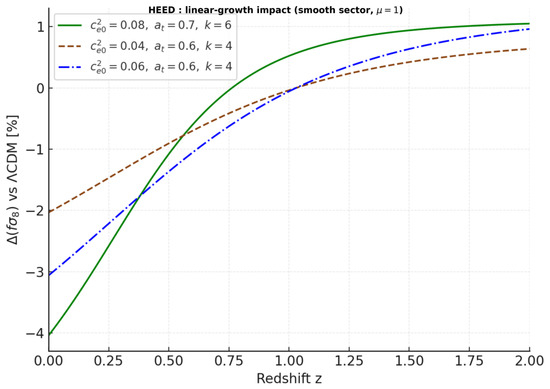
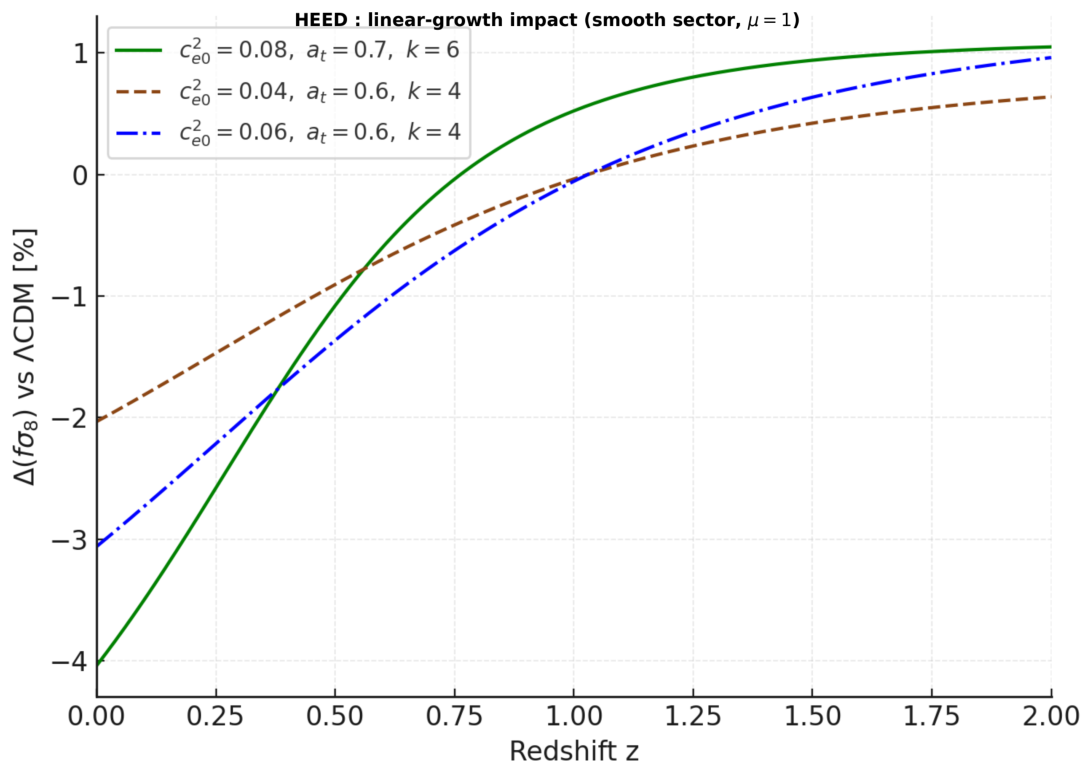
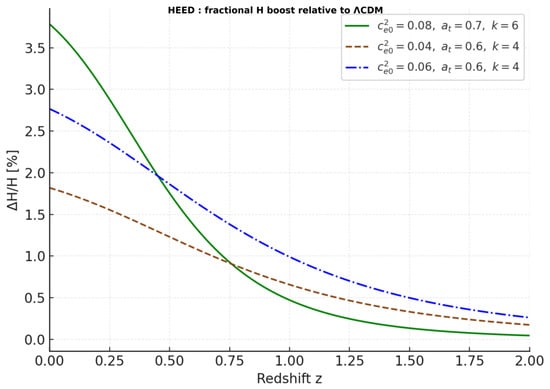
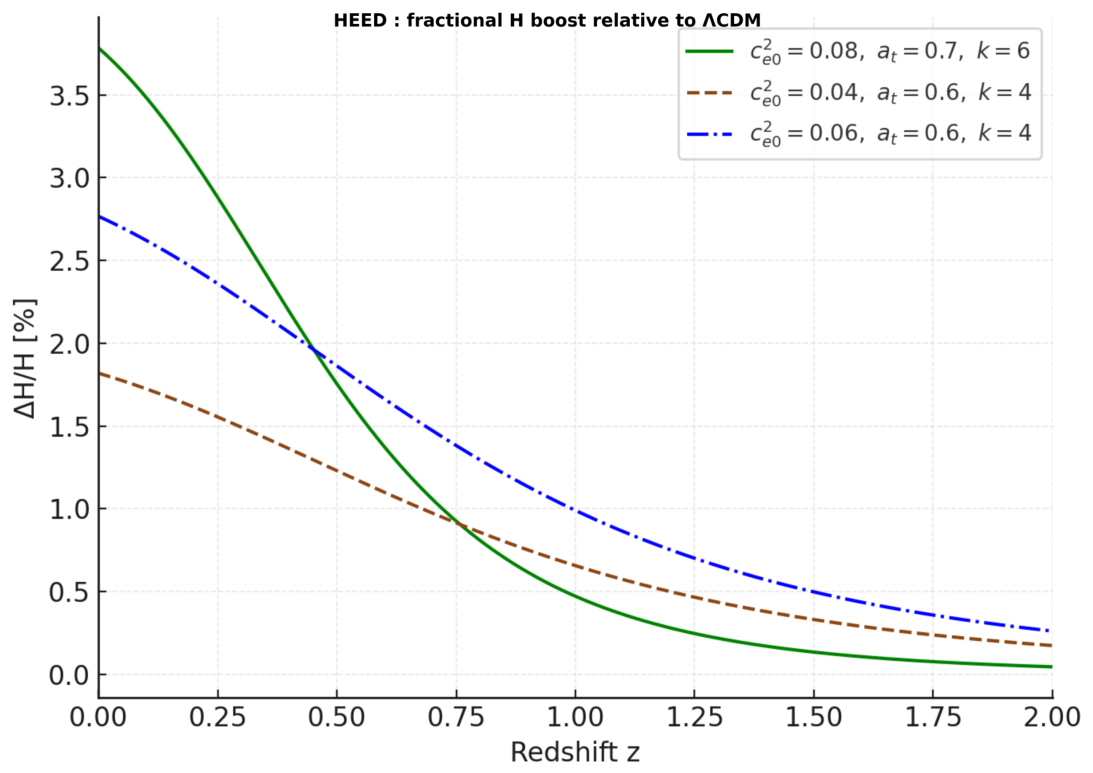
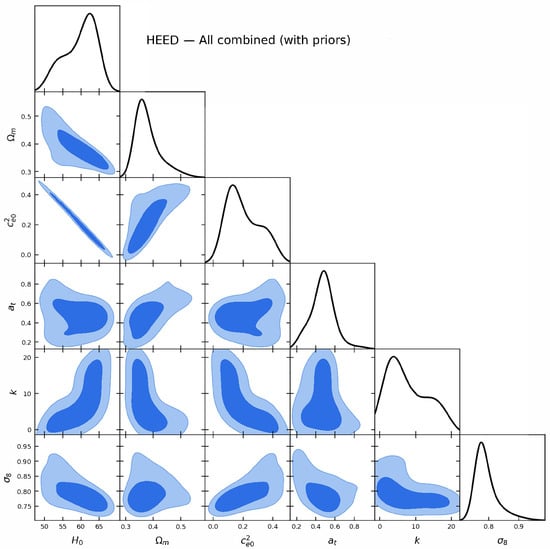
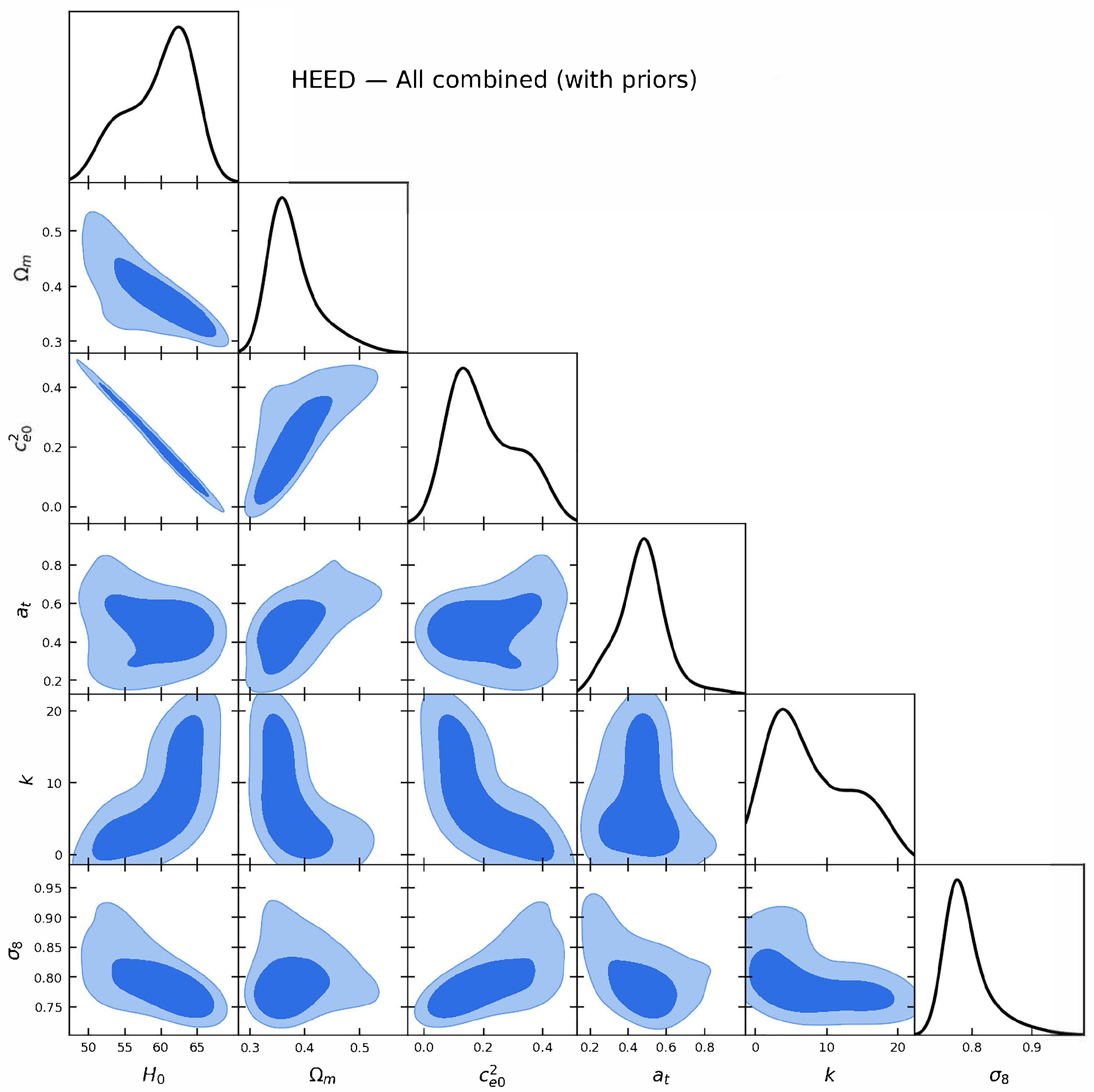
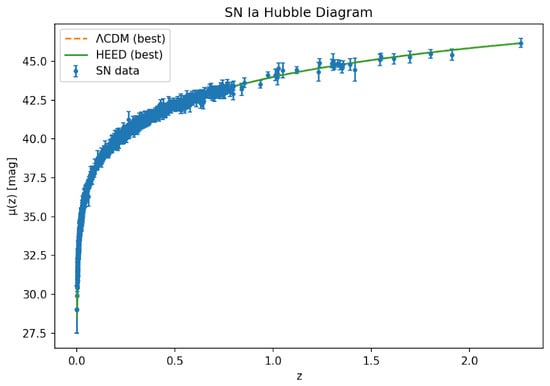
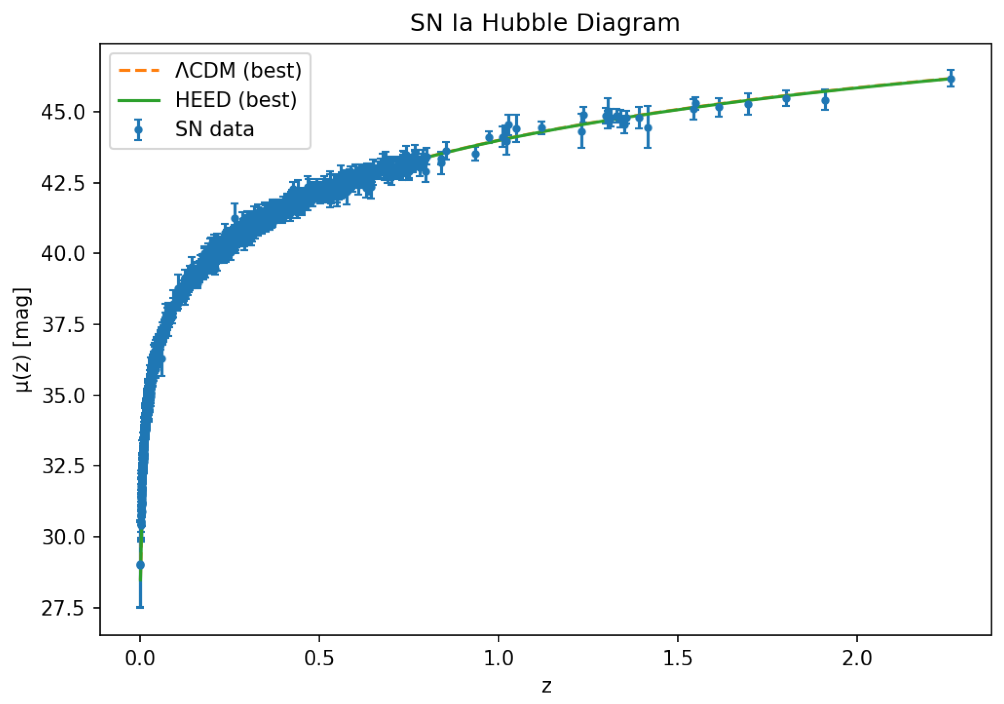
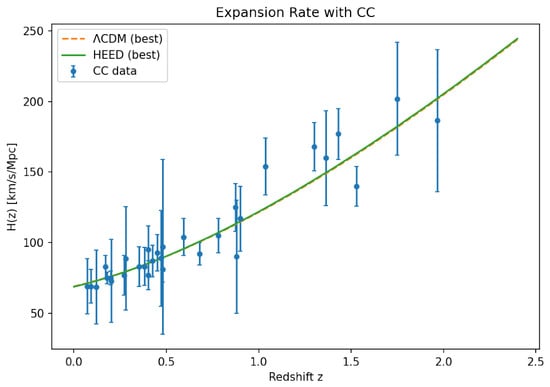
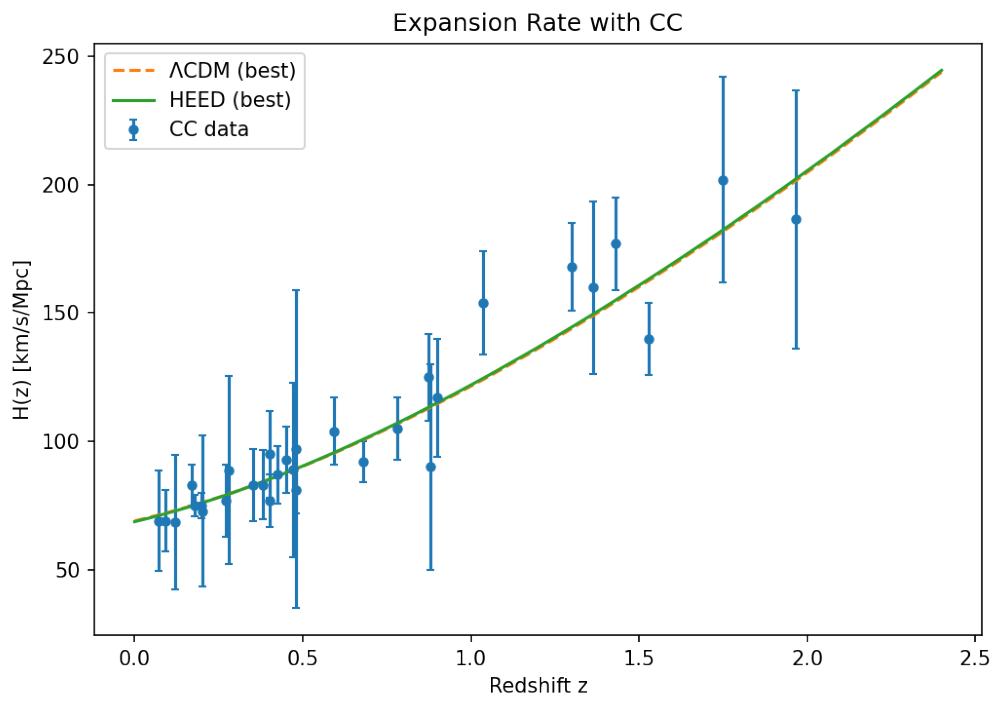
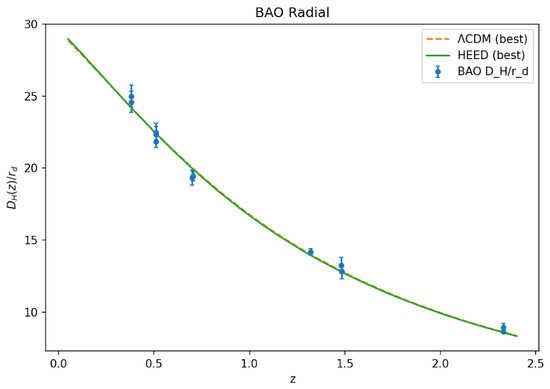
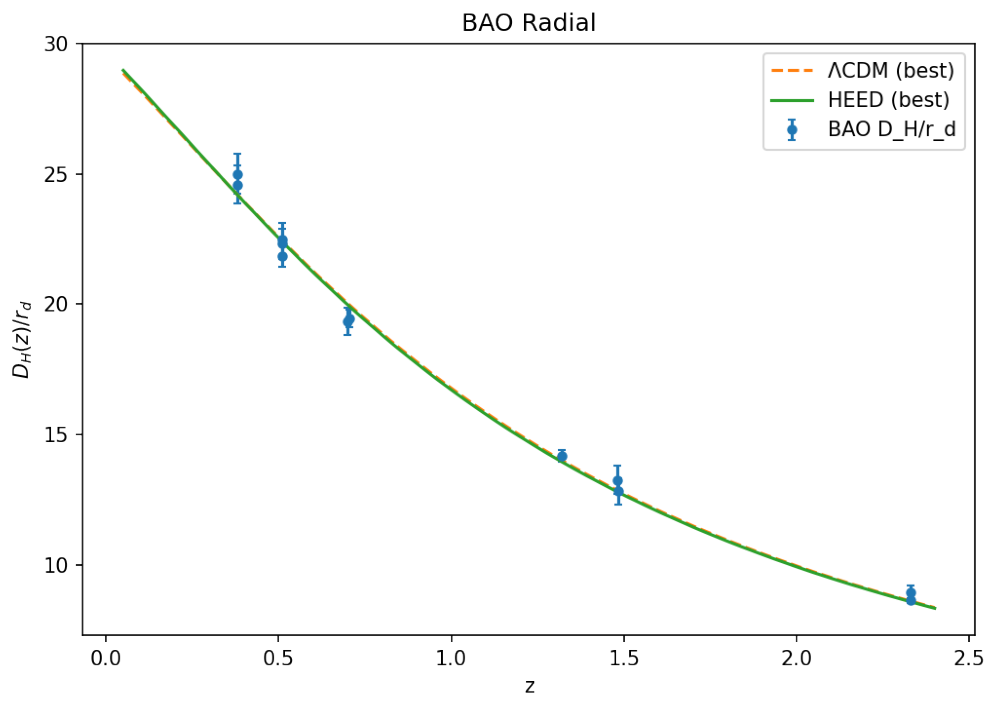
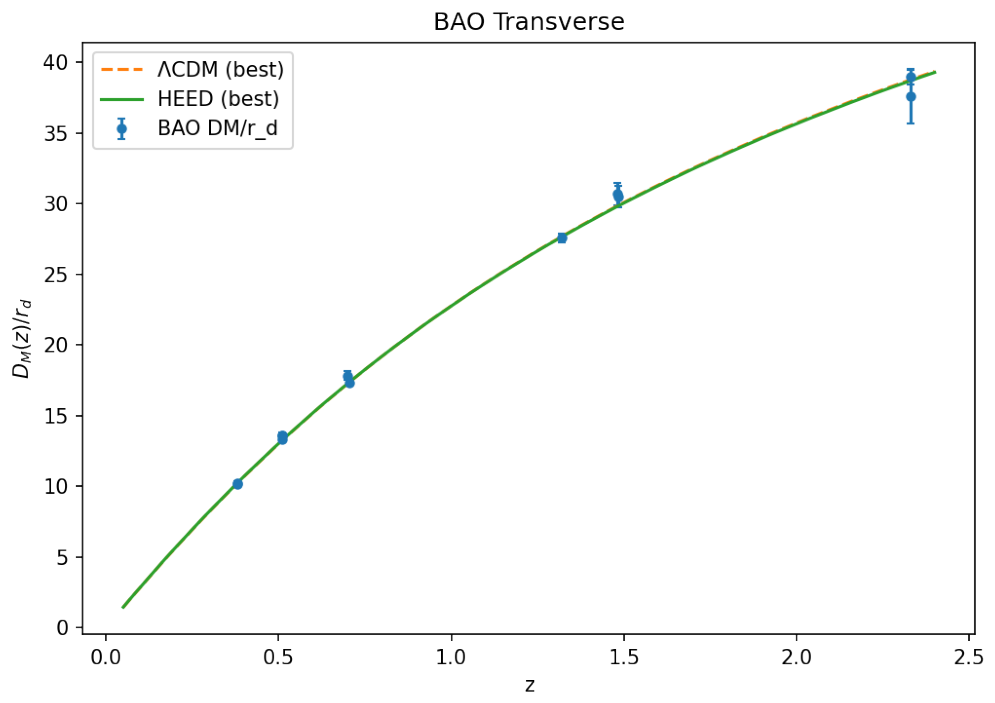
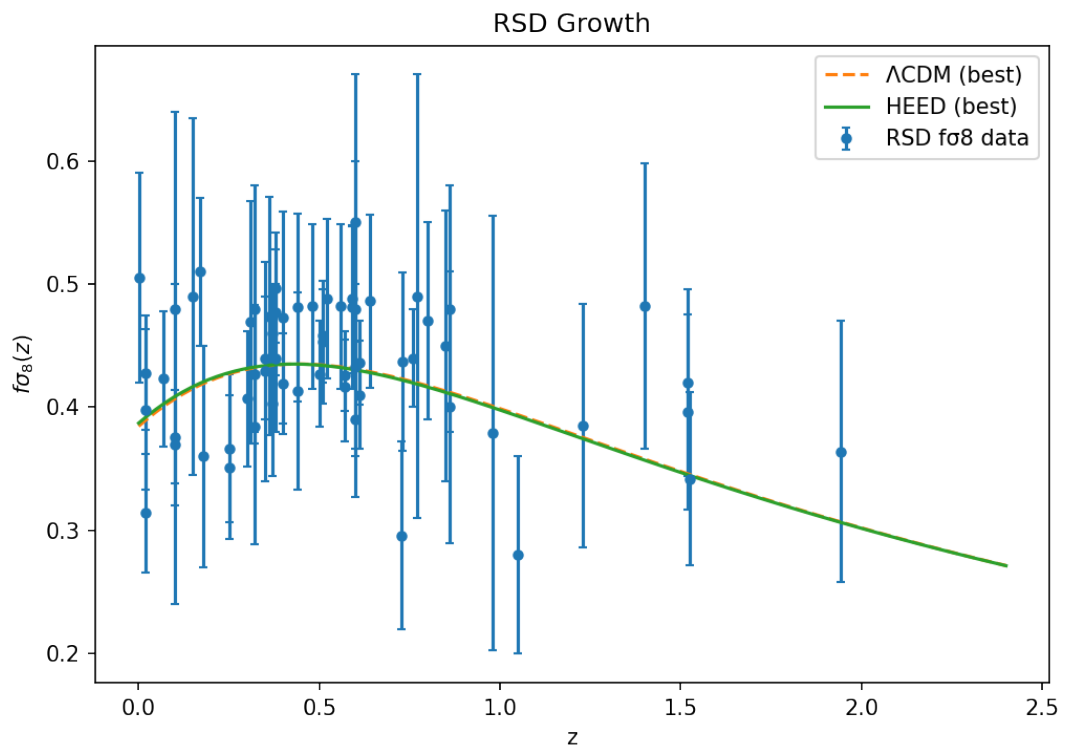

Disclaimer/Publisher’s Note: The statements, opinions and data contained in all publications are solely those of the individual author(s) and contributor(s) and not of MDPI and/or the editor(s). MDPI and/or the editor(s) disclaim responsibility for any injury to people or property resulting from any ideas, methods, instructions or products referred to in the content. |
© 2026 by the authors. Licensee MDPI, Basel, Switzerland. This article is an open access article distributed under the terms and conditions of the Creative Commons Attribution (CC BY) license.