1. Introduction
In the previous paper [
1], we analyzed the degree of agreement between selected astrophysical observational data and the newly formulated scale invariant fully conformal cosmological model, hereafter FCC (fully conformal cosmology). That study was motivated by the question of whether cosmological redshift can be interpreted as a consequence of the temporal evolution of the global metric field. Within FCC, the Hubble constant has the character of a fundamental natural constant that is a basic parameter of the fully conformal metric. A generalized Hubble–Lemaître law was derived, and satisfactory agreement was obtained with selected astrophysical data such as the global spacetime distribution of the observed densities of gamma-ray bursts and quasars. An important property of FCC is the natural determination of the critical cosmological density and spatial flatness solely from the fully conformal metric, without ad hoc assumptions and without the need for additional parametrization.
A fundamental question nevertheless remained open, namely how this global cosmological framework could be consistently extended to the local gravitational field of a central source and to the global state behavior of the cosmological background. This problem is the main motivation for the present follow-up study. The relation between local gravitationally bound systems and the cosmological background was already addressed by Noerdlinger and Petrosian [
2], later reviewed by Carrera and Giulini [
3], and more recently by Pons and Talavera [
4]. Those works, however, are formulated within standard cosmological frameworks and do not address the fully conformal, scale-invariant metric. The aim of this paper is to analyze the behavior of the central gravitational field on the background of the fully conformal metric, to formulate the corresponding generalization of the weak Schwarzschild field, and to examine the implications of such a framework for the cosmological equation of state and for the effective composition of the cosmological background. In this sense, the paper represents the second step in the development of FCC: from the global cosmological metric to its gravitational-dynamical consequences.
For the fully conformal metric, the
gμν(
x4) =
ημνe2Hx4/c is a natural geometric framework in which metric scaling is applied to all four spacetime coordinates. This choice leads, within the field-equation solution, to a remarkable consequence: the corresponding Einstein tensor, and thus also the global energy-momentum tensor, becomes time independent. In FCC, this result therefore does not appear as an additional a priori requirement, but as a direct consequence of the fully conformal spacetime
The time dependence of the conformal metric (1) is fully compensated in the Einstein tensor on the left-hand side of the field equations, so the global energy-momentum tensor [
1] on the right-hand side fully satisfies the above-mentioned a priori requirement of time independence.
The aim of this follow-up paper is to analyze the behavior of the gravitational field of a central source on the background of the global metric and to derive from it the consequences for the state behavior of the corresponding cosmological framework. Because of the nonlinear character of Einstein’s equations, the superposition of a local gravitational field with a given global metric background (1) does not have a simple additive form. For this reason, we do not solve the problem perturbatively here but instead seek a direct effective formulation of the weak field. In the standard case, the Schwarzschild solution in the weak-field limit corresponds to the central Newtonian potential and asymptotically approaches the time-independent Minkowski metric
ημν [
5,
6]. Such a solution, however, corresponds to local Keplerian dynamics and is valid only on a time-independent asymptotic metric background. In a cosmological framework with an explicitly time-parameterized metric background, a nontrivial problem of the corresponding generalization of the Schwarzschild field therefore arises. The analogous problem within the global FLRW metric of the standard model was analyzed by Noerdlinger and Petrosian [
2].
We now proceed to the analysis of the composition of the gravitational field of a central source with the FCC metric (1). For a correct interpretation of the following construction, it is first necessary to clarify explicitly the observational meaning of this global conformal expansion. This is not merely an interpretive remark, but an essential part of the physical framework of the model.
The conformal metric (1) is determined by the metric tensor
gµν(
x4), whose time-dependent conformal factor acts equally on all spacetime coordinates, including the time coordinate
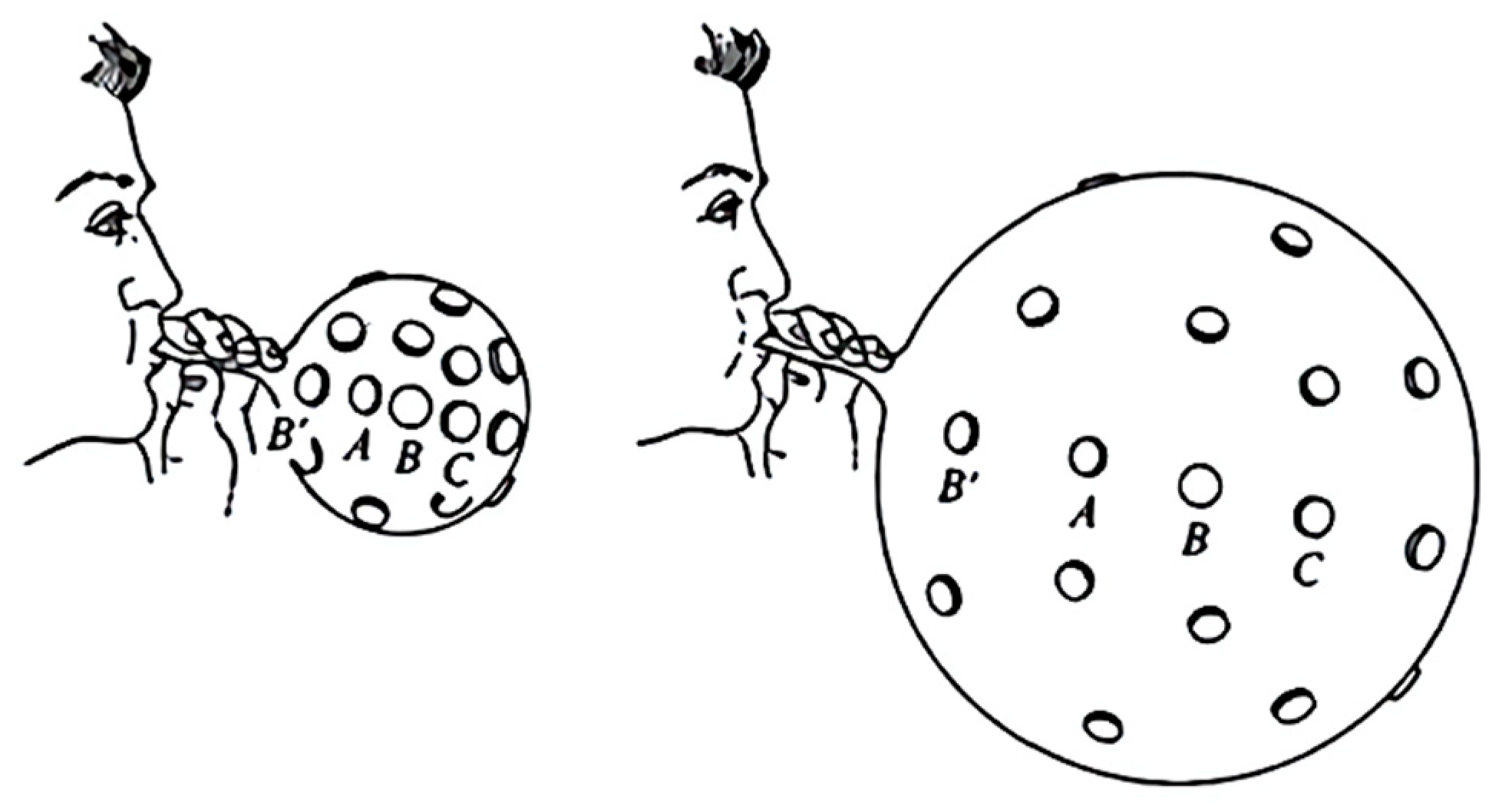
x4In this situation, it is necessary to clarify whether cosmological expansion in the given framework has a universal physical character. In the classical textbook interpretation, cosmic expansion is often illustrated by the analogy of an inflating balloon with coins fixed to its surface, while the coins themselves do not undergo expansion; see
Figure 1 [
7].
There is no fully uniform view within the physics community as to the extent to which force- bound systems may be affected by global cosmological expansion. Within general relativity, the usual conclusion that locally bound systems do not expand is not the only logically possible interpretation, but depends on the choice of geodesic congruence and the corresponding metric description. In an alternative framework, for example with a scale invariant conformal metric, a local system may in principle exhibit a nonzero effective expansion without violating the consistency of general relativity. At the same time, however, it must be emphasized that direct experimental evidence for such an effect is currently not convincing [
2,
3,
4,
8].
In what follows, we adopt the hypothesis formulated in PREMISE 4, which we already accepted in the previous paper [
1]. This hypothesis interprets the global metric field as a scale invariant universal framework of all physical processes, including physical interactions.
PREMISE 4 [
1]:
The global metric field acts universally on all units of length and time scales, independent of how they are dimensioned and materialized.
For the operational interpretation of the global time coordinate
x4 from the point of view of a local observer, the notion of the Central Observer Point (COP) was introduced in the previous paper [
1]. Based on PREMISE 4, let us now formulate the following gedankenexperiment:
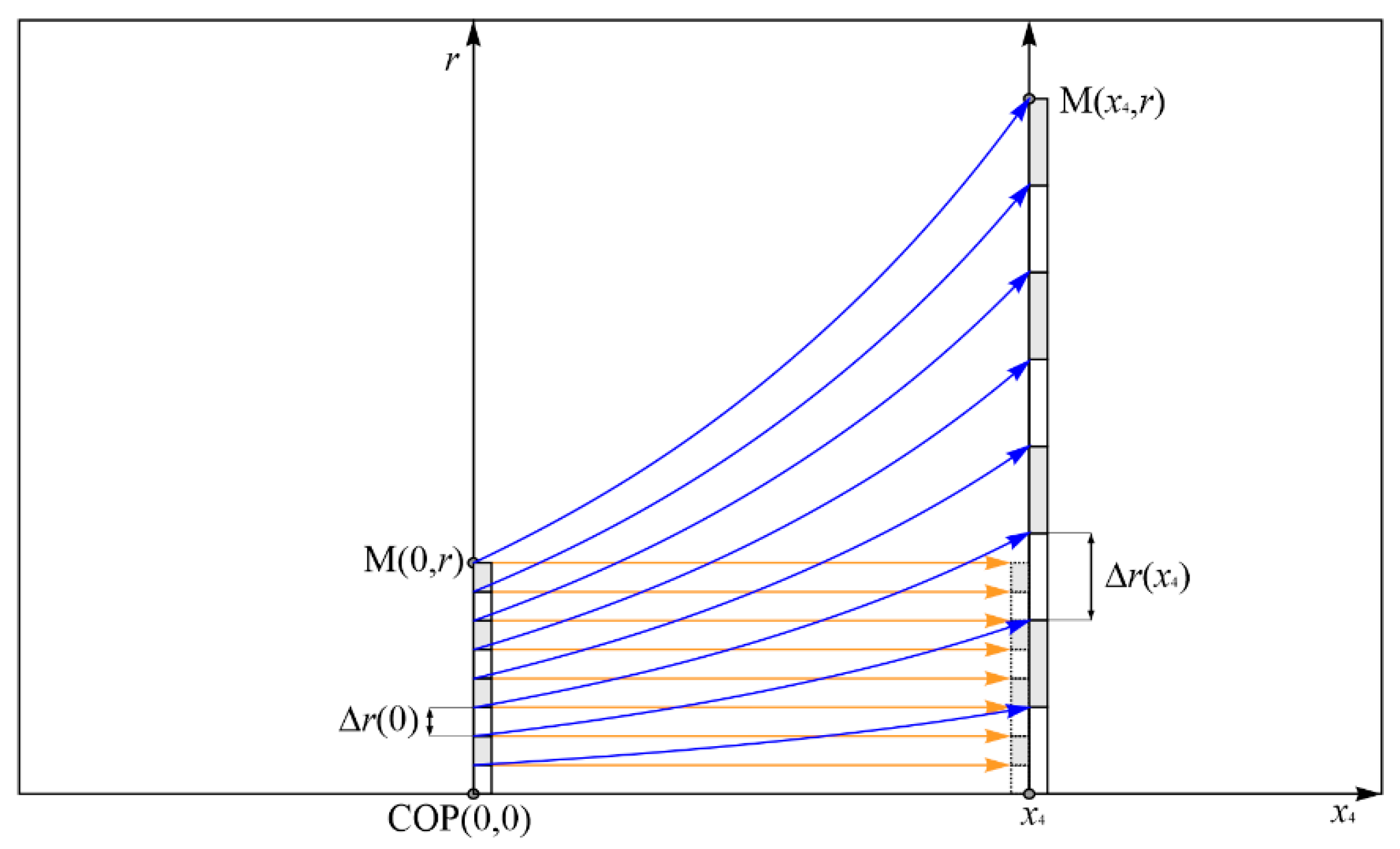
In the time slice (
x4 = 0) of the conformal spacetime (2), consider a measuring rod composed of a linear series of rigid differential measuring rods of length Δ
r that connect the COP with a body M, see
Figure 2. The total length of this measuring rod is given by the number
n of these elements, i.e.,
r =
nΔ
r. As a consequence of time evolution within the universal conformal expansion (2), the entire measuring rod is carried into a later time slice (
x4 > 0). If PREMISE 4 holds, the number of measuring elements between the COP and M remains unchanged (
n = const), and the quantity
r thus represents an operationally defined instantaneous distance between the COP and the body M. The distance defined in this way has the same measurable value in all time slices, i.e., both in the slice (
x4 = 0) and in any slice (
x4 > 0).
By contrast, hypothetical “absolute” measuring rods in the sense of the coins in
Figure 1, which themselves would not undergo conformal scaling, would no longer reach point M after being transferred to time level
x4. To span the same distance, a larger number of measuring rods would then be required.
It is now necessary to formulate the physical relation between Minkowski spacetime and spacetime with the scale invariant fully conformal metric (2). In this paper we proceed from a strictly operational conception of physical reality, which distinguishes physically measurable quantities from a purely formal geometric representation. The basic assumption is that all physical measuring systems, including clocks, length standards, and material reference structures, undergo the same conformal transformation as the spacetime metric itself. Under this assumption, all locally realizable experiments remain invariant. No purely operational procedure can therefore distinguish, on a global scale, a fully conformally scaled spacetime from the Minkowski framework. This equivalence is understood here exclusively in the physical, i.e., operational, sense: it refers to real measurable processes and observable quantities, not to an abstract mathematical representation of a differentiable manifold with a priori absolute scales.
Within scale invariant fully conformal cosmology, the existence of fundamental absolute length and time scales is not assumed, and the two descriptions above are therefore empirically equivalent in the operational sense. At each COP, an appropriate conformal coordinate transformation
xµ →
xoµ can therefore be used to pass from the scale-invariant conformal metric
gµν to the locally observable form of the Minkowski metric
ηµν.
Both coordinate systems in (3), namely (
x1,
x2,
x3,
x4) as “global coordinates” and (
xo1,
xo2,
xo3,
xo4) as “local observable coordinates”, have the character of the Minkowski metric at local scales (
r = |
x4|,
ro = |
xo4|) <<
c/
H. For a given COP in a given time slice
x4, the exponential conformal factor is locally constant and in this sense, defines a local Minkowski measuring frame. All physical measurements by an observer at the COP are therefore performed precisely in this frame, and the local observable coordinates have the character of proper coordinates. The universal influence of the global metric on measuring rods and clocks implies that expansion within the scale invariant fully conformal spacetime (2) has only a relative operational character, as already indicated in [
1]. This interpretive framework is at the same time compatible with the time independence of the cosmological energy density
ε and pressure
p [
1] and forms the starting point for the following composition of the local metric of a central gravitational source with the given global spacetime.
2. Generalization of Newton’s Law of Gravity
Within general relativity, we start from the standard idea that the local neighborhood of a spherically symmetric massive source is described by a curved Schwarzschild metric that asymptotically approaches flat Minkowski spacetime. In the standard case, this asymptotically flat behavior is naturally interpreted in a local inertial frame. In the case of the scale-invariant conformal metric (2), however, it is necessary to specify explicitly in which frame this asymptotic limit should be physically interpreted. In view of the previous section, the natural candidate is precisely the system of local observable coordinates (
xo1,
xo2, x
o3,
xo4). For purely radial motion in a spherically symmetric gravitational field with gravitational radius
Rs, the Schwarzschild metric in local observable coordinates can be written in the reduced two-dimensional spacetime form (
ro,
xo4).
If the global conformal structure of spacetime has physical significance also beyond local scales, then one may expect that when the weak field is extrapolated to larger astrophysical distances, additional contributions may appear that are absent in the ordinary Newtonian limit. Such effects would naturally not manifest themselves in the local frame of local observable coordinates (ro = |xo4|) << c/H, but only in the description of the field in global coordinates. For this reason, the corresponding generalization of the Schwarzschild metric must be formulated precisely in the system of global coordinates.
In the standard static configuration, the time dependence of the Schwarzschild metric does not appear explicitly, and in the weak-field limit one can pass to the usual Newtonian approximation. In the case of the time-parameterized global metric background (2), however, this transition is no longer entirely trivial. One must consider the causal structure of the gravitational interaction: the gravitational effect observed at a given point must be assigned to the corresponding past configuration of the source within the given metric background. This is precisely where the problem of retardation naturally arises. When generalizing the Schwarzschild solution on the background of the time-parameterized conformal metric (1), it is therefore necessary to work with a retarded field configuration.
The gravitational effect acting on a test particle at the COP corresponds to the state of the source in its causally relevant past, analogously to retarded potentials. In our case, it is not the parameters of the source that change in time, but the global metric background (1) on which the field is defined. From the viewpoint of the COP, the physically relevant field configuration is thus related to a different time level than the local act of its observation. This leads to the need to introduce a corresponding causal interaction distance between the source and the test particle.
Let us now analyze the influence of the global conformal metric (1) on the causal interaction distance between the field source and a test particle at the COP. In the static configuration, their locally measurable distance can be described by the time-independent local observable coordinate
ro, defined relative to the constant COP time level. In the global description, however, the physically relevant distance does not correspond to the present spatial separation within a single time slice, but to the retarded causal relation between the state of the source in the past (
x4 ≤ 0) and the current observation at the COP (
x4 = 0). Equation (5) is therefore not introduced as a general replacement of the time coordinate by a radial coordinate, nor as an arbitrary radially dependent conformal transformation. It only expresses a parametrization of the past light cone of the COP for the radial propagation of retarded gravitational information, where the causal interaction distance r corresponds to the past source time
t = −
r/
c.
In this framework, the standard asymptotic Minkowski limit of the weak Schwarzschild field [
5,
6], ceases to be a sufficient global description at cosmological distances |
r| = |
ct| = |
x4| ≈
c/
H. Instead, the natural asymptotic background becomes the scale invariant fully conformal metric (1). On this basis, a modified form of the Schwarzschild metric and the corresponding geodesic equation for the radial motion of a test particle will be derived below, which will then provide the basis for a generalized Newtonian formula in the weak-field limit.
Whereas in special relativity coordinate systems are physically distinguished mainly by their relative velocity, in the present conformal cosmological framework the causal link between the past emission configuration of the source and the local observation of its effect at the COP additionally plays a crucial role. The causality condition (5) thus determines the relation between the differentials of the local observable coordinates (
dro,
dxo4) and those of the global coordinates (
dr,
dx4).
The negative values of the exponents in relation (6) already take into account the past character of the relevant causal configuration, so there is no need to shift the coordinate origin to the position of the test particle at the COP. The origin can therefore remain in the standard position at the central field source. The local physically measurable reality of the Schwarzschild solution (4) remains accessible in the system of local observable coordinates (
ro,
xo4), whereas its global generalization must be formulated on the background of conformal spacetime (2) in the system of global coordinates (
r,
x4). The differential transformations (6) must therefore be supplemented by the integral relation between the radial distances
ro and
r.
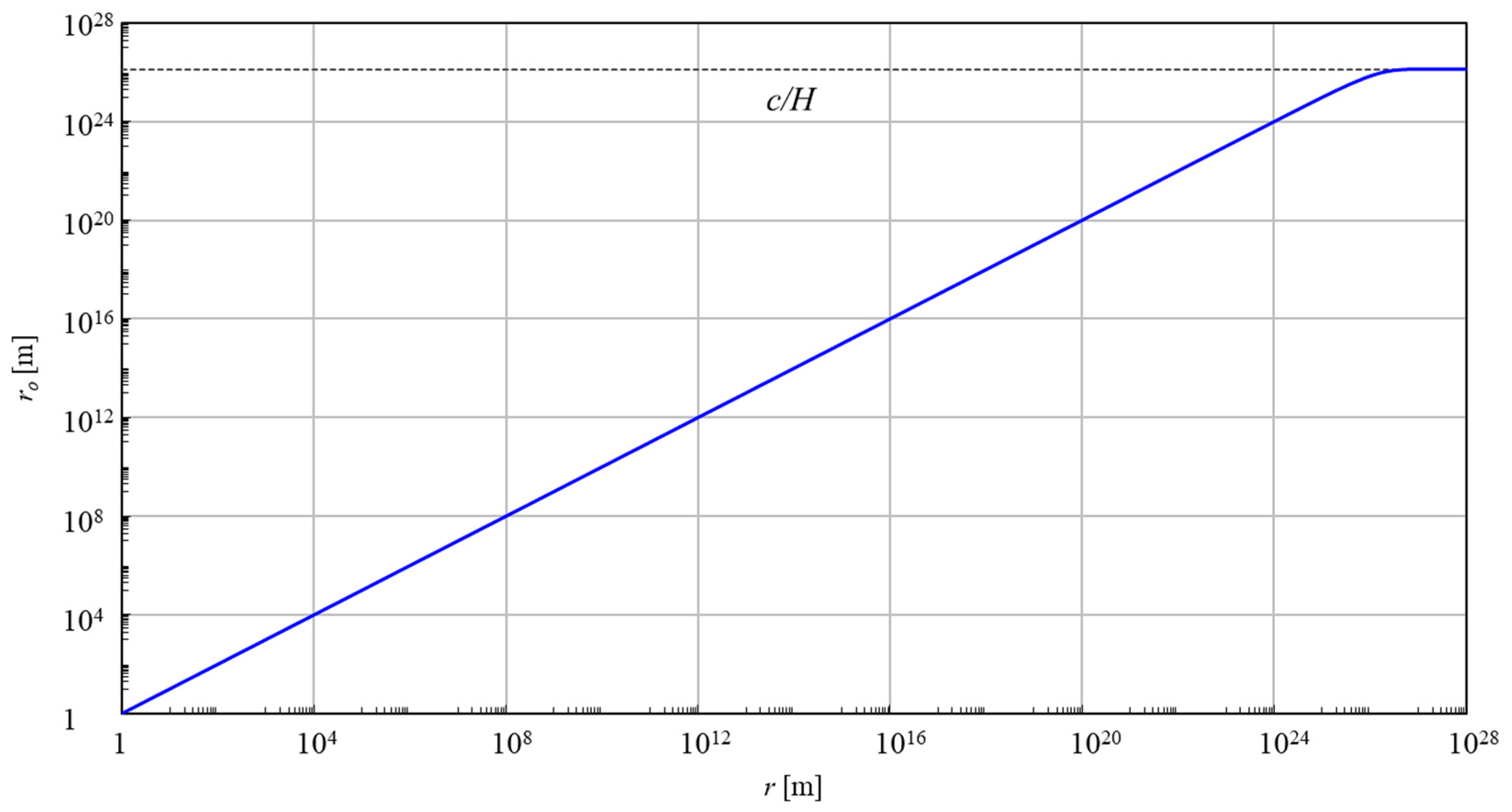
It should be emphasized that in the limit global coordinate
r → ∞, the corresponding local observable coordinate
ro reaches the finite asymptotic value
max ro =
c/
H, which in this model corresponds to the maximum observable radius [
1]. The nonlinear relation (7) therefore leads to a nontrivial difference between the quantities
r and
ro, as illustrated in
Figure 3.
For one of the largest known galaxies, ESO 383-G076, with a characteristic radius of approximately 10
22 m, the relative deviation between the two radial coordinates is only about 0.4 ‰.
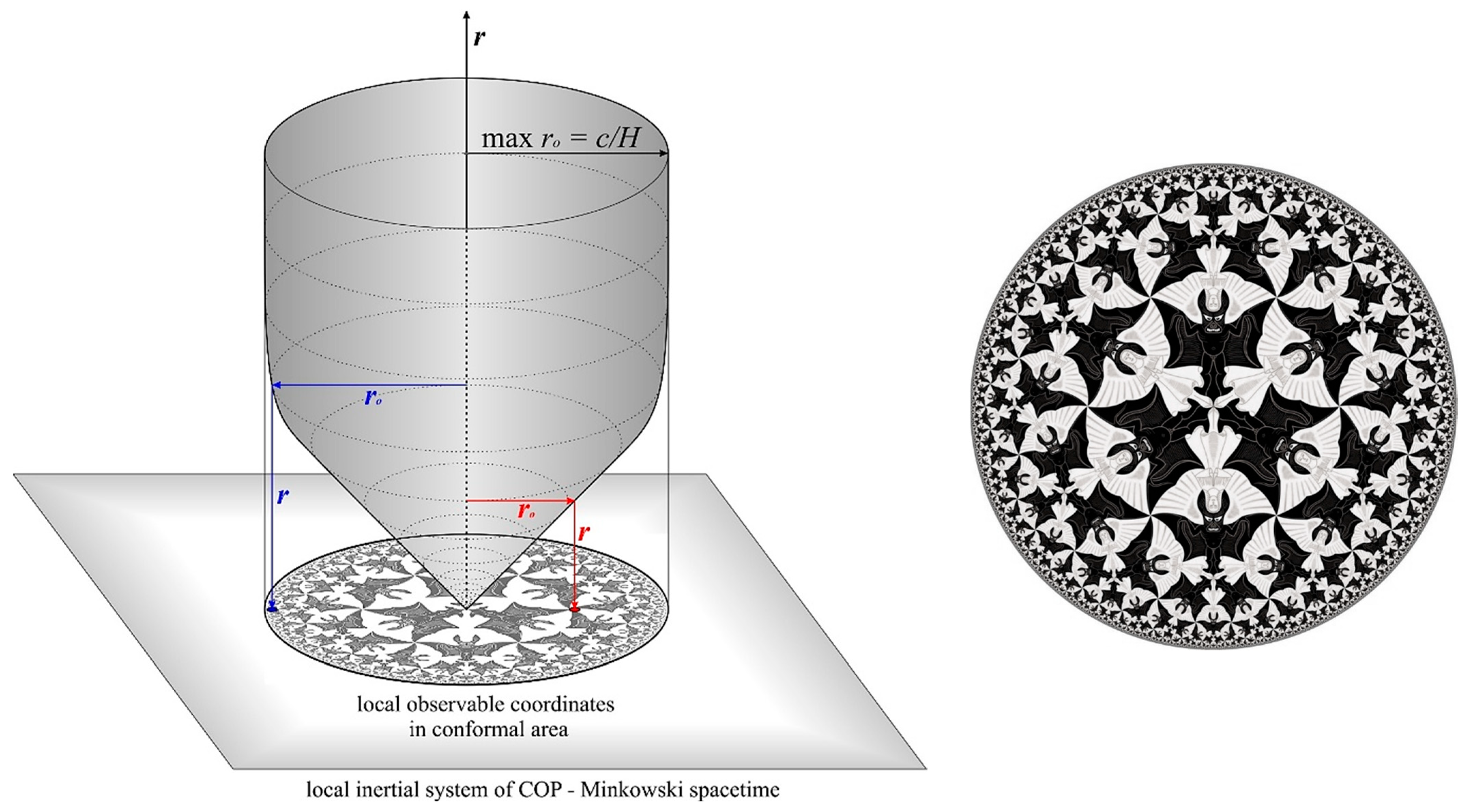
At the scale of ordinary galactic structures, the two representations are therefore practically indistinguishable. On the global scale, however, relation (7) implies that in the system of local observable coordinates, an infinite space is mapped from the point of view of an observer at the COP, into a region with limiting radius
c/
H, as schematically illustrated in
Figure 4.
Whereas in the previous paper [
1] the generalized Hubble law was formulated for global coordinates
r (by direct use of the model ΛCDM metric distance from the NASA/IPAC Extragalactic Database, NED [
10]), let us write here its equivalent form for the local observable coordinate
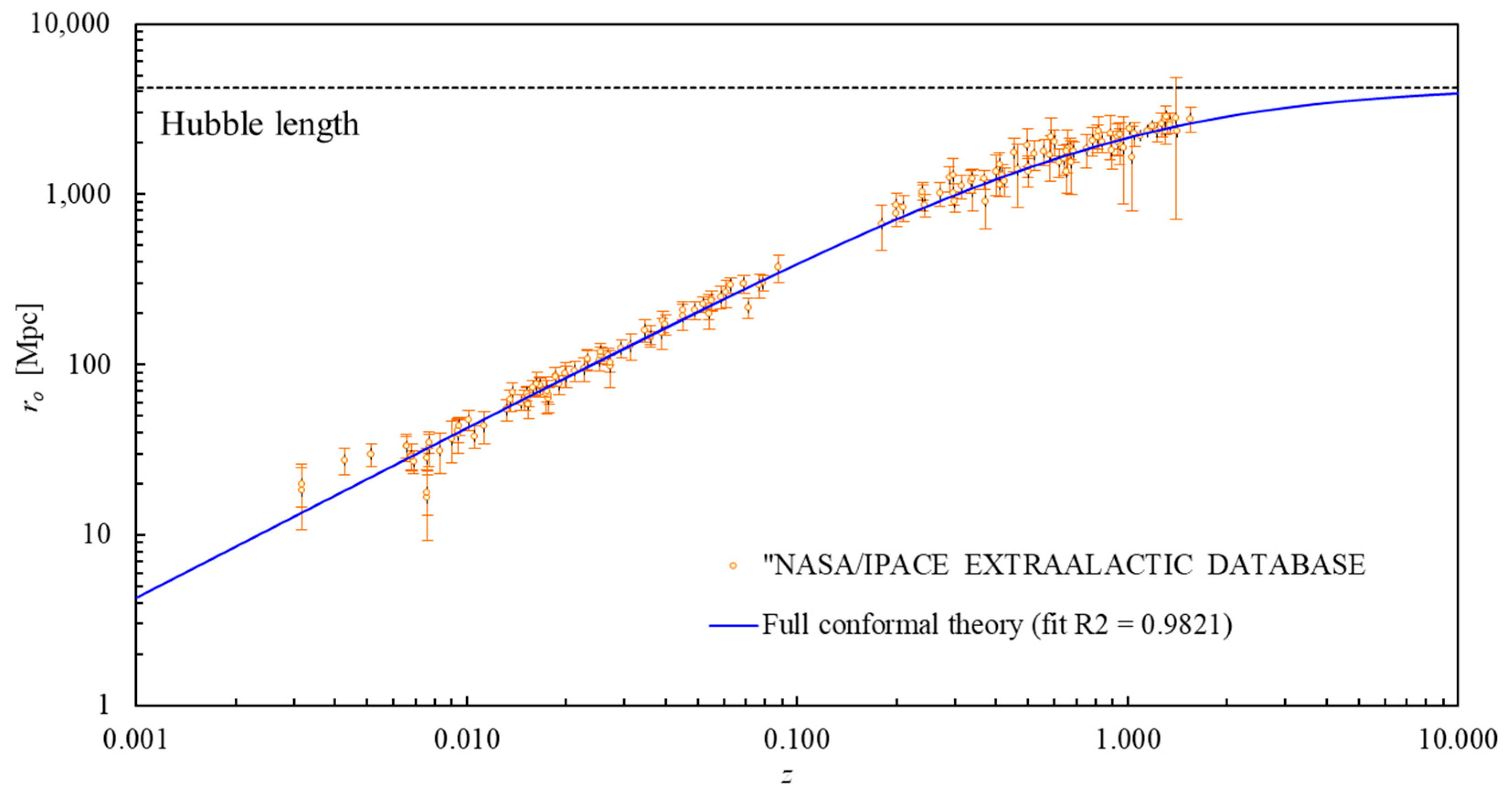
ro (lookback distance), which is the natural framework of real observational measurements as the proper coordinate in FCC.
Similarly to
Figure 3 and
Figure 4, the redshift dependence (9) on the local observable coordinate
ro also exhibits asymptotic limiting behavior at the Hubble-horizon boundary
c/
H (see
Figure 5). The data points are taken from the NASA/IPAC Extragalactic Database (NED) [
10]. Type Ia supernovae up to
z ≲ 1.552 currently represent the only source of observational data for photometric determination of the distance modulus
μ(
z) that is not strongly dependent on the cosmological model. These determinations are based solely on the empirical standardization of astrophysical light curves.
Within the conformal metric [
1], the boundary
ro =
c/
H corresponds to the maximum value of the locally observable radial coordinate
ro and thus has the character of an effective boundary of observable space in the system of local observable coordinates. In this sense, the interpretation of the Hubble horizon in FCC differs from its usual role in the standard ΛCDM model, where the Hubble horizon is not generally identical to the radius of the observable universe. A potentially sensitive point of this interpretation is the high redshift of the CMB,
z ≈ 1089, which in standard ΛCDM is associated with the surface of last scattering at a distance significantly greater than
c/
H. It is, however, necessary to distinguish the directly observed CMB spectrum from the subsequent cosmological interpretation of this quantity within a particular model. Whereas the Planck spectrum of CMB itself is an experimental fact, the corresponding “distance to last scattering” is already derived within the standard ΛCDM expansion scenario. In the scale invariant fully conformal cosmology model, by contrast, relation (9) at
z ≈ 1089 corresponds to
ro ≈ 0.99908
c/
H, i.e., just below the Hubble-horizon boundary.
After these clarifications of the interpretive role of the scale invariant fully conformal cosmological metric, we now proceed to the generalization of the Schwarzschild solution on its background. The standard Schwarzschild solution (4) is transformed from the local observable coordinates (
ro,
xo4) to the global coordinates (
r,
x4) by means of relations (6) and (7).
As stated above, the generalization is carried out for a static configuration of a point source and a test particle whose mutual distance
r is time-independent because of scale invariance; see
Figure 2. To formulate the generalized gravitational intensity
K(
r), we use the standard radial equation of motion in a central field
In the limit of negligible velocities
v <<
c, the kinematic term
d2r/
dt2 of the geodesic equation is determined solely by the Christoffel symbol Γ
r44.
After substitution of both components of the metric tensor from (10), it takes the explicit form
By differentiation, simplification, and substitution of the Schwarzschild radius
RS = 2
Gm/
c2, the geodesic Equation (13) then takes the form
Before interpreting Equation (14) as an effective gravitational intensity, it is necessary to clarify the physical meaning of both its left- and right-hand sides. The kinematic coordinate term
d2r/
dt2 in global conformal coordinates, in general, does not have to correspond directly to a locally measurable force effect. The first term on the right-hand side of (14) is moreover present even in the absence of a local massive source and therefore reflects the global structure of the conformal metric background itself. In this sense, we interpret it as the cosmological acceleration of relative coordinate expansion without a dynamical gravitational effect on test particles. The effective gravitational intensity is therefore identified below only with the source-dependent term of Equation (14), from which, using condition (11), we obtain the final form of the generalized Newtonian intensity in global coordinates
r.
The generalized Newtonian-intensity formula in global coordinates thus provides a model description of the weak field on cosmological spacetime scales and will be used further in the analysis of cosmological pressure and the cosmological equation of state. For comparison with real measurements, however, it must be transformed into the system of local observable coordinates (
ro,
xo4). Transformation of relation (15) by means of (7) shows that within ordinary local structures, including the Solar System, the additional cosmological terms are practically unmeasurable.
The model nevertheless formally admits their nonzero contribution on very large scales. An estimate for structures of the size of the local Virgo supercluster (order of 1024 m) shows that the corresponding correction to the standard Newtonian formula (1 → 0.9925) remains very small even there, and its direct observational quantification appears extremely difficult.
3. Cosmological Equation of State
The fully conformal, scale-invariant metric was derived in the previous paper [
1] based on the hypothesis of full conformality in all spacetime coordinates. Its specific form (2) with the exponential conformal factor leads to a time-independent Einstein tensor
In the previous paper [
1], the energy-momentum tensor was introduced in diagonal form (Equation (4)) for a homogeneous dispersion of incoherent dust with energy density
εp (particulate matter) in an ideal cosmological fluid with energy density
εs. Comparison with the constant components of the diagonal Einstein tensor (17) then determines the constant values of the total pressure
p and energy density
ε =
εp +
εs, as well as their mutual relation. Because the energy-momentum tensor is constant and homogeneous in this solution, its covariant divergence ∇
μTμν vanishes, so conservation of energy and momentum on the cosmological scale is satisfied without any additional assumptions. The relation between global energy density and pressure has the character of a cosmological constitutive equation
which, unlike in most cosmological models, does not appear here as an independently postulated input, but as a direct consequence of the geometry of the fully conformal metric. It expresses the structural compatibility between the given form of the global metric and homogeneous distribution of energy density on the cosmological scale. Local curvature caused by stars or galactic structures generally violates this relation, but on the cosmological scale does not alter the asymptotic character of the fully conformal solution. What is involved here is not dynamical stability in the sense of Lyapunov analysis, but structural stability of the homogeneous background solution with respect to local perturbations. Linear analysis of these perturbations will be the subject of a separate paper. In this respect, the present framework differs fundamentally from Einstein’s static model, whose equilibrium between gravity and the repulsion of the cosmological constant is linearly unstable. The special behavior of conformal metric (2) in Einstein tensor (17) directly implies fixed values of the constitutive parameters
p and
ε.
These global parameters are not ad hoc free follow directly from the fundamental structure of FCC. In this sense, the equality ρ = ρcrit is, within this framework, a principal geometric consequence of the model rather than the result of an independent parametric fit to observational data. The interpretation of Equation (18) and values (19) is naturally limited to a homogeneous cosmological background. It is not a universal equation of state of all local gravitationally bound systems, but an effective background relation valid for the asymptotically homogeneous distribution of energy on the global cosmological scale. The robust character of this structural stability can be physically interpreted as an equilibrium between the “negative pressure of the rigid conformal metric” and the gravitational cohesion of homogeneously distributed matter. This wording, however, should be understood only as a physical interpretation of the global background solution, not as a microphysical model of a specific substance. As an illustrative analogy, this approach may be compared to the opposite situation in which the pressure of a fluid has a positive sign: a fluid enclosed in a rigid vessel exerts expansion pressure on the solid walls of the vessel, which represents the equilibrium cohesive factor preventing a temporal change in volume. This analogy serves only to make more intuitive the cosmological “hydrostatic pressure” of gravitating elements of matter density that is compensated by the conformal metric framework.
Let us now turn to the calculation of the equilibrium gravitational cohesive pressure of a homogeneously distributed density ρcrit when the newly derived weak-field gravitational law (15) is applied. In this calculation, the two components of the total cosmological energy density ε = εp + εs must be distinguished. Particulate matter with global cosmological energy density εp behaves on cosmological scales as nonrelativistic incoherent dust. In the rest frame of this dust, only the temporal component of the energy-momentum tensor T44 is nonzero. Because of the nonrelativistic particle velocities and the absence of collective dynamics, no macroscopic physical pressure arises in such a particle system. By contrast, the energy density εs characterizes a cosmological fluid with nonzero pressure ps. This is a very important property of FCC: both fractions of the energy density εp and εs act as sources of gravity, but only the continuous cosmological fluid carries the positive “hydrostatic pressure.”
Before deriving the model value of β, the total particulate-matter fraction within FCC, it is useful briefly to clarify the relation of this result to the standard cosmological parameters in common use. The frequently quoted value of the total particulate density, approximately ρp ≈ 0.32ρcrit, is a parameter of the standard ΛCDM cosmological model based on Friedmann geometry. Within ΛCDM, its magnitude is inferred from the combined analysis of multiple cosmological probes (large-scale structure of the universe, dynamics of galaxies and galaxy clusters, gravitational lensing).
We shall now focus exclusively on the properties of homogeneous cosmological energy density within the fully conformal framework (3). In contrast to the standard ΛCDM scenario, the relation
ρ =
ρcrit here does not result from a parametric fit to observational data, but is fixed by the geometric structure of the fully conformal metric framework. For the homogeneous isotropic background of this model, Equation (19) therefore holds. The principal global flatness of space
ℝ3 is here a direct consequence of the form of the conformal metric (3). One may expect that the above equilibrium between global gravitational cohesion and the dilatational effect of the conformal metric framework will be established only for one specific value of the effective fraction of the particulate component, which need not coincide with the reference value 0.32
ρcrit of standard ΛCDM. In this sense, the FCC prediction carries informational weight analogous to that of the corresponding parameter of standard ΛCDM and by itself cannot be regarded as a decisive argument against the model. In the previous paper [
1], its predictions were compared with key cosmological observations such as the generalized Hubble–Lemaître redshift relation for Type Ia supernovae, the spacetime distribution of gamma-ray bursts, and the spacetime distribution of quasars on large scales. Satisfactory quantitative agreement of these predictions is illustrated in
Table 1, which compares the regression quality of the conformal model with the results of standard ΛCDM. The
R2 and
σ values indicate that FCC provides, within the adopted approximation scheme, a consistent description of these cosmological observations and merits further theoretical and observational analysis.
Comparison of the two models shows that, when fitted with a single parameter
H, the conformal model achieves agreement with type Ia supernova data comparable to that of standard ΛCDM and, moreover, in the paper [
1] shows significant agreement with the observed spatial distribution of GRBs and quasars. In standard ΛCDM, GRBs and quasars are used rather as supplementary observational data sets serving to test the predictions of semiempirical models within ΛCDM.
Let us therefore continue the analysis of the equilibrium gravitational cohesive pressure of a homogeneously distributed density
ρcrit using the newly derived weak-field gravitational law (15). To quantify the fraction of particulate matter in the total energy density
ε, let us introduce the parameter
β, which represents the effective share of the particulate component in the homogeneous cosmological background.
At this stage, decomposition of the total density ρcrit (20) has a purely effective background character and by itself does not determine the microphysical nature either of the continuous component or of the pressureless particulate matter. It should be emphasized that the pressure of “pressureless particulate matter” is negligible in this model framework in comparison with the pressure p of the cosmological fluid (18). Let us now interpret the value of the parameter β in the context of observationally constrained fractions of cosmological matter. The calculation should eventually specify its value from the above-mentioned equilibrium between the negative pressure p (18) of the “rigid conformal metric” and the gravitational cohesive pressure pg of homogeneously distributed matter (pg + p = 0).
The effective magnitude of the scalar field intensity
g(
r) on the surface of a source sphere centered at the COP, with radius
r and homogeneous density
ρcrit = (
εp +
εs)/
c2, follows from the generalized Formula (15)
The cohesive “hydrostatic pressure” in the cosmological fluid then arises from the action of the central field (21) on all its volume elements. On a mass element
dm above the differential surface
dS of the source sphere mentioned above, the central field acts with force
dF(
r).
The gravitational cohesive pressure
pg therefore receives from each distance
r from the center at the COP, a contribution from the differential shell
dr in the form of the pressure increment
dpg.
After integration in the radial direction
r, the total hydrostatic pressure
pg takes the form
After subsequently substituting the critical density
ρcrit = 3
H2/8π
G and the approximate value of the transcendental Riemann zeta function
ζ(3) ≈ 1.202057, we obtain the total hydrostatic pressure of the cosmological fluid in the form
It turns out that the above-mentioned requirement of equilibrium between the negative pressure
p in the constitutive Equation (18) and the gravitational cohesion
pg (25) of homogeneously distributed matter is satisfied only for a single specific fraction,
β ≈ 0.450 particulate matter
The positive value
pg > 0 corresponds to the pressure of gravitational cohesion that balances the negative cosmological pressure
p in Equation (18). For the specific conditions (19) of the flat spatial part, the baryonic matter fraction including neutrinos is
observationally well constrained, and within ΛCDM the mean fraction of dark matter
cdm has also been inferred from observational data [
15,
16,
17]. In view of the robustness of these observational constraints, we shall regard the present value of the baryonic fraction
as currently reliable. Given the magnitude of the model fraction
β ≈ 0.45 (26), however, the mean dark-matter fraction in FCC
differs from the ΛCDM model value of
cdm by about 0.13. The value
within ΛCDM is consistently supported by a number of independent observational indications, in particular gravitational lensing, the dynamics of galaxies and galaxy clusters, and the observed large-scale structure of the Universe. It does not follow from this, however, that the higher effective dark fraction in FCC can be entirely interpreted as standard collisionless cold dark matter
cdm. Simply increasing the
cdm fraction from ~0.27 to ~0.40 would very probably significantly disrupt this observational consistency. A higher fraction of a collisionless gravitationally collapsing component would strengthen gravitational potentials and modify the growth of density perturbations, which would be reflected in large-scale-structure statistics, the halo mass function, and gravitational lensing. Any additional dark component therefore cannot share the same dynamical regime as standard collisionless cold dark matter. If the total dark fraction is to exceed the observationally well-confirmed value ~ 0.27, its excess part must be dynamically suppressed from the point of view of structure growth. The decisive factor is therefore not only the total gravitational density of this component, but above all its efficiency in generating gradients of the gravitational potential and in the growth of density perturbations. One possible mechanism is nonzero velocity dispersion. The observational constraints thus apply not only to the total gravitational density of the dark component, but above all to its dynamical efficiency in the growth of cosmological structures.
In the following, the total dark component of the FCC model will therefore be interpreted effectively as the sum of two dynamically distinct contributions: a structuring collisionless cold dark matter component and an additional warm-dark-matter-like component. The label “
wdm” does not here necessarily denote a specific microphysical model, but an effective component with nonzero velocity dispersion that may contribute to the total gravitational density without fully participating in the growth of density perturbations. The total dark fraction of the FCC model can thus be decomposed into a spatially perturbed structuring
cdm component and an almost homogeneous accompanying
wdm component
where δ
ΛCDM(
x) denotes the spatial structural perturbation of the
cdm component relative to its cosmological mean value. It follows from the above decomposition that the observable gravitational signal associated with the growth of cosmological structures is determined mainly by the spatially perturbed fraction
, whereas the residual
fraction appears as an almost homogeneous contribution to the total dark-matter density. One may therefore expect that observables sensitive to density contrast, in particular the statistics of large-scale structure, the halo mass function, and gravitational lensing, will be determined primarily by the structuring fraction
, rather than by the total dark fraction
. The model thus naturally separates the global gravitational balance from the dynamics of structure formation and provides an effective parametrization that, at the phenomenological level, does not lead to an immediate conflict with the main structural observations. In this situation, the phenomenological pilot hypothesis
suggests itself, although it must be treated with caution because the original predictions of the above observed effects were derived within standard ΛCDM.
Acceptance of this phenomenological hypothesis, however, requires that the structuring cdm component in FCC share with ΛCDM all the decisive physical properties that determine the growth of cosmological structures and their observed gravitational manifestations. In other words, what matters is not the total dark fraction itself, but the effective dynamical regime of the structuring component. This requirement may be made concrete in the following seven conditions of effective structural equivalence between FCC and ΛCDM:
Both cosmological models, ΛCDM and FCC, are spatially flat.
The characteristic timescale of cosmological change in ΛCDM is much longer than the characteristic timescale of cdm structure formation, so that the model behaves effectively stationarily in this process, similarly to FCC.
The residual wdm fraction exhibits negligible pressure, so although it does not contribute to the pressure of the continuous cosmological-vacuum fluid, its homogeneous density in FCC supplements the background to the same effective level as the vacuum component in ΛCDM.
The structuring cdm component is collisionless, so its gravitational collapse is not damped by dissipation, viscosity, or collisional momentum transfer.
The structuring cdm component is kinematically cold, so its velocity dispersion is small enough that significant free-streaming smearing of density perturbations does not occur.
Between the density contrast of the structuring cdm component and the gradients of the gravitational potential, the standard one-to-one relation holds, so that the same spatial density contrast produces the same gravitational acceleration and the same collapse dynamics of structures.
In both models, the structuring cdm component has approximately the same effective mean fraction and the same character of perturbations, provided that its gravitational evolution proceeds in an effectively equivalent metric and physical environment.
These seven conditions cover the dominant physical aspects that determine the observed large-scale distribution of cdm (the statistical spatial distribution of the structuring cdm component), the population of gravitational halos (the volume number density of gravitationally bound cdm halos as a function of their mass), and the gravitational-lensing signal (the gravitational response to the distribution of the structuring cdm component). One may therefore expect that an FCC cosmological model that is effectively equivalent to ΛCDM in these aspects will lead, for this class of observables, to the same optimal value of the structuring fraction . These seven conditions very probably capture the dominant physical aspects relevant to the structural observables discussed above. Their formal completeness with respect to possible detailed differences has not yet been explicitly proved, and full confirmation of the identification of the optimal value of will therefore require explicit fitting of the corresponding observables directly within the FCC model.
At the same time, it would be appropriate to analyze possible manifestations of the residual wdm component, especially on small scales where its nonzero velocity dispersion may become apparent. Such a procedure would make it possible to determine whether the structuring fraction in FCC is indeed close to the standard value inferred within ΛCDM, while also identifying possible observational signatures of the residual wdm component as a specific distinguishing feature of the FCC model. In this sense, the derived background value β ≈ 0.45 in FCC leads to a natural effective interpretation in which the total dark component need not be dynamically homogeneous, but may be divided into a structuring collisionless cold dark matter component and a residual almost homogeneous warm-dark-matter-like component. Under the assumption of effective structural equivalence of the structuring component with ΛCDM, the identification then suggests itself as a phenomenologically consistent working hypothesis. At the present stage, this conclusion cannot be regarded as a definitively observationally confirmed result, but as an internally consistent phenomenological interpretation of the derived model fraction β that is not in immediate conflict with the main structural observations and at the same time provides a concrete basis for further testing of the FCC model.
4. Conclusions
In this paper, we developed the scale-invariant fully conformal cosmological framework from the level of global metric construction to its local gravitational and background-dynamical consequences. An important result is the effective generalization of the weak Schwarzschild field on the background of the fully conformal metric, and the modified Newtonian radial intensity derived from it in global coordinates. This modification shows that the additional cosmological contribution is practically unmeasurable on the scales of ordinary gravitationally bound systems, whereas the asymptotic gravitational background remains determined by the fully conformal metric.
A second main result is the derivation of a time-independent cosmological background with the equation of state p = − ε/3. Within FCC, this relation does not appear as an ad hoc phenomenological assumption, but as a direct consequence of the structure of the Einstein tensor corresponding to the fully conformal metric. The same framework simultaneously determines the global energy density as the critical density and preserves spatial flatness as an intrinsic geometric property of the model.
Using the generalized weak-field law, we further estimated the gravitational cohesive pressure of a homogeneous cosmological distribution of matter. The requirement of equilibrium with negative background pressure leads to an effective particulate-matter fraction β ≈ 0.45. This result, however, cannot be interpreted as meaning that the entire dark matter component behaves like standard collisionless cdm. Such an identification would very probably lead to conflict with the main observables sensitive to structure growth. For this reason, we proposed a more cautious phenomenological interpretation in which the total dark component is effectively divided into a structuring cold dark matter component and an almost homogeneous residual warm-dark-matter-like component.
Under the explicitly stated assumptions of effective structural equivalence, the structuring component may remain close to the standard observationally preferred value , while the residual wdm component contributes mainly to the homogeneous gravitational background balance. In this sense, the present paper does not constitute a complete perturbative description of structure formation within FCC, but rather an internally consistent background extension of the model and a concrete phenomenological working hypothesis for its dark component.
The main contribution of this paper is therefore twofold. First, it connects the fully conformal cosmological background with an effective local description of the weak gravitational field. Second, it provides a nontrivial background prediction for the composition of the cosmological energy content. A natural next step would therefore be an explicit analysis of observables sensitive to structure growth, in particular perturbative evolution, halo statistics, gravitational lensing, and possible small-scale signatures of the residual wdm component, directly within FCC. Only at that level will it be possible to assess more precisely to what extent the interpretation of the total dark component proposed here is observationally consistent with the observed structure of the Universe.
The authors are aware that the interpretation of the CMB is also a separate and essential issue for the further development of the FCC model. While in the standard cosmological model the CMB is understood as relic radiation from photon-matter decoupling in a hot early universe, in FCC this interpretation would have to be replaced by a phenomenological description of the CMB as equilibrium thermal radiation of the conformal space continuum. The possibility that the Planckian spectral form is preserved by the conformal metric redshift balance is already being developed in detail in a follow-up manuscript.
A separate issue, not quantitatively addressed here, is the origin of the observed abundances of light elements. Since the FCC model does not assume a single initial hot and dense state, this problem would have to be formulated not as a single global episode of primordial nucleosynthesis, but possibly as cumulative local nucleosynthesis in high-temperature and high-density astrophysical environments acting over an unlimited cosmological time. A quantitative treatment of the production of D, 4He, and the A = 7 branch related to the well-known “lithium problem” is left for future work.