1. Introduction
Two of the most energetic and poorly understood phenomena in modern astrophysics are fast radio bursts (FRBs) and ultra-high-energy cosmic rays (UHECRs). Although they probe vastly different messenger channels, radio waves and charged particles, respectively, both remain enigmatic a decade or more after their discoveries, and growing observational and theoretical evidence hints at possible physical connections between them that deserve systematic investigation.
FRBs were first discovered serendipitously by Lorimer et al. [
1] through archival data from the Parkes radio telescope, which revealed a bright, dispersed millisecond-duration pulse of extragalactic origin. The excess dispersion measure (DM), which far exceeds the Galactic contribution predicted by free-electron density models of the Milky Way [
2,
3], confirmed their cosmological distances, with redshifts reaching
–1 and beyond [
4,
5]. Since then, dedicated surveys, most notably the Canadian Hydrogen Intensity Mapping Experiment (CHIME), have revealed an all-sky rate exceeding
FRBs per day [
6,
7] and confirmed that a subset of sources repeat [
8,
9]. Key observational properties include millisecond durations, brightness temperatures reaching
K (implying coherent emission mechanisms), and rich spectral and polarization structures [
10,
11]. Several FRBs have been precisely localized to host galaxies spanning a wide range of morphologies and star-formation properties [
12,
13,
14,
15,
16,
17], establishing FRBs as a cosmological phenomenon and confirming their potential as probes of cosmic baryons and intergalactic magnetic fields [
18,
19].
The physical origin of FRBs remains a subject of intense debate. The detection in 2020 of a bright FRB-like event from the Galactic magnetar SGR 1935+2154 [
20,
21] provided the strongest observational evidence to date that at least some FRBs are produced by magnetars, neutron stars with extreme surface magnetic fields
G. Proposed emission mechanisms within the magnetar framework include coherent curvature radiation from bunched charges in the magnetosphere, synchrotron maser emission from relativistic shocks in the surrounding nebula, and magnetic-reconnection events that release large amounts of free energy on dynamical timescales [
22,
23,
24,
25,
26]. Beyond magnetars, the diversity of FRB repetition behaviors and host environments motivates a broader progenitor landscape. In the blitzar scenario [
27], FRBs mark the collapse of a supramassive neutron star (SMNS), one supported against gravitational collapse by rapid uniform rotation, into a black hole, with the violent snapping of magnetic-field lines producing the observed radio burst. In the merging binary neutron star model, coherent radio emission can be generated at the moment of coalescence through magnetic braking as the stellar magnetic fields synchronize with the binary orbital motion [
28,
29], and the resulting remnant may itself be an SMNS that injects additional energy into the surrounding ejecta [
30]. More recently, Kafashi and Rahvar [
31] proposed that FRBs can originate as discharge events within accretion disks around compact objects: Compton scattering of X-ray photons by disk plasma drives spatial charge separation, building up a capacitor-like configuration that, once destabilized by radiation-pressure fluctuations, discharges as coherent radio emission on millisecond timescales. A comprehensive living catalogue of proposed FRB models, encompassing further scenarios such as cosmic string cusps, axion-star collapses, and white-dwarf mergers, can be found in Platts et al. [
32] and the review of Zhang [
11].
Ultra-high-energy cosmic rays represent a complementary extreme of the non-thermal universe. The origin of particles with energies
eV constitutes one of the longest-standing open problems in astroparticle physics [
33,
34]. The UHECR energy spectrum exhibits two prominent features at ultrahigh energies: the
ankle near
eV, where the spectrum hardens, and a sharp suppression above
eV [
35,
36], measured with high statistics by the Pierre Auger Observatory [
37] and the Telescope Array [
38,
39]. Composition measurements from air-shower depth-of-maximum observables (
and
) reveal a significant trend toward heavier nuclei with increasing energy above the ankle [
37,
40,
41], requiring that UHECR sources accelerate nuclei up to iron-group rigidities, or that propagation through extragalactic magnetic fields and cosmic photon backgrounds shapes an initially mixed composition [
42,
43]. The fundamental geometric condition for confining and accelerating a nucleus of charge
in a region of size
R and magnetic field
B, the Hillas criterion [
44],
where
is the scattering-center velocity in units of
c, restricting viable UHECR accelerators to the most extreme astrophysical environments: AGN jets,
-ray bursts, starburst superwinds, neutron-star mergers, and magnetar winds [
33,
45,
46,
47]. Anisotropy searches have yielded intriguing but not yet definitive signals. The Auger Observatory reported a ∼5.4
large-scale dipole in arrival directions above 8 EeV [
48] and subsequent analyzes highlighted correlations with star-forming galaxies and nearby AGN [
49], while deflections in the largely unknown extragalactic magnetic field (EGMF) complicate source identification, particularly for heavier nuclei [
50,
51]. Additionally, the constraint that UHECR sources must not overproduce the isotropic
-ray background measured by
Fermi-LAT [
47,
52] strongly disfavors proton-dominated scenarios at the highest energies, reinforcing the compositional evidence for a mixed or heavy nuclear component.
The potential link between FRBs and UHECRs was first examined quantitatively by Li et al. [
53], who showed that in the blitzar model, the rotational energy released by a collapsing SMNS (
erg for a millisecond initial period) can drive energetic forward shocks capable of accelerating protons to EeV energies, and that the inferred FRB rate of
yr
−1 Gpc
−3 is sufficient, for a cosmic-ray acceleration efficiency
, to account for the observed flux near
eV. In the merging double-neutron-star scenario, a similar argument applies: SMNSs formed in a significant fraction of mergers can accelerate mildly relativistic ejecta to trans-relativistic velocities, reaching maximum proton energies
at the deceleration radius [
52,
53,
54]. These early estimates remained model-dependent and did not address composition or multi-messenger constraints in detail. More recently, Yu et al. [
55] demonstrated through relativistic fluid theory and particle-in-cell (PIC) simulations that FRB pulses themselves, as ultra-relativistic electromagnetic waves with normalized field amplitudes
near their sources, can directly accelerate ions through two distinct regimes: a
wakefield regime in which ion sheets are pulled forward by the Coulomb force of a front electron sheet (FES) eroded from the burst, and a
piston regime at higher field amplitudes or plasma densities in which ions are driven directly by the
Lorentz force, with predicted ion energies
where
is the normalized ambient electron density. A key prediction of this mechanism is that the diffusion of accelerated plasma sheets, as the burst propagates outward, naturally produces a power-law energy spectrum with an index ≈−3, consistent with the observed cosmic-ray spectrum and energies extending beyond the EeV scale for sufficiently intense events [
55]. Crucially, this direct electromagnetic acceleration avoids two chronic difficulties of diffusive shock acceleration (DSA): there is no injection problem, since particles are accelerated from rest to relativistic energies by the pulse itself, and once accelerated, the plasma sheets propagate ahead of the burst without further interaction.
For an FRB–UHECR connection to be physically viable, candidate scenarios must satisfy a set of independent, model-robust constraints simultaneously. First, the Hillas criterion (Equation (
1)) must be met at the target maximum energy. Second, the effective injection spectrum and composition at the source must be consistent with the spectral and
measurements from Auger and TA after propagation. Third, the source emissivity and its cosmological evolution must reproduce the observed UHECR flux without overproducing the isotropic
-ray background. Fourth, the source density must be high enough to remain consistent with the (so-far modest) UHECR anisotropy signal, since rare, bright sources would produce stronger angular clustering than observed. Fifth, the same hadronic interactions that accelerate UHECRs are expected to produce secondary neutrinos and
-rays at rates bounded by current IceCube and
Fermi-LAT measurements. These five requirements together constitute the multi-messenger filter through which every proposed FRB–UHECR scenario must pass, and their simultaneous application is the central organizing principle of this review.
This review provides a comprehensive assessment of the hypothesis that FRBs and their central engines contribute to the observed population of UHECRs within a unified multi-messenger framework.
Section 2 summarizes the robust observational constraints on UHECR source populations derived from the energy spectrum, nuclear composition, anisotropy measurements, diffuse
-ray background, and high-energy neutrino observations.
Section 3 reviews the current landscape of FRB progenitor and engine models, including magnetars, supramassive neutron stars, compact-object mergers, and accretion-powered systems, emphasizing the energetics, environments, and source demographics most relevant for particle acceleration.
Section 4 discusses the physical mechanisms proposed for UHECR acceleration in FRB environments, including relativistic shocks, magnetar wind nebulae, magnetic reconnection, unipolar induction, and direct electromagnetic acceleration by ultra-relativistic FRB pulses.
Section 5 examines the associated multi-messenger constraints and predictions from neutrino,
-ray, and cosmic-ray observations, including limits from IceCube, KM3NeT,
Fermi-LAT, the Pierre Auger Observatory, and Telescope Array, together with the future discovery potential of next-generation facilities such as CTAO, IceCube-Gen2, GRAND, and SWGO.
Section 6 outlines the decisive observational tests expected in the coming decade through large samples of localized FRBs, composition-resolved UHECR measurements, next-generation neutrino observatories, and wide-field
-ray facilities, with particular emphasis on the role of FRB dispersion and rotation measures as probes of the baryonic and magnetic environments relevant for UHECR acceleration and propagation. Finally,
Section 7 summarizes the current status of the FRB–UHECR connection and discusses the prospects for establishing or excluding FRBs as a significant contributor to the UHECR population.
2. Observational Constraints on UHECR Sources
The three principal observational pillars, energy spectrum, nuclear composition, and arrival-direction anisotropy, are reviewed below in turn, along with the neutrino and -ray bounds that further constrain the viable parameter space.
The energy spectrum of UHECRs has been measured with high statistics by the Pierre Auger Observatory [
37] and the Telescope Array [
38,
39]. It follows a broken power law with a spectral index
below the ankle at
eV, hardening to
above the ankle, and suppressing sharply above
–
eV. The nature of the high-energy suppression remains debated: it is consistent with the Greisen–Zatsepin–Kuzmin (GZK) cutoff [
35,
36], arising from photopion and photodisintegration losses on the cosmic microwave background, but may also partly reflect the maximum rigidity of the sources themselves [
37,
43]. Fitting the spectrum alone requires sources with effective injection spectral indices harder than those typically produced by non-relativistic diffusive shock acceleration (
compared with the standard DSA prediction of
), motivating relativistic or electromagnetic acceleration scenarios. At energies below the ankle, the flux is commonly attributed to a Galactic or transition component, so extragalactic sources need only reproduce the spectrum above ∼
eV [
33,
42].
Composition measurements provide the most discriminating constraints. The Pierre Auger Observatory has exploited its fluorescence detectors to measure the depth of shower maximum
for millions of showers across a wide energy range [
37,
40]. Both the mean value
and its shower-to-shower variance
encode the nuclear mass: heavier nuclei develop showers higher in the atmosphere (smaller
) and show smaller fluctuations. Translated through hadronic interaction models (EPOS-LHC, QGSJetII-04, Sibyll 2.3), the Auger data indicate a composition that is consistent with a light (proton-helium) mix near the ankle but becomes progressively heavier, transitioning through CNO elements toward iron-group nuclei, above ∼
eV [
37,
40]. The Telescope Array collaboration, using a scintillator surface array, reports results that are statistically consistent with both a light and a mixed composition in a similar energy range, though the systematic uncertainties between the two experiments remain a subject of ongoing calibration [
41,
56]. Taken together, the composition data strongly disfavor a purely protonic UHECR spectrum at the highest energies, because protons of
EeV would overproduce the isotropic
-ray background through photopion cascade emission [
47,
52], a constraint that is unambiguously in tension with
Fermi-LAT measurements of the isotropic diffuse
-ray background [
57]. Mixed or heavy-composition sources avoid this difficulty because photodisintegrated nucleons carry lower energies per particle, reducing the pion-production threshold and spreading the secondary emission to lower, less constrained frequencies.
Phenomenological fits to the Auger spectrum and composition data using simple source populations have converged on a consistent picture: an extragalactic source spectrum with a maximum rigidity
–10 EV, a spectral index
–
(far harder than DSA), and a source evolution that is at most mildly positive, closer to the star-formation rate than to the strong positive evolution of luminous AGN [
43,
58,
59]. This combination has been reproduced by several independent fitting codes, including the CRPropa [
60] and SimProp [
61] frameworks, lending confidence to its robustness. The required injection spectral hardness is particularly constraining: values
–
are characteristic of electromagnetic or unipolar-induction acceleration (as in magnetar winds), rather than first-order Fermi acceleration at non-relativistic shocks.
Anisotropy measurements occupy the third pillar. Because UHECRs are deflected by both the Galactic magnetic field (GMF) and the EGMF at angles that scale roughly as
[
50,
51], identifying individual UHECR sources requires both a strong signal and good knowledge of intervening fields. The Auger Observatory reported a
large-scale dipole in arrival directions above 8 EeV, oriented roughly toward the Centaurus region and consistent with a nearby extragalactic origin [
48]. At smaller angular scales, subsequent analyzes revealed a correlation excess with the positions of starburst galaxies (Centaurus A, NGC 4945, M83, NGC 253, and M82) at the ∼
level [
49]. The Telescope Array has reported a “hotspot” of ∼20 EeV events in the direction of the Ursa Major supercluster at the
level [
62,
63], a feature not yet confirmed by independent analyzes. The overall pattern of anisotropy is more consistent with a relatively high source density (
Mpc
−3) than with rare, bright individual sources, because a low source density would produce stronger angular clustering than observed [
34,
64,
65]. Sources as rare as classical
-ray bursts (
Gpc
−3 yr
−1), even in steady-emission approximations, are strongly disfavored by this clustering argument alone, while the FRB volumetric rate of
–
Gpc
−3 yr
−1 [
6,
7] sits comfortably in the preferred regime [
53].
A crucial multi-messenger constraint that spans the spectrum and anisotropy pillars is the requirement that the integrated hadronic interactions of UHECRs during propagation do not overproduce the isotropic diffuse
-ray background (IGRB). For a proton-dominated composition, photopion production on the cosmic microwave background (CMB) generates a characteristic electromagnetic cascade that peaks at GeV–TeV energies, and the measured
Fermi-LAT IGRB already limits this contribution to ≲20% of the total background [
47,
52,
57]. For heavy nuclei, photodisintegration produces secondary nucleons that individually interact at lower energies, diluting the cascade power but producing a distinct spectral signature in the TeV–PeV band accessible to CTAO and LHAASO [
43,
59]. The IceCube Neutrino Observatory adds an independent and complementary bound: the astrophysical neutrino flux measured at ∼10 TeV–1 PeV [
66,
67] constrains the total hadronic power in UHECR sources at distances beyond which charged particles are isotropized. Under reasonable assumptions about the ratio of protons to nuclei at the source, the neutrino bound limits the hadronic emissivity to ≲
–
erg Mpc
−3 yr
−1 for sources with strong evolution [
68,
69]. The simultaneous satisfaction of the neutrino bound, the IGRB bound, and the observed UHECR flux constitutes the so-called multi-messenger triangle [
69], which severely narrows the viable parameter space for any proposed source class.
Taken together, these constraints paint a coherent portrait of the UHECR source: it must be capable of accelerating heavy nuclei to maximum rigidities of order 10 EV with a hard injection spectrum; it must be sufficiently common (≳
Mpc
−3 in the present universe, or equivalently a volumetric rate ≳
Gpc
−3 yr
−1 for transient sources) to avoid excessive angular clustering; it must not evolve too strongly with redshift; and it must confine hadronic activity within the multi-messenger triangle. As we discuss in
Section 3,
Section 4 and
Section 5, FRB central engines satisfy several but not all of these requirements simultaneously, and the degree to which each specific model passes the full multi-messenger filter depends sensitively on the acceleration mechanism and the surrounding environment.
3. FRB Engine Scenarios and Energetics
Understanding which astrophysical systems produce FRBs is essential for assessing their potential role as UHECR sources because the available energy reservoir, the magnetic field geometry, and the density of surrounding material all determine whether particle acceleration to ultra-high energies is possible. Despite the breadth of proposed models, catalogued by Platts et al. [
32] and reviewed in Zhang [
11], the observational evidence increasingly converges on a small number of engine classes, with magnetars occupying a privileged position following the detection of FRB 200428 from SGR 1935+2154 [
20,
21].
A critical and often overlooked dimension of this landscape is the observational division of the FRB population into repeating and apparently non-repeating sources [
8,
9]. This dichotomy is not merely phenomenological: it carries direct implications for the progenitor physics, the local magnetospheric environment, and the volumetric event rates relevant to UHECR production. The two subclasses differ markedly in their rotation measure distributions, host galaxy demographics, and burst morphologies [
5,
17], suggesting that they may represent physically distinct progenitor channels rather than a single population sampled at different repetition rates [
70,
71]. From the perspective of UHECR physics, this distinction matters because repeating FRBs in dense, highly magnetised environments, such as FRB 20121102A and FRB 20190520B with
rad m
−2 [
72,
73], maximise the product
entering the Hillas criterion [
44] and sustain long-lived energy injection into their surroundings, while apparently non-repeating FRBs in rarefied environments offer higher UHECR escape fractions but lower total energy budgets per event. These two subclasses therefore contribute to the UHECR flux through complementary channels, and treating the FRB population as a monolithic entity risks both overestimating the acceleration efficiency of non-repeaters and underestimating the interaction losses of repeaters. We return to a detailed quantitative discussion of this dichotomy and its consequences for UHECR yields in
Section 3.6.
More broadly, the diversity of FRB phenomenology—including the wide range of repetition rates, the variety of host galaxy types, and the occasional association with persistent radio sources—suggests that more than one progenitor channel may be contributing to the observed population [
7,
10,
11]. In this section, we review the principal engine scenarios in turn, discuss their energetic budgets in the context of UHECR requirements, and assess the degree to which each scenario is consistent with the growing body of FRB localisation and host galaxy data, paying explicit attention to whether the scenario preferentially applies to repeating or non-repeating sources and how that distinction shapes the predicted UHECR output.
3.1. Magnetars
Magnetars are neutron stars whose energy output is dominated by the decay of an extreme magnetic field,
G at the stellar surface, exceeding the quantum-critical field
G. Their total magnetic energy,
erg for
G and
km, represents the largest energy reservoir accessible on millisecond timescales in any stellar compact object [
11,
26]. The detection of FRB 200428 from SGR 1935+2154, associated with a simultaneous hard X-ray burst and with a fluence ∼
times lower than cosmological FRBs but consistent with the expected distance scaling for a Galactic magnetar at
kpc, firmly established the magnetar–FRB connection for at least a fraction of the population [
20,
21,
74,
75]. The fact that SGR 1935+2154 is an ordinary magnetar by Galactic standards, without an unusually high inferred magnetic field or spin-down luminosity compared to the known magnetar population, implies that FRB-producing activity may be a generic phase in magnetar evolution rather than requiring special initial conditions [
76]. This has important consequences for the FRB volumetric rate and hence for the UHECR source density argument.
The broader magnetar population is well characterized through X-ray observations. The known Galactic magnetar sample comprises roughly thirty confirmed and candidate sources [
76], with inferred birth rates consistent with ∼10% of core-collapse supernovae producing a magnetar-strength field [
77,
78], though the true fraction remains uncertain because weakly active magnetars may escape detection. Magnetar activity is observed across a wide range of timescales, from millisecond bursts to years-long outburst episodes, and the energy released in individual bursts spans many orders of magnitude from ∼
erg in common short bursts to ∼
erg in giant flares [
76,
79,
80]. The FRB-producing subset of this activity taps a comparatively small fraction of the total magnetic energy budget per individual burst, a single event at the luminosity of cosmological FRBs (∼10
38–10
40 erg) represents ∼10
−6–10
−4 of
, leaving the bulk of the reservoir available for sustained particle acceleration over the magnetar lifetime. For prolific repeating sources, however, the cumulative energy released over years of activity may represent a substantially larger fraction of the available reservoir [
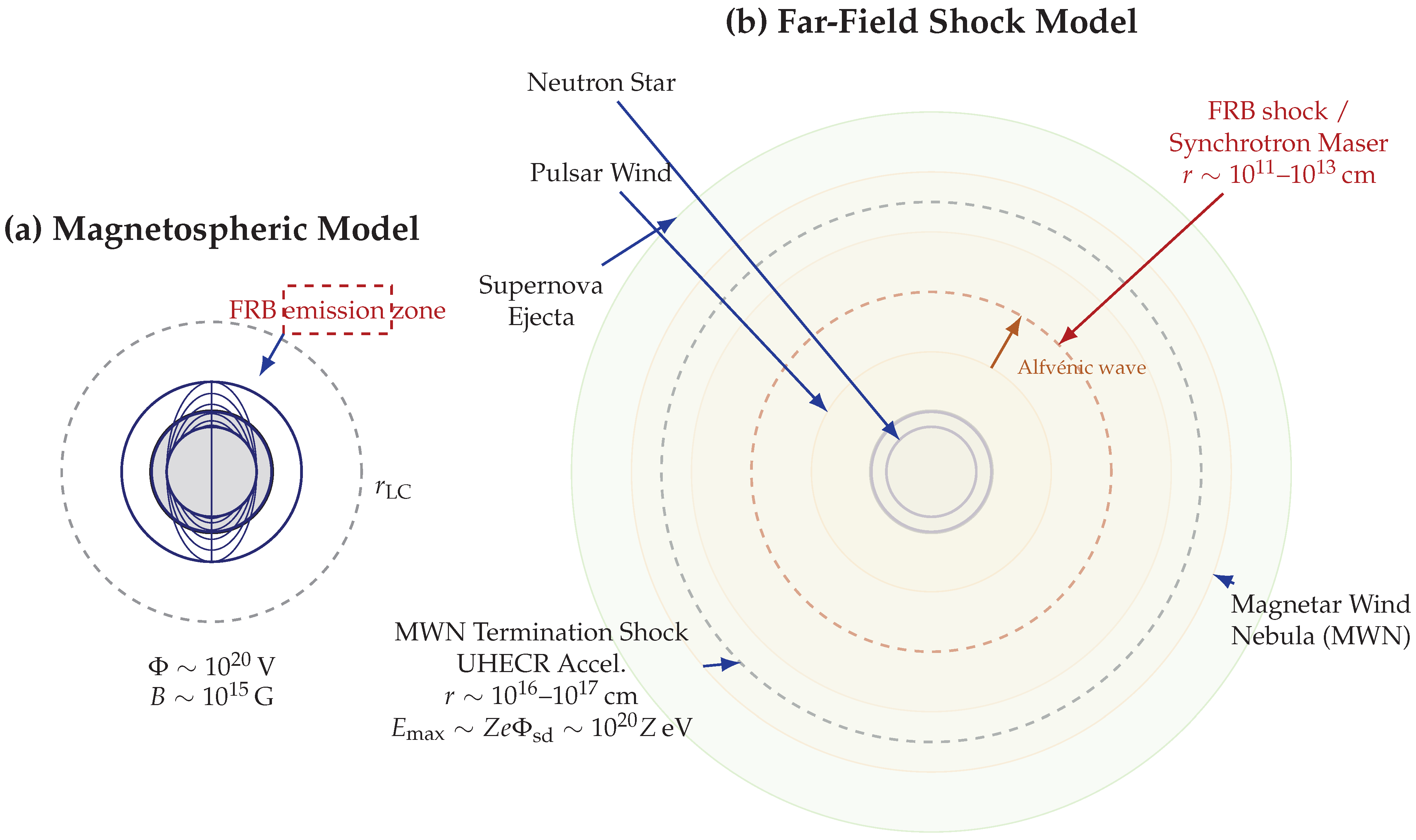
81], and it remains an open question how quickly active repeaters deplete their magnetic energy budget relative to the spin-down timescale. Two broad emission geometries are discussed within this framework. These two primary scenarios for FRB emission and their associated UHECR acceleration mechanisms are schematically illustrated in
Figure 1.
In magnetospheric models, the burst originates in the closed-field-line region or near the light cylinder, powered by magnetic reconnection or Alfvénic disturbances that accelerate charge bunches to relativistic Lorentz factors; coherent curvature radiation from these bunches then generates the observed radio emission [
22,
25,
84,
85]. The specific trigger for the reconnection event may be a crustal fracture driven by magnetic stress [
86], or an instability in the twisted magnetospheric field configuration [
87]. In far-field models, an Alfvénic wave packet or flare ejecta launched from the magnetosphere drives a mildly relativistic shock into a magnetar wind nebula or a surrounding supernova remnant; synchrotron maser emission at the shock front produces the radio burst, potentially with accompanying X-ray and
-ray emission [
23,
26,
88]. The two geometries make distinct predictions for the burst environment: magnetospheric models place the emission region within
cm of the neutron star, where the baryon density is low and the plasma is magnetically dominated, while far-field models predict shock radii
–
cm with plasma densities and magnetic fields relevant to particle acceleration at relativistic shocks. Both families of models are constrained by the requirement that the coherence length of the emitting plasma, and therefore its Lorentz factor and charge density, reproduce the observed brightness temperatures
K [
10,
11].
Observational constraints on the burst environment come primarily from rotation measure (RM) variations. The repeating source FRB 20121102A showed an extreme and time-varying RM of order
rad m
−2 in the years following its discovery, indicating that the burst propagates through a highly magnetized and evolving plasma screen within a few parsecs of the source [
72,
89]. A similarly extreme and rapidly varying RM was subsequently observed in FRB 20190520B, which also hosts a persistent radio source consistent with a young nebula or an active galactic nucleus environment [
73,
90]. The RM variations on timescales of days to weeks in both sources are most naturally explained by the passage of the line of sight through an inhomogeneous, magnetized plasma associated with the source environment rather than by the large-scale intergalactic medium, which is consistent with a young magnetar embedded in its birth supernova remnant or in a wind nebula [
11,
81]. For the majority of apparently non-repeating FRBs, the RMs are much more modest,
rad m
−2, suggesting either an older source environment, a different progenitor channel, or a geometric effect in which the line of sight to the burst does not intersect the densest part of the local magnetized plasma [
6,
10].
For UHECR acceleration, the magnetosphere itself is the most energetically favorable environment. Near the surface of a millisecond magnetar with
G and spin period
ms, the unipolar-induction (Goldreich–Julian) electric potential across the polar cap is
V [
91,
92], easily satisfying the Hillas criterion for iron nuclei at
eV. However, screening of this potential by pair plasma and the dense photon field near the surface limits the fraction of particles that escape without being catastrophically photo-disintegrated or losing energy to synchrotron radiation [
83,
93]. The pair multiplicity near the polar cap of a young millisecond magnetar can reach
–
[
94], implying that the accelerating electric field is effectively screened on scales much shorter than the polar cap radius, and only particles injected at special locations in the magnetosphere where the field is locally unscreened can be accelerated to the highest energies. In the nebular wind scenario, which develops over the spin-down timescale
–
yr, ions swept up by a relativistic pulsar wind can be re-accelerated at the termination shock within a young magnetar wind nebula (MWN), reaching maximum energies
where
V for a luminosity
erg s
−1 characteristic of a newly born millisecond magnetar [
82,
83]. This scenario directly connects to models for the UHECR
ankle–toe transition and has been explored in detail by Fang et al. [
82], Fang et al. [
95], who find that a population of extragalactic magnetars born with millisecond periods can reproduce the observed UHECR spectrum and composition above
eV, provided the birth rate is
per conventional core-collapse supernova.
A critical question for the magnetar–UHECR scenario is whether the composition of cosmic rays escaping the MWN is consistent with the heavy-to-intermediate nuclei preferred by Auger measurements above the ankle [
37,
40]. Nuclei injected into the nebula from the neutron star surface or swept up from the supernova ejecta are subject to photo-disintegration by the intense radiation field of the early-time magnetar, when the spin-down luminosity is highest and the nebular photon density is correspondingly large [
83]. Detailed calculations show that for magnetars born with
ms, the photon energy density exceeds the photo-disintegration threshold for iron over most of the volume of the early-time nebula, resulting in a predominantly protonic composition of the escaping UHECR flux at
. At later times, when the spin-down luminosity has declined and the nebula has expanded, heavier nuclei can survive and the escaping composition approaches that of the supernova ejecta, which is enriched in intermediate-mass and heavy elements [
83,
95]. The net composition of the UHECR flux from the cosmological magnetar population therefore depends on the distribution of birth periods, with longer initial periods and older active ages favoring heavier escaping nuclei in better agreement with Auger data.
3.2. Supramassive Neutron Stars and the Blitzar Scenario
In the blitzar model of Falcke and Rezzolla [
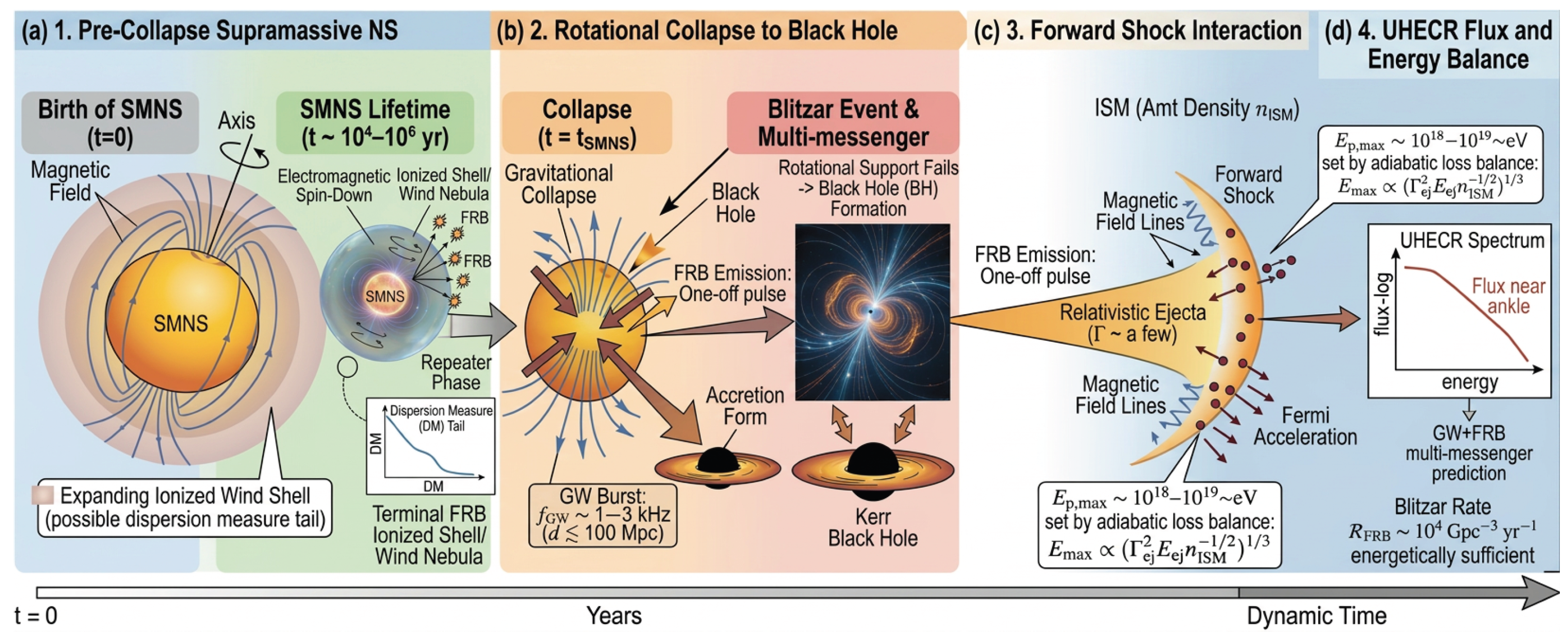
27], a neutron star formed above the maximum mass for a non-rotating body is temporarily supported by rapid rotation (a supramassive neutron star, SMNS). As the star loses angular momentum through electromagnetic spin-down, it eventually crosses the stability limit and collapses to a black hole on a dynamical timescale. The violent disruption of the magnetic-field configuration generates a sudden burst of electromagnetic energy, observed as an FRB. The rotational energy available is
erg for a canonical moment of inertia
g cm
2; a fraction of this energy is channeled into ejecta that can reach Lorentz factors
a few [
27,
96]. The full evolutionary timeline and associated phenomena of the blitzar scenario are schematically illustrated in
Figure 2.
Early support for the blitzar model came from the observation of a possible declining tail in the dispersion measure of FRB 20110523A [
97], interpreted as the signature of a compact, expanding ionized shell produced by the pre-collapse SMNS wind, a feature naturally predicted by the blitzar scenario but absent in standard magnetar models. The predicted one-off nature of blitzar events, which cannot repeat by construction since the neutron star is destroyed, is consistent with the large population of apparently non-repeating FRBs detected by CHIME and other surveys [
6], though the distinction between truly non-repeating sources and repeaters whose repetition rate is below the detection threshold of current surveys remains observationally unresolved [
70,
71]. The SMNS lifetime before collapse depends sensitively on the equation of state of dense nuclear matter and on the initial spin period; for stiff equations of state and
ms, the lifetime can reach
–
yr [
96,
98], during which the SMNS powers a magnetar-like wind nebula and potentially produces multiple FRBs through magnetospheric activity before the terminal blitzar event. This suggests that the blitzar and magnetar scenarios are not mutually exclusive: a SMNS may be responsible for both a phase of repeating FRB activity and a final non-repeating burst at collapse.
Li et al. [
53] showed that forward shocks driven by the blitzar ejecta into the surrounding interstellar medium can accelerate protons to energies
–
eV and that the inferred FRB rate of
Gpc
−3 yr
−1 [
6,
7] is energetically sufficient to reproduce the UHECR flux near the
ankle with a conversion efficiency
. The maximum energy is set by the balance between the acceleration timescale at the forward shock and the adiabatic loss timescale as the shock decelerates; for typical blitzar ejecta parameters, this balance yields
, where
is the ambient density [
53]. The relatively modest maximum energy compared to the magnetospheric scenario reflects the lower magnetic field and shorter acceleration timescale available at the forward shock compared to the magnetar wind termination shock.
The blitzar scenario makes a distinctive multi-messenger prediction: each blitzar event should be accompanied by a gravitational-wave (GW) burst from the collapsing SMNS, detectable by advanced LIGO/Virgo/KAGRA at distances
Mpc [
27,
96], and possibly by an X-ray or
-ray transient if the nascent accretion disk forms a jet. The GW signal from the collapse itself is expected to peak at frequencies
–3 kHz, within the sensitive band of current detectors but at a strain amplitude that requires a source closer than ∼50 Mpc for a confident detection with current sensitivity [
99,
100]. The absence of a confirmed electromagnetic counterpart to any detected gravitational-wave event (other than GW170817) does not yet constrain the blitzar rate, since the sky localization of most GW events is too poor for a meaningful radio follow-up with existing FRB facilities. The converse strategy, searching for GW events spatially and temporally coincident with known FRBs, will become feasible with next-generation GW detectors in the Einstein Telescope and Cosmic Explorer era [
101,
102].
3.3. Binary Neutron Star Mergers
Binary neutron star (BNS) mergers represent a well-motivated FRB progenitor channel, supported by theoretical models in which coherent radio emission can be generated either just before merger, as the magnetic fields of the two stars interact through electromagnetic braking [
28,
29], or just after, if the merger remnant is a long-lived SMNS that drives a Poynting-flux-dominated outflow [
30]. A pre-merger FRB signal, if it exists, would arrive seconds to minutes before the GW chirp and could serve as a early warning trigger for electromagnetic follow-up observatories [
29,
103]. Post-merger emission, by contrast, would follow the GW event by the lifetime of the SMNS remnant, which ranges from milliseconds for promptly collapsing systems to years for stable remnants supported by differential rotation and magnetic braking [
81,
100]. The total energy budget of a BNS merger is dominated by the gravitational binding energy released,
erg, of which a fraction
–
may be channeled into the electromagnetic energy of the SMNS remnant’s dipole field [
81,
104]. The BNS merger rate inferred from GW170817 and population synthesis,
–1500 Gpc
−3 yr
−1 [
105], is lower than the inferred FRB rate by one to two orders of magnitude, implying that if BNS mergers produce FRBs, only a subset of mergers generates detectable radio emission, or that SMNS remnants survive long enough to produce multiple bursts [
29,
30].
The host galaxy demographics of well-localized FRBs provide indirect constraints on the BNS merger channel. BNS mergers are expected to occur preferentially in early-type galaxies or in the outskirts of late-type galaxies due to the systemic kick velocities acquired at neutron star birth and the long delay times between star formation and merger [
106,
107]. A small subset of well-localized FRBs has been associated with quiescent elliptical host galaxies or with offset positions within their hosts [
13,
16,
17], which is qualitatively consistent with a BNS merger origin for that subset. However, the majority of localized FRBs are associated with star-forming host galaxies with stellar masses and star formation rates consistent with a young progenitor population such as magnetars formed in core-collapse supernovae [
17,
104,
108]. The current host galaxy sample is therefore consistent with a mixed population in which the dominant channel is a young stellar progenitor and a minority channel with characteristics consistent with BNS mergers contributes a subdominant fraction of the observed FRB rate.
For UHECR production in this channel, Fang and Metzger [
52] showed that the mildly relativistic ejecta (
–3) expelled in a BNS merger can reach maximum proton energies
eV at the deceleration radius
–
cm, where the ejecta kinetic energy equals the swept-up interstellar mass. This energy is in the ankle region for protons and extends to the trans-GZK regime for iron nuclei (
), making BNS mergers a viable ankle-to-toe source. The maximum energy depends on the ejecta Lorentz factor and the ambient density: for merger environments with
cm
−3, characteristic of the old stellar environments where BNS systems tend to reside, the maximum energy is enhanced compared to star-forming environments because the lower ambient density allows the shock to decelerate at a larger radius where the magnetic field is weaker, but the acceleration timescale is longer [
52]. The same ejecta produce secondary pions and subsequent
-rays and neutrinos through hadronic interactions with the surrounding baryonic wind from the disk outflow; the resulting neutrino flux from the cosmological population of BNS mergers is constrained to be subdominant to the IceCube astrophysical flux [
52,
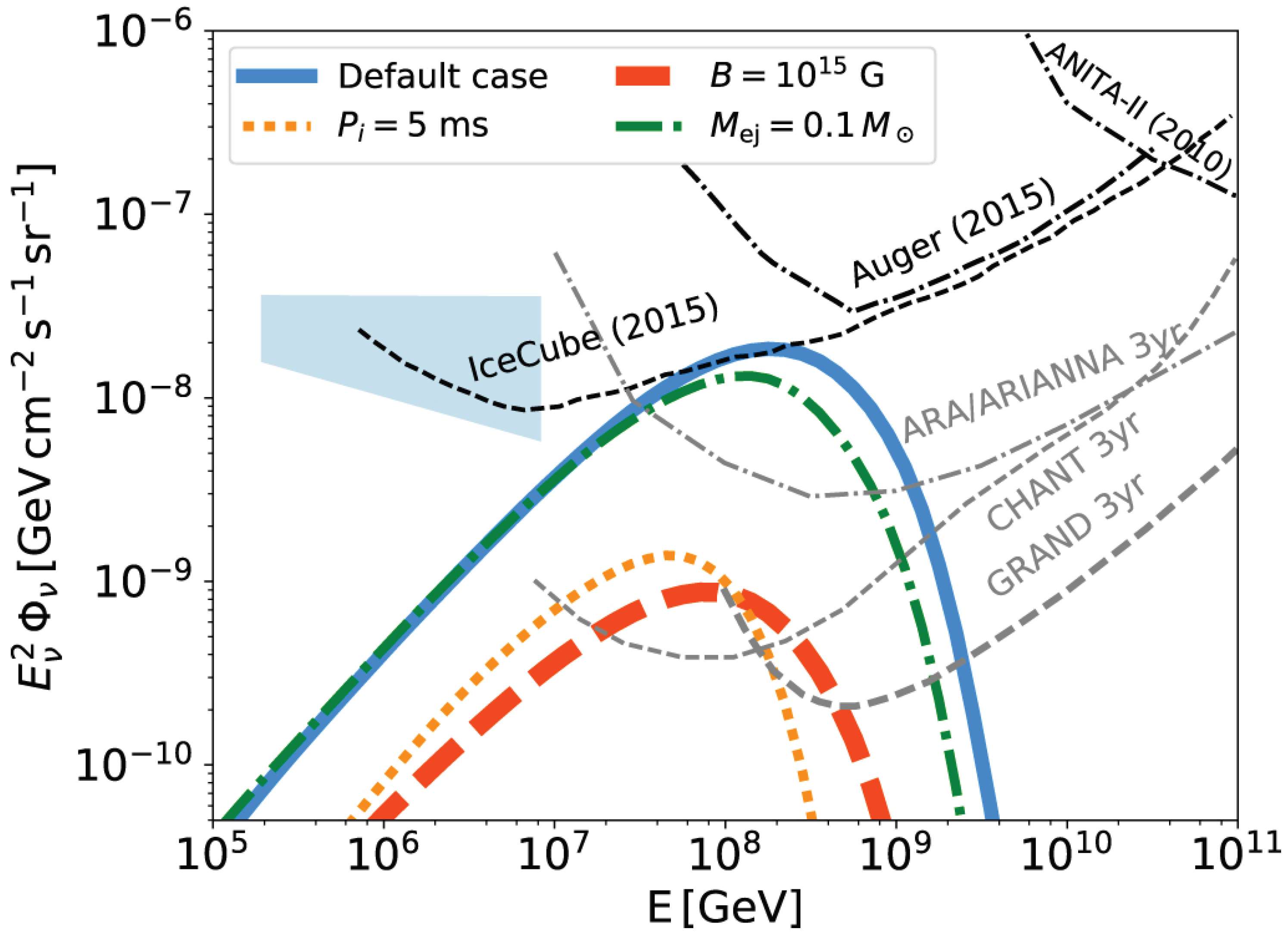
109], leaving room for a non-negligible but bounded contribution from this channel. The all-flavor diffuse neutrino spectra for magnetar populations with varying parameters, as predicted from BNS mergers, are illustrated in
Figure 3.
The kilonova associated with GW170817, AT2017gfo, provided the most detailed multi-messenger picture of a BNS merger environment to date [
116,
117,
118]. The inferred ejecta mass
and velocity
–
are broadly consistent with the parameters assumed in UHECR models for this channel, though the specific merger (which appears to have produced a rapidly collapsing remnant rather than a long-lived SMNS) may not be representative of the subset of BNS mergers most favorable for FRB and UHECR production [
100,
119].
3.4. Accretion-Disk Discharge Models
A qualitatively different scenario has been proposed by Kafashi and Rahvar [
31], in which FRBs originate from capacitor-like discharge events within the accretion disk surrounding a compact object (neutron star or stellar-mass black hole). Compton scattering of hard X-ray photons from the corona by electrons in the disk atmosphere drives a spatial separation of positive and negative charges, creating a region of strong electric field. Once the field exceeds a critical value determined by radiation-pressure equilibrium, the discharge releases energy as a coherent radio pulse on the light-crossing timescale of the charge-separation region,
km. The peak luminosity of the resulting pulse can reach the observed FRB range,
–
erg s
−1, for accretion rates near the Eddington limit [
31].
This model naturally accounts for the association of repeating FRBs with environments that show signs of active accretion, such as persistent radio counterparts consistent with a compact nebula, flat-spectrum radio emission, and redshift-independent dispersion-measure contributions from a dense local medium [
12,
15]. It also provides a natural explanation for the activity windows and sub-burst temporal structure observed in some repeating FRBs, which may reflect quasi-periodic instabilities in the accretion flow analogous to those seen in X-ray binaries and ultraluminous X-ray sources. The model predicts that FRB activity should be correlated with the X-ray luminosity of the central source and should therefore be detectable in X-ray monitoring campaigns during active FRB emission episodes, a prediction that will be testable with simultaneous radio–X-ray observations using CHIME and NICER or XMM-Newton [
120]. For UHECR acceleration, the accretion disk environment provides both a sustained energy supply and a magnetized corona where particles could, in principle, be accelerated through magnetic reconnection, similar to the AGN and X-ray binary scenarios reviewed by Kotera and Olinto [
33], though the detailed particle energetics in this specific discharge geometry remain to be worked out in future studies.
3.5. Energetics Summary and Rate Comparison
A compact summary of the energetics and volumetric rates of the engine scenarios reviewed above is useful for comparisons in subsequent sections. For magnetars formed in core-collapse supernovae, the birth rate in the local universe is
Gpc
−3 yr
−1 (assuming ∼10% of supernovae produce magnetars), each depositing
erg into a wind nebula over the spin-down timescale [
82,
83]. For blitzar events, the volumetric rate is tied to the SMNS formation rate, which is uncertain but bounded from below by the BNS merger rate and from above by the SMNS-forming fraction of all neutron-star births; current estimates place it in the range
–
Gpc
−3 yr
−1 [
96,
98]. For BNS mergers,
–1500 Gpc
−3 yr
−1 with total ejecta kinetic energies
erg [
52,
105]. The FRB all-sky rate,
Gpc
−3 yr
−1, is consistent with a magnetar origin if each magnetar produces
–
FRBs over its active lifetime [
6,
7,
88].
The maximum rigidity achievable in each scenario varies by nearly two orders of magnitude across the models reviewed here. Magnetospheric acceleration by a millisecond magnetar can, in principle, reach
V; the MWN termination shock reaches
V for the youngest systems, blitzar ejecta shocks reach
–
V, and BNS merger ejecta are in the range
V [
33,
52,
53,
82]. These numbers should be compared with the minimum rigidity required by the Auger spectrum and composition fits,
EV [
43,
58]. All four scenarios satisfy this minimum requirement for protons, and the MWN and magnetospheric scenarios satisfy it for iron nuclei as well. This establishes the Hillas criterion as a necessary but not sufficient condition: the scenarios that pass this test must then be evaluated against the rate, composition, neutrino, and anisotropy constraints discussed in the subsequent sections.
These numbers establish that among the proposed engine scenarios, magnetar-wind-nebula acceleration and BNS merger ejecta come closest to simultaneously satisfying the FRB rate, the Hillas criterion, and the UHECR energetics requirement with minimal fine-tuning. The blitzar and accretion-disk scenarios remain theoretically motivated but require either higher ejecta Lorentz factors or more favorable environmental conditions to account for the highest-energy events in the UHECR spectrum, and both lack the detailed multi-messenger modeling that has been carried out for the magnetar and BNS merger channels.
3.6. Repeating vs. Non-Repeating FRBs: Implications for UHECR Production
The observed FRB population divides broadly into sources that repeat on detectable timescales and sources for which only a single burst has been recorded [
8,
9]. Whether this dichotomy reflects a genuine bimodality in progenitor physics or merely a wide distribution of repetition rates sampled at different epochs remains actively debated [
70,
71], but its implications for UHECR production are significant regardless of its ultimate origin.
Repeating FRBs, of which FRB 20121102A and FRB 20190520B are the best-studied examples, are associated with extreme and time-variable rotation measures (
rad m
−2), persistent radio counterparts, and dense magnetised local environments [
72,
73,
89,
90], consistent with young magnetars embedded in active wind nebulae or accretion-powered systems. These environments maximise the product
entering the Hillas criterion and are energetically the most favourable for UHECR acceleration. The cumulative energy injected into the surrounding medium over years of repetitive activity is substantial, and the dense magnetised plasma revealed by RM monitoring directly traces the conditions, high magnetic field, compact source size, required for efficient particle confinement and acceleration. However, the same dense environment that favours acceleration also enhances photodisintegration and hadronic interaction losses, potentially suppressing the escaping UHECR flux and producing secondary neutrinos and
-rays at levels constrained by IceCube and Fermi-LAT [
52,
95]. The net UHECR yield from repeating FRBs therefore depends sensitively on the ratio of the acceleration timescale to the interaction timescale within the source environment.
Apparently non-repeating FRBs, by contrast, tend to inhabit less extreme RM environments and a broader range of host galaxy types, including quiescent ellipticals [
16,
17]. If their non-repeating character reflects a genuinely catastrophic progenitor event, such as a blitzar collapse or a BNS merger, the UHECR output is concentrated in a single energetic episode rather than distributed over a long active lifetime. The lower ambient density inferred from modest
and RM values for many non-repeaters implies reduced interaction losses and a higher escape fraction for accelerated nuclei, at the cost of a lower total energy budget per event compared to a long-lived magnetar wind nebula. Volumetrically, the rate of apparently non-repeating FRBs dominates the observed all-sky rate [
6,
7], making this subclass the larger contributor to the UHECR emissivity if the conversion efficiency is comparable.
In summary, the two subclasses likely contribute to the UHECR flux through complementary channels: repeating FRBs in dense magnetised environments may preferentially produce neutrino-bright, composition-mixed UHECR emission through MWN and reconnection channels, while non-repeating FRBs in rarefied environments may contribute a cleaner, neutrino-quiet UHECR signal through DSA or direct EM acceleration. Disentangling these contributions will require composition-resolved anisotropy measurements cross-correlated with RM-classified FRB catalogues, as discussed in
Section 6.
4. Cosmic-Ray Acceleration Mechanisms in FRB Environments
Given the extreme physical conditions associated with FRB progenitors, several distinct mechanisms have been identified that could accelerate ions to ultra-high energies. These mechanisms differ in their location relative to the central engine, their dependence on the local plasma density and magnetic field, and their predictions for the resulting energy spectrum and composition. In this section, we review the four best-developed acceleration channels in order of increasing distance from the central object. It is worth noting at the outset that these channels are not mutually exclusive: a single FRB source may contribute to the UHECR flux through more than one mechanism operating at different radii and at different times in the source evolution, and the relative importance of each channel depends sensitively on parameters such as the initial spin period, the magnetic field geometry, the ambient density profile, and the ion composition of the material available for acceleration. A comprehensive model for the UHECR contribution of FRBs should eventually account for the interplay between all four channels across the diversity of FRB engine scenarios reviewed in
Section 3.
A fundamental question that underlies all of the acceleration scenarios reviewed in this section is whether the extreme physical processes required for UHECR acceleration are compatible with the coherent radio emission that defines FRBs as an observational class. Coherent emission mechanisms—whether curvature radiation from charge bunches in a magnetically dominated magnetosphere [
25] or synchrotron maser emission at a relativistic shock front [
26]—require a highly ordered plasma configuration with low entropy production. UHECR acceleration through shocks or magnetic reconnection, by contrast, involves violent energy dissipation and strong plasma turbulence. The coexistence of these two processes is non-trivial and must be addressed carefully for any proposed scenario to be self-consistent.
The resolution lies in the separation of scales. In both the magnetospheric and the far-field shock models, the coherent radio emission is produced in a spatially compact and temporally brief region, within
cm of the neutron star for magnetospheric models, or at the maser-active shock front at
–
cm for far-field models [
11]. UHECR acceleration, by contrast, operates at much larger radii and on longer timescales: unipolar induction acts across the polar cap on timescales
, MWN termination shock acceleration operates at
–
cm over centuries, and DSA at forward shocks acts at
–
cm over years to decades [
52,
82]. In all of these cases, the UHECR acceleration zone is physically decoupled from the coherent emission zone by many orders of magnitude in radius, so the violent processes responsible for particle energisation do not disrupt the ordered plasma configuration required for coherent radiation.
In the direct electromagnetic acceleration scenario of Yu et al. [
55], the situation is qualitatively different: the FRB pulse itself, propagating through ambient plasma, is the accelerating agent. Here the coherent wave and the accelerating field are one and the same, so there is by construction no tension between the two processes. The pulse transfers energy to ions through the piston or wakefield mechanism and simultaneously propagates as a coherent electromagnetic wave; the only requirement is that the plasma density satisfies
so that the pulse is not absorbed before escaping the source environment [
55]. This scenario is therefore the most internally self-consistent from the perspective of the coexistence problem, and this represents one of its key theoretical advantages over shock- and reconnection-based channels.
For the magnetospheric and MWN scenarios, an additional consistency check is provided by the timescale argument. The coherent radio burst lasts milliseconds and carries
–
erg, while the UHECR acceleration operates on timescales of years to millennia and draws on the spin-down reservoir of ∼
erg. The two processes therefore tap entirely different energy reservoirs on entirely different timescales, and neither the radio burst nor its associated magnetospheric activity need disrupt the long-duration, large-scale MWN that drives the dominant UHECR output [
82,
83].
4.1. Unipolar Induction in the Magnetar Magnetosphere
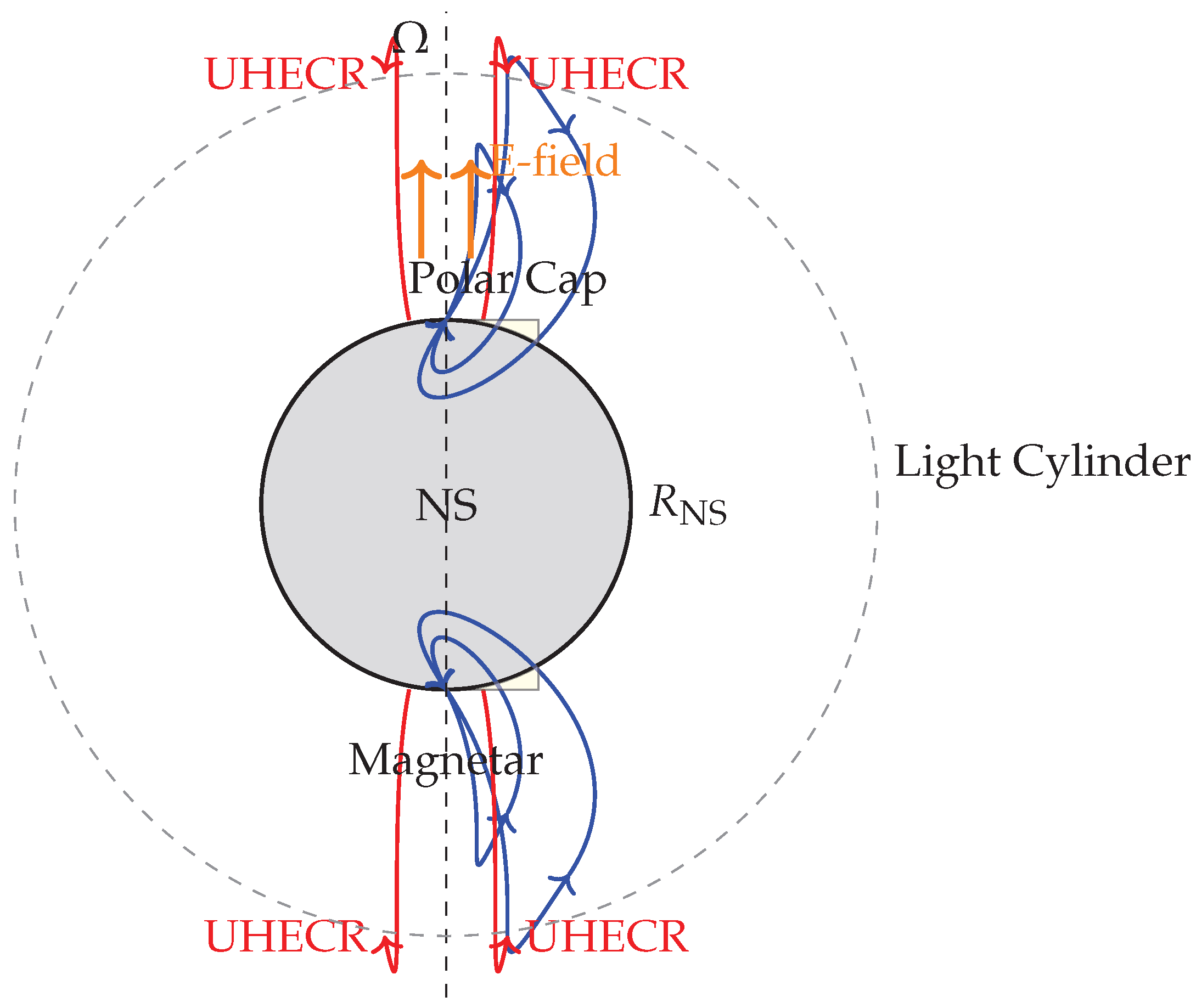
The most energetically direct route to UHECR energies is unipolar induction in the magnetosphere of a rapidly rotating, strongly magnetized neutron star. In analogy with the classic Goldreich–Julian pulsar model [
91], a magnetar with angular velocity
, where
P is the rotation period, and surface dipole magnetic field strength
, maintains an electrostatic potential difference across its polar cap of magnitude
where
is the neutron-star radius and
c is the speed of light. The quantity
represents the characteristic voltage drop available for particle acceleration along open magnetic field lines emerging from the polar-cap region of the magnetosphere. For a millisecond magnetar with
G and
km, this potential exceeds the rigidity threshold for protons (
V) and is sufficient to accelerate iron nuclei to energies
eV, well above the GZK threshold [
83,
92]. The Hillas criterion [
44] is therefore satisfied with considerable margin for the youngest and most rapidly rotating magnetars, making unipolar induction the channel with the highest theoretical maximum energy among all FRB-related acceleration scenarios. The challenge is not the available energy budget but the acceleration efficiency: only a fraction of the enormous potential drop is ultimately converted into the kinetic energy of escaping ions, since pair cascades, radiation losses, and magnetospheric screening can strongly reduce the effective accelerating electric field. A schematic illustration of this unipolar induction mechanism within a magnetar magnetosphere is presented in
Figure 4.
In practice, the efficiency of this mechanism is limited by two effects. First, the dense pair plasma that fills the open-field-line region screens the electric field, reducing the effective accelerating voltage to a fraction of
[
93]. The pair multiplicity
, defined as the number of electron–positron pairs produced per primary charge extracted from the surface, can reach
–
in young millisecond magnetars [
94], implying that the charge density in the open-field region greatly exceeds the Goldreich–Julian value and the accelerating electric field is correspondingly suppressed. Regions of unscreened electric field, sometimes called “gaps”, can exist near the polar cap or at the outer magnetosphere near the light cylinder [
121,
122], but their spatial extent and the fraction of the total potential drop they sustain are difficult to determine from first principles and depend on the uncertain microphysics of pair creation in strong magnetic and radiation fields. Second, ions accelerated along field lines near the stellar surface encounter intense synchrotron and curvature radiation losses and a large photon density that causes photodisintegration losses for heavy nuclei. The condition for a nucleus of charge
and Lorentz factor
to escape the magnetosphere is that the adiabatic cooling timescale exceeds the light-crossing time, which translates into a minimum escape energy per nucleon that depends on
and
P [
83,
93]. For a newly born millisecond magnetar with
G and
ms, protons can escape with energies
eV, but intermediate-to-heavy nuclei may suffer significant photodisintegration inside the magnetosphere, effectively lightening the composition of the escaping UHECR flux [
83].
The composition prediction of the magnetospheric channel is therefore predominantly protonic for the highest-energy particles, which is in tension with the intermediate-to-heavy composition inferred by Auger above the ankle [
37,
40]. This tension could be reduced in several ways. If the distribution of magnetar birth periods is broad, sources with longer initial periods
ms have lower photon densities near the polar cap, allowing heavier nuclei to escape with less photodisintegration [
83]. Alternatively, the composition inferred from
measurements is model-dependent through the assumed hadronic interaction cross sections at center-of-mass energies beyond the reach of collider experiments [
40], and the systematic uncertainty is large enough that a significant proton fraction above the ankle cannot be definitively excluded [
43]. Finally, if the magnetospheric channel contributes primarily below the ankle and the MWN channel (
Section 4.2) dominates above it, the composition prediction for the combined population may be consistent with observations even if the magnetospheric component alone is too light.
4.2. Particle Acceleration in Magnetar Wind Nebulae
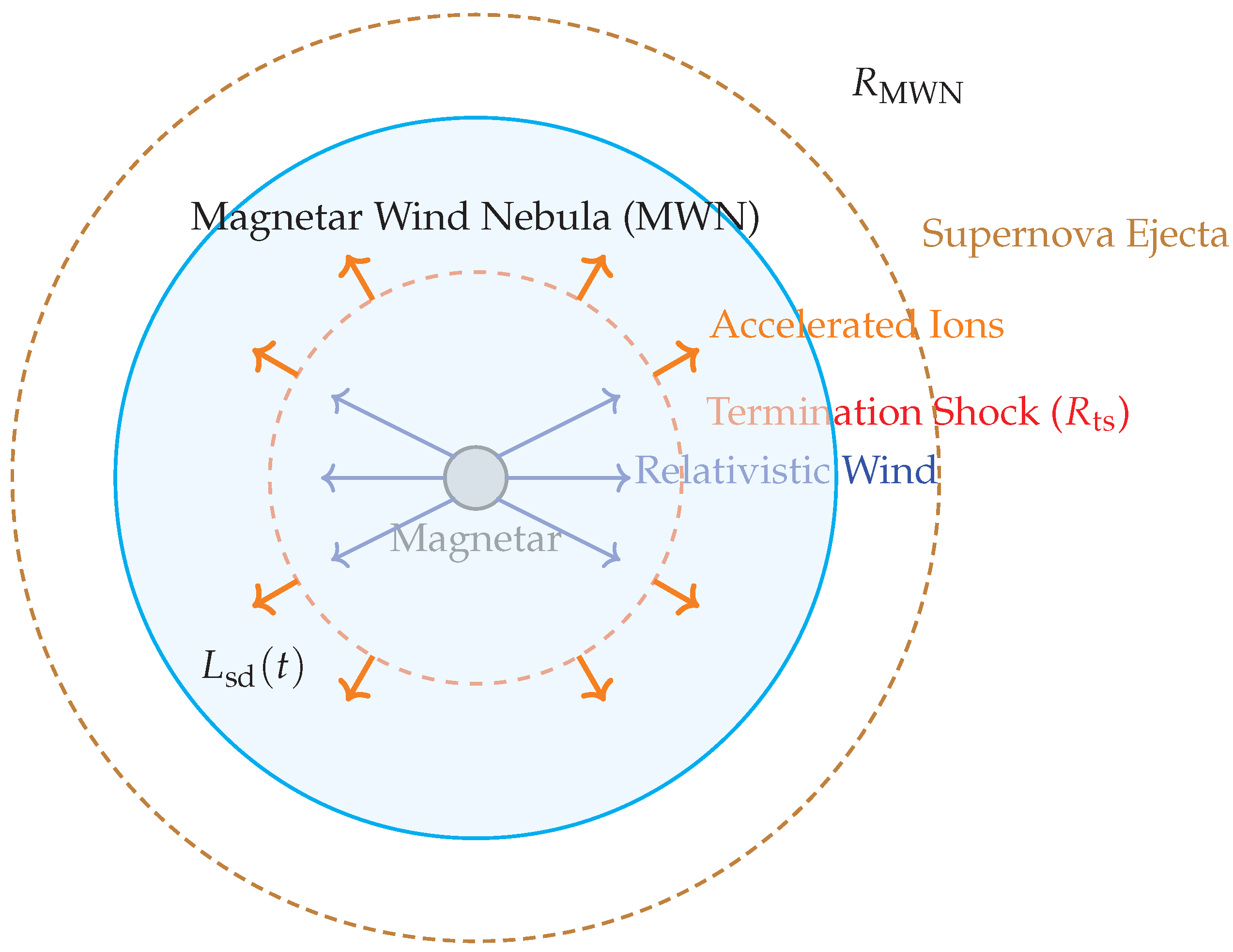
Moving further from the central engine, the relativistic wind launched by the magnetar terminates in a standing reverse shock, the magnetar wind nebula (MWN) termination shock, where ions swept up from the surrounding supernova ejecta can be accelerated through a Fermi-like process. This scenario is closely analogous to the pulsar wind nebula acceleration mechanism invoked for the knee of the Galactic cosmic-ray spectrum [
33,
92], scaled up to millisecond magnetar parameters. The termination shock radius is determined by pressure equilibrium between the wind ram pressure and the nebular magnetic and particle pressure, and evolves as the spin-down luminosity declines and the nebula expands into the surrounding supernova ejecta. For typical parameters the termination shock is located at
–
cm during the first century of the magnetar’s life, within a volume that is well confined by the supernova ejecta and therefore opaque to hadronic interactions at early times [
82,
83]. A schematic diagram illustrating the key components of a magnetar wind nebula and the particle acceleration process is shown in
Figure 5.
This scenario has been explored quantitatively by Fang et al. [
82], Fang et al. [
95], who solved the transport equation for ions propagating through a time-evolving magnetar wind nebula using realistic magnetar spin-down luminosities and supernova ejecta profiles. The maximum ion energy is determined by the requirement that the particle Larmor radius,
remain smaller than the characteristic radius of the magnetar wind nebula,
, so that particles remain magnetically confined during the acceleration process [
44]. Here,
E is the particle energy,
Z is the nuclear charge number,
e is the elementary charge, and
B is the characteristic magnetic-field strength in the nebula. This condition yields
where
is the magnetar spin-down luminosity at time
t after birth and
c is the speed of light [
82]. Physically,
represents the rate at which rotational energy is extracted from the neutron star and injected into the surrounding wind nebula in the form of relativistic magnetized outflows. The expression in Equation (
4) is effectively a Hillas-type confinement condition written in terms of the nebular energy flux rather than explicitly in terms of the magnetic field and source size. For magnetars born with millisecond spin periods and surface magnetic fields
–
G, this condition can be satisfied during approximately the first ∼
yr of evolution, when the spin-down power remains sufficiently large to sustain relativistic winds and strong nebular magnetic fields.
The resulting UHECR injection spectrum is approximately
for
, arising naturally from the time-integrated contribution of the declining spin-down luminosity,
expected for magnetic-dipole braking [
82]. This very hard injection spectrum is a distinctive prediction of magnetar-driven acceleration scenarios and differs substantially from the softer spectra typically produced by diffusive shock acceleration. Remarkably, the predicted index is in excellent agreement with the
–
favored by phenomenological fits to the Pierre Auger Observatory spectrum and composition data [
43,
58], providing a strong internal consistency check for magnetar-based UHECR models.
Ions accelerated in the nebula must subsequently escape through the supernova ejecta, which at early times (
yr) are opaque to hadronic interactions: pion production and photodisintegration on the intense infrared photon field of the nebula further modify the escaping spectrum and composition [
82,
83]. The photodisintegration rate depends on the energy density of the nebular photon field, which is highest at early times when the spin-down luminosity is largest and the nebula is most compact. Detailed transport calculations show that for magnetars with
ms, the photodisintegration optical depth for iron nuclei exceeds unity during the first several hundred years, producing a proton-enriched escaping flux at the highest energies, while for
ms the nebular photon field is less intense and intermediate-mass nuclei can survive [
83]. At later times the ejecta becomes transparent, but the spin-down power and hence the maximum energy have declined significantly. The net effect is a spectral notch at intermediate energies and a composition that is lighter than at injection for the most energetic particles [
83]. The neutrino flux from hadronic interactions within the nebula during the opaque phase has been calculated by Fang et al. [
95] and found to contribute at the level of a few percent of the IceCube astrophysical flux for the magnetar birth rate inferred from UHECR energetics, consistent with the multi-messenger constraints discussed in
Section 5.
The MWN acceleration scenario is also relevant in the context of other FRB engine scenarios. In the blitzar model, the SMNS powers a magnetar-like wind nebula during its lifetime before collapse [
27,
96], and in the BNS merger scenario a long-lived SMNS remnant can drive a similarly structured wind nebula on timescales of years to decades [
26,
81]. The UHECR output of these short-lived MWN phases is smaller than that of a cosmological magnetar population because the spin-down timescale is shorter and the total energy deposited into the nebula is correspondingly reduced, but for the most energetically extreme events the contribution may still be significant at the level of tens of percent of the UHECR flux near the ankle.
4.3. Diffusive Shock Acceleration in FRB-Driven Ejecta
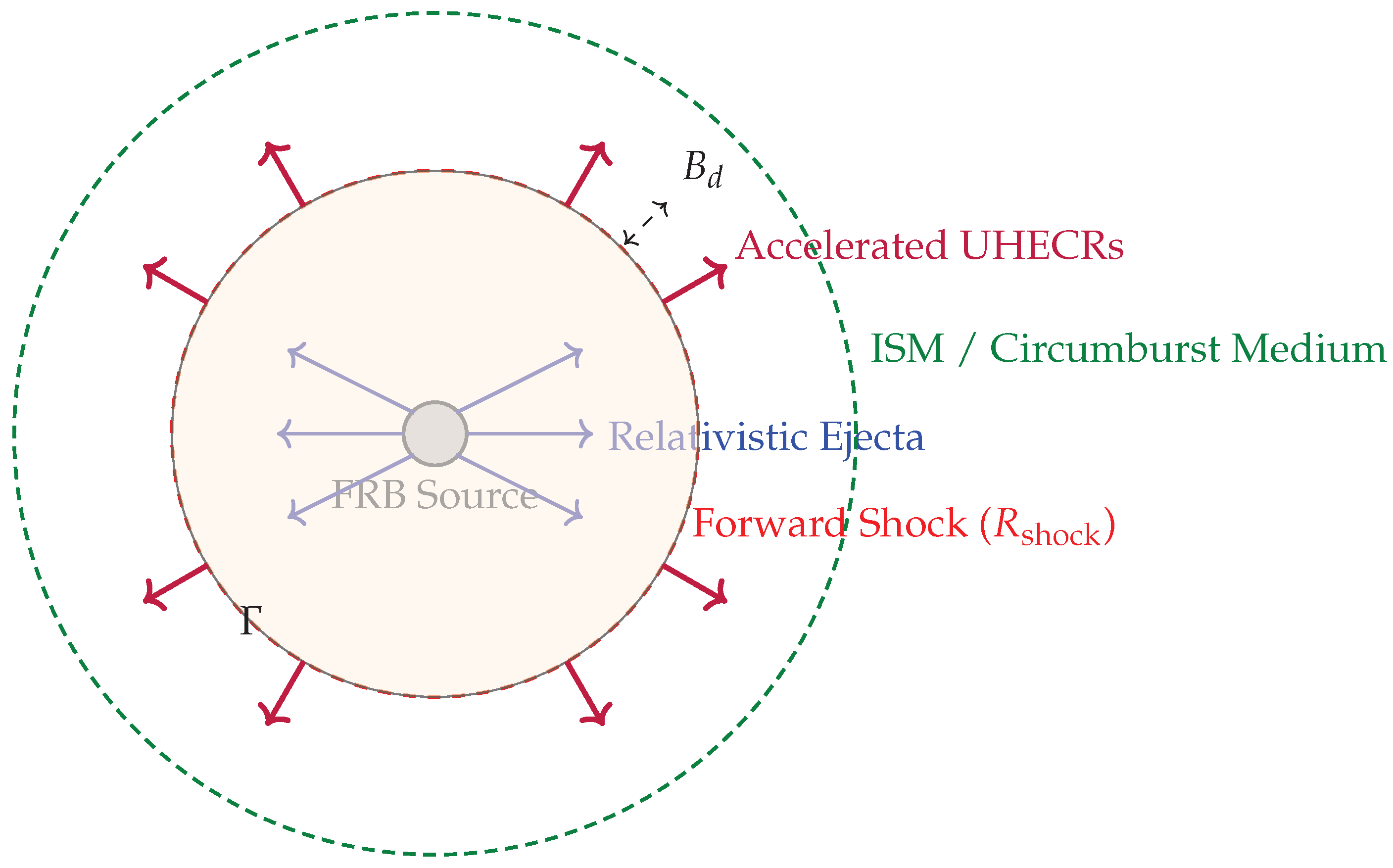
In scenarios where the FRB event is associated with a relativistic or mildly relativistic outflow, as in the blitzar model or BNS mergers, diffusive shock acceleration (DSA) at the forward shock driven into the surrounding interstellar medium (ISM) or circumburst medium provides a conventional but environment-dependent acceleration channel. DSA at relativistic shocks has a long history in the UHECR literature, having been proposed independently for
-ray burst external shocks [
45,
46] and later extended to a wide range of transient source classes. The standard result for the maximum energy achievable at a relativistic shock with Lorentz factor
and downstream magnetic field
is [
45,
46]
For the blitzar scenario, Li et al. [
53] estimated
–
eV for typical SMNS parameters and ISM densities
cm
−3, placing blitzar shocks in the ankle-to-instep regime rather than at the highest observed energies. For BNS merger ejecta, Fang and Metzger [
52] obtained
eV, corresponding to trans-EeV energies for protons and trans-GZK energies for iron. A schematic representation of this Diffusive Shock Acceleration process in FRB-driven ejecta is provided in
Figure 6.
The standard DSA spectrum at a relativistic shock is
with
–
for the shock compression ratio appropriate to a relativistic equation of state [
123,
124], which is softer than the
–
preferred by Auger fits [
43]. This tension motivates either a two-component source model combining hard-spectrum magnetar-wind injection with soft-spectrum shock injection, or a correction for spectral hardening by the energy-dependent maximum energy evolution as the shock decelerates and
shifts to lower values over time, naturally piling up particles near the instantaneous maximum energy and producing an effectively harder time-integrated spectrum [
43,
52]. The spectral softening problem is less severe for non-relativistic shocks with high compression ratios, where
approaches the test-particle prediction of
[
125], but non-relativistic shocks reach lower maximum energies and are therefore less relevant for the trans-EeV regime.
An important practical constraint on DSA in FRB environments is the potential for strong adiabatic losses. Ions accelerated at the forward shock at radius
will adiabatically cool as the shocked shell expands, reducing the effective maximum energy by a factor
between the deceleration radius and the free-streaming radius
[
52]. Furthermore, if the circumburst medium is dense, as expected near magnetars embedded in young supernova remnants or near compact binaries with significant pre-merger mass loss, hadronic interactions at or behind the shock further attenuate the escaping UHECR flux and produce neutrinos and
-rays at levels bounded by IceCube and
Fermi-LAT [
52]. The ratio of hadronic interaction energy loss to total kinetic energy, the hadronic efficiency
, parameterizes this constraint: for
, the secondary neutrino flux from the cosmological population of FRB shocks approaches the IceCube diffuse flux, providing a strong multi-messenger bound on dense circumburst environments [
68,
69].
The magnetic field amplification at the shock front is a critical but uncertain ingredient in DSA calculations. In the non-relativistic shock limit, resonant and non-resonant streaming instabilities driven by the cosmic-ray pressure can amplify the upstream magnetic field by factors of 10–100 above the ambient value [
126,
127], substantially increasing
above the estimate in Equation (
5). Whether analogous instabilities operate efficiently at the mildly relativistic shocks relevant for blitzar and BNS merger ejecta is less well established; PIC simulations of relativistic shocks suggest that field amplification is less efficient in the relativistic regime due to the reduced time available for instability growth [
128,
129]. This uncertainty directly limits the precision with which
can be predicted for the DSA channel in FRB environments.
4.4. Direct Electromagnetic Acceleration by FRB Pulses
The most recently proposed and potentially most distinctive acceleration channel is direct electromagnetic (EM) acceleration of ions by the FRB pulse itself, treated as an ultra-relativistic electromagnetic wave [
55]. In this picture, the coherent radio pulse carries electromagnetic fields so intense that particles interacting with the wave undergo relativistic quiver motion within a single oscillation cycle. The relevant dimensionless parameter characterizing this regime is the normalized wave amplitude [
130,
131],
where
e and
are the electron charge and mass, respectively,
is the electric-field amplitude of the FRB wave,
c is the speed of light, and
is the angular frequency corresponding to the observed radio frequency
. The quantity
denotes the isotropic-equivalent luminosity of the FRB pulse, while
r is the distance from the source at which the wave field is evaluated. Physically,
measures the electron quiver momentum in the electromagnetic wave in units of the electron rest-mass momentum
. For the characteristic luminosities and GHz frequencies observed in FRBs, one obtains
, corresponding to a deeply nonlinear regime of wave–particle interaction far beyond the applicability of linear plasma theory.
This regime is well known in ultra-intense laser physics, where the same parameter governs the transition between the linear wakefield and nonlinear “bubble” acceleration regimes [
130,
131]. The application of these concepts to FRBs therefore represents a natural extension of relativistic laser–plasma acceleration physics to astrophysical radio transients and cosmological scales [
11,
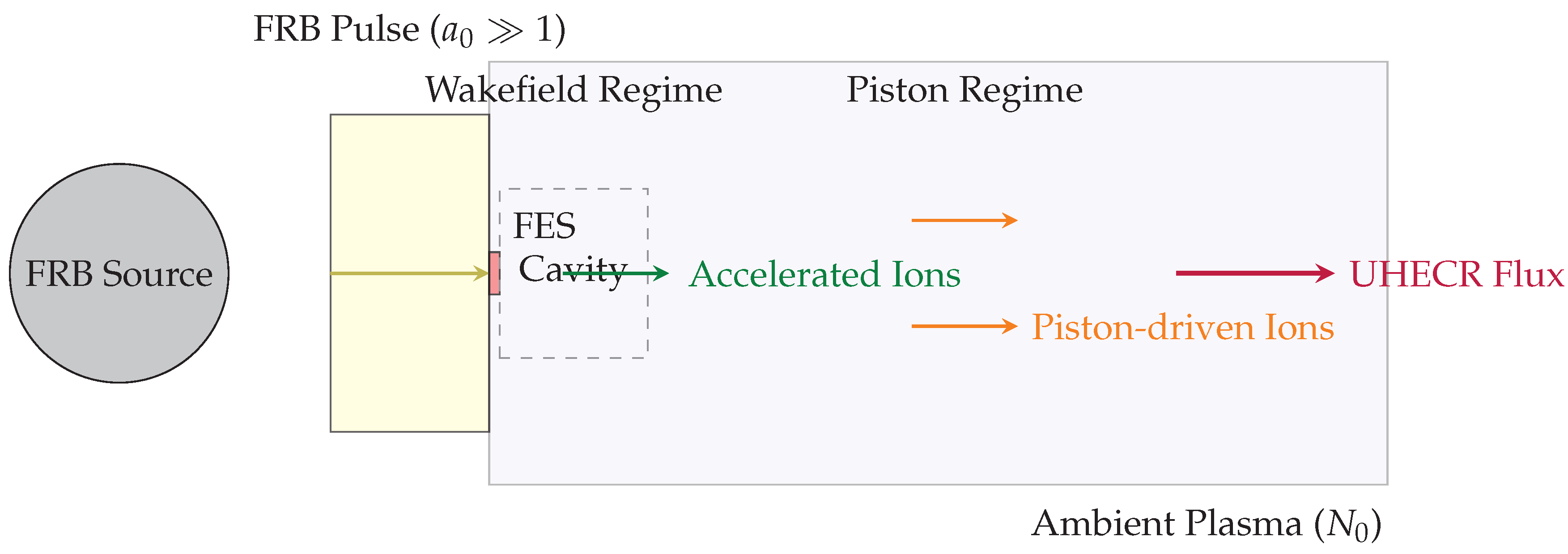
26]. In the FRB context, the enormous wave amplitude allows ions to gain energy directly from the electromagnetic pulse over distances comparable to the pulse coherence length, potentially reaching ultra-high energies without requiring multiple shock crossings or long-term magnetic confinement. A schematic illustration of this direct electromagnetic acceleration mechanism is shown in
Figure 7.
Using a combination of relativistic fluid theory and particle-in-cell (PIC) simulations, Yu et al. [
55] identified two distinct acceleration regimes governed by the interplay between the FRB wave amplitude and the density of the surrounding plasma. The relevant plasma-density parameter is
where
is the ambient electron density and
is the critical plasma density corresponding to the FRB wave frequency
. Here,
and
e are the electron mass and charge, respectively. Physically,
measures the transparency of the plasma to the propagating electromagnetic pulse: low values correspond to underdense plasmas in which the wave propagates relativistically, while high values correspond to dense environments where collective plasma effects become important.
In the wakefield regime, relevant when the normalized wave amplitude satisfies
the leading edge of the FRB pulse expels electrons from the ambient plasma and forms a thin relativistic electron layer known as the front electron sheet (FES). The displacement of the electrons creates a charge-separated cavity behind the pulse, producing a strong electrostatic field analogous to the wakefields generated in laboratory laser–plasma accelerators [
130,
131]. Ions trapped in this cavity experience the unshielded Coulomb attraction of the retreating FES and are accelerated forward with a characteristic energy
where
is the normalized FRB wave amplitude defined in Equation (
6) [
55]. In this regime, the acceleration efficiency increases for stronger electromagnetic waves and lower ambient plasma densities, since the electrostatic wake becomes less efficiently screened.
In the piston regime, relevant when the radiation pressure exerted by the FRB pulse exceeds both the thermal pressure and the magnetic pressure of the surrounding plasma,
the ambient plasma is accelerated collectively by the direct action of the electromagnetic wave rather than by electrostatic wakefields. Here,
is the normalized wave amplitude defined in Equation (
6), while
is the ambient electron density normalized to the critical density of the FRB wave. Physically, this condition implies that the electromagnetic momentum flux carried by the FRB pulse dominates the inertia of the surrounding plasma, allowing the pulse to behave like a relativistic “piston” that sweeps plasma outward as it propagates.
In this regime, ions gain energy primarily through the relativistic Lorentz force associated with the electromagnetic wave,
where
and
are the electric and magnetic fields of the FRB pulse and
is the particle velocity. The dominant acceleration term arises from the relativistic
component of the force, which transfers momentum directly from the propagating electromagnetic wave to the plasma. The characteristic ion energy achieved in this regime is approximately
where
A and
Z are the ion mass number and charge number, respectively [
55]. The dependence on
reflects the increasing acceleration efficiency for stronger FRB electromagnetic fields, while the factor
indicates that lower-density plasmas are more easily accelerated by the radiation pressure of the pulse. The explicit scaling with
and
further implies that heavier and more highly charged nuclei couple more efficiently to the electromagnetic field and can therefore attain higher terminal energies than protons under otherwise identical conditions.
Unlike conventional diffusive shock acceleration, the piston regime does not require repeated shock crossings or long-term magnetic confinement. Instead, the energy transfer occurs coherently and directly through the interaction between the ultra-relativistic FRB wave and the ambient plasma, making this mechanism one of the most distinctive acceleration channels proposed for FRB environments.
A particularly important result of the simulations is that the diffusion and fragmentation of the accelerated plasma sheets during outward propagation naturally generate a nonthermal power-law energy distribution with spectral index approximately
, comparable to the observed cosmic-ray spectrum near the ankle region [
55]. For characteristic FRB parameters
–
and ambient density ratios
–
, spanning plausible environments from the outer magnetosphere to magnetar wind nebulae and young supernova remnants, both the wakefield and piston regimes can in principle accelerate ions into the EeV range.
A key advantage of this mechanism is the complete absence of the injection problem that plagues DSA: ions are accelerated from rest by the pulse and need not exceed any pre-acceleration threshold before experiencing the main energy gain [
55]. This is particularly significant for heavy nuclei, which in DSA must first be injected into the diffusive acceleration cycle by thermal leakage or pre-heating mechanisms that are not well understood [
132]. In the direct EM scenario, the charge-to-mass dependence of the piston energy,
, is weak and allows efficient simultaneous acceleration of protons and heavy ions from a thermal plasma, naturally producing a mixed-composition UHECR flux without requiring special injection conditions.
The direct EM acceleration scenario also makes concrete multi-messenger predictions that distinguish it from shock acceleration. Because the energy gain occurs over a single light-crossing time of the accelerating region, there is no sustained hadronic interaction region and consequently very little secondary neutrino or
-ray production during the acceleration phase itself. The dominant secondary emission instead arises during propagation through the host galaxy’s interstellar medium and during intergalactic propagation, and is therefore indistinguishable from that of any other extragalactic UHECR population at those energies [
55]. This distinguishes the direct EM mechanism from shock scenarios, where hadronic interactions at or near the source are enhanced by the dense circumburst environment, producing a prompt neutrino signal spatially and temporally correlated with the FRB and potentially detectable by IceCube-Gen2 [
133]. The absence of such a prompt neutrino signal in the direct EM scenario is not a weakness but a prediction: if stacked neutrino searches with IceCube-Gen2 fail to detect a signal from the cosmological FRB population at the level predicted by shock models, this would provide indirect support for the direct EM channel or for other low-opacity acceleration environments.
The primary uncertainty in the direct EM scenario is the range of validity of the PIC simulation results. Current simulations [
55] have been performed for a limited range of plasma parameters and pulse profiles, and it is not yet clear whether the scaling relations in Equations (
7) and (
8) hold across the full diversity of FRB source environments, particularly in the presence of a strong ambient magnetic field, density gradients in the pre-pulse medium, or pulse structures more complex than the idealized monochromatic wave assumed in the analytical treatment. Extended PIC campaigns across a wider parameter space, combined with semi-analytical models for the time-integrated spectrum and composition of the UHECR output, are needed before this mechanism can be compared quantitatively with Auger data in the same way that the MWN and DSA scenarios have been.
4.5. Magnetic Reconnection in FRB Environments
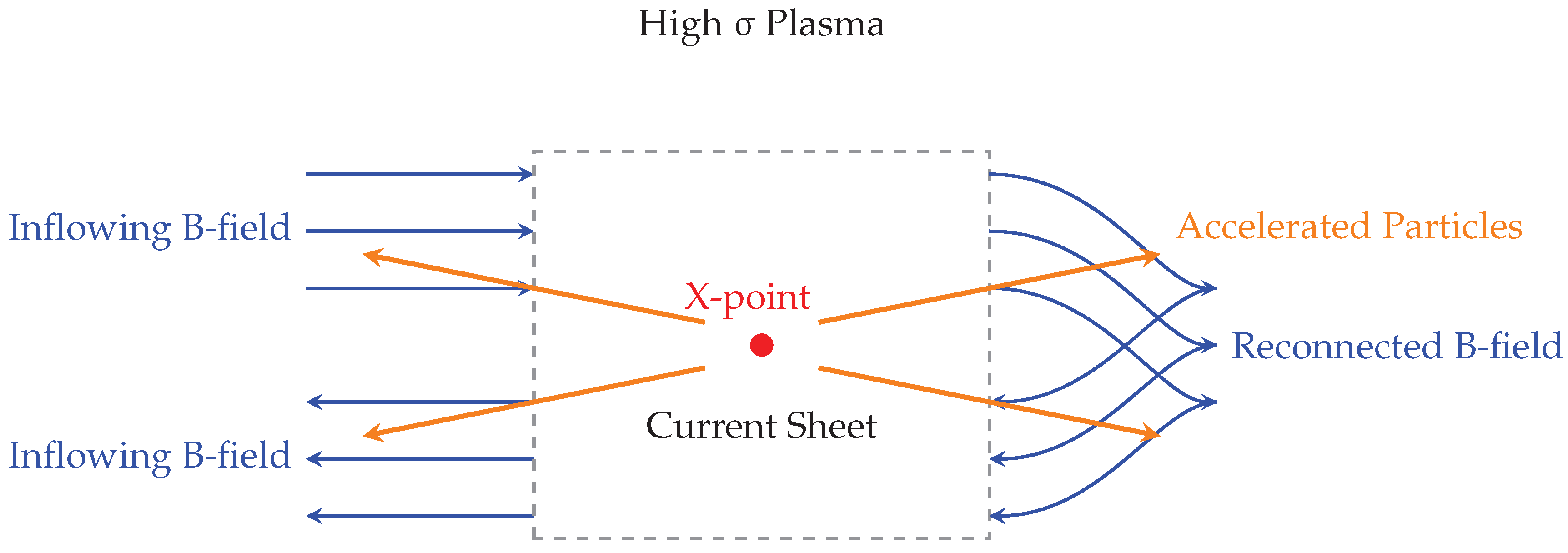
A fourth acceleration channel, not unique to FRBs but particularly relevant in magnetically dominated environments, is particle acceleration in current sheets undergoing fast magnetic reconnection. Reconnection converts magnetic field energy into particle kinetic energy at a rate determined by the reconnection electric field, which in the fast reconnection regime is a fraction ∼
of the Alfvén speed times the upstream field strength [
134,
135]. In the magnetosphere of a magnetar, or in the striped wind downstream of the light cylinder, reconnection events driven by kink instabilities or magnetic stress can generate current sheets of thickness of the order the ion Larmor radius, in which particles are accelerated to Lorentz factors
, where
is the magnetization parameter of the inflowing plasma [
134,
135]. For
as expected in the magnetar magnetosphere, this gives particle Lorentz factors
, corresponding to proton energies
eV. A schematic illustration of particle acceleration via magnetic reconnection in FRB environments is shown in
Figure 8.
Extending this mechanism to UHECR energies requires
for protons and
for iron, which requires field strengths and plasma densities accessible only within the inner magnetosphere (
cm), where photodisintegration losses may again be prohibitive [
83]. Large-scale PIC simulations of relativistic reconnection in pair plasmas have demonstrated that a power-law particle energy spectrum with index
–2 naturally develops in the high-
regime [
134,
136], which is harder than the DSA prediction and comparable to the MWN injection index. Whether this result extends to ion-electron plasmas relevant for UHECR acceleration is less well established; recent simulations of proton-electron reconnection in the mildly relativistic regime suggest that ions can be efficiently energized through a combination of Fermi reflection in magnetic islands and direct acceleration by the reconnection electric field, with maximum energies scaling as
where
is the ion magnetization [
134,
135,
136]. In the more extended wind,
is lower and the maximum energy correspondingly reduced [
87,
134]. Reconnection may therefore serve primarily as a pre-acceleration mechanism that injects particles into subsequent Fermi or EM acceleration processes rather than achieving UHECR energies independently, though its contribution to the injection spectrum and to the secondary electromagnetic emission of FRB environments merits further investigation with next-generation PIC simulations capable of resolving both the ion and electron scales simultaneously [
137].
4.6. Comparison of Acceleration Channels
The four mechanisms reviewed in this section differ substantially in their predicted maximum energies, injection spectra, composition profiles, and secondary emission signatures, and it is useful to compare them against the key observational requirements before proceeding to the multi-messenger discussion. In terms of maximum rigidity, the magnetospheric and MWN channels reach
V, the direct EM channel can reach
–
V depending on local plasma conditions, DSA at blitzar and BNS merger shocks reaches
–
V, and reconnection in the extended wind is limited to
V [
33,
52,
55,
82]. In terms of injection spectral index, the MWN and direct EM channels produce hard spectra with
–2, consistent with Auger fits [
43,
58], while DSA produces softer spectra with
–
that require an additional spectral hardening mechanism. In terms of composition, the magnetospheric channel predicts predominantly protonic output at the highest energies due to photodisintegration losses, the MWN channel predicts a composition that depends on the birth period distribution and transitions from light to intermediate-heavy with increasing age, the DSA channel reflects the composition of the shocked ISM or ejecta material, and the direct EM channel produces a mixed composition with a weak
mass dependence [
52,
55,
83]. Finally, in terms of secondary emission, the MWN and DSA channels predict neutrino and
-ray fluxes that are constrained by IceCube and Fermi-LAT and that will be further tested by IceCube-Gen2 and CTAO, while the magnetospheric and direct EM channels predict minimal secondary emission during the acceleration phase, making them effectively transparent to current neutrino telescopes [
55,
68,
95]. This comparison is summarised in
Table 1 and provides the basis for the multi-messenger analysis in
Section 5.
Taken together, the four acceleration channels can be ranked in terms of overall physical viability against current observational constraints. The MWN scenario emerges as the most self-consistent: it naturally produces the hard injection spectrum (
–
) required by Auger fits [
43,
58], reaches maximum rigidities of order
V sufficient for iron-group nuclei [
82], and has been quantitatively compared against the UHECR spectrum, composition, and neutrino bounds through detailed transport calculations [
82,
95]. Its primary tension, the photodisintegration of heavy nuclei during the early opaque nebular phase, is mitigated for magnetars born with
ms [
83], and the predicted neutrino flux remains below IceCube limits [
52]. The direct electromagnetic acceleration scenario [
55] is theoretically compelling and shares the hard-spectrum advantage, but currently lacks the end-to-end multi-messenger modelling that would allow a definitive comparison with Auger data; it should be regarded as a high-priority target for future PIC simulation campaigns. DSA at blitzar and BNS merger ejecta shocks is physically well-motivated but produces spectra that are too soft (
–
) and maximum energies that fall short of the trans-GZK regime without additional spectral hardening [
52,
53]; this channel is most naturally interpreted as a subdominant contributor near the ankle rather than at the highest observed energies. Magnetospheric unipolar induction reaches the highest theoretical maximum energies but predicts a predominantly protonic output in tension with the intermediate-to-heavy composition favoured by Auger above the ankle [
37,
40], and the escape fraction of accelerated particles through the dense pair plasma remains poorly constrained [
83]. Magnetic reconnection is best understood as a pre-acceleration mechanism rather than a primary UHECR channel in the FRB context [
134]. In summary, the MWN channel in millisecond magnetar environments currently provides the strongest case for FRBs as UHECR contributors, with direct EM acceleration as the most promising avenue for future theoretical development.
7. Summary and Conclusions
This review has examined the hypothesis that fast radio bursts and their central engines represent a viable class of ultra-high-energy cosmic-ray sources, assessing this possibility through the multi-messenger framework of spectrum, composition, anisotropy, neutrino, and -ray constraints. Rather than advocating for a single preferred scenario, we have attempted to map the landscape of proposed mechanisms, identify where theoretical predictions are robust, and indicate where observational data are already discriminating between models and where they are not yet sensitive enough to do so.
The observational foundations on both sides of the proposed connection have matured considerably over the past decade. UHECR measurements from the Pierre Auger Observatory and the Telescope Array have established the energy spectrum, the composition trend toward heavier nuclei above the ankle, and the large-scale dipole anisotropy with sufficient precision to impose meaningful constraints on source models [
37,
39,
40,
48]. Phenomenological fits to these data consistently prefer source populations with hard injection spectra (
–
), maximum rigidities of order
–10 EV, mild or negative cosmological evolution, and volumetric densities high enough to avoid excessive angular clustering of arrival directions [
43,
58]. On the FRB side, CHIME has expanded the known source population by orders of magnitude [
6], confirmed the prevalence of repeating sources [
9], and enabled the Macquart relation as a cosmological tool [
18]. The detection of an FRB-like event from the Galactic magnetar SGR 1935+2154 [
20,
21] has provided the clearest evidence to date that magnetars can power at least some FRBs, while the growing sample of host-identified events [
12,
13,
14,
15,
16,
17] has demonstrated that FRBs span a wide range of galactic environments, from actively star-forming dwarfs to quiescent ellipticals.
Against this backdrop, several features of the FRB source population are broadly consistent with what is required of UHECR sources. The inferred volumetric rate,
–
Gpc
−3 yr
−1 [
6,
7], satisfies the source-density lower bound imposed by the Auger dipole [
48], which disfavors rare source populations such as classical long
-ray bursts. The energy budgets of the leading FRB engine scenarios, millisecond magnetars, supramassive neutron star collapse, and binary neutron star mergers, are in principle sufficient to supply the observed UHECR flux near and above the ankle given plausible acceleration efficiencies [
52,
53,
82]. The hard injection spectra that emerge naturally from magnetar wind nebula acceleration [
82] and from direct electromagnetic acceleration by FRB pulses [
55] are in better agreement with the Auger spectral fits than the softer spectra predicted by non-relativistic diffusive shock acceleration. These points of consistency motivate continued investigation but do not, by themselves, constitute evidence that FRBs are UHECR sources.
Several tensions and open questions temper this picture. The compositional evidence for intermediate-to-heavy nuclei above the ankle [
37,
40] is difficult to accommodate in scenarios where heavy nuclei are photodisintegrated within the intense radiation fields near the central engine, as is expected in magnetospheric acceleration models [
83]. The maximum energies achievable through diffusive shock acceleration in blitzar and binary neutron star merger ejecta place these channels primarily in the ankle-to-instep energy range rather than at the highest observed energies [
52,
53], suggesting that if FRBs contribute to the UHECR flux at all, their contribution may be concentrated below ∼
eV. The direct electromagnetic acceleration mechanism proposed by Yu et al. [
55], while theoretically motivated and free of the injection problem that affects diffusive shock acceleration, has so far been demonstrated primarily through particle-in-cell simulations for specific plasma configurations, and its applicability across the diversity of FRB source environments and its consistency with the full set of multi-messenger constraints remain to be worked out in detail. The accretion-disk discharge model of Kafashi and Rahvar [
31] is even more recent and lacks a detailed particle-acceleration calculation that would allow it to be compared quantitatively with UHECR data.
The multi-messenger constraints from neutrino and
-ray observations are already placing meaningful, if not yet decisive, bounds on the FRB–UHECR parameter space. The non-detection of neutrinos from individual FRBs by IceCube [
145] and the absence of confirmed
-ray counterparts from pointed observations [
74] constrain the hadronic optical depth of FRB source environments, disfavoring models in which a large fraction of the UHECR energy is reprocessed into secondary pions within a dense circumburst medium. The
Fermi-LAT isotropic
-ray background [
57], combined with the Waxman–Bahcall-type bound from IceCube [
68], effectively rules out proton-dominated FRB–UHECR scenarios with strong positive source evolution, reinforcing the composition evidence in favor of mixed or heavy-nucleus scenarios [
43,
69]. These constraints do not exclude FRBs as UHECR contributors, but they substantially narrow the viable parameter space and require that any successful model operate within the multi-messenger triangle defined by the simultaneous requirements on the UHECR flux, the neutrino flux, and the diffuse
-ray background [
69].
Looking ahead, the observational program outlined in
Section 6 has the potential to test the FRB–UHECR connection with qualitatively improved sensitivity within the next ten to fifteen years. The CHIME outrigger network [
155] and future wide-field interferometric arrays [
156] will produce catalogs of thousands of arcsecond-localized FRBs per year, enabling angular cross-correlation analyzes with UHECR arrival direction maps at the statistical power required to detect or constrain a directional association at a meaningful significance level. The AugerPrime upgrade [
160] will provide event-by-event composition sensitivity through muon content measurements, making composition-resolved anisotropy searches feasible and reducing the systematic uncertainty introduced by the unknown extragalactic magnetic field deflections. IceCube-Gen2 [
133] and KM3NeT [
147] will extend the stacked neutrino sensitivity to the regime where several FRB–UHECR models predict a detectable signal, while CTAO [
152] will constrain the TeV–PeV cascade emission from heavy-nucleus UHECR propagation and enable rapid follow-up of FRB alerts in the
-ray band. The combination of these facilities will either reveal a coherent multi-messenger signature linking FRBs to the UHECR flux, or place upper limits on the FRB contribution that are sufficiently stringent to redirect theoretical attention toward other source classes.
In either case, the investigation of the FRB–UHECR connection has already proven scientifically productive. It has motivated new calculations of particle acceleration in ultra-relativistic electromagnetic wave fields, new analyses of FRB host environment magnetisation as a tracer of acceleration potential, and new strategies for multi-messenger coincidence searches that will benefit the broader field of high-energy astrophysics regardless of their outcome. The diversity of proposed FRB engine scenarios and acceleration mechanisms reviewed here reflects the genuine openness of the problem and the richness of the physical processes involved, rather than a weakness of the hypothesis. As the observational landscape continues to evolve rapidly on both the FRB and UHECR fronts, the multi-messenger framework developed in this review provides a systematic basis for evaluating new results and for identifying which measurements will be most decisive in establishing or constraining the role of fast radio bursts in the non-thermal high-energy universe.
It is also worth considering the broader implications if future observations constrain the FRB contribution to the UHECR flux to a subdominant level. In that case, the leading alternative source classes remain starburst-driven superwinds and their embedded magnetar populations [
49,
82], radio-loud AGN jets [
33,
47], and the large-scale structure accretion shocks associated with galaxy clusters and cosmic filaments [
69]. Each of these alternatives faces its own multi-messenger tensions—AGN jets with the isotropic
-ray background constraint for proton-dominated models, starburst superwinds with the relatively soft injection spectra inferred from wind-termination shock models—and none has yet achieved a fully self-consistent simultaneous fit to the Auger spectrum, composition, anisotropy, IceCube neutrino flux, and Fermi-LAT isotropic diffuse
-ray background. The FRB–UHECR investigation is therefore not in competition with these alternatives but rather part of a broader programme of elimination that will eventually identify the dominant source class or classes through the multi-messenger filter described in
Section 2.
Regarding the sensitivity of our conclusions to the viability of specific FRB progenitor models: the magnetar scenario currently provides the strongest and most quantitatively developed case for FRBs as UHECR sources. If future gravitational-wave and multi-messenger observations were to rule out millisecond magnetar formation as a common outcome of core-collapse supernovae—for instance, by establishing that the magnetar birth rate is far below the ∼
assumed here [
77,
78]—the MWN acceleration channel would be correspondingly weakened, and the case for FRBs as dominant UHECR contributors above the ankle would lose its primary theoretical pillar. The blitzar and BNS merger channels would remain viable for the ankle-to-instep energy range [
52,
53], but would not account for the highest-energy events. Conversely, if the direct EM acceleration mechanism of Yu et al. [
55] is confirmed by extended PIC simulations and shown to operate across the diversity of FRB environments, the conclusion that FRBs contribute significantly to the UHECR flux would be strengthened even if the magnetar MWN channel is suppressed, since this mechanism does not depend on the specific progenitor as long as sufficiently intense coherent radio pulses are produced. The overall conclusion of the review, that FRBs are a physically motivated and observationally testable UHECR source class, is therefore robust to the elimination of any single progenitor channel, but would be seriously challenged if both the magnetar MWN and direct EM channels were simultaneously excluded by future data.