


Abstract
The Event Horizon Telescope (EHT) imaging of M87* and Sgr A* provides a unique opportunity to test spacetime geometries in the strong-field regime. Motivated by this, we systematically investigate the optical characteristics for three types of nonsingular black holes (BHs) with a Minkowski core and constrain the quantum gravity effect parameter and the regularization parameter n using EHT observational data. Utilizing the observed shadow sizes of M87* and Sgr A*, we conduct a detailed comparison of the constraints on for the three BH types. Our analysis reveals significant differences among them: Type I BHs exhibit the largest upper limit, whereas Type III BHs show the smallest upper limit. Furthermore, the constraints derived from M87* observations are tighter than those from Sgr A*, reflecting the close dependence of these limits on current observational precision. Subsequently, we simulate BH images at the current EHT resolution using a Gaussian filter. Although the photon ring and lensed ring features cannot be resolved, variations in shadow size and brightness distribution are clearly detectable. Within the parameter space allowed by EHT observations, the shadow size and total intensity exhibit a distinct monotonic hierarchy: Type I BHs display the largest shadow and highest total intensity, while Type III BHs show the opposite trend. Finally, we find that increasing leads to shadow contraction and dimming, whereas increasing n causes the shadow to expand while making the optical characteristics of the three BH types increasingly indistinguishable. Consequently, the three BH types become more readily distinguishable only when n is small or is large.
1. Introduction
Recent advances in astronomical observations have opened new avenues for probing gravity in the strong-field regime. Gravitational-wave detections provide direct insight into the dynamical processes of compact-object mergers, while horizon-scale imaging grants access to the radiative structures governed by photon motion in the immediate vicinity of a BH [1,2,3]. In particular, the EHT has successfully resolved the near-horizon emission of the supermassive BHs M87* and Sgr A* [4,5,6,7], offering unprecedented opportunities to test spacetime geometry and to probe potential deviations from classical general relativity. These developments mark a transition from indirect inference toward image-based, quantitative tests of strong gravity.
With the advent of horizon-scale imaging, BH shadows have emerged as a powerful observational probe of spacetime geometry in the strong-gravity regime [8,9,10,11,12,13,14,15,16]. Early investigations in Schwarzschild and later rotating spacetimes established the basic physics of shadow formation, showing that spin-induced frame-dragging can produce pronounced distortions in the shadow morphology [17,18,19]. This has stimulated extensive study of shadow properties of a broad class of BH solutions beyond the classical Kerr framework. Among these, nonsingular BHs have attracted significant attention as effective models that resolve the central spacetime singularities predicted by classical general relativity [20,21,22,23,24,25,26,27,28,29,30,31,32,33,34,35,36,37,38,39,40,41,42,43,44]. In the literature [37,38,43,44,45], the term “nonsingular” is commonly used to denote spacetimes in which curvature invariants remain finite everywhere. Strictly speaking, however, spacetime singularities are defined in terms of geodesic incompleteness rather than curvature divergences, and the two notions do not necessarily coincide. In this work, we follow this convention and use the term “nonsingular” in the restricted sense of curvature-regular spacetimes. By incorporating semiclassical regularization or quantum-gravity-inspired corrections, such models feature a finite central curvature, providing a self-consistent arena for studying strong gravitational fields. Recent work has begun to systematically map the interior geometry of such BHs to their observable shadow signatures [44,45]. In particular, Ref. [44] contrasted the shadows of BHs with asymptotically Minkowski versus de Sitter cores, while Refs. [29,45] further classified BHs sharing a Minkowski core based on their curvature scaling (Kretschmann scalar) into distinct types (Type I, II, III) and linked these geometric classes to specific shadow features. This establishes a valuable theoretical framework connecting non-singular interior structures with their observational imprints.
However, this theoretical mapping between interior structure and shadow observables has not yet been confronted with actual horizon-scale imaging data. A critical next step is to examine whether these predicted differences persist under observationally realistic conditions, specifically for a BH surrounded by a thin accretion disk as is relevant for EHT targets, and to derive quantitative constraints from observations. In this work, we directly address this step by investigating the optical appearance of the nonsingular BHs with a Minkowski core (classified as Type I, II, III following [45]) under thin-disk accretion. By comparing our theoretical predictions with the EHT image, we aim to (i) assess the observational distinguishability of these geometric types in a realistic astrophysical setting and (ii) place concrete observational constraints on the model parameters (, n) that govern the nonsingular core structure.
This paper is organized as follows. In Section 2, we first establish the theoretical framework for three types of BHs with Minkowski cores, analyzing their intrinsic geometric properties. We then utilize EHT shadow size measurements of M87* and Sgr A* to place quantitative constraints on the parameters. In Section 3, we simulate EHT images of three BH types with thin accretion disk by smoothing ray-traced models with realistic EHT resolution. This allows us to rigorously assess whether distinct morphological features, such as shadow and brightness distribution, remain distinguishable under current EHT resolution limits. Finally, our conclusions are summarized in Section 4.
2. Spacetime Geometry and EHT-Based Parameter Constraints
2.1. Curvature Scaling and Horizon Structure
The study of nonsingular BHs began with Bardeen’s phenomenological replacement of the Schwarzschild mass parameter by a smooth mass function [20]. Ayón-Beato and García later placed this construction on a field-theoretic footing by realizing the Bardeen metric as a magnetic monopole solution in nonlinear electrodynamics [21]. Subsequent developments have branched into two distinct families according to their core asymptotics: de Sitter cores, where as , and Minkowski cores, characterized by an exponentially suppressed mass function at the origin [28,29]. This work focuses exclusively on the latter class.
For a static, spherically symmetric spacetime with a Minkowski core, the line element takes the standard form
with as . A unified description of such models is given by [29]
where controls the regularization strength and n governs the suppression steepness near the core.
A physically informative classification of these BHs follows from the scaling of the maximum Kretschmann scalar [29,45]
The mass-scaling exponent () directly encodes how the core curvature responds to the BH mass, yielding three distinct types: Type I (), where increases with M; Type II (), where is independent of M; and Type III (), where decreases as M grows.
This classification unifies several existing models: the GUP-motivated metric [45] corresponds to Type I (), while Hayward-like constructions with belong to Type II; models employing higher-order suppression (e.g., for ; for ) realize Type III behaviour. In all cases, acts as a universal flattening parameter: larger monotonically reduces , reflecting stronger quantum-gravity corrections. The influence of n is non-monotonic, with curvature most suppressed near [45]. These curvature imprints propagate outward and are expected to leave observable signatures in the BH shadow, which we analyze in the following sections.
The horizons are determined by the roots of the equation . When the inner and outer horizons coincide (), the BH becomes extremal and possesses a single degenerate horizon. The corresponding critical parameter is
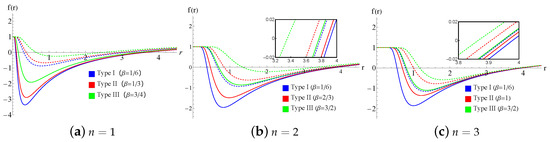
Figure 1 displays the metric function for different values of and n. The two intersections of each curve with the horizontal axis correspond to the inner and outer horizons, and their separation characterizes the horizon structure. For any fixed , Type III consistently yields the smallest , whereas Type I exhibits the largest . Further numerical calculations show that, as increases, the variation in the horizon separation is most pronounced for Type III; similarly, as n increases, Type III still displays the largest change in . Since both n and directly affect the horizon structure, we next employ observational data from the EHT to constrain the allowed ranges of these parameters.
Figure 1.
The metric function for different values of the parameters n and . The solid lines correspond to , while the dashed lines correspond to ().
2.2. Shadow Radius and Constraints from EHT
Photon motion in the spacetime described by Equation (1) follows null geodesics and can be obtained from the Lagrangian
where the overdot denotes differentiation with respect to an affine parameter . The equations of motion follow from the Euler–Lagrange equations,
together with the null condition .
Owing to the stationarity and spherical symmetry of the spacetime, the quantities associated with the Killing vectors and are conserved along the geodesics. These constants of motion are identified as the photon energy E and angular momentum L, defined by
Restricting the motion to the equatorial plane (), the radial component of the null geodesic equation can be conveniently expressed in terms of an effective potential. Defining the impact parameter and the rescaled affine parameter , the equations of motion become
where the effective potential governing photon motion is given by
Unstable circular photon orbits correspond to extrema of the effective potential and define the photon sphere. The photon sphere radius is therefore determined by
where is the critical impact parameter, corresponding to the shadow radius for a distant observer,
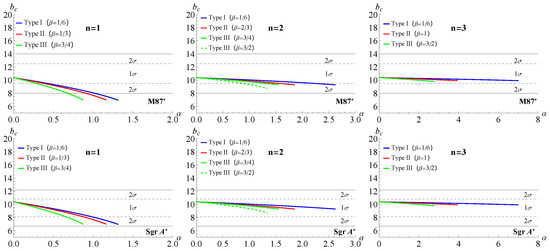
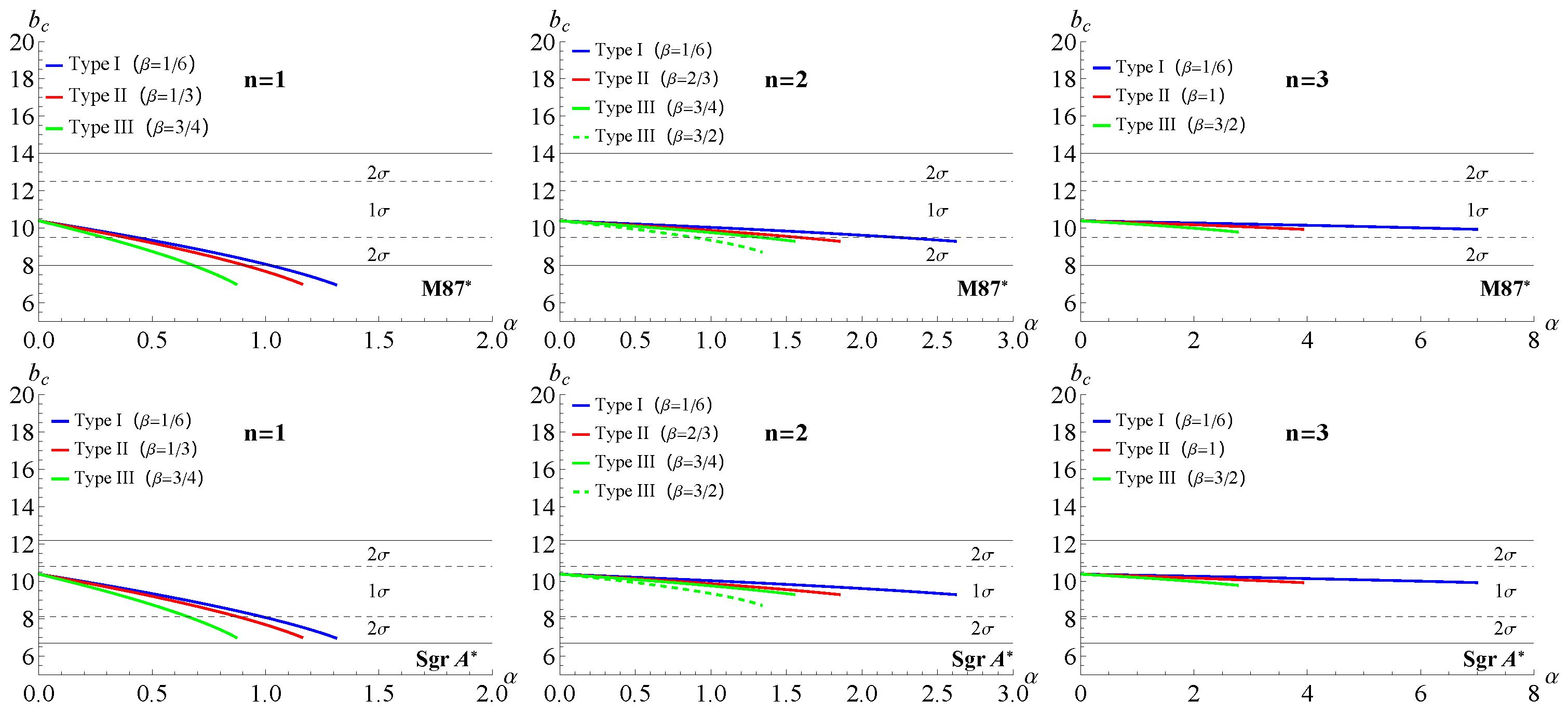
Since different values of the parameters n and modify the spacetime geometry and consequently the shadow radius, we constrain the parameter space using EHT measurements of the shadow radii. Specifically, by requiring the predicted shadow radius of each BH to lie within the corresponding observational uncertainty, quantitative bounds on the parameter can be obtained, as shown in Figure 2. The region enclosed by the two black dashed lines corresponds to the parameter space consistent with the M87* or SgrA* observation at the confidence level, while the region between the solid black line and the dashed line represents the parameter range allowed at the confidence level.
Figure 2.
The shadow radius of the BH for different values of the parameters and n (M = 2).
Using the observed shadow radius of M87*, [46,47], we derive quantitative bounds on the parameter . When , the bounds are for Type I (), for Type II (), and for Type III (). At the level, the corresponding limits tighten to , , and , respectively. When , meaningful constraints arise only at the level, where the upper bounds are for Type I (), for Type II (), for Type III (), and for the branch of Type III. No constraint can be established at . For , the predicted shadow radii of three BH types lie within the observational uncertainty over the entire parameter range, so that no effective bound on can be derived at either confidence level.
The measured shadow radius of Sgr A*, [6,7], likewise yields constraints on the parameter . When , no constraint is obtained at , whereas at the bounds are , , and for Type I, Type II, and Type III, respectively. When and , three BH types remain consistent with the observational range throughout the parameter space considered, and thus no constraint on can be imposed at either or .
Overall, the sensitivity of the shadow radius to decreases with increasing n, indicating that shadow-based constraints are more effective for smaller values of n. Furthermore, M87* offers tight bounds up to the level, while Sgr A* constrains only the case at . Regarding three BH types, Type III imposes the strictest limits on (e.g., for M87*), Type I allows the widest range (), and Type II lies between them. In the subsequent analysis of the BH’s optical appearance, we restrict the parameter to values consistent with these observational bounds. Specifically, for the case, M87* observations impose the most stringent upper limit at the confidence level, yielding for Type III. Therefore, we adopt as a representative upper bound in our numerical calculations. This choice serves two purposes. First, it ensures that all computed shadow images remain compatible with current EHT observations. Second, by positioning near the boundary of the allowed region, it maximizes the deviation from standard predictions, thereby highlighting the observable differences among the three BH types.
3. EHT-Based Optical Appearance of the Three BH Types
In this section, we consider a BH illuminated by an optically and geometrically thin accretion disk lying on the equatorial plane, while the observer is located at the north pole. We aim to investigate how the spacetime parameters n and affect the observable characteristics, assess whether these features can distinguish among the three BH types, and compare the resulting theoretical two-dimensional images with EHT observations.
3.1. Mechanism of Image Formation in Accretion Disk
Due to strong gravitational lensing effects, photon trajectories may intersect the accretion disk multiple times before either falling into the BH or escaping to infinity. According to the number of intersections between the photon trajectories and the accretion disk, the trajectories can be classified into three categories [48]. Photon trajectories that intersect the accretion disk only once correspond to the direct emission. Trajectories that intersect the disk twice give rise to the lensed ring. When photon trajectories intersect the disk three or more times before reaching the observer, they form the photon ring. These distinct classes of photon trajectories contribute differently to the observed image and encode important information about the spacetime geometry.
Based on Equation (8), the ranges of the impact parameter b for the three classes of photon trajectories around nonsingular BHs with a Minkowski core are summarized in Table A1 and Table A2. The results show clear and systematic dependence on the parameters n and for the three BH types. For fixed n, increasing shifts the direct emission region, the lensed ring, and the photon ring toward smaller values of b and increases the widths of both rings. In contrast, for fixed , increasing n shifts the entire structure toward larger b and reduces the ring widths. Among them, Type III consistently exhibits the largest lensed and photon ring widths, reflecting comparatively stronger gravitational lensing effects.
Each intersection between a photon trajectory and the accretion disk results in energy extraction from the disk, thereby contributing to the observed radiation. Assuming isotropic emission from a geometrically thin-disk and neglecting absorption, the invariance of along null geodesics implies [49]
where and denote the emitted and observed frequencies, respectively. Using the gravitational redshift relation , with [50], the observed specific intensity can be written as
Integrating over all frequencies yields the total observed intensity
For a given impact parameter b, a photon may intersect the accretion disk multiple times before reaching the observer. The total observed intensity is therefore obtained by summing the contributions from all such intersections,
where is the transfer function mapping the impact parameter b to the radial coordinate at the j-th intersection of the photon trajectory with the accretion disk. The slope corresponds to the demagnification factor. Larger j implies stronger demagnification, reducing their contributions to the total observed intensity [51,52]. Consequently, the observed intensity is dominated by the first three intersections between photon trajectories and the accretion disk, which give rise to the direct emission, the lensed ring, and the photon ring discussed below.
The total observed intensity is further specified by the emission profile according to Equation (14). To this end, we adopt the Gralla–Lupsasca–Marrone (GLM) emission model, which has been shown to accurately reproduce the observational predictions of general relativistic magnetohydrodynamic (GRMHD) simulations of astrophysical accretion disks [53,54]. The general functional form of this model is given by [55]
The shape of the intensity profile is characterized by three free parameters: , , and . Here, governs how rapidly the intensity rises from infinity to its peak; adjusts the radial location of the peak by shifting the profile; and determines the degree of radial dilation of the profile. Based on this formulation, we construct two distinct emission models for the thin accretion disk:
- ISCO model: This model adopts , , and , such that the emission is concentrated near the innermost stable circular orbit (ISCO).
- photon sphere model: This model takes , , and , so that the emission is concentrated near the photon sphere.
Here, denotes the radius of the ISCO, which is given by [51,56]
This expression reduces to the Schwarzschild value when .
3.2. Imaging Characteristics in the ISCO Model
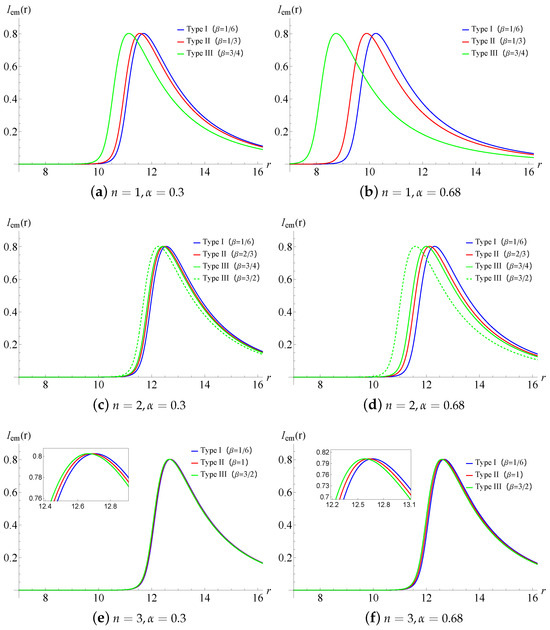
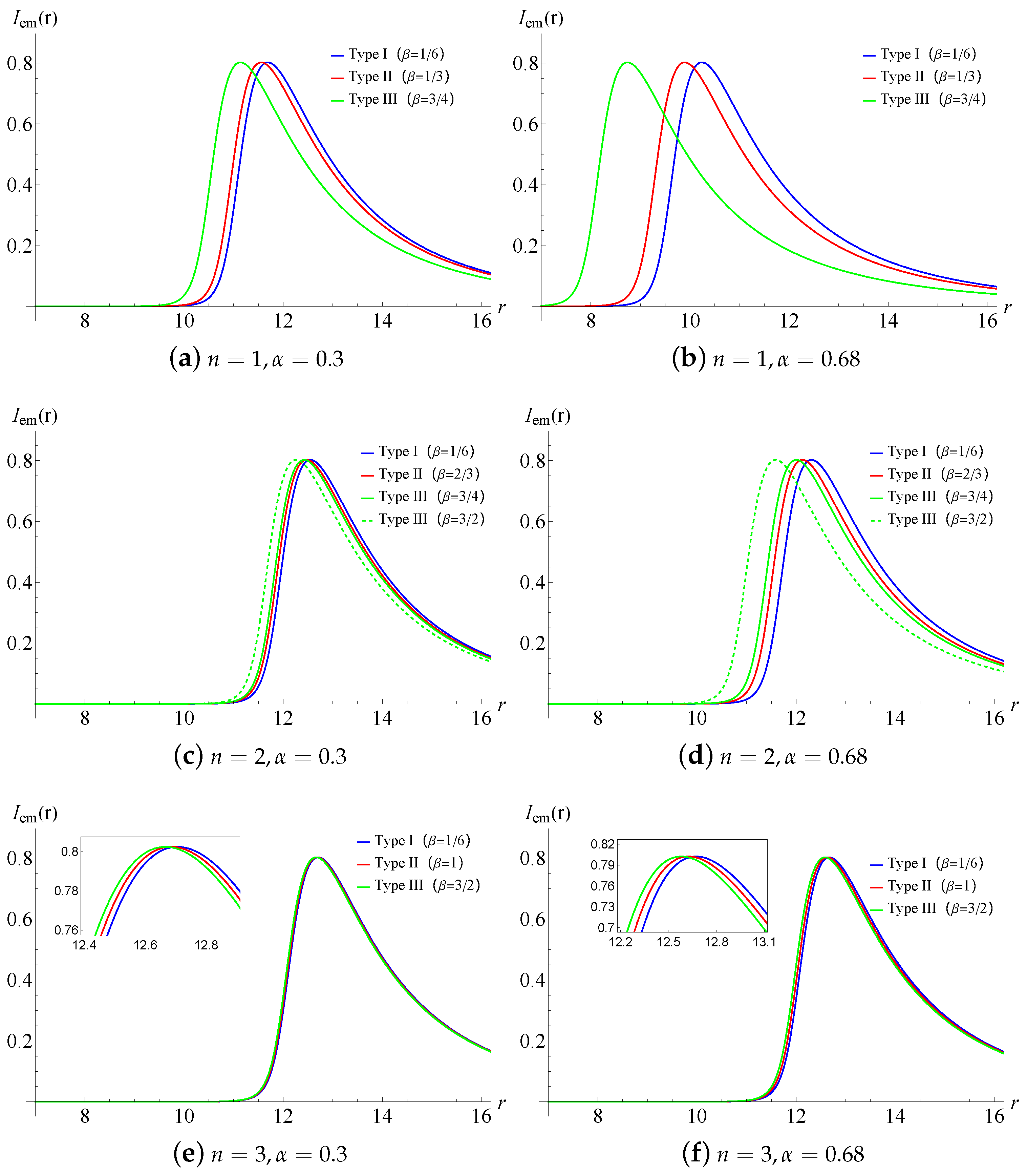
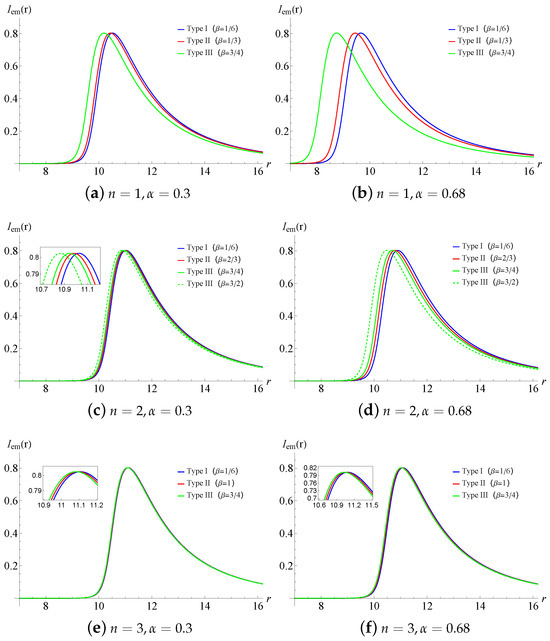
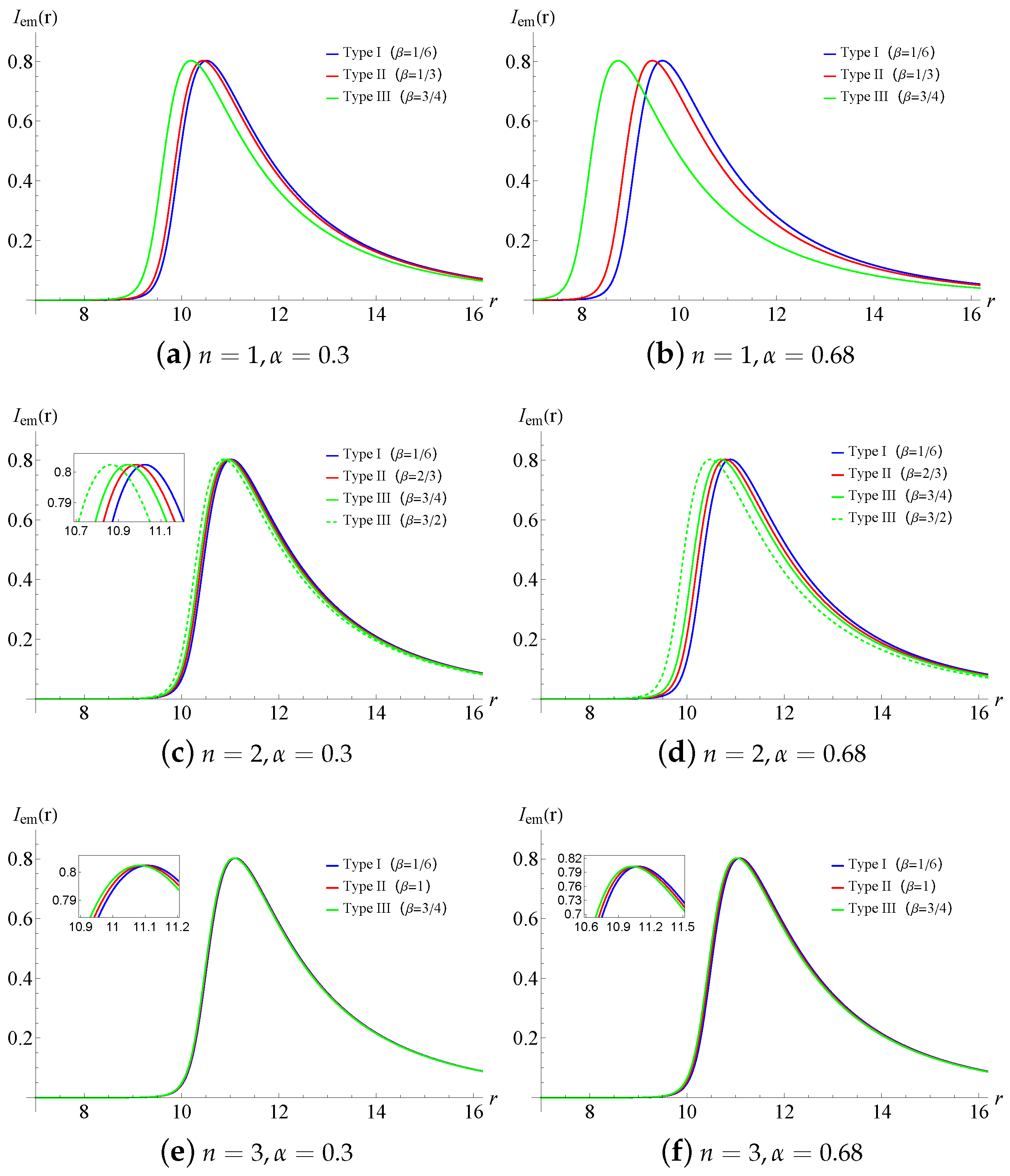
The emission intensity profiles for the ISCO model with different values of n and are presented in Figure 3. Within the ISCO model, the peak radius exhibits a clear hierarchy among the different BH types, with the peak associated with Type I located at the largest radius, followed by Type II, while Type III shows the smallest peak. This ordering directly reflects the corresponding hierarchy of the innermost stable circular orbit , which is largest for Type I and smallest for Type III. As the parameter increases, the emission peak shifts systematically inward, whereas increasing n moves the peak outward. For sufficiently small or large n, the peak positions for different BH types tend to converge.
Figure 3.
The intensity profile for different values of the parameters n and in the ISCO model (M = 2).
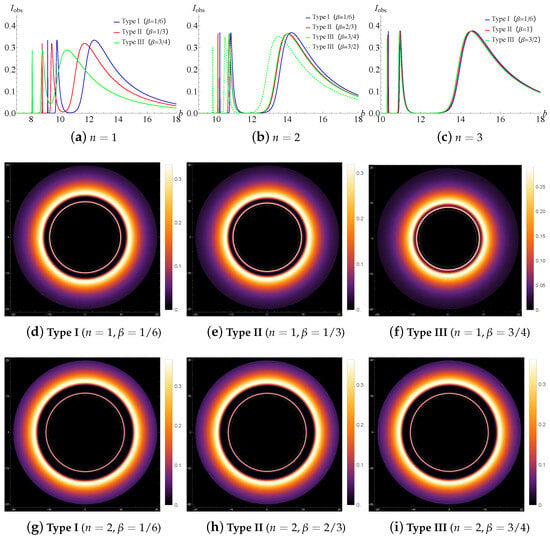
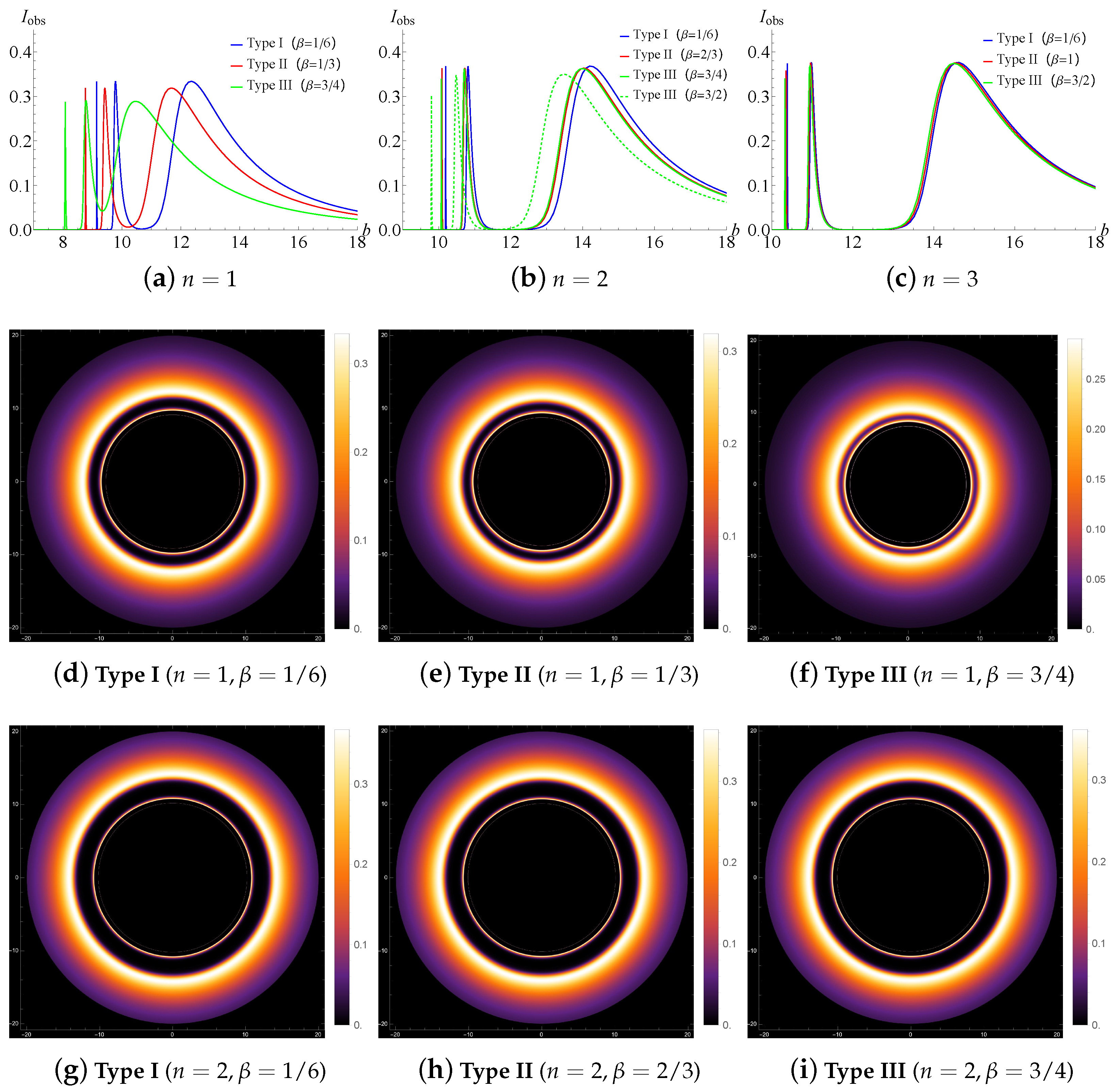
Using Equations (13)–(15), we compute the total observed intensity for the ISCO model and project the results onto a two-dimensional plane to obtain the corresponding BH optical appearance images, as shown in Figure 4 and Figure 5. Each peak in the total observed intensity corresponds to a bright ring in the resulting image. Figure 4 illustrates the total observed intensity distribution and the corresponding BH images for different values of the parameter n in the ISCO model. The total observed intensity exhibits three distinct peaks, which are associated with the photon ring, the lensed ring, and the direct emission region, respectively, and appear as three concentric bright ring-like structures in the BH images. Among the three BH types, Type I consistently shows the highest overall intensity and the clearest separation between the lensed ring and the direct emission, whereas Type III is characterized by the smallest central dark region. As n increases, the overall intensity level is enhanced and the separation between the lensed ring and the direct emission becomes more pronounced. Meanwhile, the peak locations corresponding to different BH types gradually approach each other, indicating that the morphological differences among the three types are reduced at larger values of n.
Figure 4.
The total observed intensity and BH images are presented for different values of the parameters n in the ISCO model (M = 2, ).
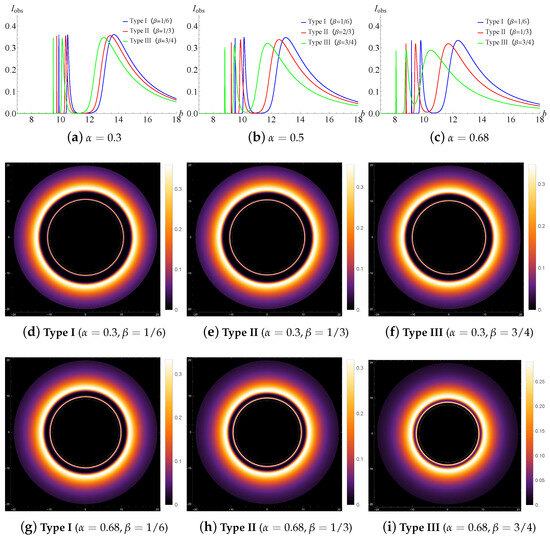
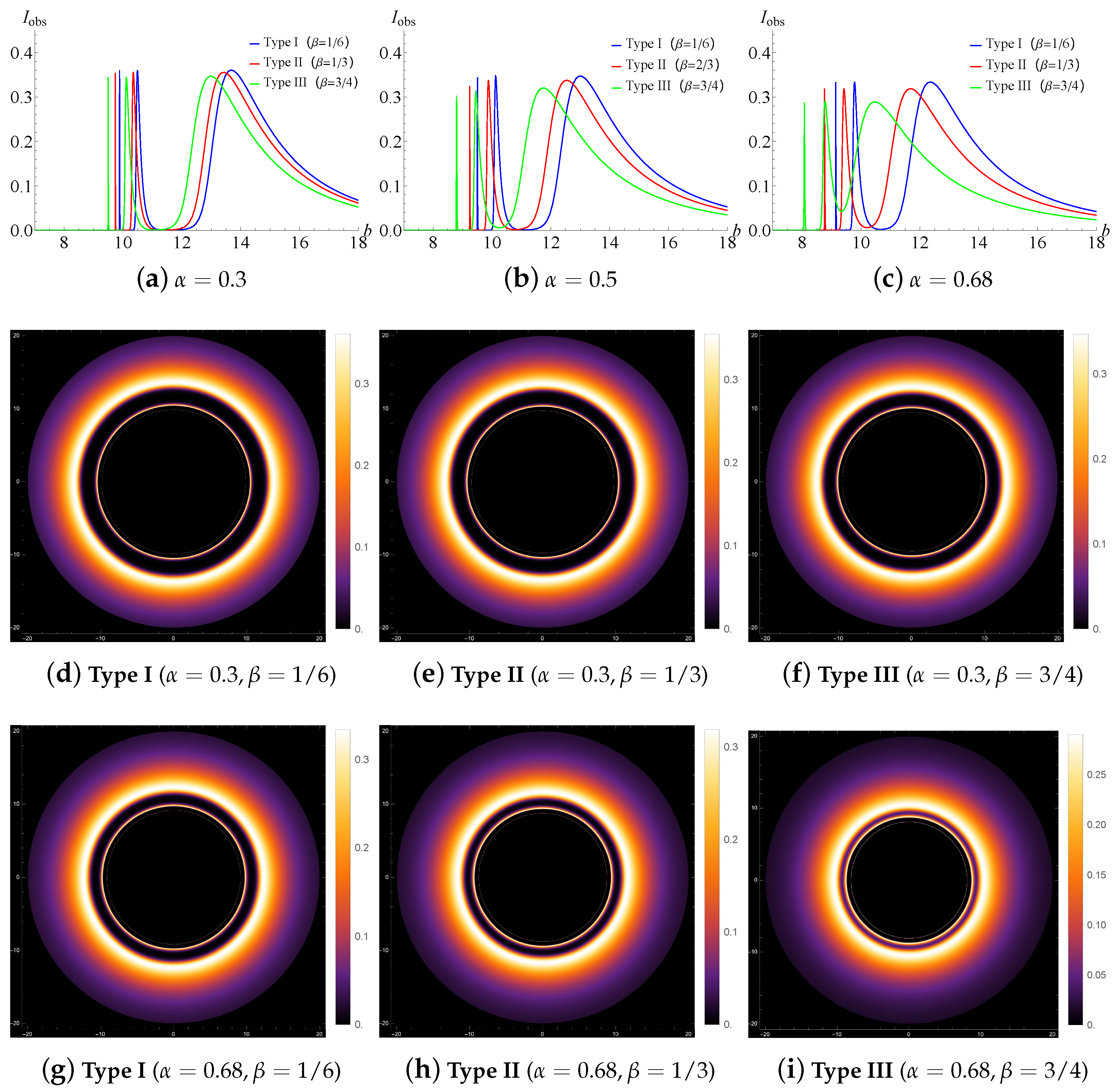
Figure 5.
The total observed intensity and BH images are presented for different values of the parameters in the ISCO model (M = 2, ).
Figure 5 presents the total observed intensity and the corresponding BH images for different values of the parameter with n fixed. Although the overall structure of three peaks is preserved, both the relative heights and the separations of the peaks are strongly affected by . Among the three BH types, Type I again exhibits the highest total observed intensity and the most pronounced separation between the lensed ring and the direct emission, while Type III retains the smallest central dark region. With increasing , the peak values of the total observed intensity decrease and the separation between the lensed ring and the direct emission is significantly reduced. In particular, for and , the regions of direct emission and the lensed ring partially overlap, further weakening the visual distinction between different emission components. For smaller values of , the peak positions corresponding to different BH types become closer, making the images of different BH types increasingly similar.
In the ISCO model, the parameters n and play a central role in shaping the BH optical appearance. As n increases, the total observed intensity is enhanced and the separation between the lensed ring and the direct emission becomes more pronounced, while the peak locations associated with different BH types gradually converge. By contrast, increasing systematically reduces the total intensity and suppresses the strongly lensed emission, leading to a diminished separation between different radiation components and, in some cases, an overlap between the lensed ring and the direct emission. As a result, larger values of n or smaller values of tend to reduce the morphological differences among the three BH types, thereby limiting their observational distinguishability. Across the parameter space considered, the direct emission dominates the total observed intensity, followed by the lensed ring, whereas the photon ring contributes negligibly.
3.3. Imaging Characteristics in the Photon Sphere Model
The emission intensity profiles for the photon sphere model with different values of n and are shown in Figure 6. Although a similar ordering of peak radii is observed to that in ISCO model, the underlying mechanism is different. In the photon sphere model, the emission peak exhibits a systematic shift toward smaller radii from Type I to Type III. This trend is directly governed by the characteristic radius , which decreases monotonically across the three BH types. Increasing drives the peak inward, whereas larger values of n shift it outward. For sufficiently small or large n, the peak positions associated with different BH types become increasingly clustered, reducing their separability in the radial emission profile.
Figure 6.
The intensity profile for different values of the parameters n and in the photon sphere model (M = 2).
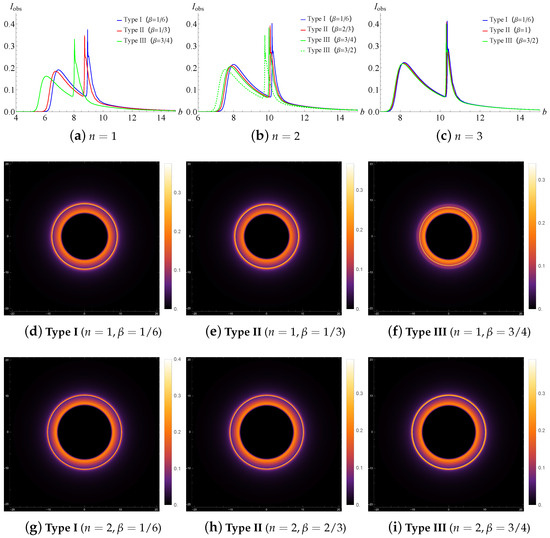
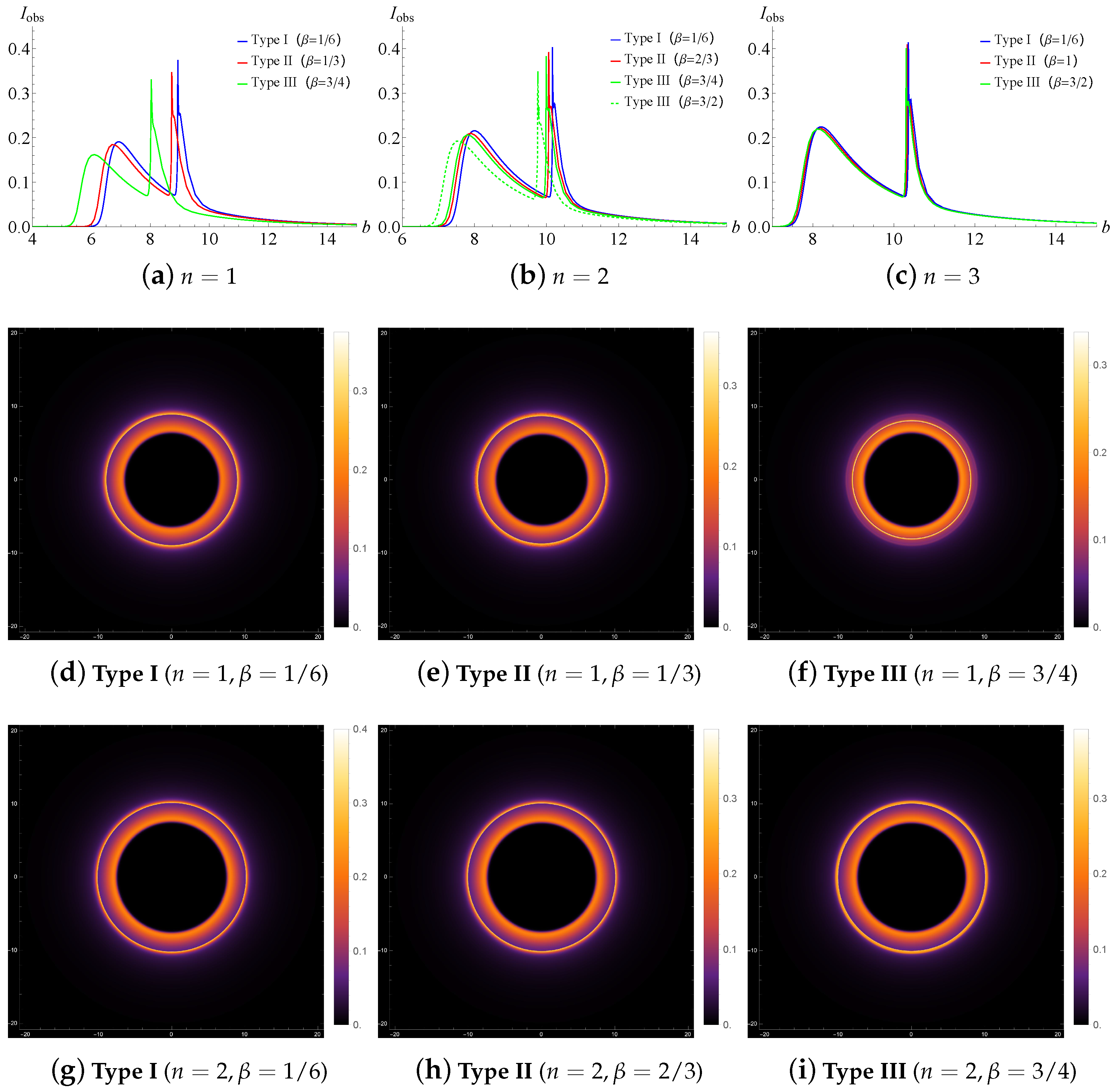
Following the same method as in Section 3.2, we compute the total observed intensity for the photon sphere model and construct the corresponding two-dimensional BH optical appearance in Figure 7 and Figure 8. Figure 7 shows the total observed intensity and the corresponding images for different values of n in the photon sphere model. In contrast to ISCO model, the total observed intensity distribution exhibits only two distinct peaks: the first corresponds to the direct emission region, while the second is dominated by the photon ring and the lensed ring. Owing to the overlap between the photon ring and the lensed ring, radiation in this region is highly concentrated, leading to a second peak whose maximum is significantly higher than that of the first peak. For , three BH types exhibit noticeable differences in both peak intensities and locations. As n increases, these differences gradually diminish, and for the intensity profiles of three BH types almost coincide. Among all cases, Type I consistently shows the strongest total intensity and the largest central dark region.
Figure 7.
The total observed intensity and BH images are presented for different values of the parameter n in the photon sphere model (M = 2, ).
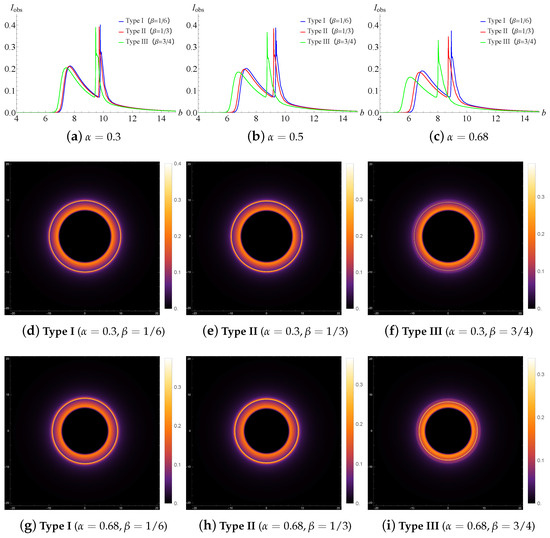
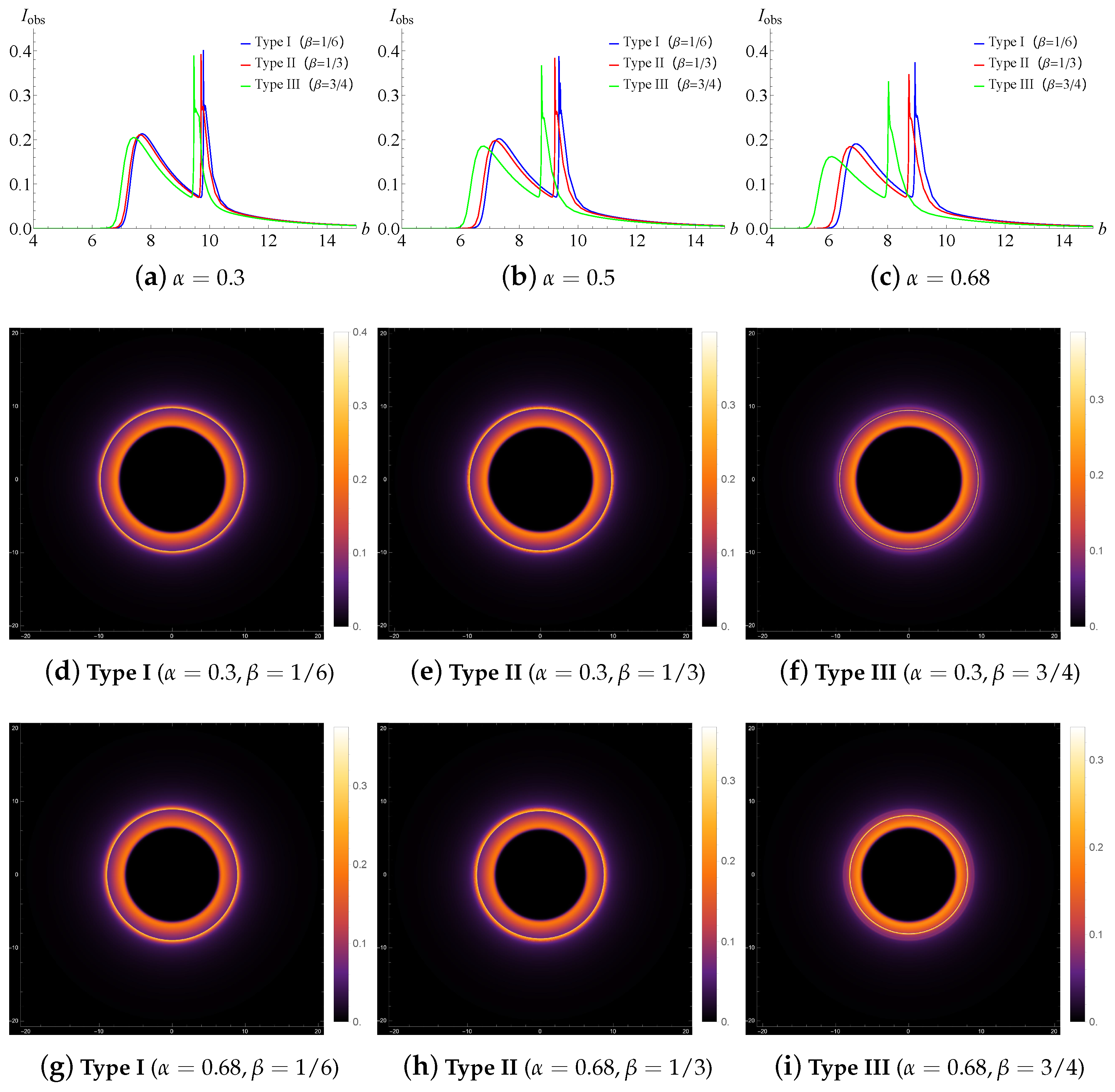
Figure 8.
The total observed intensity and BH images are presented for different values of the parameter in photon sphere model (M = 2, ).
Figure 8 displays the total observed intensity distribution and the corresponding BH images for different values of in the photon sphere model with fixed n. In all cases, the intensity distribution retains two distinct peaks, with the first peak arising from direct emission and the second associated with strong gravitational lensing dominated by the photon and lensed rings. As increases, the overall intensity decreases and the second peak is suppressed, indicating a reduction in radiation enhancement from the strongly lensed region. Meanwhile, the distinctions between the three BH types become more pronounced, particularly manifested in the height and position of the second peak. This suggests that larger values of enhance the observational distinguishability among three BH types in the photon sphere model.
Despite the more compact optical structure of the photon sphere model compared to the ISCO model, the total observed intensity remains dominated by direct emission throughout the entire parameter range considered. Within this model, increasing n gradually diminishes the differences in the total observed intensity among the three BH types, particularly in the strongly lensed region. In contrast, variations in have a pronounced impact on the lensed emission contribution, tending to accentuate differences in both the height and location of the associated intensity peak. Overall, both emission prescriptions exhibit the same qualitative trend: larger n or smaller reduces the morphological distinctions among the three BH types.
3.4. EHT-like BH Images and Finite-Resolution Effects
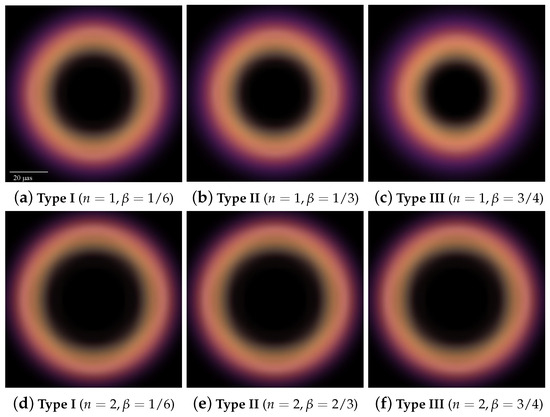
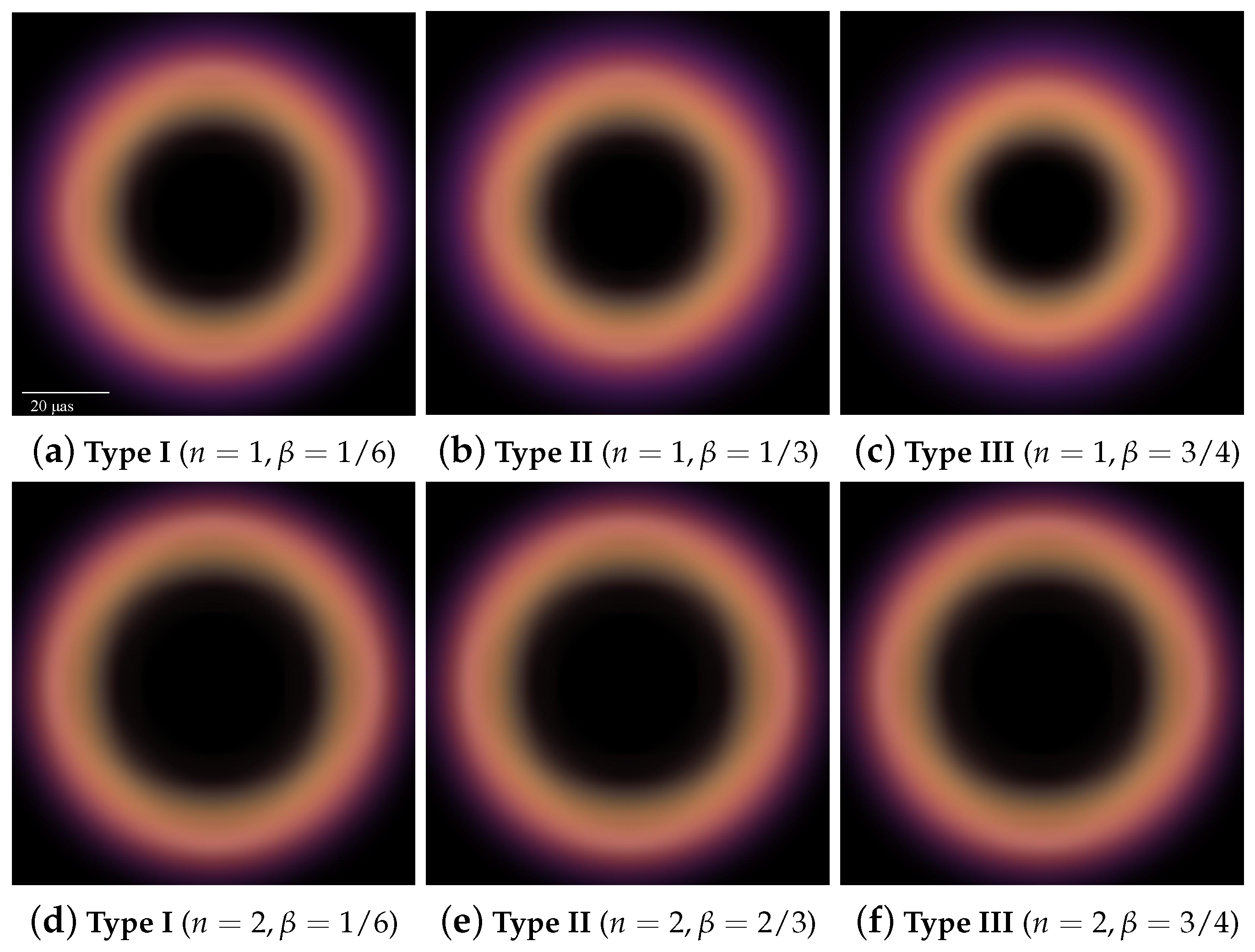
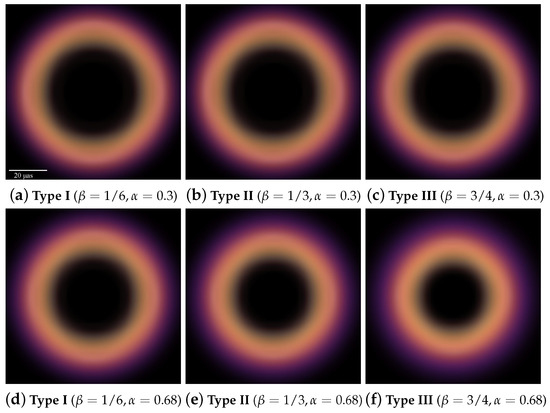
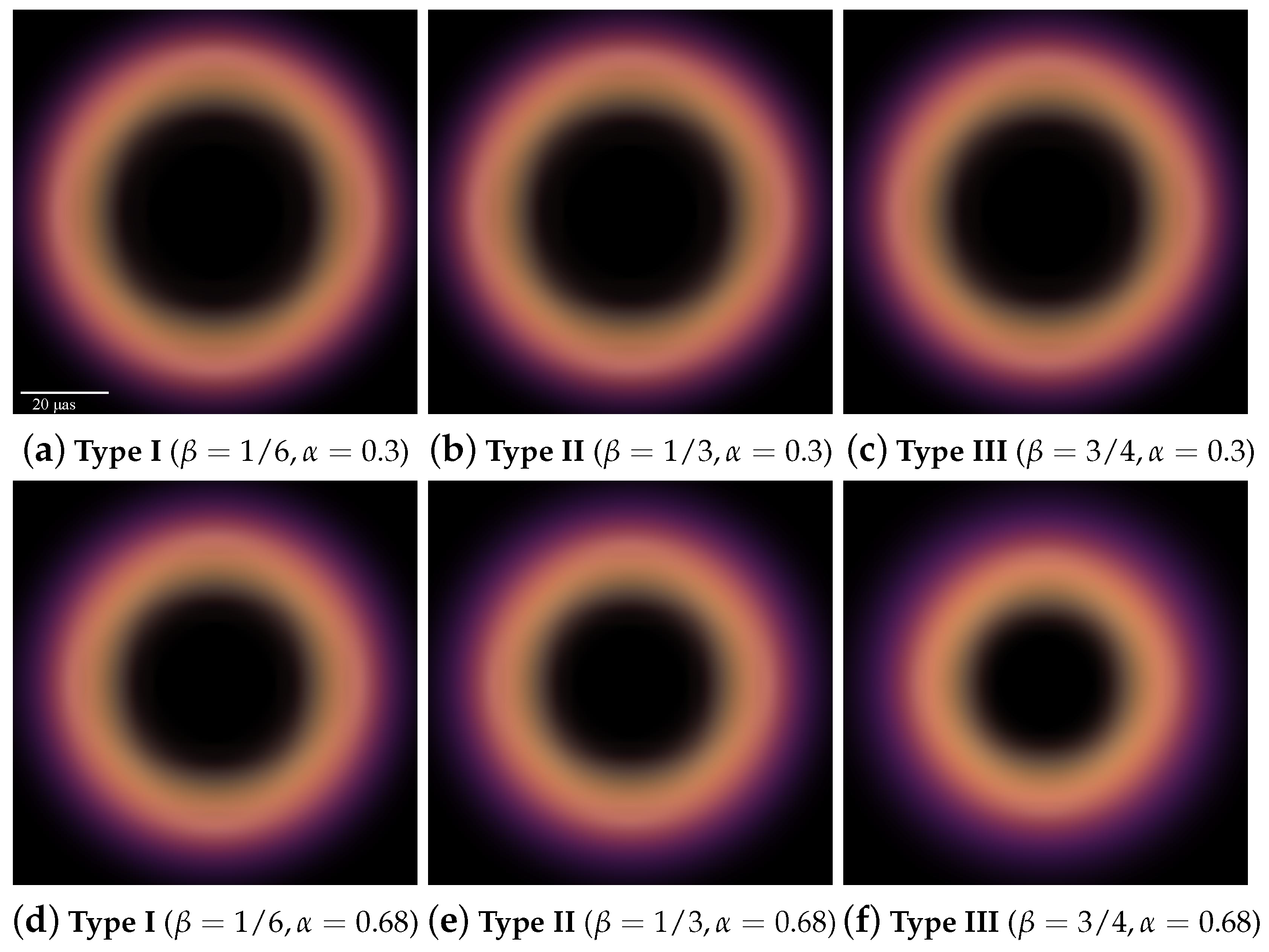
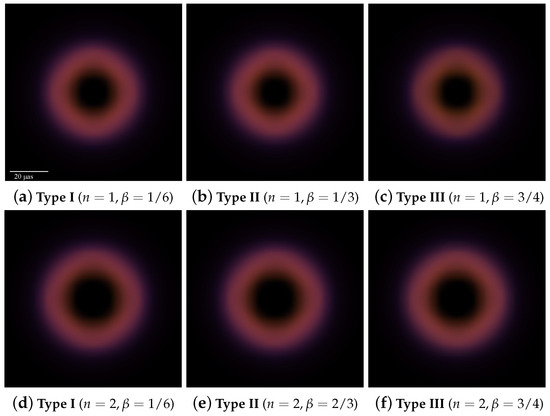
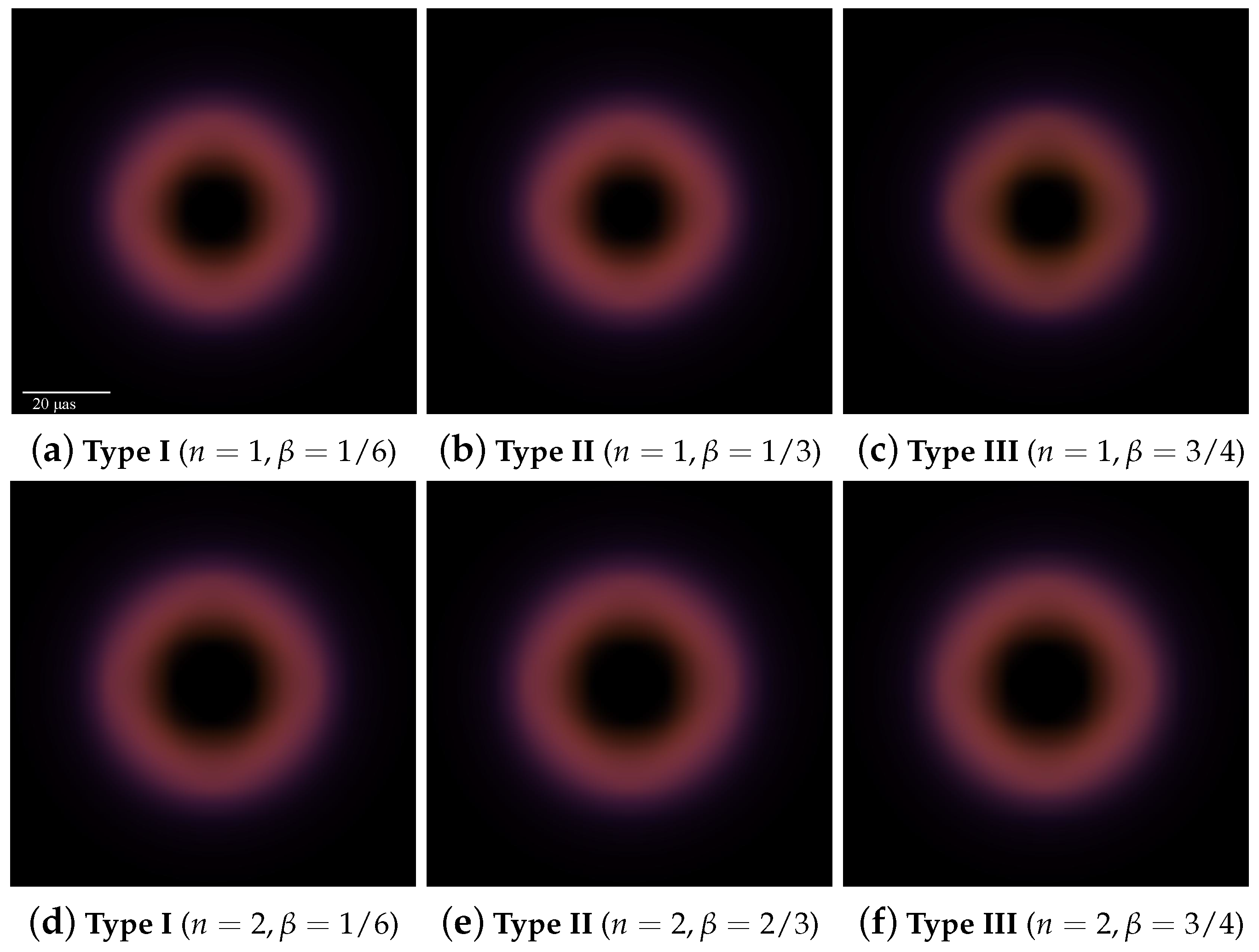
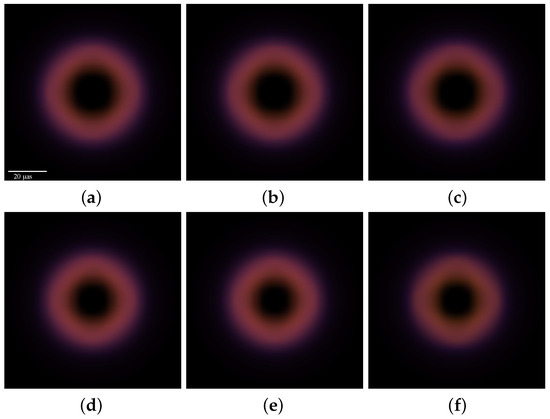
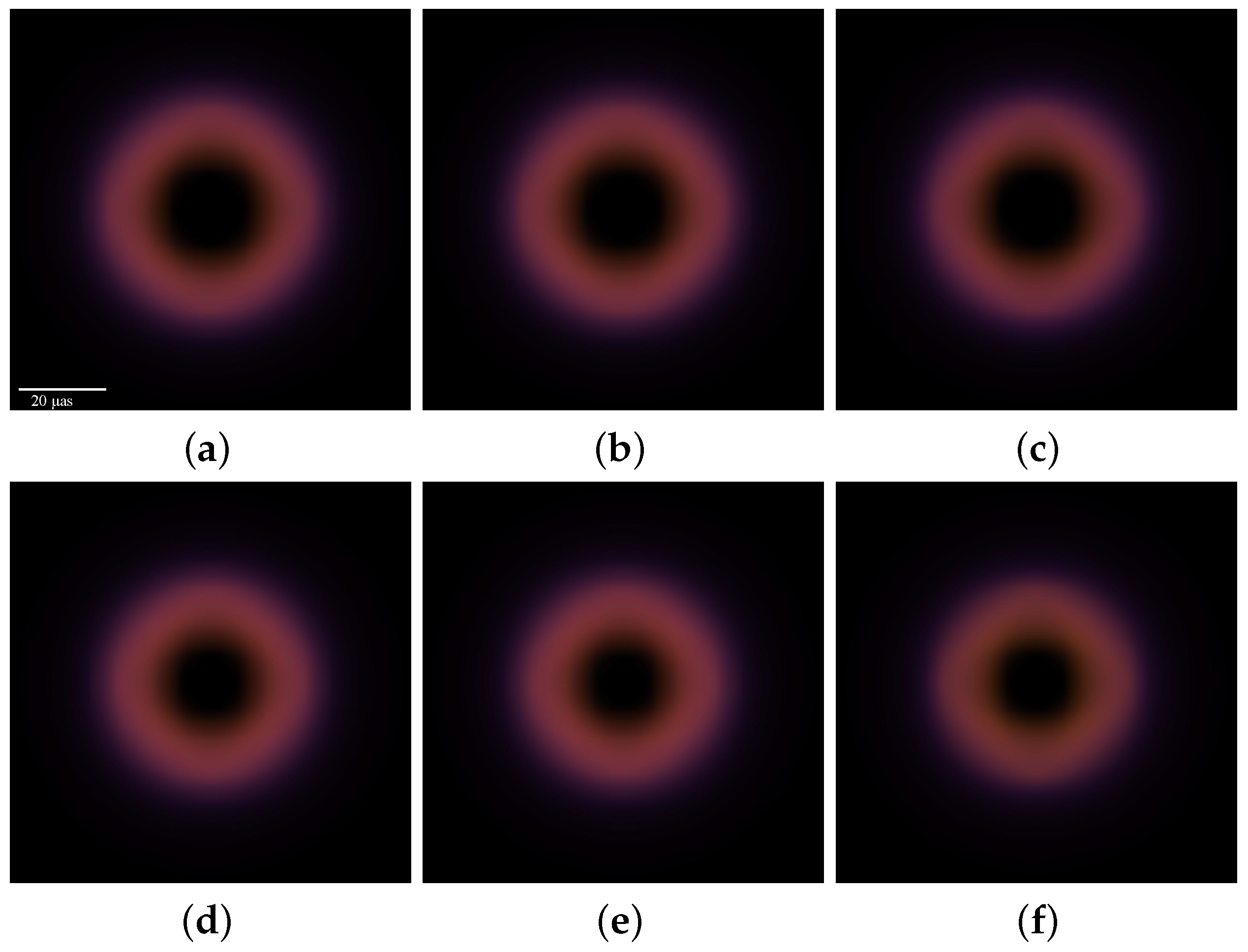
To better mimic realistic astrophysical observing conditions, we apply a Gaussian filter to the thin-disk accretion images of the three BH types, thereby approximating the finite imaging resolution of the EHT, as shown in Figure 9, Figure 10, Figure 11 and Figure 12. The resulting blurred two-dimensional images are obtained using a Gaussian filter with a standard deviation equal to of the field of view [11,14,48]. It should be emphasized that this procedure provides only a rough approximation to the effective resolution of the EHT in thin-disk accretion scenarios, rather than an exact reproduction of the actual observational process. For consistency, Figure 9, Figure 10, Figure 11 and Figure 12 use the same intensity normalization as Figure 4, Figure 5, Figure 7 and Figure 8, respectively. The first column in each figure corresponds to Type I, the second column to Type II, and the third column to Type III.
Figure 9.
Simulated BH images of ISCO model for different values of n (, ). The same intensity normalization and color scale as in Figure 4 are adopted.
Figure 10.
Simulated BH images of ISCO model for different values of (, ). The same intensity normalization and color scale as in Figure 5 are adopted.
Figure 11.
Simulated BH images of photon sphere model for different values of n (, ). The same intensity normalization and color scale as in Figure 7 are adopted.
Figure 12.
Simulated BH images of photon sphere model for different values of (, ). The same intensity normalization and color scale as in Figure 8 are adopted. (a) Type I (), (b) Type II (), (c) Type III (), (d) Type I (), (e) Type II (), (f) Type III ().
Figure 9 and Figure 10 present the simulated images of the three BH types in the ISCO model for different values of the parameters and n. At this resolution level, fine structures such as photon rings and lensed rings can no longer be clearly resolved. Nevertheless, the overall size of the BH shadow and the surrounding brightness distribution still exhibit observable differences. In particular, the Type III consistently shows the smallest central dark region, whereas the Type I exhibits the largest one, leading to systematic differences in the global brightness distribution among different BH types. In addition, it is found that the shadow size increases with increasing n or decreasing , in which case the imaging differences among the three BH types become more pronounced.
Figure 11 and Figure 12 display the corresponding results in the photon sphere model for the same parameter variations. Overall, the qualitative behavior remains consistent with that in ISCO model, with the three BH types following similar trends in the size of the central dark region and the brightness distribution. However, compared to the ISCO model, the photon sphere model exhibits significantly diminished imaging distinctions among the three BH types. The subtler variations in shadow size and brightness distribution hinder their distinguishability under limited resolution.
In addition, a comparison among two thin-disk emission models indicates that the radiative properties and spatial distribution of the accretion flow can systematically affect the overall morphology of the BH shadow and the associated brightness distribution. Therefore, when distinguishing between different BH types in thin-disk accretion scenarios, the effects of different accretion models should be considered.
4. Conclusions and Discussions
In this work, we systematically investigated the optical appearance and shadow properties of nonsingular BHs with a Minkowski core within a thin-disk accretion framework. Our analysis focuses on the connection between the internal curvature structure of these spacetimes and their horizon properties, shadow size, and image morphology. Although the three classes of nonsingular BHs considered here share the same Minkowski core at the center, their observable characteristics exhibit clear quantitative differences. Specifically, the radii of the outer horizon and the BH shadow are largest for Type I configurations, followed by Type II and Type III, while the inner horizon radius exhibits an opposite ordering. In addition, the shadow radius decreases monotonically with increasing values of parameter and increases with increasing values of parameter n. For larger values of or smaller values of n, the differences among the three BH types become more pronounced.
By leveraging EHT shadow size constraints from both M87* and Sgr A*, we derived quantitative bounds on the model parameters. While both sources were analyzed, our results demonstrate that M87* provides significantly tighter restrictions. Specifically, the constraining power on exhibits a strong dependence on the parameter n and the BH type: for , robust constraints are established at both and confidence levels, with Type III imposing the most stringent limits (). In contrast, for , viable bounds are restricted to the level, while for , current observational precision is insufficient to place any significant limits. Notably, Sgr A* yields effective constraints only for the case at the level, underscoring the superior sensitivity of M87* observations. These findings highlight that the efficacy of shadow-based tests varies substantially across different geometric configurations. Consequently, for our subsequent analysis of the BH’s optical appearance, we adopt the most stringent upper bound derived from M87* (). This choice serves a dual purpose: it ensures full compatibility with current observational data, and by positioning at the boundary of the allowed region, it maximizes the deviation from standard General Relativity predictions, thereby providing the most favorable conditions to reveal observable distinctions among the three BH types.
We further examined the imaging properties of these BHs within thin-disk accretion scenarios, strictly adhering to the parameter space constrained by EHT shadow size observations. Distinct differences are observed among the three BH types in terms of total observed intensity, shadow size, and brightness distribution. Specifically, Type I consistently exhibits the strongest total intensity and the largest shadow size, whereas Type III displays the most compact features. Our analysis reveals that while the total observed intensity increases with n and decreases with , the morphological distinctions among the three BH types are most pronounced at smaller n or larger . Crucially, by simulating images with finite resolution comparable to current EHT capabilities, we demonstrate that although fine sub-structures (such as distinct lensed and photon rings) remain unresolved, the differences in the central shadow’s diameter and the global brightness distribution are still clearly discernible. These EHT-resolvable features provide a viable observational avenue for discriminating among the three BH types.
In addition, a comparison between different thin-disk emission models reveals noticeable variations in the size of the central dark region and the brightness distribution. This indicates that, within thin-disk accretion scenarios, the radiative properties of the accretion flow play an important role in shaping the optical appearance of BHs. These findings highlight the necessity of a careful treatment of accretion models when interpreting horizon-scale images and constraining spacetime geometry using BH observations.
In summary, by systematically linking the internal curvature structure of nonsingular BHs with a Minkowski core to their observable optical features, this study provides a theoretical basis for distinguishing different geometric classes and constraining model parameters through BH imaging. Looking ahead, next-generation EHT observations combined with more realistic accretion models are expected to further clarify the relationship between near-core geometry and observable signatures in the strong-field regime.
Author Contributions
Conceptualization, J.P.; methodology, G.-P.L., J.P. and Y.L.; validation, M.-X.L. and J.P.; formal analysis, G.-P.L., J.P. and Y.L.; investigation, M.-X.L.; resources, J.P., Y.L. and G.-P.L.; data curation, M.-X.L.; writing—original draft preparation, M.-X.L.; writing—review and editing, J.P. All authors have read and agreed to the published version of the manuscript.
Funding
This work is supported by Sichuan Science and Technology Program (2023NSFSC1352) and by the starting fund of China West Normal University (Nos. 20E069 and 20A013).
Data Availability Statement
No new data were created or analyzed in this study.
Conflicts of Interest
The authors declare no conflicts of interest.
Appendix A. Ranges of the Impact Parameter for Photon Trajectories
Table A1.
The impact parameter ranges of the direct emission, lensed ring, and photon ring for different values of (, ). Note: Type I, Type II, and Type III represent different types of BHs.
Table A2.
The impact parameter ranges of the direct emission, lensed ring, and photon ring for different values of n (, ). Note: Type I, Type II, and Type III represent different types of black holes.
References
- Abbott, B.P.; et al. [LIGO Scientific and Virgo Collaborations] GW170104: Observation of a 50-Solar-Mass Binary Black Hole Coalescence at Redshift 0.2. Phys. Rev. Lett. 2017, 118, 221101. [Google Scholar] [CrossRef] [Scilit]
- Abbott, B.P.; et al. [LIGO Scientific and Virgo Collaborations] GW150914: The Advanced LIGO Detectors in the Era of First Discoveries. Phys. Rev. Lett. 2016, 116, 131103. [Google Scholar] [CrossRef] [Scilit]
- Abbott, R.; et al. [LIGO Scientific and Virgo Collaborations GW190412: Observation of a Binary-Black-Hole Coalescence with Asymmetric Masses. Phys. Rev. D 2020, 102, 043015. [Google Scholar] [CrossRef] [Scilit]
- Akiyama, K.; et al. [Event Horizon Telescope Collaboration] First M87 Event Horizon Telescope Results. I. The Shadow of the Supermassive Black Hole. Astrophys. J. Lett. 2019, 875, L1. [Google Scholar]
- Akiyama, K.; et al. [Event Horizon Telescope Collaboration] First M87 Event Horizon Telescope Results. II. Array and Instrumentation. Astrophys. J. Lett. 2019, 875, L2. [Google Scholar]
- Akiyama, K.; et al. [Event Horizon Telescope Collaboration] First Sagittarius A* Event Horizon Telescope Results. I. The Shadow of the Supermassive Black Hole in the Center of the Milky Way. Astrophys. J. Lett. 2022, 930, L12. [Google Scholar]
- Akiyama, K.; et al. [Event Horizon Telescope Collaboration] First Sagittarius A* Event Horizon Telescope Results. VI. Testing the Black Hole Metric. Astrophys. J. Lett. 2022, 930, L17. [Google Scholar]
- Medeiros, L.; Psaltis, D.; Özel, F. A Parametric model for the shapes of black-hole shadows in non-Kerr spacetimes. Astrophys. J. 2020, 896, 7. [Google Scholar] [CrossRef] [Scilit]
- Vagnozzi, S.; Roy, R.; Tsai, Y.D.; Visinelli, L.; Afrin, M.; Allahyari, A.; Bambhaniya, P.; Dey, D.; Ghosh, S.G.; Joshi, P.S.; et al. Horizon-scale tests of gravity theories and fundamental physics from the Event Horizon Telescope image of Sagittarius A*. Class. Quant. Grav. 2023, 40, 165007. [Google Scholar] [CrossRef] [Scilit]
- Uniyal, A.; Dihingia, I.K.; Mizuno, Y.; Rezzolla, L. The future ability to test theories of gravity with black-hole shadows. Nat. Astron. 2025, 1, 8. [Google Scholar] [CrossRef] [Scilit]
- Zeng, X.X.; He, K.J.; Li, G.P. Effects of dark matter on shadows and rings of Brane-World black holes illuminated by various accretions. Sci. China Phys. Mech. Astron. 2022, 65, 290411. [Google Scholar] [CrossRef] [Scilit]
- Glampedakis, K.; Pappas, G. Can supermassive black hole shadows test the Kerr metric? Phys. Rev. D 2021, 104, L081503. [Google Scholar] [CrossRef] [Scilit]
- Psaltis, D.; et al. [Event Horizon Telescope Collaboration] Gravitational Test Beyond the First Post-Newtonian Order with the Shadow of the M87 Black Hole. Phys. Rev. Lett. 2020, 125, 141104. [Google Scholar] [CrossRef] [Scilit]
- Guo, S.; Li, G.R.; Liang, E.W. Observable characteristics of the charged black hole surrounded by thin-disk accretion in Rastall gravity. Class. Quant. Grav. 2022, 39, 135004. [Google Scholar] [CrossRef] [Scilit]
- Zeng, X.X.; Aslam, M.I.; Saleem, R. The optical appearance of charged four-dimensional Gauss–Bonnet black hole with strings cloud and non-commutative geometry surrounded by various accretions profiles. Eur. Phys. J. C 2023, 83, 129. [Google Scholar] [CrossRef] [Scilit]
- Meng, Y.; Kuang, X.M.; Tang, Z.Y. Photon regions, shadow observables, and constraints from M87* of a charged rotating black hole. Phys. Rev. D 2022, 106, 064006. [Google Scholar] [CrossRef] [Scilit]
- Synge, J.L. The Escape of Photons from Gravitationally Intense Stars. Mon. Not. Roy. Astron. Soc. 1966, 131, 463. [Google Scholar] [CrossRef] [Scilit]
- Luminet, J.P. Image of a spherical black hole with thin accretion disk. Astron. Astrophys. 1979, 75, 228. [Google Scholar]
- Bardeen, J.M.; Press, W.H.; Teukolsky, S.A. Rotating black holes: Locally nonrotating frames, energy extraction, and scalar synchrotron radiation. Astrophys. J. 1972, 178, 347. [Google Scholar] [CrossRef] [Scilit] [PubMed]
- Bardeen, J.M. Non-singular general relativistic gravitational collapse. In Proceedings of the 5th International Conference on Gravitation and the Theory of Relativity; USSR: Tbilisi, The Republic of Georgia, 1968; p. 87. [Google Scholar]
- Ayon-Beato, E.; Garcia, A. The Bardeen model as a nonlinear magnetic monopole. Phys. Lett. B 2000, 493, 149–152. [Google Scholar] [CrossRef] [Scilit]
- Frolov, V.P. Information loss problem and a ’black hole’ model with a closed apparent horizon. JHEP 2014, 5, 049. [Google Scholar] [CrossRef] [Scilit]
- Bonanno, A.; Reuter, M. Renormalization group improved black hole space-times. Phys. Rev. D 2000, 62, 043008. [Google Scholar] [CrossRef] [Scilit]
- Bronnikov, K.A. Regular magnetic black holes and monopoles from nonlinear electrodynamics. Phys. Rev. D 2001, 63, 044005. [Google Scholar] [CrossRef] [Scilit]
- Khachatryan, V.; et al. [CMS Collaboration] Measurement of the inclusive 3-jet production differential cross section in proton–proton collisions at 7 TeV and determination of the strong coupling constant in the TeV range. Eur. Phys. J. C 2015, 75, 186. [Google Scholar] [CrossRef] [Scilit]
- Culetu, H. On a regular charged black hole with a nonlinear electric source. Int. J. Theor. Phys. 2015, 54, 2855–2863. [Google Scholar] [CrossRef] [Scilit]
- Xiang, L.; Ling, Y.; Shen, Y.G. Singularities and the Finale of Black Hole Evaporation. Int. J. Mod. Phys. D 2013, 22, 1342016. [Google Scholar] [CrossRef] [Scilit]
- Simpson, A.; Visser, M. Regular black holes with asymptotically Minkowski cores. Universe 2019, 6, 8. [Google Scholar] [CrossRef] [Scilit]
- Ling, Y.; Wu, M.H. Regular black holes with sub-Planckian curvature. Class. Quant. Grav. 2023, 40, 075009. [Google Scholar] [CrossRef] [Scilit]
- Ayon-Beato, E.; Garcia, A. Four parametric regular black hole solution. Gen. Rel. Grav. 2005, 37, 635. [Google Scholar] [CrossRef] [Scilit]
- Feng, Q.M.; Pu, J.; Jiang, Q.Q. Effects of magnetic monopole charge on Joule–Thomson expansion of regular Ayón Beato–García black hole. Class. Quant. Grav. 2022, 39, 155007. [Google Scholar] [CrossRef] [Scilit]
- Guo, S.; Li, G.R.; Li, G.P. Shadow thermodynamics of an AdS black hole in regular spacetime. Chin. Phys. C 2022, 46, 095101. [Google Scholar] [CrossRef] [Scilit]
- Kumara, A.N.; Rizwan, C.L.A.; Punacha, S.; Ajith, K.M.; Ali, M.S. Photon orbits and thermodynamic phase transition of regular AdS black holes. Phys. Rev. D 2020, 102, 084059. [Google Scholar] [CrossRef] [Scilit]
- Ling, Y.; Wu, M.H. The Shadows of Regular Black Holes with Asymptotic Minkowski Cores. Symmetry 2022, 14, 2415. [Google Scholar] [CrossRef] [Scilit]
- da Silva, L.F.D.; Lobo, F.S.N.; Olmo, G.J.; Rubiera-Garcia, D. Photon rings as tests for alternative spherically symmetric geometries with thin accretion disks. Phys. Rev. D 2023, 108, 084055. [Google Scholar] [CrossRef] [Scilit]
- Zheng, H.B.; Wu, M.Q.; Li, G.P.; Jiang, Q.Q. Shadows and accretion disk images of charged rotating black hole in modified gravity theory. Eur. Phys. J. C 2025, 85, 46. [Google Scholar] [CrossRef] [Scilit]
- Li, G.P.; Zheng, H.B.; He, K.J.; Jiang, Q.Q. The shadow and observational images of the non-singular rotating black holes in loop quantum gravity. Eur. Phys. J. C 2025, 85, 249. [Google Scholar] [CrossRef] [Scilit]
- Li, J.S.; Guo, S.; Huang, Y.X.; Jiang, Q.Q.; Lin, K. Imaging characteristics of Frolov black holes under different accretion models. Eur. Phys. J. C 2025, 85, 1125. [Google Scholar] [CrossRef] [Scilit]
- He, K.J.; Guo, S.; Tan, S.C.; Li, G.P. Shadow images and observed luminosity of the Bardeen black hole surrounded by different accretions. Chin. Phys. C 2022, 46, 085106. [Google Scholar] [CrossRef] [Scilit]
- Mou, P.H.; Chen, Y.X.; He, K.J.; Li, G.P. Shadows and observational appearance of a new family of Ayón-Beato-García black holes. Commun. Theor. Phys. 2022, 74, 125401. [Google Scholar] [CrossRef] [Scilit]
- Culetu, H. On a regular modified Schwarzschild spacetime. arXiv 2013, arXiv:1305.5964. [Google Scholar] [CrossRef] [Scilit]
- Modesto, L. Disappearance of black hole singularity in quantum gravity. Phys. Rev. D 2004, 70, 124009. [Google Scholar] [CrossRef] [Scilit]
- Zeng, W.; Ling, Y.; Jiang, Q.Q.; Li, G.P. Accretion disk for regular black holes with sub-Planckian curvature. Phys. Rev. D 2023, 108, 104072. [Google Scholar] [CrossRef] [Scilit]
- Xiong, Y.; Pu, J.; Ling, Y.; Li, G.P.; Deng, G.M. Investigating the shadows of new regular black holes with a Minkowski core: Effects of spherical accretion and core type differences. Chin. Phys. C 2025, 49, 095101. [Google Scholar] [CrossRef] [Scilit]
- Li, M.X.; Pu, J.; Ling, Y.; Li, G.P. Linking interior curvature to observable shadows: A case study of nonsingular black holes. Eur. Phys. J. C 2026, 86, 394. [Google Scholar] [CrossRef] [Scilit]
- Akiyama, K.; et al. [Event Horizon Telescope Collaboration] First M87 Event Horizon Telescope Results. IV. Imaging the Central Supermassive Black Hole. Astrophys. J. Lett. 2019, 875, L4. [Google Scholar]
- Bambi, C.; Freese, K.; Vagnozzi, S.; Visinelli, L. Testing the rotational nature of the supermassive object M87* from the circularity and size of its first image. Phys. Rev. D 2019, 100, 044057. [Google Scholar] [CrossRef] [Scilit]
- Gralla, S.E.; Holz, D.E.; Wald, R.M. Black Hole Shadows, Photon Rings, and Lensing Rings. Phys. Rev. D 2019, 100, 024018. [Google Scholar] [CrossRef] [Scilit]
- Guo, S.; Li, G.R.; Liang, E.W. Influence of accretion flow and magnetic charge on the observed shadows and rings of the Hayward black hole. Phys. Rev. D 2022, 105, 023024. [Google Scholar] [CrossRef] [Scilit]
- Bromley, B.C.; Chen, K.; Miller, W.A. Line emission from an accretion disk around a rotating black hole: Toward a measurement of frame dragging. Astrophys. J. 1997, 475, 57. [Google Scholar] [CrossRef] [Scilit]
- Wang, X.J.; Kuang, X.M.; Meng, Y.; Wang, B.; Wu, J.P. Rings and images of Horndeski hairy black hole illuminated by various thin accretions. Phys. Rev. D 2023, 107, 124052. [Google Scholar] [CrossRef] [Scilit]
- Zeng, X.X.; Zhang, H.Q. Influence of quintessence dark energy on the shadow of black hole. Eur. Phys. J. C 2020, 80, 1058. [Google Scholar] [CrossRef] [Scilit]
- Vincent, F.H.; Gralla, S.E.; Lupsasca, A.; Wielgus, M. Images and photon ring signatures of thick disks around black holes. Astron. Astrophys. 2022, 667, A170. [Google Scholar] [CrossRef] [Scilit]
- Cárdenas-Avendaño, A.; Lupsasca, A. Prediction for the interferometric shape of the first black hole photon ring. Phys. Rev. D 2023, 108, 064043. [Google Scholar] [CrossRef] [Scilit]
- Gralla, S.E.; Lupsasca, A.; Marrone, D.P. The shape of the black hole photon ring: A precise test of strong-field general relativity. Phys. Rev. D 2020, 102, 124004. [Google Scholar] [CrossRef] [Scilit]
- Meng, Y.; Kuang, X.M.; Wang, X.J.; Wang, B.; Wu, J.P. Images of hairy Reissner–Nordström black hole illuminated by static accretions. Eur. Phys. J. C 2024, 84, 305. [Google Scholar] [CrossRef] [Scilit]
Disclaimer/Publisher’s Note: The statements, opinions and data contained in all publications are solely those of the individual author(s) and contributor(s) and not of MDPI and/or the editor(s). MDPI and/or the editor(s) disclaim responsibility for any injury to people or property resulting from any ideas, methods, instructions or products referred to in the content. |
© 2026 by the authors. Licensee MDPI, Basel, Switzerland. This article is an open access article distributed under the terms and conditions of the Creative Commons Attribution (CC BY) license.