


Abstract
We investigate cold homogeneous matter composed of neutrons, protons, and hyperons within our hyperonic extension of the lowest-order constrained variational (LOCV) method, hereafter denoted LOCVY. Our earlier LOCVY calculation, based on two-baryon interactions, is extended by supplementing the Argonne nucleonic interaction with the Urbana IX three-nucleon force, reduced within the variational framework to a correlation-weighted density-dependent effective two-nucleon interaction. The and interactions are kept unchanged, allowing the present calculation to isolate the competition between hyperon-induced softening and nucleonic three-body repulsion. The energy per baryon is calculated for fixed fractions , , and in matter with a symmetric nucleonic component and in the proton-free neutron– limit. Direct differences between calculations with and without the three-body force quantify its density-dependent contribution, while a complementary decomposition into , , and terms identifies the microscopic origin of the stiffening. For matter with a symmetric nucleonic component, the nucleonic three-body force contribution becomes increasingly repulsive at high densities and can dominate the energy change associated with a admixture in the two-body calculation. This comparison uses rest-mass-subtracted energies at fixed composition and does not determine the equilibrium hyperon content. We further investigate the saturation properties for several prescribed fractions, with and without the nucleonic three-body force, to clarify how strangeness and many-body interactions modify the saturation point and the agreement with empirical nuclear-matter properties.
1. Introduction
The equation of state (EOS) of dense baryonic matter connects microscopic strong interactions to the structure and dynamics of compact stars. Although empirical nuclear information constrains matter near the saturation density , substantial uncertainty remains at several times , where many-body forces, isospin asymmetry, and additional hadronic degrees of freedom become increasingly important [1,2,3]. A microscopic EOS must, therefore, address both the correlations generated by realistic baryon–baryon interactions and the many-body contributions that are not captured by two-nucleon forces alone.
Hyperons provide a particularly important extension of the nuclear sector. Experimental hypernuclear spectroscopy constrains parts of the hyperon–nucleon and hyperon–hyperon interactions, but the available information remains far less complete than for the nucleon–nucleon system [4,5,6]. In dense matter, the appearance of hyperons can lower the Fermi energy of the baryonic system. This typically reduces the pressure at fixed energy density and softens the EOS [7,8,9,10,11,12]. The resulting tension between hyperonic degrees of freedom and the existence of massive neutron stars (NSs) is usually referred to as the hyperon puzzle. Proposed resolutions include stronger repulsion in hyperonic two-body channels, hyperon–nucleon–nucleon forces, and changes in the high-density composition [13,14,15,16,17,18].
Other proposed approaches modify the description of matter at high density. Quark–hadron crossover constructions smoothly connect the hadronic regime at lower densities to the quark-matter regime at higher densities [19]. Parity-doublet models describe baryon masses through contributions from the chiral condensate and a chirally invariant mass; a sufficiently large chirally invariant mass can weaken their density dependence and delay hyperon appearance [20]. The present fixed-composition LOCVY calculation addresses a complementary and more restricted question: how nucleonic three-body repulsion modifies the microscopic energy of matter with an imposed fraction, without determining the equilibrium stellar composition.
Three-nucleon forces are independently required in the ordinary nuclear sector. High-precision two-nucleon interactions provide an accurate description of nucleon–nucleon scattering data, but calculations based on them alone generally underbind light nuclei and fail to reproduce the empirical saturation point of symmetric nuclear matter [21,22]. This provides a strong motivation for the inclusion of three-nucleon interactions in microscopic descriptions of nuclear matter. The Urbana IX (UIX) interaction is a well-known nucleonic three-body force (TBF) which combines a long-range two-pion-exchange term with a phenomenological short-range repulsive contribution [23,24]. Together with the Argonne interaction [25], UIX has been used in variational descriptions of nuclear matter and NSs [21]. Within the LOCV framework, an Urbana-type TBF has been reduced to an effective density-dependent two-body interaction and applied to nucleonic matter. These studies demonstrated its importance for saturation, high-density pressure, neutron star (NS) masses, and the density dependence of the nuclear symmetry energy [26,27].
The LOCV method is a self-consistent variational approach in which a state-dependent Jastrow correlation operator is determined by minimizing the cluster-expanded energy subject to a normalization constraint [28,29,30,31]. In Ref. [32], the method was extended to homogeneous matter containing hyperons. The calculation employed the Argonne potential for nucleons and phenomenological spin-parity-dependent and interactions constrained by single- and double- hypernuclear information [33,34,35,36]. It showed explicitly that increasing the fraction softens the EOS and that the uncertain odd-state interaction affects the high-density behavior. In the original development of LOCVY as the hyperonic extension of the LOCV framework, only two-baryon interactions were included. This choice was made to isolate as clearly as possible the effects associated with the introduction of hyperonic degrees of freedom, while also keeping the initial numerical implementation computationally manageable.
The present work addresses this specific gap by incorporating the Urbana-type nucleonic three-body force into the hypernuclear calculation of Ref. [32], while adopting the corrected channel selection reported in the erratum. The same LOCVY framework was applied to beta-equilibrated matter in a cold neutron star in [37], where only the attractive prescription for the odd-state interaction was considered. Although the present work also employs the AV18+UIX nucleonic interaction, the UIX contribution has been re-examined, its numerical implementation in the LOCV code is revised, and its parameters are retuned. Therefore, the EOS considered in the present work is related to, but not identical to, that of [37]. The purpose is not to repeat the earlier extensive discussion of correlation functions. Instead, we focus on a controlled comparison of the energy with and without the nucleonic TBF at fixed composition. We calculate matter with , , and for a symmetric nucleonic component and for the proton-free neutron– limit.
Beyond examining the net modification of the EOS, we analyze the microscopic origin of these changes in considerably greater detail. In particular, the correlated two-body-cluster energy is decomposed into its , , and contributions at representative densities , , and , allowing us to trace how the nucleonic TBF redistributes the correlated two-body-cluster energy among the different baryonic sectors as the density increases. For the sector, we additionally compare the attractive and repulsive prescriptions for the poorly constrained odd-state interaction, thereby quantifying the sensitivity of the microscopic energy balance to this remaining uncertainty in the hyperon–hyperon interaction. We further determine the saturation properties for several prescribed fractions, both with and without the nucleonic TBF, in order to disentangle the effects of strangeness and many-body repulsion on the evolution of the saturation point. This analysis also permits a direct assessment of the recovery of empirical nuclear-matter saturation properties in the limit. The resulting EOSs should, therefore, be regarded as microscopic fixed-composition benchmarks for isospin-symmetric and asymmetric hyperonic matter, rather than as complete EOS for beta-equilibrated stellar matter.
The paper is organized as follows. Section 2 summarizes the LOCVY formalism, the adopted two-baryon interactions, and the density-dependent effective two-body representation of UIX employed in the LOCVY method. The results are presented in Section 3, with emphasis on the energy per baryon, the isolated three-body contribution, saturation properties, and microscopic energy decomposition. Section 4 gives the conclusions and outlook.
2. Theoretical Framework
2.1. Composition and Kinematics
We consider uniform, zero-temperature matter composed of neutrons, protons, and hyperons. The total baryon density is
and the particle fractions are
We denote the fraction by
For the nucleonic subsystem, the proton fraction and asymmetry are
The two limiting compositions studied here are
The second case is referred to below as neutron– matter or the proton-free limit; for , it reduces to pure neutron matter. The Fermi momentum of each component is
2.2. LOCV Energy Functional
The correlated many-body wave function is written in Jastrow form,
where is the Slater determinant of the noninteracting multicomponent Fermi system and
is the symmetrized product of state-dependent two-body correlation operators. For a channel , the operator is expanded as
where collects the relevant angular-momentum, spin, isospin, and particle-species labels. The explicit operator structure is given in Ref. [32] and is not repeated here.
The Hamiltonian used in the present extension is
where contains the , , and two-body interactions. The last sum acts only on triples of nucleons. Thus, no , , or hyperonic three-baryon forces are included in the present calculation, as the investigation of hyperonic three-body interactions lies beyond the scope of this study.
At the lowest cluster order, the energy per baryon is
with the one-body term
and the correlated two-body term
where
Here is the reduced mass appropriate to the pair. In the nucleonic sector, includes the density-dependent contribution generated by UIX; in the hyperonic sectors it reduces to the adopted two-body interaction.
Variation of is performed subject to the LOCV normalization constraint, which can be written schematically as
The Pauli function is applied to indistinguishable fermion pairs, while distinguishable pairs are not subjected to an exchange restriction. The variational equations are solved independently at each density and composition.
For the discussion of the microscopic mechanism, the energy per baryon is decomposed as
Here denotes the one-body kinetic energy, while , , and are the correlated two-body-cluster contributions in the corresponding pair sectors. Each includes both the correlation-induced kinetic term and the correlated potential term in Equation (15).
2.3. Two-Baryon Interactions
The nucleonic two-body interaction is Argonne [25]. The interaction is described by the central, spin- and parity-dependent three-range Gaussian potential adopted in Ref. [32],
where α ∈ {1E, 3E, 1O, 3O} denotes the spin-parity channel. The superscripts 1 and 3 correspond, respectively, to the spin-singlet () and spin-triplet () states, according to the spin multiplicity , while E and O denote even- and odd-parity states, corresponding to even and odd values of the relative orbital angular momentum L, respectively. The parameters specify the interaction strength in each spin-parity channel, whereas determine the ranges of the three Gaussian components. Its parameters were constructed to reproduce selected single- hypernuclear observables and the main features of the Nijmegen soft-core interaction [33,34].
The even- and odd-parity interactions are written as
where denotes the even- and odd-parity sectors, respectively. The coefficients and specify, respectively, the central and spin-dependent strengths of the ith Gaussian component in a given parity channel, while determines the corresponding inverse squared range. The operators and are the Pauli spin operators of the two hyperons. The even-state interaction is constrained by double- hypernuclear information, including the NAGARA event [35,36]. The odd-state interaction remains poorly constrained. We therefore retain both the attractive and repulsive prescriptions introduced in Ref. [32] in order to assess the sensitivity of the EOS and, in particular, the contribution to this remaining interaction uncertainty.
2.4. Urbana IX Three-Nucleon Force
We employ a UIX-type three-nucleon interaction consisting of a Fujita–Miyazawa-type two-pion-exchange contribution [23] and a phenomenological short-range repulsive term [24,38],
The operators are
where the cyclic sum runs over , , and , , and . The Pauli operators and act in spin and isospin space, respectively. The one-pion-exchange operator is
with
The regulated Yukawa and tensor functions are
where and [26].
Following the LOCV reduction in Refs. [26,27], the third-nucleon coordinate is eliminated using the scalar correlation weight . Here is the nucleonic 1S0 radial correlation function with , obtained from the converged two-body-force calculation at the density and composition under consideration. This averaging input is held fixed during the subsequent LOCV optimization, including the effective three-nucleon contribution, while the channel correlation functions are reoptimized. The averaging prescription is written explicitly as
Equation (27) specifies the construction of the effective interaction through the third-nucleon average. The same averaged interaction can be expressed in the two-nucleon spin–isospin operator basis as
where and , , and are the radial coefficient functions of this decomposition. For the radial reduction, let and , and introduce the triangle cosines
The angular functions required below are
with the radial normalization adopted in the present LOCV implementation, the three components are
The integration limits follow from the triangle inequality for r, x, and y. The spin–isospin average over the third nucleon in Equation (27) is normalized such that the identity operator has an average value of unity. For unpolarized, isospin-symmetric nucleonic matter, this average is given by . The spatial Jacobian , combined with the operator factors 4 for the two-pion terms and 1 for the central kernel, yields the prefactors in Equations (31)–(33). These expressions, together with the strengths calibrated in Equation (34), define the normalization of the adopted LOCV effective interaction. This interaction is included once in Equation (14), which already contains the pair-counting factor . The averaging involves a third nucleon only. Accordingly, its density factor is .
Following Ref. [27], we parametrize the UIX strengths as quadratic functions of the nucleonic asymmetry . The coefficients of the asymmetry-dependent terms were adjusted iteratively using the adopted empirical estimates of the nuclear symmetry energy and its slope parameter at saturation density as calibration targets. The resulting parametrization is
The effective nucleonic interaction entering Equation (15) is
It is inserted before solving the constrained variational equations. Consequently, including UIX changes both the direct effective-interaction contribution and the optimized correlations, and can, therefore, modify the two-body contributions indirectly. At fixed , changing also changes the nucleon density and hence the density factor in the folded interaction. The adjusted strengths and define a phenomenological UIX-type parametrization retuned within the present LOCV framework, rather than the original Urbana IX interaction with its standard parameters.
3. Results and Discussion
The calculations are performed for , , and in the two compositions defined by Equations (5) and (6). For every composition, the same density grid and hyperonic interactions are used in the two-body-only and AV18+UIX calculations. This one-to-one setup allows differences to be attributed to the nucleonic three-body sector without contamination from changes in the remaining model inputs.
3.1. Energy per Baryon: Direct Comparison with the Two-Body Baseline
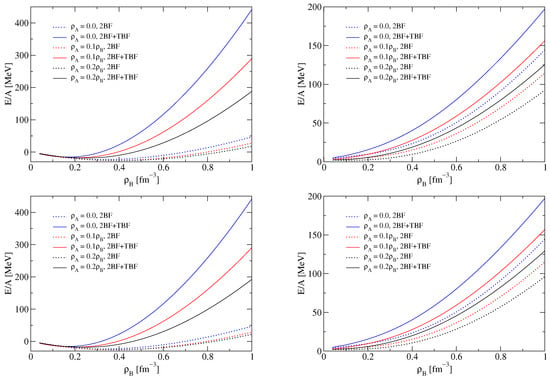
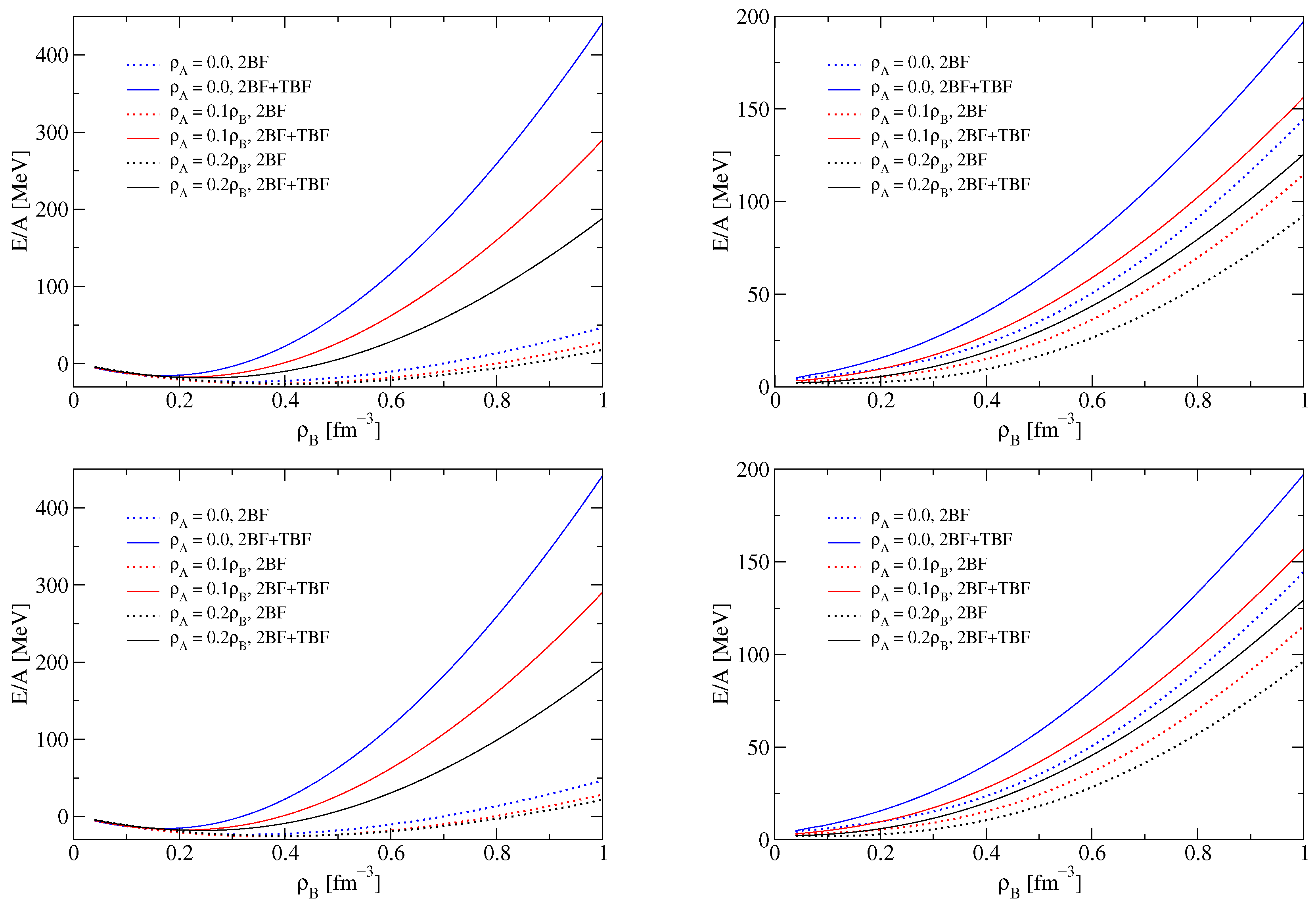
Figure 1 illustrates the competing effects of hyperons and the UIX TBF on the energy per baryon. At high baryon density, increasing the prescribed fraction lowers the energy per baryon for both nucleonic compositions. For matter with a symmetric nucleonic component, this ordering does not extend to low density, as discussed below using . In contrast, the inclusion of UIX generates an increasingly repulsive contribution with density, leading to a pronounced rise in the energy per baryon at supra-saturation densities. At fixed composition, the pressure is determined by the density derivative of the energy per baryon, . Consequently, changes in alone do not establish EOS softening or stiffening, which correspond to a lower or higher pressure, respectively, at a given energy density. Near saturation, proton-free neutron– matter has a higher energy per baryon than matter with a symmetric nucleonic component reflecting the additional energy associated with nucleonic isospin asymmetry. With the present UIX parametrization, this ordering reverses at sufficiently high density. This reversal should be regarded as a model-dependent prediction, whose reliability requires further investigation. A systematic assessment of the validity of LOCVY results in this high-density regime lies beyond the scope of the present study. The attractive and repulsive prescriptions for the odd-state part of the interaction preserve the same overall hierarchy of the curves, indicating that, for the compositions considered here, their effect is smaller than the competition between hyperonic softening and the density-dependent repulsion generated by UIX.
Figure 1.
Energy per baryon as a function of baryon density for , , and . Left panels show matter with a symmetric nucleonic component while right panels show proton-free neutron– matter. Upper panels correspond to the attractive interaction for the odd-state part of interaction and lower panels correspond to the repulsive interaction for the odd-state part of interaction. The rest-mass contribution is not included.
We define
this quantity isolates the net effect of UIX after reoptimization of the LOCV solution.
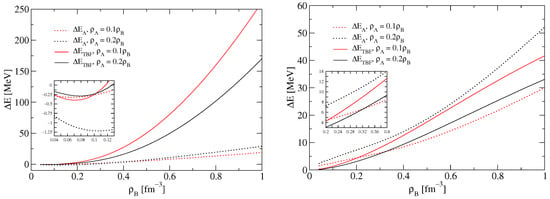
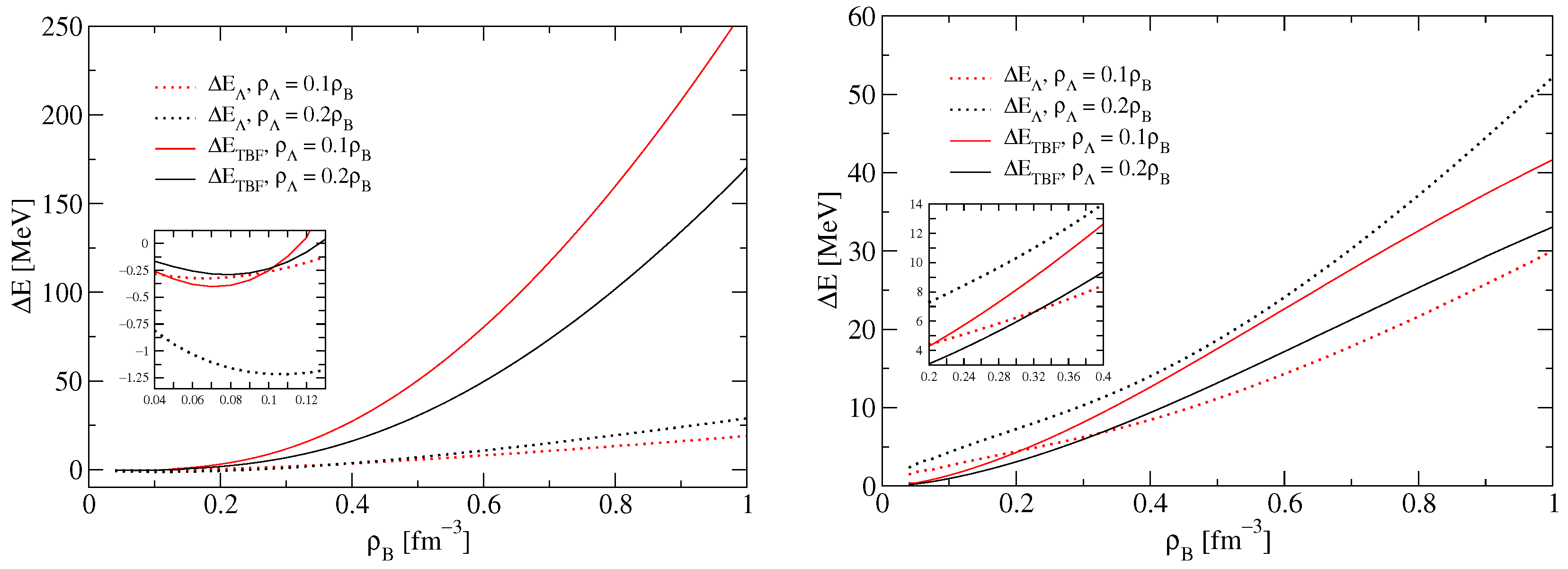
Figure 2 compares the isolated contribution of the Urbana-type nucleonic TBF, , with the change in the energy per baryon produced by introducing a prescribed fraction in the calculation with two-body forces only,
Figure 2.
Density dependence of the nucleonic three-body force contribution , defined in Equation (36), shown by solid lines, together with the hyperonic energy shift , defined in Equation (37), shown by dotted lines. The left panel corresponds to matter with a symmetric nucleonic component, while the right panel shows proton-free neutron– matter. The insets magnify the low-density region. Both energies entering are evaluated using 2BF only and all results use the attractive prescription for the odd-state part of the interaction.
With this convention, means that the rest-mass-subtracted energy per baryon of the prescribed hyperonic composition is lower than that of the corresponding purely nucleonic reference, whereas indicates the opposite.
For matter with a symmetric nucleonic component (), both and change from negative to positive. Their respective zero-crossing densities are defined by
For the energy difference evaluated using two-body forces only, the zero crossing occurs within for and within for . In contrast, the TBF contribution changes sign within and , respectively.
Thus, the TBF contribution becomes positive at a lower total baryon density than the 2BF energy difference associated with introducing the prescribed fraction. Increasing shifts both zero crossings to higher density, with a substantially larger shift for . The larger at indicates that the low-density energetic cost of imposing the larger hyperon fraction, measured using rest-mass-subtracted energies, persists to higher density. The shift of the TBF crossing is consistent with the reduction in nucleon density, , at fixed total baryon density, since UIX acts only among nucleons. For matter with a symmetric nucleonic component (), grows more rapidly than at high density and substantially exceeds it for both prescribed fractions.
No zero crossing is found for proton-free neutron– matter within the density range considered. In this case, remains positive, indicating that replacing part of the neutron component by hyperons lowers the energy throughout the calculated interval. The contrast with symmetric matter demonstrates that the hyperon-induced energy change depends strongly on the isospin composition of the nucleonic background. For proton-free neutron- matter (), exceeds at high density for . For , however, remains larger than throughout the plotted density range. Where , the TBF contribution sets the larger of these two energy scales. This inequality alone does not determine the corresponding change in pressure, which depends on density derivatives of the energy per baryon. Because the particle fractions are fixed and baryon rest-mass differences are omitted, this comparison does not determine the physical hyperon onset, equilibrium composition, or resolution of the hyperon puzzle.
In the high-density region where , its smaller value for than for is qualitatively consistent with , since increasing the hyperon fraction reduces the density of nucleons on which UIX acts. The reduction is not a simple linear scaling with , however, because the three-body contribution is nonlinear in density and the LOCVY correlations readjust self-consistently with composition. Both symmetric and proton-free matter exhibit a strong density dependence of the TBF contribution, while its magnitude also depends substantially on the nucleonic isospin asymmetry.
From an astrophysical point of view, whether additional hyperonic three-body repulsion is required depends strongly on the adopted nucleonic and hyperonic Hamiltonians and the resulting EOS. If the resulting hyperonic EOS is too soft to support the observed neutron star masses, additional repulsion from an or three-body force may be required, as found in previous studies [37,39,40,41,42]. Therefore, neutron star structure alone cannot unambiguously establish whether hyperonic three-body forces are necessary or constrain their strength independently of the adopted interactions. Complementary constraints from hypernuclear systems are therefore essential.
3.2. Saturation Properties and Symmetry-Energy Coefficients
To quantify the influence of the nucleonic TBF beyond the direct comparison of the energy curves, we extract the characteristic bulk parameters of hypernuclear matter at fixed fraction.
For each value of , the saturation density is defined by the minimum of the energy per baryon of the symmetric nucleonic component,
where
The corresponding saturation energy is
The curvature and skewness of the symmetric-matter energy per particle around its minimum, characterized by the incompressibility and skewness parameters, respectively, are given by
and
respectively. Equivalently, introducing
the local density expansion may be written as
The linear term is absent because the expansion is performed around the equilibrium density defined by Equation (39).
The dependence of the energy per baryon on the nucleonic isospin asymmetry is commonly characterized through the nuclear symmetry energy. For ordinary nucleonic matter, the quadratic symmetry-energy coefficient is defined as
Within the frequently used parabolic approximation, higher-order terms in are neglected, and the symmetry energy is commonly estimated as
For hyperonic matter, we generalize this definition by considering variations of the nucleonic isospin asymmetry at fixed total baryon density and fixed fraction . The energy per baryon can then be expanded as
where represents the generalized quadratic symmetry-energy coefficient at fixed , while quantifies the leading correction to the parabolic approximation. Odd powers of are absent when charge-symmetry-breaking effects are neglected.
In the present calculation, the energy is evaluated at , , and 1, corresponding to nucleonic proton fractions , , and 0, respectively. We define
and
Solving these two equations yields
and
This procedure allows the quadratic symmetry energy to be extracted without assuming in advance that the parabolic approximation is exact. The magnitude of provides an estimate of the leading quartic correction to the parabolic approximation.
The symmetry-energy parameters at the saturation density of each fixed- system are defined by
and
Accordingly, the symmetry energy can be expanded locally as
For , the quantities introduced above should be understood as composition-dependent generalized bulk coefficients of hypernuclear matter at fixed fraction. Only their values at correspond directly to the conventional saturation and symmetry-energy parameters of purely nucleonic matter.
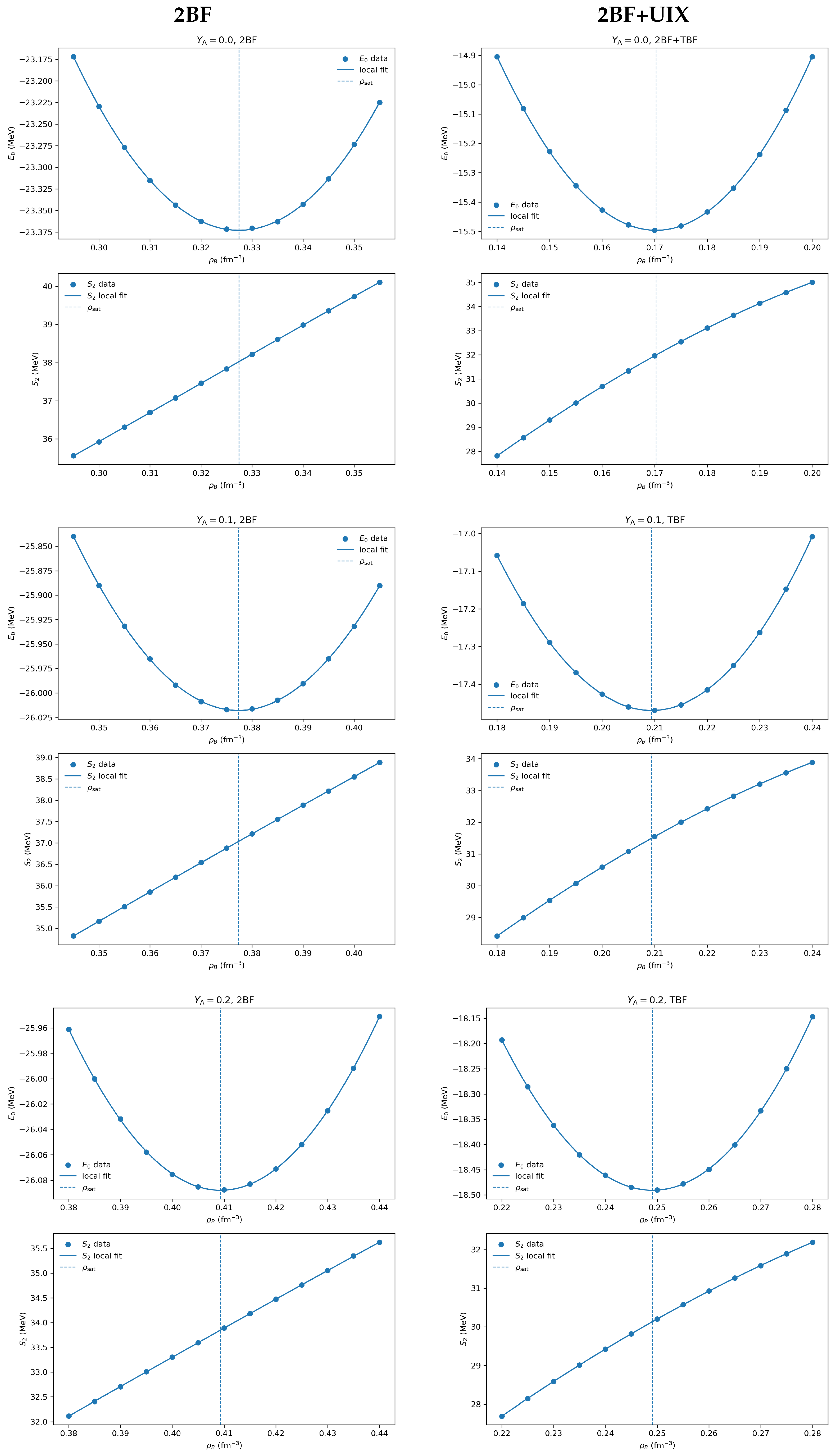
Numerically, the coefficients are extracted from local polynomial fits to the calculated points surrounding the minimum of each symmetric-matter curve. The fitting interval is selected so as to remain within the locally smooth region of the corresponding EOS, and the stability of the extracted coefficients is examined by varying the polynomial order and fitting window. The symmetry-energy coefficient is first determined at each available density from Equation (53) and is then fitted locally to extract J, L, and . Higher-derivative quantities, particularly and , are consequently more sensitive to the fitting prescription.
Table 1 summarizes the saturation properties and the generalized symmetry-energy coefficients obtained at fixed fractions, both with the AV18 two-body interaction alone and after inclusion of the Urbana-type nucleonic TBF. The quoted uncertainties represent the numerical spread obtained under the fitting-window and polynomial-order variations used in the sensitivity analysis in Appendix A. The results reveal a systematic competition between the additional repulsion generated by the nucleonic three-body interaction and the softening associated with the replacement of nucleons by hyperons. For purely nucleonic symmetric matter, corresponding to , the two-body calculation produces a deeply bound equilibrium state at a considerably high density,
Table 1.
Saturation and symmetry-energy parameters for different with 2BF+UIX and 2BF. Densities are in fm−3 and all other parameters are in MeV. Parentheses give the numerical-sensitivity uncertainty in the last quoted digits; for example, means MeV. Central values are from the corresponding reference calculations, with uncertainties obtained from the largest absolute change across the seven separate variations for each case in Table A1, Table A2, Table A3, Table A4, Table A5 and Table A6. All results with non-zero fractions are obtained using the attractive prescription for the odd-state part of the interaction.
These values reflect the excessive attraction of the two-body calculation at intermediate and high densities. The inclusion of the Urbana-type TBF changes the equilibrium point substantially, shifting it to
Thus, the TBF removes a considerable part of the overbinding and moves the saturation density toward the empirical nuclear-matter region. This behavior is consistent with the repulsive character of the Urbana contribution at densities around and above saturation. The introduction of hyperons modifies this balance in a systematic manner. For both interaction schemes, increasing shifts the saturation point toward higher total baryon densities and produces a more deeply bound minimum. In the two-body calculation, the saturation density increases from at to at and at . The corresponding saturation energies change from to and , respectively. A similar trend is found after inclusion of the TBF, although the equilibrium densities remain considerably lower:
for , , and , respectively. This upward displacement of the equilibrium density with increasing can be understood from two related effects. First, the replacement of nucleons by hyperons reduces the nucleonic Fermi pressure and modifies the balance among the , , and correlation energies. Second, the Urbana-type TBF acts only in the nucleonic sector. Consequently, at fixed total baryon density, its repulsive contribution becomes less effective when the nucleon fraction is reduced. The dependence is not expected to follow a simple power of because all correlation functions and interaction contributions are determined self-consistently. Nevertheless, the results clearly show a progressive dilution of the nucleonic three-body repulsion as the fraction increases. This behavior provides a direct microscopic illustration of the competition between hyperonic softening and three-body stiffening. The nucleonic three-body interaction suppresses the excessive binding and shifts the equilibrium state to lower density, whereas the presence of hyperons weakens this repulsive mechanism and favors equilibrium at a higher total density. The effect is already substantial at and becomes more pronounced at . Therefore, although the Urbana-type force strongly improves the saturation properties of purely nucleonic matter, its ability to stiffen the system is progressively reduced as part of the nucleonic component is replaced by hyperons.
The incompressibility exhibits an interesting trend. In the two-body calculation, increases from 368 MeV at to 441 and 448 MeV at and , respectively. With the inclusion of the nucleonic TBF, the corresponding values are , , and MeV. The increase in with should be distinguished from an increase in the unscaled curvature of the energy per baryon. At fixed composition, the incompressibility coefficient satisfies
For the present results, the unscaled curvature decreases as increases because the saturation density itself increases. Thus, the energy minimum becomes flatter as a function of absolute density. Nevertheless, the larger corresponds to a larger local derivative of the pressure with respect to density at the corresponding saturation point.
This increase in the incompressibility coefficient does not, however, imply that the corresponding hyperonic EOS is necessarily stiffer at suprasaturation densities. The quoted values of characterize different composition-dependent equilibrium states. Away from saturation, higher-order coefficients, such as , also contribute to the density dependence of the energy, and the high-density stiffness must be assessed from the resulting pressure and its density dependence. Consequently, a hyperonic EOS may possess a larger incompressibility coefficient at its shifted saturation point while remaining softer than the corresponding nucleonic EOS in the high-density regime.
The skewness coefficient is substantially less well determined than the lower-order saturation parameters. With UIX included, its central values are positive, but the uncertainties do not establish a systematic dependence on ; for , the uncertainty interval also includes zero. For the 2BF calculations, the uncertainties exceed the magnitudes of the central values, leaving even the sign of unresolved. These uncertainties highlight the sensitivity of the third density derivative to the numerical extraction and fitting procedure. Consequently, the present analysis provides only limited quantitative information on , particularly for the 2BF calculations, and does not support firm conclusions about its composition dependence.
The generalized symmetry-energy coefficients provide complementary information about the response of the nucleonic subsystem to isospin asymmetry. In the two-body calculation, the symmetry energy at saturation decreases from at to and at and , respectively. The decrease reflects the modification of the nucleonic isovector response when part of the baryonic density is carried by isoscalar hyperons. After inclusion of the TBF, J remains close to over the entire range of considered. The comparatively weak variation of J suggests that the Urbana force stabilizes the magnitude of the quadratic isospin response, in Equation (48), near the composition-dependent equilibrium density. With UIX included, the slope parameter decreases from at to and at and , respectively. These values are also lower than the corresponding 2BF results. Considering Equation (56), the coefficient L is related to the unscaled density derivative of the symmetry energy, where the derivative is taken at fixed composition. Because changes with , the quoted values characterize different composition-dependent saturation points and should not be interpreted directly as a comparison of slopes at a common density. In the present results, the decrease in L together with the increase in implies that the unscaled derivative also decreases at the respective saturation points.
The negative central values of indicate that has a downward curvature at the corresponding saturation density. Including UIX increases from approximately 30– to 320–, while shifting the saturation density to lower values for each composition. Since the unscaled curvature at fixed composition is , the larger together with the lower implies a substantially larger magnitude of the local unscaled curvature when UIX is included. However, these curvatures characterize different saturation points and do not directly establish the relative curvature of at a common density.
The quartic symmetry coefficient characterizes the contribution proportional to beyond the quadratic approximation. At the respective composition-dependent saturation densities, it is positive in the 2BF calculations, approximately –, whereas including UIX makes it negative, with a magnitude of approximately –. The quartic term, therefore, raises the energy relative to the quadratic approximation for 2BF and lowers it when UIX is included. In all cases, remains smaller than the quadratic symmetry coefficient J.
It should be emphasized that all coefficients obtained at are generalized bulk parameters of hypernuclear matter at fixed fraction. They should not be identified directly with the empirical saturation and symmetry-energy parameters of ordinary nuclear matter. Nevertheless, their systematic evolution with provides a useful quantitative measure of how hyperons modify both the isoscalar and isovector responses of the medium. Overall, the results demonstrate that the Urbana-type nucleonic TBF is essential for correcting the excessive binding and high saturation density generated by the two-body calculation. However, because this repulsion acts only among nucleons, its relative importance decreases as the fraction grows. At finite prescribed , the saturation minimum remains shifted toward higher total baryon density and lower rest-mass-subtracted energy. These results characterize the response at fixed composition and do not determine whether additional hyperonic repulsion is required in beta-equilibrated matter. This observation further motivates future investigations of repulsive hyperonic three-body interactions, such as or contributions, particularly when the model is extended to beta-stable matter and NS densities.
In Table 2, we compare the saturation properties and symmetry-energy coefficients of symmetric matter obtained using the LOCVY method with empirical and phenomenological values. The comparison shows that the inclusion of the nucleonic TBF strongly improves the saturation density and saturation energy, although both remain slightly outside their respective inferred 95% credible intervals. The TBF also brings the symmetry-energy coefficient J into agreement with the current reference range [43]. Nevertheless, remains substantially above its phenomenological reference range [44], indicating a relatively strong resistance of symmetric matter to compression near saturation. The remaining overestimate of represents a limitation of the adopted interactions and calibration. Improving the position and depth of the saturation minimum does not by itself ensure an accurate description of its curvature. The slope parameter L is also reduced by including UIX; although it remains slightly above the marginal reference interval [43].
Table 2.
Comparison of the LOCVY saturation and symmetry-energy coefficients for symmetric nuclear matter with empirical and phenomenological constraints. The LOCVY results correspond to and . Parentheses give the numerical-sensitivity uncertainties in the last quoted digits, as in Table 1. The reference intervals for and are the marginal credible intervals from the Bayesian analysis of density-functional predictions in Ref. [43]. The reference estimates of J and L additionally incorporate chiral-EFT pure-neutron-matter calculations; their quoted uncertainties are the marginal widths specified by Equation (42) of that reference. The constraint is a phenomenological input informed by giant monopole resonance (GMR) analyses and adopted in Ref. [44], following Dutra et al. [45]. It should not be interpreted as a posterior credible interval inferred from the combined Bayesian analysis.
3.3. Microscopic Decomposition of the Energy
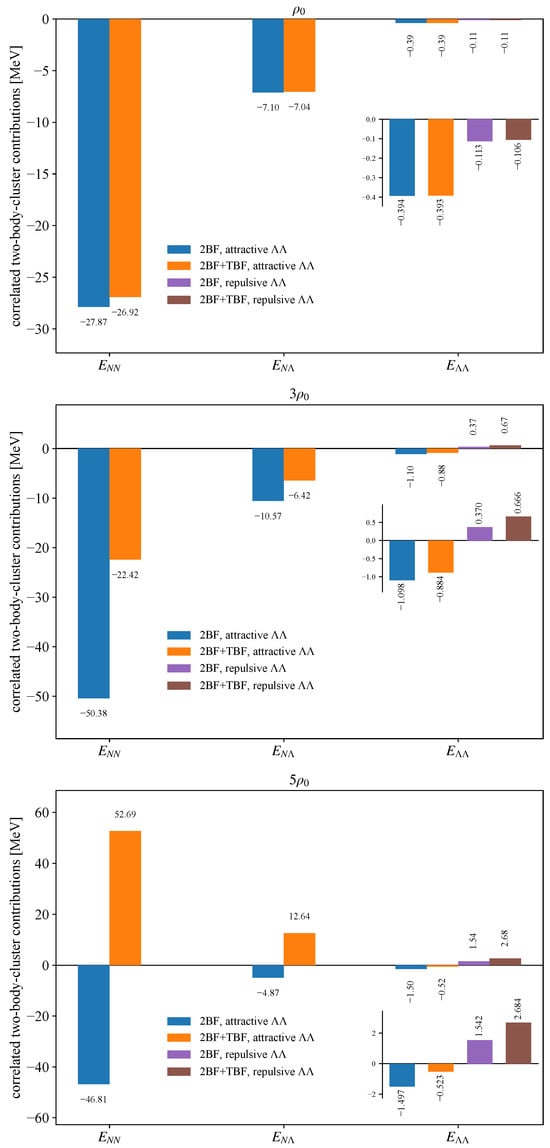
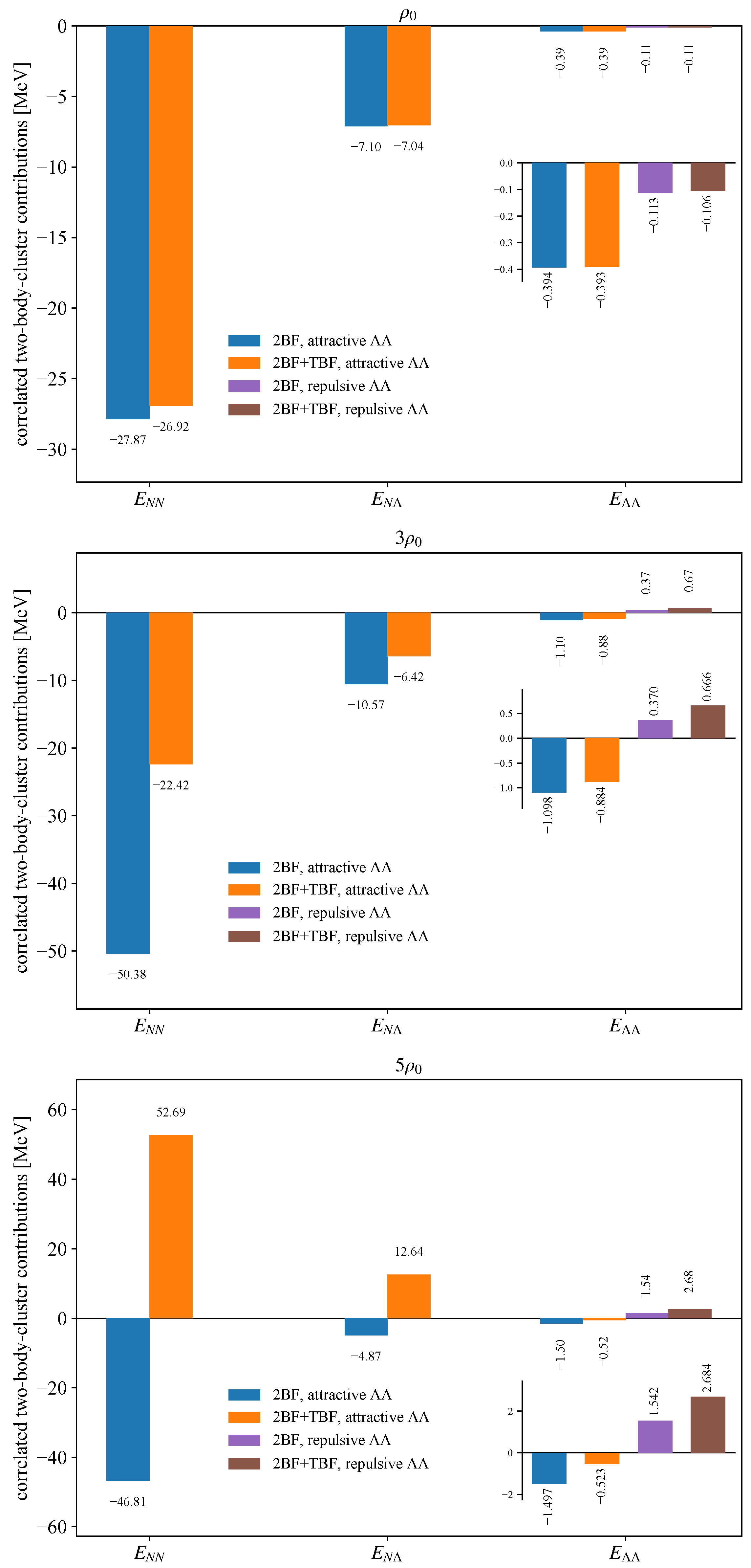
Figure 3 illustrates the microscopic decomposition of the correlated two-body-cluster contribution to the energy per baryon into the nucleon–nucleon, nucleon–, and sectors at , , and for matter with a symmetric nucleonic component and . The comparison isolates the effect of including the Urbana-type nucleonic TBF by contrasting the correlated energy calculated using only 2BF with that obtained when the TBF is also included. For the and sectors, the results correspond to the attractive prescription, while both the attractive and repulsive odd-state prescriptions are shown for the contribution.
Figure 3.
Decomposition of the correlated two-body-cluster energy per baryon into the nucleon–nucleon, nucleon–, and contributions at three representative baryon densities. The channel contributions are defined as , , and . For the and sectors, the blue and orange bars denote the 2BF and 2BF+TBF calculations, respectively, using the attractive prescription for the interaction. For the sector, the attractive and repulsive prescriptions are both displayed, with the same color convention used consistently in the main panels and the insets. The insets magnify the comparatively small contribution. All results are shown for matter with a symmetric nucleonic component, , and .
At , the energy is dominated by the attractive contribution, followed by the smaller contribution. Including the TBF changes only moderately, from approximately to , while its effect on is negligible at this density. The contribution is considerably smaller than the other two terms. It remains attractive for both prescriptions, although its magnitude is larger for the attractive prescription, , than for the repulsive one, for which .
The influence of the nucleonic TBF becomes much stronger at . In the sector, the energy changes from in the two-body calculation to after the inclusion of UIX, demonstrating a substantial reduction in the net attraction. The contribution also becomes less attractive, changing from to . Although UIX acts directly only among nucleons, its inclusion modifies the and contributions indirectly through the self-consistent readjustment of the LOCVY correlation functions. The contribution nevertheless remains much smaller than the and terms. At this density, the attractive prescription gives a negative contribution of approximately , whereas the repulsive prescription produces a small positive contribution.
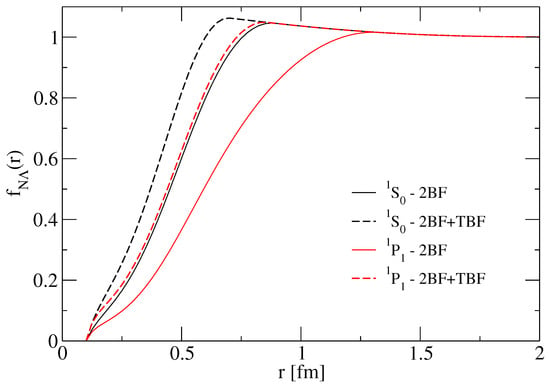
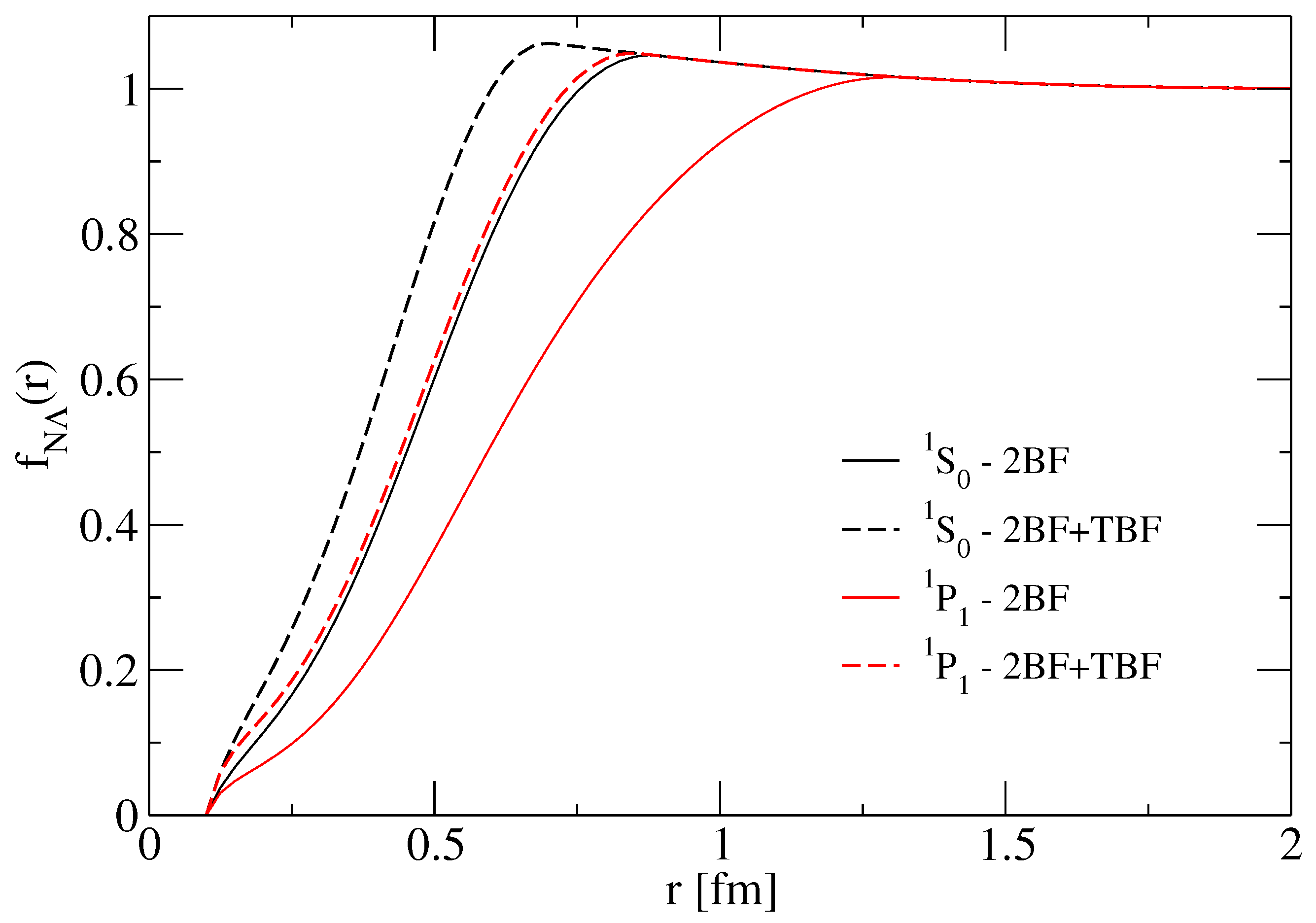
The dominance of the nucleonic TBF is most evident at . The contribution changes from in the two-body calculation to a strongly repulsive value of when UIX is included. The contribution undergoes a similar, although considerably smaller, change, from to . Figure 4 compares the correlation functions in the 1S0 and 1P1 channels with and without the nucleonic TBF, illustrating that these correlations change even though the potential remains unchanged. Including the TBF increases at short distances, with a more pronounced change in the 1P1 channel, while all curves approach unity at large separations. This modification reflects the indirect readjustment of the correlations through the common Lagrange multiplier associated with the summed normalization constraint. The modified profiles can affect both the correlation kinetic and correlated potential contributions to , although the figure alone does not establish their separate roles in its sign change.
Figure 4.
correlation functions in the 1S0 (black) and 1P1 (red) channels. Solid and dashed curves correspond to calculations with only 2BF and with the additional nucleonic TBF, respectively. The results are shown for matter with a symmetric nucleonic component at , using and the attractive prescription for the odd-state part of the interaction.
These results show that the high-density increase in the energy is controlled primarily by the nucleonic sector and is, therefore, consistent with the strong stiffening of the EOS generated by UIX. By comparison, the term remains subleading: it is attractive for the attractive prescription, changing from approximately to , and repulsive for the repulsive prescription, increasing from approximately to .
Overall, the decomposition demonstrates that the Urbana-type TBF has only a modest effect near saturation density but becomes the dominant source of repulsion at several times . Its principal effect appears in the sector, while the changes in the and contributions arise indirectly from the self-consistent reorganization of the many-body correlations. The insets further emphasize that, despite the visible sensitivity of to the adopted odd-state prescription, its absolute contribution remains small compared with the and sectors over the density range considered.
3.4. Comparison with Other Variational Results
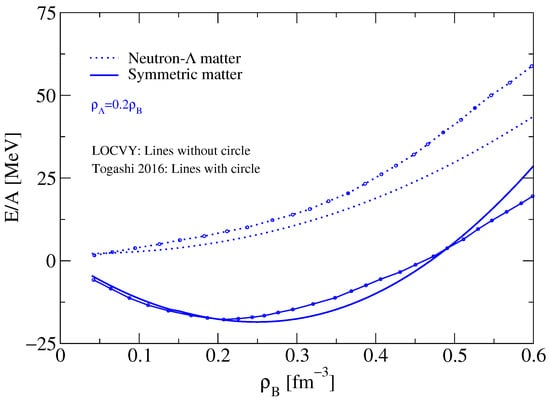
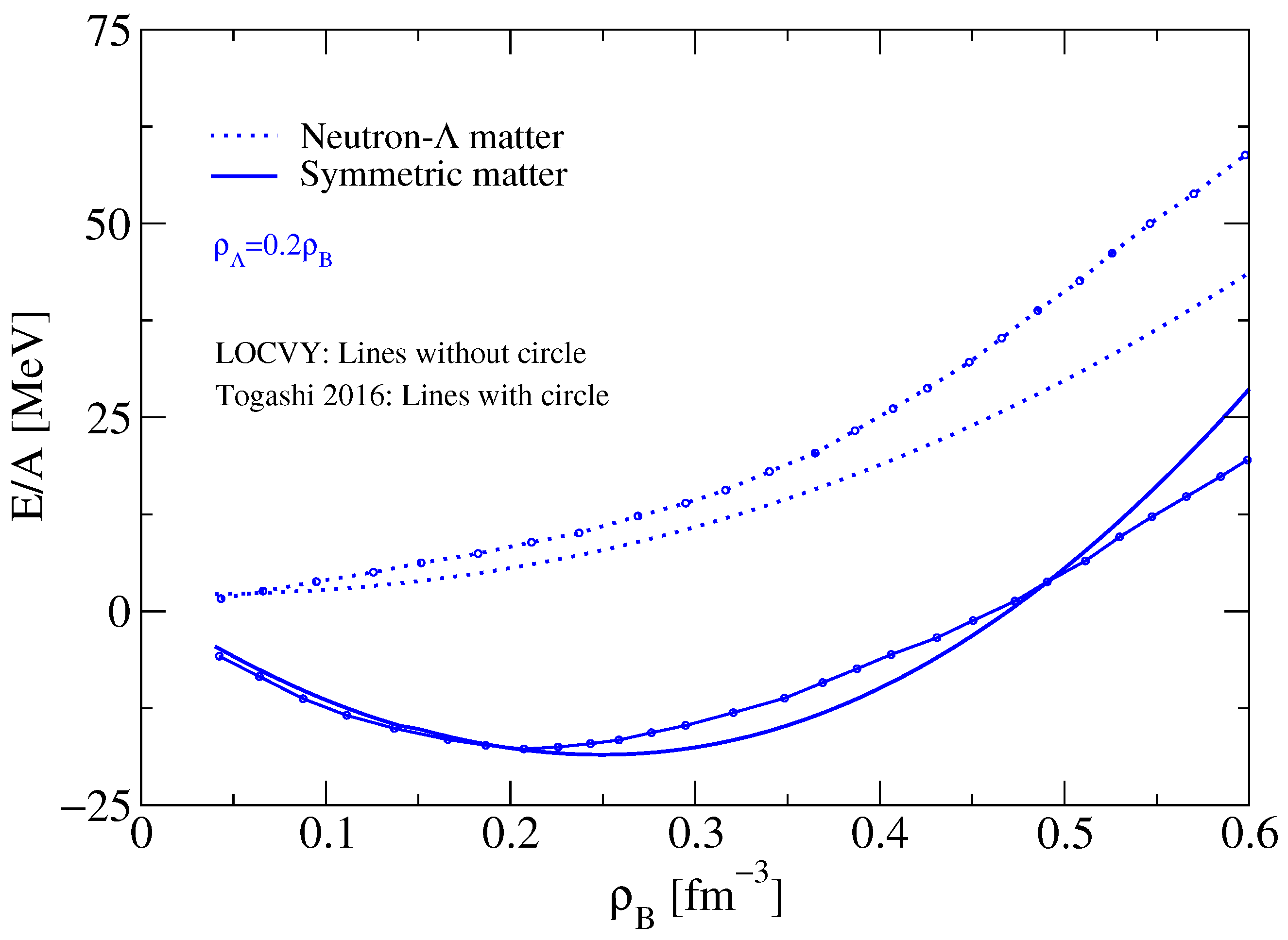
Figure 5 revisits the comparison with the variational calculation of Togashi et al. [46].
Figure 5.
The comparison of the EOS for hypernuclear matter calculated within the LOCVY method and the variational method used in the work of Togashi et al. [46]. The hyperonic two-body interactions are matched in two approaches, whereas the nucleonic interaction inputs, variational constraints, and treatments of the three-nucleon force differ. The results shown here are obtained using the attractive prescription for the odd-state part of the interaction. The solid lines correspond to isospin symmetric matter while the dotted lines show the proton-free neutron- matter.
In our previous work [32], the hyperonic EOS obtained within the LOCVY method did not include the UIX TBF, whereas this contribution was already incorporated in the calculation of Togashi et al. Consequently, part of the difference between the two sets of results originated from the UIX TBF. In the present comparison, the same and interactions, together with UIX in the nucleonic sector, are employed in both calculations. The resulting EOSs are, therefore, closer, particularly at low densities, showing that the inclusion of UIX removes a part of the earlier discrepancy.
Although the inclusion of the UIX three-nucleon force in the LOCVY approach brings the resulting EOS into closer agreement with that of Togashi et al., differences remain, particularly at intermediate and high densities. Both the cluster variational method of Togashi et al. and LOCVY employ Jastrow-correlated wave functions and a two-body-cluster approximation; however, they differ in their nucleonic interaction inputs and implementations of the variational constraints and the UIX three-nucleon force. Togashi et al. use only the isoscalar part of the AV18 potential, whereas LOCVY employs the full AV18 interaction. Furthermore, Togashi et al. determine the two-body correlation functions using channel-dependent extended Mayer conditions and a prescribed density-dependent healing distance, where the proportionality coefficient was chosen to reproduce the APR two-body energies. In contrast, LOCVY employs a single summed normalization constraint with a common Lagrange multiplier.
The treatments of the UIX three-nucleon force also differ substantially. Togashi et al. evaluate its contribution using Fermi-gas expectation values, phenomenological correction coefficients accounting for correlation and relativistic-boost effects, and an additional density-dependent correction. The corresponding parameters are adjusted to reproduce empirical nuclear-matter properties. In LOCVY, the UIX force is instead reduced, through correlation and exchange operators, to a correlation-weighted, density-dependent effective NN interaction, which is included in the variational energy functional before constrained minimization. The variational channel correlation functions are then reoptimized with this effective interaction, while the averaging correlation function used to construct it remains fixed, as described in Section 2.4. These differences in the nucleonic interaction input, variational constraints, and treatment of UIX provide plausible explanations for the different behavior. However, their individual contributions cannot be determined from the present comparison alone.
It is worth noting that previous LOCV calculations found that the three-body-cluster contribution to the energy of nucleonic matter remained below 1 MeV at densities above nuclear-matter saturation density [47]. This provides support for the lowest-order cluster approximation in the nucleonic systems studied. However, higher-order cluster contributions have not been evaluated for the present hyperonic system, particularly at densities approaching . Therefore, results in this high-density regime should be regarded as model-dependent trends, with the uncertainty associated with the cluster truncation remaining unquantified.
4. Conclusions
We have extended the LOCVY description of homogeneous n-p- matter by incorporating a UIX nucleonic TBF through a correlation-averaged density-dependent two-nucleon interaction. The extension preserves the and interactions of the earlier two-body study, so that the difference between the two calculations isolates the role of the improved nucleonic sector.
The analysis is organized around the competition between two mechanisms. At the prescribed compositions, including UIX raises the high-density energy per baryon, while introducing hyperons generally lowers it in the two-body calculation. The relative magnitudes of these rest-mass-subtracted energy changes depend on the composition, reflecting both the reduced nucleon density, , and the readjustment of the correlations.
The analysis of the saturation properties provides a complementary bulk perspective on the role of strangeness and nucleonic three-body force. For , including the nucleonic TBF improves the saturation density, saturation energy, and symmetry-energy coefficients J and L. However, the calculated incompressibility, , remains substantially above the phenomenological reference value quoted in Table 2. This overestimate is a limitation of the present interaction and calibration, indicating excessive resistance to compression near saturation. Further refinement is, therefore, required to reproduce the nuclear-matter bulk properties simultaneously.
Finite prescribed fractions shift the saturation minimum to higher densities and reduce its curvature with respect to . The accompanying increase in reflects the density scaling in its definition. The corresponding symmetry-energy analysis, performed at fixed , shows how the quadratic coefficient and its density dependence evolve with increasing strangeness. The resulting J, L, and values for should, therefore, be interpreted as generalized composition-dependent properties of hyperonic matter rather than as the conventional empirical symmetry-energy parameters of ordinary nuclear matter.
For the composition analyzed, the pair-sector decomposition shows that the high-density UIX-induced energy increase is dominated by the nucleonic sector. The and contributions also change through correlation readjustments under the shared normalization constraint; these contributions contain both kinetic and potential terms. These changes should be interpreted within the globally constrained, two-body-cluster LOCVY approximation. Their robustness against higher-order cluster corrections and alternative normalization constraints remains to be established. The odd-state prescription affects its channel contribution but has a comparatively small effect on the total energy for the compositions considered.
From the viewpoint of chiral effective field theory, the leading and forces arise at the same N2LO order [48]. However, the present calculation includes nucleonic three-body forces but omits genuine hyperonic three-body interactions, such as the force. This omission is a limitation of the present work, as these interactions may quantitatively affect the stiffness and saturation properties of hyperonic matter at fixed fractions. A systematic investigation of these contributions is beyond the scope of the present study and is left for future work.
The present fixed-composition calculations provide microscopic reference results for the density and composition dependence of hyperonic matter. The calculated energies, saturation properties, and pair-sector contributions characterize the effects of nucleonic three-body forces within the adopted framework. Applying the revised UIX parametrization to charge-neutral, -equilibrated matter and including genuine hyperonic three-body interactions would update the existing LOCVY neutron star calculations and clarify the implications for stellar composition and structure.
Funding
M. Sh. has been supported by the National Science Center, Poland (NCN), under the SONATINA 7 Grant No. 2023/48/C/ST2/00297.
Data Availability Statement
The numerical data supporting the findings of this study are available from the corresponding author upon reasonable request.
Acknowledgments
M. Sh. is deeply grateful to Makoto Oka for fruitful discussion. M. Sh. sincerely thanks Emiko Hiyama for the invitation to visit the RIKEN Nishina Center as a visiting researcher and gratefully acknowledges the warm hospitality of the Few-body Systems in Physics Laboratory, RIKEN Nishina Center, during her stay. M. Sh. is sincerely grateful to H. R. Moshfegh for his insightful discussions on the revision of the UIX parametrization and for reviewing and confirming the final nucleonic results obtained with this parametrization. During the preparation of this manuscript, the author used ChatGPT-6 (OpenAI) for assistance with language editing, improvement of clarity, and refinement of the presentation of the manuscript. The author reviewed and edited all outputs and takes full responsibility for the content of the publication.
Conflicts of Interest
The author declares no conflicts of interest.
Abbreviations
The following abbreviations are used in this manuscript:
| EOS | Equation of state |
| LOCV | Lowest-order constrained variational |
| LOCVY | Hyperonic lowest-order constrained variational |
| NS(s) | Neutron star(s) |
| TBF | Three-body force |
| UIX | Urbana IX |
| AV18 | Argonne |
| 2BF | Two-body force |
Appendix A. Numerical Sensitivity
For each calculation, the density grid is generated as , with . Here is the central density of the fitting window, fm−3 is the density spacing, and a is the integer index defining the half-width of the window. The fitting interval is therefore and contains density points. The value of a is selected for the narrow, medium, or wide window and is adjusted when h changes to preserve the same physical fitting interval. The reference polynomial degrees are for . The numerical-sensitivity uncertainty is defined as
Each alternative changes one setting relative to the reference. These uncertainties describe sensitivity to the tested grid and fitting choices, and no statistical confidence level is assigned.
The following conventions apply to all tables in this appendix. Additional digits are retained to display numerical comparisons. The final column gives the uncertainty for each parameter over the seven variations, computed from the numerical results before table rounding. The Table 1 values use conservatively rounded uncertainties. No statistical confidence level is assigned.
Table A1.
Controlled numerical-sensitivity analysis for with 2BF+UIX and fm−3. The fitting settings give the density spacing h, common fitting interval for and , polynomial degrees and , and fit RMSE values, followed by the extracted parameters. Each variation occupies one column; the final column gives for each extracted parameter. Densities are in fm−3; energies, bulk parameters, and RMSE values are in MeV.
Table A2.
Same as Table A1 but for with 2BF and fm−3.
Table A3.
Same as Table A1 but for with 2BF+UIX and fm−3.
Table A4.
Same as Table A1 but for with 2BF and fm−3.
Table A5.
Same as Table A1 but for with 2BF+UIX and fm−3.
Table A6.
Same as Table A1 but for with 2BF and fm−3.
Figure A1.
Reference local fits for the six cases in Table 1. The left and right columns correspond to 2BF and 2BF+UIX, respectively; the rows correspond to , , and , from top to bottom. Within each cell, the upper plot shows the energy per baryon and the lower plot shows . Circles denote the calculated values; solid curves are fourth-order fits to and third-order fits to . Each reference fit uses 13 density points with spacing fm−3 over the medium fitting window specified in Table A1, Table A2, Table A3, Table A4, Table A5 and Table A6. Vertical dashed lines mark the saturation densities extracted from the fits.
References
- Lattimer, J.M.; Prakash, M. The equation of state of hot, dense matter and neutron stars. Phys. Rep. 2016, 621, 127–164. [Google Scholar] [CrossRef] [Scilit]
- Oertel, M.; Hempel, M.; Klähn, T.; Typel, S. Equations of state for supernovae and compact stars. Rev. Mod. Phys. 2017, 89, 015007. [Google Scholar] [CrossRef] [Scilit]
- Sakuragi, Y. Saturation of nuclear matter and roles of many-body forces: Nuclear matter in neutron stars probed by nucleus—Nucleus scattering. Prog. Theor. Exp. Phys. 2016, 2016, 06A106. [Google Scholar] [CrossRef] [Scilit]
- ALICE Collaboration. Unveiling the strong interaction among hadrons at the LHC. Nature 2020, 588, 232–238, Erratum in Nature 2021, 590, E13. [Google Scholar] [CrossRef] [Scilit] [PubMed]
- Gal, A.; Hungerford, E.V.; Millener, D.J. Strangeness in nuclear physics. Rev. Mod. Phys. 2016, 88, 035004. [Google Scholar] [CrossRef] [Scilit]
- Tolós, L.; Fabbietti, L. Strangeness in nuclei and neutron stars. Prog. Part. Nucl. Phys. 2020, 112, 103770. [Google Scholar] [CrossRef] [Scilit]
- Zdunik, J.L.; Haensel, P.; Gourgoulhon, E.; Bejger, M. Hyperon softening of the EOS of dense matter and the spin evolution of isolated neutron stars. Astron. Astrophys. 2004, 416, 1013. [Google Scholar] [CrossRef] [Scilit]
- Chatterjee, D.; Vidaña, I. Do hyperons exist in the interior of neutron stars? Eur. Phys. J. A 2016, 52, 29. [Google Scholar] [CrossRef] [Scilit]
- Oertel, M.; Gulminelli, F.; Providência, C.; Raduta, A.R. Hyperons in neutron stars and supernova cores. Eur. Phys. J. A 2016, 52, 50. [Google Scholar] [CrossRef] [Scilit]
- Vidaña, I. Hyperons and neutron stars. Proc. R. Soc. A 2018, 474, 20180145. [Google Scholar] [CrossRef] [Scilit] [PubMed]
- Logoteta, D. Hyperons in neutron stars. Universe 2021, 7, 408. [Google Scholar] [CrossRef] [Scilit]
- Shahrbaf, M.; Moshfegh, H.R. Appearance of hyperons in neutron stars within LOCV method. Ann. Phys. 2019, 402, 66–77. [Google Scholar] [CrossRef] [Scilit]
- Lonardoni, D.; Lovato, A.; Gandolfi, S.; Pederiva, F. Hyperon puzzle: Hints from quantum Monte Carlo calculations. Phys. Rev. Lett. 2015, 114, 092301. [Google Scholar] [CrossRef] [Scilit] [PubMed]
- Maslov, K.A.; Kolomeitsev, E.E.; Voskresensky, D.N. Solution of the Hyperon Puzzle within a Relativistic Mean-Field Model. Phys. Lett. B 2015, 748, 369–375. [Google Scholar] [CrossRef] [Scilit]
- Masuda, K.; Hatsuda, T.; Takatsuka, T. Hyperon Puzzle, Hadron-Quark Crossover and Massive Neutron Stars. Eur. Phys. J. A 2016, 52, 65. [Google Scholar] [CrossRef] [Scilit]
- Wirth, R.; Roth, R. Induced Hyperon-Nucleon-Nucleon Interactions and the Hyperon Puzzle. Phys. Rev. Lett. 2016, 117, 182501. [Google Scholar] [CrossRef] [Scilit] [PubMed]
- Shahrbaf, M.; Blaschke, D.; Grunfeld, A.G.; Moshfegh, H.R. First-order phase transition from hypernuclear matter to deconfined quark matter obeying new constraints from compact star observations. Phys. Rev. C 2020, 101, 025807. [Google Scholar] [CrossRef] [Scilit]
- Shahrbaf, M.; Blaschke, D.; Khanmohamadi, S. Mixed phase transition from hypernuclear matter to deconfined quark matter fulfilling mass-radius constraints of neutron stars. J. Phys. G 2020, 47, 115201. [Google Scholar] [CrossRef] [Scilit]
- Baym, G.; Hatsuda, T.; Kojo, T.; Powell, P.D.; Song, Y.; Takatsuka, T. From hadrons to quarks in neutron stars: A review. Rept. Prog. Phys. 2018, 81, 056902. [Google Scholar] [CrossRef] [Scilit] [PubMed]
- Gao, B. Chiral symmetry restoration and hyperon suppression in neutron stars. Phys. Rev. D 2026, 113, 083012. [Google Scholar] [CrossRef] [Scilit]
- Akmal, A.; Pandharipande, V.R.; Ravenhall, D.G. Equation of state of nucleon matter and neutron star structure. Phys. Rev. C 1998, 58, 1804–1828. [Google Scholar] [CrossRef] [Scilit]
- Pieper, S.C.; Pandharipande, V.R.; Wiringa, R.B.; Carlson, J. Realistic models of pion exchange three nucleon interactions. Phys. Rev. C 2001, 64, 014001. [Google Scholar] [CrossRef] [Scilit]
- Fujita, J.; Miyazawa, H. Pion Theory of Three-Body Forces. Prog. Theor. Phys. 1957, 17, 360–365. [Google Scholar] [CrossRef] [Scilit]
- Pudliner, B.S.; Pandharipande, V.R.; Carlson, J.; Pieper, S.C.; Wiringa, R.B. Quantum Monte Carlo calculations of nuclei with A ≤ 7. Phys. Rev. C 1997, 56, 1720–1750. [Google Scholar] [CrossRef] [Scilit]
- Wiringa, R.B.; Stoks, V.G.J.; Schiavilla, R. Accurate nucleon–nucleon potential with charge-independence breaking. Phys. Rev. C 1995, 51, 38–51. [Google Scholar] [CrossRef] [Scilit] [PubMed]
- Goudarzi, S.; Moshfegh, H.R. Effects of three-body forces on the maximum mass of neutron stars in the lowest-order constrained variational formalism. Phys. Rev. C 2015, 91, 054320, Erratum in Phys. Rev. C 2017, 96, 049902. [Google Scholar] [CrossRef] [Scilit]
- Goudarzi, S.; Moshfegh, H.R.; Haensel, P. The role of three-body forces in nuclear symmetry energy and symmetry free energy. Nucl. Phys. A 2018, 969, 206–225. [Google Scholar] [CrossRef] [Scilit]
- Bordbar, G.H.; Modarres, M. Lowest-order constrained variational calculation for asymmetrical nuclear matter with the new Argonne potential. Phys. Rev. C 1998, 57, 714–724. [Google Scholar] [CrossRef] [Scilit]
- Modarres, M.; Moshfegh, H.R. LOCV calculation for beta stable matter at finite temperature. Phys. Rev. C 2000, 62, 044308. [Google Scholar] [CrossRef] [Scilit]
- Moshfegh, H.R.; Modarres, M. The properties of hot nuclear matter in LOCV formalism. Nucl. Phys. A 2005, 749, 130–133. [Google Scholar] [CrossRef] [Scilit]
- Modarres, M.; Pourmirjafari, T.; Moshfegh, H.R. The LOCV nuclear matter calculation and the magnetic susceptibility of neutron matter. Nucl. Phys. A 2009, 819, 27–45. [Google Scholar] [CrossRef] [Scilit]
- Shahrbaf, M.; Moshfegh, H.R.; Modarres, M. Equation of state and correlation functions of hypernuclear matter within the lowest order constrained variational method. Phys. Rev. C 2019, 100, 044314, Erratum in Phys. Rev. C 2026, 114, 039903. [Google Scholar] [CrossRef] [Scilit]
- Rijken, T.A.; Stoks, V.G.J.; Yamamoto, Y. Soft-core hyperon–nucleon potentials. Phys. Rev. C 1999, 59, 21–40. [Google Scholar] [CrossRef] [Scilit]
- Hiyama, E.; Yamamoto, Y.; Rijken, T.A.; Motoba, T. Four-body structure of and ΛN spin-dependent interaction. Phys. Rev. C 2006, 74, 054312. [Google Scholar] [CrossRef] [Scilit]
- Hiyama, E.; Kamimura, M.; Motoba, T.; Yamada, T.; Yamamoto, Y. Four-body cluster structure of A = 7–10 double-Λ hypernuclei. Phys. Rev. C 2002, 66, 024007. [Google Scholar] [CrossRef] [Scilit]
- Takahashi, H.; Ahn, J.K.; Akikawa, H.; Aoki, S.; Arai, K.; Bahk, S.Y.; Baik, K.M.; Bassalleck, B.; Chung, J.H.; Chung, M.S.; et al. Observation of a Double Hypernucleus. Phys. Rev. Lett. 2001, 87, 212502. [Google Scholar] [CrossRef] [Scilit] [PubMed]
- Looee, A.M.A.; Shahrbaf, M.; Moshfegh, H.R. Hyperons in Neutron Stars across the Observed Mass Range: Insights from ΛN and ΛΛ Interactions within a Microscopic Framework. Astrophys. J. 2026, 997, 26. [Google Scholar] [CrossRef] [Scilit]
- Pudliner, B.S.; Pandharipande, V.R.; Carlson, J.; Wiringa, R.B. Quantum Monte Carlo calculations of A <= 6 nuclei. Phys. Rev. Lett. 1995, 74, 4396–4399. [Google Scholar] [CrossRef] [Scilit] [PubMed]
- Logoteta, D.; Vidana, I.; Bombaci, I. Impact of chiral hyperonic three-body forces on neutron stars. Eur. Phys. J. A 2019, 55, 207. [Google Scholar] [CrossRef] [Scilit]
- Vidaña, I. Neutron stars and the hyperon puzzle. EPJ Web Conf. 2022, 271, 09001. [Google Scholar] [CrossRef] [Scilit]
- Tong, H.; Elhatisari, S.; Meißner, U.G. Hyperneutron Stars from an Ab Initio Calculation. Astrophys. J. 2025, 982, 164. [Google Scholar] [CrossRef] [Scilit]
- Gerstung, D.; Kaiser, N.; Weise, W. Hyperon–nucleon three-body forces and strangeness in neutron stars. Eur. Phys. J. A 2020, 56, 175. [Google Scholar] [CrossRef] [Scilit]
- Drischler, C.; Giuliani, P.G.; Bezoui, S.; Piekarewicz, J.; Viens, A.F. Bayesian mixture model approach to quantifying the empirical nuclear saturation point. Phys. Rev. C 2024, 110, 044320. [Google Scholar] [CrossRef] [Scilit]
- Tsang, C.Y.; Tsang, M.B.; Lynch, W.G.; Kumar, R.; Horowitz, C.J. Determination of the equation of state from nuclear experiments and neutron star observations. Nat. Astron. 2024, 8, 328–336. [Google Scholar] [CrossRef] [Scilit]
- Dutra, M.; Lourenco, O.; Martins, J.S.S.; Delfino, A.; Stone, J.R.; Stevenson, P.D. Skyrme Interaction and Nuclear Matter Constraints. Phys. Rev. C 2012, 85, 035201. [Google Scholar] [CrossRef] [Scilit]
- Togashi, H.; Hiyama, E.; Yamamoto, Y.; Takano, M. Equation of state for neutron stars with hyperons by the variational method. Phys. Rev. C 2016, 93, 035808. [Google Scholar] [CrossRef] [Scilit]
- Modarres, M.; Rajabi, A.; Moshfegh, H.R. State-dependent calculation of three-body cluster energy for nuclear matter and the validity of the lowest order constrained variational formalism. Phys. Rev. C 2007, 76, 064311. [Google Scholar] [CrossRef] [Scilit]
- Petschauer, S.; Kaiser, N.; Haidenbauer, J.; Meißner, U.G.; Weise, W. Leading three-baryon forces from SU(3) chiral effective field theory. Phys. Rev. C 2016, 93, 014001. [Google Scholar] [CrossRef] [Scilit]

Disclaimer/Publisher’s Note: The statements, opinions and data contained in all publications are solely those of the individual author(s) and contributor(s) and not of MDPI and/or the editor(s). MDPI and/or the editor(s) disclaim responsibility for any injury to people or property resulting from any ideas, methods, instructions or products referred to in the content. |
© 2026 by the author. Licensee MDPI, Basel, Switzerland. This article is an open access article distributed under the terms and conditions of the Creative Commons Attribution (CC BY) license.