


Abstract
Solar radio emissions (SREs) originate primarily from electrons—both thermal and non-thermal—in the solar atmospheric plasma. Owing to the diverse physical conditions (e.g., temperature, density, and magnetic field) across different source regions, as well as variations in electron acceleration processes, number densities, energies, and propagation directions, SREs can be broadly categorized into three main types: quiet radio emission (QRE), slowly varying component (SVC), and solar radio bursts (SRBs). SRBs are further subdivided into type I, II, III, IV, and V bursts. Moreover, each SRE type is frequently superimposed with various spectral fine structures, which encode signatures of chromospheric and coronal heating, non-thermal electron acceleration, and plasma instabilities associated with solar activity (flares, coronal mass ejections, filament eruptions, and various jets). Based on a brief review of SREs, this work presents a unified physical image to illustrate the formation of all SRE types and their interrelationships. This image aims to clarify the physical processes revealed by these emissions, elucidate the origin and evolutionary patterns of solar activity, and provide critical clues for forecasting catastrophic space weather events.
1. Introduction: Various Types of Solar Radio Emissions
At all times, the Sun produces various types of radio emissions, which cover a very broad frequency range from millimeter wavelength (>1011 Hz) to beyond kilometer wavelength (<105 Hz), and the emission source is distributed from the chromosphere, via the transition region (TR) and corona, to far regions in the interplanetary space. Accurately identifying different types of solar radio emissions (SREs) and understanding their formation mechanisms and physical conditions are important prerequisites for us to use them to reveal the origin and occurrence patterns of solar activities (solar flares, coronal mass ejections, filament eruptions, jets, and solar winds), as well as their effects and impacts on the solar–terrestrial space environment [1,2,3].
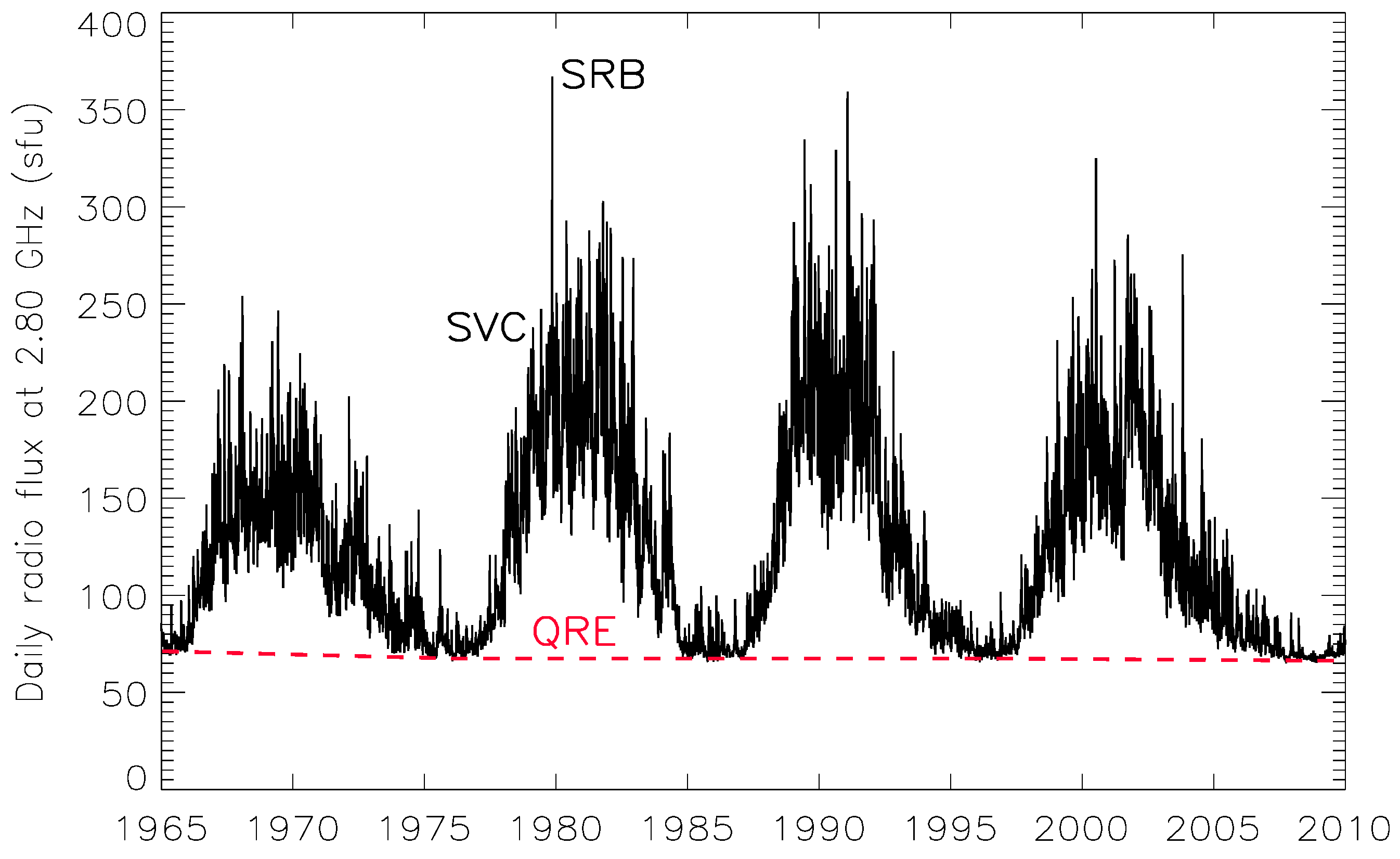
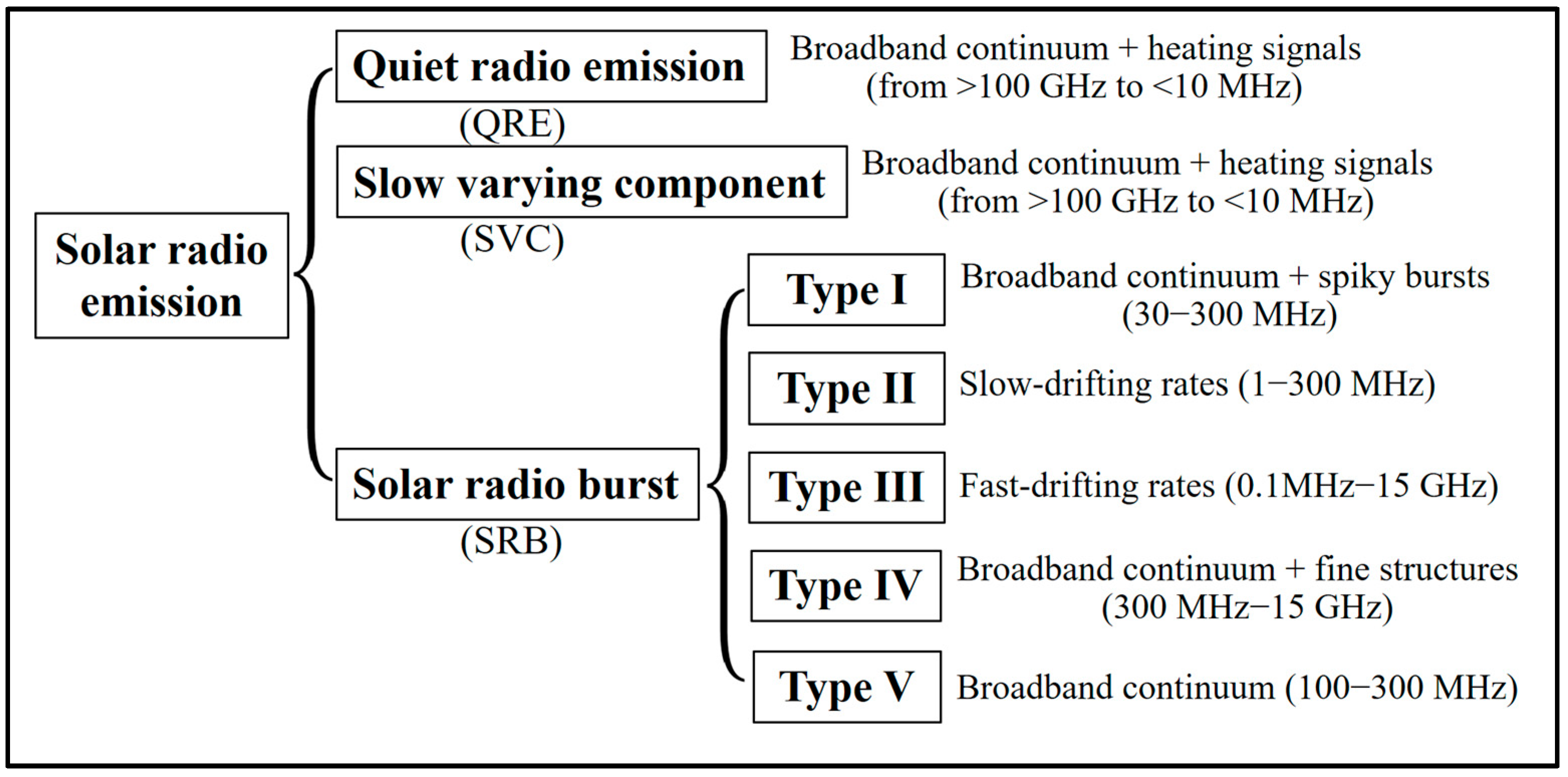
Generally, different frequency SREs are generated from different layers of the solar atmosphere. The basic characteristic is that the higher frequencies arise from closer to the solar surface. For example, the millimeter-wavelength emission is always generated from the lower chromosphere, centimeter-wavelength emission is generated from the higher chromosphere and TR, and decimeter- and meter-wavelength emissions are generated from the corona, while longer-wavelength emissions (<10 MHz) may be generated from the high corona or interplanetary space. At the same time, whether it is a quiet Sun or an active Sun, SREs still exist; only their spectral patterns are different. Based on the differences in spectral characteristics, SREs can be divided into three main categories: quiet radio emission (QRE), slowly varying component (SVC), and solar radio burst (SRB); see Figure 1. Here, SRB is manifested as a series of sharp peaks superimposed on the long-term profile of SRE and can be further classified into type I, II, III, IV, and V bursts. The main features of different kinds of SREs are summarized in Figure 2.
Figure 1.
The solar daily radio flux at 2.8 GHz during 1965–2010. The data comes from the international SGD dataset, which shows that solar radio emissions can be roughly divided into three categories: quiet radio emission (QRE), slowly varying component (SVC), and solar radio burst (SRB).
Figure 2.
The classification of solar radio emissions and their main characteristics.
1.1. Quiet Radio Emission (QRE)
QRE is a type of radio emission occurring at almost all wavelengths and at all times and that always exists in the solar atmosphere even when there is no obvious explosive activity (no flare, no coronal mass ejection (CME), no filament eruption, etc.), which is the background of solar activities. In the solar quiet regions, coronal holes, and even during the minima of solar cycles, QRE still exists. Its brightness depends on the observed frequency. For example, at 10 GHz, the brightness temperature Tb ≈ 1.5 × 10⁴ K; at 1.0 GHz, Tb ≈ 5.0 × 10⁴ K, and when f < 100 MHz, Tb > 1.0 × 10⁶ K [1,4]. The spectral characteristics of QRE are mainly smoothed, unpolarized, and a broadband continuum [5,6].
1.2. Slowly Varying Component (SVC)
SVC is a component which exceeds the background of QRE with a very long duration and smoothed broadband continuum mainly in the cm–dm wavelength with spectral peak near 10 cm (around 2.80 GHz), which is enhanced by the presence of sunspots and has slightly circular polarization and is modulated by the solar rotations [7,8]. The variation timescale of SVC is basically consistent with the solar cycles and highly correlated with the sunspot numbers.
Due to the limited resolutions and sensitivity of the existing solar radio telescopes, it remains unclear whether narrowband, short-lived fine spectral structures (FSs) exist in QRE and SVC.
1.3. Solar Radio Burst (SRB)
SRB refers to a significant enhancement in emission intensity within a short period of time (from milliseconds to days) overlapped on the background of QRE and SVC. They are always associated with certain solar eruptive activities, including the emergence of sunspot active regions, solar flares, CMEs, etc. SRBs occur during most flare events. Generally, big radio events and shock-related bursts are more likely to be accompanied with powerful flares, such as M-class and X-class flares. As for the very strong flare events, almost all will produce SRBs; for example, almost all X-class flares are accompanied by SRBs with very complex FSs. Previous researchers classified them into five different types based on their spectral characteristics.
- (1)
- Type I storm/bursts.
A type I storm, sometimes called a noise storm, is manifested as an enhanced fuzzy bright broadband continuum in the frequency range of 30–300 MHz, superimposed with many short-lived (last for 0.1–1 s), narrowband (several MHz or below), spike-like FSs (called type I bursts), with highly circular polarization. Its duration may last from hours to days or even weeks, and is generally associated with intense active regions containing large sunspots. Generally, the source region of type I storms/bursts is often associated with bright coronal structures in extreme ultraviolet (EUV) imaging observations above over the intensive active region. Here, it is necessary to distinguish between a type I storm and type I burst. Type I bursts can be regarded as FSs superimposed on the background of a type I storm [9,10,11].
- (2)
- Type II burst.
The most prominent feature of solar radio type II bursts is their slow frequency drift. Its relative drifting rate is s−1 and the frequency range is about 1–300 MHz. Here, f denotes the frequency. It appears as narrowband stripes drifting from high to low frequency slowly, typically lasting 5–15 min. Usually, most type II bursts show two parallel bands, with the harmonic band at approximately two times the plasma frequency (some even show a third harmonic). The fundamental (F) and the second harmonic (H) bands may each split into two closely spaced sub-bands, called as band-splitting [12] and discrete FSs (including spike-like groups, fish-bone structures, etc.) [13]. Multi-wavelength observations showed that most radio type II bursts are closely related to fast CMEs or high speed plasma jets, while the others may be associated with some impulsive flares [14,15,16].
- (3)
- Type III burst.
Unlike radio type II bursts, the prominent feature of type III bursts is their fast frequency drift. Its relative frequency drifting rate is D > 10% s−1 and the frequency range is about 0.1 MHz–15 GHz. Type III bursts are the most frequent flare-related emissions, although some of them occur without reported flares or subflares [17,18]. From the statistics in the metric to kilometric wavelength band (74 kHz–550 MHz), the average frequency drifting rate can be approximated as follows [19]:
where f is in MHz. However, in decimeter and centimeter wavelengths, the drifting rate can be approximately expressed as . Here, the minus sign ‘-’ refers to the normal type III burst with negative frequency drifting rate, and the plus ‘+’ refers to the reverse-sloped (RS) type III burst with positive frequency drifting rate. Occasionally, radio type III pair was observed, which is composed of two branches beginning at nearly the same time: one is a normal type III burst and the other is an RS type III burst. Generally, radio type III pairs can be regarded as direct signals of magnetic reconnections [20].
D ≈ −0.01f0.84
- (4)
- Type IV burst.
A type IV burst is characterized as an enhanced broadband continuum during solar flare. The frequency range may extend from meter wavelength to centimeter wavelength (0.1–15 GHz). Usually, there are many FSs superimposed on the continuum of type IV bursts [21], such as quasiperiodic pulsation (QPP [22]), spike group [23], Zebra patterns [24,25], lace bursts [26], etc. It is important to correctly distinguish between type IV bursts and the FSs overlaid on their background here, because it is obvious that they come from different physical processes.
Sometimes, a type IV burst also has very slow frequency drifting rate (D < 0.1% s−1), called a moving type IV burst. Typically, a solar radio type IV burst may last from several minutes to hours [27,28].
- (5)
- Type V burst.
Type V bursts are not common and usually only occur after a solar radio type III burst or type III groups in the initial phase of a solar flare, with a duration of only 1–2 min, characterized as broadband continuum enhancement in the meter-wavelength band (10–300 MHz). The degree of circular polarization of a type V burst is very low [29]. Occasionally, a type V burst blends into the continuum of a type IV burst. The main characteristics of type V bursts are summarized in [30].
What is the relationship among the various types of SREs? How can we use a physical image to illustrate their formations? Answering these questions will greatly improve our understanding of solar atmospheric dynamics, elucidate the origin of solar activities, and enhance our ability to predict catastrophic space weather events. In Section 2, we discuss the formations of each type of SREs, including their drivers, emission mechanisms, and interpretation to their FSs, as well as the relationships among different SRE types. Based on these discussions, we attempt to construct a unified physical image of SREs in Section 3. Finally, conclusions and further discussions are summarized in Section 4.
2. Formation of Different Types of Solar Radio Emissions: Drivers, Emission Mechanisms, and Interpretation to the Fine Structures
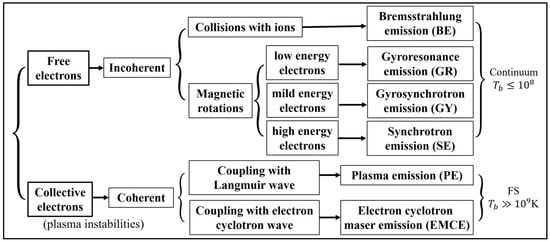
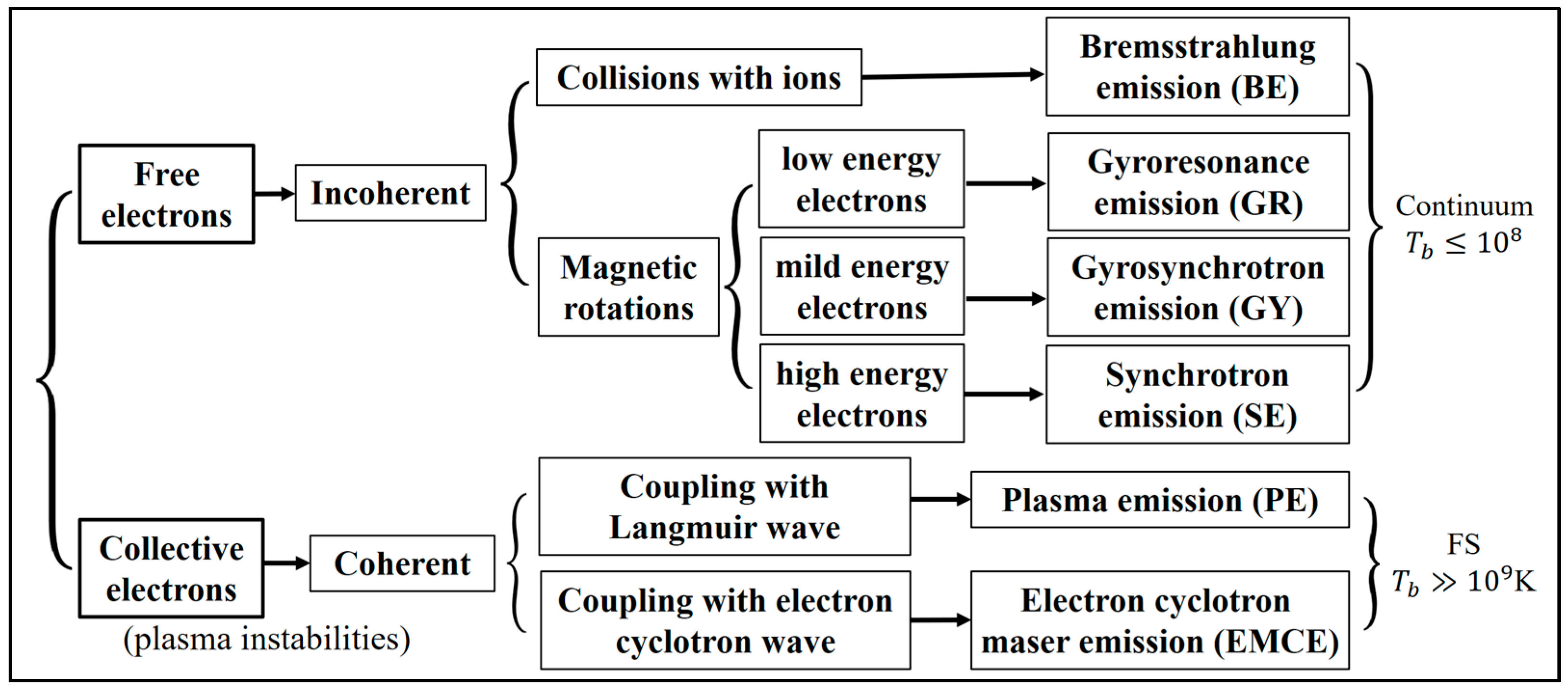
Solar radio emissions are generated from the electron motions in the solar atmosphere. Different electron motions correspond to different emission mechanisms (Figure 3). Electrons can be categorized in two ways: by energy distribution—thermal electrons in local thermodynamic equilibrium versus non-thermal electrons from eruptive acceleration—and by dynamic behavior, ranging from freely motion to collective motion [1,2].
Figure 3.
Electrons in different motions generate radio emissions through different mechanisms.
Freely moving electrons give rise to incoherent emissions through two principal mechanisms [31]:
- (1)
- Bremsstrahlung emission (BE)—Produced by electron–ion collisions in environments with relatively weak magnetic fields.
- (2)
- Magnetocyclotron emission—Generated by electron gyromotion in stronger magnetic fields. According to their energy, this mechanism is further divided into:
- Gyroresonance emission (GR): Low-energy electrons in hot plasma;
- Gyrosynchrotron emission (GY): Mild energy electrons in superhot plasma or non-thermal populations;
- Synchrotron emission (SE): High-energy electrons [32].
Collectively moving electrons are closely tied to plasma instabilities and generate coherent emissions by coupling with certain wave modes in the plasmas [33]. Two typical scenarios are:
- (1)
- Plasma emission (PE): In relatively weak magnetic fields, electron beams couple with Langmuir waves;
- (2)
- Electron cyclotron maser emission (ECME): In stronger magnetic fields, coupling between electrons and electron cyclotron waves.
The spectral characteristics of radio emissions generated by different mechanisms are completely different. Generally, the incoherent emission is a broadband continuum with long duration and low brightness temperature (Tb ≤ 108 K), and the source region should be extended and large-scale (defined as sizes exceeding several thousand km at least, such as flaring loops, coronal loops, active regions, and even the whole solar atmosphere), while the coherent emission is usually narrowband, short-life, and have a very high brightness temperature (Tb ≫ 109 K), and the source region should be relatively compact and small-scale (typically smaller than one thousand km, such as the local volume of plasma instabilities, magnetic islands, and magnetic reconnection sites, or current sheets in the solar atmosphere). In addition, BE and PE are typically O-mode emissions with low polarization degree, while GR, GY, SE, and ECME are X-mode emissions with high polarization degree. Naturally, incoherent emission is generally associated with types of SREs with broadband continuum (QRE, SVC, type I storm, type IV and type V bursts), while coherent emission is closely related to various fine structures, including type I bursts, type II and III bursts, and various FSs.
The emission characteristics are fundamentally governed by physical conditions in the source region—temperature, electron density, magnetic field, and plasma instabilities, etc. Consequently, different types of SREs originate from distinct source locations, are driven by different mechanisms, and involve entirely different physical processes. Understanding these differences provides the foundation for constructing a comprehensive physical image of SREs.
2.1. QRE
Generally, QRE is driven by the thermal electrons in the solar atmosphere where temperature ranges from less than 104 K at the lower chromosphere to beyond 106 K in the corona. Under such physical conditions, radio emission mainly comes from BE processes which are excited by the collisions of thermal electrons. Actually, in solar quiet regions and during quiet periods, the Sun still has magnetic fields, such as the network and internetwork magnetic fields corresponding to the granulations [34,35], small sunspots without eruptions, etc. Under the influence of these magnetic fields, thermal electrons also generate radio emissions through both BE and GR mechanisms. The emission intensity of BE is , while the intensity of GR and GY is . Here, α > 1 and β > 1. ne, Te, and B are electron density, temperature, and magnetic field strength, respectively. Obviously, in cold dense plasmas, BE radiation plays a dominant role, but when Te and B increase, GR and GY radiation will become dominant.
Additionally, besides the thermal electrons, there are also non-thermal energetic electrons in the quiet atmosphere. This is because of the heating process from the chromosphere to the corona, which will inevitably produce energetic electrons. The motion of these energetic electrons will interact with plasma and magnetic fields, and produce radio FSs superimposed on the background of QRE. Here, the heating mechanism may conclude wave heating in the chromosphere and lower part of TR, magnetic-gradient pumping (MGP) heating in the upper part of TR and corona, and sporadic magnetic reconnection heating. The corresponding FSs will characterize as different patterns. Tan et al. [36] proposed that the chromosphere is probably heated by waves (including acoustic wave, magnetohydrodynamic (MHD) waves and Alfven Waves) and the corresponding spectral pattern is characterized by groups of spikes at millimeter and short centimeter wavelengths, while TR and the corona are likely heated mainly by the MGP mechanism and partially contributed from magnetic reconnections, and the corresponding spectral patterns are characterized by groups of fiber bursts and accompanied with sporadic type III pairs or spike pairs at long centimeter, decimeter, and meter wavelengths. If solar radio telescopes have sufficient spectral resolutions and sensitivity, it is possible to capture such heating signals.
The driver of QRE is likely thermal electrons and the energetic electrons produced during heating processes. The emission mechanism likely involves three components: BE from collisions of thermal electrons, GR from electron gyration in the magnetic fields, and non-thermal coherent emission from heated electrons.
2.2. SVC
As shown in Figure 1, around the maxima of solar cycles and at 2.80 GHz, the emission flux of SVC is approximately several times higher than that of QRE, and is highly correlated with sunspot numbers. This suggests that the SVC emission process is closely linked to the magnetic fields above sunspot regions. In dense, magnetized hot plasmas above sunspots, GR and, partially, BE should jointly contribute to SVC formation, with GR likely being the dominant mechanism.
Similarly, non-thermal electrons produced by heating processes in the chromosphere and corona above sunspot regions are also expected to contribute partially to SVC emissions.
2.3. SRB
Unlike QRE and SVC, SRBs typically exhibit high brightness temperatures, rapid variability, and relatively short durations. Correspondingly, their formations and the underlying physical conditions are far more complex and intimately connected with plasma processes.
- (1)
- Type I storm/bursts
In the solar atmosphere, sunspot active regions are the only locations that persist throughout the duration of a radio type I storm/burst. Therefore, the physical mechanism underlying type I storms/bursts is likely intimately linked to these active regions.
Coronal loops above intense active regions have temperatures exceeding 2–3 MK, significantly higher than those of the surrounding quiet regions (~1–2 MK). These loops are located at greater heights than flaring loops, and their magnetic fields are stronger—typically ranging from several to tens of gauss, and generally below 50 G. The interaction between hot electrons and these magnetic fields is expected to generate gyro-radiation (GR), resulting in enhanced continuum emissions at meter and decameter wavelengths, namely type I radio storms. Since large active regions on the solar disk can persist from a few hours to 1–2 weeks, type I storms correspondingly exhibit long durations, lasting for up to more than one week.
Furthermore, nearly all large active regions consist of numerous magnetized plasma loops. The footpoints of these loops undergo complex motions—such as approaching, separating, rotating, vortex motions, and oscillations—driven by photospheric convection. These motions induce interactions including kinks, collisions, shearing, and twisting in the upper portions of the loops, thereby generating a multitude of localized, short-lived, small-scale current sheets in the corona. In the vicinity of these small-scale coronal current sheets, non-thermal electrons can be accelerated and subsequently excite sporadic type I bursts that are superimposed on the continuum of type I storms via coherent emission processes (PE, or ECME [33]).
- (2)
- Type II burst
For SRBs, the frequency drifting rate can be used to determine the velocity of the emission source [23],
ve ≈ 2HnD
Here, is the scale-length of plasma density variations which depends on the plasma density models (under the assumption of PE mechanism). Based on the frequency drifting rate of radio type II bursts and coronal density models [37,38], the velocity of the source region is derived approximately between 400 and 1200 km/s, which is much slower than the non-thermal electron beams and comparable to the plasmoids (CMEs, or plasma jets) ejected during solar eruptions. Furthermore, observations indicate that most radio type II bursts are closely associated with CMEs or plasma jets. Consequently, these ejected plasmoids are naturally considered the primary drivers of such bursts [39].
When CME or plasma jets propagate through the corona and interplanetary space, type II bursts can be generated through two mechanisms. The first occurs when the ejection speed exceeds the local Alfven or magnetoacoustic speed; a shockwave forms ahead of the plasmoids, which accelerates non-thermal electrons and produces the type II bursts. The second occurs when the ejected plasmoids interact with the background magnetized plasma, causing driven magnetic reconnection that accelerates non-thermal electrons which may then radiate type II bursts [40]. The former tends to produce complex spectral structures with stochastic distribution characteristics in radio type II bursts, whereas the latter will form fine structures with a certain regular distribution, such as fishbone-like patterns [13]. In addition, the pressure pulses generated by impulsive flares can also form shockwaves, leading to the generation of radio type II bursts [14,41], though it was argued that the shockwave in the impulsive flare might be due to jets colliding with the ambient coronal magnetic field [16].
- (3)
- Type III burst
For radio type III bursts, the frequency drifting rate is D ≥ 10%. Using Equation (2), the corresponding driving source should have a speed > 0.2 c (c is the light speed), and can even reach up to >0.7 c. Such a fast speed can only be the flight speed of non-thermal energetic electron beams, that is, the fast motion of non-thermal electron beams directly drive to form type III radio bursts [42].
The non-thermal electron beams most likely come from the acceleration in the magnetic reconnection region. They are accelerated from the reconnection site and fly outward along open magnetic configurations, forming radio type III bursts over a wide frequency range [18,43]. It is straightforward in that the onset time and starting frequency of the radio type III bursts indicate the timing and spatial location of the associated magnetic reconnection [44]. Usually, magnetic reconnection acceleration forms bidirectional outflows (upward and downward), which are observed as type III pair bursts (the normal type III burst indicates the upward electron beam, while the RS type III burst indicates the downward electron beam), and is the most direct signal of magnetic reconnection [20,45].
- (4)
- Type IV burst
Here, it is necessary to distinguish type IV bursts from FSs superimposed on them, as they represent two distinct emission phenomena. Similarly to radio type I storm, type IV bursts are also broadband continuum enhancements; however, they are characterized by significantly higher and broader emission frequencies, noticeable shorter durations, and an almost synchronous occurrence with solar flares. We therefore have sufficient reasons to conclude that type IV bursts are generated by the interaction between hot electrons and magnetic fields in the high-temperature plasma of flaring loops. Here, the temperature should be >107 K, the magnetic field strength may be stronger than that in the coronal loops, and the type IV bursts should be generated from GY mechanism.
In addition to the thermal electrons within the high-temperature flaring loops, flare eruptive processes often generate various populations of non-thermal electrons, which interact with the magnetic field and ambient plasma in the flaring loop, producing a variety of FSs through coherent emission mechanisms such as PE or ECME [46]. For example, MHD oscillations may modulate the emission and form QPPs with various timescales, coupling between non-thermal electrons. Excited Langmuir waves with other low-frequency waves may form Zebra patterns or lace bursts by the PE mechanism, and coupling between non-thermal electrons and electron cyclotron waves may form spike or dot bursts by the ECME mechanism.
- (5)
- Type V burst
Since radio type V bursts typically follow type III bursts at meter wavelengths near the onset of solar flares, their formation is likely linked to non-thermal energetic electron beams. A plausible explanation is that these non-thermal, high-energy electron beams interact with the magnetic field in hot coronal loops, generating type V radio bursts via the GR or even GY mechanism. However, because non-thermal electron beams usually propagate rapidly along open field lines—producing type III bursts—they have little opportunity to interact with closed coronal loops. Consequently, type V bursts occur with very low probability and are therefore difficult to observe.
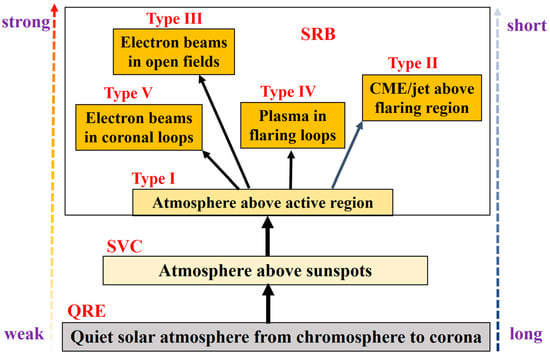
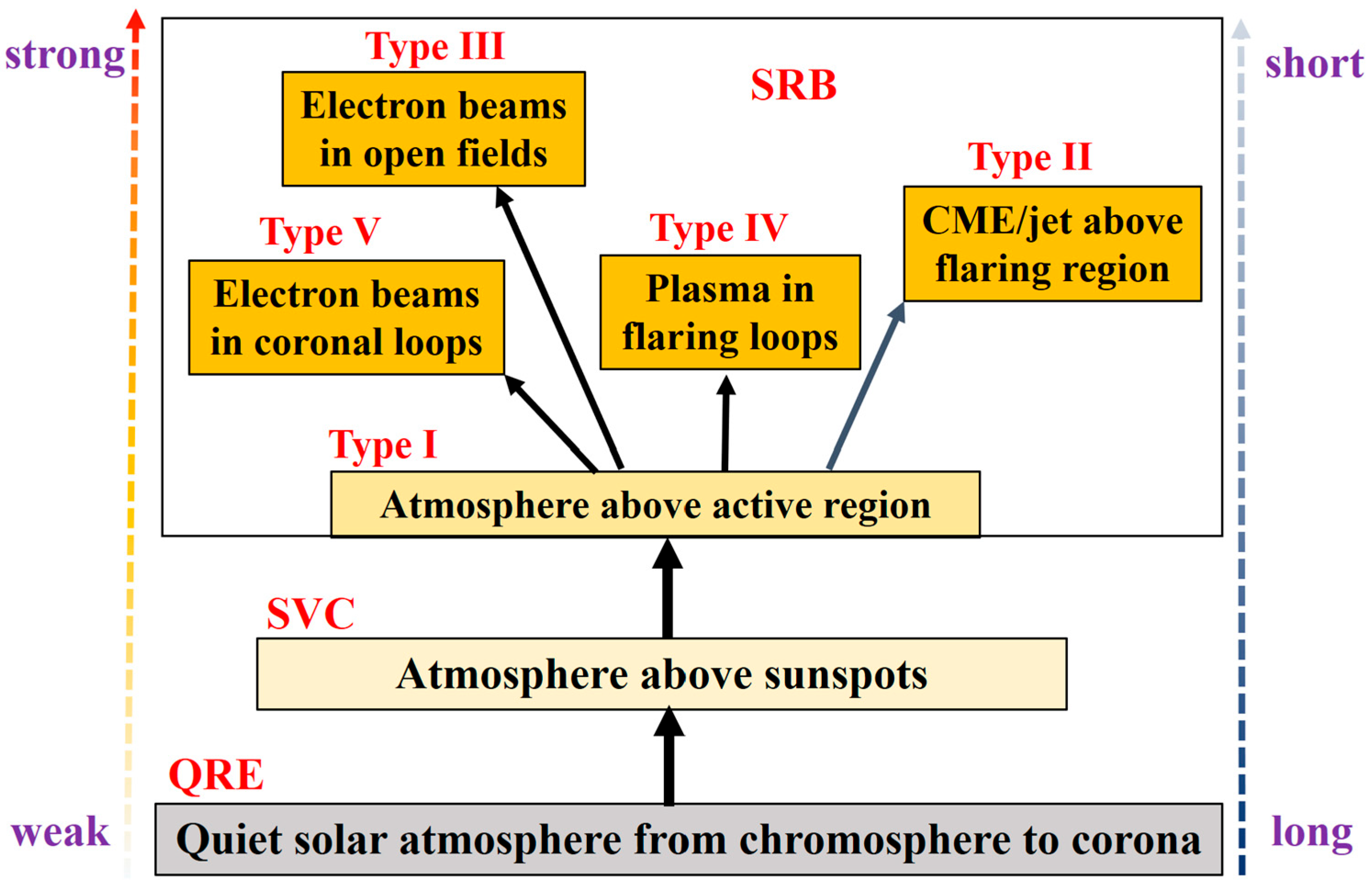
2.4. The Relationships Among Different Types of SREs
In reality, different types of SREs are closely related. Figure 4 presents the various emission sources and the relationships among different types of emissions. Here, from the bottom to the top, emission intensity increases, the timescale decreases, and the spatial scale decreases. Here, each lower type of emission is the foundation of the upper type. For example, QRE is the background of SVC, while SVC is the background of SRB. Type I, II and IV bursts should be the foundation of various FSs. In addition, the emission mechanism should be from BE to GR, to GY, and to PE or ECME.
Figure 4.
The emission sources and the relationships among various types of solar radio emissions. Here, the lower types of emissions can be regarded as the foundation of the upper types of emissions. The black font represents various emission sources, red font represents emission types, and purple font represents characteristics of the emissions. The black arrow represents the progressive relationships from the background source to the emission.
3. The Physical Image for Various Types of SREs
In the previous publications, many attempts have been made to establish a physical image for demonstrating the formation of various types of SREs [1,2,47]. For example, Dulk [1] have placed different types of SRBs in the flare-CME framework to elucidate their formation process. However, these images only provide information on the formation of various SRBs and their relationship to solar activities by magnetic reconnections, and does not demonstrate how QRE and SVC formed, nor does it correlate solar atmospheric heating with various types of SREs. Moreover, previous images have shown that there seems to be no correlation between QRE, SVC and SRB. Therefore, it is necessary to improve and establish a relatively more complete physical image to demonstrate the formation of various types of SREs.
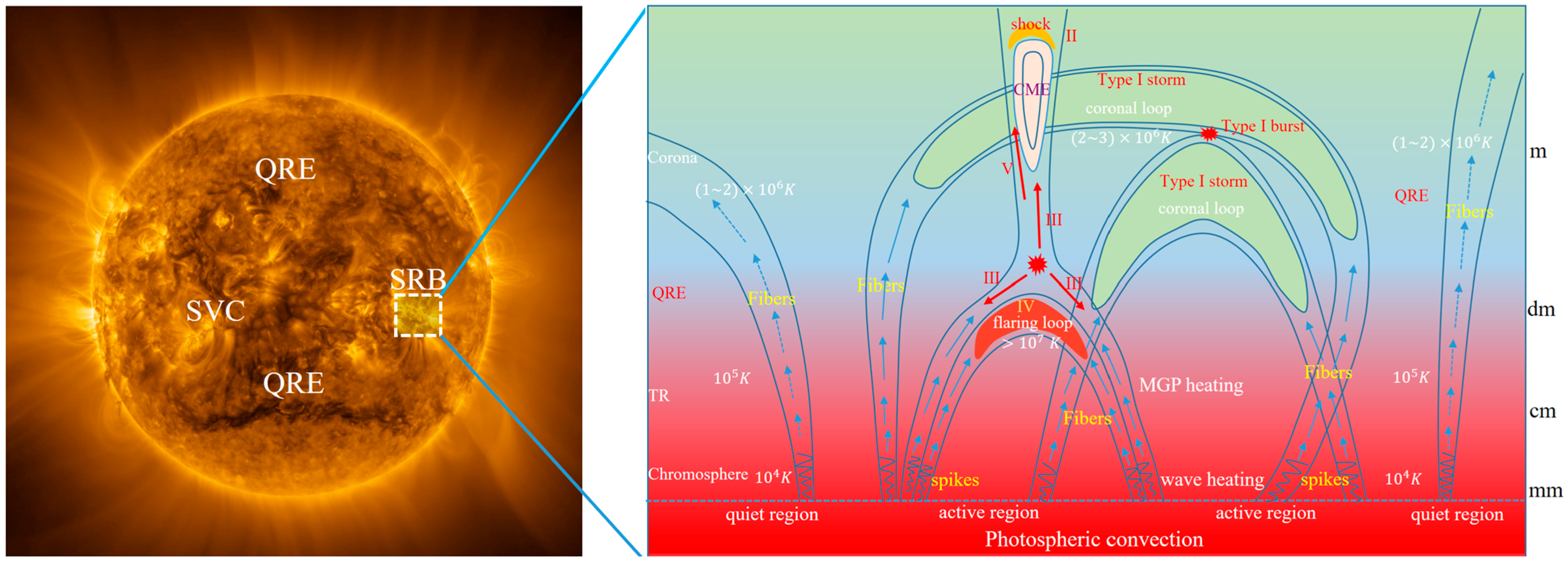
Figure 5 presents a physical image containing a collection of various SREs, which we construct by comprehensively considering the previous studies and our careful investigations. The left panel presents an overall view of the solar atmosphere with the quiet region and many sunspot active regions distributed, while the right panel shows the structural features of the atmosphere in and above an active region and its surrounding quiet regions. Here, the thick blue areas around tops of big coronal loops represent the hot plasma with a temperature of (2–3) × 106 K, and the thick red area around the top of flaring loop represents the superhot plasma with a temperature of >107 K. The typical temperature of the quiet corona is approximately (1–2) × 106 K. TR stands for transition region. II, III, IV, and V represent radio type II, III, IV, and V bursts, respectively. The red arrows represent the non-thermal electron beams generated from the magnetic reconnecting acceleration site. The solid blue arrows represent the MGP electron upflows in the plasma loops above active regions and can be observed as fiber bursts around solar flares, while the dotted blue arrows represent the MGP pumping upflows in the plasma loops above quiet regions which can be characterized by fiber bursts and need to be confirmed by the higher-resolutions and more sensitive observations from the future solar radio telescopes. The red explosion symbol indicates magnetic reconnection sites. The vertical axis on the right side roughly indicates the wavelength range of radio emission, and m, dm, cm and mm represent meter, decimeter, centimeter and millimeter wavelengths, respectively.
Figure 5.
The physical image of various types of solar radio emissions.
4. Conclusions and Discussions
In this work, based on a brief review of the spectral observational characteristics and emission mechanisms of solar radio emissions, we construct a physical image (Figure 5) that illustrates the formation processes and associated physical conditions of all types of SREs—including QRE, SVC and various SRBs. From this image, we draw the following conclusions:
- (1)
- The source regions, physical conditions, and emission mechanisms of different types of SREs are different, but also closely related to each other. For example, all types of SREs can be divided into two categories: broadband continuum and narrowband, short-lived FSs. Generally, FSs are overlapping on the background of the broadband continuum. The emission of broadband continuum is mainly related to incoherent emission mechanisms (such as BE, GR, and GY, including a small amount of SE radiation excited by relativistic high-energy electrons), while FSs are generated by coherent emission mechanism (including PE and ECME).
- (2)
- All types of SREs are closely related to the heating processes of the solar atmosphere, including wave heating, magnetic reconnection heating, and MGP heating (although this need to be confirmed from the observations with higher resolutions and sensitivity). For example, the type I and V bursts are related to the hot coronal loops ((1–2) × 106 K), while type IV burst is related to the superhot flaring loop (>107 K). Perhaps this is one of the most prominent highlights of this physical image, which is the first to connect the heating processes of the solar atmosphere with various solar eruptions. This will help us to understand the dynamics of the solar atmosphere and the precursor, trigger, and mechanism of solar eruptions.
In addition, there are still many issues that we have not been clarified from observations. These issues can be listed as follows:
- (1)
- The fiber structures that may be generated by MGP flows which heat the plasma from the upper TR to corona in the quiet Sun. Perhaps new telescopes with higher frequency–temporal resolutions and higher sensitivity are needed [48].
- (2)
- The heating in the chromosphere and TR should be dominated by wave mechanisms, and the corresponding radio signals are a large number of spike groups superimposed on the background of QRE and SVC in millimeter and centimeter wavelengths, which also need to be confirmed from observations with superwide frequency bands and high temporal–frequency resolutions.
- (3)
- At the same time, the Figure 5 indicates that during the pre-flare phase, the heating process inside the flaring loops is an important driver for triggering the flare. Therefore, tracking the radio signals at this phase will help us to find out reliable flare precursors. However, so far, we do not know what observational characteristics these precursors have, and how they are related to the classes of flares.
- (4)
- The formation and physical processes associated with FSs should be researched further from observations and theoretical investigations, especially the spike groups with various distributed patterns, zebra patterns at different frequency range, QPPs with various timescales, etc.
The questions posed above constitute fundamental problems in solar radio astronomy as well as in plasma physics. It is clear that resolving these questions will substantially propel progress in solar radio astronomy and solar physics, while simultaneously enhancing our capability to forecast catastrophic space weather events.
Author Contributions
Conceptualization, B.T. and J.H.; methodology, B.T.; formal analysis, B.T., J.H. and Y.Z.; writing—original draft preparation, B.T.; writing—review and editing, B.T.; project administration, B.T.; funding acquisition, B.T., J.H. and Y.Z. All authors have read and agreed to the published version of the manuscript.
Funding
The research of B.T., J.H., and Y.Z. was funded by the National Key R&D Program of China (Nos. 2022YFF0503001, 2021YFA1600503, 2022YFF0503800), the Strategic Priority Research Program of the Chinese Academy of Sciences, Grant No. XDB0560302.
Data Availability Statement
This work only uses the daily solar radio emission flux at 2.80GHz in the international SGD data, which can be downloaded publicly. No other observational data is involved.
Acknowledgments
This work is also supported by the international collaboration of ISSI-BJ and the International Partnership Program of Chinese Academy of Sciences (grant number 183311KYSB20200003).
Conflicts of Interest
The authors declare no conflicts of interest. The funders had no role in the design of the study; in the collection, analyses, or interpretation of data; in the writing of the manuscript, or in the decision to publish the results.
References
- Alissandrakis, C.E. Structure of the solar atmosphere: A radio perspective. Front. Astron. Space Sci. 2020, 7, 574460. [Google Scholar] [CrossRef] [Scilit]
- Alvarez, H.; Haddock, F.T. Solar wind density model from km-wave type III bursts. Sol. Phys. 1973, 29, 197–209. [Google Scholar] [CrossRef] [Scilit]
- Altyntsev, A.T.; Grechnev, V.V.; Meshalkina, N.S.; Yan, Y. Microwave type III-like bursts as possible signatures of magnetic reconnection. Sol. Phys. 2007, 242, 111–123. [Google Scholar] [CrossRef] [Scilit]
- Armatas, S.; Bouratzis, C.; Hillaris, A.; Alissandrakis, C.E.; Preka-Papadema, P.; Moussas, X.; Mitsakou, E.; Tsitsipis, P.; Kontogeorgos, A. Detection of spike-like structures near the front of type-II bursts. Astron. Astrophys. 2019, 624, A76. [Google Scholar] [CrossRef] [Scilit]
- Aschwanden, M.J.; Benz, A.O. Chromospheric evaporation and decametric radio emission in solar flares. Astrophys. J. 1995, 438, 997–1012. [Google Scholar] [CrossRef] [Scilit]
- Aurass, H.; Klein, K.L.; Zlotnik, E.Y.; Zaitsev, V.V. Solar type IV burst spectral fine structures I. Observations. Astron. Astrophys. 2003, 410, 1001–1010. [Google Scholar] [CrossRef] [Scilit][Green Version]
- Bastian, T.S.; Benz, A.O.; Gary, D.E. Radio emission from solar flares. Annu. Rev. Astron. Astrophys. 1998, 36, 131–188. [Google Scholar] [CrossRef] [Scilit]
- Benz, A.O. Radio Emission of the Quiet Sun, Solar System, Landolt-Bornstein—Group VI Astronomy and Astrophysics; Springer: Berlin/Heidelberg, Germany, 2009; Volume 4B, p. 103. [Google Scholar] [CrossRef] [Scilit]
- Chen, B.; Kong, X.L.; Yu, S.J.; Shen, C.C.; Li, X.C.; Guo, F.; Zhang, Y.; Glesener, L.; Krucker, S. Energetic electrons accelerated and trapped in a magnetic bottle above a solar flare arcade. Astrophys. J. 2024, 971, 85. [Google Scholar] [CrossRef] [Scilit]
- Chernov, G.P.; Yan, Y.H.; Fu, Q.J.; Tan, C.M. Recent data on Zebra patterns. Astron. Astrophys. 2005, 437, 1047–1054. [Google Scholar] [CrossRef] [Scilit]
- Chernov, G.P.; Yan, Y.H.; Tan, C.M.; Chen, B.; Fu, Q.J. Spiky fine structure of type III-like radio bursts in absorption. Sol. Phys. 2010, 262, 149–170. [Google Scholar] [CrossRef] [Scilit]
- Chernov, G.P.; Fomichev, V.; Tan, B.L.; Yan, Y.H.; Tan, C.M.; Fu, Q.J. Dynamics of flare processes and variety of fine structure of solar radio emission over a wide frequency range of 30–7000 MHz. Sol. Phys. 2015, 290, 95–114. [Google Scholar] [CrossRef] [Scilit]
- Chernov, G.P.; Fomichev, V. On the issue of the origin of type II solar radio bursts. Astrophys. J. 2021, 922, 82. [Google Scholar] [CrossRef] [Scilit]
- Dominguez, C.I.; Sanchez, A.J.; Kneer, F. Inter-network magnetic fields observed with sub-arcsec resolution. Astron. Astrophys. 2003, 407, 741–757. [Google Scholar] [CrossRef] [Scilit]
- Dulk, G.A.; Marsh, K.A. Simplified expressions for the gyrosynchrotron radiation from mildly relativistic, nonthermal and thermal electrons. Astrophys. J. 1982, 259, 350–358. [Google Scholar] [CrossRef] [Scilit]
- Dulk, G.A.; Suzuki, S.; Gary, D.E. The position and polarization of type V solar bursts. Astron. Astrophys. 1980, 88, 218–229. [Google Scholar]
- Dulk, G.A. Radio emission from the Sun and stars. Annu. Rev. Astron. Astrophys. 1985, 23, 169–224. [Google Scholar] [CrossRef]
- Gary, D.E. New insights from imaging spectroscopy of solar radio emission. Annu. Rev. Astron. Astrophys. 2023, 61, 427–472. [Google Scholar] [CrossRef] [Scilit]
- Gosic, M.; De Pontieu, B.; Bellot Rubio, L.R.; Sainz Dalda, A.; Pozuelo, S.E. Emerhence of internetwork magnetic fields through the solar atmosphere. Astrophys. J. 2021, 911, 41. [Google Scholar] [CrossRef] [Scilit]
- Habbal, S.R.; Ellman, N.E.; Gonzalez, R. Synthesis mapping of a solar type I storm simultaneously at 90 and 20 centimeters with the VLA. Astrophys. J. 1989, 342, 594–603. [Google Scholar] [CrossRef] [Scilit]
- Huang, J.; Tan, B.L. Microwave bursts with fine structures in the decay phase of a solar flare. Astrophys. J. 2012, 745, 186. [Google Scholar] [CrossRef] [Scilit]
- Iwai, K.; Miyoshi, Y.; Masuda, S.; Tsuchiya, F.; Morioka, A.; Misawa, H. Spectral structures and their generation mechanisms for solar radio type I bursts. Astrophys. J. 2014, 789, 4. [Google Scholar] [CrossRef] [Scilit]
- James, T.; Vilmer, N. Statistical study of type III bursts and associated DXR emissions. Astron. Astrophys. 2023, 673, A57. [Google Scholar] [CrossRef] [Scilit]
- Klassen, A.; Aurass, H.; Klein, K.L.; Hofmann, A.; Mann, G. Radio evidence on shock wave formation in the solar corona. Astron. Astrophys. 1999, 343, 287–296. [Google Scholar]
- Kuznetsov, A.A.; Tsap Yu, T. Loss-cone instability and formation of Zebra patterns in type IV solar radio bursts. Sol. Phys. 2007, 241, 127–143. [Google Scholar] [CrossRef] [Scilit]
- Li, C.Y.; Chen, Y.; Wang, B.; Zhong, Z.; Tan, B.L.; Ning, Z.J.; Ning, H.; Kong, X.L.; Chang, S.W.; Tang, Y.K.; et al. A novel fine spectral structure of solar radio bursts with periodic beaded stripes observed by CBSm of CMP-II. Sci. China-Phys. Mech. Astron. 2025, 68, 109611. [Google Scholar] [CrossRef] [Scilit]
- Magdalenic, J.; Marque, C.; Zhukov, A.N.; Vrsnak, B.; Veronig, A. Flare-generated type II burst without associated coronal mass ejection. Astrophys. J. 2012, 746, 152. [Google Scholar] [CrossRef] [Scilit]
- Mann, G.; Vocks, C.; Warmuth, A. Type III radio bursts and excitation of Langmuir waves by energetic electrons. Astron. Astrophys. 2022, 660, A91. [Google Scholar] [CrossRef] [Scilit]
- Melrose, D.B. Coherent emission mechanisms in astrophysical plasmas. Rev. Mod. Plasma Phys. 2017, 1, 5. [Google Scholar] [CrossRef] [Scilit]
- Newkirk, G., Jr. The solar corona in active regions and the thermal origin of the slowly varying component of solar radio radiation. Astrophys. J. 1961, 133, 983. [Google Scholar] [CrossRef] [Scilit]
- Nindos, A.; Alissandrakis, C.E.; Hillaris, A.; Preka-Papadema, P. On the relationship of shock waves to flares and coronal mass ejections. Astron. Astrophys. 2011, 531, A31. [Google Scholar] [CrossRef] [Scilit]
- Nindos, A. Incoherent solar radio emission. Front. Astron. Space Sci. 2020, 7, 57. [Google Scholar] [CrossRef] [Scilit]
- Reid, H.A.S.; Ratcliffe, H. A review of solar type III radio bursts. Res. Astron. Astrophys. 2014, 14, 773–804. [Google Scholar] [CrossRef] [Scilit]
- Robinson, P.A.; Benz, A.O. Bidirectional type III solar radio bursts. Sol. Phys. 2000, 194, 345–369. [Google Scholar] [CrossRef] [Scilit]
- Shibasaki, K.; Alissandrakis, C.E.; Pohjolainen, S. Radio emission of the quiet Sun and active regions (invited review). Sol. Phys. 2011, 273, 309–337. [Google Scholar] [CrossRef] [Scilit]
- Sayuf, S.; Kathiravan, C.; Ramesh, R.; Barve, I.V.; Gireesh, F.V.S.; Bane, K.S. Observations of circularly polarized radio emission from the quiet Sun at frequencies <100 MHz. Astrophys. J. 2026, 1004, 86. [Google Scholar] [CrossRef] [Scilit]
- Su, W.; Cheng, X.; Ding, M.D.; Chen, P.F.; Sun, J.Q. A type II radio burst without a coronal mass ejection. Astrophys. J. 2015, 804, 88. [Google Scholar] [CrossRef] [Scilit]
- Tan, B.L.; Zhang, Y.; Tan, C.M.; Liu, Y.Y. Microwave quasi-periodic pulsations in multi-timescales associated with a solar flare/CME event. Astrophys. J. 2010, 723, 25–39. [Google Scholar] [CrossRef] [Scilit][Green Version]
- Tan, B.L. Small Scale Microwave Bursts in Long-duration Solar Flares. Astrophys. J. 2013, 773, 165. [Google Scholar] [CrossRef] [Scilit]
- Tan, B.L.; Meszarosova, H.; Karlicky, M.; Huang, G.L.; Tan, C.M. Microwave type III pair bursts in solar flares. Astrophys. J. 2016, 819, 42. [Google Scholar] [CrossRef] [Scilit]
- Tan, B.L.; Chen, N.H.; Yang, Y.H.; Tan, C.M.; Masuda, S.; Chen, X.Y.; Misawa, H. Solar fast-drifting radio bursts in an X1.3 flare on 2014 April 25. Astrophys. J. 2019, 885, 90. [Google Scholar] [CrossRef] [Scilit]
- Tan, B.L.; Huang, J.; Zhang, Y.; Deng, Y.Y.; Chen, L.J.; Liu, F.; Fan, J.; Shi, J. The non-thermal radio emissions of the solar transition region and the proposal of an observational regime. Universe 2024, 10, 82. [Google Scholar] [CrossRef] [Scilit]
- Tan, B.L.; Huang, J.; Zhang, Y. Heating mechanism and radio response from the solar chromosphere to corona. Res. Astron. Astrophys. 2025, 15, 085020. [Google Scholar] [CrossRef] [Scilit]
- Tang, J.F.; Wu, D.J.; Tan, C.M. Electron cyclotron maser emission in coronal arches and solar radio type V bursts. Astrophys. J. 2013, 779, 83. [Google Scholar] [CrossRef] [Scilit]
- Trottet, G.; Pick, M.; Heyvaerts, J. Gyro-synchrotron modulation in the moving type IV bursts. Astron. Astrophys. 1979, 79, 164–168. [Google Scholar]
- Vrsnak, B.; Aurass, H.; Magdalenic, J.; Gopalswamy, N. Band-splitting of coronal and interplanetary type II bursts I. Basic properties. Astron. Astrophys. 2001, 377, 321–329. [Google Scholar]
- Xie, R.X.; Wang, M.; Duan, C.C.; Yan, Y.H.; Sych, R.A.; Altyntsev, A.T. A solar radio moving type IV bursts of expanding arches type involving multi-sources. Sci. China A 2002, 45, 97–105. [Google Scholar] [CrossRef] [Scilit]
- Zirin, H.; Baumert, B.M.; Hurford, G.J. The microwave brightness temperature spectrum of the quiet Sun. Astrophys. J. 1991, 370, 779–783. [Google Scholar] [CrossRef] [Scilit]
Disclaimer/Publisher’s Note: The statements, opinions and data contained in all publications are solely those of the individual author(s) and contributor(s) and not of MDPI and/or the editor(s). MDPI and/or the editor(s) disclaim responsibility for any injury to people or property resulting from any ideas, methods, instructions or products referred to in the content. |
© 2026 by the authors. Licensee MDPI, Basel, Switzerland. This article is an open access article distributed under the terms and conditions of the Creative Commons Attribution (CC BY) license.