


Abstract
Galaxy rotation curves alone do not provide a decisive test between dark matter and phenomenological alternatives. We examine four isolated SPARC galaxies for which resolved rotation curves and weak-lensing constraints provide a useful test of the -model. In this phenomenological construction, a galaxy is described in a mechanical base governed by standard Newtonian gravity in the present weak-field calculation, while reconstructed large-scale spatial quantities are related to the base by a density-dependent mapping to an observer bundle. The same density– relation is applied to all four galaxies. It reproduces the measured rotation curves with residuals comparable to those obtained with the MOND formulation used here and predicts a semi-Keplerian decline beyond the measured baryonic disc. A separate application of the same mapping to projected densities yields an outer weak-lensing trend. As an extended-baseline consistency test, the model is also applied to M31 without fitting an additional outer-halo parameter to the outer kinematic points. Because the main sample contains only four objects and the outer-halo and lensing constructions involve explicit phenomenological assumptions, the results constitute a proof of concept rather than evidence for a complete alternative to dark matter or modified gravity. The predicted outer decline and projected-density relation are falsifiable with larger samples combining resolved outer kinematics and galaxy–galaxy weak lensing.
Keywords:
dark matter; MOND; spiral galaxies; weak gravitational lensing; velocity profiles; κ-model 1. Introduction
Flat galaxy rotation curves and gravitational lensing can be described by dark-matter halos, while MOND captures several tight relations between baryons and galactic dynamics [1,2,3]. A useful comparison must therefore do more than exhibit another fit to rotation-curve data: it must identify different assumptions and an observable on which the alternatives can disagree. The present paper addresses that narrower question for four isolated galaxies.
The -model is presently formulated as a phenomenological geometrical framework. It assumes that the mechanical description of an extended system in a base space is related to quantities reconstructed by an observer through a density-dependent mapping. Newtonian gravity or General Relativity is retained in the base; the apparent discrepancy is assigned to the mapping rather than to unseen matter or a modified force law. Earlier applications reported rotation-curve fits for SPARC galaxies and extensions to clusters [4,5,6,7,8,9,10]. Here we test the consequences of the stated mapping for rotation curves and weak lensing in four isolated systems.
The present work does not attempt to derive the base–bundle mapping from a fundamental action. Its purpose is instead to state the mapping assumptions explicitly, determine their galactic consequences, and identify observational tests capable of falsifying the resulting predictions.
As an additional extended-baseline test, we apply the same mapping to M31. We compare its outer prediction with two independent recent kinematic reconstructions: the merger-remnant analysis of Hammer et al. [11] and the stellar-halo Jeans analysis of Zhang et al. [12]. These two studies are retained as external kinematic benchmarks rather than as competing gravity models. The comparison is therefore restricted to testing whether the semi-Keplerian decline predicted by the mapping is compatible with the reconstructed outer kinematics, without introducing an independently fitted outer-halo parameter. The paper is organised as follows. Section 2 states the physical assumptions and domain of validity. Section 3 gives the computational procedure. Section 4 presents the rotation-curve results, Section 5 develops the outer-region lensing calculation, and Section 6 gives the outer velocity prediction and the application to M31. Section 7 summarises the limitations and the measurements required for a decisive test.
1.1. The Dark Matter Paradigm
The ΛCDM paradigm attributes the discrepancy between visible baryons and inferred gravitational dynamics to a dominant non-baryonic matter component. Historically, the missing mass problem emerged from Zwicky’s analysis of the Coma cluster and Rubin’s measurements of approximately flat spiral-galaxy rotation curves [13,14]. Cold-dark-matter simulations successfully reproduce large-scale structure and the CMB anisotropy spectrum [15,16], while gravitational lensing systems such as the Bullet Cluster provide further evidence for gravitating mass spatially separated from the dominant baryonic gas [17]. Nevertheless, the particle nature of dark matter remains unidentified and no candidate has yet obtained universally accepted direct experimental confirmation.
1.2. Short Historical Development of Modified Gravity Theories
Small-scale challenges to ΛCDM and the tight baryon–dynamics relations emphasised by MOND have motivated alternatives in which the discrepancy emerges from modified dynamics or geometry. Such proposals remain strongly constrained by precise local tests of the inverse-square law and the apparent universality of fundamental constants [18,19]. Relativistic completions may also require additional degrees of freedom with dark-sector-like phenomenology, as illustrated by scalar–tensor–vector gravity [20]. A viable alternative must therefore recover Newtonian gravity and General Relativity locally while making distinct, testable predictions in the low-acceleration regime.
- –
- MOND and its relativistic extensions
Milgrom’s Modified Newtonian Dynamics (MOND) introduces a characteristic acceleration scale and relates the observed acceleration g to the Newtonian field generated by baryons through , where for and for [1,2]. In the deep-MOND regime, this relation accounts for asymptotically flat rotation curves and the baryonic Tully–Fisher relation without adding a dark-matter halo.
Although initially phenomenological, MOND predicted asymptotically flat rotation curves, the baryonic Tully–Fisher relation, and systematic baryon–dynamics correlations [1,2]. AQUAL later supplied a nonrelativistic action [21]; relativistic extensions introduced additional scalar, vector, or tensor degrees of freedom to address dynamics and lensing [22,23,24,25,26,27]. This development illustrates both the predictive value of a phenomenological starting point and the continuing requirement for consistent relativistic and strong-gravity limits. For the present comparison, MOND changes the low-acceleration dynamics, whereas the -model changes the density-dependent mapping to reconstructed observables; the latter mapping is specified formally in Section 2.
Other alternatives to particle dark matter include emergent-gravity proposals such as Verlinde’s construction [28,29] and refracted gravity [30,31,32]. They are mentioned here only for context and are not used in the quantitative comparisons below, which remain restricted to the -model and MOND as stated in the title.
1.3. Reinterpretation of MOND Within the -Model
MOND provides a phenomenological description of several baryon–dynamics regularities in spiral galaxies, while nonrelativistic and relativistic formulations extend that approach in different theoretical settings. The -model considered here explores a different interpretation of these regularities, based on the density-dependent base–bundle mapping described below [4,5,6,8,9,10]. A fundamental distinction between MOND and the -model concerns the physical interpretation of the acceleration scale . In MOND, is introduced as a universal constant with the empirical value . Its possible cosmological origin is usually motivated by the approximate coincidence , which reproduces the MOND scale only at the order-of-magnitude level and remains essentially heuristic. By contrast, the -model of [8,9] derives the characteristic acceleration from the local baryonic surface density of the Solar neighbourhood through the relation
Using the observed value
one obtains
Interestingly, the transition between the Newtonian and MONDian regimes also occurs near the Solar neighbourhood in the Milky Way. Hence, the relation relies exclusively on directly measurable local baryonic quantities, suggesting that the characteristic acceleration scale may emerge as a functional of the local mean density and large-scale environmental properties rather than from the global expansion of the Universe. In the -model, the characteristic acceleration scale may therefore depend on local baryonic density and environmental properties rather than being introduced as a universal acceleration constant. Applications of the same density– prescription to galaxy clusters and the Bullet Cluster have been reported previously [7]; those systems are not analysed further in the present work. A second important aspect of the -model concerns gravitational lensing. In the present construction, velocity profiles and gravitational lensing are treated as distinct observables. For lensing, light propagation and deflection are evaluated in the Einsteinian base and the resulting quantities are then related to the observer bundle through the density-dependent mapping.
- –
- The -model: An Anamorphic Interpretation of the Missing Mass Problem
The -model [10] provides a novel proposal for addressing the missing mass problem. Its purpose is not to modify the gravitational dynamics in the base. Rather, the discrepancy usually attributed to missing mass is assigned to the mapping between the mechanical base and the observer bundle.
The central idea is an anamorphic distinction between a mechanical base and an observer bundle (The spacetime structure of the base manifold is assumed to remain unchanged, whereas its large-scale observational representation may be distorted. This differs from fractal or multifractional cosmologies, in which the multiscale structure is intrinsic to spacetime itself [33]). A galaxy or cluster is described in a Newtonian or Einsteinian base and mapped to the observer bundle by a scale-dependent transformation. The inferred missing mass is thereby attributed to the relation between these two descriptions, rather than to an additional matter component or force field. This base–bundle construction is developed formally in Section 2.
The -effect is assumed to become relevant only beyond a characteristic scale. At Solar-System scales, or in binary stellar systems, ordinary Newtonian or relativistic mechanics is recovered without distortion. At galactic and cluster scales, however, lengths are no longer assumed to be directly commensurable with the small-scale standards used by terrestrial observers. The larger and more diffuse the system, the stronger the effective rescaling may become. In this way, low-density astronomical structures are expected to display stronger apparent deviations from the Newtonian expectation. In the -model, the apparent discrepancy is attributed to the base–bundle mapping. The object reconstructed by the observer is therefore treated as an anamorphic image of the baryonic system evolving according to the standard gravitational dynamics in the base.
Photometric observations provide luminosity-based distance estimates and inferred mass distributions reconstructed within the observer’s geometrical framework. Spectroscopic measurements yield line-of-sight velocities that are largely independent of any global reconstruction of spatial geometry. In contrast, trigonometric measurements are currently accessible only within relatively local regions of the Milky Way, typically on sub-kiloparsec scales. This limitation becomes particularly significant because the strongest -effects are expected precisely at galactic and cluster scales, where direct parallax determinations are no longer feasible.
At larger scales, the distinction between the mechanical base and the observer bundle may also become relevant to the reconstruction of photon trajectories. Within the present framework, light propagation and gravitational deflection are described by General Relativity in the Einsteinian base, while the -dependent mapping relates the resulting base description to that reconstructed in the observer bundle. Thus, no modification of the local geodesic propagation of light is introduced: the anamorphic effect concerns the mapping between the base and observer descriptions. The present work applies this construction to gravitational lensing; its quantitative extension to cosmological observables is beyond the scope of the present analysis.
The -model also introduces a potentially important distinction between external and internal observations. A galaxy observed from outside may exhibit a -distorted velocity profile, whereas the same system observed from within may not necessarily lead to the same reconstructed rotation curve. This is especially relevant for the Milky Way, where Gaia provides trigonometric and proper-motion data. The Milky Way may therefore offer a discriminating test of the -model’s proposed distinction between internal and external observations. Interestingly, the Keplerian decline reported for the Milky Way rotation curve by [34], which differs from the asymptotically flat behaviour expected from the isolated-MOND prescription considered here, might be interpreted within the -model as a consequence of the distinction between internal and external observations.
More broadly, the distinction between photometric and spectroscopic observables on the one hand, and purely trigonometric quantities on the other hand, is not merely technical but reflects a fundamental difference in physical and epistemological status. In the -model, this reformulates the missing mass problem in terms of scale, commensurability, and observational projection. The assumptions and empirical content used in the present calculation are stated explicitly in the following section.
A recent fractional-dimension analysis of the Milky Way [35] has shown that the reported outer Keplerian decline can also be addressed within that framework. Its use of standard () and fractional () coordinate descriptions provides a limited conceptual point of comparison with the base–bundle language of the -model, but the two constructions are not identified here. No detailed comparison with fractional-dimension gravity is pursued, since the present paper is focused on the mathematical formulation and observational predictions of the -model.
2. Physical Assumptions, Comparison with MOND, and Domain of Validity
2.1. Base, Observer Bundle, and the Mapping
In this paper, the terms base and observer bundle are used in a restricted phenomenological sense. The mechanical base, denoted by B, is the coordinate description in which the baryonic system obeys the standard gravitational dynamics adopted for the calculation. The observer bundle, denoted by O, is the reconstructed coordinate description assigned to the same system by a distant observer. The word anamorphic means that the two descriptions are related by a position- and density-dependent rescaling rather than by a single global change of units. No new force is introduced by this terminology.
The base–bundle terminology and its geometrical motivation follow the construction developed in greater detail by Pascoli and Pernas [10]. In that formulation, the mechanical problem is first posed on the base, while the observer description belongs to a family of reconstructed descriptions associated with the bundle. The present paper retains the elements of that construction needed for galactic dynamics and lensing, rather than reproducing its full geometrical development. This reference does not replace the definitions required here: the operational content of the mapping used in the present calculations is stated explicitly below.
The mapping is written schematically as
with the local scale factor fixed by the density– relation. In the axisymmetric coordinates used below, denotes the base coordinates and the observer-bundle coordinates. In the mid-plane the explicit operation is given by Equation (10). Thus the present rotation-curve calculation first computes the Newtonian dynamics in B and then maps the spatial quantities to O.
The construction is observer-dependent only in the operational sense that O represents quantities reconstructed by a specified observer from large-scale astronomical measurements. For a fixed baryonic density model, boundary conditions, and density– relation, the mapping used here is fixed; no additional observer-specific free function is introduced. A general proof of uniqueness for arbitrary geometries has not yet been established, and the present claims are restricted to the axisymmetric construction tested here.
For the galaxy rotation curves considered in this work, the base is in the weak-field, nonrelativistic regime, so Newtonian gravity is used. An Einsteinian base is required when the observable involves relativistic propagation or deflection, as in the lensing construction of Section 5. The mapping itself does not determine the switch from Newtonian gravity to General Relativity; that choice is fixed by the physical observable and gravitational regime in the base.
2.2. Physical Assumptions and Density– Prescription
The calculation rests on four explicit assumptions. First, baryonic matter is the only gravitating mass included in the base description. Second, the base dynamics is Newtonian in the weak-field regime considered for the rotation curves and Einsteinian when a relativistic description is required. Third, observed spatial coordinates are related to base coordinates by the mapping, with determined phenomenologically from the mean baryonic density. Fourth, mass is conserved between the two descriptions.
The empirical starting point of the -model is that the gravitational effect inferred from dynamics appears amplified where the mean baryonic density is low. The same density– prescription has previously been applied to SPARC galaxy rotation curves, galaxy clusters, and the Bullet Cluster [7,8,9]. Once the baryonic mass distribution and associated mean-density quantities are specified, this relation fixes the corresponding quantities and hence the rotation-curve prediction. In the present work the same relation is applied to all four isolated galaxies selected from Mistele et al. [36]; no galaxy-specific interpolation function is introduced to reproduce an individual rotation curve.
The auxiliary assumptions entering the outer-halo lensing calculation of Section 5 are specified separately and should not be confused with the density– relation used for the rotation curves. Here “outer-halo lensing calculation” denotes the projected-density and shear estimate obtained after adopting a common low-density baryonic profile outside the resolved disc; it does not denote an independently fitted dark-matter halo.
The distinction from MOND is operational: MOND changes the relation between acceleration and the Newtonian baryonic field below the scale , whereas the mapping retains the gravitational dynamics of the base and changes the mapping to reconstructed spatial quantities. In the lensing calculation, General Relativity describes light propagation and deflection in the Einsteinian base before the base–bundle mapping is applied.
2.3. Domain of Validity and Predictive Scope
The present application is restricted to weak gravitational fields and low-density galactic environments, specifically the four isolated systems listed in Table 1 and the additional M31 application discussed below. The mapping is required to reduce to the undistorted local description when , consistently with the recovery of standard Newtonian or relativistic dynamics in the high-density regime. The present calculation therefore does not independently test compact objects or strong gravity.
Table 1.
Properties of the four isolated galaxies analysed in the bundle. Masses are given in solar masses and radii and scale lengths in kiloparsecs. The tabulated quantity is the physical exponential scale length in kpc; in the dimensionless equations of Section 3, denotes its normalised value, with . The quantity is the normalised, dimensionless central volume-density parameter (). The coefficients and are dimensionless and respectively correspond to the inner (local) and outer (global) values of estimated at the centre, . The two residual ratios in the final columns are also dimensionless.
The predictive content is conditional on the density– relation and modelling assumptions. For the four isolated galaxies, the most discriminating prediction concerns the outer region, where the -model yields a continuing semi-Keplerian decline rather than the asymptotically flat profile of the isolated-MOND prescription used here. Failure of the predicted velocities or outer trends across suitable systems would reject the version of the mapping tested in this work.
M31 provides an additional extended-baseline test. Its baryonic inputs fix the density– relation, and the resulting outer profile is compared with independent kinematic reconstructions without introducing an independently fitted outer-halo parameter. This comparison is used as a consistency test of the stated mapping rather than as evidence for a complete underlying theory.
3. Computational Details
The method has already been presented elsewhere [4,5,6,10]. It is summarised in the present section.
In the base, the volume density of a spiral galaxy is assumed to have the following Maclaurin-type form:
The corresponding density in the bundle is
All quantities entering Equations (5) and (6) are defined here explicitly. These equations are written in the normalised coordinate system used for the calculation. We adopt the fixed reference length throughout. The physical cylindrical radii S and X are represented by the dimensionless variables and ; the corresponding vertical variables t and z are likewise normalised coordinates. Thus and refer to the mechanical base, whereas and refer to the observer bundle. The quantities that enter the equations are consequently dimensionless. In particular, if the physical exponential scale length listed in Table 1 is denoted by (in kpc), the parameter entering Equation (6) is its normalised value . Similarly, and are the normalised outer radial extent and the normalised Maclaurin cut-off, respectively. Their physical counterparts , B, and have units of length. Because , a physical length expressed numerically in kpc has the same numerical value as its dimensionless normalised counterpart; the distinct notation is retained to keep the dimensional convention explicit. Here and below, the tilde distinguishes quantities defined in the mechanical base from the corresponding quantities in the observer bundle; it does not by itself denote normalisation. Masses are expressed in solar-mass units: denotes the baryonic mass evaluated in the base and that evaluated in the observer bundle, with . The choice of normalisation is independent of the base–bundle notation. Different dimensionless normalisations may therefore be used in different parts of the calculation, provided that the corresponding reference scales are stated locally when physical units are restored. In particular, a tilde must not be interpreted as specifying a particular mass-, length-, volume-density-, or surface-density unit. The relation between the normalised quantities , , and is given by Equation (11). The coefficients and are dimensionless: is the inner magnification coefficient, whereas is the outer/global coefficient fixed by the baryonic mass-matching condition and is therefore not an independent fitting parameter. Finally, denotes the dimensionless local density-dependent mapping factor relating the base and observer-bundle coordinates.
Since the -model does not invoke missing mass, the total baryonic mass is required to be invariant under the passage from the base to the bundle, . As follows from Equation (5), the mass in the base is independent of . The coefficient is then fixed by the mass-matching condition and is not an independent fit parameter. The masses in the two descriptions are
and
The transformation is specified by
In the mid-plane (), these relations give
The finite Maclaurin distribution in the base requires a cut-off corresponding to the maximum measured radial extent of the exponential distribution. Thus,
which also reduces to when the idealised exponential distribution is extended asymptotically [5].
In the base, the spectroscopic circular velocity is written as
where the gravitational potential is
The angle is measured between and . The spectroscopic velocity calculated in the base is then transported to the observer bundle through the distance mapping in Equation (10).
Scope with Respect to Inner Radii and Mass
The inner parts of the four rotation curves are included in the comparison of Section 4; they are not discarded when the residuals are evaluated. They are important because the mapping must approach the local, weak-distortion regime as the baryonic density increases. The present implementation nevertheless uses an idealised axisymmetric baryonic density, so detailed non-axisymmetric structures such as bars, spiral arms, and local warps are not modelled independently. The strongest discriminating prediction of the present work therefore concerns the outer, low-density region rather than sub-kiloparsec structure.
The present study is restricted to four nearby galaxies and does not investigate redshift dependence or cosmological evolution. Redshift does not enter the calculations presented here. Likewise, the -model does not introduce a separate free parameter that is explicitly a function of the total galaxy mass; the relevant dependence is determined by the baryonic density distribution. Tests at higher redshift would require a separate study and are beyond the scope of the present work.
4. Results
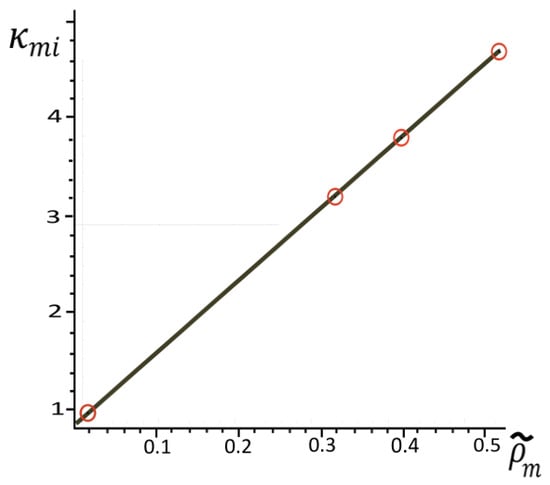
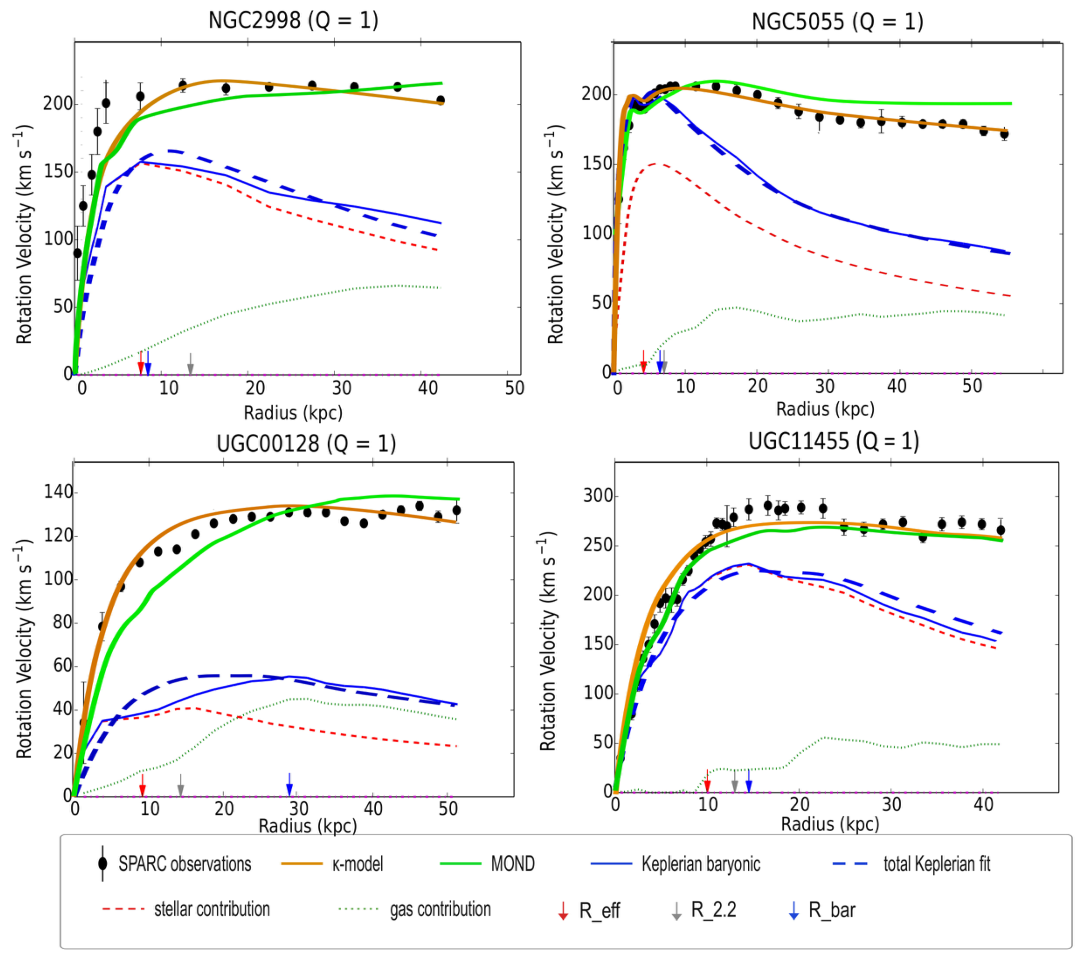
The four galaxies were selected because they are the isolated systems analysed by Mistele et al. in their weak-lensing study of indefinitely flat circular velocities and the baryonic Tully–Fisher relation [36]. Suitable targets must combine resolved rotation-curve measurements, weak-lensing information at large projected radii, and sufficient isolation to limit environmental or external-field effects. All four rotation curves have the SPARC quality flag , corresponding to the highest-quality class in the catalogue [3]. Only a small number of systems currently satisfy all these requirements; the sample size therefore reflects the scarcity of appropriate observations rather than an arbitrary selection. Table 1 first lists the baryonic inputs and the resulting quantities, after which Figure 1 and Figure 2 present the density–magnification relation and the rotation-curve comparison.
Figure 1.
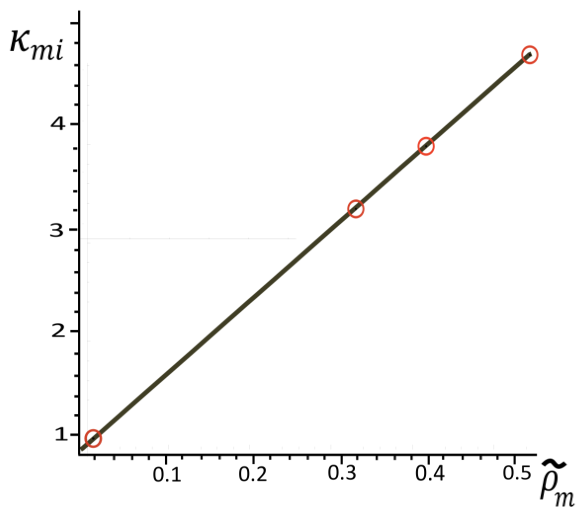
Relation between the dimensionless normalised central-density parameter and the dimensionless inner magnification coefficient for the four galaxies. Red open circles mark the individual galaxy values and the black line shows their linear regression. The regression is descriptive only; with four non-independent fitted points, no population-level inference is intended.
Figure 2.
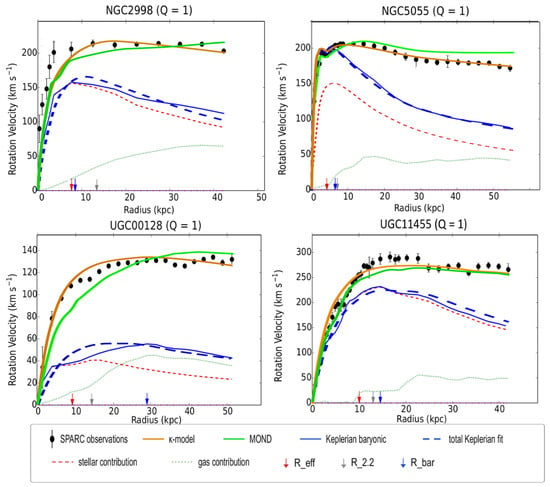
Rotation curves of the four isolated SPARC galaxies. Black filled circles and error bars show the observations from the SPARC catalogue [3]. Orange: -model; solid green: MOND; solid blue: Keplerian baryonic model; dashed blue: total Keplerian fit; dashed red: stellar contribution; dotted green: gas contribution. The arrows indicate the three characteristic radii defined in SPARC [3]: (red) is the effective radius encompassing half of the total 3.6-m luminosity; (grey) is the commonly used radius at 2.2 times the exponential stellar-disc scale length ; and (blue) is the radius where the baryonic circular-speed contribution reaches its maximum. In each panel, is the SPARC quality flag and denotes a highest-quality rotation curve. Velocities are in and radii are in .
The four values of and give a Pearson coefficient . This is a descriptive property of the fitted sample only. With , the points are neither statistically independent of the fitting procedure nor sufficient to establish a universal relation; no significance or population-level claim is inferred.
The central-density parameter spans , while spans –. A larger, independently selected sample is required to determine whether the apparent trend survives selection effects and parameter covariance.
For comparison, the MOND profiles are calculated from
Here, and are the Newtonian velocity and acceleration, respectively. The coefficient is fixed at .
The corresponding results are shown in Figure 2.
The agreement between the theoretical and observed profiles is quantified using the root-mean-square residual. For the -model, we define
For MOND, we similarly define
Here, n is the number of control points ().
These quantities are listed in columns 8 and 9 of Table 1. The normalised residuals are of comparable magnitude for MOND and the -model in this four-galaxy sample. Systematic uncertainties from distance, inclination, and radial variations of inclination are not propagated in the present calculation and may reach approximately 10–; the tabulated residuals must therefore not be interpreted as a model-selection statistic.
5. The Gravitational Lensing Distortion in the Outer Region (Halo)
Gravitational lensing depends on the mass projected onto the plane of the sky. Let denote the projected surface density in the base, in the dimensionless normalisation adopted for the lensing calculation below. As in Section 3, the tilde identifies a base quantity and does not by itself denote normalisation. Its physical counterpart is denoted by and has dimensions of mass per unit area. The conversion to physical units is made with the normalisation adopted for the calculation considered.
For clarity, the symbols used in the following lensing relations are defined here before they enter the equations. The quantity is the normalised projected surface density in the base; the variables u and r are the dimensionless normalised radial coordinates in the mechanical base and observer bundle, respectively; is the dimensionless local mapping factor relating them through ; and a is the dimensionless power-law index of the assumed outer projected-density profile. The scaling relations below use the dimensionless normalisation adopted locally for the present lensing calculation; this choice is independent of the base–bundle notation. When the relativistic deflection formula is evaluated, the corresponding physical base coordinates are restored through , , , , , and . Here M is the baryonic mass producing the deflection, G is Newton’s gravitational constant, c is the speed of light, denotes the radial lensing distortion evaluated in the base, and denotes the corresponding mapped distortion in the observer bundle. In the extended-source expression, and are the physical field-point and integration-point position vectors in the Einsteinian base, and are the corresponding physical cylindrical integration coordinates, is the azimuthal angle, is the physical radial cut-off, is the physical base volume-density distribution, and is the dimensionless deflection-angle vector evaluated in the base.
For this dimensionless normalised surface density, we assume the following simple law in the base (More specifically, is used to avoid a singularity at the origin):
and
With we have
and
For the relativistic point-mass estimate, physical base lengths are restored. For a point mass M at , acting across a physical radial interval at radius U, the radial lensing distortion is
For the unit normalised interval used in the estimate, and hence . The factor is dimensionless, so Equation (21) is dimensionally consistent.
The distortion is then mapped into the observed space through the local magnification factor . For the illustrative outer-region construction adopted here, we impose an asymptotically constant mapped shear as the phenomenological condition to be reproduced. Within the -model, this condition gives
Working backward from this condition yields and . Real galaxies are, however, extended objects. For the relativistic deflection integral, physical units are restored using the normalisation adopted for this calculation. We denote the resulting physical base volume density by , with and . Its physical line-of-sight projection is
The tilde consistently labels quantities in the base, whereas the subscript “phys” indicates that physical units have been restored; neither notation fixes the particular normalisation, which is specified locally for the calculation concerned. The deflection angle is given by
Here, is the physical base density corresponding to the normalised profile , with physical units restored according to the normalisation adopted locally for the present calculation. This form is dimensionally consistent: the volume element multiplied by supplies a mass, the geometrical kernel supplies an inverse length, and supplies length per unit mass, leaving the deflection angle dimensionless. The normalised density profile used below specifies the shape of this physical distribution, with and . For simplicity, the galaxy is assumed to be viewed face-on and to possess circular symmetry. In the physical mid-plane , the image distortion may equivalently be evaluated from the radial derivative of the deflection; because , the same calculation can be expressed in the normalised coordinate u after the physical prefactors have been restored. A quantitative prediction therefore requires an estimate of the halo density distribution in the base. This issue is addressed in the next section.
- –
- Evaluating the mean volume density of the baryonic halo as seen both in the base and in the bundle
The density outside an isolated galaxy, although very low as assumed in the previous section, is nevertheless not zero. Within the -model, a strictly zero density would even lead to the unphysical limit of infinite stretching. It must at least exceed the baryonic component of the cosmological density, . We therefore impose the condition in this region. In what follows, denotes the dimensionless normalised halo radius in the base, with its counterpart in the bundle given by in the same normalised coordinate system. The quantities and denote, respectively, the normalised volume-density and projected surface-density parameters at the galaxy centre, , and are dimensionless in this calculation. It is also reasonable to assume that is a few times, and at most of order ten times, the normalised galaxy radius .
Let us work in the base space. To obtain the volume density , expressed as a function of , we deproject the surface density , expressed as a function of u. For a surface density proportional to , we adopt the tractable approximation for the volume density and determine , , and from the best fit. We then write
and
Let denote the total mass of the halo. The halo surrounding an isolated galaxy is expected to contain a small amount of baryonic matter. Although its total mass is unknown, it is reasonable to assume that it does not exceed the baryonic mass of the galaxy itself. This assumption therefore leads to the constraint , taking the approximate baryonic mass of the Milky Way as a reference. In normalised units, we take the galaxy radius, half-thickness, and volume density to be 1, ∼0.1, and ∼1, respectively, so that in these dimensionless units. Physical quantities are recovered by expressing lengths in kiloparsecs and masses in units of ∼ (The halo volume is extremely large, whereas a spiral galaxy is geometrically thin. Consequently, even a very low halo density can yield a substantial total baryonic mass. In the observer bundle, we adopt – for the galactic radius of the objects considered here and for the halo radius). The projected-density profile was determined iteratively subject to the stated total-mass constraint, yielding the common coefficients , , and . These coefficients define the illustrative outer-halo construction used for all four galaxies; they are not fitted independently to each galaxy’s shear data. They should nevertheless be regarded as assumptions of the present phenomenological lensing construction, rather than as quantities derived from first principles. Setting gives the dimensionless bundle radius , indicating a strong stretching of the halo ( in normalised coordinates).
We also obtain , , and in normalised units. This leads to the mean density in the observer bundle, in normalised units, or ∼, using, for this numerical mean-halo-density estimate, the separate reference-density normalisation , or (For a galaxy cluster, the mean density in the observer bundle (quantities without a tilde) can be related to that in the base (quantities with a tilde) through energy conservation, . Here denotes the electron density, the temperature, which is invariant under the -transform (), and l the size of a volume element. For [7], we obtain ).
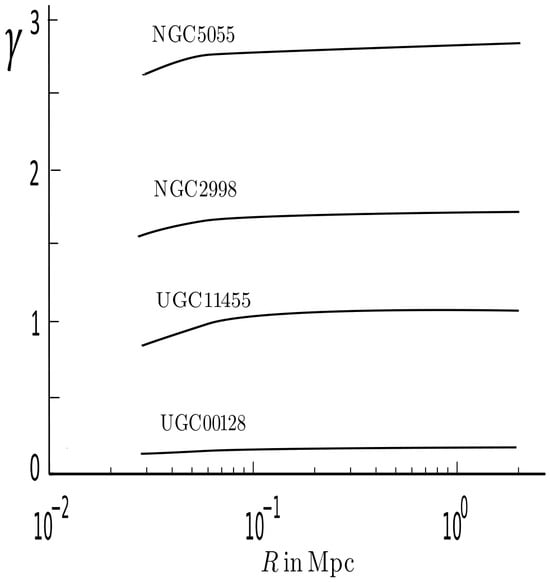
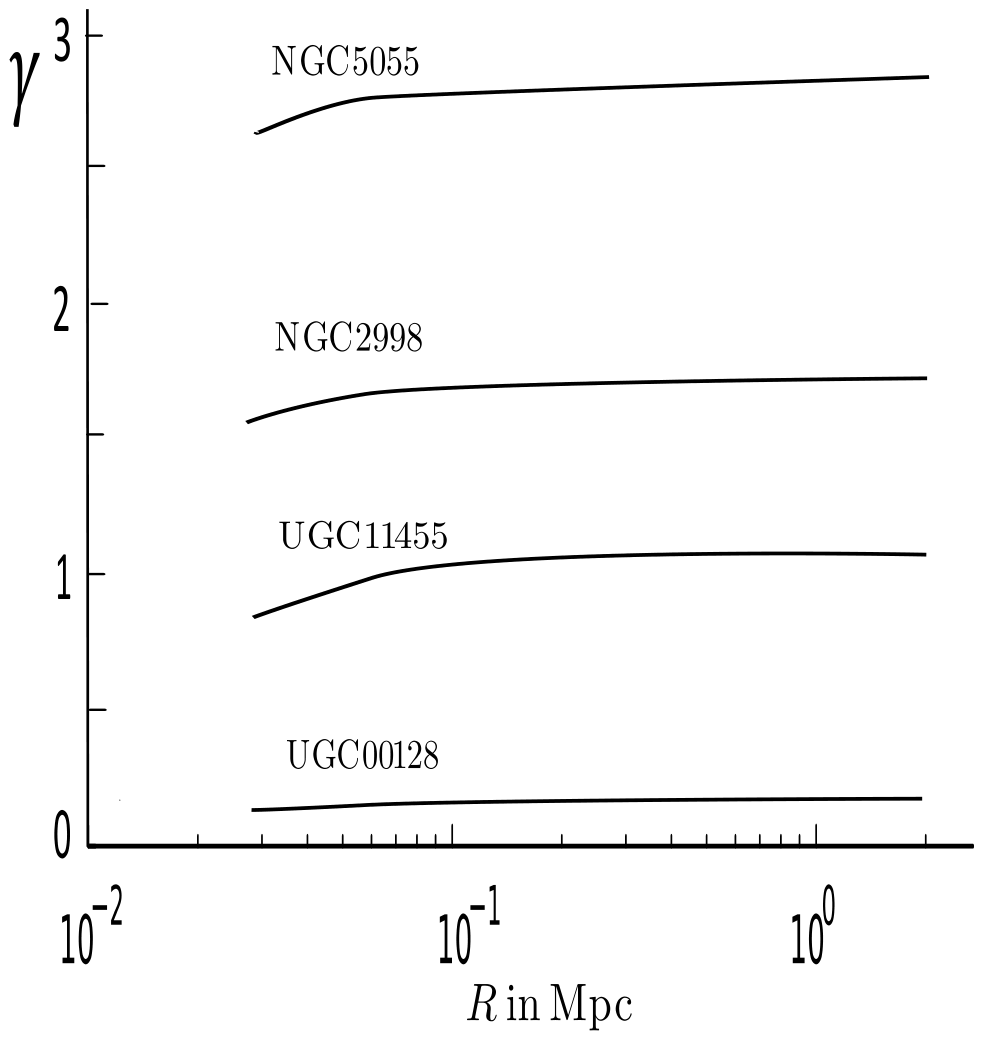
Unlike Figure 2, which compares observed SPARC rotation curves with dynamical model predictions, Figure 3 shows a separate weak-lensing prediction obtained from the assumed outer-halo projected-density profile, its deprojection, and the density-dependent mapping; no individual galaxy shear measurements are fitted.
Figure 3.
Weak-lensing distortion predicted by the mapping for the four isolated galaxies, with each curve identified directly by its galaxy name. The dimensionless shear is plotted against projected radius R in . The curves follow from the common normalised halo-density construction described in the text and are model predictions, not direct galaxy-by-galaxy shear measurements.
Once these quantities have been determined, we may proceed to evaluate the projected-density integral and its derivative. Applying the -transform then yields the distortion (in normalised units) in the observer bundle, providing an estimate of the weak gravitational lensing signal for the four galaxies considered in this work (Figure 3). The predicted shear exhibits the imposed asymptotically flat behaviour. The lensing prediction is therefore obtained directly from the projected-density mapping and is not inferred from an equivalent outer-halo velocity profile. The resulting outer plateaus are therefore interpreted here only as features of the mapped weak-lensing distortion under this projected-density mapping.
6. The Velocity Profile in the Outer Region (Halo)
Inspection of the SPARC catalogue indicates that, at large radii, approximately one third of the rotation curves are slightly increasing, another third are slightly decreasing, and the remaining third are nearly flat [8]. Within the dark-matter framework, this diversity can be represented by varying the halo parameters. MOND and the -model impose more specific asymptotic behaviours and are therefore more restrictive in this regime.
For the four galaxies considered here, the measured rotation curves decrease slightly over their outermost observed intervals. In isolated MOND, such local variations may approach an asymptotically flat profile at larger radii, whereas the -model predicts that the decline continues beyond the maximum radius of the observable gas distribution. The available measurements do not yet extend far enough to distinguish these asymptotic behaviours directly.
Knowing the density distribution within the halo, we can compute the corresponding velocity profiles directly for the four isolated galaxies. In the following, we assume that the dominant gravitational mass is contained within the galaxy and that the outer mass (halo mass) is negligible (i.e., absence of dark matter). In this case, the velocities decrease as a function of the radius u, as they would be perceived in the base. However, although this decrease is, as expected, purely Keplerian in the base, the stretching (from the base toward the bundle) causes this decrease to appear as an intermediate profile between a purely Keplerian profile and a flat profile.
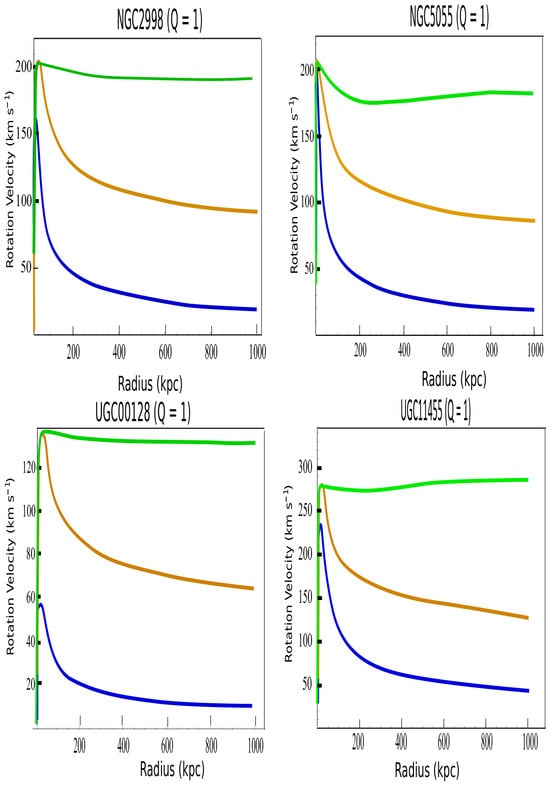
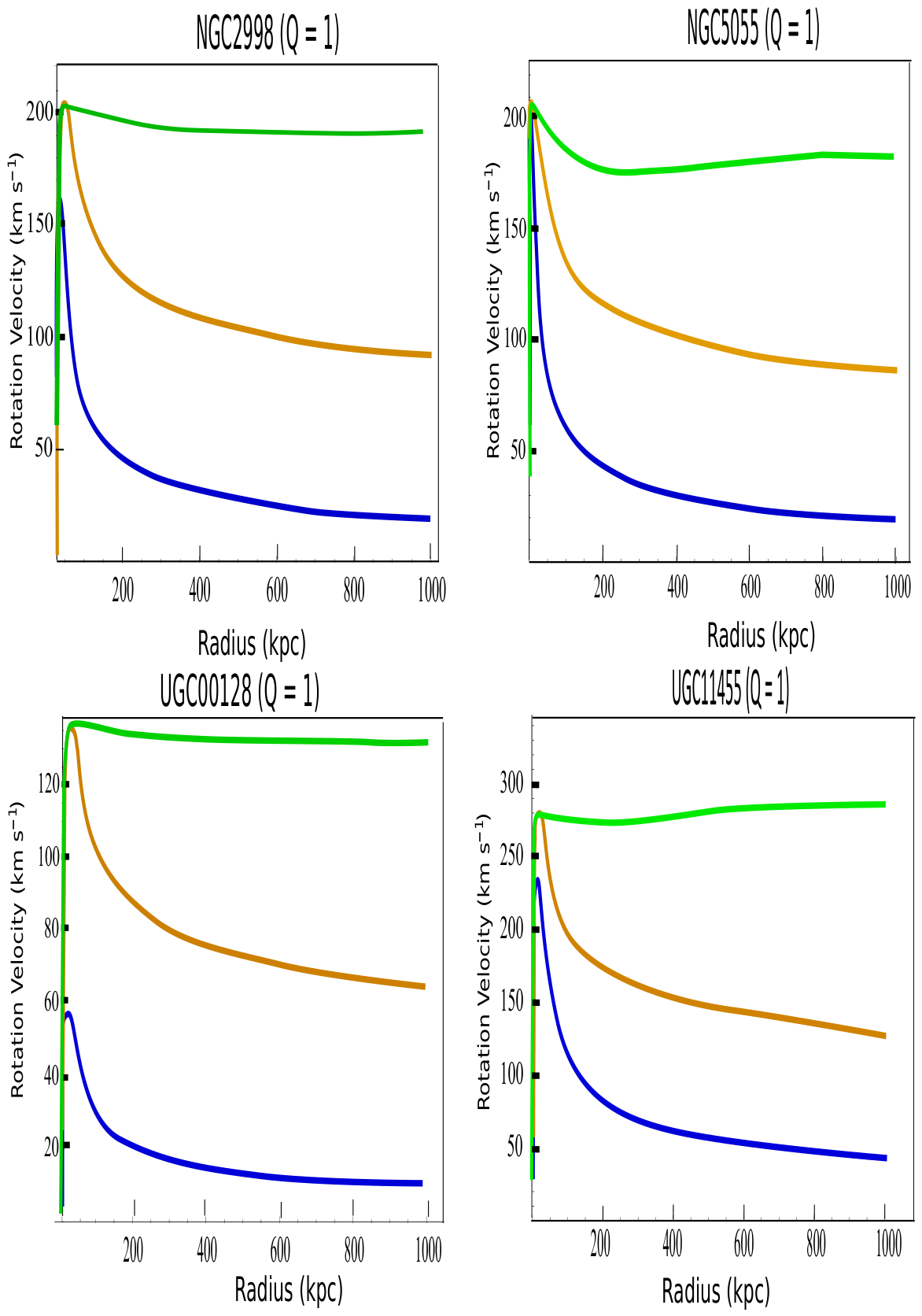
This constitutes an essential difference between the two formulations considered here. For an effectively isolated galaxy, the MOND prescription used in the present calculation approaches an asymptotically flat outer profile, whereas the -model predicts a continuing semi-Keplerian decline. The results are displayed in Figure 4 for the four galaxies considered.
Figure 4.
Extrapolated outer rotation-velocity profiles for the four galaxies, identified in the panel titles. Orange: -model; green: isolated-MOND prediction; blue: Keplerian baryonic prediction. In each panel, is the SPARC quality flag and denotes a highest-quality rotation curve. Velocities are in and radii are in . All curves beyond the measured SPARC range are model predictions rather than fitted or directly observed data.
The MOND profiles are also shown. They remain flat and differ significantly from the corresponding -model profiles, which exhibit a semi-Keplerian behaviour.
At present, however, the outer parts of these four galaxies have not been traced far enough beyond their last reliable gas measurements to test the extrapolations shown in Figure 4. The semi-Keplerian curves in this figure must therefore be regarded as predictions awaiting direct observational support, rather than as confirmed outer rotation curves. As discussed below, the much longer radial baseline available for M31 provides a first, independent indication that a declining outer profile of this general type can occur in a massive spiral. This strengthens the empirical motivation for testing the Figure 4 predictions, but does not constitute evidence that the same behaviour has already been observed in the four-galaxy sample.
6.1. Practical Discrimination Between MOND and the -Model
Figure 4 shows that the two predictions are not expected to be distinguishable primarily within the radial range already covered by the SPARC measurements: both reproduce the measured curves with residuals smaller than, or comparable to, the present systematic uncertainties. Their separation develops beyond the last reliably measured gas point. For an effectively isolated system, the MOND prediction approaches an approximately constant asymptotic speed, whereas the prediction continues along a semi-Keplerian decline. The relevant observable is therefore not a small difference in the fitted inner curve, but the sign and magnitude of the outer logarithmic slope, , measured over several independent radial bins beyond the visible gas disc.
For the four galaxies considered here, a practical test would require extending the kinematic baseline beyond the present ∼42– limits. Possible tracers include deeper H i observations where neutral gas remains detectable, discrete tracers such as planetary nebulae, globular clusters, satellite galaxies, and stellar-halo populations. Each tracer introduces different assumptions: gas velocities require control of warps, inclination, and non-circular motions, whereas halo tracers require an explicit treatment of anisotropy and possible departures from equilibrium. A meaningful comparison should therefore fit the distance, inclination, stellar mass-to-light ratio, gas distribution, tracer anisotropy, and environmental acceleration jointly, rather than comparing a single outer point with the extrapolated curves.
Weak lensing supplies a complementary, although statistically more demanding, discriminator. Individual galaxy shear measurements at the relevant radii are unlikely to be sufficiently precise; a sample enlarged beyond the present four objects would permit stacking in bins of baryonic mass, central density, isolation, and disc orientation. The kinematic and lensing samples should be selected by the same criteria to avoid comparing unrelated populations. Evidence favouring either prediction would require the predicted separation to exceed the combined observational and modelling uncertainty coherently over multiple radial bins. Conversely, a statistically significant absence of the semi-Keplerian decline, after environmental and equilibrium effects have been controlled, would falsify the version of the mapping used here. The M31 application below illustrates both the promise and the limitations of such an extended-baseline test, but it cannot substitute for missing outer measurements of the four SPARC systems.
6.2. Application to M31
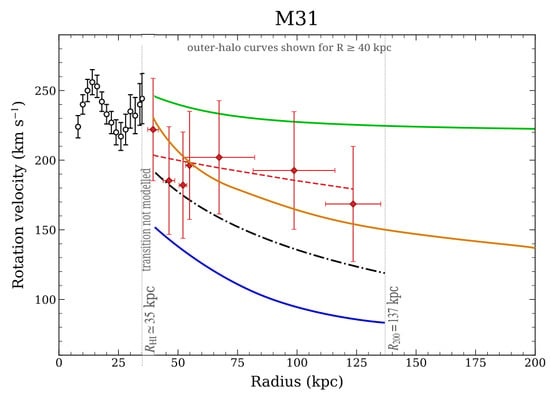
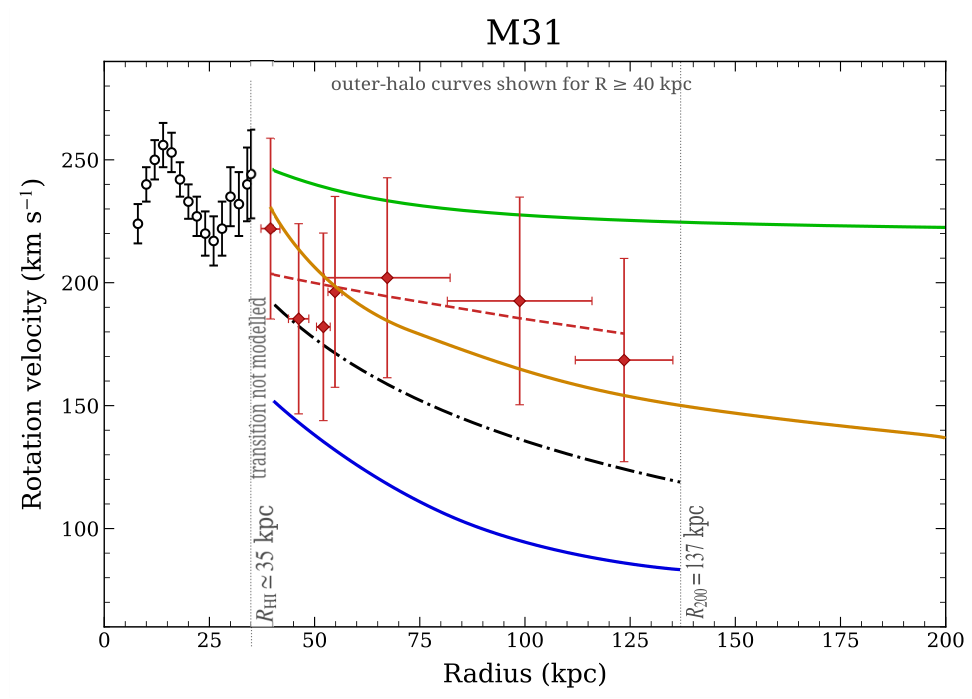
M31 provides an extended-baseline consistency test because recent studies constrain its kinematics well beyond the optical disc. Hammer et al. [11] modelled M31 as a major-merger remnant calibrated against the H i rotation curve, while Zhang et al. [12] used stellar-halo tracers to infer a declining outer circular-speed profile. These reconstructions are model-dependent and are used here only as external kinematic benchmarks. For the -model calculation, we adopt , –36 kpc, and a disc scale length kpc. These baryonic inputs fix the density– relation; no additional outer-halo parameter is fitted to the outer kinematic points. Beyond the visible gas disc, the -model rotation curve declines more slowly than the purely Keplerian baryonic prediction, whereas the MOND prescription used in this paper gives a substantially flatter outer trend. Figure 5 therefore includes both MOND and the -model in order to display their distinct predicted outer trends over the extended M31 radial baseline. The comparison is descriptive: it displays the distinct outer trends of the two predictions against the Hammer et al. and Zhang et al. reconstructions, without using M31 to claim a general falsification of MOND or to infer a preferred external-field amplitude.
Figure 5.
Outer rotation-velocity comparison for M31. Black open circles show the H i rotation-curve constraints used by Hammer et al. [11]; the black dash-dotted curve is the circular-speed profile reconstructed from their merger-remnant model. Red diamonds with error bars and the red dashed line show the stellar-halo circular-speed reconstruction of Zhang et al. [12]. The orange solid curve is the -model prediction, the green solid curve is the MOND prediction used for the central –MOND comparison of this paper, and the blue solid curve is the purely Keplerian baryonic reference. Hammer et al. and Zhang et al. [11,12] are retained as independent kinematic reconstructions rather than as competing gravity theories. No independently fitted outer-halo parameter is introduced in the curve.
Within the uncertainties of the outer-halo reconstructions, the prediction follows the observed tendency toward declining circular speed, while the MOND curve shown here remains substantially flatter over the same outer radial interval. This difference is the observable contrast emphasised in the paper, not a model-selection verdict. The Zhang et al. velocities rely on a Jeans-equilibrium reconstruction and the Hammer et al. profile on a merger-remnant simulation, and the present MOND curve represents the specific prescription adopted for this comparison. M31 therefore motivates further extended-baseline tests with directly constrained outer kinematics.
7. Conclusions
The four measured rotation curves are described with comparable residuals by MOND and by the present mapping; this agreement alone does not establish a new physical theory. The main result is instead a testable difference outside the measured baryonic disc: the isolated-MOND prescription adopted for the present comparison gives an asymptotically flat circular speed, whereas the mapping predicts a semi-Keplerian decline. The projected-density mapping used for lensing provides a second, explicitly model-dependent prediction.
M31 provides an additional extended-baseline consistency test. With no independently fitted outer-halo parameter, the mapping produces a declining outer profile compatible with the broad tendency of the quoted kinematic reconstructions. Because those reconstructions are model-dependent, this comparison is presented as a consistency check rather than as model selection. The scope of the present study remains limited by the four-galaxy sample, the absence of individual shear detections for the systems in Figure 3, and the lack of a formal likelihood analysis including the relevant systematic uncertainties. A decisive test requires an independently selected sample combining resolved kinematics beyond the visible gas disc with weak-lensing measurements of the same galaxies and propagating distance, inclination, mass-to-light, gas-distribution, and shear-calibration uncertainties. Failure to observe either the semi-Keplerian decline or the projected-density/shear relation would falsify the version of the mapping used here; agreement would provide motivation for developing its underlying geometrical formulation further.
Funding
This research received no external funding.
Data Availability Statement
The original contributions presented in this study are included in the article. Further inquiries can be directed to the corresponding author.
Acknowledgments
The author sincerely thanks the referees for their numerous and highly pertinent comments and suggestions, which have greatly improved the clarity, rigor, and overall quality of the manuscript.
Conflicts of Interest
The author declares no conflicts of interest.
References
- Milgrom, M. A Modification of the Newtonian Dynamics: Implications for Galaxy Systems. Astrophys. J. 1983, 270, 384–389. [Google Scholar] [CrossRef] [Scilit]
- Milgrom, M. MOND theory. Can. J. Phys. 2015, 93, 107–118. [Google Scholar] [CrossRef] [Scilit]
- Lelli, F.; McGaugh, S.S.; Schombert, J.M. VizieR Online Data Catalog: Mass models for 175 disk galaxies with SPARC. Astron. J. 2016, 152, 157. [Google Scholar] [CrossRef]
- Pascoli, G.; Pernas, L. Some Considerations about a Potential Application of the Abstract Concept of Asymmetric Distance in the Field of Astrophysics. HAL Open Sci. 2020. Available online: https://hal.science/hal-02530737 (accessed on 11 April 2020).
- Pascoli, G. The κ-Model, a minimal model alternative to dark matter: Application to the galactic rotation problem. Astrophys. Space Sci. 2022, 367, 62. [Google Scholar] [CrossRef] [Scilit]
- Pascoli, G. An empirical analysis of the dynamics of both individual galaxies and gravitational lensing in galaxy clusters without dark matter. arXiv 2022, arXiv:2210.12380. [Google Scholar] [CrossRef] [Scilit]
- Pascoli, G. A comparative study of MOND and MOG theories versus the κ-Model: An application to galaxy clusters. Can. J. Phys. 2023, 101, 11. [Google Scholar] [CrossRef] [Scilit]
- Pascoli, G. The κ-Model under the Test of the SPARC Database. Universe 2024, 10, 151. [Google Scholar] [CrossRef] [Scilit]
- Pascoli, G.; Pernas, L. Is Dark Matter a Misinterpretation of a Perspective Effect? Symmetry 2024, 16, 937. [Google Scholar] [CrossRef] [Scilit]
- Pascoli, G.; Pernas, L. Understanding the Universe Without Dark Matter and Without the Need to Modify Gravity: Is the Universe an Anamorphic Structure? Symmetry 2026, 18, 234. [Google Scholar] [CrossRef] [Scilit]
- Hammer, F.; Yang, Y.B.; Amram, P.; Chemin, L.; Mamon, G.A.; Wang, J.L.; Akib, I.; Jiao, Y.J.; Wang, H.F. Dark matter fraction derived from the M31 rotation curve. Astron. Astrophys. 2025, 694, A16. [Google Scholar] [CrossRef] [Scilit]
- Zhang, X.; Chen, B.; Chen, P.; Sun, J.; Tian, Z. The rotation curve and mass distribution of M31. Mon. Not. R. Astron. Soc. 2024, 528, 2653–2666. [Google Scholar] [CrossRef] [Scilit]
- Zwicky, F. Die Rotverschiebung von extragalaktischen Nebeln. Helv. Phys. Acta 1933, 6, 110–127. Available online: https://www.e-periodica.ch/digbib/view?pid=hpa-001:1933:6::112 (accessed on 11 April 2020).
- Rubin, V.C.; Ford, W.K.; Thonnard, N. Rotational Properties of 21 SC Galaxies with a Large Range of Luminosities and Radii, from NGC 4605/R = 4 kpc to UGC 2885/R = 122 kpc. Astrophys. J. 1980, 238, 471–487. [Google Scholar] [CrossRef] [Scilit]
- Springel, V.; White, S.D.M.; Jenkins, A.; Frenk, C.S.; Yoshida, N.; Gao, L.; Navarro, J.; Thacker, R.; Croton, D.; Helly, J.; et al. Simulations of the Formation, Evolution and Clustering of Galaxies and Quasars. Nature 2005, 435, 629–636. [Google Scholar] [CrossRef] [Scilit]
- Planck Collaboration. Planck 2018 Results. VI. Cosmological Parameters. Astron. Astrophys. 2020, 641, A6. [Google Scholar] [CrossRef] [Scilit]
- Clowe, D.; Bradac, M.; Gonzalez, A.H.; Markevitch, M.; Randall, S.W.; Jones, C.; Zaritsky, D. A Direct Empirical Proof of the Existence of Dark Matter. Astrophys. J. Lett. 2006, 648, L109–L113. [Google Scholar] [CrossRef] [Scilit]
- Yang, S.-Q.; Zhan, B.-G.; Wang, Q.-L.; Shao, C.-G.; Tu, L.-C.; Tan, W.-H.; Luo, J. Test of the Gravitational Inverse Square Law at Millimeter Ranges. Phys. Rev. Lett. 2012, 108, 081101. [Google Scholar] [CrossRef] [Scilit]
- Wilczynska, M.R.; Webb, J.K.; Bainbridge, M.; Barrow, J.D.; Bosman, S.E.I.; Carswell, R.F.; Dąbrowski, M.P.; Dumont, V.; Lee, C.-C.; Pasquini, L. Four Direct Measurements of the Fine-Structure Constant 13 Billion Years Ago. Sci. Adv. 2020, 6, eaay9672. [Google Scholar] [CrossRef] [Scilit]
- Moffat, J.W. Scalar–Tensor–Vector Gravity Theory. J. Cosmol. Astropart. Phys. 2006, 3, 004. [Google Scholar] [CrossRef] [Scilit]
- Bekenstein, J.D.; Milgrom, M. Does the Missing Mass Problem Signal the Breakdown of Newtonian Gravity? Astrophys. J. 1984, 286, 7–14. [Google Scholar] [CrossRef] [Scilit]
- Bekenstein, J.D.; Sanders, R.H. Gravitational Lenses and Unconventional Gravity Theories. Astrophys. J. 1994, 429, 480–490. [Google Scholar] [CrossRef] [Scilit]
- Sanders, R.H. A Stratified Framework for Scalar–Tensor Theories of Modified Dynamics. Astrophys. J. 1997, 480, 492–502. [Google Scholar] [CrossRef] [Scilit]
- Bekenstein, J.D. Relativistic Gravitation Theory for the MOND Paradigm. Phys. Rev. D 2004, 70, 083509. [Google Scholar] [CrossRef] [Scilit]
- Zlosnik, T.G.; Ferreira, P.G.; Starkman, G.D. Modifying Gravity with the Aether: An Alternative to Dark Matter. Phys. Rev. D 2007, 75, 044017. [Google Scholar] [CrossRef] [Scilit]
- Skordis, C.; Zlosnik, T. New Relativistic Theory for Modified Newtonian Dynamics. Phys. Rev. Lett. 2021, 127, 161302. [Google Scholar] [CrossRef] [Scilit]
- Blanchet, L.; Skordis, C. Relativistic Khronon theory in agreement with modified Newtonian dynamics and large-scale cosmology. J. Cosmol. Astropart. Phys. 2024, 11, 040. [Google Scholar] [CrossRef] [Scilit]
- Verlinde, E. On the Origin of Gravity and the Laws of Newton. J. High Energy Phys. 2011, 2011, 29. [Google Scholar] [CrossRef] [Scilit]
- Verlinde, E. Emergent Gravity and the Dark Universe. SciPost Phys. 2017, 2, 016. [Google Scholar] [CrossRef] [Scilit]
- Cesare, V.; Diaferio, A.; Matsakos, T.; Angus, G. Dynamics of DiskMass Survey Galaxies in Refracted Gravity. Astron. Astrophys. 2020, 637, A70. [Google Scholar] [CrossRef] [Scilit]
- Cesare, V.; Diaferio, A.; Matsakos, T. The Dynamics of Three Nearby E0 Galaxies in Refracted Gravity. Astron. Astrophys. 2022, 657, A133. [Google Scholar] [CrossRef] [Scilit]
- Cesare, V. Dark Coincidences: Small-Scale Solutions with Refracted Gravity and MOND. Universe 2023, 9, 56. [Google Scholar] [CrossRef] [Scilit]
- Briscese, F.; Calcagni, G. Fractal universe and quantum gravity made simple. arXiv 2026, arXiv:2603.24593. [Google Scholar] [CrossRef] [Scilit]
- Jiao, O.; Hammer, F.; Wang, H.; Wang, J.; Amram, P.; Chemin, L.; Yang, Y. Detection of the Keplerian Decline in the Milky Way Rotation Curve. Astron. Astrophys. 2023, 678, A208. [Google Scholar] [CrossRef] [Scilit]
- Varieschi, G.U. Fractional-Dimension Gravity and the Milky Way rotation curve. arXiv 2026, arXiv:2607.01412. [Google Scholar]
- Mistele, T.; McGaugh, S.S.; Lelli, F.; Schombert, J.M.; Li, P. Indefinitely Flat Circular Velocities and the Baryonic Tully-Fisher Relation from Weak Lensing. Astrophys. J. Lett. 2024, 969, L3. [Google Scholar] [CrossRef] [Scilit]

Disclaimer/Publisher’s Note: The statements, opinions and data contained in all publications are solely those of the individual author(s) and contributor(s) and not of MDPI and/or the editor(s). MDPI and/or the editor(s) disclaim responsibility for any injury to people or property resulting from any ideas, methods, instructions or products referred to in the content. |
© 2026 by the author. Licensee MDPI, Basel, Switzerland. This article is an open access article distributed under the terms and conditions of the Creative Commons Attribution (CC BY) license.