You are currently viewing a new version of our website. To view the old version click .

Universe, Volume 11, Issue 9

September 2025 - 42 articles

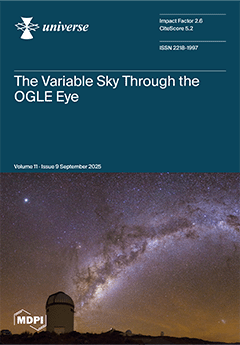
Cover Story: For over 30 years, the Optical Gravitational Lensing Experiment (OGLE) has transformed our view of the Universe. Originally designed to search for dark matter through microlensing, OGLE has evolved into one of the most productive sky surveys in the history of astronomy. Its systematic observations of approximately two billion stars have provided insights into stellar variability, led to the discovery of exoplanets, and advanced our understanding of Galactic and extragalactic structure. The OGLE Collection of Variable Stars (OCVS) is not only a global resource but is also becoming a standard training dataset for machine learning models due to its purity and completeness. OGLE continues to inspire discovery at the frontier of astrophysics. View this paper
  • Issues are regarded as officially published after their release is announced to the table of contents alert mailing list .
  • You may sign up for email alerts to receive table of contents of newly released issues.
  • PDF is the official format for papers published in both, html and pdf forms. To view the papers in pdf format, click on the "PDF Full-text" link, and use the free Adobe Reader to open them.

Articles (42)

  • Article
  • Open Access
684 Views
12 Pages

12 September 2025

In this work, we employ the nonextensive Nambu–Jona-Lasinio model to analyze the thermodynamic properties of magnetized quark matter. The nonequilibrium state is described in Tsallis distribution by a dimensionless parameter q. We find that wit...

  • Article
  • Open Access
682 Views
22 Pages

11 September 2025

Light from fast radio bursts (FRBs) can be deflected by the gravitational lensing effect of primordial black holes (PBHs), if they are distributed along the path from the FRBs to the observer. Consequently, the PBH mass function can be constrained by...

  • Article
  • Open Access
535 Views
24 Pages

Birth of an Isotropic and Homogeneous Universe with a Running Cosmological Constant

  • A. Oliveira Castro Júnior,
  • A. Corrêa Diniz,
  • G. Oliveira-Neto and
  • G. A. Monerat

11 September 2025

The present work discusses the birth of the Universe via quantum tunneling through a potential barrier, based on quantum cosmology, taking a running cosmological constant into account. We consider the Friedmann–Lemaître–Robertson&nd...

  • Article
  • Open Access
749 Views
22 Pages

10 September 2025

Moons tidally interact with their host planets and stars. A close moon is quickly synchronised by the planet or becomes captured in a higher spin–orbit resonance. However, the planet requires much more time to significantly alter its rotation r...

  • Article
  • Open Access
761 Views
15 Pages

10 September 2025

We explore a timeless approach to quantum theory, in the form of the Page–Wootters mechanism, in which a gravitational interaction is introduced between the system and a finite-dimensional clock. The clock model used is the recently proposed qu...

  • Article
  • Open Access
1 Citations
959 Views
17 Pages

Probing the Cosmic Distance Duality Relation via Non-Parametric Reconstruction for High Redshifts

  • Felipe Avila,
  • Fernanda Oliveira,
  • Camila Franco,
  • Maria Lopes,
  • Rodrigo Holanda,
  • Rafael C. Nunes and
  • Armando Bernui

9 September 2025

We test the validity of the cosmic distance duality relation (CDDR) by combining angular diameter distance and luminosity distance measurements from recent cosmological observations. For the angular diameter distance, we use data from transverse bary...

  • Article
  • Open Access
837 Views
19 Pages

9 September 2025

The temperature and polarization anisotropies of the cosmic microwave background (CMB) as measured today can offer key insights into the topology of the early universe prior to inflation, for example by discriminating between flat and warped geometri...

  • Article
  • Open Access
645 Views
17 Pages

9 September 2025

One extension of general relativity, known as f(R) gravity, where R denotes the Ricci scalar, is regarded as a promising candidate for addressing the anomalies observed in conventional general relativity. In this work, we apply the field equations of...

  • Article
  • Open Access
589 Views
19 Pages

6 September 2025

The Hubble tension, a persistent discrepancy between early and late Universe measurements of H0, poses a significant challenge to the standard cosmological model. In this work, we present a new Bayesian hierarchical framework designed to meticulously...

of 5

Get Alerted

Add your email address to receive forthcoming issues of this journal.

XFacebookLinkedIn
Universe - ISSN 2218-1997