

You are currently viewing a new version of our website. To view the old version click .

Metabolites, Volume 7, Issue 1

March 2017 - 11 articles

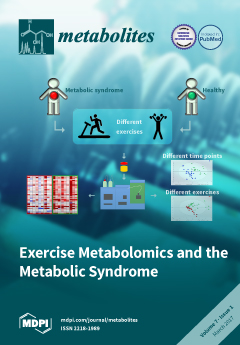
Cover Story: Exercise plays a primary role in the treatment of the metabolic syndrome (MetS), a cluster of risk factors that raises morbidity. However, the optimal exercise parameters remain undetermined. Metabolomics can provide new insights into exercise metabolism. We investigated whether the response of the urinary metabolic fingerprint to exercise depends on the presence of MetS or exercise mode. Overall, men with MetS exhibited a blunted metabolic response to exercise compared to healthy men. The metabolic fingerprint responded diversely to three fundamentally different exercise modes, while the metabolic response to exercise gradually subsided to baseline on the following day. Further investigations may bring us closer to personalized exercise prescription for individuals with cardiometabolic risk factors. View the paper
  • Issues are regarded as officially published after their release is announced to the table of contents alert mailing list .
  • You may sign up for email alerts to receive table of contents of newly released issues.
  • PDF is the official format for papers published in both, html and pdf forms. To view the papers in pdf format, click on the "PDF Full-text" link, and use the free Adobe Reader to open them.

Articles (11)

  • Article
  • Open Access
11 Citations
6,666 Views
14 Pages

Recent technological advancement has enabled the emergence of lipidomics as an important tool for assessing molecular stress, one which has yet to be assessed fully as an approach in an environmental toxicological context. Here we have applied a high...

  • Article
  • Open Access
30 Citations
7,763 Views
15 Pages

Impact of Exercise and Aging on Rat Urine and Blood Metabolome. An LC-MS Based Metabolomics Longitudinal Study

  • Olga Deda,
  • Helen G. Gika,
  • Ioannis Taitzoglou,
  • Νikolaos Raikos and
  • Georgios Theodoridis

23 February 2017

Aging is an inevitable condition leading to health deterioration and death. Regular physical exercise can moderate the metabolic phenotype changes of aging. However, only a small number of metabolomics-based studies provide data on the effect of exer...

  • Article
  • Open Access
51 Citations
6,914 Views
14 Pages

The Role of Sarcosine, Uracil, and Kynurenic Acid Metabolism in Urine for Diagnosis and Progression Monitoring of Prostate Cancer

  • Georgios Gkotsos,
  • Christina Virgiliou,
  • Ioanna Lagoudaki,
  • Chrysanthi Sardeli,
  • Nikolaos Raikos,
  • Georgios Theodoridis and
  • Georgios Dimitriadis

23 February 2017

The aim of this pilot study is to evaluate sarcosine, uracil, and kynurenic acid in urine as potential biomarkers in prostate cancer detection and progression monitoring. Sarcosine, uracil, and kynurenic acid were measured in urine samples of 32 pros...

  • Article
  • Open Access
4 Citations
6,098 Views
13 Pages

Application of Passive Sampling to Characterise the Fish Exometabolome

  • Mark R. Viant,
  • Jessica Elphinstone Davis,
  • Cathleen Duffy,
  • Jasper Engel,
  • Craig Stenton,
  • Marion Sebire and
  • Ioanna Katsiadaki

14 February 2017

The endogenous metabolites excreted by organisms into their surrounding environment, termed the exometabolome, are important for many processes including chemical communication. In fish biology, such metabolites are also known to be informative marke...

  • Article
  • Open Access
24 Citations
5,607 Views
7 Pages

QSRR Modeling for Metabolite Standards Analyzed by Two Different Chromatographic Columns Using Multiple Linear Regression

  • Chrysostomi Zisi,
  • Ioannis Sampsonidis,
  • Stella Fasoula,
  • Konstantinos Papachristos,
  • Michael Witting,
  • Helen G. Gika,
  • Panagiotis Nikitas and
  • Adriani Pappa-Louisi

9 February 2017

Modified quantitative structure retention relationships (QSRRs) are proposed and applied to describe two retention data sets: A set of 94 metabolites studied by a hydrophilic interaction chromatography system under organic content gradient conditions...

  • Article
  • Open Access
59 Citations
8,618 Views
17 Pages

Urine and Serum Metabolomics Analyses May Distinguish between Stages of Renal Cell Carcinoma

  • Oluyemi S. Falegan,
  • Mark W. Ball,
  • Rustem A. Shaykhutdinov,
  • Phillip M. Pieroraio,
  • Farshad Farshidfar,
  • Hans J. Vogel,
  • Mohamad E. Allaf and
  • Matthew E. Hyndman

3 February 2017

Renal cell carcinoma (RCC) is a heterogeneous disease that is usually asymptomatic until late in the disease. There is an urgent need for RCC specific biomarkers that may be exploited clinically for diagnostic and prognostic purposes. Preoperative fa...

  • Article
  • Open Access
24 Citations
6,986 Views
13 Pages

26 January 2017

Cercospora leaf spot (CLS) is one of the most serious leaf diseases for sugar beet (Beta vulgaris L.) worldwide. The breeding of sugar beet cultivars with both high CLS resistance and high yield is a major challenge for breeders. In this study, we re...

  • Article
  • Open Access
31 Citations
7,617 Views
15 Pages

Effects of Different Exercise Modes on the Urinary Metabolic Fingerprint of Men with and without Metabolic Syndrome

  • Aikaterina Siopi,
  • Olga Deda,
  • Vasiliki Manou,
  • Spyros Kellis,
  • Ioannis Kosmidis,
  • Despina Komninou,
  • Nikolaos Raikos,
  • Kosmas Christoulas,
  • Georgios A. Theodoridis and
  • Vassilis Mougios

26 January 2017

Exercise is important in the prevention and treatment of the metabolic syndrome (MetS), a cluster of risk factors that raises morbidity. Metabolomics can facilitate the optimization of exercise prescription. This study aimed to investigate whether th...

  • Article
  • Open Access
15 Citations
7,401 Views
15 Pages

Distinguishing Benign from Malignant Pancreatic and Periampullary Lesions Using Combined Use of 1H-NMR Spectroscopy and Gas Chromatography–Mass Spectrometry

  • Yarrow J. McConnell,
  • Farshad Farshidfar,
  • Aalim M. Weljie,
  • Karen A. Kopciuk,
  • Elijah Dixon,
  • Chad G. Ball,
  • Francis R. Sutherland,
  • Hans J. Vogel and
  • Oliver F. Bathe

13 January 2017

Previous work demonstrated that serum metabolomics can distinguish pancreatic cancer from benign disease. However, in the clinic, non-pancreatic periampullary cancers are difficult to distinguish from pancreatic cancer. Therefore, to test the clinica...

of 2

Get Alerted

Add your email address to receive forthcoming issues of this journal.

XFacebookLinkedIn
Metabolites - ISSN 2218-1989