


Abstract
Background/Objectives: Patient-reported outcomes (PROs) capture important dimensions of inflammatory bowel disease (IBD), including fatigue, questionnaire-defined mood-related symptom burden, pain, sleep disturbance, bowel urgency and impaired health-related quality of life, yet these outcomes are incompletely explained by conventional inflammatory markers. Metabolite-related measures may capture host–microbe co-metabolism relevant to patient-reported burden. Methods: This critical narrative review synthesized adult IBD literature linking metabolite-related measures with patient-reported symptom domains. PubMed/MEDLINE, Embase.com, Scopus and Web of Science Core Collection were searched through 11 June 2026; purposive source selection supported critical narrative synthesis rather than exhaustive enumeration. Results: Our structured search identified only a small number of human studies, mainly in fatigue and questionnaire-defined mood-related symptom burden. Studies included serum, plasma or fecal metabolite measurements, exploratory multi-omics, inferred microbial metabolic functions and interventional pathway testing. Fatigue was associated with serum amino-acid-related changes, plasma lipidomic alterations and fecal untargeted metabolomic and microbiome differences; inferred microbial functional modules were also reported. Mood-related burden was associated with serum and fecal metabolomic changes, bile-acid profiles and microbiota-derived functional signals. Within our search and eligibility criteria, no human studies paired measured metabolites with sleep-, pain- or urgency-specific patient-reported outcome measures (PROMs); evidence for multidimensional clusters was insufficient. Conclusions: We did not identify a metabolite-related signature for the assessment of patient-reported burden that had undergone both analytical and clinical validation; findings support candidate associations and exploratory signatures. Future work requires longitudinal, phenotype-stratified cohorts, validated PROMs, rigorous metabolomics methodology, causal modeling, inflammatory and dietary metadata, multiple-testing control and independent validation for clinical translation.
1. Introduction
Inflammatory bowel disease (IBD), including Crohn’s disease (CD) and ulcerative colitis (UC), is increasingly managed using treat-to-target frameworks that extend beyond symptom relief toward objective control of inflammation, mucosal healing and prevention of structural damage [1]. Novel outcome frameworks emphasize that patient-reported domains are clinically important in IBD [2]. Core-outcome work has similarly highlighted the need to capture outcomes meaningful to patients [3]. Patient-reported outcome measures may correlate poorly with objective inflammatory bowel disease activity measures [4]. Real-world IBD-PODCAST data show that suboptimal disease control is associated with persistent patient burden [5]. Canadian IBD-PODCAST data further link suboptimal disease control with reduced quality of life [6].
A patient-reported outcome (PRO) is the concept reported directly by the patient, such as fatigue, pain, urgency, sleep disturbance or perceived quality of life. A patient-reported outcome measure (PROM) is the instrument used to measure that concept. This distinction is important because symptom-specific PROs, psychological symptom burden, health-related quality of life (HRQoL), multidimensional symptom burden and formal psychiatric diagnoses are not interchangeable. Throughout this review, depression is distinguished from depressive symptoms, anxiety disorder from anxiety symptoms, psychological disorder from psychological burden, and screening-scale positivity from clinical diagnosis.
Common instruments discussed in this review include the Functional Assessment of Chronic Illness Therapy-Fatigue scale (FACIT-F), Fatigue Scale-14 (FS-14), Patient-Reported Outcomes Measurement Information System Fatigue instruments (PROMIS-Fatigue), Patient Health Questionnaire-9 (PHQ-9), Generalized Anxiety Disorder 7-item scale (GAD-7), Hospital Anxiety and Depression Scale (HADS), Wuerzburger Fatigue Inventory for Multiple Sclerosis (WEIMuS) and fatigue visual analogue scale (fVAS). These instruments may be analyzed as continuous scores or dichotomized using cut-off values; dichotomization can improve clinical interpretability but may reduce information and should be interpreted cautiously.
PROs should therefore not be treated as patient-reported proxies for objective disease-activity measures. Rather, they measure dimensions of disease burden that conventional biomarkers cannot directly capture. A patient with normalized fecal calprotectin and improved endoscopic activity may still experience fatigue, altered bowel confidence, cognitive burden or mood-related symptoms. Conversely, active mucosal inflammation may occur with relatively few symptoms. This bidirectional mismatch creates a need for frameworks that integrate, rather than replace, objective inflammatory and patient-reported dimensions.
The gut-brain axis provides a biologically coherent framework for interpreting persistent burden in IBD. Bidirectional brain-gut effects influence mood and prognosis in IBD [7]. IBD-related fatigue has been discussed in relation to inflammatory, psychological, nutritional and gut-brain-axis mechanisms [8]. Broader gut-brain frameworks also include neural, immune, sleep, stress-response and behavioral pathways [9]. Microbial metabolites are a key component of microbiota-gut-brain signaling in IBD [10]. Within this network, metabolomics is particularly attractive because metabolites represent functional outputs of host-microbe co-metabolism and may be closer to clinical phenotypes than taxonomy alone. Large IBD multi-omics work supports joint consideration of microbial, metabolic and host-response layers [11]. Integrative multi-omics approaches are increasingly used to study host-microbiome interactions in IBD [12]. Recent host-microbiota interactome analyses further support combining microbial, metabolic and host-response data [13].
Short-chain fatty acids (SCFAs), bile acids, tryptophan–kynurenine metabolites, serotonin-related metabolites, microbial indoles, lipid mediators, volatile organic compounds (VOCs) and broader untargeted metabolomic signatures are biologically plausible contributors to patient-reported burden. However, pathway plausibility is not equivalent to clinical validity. Many IBD metabolomic studies focus on diagnosis, inflammatory activity, treatment response or mechanistic discovery rather than validated PROMs. Conversely, many PRO studies do not include metabolomics or functional microbial readouts. A critical narrative synthesis is therefore needed to distinguish candidate metabolite–PRO associations from validated clinical tools.
In this review, a metabolite-related measure refers to a directly quantified metabolite, metabolite class or metabolomic feature measured in a biological matrix, or to a metabolite-associated microbial functional pathway when the distinction from direct metabolite quantification is explicitly stated. A metabolic signature refers to a pattern of measured metabolites or annotated metabolic features associated with a patient-reported domain, not a clinically validated biomarker unless independent validation and context-of-use evidence are available. Predicted microbial functions, metabolite-associated taxa and pathway-enrichment analyses without direct metabolite measurement were treated as evidence of potential metabolic capacity or biological context, not measured metabolite concentrations, pathway activity or metabolic flux. Interventional studies such as 5-hydroxytryptophan supplementation are interpreted as tests of a specific metabolic-pathway hypothesis, not as studies identifying or validating metabolic signatures.
Previous reviews have summarized different parts of this field. Fatigue-focused reviews have discussed gut-brain-axis mechanisms and symptom burden in IBD [8]. Systematic metabolomics reviews have synthesized IBD metabolic alterations mainly in relation to diagnosis, disease activity and pathophysiology [14]. Broader metabolomics reviews have addressed IBD pathogenesis, prognosis and treatment response [15]. Recent microbiota-derived metabolite reviews have emphasized therapeutic and mechanistic targets in IBD [16]. Zarei et al. recently reviewed gut-microbiota-derived metabolomic profiles in relation to mental disorders, particularly anxiety and depression, in IBD [17]. The most recent broad systematic review evaluated metabolomics for IBD diagnosis, disease differentiation, activity assessment, treatment response and monitoring, rather than organizing the evidence around PROs or PROMs [18]. The present review extends beyond mood-related symptom burden to fatigue, sleep disturbance, pain, bowel urgency, stool-frequency burden and multidimensional symptom clusters; uses PROs and PROMs as its organizing framework; distinguishes directly measured metabolites at the level of individual studies from exploratory multi-omics signals, inferred microbial metabolic functions and interventional pathway evidence; and does not treat screening-scale positivity as equivalent to a formal psychiatric diagnosis. A comparison of the scope and methodological focus of previous reviews and the present review is provided in Supplementary Table S1.
The objective of this critical narrative review was therefore to synthesize and critically interpret literature on metabolite-related measures and metabolic signals associated with PROs in IBD, while explicitly separating the relevant evidence layers and identifying methodological constraints that currently limit clinical translation.
2. Approach to Literature Identification and Narrative Synthesis
This article was designed as a critical narrative review aimed at synthesizing adult human and mechanistic literature relevant to metabolite-related measures and PROs in IBD. Source identification was purposive and intended to support comprehensive critical interpretation. Publications were considered according to their relevance to the review question, methodological informativeness, biological plausibility and contribution to the conceptual interpretation of metabolite-PRO relationships.
PubMed/MEDLINE, Embase.com, Scopus, and Web of Science Core Collection were searched from database inception to 11 June 2026. Search strategies combined three concept blocks covering: (1) inflammatory bowel disease; (2) metabolomics, directly measured metabolites, microbiota-derived metabolites, metabolic pathways, and inferred microbial metabolic functions; and (3) PROs, PROMs, health-related quality of life, and relevant patient-reported symptom domains. The complete database-specific search strategies are provided in Supplementary Table S2. No publication-date, language, age, species, or study-design filters were applied at the search stage. Reference lists of relevant reviews and key primary publications were additionally screened manually. Across the four databases, 827 records were identified, and manual citation searching yielded 32 additional records. After removal of 312 duplicates, 547 unique records underwent title/abstract screening; 44 full-text reports were assessed, and eight studies met the operational criteria for inclusion in the principal human evidence synthesis.
The review prioritized adult human publications in Crohn’s disease, ulcerative colitis or IBD-unclassified that evaluated directly measured metabolites, metabolomic signatures, metabolite-associated microbial functional pathways or other metabolite-related measures in relation to PROs, PROMs or clearly defined patient-reported symptom domains. The literature identification and narrative review were performed by A.H.P. and P.K.; decisions regarding which publications were central to the principal human discussion were made through author discussion, with emphasis on direct relevance, availability of patient-reported outcomes in the same clinical context and methodological contribution to the narrative synthesis.
Evidence not prioritized as part of the principal human discussion comprised pediatric-only literature, animal-only or in vitro work, taxonomy-only microbiome studies without functional or metabolite-level inference, metabolomic studies without an interpretable patient-reported outcome, studies focused exclusively on objective inflammatory activity, conference abstracts lacking sufficient methodological detail and reports with insufficient methodological information. Such sources were used only as mechanistic or contextual evidence when they helped interpret biological plausibility or research priorities. At the full-text eligibility stage, the review was restricted to peer-reviewed publications available in English; no translation workflow for non-English full texts was undertaken.
For narrative organization, human publications were grouped into four categories: evidence based on direct metabolite measurement, exploratory multi-omics evidence, evidence from inferred microbial metabolic functions and interventional pathway evidence. Evidence based on direct metabolite measurement refers to studies in which metabolites were directly quantified in biological material and analyzed in relation to PROs. Exploratory multi-omics evidence refers to studies in which metabolomics was integrated with microbiome, proteomic or other omics layers. Evidence from inferred microbial metabolic functions refers to studies in which functions or modules were predicted from metagenomic or microbiome data without direct metabolite quantification. Interventional pathway evidence refers to studies in which a defined metabolic pathway was modified and both metabolic response and PROs were evaluated.
This categorization was used only to organize the narrative synthesis. It does not represent a formal quality-grading system, a certainty-of-evidence assessment or a hierarchy of clinical validity. In particular, “direct” indicates only that metabolites were measured in the biological material; it does not imply stronger evidence, lower risk of bias or greater certainty. Studies with directly measured metabolites may still be small, cross-sectional, exploratory, affected by confounding or lacking independent validation. Mechanistic studies, animal studies, in vitro studies, taxonomy-only microbiome studies and studies that did not assess metabolite-related measures and PROs in the same clinical context are referred to as mechanistic or contextual evidence and are used in interpretative sections rather than being treated as equivalent to the principal human literature summarized in Table 1. Statements concerning evidence gaps were bounded to the scope of the structured search; failure to identify a study or validation was not interpreted as proof of universal absence.
The coherence and transparency of the review were considered using principles consistent with the Scale for the Assessment of Narrative Review Articles (SANRA), including justification of the review’s importance, statement of aims, description of literature identification, appropriate referencing, scientific reasoning and balanced presentation of evidence [19]. Critical methodological appraisal was descriptive and focused on study design, sample size, IBD phenotype and activity, PROM adequacy, synchronization of biospecimen and PROM assessment, inflammatory and dietary context, metabolomics quality, multiple-testing control, risk of overfitting and internal or external validation. The characteristics, principal findings, evidence classification, and integrated critical methodological appraisal of the key human studies are presented in Table 1.
Table 1.
Key Human Studies Linking Metabolite-Related Measures with Patient-Reported Outcomes in Inflammatory Bowel Disease.
3. Current Human Evidence Linking Metabolite-Related Measures to Patient-Reported Outcomes
3.1. Overview of the Current Evidence Base
Our structured search identified only a small number of human studies directly evaluating associations between metabolite-related measures and PROs in IBD, and the identified studies were methodologically heterogeneous. The identified studies were concentrated primarily in fatigue and questionnaire-defined mood-related symptom burden. Within the limits of the databases searched, the search strategy and the operational eligibility criteria applied, we did not identify human studies directly evaluating measured metabolites against validated sleep-, pain- or urgency-specific PROMs; the evidence captured was insufficient to establish signatures for stool-frequency burden or multidimensional symptom clusters. These findings are limited to the scope of this critical narrative review and do not establish that no such studies exist. Importantly, we did not identify any metabolite-related signature that had undergone both analytical and clinical validation for the assessment of patient-reported burden in IBD.
The available human literature uses different biological matrices, analytical platforms and conceptual links to metabolism. Some studies directly measured metabolites in serum, plasma or feces. Others used exploratory multi-omics designs that combined metabolomics with microbiome and proteomic layers. A further group inferred microbial metabolic functions from metagenomic data without direct metabolite quantification. Interventional pathway work is especially informative because it tests whether biochemical pathway modulation translates into symptomatic benefit, and our structured search identified only a small number of such studies.
Table 1 summarizes the design, study population, IBD phenotype and inflammatory activity, PRO or PROM assessment, biological matrix, metabolite-related methodology, principal findings, evidence category, and integrated critical appraisal of the key human studies informing the narrative synthesis. These publications were selected because they evaluated metabolite-related measures and patient-reported symptom burden within the same clinical cohort or intervention, or because they tested a clearly defined metabolic-pathway hypothesis. The table also highlights study-level limitations related to confounding, analytical validity, multiplicity, overfitting, and the absence of independent validation. All eight studies meeting the operational criteria for the principal human evidence synthesis are included in Table 1; Table 1 is therefore complete for that synthesis, although it does not catalogue the broader mechanistic and contextual literature considered elsewhere in this narrative review.
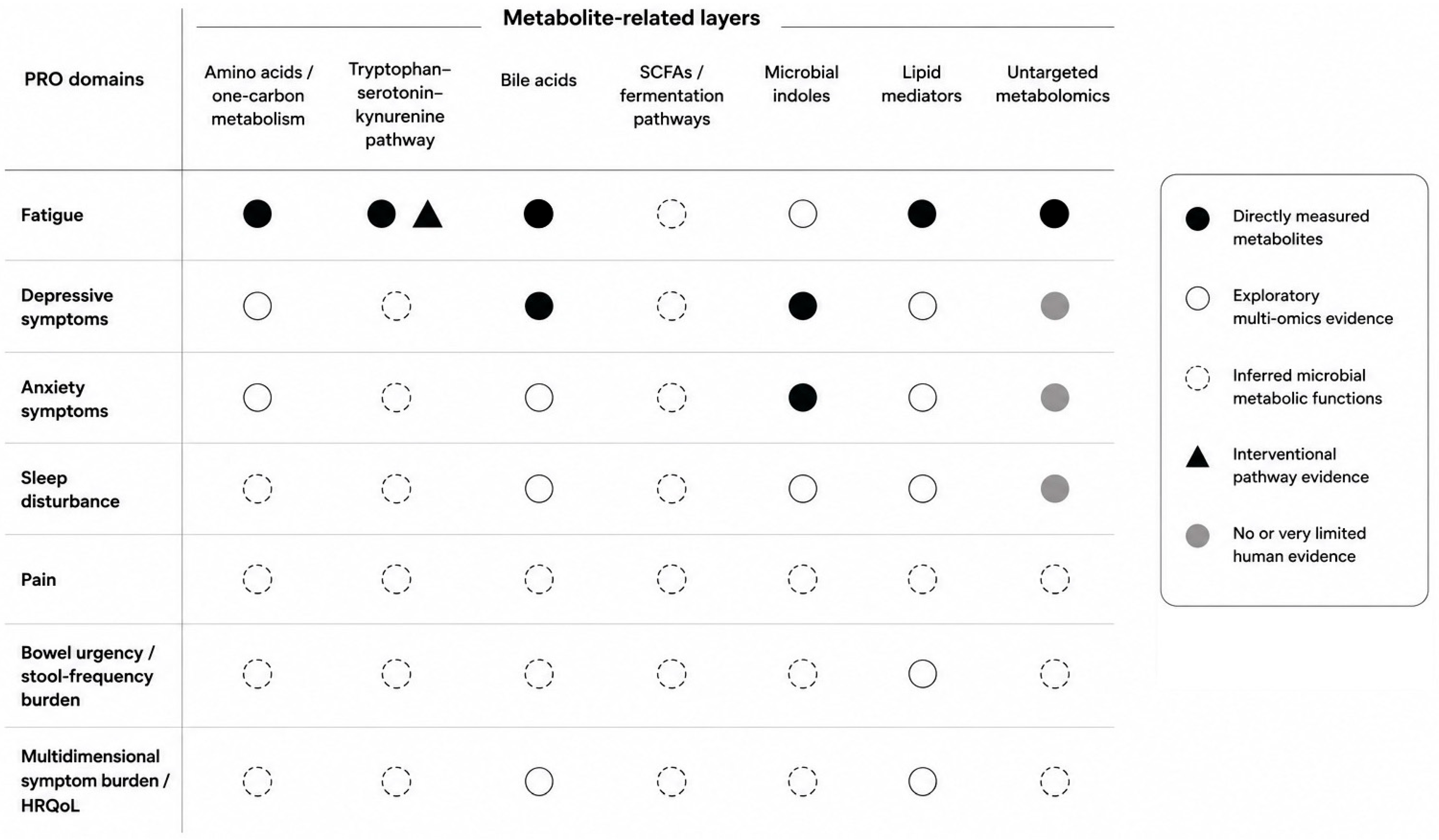
At the patient-reported outcome domain level, the studies identified in this review were unevenly distributed. Figure 1 provides a visual evidence map linking the principal PRO domains with the metabolite-related layers discussed in this review, while distinguishing direct metabolite measurements, exploratory multi-omics evidence, inferred microbial metabolic functions, interventional pathway evidence, and mechanistic plausibility.
Figure 1.
Evidence landscape of metabolite-related measures across patient-reported outcome domains in inflammatory bowel disease. The map distinguishes directly measured metabolites, exploratory multi-omics evidence, inferred microbial metabolic functions, interventional pathway evidence, and mechanistic plausibility. The human studies identified in this review were concentrated primarily in fatigue and questionnaire-defined mood-related symptom burden. For fatigue, evidence based on directly measured metabolites included serum metabolites, plasma lipidomics and fecal untargeted metabolomics, with some studies integrating microbiome profiles. Within the limits of the databases searched, the search strategy and the eligibility criteria applied, we did not identify human studies that directly evaluated measured metabolites against validated sleep-, pain- or urgency-specific PROMs; the evidence captured was insufficient to establish signatures for stool-frequency or multidimensional symptom burden. Within the same scope, we did not identify a metabolite-informed PRO tool that had undergone both analytical and clinical validation. This qualitative evidence map reflects the authors’ narrative assessment: categories describe evidence type, not quality or certainty; “direct” denotes measured metabolites, whereas predicted functions and pathway enrichments indicate potential metabolic capacity or biological context, not metabolite concentrations, pathway activity or flux.
3.2. Fatigue and Energy-Related Burden
Among the studies identified in this review, fatigue was the symptom domain with the most developed metabolite-related human literature. In quiescent IBD, Borren et al. associated fatigue with a serum metabolite cluster and fecal microbiome alterations [20]. Lower serum methionine, tryptophan, proline and sarcosine, together with depletion of butyrate-associated taxa, support a candidate host-microbe metabolic context for fatigue beyond overt mucosal activity. These findings remain exploratory.
Horta et al. examined plasma lipidomic profiles in 47 patients with quiescent IBD (27 CD and 20 UC; 23 with fatigue and 24 without fatigue) using the FACIT-FS and UPLC-TOFMS [21]. Fatigued participants had lower levels of phosphatidylcholines, plasmanyls, sphingomyelins, lysophosphatidylcholines, phosphatidylethanolamines, phosphatidylinositols, phosphatidylserines and eicosanoids. Pathway analyses implicated arachidonic-acid and glycerophospholipid metabolism and the sphingolipid pathway. This study linked directly measured plasma lipids with a fatigue PROM, but the association remains exploratory.
Liu et al. compared four groups of 30 participants—UC with fatigue, UC without fatigue, healthy participants with fatigue and healthy participants without fatigue—using Fatigue Scale-14 (FS-14; fatigue defined as a score ≥ 7), untargeted fecal LC–MS/MS and 16S rRNA profiling [22]. Compared with UC without fatigue, UC with fatigue showed 262 differential fecal metabolites; linoleoyl ethanolamide differed between groups, arachidonoyl ethanolamide and glycocholic acid were increased, and thromboxane was detected only in the UC-with-fatigue group. Eicosanoid, tryptophan and tyrosine pathways were implicated. This study linked directly measured fecal metabolites with fatigue; interpretation remains limited by its cross-sectional design and numerical imbalance in active or severe disease.
In active IBD, Thomann et al. linked fatigue and HADS-D depressive symptom severity to fecal metagenomic features and predicted functional modules related to amino-acid metabolism, methionine biosynthesis, central carbohydrate metabolism, pentose-phosphate pathways and SCFA-related taxa [23]. This work is important because it moves beyond taxonomy, but the metabolic interpretation remains inferred microbial metabolic potential rather than directly measured metabolite concentration or metabolic flux.
Interventional pathway evidence is especially valuable because it tests whether biochemical pathway modulation changes patient-reported outcomes. In quiescent IBD with fatigue, 5-hydroxytryptophan (5-HTP) increased serum 5-hydroxytryptophan and serotonin concentrations but did not improve fatigue or mood/stress-related PROs compared with placebo [27]. This result should be interpreted as a negative finding for this specific peripheral 5-HTP supplementation strategy and study population, not as evidence against the broader involvement of tryptophan-kynurenine metabolism, central serotonergic signaling, phenotype-specific pathway effects, or alternative approaches to modulating this pathway.
3.3. Mood-Related Burden: Depression and Anxiety
Among the studies identified in this review, mood-related burden was another relatively developed domain, but terminology requires caution. Studies using PHQ-9, GAD-7 or other scales assess depressive symptoms, anxiety symptoms or questionnaire-defined psychological burden; they do not necessarily establish clinical diagnoses of major depression or anxiety disorder.
Yuan et al. integrated gut microbiota, serum metabolomics and proteomics in active ulcerative colitis and identified a multi-omics network associated with PHQ-9/GAD-7-defined depressive and anxiety symptoms [24]. Increased glycochenodeoxycholate and altered levels of metabolites such as 2′-deoxy-D-ribose and L-pipecolic acid suggest that mood-related symptom burden may co-occur with microbial, metabolic, immune and inflammatory layers. However, active disease and systemic inflammation may be common causes, mediators or downstream consequences within this network; animal experiments from the same report should be treated as mechanistic context rather than direct human validation.
Feng et al. associated gut microbiota dysbiosis and fecal and serum bile-acid alterations with questionnaire-defined psychological symptom burden in Crohn’s disease [25]. Wang et al. subsequently linked HADS-defined anxiety and depressive symptoms in IBD with fecal microbiota, Tax4Fun2-predicted functional pathways and untargeted fecal LC–MS metabolites, including 3-methyl-2-oxobutanoic acid, alpha-ketoglutaric acid, pipecolic acid, glycocholic acid, taurochenodeoxycholic acid and indole-3-acetic acid [26]. Together, these studies suggest bile-acid, amino-acid, butanoate and tryptophan-related pathways for further study, but remain exploratory.
Taxonomy-only studies provide useful mechanistic or contextual evidence when interpreted cautiously. Humbel et al. associated intestinal microbiota alterations with impaired psychological function in patients with IBD in remission [28]. Scaldaferri et al. reported gut microbiota signatures associated with psychopathological profiles in ulcerative colitis [29]. Such studies provide mechanistic or contextual evidence rather than evidence based on direct metabolite measurement, because metabolites or metabolite-associated functional pathways were not assessed in the same clinical context.
3.4. Sleep Disturbance
Current human evidence. Within the limits of the databases searched, the search strategy and the eligibility criteria applied, we did not identify human studies directly evaluating associations between measured metabolites and validated sleep PROMs in IBD. PROM-focused studies show that insomnia is common and associated with mental health conditions and IBD activity [30], but these studies generally do not include metabolomics or microbial metabolic-function assessment in the same participants.
Interpretative context. Sleep disturbance may plausibly involve tryptophan-serotonin-kynurenine metabolism, inflammatory signaling, corticosteroid exposure, circadian disruption, autonomic activation and altered activity patterns. Wearable physiology should be presented only as a potential future integration layer for longitudinal symptom and activity monitoring, not as metabolite-PRO evidence [31].
Evidence gap. The mechanistic and PROM-only studies identified in this review provide insufficient evidence to validate these pathways against sleep-specific PROs or objective sleep measures in well-phenotyped IBD cohorts. Among studies captured by this search, we did not identify any metabolite-related sleep signature that had undergone clinical validation for the assessment of sleep burden.
Research priority. Future studies should combine validated sleep PROMs, actigraphy or wearable-derived sleep metrics, inflammatory markers, steroid and caffeine exposure, medication metadata, diet, repeated sampling and targeted tryptophan–serotonin–kynurenine metabolite panels.
3.5. Pain
Current human evidence. Within the limits of the databases searched, the search strategy and the eligibility criteria applied, we did not identify human studies directly evaluating associations between measured metabolites and validated pain-specific PROMs in IBD. Pain is often embedded within global symptom indices or health-related quality-of-life instruments, limiting interpretation of metabolite-pain associations.
Interpretative context. Pain is biologically plausible in relation to lipid mediators, bile acids, barrier dysfunction, immune activation, mast-cell signaling, visceral hypersensitivity and neuroimmune pathways. Lipidomics is particularly relevant because eicosanoids, oxylipins, sphingolipids and membrane lipids participate in inflammatory signaling and nociception [32].
Evidence gap. The studies identified in this review provide insufficient evidence to determine whether specific metabolite-related signatures distinguish inflammatory pain, irritable bowel syndrome (IBS) overlap, visceral hypersensitivity, bile-acid diarrhea, fibrostenotic complications, pelvic-floor dysfunction or medication-related pain. Among studies captured by this search, we did not identify any pain-specific metabolite signature that had undergone clinical validation against a pain-specific PROM.
Research priority. Pain-focused cohorts should stratify by inflammatory activity, disease location, stricturing/penetrating complications, IBS overlap, stool form, bile-acid malabsorption risk, non-steroidal anti-inflammatory drug (NSAID)/opioid exposure and psychological burden, while using pain-specific PROMs and targeted lipid mediator or bile-acid panels.
3.6. Bowel Urgency, Stool Frequency, and Bowel Confidence
Current human evidence. Within the limits of the databases searched, the search strategy and the eligibility criteria applied, we did not identify studies directly pairing measured metabolites with validated urgency-specific or bowel-confidence PROMs. Serum bile-acid metabolites have been studied as predictors of mesalazine response [33], and altered fecal bile-acid composition has been reported in active UC [34], but neither study addressed urgency-specific burden.
Interpretative context. The clinical rationale for bile-acid involvement is strongest in ileal CD, ileal resection and bile-acid malabsorption; the underlying pathways are summarized in Section 4.2. Fecal concentrations are influenced by transit, ileal absorption and stool water content and should not be interpreted as direct measures of pathway activity.
Research priority. Future studies should pair targeted serum or fecal bile-acid panels with validated urgency and stool-frequency instruments in phenotype-stratified UC and ileal CD cohorts.
3.7. Multidimensional Symptom Clusters and Health-Related Quality of Life
Current human evidence. Symptom-cluster studies describe co-occurring fatigue, pain, sleep disturbance, bowel symptoms and psychological distress [35,36,37], while IBSEN III documents fatigue across disease stages [38,39]. Within the search scope and eligibility criteria, the identified studies characterized patient-reported burden but did not align multidimensional phenotypes with directly measured metabolite profiles.
Interpretative context and research priority. Multidimensional burden may be more biologically realistic than one-symptom/one-metabolite models. Future studies should combine validated PROM clusters with repeated metabolomics and latent-profile or network analyses; domain-specific design priorities are summarized in Table 2.
Table 2.
Integrated Metabolite Classes, PRO Domains and Research Priorities for Future Metabolite-PRO Studies in IBD.
4. Metabolite Classes and Their Potential Relevance to Patient-Reported Burden
4.1. Short-Chain Fatty Acids
SCFAs are generated mainly through bacterial fermentation of non-digestible carbohydrates. Systematic review evidence summarizes therapeutic and immunologic interest in SCFAs in IBD [40]. SCFAs can regulate epithelial and immune pathways relevant to IBD biology [41]. Quantitative alterations in SCFAs have been reported across IBD studies [42]. Stool SCFA levels have also been measured directly in patients with IBD and healthy controls [43]. Broader host-microbiota literature supports the importance of SCFA-related interactions in chronic disease biology [44]. These mechanisms make SCFAs plausible contributors to barrier-related symptoms, bowel burden and fatigue-related biology.
Stool SCFA concentrations integrate production, absorption, microbial and colonocyte utilization, transit and stool water content; they therefore cannot be interpreted as production rates. Absolute quantification and matrix-specific metadata are essential.
4.2. Bile Acids
Bile acids are host-microbial signaling molecules transformed through hepatic synthesis, intestinal conjugation and microbial deconjugation. IBD studies have examined serum metabolites as predictors of mesalazine response [33], fecal composition in active UC [34], FXR/TGR5 signaling [45,46], nutritional and microbial modulation [47] and anti-integrin response in experimental colitis [48].
Their most plausible PRO relevance concerns urgency and diarrhea in ileal CD or after ileal resection, and questionnaire-defined mood-related burden in CD [25]. Interpretation should preserve species-level and matrix-specific distinctions; study-design priorities are summarized in Table 2.
4.3. Tryptophan, Kynurenine, Serotonin, and Microbial Indoles
Tryptophan metabolism connects inflammation, microbial metabolism and neuroactive signaling. Tryptophan can enter the kynurenine pathway, serotonin-related metabolism or microbial indole production. Transcriptomic and metabolomic synthesis has implicated intestinal tryptophan metabolism in IBD [49]. Mendelian randomization work has also examined the tryptophan-kynurenine pathway in relation to IBD [50]. Immune activation can induce indoleamine 2,3-dioxygenase and shift metabolism toward kynurenine-pathway products, providing a plausible link between inflammation, fatigue, low mood and immune-metabolic regulation.
The 5-HTP trial in quiescent IBD is an important example of how metabolic-pathway plausibility requires clinical testing [27]. Oral 5-HTP increased serum 5-HTP and serotonin, indicating a peripheral biochemical response, but this did not translate into improvement in fatigue or mood-related secondary outcomes in that population. This finding should not be interpreted as evidence against tryptophan-kynurenine biology, central serotonergic signaling, microbial indole pathways, phenotype-specific effects or other approaches to modulating this axis. Aryl hydrocarbon receptor activation has been discussed as a microbiota-linked pathway in IBD [51]. Gut microbiome-related anti-inflammatory effects of aryl hydrocarbon receptor activation also provide mechanistic context for IBD biology [52]. We did not identify human studies directly evaluating associations between measured indole/AhR-related metabolites and validated IBD symptom PROMs.
4.4. Lipid Mediators and Lipidomic Signatures
Lipid mediators, including eicosanoids, oxylipins, sphingolipids and membrane lipids, are relevant to inflammatory signaling, epithelial stress, nociception and systemic symptom burden. Lipidomics reviews support the importance of lipid pathways in IBD pathogenesis [32].
Horta et al. linked directly measured plasma lipidomic patterns with fatigue in quiescent IBD, illustrating a clinically relevant discovery signal that still requires independent validation [21].
Lipidomic interpretation requires careful distinction between targeted and untargeted approaches, annotation confidence, reference standards, internal standards, drift correction and batch correction. Without these elements, lipid features may be useful for discovery but remain difficult to translate into clinically interpretable patient-reported burden signatures.
4.5. Volatile Organic Compounds and Untargeted Metabolomic Signatures
VOCs and broad untargeted metabolomic profiles may offer composite signatures of host-microbial metabolism, diet, transit and inflammation. Fecal volatile organic metabolites have been investigated as potential diagnostic biomarkers in IBD [53]. Liu et al. directly paired untargeted fecal LC–MS/MS with FS-14-defined fatigue in UC [22], whereas broader untargeted fecal metabolomics has also been used to discover biomarker and treatment-target candidates in IBD [54]. We did not identify human IBD studies directly pairing VOC profiles with validated PROMs. VOCs should therefore be framed primarily as a potential future research direction unless studies directly pair VOC profiles with validated patient-reported outcomes.
Untargeted metabolomics should therefore report analytical platform, metabolite identification level, quality-control samples, internal standards, randomization of analysis order, missing-data handling, normalization, multiple-testing control and feature annotation confidence. Candidate features require confirmation with reference standards and independent validation before they can be interpreted as PRO-related signatures.
5. Methodological and Translational Challenges
Table 1 presents the study-level appraisal; the following sections focus on the cross-cutting issues most relevant to interpretation and translation.
5.1. Disease Activity and Phenotype Confounding
Inflammation can be a confounder, mediator, effect modifier or common cause in metabolite-PRO relationships. It may simultaneously alter the metabolome and produce symptoms, act through metabolic pathways, be modified by metabolites, influence diet, treatment, sleep and activity, or interact bidirectionally with psychological symptom burden. Simple statistical adjustment for C-reactive protein (CRP) or fecal calprotectin may therefore be inappropriate when inflammation lies on the causal pathway. Model covariates should be chosen according to an explicit causal hypothesis rather than added mechanically.
IBD phenotype is equally important. Ileal Crohn’s disease, colonic Crohn’s disease, ulcerative colitis, pouch status, ileal resection and stricturing or penetrating behavior may produce different metabolic profiles. Mixed cohorts without stratification can obscure location-specific bile-acid and fermentation effects, and reported Crohn’s disease/ulcerative colitis structure should be preserved when interpreting studies.
5.2. Heterogeneity of PROs and PROMs
PROM heterogeneity limits interpretability. Future studies should name and justify instruments, for example FACIT-F or PROMIS-Fatigue for fatigue, HADS or PHQ-9/GAD-7 for depressive and anxiety symptoms, validated sleep scales or actigraphy-supported sleep measures, pain numeric rating scales or disease-specific pain items, and urgency/stool-frequency instruments. Psychological symptom burden should not be conflated with formal psychiatric diagnosis unless diagnostic assessment was performed. PROM choice should also consider responsiveness, defined as the ability of an instrument to detect clinically meaningful change over time, and floor or ceiling effects, which occur when scores cluster at the lower or upper end of the scale and limit detection of worsening or improvement.
Pooling fatigue, pain, depressive symptoms, sleep disturbance and quality of life into a generic burden score may be clinically convenient but biologically imprecise. Symptom-domain specificity is essential for metabolite interpretation.
5.3. Biological Matrices and Pre-Analytical Variability
Stool, serum, plasma, urine and mucosal biopsies address different biological questions. Stool is suited to luminal fermentation, bile-acid transformation and microbial metabolic output; serum or plasma may better reflect systemic fatigue and host-integrated metabolism; biopsies capture tissue-proximal mucosal metabolism but are invasive and location-dependent.
Pre-analytical variability is central in metabolomics. Studies should report fasting status, time of day, time to freezing, storage temperature, freeze-thaw cycles, stool form, stool water content, extraction methods and bowel preparation or antibiotic exposure. For fecal metabolites, transit time and water content can strongly influence concentration, and fecal concentration should not be interpreted simplistically as production rate. This principle applies not only to SCFAs but also to bile acids, amino-acid derivatives, indoles and other fecal metabolites.
5.4. Analytical Platforms and Metabolite Identification
Targeted and untargeted metabolomics answer different questions. Targeted LC–MS/MS, GC–MS and NMR approaches can quantify predefined metabolites, sometimes with absolute concentrations when reference standards and internal standards are used. Untargeted approaches provide broader discovery potential but generate many unknown or partially annotated features.
For metabolomics-focused research, analytical transparency is essential and should be evaluated at the study level. Studies should report the platform used, chromatographic conditions where relevant, relative versus absolute quantification, metabolite identification level, reference standards, pooled quality-control samples, internal standards, randomization of analysis order, instrument drift, batch correction, normalization procedures and missing-data handling. Biological conclusions should distinguish an analytical feature, a tentatively annotated compound, a putatively identified metabolite and a metabolite confirmed with a reference standard.
5.5. Statistical Validity, Multiple Testing, and Overfitting
Metabolomics and microbiome studies often combine high-dimensional data with modest sample sizes. This creates risks of false discovery, overfitting, data leakage and unstable feature selection. Here, high-dimensional data contain many measured features, often approaching or exceeding the number of participants. Overfitting occurs when a model captures sample-specific noise rather than reproducible signal; data leakage occurs when information from validation or test data influences model development; and unstable feature selection means that small changes in the sample or analysis lead to different features being selected. Future studies should pre-specify primary symptom domains, apply false-discovery-rate correction, separate discovery and validation sets where feasible, report model calibration as well as discrimination, and validate candidate signatures externally.
5.6. Causality and Directionality
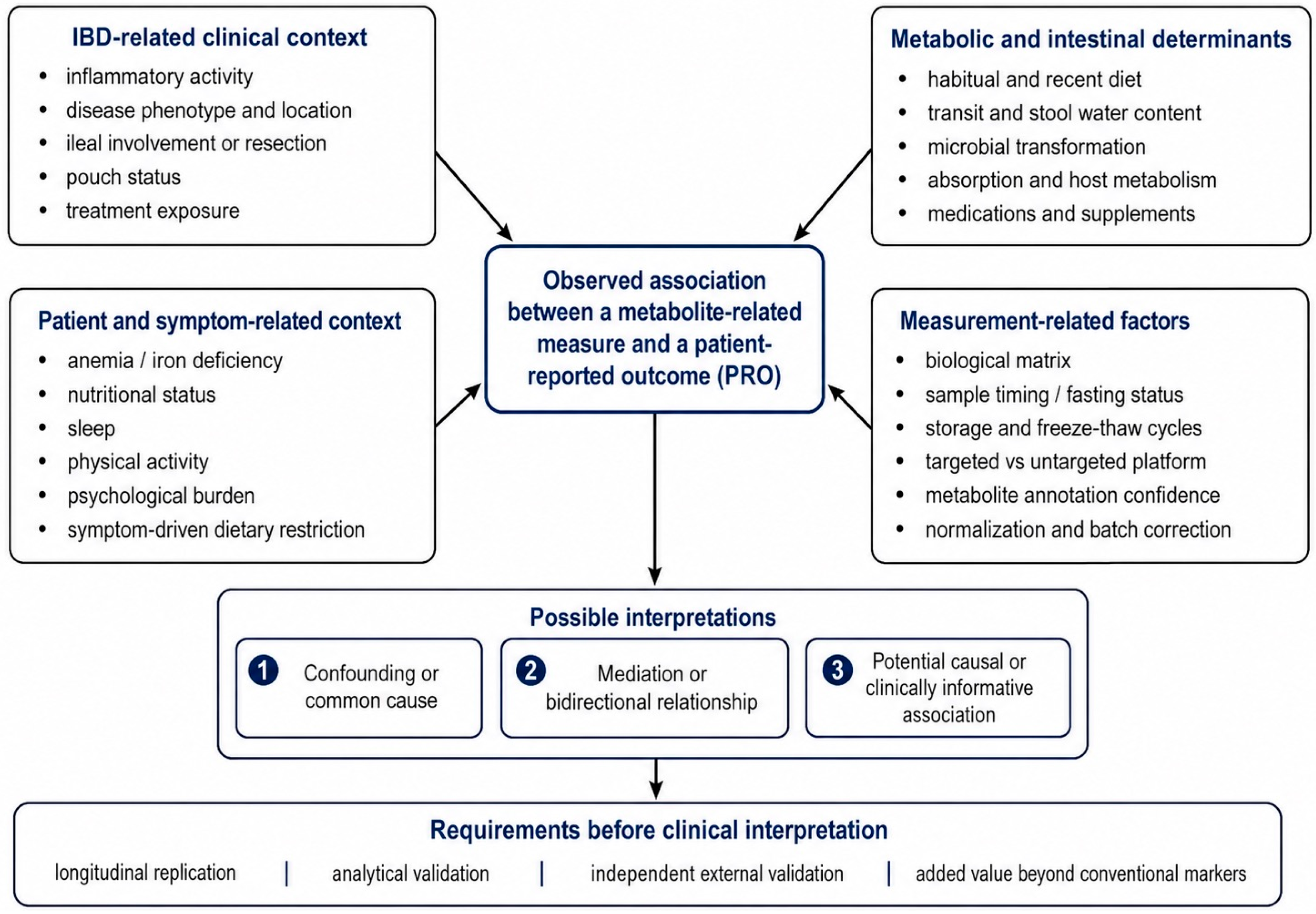
Metabolite-PRO associations may reflect several causal structures: a metabolite may be associated with a symptom, a symptom may change diet and behavior and thereby alter the metabolome, inflammation may be associated with both, medication may be associated with both, or transit and disease location may confound both. Diet may act as a determinant of metabolite concentration, a confounder, a mediator of symptom effects on the metabolome, a therapeutic exposure or an effect modifier of microbiome-PRO relationships. Future studies should collect current and habitual diet, supplementation, fiber intake, enteral nutrition, elimination diets and timing between dietary assessment, biospecimen collection and PROM completion. Figure 2 summarizes the principal clinical, patient-related, intestinal, metabolic, pre-analytical, and analytical factors that may influence an observed association between a metabolite-related measure and a PRO. These factors may act as confounders, mediators, effect modifiers, common causes, or consequences of patient-reported symptoms and should be considered before causal or clinical interpretation.
Figure 2.
Conceptual Framework for the Interpretation of Metabolite–Patient-Reported Outcome Associations in Inflammatory Bowel Disease. The framework is author-proposed and represents a research agenda for interpreting candidate metabolite–PRO associations rather than a validated clinical tool.
5.7. Reproducibility, Validation, and Clinical Context of Use
Translational requirements depend on the intended context of use. Mechanistic phenotyping requires adequate analytical performance and reproducibility. Cross-sectional classification additionally requires prespecified model development and independent external validation in representative cohorts, but cross-sectional validation does not establish longitudinal predictive performance. Prognostic and treatment-response prediction require prospective longitudinal validation with temporally ordered assessment of predictors and outcomes. Longitudinal monitoring additionally requires evidence of within-person responsiveness to changes in symptom burden. Clinical decision-support applications further require demonstration of incremental value beyond PROMs and conventional clinical markers and, ultimately, evidence that their use improves interpretation or clinical decision-making. Figure 2 summarizes the principal sources of interpretative uncertainty relevant to these applications.
6. Research Priorities
Table 2 consolidates domain-specific candidate metabolite layers, current human support, interpretative cautions and priority study designs. Near-term work should replicate the candidate fatigue- and mood-related associations for which preliminary human evidence exists, whereas sleep disturbance, pain, bowel urgency/stool frequency and multidimensional symptom burden require phenotype-specific discovery studies using validated domain-specific PROMs. Across domains, studies should prioritize prospective, preferably multicenter designs, synchronize PROM completion with biospecimen collection and incorporate repeated longitudinal assessment when monitoring, prognosis or treatment-response prediction is intended. Protocols should standardize the biological matrix, sampling time and pre-analytical handling and document key clinical and behavioral determinants, including inflammatory activity, disease phenotype, diet, medication exposure, sleep and physical activity. Analyses should pre-specify hypotheses, distinguish confounders, mediators and effect modifiers, control multiplicity, prevent data leakage and report null findings. Candidate signals should undergo analytical validation and independent external validation in representative cohorts before evaluation of incremental clinical value; monitoring applications additionally require demonstration of within-person responsiveness.
7. Strengths and Limitations of the Narrative Review
A major strength of this review is the structured separation of evidence layers and explicit attention to PROM definition, analytical method and translational maturity, consistent with SANRA principles.
Several limitations should be considered. This critical narrative review used a structured search to support purposive synthesis rather than exhaustive study enumeration, so source selection may reflect author judgment. No formal risk-of-bias or certainty-of-evidence framework was applied. Substantial heterogeneity in IBD phenotype, inflammatory activity, biological matrix, analytical platform and PROM definition limited cross-study comparison, and the predominance of cross-sectional designs constrained causal interpretation.
8. Conclusions
Human evidence was concentrated in fatigue and questionnaire-defined mood-related symptom burden. Fatigue studies included targeted serum metabolomics, plasma lipidomics and fecal untargeted metabolomics based on directly measured metabolites, predicted microbial functions and a 5-HTP pathway trial without symptomatic benefit. Mood-related studies included serum and fecal metabolomics, fecal bile-acid profiling and multi-omics networks. Within the limits of the databases searched, the search strategy and the eligibility criteria applied, we did not identify studies pairing directly measured metabolites with PROMs for sleep, pain or urgency, and the evidence captured for multidimensional clusters was insufficient.
These findings support candidate associations and exploratory signatures, including directly measured signals, but not clinically actionable biomarkers. Translation will require context-specific analytical and clinical validation and demonstration of added value beyond PROMs and conventional clinical markers.
Supplementary Materials
The following supporting information can be downloaded at: https://www.mdpi.com/article/10.3390/metabo16090696/s1, Table S1: Comparison of the Scope and Methodological Focus of Previous Reviews and the Present Critical Narrative Review [8,9,10,14,15,16,17,18]; Table S2: Database-Specific Search Strategies Used for Literature Identification.
Author Contributions
Conceptualization, P.K. and M.K.; Methodology, P.K. and A.H.P.; Investigation, A.H.P. and P.K.; Data Curation, A.H.P. and P.K.; Validation, P.K., A.H.P. and M.K.; Writing—Original Draft Preparation, P.K. and A.H.P.; Writing—Review and Editing, P.K., A.H.P. and M.K.; Visualization, P.K.; Supervision, M.K.; Project Administration, P.K. All authors have read and agreed to the published version of the manuscript.
Funding
This research received no external funding.
Institutional Review Board Statement
Not applicable. This article is a narrative review of published literature and did not involve new studies with human participants or animals performed by the authors.
Informed Consent Statement
Not applicable. This article is a narrative review of published literature and did not involve recruitment of participants or collection of new individual-level data.
Data Availability Statement
No new data were created or analyzed in this study. Data sharing is not applicable to this article.
Conflicts of Interest
The authors declare no conflict of interest.
References
- Turner, D.; Ricciuto, A.; Lewis, A.; D’Amico, F.; Dhaliwal, J.; Griffiths, A.M.; Bettenworth, D.; Sandborn, W.J.; Sands, B.E.; Reinisch, W.; et al. STRIDE-II: An Update on the Selecting Therapeutic Targets in Inflammatory Bowel Disease (STRIDE) Initiative of the International Organization for the Study of IBD (IOIBD): Determining Therapeutic Goals for Treat-to-Target Strategies in IBD. Gastroenterology 2021, 160, 1570–1583. [Google Scholar] [CrossRef] [Scilit] [PubMed]
- Jairath, V.; Narula, N.; Ungaro, R.C.; Romo Bautista, I.; Adsul, S. Novel Outcomes in Inflammatory Bowel Disease. J. Crohns Colitis 2025, 19, jjaf040, Erratum in J. Crohns Colitis 2025, 19, jjaf117. https://doi.org/10.1093/ecco-jcc/jjaf117. [Google Scholar] [CrossRef] [Scilit] [PubMed]
- Fierens, L.; Carney, N.; Novacek, G.; van der Woude, C.J.; Siegmund, B.; Casellas, F.; Borruel, N.; Huberts, A.S.; Sonnenberg, E.; Gerold, N.; et al. A Core Outcome Set for Inflammatory Bowel Diseases: Development and Recommendations for Implementation in Clinical Practice Through an International Multi-Stakeholder Consensus Process. J. Crohns Colitis 2024, 18, 1583–1595. [Google Scholar] [CrossRef] [Scilit] [PubMed]
- Calvet, X.; Ferrario, M.G.; Marfil, V.; Armenteros, S.; Barreiro-de Acosta, M. Patient-Reported Outcome Measures Poorly Correlate with Objective Inflammatory Bowel Disease Activity Measures: A Systematic Review. J. Crohns Colitis 2025, 19, jjaf132. [Google Scholar] [CrossRef] [Scilit] [PubMed]
- de Silva, S.; Steed, H.; Allen, P.B.; Vegad, C.; Crooks, J.; Jaulim, A.; Hart, A. Assessing Disease Control in Inflammatory Bowel Disease: A Real World Cross-Sectional Study in the UK (PODCAST-IBD). Curr. Med. Res. Opin. 2024, 40, 1847–1854. [Google Scholar] [CrossRef] [Scilit] [PubMed]
- Siffledeen, J.; Singh, S.; Shulman, S.M.; Igoe, J.; Heatta-Speicher, T.; Leitner, C.; Chung, C.H.; Targownik, L. Effect of Suboptimal Disease Control on Patient Quality of Life: Real-World Data from the Observational IBD-PODCAST Canada Trial. Dig. Dis. Sci. 2024, 69, 1636–1648. [Google Scholar] [CrossRef] [Scilit] [PubMed]
- Fairbrass, K.M.; Lovatt, J.; Barberio, B.; Yuan, Y.; Gracie, D.J.; Ford, A.C. Bidirectional Brain–Gut Axis Effects Influence Mood and Prognosis in IBD: A Systematic Review and Meta-Analysis. Gut 2022, 71, 1773–1780. [Google Scholar] [CrossRef] [Scilit] [PubMed]
- Truyens, M.; Lernout, H.; De Vos, M.; Laukens, D.; Lobaton, T. Unraveling the Fatigue Puzzle: Insights into the Pathogenesis and Management of IBD-Related Fatigue Including the Role of the Gut-Brain Axis. Front. Med. 2024, 11, 1424926. [Google Scholar] [CrossRef] [Scilit] [PubMed]
- Boldyreva, L.V.; Evtushenko, A.A.; Lvova, M.N.; Morozova, K.N.; Kiseleva, E.V. Underneath the Gut–Brain Axis in IBD—Evidence of the Non-Obvious. Int. J. Mol. Sci. 2024, 25, 12125. [Google Scholar] [CrossRef] [Scilit] [PubMed]
- Banfi, D.; Moro, E.; Bosi, A.; Bistoletti, M.; Cerantola, S.; Crema, F.; Maggi, F.; Giron, M.C.; Giaroni, C.; Baj, A. Impact of Microbial Metabolites on Microbiota–Gut–Brain Axis in Inflammatory Bowel Disease. Int. J. Mol. Sci. 2021, 22, 1623. [Google Scholar] [CrossRef] [Scilit] [PubMed]
- Lloyd-Price, J.; Arze, C.; Ananthakrishnan, A.N.; Schirmer, M.; Avila-Pacheco, J.; Poon, T.W.; Andrews, E.; Ajami, N.J.; Bonham, K.S.; Brislawn, C.J.; et al. Multi-Omics of the Gut Microbial Ecosystem in Inflammatory Bowel Diseases. Nature 2019, 569, 655–662. [Google Scholar] [CrossRef] [Scilit] [PubMed]
- Zhang, Y.; Thomas, J.P.; Korcsmaros, T.; Gul, L. Integrating Multi-Omics to Unravel Host-Microbiome Interactions in Inflammatory Bowel Disease. Cell Rep. Med. 2024, 5, 101738. [Google Scholar] [CrossRef] [Scilit] [PubMed]
- Su, F.; Su, M.; Wei, W.; Wu, J.; Chen, L.; Sun, X.; Liu, M.; Sun, S.; Mao, R.; Bourgonje, A.R.; et al. Integrating Multi-Omics Data to Reveal the Host-Microbiota Interactome in Inflammatory Bowel Disease. Gut Microbes 2025, 17, 2476570. [Google Scholar] [CrossRef] [Scilit] [PubMed]
- Gallagher, K.; Catesson, A.; Griffin, J.L.; Holmes, E.; Williams, H.R.T. Metabolomic Analysis in Inflammatory Bowel Disease: A Systematic Review. J. Crohns Colitis 2021, 15, 813–826. [Google Scholar] [CrossRef] [Scilit] [PubMed]
- Aldars-García, L.; Gisbert, J.P.; Chaparro, M. Metabolomics Insights into Inflammatory Bowel Disease: A Comprehensive Review. Pharmaceuticals 2021, 14, 1190. [Google Scholar] [CrossRef] [Scilit] [PubMed]
- Shen, X.; Li, Y.; Wang, D.; Sun, K. The Gut Microbiota and Its Metabolites: Novel Therapeutic Targets for Inflammatory Bowel Disease. Front. Immunol. 2025, 16, 1690279. [Google Scholar] [CrossRef] [Scilit] [PubMed]
- Zarei, P.; Sedeh, P.A.; Vaez, A.; Keshteli, A.H. Using Metabolomics to Investigate the Relationship between the Metabolomic Profile of the Intestinal Microbiota Derivatives and Mental Disorders in Inflammatory Bowel Diseases: A Narrative Review. Res. Pharm. Sci. 2025, 20, 1–24. [Google Scholar] [CrossRef] [Scilit] [PubMed]
- Sharkiya, S.H.; Namni, R.; Wattad, O.; Abu Baker, F. The Role of Metabolomics in Enhancing Diagnosis and Management of Inflammatory Bowel Disease: A Systematic Review. Ther. Adv. Gastroenterol. 2026, 19, 17562848261441018. [Google Scholar] [CrossRef] [Scilit] [PubMed]
- Baethge, C.; Goldbeck-Wood, S.; Mertens, S. SANRA—A Scale for the Quality Assessment of Narrative Review Articles. Res. Integr. Peer Rev. 2019, 4, 5. [Google Scholar] [CrossRef] [Scilit] [PubMed]
- Borren, N.Z.; Plichta, D.; Joshi, A.D.; Bonilla, G.; Peng, V.; Colizzo, F.P.; Luther, J.; Khalili, H.; Garber, J.J.; van der Woude, C.J.; et al. Alterations in Fecal Microbiomes and Serum Metabolomes of Fatigued Patients with Quiescent Inflammatory Bowel Diseases. Clin. Gastroenterol. Hepatol. 2021, 19, 519–527.e5. [Google Scholar] [CrossRef] [Scilit] [PubMed]
- Horta, D.; Moreno-Torres, M.; Ramírez-Lázaro, M.J.; Lario, S.; Kuligowski, J.; Sanjuan-Herráez, J.D.; Quintas, G.; Villoria, A.; Calvet, X. Analysis of the Association between Fatigue and the Plasma Lipidomic Profile of Inflammatory Bowel Disease Patients. J. Proteome Res. 2021, 20, 381–392. [Google Scholar] [CrossRef] [Scilit] [PubMed]
- Liu, Z.-X.; Liu, X.-Y.; Tan, W.-W.; Zhang, W.-B.; Zhang, Y.-L.; Zheng, L.; Dai, Y.-C. Characteristics of Gut Microbiota and Metabolites in Patients with Ulcerative Colitis with Fatigue. World J. Gastroenterol. 2026, 32, 115264. [Google Scholar] [CrossRef] [Scilit] [PubMed]
- Thomann, A.K.; Wüstenberg, T.; Wirbel, J.; Knoedler, L.-L.; Thomann, P.A.; Zeller, G.; Ebert, M.P.; Lis, S.; Reindl, W. Depression and Fatigue in Active IBD from a Microbiome Perspective—A Bayesian Approach to Faecal Metagenomics. BMC Med. 2022, 20, 366. [Google Scholar] [CrossRef] [Scilit] [PubMed]
- Yuan, X.; Chen, B.; Duan, Z.; Xia, Z.; Ding, Y.; Chen, T.; Liu, H.; Wang, B.; Yang, B.; Wang, X.; et al. Depression and Anxiety in Patients with Active Ulcerative Colitis: Crosstalk of Gut Microbiota, Metabolomics and Proteomics. Gut Microbes 2021, 13, 1987779. [Google Scholar] [CrossRef] [Scilit] [PubMed]
- Feng, L.; Zhou, N.; Li, Z.; Fu, D.; Guo, Y.; Gao, X.; Liu, X. Co-Occurrence of Gut Microbiota Dysbiosis and Bile Acid Metabolism Alteration Is Associated with Psychological Disorders in Crohn’s Disease. FASEB J. 2022, 36, e22100. [Google Scholar] [CrossRef] [Scilit] [PubMed]
- Wang, Z.; Zhou, M.; Dang, Y.; Huang, X.; Xu, C.; Xu, F.; Xu, X.; Li, P.; Zhang, S.; Shi, H.; et al. Fecal Microbiota Composition and Function Are Associated with Anxiety and Depression in Patients with Inflammatory Bowel Disease. PLoS ONE 2025, 20, e0337941. [Google Scholar] [CrossRef] [Scilit] [PubMed]
- Truyens, M.; Lobatón, T.; Ferrante, M.; Bossuyt, P.; Vermeire, S.; Pouillon, L.; Dewint, P.; Cremer, A.; Peeters, H.; Lambrecht, G.; et al. Effect of 5-Hydroxytryptophan on Fatigue in Quiescent Inflammatory Bowel Disease: A Randomized Controlled Trial. Gastroenterology 2022, 163, 1294–1305.e3. [Google Scholar] [CrossRef] [Scilit] [PubMed]
- Humbel, F.; Rieder, J.H.; Franc, Y.; Juillerat, P.; Scharl, M.; Misselwitz, B.; Schreiner, P.; Begré, S.; Rogler, G.; von Känel, R.; et al. Association of Alterations in Intestinal Microbiota with Impaired Psychological Function in Patients with Inflammatory Bowel Diseases in Remission. Clin. Gastroenterol. Hepatol. 2020, 18, 2019–2029.e11. [Google Scholar] [CrossRef] [Scilit] [PubMed]
- Scaldaferri, F.; D’Onofrio, A.M.; Calia, R.; Di Vincenzo, F.; Ferrajoli, G.F.; Petito, V.; Maggio, E.; Pafundi, P.C.; Napolitano, D.; Masi, L.; et al. Gut Microbiota Signatures Are Associated with Psychopathological Profiles in Patients with Ulcerative Colitis: Results from an Italian Tertiary IBD Center. Inflamm. Bowel Dis. 2023, 29, 1805–1818. [Google Scholar] [CrossRef] [Scilit] [PubMed]
- Barnes, A.; Andrews, J.M.; Mukherjee, S.; Bryant, R.V.; Bampton, P.; Fraser, R.J.; Mountifield, R. Insomnia Is Common in Inflammatory Bowel Disease (IBD) and Is Associated with Mental Health Conditions as Well as IBD Activity. Intest. Res. 2024, 22, 104–114. [Google Scholar] [CrossRef] [Scilit] [PubMed]
- Hirten, R.P.; Danieletto, M.; Sanchez-Mayor, M.; Whang, J.K.; Lee, K.W.; Landell, K.; Zweig, M.; Helmus, D.; Fuchs, T.J.; Fayad, Z.A.; et al. Physiological Data Collected from Wearable Devices Identify and Predict Inflammatory Bowel Disease Flares. Gastroenterology 2025, 168, 939–951.e5. [Google Scholar] [CrossRef] [Scilit] [PubMed]
- Lee, E.G.; Yoon, Y.C.; Yoon, J.; Lee, S.J.; Oh, Y.-K.; Kwon, S.W. Systematic Review of Recent Lipidomics Approaches Toward Inflammatory Bowel Disease. Biomol. Ther. 2021, 29, 582–595. [Google Scholar] [CrossRef] [Scilit] [PubMed]
- Sun, Q.; Tang, Y.; Dai, L.; Tang, Z.; Zhou, W.; Wu, T.; Ji, G. Serum Bile Acid Metabolites Predict the Therapeutic Effect of Mesalazine in Patients with Ulcerative Colitis. J. Proteome Res. 2023, 22, 1287–1297. [Google Scholar] [CrossRef] [Scilit] [PubMed]
- Sommersberger, S.; Gunawan, S.; Elger, T.; Fererberger, T.; Loibl, J.; Huss, M.; Kandulski, A.; Krautbauer, S.; Müller, M.; Liebisch, G.; et al. Altered Fecal Bile Acid Composition in Active Ulcerative Colitis. Lipids Health Dis. 2023, 22, 199. [Google Scholar] [CrossRef] [Scilit] [PubMed]
- Xu, K.; Li, M.; Jiang, P. Symptom Clusters in Inflammatory Bowel Disease: A Scoping Review. Front. Med. 2025, 12, 1615100. [Google Scholar] [CrossRef] [Scilit] [PubMed]
- Conley, S.; Proctor, D.D.; Jeon, S.; Sandler, R.S.; Redeker, N.S. Symptom Clusters in Adults with Inflammatory Bowel Disease. Res. Nurs. Health 2017, 40, 424–434. [Google Scholar] [CrossRef] [Scilit] [PubMed]
- Wileman, V.; Chilcot, J.; Norton, C.; Hart, A.; Miller, L.; Stagg, I.; Seaton, N.; Pollok, R.; Aziz, Q.; Moss-Morris, R. Modifiable Psychological Factors Are Associated with Clusters of Pain, Fatigue, Fecal Incontinence, and Irritable Bowel Syndrome-Type Symptoms in Inflammatory Bowel Disease: A Latent Profile Analysis. J. Crohns Colitis 2025, 19, jjae183. [Google Scholar] [CrossRef] [Scilit] [PubMed]
- Holten, K.I.A.; Bernklev, T.; Opheim, R.; Johansen, I.; Olsen, B.C.; Lund, C.; Strande, V.; Medhus, A.W.; Perminow, G.; Bengtson, M.-B.; et al. Fatigue in Patients with Newly Diagnosed Inflammatory Bowel Disease: Results from a Prospective Inception Cohort, the IBSEN III Study. J. Crohns Colitis 2023, 17, 1781–1790. [Google Scholar] [CrossRef] [Scilit] [PubMed]
- Holten, K.A.; Bernklev, T.; Opheim, R.; Olsen, B.C.; Detlie, T.E.; Strande, V.; Ricanek, P.; Boyar, R.; Bengtson, M.-B.; Aabrekk, T.B.; et al. Fatigue in Patients with Inflammatory Bowel Disease in Remission One Year After Diagnosis (the IBSEN III Study). J. Crohns Colitis 2025, 19, jjae170. [Google Scholar] [CrossRef] [Scilit] [PubMed]
- Ventura, I.; Chomon-García, M.; Tomás-Aguirre, F.; Palau-Ferré, A.; Legidos-García, M.E.; Murillo-Llorente, M.T.; Pérez-Bermejo, M. Therapeutic and Immunologic Effects of Short-Chain Fatty Acids in Inflammatory Bowel Disease: A Systematic Review. Int. J. Mol. Sci. 2024, 25, 10879. [Google Scholar] [CrossRef] [Scilit] [PubMed]
- Parada Venegas, D.; De la Fuente, M.K.; Landskron, G.; González, M.J.; Quera, R.; Dijkstra, G.; Harmsen, H.J.M.; Faber, K.N.; Hermoso, M.A. Short Chain Fatty Acids (SCFAs)-Mediated Gut Epithelial and Immune Regulation and Its Relevance for Inflammatory Bowel Diseases. Front. Immunol. 2019, 10, 277, Erratum in Front. Immunol. 2019, 10, 1486. https://doi.org/10.3389/fimmu.2019.01486. [Google Scholar] [CrossRef] [Scilit] [PubMed]
- Chulenbayeva, L.; Jarmukhanov, Z.; Kaliyekova, K.; Kozhakhmetov, S.; Kushugulova, A. Quantitative Alterations in Short-Chain Fatty Acids in Inflammatory Bowel Disease: A Systematic Review and Meta-Analysis. Biomolecules 2025, 15, 1017. [Google Scholar] [CrossRef] [Scilit] [PubMed]
- Ozturk, O.; Celebi, G.; Duman, U.G.; Kupcuk, E.; Uyanik, M.; Sertoglu, E. Short-Chain Fatty Acid Levels in Stools of Patients with Inflammatory Bowel Disease Are Lower Than Those in Healthy Subjects. Eur. J. Gastroenterol. Hepatol. 2024, 36, 890–896. [Google Scholar] [CrossRef] [Scilit] [PubMed]
- Yi, C.; Huang, S.; Zhang, W.; Guo, L.; Xia, T.; Huang, F.; Yan, Y.; Li, H.; Yu, B. Synergistic Interactions Between Gut Microbiota and Short Chain Fatty Acids: Pioneering Therapeutic Frontiers in Chronic Disease Management. Microb. Pathog. 2025, 199, 107231. [Google Scholar] [CrossRef] [Scilit] [PubMed]
- Thomas, J.P.; Modos, D.; Rushbrook, S.M.; Powell, N.; Korcsmaros, T. The Emerging Role of Bile Acids in the Pathogenesis of Inflammatory Bowel Disease. Front. Immunol. 2022, 13, 829525. [Google Scholar] [CrossRef] [Scilit] [PubMed]
- Bai, S.H.; Chandnani, A.; Cao, S. Bile Acids in Inflammatory Bowel Disease: From Pathophysiology to Treatment. Biomedicines 2024, 12, 2910. [Google Scholar] [CrossRef] [Scilit] [PubMed]
- Jiang, X.; Ren, J.; Yu, G.; Wu, W.; Chen, M.; Zhao, Y.; He, C. Targeting Bile-Acid Metabolism: Nutritional and Microbial Approaches to Alleviate Ulcerative Colitis. Nutrients 2025, 17, 1174. [Google Scholar] [CrossRef] [Scilit] [PubMed]
- Han, B.; Lv, X.; Liu, G.; Li, S.; Fan, J.; Chen, L.; Huang, Z.; Lin, G.; Xu, X.; Huang, Z.; et al. Gut Microbiota-Related Bile Acid Metabolism-FXR/TGR5 Axis Impacts the Response to Anti-α4β7-Integrin Therapy in Humanized Mice with Colitis. Gut Microbes 2023, 15, 2232143. [Google Scholar] [CrossRef] [Scilit] [PubMed]
- Wang, S.; van Schooten, F.-J.; Jin, H.; Jonkers, D.; Godschalk, R. The Involvement of Intestinal Tryptophan Metabolism in Inflammatory Bowel Disease Identified by a Meta-Analysis of the Transcriptome and a Systematic Review of the Metabolome. Nutrients 2023, 15, 2886. [Google Scholar] [CrossRef] [Scilit] [PubMed]
- Yu, F.; Du, Y.; Li, C.; Zhang, H.; Lai, W.; Li, S.; Ye, Z.; Fu, W.; Li, S.; Li, X.-G.; et al. Association Between Metabolites in Tryptophan-Kynurenine Pathway and Inflammatory Bowel Disease: A Two-Sample Mendelian Randomization. Sci. Rep. 2024, 14, 201. [Google Scholar] [CrossRef] [Scilit] [PubMed]
- Hou, J.-J.; Ma, A.-H.; Qin, Y.-H. Activation of the Aryl Hydrocarbon Receptor in Inflammatory Bowel Disease: Insights from Gut Microbiota. Front. Cell. Infect. Microbiol. 2023, 13, 1279172. [Google Scholar] [CrossRef] [Scilit] [PubMed]
- Moutusy, S.I.; Ohsako, S. Gut Microbiome-Related Anti-Inflammatory Effects of Aryl Hydrocarbon Receptor Activation on Inflammatory Bowel Disease. Int. J. Mol. Sci. 2024, 25, 3372. [Google Scholar] [CrossRef] [Scilit] [PubMed]
- Ahmed, I.; Greenwood, R.; Costello, B.; Ratcliffe, N.; Probert, C.S. Investigation of Faecal Volatile Organic Metabolites as Novel Diagnostic Biomarkers in Inflammatory Bowel Disease. Aliment. Pharmacol. Ther. 2016, 43, 596–611. [Google Scholar] [CrossRef] [Scilit] [PubMed]
- Vich Vila, A.; Zhang, J.; Liu, M.; Faber, K.N.; Weersma, R.K. Untargeted Faecal Metabolomics for the Discovery of Biomarkers and Treatment Targets for Inflammatory Bowel Diseases. Gut 2024, 73, 1909–1920. [Google Scholar] [CrossRef] [Scilit] [PubMed]

Disclaimer/Publisher’s Note: The statements, opinions and data contained in all publications are solely those of the individual author(s) and contributor(s) and not of MDPI and/or the editor(s). MDPI and/or the editor(s) disclaim responsibility for any injury to people or property resulting from any ideas, methods, instructions or products referred to in the content. |
© 2026 by the authors. Licensee MDPI, Basel, Switzerland. This article is an open access article distributed under the terms and conditions of the Creative Commons Attribution (CC BY) license.