


Abstract
Background/Objectives: As a traditional Chinese medicinal herb, Cnidii Fructus is widely used in clinical practice. Its volatile organic compounds (VOCs) are closely related to its antipruritic effect and insecticidal properties. Due to the susceptibility of this medicinal herb to mold contamination, adopting appropriate sterilization measures is of great significance for its storage. 60Co irradiation is widely used for this purpose due to its various advantages. Methods: This study employed Gas Chromatography–Ion Mobility Spectrometry (GC-IMS) combined with multivariate statistical analysis to systematically investigate the influence of different 60Co irradiation doses (0, 3, 6, 9 kGy) on the VOCs of Cnidii Fructus and associated metabolic regulatory mechanisms. Results: A total of 115 VOCs were tentatively identified. Statistical analysis revealed dose-dependent effects: 3 kGy irradiation caused the least compositional perturbation, best preserving original chemical characteristics; 6 kGy induced more pronounced compositional changes; and 9 kGy triggered substantial chemical composition reconstruction. Differential metabolite enrichment analysis indicated that medium and high doses of irradiation primarily perturbed central carbon metabolic pathways, including pyruvate metabolism, glycolysis/gluconeogenesis, and glyoxylate and dicarboxylate metabolism. Key differential components were tentatively identified (e.g., α-Thujone, α-Pinene, β-Pinene) that possess pharmacological activities closely associated with the traditional efficacy of Cnidii Fructus. Conclusions: When the irradiation dose is 3 kGy, the VOCs profile of Cnidii Fructus is most similar to that of the non-irradiated control group, suggesting that its compositional profile may be closer to that of traditional high-quality medicinal materials. Meanwhile, the differential metabolites and core metabolic pathways identified in this study can provide a chemical reference for the quality control of irradiated Cnidii Fructus. The findings provide a theoretical basis and technical support for the rational application of 60Co irradiation sterilization in the processing of Chinese medicinal materials and their powders.
1. Introduction
Cnidii Fructus, commonly used in Asian countries such as China, Korea, Japan, and Vietnam, is derived from the dried ripe fruit of Cnidium monnieri (L.) Cuss [1] and has traditionally been used to treat skin conditions such as atopic dermatitis [2,3].
More than 400 chemical constituents have been identified in Cnidii Fructus. These include coumarins, flavonoids, and volatile oils [4,5]. Recent pharmacological research has highlighted the diverse bioactivities of Cnidii Fructus, including anti-inflammatory [2], anti-tumor [6], sedative and hypnotic [7], anti-osteoporotic [1], and insecticidal and anti-pruritic effects [4,8]. The insecticidal and anti-itching effects of Cnidii Fructus have proven to be remarkably effective in the treatment of atopic dermatitis and have demonstrated broad application prospects in the therapeutic management of various dermatological conditions, including contact dermatitis, tinea corporis and cruris, and pruritus ani [8,9,10]. The volatile organic compounds (VOCs) of volatile oil constitute one of the primary active constituents through which Cnidii Fructus exerts these effects.
As a traditional Chinese medicinal material, Cnidii Fructus is primarily administered externally in clinical practice. It is often used in its raw form or as a raw powder to exert its insecticidal and anti-pruritic effects. However, due to its high content of carbohydrates and other constituents, it is highly susceptible to mold contamination and bacterial proliferation during storage, especially when exposed to unfavorable environmental temperatures and humidity. This not only degrades the active pharmaceutical ingredients (such as osthole) but may also lead to the production of hazardous metabolites like aflatoxins, posing a serious threat to clinical medication safety [11]. Therefore, it is of great significance to explore the processing technology of Cnidii Fructus.
Sterilization is a critical process in food and pharmaceutical manufacturing, necessary to eliminate harmful microbial contamination and ensure product safety, stability, and extended shelf life. Traditional sterilization approaches for traditional Chinese medicine powders have included both thermal sterilization [12,13] and non-thermal sterilization methods [14,15,16]. Of these methods, moist heat sterilization uses high-temperature steam conduction and may incompletely sterilize the interior due to powder clumping. Dry heat sterilization requires temperatures of 160–180 °C, which can cause powder charring or active ingredient degradation. Residual ethylene oxide from gas fumigation may cause allergic reactions and necessitates a closed working environment and prolonged operation times. Ethanol maceration can cause the loss of water-soluble components and is suitable only for small-scale laboratory operations. In recent years, 60Co radiation sterilization technology has gained popularity due to its strong penetrating power, applicability at room temperature, high sterilization efficiency and uniformity, absence of harmful residues, and ability to preserve traditional Chinese medicine efficacy [16]. This technology offers a green, efficient, and safe solution for sterilizing traditional Chinese medicine powders. Common radiation doses include 3 kGy and 6 kGy. Moreover, studies have shown that 3 kGy is sufficient for effective sterilization, inactivating microorganisms without risk of reactivation [17,18,19]. Therefore, this study will explore the effects of radiation doses of 3 kGy, 6 kGy, and 9 kGy on the VOCs of Cnidii Fructus.
Common analytical methods for VOCs currently include gas chromatography–mass spectrometry (GC-MS) [20], electronic nose (E-Nose) [21], and Gas Chromatography–Ion Mobility Spectrometry (GC-IMS) [22]. Among these, GC-IMS has technical advantages over traditional methods due to its rapid detection response, trace-level sensitivity, user-friendly interface, and significantly reduced operational costs [23]. Compared to conventional GC-MS, GC-IMS offers higher sensitivity and resolution, faster analysis speed, and simpler operation and eliminates the need for high vacuum conditions, making it particularly suitable for non-targeted rapid screening of VOCs [24].
Although 60Co irradiation has been utilized for sterilizing herbal materials [25,26,27], previous research has primarily focused on non-volatile marker compounds and microbial safety, largely disregarding the impact on VOCs. This oversight is especially critical for Cnidii Fructus, where VOCs comprise the essential oil fraction and play a pivotal role in its therapeutic efficacy against skin disorders. Therefore, understanding the alterations in VOCs induced by irradiation is essential for assessing the quality and clinical suitability of this medicinal material. While prior studies, such as Xiang et al. (2023) [27], have explored the effects of irradiation on the VOC profiles of other medicinal plants (e.g., Citri sarcodactylis fructus) and documented significant compositional changes at high doses (10 kGy), critical limitations persist. These investigations failed to elucidate the underlying metabolic pathways of VOC alterations or their pharmacological implications. To address these gaps, this study innovatively investigates the dose-dependent effects of 60Co irradiation (0, 3, 6, and 9 kGy) on the comprehensive VOC profile of Cnidii Fructus using GC-IMS combined with multivariate statistical analysis. By deciphering the associated metabolic patterns, this work deepens the understanding of irradiation’s impact on the quality and efficacy of the medicinal material and provides a theoretical foundation for the rational application of irradiation preservation technology in traditional Chinese medicine.
2. Materials and Methods
2.1. Materials
Cnidii Fructus was collected from Taian, Shandong, China, and it was identified by Prof. Zhaoming Xie from the Hunan Academy of Traditional Chinese Medicine. A voucher specimen (HNATCM2025-SCZ001) was deposited in the herbarium of the same institution.
2.2. 60Co Radiation
The samples were subjected to total irradiation doses of 0, 3, 6, and 9 kGy. The 60Co radiation source was located at the Hunan Radiological Technology Application Research Center (Changsha, China). Sample 1 was exposed to 0 kGy and named SCZ-01, sample 2 was exposed to 3 kGy and named SCZ-02, sample 3 was exposed to 6 kGy and named SCZ-03, and sample 4 was exposed to 9 kGy and named SCZ-04.
2.3. Analysis by GC–IMS
Instruments and equipment: FlavourSpec® Gas-Phase Ion Mobility Spectrometer, G.A.S. (Dortmund, Germany); CTC-PAL 3 Static Headspace Autosampler, CTC Analytics AG (Zwingen, Basel, Switzerland); VOCal data processing software (version 0.4.10), G.A.S. (Dortmund, Germany). Six ketones (2-butanone, 2-pentanone, 2-hexanone, 2-heptanone, 2-octanone, and 2-nonanone, each is 10 ppm, Analytical Reagent) were detected, and a calibration curve of retention time and retention index was established.
2.3.1. Sample Preparation
The volatile oil was extracted via steam distillation, referring to the Chinese Pharmacopoeia 2025 edition (part 4) [28]. We added 300 g of dried Cnidii Fructus with an appropriate amount of water and a few glass beads into a 3000 mL round-bottom flask. The mixture was slowly heated to boiling and then kept at a slight boil for 6 h. The upper oil phase (the crude volatile oil of Cnidii Fructus) was collected and sealed, then stored at 4 °C away from light for further use.
For each sample, 10 µL of volatile oil was transferred into a 20 mL headspace vial and incubated at 80 °C for 20 min prior to injection. Three independent biological replicates were included in the experiment.
2.3.2. Headspace Conditions
Incubation temperature: 80 °C; Incubation time: 20 min; Injection volume: 100 µL; Splitless injection; Incubation speed: 500 r/min; Syringe temperature: 85 °C.
2.3.3. GC Conditions
MXT-WAX capillary column (30 m × 0.53 mm, 1.0 μm), Restek Corporation, Bellefonte, PA, USA. Column temperature: 60 °C; Carrier gas: high-purity nitrogen (purity ≥ 99.999%); Programmed pressure: initial flow rate of 2.0 mL/min held for 2 min, linearly increased to 10.0 mL/min over 8 min, then linearly increased to 100.0 mL/min over 10 min, and held for 40 min. Total chromatographic run time: 60 min; Inlet temperature: 80 °C. The drift gas flow rate was maintained constant at 75.0 mL/min.
2.3.4. IMS Conditions
Ionization source: Tritium (3H); Drift tube length: 53 mm; Electric field strength: 500 V/cm; Drift tube temperature: 45 °C; Drift gas: high-purity nitrogen (purity ≥ 99.999%); Flow rate: 75.0 mL/min; Positive ion mode.
2.4. Statistical Analysis
Analysis of VOCs was performed using VOCal data processing software (version 0.4.10, G.A.S., Dortmund, Germany). This software incorporates multiple plugins enabling the generation of three-dimensional spectra, two-dimensional top views, difference spectra, and fingerprint plots. Partial least squares discriminant analysis (PLS-DA) was conducted with SIMCA software (version 14.1, Umetrics, Malmö, Sweden). Compounds exhibiting significant differences were identified using OriginPro software (version 10.1.5.132, OriginLab Corporation, Northampton, MA, USA). Metabolite enrichment analysis was performed via the MetaboAnalyst platform (https://www.metaboanalyst.ca (accessed on 9 March 2026)). The significance of differences and fold changes was calculated using Microsoft Excel. The volcano plot was generated using the MicroLife Science online platform (https://bioinformatics.com.cn (accessed on 9 March 2026)).
3. Results
3.1. Analysis of GC-IMS
3.1.1. Comparative Analysis of VOCs in Cnidii Fructus Subjected to Varying Intensities of 60Co Irradiation
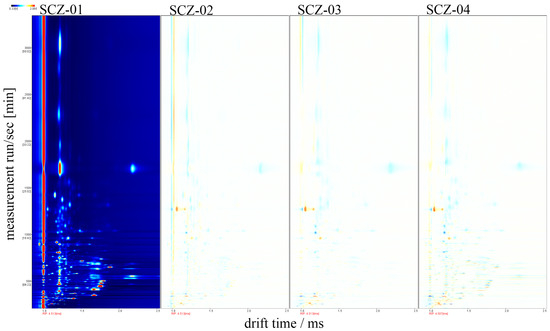
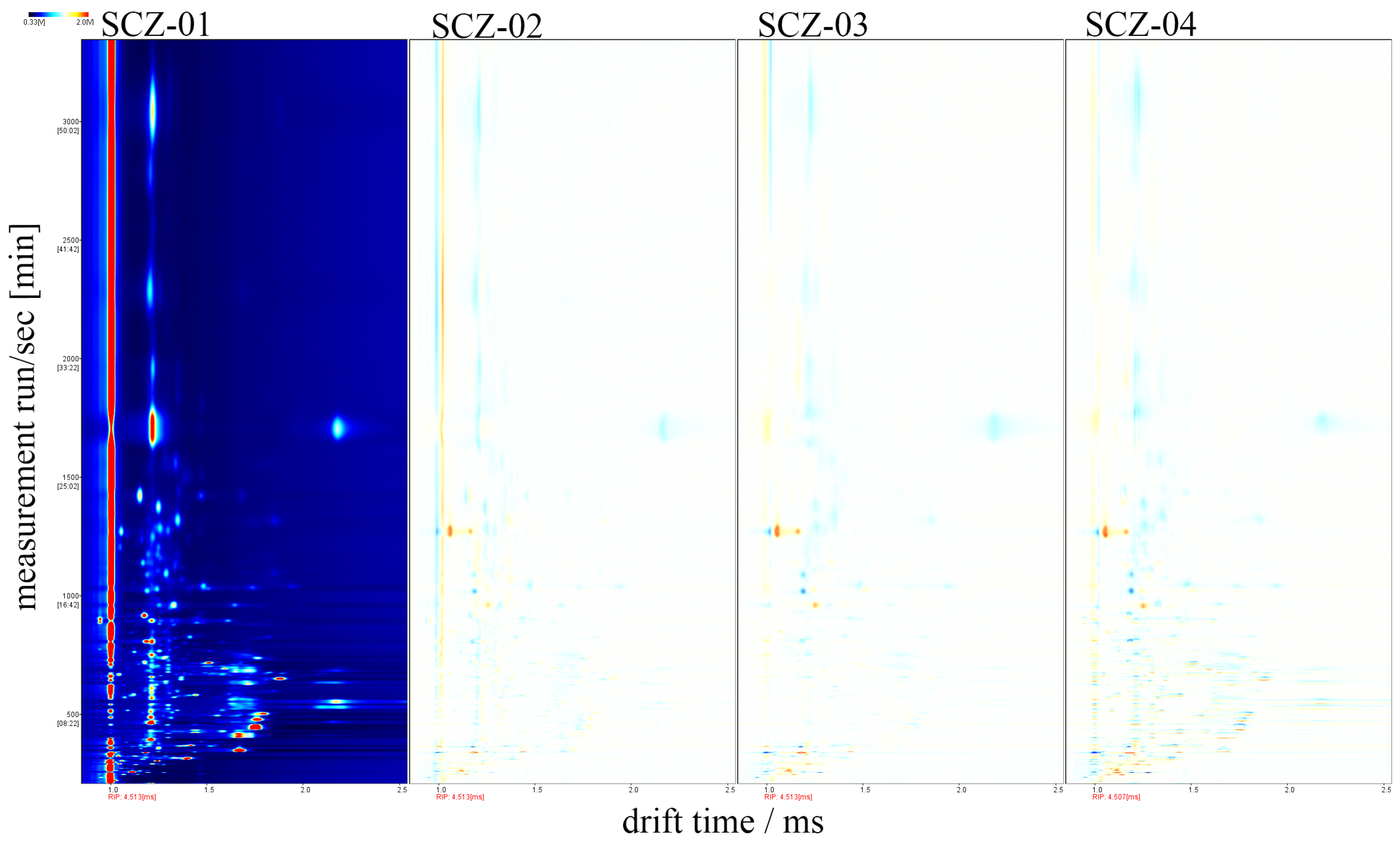
To facilitate a more intuitive comparison of the effects of varying intensities of 60Co irradiation on the VOCs in Cnidii Fructus, the spectrum obtained from the unirradiated Cnidii Fructus sample (SCZ-01) was used as a reference. The spectra of the other samples were subtracted from this reference spectrum to generate difference comparison plots (Figure 1). In these plots, a white background indicates that the VOC content in the target sample is the same as in the reference sample. Red regions signify a higher concentration of a particular substance in the target sample compared to the reference, whereas blue regions indicate a lower concentration. These difference spectra further reveal distinct variations in the volatile components among Cnidii Fructus samples treated with different intensities of 60Co irradiation.
Figure 1.
Difference spectra of VOCs by GC-IMS.
3.1.2. Qualitative Analysis of VOCs in Cnidii Fructus Subjected to Different Intensities of 60Co Irradiation by GC-IMS
This study tentatively identified a total of 115 VOCs, including 24 ketones, 20 alcohols, 18 esters, 11 aldehydes, 10 monoterpenes, 10 alkenals, 8 pyrazines, 6 aromatic hydrocarbons, 3 sulfur compounds, 3 furans, 1 acid, and 1 enol; the details are shown in Table 1.
Table 1.
Details of the VOCs in Cnidii Fructus with different 60Co irradiation intensities.
3.1.3. Fingerprint Analysis of VOCs in Cnidii Fructus with Different 60Co Irradiation Intensities
To compare differences in volatile substances among Cnidii Fructus samples treated with varying intensities of 60Co irradiation, fingerprint analysis was performed on all VOCs; the results are presented in Figure 2. Each row in the figure corresponds to all signal peaks for a given sample, while each column represents the signal peak of a specific VOC across different samples. Brighter colors indicate higher content of the compound. As shown in Figure 2, the differences in volatile components among the four sample groups are clearly visible: The SCZ-01 sample was characterized by abundant levels of compounds such as 2,3-Butanedione, Dimethyl sulfide, Nonanal-M, Nonanal-D, 2-Ethyl-5-methylpyrazine, α-Terpinene-M, α-Terpinene-D, Ethyl acetate, 2-Methylpropanal, 2,3-Butanediol, Bornyl acetate-D, 2-Propylpyrazine, Octanal-M, Octanal-D, Methyl acetate, 4-Terpinenol, γ-Terpinene-M, γ-Terpinene-D, 3-Nonen-2-one, 2,3-Diethyl-6-methylpyrazine, Neryl acetate, d-Camphor, 2-Pentanone, Hexyl isobutyrate, 1-Hexanol-M, 1-Hexanol-D, 1-Octen-3-one, (Z)-3-Hexenyl isovalerate, (E)-2-Nonenal, and o-Xylene. The SCZ-02 sample was distinguished by higher levels of α-Thujone, Isomenthone-M, Isomenthone-D, and 2-Ethyl-3,5-dimethylpyrazine. The SCZ-03 sample exhibited relatively higher levels of compounds such as (Z)-3-Hexenol-D. The SCZ-04 sample was characterized by higher contents of 3-Methyl-2-butenal, 1-Hydroxy-2-propanone, 2-Methyl-1-propanol, 3-Penten-2-one, 2-Propanol-M, and 2-Propanol-D.
Figure 2.
Fingerprint spectrum of VOCs.
3.2. Multivariate Statistical Analysis
For data analysis, this study utilized PLS-DA, a conventional method, with the aim of achieving precise sample discrimination and screening for intergroup differential features, thereby completing multidimensional data analysis of volatile components in Cnidii Fructus samples subjected to different doses of 60Co irradiation [29]. To investigate the effects of varying doses of 60Co irradiation on differential metabolites in Cnidii Fructus, a KEGG enrichment analysis of differential metabolites was further conducted.
3.2.1. Partial Least-Squares Discriminant Analysis
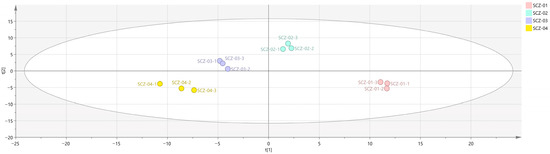
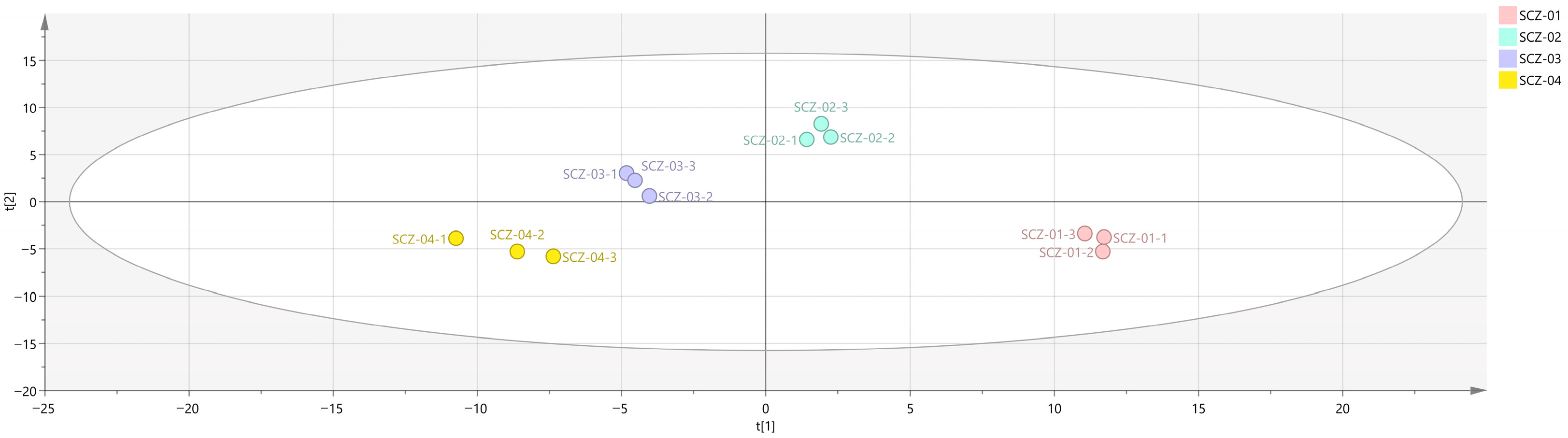
PLS-DA is a supervised multivariate statistical method primarily used for sample classification and discrimination studies. It combines the dimensionality reduction in partial least squares regression with the classification power of linear discriminant analysis, aiming to maximize inter-group differences and minimize intra-group variability. This approach enables effective differentiation and discrimination between different sample classes, with the characteristic feature of this analytical model being cross-validation analysis based on a specified sample size [30]. To investigate differences among the four groups of Cnidii Fructus samples subjected to different 60Co irradiation sterilization treatments, PLS-DA was performed using SIMCA software. The results are presented in Figure 3: The unirradiated group (SCZ-01) and all irradiated groups (SCZ-02, SCZ-03, SCZ-04) exhibited clear inter-group separation in the coordinate space, with no overlap of sample points between them. This indicates fundamental differences in the VOC profiles of Cnidii Fructus samples between irradiated and non-irradiated treatments. Clear separation trends were also observed among the irradiated groups themselves. Specifically, the low- and medium-dose groups (SCZ-02, SCZ-03) showed relatively close spatial distribution, whereas the high-dose group (SCZ-04) displayed a distinct distance from the low- and medium-dose groups (SCZ-02, SCZ-03) in the coordinate space. This indicates that the compositional characteristics of samples subjected to high-dose irradiation differed more markedly compared to those treated with low- and medium-dose irradiation.
Figure 3.
PLS-DA analysis of VOCs in four groups of Cnidii Fructus.
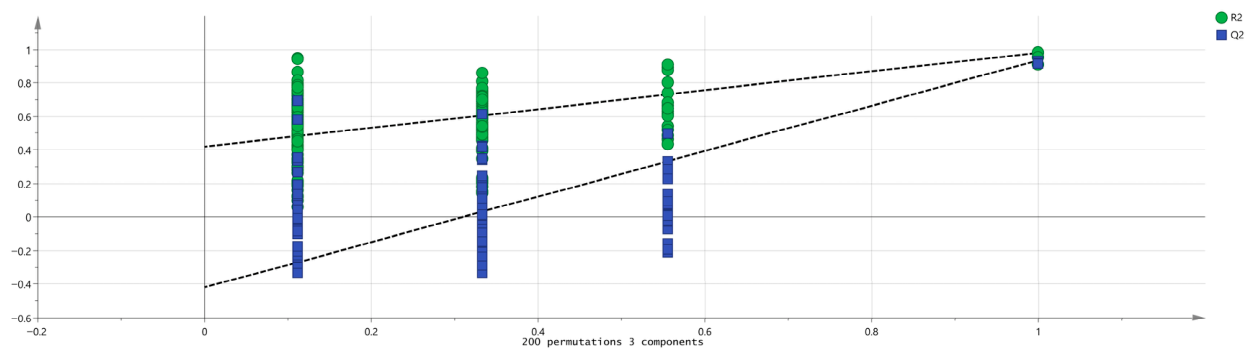
In addition, post-processing data revealed that R2X = 0.399 and R2Y = 0.172, suggesting the model has reliable predictive capability. To check for overfitting, a 200-permutation cross-validation assessed R2 and Q2. As Figure 4 shows, R2 = 0.418 and Q2 = −0.421 were obtained. Both R2 and Q2 were lower than the original values at coordinate 1.0, and the Q2 regression line intersected the abscissa with a negative intercept, indicating a valid, robust, and overfitting-free statistical model.
Figure 4.
Permutation test analysis of VOCs in four groups of Cnidii Fructus.
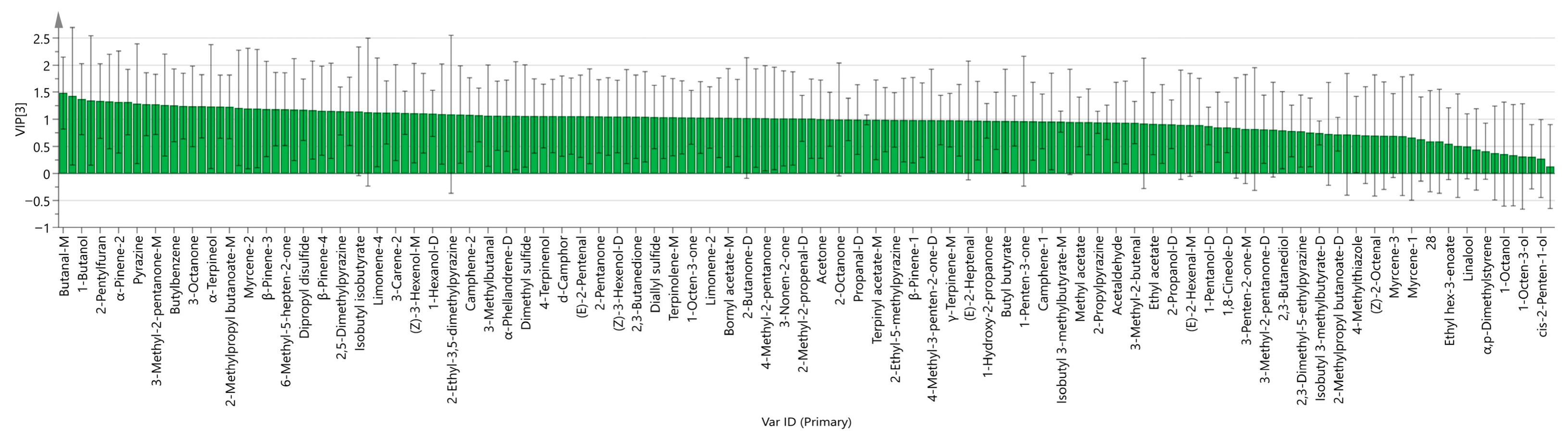
The VIP value is a crucial quantitative metric for evaluating the contribution of each variable to the model’s classification and discrimination, directly reflecting the individual variables’ relative importance in distinguishing inter-group differences. By calculating the VIP values of each VOC, characteristic variables that play a central role in classifying and discriminating Cnidii Fructus samples subjected to different doses of 60Co irradiation can be identified, clarifying their degree of contribution to the model. Generally, a variable with a VIP value greater than 1 is considered to have a significant influence on the model’s classification and discrimination, and such components are recognized as key VOCs for differentiating between sample groups [31]. As illustrated in Figure 5 and Table 2, compounds such as Butanal-M, 1-Butanol, 2-Pentylfuran, α-Pinene-2, Pyrazine, 3-Methyl-2-pentanone-M, Butylbenzene, 3-Octanone, α-Terpineol, 2-Methylpropyl butanoate-M, Myrcene-2, β-Pinene, 6-Methyl-5-hepten-2-one, Dipropyl disulfide, 2,5-Dimethylpyrazine, Isobutyl isobutyrate, Limonene, 3-Carene, (Z)-3-Hexenol-M, 1-Hexenol-D, and 2-Ethyl-3,5-dimethylpyrazine were predominant among the VOCs in Cnidii Fructus, significantly influencing the differences in volatile components resulting from the various 60Co irradiation sterilization treatments.
Figure 5.
VIP values of VOCs in Cnidii Fructus subjected to different 60Co irradiation sterilization treatments.
Table 2.
Details of the VOCs with a VIP value greater than 1 in Cnidii Fructus under different 60Co irradiation intensities.
3.2.2. KEGG Enrichment Analysis of Differential Metabolites
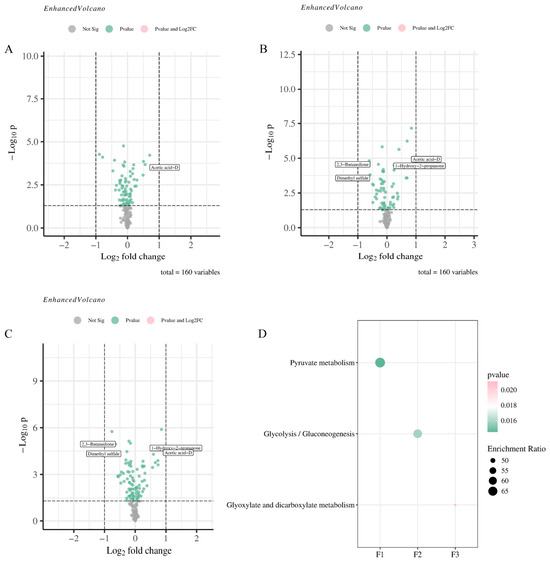
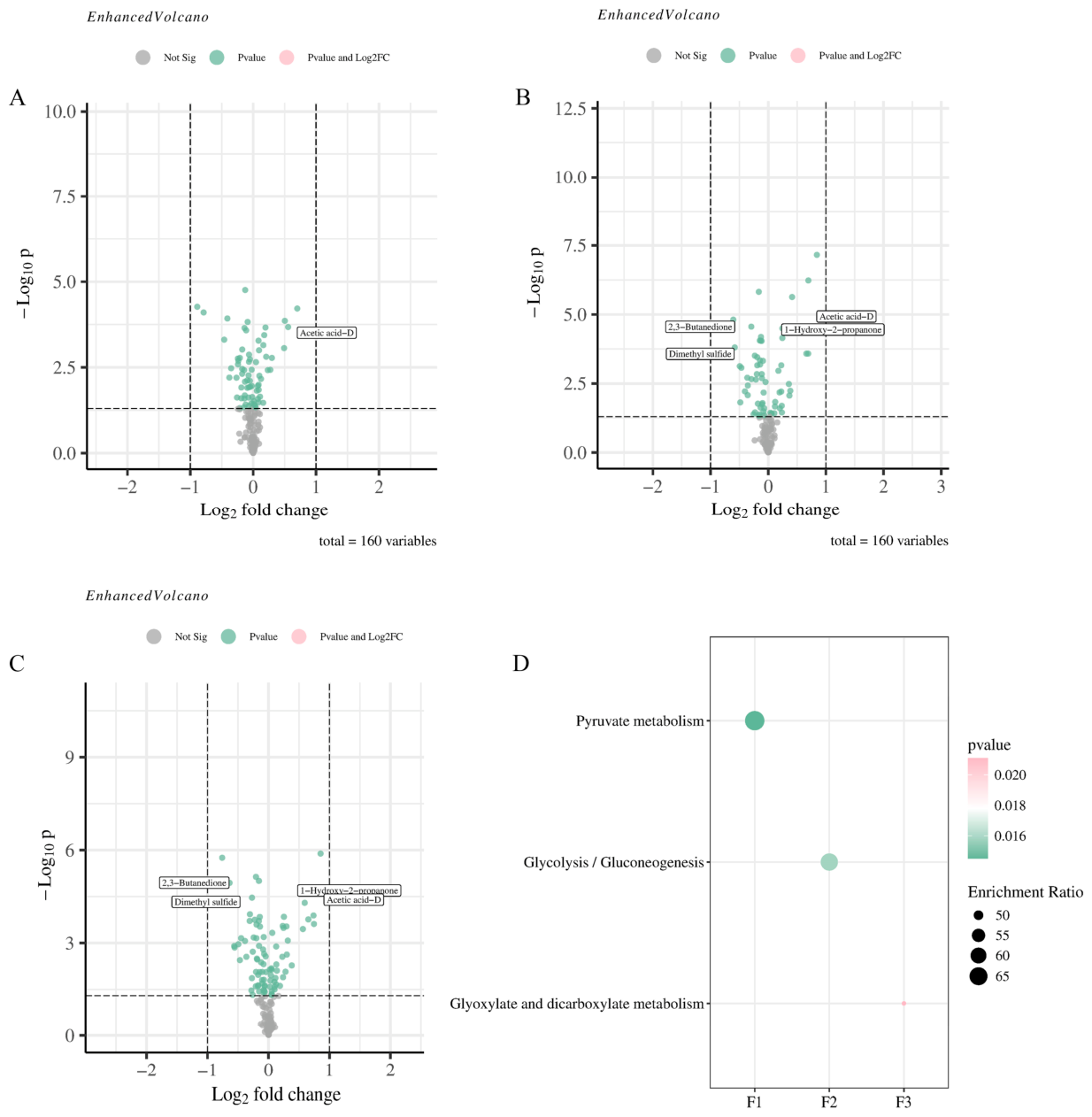
To evaluate the effect of different doses of 60Co irradiation on the differential metabolites of Cnidii Fructus, differential metabolites were screened in this study based on the criteria of p < 0.05, |log2FC| > 1, and VIP > 1. The results are presented in Figure 6A–C. One differential metabolite (Acetic acid-D, up-regulated) was identified between SCZ-02 and SCZ-01, representing the smallest number. Four differential metabolites each were screened out between SCZ-03 and SCZ-01 and between SCZ-04 and SCZ-01 (1-Hydroxy-2-propanone and Acetic acid-D up-regulated; Dimethyl sulfide and 2,3-Butanedione down-regulated), showing a marked increase in number. Compared with the unirradiated sample, most differential metabolites in the three irradiated groups exhibited changing trends, suggesting that irradiation treatment promoted the generation and transformation of metabolites. To elucidate the potential mechanisms underlying the alterations in the metabolic profile of Cnidii Fructus induced by medium- and high-dose irradiation, a metabolic pathway enrichment analysis was performed on the four differential metabolites common to the SCZ-03 vs. SCZ-01 and SCZ-04 vs. SCZ-01 comparisons. The results (Figure 6D) indicated that these metabolites were primarily enriched in three core pathways: pyruvate metabolism (enrichment ratio: 50, p = 0.0145), glycolysis/gluconeogenesis (enrichment ratio: 55, p = 0.0158), and glyoxylate and dicarboxylate metabolism (enrichment ratio: 60, p = 0.0211).
Figure 6.
Comparison of differential metabolites and enrichment pathway analysis in Cnidii Fructus subjected to different irradiation doses. (A) Comparison of differential metabolites between SCZ-01 and SCZ-02; (B) comparison of differential metabolites between SCZ-01 and SCZ-03; (C) comparison of differential metabolites between SCZ-01 and SCZ-04; (D) overview of enriched metabolite sets (Top25). Pvalue and Log2FC are listed in text box.
4. Discussion
This study utilized GC-IMS technology coupled with multivariate statistical analysis to investigate the effects of varying 60Co irradiation doses on the VOCs of Cnidii Fructus. Compared to GC-MS, GC-IMS enables faster VOCs analysis of Cnidii Fructus with high sensitivity for bioactive components (e.g., α-Thujone), and its fingerprint visualization allows for direct comparison of volatile profiles across different irradiation doses (0–9 kGy). The fingerprint spectra generated in this study visually revealed differential distribution patterns of volatile components among the dose groups [23,24]. The unirradiated group contained multiple components like 2,3-Butanedione, while the low-dose group (3 kGy) had relatively higher levels of substances like α-Thujone and the medium-dose group (6 kGy) exhibited a higher content of compounds such as (Z)-3-Hexenol-D. The high-dose group (9 kGy) was mainly composed of 3-Methyl-2-butenal. This pattern suggests that low-dose irradiation causes minor perturbation to the original component profile of Cnidii Fructus, better preserving its initial chemical characteristics. In contrast, medium- and high-dose irradiation induce more extensive component transformation and content changes, with the high dose leading to a profound reorganization of the chemical composition.
Key differential components with VIP values above 1 were identified, including α-Thujone and 1-Octen-3-one, among others. Analysis of compound classes revealed that ketones (e.g., α-Thujone, 1-Octen-3-one) were abundant in the low-dose irradiation group, and their antimicrobial, anti-inflammatory, and neuroactive properties may confer unique pharmacodynamic characteristics to samples subjected to low-dose irradiation [32]. Alcohols (e.g., 1-Octen-3-ol) showed considerable variation in the medium- and high-dose groups. Given their known involvement in antimicrobial, anti-inflammatory, and plant defense processes [33], it is postulated that irradiation may activate stress defense mechanisms in Cnidii Fructus. Esters (e.g., Neryl acetate), which contribute to aroma [34], were highly abundant in the unirradiated group, aligning with the floral and fruity scent characteristics of the untreated sample. Terpenes (e.g., α-Pinene, β-Pinene) [35], core active components among the VOCs of Cnidii Fructus, exhibited a trend of degradation with increasing irradiation dose, explaining the observed decrease in terpene content in the high-dose group. These findings not only elucidate the specific effects of irradiation on the components of Cnidii Fructus but also provide a molecular-level basis for understanding the alterations in its pharmacological activity following irradiation. In contrast, Xiang et al. (2023) [27] primarily focused on qualitative changes in VOCs without exploring underlying metabolic mechanisms.
Differential metabolite analysis showed that the number of differential metabolites between SCZ-02 and SCZ-01 was minimal under low-dose irradiation (3 kGy), indicating that low-dose irradiation induces relatively limited perturbation to the metabolic profile. In contrast, under medium-dose (6 kGy) and high-dose (9 kGy) irradiation, the number of differential metabolites compared to the unirradiated group increased significantly, demonstrating that medium- and high-dose irradiation induce more extensive alterations in the metabolic profile.
Metabolic pathway enrichment analysis revealed that differential metabolites were primarily enriched in three core pathways: pyruvate metabolism, glycolysis/gluconeogenesis, and glyoxylate and dicarboxylate metabolism. Irradiation-induced oxidative stress activates glycolytic flux, leading to the accumulation of dihydroxyacetone phosphate, which enters the methylglyoxal pathway to generate 1-Hydroxy-2-propanone [36,37]. Simultaneously, impairment of the TCA cycle redirects pyruvate towards acetyl-CoA, which is subsequently hydrolyzed to acetic acid [37,38], resulting in the accumulation of Acetic acid-D. The redistribution of pyruvate metabolism also inhibits the acetoin pathway [39,40], leading to reduced synthesis of 2,3-Butanedione. The downregulation of Dimethyl sulfide reflects the preferential utilization of methionine for glutathione synthesis under irradiation stress to counteract oxidative damage [41,42], rather than for the production of volatile sulfur compounds. These metabolic mechanisms elucidate how irradiation alters the composition of VOCs in Cnidii Fructus by influencing core metabolic pathways.
This study found that the VOCs of Cnidii Fructus were most similar to the non-irradiated control group when the irradiation dose was 3 kGy, suggesting that its component spectrum may be closer to the characteristics of traditional high-quality medicinal materials. The identified differential metabolites and core metabolic pathways can provide a chemical reference for the quality control of irradiated Cnidii Fructus. The findings offer a theoretical basis and technical support for the rational application of 60Co irradiation sterilization in the processing of Chinese medicinal materials and their powders. The level of detail and specificity provided is in line with the findings of Xiang et al. (2023) [27] and offers some fresh perspectives for the field.
It is worth noting that this study only analyzed the effect of different doses of 60Co irradiation on the VOCs profiles of Cnidii Fructus using GC-IMS and did not detect the microbial load of the irradiated samples. Therefore, although this study found that a 3 kGy irradiation dose had minimal impact on the VOC profiles, this result indicates that the volatile chemical components of Cnidii Fructus are well retained at this dose. Subsequent microbiological testing can be conducted to evaluate the sterilization efficiency of different irradiation doses.
5. Conclusions
The influence of different 60Co doses on the VOCs of Cnidii Fructus is dose-dependent, with unique trends in compositional changes observed at low (3 kGy), medium (6 kGy), and high (9 kGy) doses. Medium- and high-dose irradiation primarily reconstructs the metabolic profile by disrupting core carbon pathways. This study identified differential metabolites and core metabolic pathways that can serve as a chemical reference for quality control of irradiated Cnidii Fructus. When the irradiation dose is 3 kGy, the VOCs profile of Cnidii Fructus is most similar to that of the non-irradiated control group, suggesting that its compositional profile may be closer to that of traditional high-quality medicinal materials. The findings provide a theoretical basis and technical support for the rational application of 60Co irradiation sterilization in the processing of Chinese medicinal materials and their powders.
Author Contributions
Conceptualization, J.H.; methodology, J.H.; software, Y.L. (Yuhuan Liu) and Y.L. (Yuqing Liu); validation, Y.L. (Yuhuan Liu); formal analysis, Y.L. (Yuhuan Liu); investigation, Y.L. (Yuqing Liu); resources, J.Y.; data curation, J.H.; writing—original draft preparation, J.H.; writing—review and editing, S.L. and D.H.; visualization, Y.L. (Yuhuan Liu) supervision, J.Y.; project administration, S.L. and D.H.; funding acquisition, S.L. and D.H. All authors have read and agreed to the published version of the manuscript.
Funding
This research was funded by Xiangxi Prefecture’s “Open Competition and Merit-Based Selection” Project for Technological Breakthroughs (2022JBGS0003), Key Discipline Project on Chinese Pharmacology of Hunan University of Chinese Medicine (202302).
Institutional Review Board Statement
Not applicable.
Informed Consent Statement
Not applicable.
Data Availability Statement
The original contributions presented in the study are included in the article, and further inquiries can be directed to the corresponding author.
Conflicts of Interest
The authors declare no conflicts of interest.
References
- Xu, T.; Yin, J.; Dai, X.; Liu, T.; Shi, H.; Zhang, Y.; Wang, S.; Yue, G.; Zhang, Y.; Zhao, D.; et al. Cnidii Fructus: A traditional Chinese medicine herb and source of antiosteoporotic drugs. Phytomedicine 2024, 128, 155375. [Google Scholar] [CrossRef] [Scilit]
- Khan, S.A.; Wu, Y.; Li, A.S.; Fu, X.Q.; Yu, Z.L. Network pharmacology and molecular docking-based prediction of active compounds and mechanisms of action of Cnidii Fructus in treating atopic dermatitis. BMC Complement. Med. Ther. 2022, 22, 275. [Google Scholar] [CrossRef] [Scilit]
- Chu, M.; Tsang, M.S.; He, R.; Lam, C.W.; Quan, Z.B.; Wong, C.K. The Active Compounds and Therapeutic Mechanisms of Pentaherbs Formula for Oral and Topical Treatment of Atopic Dermatitis Based on Network Pharmacology. Plants 2020, 9, 1166. [Google Scholar] [CrossRef] [Scilit]
- Sun, Y.; Yang, A.W.H.; Lenon, G.B. Phytochemistry, Ethnopharmacology, Pharmacokinetics and Toxicology of Cnidium monnieri (L.) Cusson. Int. J. Mol. Sci. 2020, 21, 1006. [Google Scholar] [CrossRef] [Scilit]
- Gao, F.; Hu, Y.; Ye, X.; Li, J.; Chen, Z.; Fan, G. Optimal extraction and fingerprint analysis of Cnidii fructus by accelerated solvent extraction and high-performance liquid chromatographic analysis with photodiode array and mass spectrometry detections. Food Chem. 2013, 141, 1962–1971. [Google Scholar] [CrossRef] [Scilit]
- Wei, Z.; Zhang, X.; Peng, A.; Liu, C.; Pang, J.; Zhang, Y.; Duan, X. Network-Pharmacology-Based Study on Active Phytochemicals and Molecular Mechanism of Cnidii Fructus in Treating Colorectal Cancer. Comb. Chem. High Throughput Screen. 2024, 27, 2667–2680. [Google Scholar] [CrossRef] [Scilit]
- Hao, Y.M.; Wang, R.Y.; Zhong, Q.M.; Tong, L.G.; Song, M.Q.; Yang, Q.; Feng, M.L. Effect of Hypnotic Active Components from Cnidii Fructus on Neurotransmittersand Clock Genes Expression in Primary Hippocampal Neurons. J. Chin. Med. Mater. 2019, 42, 1133–1138. [Google Scholar] [CrossRef] [Scilit]
- Li, Y.M.; Jia, M.; Li, H.Q.; Zhang, N.D.; Wen, X.; Rahman, K.; Zhang, Q.Y.; Qin, L.P. Cnidium monnieri: A Review of Traditional Uses, Phytochemical and Ethnopharmacological Properties. Am. J. Chin. Med. 2015, 43, 835–877. [Google Scholar] [CrossRef] [Scilit]
- Zhang, Q.; Qin, L.; He, W.; Van Puyvelde, L.; Maes, D.; Adams, A.; Zheng, H.; De Kimpe, N. Coumarins from Cnidium monnieri and their antiosteoporotic activity. Planta Med. 2007, 73, 13–19. [Google Scholar] [CrossRef] [Scilit]
- Chen, G.; Xu, Q.; Dai, M.; Liu, X. Bergapten suppresses RANKL-induced osteoclastogenesis and ovariectomy-induced osteoporosis via suppression of NF-κB and JNK signaling pathways. Biochem. Biophys. Res. Commun. 2019, 509, 329–334. [Google Scholar] [CrossRef] [Scilit]
- Lv, B.; Yang, X.; Xue, H.; Nan, M.; Zhang, Y.; Liu, Z.; Bi, Y.; Shang, S. Isolation of Main Pathogens Causing Postharvest Disease in Fresh Codonopsis pilosula during Different Storage Stages and Ozone Control against Disease and Mycotoxin Accumulation. J. Fungi 2023, 9, 146. [Google Scholar] [CrossRef] [Scilit]
- Gao, K.; He, S.; Shi, J.; Xue, S.J.; Li, X.; Sun, H. Impact of pH-Shifting and Autoclaving on the Allergenic Potential of Red Kidney Bean (Phaseolus vulgaris L.) Lectins. J. Agric. Food Chem. 2024, 72, 28109–28121. [Google Scholar] [CrossRef] [Scilit]
- Kurtz, D.M.; Whiteside, T.E.; Caviness, G.; Lih, F.B. Dry Heat Sterilization of a Pelleted, Natural Ingredient Rodent Diet. J. Am. Assoc. Lab. Anim. Sci. 2024, 63, 377–384. [Google Scholar] [CrossRef] [Scilit] [PubMed]
- Zhang, W.; Pan, Y.; Jiang, Y.; Zhang, Z. Advances in gas fumigation technologies for postharvest fruit preservation. Crit. Rev. Food Sci. Nutr. 2024, 64, 8689–8708. [Google Scholar] [CrossRef] [Scilit]
- Sahu, P.K.; Tilgam, J.; Mishra, S.; Hamid, S.; Gupta, A.; K., J.; Verma, S.K.; Kharwar, R.N. Surface sterilization for isolation of endophytes: Ensuring what (not) to grow. J. Basic Microbiol. 2022, 62, 647–668. [Google Scholar] [CrossRef] [Scilit]
- Luo, Q.; Liu, S.; He, Y.; Liu, J.; Zhang, X.; Zheng, L.; Huang, D. An Evaluation of the Impact of 60Co Irradiation on Volatile Organic Compounds of Olibanum Using Gas Chromatography Ion Mobility Spectrometry. Molecules 2024, 29, 1671. [Google Scholar] [CrossRef] [Scilit]
- Warke, R.G.; Kamat, A.S.; Kamat, M.Y. Irradiation of chewable tobacco mixes for improvement in microbiological quality. J. Food Prot. 1999, 62, 678–681. [Google Scholar] [CrossRef] [Scilit]
- Ahmed, S.M.; Hassan, A.B. Validation of γ-radiation and their effect on phenolic compounds, antioxidant activity, and microbial load of fennel (Foeniculum vulgare) seeds and cinnamon (Cinnamomum verum) sticks. Food Sci. Nutr. 2023, 11, 1994–2001. [Google Scholar] [CrossRef] [Scilit]
- Kumari, N.; Kumar, P.; Mitra, D.; Prasad, B.; Tiwary, B.N.; Varshney, L. Effects of ionizing radiation on microbial decontamination, phenolic contents, and antioxidant properties of triphala. J. Food Sci. 2009, 74, M109–M113. [Google Scholar] [CrossRef] [Scilit]
- Korban, A.; Charapitsa, S.; Čabala, R.; Sobolenko, L.; Egorov, V.; Sytova, S. Advanced GC-MS method for quality and safety control of alcoholic products. Food Chem. 2021, 338, 128107. [Google Scholar] [CrossRef] [Scilit]
- Álvarez-Ortí, M.; Pardo, J.E.; Cascos, G.; Sánchez, R.; Lozano, J.; Martín-Vertedor, D. E-Nose Discrimination of Almond Oils Extracted from Roasted Kernels. Nutrients 2022, 15, 130. [Google Scholar] [CrossRef] [Scilit]
- Sun, X.; Yu, Y.; Wang, Z.; Akhtar, K.H.; Saleh, A.S.M.; Li, W.; Zhang, D. Insights into flavor formation of braised chicken: Based on E-nose, GC-MS, GC-IMS, and UPLC-Q-Exactive-MS/MS. Food Chem. 2024, 448, 138972. [Google Scholar] [CrossRef] [Scilit]
- Ouyang, X.; Shi, X.; Zhou, C.; Li, M.; Huang, R.; Liu, H.; Huang, D.; Zhang, G. An Exploratory Study on the Influence of Frying on Chemical Constituent Transformation and Antioxidant Activity in Ziziphi Spinosae Semen: A Multimodal Analytical Strategy Based on UPLC-Q-TOF-MS and GC-IMS. Foods 2025, 14, 4145. [Google Scholar] [CrossRef] [Scilit]
- Capitain, C.; Weller, P. Non-Targeted Screening Approaches for Profiling of Volatile Organic Compounds Based on Gas Chromatography-Ion Mobility Spectroscopy (GC-IMS) and Machine Learning. Molecules 2021, 26, 5457. [Google Scholar] [CrossRef] [Scilit]
- Wang, Z.; An, J.; Daji, R.; Peng, G.; Wei, X.; Su, R.; Liu, S.; Qiang, R.; Gu, R.; Zhong, S. E-nose, HS-SPME-GC-MS and untargeted metabolomics reveal effects on 60Co gamma irradiation of Neng-An-Jun-Ning Pills: Changes in odor and chemical compositions. J. Pharm. Biomed. Anal. 2026, 275, 117446. [Google Scholar] [CrossRef] [Scilit]
- Dai, J.; Tang, W.; Wang, Y.; Gan, X.; Yang, L.; Zhang, J.; Sun, Y.; Wang, Y.; Qin, H.; Wang, S. Investigating the influence of 60Co irradiation on the aging aroma components of soy sauce aroma type baijiu by integrating E-nose, GC-MS, GC-IMS, and chemometric methods. Food Chem. X 2025, 29, 102704. [Google Scholar] [CrossRef] [Scilit]
- Xiang, Y.; Lei, C.; Hu, G.; Zhou, W.; Li, Y.; Huang, D. Investigation of 60Co Irradiation on the Volatile Organic Compounds from Finger Citron (Citri Sarcodactylis Fructus) Using GC-IMS. Foods 2023, 12, 3543. [Google Scholar] [CrossRef] [Scilit] [PubMed]
- Committee for the Pharmacopoeia of P.R. China. Pharmacopoeia of P.R. China, Part 4; Beijing Chemical Industry Press: Beijing, China, 2025; p. 308.
- Liu, H.; Zhao, R.; Xu, H.; Manaer, T.; Pan, L.; Jin, L.; Ayupbek, A. Identification of Quality Markers in Viola kunawaresis Royel Using HPLC Fingerprints, Chemometric Analysis, and Network Pharmacology. Biomed. Chromatogr. 2026, 40, e70410. [Google Scholar] [CrossRef] [Scilit]
- Sánchez-Artero, S.; Soriano-Asensi, A.; Amorós, P.; Ros-Lis, J.V. Detection of Tuber melanosporum Using Optoelectronic Technology. Sensors 2025, 26, 230. [Google Scholar] [CrossRef] [Scilit] [PubMed]
- Yang, R.; Huang, S.; Wang, W.; Sun, T.; Ai, M.; Han, X.; Zhao, L. Effects of thermal and non-thermal sterilization on the quality and flavor of prune jam: An integrated analysis using E-nose, GC-MS, and GC-IMS. Food Res. Int. 2026, 230, 118656. [Google Scholar] [CrossRef] [Scilit] [PubMed]
- Choi, E.; Jin, C.H.; Huy Ngo, T.; Park, J.; Nam, J.W.; Han, A.R. Ionizing Radiation-Induced Structural Modification of Isoegomaketone and Its Anti-Inflammatory Activity. Molecules 2025, 30, 3466. [Google Scholar] [CrossRef] [Scilit] [PubMed]
- Kishimoto, K.; Matsui, K.; Ozawa, R.; Takabayashi, J. Volatile C6-aldehydes and Allo-ocimene activate defense genes and induce resistance against Botrytis cinerea in Arabidopsis thaliana. Plant Cell Physiol. 2005, 46, 1093–1102. [Google Scholar] [CrossRef] [Scilit]
- Elsharif, S.A.; Buettner, A. Structure-Odor Relationship Study on Geraniol, Nerol, and Their Synthesized Oxygenated Derivatives. J. Agric. Food Chem. 2018, 66, 2324–2333. [Google Scholar] [CrossRef] [Scilit]
- Salehi, B.; Upadhyay, S.; Erdogan Orhan, I.; Kumar Jugran, A.; Jayaweera, S.L.D.; Dias, D.A.; Sharopov, F.; Taheri, Y.; Martins, N.; Baghalpour, N.; et al. Therapeutic Potential of α- and β-Pinene: A Miracle Gift of Nature. Biomolecules 2019, 9, 738. [Google Scholar] [CrossRef] [Scilit]
- Aburto, C.; Parada-Goddard, V.; San Martín, A. Activation of the pentose phosphate pathway flux by hydrogen peroxide is not regulated by NADPH-mediated feedback inhibition. Br. J. Pharmacol. 2025. [Google Scholar] [CrossRef] [Scilit]
- Murata, K.; Inoue, Y.; Rhee, H.; Kimura, A. 2-Oxoaldehyde metabolism in microorganisms. Can. J. Microbiol. 1989, 35, 423–431. [Google Scholar] [CrossRef] [Scilit]
- Hamel, R.D.; Appanna, V.D. Modulation of TCA cycle enzymes and aluminum stress in Pseudomonas fluorescens. J. Inorg. Biochem. 2001, 87, 1–8. [Google Scholar] [CrossRef] [Scilit]
- Baggetto, L.G.; Testa-Parussini, R. Role of acetoin on the regulation of intermediate metabolism of Ehrlich ascites tumor mitochondria: Its contribution to membrane cholesterol enrichment modifying passive proton permeability. Arch. Biochem. Biophys. 1990, 283, 241–248. [Google Scholar] [CrossRef] [Scilit]
- Baggetto, L.G.; Lehninger, A.L. Isolated tumoral pyruvate dehydrogenase can synthesize acetoin which inhibits pyruvate oxidation as well as other aldehydes. Biochem. Biophys. Res. Commun. 1987, 145, 153–159. [Google Scholar] [CrossRef] [Scilit] [PubMed]
- Arun, P.; Rittase, W.B.; Wilder, D.M.; Wang, Y.; Gist, I.D.; Long, J.B. Defective methionine metabolism in the brain after repeated blast exposures might contribute to increased oxidative stress. Neurochem. Int. 2018, 112, 234–238. [Google Scholar] [CrossRef] [Scilit] [PubMed]
- Tsai, C.W.; Lin, A.H.; Wang, T.S.; Liu, K.L.; Chen, H.W.; Lii, C.K. Methionine restriction up-regulates the expression of the pi class of glutathione S-transferase partially via the extracellular signal-regulated kinase-activator protein-1 signaling pathway initiated by glutathione depletion. Mol. Nutr. Food Res. 2010, 54, 841–850. [Google Scholar] [CrossRef] [Scilit] [PubMed]



Disclaimer/Publisher’s Note: The statements, opinions and data contained in all publications are solely those of the individual author(s) and contributor(s) and not of MDPI and/or the editor(s). MDPI and/or the editor(s) disclaim responsibility for any injury to people or property resulting from any ideas, methods, instructions or products referred to in the content. |
© 2026 by the authors. Licensee MDPI, Basel, Switzerland. This article is an open access article distributed under the terms and conditions of the Creative Commons Attribution (CC BY) license.