


Abstract
Risperidone (RIS) oral solution has a bitter taste and is sometimes mixed with beverages to improve palatability and medication adherence. Although the package insert advises against mixing with tea beverages, the effects of beverage type and tea leaf variety on RIS concentration remain unclear. RIS oral solution was mixed with commercially available black tea, green tea, and hojicha beverages, and black tea leaf extracts. RIS concentration in the supernatant was quantified by high-performance liquid chromatography, and its recovery from precipitates was evaluated in selected samples. RIS concentration decreased in all black tea and green tea beverages and black tea extracts, whereas some hojicha beverages showed no significant decrease. The extent of reduction differed among beverage types and black tea leaf varieties. RIS was substantially recovered from precipitates redissolved in methanol or dissolution test fluid 1 (pH 1.2), whereas recovery from dissolution test fluid 2 (pH 6.8) was lower. Chromatographic and UV spectral analyses supported the presence of RIS in redissolved precipitates. The reduction in RIS concentration is associated, at least in part, with transfer into precipitates and depends on beverage type and tea leaf variety. These findings support the recommendation to avoid diluting RIS oral solution with tea beverages.
1. Introduction
Risperidone (RIS) is an atypical antipsychotic with a benzisoxazole skeleton that exerts clinical effects through serotonin 5-HT2A and D2 receptor antagonism [1,2,3]. In Japan, it was approved as a tablet in 1996, as an oral solution in 2002, and as an orally disintegrating tablet in 2007 [4]. It is indicated for schizophrenia and irritability associated with childhood autism spectrum disorder and is used across various ages, from children to older adults [5,6,7]. Oral solutions effectively alleviate agitation symptoms in schizophrenia [8].
The bitter taste characteristic of oral formulations can reduce palatability and may negatively affect medication adherence, particularly when patients have difficulty taking unpleasant-tasting medicines [9]. In clinical practice, RIS oral solutions are sometimes diluted in beverages before administration. We have previously found that 22.6% of RIS oral solution users mixed it with beverages [10], primarily to reduce bitterness. Although the package inserts and interview form permit dilution with water or juice, they state that tea beverages and cola should be avoided owing to the risk of reduced drug concentrations [4,5]. However, the use of inappropriate beverages has been confirmed [10], making this a clinically relevant concern with direct implications for medication adherence and administration. Similar incompatibility has also been reported for another antipsychotic oral solution, aripiprazole, in which gallate-type green tea polyphenols were implicated in insoluble substance formation [11].
Although the interview form indicates that RIS concentration decreases immediately after mixing with certain tea beverages [4], it is unclear whether this phenomenon is common to all tea beverages or to specific components. Black tea, green tea, and hojicha (commonly consumed in Japan) differ in their manufacturing processes; black tea is produced through enzymatic oxidation of tea leaves, green tea is non-oxidized, and hojicha is prepared by roasting green tea. The chemical composition varies substantially among tea beverages. While green tea consists primarily of catechins, such as epigallocatechin gallate (EGCg) [12], black tea contains complex polyphenols, such as theaflavins and thearubigins, formed through oxidation and polymerization [13,14]. The formation of insoluble complexes between RIS and EGCg has been reported [15]. In addition, tea polyphenols interact with various food components, including proteins, polysaccharides, and lipids, which may alter physicochemical properties such as solubility, stability, and bioavailability [16]. Commercially available beverages are complex mixtures containing various polyphenols, acidulants, sugars, and other ingredients; therefore, a single component alone cannot fully explain the reduction in RIS concentration after mixing. In this study, we investigated changes in RIS concentration following mixing an RIS oral solution with commercially available black tea, green tea, and hojicha beverages, as well as four types of black tea leaf extracts. The findings of this study are expected to provide practical evidence to support medication counseling regarding the administration of RIS oral solution.
2. Materials and Methods
2.1. Materials
RIS Oral Solution (Risperdal® Oral Solution) 1 mg/mL was purchased from Janssen Pharmaceutical K.K. (Tokyo, Japan). The RIS standard, water (high-performance liquid chromatography [HPLC] grade), methanol (HPLC grade), sodium dihydrogen phosphate, disodium hydrogen phosphate, 1st fluid for dissolution test (dissolution test fluid 1 [DS1], pH 1.2), and phosphate-buffered solution (DS2, pH 6.8) were purchased from FUJIFILM Wako Pure Chemical Co. (Osaka, Japan). Green tea beverages were selected from commercially available bottled Japanese tea products ranked in the Japanese tea and barley tea beverage category of the Food POS Ranking reported by the Japan Food Journal [17]. Hojicha beverages were selected from the product lines corresponding to the selected green tea beverages, where available. For black tea beverages, Gogo no Kocha Straight, which is listed in the interview form for RIS oral solution and contains Dimbula tea leaves, and Gogo no Kocha Lemon Tea, a product from the same manufacturer containing Nuwara Eliya tea leaves, were used. For black tea extracts, Dimbula and Nuwara Eliya were selected because these tea leaves corresponded to the black tea beverages used in this study. Assam and Ruhuna were additionally included to evaluate whether the magnitude of RIS concentration reduction differed among black tea leaf varieties. These products and tea leaf varieties were selected to reflect commercially available tea beverages and corresponding black tea leaf varieties relevant to the present study; however, they were not intended to represent the full diversity of commercially available tea products. The following codes were assigned to each product. For black tea beverages, Gogo no Kocha Straight (Kirin Beverage Co., Ltd., Tokyo, Japan) and Gogo no Kocha Lemon (Kirin Beverage Co., Ltd., Tokyo, Japan) were designated as B1 and B2. For green tea beverages, Nama-cha (Kirin Beverage Co., Ltd.), Oi Ocha Koicha (Ito En, Ltd., Tokyo, Japan), Ayataka (The Coca-Cola (Japan) Company, Ltd., Tokyo, Japan), Tokusen Ayataka (The Coca-Cola (Japan) Company, Ltd., Tokyo, Japan), and Iyemon (Suntory Beverage & Food Ltd., Tokyo, Japan) were designated as G1–G5. For hojicha beverages, we assigned Nama-cha Hojicha (Kirin Beverage Co., Ltd.), Ayataka Hojicha (The Coca-Cola (Japan) Company, Ltd., Tokyo, Japan), Iyemon Hojicha (Suntory Beverage & Food Ltd., Tokyo, Japan), Oi Ocha Hojicha (Ito En, Ltd.), and Tokucha Hojicha (Suntory Beverage & Food Ltd.) as H1–H5. For black tea leaves, Assam, Ruhuna, Dimbula, and Nuwara Eliya (Karel Capek Co., Ltd., Tokyo, Japan) were designated as T1–T4. Each black tea extract (T1–T4) was prepared by steeping one tea bag in boiling water (100 °C) for 4 min in a 200 mL beaker under continuous stirring with a magnetic stirrer. The extraction volume followed the manufacturer’s recommended preparation method; therefore, 150 mL of boiling water was used for Assam, whereas 200 mL was used for the other tea leaf varieties. After extraction, the tea extracts were cooled to room temperature before use in the compatibility test.
2.2. Experimental Apparatus
HPLC was performed using a Shimadzu Nexera XR system (Shimadzu Corporation, Kyoto, Japan) equipped with a pump (LC-20ADXR), autosampler (SIL-20AXR), column oven (CTO-20A) and a photodiode array detector (SPD-M30A), with detection at a UV wavelength of 278 nm. A VORTEX-GENIE2 (MS Kiki Co., Ltd., Fukuoka, Japan) and IntelliMixer RM2 (Toho Co., Ltd., Tokyo, Japan) were used as stirrers, and an MDX-310 (Tommy Seiko Co., Ltd., Tokyo, Japan) was used as a micro-volume high-speed refrigerated centrifuge.
2.3. HPLC Conditions
The mobile phase used for analyses was 50 mM phosphate buffer (pH 7.0)/methanol (35/65, v/v), with a flow rate of 0.4 mL/min. An InertSustain® C18 column (100 × 2.1 mm i.d., 5 µm; GL Sciences Inc., Tokyo, Japan) was used for the analysis, with the column oven temperature set to 40 °C and sample injection volume set to 1 µL. The detection wavelength was set to 278 nm in the UV range. The HPLC method employed a relatively low flow rate and short analytical run time, thereby limiting mobile phase consumption.
2.4. Preparation of Calibration Curve Samples
A standard stock solution of RIS was prepared by dissolving 10.0 mg of the reference standard in 10 mL of methanol to obtain a stock concentration of 1 mg/mL. The stock solution was further diluted with methanol to prepare a working standard solution (100 µg/mL) in a total volume of 20 mL. This solution was then serially diluted to prepare five calibration standards at 2.5, 5, 10, 20, and 40 µg/mL, and a calibration curve was constructed using the absolute calibration method. Each calibration standard was analyzed once, and the calibration curve was constructed from the peak areas of the calibration standards. Quality control samples were prepared at three concentration levels: low-quality control (LQC, 3 µg/mL), middle-quality control (MQC, 15 µg/mL), and high-quality control (HQC, 30 µg/mL). Precision was expressed as the relative standard deviation (RSD), and accuracy was expressed as the relative error. Relative error was calculated as follows: [(measured concentration − nominal concentration)/nominal concentration] × 100. The lowest calibration standard was 2.5 µg/mL. Formal validation of the lower limit of quantification (LLOQ) was not performed because the analytical method was intended for comparative quantification.
2.5. Sample Preparation
RIS oral solution is commercially supplied as a formulation containing 1 mg/mL RIS. In the present study, 30 µL of this formulation was added to 1 mL of each beverage or black tea extract, resulting in a nominal RIS concentration of approximately 29.1 µg/mL before centrifugation. The mixture was stirred for 30 s using a tube rotator (Mode: U1, 90) and subsequently centrifuged (9060× g, 5 min) to remove precipitates. The supernatant was used to determine the residual RIS concentration. Next, 200 µL of methanol was added to 100 µL of the supernatant, mixed using a vortex mixer, and 1 µL of the resulting solution was injected into the HPLC system. Water was used as the control, and the residual RIS concentration in each sample was expressed as a percentage of RIS concentration in the water control. To evaluate possible matrix-derived interference, blank samples of representative matrices, including water, methanol, DS1, DS2, B1, T3, a representative green tea beverage, and a representative hojicha beverage, were analyzed under the same HPLC conditions used for RIS quantification. The blank chromatograms were compared with the chromatogram of a RIS standard solution to confirm that no matrix-derived peaks overlapped with the retention time of RIS.
2.6. Recovery of RIS from Precipitates
To determine whether RIS was transferred into precipitates after mixing, recovery experiments were performed using B1 and T3. RIS oral solution was mixed with B1 and T3, centrifuged as described above, and the supernatant was removed. The resulting precipitate was resuspended in 1000 µL of methanol, DS1 (pH 1.2), or DS2 (pH 6.8). After thorough mixing by pipetting and vortexing, the suspension was centrifuged at 9060× g for 5 min. For HPLC analysis, a 100 µL aliquot of the methanol-resuspended sample was mixed with 200 µL of water. For samples resuspended in DS1 or DS2, a 100 µL aliquot was mixed with 100 µL of methanol and 100 µL of water prior to HPLC analysis. The recovered RIS concentration was determined by HPLC, and representative chromatograms and UV absorption spectra were compared with those of the RIS standard and water control.
2.7. Statistical Processing
The water-diluted RIS solution was used as the control. Differences between each sample and the water control were evaluated using Dunnett’s test, setting p < 0.01 as the significance threshold. Statistical analyses were conducted using JMP® software version 13.2.1 (SAS institute Inc., Cary, NC, USA) software. Black tea extracts, black tea beverages, green tea beverages, and hojicha beverages were analyzed in six independent replicates. Data are presented as means ± standard deviations (SD).
3. Results
3.1. Analytical Performance of the HPLC Method
A specific peak for RIS was observed at a retention time of approximately 2.54 min. The calibration curve showed good linearity over the range of 2.5–40 µg/mL. The calibration equation was y = 12,982x − 6097.8, and the coefficient of determination (R2) was 0.9993. The relative errors for the LQC, MQC, and HQC samples were 3.91%, 3.91%, and 5.73%, respectively. The corresponding RSD values were 1.12%, 1.20%, and 0.59%, respectively. These results indicated that the HPLC method was suitable for the comparative quantification of residual RIS concentrations under the analytical conditions used in this study.
Representative chromatograms of the RIS standard solution and blank matrices are shown in Figure S1. No interfering peaks were observed at the retention time of RIS (approximately 2.54 min) in the blank matrix chromatograms. Peaks observed at approximately 0.5–1.0 min were also detected in some blank matrix chromatograms and were therefore attributed to the injection solvent and/or sample matrices. These findings demonstrate the specificity and suitability of the HPLC method for quantifying RIS in the tea beverage and black tea extract matrices examined in this study.
3.2. Residual RIS Concentration Following Mixing with Tea Beverages and Black Tea Extracts
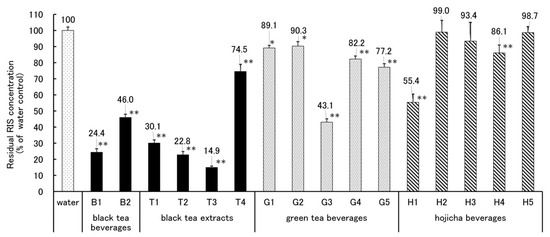
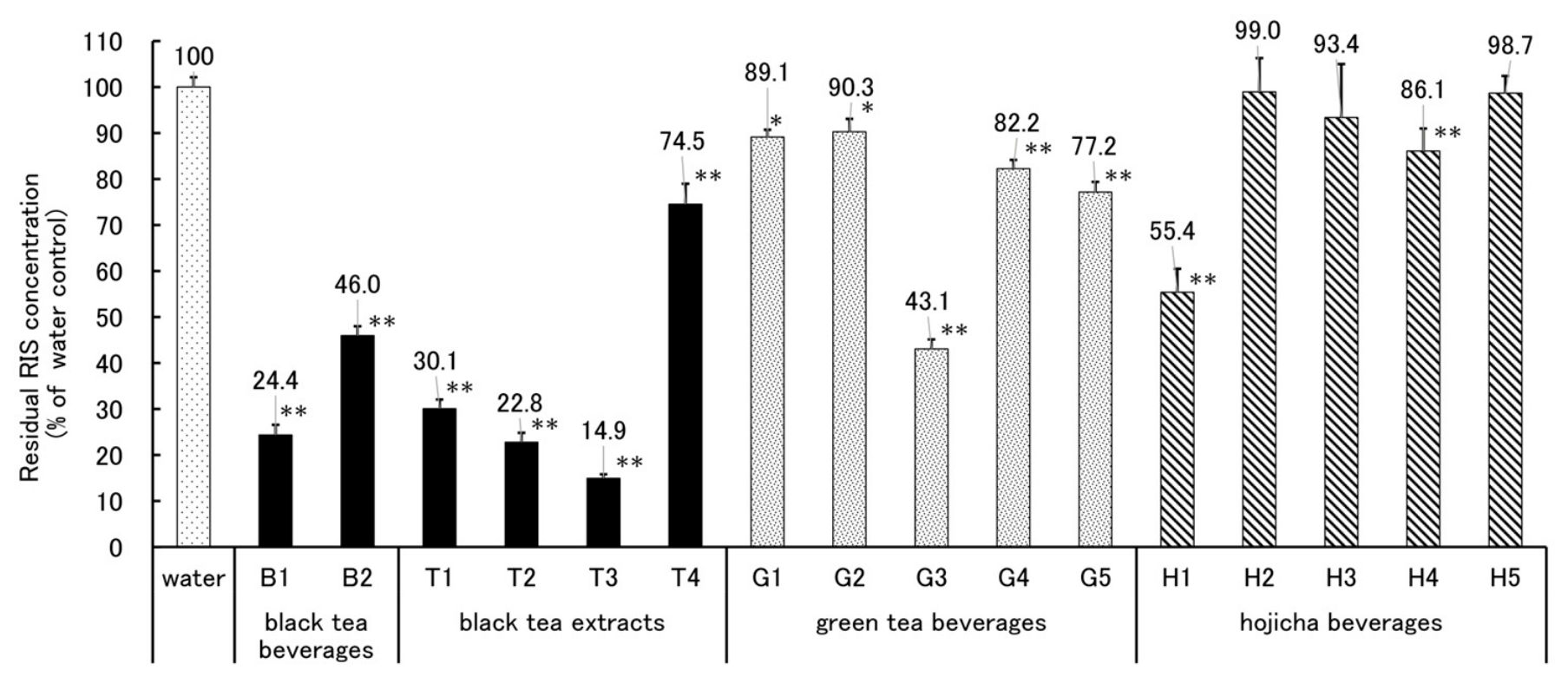
Figure 1 shows the residual RIS concentrations in the supernatants following diluting RIS oral solution with each beverage or black tea extract. RIS concentration in the water control was set to 100%. Residual RIS concentrations were 24.4 ± 2.24% for B1 and 46.0 ± 2.06% for B2, both of which were significantly lower than the concentration in the water control. For black tea extracts, the values were 14.9 ± 5.99% for T3 (p < 0.001), 22.8 ± 2.02% for T2 (p < 0.001), 30.1 ± 1.98% for T1 (p < 0.001), and 74.5 ± 4.44% for T4 (p < 0.001). RIS concentrations for all black tea extracts were significantly lower than that in the control, although the extent of the decrease varied depending on the tea leaf variety. For green tea beverages, the values were 43.1 ± 2.08% for G3 (p < 0.001), 77.2 ± 2.21% for G5 (p < 0.001), 82.2 ± 1.93% for G4 (p < 0.001), 89.1 ± 1.58% for G1 (p < 0.01), and 90.3 ± 2.78% for G2 (p < 0.01). RIS concentrations were significantly lower than that in the water control in all green tea beverages examined, and the decrease was particularly pronounced in G3. For hojicha beverages, the values were 55.4 ± 5.11% for H1 (p < 0.001), 86.1 ± 4.88% for H4 (p < 0.001), 93.4 ± 11.62% for H3, 99.0 ± 7.33% for H2, and 98.7 ± 3.71% for H5. The extent of reduction in RIS concentration varied among hojicha beverages, and the observed differences were significant only in some products (H1 and H4).
Figure 1.
Residual risperidone (RIS) concentration after mixing an RIS oral solution with black tea, green tea, and hojicha beverages and black tea extracts. RIS oral solution mixed with water under the same conditions was used as the water control, and the RIS concentration in this control was defined as 100%. Values are expressed as percentages relative to the water control and are shown as means ± SD from six independent replicates. B1–B2: black tea beverages, T1–T4: black tea extracts, G1–G5: green tea beverages, H1–H5: hojicha beverages. * p < 0.01, ** p < 0.001 vs. the water control, as evaluated using Dunnett’s test.
3.3. Recovery of RIS from Precipitates Following Mixing with B1 or T3
To examine whether the decrease in RIS concentration in the supernatant was due to degradation or transfer of RIS into precipitates, recovery experiments were performed using B1 and T3. When RIS concentration in the control was defined as 100%, the residual RIS concentration in the supernatant was 19.8–21.7% for B1, and 13.2–15.6% for T3, consistent with the marked decreases shown in Figure 1. When the precipitates were redissolved in methanol, RIS concentrations of 75.1 ± 2.58% for B1 and 72.6 ± 3.03% for T3 were detected. Redissolution in DS1 (pH 1.2), which mimics gastric fluid, yielded RIS concentrations of 68.7 ± 2.17% for B1 and 86.9 ± 1.60% for T3. Conversely, redissolution in DS2 (pH 6.8), which mimics intestinal fluid, resulted in RIS concentrations of 15.5 ± 0.817% for B1 and 13.4 ± 0.650% for T3 (Table 1).
Table 1.
RIS concentrations in the supernatant and redissolved precipitate following mixing with B1 or T3.
3.4. Chromatographic and UV Spectral Analysis of the Peak Detected in the Redissolved Precipitate
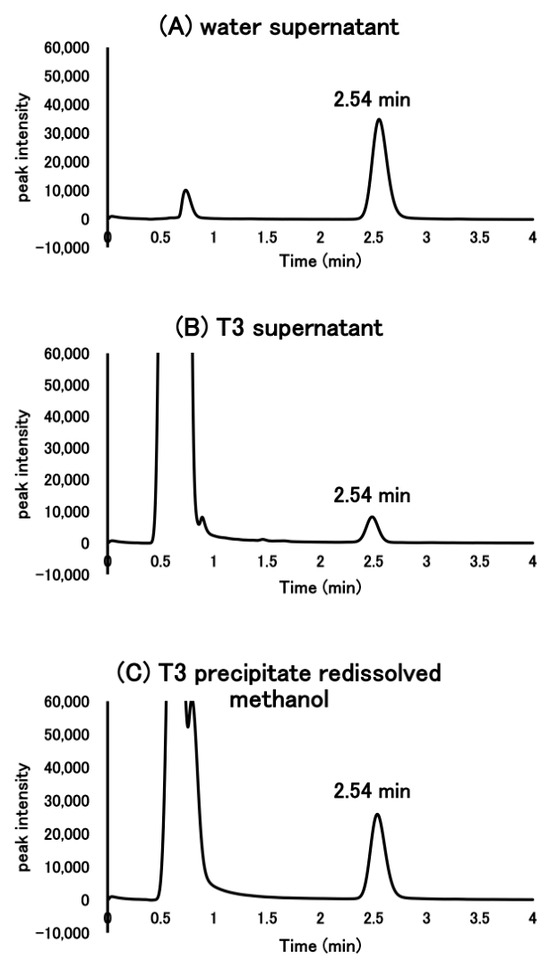
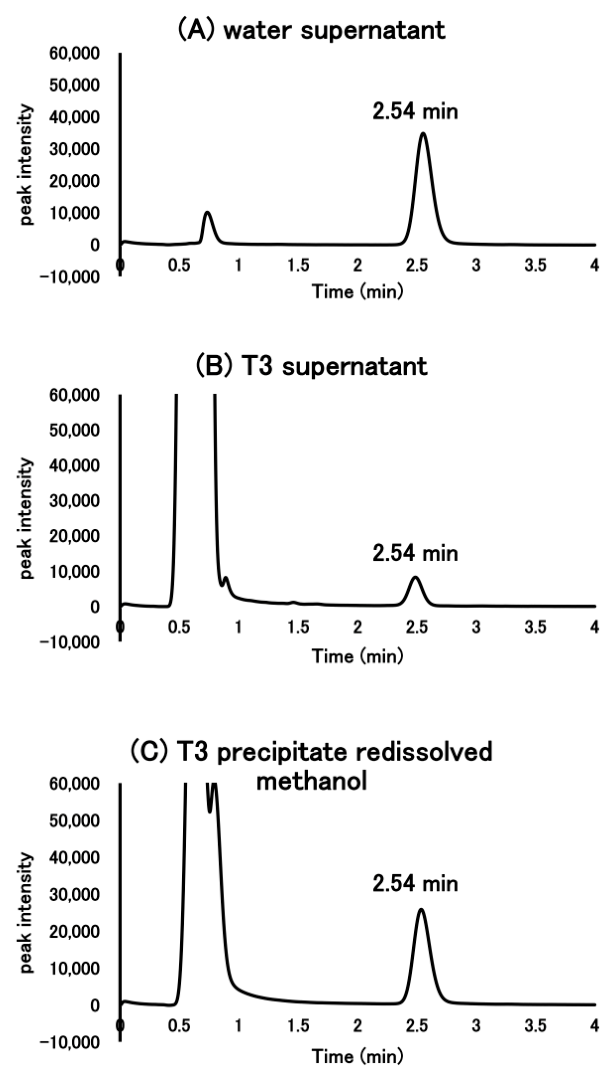
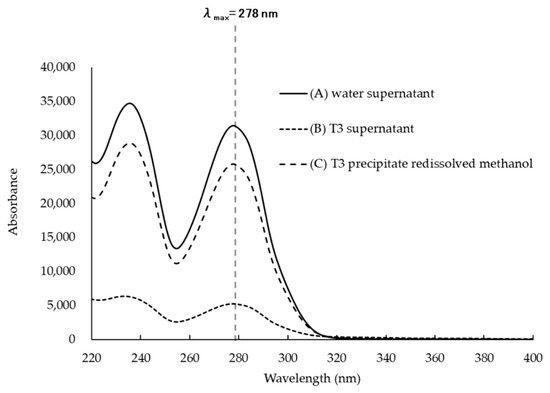
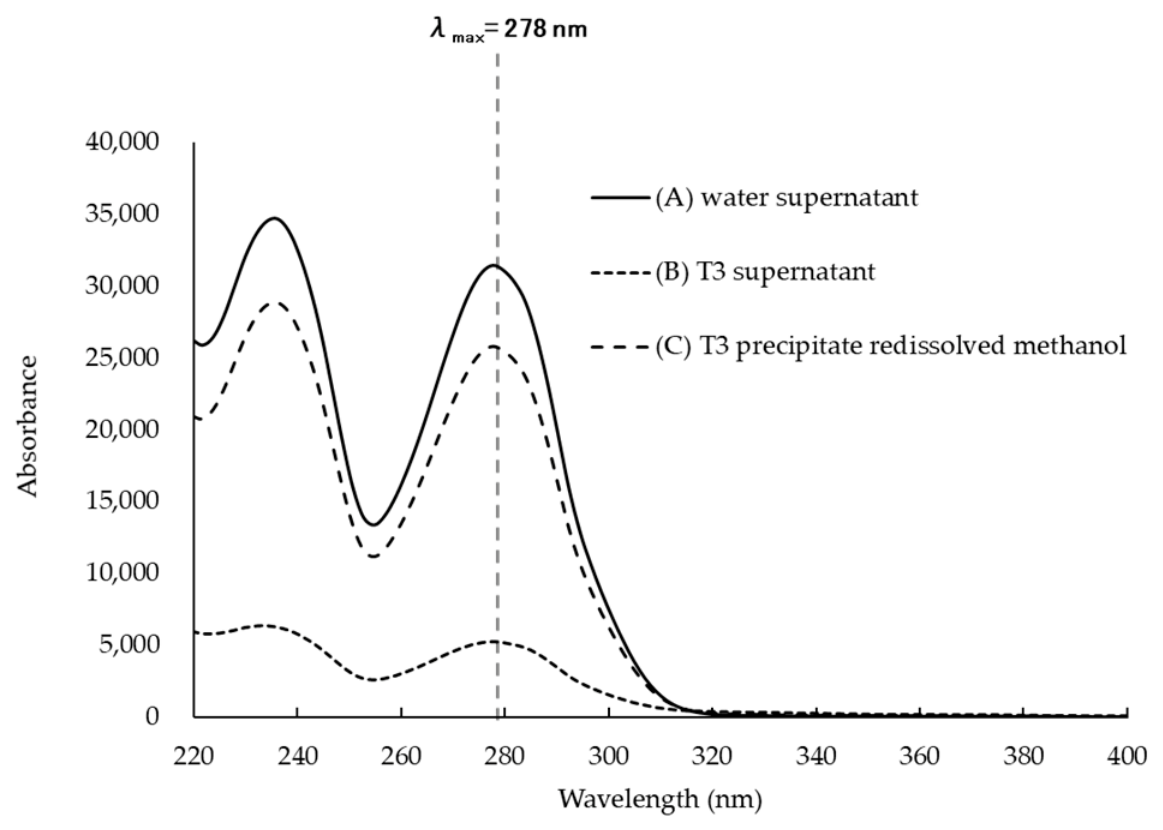
Representative chromatograms were obtained using T3, a black tea leaf extract. The RIS peak in the water control, supernatant after mixing with T3, and redissolved precipitate after mixing with T3 showed the same retention time of 2.54 min. In addition to the RIS peak, several matrix-derived peaks were observed in the T3-containing samples (Figure 2). The UV absorption spectra of the RIS peak in the water control and corresponding peaks detected in the supernatant and redissolved precipitate after mixing with T3 were also analyzed. These peaks showed similar UV absorption spectra, with a maximum absorption wavelength of approximately 278 nm (Figure 3).
Figure 2.
Representative HPLC chromatograms of RIS in the water control, supernatant, and redissolved precipitate following mixing with T3. Detection was performed at 278 nm. RIS, risperidone.
Figure 3.
UV absorption spectra of the RIS peak in the water control and the corresponding peaks detected in the supernatant and redissolved precipitate after mixing RIS oral solution with T3. RIS, risperidone.
4. Discussion
In this study, we examined changes in RIS concentration after mixing RIS oral solution with various commercially available tea beverages and black tea extracts. RIS concentration decreased in all samples of black tea beverages (B1 and B2), green tea beverages (G1–G5), and black tea extracts (T1–T4), whereas some hojicha beverages (H2, H3, and H5) showed no significant decrease. Furthermore, among green tea beverages, G3 retained only approximately 43% of RIS, whereas G2 retained approximately 90%. These findings suggest that the decrease in RIS concentration due to mixing with tea beverages cannot be explained solely by the classification as black tea, green tea, or hojicha but rather depends on the product composition and tea leaf variety.
RIS concentration decreased significantly after mixing with the black tea extracts Assam (T1), Ruhuna (T2), and Dimbula (T3), whereas the decrease was relatively small using Nuwara Eliya (T4). This pattern was consistent with the results obtained using the two commercially available black tea beverages. A larger decrease was observed for the beverage corresponding to Dimbula (T3) than to Nuwara Eliya (T4). Therefore, tea leaf variety contributes to the differences in the reduction in RIS concentrations among commercially available black tea beverages. In black tea, polyphenols, such as theaflavins, form through the oxidation and polymerization of catechins during the manufacturing process [13,14]. Black tea contains complex catechin oxidation products, including theaflavins and thearubigins, whose composition can vary depending on the degree of enzymatic oxidation during tea processing [18]. In addition, a recent liquid chromatography coupled with triple quadrupole mass spectrometry (LC-QQQ/MS) analysis of Ceylon black teas has demonstrated that the abundance of catechins and catechin derivatives, including theaflavins, differs among tea leaf varieties, such as Dimbula, Nuwara Eliya, and Ruhuna [19]. Such differences in chemical composition may have contributed to the differences in RIS concentration reduction between T3 and T4. Taken together, differences in tea-derived polyphenols may be involved in the reduction in RIS concentration.
In this study, recovery experiments using T3 further supported the involvement of precipitate formation in the decrease in RIS concentration. After mixing RIS oral solution with B1 or T3, RIS concentration in the supernatant was markedly decreased, whereas a substantial 68–87% of RIS was recovered from the precipitate after redissolution in methanol or DS1 (pH 1.2). In addition, representative HPLC chromatograms showed that the peak detected in the redissolved precipitate had the same retention time as the RIS peak in the water control, and the UV absorption spectra were comparable, with a maximum absorption wavelength of approximately 278 nm. These findings suggest that the decrease in supernatant RIS concentration was primarily attributable to the transfer of RIS into the precipitate rather than chemical degradation, possibly through the formation of insoluble complexes. In contrast, RIS recovery from the precipitate was lower in DS2 (pH 6.8), which may be explained by the reduced solubility of weakly basic RIS under near-neutral conditions.
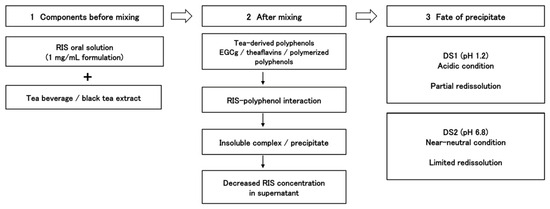
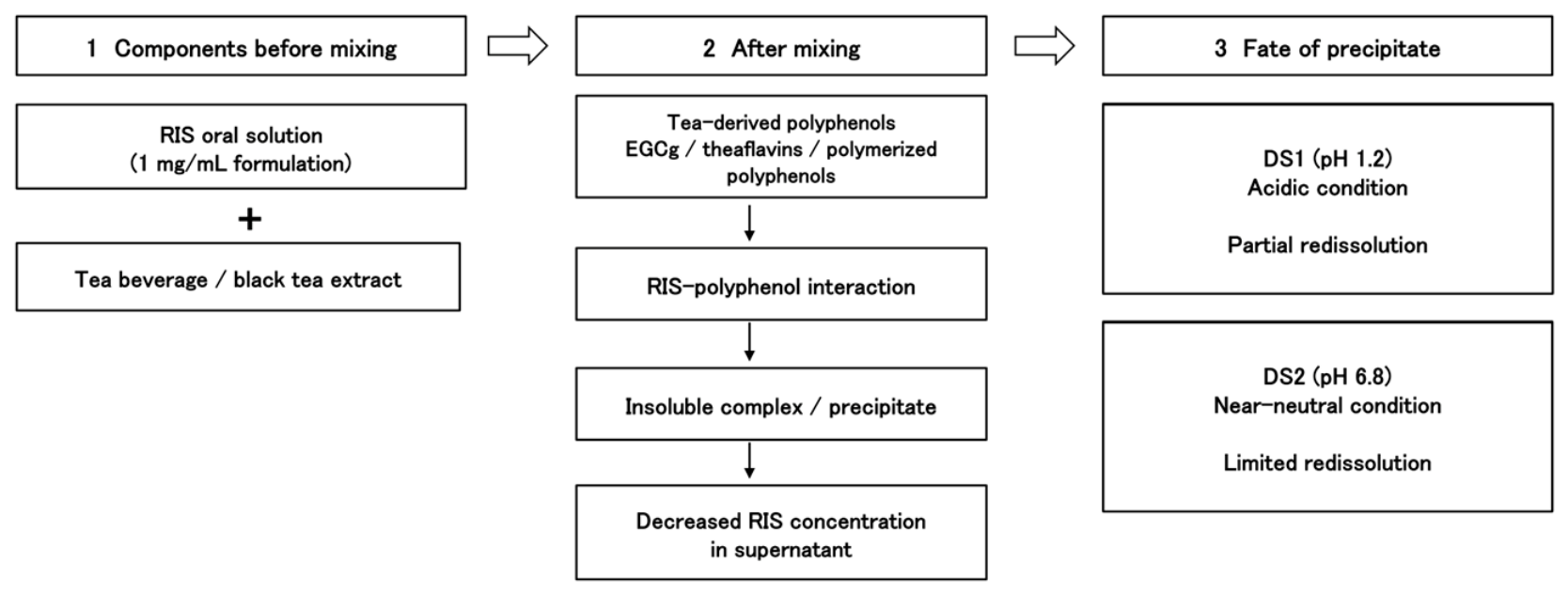
Commercially available tea beverages differ in their content of tea-derived polyphenols and coexisting components, such as caffeine, proteins, polysaccharides, and other food-derived constituents. Recent reviews have highlighted that tea polyphenols can interact with various food components and that these interactions may alter physicochemical properties, including solubility, stability, and bioavailability [16]. Therefore, product-dependent differences in beverage matrices may contribute to differences in RIS concentration reduction. Since caffeine has been reported to suppress precipitation of the RIS–EGCg complex [20], coexisting components may contribute to product-dependent differences. In particular, RIS has been reported to form a 1:1 insoluble complex with EGCg in aqueous solution, and the galloyl group of EGCg has been shown to be important for insoluble complex formation [21]. The proposed mechanism of RIS precipitation after mixing with tea beverages is summarized schematically in Figure 4.
Figure 4.
Schematic representation of the proposed mechanism of RIS precipitation after mixing with tea beverages. Tea-derived polyphenols may interact with RIS and contribute to the formation of insoluble complexes, resulting in precipitate formation and a decrease in RIS concentration in the supernatant. The precipitated RIS may partially redissolve under acidic conditions, whereas redissolution may be limited under near-neutral conditions. RIS, risperidone; DS1, dissolution test fluid 1; DS2, dissolution test fluid 2.
In our previous study, 22.6% of RIS oral solution users mixed the solution with beverages, including tea and cola, primarily citing bitterness as the reason [10]. However, the present findings demonstrate an in vitro incompatibility between RIS oral solution and certain tea beverages, and the observed reduction in supernatant RIS concentration should not be directly interpreted as evidence of reduced systemic exposure, therapeutic efficacy, or clinical outcomes in humans. A recent pharmacokinetic study in rats reported that coadministration of RIS oral solution with Dimbula black tea significantly reduced the Cmax of both RIS and 9-hydroxyrisperidone, whereas the AUC was not significantly altered and the MRT was prolonged [22]. These findings support the hypothesis that RIS transferred into precipitates following mixing with black tea may redissolve under acidic gastrointestinal conditions and subsequently be absorbed. Therefore, the reduction in RIS concentration observed in vitro should not be interpreted as a proportional decrease in systemic drug exposure. Rather, coadministration of RIS oral solution with tea beverages may alter the absorption profile of RIS, including the rate and timing of drug absorption. However, the currently available pharmacokinetic evidence is limited to a single animal study involving only one variety of black tea. Further studies are therefore needed to determine whether similar effects occur in humans and with other commercially available tea beverages.
This study had three main limitations. First, the components in each beverage were not qualitatively or quantitatively analyzed; therefore, the components responsible for the decrease in RIS concentration could not be directly identified. In addition, although the selected products were chosen with reference to market popularity and product availability, they do not necessarily represent the full diversity of commercially available tea beverages. Second, the precipitate recovery experiments and chromatographic/UV spectral analyses were performed only under selected conditions. Although these findings supported the presence of RIS in the precipitate and suggested that the reduction in supernatant RIS concentration was mainly associated with transfer of RIS into the precipitate, degradation products were not assessed in this study. Further studies using more specific analytical techniques, such as LC-MS, are required to evaluate possible degradation products and to further clarify the interaction mechanism. Third, this was an in vitro compatibility study. Only one mixing condition was evaluated. Therefore, the concentration dependence and time course of RIS reduction after mixing with tea beverages were not assessed. In addition, the effects of tea-beverage coadministration on gastrointestinal absorption, systemic exposure, therapeutic efficacy, and clinical outcomes in humans remain unclear. Further pharmacokinetic and clinical studies are required to clarify the clinical relevance of this interaction.
From a pharmaceutical practice perspective, these findings support the recommendation that RIS oral solution should not be diluted with tea beverages. Because the extent of RIS reduction varied depending on the commercial products and tea variety, pharmacists should not recommend any type of tea as a suitable diluent for RIS oral solution.
5. Conclusions
This study demonstrated that commercially available black tea beverages, green tea beverages, and some hojicha beverages can reduce RIS concentration when mixed with RIS oral solution. The extent of reduction varied depending on the beverage type and tea leaf variety and was associated, at least in part, with transfer of RIS into precipitates. These findings provide experimental support for the current recommendation to avoid diluting RIS oral solution with tea beverages.
Supplementary Materials
The following supporting information can be downloaded at https://www.mdpi.com/article/10.3390/scipharm94030068/s1.
Author Contributions
Conceptualization, H.S., Y.N., K.U. and Y.M.; Methodology, H.S., Y.N., S.O. and T.K.; Validation, H.S., Y.N. and H.N.; Formal Analysis, H.S. and Y.N.; Data Curation, Y.N.; Writing—Original Draft Preparation, H.S. and Y.N.; Writing—Review and Editing, all authors; Visualization, H.S.; Supervision, K.O., S.K. and Y.M.; Project Administration, Y.M. All authors have read and agreed to the published version of the manuscript.
Funding
This research received no external funding.
Institutional Review Board Statement
Not applicable.
Informed Consent Statement
Not applicable.
Data Availability Statement
The original contributions presented in this study are included in the article. Further inquiries can be directed to the corresponding author.
Acknowledgments
The authors are grateful to Ren Saito and Marie Kudo (Division of Clinical Pharmaceutics, Faculty of Pharmaceutical Sciences, Tohoku Medical and Pharmaceutical University, Sendai, Miyagi, Japan) for cooperation in the research.
Conflicts of Interest
The authors declare no conflicts of interest.
Abbreviations
The following abbreviations are used in this manuscript:
| EGCg | Epigallocatechin gallate |
| RIS | Risperidone |
| HPLC | High-performance liquid chromatography |
| DS | dissolution test fluid |
References
- Yunusa, I.; El Helou, M.L. The use of risperidone in behavioral and psychological symptoms of dementia: A review of pharmacology, clinical evidence, regulatory approvals, and off-label use. Front. Pharmacol. 2020, 11, 596. [Google Scholar] [CrossRef] [Scilit] [PubMed]
- Alvarez-Herrera, S.; Rosel Vales, M.; Pérez-Sánchez, G.; Jiménez-Cortegana, C.; Sánchez-Jiménez, J.; Moreno-Küstner, B.; Gutiérrez-Rojas, L.; Pérez-Costillas, L.; Gurpegui, M.; Mancilla-Leytón, J.M.; et al. Risperidone decreases expression of serotonin receptor-2A (5-HT2A) and serotonin transporter (SERT) but not dopamine receptors and dopamine transporter (DAT) in PBMCs from patients with schizophrenia. Pharmaceuticals 2024, 17, 167. [Google Scholar] [CrossRef] [Scilit] [PubMed]
- Gaitonde, S.A.; Avet, C.; de la Fuente Revenga, M.; Blondel-Tepaz, E.; Shahraki, A.; Morales Pastor, A.; Talagayev, V.; Robledo, P.; Kolb, P.; Selent, J.; et al. Pharmacological fingerprint of antipsychotic drugs at the serotonin 5-HT2A receptor. Mol. Psychiatry 2024, 29, 2753–2764. [Google Scholar] [CrossRef] [Scilit] [PubMed]
- Janssen Pharmaceutical K.K. RISPERDAL® Oral Solution 1 mg/mL Drug Interview Form, 22nd ed.; Janssen Pharmaceutical K.K.: Tokyo, Japan, 2024. (In Japanese) [Google Scholar]
- Janssen Pharmaceutical K.K. RISPERDAL® Oral Solution 1 mg/mL Package Insert, 4th ed.; Janssen Pharmaceutical K.K.: Tokyo, Japan, 2024. (In Japanese) [Google Scholar]
- Findling, R.L.; Aman, M.G.; Eerdekens, M.; Derivan, A.; Lyons, B. Risperidone Disruptive Behavior Study Group. Long-term, open-label study of risperidone in children with severe disruptive behaviors and below-average IQ. Am. J. Psychiatry 2004, 161, 677–684. [Google Scholar] [CrossRef] [Scilit] [PubMed]
- Onor, M.L.; Saina, M.; Trevisiol, M.; Cristante, T.; Aguglia, E. Clinical experience with risperidone in the treatment of behavioral and psychological symptoms of dementia. Prog. Neuropsychopharmacol. Biol. Psychiatry 2007, 31, 205–209. [Google Scholar] [CrossRef] [Scilit] [PubMed]
- Currier, G.W.; Simpson, G.M. Risperidone liquid concentrate and oral lorazepam versus intramuscular haloperidol and intramuscular lorazepam for treatment of psychotic agitation. J. Clin. Psychiatry 2001, 62, 153–157. [Google Scholar] [CrossRef] [Scilit] [PubMed]
- Mennella, J.A.; Spector, A.C.; Reed, D.R.; Coldwell, S.E. Overview of basic research on bitter taste. Clin. Ther. 2013, 35, 1225–1246. [Google Scholar] [CrossRef] [Scilit] [PubMed]
- Nishikawa, Y.; Suzuki, H.; Jinbayashi, S.; Sato, N.; Usui, K.; Okada, K.; Kawai, S.; Ohmukai, K.; Murai, Y. Investigation of risperidone oral solution administration practices and risk of beverage-related drug interactions in Japanese patients. Drugs Ther. Perspect. 2025, 41, 545–554. [Google Scholar] [CrossRef] [Scilit]
- Ikeda, H.; Yamanaka, M.; Takahashi, S.; Ohata, T.; Yukawa, M.; Nakashima, R.; Tsutsumi, H.; Fujisawa, M.; Aki, H. Drug-tea polyphenol interaction (III): Incompatibility between aripiprazole oral solution and green tea. Chem. Pharm. Bull. 2022, 70, 230–234. [Google Scholar] [CrossRef] [Scilit] [PubMed]
- Cabrera, C.; Artacho, R.; Giménez, R. Beneficial effects of green tea—A review. J. Am. Coll. Nutr. 2006, 25, 79–99. [Google Scholar] [CrossRef] [Scilit] [PubMed]
- Tanaka, T.; Kouno, I. Oxidation of tea catechins: Chemical structures and reaction mechanism. Food Sci. Technol. Res. 2003, 9, 128–133. [Google Scholar] [CrossRef] [Scilit]
- Leung, L.K.; Su, Y.; Chen, R.; Zhang, Z.; Huang, Y.; Chen, Z.Y. Theaflavins in black tea and catechins in green tea are equally effective antioxidants. J. Nutr. 2001, 131, 2248–2251. [Google Scholar] [CrossRef] [Scilit] [PubMed]
- Ikeda, H.; Moriwaki, H.; Yukawa, M.; Iwase, Y.; Aki, H. Mechanism of interaction between risperidone and tea catechin (1): Complex formation of risperidone with epigallocatechin gallate. Yakugaku Zasshi 2010, 130, 1589–1595. [Google Scholar] [CrossRef] [Scilit] [PubMed]
- Dai, Y.-H.; Wei, J.-R.; Chen, X.-Q. Interactions between tea polyphenols and nutrients in food. Compr. Rev. Food Sci. Food Saf. 2023, 22, 3130–3150. [Google Scholar] [CrossRef] [Scilit] [PubMed]
- Japan Food Journal. Food POS Ranking: Japanese Tea and Barley Tea Drinks (October 2021–March 2022). 2022. Available online: https://news.nissyoku.co.jp/news/pos20220510 (accessed on 26 May 2026). (In Japanese)
- Tanaka, T.; Matsuo, Y. Production mechanisms of black tea polyphenols. Chem. Pharm. Bull. 2020, 68, 1131–1142. [Google Scholar] [CrossRef] [Scilit] [PubMed]
- Zhang, S.; Long, X.; Xing, Y.; Ee, K.-H.; Goh, R.M.V.; Huang, Y.; Pua, A.; Jublot, L.; Liu, S.Q.; Yu, B. A systematic approach to analyzing catechins and catechin derivatives in Ceylon black tea using liquid chromatography coupled with triple quadrupole mass spectrometry. Food Chem. X 2025, 28, 102621. [Google Scholar] [CrossRef] [Scilit] [PubMed]
- Goromaru, T.; Konishi, N.; Bunya, M.; Ishizu, T. Solubilizing effect of caffeine on precipitate of risperidone oral solution and tea beverage. Biol. Pharm. Bull. 2025, 48, 515–522. [Google Scholar] [CrossRef] [Scilit] [PubMed]
- Ikeda, H.; Moriwaki, H.; Matsubara, T.; Yukawa, M.; Iwase, Y.; Yukawa, E.; Aki, H. Mechanism of interaction between risperidone and tea catechin (2): Influence of presence of galloyl group in catechin on insoluble complex formation with risperidone. Yakugaku Zasshi 2012, 132, 145–153. [Google Scholar] [CrossRef] [Scilit] [PubMed]
- Nishikawa, Y.; Suzuki, H.; Ouchi, R.; Konno, T.; Usui, K.; Watanabe, T.; Okada, K.; Kisara, S.; Murai, Y. Pharmacokinetic evaluation of risperidone and its active metabolite when risperidone oral solution is mixed with black tea in rats. Pharmaceuticals 2026, 19, 855. [Google Scholar] [CrossRef] [Scilit] [PubMed]

Disclaimer/Publisher’s Note: The statements, opinions and data contained in all publications are solely those of the individual author(s) and contributor(s) and not of MDPI and/or the editor(s). MDPI and/or the editor(s) disclaim responsibility for any injury to people or property resulting from any ideas, methods, instructions or products referred to in the content. |
© 2026 by the authors. Published by MDPI on behalf of the Österreichische Pharmazeutische Gesellschaft. Licensee MDPI, Basel, Switzerland. This article is an open access article distributed under the terms and conditions of the Creative Commons Attribution (CC BY) license.