


Abstract
Teleworking has spread drastically during the COVID-19 pandemic, but its effect on musculo-skeletal disorders (MSD) remains unclear. We aimed to make a qualitative systematic review on the effect of teleworking on MSD. Following the PRISMA guidelines, several databases were searched using strings based on MSD and teleworking keywords. A two-step selection process was used to select relevant studies and a risk of bias assessment was made. Relevant variables were extracted from the articles included, with a focus on study design, population, definition of MSD, confounding factors, and main results. Of 205 studies identified, 25 were included in the final selection. Most studies used validated questionnaires to assess MSD, six considered confounders extensively, and seven had a control group. The most reported MSD were lower back and neck pain. Some studies found increased prevalence or pain intensity, while others did not. Risk of bias was high, with only 5 studies with low/probably low risk of bias. Conflicting results on the effect of teleworking on MSD were found, though an increase in MSD related to organizational and ergonomic factors seems to emerge. Future studies should focus on longitudinal approaches and consider ergonomic and work organization factors as well as socio-economic status.
1. Introduction
The World Health Organization (WHO) and the International Labor Organization (ILO) define telework as: “the use of information and communications technology for work that is performed outside the employer’s premises” [1,2]. There are several terms related to this type of work, including remote work, which is the broadest term where the workplace can be anywhere outside the usual place, telework, which implies the usage electronic devises for remote work and home-based work/work from home (WFH), which can imply that the default working place is at home [1]. Hybrid work is a growing form of work which combines WFH and work in the office. In 2019, before the COVID-19 pandemic, 14% of workers in the European Union teleworked from home regularly or occasionally [3]. This number increased up to 40% of workers during summer 2020 following the multiple lockdowns and stabilized at 31% during spring 2022 [4]. The effect of teleworking on health seems to be contrasted both positively and negatively depending on the situations, with a predominant role of contextual factors [5,6,7]. Even before the pandemic happened, teleworking was implemented as a useful tool for allowing sustainable work and return to work, especially for workers with disabilities or who were suffering from chronic diseases, including cancer [8]. Indeed, traditional work environments may present barriers for these workers, especially those with cognitive limitations, and an adapted and familiar work environment at home may facilitate employment. Such accommodations require many changes in the work culture and vary significantly between countries [8]. Bouziri et al. highlighted the potential health impact during the COVID-19 pandemic, as well as possible recommendations for decreasing the new related risk [9]. For example, during containment, telework decreased the risk associated with transportation but also showed the lack of ergonomic measures for home workstations and the work environment in general. Indeed, office work can be associated with musculoskeletal disorders (MSD) caused by multiple interlinking factors defined by the concept of professional exposome, including the under-stimulation of the musculoskeletal system, comorbidities, and work-related organizational factors [10]. MSD is a broad term that is referenced at any affection of the soft periarticular tissues, following the EU-OSHA (European Agency for Safety and Health at Work) [11]. Medically codified diseases are included in this definition, like carpal tunnel syndrome or rotator cuff disease, but unspecific conditions like low back pain or neck pain are also included. Although there were some studies on the impact of teleworking on mental health before the COVID-19 pandemic [12], few of them focused on MSD [13,14].
The aim of this systematic review was to make a synthesis of the literature on the effect of teleworking on MSD. A qualitative approach was chosen, since heterogenous methods and results were expected.
2. Methods
2.1. Selection of Studies
A systematic review was conducted following the PRISMA (Preferred Reporting Items for Systematic Reviews and Meta-Analyses) guidelines [15]. The following databases were searched for studies relevant to the subject with the help of a librarian: PubMed, Web of Science, Embase, Cairn, EBSCO databases, and Google Scholar. Musculoskeletal disorders (and related) were searched with teleworking/working at home (and related, see Supplementary Material S1). Keywords related to MSD were chosen to engulf the various aspects of the EU-OSHA’s definition of MSD [11]. Only papers published since 1987 in English or French were included. Inclusion criteria were studies about workers (students were also included) exposed to teleworking/working at home, having an outcome related to MSD (whether pain, discomfort…), and having a quantitative approach. Studies about telemedicine and domestic work were excluded from the review, as well as non-published studies (conference abstract) and reviews. There were no other restrictions for the studies, particularly on study design (before/after study, control group, or no control group). After the exclusion of duplicates, studies were included in two steps: selection on title and abstract and selection on the full paper. At each step, all studies were included or excluded by two different reviewers among MF, JB, AD, and YR. In case of disagreement, a consensus was obtained by a third reviewer that was different from the first two. A cross-reference approach was also implemented to identify potentially relevant studies that may have been missed in the initial selection step. The extraction of studies was completed on 5 May 2022.
2.2. Extracted Data
The following variables were extracted from the articles included at the final selection step: first author, year of publication, country, objective of the study, design, population, recruitment and data collection method, exclusion criteria, number of subjects included, data of inclusion and potential follow-up, definition of MSD outcome, confounding factors considered, main results, and conclusion of the authors and limitations.
The risk of bias was assessed following the Navigation Guide for systematic reviews in environmental and occupational health [16]. For each study, two different reviewers among MF, JB, AD, and YR assessed the nine risk of bias domains, although two of them were not applicable for the observational studies (randomization and selecting outcome reporting). The last risk of bias domain (other risk of bias) that was adapted for this systematic review thus focused on two aspects: the representativeness of the studied population to the general teleworker population and the presence of a control group. In the case of disagreement, a consensus was obtained among all four reviewers.
3. Results
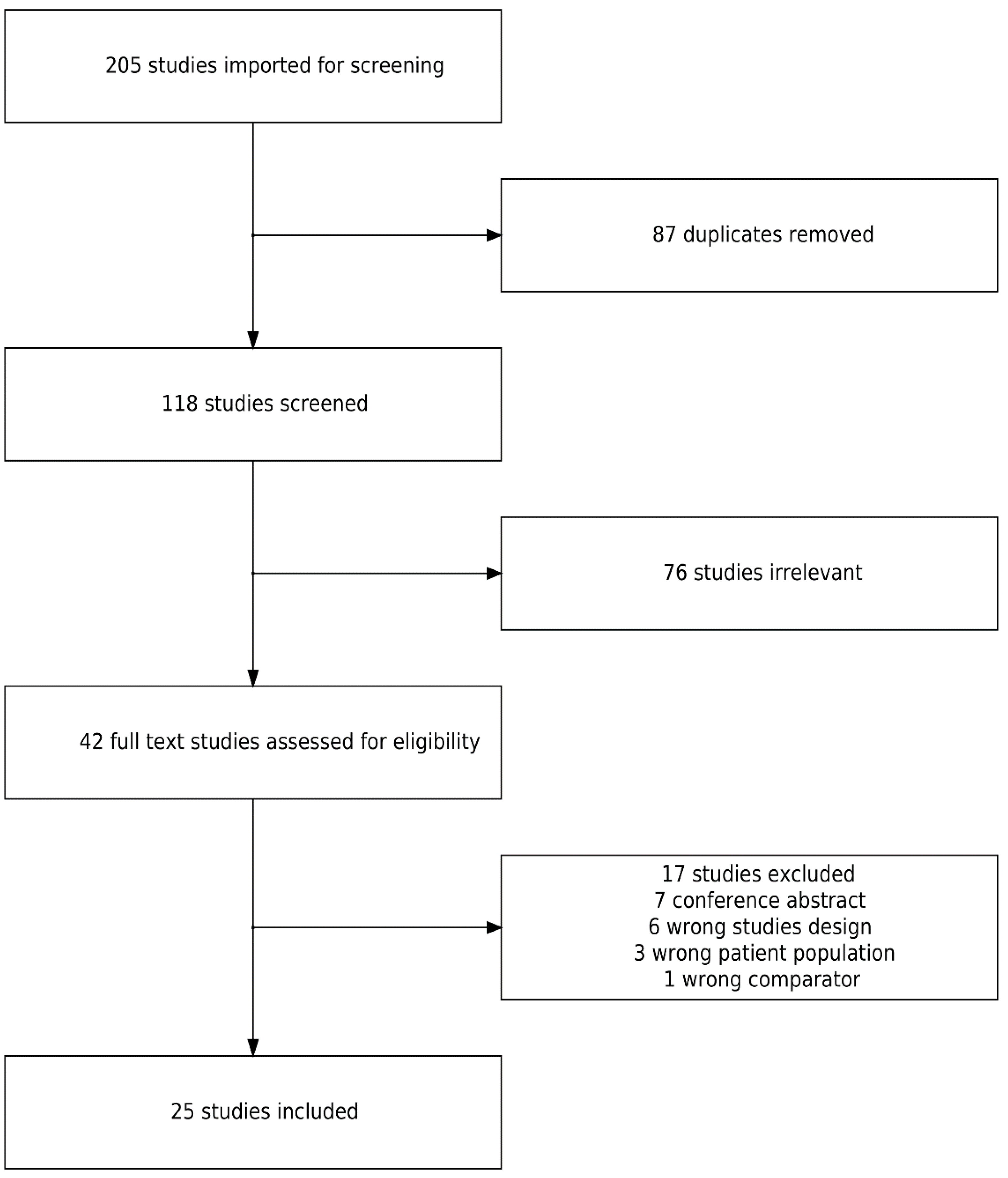
Of the 205 studies included, 87 were duplicates and 76 were deemed irrelevant according to the title and abstract. Seventeen more studies were excluded for various reasons detailed in the flow chart (Figure 1). In the end, 25 studies were selected. Table 1 summarizes the characteristics of the studies included. An exhaustive summary of the studies is available in Supplementary Material S2. All studies were published during and after 2020, and only one study used data from before the COVID-19 pandemic [12]. There was a relatively good representation of countries throughout the world, with most of them coming from Asia [17,18,19,20,21,22,23,24,25,26,27] and Europe [12,28,29,30,31,32,33,34], and some from America and Australia [35,36,37,38,39,40]. Only three studies did not have a cross-sectional design: the first was a before/after study [28], the second was a prospective cohort [37], and the last was an interventional study [19].
Figure 1.
Flow chart of the selection process.
Table 1.
Summary of data extracted from selected studies.
The majority of the populations included in the studies were office workers who had mandatory teleworking caused by lockdowns [17,18,19,23,24,25,27,28,29,31,32,33,34,35,36,37,38,40]. One study focused on participants already suffering from low back pain before implementation of telework [30], whereas others studies excluded participants with a history of MSK disorders or serious medical conditions [19,23,25,28,29,37]. The number of participants varied, ranging from 40 [19] to 12,774 [20]. Validated questionnaires were used in almost half of the studies included [17,18,19,28,29,31,34,35,37,38], with the most used one being the Nordic musculoskeletal questionnaire. Other outcomes included numerical scales and Likert type scales assessing the intensity and/or the frequency of pain or the evolution of pain before and after implementation of lockdowns (associated with WFH). Most articles inquired about pain from various region of the body, but some focused on either neck pain [12,28,37] or lower back pain [20,21,22,30].
Adjusted analyses assessing the effect of teleworking and MSD were conducted in eight studies [12,18,20,21,22,26,28,37]. Adjustment variables selected were often different, and related to demographic data (age, sex, education, income, marital status), lifestyle habits (smoking, alcohol, physical activity), comorbidities, general work factors (working hours management responsibility, occupational stress), and work factors specifically related to teleworking (working hours at home, frequency of telecommuting, ergonomic factors of the home office). Seven studies had a control group [12,20,21,26,28,32,40], which was a before intervention control for one study [28], or participants who did not WFH, or who had very few days teleworking.
The most reported MSD were low back pain and neck pain. Some studies did not find any association between MSD disorders and telework [12,24,28,29,30,34]. Others found an increase in prevalence or intensity of MSD pain during lockdowns (WFH) compared to before [17,18,23,25,33,36,38,39,40], or when comparing groups of different telework frequency [20,22,25,26,32,40]. Certain ergonomic factors and psychosocial factors were associated with increased intensity or frequency of musculoskeletal pain. [12,18,23,24,28,32,33,35,36,38]. For example, having an appropriate location to WFH with sufficient space and less demanding workloads decreased the effect of WFH on MSD.
Table 2 shows the risk of bias assessment for all the studies included. Overall, the risk of bias for the studies was high. Only five studies had low or probably low risk of bias for the specific criteria in this review, which were the representativeness of the population and the presence of a control group [20,21,26,28,40].
Table 2.
Assessment of risk of bias according to the Navigation Guide for systematic reviews in environmental and occupational health [16].
4. Discussion
This exhaustive systematic review found conflicting results on the effect of teleworking on MSD, although an increase in nonspecific MSD related to organizational and ergonomic factors seemed to emerge.
Globally, there may be an important effect of the context of teleworking. Several reports have highlighted the strong points and limits of new form of work like teleworking [41,42]. Having a good ergonomic environment, having a good relation between workers and managers, being autonomous at work, and a reasonable workload are all potential critical ergonomic and organizational factors that could prevent the potential negative impact of telework beyond MSD. Several studies in this review reported poor ergonomic work conditions linked to the abrupt change caused by lockdowns [38,39]. A study which focused on workers with a history of LBP found an increase of pain in case of teleworking during lockdown, although this association was not significant when considering workers with a dedicated workstation for teleworking [30]. Another one, though of low evidence, suggested that an ergonomic intervention could lower the risk of MSD [19]. Thus, potential future studies on ergonomic interventions, including information and training, as well as adapted equipment, would be important [43].
Telework brings many advantages, such as the flexibility of workhours or the possibility of work accommodations for people with work limitations. This emphasizes the importance of having data concerning effects on health. The effects of teleworking on other factors, like personal life and work life balance, are also complex, as some studies report positive effects on this point while others report a negative effect with increased technostress and a more blurred border [44,45]. Being sedentary is also an important aspect of teleworking that could influence the risk of MSD, as teleworking decreases break time and activity interruptions, as well as small movements happening during work [45].
A previous integrative review by dos Santos et al. found that musculoskeletal pain increased during the lockdowns, especially in the lower back and neck regions, which could be explained by an increased sedentary lifestyle, poor posture, and increased physical load due to household chores [14]. However, compared to this review, more studies were found due to the updated search, and the risk of bias was assessed. Another review by Oakman et al. on the mental and physical health effects of working at home identified only three studies related to physical health-related outcomes with conflicting conclusions [13].
The heterogenous results of our review could be explained by several factors. First, the studies included were heterogenous, with a varying number of subjects and methods for selecting the participants and populations included. Indeed, some studies recruited participants from universities or public administration [28,32,34,35,36,38], while others recruited participants from private employers [17,18,26,29,33] or from the general population [12,20,21,22,24,25,27,37,39,40]. Second, most studies likely had a high risk of bias, particularly when considering confounding, control groups, and the representativeness of the population studied. Only eight studies considered confounders in the statistical analyses, and among them, six were extensively adjusted for potential confounders [12,20,21,22,26,28]. Most studies also adopted a cross-sectional design, which can lead to reverse causation bias or differential reporting of outcome. Finally, the effect of teleworking of MSD may be different in relation to socioeconomic status and to how telework was implemented. Before the pandemic, workers doing telework were mostly highly qualified and voluntary workers, though from 2022, teleworkers can also be voluntary but also less qualified, with less autonomy. Another result of this systematic review is that all MSD were subjective, for example, the reporting of pain intensity or frequency or reporting change in pain before and after lockdown. There were no medical diagnoses of MSD, like carpal tunnel syndrome or sciatica. However, studies suggest that in the tertiary sector MSD are unspecific, with symptoms like chronic back pain or neck pain [41,42]. The COVID-19 pandemic context is also a potential strong confounder, and most of the studies included assessed the risk of telework on MSD during the pandemic. This systematic review shows the scarcity of evidence of this before the COVID-19 pandemic and shows the need to continue monitoring the effect of telework.
The main limitation of this review is the lack of quantitative analysis and grading. No pulled risk effects and grading were calculated because of the heterogenous methodologies and bias of the included studies. However, our systematic review adopted an exhaustive research protocol on several databases and all articles were selected by at least two different reviewers. The assessment of bias was done in a similar manner, and a category specific to the aim of this review was added. Thus, the qualitative synthetic approach allowed us to highlight the strengths and weaknesses of the different studies assessing the effect of teleworking on MSD. There was a change in the initial protocol for this systematic review in which we aimed to assess the effects of WHF on several health outcomes. However, we quickly focused on MSD, as the number of studies have drastically increased in the last two years. Another potential limit is the lack of MeSH keywords for “Teleworking” before 2021. This could potentially lead to missing studies before this date, but an exhaustive variety of terms were used to retrieve all relevant studies. Lastly, only studies in English or French were considered.
5. Conclusions
This systematic review brought to light the necessity of further research to understand the potential effect of teleworking on the risk of MSD. The conceptual model of Beckel and Fisher demonstrates the need for global integrative approaches of teleworking situations that consider the whole work environment in addition to the usual confounders of MSD [46]. MSD and teleworking are challenges that will need to be addressed by researchers and decision makers. Indeed, the flexibility of teleworking and hybrid work seems to be a key factor to promote sustainable work and return to work for workers with disabilities. Future studies should focus on longitudinal approaches and consider ergonomic and work organization factors as well as socio-economic status.
Supplementary Materials
The following supporting information can be downloaded at: https://www.mdpi.com/article/10.3390/ijerph20064973/s1, Supplementary Material S1: Strings used for searching the selected databases; Supplementary Material S2: Full summary of data extracted from selected studies.
Author Contributions
Conceptualization, M.F., J.B., F.C., A.D. and Y.R.; methodology, M.F., J.B., F.C., A.D. and Y.R.; formal analysis, M.F., J.B., F.C., A.D. and Y.R.; data curation, M.F. and J.B.; writing original draft preparation, M.F. and J.B.; writing review and editing, F.C., A.D. and Y.R.; supervision, A.D. and Y.R. All authors have read and agreed to the published version of the manuscript.
Funding
This study was funded by a national grant from the ANSES (French Agency for Food, Environmental and Occupational Health & Safety) which had no implication in the methodology, results or writing of the paper (“Convention de recherche et développement” Anses/Inserm 2021-CRD10).
Institutional Review Board Statement
Not applicable.
Informed Consent Statement
Not applicable.
Data Availability Statement
The data presented in this study are available in the article.
Acknowledgments
The authors would like to thank Catherine FAÏS, Librarian, for improving the search strings.
Conflicts of Interest
The authors declare no conflict of interest.
References
- ILO. COVID-19: Guidance for Labour Statistics Data Collection. In Defining and Measuring Remote Work, Telework, Work at Home and Home-Based Work; International Labour Organization: Geneva, Switzerland, 2020. [Google Scholar]
- WHO; ILO. Healthy and Safe Telework. Available online: http://www.ilo.org/global/publications/books/WCMS_836250/lang--en/index.htm (accessed on 27 October 2022).
- Eurostat. Statistics. Available online: https://ec.europa.eu/eurostat/databrowser/view/lfsa_ehomp/default/table?lang=en (accessed on 27 October 2022).
- Eurofound. Fifth Round of the Living, Working and COVID-19 e-Survey: Living in a New Era of Uncertainty; European Foundation for the Improvement of Living and Working Conditions: Luxembourg, 2022. [Google Scholar]
- Buomprisco, G.; Ricci, S.; Perri, R.; Sio, S.D. Health and Telework: New Challenges after COVID-19 Pandemic. Eur. J. Environ. Public Health 2021, 5, em0073. [Google Scholar] [CrossRef] [Scilit]
- Eurofound. Employee Monitoring and Surveillance: The Challenges of Digitalisation; Publications Office of the European Union: Luxembourg, 2020. [Google Scholar]
- Samek Lodovici, M.; Ferrari, E.; Paladino, E.; Pesce, F.; Frecassetti, P.; Aram, E.; Hadjivassiliou, K.; Junge, K.; Hahne, A.S.; Drabble, D.; et al. The Impact of Teleworking and Digital Work on Workers and Society: Special Focus on Surveillance and Monitoring, as Well as on Mental Health of Workers; European Parliament: Luxembourg, 2021; ISBN 978-92-846-8253-9. [Google Scholar]
- Linden, M. Telework Research and Practice: Impacts on People with Disabilities. Work 2014, 48, 65–67. [Google Scholar] [CrossRef] [Scilit]
- Bouziri, H.; Smith, D.R.M.; Descatha, A.; Dab, W.; Jean, K. Working from Home in the Time of COVID-19: How to Best Preserve Occupational Health? Occup. Environ. Med. 2020, 77, 509–510. [Google Scholar] [CrossRef] [Scilit]
- Roquelaure, Y.; Luce, D.; Descatha, A.; Bonvallot, N.; Porro, B.; Coutarel, F. Un modèle organisationnel de l’exposome professionnel. Med. Sci. 2022, 38, 288–293. [Google Scholar] [CrossRef] [Scilit]
- EU-OSHA. Work-Related Musculoskeletal Disorders: Prevention Report; European Agency for Safety and Health at Work: Luxembourg, 2008; Available online: https://osha.europa.eu/en/publications/report-work-related-musculoskeletal-disorders-prevention-report (accessed on 12 January 2023).
- Knardahl, S.; Christensen, J.O. Working at Home and Expectations of Being Available: Effects on Perceived Work Environment, Turnover Intentions, and Health. Scand. J. Work. Environ. Health 2022, 48, 99–108. [Google Scholar] [CrossRef] [Scilit] [PubMed]
- Oakman, J.; Kinsman, N.; Stuckey, R.; Graham, M.; Weale, V. A Rapid Review of Mental and Physical Health Effects of Working at Home: How Do We Optimise Health? BMC Public Health 2020, 20, 1825. [Google Scholar] [CrossRef] [Scilit] [PubMed]
- dos Santos, I.N.; Pernambuco, M.L.; da Silva, A.M.B.; de Andrade Ruela, G.; de Oliveira, A.S. Association between Musculoskeletal Pain and Telework in the Context of the COVID-19 Pandemic: An Integrative Review/Associacao Entre Dor Musculoesqueletica e Teletrabalho No Contexto Da Pandemia de COVID-19: Uma Revisao Integrativa. Rev. Bras. Med. Trab. 2021, 19, 342–351. [Google Scholar] [CrossRef] [Scilit] [PubMed]
- Liberati, A.; Altman, D.G.; Tetzlaff, J.; Mulrow, C.; Gøtzsche, P.C.; Ioannidis, J.P.A.; Clarke, M.; Devereaux, P.J.; Kleijnen, J.; Moher, D. The PRISMA Statement for Reporting Systematic Reviews and Meta-Analyses of Studies That Evaluate Health Care Interventions: Explanation and Elaboration. J. Clin. Epidemiol. 2009, 62, e1–e34. [Google Scholar] [CrossRef] [Scilit]
- Woodruff, T.J.; Sutton, P. The Navigation Guide Systematic Review Methodology: A Rigorous and Transparent Method for Translating Environmental Health Science into Better Health Outcomes. Environ. Health Perspect. 2014, 122, 1007–1014. [Google Scholar] [CrossRef] [Scilit] [PubMed]
- Deshmukh, T.S.K.; Phadke, S.D. Impact of Work from Home (WFH) Related Behavioural, Psychological & Ergonomic Factors on Work Related Musculoskeletal Disorders in It Professionals during COVID 19 Pandamic And Need of Guided Tele Physiotherapy: An Online Social Networking (Osn) Survey. Int. J. Res. Anal. Rev. 2020, 7, 383–397. [Google Scholar]
- Guler, M.A.; Guler, K.; Guneser Gulec, M.; Ozdoglar, E. Working From Home During a Pandemic: Investigation of the Impact of COVID-19 on Employee Health and Productivity. J. Occup. Environ. Med. 2021, 63, 731–741. [Google Scholar] [CrossRef] [Scilit]
- Jain, R.; Verma, V.; Rana, K.B.; Meena, M.L. Effect of Physical Activity Intervention on the Musculoskeletal Health of University Student Computer Users during Homestay. Int. J. Occup. Saf. Ergon. 2022, 29, 25–30. [Google Scholar] [CrossRef] [Scilit] [PubMed]
- Matsugaki, R.; Ishimaru, T.; Hino, A.; Muramatsu, K.; Nagata, T.; Ikegami, K.; Tateishi, S.; Tsuji, M.; Matsuda, S.; Fujino, Y.; et al. Low Back Pain and Telecommuting in Japan: Influence of Work Environment Quality. J. Occup. Health 2022, 64, e12329. [Google Scholar] [CrossRef] [Scilit]
- Matsugaki, R.; Muramatsu, K.; Tateishi, S.; Nagata, T.; Tsuji, M.; Hino, A.; Ikegami, K.; Fujino, Y.; Matsuda, S. CORoNaWork Project Association Between Telecommuting Environment and Low Back Pain Among Japanese Telecommuting Workers: A Cross-Sectional Study. J. Occup. Environ. Med. 2021, 63, e944–e948. [Google Scholar] [CrossRef] [Scilit] [PubMed]
- Minoura, A.; Ishimaru, T.; Kokaze, A.; Tabuchi, T. Increased Work from Home and Low Back Pain among Japanese Desk Workers during the Coronavirus Disease 2019 Pandemic: A Cross-Sectional Study. Int. J. Environ. Res. Public Health 2021, 18, 12363. [Google Scholar] [CrossRef] [Scilit] [PubMed]
- Muniandy, R.K.; Mudin, K.; Yeap, B.T.; Voo, S.K.P. Increased Incidence and Aetiological Factors of Back Pain among Universiti Malaysia Sabah Staff and Undergraduates during the COVID-19 Lockdown Period. Med. J. Malays. 2022, 77, 185–188. [Google Scholar]
- Regmi, A.; Suresh, J.; Asokan, R. Changes in Work Patterns during COVID-19 Lockdown and Its Impact on the Eyes and Body. Clin. Exp. Optom. 2022, 1–7. [Google Scholar] [CrossRef] [Scilit]
- Šagát, P.; Bartík, P.; Prieto González, P.; Tohănean, D.I.; Knjaz, D. Impact of COVID-19Quarantine on Low Back Pain Intensity, Prevalence, and Associated Risk Factors among Adult Citizens Residing in Riyadh (Saudi Arabia): A Cross-Sectional Study. Int. J. Environ. Res. Public Health 2020, 17, E7302. [Google Scholar] [CrossRef] [Scilit]
- Tezuka, M.; Nagata, T.; Saeki, K.; Tsuboi, Y.; Fukutani, N. Association Between Abrupt Change to Teleworking and Physical Symptoms During the Coronavirus Disease 2019 (COVID-19) Emergency Declaration in Japan. J. Occup. Environ. Med. 2022, 64, 1–5. [Google Scholar] [CrossRef] [Scilit]
- Widianawati, E.; Khorioni, A.; Nugroho, B.Y.S.; Wulan, W.R. The Ergonomics Design of Work-From-Home Facility during COVID-19 Outbreak InIndonesia and Its Implications for Musculoskeletal. Pak. J. Med. Health Sci. 2020, 14, 1619–1622. [Google Scholar]
- Aegerter, A.M.; Deforth, M.; Johnston, V.; Sjøgaard, G.; Volken, T.; Luomajoki, H.; Dratva, J.; Dressel, H.; Distler, O.; Elfering, A.; et al. No Evidence for an Effect of Working from Home on Neck Pain and Neck Disability among Swiss Office Workers: Short-Term Impact of COVID-19. Eur. Spine J. 2021, 30, 1699–1707. [Google Scholar] [CrossRef] [Scilit]
- Argus, M.; Pääsuke, M. Effects of the COVID-19 Lockdown on Musculoskeletal Pain, Physical Activity, and Work Environment in Estonian Office Workers Transitioning to Working from Home. Work 2021, 69, 741–749. [Google Scholar] [CrossRef] [Scilit]
- Bailly, F.; Genevay, S.; Foltz, V.; Bohm-Sigrand, A.; Zagala, A.; Nizard, J.; Petit, A. Effects of COVID-19 Lockdown on Low Back Pain Intensity in Chronic Low Back Pain Patients: Results of the Multicenter CONFI-LOMB Study. Eur. Spine J. 2022, 31, 159–166. [Google Scholar] [CrossRef] [Scilit] [PubMed]
- Moretti, A.; Menna, F.; Aulicino, M.; Paoletta, M.; Liguori, S.; Iolascon, G. Characterization of Home Working Population during COVID-19 Emergency: A Cross-Sectional Analysis. Int. J. Environ. Res. Public Health 2020, 17, 6284. [Google Scholar] [CrossRef] [Scilit]
- Prieto-González, P.; Šutvajová, M.; Lesňáková, A.; Bartík, P.; Buľáková, K.; Friediger, T. Back Pain Prevalence, Intensity, and Associated Risk Factors among Female Teachers in Slovakia during the COVID-19 Pandemic: A Cross-Sectional Study. Healthcare 2021, 9, 860. [Google Scholar] [CrossRef] [Scilit]
- Radulović, A.H.; Žaja, R.; Milošević, M.; Radulović, B.; Luketić, I.; Božić, T. Work from Home and Musculoskeletal Pain in Telecommunications Workers during COVID-19 Pandemic: A Pilot Study. Arch. Ind. Hyg. Toxicol. 2021, 72, 232–239. [Google Scholar] [CrossRef] [Scilit]
- Rodriguez-Nogueira, O.; Leiros-Rodriguez, R.; Benitez-Andrades, J.A.; Alvarez-Alvarez, M.J.; Marques-Sanchez, P.; Pinto-Carral, A. Musculoskeletal Pain and Teleworking in Times of the COVID-19: Analysis of the Impact on the Workers at Two Spanish Universities. Int. J. Environ. Res. Public Health 2021, 18, 31. [Google Scholar] [CrossRef] [Scilit] [PubMed]
- El Kadri Filho, F.; Roberto de Lucca, S. Telework during the COVID-19 Pandemic: Ergonomic and Psychosocial Risks among Brazilian Labor Justice Workers. Work 2022, 71, 395–405. [Google Scholar] [CrossRef] [Scilit]
- Gerding, T.; Syck, M.; Daniel, D.; Naylor, J.; Kotowski, S.E.; Gillespie, G.L.; Freeman, A.M.; Huston, T.R.; Davis, K.G. An Assessment of Ergonomic Issues in the Home Offices of University Employees Sent Home Due to the COVID-19 Pandemic. Work 2021, 68, 981–992. [Google Scholar] [CrossRef] [Scilit] [PubMed]
- Houle, M.; Lessard, A.; Marineau-Bélanger, É.; Lardon, A.; Marchand, A.-A.; Descarreaux, M.; Abboud, J. Factors Associated with Headache and Neck Pain among Telecommuters—A Five Days Follow-Up. BMC Public Health 2021, 21, 1086. [Google Scholar] [CrossRef] [Scilit] [PubMed]
- MacLean, K.F.E.; Neyedli, H.F.; Dewis, C.; Frayne, R.J. The Role of at Home Workstation Ergonomics and Gender on Musculoskeletal Pain. Work 2022, 71, 309–318. [Google Scholar] [CrossRef] [Scilit]
- Oakman, J.; Kinsman, N.; Lambert, K.; Stuckey, R.; Graham, M.; Weale, V. Working from Home in Australia during the COVID-19 Pandemic: Cross-Sectional Results from the Employees Working From Home (EWFH) Study. BMJ Open 2022, 12, e052733. [Google Scholar] [CrossRef] [Scilit]
- Siqueira, L.T.D.; Santos, A.P.D.; Silva, R.L.F.; Moreira, P.A.M.; Vitor, J.d.S.; Ribeiro, V.V. Vocal Self-Perception of Home Office Workers During the COVID-19 Pandemic. J. Voice 2023, 37, 144.e15–144.e22. [Google Scholar] [CrossRef] [Scilit] [PubMed]
- EU-OSHA. The Digitalisation of Work: Psychosocial Risk Factors and Work-Related Musculoskeletal Disorders. Available online: https://osha.europa.eu/en/publications/digitalisation-work-psychosocial-risk-factors-and-work-related-musculoskeletal (accessed on 19 December 2022).
- Roquelaure, Y. Musculoskeletal Disorders and Psychosocial Factors at Work. Available online: https://www.etui.org/publications/reports/musculoskeletal-disorders-and-psychosocial-factors-at-work (accessed on 1 December 2022).
- Cruz-Ausejo, L.; Copez-Lonzoy, A.; Vilela-Estrada, A.L.; Valverde, J.J.; Bohórquez, M.; Moscoso-Porras, M. Can Working at Home Be a Hazard? Ergonomic Factors Associated with Musculoskeletal Disorders among Teleworkers during the COVID-19 Pandemic: A Scoping Review. Int. J. Occup. Saf. Ergon. 2022, 1–10. [Google Scholar] [CrossRef] [Scilit] [PubMed]
- Camacho, S.; Barrios, A. Teleworking and Technostress: Early Consequences of a COVID-19 Lockdown. Cogn. Technol. Work. 2022, 24, 441–457. [Google Scholar] [CrossRef] [Scilit] [PubMed]
- Gajendran, R.S.; Harrison, D.A. The Good, the Bad, and the Unknown about Telecommuting: Meta-Analysis of Psychological Mediators and Individual Consequences. J. Appl. Psychol. 2007, 92, 1524–1541. [Google Scholar] [CrossRef] [Scilit] [PubMed]
- Baker, P.M.A.; Moon, N.W.; Ward, A.C. Virtual Exclusion and Telework: Barriers and Opportunities of Technocentric Workplace Accommodation Policy. Work 2006, 27, 421–430. [Google Scholar]

Disclaimer/Publisher’s Note: The statements, opinions and data contained in all publications are solely those of the individual author(s) and contributor(s) and not of MDPI and/or the editor(s). MDPI and/or the editor(s) disclaim responsibility for any injury to people or property resulting from any ideas, methods, instructions or products referred to in the content. |
© 2023 by the authors. Licensee MDPI, Basel, Switzerland. This article is an open access article distributed under the terms and conditions of the Creative Commons Attribution (CC BY) license (https://creativecommons.org/licenses/by/4.0/).