


Abstract
Background: Glucagon-like peptide-1 receptor agonists (GLP-1 RAs) and sodium-glucose cotransporter-2 inhibitors (SGLT2i) have transformed type 2 diabetes management, but factors associated with glycemic failure in routine practice remain poorly defined. We investigated factors associated with primary and secondary failure. Methods: This retrospective cohort included 303 adults who initiated a GLP-1 RA (dulaglutide or semaglutide, n = 196) or an SGLT2i (empagliflozin, dapagliflozin, or canagliflozin, n = 107). Primary failure was defined as failure to achieve HbA1c < 7.0% at 6 months. Secondary failure was the first subsequent HbA1c ≥ 7.0% among initial responders. Logistic regression, Kaplan–Meier analysis, and Cox regression were applied. Results: Primary failure occurred in 137 out of 294 participants included in the primary analysis (46.6%) and was numerically less frequent with GLP-1 RAs than SGLT2i (42.8% vs. 53.3%; p = 0.083). Treatment class was not independently associated with primary failure (adjusted odds ratio [aOR] 1.426, 95% confidence interval 0.861–2.362; p = 0.168). Basal insulin (aOR 1.887) and pioglitazone (aOR 2.257) use were associated with higher odds of primary failure, whereas female sex (aOR 0.542) was associated with lower odds. Among 161 participants eligible for secondary analysis, 62 (38.5%) developed secondary failure, without a significant treatment-group difference (37.1% vs. 42.2%; p = 0.547). Higher γ-glutamyl transferase was associated with secondary failure (aOR 1.019 per unit; p = 0.035). Of the 53 secondary-failure events in the main logistic analysis, 26 (49.1%) occurred among participants who permanently discontinued treatment because of adverse events or intolerance within three months; excluding these participants left 27 events among 101 participants. Median time to failure was 22 and 24 months, respectively (log-rank p = 0.779). Treatment class was unrelated to failure timing, whereas higher triglycerides were associated with earlier failure (hazard ratio 1.003 per mg/dL; p = 0.021). Conclusions: Glycemic failure was common, without significant differences between treatment classes. The identified associations are exploratory and require independent confirmation.
1. Introduction
The introduction of sodium-glucose cotransporter-2 inhibitors (SGLT2i) and glucagon-like peptide-1 receptor agonists (GLP-1 RAs) has substantially reshaped the therapeutic landscape of type 2 diabetes. Beyond their glucose-lowering efficacy and low intrinsic risk of hypoglycemia, both drug classes provide clinically important metabolic and cardiorenal benefits [1]. GLP-1 RAs promote weight loss and reduce atherosclerotic cardiovascular events, whereas SGLT2i confer particularly robust protection against heart-failure outcomes and progression of chronic kidney disease [2]. These benefits have shifted treatment selection from a predominantly glucose-centered approach toward one based on the broader cardiovascular, renal, metabolic, and individual characteristics of each patient [3]. Accordingly, contemporary recommendations strongly support the use of these agents in patients with established cardiovascular or kidney disease and those being at high risk for these entities, independently of baseline glycated hemoglobin (HbA1c) or metformin use [4].
Despite their established population-level efficacy, the glycemic response to GLP-1 RAs and SGLT2i varies considerably between individuals. Primary treatment failure may be defined as failure to achieve a prespecified glycemic target after an adequate dose and initial treatment period, whereas secondary failure refers to loss of glycemic control after that target has initially been achieved [5]. These outcomes may reflect several interacting factors, including the progressive nature of type 2 diabetes, declining beta-cell function, background glucose-lowering treatment, drug–drug interactions, treatment adherence, and clinical comorbidities [6]. Previous studies have associated a reduced glycemic response to GLP-1 RAs with longer diabetes duration, insulin co-treatment, and biochemical or immunological markers of impaired beta-cell function [7]. For SGLT2i, higher baseline HbA1c, preserved kidney function, and shorter diabetes duration have generally been associated with greater HbA1c reductions [8].
Identifying patients at increased risk of either primary or secondary failure could support more individualized treatment selection, facilitate closer monitoring, and allow earlier therapeutic reassessment. Although pharmacogenetic and other omics-based approaches may eventually improve prediction of treatment response, their cost, limited availability, and need for specialized interpretation currently restrict their application in routine clinical practice [9,10]. Conversely, demographic characteristics, diabetes duration, comorbidities, concomitant medications, and routinely measured biochemical parameters are readily accessible and can be incorporated into everyday clinical decision-making [11]. Establishing whether such variables can identify patients at risk of inadequate initial response or subsequent loss of glycemic control is therefore of direct practical relevance, particularly because evidence regarding the durability and predictors of response to these drug classes in real-world populations remains limited and heterogeneous.
The present study aimed to investigate factors associated with primary and secondary glycemic failure among adults with type 2 diabetes initiating a GLP-1 RA or an SGLT2i in routine clinical practice. We additionally examined whether the frequency of primary or secondary failure differed according to the treatment class initiated and evaluated clinical and biochemical factors associated with time to secondary failure.
2. Methods
2.1. Study Design and Population
This retrospective cohort study included adults with type 2 diabetes who received follow-up care at primary care clinics affiliated with Hippokration General Hospital in Thessaloniki and Ioannina University Hospital in Ioannina, Greece. We screened all consecutive patients who attended at least one visit at either participating center between 1 January 2022 and 1 January 2026 (n = 734). Patients were eligible if they were aged ≥ 18 years, had type 2 diabetes, and had initiated a GLP-1 receptor agonist or an SGLT2 inhibitor between February 2018 and 1 January 2026. The index date was the date of initiation of the qualifying treatment. For the secondary glycemic failure analysis, follow-up began at the 6-month assessment and extended to approximately 96 months. The GLP-1 receptor agonists used were dulaglutide and semaglutide, while the SGLT2 inhibitors were empagliflozin, dapagliflozin, and canagliflozin. Tirzepatide, a dual glucose-dependent insulinotropic polypeptide/GLP-1 receptor agonist, was outside the treatment classes evaluated and was not included. Maintenance doses were 1.5 mg once weekly in all dulaglutide-treated participants and 1 mg once weekly in more than 90% of semaglutide-treated participants. All participants receiving empagliflozin, dapagliflozin, or canagliflozin received maintenance doses of 10 mg, 10 mg, or 100 mg once daily, respectively. Patients with type 1 diabetes, those without a qualifying new initiation of either study drug class during the study period, and those who initiated both study drug classes simultaneously were excluded at the cohort-selection stage. Patients receiving chronic hemodialysis at cohort entry were ineligible for inclusion. Participants who initiated any additional glucose-lowering agent after the index date and before assessment of the relevant outcome were excluded from the study cohort. This restriction was applied to evaluate glycemic outcomes following initiation of the index drug class without the influence of subsequently added glucose-lowering agents, which could alter HbA1c trajectories and obscure the occurrence and timing of secondary glycemic failure.
Data were retrospectively extracted from the electronic medical records between 1 June and 31 August 2026. Extracted information included baseline demographic, clinical, laboratory, medication, and comorbidity data, as well as HbA1c measurements obtained during follow-up. Background glucose-lowering therapy already present at the index date was permitted, including pre-existing use of the alternative study drug class. Treatment groups were defined by the newly initiated class within existing treatment regimens, rather than mutually exclusive exposure to GLP-1 RAs and SGLT2 inhibitors. Discontinuation was defined as permanent cessation of the index treatment because of an adverse event or intolerance within the first three months after initiation, as documented in the medical records. Discontinuations occurring after this period were not systematically captured. In the main analyses, participants were classified according to the treatment initiated at the index date, irrespective of subsequent discontinuation. These were initiation-based analyses rather than as-treated analyses; continued index-treatment exposure was not required for classification as having HbA1c < 7.0% at 6 months.
2.2. Outcomes
The primary outcome was primary glycemic failure, defined as failure to achieve HbA1c < 7.0% at the assessment performed 6 months after initiation of the index treatment [12]. HbA1c measurements obtained within ±15 days of the 6-month anniversary of treatment initiation were accepted for this assessment. The 6-month assessment was selected to allow time for dose titration, where applicable, and for HbA1c to reflect glycemic control after the initial treatment period. For participants who achieved HbA1c < 7.0% at this assessment, follow-up for secondary glycemic failure began at the 6-month visit. Participants without an evaluable HbA1c measurement at this time point could not be classified and were excluded from the primary-outcome analysis. Secondary glycemic failure was evaluated exclusively among participants who achieved HbA1c < 7.0% at the 6-month assessment and had at least one subsequent HbA1c measurement. It was defined as the first subsequent HbA1c value ≥ 7.0%. Participants with primary glycemic failure were therefore not eligible for the secondary-outcome analysis.
For participants eligible for secondary-outcome assessment, the cohort exclusion criterion concerning additional glucose-lowering medication applied until the first subsequent HbA1c value ≥ 7.0% or, in those without secondary failure, the last available HbA1c assessment. For the time-to-event analysis, follow-up began at the 6-month assessment documenting HbA1c < 7.0% and ended at the first subsequent HbA1c value ≥ 7.0%. Participants who did not experience secondary failure were censored at the date of their last available HbA1c measurement. A fixed HbA1c threshold of 7.0% was used to ensure consistent outcome classification and comparability between treatment groups rather than applying heterogeneous individualized glycemic targets.
2.3. Statistical Analysis
Categorical variables were summarized as counts and percentages, while continuous variables were described using mean ± standard deviation and median with interquartile range (IQR). Within-patient HbA1c change was calculated as the 6-month value minus the baseline value and summarized by primary-failure status among participants with paired measurements. Associations between categorical variables were examined using Pearson’s chi-square test. Continuous variables were compared between participants with and without primary or secondary glycemic failure using the independent-samples t test when the relevant assumptions were satisfied and the Mann–Whitney U test otherwise.
The overall descriptive cohort included all 303 participants, with variable-specific summaries and univariable comparisons based on all available observations within the relevant analytic population. Missing values were not imputed. Outcome-specific analytic populations were defined according to the availability of the data required for each analysis. Multivariable logistic and Cox regression analyses used complete cases, excluding participants with missing outcome or model covariate data; consequently, sample sizes differed across analyses.
Factors independently associated with primary and secondary glycemic failure were evaluated using separate multivariable logistic regression models, with simultaneous entry of covariates using the Enter method. Candidate covariates were initially identified from statistically significant associations in the univariable analyses. Collinearity was assessed using variance inflation factors, and model simplification was guided by the Akaike information criterion, with lower values indicating a preferred balance between model fit and complexity. Consequently, not all variables meeting the initial significance criterion were retained. Treatment class was included irrespective of statistical significance because the treatment-class comparison was a study objective. The primary-failure model included treatment class, sex, baseline systolic blood pressure, basal insulin use, pioglitazone use, and baseline serum urea. The secondary-failure model included treatment class, baseline HbA1c, baseline triglycerides, baseline high-density lipoprotein cholesterol (HDL-C), and baseline γ-glutamyl transferase (γGT). Results are reported as adjusted odds ratios (aOR) with 95% confidence intervals (CI). Model fit was evaluated using the Hosmer–Lemeshow test, while the Nagelkerke R2 and overall classification accuracy were also reported.
Time to secondary glycemic failure was estimated using the Kaplan–Meier method, and survival distributions were compared between treatment groups using the log-rank test. A multivariable Cox proportional hazards regression model including treatment class, baseline HbA1c, and baseline triglycerides was used to investigate factors associated with time to secondary glycemic failure. The Cox covariate set was determined using the same VIF assessment and AIC-guided model-simplification procedure; γGT and HDL-C were not retained in the final model. Results are reported as hazard ratios (HR) with 95% CIs. Sensitivity analyses were performed after excluding participants who discontinued the index treatment because of adverse events or intolerance during the first 3 months. For secondary glycemic failure, these analyses assessed the robustness of associations with baseline characteristics to the exclusion of early treatment discontinuers. The corresponding logistic and Cox regression models included the same covariates as the main analyses. An exploratory analysis attempted to retain the 85 participants who initiated an additional glucose-lowering agent before outcome assessment; however, missing data limited the number evaluable in the models. An exploratory sensitivity analysis restricted the primary-failure model to participants with baseline HbA1c ≥ 7.0%, retaining the covariates included in the main model. An additional sensitivity analysis adjusted the primary-failure logistic regression model for baseline use of the alternative study drug class. An additional primary-failure sensitivity model included baseline HbA1c, age, and diabetes duration alongside all covariates in the original model, retaining these variables irrespective of statistical significance. Statistical analyses were conducted using IBM SPSS Statistics, version 31.0 (IBM Corp., Armonk, NY, USA), and statistical significance was defined as p < 0.05. Dose-stratified analyses were not performed because within-agent dose variation was limited, leaving small subgroups receiving alternative doses and potentially unstable estimates.
2.4. Ethical Aspects
The study was conducted in accordance with the Declaration of Helsinki and was approved by the institutional ethics committees of the participating centers (Hippokration Hospital: approval number: 47699/approval date: 23 October 2023; Ioannina University Hospital: approval number: 1244/approval date: 12 November 2024). Ethical approval was obtained before the commencement of study-specific patient identification, data extraction, and analysis. Because the study used retrospectively collected routine clinical data, the index treatment and clinical follow-up periods could predate ethical approval. Because of the retrospective design, the requirement for written informed consent was waived. Data were de-identified before analysis.
3. Results
3.1. Study Population and Baseline Characteristics
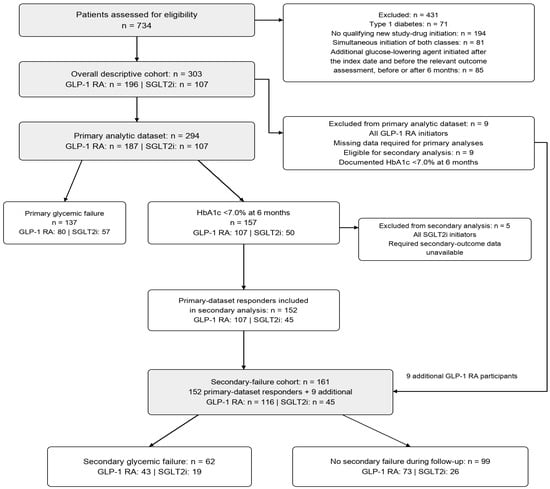
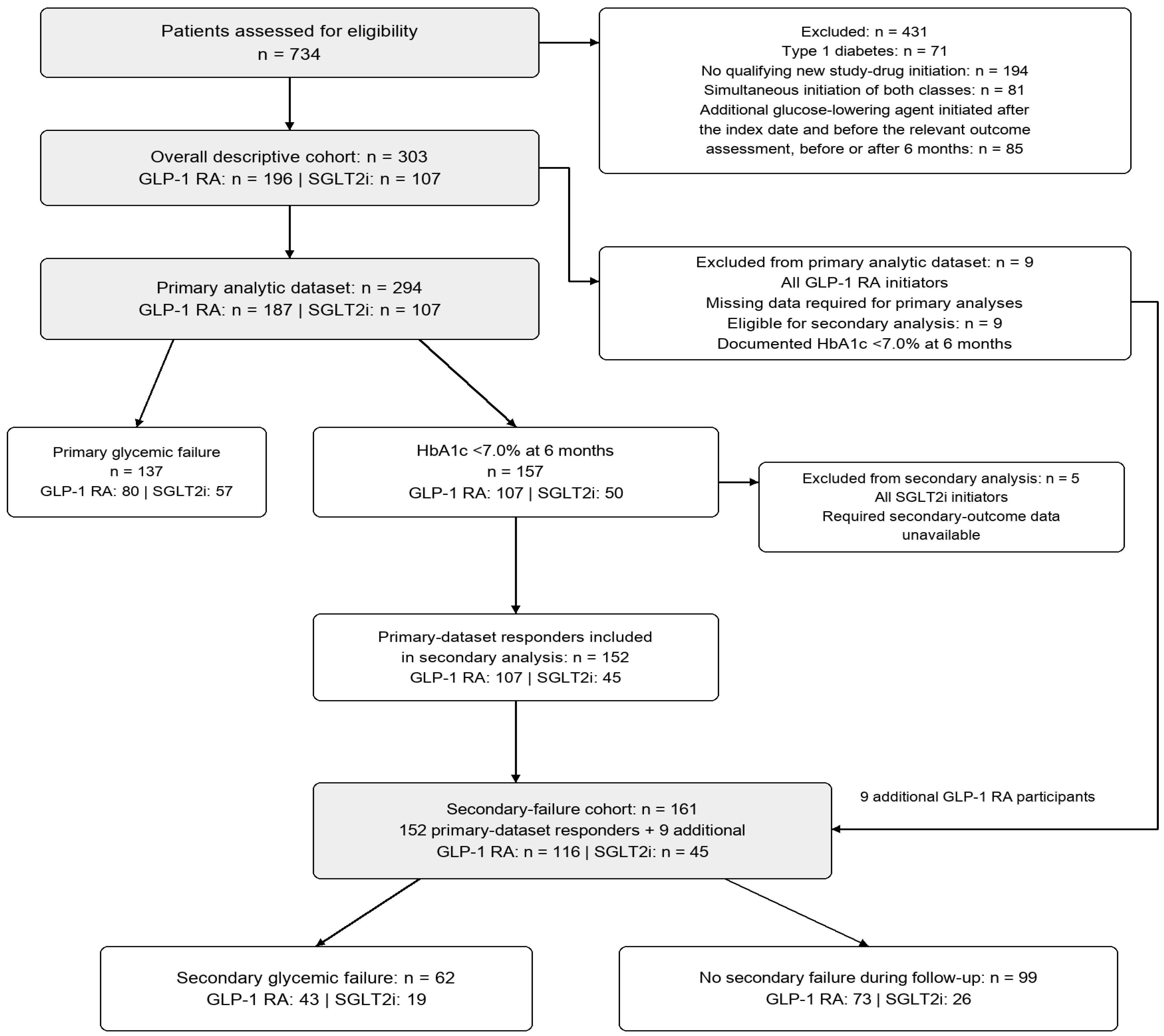
The study population comprised 303 adults with type 2 diabetes, of whom 196 initiated a GLP-1 RA and 107 initiated an SGLT2i. Participant selection is shown in Figure 1. The baseline demographic, clinical, laboratory, comorbidity, and treatment characteristics of the study population, stratified by index treatment class, are presented in Table 1. Men accounted for 61.2% (120/196) of the GLP-1 RA cohort and 63.6% (68/107) of the SGLT2i cohort. Mean age was 63.7 ± 9.8 years in the GLP-1 RA cohort and 65.9 ± 10.1 years in the SGLT2i cohort, while mean body weight was 92.0 ± 20.8 and 89.3 ± 21.5 kg, respectively. The median duration of diabetes was 10.0 years in the GLP-1 RA cohort and 12.5 years in the SGLT2i cohort. Mean baseline HbA1c was 7.99 ± 1.56% in the GLP-1 RA cohort and 7.94 ± 1.63% in the SGLT2i cohort. Among the primary analytic population, 23.4% had HbA1c < 7.0% and 76.6% had HbA1c ≥ 7.0%.
Figure 1.
Participant screening and derivation of the outcome-specific analytic cohorts.
Table 1.
Baseline characteristics of the study population according to treatment group.
Hypertension was the most prevalent comorbidity, affecting 76.4% of GLP-1 RA initiators and 78.5% of SGLT2i initiators. Coronary artery disease was present in 23.6% and 30.8%, chronic kidney disease in 21.0% and 22.4%, heart failure in 9.2% and 11.2%, and a history of ischemic stroke in 8.2% and 9.3%, respectively.
Metformin was used by 80.5% of the GLP-1 RA cohort and 74.8% of the SGLT2i cohort. Basal insulin was used by 34.9% and 33.6%, prandial insulin by 8.7% and 12.1%, sulfonylureas by 12.3% and 13.1%, and pioglitazone by 14.9% and 15.9%, respectively. At baseline, 48.2% of GLP-1 RA initiators were already receiving an SGLT2i, whereas 37.4% of SGLT2i initiators were already receiving a GLP-1 RA. Discontinuation of the index treatment because of adverse events or intolerance during the first 3 months was recorded in 25.1% (48/191) of GLP-1 RA initiators and 34.6% (37/107) of SGLT2i initiators.
3.2. Primary Glycemic Failure
Of the 303 participants in the overall descriptive cohort, 294 were included in the primary analytic dataset; nine GLP-1 RA initiators were excluded because of missing baseline systolic blood pressure and/or serum urea measurements, despite having documented HbA1c < 7.0% at 6 months. Primary glycemic failure occurred in 137 of 294 participants (46.6%), whereas 157 achieved HbA1c < 7.0% at 6 months. Participants without primary failure achieved a significantly greater reduction in HbA1c compared with those who experienced primary failure (−1.42 ± 1.63 vs. −0.42 ± 1.15 percentage points; mean difference −1.00 percentage points, 95% CI −1.33 to −0.67, p < 0.0001 by Welch’s two-sample t-test). Failure was numerically less frequent among GLP-1 RA initiators than among SGLT2i initiators [42.8% (80/187) vs. 53.3% (57/107)], although the between-group difference did not reach statistical significance (p = 0.083). Participants with primary failure were more frequently male (70.1% vs. 56.1%, p = 0.013) and had a higher prevalence of chronic kidney disease (27.0% vs. 17.2%, p = 0.042). Basal insulin use (41.6% vs. 26.8%, p = 0.007) and pioglitazone use (20.4% vs. 10.8%, p = 0.022) were also more common among participants with primary failure. Prandial insulin use showed a borderline association with primary failure (13.9% vs. 7.0%, p = 0.052), whereas metformin, sulfonylurea use, baseline use of the other study drug class, and discontinuation because of adverse events or intolerance during the first 3 months were not associated with the outcome (all p > 0.05).
Participants with primary failure were older than those who achieved the glycemic target (65.5 ± 10.5 vs. 63.2 ± 9.3 years, p = 0.047) and had a longer median duration of diabetes [12.0 (IQR 15.0) vs. 10.0 (IQR 14.0) years, p = 0.019]. They also had higher baseline systolic blood pressure [median 135 (IQR 21) vs. 131 (IQR 20) mmHg, p = 0.035] and serum urea [40.0 (IQR 19.0) vs. 37.0 (IQR 16.0) mg/dL, p = 0.009]. Baseline HbA1c did not differ between participants with and without primary failure [median 7.50% in both groups, p = 0.683]. No significant differences were observed in baseline body weight, diastolic blood pressure, heart rate, creatinine, lipid profile, urine albumin-to-creatinine ratio, liver enzymes, or thyroid-stimulating hormone (all p > 0.05).
3.3. Multivariable Analysis of Primary Glycemic Failure
The multivariable logistic regression analysis included 291 of the 294 participants in the primary analytic dataset; three participants were excluded because of incomplete model covariate data. Among the 291 participants included, 134 experienced primary glycemic failure. The model was statistically significant (χ2[6] = 29.521, p < 0.001), had a Nagelkerke R2 of 0.129, and correctly classified 63.2% of participants. Model calibration was acceptable (Hosmer-Lemeshow p = 0.652). Factors independently associated with primary glycemic failure are presented in Table 2.
Table 2.
Multivariable logistic regression analysis of factors associated with primary glycemic failure.
Basal insulin use was independently associated with higher odds of primary failure (aOR 1.887, 95% CI 1.127–3.159; p = 0.016), as was pioglitazone use (aOR 2.257, 95% CI 1.152–4.424; p = 0.018). Female sex was associated with lower odds of primary failure (aOR 0.542, 95% CI 0.324–0.908; p = 0.020). Treatment class was not independently associated with primary failure; compared with GLP-1 RA initiation, SGLT2i initiation yielded an aOR of 1.426 (95% CI 0.861–2.362; p = 0.168). Baseline systolic blood pressure (aOR 1.015 per mmHg, 95% CI 0.999–1.031; p = 0.068) and serum urea (aOR 1.010 per unit, 95% CI 0.998–1.023; p = 0.089) were not statistically significant in the adjusted model.
3.4. Secondary Glycemic Failure
Of the 157 responders in the primary analytic dataset, five SGLT2i initiators were excluded from the secondary analysis because the required secondary-outcome data were unavailable. Nine additional GLP-1 RA initiators excluded from the primary analytic dataset because of missing baseline systolic blood pressure and/or serum urea measurements had documented HbA1c < 7.0% at 6 months and subsequent HbA1c measurements. They were therefore eligible for the secondary analysis, which did not require these baseline variables. The resulting secondary cohort comprised 116 GLP-1 RA initiators and 45 SGLT2i initiators. Thus, 161 participants were eligible for the secondary analysis; 62 (38.5%) subsequently developed secondary glycemic failure, while 99 (61.5%) remained event-free through their last available HbA1c assessment. Secondary failure occurred in 37.1% (43/116) of GLP-1 RA initiators and 42.2% (19/45) of SGLT2i initiators, with no significant difference between treatment groups (p = 0.547). Discontinuation of the index treatment because of adverse events or intolerance during the first 3 months was substantially more frequent among participants with secondary failure than among those who maintained glycemic control (49.2% vs. 7.1%, p < 0.001). No significant associations were observed between secondary failure and sex, cardiovascular or renal comorbidities, or concomitant glucose-lowering therapies (all p > 0.05), although hypertension was numerically more frequent among participants with secondary failure (83.9% vs. 71.7%, p = 0.077).
At baseline, participants who subsequently developed secondary failure had higher HbA1c [median 7.40% (IQR 1.68) vs. 7.10% (IQR 1.15), p = 0.013], higher triglycerides [159 (IQR 81) vs. 125 (IQR 69) mg/dL, p = 0.005], lower HDL-C [41.0 (IQR 14.5) vs. 44.0 (IQR 15.3) mg/dL, p = 0.018], and higher γGT [25.4 (IQR 19.5) vs. 19.0 (IQR 12.3) U/L, p = 0.005]. Baseline age, body weight, diabetes duration, renal indices, total cholesterol, urine albumin-to-creatinine ratio, aminotransferases, and thyroid-stimulating hormone did not differ significantly between groups. Median follow-up was 16.0 (IQR 11.0) months among participants with secondary failure and 12.0 (IQR 14.0) months among those without secondary failure (p = 0.054).
3.5. Multivariable Analysis of Secondary Glycemic Failure
The multivariable logistic regression model included 134 of the 161 participants eligible for the secondary analysis; 27 participants were excluded because of incomplete model covariate data. Among the 134 participants included, 53 experienced secondary glycemic failure. The model was statistically significant (χ2[5] = 13.311, p = 0.021), with a Nagelkerke R2 of 0.128 and an overall classification accuracy of 66.4%; calibration was satisfactory (Hosmer-Lemeshow p = 0.796). Factors independently associated with secondary glycemic failure are presented in Table 3.
Table 3.
Multivariable logistic regression analysis of factors associated with secondary glycemic failure.
Baseline γGT was the only variable independently associated with secondary failure (aOR 1.019 per unit, 95% CI 1.001–1.037; p = 0.035). This corresponds to approximately 21% higher odds of secondary glycemic failure per 10 U/L increase in baseline γGT. Treatment class was not associated with the outcome (SGLT2i vs. GLP-1 RA: aOR 1.137, 95% CI 0.507–2.552; p = 0.755). Baseline HbA1c (aOR 1.221, 95% CI 0.926–1.610; p = 0.157), triglycerides (aOR 1.001, 95% CI 0.997–1.005; p = 0.687), and HDL-C (aOR 0.984, 95% CI 0.957–1.011; p = 0.247) were not independently associated with secondary failure.
3.6. Time to Secondary Glycemic Failure
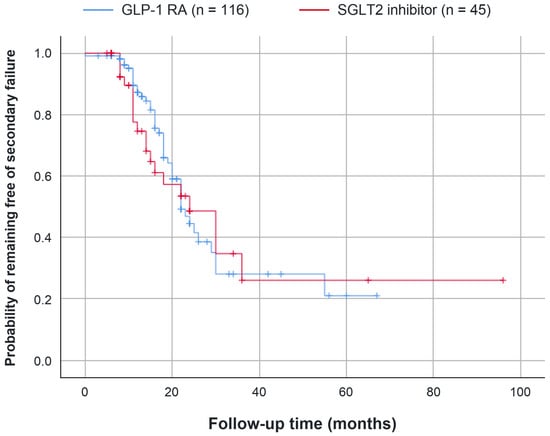
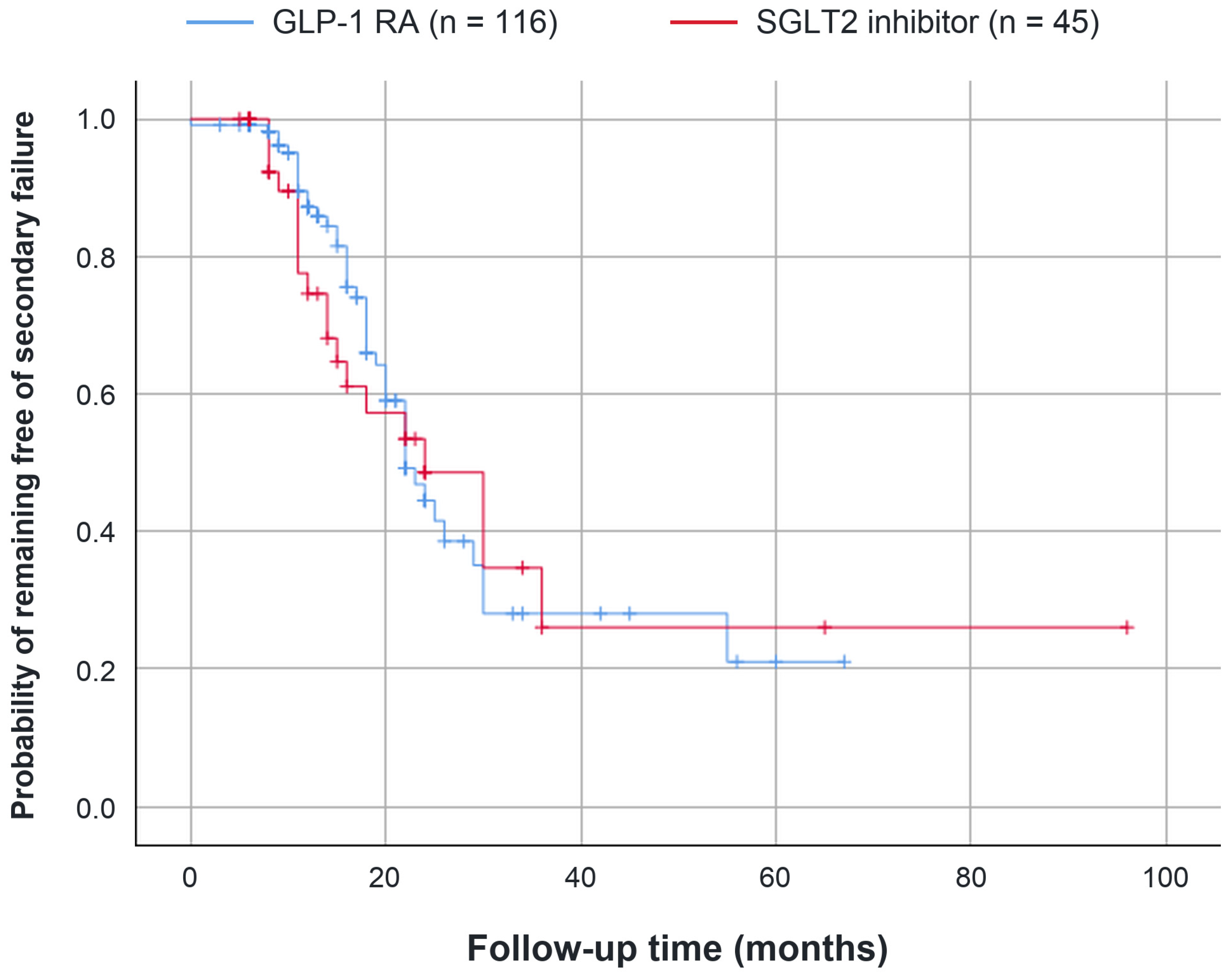
Kaplan–Meier analysis included 161 participants: 116 GLP-1 RA initiators, among whom 43 secondary-failure events occurred, and 45 SGLT2i initiators, among whom 19 events occurred (Figure 2). The estimated median time to secondary failure was 22.0 months (95% CI 18.54–25.46) in the GLP-1 RA cohort and 24.0 months (95% CI 14.15–33.85) in the SGLT2i cohort.
Figure 2.
Kaplan–Meier curves for time to secondary glycemic failure among participants who achieved HbA1c < 7.0% at 6 months, by treatment group. Follow-up began at the 6-month assessment. Plus signs indicate censored observations.
The survival distributions did not differ significantly between treatment groups (log-rank χ2[1] = 0.079, p = 0.779). In the multivariable Cox proportional hazards model (Table 4), complete covariate data were available for 157 of the 161 participants. Among the 157 subjects included, 60 secondary-failure events occurred; treatment class was not associated with time to secondary failure (HR 1.027, 95% CI 0.587–1.796; p = 0.927). Higher baseline triglyceride levels were independently associated with a shorter time to secondary glycemic failure (HR 1.003 per 1 mg/dL increase, 95% CI 1.000–1.005; p = 0.021), corresponding to an approximately 16% higher hazard per 50 mg/dL increase. Higher baseline HbA1c showed a similar direction of association with earlier secondary failure, but the association was not statistically significant (HR 1.140 per 1 percentage-point increase, 95% CI 0.983–1.321; p = 0.083).
Table 4.
Multivariable Cox proportional hazards analysis of factors associated with time to secondary glycemic failure.
3.7. Sensitivity and Exploratory Analyses
After excluding participants who discontinued the index therapy because of adverse events or intolerance during the first 3 months, the primary-failure sensitivity model included 208 participants, of whom 94 experienced primary glycemic failure. The main findings remained largely unchanged. Basal insulin (aOR 2.241, 95% CI 1.202–4.176; p = 0.011) and pioglitazone (aOR 2.739, 95% CI 1.300–5.769; p = 0.008) remained independently associated with higher odds of primary failure. Baseline systolic blood pressure was also associated with the outcome (aOR 1.020 per mmHg, 95% CI 1.001–1.040; p = 0.040). Female sex was no longer statistically significant (aOR 0.591, 95% CI 0.318–1.099; p = 0.096), and treatment class remained unrelated to primary failure (SGLT2i vs. GLP-1 RA: aOR 1.309, 95% CI 0.700–2.448; p = 0.398).
In the corresponding sensitivity analysis for secondary failure, 101 participants and 27 events were included. Baseline γGT remained independently associated with secondary failure (aOR 1.033 per unit, 95% CI 1.003–1.063; p = 0.029), whereas treatment class remained nonsignificant (aOR 1.735, 95% CI 0.621–4.850; p = 0.293). Of the 53 events in the main secondary logistic analysis, 26 occurred among participants excluded because of early discontinuation. In the sensitivity Cox model, which included 119 participants and 30 events, higher baseline triglyceride levels remained independently associated with a shorter time to secondary glycemic failure (HR 1.004 per 1 mg/dL increase, 95% CI 1.001–1.007; p = 0.008), corresponding to an approximately 22% higher hazard per 50 mg/dL increase. Neither treatment class (HR 1.238, 95% CI 0.559–2.744; p = 0.599) nor baseline HbA1c (HR 1.047, 95% CI 0.847–1.296; p = 0.670) was significantly associated with time to secondary failure.
The exploratory analysis attempting to retain the 85 participants who initiated an additional glucose-lowering agent was limited by substantial missingness in the required variables and imprecise estimates, precluding firm conclusions about the influence of their exclusion. However, the overall pattern of findings remained similar. In the sensitivity analysis restricted to baseline HbA1c ≥ 7.0%, no statistically significant association between treatment class and primary failure was detected (aOR 1.49, 95% CI 0.83–2.67; p = 0.180). Female sex remained associated with lower odds of failure (aOR 0.53, 95% CI 0.30–0.94; p = 0.030), whereas the associations with basal insulin and pioglitazone did not reach statistical significance (p = 0.058 and p = 0.051, respectively). After additional adjustment for baseline use of the alternative study drug class, treatment class was not statistically significantly associated with primary failure (290 complete cases; 134 events; aOR 1.386, 95% CI 0.833–2.307; p = 0.209), secondary failure (129 complete cases; 51 events; aOR 1.318, 95% CI 0.575–3.024; p = 0.514), or time to secondary failure (137 complete cases; 57 events; HR 1.181, 95% CI 0.666–2.095; p = 0.570). Baseline alternative-class use was nonsignificant in all three models. γGT remained associated with secondary failure in the logistic model (aOR 1.020 per U/L, 95% CI 1.001–1.040; p = 0.043), whereas triglycerides were not significantly associated with time to failure in the Cox model (HR 1.0021 per mg/dL, 95% CI 0.9995–1.0048; p = 0.117). The triglyceride association was also nonsignificant when the original Cox covariate set was fitted to the same records (p = 0.082). Full estimates are presented in Supplementary Table S1. In a further sensitivity model including baseline HbA1c, age, and diabetes duration (288 complete cases; 134 events), treatment class remained nonsignificant (aOR 1.350, 95% CI 0.806–2.260; p = 0.254). Female sex remained associated with lower odds of failure, and basal insulin and pioglitazone use remained associated with higher odds. Baseline HbA1c was inversely associated with failure (aOR 0.794, 95% CI 0.664–0.948; p = 0.011), whereas age and diabetes duration were not statistically significant. Full estimates are presented in Supplementary Table S2.
4. Discussion
In this retrospective real-world cohort of 303 adults with type 2 diabetes, primary glycemic failure occurred in almost half of participants in the primary analysis, while more than one-third of initial responders subsequently experienced secondary failure. These high rates may partly reflect the clinical complexity of patients receiving diabetes care in hospital-affiliated primary care clinics. Treatment class was not independently associated with either outcome or with time to secondary failure. Basal insulin and pioglitazone use were associated with higher odds of primary failure, whereas female sex was associated with lower odds, although this association was attenuated after excluding discontinuations due to adverse events or intolerance. Higher baseline γGT was associated with secondary failure, while higher triglycerides were associated with earlier failure. These findings highlight potentially useful routinely available characteristics in an area where real-world evidence remains limited.
The associations of basal insulin and pioglitazone use with primary glycemic failure should not be interpreted as evidence that these treatments directly impair the response to GLP-1 RAs or SGLT2i. Rather, they likely identify patients with a more advanced and treatment-resistant diabetes phenotype. Basal insulin use may serve as a clinical marker of longer-standing disease, reduced beta-cell reserve, previous inadequate glycemic control, and greater overall treatment complexity [13]. This interpretation is consistent with previous evidence linking insulin co-treatment and other markers of beta-cell failure to a reduced glycemic response to GLP-1 RAs [14]. Pioglitazone, conversely, is commonly prescribed to patients with pronounced insulin resistance and may therefore identify individuals with a greater underlying metabolic burden or a history of insufficient response to other glucose-lowering therapies [15,16,17,18,19]. The use of either medication may also reflect confounding by indication, as patients with more difficult-to-control diabetes are more likely to receive multiple agents before initiation of a GLP-1 RA or SGLT2i [20,21,22,23,24]. Unmeasured factors, including insulin dose, treatment duration, beta-cell function, insulin resistance index, adherence, and adequacy of dose titration, may have contributed to these associations. Nevertheless, the persistence of both associations after excluding participants who discontinued treatment because of adverse events or intolerance suggests that they cannot be explained solely by differences in early treatment tolerability. Female sex was associated with lower odds of primary glycemic failure in the main multivariable analysis. Several biological and clinical mechanisms could potentially contribute to this finding, including sex-related differences in body composition, adipose-tissue distribution, endogenous incretin physiology, drug exposure, weight response, and more engagement with diabetes care [25,26,27,28]. Some studies have suggested greater weight loss among women receiving GLP-1 RAs [29]. However, pooled analyses have not demonstrated a consistent sex-by-treatment interaction in the glycemic efficacy of GLP-1 RAs or SGLT2i [30,31]. Our findings should therefore be regarded as hypothesis-generating and may partly reflect differences in unmeasured characteristics, treatment persistence, background therapy, or residual confounding rather than a definitive biological advantage among women.
Higher baseline γGT was independently associated with secondary failure, while higher triglycerides were associated with earlier loss of glycemic control. Rather than direct mediators, these routinely available parameters may identify an adverse metabolic phenotype characterized by hepatic steatosis, insulin resistance, oxidative stress, ectopic lipid accumulation, and impaired beta-cell function [32]. Persistent metabolic dysfunction may therefore undermine glycemic durability despite an initially successful response. Although expressing these associations per 10 U/L increase in γGT and per 50 mg/dL increase in triglycerides facilitates interpretation, their clinical usefulness remains uncertain. These exploratory findings do not establish actionable thresholds or demonstrate that either marker improves prediction beyond established clinical characteristics. Treatment class was associated with neither the occurrence nor timing of secondary failure. Although GLP-1 RAs generally produce greater mean HbA1c reductions than SGLT2i, greater initial potency may not confer superior durability among patients who have already achieved the same target. Lipska et al. similarly found no significant advantage of GLP-1 RAs over SGLT2i for insulin discontinuation among basal insulin-treated adults with type 2 diabetes [33]. Although this outcome differs from glycemic failure, their findings complement our observation of no significant difference between GLP-1 RAs and SGLT2i, without establishing therapeutic equivalence. Responder selection, baseline use of the alternative drug class, and the relatively small SGLT2i subgroup may also have influenced the treatment-class comparisons and their precision [34,35,36].
In a U.S. claims-based study of 237,295 adults with type 2 diabetes who initiated an SGLT2 inhibitor, Tan et al. reported treatment failure in 77.3% of participants [37]. Their composite outcome included discontinuation, addition of or switching to another glucose-lowering therapy, and uncontrolled HbA1c without treatment modification. The inclusion of prescribing changes limits direct comparison with our HbA1c-based outcomes. In a retrospective study of 131 patients treated with exenatide or liraglutide, Hemmer et al. reported that mean HbA1c decreased by 1.2 percentage points in the first year and remained 1.4 percentage points below baseline at four years [38]. That sustained average reduction complements our patient-level analysis, which distinguishes failure to reach the HbA1c target from subsequent loss of glycemic control among initial responders.
This study has several strengths. Detailed clinical, biochemical, and treatment data from hospital-affiliated primary care clinics allowed us to distinguish failure to reach the 6-month HbA1c target from subsequent loss of glycemic control among those who reached it. Time-to-event analyses accounted for differences in follow-up duration, and sensitivity analyses examined whether the findings changed after excluding participants who discontinued treatment early because of adverse events or intolerance. On the other hand, important limitations should be considered. The retrospective observational design precludes causal inference and remains susceptible to confounding by indication and residual confounding. Covariate selection incorporated univariable screening, assessment of collinearity, and AIC-guided model simplification. This exploratory approach introduces model-selection uncertainty and does not ensure complete adjustment for clinically relevant confounders, including those not retained in the final models. Excluding participants who initiated additional glucose-lowering treatment before outcome assessment may have preferentially removed those with inadequate glycemic control, introducing selection bias and potentially underestimating failure rates. Substantial missingness and imprecise estimates limited the exploratory analysis attempting to retain these participants; consequently, this analysis could not reliably quantify or exclude bias arising from their exclusion. Recruitment from primary care clinics affiliated with two Greek hospitals may limit generalizability to other primary care settings. Pre-existing use of the alternative study drug class and heterogeneous background therapy complicate interpretation of treatment-class comparisons. Although additional adjustment for baseline use of the alternative class did not materially change the primary-failure findings, residual confounding by background treatment remains possible. The fixed HbA1c threshold disregarded individualized targets. Among participants already below 7.0% at baseline, the 6-month assessment reflected maintenance rather than initial attainment of the target, which should be considered when interpreting primary failure. Participants could experience glycemic improvement while remaining above the specified threshold; therefore, primary failure as defined here does not necessarily indicate absence of treatment benefit. Although mean baseline HbA1c suggested a glycemic rationale for treatment in many participants, individual prescribing indications were unavailable. Data on adherence, lifestyle, and beta-cell function were also unavailable.
Higher baseline γGT was associated with secondary failure in the logistic model, whereas higher baseline triglycerides were associated with time to failure in the Cox model. These models evaluated different aspects of the outcome and used different covariate sets and complete-case populations. Differences in statistical significance therefore do not establish distinct biological associations. Given the multiple comparisons and modest event counts, these findings may reflect chance and should be regarded as exploratory. Secondary glycemic failure was defined using a single HbA1c value without confirmation, because repeat measurements were not consistently available in routine practice. This definition may capture transient rather than sustained loss of glycemic control. Furthermore, nonstandardized testing intervals may influence event detection; the time-to-event analysis therefore estimates time to documented failure rather than the exact onset of glycemic deterioration. The relatively high frequency of discontinuation because of adverse events or intolerance may partly reflect the clinical complexity of the population, although this explanation was not formally evaluated. Discontinuation was recorded only for permanent cessation within the first three months. This window captures early intolerance, particularly gastrointestinal adverse effects associated with GLP-1 RAs during treatment initiation and dose escalation; however, later discontinuations were not systematically captured. Because outcome assessment continued irrespective of index-treatment discontinuation, secondary failure may reflect treatment cessation as well as deterioration in glycemic control during treatment. Excluding early discontinuers reduced the secondary logistic analysis sample, highlighting the relevance of treatment persistence without establishing that discontinuation caused these events. Although the γGT and triglyceride associations remained statistically significant in the corresponding sensitivity analyses, these analyses did not establish continuous treatment exposure throughout follow-up. The nonsignificant differences between treatment groups do not establish equivalence. The associations of sex with primary glycemic failure, γGT with secondary glycemic failure, and triglycerides with time to secondary glycemic failure should be evaluated in an independent cohort from other clinical centers. Using the same outcome definitions and follow-up starting points would allow investigators to assess whether the direction and magnitude of these associations are reproducible across clinical settings.
5. Conclusions
In conclusion, glycemic failure was common after initiation of either treatment class, with no demonstrated difference in its occurrence or timing. The associations between baseline characteristics and glycemic failure are exploratory and require independent confirmation; they do not establish a clinical risk-stratification tool or support treatment selection. Approximately half of the secondary-failure events in the main logistic analysis occurred among early treatment discontinuers, highlighting the importance of treatment persistence when interpreting these findings. This observation does not establish causality, and the results should not be interpreted as demonstrating glycemic durability during uninterrupted treatment. Larger prospective studies with standardized follow-up and detailed assessment of treatment exposure, adherence, and beta-cell function are needed to confirm these associations and assess their clinical relevance.
Supplementary Materials
The following supporting information can be downloaded at https://www.mdpi.com/article/10.3390/diseases14120441/s1. Table S1: Primary-failure logistic regression model additionally adjusted for baseline use of the alternative study drug class, Table S2: Sensitivity analysis of primary glycemic failure additionally adjusted for baseline HbA1c, age, and diabetes duration.
Author Contributions
M.Z., O.P., G.A., I.Z., E.M., A.S. and P.D. collected the data. G.D. performed the statistical analysis. V.T. conceptualized and designed the study. H.C., M.D., K.K., T.K. and V.T. supervised the study and contributed to the analysis and interpretation of the data. T.K. drafted the manuscript. All authors have read and agreed to the published version of the manuscript.
Funding
This research received no external funding.
Institutional Review Board Statement
The study was conducted in accordance with the Declaration of Helsinki and was approved by the ethics committees of Hippokration General Hospital, Thessaloniki, Greece (approval number 47699; 23 October 2023), and Ioannina University Hospital, Ioannina, Greece (approval number 1244; 12 November 2024).
Informed Consent Statement
The requirement for informed consent was waived by the participating institutions’ ethics committees because of the retrospective study design and the use of de-identified routinely collected clinical data.
Data Availability Statement
The datasets analyzed during the current study are available from the corresponding author on reasonable request. They are not publicly available because of privacy restrictions of the Greek National Health System.
Acknowledgments
ChatGPT 6.0 (OpenAI, San Francisco, CA, USA) was used to assist with language editing. All suggested changes were reviewed by the authors, who retain full responsibility for the accuracy and integrity of the manuscript. The tool was not used to collect patient data or fit the study’s statistical models.
Conflicts of Interest
Kalliopi Kotsa has received honoraria for lectures and advisory boards and research support from AstraZeneca, Boehringer Ingelheim, Pharmaserve Lilly, Sanofi-Aventis, ELPEN, MSD, and Novo Nordisk. Theocharis Koufakis has received honoraria for lectures from AstraZeneca, Sanofi, Boehringer Ingelheim, Pharmaserve Lilly, ELPEN, Menarini, Roche Diagnostics, and Novo Nordisk; honoraria for advisory boards from Novo Nordisk, Roche Diagnostics, Sanofi, and Boehringer Ingelheim; and has participated in studies sponsored by Eli Lilly, AstraZeneca, Boehringer Ingelheim, and Novo Nordisk. Vasilios Tsimihodimos has received honoraria for lectures and advisory boards and research support from AstraZeneca, Boehringer Ingelheim, Pharmaserve Lilly, Sanofi-Aventis, ELPEN, MSD, Winmedica, Servier, Abbott, and Novo Nordisk. Maria Zarfeiadou, Ourania Psoma, Georgia Anastasiou, Georgios Dimakopoulos, Ioanna Zografou, Eleni Manthou, Anastasia Sarvani, Haris Constantinou, Panagiotis Doukelis, and Michael Doumas declare no conflicts of interest.
References
- Castellana, E.; Budau, P.M.; Chiappetta, M.R. Overview of diabetes medications: Traditional and new-generation agents and their off-label use for weight loss. J. Pharm. Technol. 2026, 42, 135–142. [Google Scholar] [CrossRef] [Scilit]
- Nong, K.; Jeppesen, B.T.; Shi, Q.; Agoritsas, T.; Guyatt, G.H.; White, H.; Gao, Y.; Agarwal, A.; Macdonald, H.; Zou, X.; et al. Medications for adults with type 2 diabetes: A living systematic review and network meta-analysis. BMJ 2025, 390, e083039. [Google Scholar] [CrossRef] [Scilit]
- Liakos, A.; Karagiannis, T.; Avgerinos, I.; Malandris, K.; Tsapas, A.; Bekiari, E. Management of type 2 diabetes in the new era. Hormones 2023, 22, 677–684. [Google Scholar] [CrossRef] [Scilit]
- American Diabetes Association Professional Practice Committee. 9. Pharmacologic approaches to glycemic treatment: Standards of Care in Diabetes—2026. Diabetes Care 2026, 49, S183–S215. [Google Scholar] [CrossRef] [Scilit]
- Groop, L.C.; Pelkonen, R.; Koskimies, S.; Bottazzo, G.F.; Doniach, D. Secondary failure to treatment with oral antidiabetic agents in non-insulin-dependent diabetes. Diabetes Care 1986, 9, 129–133. [Google Scholar] [CrossRef] [Scilit]
- Yahaya, J.J.; Doya, I.F.; Morgan, E.D.; Ngaiza, A.I.; Bintabara, D. Poor glycemic control and associated factors among patients with type 2 diabetes mellitus: A cross-sectional study. Sci. Rep. 2023, 13, 9673. [Google Scholar] [CrossRef] [Scilit]
- Jones, A.G.; McDonald, T.J.; Shields, B.M.; PRIBA Study Group. Markers of β-cell failure predict poor glycemic response to GLP-1 receptor agonist therapy in type 2 diabetes. Diabetes Care 2016, 39, 250–257. [Google Scholar] [CrossRef] [Scilit]
- Pitsiava, S.; Dimakopoulos, G.; Tsimihodimos, V.; Kotsa, K.; Koufakis, T. Association between clinical and laboratory factors and response to sodium-glucose cotransporter 2 inhibitors in patients with type 2 diabetes: A retrospective observational study. Expert Opin. Pharmacother. 2024, 25, 1095–1104. [Google Scholar] [CrossRef] [Scilit]
- Kyriakidou, A.; Kyriazou, A.V.; Koufakis, T.; Vasilopoulos, Y.; Grammatiki, M.; Tsekmekidou, X.; Avramidis, I.; Baltagiannis, S.; Goulis, D.G.; Zebekakis, P.; et al. Clinical and genetic predictors of glycemic control and weight loss response to liraglutide in patients with type 2 diabetes. J. Pers. Med. 2022, 12, 424. [Google Scholar] [CrossRef] [Scilit]
- Kyriakidou, A.; Koufakis, T.; Gika, H.; Kotsa, K. Metabolomics insights into the benefits of SGLT2 inhibitors in type 2 diabetes. Clin. Pharmacol. 2025, 17, 253–267. [Google Scholar] [CrossRef] [Scilit]
- Dennis, J.M.; Shields, B.M.; Henley, W.E.; Jones, A.G.; Hattersley, A.T. Disease progression and treatment response in data-driven subgroups of type 2 diabetes compared with models based on simple clinical features: An analysis using clinical trial data. Lancet Diabetes Endocrinol. 2019, 7, 442–451. [Google Scholar] [CrossRef] [Scilit]
- American Diabetes Association Professional Practice Committee for Diabetes. 6. Glycemic Goals, Hypoglycemia, and Hyperglycemic Crises: Standards of Care in Diabetes-2026. Diabetes Care 2026, 49, S132–S149. [Google Scholar] [CrossRef] [Scilit]
- Koufakis, T.; Patoulias, D.; Popovic, D.S.; Tsimihodimos, V. Basal insulin in the age of innovation: Are diamonds still forever? Expert Rev. Endocrinol. Metab. 2025, 20, 471–474. [Google Scholar] [CrossRef] [Scilit]
- Wysham, C.; Shubrook, J. Beta-cell failure in type 2 diabetes: Mechanisms, markers, and clinical implications. Postgrad. Med. 2020, 132, 676–686. [Google Scholar] [CrossRef] [Scilit]
- Desouza, C.V.; Shivaswamy, V. Pioglitazone in the treatment of type 2 diabetes: Safety and efficacy review. Clin. Med. Insights Endocrinol. Diabetes 2010, 3, 43–51. [Google Scholar] [CrossRef] [Scilit]
- Inzucchi, S.E.; Viscoli, C.M.; Young, L.H. IRIS Trial Investigators. Pioglitazone prevents diabetes in patients with insulin resistance and cerebrovascular disease. Diabetes Care 2016, 39, 1684–1692. [Google Scholar] [CrossRef] [Scilit]
- Avogaro, A.; Federici, M.; Betteridge, J.; Bonadonna, R.; Campbell, I.W.; Schernthaner, G.H.; Staels, B.; Farinaro, E.; Crepaldi, G. Which is the eligible patient to be treated with pioglitazone? The expert view. J. Endocrinol. Investig. 2011, 34, 781–787. [Google Scholar] [CrossRef] [Scilit]
- Schwartz, S.S. Pioglitazone for the treatment of type 2 diabetes in patients inadequately controlled on insulin. Diabetes Metab. Syndr. Obes. 2010, 3, 243–252. [Google Scholar] [CrossRef] [Scilit]
- Einhorn, D.; Aroda, V.R.; Henry, R.R. Glitazones and the management of insulin resistance: What they do and how might they be used. Endocrinol. Metab. Clin. N. Am. 2004, 33, 595–616, vii–viii. [Google Scholar] [CrossRef] [Scilit]
- Calvert, M.J.; McManus, R.J.; Freemantle, N. Management of type 2 diabetes with multiple oral hypoglycaemic agents or insulin in primary care: Retrospective cohort study. Br. J. Gen. Pract. 2007, 57, 455–460. [Google Scholar]
- Willey, C.J.; Andrade, S.E.; Cohen, J.; Fuller, J.C.; Gurwitz, J.H. Polypharmacy with oral antidiabetic agents: An indicator of poor glycemic control. Am. J. Manag. Care 2006, 12, 435–440. [Google Scholar]
- Holmboe, E.S. Oral antihyperglycemic therapy for type 2 diabetes: Clinical applications. JAMA 2002, 287, 373–376. [Google Scholar] [CrossRef] [Scilit]
- Levin, P.A.; Wei, W.; Zhou, S.; Xie, L.; Baser, O. Outcomes and treatment patterns of adding a third agent to 2 OADs in patients with type 2 diabetes. J. Manag. Care Spec. Pharm. 2014, 20, 501–512. [Google Scholar] [CrossRef] [Scilit]
- Atak Tel, B.M.; Aktas, G.; Bilgin, S.; Baltaci, S.B.; Taslamacioglu Duman, T. Control level of type 2 diabetes mellitus in the elderly is associated with polypharmacy, accompanied comorbidities, and various increased risks according to the Beers criteria. Diagnostics 2023, 13, 3433. [Google Scholar] [CrossRef] [Scilit]
- Rentzeperi, E.; Pegiou, S.; Koufakis, T.; Grammatiki, M.; Kotsa, K. Sex differences in response to treatment with glucagon-like peptide 1 receptor agonists: Opportunities for a tailored approach to diabetes and obesity care. J. Pers. Med. 2022, 12, 454. [Google Scholar] [CrossRef] [Scilit]
- Færch, K.; Torekov, S.S.; Vistisen, D.; Johansen, N.B.; Witte, D.R.; Jonsson, A.; Pedersen, O.; Hansen, T.; Lauritzen, T.; Sandbæk, A.; et al. GLP-1 Response to Oral Glucose Is Reduced in Prediabetes, Screen-Detected Type 2 Diabetes, and Obesity and Influenced by Sex: The ADDITION-PRO Study. Diabetes 2015, 64, 2513–2525. [Google Scholar] [CrossRef] [Scilit]
- Liu, C.; Mujahid, O.; Beneyto, A.; Contreras, I.; Vehí, J. Sex differences in glycemic outcomes: A systematic review and meta-analysis of diabetes treatments. BMJ Open Diabetes Res. Care 2026, 14, e005808. [Google Scholar] [CrossRef] [Scilit]
- Inceu, G.V.; Crăciun, A.E.; Ciobanu, D.M.; Berchisan, A.; Fodor, A.; Bala, C.; Roman, G.; Rusu, A. Real-world sex differences in response to treatment with glucagon-like peptide-1 receptor agonists: Analysis of single-center outpatient case series. Medicina 2025, 61, 1343. [Google Scholar] [CrossRef] [Scilit]
- Yang, Y.; He, L.; Han, S.; Yang, N.; Liu, Y.; Wang, X.; Li, Z.; Ping, F.; Xu, L.; Li, W.; et al. Sex Differences in the Efficacy of Glucagon-Like Peptide-1 Receptor Agonists for Weight Reduction: A Systematic Review and Meta-Analysis. J. Diabetes 2025, 17, e70063. [Google Scholar] [CrossRef] [Scilit]
- Gallwitz, B.; Dagogo-Jack, S.; Thieu, V.; Garcia-Perez, L.E.; Pavo, I.; Yu, M.; Robertson, K.E.; Zhang, N.; Giorgino, F. Effect of once-weekly dulaglutide on glycated haemoglobin (HbA1c) and fasting blood glucose in patient subpopulations by gender, duration of diabetes and baseline HbA1c. Diabetes Obes. Metab. 2018, 20, 409–418. [Google Scholar] [CrossRef] [Scilit]
- Hanlon, P.; Butterly, E.; Wei, L.; Wightman, H.; Almazam, S.A.M.; Alsallumi, K.; Crowther, J.; McChrystal, R.; Rennison, H.; Hughes, K.; et al. Age and Sex Differences in Efficacy of Treatments for Type 2 Diabetes: A Network Meta-Analysis. JAMA 2025, 333, 1062–1073. [Google Scholar] [CrossRef] [Scilit]
- Zhang, R.; Guan, Q.; Zhang, M.; Ding, Y.; Tang, Z.; Wang, H.; Zhang, W.; Chen, Y.; Jiang, R.; Cui, Y.; et al. Association between triglyceride-glucose index and risk of metabolic dysfunction-associated fatty liver disease: A cohort study. Diabetes Metab. Syndr. Obes. 2022, 15, 3167–3179. [Google Scholar] [CrossRef] [Scilit]
- Lipska, K.J.; Zawack, K.; Yan, L.; Mutalik, P.; Li, J.; Gulanski, B.; Ioannou, G.N.; Aslan, M. Comparative effectiveness of glucagon-like peptide-1 receptor agonists versus oral agents for insulin discontinuation in type 2 diabetes: A target trial emulation. Ann. Intern. Med. 2026, 179, 1128–1139. [Google Scholar] [CrossRef] [Scilit]
- Cole, S.R.; Platt, R.W.; Schisterman, E.F.; Chu, H.; Westreich, D.; Richardson, D.; Poole, C. Illustrating bias due to conditioning on a collider. Int. J. Epidemiol. 2010, 39, 417–420. [Google Scholar] [CrossRef] [Scilit]
- Brookhart, M.A.; Stürmer, T.; Glynn, R.J.; Rassen, J.; Schneeweiss, S. Confounding control in healthcare database research: Challenges and potential approaches. Med. Care 2010, 48, S114–S120. [Google Scholar] [CrossRef] [Scilit]
- Altman, D.G.; Bland, J.M. Absence of evidence is not evidence of absence. BMJ. 1995, 311, 485. [Google Scholar] [CrossRef] [Scilit]
- Tan, X.; Cao, Y.; Wang, Y.; Boland, J.; Guevarra, M.; Xie, L.; Song, Y.; Kwak, M.J. Prevalence, treatment patterns, burden, and factors related to treatment failure with sodium-glucose cotransporter 2 inhibitor in adults with type 2 diabetes in the United States. Diabetes Metab. Syndr. 2025, 19, 103281. [Google Scholar] [CrossRef] [Scilit]
- Hemmer, A.; Maiter, D.; Buysschaert, M.; Preumont, V. Long-term effects of GLP-1 receptor agonists in type 2 diabetic patients: A retrospective real-life study in 131 patients. Diabetes Metab. Syndr. 2019, 13, 332–336. [Google Scholar] [CrossRef] [Scilit]

Disclaimer/Publisher’s Note: The statements, opinions and data contained in all publications are solely those of the individual author(s) and contributor(s) and not of MDPI and/or the editor(s). MDPI and/or the editor(s) disclaim responsibility for any injury to people or property resulting from any ideas, methods, instructions or products referred to in the content. |
© 2026 by the authors. Licensee MDPI, Basel, Switzerland. This article is an open access article distributed under the terms and conditions of the Creative Commons Attribution (CC BY) license.