


Abstract
Background: An estimated 13.4 million infants were born preterm worldwide in 2020, highlighting the need for early identification of those at risk of adverse neonatal outcomes. Preterm infants constitute a heterogeneous population in terms of maturity and clinical risk. A simple model based on variables available immediately after birth may facilitate the early identification of infants who require more intensive monitoring. Objective: This study aimed to develop and internally validate an early prediction model for a composite adverse neonatal outcome in preterm infants. Materials and Methods: This single-center prospective cohort study included 280 preterm infants born at 24 weeks to 36 weeks and 6 days of gestation. The primary endpoint was the occurrence, before hospital discharge, of at least one of the following events: death, grade III-IV intraventricular hemorrhage (IVH), grade III–IV periventricular leukomalacia (PVL), bronchopulmonary dysplasia (BPD), necrotizing enterocolitis (NEC), or culture-confirmed early- or late-onset neonatal sepsis. A binary logistic regression model was developed. Discrimination was assessed using the area under the receiver operating characteristic curve (AUC ROC). Calibration was assessed graphically and by the Brier score, calibration intercept, and calibration slope. Internal validation was performed using 10-fold cross-validation and bootstrap optimism correction with model refitting in each of 2000 bootstrap samples. Results: The composite outcome occurred in 35 of 280 infants (12.5%). The final model included gestational age (odds ratio [OR] 0.736 per additional week; 95% confidence interval [CI] 0.614–0.882; p < 0.001) and the 5 min Apgar score (OR 0.447 per additional point; 95% CI 0.286–0.701; p < 0.001). The apparent AUC was 0.904 (95% bootstrap CI 0.848–0.952), the optimism-corrected AUC was 0.898, and the out-of-fold AUC from 10-fold cross-validation was 0.892. The out-of-fold Brier score was 0.066; the calibration intercept was −0.113, and the calibration slope was 0.925. The probability cutoff of 0.142 and the corresponding classification measures were considered exploratory. Conclusions: A two-variable model based on gestational age and the 5 min Apgar score demonstrated high internal discriminative ability. The model is intended for research evaluation and early risk stratification; independent external validation is required before clinical implementation.
1. Introduction
Preterm birth remains a leading cause of neonatal mortality and long-term morbidity. Risk varies substantially according to gestational age, birth weight, postnatal adaptation, and the need for intensive care [1,2]. The most important in-hospital complications include severe IVH, PVL, BPD, NEC, sepsis, and death before discharge [2,3,4,5,6,7,8,9].
Modern neonatology offers numerous laboratory and instrumental markers; however, many become available only after clinical deterioration has begun, require additional equipment, or have been evaluated only in limited samples. Therefore, a practical need remains for parsimonious models based on reliable characteristics recorded immediately after birth.
Recent neonatal prediction studies have compared conventional regression with machine learning approaches, including random forests. In an externally validated study of bronchopulmonary dysplasia or death, logistic regression and random forest models showed similar discrimination, but both underestimated risk [10]. Contemporary methodological guidance therefore emphasizes assessment of calibration alongside discrimination, transparent reporting, and external validation [11,12,13,14]. These findings provide a rationale for evaluating a simple, interpretable model based on routinely available characteristics recorded immediately after birth.
Gestational age reflects the degree of morphological and functional organ maturity, whereas the 5 min Apgar score provides an overall measure of early postnatal adaptation and response to initial care. Both variables are available in virtually all maternity facilities, but their combined quantitative prognostic value depends on the study population and outcome definition [15,16,17].
The literature search was conducted in PubMed and Google Scholar, focusing primarily on publications from the preceding 10 years. The literature search was updated throughout the study, with the final update conducted in August 2026, after recruitment of the full cohort had been completed. Search terms included “neonatal outcomes,” “neonatal complications,” “outcomes of neonatal complications,” “survival of extremely low birth weight infants or infants born before 32 weeks of gestation,” “outcomes in extremely low and very low birth weight infants,” “prognostic factors for neonatal outcomes,” “prediction of neonatal morbidity,” and “predictors of neonatal complications.” Titles and abstracts were screened for relevance, followed by review of the full texts of relevant publications. Study methods, conduct, results, and analytical approaches were critically examined to inform the rationale and design of the present study.
The aim of this study was to develop and internally validate an early prediction model for a composite adverse neonatal outcome in hospitalized preterm infants using clinical parameters available immediately after birth.
2. Materials and Methods
2.1. Study Design and Setting
A prospective observational cohort study was conducted among preterm newborns hospitalized at the Municipal State Enterprise on the Right of Economic Management “Center for Perinatology and Pediatric Cardiac Surgery” in Almaty, Kazakhstan, from 1 November 2024 through March 2026. The cohort was recruited at this single center and was not a nationwide sample of preterm infants in Kazakhstan.
Infants were followed from enrollment until hospital discharge or death, whichever occurred first. Clinical data were recorded at birth and during the neonatal period using a standardized individual case report form. The present analysis focused on developing an early prediction model for a composite adverse neonatal outcome using variables available immediately after birth.
2.2. Study Population
Recruitment was conducted continuously from 1 November 2024 through March 2026. The cohort comprised 280 mother–preterm infant pairs: 50 recruited in November–December 2024, 200 in 2025 (50 in each quarter), and 30 in the first quarter of 2026. Recruitment covered all four seasons, with equal numbers enrolled in each quarter of 2025. Seasonal differences in neonatal outcomes were not specifically analyzed; therefore, a potential seasonal effect cannot be excluded. The infant was the unit of statistical analysis.
The protocol allowed the inclusion of preterm infants born from 22 weeks to 36 weeks and 6 days of gestation. The actual gestational age of enrolled infants ranged from 24 weeks to 36 weeks and 6 days. Term infants were not included, and no separate control group was formed.
The individual child was considered the unit of statistical analysis. Each maternal identifier appeared only once in the analytical dataset; there were no repeated observations of infants born to the same mother, and adjustment for within-family clustering was therefore unnecessary. Multiple complications in one infant did not result in repeated inclusion of that infant in the analytical sample.
Data required to determine the composite adverse neonatal outcome were available for all 280 infants. Gestational age and the 5 min Apgar score, which were retained in the final prediction model, were also recorded for all participants. The primary analytical sample therefore comprised 280 preterm infants.
2.3. Eligibility Criteria
The inclusion criteria were as follows: birth within the gestational-age range specified by the protocol, from 22 weeks to 36 weeks and 6 days; hospitalization and follow-up at the participating perinatal center; availability of the volume of clinical data specified in the protocol; written informed consent provided by the mother or the infant’s legal representative for study participation and processing of clinical data.
The exclusion criteria were as follows: birth from a multiple pregnancy; multiple congenital anomalies; clinically significant congenital heart disease; confirmed hereditary disorders; inborn errors of metabolism; hemolytic disease of the newborn, including immune hydrops fetalis; absence or subsequent withdrawal of informed consent; absence of the minimum clinical dataset required to determine the endpoint.
2.4. Outcome Definition
The primary endpoint was a composite adverse neonatal outcome, defined as the occurrence of at least one of the following events during hospitalization: death before hospital discharge; grade III-IV IVH; grade III–IV PVL; BPD; NEC; or culture-confirmed early- or late-onset neonatal sepsis.
Bronchopulmonary dysplasia was defined according to the Jobe–Bancalari criteria [18] as a requirement for supplemental oxygen (>21%) for at least 28 days. Severity was assessed at 36 weeks’ postmenstrual age in infants born before 32 weeks, or at 56 days of life in those born at or after 32 weeks, or at discharge if earlier: mild BPD, breathing room air; moderate BPD, requiring <30% oxygen; and severe BPD, requiring ≥30% oxygen and/or positive-pressure respiratory support. All BPD severity categories were included in the composite endpoint.
Necrotizing enterocolitis was classified according to the modified Bell staging criteria. Only definite NEC (stages II–III) was included in the composite endpoint; suspected NEC (stage I) was excluded [19].
Intraventricular hemorrhage was diagnosed by cranial ultrasonography and graded according to the Papile classification. Only grades III–IV were included in the composite endpoint: grade III, intraventricular hemorrhage with ventricular dilatation; and grade IV, associated parenchymal hemorrhagic injury, corresponding to periventricular hemorrhagic infarction [20].
Periventricular leukomalacia was diagnosed using serial cranial ultrasonography and graded according to the de Vries classification. Only grades III–IV were included in the composite endpoint: grade III, extensive periventricular cysts; and grade IV, extensive cystic lesions involving deep or subcortical white matter [21].
Neonatal sepsis was diagnosed according to the Kazakhstan Ministry of Health clinical protocol “Bacterial Sepsis of the Newborn”. Only early- or late-onset cases with compatible clinical signs and a positive blood culture were included in the composite endpoint [22].
Each component was assessed as a binary variable. If several components occurred in one infant, the infant was counted once in the analysis of the composite outcome. The frequency of each component was analyzed separately.
2.5. Potential Predictors
Potential predictors comprised perinatal, anthropometric, clinical, and routine laboratory variables available at birth or during the first hours of life, before the assessed complications developed: gestational age, sex, birth weight and length, fetal growth restriction (FGR), mode of delivery, 1 and 5 min Apgar scores, need for invasive mechanical ventilation from birth, leukocyte and platelet counts, and hemoglobin concentration.
Fetal growth restriction was recorded as a binary variable based on the diagnosis documented by the treating physicians. Clinical assessment incorporated antenatal obstetric ultrasound findings when available, together with postnatal examination and anthropometry. The postnatal anthropometric criterion supporting the diagnosis was a birth weight below the 10th percentile for gestational age and sex according to the Fenton growth charts. Birth length and head circumference were also assessed. The documented diagnosis was extracted from the medical records; FGR subtypes were not classified separately.
The candidate predictor set was defined according to clinical plausibility, availability immediately after birth, data completeness, and absence of information overlap with the endpoint. Gestational age and the 5 min Apgar score were not prespecified as the only two predictors. They were retained after examination of the study data, taking into account clinical relevance, univariable associations, completeness, and correlations among candidate predictors. Given the 35 observed events and to reduce the risk of overfitting, the final model was limited to two predictors. Gestational age was preferred among closely related measures of maturity, and the 5 min Apgar score was preferred among measures of early postnatal adaptation. Variable selection was based on clinical relevance, univariable results, data completeness, and correlations among predictors; univariable p values were not used as the sole inclusion criterion. Immunological, biochemical, and molecular variables were not included because the study aimed to develop an early clinical model based on routinely available characteristics.
2.6. Data Collection and Quality Control
Clinical data were obtained from medical records and entered into a standardized electronic database. Each infant was assigned a unique identification code, and maternal and neonatal records were linked by a coded identifier.
Before analysis, data were checked for completeness and logical consistency, measurement units, plausible ranges, duplicate identifiers, and concordance between individual complications and the final endpoint. Missing values were not imputed.
2.7. Ethical Considerations
The study protocol and accompanying documents were reviewed by the local ethics committee of the Scientific Center of Pediatrics and Pediatric Surgery. The study was approved under local ethics committee protocol no. 26 dated 31 October 2024. Participation followed written informed consent. All data were coded and processed in accordance with confidentiality and personal data protection principles.
2.8. Statistical Analysis
Continuous variables were summarized as mean ± standard deviation or median [Q1; Q3], and categorical variables as n (%). Between-group differences in continuous variables were assessed using Student’s t-test or the Mann–Whitney U test, and categorical variables using Pearson’s chi-squared test or Fisher’s exact test. Associations between predictors and the outcome were assessed using binary logistic regression and reported as odds ratios with 95% confidence intervals.
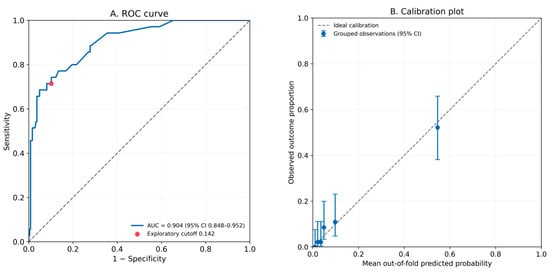
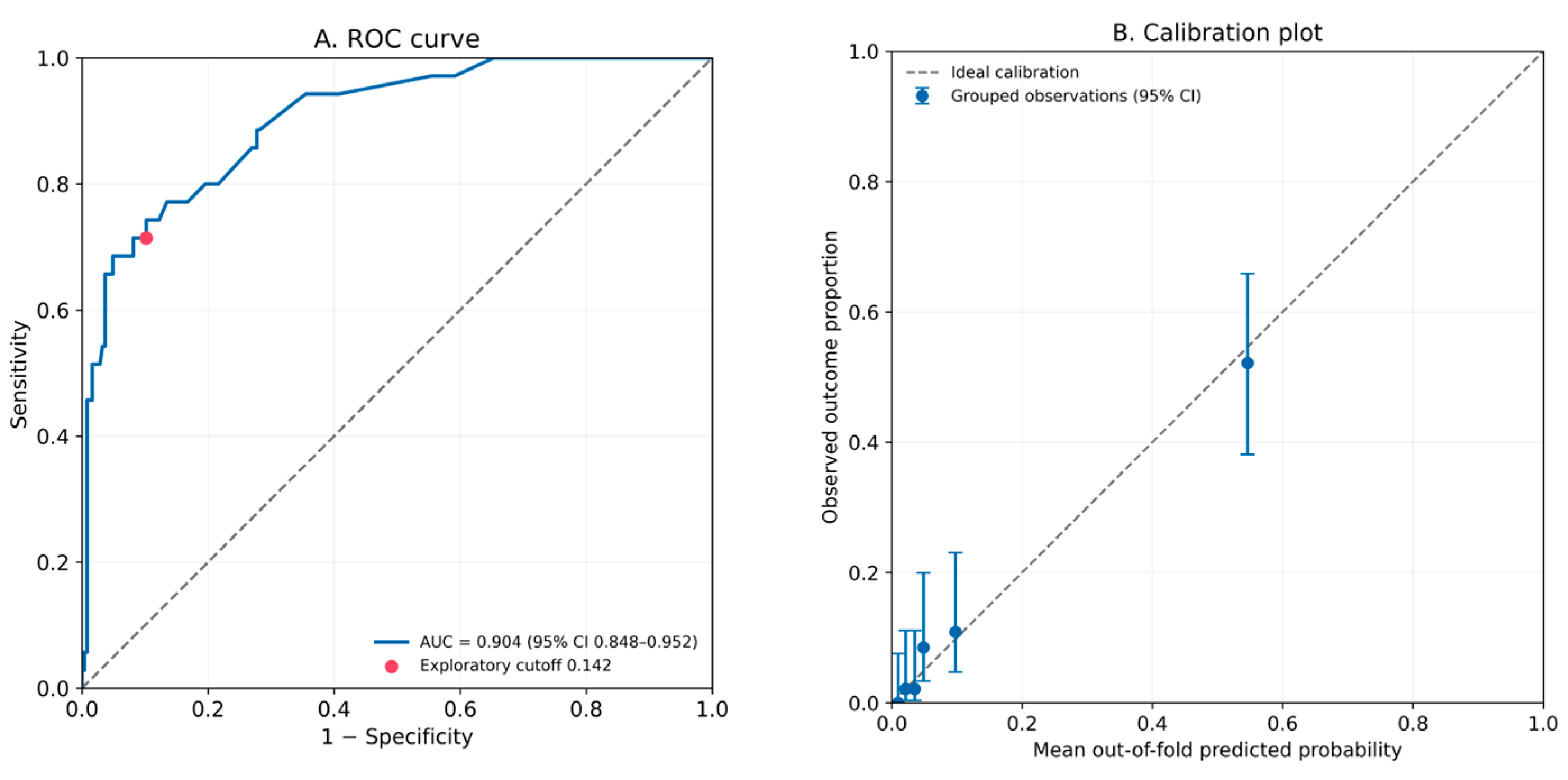
Model discrimination was assessed using the AUC ROC with a 95% bootstrap interval. Calibration was assessed graphically and using the Brier score, calibration intercept, and calibration slope. Stratified 10-fold cross-validation was used for internal validation. In addition, the model was refitted in each of 2000 bootstrap samples, and mean optimism in the AUC and Brier score was calculated; each optimism estimate was subtracted from the corresponding apparent value. In both validation procedures, the selected two-predictor model was refitted, but the complete candidate-predictor selection process was not repeated. The cutoff maximizing the Youden index, sensitivity, specificity, positive and negative predictive values, and accuracy were reported only as exploratory characteristics calculated in the original sample. Reporting followed current recommendations for the development, internal validation, and transparent presentation of prediction models [11,12,13,14,23,24,25,26]. A two-sided p value < 0.05 was considered statistically significant. The 95% confidence interval for the apparent AUC was calculated using the 2.5th and 97.5th percentiles of the AUC distribution obtained from 2000 paired bootstrap resamples of the observed outcomes and the original fitted probabilities. Bootstrap sampling used NumPy’s default_rng with a fixed seed of 1655. The ROC curve and calibration plot are presented in Figure 1A and Figure 1B, respectively.
Figure 1.
ROC curve in the original sample and calibration plot of out-of-fold model predictions. Panel (B): Points represent mean out-of-fold predicted probabilities and observed outcome proportions across six approximately equal-sized groups. Vertical error bars show Wilson 95% confidence intervals. The dashed diagonal indicates ideal calibration. No smoothing was applied. Panel (A): The cutoff marker and Table 1 classification measures use the unrounded Youden-index cutoff; its displayed value of 0.142 is rounded.
Table 1.
Exploratory performance measures at the unrounded Youden-index cutoff (displayed as 0.142) in the original sample.
For the calibration plot, infants were ranked by their out-of-fold predicted probabilities and divided into six approximately equal-sized groups (46–47 infants per group); ties were resolved using the original row order. Each point represented the mean predicted probability and the observed outcome proportion within a group; vertical error bars indicated Wilson 95% confidence intervals for the observed proportions. No smoothing was applied. The calibration intercept and slope were estimated jointly by logistic regression of the observed outcome on the logit of individual out-of-fold predicted probabilities. The cross-validation folds were generated with random_state = 1655. All performance calculations used unrounded model coefficients and the unrounded Youden-index cutoff (approximately 0.141895473); 0.142 is the cutoff rounded for presentation.
Statistical analyses were performed using Python. The final reproducibility check was conducted in Python 3.12.14 with NumPy 2.3.5, pandas 2.2.3, SciPy 1.17.0, and scikit-learn 1.8.0. Figures were generated using Matplotlib 3.10.8. Stratified 10-fold cross-validation and bootstrap validation with 2000 resamples used a fixed random seed of 1655.
3. Results
3.1. Frequency of the Composite Adverse Outcome
The analysis included 280 preterm infants. Median gestational age was 34.0 [32.0; 35.0] weeks, and median birth weight was 2188 [1660; 2490] g. The composite adverse outcome occurred in 35 infants (12.5%) (Table 2); none of its components occurred in the remaining 245 infants (87.5%). The gestational-age distribution was as follows: <28 weeks, 23 infants (8.2%); 28–31 weeks and 6 days, 43 (15.4%); 32–33 weeks and 6 days, 65 (23.2%); and 34–36 weeks and 6 days, 149 (53.2%).
Table 2.
Frequency of the components of the composite adverse neonatal outcome.
The total number of individual complications exceeded the number of infants with the composite outcome because more than one component could occur in the same infant.
3.2. Comparison of Infants with and Without the Composite Outcome
Compared with infants without the adverse outcome, those with the composite adverse outcome had lower gestational age, birth weight and length, and lower 1- and 5-minute Apgar scores. They also had lower initial leukocyte counts, hemoglobin concentrations, and platelet counts. Invasive mechanical ventilation immediately after birth was required in 22 of 35 infants (62.9%) with the adverse outcome and in 52 of 245 infants (21.2%) without the adverse outcome (p < 0.001) (Table 3).
Table 3.
Characteristics of infants according to the composite outcome.
3.3. Prediction Model
Gestational age and the 5 min Apgar score were included in the final model. Both variables remained independently and significantly associated with the outcome (Table 4).
Table 4.
Multivariable logistic regression model.
Equations (1) and (2) use the standard logistic regression formulation [17]. Equation (2) defines the linear predictor, Z = β0 + β1 × GA + β2 × Apgar5; the intercept and coefficients were estimated by maximum likelihood from the 280 infants in the development cohort, with the composite outcome coded as 1 when present and 0 when absent. Equation (1), P = 1/(1 + exp(−Z)), converts the log-odds into the predicted probability. Gestational age was expressed in weeks, with additional days converted to fractions of a week, and the 5 min Apgar score was entered in points. The model coefficients are specific to this cohort and were not taken from a published equation.
Individual probability was calculated using the following equations:
P = 1/(1 + e−z)
Z = 12.817091 − 0.306812 × GA − 0.804504 × Apgar5
The area under the ROC curve was 0.904 (95% bootstrap CI 0.848–0.952). After bootstrap optimism correction, the AUC was 0.898; the out-of-fold AUC from 10-fold cross-validation was 0.892. The Youden-index cutoff in the original sample was approximately 0.141895473 (reported as 0.142 after rounding).
The Brier score was 0.064 in the original sample, 0.067 after bootstrap optimism correction, and 0.066 under cross-validation. For the out-of-fold predictions, the calibration intercept was −0.113, and the slope was 0.925, with a slope close to the ideal value of 1. The cutoff-based measures require independent evaluation and are not intended to guide clinical decisions on their own.
4. Discussion
This prospective cohort study identified gestational age and the 5 min Apgar score as predictors of the composite adverse outcome, which occurred in 35 of 280 infants (12.5%). The two-predictor model showed high discrimination during internal validation, but its transportability and clinical utility remain to be established.
Combining death and major complications of prematurity in a composite endpoint is consistent with approaches used in large neonatal studies [2,16,27,28]. However, its components differ in pathophysiology, timing, and severity. The model estimates the probability of at least one included event, rather than the risk of a specific complication.
The 12.5% frequency of the composite adverse outcome in our study cannot be compared directly with findings from studies that predominantly enrolled the most immature infants. Our cohort included infants born from 24 weeks to 36 weeks and 6 days of gestation, including many infants born at later gestational ages who consequently had a lower risk of severe complications. In contrast, many large neonatal studies are restricted to infants born at 22–28 weeks or to very-low-birth-weight infants [28,29,30,31,32,33]. In the NICHD Neonatal Research Network study of infants born at 22–28 weeks, grade III–IV intracranial hemorrhage occurred in 14.3%, NEC in 8.9%, late-onset infection in 19.9%, and grade III BPD, classified according to the mode of respiratory support at 36 weeks’ postmenstrual age, in 8.0% [2]. The latter definition differs from the Jobe–Bancalari criteria used in our study. In the Turkish multicenter TNS-SECRETS study of very-low-birth-weight infants, BPD, stage II–III NEC, sepsis, and grade III–IV IVH occurred in 39.5%, 8.3%, 55.7%, and 8.7%, respectively; the NEC and overall sepsis frequencies were reported in Table 4 of that study [27]. Differences in gestational age, birth weight, and eligibility criteria must therefore be considered when comparing adverse-outcome frequencies.
NEC occurred in eight infants (2.9%) and culture-confirmed neonatal sepsis in five (1.8%). Comparisons with published rates must account for differences in gestational age and diagnostic definitions [5,6,7,8,27,29,31,32,34,35]. Only sepsis with compatible clinical signs and a positive blood culture was included; studies incorporating culture-negative clinical sepsis therefore assess a broader endpoint.
Each additional week of gestation was associated with a 26.4% reduction in the odds of the composite outcome, consistent with the association between prematurity and mortality or major morbidity in larger cohorts [2,27,28,29,33]. Gestational age captures baseline organ immaturity and vulnerability to several endpoint components.
Birth weight also differed substantially between groups but was not included together with gestational age. These variables are closely related and partly describe the same aspect of biological maturity. With few events, simultaneous inclusion of correlated predictors could reduce coefficient stability without meaningfully increasing information. FGR was considered separately as a measure of growth relative to gestational age but was not retained in the final model in this sample. This does not exclude its clinical relevance and warrants reassessment in a larger independent cohort.
Each one-point increase in the 5 min Apgar score was associated with a 55.3% reduction in the odds of the outcome, consistent with population-based and multinational studies [15,16]. The score complements gestational age by describing early postnatal adaptation, but it also depends on maturity and resuscitation and should not be interpreted as a diagnosis of asphyxia.
The apparent AUC was 0.904, the bootstrap optimism-corrected AUC was 0.898, and the out-of-fold AUC was 0.892. The ROC curve illustrates discrimination in the original sample (Figure 1A), while the out-of-fold calibration plot illustrates agreement between predicted and observed risks (Figure 1B). Both aspects are necessary for model evaluation [11,12,13,14,23,24,25,26].
The jointly estimated out-of-fold calibration intercept and slope were −0.113 and 0.925. The Brier score was 0.064 in the original sample, 0.067 after optimism correction, and 0.066 under cross-validation, compared with approximately 0.109 for a constant prediction of 12.5%. These findings support further evaluation, although calibration estimates based on only 35 events remain imprecise [11,12,23,24,25].
The parsimony of the final model is methodologically appropriate given the 35 events: an excessive number of parameters would increase the risk of overfitting and coefficient instability [24]. The reported performance measures should be considered internal estimates. Even a high AUC after resampling does not establish model transportability to another center, time period, or clinical population [11,12,26,36].
Published models provide useful benchmarks, although their populations, endpoints, and validation settings differ. Cao et al. studied infants born at 24–28 weeks and developed admission-based models incorporating gestational age, birth weight, the 5 min Apgar score, and additional clinical predictors. External-validation AUCs were 0.76 for mortality and 0.70 for survival without major morbidity [17]. Torchin et al. studied infants born before 30 weeks; external-validation AUCs for bronchopulmonary dysplasia or death were 0.81 for logistic regression and 0.80 for random forests, with risk underestimation by both models [10]. Our two-predictor model covered a broader gestational-age range (24–36 + 6 weeks) and achieved an out-of-fold AUC of 0.892 for a different composite endpoint. These figures do not establish superiority: differences in case mix, outcome definitions, and internal versus external validation preclude direct ranking. Independent external validation is required before comparison of clinical performance.
The model uses two routinely recorded characteristics and requires no specialized investigations. Its potential role is early risk stratification to support clinical assessment; it does not replace diagnostic procedures or established management protocols. External validation and assessment of clinical utility are required before implementation [11,12,23,26]
The unrounded cutoff (displayed as 0.142) selected using the Youden index yielded a sensitivity of 74.3%, a specificity of 89.8%, and a negative predictive value of 96.1%. The high negative predictive value may be useful for identifying infants with a relatively low probability of the composite adverse neonatal outcome. However, predictive values depend on event prevalence, and the cutoff was selected and evaluated in the same sample. Until external validation is completed, the continuous predicted probability should be preferred to rigid categorization into risk groups.
Strengths include prospective data collection, complete endpoint and final-predictor data for all 280 infants, and recording of predictors before the assessed complications developed. Internal validation addressed both discrimination and calibration, and the reported equation permits reproducible probability calculation.
This was a single-center study; its coefficients may reflect local case mix, diagnostic practices, and organization of care. Only 35 of the 280 infants experienced the composite outcome. Despite restricting the model to two predictors, this event count may reduce coefficient stability and the precision of calibration estimates, and it precludes reliable assessment of interactions and nonlinear effects. Predictor selection was conducted in the full development cohort and was not repeated in bootstrap samples or cross-validation training folds. Internal validation therefore evaluates the selected model but does not fully account for uncertainty introduced by predictor selection.
The endpoint components differed in frequency and pathogenesis. BPD and NEC diagnoses were confirmed from the medical records according to the Jobe–Bancalari criteria and modified Bell staging criteria, respectively. All eight NEC cases met stage II–III criteria. Only culture-confirmed neonatal sepsis was included; culture-negative clinical sepsis was not included in the endpoint. The model predicts the overall in-hospital outcome and does not replace individual models for BPD, NEC, severe IVH, or mortality.
Independent temporal or geographical validation, decision-curve analysis, and long-term neurodevelopmental outcomes were not available. Seasonal differences in outcomes were not analyzed. Further work should evaluate the unchanged model in an independent cohort with prespecified outcome definitions and assess calibration and clinical utility.
5. Conclusions
In this prospective single-center cohort of 280 preterm infants, gestational age and the 5 min Apgar score were independently associated with a composite adverse neonatal outcome. The resulting two-predictor model demonstrated high discrimination during internal validation, with an out-of-fold AUC of 0.892 and a Brier score of 0.066. Its use of routinely available birth characteristics supports further evaluation as a tool for early risk stratification. However, the limited number of events and data-informed predictor selection introduce uncertainty, and performance in other populations remains unknown. Independent external validation, including assessment of calibration and clinical utility, is required before clinical implementation.
Author Contributions
N.B.: Conceptualization, Methodology, Writing—Review and Editing, Project Administration, Supervision. I.S.: Writing—Original Draft, Formal Analysis, Methodology. S.S.: Writing—Original Draft, Writing—Review and Editing, Methodology. O.A.: Writing—Original Draft, Methodology, Software. S.Z.: Data Curation, Writing—Review and Editing. All authors have read and agreed to the published version of the manuscript.
Funding
This research was supported by S.D. Asfendiyarov Kazakh National Medical University.
Institutional Review Board Statement
The study was conducted in accordance with the Declaration of Helsinki and approved by the local ethics committee of the Scientific Center of Pediatrics and Pediatric Surgery (protocol no. 26 dated 31 October 2024).
Informed Consent Statement
Written informed consent was obtained from the mother or legal representative of each infant before enrollment of the mother–infant pair.
Data Availability Statement
Deidentified data may be made available to researchers upon reasonable request, subject to approval by the principal investigator and compliance with ethical approval and personal data protection requirements.
Conflicts of Interest
The authors declare no conflicts of interest.
Abbreviations
The following abbreviations are used in this manuscript:
| IVH | Intraventricular Hemorrhage |
| PVL | Periventricular Leukomalacia |
| BPD | Bronchopulmonary Dysplasia |
| NEC | Necrotizing Enterocolitis |
| AUC | Area Under the Curve |
| CI | Confidence Interval |
| FGR | Fetal Growth Restriction |
| OR | Odds Ratio |
| ROC | Receiver Operating Characteristic |
| NICHD | National Institute of Child Health and Human Development |
| IRN | Individual Registration Number |
| NCJSC | Non-Profit Corporate Joint-Stock Company |
| Q1 | Quartile 1 |
| Q3 | Quartile 3 |
| TNS | Taylor Nelson Sofres |
References
- World Health Organization. Preterm Birth. Available online: https://www.who.int/news-room/fact-sheets/detail/preterm-birth (accessed on 11 September 2026).
- Bell, E.F.; Hintz, S.R.; Hansen, N.I.; Bann, C.M.; Wyckoff, M.H.; DeMauro, S.B.; Walsh, M.C.; Vohr, B.R.; Stoll, B.J.; Carlo, W.A.; et al. Mortality, In-Hospital Morbidity, Care Practices, and 2-Year Outcomes for Extremely Preterm Infants in the US, 2013–2018. JAMA 2022, 327, 248–263. [Google Scholar] [CrossRef] [Scilit] [PubMed]
- Jensen, E.A.; Dysart, K.; Gantz, M.G.; McDonald, S.; Bamat, N.A.; Keszler, M.; Kirpalani, H.; Laughon, M.M.; Poindexter, B.B.; Duncan, A.F.; et al. The Diagnosis of Bronchopulmonary Dysplasia in Very Preterm Infants: An Evidence-Based Approach. Am. J. Respir. Crit. Care Med. 2019, 200, 751–759. [Google Scholar] [CrossRef] [Scilit] [PubMed]
- Thébaud, B.; Goss, K.N.; Laughon, M.; Whitsett, J.A.; Abman, S.H.; Steinhorn, R.H.; Aschner, J.L.; Davis, P.G.; McGrath-Morrow, S.A.; Soll, R.F.; et al. Bronchopulmonary Dysplasia. Nat. Rev. Dis. Primers 2019, 5, 78. [Google Scholar] [PubMed]
- Cao, X.; Zhang, L.; Jiang, S.; Li, M.; Yan, C.; Shen, C.; Yang, Y.; Lee, S.K.; Cao, Y. Epidemiology of Necrotizing Enterocolitis in Preterm Infants in China: A Multicenter Cohort Study from 2015 to 2018. J. Pediatr. Surg. 2022, 57, 382–386. [Google Scholar] [CrossRef] [Scilit] [PubMed]
- Hu, X.; Liang, H.; Li, F.; Zhang, R.; Zhu, Y.; Zhu, X.; Xu, Y. Necrotizing Enterocolitis: Current Understanding of the Prevention and Management. Pediatr. Surg. Int. 2024, 40, 32. [Google Scholar] [CrossRef] [Scilit] [PubMed]
- Stylianou-Riga, P.; Boutsikou, T.; Kouis, P.; Michailidou, K.; Kinni, P.; Sokou, R.; Iliodromiti, Z.; Pitsios, C.; Yiallouros, P.K.; Iacovidou, N. Epidemiology, Risk Factors, Clinical Presentation and Complications of Late-Onset Neonatal Sepsis among Preterm Neonates in Cyprus: A Prospective Case-Control Study. BMC Pediatr. 2024, 24, 50. [Google Scholar] [CrossRef] [Scilit] [PubMed]
- Duggan, H.L.; Shah, P.S.; Battin, M.; Klinger, G.; Adams, M.; Vento, M.; Lastrucci, V.; Rugolo, L.M.S.S.; Regina, M.; Håkansson, S.; et al. Early-Onset Sepsis in Preterm Neonates of 22–28 Weeks’ Gestation: An International Cohort Study. J. Pediatr. Clin. Pract. 2026, 21, 200216. [Google Scholar] [CrossRef] [Scilit] [PubMed]
- Shukla, V.V.; Wen, J.; Carlo, W.A. Intraventricular Hemorrhage in Preterm Infants: A Systematic Review of Risk- and Outcome-Prediction Models. Semin. Fetal Neonatal Med. 2026, 31, 101725. [Google Scholar] [CrossRef] [Scilit] [PubMed]
- Torchin, H.; Dhiman, P.; Ancel, P.Y.; Durrmeyer, X.; Jarreau, P.-H.; Nuytten, A.; Truffert, P.; Zeitlin, J.; Collins, G.S. Early Prediction of Bronchopulmonary Dysplasia: Comparison of Modelling Methods, Development and Validation Studies. Pediatr. Res. 2026, 99, 88–95. [Google Scholar] [CrossRef] [Scilit] [PubMed]
- Collins, G.S.; Dhiman, P.; Ma, J.; Schlussel, M.M.; Archer, L.; Van Calster, B.; E Harrell, F.; Martin, G.P.; Moons, K.G.M.; van Smeden, M.; et al. Evaluation of Clinical Prediction Models (Part 1): From Development to External Validation. BMJ 2024, 384, e074819. [Google Scholar] [CrossRef] [Scilit] [PubMed]
- Riley, R.D.; Archer, L.; Snell, K.I.E.; Ensor, J.; Dhiman, P.; Martin, G.P.; Bonnett, L.J.; Collins, G.S. Evaluation of Clinical Prediction Models (Part 2): How to Undertake an External Validation Study. BMJ 2024, 384, e074820. [Google Scholar] [CrossRef] [Scilit] [PubMed]
- Collins, G.S.; Reitsma, J.B.; Altman, D.G.; Moons, K.G.M. Transparent Reporting of a Multivariable Prediction Model for Individual Prognosis or Diagnosis (TRIPOD): The TRIPOD Statement. BMJ 2015, 350, g7594. [Google Scholar] [CrossRef] [Scilit] [PubMed]
- Collins, G.S.; Moons, K.G.M.; Dhiman, P.; Riley, R.D.; Beam, A.L.; Van Calster, B.; Ghassemi, M.; Liu, X.; Reitsma, J.B.; van Smeden, M.; et al. TRIPOD+AI Statement: Updated Guidance for Reporting Clinical Prediction Models That Use Regression or Machine Learning Methods. BMJ 2024, 385, e078378, Correction in BMJ 2024, 385, q902. [Google Scholar] [CrossRef] [Scilit] [PubMed]
- Cnattingius, S.; Johansson, S.; Razaz, N. Apgar Score and Risk of Neonatal Death among Preterm Infants. N. Engl. J. Med. 2020, 383, 49–57. [Google Scholar] [CrossRef] [Scilit] [PubMed]
- Ehrhardt, H.; Behboodi, S.; Maier, R.F.; Aubert, A.M.; Åden, U.; Draper, E.S.; Gudmundsdottir, A.; Siljehav, V.; Varendi, H.; Weber, T.; et al. Five-Minute Apgar Scores and Its Prognostic Value for Mortality and Severe Morbidity in Very Preterm Infants: A Multinational Cohort Study. BJOG 2026, 133, 649–659. [Google Scholar] [CrossRef] [Scilit] [PubMed]
- Cao, X.; Li, S.; Gu, X.; Chen, H.; Yang, C.; Qian, M.; Tian, X.; Xu, F.; Yang, Z.; Wang, Y.; et al. Predicting Death and Survival without Major Morbidity for Extremely Preterm Infants Using Information on Hospital Admission: A Multicenter Cohort Study. Transl. Pediatr. 2025, 14, 927–938. [Google Scholar] [CrossRef] [Scilit] [PubMed]
- Jobe, A.H.; Bancalari, E. Bronchopulmonary Dysplasia. Am. J. Respir. Crit. Care Med. 2001, 163, 1723–1729. [Google Scholar] [CrossRef] [Scilit] [PubMed]
- Walsh, M.C.; Kliegman, R.M. Necrotizing Enterocolitis: Treatment Based on Staging Criteria. Pediatr. Clin. North Am. 1986, 33, 179–201. [Google Scholar] [CrossRef] [Scilit] [PubMed]
- Papile, L.A.; Burstein, J.; Burstein, R.; Koffler, H. Incidence and Evolution of Subependymal and Intraventricular Hemorrhage: A Study of Infants with Birth Weights Less than 1,500 gm. J. Pediatr. 1978, 92, 529–534. [Google Scholar] [CrossRef] [Scilit] [PubMed]
- de Vries, L.S.; Eken, P.; Dubowitz, L.M. The Spectrum of Leukomalacia Using Cranial Ultrasound. Behav. Brain Res. 1992, 49, 1–6. [Google Scholar] [CrossRef] [Scilit] [PubMed]
- Ministry of Health of the Republic of Kazakhstan. Clinical Protocol for the Diagnosis and Treatment of Bacterial Sepsis of the Newborn; Ministry of Healthcare of the Republic of Kazakhstan: Astana, Kazakhstan, 2023; Approved by the Joint Commission on Healthcare Quality on 28 July 2023, Protocol No. 185. (In Russian) [Google Scholar]
- Steyerberg, E.W. Clinical Prediction Models: A Practical Approach to Development, Validation, and Updating, 2nd ed.; Springer: Cham, Switzerland, 2019; Available online: https://link.springer.com/book/10.1007/978-3-030-16399-0?utm_source=chatgpt.com (accessed on 1 September 2026).
- Riley, R.D.; Ensor, J.; Snell, K.I.E.; Harrell, F.E.; Martin, G.P.; Reitsma, J.B.; Moons, K.G.M.; Collins, G.; van Smeden, M. Calculating the Sample Size Required for Developing a Clinical Prediction Model. BMJ 2020, 368, m441. [Google Scholar] [CrossRef] [Scilit] [PubMed]
- Van Calster, B.; McLernon, D.J.; van Smeden, M.; Wynants, L.; Steyerberg, E.W. Calibration: The Achilles Heel of Predictive Analytics. BMC Med. 2019, 17, 230. [Google Scholar] [CrossRef] [Scilit] [PubMed]
- Wolff, R.F.; Moons, K.G.M.; Riley, R.D.; Whiting, P.F.; Westwood, M.; Collins, G.S.; Reitsma, J.B.; Kleijnen, J.; Mallett, S. PROBAST: A Tool to Assess the Risk of Bias and Applicability of Prediction Model Studies. Ann. Intern. Med. 2019, 170, 51–58. [Google Scholar] [CrossRef] [Scilit] [PubMed]
- Cetinkaya, M.; Memur, S.; Koc, E.; Bas, A.Y. Turkish Neonatal Society SECRETS Study Group. Assessment of Survival and Neonatal Morbidity Rates of Very Low Birth Weight Infants in Türkiye: Turkish Neonatal Society SECRETS (TNS-SECRETS) Study. Sci. Rep. 2026, 16, 24998. [Google Scholar] [CrossRef] [Scilit] [PubMed]
- Zhang, X.; Wang, P.; Wan, Z.; Xiong, P.; Rao, D.; Yu, Z.; Wu, G. Prevalence of Survival without Major Morbidity and Associated Risk Factors among Very Preterm Infants: A Systematic Review and Meta-Analysis. Front. Pediatr. 2025, 13, 1628472. [Google Scholar] [CrossRef] [Scilit] [PubMed]
- Song, I.G.; Lim, J.W.; Chang, Y.S.; Korean Neonatal Network. Improved Outcomes of Very Low Birth Weight Infants in Korea: 2015–2016 vs. 2021–2022 from the Korean Neonatal Network. J. Korean Med. Sci. 2025, 40, e258. [Google Scholar] [CrossRef] [Scilit] [PubMed]
- Adams, M.; Bassler, D.; Bucher, H.U.; Roth-Kleiner, M.; Berger, T.M.; Braun, J.; Puhan, M.A.; Edwards, E.; Soll, R.; Von Wyl, V.; et al. Variability of Very Low Birth Weight Infant Outcome and Practice in Swiss and US Neonatal Units. Pediatrics 2018, 141, e20173436. [Google Scholar] [CrossRef] [Scilit] [PubMed]
- Haumont, D.; Modi, N.; Saugstad, O.D.; Antetere, R.; NguyenBa, C.; Turner, M.; Costeloe, K.; Aelvoet, W. Evaluating Preterm Care across Europe Using the eNewborn European Network Database. Pediatr. Res. 2020, 88, 484–495. [Google Scholar] [CrossRef] [Scilit] [PubMed]
- D’Apremont, I.; Marshall, G.; Musalem, C.; Mariani, G.; Musante, G.; Bancalari, A.; Fabres, J.; Mena, P.; Zegarra, J.; Tavosnanska, J.; et al. Trends in Perinatal Practices and Neonatal Outcomes of Very Low Birth Weight Infants during a 16-Year Period at NEOCOSUR Centers. J. Pediatr. 2020, 225, 44–50.e1. [Google Scholar] [CrossRef] [Scilit] [PubMed]
- Ausbeck, E.B.; Allman, P.H.; Szychowski, J.M.; Subramaniam, A.; Katheria, A. Neonatal Outcomes at Extreme Prematurity by Gestational Age versus Birth Weight in a Contemporary Cohort. Am. J. Perinatol. 2021, 38, 880–888. [Google Scholar] [CrossRef] [Scilit] [PubMed]
- Battersby, C.; Santhalingam, T.; Costeloe, K.; Modi, N. Incidence of Neonatal Necrotising Enterocolitis in High-Income Countries: A Systematic Review. Arch. Dis. Child. Fetal Neonatal Ed. 2018, 103, F182–F189. [Google Scholar] [CrossRef] [Scilit] [PubMed]
- Ergenekon, E.; Tayman, C.; Özkan, H. Turkish Neonatal Society Necrotizing Enterocolitis Diagnosis, Treatment and Prevention Guidelines. Turk. Arch. Pediatr. 2021, 56, 513–524. [Google Scholar] [PubMed]
- Wynants, L.; Van Calster, B.; Collins, G.S.; Riley, R.D.; Heinze, G.; Schuit, E.; Bonten, M.M.J.; Dahly, D.L.; Damen, J.A.; Debray, T.P.A.; et al. Prediction Models for Diagnosis and Prognosis of COVID-19: Systematic Review and Critical Appraisal. BMJ 2020, 369, m1328, Correction in BMJ 2020, 369, m2204. [Google Scholar] [CrossRef] [Scilit] [PubMed]

Disclaimer/Publisher’s Note: The statements, opinions and data contained in all publications are solely those of the individual author(s) and contributor(s) and not of MDPI and/or the editor(s). MDPI and/or the editor(s) disclaim responsibility for any injury to people or property resulting from any ideas, methods, instructions or products referred to in the content. |
© 2026 by the authors. Licensee MDPI, Basel, Switzerland. This article is an open access article distributed under the terms and conditions of the Creative Commons Attribution (CC BY) license.