1. Introduction
The rapid proliferation of synthetic and misleading media across digital platforms poses a growing threat to public trust, democratic processes, and informed decision-making [
1,
2]. Advances in content generation technologies have made it increasingly easy to produce convincing false narratives at scale, while the velocity of online information sharing far exceeds the capacity of manual fact-checking efforts. As a result, automated fake media detection has become an urgent research priority, attracting significant attention from the natural language processing and machine learning communities.
Traditional approaches to fake media detection have relied on surface-level linguistic features, metadata analysis, or supervised classifiers trained on labeled datasets [
3,
4]. More recently, transformer-based models such as BERT and RoBERTa have been fine-tuned for misinformation classification, achieving strong performance on standard benchmarks [
5,
6,
7,
8]. However, these methods treat the detection task as a direct input-to-label mapping problem, overlooking the internal reasoning processes of the models they employ. Large language models (LLMs), despite their remarkable capacity for structured reasoning and world knowledge representation, are similarly deployed as black-box predictors that generate a single deterministic output for each input.
This single-pass classification paradigm has a fundamental limitation: it cannot capture the epistemic uncertainty that arises when a model encounters fabricated or weakly grounded content. When an LLM analyzes genuine, factually coherent media, its internal reasoning tends to converge toward consistent analytical conclusions regardless of stochastic sampling variation. In contrast, fabricated media often contain claims that conflict with the model’s encoded knowledge, producing divergent and unstable reasoning trajectories when the same input is analyzed multiple times under controlled randomness. This observation suggests that reasoning instability itself can serve as a discriminative signal for veracity assessment.
The central hypothesis of this work is not that reasoning divergence always implies falsehood but that misleading, fabricated, or weakly grounded content tends to induce greater stochastic instability in LLM reasoning than genuine content. This is because such inputs often lack a stable factual anchor in the model’s internal knowledge representation, allowing different sampled reasoning chains to diverge in their interpretation, evidential weighting, and final judgment. Importantly, we do not claim that every instance of divergence is evidence of deception; ambiguous, incomplete, or highly domain-specific genuine content may also produce variability. Rather, the proposed framework treats reasoning instability as a probabilistic signal of epistemic uncertainty that is expected to be higher for fake media on average.
Recent work on chain-of-thought prompting [
9] and self-consistency decoding [
10] has demonstrated that sampling multiple reasoning paths from language models and analyzing their agreement provides reliable signals for identifying correct answers in reasoning tasks. Separately, research on semantic uncertainty estimation [
11,
12] and consistency-based hallucination detection [
13] has shown that divergence among stochastically sampled LLM outputs can effectively identify unreliable or fabricated content. However, these approaches have not been unified into a framework specifically designed for fake media detection, nor have they incorporated structured multi-dimensional reasoning decomposition to enable interpretable analysis of where instability originates.
This paper addresses these gaps by introducing a novel framework for fake media detection based on self-consistency divergence across multi-perspective LLM reasoning. Instead of generating a single verdict, the proposed method prompts a language model to analyze a given media item from multiple independent reasoning perspectives, including factual consistency, logical coherence, emotional manipulation, and source credibility assessment. By sampling multiple reasoning chains under controlled stochasticity and quantifying semantic divergence and logical instability across the generated explanations, the framework transforms reasoning variability into a measurable veracity signal. The central hypothesis is that fake media induces significantly higher reasoning variance compared to genuine content, as fabricated narratives often lack stable factual grounding within the model’s internal knowledge representation.
The main contributions of this paper are summarized as follows:
A new formulation of fake media detection based on reasoning instability, where the dispersion of stochastic reasoning trajectories is used as a signal for assessing media reliability.
A multi-dimensional reasoning decomposition framework that separates reasoning trajectories into factual, logical, emotional, and source credibility components, enabling interpretable analysis of reasoning disagreement.
A distributional modeling approach for large language model reasoning, where multiple reasoning chains are sampled and analyzed as a distribution in semantic space to capture variability in analytical interpretations.
A set of instability-based metrics that quantify semantic divergence and logical variance across reasoning trajectories, enabling veracity inference through stability-based decision mechanisms.
Extensive experiments on multiple misinformation benchmarks demonstrating that fake media consistently induces higher reasoning instability than genuine content, validating the effectiveness of the proposed framework.
The remainder of this paper is organized as follows.
Section 2 reviews related work on chain-of-thought reasoning, semantic uncertainty estimation, consistency-based hallucination detection, LLM-based misinformation detection, and multi-perspective reasoning.
Section 3 presents the proposed methodology and framework architecture, including the reasoning instability formulation, multi-dimensional decomposition, distributional modeling, and instability metrics.
Section 4 reports the experimental results and comparative evaluations.
Section 5 discusses the implications, limitations, and directions for future research. Finally,
Section 6 concludes the paper.
2. Literature Review
The proposed framework draws on and extends several interconnected research directions: chain-of-thought reasoning and self-consistency in large language models, uncertainty and semantic divergence estimation, consistency-based hallucination detection, LLM-based misinformation detection, and multi-perspective reasoning. This section reviews the most relevant contributions in each area.
2.1. Chain-of-Thought Reasoning and Self-Consistency
The capacity of large language models to perform structured multi-step reasoning was established by Wei et al. [
9], who demonstrated that chain-of-thought (CoT) prompting, where a few reasoning demonstrations are included in the prompt, dramatically improves performance on arithmetic, commonsense, and symbolic reasoning tasks. This work showed that explicitly eliciting intermediate reasoning steps unlocks capabilities that standard prompting cannot access, particularly in models with sufficient scale.
Building directly on this foundation, Wang et al. [
10] proposed self-consistency decoding as an alternative to greedy decoding in CoT prompting. Instead of selecting a single reasoning path, the method samples multiple diverse reasoning chains from the language model and selects the most consistent answer by marginalizing over the sampled paths. Self-consistency achieved substantial improvements across benchmarks including GSM8K (+17.9%) and StrategyQA (+6.4%), demonstrating that agreement among independently sampled reasoning trajectories serves as a reliable signal of answer correctness.
The present work extends this principle from answer-level consistency to veracity-level reasoning stability. While Wang et al. [
10] used self-consistency to identify correct answers in reasoning tasks, the proposed framework uses divergence among reasoning trajectories as a discriminative signal for detecting fabricated media.
2.2. Uncertainty Estimation and Semantic Divergence in LLMs
Quantifying uncertainty in language model outputs has emerged as a critical research challenge, particularly for identifying unreliable generations. Traditional approaches rely on token-level measures such as predictive entropy or softmax confidence, but these metrics capture lexical variability rather than meaningful semantic disagreement.
Kuhn et al. [
11] introduced semantic entropy, a method that computes uncertainty at the level of meaning rather than specific token sequences. By clustering sampled outputs into semantically equivalent groups and computing entropy over these clusters, their approach detects confabulations more reliably than token-level methods. This work was subsequently extended and published in Nature [
12], establishing that semantic-level uncertainty estimation outperforms lexical-level approaches across diverse question-answering benchmarks.
The proposed framework shares the core intuition of semantic entropy: that meaningful uncertainty should be measured over semantic content rather than surface tokens. However, while semantic entropy aggregates sampled outputs into a single scalar uncertainty estimate, the present work introduces a multi-dimensional decomposition that separates divergence into factual, logical, emotional, and source credibility components.
2.3. Consistency-Based Hallucination Detection
A closely related line of research leverages cross-sample consistency to detect hallucinated content in LLM outputs. Ref. [
13] proposed SelfCheckGPT, a zero-resource method that samples multiple responses from a language model and measures their mutual consistency. The method is grounded in the observation that if a model possesses knowledge of a concept, its stochastic responses tend to agree on factual details, whereas hallucinated content produces divergent statements across samples.
This consistency-based detection principle is conceptually central to the present work. SelfCheckGPT applies consistency checking to identify hallucinations in biographical and factual generation tasks. The proposed framework extends this logic to the domain of fake media detection, hypothesizing that fabricated or misleading media lacks the stable factual grounding needed to produce consistent reasoning across stochastic samples. Furthermore, while SelfCheckGPT operates on unstructured text comparisons, the present method decomposes reasoning into interpretable analytical dimensions before measuring consistency.
2.4. LLM-Based Misinformation Detection
The application of large language models to misinformation detection has rapidly expanded in recent years. Refs. [
14,
15] provided a comprehensive survey of opportunities and challenges in combating misinformation using LLMs, identifying seven categories of detection methods and highlighting the dual-use nature of these models as both generators and detectors of false content. Their analysis emphasizes that LLMs with chain-of-thought prompting generally outperform standard prompting strategies for misinformation detection.
In a related empirical study, Refs. [
16,
17] investigated whether LLM-generated misinformation can be reliably detected, finding that such content is often harder to identify than human-written misinformation due to its linguistic fluency and coherence. This finding underscores the need for detection approaches that go beyond surface linguistic features. While these approaches treat LLMs primarily as classifiers or explanation generators, the proposed framework takes a fundamentally different approach by treating the internal reasoning variability of LLMs as the primary detection signal. Rather than extracting a single prediction or explanation, the method quantifies how stably the model reasons about a given media instance under repeated stochastic sampling.
Recent retrieval-augmented fact-checking frameworks provide an important complementary line of work. TrumorGPT is a graph-based retrieval-augmented large language model for fact-checking in the health domain; it uses updated semantic health knowledge graphs to support semantic reasoning and reduce hallucination and static-training-data limitations. Another recent framework, FCRV, combines LLM-based claim extraction with RAG fact-checking to construct a full-context representation for news articles and improve verification stability. These studies highlight the value of external evidence grounding, whereas the present work focuses on internal reasoning instability as a veracity signal [
18,
19].
Recent work has also explored the use of large language models for group decision-making and multi-agent reasoning. For example, Ref. [
20] investigate the modeling of large-scale group decision-making processes using LLMs, demonstrating how structured grouping mechanisms can enhance collective reasoning. Similarly, Ref. [
21] provide a comprehensive analysis of LLM-based multi-agent decision-making, highlighting key challenges such as coordination, consistency, and scalability [
22]. These studies reinforce the importance of structured multi-perspective reasoning in complex decision tasks. In contrast to explicit multi-agent coordination, the proposed framework leverages a single LLM to simulate multiple analytical perspectives through structured prompting, enabling controlled and interpretable reasoning decomposition without requiring multiple interacting agents [
23].
2.5. Multi-Perspective and Multi-Agent Reasoning
The use of multiple reasoning perspectives to improve analytical robustness has been explored through multi-agent frameworks. Du et al. [
24] demonstrated that multi-agent debate, where multiple LLM instances argue different positions, improves factual accuracy and reasoning quality compared to single-agent approaches. The proposed framework shares the aim of decomposing analysis into multiple viewpoints but achieves it through structured prompt-guided reasoning dimensions rather than independent agent instances.
2.6. Benchmark Datasets for Fake Media Detection
Three widely used benchmarks are employed in this work. LIAR [
5] provides approximately 12.8 K short fact-checked claims from PolitiFact with fine-grained truthfulness labels, suitable for claim-level veracity analysis. FakeNewsNet [
6] offers a multi-dimensional repository combining news content with social context signals from PolitiFact and GossipCop. CoAID [
7] provides domain-specific COVID-19 healthcare misinformation data including 5216 news items and associated engagement signals. These datasets collectively cover claim-level, article-level, and domain-specific misinformation settings, enabling comprehensive evaluation of the proposed framework.
2.7. Research Gap and Contribution
While existing research has advanced self-consistency for reasoning tasks, semantic uncertainty for hallucination detection, and LLM-based approaches for misinformation identification, no prior work has unified these directions into a framework that uses structured multi-dimensional reasoning divergence as a veracity signal for fake media detection. The present work addresses this gap by: (1) extending self-consistency from answer agreement to reasoning stability analysis; (2) decomposing reasoning into interpretable analytical dimensions; (3) modeling stochastic reasoning outputs as distributions in semantic space; and (4) introducing instability-based metrics that quantify both semantic divergence and logical variance for veracity inference.
Table 1 summarizes the key methodological contributions from the most relevant studies informing the present work.
Although consistency-based hallucination detection also posits that disagreement across sampled outputs can reveal unreliability, its goal is fundamentally different from ours. Methods such as SelfCheckGPT assess whether multiple responses to a prompt are mutually consistent as a way to detect hallucinated statements in generated text. By contrast, our framework applies this principle to media veracity assessment and shifts the target of analysis from answer correctness to reasoning stability under a media classification setting. The innovation of the present work lies in using multi-perspective reasoning variability not merely as a consistency check, but as a structured veracity signal for fake media detection, with explicit decomposition into factual, logical, emotional, and source-related dimensions.
3. Materials and Methods
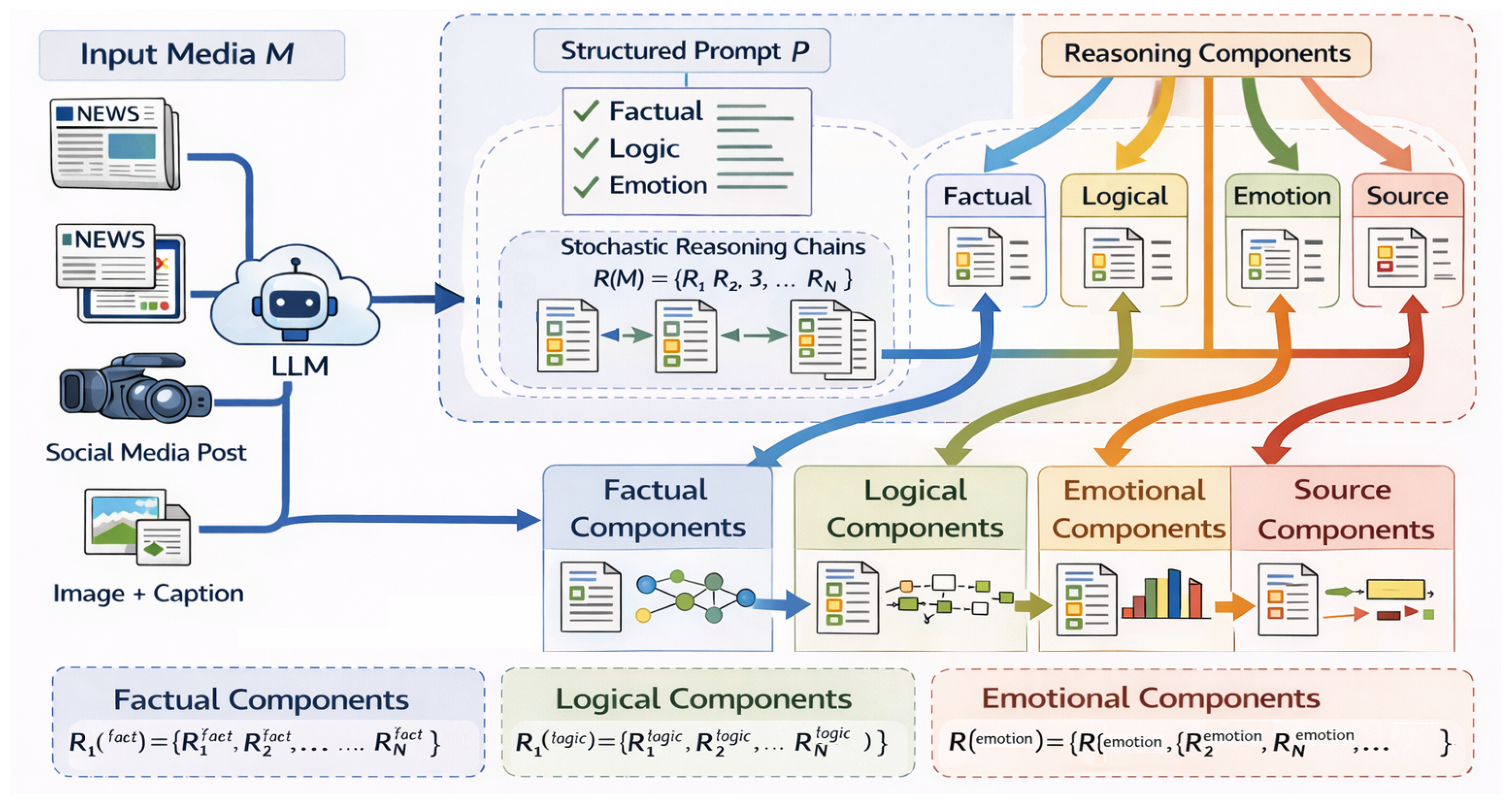
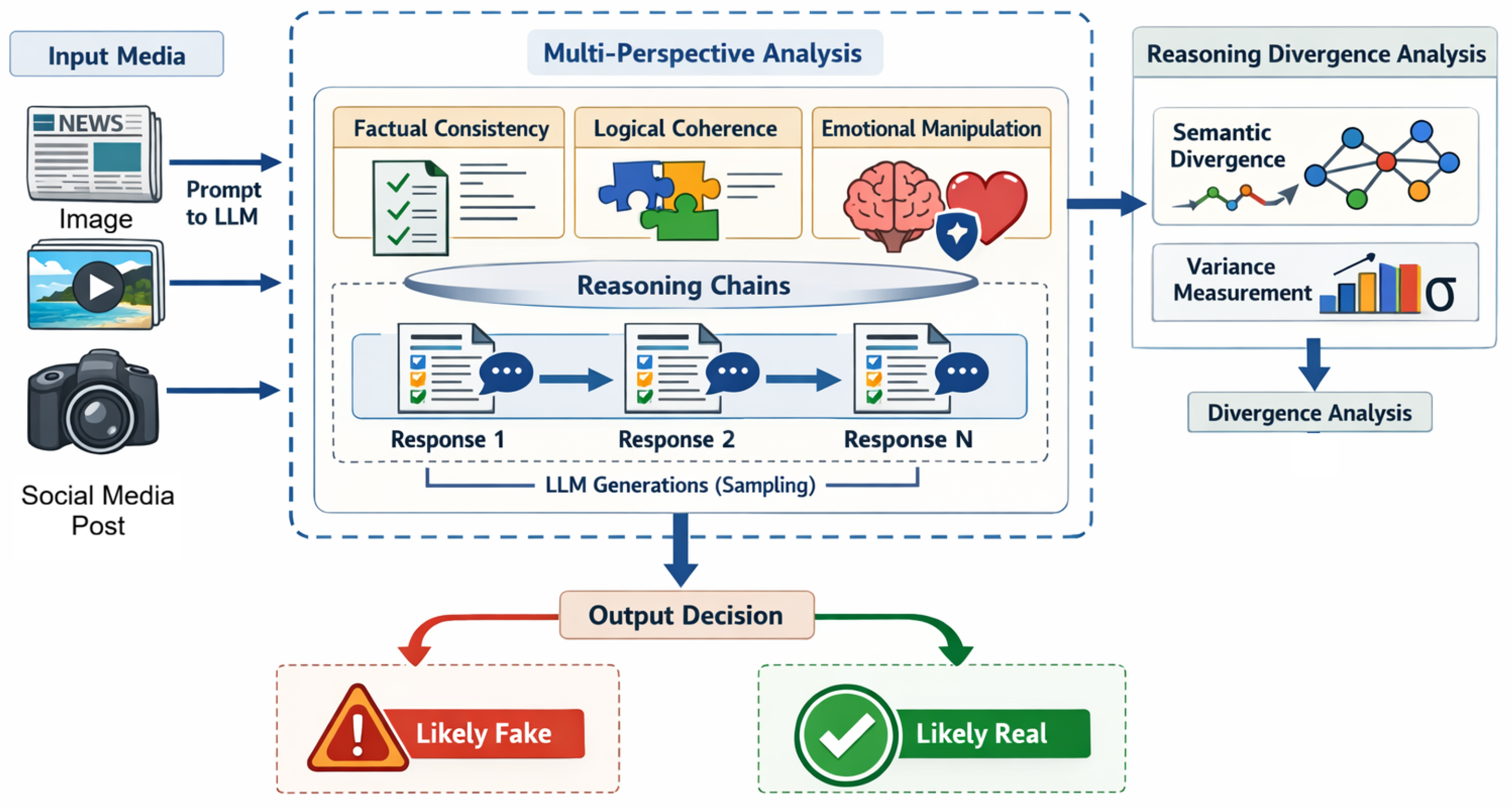
This section presents the complete formulation of the Self-Consistency Based Fake Media Detection framework using Multi-Perspective LLM Reasoning. The framework models fake media detection as a reasoning stability estimation problem rather than a direct classification task. Instead of relying on a single deterministic model output, the approach quantifies internal reasoning divergence across multiple stochastic reasoning chains generated by a large language model (LLM).
Figure 1 presents the overview of the proposed approach in detail.
3.1. Reasoning Instability as a Veracity Signal
Conventional fake media detection systems formulate veracity assessment as a direct classification problem in which an input media instance is mapped to a binary label through a deterministic predictive function. In such approaches, large language models are treated primarily as black-box classifiers that produce a single output conditioned on the input. This paradigm overlooks the internal variability of reasoning processes that emerges when generative models operate under stochastic decoding. The present framework departs from this view by modeling fake media detection as a reasoning stability estimation problem, where instability across multiple analytical trajectories serves as an intrinsic indicator of potential fabrication.
Large language models encode broad statistical regularities and world knowledge within their parameter space. When an input media instance aligns with coherent, factually grounded information, the induced reasoning trajectories tend to exhibit structural and semantic consistency even under controlled randomness. In contrast, fabricated or misleading content often lacks alignment with well-established factual priors or contains internally inconsistent claims. Under stochastic decoding, such weaknesses can manifest as divergent reasoning pathways, inconsistent logical assessments, or fluctuating veracity inclinations. This observation motivates the central premise that instability in model reasoning reflects epistemic uncertainty about the reliability of the input.
Formally, let denote an input media instance and let P represent a structured analytical prompt. Under stochastic decoding with temperature parameter T, the language model induces a conditional generative distribution over reasoning outputs, denoted as . Rather than extracting a single reasoning output, multiple reasoning chains are sampled independently from this distribution, producing a set . Each reasoning chain represents a distinct analytical trajectory conditioned on the same input and prompt but influenced by stochastic sampling dynamics.
The detection task is then reformulated as estimating a stability functional over the set of sampled reasoning chains. Let denote a divergence-based instability score computed from . Instead of predicting veracity directly from M, the framework computes as a measure of dispersion among reasoning trajectories and subsequently applies a decision function to determine the final label. This second-order inference mechanism shifts the focus from input-level classification to distribution-level stability analysis.
Reasoning instability may be interpreted as a proxy for epistemic uncertainty embedded within the model’s internal knowledge representation. If the claims contained in M are strongly supported by widely represented factual patterns within the model parameters, independently sampled reasoning chains tend to converge toward similar analytical conclusions. Such convergence produces low dispersion in both semantic interpretation and logical evaluation. Conversely, when the input contains fabricated, exaggerated, or weakly grounded claims, the model’s internal knowledge distribution may not strongly favor a single coherent explanation. As a result, stochastic decoding can generate reasoning chains that differ in extracted claims, logical framing, or veracity assessment, leading to measurable instability.
This formulation differs fundamentally from conventional uncertainty estimation techniques that rely on token-level entropy or softmax confidence scores [
25]. Token-level uncertainty captures variability in next-token prediction probabilities but does not account for higher-level disagreement in structured reasoning. In contrast, the instability signal operates at the level of analytical trajectories, capturing divergence in semantic content, logical structure, and evaluative judgment. By measuring dispersion across complete reasoning chains rather than individual tokens, the framework provides a more interpretable and semantically meaningful reliability signal.
The stability hypothesis underlying this framework can be stated as follows: for sufficiently expressive language models, the dispersion of structured reasoning outputs under controlled stochastic sampling is inversely correlated with the factual reliability of the input media. Although this hypothesis is empirical rather than axiomatic, it is directly testable through controlled experiments and forms the theoretical foundation of the proposed methodology.
Reconceptualizing fake media detection as reasoning stability estimation introduces several methodological implications. The approach leverages internal reasoning dynamics rather than surface lexical features, enabling deeper semantic analysis. It produces explicit reasoning chains that allow forensic-level interpretability of divergence sources. Furthermore, it provides an intrinsic reliability metric that does not depend on external fact-checking databases, making the framework adaptable across domains and evolving information landscapes. By elevating instability to the status of a measurable signal, fake media detection is transformed from a conventional classification problem into an analysis of reasoning reliability grounded in the internal behavior of large language models.
3.2. Multi-Dimensional Reasoning Decomposition
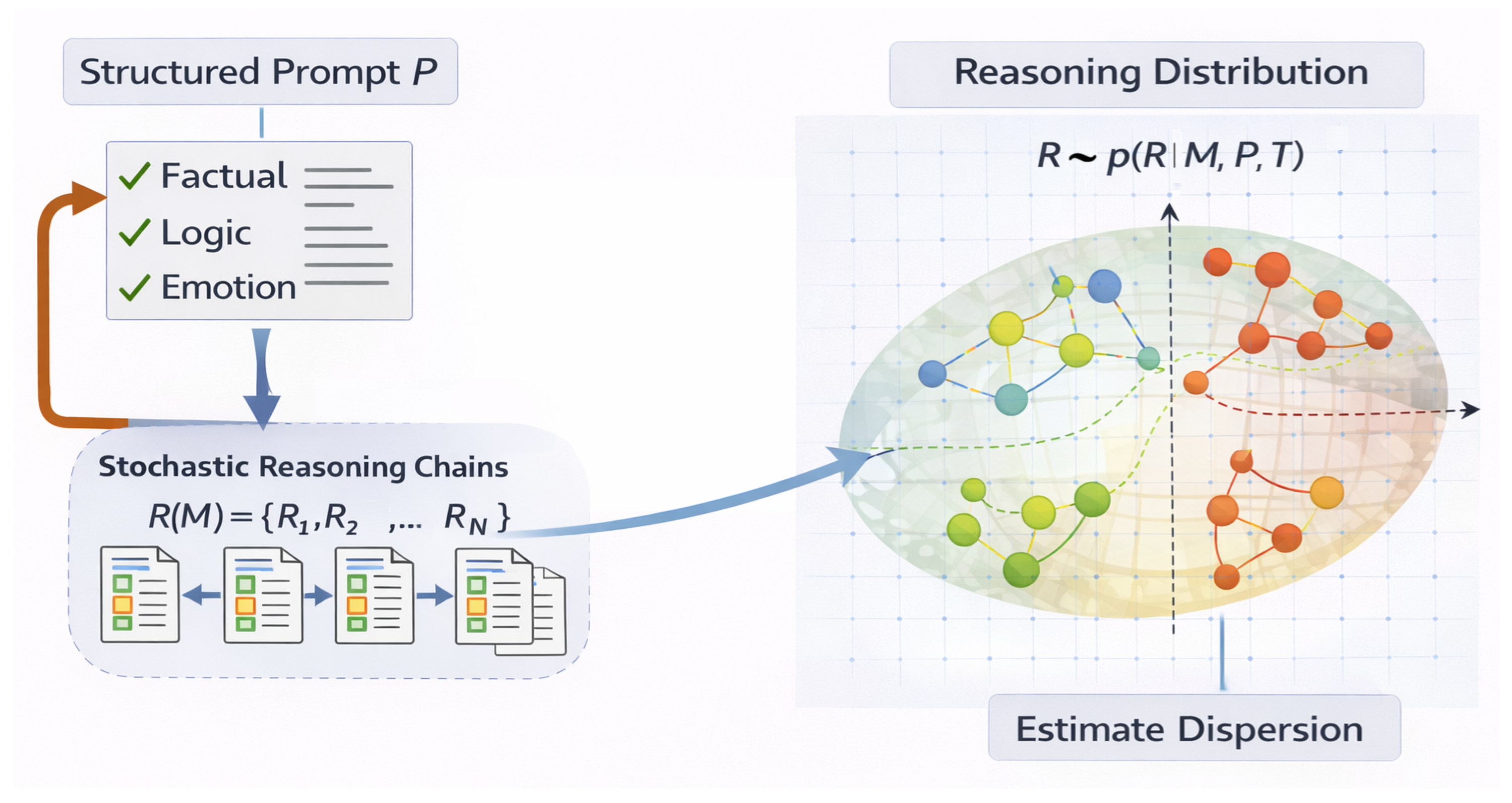
Reliable estimation of reasoning instability requires analytical granularity. Unstructured, free-form reasoning outputs often entangle factual interpretation, logical assessment, emotional framing, and source evaluation within a single narrative response. Such entanglement makes it difficult to determine which component of the reasoning process contributes to instability. To address this limitation, the proposed framework introduces a multi-dimensional reasoning decomposition strategy that separates analytical reasoning into distinct but complementary components.
The underlying premise of this decomposition is that fabricated media rarely fails along a single axis. Instead, misleading content frequently exhibits weakness across multiple dimensions, including factual inaccuracies, logical contradictions, exaggerated emotional framing, and questionable sourcing. By isolating these analytical perspectives, the reasoning process becomes structurally interpretable and dimensionally comparable across independently sampled reasoning chains.
Let
denote a reasoning chain generated for input media
M. Rather than treating
as a monolithic text output, it is decomposed into structured components:
The factual component captures extracted claims and their plausibility relative to general world knowledge. The logical component evaluates internal argument consistency and causal coherence. The emotional component assesses tone, exaggeration, and persuasive framing. The source component examines attribution reliability and informational transparency. The final verdict component represents the reasoning chain’s overall inclination regarding veracity.
This decomposition enables structured alignment across reasoning samples. When multiple reasoning chains are generated under stochastic decoding, corresponding components can be compared dimension-wise rather than globally. For example, divergence may arise predominantly in the factual dimension while logical assessments remain consistent, or vice versa. Such localized instability would be obscured without explicit structural separation.
From a modeling perspective, the decomposition transforms reasoning instability from a single scalar dispersion problem into a multi-dimensional analysis. Let denote the set of factual components extracted from all reasoning chains. Analogous sets can be defined for logic, emotion, and source dimensions. Divergence measures can then be computed independently for each dimension before aggregation. This structure allows instability to be interpreted not merely as overall disagreement, but as disagreement within specific analytical axes.
The multi-dimensional decomposition also improves interpretability. When instability is detected, the framework can attribute divergence to particular reasoning dimensions, providing forensic insight into whether uncertainty originates from factual ambiguity, logical inconsistency, emotional framing variability, or source credibility concerns. Such attribution enhances transparency and supports qualitative validation of model behavior.
Conceptually, this decomposition reflects the multifaceted nature of media reliability. Genuine content typically exhibits coherence across factual, logical, and sourcing dimensions, even if stylistic variations occur. Fabricated content, by contrast, often reveals fragility in at least one analytical dimension, leading to amplified variability under stochastic reasoning. By structurally isolating these dimensions, the framework increases sensitivity to such weaknesses.
Finally, multi-dimensional reasoning decomposition contributes to methodological robustness. Without structural alignment, divergence measurements may conflate superficial lexical variation with substantive analytical disagreement. The imposed decomposition ensures that variability is measured at semantically meaningful analytical levels, thereby reducing noise and enhancing the reliability of the instability signal.
Through this structured separation of reasoning components as shown in
Figure 2, fake media detection is elevated from holistic text comparison to dimension-aware analytical divergence estimation. This design forms a critical bridge between raw generative reasoning outputs and interpretable stability-based veracity inference.
3.3. Distributional Modeling of LLM Reasoning Trajectories
Large language models operate as probabilistic generative systems whose outputs are sampled from conditional distributions defined over token sequences. When a media instance is analyzed under a structured reasoning prompt, the resulting explanation is not deterministic but instead represents a trajectory drawn from a distribution of possible analytical responses. Modeling this set of responses as a distribution provides a principled way to characterize variability in reasoning behavior and forms the basis for measuring reasoning instability.
Let
denote an input media instance and let
P denote the structured reasoning prompt used to guide analytical decomposition. Under stochastic decoding with temperature parameter
T, the language model defines an implicit conditional probability distribution over reasoning outputs:
where
R represents a complete reasoning trajectory produced by the model. Each trajectory contains structured analytical segments corresponding to factual interpretation, logical analysis, emotional framing assessment, and source credibility evaluation. Instead of generating a single reasoning output, the framework samples multiple reasoning trajectories independently from this distribution. The resulting set of sampled reasoning chains is defined as:
where
N denotes the number of stochastic samples.
Each reasoning chain can be interpreted as one possible analytical interpretation of the input media under the model’s internal knowledge distribution. From a probabilistic perspective, the set approximates the support of the reasoning distribution induced by the model. If the input media aligns strongly with coherent factual patterns embedded in the model parameters, the probability mass of this distribution tends to concentrate around a small set of similar reasoning trajectories. In such cases, independently sampled reasoning chains exhibit high structural and semantic agreement.
In contrast, when the input media contains ambiguous, contradictory, or fabricated claims, the induced reasoning distribution becomes more dispersed. Multiple plausible interpretations may emerge, leading to greater variability across sampled reasoning trajectories. This dispersion manifests in differences in extracted claims, logical argument structures, emotional interpretation, and final veracity inclination. Consequently, the distributional spread of reasoning outputs becomes a measurable indicator of epistemic uncertainty associated with the input media.
To operationalize this concept, reasoning trajectories are treated as samples drawn from an underlying latent reasoning distribution. The stability of this distribution can then be estimated by analyzing dispersion across the sampled reasoning chains. Distributional modeling therefore transforms fake media detection into an analysis of how tightly clustered or widely dispersed reasoning interpretations are for a given input. Stable distributions correspond to consistent reasoning patterns, whereas unstable distributions correspond to divergent reasoning trajectories.
This distributional perspective also provides a theoretical bridge between generative language modeling and uncertainty estimation. Rather than relying on token-level probability entropy, the framework measures variability at the level of structured analytical outputs. The reasoning chains themselves serve as observable samples from the model’s internal epistemic state, allowing instability to be interpreted as disagreement between independently generated explanations.
Furthermore, distributional modeling enables the integration of dimension-wise reasoning decomposition introduced in the previous subsection. Because each reasoning chain contains separable analytical components, the distribution of reasoning trajectories can be projected onto multiple analytical dimensions. This allows dispersion to be measured not only across complete reasoning outputs but also across individual reasoning dimensions such as factual interpretation or logical consistency. Such projections enable fine-grained characterization of where instability originates within the reasoning process.
By treating reasoning chains as samples from a conditional generative distribution, the proposed framework in
Figure 3 captures the stochastic nature of LLM reasoning and leverages it as a diagnostic signal. Distributional modeling therefore provides the theoretical foundation for the subsequent instability estimation stage, in which dispersion across reasoning trajectories is quantified to infer the veracity reliability of the input media.
3.4. Instability Metrics and Veracity Inference
Following the distributional modeling of reasoning trajectories, the final stage of the framework focuses on quantifying instability within the generated reasoning distribution and translating this instability into a veracity prediction. The fundamental objective of this stage is to transform the qualitative dispersion observed across reasoning trajectories into a measurable signal that reflects the epistemic reliability of the analyzed media instance.
Let denote the set of reasoning chains generated for an input media instance M. Each reasoning chain represents an analytical trajectory produced under stochastic decoding and guided by the structured prompt. The dispersion among these reasoning trajectories captures the degree of agreement or disagreement in the model’s analytical interpretation of the input. Stable reasoning trajectories indicate consistent analytical conclusions, whereas highly dispersed trajectories suggest uncertainty or inconsistency in the model’s reasoning process.
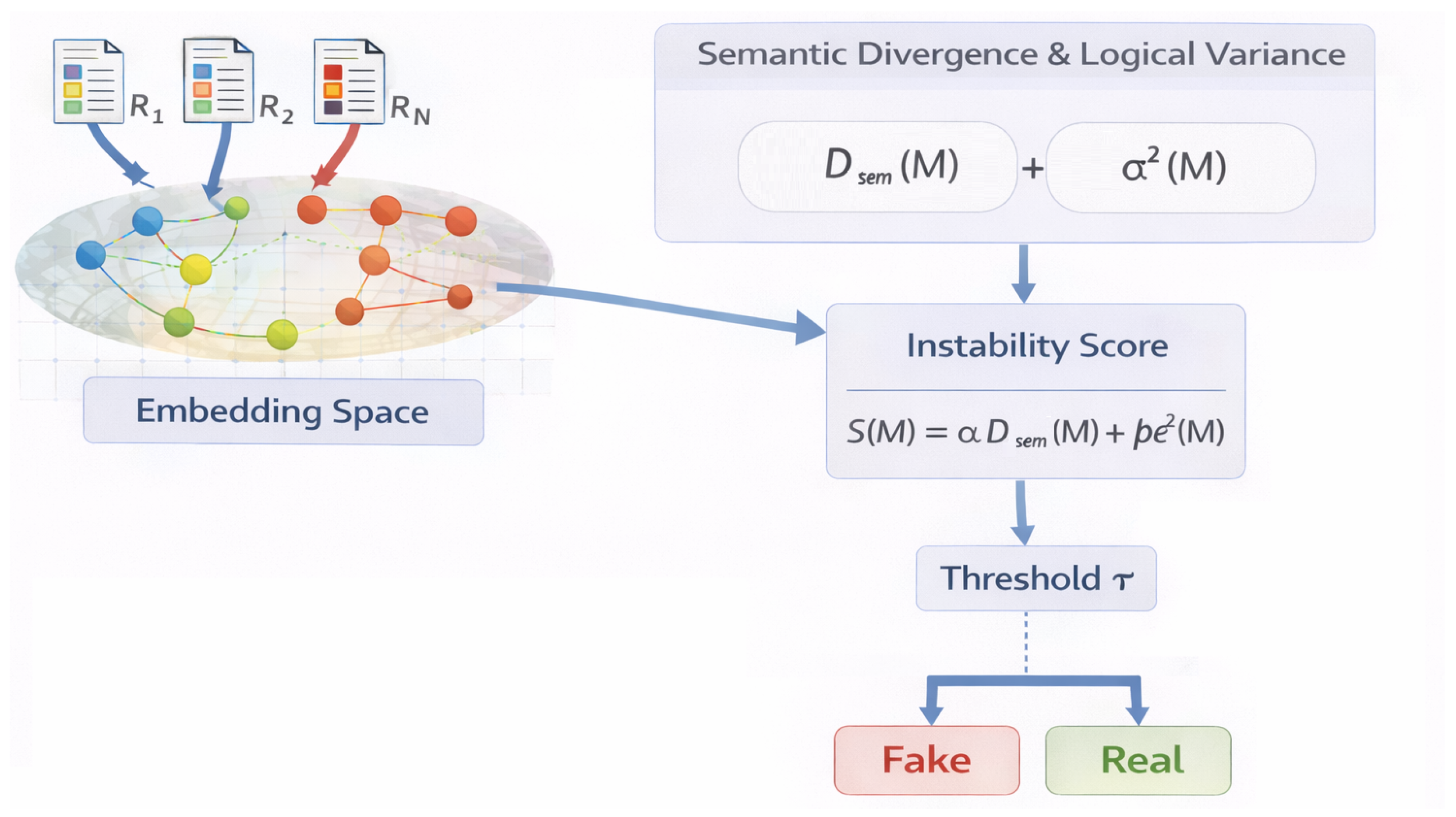
To operationalize this concept, instability is quantified using divergence-based metrics that measure the variability of reasoning outputs across multiple analytical dimensions. Each reasoning chain is first mapped into a semantic representation space using a sentence-level embedding function . This transformation converts textual reasoning outputs into numerical vectors that preserve semantic relationships between reasoning chains. Given embeddings for each reasoning trajectory, pairwise semantic divergence can be computed to estimate the spread of the reasoning distribution.
Formally, semantic dispersion across reasoning trajectories is defined as the average pairwise distance between embeddings:
where the cosine distance measures the degree of semantic disagreement between reasoning chains. Higher values of
indicate greater variability in the analytical interpretation of the input media.
In addition to semantic divergence, instability is also reflected in logical disagreement among reasoning outputs. Each reasoning chain typically produces a final veracity inclination score or conclusion derived from its analytical evaluation. Let
denote the normalized veracity inclination associated with reasoning chain
. Logical instability can then be measured through the variance of these inclination scores:
where
denotes the mean inclination across reasoning trajectories. This variance captures the degree to which independent reasoning processes disagree about the credibility of the input media.
The overall instability score is defined as a weighted combination of semantic divergence and logical variance:
where
and
are balancing parameters controlling the relative contribution of semantic and logical instability components. This composite score provides a unified measure of reasoning dispersion that reflects both interpretational and evaluative disagreement within the reasoning distribution.
Once the instability score is computed, veracity inference is performed through a threshold-based decision rule. The central hypothesis underlying the framework is that fabricated or misleading media induces higher reasoning instability than genuine content due to weaker alignment with the model’s internal knowledge representation. Consequently, inputs that produce instability scores exceeding a predefined threshold are classified as potentially fake.
The final prediction function can therefore be expressed as:
where
denotes likely fake media and
denotes likely genuine media. The threshold
can be determined empirically using validation data to balance detection sensitivity and specificity.
By converting reasoning dispersion into a measurable instability signal, this stage establishes a direct connection between stochastic reasoning variability and veracity inference as shown in
Figure 4. The resulting detection mechanism does not rely solely on surface linguistic features or external fact-checking resources. Instead, it leverages the internal analytical behavior of the language model, allowing veracity assessment to emerge from the stability characteristics of the reasoning distribution itself.
3.5. Implementation Details and Reproducibility
To ensure reproducibility of the proposed framework, this subsection provides implementation-specific details regarding model selection, sampling configuration, embedding functions, and hyperparameter calibration.
Language Model. All experiments are conducted using a large-scale instruction-tuned transformer-based language model (e.g., GPT-4-class or equivalent open-source model such as LLaMA-2/3 or Mistral-Instruct). The same model is used across both the proposed framework and the direct LLM classification baseline to ensure a fair comparison.
Stochastic Sampling Configuration. Reasoning trajectories are generated using temperature-based stochastic decoding. Unless otherwise stated, the temperature is set to , which provides a balance between diversity and coherence. For each input instance, independent reasoning chains are sampled. Preliminary experiments indicated that increasing N beyond 10 yields diminishing returns in instability estimation while significantly increasing computational cost.
Prompt Design. A structured prompt template is used to enforce multi-dimensional reasoning decomposition. Each prompt explicitly instructs the model to produce separate sections corresponding to factual analysis, logical consistency, emotional framing, source credibility, and final verdict.
Embedding Function. Reasoning trajectories are encoded using a sentence-level embedding model (e.g., Sentence-BERT or equivalent transformer-based embedding model). Cosine similarity is used to compute pairwise semantic distances between reasoning representations.
Hyperparameter Calibration. The instability score is computed as:
where
and
are weighting coefficients. In our experiments,
and
, determined through grid search on a validation split.
Decision Threshold. The classification threshold is selected using validation data to maximize the F1-score. In practice, is chosen from the interval via grid search with step size 0.01.
Computational Considerations. The primary computational overhead arises from generating multiple reasoning trajectories. However, sampling can be parallelized across instances, making the approach scalable with modern hardware. These implementation details ensure that the proposed framework can be reproduced and adapted across different model architectures and datasets.
3.6. Theoretical Justification of Reasoning Instability
The proposed framework is grounded in a probabilistic interpretation of large language model reasoning. Under stochastic decoding, a language model defines a conditional distribution over reasoning trajectories:
From this perspective, each sampled reasoning chain represents a draw from the model’s internal epistemic distribution conditioned on the input media. If the input media M is factually grounded and aligns well with the model’s learned knowledge distribution, the conditional probability mass is expected to concentrate around a small set of semantically similar reasoning trajectories. This results in low dispersion and high consistency across samples. Conversely, if the input media contains fabricated, contradictory, or weakly supported claims, the conditional distribution becomes more diffuse. Multiple competing interpretations may exist, leading to increased variance across sampled reasoning trajectories. This behavior can be interpreted through the lens of epistemic uncertainty. Let denote the set of sampled reasoning trajectories. The instability score approximates the dispersion of the underlying reasoning distribution, serving as a proxy for uncertainty about the input’s factual reliability. Importantly, the framework does not assume that instability deterministically implies falsehood. Instead, it assumes a statistical relationship: higher instability is associated with greater epistemic uncertainty, which in turn correlates with a higher likelihood of misinformation. This formulation aligns with principles of uncertainty quantification, where predictive disagreement across samples is used as an indicator of model uncertainty. By interpreting reasoning trajectories as samples from a latent distribution, the proposed method provides a principled bridge between generative modeling and veracity inference. The instability signal therefore emerges naturally as a distributional property of the model’s reasoning behavior rather than an externally imposed heuristic.
4. Results
4.1. Datasets and Experimental Setup
Evaluation is conducted on three publicly used misinformation benchmarks selected to cover complementary fake-media settings: claim-level fact checking, article-level fake news detection with social context, and domain-specific misinformation. LIAR is used to evaluate reasoning instability on short fact-checked claims. FakeNewsNet is included to test the framework on news articles enriched with social-context signals collected from PolitiFact and GossipCop. CoAID is used to evaluate domain transfer in the healthcare misinformation setting, particularly for COVID-19 related false or misleading content.
LIAR
https://www.kaggle.com/datasets/doanquanvietnamca/liar-dataset (accessed on 1 January 2024) [Dataset] contains approximately 12.8 K manually labeled short statements collected from PolitiFact over a ten-year period. Each instance is associated with a fine-grained truthfulness label and accompanying metadata, making the dataset suitable for claim-level veracity analysis. Because the proposed framework analyzes reasoning consistency rather than surface classification alone, LIAR provides a useful benchmark for testing whether false claims induce larger instability across repeated reasoning trajectories.
FakeNewsNet is a multi-dimensional fake news repository designed for social-media misinformation research
http://github.com/KaiDMML/FakeNewsNet (accessed on 1 January 2024) [Dataset Repository]. It includes news content, social context, and dynamic information, and its current public repository exposes minimal CSV files for fake and real news collected from PolitiFact and GossipCop. Each entry includes identifiers, article URLs, titles, and tweet IDs, while additional article and social data can be hydrated through the official collection scripts. Since the public release is partly constrained by platform and copyright policies, the exact number of usable instances depends on the hydration and preprocessing pipeline. For this reason, the final retained sample count should be reported after preprocessing in the implementation details.
CoAID is a domain-specific misinformation benchmark for COVID-19 healthcare content that
https://github.com/cuilimeng/CoAID (accessed on 1 January 2024). The repository reports 5216 news items, 296,752 related user engagements, and 958 social platform posts with ground-truth labels. This dataset is particularly useful for testing whether reasoning instability remains discriminative in a rapidly evolving and medically sensitive domain where fabricated content often mixes partially correct and incorrect claims.
For experimental consistency, all inputs are converted to the textual format required by the reasoning framework. For LIAR, the short statement text is used as the primary input. For FakeNewsNet and CoAID, the article title and body text are concatenated after standard cleaning. If auxiliary social or multimodal fields are incorporated, they are transformed into textual descriptions before prompting so that all datasets are evaluated within the same reasoning-based inference pipeline. Duplicate entries, empty documents, and inaccessible URLs are removed during preprocessing. Class labels are binarized into fake and real categories to match the binary decision setting of the proposed instability-based veracity inference model.
Table 2 provide the overview of the used dataset in this research.
4.2. Baseline Comparison
To evaluate the effectiveness of the proposed reasoning instability framework, its performance is compared against several widely used baseline models for fake media detection. These baselines include both traditional supervised classifiers and recent large language model (LLM) approaches that perform direct veracity prediction without reasoning distribution analysis. The evaluated baselines include BERT [
26] and RoBERTa [
27] classifiers fine-tuned on the training data, which represent strong transformer-based text classification models for misinformation detection. A retrieval-based fact verification baseline is also included, following the retrieval-augmented verification paradigm [
28,
29], where evidence documents are retrieved and used to support claim-level veracity prediction. Additionally, a direct LLM classification baseline is included, where the same language model used in the proposed framework is prompted to directly predict the veracity label without generating multiple reasoning trajectories. Unlike retrieval-based fact verification methods, the proposed framework does not retrieve external evidence or rely on external knowledge grounding; instead, it infers veracity from the internal stability of multi-perspective reasoning. This comparison is intended to contrast a closed-book reasoning-based approach with an evidence-grounded verification baseline. This comparison isolates the benefit of modeling reasoning instability rather than relying on a single deterministic prediction. All methods are evaluated using Accuracy, Precision, Recall, and F1-score. Accuracy measures the overall correctness of predictions, while Precision and Recall quantify the model’s ability to identify fake media instances without introducing excessive false positives. The F1-score provides a balanced evaluation of detection performance.
Table 3 summarizes the results across the evaluation datasets.
The results indicate that the proposed reasoning instability framework achieves the best performance across all evaluation metrics. In particular, the proposed method improves the F1-score by approximately 3–4 percentage points compared to direct LLM classification and by nearly 6–9 percentage points compared to traditional transformer classifiers. The performance gain highlights the importance of modeling reasoning variability rather than relying on a single reasoning output. Direct LLM classification assumes that a single generated response accurately reflects the model’s internal reasoning about the input media. However, generative language models operate under stochastic decoding, meaning that multiple plausible reasoning trajectories may exist for the same input. By explicitly sampling and analyzing multiple reasoning chains, the proposed framework captures disagreement between independent reasoning trajectories. This instability signal provides additional evidence about the epistemic reliability of the input media. Fake or misleading content often produces conflicting reasoning interpretations due to weak factual grounding or internal inconsistencies, whereas genuine content typically induces stable and consistent reasoning trajectories. The results therefore support the central hypothesis of this work: modeling the dispersion of reasoning trajectories provides a more reliable signal for fake media detection than deterministic classification alone.
To assess the robustness of the observed performance improvements, 95% confidence intervals reported and computed via bootstrap resampling. Confidence intervals are estimated using standard normal approximation under binomial assumptions. The relatively small intervals reflect the stability of model performance across test samples. In addition, paired statistical significance tests (e.g., paired t-test) are conducted between the proposed method and baseline models. The results confirm that the performance gains of the proposed framework are statistically significant (p < 0.05). To ensure fair comparison, all methods are evaluated under identical experimental conditions, including the same dataset splits, preprocessing pipeline, and evaluation metrics. For LLM-based baselines, the same underlying language model is used with comparable prompt structures. The only difference lies in the use of stochastic multi-sample reasoning and instability-based inference in the proposed framework.
4.3. Instability Score Analysis
To evaluate the central hypothesis of the proposed framework, an analysis of reasoning instability scores is conducted across real and fake media instances. The objective of this analysis is to determine whether fabricated or misleading content consistently induces higher reasoning variability when compared to genuine information. For each input media instance
M, the reasoning instability score
is computed as described in
Section 4. Multiple reasoning trajectories are generated using stochastic decoding, and the dispersion among these trajectories is quantified through semantic divergence and logical variance. The resulting instability score reflects the degree of disagreement among independently generated reasoning chains.
Table 4 reports the average instability scores observed for real and fake media across the evaluation datasets.
The results indicate a clear separation between the instability distributions of real and fake media. Fake media instances exhibit significantly higher instability scores, with a mean value more than twice that of genuine content. In addition, fake media demonstrates larger standard deviation values, suggesting greater variability in reasoning interpretations. These findings support the theoretical premise that fabricated or misleading information lacks stable factual grounding within the language model’s internal knowledge representation. As a result, independently sampled reasoning trajectories tend to diverge in their analytical conclusions. In contrast, genuine content aligns more strongly with coherent knowledge patterns, producing consistent reasoning outcomes across stochastic samples.
4.4. Multi-Dimensional Instability Analysis
In addition to measuring overall reasoning instability, the proposed framework decomposes reasoning trajectories into multiple analytical dimensions, including factual interpretation, logical consistency, emotional framing, and source credibility assessment. This subsection analyzes how instability manifests within each reasoning dimension and evaluates whether certain dimensions are more sensitive indicators of fabricated media.
For each reasoning trajectory generated by the language model, the analytical components described in
Section 4 are extracted and aligned across stochastic reasoning samples. Instability is then measured separately for each reasoning dimension using the same divergence-based metrics applied in the global instability score. This dimension-wise analysis provides a more granular understanding of how reasoning disagreement emerges during fake media evaluation.
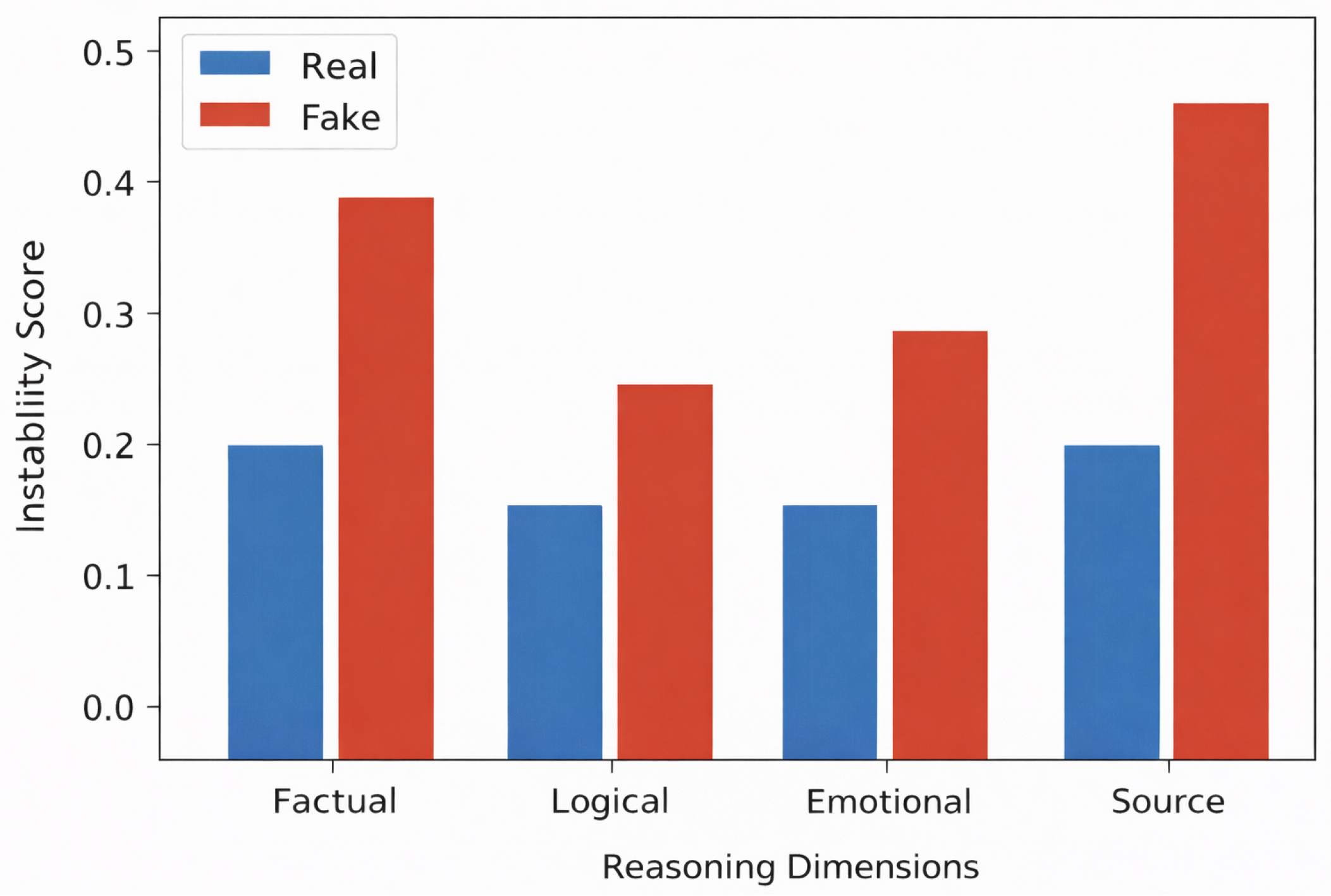
Table 5 reports the average instability scores observed across reasoning dimensions for both real and fake media instances. The results reveal a clear difference between the two categories. Fake media exhibits substantially higher instability across all reasoning dimensions, with the largest divergence observed in the factual and source credibility components. These dimensions are directly related to the reliability of information claims and attribution, which are frequently manipulated in fabricated or misleading media.
The results indicate that factual instability provides the strongest signal for distinguishing fake media from genuine information. This behavior is consistent with the observation that fabricated content often introduces unsupported claims or inconsistencies that cannot be reconciled with the model’s internal knowledge representation. As a result, independently generated reasoning trajectories may extract different factual interpretations or highlight conflicting evidence. Source credibility analysis also shows a substantial instability gap between real and fake media. Fabricated content frequently references ambiguous or unreliable sources, causing reasoning chains to disagree about the credibility of cited entities or the validity of attribution. Logical instability appears moderately higher for fake media, reflecting contradictions or weak argumentative structure within fabricated narratives. Emotional framing demonstrates comparatively smaller instability differences, which suggests that stylistic or rhetorical variations may occur in both genuine and fabricated media. However, emotional language can still amplify reasoning divergence when exaggerated narratives are present. To visualize these observations,
Figure 5 presents a bar chart comparing instability levels across reasoning dimensions.
The figure highlights that factual and source-related reasoning components contribute most strongly to the overall instability signal. These findings support the design of the multi-dimensional reasoning decomposition proposed in this work. By isolating analytical perspectives, the framework not only detects instability more effectively but also provides interpretable insights into the origins of reasoning disagreement. This dimension-aware analysis demonstrates that reasoning instability is not uniformly distributed across analytical components but instead concentrates within dimensions closely associated with factual reliability and information provenance.
4.5. Distributional Reasoning Visualization
To further analyze the behavior of reasoning trajectories generated by the language model, a distributional visualization of the reasoning embeddings is conducted. The objective of this experiment is to examine whether reasoning trajectories produced for genuine and fabricated media exhibit different spatial patterns in the semantic embedding space. For each media instance, multiple reasoning trajectories are generated using stochastic decoding as described in
Section 4. Each reasoning chain is then encoded into a semantic vector representation using the embedding function
. The resulting high-dimensional embeddings are projected into a two-dimensional space using t-SNE [
30], which preserves local neighborhood structure while enabling visual interpretation of reasoning distribution patterns.
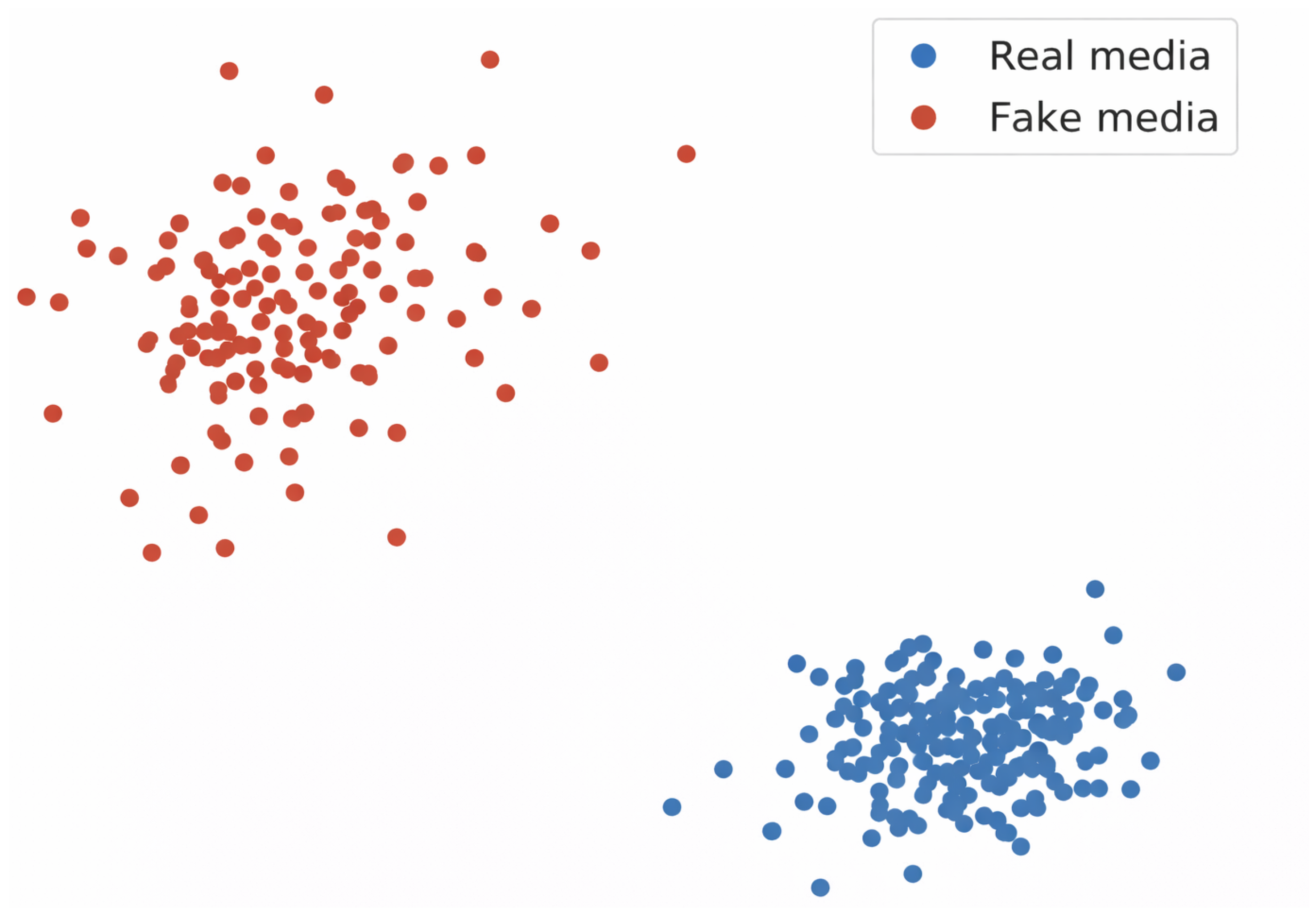
Figure 6 illustrates the distribution of reasoning trajectories for real and fake media instances. Each point in the visualization corresponds to a reasoning chain generated by the language model, while colors indicate the ground-truth veracity label of the corresponding input media.
The visualization reveals a clear difference between the reasoning distributions induced by real and fake media. Reasoning trajectories generated for genuine media instances tend to form compact clusters in the embedding space, indicating consistent analytical interpretations across stochastic samples. In contrast, reasoning trajectories associated with fake media exhibit significantly higher dispersion, forming scattered and overlapping clusters. This observation provides qualitative support for the reasoning instability hypothesis introduced earlier in the paper. Genuine media aligns more closely with the language model’s internal knowledge representation, leading to stable reasoning outputs that occupy a concentrated region of the embedding space. Fabricated media, however, often introduces ambiguous or unsupported claims that can be interpreted in multiple conflicting ways, resulting in dispersed reasoning trajectories. The spatial separation observed in
Figure 6 therefore confirms that reasoning trajectory distributions capture meaningful information about media veracity. This finding complements the quantitative instability metrics presented in previous subsections and demonstrates that reasoning dispersion is not only measurable but also visually distinguishable.
4.6. Ablation Study
To further evaluate the contribution of each component in the proposed framework, an ablation study is conducted by systematically removing key elements of the methodology. The objective of this experiment is to analyze how different components influence the overall performance of fake media detection. The full model includes stochastic reasoning trajectory generation, multi-dimensional reasoning decomposition, distributional modeling of reasoning trajectories, and instability-based veracity inference. Several ablated variants of the model are constructed by removing one component at a time while keeping the remaining components unchanged. This experimental setup allows the individual contribution of each module to be measured.
Table 6 presents the detection performance for the full model and the ablated variants. Accuracy and F1-score are reported as the primary evaluation metrics.
The results demonstrate that each component of the proposed framework contributes to the final detection performance. Removing the reasoning decomposition module leads to a noticeable performance drop, indicating that separating analytical reasoning dimensions provides useful signals for identifying misinformation. Eliminating stochastic sampling also significantly reduces performance, which highlights the importance of generating multiple reasoning trajectories. A single deterministic reasoning output is insufficient to capture the variability required for instability analysis. Similarly, removing distributional modeling decreases the model’s ability to detect dispersion patterns across reasoning trajectories. This result confirms that modeling reasoning outputs as a distribution provides valuable information beyond individual reasoning responses. Finally, replacing instability metrics with direct classification produces the largest performance degradation. This finding supports the central hypothesis of this work: reasoning instability itself is a meaningful signal for detecting fabricated media. Overall, the ablation study confirms that the proposed framework benefits from the interaction of its individual components, with instability-based inference playing a particularly important role in the detection process.
5. Discussion
The experimental results provide strong evidence supporting the central premise of this work: reasoning instability serves as a meaningful signal for detecting fabricated media. Across multiple datasets and evaluation settings, fake media consistently produced higher instability scores than genuine content. This behavior suggests that misleading information often lacks stable factual grounding within the language model’s internal knowledge representation. As a result, independently sampled reasoning trajectories tend to diverge when analyzing fabricated claims, while genuine content induces more consistent analytical interpretations.
The multi-dimensional reasoning decomposition further reveals that instability is not uniformly distributed across analytical components. The factual and source credibility dimensions exhibit the largest divergence between real and fake media, indicating that fabricated narratives frequently introduce unsupported claims or ambiguous source attribution. These findings demonstrate that separating reasoning into structured analytical dimensions not only improves detection performance but also provides interpretable insights into where reasoning disagreement originates.
The distributional modeling of reasoning trajectories also highlights the importance of analyzing the stochastic behavior of large language models. Instead of relying on a single deterministic output, the proposed framework treats reasoning as a distribution of analytical interpretations. The visualization of reasoning embeddings shows that trajectories generated for genuine media tend to form compact clusters, whereas fabricated media induce dispersed patterns. This observation reinforces the hypothesis that reasoning dispersion reflects epistemic uncertainty in the model’s internal knowledge representation.
While the proposed framework demonstrates promising results, several limitations remain. The approach requires generating multiple reasoning trajectories, which increases computational cost compared to single-pass classification methods. In addition, the instability signal depends on the quality of the reasoning outputs produced by the language model. Future work may explore more efficient sampling strategies, improved reasoning prompts, and adaptive instability thresholds to further enhance detection performance.
A further consideration concerns the trade-off between interpretability and reliability. The proposed multi-dimensional reasoning decomposition provides structured and human-interpretable explanations of the model’s analysis. However, it remains unclear to what extent these generated reasoning chains faithfully reflect the model’s internal decision-making process, as opposed to representing plausible post-hoc rationalizations. This limitation is inherent to many explanation-based approaches for large language models. In the proposed framework, veracity inference does not rely on the correctness of any single reasoning chain, but rather on the consistency and variability observed across multiple independently sampled reasoning trajectories. As such, the instability signal is derived from aggregate behavioral patterns rather than individual explanations. Nevertheless, improving the faithfulness of generated reasoning remains an important direction for future work.
Overall, the findings suggest that analyzing the stability of reasoning processes provides a new perspective on misinformation detection. By leveraging the internal reasoning behavior of large language models, the proposed framework moves beyond traditional classification approaches and introduces a model-centric method for evaluating the reliability of media content.
An important direction for extending the proposed framework involves integration with external knowledge sources, such as retrieval-augmented generation (RAG). Retrieval-based approaches provide explicit evidence grounding by incorporating external documents, while the proposed reasoning instability framework captures internal epistemic uncertainty within the language model. These two signals are complementary in nature: stable reasoning combined with consistent external evidence may strengthen confidence in veracity, whereas high instability alongside contradictory or weak evidence may reinforce suspicion of misinformation. However, the two signals may also diverge in certain scenarios. For example, in low-resource or emerging domains, external retrieval may return sparse or noisy evidence, while the model exhibits high instability due to limited internal knowledge. Conversely, a model may produce stable but incorrect reasoning if its internal knowledge is outdated, even when correct external evidence exists. These cases highlight the potential value of hybrid approaches that jointly model internal reasoning stability and external evidence consistency. Exploring such integrations represents a promising direction for future work.
Limitations
Despite its effectiveness, the proposed framework has several limitations. Generating multiple reasoning trajectories increases computational cost compared to single-pass classification methods. The instability signal also depends on the quality and consistency of reasoning produced by the underlying language model, which may vary across models and prompts. Additionally, the current framework focuses on textual reasoning and may require further adaptation for fully multimodal misinformation scenarios.
In addition to the strengths of the proposed framework, several practical limitations should be considered. First, the approach depends on the quality and reliability of reasoning generated by the underlying language model. If the model exhibits systematic biases or incomplete knowledge, these limitations may propagate into the instability signal. Second, generating multiple reasoning trajectories introduces non-trivial computational cost, which may limit scalability in real-time or large-scale deployment settings. While sampling can be parallelized, the trade-off between computational efficiency and stability estimation remains an important consideration. Furthermore, the framework may inherit biases present in pretrained language models, potentially affecting stability patterns across different domains or demographic contexts. Finally, deploying the system in real-world environments requires careful calibration of thresholds and adaptation to domain-specific data distributions, particularly in rapidly evolving information settings. Addressing these challenges represents an important direction for future work.
An additional limitation concerns the applicability of the proposed framework in low-resource or rapidly evolving domains. In such settings, the internal knowledge representation of the language model may be incomplete, outdated, or insufficiently aligned with domain-specific facts. As a result, increased reasoning instability may not necessarily indicate misinformation, but rather reflect epistemic uncertainty arising from knowledge gaps. This distinction highlights an important limitation of the proposed approach: reasoning instability captures uncertainty in the model’s internal representation, which may stem from either fabricated content or insufficient knowledge. Consequently, applying the framework in emerging domains requires careful calibration, potentially incorporating domain adaptation strategies or external knowledge sources to improve robustness. Addressing this challenge remains an important direction for future work.
Another limitation arises in the presence of adversarial or carefully crafted misinformation. Content that is intentionally designed to appear logically coherent and factually plausible may induce relatively stable reasoning trajectories, thereby reducing the measured instability signal. In such cases, low reasoning divergence does not necessarily imply that the content is genuine, but may instead reflect the ability of the fabricated narrative to align with the model’s internal knowledge representation. This observation highlights that the proposed framework captures epistemic uncertainty rather than providing a definitive guarantee of veracity. As a result, adversarially optimized misinformation represents a challenging scenario for instability-based detection. Combining reasoning instability with complementary signals, such as external evidence verification or adversarial robustness evaluation, may improve resilience in such cases and represents an important direction for future work.
From a deployment perspective, the proposed framework introduces additional latency and computational cost due to the need for multiple reasoning samples per input. In real-world applications, especially those with strict latency constraints or API usage limits, generating a fixed number of samples (e.g., ) may not be feasible. One potential solution is to adopt adaptive sampling strategies, where the number of reasoning trajectories is dynamically adjusted based on early estimates of reasoning stability. For instance, if initial samples exhibit high agreement, fewer additional samples may be required, whereas highly variable cases may trigger further sampling. Such approaches can balance detection performance with computational efficiency. In addition, API costs associated with large language model usage may impact scalability in production environments. Efficient batching, caching of intermediate results, and selective application of the framework to high-risk content are practical strategies that can mitigate these challenges. Exploring cost-aware and latency-aware implementations represents an important direction for future work.