


Abstract
The diffusion model (DM) is a hot topic in deep generative models and is widely applied in image generation. In diffusion models, there are four main “secrets” that affect high-quality image generation: constructing the diffusion model, improving the sampling velocity, designing the diffusion process, and guiding diffusion models. How should one construct the diffusion model? How can one improve the sampling velocity? How should one design the diffusion process? How should one guide diffusion models? These questions are critical to enhancing diffusion model performance. However, most existing review papers focus on applications, while discussion of the four key technical aspects remains limited. In response, this paper summarizes four key technologies and six representative application directions. First, the basic principles of diffusion models are reviewed from three perspectives: denoising diffusion probabilistic models, noise conditional score network models, and stochastic differential equation models. Second, key techniques for improving sampling velocity are summarized from three perspectives: non-Markovian sampling, knowledge distillation sampling, and discrete optimization sampling. Third, the diffusion process design is summarized from three perspectives: latent space, Transformer-based diffusion, and non-Euclidean space. Fourth, guidance strategies are summarized from three perspectives: classifier guidance, classifier-free guidance, and multimodal guidance. Fifth, the advantages and applications of diffusion models are discussed in high-quality text-to-image generation, high-quality text-to-video generation, and high-quality image-to-image generation. Finally, this paper discusses the challenges faced by diffusion models in image generation. Overall, this review systematically discusses the four “secrets” of diffusion models for image generation and provides a useful reference for future research in this field.
1. Introduction
In recent years, deep learning technology has achieved significant breakthroughs. Generative modeling demonstrates exceptional performance in computer vision, natural language processing, semi-supervised learning, and unsupervised learning paradigms [1]. Common deep generative models include Variational Autoencoders (VAEs) [2], Generative Adversarial Networks (GANs) [3], normalizing flows [4], and diffusion models. The diffusion model was proposed by Sohl-Dickstein et al. [5] in 2015 and was further developed by Song et al. [6] in 2019 and Ho et al. [7] in 2020. It gradually perturbs training data with Gaussian noise and then learns to recover the data by reversing this process. After training, the model starts from random Gaussian noise and generates data through iterative denoising.
Compared with VAEs, GANs, and normalizing flows, diffusion models offer a more direct route to high-fidelity generation. VAEs require posterior alignment, GANs depend on an additional discriminator network, and normalizing flows impose invertibility constraints on network design. In contrast, diffusion models generate images through a step-by-step denoising process that offers fine-grained control over generation and often leads to more detailed and realistic outputs. This formulation simplifies training while improving image quality and robustness.
This paper provides a critical evaluation of image generation methods based on diffusion models. Rather than a purely descriptive summary, we employ the “4 Secrets” as an analytical lens to evaluate how technical advancements address the core bottlenecks in generative modeling. We analyze the foundational principles not only as mechanics but also as responses to the stability–efficiency–control trade-off inherent in deep generative architectures. Unlike existing surveys that primarily focus on specific application domains, this paper proposes a technical-centric taxonomy termed the “4 Secrets”. The main contributions are as follows:
- To address “how to construct diffusion models?”, the basic principles of diffusion models are summarized from three perspectives: denoising diffusion probabilistic models, noise conditional score networks, and stochastic differential equations.
- To address “how to improve the sampling speed?”, key acceleration techniques are summarized from three perspectives: non-Markovian sampling, knowledge distillation, and discrete optimization.
- To address “how to design the diffusion process?”, this paper summarizes diffusion process design from three perspectives: latent space, Transformer-based diffusion, and non-Euclidean space.
- To address “how to guide diffusion models?”, this paper summarizes diffusion guidance strategies from three perspectives: classifier guidance, classifier-free guidance, and multimodal guidance.
This paper introduces diffusion models from four technical perspectives. First, constructing the diffusion model (Secret 1) defines the probabilistic boundaries of the forward and reverse processes. Second, sampling acceleration (Secret 2) addresses the efficiency bottleneck in practical deployment, as diffusion models often require thousands of denoising steps. Third, diffusion process design (Secret 3) reduces the computational cost of generating high-resolution images and handling complex data structures, for example by operating in latent space or with Transformer-based architectures. Fourth, guidance strategies (Secret 4) improve semantic controllability so that generated images better match human intent. Therefore, this paper classifies the key technical challenges of diffusion models into the “4 Secrets” framework.
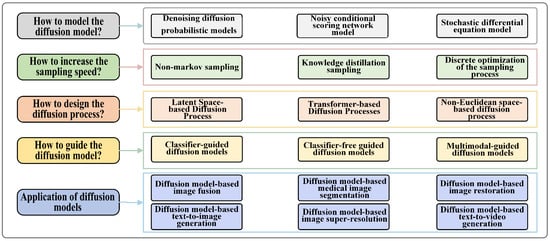
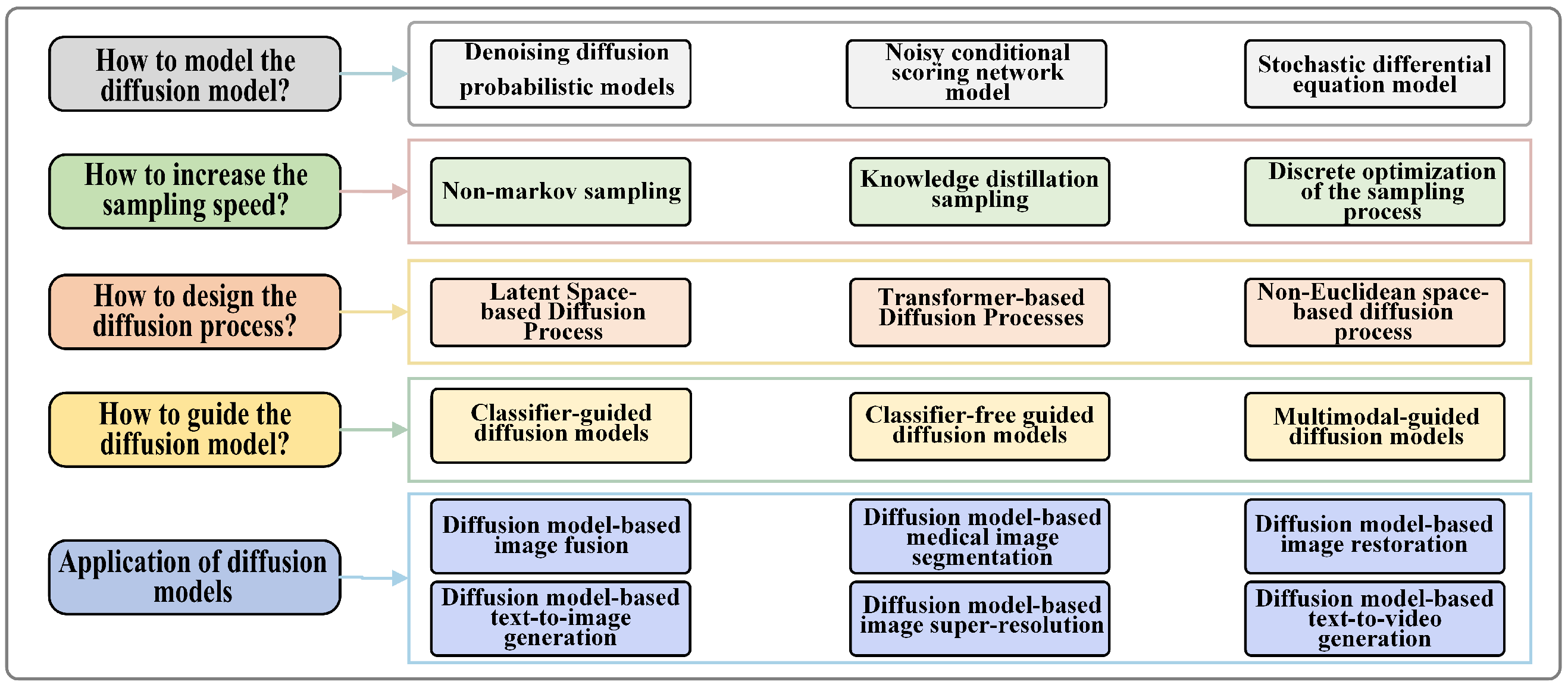
The rest of this paper is organized as follows. Figure 1 shows the overall framework. Section 2 introduces how to construct diffusion models, including denoising diffusion probabilistic models, noise-conditional score networks, and stochastic differential equations. Section 3 summarizes key techniques for improving sampling speed, including non-Markovian sampling, knowledge distillation, and discrete optimization. Section 4 reviews diffusion process design from the perspectives of latent space, Transformer-based diffusion, and non-Euclidean space. Section 5 summarizes the main guidance strategies for diffusion models, including classifier guidance, classifier-free guidance, and multimodal guidance. Section 6 reviews representative application scenarios in high-quality visual generation. Finally, Section 7 concludes the paper and outlines future research directions.
Figure 1.
General framework diagram. The figure summarizes the overall framework of this review, including diffusion model construction, sampling acceleration, diffusion process design, guidance strategies, and representative applications. Different colors denote the five thematic modules of this review.
2. How to Construct the Diffusion Model?
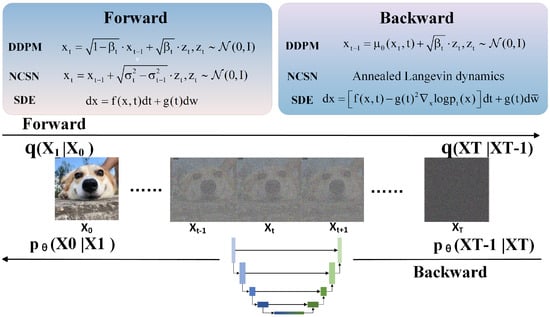
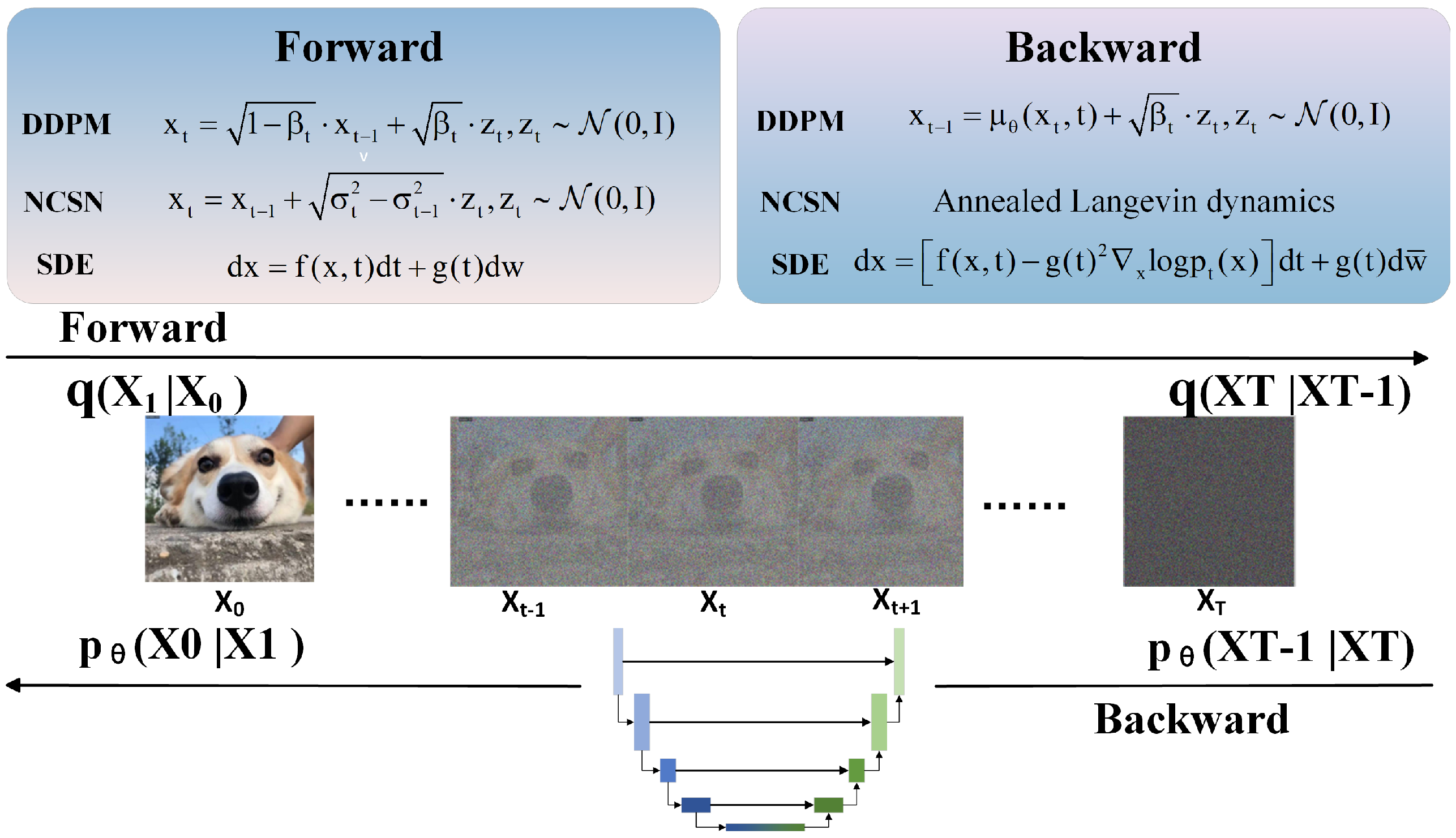
The construction of the diffusion model is the first “secret” to generating high-quality images. Its basic method is to simulate the generation process by gradually adding and removing noise. The basic model is shown in Figure 2. The diffusion model consists of two main processes: the forward diffusion process and the reverse generative process. The forward process gradually adds noise to the original images; thus, the process gradually randomizes the noise and eventually reaches a Gaussian distribution. The reverse process of the diffusion model is to transform random noise into a target image by removing noise step by step. Therefore, it is the inverse process of the forward diffusion process. The diffusion model construction includes three aspects: the denoising diffusion probabilistic model [7], the noise conditional score network model [6], and the stochastic differential equation model [8].
Figure 2.
Basic principles of the diffusion model. The figure illustrates the forward noising process and the reverse denoising process used for high-fidelity image synthesis.
2.1. Denoising Diffusion Probabilistic Model
The diffusion probability model is a generative model based on the diffusion process. The core mechanism is to use a Markov chain to simulate the process of noising and denoising and then learn the denoising steps through a neural network so as to generate high-quality and diversified images through this technology. The model utilizes two Markov chains: the forward chain and the reverse chain. In the forward noising stage, the model gradually converts the image from the original distribution to the known Gaussian noise distribution. The process is accomplished by gradually increasing random noise. There are multiple steps in the process, each of which adds more Gaussian noise, and the noise parameters (such as variance) that are added at each step are predefined. In the process of denoising, the task of the model is to recover the original image from the noise state step by step. In Song et al. [9], a denoising diffusion probabilistic model with de Markov is proposed, which improves the sampling speed of diffusion probabilistic models and generates higher quality images.
In the forward process, given an initial data distribution , noise with standard deviation is gradually added to the initial data at each step. The noisy data are defined as follows:
where represents the diffusion steps. is the identity matrix, and denotes a normal distribution with mean and covariance . The forward-process variance can be learned through reparameterization or kept constant as a hyperparameter. The expressive part of the reverse process is ensured by the choice of the Gaussian condition in , because when is small, both processes have the same functional form. When and , the marginal can be written as follows:
Using the above definitions, an image can be approximately obtained from through the reverse process. Thus, this reverse process can be parameterized as follows:
The objective in the training process of diffusion models is to make the generated distribution as close as possible to the actual data distribution. To achieve this goal, the variational bound on the negative logarithmic likelihood can be minimized as an optimization strategy. The formula is as follows:
Ho et al. [7] found that it is best not to directly parameterize as a neural network but to train the model to predict . A simplified objective is proposed through the above formula as follows:
Most diffusion models adopt the DDPM training strategy. However, there are some exceptions. The improved DDPM [10] proposes to combine with other auxiliary objectives to achieve faster sampling.
2.2. Noise Conditional Score Network Model
The noise conditional score network (NCSN) [6] is a generative model based on the diffusion model. The model estimates the gradient of the data distribution by learning a scoring function, and it uses this scoring function to gradually generate data samples from the noise. Images are generated using the Langevin dynamics principle. The Langevin dynamics principle is an iterative method; it can simulate the atoms in the system that are subjected to the interaction force of the atoms around them, and they move according to Newton’s second law and the interaction force. The Langevin dynamics principle is achieved by adding two additional forces to the atom, namely friction and random force. The magnitude of the friction force is the atom’s velocity multiplied by its mass and then multiplied by a friction factor in the direction opposite to the atomic velocity. The difference with the DDPM is that the NCSN trains a score network to estimate the data distribution gradient and uses these gradients to generate new images through iterative optimization with the Langevin dynamics principle.
The NCSN [6] generates images through the Langevin dynamics principle, where each image is independently distributed. The score function is , and the probability density function is . This density function is unknown; hence, a neural network with score matching needs to be trained for estimation. The score network is a neural network parameterized by , and the neural network is trained to approximate the score of () by minimizing the following objective:
2.3. Stochastic Differential Equation Model
Score-Based Generative Modeling (SGM) [8] through stochastic differential equations is a generative model based on score matching and the diffusion process. SGM generalizes these two methods, treating the diffusion process as a continuous process, thus from a disordered state (a state full of noise) to an ordered state (a true distribution of data), which is the solution of the stochastic differential equation (SDE):
where w represents the standard Wiener process/Brownian motion, denotes the drift coefficient of the SDE, and is a function of time t that signifies the noise coefficient. Diffusion models achieve the sampling process by utilizing a corresponding reverse-time SDE for the forward process:
where is an infinitesimal negative time step, and represents the backward-running Brownian motion. To numerically solve the reverse-time SDE, the neural network can be trained through score matching to approximate the actual score function estimate . This score model is trained using the following objective:
where the neural network is trained to approximate the score function , which represents the gradient of the log-probability density of the noise-perturbed data. This operation establishes a learned vector field that points toward regions of higher data density, effectively providing the “denoising direction” required to guide stochastic trajectories from a disordered noise state back to the structured data manifold during the reverse diffusion process. By minimizing this objective, the model can numerically solve the reverse-time SDE, facilitating high-quality image synthesis through an iterative process conceptually similar to the reverse Markov chain of the DDPM.
3. How to Improve the Sampling Speed?
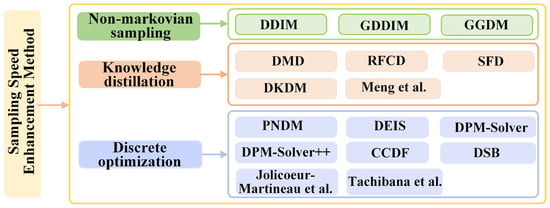
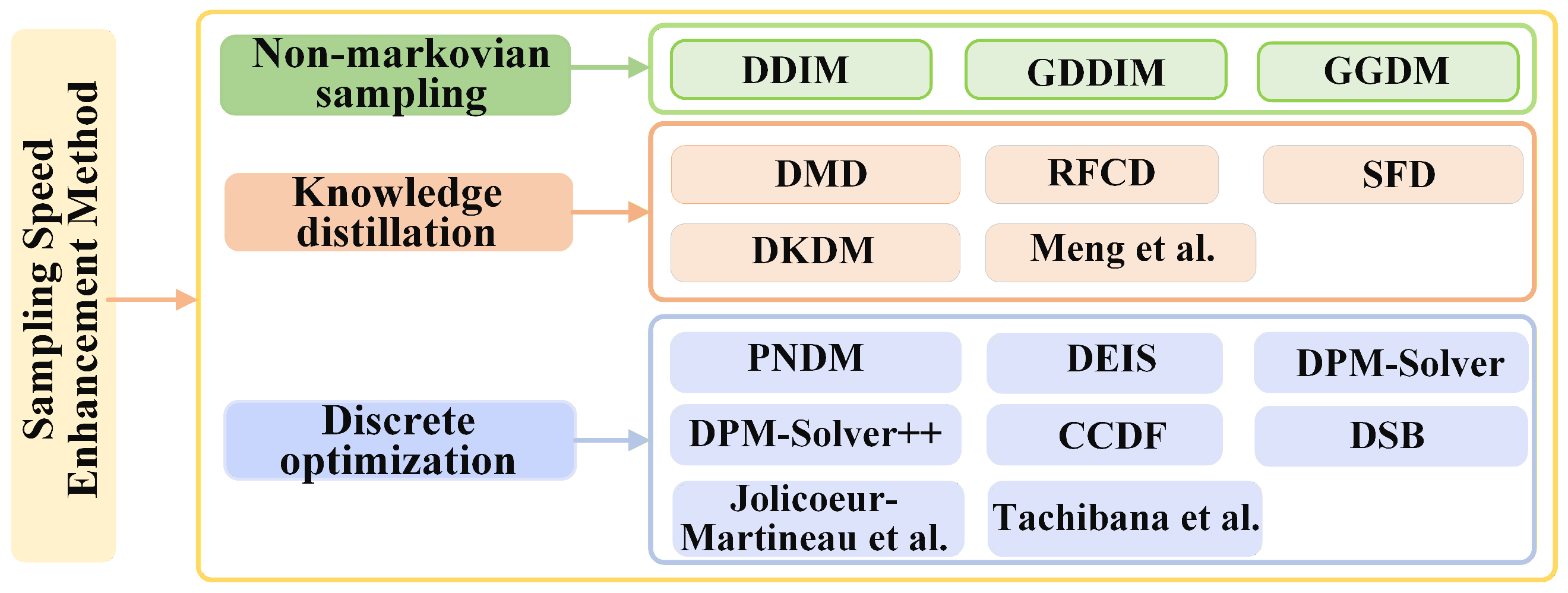
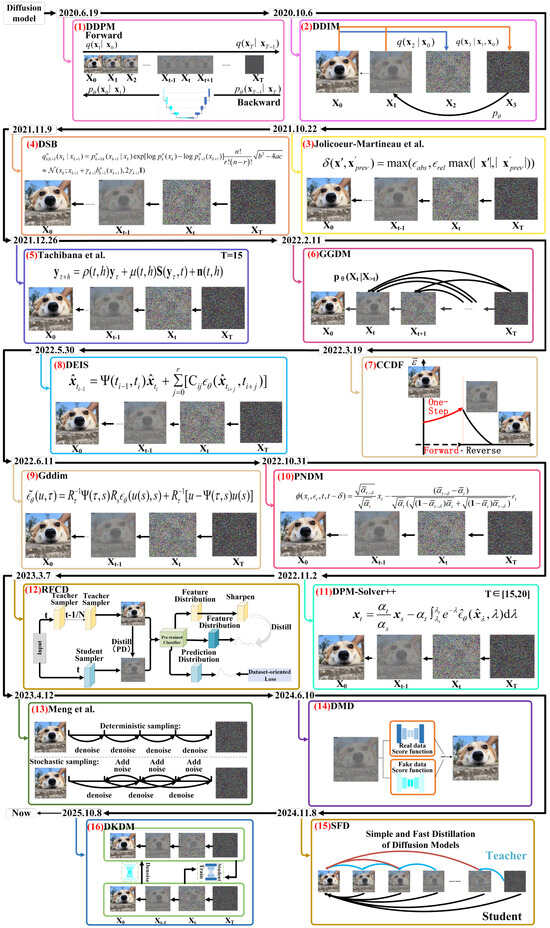
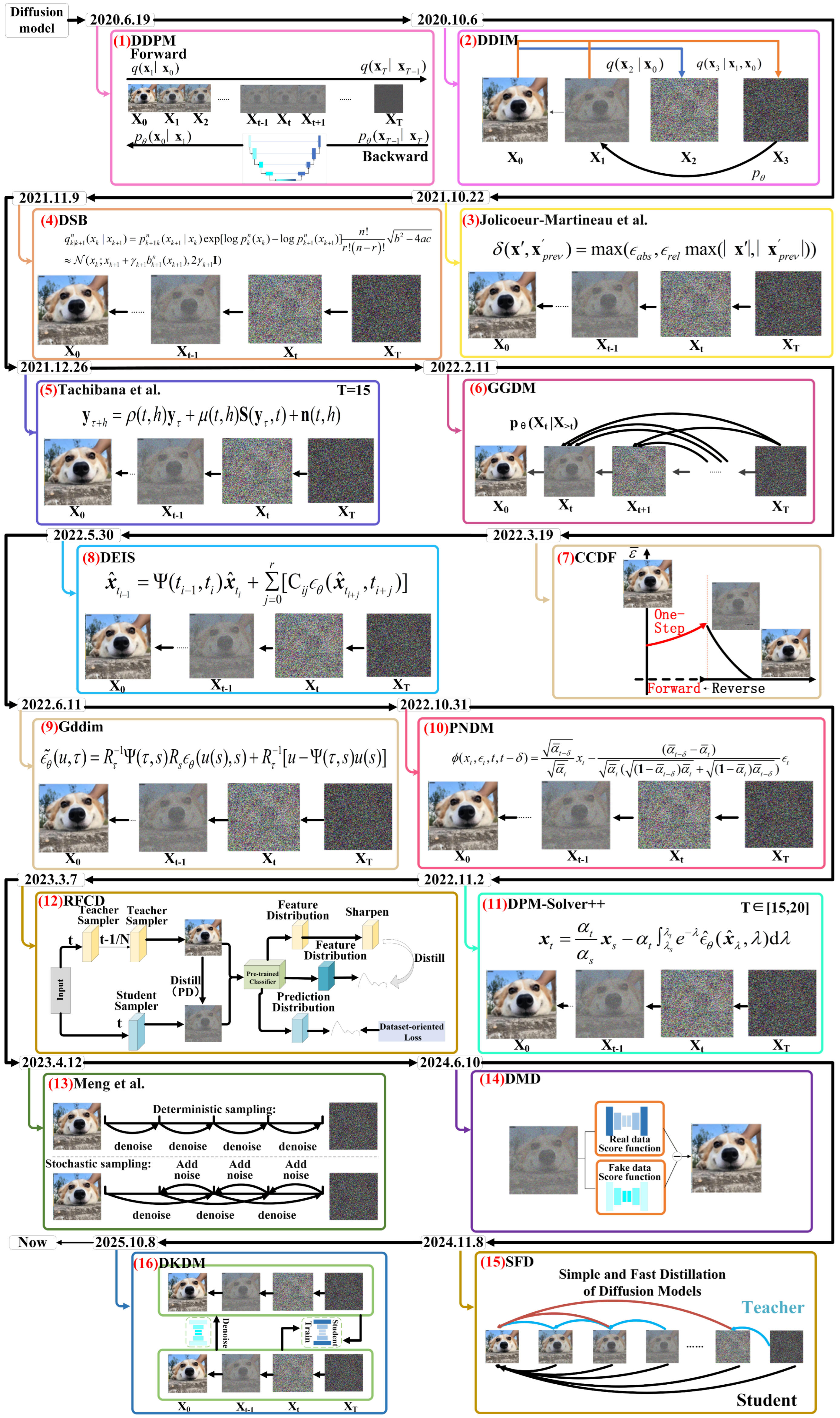
Improving the sampling speed of diffusion models is the second “secret” to generating high-quality images. Although the diffusion model makes remarkable achievements in generating high-quality and diverse images, its low sampling rate limits its practical applications. In recent years, methods to accelerate the sampling process are reported in many studies in the literature. The main methods include non-Markov sampling, knowledge distillation, and discretization optimization, as shown in Figure 3. In order to further explain the methods’ evolution to improve the sampling speed and the technologies iteration, taking time as the main line, this paper summarizes the methods of improving the sampling speed of the diffusion model, as shown in Figure 4, and the interpretations of the formulas appearing in the figure are detailed in Table 1. The following three optimization strategies are summarized. Firstly, non-Markov sampling depends not only on the state of the previous step but also on the past state in each step. Secondly, knowledge distillation generates the image by reducing the step number or using a smaller network to minimize the difference between the generated image and the original image. Thirdly, discrete optimization strategies are optimized by solving random differential equations or ordinary differential equations, thereby reducing sampling steps and maintaining good image quality. In Figure 3, non-Markov sampling speed improvement methods mainly include DDIM [9], GGDM [11], GDDIM [12] (represented in green color in Figure 3), and knowledge distillation sampling speed improvement methods mainly include DKDM [13], RFCD [14], SFD [15] and DKDM [13] (represented in orange color in Figure 3). The discrete optimization sampling speed improvement methods mainly include DPM-Solver [16], PNDM [17], DEIS [18], DPM-Solver++ [19], CCDF [20], DSB [21], etc. (represented by blue in Figure 3). In this paper, three methods to improve the sampling speed are elaborated, respectively.
Figure 3.
Sampling speed enhancement method. The main methods include non-Markov sampling, knowledge distillation and discretization optimization. Green arrows denote non-Markovian sampling, orange arrows denote knowledge distillation, and blue arrows denote discretization-based optimization. Representative methods include DDIM (Song et al. [9] ), GGDM (Watson et al. GDDIM [12]), GDDIM (Zhang et al. [12]), RFCD (Sun et al. [14]), SFD (Zhou et al. [15]), DKDM (Xiang et al. [13]), Meng et al. [22], PNDM (Liu et al. [17]), DEIS (Zhang et al. [18]), DPM-Solver/DPM-Solver++ (Lu et al. [19]), CCDF (Chung et al. [20]), DSB (De Bortoli et al. [21]), Jolicoeur-Martineau et al. [23], and Tachibana et al. [24].
Figure 4.
Improving the sampling speed for diffusion models. The numbered labels (1)–(16) correspond to the representative methods shown in the timeline.
Table 1.
Notations and descriptions.
3.1. Non-Markov Sampling
Non-Markov sampling means that each step in image generation no longer depends only on the previous state; it also depends on the past state. By incorporating historical information, non-Markov chain sampling can better capture long-term dependencies in the data, thereby improving the quality of generated image.
In Figure 4(2), Song et al. [9] proposes DDIM, and the sampling process of DDIM is a non-Markov process. DDPM requires simulating many steps of a Markov chain to generate images, which can have thousands of steps, iterating over all steps to generate an image. Therefore, DDIM uses non-Markov process sampling to generate high-quality samples faster and that are more balanced in terms of computation and sampling quality.
In Figure 4(6), Watson et al. [11] introduces the Differentiable Diffusion Sampler Search (DDSS), which is a method for optimizing a fast sampler of pre-trained diffusion models by differentiating sample quality scores. They propose the GGDM, which is a flexible non-Markovian sampler for diffusion models. The optimization process for GGDM uses reparameterization techniques and repeated gradient calculations.
In Figure 4(9), Zhang et al. [12] propose generalized DDIM (gDDIM). They found that the sampling of DDIM can be achieved by using a specific fraction approximation when solving the corresponding random differential equation. Compared to stochastic sampling, using the deterministic sampling can make the sampling process quicker.
3.2. Knowledge Distillation Sampling
Knowledge distillation is a model compression technique that transfers knowledge from a large, complex model to a small, simple model. This allows the student model to learn important knowledge and performance from the teacher model while maintaining a smaller size and computational efficiency. The distillation technique in the diffusion model aims to generate images in fewer steps or with a smaller network; the technique minimizes the difference between the generated image and the corresponding original image. Salimans and Ho et al. [25] first applied this principle to enhance diffusion models by progressively extracting sampling trajectories. Trajectories are extracted by correcting the latent maps in every two sampling steps.
In Figure 4(12), RFCD [14] aligns the student’s feature distribution with the teacher’s sharpened feature distribution in training. Therefore, students can focus on learning important features of images, resulting in better performance than the teacher.
In Figure 4(13), Meng et al. [22] propose a method to distill a classifier-free guided diffusion model into a fast-sampling model. Given a pre-trained classifier-free guided model, a single model learns to match the output of the conditional and unconditional models, and it gradually extracts the model into a diffusion model that requires fewer sampling steps.
In Figure 4(14), Yin et al. [26] proposed Distribution-Matching Distillation (DMD), which converts diffusion models into a one-step image-generation system while minimizing the impact on image quality. DMD enforces distribution-level matching between one-step generated images and the diffusion model by minimizing an approximate KL divergence. The gradient of this approximate KL divergence can be expressed as the difference between a score function of the target distribution and another score function of the synthetic distribution produced by the one-step generator.
In Figure 4(15), Zhou et al. [15] propose the Simple and Fast Distillation of the diffusion model (SFD), which simplifies the paradigms used in existing methods and significantly shortens their fine-tuning time. Starting from the sampling method based on vanilla distillation, SFD has elevated its performance to the most advanced level by identifying and addressing the factors that affect synthesis efficiency.
In Figure 4(16), Xiang et al. [13] utilize the existing diffusion models as data sources to train new diffusion models with any architecture. DKDM employs a dynamic iterative extraction method, which can efficiently extract time-domain knowledge from existing data models, thereby directly obtaining training data without the need for a lengthy generation process.
3.3. Discrete Optimization of the Sampling
The sampling speed can be improved by shortening the step interval when solving the diffusion SDE. However, this method can lead to discretization errors and negatively impact model performance. Optimizing the stochastic differential equation solutions or ordinary differential equations can reduce the sampling steps and maintain good image quality [27].
Optimization of SDE Solvers for the Sampling Process.
The SDE solver is optimized to solve the inverse diffusion SDE problem under continuous time conditions. SGM [8] aims to discretize the reverse SDE in the same manner as the forward SDE; the forward SDE and reverse SDE are discretized as shown in Equations (7) and (8). Due to the large number of score networks required by numerical SDE solvers, current score-based models generate data very slowly. Therefore, SGM suggests adding a “corrector” to the SDE solver to produce images with the correct marginal distribution. After the numerical SDE solver estimates the images at each time step, the “corrector” uses Markov Chain Monte Carlo methods to adjust the estimated images’ marginal distribution. Experimental results show that adding a corrector is more effective than using more steps.
In Figure 4(3), Jolicoeur-Martineau et al. [23] designed an SDE solver with an adaptive step. The solver requires only two fractional function evaluations; it reduces the quality in a reasonable way to increase speed, reducing the required computational budget 2 to 5-fold.
In Figure 4(4), De Bortoli et al. [21] propose DSB and extended SGM by treating reverse process learning as a Schrödinger bridging problem. DSB is an original approximation of the Iterative Proportional Fitting (IPF) procedure to solve the Schrödinger Bridge (SB) problem. In addition, DSB reveals the connection between generative modeling and optimal transportation problems.
In Figure 4(5), Tachibana et al. [24] propose the ideal derivative substitution. It utilizes the special structure of the latent gradient (score function). It can calculate its high-order derivatives and synthesize reasonable image and audio signals in relatively few refinement steps.
In Figure 4(7), Chun et al. [20] propose CCDF. which showed that starting from forward diffusion with better initialization can significantly reduce the number of sampling steps in reverse conditional diffusion. It also reveals how existing feedforward neural network methods can be combined with diffusion models.
Optimization of ODE Solvers for the Sampling Process.
The ODE solver optimization of the sampling process is used to improve the sampling efficiency of the diffusion model. Unlike SDE solvers, ODE solvers do not require Gaussian sampling. According to SGM [8], each diffusion model has a corresponding ODE whose marginal distribution is the same as the diffusion SDE. By designing a more efficient ODE solver, the generation quality can be preserved and the number of steps required for sampling can be significantly reduced, thus improving the performance of the overall diffusion model. This not only helps accelerate the training and inference processes of the model but also enables faster high-quality image generation in practical applications.
In Figure 4(8), Zhang and Chen et al. [18] propose DEIS, an exponential integrator designed for discrete ordinary differential equations, which uses the semilinear structure of the learning diffusion process to reduce discretization errors. This method proposes using quadratic time steps to discretize the diffusion ODE, which is similar to DDIM. It also suggests using an exponential integrator to approximate the solution of the ODE in the time step and employing polynomial extrapolation to enhance score estimation.
In Figure 4(10), Liu et al. [17] propose PNDM and proved that faster higher-order ODE can be designed by solving differential equations of DDPM on manifolds. PNDM combines the advantages of DDIM and higher-order numerical methods, which can generate high-quality images with fewer steps without loss of quality.
In Figure 4(11), Lu et al. [16] propose an exact formula for the solution of diffusion ordinary differential equations (ODEs), which simplified the exponentially weighted integration of neural networks through variable transformation. They developed DPM Solver based on this formulation, which is a fast high-order ODE solver, but it is unstable in large-scale guided sampling and generating image quality worse than the first-order solver DDIM. To solve this problem and speed up boot sampling, they propose DPM-Solver++ [19], which is a training-free fast diffusing ODE solver. Dpm-solver ++ stabilizes the sampling process with a threshold method, and it is suitable for DPM in pixels and potential spaces.
The progression from DDIM to DPM-Solver++ reflects a critical evolution in the “secret” of sampling acceleration. While DDIM established the feasibility of non-Markovian sampling, it requires a relatively high number of steps to maintain quality. PNDM improved this by leveraging manifold geometry, but it was the introduction of high-order solvers like DPM-Solver that truly pushed the efficiency boundary to approximately 10 steps. However, our analysis identifies a significant stability–efficiency trade-off: DPM-Solver often exhibits instability during guided sampling, which is a common requirement for high-quality text-to-image tasks. This led to the development of DPM-Solver++, which utilizes thresholding techniques to stabilize the sampling process in both pixel and latent spaces, effectively becoming the state-of-the-art for balanced, high-speed generation.
The quantitative evaluation in Table 2 illustrates a clear technical evolution. While DDPM establishes a high-quality baseline for generative fidelity, its practical utility is constrained by the 1000-step sampling bottleneck. In contrast, modern numerical solvers such as DPM-Solver++ reduce this to approximately 10–20 steps (NFE) without additional training, effectively balancing image quality and inference speed. However, a persistent stability–efficiency trade-off remains: high-order solvers, while pushing the efficiency boundary, may exhibit numerical instability during complex guided sampling compared with more robust first-order methods such as DDIM. Ultimately, distillation techniques such as DMD achieve single-step generation, although this efficiency comes at the cost of substantial training overhead and a loss of the zero-shot flexibility inherent in training-free solvers.
Table 2.
Performance evaluation and comparative analysis of representative diffusion models. Lower values indicate better performance.
4. How to Design the Diffusion Process?
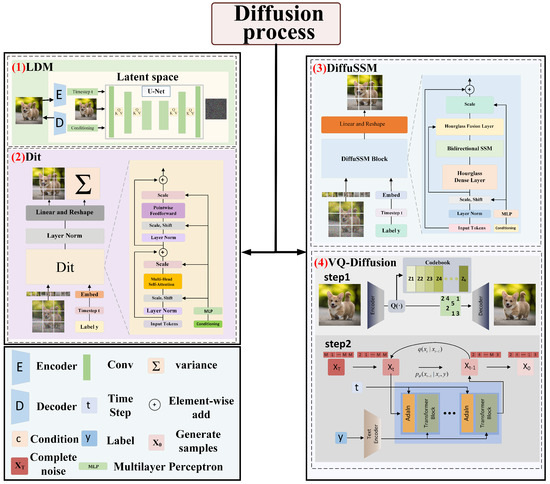
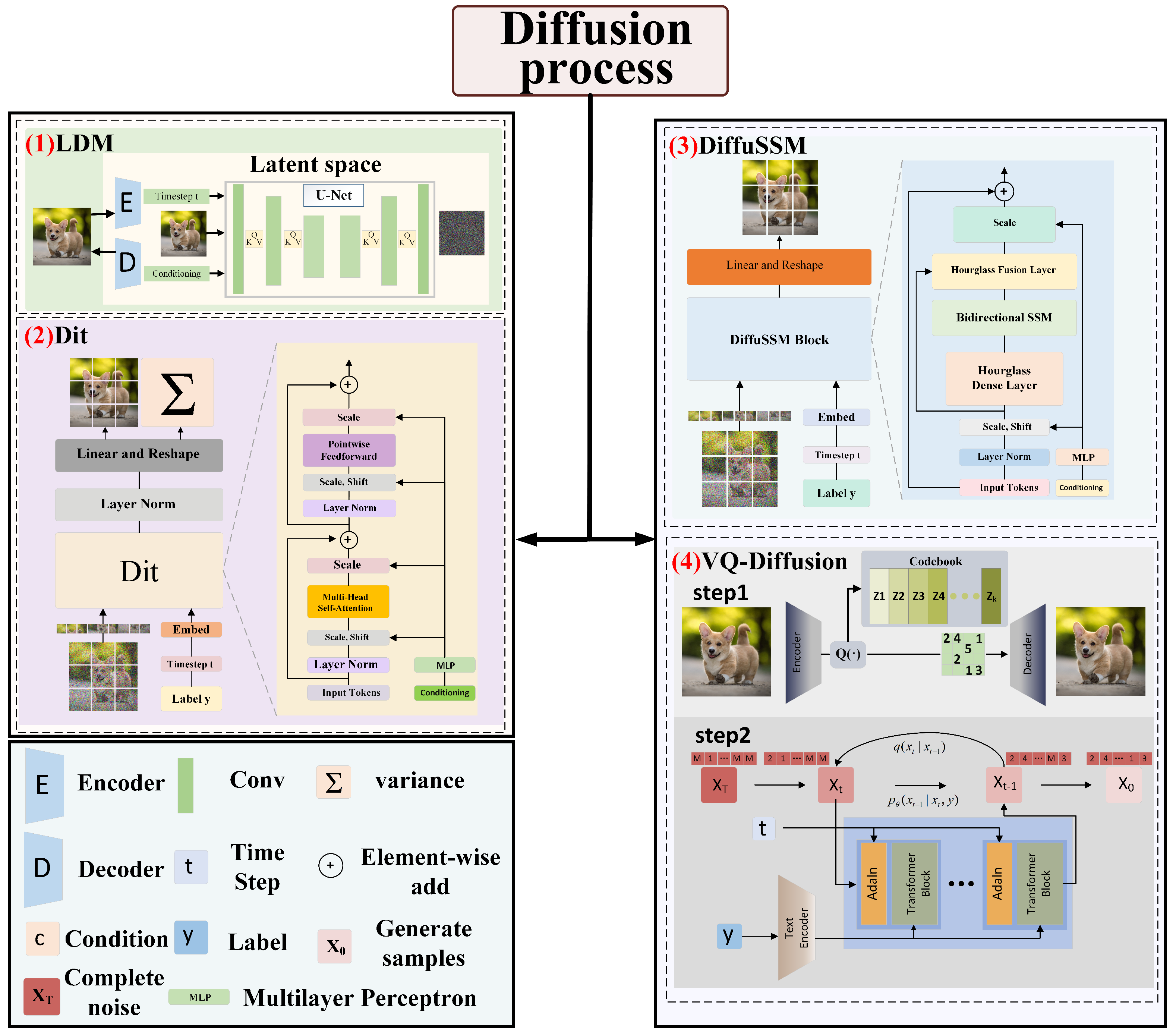
In the image diffusion model, the diffusion process design is the third “secret” to generating high-quality images, and the forward process in the diffusion model is usually considered to be Brownian movement in the pixel space, which may lead to high computational complexity when processing large-size images. For real-time or large-size image processing tasks, pixel spatial diffusion is not efficient enough. Therefore, designing new diffusion processes can make the reverse process easier to learn by neural networks. There are four main diffusion processes of diffusion models. Firstly, the diffusion model based on pixel space works in pixel space. Secondly, the diffusion process based on latent space is applied to the VAE Latent Space. Thirdly, there is a diffusion process based on Transformer in which the U-Net architecture of the diffusion model is replaced by Transformer. Fourthly, there is the diffusion process based on non-Euclidean space, which is applied in non-Euclidean space. This paper summarizes the application of the diffusion model in non-pixel space, as shown in Figure 5.
Figure 5.
Diffusion process design approaches, including LDM, DiT, DiffuSSM, and VQ-Diffusion. Different colors denote different diffusion-process design paradigms.
4.1. Diffusion Process Based on Latent Space
The latent space-based diffusion process encodes data into a continuous latent space. The model generates an image by progressively denoising the latent space; its structure is shown in Figure 5(1). The key problem is how to design the loss function; through this, the joint learning between VAE and diffusion models is realized. LSGM [28] maps an input image to a latent space and applies a score-based generative model in this space. The score-based model performs iterative denoising in the latent space and finally converts the image back into the pixel space through the decoder. Additionally, Stable Diffusion [29] and Blended Latent Diffusion [30] divide the process into two different stages: learning the latent space of the VAE and training the diffusion model with text as a conditional input. On the other hand, DVDP [31] decomposes images into several orthogonal components and controls the attenuation of each component when adding noise. This process can be interpreted as a dynamic form of downsampling and upsampling.
4.2. Diffusion Process Based on Transformer
The diffusion process based on Transformer replaces U-Net in the diffusion model with Transformer. The denoising process of the diffusion model usually adopts U-Net, which uses the step result and the conditional input to predict the noise added by the step. Subsequently, by DDPM, the data distribution at the step can be obtained. After multi-step iteration, the image is restored from random noise. Due to the excellent performance of vision Transformer in various visual tasks, researchers attempt to replace the U-Net in diffusion models with Transformer [32], and the model produces comparable or even better results than CNN-based methods. This section describes how to combine DDPM and ViT. The structure between DDPM and ViT is subdivided into U-ViT, DiTs, and GenViT.
GenViT: Yang et al. [33] integrated the ViT architecture into DDPM and, for the first time, used ViT as the backbone network for diffusion models, calling the resulting model generative ViT (GenViT). However, compared with CNN-based methods, GenViT has some limitations, such as lower generation quality, more training iterations, and a slow inference sampling speed ().
DiTs: Peebles et al. [34] proposed Diffusion Transformers (DiTs), as shown in Figure 5(2). In the LDM framework, the model replaces the commonly used U-Net backbone with transformers operating on latent patches. DiT inherits the strengths of transformers and outperforms earlier U-Net-based models.
U-ViT: Bao et al. [35] developed a ViT-based architecture called U-ViT for diffusion-model image generation. Inspired by U-Net, U-ViT uses long skip connections from shallow layers to deep layers and shows that explicit upsampling and downsampling are not always necessary in a CNN-style U-Net architecture.
The attention mechanism is a core component of the Transformer architecture and is critical for high-quality text and image generation [36]. However, its drawback is also obvious; that is, the computational complexity will increase with the increase in the sequence length. In order to allow the diffusion model to generate high-resolution images with less computing power, the attention mechanism can be discarded. Yan et al. [37] introduce DIFFUSSM, an architecture that replaces the attention mechanism with a more scalable state-space model backbone, as shown in Figure 5(3). DIFFUSSM can learn remote interactions at high resolution without the need for “length reduction” like patching. Similar to DiT [34], this approach operates by flattening the image and treating it as a sequence. However, unlike Transformer, it employs sub-quadratic computation with respect to the sequence length.
4.3. Diffusion Process Based on Non-Euclidean Space
The existing sample data are usually defined in Euclidean space, such as images and videos. Therefore, most diffusion generative models and their variational frameworks are constructed in Euclidean spaces. Huang et al. [38] developed a variational framework for likelihood estimation on Euclidean manifolds, which includes continuous-time normalized flows as a special case and can be viewed as an infinitely deep variational autoencoder. However, in many scientific fields, such as modeling geological formations in earth sciences, information propagation analysis in social networks, and disease propagation simulation in biomedicine, data are better represented by Riemannian manifolds with non-zero curvature, and standard Euclidean methods may not be applicable. Refs. [17,39,40,41,42] integrate diffusion sampling into Riemannian manifolds, thereby extending the SDE framework.
To improve and extend discrete diffusion models, D3PM [43] generates data through a more structured categorical corruption process. The transition kernel is designed to define the forward process in discrete space:
where represents a categorical distribution over the one-hot vector with probabilities given by the row vector p. The term is the row vector-matrix product.
In order to solve multi-model problems, such as text-to-image generation, text-to-3D generation, and text-to-image editing, Gu et al. [44] propose vector quantization (VQ) data to convert data into code. The diffusion model is applied to VQ data to solve the problem of unidirectional deviation and cumulative prediction error in VQ-VAE, as shown in Figure 5(4). The network structure of VQ-Diffusion [44] includes a text encoder and a diffusion decoder. The diffusion decoder takes image tokens and timestep t, outputting the noise-free token distribution . Du et al. [45] further extended VQ-VAE to text-to-image tasks. VQ-Diffusion [44] and D3PM [43] are models that generalize DDPM [7] to the discrete state. The forward Markov diffusion process for the entire token sequence can be written as shown below:
where is a one-hot column vector of length K and is the probability transition matrix.
5. How to Guide the Diffusion Model?
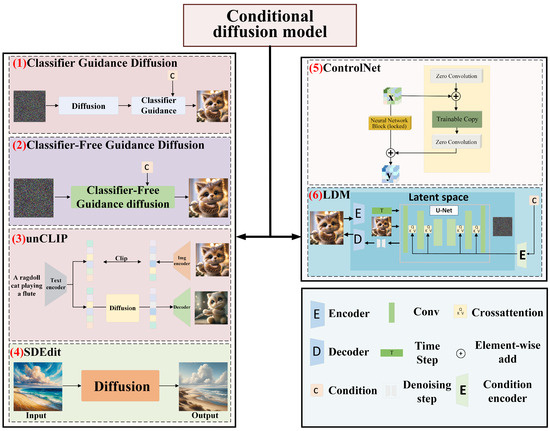
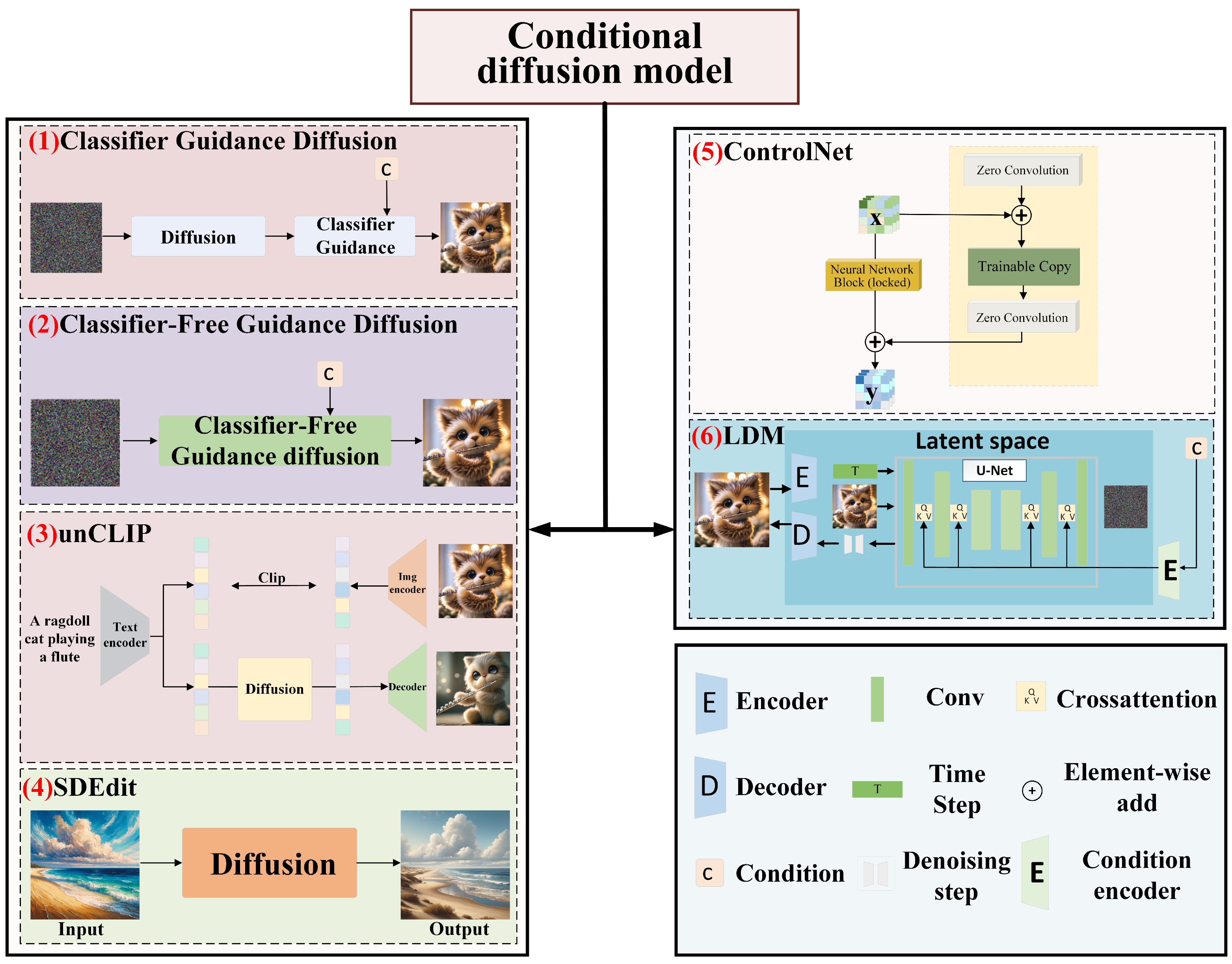
In diffusion models, guided generation is the fourth “secret” for producing high-quality images. Conditional diffusion models extend the standard diffusion framework by incorporating conditioning signals such as class labels, text, images, or videos. In many cases, label-specific conditional gradients are obtained with an additional classifier built on a U-Net encoder architecture [46]. Adding such constraints alleviates the lack of controllability in unconditional generation and improves both training stability and output quality. As with other generative models such as VAEs, GANs, and normalizing flows, diffusion models were first developed for unconditional generation and later extended to conditional settings. Unconditional generation is often used to benchmark fundamental model capability, whereas conditional generation is more application-oriented because it steers outputs according to specific inputs, as shown in Figure 6. There are three main categories of guided diffusion models: classifier-guided diffusion models [47], classifier-free guided diffusion models [48], and multimodal-guided diffusion models.
Figure 6.
Conditional diffusion models, including classifier guidance, classifier-free guidance, unCLIP, SDEdit, ControlNet, and LDM, Different colors denote different conditioning branches or guidance mechanisms.
5.1. Classifier-Guided Diffusion Models
Classifier guidance is used to add category label information in the image generation process to enhance the model constraints, and it combines the score estimation of the diffusion model with the gradient of the independently trained image classifier to improve the generation quality, as shown in Figure 6(1). Dhariwal and Nichol et al. [47] propose classifier guidance, which is a technique that uses an additionally trained classifier to enhance the image quality of diffusion models. Adjusting the strength of the classifier gradient can achieve a balance between the Inception Score [49] and FID Score [50], as shown in Equation (3). The key of the diffusion model is to construct by denoising the network. Using Bayes’ formula, the classifier converts into a pre-trained unconditional image generation model to .
where represents the given condition. Although the classifier is cost-effective, it has the following drawbacks. (1) An additional classifier needs to be trained, increasing the model’s complexity. (2) The classifier partially determines the model’s performance ceiling, and optimizing this classifier is challenging. (3) Classifier guidance will destroy the diversity of the generated results.
5.2. Classifier-Free Guided Diffusion Models
Classifier-free guidance is a technique for guiding diffusion models without independently training classifiers. Classifier guidance increases the complexity of the diffusion model training process because it requires training an additional classifier. Jonathan Ho and Tim Salimans [48] propose a classifier-free guidance method, which can be considered as classifier guidance without a classifier, as shown in Figure 6(2). By adjusting the mixed weights, a similar FID/IS trade-off can be achieved with classifier guidance. In classifier-free guidance, the label in a class-conditional diffusion model is sometimes substituted with a null label ∅ at a certain probability during training. During sampling, the model’s output is extrapolated more toward and further from as shown below:
where is the guidance scale. This functional form is inspired by the implicit classifier. Classifier-free guidance can be trained using its own knowledge rather than relying on guidance from a separate classification model. In addition, this approach simplifies the training process for information that is difficult for classifiers to predict, such as text. Current image generation models, such as GLIDE [51], Stable Diffusion [29], DALLE-2 [52] and Imagen [53], all use classifier-free guidance, demonstrating remarkable generation results.
5.3. Multimodal-Guided Diffusion Models
Multimodal guidance [54] refers to the use of information from multiple data modes (such as text, images, audio, etc.) [55] to guide the data generation process. By fusing the information from different modalities, it can enrich the representation of data and improve the understanding and generation ability [56]. For example, in the image generation task, this model can generate more semantically rich images. DiffuSeq [57] proposes a sequence-to-sequence diffusion framework based on text conditions that can support four natural language processing (NLP) tasks. SDEdit [58] uses a style image as a condition to achieve image-to-image translation, as shown in Figure 6(4). LDM [29] integrates these semantic conditions to generate images through a latent diffusion process, as shown in Figure 6(6). unCLIP [52] utilizes the CLIP model to achieve text-to-image generation, aligning semantics between images and text, as shown in Figure 6(3). Ramesh et al. [52] used the CLIP model to replace the traditional classifier in classifier guidance. Specifically, the inverse process can be perturbed by using the gradient of the dot product between the image and the title encodings:
Similar to classifier guidance, unCLIP requires training CLIP on noisy images to ensure the correct gradients are obtained during the reverse process.
Zhang et al. [59] propose ControlNet for the accurate conditional control of large pre-trained text-to-image diffusion models, as shown in Figure 6(5). The architecture uses the pre-trained layer of the original model to build a structure with more coding capability. This structure learns a variety of conditions to improve the adaptability and versatility of the model. ControlNet introduces “zero convolution” layers that connect the original model with its trainable copy, which effectively eliminates the harmful noise that can be generated during training. This approach shows excellent versatility and flexibility in handling complex image synthesis tasks.
6. Application of Diffusion Models
In recent years, deep learning has driven significant advances in image fusion and visual generation [60]. As a powerful generative paradigm, diffusion models show strong application potential across multiple tasks. This section reviews three representative application scenarios: high-quality text-to-image generation, high-quality text-to-video generation, and high-quality image-to-image generation.
6.1. High-Quality Text-to-Image Generation
Text-to-image generation is technology using natural language descriptions to generate images. In DreamBooth [61], pre-trained text is fine-tuned into the image by inputting some theme images to bind specific themes to unique identifiers. In this way, the model can generate new realistic images containing the subject in different scenes. ET-DM [62] combines diffusion and transformer, which enables the generation of images with consistent semantic information. ControlNet [59] combines a pre-trained diffusion model with additional input conditions; the model implements conditional control in this way. It learns specific conditions in an end-to-end manner and remains robust on small training datasets.
Analytical: The advantage is unparalleled semantic diversity. The industry pain point is the “problems” of fine details like hands or text. Future directions include zero-shot attention mechanisms for more precise localized generative control.
6.2. High-Quality Text-to-Video Generation
Diffusion model-based text-to-video [63] generation is a technique that uses diffusion model technology to convert natural language text descriptions into video content. Hu et al. [64] propose a latent motion diffusion (LaMD) framework, which consists of a motion decomposition video autoencoder and a diffusion-based motion generator: the motion decomposition video autoencoder can compress motion patterns into concise latent motion representations. Diffusion-based motion generators can generate real motion in continuous latent space. Wang et al. [65] propose LaVie, which is an integrated video generation framework that not only reveals the incorporation of simple temporal self-attention but also fully captures the temporal correlations inherent in video data. Ni et al. [66] introduce the cI2V method based on the Latent Flow Diffusion Model (LFDM). This method warps a given image by generating a sequence of optical flow in the potential space to achieve conditional synthesis. The diffusion model in LFDM only needs to learn a low-dimensional latent flow space for movement generation, making it more computationally efficient.
Analytical: The core difficulty is avoiding inter-frame flickering. The industry pain point is the extreme GPU memory cost for long sequences. Future improvements likely involve decomposed latent move flow for mobile-level generative editing.
6.3. High-Quality Image-to-Image Generation
Diffusion model-based image-to-image generation is used to generate images conditioned on images. InstructPix2Pix [67] proposes a method for image editing: given an input image and a written instruction, the model edits the image according to these instructions. UNIMO-G [68] proposes a simple multimodal conditional diffusion framework, which takes text and images as the conditions for image generation and generates images that are consistent with the semantics.
Analytical: The core of the technology for generating images from high-quality images lies in achieving a balance between preserving the structural prior of the image and performing semantic transformation. The main challenge is “the trade-off between fidelity and instructions”. Excessive adherence to instructions result in the loss of the original subject identity, while strict fidelity leads to insufficient editing. Future research should prioritize local attention mechanisms and zero-sample decoupling to achieve more precise control over which visual elements are retained and which are transformed.
To provide a structured and objective evaluation of diffusion models, Table 3 summarizes representative applications in three fields. This comparison evaluates each field through three critical dimensions: advantages, challenges, and future work. Although these models perform well in visual synthesis, maintaining structural fidelity, semantic interpretability, and computational efficiency remains challenging. Therefore, future work should move beyond sample quality alone and pursue a better balance among inference efficiency, semantic controllability, and ethical safety.
Table 3.
Comprehensive analysis of high-quality generation applications.
7. Conclusions and Prospects
7.1. Conclusions
Diffusion models are important techniques in image processing and computer vision, and their application scope continues to expand. The main contributions of this paper are as follows. Firstly, the basic principles of diffusion models are introduced, including denoising diffusion probabilistic models, noise conditional score networks, and stochastic differential equations. Secondly, key techniques for improving sampling speed are summarized, including non-Markovian sampling, knowledge distillation, and discrete optimization. Thirdly, diffusion process design is reviewed from three perspectives: latent space, transformer-based diffusion, and non-Euclidean space. Fourthly, guided diffusion techniques are summarized, including classifier guidance, classifier-free guidance, and multimodal guidance. Fifthly, representative applications of diffusion models are discussed, including high-quality text-to-image, text-to-video, and image-to-image generation.
7.2. Comparison with Other Generative Models
Compared with other generative models, the diffusion model has the following three advantages. Firstly, compared with GAN, the diffusion model avoids training problems such as pattern collapse by gradually adding noise and reversing the process of generating images, which provides a more stable and consistent image generation. Secondly, the diffusion model does not need to perform approximate inference in the latent space, and it directly optimizes the generation process in the data space, avoiding model collapse and generation quality constraints in VAE. Thirdly, compared with normalizing flows, diffusion models do not rely on learning complex reversible transformations, which not only improves the stability of training but also enhances the diversity and quality of generation.
However, the diffusion model also has the following three disadvantages. Firstly, the diffusion model needs to perform a large number of matrix operations at each time step, especially when dealing with high-dimensional data, which requires high computational resources. Secondly, since the diffusion model requires several iterations to generate images, it needs to reverse diffusion step by step, in which every step needs to calculate the conditional probability distribution. This makes it take longer to generate a single image. This may limit its feasibility in practical applications, especially in scenarios where results need to be generated quickly. Thirdly, parameter tuning is difficult; diffusion models need to fine-tune multiple hyperparameters to ensure model stability and generation quality.
7.3. Future Work
While diffusion models have demonstrated remarkable generative capabilities, several diffusion-specific technical challenges remain as critical research frontiers:
Firstly, the diffusion model requires a more standardized evaluation framework. The existing studies often report their performance under different datasets, resolutions, sampling steps, guidance ratios and evaluation metrics, which makes fair comparisons difficult. Future research should establish more unified standards and evaluation procedures to enhance the reproducibility, fairness and interpretability of model comparisons. Secondly, the training and inference costs of diffusion models are the main bottlenecks in actual deployment. High-quality generation usually requires large amounts of data, long training times, and iterative sampling, which will result in significant computational and memory overheads. Therefore, developing more efficient training strategies, lightweight architectures, and faster sampling methods remains important for future work. Thirdly, the controllable generation under complex conditions still requires further improvement. Although the classifier-free guidance and ControlNet have significantly enhanced the conditional generation capabilities, achieving fine control, combining prompts, and editing for specific areas under multiple constraints remains challenging. Future research should focus on improving semantic consistency, local controllability, and robustness in complex multimodal conditions. Fourthly, watermarking technology, copyright protection, and content ownership identification have become increasingly important during the diffusion process. As diffusion models have been widely applied in creative and commercial scenarios, it is necessary to study how to embed reliable watermarks, track the generated content, and resolve copyright disputes related to training data and generated outputs. These issues are very important for the sustainable development of diffusion model technology. Finally, future research on diffusion models should not only focus on improving generation quality, accelerating inference speed, and enhancing controllability but also pay attention to the fairness of evaluation, the consistency of multimodality, security governance, and legal compliance. Moving in these directions promotes the theoretical development and practical application of diffusion models in high-quality visual generation.
Author Contributions
Conceptualization, T.Z. and Z.Z.; methodology, T.Z.; software, T.Z.; validation, T.Z., Z.Z. and M.Z.; formal analysis, T.Z.; investigation, T.Z. and M.Z.; resources, Y.X. and F.H.; data curation, T.Z.; writing—original draft preparation, T.Z.; writing—review and editing, Z.Z., W.C. and Y.X.; visualization, T.Z.; supervision, Z.Z.; project administration, Z.Z.; funding acquisition, Z.Z. All authors have read and agreed to the published version of the manuscript.
Funding
This research was funded by the National Natural Science Foundation of China (Grant Nos. 62561002 and 62576009) and the Ningxia Natural Science Foundation Project (Grant No. 2025AAC020006). Ningxia Leading Talent Cultivation Project for Science and Technology (No. 2025GKLRLX26).
Data Availability Statement
No new data were created or analyzed in this study. Data sharing is not applicable to this paper.
Acknowledgments
The authors gratefully acknowledge the support of the funding agencies.
Conflicts of Interest
The authors declare no conflicts of interest.
References
- Croitoru, F.A.; Hondru, V.; Ionescu, R.T.; Shah, M. Diffusion models in vision: A survey. IEEE Trans. Pattern Anal. Mach. Intell. 2023, 45, 10850–10869. [Google Scholar] [CrossRef] [Scilit]
- Pinheiro Cinelli, L.; Araújo Marins, M.; Barros da Silva, E.A.; Lima Netto, S. Variational autoencoder. In Variational Methods for Machine Learning with Applications to Deep Networks; Springer: Cham, Switzerland, 2021; pp. 111–149. [Google Scholar]
- Zhou, T.; Li, Q.; Lu, H.; Cheng, Q.; Zhang, X. GAN review: Models and medical image fusion applications. Inf. Fusion 2023, 91, 134–148. [Google Scholar] [CrossRef] [Scilit]
- Papamakarios, G.; Nalisnick, E.; Rezende, D.J.; Mohamed, S.; Lakshminarayanan, B. Normalizing flows for probabilistic modeling and inference. J. Mach. Learn. Res. 2021, 22, 1–64. [Google Scholar]
- Sohl-Dickstein, J.; Weiss, E.A.; Maheswaranathan, N.; Ganguli, S. Deep Unsupervised Learning using Nonequilibrium Thermodynamics. arXiv 2015, arXiv:1503.03585. [Google Scholar] [CrossRef] [Scilit]
- Song, Y.; Ermon, S. Generative modeling by estimating gradients of the data distribution. In Proceedings of the Advances in Neural Information Processing Systems, Vancouver, BC, Canada, 8–14 December 2019; Volume 32. [Google Scholar]
- Ho, J.; Jain, A.; Abbeel, P. Denoising diffusion probabilistic models. In Proceedings of the Advances in Neural Information Processing Systems, Virtual, 6–12 December 2020; Volume 33, pp. 6840–6851. [Google Scholar]
- Song, Y.; Sohl-Dickstein, J.; Kingma, D.P.; Kumar, A.; Ermon, S.; Poole, B. Score-Based Generative Modeling through Stochastic Differential Equations. arXiv 2020, arXiv:2011.13456. [Google Scholar] [CrossRef] [Scilit]
- Song, J.; Meng, C.; Ermon, S. Denoising Diffusion Implicit Models. In Proceedings of the International Conference on Learning Representations, Virtual, 3–7 May 2021. [Google Scholar]
- Nichol, A.Q.; Dhariwal, P. Improved denoising diffusion probabilistic models. In Proceedings of the International Conference on Machine Learning, PMLR, London, UK, 18–24 July 2021; pp. 8162–8171. [Google Scholar]
- Watson, D.; Chan, W.; Ho, J.; Norouzi, M. Learning fast samplers for diffusion models by differentiating through sample quality. In Proceedings of the International Conference on Learning Representations, Virtual, 25–29 April 2022. [Google Scholar]
- Zhang, Q.; Tao, M.; Chen, Y. gDDIM: Generalized denoising diffusion implicit models. In Proceedings of the The Eleventh International Conference on Learning Representations, Kigali, Rwanda, 1–5 May 2023. [Google Scholar]
- Xiang, Q.; Zhang, M.; Shang, Y.; Wu, J.; Yan, Y.; Nie, L. Dkdm: Data-free knowledge distillation for diffusion models with any architecture. In Proceedings of the Computer Vision and Pattern Recognition Conference, Nashville, TN, USA, 11–15 June 2025; pp. 2955–2965. [Google Scholar]
- Sun, W.; Chen, D.; Wang, C.; Ye, D.; Feng, Y.; Chen, C. Accelerating diffusion sampling with classifier-based feature distillation. In Proceedings of the 2023 IEEE International Conference on Multimedia and Expo (ICME), Brisbane, Australia, 10–14 July 2023; pp. 810–815. [Google Scholar]
- Zhou, Z.; Chen, D.; Wang, C.; Chen, C.; Lyu, S. Simple and fast distillation of diffusion models. In Proceedings of the Advances in Neural Information Processing Systems, Vancouver, BC, Canada, 10–15 December 2024; Volume 37, pp. 40831–40860. [Google Scholar]
- Lu, C.; Zhou, Y.; Bao, F.; Chen, J.; Li, C.; Zhu, J. Dpm-solver: A fast ode solver for diffusion probabilistic model sampling in around 10 steps. In Proceedings of the Advances in Neural Information Processing Systems, New Orleans, LA, USA, 28 November–9 December 2022; Volume 35, pp. 5775–5787. [Google Scholar]
- Liu, L.; Ren, Y.; Lin, Z.; Zhao, Z. Pseudo Numerical Methods for Diffusion Models on Manifolds. arXiv 2022, arXiv:2202.09778. [Google Scholar] [CrossRef] [Scilit]
- Zhang, Q.; Chen, Y. Fast sampling of diffusion models with exponential integrator. arXiv 2022, arXiv:2204.13902. [Google Scholar]
- Lu, C.; Zhou, Y.; Bao, F.; Chen, J.; Li, C.; Zhu, J. Dpm-solver++: Fast solver for guided sampling of diffusion probabilistic models. arXiv 2022, arXiv:2211.01095. [Google Scholar] [CrossRef] [Scilit]
- Chung, H.; Sim, B.; Ye, J.C. Come-closer-diffuse-faster: Accelerating conditional diffusion models for inverse problems through stochastic contraction. In Proceedings of the IEEE/CVF Conference on Computer Vision and Pattern Recognition, New Orleans, LA, USA, 19–24 June 2022; pp. 12413–12422. [Google Scholar]
- De Bortoli, V.; Thornton, J.; Heng, J.; Doucet, A. Diffusion schrödinger bridge with applications to score-based generative modeling. In Proceedings of the Advances in Neural Information Processing Systems, Virtual, 6–14 December 2021; Volume 34, pp. 17695–17709. [Google Scholar]
- Meng, C.; Rombach, R.; Gao, R.; Kingma, D.; Ermon, S.; Ho, J.; Salimans, T. On distillation of guided diffusion models. In Proceedings of the IEEE/CVF Conference on Computer Vision and Pattern Recognition, Vancouver, BC, Canada, 18–22 June 2023; pp. 14297–14306. [Google Scholar]
- Jolicoeur-Martineau, A.; Li, K.; Piché-Taillefer, R.; Kachman, T.; Mitliagkas, I. Gotta go fast when generating data with score-based models. arXiv 2021, arXiv:2105.14080. [Google Scholar] [CrossRef] [Scilit]
- Tachibana, H.; Go, M.; Inahara, M.; Katayama, Y.; Watanabe, Y. Quasi-Taylor Samplers for Diffusion Generative Models based on Ideal Derivatives. arXiv 2021, arXiv:2112.13339. [Google Scholar]
- Salimans, T.; Ho, J. Progressive distillation for fast sampling of diffusion models. arXiv 2022, arXiv:2202.00512. [Google Scholar] [CrossRef] [Scilit]
- Yin, T.; Gharbi, M.; Zhang, R.; Shechtman, E.; Durand, F.; Freeman, W.T.; Park, T. One-step diffusion with distribution matching distillation. In Proceedings of the IEEE/CVF Conference on Computer Vision and Pattern Recognition, Seattle, WA, USA, 17–21 June 2024; pp. 6613–6623. [Google Scholar]
- Karras, T.; Aittala, M.; Aila, T.; Laine, S. Elucidating the design space of diffusion-based generative models. In Proceedings of the Advances in Neural Information Processing Systems, New Orleans, LA, USA, 28 November–9 December 2022; Volume 35, pp. 26565–26577. [Google Scholar]
- Vahdat, A.; Kreis, K.; Kautz, J. Score-based generative modeling in latent space. In Proceedings of the Advances in Neural Information Processing Systems, Virtual, 6–14 December 2021; Volume 34, pp. 11287–11302. [Google Scholar]
- Rombach, R.; Blattmann, A.; Lorenz, D.; Esser, P.; Ommer, B. High-resolution image synthesis with latent diffusion models. In Proceedings of the IEEE/CVF Conference on Computer Vision and Pattern Recognition, New Orleans, LA, USA, 19–24 June 2022; pp. 10684–10695. [Google Scholar]
- Avrahami, O.; Fried, O.; Lischinski, D. Blended latent diffusion. ACM Trans. Graph. (TOG) 2023, 42, 149. [Google Scholar] [CrossRef] [Scilit]
- Zhang, H.; Feng, R.; Yang, Z.; Huang, L.; Liu, Y.; Zhang, Y.; Shen, Y.; Zhao, D.; Zhou, J.; Cheng, F. Dimensionality-varying diffusion process. In Proceedings of the IEEE/CVF Conference on Computer Vision and Pattern Recognition, Vancouver, BC, Canada, 18–22 June 2023; pp. 14307–14316. [Google Scholar]
- Zhou, T.; Peng, C.; Guo, Y.; Wang, H.; Niu, Y.; Lu, H. Identity-mapping ResFormer: A computer-aided diagnosis model for pneumonia X-ray images. IEEE Trans. Instrum. Meas. 2025, 74, 5007712. [Google Scholar] [CrossRef] [Scilit]
- Yang, X.; Shih, S.M.; Fu, Y.; Zhao, X.; Ji, S. Your vit is secretly a hybrid discriminative-generative diffusion model. arXiv 2022, arXiv:2208.07791. [Google Scholar]
- Peebles, W.; Xie, S. Scalable diffusion models with transformers. In Proceedings of the IEEE/CVF International Conference on Computer Vision, Paris, France, 2–6 October 2023; pp. 4195–4205. [Google Scholar]
- Bao, F.; Nie, S.; Xue, K.; Cao, Y.; Li, C.; Su, H.; Zhu, J. All are worth words: A vit backbone for diffusion models. In Proceedings of the IEEE/CVF Conference on Computer Vision and Pattern Recognition, Paris, France, 2–6 October 2023; pp. 22669–22679. [Google Scholar]
- Zhou, T.; Niu, Y.; Lu, H.; Peng, C.; Guo, Y.; Zhou, H. Vision transformer: To discover the “four secrets” of image patches. Inf. Fusion 2024, 105, 102248. [Google Scholar] [CrossRef] [Scilit]
- Yan, J.N.; Gu, J.; Rush, A.M. Diffusion models without attention. In Proceedings of the IEEE/CVF Conference on Computer Vision and Pattern Recognition, Seattle, WA, USA, 17–21 June 2024; pp. 8239–8249. [Google Scholar]
- Huang, C.W.; Lim, J.H.; Courville, A.C. A variational perspective on diffusion-based generative models and score matching. In Proceedings of the Advances in Neural Information Processing Systems, Virtual, 6–14 December 2021; Volume 34, pp. 22863–22876. [Google Scholar]
- Park, Y.H.; Kwon, M.; Choi, J.; Jo, J.; Uh, Y. Understanding the Latent Space of Diffusion Models through the Lens of Riemannian Geometry. In Proceedings of the Advances in Neural Information Processing Systems; Oh, A., Naumann, T., Globerson, A., Saenko, K., Hardt, M., Levine, S., Eds.; Curran Associates, Inc.: New York, NY, USA, 2023; Volume 36, pp. 24129–24142. [Google Scholar]
- Huang, C.W.; Aghajohari, M.; Bose, J.; Panangaden, P.; Courville, A.C. Riemannian diffusion models. In Proceedings of the Advances in Neural Information Processing Systems, New Orleans, LA, USA, 28 November–9 December 2022; Volume 35, pp. 2750–2761. [Google Scholar]
- Lou, A.; Xu, M.; Farris, A.; Ermon, S. Scaling Riemannian Diffusion Models. In Proceedings of the Advances in Neural Information Processing Systems; Oh, A., Naumann, T., Globerson, A., Saenko, K., Hardt, M., Levine, S., Eds.; Curran Associates, Inc.: New York, NY, USA, 2023; Volume 36, pp. 80291–80305. [Google Scholar]
- De Bortoli, V.; Mathieu, E.; Hutchinson, M.; Thornton, J.; Teh, Y.W.; Doucet, A. Riemannian score-based generative modelling. In Proceedings of the Advances in Neural Information Processing Systems, New Orleans, LA, USA, 28 November–9 December 2022; Volume 35, pp. 2406–2422. [Google Scholar]
- Austin, J.; Johnson, D.D.; Ho, J.; Tarlow, D.; Van Den Berg, R. Structured denoising diffusion models in discrete state-spaces. In Proceedings of the Advances in Neural Information Processing Systems, Virtual, 6–14 December 2021; Volume 34, pp. 17981–17993. [Google Scholar]
- Gu, S.; Chen, D.; Bao, J.; Wen, F.; Zhang, B.; Chen, D.; Yuan, L.; Guo, B. Vector quantized diffusion model for text-to-image synthesis. In Proceedings of the IEEE/CVF Conference on Computer Vision and Pattern Recognition, New Orleans, LA, USA, 19–24 June 2022; pp. 10696–10706. [Google Scholar]
- Du, C.; Guo, Y.; Shen, F.; Liu, Z.; Liang, Z.; Chen, X.; Wang, S.; Zhang, H.; Yu, K. Unicats: A unified context-aware text-to-speech framework with contextual vq-diffusion and vocoding. In Proceedings of the AAAI Conference on Artificial Intelligence, Vancouver, BC, Canada, 20–27 February 2024; Volume 38, pp. 17924–17932. [Google Scholar]
- Ronneberger, O.; Fischer, P.; Brox, T. U-net: Convolutional networks for biomedical image segmentation. In Proceedings of the Medical Image Computing and Computer-Assisted Intervention—MICCAI 2015: 18th International Conference, Part III, Munich, Germany, 5–9 October 2015; pp. 234–241. [Google Scholar]
- Dhariwal, P.; Nichol, A. Diffusion models beat gans on image synthesis. In Proceedings of the Advances in Neural Information Processing Systems, Virtual, 6–14 December 2021; Volume 34, pp. 8780–8794. [Google Scholar]
- Ho, J.; Salimans, T. Classifier-free diffusion guidance. arXiv 2022, arXiv:2207.12598. [Google Scholar] [CrossRef] [Scilit]
- Salimans, T.; Goodfellow, I.; Zaremba, W.; Cheung, V.; Radford, A.; Chen, X. Improved techniques for training gans. In Proceedings of the Advances in Neural Information Processing Systems, Barcelona, Spain, 5–10 December 2016; Volume 29. [Google Scholar]
- Heusel, M.; Ramsauer, H.; Unterthiner, T.; Nessler, B.; Hochreiter, S. Gans trained by a two time-scale update rule converge to a local nash equilibrium. In Proceedings of the Advances in Neural Information Processing Systems, Barcelona, Spain, 4–9 December 2017; Volume 30. [Google Scholar]
- Nichol, A.; Dhariwal, P.; Ramesh, A.; Shyam, P.; Mishkin, P.; McGrew, B.; Sutskever, I.; Chen, M. Glide: Towards photorealistic image generation and editing with text-guided diffusion models. arXiv 2021, arXiv:2112.10741. [Google Scholar]
- Ramesh, A.; Dhariwal, P.; Nichol, A.; Chu, C.; Chen, M. Hierarchical text-conditional image generation with clip latents. arXiv 2022, arXiv:2204.06125. [Google Scholar] [CrossRef] [Scilit]
- Saharia, C.; Chan, W.; Saxena, S.; Li, L.; Whang, J.; Denton, E.L.; Ghasemipour, K.; Gontijo Lopes, R.; Karagol Ayan, B.; Salimans, T.; et al. Photorealistic text-to-image diffusion models with deep language understanding. In Proceedings of the Advances in Neural Information Processing Systems, New Orleans, LA, USA, 28 November–9 December 2022; Volume 35, pp. 36479–36494. [Google Scholar]
- Huang, N.; Tang, F.; Dong, W.; Xu, C. Draw your art dream: Diverse digital art synthesis with multimodal guided diffusion. In Proceedings of the 30th ACM International Conference on Multimedia, Lisbon, Portugal, 10–14 October 2022; pp. 1085–1094. [Google Scholar]
- Liu, X.; Park, D.H.; Azadi, S.; Zhang, G.; Chopikyan, A.; Hu, Y.; Shi, H.; Rohrbach, A.; Darrell, T. More control for free! image synthesis with semantic diffusion guidance. In Proceedings of the IEEE/CVF Winter Conference on Applications of Computer Vision, Waikoloa, HI, USA, 2–7 January 2023; pp. 289–299. [Google Scholar]
- Avrahami, O.; Lischinski, D.; Fried, O. Blended diffusion for text-driven editing of natural images. In Proceedings of the IEEE/CVF Conference on Computer Vision and Pattern Recognition, New Orleans, LA, USA, 19–24 June 2022; pp. 18208–18218. [Google Scholar]
- Gong, S.; Li, M.; Feng, J.; Wu, Z.; Kong, L. Diffuseq: Sequence to sequence text generation with diffusion models. arXiv 2022, arXiv:2210.08933. [Google Scholar]
- Meng, C.; He, Y.; Song, Y.; Song, J.; Wu, J.; Zhu, J.Y.; Ermon, S. Sdedit: Guided image synthesis and editing with stochastic differential equations. arXiv 2021, arXiv:2108.01073. [Google Scholar]
- Zhang, L.; Rao, A.; Agrawala, M. Adding conditional control to text-to-image diffusion models. In Proceedings of the IEEE/CVF International Conference on Computer Vision, Paris, France, 2–6 October 2023; pp. 3836–3847. [Google Scholar]
- Yang, L.; Zhang, Z.; Song, Y.; Hong, S.; Xu, R.; Zhao, Y.; Zhang, W.; Cui, B.; Yang, M.H. Diffusion models: A comprehensive survey of methods and applications. ACM Comput. Surv. 2023, 56, 105. [Google Scholar] [CrossRef] [Scilit]
- Ruiz, N.; Li, Y.; Jampani, V.; Pritch, Y.; Rubinstein, M.; Aberman, K. Dreambooth: Fine tuning text-to-image diffusion models for subject-driven generation. In Proceedings of the IEEE/CVF Conference on Computer Vision and Pattern Recognition, Vancouver, BC, Canada, 18–22 June 2023; pp. 22500–22510. [Google Scholar]
- Li, H.; Xu, F.; Lin, Z. ET-DM: Text to image via diffusion model with efficient Transformer. Displays 2023, 80, 102568. [Google Scholar] [CrossRef] [Scilit]
- Xing, Z.; Feng, Q.; Chen, H.; Dai, Q.; Hu, H.; Xu, H.; Wu, Z.; Jiang, Y.G. A survey on video diffusion models. ACM Comput. Surv. 2024, 57, 41. [Google Scholar] [CrossRef] [Scilit]
- Hu, Y.; Chen, Z.; Luo, C. LaMD: Latent Motion Diffusion for Image-Conditional Video Generation. Int. J. Comput. Vis. 2025, 133, 4384–4400. [Google Scholar] [CrossRef] [Scilit]
- Wang, Y.; Chen, X.; Ma, X.; Zhou, S.; Huang, Z.; Wang, Y.; Yang, C.; He, Y.; Yu, J.; Yang, P.; et al. Lavie: High-quality video generation with cascaded latent diffusion models. Int. J. Comput. Vis. 2025, 133, 3059–3078. [Google Scholar] [CrossRef] [Scilit]
- Ni, H.; Shi, C.; Li, K.; Huang, S.X.; Min, M.R. Conditional image-to-video generation with latent flow diffusion models. In Proceedings of the IEEE/CVF Conference on Computer Vision and Pattern Recognition, Vancouver, BC, Canada, 18–22 June 2023; pp. 18444–18455. [Google Scholar]
- Brooks, T.; Holynski, A.; Efros, A.A. InstructPix2Pix: Learning to Follow Image Editing Instructions. arXiv 2023, arXiv:2211.09800. [Google Scholar] [CrossRef] [Scilit]
- Li, W.; Xu, X.; Liu, J.; Xiao, X. UNIMO-G: Unified Image Generation through Multimodal Conditional Diffusion. arXiv 2024, arXiv:2401.13388. [Google Scholar] [CrossRef] [Scilit]

Disclaimer/Publisher’s Note: The statements, opinions and data contained in all publications are solely those of the individual author(s) and contributor(s) and not of MDPI and/or the editor(s). MDPI and/or the editor(s) disclaim responsibility for any injury to people or property resulting from any ideas, methods, instructions or products referred to in the content. |
© 2026 by the authors. Licensee MDPI, Basel, Switzerland. This article is an open access article distributed under the terms and conditions of the Creative Commons Attribution (CC BY) license.