


Abstract
The latest H266/VVC standard has received numerous praises for its excellent compression efficiency. However, its extremely high computational complexity has become a hindrance to the VVC adaptation industry ecosystem, while also increasing the difficulty of hardware design and application costs. To address this issue, we designed an efficient intra-coding scheme based on neural networks, which consists of three parts: Firstly, we designed a neural network-based reverse prediction algorithm that uniquely utilizes the CNN’s prediction results for lower-level blocks to determine the QTMT partitioning of upper-level blocks, cleverly solving the adaptation problem of existing models to complex VVC partitioning patterns—a decision-making logic that has not been fully explored. Secondly, we designed a pruning algorithm, which is the first to dynamically couple the real-time RDO cost of BT segmentation with the TT segmentation direction, achieving adaptive decision-making. Finally, we designed a complexity pre-screening module. On the basis of analyzing whether the CU texture is smooth, this module designs four sets of adaptive thresholds for non-square CUs introduced in VVC. These thresholds can dynamically adjust local and global thresholds based on CU size, enabling size sensitive texture evaluation to determine whether the current block needs further partitioning. The experimental results show that, compared with traditional VTM4.0, our method reduces the average encoding time by 49.21%, while the BD-BR increase is 1.61%, and the BD-PSNR decreases by 0.06 dB, fully demonstrating its superiority and performance balance.
1. Introduction
In response to the explosive growth of ultra-high-definition, high dynamic range, 360° panoramic, and immersive media content, the demand for efficient video compression technology has become unprecedentedly urgent. In this context, a new generation of codecs—Versatile Video Coding (VVC)—has emerged. The design goal of VVC is to achieve up to 50% bit rate savings while maintaining equivalent subjective visual quality, in order to support diverse application scenarios ranging from 4 K/8 K streaming media to virtual reality.
The core technological breakthrough of VVC stems from the introduction of a series of advanced coding tools. Among them, the most representative innovation is the adoption of a nested multi-type tree partitioning structure. Based on traditional quadtree partitioning, this structure integrates binary and ternary tree partitioning, making the partitioning of coding units more flexible and thus enabling more precise matching of complex textures and motion features in video content. However, this flexibility causes the cost of a sharp rise in encoder time, especially during the rate-distortion optimization process when searching for the optimal partitioning mode for each coding block, which imposes a significant computational burden.
In order to address the challenge of coding complexity while maintaining the excellent compression performance of VVC, the academic and industrial communities are actively seeking innovative solutions. In recent years, the widespread application of deep learning technology in the field of computer vision has opened up a new path for the optimization of video coding. From image quality assessment to intra/inter prediction, deep learning models have demonstrated the potential to replace or enhance traditional coding decision-making processes. Inspired by this, numerous studies have begun to explore the application of deep learning to the coding decision-making process of VVC, aiming to significantly reduce redundant computational processes through neural network predictions, thus achieving a better balance between compression performance and encoder complexity.
Given the application value of this technology in reducing complexity, this study proposes QTMT partition division algorithm based on convolutional neural networks, aiming to effectively shorten encoding time. The contributions of this study include the following:
- 1.
- We designed a unique prediction algorithm, named the reverse prediction algorithm, which determines whether to use QT partitioning or BT partitioning by reversely utilizing the partition probabilities output by the neural network, in order to reduce encoding complexity.
- 2.
- By comparing the rate distortion optimization (RDO) sizes of BTV and BTH, we identified the direction where the RDO is relatively large. This prohibits the calculation of RDO in this direction during the TT partitioning process, simplifies the calculation process, and reduces computational costs.
- 3.
- We combined the complexity pre-screening module with machine learning techniques. Prior to entering the RDO calculation, blocks that do not require partitioning in advance are identified and their partitioning to reduce encoding complexity is prohibited.
This article is divided into the following four sections: In Section 2, we introduce methods to reduce encoding complexity under the VVC standard. Section 3 and Section 4 presents our methods and the corresponding test results with other improved schemes. Section 5 summarizes our work and introduces the future research direction.
2. Related Work
The introduction of the QTMT mode has endowed the VVC encoder with a more flexible partitioning approach, yet it has simultaneously increased the encoding complexity by 18 times compared to high efficiency video coding (HEVC) [1], severely limiting the practical application of VVC in real-world scenarios. To address this issue, numerous research teams have proposed solutions, encompassing statistical methods, machine learning techniques, and neural network approaches.
Chen et al. [2] proposed a fast intra-frame segmentation algorithm based on variance and gradient to address the rectangular segmentation problem in VVC. Cui et al. [3] introduced a termination algorithm based on directional gradient, which skips unnecessary searches in CU size decision-making. Park et al. [4] conducted research by identifying TT features in the VVC encoding context and proposed a simple decision-making technique.
In addition to statistical-based methods, there are also machine learning-based methods. Fu et al. [5] proposed a fast partitioning algorithm based on Bayesian decision rules by fully exploiting the newly introduced horizontal binary split information. Wang et al. [6] introduced a QTBT decision tree algorithm that dynamically derives the partitioning parameters of QTBT to adapt to local characteristics, designs a joint classifier decision tree structure, and controls the risk of incorrect predictions. Lei et al. [7] proposed a coding unit size pruning algorithm based on look-ahead prediction to achieve the goal of identifying unnecessary partition directions in advance. Amestoy et al. [8] used a random forest classifier to determine the most likely partitioning mode for every coding block, introducing a risk interval for classifier decisions. By changing the size of the risk interval, an adjustable trade-off between coding complexity reduction and coding loss is achieved. Yang et al. [9] developed a fast QTMT partitioning decision framework and introduced a fast intra-mode decision using gradient descent search by exploring the distribution characteristics of block sizes and encoding modes. Chen et al. [10] extracted discriminative features from entropy, texture contrast, and Haar wavelet efficiency of the current CU to identify segmentation orientations, and conducted SVM classification training on variable-sized CUs to forecast quadtree CU partitioning directions. Saldanha et al. [11] trained five LGBM classifiers offline using effective features of texture, encoding, and contextual information for partitioning decisions, skipping partitioning combinations that were unlikely to be optimal. Wu et al. [12] proposed a fast CU partitioning algorithm for support vector machines (SVMs), which trains SVM classifiers for different-sized CUs, sets different thresholds for each classifier, and utilizes texture information to predict CU partitioning for early termination of redundant partitioning. Zhang et al. [13] introduced an accelerated algorithm for both CU partitioning and intra-mode decision, achieved through RFC-driven fast CU splitting and texture-based fast prediction mode enhancement. Zhao et al. [14] analyzed the splitting ratios of CUs of different sizes, selected more reliable relevant features according to the maximum ratio, designed and trained two SVM models using these relevant features to decide whether to split. Shu et al. [15] introduced a complexity control algorithm that leverages texture information to distribute varying encoding times across CUs according to their texture entropy values. Although these methods have achieved good results, their structures constrain their capacity to capture intricate spatial patterns. Neural network-based methods can effectively compensate for this limitation. Abdallah et al. [16] applied a fast QTMT intra-partitioning algorithm based on early stopping hierarchical convolutional neural networks to determine the QTMT partition structure, achieving an encoding time saved of 24.49%, and a BD-PSNR decrease of 0.18 dB for all video sequences. Li et al. [17] proposed a multi-stage exit CNN model with an early exit mechanism, subsequently designed an adaptive loss function for training the MSE-CNN model, and finally developed a multi-threshold decision scheme to skip unnecessary RD cost processes to predict intra-frame CU partitioning. Zhao et al. [18] designed a texture classification model based on thresholding for homogeneous and complex coding units (CUs), and a CNN based on multi-feature fusion for edge CU classification. The remaining CUs were classified using an adaptive CNN structure. Tech et al. [19] derived the CNN loss function during training for encoding 32 × 32 blocks, using all parameter combinations and Lagrange rate-distortion time (RDT) costs of 32 × 32 blocks. This method reduced encoding time by 50% and increased bit rate by 0.9%. Xu et al. [20] proposed a fast coding unit partitioning method based on CNN and proposed classifiers for CUs of different sizes. By predicting the partitioning patterns of texture information and terminating redundant patterns in advance, the algorithm accelerates CU partitioning. Abdallah et al. [21] developed fast QTMT segmentation algorithms for CNN binary tree horizontal (CNN-BTH) and CNN binary tree vertical (CNN-BTV) networks. To achieve optimal results when using the two networks together, a new fast QTMT intra-decision tree algorithm was proposed. Park et al. [22] developed two effective features: explicit VVC features and derivative VVC features, which were used to train their LNN. Wu et al. [1] proposed a HG-FCN framework and designed a Hierarchical Grid Map (HGM) for complex CU partitioning QTMT, employing a dual-threshold decision scheme to reduce the encoding complexity within VVC by 51.15%, with a negligible increase in BD-BR of 1.17%. Tissier et al. [23] designed a two-stage learning technique, where convolutional neural networks are used to predict the spatial features of edge partitions, and a Decision Tree model utilizes this spatial feature vector to predict the most likely segmentation for each block. This method reduces complexity by 47.4% and increases bit rate by 0.79%. Feng et al. [24] represented partition structures using partition maps, predicted the optimal partitioning map using a Down-Up-CNN, and designed a post-processing algorithm to adjust the network output partition map. Tang et al. [25] proposed a pooling-variable CNN that can adapt to different sizes of CU partitions through variable pooling layer sizes.
In addition to the above methods, there have been many other methods based on VVC recently to reduce encoding complexity. These methods have achieved the goal of reducing coding complexity from different perspectives, providing diverse ideas for the research of VVC.
Wang et al. [26] proposed a fast intra-frame prediction algorithm to address the high complexity issue caused by multiple modes and QTMT structures in VVC screen content encoding. This algorithm effectively reduces encoding complexity by skipping intra-frame checks based on SATD differences, terminating BDPCM checks using decision trees, and skipping MTS and LFNST checks. Sainio et al. [27] proposed a fast scheme for intra-frame mode decision-making in VVC, which divides intra-frame modes into 15 clusters through a lightweight machine learning model and uses one of three strategies for refined selection. Under the fastest configuration of the practical UVG266 encoder, this method achieves a better rate distortion complexity trade-off than traditional coarse-grained mode decision-making; this is the first work to successfully reduce RMD complexity using machine learning in practical VVC encoders. Zeng et al. [28] proposed a hierarchical feature fusion convolutional neural network (HFF-CNN) that reduces complexity by predicting the optimal intra prediction mode of the current CU and using the mode probabilities of adjacent CUs to skip unnecessary rate distortion cost calculations. Wang et al. [29] proposed a fast chroma intra prediction mode decision algorithm, which is based on the correlation of mode selection between the current chroma CU and the most recently encoded chroma CU, as well as the change in modulus value. With an increase of only 0.08% to 1.43% BD rate, the algorithm saves an average of 28% of chroma intra coding time. Belghith et al. [30] proposed a deep QTMT partitioning method based on CNN-TT. By establishing a database containing CU partitioning depths and developing a three-level CNN-TT model, they predicted the optimal intra-frame QTMT decision tree for 32 × 32 blocks in advance, while combining threshold strategies to balance encoding complexity and efficiency.
To make encoding more efficient without materially sacrificing quality, our proposed efficient intra-coding scheme, based on the DCMFF-Net, aims to expedite the QTMT splitting process compared to existing research. The experiments show that our method achieved good results. Next, we will elaborate on our work in detail.
3. The Proposed Method
We propose a QTMT segmentation algorithm based on convolutional neural networks, which consists of three parts as follows: first, a reverse prediction method based on DCMFF-Net; second, a pruning method that determines the TT partition direction through the RDO of BT partition direction; and finally, a complexity pre-screening module for joint texture recognition.
3.1. Reverse Prediction Algorithm Based on DCMFF-Net
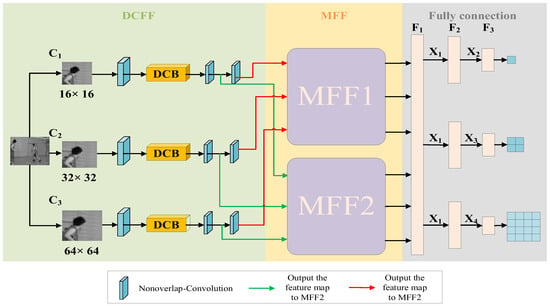
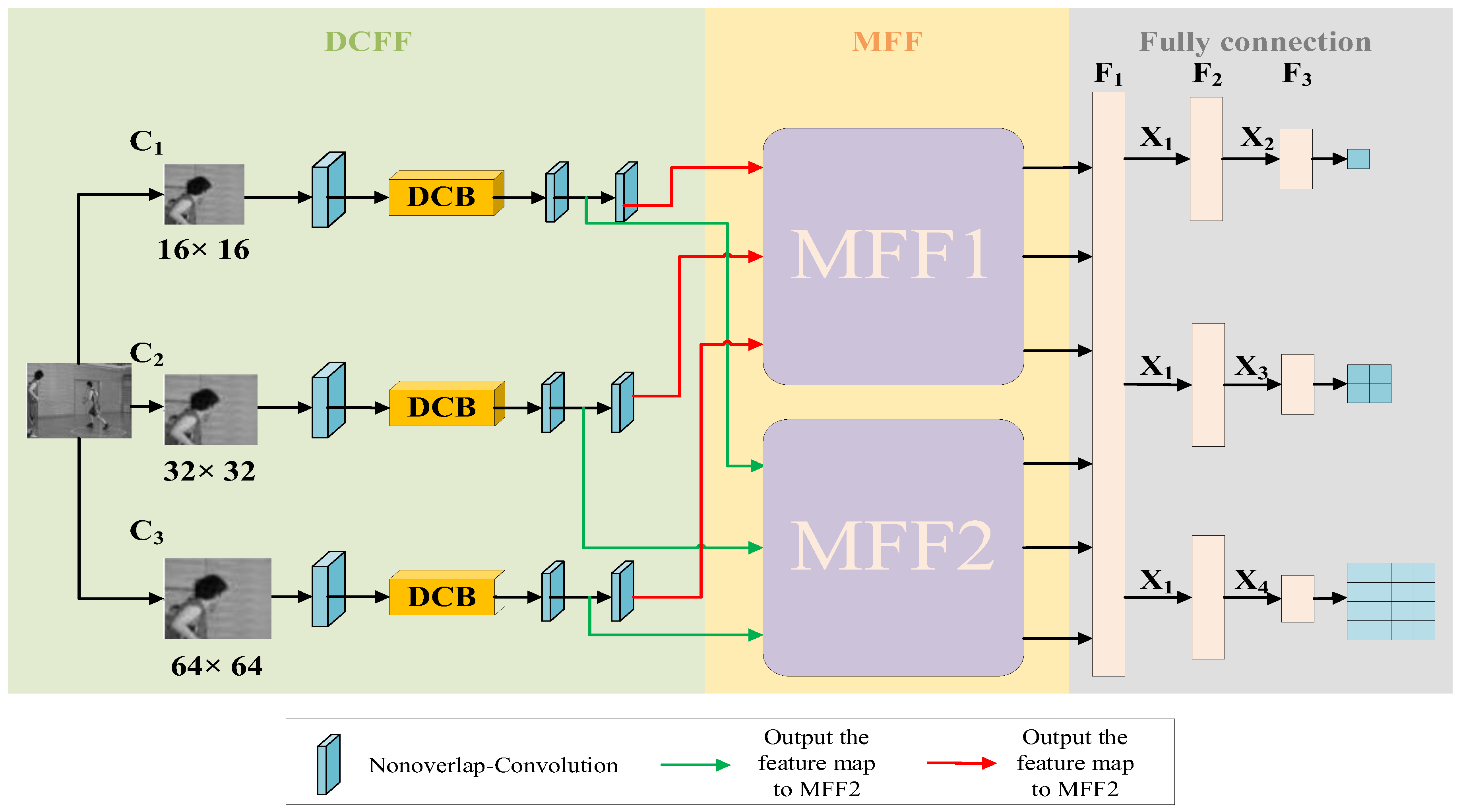
Part of the research work in this article is based on our previously proposed DCMFF-Net [31], which consists of a DCFF network and multi-scale feature fusion (MFF). This Net has the advantages of effectively extracting image features, accurately predicting segmentation modes, and achieving the function of fusing multi-scale feature maps. While significantly reducing encoding complexity, the loss of encoding quality is controlled within a very small range. DCMFF-Net exhibits excellent performance in HEVC. Therefore, this article applied DCMFF-Net to VVC and proposed a reverse prediction method based on the DCMFF-Net. The network architecture diagram is shown in Figure 1. In DCMFF-Net, MFF1 and MFF2 are the same module; the only difference lies in the input feature map. Based on the DCFF network, two MFF modules are used, numbered MFF1 and MFF2. They are hierarchically progressive and functionally complementary core components that jointly optimize QTMT segmentation prediction for VVC intra-frame coding. MFF1, located in a shallow layer of the network, focuses on extracting local texture and edge details, providing basic features for segmentation decisions; MFF2, as the final output of DCFF based on neural networks, performs advanced semantic abstraction at a deeper level, and integrates global structural information, unlike MFF1, which extracts shallow details. This design ensures comprehensive coverage from subtle features to macro patterns, significantly improving segmentation accuracy.
Figure 1.
Structure of double convolutional multi-scale feature fusion network (DCMFF-Net).
Compared with reference [31], this article achieved three core breakthroughs. Firstly, it expanded its application scope, upgrading from targeting HEVC standards to solving more complex VVC standards, and its QTMT partition structure increased encoding complexity by about 18 times. Secondly, it upgraded its methodology from a single model to a system solution, and innovatively proposed three algorithms based on DCMFF-Net. Reverse prediction algorithm: solves the adaptive problem between neural network models and the new VVC QTMT partitioning mode. Trimming algorithm: intelligently skips redundant TT direction calculations based on the RDO results of BT partitioning. Complexity pre-screening module: terminates the smooth block segmentation process in advance based on texture features. Finally, the integration of technology and performance was significantly improved. Through the cooperation of multiple modules, it achieved excellent results on VVC. The encoding time was reduced by 49.21% and the bit rate was only increased by 1.61%, far exceeding the potential of a single model, forming a complete and effective VVC encoding scheme.
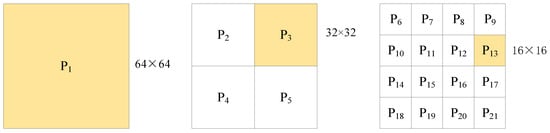
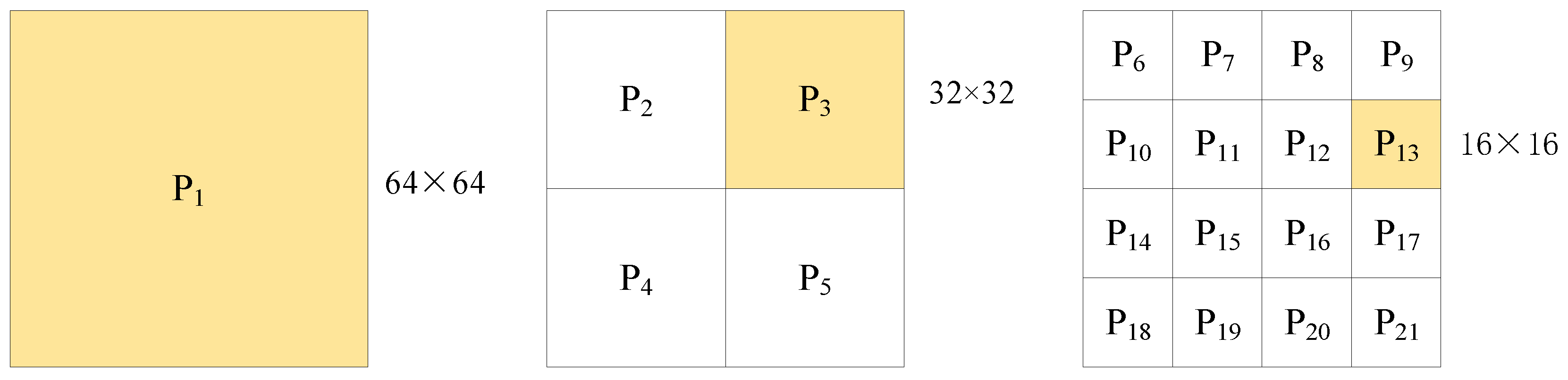
Due to the introduction of QTMT partitioning in VVC, compared to HEVC, the additional MTT segmentation makes the partitioning mode more complex and introduces significant computational complexity. Simply using neural networks to accelerate the encoder for QT partitioning cannot effectively achieve the goal of reducing encoding complexity. At the same time, the dataset we used is primarily trained for HEVC networks and is not suitable for the QTMT partitioning mode of VVC. Therefore, we designed a reverse prediction algorithm based on DCMFF-Net to compensate for the limitations of the dataset. Our DCMFF-Net outputs 21 probabilities, each corresponding to 21 partitions. The design of the 21 output probabilities in DCMFF-Net is based on the complexity of the QTMT (Quadtree Plus Multi-Type Tree) partitioning structure in the VVC standard. VVC provides flexible partitioning options for each coding unit (CU), including multiple modes such as quadtree (QT), horizontal/vertical binary tree (BTH/BTV), and horizontal/vertical ternary tree (TTH/TTV). For typical CU sizes (e.g., 64 × 64 to 8 × 8), there are a total of 21 possible partitioning combinations, covering all scenarios from overall segmentation to fine-grained splitting, as shown in Figure 2. The 64 × 64, 32 × 32, and 16 × 16 shown in Figure 2 represent the minimum CU sizes in the current image. Pi represents two modes, 0 (no partitioning) or 1 (partitioning), which are determined by the partitioning probabilities output by the neural network and filtered and organized by a threshold. However, since the probabilities we obtained are specific to QT partitioning, they cannot effectively skip the RDO calculation for BT and TT partitioning. To deal with this issue, we designed a method based on the partitioning logic of QTMT to use the partitioning probabilities of the next layer to determine the partitioning mode of the previous layer.
Figure 2.
Schematic diagram of CU partition.
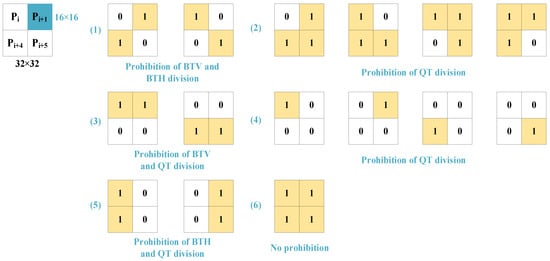
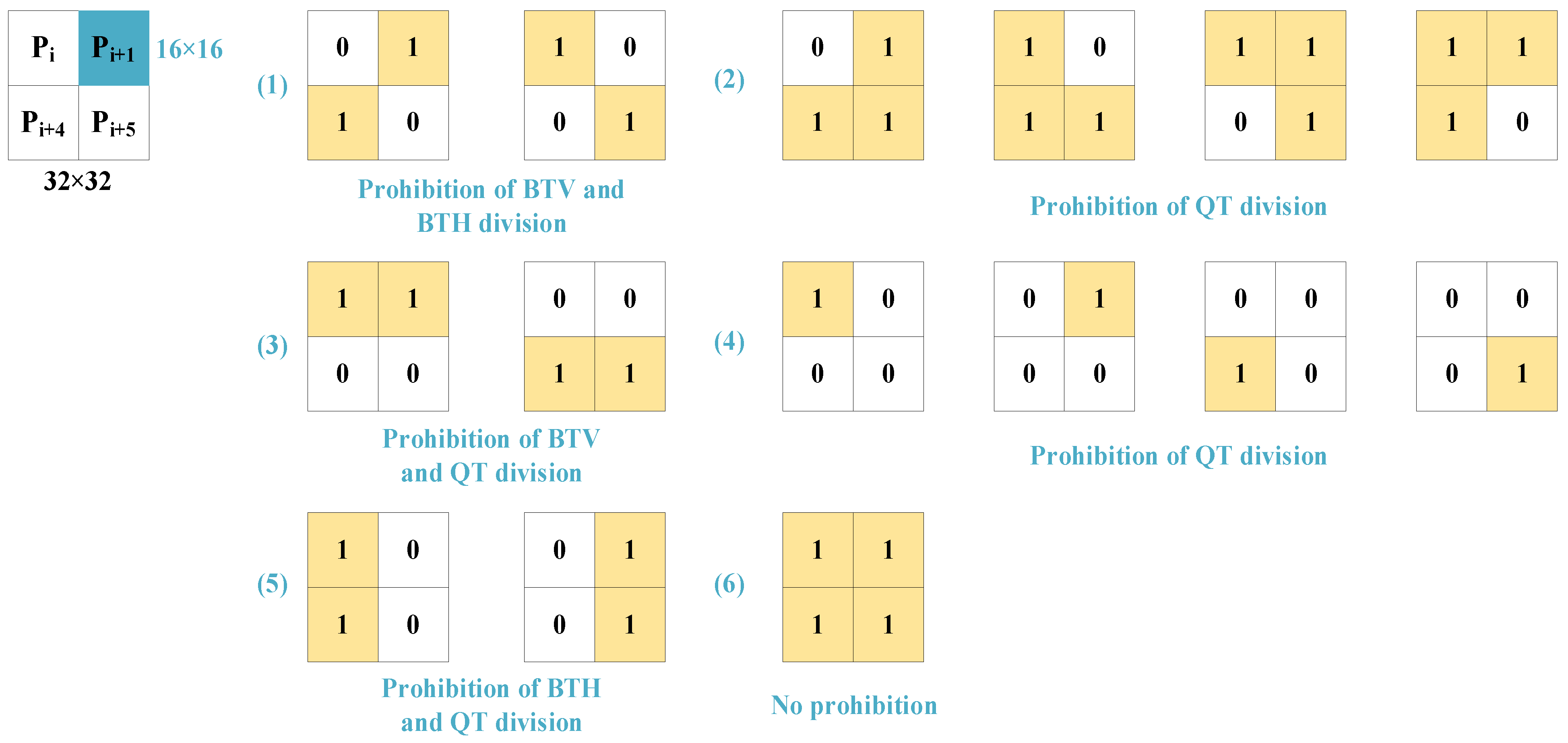
Our proposed reverse prediction algorithm utilizes neural networks to predict the partition probability distribution of small-sized (16 × 16) CUs and divides these distributions into six typical categories, each corresponding to a reasonable constraint assumption for the partition mode of large-sized (32 × 32) CUs. Specifically, different probability distribution patterns reflect the texture complexity and structural patterns of the current image region at different scales. When a 16 × 16 CU exhibits a certain unified partitioning tendency, it can be inferred that some partitioning patterns in its parent 32 × 32 CU will be redundant in terms of rate distortion. Therefore, the search space can be reduced by pre-disabling these patterns. At the same time, our designed group (6) retains all partition possibilities to prevent the erroneous prohibition of actually better binary or ternary tree partitions when the regional structure is complex or the neural network prediction is not accurate enough. This grouping constraint mechanism essentially relies on the prior understanding of the local structure of the image by neural networks, filtering out obviously inappropriate partitioning options in the early stages of encoding decisions, thereby effectively reducing computational overhead while ensuring compression efficiency.
As shown in Figure 3, according to the prediction results of the neural network, the CU with the size of 16 × 16 is predicted, and all probability distributions are divided into 6 groups to predict the CU with the size of 32 × 32. For the distribution in group (1), we prohibited BTV and BTH segmentation; for group (2), we prohibited QT segmentation; for group (3), we prohibited both BTV and QT segmentation; for group (4), we also prohibited QT segmentation; for group (5), we prohibited BTH and QT segmentation; and for group (6), we did not perform any processing in order to prevent situations where the entire region is more suitable for BT or TT segmentation.
Figure 3.
The algorithm and partitioning logic we proposed.
All the prohibitions mentioned above refer to skipping the RDO calculation of the relevant modes.
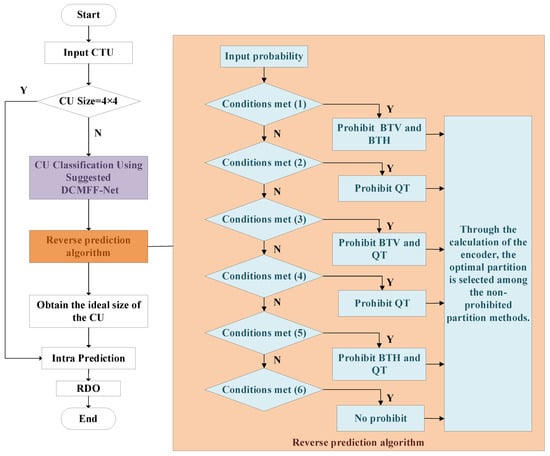
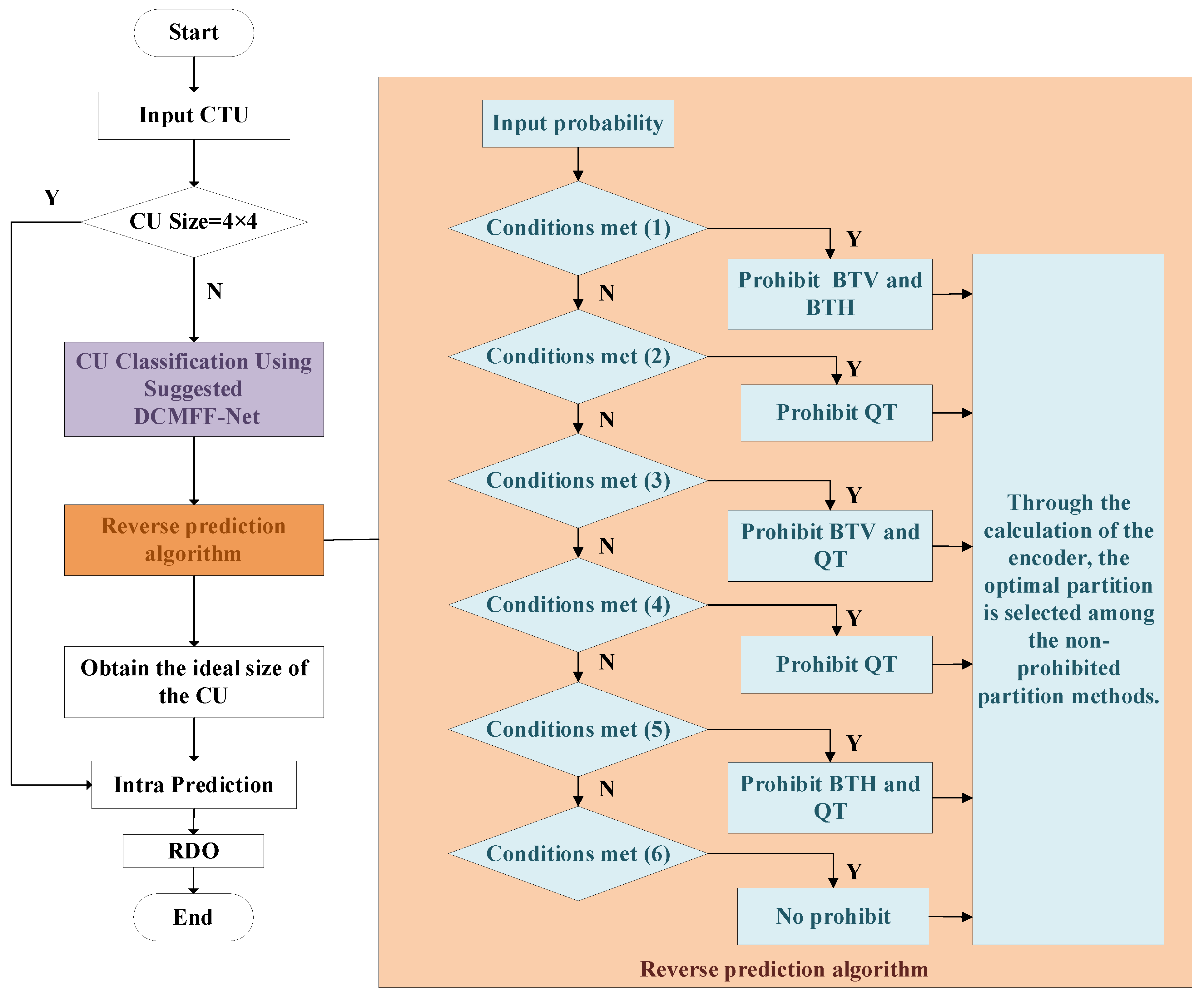
The flow chart is shown in Figure 4. After the output probability of the neural network, the reverse prediction algorithm proposed by us was applied to determine the partition mode of the four 32 × 32 CUs by reading the partition probability of 16 CUs with the size of 16 × 16. The VVC encoder using the reverse prediction algorithm makes a condition judgment in sequence according to the strategy shown in Figure 4. When it detects that any of the conditions in (1)–(5) are met, it takes the corresponding operation shown in Figure 4 to prohibit the corresponding division and does not perform RDO calculation of the prohibited division.
Figure 4.
Flow chart of the reverse prediction algorithm.
3.2. Pruning Algorithm
After completing the above design, we found that the effect of using only the reverse prediction algorithm in reducing the coding complexity is not satisfactory. To further decrease the complexity of VVC intra-frame coding, we examined the relationship between BT and TT partitions and discovered that, if BTVRDO > BTHRDO, there is a higher likelihood that TTVRDO > TTHRDO for TT partitions. Leveraging this insight, we devised a novel pruning algorithm that dynamically determines the splitting direction of TT (ternary tree) by utilizing the RD cost information from the completed BT (binary tree) partitions during the encoding process, thereby achieving runtime pruning. This is the first time that the real-time RDO cost of BT segmentation has been dynamically coupled with the TT segmentation direction, achieving adaptive decision-making.
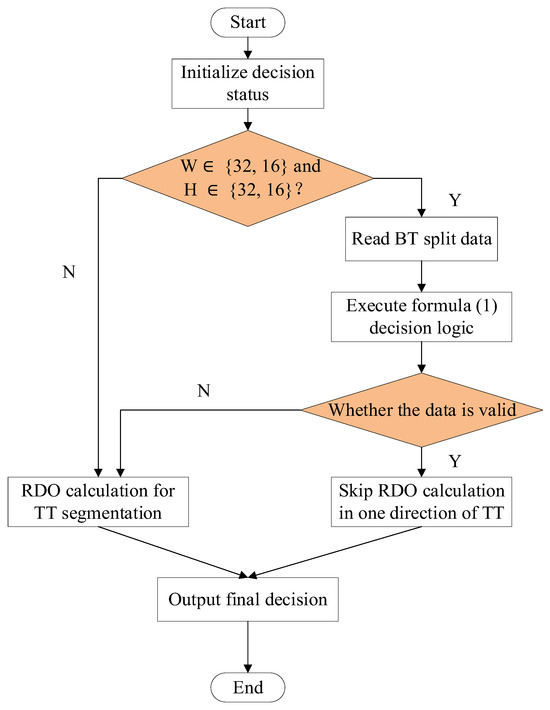
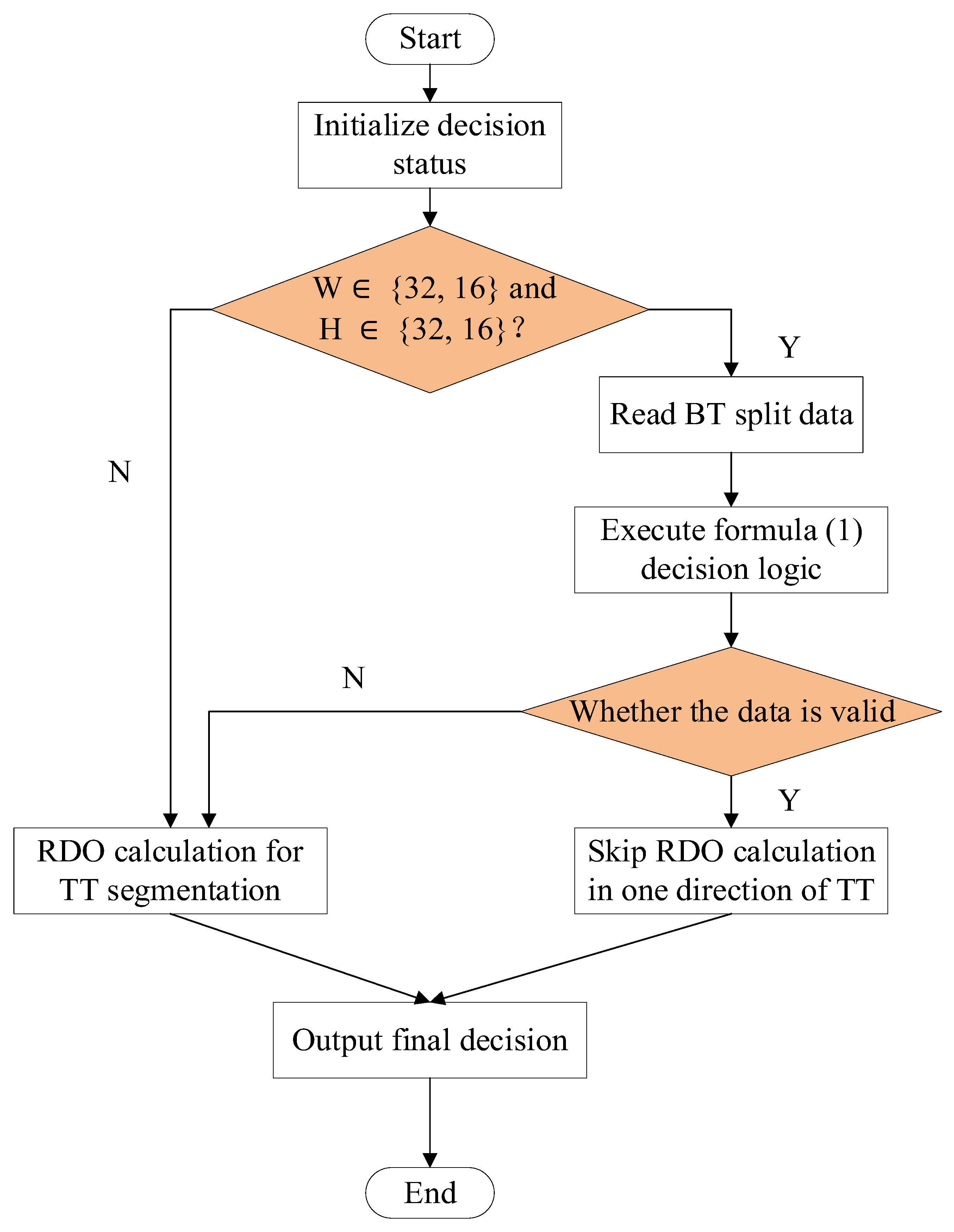
The flow chart of the pruning algorithm is shown in Figure 5. Starting from a new CU, it first initializes the decision state and triggers when testing TT segmentation. Next, it checks the size and mode conditions. If they do not meet the criteria, it performs RDO calculation for TT direction segmentation. If they meet the criteria, it reads the BT segmentation cost data and executes the decision logic. Finally, based on the real-time results, it skips the RDO calculation for one TT direction to reduce computational complexity. This method utilizes the completed BT rate-distortion optimization results, fully leverages existing information, and avoids redundant calculations. At the same time, it automatically degrades to RDO testing when the data is invalid, ensuring that incorrect decisions do not lead to a decline in encoding quality. The algorithm logic is shown in Formula (1) below:
where Ccurr represents the optimal encoding cost of the current non-segmentation mode, CBT_H represents the encoding cost of the optimal horizontal binary tree (BT_H) segmentation, CBT_V represents the encoding cost of the optimal vertical binary tree (BT_V) segmentation, and M represents the maximum cost constant (MAX_DOUBLE).
Figure 5.
Flow chart of the pruning algorithm.
Because of the particularity of the pruning algorithm, if the reverse prediction algorithm pruned any direction of the BT partition, the pruning algorithm we designed does not work. Algorithm 1 shows the execution flow of the pruning algorithm.
| Algorithm 1. BT-Guided TT Direction Selection for VVC/H.266 |
| Input: W, H, bthCost, btvCost, BEST_NON_SPLIT_COST |
| Output: tt_direction (Horizontal, Vertical, or Invalid) |
| 1: if W ∉ {32, 16} or H ∉ {32, 16} then |
| 2: tt_direction ← INVALID; return //TT not applicable |
| 3: end if |
| 4: if BEST_NON_SPLIT_COST = ∞ then |
| 5: tt_direction ← INVALID; return //No valid non-split result |
| 6: end if |
| 7: if bthCost = ∞ and btvCost = ∞ then |
| 8: tt_direction ← INVALID //Both BT splits invalid, skip TT |
| 9: else if bthCost ≤ btvCost or btvCost = ∞ then |
| 10: tt_direction ← HORIZONTAL //Horizontal BT better, test TT_H only |
| 11: else |
| 12: tt_direction ← VERTICAL //Vertical BT better, test TT_V only |
| 13: end if |
| 14: Apply: test winning TT direction only, skip the other |
3.3. Complexity Pre-Screening Module
In terms of using texture information and a neural network to reduce coding complexity, our team proposed an algorithm combining the Prewitt [32] operator and CNN for HEVC [33], which achieved good results. However, VVC is different from HEVC. VVC uses the QTMT technology to make block partitioning more flexible. For the selection of the optimal CU, VVC uses the exhaustive Rate-Distortion Optimization (RDO) algorithm that traverses all CU cells to calculate and compare the RD costs of different partition combinations to determine the minimum cost segmentation method. The computational complexity is very high. To solve this problem, we considered using the texture complexity method to identify the blocks that do not need to be calculated for each CU, before RDO calculation. Because we do not need an accurate edge location, and we only need to determine the complexity of the texture, we chose to apply this method to VVC.
In HEVC, the size of CU is strictly square (such as 64 × 64, 32 × 32, 16 × 16, 8 × 8). However, VVC adopts a more flexible QTMT coding method and introduces binary tree and trigeminal tree division, so that CU can be not only square, but also rectangular (such as 64 × 32, 32 × 16, 16 × 32, 32 × 64, etc.). The emergence of this kind of irregular CU has brought new challenges to the fast algorithm based on texture complexity: different shapes and sizes of CU have different sensitivity to texture complexity and a single threshold cannot effectively cover all cases.
In order to solve this problem, we set four groups of adaptive thresholds in the whole calculation process. Each group contains two thresholds: A local threshold is used to measure the complexity of the texture around the pixel, and a global threshold is used to measure the complexity of the entire CU texture. The algorithm will dynamically adjust these two criteria according to the specific size of the CU, so as to achieve a balance between coding quality and computational complexity.
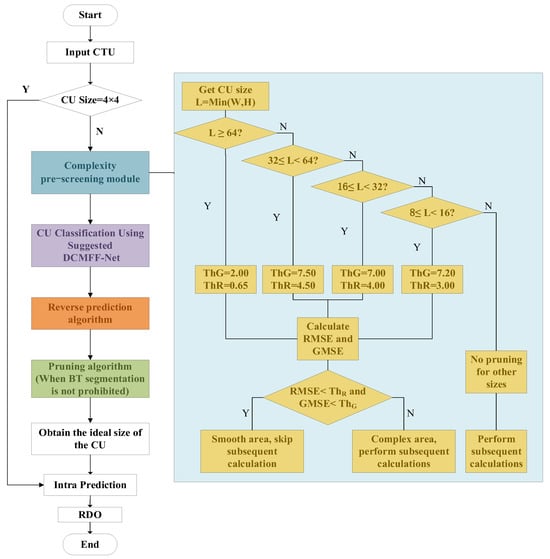
Because the large size CU is more likely to contain rich content, once misjudged, it will lead to significant degradation of coding quality; so, its threshold was set to the lowest, and only the large CU with extremely smooth texture can be terminated in advance. Specifically, for a CU with a side length larger than or equal to 64, we set the local threshold to 2.0 and the global threshold to 0.65. As the size of CU decreased, our tolerance of texture was appropriately improved. For CU with side length larger than or equal to 32 and less than 64, the local threshold was increased to 7.5, and the global threshold was increased to 4.5, so as to achieve a balance between complexity and quality. For smaller CU, due to the limited coding gain brought by partitioning, we adopted a more active pruning strategy. For CU with side length greater than or equal to 16 and less than 32, the local threshold was set to 7.0. The global threshold was returned to a lower level of 0.65 to ensure the accuracy of the regional consistency judgment. For the minimum size CU with side length greater than or equal to 8 and less than 16, due to its small amount of calculation, we set a higher local threshold of 7.2 to allow more such CU to terminate in advance; At the same time, with the global threshold of 3.0, we took into account the influence of the surrounding texture to prevent misjudgment in the texture mutation area. The above decision logic can be expressed by the following formula:
where blkSize stands for the smallest edge of the current block, ThR stands for the threshold of root mean square error (RMSE), and The stands for the threshold of the root mean square of the gradient amplitude (GMSR). The calculation formulae are as follows:
where H and W represent the height and width of the CU, respectively. I(x,y) denotes the pixel value at the coordinate (x,y). μ represents the mean of all pixels inside CU, and SumG denotes the sum of the gradient magnitudes of each pixel in the CU. If the value of RMSE is less than or equal to ThR and the value of GMSR is less than or equal to ThG, it is determined as a texture smooth region. The logic is expressed as follows:
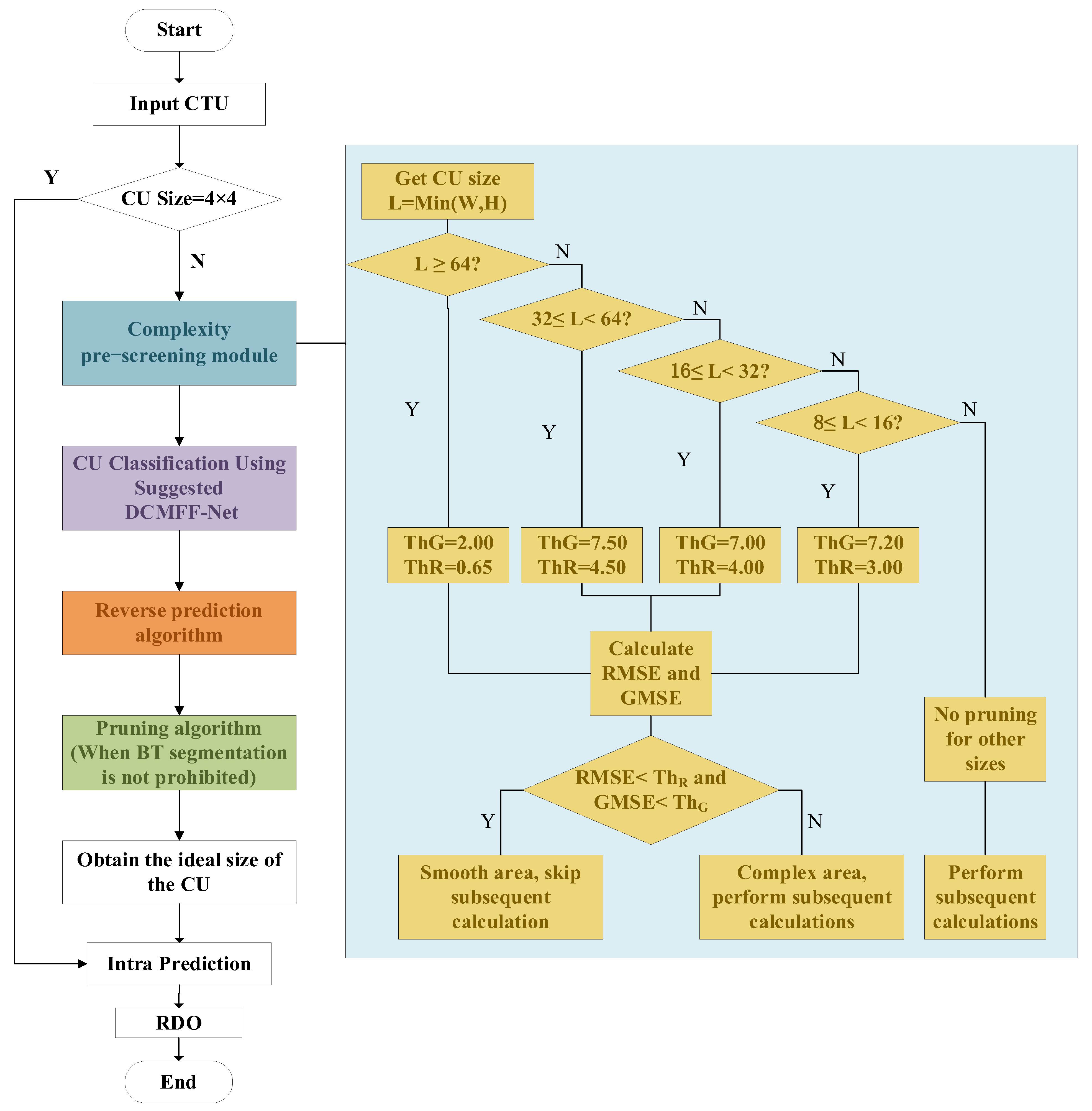
Based on the above decision criteria, the overall workflow of the proposed fast CU partitioning algorithm can be illustrated in Figure 6, and the detailed algorithm flow chart of the complexity pre-screening module is shown in the blue block in Figure 6. The process begins with the current CU, first determining its size to select the corresponding threshold pair (ThR, ThG). Subsequently, the RMSE and GMSR values are calculated to evaluate both local texture complexity and global texture consistency. The algorithm then performs a dual-condition judgment: only when both metrics are below their respective thresholds does it skip the subsequent process for the current CU; otherwise, it proceeds with the full calculation. This streamlined decision path effectively reduces unnecessary computational overhead while maintaining coding efficiency.
Figure 6.
Flow chart of complexity pre-screening module.
4. Experimental Results
4.1. Experimental Setup
The detailed experimental setup and evaluation metrics are outlined below: VTM4.0 was used as the experimental platform, and video encoding employed four quantization points (QP) values: {22, 27, 32, 37}. The neural network was trained using the CPHI dataset [34]. This dataset contained 2000 images of multiple resolutions, with each image having a resolution of 4928 × 3264. After preprocessing, the entire dataset was randomly divided into three disjoint subsets: the training set accounts for 85%, the testing set accounts for 10%, and the validation set accounts for 5%. Each subset was further divided into four groups to generate the final training, testing, and validation dataset with coding unit (CU) partition labels.
In the training phase, we chose the NVIDIA GeForce GTX 1650 GPU to train the neural network. Testing was conducted on an Intel Core i5-12400F processor. The GPU was only activated for acceleration training network and remained dormant during the testing process. The network framework was implemented based on TensorFlow 1.15.
During model training, all trainable parameters were initialized randomly. The initial learning rate (η) was set to 0.01, and the batch size parameter was set to n = 64. A total of 1,000,000 optimization steps were performed.
4.2. Performance Evaluation and Test Sequence
To better evaluate the three algorithms we designed, we adopted the fair comparison scheme proposed by JCT-VC [35], and validation experiments were conducted on 21 different standard sequences. These sequences are divided into six groups: A1, A2, B, C, D, and E. All parameters were configured according to the default settings of Common Test Conditions (CTCs), and the detailed parameters are listed in Table 1. The evaluation criteria used in this paper followed the VCEG-M33 [36] specification, covering three indicators: ΔT, BD-BR, and BD-PSNR. ΔT represents the saved encoding time achieved compared to the VTM 4.0 encoding scheme; BD-BR and BD-PSNR measure the image quality of the encoded sequences. The mathematical expressions for each indicator are as follows:
where TVTM represents the encoding time of the VTM4.0, and Tproposed represents the encoding time required by our method. During the encoding process, the QP value can be any one of {22, 27, 32, 37}. BD-PSNR reflects the difference in average Peak Signal-to-Noise Ratio (PSNR) between the original encoder and the encoder with our proposed algorithm incorporated. Its calculation formula is as follows:
where PSNRVTM represents the average PSNR of the original encoder and PSNRproposed represents the average PSNR of our proposed algorithm. BD-BR denotes the average bit rate difference between the original encoder and the proposed algorithm.
BD-PSNR = PSNRproposed − PSNRVTM
Table 1.
The test sequences and their parameters are adopted in this paper.
4.3. Ablation Experiment
Firstly, in order to evaluate the performance of the three modules we designed, we conducted experiments on each module separately under identical configurations. We selected one test sequence from each of the six categories A1, A2, B, C, D, and E; tested each sequence under four different QPs (22, 27, 32, 37); and took the average of the results. The experimental results are shown in Table 2.
Table 2.
Separate experiments of the reverse prediction algorithm, the pruning algorithm, and the complexity pre-screening module.
From the data in Table 2, it can be seen that, when using only the reverse prediction algorithm based on DCMFF-Net, the experimental results show that the encoding time was reduced by 30.63%, while the BD-BR increased by 2.18%, and the BD-PSNR decreased by 0.07 dB. When only using the pruning algorithm, the experimental outcomes indicate a 33.23% reduction in encoding time, with BD-BR rising by 0.88% and BD-PSNR dropping by 0.03 dB. When using only the complexity pre-screening module, as demonstrated by the experiments, the proposed method achieved a 9.08% saving in encoding time, at the cost of a 0.28% BD-BR increase and a 0 dB BD-PSNR loss. It is obvious that the individual effects of the three modules did not achieve the overall effect of their combination, but there is no doubt that each of these three modules has a certain ability to reduce coding complexity.
Secondly, to verify the effectiveness of the reverse prediction algorithm, we conducted a comparative experiment between DCMFF-Net, which only includes QT partition prediction, and the reverse prediction algorithm based on DCMFF-Net. The experimental results are shown in Table 3.
Table 3.
Comparison of experimental results between neural network for predicting QT partitioning only and a reverse prediction algorithm based on a neural network.
From Table 3, it can be seen that, compared to using only QT partition prediction, our designed reverse prediction algorithm based on DCMFF-Net reduces encoding time by 20.56%, increases BD-BR by 1.53%, and reduces BD-PSNR by 0.04 dB. This experiment strongly proves the effectiveness and rationality of the proposed reverse prediction algorithm. It is worth noting that the average encoding time of Food Market under four QPs increased by 1.3% compared to the original encoder. After analysis, it was found that the actual encoding time has indeed decreased, but due to the longer prediction time of neural networks, the saved encoding time cannot offset the additional overhead caused by prediction, ultimately leading to an increase in average encoding time. This is a normal phenomenon that occurs only when performing QT partitioning on VVC, which further illustrates the necessity of our proposed reverse prediction algorithm.
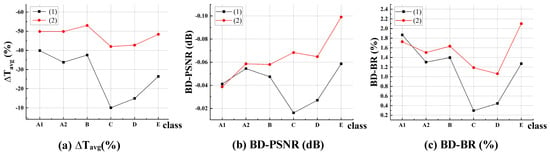
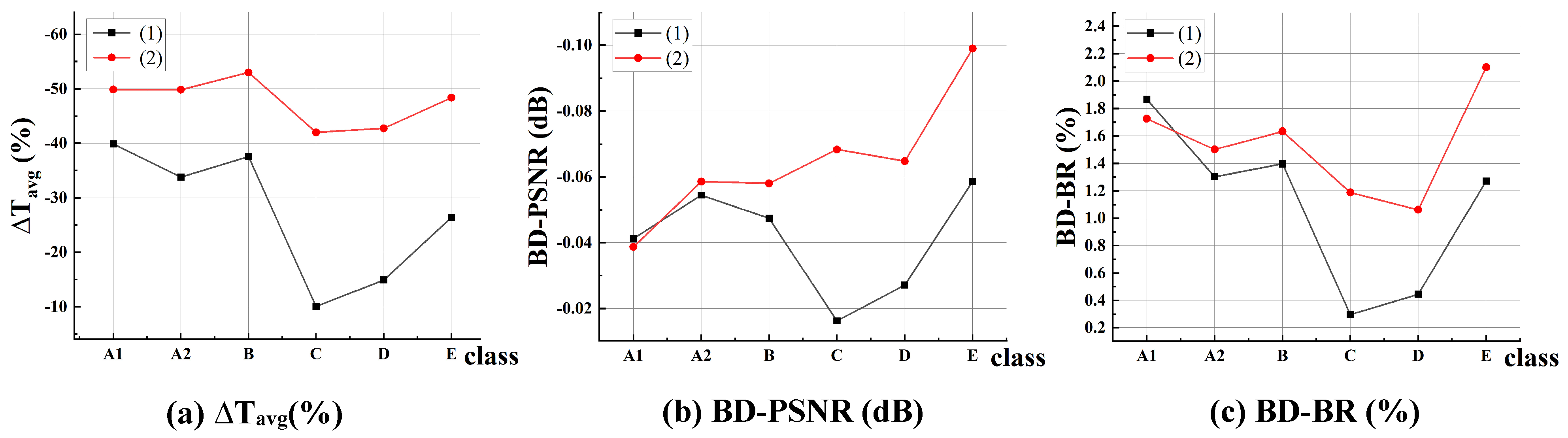
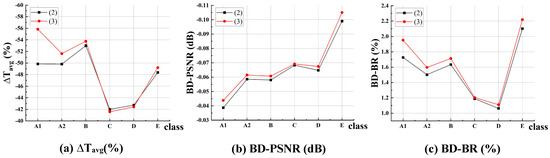
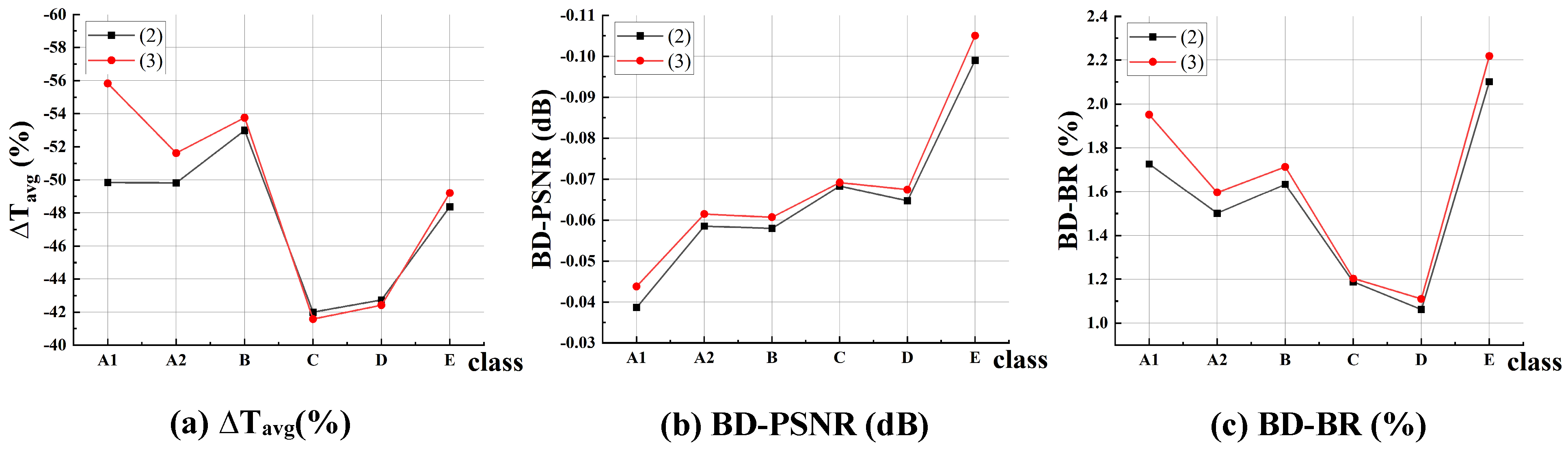
Finally, to evaluate our proposed reverse prediction algorithm, pruning algorithm, and complexity pre-screening module, we designed two sets of ablation experiments. Both experiments used the same configuration and maintained consistent quantization parameters (QP). As shown in Figure 7 and Figure 8, the dots represent the average results of six sequences (A1, A2, B, C, D, E) under different QPs. In Figure 7, we compared the encoding performance of using only the reverse prediction algorithm (marked as (1) in the figure) with that of using the reverse prediction algorithm combined with the pruning algorithm (marked as (2) in the figure). In Figure 8, we compared the effect of (2) with that of combining the complexity pre-screening module (marked as (3) in the figure) on top of (2).
Figure 7.
For the 21 test sequences, a performance comparison was conducted between algorithm (1) (using only the reverse prediction algorithm) and algorithm (2) (using a combination of the reverse prediction algorithm and pruning algorithm).
Figure 8.
For the 21 test sequences, a performance comparison was conducted between algorithm (2) (using a combination of the reverse prediction algorithm and pruning algorithm) and algorithm (3) (incorporating the complexity pre-screening module on the basis of (2)).
As can be seen from Figure 7, compared to using the backward prediction algorithm alone, the encoder incorporating the pruning algorithm significantly improved coding efficiency (encoding time reduced by 20.6%) at a minimal cost (average BD-BR increased by 0.43%, average BD-PSNR decreased by 0.02 dB). This improvement is attributed to our proposed efficient pruning algorithm, which determines the direction of TT partitioning through RDO calculated by BT partitioning, reducing redundant RDO calculations while also enhancing coding quality.
In Figure 8, compared to the combination with the first two algorithms (2), the addition of the complexity pre-screening module leads to an increase in bit rate (averaging 0.09%), with negligible changes in video quality. However, it also reduces encoding complexity (averaging 1.33%). This change is attributed to the texture algorithm’s ability to judge the texture of each block before the CU performs division and calculation for RDO. If the block is determined to be a smooth texture block, subsequent calculations are skipped, and no division is performed. This approach reduces encoding quality but enhances encoding efficiency. Although the effect of this algorithm is not particularly significant, it better balances encoding efficiency and video quality, providing some inspiration for research that requires overall performance balance. These results demonstrate that our algorithm can effectively improve encoding efficiency, reduce encoding complexity, and achieve excellent performance on most evaluation metrics.
4.4. Test Results
As shown in Table 4, the algorithm we designed reduces the encoding complexity of four different QPs while causing minimal loss in video quality. Compared to the original encoder VTM4.0, our designed algorithm achieves an average reduction of 49.45%, 48.18%, 48.86%, and 49.85% in encoding time at QPs = {22, 27, 32, 37}, respectively. BD-BR slightly increases by 1.61%, while the loss in BD-PSNR is almost negligible (−0.06). Experimental data indicate that our proposed algorithm performs well across various QPs. The performance improvement is attributed to measures taken simultaneously at three levels: the complexity pre-screening module is applied before the start of partitioning to preliminarily classify CUs, terminating the partitioning process early for smooth regions that do not require partitioning; the exhaustive algorithm is replaced with a reverse prediction algorithm based on DCMFF-Net during partitioning, combined with a pruning algorithm. DCMFF-Net effectively integrates multi-scale feature maps from multiple branches to extract sufficient feature information to ensure encoding quality, while the reverse prediction and pruning algorithms further optimize and reduce encoding complexity based on neural networks. The slight changes in video quality suggest that the effect of our proposed algorithm on video quality remains within the acceptable range for the human eye.
Table 4.
The test results of our proposed method on standard test sequences.
To better demonstrate the contributions of this paper, we selected five intra-frame coding improvement schemes and analyzed the advantages of our research by comparing the coding performance of 21 quasi-video sequences provided by JCT-VC. The specifics are illustrated in Table 5.
Table 5.
The comparison results of our method with other algorithms.
Table 3 shows that the method in this paper reduces the encoder time by 49.21%, which is significantly better than the 31% reduction in encoding complexity reported in [21], the 24.49% reduction in encoding complexity reported in [16], and the 35% reduction in encoding complexity reported in [37]. As we can see, while maintaining the same transmission bit rate, our algorithm outperforms both methods in encoding quality. The BD-BR values for the methods adopted in [22] and [4] are 0.44% and 1.02%, respectively, and the T are −27% and −34%, respectively. Compared to them, although our performance in terms of BDBR is slightly worse, we have a significant advantage in reducing encoding complexity.
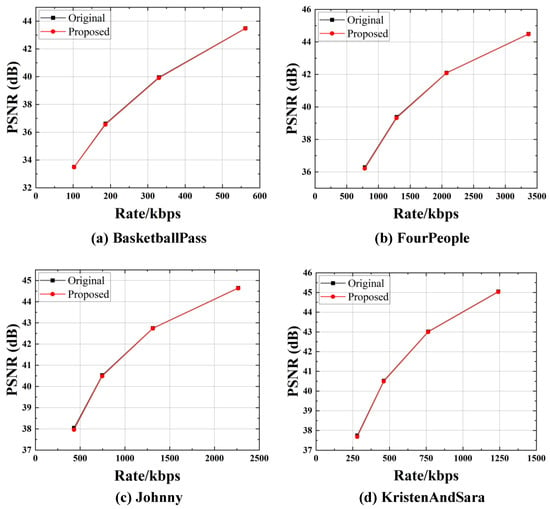
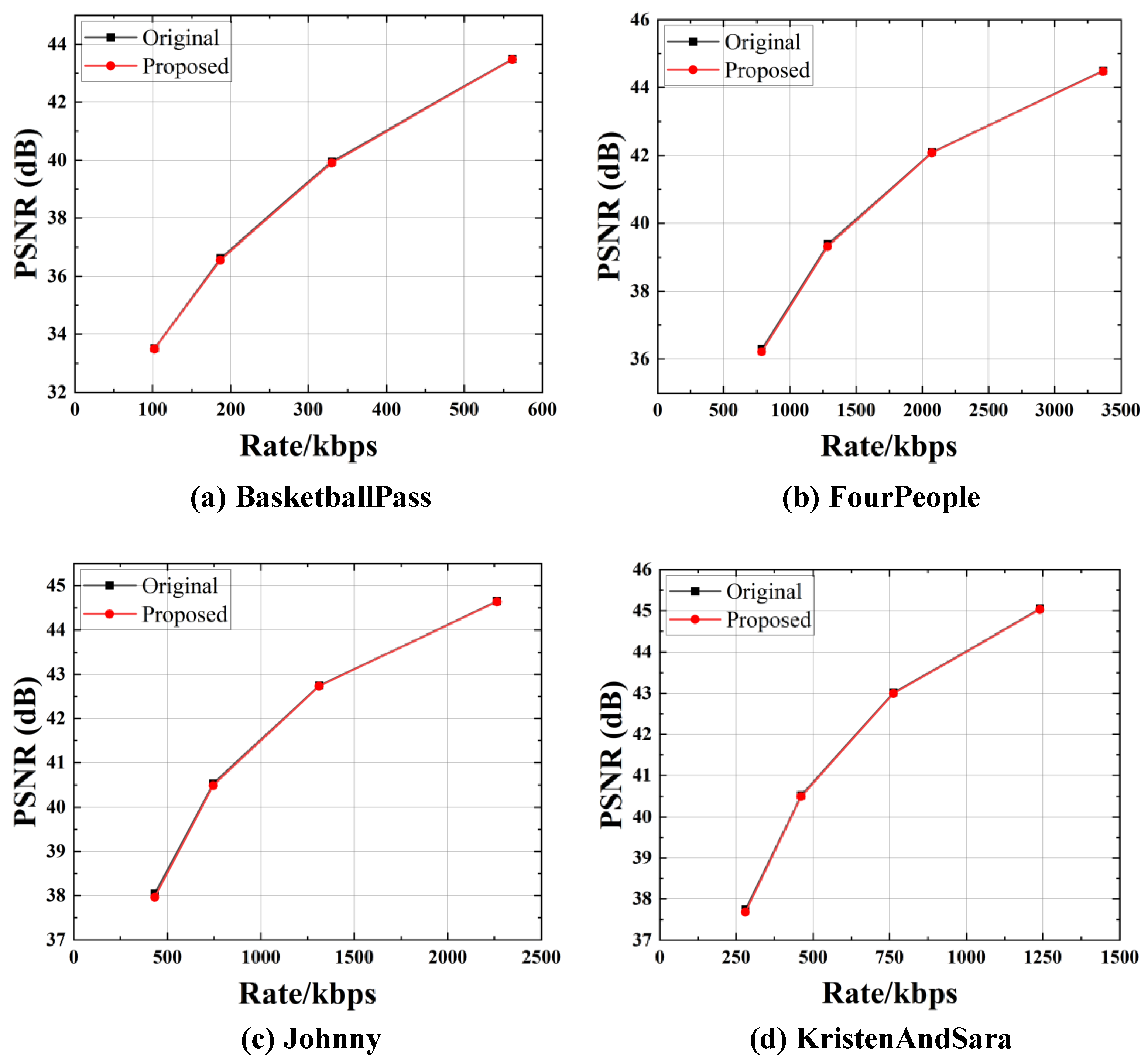
To demonstrate the rate distortion (RD) of our method, we chose four sequences with the highest video quality loss from the test sequences. These selected sequences include BasketballPass, FourPeople, Johnny, and KristenAndSara, and their performance was compared with that of VTM4.0. Figure 9 reveals the RD curve comparison between these four sequences when using our method and VTM4.0. It is clear that the rate distortion curve of our method closely matches the original encoder, and some curves overlap almost completely. This indicates that our method has good robustness and stability, and the difference relative to the original encoding method is negligible.
Figure 9.
The RD performance comparison between our proposed scheme and the algorithm in VVC on four sequences.
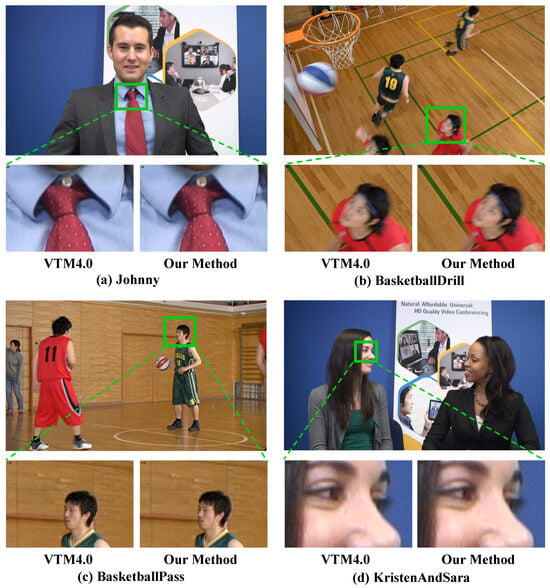
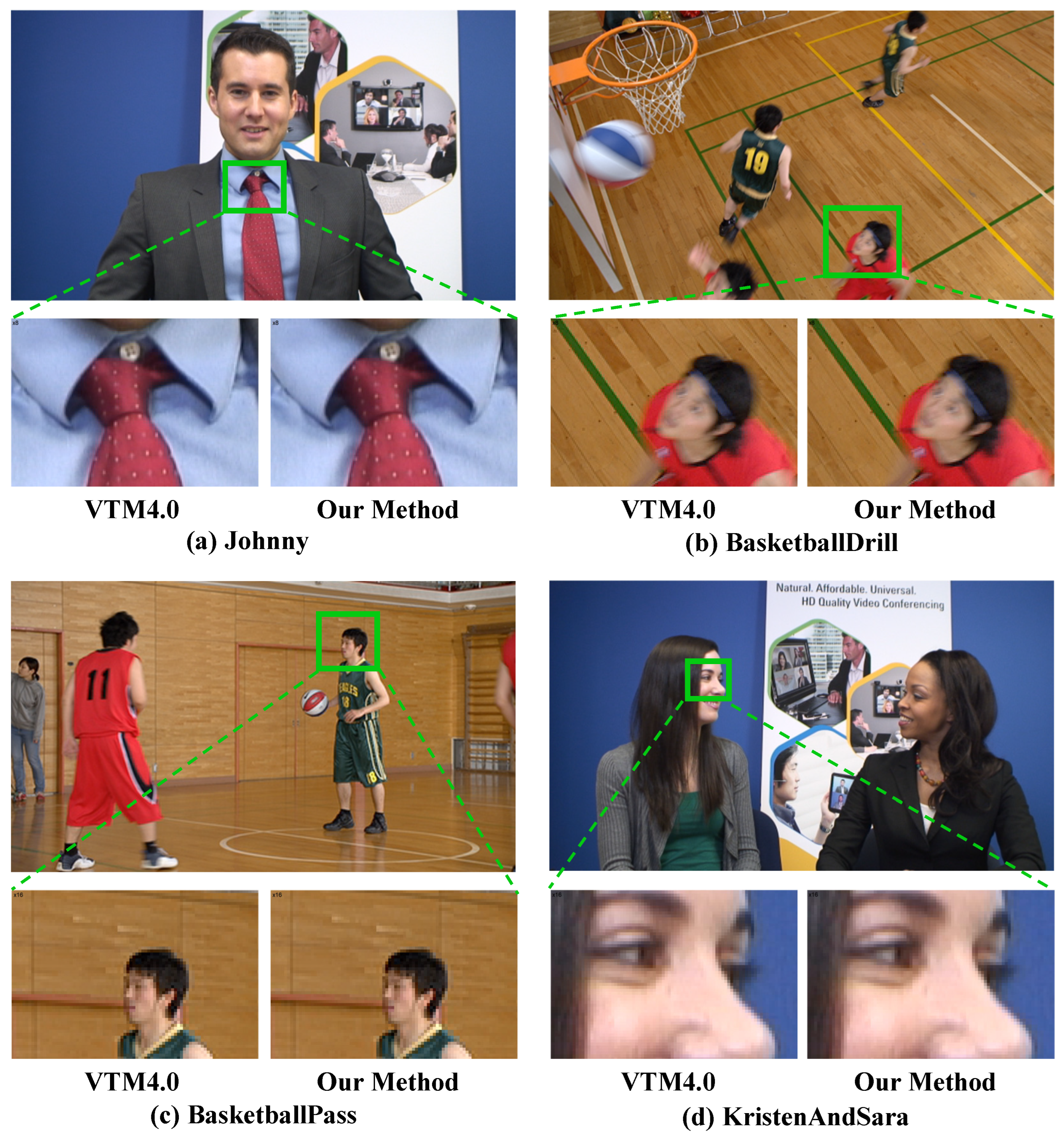
To evaluate the subjective visual quality of the method proposed in this paper, we selected sequences with significant quality loss or intense motion, including BasketballPass, KristenAndSara, Johnny, and BasketballDrill, and obtained the I-frames [38] from these sequences as test objects for subjective visual comparison with the encoding results of VTM4.0 under QP = 37 conditions. Figure 10 presents enlarged images of local details from these sequences for both schemes. Visual observation shows that there is almost no difference in image quality between the two methods in the enlarged areas, and it is difficult for the human eye to discern the difference. It can be inferred that the image quality degradation caused by our algorithm is below the perceptual threshold that the human eye can detect, and the subjective impact can be ignored. The same results were obtained in different resolution sequences. Based on the above analysis, our method demonstrates significant advantages in both video quality and encoding efficiency.
Figure 10.
Comparison of the local zoom regions of our method and VTM4.0 on four sequences (Johnny, BasketballDrill, BasketballPass, and KiristenAndSara; QP = 37).
5. Conclusions and Outlook
This paper proposes an efficient intra-coding scheme, including a reverse prediction algorithm based on the DCMFF-Net neural network, a pruning algorithm, and a complexity pre-screening module. All three algorithms aim to accelerate the QTMT segmentation decision in VVC video coding, thereby reducing the encoding complexity of VVC. Our contributions include the following: 1. Proposing a reverse prediction algorithm that enables the prediction of two partitioning methods using only one CNN. 2. Proposing a pruning algorithm that removes one partitioning direction based on the RDO of BTH and BTV, without calculating the RDO of TT segmentation. 3. We designed and integrated a complexity pre-screening module, further reducing the encoding complexity. The experimental results show that, compared to the traditional encoder VTM4.0, our method achieves an average BD-BR of 1.61 and an average BD-PSNR of −0.06 on the JCT-VC test sequence, while reducing the encoding complexity by 49.21%.
However, this study still has certain limitations. For example, inter-frame segmentation has a significant impact on the complexity of actual encoding, and the related work remains unfinished. In subsequent work, our team will further explore inter-frame prediction and integrate it with intra-frame prediction to further reduce encoding complexity. And the version of VTM we used for the experiment is relatively low. We will migrate to a newer version of VTM for further development and research.
Author Contributions
Methodology, X.S.; Software, P.L.; Validation, X.S.; Investigation, P.L.; Writing—original draft, X.S.; Writing—review & editing, X.S.; Supervision, G.W.; Project administration, G.W. All authors have read and agreed to the published version of the manuscript.
Funding
This research received no external funding.
Data Availability Statement
The original contributions presented in this study are included in the article. Further inquiries can be directed to the corresponding author.
Conflicts of Interest
The authors declare no conflict of interest.
References
- Wu, S.; Shi, J.; Chen, Z. HG-FCN: Hierarchical Grid Fully Convolutional Network for Fast VVC Intra Coding. IEEE Trans. Circuits Syst. Video Technol. 2022, 32, 5638–5649. [Google Scholar] [CrossRef] [Scilit]
- Chen, J.; Sun, H.; Katto, J.; Zeng, X.; Fan, Y. Fast QTMT partition decision algorithm in VVC intra coding based on variance and gradient. In Proceedings of the IEEE Visual Communications and Image Processing (VCIP), Sydney, NSW, Australia, 1–4 December 2019; pp. 1–4. [Google Scholar]
- Cui, J.; Zhang, T.; Gu, C.; Zhang, X.; Ma, S. Gradient-based early termination of CU partition in VVC intra coding. In Proceedings of the Data Compression Conference (DCC), Snowbird, UT, USA, 24–27 March 2020; pp. 103–112. [Google Scholar]
- Park, S.-H.; Kang, J.-W. Context-based ternary tree decision method in versatile video coding for fast intra coding. IEEE Access 2019, 7, 172597–172605. [Google Scholar] [CrossRef] [Scilit]
- Fu, T.; Zhang, H.; Mu, F.; Chen, H. Fast cu partitioning algorithm for h. 266/vvc intra-frame coding. In Proceedings of the IEEE International Conference on Multimedia and Expo (ICME), Shanghai, China, 8–12 July 2019; pp. 55–60. [Google Scholar]
- Wang, Z.; Wang, S.; Zhang, J.; Wang, S.; Ma, S. Effective quadtree plus binary tree block partition decision for future video coding. In Proceedings of the Data Compression Conference (DCC), Snowbird, UT, USA, 4–7 April 2017; pp. 23–32. [Google Scholar]
- Lei, M.; Luo, F.; Zhang, X.; Wang, S.; Ma, S. Look-ahead prediction based coding unit size pruning for VVC intra coding. In Proceedings of the IEEE International Conference on Image Processing (ICIP), Taipei, Taiwan, 22–25 September 2019; pp. 4120–4124. [Google Scholar]
- Amestoy, T.; Mercat, A.; Hamidouche, W.; Menard, D.; Bergeron, C. Tunable VVC frame partitioning based on lightweight machine learning. IEEE Trans. Image Process. 2019, 29, 1313–1328. [Google Scholar] [CrossRef] [Scilit]
- Yang, H.; Shen, L.; Dong, X.; Ding, Q.; An, P.; Jiang, G. Low complexity CTU partition structure decision and fast intra mode decision for versatile video coding. IEEE Trans. Circuits Syst. Video Technol. 2020, 30, 1668–1682. [Google Scholar] [CrossRef] [Scilit]
- Chen, F.; Ren, Y.; Peng, Z.; Jiang, G.; Cui, X. A fast CU size decision algorithm for VVC intra prediction based on support vector machine. Multimed. Tools Appl. 2020, 79, 27923–27939. [Google Scholar] [CrossRef] [Scilit]
- Saldanha, M.; Sanchez, G.; Marcon, C.; Agostini, L. Configurable fast block partitioning for VVC intra coding using light gradient boosting machine. IEEE Trans. Circuits Syst. Video Technol. 2021, 32, 394–3960. [Google Scholar] [CrossRef] [Scilit]
- Wu, G.; Huang, Y.; Zhu, C.; Song, L.; Zhang, W. SVM based fast CU partitioning algorithm for VVC intra coding. In Proceedings of the 2021 IEEE International Symposium on Circuits and Systems (ISCAS), Daegu, Republic of Korea, 22–28 May 2021; pp. 1–5. [Google Scholar]
- Zhang, Q.; Wang, Y.; Huang, L.; Jiang, B. Fast CU partition and intra mode decision method for H. 266/VVC. IEEE Access 2020, 8, 117539–117550. [Google Scholar] [CrossRef] [Scilit]
- Zhao, J.; Wu, A.; Zhang, Q. SVM-based fast CU partition decision algorithm for VVC intra coding. Electronics 2022, 11, 2147. [Google Scholar] [CrossRef] [Scilit]
- Shu, Z.; Li, J.; Peng, Z.; Chen, F.; Yu, M. Intra complexity control algorithm for VVC. Electronics 2022, 11, 2572. [Google Scholar] [CrossRef] [Scilit]
- Abdallah, B.; Belghith, F.; Ayed, M.A.B.; Masmoudi, N. Low-complexity QTMT partition based on deep neural network for versatile video coding. Signal Image Video Process. 2021, 15, 1153–1160. [Google Scholar] [CrossRef] [Scilit]
- Li, T.; Xu, M.; Tang, R.; Chen, Y.; Xing, Q. DeepQTMT: A deep learning approach for fast QTMT-based CU partition of intra-mode VVC. IEEE Trans. Image Process. 2021, 30, 5377–5390. [Google Scholar] [CrossRef] [Scilit]
- Zhao, J.; Wang, Y.; Zhang, Q. Adaptive CU split decision based on deep learning and multifeature fusion for H.266/VVC. Sci. Program. 2020, 2020, 8883214. [Google Scholar]
- Tech, G.; Pfaff, J.; Schwarz, H.; Helle, P.; Wieckowski, A.; Marpe, D.; Wiegand, T. Fast partitioning for VVC intra-picture encoding with a CNN minimizing the rate-distortion time cost. In Proceedings of the 2021 Data Compression Conference (DCC), Snowbird, UT, USA, 23–26 March 2021; pp. 3–12. [Google Scholar]
- Xu, J.; Wu, G.; Zhu, C.; Huang, Y.; Song, L. CNN-based fast CU partitioning algorithm for VVC intra coding. In Proceedings of the 2022 IEEE International Conference on Image Processing (ICIP), Bordeaux, France, 16–19 October 2022; pp. 2706–2710. [Google Scholar]
- Abdallah, B.; Belghith, F.; Ben Ayed, M.A.; Masmoudi, N. Fast QTMT decision tree for versatile video coding based on deep neural network. Multimed. Tools Appl. 2022, 81, 42731–42747. [Google Scholar] [CrossRef] [Scilit]
- Park, S.-H.; Kang, J.-W. Fast multi-type tree partitioning for versatile video coding using a lightweight neural network. IEEE Trans. Multimed. 2020, 23, 4388–4399. [Google Scholar] [CrossRef] [Scilit]
- Tissier, A.; Hamidouche, W.; Mdalsi, S.B.D.; Vanne, J.; Galpin, F.; Menard, D. Machine learning based efficient QT-MTT partitioning scheme for VVC intra encoders. IEEE Trans. Circuits Syst. Video Technol. 2023, 33, 4279–4293. [Google Scholar] [CrossRef] [Scilit]
- Feng, A.; Liu, K.; Liu, D.; Li, L.; Wu, F. Partition map prediction for fast block partitioning in VVC intra-frame coding. IEEE Trans. Image Process. 2023, 32, 2237–2251. [Google Scholar] [CrossRef] [Scilit] [PubMed]
- Tang, G.; Jing, M.; Zeng, X.; Fan, Y. Adaptive CU split decision with pooling-variable CNN for VVC intra encoding. In Proceedings of the IEEE Visual Communications and Image Process (VCIP), Sydney, NSW, Australia, 1–4 December 2019; pp. 1–4. [Google Scholar]
- Wang, D.; Deng, Y.; Li, W.; Lu, X.; Dufaux, F.; Hang, B.; Zhu, C. Fast intra mode prediction algorithms for scbs in VVC SCC. In Proceedings of the IEEE International Conference on Acoustics, Speech and Signal Processing (ICASSP), Seoul, Republic of Korea, 14–19 April 2024; pp. 4395–4399. [Google Scholar]
- Sainio, J.; Ataman, B.; Marie, A.; Mercat, A.; Vanne, J. Fast Machine Learning Aided Intra Mode Decision for Real-Time VVC Intra Coding. In Proceedings of the IEEE International Conference on Visual Communications and Image Processing (VCIP), Tokyo, Japan, 8–11 December 2024; pp. 1–5. [Google Scholar]
- Zeng, J.; Chen, J.; Zeng, H.; Zhang, X.; Lin, Q. Hierarchical Feature Fusion CNN: Fast Intra Prediction Mode Decision for VVC Screen Content Coding. IEEE Signal Process. Lett. 2025, 32, 2229–2233. [Google Scholar] [CrossRef] [Scilit]
- Wang, H.; Yuan, F.; Zhang, L.; Chen, J.; Wang, F.L.; Pan, Z. Spatial Similarity-Based Fast Mode Decision for VVC Chroma Intra Coding. In Proceedings of the IEEE International Conference on Visual Communications and Image Processing (VCIP), Tokyo, Japan, 8–11 December 2024; pp. 1–5. [Google Scholar]
- Belghith, F.; Abdallah, B.; Ben Jdidia, S.; Ben Ayed, M.A.; Masmoudi, N. CNN-based ternary tree partition approach for VVC intra-QTMT coding. Signal Image Video Process. 2024, 18, 3587–3594. [Google Scholar] [CrossRef] [Scilit]
- Shi, X.; Wei, G.; Li, L.; Luo, G.; Zhou, Y.; Zhu, S. DCMFF-Net: A Low-Complexity Intra-Frame Encoding Method with Double Convolution and Multi-Scale Feature Fusion. Electronics 2025, 14, 4863. [Google Scholar] [CrossRef] [Scilit]
- Gao, W.; Yang, L.; Zhang, X.; Zhou, B.; Ma, C. Based on soft-threshold wavelet denoising combining with Prewitt operator edge detection algorithm. In Proceedings of the 2010 2nd International Conference on Education Technology and Computer (ICRTC), Shanghai, China, 22–24 June 2010. [Google Scholar]
- Wang, T.; Wei, G.; Li, H.; Bui, T.; Zeng, Q.; Wang, R. Fast CU partition algorithm for intra-frame coding based on joint texture classification and CNN. Sensors 2023, 23, 7923. [Google Scholar] [CrossRef] [Scilit]
- CPH-Intra. Available online: https://github.com/HEVC-Projects/CPH (accessed on 3 October 2018).
- Bossen, F. Common test conditions and software reference configurations. In Proceedings of the Joint Collaborative Team on Video Coding (JCT-VC) of ITU-T SG16 WP3 and ISO/IEC JTC1/SC29/WG11, 5th Meeting, Geneva, Switzerland, 16–23 March 2011. [Google Scholar]
- Grellert, M.; Bampi, S.; Correa, G.; Zatt, B.; Cruz, L.S. Learning-based complexity reduction and scaling for HEVC encoders. In Proceedings of the 2018 IEEE International Conference on Acoustics, Speech and Signal Processing (ICASSP), Calgary, AB, Canada, 15–20 April 2018; pp. 1208–1212. [Google Scholar]
- Amna, M.; Imen, W.; Ezahra, S.F.; Mohamed, A. Fast intra-coding unit partition decision in H. 266/FVC based on deep learning. J. Real-Time Image Process. 2020, 17, 1971–1981. [Google Scholar] [CrossRef] [Scilit]
- Sze, V.; Budagavi, M.; Sullivan, G.J. High Efficiency Video Coding (HEVC): Algorithms and Architectures; Springer International Publishing: Cham, Switzerland, 2014; pp. 91–112. [Google Scholar]

Disclaimer/Publisher’s Note: The statements, opinions and data contained in all publications are solely those of the individual author(s) and contributor(s) and not of MDPI and/or the editor(s). MDPI and/or the editor(s) disclaim responsibility for any injury to people or property resulting from any ideas, methods, instructions or products referred to in the content. |
© 2026 by the authors. Licensee MDPI, Basel, Switzerland. This article is an open access article distributed under the terms and conditions of the Creative Commons Attribution (CC BY) license.