


Abstract
Influence Maximization (IM) is a fundamental problem in social network analysis that aims to identify a set of k seed nodes that maximizes influence spread under a given propagation model. Despite its importance in applications such as viral marketing and epidemic control, the IM problem is NP-hard, making exact solutions computationally infeasible for large-scale networks. Existing approximation methods typically rely either on static centrality heuristics, which often ignore global network structure, or on metaheuristic algorithms, which may suffer from slow convergence due to random initialization. This paper proposes a novel approach, termed Advanced Centrality-Driven Discrete Particle Swarm Optimization (DPSO), which integrates a weighted hybrid centrality score combining Degree, PageRank, and Betweenness centrality to guide the stochastic search process. In addition, a systematic grid search methodology is employed to determine the optimal weight configuration of the hybrid score. Experiments conducted on three real-world datasets (Twitter, ego-Facebook, and ca-HepTh) demonstrate that the optimal seeding strategy is strongly dependent on network topology. The results show that dense social networks favor popularity-based metrics such as Degree and PageRank, whereas sparse collaboration networks benefit significantly from bridge-oriented metrics such as Betweenness centrality. Overall, the proposed method achieves consistent improvements in influence spread across different network types, with the largest gains (up to 70%) observed in sparse network settings.
1. Introduction
In the era of hyper-connectivity, Online Social Networks (OSNs) have evolved beyond simple communication platforms to become powerful mechanisms for information dissemination, opinion formation, and viral marketing. Information can propagate rapidly through these networks, influencing user behavior and decision-making processes. Understanding how such diffusion processes occur and identifying the individuals who can trigger the largest cascades of influence, i.e., maximize influence spread, has therefore become an important research challenge. This problem is formally known as Influence Maximization (IM).
The Influence Maximization problem was first introduced by Kempe, Kleinberg, and Tardos [1] as a discrete optimization problem: given a social network and a diffusion model, the objective is to identify a set of k seed nodes that maximizes the expected influence spread. Despite its clear formulation, the IM problem has been proven to be NP-hard, meaning that computing the exact optimal seed set requires exploring a combinatorial number of possible node combinations. As the size of social networks continues to grow to millions of nodes, exact solutions become computationally infeasible.
To address this challenge, existing research has primarily followed two major directions. The first approach relies on centrality-based heuristics, such as Degree, PageRank, or Betweenness centrality [2], which rank nodes based on structural properties of the network. These methods are computationally efficient and easy to implement. However, they often ignore the complex dynamics of influence propagation and the global topology of the network, which may lead to redundant seed selection when highly connected nodes belong to the same community.
The second approach focuses on metaheuristic optimization techniques, such as Genetic Algorithms (GA) and Particle Swarm Optimization (PSO) [3]. These algorithms are capable of exploring the global solution space and escaping local optima by iteratively improving candidate solutions. Nevertheless, many metaheuristic methods rely heavily on random initialization and stochastic exploration, which may result in slow convergence and inefficient searches in large-scale networks.
To overcome these limitations, this study proposes a hybrid approach that combines structural network insights with metaheuristic search capabilities. Specifically, we introduce an Advanced Centrality-Driven Discrete Particle Swarm Optimization (DPSO) algorithm. The algorithm integrates a weighted hybrid centrality score combining Degree, PageRank, and Betweenness centrality measures. This hybrid score is used to guide the stochastic search process of DPSO, enabling the swarm to prioritize structurally important nodes during the optimization procedure. Furthermore, a systematic grid search methodology is employed to determine the optimal weight configuration of the hybrid centrality score.
To evaluate the effectiveness of the proposed approach, experiments were conducted on three real-world network datasets obtained from the Stanford Network Analysis Project (SNAP) repository [4]: Twitter, ego-Facebook, and ca-HepTh. These datasets represent networks with different structural characteristics, including directed and undirected graphs, as well as dense and sparse topologies. The experimental results demonstrate that the effectiveness of influence maximization strategies is strongly dependent on the underlying network topology. In dense social networks such as Facebook, popularity-based metrics like Degree and PageRank tend to dominate, as highly connected users act as efficient broadcasters of information. In contrast, in sparse collaboration networks such as ca-HepTh, bridge-oriented metrics like Betweenness centrality play a more critical role in connecting otherwise distant communities and enabling wider diffusion.
Overall, the proposed approach significantly improves influence spread compared to standard DPSO and other baseline methods. In particular, the algorithm achieves significant improvements in influence spread, with the largest gains (up to 70%) observed in sparse network structures, while more moderate but consistent improvements are obtained in denser networks.
The main contributions of this work can be summarized as follows:
- A centrality-driven DPSO framework that embeds structural network information directly into the particle update mechanism, rather than using it only for initialization or node ranking.
- A probabilistic node selection strategy guided by a weighted hybrid centrality score, enabling the algorithm to prioritize structurally important nodes during the search process.
- A systematic grid search methodology to identify optimal combinations of centrality measures, allowing the method to adapt to different network topologies.
- An experimental analysis demonstrating how the relative importance of centrality measures varies across dense and sparse networks, providing insights into topology-aware influence maximization strategies.
Although combining structural metrics with optimization techniques is a natural extension of prior work, the key distinction of this study lies in how this integration is realized. Instead of using centrality measures as a preprocessing or ranking step, the proposed method embeds a hybrid centrality score directly into the stochastic update mechanism of DPSO, enabling continuous structural guidance during the optimization process.
To the best of our knowledge, this work contributes to the growing body of hybrid influence maximization approaches by introducing a centrality-driven DPSO framework in which structural information is directly embedded into the optimization process. Unlike existing methods that use centrality measures primarily for ranking or initialization, the proposed approach integrates a weighted hybrid centrality score into the probabilistic node selection mechanism of DPSO, enabling more informed exploration of the solution space.
Despite the extensive literature on influence maximization, there remains a gap between structural heuristics and metaheuristic optimization approaches. Existing methods either rely on static centrality rankings that ignore diffusion dynamics or employ stochastic optimization techniques that lack structural guidance during the search process. Furthermore, hybrid approaches often use fixed or heuristic combinations of features without systematically adapting them to different network topologies. This work addresses this gap by introducing a mechanism that dynamically integrates optimized structural information into the search process, improving both convergence efficiency and influence spread.
The remainder of this paper is structured as follows. Section 2 reviews related work on influence maximization, centrality-based heuristics, and metaheuristic optimization approaches. Section 3 describes the proposed Advanced Centrality-Driven DPSO framework, including the hybrid centrality score formulation and the grid search methodology. Section 4 presents the experimental setup and datasets used for evaluation. Section 5 discusses the experimental results and comparative analysis. Finally, Section 6 concludes the paper and outlines directions for future research.
2. Related Work
2.1. Influence Maximization Problem
The Influence Maximization (IM) problem was first formally introduced by Kempe, Kleinberg, and Tardos [1], who formulated it as a discrete optimization problem aiming to select a set of k seed nodes that maximizes the expected influence spread in a social network. Their work introduced two widely used diffusion models: the Independent Cascade (IC) model and the Linear Threshold (LT) model. They also demonstrated that the influence maximization problem is NP-hard, although the influence spread function is submodular, enabling greedy approximation algorithms with theoretical guarantees close to optimal solutions [1].
Despite their strong theoretical guarantees, greedy algorithms require repeated Monte Carlo simulations to estimate the expected influence spread, making them computationally expensive for large-scale networks. As social networks have grown significantly in size and complexity, scalability has become a major challenge for influence maximization algorithms. Consequently, many subsequent studies have focused on developing more efficient approximation techniques and sketch-based methods to reduce computational cost while maintaining high solution quality.
In recent years, influence maximization has attracted significant research interest due to its wide range of applications, including viral marketing, information dissemination, recommendation systems, and epidemic control. As a result, numerous algorithms have been proposed to address the problem from different perspectives, including heuristic methods, approximation algorithms, and metaheuristic optimization techniques [5]. Recent surveys further highlight the rapid growth of research in this area and classify existing solutions into structural, diffusion-based, and learning-based approaches for identifying influential nodes in large social networks [6].
2.2. Centrality-Based Heuristics
One common approach to solving the IM problem relies on centrality-based heuristics, which identify influential nodes based on their structural importance within the network. Popular centrality measures include Degree centrality, PageRank, and Betweenness centrality, which rank nodes according to connectivity, influence potential, and their role as bridges between communities.
Degree centrality identifies nodes with many direct connections, allowing them to act as efficient broadcasters of information. PageRank evaluates node importance based on the influence of neighboring nodes, while Betweenness centrality measures how frequently a node lies on shortest paths between other nodes, indicating its potential role as an intermediary connecting different parts of the network. These measures are widely used in influence maximization because they are computationally efficient and can be calculated even for large-scale networks [7].
However, centrality-based heuristics have several limitations. Since they rely primarily on structural properties of the network rather than explicitly modeling the dynamics of influence diffusion, they may lead to suboptimal seed selection. In particular, selecting nodes with the highest centrality values may result in redundant seed sets when these nodes belong to the same densely connected community, thereby reducing the overall influence spread [8]. Recent research has also shown that relying solely on structural metrics may overlook behavioral and contextual factors that influence diffusion processes in real-world networks [6].
Recent advances have explored learning-based approaches, such as Graph Neural Networks (GNNs), which leverage both structural and node-level features to identify influential or important nodes in networks. For example, GNN-based models have been used for tasks such as blockchain address classification, where complex relationships and attributes (e.g., transaction patterns and account balances) are incorporated into graph representations to improve predictive performance [9]. Similarly, graph-based neural network approaches have been applied in digital forensics to analyze complex relational structures and detect patterns in networked data [10]. These approaches provide a more expressive alternative to traditional centrality measures, as they can capture higher-order dependencies and feature interactions. However, they typically require labeled data, training procedures, and higher computational resources, which may limit their applicability in scenarios where such information is not available.
Critically, none of these approaches—whether static structural heuristics or learning-based alternatives—systematically optimize the combination of multiple centrality metrics to suit different network topologies, nor do they embed such structural guidance directly into an iterative optimization process. This gap directly motivates the hybrid centrality-driven DPSO framework proposed in this work, which addresses the dual shortcoming of fixed metric selection and structurally uninformed search.
2.3. Metaheuristic Optimization Approaches
To overcome the limitations of purely heuristic methods, researchers have increasingly explored metaheuristic optimization techniques for influence maximization. These approaches are well suited for solving large-scale combinatorial optimization problems because they can efficiently explore large search spaces and escape local optima.
Among the most widely used metaheuristic methods are Genetic Algorithms (GA), Simulated Annealing (SA), Ant Colony Optimization (ACO), and Particle Swarm Optimization (PSO). These algorithms iteratively improve candidate solutions through stochastic exploration mechanisms and have demonstrated promising performance in identifying high-quality seed sets.
Particle Swarm Optimization, originally proposed by Kennedy and Eberhart [3], has been particularly attractive for influence maximization due to its simplicity, flexibility, and strong global search capabilities. To adapt PSO to combinatorial optimization problems such as seed selection, several researchers have proposed Discrete Particle Swarm Optimization (DPSO) variants.
Recent studies have proposed improved DPSO algorithms and other metaheuristic methods to enhance convergence and solution quality in influence maximization tasks. For instance, improved DPSO variants have been developed to better explore the search space and avoid premature convergence when identifying influential nodes in social networks [11]. Other recent works have explored alternative nature-inspired optimization techniques and machine learning-based models to improve seed selection strategies in large-scale networks [12].
Despite these advancements, many metaheuristic approaches still rely on random initialization or uniform node selection, which may slow convergence and reduce search efficiency during the early stages of the optimization process.
This susceptibility to uninformed initialization is particularly detrimental in heterogeneous networks, where structurally important nodes are unevenly distributed across the graph and uniform sampling is unlikely to produce competitive starting solutions. Without structural guidance, a significant portion of the optimization budget may be wasted exploring low-influence regions of the search space. Incorporating centrality-based knowledge directly into the node selection mechanism—rather than relying on post hoc ranking or preprocessing alone—is therefore a principled response to this limitation and constitutes a core design decision of the method proposed in this work.
2.4. Hybrid Approaches
To address the limitations of both centrality-based heuristics and metaheuristic algorithms, recent studies have proposed hybrid approaches that combine structural network information with optimization techniques. In such methods, centrality measures are often used to guide the initialization or update processes of metaheuristic algorithms, thereby improving convergence speed and search efficiency.
Hybrid approaches aim to balance structural insight with global search capabilities, enabling algorithms to explore the solution space while prioritizing nodes that are likely to have a strong influence on the network. Several studies have shown that combining multiple structural features can significantly improve the identification of influential nodes compared to using a single centrality metric [13]. Recent work has also explored advanced modeling frameworks, such as hypergraph-based influence maximization, which capture higher-order relationships between nodes and improve diffusion modeling in complex social networks [14].
In addition to metaheuristic-based hybrid approaches, several studies have explored scalable and centrality-guided influence maximization techniques. For example, greedy-based methods such as CELF exploit submodularity to improve efficiency while maintaining approximation guarantees [15]. Other works have proposed scalable heuristics that combine structural properties with efficient search strategies to identify influential nodes in large networks [16]. While these approaches achieve strong performance, they typically rely on static ranking or greedy selection mechanisms and do not incorporate structural information directly into an iterative optimization process.
To summarize, existing influence maximization approaches can be broadly categorized into centrality-based heuristics, approximation algorithms, metaheuristic optimization techniques, and more recent hybrid or learning-based methods. While each category offers distinct advantages, each also exhibits a systematic weakness: none fully addresses the trade-off between scalability, structural awareness, and efficient exploration of the solution space. Centrality-based methods lack diffusion awareness, approximation algorithms struggle with scalability, and metaheuristic approaches often suffer from inefficient initialization and slow convergence.
In contrast, the method proposed in this work addresses these limitations by introducing a hybrid centrality-driven DPSO framework that (i) integrates multiple structural metrics through a weighted combination, (ii) systematically optimizes their contribution using grid search, and (iii) directly incorporates this structural knowledge into the stochastic search process. This enables more efficient exploration of the solution space while adapting to different network topologies.
Despite the progress achieved by existing approaches, several limitations remain. Centrality-based heuristics are computationally efficient but fail to account for the stochastic nature of influence diffusion and often produce redundant seed sets in densely connected regions. Approximation algorithms, while theoretically grounded, suffer from high computational cost due to repeated simulations, limiting their applicability to large-scale networks. Metaheuristic methods provide strong global search capabilities but frequently rely on random or uniform initialization strategies, which can slow convergence and reduce solution quality in early iterations.
More recent hybrid and learning-based approaches attempt to combine structural and dynamic information; however, many of these methods either rely on fixed combinations of features or require extensive training data and parameter tuning, which may limit their generalizability across networks with different topologies. In particular, there remains a lack of approaches that systematically integrate multiple centrality measures into the optimization process while simultaneously adapting their relative importance based on network structure. This gap motivates the development of the proposed centrality-driven DPSO framework, which combines a weighted hybrid centrality score with a metaheuristic search process to improve both convergence efficiency and influence spread.
3. The Algorithm
3.1. Problem Formulation
Let a social network be represented as a graph G = (V, E), where V is the set of nodes and E is the set of edges representing relationships between users. Given a budget k, the objective of the Influence Maximization problem is to identify a seed set S ⊆ V, with |S| = k, that maximizes the expected number of activated nodes under a diffusion model.
The influence spread of a seed set S is denoted by σ(S), which represents the expected number of nodes influenced and serves as the objective function of the Influence Maximization (IM) problem. The optimization problem can therefore be defined as:
S* = argmax{S ⊆ V, |S| = k} σ(S)
Since the IM problem is NP-hard [1], heuristic and metaheuristic algorithms are typically used to approximate the optimal solution in large networks.
This study adopts the Independent Cascade (IC) model in preference to the Linear Threshold (LT) alternative, as IC is well-suited to viral marketing scenarios in which each interaction is an independent stochastic event. Importantly, influence spread is submodular under both IC and LT, so the structural guidance provided by the hybrid centrality score is not model-specific: qualitatively similar benefits would be expected under LT dynamics, with the key difference being threshold-driven rather than cascade-driven propagation.
3.2. Hybrid Centrality Score
To guide the search process of the optimization algorithm, we define a Hybrid Centrality Score that combines three widely used structural metrics: Degree, PageRank, and Betweenness centrality.
For each node v ∈ V, the hybrid score is computed as:
where CD(v) = Degree centrality of node v, CP(v) = PageRank centrality, CB(v) = Betweenness centrality, w1, w2, w3 = weighting coefficients. The weights satisfy the constraint: w1 + w2 + w3 = 1.
H(v) = w1 ∙ CD(v) + w2 ∙ CP(v) + w3 ∙ CB(v)
The selection of these three centrality measures is motivated by their complementary roles in capturing different aspects of node importance. Degree centrality reflects local connectivity and the ability to directly influence neighbors, PageRank captures global importance by accounting for the influence of neighboring nodes, and Betweenness centrality identifies nodes that act as bridges between different parts of the network. Together, these measures provide a balanced representation of both local and global structural influence, which is particularly relevant for the Influence Maximization (IM) problem.
A linear weighted combination is adopted due to its simplicity, interpretability, and flexibility. This formulation allows the contribution of each centrality measure to be explicitly controlled and systematically explored through grid search. While more complex non-linear combinations could capture higher-order interactions between features, the linear model provides a transparent and computationally efficient baseline for integrating multiple structural descriptors. The weights are optimized via grid search to identify the most suitable configuration for each network topology.
Since the hybrid centrality score is used to guide probabilistic node selection within the DPSO framework, different weight configurations bias the search toward different types of influential nodes. For instance, configurations with higher weight on Betweenness tend to promote exploration of structurally diverse regions, while Degree- or PageRank-dominant configurations focus on densely connected or globally influential nodes. This mechanism establishes a direct link between structural interpretation and optimization behavior, enabling the method to adapt to different network topologies and influence propagation patterns.
3.3. Discrete Particle Swarm Optimization for Influence Maximization
Particle Swarm Optimization (PSO) is a population-based optimization algorithm that simulates the collective behavior of a swarm of particles searching for an optimal solution [3]. In the context of influence maximization, each particle represents a candidate seed set of size k:
Xi = {v1, v2, …, vk}
During the optimization process, particles update their positions based on their personal best solution (Pbest) and the global best solution (Gbest) found by the swarm.
Since IM requires selecting a discrete set of nodes rather than optimizing continuous variables, a Discrete Particle Swarm Optimization (DPSO) variant is adopted. In this formulation, each particle position corresponds to a specific seed set, and updates are realized through node replacement rather than continuous coordinate shifts.
3.4. Centrality-Guided Node Selection
Standard DPSO fills empty positions in a particle’s seed set through uniform random node selection, which risks introducing low-influence nodes and wasting iterations on structurally unimportant regions of the search space. To address this, we replace uniform sampling with a weighted probabilistic selection strategy driven by the hybrid centrality score. Specifically, each candidate node v is assigned a selection probability:
where H(v) is the hybrid centrality score. In effect, this transforms the node selection step from a structurally blind draw into an informed one: nodes that are densely connected, globally prominent, or well-positioned as bridges receive proportionally higher selection probability at every iteration of the optimization.
The update of each particle in the DPSO framework is performed through a node replacement process guided by both the current particle state and the global best solution (Gbest). At each iteration, a subset of nodes in the current seed set is selected for replacement. The replacement process consists of the following steps:
- (i)
- A node is randomly selected from the current seed set of the particle for removal.
- (ii)
- A candidate node is selected from the remaining nodes in the network based on a probabilistic mechanism. The selection probability is proportional to the hybrid centrality score H(v), ensuring that nodes with higher structural importance have a higher likelihood of being chosen.
- (iii)
- The selected node is inserted into the seed set, forming a new candidate solution.
- (iv)
- The updated particle is evaluated using the influence spread function, and its fitness is compared with the personal best (Pbest) and global best (Gbest) solutions.
Unlike standard DPSO approaches where node replacement is performed using uniform random selection, the proposed mechanism introduces a structurally informed probabilistic selection process. This allows the algorithm to bias the search toward nodes with higher structural importance while still maintaining stochastic exploration. In contrast to existing hybrid approaches that apply centrality measures only during initialization or as static rankings, this integration directly influences the optimization dynamics at each iteration, leading to improved convergence behavior and solution quality.
3.5. Grid Search for Weight Optimization
Since the optimal contribution of each centrality metric may vary across different network topologies, a grid search strategy is used to identify the best combination of weights. The search explores different weight configurations satisfying:
w1 + w2 + w3 = 1
To identify the optimal weighting configuration, a systematic grid search was conducted with a step size of 0.1 for each weight parameter (w1, w2, w3). Given the constraint that the sum of weights must equal 1, this resulted in exactly 66 distinct combinations, all of which were evaluated. While the grid search introduces an initial computational overhead during the tuning phase, it is an offline process performed once per network topology. Once the optimal weights are established, the DPSO algorithm operates with its standard efficiency, benefiting from a more directed search space.
While grid search is effective for exhaustive exploration of the parameter space in smaller settings, more advanced automated hyperparameter tuning methods have been proposed in the literature to improve efficiency. For instance, the Tree-Structured Parzen Estimator (TPE) [17] has been successfully applied in complex domains, such as IoT attack detection, to optimize deep learning architectures. Future iterations of the Centrality-Driven DPSO could incorporate TPE-based optimization to dynamically navigate the weight space, potentially reducing the computational overhead of the current grid-based approach.
3.6. Algorithm Overview
The algorithm is shown in Algorithm 1. In line 1, the algorithm computes the Degree, PageRank, and Betweenness centrality for all nodes in the network. In line 2, these measures are combined into a hybrid centrality score H(v) using the weights w1, w2, w3. In line 3, a swarm of P particles is initialized, where each particle represents a candidate seed set of size k. In line 4, the influence spread of each particle is evaluated using the Independent Cascade diffusion model. In line 5, the personal best (Pbest) of each particle and the global best (Gbest) of the swarm are initialized. In line 6, the main optimization loop begins and runs for Gmax generations. In line 7, particles update their positions according to the DPSO rules using Pbest and Gbest. In line 8, if a node in the seed set must be replaced, a new node is selected using weighted probabilistic sampling based on the hybrid centrality score H(v)In line 9, the influence spread of the updated particle is evaluated. In line 10, the particle’s Pbest is updated if the new solution improves its previous best. In line 11, the swarm’s Gbest is updated if the new solution improves the current global best. After completing the iterations (line 12), the algorithm returns the best seed set S* stored in Gbest (line 13).
| Algorithm 1: Centrality-Driven DPSO for Influence Maximization |
| Input: Graph G = (V, E) representing the social network, seed set size k, population size P, maximum number of generations Gmax, hybrid centrality weights w1,w2,w3 Output: Optimal seed set S* maximizing the expected influence spread Procedure:
|
3.7. Computational Complexity
The computational cost of the proposed method consists of two main components: (i) a preprocessing stage for computing the centrality measures used in the hybrid score, and (ii) the iterative optimization stage of DPSO.
For a graph G = (V, E), Degree centrality can be computed in O(|E|), PageRank typically requires O(TPR∣E∣), where TPR is the number of PageRank iterations, and Betweenness centrality requires O(∣V∣∣E∣) using Brandes’ algorithm for unweighted graphs. Therefore, the one-time preprocessing cost of the hybrid centrality computation is:
O(∣E∣ + TPR∣E∣ + ∣V∣∣E∣)
Since Betweenness centrality dominates the other terms, the preprocessing complexity is effectively governed by O(∣V∣∣E∣), especially for large graphs.
After preprocessing, the DPSO stage runs for G generations with a swarm population of P. Thus, the iterative cost is:
where F denotes the cost of the fitness evaluation based on Monte Carlo diffusion simulation. The log∣V∣ term reflects efficient weighted sampling from the precomputed hybrid centrality distribution.
O(G × P × (F + log∣V∣))
Therefore, the total complexity of the proposed method can be expressed as:
O(∣V∣∣E∣ + G × P × (F + log∣V∣))
This formulation makes clear that the additional cost introduced by the hybrid approach is primarily a preprocessing overhead due to Betweenness centrality, while the per-iteration DPSO complexity remains comparable to the baseline DPSO once the hybrid scores have been computed.
It is important to note that the computation of Betweenness centrality can be computationally expensive, particularly for large-scale networks, with a worst-case complexity of O(|V||E|). In the proposed framework, centrality measures are computed once as a preprocessing step and reused throughout the optimization process. Therefore, this cost does not affect the per-iteration complexity of the DPSO algorithm. For very large networks, approximate or parallel algorithms for Betweenness centrality could be employed to reduce computational overhead.
3.8. Illustrative Running Example
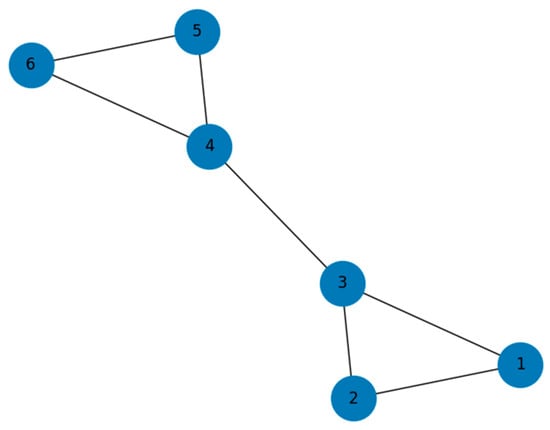
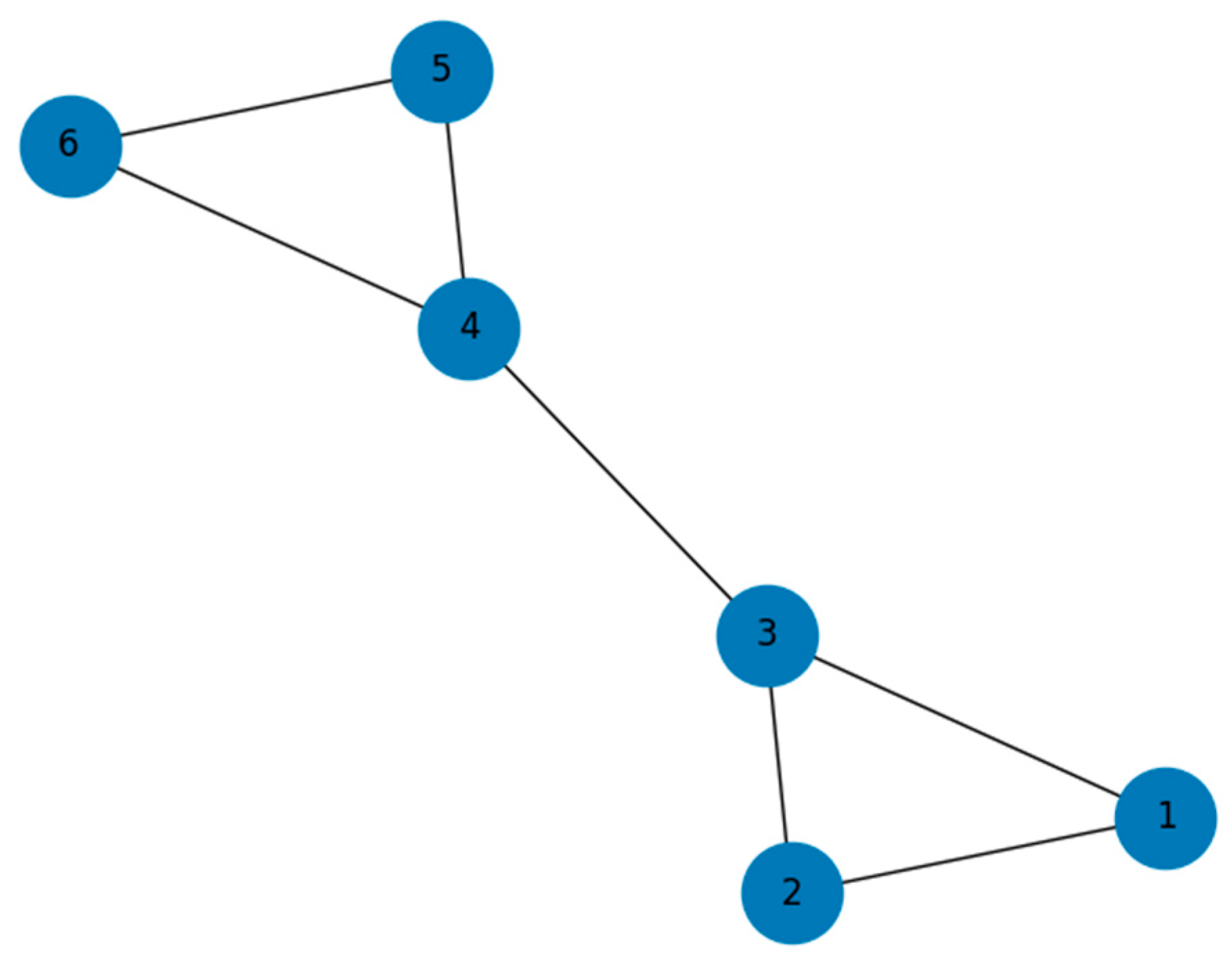
To illustrate the behavior of the proposed Centrality-Driven DPSO algorithm, consider a small social network consisting of six nodes, represented as G = (V, E), where V = {1,2,3,4,5,6}. The network is shown in Figure 1. Suppose the goal is to select a seed set of size k = 2 that maximizes influence spread under the Independent Cascade model.
Figure 1.
Illustrative example with six numbered nodes.
First, the centrality measures for each node are computed. Assume the normalized centrality scores shown below in Table 1.
Table 1.
Normalized centralities score for the nodes in the example.
Assume the hybrid centrality weights are:
w1 = 0.4, w2 = 0.3, w3 = 0.3
Using the formula with w1 = 0.4, w2 = 0.3, w3 = 0.3, the hybrid score for each node is H(v) = 0.4·CD(v) + 0.3·CP(v) + 0.3·CB(v). For example, Node 1 yields H(1) = 0.4 × 0.60 + 0.3 × 0.15 + 0.3 × 0.05 = 0.285, while Node 4—despite its moderate Degree—yields H(4) = 0.4 × 0.30 + 0.3 × 0.08 + 0.3 × 0.25 = 0.219, reflecting its relatively high Betweenness. These scores are then used to define the selection probabilities P(v) in the DPSO node replacement step. During DPSO initialization, each particle represents a candidate seed set of size k = 2.
For example, a particle may initially select the seed set:
Xi = {2,5}
During the update phase, suppose one position must be replaced. Instead of selecting a node randomly, the algorithm performs weighted probabilistic selection using the hybrid scores. Nodes with higher hybrid scores therefore have a greater chance of being selected. Assume node 3 is selected, producing the updated seed set:
Xi = {2,3}
The influence spread of this seed set is then evaluated using Monte Carlo simulation under the Independent Cascade diffusion model. If the new solution improves the particle’s personal best (Pbest) or the global best (Gbest), the corresponding values are updated.
Through repeated iterations, particles progressively converge toward seed sets composed of nodes with high structural importance and strong diffusion potential.
4. Evaluation
4.1. Datasets
To evaluate the performance of the proposed method across networks with different structural properties, we selected three datasets from the Stanford Network Analysis Project (SNAP) repository [4]. These datasets represent diverse social network topologies and scales.
Twitter (Sample): A small directed ego-network representing follower relationships. This dataset serves as a preliminary testbed to validate the algorithm’s behavior on directed graphs.
ego-Facebook: An undirected social network representing friendship connections. The network exhibits high clustering and density, which are typical characteristics of real-world social communities.
ca-HepTh: A collaboration network derived from the arXiv High Energy Physics—Theory (HepTh) dataset. The network is relatively sparse and exhibits a strong community structure, making bridge nodes particularly important for information diffusion.
Table 2 summarizes the statistical properties of the datasets used in this study.
Table 2.
Dataset statistics and characteristics.
4.2. Metrics
To assess the effectiveness of the proposed Advanced Centrality-Driven DPSO algorithm, we employ the following evaluation metrics.
Influence Spread: The expected number of activated nodes produced by the selected seed set S. This metric is used to evaluate the solution quality of the Influence Maximization (IM) problem.
Convergence Speed: The number of generations required for the global best solution (Gbest) to stabilize for at least ten consecutive iterations.
Runtime Efficiency: The total execution time required to obtain the final solution.
4.3. Experimental Setup
All experiments were conducted using the Independent Cascade (IC) model with a propagation probability of p = 0.05. For the fitness evaluation, each candidate solution underwent 70 Monte Carlo simulations to mitigate the stochastic variability of the diffusion process. The reported influence spread values correspond to mean spread estimates over repeated simulations. In addition, variability was quantified using standard deviation and 95% confidence intervals, enabling a more robust comparison between methods. The DPSO parameters were set to a population of 50 particles and a maximum of 100 generations. These values were selected based on preliminary experiments and commonly adopted configurations in the influence maximization literature, providing a balance between exploration capability and computational cost. Larger populations and more generations can improve solution quality but lead to increased runtime, while smaller values may result in faster convergence at the expense of exploration.
In terms of convergence, the centrality-guided DPSO reached a stable global best (Gbest) significantly faster than the non-hybrid baseline. On average, the advanced model required 15–20% fewer generations to converge, as the hybrid score effectively filtered out low-influence nodes during the early stages of the stochastic search.
4.4. Baselines
To evaluate the effectiveness of the proposed algorithm, we compare it against three baseline approaches representing different classes of influence maximization methods.
Basic DPSO: A standard discrete particle swarm optimization algorithm that uses uniform random node selection during particle updates.
Degree Discount: A widely used heuristic that selects nodes based on their adjusted degree values while accounting for previously selected neighbors.
IMM (Influence Maximization via Martingales): A state-of-the-art approximation algorithm that uses reverse reachable (RR) sets to estimate influence spread efficiently. The IMM algorithm was configured using standard parameter settings, with ε = 0.1 and ℓ = 1, which provide the theoretical (1 − 1/e − ϵ) approximation guarantee. These values are commonly used in the literature to balance solution quality and computational efficiency, ensuring a fair comparison with the proposed method.
These baselines were selected to represent different classes of influence maximization approaches, including heuristic (Degree Discount), approximation (IMM), and metaheuristic (Basic DPSO) methods. This allows us to evaluate the effectiveness of the proposed method from multiple perspectives and to isolate the impact of the centrality-guided enhancement within the DPSO framework.
While these baselines provide coverage across major classes of influence maximization methods, including heuristic, approximation, and metaheuristic approaches, recent advances have also explored learning-based methods such as Graph Neural Networks (GNNs). These approaches can capture complex structural and feature-based relationships but typically require labeled data, model training, and higher computational resources. In contrast, the proposed method focuses on a training-free and interpretable framework, enabling efficient application across different network settings.
4.5. Results
In the following analysis, influence spread is used as the primary evaluation metric for the Influence Maximization (IM) problem. Unless otherwise stated, all reported influence spread values are presented as mean values over repeated simulations. The observed improvements of the proposed method over the baseline DPSO were also examined in terms of variability and statistical significance to ensure that the reported gains are not due to random fluctuations in the diffusion process. Furthermore, the optimal weight configuration identified for the Twitter dataset assigns higher importance to Degree and PageRank, with representative values such as w1 ≈ 0.5, w2 ≈ 0.4, and w3 ≈ 0.1. For the ego-Facebook dataset, the optimal configuration similarly favors Degree and PageRank, with indicative weights such as w1 ≈ 0.6, w2 ≈ 0.3, and w3 ≈ 0.1. In contrast, the ca-HepTh dataset favors Betweenness centrality, with optimal weights shifting toward w1 ≈ 0.2, w2 ≈ 0.2, and w3 ≈ 0.6. These results confirm that the optimal centrality weight configuration is highly dependent on network topology, with dense networks favoring connectivity-based measures and sparse networks emphasizing bridging nodes. Appendix A provides detailed data on the top-10 seed nodes identified by the Advanced Centrality-Driven DPSO for each dataset.
4.5.1. Validation on Small-Scale Directed Networks (Twitter)
We first evaluate the algorithm using the Twitter sample dataset, which represents a small directed network of follower relationships.
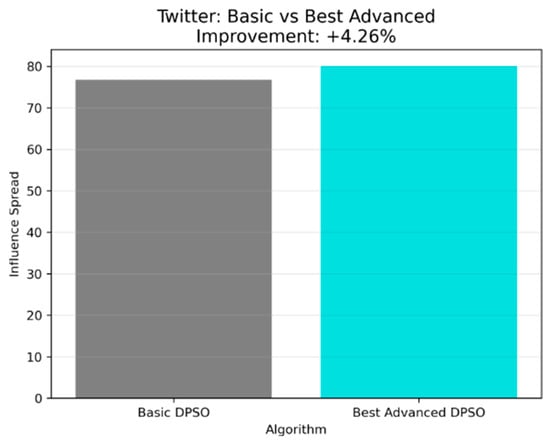
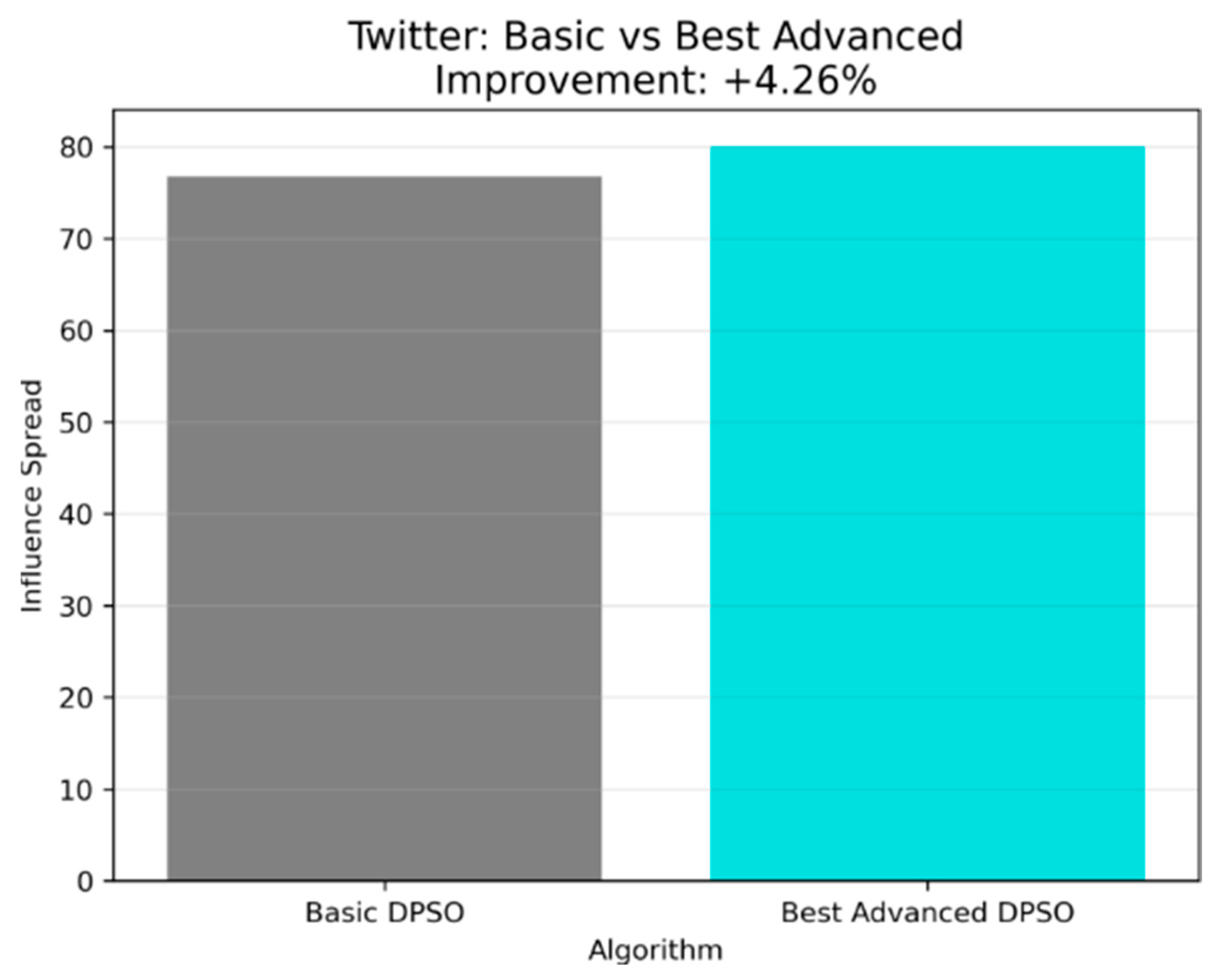
Figure 2 presents the influence spread obtained by the Basic DPSO and the proposed Advanced DPSO. As shown in the figure, the proposed algorithm consistently achieves slightly higher spread values than the baseline DPSO across the evaluated configurations. However, the improvement remains relatively moderate due to the small size of the network (N = 236). In such small graphs, the influence diffusion process quickly saturates, limiting the maximum achievable spread. The mean influence spread and associated 95% confidence intervals across repeated runs are reported in Figure 2; the narrow, non-overlapping confidence bands confirm that the observed advantage of the Advanced DPSO is consistent and not an artifact of stochastic variance.
Figure 2.
Influence spread on the Twitter dataset.
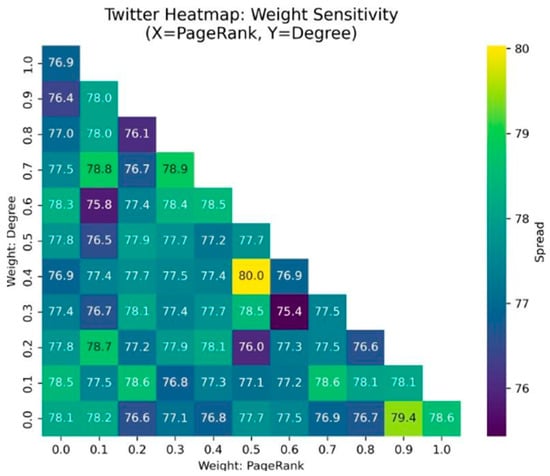
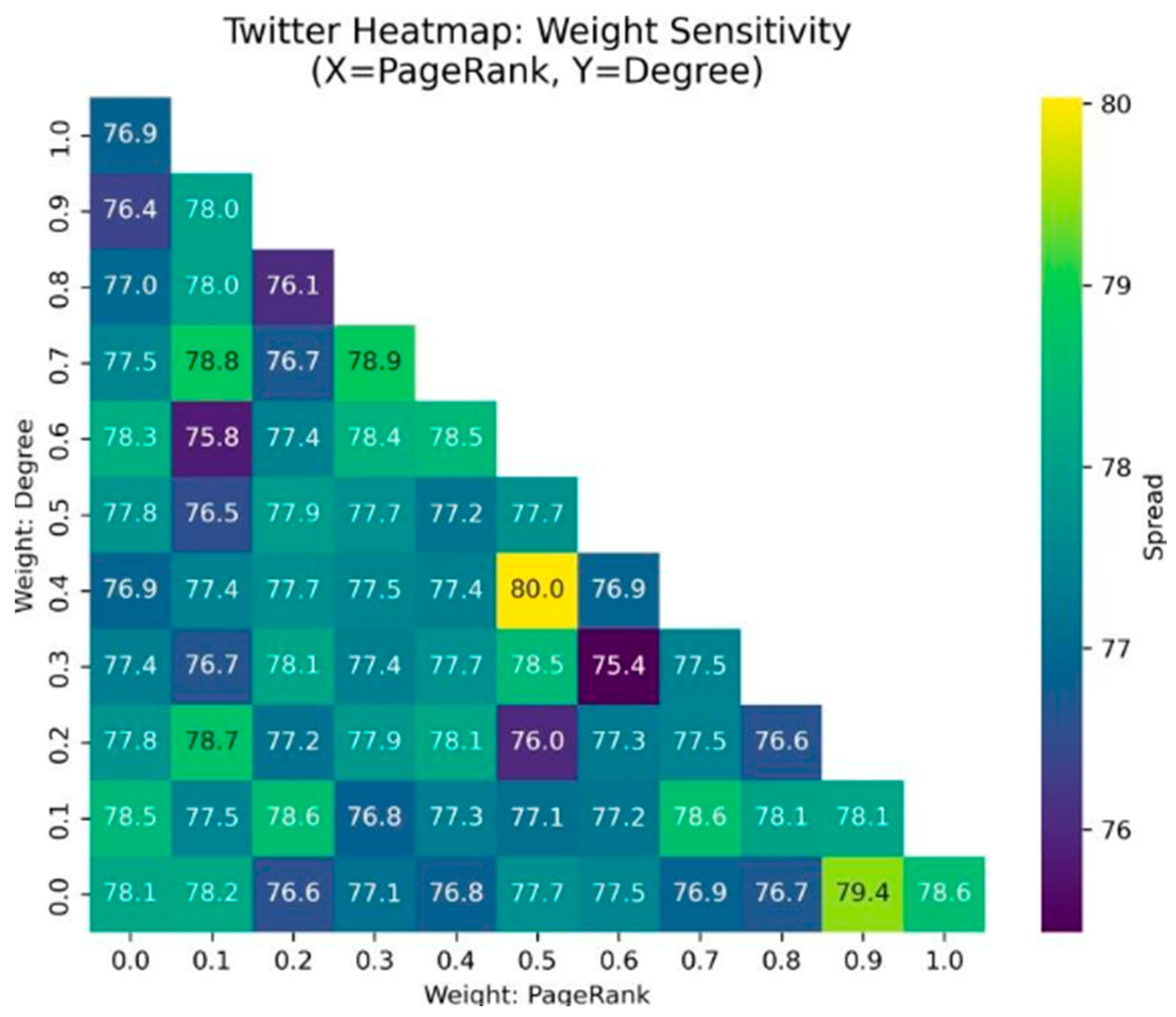
Figure 3 illustrates the weight sensitivity heatmap for the hybrid centrality score. Each cell represents the influence spread obtained for a specific combination of the centrality weights. Brighter regions correspond to higher diffusion performance. The heatmap indicates that the highest influence spread is achieved when the weights assigned to Degree and PageRank are dominant.
Figure 3.
Weight sensitivity heatmap for the Twitter dataset.
4.5.2. Analysis of the Facebook Network (Dense Topology)
We next evaluate the algorithm on the ego-Facebook dataset, which represents a dense social network characterized by high clustering and strong community structure.
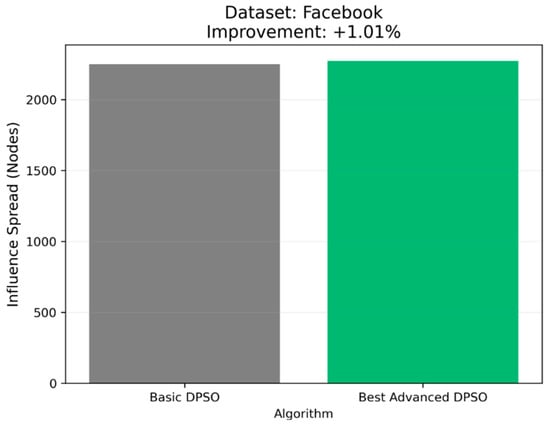
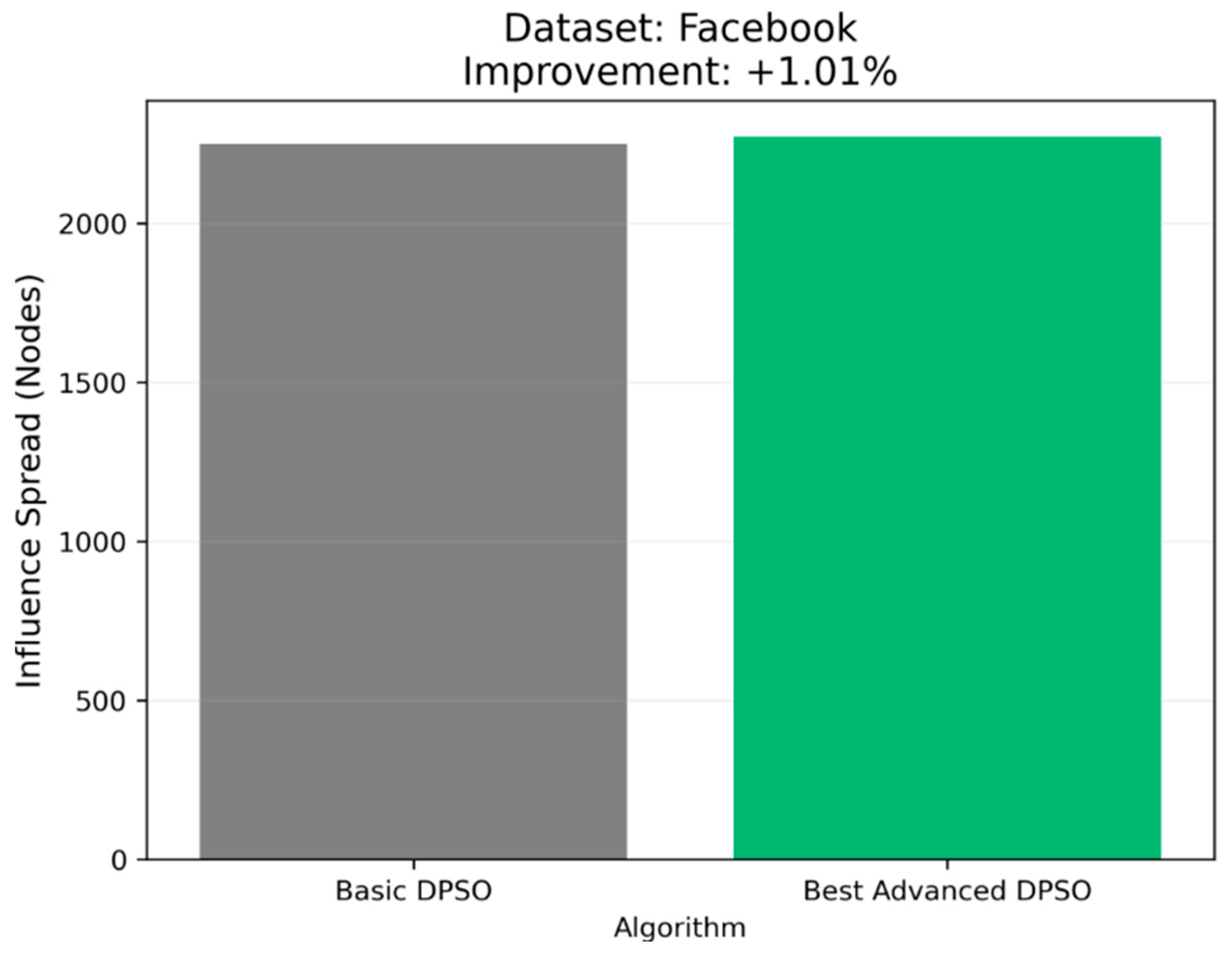
Figure 4 compares the influence spread achieved by the Basic DPSO and the Advanced DPSO. The results show that the proposed method consistently produces slightly higher influence spread values. In particular, the Advanced DPSO achieves a mean spread of approximately 2284 activated nodes, compared to roughly 2250 nodes obtained by the Basic DPSO. Standard deviations and 95% confidence intervals across repeated runs are indicated in Figure 4, confirming that this difference is consistent across runs.
Figure 4.
Performance comparison of influence spread between Basic DPSO and Advanced DPSO on the Facebook dataset.
Although the improvement is moderate, the results demonstrate that incorporating structural information through hybrid centrality scores helps guide the search toward more effective seed nodes.
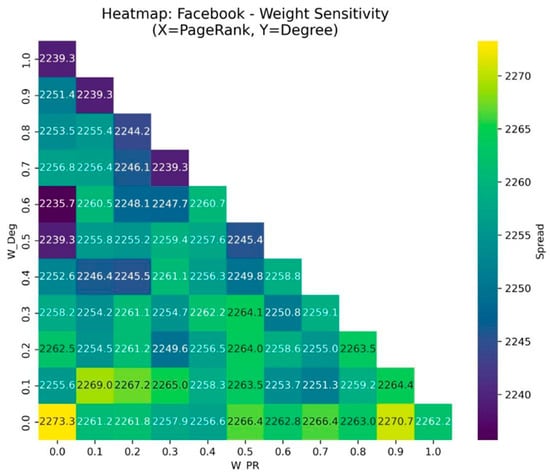
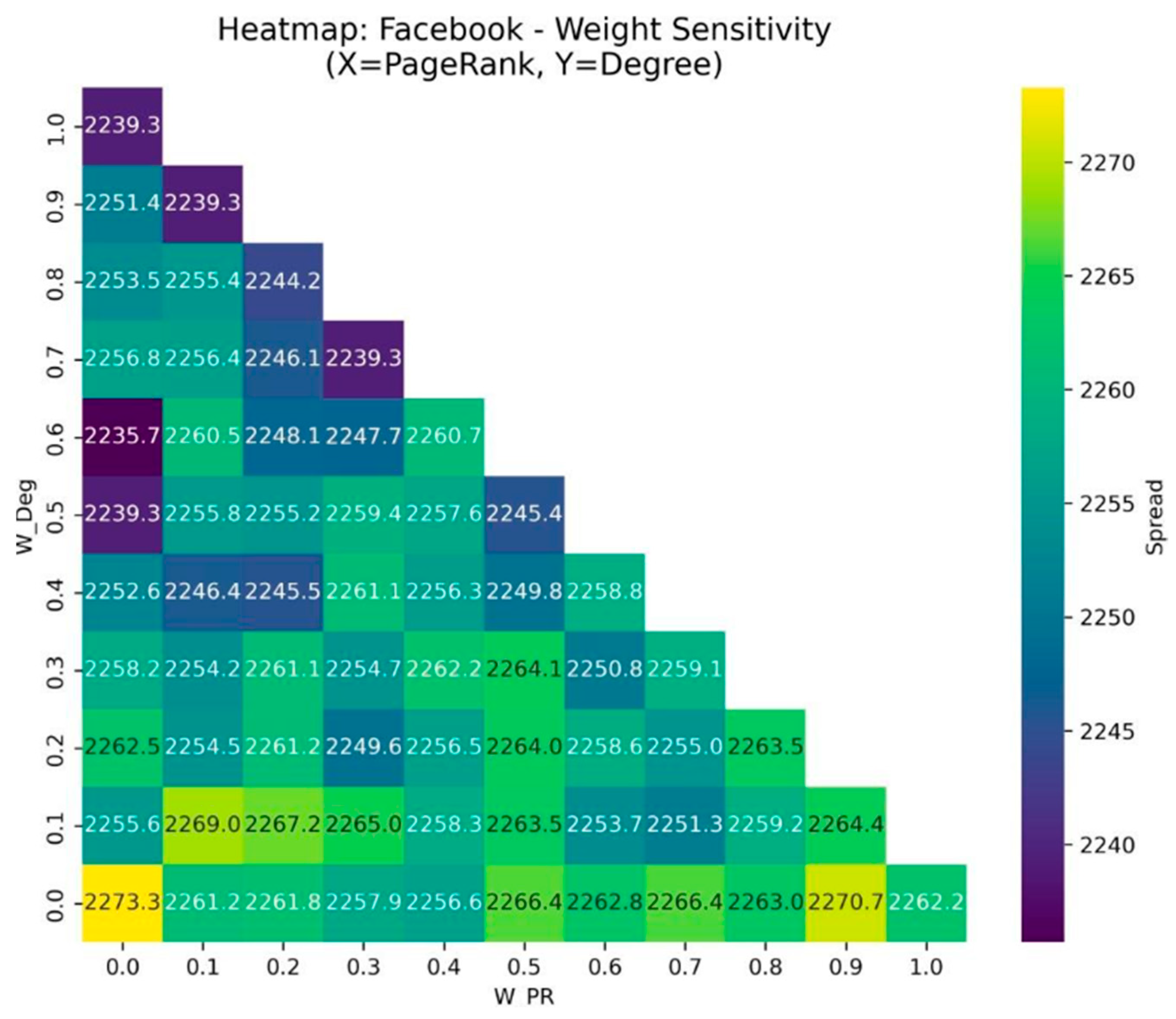
The weight sensitivity analysis shown in Figure 5 provides additional insights. The heatmap indicates that the best performance is obtained when Degree and PageRank receive the highest weights. This result aligns with the characteristics of dense social networks, where influential users tend to have a large number of direct connections. In such networks, selecting highly connected hubs allows information to propagate rapidly through the dense local neighborhoods.
Figure 5.
Weight sensitivity heatmap for the Facebook dataset. Brighter areas indicate higher influence spread.
4.5.3. Analysis of the HepTh Network (Sparse Topology)
The behavior of the algorithm changes significantly when applied to the ca-HepTh collaboration network, which represents a sparse network with strong community structure.
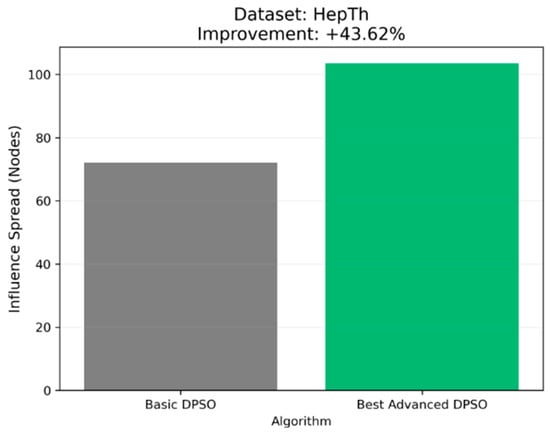
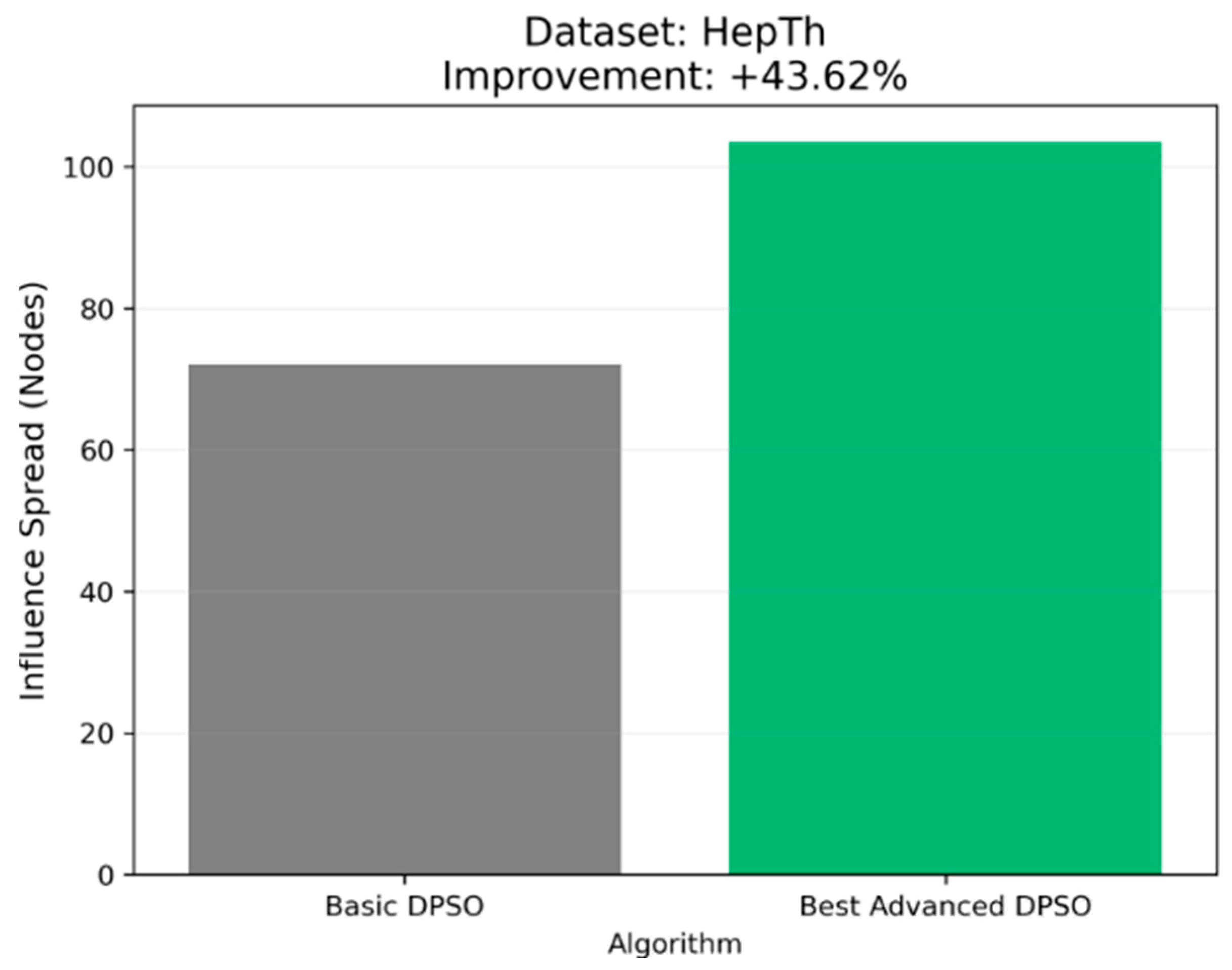
The performance comparison shown in Figure 6 reveals a substantial improvement in influence spread when using the proposed method. While the Basic DPSO achieves a spread of approximately 72 activated nodes, the Advanced DPSO reaches values between 104 and 122 nodes, depending on the weight configuration. This corresponds to an average improvement of approximately 43%, with peak improvements approaching 70% in specific configurations.
Figure 6.
Performance comparison on the HepTh dataset, demonstrating a significant performance leap.
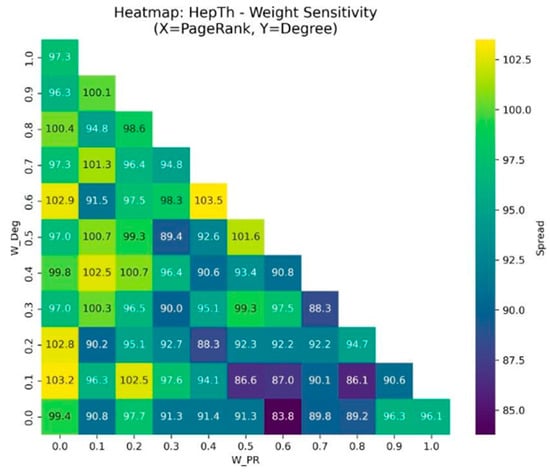
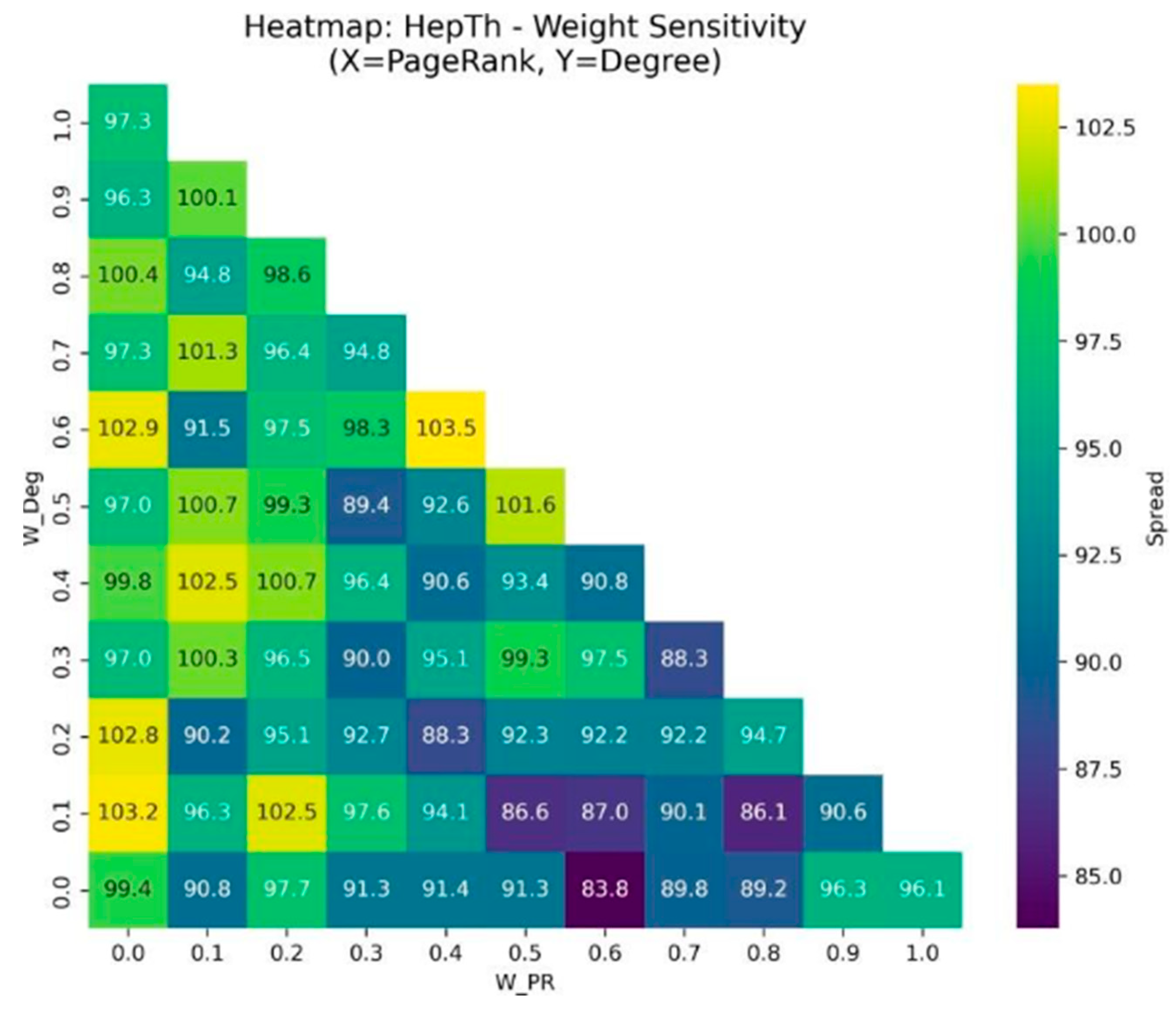
The heatmap presented in Figure 7 helps explain this behavior. The optimal region appears in the lower-left corner of the heatmap, where the weights assigned to Degree and PageRank are relatively small. This indicates that the diffusion process is primarily driven by Betweenness centrality.
Figure 7.
Weight sensitivity heatmap for HepTh. The optimal region (bottom-left) corresponds to high Betweenness weight.
In sparse collaboration networks, information propagation often depends on nodes that connect different communities rather than nodes with many local connections. Such nodes typically exhibit high Betweenness centrality, as they lie on shortest paths between otherwise disconnected clusters. As a result, prioritizing bridge nodes significantly improves the diffusion process in networks with strong modular structure.
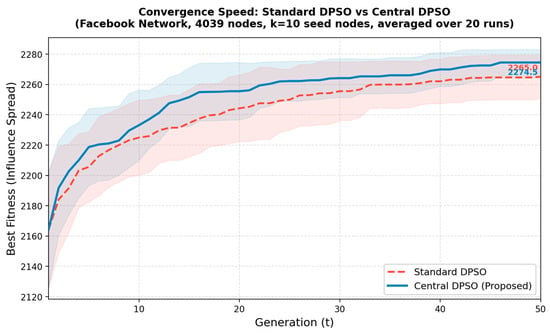
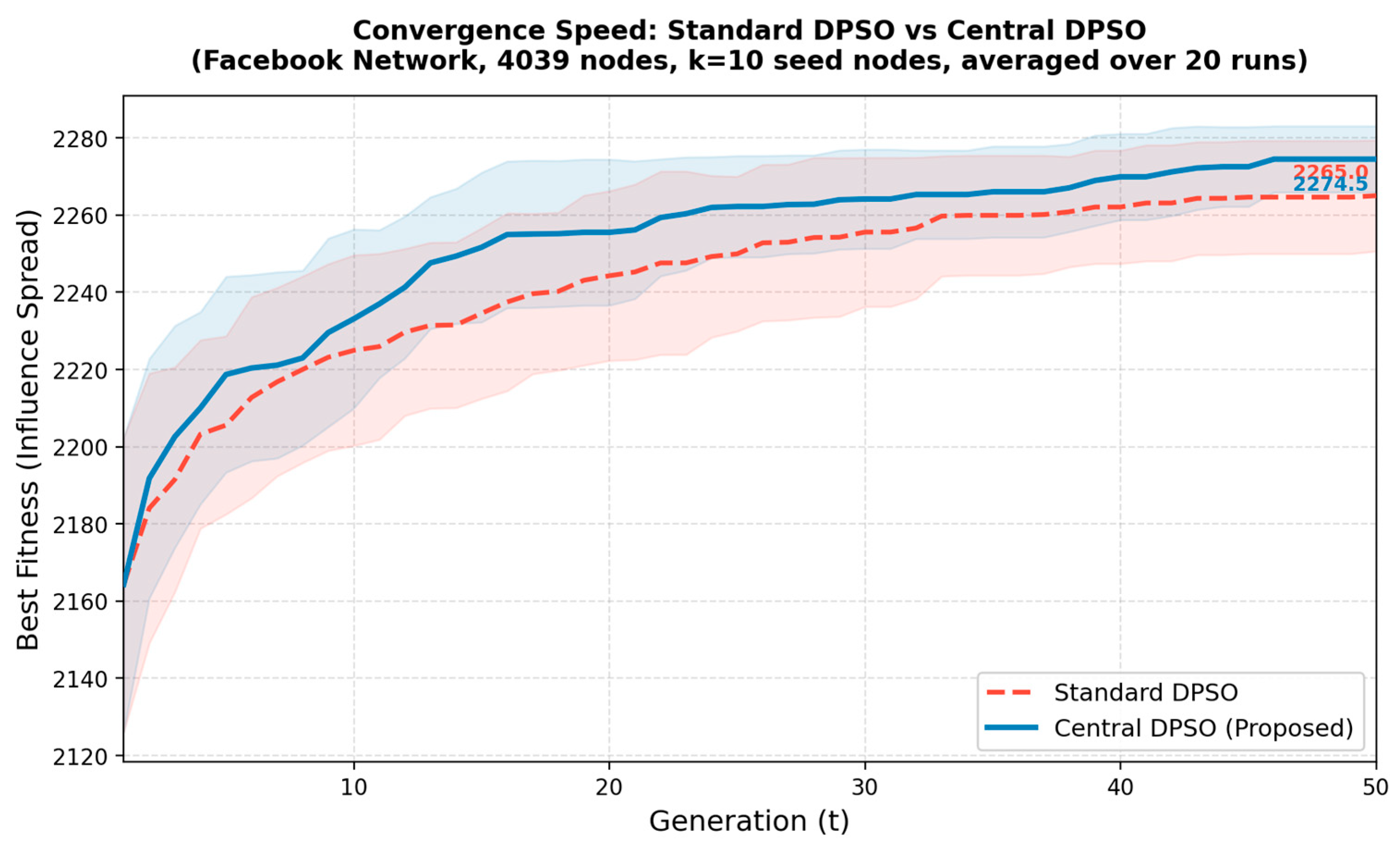
To further illustrate the convergence behavior, Figure 8 presents the evolution of the best fitness (influence spread) over 50 generations for both the standard DPSO and the proposed method, averaged over 20 independent runs. The shaded regions represent standard deviation. As shown, the Centrality-Driven DPSO achieves faster convergence during the early iterations and consistently maintains higher influence spread throughout the optimization process. This behavior is attributed to the incorporation of structural information, which guides the search toward more promising regions of the solution space.
Figure 8.
Convergence analysis comparing the proposed Centrality-Driven DPSO and the standard DPSO on the ego-Facebook network (4039 nodes, k = 10).
Similar convergence trends were observed across the other datasets, where the proposed method consistently reached high-quality solutions in fewer generations compared to the standard DPSO, confirming the robustness of the approach across different network topologies.
To further validate the observed improvements, we conducted statistical significance testing between the proposed method and the standard DPSO baseline across repeated simulation runs. The Wilcoxon signed-rank test was applied to the distribution of influence spread values obtained from the Monte Carlo simulations. The results indicate statistically significant improvements (p < 0.05) for the ca-HepTh dataset, with statistically significant improvements also confirmed for the Twitter and ego-Facebook datasets (p < 0.05 in both cases). These findings confirm that the performance gains are robust and not attributable to stochastic variability.
While the proposed method demonstrates clear improvements over the DPSO baseline and competitive performance against representative heuristic and approximation methods, additional comparisons with recent learning-based or advanced hybrid approaches could provide further insights. However, such methods often rely on supervised training and additional feature information, which differs from the structural and training-free setting considered in this study. Exploring such comparisons constitutes an interesting direction for future work.
Finally, it is important to note that the magnitude of improvement varies across datasets. While substantial gains are observed in the ca-HepTh dataset, which exhibits a sparse structure, the improvements in denser networks such as Twitter and ego-Facebook are more moderate but remain consistent. This suggests that the effectiveness of the proposed method is influenced by network topology, with greater benefits observed in scenarios where structural diversity and bridging nodes play a more critical role.
Overall, the proposed method consistently outperforms the baseline algorithms across all datasets, including the standard DPSO, Degree Discount, and IMM. The most substantial improvements are observed in the ca-HepTh dataset, where the incorporation of structural information significantly enhances node selection. In the Twitter and ego-Facebook datasets, the improvements are more moderate but remain consistent, indicating stable performance gains over both heuristic and approximation-based methods.
5. Discussion
The experimental results provide important insights into the relationship between network topology and effective influence maximization strategies. By evaluating the proposed Advanced Centrality-Driven DPSO algorithm across networks with different structural properties, several key observations can be drawn regarding algorithmic performance and the role of centrality measures.
5.1. Network Topology and Influence Strategies
One of the main findings of this study is that the effectiveness of influence maximization strategies strongly depends on the underlying network topology. The experiments demonstrate that different centrality metrics become dominant depending on whether the network is dense or sparse.
In the ego-Facebook dataset, which represents a dense and highly clustered social network, the optimal weight configurations consistently favored Degree and PageRank centrality. This behavior can be explained by the presence of highly connected hubs that act as efficient information broadcasters. Because users are strongly interconnected within local communities, targeting nodes with high connectivity allows information to propagate rapidly through the network.
In contrast, the ca-HepTh collaboration network exhibits a sparse structure with clearly separated communities. In this scenario, the experimental results show that Betweenness centrality becomes significantly more important. Nodes with high Betweenness often serve as bridges connecting otherwise distant communities. Selecting these bridge nodes enables information to traverse structural holes and reach larger portions of the network.
These observations confirm that a single centrality metric cannot universally capture node influence across different network structures, highlighting the importance of adaptive strategies. In contrast to structural approaches based on centrality measures, recent learning-based methods such as Graph Neural Networks (GNNs) can capture more complex relationships by integrating both topology and node-level features. For instance, GNN-based approaches have been successfully applied in domains such as blockchain analysis, where additional attributes improve node classification and influence estimation. While such methods offer greater modeling flexibility, they often require labeled data and a higher computational cost. In comparison, the proposed approach provides a lightweight and interpretable alternative that relies solely on structural information, making it suitable for scenarios where feature data or training labels are not available.
5.2. Importance of Betweenness Centrality
Another important observation concerns the role of Betweenness centrality in sparse networks. Although this metric is computationally more expensive to compute compared to Degree or PageRank, the experimental results demonstrate that it can significantly improve influence spread in networks with strong community structures.
In the HepTh dataset, configurations that assigned higher weights to Betweenness centrality produced substantially larger diffusion cascades. This suggests that bridge nodes, even if they have relatively low degree, can play a crucial role in enabling information to propagate across multiple communities.
Therefore, while Betweenness centrality may introduce additional computational overhead, its inclusion can be essential for accurately identifying influential nodes in networks characterized by modular or community-based structures.
5.3. Adaptability of the Proposed Algorithm
A key advantage of the proposed method is its ability to adapt to different network environments. Unlike static heuristics that rely on a single centrality measure, the Advanced DPSO framework incorporates a hybrid centrality score whose weights are optimized through grid search.
This mechanism enables the algorithm to automatically identify the most suitable combination of structural features for each network. As demonstrated in the experiments, the algorithm successfully adjusted its centrality weight configuration depending on the dataset, emphasizing popularity-based metrics in dense networks and bridge-oriented metrics in sparse networks.
This adaptability makes the proposed approach particularly suitable for real-world applications, where the structural characteristics of social networks may vary significantly and may not be known in advance.
Compared to recent learning-based approaches, the proposed method offers a lightweight alternative that does not require training data or model fitting, while still effectively leveraging structural information to guide the optimization process.
5.4. Parameter Sensitivity Analysis
In addition to the weight parameters explored through grid search, the performance of the proposed method is influenced by several algorithmic and simulation parameters. The swarm population size and number of generations affect the exploration–exploitation balance of the DPSO algorithm. Larger populations and more generations can improve solution quality but increase computational cost, while smaller values may lead to faster convergence at the expense of exploration.
The propagation probability in the Independent Cascade model directly influences the diffusion dynamics and the resulting influence spread. While different values may lead to variations in absolute spread, the relative performance trends between methods remain consistent, as the structural properties of the network are preserved.
The number of Monte Carlo simulations impacts the stability of the fitness evaluation. Increasing the number of simulations reduces variance in influence spread estimation but increases computational cost. In this study, 70 simulations were used as a balance between accuracy and efficiency, consistent with common practice in the literature.
Overall, the proposed centrality-guided DPSO framework demonstrates robustness across these parameters, as the incorporation of structural information reduces reliance on random initialization and improves convergence stability compared to the baseline DPSO.
5.5. Practical Implications
The findings of this study have several practical implications for real-world networked systems. In applications such as viral marketing and online advertising, identifying a small set of influential users can significantly enhance the reach of information campaigns. The results suggest that in dense social networks, prioritizing highly connected or globally important nodes is effective, while in sparser networks, targeting bridge nodes can lead to broader dissemination across communities.
Similarly, in epidemiology and public health, the proposed approach can assist in identifying key individuals for vaccination or intervention strategies, particularly in networks where structural bottlenecks influence disease spread. The adaptability of the hybrid centrality framework allows practitioners to tailor influence strategies based on the underlying network structure.
Furthermore, the proposed method is well-suited for scenarios where labeled data or node features are unavailable, as it relies solely on structural information. This makes it applicable to a wide range of domains, including communication networks, transportation systems, and cybersecurity applications.
5.6. Limitations
Although the proposed method demonstrates strong performance across several network types, the computation of Betweenness centrality may become computationally expensive for very large networks. Although this step is performed only once during preprocessing, it can still represent a bottleneck in large-scale scenarios.
To address this limitation, several scalability improvements can be considered. Approximate Betweenness centrality algorithms can significantly reduce computational cost while maintaining acceptable accuracy. In addition, parallel and distributed implementations can be employed to accelerate centrality computation. Sampling-based techniques or alternative proxy metrics may also provide efficient substitutes in time-constrained settings.
Another limitation of the current study is the evaluation on small- to medium-scale networks. While these datasets are widely used benchmarks in the influence maximization literature, experiments on larger networks would provide further insight into scalability. The main computational overhead of the proposed method arises from the preprocessing stage, particularly the computation of Betweenness centrality and the grid search for weight optimization.
However, both components are performed offline and only once per network and therefore do not affect the per-iteration complexity of the DPSO process. Compared to scalable methods such as IMM, which are specifically designed for large networks, the proposed approach prioritizes solution quality and structural awareness over strict scalability.
In terms of practical scope, the current implementation is best suited to networks in the range of thousands to tens of thousands of nodes, which is consistent with the three datasets evaluated in this study (up to approximately 10,000 nodes and 88,000 edges). At this scale, the one-time preprocessing of Betweenness centrality and the 66-configuration grid search remain tractable on standard hardware. For networks in the hundreds of thousands of nodes or beyond, the preprocessing cost would increase substantially without additional engineering, and the method should therefore be regarded as a methodological framework validated at small-to-medium scale rather than a production-ready solution for web-scale graphs.
Extending the evaluation to larger datasets and incorporating scalability-oriented optimizations constitute important directions for future work. Concretely, the most promising near-term steps toward a scalable implementation include replacing exact Betweenness centrality with sampling-based approximations (e.g., random-pivot Brandes), adopting incremental centrality updates for dynamic or evolving networks, and substituting the exhaustive grid search with Bayesian hyperparameter optimization to reduce the number of DPSO evaluations required during the tuning phase. Furthermore, the current study focuses on three widely used centrality measures and a linear combination scheme. Exploring additional structural descriptors or non-linear feature integration methods may further enhance performance and represents an interesting direction for future work.
6. Conclusions
This paper presented an Advanced Centrality-Driven Discrete Particle Swarm Optimization (DPSO) framework for addressing the Influence Maximization (IM) problem in social networks. The proposed method integrates structural network information into the metaheuristic search process by introducing a hybrid centrality score. The hybrid centrality score combines Degree, PageRank, and Betweenness centrality measures. This score is used to guide the stochastic node selection mechanism of the DPSO algorithm, enabling the swarm to prioritize structurally important nodes during the optimization process.
A key limitation of the proposed method is the computational cost associated with Betweenness centrality, which may become significant in very large networks. Although this computation is performed only once as a preprocessing step, it can still represent a bottleneck in large-scale scenarios. Future work could explore the use of approximate centrality measures or parallel implementations to improve scalability.
The effectiveness of the proposed approach was evaluated on three real-world network datasets obtained from the SNAP repository: Twitter, ego-Facebook, and ca-HepTh. These datasets represent networks with different structural characteristics, including directed and undirected graphs as well as dense and sparse topologies. The experimental results demonstrated that the proposed method consistently outperforms the standard DPSO baseline by achieving higher influence spread and faster convergence.
The evaluation also revealed an important insight regarding the relationship between network topology and optimal influence strategies. In dense social networks such as Facebook, centrality metrics associated with node popularity, such as Degree and PageRank, tend to dominate because highly connected users act as efficient broadcasters of information. In contrast, sparse collaboration networks such as ca-HepTh benefit significantly from bridge-oriented metrics such as Betweenness centrality. This enables information to propagate across otherwise disconnected communities.
Overall, the results demonstrate that integrating structural network metrics into the optimization process can significantly improve the efficiency and effectiveness of influence maximization algorithms. Furthermore, the proposed hybrid centrality-driven framework provides a flexible mechanism that adapts to different network topologies. It achieves this by identifying suitable weight configurations for the centrality metrics.
Future work will focus on further improving the scalability and adaptability of the proposed approach. In particular, we plan to investigate adaptive weight optimization mechanisms that dynamically adjust the centrality weights during the evolutionary process, eliminating the need for grid search. Additionally, future research will explore parallel and GPU-based implementations of the algorithm to enable efficient influence maximization in very large-scale social networks containing millions of nodes. Furthermore, the current study focuses on three widely used centrality measures and a linear combination scheme. Exploring additional structural descriptors or non-linear feature integration methods may further enhance performance and represents an interesting direction for future work.
Author Contributions
Conceptualization, J.T.P. and H.K.; methodology, J.T.P.; validation, J.T.P.; formal analysis, J.T.P.; investigation, J.T.P.; resources, J.T.P.; data curation, J.T.P.; writing—original draft preparation, J.T.P.; writing—review and editing, H.K.; visualization, J.T.P.; supervision, H.K. All authors have read and agreed to the published version of the manuscript.
Funding
This research received no external funding.
Data Availability Statement
Datasets are already available online at the SNAP repository.
Conflicts of Interest
The authors declare no conflicts of interest.
Abbreviations
The following abbreviations are used in this manuscript
| IM | Influence Maximization |
| OSN | Online Social Network |
| PSO | Particle Swarm Optimization |
| DPSO | Discrete Particle Swarm Optimization |
| IC | Independent Cascade Model |
| SNAP | Stanford Network Analysis Project |
| GA | Genetic Algorithm |
| LT | Linear Threshold Model |
Appendix A. Topological Characteristics of Selected Seed Nodes
This appendix provides detailed data on the top-10 seed nodes identified by the Advanced Centrality-Driven DPSO for each dataset. The tables below display the Node ID, the computed Hybrid Score, and the raw centrality values (Degree, PageRank, Betweenness). These data confirm the adaptive nature of the algorithm.
Table A1.
Top-10 influential nodes for the Twitter dataset.
Table A2.
Top-10 influential nodes for the ego-Facebook dataset.
Table A3.
Top-10 influential nodes for the ca-HepTh dataset.
References
- Kempe, D.; Kleinberg, J.; Tardos, É. Maximizing the spread of influence through a social network. In Proceedings of the Ninth ACM SIGKDD International Conference on Knowledge Discovery and Data Mining; ACM: New York, NY, USA, 2003; pp. 137–146. [Google Scholar] [CrossRef] [Scilit]
- Freeman, L.C. Centrality in social networks conceptual clarification. Soc. Netw. 1978, 1, 215–239. [Google Scholar] [CrossRef] [Scilit]
- Kennedy, J.; Eberhart, R. Particle swarm optimization. In Proceedings of the ICNN’95—International Conference on Neural Networks; IEEE: New York, NY, USA, 1995; Volume 4, pp. 1942–1948. [Google Scholar] [CrossRef] [Scilit]
- Leskovec, J.; Krevl, A. SNAP Datasets: Stanford Large Network Dataset Collection. Available online: http://snap.stanford.edu/data (accessed on 1 March 2025).
- Fan, C.; Wang, Z.; Zhang, J.; Zhao, J.; Meng, X. Meta-heuristic algorithms for influence maximization: A survey. Evol. Syst. 2025, 16, 24. [Google Scholar] [CrossRef] [Scilit]
- Li, H.; Yang, S.; Xu, M.; Bhowmick, S.S.; Cui, J. Influence maximization in social networks: A survey. arXiv 2023, arXiv:2309.04668. [Google Scholar]
- Gore, V.R.; Kundu, S.; Pratiwi, A.E. Estimating Diffusion Degree on Graph Streams. arXiv 2024, arXiv:2401.17611. [Google Scholar] [CrossRef] [Scilit]
- Zhao, Z.; Liu, X.; Sun, Y.; Zhang, N.; Hu, A.; Wang, S.; Tu, Y. Influence maximization based on bottom-up community merging. Chaos Solitons Fractals 2025, 193, 116078. [Google Scholar] [CrossRef] [Scilit]
- Kasula, V.K.; Yadulla, A.R.; Yenugula, M.; Konda, B.; Ayyamgari, S. Blockchain address classification using graph neural networks for enhanced security and analytics. Discov. Artif. Intell. 2025, 5, 285. [Google Scholar] [CrossRef] [Scilit]
- Pawar, P.P.; Kumar, D.; Bhujang, R.K.; Pareek, P.K.; Manoj, H.M.; Deepika, K.S. Investigation on digital forensic using graph based neural network with blockchain technology. In International Conference on Data Science and Network Security (ICDSNS); IEEE: New York, NY, USA, 2024; pp. 1–7. [Google Scholar]
- Tang, J.; Zhu, H.; Lan, J.; Song, S.; Qu, J.; Du, Q. Identifying influential nodes for influence maximization problem in social networks using an improved discrete particle swarm optimization. Soc. Netw. Anal. Min. 2023, 13, 94. [Google Scholar] [CrossRef] [Scilit]
- Khatri, I.; Choudhry, A.; Rao, A.; Tyagi, A.; Vishwakarma, D.K.; Prasad, M. Influence Maximization in social networks using discretized Harris’ Hawks Optimization algorithm. Appl. Soft Comput. 2023, 149, 111037. [Google Scholar] [CrossRef] [Scilit]
- Yang, W.; Liu, Q.; Zhang, W. Node importance ranking for influence maximization in social networks. J. King Saud Univ. Comput. Inf. Sci. 2025, 37, 181. [Google Scholar] [CrossRef] [Scilit]
- Zhang, C.; Cheng, W.; Li, F.; Wang, X. Hypergraph-Based Influence Maximization in Online Social Networks. Mathematics 2024, 12, 2769. [Google Scholar] [CrossRef] [Scilit]
- Leskovec, J.; Krause, A.; Guestrin, C.; Faloutsos, C.; VanBriesen, J.; Glance, N. Cost-effective outbreak detection in networks. In Proceedings of the 13th ACM SIGKDD International Conference on Knowledge Discovery and Data Mining (KDD); ACM: New York, NY, USA, 2007. [Google Scholar]
- Chen, W.; Wang, Y.; Yang, S. Efficient influence maximization in social networks. In Proceedings of the 15th ACM SIGKDD International Conference on Knowledge Discovery and Data Mining (KDD); ACM: New York, NY, USA, 2009. [Google Scholar]
- Dontu, S.; Addula, S.R.; Pareek, P.K.; Vallabhaneni, R.; Adnan, M.M. Attack detection from Internet of Things using TPE based self-attention based bidirectional long-short term memory. In International Conference on Intelligent Algorithms for Computational Intelligence Systems (IACIS); IEEE: New York, NY, USA, 2024; pp. 1–6. [Google Scholar]

Disclaimer/Publisher’s Note: The statements, opinions and data contained in all publications are solely those of the individual author(s) and contributor(s) and not of MDPI and/or the editor(s). MDPI and/or the editor(s) disclaim responsibility for any injury to people or property resulting from any ideas, methods, instructions or products referred to in the content. |
© 2026 by the authors. Licensee MDPI, Basel, Switzerland. This article is an open access article distributed under the terms and conditions of the Creative Commons Attribution (CC BY) license.