


Abstract
Precise segmentation of transmission equipment is crucial for ensuring secure power grid operation, yet practical deployment faces substantial challenges including the preservation of elongated morphological characteristics of transmission lines and accurate boundary localization for complex transmission tower structures. This paper proposes a novel segmentation method that synergistically integrates cross-directional convolutions with multi-layer attention mechanisms within the YOLO11 framework. The designed C3x cross-directional convolution module incorporates orthogonal convolutional operations during feature extraction, enabling independent enhancement of feature responses along horizontal and vertical dimensions. This architecture effectively captures continuous morphological characteristics of elongated targets while mitigating fragmentation artifacts. Additionally, the proposed Multi-Layer Cascaded Attention (MLCA) module employs a progressive fusion strategy combining spatial and channel attention, significantly augmenting the network’s capacity to extract multi-scale semantic information while maintaining computational efficiency. This design particularly enhances boundary detail preservation for structurally complex targets. Experimental evaluations on the TTPLA dataset (comprising 1232 images across 4 categories) demonstrate remarkable performance improvements: bounding box detection achieves 72.56% mAP@0.5 and mask segmentation reaches 68.37% mAP@0.5, representing gains of 2.97% and 4.52% respectively over the baseline YOLO11 model. The Mask F1 score improves from 67.85% to 71.76%, comprehensively validating the proposed method’s effectiveness in enhancing segmentation capabilities for both elongated and morphologically complex targets. These results substantiate the practical applicability of the proposed approach for intelligent transmission infrastructure monitoring systems.
1. Introduction
Precise segmentation of transmission infrastructure, particularly slender transmission lines and structurally complex towers, constitutes a fundamental technology for ensuring the secure and stable operation of modern power grids [1]. The rapid expansion of ultra-high-voltage transmission networks and the advancement of intelligent grid construction in China have intensified demands for automated inspection and intelligent monitoring of transmission corridors [2,3]. The morphological characteristics of transmission equipment present unique segmentation challenges: transmission lines exhibit elongated linear geometries with extreme aspect ratios (often exceeding 100:1 and occupying less than 1% of image pixels), whereas transmission towers comprise intricate three-dimensional lattice structures with complex topological relationships [4,5]. These distinctive features, combined with challenging environmental conditions including heterogeneous natural backgrounds, variable illumination, and adverse weather, create substantial obstacles for accurate segmentation [6,7]. Current methodologies demonstrate critical limitations in addressing these challenges, particularly in recognizing fine structural details, achieving precise boundary delineation, and detecting small-scale components [8]. Such deficiencies significantly compromise the reliability and practical applicability of automated transmission equipment segmentation systems, necessitating the development of more robust and sophisticated approaches [9].
Driven by these operational imperatives, the convergence of unmanned aerial vehicle (UAV) technology and deep learning has catalyzed a paradigm shift toward vision-based intelligent inspection systems [10]. Traditional manual inspection methods suffer from inherent limitations including operational inefficiency, excessive costs, and substantial safety risks. Such occupational hazards are particularly severe in high-altitude and high-voltage operational environments, where human inspectors face considerable risks of electrical accidents and fall injuries [11]. These human-centered safety concerns constitute the primary driving force behind the paradigm shift toward vision-based automated systems. While the current work focuses on algorithmic innovations for segmentation accuracy, the proposed method is architecturally designed to be compatible with human-in-the-loop deployment scenarios in future practical applications [12]. Such deployment frameworks position AI-enabled segmentation algorithms as decision support systems within collaborative operational paradigms, rather than autonomous replacement mechanisms. In envisioned practical implementations, UAV-mounted inspection platforms could leverage real-time computer vision pipelines to generate preliminary defect localization results, enabling domain experts to conduct informed maintenance decision-making through interactive graphical user interfaces from remote, safe locations [13,14]. This collaborative computational paradigm substantially enhances occupational safety by minimizing direct human exposure to hazardous operational scenarios while concurrently improving inspection throughput [15]. Although deep learning approaches have demonstrated exceptional potential in this domain through robust feature extraction, the distinctive characteristics of aerial imagery—including ultra-high resolution, heterogeneous backgrounds, and elongated target morphology—present formidable technical challenges that necessitate specialized architectural solutions [16,17].
In response to these obstacles, recent research has evolved from general segmentation improvements to specialized architectural optimizations, which can be broadly categorized into CNN-based, Transformer-based, and Hybrid attention networks. To enhance generalization across diverse operational environments, Li et al. [18] developed a cross-scene detection approach utilizing fully convolutional neural networks enhanced with attention-based information fusion. Addressing the accuracy degradation caused by insufficient local context and background noise, Yang et al. [19] augmented the U-Net architecture with an attention fusion network. In terms of computational efficiency and occlusion handling, Ma et al. [20] optimized the SoloV2 framework by integrating a Path Aggregation Feature Pyramid Network (PaFPN), while Souza et al. [21] further demonstrated the efficacy of YOLO-based architectures for real-time defect classification. More recently, Sangaiah et al. [22] proposed the LCUT-Sv9 framework based on Tiny-YOLOv9, incorporating 3D feature adaptation and coordinate attention to boost detection speed and security. Furthermore, specific optimizations have been introduced to address the morphological challenge of slender objects. Gao et al. [23] employed asymmetric decomposed convolutions to improve feature extraction efficiency, and similarly, Dai et al. utilized bilateral and convolutions to better align with line morphology. Additionally, to capture global context in complex aerial backgrounds, Zhang et al. [24] explored Transformer-based cross-modal fusion strategies.
Despite significant progress in automated inspection systems, existing mainstream segmentation models (e.g., U-Net, DeepLab, and standard YOLO variants) exhibit critical limitations in this specific application. Their reliance on conventional isotropic convolution kernels inherently causes them to over-sample lateral background noise when processing extremely thin targets, leading to frequent fragmentation of slender transmission lines. Furthermore, they suffer from imprecise boundary delineation of complex tower structures and inadequate generalization. To address these fundamental challenges, this work presents a novel transmission equipment segmentation framework that synergistically integrates cross-directional convolutions with multi-layer attention mechanisms within the YOLO11 architecture. Specifically, the proposed cross-directional convolution is uniquely suited to overcome the limitations of isotropic kernels by decoupling feature extraction into orthogonal components, thereby maximizing signal density along the target’s axis while suppressing lateral background interference. The proposed approach introduces two innovative modules specifically designed to enhance feature representation and segmentation precision for morphologically diverse transmission infrastructure. Comprehensive experimental evaluations conducted on a large-scale transmission equipment dataset demonstrate the substantial performance improvements achieved by our method. The principal contributions of this research are delineated as follows:
- (1)
- we introduce the Cross-directional Convolution Module (C3x) to overcome the representational bottleneck inherent in conventional isotropic operators. Standard square convolution kernels exhibit a critical geometric mismatch when processing one-dimensional transmission lines, as their receptive fields inevitably sample excessive background noise perpendicular to the line structure. The proposed module addresses this limitation by decomposing feature extraction into orthogonal, horizontal and vertical paths. This design constitutes a shift from generic feature extraction to physics-aware anisotropic modeling. It enables the network to maximize signal density along the elongated line morphology while suppressing lateral background interference, thereby effectively resolving the fragmentation artifacts commonly observed in slender object detection.
- (2)
- we develop the Multi-Layer Cascaded Attention mechanism (MLCA) to confront the challenges posed by the hollow lattice structures of transmission towers where local features are spatially discontinuous. Unlike conventional attention mechanisms that operate purely on semantic abstraction, this architecture is hierarchically deployed to resolve the topological ambiguity of complex lattice structures. By establishing long-range dependencies across multiple scales, the mechanism functions as a semantic bridge that connects fragmented structural components into a coherent global object. This approach significantly enhances the robustness of the model against occlusion and background clutter, ensuring precise boundary delineation for structurally complex equipment.
2. Methods
The proposed architectural enhancements to the YOLO11 framework introduce two fundamental modifications specifically engineered for instance segmentation of power transmission equipment. The primary innovation addresses the distinctive geometric characteristics inherent in transmission infrastructure: elongated linear morphologies of transmission lines and intricate lattice configurations of transmission towers present formidable challenges for conventional isotropic convolutional operators. These standard kernels exhibit limited capacity in capturing directionally dependent features, necessitating a more sophisticated approach. A cross-directional convolution mechanism is therefore integrated as a systematic replacement for conventional modules, employing spatially decomposed kernels that independently model horizontal and vertical feature responses to enhance orientation-specific pattern recognition.
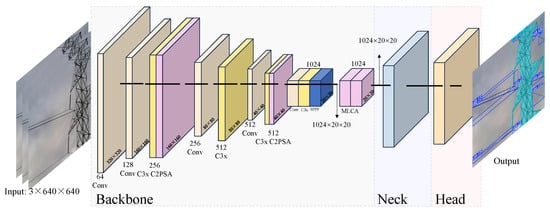
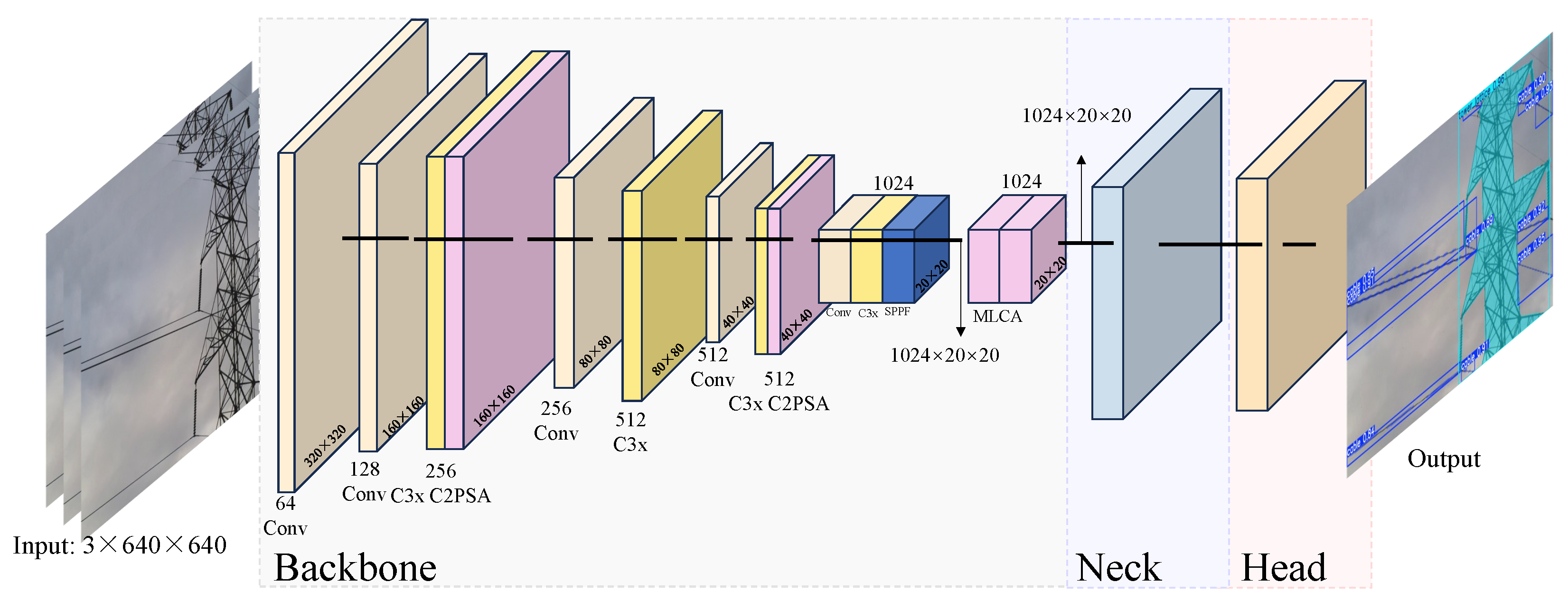
The secondary modification rectifies the constrained attention mechanism in the baseline YOLO11 architecture, which relegates attention computation to a single module within deep network layers. This design paradigm fails to exploit the hierarchical nature of visual representations across multiple scales. The proposed framework strategically deploys attention modules throughout various network depths, establishing a multi-level feature enhancement architecture. This hierarchical attention mechanism enables comprehensive feature refinement across diverse semantic scales, facilitating precise boundary delineation for morphologically complex transmission equipment while maintaining computational parsimony. Figure 1 delineates the comprehensive architecture of the enhanced YOLO11 framework.
Figure 1.
Overall Architecture of the Enhanced YOLO11 Network for Transmission Equipment Segmentation.
2.1. Cross-Directional Convolution Module
The C3k2 module constitutes a cornerstone element within the original YOLO11 backbone architecture, leveraging Cross-Stage Partial design principles to balance representational capacity and efficiency. However, the fundamental Bottleneck configuration remains constrained by its reliance on conventional isotropic convolutions. This design creates a critical geometric mismatch when processing transmission lines. As these targets typically possess extremely high aspect ratios and often appear as structures spanning merely one or two pixels in width, a standard square kernel centered on the line inevitably allocates a substantial majority of its computational resources to processing background noise. This noise dilution effect significantly reduces the Effective Receptive Field along the axis of the object and is the root cause of the line fragmentation artifacts observed in baseline detection results.
To resolve this physics-based limitation, the proposed C3x module introduces a paradigm shift from generic feature extraction to anisotropic modeling. The architectural innovation centers on a spatially decoupled convolution strategy that decomposes standard kernels into orthogonal components, specifically the and configurations. This design explicitly enables independent feature modeling along horizontal and vertical axes, allowing the network to adaptively emphasize orientation-specific patterns while suppressing lateral background clutter. Consequently, the feature activation is driven solely by the structural signal rather than contextual noise. The resulting architecture demonstrates superior capability in preserving the continuity of elongated features and accurately capturing complex boundary geometries without incurring substantial computational overhead.
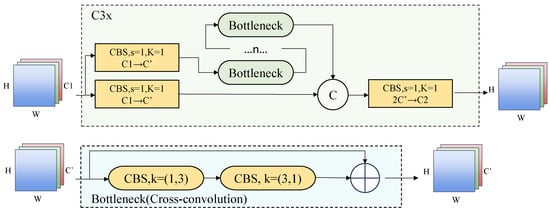
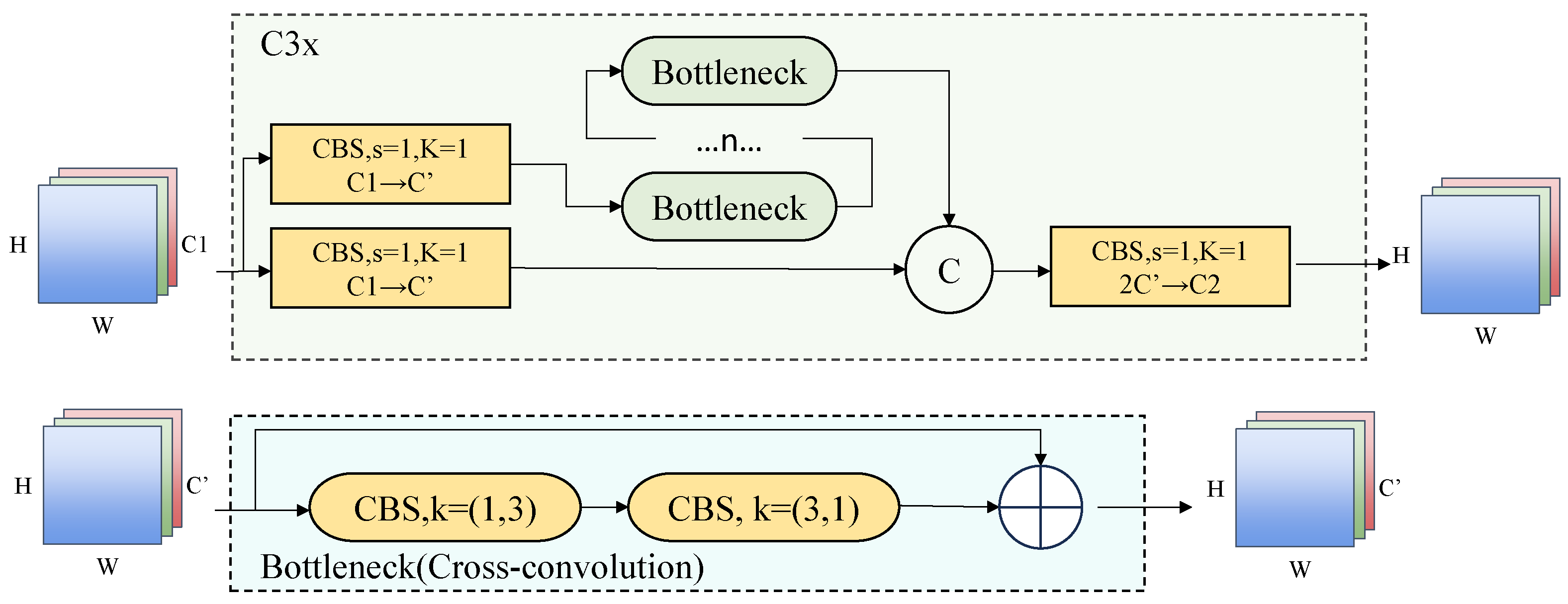
The detailed architecture of the C3x module is depicted in Figure 2. At its core lies a modified Bottleneck unit, in which conventional 2D convolutional kernels are extended to a set of cross-directional kernels: . This design essentially decomposes the standard kernel into orientation-sensitive components, enabling the extraction of directional features with greater efficacy. Given an input feature tensor , the orthogonal feature extraction and fusion process is rigorously formulated to include normalization and non-linear activation:
where denotes Batch Normalization, represents the SiLU activation function, and Y represents the fused output via a residual connection.
Figure 2.
Detailed Architecture of the C3x Module.
The C3x cross-directional convolution module achieves enhanced modeling of target spatial structures through this specific feature fusion strategy, integrating horizontal and vertical convolutional pathways while preserving original gradient flows. The resulting feature maps preserve the semantic information of original features while substantially elevating representation capabilities for anisotropic structures through directional decoupling mechanisms. Compared to conventional modules employing standard convolutions, C3x demonstrates significant advantages in parameter efficiency and computational complexity: decomposing a single convolution into two orthogonal convolutions of and reduces parameter count by approximately 33% while maintaining comparable receptive fields, effectively mitigating model overparameterization. The orthogonal convolution decomposition strategy endows the network with explicit directional awareness, enabling adaptive enhancement of feature responses across different orientations. This asymmetric convolution strategy aligns remarkably well with the morphological characteristics of transmission equipment, precisely capturing continuous elongated structures of transmission lines while effectively preserving geometric edge information of complex targets such as transmission towers. Consequently, this lightweight architecture achieves substantial improvements in feature expressiveness, providing more discriminative feature representations for downstream segmentation tasks.
2.2. Multi-Layer Cascaded Attention
Transmission towers present a unique segmentation challenge due to their semi-transparent, lattice-like nature. Standard CNNs tend to over-focus on local textures, often misclassifying the background visible through the tower gaps as “non-object,” leading to fractured segmentation masks. The baseline YOLO11 configuration exacerbates this issue by constraining attention processing to a solitary C2PSA module positioned post-SPPF. This architectural limitation restricts the exploitation of fine-grained spatial information, as deep semantic features alone prove insufficient for resolving the topological ambiguity of hollow structures.
Confronting these computational challenges, we develop the Multi-Layer Cascaded Attention (MLCA) to enforce global topological integrity. Unlike the baseline approach, the proposed framework strategically deploys C2PSA modules across multiple network depths, establishing a hierarchical attention cascade. By calculating attention maps across expanded receptive fields, MLCA suppresses the high-frequency noise from background gaps and reinforces the semantic connection between spatially distant tower components.
This work implements MLCA across three strategic stages to construct a progressive feature enhancement strategy. The shallow MLCA module operates on high-resolution feature maps to preserve rich spatial details, effectively capturing continuous patterns of elongated targets within local regions. The mid-level module establishes long-range dependencies, proving crucial for comprehending the overall topology of complex lattice structures. Finally, the deep-level cascade architecture refines global contextual information, ensuring precise target localization even within highly abstract feature spaces. This multi-tiered mechanism not only elevates global perception capabilities but also substantially ameliorates the segmentation discontinuity issues arising from insufficient attention coverage in conventional networks.
Specifically, given an input feature map , a convolution first reduces the channels to , where and e denotes the compression ratio. The resulting feature map is then split along the channel dimension into two branches, . The branch a retains residual information directly, while b is propagated through a stack of self-attention modules, PSABlock, for cross-spatial and cross-channel modeling:
Unlike established convolutional attention blocks such as SE or CBAM, which rely heavily on global average or max pooling to aggregate spatial context into singular channel descriptors, the PSABlock leverages Multi-Head Self-Attention (MHSA) to compute dynamic, dense pixel-to-pixel affinities. Specifically, the input feature is linearly projected into Query (Q), Key (K), and Value (V) tensors. The attention weights are then computed via a scaled dot-product:
where represents the scaling factor of the key dimensions. This mechanism inherently calculates fine-grained spatial dependencies across the entire receptive field. Simultaneously, projecting the features across multiple independent “heads” facilitates the progressive aggregation of diverse channel sub-spaces. Within each PSABlock, this multi-head self-attention is synergistically integrated with a feed-forward network, while residual connections are employed to fortify training stability and feature expressiveness. By stacking multiple PSABlocks—increasing the parameter n—the model hierarchically constructs intricate dependencies across both spatial and channel domains, thereby elevating segmentation accuracy for transmission equipment with complex structural patterns.
3. Experiment
3.1. Experimental Parameters
All experiments are conducted on a single NVIDIA A100 GPU using Python 2.9 and the PyTorch 2.5 framework. Input images are resized to pixels, and the output consists of segmentation masks at the same resolution.The training process operates with a batch size of 16 for a maximum of 1500 total epochs. This large upper bound was intentionally set to accommodate the complex spatial modeling required by the MLCA module, while the early stopping mechanism (patience of 100 epochs) ensured that training dynamically terminated upon convergence—typically well before the 1500th epoch—effectively preventing overfitting. An adaptive optimizer selection strategy dynamically configures the optimizer type and parameters based on the training phase; the initial learning rate is set to 0.01, momentum to 0.937, and weight decay to 0.0005. A warm-up procedure is activated during the first three epochs to stabilize optimization. To ensure deterministic reproducibility and fair comparison across all architectures despite the prohibitive computational cost of running multiple statistical trials, a fixed random seed (seed = 0) was strictly applied to all training sessions. Data augmentation is applied dynamically online during the data loading process, which avoids expanding the physical dataset size while ensuring continuous batch diversity. The online augmentation consists of random horizontal flip (probability 0.5), RandAugment, and random erasing (probability 0.4), while more complex methods—such as Mosaic, MixUp, and CopyPaste—are disabled to preserve data authenticity. Mixed-precision training (AMP) is utilized for acceleration, and data loading exploits eight parallel worker threads. During validation, an IoU threshold of 0.7 guides evaluation. This relatively strict threshold was specifically selected to enforce high-fidelity boundary delineation, which is crucial for accurately segmenting slender targets and complex lattice structures. To accommodate fine-grained object segmentation, overlap masks and a mask ratio of 4 are enabled, substantially enhancing the model’s ability to delineate slender structures such as transmission lines.
3.2. Dataset
This investigation employs the TTPLA [25] dataset as the principal benchmark for model training and evaluation. TTPLA comprises 1232 ultra-high-resolution remote sensing images ( pixels), capturing four archetypal categories of transmission equipment: transmission lines, lattice transmission towers, pole-type towers, and wooden towers. Note that 2 images from the original 1234 dataset were excluded during the preprocessing phase due to severe annotation corruption. The collection is meticulously partitioned into 903 images for training, 109 for validation, and 220 for testing, facilitating robust and comprehensive assessment of segmentation performance. Original annotations are delivered in JSON format and encompass fine-grained class attribution and segmentation delineation for every instance, recorded either as polygonal coordinates or direct mask indices. To ensure seamless integration with the YOLO segmentation pipeline, annotation files undergo structural transformation: coordinates are normalized relative to image dimensions, and polygonal boundaries are rasterized into binary mask representations compatible with YOLO protocols. Segment labels for each instance synthesize image paths, mask locations, and categorical indices in accordance with training standards. For procedural coherence, all images are uniformly rescaled to pixels, adhering to input requirements of the YOLO architecture.
3.3. Comparative Experiment
To validate the efficacy of the proposed modules in transmission equipment segmentation, we conduct comprehensive comparative experiments on the TTPLA dataset. All models undergo training under identical strategies and data preprocessing conditions to ensure impartiality and reproducibility. Several state-of-the-art segmentation architectures serve as baseline comparisons, including Yolact [26], Mask R-CNN [27], YOLOv5 [28], YOLOv8 [29], YOLOv9 [30], and the baseline YOLO11. Experimental outcomes summarized in Table 1 report average precision (mAP) at an IoU threshold of 0.5, along with mAP across multiple IoU thresholds (0.5–0.95), … evaluated separately for bounding box (b) and mask (m) predictions. It is worth noting that while input resolutions vary across some non-YOLO baseline models (e.g., for YOLACT), these dimensions strictly adhere to their respective author-recommended optimal configurations. Forcing a uniform resolution across fundamentally different architectures would artificially degrade their pre-calibrated feature pyramids and anchor settings. Thus, evaluating each model at its peak configuration ensures a more objective and fair comparison of their true structural capacities. These metrics collectively demonstrate the superior performance of our proposed framework.
Table 1.
Performance comparison of state-of-the-art object detection models (sorted by ascending mAP@0.5 (b)), where (b) denotes bounding box detection and (m) represents mask-based segmentation.
The stability of the proposed framework is underscored by its uniform performance elevation across diverse evaluation metrics. The consistent gains in both detection and segmentation accuracy, observed under various IoU criteria, demonstrate that the architectural improvements are structurally rooted rather than being artifacts of stochastic training fluctuations. The experimental setup uniformly implements the YOLO segmentation framework, with training images standardized at a resolution. Evaluation metrics for the baseline comparison primarily rely on average precision (mAP) across different IoU thresholds, providing a standard and comprehensive assessment of segmentation accuracy. All results are evaluated on the designated TTPLA test set comprising 220 images excluded from training, ensuring objective assessment and validation of generalization capability. Experimental outcomes presented in Table 1 reveal that our proposed method demonstrates superior performance across all evaluation metrics: achieving 72.56% mAP@0.5 for bounding box detection, surpassing the baseline YOLO11 by 2.97 percentage points, and attaining 68.37% mAP@0.5 for mask prediction, exceeding the baseline YOLO11 by 4.52 percentage points. These results substantiate the significant advantage of our approach in segmentation precision for power transmission infrastructure.
To comprehensively evaluate the computational efficiency and real-time deployment potential of the proposed framework, a comparative analysis of inference metrics was conducted against mainstream YOLO architectures (YOLOv5, YOLOv8, and YOLO11). As detailed in Table 2, the evaluation encompasses computational complexity (GFLOPs), Number of Parameters, Inference Time, and Frames Per Second (FPS).
Table 2.
Comparison of computational complexity and inference efficiency among state-of-the-art models.
As shown in Table 2, the proposed method achieves an optimal balance between model complexity and real-time inference speed. Compared to the YOLO11 baseline, integrating the C3x and MLCA modules inevitably increases the parameter count to 48.72 M and GFLOPs to 277.8. However, the inference time only experiences a marginal increase of 0.6 ms, rising from 11.3 ms to 11.9 ms, thereby maintaining a high processing speed of 84.03 FPS. Furthermore, our model demonstrates superior inference efficiency against other state-of-the-art architectures. Specifically, our method outperforms these baseline models in processing speed, surpassing the 82.64 FPS of YOLOv5x, the 74.07 FPS of YOLOv8x, and the 60.24 FPS of YOLOv9-c, even though YOLOv9-c maintains a comparable parameter count of 57.82 M. This confirms that our architectural modifications ensure high-precision segmentation while fully satisfying the real-time operational demands of UAV-based inspection systems.
3.4. Ablation Experiment
A comprehensive ablation study systematically investigates the individual and synergistic contributions of the proposed architectural components to segmentation performance. The experimental design isolates the impact of two core innovations: the C3x module, which employs cross-directional convolutions to enhance spatial modeling through directionally sensitive feature extraction, and the MLCA module, which implements multi-layer cascaded attention mechanisms for integrated local–global feature representation. The ablation protocol follows a systematic integration strategy, progressively incorporating architectural modifications to quantify their respective contributions. The baseline configuration is first modified by substituting C3k2 modules with the proposed C3x variant, followed by the integration of MLCA modules in both standalone and combined configurations. Each architectural variant undergoes rigorous evaluation on transmission equipment segmentation benchmarks, enabling precise quantification of performance improvements attributable to specific components. Table 3 presents the comparative analysis across all experimental configurations, explicitly detailing the computational overhead (FLOPs and parameter count) alongside segmentation metrics to demonstrate the incremental gains achieved through each architectural enhancement.
Table 3.
Ablation study on the impact of the C3x and MLCA modules on segmentation performance. A checkmark (✓) indicates that the corresponding module is included, while “–” indicates that it is not used.
As presented in Table 3, the quantitative ablation results substantiate the distinct contributions and synergistic benefits of the proposed modules. The integration of the C3x module yields a remarkable performance improvement by boosting the mask mAP to 66.21% and the F1-Score to 70.94%. This enhancement is achieved with a negligible computational cost involving an increase of only 0.9 G FLOPs and 0.06 M parameters. Such efficiency effectively validates the superiority of the cross-directional decoupling strategy in modeling the anisotropic morphological features of slender transmission lines. In contrast, the standalone MLCA module achieves the highest bounding box mAP of 72.65%, demonstrating its strength in global context aggregation for object localization. However, this capability comes with a substantial increase in computational overhead amounting to 134.2 G FLOPs. Although this computational cost is relatively high for direct edge deployment, it is entirely acceptable within our target operational paradigm. As outlined in the introduction, our framework is designed for collaborative “human-in-the-loop” inspection systems. In such scenarios, UAVs serve primarily as high-mobility acquisition platforms, while the computationally intensive segmentation—particularly the MLCA processing—is executed on high-performance ground stations or cloud servers. In the context of critical power grid safety, the substantial accuracy gain for complex towers heavily outweighs the ground-computation overhead, prioritizing strict inspection precision over edge-only processing speed. The exploration of structural pruning for fully autonomous edge deployment is slated for our future work. Crucially, the synergistic integration of both modules attains the optimal mask segmentation performance of 68.37% mAP and an F1-Score of 71.76% with only a marginal additional cost of 0.9 G FLOPs over the standalone MLCA configuration. This confirms that our framework successfully bridges the gap between robust global semantic modeling and precise local feature extraction, delivering superior segmentation fidelity for complex transmission infrastructure.
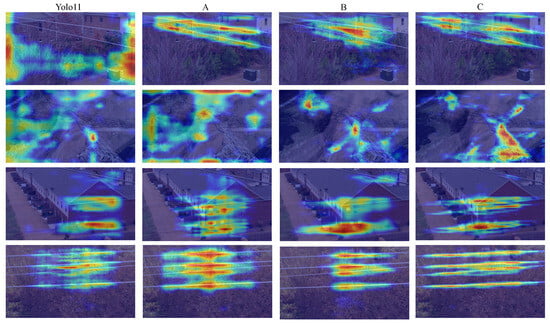
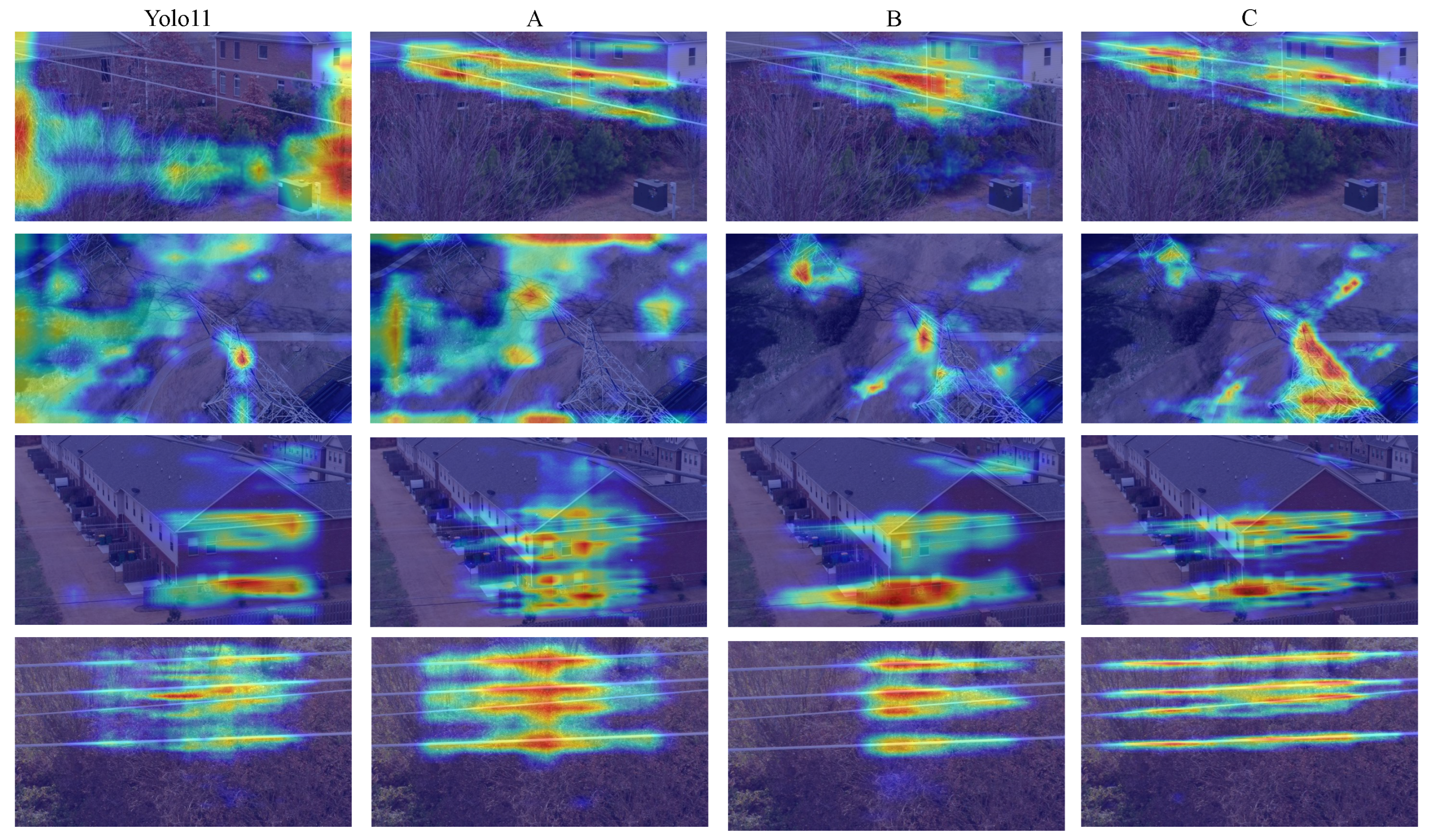
To intuitively validate the effectiveness of the proposed modules in addressing the challenges of slender lines and complex towers, we employed Grad-CAM to visualize the feature activation maps as presented in Figure 3. Analysis of Slender Transmission Lines: As observed in the first, third, and fourth rows of Figure 3, the baseline YOLO11 exhibits fragmented feature responses that are often distracted by background textures such as trees or buildings. In contrast, the model equipped with the C3x module demonstrates a distinct transformation where the activation maps become continuous and linear along the transmission lines. This visually confirms that the spatially decoupled convolution strategy successfully enhances the feature response in specific directions. From a theoretical perspective, transmission lines represent essentially 1D continuous signals embedded within a 2D spatial domain. Conventional isotropic filters (such as standard kernels) aggregate features uniformly across all directions, inadvertently diluting the slender target’s signal with lateral background noise. In contrast, the directional filters within the C3x module ( and ) act as anisotropic operators that inherently align with the geometric priors of these elongated structures. By integrating features strictly along orthogonal axes, they maximize signal accumulation along the line’s trajectory while rigorously minimizing the lateral receptive field, thereby providing a robust theoretical foundation for solving the fragmentation issue in elongated target segmentation. Analysis of Complex Tower Structures: For the transmission tower scene in the second row, the baseline model fails to capture the complete structure with attention scattered on the ground. The introduction of the MLCA mechanism significantly corrects this by expanding the receptive field to cover the lattice structure of the tower. Furthermore, the full method synergizes these advantages to exhibit high-contrast activation on targets while maximally suppressing background noise. This visualization provides compelling evidence that the proposed improvements are specifically targeted at the morphological characteristics of transmission equipment.
Figure 3.
Grad-CAMvisualization comparison of feature activation maps across different model variants (Yolo11, A, B, C). Warmer colors indicate higher activation, and cooler colors indicate lower activation.
3.5. Visualization
This section describes an in-depth analysis of the proposed method’s performance in practical transmission equipment segmentation tasks through comprehensive visualization experiments, focusing on evaluating the model’s robustness and precision when confronting diverse challenging scenarios. To thoroughly assess the improvements, representative images encompassing various complex conditions are carefully selected from the TTPLA dataset, covering quintessential challenges in transmission equipment detection and segmentation: precise localization of slender transmission lines against complex backgrounds, detail preservation within densely structured transmission towers, stable recognition under varying illumination conditions, and accurate segmentation in multi-target overlapping scenarios.
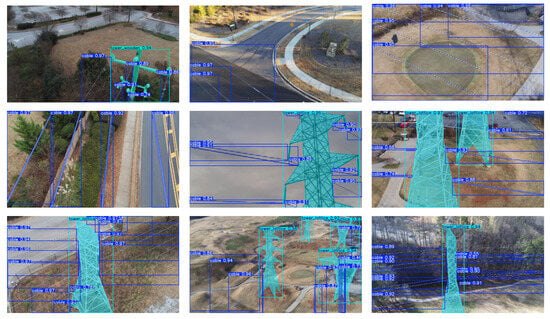
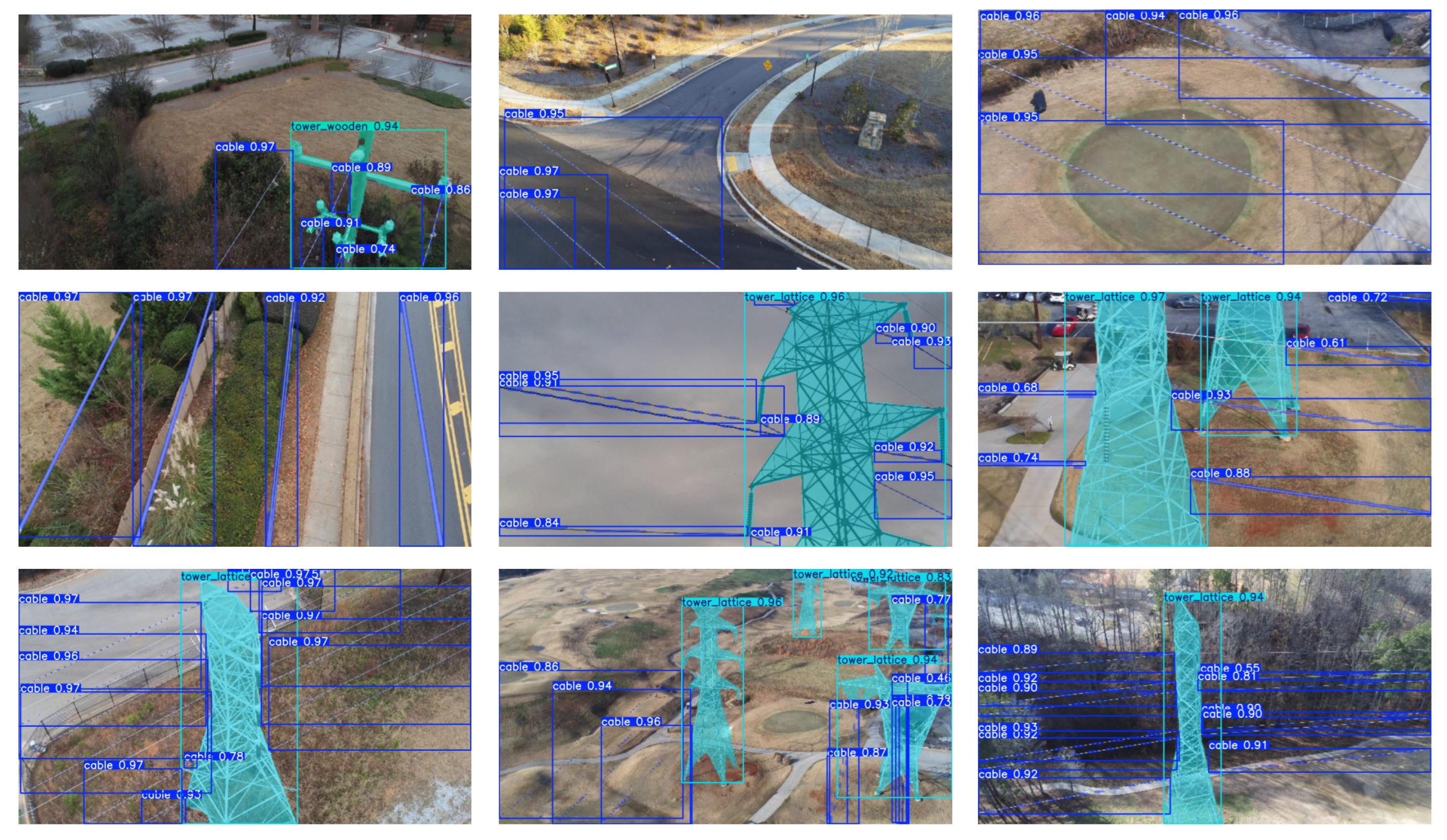
Figure 4 presents segmentation results generated by our method across diverse scenarios within the TTPLA dataset, where blue bounding boxes indicate transmission line detections and cyan masks represent transmission tower segmentations, with corresponding confidence scores displayed above each detection. The visualization reveals that our method exhibits exceptional continuity preservation when processing slender transmission lines, accurately capturing complete line contours even against complex natural backgrounds, with confidence scores consistently exceeding 0.90. For structurally intricate transmission towers, the enhanced model precisely segments fine structural details including support frames and cross-arms, producing mask boundaries that closely align with actual target contours. Under challenging illumination conditions such as backlighting and shadow occlusion, as well as diverse environmental variables including adverse weather (e.g., fog or low visibility) and varying UAV camera angles, the model maintains robust detection performance. Specifically, the MLCA module’s global context aggregation effectively mitigates severe physical occlusions by inferring complete topological structures from partial observations. Concurrently, the C3x module’s anisotropic filtering ensures that the elongated morphology of transmission lines is consistently captured regardless of perspective distortions induced by different camera angles. Furthermore, in complex scenarios featuring overlapping or densely distributed transmission equipment, our method accurately distinguishes individual target instances while avoiding false positives and missed detections. These visual demonstrations compellingly validate the practical applicability of our proposed approach in real-world deployment scenarios.
Figure 4.
Segmentation results generated by our method across diverse scenarios within the TTPLA dataset, where blue bounding boxes indicate transmission line detections and cyan masks represent transmission tower segmentations, with corresponding confidence scores displayed above each detection.
3.6. Limitations Analysis
Despite the robust performance achieved by the C3x and MLCA modules, the proposed framework encounters limitations in certain extreme operational scenarios. First, under severe atmospheric degradation—such as dense fog or extreme optical overexposure—the visual contrast of ultra-thin transmission lines diminishes drastically. This low signal-to-noise ratio restricts the C3x module’s ability to extract directional gradients, occasionally resulting in discontinuous or missed segmentations. Second, when transmission towers are heavily occluded by dense forest canopies or complex backgrounds with lattice-like textures, the MLCA module may over-aggregate visually similar background features, leading to minor boundary over-segmentation. Openly addressing these edge cases reveals the inherent physical limitations of pure RGB optical sensors in highly complex environments. These failure cases directly motivate our future research to explore cross-modal fusion strategies, such as integrating LiDAR or thermal imaging, to overcome the bottlenecks of single-modality vision systems.
4. Conclusions
This study addresses the critical modeling bottlenecks associated with slender transmission lines and structurally complex towers by proposing a synergistically enhanced segmentation framework based on the YOLO11 architecture. By integrating the Cross-directional Convolution (C3x) module to decouple directional feature extraction and the Multi-Layer Cascaded Attention (MLCA) mechanism to capture hierarchical semantic dependencies, the proposed method achieves a superior balance between precision and efficiency, yielding a bounding box mAP@0.5 of 72.56% and a mask mAP@0.5 of 68.37%. These quantitative results validate the framework’s robustness in overcoming morphological anisotropy and background clutter while maintaining a lightweight footprint suitable for intelligent inspection. Looking forward, we aim to bridge the gap toward practical edge deployment by exploring advanced multi-modal fusion strategies and implementing model acceleration techniques, specifically structural pruning [31] and knowledge distillation [32], to further optimize inference latency on resource-constrained platforms.
Author Contributions
Conceptualization, C.Y. and Z.Z.; methodology, C.Y. and K.Z.; software, K.Z. and Y.Z.; validation, C.Y., K.Z. and Y.Z.; formal analysis, C.Y.; investigation, K.Z. and Y.Z.; resources, Z.Z.; data curation, Y.Z.; writing—original draft preparation, C.Y.; writing—review and editing, C.Y. and Z.Z.; visualization, K.Z.; supervision, Z.Z.; project administration, Z.Z.; funding acquisition, C.Y. and Z.Z. All authors have read and agreed to the published version of the manuscript.
Funding
This work was supported by the Zhejiang Provincial “Pioneer, Leader+ X” Science and Technology Program (Grant No. 2026C02A1221), the Key Program of the Zhejiang Provincial Natural Science Foundation (Grant No. LZ24F010004), the 14th China Innovation and Entrepreneurship Competition—Innovation Challenge (Ningbo), and the Ningbo Municipal “Yongjiang Science and Technology Innovation 2035” Key R&D Program (Grant No. 2024Z125).
Data Availability Statement
The data presented in this study are openly available in the TTPLA (Transmission Towers and Power Lines Aerial-image) dataset. The TTPLA dataset was introduced by Abdelfattah et al. [25] in “TTPLA: An aerial-image dataset for detection and segmentation of transmission towers and power lines” presented at the Asian Conference on Computer Vision 2020. The dataset contains 1232 ultra-high-resolution aerial images with detailed annotations for transmission equipment segmentation. Researchers interested in accessing this dataset should refer to the original publication for download instructions and usage guidelines. The processed results and trained models from this study are available from the corresponding authors upon reasonable request.
Conflicts of Interest
All authors were employed by Yuyao Power Supply Company, State Grid Zhejiang Electric Power Co., Ltd. The authors declare that the research was conducted in the absence of any commercial or financial relationships that could be construed as a potential conflict of interest.
Abbreviations
The following abbreviations are used in this manuscript:
| UAV | Unmanned Aerial Vehicle |
| C3x | Cross-directional Convolution Module |
| C2PSA | Cross-Channel Parallel Self-Attention |
| MLCA | Multi-Layer Cascaded Attention |
| TTPLA | Transmission Towers and Power Lines Aerial-image |
References
- Duan, P.; Liang, X. An Improved YOLOv8-Based Foreign Detection Algorithm for Transmission Lines. Sensors 2024, 24, 6468. [Google Scholar] [CrossRef] [Scilit] [PubMed]
- Hosseini, M.M.; Umunnakwe, A.; Parvania, M.; Tasdizen, T. Intelligent damage classification and estimation in power distribution poles using unmanned aerial vehicles and convolutional neural networks. IEEE Trans. Smart Grid 2020, 11, 3325–3333. [Google Scholar] [CrossRef] [Scilit]
- Meng, R.; Wang, Z.L.; Zhao, Z.L.; Li, J.P.; Fu, W.P. A multimodal detection method for UHV substation faults based on robot inspection and deep learning. J. Robot. 2022, 2022, 1188617. [Google Scholar] [CrossRef] [Scilit]
- Chen, W.; Yu, S.; Huang, Y.; Wang, J.; Lin, B.; Xie, C. TS-Net: A spatial–temporal entanglement model for predicting the operational status of transmission towers. Electr. Eng. 2025, 107, 9369–9385. [Google Scholar] [CrossRef] [Scilit]
- Jenssen, R.; Roverso, D. Automatic autonomous vision-based power line inspection: A review of current status and the potential role of deep learning. Int. J. Electr. Power Energy Syst. 2018, 99, 107–120. [Google Scholar] [CrossRef] [Scilit]
- Choi, H.; Yun, J.P.; Kim, B.J.; Jang, H.; Kim, S.W. Attention-based multimodal image feature fusion module for transmission line detection. IEEE Trans. Ind. Inform. 2022, 18, 7686–7695. [Google Scholar] [CrossRef] [Scilit]
- Wang, Y.; Li, S.; Wang, G.; Jiang, W.; Yan, Y.; Sun, J. Robust and Transferable Elevation-Aware Multi-Resolution Network for Semantic Segmentation of LiDAR Point Clouds in Powerline Corridors. Remote Sens. 2025, 17, 3318. [Google Scholar] [CrossRef] [Scilit]
- Yetgin, ÖE.; Benligiray, B.; Gerek, ÖN. Power line recognition from aerial images with deep learning. IEEE Trans. Aerosp. Electron. Syst. 2018, 55, 2241–2252. [Google Scholar] [CrossRef] [Scilit]
- Gui, Y.; Jiang, S.; Bai, L.; Xue, Y.; Wang, H.; Reidt, J.; Schoenwald, D.A. Review of challenges and research opportunities for control of transmission grids. IEEE Access 2024, 12, 94543–94569. [Google Scholar] [CrossRef] [Scilit]
- Mendu, B.; Mbuli, N. State-of-the-Art Review on the Application of Unmanned Aerial Vehicles (UAVs) in Power Line Inspections: Current Innovations, Trends, and Future Prospects. Drones 2025, 9, 265. [Google Scholar] [CrossRef] [Scilit]
- Luo, Y.; Yu, X.; Yang, D.; Zhou, B. A survey of intelligent transmission line inspection based on unmanned aerial vehicle. Artif. Intell. Rev. 2023, 56, 173–201. [Google Scholar] [CrossRef] [Scilit]
- Cohen, Y.; Biton, A.; Shoval, S. Fusion of computer vision and AI in collaborative robotics: A review and future prospects. Appl. Sci. 2025, 15, 7905. [Google Scholar] [CrossRef] [Scilit]
- Ye, Y.; Min, X.; Liu, X.; Chen, X.; Cao, K.; Howlader, S.R.K.; Chen, X. Secure and intelligent low-altitude infrastructures: Synergistic integration of IoT networks, AI decision-making and blockchain trust mechanisms. Sensors 2025, 25, 6751. [Google Scholar] [CrossRef] [Scilit] [PubMed]
- Couturier, A.; Akhloufi, M.A. A review on deep learning for UAV absolute visual localization. Drones 2024, 8, 622. [Google Scholar] [CrossRef] [Scilit]
- Costanzo, M.; De Maria, G.; Lettera, G.; Natale, C. A multimodal approach to human safety in collaborative robotic workcells. IEEE Trans. Autom. Sci. Eng. 2021, 19, 1202–1216. [Google Scholar] [CrossRef] [Scilit]
- He, Y.; Liu, Z.; Guo, Y.; Zhu, Q.; Fang, Y.; Yin, Y.; Liu, Z. UAV based sensing and imaging technologies for power system detection, monitoring and inspection: A review. Nondestruct. Test. Eval. 2025, 40, 5681–5748. [Google Scholar] [CrossRef] [Scilit]
- Dai, M.; Huang, N.; Wu, Y.; Gao, J.; Su, Z. Unmanned-aerial-vehicle-assisted wireless networks: Advancements, challenges, and solutions. IEEE Internet Things J. 2022, 10, 4117–4147. [Google Scholar] [CrossRef] [Scilit]
- Li, Y.; Xiao, Z.; Zhen, X.; Cao, X. Attentional information fusion networks for cross-scene power line detection. IEEE Geosci. Remote Sens. Lett. 2019, 16, 1635–1639. [Google Scholar] [CrossRef] [Scilit]
- Yang, L.; Fan, J.; Xu, S.; Li, E.; Liu, Y. Vision-based power line segmentation with an attention fusion network. IEEE Sens. J. 2022, 22, 8196–8205. [Google Scholar] [CrossRef] [Scilit]
- Ma, W.; Xiao, J.; Zhu, G.; Wang, J.; Zhang, D.; Fang, X.; Miao, Q. Transmission tower and Power line detection based on improved Solov2. IEEE Trans. Instrum. Meas. 2024, 73, 1–11. [Google Scholar] [CrossRef] [Scilit]
- Souza, B.J.; Stefenon, S.F.; Singh, G.; Freire, R.Z. Hybrid-YOLO for classification of insulators defects in transmission lines based on UAV. Int. J. Electr. Power Energy Syst. 2023, 148, 108982. [Google Scholar] [CrossRef] [Scilit]
- Sangaiah, A.K.; Anandakrishnan, J.; Son, N.K.; Darmawan, H.; Bian, G.B.; Alenazi, M.J. LCUT-Sv9: UAV-assisted powerline inspection framework with secure time-sensitive communication for industry 5.0. IEEE Open J. Commun. Soc. 2025, 6, 2837–2852. [Google Scholar] [CrossRef] [Scilit]
- Gao, Z.; Yang, G.; Li, E.; Liang, Z.; Guo, R. Efficient parallel branch network with multi-scale feature fusion for real-time overhead power line segmentation. IEEE Sens. J. 2021, 21, 12220–12227. [Google Scholar] [CrossRef] [Scilit]
- Zhang, J.; Liu, H.; Yang, K.; Hu, X.; Liu, R.; Stiefelhagen, R. CMX: Cross-modal fusion for RGB-X semantic segmentation with transformers. IEEE Trans. Intell. Transp. Syst. 2023, 24, 14679–14694. [Google Scholar] [CrossRef] [Scilit]
- Abdelfattah, R.; Wang, X.; Wang, S. TTPLA: An aerial-image dataset for detection and segmentation of transmission towers and power lines. In Proceedings of the Asian Conference on Computer Vision, Virtual Event, 30 November–4 December 2020. [Google Scholar]
- Bolya, D.; Zhou, C.; Xiao, F.; Lee, Y.J. YOLACT: Real-time instance segmentation. In Proceedings of the IEEE/CVF International Conference on Computer Vision, Seoul, Republic of Korea, 27 October–2 November 2019; pp. 9157–9166. [Google Scholar]
- He, K.; Gkioxari, G.; Dollár, P.; Girshick, R. Mask R-CNN. In Proceedings of the IEEE International Conference on Computer Vision, Venice, Italy, 22–29 October 2017; pp. 2961–2969. [Google Scholar]
- Jocher, G.; Chaurasia, A.; Stoken, A.; Borovec, J.; NanoCode012; Kwon, Y.; Xie, T.; Michael, K.; Fang, J.; Imyhxy; et al. Ultralytics/Yolov5: V6.2-YOLOv5 Classification Models, Apple M1, Reproducibility, ClearML and Deci.ai Integrations. Available online: https://zenodo.org/records/7002879 (accessed on 15 November 2024).
- Kukartsev, V.V.; Ageev, R.A.; Borodulin, A.S.; Gantimurov, A.P.; Kleshko, I.I. Deep learning for object detection in images development and evaluation of the YOLOv8 model using ultralytics and roboflow libraries. In Proceedings of the Computer Science Online Conference, Cham, Switzerland, 23–27 April 2024; pp. 629–637. [Google Scholar]
- Redmon, J.; Divvala, S.; Girshick, R.; Farhadi, A. You only look once: Unified, real-time object detection. In Proceedings of the IEEE Conference on Computer Vision and Pattern Recognition, Las Vegas, NV, USA, 27–30 June 2016; pp. 779–788. [Google Scholar]
- Wu, D.; Guo, Z.; Yu, L.; Sang, N.; Gao, C. Structural pruning via spatial-aware information redundancy for semantic segmentation. In Proceedings of the AAAI Conference on Artificial Intelligence, Vancouver, BC, Canada, 25 February–4 March 2025; Volume 39, pp. 8368–8376. [Google Scholar]
- Yang, C.; Zhou, H.; An, Z.; Jiang, X.; Xu, Y.; Zhang, Q. Cross-image relational knowledge distillation for semantic segmentation. In Proceedings of the IEEE/CVF Conference on Computer Vision and Pattern Recognition, New Orleans, LA, USA, 18–24 June 2022; pp. 12319–12328. [Google Scholar]

Disclaimer/Publisher’s Note: The statements, opinions and data contained in all publications are solely those of the individual author(s) and contributor(s) and not of MDPI and/or the editor(s). MDPI and/or the editor(s) disclaim responsibility for any injury to people or property resulting from any ideas, methods, instructions or products referred to in the content. |
© 2026 by the authors. Licensee MDPI, Basel, Switzerland. This article is an open access article distributed under the terms and conditions of the Creative Commons Attribution (CC BY) license.