


Abstract
Deepfake technology poses significant threats to information authenticity and social trust, necessitating effective detection methods. However, existing detection approaches predominantly rely on high-complexity network architectures that, while accurate in controlled environments, suffer from prohibitive computational costs that hinder deployment in resource-constrained scenarios such as social media platforms. To address this efficiency-accuracy dilemma, we propose a lightweight face forgery detection method that systematically learns multi-scale forgery traces. Our approach features a four-stage lightweight architecture that hierarchically extracts features from local textures to global semantics, mimicking the human visual system. Within each stage, a multi-scale dynamic perception mechanism divides feature channels into parallel groups equipped with lightweight attention modules to capture forgery cues spanning pixel-level anomalies, local structures, regional patterns, and semantic inconsistencies. Furthermore, rather than relying on conventional feature fusion that risks suppressing subtle artifacts, we introduce a novel Context-Guided Dynamic Convolution. This mechanism uses mid-level spatial anomalies as active anchors to dynamically modulate high-level semantic filters, with the goal of mitigating the disconnect between semantic content and forgery evidence. Our model achieves strong performance, yielding an AUC of 91.98% on FaceForensics++ and 93.50% on DeepFake Detection Challenge, outperforming current state-of-the-art lightweight methods. Furthermore, compared to heavy Vision Transformers, our model achieves a superior performance-efficiency trade-off, requiring only 3.06 M parameters and 1.36 G FLOPs, making it highly suitable for real-time, resource-constrained deployment.
1. Introduction
Deepfake technology has the capability to generate highly realistic facial content. Its misuse—such as the creation of false information, perpetration of fraud, and acts of defamation—poses a significant threat to individual rights and social stability. Research into effective deepfake detection technologies is crucial for maintaining the authenticity and credibility of digital content, safeguarding citizens’ legitimate rights and interests, and promoting social stability.
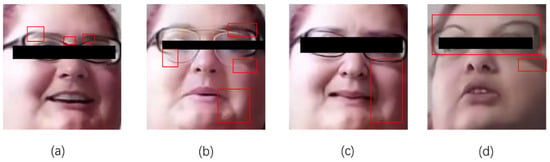
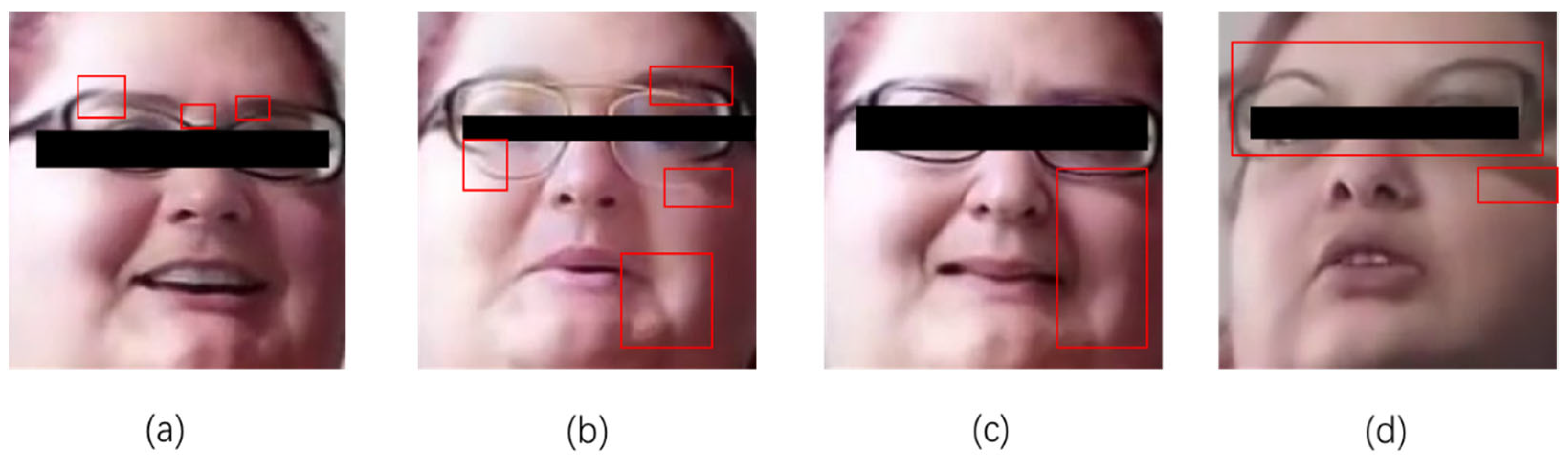
Current deepfake detection methods primarily focus on analyzing inconsistencies in image color [1,2], illumination [3], texture [4,5,6], and biological features [7,8,9] across spatial, frequency, and temporal domains to ascertain authenticity. These methods have made considerable advancements; however, with the diversification of generative models and increasing complexity in post-processing techniques, the detection task continues to face formidable challenges. On the one hand, as illustrated in Figure 1, forgery traces exhibit significant scale variations, ranging from local micro-artifacts to global semantic inconsistencies. On the other hand, both the concealment and diversity of forgery features are continually escalating, complicating accurate identification by detection models. These issues directly impact the robustness and generalization capabilities of detection systems while presenting urgent technical challenges for practical deepfake detection scenarios.
Figure 1.
Schematic diagram of multi-scale forgery traces in deepfake images. Red boxes are used to indicate forgery traces, with larger box sizes representing larger scales of forgery traces. (a) Local micro-scale artifacts; (b) Local unnatural features; (c) Medium-scale inconsistencies; (d) Global semantic inconsistencies. The deepfake images are sourced from the Deepfake Detection Challenge (DFDC) dataset [10].
The essence of multi-scale forgery feature detection lies in effectively capturing and integrating cross-scale traces that range from pixel-level artifacts to semantic-level inconsistencies [11]. This necessitates that models possess an ability to perceive forgery patterns within multi-scale feature spaces while remaining sensitive to subtle anomalies as well as high-level contradictions. In essence, forgery features at different scales may manifest entirely distinct feature patterns; coupled with rapid advancements in generation technology—the concealment and diversity of these features further intensify—rendering traditional single-scale detection methods increasingly inadequate.
To address these issues, researchers have proposed various multi-scale feature analysis schemes. For instance, structures based on the Feature Pyramid Network [12], multi-task learning frameworks [13], and parallel multi-branch architectures [14] can effectively integrate information from different levels. Some studies introduce the attention mechanism to achieve adaptive selection and enhancement of multi-scale features [15]. Although these methods have improved the model’s adaptability to diverse forged content to a certain extent, they still have obvious limitations: multi-scale features are prone to alignment deviation and information redundancy during the fusion process, and the high computational cost brought by complex model structures also limits their deployment in resource-constrained scenarios.
In response to the shortcomings of existing methods, we propose a four-stage lightweight network for deepfake face detection. The core design idea of our model lies in systematically extracting multi-scale forgery features that range from fine-grained details to coarse-grained semantics. This approach is reflected in the following two aspects: First, a four-stage network is constructed through progressive downsampling, enabling each stage to concentrate on processing and capturing forgery information at varying scales. Second, within each stage, a dynamic perception mechanism for multi-scale features is introduced that enables parallel processing and interaction among multi-scale features via grouped convolution. This design comprehensively captures potential multi-scale forgery clues from both the horizontal (across stages) and vertical (within stages) dimensions. Moreover, the downsampling operation embedded between stages gradually expands the receptive field while effectively controlling the computational complexity, meeting the requirements of lightweight deployment. Particularly noteworthy is the third stage of the network which incorporates a dynamic convolution module dedicated to context information fusion. It can effectively integrate the spatial detail features of the second stage with the deep semantic features of the third stage. Through the cross-level feature complementarity mechanism, it alleviates the problem of subtle forgery traces being lost in deep networks, further enhancing the integrity and discriminative power of feature representation.
The main contributions of this paper are summarized as follows:
- A lightweight deepfake detection method is proposed, which ensures high detection efficiency while maintaining the capability to perceive multi-scale forgery features. This approach offers a feasible solution for practical applications in resource-constrained environments.
- A dynamic multi-scale feature perception block is designed based on the physical generation priors of deepfakes. By establishing a rigorous mapping between diverse forgery traces and neural receptive fields, this block decomposes artifacts into four distinct physical scales (ranging from pixel-level up-sampling noise to global semantic contradictions). Consequently, the proposed grouped parallel architecture acts as an adaptive evidence selector, ensuring the comprehensive capture of multi-granularity forgery clues.
- A context-guided dynamic convolution mechanism is proposed to mitigate the disconnect between semantic content and forgery evidence in deep networks. Unlike traditional cross-layer feature fusion that passively concatenates representations, CGDC introduces an active modulation mechanism. It utilizes mid-level spatial anomalies from Stage 2 as contextual anchors to dynamically generate the convolutional weights for high-level semantic features in Stage 3. This top-down guidance mechanism addresses a critical bottleneck in existing detectors by ensuring that global semantic analysis is anchored to potential tampered regions rather than being misled by irrelevant facial attributes.
- Systematic experiments are conducted to validate model performance. Experimental results on multiple public datasets demonstrate that the proposed model achieves an advantageous balance among detection accuracy, generalization capability, and inference efficiency, significantly outperforming existing mainstream lightweight detection models.
The rest of this paper is structured as follows: Section 2 offers a concise overview of prior approaches in face forgery detection, focusing on methods utilizing local and global features as well as lightweight deepfake detection techniques. Section 3 elaborates on the architecture of the proposed model. Section 4 presents the conducted experiments and corresponding analyses. Finally, Section 5 concludes with a summary of our research findings.
2. Related Works
2.1. Deepfake Detection Methods Utilizing Local and Global Features
Deepfake detection automatically analyzes facial content to identify tampered or synthesized media. Early research primarily relied on handcrafted features and camera-based forensic analysis [16,17,18]. However, such methods offer limited representational capacity and struggle to generalize against increasingly realistic generative models.
With advances in deep learning, neural network-based approaches have since become mainstream in this field. Some studies focus on unnatural characteristics in local regions, such as lip movements [7,19], blinking frequency [8], micro-anomalies across multiple facial areas [20], and head pose inconsistencies [21]. However, such methods remain sensitive to image compression and noise interference, exhibiting certain robustness limitations. Another line of research focuses on mining global inconsistency cues, such as boundary artifacts [22], facial landmark misalignment [23], color space mismatch [2], lighting plausibility analysis [21], and frequency domain statistical anomalies [24]. While these methods excel at capturing macro-level forgery features, their effectiveness heavily relies on accurate semantic or physical modeling and may fail against forgery techniques that preserve global consistency. In summary, local methods are adept at capturing microscopic “fingerprints” left by generative models but remain sensitive to image quality, whereas global methods specialize in identifying macro-level physical or semantic contradictions, though their performance depends on precise modeling of such inconsistencies.
Since visual elements are often variable [25], multi-scale feature analysis [NO_PRINTED_FORM] has significant benefits for deepfake detection tasks. Gu et al. [12] propose integrating spatial multi-scale features through a Feature Pyramid Network (FPN) and combining them with frequency domain information to build a more generalizable detection system. By integrating contrastive learning with multi-modal frequency cues, Dong et al. [11] develop a multi-scale feature enhancement module that robustly captures both texture details and semantic information. Through the systematic integration of multi-level forgery features, these methods can generalize more effectively to previously unseen manipulation types, demonstrating enhanced robustness.
2.2. Lightweight Deepfake Detection Methods
Building lightweight models represents a fundamental approach to improving the efficiency of deepfake detection and facilitating its real-world deployment. Afchar et al. [26] propose two shallow neural networks that achieve face forgery detection by capturing mesoscopic features within facial regions. Matern et al. [3] train a compact neural network specifically designed to identify common visual artifacts present in the eye and tooth regions of forged facial images. Nguyen et al. [27] introduce a lightweight multi-task learning approach capable of classifying the authenticity of facial images while localizing tampered regions. Sun et al. [28] propose an efficient detection framework by establishing a temporal model of precise geometric features. Guo et al. [6] design a low-complexity dynamic fusion network that effectively integrates local and global cues to form more discriminative feature representations. Recently, parameter-efficient adaptation has emerged as a promising lightweight paradigm for deepfake detection. Specifically, Shao et al. [29] propose DeepFake-adapter, a dual-level adapter framework that efficiently adapts pre-trained Vision Transformers (ViTs) for deepfake detection with minimal trainable parameters. Despite these advances, the pursuit of efficiency often compromises accuracy and generalization due to the inherent limitations in representational capacity of lightweight architectures. Consequently, achieving an optimal balance between architectural compactness and robust feature learning remains a critical challenge in deepfake detection research.
3. Method
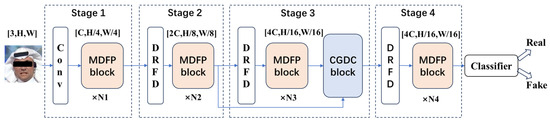
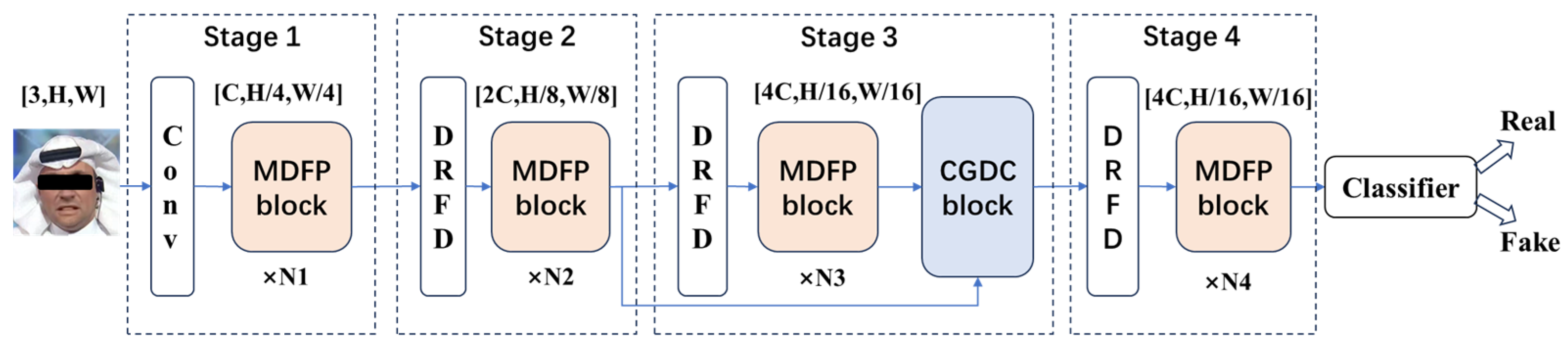
This section provides a comprehensive description of the proposed model. As depicted in Figure 2, the architecture is formulated as a deepfake image classification network composed of four key stages. These components collectively enhance sensitivity to multi-scale forgery cues and mitigate the loss of subtle artifacts in deep layers. The organization is as follows: Section 3.1 presents the design proof, which provides a theoretical rationale for the proposed modules. Section 3.2 provides an overview of the network structure, Section 3.3 outlines the downsampling module, Section 3.4 details the dynamic multi-scale feature perception block, and Section 3.5 introduces the dynamic convolution block for contextual fusion.
Figure 2.
The overall architecture of our proposed model.
3.1. Design Motivation
To address the multi-scale nature of forgery traces, we propose a systematic mapping between the physical generation priors of deepfakes and neural perception fields. We decompose forgery artifacts into four distinct scales—pixel, local, meso, and global—as a design basis for our Multi-scale Dynamic Feature Perception (MDFP) module, which serves as the foundational extractor across all stages. Each parallel branch is designed with a specific anomaly: (1) Pixel-level Priors: Generative models often leave microscopic “upsampling fingerprints” or color-space anomalies. Standard 3 × 3 or larger convolutions act as low-pass filters, inadvertently inducing “spatial blurring” that washes out high-frequency noise. We design the Point-wise branch to perform channel-wise learning without spatial distortion, thereby preserving these microscopic forensic traces. (2) Local-scale Priors: Forgery involves localized blending, creating sharp discontinuities at facial boundaries. The Local branch utilizes restricted-receptive-field operators to capture high-gradient spatial transitions, ensuring sensitivity to textural mutations. (3) Meso-scale Priors: Deepfakes frequently exhibit physical inconsistencies between distant facial components (e.g., asymmetrical pupil reflections). We formulate the Medium-Range Local Attention (MRLA) as a mechanism to establish long-range dependencies and identify structural contradictions that localized operators may miss. (4) Global-scale Priors: To prevent holistic proportion errors, the Global branch models macroscopic semantic logic, ensuring classification is grounded in a structurally coherent face representation.
Furthermore, as networks advance to deeper stages, high-level neurons tend to prioritize identity and attribute abstraction while suppressing subtle forgery signals. To mitigate this issue, we propose the Context-Guided Dynamic Convolution in the third stage. Middle-layer features (Stage 2) retain rich spatial responses and physical anomaly anchors, while deep-layer features (Stage 3) possess strong semantic abstraction. We leverage the spatial responses from Stage 2 as contextual anchors to dynamically modulate the weights of the Stage 3 convolutions. This design is intended to help maintain a connection between high-level semantic understanding and spatial evidence of forgery, reducing the risk that subtle artifacts are lost in deeper representations.
3.2. Network Architecture
The proposed network adopts a classic four-stage architecture, as illustrated in Figure 2. Between stages, downsampling modules are employed to reduce feature map dimensions, thereby improving computational efficiency while progressively expanding the receptive field. As the network advances from lower to higher stages, the Multi-scale Dynamic Feature Perception Block extracts feature at different scales, aiming to capture potential forgery traces across varying levels of granularity.
Unlike conventional stage-wise architectures, our network innovatively introduces a feature enhancement module in the third stage. This module utilizes the detail-rich features output by the second stage as contextual semantics and performs cross-layer fusion with the deeper features extracted in the third stage, thereby effectively enhancing and supplementing the backbone features. This design facilitates information interaction and semantic complementarity among multi-scale features, enabling the model to capture local anomalies without compromising global consistency.
3.3. Downsampling Module
A fundamental paradigm in deepfake detection networks is the incorporation of downsampling layers prior to each hierarchical stage. This method reduces the spatial resolution of feature maps while retaining critical information, thereby addressing the dual challenges of multi-scale artifact detection and computational efficiency.
In terms of forged feature extraction, high-resolution feature maps in the lower layers of the network are vital for capturing subtle local artifacts, such as texture anomalies and unnatural edge distortions. Progressive downsampling systematically reduces spatial dimensions, which in turn enlarges the receptive fields in subsequent layers. This enlargement enables the integration of global contextual information, permitting the identification of semantic inconsistencies such as implausible lighting or structural distortions across facial regions. The implementation across a four-stage framework establishes an analytical progression from local details to global structures, paralleling the “detail-to-global” processing of human vision.
From an efficiency perspective, downsampling significantly decreases computational expense and memory consumption by reducing data dimensionality. This reduction is particularly critical for deployment in resource-constrained environments or for real-time processing applications.
As depicted in Figure 1, the initial downsampling is performed by a convolutional layer with a kernel size of 4 × 4 and a stride of 4. Since standard convolutional downsampling in later stages tends to erase fine-grained features critical for forgery detection, we replace it in the subsequent three stages with the DRFD [30] module. This module is designed to prevent the loss of subtle artifacts during aggressive spatial reduction. It integrates cut-slice downsampling, depthwise separable convolution, and max pooling, generating complementary low-dimensional features that collectively form a robust representation for the classification task.
3.4. Multi-Scale Dynamic Feature Perception Block
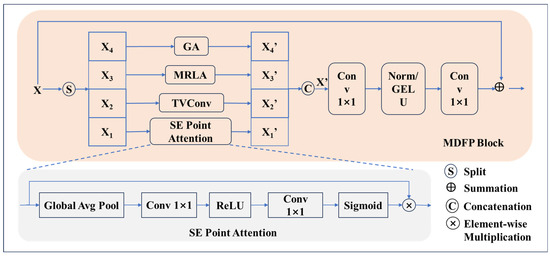
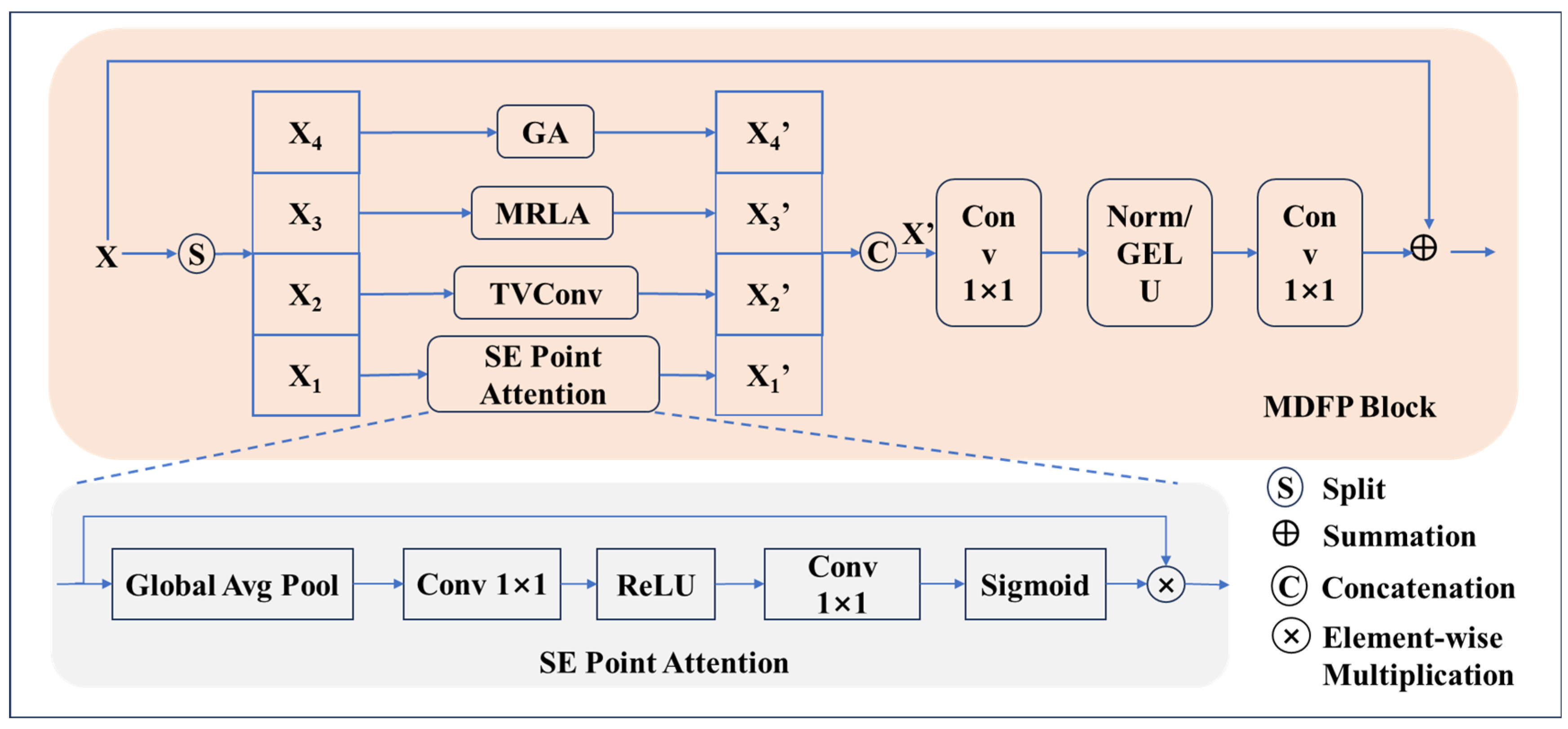
The Multi-scale Dynamic Feature Perception (MDFP) block serves as the core component of each stage. As illustrated in Figure 2, the number of MDFP blocks in each stage is denoted as , where represents the stage index. Within each block, the input feature map is processed to achieve dynamic multi-scale feature perception.
The detailed architecture of the MDFP module is depicted in Figure 3. It acts as a powerful feature extractor that utilizes grouped convolution to reduce computational cost [31] while processing multi-scale spatial information in parallel, dynamically integrating features ranging from pixel-level details to global semantics. This design generates a highly robust and informative feature representation, effectively mitigating the limitation of single convolutional layers, which struggle to capture both fine-grained details and contextual information simultaneously due to their fixed receptive field.
Figure 3.
Detailed architecture of the Multi-scale Dynamic Feature Perception (MDFP) block.
The workflow of the MDFP module comprises four stages: splitting the input, parallel feature perception, dynamic weighting, and feature fusion. Specifically, the input feature map is first partitioned evenly along the channel dimension into four groups: and . These subgroups are then processed simultaneously by four distinct branches: the branch conducts point-wise scale perception through a Squeeze-and-Excitation (SE) point attention mechanism, which dynamically recalibrates channel-wise feature importance. The branch focuses on local details and textures utilizing a Textural Variance Convolution (TVconv) [32]. It captures short-range local features like artificial edges, unnatural skin textures, and noise patterns. The branch employs the Multi-scale Reciprocal Learning Attention (MRLA) [33] module to model medium- and long-range dependencies. It is designed to dynamically perceive anomalies such as unnatural transitions or distortions between facial organs. The branch performs global perception using a global attention mechanism. It captures relationships between any two spatial locations in the feature map, dynamically assigning higher weights to critical global regions to identify inconsistencies at a holistic level.
The enhanced feature maps , , , from the four sub-modules are then concatenated along the channel dimension, resulting in an output feature map with the same channel number as the input . This process can be formulated as:
Subsequently, the feature map passes through a 1 × 1 convolutional layer for channel expansion, followed by a normalization layer and the GELU activation function, before another 1 × 1 convolution restores the channel count. The processed feature map is then combined with the original input feature map via element-wise addition, forming a residual connection to produce the final output feature map of the MDFP block.
It is crucial to emphasize the dynamic weighting mechanism inherent in the MDFP block, which distinguishes it from naive multi-branch module aggregation. This dynamic property manifests at two levels. First, at the intra-branch level, modules such as the SE Point Attention and GA explicitly compute input-conditioned weight vectors or spatial maps (via gating mechanisms like Sigmoid). These adaptively generated weights are element-wise multiplied with the partitioned features, ensuring that the network dynamically scales the importance of point-wise, local, or global features based on the specific forgery characteristics of the current input image. Second, at the inter-branch level, the aggregated feature undergoes a dynamic channel-mixing process. The cascaded 1 × 1 convolutions, coupled with the non-linear activation, function as an adaptive cross-channel router. Rather than performing a static summation, this bottleneck structure dynamically recalibrates the fusion weights of the four diverse perceptual branches. This dual-level dynamic weighting ensures that the MDFP block remains highly flexible, optimally emphasizing either fine-grained textural anomalies or global structural inconsistencies as required by the input data.
3.5. Context-Guided Dynamic Convolution Block
As theoretically established in Section 3.1, a fundamental discrepancy exists between the high-level semantic facial information (e.g., identity and attributes) extracted by deep neural networks and the actual objective of forgery authentication. The core task is not to recognize “who” but to discriminate “whether” the media has been manipulated. We propose a Context-Guided Dynamic Convolution (CGDC) module to bridge this gap, building on the insights from [34]. Conventional multi-scale fusion passively mixes features, often resulting in “semantic override” where dominant identity features suppress delicate forgery traces. CGDC is designed as an active, top-down modulation mechanism.
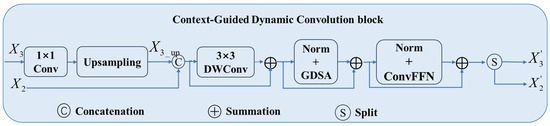
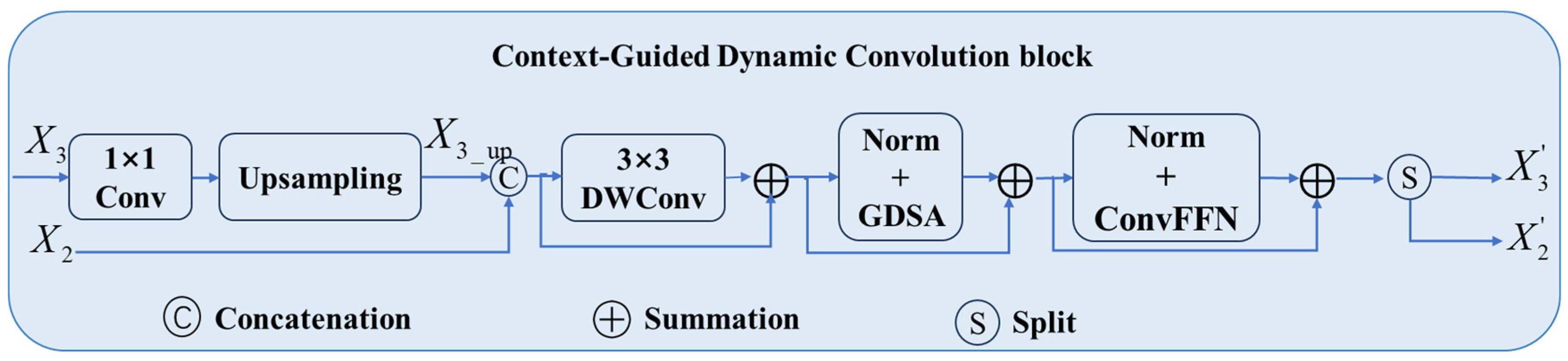
As shown in Figure 2, we implement this through a Context-Guided Dynamic Convolution module in Stage 3. Rather than simply appending features, the module treats high-resolution anomalies from Stage 2 as contextual anchors. These anchors dynamically generate and steer the convolutional weights applied to the deep semantic features of Stage 3, ensuring that global semantic analysis is anchored to potential tampered regions. This spatially grounded parameter generation forces the high-level semantic representation to be continuously evaluated through the lens of local texture and edge inconsistencies, successfully circumventing the information redundancy and alignment deviation inherent in traditional fusion. The structure of the CGDC block is illustrated in Figure 4.
Figure 4.
The structure of the Context-Guided Dynamic Convolution block.
The block takes two inputs: feature map from stage 2 and feature map from Stage 3. First, undergoes channel compression to reduce computational complexity. It is then up-sampled spatially to match ’s dimensions, producing .
Subsequently, and are concatenated along the channel dimension. The concatenated features pass through three sequential components: a residual unit containing a 3 × 3 depthwise separable convolution, a residual structure combining normalization and GDSA, and another residual structure integrating normalization and convFFN. Finally, the output features are split along the channel dimension to obtain enhanced features and , which retain the same dimensions as and , respectively. This process can be formulated as:
4. Experiments and Discussion
4.1. Datasets
To ensure fair evaluation and comparable results, this study conducts experiments on four widely adopted deepfake detection benchmarks: FaceForensics++ (FF++) [35], CelebDF-v2 (CDF) [36], Deepfake Detection Challenge (DFDC) [10], and FaceShifter (FSh) [37]. The FF++ dataset contains 1000 real face videos from YouTube and corresponding 4000 fake videos generated by four mature techniques (Deepfakes, Face2Face, FaceSwap, NeuralTextures), providing both high-quality and low-quality versions, with the high-quality version being used in this work. CelebDF-v2 includes 590 real celebrity videos and 5639 fake counterparts, exhibiting distribution closer to real-world scenarios. The DFDC dataset is a large-scale collection of over 100,000 videos produced with eight distinct forgery methods, covering diverse scenes and conditions that significantly advance real-world detection research. The FaceShifter dataset is a high-fidelity forgery dataset generated based on real videos from FF++ through advanced face-swapping algorithms. This technology precisely fuses the identity features of the source face with the temporal dynamics of the target video, resulting in generated videos with continuous micro-expressions, natural skin color transitions, and other good temporal coherence. This poses a significant challenge to most deepfake detectors.
4.2. Experimental Settings
This experiment adopts the following settings for training and evaluating the deepfake detection model. During data processing, the batch size is set to 16, with 30 frames uniformly sampled from each video. MTCNN [38] is employed for face detection and extraction, and the cropped face regions are resized to 224 × 224 pixels to form the experimental dataset. To address the class imbalance between real and fake videos in the FF++ dataset, we adopt sampling rates of 100% and 30% for the training set, while the validation set is sampled at 1/6 of the training set size. All normalized face images undergo data augmentation, including random flipping, before being fed into the model for binary classification.
The training phase utilizes the SGD optimizer with an initial learning rate of 1 × 10⁻³, accompanied by a weight decay of 1 × 10⁻⁷ and gradient clipping with a threshold of 5. A StepLR scheduler is adopted, reducing the learning rate to 0.1× of its previous value every 15 epochs, along with a 5-epoch warm-up phase. The maximum training epoch is set to 60, with an early stopping mechanism that terminates training if the validation loss shows no improvement for 5 consecutive epochs. The loss function selected is BCEWithLogitsLoss with auto- calculated class weights.
To ensure strict reproducibility, all experiments are conducted on a Linux server equipped with a single NVIDIA RTX 4090 GPU (24 GB VRAM) and a 16-core Intel Xeon Gold 6430 CPU. The software environment is built on Python 3.8.10 and PyTorch 2.0.0 with CUDA 11.8. Key third-party libraries include albumentations 1.0.0 for data augmentation and facenet-pytorch 2.5.3 for MTCNN-based face extraction. Evaluation uses Accuracy (ACC) and the Area Under the Receiver Operating Characteristic Curve (AUC) on multiple benchmark datasets. To evaluate the computational efficiency of the model, we measure its parameter count, and floating point operations (FLOPs).
4.3. Lightweight Evaluation
Table 1 presents a performance comparison between the proposed model and various existing lightweight deepfake detection methods on the FF++ dataset. With only 3.06 M parameters and 1.36 G FLOPs, the proposed model demonstrates lower computational complexity than most competing approaches. In terms of detection performance, the proposed model achieves state-of-the-art accuracy and AUC scores on the FF++ dataset. Although not the most compact model in parameter count, it delivers superior detection capability. Specifically, compared to the lightweight Meso-Incep [26] model, our approach improves accuracy by approximately 10%, while also outperforming the larger F3-Net [39] model in detection performance. These results indicate that the proposed model achieves an optimal balance between detection accuracy and computational efficiency, maintaining robust deepfake identification capability while preserving low complexity.
Table 1.
Performance comparison between the proposed model and various existing lightweight deepfake detection methods on the FF++ dataset.
Furthermore, we compare our model with the state-of-the-art ViT-based model proposed by Heo et al. [42] on the DFDC dataset. Their model achieves an AUC of 97.80% with 440.2 M parameters, making it impractical for real-time deepfake detection on resource-constrained edge devices. In contrast, our model achieves a comparable AUC of 93.50% with only 3.06 M parameters.
To further evaluate computational efficiency, we measured the pure inference latency and throughput (Frames Per Second, FPS) on an NVIDIA RTX 4090 GPU, with the measured time exclusively accounting for the network’s forward pass (excluding data loading, face cropping, and CPU-to-GPU transfer overheads). Our model achieves a high throughput of 466.60 FPS with an average latency of 2.143 ms/frame. Given that standard real-time video processing typically requires 30 FPS (33.3 ms/frame), our model consumes less than 10% of this time budget for feature extraction and classification. This substantial time margin accommodates necessary pre-processing steps such as MTCNN-based face extraction, ensuring the end-to-end pipeline remains fully real-time.
These results demonstrate that our method achieves a markedly superior performance-efficiency trade-off. The high throughput of 466.60 FPS validates that the proposed multi-branch dynamic weighting mechanism and CGDC block effectively constrain computational overhead, enabling robust multi-scale artifact perception while maintaining strict latency requirements. This makes our network highly scalable for real-world deployment, including high-concurrency scenarios on social media platforms.
4.4. Intra-Dataset Evaluation
We conducted intra-dataset evaluation to assess the model’s capability in detecting known deepfake patterns. The experiments were performed on the DFDC and subsets of FF++ datasets for training and testing, with comparative detection accuracy across different models detailed in Table 2. Experimental results indicate that our model consistently achieves superior performance across various manipulation techniques. It attains state-of-the-art detection accuracy on two predominant forgery methods, specifically DeepFakes and FaceSwap, while maintaining competitive performance in other testing scenarios. This performance advantage is principally attributed to the model’s multi-scale feature extraction architecture, which enables comprehensive capture of manipulation traces across different spatial granularities, thereby ensuring precise identification of diverse deepfake modalities.
Table 2.
Comparison of detection accuracy (in %) across different models on the DFDC, Deepfake (DF), Face2Face (F2F), FaceSwap (FS), NeuralTextures (NT) datasets.
4.5. Cross-Dataset Evaluation
A robust deepfake detection framework should demonstrate generalization capability towards unseen manipulation techniques. To systematically evaluate our model’s adaptability to unknown forgery patterns, we conducted rigorous cross-dataset validation: the proposed model was exclusively trained on the FF++ dataset and subsequently evaluated on three independent external benchmarks—DFDC, CDF, and FSh. These datasets encompass diverse generation methodologies and real-world scenario distributions, presenting substantial challenges for cross-domain generalization.
As shown in Table 3, our approach achieves superior performance compared to baseline methods in cross-domain detection scenarios. When confronted with out-of-distribution samples, our model maintains exceptional detection capability, attaining competitive AUC scores across all test domains. This consistent performance advantage suggests that the learned representations capture general forgery artifacts rather than dataset-specific cues, indicating strong cross-domain generalization potential for real-world deployment.
Table 3.
Cross-Dataset Performance Evaluation. The table reports AUC values (in %) across different datasets.
4.6. Ablation Study
To systematically validate the effectiveness of each core module in our proposed model, we conducted comprehensive ablation studies.
4.6.1. Effectiveness of GA, MLRA, TVConv, and SPA
We conducted component-wise evaluation of GA, MLRA, TVConv, and SPA on the FF++ subsets. Table 4 presents the comparative experimental results of replacing the complete MDFP block with each individual module. Data in the first four rows clearly demonstrate that using any single module alone leads to a significant degradation in detection performance under all testing scenarios. This fully validates their complementary role and the necessity of integrated design. Meanwhile, model’s parameter analysis substantiates that the complete MDFP block achieves effective model complexity control through its grouped parallel architecture. This design preserves the functional integrity of all constituent modules while maintaining computational efficiency. This innovative design ensures comprehensive multi-scale feature representation and establishes an optimal performance-efficiency equilibrium. These findings collectively demonstrate the architectural superiority of our approach in balancing representational capacity with operational efficiency.
Table 4.
Ablation Study on the MDFP Block (Performance measured by ACC/AUC, %).
4.6.2. Effectiveness of CGDC
To evaluate the impact of the Context-Guided Dynamic Convolution (CGDC) module on deepfake detection, we constructed an ablation model: Model 1, which removes the CGDC module and retains only the downsampling module and MDFP blocks; Model 2 represents the complete proposed framework. The intra-dataset evaluation results on various subsets of FF++ are presented in Table 5.
Table 5.
Ablation Study on the CGDC Block. (Performance measured by AUC, %).
Experimental results indicate that Model 1 exhibits significant performance degradation across test subsets with different manipulation methods, especially on the NT dataset. This phenomenon confirms the critical role of the CGDC module in forgery feature perception and representation: by employing a dynamic convolution mechanism, the module effectively integrates multi-scale contextual information to guide the learning of discriminative high-level semantic features. Particularly when handling complex forgery types such as facial expression manipulation, illumination inconsistency, and edge artifacts, CGDC demonstrates enhanced feature augmentation capabilities.
4.7. Robustness Analysis on Low-Quality Data
In practical deepfake detection scenarios, videos and images shared across social media platforms inevitably undergo severe compression and quality degradation. Therefore, we select heavy compression, the most prevalent and challenging real-world perturbation, as the representative metric to evaluate the robustness of our model.
Specifically, we conduct experiments by training and testing our proposed model on the highly compressed C40 version of the FF++ dataset. The severe compression in C40 naturally introduces complex visual interferences, including blurring and compression artifacts. As demonstrated in Table 6, the proposed model achieves competitive performance even on low-quality images, which fully validates its strong robustness. This is mainly attributed to the two core modules: the MDFP module adaptively adjusts feature importance through a dynamic weighting mechanism to effectively counter the interference of compression artifacts; the CGDC module enhances the capture of distortion features such as edge blurring and detail loss through cross-gradient feature fusion.
Table 6.
Comparison of detection accuracy (in %) across different models on the subset of FF++ C40 datasets.
4.8. Visualization
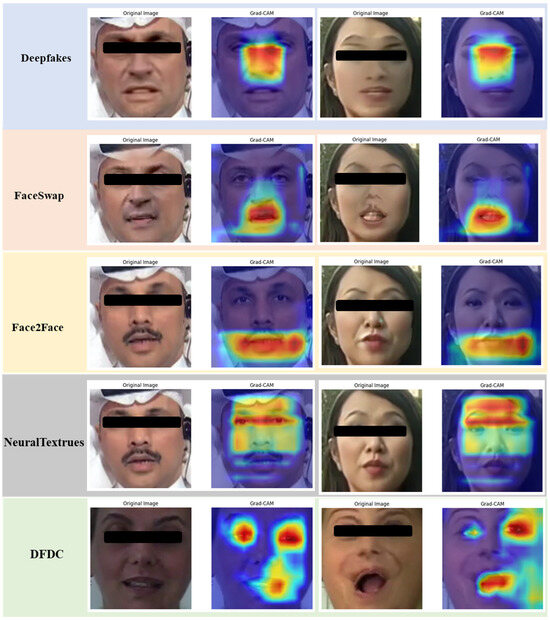
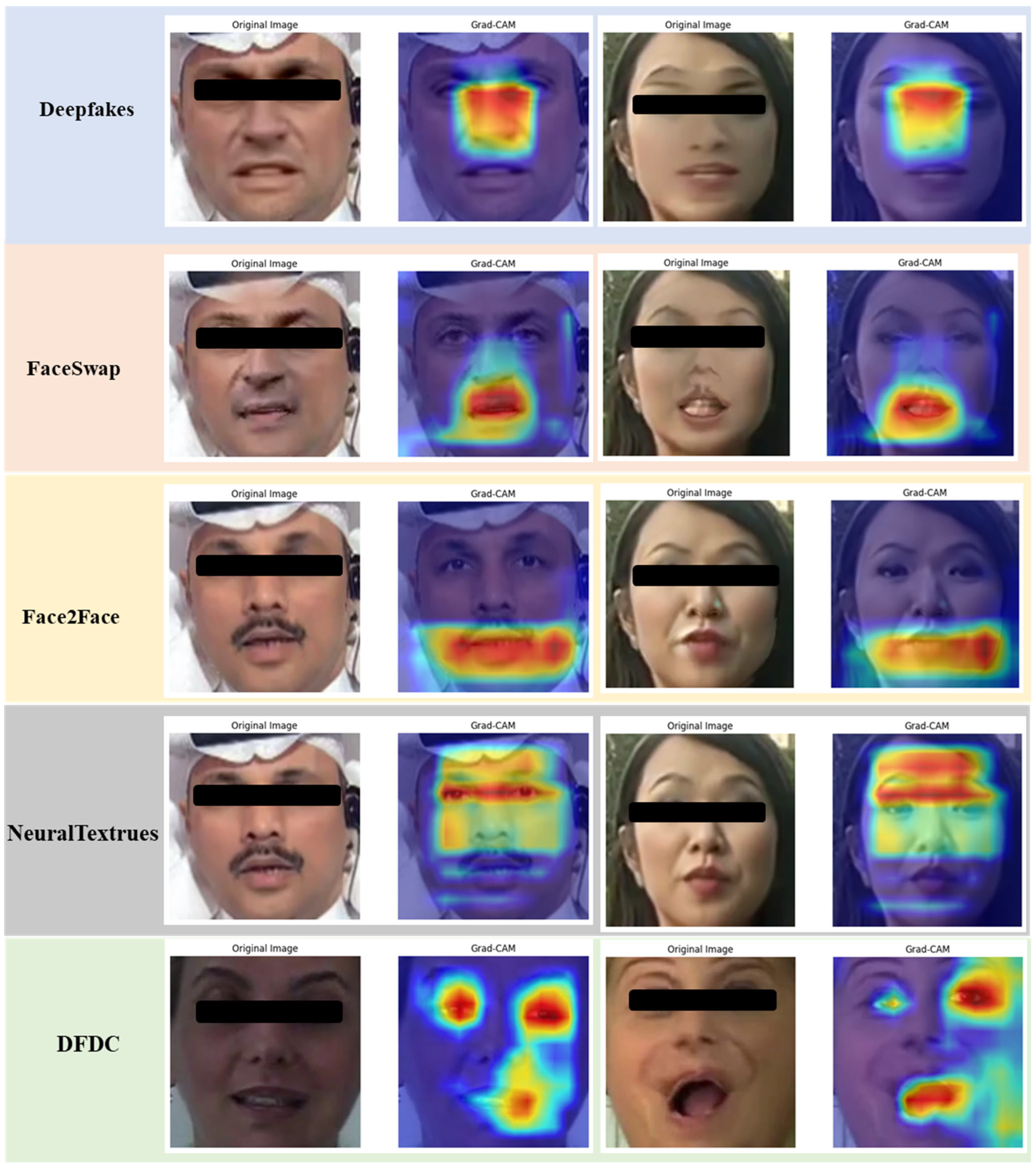
To enhance model interpretability, we visualize its decisions using Grad-CAM [56]. Figure 5 shows attention heatmaps for individual frames from four FF++ deepfake techniques, along with additional visualizations on the DFDC dataset. Warmer regions indicate higher confidence of forgery, revealing spatial artifacts detected by our model.
Figure 5.
Visualization of frames and their corresponding Grad-CAM heatmaps for four different manipulation methods in the FF++ dataset.
Qualitative analysis results show that the Grad-CAM heatmaps identified by our model tend to focus on critical facial areas, such as the mid-face and lips, generally align with the tampered regions within the images. This suggests that the model can effectively capture traces associated with deepfake manipulations. Specifically: for Deepfakes and FaceSwap, which involve face-swapping forgeries, the regions highlighted by our model correspond to the centered face. In the case of Face2Face, which modifies expressions, mouth movements and gaze direction. Our model successfully captures coarse textual details around the mouth region. Regarding NeuralTextures, another reenactment-based approach that addressing texture blurring artifacts around the mouth, our model focuses more on the eye region, effectively revealing the anomalies in expressions and gazes. These observations indicate that our proposed model can effectively identify and locate artifacts left by different deep forgery techniques. On the DFDC dataset, our model also concentrates on critical facial regions, showing consistent interpretability under diverse real-world conditions.
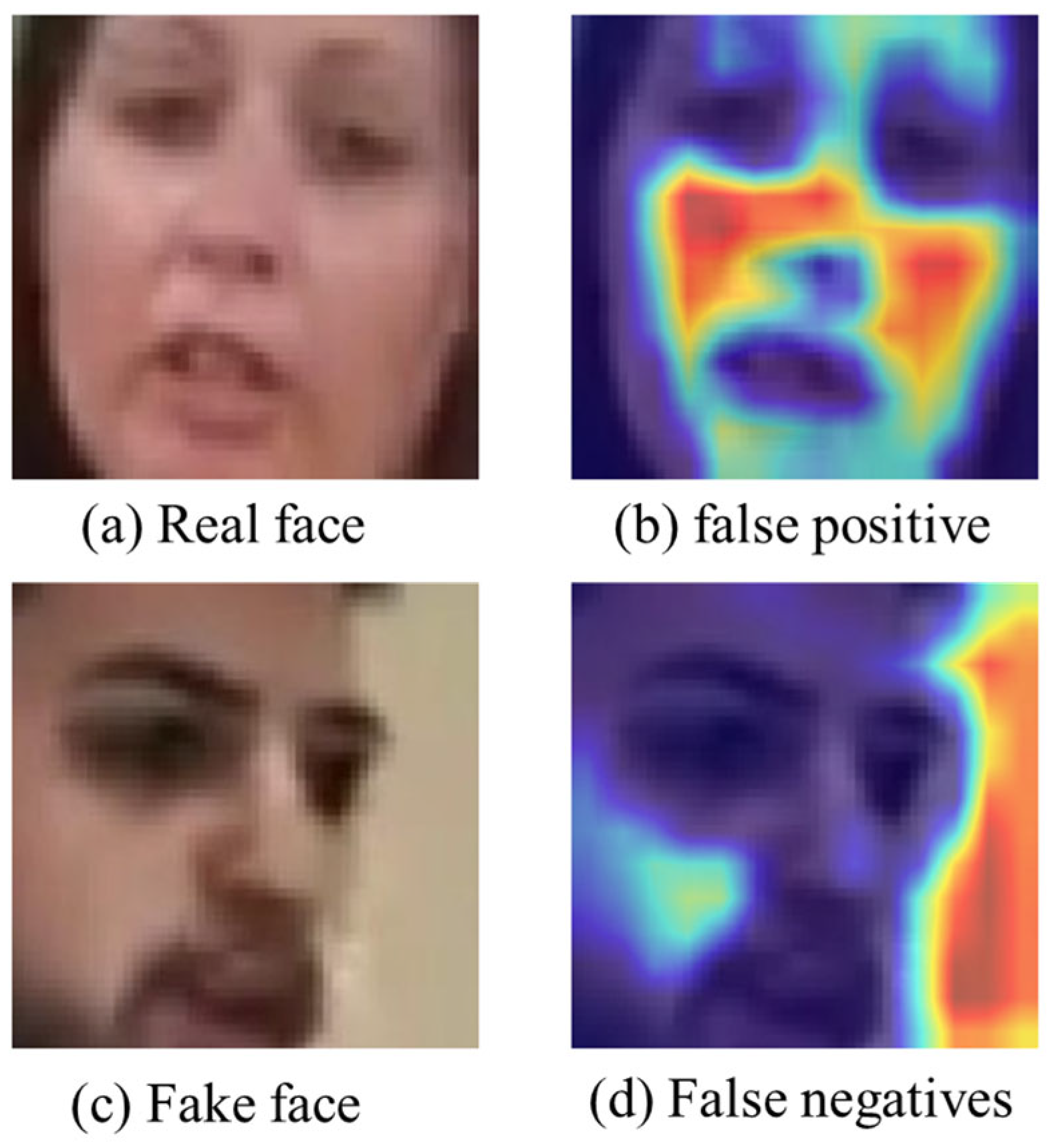
To further understand the behavior of our model, we analyze failure cases using Grad-CAM visualization. As shown in Figure 6, false positives often occur when the input suffers from severe motion blur and low-resolution degradation, where the model mistakenly attends to blurry edge regions. False negatives, on the other hand, are primarily attributed to the combined effects of extreme image blur and a side-view profile, which obscure critical facial features and weaken subtle forgery artifacts. These results indicate that while our model performs well on standard benchmarks, it remains sensitive to severe quality degradation and challenging viewpoints. Addressing these challenges, potentially by incorporating temporal consistency to compensate for information loss in individual frames, will be a focus of our future work.
Figure 6.
Grad-CAM visualization of failure cases.
5. Conclusions
Addressing the need for deepfake detection in resource-constrained environments, we propose a lightweight deepfake detection model that leverages mid-level features to guide a multi-scale fusion process. The model integrates multi-scale features to achieve high detection accuracy and robust generalization while maintaining low computational costs. Specifically, we design a multi-scale dynamic feature perception module with a grouped architecture that employs attention mechanisms at various scales in parallel, thereby enhancing the capture of diverse forgery artifacts. Additionally, we introduce a context-guided dynamic convolution mechanism that uses mid-level forgery features to adaptively steer the learning of high-level semantic features, ensuring the model focuses on authentically manipulated regions. Extensive experiments on multiple mainstream datasets demonstrate that our model efficiently and accurately identifies deepfake videos and images, achieving an optimal balance between detection performance and computational efficiency.
Author Contributions
Conceptualization, Y.D.; methodology, Y.D.; software, Y.D.; validation, H.Z.; formal analysis, H.Z.; investigation, Y.D.; resources, Y.D.; data curation, H.Z.; writing—original draft preparation, Y.D.; writing—review and editing, Y.D.; visualization, Y.D.; supervision, F.B.; project administration, F.B.; funding acquisition, F.B. All authors have read and agreed to the published version of the manuscript.
Funding
This research was supported by the Double First-Class Innovation Research Project of People’s Public Security University of China (Grant No. 2023SYL08) and the Open Source Intelligence Research Center of Sichuan Police Science Research Institute (Grant No. KYQBYJZX2025006).
Data Availability Statement
The data used in this study are all from public datasets. The FaceForensics++ dataset is available at https://github.com/ondyari/FaceForensics (accessed on 3 April 2026). The CelebDF-v2 dataset is available at: https://github.com/yuezunli/celeb-deepfakeforensics (accessed on 3 April 2026). The Deepfake Detection Challenge (DFDC) dataset is provided by Meta AI and can be downloaded from: https://ai.meta.com/datasets/dfdc/ (accessed on 3 April 2026). The FaceShifter dataset is accessible as part of the FaceForensics++ repository or via its project page: https://lingzhili.com/FaceShifterPage/ (accessed on 3 April 2026). The source code that supports the findings of this study is available from the corresponding author, Fanliang Bu, upon reasonable request.
Acknowledgments
The authors would like to express their sincere gratitude to Fanliang Bu (People’s Public Security University of China) for his invaluable guidance and insightful suggestions throughout this research.
Conflicts of Interest
The authors declare no conflicts of interest.
References
- Luo, Y.; Zhang, Y.; Yan, J.; Liu, W. Generalizing Face Forgery Detection with High-Frequency Features. In Proceedings of the IEEE/CVF Conference on Computer Vision and Pattern Recognition (CVPR), Nashville, TN, USA, 20–25 June 2021; pp. 16317–16326. [Google Scholar]
- McCloskey, S.; Albright, M. Detecting GAN-Generated Imagery Using Saturation Cues. In Proceedings of the 2019 IEEE International Conference on Image Processing (ICIP), Taipei, Taiwan, 22–25 September 2019; pp. 4584–4588. [Google Scholar]
- Matern, F.; Riess, C.; Stamminger, M. Exploiting Visual Artifacts to Expose Deepfakes and Face Manipulations. In Proceedings of the 2019 IEEE Winter Applications of Computer Vision Workshops (WACVW), Waikoloa Village, HI, USA, 7–11 January 2019; pp. 83–92. [Google Scholar]
- Wang, Y.; Chen, C.; Zhang, N.; Hu, X. WATCHER: Wavelet-Guided Texture-Content Hierarchical Relation Learning for Deepfake Detection. Int. J. Comput. Vis. 2024, 132, 4746–4767. [Google Scholar] [CrossRef] [Scilit]
- Liu, J.; Xie, J.; Wang, Y.; Zha, Z.-J. Adaptive Texture and Spectrum Clue Mining for Generalizable Face Forgery Detection. IEEE Trans. Inf. Forensics Secur. 2024, 19, 1922–1934. [Google Scholar] [CrossRef] [Scilit]
- Guo, Z.; Wang, L.; Yang, W.; Yang, G.; Li, K. LDFnet: Lightweight Dynamic Fusion Network for Face Forgery Detection by Integrating Local Artifacts and Global Texture Information. IEEE Trans. Circuits Syst. Video Technol. 2024, 34, 1255–1265. [Google Scholar] [CrossRef] [Scilit]
- Haliassos, A.; Vougioukas, K.; Petridis, S.; Pantic, M. Lips Don’t Lie: A Generalisable and Robust Approach to Face Forgery Detection. In Proceedings of the 2021 IEEE/CVF Conference on Computer Vision and Pattern Recognition (CVPR), Virtual Conference, 19–25 June 2021; pp. 5037–5047. [Google Scholar]
- Li, Y.; Chang, M.-C.; Lyu, S. In Ictu Oculi: Exposing AI Created Fake Videos by Detecting Eye Blinking. In Proceedings of the 2018 IEEE International Workshop on Information Forensics and Security (WIFS), Hong Kong, China, 4 September 2018; pp. 1–7. [Google Scholar]
- Ciftci, U.A.; Demir, I.; Yin, L. FakeCatcher: Detection of Synthetic Portrait Videos Using Biological Signals. IEEE Trans. Pattern Anal. Mach. Intell. 2020, 1. [Google Scholar] [CrossRef] [Scilit]
- Dolhansky, B.; Bitton, J.; Pflaum, B.; Lu, J.; Howes, R.; Wang, M.; Ferrer, C.C. The DeepFake Detection Challenge (DFDC) Dataset. arXiv 2020, arXiv:2006.07397v4. [Google Scholar] [CrossRef] [Scilit]
- Dong, F.; Zou, X.; Wang, J.; Liu, X. Contrastive Learning-Based General Deepfake Detection with Multi-Scale RGB Frequency Clues. J. King Saud Univ. Comput. Inf. Sci. 2023, 35, 90–99. [Google Scholar] [CrossRef] [Scilit]
- Gu, S.; Qin, Z.; Xie, L.; Wang, Z.; Hu, Y. Multiscale Features Integrated Model for Generalizable Deepfake Detection. Int. J. Intell. Syst. 2025, 2025, 7084582. [Google Scholar] [CrossRef] [Scilit]
- Chen, H.; Li, Y.; Lin, D.; Li, B.; Wu, J. Watching the BiG Artifacts: Exposing DeepFake Videos via Bi-Granularity Artifacts. Pattern Recognit. 2023, 135, 109179. [Google Scholar] [CrossRef] [Scilit]
- Masi, I.; Killekar, A.; Mascarenhas, R.M.; Gurudatt, S.P.; AbdAlmageed, W. Two-Branch Recurrent Network for Isolating Deepfakes in Videos. In Computer Vision—ECCV 2020; Springer: Berlin/Heidelberg, Germany, 2020; pp. 667–684. [Google Scholar]
- Yadav, A.; Vishwakarma, D.K. AW-MSA: Adaptively Weighted Multi-Scale Attentional Features for DeepFake Detection. Eng. Appl. Artif. Intell. 2024, 127, 107443. [Google Scholar] [CrossRef] [Scilit]
- Cozzolino, D.; Verdoliva, L. Noiseprint: A CNN-Based Camera Model Fingerprint. IEEE Trans. Inf. Forensics Secur. 2020, 15, 144–159. [Google Scholar] [CrossRef] [Scilit]
- Mayer, O.; Stamm, M.C. Forensic Similarity for Digital Images. IEEE Trans. Inf. Forensics Secur. 2020, 15, 1331–1346. [Google Scholar] [CrossRef] [Scilit]
- Wu, Y.; AbdAlmageed, W.; Natarajan, P. ManTra-Net: Manipulation Tracing Network for Detection and Localization of Image Forgeries with Anomalous Features. In Proceedings of the 2019 IEEE/CVF Conference on Computer Vision and Pattern Recognition (CVPR), Long Beach, CA, USA, 15–20 June 2019; pp. 9535–9544. [Google Scholar]
- Suwajanakorn, S.; Seitz, S.M.; Kemelmacher-Shlizerman, I. Synthesizing Obama: Learning Lip Sync from Audio. ACM Trans. Graph. 2017, 36, 1–13. [Google Scholar] [CrossRef] [Scilit]
- Zhao, H.; Zhou, W.; Chen, D.; Wei, T.; Zhang, W.; Yu, N. Multi-Attentional Deepfake Detection. In Proceedings of the IEEE/CVF Conference on Computer Vision and Pattern Recognition, Nashville, TN, USA, 20–25 June 2021; pp. 2185–2194. [Google Scholar]
- Yang, X.; Li, Y.; Lyu, S. Exposing Deep Fakes Using Inconsistent Head Poses. In Proceedings of the ICASSP 2019—2019 IEEE International Conference on Acoustics, Speech and Signal Processing (ICASSP), Brighton, UK, 12–17 May 2019; pp. 8261–8265. [Google Scholar]
- Li, L.; Bao, J.; Zhang, T.; Yang, H.; Chen, D.; Wen, F.; Guo, B. Face X-Ray for More General Face Forgery Detection. In Proceedings of the IEEE/CVF Conference on Computer Vision and Pattern Recognition, Seattle, WA, USA, 13–19 June 2020; pp. 5001–5010. [Google Scholar]
- Scherhag, U.; Budhrani, D.; Gomez-Barrero, M.; Busch, C. Detecting Morphed Face Images Using Facial Landmarks. In Image and Signal Processing; Springer: Cham, Switzerland, 2018; pp. 444–452. [Google Scholar]
- Wang, S.Y.; Wang, O.; Zhang, R.; Owens, A.; Efros, A.A. Efros CNN-Generated Images Are Surprisingly Easy to Spot… for Now. In Proceedings of the IEEE/CVF Conference on Computer Vision and Pattern Recognition (CVPR), Seattle, WA, USA, 13–19 June 2020; pp. 8695–8704. [Google Scholar]
- Lin, X.; Sun, S.; Huang, W.; Sheng, B.; Li, P.; Feng, D.D. EAPT: Efficient Attention Pyramid Transformer for Image Processing. IEEE Trans. Multimed. 2023, 25, 50–61. [Google Scholar] [CrossRef] [Scilit]
- Afchar, D.; Nozick, V.; Yamagishi, J.; Echizen, I. MesoNet: A Compact Facial Video Forgery Detection Network. In Proceedings of the 2018 IEEE International Workshop on Information Forensics and Security (WIFS), Hong Kong, China, 4 September 2018; pp. 1–7. [Google Scholar]
- Nguyen, H.H.; Fang, F.; Yamagishi, J.; Echizen, I. Multi-Task Learning for Detecting and Segmenting Manipulated Facial Images and Videos. In Proceedings of the 2019 IEEE 10th International Conference on Biometrics Theory, Applications and Systems (BTAS), Tampa, FL, USA, 23–26 September 2019; pp. 1–8. [Google Scholar]
- Sun, Z.; Han, Y.; Hua, Z.; Ruan, N.; Jia, W. Improving the Efficiency and Robustness of Deepfakes Detection Through Precise Geometric Features. In Proceedings of the IEEE/CVF Conference on Computer Vision and Pattern Recognition (CVPR), Nashville, TN, USA, 20–25 June 2021; pp. 3609–3618. [Google Scholar]
- Shao, R.; Wu, T.; Nie, L.; Liu, Z. DeepFake-Adapter: Dual-Level Adapter for DeepFake Detection. Int. J. Comput. Vis. 2025, 133, 3613–3628. [Google Scholar] [CrossRef] [Scilit]
- Lu, W.; Chen, S.-B.; Tang, J.; Ding, C.H.Q.; Luo, B. A Robust Feature Downsampling Module for Remote-Sensing Visual Tasks. IEEE Trans. Geosci. Remote Sens. 2023, 61, 1–12. [Google Scholar] [CrossRef] [Scilit]
- Zhang, H.; Qi, Y.; Chen, H.; Cao, P.; Liang, A.; Wen, S. LSDNet: Lightweight Stochastic Depth Network for Human Pose Estimation. Vis. Comput. 2025, 41, 257–270. [Google Scholar] [CrossRef] [Scilit]
- Chen, J.; He, T.; Zhuo, W.; Ma, L.; Ha, S.; Chan, S.-H.G. TVConv: Efficient Translation Variant Convolution for Layout-Aware Visual Processing. In Proceedings of the IEEE/CVF Conference on Computer Vision and Pattern Recognition (CVPR), New Orleans, LA, USA, 18–24 June 2022; pp. 12548–12558. [Google Scholar]
- Lu, W.; Chen, S.-B.; Shu, Q.-L.; Tang, J.; Luo, B. DecoupleNet: A Lightweight Backbone Network with Efficient Feature Decoupling for Remote Sensing Visual Tasks. IEEE Trans. Geosci. Remote Sens. 2024, 62, 1–13. [Google Scholar] [CrossRef] [Scilit]
- Lou, M.; Yu, Y. OverLoCK: An Overview-First-Look-Closely-next ConvNet with Context-Mixing Dynamic Kernels. In Proceedings of the IEEE/CVF Conference on Computer Vision and Pattern Recognition (CVPR), Nashville, TN, USA, 10–17 June 2025; pp. 128–138. [Google Scholar]
- Rössler, A.; Cozzolino, D.; Verdoliva, L.; Riess, C.; Thies, J.; Nießner, M. FaceForensics++: Learning to Detect Manipulated Facial Images. In Proceedings of the IEEE/CVF International Conference on Computer Vision, Seoul, Republic of Korea, 27 October–2 November 2019; pp. 1–11. [Google Scholar]
- Li, Y.; Yang, X.; Sun, P.; Qi, H.; Lyu, S. Celeb-DF: A Large-Scale Challenging Dataset for DeepFake Forensics. In Proceedings of the IEEE/CVF Conference on Computer Vision and Pattern Recognition, Seattle, WA, USA, 13–19 June 2020; pp. 3207–3216. [Google Scholar]
- Li, L.; Bao, J.; Yang, H.; Chen, D.; Wen, F. FaceShifter: Towards High Fidelity and Occlusion Aware Face Swapping. arXiv 2019, arXiv:1912.13457. [Google Scholar]
- Timesler, T. Facenet-Pytorch: Pretrained Pytorch Face Detection (MTCNN) and Recognition (InceptionResnet) Models [Software] Github. 2018. Available online: https://github.com/timesler/facenet-pytorch (accessed on 3 April 2026).
- Qian, Y.; Yin, G.; Sheng, L.; Chen, Z.; Shao, J. Thinking in Frequency: Face Forgery Detection by Mining Frequency-Aware Clues. In Proceedings of the European Conference on Computer Vision, Glasgow, UK, 23–28 August 2020; pp. 86–103. [Google Scholar]
- Wang, J.; Wu, Z.; Ouyang, W.; Han, X.; Chen, J.; Jiang, Y.-G.; Li, S.-N. M2TR: Multi-Modal Multi-Scale Transformers for Deepfake Detection. In Proceedings of the 2022 International Conference on Multimedia Retrieval; ACM: New York, NY, USA, 2022; pp. 615–623. [Google Scholar]
- Peng, C.; Miao, Z.; Liu, D.; Wang, N.; Hu, R.; Gao, X. Where Deepfakes Gaze at? Spatial–Temporal Gaze Inconsistency Analysis for Video Face Forgery Detection. IEEE Trans. Inf. Forensics Secur. 2024, 19, 4507–4517. [Google Scholar] [CrossRef] [Scilit]
- Heo, Y.-J.; Yeo, W.-H.; Kim, B.-G. DeepFake Detection Algorithm Based on Improved Vision Transformer. Appl. Intell. 2023, 53, 7512–7527. [Google Scholar] [CrossRef] [Scilit]
- Coccomini, D.; Messina, N.; Gennaro, C.; Falchi, F. Combining EfficientNet and Vision Transformers for Video Deepfake Detection. In Proceedings of the International Conference on Image Analysis and Processing, New York, NY, USA, 6 July 2022; pp. 219–229. [Google Scholar]
- Baek, J.Y.; Yoo, Y.S.; Bae, S.H. Generative Adversarial Ensemble Learning for Face Forensics. IEEE Access 2020, 8, 45421–45431. [Google Scholar] [CrossRef] [Scilit]
- Nirkin, Y.; Wolf, L.; Keller, Y.; Hassner, T. DeepFake Detection Based on Discrepancies Between Faces and Their Context. IEEE Trans. Pattern Anal. Mach. Intell. 2022, 44, 6111–6121. [Google Scholar] [CrossRef] [Scilit]
- Zi, B.; Chang, M.; Chen, J.; Ma, X.; Jiang, Y.G. WildDeepfake: A Challenging Real-World Dataset for Deepfake Detection. In Proceedings of the MM 2020—Proceedings of the 28th ACM International Conference on Multimedia; Association for Computing Machinery, Inc.: New York, NY, USA, 2020; pp. 2382–2390. [Google Scholar]
- Liu, H.; Li, X.; Zhou, W.; Chen, Y.; He, Y.; Xue, H.; Zhang, W.; Yu, N. Spatial-Phase Shallow Learning: Rethinking Face Forgery Detection in Frequency Domain. In Proceedings of the IEEE/CVF Conference on Computer Vision and Pattern Recognition, Nashville, TN, USA, 20–25 June 2021. [Google Scholar]
- Ding, Y.; Bu, F.; Zhai, H.; Hou, Z.; Wang, Y. Multi-Feature Fusion Based Face Forgery Detection with Local and Global Characteristics. PLoS ONE 2024, 19, e0311720. [Google Scholar] [CrossRef] [Scilit]
- Nguyen, H.H.; Yamagishi, J.; Echizen, I. Capsule-Forensics: Using Capsule Networks to Detect Forged Images and Videos. In Proceedings of the ICASSP 2019—2019 IEEE International Conference on Acoustics, Speech and Signal Processing (ICASSP), Brighton, UK, 12–17 May 2019; pp. 2307–2311. [Google Scholar]
- Li, Y.; Lyu, S. Exposing DeepFake Videos by Detecting Face Warping Artifacts. arXiv 2018, arXiv:1811.00656. [Google Scholar]
- Lin, H.; Huang, W.; Luo, W.; Lu, W. DeepFake Detection with Multi-Scale Convolution and Vision Transformer. Digit. Signal Process. Rev. J. 2023, 134, 103895. [Google Scholar] [CrossRef] [Scilit]
- Gao, J.; Xia, Z.; Marcialis, G.L.; Dang, C.; Dai, J.; Feng, X. DeepFake Detection Based on High-Frequency Enhancement Network for Highly Compressed Content. Expert Syst. Appl. 2024, 249, 123732. [Google Scholar] [CrossRef] [Scilit]
- Li, J.; Xie, H.; Li, J.; Wang, Z.; Zhang, Y. Frequency-Aware Discriminative Feature Learning Supervised by Single-Center Loss for Face Forgery Detection. In Proceedings of the IEEE/CVF Conference on Computer Vision and Pattern Recognition, Nashville, TN, USA, 20–25 June 2021; pp. 6458–6467. [Google Scholar]
- Zhou, P.; Han, X.; Morariu, V.I.; Davis, L.S. Two-Stream Neural Networks for Tampered Face Detection. In Proceedings of the 2017 IEEE Conference on Computer Vision and Pattern Recognition Workshops (CVPRW), Honolulu, HI, USA, 21–26 July 2017; pp. 1831–1839. [Google Scholar]
- Tan, M.; Le, Q.V. EfficientNet: Rethinking Model Scaling for Convolutional Neural Networks. In Proceedings of the 36th International Conference on Machine Learning, Long Beach, CA, USA, 28 May 2019; pp. 6105–6114. [Google Scholar]
- Selvaraju, R.R.; Cogswell, M.; Das, A.; Vedantam, R.; Parikh, D.; Batra, D. Grad-CAM: Visual Explanations from Deep Networks via Gradient-Based Localization. Int. J. Comput. Vis. 2020, 128, 336–359. [Google Scholar] [CrossRef] [Scilit]

Disclaimer/Publisher’s Note: The statements, opinions and data contained in all publications are solely those of the individual author(s) and contributor(s) and not of MDPI and/or the editor(s). MDPI and/or the editor(s) disclaim responsibility for any injury to people or property resulting from any ideas, methods, instructions or products referred to in the content. |
© 2026 by the authors. Licensee MDPI, Basel, Switzerland. This article is an open access article distributed under the terms and conditions of the Creative Commons Attribution (CC BY) license.