


Abstract
With the widespread application of deep neural networks across various fields, issues related to model security have become increasingly prevalent. Backdoor attacks, as a covert method of attack, can implant malicious behavior during the model training process, causing the model to perform predetermined tasks under specific trigger conditions. However, current backdoor attacks struggle to achieve a good balance between stealthiness and attack success rate, and there is an issue in which certain data transformation operations can negatively impact attack performance. To address these issues, this paper proposes a specialized backdoor attack method called Ditto. It first uses a boundary detection algorithm and a padding algorithm to determine the trigger’s insertion position. The trigger is then dynamically generated using a generative adversarial network, taking into account the texture features of the images. Subsequently, the trigger is applied to the images, and its level of stealthiness is adjusted. Compared to existing popular backdoor attack methods, the experimental results ensure a high level of stealthiness while also maintaining a high attack success rate and a high accuracy for clean data. Furthermore, our attack method exhibits considerable robustness and adaptability, demonstrating effective resistance against baseline backdoor defense techniques.
1. Introduction
Currently, deep neural networks are extensively utilized in diverse domains, such as facial recognition [1], voice authentication [2], and natural language processing [3]. Since training deep neural networks typically requires substantial computational resources, diverse datasets, and sufficient training time, many users who lack data and computational capabilities often choose to utilize data and pre-trained networks from third-party computing platforms for their experiments. However, this practice potentially exposes them to numerous security issues, such as adversarial example attacks, data poisoning attacks, and backdoor attacks.
Compared to adversarial example attacks [4,5] and data poisoning attacks [6,7], backdoor attacks are more insidious. Due to the complexity and opacity of deep neural networks—with their numerous parameters and layers—their decision-making process is difficult to analyze directly, making them susceptible to backdoor attacks. Specifically, backdoor attacks on deep neural networks have no impact on normal samples and exert an abnormal influence only on poisoned samples containing triggers. This prompts the model to learn the features of the trigger and subsequently alter its predictions to the target category specified by the attacker. This type of attack is extremely stealthy and difficult for users to detect. Furthermore, backdoor attacks are characterized by their complexity and can occur in various stages of the machine learning pipeline, such as data collection, model training, and model deployment [8], which poses a significant threat to model security. In autonomous driving, adversaries can implant backdoor triggers on no-entry signs, causing models to misclassify them as straight-ahead signs. Such covert contamination remains undetected in real-world scenarios but may trigger critical safety hazards upon activation. Therefore, studying backdoor attacks is crucial for advancing model security defenses.
In recent years, backdoor attacks on DNNs have received widespread attention, and researchers have studied various backdoor attacks on network architectures like ResNet and VGGNet. Gu et al. [9] proposed BadNets, which first introduced the concept of backdoor attacks on DNNs. However, the triggers used in BadNets were overly conspicuous, resulting in poor stealthiness. The currently prevalent backdoor attacks require a high degree of stealthiness, leading to the development of invisible triggers. Chen et al. [1] were pioneering researchers who delved into this matter, making trigger images invisible and merging them with the original sample images to construct poisoned images for launching attacks. Zhang et al. [10] concealed the toxic information within the edge information of images. However, the triggers generated by its method are static and cannot adapt to the texture changes of different images, resulting in a decrease in concealment in complex backgrounds. Existing invisible backdoor attacks still suffer from several limitations: (1) most methods rely on static or globally generated triggers, lacking adaptability to image-specific texture features; (2) existing approaches fail to effectively balance stealthiness and robustness, especially under common data transformations [11]; (3) the trigger generation process is often independent of image structure, leading to suboptimal feature alignment and limited attack generalization. Therefore, there is still a lack of a unified framework that can generate adaptive, texture-aware triggers while maintaining high stealthiness and robustness. Investigating more robust and adaptable backdoor attack paradigms holds significant implications for enhancing the robustness of backdoor defense models.
This paper designs an invisible backdoor attack method to address the aforementioned issues. Firstly, an edge detection algorithm combined with Local Binary Pattern (LBP) is employed to extract structural and textural features from the image. These features are further fused to construct a refined spatial mask, which determines the regions suitable for trigger embedding. Subsequently, Generative Adversarial Networks are utilized to dynamically generate triggers. Different from conventional approaches that directly incorporate structural features into the generator, the proposed method adopts a decoupled design: the generator takes the original image and random noise as input to produce a full-image trigger that is visually consistent with the image distribution [12]. Through the adversarial training between the generator and discriminator, the generated triggers can effectively mimic the texture characteristics of normal samples. After trigger generation, the spatial mask is applied to constrain the trigger to perceptually insensitive regions. The masked trigger is then blended with the original image to produce poisoned samples. This design separates trigger content generation from spatial constraint, allowing the model to generate realistic perturbations while precisely controlling where they are applied. The method is based on the observation that edge regions correspond to high-frequency components, which are less perceptible to human vision but highly informative for deep neural networks. By combining texture-aware mask construction with GAN-based trigger generation, the proposed method produces triggers that are visually indistinguishable from the original image while remaining highly effective for backdoor attacks.
Our main contributions are as follows:
- We introduce Ditto, an innovative backdoor attack framework that employs Generative Adversarial Networks to dynamically create triggers customized to the image texture, thereby making them imperceptible and focusing on enclosed areas at the image boundaries.
- Our approach successfully navigates the balance between stealth, CDA, and ASR, enhancing the average performance of CDA and ASR post-data transformation, thereby mitigating the limitations inherent in other invisible backdoor attack methods.
- We perform extensive experiments across various datasets, demonstrating the robustness and versatility of Ditto across diverse scenarios, multiple datasets, and various deep neural network models.
2. Related Work
2.1. Backdoor Attack
The objective of a backdoor attack is to introduce triggers into the samples, thereby prompting the victim model to acquire the trigger features embedded within them. When encountering harmless test samples, the model will carry out standard prediction and classification tasks. Nevertheless, upon processing contaminated samples that incorporate the trigger, the model will predict the outcome as the attacker-specified target class. The pivotal phase in executing a backdoor attack is the creation of the trigger.
Gu et al. [9] introduced BadNets, the first method to apply backdoor attacks to deep learning models, where they statically inserted one or more pixel blocks as triggers into benign images to complete the poisoning process. Subsequently, Chen et al. [1] proposed an attack method that blends trigger images with benign images. Nguyen et al. [13] proposed using subtle distortive transformations that preserve image content as triggers, based on the premise that humans are not good at detecting small geometric transformations. However, the triggers used in the aforementioned methods are relatively conspicuous, and thus do not guarantee the same level of attack stealthiness as our approach.
In recent years, many researchers have begun to focus on invisible backdoor attacks, making triggers concealed. Zhong et al. [14] proposed two methods for generating perturbation backdoor patterns: one is static perturbation, which constructs simple, small-scale repetitive patterns as triggers, and the other is target-adaptive perturbation, using universal adversarial perturbations [15] as backdoor triggers. Barni et al. [16] replaced repetitive masks with SIG. Liu et al. [17] proposed the Refool method, which uses reflection as a backdoor model implanted into the victim’s model. Li et al. [18], based on image steganography techniques, used the classic LSB algorithm to embed triggers into the bit-space, but their method performed very poorly on some low-resolution datasets like CIFAR-10. Recently, Zhang et al. [10] proposed the Poison ink method, which hides toxic information in the image boundaries to conceal triggers. Gao et al. [19] proposed a sparse invisible backdoor attack method to improve stealthiness. Wang et al. [20] embedded a learnable watermark into the latent domain of images as a trigger. However, the trigger generation methods mentioned above are static and do not offer as much flexibility and scalability as our method.
Now, the method of dynamically generating triggers for backdoor attacks is gradually becoming a trend. Dong et al. [21] proposed NNSDB, which dynamically generates backdoor triggers combined with image steganography, making the triggers invisible. Chen et al. [22] designed a trigger generator with a multi-feature constraint algorithm that overlays hidden features on clean images in an “invisible” manner, dynamically generating triggers. Wang et al. [23] proposed GhostEncoder, which employs dynamic triggers to conduct covert backdoor attacks on pre-trained encoders. Compared to our method, these methods are inferior in terms of stealthiness, CDA, and ASR metrics, and, unlike our method, their CDA and ASR significantly decrease after some data transformation operations.
2.2. Backdoor Defence
As backdoor attack methods multiply, corresponding backdoor defense strategies have emerged. Generally, backdoor defenses can be categorized into two types: input- & output-based methods and model-based methods.
Input & output-based methods: Gao et al. [24] proposed the Strip method, which overlays various image patterns on suspicious images to observe their outputs. A higher probability of poisoning results in lower output randomness, thus distinguishing between poisoned and clean images. The Grad-CAM [25] method generates class activation maps that show which areas of the input image are most important for the model’s predictions, enhancing model interpretability. In backdoor defense, if the model fails to concentrate on the object or persistently directs its focus to a specific area, the image is deemed to be poisoned. The SentiNet technique proposed by Chou et al. [26] is based on the Grad-CAM [25] method and is designed to locate potential trigger regions, reflecting the positive significance of the input image. Recent studies [11,27] have shown that many backdoor attacks are affected by data transformations, which can diminish the success rate of backdoor attacks, a factor that our method also considers.
Model-based methods: Liu et al. [28] proposed the Fin-pruning method, which prunes dormant neurons to mitigate backdoor attacks because these neurons might activate the backdoor. Wang et al. [29] introduced the Neural Cleanse approach, which involves reverse-engineering the trigger to ascertain the existence of a backdoor within the model and employs anomaly detection to pinpoint the most probable backdoor. Guo et al. [30] built on Neural Cleanse and proposed the TABOR method, which adds various regularizations to the reverse-engineering process to improve the method. Currently, these backdoor defenses can withstand most backdoor attack methods. In the experiments below, we have employed relevant techniques to demonstrate Ditto’s resistance to backdoor defenses.
3. The Proposed Method
3.1. Problem Definition
A successful backdoor attack method should mislead the model into making incorrect predictions for poisoned images with inserted triggers (i.e., the target label preset by the attacker) while classifying clean images normally. In this paper, we take image classification tasks as the target of backdoor attacks.
For image classification tasks, assuming that the training dataset contains different classes, where , N is the total number of samples in . The input domain consists of a large collection of images, and the output domain consists of the corresponding labels. Image classification can be defined as a mapping function . The objective is to refine and train the target model in a manner that minimizes the loss function throughout the training phase.
For the process of generating a poisoned model, assume p is the designed trigger to be inserted into the image, where . The training set after inserting the trigger becomes the poisoned dataset and the poisoned model is obtained by training with the poisoned training set. The quantity of poisoned samples does not exceed the quantity of benign samples, and the combined total of both forms the complete training dataset .
3.2. Threat Model
- Attacker’s Goals: For the attacker, it is necessary to ensure that the attack is effective, stealthy and robust. Effectiveness requires the attacked model to exhibit a high ASR when the backdoor trigger pattern appears and also a high CDA for images without the trigger. Stealthiness requires that the inserted trigger is imperceptible and cannot be detected by the victim (i.e., the user of the dataset). Additionally, the attack method should be highly robust, showing good adaptability to different datasets, maintaining stability and reliability in the presence of certain interferences (e.g., data transformations, backdoor defenses, etc.), and still maintaining good attack performance.
- Attacker’s Capacities: It is presumed that the attacker can only manipulate a portion of the training data and lacks access to other aspects of the model training process, including the victim model’s architecture and loss function. In the inference stage, attackers are able to input any image into the trained model for querying; however, they possess no knowledge regarding the model itself and are unable to interfere with the inference process. This premise outlines the baseline capability expected of the attacker [31]. This threat model frequently arises in various real-world scenarios, such as the use of third-party training data, training platforms, and model APIs.
3.3. The Proposed Ditto
3.3.1. Trigger Generation
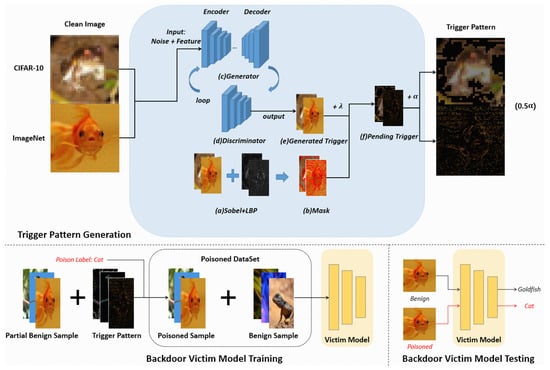
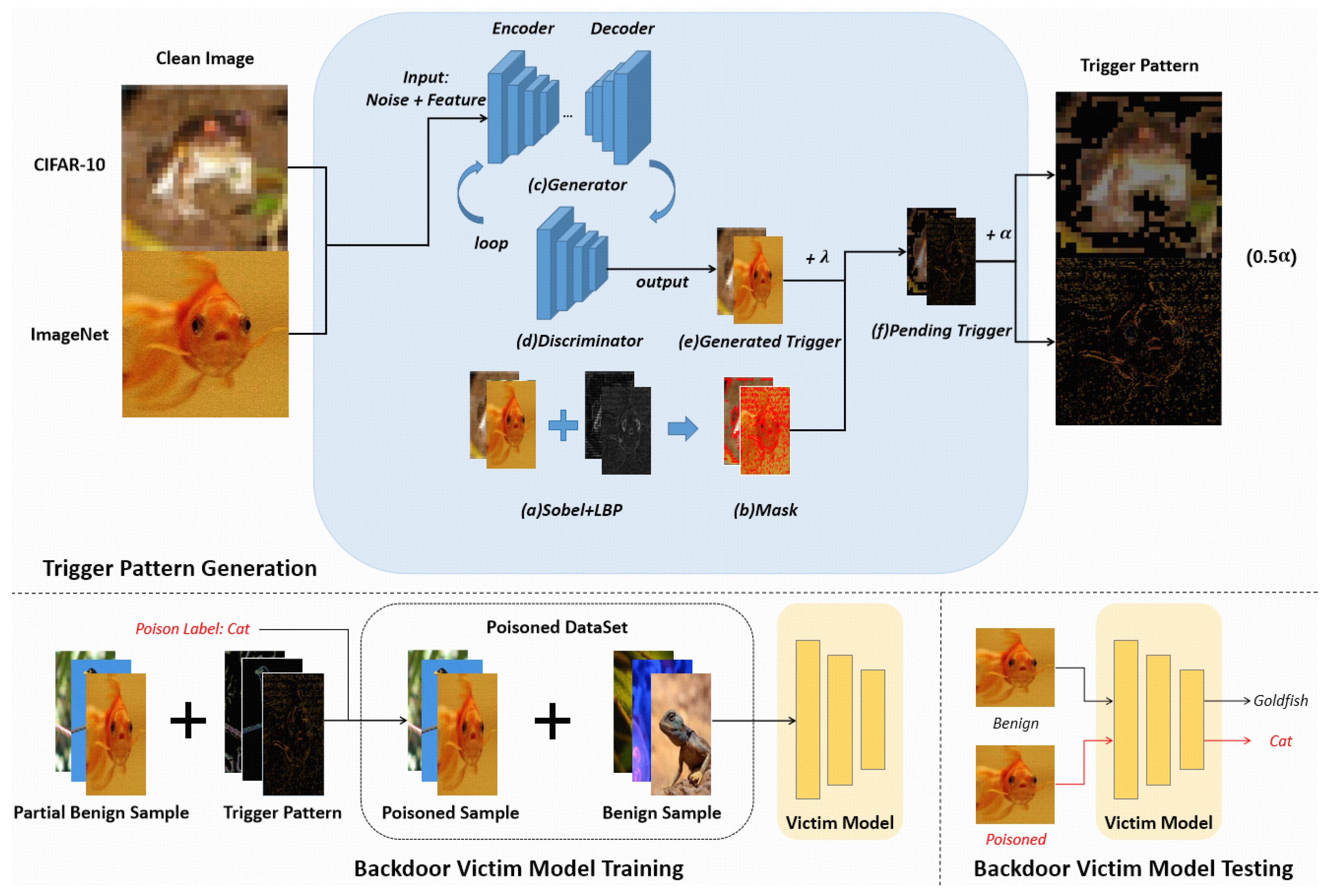
Ditto’s trigger generation process adopts a decoupled paradigm that separates “trigger pattern generation” from “spatial positioning”. This design enhances the flexibility and quality of the trigger. As shown in Figure 1, the process is divided into three main stages: Boundary Mask Construction, Texture-Aware Trigger Synthesis, and Adaptive Fusion.
Figure 1.
The overall framework of our method consists of three parts: trigger pattern generation, backdoor victim model training and testing (in order to make the trigger pattern clearly visible, we set the value of to 0.5 here).
Boundary Mask Construction: To ensure the trigger is embedded in high-frequency edge regions without affecting the semantic integrity of the target object, we construct a spatial positioning mask M. Firstly, we apply the Sobel [32] operator to the input image to extract the gradient magnitude , which captures geometric edges. Simultaneously, we apply the Local Binary Pattern operator to extract the local texture map . The initial mask is obtained by fusing these two features:
To eliminate background noise and strictly confine the trigger to significant edge contours, we apply a percentile threshold t (set to 70% in experiments) to . The final normalized binary mask is obtained, where 1 indicates the region where the trigger is allowed to be inserted.
Texture-Aware Trigger Synthesis: Unlike traditional methods that generate fixed-size patches, we utilize a Generative Adversarial Network to synthesize a full-image trigger T that matches the texture of the original image. Note that the generator G takes the entire original image and a random noise vector z as inputs. This allows the GAN to learn the global texture distribution and generate perturbations that are highly consistent with the image context. The adversarial training objective is defined as
where indicates that the noise vector z is drawn from the normal distribution , which signifies that the input to the generator consists of random noise. And denotes that the image is randomly selected from the dataset . represents the output of the generator, indicating the trigger image generated based on the texture features of the image and the noise z.
The discriminator receives both the generated image and the real image as input, with the goal of distinguishing between them. The loss function of the discriminator is given by
In Equation (5), and represent the loss functions of the discriminator for real images and generated images, respectively. denotes the discriminator’s outcome for the real image , and signifies the discriminator’s discriminative for the generated image .
After training, we obtain the raw trigger pattern .
Adaptive Fusion with and :
Following the generation of the raw full-image trigger from the GAN, we apply a post-processing enhancement to ensure it possesses sufficient perturbation intensity to be reliably learned by deep neural networks. Since the GAN output tends to be smooth and lacks prominent high-frequency details, we introduce a contrast-based amplification mechanism governed by the parameter . Specifically, we define a center value C representing the neutral grayscale midpoint. The enhanced trigger pattern is obtained by stretching the deviation of each pixel from this center point:
To control the visibility of the trigger, we introduce the transparency coefficient , which directly governs the blending ratio between the original image and the masked trigger. When , the trigger becomes completely transparent. Firstly, the enhanced trigger is constrained by the spatial mask:
Then, a weighted pixel-wise fusion is performed between the original image and the masked trigger . The final poisoned image is formulated as
Equation (8) indicates that the perturbation is only applied to the edge regions where the mask M is active, and its magnitude is strictly controlled by the transparency coefficient . Through the joint tuning of and , Ditto achieves an optimal and controllable trade-off between imperceptibility and attack effectiveness.
3.3.2. Model Training
We select a subset of images from the training set and the test set and embed the trigger into them. Subsequently, these images are combined with the remaining benign images to form the poisoned training and test sets . During the training process, we only poison a portion of the dataset, without making any other modifications to the model’s training procedure. This simulates a scenario where the victim trains the model normally, unaware of the poisoning. We apply a poisoning ratio of 15% to both the training and test sets independently. Specifically, 15% of the samples in are randomly selected for trigger insertion to form the poisoned training set. Similarly, 15% of is poisoned to evaluate the Attack Success Rate (ASR). All poisoned samples are assigned the target label ’cat poison’, while the remaining 85% retain their original clean labels.
3.3.3. Model Testing
We utilize the poisoned test set to evaluate the trained poisoned model. For a clean image , if its predicted label corresponds to its true label , the prediction is considered correct; otherwise, it is deemed incorrect. For poisoned images , if the predicted label corresponds to the poisoning label, the prediction is considered correct; otherwise, it is considered incorrect.
4. Experiments
4.1. Experimental Setup
Datasets. To evaluate Ditto performance in different tasks, we conduct some experiments in four distinct data sets: CIFAR-10 [33], ImageNet [34], GTSRB [35], and VGG-Face [36]. These four datasets cover a variety of classification tasks. Among them, CIFAR-10 and ImageNet are used for object recognition, including objects such as horses, birds, and airplanes. GTSRB is used for traffic sign recognition, and VGG-Face is used for face recognition tasks. Owing to resource and space constraints, we primarily employ ImageNet and CIFAR-10 datasets for comparative purposes, we also demonstrat Ditto’s capabilities on the GTSRB and VGG Face datasets. The specifics of these datasets are outlined in Table 1.
Table 1.
Dataset information.
Models. For the generation of trigger patterns, we adjust our network architecture accordingly for different datasets to better adapt to the images. Table 2 and Table 3 respectively present the network architectures of our trigger pattern generator and pattern discriminator [37]. For the victim models, we mainly employ four commonly used recognition networks: ResNet-18 [38], ResNeXt [39], VGG-19 [40], and RepVGG [41]. This paper primarily utilizes ResNet-18 and VGG-19 for illustrating experimental results obtained on the CIFAR-10 and ImageNet datasets.
Table 2.
The detailed network structure of trigger pattern generator.
Table 3.
The detailed network structure of trigger pattern discriminator.
Evaluation metrics. The Ditto is evaluated from two aspects: attack performance and stealthiness. To evaluate attack performance, we employ CDA to measure the backdoor attack’s impact on clean samples and ASR to assess the attack’s effectiveness. CDA denotes the percentage of clean, trigger-free samples that are accurately classified, whereas ASR indicates the percentage of poisoned images that are correctly categorized under the attacker’s predetermined target label. For stealthiness, we employ Peak Signal-to-Noise Ratio (PSNR) [42], Structural Similarity (SSIM) [43], and Learned Perceptual Image Patch Similarity (LPIPS) [44] as metrics to compare the differences between the poisoned dataset and the clean dataset, with LPIPS using AlexNet as the network for feature extraction. Among these metrics, higher values of CDA and ASR indicate better attack performance. Higher values of PSNR and SSIM, and lower values of LPIPS, indicate better stealthiness.
Training Settings. In the aspect of trigger generation, we first design a new label “cat poison” as the poisoned class within the dataset. Subsequently, we employ a decoupled dual-branch strategy for trigger generation. Specifically, we fuse Sobel operators with Local Binary Patterns (LBPs) to extract high-frequency edge textures, generating a precise mask to delineate the insertion regions. Simultaneously, the original image features and random noise are fed into the GAN to dynamically synthesize a full-image texture perturbation. The generated trigger is then spatially constrained by the mask and refined using parameters and to adjust its transparency and intensity. In the model training process, we adhere to the standard practice of training for 200 epochs, employing the SGD optimizer with a momentum of 0.9, an initial learning rate set at 0.001, and a weight decay parameter of . The learning rate is reduced by a factor of 0.1 at every 30-epoch interval. To avoid overfitting and improve the model’s generalization ability, an early stopping mechanism is adopted, where training is terminated prematurely if the model’s loss does not decrease below the best loss result within 30 epochs.
4.2. Attack Performance Evaluation
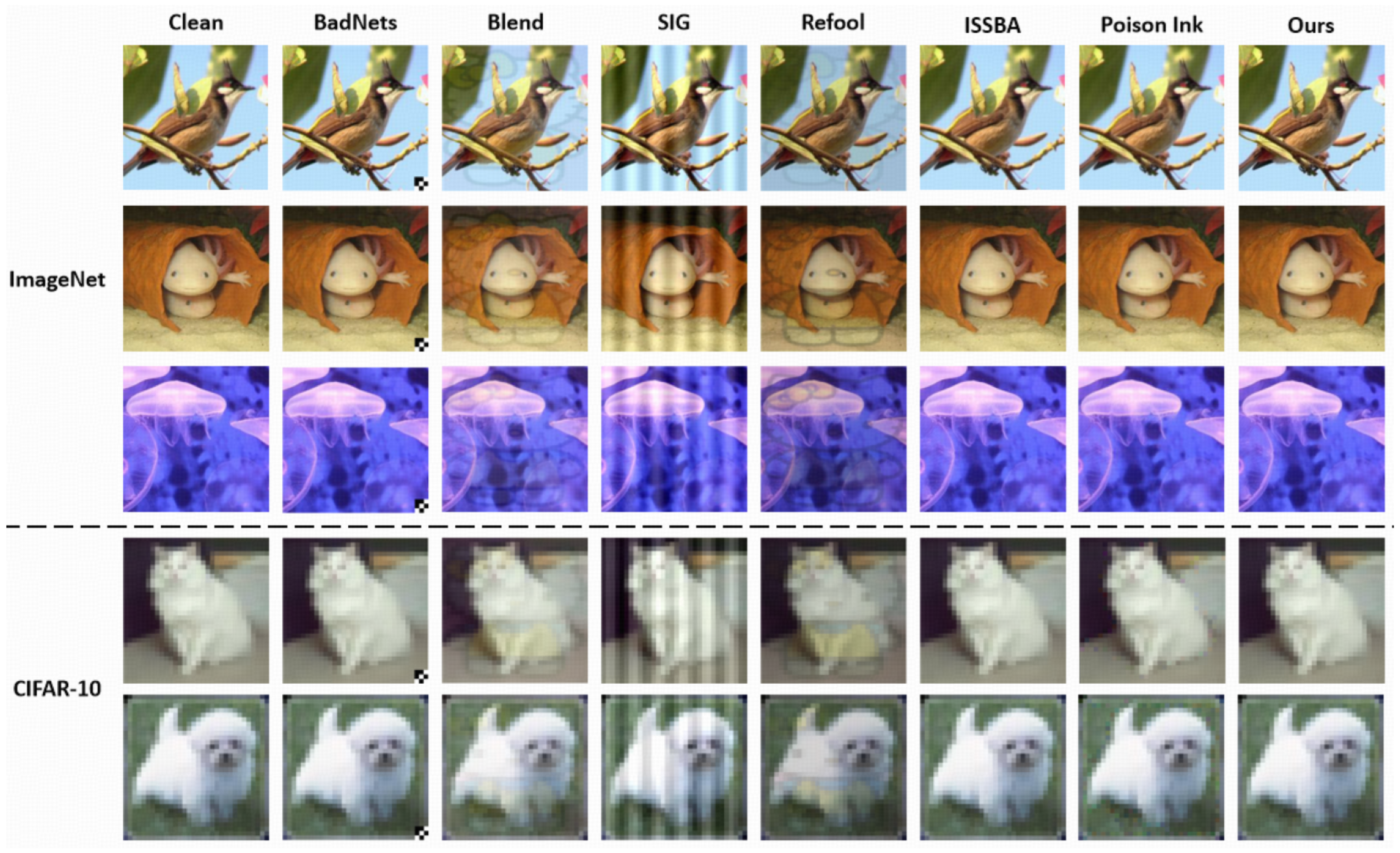
Regarding stealthiness, we contrast our approach with other prevalent backdoor attack techniques. Figure 2 showcases a comparison of the poisoned images produced by our method and other backdoor attack techniques, as applied to the CIFAR-10 and ImageNet datasets, offering a more intuitive view of the differences between triggers. Among them, the triggers of BadNets [9], Blend [1], SIG [16] and Refool [17] are quite obvious and can be easily distinguished by the human eyes, potentially failing to pass through a manual screening process. The methods of ISSBA [45] and Poison Ink [10] appear indistinguishable from clean images. Therefore, we introduce the metrics of PSNR, SSIM, and LPIPS to evaluate the stealthiness of the triggers.
Figure 2.
A visual comparison of the poisoned images generated by our method and other backdoor attack methods is presented. The first three rows show the poisoned samples from the ImageNet dataset, while the last two rows display the poisoned samples from the CIFAR-10 dataset.
Table 4 and Table 5 respectively present the comparison of the stealthiness metrics between Ditto and other baseline methods on the CIFAR-10 and ImageNet datasets. It can be observed that our method outperforms the other methods in terms of invisibility. On the ImageNet dataset, our LPIPS metric is slightly higher than that of Poison Ink [10]. This might be due to the fact that, in the process of perturbation enhancement, our method has a slight impact on the pixel values of the image boundary textures, which may have led to a slight increase in the LPIPS value. However, the difference is minimal, and our method exhibits superior performance in both PSNR and SSIM metrics. Therefore, it can be concluded that our method demonstrates the best stealthiness among all methods in this dataset.
Table 4.
Comparison of stealthiness metrics for various methods on the CIFAR-10 dataset. (Bold indicates the best result).
Table 5.
Comparison of stealthiness metrics for various methods on the ImageNet dataset. Bold indicates the best result.
In terms of attack performance, we measure the attack capabilities of our method by dividing it into several components, as follows.
4.2.1. Impact on Original Data
According to the definition of backdoor attack methods, the model should remain unaffected and make correct classifications for clean images without the trigger inserted. Therefore, we adopt CDA to evaluate the impact of our method on benign samples. Table 6 and Table 7 present the comparison of our method with other baseline methods. Our method achieves CDA rates of 93.70% and 92.06% on the CIFAR-10 and ImageNet datasets, respectively, significantly higher than other baseline methods.
Table 6.
Comparison of attack performance and robustness to different data transformations among methods on the CIFAR-10 dataset. We highlight the best results in bold. (Bold indicates the best result, Rot means rotation, C&S means cropping and scaling, No means noise).
Table 7.
Comparison of attack performance and robustness to different data transformations among methods on the ImageNet dataset. We highlight the best results in bold. (Bold indicates the best result, Rot means rotation, C&S means cropping and scaling, No means noise).
4.2.2. Attack Success Rate
4.2.3. Robustness
Some studies have shown that many backdoor attacks are susceptible to data transformations [11,27], leading to lower CDA or ASR. To demonstrate the robustness of our method, we apply various data transformations to the test images, such as rotation, flipping, noise addition, and cropping and scaling. Finally, we compare the impact on CDA and ASR of each baseline method after undergoing these data transformations.
As shown in Table 6 and Table 7, our method, along with the baseline methods, undergoes data transformation processing, where the results are averaged for comprehensive comparison. The results indicate that our method demonstrates robustness against various data transformation operations, with no significant changes in CDA and ASR, maintaining high values, and showing more stable performance compared to other baseline methods.
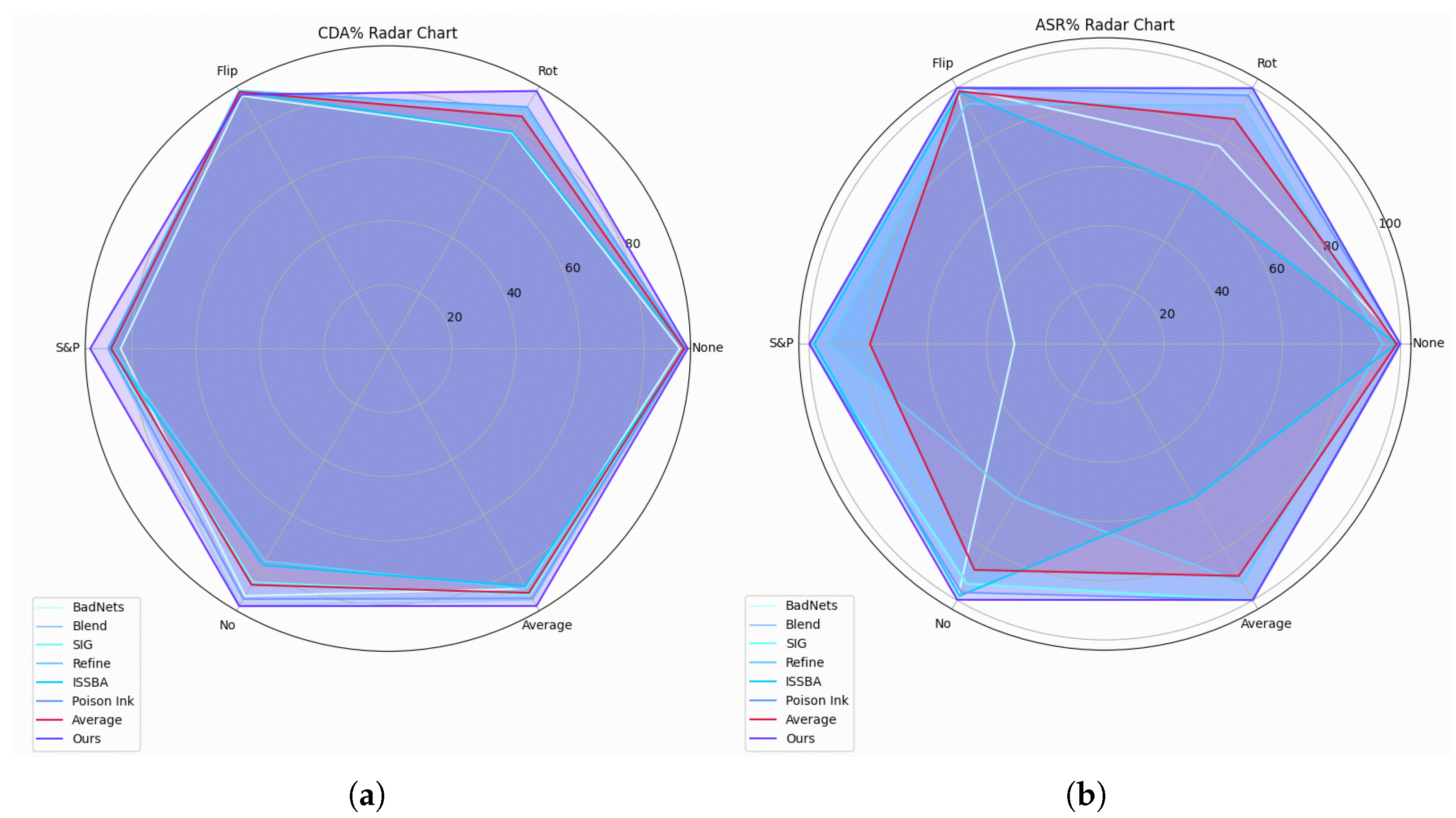
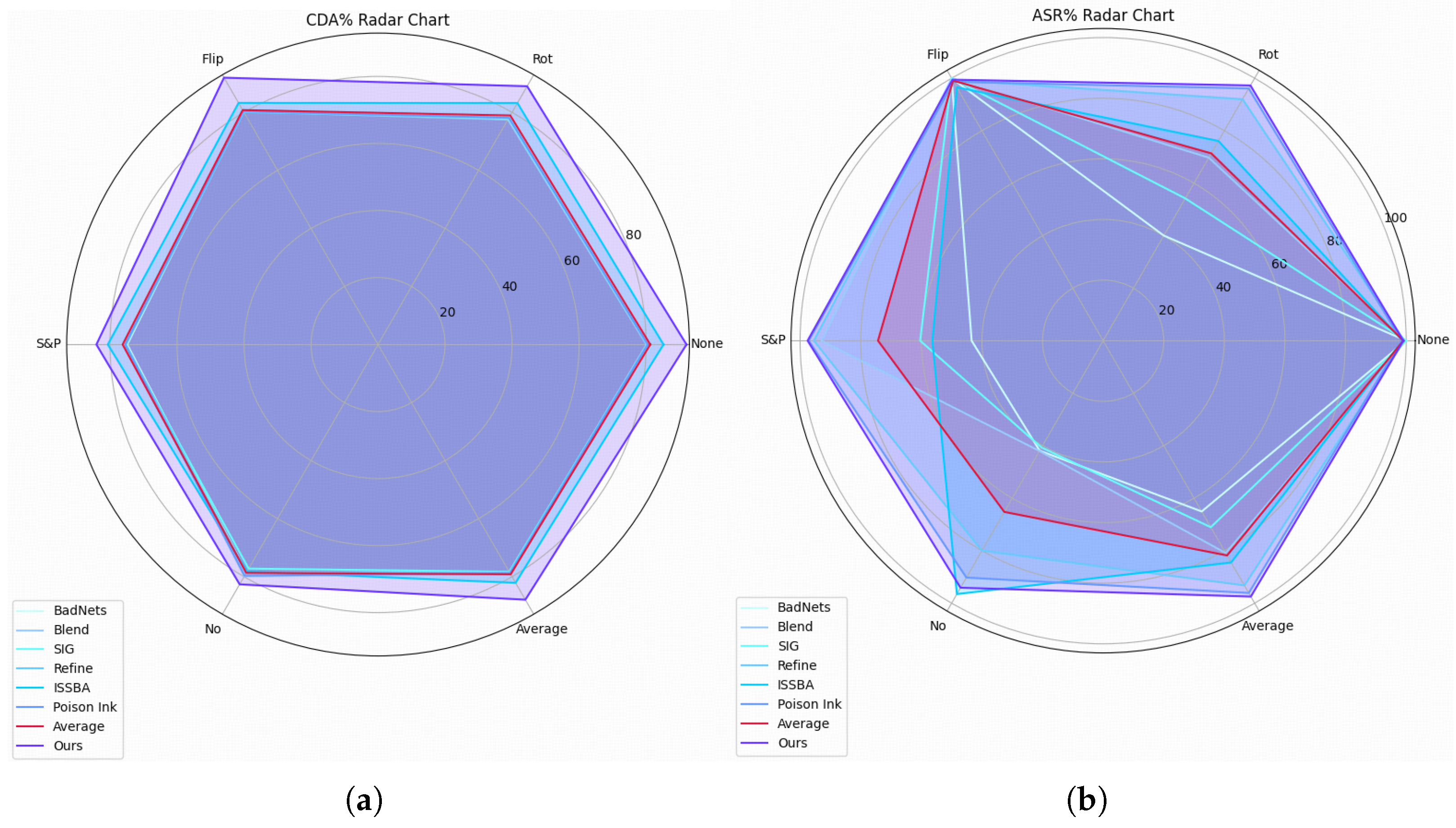
It can be observed that our method generally yields the best outcomes after data transformation operations. Even where it does not achieve the top performance, it still maintains a high standard. Overall, our method achieves an average CDA of 92.82% and an average ASR of 98.87% on the CIFAR-10 dataset, and an average CDA of 87.93% and an average ASR of 97.48% on the ImageNet dataset. Compared to other baseline methods, our results are more outstanding. Figure 3 and Figure 4 present the comparison of our method with other methods using radar charts, which intuitively demonstrate the robustness of our results. Our method exhibits almost complete superiority over other methods in terms of CDA scores on both datasets. Although ASR fluctuates slightly after different transformation treatments, it still maintains the shape of a hexagon. Additionally, we calculate the average values of each baseline method under the conditions of None, Rot, Flip, S&P and Average. It is evident that our results consistently surpass the average values of the baseline methods across all conditions, demonstrating the superior attack performance and robustness of our approach. After some data transformation operations, the triggers of some backdoor attack methods will be affected, leading to a decline in attack performance. However, since Ditto places the trigger at the edge of the image, without affecting the integrity of the image, after most data transformation operations, some toxic information will still be noticed by the deep neural network, so it can still carry out effective attacks.
Figure 3.
The attack performance of different attack methods on the CIFAR-10 dataset and the data radar map comparison of different data transformations. (The red portion represents the average values of the baseline method under various conditions. (a) is CDA, (b) is ASR).
Figure 4.
The attack performance of different attack methods on the ImageNet dataset and the data radar map comparison of different data transformations. (The red portion represents the average values of the baseline method under various conditions. (a) is CDA, (b) is ASR).
4.3. Compared with Other Emerging Invisible Backdoor Attacks
To further demonstrate the superiority of our method, we deliberately select several methods for invisible backdoor attacks proposed within the last one or two years for comparison. Among these, Dong et al. [21] introduced NNSDB, which employed deep learning techniques to dynamically embed hidden data within clean samples, thereby executing backdoor attacks. Gao et al. [46] presented the notion of dual backdoor attacks, which considered the imperceptibility of the trigger in both the spatial and frequency domains. Gao et al. [19] proposed a sparse invisible backdoor attack method to enhance stealthiness. Wang et al. [20] embedded a learnable watermark in the latent domain of images as the trigger. To ensure consistency, we uniformly choose the CIFAR-10 dataset and ResNet as the training model for result comparison.
As shown in Table 8, our three stealthiness evaluation metrics outperform the other four methods, indicating that the stealthiness of our method is the best. In terms of attack performance, although our CDA and ASR are not the highest, the difference between our results and the best results is not significant, all within 1%. Considering that the backdoor attack process may encounter overfitting during training, the attack performance of our method is acceptable. Among them, NNSDB shares similarities with our method in dynamically generating triggers. However, its ultimate level of stealth and attack performance is below that of Ditto. This discrepancy may be due to the broader scope of trigger application of NNSDB, which affects the entire image, likely reducing its stealthiness. Furthermore, comprehensive trigger coverage in NNSDB might introduce global noise, while Ditto confines the trigger to the image boundary regions. Since feature extraction networks are particularly sensitive to edge information, they are more likely to capture the characteristics of the trigger embedded by Ditto.
Table 8.
Comparison of emerging invisible backdoor attack methods. (Bold indicates the best result).
To further demonstrate the robustness of our method, we select the same data augmentation operations as in SPY-WATERMARK [20] to compare CDA and ASR, shown in Table 9. We use random masks to obscure a quarter of the area in the poisoned images. Compared to SPY-WATERMARK, our method yield better results under random masking, with both the average CDA and ASR scores being superior. This phenomenon occurs because the triggers generated by GANs have slight textural differences from the original images. These subtle differences are regarded as poisoned information and are learned by the deep neural network. Even if one-fourth of the area is randomly occluded, some poisoned information still remains.
Table 9.
Comparison with SPY-WATERMARK (Bold indicates the best result, RM is random masking).
4.4. The Performance of Ditto on Other Models and Datasets
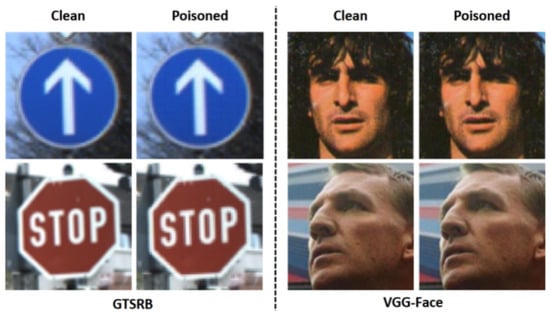
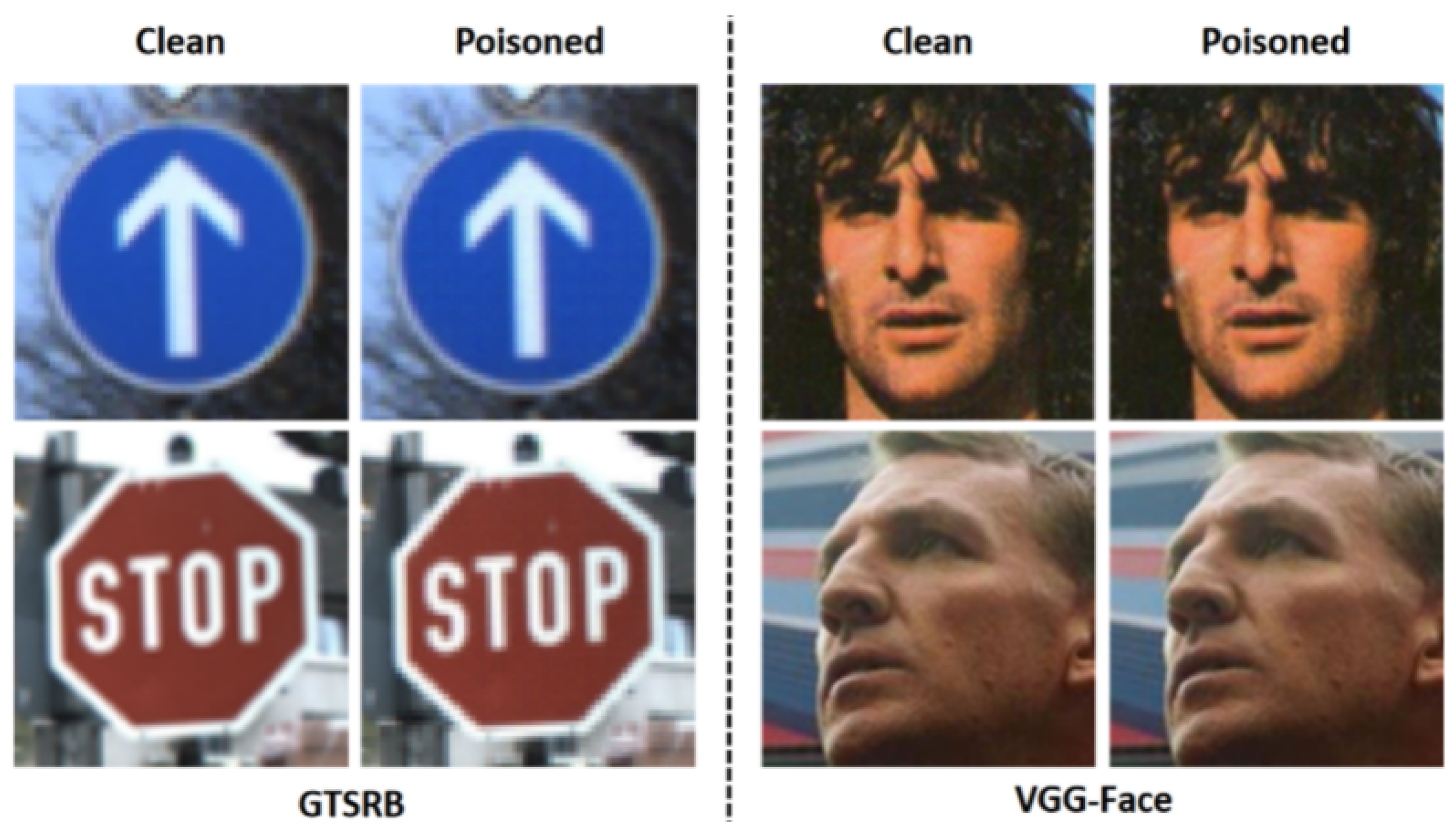
To showcase the adaptability and scalability of our approach, we undertake a series of experiments across various datasets and training models. Specifically, we conduct experiments on the GTSRB and VGG-Face datasets. Figure 5 illustrates the distinctions between clean and poisoned images following the insertion of triggers. Additionally, Table 10 details the attack efficacy and stealth metrics of our method when applied to these datasets.
Figure 5.
Visual comparison of clean images and images poisoned on GTSRB and VGG-Face.
Table 10.
Attack performance and stealthiness metrics on the GTSRB and VGG-Face datasets.
In addition, we utilize other network architectures for model training. Table 11 displays the attack performance results of our method on the ResNet-18, ResNeXt, VGG-19 and RepVGG network architectures. During the training process, we introduce an early stopping mechanism to prevent overfitting, where the training would cease if the loss rate does not decrease after 30 epochs. For training these four models, it is observed that only approximately 50 epochs are required to achieve the best results, indicating that our method yields satisfactory attack efficacy with fewer iterations.
Table 11.
Attack performance of the four network structures on the CIFAR-10 dataset.
4.5. The Resistance to Potential Backdoor Defenses
Here, we test the resilience of Ditto against both input&output-based and model-based types of backdoor defenses.
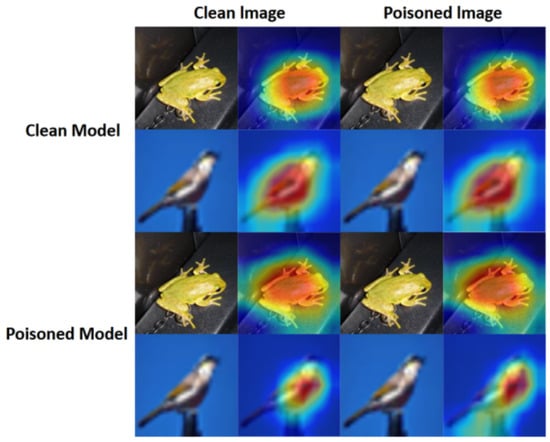
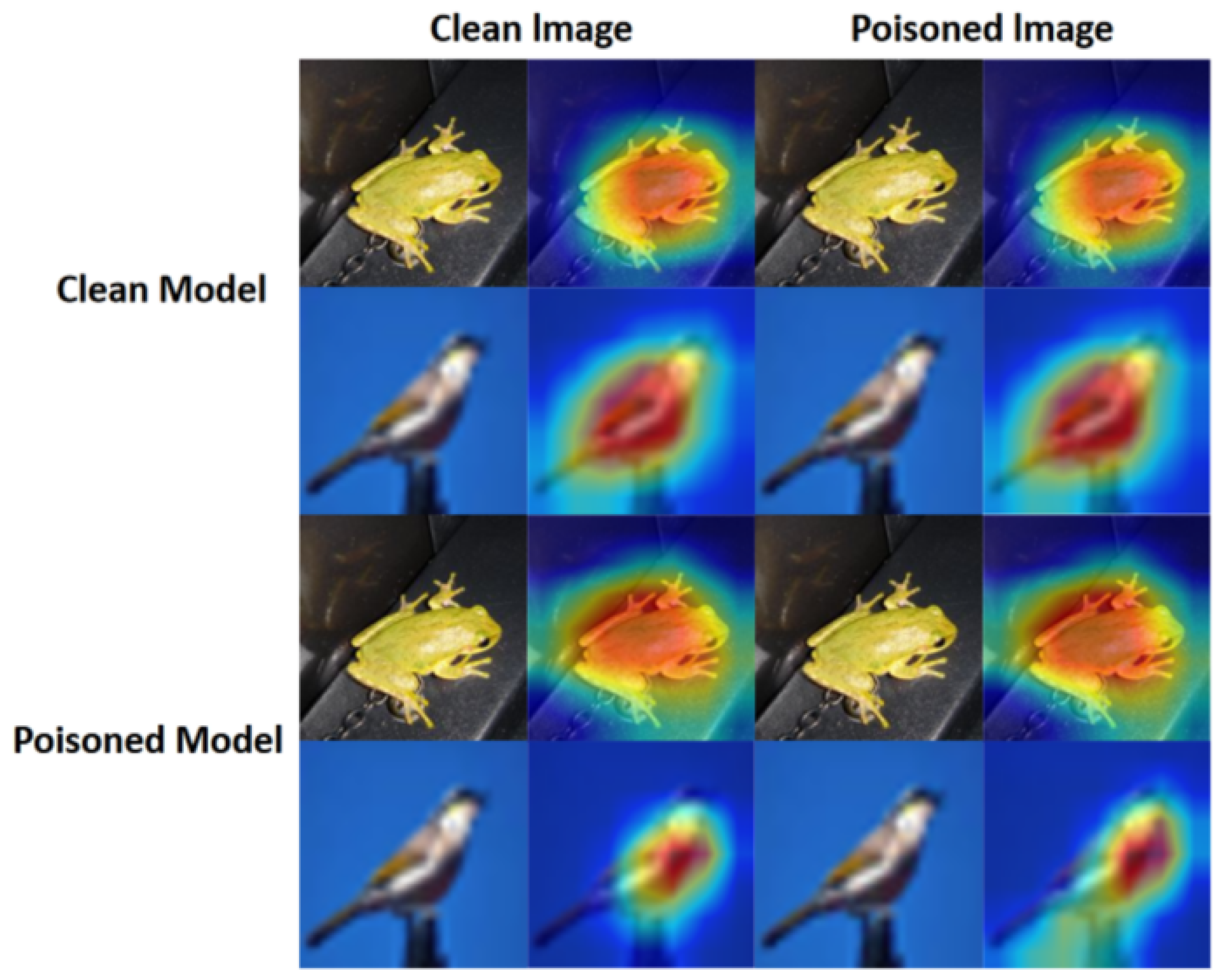
Input&output-based methods: Grad-CAM [25] produces class activation heatmaps that visually highlight the areas of the input image most influential in shaping the model’s predictions, thereby augmenting the model’s transparency and interpretability. In the context of backdoor attack defense, if the model fails to focus on the target object or consistently focuses on the same fixed area, it can be inferred that the image may have been poisoned. Figure 6 shows the attention areas of our method on both poisoned and clean models. It can be observed that the attention heatmap of the poisoned images is almost identical to that of the clean images. Since we insert the triggers at the edges of the images, similar to clean images, the model’s attention is focused on the target object.
Figure 6.
Comparison of Grad-CAM heatmap images for poisoned and clean images on clean and poisoned models.
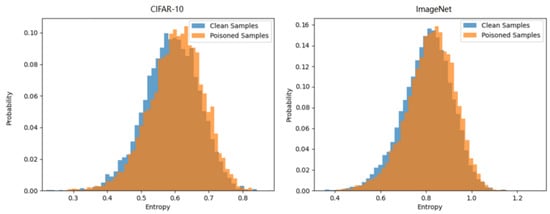
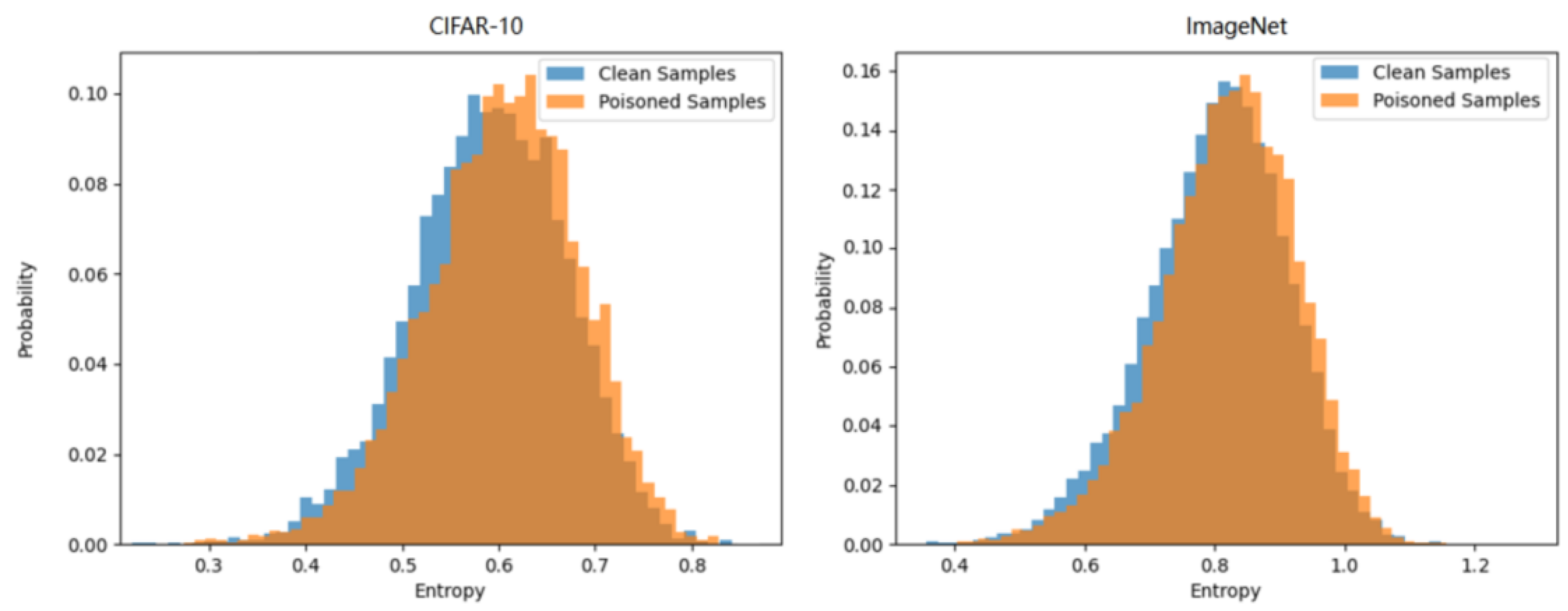
Subsequently, we test our method using STRIP [24]. STRIP perturbs a given test image by superimposing various images and then checks the entropy of the model’s predictions. Generally, the entropy of poisoned images is much lower than that of clean images after such perturbations. As shown in Figure 7, the entropy values of the poisoned images generated by our method are intermingled with those of the clean images, suggesting that our method can effectively resist STRIP detection.
Figure 7.
Visualization of STRIP results, with the left side showing the CIFAR-10 dataset and the right side showing the ImageNet dataset.
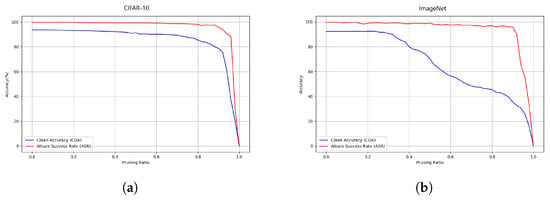
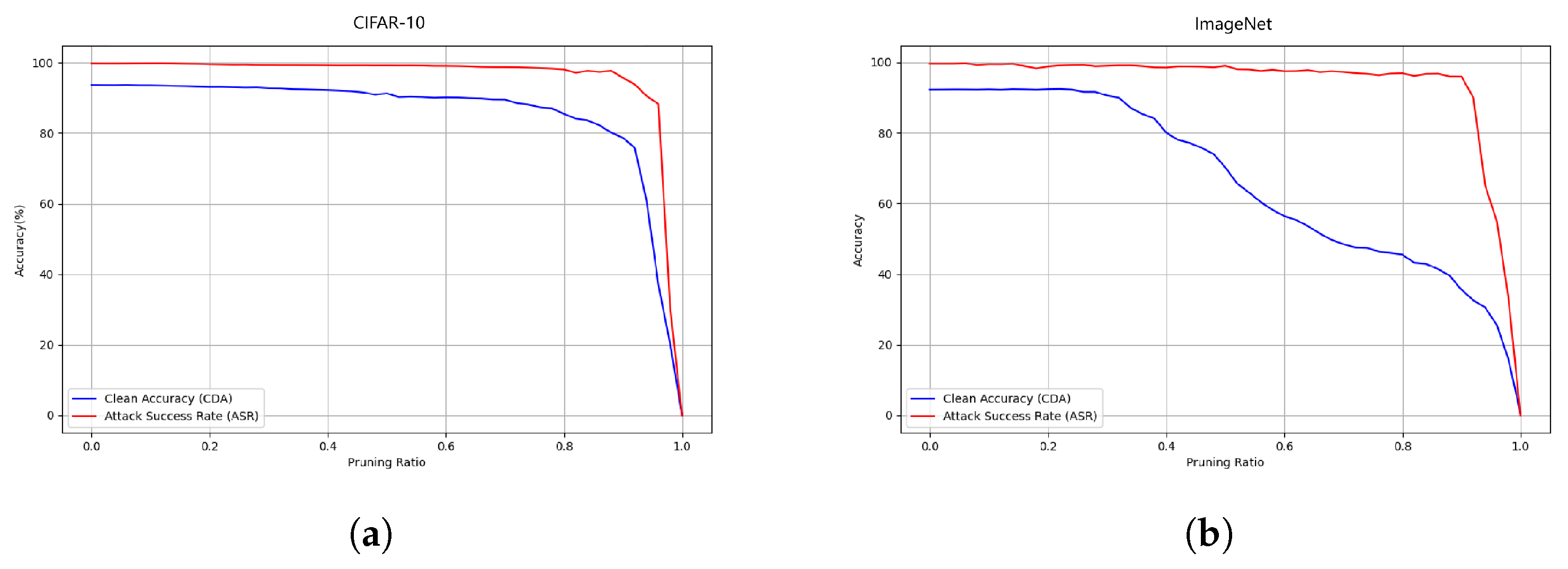
Model-based methods: For model-based backdoor defense methods, we first attempt the Fine-Pruning method [28]. As shown in Figure 8, on the CIFAR-10 dataset, even with a pruning rate as high as 90%, our CDA and ASR maintain a high level. On the ImageNet dataset, the decrease in CDA is relatively gradual, and the ASR maintains an attack success rate of over 90% before the steep decline, indicating that it still preserves good attack effectiveness.
Figure 8.
Visualization of Fine-Pruning results, with (a) showing the CIFAR-10 dataset and (b) showing the ImageNet dataset.
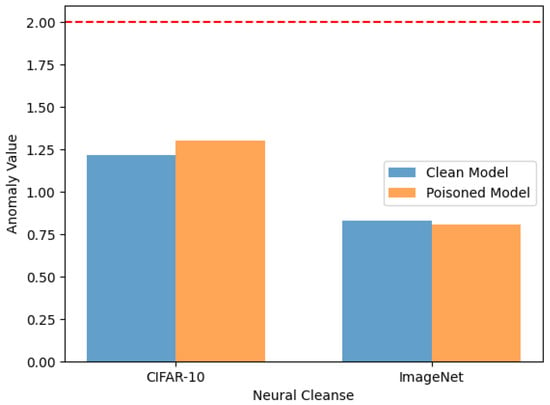
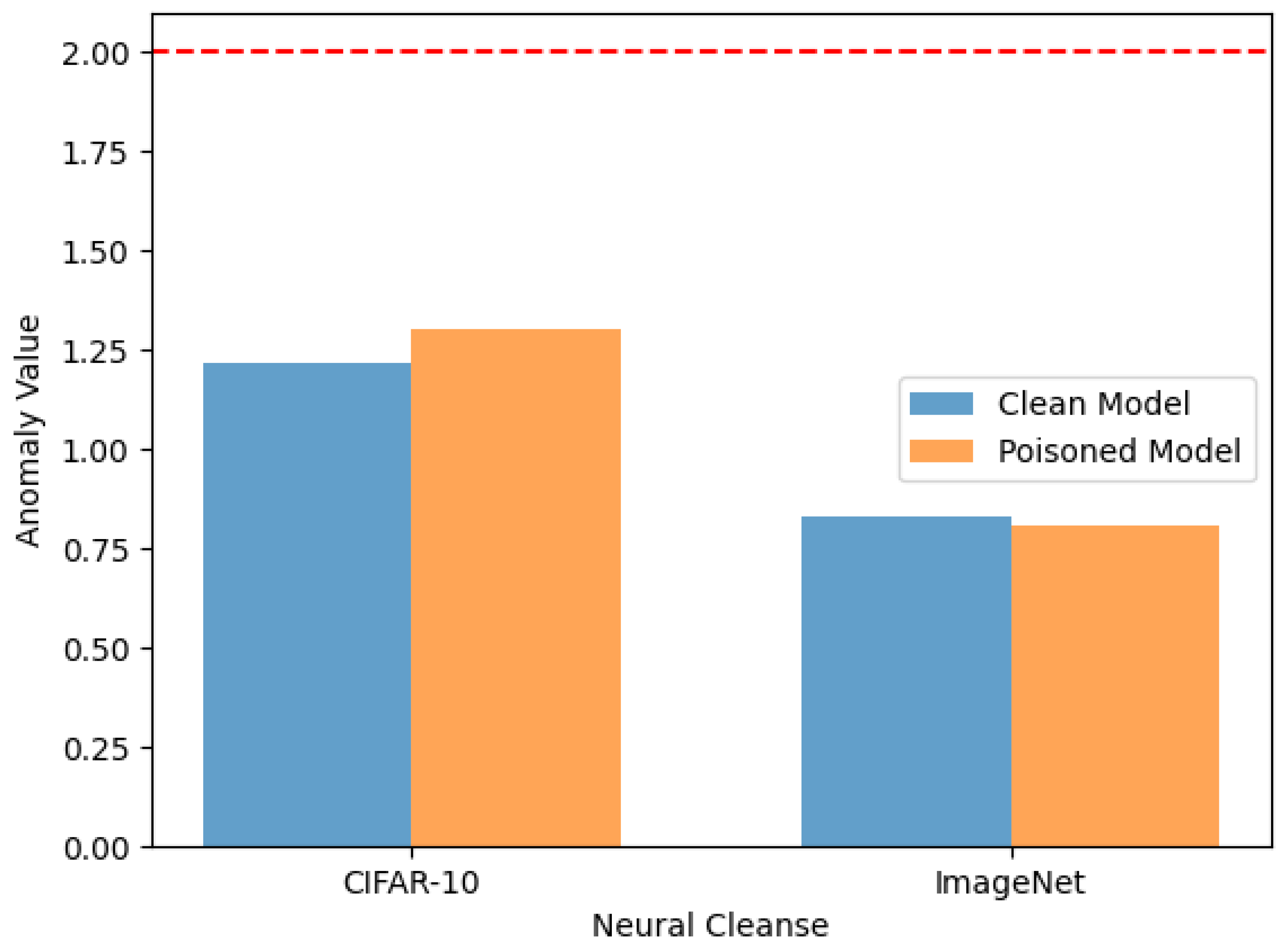
Subsequently, we conduct experiments with the Neural Cleanse [29] method. Firstly, we perform the inversion operation on the potential triggers of the suspicious model and collect the norm values of the optimized triggers associated with each target label. Following this, we calculate the median absolute deviation of this group of data and the anomaly index for each label. If the anomaly index for a particular label exceeds the set threshold, the model is deemed to have a backdoor. In this case, we set the threshold to 2. Any values exceeding this threshold would be identified as a poisoned model. Our backdoored models have anomaly indices below the threshold on both the CIFAR-10 and ImageNet datasets, as shown in Figure 9.
Figure 9.
Comparison of clean and poisoned models on different datasets under the defense of Neural Cleanse for backdoor attacks. The red dashed line represents the threshold we set, which is 2.
4.6. Ablation Study
To individually investigate the impact of various components on the overall results, we design several ablation experiments.
Impact of poisoning ratio: The experiments are conducted on the CIFAR-10 dataset, selecting poisoning ratios of 10%, 5%, and 1%. For comparison, we choose some baseline experiments. As shown in Table 12, our method outperforms other results in terms of CDA and ASR at all three ratios, indicating that the model can effectively extract the trigger’s features and correctly activate the backdoor pattern. This demonstrates that our method can also achieve considerable attack effectiveness through low-ratio poisoning.
Table 12.
Comparison of attack performance across different poisoning ratios for various methods (Bold indicates the best result, RM is random masking).
Impact of Parameters: To control the stealthiness and perturbation level of the generated triggers, we introduced two parameters, and , as defined in Equations (6) and (8). Here, we conduct an ablation study to evaluate their impact on both stealthiness and attack performance.
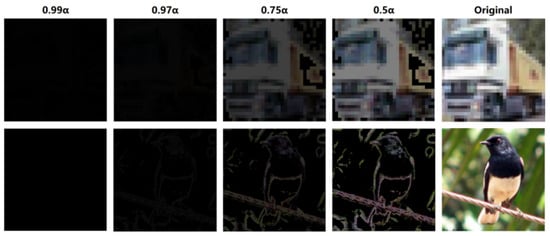
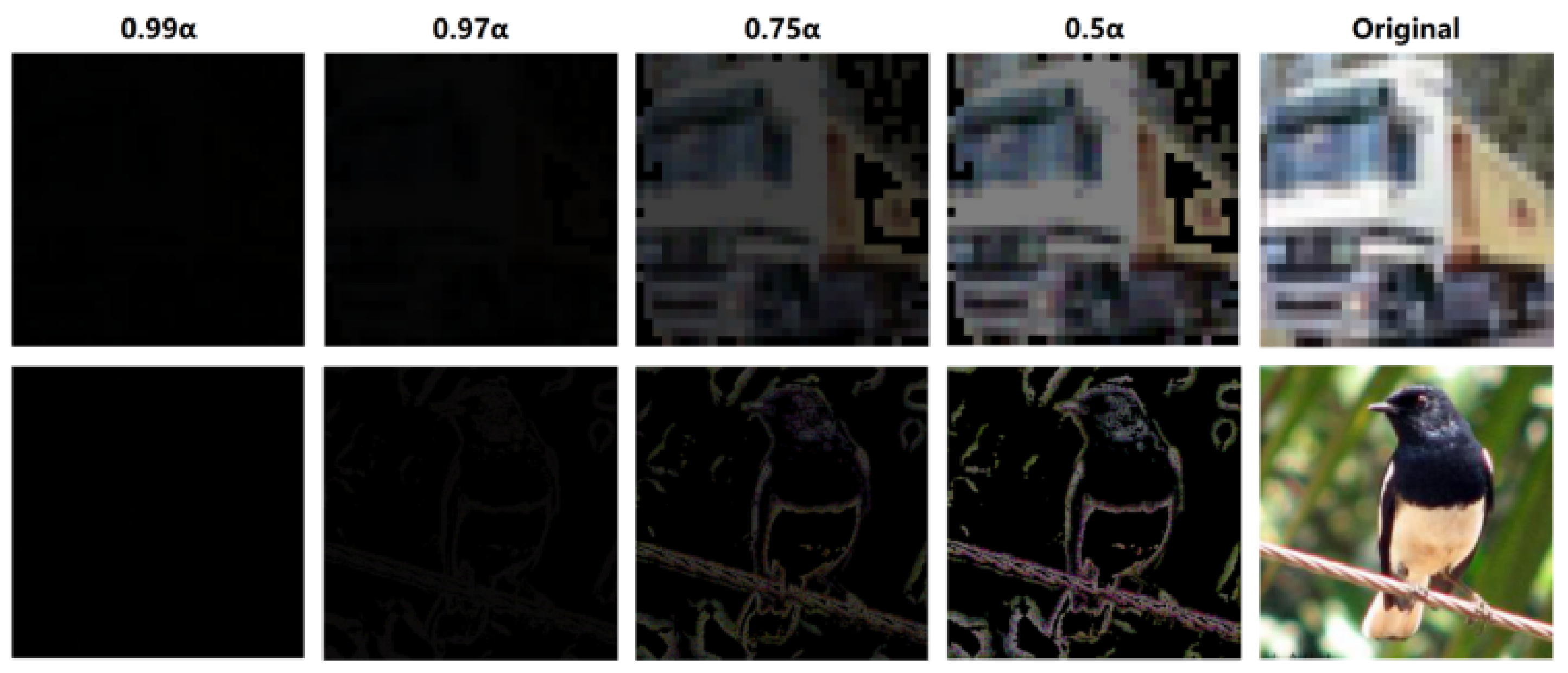
Analysis of : We first investigate the effect of the transparency parameter by comparing values of 0.99, 0.97, 0.75, 0.50, and 0.25. As shown in Table 13 and Figure 10, a higher value results in significantly better stealthiness. Specifically, when , the trigger achieves the highest PSNR 43.19 and SSIM 0.9979, and the lowest LPIPS 0.0001, making it almost imperceptible to the human eye. As decreases, the visual quality metrics degrade rapidly; for instance, at , PSNR drops to 17.19 dB and LPIPS increases to 0.1580, indicating a visible and disruptive trigger. Notably, while the stealthiness degrades with lower , the attack success rate (ASR) remains consistently high—above 99.85%—across all settings, demonstrating the robustness of our attack, even with highly visible triggers.
Table 13.
Comparison of stealthiness metrics under different parameters.
Figure 10.
Comparison of trigger patterns under different parameters (here, is set to 0.99, 0.97, 0.75, and 0.5, from left to right).
Analysis of : We examine the impact of the texture strength parameter by evaluating values of 1, 2, 3, 5, and 10. The results indicate that plays a crucial role in balancing attack effectiveness and stealthiness. When , the stealthiness is high (PSNR = 45.74 dB), but the attack performance is suboptimal, with CDA at 83.19% and ASR at only 90.21%. This suggests that a weak texture is insufficient to effectively backdoor the model. As increases to 2, the ASR sharply rises to 99.77% while maintaining excellent stealthiness: PSNR = 43.19 dB, LPIPS = 0.0001. However, further increasing beyond 2 leads to a trade-off: while ASR remains high above 99.9%, the stealthiness metrics degrade. For example, at , PSNR drops to 31.99 dB and LPIPS increases to 0.048, making the trigger more noticeable. This shows that an excessively strong texture introduces more perturbation, compromising the trigger’s invisibility.
Validation of Realistic Threat Model—Standard Closed-Set All-to-One Attack: In the previous experiments, we designated a new, unseen label (“cat poison”) as the target class to initially validate the generation capabilities of the triggers. To address potential concerns regarding task simplification from introducing an unseen target class, we further validate Ditto under a more rigorous and realistic Standard Closed-Set All-to-One Attack setting. In this setup, the model is trained strictly on the original dataset without adding new classes (default selection of the first class in the dataset), forcing any poisoned sample to be misclassified into an existing target class. This accurately reflects real-world attack scenarios and verifies that our triggers can robustly override pre-existing semantic features rather than merely exploiting out-of-distribution boundaries.
We evaluate this strict setting across both CIFAR-10 and ImageNet using ResNet-18 and VGG-19. The results are presented in Table 14.
Table 14.
Ditto’s performance in the All-to-One scene.
As shown in Table 14, Ditto demonstrates highly competitive performance, even under the significantly more challenging Closed-Set All-to-One scenario. Although the attack performance indicators have slightly decreased, they still maintain a high level. The fact that ASR remains above 97% across all settings proves that the boundary-texture triggers generated by Ditto are sufficiently prominent in the feature space to successfully hijack the model’s decision logic. Secondly, the minimal drop in Clean Data Accuracy highlights the non-intrusiveness of our method. Our CDA remains exceptionally high. Finally, the stealthiness metrics remain completely uncompromised.
Impact of Trigger Location: To validate the effectiveness of our boundary mask design, we conduct ablation experiments, comparing different trigger insertion locations while keeping the trigger generation method and parameters and . In addition to our proposed boundary mask, we design some baseline masks: a “Random Mask”, a “Global Mask” (applying the trigger uniformly across the entire image), and a “Center Block Mask” (a circular area of size 8 × 8, fixed in the middle of the image).
As shown in Table 15, our method significantly outperforms the Random Mask in both attack performance and stealthiness. Specifically, the ASR drops by approximately 4.21% when moving the mask from the boundary to random areas, and the CDA also decreases by about 4.07%. This is because deep neural networks are highly sensitive to high-frequency edge information; masks placed in random regions lack sufficient semantic weight and are more susceptible to being ignored by feature extractors. Furthermore, compared to the Global Mask and Center Block Mask, our method achieves significantly higher PSNR and SSIM with almost identical ASR. This demonstrates that strictly confining the trigger to the boundary texture regions maximizes stealthiness without sacrificing attack efficacy, effectively avoiding the visual artifacts caused by global perturbations.
Table 15.
Ablation study on trigger location using CIFAR-10 and ResNet-18.
5. Limitations and Failure Cases
While Ditto demonstrates superior stealth and robustness in most scenarios, we acknowledge several limitations and specific failure modes that are crucial for a comprehensive understanding of the method.
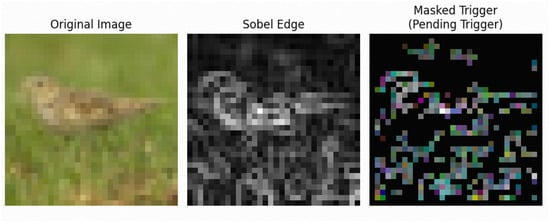
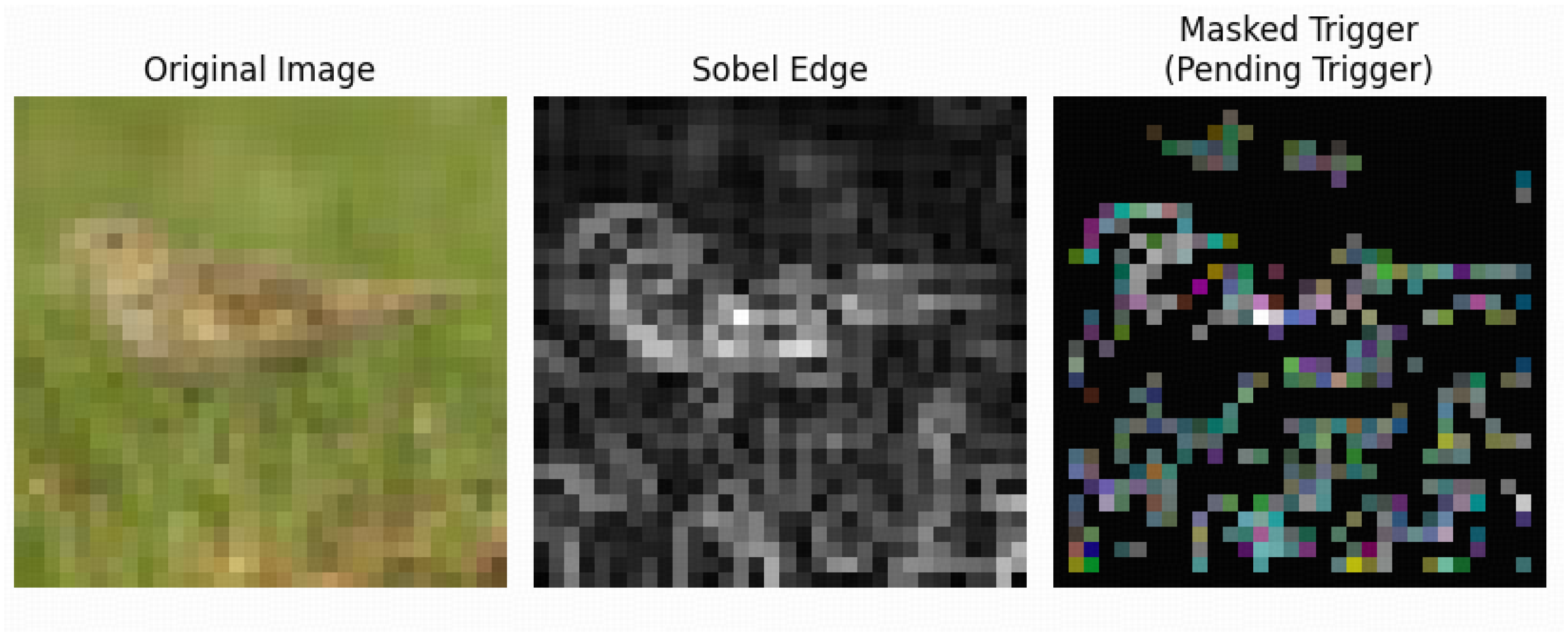
Dependency on Texture Richness: On low resolution datasets, the effectiveness of Ditto is contingent on the texture complexity of the host image. As shown in Figure 11, in our experiments, we have observed that, for images having extremely smooth backgrounds or lacking distinct edge features, the Sobel operator struggles to accurately delineate object boundaries, which fails to effectively constrain the trigger to the perceptually insensitive edge regions, thereby compromising the spatial stealthiness of the insertion. Furthermore, since the GAN generator operates in a decoupled manner to synthesize a full-image trigger based on the input image’s texture distribution, the lack of high-frequency textural information in smooth backgrounds deprives the generator of valid reference features. Consequently, the generator cannot produce context-coherent textures, often defaulting to generic noise-like patterns that deviate from the natural image statistics. This dual failure in both spatial masking and textural synthesis ultimately leads to a decrease in the overall concealment level of the trigger.
Figure 11.
Ditto’s limitations on partial images in low-resolution datasets (Pending Trigger is the trigger image to be processed).
Computational Cost and Stability: A notable limitation lies in the training dynamics of the GAN framework. Processing large-scale datasets requires a substantial number of training epochs, leading to significant computational overhead and extended training times. Furthermore, we have observed that the generation of trigger images exhibits a degree of instability: the quality and effectiveness of the triggers can fluctuate across different training runs. Addressing this instability and optimizing the training efficiency remain key directions for our future work.
Architectural Scalability Constraints: A significant limitation inherent in the current Ditto framework is the lack of a universal network architecture, necessitating manual architectural re-design when transitioning between datasets of varying resolutions and complexities. As evidenced in our implementation (Table 2 and Table 3), the generator and discriminator networks exhibit a rigid dependency on specific data characteristics. For instance, the architecture deployed on the high-resolution ImageNet dataset requires additional Convolutional and ConvTranspose2d layers to handle the spatial dimensions (224 × 224) and feature depth, whereas the CIFAR-10 implementation utilizes a much shallower structure tailored for 32 × 32 pixels. This disparity indicates that the model cannot autonomously adapt to new data distributions without human intervention to adjust the network topology (e.g., kernel sizes, stride configurations, or layer depths). Consequently, this architectural inflexibility poses a substantial scalability bottleneck, as deploying Ditto on arbitrary new datasets requires non-trivial engineering effort to redesign the GAN structure, limiting its extensibility as a “one-size-fits-all” backdoor attack solution.
6. Conclusions
In this paper, we examine the limitations of existing approaches and introduce a new backdoor attack technique termed Ditto. Specifically, we first employ boundary detection algorithms and padding algorithms to determine the insertion position of the trigger. Then, we dynamically generate the trigger using adversarial neural networks, taking into account the characteristics of the images. Finally, we apply the trigger to the images and adjust its level of stealth. Our method considers both the attack efficacy and stealthiness, resulting in significant improvements in both aspects. Moreover, our method demonstrates good performance in robustness, generalizability, and resistance to backdoor defenses.
Based on the current limitations, we outline several promising directions for future research:
Scalable Architectures and Training Efficiency: The current implementation suffers from architectural rigidity and high computational costs. Future work will focus on two key aspects: firstly, developing scalable GAN architectures that can automatically adapt to different data distributions without manual re-design; secondly, optimizing the training pipeline to enable the efficient processing of large-scale datasets. This includes exploring lightweight generator networks and distributed training strategies to significantly reduce the time and resources required for trigger generation.
Adaptive Frequency-Domain Attacks: Current work primarily operates in the spatial domain. Future work will focus on extending Ditto into the frequency domain (e.g., DCT or Wavelet domains). By embedding triggers in specific frequency components, we aim to further enhance robustness against compression and noise attacks, which are common in real-world image transmission.
Systematic Evaluation Against Advanced Defenses: While our current experiments validate the attack against several baseline defenses, future work will conduct a comprehensive benchmarking study. We will rigorously evaluate the resilience of Ditto against state-of-the-art backdoor defense strategies to systematically analyze the attack’s resistance and identify potential failure modes under sophisticated defensive scrutiny.
Automated Parameter Optimization: To mitigate the parameter sensitivity issue, we plan to investigate Reinforcement Learning-based controllers that can automatically adjust and based on the input image’s texture complexity, eliminating the need for manual tuning.
Author Contributions
W.Z.: Writing—original draft, Data curation, Methodology, Conceptualization, Writing—review and editing, Visualization. L.Z.: Conceptualization, Writing—review and editing. Y.X.: Conceptualization, Formal analysis, Writing—review and editing. P.S.: Methodology, Supervision, Writing—review and editing, Conceptualization, Formal analysis. X.H.: Methodology, Supervision, Writing—review and editing. All authors have read and agreed to the published version of the manuscript.
Funding
This research was funded by the National Key R&D Program of China grant number No. 2023YFC3805700.
Informed Consent Statement
Informed consent was obtained from all subjects involved in the study.
Data Availability Statement
The data presented in this study are available in the article. Further information can be obtained from the corresponding author upon request.
Conflicts of Interest
The authors declare no conflicts of interest.
References
- Chen, X.; Liu, C.; Li, B.; Lu, K.; Song, D. Targeted backdoor attacks on deep learning systems using data poisoning. arXiv 2017, arXiv:1712.05526. [Google Scholar] [CrossRef] [Scilit]
- Tang, Y.; Xu, X.; Sun, L. Acoustic backdoor attacks on speech recognition via frequency offset perturbation. Appl. Soft Comput. 2025, 177, 113188. [Google Scholar] [CrossRef] [Scilit]
- Zhang, Y.; Wang, Q.; Min, S.; Zuo, R.; Huang, F.; Liu, H.; Yao, S. Attention-based backdoor attacks against natural language processing models. Appl. Soft Comput. 2025, 173, 112907. [Google Scholar] [CrossRef] [Scilit]
- Duan, R.; Ma, X.; Wang, Y.; James, B.; Qin, A.K.; Yang, Y. Adversarial Camouflage: Hiding Physical-World Attacks with Natural Styles. arXiv 2020, arXiv:2003.08757. [Google Scholar] [CrossRef] [Scilit]
- Dong, Y.; Liao, F.; Pang, T.; Su, H.; Zhu, J.; Hu, X.; Li, J. Boosting adversarial attacks with momentum. In Proceedings of the IEEE Conference on Computer Vision and Pattern Recognition, Salt Lake City, UT, USA, 18–23 June 2018; pp. 9185–9193. [Google Scholar]
- Shafahi, A.; Huang, W.R.; Najibi, M.; Suciu, O.; Studer, C.; Dumitras, T.; Goldstein, T. Poison frogs! targeted clean-label poisoning attacks on neural networks. In Proceedings of the Advances in Neural Information Processing Systems (NeurIPS 2018), Montréal, QC, Canada, 3–8 December 2018; Volume 31. [Google Scholar]
- Jagielski, M.; Oprea, A.; Biggio, B.; Liu, C.; Nita-Rotaru, C.; Li, B. Manipulating machine learning: Poisoning attacks and countermeasures for regression learning. In Proceedings of the 2018 IEEE Symposium on Security and Privacy (SP), San Francisco, CA, USA, 21–23 May 2018; pp. 19–35. [Google Scholar]
- Rakin, A.S.; He, Z.; Fan, D. Tbt: Targeted neural network attack with bit trojan. In Proceedings of the IEEE/CVF Conference on Computer Vision and Pattern Recognition, Seattle, WA, USA, 13–19 June 2020; pp. 13198–13207. [Google Scholar]
- Gu, T.; Liu, K.; Dolan-Gavitt, B.; Garg, S. Badnets: Evaluating backdooring attacks on deep neural networks. IEEE Access 2019, 7, 47230–47244. [Google Scholar] [CrossRef] [Scilit]
- Zhang, J.; Dongdong, C.; Huang, Q.; Liao, J.; Zhang, W.; Feng, H.; Hua, G.; Yu, N. Poison ink: Robust and invisible backdoor attack. IEEE Trans. Image Process. 2022, 31, 5691–5705. [Google Scholar] [CrossRef] [Scilit] [PubMed]
- Li, Y.; Zhai, T.; Wu, B.; Jiang, Y.; Li, Z.; Xia, S. Rethinking the trigger of backdoor attack. arXiv 2020, arXiv:2004.04692. [Google Scholar]
- Geirhos, R.; Rubisch, P.; Michaelis, C.; Bethge, M.; Wichmann, F.A.; Brendel, W. ImageNet-trained CNNs are biased towards texture; increasing shape bias improves accuracy and robustness. In Proceedings of the International Conference on Learning Representations, Vancouver, BC, Canada, 30 April–3 May 2018. [Google Scholar]
- Nguyen, A.; Tran, A. Wanet–imperceptible warping-based backdoor attack. arXiv 2021, arXiv:2102.10369. [Google Scholar]
- Liao, C.; Zhong, H.; Squicciarini, A.; Zhu, S.; Miller, D. Backdoor embedding in convolutional neural network models via invisible perturbation. arXiv 2018, arXiv:1808.10307. [Google Scholar] [CrossRef] [Scilit]
- Moosavi-Dezfooli, S.M.; Fawzi, A.; Fawzi, O.; Frossard, P. Universal adversarial perturbations. In Proceedings of the IEEE Conference on Computer Vision and Pattern Recognition, Honolulu, HI, USA, 21–26 July 2017; pp. 1765–1773. [Google Scholar]
- Barni, M.; Kallas, K.; Tondi, B. A new backdoor attack in cnns by training set corruption without label poisoning. In Proceedings of the 2019 IEEE International Conference on Image Processing (ICIP), Taipei, Taiwan, 22–25 September 2019; pp. 101–105. [Google Scholar]
- Liu, Y.; Ma, X.; Bailey, J.; Lu, F. Reflection backdoor: A natural backdoor attack on deep neural networks. In Proceedings of the Computer Vision–ECCV 2020: 16th European Conference, Glasgow, UK, 23–28 August 2020; Springer: Berlin/Heidelberg, Germany, 2020; pp. 182–199. [Google Scholar]
- Li, S.; Xue, M.; Zhao, B.Z.H.; Zhu, H.; Zhang, X. Invisible backdoor attacks on deep neural networks via steganography and regularization. IEEE Trans. Dependable Secur. Comput. 2020, 18, 2088–2105. [Google Scholar] [CrossRef] [Scilit]
- Gao, Y.; Li, Y.; Gong, X.; Li, Z.; Xia, S.T.; Wang, Q. Backdoor attack with sparse and invisible trigger. IEEE Trans. Inf. Forensics Secur. 2024, 19, 6364–6376. [Google Scholar] [CrossRef] [Scilit]
- Wang, R.; Wan, R.; Guo, Z.; Guo, Q.; Huang, R. Spy-watermark: Robust invisible watermarking for backdoor attack. In Proceedings of the ICASSP 2024—2024 IEEE International Conference on Acoustics, Speech and Signal Processing (ICASSP), Seoul, Republic of Korea, 14–19 April 2024; pp. 2700–2704. [Google Scholar]
- Dong, L.; Qiu, J.; Fu, Z.; Chen, L.; Cui, X.; Shen, Z. Stealthy dynamic backdoor attack against neural networks for image classification. Appl. Soft Comput. 2023, 149, 110993. [Google Scholar] [CrossRef] [Scilit]
- Chen, X.; Li, M.; Sun, Y.; Tian, Z. Invisible trigger image: A dynamic neural backdoor attack based on hidden feature. Neurocomputing 2025, 639, 130296. [Google Scholar] [CrossRef] [Scilit]
- Wang, Q.; Yin, C.; Fang, L.; Liu, Z.; Wang, R.; Lin, C. GhostEncoder: Stealthy backdoor attacks with dynamic triggers to pre-trained encoders in self-supervised learning. Comput. Secur. 2024, 142, 103855. [Google Scholar] [CrossRef] [Scilit]
- Gao, Y.; Xu, C.; Wang, D.; Chen, S.; Ranasinghe, D.C.; Nepal, S. Strip: A defence against trojan attacks on deep neural networks. In Proceedings of the 35th Annual Computer Security Applications Conference, San Juan, PR, USA, 9–13 December 2019; pp. 113–125. [Google Scholar]
- Selvaraju, R.R.; Cogswell, M.; Das, A.; Vedantam, R.; Parikh, D.; Batra, D. Grad-cam: Visual explanations from deep networks via gradient-based localization. In Proceedings of the IEEE International Conference on Computer Vision, Venice, Italy, 22–29 October 2017; pp. 618–626. [Google Scholar]
- Chou, E.; Tramer, F.; Pellegrino, G. Sentinet: Detecting localized universal attacks against deep learning systems. In Proceedings of the 2020 IEEE Security and Privacy Workshops (SPW), Virtual, 21 May 2020; pp. 48–54. [Google Scholar]
- Borgnia, E.; Cherepanova, V.; Fowl, L.; Ghiasi, A.; Geiping, J.; Goldblum, M.; Goldstein, T.; Gupta, A. Strong data augmentation sanitizes poisoning and backdoor attacks without an accuracy tradeoff. In Proceedings of the ICASSP 2021—2021 IEEE International Conference on Acoustics, Speech and Signal Processing (ICASSP), Toronto, ON, Canada, 6–11 June 2021; pp. 3855–3859. [Google Scholar]
- Liu, K.; Dolan-Gavitt, B.; Garg, S. Fine-pruning: Defending against backdooring attacks on deep neural networks. In Proceedings of the International Symposium on Research in Attacks, Intrusions, and Defenses, Crete, Greece, 10–12 September 2018; Springer: Cham, Switzerland, 2018; pp. 273–294. [Google Scholar]
- Wang, B.; Yao, Y.; Shan, S.; Li, H.; Viswanath, B.; Zheng, H.; Zhao, B.Y. Neural cleanse: Identifying and mitigating backdoor attacks in neural networks. In Proceedings of the 2019 IEEE Symposium on Security and Privacy (SP), San Francisco, CA, USA, 18–19 May 2019; pp. 707–723. [Google Scholar]
- Guo, W.; Wang, L.; Xing, X.; Du, M.; Song, D. Tabor: A highly accurate approach to inspecting and restoring trojan backdoors in ai systems. arXiv 2019, arXiv:1908.01763. [Google Scholar] [CrossRef] [Scilit]
- Li, Y.; Jiang, Y.; Li, Z.; Xia, S.T. Backdoor learning: A survey. IEEE Trans. Neural Netw. Learn. Syst. 2022, 35, 5–22. [Google Scholar] [CrossRef] [Scilit] [PubMed]
- Duda, R.O.; Hart, P.E. Pattern Classification and Scene Analysis; Wiley-Interscience Publication: Hoboken, NJ, USA, 1973. [Google Scholar]
- Krizhevsky, A.; Hinton, G. Learning Multiple Layers of Features from Tiny Images; University of Toronto: Toronto, ON, USA, 2009. [Google Scholar]
- Deng, J.; Dong, W.; Socher, R.; Li, L.J.; Li, K.; Fei-Fei, L. Imagenet: A large-scale hierarchical image database. In Proceedings of the 2009 IEEE Conference on Computer Vision and Pattern Recognition, Miami, FL, USA, 20–25 June 2009; pp. 248–255. [Google Scholar]
- Stallkamp, J.; Schlipsing, M.; Salmen, J.; Igel, C. Man vs. computer: Benchmarking machine learning algorithms for traffic sign recognition. Neural Netw. 2012, 32, 323–332. [Google Scholar] [CrossRef] [Scilit] [PubMed]
- Parkhi, O.; Vedaldi, A.; Zisserman, A. Deep face recognition. In Proceedings of the British Machine Vision Conference (BMVC), Swansea, UK, 7–10 September 2015; British Machine Vision Association: Durham, UK, 2015. [Google Scholar]
- Goodfellow, I.J.; Pouget-Abadie, J.; Mirza, M.; Xu, B.; Warde-Farley, D.; Ozair, S.; Courville, A.; Bengio, Y. Generative adversarial nets. In Proceedings of the Advances in Neural Information Processing Systems (NIPS 2014), Montréal, QC, Canada, 8–13 December 2014; Volume 27. [Google Scholar]
- He, K.; Zhang, X.; Ren, S.; Sun, J. Deep residual learning for image recognition. In Proceedings of the IEEE Conference on Computer Vision and Pattern Recognition, Las Vegas, NV, USA, 27–30 June 2016; pp. 770–778. [Google Scholar]
- Xie, S.; Girshick, R.; Dollár, P.; Tu, Z.; He, K. Aggregated residual transformations for deep neural networks. In Proceedings of the IEEE Conference on Computer Vision and Pattern Recognition, Honolulu, HI, USA, 21–26 July 2017; pp. 1492–1500. [Google Scholar]
- Simonyan, K.; Zisserman, A. Very deep convolutional networks for large-scale image recognition. arXiv 2014, arXiv:1409.1556. [Google Scholar]
- Ding, X.; Zhang, X.; Ma, N.; Han, J.; Ding, G.; Sun, J. Repvgg: Making vgg-style convnets great again. In Proceedings of the IEEE/CVF Conference on Computer Vision and Pattern Recognition, Nashville, TN, USA, 20–25 June 2021; pp. 13733–13742. [Google Scholar]
- Tanchenko, A. Visual-PSNR measure of image quality. J. Vis. Commun. Image Represent. 2014, 25, 874–878. [Google Scholar] [CrossRef] [Scilit]
- Hore, A.; Ziou, D. Image quality metrics: PSNR vs. SSIM. In Proceedings of the 2010 20th International Conference on Pattern Recognition, Istanbul, Turkey, 23–26 August 2010; pp. 2366–2369. [Google Scholar]
- Zhang, R.; Isola, P.; Efros, A.A.; Shechtman, E.; Wang, O. The unreasonable effectiveness of deep features as a perceptual metric. In Proceedings of the IEEE Conference on Computer Vision and Pattern Recognition, Salt Lake City, UT, USA, 18–23 June 2018; pp. 586–595. [Google Scholar]
- Li, Y.; Li, Y.; Wu, B.; Li, L.; He, R.; Lyu, S. Invisible backdoor attack with sample-specific triggers. In Proceedings of the IEEE/CVF International Conference on Computer Vision, Montreal, BC, Canada, 11–17 October 2021; pp. 16463–16472. [Google Scholar]
- Gao, Y.; Chen, H.; Sun, P.; Li, J.; Zhang, A.; Wang, Z.; Liu, W. A dual stealthy backdoor: From both spatial and frequency perspectives. In Proceedings of the AAAI Conference on Artificial Intelligence, Vancouver, BC, Canada, 20–27 February 2024; Volume 38, pp. 1851–1859. [Google Scholar]

Disclaimer/Publisher’s Note: The statements, opinions and data contained in all publications are solely those of the individual author(s) and contributor(s) and not of MDPI and/or the editor(s). MDPI and/or the editor(s) disclaim responsibility for any injury to people or property resulting from any ideas, methods, instructions or products referred to in the content. |
© 2026 by the authors. Licensee MDPI, Basel, Switzerland. This article is an open access article distributed under the terms and conditions of the Creative Commons Attribution (CC BY) license.