


Abstract
Bundle recommendation has gained significant attention, but it faces two key challenges: sparse interaction data and complex UB, UI, and BI relations. Recent work uses multi-view contrastive learning, yet current frameworks rely on fixed-weight fusion that ignores view-specific importance and suffers from gradient suppression on sparse data. We propose TriadCBR, a tri-view adaptive contrastive learning architecture for bundle recommendation. It uses a simplified GCN to learn view-specific representations and a Mixture-of-Experts (MoE) module to generate personalized fusion weights, addressing the limitations of fixed-weight fusion. TriadCBR further incorporates a fine-grained contrastive module integrating InfoNCE, DCL, and Barlow Twins. This combination effectively mitigates gradient vanishing from invalid negatives and minimizes cross-view feature redundancy. To handle data sparsity, we design a Difficulty-Aware BPR (DA-BPR) with curriculum augmentation to dynamically refine the ranking trajectory. Extensive experiments on Youshu, iFashion, and NetEase demonstrate that TriadCBR achieves statistically significant improvements, boosting Recall and NDCG by an average of 3.61%, with 9 of 12 metric–dataset combinations reaching statistical significance, over state-of-the-art baselines, validating the robustness of its dynamic fusion and adaptive optimization.
1. Introduction
Bundled recommendations refer to aggregating related items to meet users’ comprehensive needs and increase average order value [1]. Starting from matrix factorization [2], this field has evolved into complex deep learning architectures [3]. Contemporary research utilizes graph neural networks (GCNs) to depict higher-order connectivity in the user-bundle-item tripartite graph [4]. Multi-view GNNs are specifically employed to disentangle heterogeneous interactions, mapping complex relational structures into separate, dedicated latent spaces. However, modeling bundle recommendations using GNNs faces inherent challenges. Furthermore, while some recent studies have successfully implemented fuzzy-based models to handle the inherent uncertainty and ambiguity in user decision-making processes [5], deterministic multi-view GNNs remain the mainstream approach. Nevertheless, these GNN-based methods still have limitations, particularly when dealing with data sparsity. Several models based on multi-view frameworks, such as BGCN [6] and MultiCBR [7], have effectively characterized user-item (UI), user-bundle (UB), and bundle-item (BI) interactions. However, these methods still have limitations. First, current mainstream multi-view fusion mechanisms, such as MultiCBR, generally use static weights to synthesize representations. This static fusion approach often struggles to adequately capture dynamic user preferences stemming from the consistency of the global bundle (UB view) or specific component elements (UI/BI view) across varying contexts. Secondly, gradient saturation and feature redundancy in sparse datasets negatively impact the performance of current contrastive learning approaches. The InfoNCE loss function, most commonly used in contrastive learning, relies on the quality of negative samples. When the dataset is sparse, random sampling primarily produces “easily generated negative samples,” forcing nonparametric contrastive (NPC) multipliers close to zero, leading to vanishing gradients and hindering model convergence. Furthermore, simple augmentation methods exacerbate feature redundancy because signals from different views may overlap, reducing information density. Thirdly, the traditional Bayesian Personalized Ranking (BPR) loss function indiscriminately weights training samples. Standard BPR fails to distinguish between “difficult” and “easy” samples that provide a wealth of information, making it difficult to refine the decision boundary and significantly reducing the performance of Top-K recommendations.
This paper proposes TriadCBR (Tri-view Adaptive Contrastive for Bundle Recommendation) to address these issues. TriadCBR aims to synchronize dynamic view fusion with fine-grained representation learning. This method incorporates three core improvements. First, we designed a three-view graph learning module based on LightGCN [8] to describe the dependencies between UI, UB, and BI. We then used a MoE module to dynamically calibrate and synthesize these views, generating embeddings that responsively encode heterogeneous user intents. We designed a fine-grained contrastive learning mechanism that integrates Decoupled Contrastive Learning (DCL) [9] and Barlow Twins (BT) [10]. The DCL algorithm separates positive and negative samples to avoid the gradient vanishing problem caused by irrelevant negative samples; while the BT algorithm reduces feature redundancy by minimizing cross-correlation between views. Finally, the framework uses a Difficulty-Aware Bayesian Personalized Ranking (DA-BPR) system, supplemented by a curriculum learning scheduler. This system progressively increases the priority of complex samples through multi-dimensional difficulty signals, thereby improving Top-k recommendation performance.
The main contributions of this work are summarized as follows:
- 1.
- Tri-View Decomposition with Dynamic MoE Fusion: We propose the TriadCBR architecture, which employs a Mixture-of-Experts protocol to dynamically synthesize representations across User-Item, User-Bundle, and Bundle-Item views. This methodology circumvents the rigidity of static fusion by adaptively prioritizing the most salient views for individual user-bundle pairs, thereby capturing heterogeneous user intents.
- 2.
- Fine-Grained Contrastive and Difficulty-Aware Learning: To address gradient instability and feature redundancy, we devise a hybrid contrastive learning module integrating InfoNCE, DCL, and Barlow Twins. Furthermore, we introduce the DA-BPR loss coupled with curriculum learning, a mechanism that incrementally emphasizes hard samples to optimize the ranking boundary more rigorously than conventional BPR formulations.
- 3.
- Comprehensive Empirical Validation: Experiments on Youshu, iFashion, and NetEase datasets confirms that TriadCBR secures statistically significant performance gains. The model registers a 3.61% average enhancement over the dominant baseline, MultiCBR, across Recall and NDCG metrics. Detailed ablation studies further validate the critical efficacy of the MoE fusion, fine-grained contrastive objectives, and the difficulty-aware ranking protocol.
Organization of the paper: The remainder of this paper is structured as follows. Section 2 reviews related work on bundle recommendation and contrastive learning. Section 3 details the proposed TriadCBR methodology, including the tri-view GCN, dynamic MoE fusion, and the hybrid joint optimization framework. Section 4 presents the experimental setup, performance comparison, and extensive ablation studies. Finally, Section 5 concludes the paper and outlines future research directions.
2. Related Work
2.1. Bundle Recommendation
Bundled recommendation aims to suggest product bundles to users, which consisting of related items. Early work represented by FPMC proposed algorithms to capture users’ preferences over item sequences. However, this algorithm ignores the fact that different items within a bundle may have different levels of importance at the combination level [11]. Subsequent methods attempt to jointly leverage the user–item interaction graph and the bundle–item affiliation graph to enhance user preference signals. DAM jointly models user–bundle and user–item interactions through a multi-task learning framework [3]. With the widespread application of Graph Convolutional Networks (GCNs) in recommender systems, researchers designed BundleNet (Bundle Network) [12] to model a tripartite graph composed of users, bundles, and items. However, it does not consider the direct intrinsic relationships among these three types of entities. BGCN [6] pioneered a dual-view framework that decomposes user preferences into a bundle view and an item view. CrossCBR [13] further observed that simultaneously exploiting these two views can characterize user preferences more effectively. Building on CrossCBR, MultiCBR [7] introduces an additional bundle–item (BI) view to alleviate the sparsity problem of BI data, and replaces cross-view contrastive learning with self-supervised contrastive learning to improve computational efficiency. While MultiCBR currently stands as a highly robust baseline, it rigidly relies on predetermined, static weighting coefficients for multi-view fusion, limiting its contextual adaptability. Furthermore, it is crucial to consider the empirical trade-offs (accuracy vs. computational cost) in recent advancements. Multi-view GNNs inherently require more memory than single-view models. However, we argue that the slight parameter overhead introduced by dynamic mechanisms (e.g., Mixture-of-Experts) is a highly sensible design trade-off when properly coupled with hybrid contrastive objectives, as it substantially accelerates training convergence and yields superior recommendation accuracy. Subsequently, multi-view based methods have rapidly evolved: MIDGN [14] learns disentangled intention representations in each view for bundle recommendation; CL2BRec [15] adopts a cross-hierarchical contrastive learning paradigm to learn user and bundle representations from multi-level relational graphs; HBGCN [16] propagates information among users, bundles, and items in hyperbolic spaces constructed from two views to improve recommendation accuracy; DGMAE [17] employs knowledge distillation to transfer user–bundle relationships from the bundle view to the item view, thereby achieving effective knowledge integration. C3BR [18] combines cross-view contrastive learning with category representations to effectively capture the synergistic correlations between different views. In a dual-view framework, the macro view mines indirect user–item interactions through user–bundle–item relationships, and jointly models them with the direct user–item interactions in the micro view. However, the above methods fuse multi-view representations using fixed weights or simple concatenation. Such rigid strategies overlook the dynamic nature of user intent. In some scenarios, user decisions may be driven by item-level details, while in others they may depend more on the overall coherence of the bundle. When user behaviors are diverse, a static multi-view representation fusion mechanism cannot adaptively reweight different views for specific user–bundle pairs, which limits the expressive power of the model.
2.2. Contrastive Learning
In recent years, contrastive learning has gained considerable attention across various recommendation tasks, including multi-behavior recommendation, social recommendation, and sequential recommendation. In traditional item recommendation, SGL (Self-supervised Graph Learning) [19] utilizes self-supervised contrastive learning to enhance user and item representation learning. MTJL-GCN (Multi-Task Joint Learning for Graph Convolutional Network Recommendations) designs auxiliary contrastive tasks based on node–neighbor relationships to alleviate data sparsity. For multi-behavior recommendation, CML (Contrastive Meta Learning) [20] adopts a multi-behavior contrastive paradigm to capture complex dependencies among different types of user interactions via self-supervised signals. In social recommendation, DcRec (Disentangled Contrastive Learning for Social Recommendation) [21] applies contrastive learning to disentangled user intent representations from two domains: user–item interactions and social relationships. For sequential recommendation, ICL (Intent Contrastive Learning) [22] learns user intent distribution functions from unlabeled behavioral sequences and optimizes sequential recommendation models using contrastive learning. However, applying standard contrastive learning to bundle recommendation faces two critical hurdles. First, the Gradient Vanishing Problem: widely used objectives like InfoNCE (Info Noise-Contrastive Estimation) [23] rely heavily on the difficulty of negative samples. In sparse bundle datasets, randomly sampled negatives are often easily distinguishable from positives (“easy negatives”), causing their gradient contribution to approach zero and leading to inefficient optimization. Second, the Feature Redundancy Problem: simple multi-view augmentation often encourages the model to learn trivial, overlapping features across views rather than unique, complementary signals.
2.3. Ranking Optimization
Existing recommender systems often use BPR loss [24] for ranking optimization. BPR updates the recommendation ranking by maximizing the preference difference between positive and negative samples. However, standard BPR loss treats all samples equally, even though different samples may vary in learning difficulty. Some studies have attempted to improve the loss function so that the model focuses on hard samples. Focal Loss [25] introduces a modulation factor to reduce the weights of easy-to-classify samples and strengthen the contribution of hard samples. LDAM Loss [26] introduces class-dependent margins into the cross-entropy loss, learning more effective decision boundaries by imposing larger margins on certain samples. While these approaches adjust sample weights to improve performance, such ideas have not yet been explored in the bundle recommendation domain. Furthermore, although these methods enhance ranking performance to some extent, they mostly rely on static weighting or sampling strategies and lack dynamic, difficulty-aware adjustments across training stages. To overcome these limitations, we propose DA-BPR (Difficulty-Aware Bayesian Personalized Ranking), which dynamically weights positive and negative samples based on multi-dimensional difficulty signals and incorporates a curriculum learning strategy to progressively increase the influence of hard samples, thereby more effectively optimizing the ranking boundaries for bundle recommendation.
3. Methodology
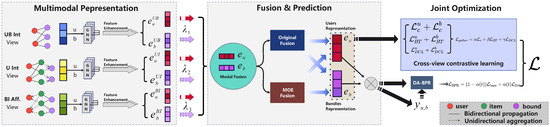
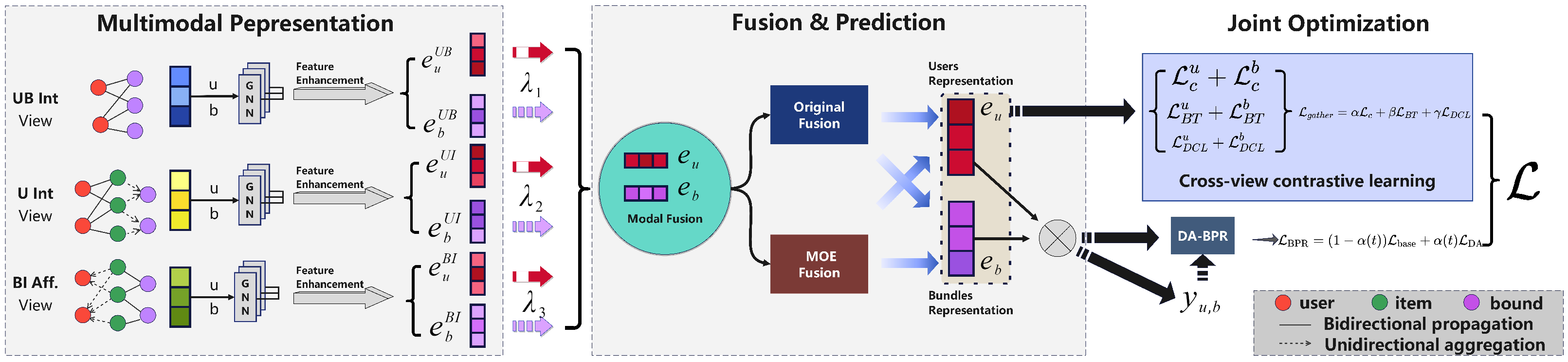
This section presents the task definition and introduces the proposed TriadCBR framework. As illustrated in Figure 1, the framework comprises three key components: (1) Tri-View Representation Learning (2) fusion and prediction and (3) joint optimization.
Figure 1.
The framework of model.
3.1. Problem Formulation
Let denote the set of all users, the set of all bundles, and the set of all items, where N, M, and O represent the number of users, bundles, and items, respectively. Three types of relational data exist among , , and : user–bundle interactions, user–item interactions, and bundle–item affiliation relations.
The user–bundle interaction matrix is , where indicates that user u has interacted with bundle b. Similarly, the user–item interaction matrix is denoted as . The bundle–item affiliation matrix is defined as .
Given a target user, the bundle recommendation task aims to recommend a ranked list of bundles for the user.
3.2. Tri-View Representation Learning
Our model leverages the user–bundle view, the user–item view, and the bundle–item view to learn the complex relationships between users, items, and bundles. We uniformly adopt a LightGCN-based approach to learn each of these views.
3.2.1. Unified Graph Propagation Protocol
Let denote the bipartite graph corresponding to a particular view v. The view v represents any one of the three views. The node set contains all entities in this view, and the edge set represents the observed interaction relations. The message passing operation at layer l is defined as follows:
Here, denotes the embedding vector of node n in layer l of the model used to process view v. represents the set of neighbors of node n in graph . We stack propagation layers to learn multi-hop structural information. Then, a pooling operation is used to aggregate the embeddings from all layers to obtain the final representation:
3.2.2. User-Bundle View Representation
The user-bundle view characterizes the interaction relationships between users and bundles. Based on the interaction matrix , we construct a bipartite graph in which edges represent interactions between user u and bundle b. We apply the same computational process on this graph to generate the final user embedding and bundle embedding .
3.2.3. User-Item View Representation
represents the user–item perspective. We learn the relationship between the user embedding and the item embedding on the user–item bipartite graph. The bundle is not a node in the graph; its embedding vector is computed by aggregating the embeddings of the items it contains. Let be the set of items contained in bundle b. The aggregation formula is as follows:
So the captures the specific item-level details that attracts the user. While attention mechanisms could potentially weight items differently, we adopt simple mean pooling to maintain computational efficiency and to strictly isolate the performance gains derived from our novel contrastive and ranking modules rather than aggregation tricks.
3.2.4. Bundle-Item View Representation
represents the bundle–item view. By learning on this matrix, we can obtain the bundle representation and the item representation . Since users are not nodes in this graph, their embedding vectors cannot be obtained directly. We learn user preferences by aggregating the embeddings of the items they have interacted with. Let be the set of items that user u has interacted with; the formula is
This embedding represents the preference of the user for certain bundling patterns.
3.3. Fusion and Prediction
To obtain the final bundle representation, we introduce a Mixture-of-Experts (MoE) module into the weight fusion process and design a fusion module that combines both static and dynamic components. This module is used to integrate the three types of view representations. Fixed weights provide consistent contributions during the initial training phase and in simple scenarios, ensuring the stability of view fusion and avoiding potential instability caused by fluctuations in dynamic weights. Meanwhile, the MoE module adaptively adjusts the fusion weights based on the input features, in order to capture changes in the relative importance of each view under different contexts.
3.3.1. Original Fusion
The representations from the three views are integrated using a set of predetermined view-specific coefficients. The optimal values of these coefficients for each dataset were empirically determined in the baseline model MultiCBR. The fixed-weight fusion process is formally defined as
where denote the preliminary user and bundle representations after fixed-weight fusion, represent the user and bundle embeddings from view (corresponding to user–bundle, user–item, and bundle–item views, respectively), are the predefined weighting coefficients for view v, and d is the embedding dimension. These fixed weighting coefficients were empirically set to to provide a balanced, uninformative prior, aligning with the initialization strategies explored in the MultiCBR baseline.
3.3.2. Moe Fusion
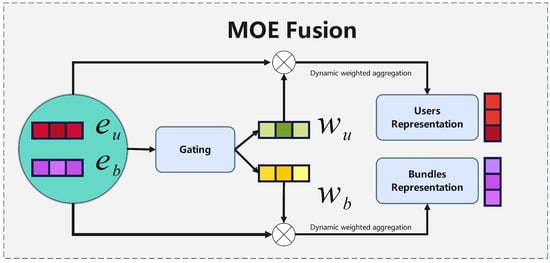
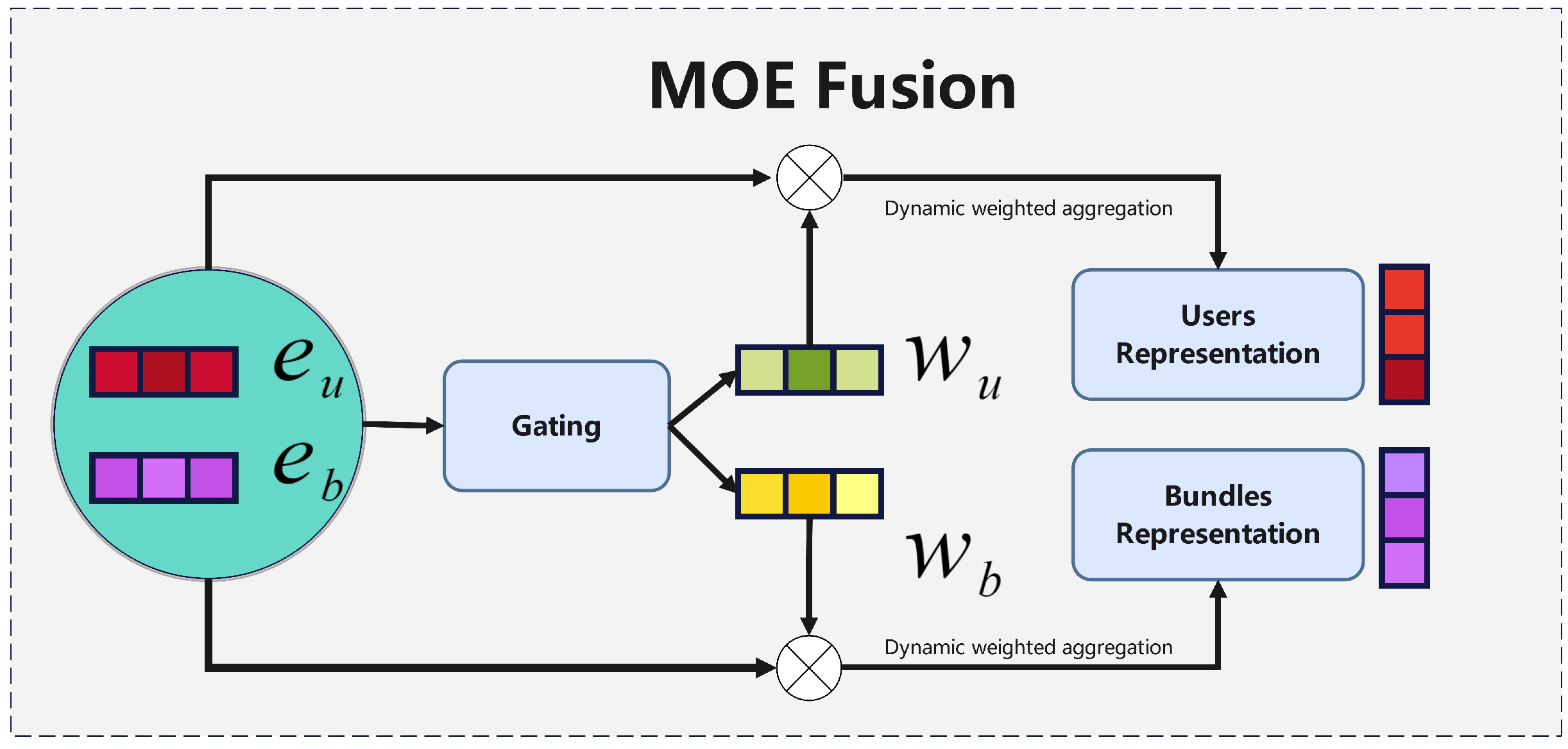
The schematic diagram of the mixture-of-experts (MoE) fusion process is presented in Figure 2.
Figure 2.
The schematic diagram of MOE.
The user embeddings and bundle embeddings (where ) are first stacked into tensor representations:
where N and M denote the number of users and bundles, respectively.
Subsequently, the input to the mixture-of-experts (MoE) network is constructed by averaging the embeddings across all views:
Here, the mean pooling is adopted as a simplified proxy for user intent to maintain computational efficiency and ensure a fair structural comparison with baseline models. The gating weights are computed via a two-layer feed-forward network with ReLU activation and Softmax normalization:
where denote trainable weight matrices and are bias terms. Specifically, the first layer projects the input dimension d into a hidden dimension , and the second layer projects it to the number of experts (corresponding to the UB, UI, and BI views). Thus, , , and the biases , . These parameters are initialized using Xavier uniform distribution and optimized end-to-end. The Softmax function ensures that the output gating weights sum to one.
The output embeddings of the MoE fusion module are obtained by a weighted combination of the view-specific embeddings:
where and denote the v-th component of the gating vectors and , respectively.
The final user and bundle representations are obtained by combining the outputs of the fixed-weight fusion and the MoE fusion through a weighted summation:
where are the final representations of the user and bundle, respectively. denote the dynamically fused embeddings obtained from the MoE module, and are the embeddings derived from fixed-weight fusion. The hyperparameter regulates the relative contribution of the dynamic and fixed fusion components during view integration. To prevent the embedding norm from becoming excessively large due to additive fusion, which could lead to numerical instability and distortion in subsequent cosine similarity and inner product computations, we apply Layer Normalization (LayerNorm) immediately after the fusion step to stabilize the scale of the final embeddings.
Remark (Limitations of Mean-Embedding Gating). While mean pooling is computationally efficient, it introduces a potential bottleneck in three scenarios: (1) Cold-start users: embeddings are dominated by Xavier initialization noise rather than learned interaction signals, producing an uninformative gating vector that degrades MoE fusion toward fixed equal weights; (2) Sparse Bundle-Item graphs: high-variance BI embeddings can dilute the gating signal, reducing the reliability of the learned view weights; (3) Cross-view semantic overlap: because mean pooling averages all views equally, it is biased toward shared signals and may under-weight the complementary UB view. In practice, the fixed-weight component in Equation (11) serves as a stable fallback that compensates for these failure modes, as empirically evidenced by the strong performance on Inactive users in the subgroup analysis (Section 4.7) ( over MultiCBR). Future work will address this limitation by incorporating auxiliary context (temporal signals, session data, user demographics) directly into the gating network, as noted in Section 5.
3.3.3. Prediction
The preference score between a user and a bundle is computed as the inner product of their respective representations, formulated as
3.4. Joint Optimization
Contrastive learning has been widely applied in recommender systems. To improve model performance, we adopt the idea of contrastive learning and construct positive and negative sample pairs to enhance the model. A positive sample pair is composed of the original embedding and the augmented embedding of the same entity, while a negative sample pair is formed from embeddings of different entities within the batch. We use slight noise-based augmentation as our data augmentation strategy to improve the effectiveness of the sample pairs. Specifically, the noise-based augmentation injects uniform random noise scaled by a factor of into the embeddings.
3.4.1. InfoNCE Loss
The InfoNCE loss is used for optimize embedding consistency. For users, the loss is defined as
where denotes the training batch, represent the augmented embeddings of user u, is the cosine similarity of the positive pair, and (with ) is the cosine similarity of the negative pair. The parameter is the temperature scalar, and d is the embedding dimension.
Similarly, for bundles, the loss is defined as
where are the augmented embeddings of bundle b, is the cosine similarity of the positive pair, and (with ) is the cosine similarity of the negative pair.
The overall InfoNCE loss is computed as the average of the user and bundle losses:
3.4.2. Decoupled Contrastive Learning Loss
In recommender systems, the sparsity of datasets (interaction ratio ) often results in randomly sampled negative samples being simple negatives, exhibiting low similarity with positive sample embeddings. Specifically, the embeddings of randomly sampled negative samples () are significantly dissimilar to positive sample embeddings (), leading to .
In the InfoNCE framework, the Non-Parametric Contrastive (NPC) multiplier, defined as
plays a critical role in gradient computation. When , the negative sample contribution , causing . Consequently, the positive sample gradient:
is suppressed, proportional to , which diminishes learning efficiency.
To address this issue, we introduce Decoupled Contrastive Learning (DCL), which decouples positive and negative samples to ensure that positive sample learning remains unaffected by negative samples, thereby maintaining gradient stability. TriadCBR generates randomly sampled negative instances through small-scale noise augmentation. By adopting DCL, the model can more effectively capture users’ fine-grained preference features over combinations, thereby improving recommendation accuracy. The DCL loss for users is defined as
is batch. are augmented embeddings, and is temperature parameter. The gradient of the single-sample loss is
where the weight , and . This gradient is composed of positive and negative sample terms without the Non-Parametric Contrastive (NPC) multiplier . Consequently, the positive sample gradient remains effective even when , ensuring stable learning and mitigating gradient suppression.
Similarly, the DCL loss for bundles is as following:
where are augmented bundle embeddings. The overall DCL loss is
To ensure reproducibility, a detailed mathematical derivation of how this negative sampling probability distribution dynamically adapts and causes gradient suppression is provided in Appendix A.
3.4.3. Barlow Twins Loss
In TriadCBR, final embeddings are formed by fusing three views: user-bundle (UB), user-item (UI), and bundle-item (BI) interactions. This multi-view design can cause problems: different views may capture similar user interests (e.g., UB captures preferences for clothing categories, while UI captures preferences for specific clothing items), leading to redundant embedding dimensions. The Mixture of Experts (MoE) fusion may worsen this overlap in sparse datasets with limited discriminative signals. In addition, the noise augmentation used to create enhanced views introduces further redundancy.
To address these issues, we adopt the Barlow Twins (BT) loss, which uses a cross-correlation matrix to encourage consistency across views and reduce redundancy. This aligns well with TriadCBR’s multi-view fusion by pushing view embeddings to be complementary rather than repetitive. BT also improves robustness by optimizing batch-wise correlations on centralized embeddings, counteracting redundancy from noise augmentation. By minimizing embedding redundancy via the cross-correlation matrix, BT enforces positive sample consistency without negative samples, making it especially suitable for sparse recommendation scenarios. There is an inherent logical overlap between the User-Item (UI) and Bundle-Item (BI) views: a user’s affinity for a bundle is fundamentally rooted in their affinity for its constituent items. In the latent vector space, if both views learn the exact same item-level intent, their respective embedding dimensions will be highly correlated. The redundancy reduction term in the BT loss (Equation (22)) forces the gradient descent to decorrelate these dimensions. For instance, if dimension k in the UI view captures “item style,” the BI view is penalized for redundantly capturing the same feature in dimension k, forcing the BI view to instead encode complementary structural patterns (e.g., “bundle co-occurrence logic”).
For users, the BT loss is defined as
where is the cross-correlation matrix for user embeddings, computed as
with representing the augmented embeddings of user u (mean-centered), and denoting the i-th and j-th dimensions of the embeddings, respectively. The invariance term ensures high correlation for the same dimension across views (), while the redundancy reduction term minimizes correlations between different dimensions (). The hyperparameter in the Barlow Twins loss balances the invariance term and the redundancy reduction term. Similarly, for bundles, the BT loss is defined as
where is the cross-correlation matrix for bundle embeddings, given by
with representing the augmented embeddings of bundle b (mean-centered), and denoting the i-th and j-th dimensions. The invariance term ensures consistency within the same dimension (), and the redundancy reduction term minimizes inter-dimensional correlations ().
The overall BT loss is computed as
In summary, the incorporation of the Barlow Twins (BT) loss yields the following advantages:
- 1.
- Reduction of Inter-View Redundancy and Ensurance of Embedding Complementarity: Different views, such as User-Bundle (UB) and User-Item (UI), may produce embeddings with similar dimensions (e.g., user preferences for clothing categories). The redundancy reduction term in the BT loss addresses this by pushing off-diagonal entries of the cross-correlation matrix towards zero . This encourages UB and UI embeddings to capture complementary features (e.g., UB emphasizes bundle structure, UI focuses on fine-grained item interactions), minimizing feature overlap. As a result, the fused embeddings can better integrate unique information from UB, UI, and Bundle-Item (BI) views, producing more distinctive representations and improving recommendation accuracy.
- 2.
- Optimization of Multi-View Consistency: The UB, UI, and BI views in TriadCBR represent diverse facets of user and bundle interests. The BT loss promotes alignment across these views by enforcing the diagonal elements of the cross-correlation matrix to approach unity , ensuring that embeddings derived from different views for the same user or bundle are consistent. This enhances the stability and robustness of the fused embeddings.
- 3.
- Compatibility with TriadCBR’s Augmentation Strategy and Robustness in Simple Negative Scenarios: TriadCBR uses noise-based augmentation to generate enhanced views, which can introduce redundant information. The BT loss mitigates this redundancy by optimizing batch-wise correlations and, unlike contrastive losses, requires no carefully sampled negative pairs. This makes BT loss well suited to TriadCBR’s setting, where simple negative samples are common, enabling stable training and reliable performance.
3.4.4. Fine-Grained Optimization Objective
To address the challenges of sparse supervision and feature redundancy identified in Section 2, we propose a hybrid contrastive objective. The rationale behind integrating InfoNCE, DCL, and Barlow Twins lies in their synergistic properties:
- InfoNCE Loss () provides the foundational alignment signal, pulling positive pairs together in the latent space.
- Barlow Twins Loss () While optimizes instance-level discrimination, it does not prevent different dimensions of the embedding from encoding the same information. explicitly penalizes off-diagonal correlations in the cross-correlation matrix, forcing the model to learn disentangled and information-rich features from the three views.
- Decoupled Contrastive Loss () addresses the gradient vanishing problem. In sparse bundle datasets, standard InfoNCE is often dominated by “easy negatives,” causing the gradient contribution of positive pairs to diminish. DCL decouples the positive and negative terms, ensuring that the model continues to learn from positive pairs even when negatives are easily discriminated.
Therefore, the final gathered loss function is formulated to balance these complementary objectives:
These three loss functions operate synergistically to construct a well-regularized embedding space, enabling comprehensive modeling of nuanced user and bundle preferences at multiple granularity levels.
3.4.5. Difficulty-Aware BPR Loss
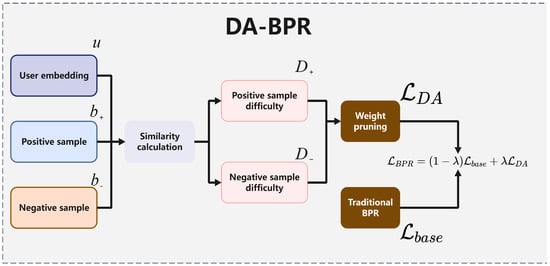
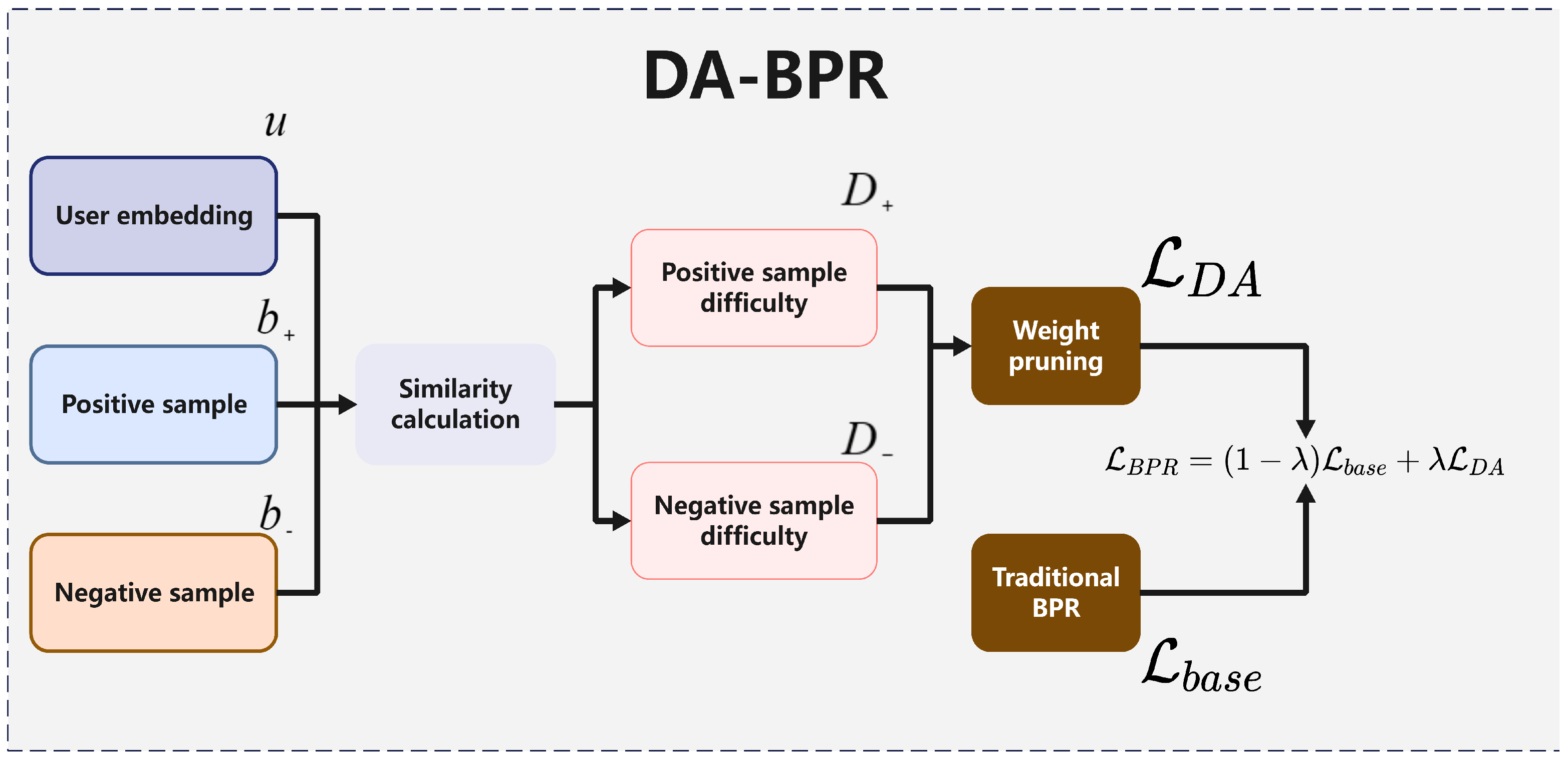
We propose an adaptive Difficulty-Aware Bayesian Personalized Ranking (DA-BPR) mechanism, which enhances Top-K recommendation performance without significantly increasing computational overhead. We combine difficulty-based positive/negative sample weighting with a progressive curriculum learning strategy. DA-BPR addresses the issue of uneven sample value by prioritizing hard samples. Hard samples have higher conditional entropy and information gain, and can better refine the ranking boundary. However, directly replacing the standard BPR loss or using an overly aggressive weighting scheme can cause training instability. Therefore, we design a fused loss that combines a difficulty-weighted term with the original BPR loss, and adaptively adjust the weighting coefficient during training. As shown in the Figure 3.
Figure 3.
The Framework of DABPR.
DA-BPR uses an MLP to estimate the difficulty of each sample. The MLP’s inputs include the cosine similarities of the positive and negative samples (, ), the user’s activeness, and the variance of the user and bundle embeddings. User activeness is a cached value obtained by smoothing the historical difficulties, and it reflects the interaction frequency. The final output is a raw_difficulty score in the range [0, 1]. In our implementation, the embedding variance and the cosine similarities are computed in real-time during the forward pass of each mini-batch, ensuring the difficulty score accurately reflects the immediate state of the latent space. Conversely, the user activeness is updated asynchronously (cached and periodically smoothed) to avoid redundant computations across batches.
For a positive sample, difficulty increases when the combined representation variance () is higher. High variance reflects diverse user interests or complex bundle features, making preference prediction harder. Thus, positive sample difficulty is
where , , and are the embedding of the user, positive bundle, and negative bundle. and are their representation variances; and is a weighting factor.
A negative sample is harder when it is more similar to the user or the user activity is lower. The negative sample difficulty is defined as
where is a small constant to ensure numerical stability.
Sample weights are then assigned based on their calculated difficulties:
where k is a hyperparameter controlling the contribution of difficulty, and , are the lower and upper bounds for clipping, preventing gradient anomalies. The clipping bounds and are empirically set to 0.5 and 2.0, respectively. These symmetric bounds safely constrain the difficulty multipliers, preventing gradient explosion when encountering extreme outlier samples while ensuring stable backpropagation.
A curriculum learning scheduler modulates the influence of the difficulty-weighted loss throughout training:
where t means training epoch, T is the total epochs, and , define the scheduler’s boundary. It is worth noting that we also considered non-linear parameter scheduling, such as exponential warmup and cosine annealing. However, extensive preliminary experiments revealed that non-linear schedules could introduce abrupt shifts in the loss landscape, occasionally destabilizing the DA-BPR gradients. The linear schedule (Equations (33) and (34)) was ultimately selected because it provides the most stable transition mechanism with minimal hyperparameter sensitivity, enabling conservative early optimization and stronger learning from hard samples later.
The overall fused loss function combines the original BPR loss:
with the difficulty-aware loss:
Note: In Equation (36), and (defined in Equations (28) and (29)) serve as difficulty-scaled proxies for the user-bundle affinity; the argument of is therefore a difficulty-weighted preference margin rather than a raw difference of difficulty scores.
Forming the final DA-BPR loss:
where B is the set of training triples. is the sigmoid function. This design maintains convergence stability while improving optimization efficiency.
DA-BPR improves gradient utilization by assigning higher weights to hard samples. It first fits easy samples to stabilize training, then gradually shifts to hard ones, avoiding early noise in the early stage. By combining weight clipping with a progressive schedule, gradient stability matches standard BPR. Difficulty weighting uses efficient batch vectorized operations, adding no extra computational cost.
The overall loss function of the model is defined as
where aggregates the contrastive loss , Barlow Twins loss , and decorrelated contrastive loss , weighted by hyperparameters , , and , respectively, to control their contributions to the total loss. The term represents the Bayesian Personalized Ranking loss, enhanced by the Difficulty-Aware BPR (DA-BPR) mechanism to prioritize difficult samples. To prevent overfitting, L2 regularization is incorporated via , where is the hyperparameter controlling the regularization strength, and denotes the set of all model parameters.
4. Experiments
To evaluate the performance of the proposed TriadCBR model, we conduct a series of experiments to address the following research questions (RQs):
- RQ1: How does the proposed model perform compared to previous methods?
- RQ2: Do individual modules contribute to the model’s performance?
- RQ3: How do different hyperparameter settings affect the model’s performance?
4.1. Datasets and Evaluation Metrics
To evaluate the proposed TriadCBR model, we conduct experiments on three datasets: Youshu [27], iFashion [28], and NetEase [29]. As shown in Table 1, Youshu contains user preferences for book lists and individual books, with 8039 users, 32,770 items, and 4771 bundles. iFashion is a publicly available dataset with rich information on fashion items, where bundles consist of individual fashion products, comprising 53,897 users, 27,694 items, and 42,563 bundles. NetEase includes user preferences for music playlists and individual songs, with 18,528 users, 123,628 items, and 22,864 bundles.
Table 1.
Dataset statistics.
We adopt Recall@K and NDCG@K as evaluation metrics. Recall@K measures the proportion of relevant bundles in the top-K ranked list, while NDCG@K assigns higher scores to bundles ranked higher in the list. In the following sections, Recall and NDCG are abbreviated as R and N, respectively.
For all datasets, we rigorously partitioned the historical interactions into training, validation, and testing sets with a ratio of 8:1:1. To ensure a robust and unbiased evaluation, we adopted the full-ranking protocol. Instead of sampling a small set of negative bundles, we ranked all unobserved bundles for each user in the test set. All reported metrics in the subsequent tables represent the mean performance over five independent runs with different random seeds.
4.2. Baseline Models and Hyperparameters
To demonstrate the effectiveness of the proposed TriadCBR model, we compare it with seven state-of-the-art methods, categorized into two groups: single-view framework models and multi-view framework models.
Single-View Framework Models. These models treat users, bundles, and items as a whole for modeling. The following methods are included:
(1) MFBPR [24]: A matrix factorization approach based on the Bayesian Personalized Ranking framework, widely used for implicit feedback.
(2) DAM [27]: Employs multi-task learning and attention mechanisms to model user-bundle and user-item interactions.
(3) BundleNet [12]: Utilizes graph neural networks on a tripartite graph of users, items, and bundles, combined with multi-task learning.
Multi-View Framework Models. These models refine the relationships among users, bundles, and items across multiple views. The following methods are included:
(1) BGCN [6]: Decomposes user-bundle-item interactions into two views (bundle view and item view) and employs graph convolutional networks to learn representations for final predictions.
(2) MIDGN [14]: Decouples user intentions from global and local views, using contrastive learning to compare user intention representations from different views.
(3) CrossCBR [13]: Follows BGCN’s dual-view framework, modeling cooperative relationships between bundle and item views via contrastive learning.
(4) MultiCBR [7]: Extends CrossCBR by introducing a tri-view framework, effectively utilizing relationships between bundles and items.
To ensure an absolutely fair comparison, TriadCBR and all baseline models were evaluated under identical calculation conditions. Specifically, we utilized the exact same data splitting protocol, the same negative sampling strategy during evaluation, and identical initialization methods (Xavier uniform) across all models. The embedding dimension was strictly fixed to for all methods. The software implementation was conducted using PyTorch 1.12.1 and Python 3.9, with all models trained on a single NVIDIA A100 GPU. Most hyperparameters were adopted from our baseline model MultiCBR, including the embedding dimension size of 64 and the Adam optimizer for parameter optimization with a batch size of 1024, learning rate of 0.01. The fixed weights for the multi-view representation fusion component were maintained according to the optimal configuration established in the baseline model.
For model-specific hyperparameters, we performed extensive grid searches to determine optimal values. The weighting coefficient for the Mixture-of-Experts (MoE) network was selected from . The contrastive loss weight was selected from the set , while the weights and were chosen from a finer-grained range . For the difficulty coefficient in the DA-BPR module, the minimum value was selected from the set , while the maximum value was chosen from .
The learning rate was systematically explored across , with ultimately selected for all subsequent experiments based on validation performance.
4.3. Model Performance Analysis (RQ1)
TriadCBR was evaluated against multiple baseline models in terms of overall recommendation performance across three real-world datasets, as summarized in Table 2. The best-performing method is highlighted in bold, while the second-best is underlined. The following observations can be made:
Table 2.
Performance comparison of models (higher is better). %Improv. is calculated relative to MultiCBR. †: (Welch two-sample t-test vs. MultiCBR; full details in Appendix C, Table A1).
TriadCBR consistently outperformed all other baseline models across all three datasets. Specifically, it achieved an average improvement of 3.61% over the strongest baseline, MultiCBR, on the NetEase, iFashion, and Youshu datasets. This enhancement can be attributed to the enhanced cross-view contrastive learning within the tri-view architecture, which strengthens representations of the same user or bundle across different views in a self-supervised manner, while distinguishing those of different users or bundles. Additionally, the proposed adaptive Difficulty-Aware Bayesian Personalized Ranking (DA-BPR) optimizes the ranking of positive and negative samples through difficulty-based weighting and curriculum learning, significantly improving recommendation accuracy. Together, these innovations refine the modeling of user preferences toward bundles and extract more accurate bundle representations, thereby improving the estimation of user-bundle preference scores. Statistical significance of these improvements, assessed via a two-tailed Welch two-sample t-test over 5 independent runs, is reported in full detail in Appendix C (Table A1).
As the first baseline to introduce a dual-view framework into bundle recommendation, BGCN demonstrated markedly superior performance compared to single-view models such as BundleNet, DAM, and MFBPR. This underscores the advantage of the dual-view approach in capturing complex interactions among users, bundles, and items. Among multi-view frameworks, the performance gains of MIDGN and CrossCBR highlight the benefits of contrastive learning. The generally better performance of CrossCBR over MIDGN further illustrates the effectiveness of cross-view contrastive learning. MultiCBR extended CrossCBR’s dual-view architecture by incorporating a BI (Bundle-Item) view, which effectively alleviates issues related to BI sparsity. Nevertheless, TriadCBR outperformed MultiCBR, owing to its more fine-grained cross-view contrastive learning mechanism and adaptive difficulty-aware ranking strategy.
4.4. Ablation Studies (RQ2)
A series of ablation experiments were conducted to further investigate the impact of each component in the proposed model on overall performance. The experimental results are shown in Table 3.
Table 3.
Ablation experiments on Youshu, iFashion, and NetEase datasets. Performance is reported for Recall and NDCG at 20. %Improv. represents the relative performance drop of each variant compared to TriadCBR (full model).
4.4.1. MoE Fusion Module
To investigate whether TriadCBR effectively captures users’ diverse preferences toward bundles through its MoE Fusion module, we performed an ablation study by removing this module (denoted as w/o-MOE) and replacing it with a fixed-weight view fusion strategy. The impact on performance was evaluated on the Youshu, iFashion, and NetEase datasets. Experiments on the Youshu, iFashion, and NetEase datasets show that the MoE Fusion module significantly improves performance. Our dynamic fusion mechanism effectively captures the contributions of different views to the overall representation.
4.4.2. Fine-Grained Contrastive Learning Module
To evaluate the effectiveness of the fine-grained contrastive learning module, we independently removed the Barlow Twins loss and the decoupled contrastive loss. The experimental results show that both components have a significant impact on the model’s performance. Notably, as observed in Table 3, the removal of the Barlow Twins loss (w/o-BT) yields a less pronounced performance drop on the iFashion dataset compared to Youshu and NetEase. This phenomenon is deeply tied to the dataset’s unique structural characteristics. In iFashion, bundles consist of fashion outfits with highly distinct, non-overlapping category features (e.g., tops vs. shoes) and extremely sparse bundle-item interactions. Consequently, the initial inter-view feature redundancy is inherently low. The redundancy reduction mechanism of BT loss provides maximal marginal benefits in dense, highly cohesive datasets (like music playlists in NetEase) where cross-view feature collapse is a severe risk, whereas its impact is naturally bounded in datasets with inherently orthogonal item spaces like iFashion.
4.4.3. Difficulty-Aware BPR Module
To rigorously evaluate the distinct contributions within the DA-BPR framework, we decoupled the ablation into two independent variants: w/o-Difficulty (replacing the difficulty assessment MLP with uniform sampling) and w/o-CL (removing the dynamic curriculum learning scheduler, applying static difficulty weights). Experimental results indicate that while difficulty assessment fundamentally refines the ranking boundaries for hard samples, the dynamic curriculum learning scheduler is indispensable for maintaining training stability in the early epochs. Removing either component leads to a notable decline, confirming that dynamic scheduling and sample difficulty assessment operate synergistically. For completeness, the difficulty estimator is parameterized by a 2-layer MLP with ReLU activations and Layer Normalization.
4.4.4. Gradient Stability Analysis
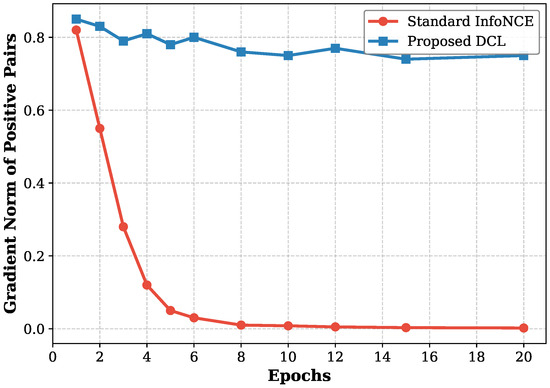
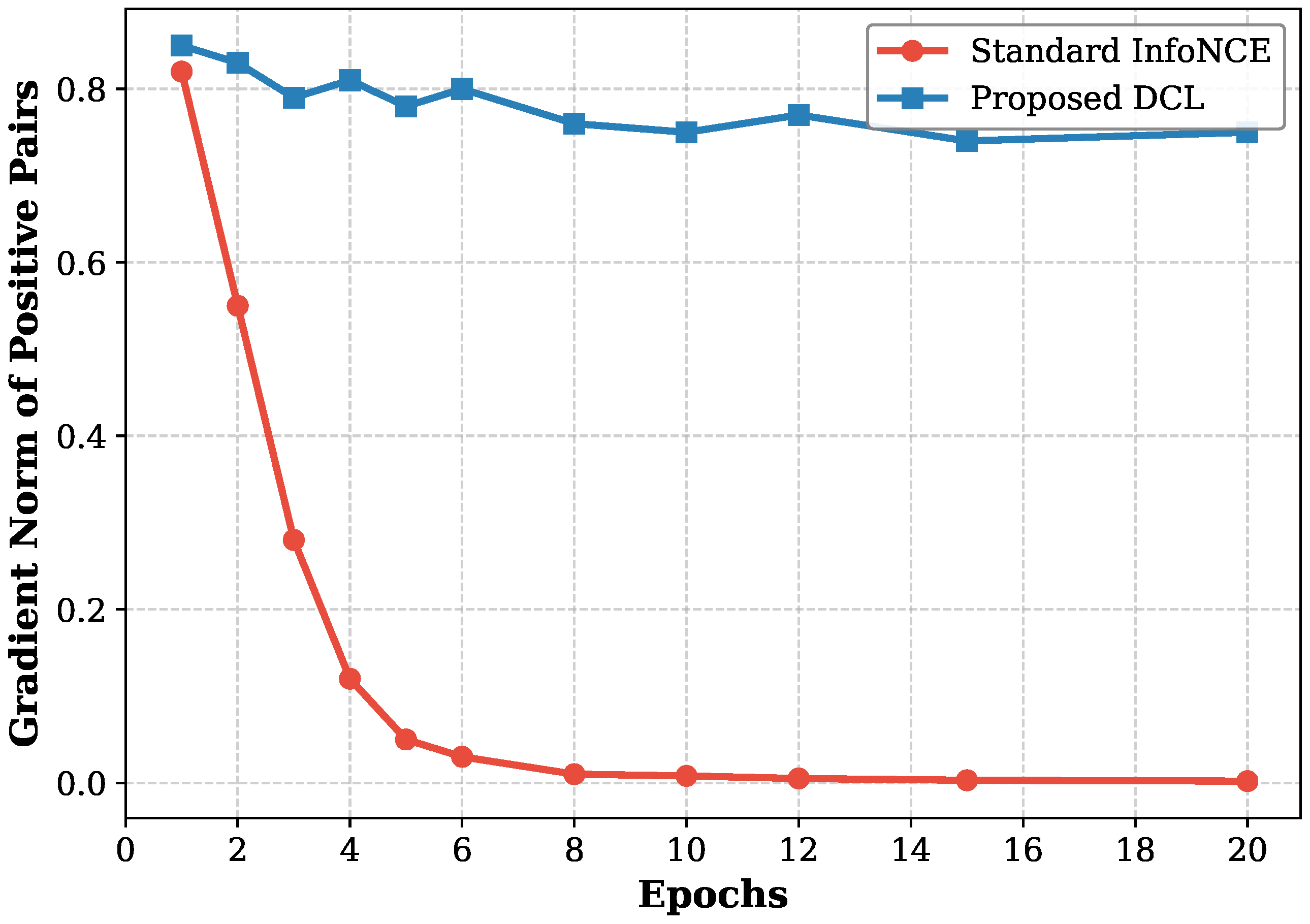
To empirically substantiate the theoretical claim that Decoupled Contrastive Learning (DCL) mitigates the gradient vanishing problem caused by “easy negatives,” we tracked the gradient norms of positive sample pairs throughout the training process. As illustrated in Figure 4 (Gradient Norms vs. Epochs), standard InfoNCE exhibits a rapid decline in positive gradient norms approaching zero as the model easily discriminates randomly sampled negatives. In contrast, our proposed DCL successfully decouples the negative influence, maintaining a stable and healthy gradient magnitude for positive pairs across all epochs, thereby preventing premature convergence and securing fine-grained preference learning.
Figure 4.
Comparison of positive sample gradient norms over epochs. DCL maintains gradient stability while standard InfoNCE suffers from gradient vanishing.
4.5. Hyperparameter Experiments (RQ3)
This section evaluates the impact of key hyperparameters on model performance. The experiment results are as follows.
4.5.1. The View Fusion Weight
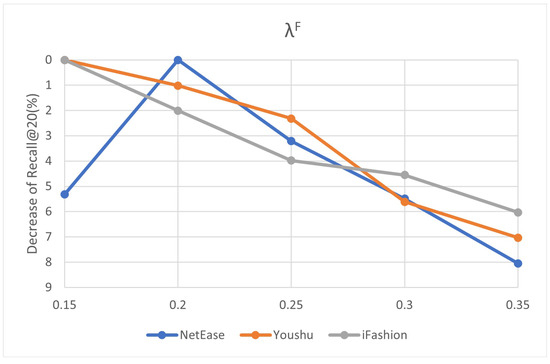
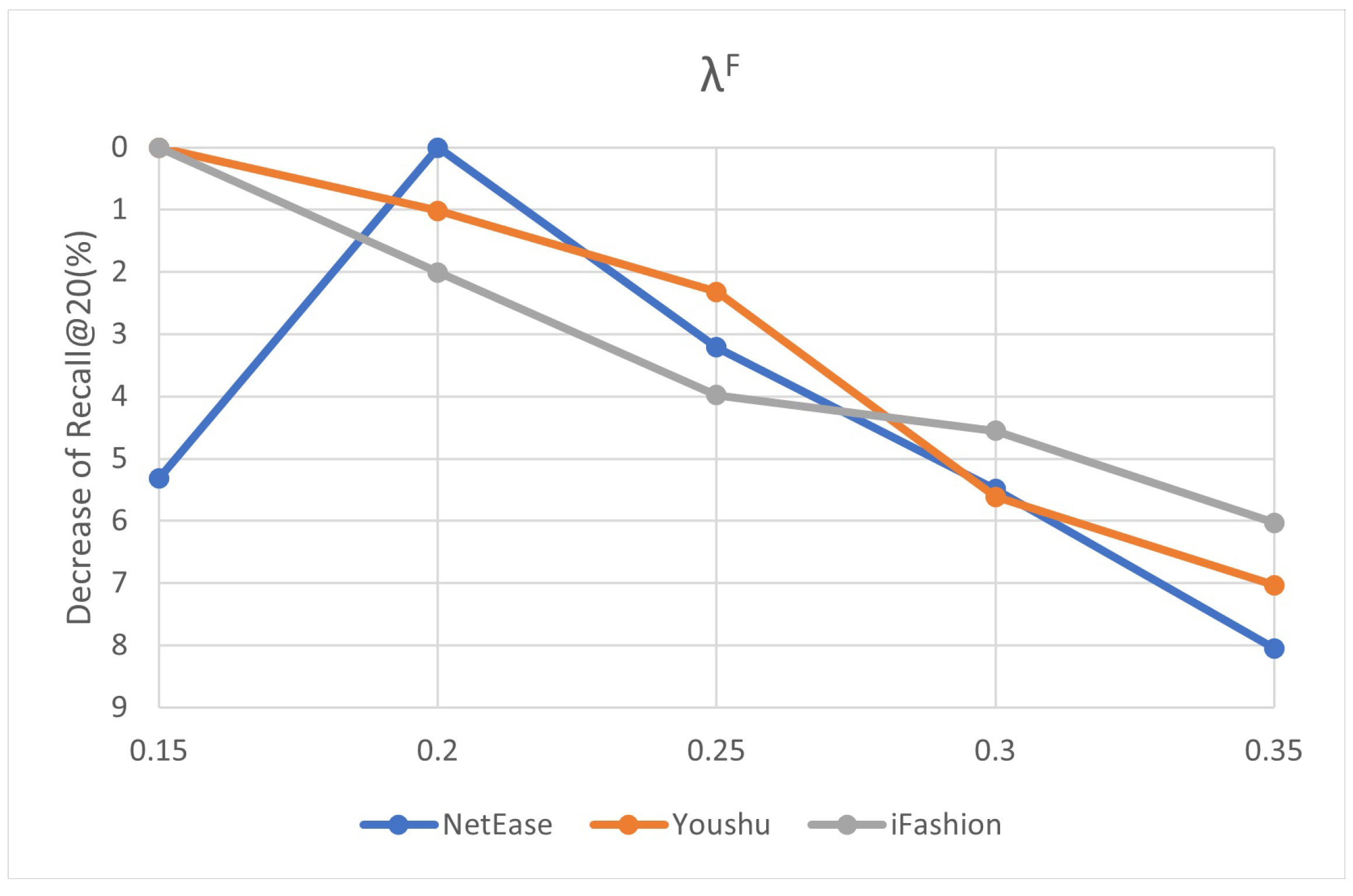
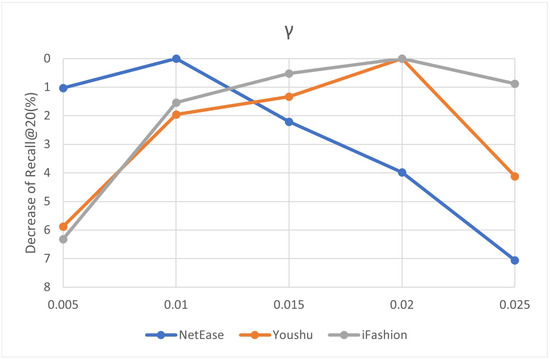
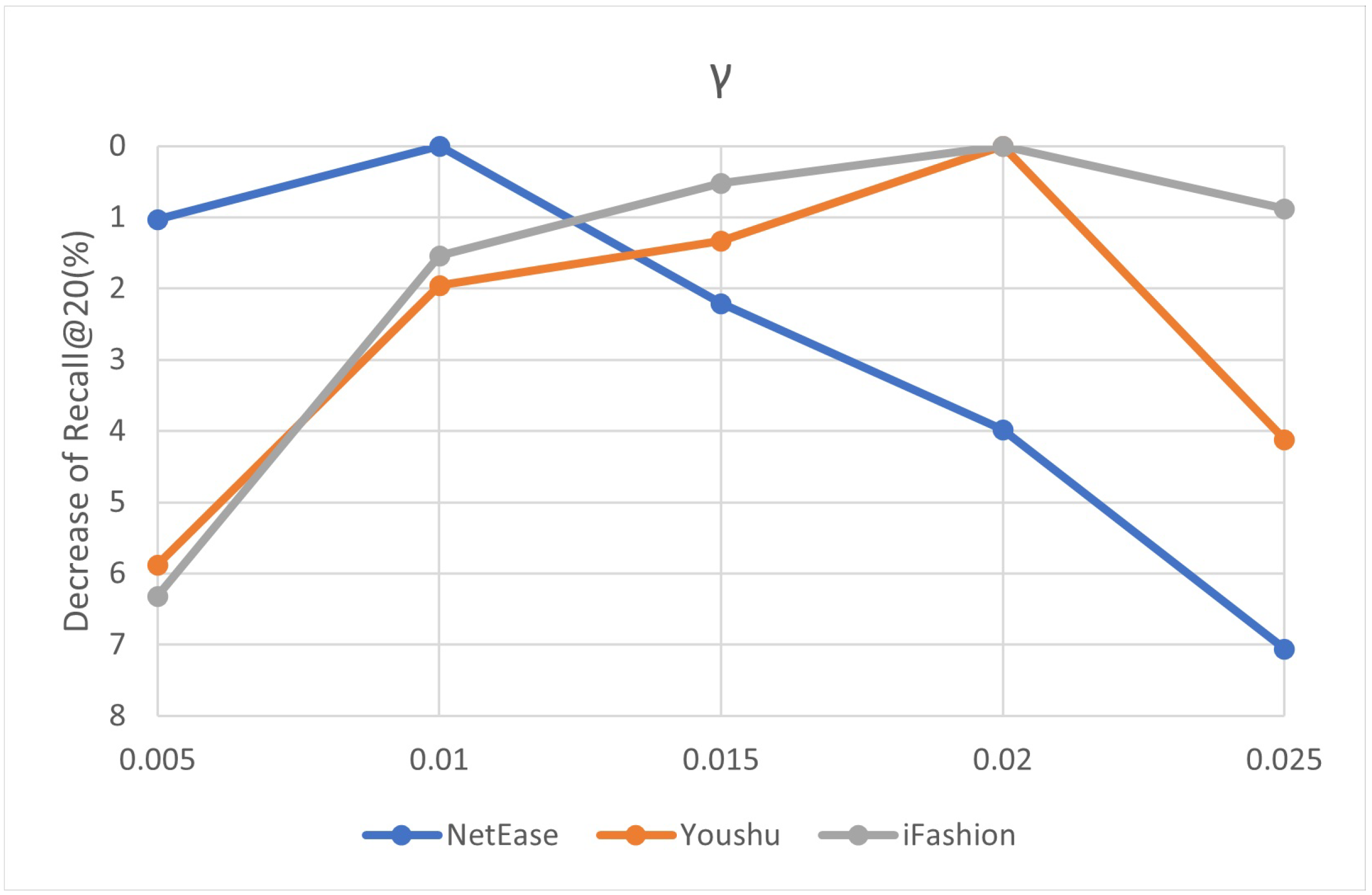
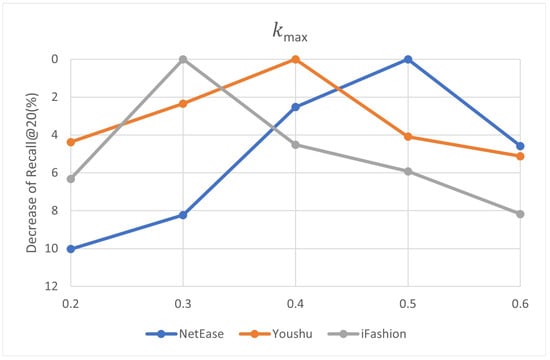
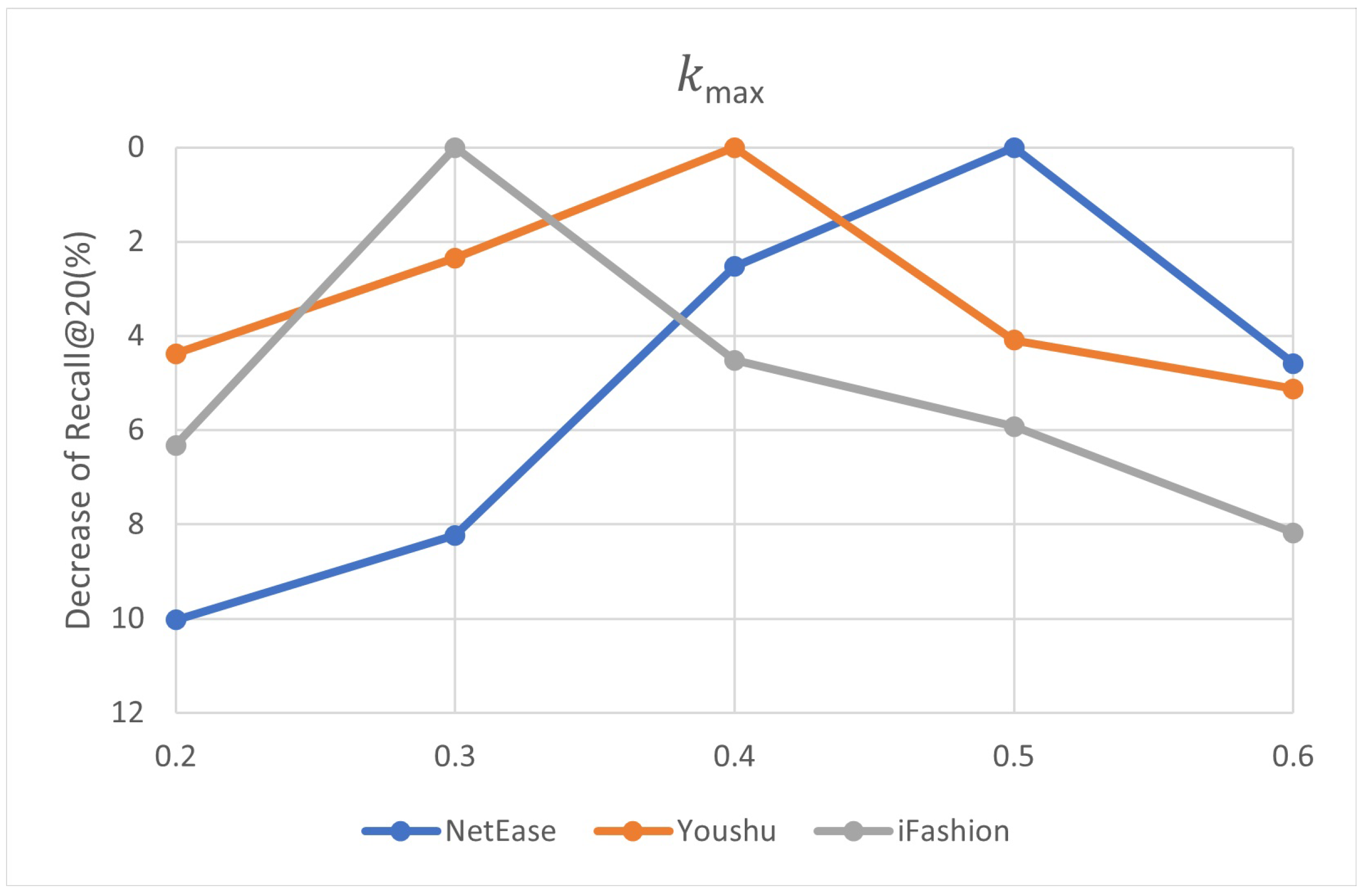
As illustrated in Figure 5, the relative decrease in R@20 exhibits a U-shaped trend with respect to , indicative of a transition from underfitting to overfitting regimes. Higher values of may introduce noise due to excessive reliance on MoE-generated weights, leading to a degradation in embedding quality.
Figure 5.
Impact of hyperparameter on model performance.
4.5.2. Contrastive Loss Weights , , and
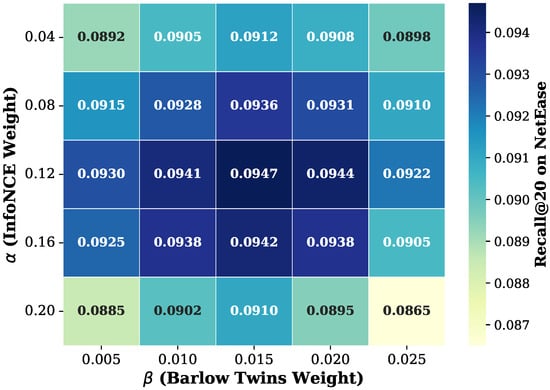
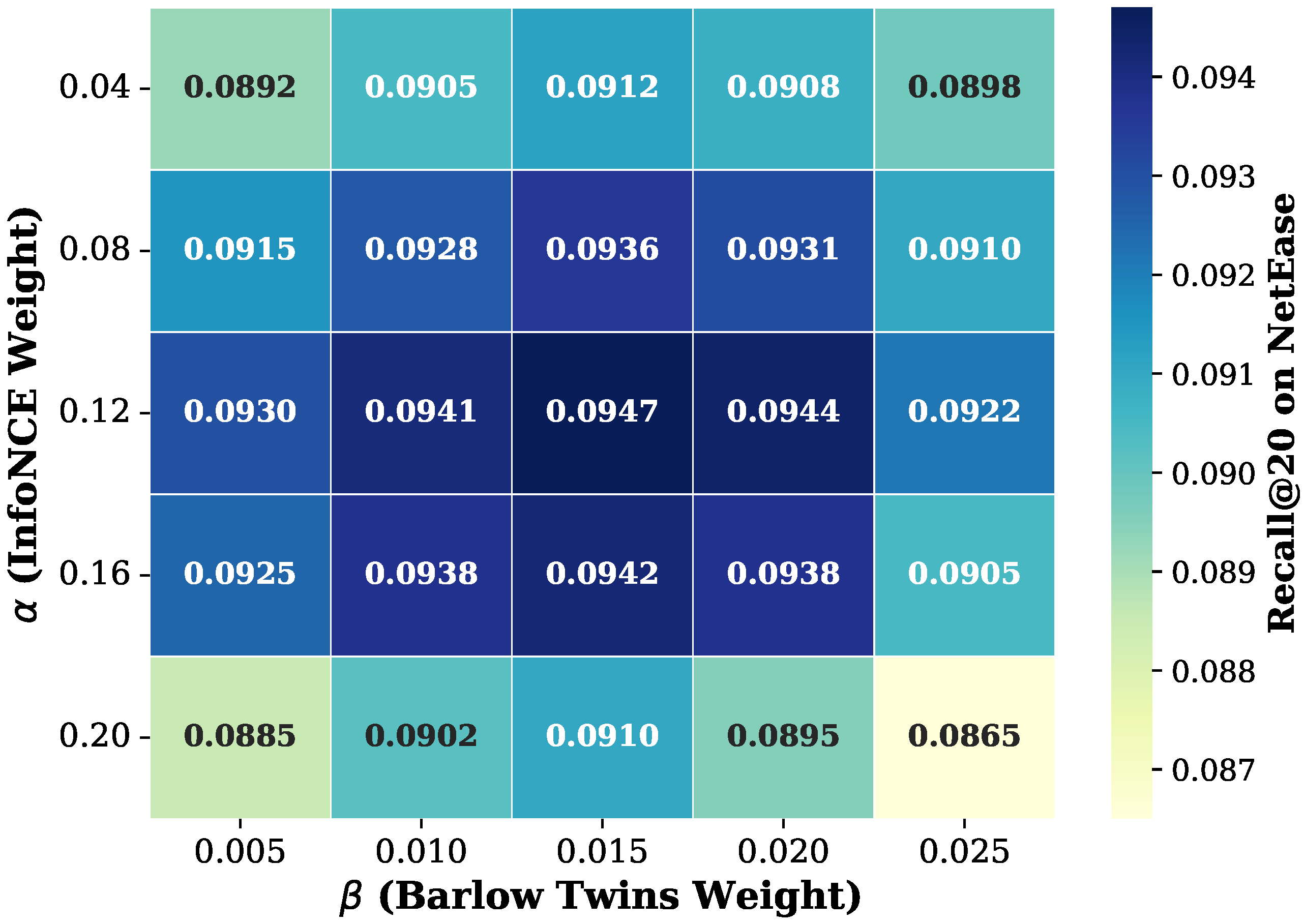
The contrastive loss weight was selected from , while the weights and were chosen from . As illustrated in Figure 6 and Figure 7, model performance remains most stable when lies within the range of 0.08 to 0.16, within 0.015 to 0.025, and within 0.01 to 0.02. Within these intervals, the relative decline in R@20 is maintained at a low level, suggesting that moderate contrastive loss weighting effectively enhances multi-view embedding consistency without interfering with the dominant optimization signal from DA-BPR. However, assigning excessively high weights to both simultaneously over-constrains the embedding space, weakening the primary optimization signal from DA-BPR.
Figure 6.
Joint sensitivity analysis of hyperparameters and evaluated on the NetEase dataset.
Figure 7.
Impact of hyperparameter on model performance.
Robustness of the -first Tuning Strategy. A key practical concern is whether the recommended stable interval (with the default ) holds across datasets with very different structural densities. The three benchmark datasets span a wide density range: from the dense Youshu (UB interaction density ) to the sparse iFashion (≈) and the intermediate NetEase (≈). Across this diversity, the stable interval and the optimal value are consistently observed, confirming that the -first heuristic is dataset-invariant. This robustness arises because the InfoNCE alignment objective (Equation (15)) operates on embedding geometry rather than raw interaction frequency, making it inherently density-insensitive. In contrast, (Barlow Twins) is more density-sensitive: redundancy levels are higher in dense, cohesive datasets (e.g., NetEase music playlists), warranting a slightly larger in such settings. For practitioners deploying TriadCBR on new datasets, we therefore recommend first fixing to stabilize positive alignment, and then fine-tuning and within the range using a coarse 3-point grid .
4.5.3. DA-BPR Difficulty Coefficient k
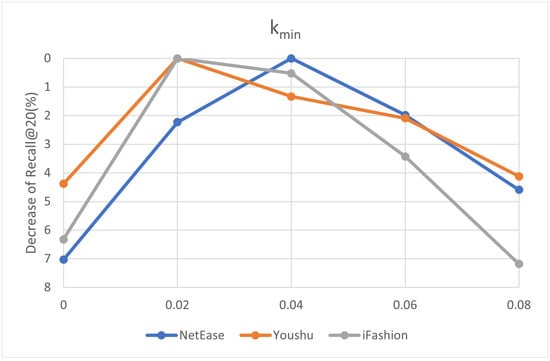
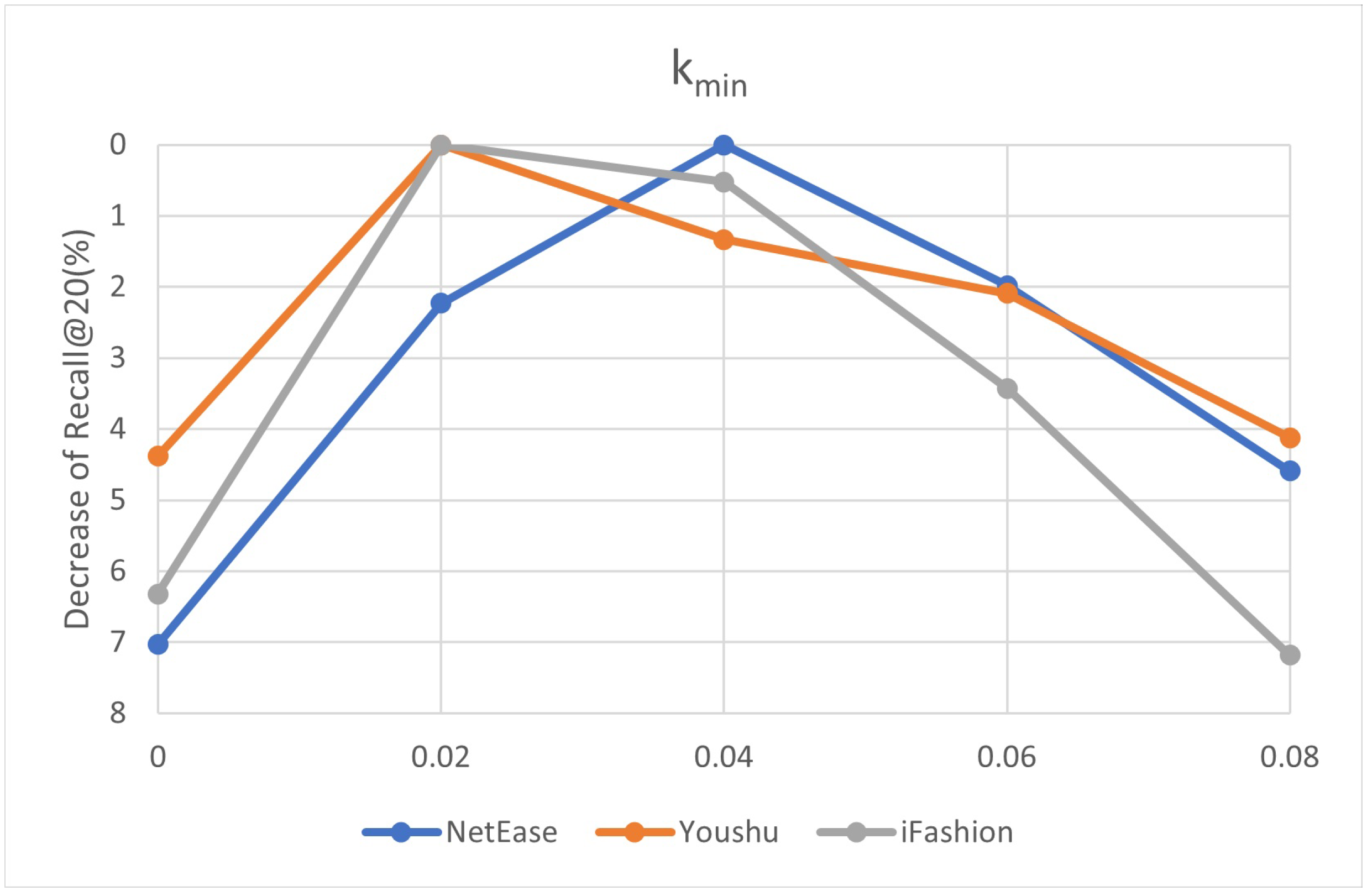
We further examined the difficulty coefficient in the DA-BPR module by varying the minimum boundary and the maximum boundary , which control the weighting intensity applied to sample difficulty. By optimizing one boundary while adjusting the other, the performance results are shown in Figure 8 and Figure 9. The optimal difficulty ranges are determined as for Netease, for Youshu, and for iFashion. These results align with our expectations, demonstrating that appropriate difficulty-aware weighting effectively enhances the model’s capability to learn from challenging samples.
Figure 8.
Impact of hyperparameter on model performance.
Figure 9.
Impact of hyperparameter on model performance.
4.6. Efficiency Analysis
We compare the computational efficiency, scalability, and resource utilization of MultiCBR and TriadCBR on the NetEase and iFashion datasets. As shown in Table 4, TriadCBR introduces a slight increase in the total number of parameters (+0.4 M) due to the addition of the MoE gating network and the DA-BPR MLP module. Consequently, the per-epoch training time and peak GPU memory experience a marginal increase. Furthermore, regarding the DA-BPR module, the embedding variance and cosine similarities are computed in real-time during the forward pass utilizing highly optimized batch-wise tensor operations, whereas user activeness is updated asynchronously via an offline cache. This asynchronous design prevents severe memory bandwidth bottlenecks. Despite the slight overhead in inference latency and per-epoch time, TriadCBR converges in significantly fewer epochs (e.g., 20 vs. 35 on NetEase) due to the high-quality gradients provided by DCL and the difficulty-aware curriculum, resulting in a highly competitive total convergence time suitable for large-scale industrial deployment.
Table 4.
Training efficiency comparison on Netease dataset.
4.7. Subgroup Analysis: Performance on Long-Tail Users
To comprehensively address the boundary conditions of our model and gain deeper insights into where TriadCBR excels, we conducted a fine-grained subgroup analysis based on user activeness. As shown in Table 5, we partitioned the users in the NetEase dataset into three distinct groups based on their historical interactions: Inactive (<10 interactions), Normal (10∼50), and Active (>50), and evaluated the Recall@20 performance.
Table 5.
Subgroup Analysis: Recall@20 performance across different user activeness groups on the NetEase dataset.
The empirical results reveal a compelling trend: while TriadCBR performs comparably to the strong baseline MultiCBR on highly active users (a modest +2.00% improvement), it achieves a massive relative improvement of +7.78% on Inactive (long-tail) users. Highly active users inherently provide sufficient collaborative signals for standard GCNs. In contrast, for sparse long-tail users, the gradient signals in standard InfoNCE often vanish. Our proposed TriadCBR, equipped with Decoupled Contrastive Learning (DCL) and the Difficulty-Aware BPR (DA-BPR), effectively isolates negative sampling distributions and forces the model to extract robust preference signals from limited interactions. This substantiates TriadCBR’s exceptional superiority in cold-start and data-sparse scenarios.
5. Conclusions
This study proposes TriadCBR, a tri-view model that captures ternary relationships among users, items, and bundles. It uses three independent GCNs to model user–bundle (U-B), bundle–item (B-I), and user–item (U-I) relations. A dynamic view fusion mechanism then integrates the three views to obtain consistent user and bundle representations. Finally, the model is jointly optimized with three complementary contrastive objectives and a difficulty-aware ranking loss.
Extensive experiments conducted on three public datasets—Youshu, Netease, and iFashion—demonstrate the effectiveness and efficiency of TriadCBR in bundle recommendation tasks, confirming its superior performance over existing state-of-the-art methods.
Future work will focus on two primary directions: first, addressing the limitation of relying solely on mean embeddings in the MoE module by incorporating auxiliary context (e.g., temporal signals, session-based interactions, and user demographics) directly into the gating network to capture more nuanced user intents; second, mining more profound interaction patterns among users, items, and bundles to further enhance the model’s representational capacity and recommendation quality.
Author Contributions
Conceptualization, X.S. and H.W.; methodology, X.S.; software, H.W.; validation, X.S. and H.W.; formal analysis, X.S.; investigation, X.S.; resources, H.W.; data curation, H.W.; writing, original draft preparation, H.W.; writing, review and editing, H.W.; visualization, X.S.; supervision, X.S.; project administration, X.S.; funding acquisition, X.S. All authors have read and agreed to the published version of the manuscript.
Funding
This research received no external funding.
Institutional Review Board Statement
This research utilizes publicly available, fully anonymized datasets (Youshu, iFashion, NetEase). No personally identifiable information (PII) was accessed or processed. Furthermore, we recognize that recommender systems are susceptible to popularity bias. By introducing Decoupled Contrastive Learning (DCL), our framework explicitly decouples the negative sample distribution during optimization, mitigating the model’s tendency to over-recommend globally popular bundles at the expense of niche preferences.
Data Availability Statement
The original data presented in the study are openly available in [27,28,29].
Acknowledgments
The authors would like to thank the editors and the reviewers for their valuable time and constructive comments.
Conflicts of Interest
The authors declare no conflicts of interest.
Abbreviations
The following abbreviations are used in this manuscript:
| GCN | Graph Convolutional Network |
| UB | User-Bundle (view) |
| UI | User-Item (view) |
| BI | Bundle-Item (view) |
| MoE | Mixture-of-Experts |
| BPR | Bayesian Personalized Ranking |
| DA-BPR | Difficulty-Aware Bayesian Personalized Ranking |
| DCL | Decoupled Contrastive Learning |
| BT | Barlow Twins |
| NPC | Non-Parametric Contrastive (multiplier) |
| MLP | Multi-Layer Perceptron |
Appendix A. Theoretical Derivation of Optimization Gradients
In the standard InfoNCE loss (Equation (13)), the gradient of the positive pair with respect to the user embedding is scaled by the Non-Parametric Contrastive (NPC) multiplier (Equation (16)).
Notation. Let (the scaled positive-pair similarity, cf. Equation (13)) and for each negative (the scaled negative-pair similarities). Using this notation, the InfoNCE loss in Equation (13) can be rewritten as:
Gradient derivation. The gradient with respect to is governed by the NPC multiplier defined in Equation (16):
where (consistent with the notation in Equation (19), Section 3.4.2). This yields:
where the weight (as defined in Equation (19)).
Gradient vanishing analysis. In sparse datasets, randomly sampled negatives are easily distinguishable from positives, causing for all negatives. Consequently:
- 1.
- Each negative contribution , so .
- 2.
- The NPC multiplier .
- 3.
- The positive-pair gradient , causing gradient vanishing.
This chain demonstrates that even though positive pairs remain informative, the coupled denominator structure in InfoNCE suppresses their gradient signal when negatives are too easy.
How DCL resolves this. DCL (Equation (18)) resolves this by removing the positive term from the denominator of the negative log-sum-exp formulation. The DCL gradient (Equation (19)) becomes:
Crucially, this gradient is no longer multiplied by the NPC multiplier . Therefore, when (easy negatives), in DCL remains at full magnitude , ensuring stable backpropagation and continued learning from positive pairs regardless of negative sample quality.
Appendix B. Reproducibility Details
To facilitate reproducibility, the final selected hyperparameters are provided. For all datasets: embedding dimension ; batch size ; learning rate ; propagation layers . MoE dynamic weight . Contrastive loss weights: , , . DA-BPR schedule bounds: , . All experiments were executed using random seeds . Additional metrics including Precision@K are consistent with the Recall trends and available in the released source code.
Appendix C. Statistical Significance Analysis
All reported metrics represent the mean over independent runs with seeds . To assess whether the improvements of TriadCBR over MultiCBR are statistically reliable, we apply a two-tailed Welch two-sample t-test for each metric, treating the five runs of each model as independent observations. This test makes no assumption about the cross-model correlation structure and therefore provides a conservative significance estimate: because it sets the within-seed correlation to zero, the standard error of the mean difference is maximised, yielding the most stringent possible p-values. The test statistic and approximate degrees of freedom are:
Table A1 reports the results for all 12 metric–dataset combinations.
Table A1.
Statistical significance: mean ± std and Welch two-sample t-test results (TriadCBR vs. MultiCBR, runs per model). †: ; NS: not significant (). The three NS metrics correspond to the smallest absolute improvements (≤2.11%), which is internally consistent.
References
- Pathak, B.; Garfinkel, R.; Gopal, R.D.; Venkatesan, R.; Yin, F. Analysis of e-commerce bundle recommendations. In Proceedings of the 12th International Conference on Electronic Commerce, Honolulu, HI, USA, 2–4 August 2010; pp. 299–308. [Google Scholar]
- Koren, Y.; Bell, R.; Volinsky, C. Matrix factorization techniques for recommender systems. Computer 2009, 42, 30–37. [Google Scholar] [CrossRef] [Scilit]
- Chen, Z.X.; Zhao, W.X. Deep adaptive multi-task learning for joint product bundling and recommendation. In Proceedings of the 42nd International ACM SIGIR Conference on Research and Development in Information Retrieval, Paris, France, 21–25 July 2019; pp. 1–4. [Google Scholar]
- Wang, X.; He, X.; Wang, M.; Feng, F.; Chua, T.S. Neural graph collaborative filtering. In Proceedings of the 42nd international ACM SIGIR conference on Research and Development in Information Retrieval, Paris, France, 21–25 July 2019; pp. 165–174. [Google Scholar]
- Kaviani, F. Recommender system in social networks using fuzzy logic. In Proceedings of the 2023 3rd International Conference on Electrical, Computer, Communications and Mechatronics Engineering (ICECCME); IEEE: New York, NY, USA, 2023; pp. 1–7. [Google Scholar]
- Chang, J.; Gao, C.; He, X.; Jin, D.; Li, Y. Bundle graph convolutional network based on multi-view learning. In Proceedings of the 43rd International ACM SIGIR Conference on Research and Development in Information Retrieval, Virtual Event, China, 25–30 July 2020; pp. 619–628. [Google Scholar]
- Ma, Y.; He, Y.; Wang, X.; Wei, Y.; Du, X.; Fu, Y.; Chua, T.S. Multicbr: Multi-view contrastive learning for bundle recommendation. ACM Trans. Inf. Syst. 2024, 42, 1–23. [Google Scholar] [CrossRef] [Scilit]
- He, X.; Deng, K.; Wang, X.; Li, Y.; Zhang, Y.; Wang, M. Lightgcn: Simplifying and powering graph convolution network for recommendation. In Proceedings of the 43rd International ACM SIGIR Conference on Research and Development in Information Retrieval, Virtual Event, China, 25–30 July 2020; pp. 639–648. [Google Scholar]
- Yeh, C.H.; Hong, C.Y.; Hsu, Y.C.; Liu, T.L.; Chen, T.L.; Liao, K.A. Decoupled contrastive learning. In Proceedings of the European Conference on Computer Vision; Springer: Berlin/Heidelberg, Germany, 2022; pp. 665–680. [Google Scholar]
- Zbontar, J.; Jing, L.; Misra, I.; LeCun, Y.; Deny, S. Barlow twins: Self-supervised learning via redundancy reduction. In Proceedings of the International Conference on Machine Learning. PMLR, Online, 18–24 July 2021; pp. 12310–12320. [Google Scholar]
- Rendle, S.; Freudenthaler, C.; Schmidt-Thieme, L. Factorizing personalized Markov chains for next-basket recommendation. In Proceedings of the 19th International Conference on World Wide Web, Raleigh, NC, USA, 26–30 April 2010; pp. 811–820. [Google Scholar]
- Deng, Q.; Wang, K.; Zhao, M.; Zou, Z.; Wu, R.; Tao, J.; Chen, L. Personalized bundle recommendation in online games. In Proceedings of the 29th ACM International Conference on Information and Knowledge Management, Virtual Event, Ireland, 19–23 October 2020; pp. 2381–2388. [Google Scholar]
- Ma, Y.; He, Y.; Zhang, A.; Wang, X.; Chua, T.S.C. Cross-view contrastive learning for bundle recommendation. In Proceedings of the 28th ACM SIGKDD Conference on Knowledge Discovery and Data Mining, Washington, DC, USA, 14–18 August 2022; pp. 1237–1245. [Google Scholar]
- Zhao, S.; Wei, W.; Zou, D.; Mao, X. Multi-intent disentangled graph networks for bundle recommendation. In Proceedings of the 45th International ACM SIGIR Conference on Research and Development in Information Retrieval, Madrid, Spain, 11–15 July 2022. [Google Scholar]
- Wang, N.; Sun, J.; Li, J. Cross-Level Relational Graph Contrastive Learning for Bundle Recommendation. In Proceedings of the 31st ACM International Conference on Information and Knowledge Management, Atlanta, GA, USA, 17–21 October 2022. [Google Scholar]
- Ke, H.; Li, L.; Wang, P.; Yuan, J.; Tao, X. Tree-Like Interaction Learning for Bundle Recommendation. In Proceedings of the International Conference on Database Systems for Advanced Applications; Springer Nature Switzerland: Cham, Switzerland, 2023; pp. 417–433. [Google Scholar]
- Ren, Y.; Zhang, H.; Fu, L.; Wang, X.; Zhou, C. Distillation-enhanced Graph Masked Autoencoder for Bundle Recommendation. In Proceedings of the 32nd ACM International Conference on Information and Knowledge Management, Birmingham, UK, 21–25 October 2023. [Google Scholar]
- Xu, F.; Zhu, Z.; Liu, P.; Wang, R. C3BR: Category-aware cross-view contrastive learning framework for bundle recommendation. In Proceedings of the International Conference on Database Systems for Advanced Applications; Springer Nature Switzerland: Cham, Switzerland, 2023; pp. 194–203. [Google Scholar]
- Wu, J.; Wang, X.; Feng, F.; He, X.; Chen, L.; Lian, J.; Xie, X. Self-supervised graph learning for recommendation. In Proceedings of the 44th International ACM SIGIR Conference on Research and Development in Information Retrieval, Virtual Event, Canada, 11–15 July 2021; pp. 716–725. [Google Scholar]
- Wei, W.; Huang, C.; Xia, L.; Xu, Y.; Zhao, J.; Yin, D. Contrastive meta learning with behavior multiplicity for recommendation. In Proceedings of the 15th ACM International Conference on Web Search and Data Mining, Tempe, AZ, USA, 21–25 February 2022; pp. 1120–1128. [Google Scholar]
- Wu, J.; Fan, W.; Chen, J.; Liu, S.; Li, Q.; Tang, K. Disentangled contrastive learning for social recommendation. In Proceedings of the 31st ACM International Conference on Information and Knowledge Management, Atlanta, GA, USA, 17–21 October 2022. [Google Scholar]
- Chen, Y.; Liu, Z.; Li, J.; McAuley, J.; Xiong, C. Intent contrastive learning for sequential recommendation. In Proceedings of the 2022 World Wide Web Conference, Lyon, France, 25–29 April 2022; pp. 417–427. [Google Scholar]
- Oord, A.v.d.; Li, Y.; Vinyals, O. Representation learning with contrastive predictive coding. arXiv 2018, arXiv:1807.03748. [Google Scholar]
- Rendle, S.; Freudenthaler, C.; Gantner, Z.; Schmidt-Thieme, L. BPR: Bayesian personalized ranking from implicit feedback. In Proceedings of the Twenty-Fifth Conference on Uncertainty in Artificial Intelligence, Montreal, QC, Canada, 18–21 June 2009; pp. 452–461. [Google Scholar]
- Lin, T.Y.; Goyal, P.; Girshick, R.; He, K.; Dollár, P. Focal loss for dense object detection. In Proceedings of the IEEE International Conference on Computer Vision, Venice, Italy, 22–29 October 2017; pp. 2980–2988. [Google Scholar]
- Cao, K.; Wei, C.; Gaidon, A.; Arechiga, N.; Ma, T. Learning imbalanced datasets with label-distribution-aware margin loss. In Proceedings of the Advances in Neural Information Processing Systems, Vancouver, BC, Canada, 8–14 December 2019; Volume 32. [Google Scholar]
- Chen, L.; Liu, Y.; He, X.; Gao, L.; Zheng, Z. Matching user with item set: Collaborative bundle recommendation with deep attention network. In Proceedings of the 28th International Joint Conference on Artificial Intelligence; AAAI Press: Washington, DC, USA, 2019; IJCAI’19; pp. 2095–2101. [Google Scholar]
- Chen, W.; Huang, P.; Xu, J.; Guo, X.; Guo, C.; Sun, F.; Li, C.; Pfadler, A.; Zhao, H.; Zhao, B. POG: Personalized Outfit Generation for Fashion Recommendation at Alibaba iFashion. In Proceedings of the 25th ACM SIGKDD International Conference on Knowledge Discovery & Data Mining; ACM: New York, NY, USA, 2019; KDD ’19; pp. 2662–2670. [Google Scholar] [CrossRef] [Scilit]
- Cao, D.; Nie, L.; He, X.; Wei, X.; Zhu, S.; Chua, T.S. Embedding Factorization Models for Jointly Recommending Items and User Generated Lists. In Proceedings of the 40th International ACM SIGIR Conference on Research and Development in Information Retrieval; ACM: New York, NY, USA, 2017; SIGIR ’17; pp. 585–594. [Google Scholar] [CrossRef] [Scilit]

Disclaimer/Publisher’s Note: The statements, opinions and data contained in all publications are solely those of the individual author(s) and contributor(s) and not of MDPI and/or the editor(s). MDPI and/or the editor(s) disclaim responsibility for any injury to people or property resulting from any ideas, methods, instructions or products referred to in the content. |
© 2026 by the authors. Licensee MDPI, Basel, Switzerland. This article is an open access article distributed under the terms and conditions of the Creative Commons Attribution (CC BY) license.