


Abstract
Unmanned aerial vehicle (UAV) communication networks are highly vulnerable to eavesdropping due to their open and dynamic air–ground channels, making physical layer security (PLS) a critical design requirement. Existing security mechanisms often struggle to adapt to large-scale UAV swarms operating under power and coordination constraints. To address this challenge, this work presents a dual-game framework that enables a group of legitimate UAVs to form optimal coalition structures through an internal coalition game, while countering coordinated eavesdropping attacks from adversarial UAVs. The framework is specifically designed for demanding real-world conditions, considering maximum power restrictions of individual UAVs and the need for secure and efficient communication with ground nodes. By jointly minimizing communication cost and maximizing swarm utility, the proposed approach enhances both security and resource efficiency. Extensive simulation results demonstrate that the proposed approach achieves up to improvement in secrecy rate compared with conventional frameworks, validating its effectiveness for securing large-scale UAV networks.
1. Introduction
Unmanned aerial vehicles (UAVs) have been widely adopted in various domains due to their flexible deployment capability, line-of-sight (LoS) transmission characteristics, and cost efficiency [1]. UAVs can serve as aerial base stations to establish high-quality LoS links with ground nodes, thereby reducing air-to-ground path loss and improving communication reliability [2]. Their adaptability to dynamic and challenging environments has enabled applications in areas such as emergency communication, infrastructure monitoring, marine communication relays, and post-disaster network reconstruction [3]. Compared with traditional terrestrial systems, UAV networks provide more resilient connectivity and higher spectral efficiency [4].
However, UAV communication networks are inherently vulnerable to security threats due to the broadcast nature of wireless channels [5]. Eavesdropping is among the most critical and common attacks in UAV networks, where adversarial UAVs can intercept legitimate transmissions by exploiting LoS propagation, resulting in severe security breaches [6]. These vulnerabilities make physical layer security (PLS) a crucial component in securing UAV communications. PLS techniques utilize signal processing and channel coding to enhance confidentiality without relying on key-based encryption [7].
Despite recent advances in PLS for UAV networks, most existing studies adopt simplified assumptions regarding the behavior of legitimate UAVs, often ignoring their energy constraints and individual utility considerations [8]. Furthermore, current defense mechanisms are typically limited to single-UAV strategies, which cannot effectively counter sophisticated, coordinated attacks launched by adversaries with increasing computational capabilities [9]. To improve defense efficiency, cooperative frameworks have been explored, where UAVs form alliances and share resources to resist eavesdropping attacks [10]. However, these methods assume the presence of a leader UAV, which introduces a single point of failure risk. If the leader is compromised, the entire defense becomes vulnerable, making such approaches impractical in real deployments. Therefore, establishing a coalition game framework for UAV networks in a non-leader scenario has emerged as a critical and challenging problem [11].
To address these challenges, this work proposes a novel Dual-Game UAV Alliance (DGUA) framework to enhance network security in UAV communications. The framework integrates two interactive game models: an inner-layer Union Coalition Game (UCG) among legitimate UAVs to determine optimal alliance structures, and an outer-layer Stackelberg game that captures the strategic interaction between legitimate and attacker UAVs. Each UAV can either cooperate with other UAVs by joining an alliance or defend independently, while attackers dynamically adjust their eavesdropping strategies. Each of the Legitimate UAV is equipped with dual antennas to simultaneously receive data from ground nodes and transmit jamming signals to attackers, subject to a maximum power restriction (MPR). The objective of DGUA is to maximize the swarm’s overall defensive capability and utility while maintaining secrecy rate in realistic scenarios.
The main contributions of this work are summarized as follows:
- A novel DGUA framework is proposed to establish a defender–attacker interaction model for UAV networks under power-constrained, non-leader scenarios, enabling efficient security enhancement with controlled energy expenditure.
- A coalition game-based optimal partition (CGOP) algorithm is developed to dynamically adjust alliance formation, maximize UAV swarm utility, and provide an adaptive defense decision-making mechanism against eavesdropping.
- Extensive simulations demonstrate that the DGUA framework outperforms the scheme in [10] by up to 10% in security performance, achieving improved secrecy rates in realistic UAV network environments.
2. Related Work
Significant research efforts have been devoted to addressing security challenges in UAV networks. PLS has been widely investigated as an effective mechanism for ensuring secure communication between UAVs and ground nodes through signal processing and channel coding techniques. Zhang et al. [12] explored the problem of maximizing the average secrecy rate by combining UAVs with PLS, where jamming signals were emitted by UAVs to resist eavesdropping attacks. Zhou et al. [13] examined a secure mobile edge computing system for UAVs and developed a low-complexity iterative algorithm to minimize waiting time while maximizing secrecy rates. Liu et al. [14] proposed a secure UAV network leveraging PLS to disrupt eavesdropping channels, in which an iterative suboptimal algorithm was designed to enhance system security. Although these studies significantly advance the use of PLS for UAV communication security, they typically focus on individual UAV defense strategies and do not address cooperative mechanisms or strategic interactions among multiple UAVs.
Intrusion detection has also been recognized as a reliable approach for safeguarding UAV networks against both internal and external attacks with high detection accuracy. Mitchell et al. [15] proposed an intrusion detection system to audit UAVs and determine whether their operational status was normal or under attack. Alpcan et al. [16] developed a security scheme to identify the most valuable or vulnerable points in UAV networks, employing a game-theoretic model to characterize attacker–defender interactions. Sedjelmaci et al. [17] constructed an intrusion detection system for ground networks composed of sensors and vehicles, where a Bayesian game was used to improve detection accuracy while controlling false alarm rates and costs. While intrusion detection provides effective monitoring and attack identification capabilities, it mainly operates at the network or system level and does not directly offer active defense strategies for UAV communication security.
Game-theoretic approaches have recently gained significant attention for modeling strategic interactions in UAV security scenarios. Xie et al. [10] established a game-theoretic framework for cooperative defense among legitimate UAVs and proposed a leader–follower game model to characterize defender–attacker interactions. Chen et al. [11] introduced a coalitional game approach for UAV alliances to incorporate time-dependent factors in the game process and applied Stackelberg game algorithms to obtain equilibrium solutions for dynamic interactions. Xu et al. [18] employed both Nash and Stackelberg game methods to analyze a three-party leader–follower game scenario among UAVs and compared security performance under different strategies. Although game-theoretic methods provide powerful tools for strategic modeling, most existing work considers limited-scale alliances and does not incorporate internal gaming mechanisms for large UAV swarms.
In summary, existing research on UAV network security has made substantial progress in physical layer protection, intrusion detection, and game-theoretic modeling. However, most studies focus on either individual UAV defense or small-scale cooperation, lacking a scalable framework that captures multi-level strategic interactions and internal coalition behaviors among legitimate UAVs. To bridge this gap, this work proposes a dual-game UAV alliance framework that integrates a UCG for internal alliance formation with a defender–attacker interaction model. A CGOP strategy is also derived to maximize swarm utility and enhance defense effectiveness in large-scale UAV networks.
3. Problem Formulation
This section formulates the secure UAV communication problem as a hierarchical decision-making process under uncertainty. The key assumptions, system constraints, and optimization objectives are explicitly stated to provide a foundation for the proposed dual-game framework.
3.1. System Assumptions and Constraints
The following assumptions are adopted throughout this work based on realistic UAV communication scenarios:
- Network Geometry: Legitimate UAVs are distributed within a circular area of radius , while attacker UAVs operate within a separate circular area of radius . Both sets of UAVs fly at fixed altitudes, with legitimate UAVs at altitude = 120 m and attacker UAVs at altitude = 100 m.
- Attacker Arrival Process: The number of attacker UAVs actively participating in eavesdropping follows a Poisson process [19], characterized by attack intensity (attacks per unit area) and the area . The probability that n attackers participate is given by (1).
- Attack Success Probability: The probability of a successful eavesdropping attack, denoted by , is a parameter that depends on channel conditions between ground nodes and attackers.
- Power Constraints: Each legitimate UAV l is equipped with dual antennas for simultaneous data transmission and jamming. The total power is subject to a maximum power restriction (MPR):where is the transmission power for ground communication, is the interference power for interfering with attackers, and P is the maximum allowable total power.
- Attack Intensity Bound: The attacker UAVs’ attack intensity is bounded by , reflecting practical limitations on attack resources.
3.2. Decision Variables and Optimization Objectives
The problem involves two types of decision-makers with conflicting objectives:
Legitimate UAV Swarm (Defenders):
- Coalition Formation Decision: Each legitimate UAV decides whether to join a coalition or operate independently. The coalition structure is represented as a partition , where denotes a coalition and denotes an independent UAV.
- Power Allocation Decision: Each legitimate UAV determines its power allocation to balance secure communication and energy consumption.
The objective of the legitimate UAV swarm is to maximize its utility function, which comprises three components: benefit from secure transmission, loss from successful attacks, and energy cost. Formally, the optimization problem is:
where the utility function is defined in (13)–(15).
Attacker UAVs:
- Attack Intensity Decision: Attacker UAVs select the attack intensity to maximize their eavesdropping utility, given the defenders’ strategy.
3.3. Hierarchical Decision Structure and Equilibrium Concept
The interaction between legitimate UAVs and attackers exhibits a natural hierarchy: legitimate UAVs first form coalitions and allocate power, after which attackers choose their attack intensity based on the observed defense strategy. This sequential decision-making process is modeled as a Stackelberg game, where the legitimate UAV swarm acts as the leader and the attacker UAVs act as followers.
The solution concept is the Stackelberg equilibrium, defined as follows:
- Definition (Stackelberg Equilibrium)
- Let denote the optimal power allocation strategy for Problem , and let denote the optimal attack intensity for Problem . The tuple constitutes a Stackelberg equilibrium if:
At equilibrium, neither party can unilaterally improve its utility by deviating from its current strategy. This property ensures the stability and predictability of the secure communication framework.
3.4. Key Challenges
The formulated problem presents several technical challenges that motivate the proposed dual-game approach:
- 1.
- Coupling Between Layers: The coalition formation decision affects the power allocation strategy, which in turn influences the attackers’ response. This coupling requires a joint optimization framework.
- 2.
- Scalability: With a large number of UAVs (up to 50), the combinatorial nature of coalition formation becomes computationally prohibitive without efficient algorithms.
- 3.
- Uncertainty: The Poisson arrival of attackers introduces stochastic elements, requiring probabilistic modeling of attack events.
- 4.
- No Leader Assumption: Unlike existing work [10], this formulation assumes no designated leader UAV, eliminating single points of failure but complicating coordination.
The proposed dual-game framework addresses these challenges by decomposing the problem into an inner coalition game for alliance formation and an outer Stackelberg game for defender–attacker interaction, as detailed in Section 4.
4. System Model
In this section, the system model is introduced, which includes the network model, the channel model, and the defender–attacker interaction model. The notations used in this paper are summarized in Table 1. Due to the time-varying nature of UAV mobility and attacker strategies, the coalition formation decision is made in each time slot.
Table 1.
Notations and Descriptions.
4.1. Network Model
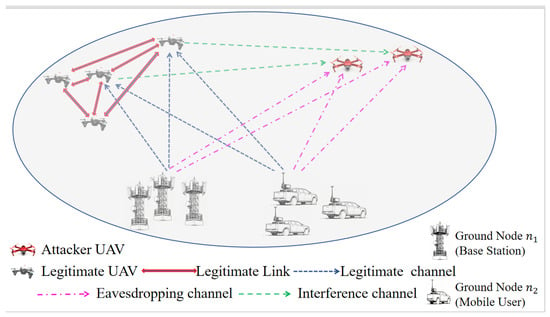
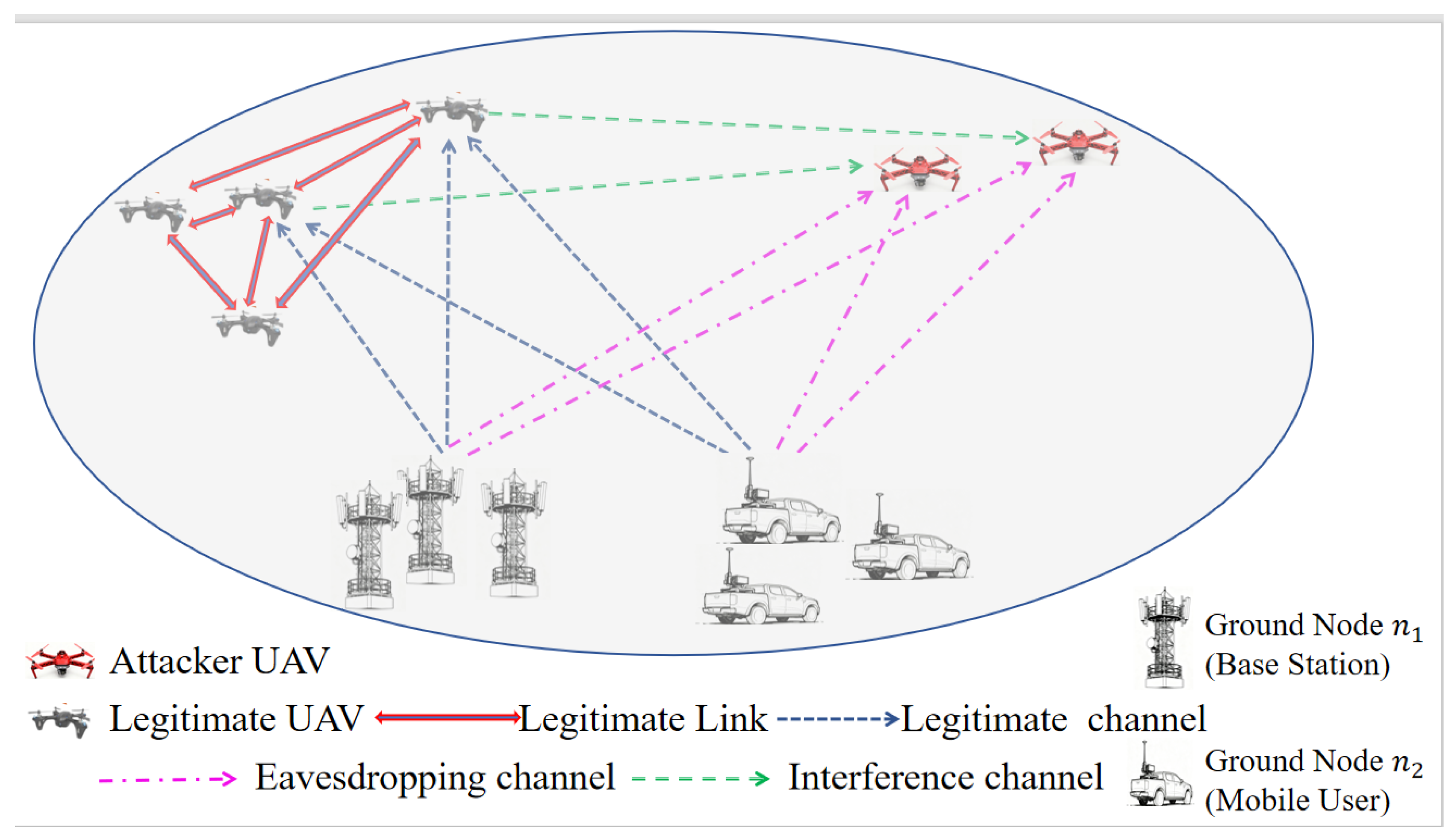
As shown in Figure 1, the network model consists of three components: ground nodes, legitimate UAVs (defenders), and attacker UAVs.
Figure 1.
System Model.
Ground nodes: Ground nodes are randomly distributed on the ground and are equipped with storage and computation capabilities. Let denote the set of ground nodes in the UAV network, where each ground node is responsible for transmitting data to legitimate UAVs. The positions of the ground nodes are represented in a three-dimensional Cartesian coordinate system. Since all ground nodes are located on the ground plane, their coordinates can be expressed as , with the z-axis coordinate omitted.
Legitimate UAVs (Defenders): Let represent the set of legitimate UAVs. These UAVs act as defenders in the proposed framework. They are evenly distributed in a circular space with radius . Each legitimate UAV flies within at an average flight speed and establishes a LoS link with a ground node to transmit confidential information. Following [20], the defense capability of the l-th legitimate UAV is characterized by its interference power and transmission power .
To realize a leaderless framework, we incorporate a dynamic spatial adaptation mechanism. In this mechanism, each UAV operates as an independent node equipped with autonomous perception, cross-validation, and collaborative defense capabilities. During the initial access phase, each UAV carries an immutable digital identity generated based on its hardware characteristics. When two UAVs enter each other’s communication range, they first complete identity mutual authentication through physical layer features, thereby establishing a basic trust relationship. Subsequently, the communication key is not pre-set or centrally distributed but is dynamically generated based on the instantaneous physical environment characteristics perceived by both parties (such as surrounding obstacle distribution, real-time meteorological data, etc.). This achieves a “one-time pad” effect, significantly increasing the difficulty of key cracking.
Attacker UAVs: The attacker UAVs aim to eavesdrop on communications between legitimate UAVs and ground nodes. Let denote the set of attacker UAVs. These UAVs are capable of actively adjusting their attack intensity to compromise network security. Similar to legitimate UAVs, the attackers are distributed within a circular space with radius and fly at an average flight speed to intercept transmissions between legitimate UAVs and ground nodes.
4.2. Defender–Attacker Interaction Model
In the defender–attacker interaction model, the behaviors of legitimate UAVs transmitting data and attacker UAVs eavesdropping on communications between legitimate UAVs and ground nodes are analyzed. The attacker UAVs threaten the communication security of legitimate UAVs by adjusting both their attack intensity and the number of attacking units. Specifically, attackers first select the number of UAVs to participate in the eavesdropping activity and then determine the optimal attack intensity on the strategy adopted by the defenders. Since each legitimate UAV resists eavesdropping attacks by emitting jamming signals, it is not guaranteed that attackers can successfully launch an attack in every attempt.
Specifically, given that the spatial positions of UAVs within an airspace are random and independent, the number of attacker UAVs is assumed to follow a Poisson process [19]. Moreover, UAVs only fly through the airspace and do not take off or land, so even if the UAV density in the airspace is high, the number of UAVs should exhibit a clear Poisson distribution. According to [10], the probability of attackers launching an attack first increases and then decreases with the increase in the number of eavesdropping UAVs. This intrinsic relationship conforms to the Poisson process. Therefore, the probability of the number of eavesdropping UAVs in the airspace can be quantified as the probability of attackers launching an attack. Empirically, as the number of attacker UAVs within increases, the probability of launching a successful attack rises, resulting in higher potential gains. However, this also incurs higher costs because attackers must allocate more resources to sustain the attack. As rational entities, attackers aim to maximize their own utility. Therefore, the probability of launching an attack first increases and then decreases as the number of attacker UAVs grows, which is characterized by the Poisson distribution. The attack probability is defined as
where represents the mean of the distribution of attacker UAVs in , denotes the attack intensity (i.e., the number of eavesdropping attacks per unit time), and is the area of . Here, n represents the number of attacker UAVs. Let denote the probability of a successful attack, which depends on the quality of channels between ground nodes and attackers. The probability of attackers successfully intercepting communications between legitimate UAVs and ground nodes is then given by . A successful attack can lead to severe security issues, including the loss of confidential information and privacy leakage.
While transmitting information to ground nodes, legitimate UAVs simultaneously emit jamming signals to interfere with attacker UAVs and mitigate their impact, thereby enhancing communication security. The attack intensity of the attacker UAVs directly affects the coalition formation and power allocation strategies of the legitimate UAVs. In turn, attackers dynamically adjust their attack strategies based on the defenders’ coalition structure and power distribution. This mutual adaptation forms a hierarchical decision-making process that can be modeled as a Stackelberg game between defender UAVs and attacker UAVs.
4.3. Channel Model
The wireless channel link between UAVs and ground nodes has been extensively studied in the literature. Most existing models can be categorized into three types: free-space LoS models, altitude-dependent models, and probabilistic LoS channel models. Recent studies [12] have shown that the LoS model provides a good approximation for UAV-to-ground communications. To avoid obstacles and prevent UAVs from accidental altitude variations during detection tasks, the flight altitude of the l-th legitimate UAV is specified as according to the type of obstacles. Therefore, the channel gain between the n-th ground node and the l-th legitimate UAV, denoted by , follows the free-space path loss model, which is expressed as
where represents the channel power gain at the reference distance m, and depends on the carrier frequency and the antenna gains and of the transmitter and receiver, respectively. It is given by
where c is the speed of light.
Similarly, the LoS channel gain between the j-th attacker UAV and the n-th ground node, denoted as , is defined as
If the l-th legitimate UAV is connected to the n-th ground node, the achievable data transmission rate is expressed as
where represents the power of Gaussian white noise, is the transmission power of the l-th legitimate UAV, and denotes its bandwidth.
Similarly, the data transmission rate between the j-th attacker UAV and the n-th ground node, denoted as , is given by
where is the bandwidth of the j-th attacker UAV, and represents the interference power emitted by legitimate UAVs.
- Secrecy rate: The secrecy rate is a key performance metric for physical layer security. It represents the amount of confidential information that can be reliably transmitted without being eavesdropped. The secrecy rate is defined as the difference between the achievable transmission rate of the legitimate link and that of the eavesdropping link. Thus, the average secrecy rate from legitimate UAVs to the n-th ground node is given bywhere . The summation result in Equation (7) is the difference between the sum of all legitimate UAV rates and the sum of all attacker UAV rates.
5. Dual-Game-Based Framework for UAV Swarms
In this section, a dual-game-based framework for legitimate UAVs (defenders) and attacker UAVs is presented. First, a UCG is formulated, through which legitimate UAVs converge toward an optimal coalition division. Then, a Stackelberg game between defenders and attackers is established by analyzing their respective utilities. Finally, the optimal strategies for legitimate UAVs and attacker UAVs are derived.
5.1. Union Coalition Game (UCG) of Legitimate UAVs for Optimal Division
As the number of legitimate UAVs in a coalition increases, the security of communications between legitimate UAVs and ground nodes can either be enhanced through collaborative defense or degraded if excessive defense resources are consumed. To address this issue, an incentive scheme is introduced to guide the UAV swarm toward an optimal coalition structure through coalition formation and fragmentation. Within a coalition, legitimate UAVs cooperate by sharing their defense resources to assist one another in countering eavesdropping attacks. A coalition game is employed to model the interactions among legitimate UAVs, where the strategy of an individual UAV is to decide whether to join a coalition, and the strategy of a coalition is to determine whether to split or admit additional members. After strategies are selected, the legitimate UAVs transmit data to the ground nodes through the wireless channel.
By joining a coalition, each legitimate UAV receives a portion of the collective defensive capabilities from other coalition members while contributing part of its own capabilities to assist in collaborative defense. The defensive capability of a UAV reflects its ability to transmit information and to resist attacks. This capability is modeled as a concave function with respect to both and . The total defense capability of the l-th UAV is expressed as
and are further defined as
where and represent the data transmission and jamming components of the defensive capability , P denotes the maximum transmission power of a UAV, M is the number of legitimate UAVs in the coalition, and is the coalition benefit impact factor. After joining a coalition, a UAV can rely on shared defense resources, allowing it to allocate more power to information transmission with ground nodes. To maintain concavity of the utility function, let , where represents the power used for data transmission after coalition formation. Similarly, let , where represents the power allocated for jamming attacker UAVs. Consequently, legitimate UAVs within a coalition can effectively exchange information about defense tasks and distribute their defensive capabilities equally through a coalition defense allocation strategy.
The objective of legitimate UAVs is to maximize their individual utilities. Due to the eavesdropping attacks conducted by attacker UAVs, the probability of absolutely secure communication between the l-th legitimate UAV and the n-th ground node is . Moreover, the utility function of the l-th legitimate UAV incorporates both its data transmission rate and defensive capability. Specifically, to effectively balance and , a weighted combination is adopted. Accordingly, the utility of the l-th legitimate UAV is defined as
which represents the data transmission rate and defensive capability of the l-th legitimate UAV in absolutely secure communications.
For the set of legitimate UAVs L, if a subset satisfies
then can form a coalition S. Conversely, S can be split into . This criterion is used to determine whether coalition formation or fragmentation occurs.
The UCG mechanism for coalition formation among legitimate UAVs is illustrated in Algorithm 1.
| Algorithm 1 Union Coalition Game (UCG) Algorithm |
| Require: UAV set Ensure: Optimal partition of the legitimate UAV swarm
|
The convergence of this algorithm can be guaranteed by payoff monotonicity and the finiteness of states: each merging operation (whether adding a single UAV to an existing coalition or merging multiple coalitions into a larger one) must satisfy Equation (12), i.e., the total payoff after merging is not less than the sum of the payoffs of the separate parts before merging. Therefore, the total payoff of the entire system is monotonically non-decreasing during the iterative process. Meanwhile, since the number of UAVs is finite, the possible coalition partition methods are also finite, and the payoff cannot increase indefinitely, so the algorithm must converge to a stable partition where no further merging is possible within a finite number of steps. The termination condition of the algorithm is exactly when all possible merging attempts (including adding elements to coalitions and merging between coalitions) fail to satisfy Equation (12), and the current partition is the final output. In terms of time complexity, in the worst case, the algorithm needs to attempt to add each UAV to existing coalitions sequentially and perform pairwise merging judgments between coalitions. Each merging judgment also requires calculating the payoff of the coalition (which is generally proportional to the coalition size). Therefore, the total time complexity is , where n is the total number of UAVs. The space complexity is relatively low, mainly storing the set of elements in each coalition in the current partition and the payoff information of each element. The required space is linearly related to the number of UAVs, i.e., .
5.2. The Stackelberg Game Between Legitimate and Attacker UAVs
5.2.1. The Utility of the Legitimate UAV Swarm
After the legitimate UAVs converge toward the optimal coalition division, security risks still persist due to the broadcast characteristics of wireless channels. To counter eavesdropping attacks, a hierarchical Stackelberg game is employed to model the interaction between legitimate UAVs and attacker UAVs.
Specifically, each legitimate UAV first allocates its transmission and interference power (where and ) based on the trade-off between energy consumption and communication security. Subsequently, given the chosen , attacker UAVs select the attack intensity (where ) to maximize their eavesdropping utility. Here, represents the upper bound of the attack intensity.
The secrecy rate is a critical factor in determining the utility of the legitimate UAV swarm. An increase in secrecy rate generally leads to an improvement in utility. However, maximizing secrecy rate alone does not necessarily maximize the swarm’s utility, as the UAVs aim to achieve a balance between communication benefits and defense costs. To capture this trade-off, the utility function is defined to represent the preferences and payoffs of legitimate UAVs under different strategic combinations. This utility depends not only on the secrecy rate but also on the energy expenditure required to resist eavesdropping attacks.
Specifically, the utility of the legitimate UAV swarm consists of three components:
- 1.
- The benefit obtained from secure data transmission to ground nodes,
- 2.
- The loss caused by successful attacks, and
- 3.
- The energy cost of defense operations.
- Accordingly, the utility function of the legitimate UAV swarm is defined aswhere represents the benefit from secure transmission and represents the total cost, which includes both attack-induced losses and energy consumption.
The probability of successful data transmission is positively correlated with network security. As such, the transmission benefit of the legitimate UAV swarm can be expressed as
where denotes the coalition size after optimal division. is the number of legitimate UAV coalitions, and is the number of legitimate UAVs in a coalition.
The cost function depends on both the attackers’ intensity and the legitimate UAVs’ energy consumption. When the attack intensity increases, the UAV swarm must consume more energy to counter the attack and incurs greater losses due to successful eavesdropping. Thus, the cost is modeled as
where is a weighting parameter reflecting the trade-off between cost and energy consumption.
5.2.2. The Utility of Attackers
The utility of attacker UAVs is determined by the benefit obtained from eavesdropping on legitimate communications and the loss incurred due to interference from legitimate UAVs. It can be expressed as
where denotes the benefit function associated with eavesdropping on data transmission between legitimate UAVs and ground nodes, and represents the cost function of attackers.
When attackers successfully intercept communications, significant profit can be obtained. Accordingly, the benefit function of the attacker UAVs is given by
where represents the probability of a successful attack and denotes the achievable data rate from the attacker UAVs to the ground nodes.
The cost function depends on both the attack intensity and the interference power generated by legitimate UAVs. When the interference power is high, attackers must consume more energy to resist the jamming signal, resulting in increased loss costs. Thus, the cost function of the attackers is formulated as
where represents the jamming effect coefficient associated with the coalition size of legitimate UAVs.
5.2.3. Analysis of the Stackelberg Game
Based on the above formulations, the optimization problems for the legitimate UAV swarm and the attackers can be defined separately. The objective of the legitimate UAV swarm is to determine the optimal power allocation strategy to maximize its utility under the power limitation. Accordingly, the optimization problem is formulated as Problem I:
Similarly, the objective of the attacker UAVs is to select the optimal attack intensity to maximize their own utility. Thus, the optimization problem for the attackers is formulated as Problem II:
The goal of the Stackelberg game is to obtain an equilibrium solution that maximizes the utility of each party under hierarchical decision-making. In this game, the attackers determine their optimal attack intensity after observing the power allocation strategy of the legitimate UAV swarm. The corresponding Stackelberg equilibrium is defined as follows.
Let denote the optimal power allocation strategy for Problem I, and let denote the optimal attack intensity for Problem II. The tuple is a Stackelberg equilibrium if the following conditions are satisfied:
At this equilibrium point, neither the legitimate UAV swarm nor the attackers can unilaterally improve their utility by changing their strategies. This property ensures the stability and optimality of the proposed Stackelberg game framework.
- (i)
- First, find that achieves .
Take the first-order partial derivative of with respect to :
Then take the partial derivative of with respect to :
Analyze the extremum of the function :
If holds constantly, then the value range of is:
The extreme point of should satisfy . According to (24), we can find:
Therefore, regardless of how the parameters are valued, the function always has an extreme point. In practice, as long as the value range of the attack intensity that the attacker UAV can choose contains this extreme point, can achieve . Therefore, for the attacker UAV, the attack intensity selection strategy is:
- (ii)
- Under the condition that is determined, solve the optimal power allocation that satisfies :
By analyzing the influencing factors of , it can be found that the game within the legitimate UAV group will affect the values of s and , thereby affecting the properties of . Since the outcome of the game within the legitimate UAV group depends on the power allocation of individual legitimate UAVs, the parameters are strongly coupled with s and . Therefore, the analytical form of cannot be obtained in the same way as solving for .
6. Simulation Results
In this section, the performance of the proposed framework is evaluated through numerical simulations conducted in MATLAB 2021a. The simulation configuration is first described, followed by the presentation and analysis of the results.
6.1. Simulation Settings
To capture all potential coalition behaviors of legitimate UAVs before initiating communication with ground nodes (e.g., no coalition, partial coalition, or complete coalition), the total number of legitimate UAVs is randomly selected from the interval [2, 50]. In the Stackelberg game, a purely strategic interaction occurs between the attacker UAVs and the legitimate UAVs, and hence the number of attacker UAVs must also be determined. Since both the secrecy rate and the total utility of the legitimate UAV swarm are influenced by the number of attacker UAVs, this number is dynamically varied and randomly chosen from [1, 50]. The flight altitudes of the attacker UAVs and legitimate UAVs are fixed at 100 m and 120 m, respectively. The noise power is set to dB [21], and the probability of a successful attack is uniformly sampled from the interval [0.1, 1]. Each experiment is iterated 10,000 times to ensure statistical stability. Other simulation parameters: ; MHz; m; m; W; dB; .
For clarity, the proposed framework (DGUA) is referred to as the “alliance game framework” in the simulation results. To demonstrate its performance advantages, three baseline frameworks are considered for comparison:
- Complete Alliance Framework [10]: All legitimate UAVs form a single alliance, and the leader UAV randomly selects an interference power strategy.
- Random Framework [22]: The leader UAV randomly selects an interference power strategy without alliance optimization.
- Fixed Framework [6]: The leader UAV selects a fixed interference power strategy for the entire simulation process.
6.2. Experimental Results and Analysis
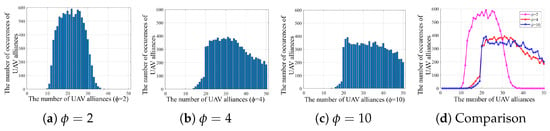
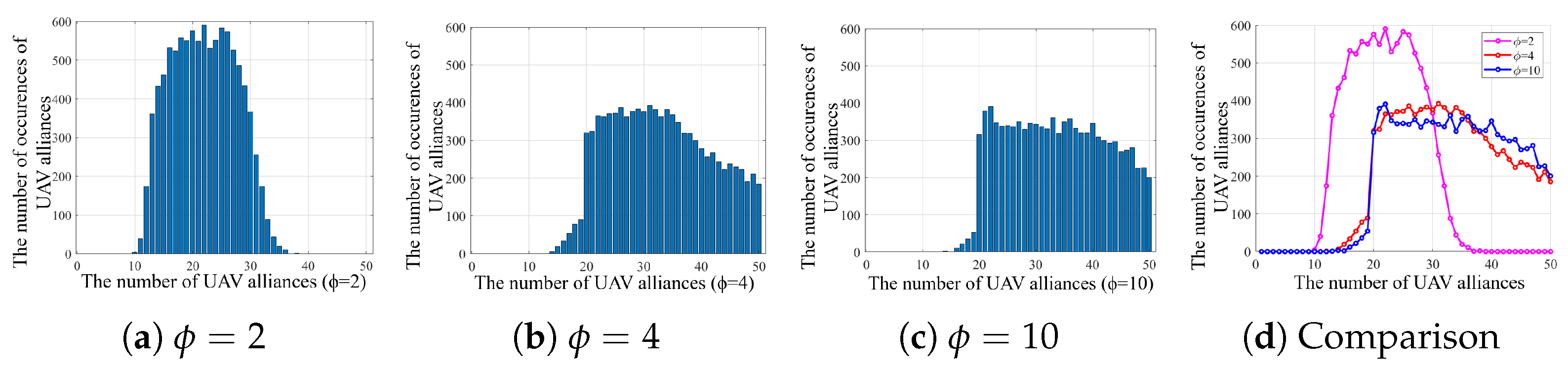
Figure 2 illustrates the optimal coalition partitions of the legitimate UAV swarm under different coalition benefit impact factors , with the number of legitimate UAVs fixed at 50. A larger number of coalitions corresponds to a lower degree of cooperation among legitimate UAVs. When the number of coalitions equals 50, the UAV swarm operates in a fully non-cooperative state, whereas a coalition number of 1 indicates the formation of a grand coalition. As shown in the figure, when the coalition impact factor increases, the coalition number shifts toward the interval . This trend occurs because a larger reduces the marginal benefit of joining a coalition, thereby discouraging cooperative behavior and leading to an increase in the number of coalitions. Based on this observation, is selected as the operating condition for subsequent experiments to compare the proposed coalition game framework with other baseline schemes.
Figure 2.
The optimal partition of legitimate UAVs for different coalition benefit impact factor .
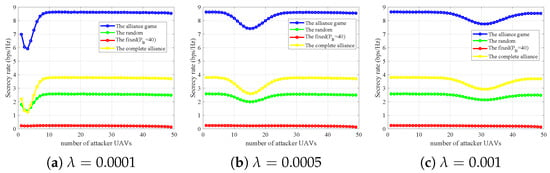
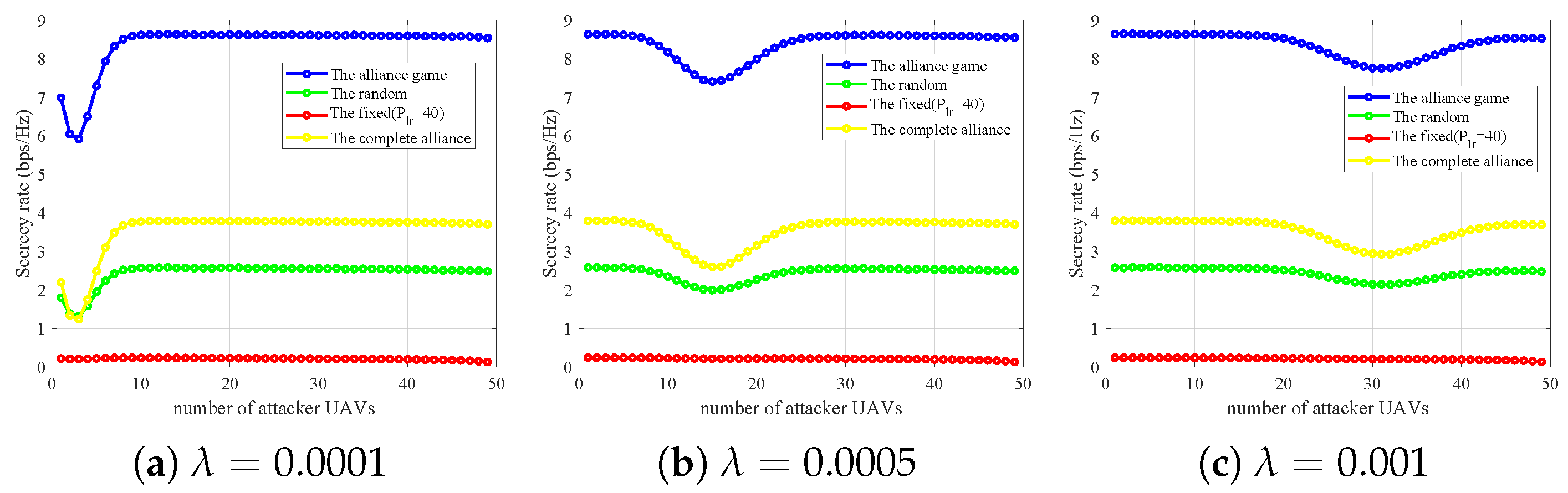
Figure 3 illustrates the secrecy rate performance of legitimate UAV networks under different attack intensities as the number of attacker UAVs varies. As shown in the figure, the secrecy rate of the UAV network initially decreases and then increases as the number of attacker UAVs grows. This trend arises because the attackers’ attack probability follows a Poisson process, which first increases and subsequently decreases with the number of attackers. A comparison of subfigures (a)–(c) reveals that lower attack intensities correspond to smaller numbers of attacker UAVs at which the network secrecy rate reaches its minimum. This behavior is also attributed to the characteristics of the Poisson distribution, the smaller the value of , the lower the extremum point of the Poisson process. Inspired by [10], the simulation scale was expanded, and the scenario was modified to represent a larger UAV network. This adjustment ensures that the proposed framework achieves a significantly higher secrecy rate than the three baseline schemes, with clear performance gains observed across all attack intensities.
Figure 3.
Total utility of the legitimate UAV swarm for different attack intensity .
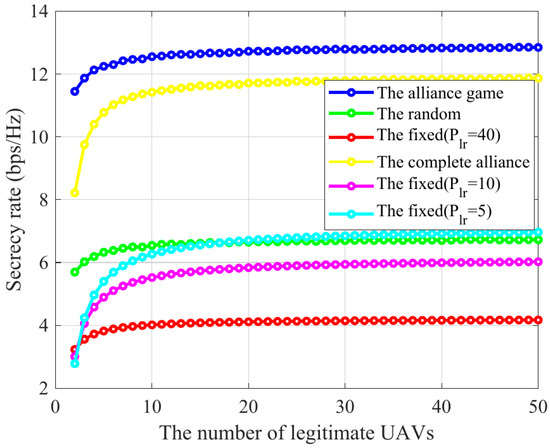
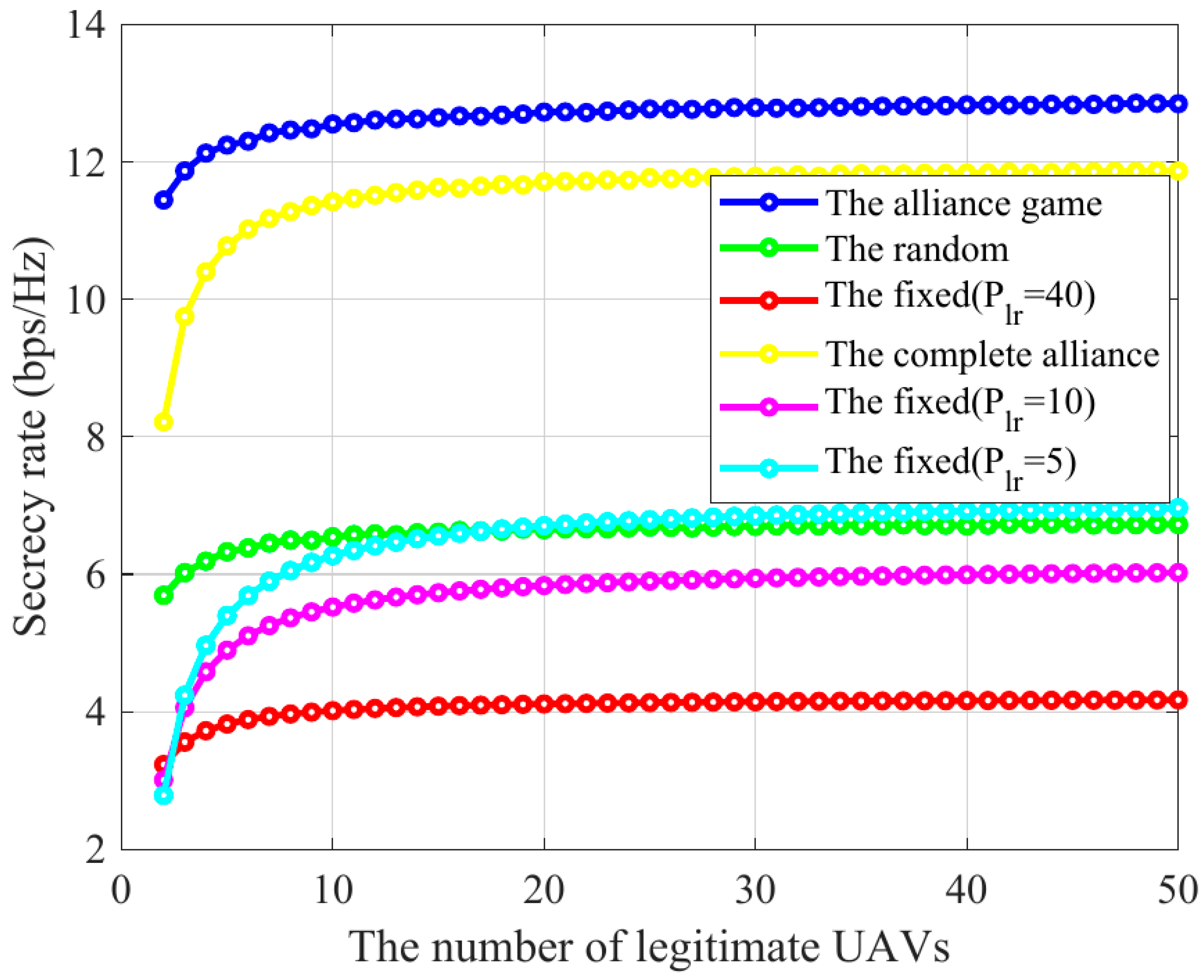
Figure 4 presents the secrecy rate performance under different numbers of legitimate UAVs. The secrecy rate of all frameworks increases as the number of legitimate UAVs grows; however, the rate of increase gradually diminishes, indicating a saturation trend. In the complete alliance framework, when the UAV swarm becomes excessively large, the defensive resources gained by an individual UAV from joining the coalition become significantly smaller than the resources it must share with other UAVs. As a result, the secrecy rate of this framework does not reach its maximum potential. Both the fixed and random frameworks exhibit lower performance because they do not account for the defender–attacker interaction mechanisms. Whether the fixed framework outperforms the random framework depends on the interference power allocation of the legitimate UAVs, and no consistent superiority relationship can be observed between the two schemes. Furthermore, the alliance game framework achieves higher secrecy rate, outperforming the complete alliance framework by 10%.
Figure 4.
Comparison of secrecy rate of the UAV network, when the number of legitimate UAVs changes.
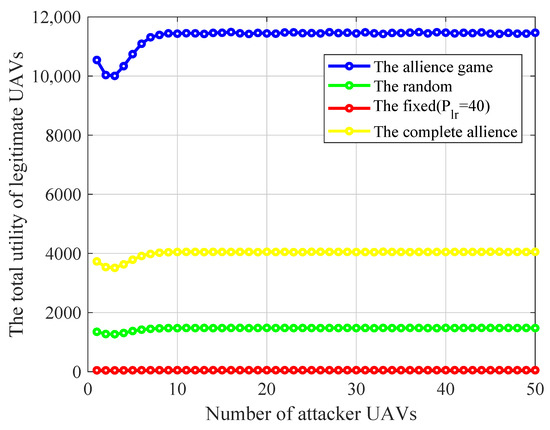
Figure 5 illustrates the utility variations under different numbers of attacker UAVs. For this analysis, the attack intensity is fixed at to highlight the decision-making process. It can be observed that as the number of attacker UAVs increases, the utility of the legitimate UAV swarm initially decreases and then increases. This behavior is explained by the Poisson distribution governing the attack probability, which first rises and subsequently declines as the number of attackers grows. Furthermore, the utility of the legitimate UAV swarm under the proposed alliance game framework remains significantly higher than that achieved by the complete alliance framework across all attacker UAV numbers. This improvement results from the alliance game framework’s objective of maximizing swarm utility by dynamically adjusting coalition partitions, thereby avoiding the inefficient allocation of defense resources and enhancing both data transmission and attack resistance. In contrast, due to the maximum power restriction (MPR) imposed on the total transmission and interference power, the complete alliance framework requires individual UAVs to allocate excessive defensive resources. This leads to insufficient remaining power for data transmission or jamming, ultimately reducing the overall utility of the network.
Figure 5.
Comparison of total utility of the legitimate UAV swarm, when the number of attacker UAVs changes.
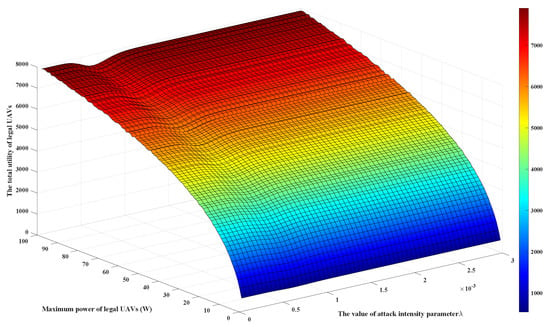
Figure 6 illustrates the utility of the legitimate UAV swarm under different maximum power levels and attack intensities. When the attack intensity is fixed, the utility of the legitimate UAV swarm increases as the maximum power P grows. However, the rate of increase gradually diminishes with larger P, indicating that the utility eventually reaches a saturation point. Conversely, when P is fixed, the utility of the legitimate UAV swarm initially decreases and then increases. This non-monotonic trend arises because the attackers’ attack probability follows a Poisson distribution, which first increases and then declines with changing parameters. Moreover, across different values of , the overall trend of the UAV swarm’s utility with respect to maximum power remains consistent, and the reverse also holds. This observation indicates that the choice of P by legitimate UAVs has little impact on the attack intensity strategy adopted by the attackers. In other words, only the power allocation strategy of legitimate UAVs influences the attack intensity strategy of attacker UAVs.
Figure 6.
The legitimate UAV swarm utility of the alliance game framework under different maximum power P of legitimate UAVs and attack intensity .
7. Conclusions and Future Work
This paper proposed a dual-game UAV alliance framework to secure large-scale UAV networks against coordinated eavesdropping attacks under power constraints. The framework integrates an inner-layer Union Coalition Game for dynamic coalition formation among legitimate UAVs without a designated leader, and an outer-layer Stackelberg game capturing the hierarchical interaction where legitimate UAVs allocate dual-antenna power while attackers select attack intensity.
Simulation results demonstrated that the proposed framework achieves secrecy rate improvements of up to compared with existing complete alliance strategies. Analysis revealed that the optimal attack intensity for the Stackelberg equilibrium is , indicating that attackers’ strategic behavior is fundamentally determined by the spatial density of UAVs in the attack region. The secrecy rate exhibits a non-monotonic relationship with the number of attacker UAVs due to the Poisson-distributed attack probability, and the utility of the legitimate UAV swarm shows diminishing returns with respect to maximum power.
Future work will extend the framework to allow attacker coalitions, incorporate dynamic trajectory optimization, and employ multi-agent reinforcement learning for real-time adaptive defense.
Author Contributions
Conceptualization, Z.K.; methodology, K.Z.; software, K.Z.; investigation, K.Z. and Z.K.; validation, M.W.; resources, Z.K.; data curation, Y.Y.; writing—original draft preparation, K.Z. and Z.K.; writing—review and editing, Y.Y.; visualization, M.W.; supervision, Z.K.; project administration, Z.K.; funding acquisition, Z.K. All authors have read and agreed to the published version of the manuscript.
Funding
The work of Zhengmin Kong was supported in part by the Fundamental Research Funds for the Central Universities (No. 2042025kf0055) and in part by the National Natural Science Foundation of China (No. 62173256) and in part by Guangdong Provincial Key Laboratory of Intelligent Measurement and Advanced Metering of Power Grid (GPKLIMAMPG-2024-KF-01).
Data Availability Statement
No new data were created or analyzed in this study. Data sharing is not applicable to this article.
Conflicts of Interest
The authors declare no conflicts of interest.
References
- Jiang, H.; Chang, Y.; Yang, L.; Liu, X.; He, Y. Cooperative Exploration of Heterogeneous UAVs in Mountainous Environments by Constructing Steady Communication. IEEE Robot. Autom. Lett. 2023, 8, 7249–7256. [Google Scholar] [CrossRef] [Scilit]
- Ladosz, P.; Oh, H.; Zheng, G.; Chen, W.H. A Hybrid Approach of Learning and Model-Based Channel Prediction for Communication Relay UAVs in Dynamic Urban Environments. IEEE Robot. Autom. Lett. 2019, 4, 2370–2377. [Google Scholar] [CrossRef] [Scilit]
- Padilla, G.E.G.; Kim, K.J.; Park, S.H.; Yu, K.H. Flight Path Planning of Solar-Powered UAV for Sustainable Communication Relay. IEEE Robot. Autom. Lett. 2020, 5, 6772–6779. [Google Scholar] [CrossRef] [Scilit]
- Zeng, Y.; Zhang, R.; Lim, T.J. Wireless communications with unmanned aerial vehicles: Opportunities and challenges. IEEE Commun. Mag. 2016, 54, 36–42. [Google Scholar] [CrossRef] [Scilit]
- Cai, Y.; Cui, F.; Shi, Q.; Zhao, M.; Li, G.Y. Dual-UAV-enabled secure communications: Joint trajectory design and user scheduling. IEEE J. Sel. Areas Commun. 2018, 36, 1972–1985. [Google Scholar] [CrossRef] [Scilit]
- Liu, C.; Lee, J.; Quek, T.Q.S. Safeguarding UAV communications against full-duplex active eavesdropper. IEEE Trans. Wirel. Commun. 2019, 18, 2919–2931. [Google Scholar] [CrossRef] [Scilit]
- Dai, C.; Zhu, K.; Hossain, E. Multi-agent deep reinforcement learning for joint decoupled user association and trajectory design in full-duplex Multi-UAV networks. IEEE Trans. Mobile Comput. 2023, 22, 6056–6070. [Google Scholar] [CrossRef] [Scilit]
- Lee, H.; Eom, S.; Park, J.; Lee, I. UAV-Aided secure communications with cooperative jamming. IEEE Trans. Veh. Technol. 2018, 67, 9385–9392. [Google Scholar] [CrossRef] [Scilit]
- Yao, J.; Xu, J. Joint 3D maneuver and power adaptation for secure UAV communication with CoMP reception. IEEE Trans. Wirel. Commun. 2020, 19, 6992–7006. [Google Scholar] [CrossRef] [Scilit]
- Xie, L.; Su, Z.; Xu, Q.; Chen, N.; Fan, Y.; Benslimane, A. A Secure UAV Cooperative Communication Framework: Prospect Theory Based Approach. IEEE Trans. Mobile Comput. 2024, 23, 10219–10234. [Google Scholar] [CrossRef] [Scilit]
- Chen, R.; Yi, C.; Zhu, K.; Chen, B.; Cai, J.; Guizani, M. A Three-Party Hierarchical Game for Physical Layer Security Aware Wireless Communications with Dynamic Trilateral Coalitions. IEEE Trans. Wirel. Commun. 2024, 23, 4815–4829. [Google Scholar] [CrossRef] [Scilit]
- Zhang, G.; Wu, Q.; Cui, M.; Zhang, R. Securing UAV communications via joint trajectory and power control. IEEE Trans. Wirel. Commun. 2019, 18, 1376–1389. [Google Scholar] [CrossRef] [Scilit]
- Zhou, Y.; Pan, C.; Yeoh, P.L.; Wang, K.; Elkashlan, M.; Vucetic, B.; Li, Y. Secure Communications for UAV-enabled mobile edge computing systems. IEEE Trans. Commun. 2020, 68, 376–388. [Google Scholar] [CrossRef] [Scilit]
- Liu, Z.; Zhu, B.; Xie, Y.; Ma, K.; Guan, X. UAV-aided secure communication with imperfect eavesdropper location: Robust design for jamming power and trajectory. IEEE Trans. Veh. Technol. 2023, 73, 7276–7286. [Google Scholar] [CrossRef] [Scilit]
- Mitchell, R.; Chen, I. Adaptive intrusion detection of malicious unmanned air vehicles using behavior rule specifications. IEEE Trans. Syst. Man Cybern. Syst. 2024, 44, 593–604. [Google Scholar] [CrossRef] [Scilit]
- Alpcan, T.; Buchegger, S. Security games for vehicular networks. IEEE Trans. Mobile Comput. 2011, 10, 280–290. [Google Scholar] [CrossRef] [Scilit]
- Sedjelmaci, H.; Senouci, S.; Ansari, N. Intrusion detection and ejection framework against lethal attacks in UAV-Aided networks: A Bayesian game-theoretic methodology. IEEE Trans. Intell. Transp. Syst. 2017, 18, 1143–1153. [Google Scholar] [CrossRef] [Scilit]
- Xu, G.; Chen, G.; Cheng, Z.; Hong, Y.; Qi, H. Consistency of Stackelberg and Nash Equilibria in Three-Player Leader-Follower Games. IEEE Trans. Inf. Forensics Secur. 2024, 19, 5330–5344. [Google Scholar] [CrossRef] [Scilit]
- Tang, J.; Chen, G.; Coon, J. Secrecy performance analysis of wireless communications in the presence of UAV jammer and randomly located UAV eavesdroppers. IEEE Trans. Inf. Forensics Secur. 2019, 14, 3026–3041. [Google Scholar] [CrossRef] [Scilit]
- Xiao, L.; Xie, C.; Min, M.; Zhuang, W. User-centric view of unmanned aerial vehicle transmission against smart attacks. IEEE Trans. Veh. Technol. 2018, 67, 3420–3430. [Google Scholar] [CrossRef] [Scilit]
- Peng, H.; Shen, X. Multi-agent reinforcement learning based resource management in MEC- and UAV-Assisted vehicular networks. IEEE J. Sel. Areas Commun. 2021, 39, 131–141. [Google Scholar] [CrossRef] [Scilit]
- Ye, J.; Zhang, C.; Lei, H.; Pan, G.; Ding, Z. Secure UAV-to-UAV Systems with Spatially Random UAVs. IEEE Wirel. Commun. Lett. 2019, 8, 564–567. [Google Scholar] [CrossRef] [Scilit]

Disclaimer/Publisher’s Note: The statements, opinions and data contained in all publications are solely those of the individual author(s) and contributor(s) and not of MDPI and/or the editor(s). MDPI and/or the editor(s) disclaim responsibility for any injury to people or property resulting from any ideas, methods, instructions or products referred to in the content. |
© 2026 by the authors. Licensee MDPI, Basel, Switzerland. This article is an open access article distributed under the terms and conditions of the Creative Commons Attribution (CC BY) license.