


Abstract
A Lyapunov-based hybrid model predictive control (LHMPC) method is proposed for the control of a vehicle hybrid logic dynamic system (MLD) that regulates vehicle height through asymmetric damping forces. This method addresses the limitations of traditional hybrid model predictive control (HMPC), including its inability to guarantee closed-loop stability, long prediction horizons, and excessive computational burden. The method incorporates the decreasing condition of the Lyapunov function as a contraction constraint mechanism, ensuring asymptotic stability throughout the control process. Additionally, by following the terminal constraint principle, the Lyapunov function is introduced as an inequality constraint set, replacing the terminal equality constraints typically used in traditional stability frameworks. This further guarantees the recursive feasibility and closed-loop stability of the MLD system optimization. Simulation results based on a seven-degree-of-freedom vehicle model demonstrate that the proposed LHMPC significantly outperforms conventional HMPC in terms of height tracking accuracy, convergence rate, vibration suppression, and real-time controller performance. Furthermore, the method can effectively harness the vehicle body’s vibrational energy while achieving coordinated control of vehicle height and posture, thereby reducing energy consumption during the height adjustment process.
1. Introduction
Vehicle height control technology can improve vehicle performance under different driving conditions. With the rapid development of intelligent connected vehicles and autonomous driving technologies, achieving accurate, fast, and efficient regulation of suspension systems has become a major research focus. Currently, commonly used suspension control strategies include skyhook control [1], optimal control [2], sliding mode control [3], and PID control [4]. Among these methods, Model Predictive Control (MPC) has become one of the most representative approaches in suspension control due to its ability to explicitly handle system constraints, predict future dynamics, and perform receding-horizon optimization [5,6]. In the field of active suspension, Yu et al. [7] proposed an MPC-based control scheme for an in-wheel electric suspension system, achieving performance optimization while considering actuator stroke constraints and tire adhesion limitations. However, in practical applications, hardware limitations on actuator force magnitude and response delay require frequent controller adjustments, which may affect control performance. To address energy consumption issues, Meléndez-Useros et al. [8] developed a hybrid electromagnetic active suspension system (HEAS) integrating hydraulic and electromagnetic energy recovery modules (HERM) and achieved coordinated optimization of energy recovery and vibration suppression within the MPC framework. Nevertheless, the integration of multiple actuation and energy conversion units increases the coupling complexity and control difficulty of the suspension system. Therefore, although active suspension systems exhibit superior performance, they still suffer from high energy consumption, high cost, and structural complexity.
In contrast, variable dampers in semi-active suspension systems provide passive damping forces and offer advantages such as simple and reliable structure, lower cost, and reduced energy consumption [9,10]. Ratha et al. [11] developed an MPC-based control method for semi-active suspension systems, formulating the control problem as an open-loop optimal control task based on parameterized input sequence search over a finite prediction horizon while optimizing ride comfort under system constraints. However, with increasing system nonlinearity, stronger coupling effects, and higher real-time requirements, the application of conventional MPC in semi-active suspension systems still faces challenges related to computational burden and stability assurance. To improve MPC performance, Bouden et al. [12] proposed a Robust Model Predictive Control (RMPC) strategy to enhance the performance of active suspension systems with time-varying switching delays. However, applying this strategy to semi-active systems may introduce additional uncertainties. To address the heavy computational burden of conventional MPC, Zhang et al. and Li et al. [13,14] developed control frameworks for vehicle suspension systems based on Explicit Model Predictive Control (EMPC), which improves computational efficiency by shifting the optimization process offline and avoiding online iterative computation. Nevertheless, EMPC suffers from limitations in high-dimensional systems, including complex control law representation, large memory requirements, and substantial offline computational effort. Li et al. [15] proposed a variable step-length MPC (VSL-MPC) algorithm to optimize damping adjustment timing and enhance control performance. Cai et al. [16] introduced a hybrid control strategy combining MPC with fuzzy adaptive PID compensation and applied it to a half-car semi-active suspension system, reducing computational burden and improving control efficiency through an embedded compensation mechanism. Mazouchi et al. and Wang et al. [17,18] presented learning-based MPC approaches that enhance prediction capability by identifying disturbance models, thereby improving optimization efficiency. Therefore, it is necessary to further investigate the relationship between MPC-based control strategies and damping regulation effects in semi-active suspension systems and to develop optimization methods that simultaneously ensure stability and real-time performance.
In our previous research, an innovative method for vehicle height adjustment based on asymmetric damping was proposed for semi-active suspension systems with adjustable damping characteristics [19]. The system was modeled using a Mixed Logical Dynamical (MLD) framework, and a Hybrid Model Predictive Control (HMPC) scheme was subsequently constructed based on this model [20]. However, the optimization process of the HMPC algorithm may not guarantee the closed-loop stability of the MLD system, which can result in slower state convergence.
Existing stability studies of HMPC commonly impose terminal equality constraints over the prediction horizon to maintain recursive feasibility in subsequent horizons [21,22]. The core idea of this approach is to force the system state to exactly reach the equilibrium point at the end of the prediction horizon. Consequently, this method often relies on a long prediction horizon, which increases computational burden and limits practical applicability. To overcome these limitations, Lazar et al. [23,24] adopted a terminal constraint set approach, providing a priori sufficient conditions for Lyapunov asymptotic and exponential stability in the form of terminal costs or constraint sets, thereby ensuring the stability of Piecewise Affine (PWA) systems. Habibi et al. [25,26] further proposed a contraction-based predictive control method by introducing a contraction constraint on the terminal state norm at each optimization step, forcing the terminal state to converge progressively over time and effectively reducing the dependence of the optimization process on terminal equality constraints.
Building upon the above research, this paper proposes a Lyapunov-based Hybrid Model Predictive Control (LHMPC) strategy for full-vehicle height and posture regulation based on asymmetric damping. Specifically, to enhance control performance, the Lyapunov decrease condition is formulated as a contraction constraint and incorporated into the HMPC optimization problem, thereby constructing a hybrid model predictive control framework with Lyapunov contraction constraints. Stability analysis and simulation studies are conducted, and comparisons with conventional HMPC are performed to validate the practical advantages of the proposed LHMPC method. The main contributions of this paper are summarized as follows:
- (i)
- By exploiting the asymmetric characteristics of the damping force in the semi-active suspension, a coordinated control strategy for the suspension at the four corners of the vehicle model was designed to regulate vehicle height and posture. Furthermore, based on this control strategy, an MLD model for the full 7-DOF vehicle system was developed, providing a framework for subsequent control optimization.
- (ii)
- A Lyapunov-based Hybrid Model Predictive Control (HMPC) algorithm with contraction constraints was designed to guarantee both stability and feasibility. The Lyapunov function’s decrease condition is designed as a contraction constraint and incorporated into the HMPC optimization problem, ensuring the stability of the control, while utilizing the Lyapunov inequality form to construct the maximal positively invariant set, thereby ensuring both system stability and recursive feasibility of the control.
- (iii)
- Compared with classical contraction-based MPC stability results, the proposed contraction constraint is independent of the objective function adopted in the LHMPC framework. Consequently, it can be readily extended to MPC problems with arbitrary objective functions.
2. Establishment of Vehicle MLD Systems
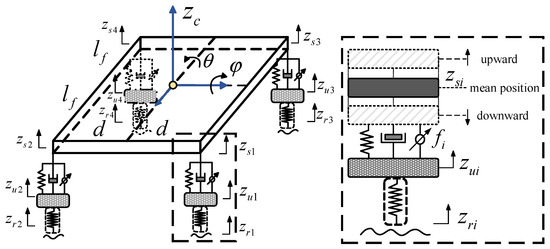
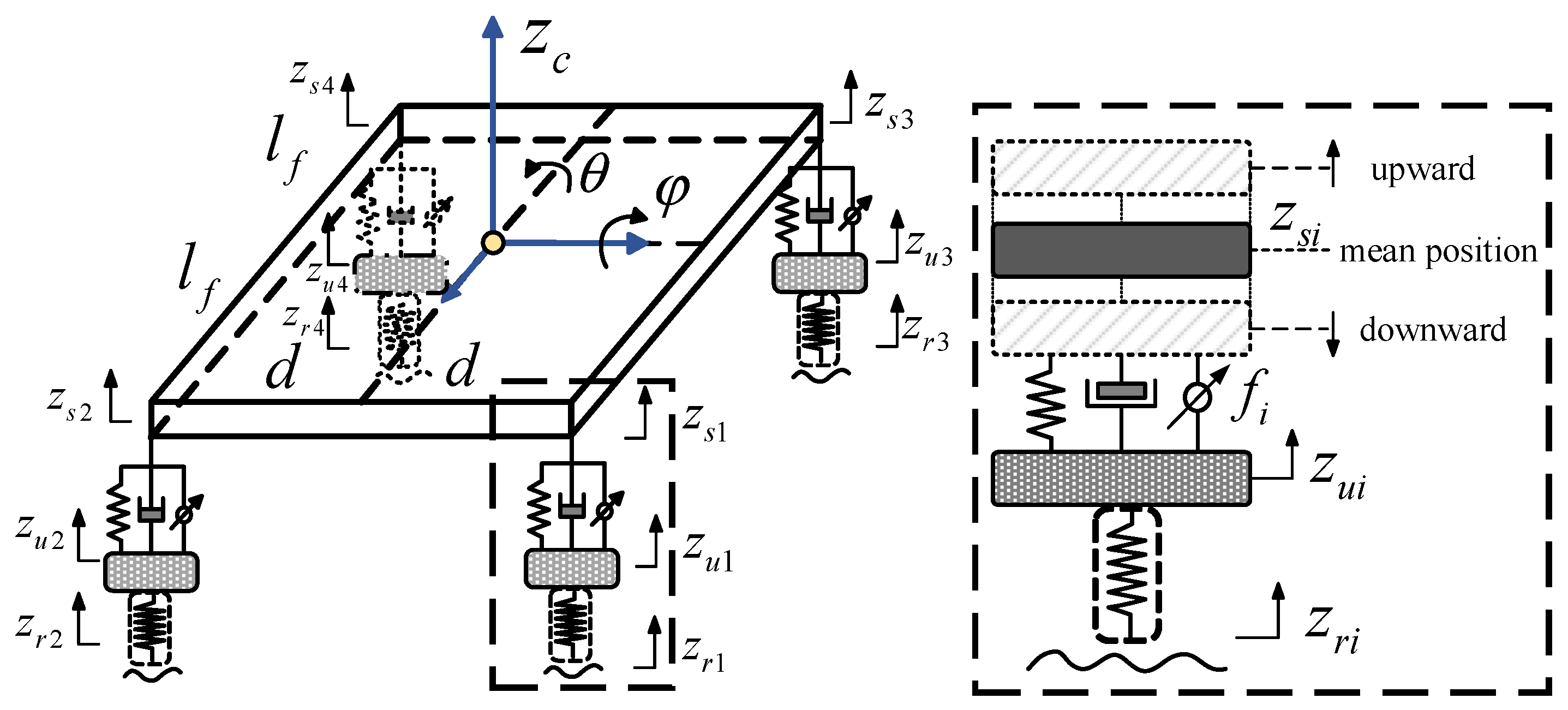
The schematic diagram of the target vehicle height adjustment system, based on a seven-degree-of-freedom vehicle dynamics model with asymmetric damping adjustment characteristics, is shown in Figure 1. The seven degrees of freedom correspond to the vertical motion, pitch motion, and roll motion of the sprung mass of the vehicle body, as well as the vertical motions of the four suspension and wheel systems [27].
Figure 1.
Full-vehicle (7-DOF) model and quarter-car (2-DOF) model.
To implement vehicle height adjustment control via asymmetric regulation, the damping force of each suspension model in Figure 1 can be divided into the extension stroke damping force and the compression stroke damping force .
The control of vehicle height and posture can be achieved by individually controlling each suspension. The control process of each suspension is divided into three discrete operation modes: no lift control, vehicle rising, and vehicle lowering. To raise the vehicle body, the damping force during the extension stroke provides a small damping force (zero damping force), while the damping force during the compression stroke provides a large damping force. To lower the vehicle body, provides a large damping force, while provides a small damping force (zero damping force).
Therefore, the damping force during the extension and compression strokes of each suspension in the entire vehicle height adjustment system must meet the following constraints for the semi-active suspension:
where correspond to the four suspensions: left front, right front, left rear, and right rear. is constant, representing the maximum damping force provided by each suspension. When , the suspension is in the extension stroke, and when , the suspension is in the compression stroke.
The Mixed Logical Dynamical (MLD) modeling framework was employed to address the nonlinear constraints associated with adjustable dampers. Two binary vehicle height control signals, and , were introduced to represent height increase and decrease commands, respectively, together with the discrete auxiliary variables required for seven-degree-of-freedom height regulation. Their definitions are summarized in Table 1.
Table 1.
Parameters of binary auxiliary variables.
The vehicle height and posture control strategy is formulated as follows:
Due to the vertical nonlinear interactions of the four suspension systems, they simultaneously affect the vertical, pitch, and roll motions of the sprung body, thereby forming a multi-degree-of-freedom coupled relationship. Therefore, the HYSDEL language is used to model the vehicle height and posture control system, composed of four quarter-car units, to describe its hybrid dynamic behavior and convert the system into a hybrid logical dynamic model, unifying its logical and continuous characteristics.
By discretizing the vehicle system state equations with a sampling time of 0.01 s to obtain the system parameters, the vehicle model based on the asymmetric damping strategy can be converted into a discrete-time MLD system model in the following form using the built-in compiler of HYSDEL. The constraints involved in the model are also transformed into a hybrid constraint form.
The system shown in Equation (2) consists of state update equations, output equations, and mixed-integer inequality constraint equations, and is a seven-degree-of-freedom vehicle MLD model with 14 states, 8 inputs, 12 binary auxiliary variables, and 0 continuous auxiliary variables.
where is the discrete auxiliary variable representing each discrete state event in the vehicle’s hybrid system, and is the continuous auxiliary variable representing continuous signals subject to logical constraints. Since such signals are not introduced in the vehicle model presented in this study, is an empty set in this case. In model (2), is used solely to maintain the completeness and generality of the model, facilitating future extensions.
3. Design of an HMPC Controller Based on Lyapunov Contraction Constraint
3.1. Contraction Constraint Design
An auxiliary constraint based on the Lyapunov function is introduced into the hybrid model predictive control framework. First, the error between the state variables of the hybrid system and the desired values is defined as: ; The quadratic Lyapunov function for the state error, , is defined as follows:
where is an n-by-n real symmetric matrix, and it is given by the following linear matrix inequality condition [28].
Based on the above linear matrix inequality (LMI) conditions, the Lyapunov contraction constraint can be designed in the following form:
where the matrix is defined as . The matrix satisfies and can be regarded as a control weight matrix. The constant , satisfying , acts as a contraction factor. The matrix denotes the closed-loop feedback coefficient matrix of the system state variables. By selecting appropriate values for and , the Lyapunov function of the system state error at the next time step can be made smaller than that at the previous time step, thus forming a decreasing contraction relationship. In practice, the contraction constraint aims to bring the system state closer to the equilibrium point at each time step. In other words, the system state error at the next time step will not increase compared to the current time step, but will decrease by a certain proportion. If is large, the contraction speed of the system will slow down; If is small, the system state error will decrease more quickly. Therefore, based on the relevant linear matrix inequality conditions (Equations (4) and (5)), and with the system state matrix known, the values of , , and can be determined by defining the following generalized eigenvalue problem (GEVP).
Equation (8) indicates that the selection of must ensure the convergence of the inequality while maintaining system stability. If the value exceeds the critical point of the inequality, system stability may be compromised. Therefore, to enable the system to reach equilibrium more quickly, the value of should be chosen as large as possible.
Due to the finite prediction horizon in model predictive control, the optimality of the solution alone cannot guarantee the stability of the closed-loop system [29]. Therefore, the contraction constraint (7) can only cover the system state error within the prediction horizon , ensuring only the monotonic convergence of the system state error along the predicted trajectory. No constraints are imposed on the subsequent dynamic behavior of the terminal state at the current control time step, which ultimately results in the possibility of the HMPC having no solution at some point.
The quadratic Lyapunov function for the system state error is designed as a constraint set in the form of terminal inequalities. This allows the terminal state of the predicted trajectory at each time step to be replaced by a controlled invariant set, rather than a terminal equality constraint, thereby providing a larger feasible region for the HMPC problem. The form is as follows:
According to geometric analysis, the terminal inequality constraint takes the form of a quadratic function constraint set, whose shape is an ellipsoid with the same dimension as the system state vector. To ensure a larger feasible region for the LHMPC problem, the value of should be as large as possible, and the ellipsoid constraint domain must not exceed the system’s original constraint domain. The problem of determining the matrix can also be referred to as the Chebyshev center problem, which can be interpreted as finding the largest inscribed ball within the bounded set [30].
where the constraint set is defined as:
The problem can be solved using optimization toolboxes, such as MATLAB (2010b) or CPLEX (12.6), to address the resulting linear programming formulation.
3.2. LHMPC Controller Design
For the full-vehicle MLD system in Equation (2), we formulate the optimization objective defined in Equation (11a). This objective function enables the vehicle to accurately track the target ride height and maintain a favorable body posture, while minimizing the damping force consumed by the shock absorbers. In addition, the contraction constraint (7) and the terminal inequality constraint (9) are incorporated as constraints into the optimization objective function.
where is the system’s objective function, is the prediction horizon, and are weight matrices, and is the desired system output, typically set as a constant or time-varying trajectory. In this study, the desired output for the full vehicle model is: . Specifically, the desired output includes the target vehicle height and posture angles, with the height tracking signal defined as a step signal, and both the pitch and roll angles set to zero. is the optimization variable, which can be expressed as:
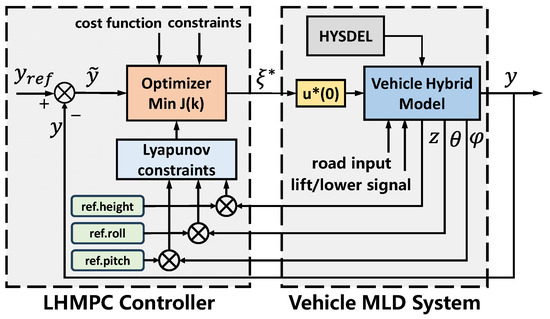
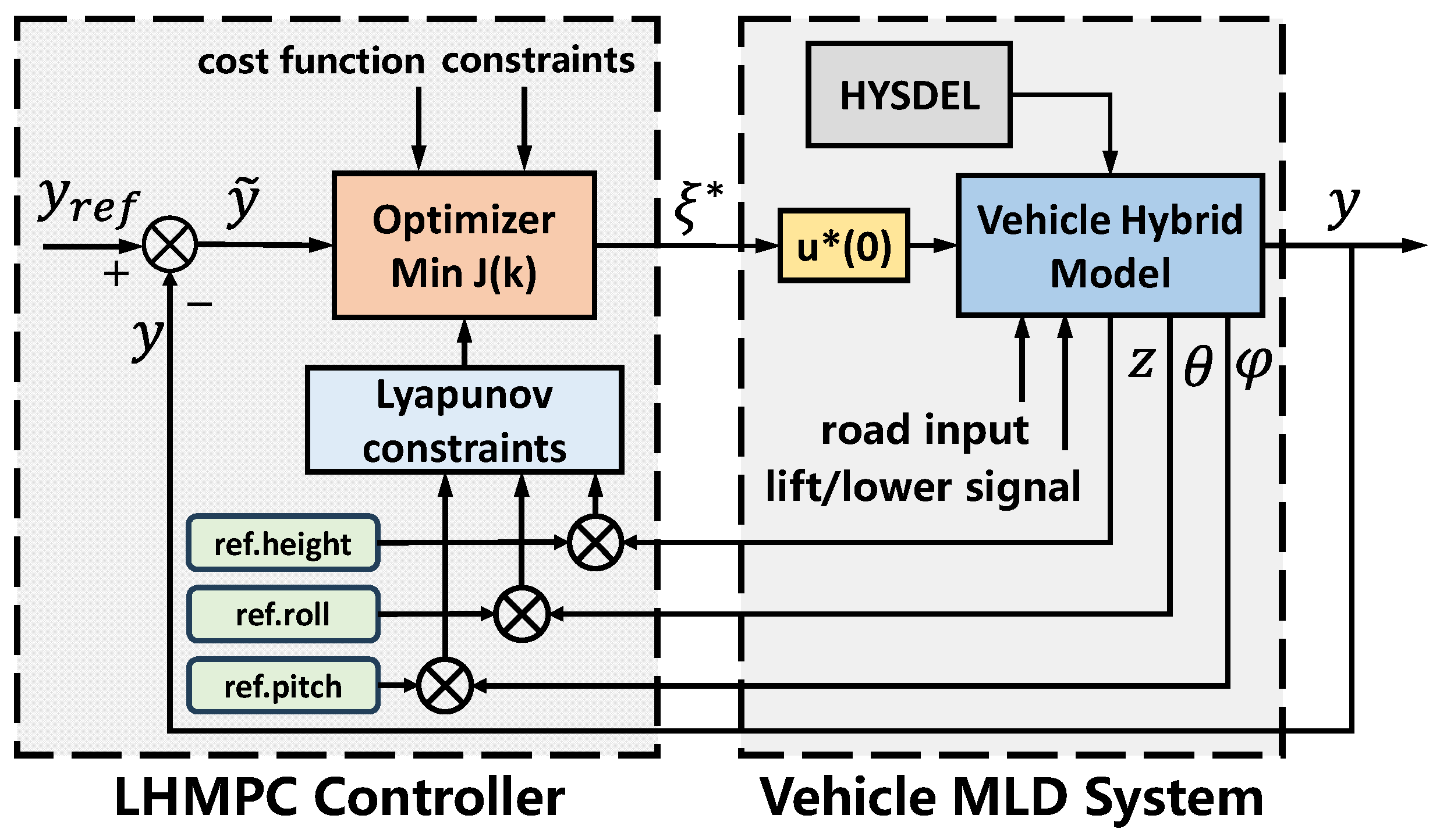
According to the hybrid model predictive control theory, at each sampling time step , the optimal control sequence of the optimization variables can be obtained by solving the MIQP problem through rolling horizon optimization. The first element of , denoted as , is taken as the control input for the current time step and is applied to the vehicle’s MLD system. Additionally, under the Lyapunov constraint, the system can maintain stability over the prediction horizon at each optimization step, and it is recursively feasible in the subsequent time horizons. Therefore, the vehicle’s system states are rapidly fed back into the controller through closed-loop feedback, and the optimization process is repeated at the next sampling time. The framework of the vehicle hybrid model predictive control algorithm with Lyapunov contraction constraints is illustrated in Figure 2.
Figure 2.
Framework of the vehicle height tracking control system.
In Figure 2, represents the reference value of the vehicle’s system state, is the state error, is the reference value of the system output, is the output error, is the input, is the state variable, is the actual output.
3.3. Proof of System Recursive Feasibility and Closed-Loop Stability
Suppose that the optimal input sequence of the system optimization problem at time is , with the corresponding state sequence .
Then, at time , the optimal input sequence of the system , with the corresponding predicted state sequence , where denotes the control input at the predicted terminal.
Therefore, for the prediction horizon , according to the receding horizon optimization, applying the sequence leads to . Hence, the state variables at two consecutive time steps satisfy the following relationship:
It can be observed that the system state at time can be directly transformed from that at time . Constraints (11e) and (11f) can thus be recursively satisfied, and consequently, the optimization problem remains feasible for and at time step .
Furthermore, when the prediction horizon , the following expression can be written:
where , and is positive definite. It thus follows that:
Then, if the system satisfies the contraction constraint at time step , the following can be obtained:
Equations (15) and (16) respectively verify that, at the prediction horizon and at time step , the contraction constraint (11e) and the terminal inequality constraint (11f) are both satisfied in the optimization problem.
It can be seen from the above that for all prediction horizons at time step , the system optimization problem satisfies both the contraction constraint (11e) and the terminal inequality constraint (11f). Therefore, by mathematical induction, the optimization problem is feasible.
In conclusion, if the optimization problem of the system is feasible at time step t, this leads to feasibility at time . Consequently, the LHMPC method guarantees the recursive feasibility of the system optimization problem.
Considering the Lyapunov contraction constraint (11e). By the definition of the Euclidean norm, we have:
Let , from Equation (17), it can be deduced that:
Finally, by letting , Equation (18) can be written as follows:
According to the definition of exponential stability provided in the literature [22], Equation (19) is the exponential stability condition of the system under this definition.
The existence of recursive feasibility means that the optimization problem has a solution at each time step, i.e., the state trajectory of the closed-loop system is well-defined. Additionally, it has been proven that the system satisfies the exponential stability condition along the prediction horizon . Therefore, it can be concluded that the rolling horizon optimization control with Lyapunov contraction constraints ensures that the MLD system remains stable at the system origin at all time. Function (3) can be regarded as the Lyapunov function of the MLD system.
4. Discussion
The proposed LHMPC method is applied to vehicle control, with the conventional HMPC serving as a benchmark to validate its effectiveness. In the legends of the result figures, LHMPC denotes the Lyapunov contraction-constrained hybrid model predictive controller, HMPC denotes the conventional hybrid model predictive controller, and Desired denotes the reference value
4.1. Controller Performance Verification
At a vehicle speed of 72 km/h, simulation control is performed on the quarter-car system shown in Figure 1, with a target height increase of 0.03 m. Two scenarios are considered: in the first scenario, road disturbance is not considered; and in the second scenario, Gaussian white noise is used to model the disturbance of the road. The quarter-car model adopts the MLD system described in the literature [20], where and are state variables representing the displacements of the unsprung mass and the sprung mass, respectively. The matrices , , and parameter for the LHMPC algorithm are obtained as follows:
Scenario 1: In this scenario, the road is assumed to be perfectly flat without disturbances. The initial vehicle height is set to 0 m, the simulation duration is 10 s, and the height adjustment is activated at the 5th second.
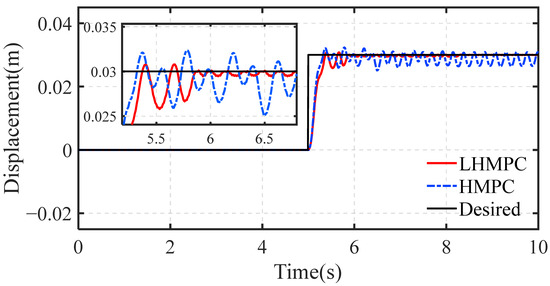
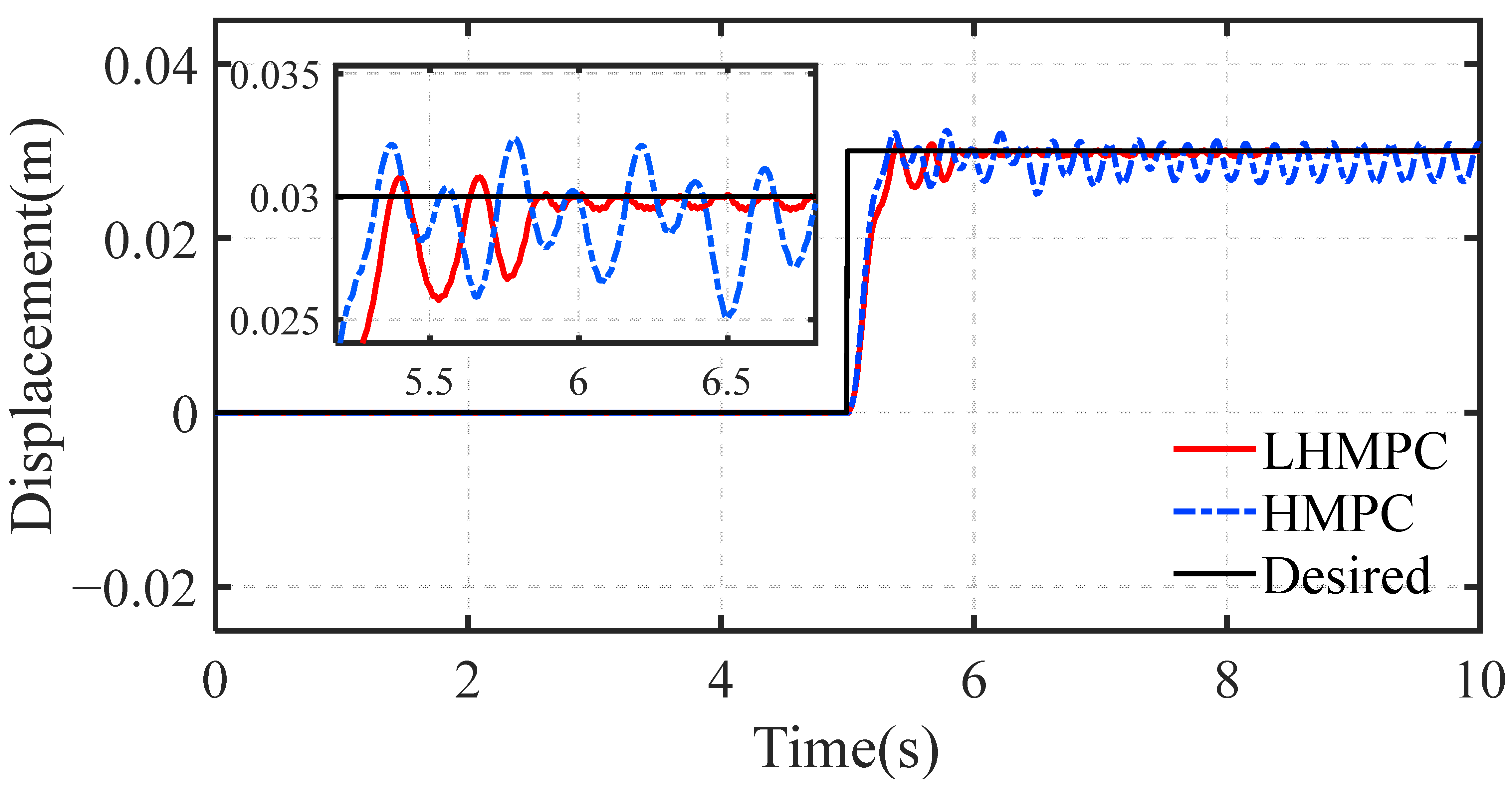
Figure 3 illustrates the response of vehicle height displacement tracking under disturbance-free conditions. As shown, the proposed LHMPC controller enables the vehicle body to successfully track the target ride height and gradually converge to a stable state. However, owing to the mixed logical characteristics of the vehicle MLD system described in Equation (1), the height displacement under the HMPC controller exhibits a persistent oscillatory trend.
Figure 3.
Vehicle body displacement of the quarter-car model (without road disturbance).
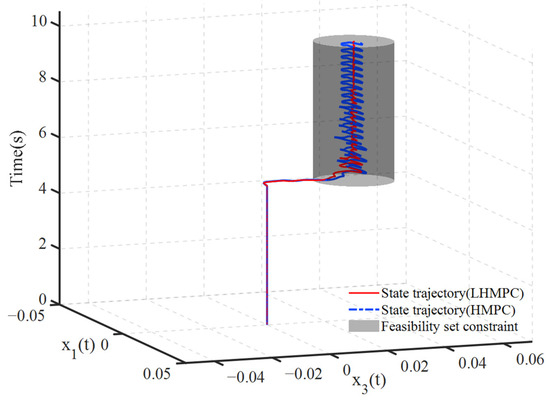
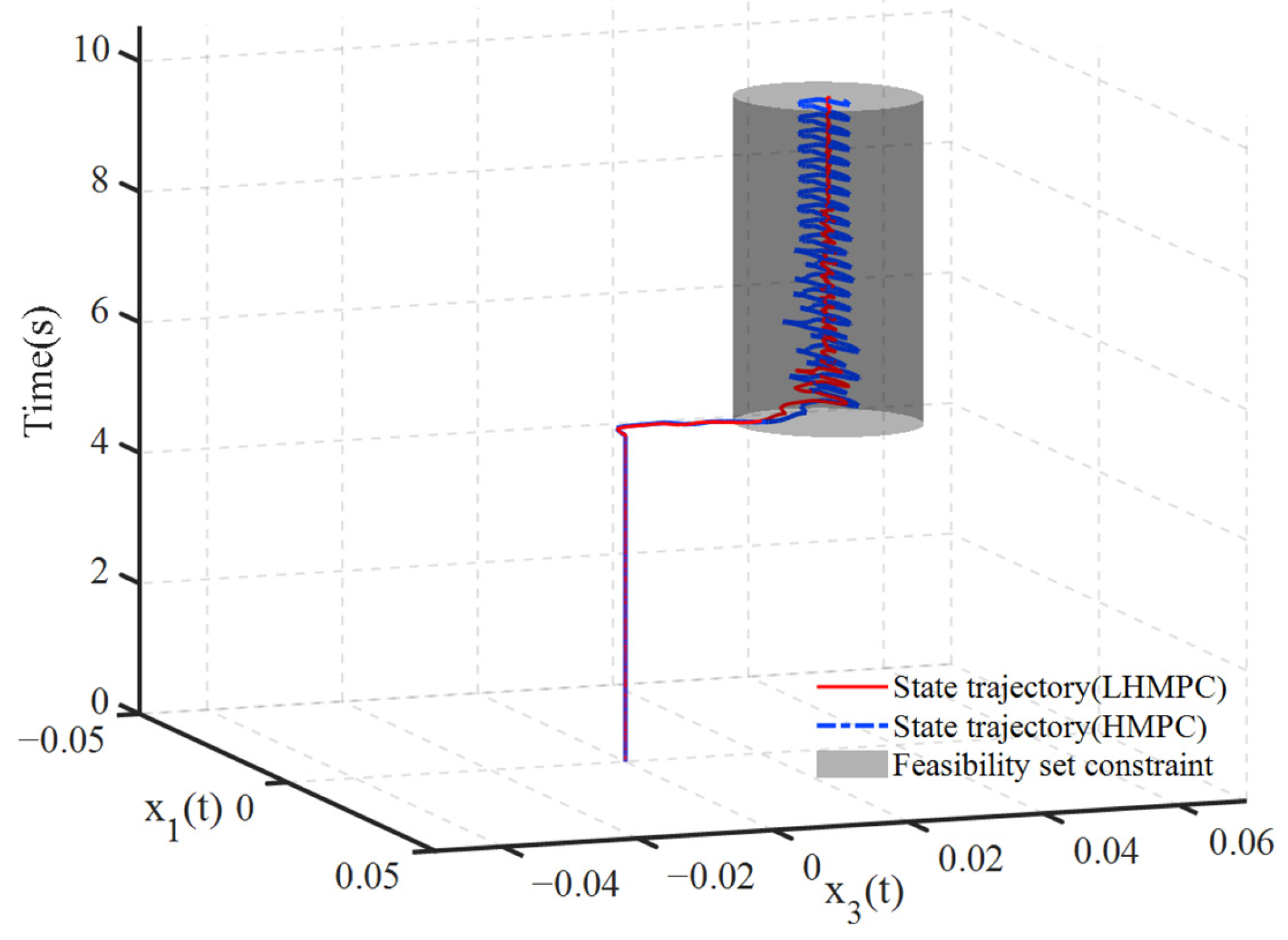
The state trajectories of and over time under the two controllers are shown in Figure 4. As shown in Figure 4, once the simulation reaches the 5th second, the LHMPC controller drives the system states rapidly toward the vicinity of the equilibrium point, with oscillations diminishing to zero. In contrast, the conventional HMPC controller exhibits a slower convergence rate.
Figure 4.
System state trajectories (without road disturbance).
Scenario 2: In this scenario, to perform a more realistic simulation, a Class B road condition is adopted as the disturbance excitation, while all other simulation conditions remain unchanged. The simulation results are presented as follows:
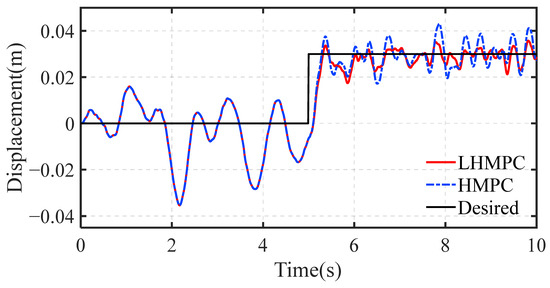
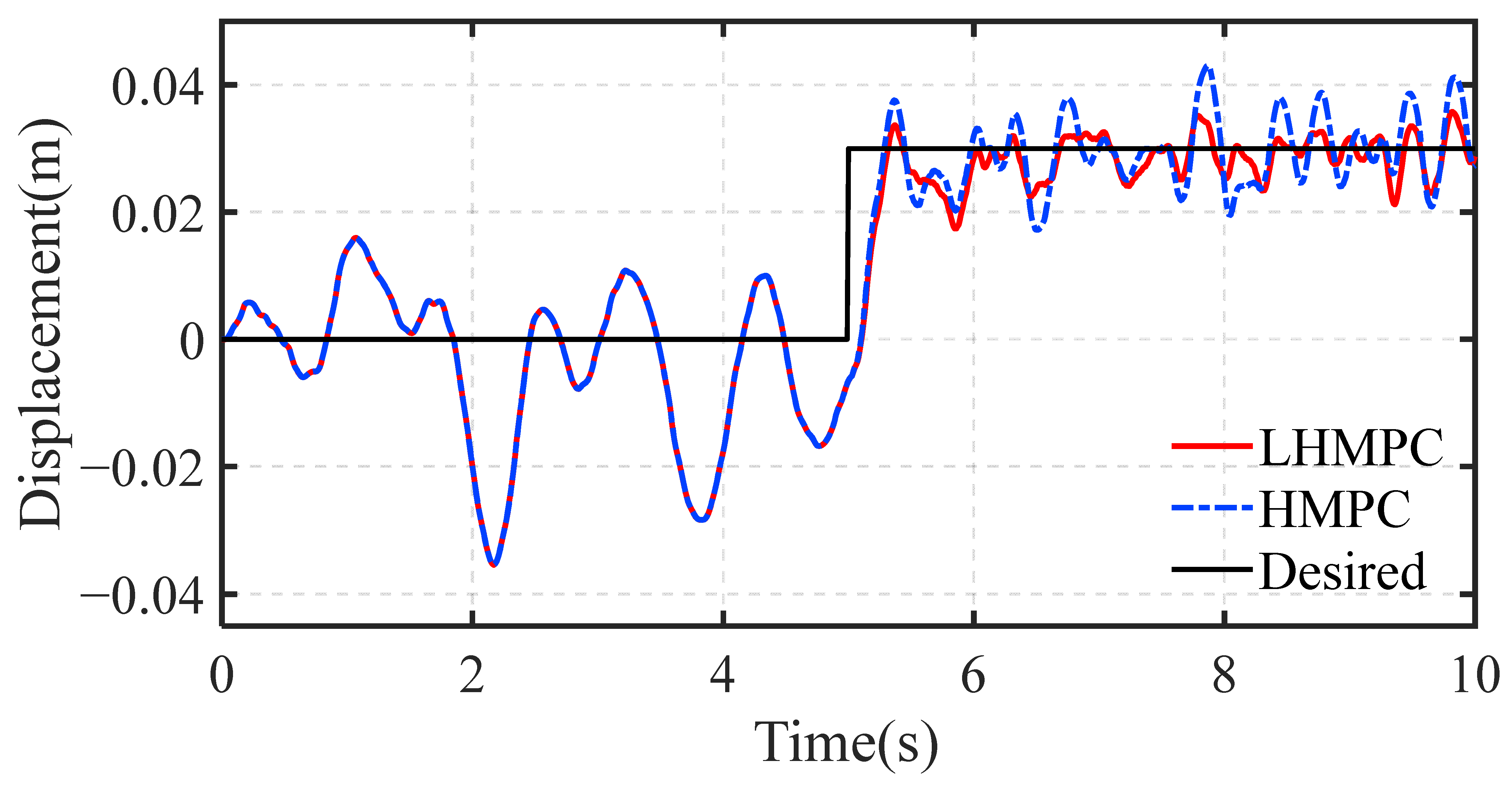
Figure 5 depicts the vehicle height displacement tracking response in the presence of road disturbances. As shown, under road disturbances, the LHMPC controller likewise enables the vehicle to successfully track the target height. Moreover, the amplitude of body vibrations is significantly reduced after control, remaining lower than that achieved with the HMPC controller.
Figure 5.
Vehicle body displacement of the quarter-car model (Class B road).
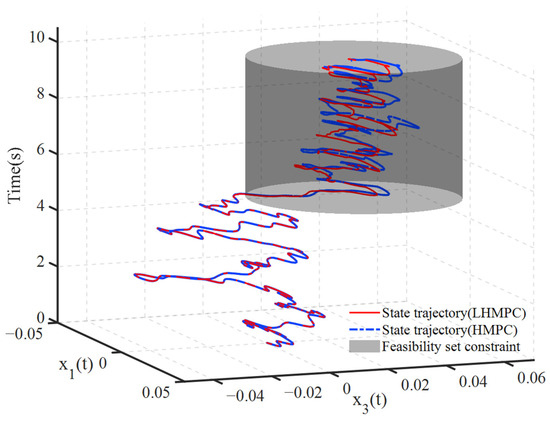
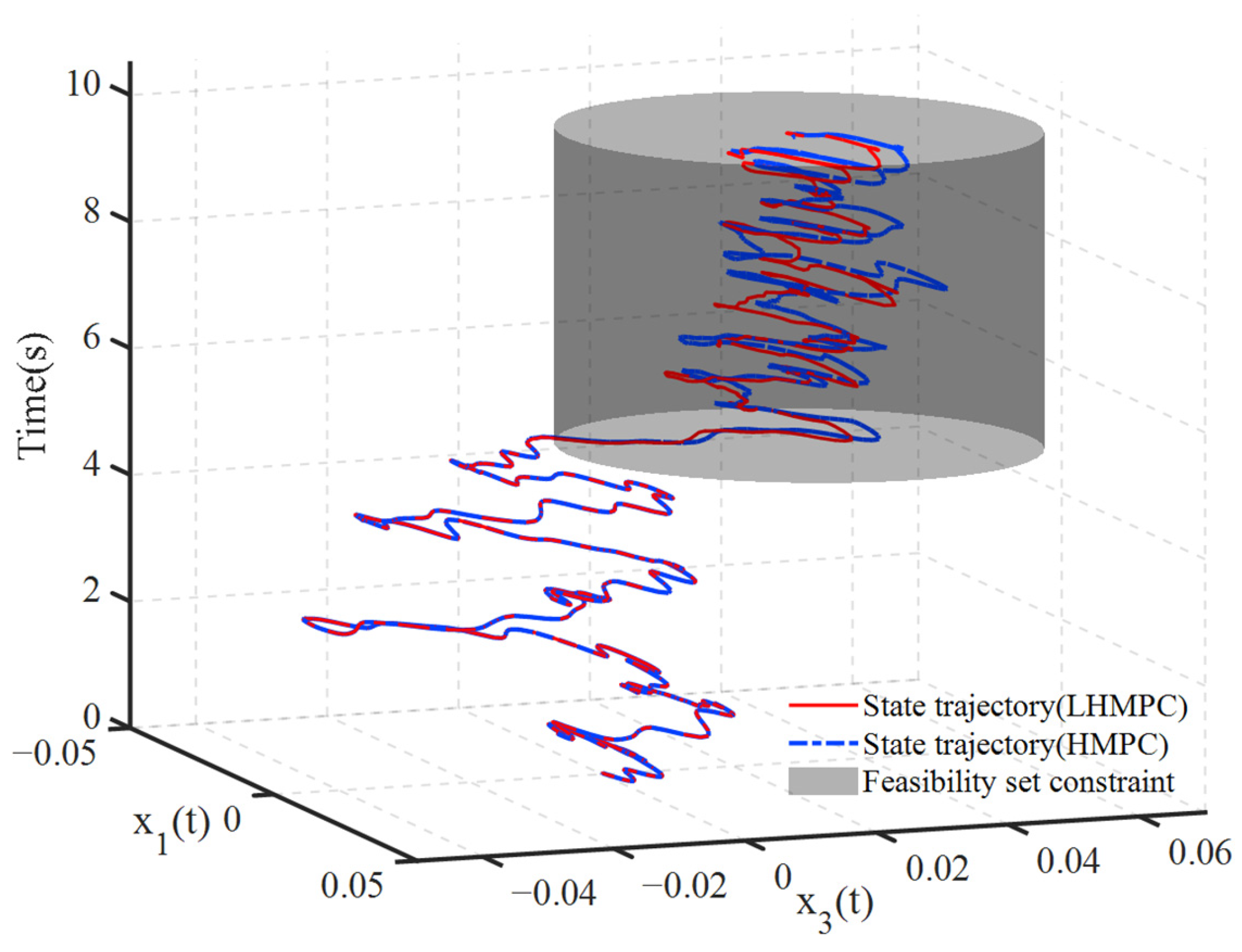
Figure 6 presents a comparison of the system state trajectories under road disturbances. With the LHMPC algorithm, the state variables of the vehicle system also enter the feasible constraint set after the 5th second and remain within the admissible region thereafter. In contrast, under the HMPC controller, the system states exhibit larger oscillations and a slower convergence rate.
Figure 6.
System state trajectories (Class B road).
Therefore, the proposed LHMPC controller outperforms the conventional HMPC controller in terms of tracking accuracy and stability, enabling faster system response and convergence.
From a mechanistic perspective, traditional HMPC relies solely on the optimality of the cost function in the optimization process. It solves the open-loop optimization problem within a limited prediction horizon for each control cycle, lacking a guarantee of closed-loop stability in subsequent control horizons. As a result, under hybrid mode switching and road disturbances, the system state may repeatedly adjust between different modes, leading to oscillations or slower convergence, and thus relying on longer prediction horizons to maintain control performance. By enforcing the Lyapunov function’s decreasing condition over time, the system state can be constrained within a progressively shrinking ellipsoidal invariant set, which theoretically guarantees system stability. This leads to smaller vibration amplitudes, faster attenuation, and the ability to maintain good control performance even with shorter prediction horizons.
The following section presents simulations of the seven-degree-of-freedom full-vehicle model under multiple operating conditions.
4.2. Full Vehicle Height Control Simulation
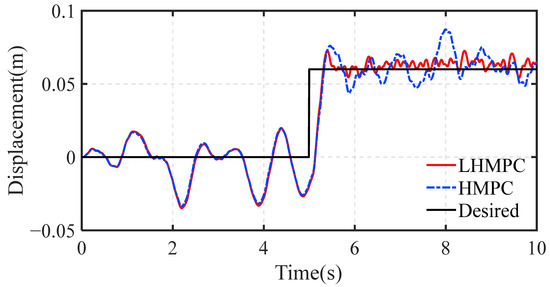
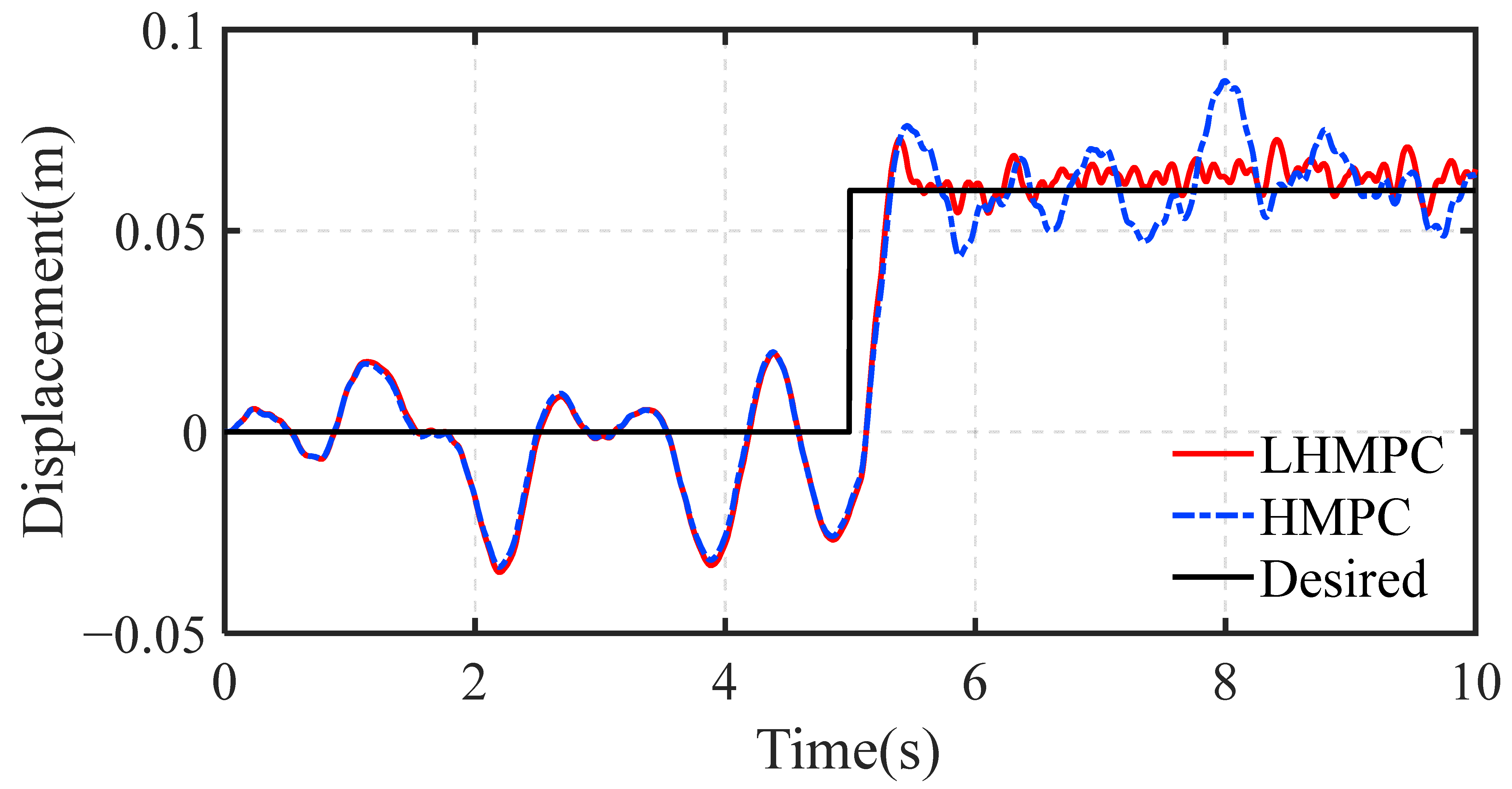
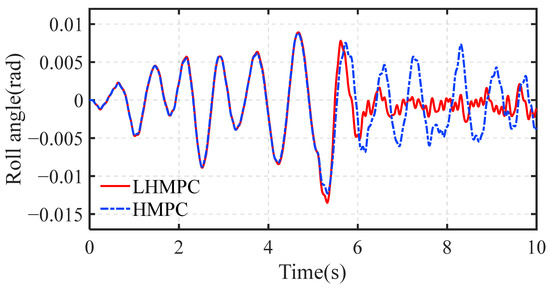
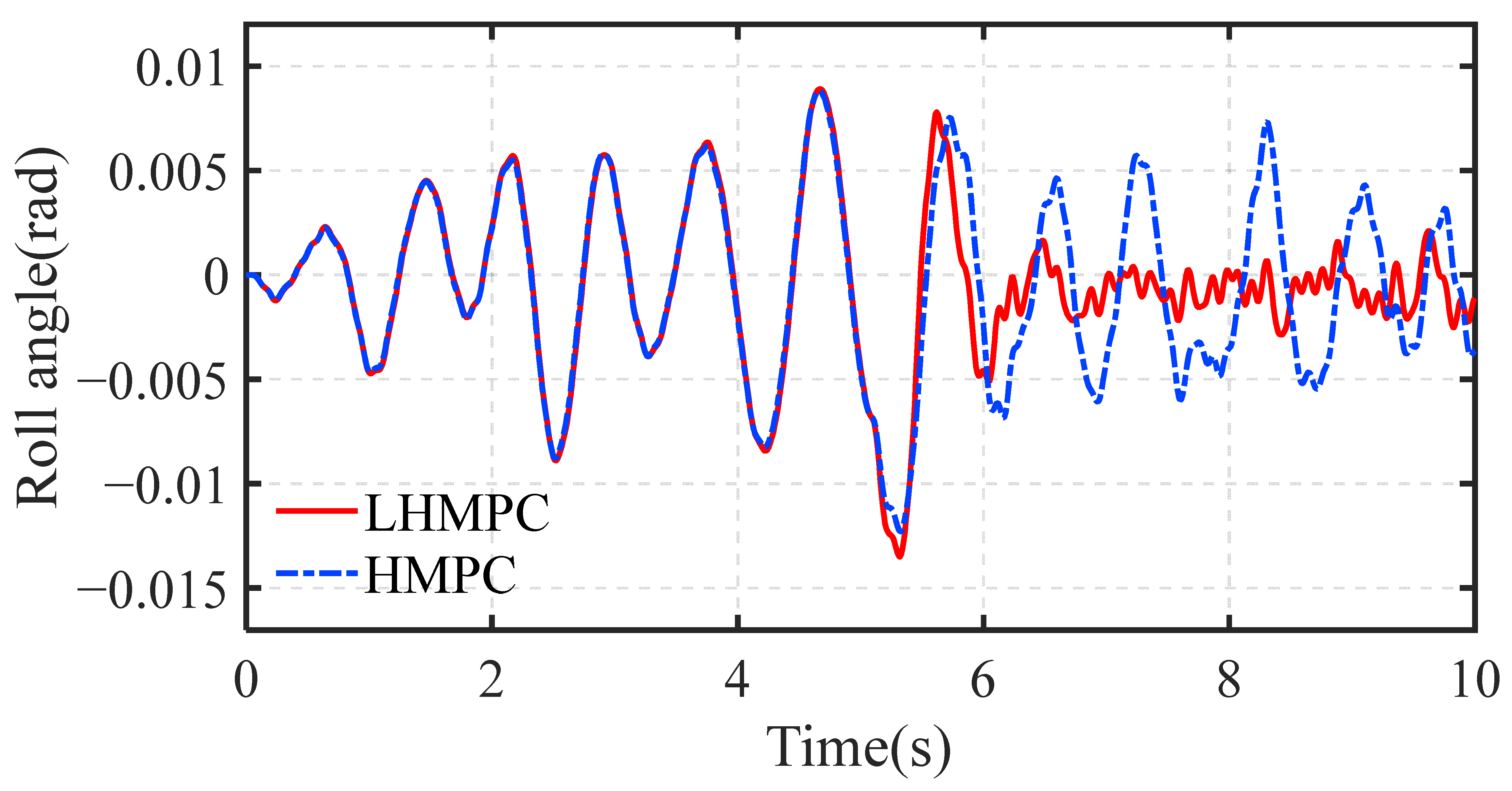
In the full-vehicle height control simulation, the operating condition was set to a Class B road, with a total duration of 10 s. Height adjustment was applied at the fifth second, targeting 0.06 m, while the vehicle speed was maintained at 72 km/h. The simulation results are shown in Figure 7, Figure 8, Figure 9, Figure 10, Figure 11 and Figure 12.
Figure 7.
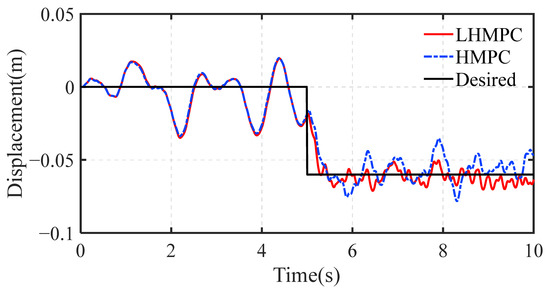
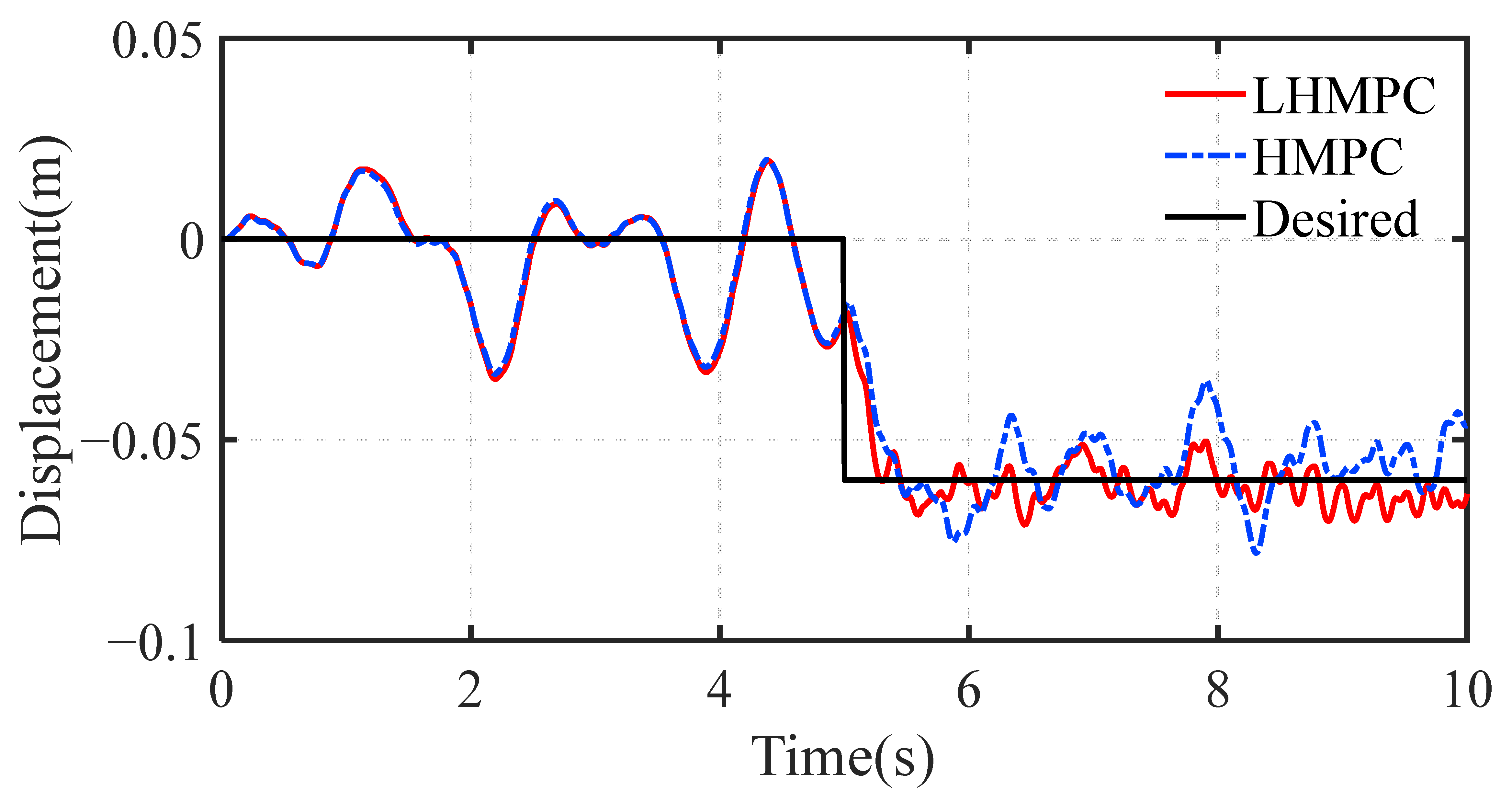
Vehicle body displacement under lift control (B, 72 km/h, 0.06 m).
Figure 8.
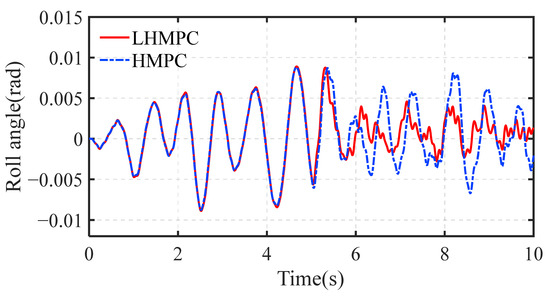
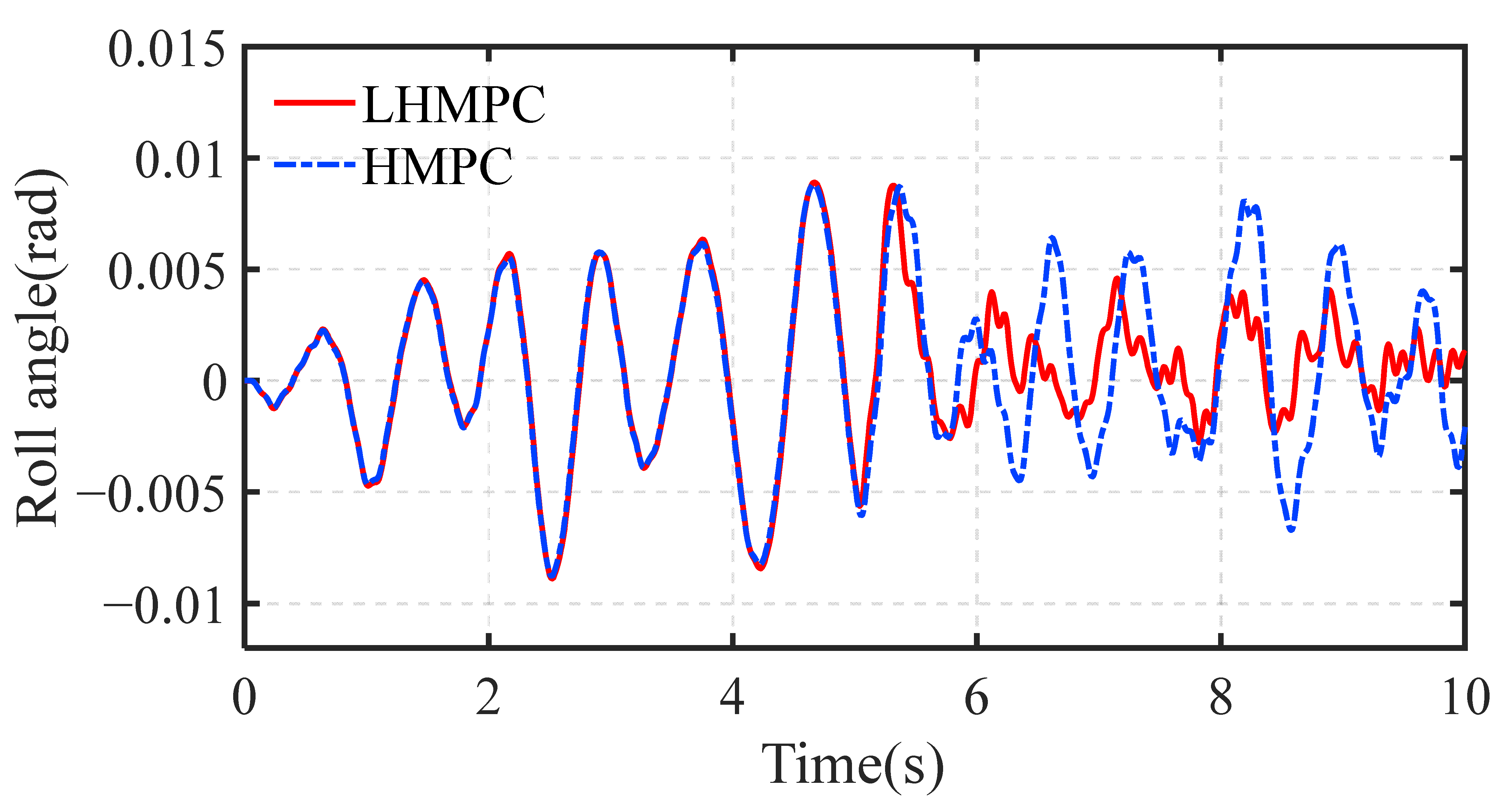
Vehicle body roll angle under lift control (B, 72 km/h, 0.06 m).
Figure 9.
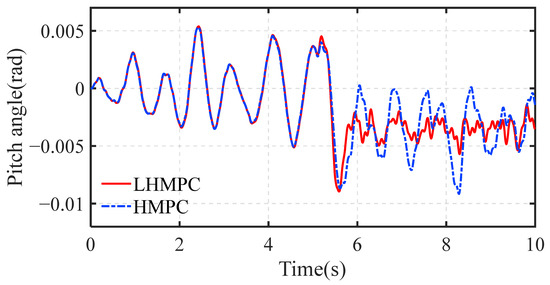
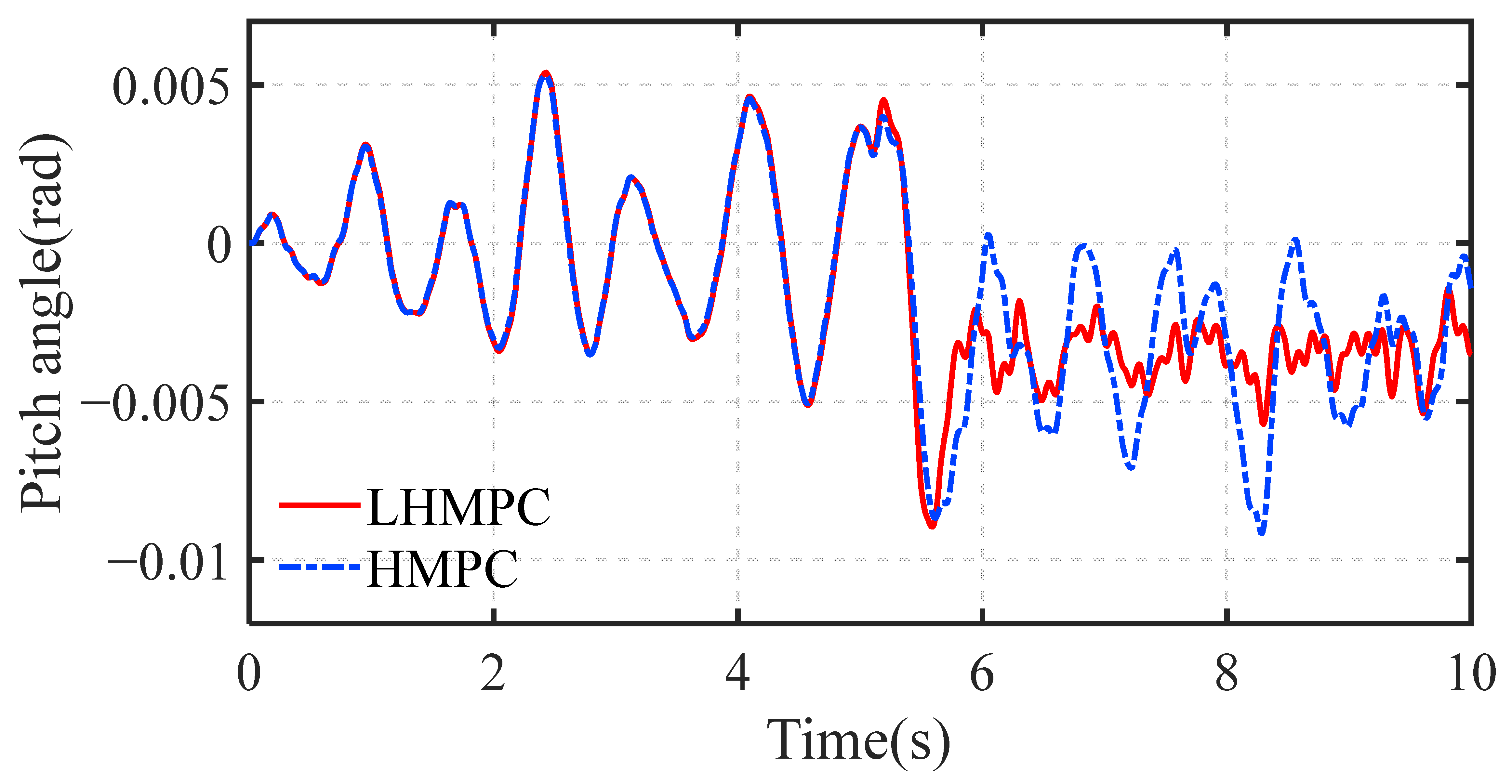
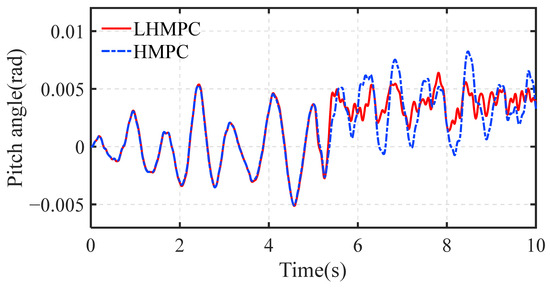
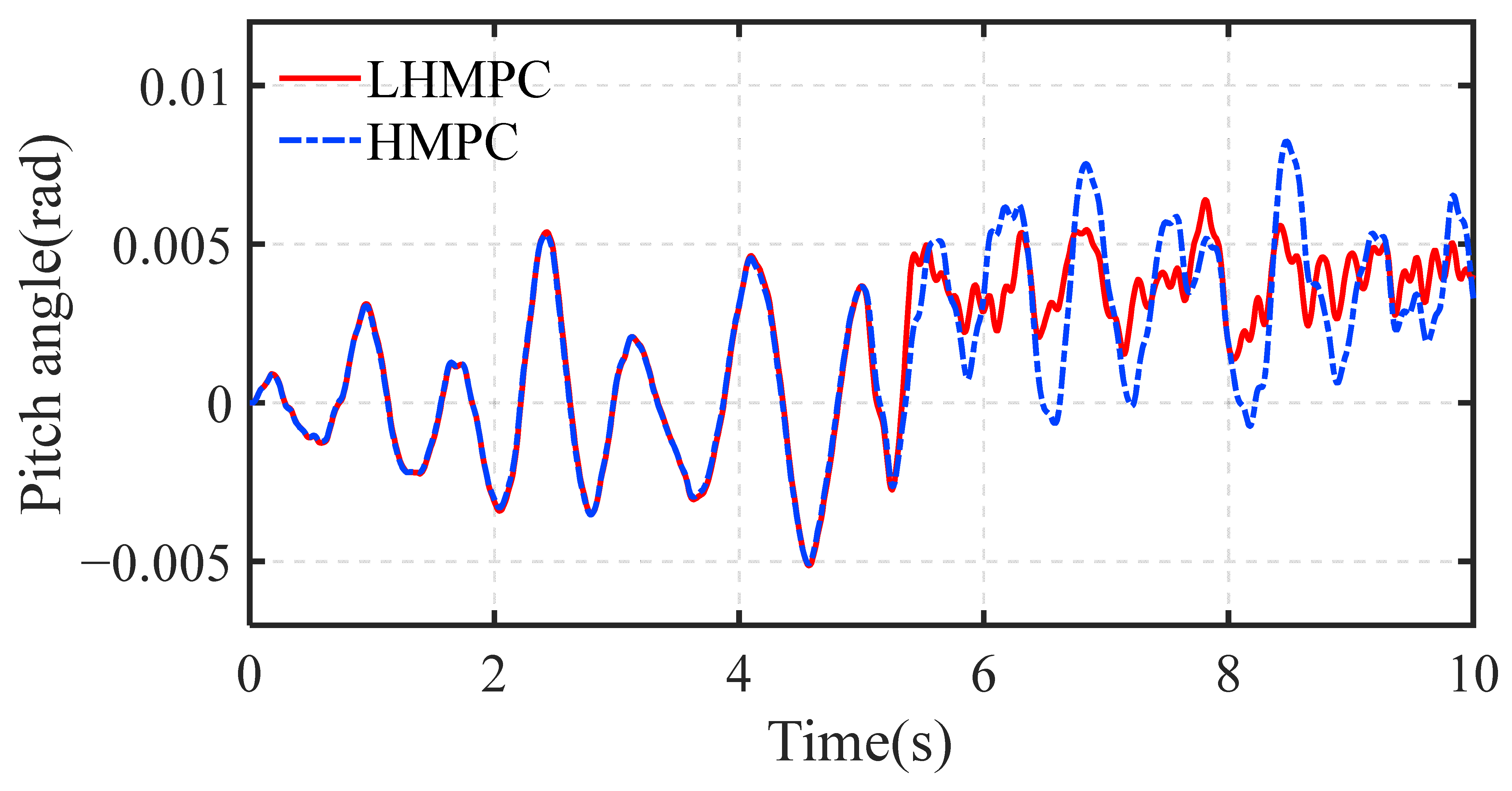
Vehicle body pitch angle under lift control (B, 72 km/h, 0.06 m).
Figure 10.
Vehicle body displacement under descent control (B, 72 km/h, 0.06 m).
Figure 11.
Vehicle body roll angle under descent control (B, 72 km/h, 0.06 m).
Figure 12.
Vehicle body pitch angle under descent control (B, 72 km/h, 0.06 m).
Figure 7 and Figure 10 show the full-vehicle height responses under the two controllers, both exhibiting rapid responses. It can be observed that, after control is applied, the full-vehicle height under the LHMPC controller stabilizes around the target height, with vibration amplitudes significantly lower than those under the HMPC controller, indicating that the LHMPC controller effectively enhances the accuracy of ride height regulation.
Figure 8 and Figure 11 show the roll angle responses of the vehicle body under the two controllers. It can be seen that the roll angle is significantly reduced under the LHMPC controller, with peak values during the lift and drop operations (0.00144 rad and 0.00391 rad) decreased by 69.0% and 49.2%, respectively, compared with those under the HMPC controller (0.00465 rad and 0.00769 rad).
Figure 9 and Figure 12 show the pitch angle responses of the vehicle body under the two controllers. It can be seen that both control methods lead to a slight increase in pitch angle. Compared with the pitch angle peak values under the HMPC controller (0.00594 rad and 0.00762 rad), those under the LHMPC controller (0.00478 rad and 0.00537 rad) are reduced by 19.5% and 29.5%, respectively. Moreover, the pitch angle fluctuations under the LHMPC controller are smaller, allowing the vehicle to maintain a more favorable body attitude during full-vehicle height adjustment.
To evaluate the robustness of the LHMPC controller, simulations were conducted under multiple operating conditions. In all scenarios, the prediction horizon was set to Nv = 3. Table 2 summarizes the tracking error between the controlled ride height and the reference value, as well as the corresponding overshoot under each simulation condition.
Table 2.
Error between the root mean square (RMS) value of body displacement and the control target value.
The results indicate that, under all tested conditions, both the LHMPC and HMPC controllers enable the vehicle to achieve height tracking with relatively small errors. Specifically, for the same control height under Class C road condition, compared with the tracking errors of the HMPC controller (0.0684 m and −0.0595 m), those under the LHMPC controller (0.0577 m and −0.0603 m) are reduced by 72.6% and 40.0%, respectively. When the tracking target is set to 0.08 m under the same Class B road condition, compared with the tracking errors of the HMPC controller (0.0757 m and −0.0776 m), those under the LHMPC controller (0.0790 m and −0.0814 m) are reduced by 76.7% and 41.6%, respectively. Overall, the LHMPC controller consistently achieves higher tracking accuracy, with smaller errors and reduced overshoot.
To compare the real-time performance of the two controllers, the computation time at each sampling instant was recorded for both. The sampling period Ts was set to 0.01 s for the simulation. The comparison results of the two controllers are presented in Table 3.
Table 3.
LHMPC and HMPC computation time.
From the comparison in the Table 3, when the tracking target is set to 0.06 m under Class B road conditions, the total computation time of the LHMPC controller (24.0892 s and 22.5301 s) is reduced by 29.43% and 25.33%, respectively, compared with that of the HMPC controller (34.1387 s and 30.1736 s). For the other two scenarios, the total computation time under the LHMPC controller is also reduced by 32.88% and 30.86% (condition: Class B, ±0.08) and by 20.82% and 15.10% (condition: Class C, ±0.06), compared with the HMPC controller. These results demonstrate that the LHMPC controller achieves faster optimization and superior real-time performance compared with the HMPC controller.
In summary, compared with the conventional HMPC, the LHMPC controller can effectively track the desired vehicle height, significantly reduce body roll and pitch angles, and offers superior real-time performance and dynamic response.
4.3. Energy Consumption Comparison Analysis for Vehicle Control
To analyze the energy consumption of the proposed vibration-based vehicle height controller, this study compares the energy usage of LHMPC, HMPC, and active suspension under different operating conditions.
For the active suspension, energy consumption can be approximated by the work performed against gravity during the lifting and lowering of the vehicle body. For the semi-active suspensions (LHMPC and HMPC), where control involves discrete damping forces, the energy consumption can be calculated from the damping forces.
Table 4 lists the total energy consumption of the three suspension controllers for full-vehicle height control under different operating conditions.
Table 4.
Energy consumption of vehicle height control.
The simulation results in the table indicate that, with vehicle speed and other conditions held constant, the energy consumption of the vehicle suspension system increases with greater body height adjustments or deteriorating road conditions. Compared with active suspension control, both LHMPC and HMPC semi-active suspension methods significantly reduce energy consumption, with the semi-active suspension consuming approximately half the energy of the active suspension. Further comparison shows that, under the same operating conditions, the energy consumption with the LHMPC controller is slightly higher than with the HMPC controller; however, the LHMPC controller demonstrates superior body vibration suppression, faster dynamic response, and better posture maintenance, reflecting higher control performance and overall effectiveness.
5. Discussion and Conclusions
This study establishes a full-vehicle MLD system for ride height and posture control based on an asymmetric damping-driven height adjustment strategy during vehicle operation and proposes a hybrid model predictive control method incorporating Lyapunov contraction constraints and terminal inequality constraints (LHMPC). The proposed control method rigorously guarantees recursive feasibility and closed-loop stability of the hybrid logical dynamical (MLD) system while significantly reducing the dependence of conventional HMPC on long prediction horizons, thereby achieving a balance between control performance and real-time capability.
Current results demonstrate that the LHMPC approach effectively improves ride height tracking accuracy and dynamic response speed. In particular, under rapidly varying driving conditions, LHMPC significantly reduces vehicle body vibrations while maintaining system stability. During ride height tracking tasks, the peak values and fluctuations in vehicle roll and pitch angles are markedly reduced, thereby preserving superior posture regulation and handling stability. Moreover, the LHMPC controller exhibits a lower computational burden, making it more suitable for vehicle control systems with stringent real-time requirements. Energy consumption comparisons indicate that, under the operating conditions and parameters considered in this study, posture regulation using semi-active actuation combined with vibration energy utilization can substantially reduce energy consumption—by approximately 50%—compared with active suspension systems.
Future work will further explore the application of the LHMPC method to integrated posture adjustment in vehicle trajectory tracking control, incorporating vehicle height and posture adjustment into the overall vehicle motion control framework. This direction will consider the control performance and stability under variable vehicle speeds and extreme road conditions, further validating the applicability and robustness of the method in complex real-world scenarios, thereby enhancing its practical application value.
Author Contributions
Conceptualization, A.C. and J.Y.; methodology, A.C.; software, A.C.; validation, A.C. and J.Y.; formal analysis, J.Y.; investigation, A.C.; resources, J.Y.; data curation, A.C.; writing—original draft preparation, A.C.; writing—review and editing, A.C.; visualization, A.C.; supervision, J.Y.; project administration, A.C. and J.Y.; funding acquisition, J.Y. All authors have read and agreed to the published version of the manuscript.
Funding
This work was funded by the National Natural Science Foundation of China (Grant number 51975299) and the Key Research and Development Project of Yangzhou City (No. YZ2023009).
Data Availability Statement
The data presented in this study are available in this article.
Conflicts of Interest
The authors declare no conflicts of interest.
References
- Wang, J.; Huang, Z.; Hong, H.; Yu, S.; Shi, W.; Zhang, X. Skyhook-Based Techniques for Vehicle Suspension Control: A Review of the State of the Art. Machines 2025, 13, 727. [Google Scholar] [CrossRef] [Scilit]
- Abut, T.; Salkım, E.; Demosthenous, A. Performance Improvement in a Vehicle Suspension System with FLQG and LQG Control Methods. Actuators 2025, 14, 137. [Google Scholar] [CrossRef] [Scilit]
- Shi, H.; Zeng, J.; Guo, J. Disturbance observer-based sliding mode control of active vertical suspension for high-speed rail vehicles. Veh. Syst. Dyn. 2024, 62, 2912–2935. [Google Scholar] [CrossRef] [Scilit]
- Ma, S.; Li, Y.; Tong, S. Research on control strategy of seven-DOF vehicle active suspension system based on co-simulation. Meas. Control 2023, 56, 1251–1260. [Google Scholar] [CrossRef] [Scilit]
- Dong, H.; Zhuang, W.; Chen, B.; Yin, G.; Wang, Y. Enhanced Eco-Approach Control of Connected Electric Vehicles at Signalized Intersection with Queue Discharge Prediction. IEEE Trans. Veh. Technol. 2021, 70, 5457–5469. [Google Scholar] [CrossRef] [Scilit]
- Yang, M.; Tian, J. Research on Curving Acc System for Electric Vehicle Driven by In-wheel Motors Based on Fmpc and Smc. Adv. Theory Simul. 2024, 7, 2300599. [Google Scholar] [CrossRef] [Scilit]
- Yu, Y.; Li, Z.; Zhou, Y.; Wang, X. A nonlinear model predictive control for air suspension in hub motor electric vehicle. Proc. Inst. Mech. Eng. Part D J. Automob. Eng. 2025, 239, 564–585. [Google Scholar] [CrossRef] [Scilit]
- Meléndez-Useros, M.; Jiménez-Salas, M.; Viadero-Monasterio, F.; López-Boada María, J. Novel Methodology for Integrated Actuator and Sensors Fault Detection and Estimation in an Active Suspension System. IEEE Trans. Reliab. 2025, 74, 2171–2184. [Google Scholar] [CrossRef] [Scilit]
- Wang, Z.; Liu, C.; Zheng, X.; Zhao, L.; Qiu, Y. Advancements in Semi-Active Automotive Suspension Systems with Magnetorheological Dampers: A Review. Appl. Sci. 2024, 14, 7866. [Google Scholar] [CrossRef] [Scilit]
- Viadero-Monasterio, F.; Meléndez-Useros, M.; Jiménez-Salas, M.; Boada Beatriz, L. Robust Static Output Feedback Control of a Semi-Active Vehicle Suspension Based on Magnetorheological Dampers. Appl. Sci. 2024, 14, 10336. [Google Scholar] [CrossRef] [Scilit]
- Madhavan Rathai Karthik, M.; Alamir, M.; Sename, O. Experimental Implementation of Model Predictive Control Scheme for Control of Semi-active Suspension System. IFAC-PapersOnLine 2019, 52, 261–266. [Google Scholar] [CrossRef] [Scilit]
- Bououden, S.; Chadli, M.; Zhang, L.; Yang, T. Constrained model predictive control for time-varying delay systems: Application to an active car suspension. Int. J. Control Autom. Syst. 2016, 14, 51–58. [Google Scholar] [CrossRef] [Scilit]
- Zhang, H.; Liang, J.; Yuan, C.; Sun, X.; Cai, Y. Application of explicit model predictive control to a vehicle semi-active suspension system. J. Low Freq. Noise Vib. Act. Control 2020, 39, 772–786. [Google Scholar] [CrossRef] [Scilit]
- Li, W.; Liang, H.; Xia, D.; Fu, J.; Yu, M. Explicit model predictive control of magnetorheological suspension for all-terrain vehicles with road preview. Smart Mater. Struct. 2024, 33, 035037. [Google Scholar] [CrossRef] [Scilit]
- Li, G.; Zhong, L.; Sun, W.; Zhang, S.; Liu, Q.; Huang, Q.; Hu, G. A Variable Horizon Model Predictive Control for Magnetorheological Semi-Active Suspension with Air Springs. Sensors 2024, 24, 6926. [Google Scholar] [CrossRef] [Scilit]
- Cai, C.; Wang, G.; Wang, Z.; Li, R.; Li, Z. Research on Control Strategy of Semi-Active Suspension System Based on Fuzzy Adaptive PID-MPC. Appl. Sci. 2025, 15, 9768. [Google Scholar] [CrossRef] [Scilit]
- Mazouchi, M.; Li, Z.; Srivastava, V.; Tai, W.-C.; Goryca, J. Learning-Enhanced Active Vehicle Suspension Control Using Preview-augmented Model Predictive Control and Gaussian Process. IFAC-PapersOnLine 2024, 58, 246–251. [Google Scholar] [CrossRef] [Scilit]
- Wang, C.; Cui, X.; Zhao, S.; Zhou, X.; Song, Y.; Wang, Y.; Guo, K. A deep reinforcement learning-based active suspension control algorithm considering deterministic experience tracing for autonomous vehicle. Appl. Soft Comput. 2024, 153, 111259. [Google Scholar] [CrossRef] [Scilit]
- Li, Z.; Yao, J.; Shi, W.; Fang, M. A novel method of vehicle height control utilizing semi-active actuator. Mech. Syst. Signal Process. 2025, 223, 111818. [Google Scholar] [CrossRef] [Scilit]
- Yao, J.; Cai, C.; Wang, S.; Yang, R.; Jia, Y. Hybrid model predictive control on lifting and dropping vehicle body via asymmetric damping adjustment. Veh. Syst. Dyn. 2023, 61, 3225–3243. [Google Scholar] [CrossRef] [Scilit]
- Bemporad, A.; Morari, M. Robust Model Predictive Control: A Survey; Springer: London, UK, 1999; pp. 207–226. [Google Scholar]
- Bemporad, A.; Morari, M. Control of systems integrating logic, dynamics, and constraints. Automatica 1999, 35, 407–427. [Google Scholar] [CrossRef] [Scilit]
- Lazar, M.; Heemels, W.P.M.H.; Weiland, S.; Bemporad, A. Stabilizing Model Predictive Control of Hybrid Systems. IEEE Trans. Autom. Control 2006, 51, 1813–1818. [Google Scholar] [CrossRef] [Scilit]
- Lazar, M. On infinity norms as Lyapunov functions: Alternative necessary and sufficient conditions. In Proceedings of the 49th IEEE Conference on Decision and Control (CDC), Atlanta, GA, USA, 15–17 December 2010; pp. 5936–5942. [Google Scholar]
- Habibi, J.; Moshiri, B.; Sedigh, A. Contractive predictive control of mixed logical dynamical Hybrid systems. Int. J. Innov. Comput. Inf. Control 2008, 4, 1283–1297. [Google Scholar]
- Habibi, J.; Moshiri, B.; Khaki Sedigh, A.; Morari, M. Low-complexity control of hybrid systems using approximate multi-parametric MILP. Automatica 2016, 63, 292–301. [Google Scholar] [CrossRef] [Scilit]
- Lyv, P.; Leng, D.; Li, Y.; Xu, T.; Huixing, W.; Xu, H. Semi-active magnetorheological suspension of a full-vehicle model based on combined vertical and attitude control. In Proceedings of the 2023 IEEE/ASME International Conference on Advanced Intelligent Mechatronics (AIM), Seattle, DC, USA, 28–30 June 2023. [Google Scholar] [CrossRef] [Scilit]
- Duan, G.-R. Analysis and Design of Descriptor Linear Systems; Springer Science & Business Media: Berlin, Germany, 2010; Volume 23. [Google Scholar]
- Mayne, D.Q. Model predictive control: Recent developments and future promise. Automatica 2014, 50, 2967–2986. [Google Scholar] [CrossRef] [Scilit]
- Olama, A.; Shasadeghi, M.; Ramezani, A.; Khorramizadeh, M.; Mendes, P.R.C. Ellipsoidal Lyapunov-based hybrid model predictive control for mixed logical dynamical systems with a recursive feasibility guarantee. Trans. Inst. Meas. Control 2018, 41, 2475–2487. [Google Scholar] [CrossRef] [Scilit]

Disclaimer/Publisher’s Note: The statements, opinions and data contained in all publications are solely those of the individual author(s) and contributor(s) and not of MDPI and/or the editor(s). MDPI and/or the editor(s) disclaim responsibility for any injury to people or property resulting from any ideas, methods, instructions or products referred to in the content. |
© 2026 by the authors. Licensee MDPI, Basel, Switzerland. This article is an open access article distributed under the terms and conditions of the Creative Commons Attribution (CC BY) license.