


Abstract
Spiking Neural Networks (SNNs) have attracted increasing attention due to their energy efficiency and suitability for neuromorphic data processing. Despite these advantages, the security of SNNs—particularly their robustness against backdoor attacks—remains underexplored. This study revisits fine-pruning, a widely adopted backdoor defense technique in deep neural networks, and adapts it to the unique spatio-temporal characteristics of SNNs. We propose two SNN-specific fine-pruning methods: Hook–Surrogate Gradient-based fine-pruning (HS-FP) and Spike–STDP-based fine-pruning (SS-FP). HS-FP leverages hook-based activation analysis with surrogate gradient learning, while SS-FP integrates total spike activity with hybrid STDP and surrogate gradient fine-tuning. We evaluate both methods against static, moving, and smart backdoor attacks on two neuromorphic benchmarks, N-MNIST and DVS128-Gesture. Experimental results show that both approaches reduce the attack success rate down to approximately 10% while preserving model accuracy above 99% on N-MNIST and achieving substantial recovery on DVS128-Gesture. Moreover, our analysis reveals that several phenomena observed in fine-pruning-based defenses for deep neural networks—such as mixed-function neurons and backdoor reactivation during fine-tuning—also manifest in SNNs. These findings highlight both the effectiveness and limitations of fine-pruning in the SNN domain and suggest promising directions for extending existing DNN security methodologies to neuromorphic systems.
1. Introduction
Spiking Neural Networks (SNNs), the third generation of artificial neural networks, are emerging as next-generation successors to Deep Neural Networks (DNNs) due to their superior energy efficiency and dynamic data processing capabilities. SNNs mimic the information processing mechanisms of biological neurons by generating discrete signals called spikes, making them suitable for processing neuromorphic event data that changes over time. Unlike DNNs, which require heavy matrix multiplication for every operation, SNNs consume power only when information is present, offering significant advantages in energy efficiency. Recent studies have shown that SNNs can achieve performance comparable to existing DNNs in large language models (LLMs) [1] and high-performance vision fields [2], while reducing energy consumption. Furthermore, limitations such as the lack of powerful learning algorithms compared to DNNs are being overcome by improving or combining existing SNN learning algorithms, such as Spike Timing-Dependent Plasticity (STDP) and Surrogate Gradient Descent [3,4]. Beyond algorithmic improvements, hardware accelerators have been developed to enhance the computational efficiency of DNNs. Recent studies explore memory-centric and in-sensor computing architectures for high-throughput AI inference [5,6].
Despite the rapid advancement of SNNs, research on their security vulnerabilities remains relatively scarce. A particularly critical area of concern is a backdoor attack, in which an attacker injects malicious triggers into clean training data to manipulate model behavior. While a compromised model functions correctly on normal inputs, it performs incorrect classifications when the trigger is present. This stealthy nature makes backdoor attacks particularly difficult to detect and mitigate, especially in safety-critical applications. While numerous studies have addressed backdoor attacks and defenses in the DNN domain [7,8,9,10], there are significant limitations in directly applying DNN-based attack and defense methods to SNNs. This is primarily because SNNs process information through discrete spikes, whereas DNNs rely on continuous real values. The robustness analysis of SNNs against backdoor attacks in the neuromorphic vision field is still in its nascent stages. Recently, Abad et al. [11] introduced four types of backdoor attacks targeting SNNs and neuromorphic data. However, research on defense mechanisms against backdoor attacks remains relatively underexplored.
To address the issue, this study revisits a fine-pruning method that has been a promising defense mechanism in DNNs. Originally developed to enhance computational efficiency by pruning and fine-tuning neurons, it is now utilized for security based on the observation that neurons activated by backdoor triggers are often distinct from those used for normal functions. By selectively removing these “backdoor-related” neurons and subsequently fine-tuning the model, the attack can be neutralized while recovering any performance loss caused by the pruning process.
This paper proposes two backdoor defense methods for SNNs: Hook–Surrogate Gradient-based fine-pruning (HS-FP) and Spike–STDP-based fine-pruning (SS-FP). They adapt the fine-pruning paradigm to the spatio-temporal and spike-driven characteristics of SNNs. Extensive evaluations show that the proposed methods successfully recover a model’s accuracy up to 99% after defense while strongly suppressing the attack success rate to below 10%. These results demonstrate that fine-pruning-based backdoor defense strategies targeted at existing DNNs are also effective in the SNN environment. Furthermore, through quantitative analysis of performance metrics, this study elucidates the similarities in phenomena observed during the backdoor defense processes of DNNs and SNNs.
The main contributions of this study are as follows:
- We propose two SNN-specific backdoor defense methods, HS-FP and SS-FP. Unlike prior DNN-oriented approaches, our methods redefine neuron activation and fine-tuning mechanisms to be compatible with neuromorphic event-based processing.
- We design and compare two distinct pruning criteria for SNNs: hook-based average spike activation with surrogate gradient learning (HS-FP) and total spike count with hybrid STDP–surrogate learning (SS-FP). This comparison provides new insights into how different spike-based activation definitions and learning rules affect backdoor elimination and performance recovery in SNNs.
- We conduct extensive quantitative evaluations against static, moving, and smart backdoor attacks on two representative neuromorphic datasets, N-MNIST and DVS128-Gesture. The results demonstrate that both HS-FP and SS-FP consistently reduce the attack success rate while preserving high classification accuracy.
- Through detailed experimental analysis, we reveal that several key phenomena observed in fine-pruning-based defenses for DNNs—such as mixed-function neurons and backdoor reactivation during fine-tuning—also emerge in SNNs. These findings highlight the transferability of DNN backdoor defense principles to the SNN domain while exposing new challenges unique to neuromorphic event-driven models.
The remainder of this paper is organized as follows. Section 2 provides a brief background on SNN, neuromorphic event data, backdoor attacks, and the fine-pruning method. Section 3 defines a threat model and introduces backdoor attack models against SNNs and neuromorphic data. Section 4 presents two proposed defense methods. Section 5 describes setups for experiments such as datasets. Section 6 reports experimental results that demonstrate the effectiveness of the proposed defenses. Finally, Section 7 concludes the paper.
2. Background and Related Works
2.1. Spiking Neural Networks
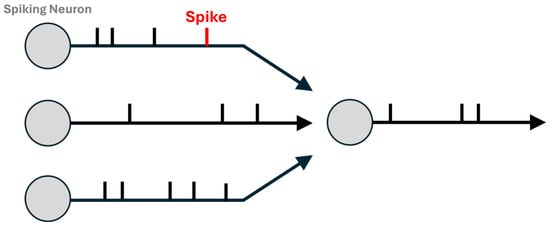
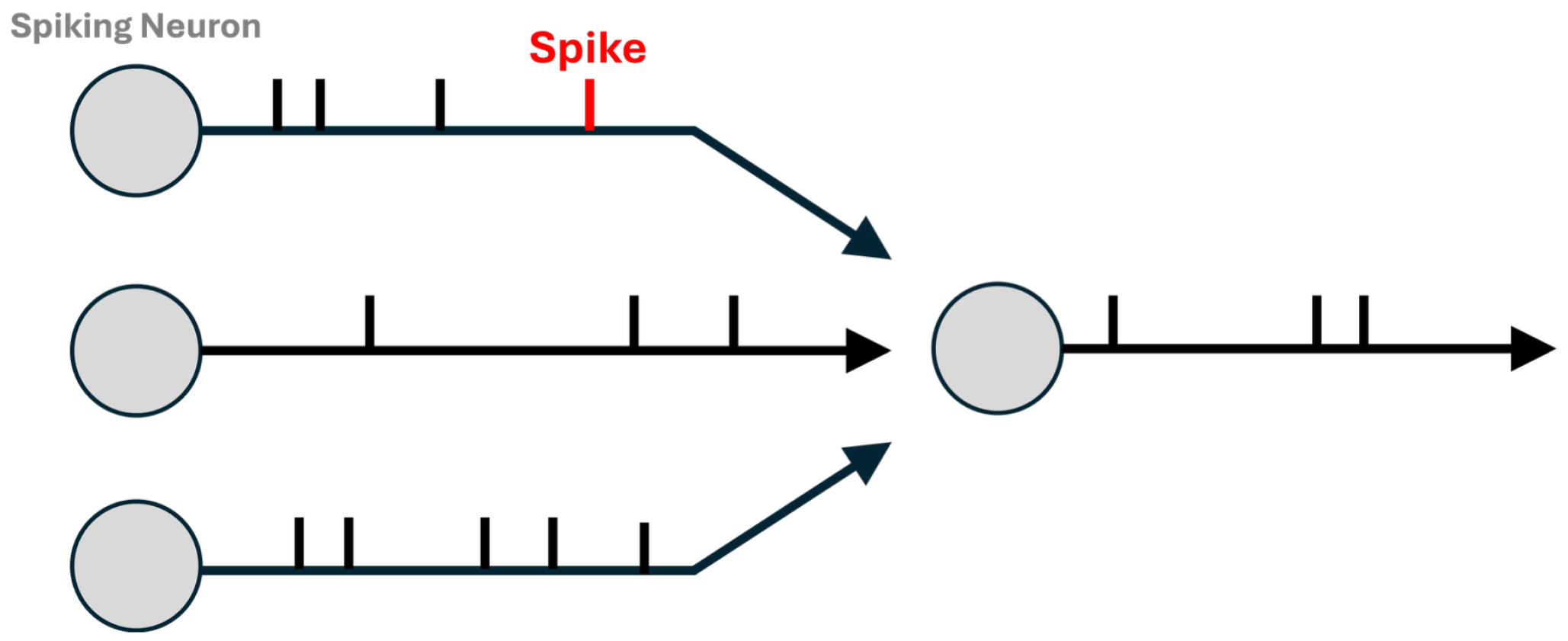
SNNs are a class of artificial neural networks designed to mimic the activity of biological neurons [12]. They are event-driven networks that exchange discrete signals known as spikes between neurons and incorporate temporal dynamics as shown in Figure 1 [13]. Structurally, SNNs resemble traditional DNNs, consisting of interconnected spiking neurons arranged in input, hidden, and output layers. However, unlike traditional deep learning that utilizes continuous real-valued signals, SNNs operate exclusively using discrete signals of 0 or 1.
Figure 1.
Neurons in SNNs communicate with binary spike signals. Input spikes increase a neuron’s membrane potential, and the neuron fires an output spike when the potential reaches a threshold .
Leaky Integrate-and-Fire (LIF) is the most popular neuron model of the SNN [14]. Its core component lies in membrane potential, which arises from the difference in ion concentration across the neuronal membrane, and a threshold that determines spike generation. The membrane potential is calculated as the sum of inputs; if this potential fails to reach the threshold, it gradually decays. When the membrane potential reaches or exceeds the threshold , the neuron generates a spike, and its potential is subsequently reset to a resting potential level.
Thus, instead of employing the activation functions used in DNNs, SNNs utilize spike signals fired based on the neuron’s membrane potential. While standard DNN models employ differentiable, continuous activation functions like ReLU [15] to transform the sum of input signals into an output signal, SNNs rely on discrete spikes to fulfill this role. Since spikes are non-differentiable, the standard backpropagation algorithm used in DNNs cannot be directly applied. Consequently, two primary methods are employed to train SNNs: Spike Timing-Dependent Plasticity (STDP) [16] and Surrogate Gradient Descent [17]. STDP is a mechanism that adjusts the strength of neuronal connections based on the relative timing of spike generation between neurons. For example, if a neuron A fires before a post neuron B, the connection between them is strengthened; conversely, if neuron B fires before neuron A, the connection is weakened. The Surrogate Gradient method enables backpropagation in SNNs by approximating gradients, making it compatible with optimizers such as Adam or Stochastic Gradient Descent (SGD).
The biggest benefit of SNNs is their high energy efficiency. Unlike DNNs, which require computationally intensive matrix multiplication operations involving numerous real values, SNNs ensure low power consumption by utilizing discrete spikes and neuromorphic event data. Neuromorphic data consists of temporally encoded brightness changes of objects or subjects captured by Dynamic Vision Sensor (DVS) cameras. The advantage of the data lies in its compressed visual format, which allows for near-instantaneous processing; SNNs are particularly well-suited for handling such event-driven and time-encoded dynamic data.
2.2. Backdoor Attacks and Fine-Pruning
A backdoor attack involves manipulating a model during the training phase to induce abnormal behavior during the testing phase. A model embedded with a backdoor functions correctly on normal clean data but performs incorrect classification on data containing a specific pattern defined by the attacker, known as a trigger. Generally, a trigger consists of a pixel pattern located in a specific region of an image. When an attacker injects a trigger into a portion of the model’s training dataset, the model learns to misclassify input data containing the trigger into a target label designated by the attacker.
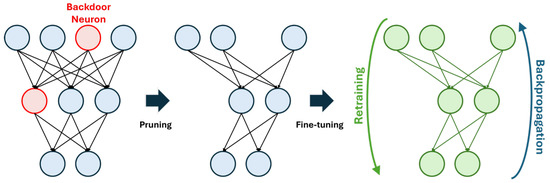
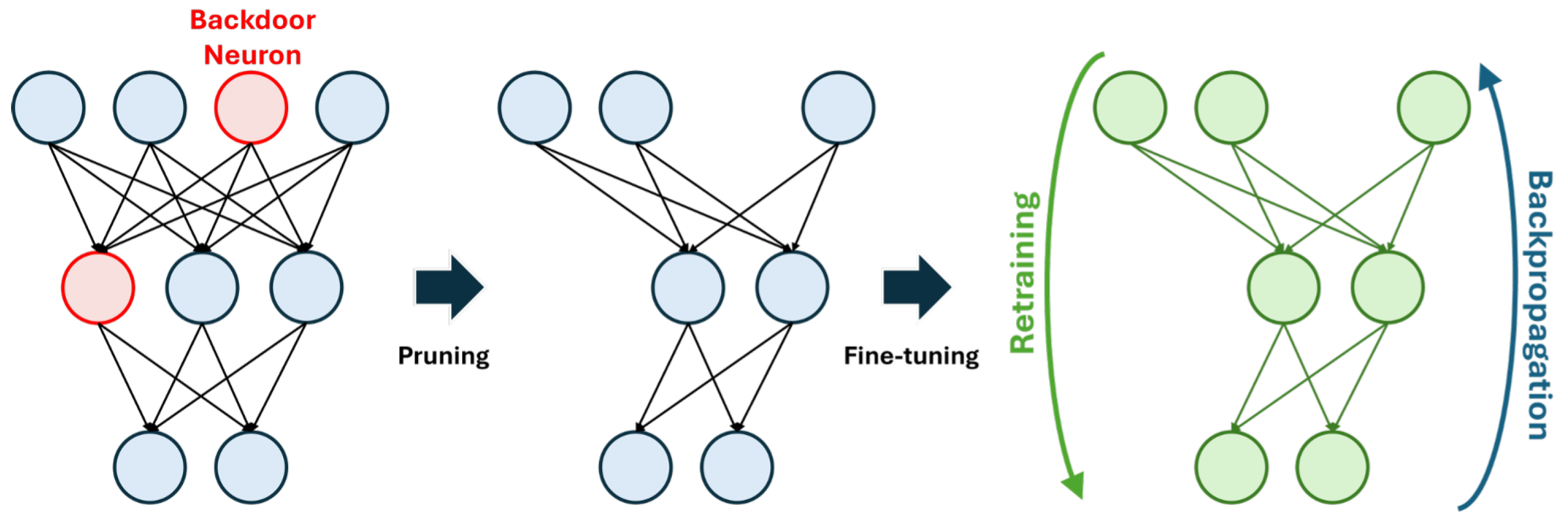
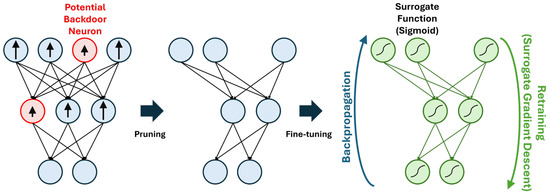
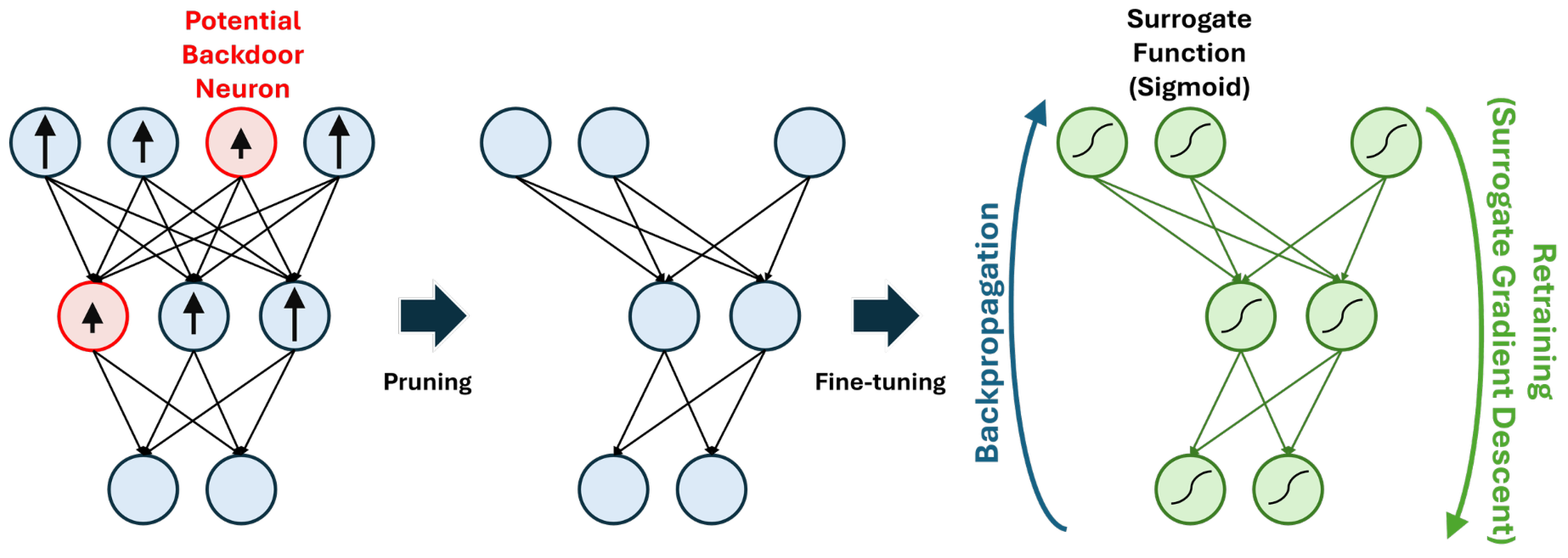
Fine-pruning is one of the well-known backdoor defense techniques that combines pruning and fine-tuning, falling under the category of backdoor elimination rather than backdoor detection. The core motivation for fine-pruning as a defense mechanism lies in the observation that there exist specific neurons, termed backdoor neurons, which are activated solely by backdoor inputs [18]. This reflects the assumption that backdoor neurons respond only to trigger-embedded backdoor inputs while remaining unresponsive to normal, clean inputs. Fine-pruning proceeds in two phases (see Figure 2): A defender first prunes the network to remove backdoor neurons, and subsequently employs fine-tuning to recover the accuracy on clean data inputs—which may have degraded due to pruning—while further eliminating any residual backdoor effects. In the pruning phase, a small amount of clean data is input into the infected model to measure the activation of each neuron, and neurons with low activation are sequentially removed. Following pruning, the fine-tuning phase involves retraining the model for a short number of epochs using clean data.
Figure 2.
A structure diagram of the fine-pruning method that eliminates backdoors.
This study aims to defend against security threats that may arise in SNN models, specifically backdoor attacks tailored to the characteristics of SNNs and neuromorphic data. We adapt fine-pruning, a backdoor defense technique used in traditional DNNs, to reflect the spatio-temporal characteristics of spikes. By applying SNN learning algorithms—specifically STDP and Surrogate Gradient Descent—we achieve both objectives: backdoor elimination and performance recovery.
3. Threat Model
The threat model in this study aligns with the ones in the context of SNN backdoor attacks [7,11]. We assume that the attacker possesses full access to the model. This implies that an attacker has complete capability to access and modify the model’s architecture and parameters. Furthermore, the attacker has access to the original training dataset provided by the user and manipulates it to execute poisoning-based backdoor attacks. It is assumed that the attacker employs the dirty-label methodology, wherein the labels of trigger-embedded data samples are altered to the target labels desired by the attacker. There are three representative real-world scenarios where backdoor attacks can occur [19]:
- Adopting third-party datasets: In this scenario, the attacker directly provides a poisoned dataset containing triggers to the user via the Internet or other means. The user trains the model using this poisoned dataset. The attacker can only manipulate the dataset and cannot access or modify the model’s architecture or parameters.
- Adopting third-party platforms: In this scenario, a user uploads their own benign dataset and model to an untrusted third-party platform (say, Google Cloud or Amazon Web Services) for training. The attacker has the capability to access and modify both the dataset and the model’s architecture and parameters.
- Adopting third-party models: In this scenario, the attacker provides an infected model to the user via the Internet. The attacker has full access to and modification capabilities over everything except the inference pipeline.
This study considers the second scenario of adopting third-party platforms that is widely accepted in the literature [11]. For instance, consider a scenario where a client intends to train a model using a proprietary dataset but lacks sufficient computing resources, such as GPUs, to perform the training locally. To address this limitation, the client outsources the training process to a third-party machine learning platform (e.g., Google Cloud) by providing both the model architecture and the training dataset. In this threat model, the third-party service provider acts as the adversary. Consequently, the attacker gains full access privileges to both the model architecture and the training data. Leveraging this access, the attacker injects a backdoor during the training phase and subsequently delivers the compromised backdoor model to the client. We note that the attacks in this study are conducted within a digital environment rather than the physical world; thus, triggers are not physically applied to the real-world environment [20].
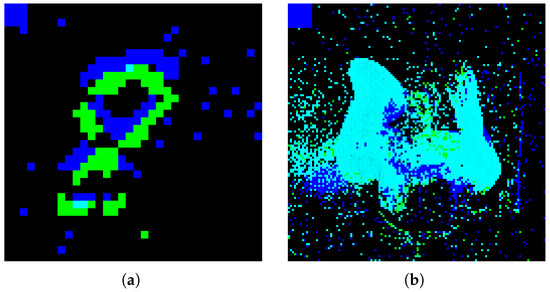
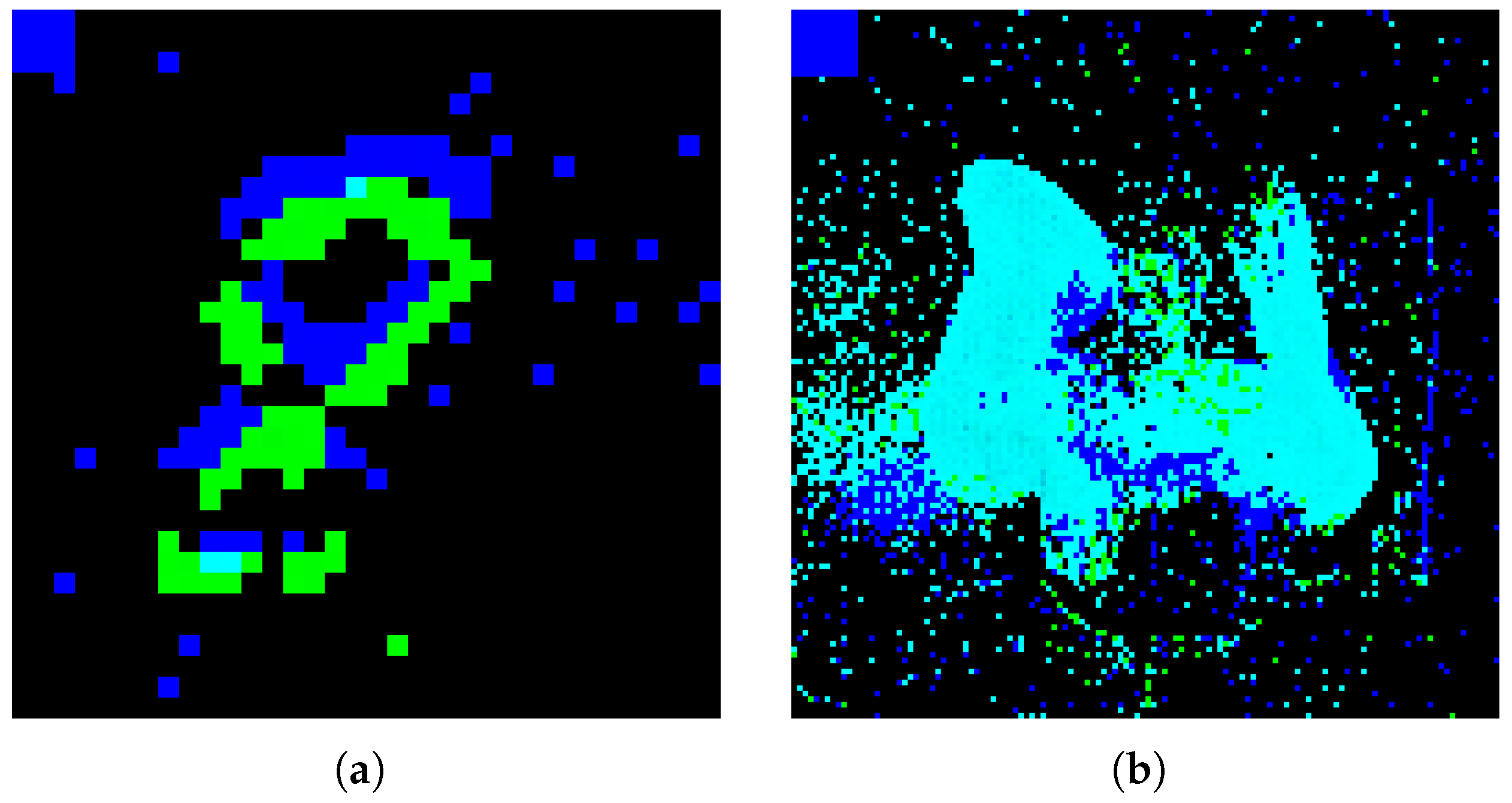
Regarding attack models, Abad et al. [11] introduced and evaluated four backdoor attacks that reflect the unique characteristics of SNNs and neuromorphic data as sampled in Figure 3. By leveraging the temporal nature of event-based data, these four attacks generate triggers that are stealthier and more sophisticated than classical attacks in DNNs. Out of them, this study adopts three attack models; the static, moving, and smart backdoor attacks.
Figure 3.
Examples of backdoor attacks: (a) static and (b) moving.
- A static backdoor attack is a fundamental form inspired by classical DNN attacks. A static trigger is a small square pattern inserted at the identical position across all frames of a poisoned data sample. The form of the trigger is defined by its size, position, and polarity. Here, polarity determines the color of the trigger within neuro-morphic data. Since the polarity of neuromorphic data is represented by two values—black and bright blue—the trigger’s polarity, p, can generate up to four combinations (black, dark blue, green, and bright blue) as pixels of different polarities overlap.
- A moving backdoor attack exploits the temporal characteristics of SNNs and neuromorphic data. A moving trigger is inserted at a different position in each frame, thereby imparting movement to the trigger. Like the static trigger, its form is defined by size, position, and polarity. To generate a moving trigger, a binary mask is employed, where the position of the trigger is set to 1 and the remaining positions to 0. The trigger shifts 2 pixels to the right in each subsequent frame.
- A smart backdoor attack automates the selection of the trigger’s position and polarity to maximize both attack efficacy and stealth. The image is divided into regions using vertical and horizontal lines, and activity is calculated by summing polarity changes within each region. A smart trigger is automatically selected to be inserted into the most active region using the least utilized polarity. Furthermore, the trigger moves randomly yet smoothly within the selected region across frames.
- A dynamic backdoor attack generates a unique trigger for each input and frame. Unlike a standard square pattern, a dynamic trigger is generated in the form of optimal noise using a Spiking Autoencoder, ensuring it remains invisible across the entire image while maintaining performance. The Spiking Autoencoder is trained simultaneously with the model to generate noise that maximizes backdoor accuracy while remaining undetectable to the human eye.
4. Proposed Methods: Redesign Fine-Pruning for SNNs
This section proposes two backdoor defense methods, HS-FP and SS-FP, which adapt the fine-pruning paradigm to the spatio-temporal and spike-driven characteristics of SNNs.
4.1. Hook–Surrogate Gradient-Based Fine-Pruning (HS-FP)
Similar to conventional fine-pruning, HS-FP sequentially removes neurons with low activation from the model infected by a backdoor attack during the pruning phase in Figure 4. Subsequently, in the fine-tuning phase, the model is retrained for a short number of epochs using clean data. The abbreviation HS in HS-FP denotes the distinct features of using PyTorch’s hook function to obtain activation values for each neuron during the pruning phase and employing Surrogate Gradient Descent during the fine-tuning phase.
Figure 4.
HS-FP removes neurons with low activation at the pruning phase, and then the model is retrained for a short number of epochs using clean data in the next phase.
The objective of the pruning phase is to identify and eliminate neurons that are unresponsive to normal clean inputs—specifically, backdoor neurons that contribute to the backdoor mechanism by reacting exclusively to backdoor inputs. To achieve this, HS-FP performs forward propagation of the clean training dataset through the infected model to obtain the output of a specific layer (the fully connected layer in this study). Using the obtained output, the average activation of each neuron is measured, and neurons are sequentially removed starting from those with the lowest activation. In CNN architectures, the fully connected layer plays a critical role in performing the final classification based on extracted features. Since the primary objective of a backdoor attack is to induce intentional misclassification upon the presence of a specific trigger pattern, the final fully connected layer, which establishes the decision boundaries between classes, is most closely associated with the backdoor mechanism. Therefore, in this study, we specifically apply pruning to the last fully connected layer to effectively neutralize the backdoor behavior. This pruning strategy is based on the assumption that neurons exhibiting low activation in response to clean inputs are highly likely to be backdoor neurons that respond specifically to backdoor triggers; thus, the process is executed by removing neurons with the lowest activation levels first. The formula for calculating the activation of a specific neuron j is as follows:
where represents the value of neuron j in the intermediate layer output, denotes the number of time steps in batch b, and indicates the number of spatial positions (which is 1 for fully connected layer inputs).
Equation (1) encapsulates the engineering process of quantifying discrete spike events into a continuous metric for neuron importance, reflecting the spatio-temporal nature of SNNs. Unlike DNNs, which output static real values, SNNs transmit information via binary spike events (0 or 1) over time. Consequently, evaluating a neuron’s contribution requires temporal integration—accumulating spikes over the entire simulation duration (T) rather than examining a single snapshot. In terms of pruning criteria, neuron activation in HS-FP is defined as the average value obtained by dividing the total sum of spikes generated by the neuron by the time steps and batch size. This process derives the ‘Average Firing Rate’, providing a consistent, scale-invariant metric representing the neuron’s responsiveness to clean inputs. We utilize this normalized rate as the activation rank to identify and prune potential backdoor neurons, effectively bridging the gap between discrete neuromorphic events and the continuous ranking required for fine-pruning.
The removal of backdoor-related neurons during the pruning phase may lead to a partial degradation in the model’s normal performance. The fine-tuning phase aims to recover this performance degradation and further eliminate any backdoor effects that may persist after the pruning phase. The fine-tuning phase of HS-FP employs Surrogate Gradient Descent. The pruned model is retrained for a specified number of epochs using the clean training dataset. Surrogate gradient learning utilizes the Adam optimizer and Cross Entropy Loss function. In this manner, HS-FP applies the proven methodology of conventional fine-pruning to the SNN environment, executing SNN backdoor elimination through an intuitive approach that combines neuron activation analysis via hooks and learning based on Surrogate Gradient Descent.
4.2. Spike–STDP-Based Fine-Pruning (SS-FP)
SS-FP integrates the biological characteristics of SNNs—specifically, discrete spike generation frequency and STDP learning—as core mechanisms for backdoor defense. While HS-FP directly transplants the defense mechanism of fine-pruning from existing DNN research to SNNs, SS-FP more deeply reflects the unique nature of SNNs by leveraging spikes and STDP.
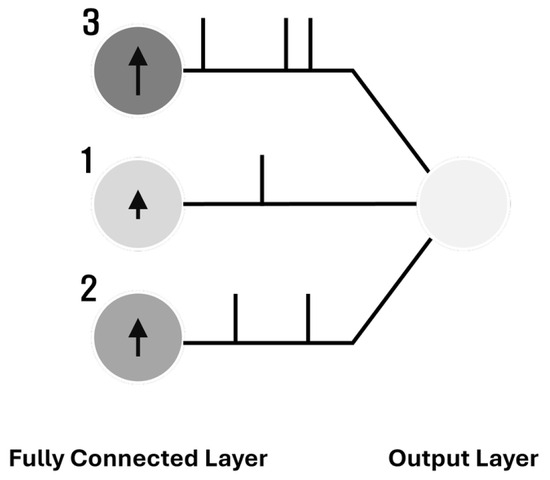
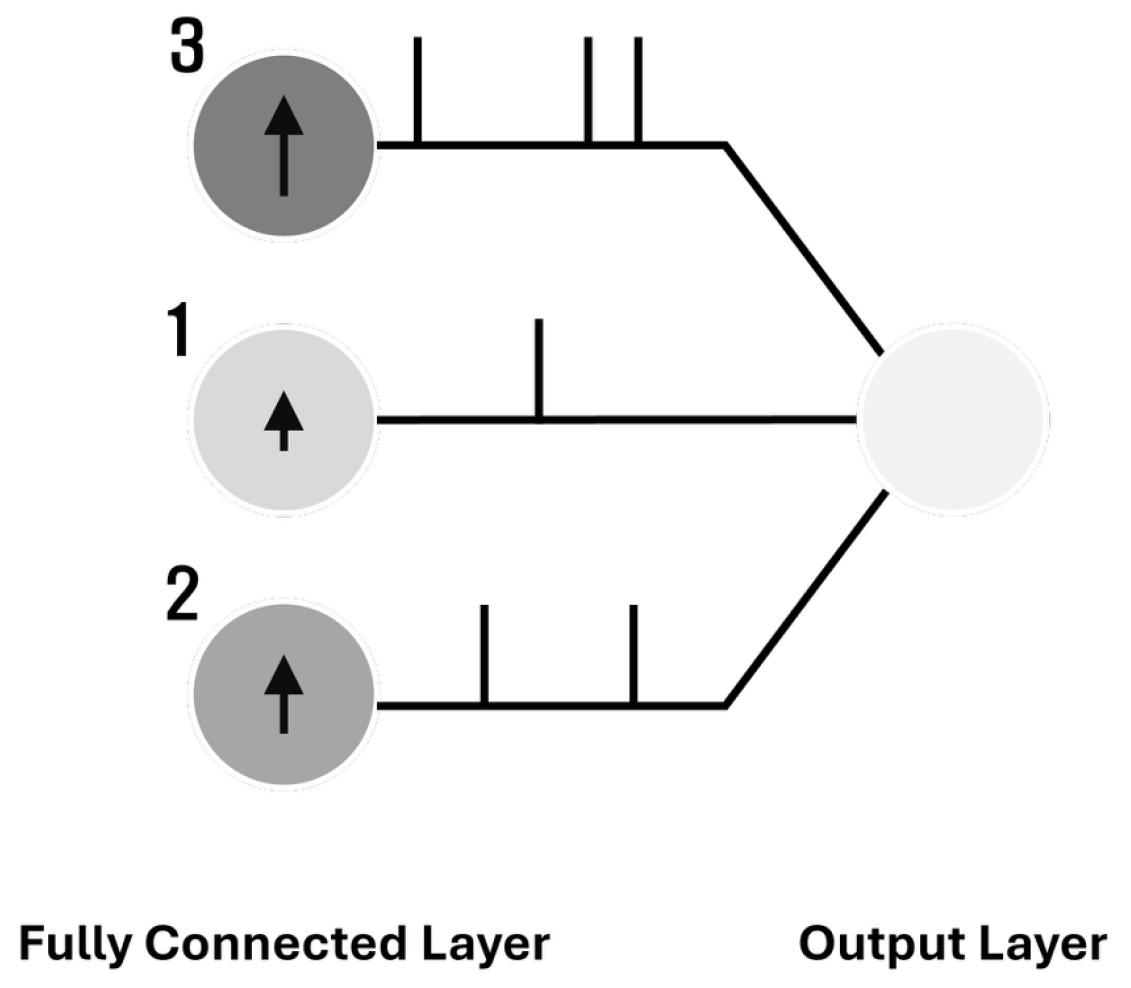
Unlike HS-FP, which uses the average of spikes as the criterion for activation during the pruning phase, SS-FP determines activation based on the total spike count actually fired by the neuron.Since SNNs transmit information via the presence and frequency of spike signals, it is assumed that backdoor neurons will exhibit minimal spike firing patterns in response to normal, clean inputs. Similar to HS-FP, the pruning phase of SS-FP involves forward-propagating the clean training dataset through the infected model to obtain the output of the fully connected layer. Based on this output, the activation of each neuron is calculated, and neurons are sequentially removed starting from those with low activation. For instance, in Figure 5, neurons are removed in the order of 1, 2, and 3, corresponding to lower activation levels. The formula for calculating the activation of a specific neuron j is as follows:
where represents the value of neuron j in the intermediate layer output, denotes the number of time steps in batch b, and indicates the number of spatial positions (which is 1 for fully connected layer inputs).
Figure 5.
Pruning sequence of SS-FP.
As such, the sum of spikes fired across all batches and time steps is used as the activation for each neuron in SS-FP. Except for the fact that neuron activation is calculated based on the total spike count, the subsequent process proceeds identically to HS-FP. Neurons are sorted in ascending order of activation and removed sequentially starting from the lowest activation, and then the fine-tuning phase is executed.
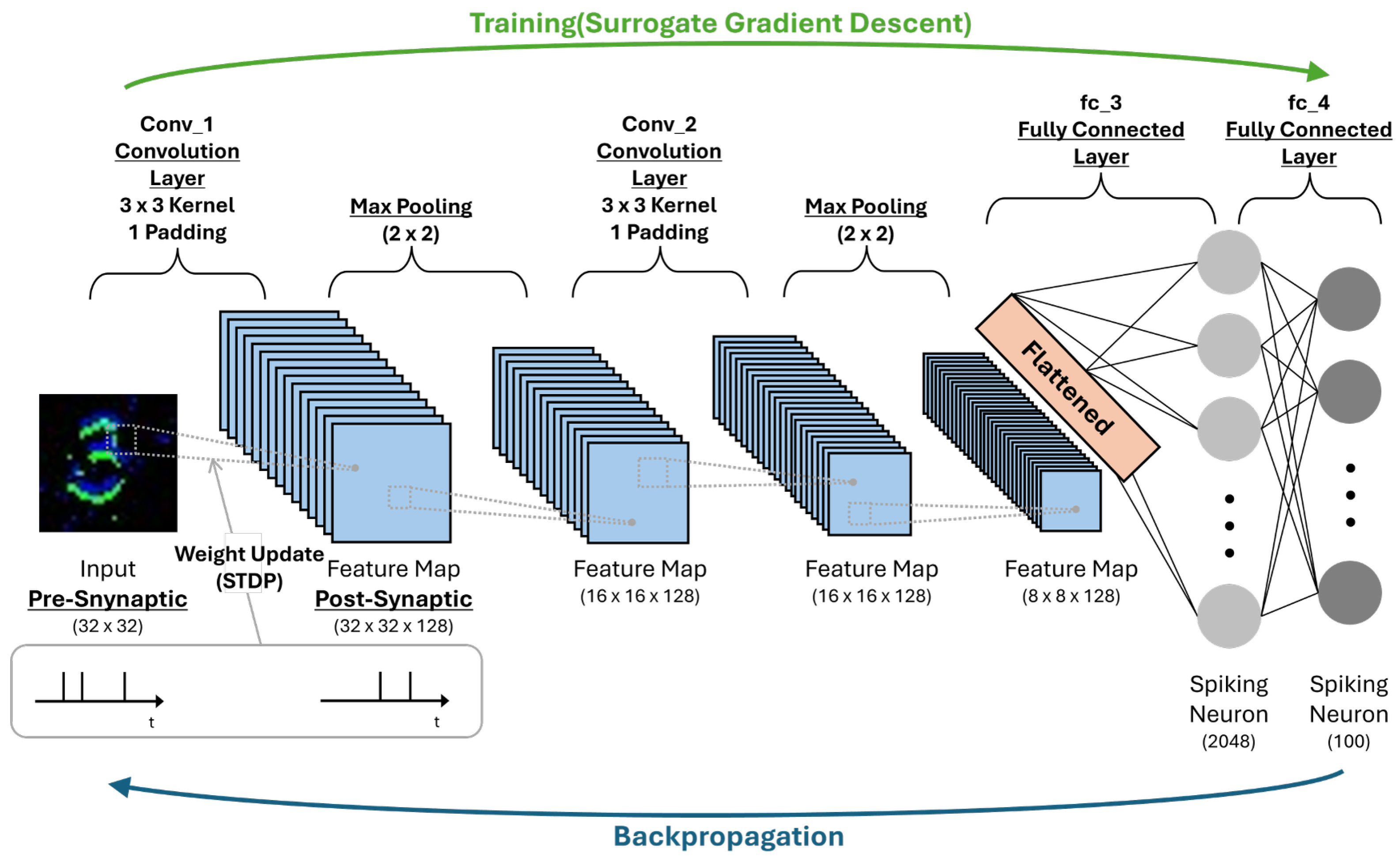
The most distinctive feature of SS-FP is that it performs hybrid learning in the fine-tuning phase to recover the model damaged after pruning. This hybrid approach combines STDP, a biological unsupervised learning rule, with Surrogate Gradient Descent, a supervised learning method. This is intended to optimize learning by distinguishing the roles of the convolutional layer and the fully connected layer in the SNN [21,22].
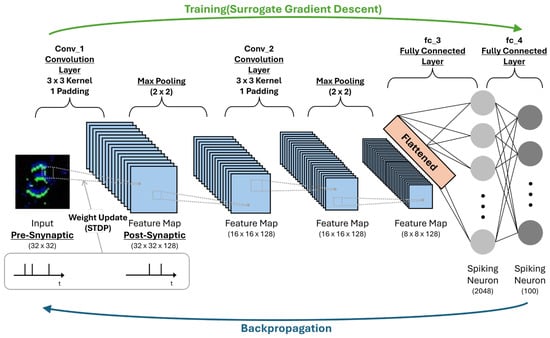
The fine-tuning phase of SS-FP implementing the combined learning method is depicted in Figure 6. STDP learning is applied to the convolutional layers responsible for extracting spatio-temporal features of the input data. By forward-propagating the clean training dataset through the model, the firing timings of pre-synaptic and post-synaptic neurons in the convolutional layer are observed, and STDP learning is performed to strengthen or weaken weights based on the difference in firing times between neurons. In the figure, the input data itself is set as the pre-synaptic neuron and the neuron of the convolutional layer as the post-synaptic neuron, updating weights according to the relative spike firing timing between the two. For the parameters of the remaining layers, excluding the layer where STDP learning is applied, the surrogate gradient learning method is used. These parameters are updated in a supervised manner using the Adam optimizer and Cross Entropy Loss function.
Figure 6.
In the fine-tuning phase, SS-FP performs hybrid learning that combines STDP learning with Surrogate Gradient Descent.
This hybrid learning approach in the fine-tuning phase of SS-FP allows the con-volutional layer to naturally relearn features of clean data in an unsupervised manner (STDP), thereby reducing dependency on artificial patterns like triggers. Simultaneously, it induces the fully connected layer to reset accurate classification boundaries through supervised learning (Surrogate Gradient). Consequently, SS-FP maximizes the biological characteristics of SNNs to achieve backdoor elimination and performance restoration in infected SNN models.
5. Experiments
5.1. Evaluation Metrics
To quantitatively evaluate the defense effectiveness of the proposed HS-FP and SS-FP methods, we utilize two standard metrics widely adopted in the field of backdoor learning: Accuracy (ACC) and Attack Success Rate (ASR).
ACC measures the model’s task performance on clean test data. This indicates the extent to which the model’s utility is preserved following the application of defense mechanisms. ACC is calculated as the proportion of clean test data that the model correctly classifies into the correct labels. The formula is as follows:
From the attacker’s perspective, maintaining high ACC is ideal to remain stealthy. Similarly, from the defender’s perspective, preserving high ACC is also the ideal outcome to ensure the model remains useful.
ASR measures the effectiveness of the backdoor attack on the model. It is evaluated using a distinct set of poisoned test data, which consists exclusively of data samples with triggers inserted. ASR is calculated as the proportion of poisoned test data that the model classifies into the target label intended by the attacker. The formula is as follows:
From the attacker’s perspective, achieving a high ASR is ideal. Conversely, from the defender’s perspective, reducing the ASR to a low level is the ideal outcome.
5.2. Experimental Setup
All experiments were conducted with the objective of maximizing the preservation of model ACC while reducing the ASR following the application of the defense techniques. The experiments utilized the N-MNIST [23] and DVS128-Gesture [24] datasets. N-MNIST is an event-based neuromorphic dataset converted from the existing MNIST dataset to accommodate SNNs. It comprises 60,000 training samples and 10,000 test samples, featuring a resolution of 34 × 34 and classified into 10 classes ranging from 0 to 9. DVS128-Gesture is a dataset constructed by capturing human hand gestures in real time using a DVS camera. It contains 1077 training samples and 264 test samples, classified into a total of 11 classes.
The backdoor attack models were generated using the three attack techniques described in Section 3. The poisoning rate of the training dataset was set to 10% ( = 0.1), and the trigger size was set to 10% of the image. Regarding trigger placement, static and moving triggers were positioned at the top-left of the image, while smart triggers were configured to be automatically inserted into inactive regions. The detailed hyperparameters configured for the backdoor attacks are specified in Table 1.
Table 1.
Detailed hyperparameters and settings for backdoor attacks.
For the defense hyperparameters, the once_prune_ratio was set to 0.05. The acc_ratio (accuracy tolerance threshold) was set to 0.8 for the N-MNIST environment and 0.3 for the DVS128-Gesture environment. Fine-tuning was performed for 20 epochs and 128 epochs, respectively. The once_prune_ratio is a factor used to observe gradual changes in accuracy and ASR during the pruning phase, representing the proportion of neurons to be removed in a single pruning step relative to the total neurons in the target layer. The acc_ratio defines the permissible limit for ACC degradation during the pruning process. We flexibly adjusted the accuracy tolerance to account for the unique pruning sensitivity of each dataset. In particular, since the DVS128-Gesture model exhibits relatively slow performance degradation due to neuron removal, the accuracy tolerance was adjusted to fully track the trend of ASR reduction. In the fine-tuning phase, the surrogate gradient learning rate was fixed at 0.001, and the STDP learning rate was set to 0.1. The detailed hyperparameter configurations for the defense mechanisms are specified in Table 2.
Table 2.
Detailed hyperparameters and settings for HS-FP and SS-FP.
The experimental framework was implemented based on PyTorch 2.6.0 and SpikingJelly 0.0.0.0.14. The specific experimental environments for N-MNIST and DVS128-Gesture are as follows:
- N-MNIST [OS: Windows 10; Language: Python 3.12; GPU: NVIDIA RTX 4050 GPU (6GB); RAM: 16GB];
- DVS128-Gesture [Platform: Google Colab; Language: Python 3.12; GPU: NVIDIA A100 GPU (40GB); RAM: 83.5GB].
6. Evaluation
This section details the experimental results of applying the two proposed defense methods, HS-FP and SS-FP, to SNN models infected with static, moving, and smart backdoor attacks.
6.1. Results of HS-FP
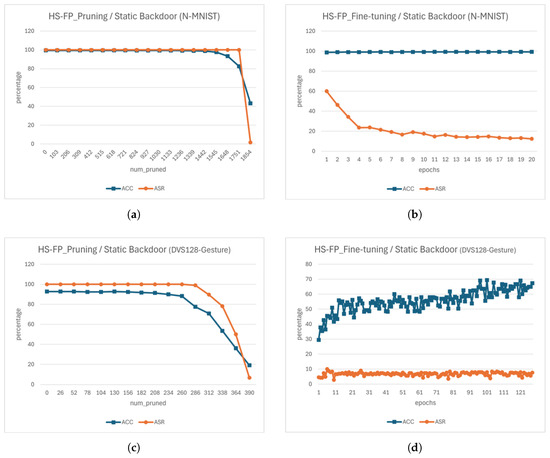
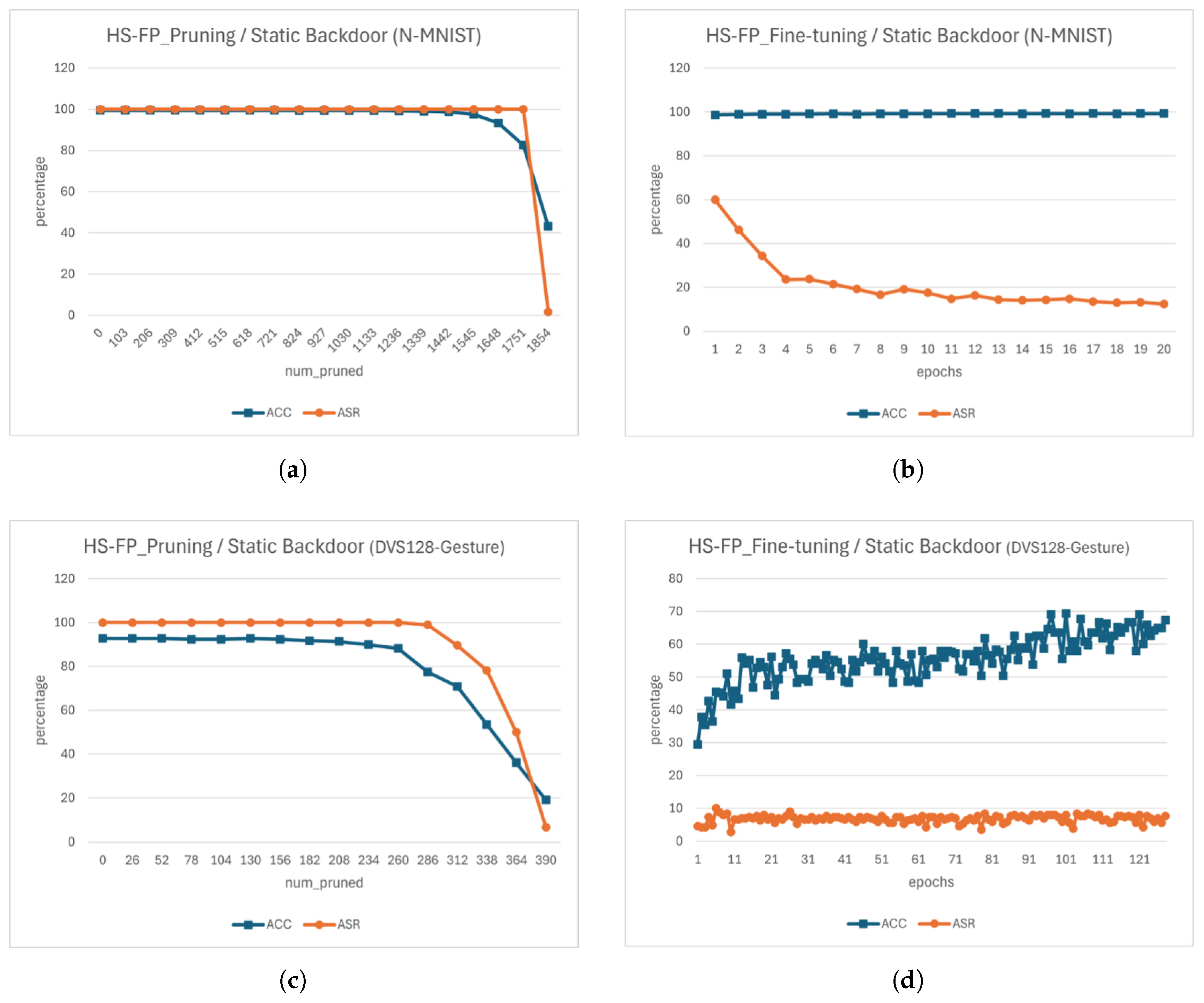
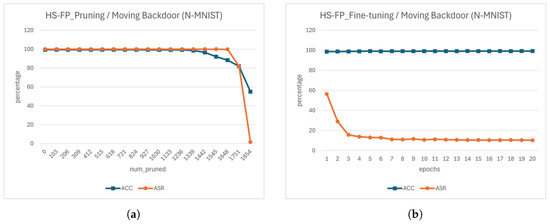
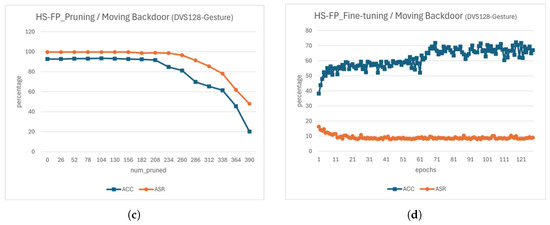
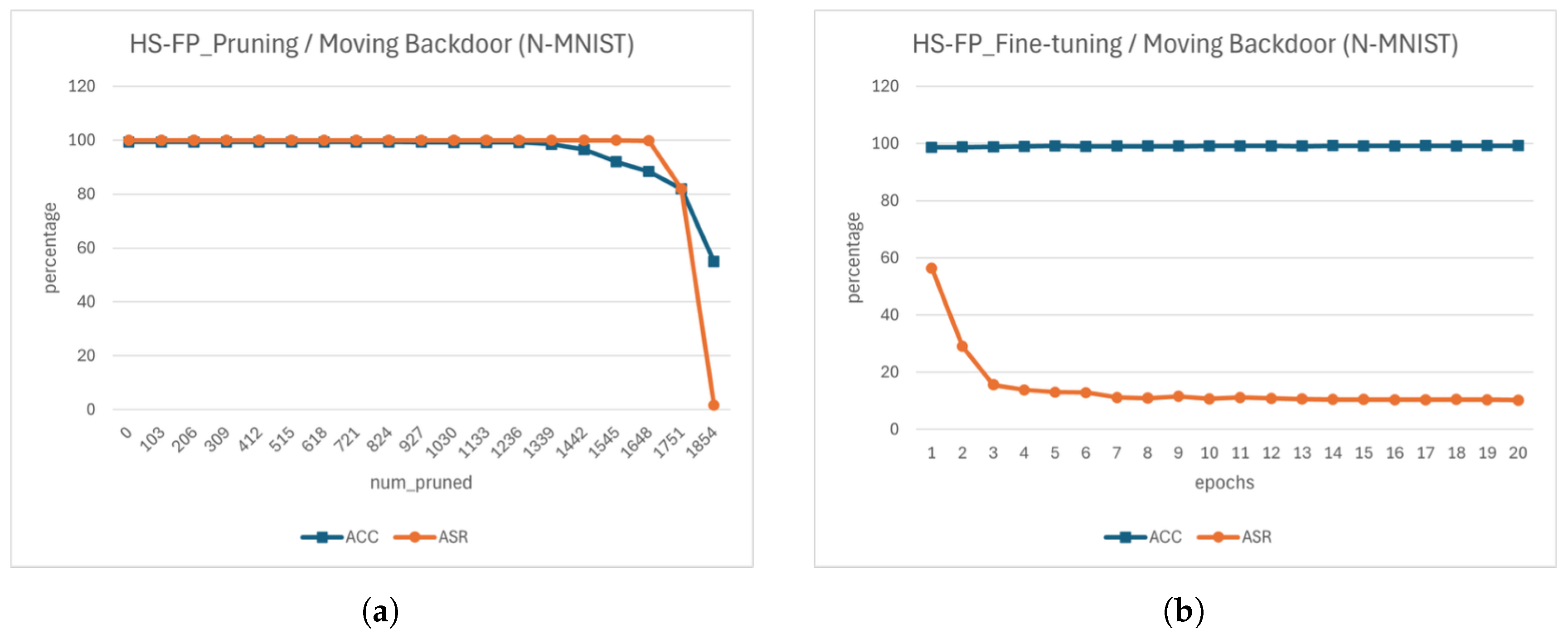
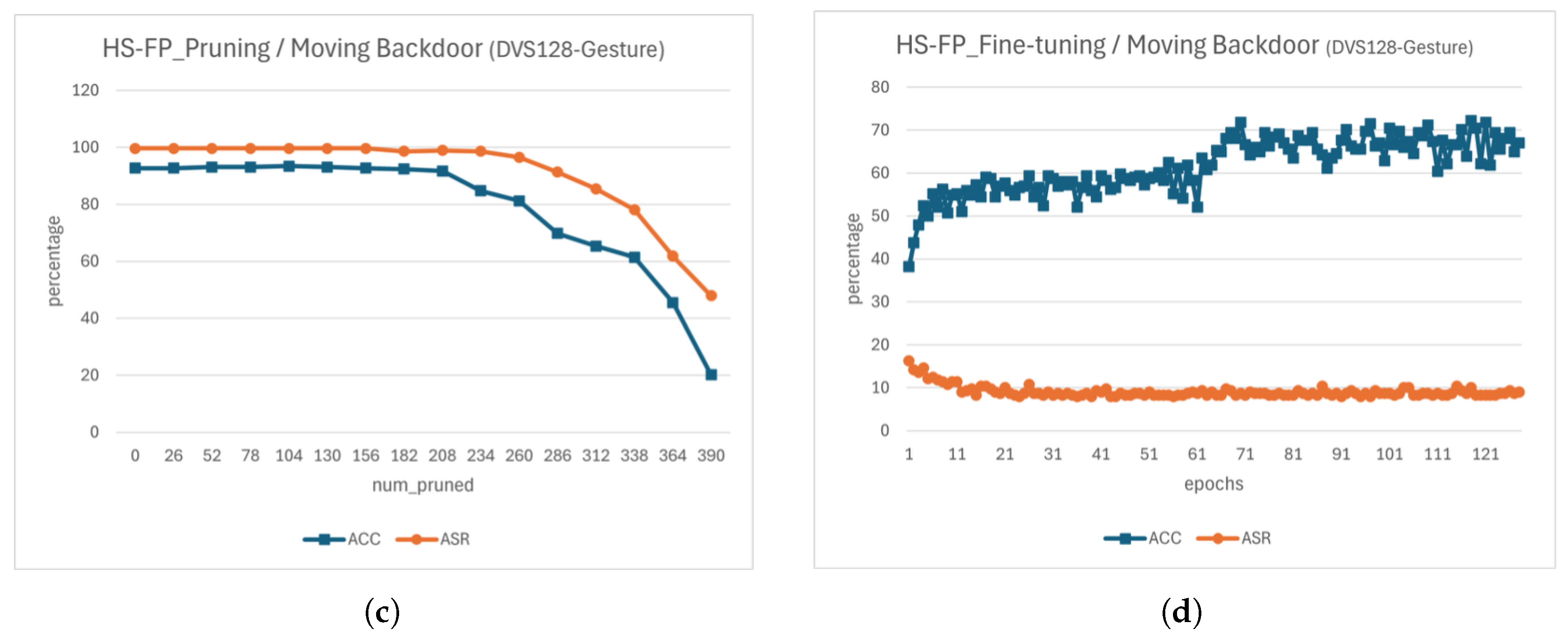
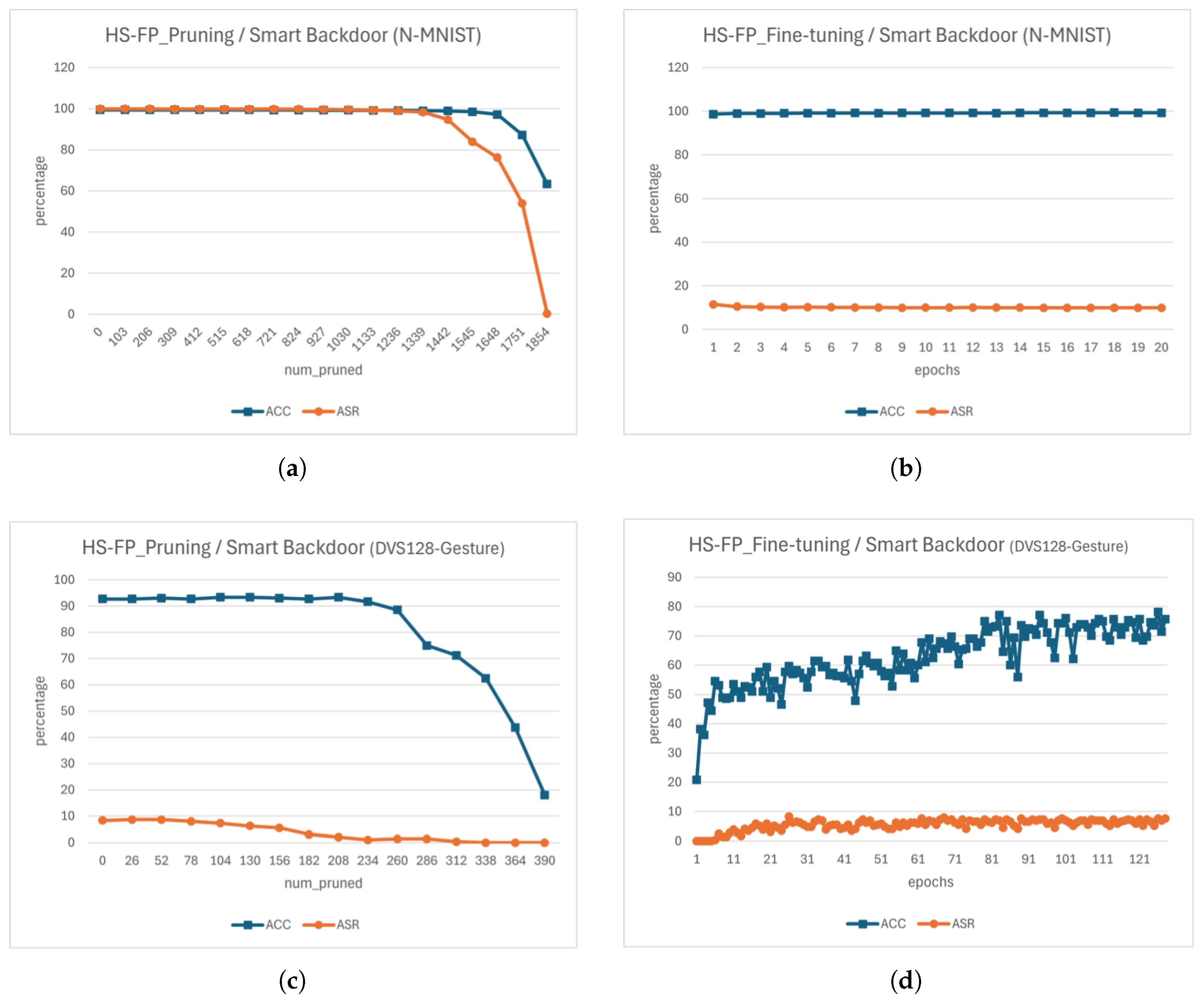
The experimental results of HS-FP under static, moving, and smart backdoor attacks are demonstrated in Figure 7, Figure 8 and Figure 9. Subfigures (a) and (b) show the results on N-MNIST, while subfigures (c) and (d) show the results on DVS128-Gesture. Subfigures (a) and (c) demonstrate the results at the end of the pruning phase, while subfigures (b) and (d) demonstrate the results at the end of the subsequent fine-tuning phase.
Figure 7.
Results of HS-FP under static backdoor attacks. (a,b) show the results on N-MNIST, while (c,d) show the results on DVS128-Gesture.
Figure 8.
Results of HS-FP under moving backdoor attacks. (a,b) show the results on N-MNIST, while (c,d) show the results on DVS128-Gesture.
Figure 9.
Results of HS-FP under smart backdoor attacks. (a,b) show the results on N-MNIST, while (c,d) show the results on DVS128-Gesture.
In the case of the static backdoor (see Figure 7), 1854 out of a total of 2048 neurons in the fully connected layer of the N-MNIST model were removed during the pruning phase. Consequently, the ACC and ASR dropped to 43.13% and 1.65%, respectively. For the N-MNIST dataset, while the ACC generally exhibited a more significant decline than the ASR during the pruning process, a trend was observed where the ASR decreased drastically compared to the ACC once the number of removed neurons exceeded a certain threshold. Through subsequent fine-tuning, the ACC was rapidly recovered to 99% within a single epoch and subsequently maintained. However, the ASR experienced a sharp surge during the initial phase of retraining before ultimately converging to 12.35% through supervised learning on clean data. For the DVS128-Gesture dataset, 390 out of 512 neurons in the fully connected layer were removed during the pruning phase, resulting in an ACC of 19.44% and an ASR of 8.33%. Throughout the subsequent fine-tuning phase, the ASR was maintained below 10%, while the model’s ACC was ultimately recovered to 67.36%.
For the moving backdoor (see Figure 8), the same number of neurons were removed during the pruning phase for both the N-MNIST and DVS128-Gesture models, resulting in an ACC of 54.93% and an ASR of 1.66% for N-MNIST, and an ACC of 19.1% and an ASR of 48.61% for DVS128-Gesture. We observed that the decreasing trends of ACC and ASR during the pruning process, as well as the post-pruning metrics, were similar to the defense results obtained for the static backdoor. Following fine-tuning, the final metrics recorded were an ACC of 99.25% and an ASR of 10.27% for N-MNIST, and an ACC of 67.01% and an ASR of 9.03% for DVS128-Gesture.
In the case of the smart backdoor (see Figure 9), 1854 and 390 neurons were removed during the pruning phase, respectively. Among the N-MNIST results, this case exhibited the most significant reduction in ASR while simultaneously maintaining the highest ACC at 63.32%. Furthermore, during the neuron removal process, the reduction in ASR was greater than the reduction in ACC, which is the exact opposite of the trend observed in the static and moving backdoors. After the fine-tuning phase, the ACC reached 99.34% and the ASR 9.94%, demonstrating that HS-FP achieved the most superior defense performance against this backdoor on the N-MNIST dataset. Conversely, for the DVS128-Gesture dataset, the smart backdoor attack was completely eliminated solely through the pruning phase due to its low attack efficacy. Through the subsequent fine-tuning phase, the ACC was recovered to 75.69%, marking the highest defense performance on the DVS128-Gesture dataset as well.
6.2. Discussion on HS-FP
Overall, Table 3 summarizes that HS-FP demonstrated a high accuracy recovery of over 99% across all N-MNIST backdoor models. However, in the static and moving backdoor models, accuracy decreased more significantly than the ASR during the pruning phase. A trend was observed where the ASR dropped drastically only after a certain number of neurons were removed across all backdoor models. Similarly, in the pruning phase for the DVS128-Gesture dataset, accuracy and ASR exhibited a similar declining pattern as neurons with low activation were sequentially removed.
Table 3.
ACC and ASR of HS-FP at the end of each phase under backdoor attacks.
This indicates that some neurons in the model are dedicated to normal tasks and others to backdoor operations, and some possess mixed functionality. In other words, this suggests that the neurons constituting the model include not only “normal neurons” responsible for normal functions and “backdoor neurons” that respond only to backdoor inputs, but also a set of neurons that respond to both normal and backdoor inputs [18]. In the N-MNIST dataset, these mixed neurons were removed during the final pruning process, causing a significant drop in both accuracy and ASR; this implies that removing neurons solely in ascending order of activation may not be the optimal strategy.
Furthermore, we observed a phenomenon where backdoor functionality was partially revived, causing the ASR to rise during the initial phase of fine-tuning. This phenomenon is often found when treating infected DNN models with fine-pruning techniques, proving that the backdoor in the defended model is not eliminated but remains in a dormant state [25]. The pruning phase of HS-FP is implemented by masking neuron weights to zero; however, since masking is not permanent, the weights involved in the backdoor function are revived during the retraining process in the fine-tuning phase.
The relatively suppressed rise in ASR during the initial fine-tuning phase of the DVS128-Gesture model can be attributed to the difference in the difficulty of backdoor learning itself. In fact, for the N-MNIST dataset, backdoor injection is completed with only 10 epochs of training. In contrast, the DVS128-Gesture dataset, which has complex spatio-temporal information and a small sample size, requires long-term training of 64 epochs to achieve 100% ASR. This high learning difficulty acts as a factor preventing the easy reactivation of backdoor functions during the fine-tuning process, resulting in the ASR failing to rebound and remaining at a low level.
6.3. Results of SS-FP
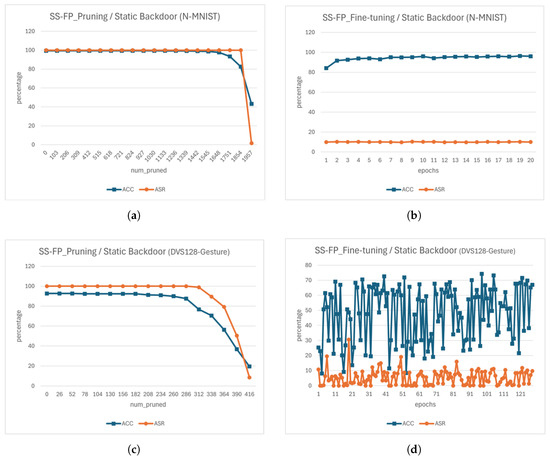
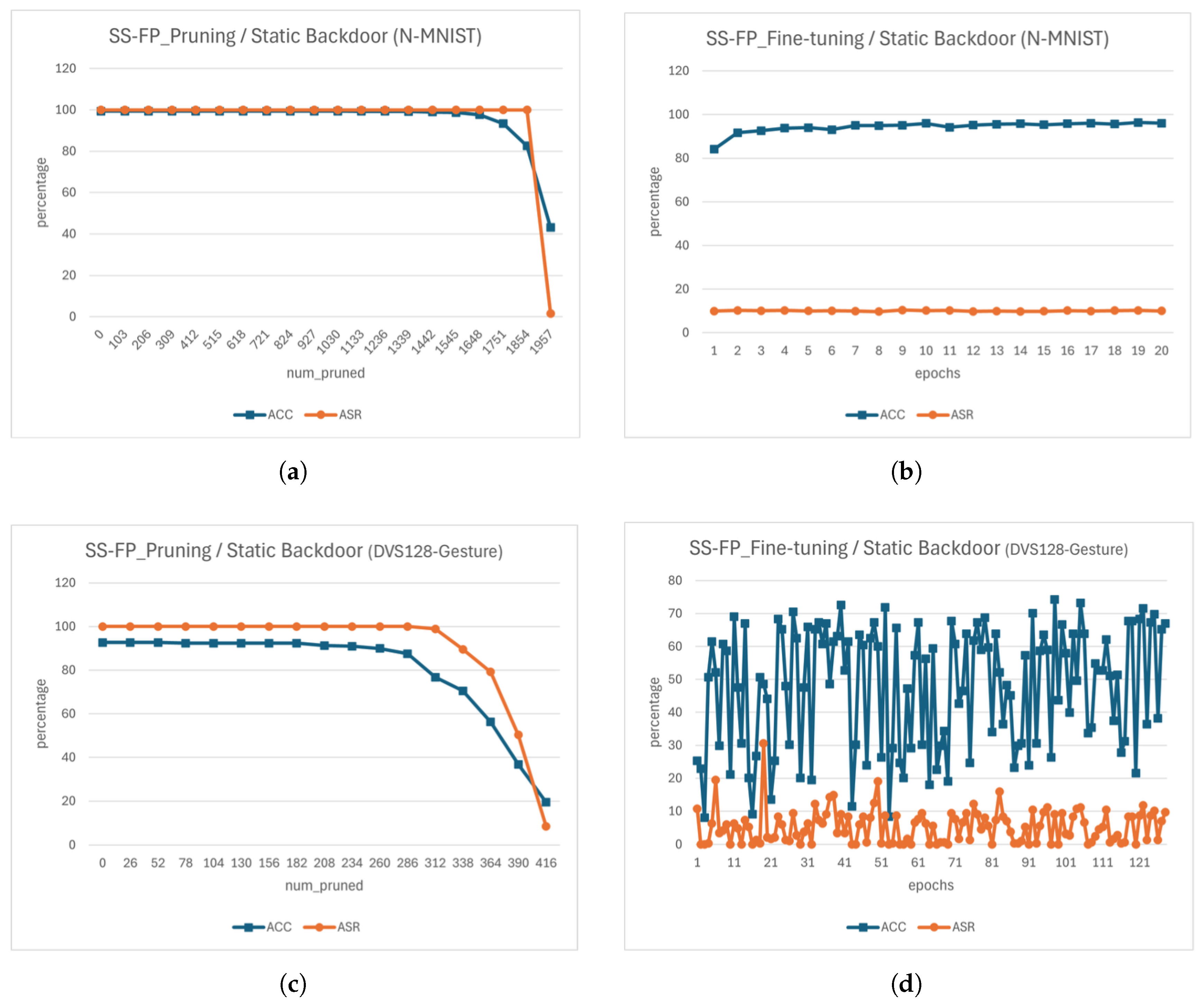
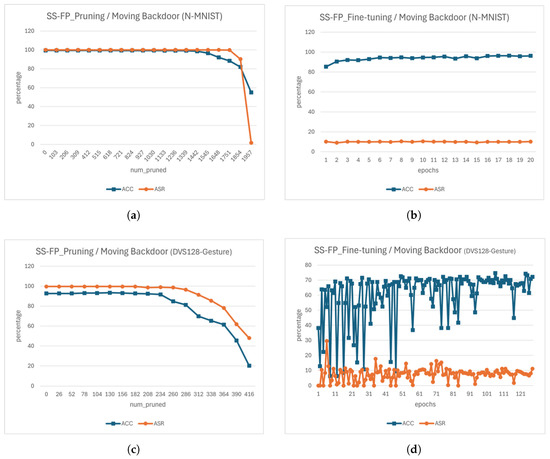
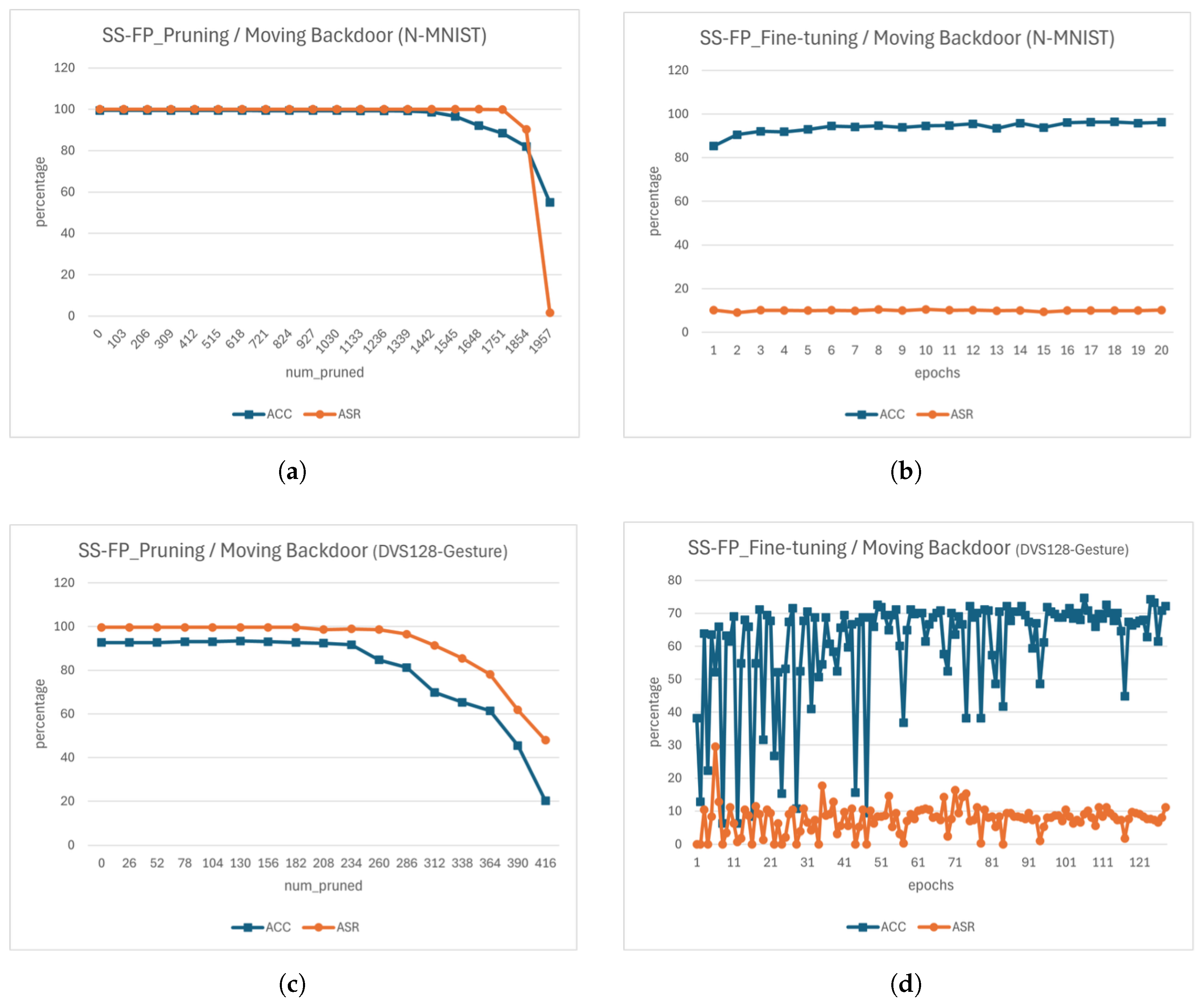
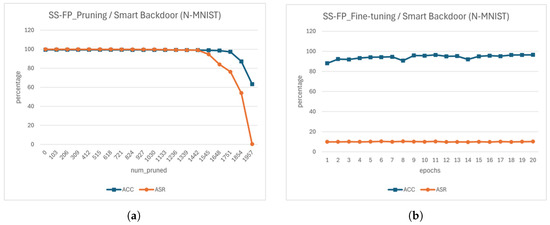
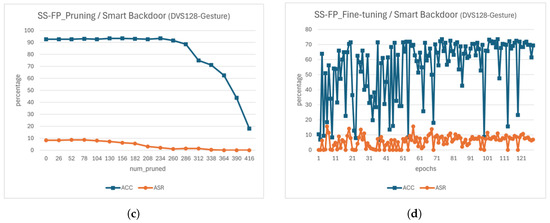
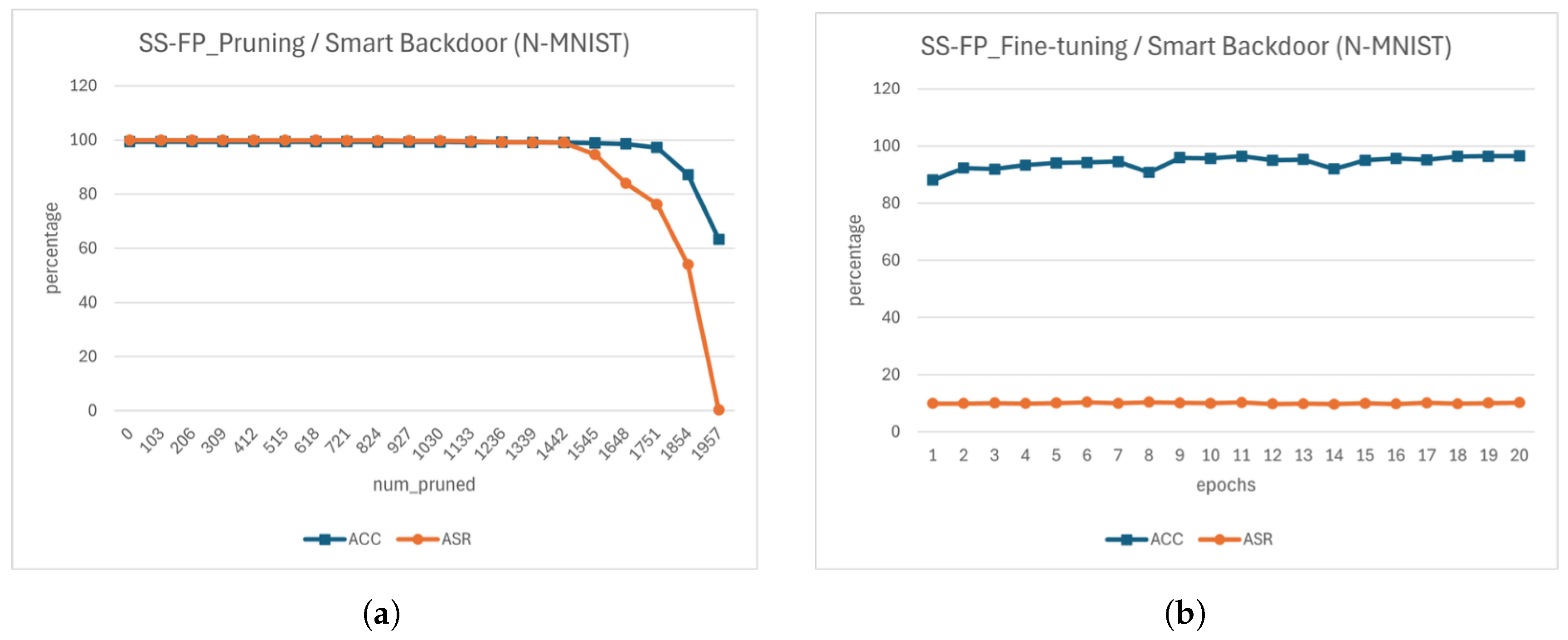
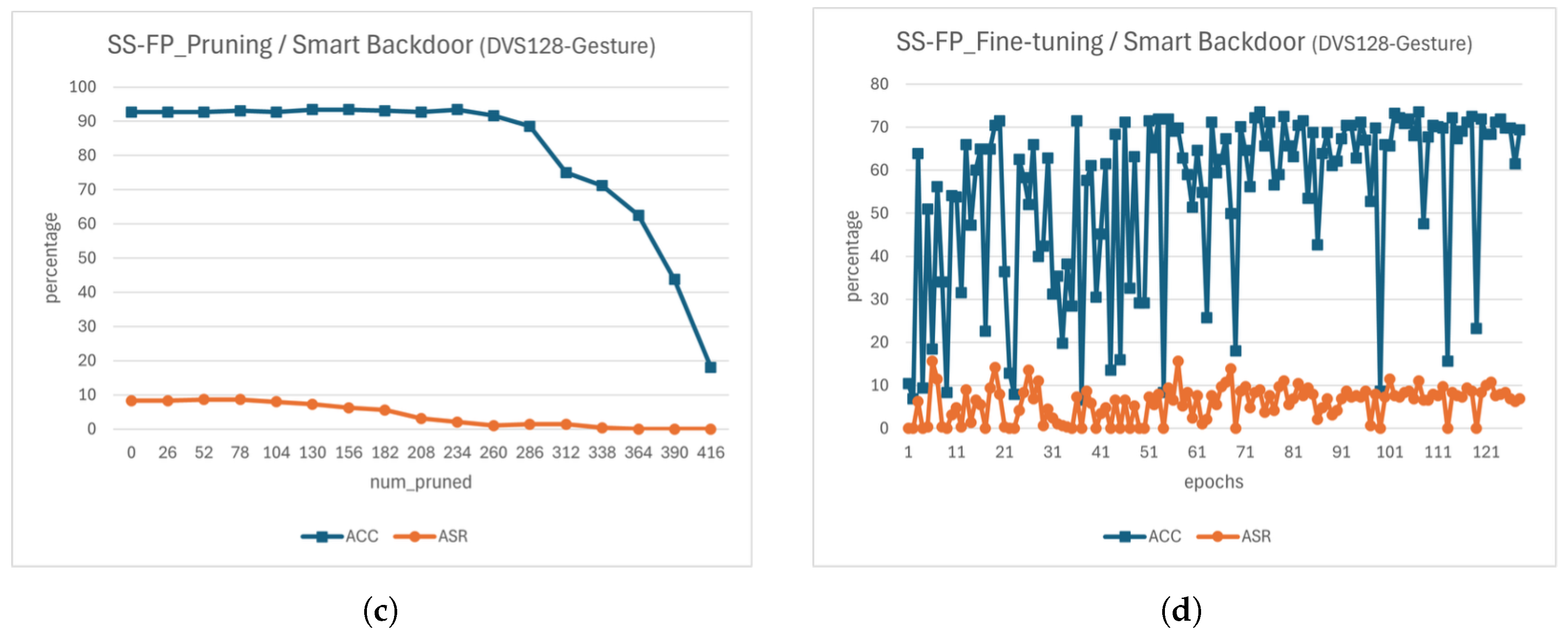
The experimental results of SS-FP under static, moving, and smart backdoor attacks are demonstrated in Figure 10, Figure 11 and Figure 12. Just as with HS-FP, subfigures (a) and (b) show the results on N-MNIST, while subfigures (c) and (d) show the results on DVS128-Gesture. Subfigures (a) and (c) demonstrate the results at the end of the pruning phase, while subfigures (b) and (d) demonstrate the results at the end of the subsequent fine-tuning phase.
Figure 10.
Results of SS-FP under static backdoor attacks. (a,b) show the results on N-MNIST, while (c,d) show the results on DVS128-Gesture.
Figure 11.
Results of SS-FP under moving backdoor attacks. (a,b) show the results on N-MNIST, while (c,d) show the results on DVS128-Gesture.
Figure 12.
Results of SS-FP under smart backdoor attacks. (a,b) show the results on N-MNIST, while (c,d) show the results on DVS128-Gesture.
In the case of the static backdoor (see Figure 10), 1957 and 416 neurons were removed during the pruning phase for the N-MNIST and DVS128-Gesture datasets, respectively. Although these numbers are higher than those in HS-FP, the level of performance degradation remained similar. As a result of hybrid fine-tuning, the ACC for the N-MNIST dataset was recovered to 96.02%, and the ASR was reduced to 10.02%, indicating successful elimination of most backdoors. For the DVS128-Gesture dataset, both ACC and ASR exhibited high volatility during the fine-tuning process; ultimately, the model recorded an ACC of 67.01% and an ASR of 9.72%.
In the case of the moving backdoor (see Figure 11), excluding the number of neurons removed after the pruning phase, both the N-MNIST and DVS128-Gesture datasets exhibited pruning results identical to those of HS-FP. Through the fine-tuning phase, the N-MNIST model recorded final performance metrics of 96.24% ACC and 10.19% ASR, while the DVS128-Gesture model achieved a final ACC of 72.22% and an ASR of 11.11%.
In the case of the smart backdoor (see Figure 12), although the number of pruned neurons differed from that of HS-FP, the declining trends of ACC and ASR during the pruning phase remained identical. In the subsequent fine-tuning phase, the N-MNIST dataset achieved a final performance of 96.50% ACC and 10.24% ASR. For the DVS128-Gesture dataset, the model successfully recovered the ACC to 69.44% while simultaneously reducing the ASR to 6.94%.
6.4. Discussion on SS-FP
Table 4 summarizes performance in terms of ACC and ASR of SS-FP. Although SS-FP exhibited a final ACC approximately 3% lower than that of HS-FP on the N-MNIST dataset, the rise in ASR during the initial phase of fine-tuning was not significant, and the defense performance regarding the final ASR appeared more stable and consistent. The hybrid fine-tuning method of SS-FP effectively suppressed the rebound phenomenon of ASR in the initial fine-tuning phase compared to the simple surrogate gradient learning of HS-FP. This is because the unsupervised STDP learning in the convolutional layers reduced dependency on artificial features such as backdoor triggers and induced natural feature extraction.
Table 4.
ACC and ASR of SS-FP at the end of each phase under backdoor attacks.
However, in the pruning phase for both HS-FP and SS-FP, the ACC decreased earlier than the ASR for the static and moving backdoor models, whereas the ASR responded more sensitively than the ACC for the smart backdoor model. This discrepancy stems from the difference in trigger placement strategies between the static/moving backdoor attacks and the smart backdoor attack. In static and moving backdoor attacks, triggers are inserted at positions manually designated by the attacker, regardless of data activity. In contrast, in the smart backdoor attack, triggers are injected into inactive regions—areas with the least activity in the data. Consequently, in static and moving backdoor models, the low-activation neurons preferentially removed during the pruning phase may not coincide with the neurons performing the backdoor function; conversely, in smart backdoor models, there is a high probability that low-activation neurons coincide with backdoor neurons.
Furthermore, due to the unique characteristic of the DVS128-Gesture dataset having stronger spatio-temporal dynamics compared to N-MNIST, significant fluctuations in ACC and ASR were observed during the fine-tuning phase. Specifically, the DVS128-Gesture dataset exhibited a lower accuracy recovery (~70%) compared to N-MNIST. This performance gap can be attributed to the inherent data scarcity (1077 samples vs. 60,000 in N-MNIST) and the high spatio-temporal complexity of real-world gesture data. To overcome these limitations and further optimize performance, future work could employ neuromorphic-specific data augmentation to mitigate overfitting, and distribute the pruning threshold across earlier convolutional layers to preserve high-level semantic features.
Synthesizing the experimental results of HS-FP and SS-FP, HS-FP demonstrated superior performance in terms of model performance restoration, while SS-FP proved to have relatively robust performance in terms of backdoor neutralization.
7. Conclusions
This paper proposed HS-FP and SS-FP, fine-pruning-based defense methods designed to address security vulnerabilities in SNNs, specifically targeting backdoor attacks, and verified their effectiveness. Under three types of SNN backdoor attacks (static, moving, and smart backdoor), both methods succeeded in effectively reducing the ASR to the 10% range while maintaining a model’s accuracy at over 99%. These results demonstrate that fine-pruning-based defense strategies remain valid within the SNN environment. Furthermore, through quantitative analysis of performance metrics, we confirmed that major phenomena observed during the backdoor defense process based on fine-pruning in DNN models are similarly reproduced in the SNN defense process. This suggests the potential for extending and transplanting existing DNN security methodologies to SNNs in the future.
However, a limitation identified in this study is that both HS-FP and SS-FP exhibited defense effects only when more than 90% of neurons in the fully connected layer were removed during the defense process. This implies that eliminating backdoors requires pruning neurons to an extent that compromises model utility, posing a risk of significantly degrading the model’s potential performance and expressiveness. Furthermore, the observation that accuracy recovery and ASR reduction through fine-tuning exhibited unstable patterns in environments with high spatio-temporal dynamics and limited sample sizes, such as the DVS128-Gesture dataset, remains a challenge that needs to be addressed.
To overcome these limitations, future research should move beyond simply using the magnitude of neuron activation as the sole criterion during the pruning phase. Instead, new SNN-specific pruning criteria that reflect the spatio-temporal characteristics of spikes or their contribution to information transmission must be developed. Moreover, by more precisely adjusting and optimizing hyperparameters—such as the STDP learning rate and the specific layers to which STDP is applied—in the hybrid fine-tuning phase of SS-FP, it is anticipated that backdoor elimination performance can be enhanced and the phenomenon of ASR rebound effectively mitigated.
Author Contributions
Conceptualization, E.-K.L.; Methodology, K.-H.K.; Software, K.-H.K.; Validation, K.-H.K.; Formal analysis, E.-K.L.; Investigation, K.-H.K. and E.-K.L.; Resources, E.-K.L.; Data curation, K.-H.K. and E.-K.L.; Writing—original draft, K.-H.K.; Writing—review and editing, E.-K.L.; Visualization, K.-H.K.; Supervision, E.-K.L.; Project administration, E.-K.L.; Funding acquisition, E.-K.L. All authors have read and agreed to the published version of the manuscript.
Funding
This research was supported by the MSIT (Ministry of Science and ICT), Korea, under the ITRC (Information Technology Research Center) support program (IITP-2026-RS-2023-00259061) supervised by the IITP (Institute for Information & Communications Technology Planning & Evaluation).
Institutional Review Board Statement
Not applicable.
Informed Consent Statement
Not applicable.
Data Availability Statement
This study used publicly archived datasets (https://www.garrickorchard.com/datasets/n-mnist (accessed on 23 February 2026) and http://research.ibm.com/dvsgesture/ (accessed on 23 February 2026)).
Acknowledgments
During the preparation of this manuscript, the author(s) used ChatGPT 5.2 for the purposes of editing grammatical errors and expressions. The authors have reviewed and edited the output and take full responsibility for the content of this publication.
Conflicts of Interest
The authors declare no conflicts of interest.
References
- Zhu, R.J.; Zhao, Q.; Li, G. SpikeGPT: Generative Pre-trained Language Model with Spiking Neural Networks. arXiv 2024, arXiv:2302.13939. [Google Scholar]
- Zhou, Z.; Zhu, Y.; He, C.; Wang, Y.; Yan, S.; Tian, Y.; Yuan, L. Spikformer: When Spiking Neural Network Meets Transformer. arXiv 2022, arXiv:2209.15425. [Google Scholar] [CrossRef] [Scilit]
- Yao, M.; Hu, J.; Zhou, Z.; Yuan, L.; Tian, Y.; Xu, B.; Li, G. Spike-driven Transformer. In Proceedings of the 37th Conference on Neural Information Processing Systems (NeurIPS), New Orleans, LA, USA, 10–16 December 2023. [Google Scholar]
- Goupy, G.; Tirilly, P.; Bilasco, I.M. Neuronal Competition Groups with Supervised STDP for Spike-Based Classification. In Proceedings of the 38th Conference on Neural Information Processing Systems (NeurIPS), Vancouver, BC, Canada, 10–15 December 2024. [Google Scholar]
- Rajput, A.K.; Pattanaik, M.; Kaushal, G. An energy-efficient 10T SRAM in-memory computing macro for artificial intelligence edge processor. Mem. Mater. Devices Circuits Syst. 2023, 5, 100076. [Google Scholar] [CrossRef] [Scilit]
- Antolini, A.; Zavalloni, F.; Lico, A.; Quqa, S.; Greco, L.; Mangia, M.; Pareschi, F.; Pasotti, M.; Franchi Scarselli, E. The Role of Phase-Change Memory in Edge Computing and Analog In-Memory Computing: An Overview of Recent Research Contributions and Future Challenges. Sensors 2025, 25, 3618. [Google Scholar] [CrossRef] [Scilit] [PubMed]
- Gu, T.; Liu, K.; Dolan-Gavitt, B.; Garg, S. BadNets: Evaluating Backdooring Attacks on Deep Neural Networks. IEEE Access 2019, 7, 47230–47244. [Google Scholar] [CrossRef] [Scilit]
- Salem, A.; Wen, R.; Backes, M.; Ma, S.; Zhang, Y. Dynamic Backdoor Attacks Against Machine Learning Models. In Proceedings of the 7th IEEE European Symposium on Security and Privacy, Genova, Italy, 6–10 June 2022. [Google Scholar]
- Wang, B.; Yao, Y.; Shan, S.; Li, H.; Viswanath, B.; Zheng, H.; Zhao, B.Y. Neural Cleanse: Identifying and Mitigating Backdoor Attacks in Neural Networks. In Proceedings of the IEEE Symposium on Security and Privacy (SP), San Francisco, CA, USA, 20–22 May 2019. [Google Scholar]
- Liu, Y.; Lee, W.; Tao, G.; Ma, S.; Aafer, Y.; Zhang, X. ABS: Scanning Neural Networks for Backdoors by Artificial Brain Stimulation. In Proceedings of the ACM SIGSAC Conference on Computer and Communications Security, London, UK, 11–15 November 2019; pp. 1265–1281. [Google Scholar]
- Abad, G. Sneaky Spikes: Uncovering Stealthy Backdoor Attacks in Spiking Neural Networks with Neuromorphic Data. arXiv 2024, arXiv:2302.06279. [Google Scholar] [CrossRef] [Scilit]
- Ponulak, F.; Kasiński, A. Introduction to Spiking Neural Networks: Information Processing, Learning and Applications. Acta Neurobiol. Exp. 2011, 71, 409–433. [Google Scholar] [CrossRef] [Scilit] [PubMed]
- Tavanaei, A.; Ghodrati, M.; Kheradpisheh, S.R.; Masquelier, T.; Maida, A. Deep Learning in Spiking Neural Networks. Neural Netw. 2019, 111, 47–63. [Google Scholar] [CrossRef] [Scilit] [PubMed]
- Hunsberger, E.; Eliasmith, C. Spiking Deep Networks with LIF Neurons. arXiv 2015, arXiv:1510.08829. [Google Scholar] [CrossRef] [Scilit]
- Nair, V.; Hinton, G.E. Rectified Linear Units Improve Restricted Boltzmann Machines. In Proceedings of the 27th International Conference on Machine Learning (ICML), Haifa, Israel, 21–24 June 2010. [Google Scholar]
- Abbott, L.F.; Nelson, S.B. Synaptic Plasticity: Taming the Beast. Nat. Neurosci. 2000, 3, 1178–1183. [Google Scholar] [CrossRef] [Scilit] [PubMed]
- Neftci, E.O.; Mostafa, H.; Zenke, F. Surrogate Gradient Learning in Spiking Neural Networks: Bringing the Power of Gradient-Based Optimization to Spiking Neural Networks. IEEE Signal Process. Mag. 2019, 36, 51–63. [Google Scholar] [CrossRef] [Scilit]
- Liu, K.; Dolan-Gavitt, B.; Garg, S. Fine-Pruning: Defending Against Backdooring Attacks on Deep Neural Networks. In Proceedings of the International Symposium on Research in Attacks, Intrusions, and Defenses; Springer: Cham, Switzerland, 2018; p. 8. [Google Scholar]
- Li, Y.; Jiang, Y.; Li, Z.; Xia, S.T. Backdoor Learning: A Survey. In Proceedings of the 30th USENIX Security Symposium, Online, 11–13 August 2021; pp. 5–22. [Google Scholar]
- Bagdasaryan, E.; Shmatikov, V. Blind Backdoors in Deep Learning Models. In Proceedings of the USENIX Security Symposium, Online, 11–13 August 2021; pp. 1505–1521. [Google Scholar]
- Tavanaei, A.; Kirby, Z.; Maida, A.S. Training Spiking ConvNets by STDP and Gradient Descent. In Proceedings of the International Joint Conference on Neural Networks (IJCNN), Rio de Janeiro, Brazil, 8–13 July 2018. [Google Scholar]
- Lee, C.; Panda, P.; Srinivasan, G.; Roy, K. Training Deep Spiking Convolutional Neural Networks with STDP-Based Unsupervised Pre-Training Followed by Supervised Fine-Tuning. Front. Neurosci. 2018, 12, 435. [Google Scholar] [CrossRef] [Scilit] [PubMed]
- Orchard, G.; Jayawant, A.; Cohen, G.K.; Thakor, N. Converting Static Image Datasets to Spiking Neuromorphic Datasets Using Saccades. Front. Neurosci. 2015, 9, 437. [Google Scholar] [CrossRef] [Scilit] [PubMed]
- Amir, A.; Taba, B.; Berg, D.; Melano, T.; McKinstry, J.; Nolfo, C.D.; Nayak, T.; Andreopoulos, A.; Garreau, G.; Mendoza, M.; et al. A Low Power, Fully Event-Based Gesture Recognition System. In Proceedings of the IEEE Conference on Computer Vision and Pattern Recognition (CVPR), Honolulu, HI, USA, 21–26 July 2017; pp. 7243–7252. [Google Scholar]
- Zhu, M.; Liang, S.; Wu, B. Breaking the False Sense of Security in Backdoor Defense through Re-Activation Attack. In Proceedings of the 38th Conference on Neural Information Processing Systems (NeurIPS), Vancouver, BC, Canada, 10–15 December 2024; p. 10. [Google Scholar]

Disclaimer/Publisher’s Note: The statements, opinions and data contained in all publications are solely those of the individual author(s) and contributor(s) and not of MDPI and/or the editor(s). MDPI and/or the editor(s) disclaim responsibility for any injury to people or property resulting from any ideas, methods, instructions or products referred to in the content. |
© 2026 by the authors. Licensee MDPI, Basel, Switzerland. This article is an open access article distributed under the terms and conditions of the Creative Commons Attribution (CC BY) license.