


Abstract
Multi-view clustering (MVC) is crucial for exploiting complementary information from multi-view data. Anchor-based MVC methods are efficient for large-scale tasks but lack the ability to balance view-specific local complementarity and cross-view global consistency. To address this issue, we propose GL4-MVC, a dual-level anchor graph learning framework. It constructs anchor graphs with integrated adaptive learning of view-specific local anchors and concatenated a priori cross-view global anchor guidance, with an orthogonal mapping matrix enabling cross-level alignment to ensure effective guidance of global information for local learning. GL4-MVC is scalable and suitable for large-scale data. Extensive experimental results confirm the effectiveness and efficiency of GL4-MVC.
1. Introduction
Clustering refers to the learning task of partitioning unlabeled data into subgroups based on the latent structural similarities of the data, such that samples within the same subgroup exhibit high similarity while those from different subgroups are highly distinct [1]. As a fundamental unsupervised learning task in machine learning and data mining, clustering has been widely applied in real-world scenarios, such as image segmentation [2,3,4], community detection [5], and text mining [6].
Over the past decades, clustering algorithms have been extensively studied [7,8,9]. Traditional clustering algorithms are tailored for data with single-view features. However, in practical scenarios, data are often collected from multiple heterogeneous sources that encapsulate complementary and diverse information, forming multi-view data [10]. Unfortunately, traditional single-view clustering methods cannot fully exploit such multi-view information [11], leading to the waste of valuable information as well as suboptimal clustering performance. Therefore, it is essential to develop multi-view clustering (MVC) methods for improved clustering performance, which are expected to effectively integrate the complementary and consistent information embedded in multi-view features [12].
Over the past decades, MVC has been extensively studied [13,14]. A typical approach essentially adheres to the classic subspace clustering framework for single-view data [14]. In general, subspace clustering assumes that samples are self-representative [15], and it is effective to recover the latent group structure by seeking a low-dimensional representation of data [16]. Following this framework, numerous MVC methods attempt to learn low-dimensional representations of multi-view data within individual views [13,17,18]. For example, DiMSC introduces a diversity-inducing regularization term based on the Hilbert–Schmidt Independence Criterion (HSIC), thereby encouraging the subspace representations learned from different views to be more distinct and complementary, which effectively reduces redundancy and improves clustering performance [19]. In contrast, CoMSC incorporates a co-training mechanism that jointly optimizes robust data representation learning under multi-kernel mapping and the construction of a consensus self-representation matrix, enabling each view to reduce redundancy and thereby effectively enhancing clustering performance [20]. CSMSC proposes a joint learning strategy that decomposes the self-representation of each view into a shared consensus component and a view-specific component, allowing the method to preserve cross-view commonalities while effectively separating view-specific noise, thus enhancing both clustering performance and robustness [21]. Moreover, MSC-AS integrates adaptive graph learning with cross-view rank consistency, forcing all views to share an identical matrix rank in their low-rank representations to align subspace structures and mitigate the impact of noise [22]. Although these methods have demonstrated effectiveness in recovering the latent group structures of multi-view data with promising clustering performance, they suffer from a key issue of high computational complexity due to the use of singular value decomposition (SVD), which severely limits their potential applicability to large-scale application scenarios [23].
In recent years, multi-view clustering based on deep learning and self-supervised learning has also achieved remarkable progress. gLMSC proposes a latent representation-based multi-view subspace clustering strategy that integrates complementary information from multiple views into a comprehensive latent representation, enabling the capture of the underlying common structure of data and significantly enhancing the accuracy and robustness of clustering [10]. SMpNet integrates structured multi-pathway feature extraction with low-rank constrained consensus learning, enforcing all views to fuse multi-view features into a common subspace via a connection matrix to explore complementary structure and highlight consensus information [24]. DAMC proposes a deep adversarial learning framework that integrates multi-view denoising auto-encoders with view-specific discriminators and an embedded deep clustering layer, allowing the method to model the non-linear correlations of multi-view data while capturing view-wise data distributions and disentangling the common latent space [25]. SG-DMSC proposes a trainable view-fusion layer and a novel spectral supervisor loss term with theoretical support and designs an alternate iterative optimization algorithm to realize self-guided deep multi-view subspace clustering [26]. However, all these methods rely on the construction of an representation matrix, which incurs prohibitive computational and memory costs and thus severely impairs the scalability of the models for large-scale data sets.
To tackle this inefficiency issue, a number of approaches have been attempted for efficient learning of large-scale multi-view data [27,28,29]. Among these methods, the anchor-based approach is typical, which essentially follows the key idea of subspace clustering but constructs low-dimensional representations of data using a small number of representative anchors [27]. Notably, compared with the representations constructed by subspace clustering using all samples, anchor-based representations have significantly reduced dimensions, which greatly lowers the complexity of the learning algorithm and renders it suitable for large-scale data scenarios. For example, LMVSC selects anchors from samples using K-means, which are then used to construct low-dimensional representation matrices [27]. However, the anchors are independently selected within each view, which fails to leverage the inherent cross-view consistency and complementary information, leading to view-specific anchor sets that lack global representativeness for the entire multi-view data. This further impairs the quality of the unified low-dimensional representation required for coherent clustering. To address this issue, MERLIN concatenates multi-view features and uses K-means to select anchors across all views [30]. These methods all adopt an anchor pre-selection strategy, relying on fixed anchor points determined a priori. Unfortunately, this approach suffers from the initialization sensitivity of methods like K-means and limited adaptability to complex data distributions [31]. Moreover, fixed anchors cannot be dynamically adjusted during subsequent learning, which adversely affects the capture of fine-grained data structures and evolving cross-view correlations.
To address the limitations of fixed anchors, another approach attempts to learn adaptive anchors instead of using fixed ones throughout the learning process [29]. With adaptive anchors, MVC methods can integrate anchor optimization into the unified learning framework of representation and clustering, enabling dynamic adjustment of anchor positions and representativeness to fit the underlying data distribution [32]. This not only mitigates the adverse effects of poor initial anchor selection but also enhances the alignment between anchors and global multi-view structures, thereby improving the discriminability of clustering results. For example, FPMVS-CAG jointly optimizes anchor learning and subspace graph construction within a unified framework, enabling adaptive consensus anchor selection that captures complementary information across all views without requiring any hyperparameters [29]. SMVSC combines anchor learning and graph construction into a unified optimization framework, enabling adaptive anchor learning that allows the learned anchors to more accurately capture the underlying data distribution and yield a more discriminative clustering structure [33]. Notably, adaptive anchor learning methods have achieved promising performance in leveraging dynamic data structures, and most of them maintain linear complexity in practical implementations [23]. However, such methods usually rely on orthogonal constraints to enrich anchor diversity, which may overly restrict the fitting ability of anchors, especially when the number of anchors is large [34]. More importantly, existing adaptive anchor-based methods still lack an effective mechanism to effectively balance the complementary information of view-specific local structures and the consistent information of cross-view global structures, which may limit further improvements in clustering performance.
In summary, existing anchor-based MVC methods face a critical challenge: fixed anchor methods lack adaptability and global representativeness, while adaptive anchor methods often fail to effectively balance view-specific local complementarity and cross-view global consistency. To bridge this gap, we propose a dual-level anchor graph optimization framework, which learns view-specific local anchors with the guidance of cross-view global anchor selection within a unified model. Specifically, this framework incorporates two complementary anchor learning mechanisms: it first selects cross-view global anchors that provide a stable global structural prior, which in turn guide the learning of local anchors specific to each view. Consequently, the cross-view anchors may well preserve the global structure of the data while view-specific anchors capture the local structure of the data.
We summarize the key contributions of this paper as follows: (1) We propose a novel dual-level anchor graph optimization framework for MVC, which synergistically integrates adaptive learning of view-specific local anchors and cross-view global anchor selection, effectively addressing the limitation of single-level anchor methods in balancing local complementarity and global consistency. (2) We introduce a mapping matrix with an orthogonal constraint to bridge the local consensus anchor graph and the global anchor graph, enabling fine-grained cross-level alignment and ensuring that global consistency information can effectively guide the learning of local anchor structures. (3) We formulate a unified objective function integrating reconstruction loss, cross-level alignment loss, and regularization terms and design an efficient alternating optimization scheme to solve it, achieving overall linear time complexity suitable for large-scale scenarios. (4) Extensive experimental results convincingly demonstrate the significant superiority of our proposed GL4-MVC method over state-of-the-art anchor-based MVC methods in both clustering effectiveness and efficiency.
We organize the rest of this paper as follows. First, we review related work in Section 2. Subsequently, we introduce the GL4-MVC model and present the corresponding optimization algorithm in Section 3 and Section 4, respectively. Following this, we detail the clustering step and outline the overall algorithm in Section 5. Next, we provide theoretical analyses of GL4-MVC in Section 6. Afterwards, extensive experiments are conducted to verify the effectiveness and efficiency of the proposed model in Section 7. Finally, we conclude this paper in Section 8.
2. Related Work
Subspace clustering-based methods have been widely applied to multi-view clustering [35]. To improve computational efficiency, many methods select a set of anchors from the data, which are then leveraged to learn a low-dimensional representation of samples via their linear combinations [27]. Given multi-view data with c clusters and V feature spaces, where denotes the v-th view feature matrix, with being the feature dimension of the v-th view and n being the number of samples, the above anchor-based MVC approach can be formulated as follows:
where is a balancing parameter; denotes a column vector of ones with appropriate dimension; represents the Frobenius norm; denotes the transpose of a matrix; is the anchor matrix selected from the v-th view feature space; denotes the anchor-sample affinity matrix to be learned for the v-th view; and m denotes the number of anchors.
Besides the anchor pre-selection strategy, some other approaches adopt an adaptive anchor learning paradigm [33], which enables the anchors to be dynamically refined according to the inherent structure of data and the clustering objective [31]. Typically, this paradigm can be formulated as follows:
where denotes an identity matrix of proper size and other symbols follow the definitions in Equation (1). Different from Equation (1), in Equation (2) is the anchor matrix to be learned for the v-th view, and the orthogonal constraint renders the learned anchors more discriminative and diverse.
3. The Proposed Method
3.1. Global Anchor-Guided Local Anchor Learning for Multi-View Clustering
Anchor-based MVC methods, such as LMVSC [27] and FPMVS [29], have advanced computational efficiency and clustering accuracy but suffer from the inability to balance global structural consistency and view-specific complementary information. Specifically, static anchors in methods like LMVSC fail to adapt to global data distributions, while FPMVS overemphasizes cross-view anchor uniformity and neglects view-specific local features. To address this trade-off, we propose a dual-level anchor-guided framework that integrates cross-view global consistency and view-specific complementary information, achieving synergistic optimization of local fitting and global alignment.
Anchor quality is essential in determining the performance of anchor-based multi-view clustering, as high-quality anchors can accurately characterize the essential structural features of data [36]. It has been shown that adaptively learning anchors from data is an effective strategy to improve anchor quality, as it enables anchors to dynamically match the data distribution [31]. In this paper, we follow this approach and adopt an adaptive optimization strategy to learn view-specific anchors, which ensures that view-specific local complementary information is fully captured. We adopt this strategy to generate view-specific anchors and further enforce consensus consistency among the learned anchor graphs, which leads to the following objective function:
where follows Equation (2) and denotes the adaptively learned anchor set for the v-th view and represents the cross-view consensus anchor affinity matrix. It is noted that the constraints are meaningful in capturing useful structural information of the data. In particular, the orthogonal constraint on makes the anchor vectors mutually orthogonal and ensures that the learned view-specific anchors are mutually uncorrelated, thereby eliminating redundant information between anchors and enhancing their discriminative power to distinguish different data patterns. Moreover, the consensus anchor affinity matrix plays a key role in aligning local structures across views, where the row-wise simplex constraints and restrict each row to the standard simplex space, enabling each row to represent the probability distribution of a sample belonging to different anchors. This probabilistic expression not only conforms to the statistical characteristics of sample–anchor affiliation but also realizes the unified encoding of local structural information across multiple views, laying a foundation for subsequent cross-view alignment.
Despite the above merits, Equation (3) still has inherent limitations. It is noted that the model only achieves local cross-view consensus based on view-specific anchors but fails to capture the intrinsic global structural consistency of multi-view data. Specifically, the consensus of is limited to the fitting of local sample–anchor correlation patterns, and does not involve the unified global distribution structure shared by all views. This limitation may lead to a critical issue such that the locally consistent anchor graphs may deviate from the global data structure, resulting in suboptimal clustering performance due to local optima. To address this defect, we propose a dual-level anchor graph optimization framework that jointly achieves the learning of view-specific local anchor structures and cross-view global consistency structures in a unified model. Towards this goal, we introduce a cross-view global anchor set into the model to explicitly model the global consistency across views, where denotes the total dimension of concatenated multi-view features and is the number of global anchors. In particular, is selected by performing methods, such as the standard K-means clustering, on the concatenated multi-view features with . Before constructing , we perform sample-wise normalization on each view separately to unify the feature scale across views and alleviate distribution shifts caused by inconsistencies in dimension and magnitude between different views. This ensures that the subsequent K-means clustering on the global concatenated feature is not dominated by any single view, thereby making multi-view fusion more reasonable and effective. This approach is grounded in the principle that the consistent semantic information of multi-view data is concentrated in the integrated feature space, such that clustering on concatenated multi-view features ensures that inherently encodes the global distributional structure shared by all views. Then, we may further develop Equation (3) into the following model to integrate local and global structure learning:
where denotes the global anchor graph derived from the cross-view global anchor . This design balances stability and flexibility. The fixed cross-view global anchor ensures a unified cross-view reference frame, while learned flexibly captures fine-grained global structure.
However, the global and local terms are separated in the model, which lack necessary connection. We further introduce a mapping matrix into Equation (4) to bridge the local-level learning and global-level guidance, which leads to the final model of our paper:
where is the orthogonal mapping that ensures invariance of structural information during cross-level mapping and is a balancing parameter.
It is noted that the cross-view global anchor selection plays an essential role in our model from the following perspectives. First, it remedies the inherent defect of existing anchor-based MVC methods in global structure modeling. Unlike view-specific local anchors that only capture single-view local patterns, our model encodes the global shared structure of multi-view data and provides a unified reference for cross-view consistency, fundamentally addressing the mismatch between local consensus and global structure. Second, it enables dual-level joint optimization of local view-specific structure and global cross-view consistency. Through the orthogonal mapping matrix, the global structural guidance is accurately transmitted to the learning of the local consensus anchor graph. This strategy alleviates the deviation of local structure from the global multi-view consistent structure while retaining the complementary local information of each view captured by view-specific anchors, which breaks the long-standing trade-off between local fitting and global alignment in existing methods. Third, it provides a unified global criterion for multi-view clustering. It ensures that all views converge to the same intrinsic structure during optimization instead of generating independent and potentially conflicting clustering criteria based on respective local anchors. This not only enhances the cross-view consistency of clustering results, but also improves the model robustness to noise and view-specific variations, laying a solid foundation for high-quality multi-view clustering. We name Equation (5) as GLobaL Anchor-Guided Local Anchor Learning for Multi-View Clustering (GL4-MVC) and present its optimization algorithm in the next section.
3.2. Comparison with Existing Anchor-Based Strategies
To further clarify the conceptual differences, this paper classifies existing anchor-based methods into two categories. One category is fixed anchor methods represented by LMVSC and MERLIN, which are sensitive to initialization (e.g., K-means) and lack adaptability to complex data distributions; moreover, their static anchors cannot be dynamically adjusted during subsequent learning, hindering the capture of fine-grained structures and cross-view correlations. The other category is adaptive anchor methods typified by FPMVS-CAG and SMVSC, which alleviate the static limitation but still lack an effective mechanism to balance the complementary information of view-specific local structures and the consistent information of cross-view global structures, potentially restricting further improvements in clustering performance. In essence, the proposed framework differs fundamentally as it explicitly decouples these two types of information for the first time. It provides a unified global structural reference through cross-view global anchors, guides the adaptive learning of view-specific local anchors, and establishes fine-grained alignment between the dual-level anchor graphs using an orthogonal mapping matrix. Thus, it breaks the inherent trade-off of existing methods in a unified model and achieves the synergistic optimization of global consistency and local complementarity.
4. Optimization
In this section, we develop an effective and efficient optimization algorithm to solve Equation (5). In particular, we alternately update each variable while keeping the others fixed. The detailed optimization strategy is presented as follows.
4.1. Optimization of
The subproblem of is formulated as follows:
It is clear that the subproblems of are independent for . With straightforward algebra, the above problem can be reformulated as
which is the standard orthogonal Procrustes problem [37]. Let be the SVD of ; then Equation (7) admits the following closed-form solution [37,38]:
Theorem 1.
Given and , where , , and has the singular value decomposition , the optimization problem can be reduced to
The optimal solution to Equation (9) is .
Proof.
From the SVD together with Equation (9), it is evident that
where and and are the elements of and , respectively. It can be easily verified that ; therefore and . Thus we have
The equality holds when , which maximizes . □
4.2. Optimization of
The subproblem of is given by
Based on the property that , we may convert the above problem into an equivalent form as follows:
Through simple algebraic transformation and completing the square, we can further simplify the above objective function into a compact Frobenius norm minimization problem:
where
It is clear that Equation (12) is quadratic with a closed convex constraint, which admits a unique solution. It can be effectively solved using various algorithms, such as projection-based methods [39] or active set methods [40]. In this paper, we adopt a projection-based method and solve by row. Let denote an arbitrary row of with ; then the corresponding row of , denoted by , is obtained by projecting y onto the probability simplex:
where denotes the non-negative projection, denotes the sorted elements of y such that , and . Then, we may obtain accordingly. For ease of notation, we summarize this procedure as
4.3. Optimization of
The subproblem associated with is as follows:
which is a constrained convex programming problem. For ease of notation, we denote and Then, Equation (17) can be reformulated as follows:
It is clear that Equation (18) can be divided into subproblems by row of . For ease of notation, let denote an arbitrary row of with ; then we may convert Equation (18) into the following independent subproblems:
where refers to the column of that is indexed by the row position of within . It is clear that Equation (19) is the standard QP problem, which can be solved with the standard QP solver [41]. Then, we may obtain accordingly.
For ease of notation, we denote the optimal solution of Equation (17) as the following operator:
4.4. Optimization of
The subproblem associated with is the following constrained optimization problem:
which can be reformulated into the following form:
We may further convert the above problem into the following standard quadratic form on the Stiefel manifold [42]:
where is a constant such that is positive definite. Equation (23) is the unbalanced orthogonal Procrustes problem [43], which can be effectively solved by the algorithm proposed in [43]. For ease of notation, we denote the solution of Equation (21) as the following operator:
5. Clustering Step
After we solve Equation (5), we follow [29] to obtain the spectral embedding of , denoted by . Since the left singular vectors of are the same as the eigenvectors of , it is straightforward to obtain the spectral embedding by performing SVD on . Then, we perform K-means on to obtain the final clustering result. We summarize the overall GL4-MVC in Algorithm 1.
Proof.
Let the SVD of be . Then we have . It can be clearly seen that and share the same left singular vectors. □
| Algorithm 1 GL4-MVC |
|
6. Theoretical Analysis
We provide some theoretical results of GL4-MVC as follows.
6.1. Computational Complexity
In this subsection, we analyze the computational complexity of GL4-MVC. At each iteration, GL4-MVC needs to update variables , , , and in an alternating manner. To update these variables, it requires a complexity of , , , and , respectively. Thus, the complexity of GL4-MVC is . In practice, we generally set ; then we may further simplify the complexity of GL4-MVC as . It is noted that the complexity is linear in n; thus GL4-MVC is scalable.
6.2. Convergence Analysis
It is guaranteed that the optimization algorithm of GL4-MVC is convergent in the objective value. For ease of notation, we use the subscript to denote the iteration number and denote the objective function by . Then, the convergent property is formally presented in the following.
Theorem 2.
Denote the objective value sequence generated by Algorithm 1 by ; it is guaranteed that converges.
Proof.
The subproblems of are the standard orthogonal Procrustes problems. According to [37], the solution in Equation (8) is the global minimum of the corresponding subproblem. Moreover, it is easy to verify that the subproblems of and are both convex. Thus, they are guaranteed to obtain global solutions by standard convex programming techniques [41]. Thus, it is easy to verify that
For the subproblem of , the algorithm provided in [43] is guaranteed to monotonically converge to a local minimum. Thus, it is guaranteed that
Thus, it is clear that . Moreover, it is easy to verify that . Then, it is clear that the sequence converges. □
7. Experiments
In this section, we conduct extensive experiments to validate the effectiveness of GL4-MVC. In particular, we compare GL4-MVC with eight state-of-the-art baseline methods, including AMGL [44], LMVSC [27], FPMVS [29], AGLMF [45], FDAGF [46], OMVCDR [47], EMVGC [48], and DDMVC [49]. We use six benchmark data sets, including NGs, Mfeat, Wiki, VGGface50, cifar10, and MNIST. Four evaluation metrics are adopted, including accuracy (ACC), Normalized Mutual Information (NMI), Purity, and F-score. We present detailed experimental settings and results in the rest of this section.
7.1. Data Sets and Baseline Methods
In our experiment, we use six benchmark data sets for comparison. For clarity, we summarize the key information of these data sets in Table 1.
Table 1.
Summary of benchmark data sets.
We compare GL4-MVC with eight baseline methods, which are briefly introduced in the following. (1) AMGL [44] proposes a parameter-free auto-weighted multiple graph learning framework, which automatically assigns adaptive weights to view-specific graphs. (2) LMVSC [27] admits linear time complexity by constructing anchor graphs. (3) FPMVS [29] leverages consensus anchor guidance to construct a unified similarity graph in a parameter-free manner. (4) AGLMF [45] combines adaptive graph learning with matrix factorization for simultaneous graph and representation learning. (5) FDAGF [46] introduces a flexible and diverse anchor graph fusion strategy that adaptively integrates multi-scale anchor graphs. (6) OMVCDR [47] projects views into latent spaces and applies self-supervised weighting to obtain hard partitions in a one-pass framework. (7) EMVGC [48] unifies local and global structures for anchor construction and graph learning with linear time complexity. (8) DDMVC [49] introduces class-specific discriminative projection dictionaries, leveraging global prior information guidance and independence constraints to enhance cluster separability.
7.2. Experimental Settings
For the baseline methods, we employ a grid search strategy to tune the parameters according to the settings described in the original papers. For our method, the balancing parameters , , and are tuned from the set . For the number of anchors, we tune m and within the set while ensuring that . For each combination of parameters, we conduct 10 independent trials of the final clustering step and record the averaged clustering results. For all methods, we perform an exhaustive search over all possible parameter combinations and report the maximum of the average performance metrics across each combination as the final result. All experiments are conducted using MATLAB R2019b on a workstation equipped with dual 32-core 7285H processors operating at 2.5 GHz and 256 GB DDR4 RAM.
7.3. Clustering Performance
We report the clustering results obtained by all methods in Table 2. In general, GL4-MVC obtains excellent clustering performance among all methods, where it achieves first-place results in 23 out of 24 cases while securing second-best results in the remaining one.
Table 2.
Clustering results of different methods on six data sets (mean ± s.t.d).
On the small-scale and medium-scale data sets, GL4-MVC obtains the best results in 11 out of 12 cases. In particular, it improves the performance by about 1.2–4.2% and 2.3–3.5% across different metrics on the NGs and Mfeat data sets, which is quite significant. It is noted that among the compared methods, GL4-MVC achieves leading performance in 11 out of 12 cases on all small- and medium-scale data sets. In contrast, few baseline methods maintain top-three performance across all three small- and medium-scale data sets. For example, OMVCDR obtains some promising results on the Wiki data set, but it is significantly inferior to other methods on the NGs and Mfeat data sets.
On the large-scale data sets, it is seen that several methods fail on the cifar10 and MNIST data sets, while all methods have quite low clustering performance on the VGGface50 data set. Thus, these data sets are considered challenging in our experiment. On the VGGface50 data set, none of the results is higher than 0.2, while GL4-MVC improves the clustering performance by about 0.9–2.5%. Considering the challenge of this data set, such improvements hold practical value. On the cifar10 and MNIST data sets, several methods such as the AMGL and AGLMF fail. Meanwhile, the other methods obtain quite high clustering performance, which makes it rather difficult to make any further improvement. Thus, it is indeed promising that GL4-MVC obtains the best clustering performance in all cases of the cifar10 and MNIST data sets. Moreover, EMVGC is the only one among the baseline methods that is among the top three on all large-scale data sets. However, it is significantly inferior to other methods on small-scale and large-scale data sets. Meanwhile, none of the baseline methods is consistently among the top three on all large-scale data sets. These observations confirm the effectiveness of GL4-MVC. In the rest of this section, we will conduct more experiments to validate the effectiveness of GL4-MVC from multiple perspectives.
7.4. Convergence Study
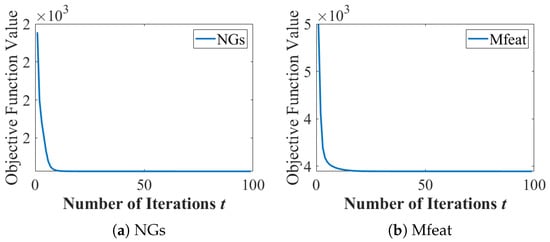
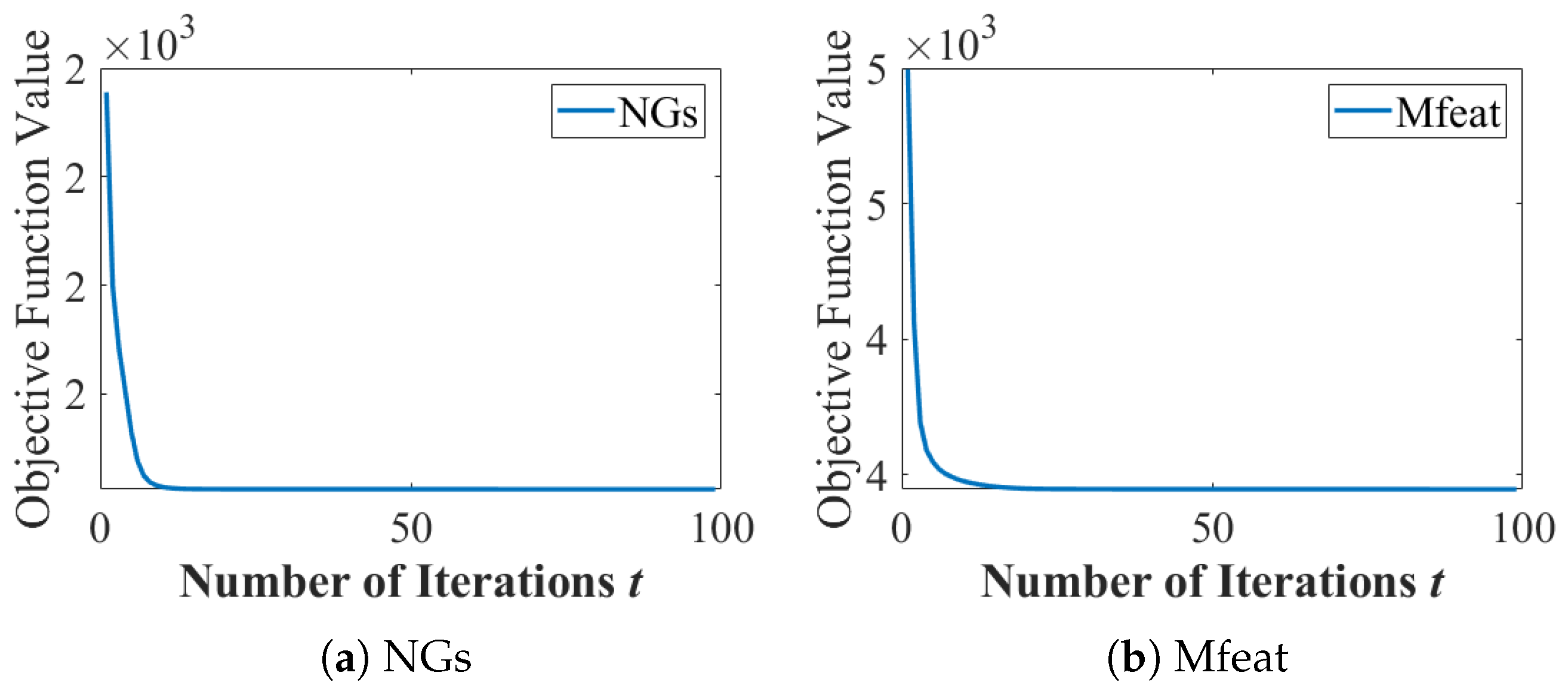
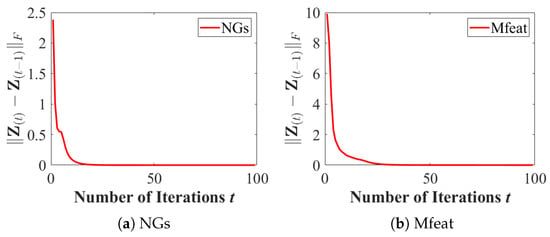
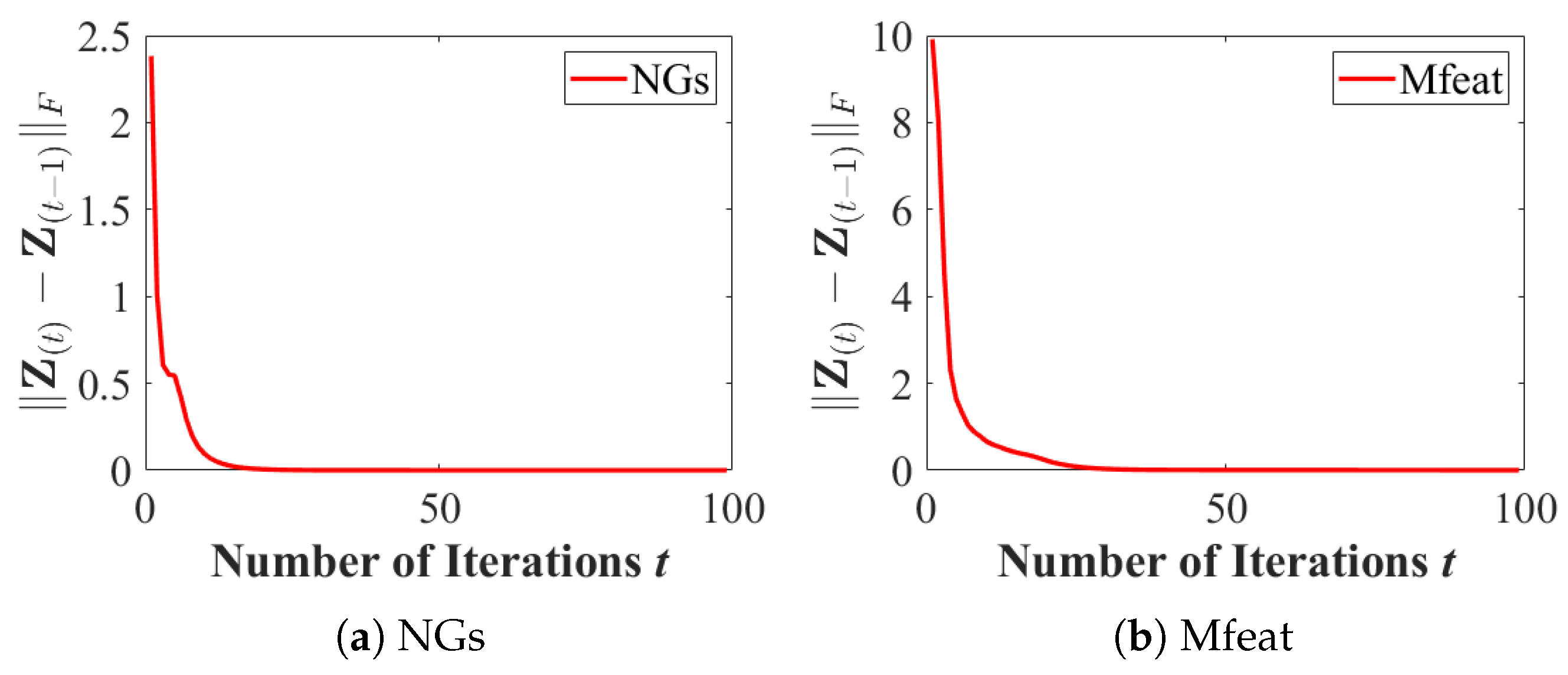
In this study, we empirically show the convergent behavior of GL4-MVC. Without loss of generality, we use the NGs and Mfeat data sets for illustration. Throughout this test, we set and and fix all other balancing parameters to 0.1. Then, we illustrate the convergent property of GL4-MVC from the following two perspectives. First, we investigate how the value of the objective function changes with respect to the iteration in Figure 1. Second, since is directly used to obtain the final clustering result, we analyze in Figure 2 the trend in the update difference between consecutive iterations with the number of iterations. We show the results in Figure 1 and Figure 2, respectively. From the results, it is clearly observed that GL4-MVC converges within about 20 iterations in terms of both the objective function value and variable updates. These observations empirically demonstrate the efficient convergent behavior of GL4-MVC and practical applicability in real-world scenarios.
Figure 1.
The objective function value versus the number of iterations on NGs and Mfeat data sets.
Figure 2.
The error curves of on the NGs and Mfeat data sets.
7.5. Comparison of Time Cost and Scalability Study
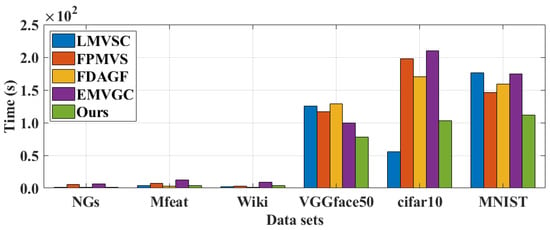
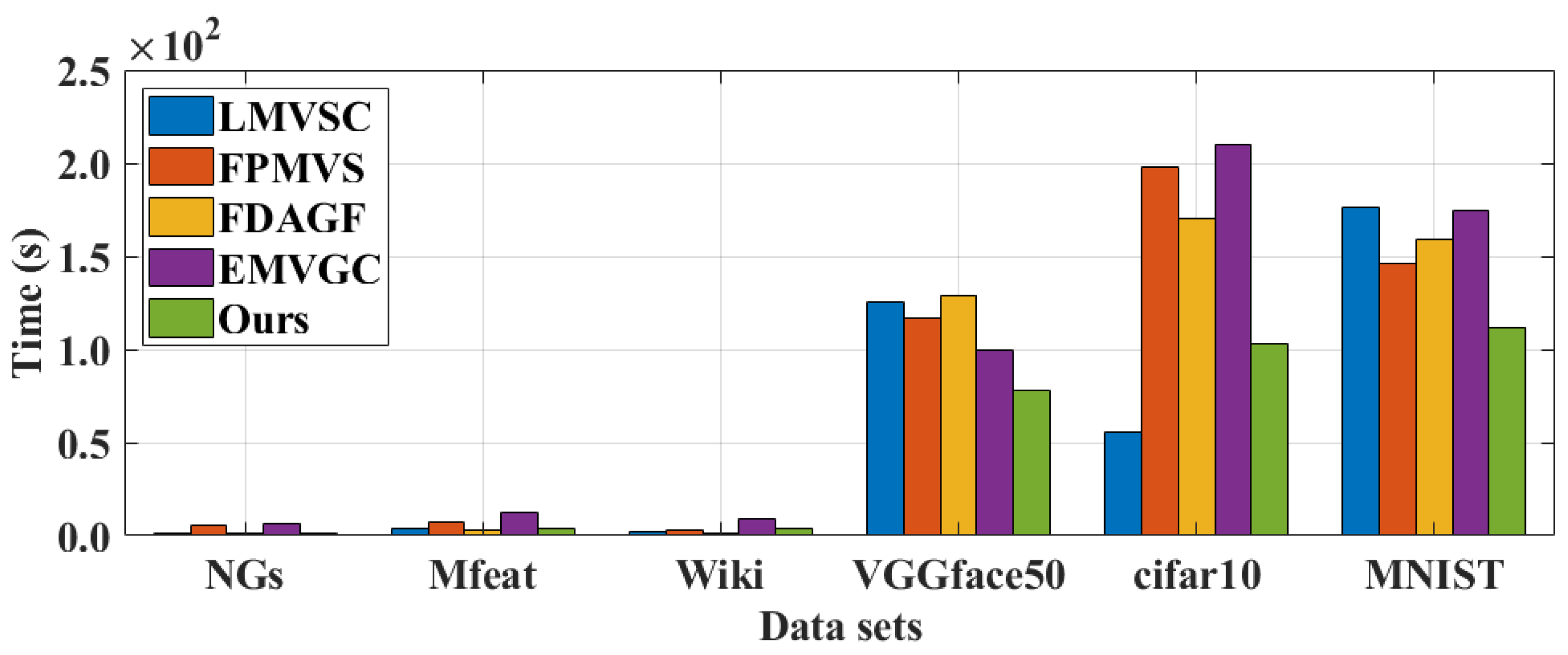
To evaluate the efficiency of GL4-MVC, we conduct experiments from the following two perspectives. First, we compare time cost of GL4-MVC against other anchor-based methods to show its efficiency. In particular, we compare GL4-MVC with LMVSC, FPMVS, FDAGF, and EMVGC on six benchmark data sets and show the results in Figure 3. From the results, it is seen that GL4-MVC is quite efficient. On the small-scale and medium-scale data sets, GL4-MVC takes only a few seconds. On the large-scale data sets, GL4-MVC runs the fastest on the VGGface50 and MNIST data sets and ranks second in speed on the cifar10 data set. On the cifar10 data set, the speed of GL4-MVC is about 1.94 times and 1.82 times that of EMVGC and FPMVS, respectively. These observations confirm the efficiency of GL4-MVC compared with the baseline methods. Considering that GL4-MVC has leading clustering performance on these data sets, it is recommended to apply GL4-MVC for both effectiveness and efficiency in real-world applications.
Figure 3.
Time cost of different anchor-based methods on various data sets.
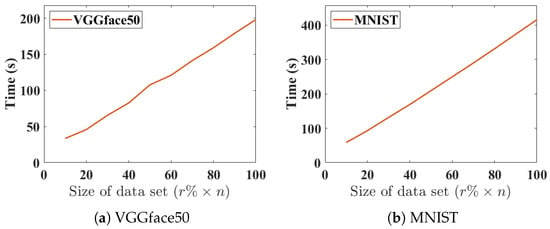
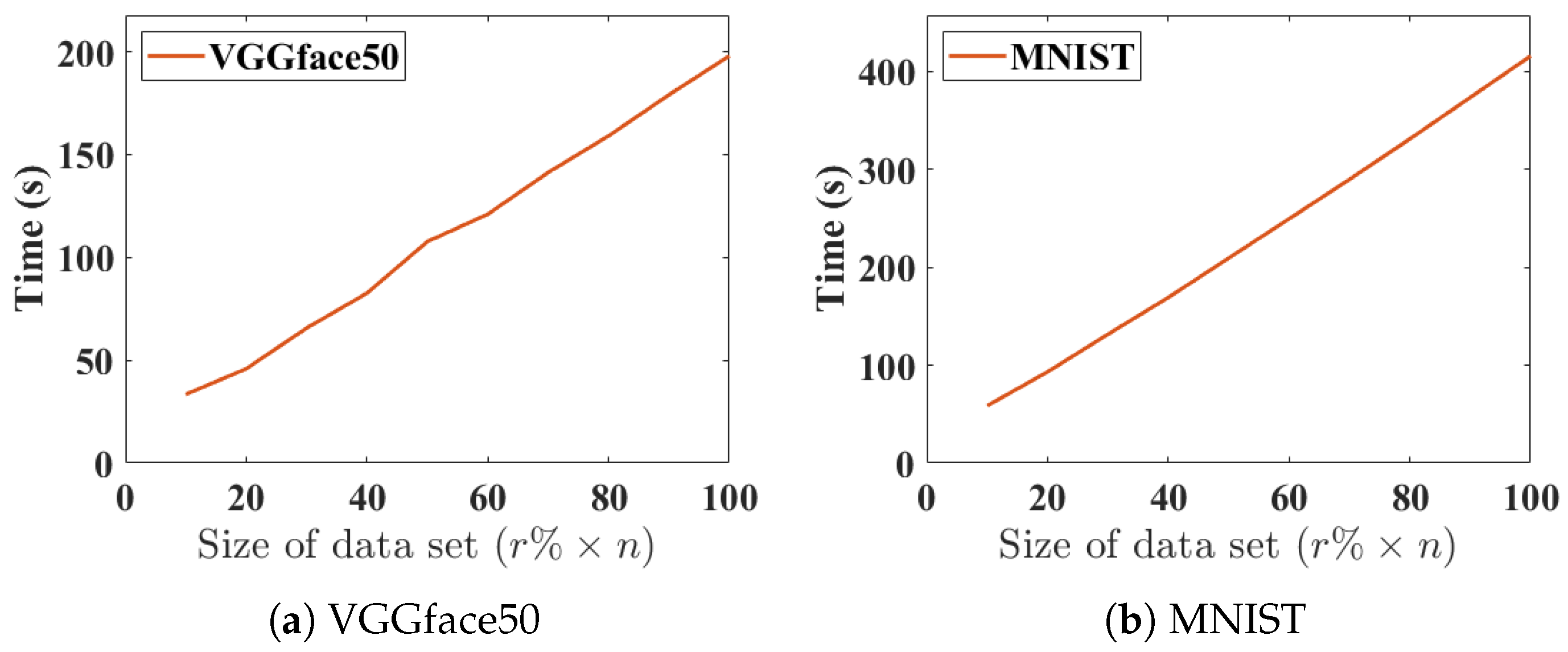
Second, we show how the time cost of GL4-MVC changes with respect to data size to empirically demonstrate the scalability of GL4-MVC. Without loss of generality, we use the VGGface50 and MNIST data sets for illustration. In this experiment, we use subsets of these data sets sampled from the overall data sets with a ratio of , where the r value ranges within . We temporarily fix the number of iterations to 50, which has been shown to be sufficient for convergence in Section 7.4. Additionally, we fix and set all balancing parameters to 0.1. With the above experimental settings, we show the results in Figure 4. From the results, it is clearly observed that the time cost of GL4-MVC changes linearly with respect to n, which empirically demonstrates the scalability of GL4-MVC. These observations suggest potential applicability of GL4-MVC in large-scale application scenarios.
Figure 4.
Time cost of GL4-MVC with respect to sample size on VGGface50 and MNIST data sets.
7.6. Statistical Study
To provide statistical evidence of the superiority of GL4-MVC to the baseline methods, we employ the Wilcoxon signed-rank test based on the results presented in Table 2 and report the statistical results in Table 3. In particular, we aggregate the results of each method across six benchmark data sets and different evaluation metrics to obtain a vector of length 24. Then, we perform the Wilcoxon signed-rank test to compare the aggregated vector of GL4-MVC against those of the baseline methods. From the results, it is seen that the p-value is lower than 0.001 in all cases, which suggests that the results obtained by GL4-MVC are starkly different from those obtained by the baseline methods with statistical significance. Thus, it is evident to claim that GL4-MVC outperforms the baseline methods in our experiments.
Table 3.
Comparison results of Wilcoxon signed-rank test on six benchmark data sets.
7.7. T-SNE Visualization
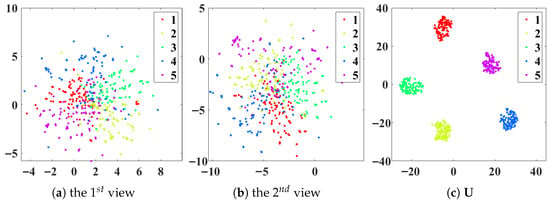
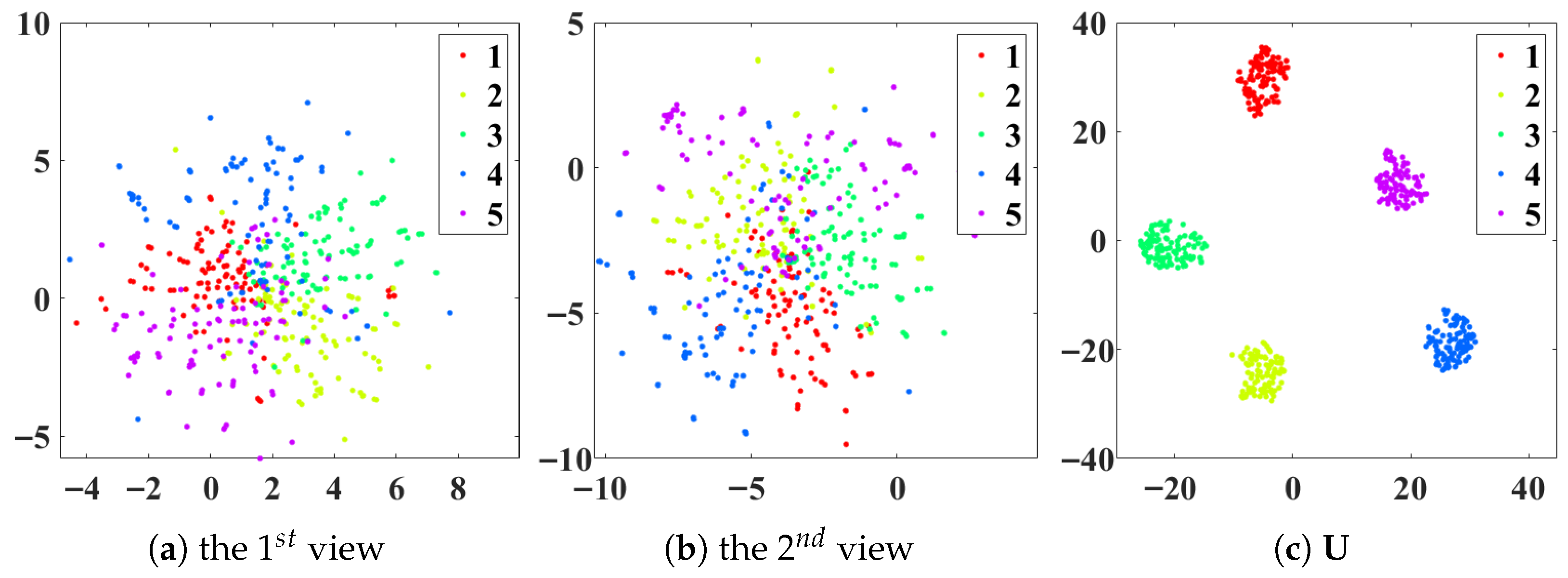
To better understand the learning performance of GL4-MVC, we show its clustering capability with some visualized results using the t-SNE technique [50]. Without loss of generality, we use the NGs data set for illustration and we present the results in Figure 5. In particular, we visualize the distributions of the original features from the first two views of the data, as well as the distribution of samples represented by the spectral embedding . It is observed that clusters of the NGs data set heavily overlap in the original feature spaces, whereas they are well separated in the latent low-dimensional space. These observations demonstrate the effectiveness of GL4-MVC in seeking latent structures of multi-view data.
Figure 5.
T-SNE visualization of the NGs data set in both the original feature space and latent low-dimensional space.
7.8. Parameter Sensitivity
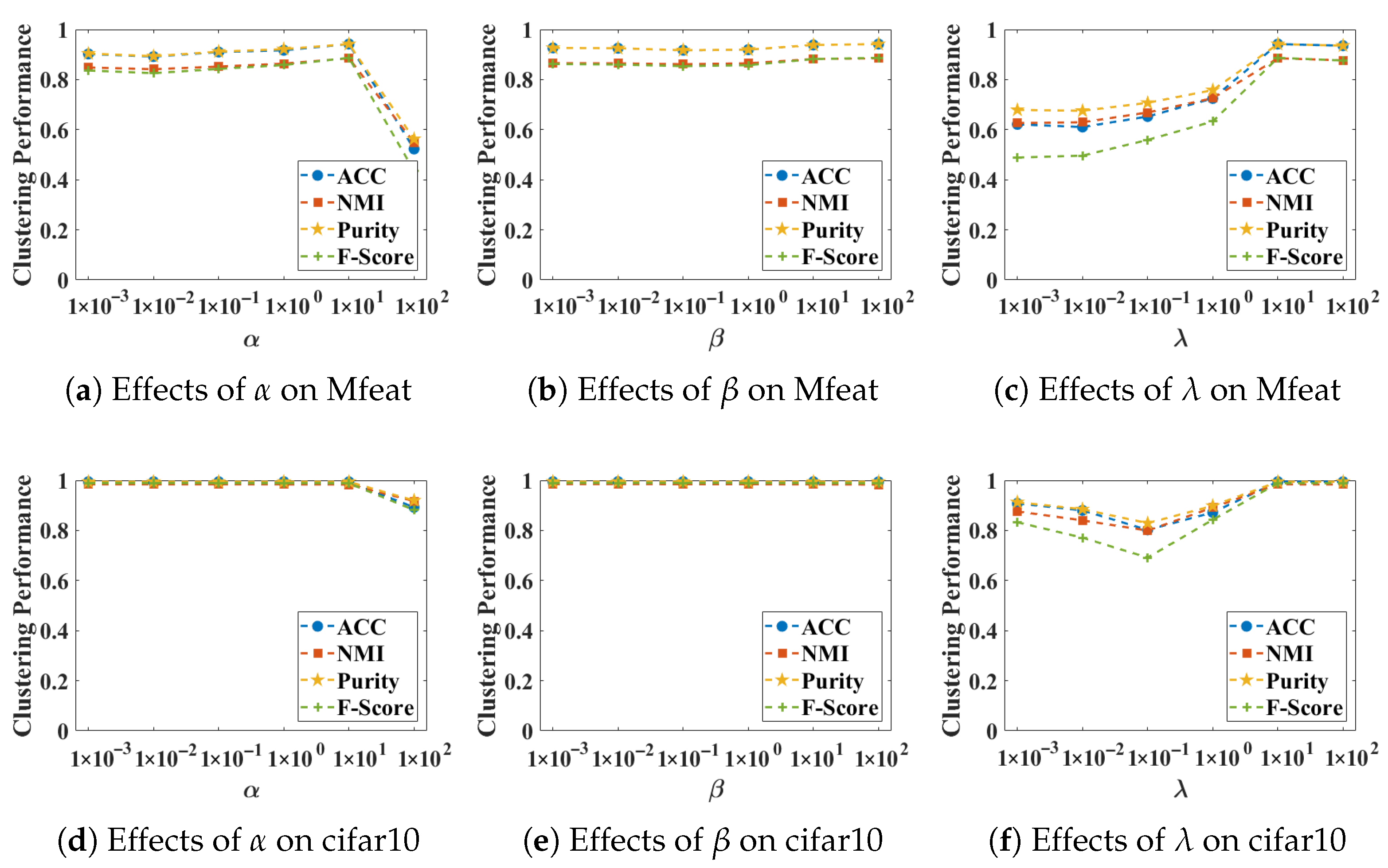
In this study, we investigate the effects of the balancing parameters on the clustering performance of GL4-MVC. Without loss of generality, we use the Mfeat and cifar10 data sets for illustration. For each balancing parameter, we analyze how the clustering performance evolves with different values. Specifically, when evaluating a given parameter, we vary its value within the set while tuning the remaining two parameters to their optimal values within and then report the corresponding clustering results in Figure 6. The results show that GL4-MVC achieves stable and excellent clustering performance with balancing parameters and over a wide range of values, and GL4-MVC can also maintain stable and favorable clustering performance when the value of balancing parameter is greater than 1. This characteristic significantly reduces the difficulty of parameter tuning for GL4-MVC in practical applications and fully validates that GL4-MVC exhibits outstanding stability and practical application value.
Figure 6.
The effects of different balancing parameters on clustering performance of GL4-MVC on the Mfeat (top) and cifar10 (bottom) data set.
7.9. Ablation Study
In this study, we experimentally verify the effectiveness of adopting global anchor learning guidance in the GL4-MVC model. To this end, we construct three baseline variant models of GL4-MVC from different perspectives:
- The first baseline variant is constructed by removing the global anchor learning module, whose structure is shown as follows:
- The second variant is obtained by removing the orthogonal projection constraint module, whose structure is shown as follows:
Table 4.
Comparison of GL4-MVC and its variants on six data sets (Mean ± s.t.d).
8. Conclusions
In this paper, we propose a novel anchor-based approach for MVC named GL4-MVC. This method learns view-specific local anchors under the guidance of cross-view global anchor selection, enabling effective capture of both view-specific local information and cross-view global consistency of multi-view data. Theoretical complexity analysis demonstrates that GL4-MVC is scalable with respect to sample size, making it efficient and suitable for large-scale data sets. Extensive experimental results confirm the effectiveness and efficiency of GL4-MVC, verifying its superiority in multi-view clustering.
Author Contributions
Conceptualization, G.Z., C.L. and C.P.; methodology, G.Z., C.L. and C.P.; software, G.Z. and C.L.; validation, Q.Z., Y.H., K.K. and C.P.; formal analysis, G.Z., C.L. and Y.H.; investigation, Q.Z., K.K. and Y.H.; resources, G.Z. and C.L.; data curation, G.Z., C.L., K.K. and Q.Z.; writing—original draft preparation, G.Z. and C.L.; writing—review and editing, C.P.; visualization, G.Z. and C.L.; supervision Y.H. and C.P.; project administration, C.P.; funding acquisition, Y.H. and C.P. All authors have read and agreed to the published version of the manuscript.
Funding
This work is supported in part by the National Natural Science Foundation of China (NSFC) under Grant 62276147; in part by the Shandong Province Colleges and Universities Youth Innovation Technology Plan Innovation Team Project under Grant 2022KJ149; in part by the Fund Program for the Scientific Activities of Selected Returned Overseas Professionals in Shanxi Province under Grant 20240035; and in part by the Research start-up funds of the OUC Youth Talents Project under Grant 862501013147; and in part by Sub-project of the University of Chinese Academy of Sciences under Grant 202422A014.
Data Availability Statement
The data used in this study are publicly accessible, while the associated code is available from the authors upon request.
Conflicts of Interest
The authors declare no conflicts of interest.
References
- Von Luxburg, U. A tutorial on spectral clustering. Stat. Comput. 2007, 17, 395–416. [Google Scholar] [CrossRef] [Scilit]
- Ng, T.C.; Choy, S.K.; Lam, S.Y.; Yu, K.W. Fuzzy superpixel-based image segmentation. Pattern Recognit. 2023, 134, 109045. [Google Scholar] [CrossRef] [Scilit]
- Chen, Y.; Wang, Z.; Bai, X. Fuzzy sparse subspace clustering for infrared image segmentation. IEEE Trans. Image Process. 2023, 32, 2132–2146. [Google Scholar] [CrossRef] [Scilit]
- Tang, H.; Li, Z.; Zhang, D.; He, S.; Tang, J. Divide-and-conquer: Confluent triple-flow network for RGB-T salient object detection. IEEE Trans. Pattern Anal. Mach. Intell. 2024, 47, 1958–1974. [Google Scholar] [CrossRef] [Scilit] [PubMed]
- Park, N.; Rossi, R.; Koh, E.; Burhanuddin, I.A.; Kim, S.; Du, F.; Ahmed, N.; Faloutsos, C. Cgc: Contrastive graph clustering forcommunity detection and tracking. In Proceedings of the ACM Web Conference 2022, Lyon, France, 25–29 April 2022; pp. 1115–1126. [Google Scholar]
- Guan, R.; Zhang, H.; Liang, Y.; Giunchiglia, F.; Huang, L.; Feng, X. Deep feature-based text clustering and its explanation. IEEE Trans. Knowl. Data Eng. 2020, 34, 3669–3680. [Google Scholar] [CrossRef] [Scilit]
- Ikotun, A.M.; Ezugwu, A.E.; Abualigah, L.; Abuhaija, B.; Heming, J. K-means clustering algorithms: A comprehensive review, variants analysis, and advances in the era of big data. Inf. Sci. 2023, 622, 178–210. [Google Scholar] [CrossRef] [Scilit]
- Peng, C.; Zhang, Y.; Chen, Y.; Kang, Z.; Chen, C.; Cheng, Q. Log-based sparse nonnegative matrix factorization for data representation. Knowl.-Based Syst. 2022, 251, 109127. [Google Scholar] [CrossRef] [Scilit]
- Peng, C.; Zhang, P.; Chen, Y.; Kang, Z.; Chen, C.; Cheng, Q. Fine-grained bipartite concept factorization for clustering. In Proceedings of the IEEE/CVF Conference on Computer Vision and Pattern Recognition, Seattle, WA, USA, 16–22 June 2024; pp. 26264–26274. [Google Scholar]
- Zhang, C.; Fu, H.; Hu, Q.; Cao, X.; Xie, Y.; Tao, D.; Xu, D. Generalized latent multi-view subspace clustering. IEEE Trans. Pattern Anal. Mach. Intell. 2018, 42, 86–99. [Google Scholar] [CrossRef] [Scilit]
- Wang, F.; Chen, C.; Peng, C. Essential low-rank sample learning for group-aware subspace clustering. IEEE Signal Process. Lett. 2023, 30, 1537–1541. [Google Scholar] [CrossRef] [Scilit]
- Wu, J.; Lin, Z.; Zha, H. Essential tensor learning for multi-view spectral clustering. IEEE Trans. Image Process. 2019, 28, 5910–5922. [Google Scholar] [CrossRef] [Scilit]
- Yang, Y.; Wang, H. Multi-view clustering: A survey. Big Data Min. Anal. 2018, 1, 83–107. [Google Scholar] [CrossRef] [Scilit]
- Gao, H.; Nie, F.; Li, X.; Huang, H. Multi-view subspace clustering. In Proceedings of the IEEE International Conference on Computer Vision, Santiago, Chile, 7–13 December 2015; pp. 4238–4246. [Google Scholar]
- Elhamifar, E.; Vidal, R. Sparse subspace clustering: Algorithm, theory, and applications. IEEE Trans. Pattern Anal. Mach. Intell. 2013, 35, 2765–2781. [Google Scholar] [CrossRef] [Scilit]
- Liu, G.; Lin, Z.; Yan, S.; Sun, J.; Yu, Y.; Ma, Y. Robust recovery of subspace structures by low-rank representation. IEEE Trans. Pattern Anal. Mach. Intell. 2012, 35, 171–184. [Google Scholar] [CrossRef] [Scilit]
- Yu, H.; Zhang, T.; Lian, Y.; Cai, Y. Co-regularized multi-view subspace clustering. In Proceedings of the Asian Conference on Machine Learning, PMLR, Beijing, China, 14–16 November 2018; pp. 17–32. [Google Scholar]
- Zhang, C.; Hu, Q.; Fu, H.; Zhu, P.; Cao, X. Latent multi-view subspace clustering. In Proceedings of the IEEE Conference on Computer Vision and Pattern Recognition, Honolulu, HI, USA, 21–26 July 2017; pp. 4279–4287. [Google Scholar]
- Cao, X.; Zhang, C.; Fu, H.; Liu, S.; Zhang, H. Diversity-induced multi-view subspace clustering. In Proceedings of the IEEE Conference on Computer Vision and Pattern Recognition, Boston, MA, USA, 7–12 June 2015; pp. 586–594. [Google Scholar]
- Liu, J.; Liu, X.; Yang, Y.; Guo, X.; Kloft, M.; He, L. Multiview subspace clustering via co-training robust data representation. IEEE Trans. Neural Netw. Learn. Syst. 2021, 33, 5177–5189. [Google Scholar] [CrossRef] [Scilit]
- Luo, S.; Zhang, C.; Zhang, W.; Cao, X. Consistent and specific multi-view subspace clustering. In Proceedings of the AAAI Conference on Artificial Intelligence, New Orleans, LA, USA, 2–7 February 2018; Volume 32. [Google Scholar]
- Dong, A.; Wu, Z.; Zhang, H. Multi-view subspace clustering based on adaptive search. Knowl.-Based Syst. 2024, 289, 111553. [Google Scholar] [CrossRef] [Scilit]
- Zhang, C.; Jia, X.; Li, Z.; Chen, C.; Li, H. Learning cluster-wise anchors for multi-view clustering. In Proceedings of the AAAI Conference on Artificial Intelligence, Vancouver, BC, Canada, 20–27 February 2024; Volume 38, pp. 16696–16704. [Google Scholar]
- Wang, Q.; Tao, Z.; Gao, Q.; Jiao, L. Multi-view subspace clustering via structured multi-pathway network. IEEE Trans. Neural Netw. Learn. Syst. 2022, 35, 7244–7250. [Google Scholar] [CrossRef] [Scilit]
- Li, Z.; Wang, Q.; Tao, Z.; Gao, Q.; Yang, Z. Deep adversarial multi-view clustering network. In Proceedings of the IJCAI, Macao, China, 10–16 August 2019; Volume 2, p. 4. [Google Scholar]
- Cui, B.; Yu, H.; Zong, L.; Cheng, Z. Self-guided deep multi-view subspace clustering network. In Proceedings of the 2021 IEEE International Conference on Multimedia and Expo (ICME), IEEE Computer Society, Shenzhen, China, 5–9 July 2021; pp. 1–6. [Google Scholar]
- Kang, Z.; Zhou, W.; Zhao, Z.; Shao, J.; Han, M.; Xu, Z. Large-scale multi-view subspace clustering in linear time. In Proceedings of the AAAI Conference on Artificial Intelligence, New York, NY, USA, 9–11 February 2020; Volume 34, pp. 4412–4419. [Google Scholar]
- Li, Y.; Nie, F.; Huang, H.; Huang, J. Large-scale multi-view spectral clustering via bipartite graph. In Proceedings of the AAAI Conference on Artificial Intelligence, Austin, TX, USA, 25–30 January 2015; Volume 29. [Google Scholar]
- Wang, S.; Liu, X.; Zhu, X.; Zhang, P.; Zhang, Y.; Gao, F.; Zhu, E. Fast parameter-free multi-view subspace clustering with consensus anchor guidance. IEEE Trans. Image Process. 2021, 31, 556–568. [Google Scholar] [CrossRef] [Scilit]
- Yu, X.; Liu, H.; Zhang, Y.; Sun, S.; Zhang, C. Multi-view clustering via efficient representation learning with anchors. Pattern Recognit. 2023, 144, 109860. [Google Scholar] [CrossRef] [Scilit]
- Wang, S.; Liu, X.; Liu, S.; Jin, J.; Tu, W.; Zhu, X.; Zhu, E. Align then fusion: Generalized large-scale multi-view clustering with anchor matching correspondences. Adv. Neural Inf. Process. Syst. 2022, 35, 5882–5895. [Google Scholar]
- Wu, L.; Guo, S.; Zhang, Q.; Zeng, Y.; Kang, Z.; Guo, K. Linear-time attributed graph clustering via collaborative learning of adaptive anchors. Neurocomputing 2025, 665, 132191. [Google Scholar] [CrossRef] [Scilit]
- Sun, M.; Zhang, P.; Wang, S.; Zhou, S.; Tu, W.; Liu, X.; Zhu, E.; Wang, C. Scalable Multi-view Subspace Clustering with Unified Anchors. In Proceedings of the 29th ACM International Conference on Multimedia, New York, NY, USA, 20–24 October 2021; MM ’21. pp. 3528–3536. [Google Scholar]
- Zhang, P.; Pan, Y.; Wang, S.; Yu, S.; Xu, H.; Zhu, E.; Liu, X.; Tsang, I. Max-mahalanobis anchors guidance for multi-view clustering. In Proceedings of the AAAI Conference on Artificial Intelligence, Philadelphia, PA, USA, 25 February–4 March 2025; Volume 39, pp. 22488–22496. [Google Scholar]
- Kang, K.; Chen, C.; Peng, C. Consensus Low-Rank Multi-View Subspace Clustering With Cross-View Diversity Preserving. IEEE Signal Process. Lett. 2023, 30, 1512–1516. [Google Scholar] [CrossRef] [Scilit]
- Liu, S.; Liang, K.; Dong, Z.; Wang, S.; Yang, X.; Zhou, S.; Zhu, E.; Liu, X. Learn from view correlation: An anchor enhancement strategy for multi-view clustering. In Proceedings of the IEEE/CVF Conference on Computer Vision and Pattern Recognition, Seattle, WA, USA, 16–22 June 2024; pp. 26151–26161. [Google Scholar]
- Schönemann, P.H. A generalized solution of the orthogonal procrustes problem. Psychometrika 1966, 31, 1–10. [Google Scholar] [CrossRef] [Scilit]
- Peng, C.; Chen, Y.; Kang, Z.; Chen, C.; Cheng, Q. Robust principal component analysis: A factorization-based approach with linear complexity. Inf. Sci. 2020, 513, 581–599. [Google Scholar] [CrossRef] [Scilit]
- Michelot, C. A finite algorithm for finding the projection of a point onto the canonical simplex of ∝n n. J. Optim. Theory Appl. 1986, 50, 195–200. [Google Scholar] [CrossRef] [Scilit]
- Elhamifar, E.; Sapiro, G.; Sastry, S.S. Dissimilarity-Based Sparse Subset Selection. IEEE Trans. Pattern Anal. Mach. Intell. 2016, 38, 2182–2197. [Google Scholar] [CrossRef] [Scilit]
- Boyd, S.; Vandenberghe, L. Convex Optimization; Cambridge University Press: Cambridge, MA, USA, 2004. [Google Scholar]
- Yang, B.; Zhang, X.; Nie, F.; Wang, F. Fast multiview clustering with spectral embedding. IEEE Trans. Image Process. 2022, 31, 3884–3895. [Google Scholar] [CrossRef] [Scilit]
- Nie, F.; Zhang, R.; Li, X. A generalized power iteration method for solving quadratic problem on the Stiefel manifold. Sci. China Inf. Sci. 2017, 60, 112101. [Google Scholar] [CrossRef] [Scilit]
- Nie, F.; Li, J.; Li, X. Parameter-free auto-weighted multiple graph learning: A framework for multiview clustering and semi-supervised classification. In Proceedings of the IJCAI, New York, NY, USA, 9–15 July 2016; Volume 9, pp. 1881–1887. [Google Scholar]
- Yang, W.; Wang, Y.; Tang, C.; Tong, H.; Wei, A.; Wu, X. One step multi-view spectral clustering via joint adaptive graph learning and matrix factorization. Neurocomputing 2023, 524, 95–105. [Google Scholar] [CrossRef] [Scilit]
- Zhang, P.; Wang, S.; Li, L.; Zhang, C.; Liu, X.; Zhu, E.; Liu, Z.; Zhou, L.; Luo, L. Let the Data Choose: Flexible and Diverse Anchor Graph Fusion for Scalable Multi-View Clustering. In Proceedings of the AAAI Conference on Artificial Intelligence, Washington, DC, USA, 7–14 February 2023; Volume 37, pp. 11262–11269. [Google Scholar]
- Wan, X.; Liu, J.; Gan, X.; Liu, X.; Wang, S.; Wen, Y.; Wan, T.; Zhu, E. One-step multi-view clustering with diverse representation. IEEE Trans. Neural Netw. Learn. Syst. 2024, 36, 5774–5786. [Google Scholar] [CrossRef] [Scilit] [PubMed]
- Wen, Y.; Liu, S.; Wan, X.; Wang, S.; Liang, K.; Liu, X.; Yang, X.; Zhang, P. Efficient Multi-View Graph Clustering with Local and Global Structure Preservation. In Proceedings of the 31st ACM International Conference on Multimedia, New York, NY, USA, 29 October–3 November 2023; MM ’23. pp. 3021–3030. [Google Scholar]
- Chen, Z.; Wu, X.J.; Xu, T.; Li, H.; Kittler, J. Deep Discriminative Multi-view Clustering. IEEE Trans. Circuits Syst. Video Technol. 2025, 35, 6974–6978. [Google Scholar] [CrossRef] [Scilit]
- Maaten, L.v.d.; Hinton, G. Visualizing data using t-SNE. J. Mach. Learn. Res. 2008, 9, 2579–2605. [Google Scholar]

Disclaimer/Publisher’s Note: The statements, opinions and data contained in all publications are solely those of the individual author(s) and contributor(s) and not of MDPI and/or the editor(s). MDPI and/or the editor(s) disclaim responsibility for any injury to people or property resulting from any ideas, methods, instructions or products referred to in the content. |
© 2026 by the authors. Licensee MDPI, Basel, Switzerland. This article is an open access article distributed under the terms and conditions of the Creative Commons Attribution (CC BY) license.