


Abstract
Quantum computing exploits the principles of quantum mechanics to perform computation. Information is stored in qubits and processed with a sequence of quantum gates arranged as circuits. Verifying the correctness of quantum circuits is becoming essential as hardware scales in qubit count and architectural complexity. Traditional testing and naive simulation do not scale and quickly become computationally infeasible because the state space grows exponentially. This creates a strong need for more powerful and scalable verification techniques. Formal methods offer a viable solution by providing mathematically rigorous and scalable verification techniques that address these scalability challenges through abstraction, symbolic reasoning, and probabilistic guarantees. This study examines how formal methods are applied to quantum-circuit verification. Specifically, four families of formal techniques: barrier certificates, abstract interpretation, model checking, and theorem proving are examined, along with the theoretical foundations and practical applications of these techniques. Finally, the study highlights open challenges and identifies promising directions for future research. An extensive set of references is included to support further study and exploration.
1. Introduction
Quantum computing promises algorithmic advantages for select problems by exploiting superposition, interference, and entanglement. The field has advanced rapidly in recent years [1,2,3,4,5,6]. Progress has been driven by key contributions from industry and academia. Quantum processors are becoming more realistic, and error-correction techniques are steadily improving [7,8,9,10,11].
Major technology companies have played a key role in this progress. Google, IBM, and Amazon have significantly improved their quantum hardware platforms. They have also experimentally demonstrated the effectiveness of modern quantum-error-correction codes [12,13,14].
Microsoft has taken a different approach by focusing on topological quantum computing. Their work demonstrates architectures that promise more robust qubits and gate operations [15].
Together, these advances help quantum computing transition beyond the Noisy Intermediate Scale Quantum (NISQ) era. They point toward quantum architectures capable of reliable and fault-tolerant computation. The goal of fault-tolerant quantum computing is thus being realized.
As experimental platforms grow in qubit count and circuit depth, ensuring that implemented circuits preserve intended semantics becomes increasingly important for both research and deployment. Correct execution of quantum algorithms is a critical concern. Quantum circuits are the primary abstraction for describing quantum algorithms. Thus, their correctness verification is critical and urgent.
Verifying quantum systems is fundamentally difficult. Most quantum processes cannot be efficiently simulated on classical computers due to their complexity and state space explosion. As a result, many traditional verification techniques do not scale as qubit count increases. Empirical testing alone is not sufficient to validate quantum behavior due to differences in the behavior of quantum systems (superposition, entanglement, measurement) from classical circuits. Such testing provides limited coverage and weak correctness guarantees. For these reasons, alternative verification approaches are necessary.
Formal verification provides a rigorous way to validate complex systems. It uses mathematical reasoning and proofs to ensure design correctness. Unlike traditional testing, formal verification explores the entire design space. It does not rely solely on sampled behaviors. This makes it possible to detect subtle corner case bugs that testing may miss. Because of these strong guarantees, formal verification is widely used in safety and reliability-critical domains. These include software systems, hardware design, and VLSI design verification [16,17,18].
Formal methods are also applied to quantum-circuit verification. Formal methods are not a single replacement for testing or simulation, but a set of complementary tools that provide strong guarantees when their modeling assumptions and abstractions are explicit [19,20].
Why formal methods for quantum circuits? Two practical observations motivate this choice. First, classical test and sampling methods cannot exhaustively explore the -dimensional state space of an n-qubit system, as qubit count increases. Second, the algebraic structure of quantum gates (unitarity, reversibility, and linearity) and their many domain uses (e.g., compiler transformations, error correction) admit symbolic and/or algebraic encodings that formal tools can exploit. Taken together, these points make formal methods both relevant and tractable if the verification problem is posed with suitable abstractions.
Table 1 compares the four formal methods discussed in this study. It looks at their computational complexity, level of automation, and soundness guarantees.
Table 1.
Comparative outlook of formal methods.
Table 2 compares the different techniques in terms of scalability, common use cases, and the current state of tool support.
Table 2.
Scalability, use cases, and tool support of various formal methods.
This work presents a concise study of formal methods for quantum-circuit verification. Specifically, four families of formal techniques: barrier certificates, abstract interpretation, model checking, and theorem proving. It covers both the theoretical foundations and practical applications of these techniques. The study examines several key approaches. These include barrier certificates, abstract interpretation, model checking, and theorem proving. It compares their strengths and limitations in a systematic manner. Finally, it highlights promising research directions for addressing the verification challenges posed by increasingly complex quantum systems. Unless stated otherwise, all guarantees discussed in this study are conditional on the chosen model, abstraction, and specification, and do not remove worst-case exponential complexity.
As shown in Table 1 and Table 2, each method has its own strengths. Barrier certificates are efficient for safety checks using convex optimization. Abstract interpretation gives automatic analysis with sound approximations. Model checking provides full verification for finite-state models. Theorem proving offers the strongest assurance with machine-checked proofs. The best choice depends on the task, available resources, and the level of assurance required. Each method is explained in detail in the following sections.
2. Background
This section introduces the background needed to understand qubits and quantum circuits. It also presents the general formal verification techniques used in verification.
2.1. Qubits & Quantum Circuits
Quantum circuits are fundamentally different from classical circuits. This difference arises from the unique properties of quantum information. Classical bits can take only one of two definite values, 0 or 1. In contrast, quantum bits, or qubits, can exist in superpositions of basis states. Qubit states are described using complex-valued probability amplitudes [21,22].
A single-qubit state is written as
where represents the quantum state. The vectors and form the computational basis. The coefficients and are complex numbers. The squared magnitudes of these coefficients determine measurement outcomes. Specifically, and give the probabilities of measuring and . These probabilities must sum to one, which leads to the normalization condition
The computational basis vectors are defined as
Similarly, the state of an n-qubit quantum system, denoted by , is described using complex probability amplitudes. The state can be written as
Each basis state has an associated amplitude . The probability of measuring the system in state x is given by
All measurement probabilities must sum to one. This normalization condition is expressed as
Qubits can also become entangled. Entanglement creates non-classical correlations that cannot be reproduced by any classical system. These properties allow quantum algorithms to outperform classical algorithms for certain tasks. At the same time, they introduce significant challenges for verifying quantum circuits.
A quantum circuit is represented as a sequence of quantum gates acting on a set of qubits [21]. Each gate applies a unitary transformation to the qubits. Common single-qubit gates include the Pauli operators (X, Y, Z), the Hadamard gate, and various phase gates. Multi-qubit gates, such as the CNOT (controlled-NOT) gate, can create entanglement between qubits.
Verification of quantum circuits is challenging because the state space grows exponentially with the number of qubits. An n-qubit system occupies a Hilbert space of dimension , making classical simulation not feasible for large circuits.
2.2. Formal Verification Principles
As introduced in Section 1, formal verification involves mathematically proving or disproving that a system meets a formal specification. Unlike testing, which checks only a finite set of inputs or execution paths, formal methods reason about the entire state space and all possible evolutions of a system. This allows them to guarantee correctness, safety, or compliance with specifications for every possible input, timing, or quantum state, and not just the cases tested. In other words, formal methods provide mathematical certainty, while testing can only show that errors are absent in the scenarios that were actually checked.
Formal verification approaches can be grouped into three main categories:
- 1.
- Deductive verification: Proving correctness properties using mathematical proof systems.
- 2.
- Model checking: Verifying finite state systems against temporal logic specifications.
- 3.
- Abstract interpretation: Analyzing system behavior using sound semantic approximations.
In quantum systems, formal verification faces unique challenges. These arise from superposition, entanglement, measurement, and decoherence. Classical methods must be carefully adapted to be employed for quantum-circuit verification. They need to handle the quantum effects while staying computationally feasible.
3. Barrier Certificates
This section introduces barrier certificates, an important method used to verify quantum circuits. They come from classical dynamical systems theory, where they separate safe and unsafe regions [23]. Recent research has also found links between quantum entanglement and nonlinear dynamics, which motivates using barrier certificates in quantum verification [24].
3.1. Foundations
Barrier certificates are an effective method for verifying safety properties of dynamical systems [23]. They guarantee that system trajectories never reach unsafe or undesirable states. More recently, barrier certificates have been extended to the verification of quantum circuits [23,24,25,26]. A barrier certificate captures all possible executions of a system using a single real-valued function. This function separates safe regions from unsafe regions of the state space.
Formally, a barrier certificate for a quantum system is defined as a function defined on the Hilbert space . It must satisfy three main conditions:
where is the set of initial states, is the set of unsafe states, and is the set of unitary transformations corresponding to quantum gates. The decrement condition ensures that B is non-increasing under circuit evolution, guaranteeing that trajectories starting from never enter . This means that the trajectories starting from any initial state never enter the unsafe region at any given time step. The existence of such a barrier certificate guarantees safety over an unbounded time horizon. This approach avoids explicit state or time enumeration and therefore mitigates the state space explosion problem to some extent.
Quantum circuits can be viewed as dynamical systems, which makes barrier certificates well-suited for their verification. An n-qubit state resides in and satisfies the normalization condition . Each quantum gate acts as a unitary linear transformation, producing a trajectory in the state space [26]. Safety and correctness properties can be expressed as polynomial or semi-algebraic constraints on the amplitudes. These include properties such as bounds on measurement probabilities and the preservation of logical subspaces. This algebraic structure naturally aligns with polynomial barrier certificates and sum-of-squares reasoning.
3.2. Connection to Nonlinear Dynamics and Entanglement
Barrier certificates for quantum systems can be better understood by comparing quantum entanglement to non-linear dynamics [27]. Chaotic systems are highly sensitive to small changes, and highly entangled quantum states also show complex correlations that make verification harder. Recent work shows that entanglement in quantum circuits can be viewed as a form of dynamical instability [28].
This connection has important implications for barrier-certificate synthesis. When entanglement grows quickly, the barrier function usually needs to be more complex. Circuits with high entanglement often need higher-degree or exponential barriers, while circuits with low entanglement (circuits that preserve stabilizer structure) can use simpler polynomial barriers.
In this view, the barrier conditions (Equations (7)–(9)) act like a boundary between stable and unstable regions in the quantum state space. The barrier function B works like a Lyapunov function, helping ensure the system stays in a safe region. This connection brings ideas from classical dynamical systems into quantum verification and helps guide the choice of barrier functions based on the expected entanglement structure.
3.3. Scenario-Based Approach
A key advancement in barrier certificate synthesis for quantum circuits is the scenario-based approach [24,29,30]. Scenario-based synthesis uses sampled trajectories over both finite and infinite time horizons to construct barrier certificates. It explicitly accounts for uncertainties in initial states and system dynamics. These features make it well-suited for noisy quantum systems, where exact knowledge of all parameters is often impossible.
This approach converts the verification problem into a convex optimization problem using sampled constraints. The resulting guarantee is probabilistic rather than absolute. This means that it is guaranteed to hold on unseen cases up to a user-chosen failure level. The designer selects a target violation probability and a confidence level . The number of scenarios N is then chosen so that the synthesized certificate violates the property with probability at most , with confidence at least . Larger values of N reduce the failure probability but increase computational cost. Concretely, the method can ensure correctness with a confidence level of at least (e.g., ), provided enough independent samples are used, typically scaling as [29]. However, this guarantee depends on the sampling assumptions and may not detect rare violations.
The method offers several practical benefits for quantum-circuit verification:
- 1.
- Supports the continuous state spaces inherent to quantum systems.
- 2.
- Handles uncertain dynamics caused by quantum noise and device imperfections.
- 3.
- Provides probabilistic guarantees of correctness.
- 4.
- Works for both finite and infinite time horizons.
3.4. Application
Barrier certificates have been applied to verify the behavior of quantum systems. For example, in [26], the notion of barrier certificate is extended to complex variables, and the verification of Hadamard, phase, and controlled-not operations is elucidated. Grover’s search algorithm verification with up to 30 qubits is demonstrated in [24]. Researchers have tested various classes of barrier certificates, such as polynomial, exponential, and rational functions. This helps determine the most effective type for each application. Table 3 summarizes these barrier certificate types. It highlights their strengths, limitations, and typical use cases.
Table 3.
Barrier certificates and their applications.
To verify a quantum circuit using barrier certificates, the circuit is first encoded as a discrete-time complex dynamical system. Polynomial descriptions of the initial and unsafe sets are also defined. Next, a barrier function template is chosen based on the expected entanglement structure and circuit characteristics. This is usually a real-valued polynomial in the real and imaginary parts of the quantum state. Verification conditions are then imposed to ensure that the initial and unsafe regions are separated and that the barrier does not increase along any gate-induced transition. These conditions can be solved using Hermitian sum-of-squares optimization to provide exact guarantees [26]. Scenario-based optimization combined with SMT solving can improve scalability [24]. Once the barrier certificate is synthesized and formally validated, it provides a sound and global correctness proof for the quantum circuit.
Case studies indicate that the choice of barrier function greatly affects both the efficiency and effectiveness of verification (Table 3). For many quantum circuits, polynomial barrier certificates offer a good balance between expressiveness and computational efficiency. More complex barrier functions may be needed for circuits with highly non-linear dynamics.
4. Abstract Interpretation
This section provides an overview of how abstract interpretation is applied to the formal verification of quantum circuits. Abstract interpretation is a static analysis technique that verifies program properties by computing sound over-approximations of program semantics in an abstract domain [31]. In quantum-circuit verification, abstract interpretation is useful because it avoids explicitly enumerating the exponentially large Hilbert space. Instead of tracking exact quantum states, it reasons over abstract representations, such as projection subspaces, stabilizers, or interval bounds on amplitudes [32]. Quantum circuits consist of structured, sequential unitary transformations. This makes them well-suited to abstract interpretations. This allows abstract transformers to be defined compositionally for each quantum gate.
Verification using abstract interpretation involves defining an abstract domain and a mapping to the original state space, implementing abstract gate semantics that conservatively approximate unitary evolution, and checking properties on the abstract states. This approach guarantees soundness and, for specific abstract domains (e.g., interval domains for reachability) and property types (e.g., robustness), can achieve polynomial time scalability. This behavior holds only for properties expressible in the chosen abstract domain. The abstraction compresses the quantum state and does not represent the full Hilbert space. As a result, polynomial complexity applies to abstract operations rather than to concrete-state simulation. For example, tuple-of-projections abstractions have been used to verify assertions on benchmark circuits with hundreds of qubits that are infeasible to simulate directly [32]. However, this scalability comes with precision trade-offs. The analysis may produce over-approximations that lead to false positives, and its applicability depends on the circuit structure and the chosen abstraction.
4.1. Semantic Framework
Abstract interpretation provides a theoretical framework for approximating the semantics of computational systems. It enables static analysis of program properties [32,33,34,35,36,37]. Recent work has extended this approach to variational quantum circuits (VQCs) [38,39]. VQCs form the basis of many quantum machine learning algorithms. Similar to classical deep neural networks, VQCs are vulnerable to adversarial inputs. Small deviations or perturbations in the input can cause incorrect outputs or predictions.
Assolini et al. [38] propose a semantic framework based on abstract interpretation for verifying VQCs. Their approach explicitly handles quantum-specific properties, such as state normalization. Normalization introduces dependencies between variables, which complicates traditional verification methods. This framework provides a formal way to define the verification problem for VQCs. It also offers tools to analyze the computational complexity of the verification process.
4.2. Interval-Based Reachability
Interval-based reachability analysis is a key technique in the abstract interpretation of quantum circuits. It computes over approximations of the reachable states at each layer of the quantum circuit [38,40,41,42]. This method propagates interval bounds through the layers of the circuit. In doing so, it provides formal guarantees about circuit behavior. However, quantum effects such as superposition and entanglement create dependencies between variables. These dependencies make interval analysis more challenging.
To address these challenges, researchers have developed enhanced abstraction techniques. These techniques explicitly track dependencies between variables. However, this added precision comes with a higher computational cost [43]. Finding the right balance between precision and efficiency remains an active research problem in quantum abstract interpretation.
4.3. Verification of Robustness Properties
Abstract interpretation is quite effective for verifying robustness properties of VQCs. It can be used to study how adverse perturbations affect circuit behavior. These techniques analyze how small changes in the input state influence the final measurement probabilities. In doing so, they provide formal robustness certificates. These certificates are similar to those used for classical neural networks [44,45,46,47,48]. The verification process typically follows four main steps:
- 1.
- Defining a perturbation model for the input states.
- 2.
- Propagating these perturbations through the quantum circuit using abstract domains.
- 3.
- Computing bounds on the output measurement probabilities.
- 4.
- Checking that classification decisions remain stable within the allowed perturbation range.
This methodology has been tested on standard verification benchmarks. The results show its potential for certifying the reliability of quantum machine learning models [49]. This makes it specifically important for safety-critical applications [50,51,52,53].
5. Model Checking
Model checking is a formal verification technique that systematically explores all possible states of a system. In quantum-circuit verification, it checks whether a circuit satisfies specified temporal-logic properties. Model checking is valuable because it provides complete, counterexample-driven verification for finite or symbolically representable quantum systems [54,55]. Quantum circuits can be modeled as finite-state transition systems or quantum Markov chains. This is done by discretizing their evolution or focusing on basis states and measurement outcomes. This structure allows the use of temporal logics, including probabilistic extensions, to specify correctness, safety, or termination properties. This approach has been the subject of extensive research [56,57,58,59,60,61,62,63,64].
For quantum circuits, model checking typically follows three main steps:
- 1.
- Encoding the quantum circuit as a finite-state model.
- 2.
- Expressing the desired properties using suitable temporal logics.
- 3.
- Checking these properties against the encoded model.
Early work in this area verified quantum circuits by mapping them to quantum Markov chains. These models were then analyzed using model checking [55]. Other approaches extended probabilistic model checking. They account for the inherent randomness of quantum measurements and decoherence [65].
5.1. Symbolic Techniques and SMT Integration
In spite of having superior theoretical power, model checking faces serious scalability issues in quantum systems due to exponential state-space growth. The state space grows exponentially with the increase in the number of qubits. This makes exhaustive exploration of the state space impractical. To address this state explosion problem, symbolic model checking techniques have been developed. These methods use binary decision diagrams (BDDs) and related compression strategies [66,67,68,69,70,71,72]. They achieve varying levels of success in improving scalability. For example, BDD-based approaches have verified equivalence for circuits with up to 30 qubits in controlled settings, but runtime and memory usage can grow rapidly beyond this range. [68]. Tensor decision diagram-based image computation demonstrates scalability to circuits such as Grover (20), with runtimes in the order of seconds under favorable partitioning strategies [73].
A significant recent advancement is the integration of Satisfiability Modulo Theories (SMT) solvers into quantum model checking workflows. Modern verification frameworks leverage SMT solvers to handle constraints generated from quantum programs efficiently. The AutoQ tool [63] uses automata-based representations combined with SMT reasoning to verify quantum circuits. This hybrid approach enables:
- 1.
- Efficient handling of arithmetic constraints on quantum amplitudes.
- 2.
- Symbolic representation of measurement outcomes and probabilities.
- 3.
- Integration with classical control logic in hybrid quantum-classical circuits.
- 4.
- Counterexample generation for property violations.
SMT-based model checking has been particularly effective for verifying quantum programs with significant classical components, such as those arising in quantum error correction and hybrid algorithms [35,63,74]. The combination of symbolic state representation and SMT solving pushes the scalability envelope while maintaining completeness for finite-state models.
5.2. The Classical Simulability Threshold
Model checking works well only when a circuit is below the classical simulability threshold [75]. For Clifford-heavy circuits, stabilizer methods can compress the state efficiently using tableau methods [76], and model checking grows only polynomially with the number of qubits.
For circuits with many non-Clifford gates (high T-count or T-depth), the cost often grows exponentially. The number of stabilizer terms increases quickly, and compression becomes less useful. This result is based on known classical simulation limits and should guide the choice of verification method. In certain scenarios, circuits are split into Clifford parts, checked symbolically, and non-Clifford parts, checked with bounded techniques. This approach helps in practice, even though the worst-case cost is still exponential.
5.3. Tool Support and Applications
Several model checking tools have been developed for quantum verification. QMC (Quantum Model Checker) provides early support for quantum protocols [54]. AutoQ [63] implements automata-based verification with SMT integration. The qMC framework [58] targets superconducting quantum logic. These tools have been applied to verify quantum error correction protocols, communication protocols, and small-to-medium scale quantum algorithms.
Despite these advances, model checking tools remain at the prototype stage (Table 2). Production-ready integration with quantum software development kits is limited, and tool maturity varies significantly. Standardized benchmarks and input formats are needed to accelerate tool development and comparison.
6. Theorem Proving
Theorem proving is a deductive method for verifying quantum circuits. In this approach, correctness properties are established through formal logical proofs checked by a proof assistant [77]. As theorem proving produces machine-checked logical proofs, it offers the highest level of assurance for the properties it expresses. However, this assurance is conditional. It applies only to the formal model and specification that the developer encodes.
Quantum circuits have rich algebraic and mathematical structures, such as unitary operators, linearity, and reversibility. These properties make them well-suited for formal reasoning in higher-order logic or dependent type theory. Theorem-proving methods typically formalize the semantics of quantum gates and circuits within a proof assistant. They then prove equivalence, invariants, or correctness theorems with respect to a specification. This approach has been implemented in proof assistants like Coq, Isabelle/HOL, and Lean. These tools are often enhanced with specialized libraries for quantum computation [78,79,80,81,82].
6.1. Integration with SMT Solvers
SMT solvers have been integrated into theorem proving for quantum circuits to automate proof obligations. Modern verification workflows combine the expressiveness of interactive theorem proving with the automated reasoning power of SMT solvers. This hybrid approach addresses the scalability limitations of pure interactive proof while maintaining high assurance.
The Giallar tool [83] exemplifies this approach for quantum compiler verification. Giallar uses SMT solvers to verify that compiler passes preserve quantum semantics. The verification process involves:
- 1.
- Translating quantum circuits into logical formulae capturing gate semantics.
- 2.
- Encoding compiler transformations as logical relations between input and output circuits.
- 3.
- Using SMT solvers to check equivalence or semantic preservation conditions.
- 4.
- Generating counterexamples when verification conditions fail.
Rotational abstractions for verification of quantum Fourier transform circuits [74], and Superposition-Based Abstractions for Quantum Data Encoding Verification [84] elucidate a symbolic deductive abstraction approach to quantum-circuit verification using SMT solvers. These examples show that theorem proving can produce certified, end-to-end results for non-trivial quantum algorithms. At the same time, interactive proof developments are often labor-intensive and require careful modeling of assumptions and bounds. This makes it less suitable for rapid iteration in quantum circuit design workflows.
6.2. Limitations
Despite these advances, theorem proving remains labor-intensive compared to fully automatic methods. Interactive proof development requires significant expertise and careful modeling of assumptions. The integration of SMT solvers automates many proof obligations, but users must still provide high-level specifications and proof strategies.
The choice between interactive theorem proving and SMT-based automation involves trade-offs between assurance level, automation, and scalability. Interactive proofs provide the highest assurance but scale poorly with circuit size. SMT-based approaches offer greater automation but may miss subtle bugs that require inductive reasoning or complex invariants. Hybrid workflows that combine both approaches are emerging as the preferred methodology for high-assurance quantum verification.
6.3. Runtime Verification
Runtime verification monitors the execution of a quantum circuit to check whether it satisfies specified properties. Although it does not provide full formal guarantees, it can detect property violations during testing or actual operation. This makes runtime verification practical for near-term quantum applications [63,83,85,86,87,88,89,90,91]. The runtime verification process typically involves three main steps:
- 1.
- Instrumenting the quantum circuit with extra measurement operations.
- 2.
- Defining assertions like properties for specific circuit states.
- 3.
- Performing statistical testing of these properties during execution.
Runtime verification is particularly useful for validating specific executions on quantum hardware. It serves as a complement to formal methods that analyze entire quantum circuit designs.
7. Applications
This section presents case studies that demonstrate the practical application of quantum-circuit verification.
7.1. Quantum Error Correction
Quantum error correction (QEC) is a key area where formal verification methods are employed. Fault-tolerant quantum computation depends on the correct operation of QEC circuits [92,93,94]. Formal methods have been used to verify different aspects of QEC implementations [95,96,97,98,99], including:
- 1.
- The correctness of stabilizer measurements.
- 2.
- Fault tolerance thresholds.
- 3.
- The implementation of logical operations.
For example, barrier certificates effectively ensure that errors stay within correctable regions of the state space. Model checking is used to verify the sequential behavior of QEC protocols under various fault models.
7.2. Compiler Verification
Quantum circuits are typically written in high-level programming languages and then compiled into hardware-specific instructions. This makes verifying the correctness of the compilation process both critical and essential [37,85,87,89,100,101,102,103]. The Giallar tool [83] uses SMT solvers to check that each compiler pass preserves the semantic integrity of the quantum circuit. This verification process usually involves three main steps:
- 1.
- Translating quantum circuits into logical formulae.
- 2.
- Checking equivalence between the original and compiled circuits.
- 3.
- Verifying that the optimization rules applied during compilation are correct.
Compiler verification is critical for quantum applications where correctness is essential. Small compilation errors can lead to incorrect results, which in safety-critical settings (e.g., quantum error correction or algorithmic circuits) can invalidate algorithmic correctness and result in operational failures.
7.3. Quantum Algorithms
Formal methods have been used to verify the correctness of various quantum algorithms [104,105]. These include Grover’s search algorithm [106], quantum phase estimation [107,108], and quantum approximate optimization algorithms (QAOAs) [109], among others.
Each algorithm presents its own verification challenges:
- 1.
- Grover’s algorithm: Verification requires proving convergence and establishing bounds on the success probability.
- 2.
- Quantum phase estimation: Verification involves ensuring precision guarantees under different noise models.
- 3.
- QAOA: Verification focuses on approximation ratios and convergence properties.
These verifications often use a combination of formal techniques. For example, barrier certificates can be used to establish safety properties, while theorem proving ensures functional correctness. The benefits of each method can thus be exploited depending on the application. Recent studies show the use of combined techniques, privacy-preserving bidirectional data transmission in quantum networks [110], and semi-quantum private comparison protocol [111].
The choice of verification method generally depends on the type of problem. Barrier certificates or abstract interpretation are suitable for systems with large or continuous state spaces. Model checking works well when exhaustive exploration of discrete transitions is feasible. Theorem proving or SMT-based methods are used when semantic correctness or equivalence must be guaranteed across transformations. Runtime verification is useful for detecting errors during actual hardware execution. Hybrid approaches can combine these techniques to balance scalability, automation, and formal guarantees. This allows the verification method to be adapted to the structure and requirements of the quantum system.
As shown in Table 4, verification methods are chosen based on the characteristics and challenges of each quantum computing domain. For quantum error correction, barrier certificates and model checking are particularly suitable. They rigorously guarantee the stability and correctness of feedback-controlled stabilizer circuits across all possible error trajectories. Barrier certificates handle continuous state-space dynamics, while model checking systematically explores discrete syndrome transitions. This combination makes them ideal for the safety-critical nature of error correction.
Table 4.
Applications of formal verification in quantum computing.
In quantum compilers, theorem proving and SMT solvers focus on semantic preservation across multiple compilation layers. The algebraic and logical structure of quantum gates allows formal deduction. It helps to verify that transformations and optimizations preserve program semantics. This ensures correctness for all possible input states.
Quantum algorithms, which often operate on exponentially large state spaces, benefit from abstract interpretation and barrier certificates. Abstract interpretation approximates sets of quantum states to efficiently check invariants. Barrier certificates provide mathematically rigorous safety guarantees without enumerating all states. Both approaches enable scalable verification.
For quantum hardware, model checking and runtime verification are effective. They capture both the discrete and continuous aspects of physical imperfections. Model checking systematically explores control sequences and configurations. Runtime verification monitors live signals to detect deviations from expected behavior.
8. Challenges and Limitations
This section presents a critical assessment of the challenges and limitations in current quantum-circuit verification methods. Abstraction reduces state complexity but discards some concrete information. Typical losses include amplitude, phase details, and correlations across distant qubits. Modular verification works well if modules interact weakly, but it can fail when entanglement spans module boundaries. Symbolic compression (BDDs, tensor decision diagrams) is effective when the circuit exhibits regular structure or limited entanglement. Its compression factor drops for highly entangled or random circuits. Scenario-based methods reduce verification cost by sampling, but the required sample size grows with the number of optimization variables and with the desired confidence. Therefore, it is required to balance (allowed violation probability), (confidence), and N (samples). Stronger guarantees always come at a measurable cost in computation, modeling effort, or sample size. Three key challenges, scalability, quantum-specific capabilities, and tool support are listed below.
8.1. Scalability
A major challenge in quantum-circuit verification is the exponential growth of the state space as the number of qubits increases linearly. Figure 1 elucidates a conceptual comparison of how each method addresses the verification problem and manages state explosion. As depicted, model checking employs symbolic compression and decision diagrams, while theorem proving utilizes inductive invariants and machine-checked proofs to address the exponential state space growth. Barrier certificates do not do state enumeration and employ continuous separating functions, and abstract interpretation exploits sound approximation techniques in abstract domains, trying to maintain scalability.
Figure 1.
Conceptual comparison of how each formal method addresses the state explosion problem. Barrier certificates use continuous functions to separate safe/unsafe regions without state enumeration (blue curve). Abstract interpretation employs sound over-approximations in abstract domains (grey dots within red box). Model checking leverages symbolic compression through decision diagrams. Theorem proving relies on compositional reasoning and inductive invariants.
Scalability remains dominated by the classical simulability threshold.
- 1.
- Clifford dominated circuits: Exact symbolic compression (stabilizer formalism, tableau methods) and symbolic model checking frequently succeed. Verification scales polynomially with qubit count for circuits dominated by Clifford gates.
- 2.
- High non-Clifford content: Verification costs typically grow exponentially with the number of non-Clifford generators (T-count, T-depth) or with circuit entangling width. Practical methods resort to approximations, including stabilizer rank decompositions, tensor network contraction heuristics, and bounded-error statistical certificates.
This distinction is empirically grounded and theoretically connected to classical simulation results. It helps to guide method selection in practice. Current approaches try to address this challenge using:
- 1.
- Abstraction and approximation techniques that trade completeness for scalability.
- 2.
- Modular verification, which breaks large circuits into smaller components.
- 3.
- Symbolic methods that represent sets of quantum states compactly.
Despite these strategies, verifying circuits with many qubits remains difficult. This underscores the need for further research into scalable verification techniques and methodologies.
8.2. Quantum-Specific Capabilities
Quantum phenomena such as entanglement, superposition, and measurement create verification challenges that do not have a classical equivalent. These effects produce complex correlations between qubits that are hard to abstract or approximate without losing important information.
Measurement and Non-Unitary Semantics
A major modeling and verification challenge is the proper treatment of measurement and other non-unitary operations. The following approaches have been developed recently:
- 1.
- Density-matrix/super-operator semantics: Model gates and noisy channels as completely positive trace preserving (CPTP) maps [112]. This captures mixed states and partial traces but increases dimension and computational cost.
- 2.
- Kraus decomposition abstractions: Use parametric Kraus sets to represent measurement noise and non-unitary steps. Verify properties in an abstract (sound) domain, tracking probabilities, and post-measurement subspaces [113].
- 3.
- Relational/probabilistic program logics: Adopt logics where assertions are distributions or linear functions on density operators. Soundness proofs reason about expected measurement outcomes, generalizing classical Hoare logics to quantum CPTP maps [114].
Each approach involves trade-offs between expressiveness and tractability. Approaches employed to address these challenges include:
- 1.
- Creating specialized abstract domains to capture quantum correlations.
- 2.
- Designing verification techniques that are aware of measurements.
- 3.
- Using relational logics to represent and reason about entanglement.
8.3. Tool Support
Many tools have been developed for quantum-circuit verification. The ecosystem is still less mature than that for classical software verification. Most tools require significant expertise to use. They are often tailored to specific verification methods or quantum programming languages. While Table 2 captures the tool maturity status based on the verification method, Table 5 captures the current state of the available tools.
Table 5.
Illustrative representation of tool maturity.
Checklist for Assessing Tools
- 1.
- Input language compatibility: Does the tool accept mainstream quantum Intermediate Representations (OpenQASM, Quil, Q#, etc.)?
- 2.
- Automation level: How much manual effort is required per verification target?
- 3.
- Scalability: What qubit counts, and gate depths have been demonstrated, and under which circuit families?
- 4.
- Soundness guarantees: Does the tool provide machine-checked soundness (formal proofs) vs. high confidence numeric certificates?
- 5.
- Interoperability: Can it export proofs and counterexamples to theorem provers or SMT solvers?
This practical checklist helps readers choose appropriate implementations. Improving tool support will require:
- 1.
- Standardizing interfaces between verification tools and quantum programming frameworks.
- 2.
- Creating user-friendly interfaces for specifying verification properties.
- 3.
- Establishing elaborate benchmark suites to evaluate and compare verification tools.
- 4.
- Automating the choice of the most suitable verification method for a given circuit.
9. Future Directions
This section presents key challenges and future research directions in quantum-circuit verification. It focuses on practical feasibility, current limitations, and open theoretical problems.
9.1. Hybrid Verification Methods
Future verification frameworks are likely to combine multiple techniques into hybrid approaches. These approaches can leverage the strengths of each method. For example, abstract interpretation can quickly identify potential problem areas. These areas can then be examined in detail using more precise methods, such as theorem proving or model checking. Promising hybrid combinations include:
- 1.
- Using barrier certificates together with abstract interpretation for safety verification.
- 2.
- Combining theorem proving with model checking to verify both functional and temporal properties.
- 3.
- Augmenting runtime verification with formal methods to provide practical assurance.
A practical hybrid pipeline should address the following:
- 1.
- Decomposition policy: A clear way to split a circuit into an easy part (mostly stabilizer gates) and a harder part with few non-Clifford gates. The main question is whether this split can be done automatically with proven size limits. Current methods are heuristic and may fail in hard cases.
- 2.
- Interface semantics: The symbolic and numeric parts must connect in a clear and verified way. This needs a small translator that maps symbolic results into assumptions for numeric tools. Building verified links between tableaus, stabilizer forms, and tensor networks is still an open problem.
- 3.
- Error accumulation: Numeric methods add small errors. We need results that bound the total error in terms of local errors, similar to ideas in numerical analysis. Such guarantees are still limited in the current work.
A focused hybrid verification workflow for stabilizer QEC (e.g., surface code) is given below:
- 1.
- Model syndrome extraction as a discrete transition system (syndrome states + syndrome update rules).
- 2.
- Use model checking for the discrete syndrome protocol and barrier certificates for continuous errors bounded within correctable regions.
- 3.
- Combine results to show that, under the assumed noise model, errors remain within the logical correctable set and logical operations preserve code invariants.
A hybrid strategy for compiler verification is provided below:
- 1.
- Encode the source and target circuits symbolically (SMT formulas or intermediate algebraic form).
- 2.
- Prove semantic preservation for each compiler pass (local rewrite proofs) using SMT/theorem proving or automated equivalence checking for restricted gate sets (e.g., Clifford+T).
- 3.
- When full proof is expensive, use abstract interpretation to catch classes of semantic violations and employ interactive proofs for the remaining critical passes.
A hybrid approach for algorithmic verification:
- 1.
- Grover: Prove convergence and success probability bounds using barrier certificates (to capture iterated amplitude amplification) and symbolic reasoning for the oracle behavior.
- 2.
- Quantum phase estimation (QPE): Establish precision bounds via theorem proving on the phase kickback structure, augmented by model checking for time-bounded noise models.
- 3.
- QAOA: Use abstract interpretation to bound expectation values under parameter perturbations, combined with numerical certification for specific parameter choices.
These approaches show how to mix multiple verification methods to exploit the benefits of each for different problem classes.
9.2. Machine Learning Assisted Verification
Machine learning (ML) offers promising ways to enhance formal verification of quantum circuits. While ML can accelerate heuristic choices (including variable ordering, partitioning, and template degrees) and predict verification failure modes, it cannot replace soundness guarantees. Thus, a realistic research approach can use ML assistance only to suggest candidate abstractions; the verification decisions remain with the sound engine (SMT/interactive proof) employed. Technical feasibility questions include:
- 1.
- How to certify ML suggested invariants (e.g., by running a short verification check)?
- 2.
- How to bound the probability of ML-induced misguidance (statistical validation and cross-validation on benchmark sets)?
- 3.
- Whether learned heuristics generalize across circuit families or require retraining for each new architecture?
Potential applications include:
- 1.
- Learning barrier certificates directly from simulation data.
- 2.
- Predicting which circuit components are hard to verify, to focus verification efforts.
- 3.
- Guiding abstract interpretation using learned heuristics.
- 4.
- Speeding up model checking with learned representations of the state space.
Initial results suggest that ML can reduce verification time for specific circuit classes, but generalization remains limited. Open challenges include developing ML architectures that respect quantum-mechanical constraints and providing statistical guarantees of heuristic correctness.
9.3. Measurement and Non-Unitary Semantics
Quantum features like measurement and non-unitary operations are still not well developed. Important research tasks include:
- 1.
- Designing program logics that work with density matrices and CPTP maps, and proving good completeness results. Current ideas exist, but they lack automation and tool support.
- 2.
- Creating standard benchmark sets with measurement-heavy protocols, such as interactive protocols, teleportation-based compilers, and dynamic circuits, so different methods can be compared fairly.
- 3.
- Proving lower bounds on verification complexity for certain noise and measurement models. This can help set realistic expectations and guide method choice.
Progress will come from solving these concrete technical problems, since each one can be studied with formal analysis and experiments.
9.4. Verifying Fault-Tolerant Quantum Computing
As quantum computing moves toward fault-tolerant operation, new verification challenges and opportunities emerge. Future research directions include:
- 1.
- Verifying quantum error correction protocols under realistic noise models, capable of handling continuous error parameters and stochastic behavior.
- 2.
- Developing verification techniques for distributed quantum systems, involving reasoning about communication and entanglement distribution.
- 3.
- Establishing certification frameworks for quantum hardware components, demanding integration of physical modeling with formal verification.
- 4.
- Creating standards for quantum software verification, requiring community consensus on specification languages and assurance levels.
Advances in these areas will be essential to building reliable and trustworthy quantum computing systems for critical applications.
9.5. Near-Term Research Agenda
We highlight key technical problems for near-term research:
- 1.
- Automatic decomposition: Algorithms to split circuits into Clifford and non-Clifford parts with proven size bounds for the non-Clifford segments.
- 2.
- Verified translation: Formally verified translators between stabilizer tableaux, tensor networks, and density matrix representations.
- 3.
- Error composition: Theorems that bound how verification errors propagate in hybrid pipelines.
- 4.
- ML certification: Methods that give statistical guarantees for verification results suggested by machine learning.
- 5.
- Program logic automation: Automated theorem proving for quantum program logics, combining SMT solvers with quantum reasoning.
These focused problems provide clear paths toward scalable and reliable quantum-circuit verification.
10. Conclusions
Formal methods for quantum-circuit verification have made significant progress in recent years. They have evolved from theoretical frameworks to practical tools that can be applied to real quantum circuits. This study examines the current landscape of various methods, including barrier certificates, abstract interpretation, model checking, and theorem proving. Each method offers unique advantages and is suited to different verification scenarios.
Barrier certificates provide a strong method for safety verification. When combined with scenario-based approaches, they can handle uncertainties in initial states and system dynamics. Abstract interpretation gives a semantic framework for analysing variational quantum circuits and verifying their robustness. Model checking allows exhaustive verification of temporal properties. Theorem proving offers the highest level of assurance through rigorous mathematical proofs.
In spite of these advances, major challenges remain. Scaling verification to larger quantum systems and handling quantum-specific features like entanglement, superposition, and measurement are still difficult. Future research should focus on developing hybrid approaches that combine multiple verification techniques. It should also explore using machine learning to improve scalability and address the verification needs of fault-tolerant quantum computing.
As quantum computing moves closer to practical applications, formal verification methods will be increasingly important for ensuring the reliability and correctness of quantum software and hardware. Developing robust verification tools and methods will be key to building trust in quantum computing systems and unlocking their full potential to solve challenging and complex computational problems.
Funding
This research received no external funding.
Data Availability Statement
Data sharing is not applicable to this article.
Acknowledgments
During the preparation of this manuscript/study, the author used ‘Quillbot, free paraphrasing tool’ for the purpose of grammar check when needed. The authors have reviewed and edited the output and take full responsibility for the content of this publication.
Conflicts of Interest
The authors declare no conflicts of interest.
References
- Hassija, V.; Chamola, V.; Goyal, A.; Kanhere, S.S.; Guizani, N. Forthcoming applications of quantum computing: Peeking into the future. IET Quantum Commun. 2020, 1, 35–41. [Google Scholar] [CrossRef] [Scilit]
- Jose, P.; Shanmugasundaram, H.; Madhivanan, V.; Sujaudeen, N.; Krisnamoorthy, M.; Cherukuri, A.K. Enhanced QSVM with elitist non-dominated sorting genetic optimisation algorithm for breast cancer diagnosis. IET Quantum Commun. 2024, 5, 384–398. [Google Scholar] [CrossRef] [Scilit]
- Arun, G.; Mishra, V. A review on quantum computing and communication. In Proceedings of the 2014 2nd International Conference on Emerging Technology Trends in Electronics, Communication and Networking, Surat, India, 7–8 February 2014; pp. 1–5. [Google Scholar] [CrossRef] [Scilit]
- Brooks, M. Beyond quantum supremacy: The hunt for useful quantum computers. Nature 2019, 574, 19–21. [Google Scholar] [CrossRef] [Scilit]
- Chen, S. Quantum Computing Scientists: Give Them Lemons, They’ll Make Lemonade. APS News. 2019. Available online: https://www.aps.org/apsnews/2019/05/quantum-computing-lemons-lemonade (accessed on 21 March 2025).
- Preskill, J. Quantum Computing in the NISQ era and beyond. Quantum 2018, 2, 79. [Google Scholar] [CrossRef] [Scilit]
- Porter, J. Google Wants to Build a Useful Quantum Computer by 2029. Available online: https://www.theverge.com/2021/5/19/22443453/google-quantum-computer-2029-decade-commercialuseful-qubits-quantum-transistor (accessed on 18 September 2022).
- Gambetta, J. Expanding the Ibm Quantum Roadmap to Anticipate the Future of Quantum-Centric Supercomputing. Available online: https://www.ibm.com/quantum/blog/ibm-quantum-roadmap-2025 (accessed on 12 October 2024).
- Krewell, K.; Research, T. The Next Generation of Ibm Quantum Computers. Available online: https://www.forbes.com/sites/tiriasresearch/2022/06/22/the-next-generation-ofibm-quantum-computers/?sh=5083d463266f (accessed on 18 October 2024).
- Jay, G.; Ismael, F.; Karl, W. Ibm’s Roadmap for Building an Open Quantum Software Ecosystem. Available online: https://research.ibm.com/blog/quantum-development-roadmap (accessed on 18 September 2025).
- Hsu, J. Ces 2018: Intel’s 49-Qubit Chip Shoots for Quantum Supremacy. Available online: https://spectrum.ieee.org/intels-49qubit-chip-aims-for-quantum-supremacy (accessed on 18 September 2025).
- Acharya, R.; Abanin, D.A.; Aghababaie-Beni, L.; Aleiner, I.; Andersen, T.I.; Ansmann, M.; Arute, F.; Arya, K.; Asfaw, A.; Astrakhantsev, N.; et al. Quantum error correction below the surface code threshold. Nature 2025, 638, 920–926. [Google Scholar] [CrossRef] [Scilit]
- Bravyi, S.; Cross, A.W.; Gambetta, J.M.; Maslov, D.; Rall, P.; Yoder, T.J. High-threshold and low-overhead fault-tolerant quantum memory. Nature 2024, 627, 778–782. [Google Scholar] [CrossRef] [Scilit] [PubMed]
- Putterman, H.; Noh, K.; Hann, C.T.; MacCabe, G.S.; Aghaeimeibodi, S.; Patel, R.N.; Lee, M.; Jones, W.M.; Moradinejad, H.; Rodriguez, R.; et al. Hardware-efficient quantum error correction via concatenated bosonic qubits. Nature 2025, 638, 927–934. [Google Scholar] [CrossRef] [Scilit] [PubMed]
- Aghaee, M.; Ramirez, A.A.; Alam, Z.; Ali, R.; Andrzejczuk, M.; Antipov, A.; Astafev, M.; Barzegar, A.; Bauer, B.; Becker, J.; et al. Interferometric single-shot parity measurement in InAs–Al hybrid devices. Nature 2025, 638, 651–655. [Google Scholar] [CrossRef] [Scilit] [PubMed]
- Hasan, O.; Tahar, S. Formal verification methods. In Encyclopedia of Information Science and Technology, 3rd ed.; IGI Global: New York, NY, USA, 2015; pp. 7162–7170. [Google Scholar]
- Gupta, A. Formal hardware verification methods: A survey. Form. Methods Syst. Des. 1992, 1, 151–238. [Google Scholar] [CrossRef] [Scilit]
- Schubert, T.; Seligman, M.V.A.K.K.E. Formal Verification; Elsevier: Amsterdam, The Netherlands, 2015. [Google Scholar] [CrossRef] [Scilit]
- Quist, A.J.; Mei, J.; Coopmans, T.; Laarman, A. Advancing Quantum Computing with Formal Methods. In Proceedings of the Formal Methods; Platzer, A., Rozier, K.Y., Pradella, M., Rossi, M., Eds.; Springer: Cham, Switzerland, 2025; pp. 420–446. [Google Scholar]
- Chareton, C.; Bardin, S.; Lee, D.; Valiron, B.; Vilmart, R.; Xu, Z. Formal Methods for Quantum Programs: A Survey. arXiv 2022, arXiv:2109.06493. [Google Scholar] [CrossRef] [Scilit]
- Nielsen, M.A.; Chuang, I.L. Quantum Computation and Quantum Information: 10th Anniversary Edition, 10th ed.; Cambridge University Press: Cambridge, MA, USA, 2011. [Google Scholar]
- Bernhardt, C. Quantum Computing for Everyone; MIT Press: Cambridge, MA, USA, 2020. [Google Scholar]
- Prajna, S.; Jadbabaie, A.; Pappas, G.J. A Framework for Worst-Case and Stochastic Safety Verification Using Barrier Certificates. IEEE Trans. Autom. Control 2007, 52, 1415–1428. [Google Scholar] [CrossRef] [Scilit]
- Hu, S.; Lopata, V.; Soudjani, S.; Zuliani, P. Verification of Quantum Circuits Through Barrier Certificates Using a Scenario Approach. In Proceedings of the 2025 IEEE International Conference on Quantum Software (QSW), Helsinki, Finland, 7–12 July 2025; pp. 151–161. [Google Scholar] [CrossRef] [Scilit]
- Lewis, M.; Soudjani, S.; Zuliani, P. Verification of Quantum Circuits through Discrete-Time Barrier Certificates. arXiv 2024, arXiv:2408.07591. [Google Scholar] [CrossRef] [Scilit]
- Lewis, M.; Zuliani, P.; Soudjani, S. Verification of Quantum Systems Using Barrier Certificates. In Proceedings of the International Conference on Quantitative Evaluation of Systems, Antwerp, Belgium, 20–22 September 2023; Springer: Berlin/Heidelberg, Germany, 2023; pp. 346–362. [Google Scholar] [CrossRef] [Scilit]
- Wanic, M.; Jasiukiewicz, C.; Toklikishvili, Z.; Jandieri, V.; Trybus, M.; Jartych, E.; Mishra, S.; Chotorlishvili, L. Entanglement properties of photon–magnon crystal from nonlinear perspective. Phys. D Nonlinear Phenom. 2025, 476, 134699. [Google Scholar] [CrossRef] [Scilit]
- Massera, J.L. On Liapounoff’s Conditions of Stability. Ann. Math. 1949, 50, 705. [Google Scholar] [CrossRef] [Scilit]
- Murali, V.; Trivedi, A.; Zamani, M. A scenario approach for synthesizing k-inductive barrier certificates. IEEE Control Syst. Lett. 2022, 6, 3247–3252. [Google Scholar] [CrossRef] [Scilit]
- Akella, P.; Ames, A.D. A barrier-based scenario approach to verifying safety-critical systems. IEEE Robot. Autom. Lett. 2022, 7, 11062–11069. [Google Scholar] [CrossRef] [Scilit]
- Cousot, P.; Cousot, R. Abstract interpretation: A unified lattice model for static analysis of programs by construction or approximation of fixpoints. In POPL’77: Proceedings of the 4th ACM SIGACT-SIGPLAN Symposium on Principles of Programming Languages; ACM: New York, NY, USA, 1977; pp. 238–252. [Google Scholar] [CrossRef] [Scilit]
- Yu, N.; Palsberg, J. Quantum abstract interpretation. In Proceedings of the 42nd ACM SIGPLAN International Conference on Programming Language Design and Implementation, Virtual Event, 20–25 June 2021; pp. 542–558. [Google Scholar] [CrossRef] [Scilit]
- Ying, M.; Zhang, Z. Verification of Recursively Defined Quantum Circuits. arXiv 2024, arXiv:2404.05934. [Google Scholar] [CrossRef] [Scilit]
- Rizvi, S.M.A.; Khalid, U.; Chatzinotas, S.; Duong, T.Q.; Shin, H. Controlled Quantum Semantic Communication for Industrial CPS Networks. IEEE Trans. Netw. Sci. Eng. 2026, 13, 996–1009. [Google Scholar] [CrossRef] [Scilit]
- Chen, Y.F.; Chung, K.M.; Lengál, O.; Lin, J.A.; Tsai, W.L.; Yen, D.D. An Automata-Based Framework for Verification and Bug Hunting in Quantum Circuits. Commun. ACM 2025, 68, 85–93. [Google Scholar] [CrossRef] [Scilit]
- Li, L.; Zhu, M.; Cleaveland, R.; Nicolellis, A.; Lee, Y.; Chang, L.; Wu, X. Qafny: A Quantum-Program Verifier. arXiv 2024, arXiv:2211.06411. [Google Scholar] [CrossRef] [Scilit]
- Shi, Y.; Tao, R.; Li, X.; Javadi-Abhari, A.; Cross, A.W.; Chong, F.T.; Gu, R. CertiQ: A Mostly-automated Verification of a Realistic Quantum Compiler. arXiv 2020, arXiv:1908.08963. [Google Scholar]
- Assolini, N.; Marzari, L.; Mastroeni, I.; di Pierro, A. Formal Verification of Variational Quantum Circuits. arXiv 2025, arXiv:2507.10635. [Google Scholar] [CrossRef] [Scilit]
- Peham, T.; Burgholzer, L.; Wille, R. Equivalence Checking of Parameterized Quantum Circuits: Verifying the Compilation of Variational Quantum Algorithms. In Proceedings of the 28th Asia and South Pacific Design Automation Conference, ASPDAC’23, New York, NY, USA, 16–19 January 2023; Association for Computing Machinery: New York, NY, USA, 2023; pp. 702–708. [Google Scholar] [CrossRef] [Scilit]
- Ye, K.; Dai, S.; Guo, B.; Shen, Y.; Liu, C.; Bi, K.; Chen, F.; Hu, Y.; Zhao, M. A Mutual-Influence-Aware Heuristic Method for Quantum Circuit Mapping. IEEE Trans. Comput. 2024, 73, 2855–2867. [Google Scholar] [CrossRef] [Scilit]
- Hung, W.N.N.; Song, X.; Yang, G.; Yang, J.; Perkowski, M. Quantum logic synthesis by symbolic reachability analysis. In Proceedings of the 41st Annual Design Automation Conference, DAC’04, New York, NY, USA, 7–11 June 2004; pp. 838–841. [Google Scholar] [CrossRef] [Scilit]
- Li, X.W.; Zhang, X.M.; Cheng, B.; Yung, M.H. Reachability deficit of variational Grover search. Phys. Rev. A 2024, 109, 012414. [Google Scholar] [CrossRef] [Scilit]
- Hietala, K.; Rand, R.; Hung, S.H.; Li, L.; Hicks, M. Proving Quantum Programs Correct. In Proceedings of the 12th International Conference on Interactive Theorem Proving (ITP 2021); Cohen, L., Kaliszyk, C., Eds.; Leibniz International Proceedings in Informatics (LIPIcs): Dagstuhl, Germany, 2021; Volume 193, pp. 21:1–21:19. [Google Scholar] [CrossRef] [Scilit]
- Lin, Y.; Guan, J.; Fang, W.; Ying, M.; Su, Z. VeriQR: A Robustness Verification Tool for Quantum Machine Learning Models. arXiv 2024, arXiv:2407.13533. [Google Scholar] [CrossRef] [Scilit]
- Guan, J.; Fang, W.; Ying, M. Robustness verification of quantum classifiers. In Proceedings of the International Conference on Computer Aided Verification, Online, 18–24 July 2021; Springer: Berlin/Heidelberg, Germany, 2021; pp. 151–174. [Google Scholar] [CrossRef] [Scilit]
- Franco, N.; Wollschlaeger, T.; Gao, N.; Lorenz, J.M.; Guennemann, S. Quantum Robustness Verification: A Hybrid Quantum-Classical Neural Network Certification Algorithm. arXiv 2022, arXiv:2205.00900. [Google Scholar] [CrossRef] [Scilit]
- Gheorghiu, A.; Kashefi, E.; Wallden, P. Robustness and device independence of verifiable blind quantum computing. New J. Phys. 2015, 17, 083040. [Google Scholar] [CrossRef] [Scilit]
- Fey, G.; Drechsler, R. A Basis for Formal Robustness Checking. In Proceedings of the 9th International Symposium on Quality Electronic Design (isqed 2008), San Jose, CA, USA, 17–19 March 2008; pp. 784–789. [Google Scholar] [CrossRef] [Scilit]
- Catak, F.O.; Seo, J.; Cali, U. Trustworthy Quantum Machine Learning: A Roadmap for Reliability, Robustness, and Security in the NISQ Era. arXiv 2025, arXiv:2511.02602. [Google Scholar] [CrossRef] [Scilit]
- Saki, A.A.; Ghosh, S. Qubit Sensing: A New Attack Model for Multi-programming Quantum Computing. arXiv 2021, arXiv:2104.05899. [Google Scholar] [CrossRef] [Scilit]
- Debus, P.; Wendlinger, M.; Tscharke, K.; Herr, D.; Brügmann, C.; de Mello, D.O.; Ulmanis, J.; Erhard, A.; Schmidt, A.; Petsch, F. Entangled Threats: A Unified Kill Chain Model for Quantum Machine Learning Security. arXiv 2025, arXiv:2507.08623. [Google Scholar] [CrossRef] [Scilit]
- Yu, M.; Li, D.; Wang, J.; Chu, Y.; Yang, P.; Gong, M.; Goldman, N.; Cai, J. Experimental estimation of the quantum Fisher information from randomized measurements. Phys. Rev. Res. 2021, 3, 043122. [Google Scholar] [CrossRef] [Scilit]
- Ho, L.B. A stochastic evaluation of quantum Fisher information matrix with generic Hamiltonians. EPJ Quantum Technol. 2023, 10, 37. [Google Scholar] [CrossRef] [Scilit]
- Gay, S.J.; Nagarajan, R.; Papanikolaou, N. QMC: A Model Checker for Quantum Systems. In Proceedings of the Computer Aided Verification; Gupta, A., Malik, S., Eds.; Springer: Berlin/Heidelberg, Germany, 2008; pp. 543–547. [Google Scholar] [CrossRef] [Scilit]
- Feng, Y.; Yu, N.; Ying, M. Model checking quantum Markov chains. J. Comput. Syst. Sci. 2013, 79, 1181–1198. [Google Scholar] [CrossRef] [Scilit]
- Ying, M. Model checking for verification of quantum circuits. In Proceedings of the International Symposium on Formal Methods; Springer: Berlin/Heidelberg, Germany, 2021; pp. 23–39. [Google Scholar] [CrossRef] [Scilit]
- Do, C.M.; Ogata, K. Symbolic model checking quantum circuits in Maude. PeerJ Comput. Sci. 2024, 10, e2098. [Google Scholar] [CrossRef] [Scilit]
- Munir, M.; Gopikanna, A.; Fayyazi, A.; Pedram, M.; Nazarian, S. qMC: A Formal Model Checking Verification Framework For Superconducting Logic. In Proceedings of the 2021 Great Lakes Symposium on VLSI, GLSVLSI’21, New York, NY, USA, 22–25 June 2021; pp. 259–264. [Google Scholar] [CrossRef] [Scilit]
- Davidson, T.; Gay, S.; Mlnařík, H.; Nagarajan, R.; Papanikolaou, N. Model Checking for Communicating Quantum Processes. Int. J. Unconv. Comput. 2012, 8, 73–98. [Google Scholar]
- Papanikolaou, N.K. Model Checking Quantum Protocols. Ph.D. Thesis, University of Warwick, Coventry, UK, 2009. [Google Scholar]
- Jeon, S.; Cho, K.; Kang, C.G.; Lee, J.; Oh, H.; Kang, J. Quantum probabilistic model checking for time-bounded properties. Proc. Acm. Program. Lang. 2024, 8, 557–587. [Google Scholar] [CrossRef] [Scilit]
- Turrini, A. An introduction to quantum model checking. Appl. Sci. 2022, 12, 2016. [Google Scholar] [CrossRef] [Scilit]
- Chen, Y.F.; Chung, K.M.; Lengál, O.; Lin, J.A.; Tsai, W.L. AutoQ: An Automata-Based Quantum Circuit Verifier. In Proceedings of the Computer Aided Verification: 35th International Conference, CAV 2023, Proceedings, Part III, Paris, France, 17–22 July 2023; Springer: Berlin/Heidelberg, Germany, 2023; pp. 139–153. [Google Scholar] [CrossRef] [Scilit]
- Anticoli, L.; Piazza, C.; Taglialegne, L.; Zuliani, P. Towards quantum programs verification: From quipper circuits to QPMC. In Proceedings of the International Conference on Reversible Computation; Springer: Berlin/Heidelberg, Germany, 2016; pp. 213–219. [Google Scholar]
- Gay, S.; Nagarajan, R.; Papanikolaou, N. Probabilistic Model–Checking of Quantum Protocols. arXiv 2005, arXiv:0504007. [Google Scholar]
- Seiter, J.; Soeken, M.; Wille, R.; Drechsler, R. Property checking of quantum circuits using quantum multiple-valued decision diagrams. In Proceedings of the International Workshop on Reversible Computation; Springer: Berlin/Heidelberg, Germany, 2012; pp. 183–196. [Google Scholar]
- Wille, R.; Hillmich, S.; Burgholzer, L. Decision diagrams for quantum computing. In Design Automation of Quantum Computers; Springer: Berlin/Heidelberg, Germany, 2022; pp. 1–23. [Google Scholar]
- Yamashita, S.; Minato, S.-i.; Miller, D.M. DDMF: An Efficient Decision Diagram Structure for Design Verification of Quantum Circuits under a Practical Restriction. IEICE Trans. Fundam. Electron. Commun. Comput. Sci. 2008, 91-A, 3793–3802. [Google Scholar] [CrossRef] [Scilit]
- Hong, X.; Huang, W.J.; Chien, W.C.; Feng, Y.; Hsieh, M.H.; Li, S.; Yeh, C.S.; Ying, M. Decision Diagrams for Symbolic Verification of Quantum Circuits. In Proceedings of the 2023 IEEE International Conference on Quantum Computing and Engineering (QCE), Bellevue, WA, USA, 17–22 September 2023; Volume 1, pp. 970–977. [Google Scholar] [CrossRef] [Scilit]
- Wang, S.-A.; Lu, C.-Y.; Tsai, I.M.; Kuo, S.-Y. An XQDD-Based Verification Method for Quantum Circuits. IEICE Trans. Fundam. 2008, E91-A, 584–594. [Google Scholar] [CrossRef] [Scilit]
- Wille, R.; Hillmich, S.; Burgholzer, L. Tools for Quantum Computing Based on Decision Diagrams. ACM Trans. Quantum Comput. 2022, 3, 1–17. [Google Scholar] [CrossRef] [Scilit]
- Wang, Z.; Cheng, B.; Yuan, L.; Ji, Z. FeynmanDD: Quantum Circuit Analysis with Classical Decision Diagrams. In Proceedings of the International Conference on Computer Aided Verification; Springer: Berlin/Heidelberg, Germany, 2025; pp. 28–52. [Google Scholar] [CrossRef] [Scilit]
- Hong, X.; Gao, D.; Li, S.; Ying, S.; Ying, M. Image Computation for Quantum Transition Systems. In Proceedings of the 2025 Design, Automation & Test in Europe Conference (DATE), Lyon, France, 31 March–2 April 2025; pp. 1–7. [Google Scholar] [CrossRef] [Scilit]
- Govindankutty, A.; Srinivasan, S.K.; Mathure, N. Rotational abstractions for verification of quantum Fourier transform circuits. IET Quantum Commun. 2023, 4, 84–92. [Google Scholar] [CrossRef] [Scilit]
- Virmani, S.; Huelga, S.F.; Plenio, M.B. Classical simulability, entanglement breaking, and quantum computation thresholds. Phys. Rev. A 2005, 71, 042328. [Google Scholar] [CrossRef] [Scilit]
- Xu, X.; Benjamin, S.; Chen, J.; Sun, J.; Yuan, X.; Zhang, P. A Herculean task: Classical simulation of quantum computers. Sci. Bull. 2025, 70, 4104–4112. [Google Scholar] [CrossRef] [Scilit]
- Abramsky, S.; Coecke, B. A categorical semantics of quantum protocols. In Proceedings of the 19th Annual IEEE Symposium on Logic in Computer Science, Turku, Finland, 13–17 July 2004; pp. 415–425. [Google Scholar] [CrossRef] [Scilit]
- Rand, R.; Paykin, J.; Zdancewic, S. QWIRE Practice: Formal Verification of Quantum Circuits in Coq. Electron. Proc. Theor. Comput. Sci. 2018, 266, 119–132. [Google Scholar] [CrossRef] [Scilit]
- Amy, M. Towards Large-scale Functional Verification of Universal Quantum Circuits. Electron. Proc. Theor. Comput. Sci. 2019, 287, 1–21. [Google Scholar] [CrossRef] [Scilit]
- Kaivola, R.; Aagaard, M.D. Divider circuit verification with model checking and theorem proving. In Proceedings of the International Conference on Theorem Proving in Higher Order Logics; Springer: Berlin/Heidelberg, Germany, 2000; pp. 338–355. [Google Scholar] [CrossRef] [Scilit]
- Chen, Y.F.; Rümmer, P.; Tsai, W.L. A theory of cartesian arrays (with applications in quantum circuit verification). In Proceedings of the International Conference on Automated Deduction; Springer: Berlin/Heidelberg, Germany, 2023; pp. 170–189. [Google Scholar] [CrossRef] [Scilit]
- Mahadev, U. Classical Verification of Quantum Computations. In Proceedings of the 2018 IEEE 59th Annual Symposium on Foundations of Computer Science (FOCS), Paris, France, 7–9 October 2018; pp. 259–267. [Google Scholar] [CrossRef] [Scilit]
- Tao, R.; Shi, Y.; Yao, J.; Li, X.; Javadi-Abhari, A.; Cross, A.W.; Chong, F.T.; Gu, R. Giallar: Push-button verification for the qiskit Quantum compiler. In Proceedings of the 43rd ACM SIGPLAN International Conference on Programming Language Design and Implementation, PLDI 2022, San Diego, CA, USA, 13–17 June 2022; pp. 641–656. [Google Scholar] [CrossRef] [Scilit]
- Govindankutty, A.; Srinivasan, K.S. Superposition-Based Abstractions For Quantum Data Encoding Verification. IET Quantum Commun. 2025. [Google Scholar] [CrossRef] [Scilit]
- Hietala, K.; Rand, R.; Hung, S.H.; Wu, X.; Hicks, M. A verified optimizer for quantum circuits. Proc. ACM Program. Lang. 2021, 5, 37. [Google Scholar] [CrossRef] [Scilit]
- Tang, W.; Tomesh, T.; Suchara, M.; Larson, J.; Martonosi, M. Cutqc: Using small quantum computers for large quantum circuit evaluations. In Proceedings of the 26th ACM International Conference on Architectural Support for Programming Languages and Operating Systems, Virtually, 19–23 April 2021; pp. 473–486. [Google Scholar] [CrossRef] [Scilit]
- Burgholzer, L.; Raymond, R.; Wille, R. Verifying Results of the IBM Qiskit Quantum Circuit Compilation Flow. In Proceedings of the 2020 IEEE International Conference on Quantum Computing and Engineering (QCE), Denver, CO, USA, 12–16 October 2020; pp. 356–365. [Google Scholar] [CrossRef] [Scilit]
- Villalonga, B.; Boixo, S.; Nelson, B.; Henze, C.; Rieffel, E.; Biswas, R.; Mandrà, S. A flexible high-performance simulator for verifying and benchmarking quantum circuits implemented on real hardware. npj Quantum Inf. 2019, 5, 86. [Google Scholar] [CrossRef] [Scilit]
- Wille, R.; Hillmich, S.; Burgholzer, L. Efficient and Correct Compilation of Quantum Circuits. In Proceedings of the 2020 IEEE International Symposium on Circuits and Systems (ISCAS), Sevilla, Spain, 10–21 October 2020; pp. 1–5. [Google Scholar]
- Hurwitz, L.; Datta, K.; Kole, A.; Drechsler, R. Is Simulation the only Alternative for Effective Verification of Dynamic Quantum Circuits? In Proceedings of the International Conference on Reversible Computation; Springer: Berlin/Heidelberg, Germany, 2024; pp. 201–217. [Google Scholar] [CrossRef] [Scilit]
- Xu, A.; Molavi, A.; Pick, L.; Tannu, S.; Albarghouthi, A. Synthesizing Quantum-Circuit Optimizers. Proc. ACM Program. Lang. 2023, 7, 835–859. [Google Scholar] [CrossRef] [Scilit]
- Devitt, S.J.; Munro, W.J.; Nemoto, K. Quantum error correction for beginners. Rep. Prog. Phys. 2013, 76, 076001. [Google Scholar] [CrossRef] [Scilit]
- Kitaev, A.Y. Quantum computations: Algorithms and error correction. Russ. Math. Surv. 1997, 52, 1191. [Google Scholar] [CrossRef] [Scilit]
- Knill, E.; Laflamme, R. Theory of quantum error-correcting codes. Phys. Rev. A 1997, 55, 900–911. [Google Scholar] [CrossRef] [Scilit]
- Huang, Q.; Zhou, L.; Fang, W.; Zhao, M.; Ying, M. Efficient Formal Verification of Quantum Error Correcting Programs. Proc. ACM Program. Lang. 2025, 9, 1068–1093. [Google Scholar] [CrossRef] [Scilit]
- Poulin, D. Stabilizer Formalism for Operator Quantum Error Correction. Phys. Rev. Lett. 2005, 95, 230504. [Google Scholar] [CrossRef] [Scilit]
- Fang, W.; Ying, M. Symbolic Execution for Quantum Error Correction Programs. Proc. ACM Program. Lang. 2024, 8, 189. [Google Scholar] [CrossRef] [Scilit]
- Wu, A.; Li, G.; Zhang, H.; Guerreschi, G.G.; Xie, Y.; Ding, Y. QECV: Quantum Error Correction Verification. arXiv 2021, arXiv:2111.13728. [Google Scholar] [CrossRef] [Scilit]
- Chen, K.; Liu, Y.; Fang, W.; Paykin, J.; Wu, X.C.; Schmitz, A.; Zdancewic, S.; Li, G. Verifying Fault-Tolerance of Quantum Error Correction Codes. arXiv 2025, arXiv:2501.14380. [Google Scholar] [CrossRef] [Scilit]
- Chong, F.T.; Franklin, D.; Martonosi, M. Programming languages and compiler design for realistic quantum hardware. Nature 2017, 549, 180–187. [Google Scholar] [CrossRef] [Scilit]
- Salm, M.; Barzen, J.; Leymann, F.; Weder, B.; Wild, K. Automating the Comparison of Quantum Compilers for Quantum Circuits. In Proceedings of the Service-Oriented Computing; Barzen, J., Ed.; Springer: Cham, Switzerland, 2021; pp. 64–80. [Google Scholar] [CrossRef] [Scilit]
- Nguyen, T.; Lyakh, D.; Pooser, R.C.; Humble, T.S.; Proctor, T.; Sarovar, M. Quantum Circuit Transformations with a Multi-Level Intermediate Representation Compiler. arXiv 2021, arXiv:2112.10677. [Google Scholar] [CrossRef] [Scilit]
- Yan, G.; Wu, W.; Chen, Y.; Pan, K.; Lu, X.; Zhou, Z.; Wang, Y.; Wang, R.; Yan, J. Quantum Circuit Synthesis and Compilation Optimization: Overview and Prospects. arXiv 2025, arXiv:2407.00736. [Google Scholar]
- Liu, J.; Zhan, B.; Wang, S.; Ying, S.; Liu, T.; Li, Y.; Ying, M.; Zhan, N. Formal Verification of Quantum Algorithms Using Quantum Hoare Logic. In Proceedings of the Computer Aided Verification; Dillig, I., Tasiran, S., Eds.; Springer: Cham, Switzerland, 2019; pp. 187–207. [Google Scholar] [CrossRef] [Scilit]
- Amy, M.; Lunderville, J. Linear and Non-linear Relational analyzes for Quantum Program Optimization. Proc. ACM Program. Lang. 2025, 9, 1072–1103. [Google Scholar] [CrossRef] [Scilit]
- Zuliani, P. A Formal Derivation of Grover’s Quantum Search Algorithm. In Proceedings of the First Joint IEEE/IFIP Symposium on Theoretical Aspects of Software Engineering (TASE’07), Shanghai, China, 6–8 June 2007; pp. 67–74. [Google Scholar] [CrossRef] [Scilit]
- Witzel, W.M.; Craft, W.D.; Carr, R.; Kapur, D. Verifying quantum phase estimation using an expressive theorem-proving assistant. Phys. Rev. A 2023, 108, 052609. [Google Scholar] [CrossRef] [Scilit]
- Peng, Y.; Hietala, K.; Tao, R.; Li, L.; Rand, R.; Hicks, M.; Wu, X. A formally certified end-to-end implementation of Shor’s factorization algorithm. Proc. Natl. Acad. Sci. USA 2023, 120, e2218775120. [Google Scholar] [CrossRef] [Scilit] [PubMed]
- Alam, M.S.; Wudarski, F.A.; Reagor, M.J.; Sud, J.; Grabbe, S.; Wang, Z.; Hodson, M.; Lott, P.A.; Rieffel, E.G.; Venturelli, D. Practical Verification of Quantum Properties in Quantum-Approximate-Optimization Runs. Phys. Rev. Appl. 2022, 17, 024026. [Google Scholar] [CrossRef] [Scilit]
- Lou, X.; Zan, H.; Wang, Z.; Shi, J.; Zhang, S. Privacy-Preserving Bidirectional Data Transmission of Smart Grid Via Semi-Quantum Computation: On Mutual Identity and Message Authentication. IEEE Trans. Dependable Secur. Comput. 2025, 22, 5537–5548. [Google Scholar] [CrossRef] [Scilit]
- Zhou, N.; Chen, Z.; Liu, Y.; Gong, L. Multi-Party Semi-Quantum Private Comparison Protocol of Size Relation with d -Level GHZ States. Adv. Quantum Technol. 2025, 8, 2400530. [Google Scholar] [CrossRef] [Scilit]
- Homa, G.; Ortega, A.; Koniorczyk, M. Choi representation of completely positive maps in brief. Z. FüR Naturforschung A 2024, 79, 1123–1133. [Google Scholar] [CrossRef] [Scilit]
- Wechs, J.; Oreshkov, O. Subsystem Decompositions of Quantum Evolutions and Transformations between Causal Perspectives. Phys. Rev. Lett. 2025, 135, 190201. [Google Scholar] [CrossRef] [Scilit]
- Avanzini, M.; Barthe, G.; Davoli, D.; Grégoire, B. A quantitative probabilistic relational Hoare logic. arXiv 2025, arXiv:2407.17127. [Google Scholar] [CrossRef] [Scilit]
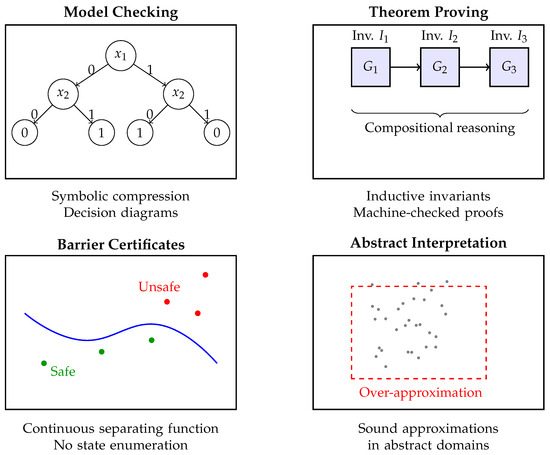
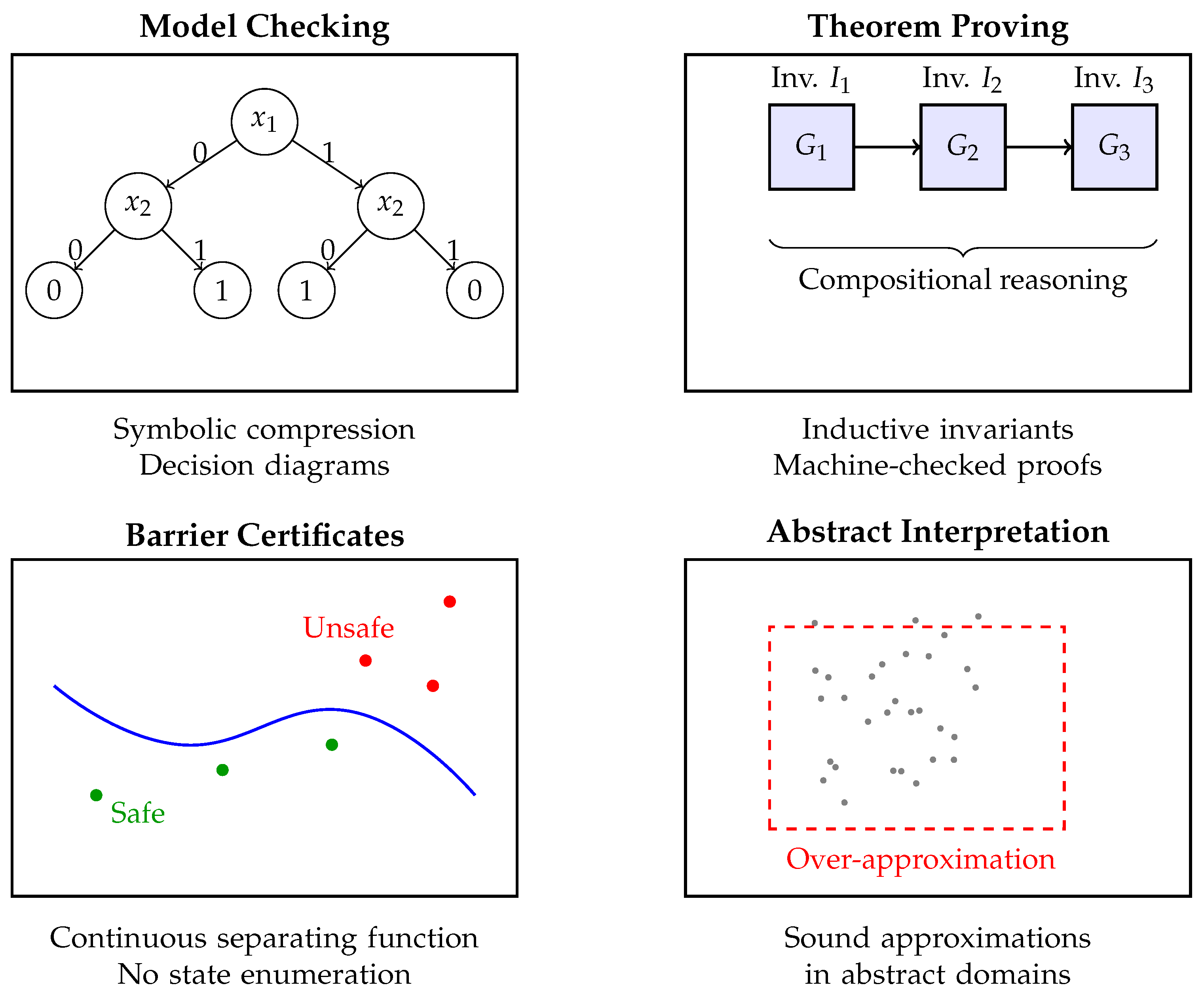

Disclaimer/Publisher’s Note: The statements, opinions and data contained in all publications are solely those of the individual author(s) and contributor(s) and not of MDPI and/or the editor(s). MDPI and/or the editor(s) disclaim responsibility for any injury to people or property resulting from any ideas, methods, instructions or products referred to in the content. |
© 2026 by the author. Licensee MDPI, Basel, Switzerland. This article is an open access article distributed under the terms and conditions of the Creative Commons Attribution (CC BY) license.