


Abstract
Operational disruptions in urban rail transit significantly degrade service quality and passenger experience, necessitating efficient rescheduling strategies. This study investigates the application of virtual coupling (VC) technology to enhance operational flexibility during single-line interruptions. We propose a novel rescheduling strategy—VC with section reverse driving (VC-SRD)—specifically designed for single-line disruption. A mixed-integer programming model is developed with the objective of minimizing total passenger waiting time, incorporating safety headway constraints, dwell time limits, and time-dependent passenger demand. Case studies indicate that the proposed VC-SRD strategy leads to a substantial reduction in passenger waiting time and a marked improvement in hauling capacity by 60%. Sensitivity analysis further reveals that the advantages of VC-SRD become more pronounced during prolonged interruptions exceeding 60 min, effectively alleviating peak-hour congestion risks. By providing a systematic and validated optimization framework, this research confirms that VC technology can substantially enhance network resilience and offer practical solutions for managing service interruptions in urban rail systems.
1. Introduction
As of December 2024, the global urban rail transit network encompassed 44,730.14 km of operational lines across 562 cities, reflecting a modest 3.06% year-on-year growth in total mileage. Notably, China contributed 58 cities, with an aggregate network length of 12,168.77 km, retaining its dominance as the largest contributor to global rail infrastructure, as reported by the China Association of Metros [1,2]. However, escalating operational interruptions in urban rail systems—primarily attributed to infrastructure vulnerabilities (e.g., signaling failures, traction power outages) and human-factor errors—are intensifying systemic risks to passenger throughput stability and network-wide safety protocols. These disruptions disproportionately amplify during peak-demand cycles, where even minor interruptions cascade into prolonged service degradation. For instance, during the morning rush hour on 13 March 2023, a signal failure on Beijing Subway Line 10 led to severe delays, leaving numerous passengers stranded and disrupting ground traffic flow. Therefore, addressing the effective rescheduling of trains to ensure passenger safety remains a pressing concern within the urban rail transit sector. Existing methodologies for addressing operational disruptions in urban rail transit systems remain insufficient in resolving passenger congestion and unidirectional traffic bottlenecks with high efficiency. With continuous technological advancements, novel approaches such as virtual coupling are being integrated into train operation adjustments, offering potential to restore transportation efficiency and enhance passenger satisfaction through adaptive service optimization.
In recent years, virtual coupling technology has emerged as a focal point of research. Originating from the concept proposed by Bock et al. [3] in Germany in 1999, aimed at enhancing the attractiveness of European railways, this technology has garnered significant attention. Subsequently, Europe has continuously supported numerous related projects through the Shift2Rail initiative, such as the CONNECTA series, X2RAIL series, and the Moving Rail and Performing Rail thematic projects, which have delved deep into the fundamental concepts, principles, feasibility, and key technologies of virtual coupling. Research institutions and enterprises like Germany’s DLR, Spain’s CA, and Russia’s AVP Technology have also made substantial advancements in this field, validating partial key technologies of virtual coupling through principle simulations and field experiments. Traditional fixed train composition operational methods often face limitations due to fixed composition configurations, making it challenging to meet flexible demands for “on-demand transportation”. Emerging virtual coupling technologies offer new perspectives, potentially enhancing operational flexibility, improving the response speed during interruptions, and achieving flexible train formations.
Virtual coupling technology enables the collaborative operation of trains during their journey through wireless communication technology. Since it does not rely on physical connections, virtual coupling technology can enhance operational flexibility and improve the response speed during interruptions in rail transit systems, especially in the case of sudden disruptions. The introduction of virtual coupling not only shortens train intervals and enhances transport efficiency but also effectively addresses fluctuations in transportation service demands during emergencies, particularly interruptions, providing more precise and efficient passenger services. This study aligns with the emerging paradigm of AI-driven autonomous transportation. We aim to bridge the gap between advanced train control technology (virtual coupling) and intelligent disruption management, contributing to the development of self-healing and resilient urban rail systems. Specifically, it addresses the themes of smart urban rail transit and scheduling optimization under disruptions, demonstrating how cutting-edge technology can enhance travel quality and system reliability.
This paper is dedicated to exploring the application of virtual coupling technology in urban rail transit train operation adjustments. The focus of the study is on (1) the advantages of virtual coupling technology; (2) how virtual coupling technology can be integrated with traditional train rescheduling strategies; and (3) evaluating train rescheduling strategies to validate the technological advantages of virtual coupling.
2. Literature Review
In recent years, many scholars at home and abroad have proposed virtual coupling technology [3,4]. In the field of rail transit, this is a method inspired by the formation mode of road traffic vehicles. By using wireless communication technology, multiple trains, like mechanical coupling vehicles, can run at very small tracking intervals and can be automatically unmarshaled or automatically marshaled when needed so as to achieve flexible coupling. To explore the feasibility of flexible coupling in rail transit, some scholars first studied the basic concepts and functions of virtual coupling. Ständer et al. [5] discussed the basic concept of virtual coupling and verified the effectiveness and security of its functions. Nold M et al. [6] proposed the potential of a dynamic train unit coupling and decoupling at cruising speed, presenting various operating concepts based on dynamic coupling at cruising speed. G Goikoetxea et al. [7] introduced the technology needed to realize virtual coupling in the “Shift2Rail” plan, discussed the application of virtual coupling technology in rail transit, emphasized the importance of virtual coupling technology to improve the efficiency and safety of railway transportation, and outlined the key steps needed to realize this technology. Quaglietta et al. [8] introduced the notion of a dynamic safety margin for virtual coupling and embedded it in a multi-state train-following model to analyze virtual coupling operations in the presence of operational risk factors. Gómez et al. [9] discussed the feasibility of decentralized communication between moving trains, analyzing the role and challenge of virtual coupling technology in transportation applications. Carlo Di Meo et al. [10] provided a proof of concept of virtual coupling by introducing a specific operating mode within the European Rail Traffic Management System/European Train Control System standard specification and by defining a coupling control algorithm accounting for time-varying delays affecting communication links.
Virtual coupling has new requirements for train control systems. So far, most of the research on virtual coupling has focused on synchronous operation control technology, vehicle technology, speed measurement and positioning technology, communication technology, integrity check technology and other aspects of virtual coupling [11,12,13], whereas some others have focused on discussion of and research on the technology of virtual coupling, as well as the realistic conditions. In comparison with the large amount of research on the theoretical study of virtual coupling technologies, there has been less research on its practical application so far. Liu L et al. [14] presented dynamic train formation technology to coordinate and dispatch all running trains in a virtually coupled train set. Simin Chai et al. [15,16] introduced virtual coupling into the train scheduling problem and developed a mixed-integer linear programming model. Aiming to address changes in passenger demand, they discussed how to improve the operation efficiency of the urban rail network by optimizing the scheduling of train formations and designed and conducted real-world case studies based on the operational data of the Beijing metro network to verify the effectiveness of this approach. Yang et al. [17] considered an integer linear programming model to optimize train operations on a Y-type line, including the train timetable, the rolling stock circulation plan and a virtual coupling/uncoupling strategy that enables trains to switch between different compositions or configurations during operations. Xu Zhou et al. [18] mainly discussed the train operation planning optimization of virtual coupling trains on full-length and short-turn routes and provided a new optimization method, especially in the application of virtual coupling trains, which is helpful for improving operation efficiency and service quality.
So far, there has been some progress in the research on train rescheduling during interruptions of urban rail transit. In terms of operation adjustment and optimization, scholars mainly aim to reduce passenger waiting time and improve the train utilization rate. Jespersen-Groth et al. [19] studied disruption management in passenger rail transport and discussed schedule adjustments through the rescheduling of rolling stock and crew. Canca et al. [20,21] studied the problem of railway operation interruptions, proposed that the train affected by the fault can turn back to the nearest place, built a model with the minimum passenger waiting time as the target, and determined the specific turning point and train schedule. Ghaemi et al. [22] established a small route operation model for train disruptions with the minimum departure and arrival delay as the objective function. Jamili et al. [23] discussed two recovery modes during the disruption of urban rail operations and identified two criteria: the total travel time of passengers and the number of unserved passengers in the degraded mode. Yin et al. [24] proposed an integrated approach for the train scheduling problem on a bidirectional urban metro line in order to minimize operational costs and passenger waiting time. Concerning operation adjustment strategies, scholars have given a variety of methods, among which, the rerouting measure has been popular; this measure could be further divided into passenger rerouting and train rerouting. Passenger rerouting means that passengers transfer to other trains or choose other routes to continue their journey to ensure they reach their destinations during the disruption [25,26]; this strategy is mainly used in dealing with railway rescheduling or metro network rescheduling problems. In the study on train rerouting, Yixiang Y et al. [27] proposed a novel optimization methodology that integrates both train timetabling and rolling stock scheduling based on time-dependent passenger flow demands. In their research, they employed a simulated-annealing-based heuristic algorithm to solve the proposed model and generate approximate optimal solutions. Tessitore M L et al. [28] analyzed how train delays propagate in a metro network with disturbances and disruptions when different recovery strategies are implemented. Xiaoming Xu et al. [29] considered an accident on the tracks of a two-track subway line and developed an efficient train rescheduling strategy with the goal of minimizing the total delay time compared to the original schedule. Zhu Y et al. [30] proposed a novel passenger-oriented timetable rescheduling model. This model, taking station capacity into account, applies the dispatching measures of retiming, re-ordering, canceling, flexible stopping and flexible short-turning trains on the one hand and handles rolling stock circulations at both short-turning and terminal stations of trains on the other. Yeran Huang et al. [31] developed a nonlinear mixed-integer programming model with two different recovery strategies, proposed a mixed formula for solving the model in real time, and designed a two-stage method to process the information detected in real time. Zhu Q et al. [32], in order to minimize train rescue duration and the number of stranded passengers, proposed a collaborative model to optimize train rescue operations and timetable rescheduling, which includes retiming, canceling trains, stop skipping, and inserting additional trains. In terms of passenger flow assignment, Owais M et al. [33,34] integrated dynamic bus-stop simulation into a static transit assignment framework. It models real-time passenger and bus interactions and conducts a parallel review and comparison of two fundamental graph-based frequency assignment models: the hyperpath method offers detailed modeling of passenger en route strategies but suffers from high computational complexity, and the section-based method provides a simplified, computationally efficient network but with coarser behavioral granularity. Almutairi A et al. [35] simplified transit assignment into a conventional shortest-path problem on an augmented graph and highlighted the model’s efficiency for large-scale networks, its integration with BPR-like congestion functions, and its solution via variational inequality.
With the deepening of relevant theoretical research, a small number of studies have discussed the application of virtual coupling technology in specific scenarios. However, there is still a lack of research on virtual coupling technology in train rescheduling, and the existing studies have low general applicability. The studies on train operation adjustment in the case of urban rail transit operation interruptions mainly focus on single-line bidirectional operations, short-turning operations, section unidirectional operations, schedule adjustment, etc. However, the existing methods cannot solve the impact of section interruptions on hauling capacity, and the original hauling capacity can only be restored after the interruption. In addition, there are few studies on the application of virtual coupling technology in the rescheduling of train operations during interruptions of urban rail transit operations.
The research content of this paper investigates the application of virtual coupling technology in addressing train rescheduling challenges during single-line disruptions in urban rail transit. The main contributions are as follows: (1) Innovative Rescheduling Strategies: This study proposes novel train rescheduling strategies tailored for single-line interruption scenarios by integrating virtual coupling technology into the operational adjustment framework. (2) Mathematical Modeling for Passenger-Oriented Optimization: A mathematical model is developed with the objective of minimizing total passenger waiting time, providing a quantitative basis for evaluating the performance of the proposed strategies. (3) Validation of Operational Benefits: Through comparative analysis with conventional rescheduling approaches, the findings demonstrate that the application of virtual coupling technology significantly reduces passenger waiting time, enhances hauling capacity and service quality, and improves the flexibility and efficiency of the rescheduling process. These results provide a theoretical foundation for the broader implementation of virtual coupling technology in rail transportation systems.
This paper is organized as follows. Section 3 introduces a train disruption management strategy based on virtual coupling technology. Section 4 constructs the train rescheduling model. Section 5 verifies the application of the model in design scenarios and examples. Section 6 provides the conclusion of this paper and suggestions for future research.
3. Problem Analysis
3.1. Problem Scenario
The single-line disruption scenario in a bidirectional urban rail transit system describes an operational state wherein one directional line (upstream or downstream) experiences a partial or complete loss of service capacity due to infrastructure failures, rolling stock malfunctions, or external emergencies (e.g., extreme weather), while the counterpart directional line retains operational functionality. This contingency mandates the activation of contingency protocols—including dynamic scheduling, asymmetric resource reallocation, and virtual coupling-enabled fleet coordination—to preserve network-wide service continuity.
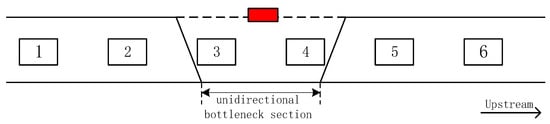
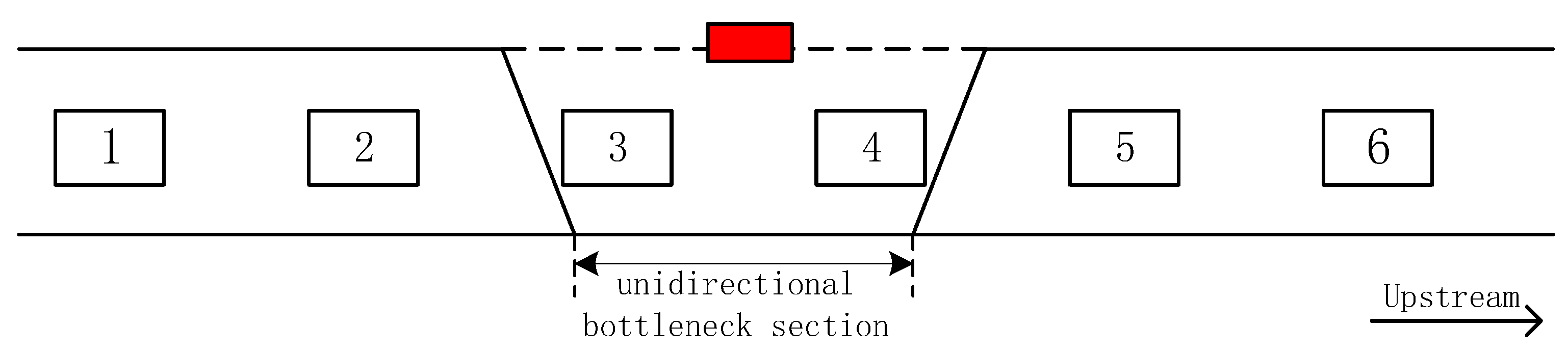
Upon the occurrence of a single-line disruption in a bidirectional urban rail transit corridor, the infrastructure is dynamically reconfigured via emergency crossovers (Figure 1), segmenting the corridor into
Figure 1.
Bidirectional urban rail line L.
Two bidirectional operational sections:
Segment A: Stations 1 to k (maintaining full bidirectional service).
Segment B: Stations k + 1 to n (retaining bidirectional capacity).
One unidirectional bottleneck section (red rectangle):
Between stations k and k + 1, restricted to upstream-only traversal due to the outage.
During such kinds of interruption, trains cannot travel downstream between station k and station k + 1, while upstream travel remains unaffected. Once the interruption is resolved, both directions resume normal operations.
3.2. Concepts of Virtual Coupling
Virtual coupling (VC) technology transforms rail coordination by enabling the real-time exchange of critical operational parameters—such as velocity, position, and acceleration—through advanced wireless communication systems. This approach removes the requirement for physical connections, allowing multiple trains to synchronize their movements as a unified, dynamically managed platoon.
When virtually coupled, trains form a cooperative multi-agent system. Each unit maintains autonomous control while achieving precise relative positioning and speed synchronization through continuous data sharing. This shared situational awareness significantly enhances operational flexibility, enabling trains to safely couple and decouple both within stations and along track sections, adapting the formation in real time to service demands [7,9].
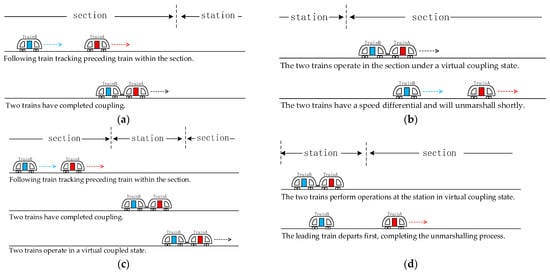
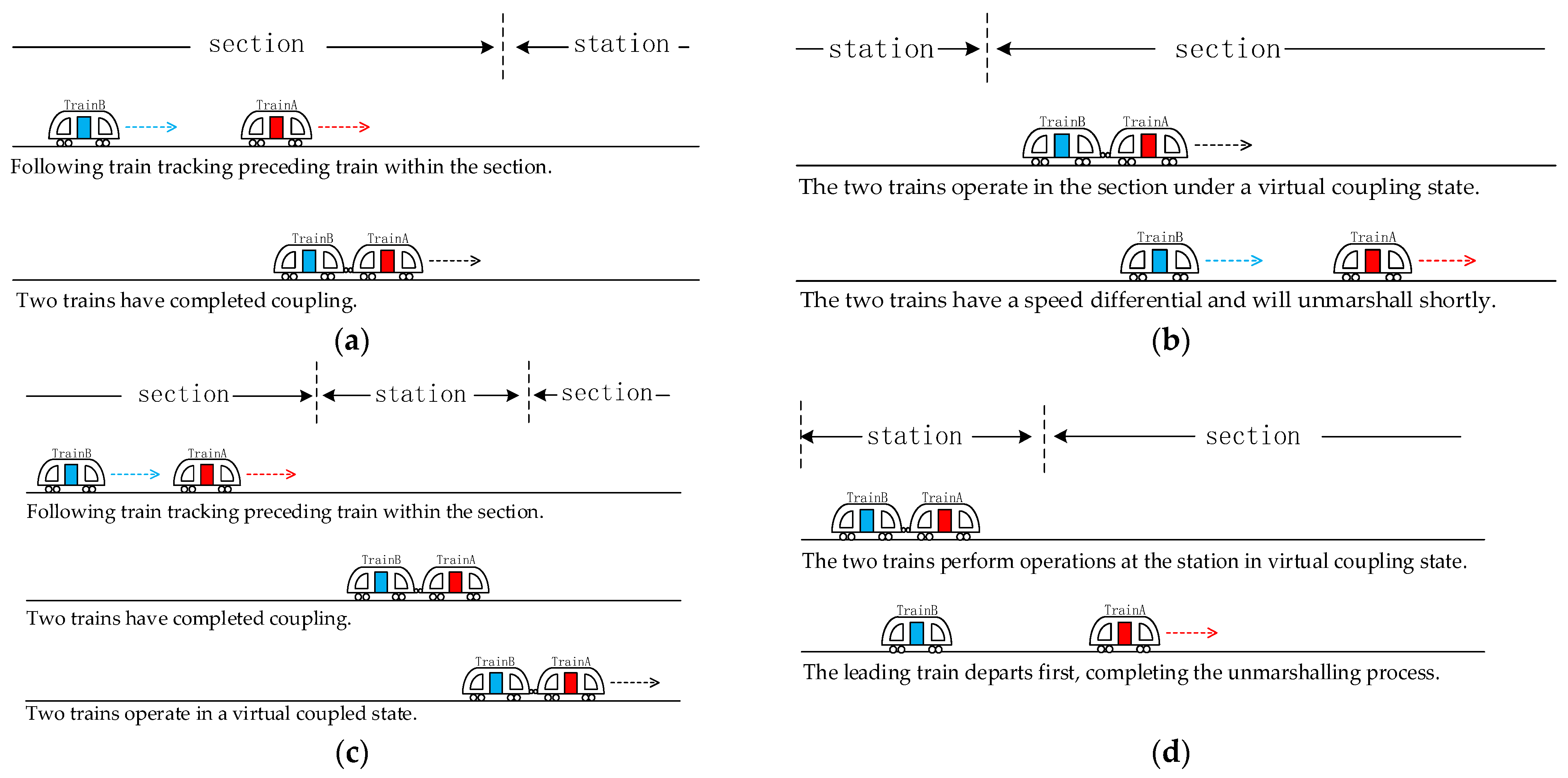
From a signaling perspective, VC shifts the basis of train separation from absolute braking distance (fixed-block systems) to relative braking distance (moving-block with real-time kinematics). This fundamental change allows for drastically reduced headways, directly increasing line capacity. From a transportation planning perspective, VC enables more adaptive and demand-responsive scheduling, improving the balance between service supply and passenger demand. The process of VC is illustrated in Figure 2. In the figure, arrows of different colors represent different train units, and the black arrow represents a train running in virtual marshalling.
Figure 2.
The process of virtual coupling: (a) virtual marshaling in the section; (b) virtual unmarshaling in the section; (c) virtual marshaling at the station; (d) virtual unmarshaling at the station.
By enabling these dynamic processes, VC technology not only enhances the flexibility and adaptability of urban rail transit systems but also optimizes resource utilization and operational efficiency. This approach marks a progression in the development of train control and management systems.
3.3. Rescheduling Strategies with VC
There are many strategies for rescheduling in urban rail transit, including suspension of service, adding trains, removing trains, shortening or extending dwell times, skipping stops [29], turning back before the station [19,20], short turning [21], reverse driving, and single-line bidirectional operation [26]. Different strategies are suitable for different scenarios. When a train experiences a short delay and the line conditions are intact, rescheduling can be made by skipping stops, changing dwell time, and combining other strategies. For single-line interruptions, existing research and practical applications commonly adopt short-turning strategies, single-line bidirectional operations, reverse driving strategies, or combinations based on these approaches for rescheduling. Therefore, this study combines the traditional adjustment strategies with VC.
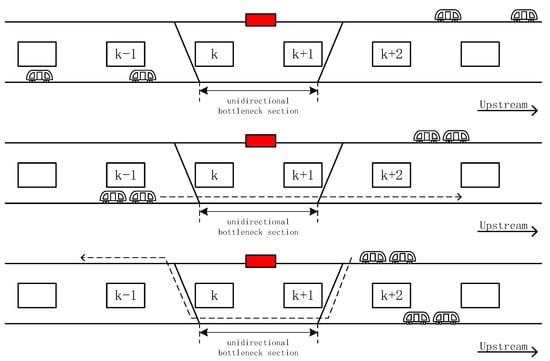
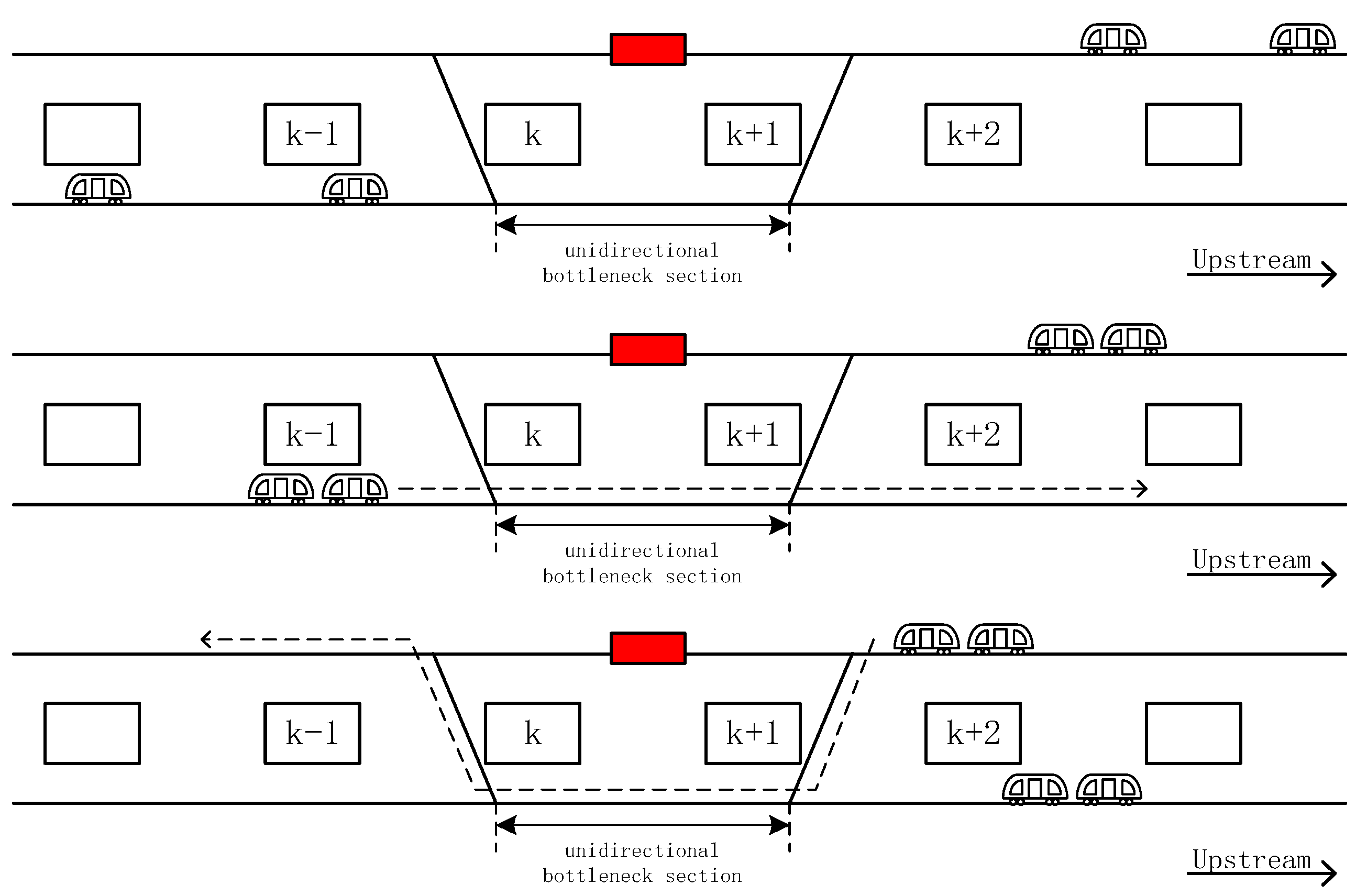
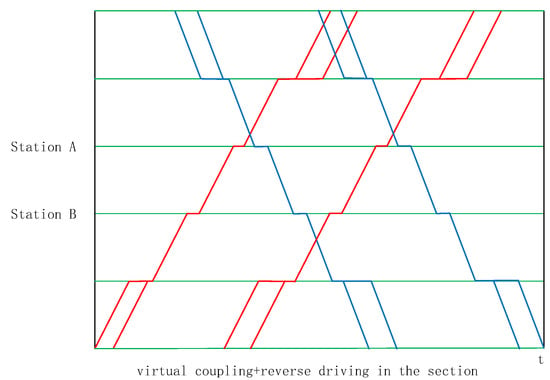
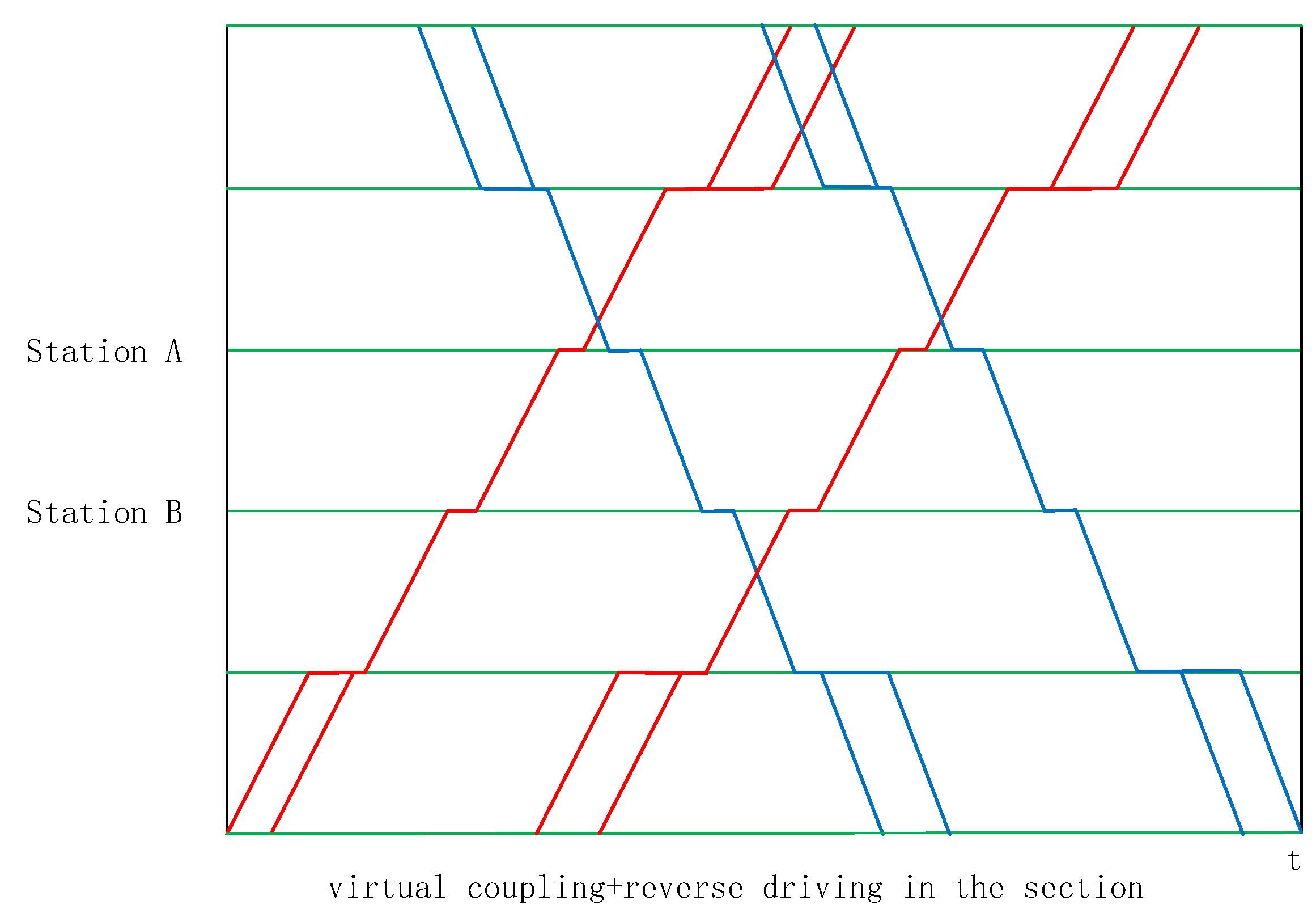
In practical applications, considering the need to minimize additional passenger operations and train turnaround activities, the infrastructure configuration of the disrupted section, and the safety risks associated with virtual coupling operations, this paper proposes and focuses on a virtual coupling + reverse driving in the section (VC-SRD) strategy. The upstream train proceeds to station k − 1, where it virtually couples with the following train. Similarly, the downstream train advances to station k + 2 to await its coupling partner. Once the upstream train has passed through the single-line section, both the upstream and downstream virtually coupled pairs sequentially enter the single-line section via the crossover, traveling in a platoon formation (Figure 3). For station-based coupling maneuvers, platform length is a critical constraint. The platform must accommodate the combined length of both trains. If the platform is insufficient, the coupled trains will stop with part of their length extending beyond the platform boundary. In such cases, passenger flow is managed by allowing boarding and alighting only through the doors aligned with the platform area, ensuring safety and operational efficiency. The VC-SRD strategy offers a balanced approach. It provides moderate gains in both line throughput capacity and passenger waiting time reduction, making it particularly suitable for scenarios where a compromise between operational efficiency and passenger experience is required.
Figure 3.
Virtual coupling + reverse driving in the section.
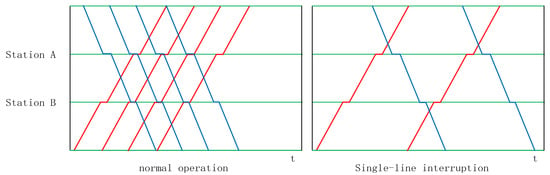
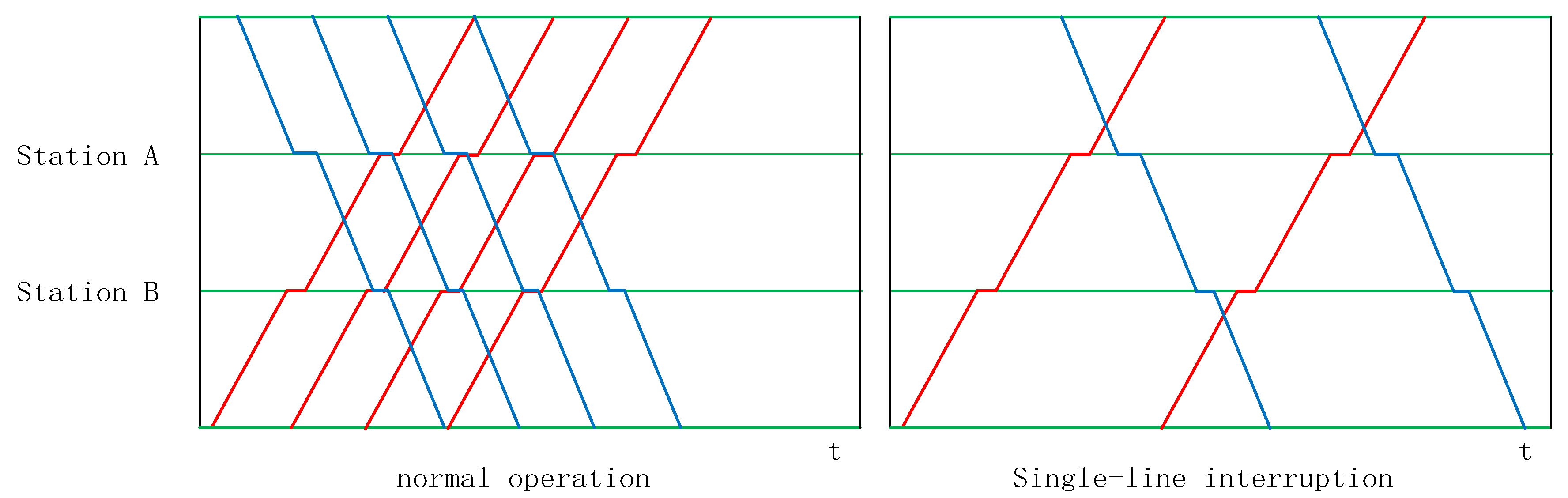
In the case of traditional adjustments, only one train is permitted to traverse the single-line section at any given time following an interruption. This results in a doubled headway compared to normal operations, significantly reducing both passing and hauling capacities. The comparison of capabilities under normal operations and during interruptions is illustrated in Figure 4. In the figure, the red lines represent upstream, and the blue lines represent downstream.
Figure 4.
Comparison of capabilities under normal operation and interruption.
While the existing rescheduling method partially restores the hauling capacity to address passenger demands, it fails to rapidly return to pre-interruption levels. By implementing VC technology in rescheduling trains during single-line interruptions, such as utilizing VC-SRD strategies, the number of vehicles doubles with no change in passing capacity, resulting in a twofold increase in hauling capacity (Figure 5). This highlights that without any loss of capacity, rescheduling based on VC technology can maximize hauling capabilities compared to alternative methods.
Figure 5.
Schematic timetable under the VC-SRD.
Compared to traditional rescheduling methods not based on virtual coupling, the VC-SRD strategy proposed in this study demonstrates unique advantages in restoring transport capacity. In single-line interruption scenarios, traditional strategies, such as the short-turning proposed by Canca et al. [20,21] or the dynamic timetable adjustments studied by Yin et al. [24], primarily alleviate disruptions by optimizing the allocation of existing resources like trains and routes. These methods generally struggle to fully recover the line capacity lost due to the halving of available tracks.
In contrast, as shown in Figure 5, the core advantage of the VC-SRD strategy lies in allowing two trains to pass through the single-line section simultaneously in a virtually coupled formation. This enables the passenger capacity per transit unit to be doubled without increasing the number of train paths, thereby fundamentally restoring the section capacity to a level close to normal operations. Furthermore, compared to the integrated timetable rescheduling and passenger reassignment model proposed by Zhu et al. [30], VC technology directly reduces passenger waiting time from the supply side by effectively shortening the train headway through the bottleneck section, offering a more foundational solution.
4. Mathematical Model
4.1. Problem Description
4.1.1. Basic Description
Based on problem analysis, the urban railway line was divided into two bidirectional sections and one single-line section by two crossovers. The downstream line between station k and station k + 1 could not be used during the interruption, but the upstream line was intact for running.
4.1.2. Problem Assumptions
For rigor and simplicity, several assumptions are made for the problem as follows:
The train is not permitted to overtake at any position along the track, regardless of instances of train stalling;
The security headway of two consecutive trains in the virtual marshaling state is assumed to be infinitesimally small, the interval running time will not be adjusted, but the stop time may be adjusted as needed;
The research adopts a forward-looking perspective, positing that all platforms are equipped with predefined coupling capabilities to accommodate virtual coupling operations [36];
All trains make complete stops at each station, and the travel time in both upstream and downstream sections is uniform;
Interruptions are assumed to occur during off-peak hours, and passengers who have not disembarked have the opportunity to board the first available train upon arrival without waiting for subsequent services.
4.2. Model Formulations
4.2.1. Notations and Parameters
Table 1 shows the notations and parameters involved in formulating the model.
Table 1.
Notations and parameters involved in formulating the model.
4.2.2. Objective Functions
This study establishes passenger service quality as the primary optimization criterion, quantified through passenger waiting time metrics within the operational framework, and the passenger waiting time could be calculated from the two perspectives of the waiting time for upstream and downstream passengers in the objective functions.
The formula describes the optimization objective of minimizing the total waiting time between each passenger’s arrival at the station and boarding the train:
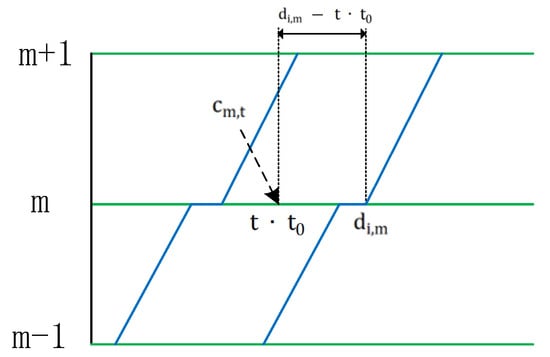
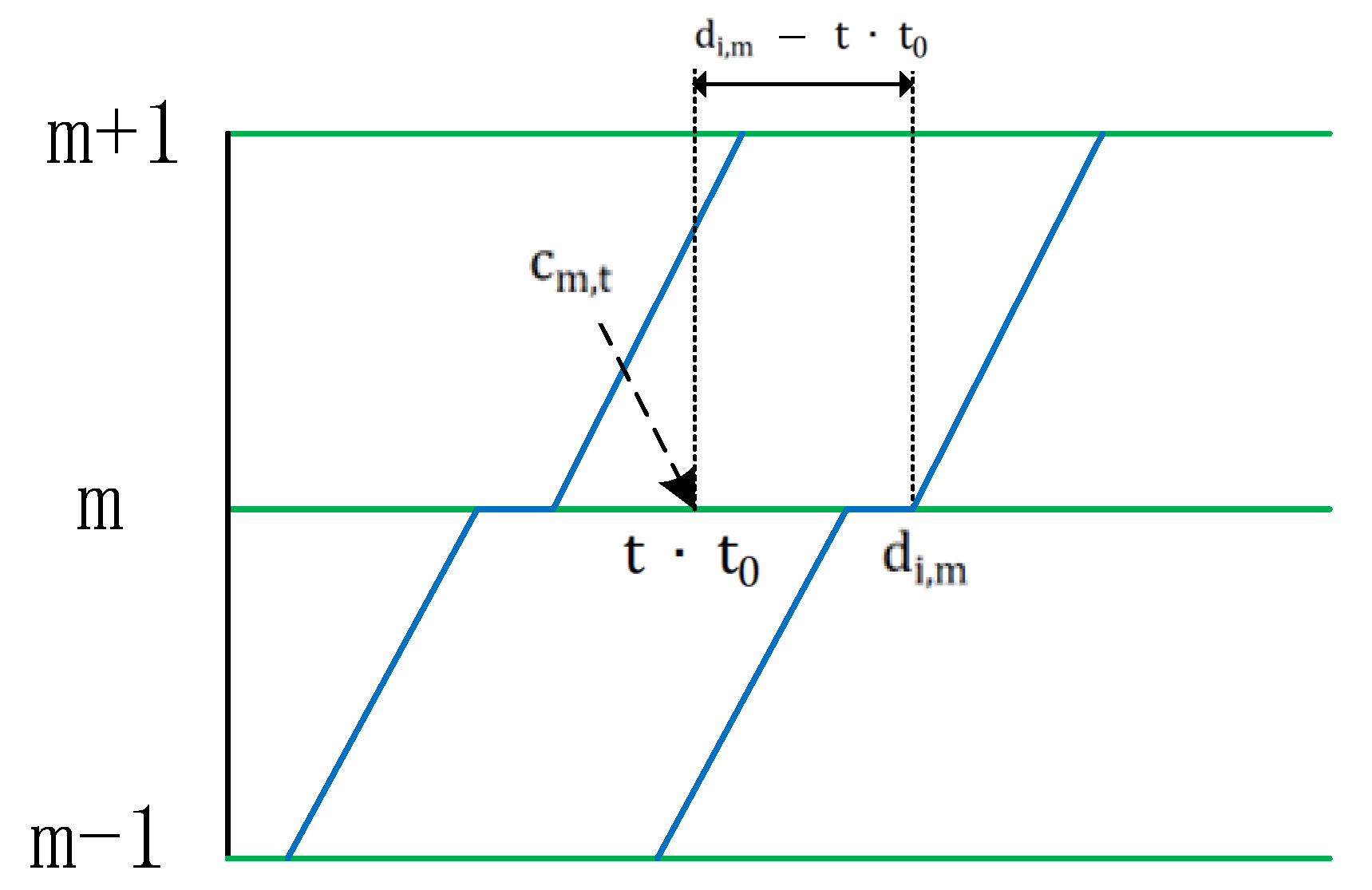
where represents if the passengers arrived at station m at time t to take train i, represents number of passengers that arrived at station m at the time interval, represents the time granularity, and represents the time interval to determine passengers’ arrival time, the blue lines represent trains in the same direction (Figure 6). This objective function is a temporal model expression for the passenger waiting time cost, with the core idea of minimizing the total waiting time of passengers from their arrival at the station until the departure of the train.
Figure 6.
Illustration of the objective function.
4.2.3. Model Constraint
Based on the problem description and problem assumptions, model formulations are given as train operation constraints and passenger flow constraints. The constraint conditions are illustrated by taking the upstream train as an example, and the constraints for the downstream train are basically consistent with those for the upstream train.
- Departure or arrival time
In the rescheduled timetable, let and be the actual arrival and departure time at station m of service i:
where is the actual dwell time of service i at station m, is the actual running time of service i from station m to station m + 1, and is the headway for service i at station m. Considering the practical operation requirements, there are limitations on the dwell time:
where is the minimum dwell time; is the maximum dwell time.
- 2.
- Headway for train services traveling in the same direction
To ensure the security of operations, consecutive train services should follow several headway limitations. Then, we formulate the headway constraints as
where is the minimum headway for trains traveling in the same direction; is the maximum headway for trains traveling in the same direction. When the two trains are in the virtual marshaling state, the headway can be considered as 0.
where is the minimum headway for two consecutive train services to arrive at or depart from the same station.
- 3.
- Headway for train services traveling in different directions
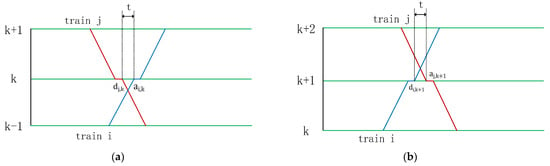
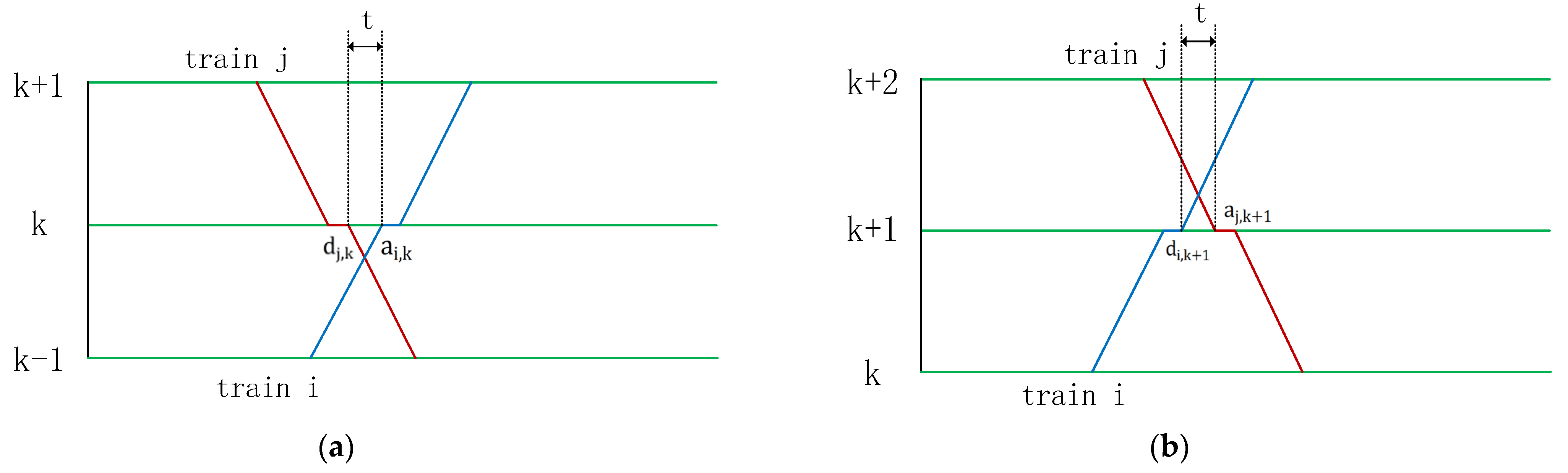
As mentioned, train services in the upstream direction need to run on the single-line section used for the upstream trains during the disruption. To ensure safety, bidirectional train services are banned in the single-line section at the same time. The headway for train services traveling in different directions should be considered as
where is the minimum safety headway for train j’s departure from station k with train i arriving at station k; is the minimum safety headway for train i’s departure from station k + 1 with train j + 1 arriving at station k + 1. Equation (15) and Figure 7 show the minimum safety headway for trains i and j at station k and k + 1. In the figure, the blue lines represent upstream, and the red lines represent downstream. Equation (16) shows that the single-line can only be used by train services traveling in the same direction at the same time.
Figure 7.
The minimum safety headway for trains i and j: (a) at station k; (b) at station k + 1.
- 4.
- Trains virtually marshaled
When using virtual coupling technology in rescheduling strategies, one train can only be marshaled with one train, so we have
where is the binary value that shows the marshaling state of services i at station m.
- 5.
- Passenger boarding and alighting
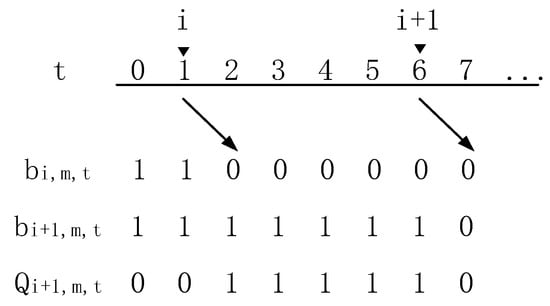
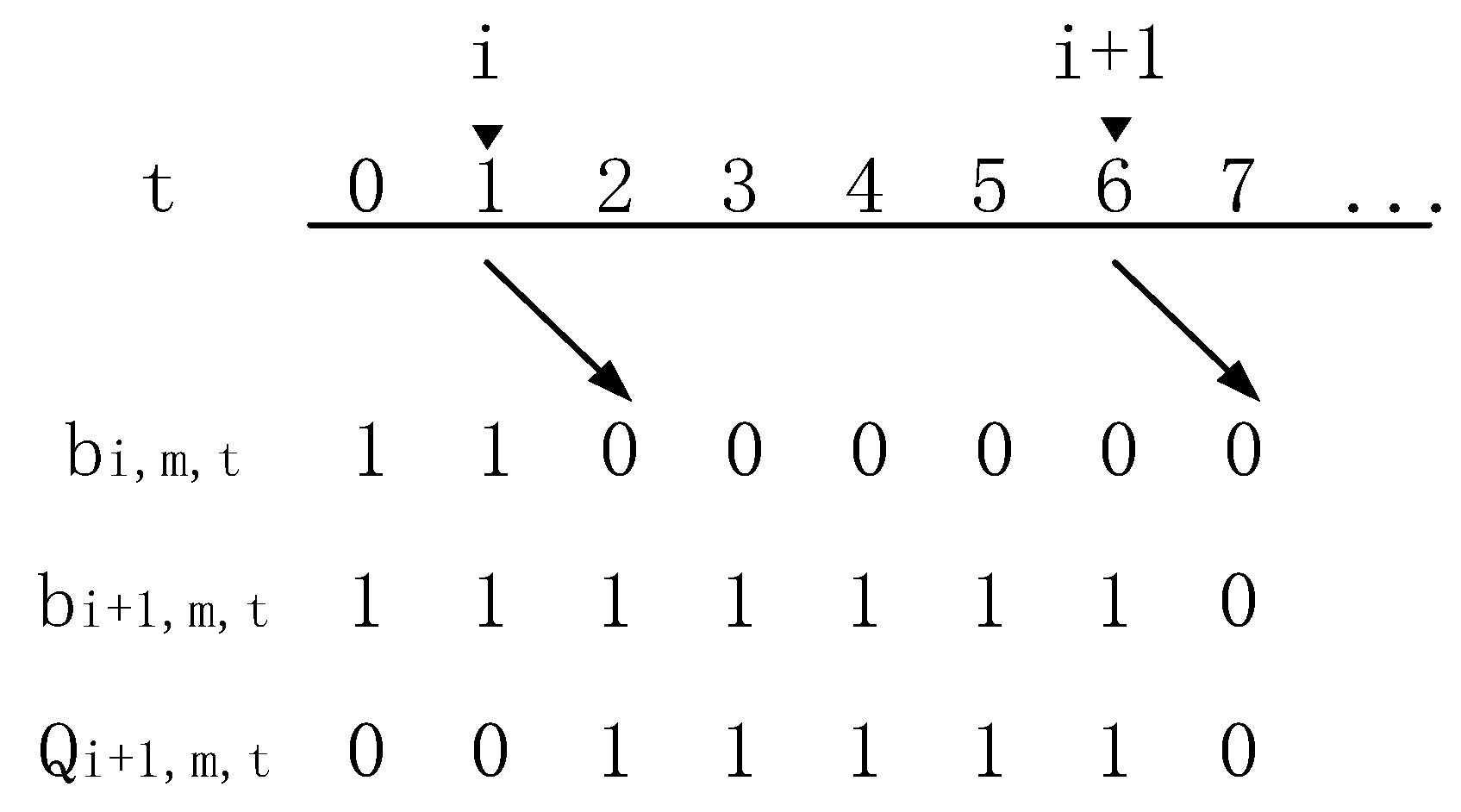
We assume that the passengers can take train i at station m if they arrive before the train departure and all passengers who have not left can board the first train service after their arrival without waiting for the next one during the disruption. Then we have
where shows whether the passengers have the chance to board train i at station m or not, and shows whether the passengers board train i at station m or not.
As shown in Figure 8, if a passenger arrives at station m at the end of 0 min, then the passenger will choose to take train i; if a passenger arrives at station m at the end of the 4th minute, they will travel on train i + 1. In the figure, arrows indicate the arrival of passenger flow.
Figure 8.
The relationship between whether passengers board and whether passengers have the opportunity to board.
The demand from passengers to board a train at a station consists of two components: one is the number of newly arriving passengers during the headway between two consecutive trains, and the other is the number of passengers stranded at the station due to train capacity constraints when the previous train departed. The specific expression for boarding demand is given as follows:
where shows the demand from passengers to board train i at m station.
The number of passengers boarding a train at a station is determined by both boarding demand at the station and the train’s remaining capacity:
where shows the number of passengers boarding train i at m station, and shows the train’s capacity.
where shows the number of passengers on train i at m station; shows the number of passengers stranded at station m of train i; shows the number of passengers getting off train i at station m; shows the proportion of passengers getting off at station m.
All constraints in the model have been linearized, making the model a mixed-integer nonlinear programming (MILP) problem. The study will use the Gurobi solver to solve the numerical examples and the case.
The model proposed in this study shows significant differences and advancements in both the problem context and the optimization objectives when compared to earlier scheduling research based on virtual coupling (VC). While inheriting the advantages of VC in improving line capacity and enabling flexible formations, our model has the core objective of minimizing total passenger waiting time during the disruption. It is important to note that the safety headways employed in our model are based on standardized thresholds derived from the European Train Control System specifications, which have been widely adopted and validated in virtual coupling research.
4.3. Numerical Examples
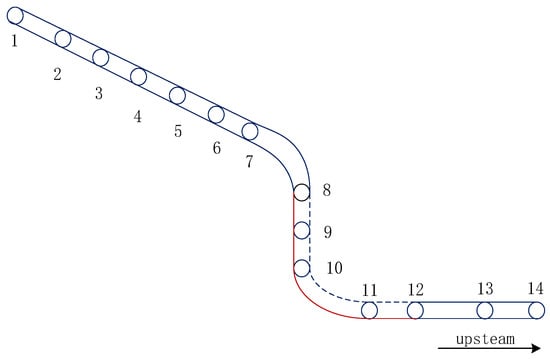
In this section, a case study is conducted to demonstrate the efficiency and applicability of the proposed methodology. The case study employs the bidirectional urban rail transit illustrated in Figure 9 as the experimental scenario, where a single-line interruption occurs between stations 3 and 4 on the downstream line, rendering it impassable. The operational VC-SRD strategy is implemented for train rescheduling.
Figure 9.
The subway line of the case.
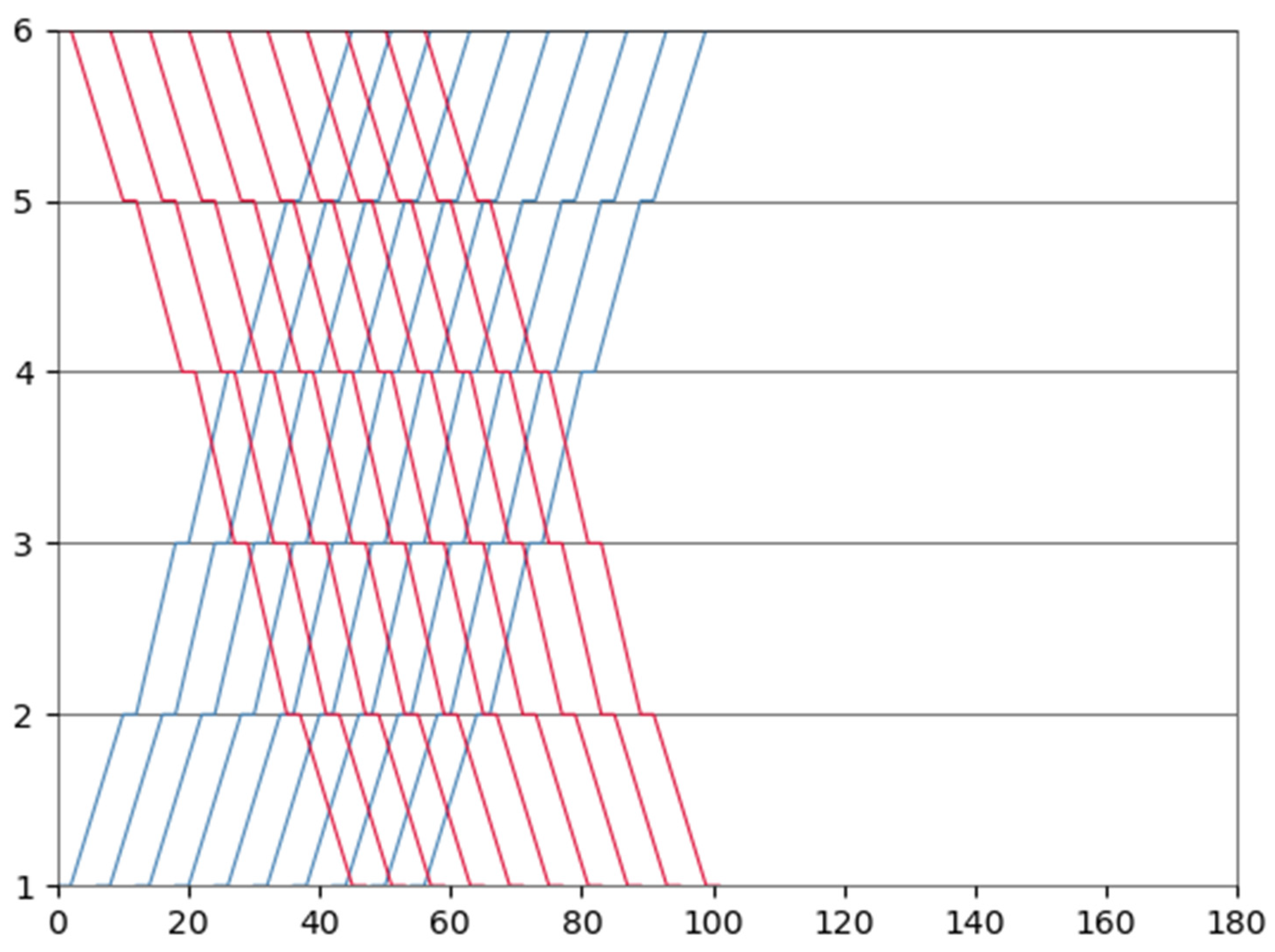
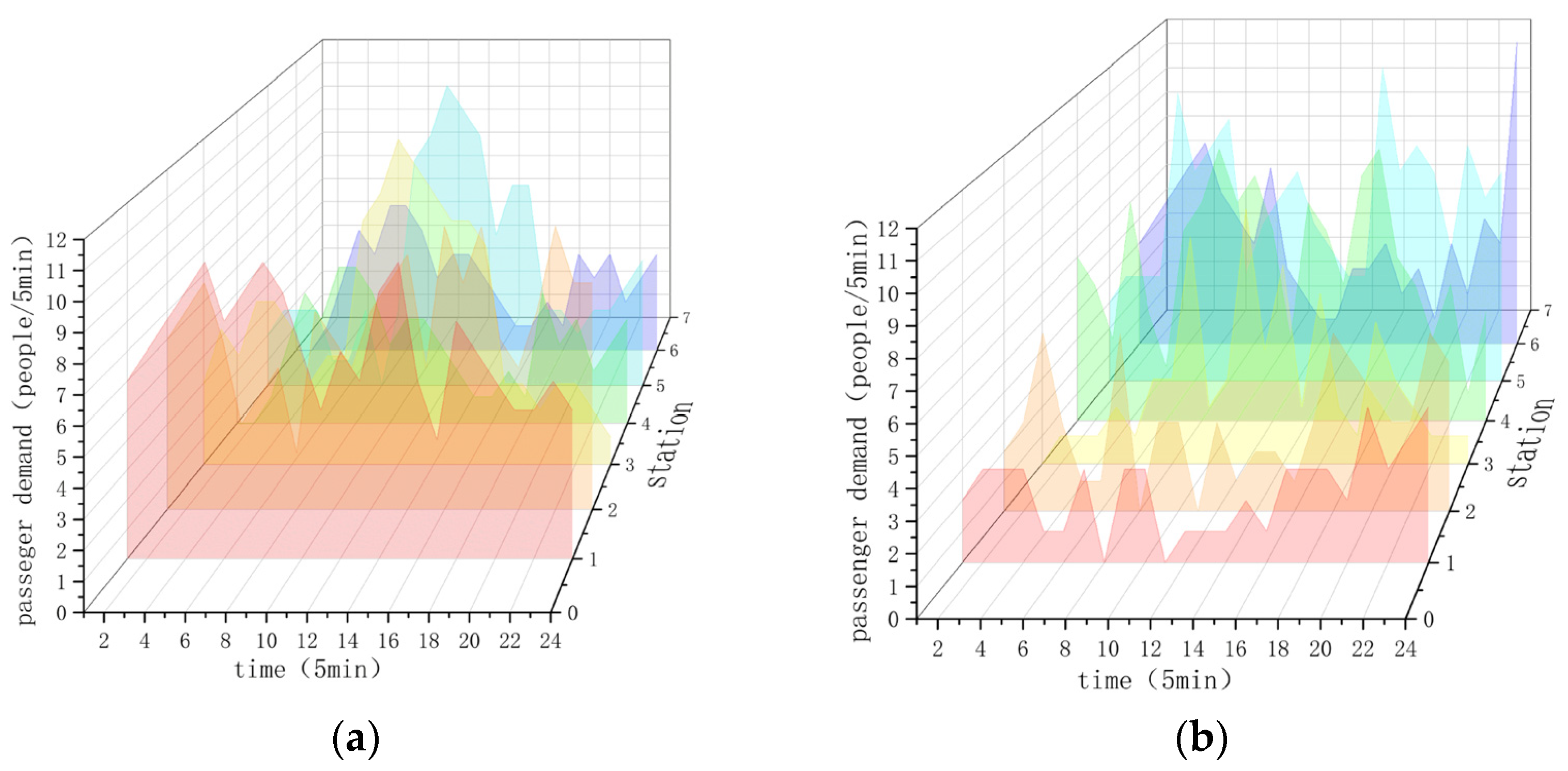
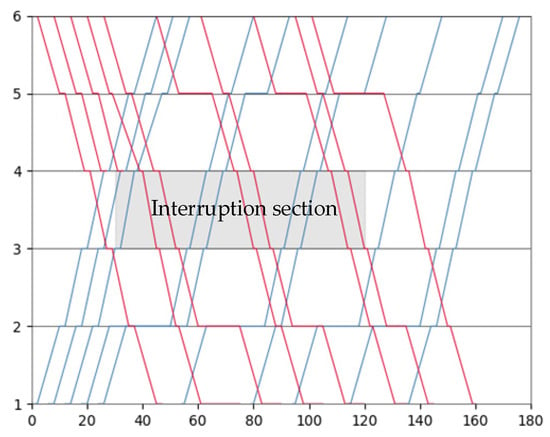
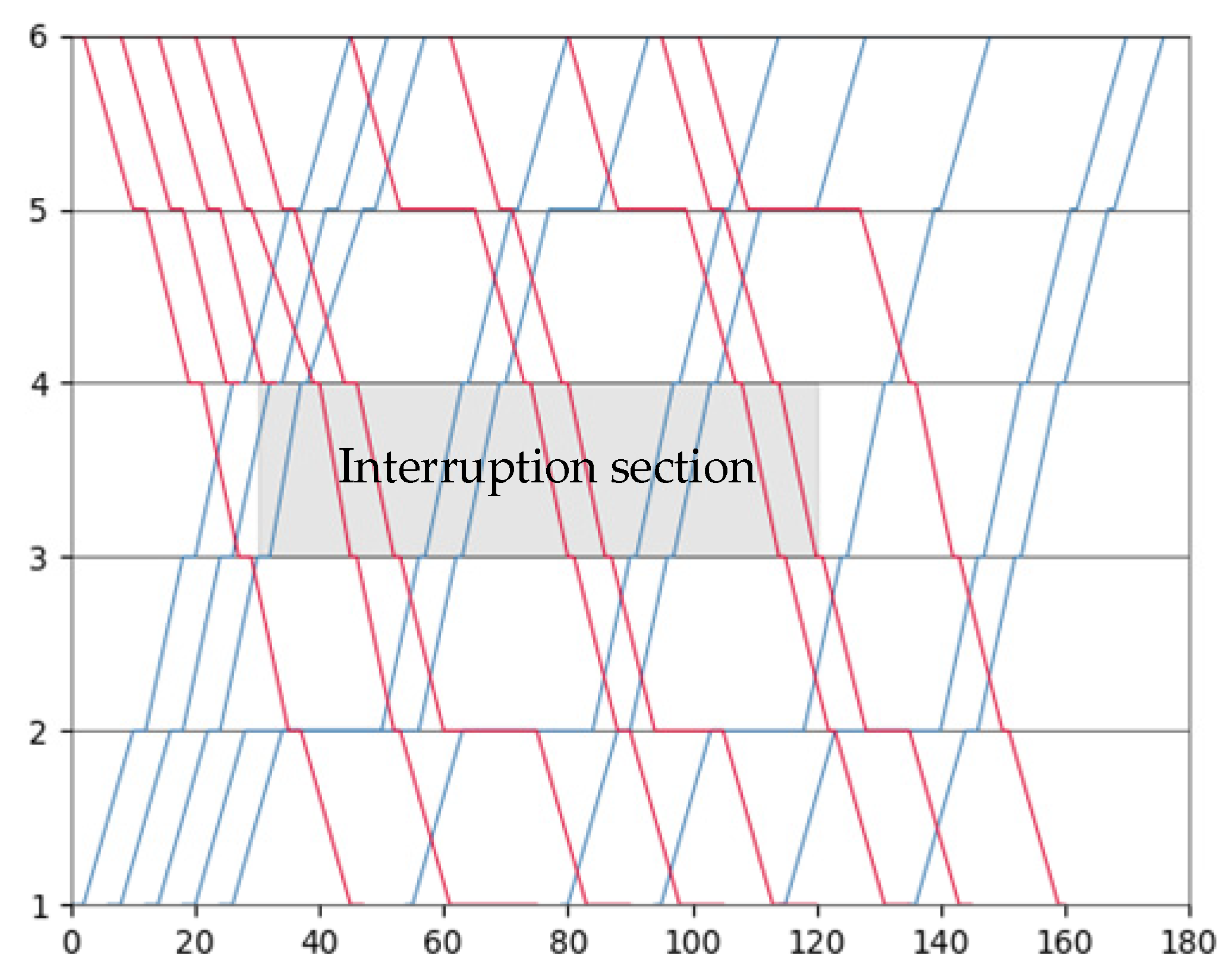
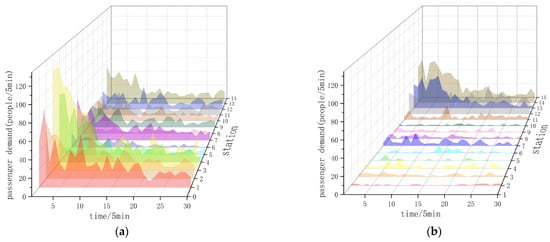
The original timetable is shown in Figure 10. The blue lines represent upstream, the red line represent downstream. There are 20 trains in this period (10 for upstream and 10 for downstream), and the interruption happens at 30 min and continues for 90 min. The passenger flow input is at 5 min representing granular passenger demands, as seen in Figure 11. The parameters of the basic scenario can be seen in Table 2. The parameter values in the numerical example section are set proportionally to simulate real-world lines. This chapter employs the train rescheduling model proposed and uses the GUROBI solver to obtain the calculation results. It took 3019 s to solve.
Figure 10.
The original timetable.
Figure 11.
Passenger demands in the case study: (a) upstream passenger flow; (b) downstream passenger flow.
Table 2.
Parameters of the basic scenario.
4.3.1. Rescheduling Timetable
- Section reverse driving without virtual coupling
The conventional section reverse driving (SRD) strategy represents a legacy operational recovery methodology for railway disruptions. Under this paradigm, upstream and downstream trains sequentially obtain the exclusive right of way in the single-line section through temporal partitioning, resuming nominal operations post-disruption via phased schedule normalization. Figure 12 shows the rescheduled timetable using the non-VC-SRD under passenger demands, with time granularity at 5 min.
Figure 12.
Timetable using section reverse driving without virtual coupling.
- 2.
- Virtual coupling + reverse driving in the section
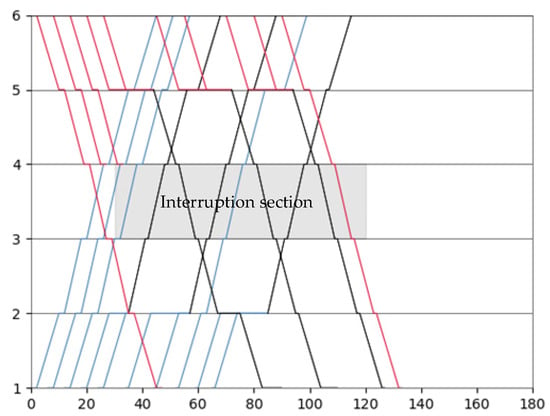
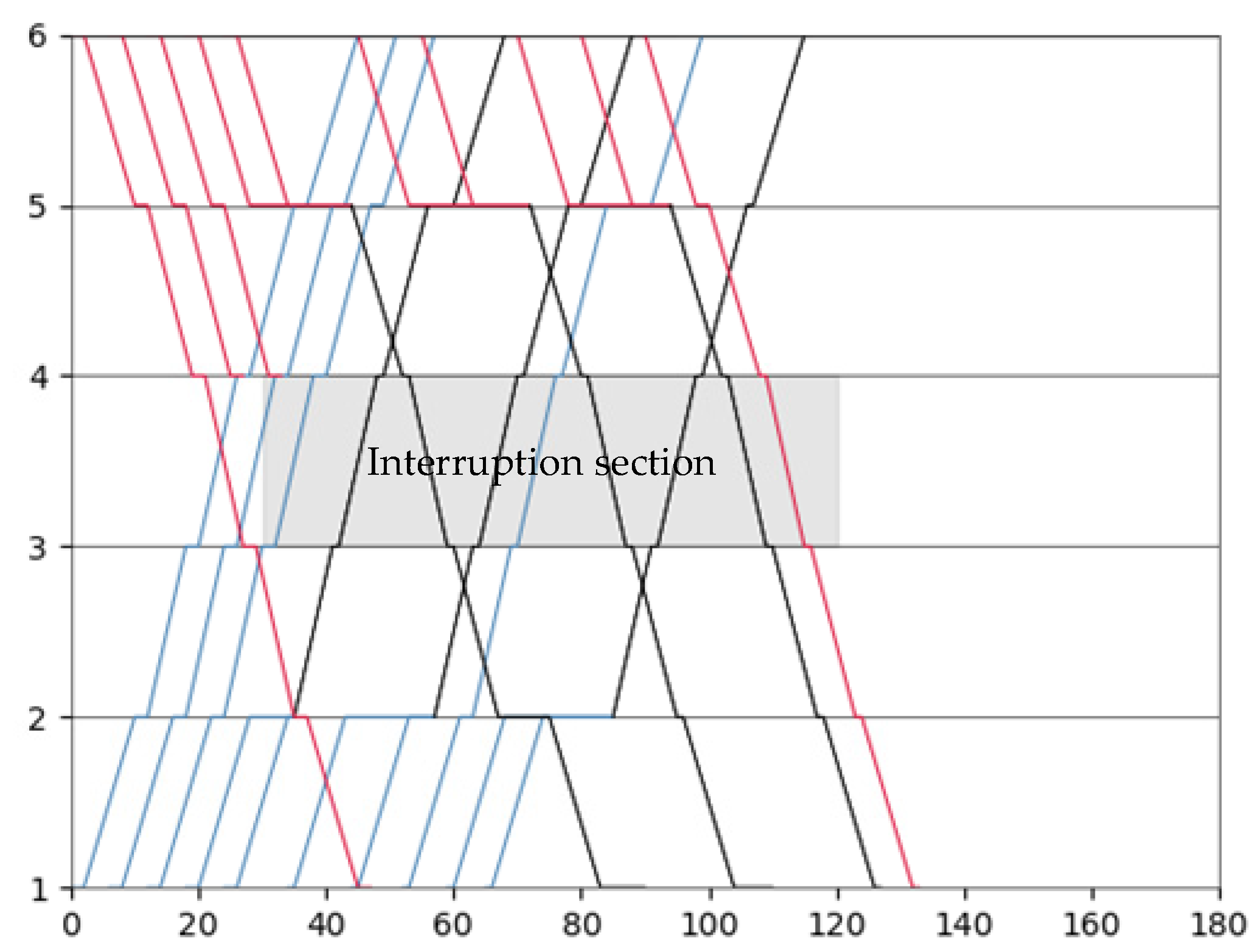
Virtual coupling + reverse driving in the section (VC-SRD) refers to the section reverse driving rescheduling method based on virtual coupling technology; that is, the upstream and downstream trains are virtually marshaled at the stations on both sides of the interrupted section and then pass through the single-line section alternately in the virtual marshaling state. After leaving the single-line section, the downstream trains return to the downstream line through the crossover, and the upstream and downstream trains continue to run to their destination in the virtual marshaling state. Figure 13 shows the rescheduled timetable using section reverse driving based on virtual coupling in relation to passenger demands, with time granularity at 5 min.
Figure 13.
Timetable using virtual coupling + section reverse driving.
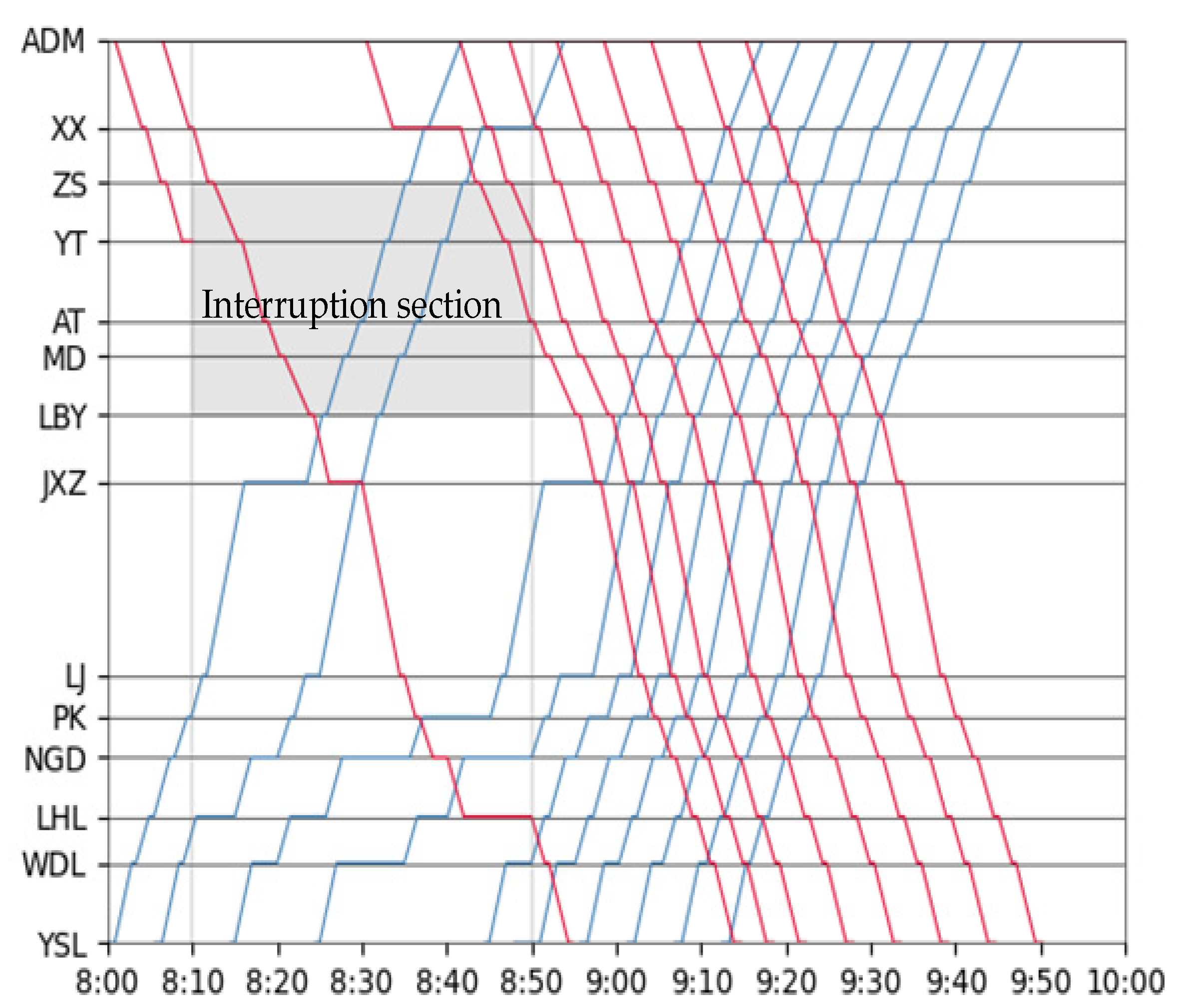
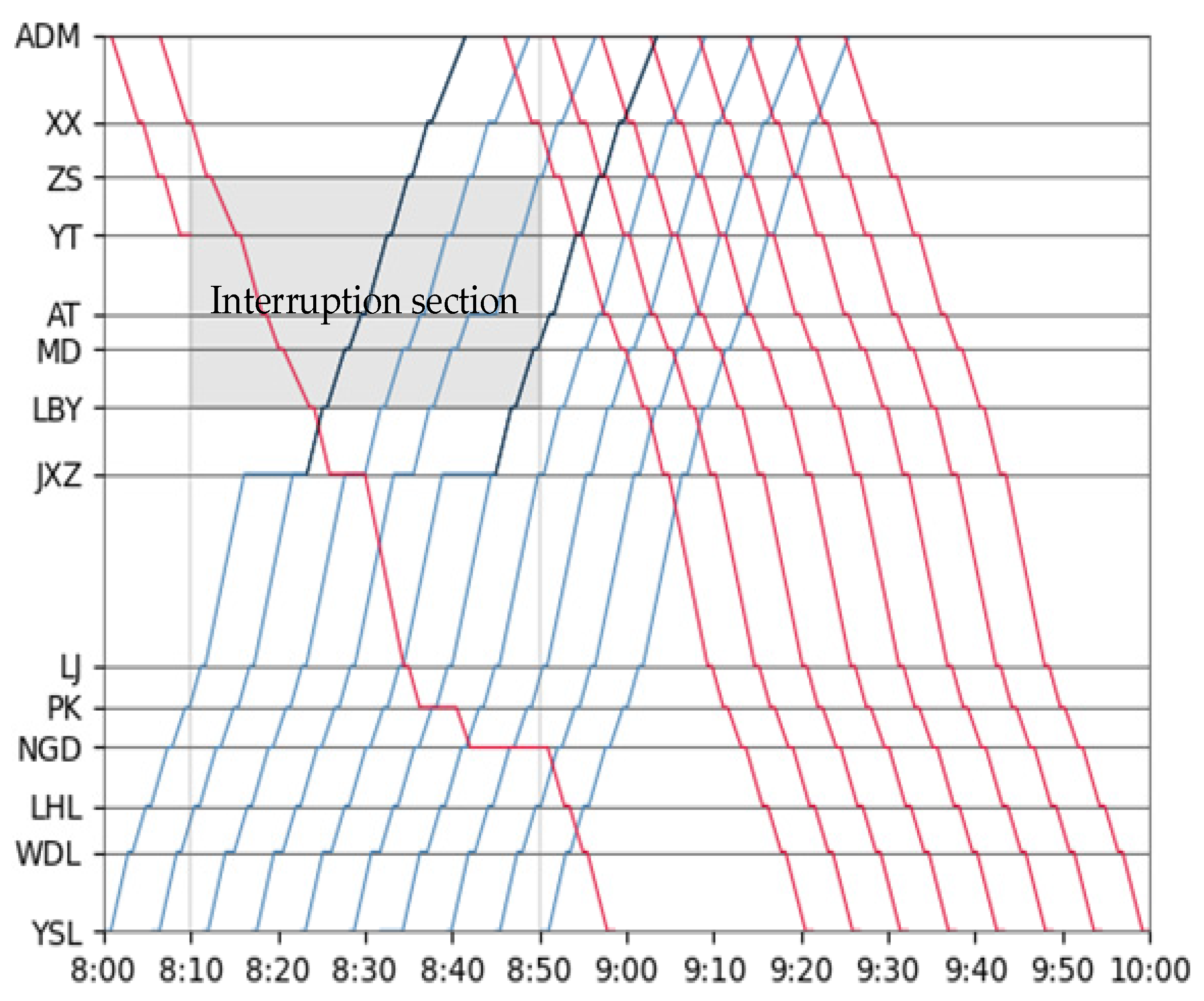
In Figure 12 and Figure 13, the blue lines indicate upstream train services, the red ones show train services in the downstream direction, and the black ones show trains in the virtual marshaling state. The shaded part represents the interrupted interval. It can be observed that the advantages of the VC-SRD strategy are mainly reflected in two aspects. The first is to balance upstream and downstream running trains. Compared with the “running interruption of downstream trains”, the use of section reverse running can effectively balance the upstream and downstream trains and restore the hauling capacity of the interrupted lines to a certain extent. The second is to reduce passenger waiting time. In the traditional reverse running condition, it usually takes time for upstream and downstream trains to wait for trains traveling in the opposite direction to pass through the single line to virtual marshaling. Compared with traditional reverse running in the section, virtual coupling technology can effectively use the waiting time so that the two trains can pass through the single line at the same time, which greatly shortens the total waiting time of passengers.
4.3.2. Waiting Time of Passengers
The calculation results of the objective functions of the three train operation adjustment strategies related to passenger demand with a granularity of 5 min are shown in Table 3. In the case of single-line interruptions, the VC-SRD strategy proposed in this paper can effectively reduce the objective function value or passenger waiting time and improve hauling efficiency and service levels. Compared with the “running interruption of downstream trains”, the waiting time of passengers in the upstream direction increases. When the interruption duration is too long, the running interruption of downstream trains will lead to the loss of passing capacity along the whole line, and no train can pass in the downstream direction until the end of the interruption. Compared with non-organized section reverse running, the waiting time of upstream and downstream passengers under the VC-SRD strategy is more balanced. The objective function is reduced by 4511 min, or 33.69%, compared with non-VC-SRD. From the objective function, the total passenger waiting time under VC-SRD is the smallest, effectively improving hauling efficiency. The results show that the VC-SRD strategy proposed in this paper and the adjustment model of rescheduling trains affected by single-line interruptions for urban rail transit based on virtual coupling are both effective and superior for reducing passenger waiting time.
Table 3.
Comparison of objective functions.
5. Case Study
5.1. Basic Description
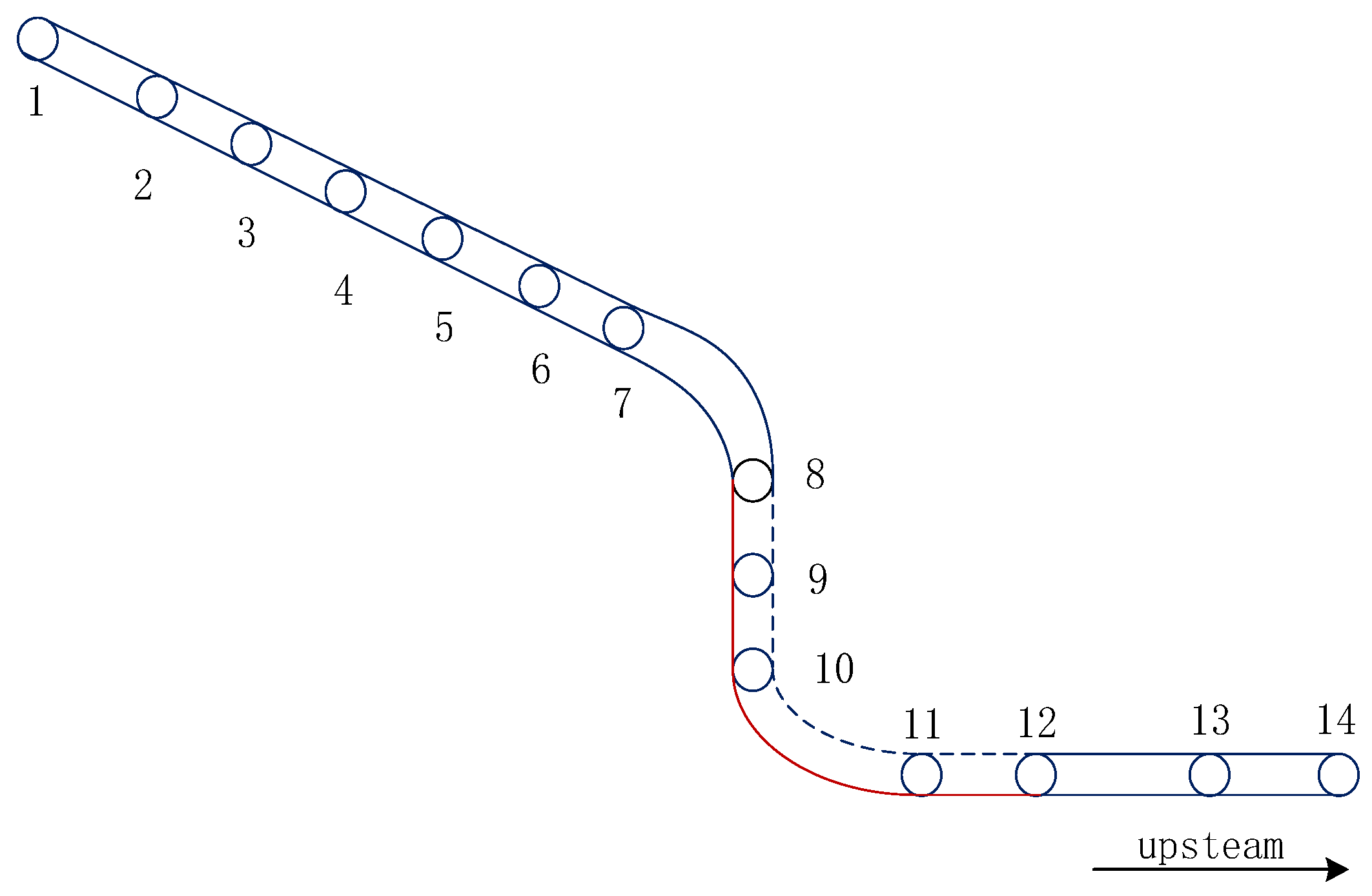
An urban railway line of Nanjing in China that covers 14 stations with a total length of 21.48 km is taken as the case study in this work. Select 08:00–10:30 as the research period, set the interruption to occur at 08:10 between station 8 and station 12 (downstream), and set the interruption duration as 40 min.
In this case, the interruption resulted in the inability of the ZS(12) station and the LBY(8) station in the downstream direction to operate normally. To address this situation, we adopted the VC-SRD strategy described in problem analysis, where trains in both directions are marshaled to pass through single-line sections in the marshaling state. On this railway line, both the ZS(12) and LBY(8) stations are equipped with crossovers (Figure 14), in the figure, the red line represent the interruption section.
Figure 14.
The subway line in the interruption scenario of the case study.
The relevant parameters in the model are detailed in Table 4. The parameter values are based on actual operational data from real lines, while the parameter values for virtual coupling operations refer to previous research [17,18] and practical conditions.
Table 4.
Model related parameters.
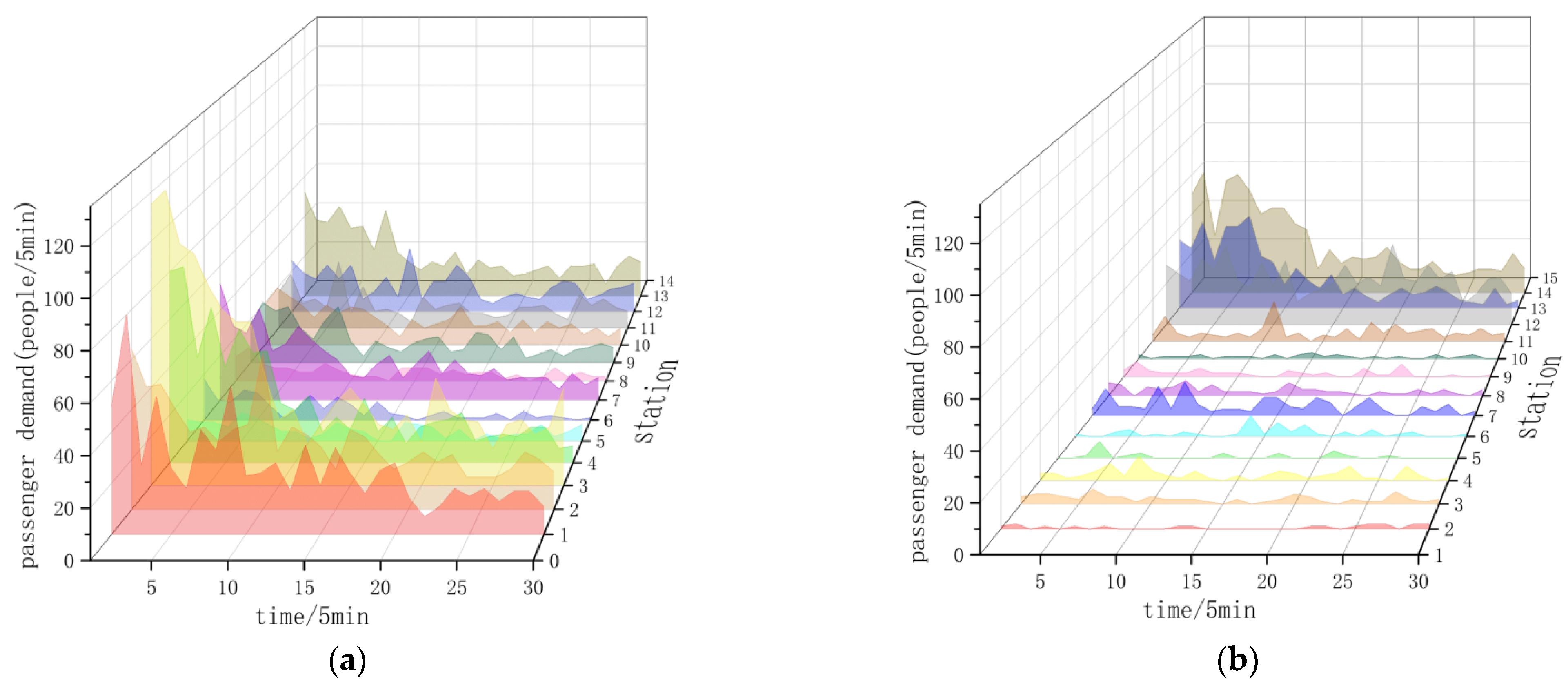
The passenger flow basic data is obtained from the AFC system data during a workday from 08:00 to 10:30 in Nanjing. The passenger data is preprocessed to remove abnormal data, such as card swipe-out times earlier than swipe-in times, and consistent station IDs for both entry and exit. Subsequently, passenger flow data within the research period is extracted. The fluctuation in passenger demand at a 5 min granularity is illustrated in Figure 15. It can be seen that there is substantial diversity in passenger flow across different stations, and passenger volumes vary significantly during different time sections within the same station. The demand for upstream travel exceeds that of downstream travel, and the flow of passengers in both directions follows a pattern of initial increase (with peak flow emerging between 08:15 and 08:50) followed by decrease.
Figure 15.
Passenger demand in the case study: (a) upstream passenger flow; (b) downstream passenger flow.
This chapter employs the train rescheduling model proposed and uses the GUROBI solver to obtain the calculation results. A comparison is made between the results of not implementing the rescheduling strategy, utilizing a conventional reverse driving strategy, and applying the reverse driving strategy based on virtual coupling introduced in this paper in order to analyze the effectiveness of the model.
5.2. Results
5.2.1. Rescheduling Timetable
Table 5 lists the positions of online trains when the single-line interruption occurs, as shown in Figure 16.
Table 5.
Online train positions.
Figure 16.
Online train positions.
- Running interruption of downstream trains
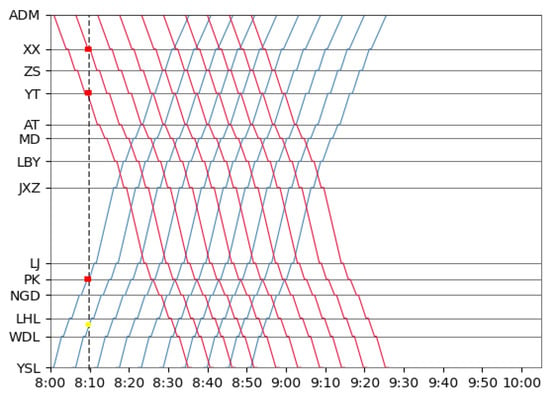
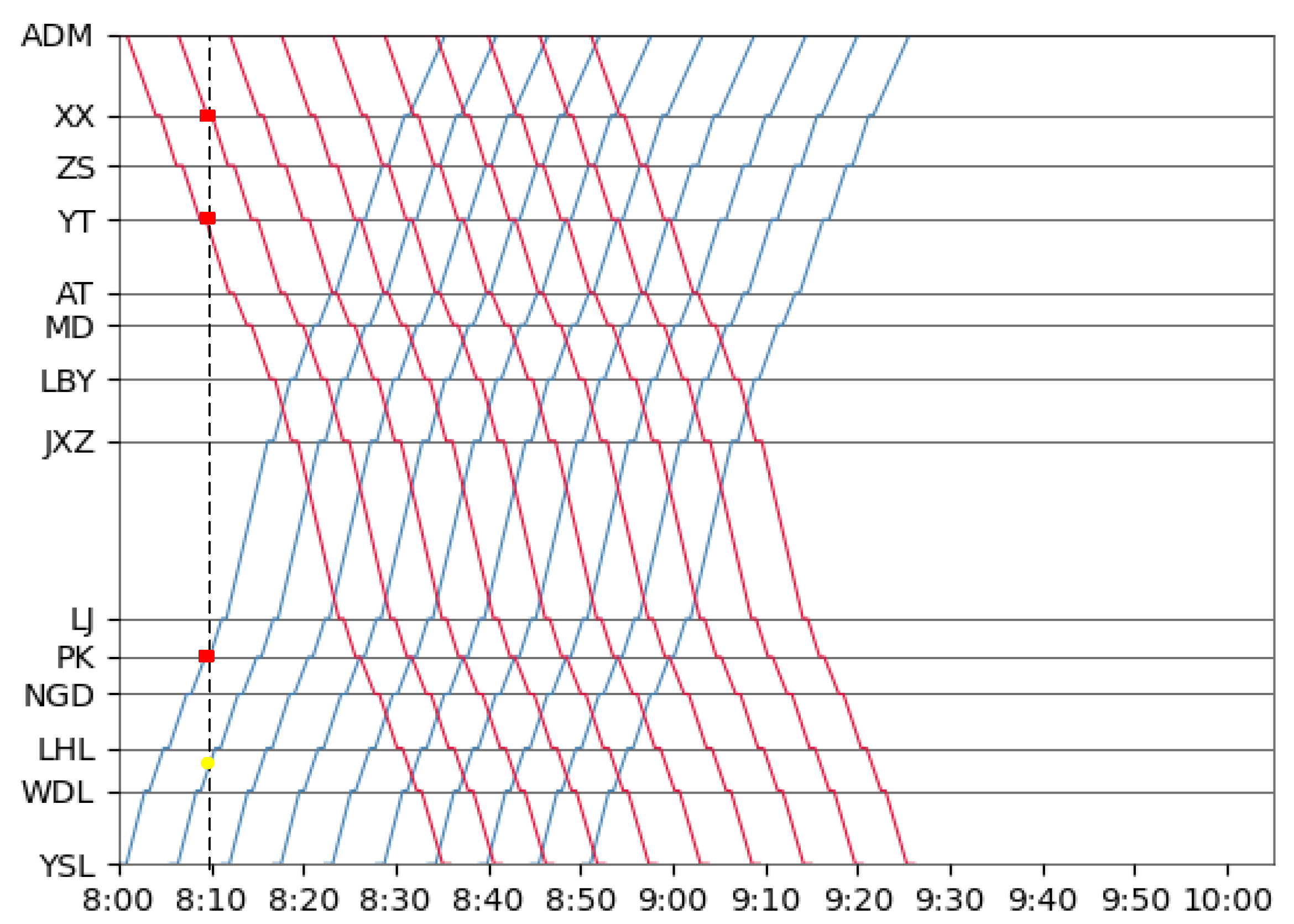
The running interruption of downstream trains means that the downstream online trains that do not pass the interruption section will be stopped by alighting passengers until the end of the interruption. Trains in the upstream direction are operating according to the timetable. Figure 17 shows the rescheduled timetable with the running interruption of downstream trains. It can be seen that although the upstream trains can run normally according to the timetable, the downstream online trains are stopped at the nearby stations. Consequently, due to the delayed departure of the starting trains caused by the section interruption and the imbalance of upstream and downstream trains, platform congestion and accidents are likely to happen.
Figure 17.
Timetable with running interruption of downstream trains.
- 2.
- Section reverse driving without virtual coupling
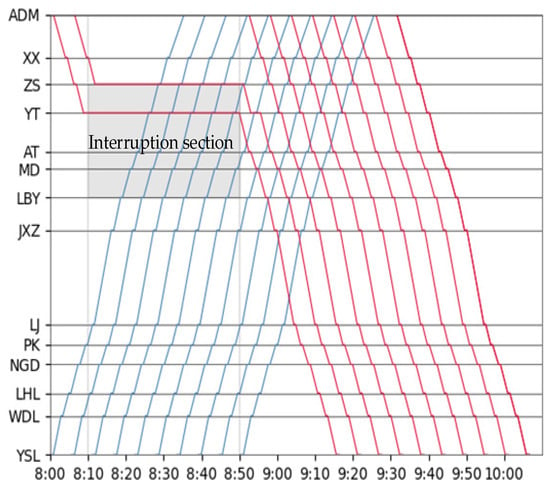
As with the timetable mentioned, the upstream and downstream trains occupy the single-line section and resume normal operations after the end of the interruption. Figure 18 shows the rescheduled timetable using the non-VC-SRD strategy.
Figure 18.
Timetable using section reverse driving without VC.
- 3.
- Virtual coupling + reverse driving in the section.
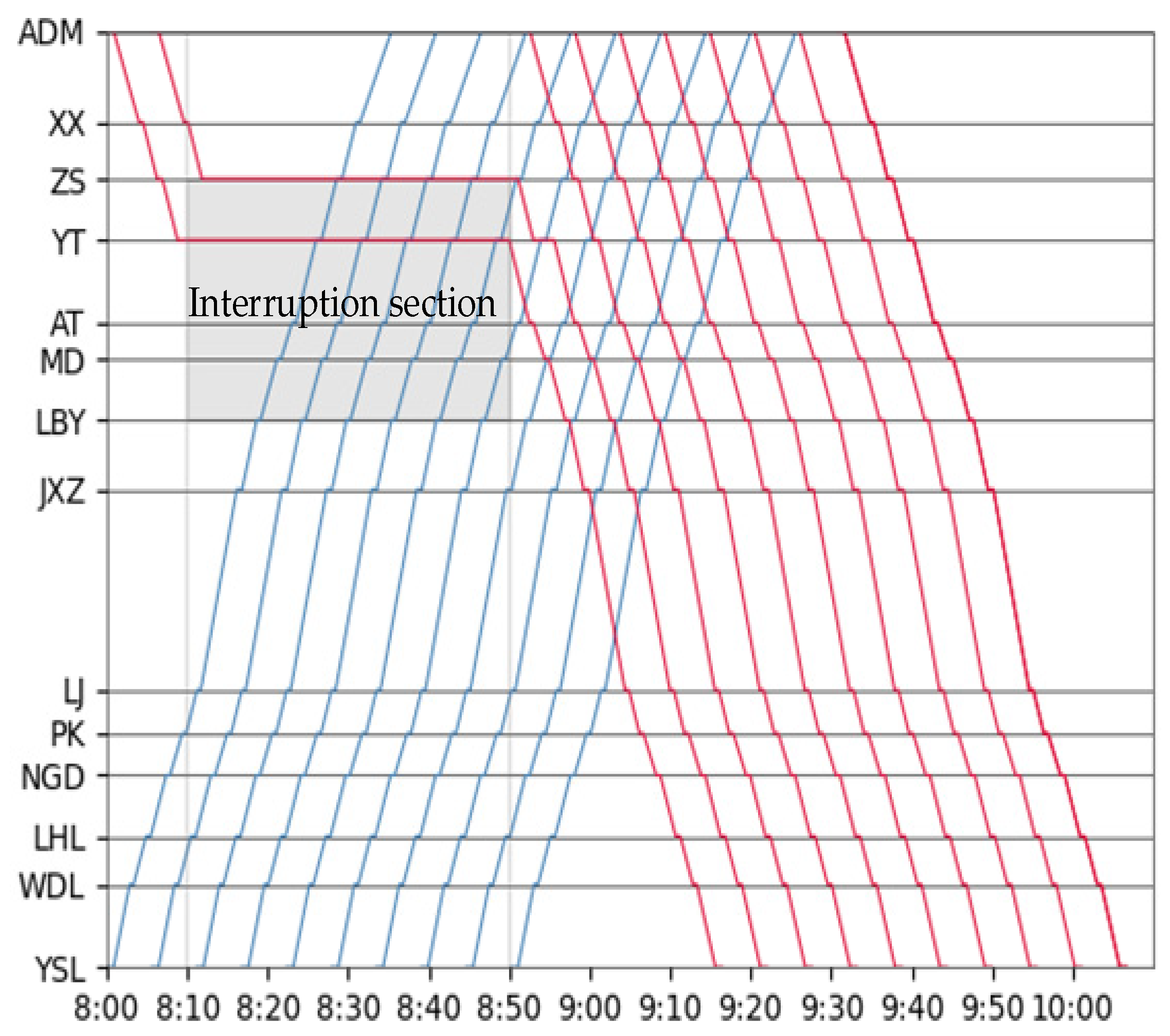
Consistent with the rescheduling strategy described in the numerical examples, upstream and downstream trains are virtually marshaled at stations flanking the interrupted section and subsequently traverse the single-line section alternately in their marshaled formation. As shown in Figure 19, the rescheduled timetable, generated by integrating virtual coupling with section reverse driving, prioritizes the virtual marshaling of upstream trains to expedite passenger flow mitigation through the single-line bottleneck. This prioritization aligns with the observed asymmetric demand, where upstream passenger volume significantly exceeds downstream demand during the interruption period.
Figure 19.
Timetable using section reverse driving based on VC.
From Figure 17 and Figure 18, it is evident that employing a reverse running strategy rather than adjusting strategies can balance the departure intervals for both upstream and downstream trains. As shown in Figure 18 and Figure 19, when trains must wait for the opposing traffic to clear the single-line section, they can virtually couple with another train. This allows platoons to form that pass through the bottleneck more efficiently. Therefore, the trains can enter and leave the single-line section in a marshaling state, with the travel interval greatly reduced in this section.
From Figure 19, we can observe that only the upstream trains are being virtually marshaled, whereas the downstream trains, while continuing to operate in their original state, strive to allow the upstream trains to pass through the single-line section first. This is because during the interruption period, there is a higher demand and a larger passenger flow in the upstream direction. Additionally, the interruption period is set to last for 50 min, and by the time the downward trains start virtual coupling, the interruption has already ended. If the interruption period is appropriately extended, the application of virtual coupling for both upstream and downstream trains becomes noticeably evident, as detailed in the sensitivity analysis.
5.2.2. Waiting Time of Passengers
The calculation results of the objective functions of the three train operation adjustment strategies for passenger demand with a granularity of 5 min are shown in Table 6. In the case of single-line interruption, the VC-SRD strategy proposed in this paper can effectively reduce the objective function value or passenger waiting time and improve hauling efficiency and service levels. Compared with the “running interruption of downstream trains”, the waiting time of passengers in the upstream direction increases. When the interruption duration is too long, the running interruption of downstream trains will lead to the loss of passing capacity along the whole line, leaving trains passing in the downstream direction suspended until the end of the interruption. Compared with the non-organized section reverse running, the waiting time of upstream and downstream passengers under the VC-SRD strategy is more balanced. The objective function is reduced by 155,929 s compared with the non-VC-SRD strategy. From the objective function, the total passenger waiting time of VC-SRD is the shortest, effectively improving hauling efficiency. The results show that the “virtual coupling + reverse driving in the section” strategy proposed in this paper and the adjustment model of rescheduling trains during single-line interruptions in urban rail transit based on virtual coupling are both effective and superior in terms of reducing passenger waiting time.
Table 6.
Comparison of objective functions.
5.2.3. Hauling Capacity
In the case of single-line interruptions in urban rail transit, the strategy of VC-SRD proposed in this paper can effectively improve hauling capacity, which can be obtained by calculating Equations (29) and (30):
where means the total number of passengers that can be transported within a unit of time; is the the number of trains passing within a unit of time; and is the passenger capacity for each train. is obtained from the rescheduled timetable, = 1340, and for trains in the virtual marshaling state has a value of 2680.
It can be seen from Table 7 that the VC-SRD strategy proposed in this paper can effectively recover the loss of hauling capacity caused by the interruption. Compared with the original timetable, hauling capacity under the SRD strategy is reduced by 68.75%; hauling capacity under the VC-SRD strategy is reduced by 50%. Compared with “section reverse driving without virtual coupling”, the use of virtual coupling technology can improve hauling capacity by 60%. The calculation results proved the hauling capacity restoration effectiveness and superiority of the proposed VC-SRD strategy and the virtual coupling-based rescheduling model during single-line interruptions in urban rail transit.
Table 7.
Comparison of hauling capacity.
In summary, these results indicate that, compared to traditional rescheduling strategies, virtual coupling-based train rescheduling strategies can effectively reduce the total passenger waiting time at stations, particularly in cases of longer disrupted sections. This ensures a smooth travel experience for the majority of passengers, even under severe operational conditions.
5.2.4. Sensitivity Analysis
To understand the effectiveness of employing a virtual coupling-based bidirectional strategy under different interruption durations, the model proposed earlier was utilized to solve adjusted train operations for interruption durations of 20 min, 40 min, 60 min, 80 min, 100 min, and 120 min. These data contribute to the assessment of the impact of employing virtual grouping-based bidirectional train strategies under varying interruption durations and further enhance our understanding of the strategy’s effectiveness and applicability across different circumstances.
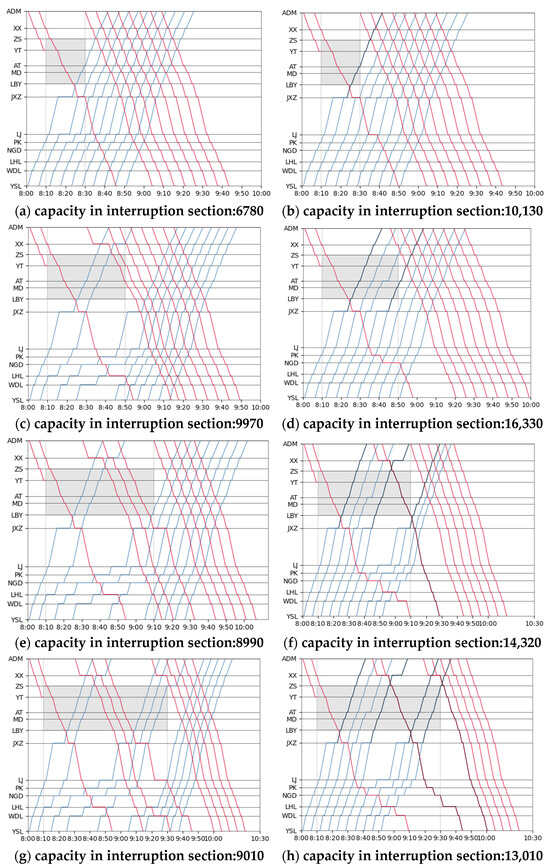
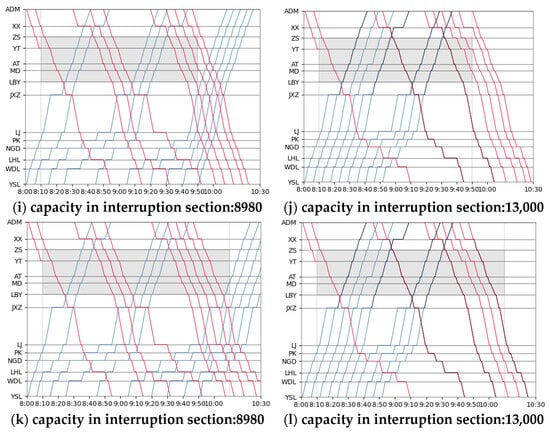
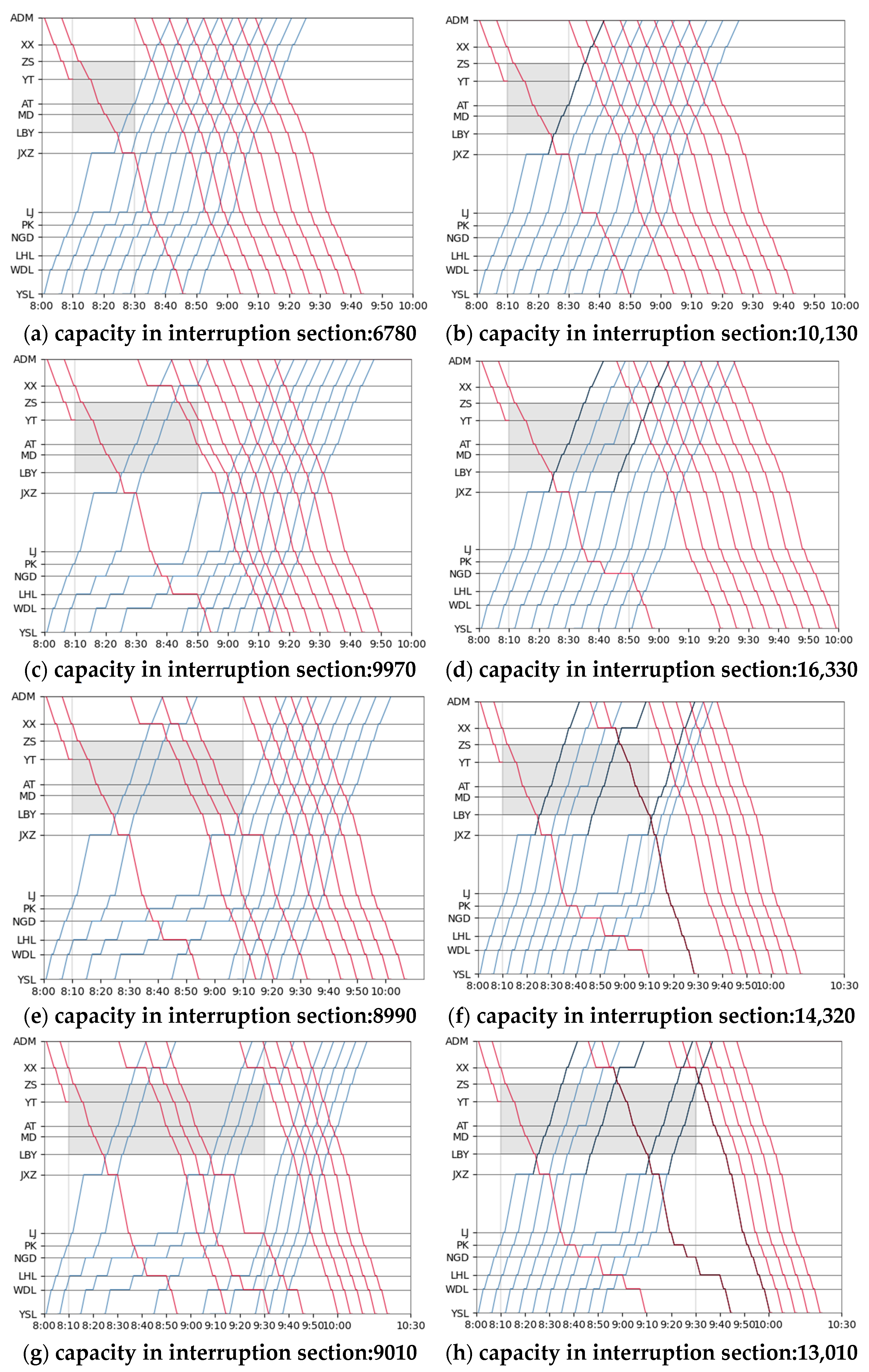
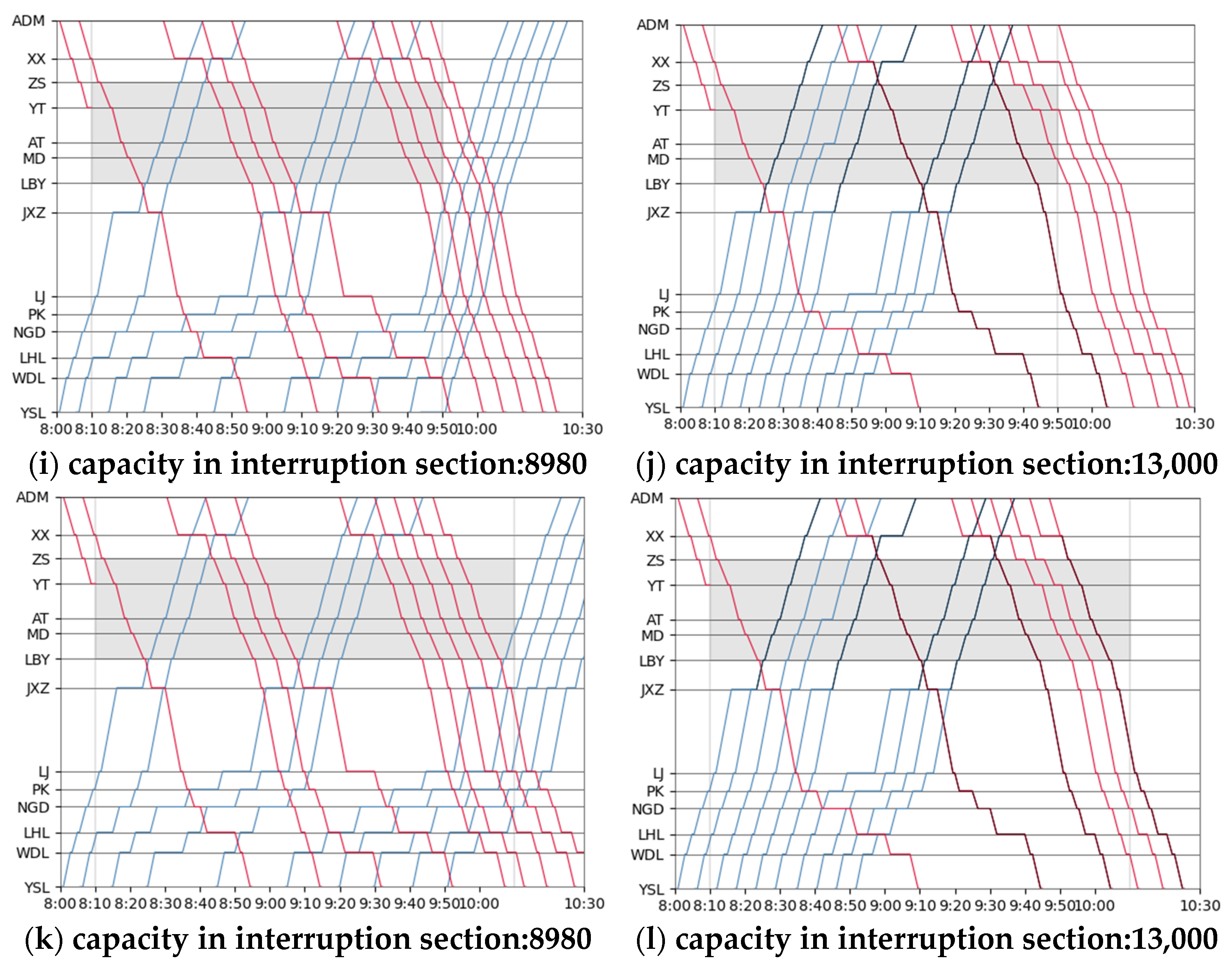
Figure 20 compares the rescheduled timetables of two strategies—conventional section reverse driving and VC-SRD—under different interruption durations. Analysis of these timetables clearly reveals the core advantages of the VC-SRD strategy and its dynamic evolution as the interruption duration increases. Under short interruptions (e.g., 20 min), the VC-SRD strategy already enables upstream trains to virtually couple outside stations and subsequently pass through the single-line section together. As the interruption duration extends to 60 min or longer, the systematic virtual coupling of both upstream and downstream trains at both ends of the section becomes the operational norm, significantly enhancing the utilization efficiency of the single-line section.
Figure 20.
Rescheduling timetables with SRD and VC-SRD strategies under different interruption durations (20–120 min) showing interruption capacity.
Compared to the conventional strategy, where trains must wait at the entrance of the single-line section for the opposing train to completely clear it, trains under the VC-SRD strategy pass through in platoons with minimal safe headways. This directly reduces train waiting times at the bottleneck, thereby mitigating departure delays at subsequent stations.
When the interruption duration exceeds 80 min, the disparity between the two strategies widens substantially. The timetable under the conventional SRD strategy exhibits increasingly long train queues and severe delay propagation, whereas the VC-SRD strategy maintains a relatively compact and stable operational schedule. This demonstrates its superior recovery capability and robustness in dealing with severe service disruptions.
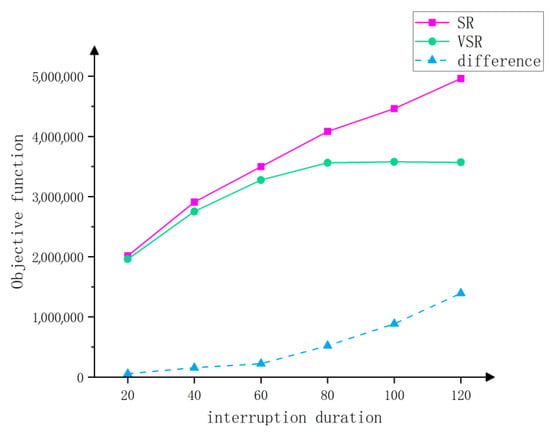
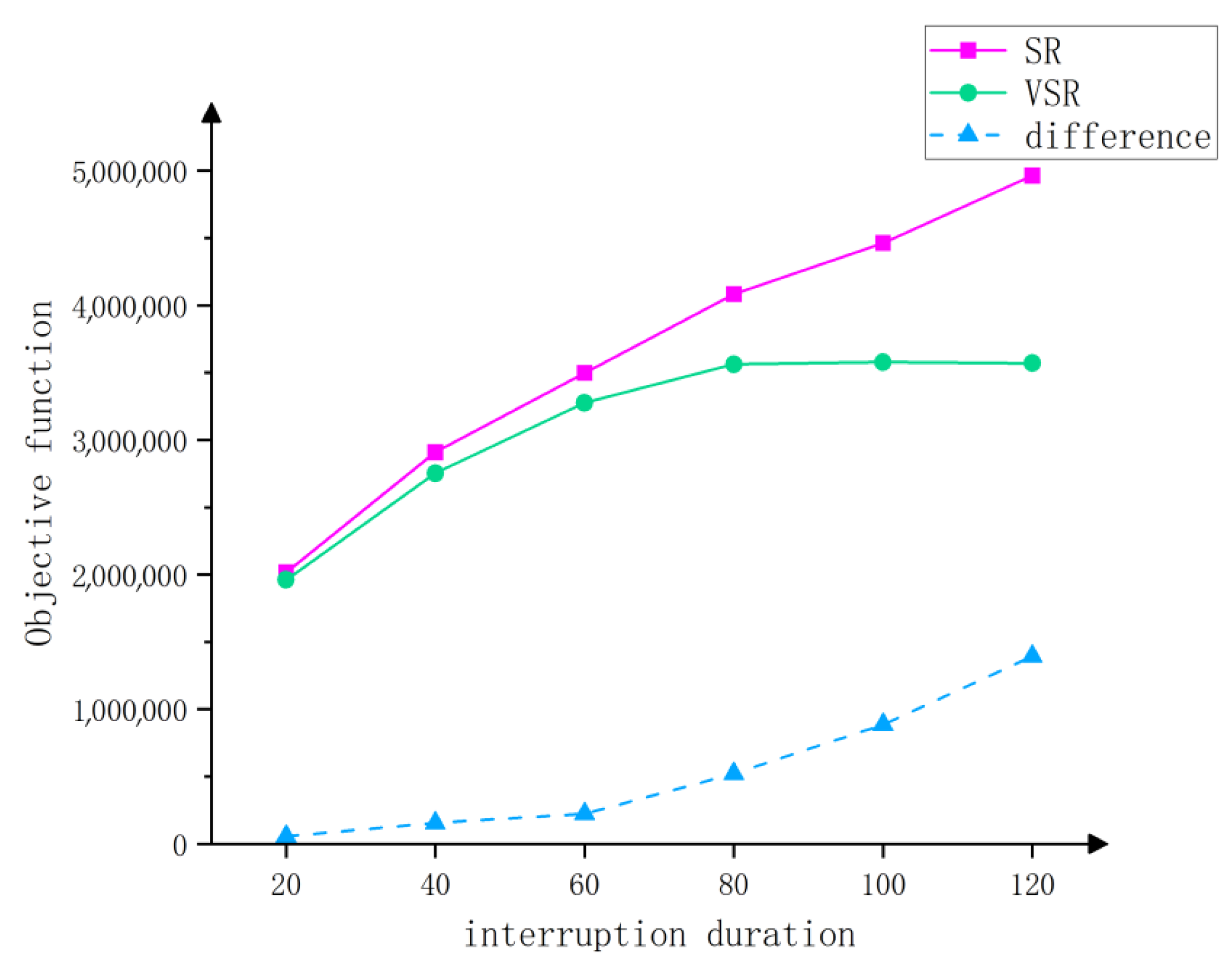
From Table 8 and Figure 21, it can be observed that the total passenger waiting time increases continuously when the two-train strategy is employed. This is because interruptions along the route increase the intervals between train operations, thereby resulting in longer waiting times for passengers. However, with the application of the virtual coupling-based strategy, the increase in passenger waiting time is getting slower. When the interruption time exceeds 60 min, the change in the objective function is relatively smooth. In contrast, with the application of traditional train strategies, passenger waiting time increases rapidly. The difference in the objective function values between the two approaches increases at an accelerating rate.
Table 8.
Train rescheduling results of two strategies under different interruption durations.
Figure 21.
Trend of total waiting time for passengers under different interruption durations.
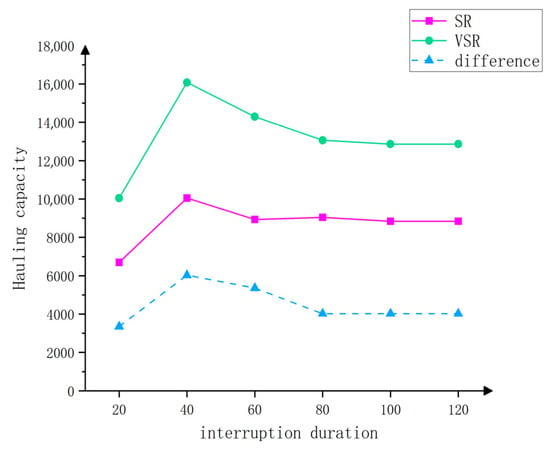
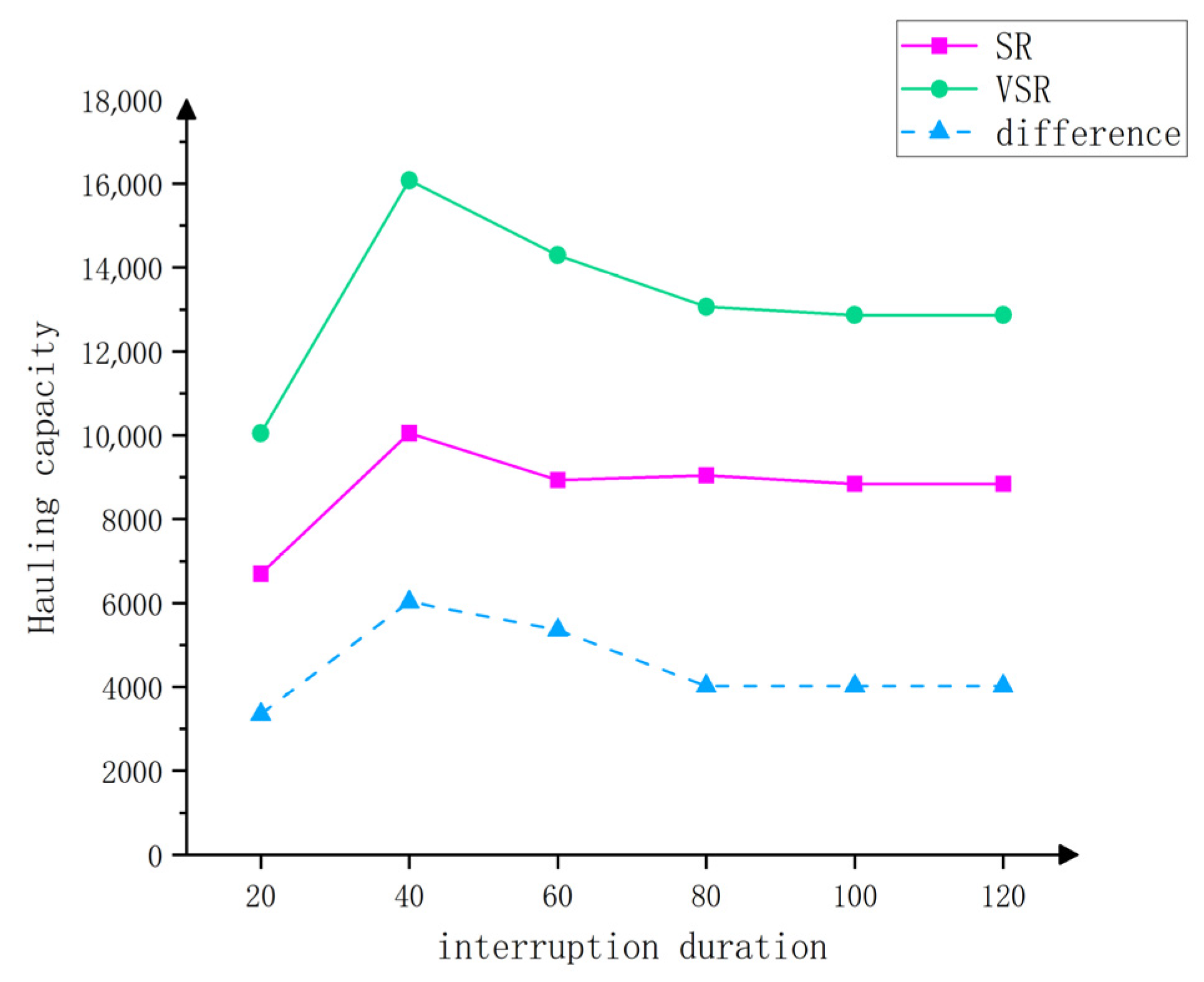
Based on Figure 22, it is observed that with increasing interruption durations, hauling capacity under both strategies initially increases substantially then gradually decreases to a stable level, with the difference between them reflecting this trend. Analysis of the timetable indicates that this occurs because when the interruption duration is slightly extended, the rescheduling strategy begins to be implemented smoothly, resulting in a significant recovery of hauling capacity. However, as the interruption duration continues to lengthen, the scheduling strategy functions normally, and hauling capacity stabilizes accordingly. During this period, the application of virtual coupling technology consistently demonstrates its superiority in enhancing hauling capacity.
Figure 22.
Trend of hauling capacity under different interruption durations.
Considering the operational costs associated with the practical application of virtual coupling technology, sensitivity analysis of interruption durations indicates that its advantages are limited during short interruptions. Therefore, for relatively brief interruptions of around 60 min, the SRD is more suitable. However, in cases of prolonged interruptions lasting from 80 to 120 min or longer, virtual coupling technology demonstrates significant advantages in adjustment. Furthermore, when the interruption is short and passenger demand in the disrupted direction is substantially lower than that in the normal line direction, adopting the “running interruption of downstream trains” strategy is more appropriate to reduce scheduling and operational costs.
Under the conditions of different interruption durations, the virtual coupling-based train strategy outperforms the traditional SRD strategy, and the disparity in their adjustment effects grows with longer interruption durations. Therefore, theoretically speaking, when a single-line interruption occurs in urban rail transit lines, it may be advisable to utilize the virtual coupling-based train strategy proposed and adjustment model presented in this paper under idealized conditions. This approach aims to fully utilize the hauling capacity of the interrupted line and maximally meet passenger demands.
6. Conclusions
In the context of autonomous transport development, this study demonstrates that virtual coupling (VC) technology can contribute to the enhanced resilience of urban rail transit during single-line interruptions. This research provides a validated pathway for integrating autonomous train technologies into real-time operational decision-making, supporting the development of more adaptive and passenger-oriented urban rail systems.
The model proposed in this study shows significant differences and advancements in both the problem context and the optimization objectives when compared to earlier scheduling research based on VC. Our study pioneers the application of this technology to the specific scenario of single-line service disruptions. While inheriting the advantages of VC in improving line capacity and enabling flexible formations, our model has the core objective of minimizing total passenger waiting time during the disruption. Case study results demonstrate that, for this specific objective, the VC-SRD strategy can reduce passenger waiting time and increase hauling capacity by 60%. This proves that integrating VC technology with classic disruption management goals, such as passenger experience, creates a significant synergistic effect, offering a new technical pathway for solving challenging practical operational problems. Sensitivity analysis indicates that the SRD is more suitable for relatively short interruptions of around 60 min. In cases of prolonged interruptions lasting from 80 to 120 min or longer, the VC-SRD strategy is recommended. Furthermore, when the interruption duration is short and passenger demand in the disrupted direction is substantially lower than that in the normal line direction, adopting the “running interruption of downstream trains” strategy is more appropriate.
The practical implementation and impact of these strategies are critically dependent on three key factors: technical feasibility, communication reliability, and station infrastructure. The significant performance gains of VC-SRD are contingent upon high-fidelity, real-time train-to-train communication. Any latency or failure in this system directly compromises operational safety and efficiency. Furthermore, the strategy necessitates station platforms capable of accommodating virtually coupled train sets, which may require substantial infrastructural modifications to existing systems for simultaneous passenger boarding and alighting.
Therefore, while the operational benefits of VC are substantial, they are not without prerequisites. Future work must transition from theoretical models to addressing these practical engineering challenges, focusing on robust communication protocols under real-world conditions and cost-effective station adaptation strategies to unlock the full potential of virtual coupling in urban rail disruption management.
While this study validates the significant potential of virtual coupling in responding to single-line disruptions, the effectiveness of the models and strategies is predicated on several idealized assumptions. These limitations point the way for future research. Firstly, the model presupposes that all relevant station platforms are pre-equipped with virtual coupling capabilities and that vehicle-to-vehicle communication is instantaneous, stable, and ideal. In practical applications, retrofitting existing line platforms to accommodate longer coupled trains and facilitate simultaneous passenger boarding/alighting presents substantial engineering and cost challenges. Furthermore, communication delays, packet loss, or system failures could pose significant threats to the safety and reliability of virtual coupling operations. Future research needs to incorporate the non-ideal characteristics of communication systems and explore feasible strategies, such as equipping only a subset of stations with VC capabilities or implementing degraded operational modes. Secondly, although the constructed mixed-integer nonlinear programming model can be solved effectively by commercial solvers like GUROBI for small-to-medium-scale cases, its computational efficiency may become a bottleneck for large-scale real-world networks or scenarios requiring a real-time response. Developing efficient heuristic algorithms or reinforcement learning methods to enable rapid rescheduling for large-scale networks is a crucial step toward practical application. Thirdly, while three VC strategies are proposed in this paper, the case study section provides detailed modeling and validation only for the VC-SRD strategy. The practical effectiveness, applicable conditions, and corresponding optimization models for the “Virtual Coupling + Short-Turn Routing” and “Virtual Coupling + Alternating Direction” strategies warrant further investigation and comparative analysis through simulation in subsequent work. Finally, this research focuses on a single-line system. Future studies should extend the framework to large-scale network operations, considering the propagation effects of disruptions across multiple lines, and investigate network-wide cooperative recovery strategies based on VC to further enhance the overall resilience of urban rail transit systems.
Author Contributions
Study conception and design, S.H.; data collection, W.Z.; analysis and interpretation of results, F.L.; draft manuscript preparation, S.L. and J.L. All authors have read and agreed to the published version of the manuscript.
Funding
This research was funded by the Fundamental Research Funds for the Central Universities (Grant No. 2024JBZX030); the National Natural Science Foundation of China (Grant No. 72471023); Traffic Control Technology Funding Program number 9907006518; Beijing Natural Science Foundation (L201013).
Data Availability Statement
The original contributions presented in this study are included in the article. Further inquiries can be directed to the corresponding author.
Conflicts of Interest
Author Sha Li was employed by the company Beijing Rail Transit Technology Equipment Group Co., Ltd. The remaining authors declare that the research was conducted in the absence of any commercial or financial relationships that could be construed as a potential conflict of interest.
Abbreviations
The following abbreviations are used in this manuscript:
| VC | Virtual coupling |
| SRD | reverse driving in the section without VC |
| VC-SRD | Virtual coupling + reverse driving in the section |
References
- Han, B.; Li, Z.; Jin, Y.; Lu, F.; Hu, J.; Huang, S.; Wang, D.; Zhang, Z.; Gao, J.; Feng, F.; et al. Statistical Analysis of Urban Rail Transit Operations Worldwide in 2024: A Review. Urban Rapid Rail Transit 2025, 38, 1–12. [Google Scholar]
- Lu, K.; Zhang, L.; Li, S.; Huang, Y.; Ding, X.; Hao, J.; Huang, S.; Li, X.; Lu, F.; Zhang, H. Urban Rail Transit in China: Progress Report and Analysis (2015–2023). Urban Rail Transit 2025, 11, 1–27. [Google Scholar] [CrossRef] [Scilit]
- Bock, U.; Varchmin, J.U. Erhöhung der Streckenauslastung durch virtuelle Zugverbände. In Proceedings of the Tagung der VDI-Gesellschaft Fahrzeug- und Verkehrstechnik, Duesseldorf, Germany, 28–29 October 1999; pp. 315–324. [Google Scholar]
- Bock, U.; Bikker, G. Design and Development of a Future Freight Train Concept—“Virtually Coupled Train Formations”. IFAC Proc. Vol. 2000, 33, 395–400. [Google Scholar] [CrossRef] [Scilit]
- Stander, T.; Drewes, J.; Braun, I.; Schnieder, E. Operational and Safety Concepts for Railway Operation with Virtual Train-Sets. IFAC Proc. Vol. 2006, 39, 261–266. [Google Scholar] [CrossRef] [Scilit]
- Nold, M.; Corman, F. Dynamic train unit coupling and decoupling at cruising speed: Systematic classification, operational potentials, and research agenda. J. Rail Transp. Plan. Manag. 2021, 18, 100241. [Google Scholar] [CrossRef] [Scilit]
- Goikoetxea, J. Roadmap Towards the Wireless Virtual Coupling of Trains. In Proceedings of the International Workshop on Communication Technologies for Vehicles; Springer International Publishing: Cham, Switzerland, 2016; pp. 395–400. [Google Scholar]
- Quaglietta, E.; Spartalis, P.; Wang, M. Modelling and analysis of Virtual Coupling with dynamic safety margin considering risk factors in railway operations. J. Rail Transp. Plan. Manag. 2022, 22, 100313. [Google Scholar] [CrossRef] [Scilit]
- Gómez, A.A.; Mozo, E.; Bernadó, L.; Zelenbaba, S.; Zemen, T.; Parrilla, F.; Alberdi, A. Performance Analysis of ITS-G5 for Smart Train Composition Coupling. In Proceedings of the 16th International Conference on Intelligent Transportation Systems Telecommunications (ITST), Lisbon, Portugal, 15–17 October 2018. [Google Scholar]
- Di Meo, C.; Di Vaio, M.; Flammini, F.; Nardone, R.; Santini, S.; Vittorini, V. ERTMS/ETCS Virtual Coupling: Proof of Concept and Numerical Analysis. IEEE Trans. Intell. Transp. Syst. 2019, 21, 2545–2556. [Google Scholar] [CrossRef] [Scilit]
- Chen, Q. Research on adjustment strategy of tracking interval of trains formation operation based on train-to-train communication. Electron. Des. Eng. 2016, 24, 97–100. [Google Scholar]
- Song, Z.; Xu, X.; Li, H.; Wang, L. Study on Virtual-Coupling-Orientated Train Control Technique. Railw. Stand. Des. 2019, 63, 155–159. [Google Scholar]
- Cui, J.; Liu, L. Research on Key Technology Requirements of Virtual Coupling in Application of Train Control System. Technol. Innov. 2019, 16, 1–5. [Google Scholar]
- Liu, L. Research and Prospect of Intelligent Control Technology for Virtually Coupled Train Formation. Railw. Signal. Commun. Eng. 2020, 17, 1–9. [Google Scholar]
- Chai, S.; Yin, J.; Andrea, D.; Sama, M.; Tang, T. Scheduling of Coupled Train Platoons for Metro Networks: A Passenger Demand-Oriented Approach. Transp. Res. Rec. 2023, 2677, 1671–1689. [Google Scholar] [CrossRef] [Scilit]
- Chai, S.; Yin, J.; Andrea, D.; Liu, R.; Yang, L.; Tang, T. A branch-and-cut algorithm for scheduling train platoons in urban rail network. Transp. Res. Part B Methodol. 2024, 181, 102891. [Google Scholar] [CrossRef] [Scilit]
- Wang, H.; Yang, L.; Zhang, J.; Liu, Q.; Fan, Z. Real-time train timetabling with virtual coupling operations on a Y-type metro line. Eur. J. Oper. Res. 2024, 319, 168–190. [Google Scholar] [CrossRef] [Scilit]
- Zhou, X.; Lu, F.; Wang, L. Optimization of Train Operation Planning with Full-Length and Short-Turn Routes of Virtual Coupling Trains. Appl. Sci. 2022, 12, 7935. [Google Scholar] [CrossRef] [Scilit]
- Jespersen-Groth, J.; Potthoff, D.; Clausen, J.; Huisman, D.; Kroon, L.; Maróti, G.; Nielsen, M.N. Disruption Management in Passenger Railway Transportation. In Robust and Online Large-Scale Optimization; Lecture Notes in Computer Science; Springer: Berlin/Heidelberg, Germany, 2009; Volume 5868, pp. 399–421. [Google Scholar]
- Canca, D.; Barrena, E.; Zarzo, A.; Ortega, F.; Algaba, E. Optimal Train Real-Location Strategies under Service Disruptions. Procedia Soc. Behav. Sci. 2012, 54, 402–413. [Google Scholar] [CrossRef] [Scilit]
- Canca, D.; Barrena, E.; Laporte, G.; Ortega, F.A. A Short-Turning Policy for the Management of Demand Disruptions in Rapid Transit Systems. Ann. Oper. Res. 2016, 246, 145–166. [Google Scholar] [CrossRef] [Scilit]
- Ghaemi, N.; Zilko, A.A.; Yan, F.; Cats, O.; Kurowicka, D.; Goverde, R.M.P. Impact of railway disruption predictions and rescheduling on passenger delays. J. Rail Transp. Plan. Manag. 2018, 8, 103–122. [Google Scholar] [CrossRef] [Scilit]
- Jamili, A.; Nejad, M.; Ghoreshi, M. Urban Railway Operation Recovery during Disruption. In Proceedings of the 18th International IEEE Conference on Intelligent Transportation Systems, Gran Canaria, Spain, 15–18 September 2015; pp. 2825–2830. [Google Scholar]
- Yin, J.; Yang, L.; Tang, T.; Gao, Z.; Ran, B. Dynamic Passenger Demand Oriented Metro Train Scheduling with Energy-Efficiency and Waiting Time Minimization: Mixed-Integer Linear Programming Approaches. Transp. Res. Rec. 2017, 97, 182–213. [Google Scholar] [CrossRef] [Scilit]
- Long, S.; Luan, X.; Corman, F. Passenger-Oriented Rescheduling of Trains and Rolling Stock for Handling Large Passenger Demand: Linearized Models with Train Capacity Constraint. Transp. Metr. B Transp. Dyn. 2021, 9, 641–672. [Google Scholar] [CrossRef] [Scilit]
- Corman, F.; D’Ariano, A.; Marra, A.D.; Pacciarelli, D.; Samà, M. Integrating Train Scheduling and Delay Management in Real-Time Railway Traffic Control. Transp. Res. Part E Logist. Transp. Rev. 2017, 105, 213–239. [Google Scholar] [CrossRef] [Scilit]
- Yue, Y.; Han, J.; Wang, S.; Liu, X. Integrated Train Timetabling and Rolling Stock Scheduling Model Based on Time-Dependent Demand for Urban Rail Transit. Comput. Aided Civ. Infrastruct. Eng. 2017, 32, 856–873. [Google Scholar] [CrossRef] [Scilit]
- Tessitore, M.L.; Samà, M.; D’Ariano, A.; Hélouet, L.; Pacciarelli, D. A Simulation Optimization Framework for Traffic Disturbance Recovery in Metro Systems. Transp. Res. Part C Emerg. Technol. 2022, 136, 103525. [Google Scholar] [CrossRef] [Scilit]
- Xu, X.; Li, K.; Yang, L. Rescheduling Subway Trains by a Discrete Event Model Considering Service Balance Performance. Appl. Math. Model. 2016, 40, 1446–1466. [Google Scholar] [CrossRef] [Scilit]
- Zhu, Y.; Goverde, R.M.P. Integrated Timetable Rescheduling and Passenger Reassignment during Railway Disruptions. Transp. Res. Part B Methodol. 2020, 140, 282–314. [Google Scholar] [CrossRef] [Scilit]
- Huang, Y.; Mannino, C.; Yang, L.; Tang, T. Coupling Time-Indexed and Big-M Formulations for Real-Time Train Scheduling during Metro Service Disruptions. Transp. Res. Part B 2020, 133, 38–61. [Google Scholar] [CrossRef] [Scilit]
- Zhu, Q.; Bai, Y.; Yang, L.; Chen, Y.; Yan, D. Collaborative Optimization of Rescue Operation and Timetable Rescheduling under Metro Train Failure. Transp. B Transp. Dyn. 2023, 11, 2203847. [Google Scholar] [CrossRef] [Scilit]
- Owais, M.; Hassan, T. Incorporating Dynamic Bus Stop Simulation into Static Transit Assignment Models. Int. J. Civ. Eng. 2018, 16, 67–77. [Google Scholar] [CrossRef] [Scilit]
- Owais, M.; Ahmed, A.S. Frequency Based Transit Assignment Models: Graph Formulation Study. IEEE Access 2022, 10, 62991–63003. [Google Scholar] [CrossRef] [Scilit]
- Almutairi, A.; Owais, M.; Ahmed, A.S. Notes on Bus User Assignment Problem Using Section Network Representation Method. Appl. Sci. 2024, 14, 3406. [Google Scholar] [CrossRef] [Scilit]
- Li, Z.; Yin, J.; Besinovic, N.; Chai, S.; Tang, T. Resilience Assessment and Optimization of Urban Rail Systems with Train Platoons: A Passenger Demand Oriented Approach. In Proceedings of the 2024 IEEE 27th International Conference on Intelligent Transportation Systems (ITSC), Edmonton, AB, Canada, 24–27 September 2024. [Google Scholar]



Disclaimer/Publisher’s Note: The statements, opinions and data contained in all publications are solely those of the individual author(s) and contributor(s) and not of MDPI and/or the editor(s). MDPI and/or the editor(s) disclaim responsibility for any injury to people or property resulting from any ideas, methods, instructions or products referred to in the content. |
© 2026 by the authors. Licensee MDPI, Basel, Switzerland. This article is an open access article distributed under the terms and conditions of the Creative Commons Attribution (CC BY) license.