


Abstract
Background: Voice interaction can reduce access barriers in digital health, but cloud-dependent assistants raise connectivity, latency, autonomy and privacy concerns. Deploying a complete spoken-dialogue pipeline on resource-constrained edge devices remains challenging. Objective: This scoping review mapped voice-interaction technologies evaluated in edge-computing environments and identified relevant modules, platforms, optimization strategies, evaluation practices and evidence gaps relevant for digital health. Methods: In accordance with PRISMA-ScR, seven information sources were searched for records published in English or Portuguese between 2020 and 2025. Journal articles, conference papers, reviews, book chapters, technical reports and theses were eligible when they addressed at least one core voice-interaction component and documented local or edge execution, resource optimization or a direct digital-health or transferable assistive application. Privacy and security were charted as cross-cutting dimensions rather than independent inclusion criteria. Data were charted for evidence type, application relevance, voice modules, edge platform, optimization techniques, evaluation metrics and reported limitations. Results: Seventy sources were included: 61 primary studies, 7 reviews and 2 viewpoints. Evidence focused on speech-to-text and automatic speech recognition (41 sources) and on natural language processing, natural language understanding and large language models (37 sources). Ten primary studies implemented a complete spoken-dialogue pipeline, but none of the pipelines ran fully offline on constrained hardware in a digital-health application, and four implemented explicit privacy or security safeguards. Evaluations emphasized system performance (55 sources) and resource efficiency (39 sources), whereas 15 sources reported health-task measures and none reported clinical outcomes. Limitations: Major health and clinical databases were not searched, several searches required conversational or language-processing terms, one reviewer performed study selection and data extraction, no formal quality appraisal was conducted and study heterogeneity limited direct comparison. Conclusions: In the retrieved evidence, edge deployment of individual voice modules is advancing, but complete offline digital-health systems remain under-evaluated. Future research should integrate reliable, privacy-preserving pipelines and test them under realistic conditions using technical and health-related outcomes.
1. Introduction
Digital-health systems increasingly support access to health information, self-management and personalized interaction. As these systems are adopted in homes, schools and community settings, accessibility, trust and continuity of operation must be considered alongside technical performance. Voice interaction may improve accessibility by reducing reliance on visual navigation and manual input, particularly for users with limited digital literacy or visual or motor impairments [1]. Multimodal virtual companions and personal assistants have also been developed and evaluated to support older adults and care provision at home [2,3,4], building on context-based human–machine interaction frameworks for artificial social companions [5].
A spoken conversational agent typically comprises several interconnected modules: wake-word detection (WWD) or keyword spotting (KWS), voice activity detection (VAD), speech-to-text (STT) or automatic speech recognition (ASR), natural language processing and understanding (NLP/NLU), dialogue management (DM), response generation and text-to-speech (TTS). Response generation may rely on structured knowledge, retrieval-augmented generation (RAG) or large language models (LLMs). Although recent neural models have improved individual components, many practical systems continue to depend on cloud services.
Reliance on cloud services may introduce network delays, interruptions, service-availability constraints, and the transmission of audio, transcripts, or health-related queries outside the user’s device. These concerns are particularly important in digital health because spoken interactions may disclose symptoms, routines, identifiers, or other sensitive information. Edge computing provides an alternative by processing data closer to the user, potentially reducing latency, network dependency, and external data transfer [6,7]. However, constraints in processing capacity, memory, storage and energy consumption restrict the models and processing pipelines that can be deployed locally.
Several reference works anchor this field. The Speech Commands dataset established a shared benchmark for limited-vocabulary recognition and keyword spotting [8], and subsequent work demonstrated keyword spotting on microcontrollers with kilobyte-scale memory budgets [9]. The MLPerf Tiny benchmark standardized the measurement of accuracy, latency and energy on such devices [10]. At the recognition stage, large-scale weakly supervised models such as Whisper improved the robustness of general-purpose ASR [11] and have since been adapted for edge execution, as in several studies included in this review [12,13,14]. These works define the benchmarks and baselines against which the edge-oriented studies mapped here can be interpreted.
Relevant evidence spans speech processing, natural language processing, embedded computing, human–computer interaction, and digital health. Existing research evaluates individual voice modules and complete pipelines across diverse hardware platforms, datasets, metrics and operating conditions. Consequently, it remains unclear whether advances in individual components can be effectively integrated into digital-health systems that meet requirements for efficiency, reliability, usability and privacy.
To address this gap, this scoping review maps the available evidence across the voice-interaction pipeline and identifies technical and methodological gaps affecting the deployment of voice-interaction systems for digital health on resource-constrained edge devices.
Objectives
The objectives of this review are as follows:
- Identify the voice-interaction modules, models, hardware platforms and architectural patterns used in resource-constrained edge environments.
- Examine optimization strategies used to reduce resource consumption and cloud dependency and to enable local or fully offline operation.
- Characterize privacy and security practices for protecting voice recordings, transcripts and other user data.
- Analyze the metrics and evaluation practices used to assess technical performance, resource efficiency, interaction quality and health-related outcomes.
- Identify evidence gaps and derive recommendations for the design and evaluation of reliable edge-based conversational AI systems.
Review question: What voice-interaction technologies, edge platforms, optimization strategies and evaluation practices have been reported for local execution on resource-constrained edge devices, and what gaps limit their application in digital health?
Table 1 presents the Population–Concept–Context (PCC) framework used to define the scope of the review. The first two objectives address the Concept and Context elements (voice-interaction modules executed on edge hardware), the third addresses privacy and security as a cross-cutting property of the Concept, the fourth addresses outcomes relevant to the Population of intended users, and the fifth integrates the three elements to identify gaps.
Table 1.
PCC framework for the scoping review.
2. Methods
This scoping review examined and categorized recent research on voice-interaction technologies designed for resource-constrained edge environments, with a particular focus on digital-health applications.
The review was conducted and reported in accordance with the Preferred Reporting Items for Systematic Reviews and Meta-Analyses Extension for Scoping Reviews (PRISMA-ScR) [15]. The search strategy was developed and executed between December 2025 and October 2026, and all searches were last executed on 24 October 2026. The IEEE Xplore hit counts in Table 4 were recalculated on 8 November 2026 to verify the strategy, which reproduced the exported queries S13, S14 and S18 exactly (Appendix A); The exported records reported in Table 5 refer to that final execution; records retrieved and screened in the earlier executions but not returned by the final execution were added to the screened set (Section 2.6).
2.1. Protocol and Reporting
No review protocol was registered or published before the conduct of this scoping review. The review was designed using the PCC framework and was reported in accordance with PRISMA-ScR. A completed PRISMA-ScR checklist is provided in the Supplementary Materials as file S1.
Because no protocol was registered, changes made during peer review are reported here for transparency: (i) the eligibility rule was restated as one mandatory condition combined with at least one of three alternative conditions; (ii) evidence type, application relevance, execution location and evaluation mode were added as charting variables; (iii) module coverage was recoded as discussed, implemented or experimentally evaluated; (iv) a hardware-based definition of resource-constrained deployment was introduced, and high-capacity hardware was separated as comparative evidence; and (v) the reporting of query hits, exported records and unique records was separated, and the record flow was reconstructed from the complete set of screened records.
2.2. Eligibility Criteria
Inclusion required that a source address at least one core voice-interaction component and document either resource-constrained edge or local execution, resource optimization, or a direct digital-health or transferable assistive application. Privacy and security were charted as cross-cutting dimensions rather than independent inclusion criteria. Reviews and viewpoints were eligible only when they addressed systems within this scope and provided sufficient information for charting.
Eligibility therefore required one mandatory condition (C1: At least one core voice-interaction component was implemented, evaluated or substantively discussed) and at least one of three alternative conditions (C2a: Documented local or edge execution; C2b: Resource optimization; or C2c: A direct digital-health or transferable assistive application). A source satisfying C1 and C2c could be cloud-based, and a source satisfying C1 and C2a could come from a non-health domain; these sources were retained but classified separately by application relevance (Section 3) so that direct health evidence is not combined with transferable technical evidence. For sources available in several versions, eligibility was determined by the date of the first public version, and data were charted only from the version cited in the reference list.
2.3. Definition of Resource-Constrained Edge Deployment
Resource-constrained deployment was defined by the hardware executing the voice-processing workload, using three tiers: (i) microcontroller- or DSP-class devices with on-chip memory in the kilobyte-to-low-megabyte range and milliwatt-level power budgets; (ii) single-board computers, smartphones and wearable or embedded processors with up to 16 GB of system memory and no discrete GPU; and (iii) accelerated embedded modules (for example, Jetson-class modules, FPGA or ASIC accelerators and NPU-equipped systems-on-chip) with up to 64 GB of memory and a nominal power envelope below 60 W. Laptops, AI PCs, workstations and servers were classified as non-constrained hardware and retained only as comparative evidence. For each source, the execution location of each module (on-device, local edge server or cloud) and the evaluation mode (measurement on physical hardware, simulation or emulation, or not reported) were recorded.
2.4. Information Sources
Seven information sources were searched. Five contributed studies to the final included set: ACM Digital Library, IEEE Xplore, ScienceDirect, Google Scholar and arXiv. Espacenet and the EU Funding & Tenders Portal were also searched to identify technical developments and linked publications. Because patents and project descriptions are not eligible source types (Table 2), their records were inspected on the source platforms for links to eligible publications; none met the eligibility criteria and none was exported for deduplication. The most recent search was executed on 24 October 2026.
Table 2.
Eligibility criteria used in the scoping review.
Table 3 summarizes the information sources searched.
Table 3.
Information sources used in the scoping review.
2.5. Search Strategy
The search strategy was developed iteratively and adapted to the syntax and search functions of each information source. The terms were organized into seven concept blocks: artificial intelligence; voice interaction and language processing; speech processing; edge computing; optimization; digital health; and population. Table 4 presents the IEEE Xplore implementation.
Table 4.
Search strategy implemented in IEEE Xplore.
The OR operator combined synonyms within each concept block, whereas AND connected distinct concept blocks. The complete source-specific search strategies and operational parameters are provided in Appendix A.
2.6. Selection of Evidence Sources
The study-selection process followed the PRISMA-ScR recommendations. Three quantities are distinguished throughout: hits, the number of results returned by a query (Table 4, Table A1, Table A2, Table A3, Table A4, Table A5, Table A6 and Table A7); exported records, the BibTeX records downloaded from the queries listed in Table 5; and unique records, the records remaining after deduplication (Table 6).
Table 5.
Records exported from each information source. Hits are the counts returned by each exported query; nested queries are subsets of the broader query from the same source.
Table 6.
Records retained after deduplication.
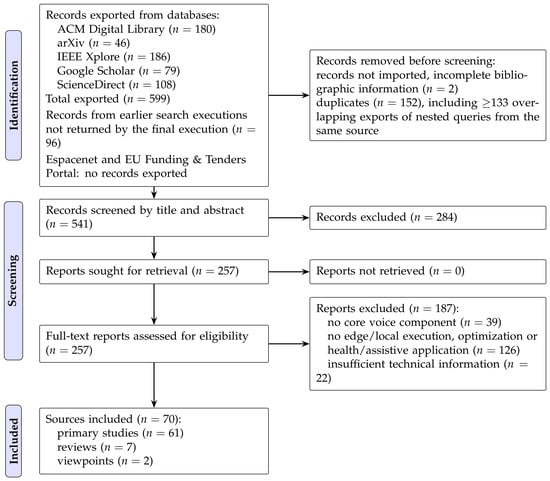
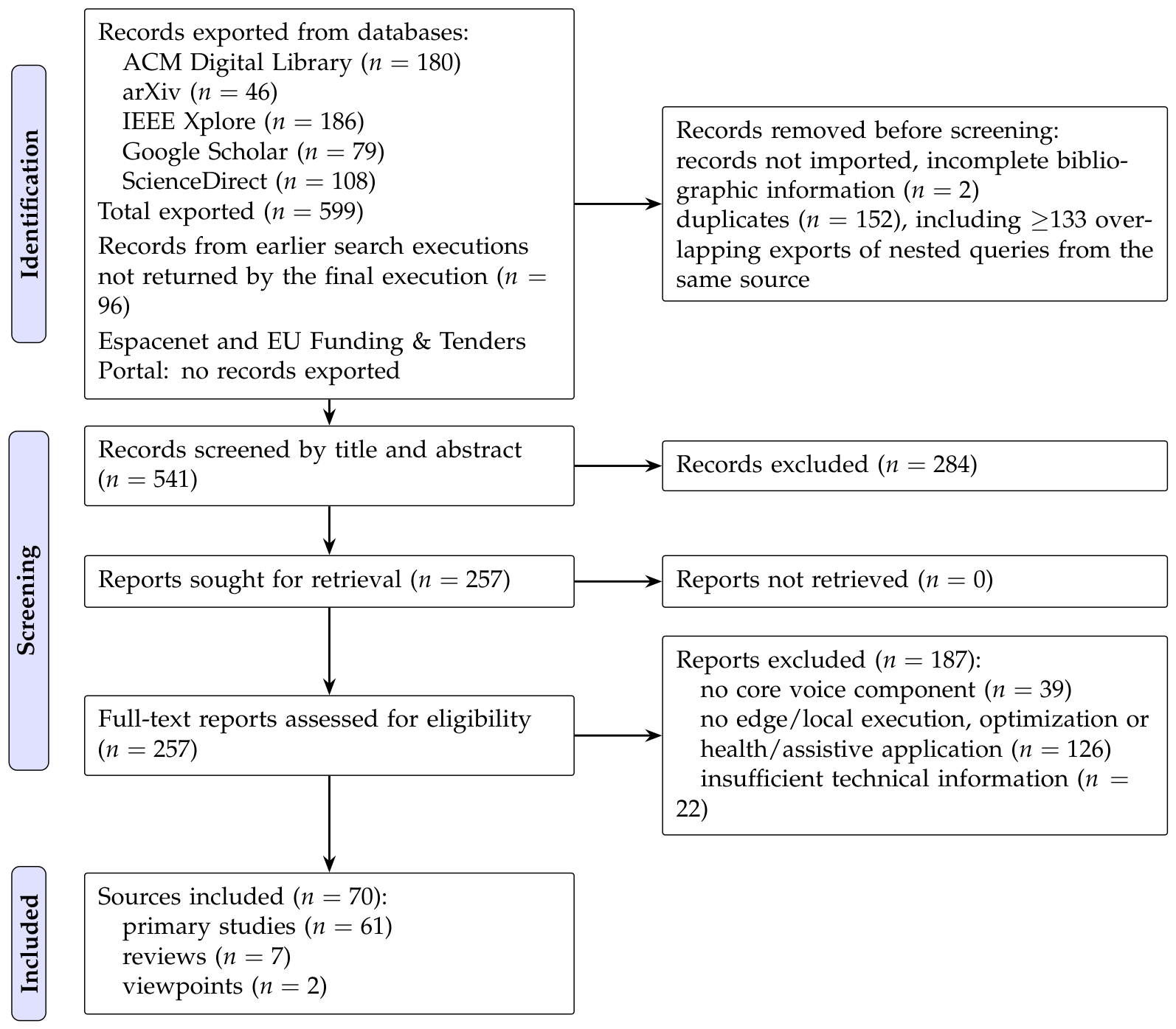
Several exported queries were nested refinements of a broader query from the same source (for example, IEEE Xplore S18 ⊂ S16 ⊂ S14 ⊂ S13). Each nested query was exported in full, so the exported totals in Table 5 include records exported more than once from the same source. A total of 599 records were exported from the five contributing sources in the final execution, of which 597 were imported into the reference manager; 2 records could not be imported because of incomplete bibliographic information. To obtain the complete set of screened records, 96 records that had been retrieved and screened in the earlier search executions but were not returned by the final execution were added, giving 693 records before deduplication. Duplicates, including within-source overlaps and cross-source duplicates, were identified in the reference manager and re-verified on this complete set by matching DOIs and normalized titles (Table 6). The complete record set, with the screening decision for each record, is provided in the Supplementary Materials as file S5.
Of the 152 duplicates removed, at least 133 were within-source overlaps created by exporting nested queries (the minimum of 135 in Table 5, less the 2 records that could not be imported); the remainder were cross-source duplicates, overlaps between non-nested queries or records retrieved by more than one search execution. The 541 unique records underwent title and abstract screening, resulting in the exclusion of 284 records that did not meet the eligibility criteria. The remaining 257 full-text reports were retrieved and assessed for eligibility, as detailed in Table 7.
Table 7.
Final number of results included.
Of the 257 full-text reports assessed, 187 were excluded for the following primary reasons: no relevant voice-interaction component (, failing C1); no documented edge or local execution, no resource optimization and no direct digital-health or transferable assistive application (, failing all of C2a–C2c); and insufficient technical information to determine eligibility (). Each excluded report was assigned one primary reason.
Figure 1 summarizes the identification, deduplication, screening, eligibility assessment, and final inclusion of studies. Data from the included studies were then collected using a standardized charting form.
Figure 1.
PRISMA-ScR flow diagram of the source-selection process. Exports of nested queries from the same source contained overlapping records. Duplicate copies were removed.
2.7. Data Charting
Data were manually charted by one reviewer (L.F.) using a standardized form. The process recorded the evidence type, application relevance, voice-interaction modules, edge platform, execution location, evaluation mode, optimization and integration methods, evaluation metrics and reported limitations. Selection and charting were performed by a single reviewer without independent verification, and the charting form was not pilot-tested before use. During revision, the record flow was reconstructed from the reference-manager exports and the category coding was re-derived from the study-level charting matrix; these steps were supervised and approved by a second author (J.Q.). Initial selection and charting were not independently duplicated. Information unavailable in the publications was recorded as not reported, and no data were requested from investigators.
2.8. Data Items
Table 8 defines the variables charted for each included source.
Table 8.
Data items charted for each source of evidence.
2.9. Coding Rules
A coding guide was used to classify each source consistently. A voice module was coded as: discussed, when it was described without implementation; implemented, when it formed part of the reported system; and evaluated, when its performance was measured experimentally. Module, optimization and evaluation categories were non-mutually exclusive. Each study was assigned one primary platform according to the device through which the user interacts with the system, as presented by the authors; commercial assistants and web or cloud services formed a separate category, and laptops, AI PCs and workstations were classified as non-constrained comparative hardware; when processing was delegated to a companion device, edge server or cloud service, the hardware executing each module was recorded separately as its execution location. Unavailable information was coded as not reported. Privacy and security were treated as cross-cutting dimensions rather than optimization techniques and were coded at three levels: explicit safeguard implemented, engineering strategy described, and privacy or security outcome evaluated. A source was coded as a complete pipeline when a single reported system processed spoken input to produce spoken output, including at least speech recognition, language processing or response selection, and speech synthesis. Application relevance was coded as direct digital health when the system or evaluation addressed a health, care or clinical task, and as transferable when the technical contribution was relevant to such tasks but was evaluated in another domain. Optimization techniques were coded only for primary studies. Evaluation categories were coded from the reported measures: Health-task performance denotes correctness, effectiveness, safety or efficiency measured in a health, care, clinical or assistive task, and privacy or security integrity denotes attack resistance, data leakage, unintended activation or security requirements. Privacy and security were coded as an implemented safeguard, a strategy or requirement discussed without an implemented safeguard, or an evaluated outcome. All category counts in Table 9, Table 10, Table 11, Table 12 and Table 13 were derived from the study-level charting matrix (Appendix B) by applying these rules; the code assigned to each source is given in the Supplementary Materials (file S4).
Table 9.
Distribution of edge platforms identified in the included studies ().
Table 10.
Voice-interaction coverage in the included studies ().
Table 11.
Optimization and integration techniques reported in the included studies ().
Table 12.
Privacy and security evidence reported in the included sources (). The first two levels are mutually exclusive; outcome evaluation can co-occur with either.
Table 13.
Evaluation categories reported in the included studies ().
2.10. Critical Appraisal of Evidence Sources
Consistent with the exploratory and descriptive purpose of this scoping review, no formal methodological quality or risk-of-bias assessment was performed. Study selection was based exclusively on relevance to the review question and the predefined eligibility criteria, while methodological aspects were considered descriptively without influencing inclusion.
During data extraction, several general aspects were considered to support the interpretation of the findings and the identification of gaps in the available evidence:
- Clarity of methodological reporting: Sufficient description of the methods, models and procedures used in the study.
- Evaluation context: Adequacy of the description of the experimental conditions, study setting and evaluation procedures.
- Transparency of results: Clear presentation of the evaluation measures, reported outcomes and supporting evidence.
- Reporting of limitations: Identification of the main limitations, constraints and challenges reported by the authors.
- Relevance and applicability: Relevance of the study to the review scope and applicability of the reported approach to edge-based voice interaction.
These aspects supported the interpretation of findings and identification of evidence gaps, but did not influence study selection or weighting. The review therefore provides a descriptive rather than formal methodological appraisal of the evidence.
2.11. Synthesis of Results
The charted data were synthesized using descriptive frequencies and narrative comparison to identify technological patterns and research gaps. Counts were based on the 70 included studies, with percentages calculated as , where n represents the number of studies assigned to each category. Voice-module, optimization and evaluation categories were non-mutually exclusive, allowing each study to contribute to more than one category.
Platform analysis used one primary category per study, while studies without a clearly specified platform were classified as not reported or not applicable. For the tables with non-mutually exclusive categories, the number of sources assigned to no category is reported in the table notes. Primary studies, reviews and viewpoints were counted together in Table 9, Table 10, Table 11, Table 12 and Table 13; the separate counts are provided in the Supplementary Materials (file S4).
3. Results
The 70 included sources comprised 61 primary studies, 7 reviews (S20, S23, S42, S44, S47, S65 and S69) and 2 viewpoints (S15 and S37). By application relevance, 15 sources addressed a direct digital-health application, 51 provided transferable assistive or technical evidence and four were non-health comparisons (see file S2 in the Supplementary Materials). The sources were analyzed across four dimensions: edge platforms, voice-interaction modules, optimization and integration techniques, and evaluation metrics. The following sections present the distribution and main characteristics of the available evidence.
3.1. Edge-Computing Platforms
The edge platforms ranged from resource-constrained microcontrollers to accelerated modules capable of executing more demanding neural models. Table 9 presents their distribution and principal roles in the reviewed systems.
3.1.1. Mobile and Wearable Devices
Mobile and wearable devices supported direct interaction with the user through integrated microphones, speakers, sensors and accessible interfaces. Agarwal et al. implemented lightweight intent detection on a Samsung Galaxy S20 [16], while Mulfari et al. used an Android application for keyword recognition by users with speech disorders [17]. Mobile devices were also integrated into nursing-documentation workflows [18].
Wearable devices often relied on additional processing hardware. Smart glasses were combined with a Jetson Nano to support emergency medical teams [13], while a smart bracelet was connected to a voice assistant for activity monitoring in older adults [19]. These platforms improved accessibility and portability, although complete offline execution remained uncommon.
3.1.2. Single-Board Computers and Accelerated Edge Modules
Single-board computers offered sufficient flexibility to integrate several voice modules using common operating systems and machine-learning frameworks. Examples included local Rasa deployment on a Raspberry Pi 4 [20], quantized Llama 3 execution on a Raspberry Pi 5 [21] and joint ASR, TTS and speaker-recognition evaluation on the same platform [22].
Accelerated modules supported more computationally demanding workloads. Tsai et al. developed a low-power STT accelerator [23], while Tambe et al. proposed a dedicated system-on-chip for noise-robust speech and NLP inference [24]. These platforms improved execution efficiency but often depended on specialized hardware and software.
3.1.3. Microcontrollers and Custom Embedded Platforms
Microcontrollers were mainly used for lightweight, continuously active functions. CL and Ranjani implemented TinyML-based keyword spotting on a Cortex-M55 [25], while Shi et al. designed keyword-spotting models for tiny embedded systems through architecture search [26]. Their limited resources restricted the execution of complete conversational pipelines.
Custom embedded and robotics platforms combined voice processing with sensors, actuators and other system components. Pirabaharan et al. integrated ASR, language identification, RAG, and TTS into a multilingual service robot [27], while Gulzar et al. used an FPGA-based edge server for speech interaction in socially assistive robotics [28]. Such integration increased functionality but reduced portability across hardware and software environments.
3.1.4. Commercial Assistants, Cloud Services and Comparative Hardware
Six sources relied on commercial assistant devices or web and cloud services, such as an Alexa-based diet assistant for dementia caregivers [29] and smart-home assistants [30]; these systems do not execute voice processing locally. Five sources used laptops, AI PCs or workstations [12,14,31,32,33]; they were retained as comparative evidence and were not interpreted as low-resource deployment. Twenty-three sources did not report deployment hardware, including all reviews and viewpoints.
3.2. Voice-Interaction Modules
Voice-interaction coverage was classified using the binary categories defined in the Methods. Because studies could implement or evaluate several functions, the categories presented in Table 10 were non-mutually exclusive.
The evidence was concentrated on language processing and speech recognition, while complete pipelines and explicit VAD evaluation were less frequent.
3.2.1. Speech Recognition and Language Processing
Speech-recognition studies concentrated on WER, latency and noise robustness. Park et al. evaluated a streaming ASR model for embedded devices [34], while Mulfari et al. examined recognition for speakers with dysarthria [35].
Language-processing studies used measures such as intent accuracy, F1-score, retrieval relevance, and response quality. The evidence ranged from multilingual spoken-language understanding [36] to ASR–LLM alignment on edge hardware [37]. However, recognition and language processing were usually evaluated separately. Few studies traced how transcription errors affected intent recognition, retrieval or the final response.
3.2.2. Dialogue Management and Text-to-Speech
Dialogue management evidence focused mainly on structured tasks, state control and response selection. Examples included finite-state health conversations [38] and hybrid rule- and LLM-based interaction for older adults [39].
TTS studies emphasized synthesis latency, intelligibility and naturalness. Streaming synthesis was used to reduce conversational delay [31], while mobile TTS supported users with speech impairments [40].
3.2.3. Activation and Voice Activity Detection
KWS and WWD were evaluated primarily through detection performance and efficiency. Kim et al. proposed a lightweight dynamic filter for KWS [41], while Macoskey et al. used keyword spotting to avoid unnecessary ASR computation [42].
Three sources addressed VAD at different levels. Jafarzadeh Asl et al. implemented and experimentally evaluated a compact noise-robust VAD module [43]; Likhomanenko et al. used ASR-based endpointing within a streaming pipeline without evaluating it separately [31]; and Spachos et al. discussed VAD in a review without a prototype [44]. Only one primary study therefore provides an experimental VAD evaluation, leaving limited evidence on how segmentation errors affect recognition and downstream processing.
3.2.4. End-to-End Pipelines
Ten primary studies implemented a complete pipeline from spoken input to spoken output [19,21,27,31,33,39,40,45,46,47]. Two of the systems ran all modules locally on constrained hardware: an automotive assistant on a Jetson AGX Xavier [46] and a quantized Llama 3 pipeline on a Raspberry Pi 5 [21]. Four relied on cloud or external services for at least one module [19,39,45,47], one offloaded processing to an edge server [40], two ran on non-constrained hardware [31,33], and one did not report where its language model was executed [27]. Only one pipeline addressed a direct digital-health application [39], and it used cloud speech services; no included system therefore combined a complete, fully offline pipeline on constrained hardware with a digital-health application. Lazzaroni et al. evaluated an embedded end-to-end voice assistant [46], while Navaneethan et al. combined ASR, language processing, ChatGPT and TTS in a hardware-based assistant [47]. However, few studies evaluated a complete offline pipeline in digital-health applications.
3.2.5. Security and Privacy Support
Security and privacy were not included in the voice-module table because they are cross-cutting system properties rather than pipeline components. Four primary studies implemented explicit safeguards [48,49,50,51], seven sources discussed strategies or requirements without implementing a safeguard [44,45,52,53,54,55,56], and six evaluated privacy or security outcomes [44,48,55,57,58,59], two of them reviews (Table 12). Although approaches included privacy-preserving speech representations and attack mitigation [48,50], their effectiveness was not consistently demonstrated.
3.3. Optimization and Integration Techniques
The included studies were categorized according to six optimization and integration approaches. Table 11 summarizes these non-mutually exclusive categories. Privacy and security were analyzed separately as cross-cutting system properties in Table 12.
3.3.1. Inference, Software and Model Compression
Inference and software optimization focused on reducing latency and unnecessary computation. Xu et al. developed a caching framework for home voice assistants [60], while Likhomanenko et al. combined streaming and caching to reduce conversational latency [31].
Model compression reduced memory and computational requirements through techniques such as quantization, pruning, and reduced precision. Chakravarty evaluated quantization, energy use and noise robustness for edge ASR [61], while Hannan et al. developed lightweight recognition models [62]. However, the effect of model compression on end-to-end interaction was rarely evaluated.
3.3.2. Hardware and Architecture Optimization
Hardware-centric approaches used specialized processors to accelerate demanding models. Shakiah et al. proposed accelerator-aware training for transducer-based speech recognition [63], while Shi et al. applied data-aware neural architecture search to TinyML keyword spotting [26]. These approaches improved efficiency but often depended on device-specific tools, limiting portability and direct comparison.
3.3.3. Partitioning, Offloading and Adaptive Learning
Partitioning and offloading distributed processing between edge and cloud resources. Torkamani and Zarin proposed adaptive execution for a system combining ASR and LLMs [64]. This reduced local resource use but reintroduced network dependence and external data transfer.
Continual and federated learning were less common. Guliani et al. explored federated dropout for on-device ASR [53], while Rao et al. investigated federated self-learning with weak supervision [54]. These approaches supported distributed adaptation but increased communication and training complexity.
3.4. Evaluation Metrics
Evaluation outcomes were classified into five non-mutually exclusive categories, as presented in Table 13.
3.4.1. System Performance and Resource Efficiency
Performance measures varied by module: KWS and WWD studies used detection accuracy, ASR studies reported WER or CER, and language-processing studies used intent accuracy, F1-score or task success. TTS evaluation focused mainly on synthesis speed, intelligibility and naturalness. Recent examples included the state-space KWS model proposed by Ding et al. [65] and the compact noise-robust VAD module developed by Jafarzadeh Asl et al. [43].
Resource measures included latency, memory, model size, processor utilization and energy consumption. However, differences in hardware and experimental conditions limited direct comparison.
3.4.2. Interaction Quality and Health Relevance
Interaction quality covered usability, acceptance, intelligibility and user feedback, while health evaluation considered correctness, comprehension, safety and usefulness. Recent evidence included speech recognition for prehospital documentation [66] and smart-speaker adoption in health and social care [67]. However, these outcomes were assessed inconsistently, and clinical validation remained limited. The health-task performance category () records measures such as correctness or efficiency in a health, care or assistive task; it does not denote clinical validation. Five primary studies involved patients, caregivers or clinicians [18,35,68,69,70], none reported clinical outcomes, and most were laboratory or prototype evaluations.
3.4.3. Privacy and Security Integrity
Privacy and security evaluation covered attacks, leakage, authentication, data handling and compliance, including risk assessments without implemented safeguards. This explains why six sources evaluated these issues, seven discussed strategies or requirements and only four implemented explicit protection.
Examples included device-directed speech detection [59] and privacy analyses of edge-based generative AI [55]. However, protection mechanisms were rarely tested within complete voice systems.
Overall, evaluation remained strongest for technical and resource outcomes, with less consistent evidence on complete interaction, health relevance and privacy or security.
3.5. Topic-Oriented Guide to the Reviewed Evidence
To support a structured, topic-based examination of the reviewed evidence, Table 14 organizes the included studies according to specific technical and domain-specific areas of interest. This thematic overview complements the aggregate findings reported in the preceding sections and the detailed study-level charting matrix presented in Appendix B.
Table 14.
Thematic guide to the research topics, approaches and evaluation measures reported in the included studies.
4. Discussion
4.1. Main Findings and Technological Trends
Within the retrieved evidence, this review identified substantial research on speech recognition, language processing and edge inference, but less evidence on complete offline voice systems for digital health. The main gap concerns the integration and validation of existing components rather than their individual availability.
Performance at module level does not guarantee a reliable complete interaction. Delays and errors introduced during speech recognition, retrieval, response generation, or synthesis may propagate through the pipeline and affect the final response. End-to-end behavior should therefore be considered alongside individual model performance.
The reviewed studies also suggest a gradual transition from fixed-command systems towards more flexible architectures. As a design implication, predictable rule-based processing could be combined with RAG or local language models to extend the range of supported requests while retaining greater control over sensitive responses. However, the benefits of this approach require validation under realistic conditions.
4.2. Robustness in Real-World Acoustic and User Conditions
Many studies evaluated voice modules using prepared datasets, limited vocabularies or controlled noise. These settings do not fully represent digital-health conditions, where speech characteristics, recording conditions and acoustic environments may vary considerably. Studies involving speakers with dysarthric speech [35], children [50] and prehospital professionals [66] demonstrate the importance of evaluating systems with their intended users.
Robustness should also be evaluated across the complete pipeline. Errors in speech detection or recognition may alter health-related information and affect language understanding, retrieval and response generation. Evaluations should therefore trace errors from spoken input to the final response rather than report only average module accuracy.
4.3. Resource-Constrained and Offline Deployment
Techniques such as quantization, pruning, streaming, caching and selective model activation can support local execution but may introduce trade-offs in accuracy and latency. A practical low-resource architecture can keep lightweight components continuously active while executing more demanding modules only when required.
Studies should also distinguish fully local systems from those using optional or mandatory external processing [64]. Models should be selected according to their effects on end-to-end response time, memory, energy consumption and output reliability rather than model size alone.
4.4. Response Reliability and Health Safety
Language models offer greater flexibility but may produce unsupported responses. The reviewed evidence suggests combining curated knowledge with RAG or constrained generation and using clarification, refusal, or fallback when support is insufficient [38,39]. Health-facing systems should also define limits on diagnosis and prescription, provide predefined responses for urgent situations, and evaluate factual support and safe-failure behavior.
4.5. Privacy, Security, Ethics, and Legal Considerations
Voice recordings, transcripts and dialogue histories may contain biometric, personal and health-related information. Local processing reduces external data transfer but does not protect stored information. Privacy therefore requires data minimization, secure storage, access control, and transparency about external transfers, in accordance with GDPR principles.
Security threats include unauthorized activation, replayed or synthesized speech and data leakage. Ethical evaluation should also address accessibility, language and accent bias, informed consent and the possibility that natural-sounding responses may create excessive user trust.
4.6. Implications for Pipeline-Level Evaluation
Differences in datasets, devices, users, and evaluation procedures limited comparison between studies. Based on the gaps identified in the review, Table 15 presents a review-derived proposal for evaluating complete edge-based voice systems.
Table 15.
Minimum evaluation dimensions for edge-based digital-health voice systems.
Four pipeline-level measures in Table 15 require operational definitions. End-to-end response latency is the time from the end of the user’s utterance, as determined by VAD or endpointing, to the onset of audible system output, reported as the median and 95th percentile across interactions. Peak memory is the maximum resident memory of all on-device processes during an interaction, including loaded models. Energy per completed interaction is the device energy measured from activation to the end of the spoken response, divided by the number of successfully completed interactions. Error propagation is calculated for health-related requests as the proportion of incorrect or unsafe final responses that are attributable to upstream recognition or segmentation errors, determined by annotating each interaction at the transcript, interpretation and response stages.
Future studies should evaluate complete system performance on clearly identified hardware and under conditions representative of their intended users and environments. A minimal study design would include (i) deployment on the target hardware with network access disabled, with any external calls logged; (ii) a predefined set of health-related requests, including urgent and out-of-scope requests, constructed with clinical input; (iii) participants from the intended user group, such as older adults or speakers with dysarthria, in addition to standard corpora, recorded under acoustic conditions representative of the deployment setting; (iv) a within-subject comparison against a cloud-based or module-level baseline; (v) reporting of the measures in Table 15 at module and pipeline level; and (vi) clinician review of responses that distinguishes correct responses, safe failures (clarification, refusal or escalation) and unsafe responses. Consistent reporting across these dimensions would improve comparison and provide clearer evidence of readiness for practical deployment.
4.7. Design Implications
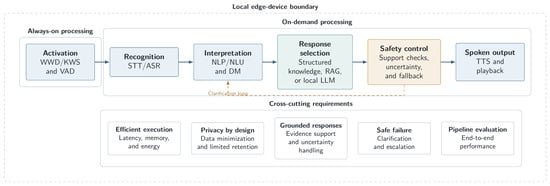
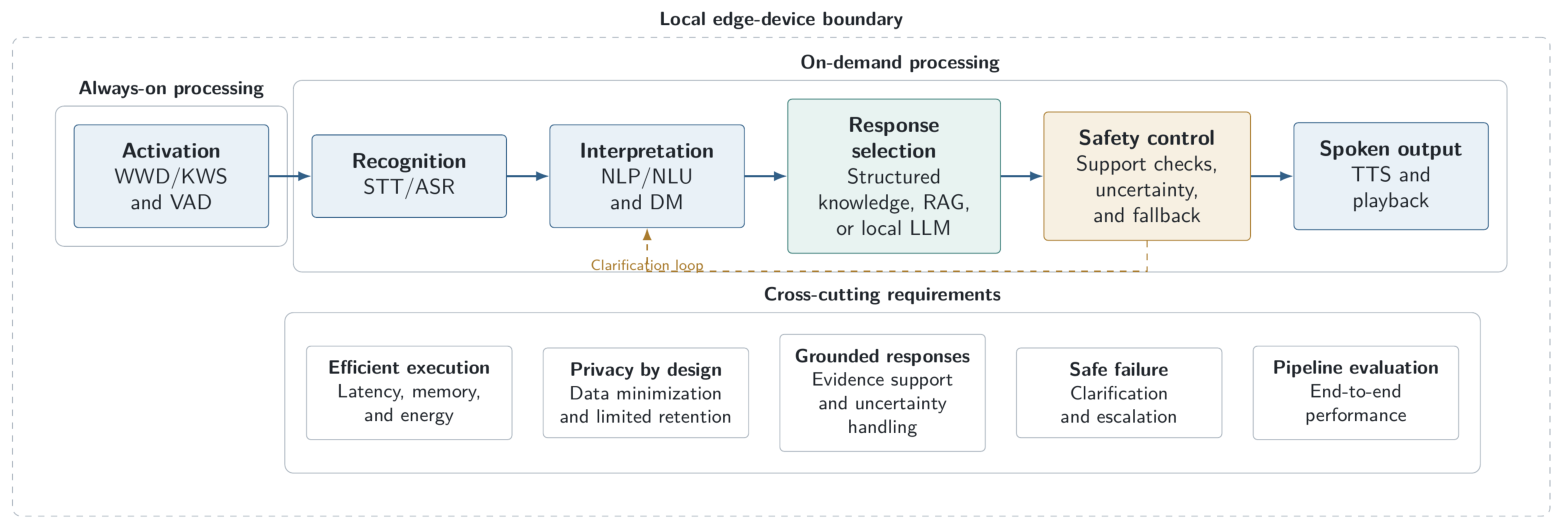
The reviewed evidence supports a modular local architecture that separates lightweight, always-on activation from more demanding on-demand processing. Figure 2 summarizes this pipeline and the cross-cutting requirements derived from the review.
Figure 2.
Review-derived design framework for a low-resource digital-health voice assistant.
Rather than prescribing specific models, the framework defines functional boundaries that allow components to be adapted to the target device, language and application, in line with modular and context-based architectures proposed for artificial social companions [5,81]. Confidence information, response provenance, latency and resource use should remain traceable without retaining unnecessary health-related data.
The framework is a synthesis of the reviewed evidence, not a validated architecture; no included source implemented and evaluated all of its components together. Its components are grounded as follows: always-on activation in KWS and VAD studies [25,43,71]; local recognition and interpretation in embedded ASR and NLU studies [16,20,34,61]; response selection based on structured knowledge, RAG or local LLMs [21,27,38]; safety control through rule-based fallback [38,39] and query rejection [30], the latter evaluated only for smart-home requests; and spoken output in on-device TTS studies [22,31]. The clarification loop and the integrated safety-control stage remain unvalidated proposals.
4.8. Limitations of the Review Process
Search sensitivity was limited in several ways. In IEEE Xplore, ACM Digital Library and arXiv, the speech-processing block was combined with a voice-interaction or language-processing block (S5 = S1 AND S4), so studies of standalone speech modules, such as KWS, VAD or ASR studies that do not mention conversational agents or language processing, were retrieved only when indexed with these terms. Major health and clinical databases such as PubMed/MEDLINE, Scopus and Web of Science were not searched, and the search strategy was not validated against a reference set of known eligible studies. Google Scholar results depend on a proprietary ranking and cannot be reproduced exactly. The population terms were applied only as the final refinement step; because the broader parent queries were also exported, the population terms did not restrict the retrieved set. These terms reflected the intended user group of the solution under development in the project that funded this review. The gaps reported in this review therefore describe the retrieved evidence and may underestimate work on standalone speech modules and on clinically indexed voice technologies. Restricting eligibility to English- and Portuguese-language studies published from 2020 onwards may also have excluded relevant earlier research and publications in other languages. Some included preprints were revised after the search; only the cited versions were charted. Two exported records with incomplete bibliographic information could not be imported and were not screened, so a relevant study among them may have been missed. Records that were retrieved only by the earlier search executions and excluded at title and abstract screening were not retained in the reference manager; the number of screened records may therefore be underestimated, although the full-text assessments and inclusions are complete.
Study selection and data charting were conducted by one reviewer without independent verification, the charting form was not pilot-tested, and no formal critical appraisal was performed. Category counts were derived from the condensed study-level matrix and may therefore under-represent techniques or measures not recorded in it. Differences in datasets and tasks also prevented pooled quantitative comparison. The findings should therefore be interpreted as a descriptive overview of the literature rather than evidence of methodological quality or clinical readiness.
5. Conclusions
This scoping review mapped 70 studies on voice interaction in resource-constrained edge environments, with particular attention to digital health. The evidence primarily addressed speech recognition, language processing, optimization and technical performance, while complete offline pipelines, explicit protection mechanisms, and health-related evaluation received less attention.
The findings indicate that individual voice modules can operate efficiently on edge hardware, but their integration into reliable systems remains insufficiently validated. These conclusions are limited to the retrieved evidence, which was drawn mainly from engineering databases. Future research should evaluate complete pipelines on clearly specified hardware, with network access disabled, involving representative users and realistic acoustic conditions, and should report end-to-end response latency, peak memory, energy per completed interaction and the propagation of recognition errors into health-related responses. This would help bridge the gap between experimental prototypes and practical digital-health deployment.
Supplementary Materials
The following supporting information can be downloaded at https://www.mdpi.com/article/10.3390/electronics15235548/s1: S1, completed PRISMA-ScR checklist; S2, health-relevance evidence matrix; S3, eligibility criteria and screening decision rules; S4, study-by-category coding matrix; and S5, complete record set with deduplication and screening decisions.
Author Contributions
Conceptualization, L.F.; methodology, L.F.; software, L.F.; validation, J.Q. and P.M.; formal analysis, J.Q. and P.M.; investigation, L.F.; resources, L.F.; data curation, L.F. and J.Q.; writing—original draft preparation, L.F.; writing—review and editing, L.F.; visualization, J.Q., P.M. and L.F.; and supervision, J.Q. and P.M. All authors have read and agreed to the published version of the manuscript.
Funding
This research was supported by the Centro Regional Operational Programme (Centro 2030), under the Portugal 2030 partnership agreement, and the European Regional Development Fund (ERDF), through the project OptinDTx–PdC (reference CENTRO2030-FEDER-02366200); by the Innovation and Digital Transition Thematic Programme (COMPETE 2030), under the Portugal 2030 partnership agreement, and the European Regional Development Fund (ERDF), through the project ‘Sistema Inteligente de Otimização da Medicação Integrado com IoT’ (AllyMED) with reference COMPETE2030-FEDER-01468600; and has received funding from the European Union’s Horizon Europe under PAS GRAS project grant agreement No 101080329. The funders had no role in the design of the review; in the collection, analysis or interpretation of data; in the writing of the manuscript; or in the decision to publish. Funding sources of the included sources were not charted.
Institutional Review Board Statement
Not applicable.
Informed Consent Statement
Not applicable.
Data Availability Statement
No new data were generated. All data analyzed were extracted from the included publications. The study-level charting matrix is provided in Appendix B, the per-query exports are reported in Table 5, and the study-by-category coding matrix underlying Table 9, Table 10, Table 11, Table 12 and Table 13 is provided in the Supplementary Materials as file S4. The complete set of identified records, with deduplication and screening decisions, is provided in the Supplementary Materials as file S5.
Acknowledgments
The authors acknowledge the use of ChatGPT 5 (OpenAI, San Francisco, CA, USA) and Claude Opus 5.5 (Anthropic, San Francisco, CA, USA) only to streamline text revision and preparation and to derive the category coding from the study-level charting matrix by applying the authors’ coding rules; the resulting coding was reviewed and accepted by the authors. The review concept, the design and application of the methodology, and the screening and analysis of the sources are the work of the authors. All suggestions were reviewed and edited by the authors, who take full responsibility for the final content.
Conflicts of Interest
The authors declare no conflicts of interest.
Abbreviations
The following abbreviations are used in this manuscript:
| AI | Artificial Intelligence |
| ASR | Automatic Speech Recognition |
| DM | Dialogue Management |
| KWS | Keyword Spotting |
| LLM | Large Language Model |
| NLP | Natural Language Processing |
| NLU | Natural Language Understanding |
| PCC | Population–Concept–Context |
| PRISMA-ScR | Preferred Reporting Items for Systematic Reviews and Meta-Analyses Extension |
| for Scoping Reviews | |
| RAG | Retrieval-Augmented Generation |
| STT | Speech-to-Text |
| TTS | Text-to-Speech |
| VAD | Voice Activity Detection |
| WWD | Wake-Word Detection |
Appendix A. Database-Specific Search Strategies
This appendix presents the search strategies used for the sources not detailed in the main text. Espacenet and the EU Funding and Tenders Portal were retained for transparency, although they yielded no eligible studies. The most recent searches were executed on 24 October 2026. Results are query hits; “Not recorded” marks a hit count that was not retained (for a standalone ScienceDirect block used only as a filter). The IEEE Xplore hit counts in Table 4 were recalculated on 8 November 2026 with the documented settings; the exported queries S13, S14 and S18 reproduced the counts recorded at export, whereas S16 returned 5 hits instead of 8. Because S16 is nested within S13, this difference does not affect the unique records retrieved. Successive queries are nested refinements, so hit counts of different rows are not additive. The “Records exported” row gives the BibTeX records exported from the queries listed in Table 5, which include within-source overlaps removed during deduplication; the records entering deduplication are reported in Table 5.
Table A1.
Search strategy used for the ACM Digital Library abstract search.
Table A2.
Search strategy used for the ACM Digital Library full-text search.
Table A3.
Search strategy used in arXiv.
Table A4.
Search strategy used in Espacenet.
Table A5.
Search strategy used in the EU Funding and Tenders Portal.
Table A6.
Search strategy used in Google Scholar.
Table A7.
Search strategy used in ScienceDirect.
Appendix B. Study-Level Charting Matrix
Table A8 summarizes the 70 included studies using the charting dimensions defined in the Methods.
Table A8.
Concise study-level charting matrix for the included studies ().
References
- Masina, F.; Orso, V.; Pluchino, P.; Dainese, G.; Volpato, S.; Nelini, C.; Mapelli, D.; Spagnolli, A.; Gamberini, L. Investigating the Accessibility of Voice Assistants With Impaired Users: Mixed Methods Study. J. Med. Internet Res. 2020, 22, e18431. [Google Scholar] [CrossRef] [Scilit] [PubMed]
- Tsiourti, C.; Quintas, J.; Ben-Moussa, M.; Hanke, S.; Nijdam, N.A.; Konstantas, D. The CaMeLi Framework—A Multimodal Virtual Companion for Older Adults. In Intelligent Systems and Applications: Extended and Selected Results from the SAI Intelligent Systems Conference (IntelliSys) 2016; Studies in Computational Intelligence; Springer: Cham, Switzerland, 2018; Volume 751, pp. 196–217. [Google Scholar]
- Jegundo, A.L.; Dantas, C.; Quintas, J.; Dutra, J.; Almeida, A.L.; Caravau, H.; Rosa, A.F.; Martins, A.I.; Pacheco Rocha, N. Perceived Usefulness, Satisfaction, Ease of Use and Potential of a Virtual Companion to Support the Care Provision for Older Adults. Technologies 2020, 8, 42. [Google Scholar] [CrossRef] [Scilit]
- Kern, J.B.; Strola, S.; Quintas, J.; Moulaert, T.; Jacquet, J.P.; Benhamou, P.Y. My Little Smart Personal Assistant: A Co-Designed Solution to Ensure an Optimized Ageing-Well at Home in Rural European Settings. In MEDINFO 2019: Health and Wellbeing e-Networks for All; IOS Press: Amsterdam, the Netherlands, 2019; pp. 1949–1950. [Google Scholar]
- Quintas, J.M.L. Context-Based Human-Machine Interaction Framework for Artificial Social Companions. PhD Thesis, University of Coimbra, Coimbra, Portugal, 2018. [Google Scholar]
- Shi, W.; Cao, J.; Zhang, Q.; Li, Y.; Xu, L. Edge Computing: Vision and Challenges. IEEE Internet Things J. 2016, 3, 637–646. [Google Scholar] [CrossRef] [Scilit]
- Satyanarayanan, M. The Emergence of Edge Computing. Computer 2017, 50, 30–39. [Google Scholar] [CrossRef] [Scilit]
- Warden, P. Speech Commands: A Dataset for Limited-Vocabulary Speech Recognition. arXiv 2018, arXiv:1804.03209. [Google Scholar] [CrossRef] [Scilit]
- Zhang, Y.; Suda, N.; Lai, L.; Chandra, V. Hello Edge: Keyword Spotting on Microcontrollers. arXiv 2017, arXiv:711.07128. [Google Scholar] [CrossRef] [Scilit]
- Banbury, C.; Reddi, V.J.; Torelli, P.; Holleman, J.; Jeffries, N.; Kiraly, C.; Montino, P.; Kanter, D.; Ahmed, S.; Pau, D.; et al. MLPerf Tiny Benchmark. arXiv 2021, arXiv:2106.07597. [Google Scholar] [CrossRef] [Scilit]
- Radford, A.; Kim, J.W.; Xu, T.; Brockman, G.; McLeavey, C.; Sutskever, I. Robust Speech Recognition via Large-Scale Weak Supervision. Proc. Mach. Learn. Res. 2023, 202, 28492–28518. [Google Scholar]
- Yasu Bharathi, V.R.; Priyadharshini, K.; Madasamy, K.S.; Goldwin, K.R.; Elangovan, A.; Kumar, M.V. Edge-Deployed Speech-to-Text Models for Real-Time Classroom Feedback in Interactive Linguistics Pronunciation Labs. In Proceedings of the 2025 2nd International Conference on Artificial Intelligence and Knowledge Discovery in Concurrent Engineering (ICECONF); IEEE: Piscataway, NJ, USA, 2025; pp. 1–7. [Google Scholar] [CrossRef] [Scilit]
- Weerasinghe, K.; Janapati, S.; Ge, X.; Kim, S.; Iyer, S.; Stankovic, J.A.; Alemzadeh, H. Real-Time Multimodal Cognitive Assistant for Emergency Medical Services. In Proceedings of the 2024 IEEE/ACM Ninth International Conference on Internet-of-Things Design and Implementation (IoTDI); IEEE: Piscataway, NJ, USA, 2024; pp. 85–96. [Google Scholar] [CrossRef] [Scilit]
- Wilkerson, M.; Brown, T.; Davis, G.; White, T.; Lockart, J.; Hernandez, L.; Bhattacharya, S. Real-Time Multimodal AI for Medical Intervention Understanding. In Proceedings of the 2025 IEEE International Conference on High Performance Computing and Communications (HPCC); IEEE: Piscataway, NJ, USA, 2025; pp. 926–931. [Google Scholar] [CrossRef] [Scilit]
- Tricco, A.C.; Lillie, E.; Zarin, W.; O’Brien, K.K.; Colquhoun, H.; Levac, D.; Moher, D.; Peters, M.D.J.; Horsley, T.; Weeks, L.; et al. PRISMA Extension for Scoping Reviews (PRISMA-ScR): Checklist and Explanation. Ann. Intern. Med. 2018, 169, 467–473. [Google Scholar] [CrossRef] [Scilit] [PubMed]
- Agarwal, V.; Shivnikar, S.D.; Ghosh, S.; Arora, H.; Saini, Y. LIDSNet: A Lightweight On-Device Intent Detection Model Using Deep Siamese Network. In Proceedings of the 2021 20th IEEE International Conference on Machine Learning and Applications (ICMLA); IEEE: Piscataway, NJ, USA, 2021; pp. 1112–1117. [Google Scholar] [CrossRef] [Scilit]
- Mulfari, D.; Meoni, G.; Marini, M.; Fanucci, L. Machine Learning Assistive Application for Users with Speech Disorders. Appl. Soft Comput. 2021, 103, 107147. [Google Scholar] [CrossRef] [Scilit]
- Mairittha, T.; Mairittha, N.; Inoue, S. Integrating a Spoken Dialogue System, Nursing Records, and Activity Data Collection Based on Smartphones. Comput. Methods Programs Biomed. 2021, 210, 106364. [Google Scholar] [CrossRef] [Scilit] [PubMed]
- Valera Román, A.; Pato Martínez, D.; Lozano Murciego, Á.; Jiménez-Bravo, D.M.; de Paz, J.F. Voice Assistant Application for Avoiding Sedentarism in Elderly People Based on IoT Technologies. Electronics 2021, 10, 980. [Google Scholar] [CrossRef] [Scilit]
- Malamas, N.; Symeonidis, A. Embedding Rasa in Edge Devices: Capabilities and Limitations. Procedia Comput. Sci. 2021, 192, 109–118. [Google Scholar] [CrossRef] [Scilit]
- Arora, S.; Kachari, K.K.; Gupta, S.; Saarthi, P.; Yadav, A.K.; Patnaik, S.S. Bringing Llama-3 to the Edge: End-to-End Quantized Conversational AI on Raspberry Pi 5. In Proceedings of the 2025 IEEE International Conference on Computer Vision and Machine Intelligence (CVMI); IEEE: Piscataway, NJ, USA, 2025; pp. 1–5. [Google Scholar] [CrossRef] [Scilit]
- Gonzales, M.G.; Corcoran, P.; Harte, N.; Schukat, M. On-Device Evaluation of Joint Speech-Text Embeddings for ASR, TTS, and Speaker Recognition Tasks. IEEE Access 2025, 13, 192518–192530. [Google Scholar] [CrossRef] [Scilit]
- Tsai, Y.H.; Lin, Y.C.; Chen, W.C.; Lin, L.Y.; Chang, N.S.; Lin, C.P.; Chen, S.H.; Chen, C.S.; Yang, C.H. A 1.3mW Speech-to-Text Accelerator with Bidirectional Light Gated Recurrent Units for Edge AI. In Proceedings of the 2022 IEEE Asian Solid-State Circuits Conference (A-SSCC); IEEE: Piscataway, NJ, USA, 2022; pp. 1–3. [Google Scholar] [CrossRef] [Scilit]
- Tambe, T.; Yang, E.Y.; Ko, G.G.; Chai, Y.; Hooper, C.; Donato, M.; Whatmough, P.N.; Rush, A.M.; Brooks, D.; Wei, G.Y. A 16-nm SoC for Noise-Robust Speech and NLP Edge AI Inference With Bayesian Sound Source Separation and Attention-Based DNNs. IEEE J. Solid-State Circuits 2023, 58, 569–581. [Google Scholar] [CrossRef] [Scilit]
- CL, N.; G, R. Smart Voice Assistant Using TinyML on Cortex-M55. In Proceedings of the 2025 9th International Conference on Computational System and Information Technology for Sustainable Solutions (CSITSS); IEEE: Piscataway, NJ, USA, 2025; pp. 1–6. [Google Scholar] [CrossRef] [Scilit]
- Shi, Y.; Njor, E.; Martínez-Nuevo, P.; Shepstone, S.E.; Fafoutis, X. Data Aware Differentiable Neural Architecture Search for Tiny Keyword Spotting Applications. arXiv 2025, arXiv:2507.15545. [Google Scholar] [CrossRef] [Scilit]
- Pirabaharan, K.; Ragunathan, A.; Sathiyalokeswaran, L.; Jayasekara, A.G.B.P.; Vadivelthasan, J. Context-Aware Trilingual Conversational Service Robot for Restaurant. In Proceedings of the MERCon 2025; IEEE: Piscataway, NJ, USA, 2025. [Google Scholar]
- Gulzar, H.; Shakeel, M.; Itoyama, K.; Nakadai, K.; Nishida, K.; Amano, H.; Eda, T. FPGA-Based Power-Efficient Edge Server to Accelerate Speech Interface for Socially Assistive Robotics. In Proceedings of the 2023 IEEE/SICE International Symposium on System Integration (SII); IEEE: Piscataway, NJ, USA, 2023; pp. 1–6. [Google Scholar] [CrossRef] [Scilit]
- Li, J.; Maharjan, B.; Xie, B.; Tao, C. A Personalized Voice-Based Diet Assistant for Caregivers of Alzheimer Disease and Related Dementias: System Development and Validation. J. Med. Internet Res. 2020, 22, e19897. [Google Scholar] [CrossRef] [Scilit] [PubMed]
- Men, H.; Hu, Y.; He, Y.; Gao, Y.; Mou, X.; Xu, Y. Reject or Not?: A Benchmark for Voice Assistant Query Rejection in Smart Home Scenario and an Improved Method Based on LLMs. arXiv 2025, arXiv:2512.10257. [Google Scholar] [CrossRef] [Scilit]
- Likhomanenko, T.; Carlson, L.; Bai, R.H.; Gu, Z.; Tran, H.; Aldeneh, Z.; Zhang, Y.; Zhang, R.; Zheng, H.; Jaitly, N. ChipChat: Low-Latency Cascaded Conversational Agent in MLX. In Proceedings of the 2025 IEEE Automatic Speech Recognition and Understanding Workshop (ASRU); IEEE: Piscataway, NJ, USA, 2025. [Google Scholar] [CrossRef] [Scilit]
- Srinivas, V.; Englhardt, Z.; Iyer, V.; Patel, S. Thinking While Speaking: Inference-Time Knowledge Transfer for Responsive and Intelligent Conversational Voice Agents. arXiv 2025, arXiv:2511.07397. [Google Scholar] [CrossRef] [Scilit]
- Lai, M.S.; Ooi, E.G.; Goh, I.X.; Teoh, K.L.; Nee Pragasam, T.T.; Lim, S.W.; Ru Teh, J.S.; Tang, L.J.; Tan, S.C. Real-Time Avatar-Based Speech-to-Speech Conversational AI Tutor on AI PC. In Proceedings of the 2025 IEEE 15th Symposium on Computer Applications & Industrial Electronics (ISCAIE); IEEE: Piscataway, NJ, USA, 2025; pp. 108–113. [Google Scholar] [CrossRef] [Scilit]
- Park, J.; Kim, C.; Sung, W. Convolution-Based Attention Model With Positional Encoding for Streaming Speech Recognition on Embedded Devices. In Proceedings of the 2021 IEEE Spoken Language Technology Workshop (SLT); IEEE: Piscataway, NJ, USA, 2021; pp. 30–37. [Google Scholar] [CrossRef] [Scilit]
- Mulfari, D.; Carnevale, L.; Galletta, A.; Villari, M. Edge Computing Solutions Supporting Voice Recognition Services for Speakers with Dysarthria. In Proceedings of the 2023 IEEE/ACM 23rd International Symposium on Cluster, Cloud and Internet Computing Workshops (CCGridW); IEEE: Piscataway, NJ, USA, 2023; pp. 231–236. [Google Scholar] [CrossRef] [Scilit]
- Hoscilowicz, J.; Pawlowski, P.; Skorupa, M.; Sowański, M.; Janicki, A. Large Language Models for Expansion of Spoken Language Understanding Systems to New Languages. arXiv 2024, arXiv:2404.02588. [Google Scholar] [CrossRef] [Scilit]
- Qin, R.; Liu, D.; Xu, G.; Nassereldine, A.; Yan, Z.; Xu, C.; Hu, Y.; Wang, S.; Hu, X.S.; Xiong, J.; et al. Tiny-Align: Bridging Automatic Speech Recognition and Large Language Model on Edge. arXiv 2025. [Google Scholar] [CrossRef] [Scilit]
- Vijayan, H.T. A Hybrid Dialogue System for Structured Health Conversations: Integrating BiLSTM-Based Intent Classification with Finite-State Control. Master’s Thesis, University of Wisconsin-Milwaukee, Milwaukee, WI, USA, 2025. [Google Scholar]
- Vinay, R.; Uetova, E.; Tommila, N.; Biller-Andorno, N.; Kowatsch, T. A Hybrid Rule- and Large Language Model–Based Embodied Voice Assistant (GRACE) for Cognitive Stimulation in Older Adults: Usability Study Assessing Technical Feasibility, Technology Acceptance, and Working Alliance. JMIR Aging 2025, 8, e76489. [Google Scholar] [CrossRef] [Scilit] [PubMed]
- Lou, H.; Huang, C.; Paik, H.y.; Hu, Y.; Quigley, A.; Hu, W.; Yao, L. SpeechAgent: An End-to-End Mobile Infrastructure for Speech Impairment Assistance. arXiv 2025, arXiv:2510.20113. [Google Scholar] [CrossRef] [Scilit]
- Kim, D.; Ko, K.; Kwak, J.; Han, D.K.; Ko, H. A Lightweight Dynamic Filter for Keyword Spotting. arXiv 2023, arXiv:2109.11165. [Google Scholar] [CrossRef] [Scilit]
- Macoskey, J.; Strimel, G.P.; Rastrow, A. Bifocal Neural ASR: Exploiting Keyword Spotting for Inference Optimization. In Proceedings of the ICASSP 2021–2021 IEEE International Conference on Acoustics, Speech and Signal Processing (ICASSP); IEEE: Piscataway, NJ, USA, 2021; pp. 5999–6003. [Google Scholar] [CrossRef] [Scilit]
- Jafarzadeh Asl, H.; Ghazvini Nejad, M.; Edraki, A.; Asgharian, M.; Partovi Nia, V. Tiny Noise-Robust Voice Activity Detector for Voice Assistants. In Proceedings of the 2025 IEEE 35th International Workshop on Machine Learning for Signal Processing (MLSP); IEEE: Piscataway, NJ, USA, 2025; pp. 1–6. [Google Scholar] [CrossRef] [Scilit]
- Spachos, P.; Gregori, S.; Deen, M.J. Voice-Activated IoT Devices for Healthcare: Design Challenges and Emerging Applications. IEEE Trans. Circuits Syst. II Express Briefs 2022, 69, 3101–3107. [Google Scholar] [CrossRef] [Scilit]
- Szczepaniak, F.; Boudy, J.; Chollet, G.; Hariz, M.; Lohr, C. A Virtual Assistant Dedicated to the Accompaniment of the Person Informed of his Life Context Thanks to the Smartphone. In Proceedings of the 16th International Conference on PErvasive Technologies Related to Assistive Environments; PETRA ’23; ACM: New York, NY, USA, 2023; pp. 662–666. [Google Scholar] [CrossRef] [Scilit]
- Lazzaroni, L.; Bellotti, F.; Berta, R. An Embedded End-to-End Voice Assistant. Eng. Appl. Artif. Intell. 2024, 136, 108998. [Google Scholar] [CrossRef] [Scilit]
- Navaneethan, S.; Arunkumar, K.; Gaurav Sunhel, R.; Vishal, M. Design of Hardware ChatGPT and Implementation with AI for a Universal Voice Assistant. In Proceedings of the 2025 IEEE International Conference on Communication Networks and Computing (CNC); IEEE: Piscataway, NJ, USA, 2025; pp. 616–622. [Google Scholar] [CrossRef] [Scilit]
- Tran, B.Q. Enhancing Security and Privacy for Voice Assistant Systems. Ph.D. Dissertation, University of Massachusetts, Boston, MA, USA, 2023. [Google Scholar]
- Chinnusamy, P. Enhancing Smart Home Accessibility Through Natural Language Interaction. In Proceedings of the 2025 8th Conference on Cloud and Internet of Things (CIoT); IEEE: Piscataway, NJ, USA, 2025; pp. 1–4. [Google Scholar] [CrossRef] [Scilit]
- Dutta, S.; Irvin, D.; Hansen, J.H.L. Exploring Discrete Speech Units for Privacy-Preserving and Efficient Speech Recognition for School-Aged and Preschool Children. Int. J. Hum.-Comput. Stud. 2025, 199, 103460. [Google Scholar] [CrossRef] [Scilit]
- Lupión, M.; González-Ruiz, V.; Sanjuan, J.F.; Ortigosa, P.M. Privacy-Aware Fall Detection and Alert Management in Smart Environments Using Multimodal Devices. Internet Things 2025, 30, 101526. [Google Scholar] [CrossRef] [Scilit]
- Sezgin, E.; Noritz, G.; Elek, A.; Conkol, K.; Rust, S.; Bailey, M.; Strouse, R.; Chandawarkar, A.; von Sadovszky, V.; Lin, S.; et al. Capturing At-Home Health and Care Information for Children With Medical Complexity Using Voice Interactive Technologies: Multi-Stakeholder Viewpoint. J. Med. Internet Res. 2020, 22, e14202. [Google Scholar] [CrossRef] [Scilit] [PubMed]
- Guliani, D.; Zhou, L.; Ryu, C.; Yang, T.J.; Zhang, H.; Xiao, Y.; Beaufays, F.; Motta, G. Enabling On-Device Training of Speech Recognition Models with Federated Dropout. arXiv 2021, arXiv:2110.03634. [Google Scholar] [CrossRef] [Scilit]
- Rao, M.; Chennupati, G.; Tiwari, G.; Kumar Sahu, A.; Raju, A.; Rastrow, A.; Droppo, J. Federated Self-Learning with Weak Supervision for Speech Recognition. In Proceedings of the ICASSP 2023–2023 IEEE International Conference on Acoustics, Speech and Signal Processing (ICASSP); IEEE: Piscataway, NJ, USA, 2023; pp. 1–5. [Google Scholar] [CrossRef] [Scilit]
- Reddi, V.J. Generative AI at the Edge: Challenges and Opportunities. Queue 2025, 23, 79–137. [Google Scholar] [CrossRef] [Scilit]
- Zhang, J.; Wu, J.; Qiu, Y.; Song, A.; Li, W.; Li, X.; Liu, Y. Intelligent Speech Technologies for Transcription, Disease Diagnosis, and Medical Equipment Interactive Control in Smart Hospitals: A Review. Comput. Biol. Med. 2023, 153, 106517. [Google Scholar] [CrossRef] [Scilit] [PubMed]
- Wagner, D.; Churchill, A.; Sigtia, S.; Georgiou, P.; Mirsamadi, M.; Mishra, A.; Marchi, E. A Multimodal Approach to Device-Directed Speech Detection with Large Language Models. In Proceedings of the ICASSP 2024–2024 IEEE International Conference on Acoustics, Speech and Signal Processing (ICASSP); IEEE: Piscataway, NJ, USA, 2024; pp. 10451–10455. [Google Scholar] [CrossRef] [Scilit]
- Bilika, D.; Michopoulou, N.; Alepis, E.; Patsakis, C. Hello Me, Meet the Real Me: Voice Synthesis Attacks on Voice Assistants. Comput. Secur. 2024, 137, 103617. [Google Scholar] [CrossRef] [Scilit]
- Wagner, D.; Churchill, A.; Sigtia, S.; Marchi, E. SELMA: A Speech-Enabled Language Model for Virtual Assistant Interactions. In Proceedings of the ICASSP 2025–2025 IEEE International Conference on Acoustics, Speech and Signal Processing (ICASSP); IEEE: Piscataway, NJ, USA, 2025; pp. 1–5. [Google Scholar] [CrossRef] [Scilit]
- Xu, L.; Iyengar, A.; Shi, W. CHA: A Caching Framework for Home-Based Voice Assistant Systems. In Proceedings of the 2020 IEEE/ACM Symposium on Edge Computing (SEC); IEEE: Piscataway, NJ, USA, 2020; pp. 293–306. [Google Scholar] [CrossRef] [Scilit]
- Chakravarty, A. Deep Learning Models in Speech Recognition: Measuring GPU Energy Consumption, Impact of Noise and Model Quantization for Edge Deployment. arXiv 2024, arXiv:2405.01004. [Google Scholar] [CrossRef] [Scilit]
- Hannan, A.; Brutti, A.; Nawaz, S.; Noman, M. An Effective Training Framework for Light-Weight Automatic Speech Recognition Models. In Proceedings of the Interspeech 2025; International Speech Communication Association: Grenoble, France, 2025; pp. 3613–3617. [Google Scholar] [CrossRef] [Scilit]
- Shakiah, S.M.; Swaminathan, R.V.; Nguyen, H.D.; Chinta, R.; Afzal, T.; Susanj, N.; Mouchtaris, A.; Strimel, G.P.; Rastrow, A. Accelerator-Aware Training for Transducer-Based Speech Recognition. In Proceedings of the 2022 IEEE Spoken Language Technology Workshop (SLT); IEEE: Piscataway, NJ, USA, 2023; pp. 100–107. [Google Scholar] [CrossRef] [Scilit]
- Torkamani, M.J.; Zarin, I. Adaptive Edge-Cloud Inference for Speech-to-Action Systems Using ASR and Large Language Models. arXiv 2025, arXiv:2512.12769. [Google Scholar] [CrossRef] [Scilit]
- Ding, H.; Dong, W.; Mao, Q. Keyword Mamba: Spoken Keyword Spotting with State Space Models. arXiv 2025, arXiv:2508.07363. [Google Scholar] [CrossRef] [Scilit]
- Hedderson, D.; Courtney, K.L.; Monkman, H.; Blanchard, I.E. Speech Recognition Technology in Prehospital Documentation: A Scoping Review. Int. J. Med. Inform. 2025, 193, 105662. [Google Scholar] [CrossRef] [Scilit] [PubMed]
- Merkel, S.; Schorr, S. Identification of Use Cases, Target Groups, and Motivations Around Adopting Smart Speakers for Health Care and Social Care Settings: Scoping Review. JMIR AI 2025, 4, e55673. [Google Scholar] [CrossRef] [Scilit] [PubMed]
- Islam, A.; Chaudhry, B.M. Design Validation of a Relational Agent by COVID-19 Patients: Mixed Methods Study. JMIR Hum. Factors 2023, 10, e42740. [Google Scholar] [CrossRef] [Scilit] [PubMed]
- Bosco, C.; Otenen, E.; Osorio Torres, J.; Nguyen, V.; Chheda, D.; Peng, X.; Jessup, N.; Himes, A.; Cureton, B.; Lu, Y.; et al. Designing a Multimodal and Culturally Relevant Alzheimer Disease and Related Dementia Generative Artificial Intelligence Tool for Black American Informal Caregivers: Cognitive Walk-Through Usability Study. JMIR Aging 2025, 8, e60566. [Google Scholar] [CrossRef] [Scilit] [PubMed]
- Lee, T.Y.; Li, C.C.; Chou, K.R.; Chung, M.H.; Hsiao, S.T.; Guo, S.L.; Hung, L.Y.; Wu, H.T. Machine Learning-Based Speech Recognition System for Nursing Documentation: A Pilot Study. Int. J. Med. Inform. 2023, 178, 105213. [Google Scholar] [CrossRef] [Scilit] [PubMed]
- Rusci, M.; Tuytelaars, T. Few-Shot Open-Set Learning for On-Device Customization of Keyword Spotting Systems. arXiv 2023, arXiv:2306.02161. [Google Scholar] [CrossRef] [Scilit]
- Peng, T.; Xiao, Y. Dark Experience for Incremental Keyword Spotting. In Proceedings of the ICASSP 2025–2025 IEEE International Conference on Acoustics, Speech and Signal Processing (ICASSP); IEEE: Piscataway, NJ, USA, 2025; pp. 1–5. [Google Scholar] [CrossRef] [Scilit]
- Bonet, D.; Cámbara, G.; López, F.; Gómez, P.; Segura, C.; Luque, J. Speech Enhancement for Wake-Up-Word Detection in Voice Assistants. arXiv 2021, arXiv:2101.12732. [Google Scholar] [CrossRef] [Scilit]
- Froiz-Míguez, I.; Fraga-Lamas, P.; Fernández-Caramés, T.M. Design, Implementation, and Practical Evaluation of a Voice Recognition Based IoT Home Automation System for Low-Resource Languages and Resource-Constrained Edge IoT Devices: A System for Galician and Mobile Opportunistic Scenarios. IEEE Access 2023, 11, 63623–63649. [Google Scholar] [CrossRef] [Scilit]
- Sarkar, S.; Babar, M.F.; Hassan, M.M.; Hasan, M.; Karmaker Santu, S.K. Processing Natural Language on Embedded Devices: How Well Do Transformer Models Perform? In Proceedings of the 15th ACM/SPEC International Conference on Performance Engineering; ICPE ’24; ACM: New York, NY, USA, 2024; pp. 211–222. [Google Scholar] [CrossRef] [Scilit]
- Dighe, P.; Su, Y.; Zheng, S.; Liu, Y.; Garg, V.; Niu, X.; Tewfik, A. Leveraging Large Language Models for Exploiting ASR Uncertainty. arXiv 2023, arXiv:2309.04842. [Google Scholar] [CrossRef] [Scilit]
- Guimarães, H.R.; Tan, K.; Azcarreta, J.; Alvarez, J.; Agrawal, P.; Pandey, A.; Xu, B. Improving Resource-Efficient Speech Enhancement via Neural Differentiable DSP Vocoder Refinement. In Proceedings of the 2025 IEEE Automatic Speech Recognition and Understanding Workshop (ASRU); IEEE: Pisacataway, NJ, USA, 2025. [Google Scholar] [CrossRef] [Scilit]
- Tudor Car, L.; Dhinagaran, D.; Kyaw, B.M.; Kowatsch, T.; Joty, S.; Theng, Y.L.; Atun, R. Conversational Agents in Health Care: Scoping Review and Conceptual Analysis. J. Med. Internet Res. 2020, 22, e17158. [Google Scholar] [CrossRef] [Scilit] [PubMed]
- Sezgin, E.; Kocaballi, A.B. Era of Generalist Conversational Artificial Intelligence to Support Public Health Communications. J. Med. Internet Res. 2025, 27, e69007. [Google Scholar] [CrossRef] [Scilit] [PubMed]
- Park, J.; Singh, V.; Wisniewski, P. Current Landscape and Future Directions for Mental Health Conversational Agents for Youth: Scoping Review. JMIR Med. Inform. 2025, 13, e62758. [Google Scholar] [CrossRef] [Scilit] [PubMed]
- Quintas, J.; Emami, A.; Neves, L.; Sousa, S. A Short Review on Architectures for Artificial Social Companions. In Proceedings of the Workshop on Adaptive Behavioral Models of Robotic Systems Based on Brain-Inspired AI Cognitive Architectures (APHRODITE), 29th IEEE International Conference on Robot and Human Interactive Communication (RO-MAN 2020); IEEE: Piscataway, NJ, USA, 2020. [Google Scholar]
- Gulzar, H.; Shakeel, M.; Nishida, K.; Itoyama, K.; Nakadai, K.; Amano, H. CASE: CNN Acceleration for Speech-Classification in Edge-Computing. In Proceedings of the 2021 IEEE Cloud Summit (Cloud Summit); IEEE: Piscataway, NJ, USA, 2021; pp. 63–68. [Google Scholar] [CrossRef] [Scilit]
- Pech, M.; Gbessemehlan, A.; Dupuy, L.; Sauzéon, H.; Lafitte, S.; Bachelet, P.; Amieva, H.; Pérès, K. Lessons Learned From the SoBeezy Program for Older Adults During the COVID-19 Pandemic: Experimentation and Evaluation. JMIR Form. Res. 2022, 6, e39185. [Google Scholar] [CrossRef] [Scilit] [PubMed]

Disclaimer/Publisher’s Note: The statements, opinions and data contained in all publications are solely those of the individual author(s) and contributor(s) and not of MDPI and/or the editor(s). MDPI and/or the editor(s) disclaim responsibility for any injury to people or property resulting from any ideas, methods, instructions or products referred to in the content. |
© 2026 by the authors. Licensee MDPI, Basel, Switzerland. This article is an open access article distributed under the terms and conditions of the Creative Commons Attribution (CC BY) license.