


Abstract
Intelligent reflecting surfaces (IRSs) have been recognized as a disruptive and revolutionary technology for achieving efficient and secure information transmission. This paper investigates beamforming optimization methods for an IRS-aided MIMO system with an eavesdropper. A secrecy rate maximization beamforming problem subject to both the transmit power constraints at the base station (BS) and the reflection constraints at the IRS is considered. The problem is non-convex and challenging to solve due to the coupled optimization variables. To address this issue, an iterative alternating optimization (IterAO) algorithm is proposed. The method is easy to implement, but it needs more running time to converge. We then propose a projected gradient method (PGM), which is proven to converge to a stable secrecy rate in relatively less time. It is shown that the proposed IterAO and PGM methods converge to almost the same secrecy rate ultimately, but the PGM significantly reduces the computational complexity. In addition, the secrecy rates of the proposed IterAO and PGM are higher than that of the benchmark scheme. It is also shown that the system with an IRS offers significant achievable secrecy rate gains over that without.
1. Introduction
The continuous development of mobile communication technology [1,2] requires higher data transmission rates [3]. Higher data transmission rates can be achieved thanks to a large number of wireless technologies, such as the ultra-dense network (UDN), massive multiple-input multiple-output (MIMO), and millimeter wave (mmWave) communication [4]. Although these technologies can improve spectral efficiency to a certain extent, the increase in computational complexity and hardware loss bring new challenges to wireless communication [5]. One possible solution to this issue is to use intelligent reflecting surfaces (IRSs) [6,7], which comprise an array of nearly passive, low-cost, low-energy consumption, reflecting elements with reconfigurable parameters [8,9,10,11]. This technology presents an ideal, cost-effective, and energy-efficient solution for scenarios where direct communication links are either blocked or excessively weak [12,13]. Due to the broadcast nature of transmission, information is easily eavesdropped during transmission. Secure wireless networks play an important role in the protection of private information [5].
It is worth noting that the future 6G network brings a threat of data transmission security in wireless communication systems, especially for various civilian and military applications. Thus, methods of ensuring security and privacy protection in 6G networks have attracted significant attention [14]. Traditional encryption technology can guarantee the reliability of wireless transmission, but the huge overhead brought by it still remains a critical issue [15]. In addition, security threats cannot be handled by conventional cryptographic solutions alone—especially in heterogeneous and decentralized future wireless networks [16]. Thus, physical layer security (PLS) represents a different approach [17]. PLS provides a secrecy capacity metric by exploiting information-theoretic fundamentals [18,19,20]. PLS plays an important role in wireless networks as the first line of defense for network security, as it guarantees transmission security for both conventional and unconventional communication systems. As a key performance metric, secrecy rate characterizes the anti-eavesdropping capability of a network, which becomes particularly important under complex channel conditions. Synchronization is indispensable in wireless systems, as synchronization errors cause signal distortion and deteriorate secrecy performance, and assessing such performance loss is critical for physical-layer security design.
In addition, with its ability to reconfigure the wireless channel between a transmitter and receivers, IRSs have emerged as a popular technology to enhance the security rate in secure wireless communication systems [21,22]. IRS-assisted secure systems feature an intelligent phase adjustment of reflecting units by the IRS. This enables the steering of signal power to the desired user and a reduction in information leakage [23]. Multiple scenarios, system models, objectives, and methodologies regarding IRS-assisted PLS applications are exhibited in [24]. Most existing works aim to maximize the secrecy rate (SR) of the legitimate user by jointly optimizing the beamformer and the reflecting coefficients, while the differences between these works lie in the methodology adopted to achieve the best solution. Since the formulated problem is non-convex, most existing optimization algorithms rely on alternating iterative optimization among variables [25]. Recently, a novel manifold-based approach was proposed to improve the sum secrecy rate (SSR) of an IRS-assisted integrated sensing and communication (ISAC) system [26]. That method, however, applies to certain classes of optimization problems and suffers from poor generality. In IRS-supported multi-user MIMO communication scenarios, gradient projection-based algorithms have been widely used to handle unit-modulus constraints and power-constrained beamforming design through an iterative process that alternates between gradient descent and feasibility projection [27]. Learning-aided optimization frameworks have also been introduced to improve the efficiency of projected gradient iterations. In these frameworks, neural networks initialize or guide the beamforming updates, thereby reducing the number of required iterations while maintaining near-optimal performance [28].
Despite these advances, existing PGM-based designs for IRS-aided systems still lack a unified treatment of the beamformer and the IRS phase shifts, and no convergence analysis has been established for such a coupled update. The designs reported so far optimize these variables alternately, one block at a time [5,9,11]; a simultaneous update for the secrecy-rate objective has not yet been considered. The main contributions of this paper are summarized as follows:
- We propose an iterative alternating optimization (IterAO) algorithm that scales the objective function to maximize the secrecy rate for IRS-aided secure communications under transmit power and unit-modulus constraints. Auxiliary variables and the Taylor approximation are adopted to convexify the non-convex problem. We prove rank-one optimality to enable rank relaxation, and CVX is used to solve subproblems. Unlike the sum-rate designs in [9,11], the secrecy-rate objective requires dedicated handling.
- A single-loop simultaneous projected gradient method (PGM) is developed for the joint optimization of the transmit covariance and the IRS phase shifts. Compared with the alternating SDR-based scheme in [5], nested inner-outer iterations are eliminated. Closed-form projection operators are derived for the semidefinite cone and the unit-modulus constraints. An Armijo–Goldstein backtracking line search is introduced to accelerate the coupled iteration, and the resulting complexity is analyzed and verified numerically.
- We present a joint convergence proof for the coupled updates. It proves that all limit points of the PGM sequence are stationary points of the reformulated problem. To the best of our knowledge, such a joint convergence guarantee is missing from the PGM-based secure IRS framework [29].
- Simulation results show that both IterAO and PGM outperform the benchmark schemes. The secrecy rate grows with the number of IRS reflecting elements. Although IterAO and PGM converge to similar secrecy rates, PGM has a much shorter runtime. Deploying an IRS yields substantial secrecy gains compared with systems without one.
The remainder of this paper is organized as follows. The related work is reviewed in Section 2. Section 3 presents the IRS-aided wiretap channel network and formulates the secrecy rate maximization problem. Section 4 develops an iterative alternating optimization (IterAO) framework for the secrecy rate maximization beamforming design. Section 5 proposes a PGM-based optimization method to solve the non-convex problem. The convergence analysis of the algorithm is given in Section 6. Simulation results are discussed in Section 7. Finally, Section 8 concludes the paper.
2. Related Work
The literature relevant to this work falls into three strands, and we review them in this order. The first is the design of IRS-aided systems for rate and energy-efficiency objectives, in which the reflecting coefficients are tuned to improve the received signal power. The second is IRS-aided physical-layer security, in which the objective is a secrecy-related metric and the availability of channel state information at the legitimate nodes and at the eavesdropper plays a decisive role. The third is the optimization methodology itself, for which we distinguish designs that alternate between blocks of variables from those that keep the variables feasible by projection.
There has been much work on IRS-assisted wireless communication systems [3,30,31]. In [3], a multiple-input multiple-output (MIMO) system equipped with an IRS was proposed. In this system, a joint optimization problem over the covariance matrix of the transmitted signal and the IRS elements was formulated to maximize the achievable rate. In [30], the penalty-based optimization method was utilized to minimize the power transmitted at the access point (AP) for a simultaneous wireless information and power transfer (SWIPT) system assisted by an IRS. Previous studies on IRSs primarily rely on the instantaneous channel state information (I-CSI). This is notoriously difficult to obtain in practice. To overcome this difficulty, the authors of [31] studied a novel TTS-based joint active and passive beamforming optimization problem in an IRS-aided multi-user system. In that study, the long-term IRS phase shifts were optimized according to the S-CSI. Meanwhile, the short-term transmit precoding vectors were designed to adapt to the instantaneous effective CSI with fixed phase shifts.
From the security perspective, IRS-aided secrecy wireless communication systems have recently attracted increasing attention [5,23]. The IRS can dynamically adjust its phase shifts to impove the secrecy rate when it is deployed near the legitimate user. In [32], an IRS-assisted nonorthogonal multiple access (NOMA) scheme was proposed to achieve secrecy transmission via artificial jamming, in which the transmit beamforming, the artificial jamming vector and the IRS reflecting vector were optimized alternately to maximize the sum rate. In general, the channel state information (CSI) is assumed to be perfect. This is an ideal situation, since the actual CSI is imperfect. The authors of [33] investigated the design of robust transmission schemes for IRS-enhanced secure communication systems, taking into account the imperfection of the cascaded CSI. In [34], a novel and efficient dual-cycling learning scheme was introduced to enhance information security for an IRS-assisted secure NOMA uplink communication system. The beamforming matrix design problem for the multi-antenna amplify-and-forward (AF) relay in a relay-eavesdropper network with partial CSI of the eavesdropper’s channel was studied in [35]. In standard directional modulation (DM), the AP sends one confidential bit stream (CBS) to Bob through a line-of-sight (LOS) channel with multiple antennas. To address this issue, an IRS was leveraged in [1] to deliberately create controllable multipaths for DM, enabling the simultaneous transmission of two CBSs from the AP to Bob. An IRS was applied to an underlay cognitive radio network in [12]. In that scenario, a multi-antenna cognitive base station employs the spectrum allocated to the primary user (PU) to communicate with a secondary user (SU) via an IRS in the presence of multiple coordinated eavesdroppers (Eves). As a promising alternative to cryptographic solutions, PLS requires secure key management and distribution, which is challenging in future wireless technologies with distributed keys. A PLS algorithm using linear virtual antenna array (VAA) constructed by multiple single-antenna nodes in mobile ad hoc networks such as unmanned aerial vehicles (UAVs) and mobile robots was therefore proposed in [36]. Meanwhile, a fully decentralized design framework for cooperative beamforming in IRS-aided cell-free networks was proposed in [37] to achieve cost-effective communication. In this framework, the formulated centralized weighted sum-rate maximization problem was transformed into a tractable consensus optimization problem. The application of artificial noise (AN) was considered to enhance the secrecy rate in secure IRS-assisted multi-user multiple-input single-output (MU-MISO) systems in [38].
In [39], a secure transmission scheme for multi-user MISO systems leveraging multiple collaborative IRSs was investigated, in which a max–min problem was formulated and the initial problem was decomposed, which could be disaggregated into a number of subproblems by means of an alternating optimization (AO) method. Secrecy rate maximization for an IRS-assisted MIMO system was addressed in [5] by an alternating scheme, in which the transmit covariance and the IRS phase shifts are optimized in separate blocks and the transmit subproblem is handled by semidefinite relaxation; the two blocks are iterated until the inner subproblem has converged. For IRS systems with sum-rate objectives, joint transmit and passive beamforming has been studied through SINR balancing and matrix fractional programming [9,11], which are techniques that exploit the smooth fractional structure of the sum-rate expression. Gradient-projection optimization has likewise been combined with a secure IRS framework in [29]. The present work differs from these designs in three respects. First, the transmit covariance and the IRS phase configuration are updated simultaneously in a single projected-gradient loop, so that no inner subproblem has to be solved to convergence at each outer step, as is required by the alternating scheme of [5]. Second, the objective considered here is the secrecy rate of an IRS-aided wiretap channel, whose difference-of-logarithms form does not possess the smooth fractional structure exploited by the matrix fractional programming of [9,11]; those methods are therefore not directly applicable. Third, the coupled iteration admits a joint convergence analysis (Theorem 2), which is not available for the gradient-projection-based secure IRS design of [29].
3. Notations, System Model and Problem Formulation
Notations: denotes the space of complex matrices of dimensions . Bold uppercase letters denote matrices, and lowercase letters denote column vectors. Non-bold italic letters denote scalar values. denotes the Hermitian transpose, and the inverse of . denotes the base-2 logarithm of x. The Euclidean norm is denoted by . denotes the trace of matrix , and the rank of matrix . represents the diagonal matrix whose main diagonal entries are the elements of x. The Cartesian product of two sets and is denoted by . The symbol represents the absolute value of x, and means . The l-th entry of the vector is denoted by . represents the gradient of the function f. The symbol denotes the vector formed by the diagonal elements of . The symbol denotes the vectorization operator, which stacks the columns of to form a single extended column vector. The symbol indicates that matrix is positive semidefinite. denotes the statistical expectation operator.
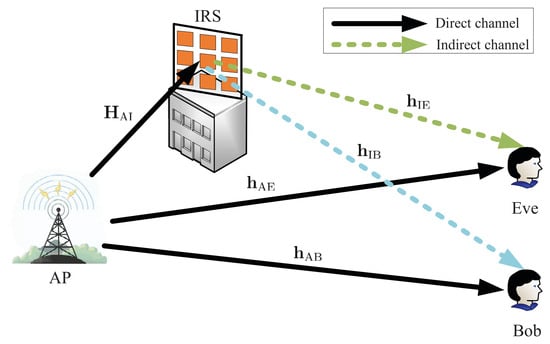
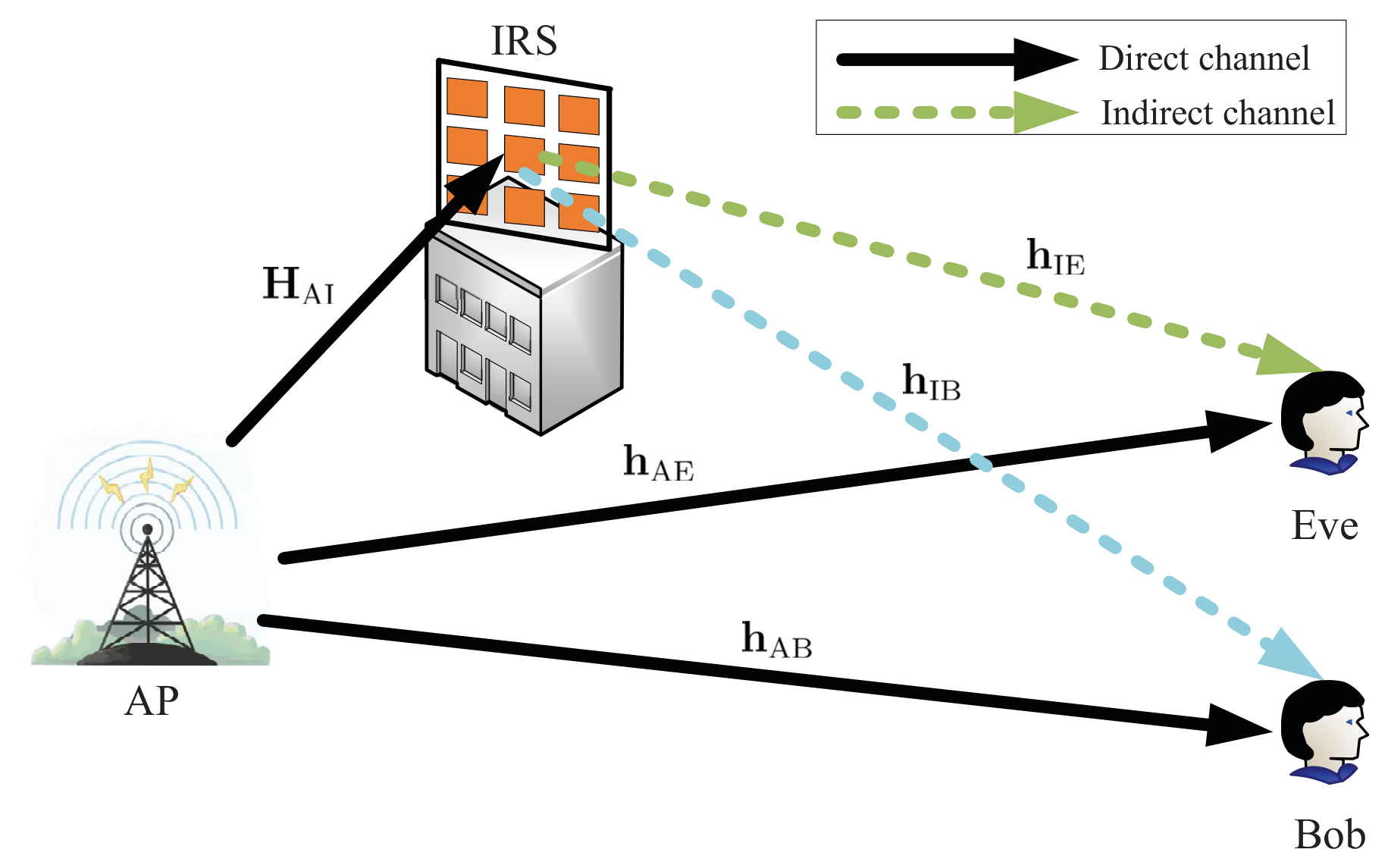
We consider a wiretap channel network aided by an IRS, in which the IRS is deployed to facilitate secure wireless communication. An AP with M antennas transmits messages to a single-antenna user, Bob, in the presence of an eavesdropper, Eve, who is also equipped with a single antenna. The number of reflecting units at the IRS is denoted by N. Let denote the set of reflecting units at the IRS. The IRS is deployed to assist the AP’s transmission by passively reflecting the signal to Bob. The system model is depicted in Figure 1.
Figure 1.
System model of the IRS-aided wiretap channel considered in this paper. An access point (AP) with M antennas serves a single-antenna legitimate user (Bob) with the assistance of an IRS composed of N reflecting elements, while a single-antenna eavesdropper (Eve) attempts to intercept the transmission. The solid arrows denote the direct links (AP-Bob and AP-Eve) and the blue dashed arrows denote the links reflected by the IRS (AP-IRS-Bob and AP-IRS-Eve).
Owing to broadcast nature of the wireless channel, the transmitted signal can also be received by Eve. The signal can be reflected toward the intended user by adjusting the phase shifts of the reflecting elements, which ultimately increases the secrecy transmission rate [40]. The channel coefficients from the AP to the IRS, from the AP to Bob, from the AP to Eve, from the IRS to Bob and from the IRS to Eve are denoted by , , , and , respectively. The CSI of these links is assumed to be perfectly obtainable at the AP, and the objective is to derive an upper performance limit for the IRS-aided BC network.
The information signal with zero mean and unit variance (s.t. ) is transmitted from the AP to Bob by beamforming. Let denote the transmit beamforming vector; the precoded transmitted signal vector is then given by . We assume that the AP is subject to a transmit power constraint P, so that and the following inequality holds: .
We denote as the reflective beamforming vector, where denotes the phase shift imposed on the incident signal and denotes the corresponding reflection amplitude. We set . The reflection coefficient matrix is then defined as .
The signals received at Bob and Eve can be expressed, respectively, as and , where and denote the additive white Gaussian noise (AWGN) at Bob and Eve with zero mean and variances and , respectively.
Our aim is to maximize the achievable secrecy rate by jointly optimizing the transmit beamforming vector and the reflecting beamforming vector . The optimization problem is therefore formulated as follows
The coupling between and makes problem (1) highly non-convex, and it is therefore diffcult to solve directly for the optimal solution. In the following sections, a novel iterative algorithm built on an iterative alternative optimization (IterAO) framework is proposed to tackle this non-convex secrecy rate maximization problem.
4. Iterative Alternating Optimization Algorithm (IterAO)
Let denote the transmit beamforming matrix, and define and ; problem (1) can then be represented as
Next, we design an IterAO framework to handle the non-convexity of the formulated problem. The core idea of the IterAO framework is that the objective function is convex with respect to either the transmit beamforming vector or the reflective beamforming vector . It is therefore reasonable to optimize for a given and for a given .
4.1. Optimizing
When the reflecting beamforming is fixed, problem (2) can be reformulated as
By introducing an auxiliary variable [12], problem (3) can be represented as
Proposition 1.
Rewriting the first equality constraint in (4b) as , the solution of problem (4) remains the same.
Proof of Proposition 1.
Please refer to Appendix A. □
According to Proposition 1, problem (4) can be rewritten as
It is easy to see that the rank constraint is non-convex, which hinders the solving of problem (5). The rank constraint can be removed to solve the relaxed problem, but the optimality of the resulting solution cannot be guaranteed. Proposition 2 provides a positive answer.
Proposition 2.
The optimal solution of problem (5) always satisfies .
Proof of Proposition 2.
Please refer to Appendix B. □
It follows from Proposition 2 that the solution of the relaxed problem is also the optimal solution of the original problem (5).
Thus, by defining and , we can represent problem (5) as
The objective function (6a) is the difference between two concave functions, so it is difficult to determine whether it is convex. Fortunately, the D.C. programming approach mentioned in [12,41] can be used to transform the objective function into a convex one. To address the non-convexity of (6a), a Taylor expansion is used to linearize . Given a feasible initial point , the Taylor expansion can be expressed as , where . We then have , i.e., .
Therefore, problem (6) can be solved by the iterative process of the following problem
where the solution at the i-th iteration is given by . Problem (7) is now convex and can be solved using CVX [42].
It is easy to verify that the iterative process produces a sequence of improved solutions and reaches a stationary point. The iterative algorithm is summarized in Algorithm 1.
| Algorithm 1 Taylor approximation algorithm based on scaling of the objective function |
|
4.2. Optimizing
Problem (2) can be rewritten as follows when the transmit beamforming matrix is fixed
Define
then the following equations hold [4],
where , , and . Substituting these two equations into problem (8), we obtain a more tractable form of the problem as follows
where the diagonal entry of is 1 and all other entries are 0. In addition, and are given in (10) and (11), respectively.
Problem (9) is a non-convex quadratically constrained quadratic program (QCQP). To overcome the non-convex constraint (9b), the SDR technique in [43] is applied. Define , which needs to satisfy and . Since the rank constraint is non-convex, problem (9) can be relaxed as
Inspired by the Charnes–Cooper transformation [43], we define and ; then, problem (12) can be restated as follows
Problem (13) is a convex semidefinite programming (SDP) problem and can be solved efficiently by an interior-point method. Algorithm 2 details the solution process for problem (8).
| Algorithm 2 The standard convex optimization algorithm |
|
4.3. Iterative Alternative Optimization Framework
The alternative optimization framework for problem (2) is presented in Algorithm 3, where denotes the objective value of problem (2) at and in iteration m, and is the accuracy, i.e., the stopping criterion. If satisfies , Algorithm 3 converges to a stationary solution.
| Algorithm 3 Iterative alternating optimization algorithm (IterAO) |
|
5. Synchronous Optimization Algorithm
We have found that problem (2) is non-convex and therefore difficult to solve. In Section 4, an iterative alternating optimization framework (IterAO) was constructed to tackle the non-convex secrecy rate optimization problem. The alternating optimization (AO) technique [4,44] has been proposed for sum rate optimization in communication systems, yet few studies apply AO to the maximum secrecy rate problem. The fundamental principle of this approach is that the optimization over a single variable can be performed efficiently and in a convex manner while the other variables remain fixed [3].
The alternating optimization method is favored by researchers for its ease of implementation, but it also has drawbacks: when the number of parameters is too large, the running time of the algorithm is greatly prolonged [3]. We therefore propose a PGM-based optimization method to tackle the non-convex secrecy rate optimization problem. Each iteration of the PGM method updates all variables simultaneously. Consequently, the execution time of the PGM method is much shorter than that of the proposed IterAO method.
5.1. Reformulation of Problem (2)
Next, we explore another method that optimizes all variables simultaneously to solve problem (2). After a series of algebraic transformations and dropping the constant term, the secrecy rate optimization problem (2) can be rewritten as
The derivation is relatively simple and is therefore omitted for brevity. By the definition of the projection operator, we denote by the projection of a point onto a set . The variables satisfying the constraints of problem (14) are written in the form of the sets and , respectively. The feasible set is therefore . It is worth noting that problem (14) is optimized over the convex set , in which the rank-one constraint on has been dropped. Problem (14) is therefore a relaxation of the original problem, and a stationary point of (14) is not guaranteed to be rank-one. In particular, the rank-one property established in Proposition 2 for the semidefinite relaxation solved within IterAO does not carry over to Algorithm 4, since the two algorithms reach their solutions along different paths.
| Algorithm 4 Projected gradient method (PGM) |
|
5.2. Design Concept of Synchronous Optimization Algorithm
The core principle of the algorithm is as follows. Given a point , the objective function moves along the gradient direction at each iteration. We use as the step size, which determines the size of the move. In order to prevent the updated points from falling outside the feasible region , we project the new iterates and onto their feasible sets and , respectively, before the next iteration. The iterative process of the PGM algorithm is described in Algorithm 4. As described in [45], the complex-valued gradients and are the directions in which achieves a maximum secrecy rate of change with respect to and , respectively. Let , . The following lemma holds.
Lemma 1.
The complex-valued gradient of the function with respect to the parameters and is given by
Proof of Lemma 1.
Please refer to Appendix C. □
This subsection details the projection onto the sets denoted by and in Algorithm 4. We show that this operation can be carried out very efficiently and hence that it requires lower complexity than the IterAO method proposed above. It is obvious that for an arbitrary given point , is the vector where
According to the second case in (17), can be any point on the unit circle when ; the projection onto is therefore not unique. For a fixed , the projection onto is equivalent to solving the following minimization problem
The eigenvalue decomposition of is performed such that , where . We can therefore write for some , and we have . It is then straightforward to obtain . Matrix must satisfy . Problem (18) can thus be rewritten as follows.
The classical water-filling algorithm for the conventional MIMO channel can be used to solve the problem above, and it satisfies the following power constraint , where represents the water level.
Having obtained the projections onto and , we can apply the PGM method to solve problem (14). The synchronous optimization framework (i.e., the PGM method) is described in the following subsection.
5.3. Synchronous Optimization Framework
The optimization framework for problem (14) is presented in Algorithm 4. The secrecy rate is non-decreasing over iterations and converges to a stationary solution; the detailed analysis is given in the following section.
6. Convergence Analysis
Next, we verify whether both algorithms, IterAO and PGM, converge to a stationary point.
Theorem 1.
Algorithm 3 converges to a stationary point if the optimal solution of problem (7) and an approximate optimal solution of (13) can be obtained.
Proof of Theorem 1.
We assume that is the initial feasible point at the m-th iteration. In Step 5, the objective value must be monotonically non-decreasing while a solution is being obtained, i.e., . Similarly, following Step 7, we have . Combining the two inequalities above yields . It follows that the objective function f is monotonically non-decreasing after each iteration, and the iterative AO framework is therefore convergent. □
Theorem 2.
Any accumulation point of the infinite iterative point sequence generated by Algorithm 4 is a stationary point of the original problem (14).
Proof of Theorem 2.
Let be any convergent subsequence of a sequence of points produced by Algorithm 4, then
and
hold. Assume that is the limit point of the subsequence . According to the convergence of , we have
and
By the properties of the projection operator, for any , the following inequality holds
Therefore
Let , and by combining with the above analysis, we obtain
where is the accumulation point of . Similarly, we obtain
□
6.1. Improved Line Search for PGM
For the tractability of the optimization, the fixed step size (used in Algorithm 4) is always very small. This is required to guarantee convergence, but it results in slow convergence. To circumvent this deficiency, we determine the step size on the basis of the Armijo-Goldstein condition [46], and simulations have shown its efficiency.
Let and be sufficiently small constants, and let . We replace the step size by in Step 5 and 6 of Algorithm 4; then, and can be replaced by
and
Substituting and into the following inequality
the smallest nonnegative integer will be obtained.
6.2. Per-Iteration Computational Complexity
At each outer iteration, IterAO solves the semidefinite subproblem (13) over an matrix variable by an interior-point method. The arithmetic cost of one interior-point iteration is up to an accuracy-dependent factor in . Because the relaxation must be re-solved from scratch at every outer step, the cost of one outer iteration is dominated by this term, and the overall complexity of IterAO is , where denotes the number of interior-point iterations and the number of outer iterations.
One iteration of Algorithm 4 consists of four operations: (i) the gradient evaluation, dominated by the matrix inversions required by the objective of (14), which costs ; (ii) the projection onto , which requires an eigendecomposition, , followed by eigenvalue water-filling, ; note that the eigendecomposition, and not the water-filling, is the dominant term here; (iii) the projection onto the unit-modulus constraints (17)–(19), which costs ; and (iv) the Armijo–Goldstein line search, whose overhead is . The per-iteration complexity of PGM is therefore with a small constant factor and, more importantly, it contains no inner loop, so that the total complexity is . The convergence of Algorithm 4 still holds under the improved line search. Following [3], the line search incurs an additional complexity , where N represents the number of reflecting units and M the number of transmit antennas at the AP. Nevertheless, this computational cost can be neglected, since the line search accelerates convergence.
7. Simulation and Discussions
In this section, simulation results are provided with Matlab R2019a on a computer with 3.40 GHz CPU and 8.00 GB of RAM. We discuss numerical experiments designed to verify the security performance of the IterAO and PGM beamforming designs.
For the IterAO method, two scenarios are considered: one in which only the direct link is active, and one in which only the indirect link is active. For the PGM method, the direct and indirect link are all considered. We also demonstrate the influence of the number of IRS elements on the achievable secrecy rate. Furthermore, the effectiveness of secure information transmission is examined and the impact of the key parameters of the system on secrecy rate maximization is discussed. We compare IterAO and PGM with AOMRT (i.e., benchmark) [23] in terms of runtime. We also analyze the effect of different initial values on the proposed PGM algorithm. Finally, we verify the performance benefit of the improved line search procedure.
7.1. Simulation Setup
Unless otherwise stated, the following setting is used throughout the simulations. The access point (AP) is equipped with antennas and the IRS with reflecting elements. The positions of the AP, the IRS, the legitimate user and the eavesdropper are predefined, and the corresponding small-scale fading channels are randomly generated for each independent realization. We assume that the transmit power dBm, and mW. The parameters of the improved line search for the PGM algorithm are , and . The initial values and are randomly generated in all simulations. All curves are averaged over 100 independent realizations of the channels and of the noise.
7.2. Performance Analysis
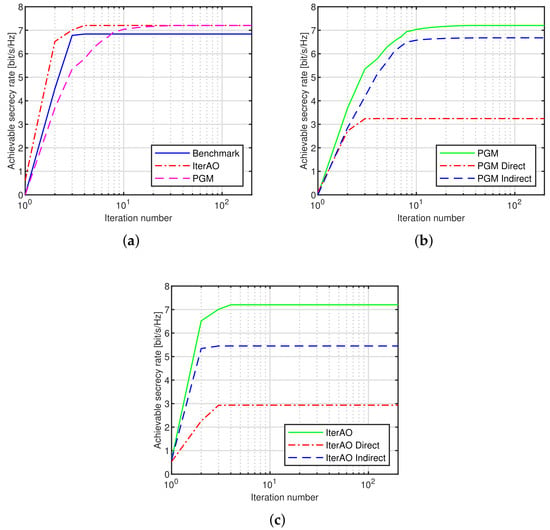
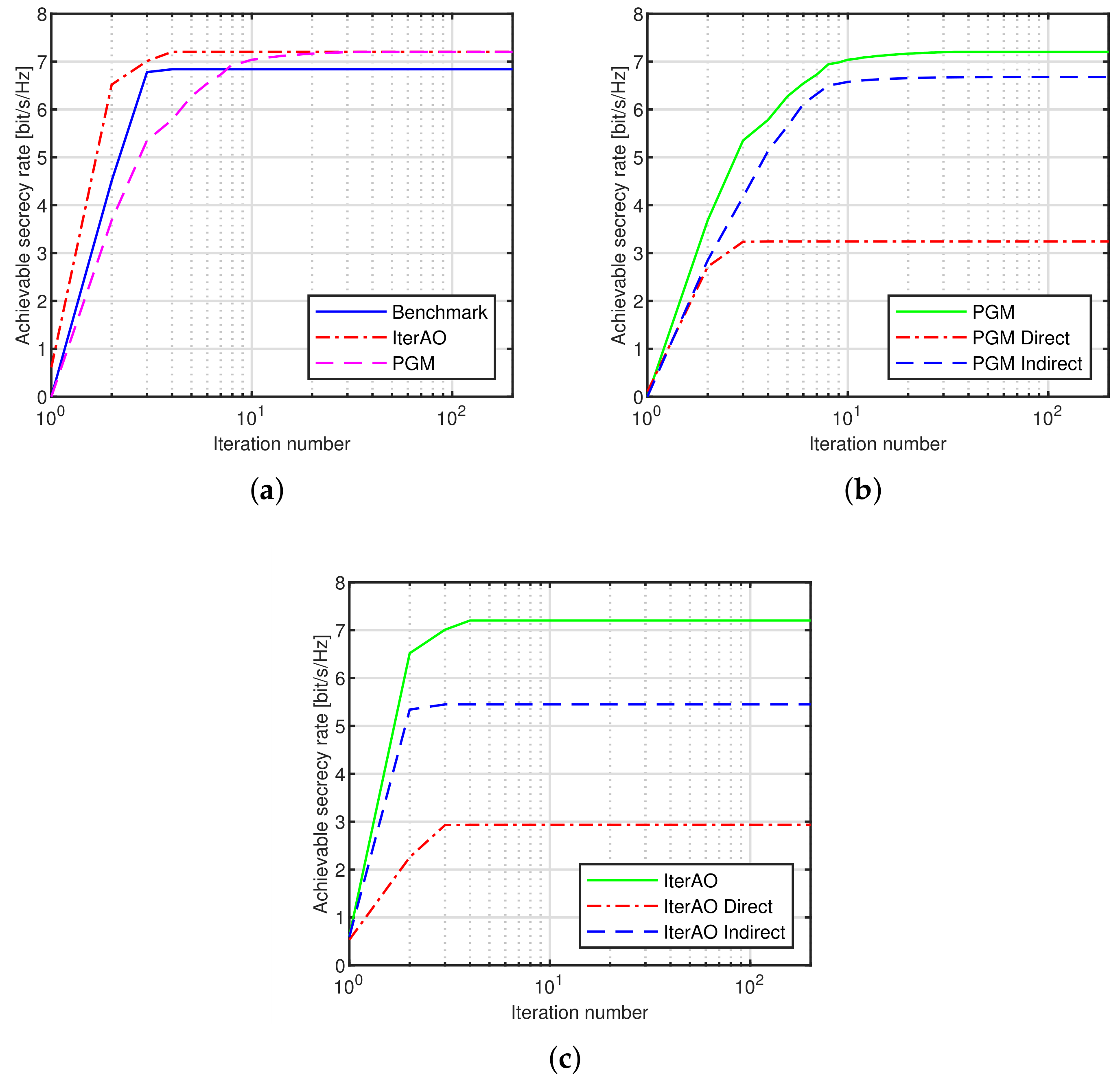
All numerical results reported in this section are obtained by Monte Carlo simulation. The small-scale fading coefficients of all links are drawn independently in each realization, whereas the transmit power, the noise variances and the IRS geometry are kept fixed. Figure 2a shows the achievable secrecy rate of the IterAO and PGM algorithms versus the AOMRT method. It is observed that IterAO and PGM converge to almost the same secrecy rate, and both achieve a higher secrecy rate than AOMRT. Furthermore, the IRS plays a vital role in increasing the secrecy rate for both the IterAO and PGM.
Figure 2.
Achieved secrecy rate in bit/s/Hz versus the iteration index obtained by Monte Carlo simulation over 100 independent channel realizations. (a) Comparison of the proposed IterAO and PGM schemes with the benchmark AOMRT [23]; the IRS is used in all three schemes. (b) The PGM scheme under three channel conditions: both links available (PGM), direct link only (PGM Direct) and IRS link only (PGM Indirect). (c) The same three conditions for the IterAO scheme.
Figure 2b presents the secrecy rate of the PGM method under the direct and indirect link conditions. It can be seen that PGM finally converges to a stationary point and achieves a much higher secrecy rate than the “PGM Direct” and “PGM Indirect” cases. Meanwhile, Figure 2c shows the secrecy rate of the proposed IterAO method under the direct and indirect link scenarios. The presence of the indirect link clearly enhances the secrecy rate, which again highlights the importance of the IRS elements.
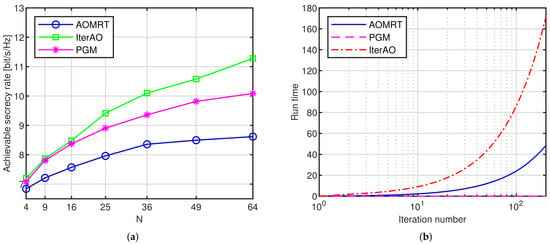
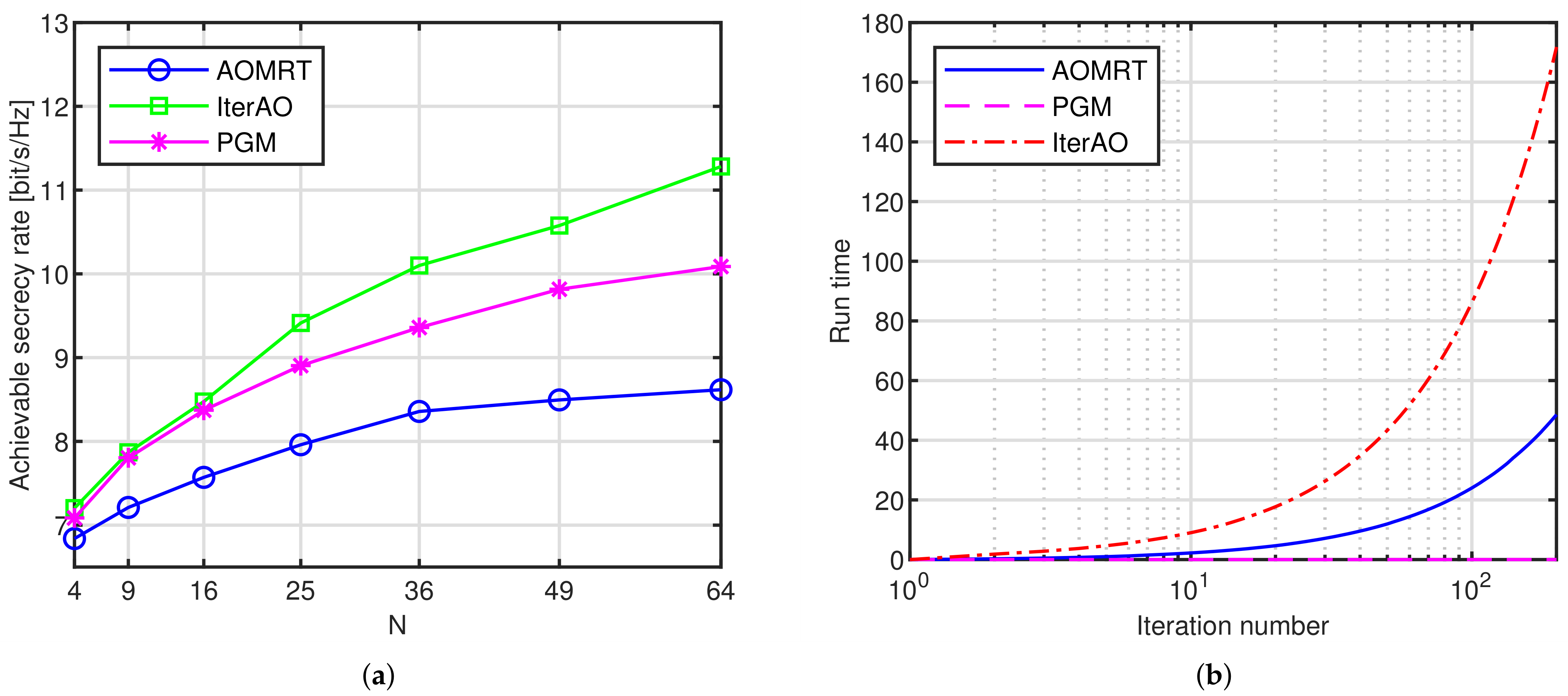
Next, we numerically evaluate the secrecy rate versus N for all algorithms. In the simulations, the number of reflecting elements is not increased at equal intervals: the IRS array is kept square, so that N takes the values 4, 9, 16, 25, 36, 49 and 64, corresponding to arrays of , , …, elements. This choice keeps the surface area and the aperture of the array comparable across the different points of the curve. As N increases, the secrecy rate increases, as shown in Figure 3a.
Figure 3.
(a) Achieved secrecy rate in bit/s/Hz versus the number of IRS reflecting elements N for the IterAO, PGM and AOMRT schemes; N = 4, 9, 16, 25, 36, 49 and 64 correspond to square arrays of elements. (b) Accumulated run time in seconds versus the iteration index for the same three schemes; note that the horizontal axis is the iteration index and not N. Measurements were taken on Matlab.
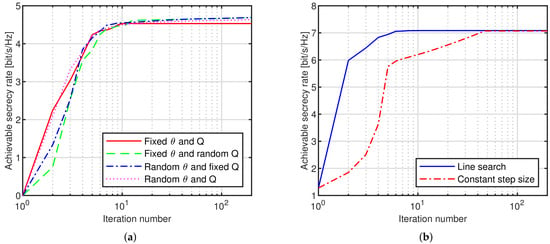
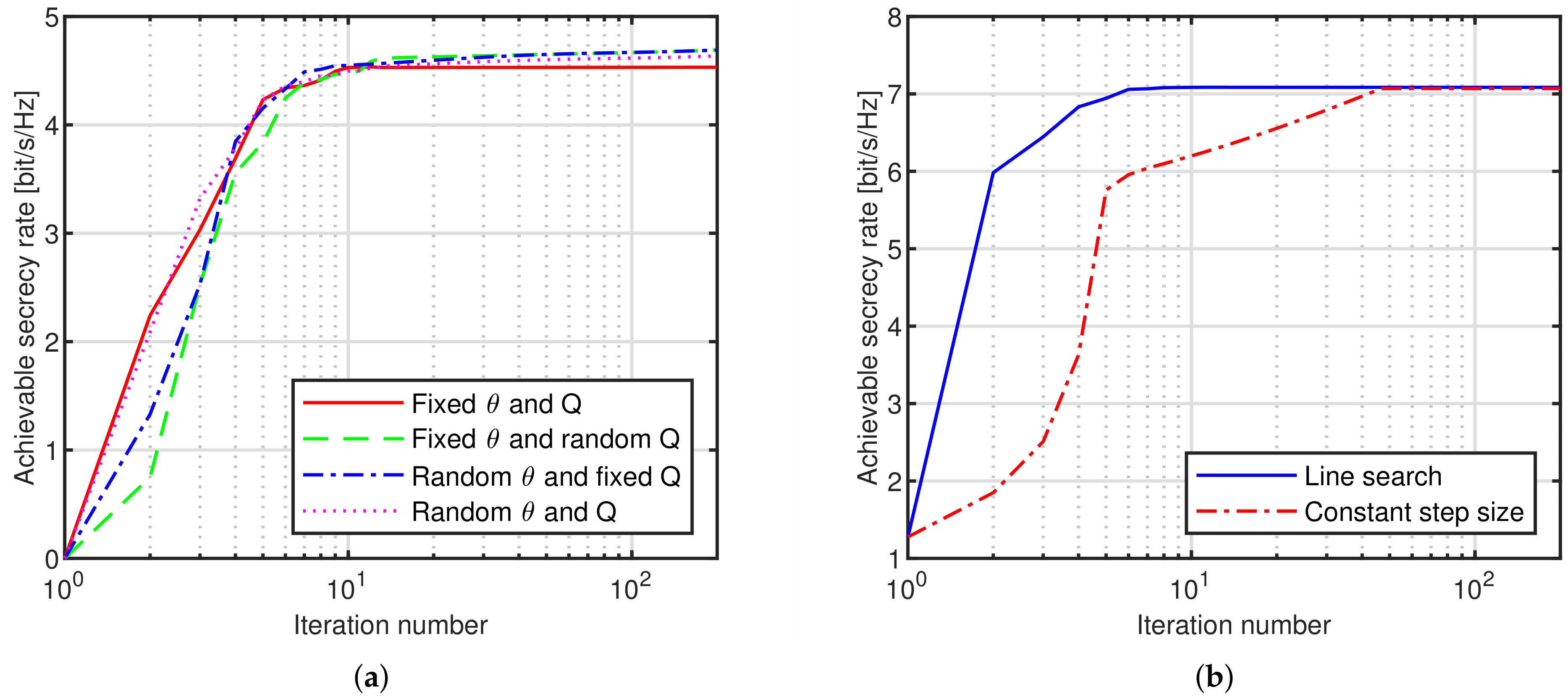
Furthermore, the secrecy rates of IterAO and PGM outperform that of the benchmark scheme (i.e., AOMRT). We also observe that the secrecy rate of IterAO is marginally higher than that of PGM. As we all know, runtime is an important performance metric of an algorithm, so we compare the runtime of PGM and IterAO with that of AOMRT in Figure 3b. It is intuitively clear that PGM requires less runtime than both IterAO and AOMRT. This result shows that although IterAO achieves a slightly higher secrecy rate than PGM, the latter is far more computationally efficient, which is of considerable practical significance. In addition, as the number of iterations increases, the runtime of the proposed IterAO and of AOMRT increases accordingly. Figure 4a shows the effect of the initial value on the performance of PGM. Four cases are considered, in which is either set to (referred to as “fixed ”) or generated randomly, and is either set to (referred to as “fixed ”) or generated randomly. Figure 4a illustrates the secrecy rate for different initial values of and . The secrecy rates in all cases are almost identical once the algorithm has converged to a stationary point. PGM therefore always attains the same secrecy level after a certain number of iterations, which means that its performance is independent of and . Figure 4b shows the impact of the search method on the PGM algorithm. Although they all reach the approximate optimum, PGM with a constant step size converges more slowly than the iteration with line search.
Figure 4.
(a) Effect of the initialization on the PGM scheme: fixed or random initial phase shifts combined with a fixed or random initial transmit covariance. (b) Effect of the step-size rule on the PGM scheme: Armijo–Goldstein line search versus a constant step size.
8. Conclusions
This paper investigated the secrecy rate maximization problem for an IRS-aided MIMO wiretap channel subject to transmit power and unit-modulus constraints. We developed two optimization approaches: the IterAO framework, which alternately optimizes the transmit covariance matrix and the IRS phase shifts, and the PGM scheme, which updates all variables simultaneously with an Armijo–Goldstein line search for faster convergence; the convergence of both algorithms was proved. Numerical results demonstrate that IterAO and PGM achieve nearly identical secrecy rates and outperform the benchmark AOMRT. The secrecy rate increases with the number of IRS reflecting elements N, and deploying an IRS brings a substantial performance gain. Compared with IterAO, PGM attains the target secrecy rate with considerably lower runtime. Moreover, the IRS channel path configuration has a more pronounced effect on secrecy performance than the adopted optimization algorithm. This work adopts rank relaxation followed by rank-one recovery to obtain the transmit covariance, assumes perfect CSI at the legitimate users, and considers continuous IRS phase shifts and a moderate number of reflecting elements. Future work will explore imperfect CSI, discrete phase shifts, large-scale IRS arrays, and scenarios with multiple users and multi-antenna eavesdroppers.
Author Contributions
Methodology, J.Q.; Software, J.Q.; Validation, J.Q.; Formal analysis, J.Q.; Investigation, G.W.; Writing-original draft, J.Q.; Writing-review & editing, J.Q. and A.D.; Supervision, G.W.; Funding acquisition, J.Y. All authors have read and agreed to the published version of the manuscript.
Funding
This work was supported by the National Natural Science Foundation of China under Grants 62272256, the Major Program of Shandong Provincial Natural Science Foundation for the Fundamental Research under Grant ZR2022ZD03, the Colleges and Universities 20 Terms Foundation of Jinan City under Grant 202228093, the Shandong Provincial Natural Science Foundation under Grant ZR2026MS1141, ZR2023MF040, the Shandong Computer Society Provincial Key Laboratory Joint Open Fund Project under Grant 2026ISEC002, the Shandong Province Youth Innovation Team Project under Grant 2024KJH032, the Innovation Pilot Project for Science-Education-Industry Integration of Qilu University of Technology (Shandong Academy of Sciences) under Grant 2026ZDCX02, the Special Research Project for High-Level Talent Introduction (2025) of Shandong Women’s University under Grant 2025RCYJ20, the Key R&D Program of Shandong Province, China, under Grant 2025CXPT082 and the “20 New Universities” Project of Jinan City under Grant 202534108.
Data Availability Statement
The data presented in this study are available on request from the corresponding author.
Conflicts of Interest
The authors declare no conflicts of interest. The funders had no role in the design of the study; in the collection, analyses, or interpretation of data; in the writing of the manuscript; or in the decision to publish the results.
Appendix A
Assume that is the smooth solution which satisfies . There exists a , such that the feasible point to satisfy . Obviously, it can be proven that the value provided by is larger than that obtained from ; this contradicts the assumption that is a smooth solution. Thus, we can rewrite the first equality constraint in (4b) as , and the solution of problem (4) remains the same.
Appendix B
Define the dual variables with respect to the first two constraints in problem (5) and variable as and , respectively; then, we can express the Lagrangian function of problem (5) as follows
Then, we have
and on the basis of KKT conditions, where , , and are the optimal solutions of , , and , respectively. Substituting into , we can obtain
Since , and is a full-rank matrix, we have
It is obvious that cannot be the optimal solution. Thus, we obtain .
Appendix C
It is easy to note that (16) is given according to [45] and to some extent, it has been quite common in the literature. Compared with the derivation of (16), the derivation of (15) is an insurmountable barrier. To deal with this problem, we review the definitions of complex-valued gradients described in [45]. We define as the differential of . Based on this, we obtain the following equation,
where is the matrix for placing the diagonal elements of on , i.e., [45]. Following the footstep in [45], we obtain
We can prove the expression for in a similar way, which is therefore omitted for brevity.
References
- Shu, F.; Teng, Y.; Li, J.; Huang, M.; Shi, W.; Li, J.; Wu, Y.; Wang, J. Enhanced secrecy rate maximization for directional modulation networks via irs. IEEE Trans. Commun. 2021, 69, 8388–8401. [Google Scholar] [CrossRef] [Scilit]
- Shahzadi, S.; Iqbal, M.; Chaudhry, N.R. 6G vision: Toward future collaborative cognitive communication (3c) systems. IEEE Commun. Stand. Mag. 2021, 5, 60–67. [Google Scholar] [CrossRef] [Scilit]
- Achievable rate optimization for mimo systems with reconfigurable intelligent surfaces. IEEE Trans. Wirel. Commun. 2021, 20, 3865–3882. [Google Scholar] [CrossRef] [Scilit]
- Wu, Q.; Zhang, R. Intelligent reflecting surface enhanced wireless network via joint active and passive beamforming. IEEE Trans. Wirel. Commun. 2019, 18, 5394–5409. [Google Scholar] [CrossRef] [Scilit]
- Chu, Z.; Hao, W.; Xiao, P.; Mi, D.; Liu, Z.; Khalily, M.; Kelly, J.R.; Feresidis, A.P. Secrecy rate optimization for intelligent reflecting surface assisted mimo system. IEEE Trans. Inf. Forensics Secur. 2021, 16, 1655–1669. [Google Scholar] [CrossRef] [Scilit]
- Porambage, P.; Gür, G.; Moya Osorio, D.P.; Livanage, M.; Ylianttila, M. 6g security challenges and potential solutions. In 2021 Joint European Conference on Networks and Communications 6G Summit (EuCNC/6G Summit); IEEE: New York, NY, USA, 2021; pp. 622–627. [Google Scholar]
- Dong, L.; Wang, H.-M. Enhancing secure mimo transmission via intelligent reflecting surface. IEEE Trans. Wirel. Commun. 2020, 19, 7543–7556. [Google Scholar] [CrossRef] [Scilit]
- Nadeem, Q.-U.-A.; Kammoun, A.; Chaaban, A.; Debbah, M.; Alouini, M.S. Asymptotic max-min sinr analysis of reconfigurable intelligent surface assisted miso systems. IEEE Trans. Wirel. Commun. 2020, 19, 7748–7764. [Google Scholar] [CrossRef] [Scilit]
- Qiu, J.; Yu, J.; Dong, A.; Yu, K. Joint beamforming for irs-aided multi-cell miso system: Sum rate maximization and sinr balancing. IEEE Trans. Wirel. Commun. 2022, 21, 7536–7549. [Google Scholar] [CrossRef] [Scilit]
- Xie, H.; Xu, J.; Liu, Y.-F. Max-min fairness in irs-aided multi-cell miso systems with joint transmit and reflective beamforming. IEEE Trans. Wirel. Commun. 2021, 20, 1379–1393. [Google Scholar] [CrossRef] [Scilit]
- Qiu, J.; Yu, J.; Dong, A.; Yu, K.; Chen, H. Weighted Sum-Rate Maximization With Transceiver and Passive Beamforming Design for IRS-Aided MIMO-BC Communications via Matrix Fractional Programming. IEEE Trans. Commun. 2024, 73, 1383–1398. [Google Scholar] [CrossRef] [Scilit]
- Wu, X.; Ma, J.; Xing, Z.; Gu, C.; Xue, X.; Zeng, X. Secure and energy efficient transmission for irs-assisted cognitive radio networks. IEEE Trans. Cogn. Commun. Netw. 2022, 8, 170–185. [Google Scholar] [CrossRef] [Scilit]
- Qiao, J.; Alouini, M.-S. Secure transmission for intelligent reflecting surface-assisted mmwave and terahertz systems. IEEE Wirel. Commun. Lett. 2020, 9, 1743–1747. [Google Scholar] [CrossRef] [Scilit]
- Chen, S.; Liang, Y.-C.; Sun, S.; Kang, S.; Cheng, W.; Peng, M. Vision, requirements, and technology trend of 6g: How to tackle the challenges of system coverage, capacity, user data-rate and movement speed. IEEE Wirel. Commun. 2020, 27, 218–228. [Google Scholar] [CrossRef] [Scilit]
- Cumanan, K.; Ding, Z.; Sharif, B.; Tian, G.Y.; Leung, K.K. Secrecy rate optimizations for a mimo secrecy channel with a multiple-antenna eavesdropper. IEEE Trans. Veh. Technol. 2014, 63, 1678–1690. [Google Scholar] [CrossRef] [Scilit]
- Yu, K.; Yu, J.; Dong, A. Cooperative communication and mobility for securing urllc of future wireless networks. IEEE Trans. Veh. Technol. 2022, 71, 5331–5342. [Google Scholar] [CrossRef] [Scilit]
- Yan, P.; Duan, W.; Sun, Q.; Zhang, G.; Zhang, J.; Ho, P.H. Improving Physical-Layer Security for Cognitive Networks via Artificial Noise-Aided Rate Splitting. IEEE Internet Things J. 2024, 11, 18932–18933. [Google Scholar] [CrossRef] [Scilit]
- Ji, Y.; Yu, K.; Qiu, J.; Yu, J. Massive MIMO and Secrecy Guard Zone Based Improving Physical Layer Security in UAV-Enabled uRLLC Networks. IEEE Trans. Veh. Technol. 2023, 72, 4553–4567. [Google Scholar] [CrossRef] [Scilit]
- Yu, K.; Yu, J.; Luo, C. The Impact of Mobility on Physical Layer Security of 5G IoT Networks. IEEE/ACM Trans. Netw. 2023, 31, 1042–1055. [Google Scholar] [CrossRef] [Scilit]
- Sharma, G.; Mallik, R.K.; Pandey, N.; Singh, A. Effect of Interfering Transmitter on the Secrecy of Diffusive Molecular Timing Channels. IEEE Trans. Commun. 2024, 72, 3323–3337. [Google Scholar] [CrossRef] [Scilit]
- Hong, S.; Pan, C.; Ren, H.; Wang, K.; Nallanathan, A.; Li, H. Robust transmission design for intelligent reflecting surface aided secure communications. In 2020 IEEE Global Communications Conference (IEEE GLOBECOM); IEEE: New York, NY, USA, 2020; pp. 1–6. [Google Scholar]
- Shen, Y.; Wang, C.; Zang, W.; Xue, L.; Yang, B.; Guan, X. Outage Constrained Max–Min Secrecy Rate Optimization for IRS-Aided SWIPT Systems With Artificial Noise. IEEE Internet Things J. 2024, 11, 9814–9828. [Google Scholar] [CrossRef] [Scilit]
- Cui, M.; Zhang, G.; Zhang, R. Secure wireless communication via intelligent reflecting surface. IEEE Wirel. Commun. Lett. 2019, 8, 1410–1414. [Google Scholar] [CrossRef] [Scilit]
- Almohamad, A.; Tahir, A.M.; Al-Kababji, A.; Furqan, H.M.; Khattab, T.; Hasna, M.O.; Arslan, H. Smart and secure wireless communications via reflecting intelligent surfaces: A short survey. IEEE Open J. Commun. Soc. 2020, 1, 1442–1456. [Google Scholar] [CrossRef] [Scilit]
- Kavianinia, M.R.; Mohammadi, A.; Meghdadi, V. Secrecy Rate Maximization in the Presence of Stacked Intelligent Metasurface. IEEE Trans. Inf. Forensics Secur. 2025, 20, 6840–6853. [Google Scholar] [CrossRef] [Scilit]
- Elsayed, M.; Ibrahim, A.S.; Ismail, M.H.; Samir, A. Sum Secrecy Rate Optimization in RIS-Assisted ISAC Systems: A Manifold-Based Framework. IEEE Wirel. Commun. Lett. 2025, 14, 1244–1248. [Google Scholar] [CrossRef] [Scilit]
- Zhu, F.; Wang, X.; Huang, C.; Yang, Z.; Chen, X.; Al Hammadi, A.; Zhang, Z.; Yuen, C.; Debbah, M. Robust beamforming for RIS-aided communications: Gradient-based manifold meta learning. IEEE Trans. Wirel. Commun. 2024, 23, 15945–15956. [Google Scholar] [CrossRef] [Scilit]
- He, X.; Ye, Y.; Xu, H.; Liu, W.; Zhou, A. Beamforming optimization of meta-learning algorithm based on gradient descent in RIS-assisted ISAC system. Phys. Commun. 2024, 66, 102429. [Google Scholar] [CrossRef] [Scilit]
- Sivasankar, S.; Markkandan, S. Hybrid Optimization for IRS-Aided Secure Communication: A Gradient Projection and Dynamic Security Framework. Trans. Emerg. Telecommun. Technol. 2025, 36, e70149. [Google Scholar] [CrossRef] [Scilit]
- Wu, Q.; Zhang, R. Joint active and passive beamforming optimization for intelligent reflecting surface assisted swipt under qos constraints. IEEE J. Sel. Areas Commun. 2020, 38, 1735–1748. [Google Scholar] [CrossRef] [Scilit]
- Zhao, M.-M.; Wu, Q.; Zhao, M.-J.; Zhang, R. Intelligent reflecting surface enhanced wireless networks: Two-timescale beamforming optimization. IEEE Trans. Wirel. Commun. 2021, 20, 2–17. [Google Scholar] [CrossRef] [Scilit]
- Wang, W.; Liu, X.; Tang, J.; Zhao, N.; Chen, Y.; Ding, Z.; Wang, X. Beamforming and jamming optimization for irs-aided secure noma networks. IEEE Trans. Wirel. Commun. 2022, 21, 1557–1569. [Google Scholar] [CrossRef] [Scilit]
- Hong, S.; Pan, C.; Ren, H.; Wang, K.; Chai, K.K.; Nallanathan, A. Robust transmission design for intelligent reflecting surface-aided secure communication systems with imperfect cascaded csi. IEEE Trans. Wirel. Commun. 2021, 20, 2487–2501. [Google Scholar] [CrossRef] [Scilit]
- Zhou, D.; Li, L.; Gong, S.; Gu, B.; Chen, G.; Niyato, D. Learning Adaptive Jamming and Beamforming for Hybrid IRS-assisted Secure NOMA Transmissions. IEEE Trans. Wirel. Commun. 2025, 73, 12235–12247. [Google Scholar] [CrossRef] [Scilit]
- Wang, X.; Wang, K.; Zhang, X.-D. Secure relay beamforming with imperfect channel side information. IEEE Trans. Veh. Technol. 2013, 62, 2140–2155. [Google Scholar] [CrossRef] [Scilit]
- Jung, H.; Ko, S.-W.; Lee, I.-H. Secure transmission using linearly distributed virtual antenna array with element position perturbations. IEEE Trans. Veh. Technol. 2021, 70, 474–489. [Google Scholar] [CrossRef] [Scilit]
- Huang, S.; Ye, Y.; Xiao, M.; Poor, H.V.; Skoglund, M. Decentralized beamforming design for intelligent reflecting surface-enhanced cell-free networks. IEEE Wirel. Commun. Lett. 2021, 10, 673–677. [Google Scholar] [CrossRef] [Scilit]
- Niu, H.; Chu, Z.; Zhou, F.; Zhu, Z.; Zhang, M.; Wong, K.K. Weighted sum secrecy rate maximization using intelligent reflecting surface. IEEE Trans. Commun. 2021, 69, 6170–6184. [Google Scholar] [CrossRef] [Scilit]
- Li, J.; Zhang, L.; Xue, K.; Fang, Y.; Sun, Q. Secure transmission by leveraging multiple intelligent reflecting surfaces in miso systems. IEEE Trans. Mob. Comput. 2023, 22, 2387–2401. [Google Scholar] [CrossRef] [Scilit]
- Dong, L.; Wang, H.-M. Secure mimo transmission via intelligent reflecting surface. IEEE Wirel. Commun. Lett. 2020, 9, 787–790. [Google Scholar] [CrossRef] [Scilit]
- Kha, H.; Tuan, H.D.; Nguyen, H.H. Fast global optimal power allocation in wireless networks by local d.c. programming. IEEE Trans. Wirel. Commun. 2012, 11, 510–515. [Google Scholar] [CrossRef] [Scilit]
- Boyd, S.; Boyd, S.P.; Vandenberghe, L. Convex Optimization; Cambridge University Press: Cambridge, UK, 2004. [Google Scholar]
- Liu, L.; Zhang, R.; Chua, K.-C. Secrecy wireless information and power transfer with miso beamforming. IEEE Trans. Signal Process. 2014, 62, 1850–1863. [Google Scholar] [CrossRef] [Scilit]
- Zhang, S.; Zhang, R. Capacity characterization for intelligent reflecting surface aided mimo communication. IEEE J. Sel. Areas Commun. 2020, 38, 1823–1838. [Google Scholar] [CrossRef] [Scilit]
- HjØrungnes, A. Complex-Valued Matrix Derivatives—With Applications in Signal Processing and Communications; Cambridge University Press: Cambridge, UK, 2011. [Google Scholar] [CrossRef] [Scilit]
- Armijo, L. Minimization of functions having lipschitz continuous first partial derivatives. Pac. J. Math. 1966, 16, 1–3. [Google Scholar] [CrossRef] [Scilit]
Disclaimer/Publisher’s Note: The statements, opinions and data contained in all publications are solely those of the individual author(s) and contributor(s) and not of MDPI and/or the editor(s). MDPI and/or the editor(s) disclaim responsibility for any injury to people or property resulting from any ideas, methods, instructions or products referred to in the content. |
© 2026 by the authors. Licensee MDPI, Basel, Switzerland. This article is an open access article distributed under the terms and conditions of the Creative Commons Attribution (CC BY) license.