


Abstract
Automatic modulation recognition (AMR) from short in-phase and quadrature (I/Q) sequences remains challenging at low signal-to-noise ratios (SNRs), as informative local structures become less distinguishable and discriminative evidence may be distributed across time. We present DITE-Net, a Dendritic-Inhibitory Temporal Evidence Network for short-sequence AMR. Inspired by neural information-processing functions, the architecture combines dendritic compartmental integration (DCI) for input-dependent multiscale feature aggregation, excitation–inhibition regulation (EIR) for gated residual response control, and distributed temporal evidence integration (DTEI) for contextual processing and bidirectional recurrent aggregation. The neural-circuit-inspired terminology reflects functional design analogies rather than a biologically faithful simulation. Experiments on RADIOML 2016.10A and RML22 demonstrate that DITE-Net achieves competitive recognition accuracy. Additional ablation studies and low-SNR evaluations indicate that removing BiGRU causes the largest accuracy reduction among the evaluated components, while the independent effects of adaptive routing and EIR remain modest and dataset-dependent. Computational analyses further quantify the trade-off between recognition accuracy and inference cost for fixed-window processing.
1. Introduction
Automatic modulation recognition (AMR) identifies the modulation format of a received signal and supports applications such as spectrum monitoring, cognitive radio, adaptive reception, and non-cooperative signal analysis [1]. In practical wireless environments, received in-phase and quadrature (I/Q) sequences may be affected by additive noise, channel fading, carrier-frequency offset, sampling-rate offset, phase offset, and hardware impairments. These effects can distort the amplitude, phase, and temporal features used for modulation discrimination [2]. Their impact is particularly pronounced at low signal-to-noise ratios (SNRs), where class-dependent patterns become difficult to distinguish, and only weak discriminative cues may remain within a short observation interval. Therefore, the AMR, under these conditions, requires both discriminative feature extraction and the integration of weak evidence distributed across the received sequence.
Classical AMR methods generally rely on likelihood-based decision rules or expert-designed signal features, whereas deep learning enables discriminative representations to be learned directly from raw or transformed observations. Related radio-frequency signal identification tasks, including radio-frequency fingerprinting and specific emitter identification, have likewise benefited from deep representation learning, self-supervised learning, and few-shot learning [3,4,5]. Early studies on the RadioML benchmark demonstrated the feasibility of end-to-end modulation classification from raw I/Q sequences [6]. Subsequent research has explored convolutional, recurrent, and attention-based architectures to capture complementary signal characteristics. MCLDNN combines convolutional feature extraction with recurrent modeling to capture complementary spatial and temporal information [7], while PET-CGDNN addresses phase-related nuisance factors through parameter estimation and transformation [8]. Transformer-based approaches have also been explored for sequence-level modeling [9]. FEA-T employs frame-wise embeddings for Transformer encoding [10], while AMC-Net combines frequency-domain adaptive correction, multiscale convolutional feature extraction, and self-attention-based temporal fusion [11]. CV-TRN introduces complex-valued self-attention to model interactions between the I/Q components [12]. Other studies combine complementary signal representations. TSFFN integrates time-domain, spectrogram, and temporal–spectral representations [13]. IQFormer dynamically fuses I/Q and time–frequency features within a staged Transformer framework [14]. MILAFormer further integrates local feature enhancement, temporal modeling, and Mamba-inspired linear attention within a multi-stage architecture [15]. Together, these methods illustrate different approaches to extracting and combining local, temporal, spectral, and global signal information.
Recent AMR studies have also explored hybrid architectures for complementary feature extraction and temporal modeling. For example, TLDNN combines Transformer-based global feature extraction with recurrent sequence modeling and introduces segment-substitution data augmentation [16]. Ansari et al. proposed an attention-enhanced hybrid CNN–Transformer framework for modulation recognition [17]. Building on the general idea of complementary feature modeling, DITE-Net adopts a task-oriented architecture that integrates multiscale local feature extraction, gated response regulation, and bidirectional temporal evidence integration for short I/Q sequences.
Noise that corrupts received I/Q samples should be distinguished from errors in training labels. UCRT addresses label corruption through uniform-consistency sample selection and robust semi-supervised training [18]. By contrast, DITE-Net focuses on signal-level degradation and does not include label-error detection or noisy-label learning.
Existing AMR approaches commonly seek to improve recognition through richer local, temporal, or spectral representations. At low SNRs, however, extracting informative features is only part of the challenge. Weak modulation cues may occur at different temporal scales, be obscured by noise-induced activations, and remain dispersed across the observation window. The weighting of local cues, regulation of unreliable responses, and integration of distributed evidence are often handled implicitly within general-purpose feature extraction or fusion blocks. These considerations motivate an architecture that explicitly organizes local evidence aggregation, response regulation, and temporal integration.
Neuroscience offers several functional principles that provide a useful perspective for organizing such weak evidence. Recent in vivo evidence indicates that distinct dendritic compartments can follow different activity-dependent synaptic plasticity rules, suggesting that synaptic processing varies across compartments [19]. Cortical inhibition is also highly selective, with inhibitory neurons targeting specific neuronal populations and subcellular compartments, thereby regulating the propagation of neural responses [20]. At a broader scale, neural computations involve interactions across interconnected brain regions, and task-related activity evolves across regions and time during perception and decision-making [21,22]. Inspired by these principles, DITE-Net abstracts three corresponding computational functions: adaptive local integration, selective excitation–inhibition regulation, and distributed temporal evidence integration.
Motivated by these observations, we propose DITE-Net, a Dendritic-Inhibitory Temporal Evidence Network for automatic modulation recognition. The architecture organizes local feature extraction, response regulation, and temporal modeling into successive stages of evidence processing. Specifically, dendritic compartmental integration (DCI) adaptively combines local patterns over multiple temporal receptive fields, excitation–inhibition regulation (EIR) selectively regulates the resulting feature responses, and distributed temporal evidence integration (DTEI) establishes contextual interactions and accumulates distributed information over the observation interval.
DITE-Net thus converts local I/Q features into a sequence-level representation for classification. Its modules are implemented using established convolutional, gating, attention, and recurrent operations; the neural-circuit-inspired terminology denotes functional analogies rather than biological neural dynamics. The contribution lies in the task-oriented organization of these operations and their evaluation in terms of accuracy and computational cost. The five-run overall accuracies are on RADIOML 2016.10A and on RML22. Component ablations and simplified BiGRU-based controls help distinguish the performance of the complete architecture from the contributions of its individual components.
2. Problem Formulation
We formulate modulation recognition as a supervised classification task using received I/Q sequences. Given a received signal segment, its real-valued representation is denoted by , where T is the number of sampling points, and and denote the in-phase and quadrature components, respectively. Each sample is associated with a modulation label , where denotes the number of modulation categories.
The network learns a nonlinear mapping , where denotes the proposed DITE-Net with trainable parameters . For an input , the network produces a probability vector , with , and the predicted modulation category is given by . For classification, we minimize the cross-entropy loss
where is the one-hot encoded target for the c-th category, and is the corresponding predicted probability.
Under low-SNR conditions, noise and channel effects can weaken modulation-dependent patterns. DITE-Net addresses this challenge by combining local feature extraction, response regulation, and temporal evidence integration.
3. Proposed Method
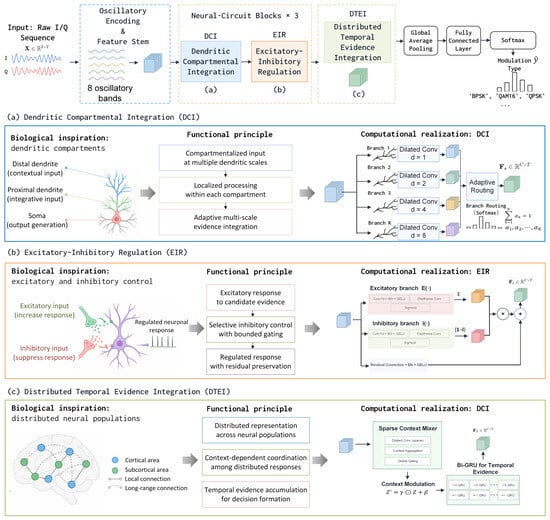
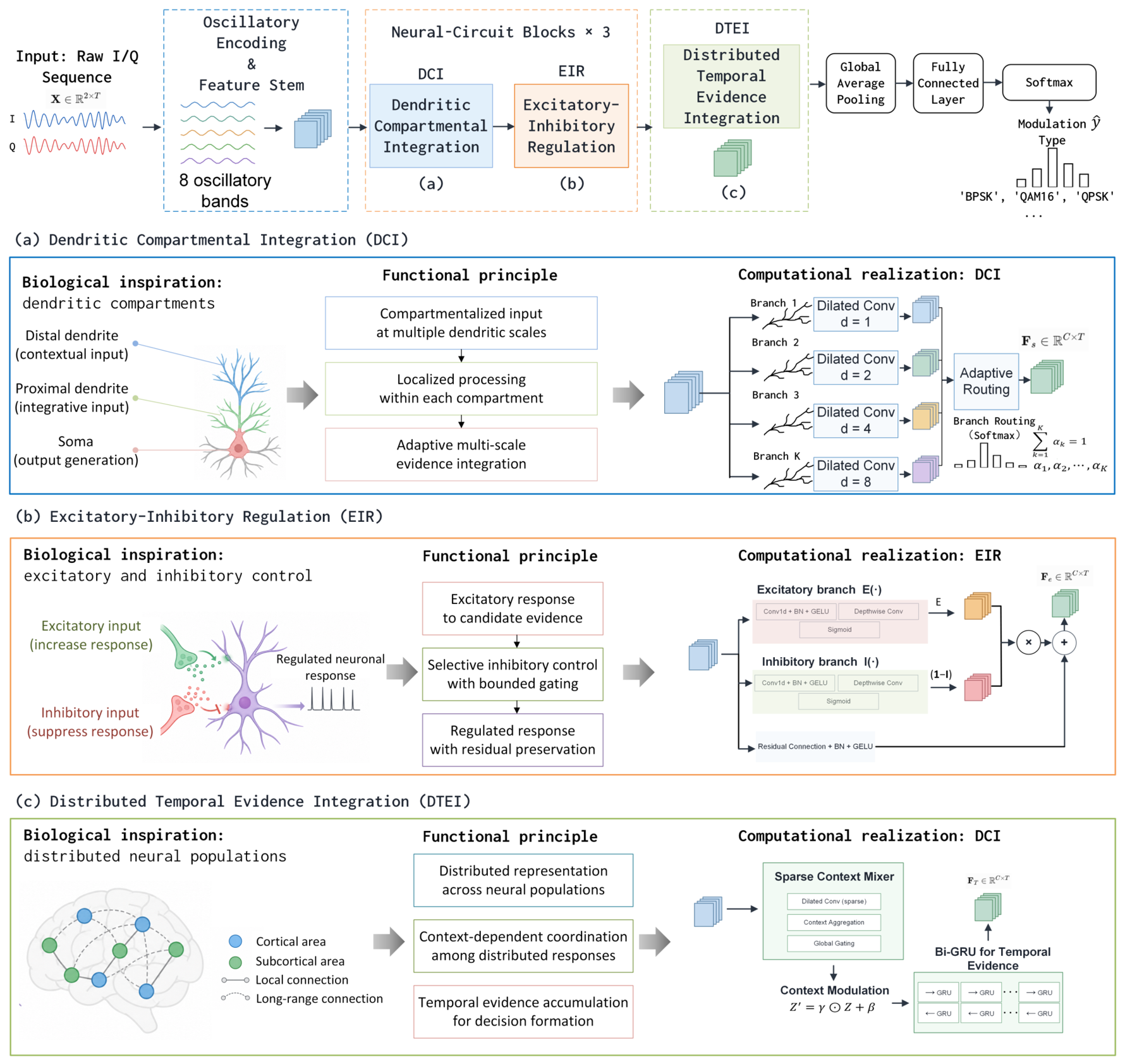
The overall architecture of DITE-Net is illustrated in Figure 1. Given a received I/Q sequence , the oscillatory encoder projects the raw samples onto learnable sinusoidal components to produce complementary periodic and phase-sensitive responses. A lightweight convolutional stem subsequently transforms the encoded responses into an initial feature representation .
Figure 1.
Overall architecture of DITE-Net. Raw I/Q samples are mapped to an initial feature representation, refined by stacked local neural-circuit blocks, and processed by DTEI before global pooling and modulation classification.
The initial representation is processed by stacked local neural-circuit blocks. Within each block, dendritic compartmental integration (DCI) adaptively combines local evidence from multiple temporal receptive fields, followed by excitation–inhibition regulation (EIR) to selectively regulate the resulting feature responses. A differentiable soft gate and a predictive-coding correction provide additional feature refinement. After local refinement, the resulting sequence is passed to the distributed temporal evidence integration (DTEI) module, which applies sparse contextual interactions, context-dependent modulation, and bidirectional temporal integration. Finally, global average and max pooling summarize the integrated feature sequence, and the concatenated representation is fed to the classifier for modulation prediction.
The three components form a sequential evidence-processing pathway. DCI integrates local features across temporal scales, EIR regulates the resulting responses, and DTEI organizes contextual interactions and combines evidence over time into a sequence-level representation. This functional analogy does not imply a biologically faithful implementation; the effects of the individual components are evaluated in the ablation study.
3.1. Dendritic Compartmental Integration
Recent in vivo evidence shows that distinct dendritic compartments can follow different activity-dependent synaptic plasticity rules, indicating compartment-dependent processing within individual neurons [19]. Inspired by this functional principle, DITE-Net introduces dendritic compartmental integration (DCI) as a computational abstraction for organizing local modulation evidence. Rather than processing all local patterns through a single temporal receptive field, DCI employs multiple parallel branches and adaptively determines their contributions according to the current input.
Given an input feature map , DCI constructs K parallel temporal branches with different dilation factors. The response of the k-th branch is written as
where consists of a depthwise temporal convolution with dilation , followed by batch normalization, GELU activation, pointwise channel projection, and feature refinement. The dilation factors provide different temporal receptive fields, enabling the branches to capture patterns at different time scales.
The relative importance of these branch responses is determined adaptively for each received sequence. Global average pooling (GAP) first summarizes the temporal dimension of into a channel descriptor. The descriptor is then processed by a two-layer routing network, and the branch weights are obtained as
where , , , and . The first linear projection maps the C-dimensional channel descriptor to an intermediate dimension , and the second produces K routing logits. Softmax normalization yields non-negative coefficients satisfying and . Thus, the routing weights depend on the current input rather than being shared as fixed coefficients across all samples.
The branch responses are aggregated using the routing weights and added to the input through a residual connection:
where denotes the DCI output. Each scalar is broadcast over the response of its corresponding branch. The residual path retains the input features, while weighted aggregation introduces input-dependent multiscale information. The fixed-routing ablation below retains these multiscale branches, so it isolates the routing mechanism rather than the entire DCI block.
The routing network adapts branch contributions to each input rather than using fixed weights. Nevertheless, the ablation results show only a modest, dataset-dependent accuracy difference; they do not establish a substantial independent benefit from adaptive routing.
3.2. Excitation–Inhibition Regulation
Connectomic evidence indicates that cortical inhibition exhibits target specificity, with inhibitory neurons preferentially contacting particular neuronal populations and subcellular compartments [20]. Inspired by this selective inhibitory control, DITE-Net introduces excitation–inhibition regulation (EIR) to regulate the local evidence produced by DCI. Rather than directly forwarding all newly activated responses, EIR separates response generation from inhibitory control through two functionally asymmetric pathways.
Given the DCI output , the excitatory pathway generates candidate feature responses using a temporal convolution followed by batch normalization, GELU activation, and dropout. In parallel, the inhibitory pathway applies a depthwise temporal convolution followed by batch normalization and pointwise projection, and terminates with a sigmoid function to produce a bounded gate . In the implemented EIR block, kernel sizes of 3 and 5 are used for the excitatory and inhibitory pathways, respectively. The regulated representation is computed as
where and denote the excitatory response and inhibitory gating transformations, respectively, and ⊙ denotes element-wise multiplication.
The two pathways have distinct computational roles. The excitatory pathway produces a candidate feature update, while the sigmoid-bounded inhibitory gate controls how strongly that update contributes to the residual representation. When an inhibitory coefficient approaches one, the corresponding excitatory update is strongly attenuated; when it approaches zero, the update is largely retained. Importantly, the residual term is preserved throughout this operation, so EIR regulates newly generated responses rather than directly suppressing the underlying DCI representation.
After EIR, each local neural circuit block applies a differentiable soft gate to further control feature transmission. For each channel and temporal location, the gate is defined as
where is a learnable channel-wise threshold and is a positive learnable temperature. This differentiable gate scales feature responses according to their activation relative to the learned threshold.
A predictive-coding correction is then applied to . A local predictor estimates the current representation, and the resulting prediction error is transformed and fed back through a residual correction:
where maps the prediction error back to the feature space and is a learnable predictive-coding correction coefficient. The prediction error additionally provides an auxiliary objective
and the network is trained using
where controls the contribution of the predictive coding objective.
EIR thus regulates local feature updates, while the soft gate and predictive-coding correction provide additional response control and error-based refinement before temporal integration.
3.3. Distributed Temporal Evidence Integration
Neural computation is not confined to isolated local circuits but emerges from coordinated interactions across distributed neural populations. Large-scale connectomic and brain-wide recording studies suggest that neural activity is shaped by structured connectivity and evolves across regions and time during perception and decision-making [21,22]. Inspired by this distributed processing principle, DITE-Net introduces distributed temporal evidence integration (DTEI) to organize the locally refined representation into a sequence-level representation. DTEI consists of a sparse context mixer, context modulation, and bidirectional temporal integration.
Given the locally refined feature map , the sparse context mixer first introduces structured interactions across feature channels. Instead of using a fully dense transformation, a binary connectivity mask retains both local and sparse long-range connections between channels. The effective mixing matrix is defined as
where is learnable and specifies the predefined sparse connectivity pattern. The mixed response is normalized and nonlinearly transformed before being introduced through a learnable residual coefficient:
where denotes the masked linear transformation followed by batch normalization, GELU activation, and dropout, and controls the contribution of the contextual interaction. The operation allows structured cross-channel interactions while retaining the original feature map.
DTEI subsequently derives a global context from distributed temporal regions of . The sequence is adaptively pooled into R region tokens , while global average pooling produces a global prior token . The global prior serves as the query, whereas the region tokens provide the keys and values. This interaction is written compactly as
where denotes multi-head attention. The resulting context vector is projected to channel-wise scale and shift parameters, denoted by and , respectively. The contextual modulation is then expressed as
where is bounded by a hyperbolic tangent function and is a separate learnable contextual-modulation coefficient, independent of . Thus, regional information modulates the channel responses throughout the sequence.
After contextual processing, temporal evidence is accumulated by a bidirectional gated recurrent unit (BiGRU). The feature map is transposed into a time-major representation . This sequence is processed in forward and backward directions; the concatenated output is layer-normalized and transposed back to channel-major form:
Here and denote forward and backward recurrent processing, respectively, ‖ denotes concatenation along the feature dimension, and is the temporally integrated representation. With 32 hidden units in each direction, the concatenated feature dimension is . The bidirectional operation allows information from different portions of the observation interval to contribute to each temporal representation, thereby accumulating modulation evidence distributed across the received sequence.
Finally, global average and max pooling summarize complementary statistics of :
where ‖ denotes feature concatenation and . The resulting representation is passed through a lightweight fully connected classifier to produce the modulation logits.
DTEI therefore combines contextual processing with bidirectional temporal integration. The sparse mixer and context modulation are auxiliary refinements, whereas BiGRU is the principal temporal integrator. The ablation results show that the contextual operations do not provide consistent independent accuracy gains across the evaluated datasets.
4. Experimental Settings
4.1. Dataset
Experiments are conducted on two widely used AMR benchmarks, RADIOML 2016.10A and RML22. RADIOML 2016.10A contains 220,000 I/Q sequences from 11 modulation classes: eight digital modulations (BPSK, QPSK, 8PSK, 16QAM, 64QAM, PAM4, GFSK, and CPFSK) and three analog modulations (AM-DSB, AM-SSB, and WBFM). Each example contains 128 complex baseband samples represented by two real-valued I/Q channels. The signal-to-noise ratio (SNR) ranges from to 18 dB in 2 dB increments, with 1000 samples for each modulation–SNR combination [6]. RML22 is a more recent benchmark incorporating simulated additive noise, channel fading, carrier-frequency offset, sampling-rate offset, and phase offset [2]. RML22 contains the same 11 modulation classes and 462,000 I/Q sequences in total. Nevertheless, these simulated impairments do not establish robustness to unseen receiver hardware, calibration changes, or channel conditions outside the benchmark distributions. Its SNR ranges from to 20 dB in 2-dB increments, with 2000 sequences per modulation–SNR combination; each sequence contains 128 complex samples.
For both datasets, samples are divided into training, validation, and test subsets with a ratio of 60%, 20%, and 20%, respectively, while preserving the distributions of modulation classes and SNR levels. The validation subset is used for model selection, whereas the test subset is kept separate and used only for the final performance evaluation.
4.2. Implementation Details
DITE-Net is implemented in PyTorch (version 2.13.0) and trained end-to-end from raw I/Q sequences. Unless otherwise specified, the feature dimension is set to , and the oscillatory encoder contains eight learnable frequency bands. Three local neural-circuit blocks are stacked for progressive feature refinement. Each DCI module employs four parallel temporal branches with dilation factors . In DTEI, the context modulation module uses eight region tokens and four attention heads, while the temporal integrator adopts a single-layer bidirectional GRU with a hidden size of 32 in each direction. The default dropout rate is set to 0.1. The predictive-coding auxiliary loss is weighted by .
We train the network with AdamW for 100 epochs, using an initial learning rate of and a batch size of 64. A MultiStepLR scheduler reduces the learning rate by a factor of 0.1 after epoch 30, and gradients are clipped to a maximum norm of 1.0. The training objective combines cross-entropy loss with the predictive-coding auxiliary loss. The checkpoint with the highest validation accuracy is selected for final test evaluation.
5. Results and Discussion
We evaluate DITE-Net through comparisons with representative AMR models, repeated-run ablations and recurrent controls, computational benchmarking, low-SNR analysis, and visualizations of class-level predictions and learned representations.
5.1. Performance Comparison
Table 1 compares DITE-Net with seven representative AMR models evaluated using the same data partitions and evaluation protocol. The comparison includes MCLDNN [7], PET-CGDNN [8], FEA-T [10], AMC-Net [11], MCFormer [23], IQFormer [14], and SMTrans [24], covering convolutional–recurrent, lightweight convolutional, and Transformer-based architectures. We report overall accuracy and separate low- and high-SNR results to assess recognition under different signal-quality conditions. Here, low SNR spans to 0 dB, while high SNR spans 2 to 18 dB for RADIOML 2016.10A and 2 to 20 dB for RML22.
Table 1.
Performance comparison on RADIOML 2016.10A and RML22 under the common evaluation protocol. Params denotes trainable parameters; accuracy values are percentages. DITE-Net overall accuracies are reported as mean ± sample standard deviation over five independent runs. Other accuracy entries, including SNR-regime results and literature-baseline accuracies, are from designated runs. Bold values indicate the best recognition accuracy in each column.
DITE-Net achieves a five-run overall accuracy of on RADIOML 2016.10A, compared with designated-run accuracies of 63.03% for SMTrans and 62.88% for IQFormer. On RML22, DITE-Net achieves , while SMTrans and IQFormer achieve designated-run accuracies of 70.54% and 70.49%, respectively. The low- and high-SNR results in Table 1 are also from designated runs and should not be interpreted as five-run means. Repeated-run standard deviations are unavailable for some baselines and are therefore not estimated. DITE-Net contains more parameters than several alternatives, including SMTrans (66,316 parameters); its recognition accuracy should consequently be considered alongside the additional computation reported below.
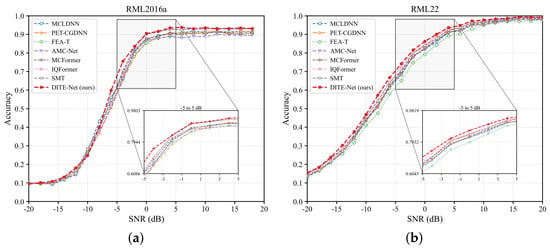
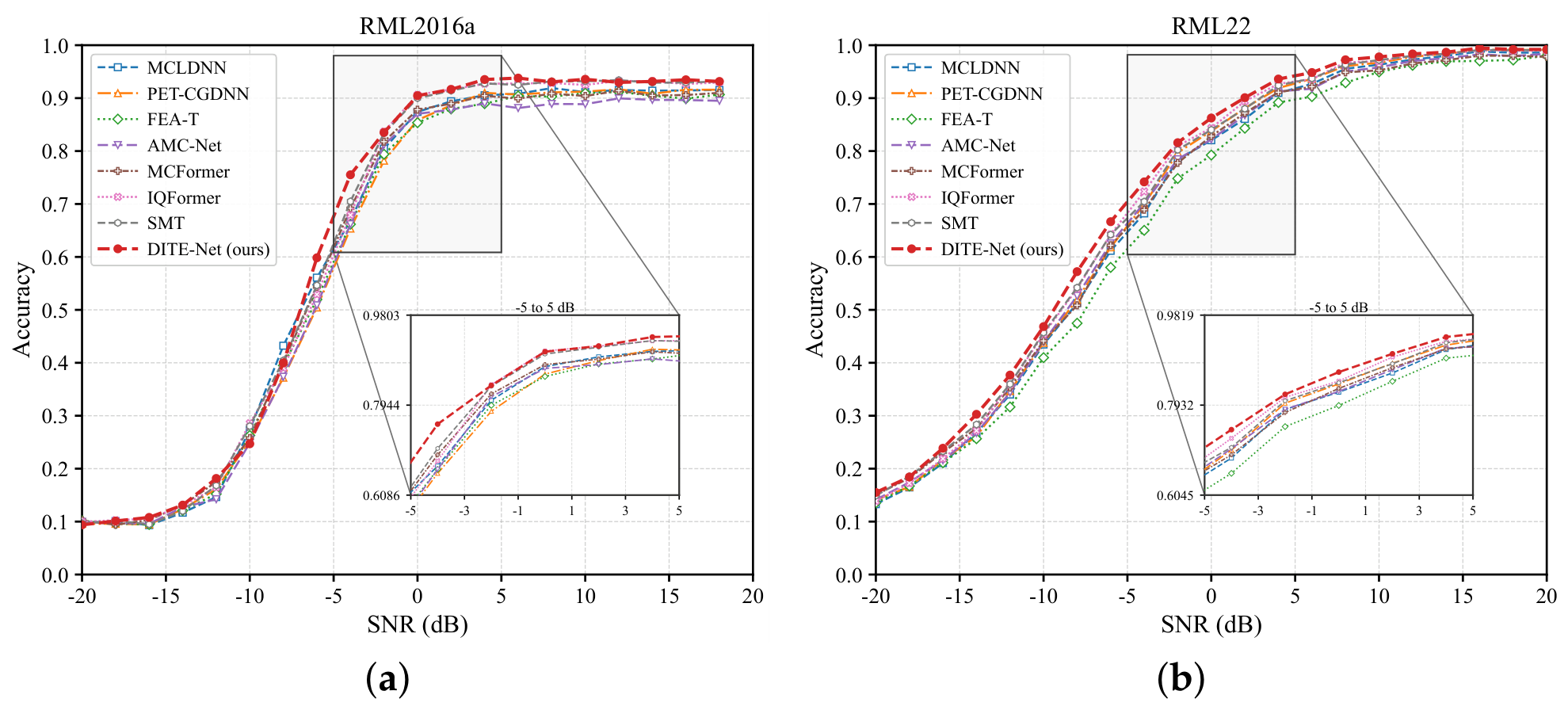
Figure 2 provides a finer-grained comparison across individual SNR levels. Recognition accuracy generally rises with increasing SNR. At very low SNRs, the curves are close because discriminative waveform patterns are strongly obscured by noise. Differences become more visible in the transition region, where DITE-Net maintains competitive recognition accuracy relative to the evaluated baselines. The trend is particularly apparent on RML22 and is consistent with the overall results in Table 1.
Figure 2.
Recognition accuracy versus SNR on (a) RADIOML 2016.10A and (b) RML22. The DITE-Net curve is highlighted, and the inset magnifies the transition region from dB to 5 dB.
5.2. Ablation Analysis
To examine component contributions and run-to-run variability, we evaluate the complete model and five ablation variants across five random seeds. Table 2 reports mean overall test accuracy and sample standard deviation. For the full model, the five-run overall means are 63.70% on RADIOML 2016.10A and 71.60% on RML22. The low- and high-SNR values in Table 1 remain designated-run values.
Table 2.
Five-seed ablation results on RADIOML 2016.10A and RML22. Overall test accuracy is reported as mean ± sample standard deviation (%).
The most pronounced degradation is observed when the BiGRU temporal integrator is removed: mean overall accuracy decreases from 63.70% to 63.13% on RADIOML 2016.10A and from 71.60% to approximately 69.75% on RML22. This ablation also exhibits greater run-to-run variability, particularly on RML22. Among the tested changes, removing BiGRU therefore has the largest measurable effect on accuracy, consistent with its role in integrating information over the full observation window.
Replacing adaptive DCI routing with fixed routing leaves the RADIOML 2016.10A mean unchanged at 63.70% and reduces RML22 mean accuracy by approximately 0.21 percentage points (71.60% versus 71.39%). Because this variant retains all multiscale DCI branches, it assesses adaptive routing rather than the necessity of DCI as a whole. Removing EIR also yields relatively small, dataset-dependent changes. These results do not establish a substantial or generalizable independent accuracy benefit from either mechanism.
Removing the Sparse Context Mixer produces 63.73% on RADIOML 2016.10A, slightly above the complete model, while removing Context Modulation produces 71.64% on RML22, also slightly above the complete model. Neither operation yields a consistent independent improvement across the two datasets. Although both were designed to organize contextual features, the ablations do not establish that either is essential for recognition performance. Simplified designs may be more suitable when deployment cost is the primary constraint.
5.3. BiGRU-Based Control Experiments
To examine whether the performance of DITE-Net can be reproduced using smaller conventional recurrent architectures, two additional controls were evaluated under the same dataset partitions with five independent random seeds. CNN+BiGRU combines a compact convolutional encoder and a bidirectional GRU, while Osc+Stem+BiGRU retains oscillatory encoding and a convolutional stem before recurrent integration. Table 3 gives the overall test accuracy for both benchmarks.
Table 3.
Five-seed test accuracy (mean ± sample standard deviation, %) for the complete architecture and two reduced BiGRU-based controls.
On RML22, the full architecture exceeds CNN+BiGRU and Osc+Stem+BiGRU by approximately 3.34 and 1.73 percentage points, respectively, using unrounded five-run means. The complete model also achieves higher mean accuracy than both controls on RADIOML 2016.10A. Under the evaluated protocol, neither simplified recurrent control matches the overall accuracy of DITE-Net. However, they use substantially fewer parameters and operations; therefore, this is an architecture-level comparison rather than a parameter-matched or compute-matched isolation of DCI, EIR, or contextual operations. It does not attribute the remaining accuracy gap to any single neural-circuit-inspired mechanism.
5.4. Computational Cost and Inference Efficiency
Table 4 reports model parameter count, estimated dense multiply–accumulate operations (MACs), serialized FP32 state size, and measured median CPU/GPU latency. The operation counts correspond to a single 128-sample I/Q window. The MAC estimator covers selected dense operations but excludes some element-wise and normalization operations; these values are not complete FLOP counts. State size is serialized storage rather than runtime memory usage.
Table 4.
Computational characteristics for a 128-sample I/Q window (batch size 1, FP32). Latencies are measured as medians in milliseconds on an Intel Core i9-14900KF CPU and NVIDIA RTX 5090 D v2 GPU. MACs are operator-subset dense estimates, not total FLOPs.
All latency measurements were performed on an otherwise idle system with a batch size of one and FP32 arithmetic. CPU benchmarks used 30 warm-up iterations and 200 timed forward passes; GPU benchmarks used 50 warm-up iterations and 300 timed forward passes. The measured peak PyTorch CUDA allocation for the full model was 49.54 MiB in this configuration. This allocation metric is distinct from serialized model size and from total device memory reserved by the runtime. The measurements cover model forward passes, not acquisition or end-to-end streaming latency. No same-hardware inference latency is available for SMTrans or the other external baselines in Table 1, so a runtime-speed advantage over those methods is not claimed.
For a 128-sample I/Q input with a batch size of one, DITE-Net achieves median inference latencies of 6.663 ms on the CPU and 2.225 ms on the GPU. These results provide a practical assessment of the computational cost of the proposed model. Although the bidirectional GRU requires a complete observation window for temporal integration, DITE-Net can be incorporated into a window-based online processing framework. Its end-to-end real-time feasibility, however, depends on additional factors, including the signal sampling rate, window buffering strategy, preprocessing overhead, and application-specific latency requirements.
Removing both contextual operations reduces the parameter count and measured forward-pass latency. As neither operation consistently improves accuracy in isolation, retaining them represents an architectural choice with an additional computational cost rather than a demonstrated efficiency advantage.
5.5. Component-Level Low-SNR Analysis
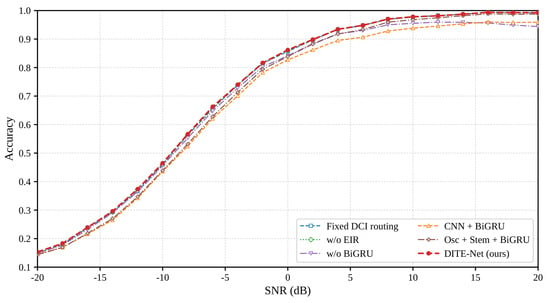
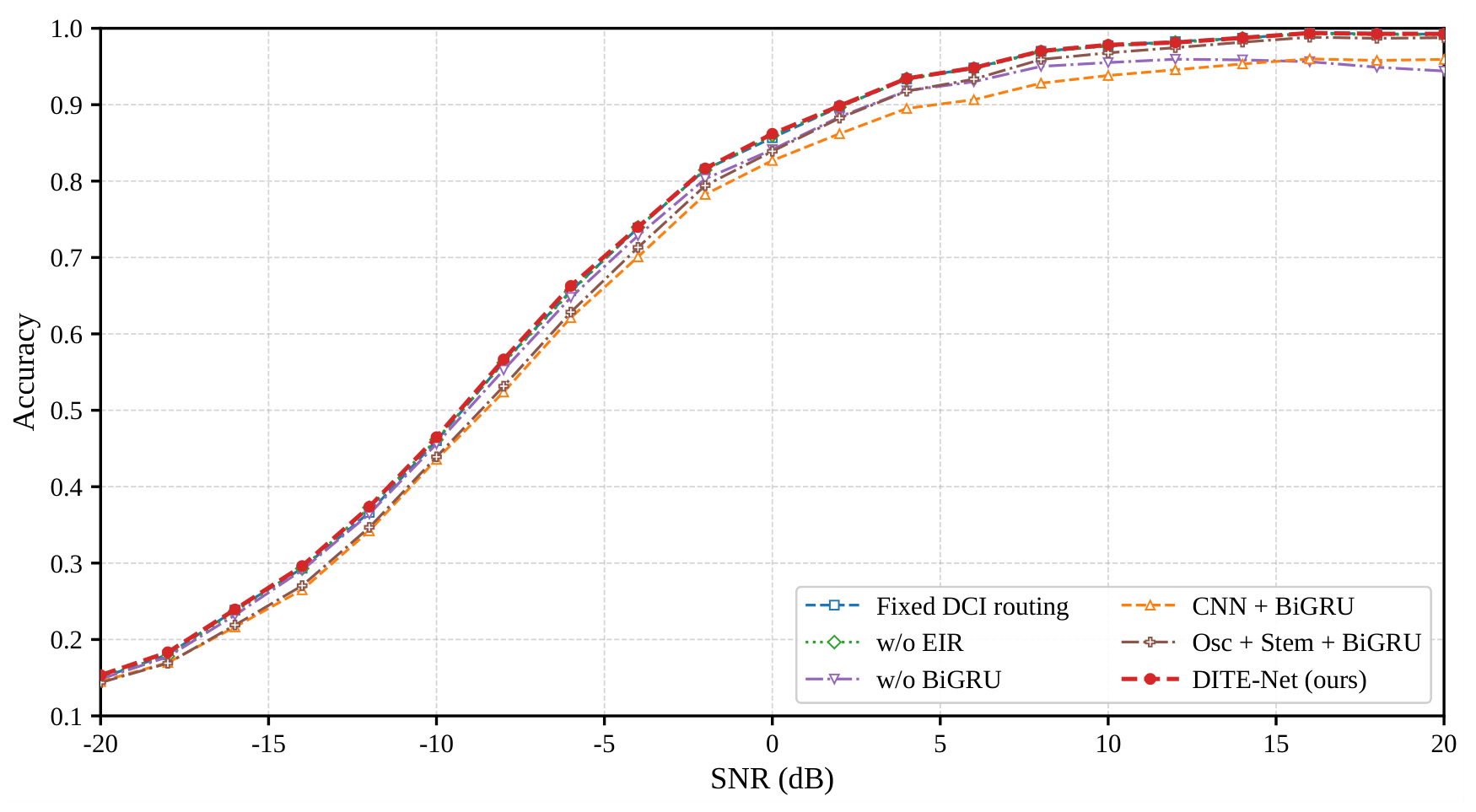
To assess component effects under weak-signal conditions, we evaluated per-SNR test accuracy on RML22 across five random seeds. The low-SNR summary averages the 11 SNR conditions from to 0 dB inclusive at 2-dB increments. Table 5 and Figure 3 compare the full model, fixed DCI routing, EIR removal, BiGRU removal, and both reduced recurrent baselines.
Table 5.
RML22 five-seed component-level test accuracy (mean ± sample standard deviation, %). Low SNR covers to 0 dB inclusive. Overall accuracy is across all SNRs.
Figure 3.
Component-level test accuracy across SNR on RML22, averaged over five seeds for each architecture. Values are unsmoothed SNR-wise means.
The full model exceeds the low-SNR mean accuracy of the fixed-routing and EIR-removal variants by approximately 0.37 and 0.30 percentage points, respectively. These modest differences have not been subjected to a dedicated statistical significance test and should not be interpreted as evidence of a large or generalizable independent benefit. The full architecture exceeds Osc+Stem+BiGRU by approximately 2.41 percentage points over the specified low-SNR range; however, that difference cannot be assigned to any individual biologically motivated component, particularly because the architectures differ in scale and computation. The ablation results also reinforce the importance of BiGRU-based integration over the complete observation window.
5.6. Visualization Analysis
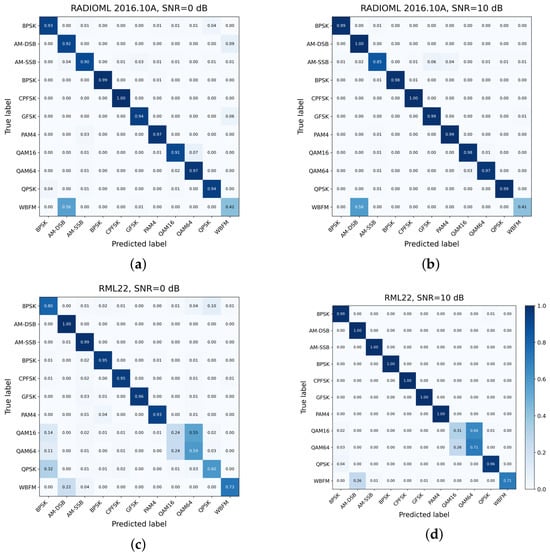
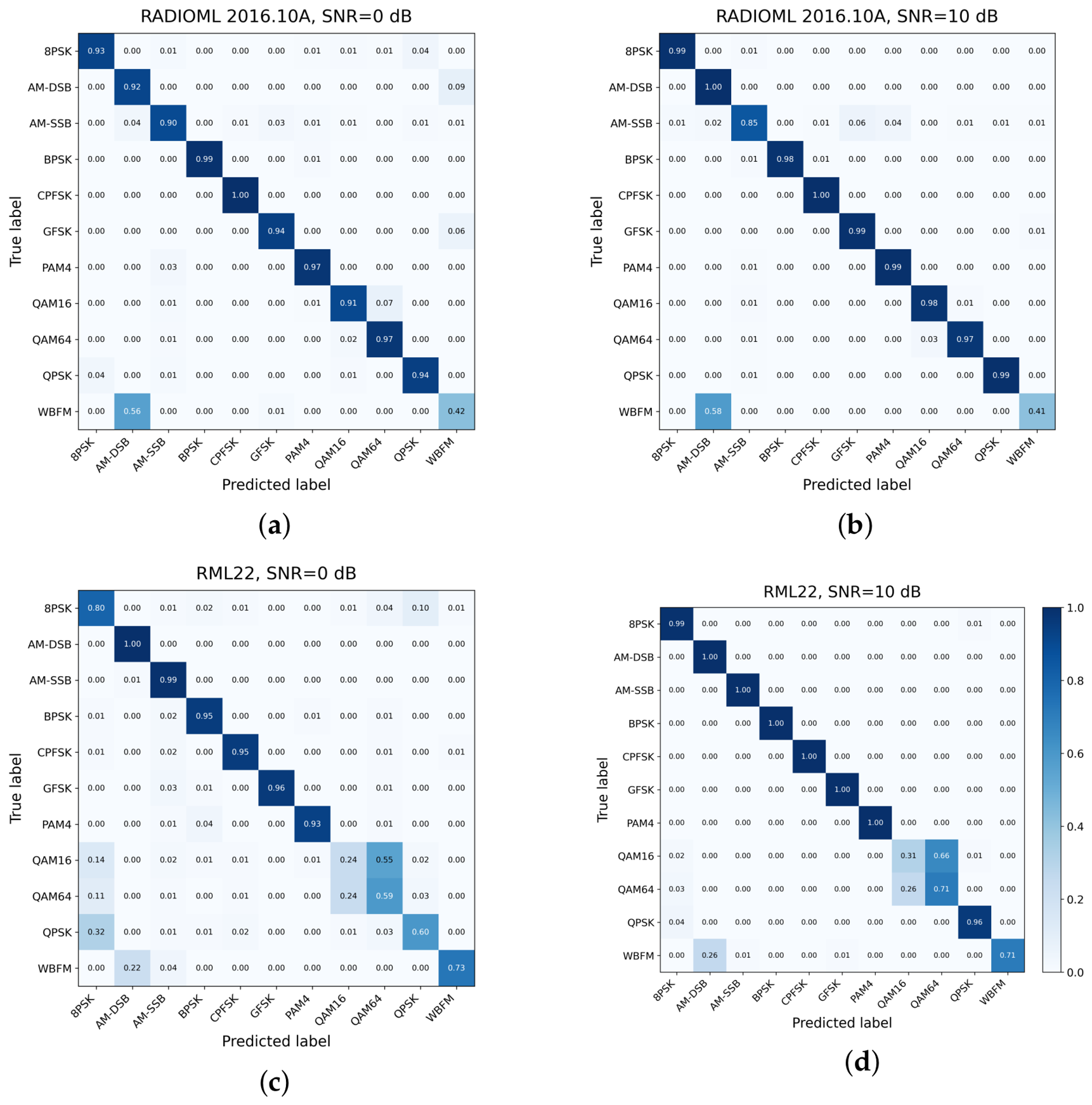
To examine class-level recognition behavior, Figure 4 presents normalized confusion matrices of DITE-Net at 0 and 10 dB. On RADIOML 2016.10A, the overall accuracies at these two SNR levels are 89.82% and 92.45%, respectively. Most digital modulation classes exhibit strongly diagonal decision patterns. At 0 dB, QAM16 shows moderate confusion with QAM64, while QPSK and 8PSK also exhibit limited mutual ambiguity. The most persistent confusion is between WBFM and AM-DSB, with many WBFM samples assigned to AM-DSB even at 10 dB. Comparable WBFM-to-AM-DSB confusion on RADIOML 2016.10A has been reported by Hou et al. [25], who investigated frequency-domain amplitude and phase information to improve discrimination between these analog modulation classes. A possible explanation is that some 128-sample windows contain insufficient modulation-dependent information to distinguish these analog classes reliably. Higher SNR alone may therefore not eliminate the ambiguity. This explanation remains a hypothesis: the present experiments do not isolate window length as a causal factor.
Figure 4.
Normalized confusion matrices of DITE-Net on (a) RADIOML 2016.10A at 0 dB, (b) RADIOML 2016.10A at 10 dB, (c) RML22 at 0 dB, and (d) RML22 at 10 dB. The common color scale is shown in panel (d).
RML22 exhibits a different error distribution. DITE-Net achieves 79.45% accuracy at 0 dB and 87.91% at 10 dB. At 0 dB, most BPSK, CPFSK, GFSK, PAM4, and analog classes remain well identified, whereas the largest ambiguities are concentrated within the higher-order QAM and PSK-related classes. In particular, QAM16 and QAM64 show substantial mutual confusion, and portions of QPSK and the QAM classes are assigned to 8PSK. At 10 dB, most classes approach near-perfect recognition, but confusion between QAM16 and QAM64 remains visible. WBFM also continues to be partially confused with AM-DSB. The remaining errors at higher SNRs suggest that class similarity, as well as noise intensity, contributes to recognition difficulty.
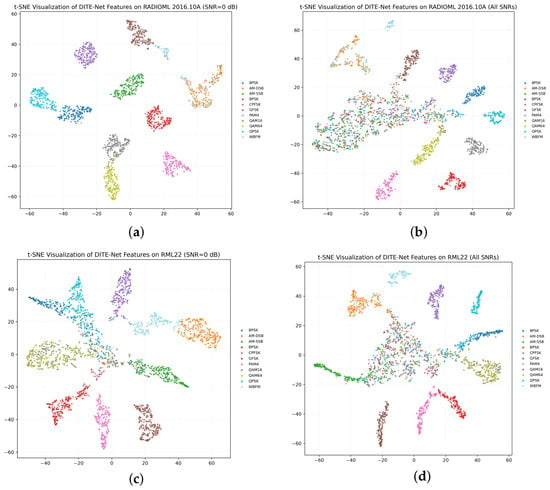
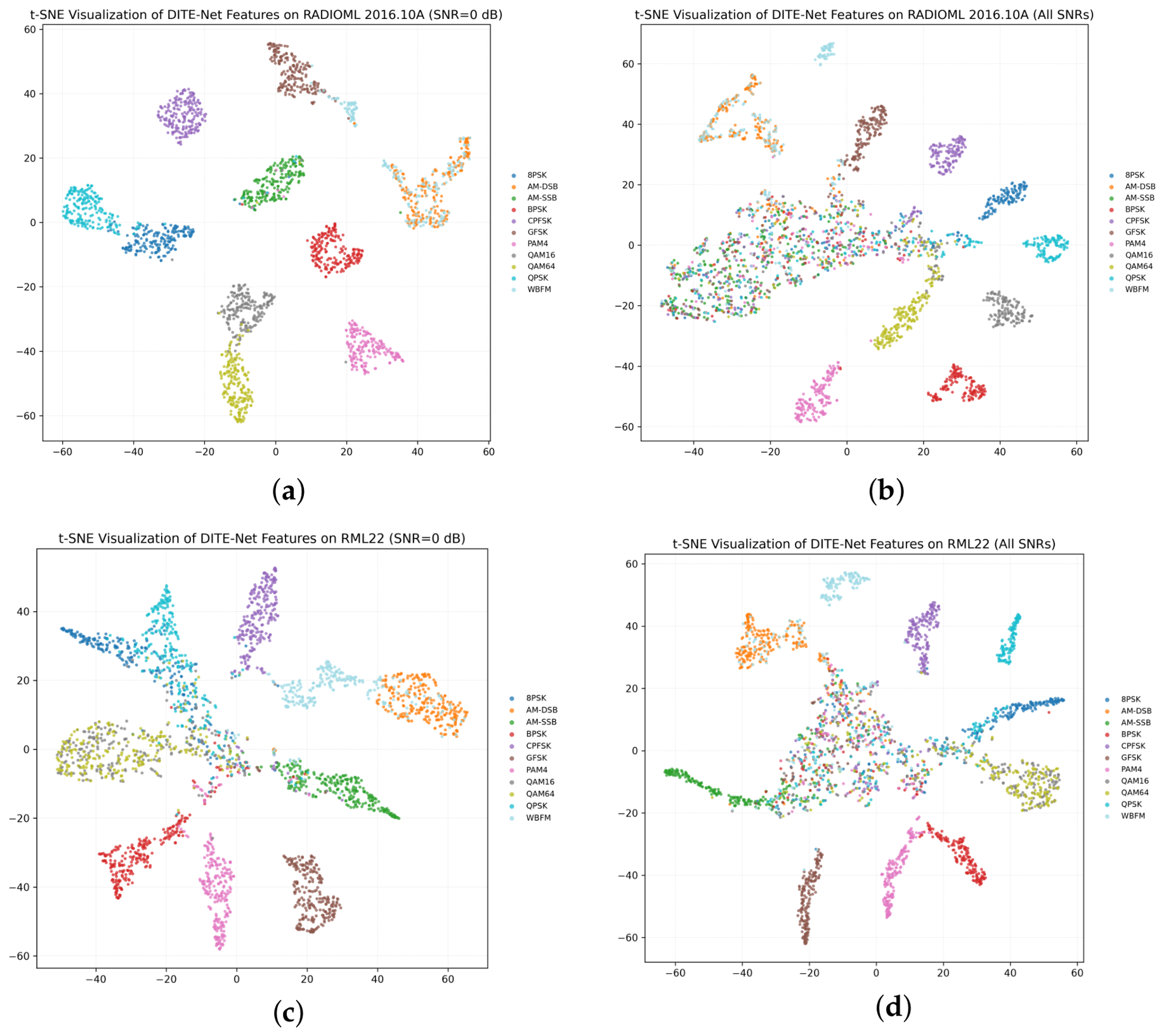
Figure 5 further visualizes the feature representations learned by DITE-Net. At 0 dB, most modulation categories form distinguishable local structures on both datasets, although overlap remains among classes that also exhibit confusion in Figure 4. When samples from all SNR levels are projected together, the feature distributions become more dispersed, with greater overlap among representations affected by strong noise. Nevertheless, several modulation categories retain recognizable local organization across the mixed-SNR representation.
Figure 5.
t-SNE visualization of DITE-Net feature representations on (a) RADIOML 2016.10A at 0 dB, (b) RADIOML 2016.10A across all SNR levels, (c) RML22 at 0 dB, and (d) RML22 across all SNR levels.
The t-SNE plots qualitatively agree with the confusion-matrix patterns: several classes form distinct clusters, whereas overlapping groups are more evident among similar modulation types and noise-affected samples. Because t-SNE is a two-dimensional visualization, cluster separation should not be treated as a direct measure of classification performance or as evidence for the effectiveness of any individual module.
6. Conclusions
This study presented DITE-Net for automatic modulation recognition from short I/Q sequences. The architecture combines multiscale local feature extraction, gated response regulation, contextual processing, and BiGRU-based temporal integration. The neural-circuit terminology describes functional design analogies rather than a biologically faithful simulation. Across five independent runs, DITE-Net achieves overall accuracy on RADIOML 2016.10A and on RML22. The ablation study shows that removing BiGRU produces the largest accuracy reduction among the tested components, while adaptive DCI routing and EIR yield relatively modest, dataset-dependent effects. Neither contextual operation provides a consistent independent accuracy gain. The complete architecture outperforms the evaluated simplified recurrent controls but requires more computation, as quantified by model size, MAC, and CPU/GPU latency measurements. Future work will examine controlled channel and receiver impairments, cross-device generalization, longer observation windows, and over-the-air evaluation. It will also explore reduced contextual designs for applications with tighter computational constraints.
Author Contributions
Conceptualization, G.S. and C.Q.; methodology, G.S. and C.Q.; software, C.Q.; validation, G.S., C.Q., Q.L. and D.Q.; formal analysis, G.S., C.Q. and D.Q.; investigation, C.Q., Q.L. and D.Q.; writing—original draft preparation, G.S. and C.Q.; writing—review and editing, G.S., C.Q., Q.L., D.Q. and B.Z.; visualization, G.S. and C.Q.; supervision, B.Z.; project administration, B.Z. All authors have read and agreed to the published version of the manuscript.
Funding
This research was funded by the Defense Industrial Technology Development Program under grant 20251.22XT210-005.
Data Availability Statement
The RADIOML 2016.10A and RML22 datasets are publicly accessible through their respective dataset providers [2,6]. The source code of the proposed DITE-Net model is publicly available at https://github.com/songgx-cjlu/DITE-Net (accessed on 1 November 2026).
Conflicts of Interest
Author Qingjie Liu is employed by the company China Nanhu Academy of Electronics and Information Technology, Jiaxing, China. The remaining authors declare that the research was conducted in the absence of any commercial or financial relationships that could be construed as a potential conflict of interest.
References
- Tian, X.; Zheng, Q.; Li, B.; Qiao, D.; Yu, K.; Wei, Z.; Li, B.; Jiang, H.; Li, X.; Lin, Y.; et al. A survey on deep learning enabled automatic modulation classification methods: Data representations, model structures, and regularization techniques. Signal Process. 2026, 242, 110444. [Google Scholar] [CrossRef] [Scilit]
- Sathyanarayanan, V.; Gerstoft, P.; El Gamal, A. RML22: Realistic dataset generation for wireless modulation classification. IEEE Trans. Wirel. Commun. 2023, 22, 7663–7675. [Google Scholar] [CrossRef] [Scilit]
- Yan, G.; Fu, X.; Wang, Y.; Zhang, Q.; Gui, G. Radio frequency fingerprint identification towards statistical and deep learning features: Review, recent results and future directions. Peer-to-Peer Netw. Appl. 2025, 18, 116. [Google Scholar] [CrossRef] [Scilit]
- Liu, C.; Gui, G.; Wang, Y.; Ohtsuki, T.; Niyato, D.; Shen, X. A comprehensive survey on self-supervised learning for specific emitter identification. IEEE Commun. Surv. Tuts. 2026, 28, 1749–1775. [Google Scholar] [CrossRef] [Scilit]
- Xu, L.; Fu, X.; Wang, Y.; Zhang, Q.; Zhao, H.; Lin, Y.; Gui, G. Enhanced few-shot specific emitter identification via phase shift prediction and decoupling. IEEE Trans. Cogn. Commun. Netw. 2025, 11, 145–155. [Google Scholar] [CrossRef] [Scilit]
- O’Shea, T.J.; West, N. Radio machine learning dataset generation with GNU Radio. Proc. GNU Radio Conf. 2016, 1, 1–6. [Google Scholar]
- Xu, J.; Luo, C.; Parr, G.; Luo, Y. A spatiotemporal multi-channel learning framework for automatic modulation recognition. IEEE Wirel. Commun. Lett. 2020, 9, 1629–1632. [Google Scholar] [CrossRef] [Scilit]
- Zhang, F.; Luo, C.; Xu, J.; Luo, Y. An efficient deep learning model for automatic modulation recognition based on parameter estimation and transformation. IEEE Commun. Lett. 2021, 25, 3287–3290. [Google Scholar] [CrossRef] [Scilit]
- Quan, D.; Chen, Y.; Sun, Y.; Zhao, J.; Jin, N.; Wang, X.; Liu, X. FFTFormer: A frequency-aware Transformer with multi-task learning for robust modulation recognition. IEEE J. Microwaves 2026, 6, 1421–1439. [Google Scholar] [CrossRef] [Scilit]
- Chen, Y.; Dong, B.; Liu, C.; Xiong, W.; Li, S. Abandon locality: Frame-wise embedding aided Transformer for automatic modulation recognition. IEEE Commun. Lett. 2023, 27, 327–331. [Google Scholar] [CrossRef] [Scilit]
- Zhang, J.; Wang, T.; Feng, Z.; Yang, S. AMC-Net: An effective network for automatic modulation classification. In ICASSP 2023—2023 IEEE International Conference on Acoustics, Speech and Signal Processing (ICASSP); IEEE: New York, NY, USA, 2023; pp. 1–5. [Google Scholar]
- Li, W.; Deng, W.; Wang, K.; You, L.; Huang, Z. A complex-valued Transformer for automatic modulation recognition. IEEE Internet Things J. 2024, 11, 22197–22207. [Google Scholar] [CrossRef] [Scilit]
- Feng, Z.; Chen, S.; Ma, Y.; Gao, Y.; Yang, S. Learning temporal–spectral feature fusion representation for radio signal classification. IEEE Trans. Ind. Informat. 2025, 21, 791–800. [Google Scholar] [CrossRef] [Scilit]
- Shao, M.; Li, D.; Hong, S.; Qi, J.; Sun, H. IQFormer: A novel Transformer-based model with multi-modality fusion for automatic modulation recognition. IEEE Trans. Cogn. Commun. Netw. 2025, 11, 1623–1634. [Google Scholar] [CrossRef] [Scilit]
- Zhao, J.; Sun, Y.; Chen, Y.; Dong, X.; Song, G.; Jin, N.; Quan, D. MILAFormer: A multi-stage hybrid deep learning architecture for robust radio signal modulation recognition. IEEE Trans. Cogn. Commun. Netw. 2026, 12, 7574–7588. [Google Scholar] [CrossRef] [Scilit]
- Qu, Y.; Lu, Z.; Zeng, R.; Wang, J.; Wang, J. Enhancing automatic modulation recognition through robust global feature extraction. IEEE Trans. Veh. Technol. 2025, 74, 4192–4207. [Google Scholar] [CrossRef] [Scilit]
- Ansari, S.; Alnajjar, K.A.; Majzoub, S.; Almajali, E.R.F.; Jarndal, A.; Bonny, T.; Hussain, A.; Mahmoud, S.A. Attention-enhanced hybrid automatic modulation classification for advanced wireless communication systems: A deep learning–Transformer framework. IEEE Access 2025, 13, 105463–105491. [Google Scholar] [CrossRef] [Scilit]
- Zhang, Q.; Chen, Q. UCRT: A two-stage noisy label learning framework with uniform consistency selection and robust training. Appl. Intell. 2026, 56, 21. [Google Scholar] [CrossRef] [Scilit]
- Wright, W.J.; Hedrick, N.G.; Komiyama, T. Distinct synaptic plasticity rules operate across dendritic compartments in vivo during learning. Science 2025, 388, 322–328. [Google Scholar] [CrossRef] [Scilit]
- Schneider-Mizell, C.M.; Bodor, A.L.; Brittain, D.; Buchanan, J.; Bumbarger, D.J.; Elabbady, L.; Gamlin, C.; Kapner, D.; Kinn, S.; Mahalingam, G.; et al. Inhibitory specificity from a connectomic census of mouse visual cortex. Nature 2025, 640, 448–458, Correction in Nature 2025, 642, E9. [Google Scholar] [CrossRef] [Scilit]
- The MICrONS Consortium. Functional connectomics spanning multiple areas of mouse visual cortex. Nature 2025, 640, 435–447. [Google Scholar] [CrossRef] [Scilit]
- International Brain Laboratory. A brain-wide map of neural activity during complex behaviour. Nature 2025, 645, 177–191. [Google Scholar] [CrossRef] [Scilit]
- Hamidi-Rad, S.; Jain, S. MCformer: A Transformer based deep neural network for automatic modulation classification. In 2021 IEEE Global Communications Conference (GLOBECOM); IEEE: New York, NY, USA, 2021; pp. 1–6. [Google Scholar] [CrossRef] [Scilit]
- Huo, Y.; Wang, C.; Liang, J.; Yue, K.; Li, W. SMTrans: An efficient automatic modulation recognition network based on the scale-aware modulation transformer. Phys. Commun. 2026, 74, 102966. [Google Scholar] [CrossRef] [Scilit]
- Hou, S.; Dong, Y.; Li, Y.; Yan, Q.; Wang, M.; Fang, S. Multi-domain-fusion deep learning for automatic modulation recognition in spatial cognitive radio. Sci. Rep. 2023, 13, 10736. [Google Scholar] [CrossRef] [Scilit]

Disclaimer/Publisher’s Note: The statements, opinions and data contained in all publications are solely those of the individual author(s) and contributor(s) and not of MDPI and/or the editor(s). MDPI and/or the editor(s) disclaim responsibility for any injury to people or property resulting from any ideas, methods, instructions or products referred to in the content. |
© 2026 by the authors. Licensee MDPI, Basel, Switzerland. This article is an open access article distributed under the terms and conditions of the Creative Commons Attribution (CC BY) license.