


Abstract
Ultra-Reliable Low-Latency Communication (URLLC) systems require extremely reliable packet delivery under stringent latency constraints, particularly in mission-critical wireless applications such as industrial automation, autonomous transportation, and intelligent control systems. In such systems, communication reliability is jointly influenced by finite-blocklength decoding behavior, stochastic wireless channel variations, queue evolution, and packet deadline violations. This paper develops a Lyapunov-based cross-layer transmission control framework for finite-blocklength URLLC systems with deadline-constrained queues and stochastic traffic arrivals. The proposed method jointly models short-packet communication reliability, queue dynamics, packet expiration, and adaptive transmission parameter selection within a unified mathematical formulation. An end-to-end (E2E) reliability metric incorporating both physical-layer (PHY) decoding failures and queue-induced deadline violations is introduced. In order to satisfy long-term reliability and power constraints while preserving queue stability, virtual queues are constructed and integrated into a Lyapunov drift-plus-penalty optimization framework. Based on the proposed formulation, an online transmission control algorithm is developed for adaptive selection of transmission blocklength, coding rate, and transmit power according to instantaneous queue and wireless channel conditions. Unlike reinforcement-learning-based methods, the proposed framework does not require offline training or prior statistical knowledge of traffic and channel distributions. The analysis establishes bounded real-queue occupancy under capped admissions and deadline expiration, and shows that mean-rate stability of the virtual queues implies the corresponding surrogate-risk and power constraints. Classical Lyapunov scaling is discussed as a conditional benchmark rather than an established optimality guarantee for the implemented urgency-weighted controller. Simulation results show that the proposed framework reduces time-average transmit power by approximately 33.0% relative to Adaptive-FBL, 42.3% relative to EC-FBL, 46.7% relative to the simplified Lyapunov baseline, and 71.6% relative to fixed transmission, while maintaining packet-level reliability, delay, and queueing performance close to the adaptive benchmarks. Simulation results show that the proposed approach achieves a favorable balance between reliability, latency, and energy consumption across different traffic conditions.
1. Introduction
Ultra-Reliable Low-Latency Communication (URLLC) has emerged as one of the most critical service categories in fifth-generation (5G) and beyond wireless communication systems, particularly for applications requiring highly dependable and time-sensitive data delivery. Unlike enhanced Mobile Broadband (eMBB), which primarily targets high spectral efficiency and large data throughput, URLLC systems are designed to support mission-critical applications where communication reliability and latency directly affect operational safety and control stability. Representative examples include industrial automation, factory robotics, intelligent transportation systems, autonomous vehicles, remote healthcare, smart grid protection, unmanned aerial vehicle coordination, and tactile Internet services [1,2,3,4,5]. In such applications, communication links often operate within closed-loop control systems, where outdated or delayed information may become unusable even if successfully decoded at a later time. Consequently, URLLC systems must simultaneously satisfy extremely stringent latency and reliability requirements, typically involving end-to-end delay budgets on the order of milliseconds and packet failure probabilities on the order of 10−5 or lower [1,2].
Meeting such demanding performance requirements over wireless channels remains highly challenging due to the combined effects of fading, stochastic traffic arrivals, interference, and limited transmission duration. Classical communication theory is fundamentally built upon Shannon’s asymptotic capacity framework, which assumes arbitrarily long codewords and vanishing decoding error probability [6]. Under these assumptions, reliable communication can theoretically be achieved by transmitting below channel capacity while allowing sufficiently large blocklengths. However, these assumptions become invalid in latency-sensitive URLLC systems, where packets must be transmitted using short codewords to satisfy strict timing constraints. In the short-packet communication regime, decoding errors become non-negligible even when the transmission rate remains below the Shannon capacity. As a result, reliability becomes an explicit function of blocklength, coding rate, and instantaneous signal-to-noise ratio (SNR), fundamentally altering the conventional reliability–latency tradeoff [7,8].
Finite-blocklength information theory provides a more realistic characterization of short-packet wireless communication by incorporating channel dispersion effects into the achievable rate formulation [7]. Unlike asymptotic capacity analysis, finite-blocklength communication explicitly captures the tradeoff between decoding reliability, transmission efficiency, and latency. In particular, increasing the coding rate improves spectral efficiency but simultaneously increases the probability of decoding failure, while larger blocklengths generally improve reliability at the expense of longer transmission duration. Consequently, adaptive transmission control becomes essential in finite-blocklength URLLC systems, especially under dynamically varying wireless channel conditions. In addition to physical-layer (PHY) decoding limitations, queueing dynamics introduce another major source of reliability degradation in URLLC systems. Many practical URLLC applications generate event-driven traffic rather than continuous data streams, resulting in stochastic and bursty packet arrivals [9,10]. Under heavy traffic conditions or unfavorable channel realizations, packets may accumulate in transmission buffers, causing queueing delay to become a dominant component of the overall end-to-end latency. Since many real-time applications impose strict packet deadlines, packets exceeding their allowable waiting time become obsolete and must be discarded. Therefore, communication reliability in URLLC systems must account not only for PHY decoding failures but also for queue-induced deadline violations. This creates a tightly coupled interaction between transmission reliability and queue evolution, making isolated layer-by-layer optimization inherently inefficient. These observations have motivated increasing interest in cross-layer communication system design, where PHY transmission decisions are jointly optimized with higher-layer queue dynamics [11,12,13,14]. In such systems, transmission parameters including coding rate, transmit power, and blocklength influence decoding success probability and service rate, which in turn affect queue evolution and delay performance. Conversely, the queue state information, including backlog and packet urgency, should influence transmission decisions. For example, when queue congestion increases or packet deadlines approach expiration, the transmitter may select more conservative transmission configurations to improve decoding reliability. On the other hand, favorable channel conditions and low traffic load may allow more aggressive transmission strategies with improved energy efficiency or spectral utilization.
Existing approaches for URLLC optimization have relied on several mathematical frameworks, including convex optimization, stochastic network optimization, Markov decision processes, Lyapunov drift methods, adaptive finite-blocklength optimization, and reinforcement-learning-based transmission control [11,12,13,14,15,16,17,18,19,20]. Convex optimization techniques provide rigorous formulations for resource allocation problems but often rely on simplified assumptions and continuous relaxations that may not accurately capture discrete transmission configurations and stochastic queue evolution. Dynamic programming approaches can theoretically obtain optimal control policies; however, their computational complexity becomes prohibitive in large state spaces due to the curse of dimensionality [15]. More recently, reinforcement learning (RL) and deep reinforcement learning (DRL) approaches have attracted significant attention because of their ability to learn adaptive transmission policies directly from interaction with the communication environment [16,17,18,19,20].
Although RL-based frameworks offer flexibility for handling stochastic wireless systems, several practical limitations remain in those methods. First, RL algorithms typically require extensive training data and large numbers of environment interactions before convergence can be achieved. Such training requirements may become impractical in rapidly changing wireless environments. Second, the convergence behavior of RL algorithms is often sensitive to reward engineering, hyperparameter selection, and exploration strategy. Third, the learned decision policies are frequently difficult to interpret, particularly in safety-critical URLLC applications where deterministic and explainable control behavior is preferred. Moreover, many DRL approaches lack explicit guarantees regarding queue stability, reliability constraint satisfaction, or long-term boundedness of system states. These limitations motivate the investigation of mathematically grounded online optimization methods that provide adaptive decision-making while preserving analytical tractability and stability guarantees. Recent learning-based wireless control studies further illustrate the growing use of transfer-learning and GNN-assisted DRL formulations in communication-resource optimization [21,22].
To address these challenges, this paper develops a Lyapunov-based cross-layer transmission control framework for finite-blocklength URLLC systems with deadline-constrained queues. Unlike learning-based approaches that require offline training and policy approximation, the proposed framework derives online transmission decisions directly from Lyapunov drift-plus-penalty minimization. The considered system jointly captures stochastic packet arrivals, finite-blocklength decoding reliability, queue evolution, deadline-induced packet dropping, and adaptive transmission parameter selection within a unified mathematical framework. Virtual queues are introduced to enforce long-term reliability and power constraints, while the Lyapunov optimization framework enables real-time adaptive transmission control without requiring prior knowledge of traffic or channel distributions.
Specifically, the proposed approach dynamically selects transmission blocklength, coding rate, and transmit power according to the instantaneous queue state and wireless channel condition. By minimizing a drift-plus-penalty metric at each transmission slot, the proposed controller balances decoding reliability, queue stability, latency performance, and energy efficiency in an online manner. In contrast to conventional RL-based methods, the proposed framework provides interpretable decision mechanisms, reduced computational complexity, and an explicit distinction between real-queue boundedness and conditional virtual-queue constraint implications.
The main contributions of this paper are summarized as follows:
- A unified cross-layer finite-blocklength URLLC framework is developed by jointly integrating stochastic packet arrivals, deadline-constrained queue evolution, short-packet wireless transmission, and adaptive communication control within a mathematically consistent system model. Unlike conventional layer-isolated approaches, the proposed formulation explicitly captures the strong interaction between PHY decoding reliability and queue-induced latency behavior.
- An end-to-end reliability formulation is established by jointly incorporating finite-blocklength decoding failures and queue-induced deadline violations into a single reliability metric. This provides a more realistic characterization of practical URLLC performance compared with conventional reliability models that consider only PHY decoding behavior.
- A Lyapunov drift-plus-penalty optimization framework is proposed for real-time adaptive transmission control under long-term reliability and power constraints. The proposed formulation enables online decision-making without requiring offline training, prior statistical knowledge, or reinforcement-learning-based policy approximation.
- Virtual queue mechanisms are introduced to transform long-term reliability and average power constraints into queue-stability conditions, thereby enabling analytically tractable cross-layer optimization with constraint satisfaction conditional on mean-rate stability of the corresponding virtual queues.
- A low-complexity online transmission control algorithm is developed for dynamic selection of transmission blocklength, coding rate, and transmit power according to instantaneous queue states and wireless channel conditions. The proposed controller operates using deterministic per-slot optimization and avoids the computational overhead associated with neural-network training and exploration-based learning methods.
- Extensive simulation results show that the proposed framework achieves substantial reductions in time-average transmit power while maintaining packet-level end-to-end reliability, delay, and queueing performance close to the adaptive finite-blocklength and Lyapunov-based benchmarks. Relative to fixed transmission, it also improves packet-level reliability, queueing behavior, delay, and energy consumption. The results therefore demonstrate a favorable reliability–latency–energy operating point rather than uniform dominance in every individual metric.
The remainder of this paper is organized as follows. Section 2 presents the system model and finite-blocklength communication framework. Section 3 formulates the cross-layer optimization problem and discusses its stochastic characteristics. Section 4 introduces the proposed Lyapunov-based transmission control framework and derives the drift-plus-penalty formulation. Section 5 presents the proposed online transmission control algorithm and complexity analysis. Theoretical performance analysis is provided in Section 6. Simulation setup and numerical results are presented in Section 7 and Section 8, respectively. Section 9 discusses practical implications and future extensions, and Section 10 concludes the paper.
2. System Model and Communication Scenario
This section presents the communication scenario and mathematical framework considered in this work. The proposed system is designed to capture the fundamental characteristics of finite-blocklength Ultra-Reliable Low-Latency Communication systems operating under stochastic traffic arrivals and strict packet delay requirements. The framework integrates short-packet wireless communication, queue-aware latency constraints, adaptive transmission control, and time-varying wireless channel conditions within a unified cross-layer formulation. Unlike conventional communication systems that primarily focus on physical-layer decoding performance, the considered model explicitly incorporates queue dynamics and packet deadline violations into the end-to-end reliability analysis.
The system operates in fixed-duration slots, with at most one HoL packet attempted per slot. Each slot contains a data region of duration Tdata after any reserved overhead. Under the PHY abstraction, let Tsym denote the duration of one channel use. Every candidate blocklength satisfies nTsym ≤ Tdata; the data region is assumed to accommodate the largest candidate blocklength. A shorter codeword occupies a smaller portion of this region, and the remaining portion is left unused. The channel is constant over the slot. This resource interpretation does not specify a deployment-specific symbol duration or overhead configuration.
At the beginning of each slot, the transmitter observes the channel, queues, and packet ages, selects a feasible action, and attempts the current HoL packet if the queue is nonempty. A successfully decoded packet is removed. The admitted arrivals are then appended with age zero. Next, all remaining packet ages, including those of newly admitted packets, are incremented by one; packets whose updated ages exceed Dmax are removed as deadline drops. Thus, a newly admitted packet has age one at its first subsequent service opportunity, and service is admissible at ages 1 through Dmax. Delivered-packet delay is the age recorded at successful service, in slots, rather than a continuous-time waiting-time measurement.
The traffic model represents sporadic event-driven arrivals, as encountered in URLLC monitoring and control applications [23,24,25,26]. Let X(t) denote the number of potential arrivals in slot t. The underlying offered-load parameter λ is the intensity of the raw Poisson process:
X(t)∼Poisson(λ)
The admitted count is A(t) = min{X(t),Amax}, with Amax = 4 in the numerical evaluation. Its distribution is
Thus, A(t) is capped rather than Poisson conditioned on a truncation event. Its mean is 𝔼[A(t)] = 𝔼[min{X(t),Amax}] < λ for finite positive λ. Excess potential arrivals are discarded before admission, are not merged into admitted packets, and are excluded from the reported packet-loss ratios. Each admitted packet contains a fixed payload of k information bits [7,27]. The queue dynamics below use A(t) as the admitted count.
Arriving packets are stored in a First-In-First-Out (FIFO) transmission buffer before being served by the wireless transmitter. Let Q(t) denote the queue length at the beginning of slot t. If the queue is nonempty, the transmitter attempts to serve the head-of-line packet during the current slot. The queue evolution depends jointly on successful packet transmissions, new packet arrivals, and packet removals caused by deadline expiration. To model strict latency requirements, each packet maintains an age counter representing the number of time slots it has spent waiting inside the queue. Let Di(t) denote the waiting time of the i-th packet during slot t. A hard packet deadline constraint is imposed such that packets exceeding the maximum allowable waiting time Dmax are discarded from the system. This mechanism reflects practical URLLC systems where outdated information becomes unusable for control and decision-making purposes [1,2].
Let L(t) denote the number of packets removed due to deadline expiration during slot t, and let S(t) ∈ {0,1} represent the successful service indicator, where S(t) = 1 indicates successful decoding and removal of the head-of-line packet, while S(t) = 0 corresponds to transmission failure or an idle transmission slot. The queue evolution is therefore given by
Q(t + 1) = max{Q(t) − S(t) − L(t),0} + A(t).
Equation (3) demonstrates the strong interaction between PHY transmission reliability and higher-layer queue dynamics. Successful decoding reduces queue backlog, whereas decoding failures and unfavorable channel realizations may indirectly increase queue congestion and delay violations. The wireless communication link between the transmitter and receiver is modeled as a block-fading channel. Under this model, the wireless channel remains constant during one transmission slot and changes independently across different slots due to fading effects [28,29]. Let denote the complex channel coefficient during slot. The channel power gain follows a Rayleigh fading distribution such that
where Exp(1) denotes the exponential distribution with unit mean. The instantaneous received Signal-to-Noise Ratio (SNR) during slot t is expressed as
where P(t) denotes the selected transmit power and σ2 represents the noise variance of the additive white Gaussian noise channel. The AWGN model describes thermal-noise effects; its Gaussian samples are not assumed to be bounded. The boundedness and moment conditions used in the queue analysis concern arrivals, departures, control quantities, and power rather than bounded noise samples. Adversarial interference, jamming, and malicious observations are outside the scope of the present model. Since the channel realization varies across transmission slots, the received SNR also fluctuates dynamically over time. Consequently, transmission reliability depends jointly on the selected transmission parameters and the instantaneous wireless channel condition. Due to the stringent latency constraints imposed by URLLC applications, communication operates in the finite-blocklength regime where codewords contain only a limited number of channel uses. Under such conditions, Shannon’s asymptotic capacity expression no longer accurately characterizes achievable reliability performance [7,30]. Instead, decoding reliability must be analyzed using finite-blocklength information theory. During slot t, the transmitter selects a blocklength n(t) and coding rate R(t) for the transmission of the head-of-line packet. The selected transmission parameters must satisfy the finite-blocklength feasibility condition
which ensures that the selected transmission configuration can accommodate the packet payload. The PHY decoding error probability is approximated using the normal approximation for finite-blocklength coding over fading channels [7,31]. Accordingly, the decoding error probability is expressed as
where Q(⋅) denotes the Gaussian Q-function. The details are provided in Appendix A. The functions C(γ) and V(γ) represent the channel capacity and channel dispersion, respectively, given by
and
∣h(t)∣2∼Exp(1)
k ≤ n(t)R(t),
C(γ) = log2(1 + γ),
Equation (7) explicitly captures the reliability–latency tradeoff inherent in short-packet communication systems. Increasing the coding rate improves transmission efficiency but simultaneously increases decoding error probability, while larger blocklengths generally improve reliability at the expense of longer transmission duration and increased resource utilization. In latency-constrained URLLC systems, reliability must be evaluated from an end-to-end perspective rather than solely through PHY decoding performance. In particular, packets that exceed their allowable delay deadline become obsolete even if they are eventually decoded successfully. Therefore, both PHY decoding failures and queue-induced deadline violations must be incorporated into the overall reliability formulation.
For online control, the deadline-related risk is defined for the current HoL packet at its final admissible service opportunity. Let aHoL(t) denote its observed age. The implemented risk is defined in (10); its legacy symbol εe2e(t) denotes this per-slot HoL surrogate, not the measured packet-level E2E failure probability. A failed PHY attempt before the last opportunity is not terminal because retransmission remains possible. Terminal E2E failure is evaluated separately from each admitted packet’s final delivery or expiration outcome.
The expected service probability and normalized urgency weight used at decision time are
Both quantities in (11) are zero for an empty queue. The risk in (10) equals the selected action’s PHY error probability only when the HoL age reaches Dmax; otherwise it is zero. It excludes the possible expiration of other queued packets. Backlog affects the service priority through Q(t), while urgency enters through ηu(t). Accordingly, a slot-average constraint on this surrogate is not a constraint on the terminal failure ratio across all admitted packets.
The proposed communication framework exhibits strong cross-layer interactions between wireless transmission reliability and queue evolution. The selected transmission configuration influences decoding success probability, which directly affects queue service capability and packet waiting times. Conversely, the queue state reflects system urgency and should influence transmission decisions. For example, large queue backlog or approaching packet deadlines may require more conservative transmission strategies to reduce decoding failure probability. Similarly, favorable channel conditions may permit higher coding rates or lower transmit power while maintaining acceptable reliability levels. These interactions demonstrate that transmission reliability, queue stability, latency performance, and energy consumption are tightly coupled in finite-blocklength URLLC systems. Consequently, independent optimization of individual communication layers becomes inefficient. Instead, adaptive cross-layer transmission control mechanisms are required to jointly account for wireless channel dynamics, queue evolution, and finite-blocklength decoding behavior within a unified mathematical framework.
3. Cross-Layer Optimization Problem Formulation
The communication framework presented in the previous section captures the coupled interaction between finite-blocklength decoding reliability, stochastic traffic arrivals, queue evolution, and packet deadline constraints. Based on this system model, the transmission control problem can now be formulated as a stochastic cross-layer optimization problem. The objective of the transmitter is to dynamically select transmission parameters in a manner that simultaneously improves communication reliability, preserves queue stability, satisfies strict latency constraints, and limits energy consumption.
Unlike conventional physical-layer optimization problems that focus primarily on maximizing throughput or minimizing decoding error probability, the considered framework explicitly incorporates higher-layer queue dynamics and packet expiration behavior into the optimization process. Consequently, transmission decisions influence not only instantaneous decoding reliability but also future queue evolution and long-term system stability. This results in a tightly coupled stochastic optimization problem involving both communication-layer and queue-layer interactions.
At each transmission slot t, the transmitter selects a communication action consisting of the transmission blocklength, coding rate, and transmit power according to
a(t) = {n(t),R(t),P(t)}.
The selected action affects PHY decoding, queue service, power, and packet delivery. To align the analytical objective with the supplied controller, define Ifail(t) as the terminal-expiration indicator for the packet that is HoL at the start of slot t, with value zero when the queue is empty. It does not count every unsuccessful decoding attempt or every queue-wide expiration:
Ifail(t) = 1{current HoL packet expires in slot t}
Given the observed state and candidate action, the conditional expectation of Ifail(t) is the HoL risk in (10). Let t denote the information available at decision time, including all packet ages, channel state, and real and virtual queues. The power terms are normalized as follows:
Thus, the reliability component of the controller objective is the time-average HoL terminal-risk surrogate. The packet-level E2E outcome remains a separate evaluation metric. The corresponding reliability objective is
Although aggressive transmission strategies with high transmit power and conservative coding rates may improve decoding reliability, such approaches can significantly increase energy consumption. Since practical URLLC systems are often constrained by limited power budgets and energy efficiency requirements, communication reliability and energy consumption must be jointly considered during transmission control design. To capture the reliability–energy tradeoff, a weighted long-term cost function is introduced as
Here α ≥ 0 and β ≥ 0 weight the HoL terminal-risk surrogate and normalized power, respectively. Larger α emphasizes that risk, and larger β emphasizes power reduction; neither coefficient by itself guarantees a packet-level reliability target. The physical power constraint continues to use P(t) in watts, while the controller cost and power virtual queue use p(t).
First, the selected transmission configuration must satisfy the finite-blocklength payload feasibility condition introduced previously. Since each packet contains k information bits, the selected blocklength and coding rate must satisfy
k ≤ n(t)R(t),∀t
This constraint ensures that the selected transmission configuration can accommodate the packet payload within the chosen codeword length. Second, the transmit power must remain within the allowable hardware and regulatory limits. Therefore,
where Pmax denotes the maximum allowable transmission power.
0 ≤ P(t) ≤ Pmax,∀t
Third, the deadline rule restricts successful delivery to the admissible packet ages; it does not guarantee delivery of every admitted packet. Let (t) be the set of packets successfully delivered in slot t, and let Di(t) be packet i’s age at service. Then
1 ≤ Di(t) ≤ Dmax, i ∈ (t).
Packets that remain undelivered when their updated ages exceed Dmax are discarded and counted as terminal failures. Equation (18) therefore states an age condition on successful deliveries, while expiration is the separate removal rule in the queue dynamics. Capped admissions and expiration bound the real queue even when packets are lost; bounded occupancy alone is not evidence of reliable delivery. The backlog stability condition is stated in (19) [11,12], and its relation to expiration and virtual-queue stability is discussed in Section 6.
Equation (19) guarantees that the queue does not diverge indefinitely under the adopted transmission policy. Since URLLC systems require highly reliable communication, an additional long-term cross-layer reliability-risk constraint is imposed on the time-average failure-risk quantity defined in (10)–(13). Specifically,
The threshold εmax in (20) applies to the per-slot HoL risk defined by (10). It does not directly constrain the terminal packet-level E2E failure ratio. The power budget remains expressed in physical units as
where Pavg represents the allowable average transmit power budget. Combining the objective function and constraints, the overall stochastic optimization problem can be expressed as
The optimization problem in (22) is highly challenging to solve due to several fundamental characteristics of the system. First, the wireless channel evolves randomly over time due to fading, resulting in stochastic variations in the instantaneous SNR and decoding reliability. Second, packet arrivals follow a stochastic Poisson process, causing random fluctuations in queue backlog and packet urgency. Third, finite-blocklength decoding reliability depends nonlinearly on the selected blocklength, coding rate, and instantaneous channel realization through the normal approximation in (7). Fourth, the queue evolution introduces strong temporal coupling across transmission slots, since the current queue state depends on previous transmission decisions and channel outcomes.
In addition to stochasticity, the optimization problem is inherently non-convex. The finite-blocklength decoding error probability is a nonlinear function of transmission parameters and channel conditions, while the feasible transmission actions are selected from discrete configuration sets supported by practical communication systems. Consequently, the optimization problem becomes combinatorial in nature and difficult to solve using conventional convex optimization techniques. Dynamic programming methods can theoretically obtain optimal transmission policies for such stochastic systems; however, their computational complexity grows exponentially with the state space dimension, leading to the well-known curse of dimensionality [15]. Reinforcement learning approaches have also been investigated for similar cross-layer wireless optimization problems [16,17,18,19,20]. Nevertheless, RL-based frameworks typically require extensive offline training, large exploration overhead, and careful hyperparameter tuning. Moreover, many learning-based approaches lack explicit guarantees regarding queue stability and long-term reliability constraint satisfaction.
These limitations motivate us to use Lyapunov stochastic optimization as an alternative online control framework. Lyapunov optimization provides a mathematically rigorous approach for handling stochastic queue-aware communication systems without requiring prior knowledge of traffic or channel statistics [11,32]. By transforming long-term stochastic constraints into virtual queue stability conditions, Lyapunov optimization enables adaptive online transmission control while preserving analytical tractability and queue stability guarantees.
More importantly, the Lyapunov framework allows transmission decisions to be obtained through deterministic per-slot optimization rather than offline policy learning. This significantly reduces implementation complexity while providing interpretable and computationally efficient online control suitable for practical URLLC systems. Motivated by these advantages, the following section develops a Lyapunov drift-plus-penalty transmission control framework for finite-blocklength URLLC systems with deadline-constrained queues.
4. Lyapunov-Based Cross-Layer Transmission Control Framework
This section develops the proposed Lyapunov-based online transmission control framework. The objective is to transform the long-term stochastic optimization problem in (22) into a sequence of tractable per-slot decisions that can be solved without offline training, prior knowledge of traffic statistics, or reinforcement learning. The key idea is to use real and virtual queues to capture queue stability, reliability, and power constraints, and then derive an online transmission policy through drift-plus-penalty minimization.
Lyapunov stochastic optimization is widely used for queue-aware resource allocation in wireless networks because it provides a systematic way to stabilize queues while optimizing long-term performance objectives [11,32,33,34]. In this work, it is particularly suitable because URLLC transmission control naturally involves stochastic packet arrivals, time-varying wireless channels, finite-blocklength decoding uncertainty, and deadline-constrained queue evolution. The real packet queue follows the queue dynamics defined in (3). To enforce the long-term cross-layer reliability-risk constraint in (20), we introduce a virtual reliability queue [35,36], updated as
The reliability virtual queue tracks accumulated violations of the per-slot cross-layer failure-risk target. If the instantaneous control-risk quantity frequently exceeds the target, the virtual queue grows and increases the penalty assigned to risky transmission actions in future slots. Thus, mean-rate stability of this virtual queue implies satisfaction of the time-average control-risk constraint in (20). It does not, by itself, constitute a direct theorem-level guarantee on the terminal packet-level E2E failure probability under retransmissions; that packet-level metric is evaluated from realized final packet outcomes in Section 8. Similarly, to enforce the average power constraint in (21), a virtual power queue is defined as
Y(t + 1) = max{Y(t) + p(t) − pavg,0}
When the selected transmit power repeatedly exceeds the average power budget, Y(t) increases and discourages high-power actions in subsequent slots. Therefore, the virtual queues provide an online mechanism for converting long-term constraints into queue stability conditions. Let the combined queue state be
The quadratic Lyapunov function is defined as
This function measures the aggregate congestion level of the real packet queue and the two virtual constraint queues. A small Lyapunov value indicates stable queue behavior, while a large value indicates packet congestion, reliability constraint violation, or power budget violation. The one-step conditional Lyapunov drift is given by
The drift measures the expected change in the queue congestion state from one slot to the next. Minimizing the drift tends to stabilize the queues [35]. However, queue stability alone is not sufficient because the system must also minimize packet failure and energy consumption. Therefore, a drift-plus-penalty function is introduced:
Δ(Θ(t)) + V𝔼[αIfail(t) + βp(t)∣Θ(t)]
Here V > 0 controls the weight of the surrogate cost relative to the queue-related terms. The deadline-removal term is nonpositive in the drift bound and can be dropped to obtain a more conservative bound, as shown in Section 6. The implemented controller additionally uses the bounded urgency term . Its decision-time metric, using expected service rather than a future decoding outcome, is
Accordingly, the transmission control problem at each slot is formulated as
The action sets , and denote the feasible blocklength, coding rate, and power levels supported by the transmitter [37]. Since these sets are finite in practical systems, (30) can be solved through a low-complexity search over feasible transmission configurations.
The decision metric in (29) has a clear cross-layer interpretation. The first term penalizes unreliable transmission decisions. Its weight increases when the virtual reliability queue grows, forcing the transmitter to select more reliable configurations whenever the system approaches or violates the reliability target. The second term penalizes transmit power usage. Its influence increases with Y(t), thereby discouraging persistent violations of the average power constraint. The third term favors successful packet service when the real queue backlog Q(t) is large, encouraging the controller to reduce the accumulated backlog and mitigate the risk of deadline violations. Therefore, the proposed Lyapunov controller naturally balances three competing objectives: reliability improvement, energy efficiency, and queue stability. Unlike reinforcement-learning-based solutions, the proposed method does not require training, exploration, replay buffers, or neural-network approximation. Instead, the transmission action is selected online from a mathematically derived metric that directly reflects the current system state and long-term constraints.
5. Proposed Online Transmission Control Algorithm
This section presents the proposed online transmission control algorithm derived from the Lyapunov drift-plus-penalty framework. The purpose of the algorithm is to determine, at every transmission slot, the most suitable finite-blocklength transmission configuration according to the current queue state, wireless channel condition, reliability requirement, and power budget. Unlike learning-based methods, the proposed algorithm does not require offline training or policy approximation. Instead, the transmission decision is obtained by solving the deterministic per-slot problem in (30). At the beginning of slot t, the transmitter observes the current queue state Q(t), the virtual reliability queue Z(t), the virtual power queue Y(t), the head-of-line packet delay, and the instantaneous channel coefficient h(t). Using the selected power level, the corresponding instantaneous SNR is evaluated from (5). The controller then searches over a finite set of feasible transmission configurations. Let the complete action set be defined as
Since not all combinations can carry the packet payload, the feasible action set at slot t is restricted as
For each feasible action, the controller computes the PHY error from (7), the HoL terminal-risk surrogate from (10), and expected service and urgency from (11). Together with normalized power, these quantities determine the metric in (29). The selected action minimizes this metric; realized decoding success is observed only after transmission. Thus,
where
The selected action is then used to transmit the head-of-line packet. After the transmission outcome is observed, the realized service indicator is set to one for successful decoding and zero for a decoding failure or idle slot. New packet arrivals are then admitted, packet ages are updated, and expired packets are removed according to the deadline rule. The real packet queue is updated using (3), while the reliability and power virtual queues are updated using (23) and (24), respectively. The resulting algorithm is summarized in Algorithm 1. The computational complexity of the proposed algorithm is mainly determined by the exhaustive search over the finite feasible action set. If ∣∣, ∣∣, and ∣∣ denote the cardinalities of the blocklength, coding-rate, and power sets, respectively, the worst-case number of candidate evaluations per slot is
Thus, the per-slot complexity is
This complexity is low for practical systems because transmission parameters are usually selected from finite modulation, coding, blocklength, and power configurations. Moreover, infeasible actions that violate k ≤ nR can be removed offline before real-time operation, further reducing the online search burden. Further details of the per-slot computational complexity are provided in Appendix D.
From an implementation perspective, the proposed controller is suitable for real-time URLLC operation. It requires only the current queue state, channel estimate, and virtual queue values. It does not require neural-network inference, replay memory, exploration, or retraining when traffic conditions change. The resulting decision rule is deterministic, interpretable, and directly linked to reliability, latency, and power constraints. This makes the proposed approach attractive for safety-critical wireless systems where predictable behavior and analytical tractability are preferred over black-box learning-based control.
| Algorithm 1: Deadline-Aware Lyapunov Drift-Plus-Penalty Transmission Control |
| Input: Candidate blocklength set , coding-rate set , transmit-power set , packet payload K, maximum transmit power Pmax, average power budget Pavg, reliability-risk target ϵmax, maximum packet deadline Dmax, Lyapunov control parameter V, and weighting coefficients α and β. Initialization: Set Q(0) = 0, Z(0) = 0, and Y(0) = 0. For each slot t = 0,1,2,…:
|
6. Theoretical Analysis
This section derives the queue-drift bound and distinguishes three statements: bounded real-queue occupancy due to capped admissions and expiration; the constraint implications of mean-rate stable virtual queues; and the classical conditional DPP scaling benchmark. The derivation does not identify the implemented urgency-weighted policy with an exact optimizer of the original expiration-aware drift expression.
Let denote the combined real and virtual queue state. From (26), the quadratic Lyapunov function measures the aggregate congestion of the system. The corresponding one-step drift was defined in (27). To obtain a tractable upper bound, the queue update equations in (3), (23), and (24) are squared and bounded using the inequality. For the real queue, this gives
Similarly, the reliability virtual queue satisfies
and the power virtual queue satisfies
For the supplied simulator, the underlying draw X(t) is Poisson with intensity λ and the admitted count is min[X(t),Amax]. Thus its second moment is finite and no larger than λ2+λ. With an initially empty queue and the stated age-update order, capped admissions and expiration bound Q(t) by AmaxDmax, and bound the removal count. The HoL risk and normalized power are also bounded. A finite constant B can therefore uniformly upper-bound the quadratic terms for this capped-arrival implementation. Substitution gives
Adding the weighted performance penalty to both sides gives
The detailed Lyapunov drift derivation is provided in Appendix B. Because Q(t) and L(t) are nonnegative, the deadline-removal contribution satisfies the following inequality; no assumption that L(t) is independent of the selected action is needed:
−Q(t)𝔼[L(t)∣t,a] ≤ 0
Dropping this nonpositive contribution in (41), taking the conditional expectation of Ifail(t), and removing action-independent arrival and threshold terms gives the following reduced action metric:
The implemented metric in (29) further subtracts . This term lies between zero and η before subtraction, so it is a bounded urgency preference. These steps produce a conservative DPP-inspired decision rule; they are not an algebraic equivalence to the original bound in (41). A controller-specific optimality or virtual-stability theorem additionally requires an appropriate comparison-policy argument, which is not established here.
Theorem 1.
Under capped admissions A(t) ≤ Amax, an initially empty FIFO queue, and expiration after the updated age exceeds Dmax, the real queue is bounded by AmaxDmax. If the reliability and normalized-power virtual queues in (23) and (24) are mean-rate stable, then the corresponding time-average HoL-risk and physical average-power constraints hold. Virtual-queue mean-rate stability is a condition of this implication, not a consequence proved here for every traffic load or V.
Proof.
At the beginning of any slot, packets can only remain from the preceding Dmax admission batches, each of size at most Amax. Hence Q(t) ≤ AmaxDmax and E[Q(T)]/T tends to zero. Under the additional virtual-queue mean-rate-stability condition,
The first limit in (42) follows from the finite real-queue bound; the other two limits are the assumed virtual-queue stability conditions. Summing their updates establishes the constraint implications. In particular,
Summing from t = 0 to T − 1, dividing by T, and rearranging gives
Taking expectations in (44) and applying the assumed mean-rate stability of Z(t) gives
Thus, stabilizing the reliability virtual queue guarantees satisfaction of the long-term cross-layer reliability-risk constraint in (20). This result applies to the control-risk quantity used in the virtual-queue update and should not be interpreted as a direct analytical guarantee on the terminal packet-level E2E failure probability under retransmissions. Similarly, from the update rule of Y(t),
Y(t + 1) ≥ Y(t) + p(t) − pavg
Summing (46), taking expectations, applying the assumed mean-rate stability of Y(t), and multiplying by Pmax yields
The preceding power conclusion is conditional on mean-rate stability of Y(t). For comparison, classical DPP analysis under a valid policy-comparison argument, the relevant feasibility conditions, and a consistent objective can yield a performance bound of the form [11,32]
Here C and C⋆ refer to the achieved and optimal costs of the same comparator problem for which that argument is valid; B is the corresponding drift constant. Under the additional conditions of the classical result, an aggregate real-and-virtual backlog upper bound has the order
Equations (48) and (49) are recalled as conditional classical benchmarks, not established bounds for the implemented urgency-weighted policy. O(V) is an asymptotic upper-bound order, not an assertion of exact linear growth. In the present capped-arrival model, Q(t) ≤ AmaxDmax = 12 independently of V, so real backlog need not grow linearly with V. Virtual queues are not bounded by this expiration argument. A finite V sweep can assess observed power, backlog, delivered-packet delay, and E2E loss, but cannot establish an optimality gap without a valid reference optimum or aggregate-queue scaling without virtual-queue analysis.
The resulting controller provides a state-dependent mechanism for balancing HoL terminal risk, normalized power, and service urgency. Its real-queue boundedness must be interpreted alongside packet expiration and delivered-packet delay. The virtual-queue updates provide conditional surrogate-risk and power implications; they do not directly establish terminal packet-level E2E reliability or unconditional stability of the implemented policy. □
A supplementary derivation of the conditional queue-stability and constraint implications is provided in Appendix C.
7. Simulation Setup
This section presents the simulation environment used to evaluate the proposed Lyapunov-based cross-layer transmission control framework for finite-blocklength URLLC systems. The simulation setup captures the main characteristics of practical URLLC operation, including stochastic packet arrivals, strict deadline-constrained queueing, short-packet transmission under finite blocklength, block Rayleigh fading channels, and adaptive online resource allocation. The numerical evaluation follows the same system assumptions and signal models introduced in the previous sections.
The simulation-based evaluation isolates the interactions among stochastic traffic, channel fading, FBL decoding, and packet expiration under controlled operating conditions. The capped Poisson model permits multiple packet arrivals per slot, while independent block Rayleigh fading represents slot-to-slot channel variation. The FBL normal approximation provides an analytical decoding-error model for evaluating the candidate transmission configurations. These assumptions enable comparison of the controllers within a common experimental setting; they are not calibrated to a particular deployment. No measured network or security traces are used, and validation with measured traffic and channel data remains future work.
Raw arrivals X(t) are drawn independently from Poisson(λ), and A(t) = min[X(t),4] packets are admitted per slot, consistent with Section 2. The underlying offered-load parameter is varied over λ ∈ {0.2,0.4,0.6,0.8,1.0,1.2} packets/slot. The admitted mean is E[min{X(t),4}], rather than λ. Excess raw arrivals are discarded before admission and excluded from the reported packet-loss denominators. The results therefore characterize admitted traffic. Each admitted packet contains K = 64 information bits. Independent traffic realizations are generated across simulation runs.
A FIFO queueing structure is employed at the transmitter side. Each packet maintains an individual age counter, and packets are removed from the queue whenever their waiting time exceeds the maximum allowable latency constraint Dmax. Unless otherwise stated, the default deadline threshold is selected as Dmax = 3 slots, which imposes a strict URLLC latency requirement while still allowing observable queue dynamics under stochastic arrivals and fading variations. The queue is initialized as empty at the beginning of every simulation episode. Both successful packet departures and deadline-induced packet drops are recorded throughout the simulation horizon.
The wireless channel is modeled as an independent block Rayleigh fading channel. The channel coefficient remains constant during one transmission slot and changes independently across successive slots. The channel power gain follows an exponential distribution with unit mean. For each transmission decision, the instantaneous received SNR is computed according to the selected transmit power and instantaneous fading realization. The average reference SNR is fixed at 7 dB for a transmit power of 10 dBm, representing a moderate wireless operating regime suitable for finite-blocklength URLLC analysis. Independent channel realizations are generated in every episode to avoid correlation across experiments.
Finite-blocklength decoding reliability is evaluated using the normal approximation introduced earlier. The transmission parameters are selected from finite action sets, reflecting practical wireless systems where modulation, coding, and transmission configurations are selected from predefined transmission modes rather than arbitrary continuous values. The candidate blocklength set is selected as N = 80,120,160,240,320,400,480, while the coding-rate set is given by . The transmit-power set is defined as dBm = {0,5,10,15,20,23} dBm with the corresponding linear-scale transmit powers obtained through standard dBm-to-watt conversion. Only feasible transmission actions satisfying the payload constraint and maximum transmit-power limitation are retained during online decision-making. Infeasible transmission configurations are excluded from the feasible action set before evaluating the Lyapunov optimization metric. This guarantees physically realizable transmission decisions while reducing unnecessary computational complexity.
The proposed cross-layer controller jointly adapts the blocklength, coding rate, and transmit power according to the queue backlog state, virtual queue evolution, deadline urgency, and instantaneous channel realization. The Lyapunov optimization framework employs two virtual queues corresponding to the long-term reliability and average power constraints. The per-slot HoL reliability-risk threshold is fixed as ϵmax = 10−3, while the Lyapunov control parameter is selected as V = 20 unless otherwise stated. The reliability and power weighting coefficients are selected as α = 1.0 and β = 0.35, respectively, while the deadline urgency weighting factor is chosen as η = 2.0. The model considers a single traffic class; these coefficients are controller weights rather than service-class priorities. The coefficients α and β weight the reliability-risk and normalized-power components, respectively, while η controls the additional HoL urgency weight. They remain fixed across the reported traffic-load comparisons. The virtual queues are initialized to zero at the beginning of each episode. This target is used as the virtual-queue design threshold. At sufficiently high offered loads, the combination of the strict deadline and limited service capacity can make the target infeasible; in such cases, the reported E2E failure probability reflects the resulting deadline-induced reliability loss rather than presuming constraint satisfaction.
To demonstrate the effectiveness of the proposed framework, four benchmark transmission policies are considered for comparison. The first baseline is a fixed transmission policy that employs constant blocklength, coding rate, and transmit power regardless of queue state or channel conditions. The second baseline is an adaptive finite-blocklength (Adaptive-FBL) policy that follows the general finite-blocklength adaptation principle represented by [20], with transmission parameters adapted according to reliability and urgency metrics but without the long-term virtual-queue mechanism of the proposed controller. The third baseline is an energy-constrained finite-blocklength (EC-FBL) policy motivated by link-layer finite-blocklength reliability optimization approaches in fading wireless channels [37]. The fourth benchmark is a simplified queue-aware policy that combines PHY error, normalized power, a preference for a blocklength of 320 channel uses, and expected service weighted by backlog, without the proposed controller’s virtual-queue updates. These baselines allow the proposed controller to be compared against fixed, adaptive, energy-aware, and simplified queue-aware transmission strategies under identical traffic and channel conditions. Adaptive-FBL and EC-FBL are locally implemented benchmark policies motivated by adaptation principles in [20] and [37], respectively; they are not exact reproductions of the complete algorithms or system models in those studies. All benchmarks are evaluated using the same admitted-traffic model, channel model, deadlines, and feasible transmission configurations. The comparison therefore assesses the implemented transmission-control policies within the present single-user setting.
The PHY attempt-failure probability is the number of unsuccessful decoding attempts divided by all attempted transmissions. Let Nadm, Nsucc, Ndrop, and Nunres denote, respectively, admitted packets, successful deliveries, deadline drops, and packets unresolved at the finite simulation boundary. Starting from an empty queue, Nadm = Nsucc + Ndrop + Nunres. Terminal packet-level E2E failure is Ndrop/(Nsucc + Ndrop), evaluated over resolved packets; the separate deadline-loss ratio is Ndrop/Nadm. The two ratios can differ at a finite horizon because unresolved packets are excluded only from the first denominator. Excess raw arrivals before admission enter neither ratio. An unsuccessful PHY attempt is not itself a terminal failure because retransmission remains possible. Average delivered-packet delay is the mean age at successful service and excludes dropped and unresolved packets. Other metrics include average queue length, selected rate, selected blocklength, and time-average transmit power over all slots, with zero power in idle slots. This power metric does not weight a transmission by its duration nTsym and is not a measurement of burst energy or energy per delivered packet.
The existing traffic-load comparison is performed over a finite horizon of Tsim = 30000 time slots, and the reported results are averaged over 40 independent simulation episodes with different traffic and channel realizations. This averaging procedure reduces statistical fluctuations and provides stable performance trends across different traffic conditions. Additional experiments investigate the impact of the maximum deadline threshold, blocklength adaptation, queue evolution, reliability–energy tradeoff, and Lyapunov control parameter variation. The reported numerical results use averaged performance values, while logarithmic scaling is employed for reliability-related metrics to clearly illustrate the differences between competing transmission policies.
The completed V-sensitivity experiment uses a fixed underlying Poisson intensity λ = 0.60 packets/slot, Amax = 4, and Dmax = 3 slots, with V ∈ {1,5,10,20,50,100}. It uses 100 independent runs per V and 30,000 slots per run, while α = 1.0, β = 0.35, and η = 2.0 remain fixed. The recorded performance matrices include run means of transmit power, queue length, delay conditional on successful delivery, and terminal E2E failure. Approximate 95% confidence intervals were computed across runs as the sample mean ±1.96 times the sample standard deviation divided by √100; This experiment varies V rather than traffic load and does not test sensitivity to the relative controller coefficients.
The simulation methodology is designed to evaluate three primary aspects of the proposed framework. First, it investigates whether the proposed Lyapunov-based controller can maintain queue stability and low end-to-end failure probability under increasing traffic intensity. Second, it assesses the behavior of the virtual-queue mechanism relative to the long-term reliability and power constraints, including high-load operating points where the stringent reliability target may become infeasible. Third, it examines the reliability, energy, and latency tradeoff achieved through adaptive finite-blocklength transmission control compared with conventional transmission policies. Together, these experiments provide a comprehensive performance assessment of the proposed cross-layer Lyapunov optimization framework for finite-blocklength URLLC systems.
8. Simulation Results and Discussion
This section evaluates the newly generated simulation results for the proposed cross-layer finite-blocklength URLLC controller and four benchmark schemes: Adaptive-FBL, EC-FBL, a simplified Lyapunov baseline, and fixed transmission. The discussion distinguishes packet-level E2E failure from PHY attempt failure: a decoding failure on one transmission attempt does not necessarily constitute an E2E packet failure because the packet may be retransmitted and successfully delivered before its deadline. The results are therefore interpreted jointly in terms of final packet delivery, deadline expiration, queueing, delay, and time-average transmit power. Particular attention is given to the reliability–energy tradeoff, since the proposed controller deliberately accepts a somewhat higher PHY attempt-failure rate than the adaptive benchmarks in exchange for substantially lower transmit power while maintaining closely comparable packet-level E2E performance.
Figure 1 shows the packet-level E2E failure probability as the average arrival rate increases from 0.2 to 1.2 packets/slot. Failure probability rises for every policy as traffic becomes heavier because the single-packet service opportunity per slot creates increasing queue pressure and a greater probability of deadline expiration. At λ = 0.2 packets/slot, the proposed controller achieves an E2E failure probability of 7.32 × 10⁻⁴, compared with 5.77 × 10⁻⁴ for Adaptive-FBL, EC-FBL, and the Lyapunov baseline, and 2.46 × 10⁻³ for fixed transmission. At λ = 1.2, the corresponding values are 0.2301 for the proposed method, approximately 0.2281–0.2282 for the three adaptive benchmarks, and 0.2590 for fixed transmission. Thus, the proposed controller does not claim the minimum E2E failure among the adaptive methods; rather, it maintains a very similar reliability trend while operating at markedly lower time-average transmit powerThe increasing failure probability at high load also confirms that the strict deadline, rather than PHY decoding alone, becomes the principal reliability bottleneck as the offered traffic approaches the service limit.
Figure 1.
End-to-end reliability performance under varying traffic arrival rates.
Figure 2 presents the deadline-violation probability versus average arrival rate. In the implemented retransmission model, packet-level E2E failure is defined by unsuccessful delivery before the packet deadline; therefore, the deadline-violation and E2E failure probabilities coincide, resulting in identical curves in Figure 1 and Figure 2. Hence we retained both figures explicitly illustrate this equivalence. The curves closely track the packet-level E2E results because, in the implemented retransmission model, a packet is counted as an E2E failure only when it is not successfully delivered before expiration. Consequently, the deadline loss is the dominant terminal failure mechanism. For the proposed method, the deadline-violation probability increases from 7.32 × 10⁻⁴ at λ = 0.2 to 0.2300 at λ = 1.2. Adaptive-FBL, EC-FBL, and the Lyapunov baseline are slightly lower across the tested loads, whereas fixed transmission is consistently worse, reaching 0.2590 at λ = 1.2. The small separation among the adaptive schemes indicates that all four controllers provide broadly comparable deadline management under the selected Dmax, while the proposed method achieves this operating region with a substantially smaller energy expenditure. The figure also reinforces that improving PHY reliability alone cannot prevent high-load packet expiration when queueing pressure becomes dominant.
Figure 2.
Deadline-violation probability versus average packet arrival rate.
Figure 3 compares the average queue length as traffic intensity increases. The average backlog grows from approximately 0.23 packets at λ = 0.2 to about 2.9 packets at λ = 1.2, reflecting the increasing utilization of the transmitter. The proposed method has an average queue length of 0.2283, 0.5328, 0.9561, 1.5202, 2.1942, and 2.9193 packets over the six traffic points. The three adaptive benchmarks are marginally lower, while fixed transmission develops the largest backlog over most of the operating range. Averaged across all loads, the proposed queue length is 1.3918 packets compared with approximately 1.3828–1.3829 for Adaptive-FBL, EC-FBL, and the Lyapunov baseline, and 1.4302 for fixed transmission. These differences are small, showing that the proposed energy saving is not obtained through uncontrolled queue growth; instead, it preserves queueing behavior close to the stronger adaptive benchmarks while using considerably less power.
Figure 3.
Average queue length for different URLLC transmission schemes.
Figure 4 provides the clearest quantitative advantage of the proposed controller. Because power is averaged over all slots, including idle slots, the plotted quantity is consistent with the long-term time-average power constraint used by the Lyapunov formulation. The proposed method increases its average power from only 0.489 mW at λ = 0.2 to 2.957 mW at λ = 1.2 as greater traffic and deadline pressure require more frequent or stronger transmissions. Across all traffic loads, its mean power is 1.778 mW, compared with 2.652 mW for Adaptive-FBL, 3.082 mW for EC-FBL, 3.334 mW for the Lyapunov baseline, and 6.266 mW for fixed transmission. These correspond to average power reductions of approximately 33.0%, 42.3%, 46.7%, and 71.6%, respectively. Importantly, these reductions are achieved while the packet-level E2E failure, queue length, and delay remain close to those of the adaptive benchmarks. The result therefore demonstrates that the principal benefit of the proposed drift-plus-penalty policy is improved energy efficiency rather than uniform dominance in every reliability metric.
Figure 4.
Average transmit power under different traffic loads.
Figure 5 illustrates the moving-average queue evolution over time for the adaptive transmission schemes. The trajectories remain bounded and fluctuate within a limited range rather than exhibiting persistent growth, which is consistent with stable queue operation for the illustrated traffic condition. The substantial overlap among the proposed, Adaptive-FBL, EC-FBL, and Lyapunov-baseline trajectories agrees with the average-queue results in Figure 3 and confirms that their queueing behavior is very similar under the same arrival and channel realizations. Accordingly, the proposed controller should not be interpreted as producing a uniformly smaller instantaneous queue. Its advantage is that comparable bounded queue behavior is maintained while the transmission-power expenditure is reduced. For deadline-constrained URLLC, this bounded evolution is important because persistent backlog growth would directly increase packet age and ultimately raise the deadline-violation probability.
Figure 5.
Queue evolution and stability behavior over time.
Figure 6 combines packet-level E2E reliability and time-average transmit power to expose the reliability–energy tradeoff directly. For a given traffic point, the proposed curve is shifted substantially to the left of the other adaptive schemes, indicating lower power consumption for a closely comparable E2E failure probability. Averaged over the six traffic loads, the proposed method uses 1.778 mW while its E2E failure probability is 0.0831; Adaptive-FBL uses 2.652 mW with 0.0817, EC-FBL uses 3.082 mW with 0.0817, and the Lyapunov baseline uses 3.334 mW with 0.0817. Fixed transmission is clearly inferior in the joint sense, requiring 6.266 mW on average while producing an E2E failure probability of 0.1000. Hence, the proposed design intentionally trades a small reliability difference relative to the strongest adaptive baselines for a much larger reduction in energy consumption. This is the most direct numerical evidence for the reliability–energy balancing behavior targeted by the proposed cross-layer Lyapunov formulation.
Figure 6.
E2E failure versus time-average transmit power across traffic loads for different transmission schemes.
Figure 7 presents the delay–reliability operating points as traffic load increases. Both average delay and E2E failure probability rise with λ because packets spend longer in the queue and are more likely to reach the hard deadline. For the proposed method, average delay increases from 1.1385 slots at λ= 0.2 to 2.2860 slots at λ = 1.2, while the corresponding E2E failure probability increases from 7.32 × 10⁻⁴ to 0.2301. Adaptive-FBL, EC-FBL, and the Lyapunov baseline occupy a slightly better but very close delay–reliability region; their mean delays are approximately 1.680 slots compared with 1.693 slots for the proposed method. Fixed transmission is worse, with an average delay of 1.735 slots and higher E2E failure across the load range. The proposed controller therefore achieves its substantial power saving with only a small degradation in the average delay–reliability operating point relative to the adaptive benchmarks, rather than by sacrificing latency stability.
Figure 7.
Delay–reliability tradeoff for different cross-layer transmission strategies.
Figure 8 separates the PHY attempt-failure rate from the packet deadline-violation probability for the proposed controller. These quantities should not be added directly: PHY attempt failure is measured per transmission attempt, whereas deadline violation is a packet-level terminal outcome, and a packet that fails one decoding attempt may still be successfully retransmitted before expiration. The PHY attempt-failure rate decreases from 1.12 × 10⁻² at λ = 0.2 to 4.90 × 10⁻³ at λ = 1.2, while the deadline-violation probability increases sharply from 7.32 × 10⁻⁴ to 0.2300. The opposite trends arise because higher offered load keeps the transmitter active more frequently and the controller adapts its transmission actions under greater queue and deadline pressure, while the growing backlog simultaneously makes packet expiration much more likely. The figure therefore identifies a clear transition in the dominant impairment. At light load, PHY attempt errors are more frequent than deadline expirations, but they rarely become final packet failures because retransmission opportunities remain available. As λ increases, deadline expiration rapidly overtakes PHY attempt failure and becomes the dominant determinant of packet-level E2E reliability. This distinction is central to the proposed cross-layer formulation: optimizing the PHY error probability in isolation would not address the main reliability limitation at moderate and heavy traffic loads, whereas queue backlog and packet urgency explicitly expose the increasing risk of expiration.
Figure 8.
PHY attempt-failure and deadline-violation behavior of the proposed URLLC framework.
Figure 9 shows the coding-rate decisions selected by the proposed controller over the observed instantaneous SNR range. The result is distinctly nonmonotonic and therefore should not be interpreted as a conventional SNR-only rate-adaptation rule. A coding rate near 0.40 appears for many very low-SNR observations, while lower rates around 0.15–0.20 are selected over part of the intermediate-SNR region; rates of 0.30 and 0.40 reappear as the channel becomes more favorable. In the proposed algorithm, coding rate is selected jointly with blocklength and transmit power using queue backlog, reliability and power virtual queues, head-of-line urgency, and channel state. Consequently, similar SNR values can be associated with different selected rates when the other system states differ. The observed nonmonotonic behavior is therefore consistent with the proposed cross-layer decision rule rather than with a predetermined SNR-only mapping. The discrete rate levels visible in Figure 9 also reflect the finite action set used by the controller. Their state-dependent switching is consistent with the per-slot drift-plus-penalty optimization, in which coding rate is selected only as one component of the joint (blocklength, rate, power) action.
Figure 9.
Adaptive coding-rate selection as a function of instantaneous SNR.
Figure 10 illustrates the corresponding blocklength decisions. As with coding rate, blocklength selection is strongly nonmonotonic with SNR. The controller frequently selects a short blocklength around 160 channel uses at very poor SNR, switches to substantially longer blocklengths—up to approximately 480 channel uses—over part of the intermediate-SNR region, and returns to shorter blocklengths at favorable SNR, with additional discrete choices around 240, 320, and 400 channel uses. This pattern is consistent with joint optimization rather than a fixed rule that always increases blocklength when SNR decreases. The behavior can be interpreted as the outcome of the joint drift-plus-penalty optimization, in which the reliability benefit of a longer blocklength is balanced against the associated action cost and the instantaneous queue and virtual-queue states. At favorable SNR, shorter codewords can again become attractive because reliable transmission may be achieved with fewer channel uses.
Figure 10.
Adaptive blocklength selection versus instantaneous SNR in the proposed cross-layer URLLC framework.
Taken together, Figure 9 and Figure 10 show that the proposed controller uses the available discrete transmission modes in a state-dependent manner. Across the complete traffic sweep, its average selected rate remains close to 0.201, while the average selected blocklength is approximately 396 channel uses. The relatively stable averages do not imply a fixed policy; rather, the scatter plots reveal substantial slot-to-slot switching among feasible configurations as the channel and queue states evolve. This adaptive action selection is what allows the controller to reduce time-average power while keeping packet-level reliability and delay close to the competing adaptive schemes.
Table 1 summarizes the averages over all six traffic loads using the newly generated packet-level metrics. The proposed framework achieves an average E2E packet-failure probability of 0.0831, compared with 0.0817 for Adaptive-FBL, 0.0817 for EC-FBL, 0.0817 for the Lyapunov baseline, and 0.1000 for fixed transmission. Its average deadline-violation probability is 0.0831, confirming that expiration dominates final packet loss. The proposed PHY attempt-failure rate, 0.0081, is higher than the approximately 0.0012 values of the three adaptive benchmarks but far below the 0.0457 value of fixed transmission. This higher attempt-error rate is not inconsistent with the similar E2E reliability because an unsuccessful PHY attempt is not a terminal packet failure when the packet can be retransmitted before its deadline. Average queue length and delay are also close to the adaptive benchmarks: 1.3918 packets and 1.6934 slots for the proposed controller versus approximately 1.3828–1.3829 packets and 1.6798–1.6800 slots for the other adaptive schemes.
Table 1.
Average performance comparison of different URLLC transmission schemes.
The strongest quantitative gain in Table 1 is energy consumption. The proposed controller requires only 1.7782 mW of average transmit power, representing reductions of approximately 33.0% relative to Adaptive-FBL, 42.3% relative to EC-FBL, 46.7% relative to the simplified Lyapunov baseline, and 71.6% relative to fixed transmission. Fixed transmission also has the highest average E2E failure probability (0.1000), queue length (1.4302 packets), and delay (1.7354 slots). Overall, the new results support a precise conclusion: the proposed controller is not uniformly superior in every individual reliability or latency metric, but it achieves a substantially more energy-efficient operating point while retaining packet-level E2E reliability, queueing, and delay close to the stronger adaptive benchmarks. This reliability–latency–energy balance is the principal simulation-level advantage of the proposed framework.
The reported advantage is a reduction in time-average transmit power, accompanied by slightly higher E2E failure and delay than the strongest adaptive benchmarks. As offered traffic increases, deadline expiration becomes the main terminal-loss mechanism. The virtual-queue threshold applies to the controller’s per-slot reliability-risk surrogate and does not establish that the measured packet-level E2E failure meets the same numerical target. The results should therefore be interpreted as a power–reliability–delay tradeoff within the evaluated operating conditions.
Table 2 examines the influence of V while keeping the traffic and deadline settings fixed. Increasing V from 1 to 100 reduces average transmit power from approximately 2.273 to 1.193 mW, corresponding to a 47.5% reduction. This saving is accompanied by increases in average backlog from 0.9459 to 0.9886 packets and delivered-packet delay from 1.5327 to 1.5974 slots, representing increases of approximately 4.5% and 4.2%, respectively. Terminal E2E failure increases from 2.961% to 3.593%, an increase of approximately 0.632 percentage points. Thus, larger V values favor lower-power operation under the tested settings, with a corresponding deterioration in delay and reliability.
Table 2.
Effect of V on power, backlog, delivered-packet delay, and terminal E2E failure at fixed traffic load.
These results demonstrate empirical tunability of the implemented controller. They do not establish an O(1/V) optimality gap or O(V) aggregate-backlog scaling. In particular, bounded admissions and packet expiration bound the real queue independently of V, while the virtual queues require separate analysis. The measured packet-level E2E failure also remains above 10−3; this metric differs from the per-slot HoL-risk surrogate used in the reliability virtual queue.
9. Practical Implications of the Proposed Method and Future Extensions
The proposed Lyapunov-based cross-layer transmission control framework provides several practical advantages for next-generation URLLC deployment scenarios. Unlike conventional optimization approaches that require offline training, large-scale dataset generation, or computationally intensive policy learning, the proposed framework performs online decision-making directly from the instantaneous queue state and wireless channel realization. This characteristic makes the proposed approach particularly attractive for latency-sensitive wireless systems where rapid adaptation and deterministic decision behavior are essential. The controller uses explicit queue updates and a finite search over transmission configurations, providing a tractable basis for implementation. Its execution time and suitability for a particular slot-processing deadline require platform-specific evaluation. Furthermore, the absence of neural-network training and replay-buffer management significantly simplifies practical deployment compared to deep-reinforcement-learning-based solutions [16,17,18,19].
From a computational perspective, the proposed framework exhibits manageable complexity because the transmission decision is obtained through a finite search over feasible transmission configurations. In practical URLLC systems, modulation and coding schemes, blocklengths, and power levels are typically selected from predefined transmission profiles supported by communication standards. Consequently, the proposed algorithm can be efficiently implemented using lookup-based or parallelized hardware architectures. Moreover, infeasible actions violating payload or power constraints can be pre-eliminated offline, further reducing real-time computational requirements. This low-complexity structure is particularly beneficial for edge computing platforms, industrial controllers, vehicular communication systems, and embedded wireless devices with limited computational resources.
Another important practical implication of the proposed framework is its robustness under dynamically varying traffic and wireless channel conditions. Since the controller does not rely on prior knowledge of traffic arrival distributions or channel statistics, it can adapt naturally to nonstationary communication environments. This property is especially important for practical URLLC applications involving bursty machine-type traffic, industrial event-triggered communication, emergency alarm systems, and autonomous control networks where traffic characteristics may vary significantly over time [1,2,24]. In such systems, the proposed queue-aware adaptive transmission mechanism can maintain stable operation without requiring repeated retraining or parameter reconfiguration.
The present evaluation is limited to a single-user link. The candidate-action complexity characterizes transmission-configuration search and does not establish scalability with the number of devices or slices. Execution time, memory consumption, and compliance with a practical slot-processing deadline have not been measured. Multi-user operation would additionally require scheduling and resource-sharing decisions, which remain outside the current evaluation.
The proposed framework can also be extended toward larger-scale multi-user communication scenarios. In practical wireless networks, multiple URLLC users may simultaneously compete for shared radio resources under heterogeneous latency and reliability requirements. In such systems, the transmission control problem becomes significantly more challenging because the scheduler must jointly determine user scheduling, resource allocation, interference management, and queue stabilization across multiple interacting queues. The Lyapunov optimization framework provides a natural foundation for addressing such problems because virtual queues can be extended to represent user-specific reliability constraints, fairness requirements, and network-wide power budgets. Future extensions may therefore investigate joint user scheduling and finite-blocklength transmission adaptation in multi-user orthogonal and nonorthogonal wireless access systems, including NOMA-based URLLC architectures and integrated radio resource management frameworks [13,14,26].
Another promising research direction involves integrating the proposed cross-layer framework with Reconfigurable Intelligent Surface (RIS)-assisted communication systems. RIS technology has recently emerged as a powerful mechanism for improving wireless coverage, reliability, and spectral efficiency through programmable electromagnetic wave manipulation. In RIS-assisted URLLC systems, the wireless channel quality can be dynamically enhanced through adaptive RIS phase-shift optimization, thereby improving finite-blocklength decoding reliability and reducing transmission power requirements. Incorporating RIS control variables into the proposed Lyapunov framework would enable joint optimization of transmit power, coding rate, blocklength, and RIS reflection configuration under queue-aware reliability constraints. Such integration may significantly improve communication robustness in challenging propagation environments, including industrial factories, vehicular networks, and indoor wireless control systems.
The proposed framework can also be extended toward Integrated Sensing and Communication (ISAC) systems, where wireless networks simultaneously support communication and environmental sensing functionalities. In future sixth-generation (6G) wireless systems, ISAC architectures are expected to support applications such as autonomous driving, smart transportation, industrial robotics, and wireless digital twins. In such systems, communication reliability and sensing accuracy become tightly coupled optimization objectives. The Lyapunov-based cross-layer formulation developed in this work can potentially be generalized to jointly optimize sensing performance, queue stability, and finite-blocklength communication reliability. Additional virtual queues may be introduced to enforce sensing quality constraints, radar illumination requirements, or target-detection performance metrics while maintaining communication latency guarantees.
Several additional future research directions can further enhance the proposed framework. First, the current work considers single-hop communication with independent block fading. Future studies may investigate multi-hop URLLC networks, cooperative relaying systems, and mobile edge computing architectures where queue coupling exists across multiple network nodes. Second, imperfect channel state information and estimation errors may be incorporated into the reliability formulation to better reflect practical wireless deployments. Third, hybrid optimization approaches combining Lyapunov optimization with lightweight learning-based prediction mechanisms may provide improved adaptability under highly nonstationary environments while preserving queue stability guarantees. Fourth, energy-harvesting wireless systems and battery-constrained IoT devices may introduce additional energy causality constraints requiring joint queue–energy management. Finally, future work may also investigate semantic-aware URLLC transmission, where packet importance and task relevance are jointly considered with communication reliability and latency constraints. Overall, the proposed framework establishes a flexible and mathematically tractable foundation for queue-aware finite-blocklength URLLC optimization. Its online operation, low computational complexity, and extensibility toward emerging wireless communication paradigms make it a promising candidate for practical deployment in future low-latency wireless networks.
10. Conclusions
This paper developed a Lyapunov-based cross-layer transmission control framework for finite-blocklength URLLC systems operating under stochastic traffic arrivals and deadline-constrained queue dynamics. The proposed framework jointly incorporated finite-blocklength decoding reliability, queue evolution, packet expiration, adaptive transmission parameter selection, and long-term reliability and power constraints within a unified mathematical model. By transforming the stochastic optimization problem into a drift-plus-penalty formulation, the approach enables online transmission control without offline training or prior statistical knowledge of traffic and channel distributions. The analytical contribution is the integration of finite-blocklength transmission reliability and deadline-aware queue dynamics within a constrained Lyapunov control formulation, together with a finite real-queue bound and conditional long-term surrogate-risk and power implications when the virtual queues are mean-rate stable. Simulation results show that the proposed controller reduces time-average transmit power by approximately 33.0% relative to Adaptive-FBL, 42.3% relative to EC-FBL, 46.7% relative to the simplified Lyapunov baseline, and 71.6% relative to fixed transmission. This energy saving is obtained while packet-level E2E reliability, queue length, and delay remain close to the adaptive benchmarks, although the proposed controller exhibits a higher PHY attempt-failure rate. These results demonstrate a favorable reliability–latency–energy operating point through joint adaptation of blocklength, coding rate, and transmit power according to instantaneous queue and channel conditions. Future work may extend the framework to multi-user networks, RIS-assisted communication, ISAC systems, imperfect CSI, semantic-aware transmission, and hybrid learning-assisted cross-layer optimization.
Author Contributions
Conceptualization, M.P.; methodology, M.P.; software, M.P.; validation, M.M.A., M.P. and M.S.H.; formal analysis, M.P.; investigation, M.P.; visualization, M.P. and M.S.H.; writing—original draft preparation, M.P.; writing—review and editing, M.M.A. and M.S.H.; supervision, M.M.A.; interpretation of results, M.M.A. and M.S.H. All authors have read and agreed to the published version of the manuscript.
Funding
The authors extend their appreciation to the Deanship of Research and Graduate Studies at King Khalid University for funding this work through Large Research Project under grant number RGP.2/357/47.
Data Availability Statement
The data supporting the findings of this study were computationally generated through Monte Carlo simulations. No external datasets were used. The mathematical models, simulation parameters, and algorithm specifications required to reproduce the data-generation procedure are provided in the article.
Conflicts of Interest
The authors declare no potential conflicts of interest.
Appendix A. Finite-Blocklength Reliability Derivation
Conventional Shannon capacity theory assumes infinitely long codewords and asymptotically vanishing decoding error probability. However, URLLC systems operate under strict latency constraints where packets must be transmitted using short codewords. Under such conditions, classical asymptotic capacity analysis becomes inaccurate, and decoding reliability must be characterized using finite-blocklength information theory [7]. Consider a finite-blocklength transmission system operating over a fading wireless channel with instantaneous Signal-to-Noise Ratio (SNR). For a selected coding blocklength and coding rate, the achievable transmission rate under finite blocklength can be approximated using the normal approximation as
where denotes the decoding error probability, represents the Gaussian Q-function inverse, while and denote the channel capacity and channel dispersion, respectively. For the considered wireless fading channel, the channel capacity is given by
while the channel dispersion is expressed as
C(γ) = log2(1 + γ),)
Rearranging the finite-blocklength approximation yields the decoding error probability formulation adopted throughout this paper:
The above expression explicitly demonstrates the reliability–latency tradeoff in finite-blocklength URLLC systems. Increasing the coding rate improves spectral efficiency but increases decoding error probability, whereas increasing the blocklength improves decoding reliability at the cost of additional transmission latency and resource consumption. Consequently, adaptive selection of blocklength, coding rate, and transmit power becomes essential for reliable low-latency communication.
Appendix B. Lyapunov Drift Derivation
Starting from the queue updates in (3), (23), and (24), the quadratic Lyapunov drift can be bounded using standard stochastic network optimization arguments [11,32]. Let the aggregate queue state of the proposed framework be defined as
In this appendix, Zr(t) and Zp(t) denote Z(t) and Y(t), respectively. The reliability quantity εe2e(t) is the HoL surrogate rHoL(t,a(t)) defined in (10); p(t) and pavg are normalized power quantities from Section 3.
where denotes the real packet queue, while and represent the reliability and power virtual queues, respectively [11,32]. The quadratic Lyapunov function is selected as
Ψ(t) = {Q(t),Zr(t),Zp(t)}
The corresponding one-step conditional Lyapunov drift is therefore defined as
Δ(Ψ(t)) = 𝔼[L(Ψ(t + 1)) − L(Ψ(t))∣Ψ(t)].
Using the queue evolution equation introduced in the main paper and applying the inequality
the real queue evolution satisfies
(max{Q − b,0} + A)2 ≤ Q2 + b2 + A2 + 2Q(A − b), Q,b,A ≥ 0
Q2(t + 1) − Q2(t) ≤ A2(t) + [S(t) + L(t)]2 + 2Q(t)[A(t) − S(t) − L(t)]
Similarly, the reliability virtual queue satisfies
while the power virtual queue evolves according to
For capped admissions, E[A2(t)] ≤ λ2+λ and A(t) ≤ Amax. Together with the finite deadline and initially empty queue, this bounds Q(t), S(t), and L(t); the HoL risk and normalized power are bounded as well. Thus a uniform finite B exists for the quadratic terms in the capped implementation. The resulting drift bound is
Adding the weighted performance penalty term yields the drift-plus-penalty expression
Δ(Ψ(t)) + V𝔼[αrHoL(t,a(t)) + βp(t)∣Ψ(t)]
The term −Q(t)E[L(t)|observed state,a(t)] is nonpositive. Dropping it yields a more conservative bound and the reduced metric Ψ0 from Section 6. Adding the bounded urgency preference gives the implemented metric in (29). This construction does not make the reduced bound algebraically equivalent to the full expiration-aware bound and does not by itself prove the classical optimality or virtual-stability claims.
Appendix C. Proof: Queue Stability
This appendix proves the conditional constraint implication stated in Theorem 1, rather than asserting virtual stability from the implemented metric. Under capped admissions and expiration, Q(t) ≤ A_max D_max for the initially empty queue. For the reliability virtual queue, repeated application of (23) gives
Similarly, the normalized-power update (24) implies
Dividing these inequalities by T and taking expectations shows that the upper bounds on time-average constraint violations tend to zero if E[Z(T)]/T and E[Y(T)]/T tend to zero. Independently, bounded real-queue occupancy gives
The virtual-queue mean-rate limits are additional conditions; they are not inferred from the real-queue bound. If these conditions hold, the reliability update gives the time-average HoL-surrogate constraint
while the stability of the power virtual queue ensures
Thus, capped admissions and expiration establish real-queue boundedness, while mean-rate stable virtual queues imply the HoL-surrogate and physical power constraints. This proof does not establish that the implemented policy stabilizes the virtual queues for all operating conditions, nor does it convert the per-slot surrogate constraint into a terminal packet-level E2E guarantee.
Appendix D. Complexity Analysis
The computational complexity of the proposed Lyapunov-based transmission controller is mainly determined by the per-slot action-search process. During each transmission slot, the controller evaluates multiple feasible transmission configurations according to the instantaneous queue state, virtual queue values, packet urgency, and wireless channel realization. Let, and denote the cardinalities of the candidate blocklength, coding-rate, and transmit-power sets, respectively. The total number of candidate transmission actions is therefore
∣𝒜∣ = ∣∣∣∣∣∣.
However, only transmission actions satisfying the finite-blocklength payload feasibility constraint are retained in the feasible action set. Consequently, infeasible actions are eliminated before online optimization, reducing the practical search space. For each feasible transmission configuration, the controller performs: instantaneous SNR computation, finite-blocklength decoding error evaluation, end-to-end reliability estimation, and drift-plus-penalty metric computation. Each operation requires constant-order arithmetic complexity. Therefore, the worst-case computational complexity per transmission slot becomes
(∣∣∣∣∣∣).
With finite transmission sets, the proposed controller maintains a moderate action space and avoids the training overhead of learning-based methods. Its candidate actions can also be evaluated in parallel, enabling computationally efficient real-time URLLC transmission control.
References
- Popovski, P.; Nielsen, J.J.; Stefanovic, C.; de Carvalho, E.; Ström, E.; Trillingsgaard, K.F.; Bana, A.-S.; Kim, D.M.; Kotaba, R.; Park, J.; et al. Wireless access for ultra-reliable low-latency communication: Principles and building blocks. IEEE Netw. 2018, 32, 16–23. [Google Scholar] [CrossRef] [Scilit]
- Bennis, M.; Debbah, M.; Poor, H.V. Ultrareliable and low-latency wireless communication: Tail, risk, and scale. Proc. IEEE 2018, 106, 1834–1853. [Google Scholar] [CrossRef] [Scilit]
- Durisi, G.; Koch, T.; Popovski, P. Toward massive, ultrareliable, and low-latency wireless communication with short packets. Proc. IEEE 2016, 104, 1711–1726. [Google Scholar] [CrossRef] [Scilit]
- She, C.; Liu, C.; Quek, T.Q.S.; Yang, C.; Li, Y. Ultra-reliable and low-latency communications in unmanned aerial vehicle communication systems. IEEE Trans. Commun. 2019, 67, 3768–3781. [Google Scholar] [CrossRef] [Scilit]
- Popovski, P. Ultra-reliable communication in 5G wireless systems. In Proceedings of the 1st International Conference on 5G for Ubiquitous Connectivity (5GU), Akaslompolo, Finland, 26–28 November 2014; pp. 146–151. [Google Scholar]
- Shannon, C.E. A mathematical theory of communication. Bell Syst. Tech. J. 1948, 27, 379–423. [Google Scholar] [CrossRef] [Scilit]
- Polyanskiy, Y.; Poor, H.V.; Verdú, S. Channel coding rate in the finite blocklength regime. IEEE Trans. Inf. Theory 2010, 56, 2307–2359. [Google Scholar] [CrossRef] [Scilit]
- Yang, W.; Durisi, G.; Koch, T.; Polyanskiy, Y. Quasi-static multiple-antenna fading channels at finite blocklength. IEEE Trans. Inf. Theory 2014, 60, 4232–4265. [Google Scholar] [CrossRef] [Scilit]
- Chang, C.-S. Performance Guarantees in Communication Networks; Springer: New York, NY, USA, 2000. [Google Scholar]
- Cao, Y.; Sun, H.R.; Trivedi, K.S. Performance analysis of reservation media-access protocol with access and serving queues under bursty traffic in GPRS/EGPRS. IEEE Trans. Veh. Technol. 2003, 52, 1627–1641. [Google Scholar] [CrossRef][Green Version]
- Neely, M. Stochastic Network Optimization with Application to Communication and Queueing Systems; Morgan & Claypool Publishers: San Rafael, CA, USA, 2010. [Google Scholar]
- Georgiadis, L.; Neely, M.J.; Tassiulas, L. Resource Allocation and Cross-Layer Control in Wireless Networks; Now Publishers Inc.: Hanover, MA, USA, 2006. [Google Scholar]
- She, C.; Yang, C.; Quek, T.Q.S. Cross-layer optimization for ultra-reliable and low-latency radio access networks. IEEE Trans. Wirel. Commun. 2018, 17, 127–141. [Google Scholar] [CrossRef] [Scilit]
- She, C.; Yang, C.; Quek, T.Q.S. Joint uplink and downlink resource configuration for ultra-reliable and low-latency communications. IEEE Trans. Commun. 2018, 66, 2266–2280. [Google Scholar] [CrossRef] [Scilit]
- Bertsekas, D. Dynamic Programming and Optimal Control, 4th ed.; Athena Scientific: Belmont, MA, USA, 2012; Volume I. [Google Scholar]
- Ye, H.; Li, G.Y.; Juang, B.-H.F. Deep reinforcement learning based resource allocation for V2V communications. IEEE Trans. Veh. Technol. 2019, 68, 3163–3173. [Google Scholar] [CrossRef] [Scilit]
- Luong, N.C.; Hoang, D.T.; Gong, S.; Niyato, D.; Wang, P.; Liang, Y.-C.; Kim, D.I. Applications of deep reinforcement learning in communications and networking: A survey. IEEE Commun. Surv. Tutor. 2019, 21, 3133–3174. [Google Scholar] [CrossRef] [Scilit]
- Sun, Y.; Peng, M.; Mao, S. Deep reinforcement learning-based mode selection and resource management for green fog radio access networks. IEEE Internet Things J. 2019, 6, 1960–1971. [Google Scholar] [CrossRef] [Scilit]
- Yağcıoğlu, M. Enhanced deep reinforcement learning-driven adaptive network slicing and resource allocation for URLLC in 5G networks. J. Netw. Syst. Manag. 2026, 34, 33. [Google Scholar] [CrossRef] [Scilit]
- Lin, X.; Sun, X.; Li, J.; Zhu, P.; Wang, D.; Shu, F.; You, X. Adaptive finite-blocklength optimization for the communication-sensing trade-off in network-assisted full-duplex cell-free ISAC systems with URLLC users. IEEE Trans. Wirel. Commun. 2026, 25, 17446–17462. [Google Scholar] [CrossRef] [Scilit]
- Xu, C.; Zhang, J.; Yu, H. Control-communication co-optimization for wireless cloud robotic system via multi-agent transfer reinforcement learning. IEEE/CAA J. Autom. Sin. 2026, 13, 311–326. [Google Scholar] [CrossRef] [Scilit]
- Wang, L.; Wei, Z.; Mao, B.; Luo, Q.; Peng, Q.; Xiao, P. Energy-efficient federated learning over wireless networks: A GNN-assisted deep reinforcement learning approach. IEEE Internet Things J. 2026, 13, 32059–32072. [Google Scholar] [CrossRef] [Scilit]
- Wang, J.; Zou, L.; Li, Y. Reduced complexity construction of low density parity check codes for ultra reliable and low latency communications. Phys. Commun. 2026, 77, 103124. [Google Scholar] [CrossRef] [Scilit]
- Adhikari, M.S.; Gupta, R.; Raj, D.; Sagar, A.K.; Ather, D.; Agrawal, A.K. Enhancing energy efficiency in IoT via cellular network integration. In Energy Efficient Internet of Things-Based Wireless Sensor Network; Wiley: Hoboken, NJ, USA, 2026; pp. 91–133. [Google Scholar]
- Zhang, C.; Wu, Y.; Wang, J.; Li, J.; Zhu, P.; Wang, D.; You, X. A scalable semi-grant-free access scheme in cell-free massive MIMO system. IEEE Internet Things J. 2026, 13, 26200–26206. [Google Scholar] [CrossRef] [Scilit]
- Ivanova, D.; Manaeva, V.; Markova, E.; Koucheryavy, Y. Joint resource allocation and packet scheduling for eMBB/URLLC coexistence in 5G NR systems. IEEE Access 2026, 14, 34527–34544. [Google Scholar] [CrossRef] [Scilit]
- Lu, Y.; Zhang, J.; Zheng, J.; Ng, D.W.K.; Ai, B. Joint beamforming and blocklength optimization for URLLC in RIS-aided cell-free massive MIMO system. IEEE Trans. Wirel. Commun. 2026, 25, 11641–11656. [Google Scholar] [CrossRef] [Scilit]
- Goldsmith, A. Wireless Communications; Cambridge University Press: Cambridge, UK, 2005. [Google Scholar]
- Tse, D.; Viswanath, P. Fundamentals of Wireless Communication; Cambridge University Press: Cambridge, UK, 2005. [Google Scholar]
- Durisi, G.; Koch, T.; Östman, J.; Polyanskiy, Y.; Yang, W. Short-packet communications over multiple-antenna Rayleigh-fading channels. IEEE Trans. Commun. 2016, 64, 618–629. [Google Scholar] [CrossRef] [Scilit]
- Yang, W.; Durisi, G.; Koch, T.; Polyanskiy, Y. Block-fading channels at finite blocklength. In Proceedings of the 10th International Symposium on Wireless Communication Systems (ISWCS), Ilmenau, Germany, 27–30 August 2013; pp. 1–4. [Google Scholar]
- Neely, M.J. Energy optimal control for time-varying wireless networks. IEEE Trans. Inf. Theory 2006, 52, 2915–2934. [Google Scholar] [CrossRef] [Scilit]
- Tassiulas, L.; Ephremides, A. Stability properties of constrained queueing systems and scheduling policies for maximum throughput in multihop radio networks. In Proceedings of the 29th IEEE Conference on Decision and Control, Honolulu, HI, USA, 5–7 December 1990; Volume 4, pp. 2130–2132. [Google Scholar]
- Eryilmaz, A.; Srikant, R. Fair resource allocation in wireless networks using queue-length based scheduling and congestion control. IEEE/ACM Trans. Netw. 2007, 15, 1333–1344. [Google Scholar] [CrossRef] [Scilit]
- Neely, M.J. Delay-based network utility maximization. IEEE/ACM Trans. Netw. 2013, 21, 41–54. [Google Scholar] [CrossRef] [Scilit]
- Andrews, M.; Kumaran, K.; Ramanan, K.; Stolyar, A.; Whiting, P.; Vijayakumar, R. Providing quality of service over a shared wireless link. IEEE Commun. Mag. 2001, 39, 150–154. [Google Scholar] [CrossRef] [Scilit]
- Imran, M.; Amjad, M.; Afzal, M.K.; Usman, M.; Kim, B.-S. Investigating low latency communications with link-layer rate of NOMA under Nakagami-m fading channel in finite blocklength regime. IEEE Access 2025, 13, 24237–24250. [Google Scholar] [CrossRef] [Scilit]
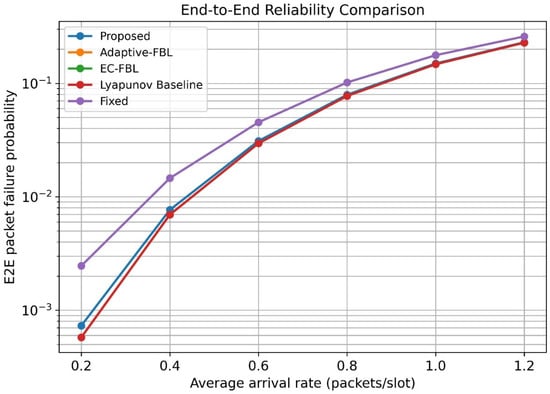
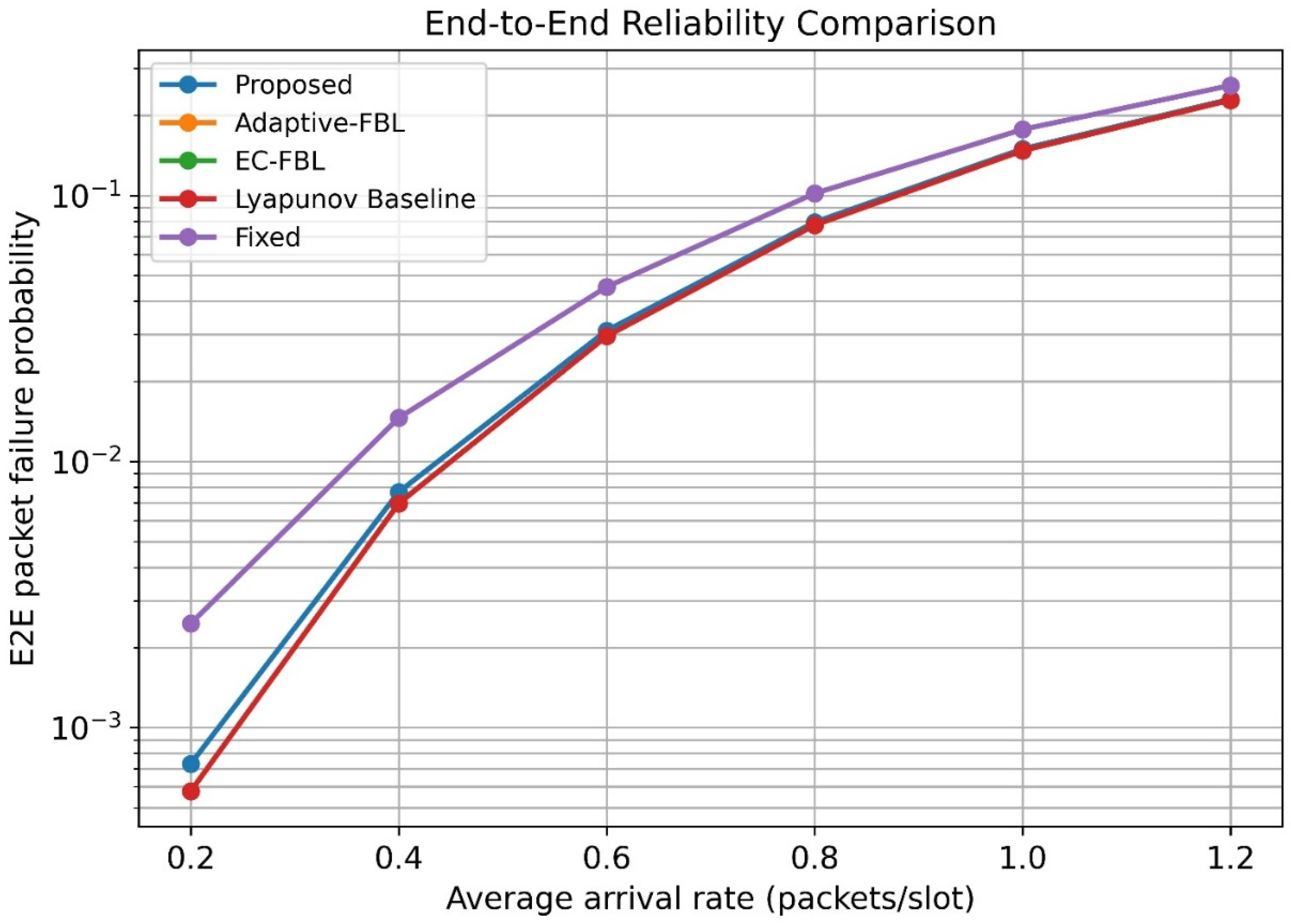
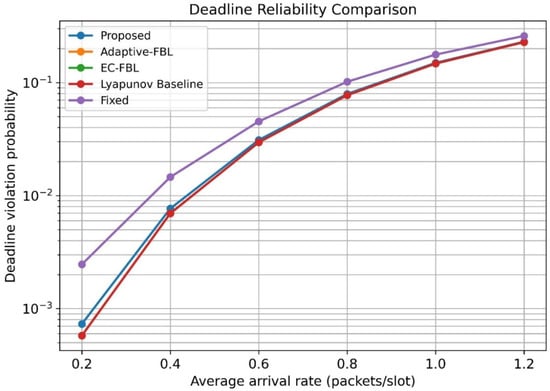
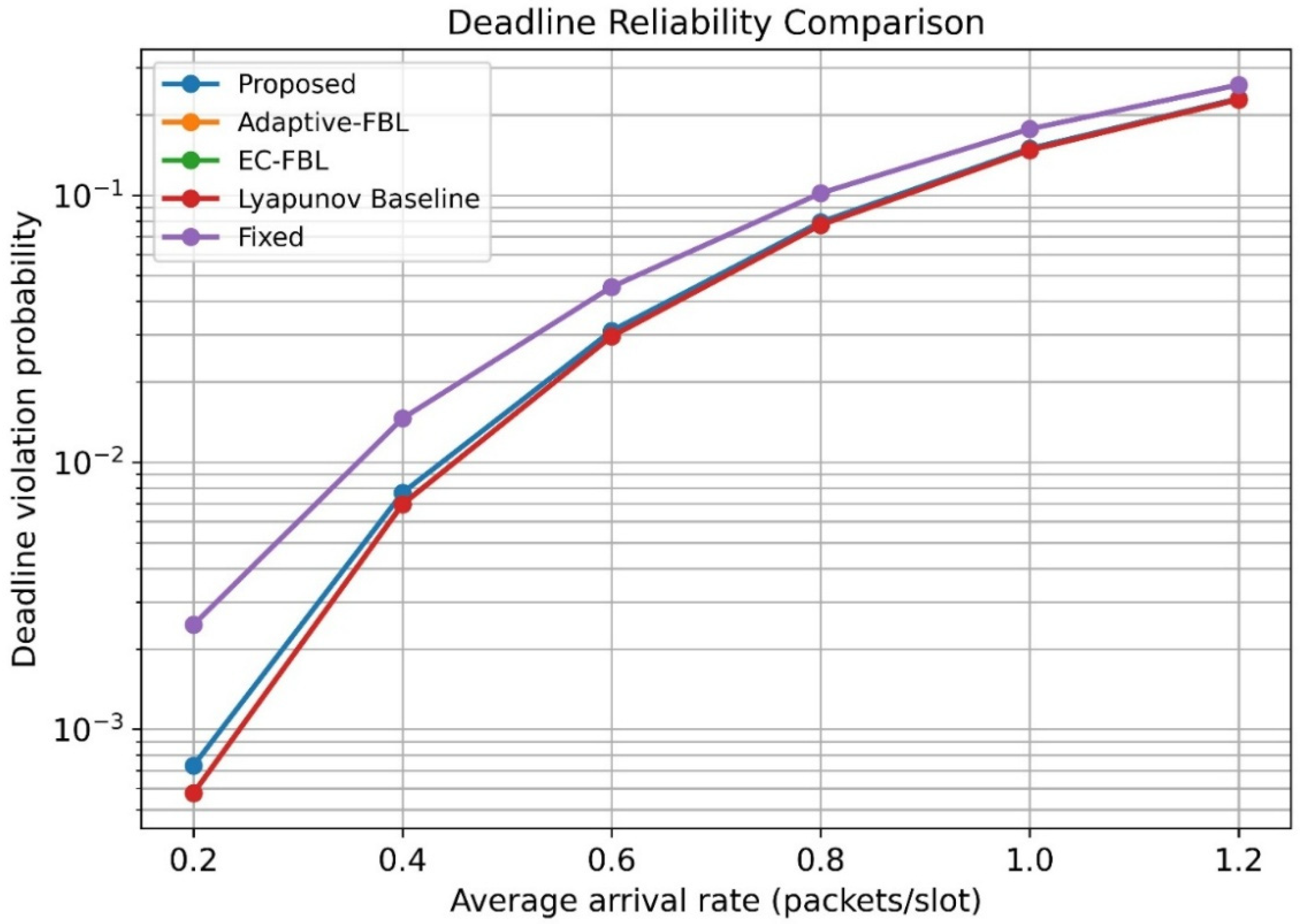
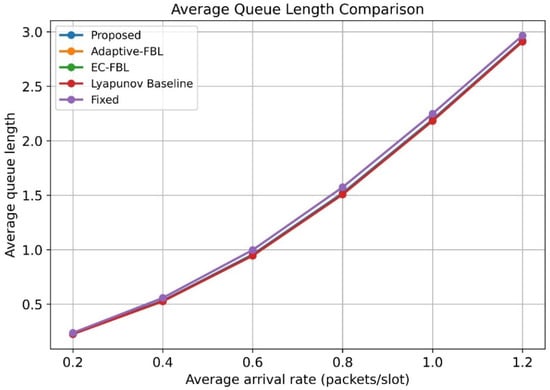
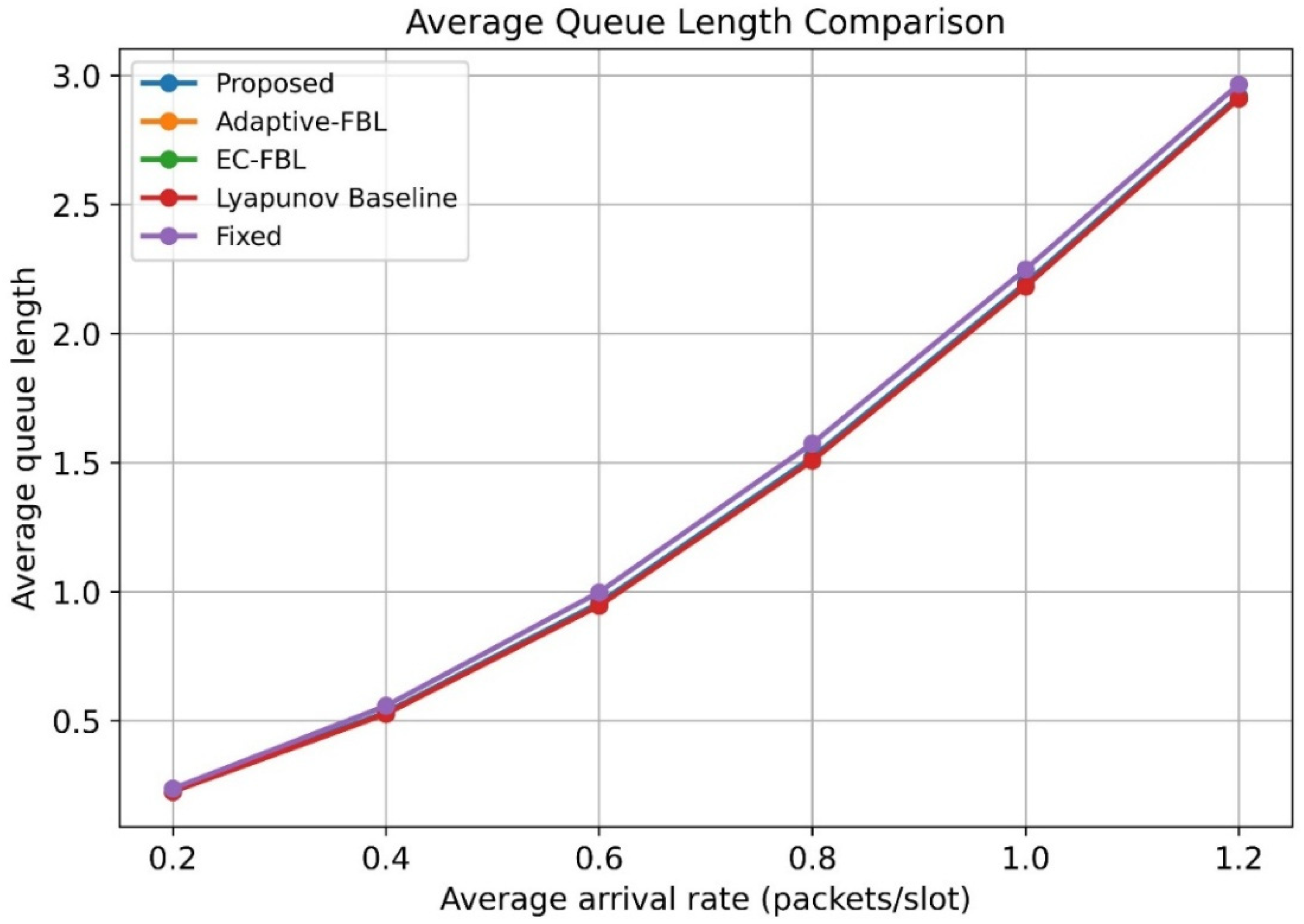
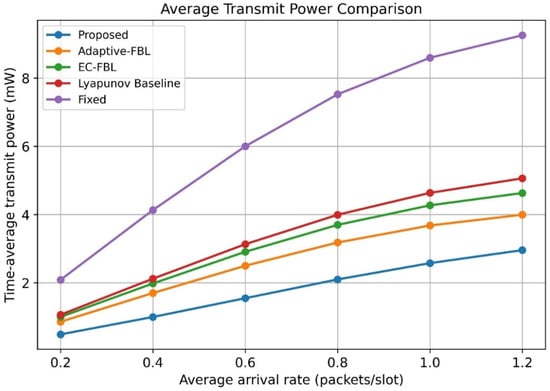
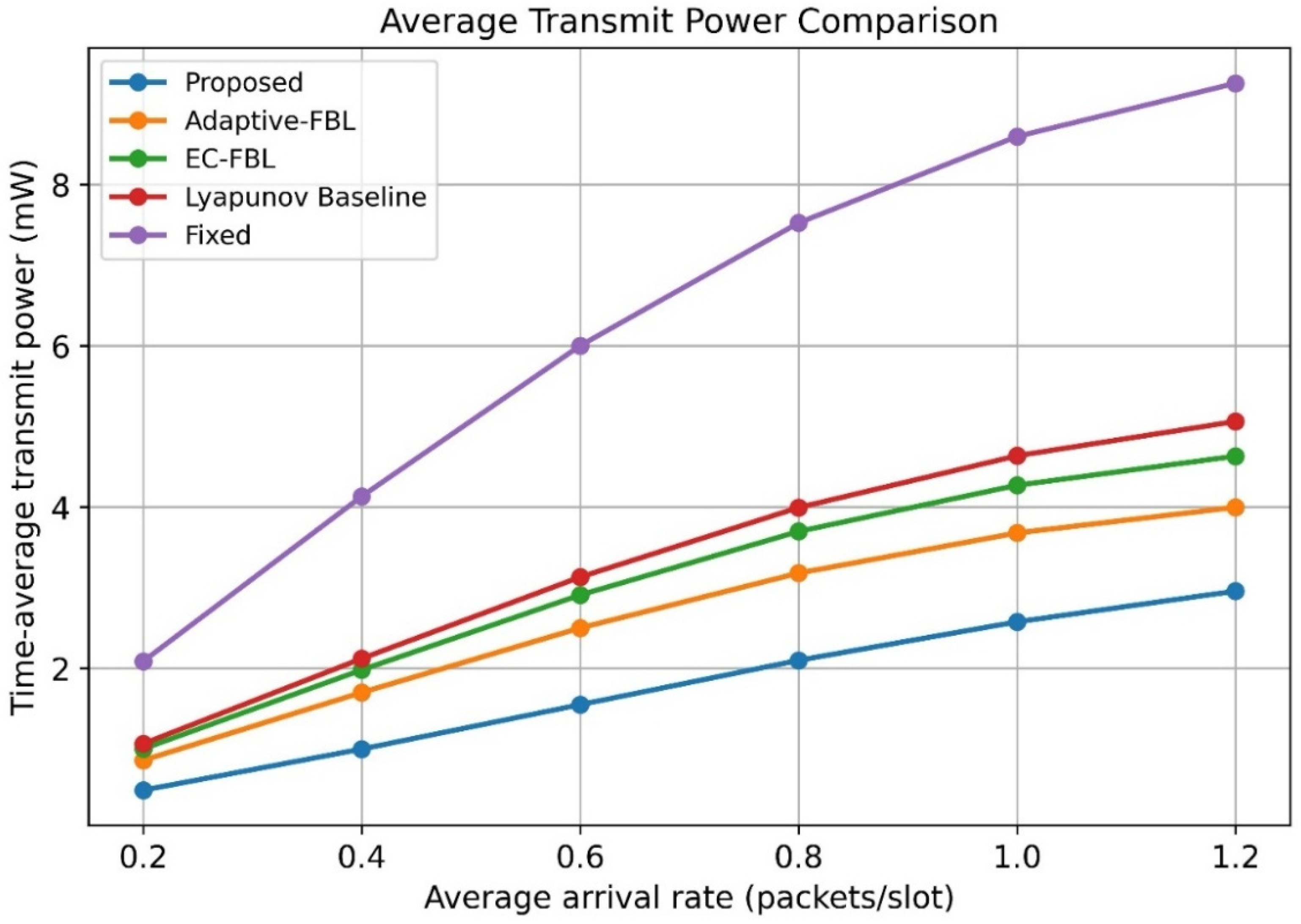
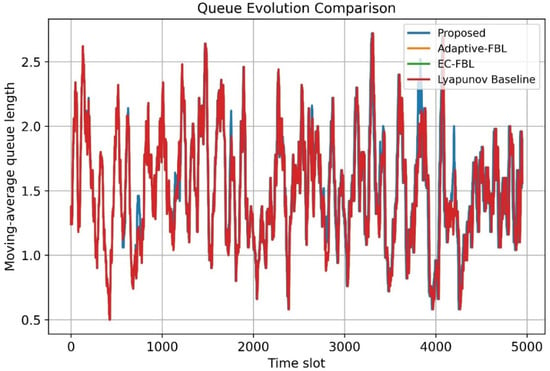
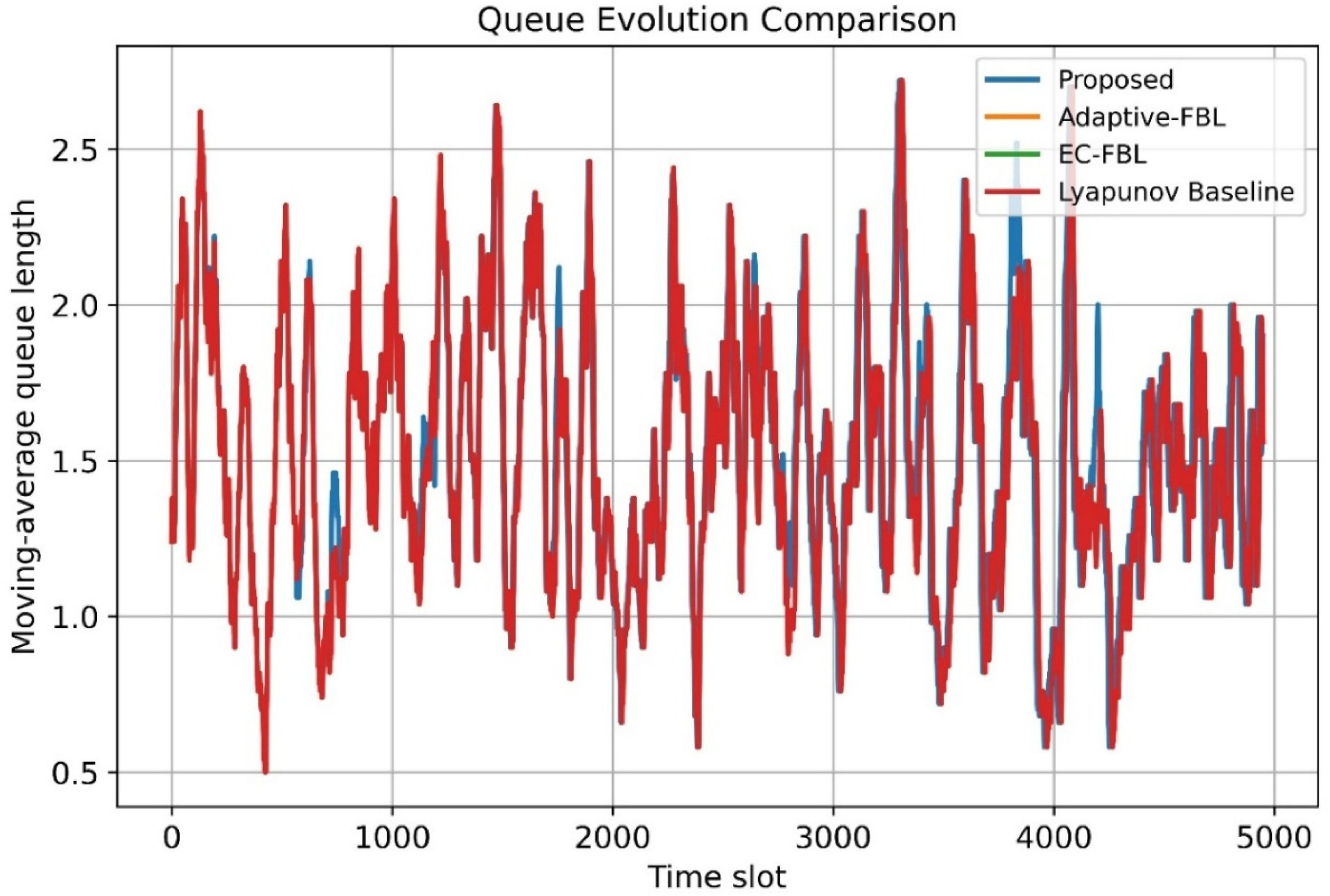
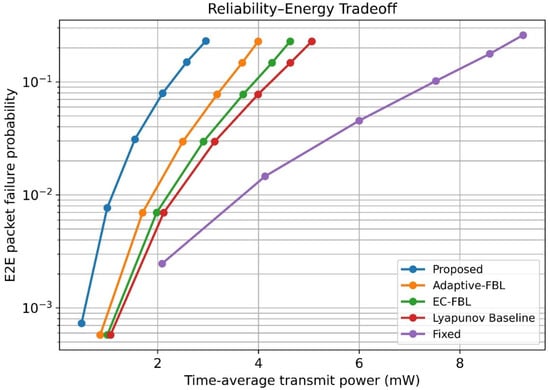
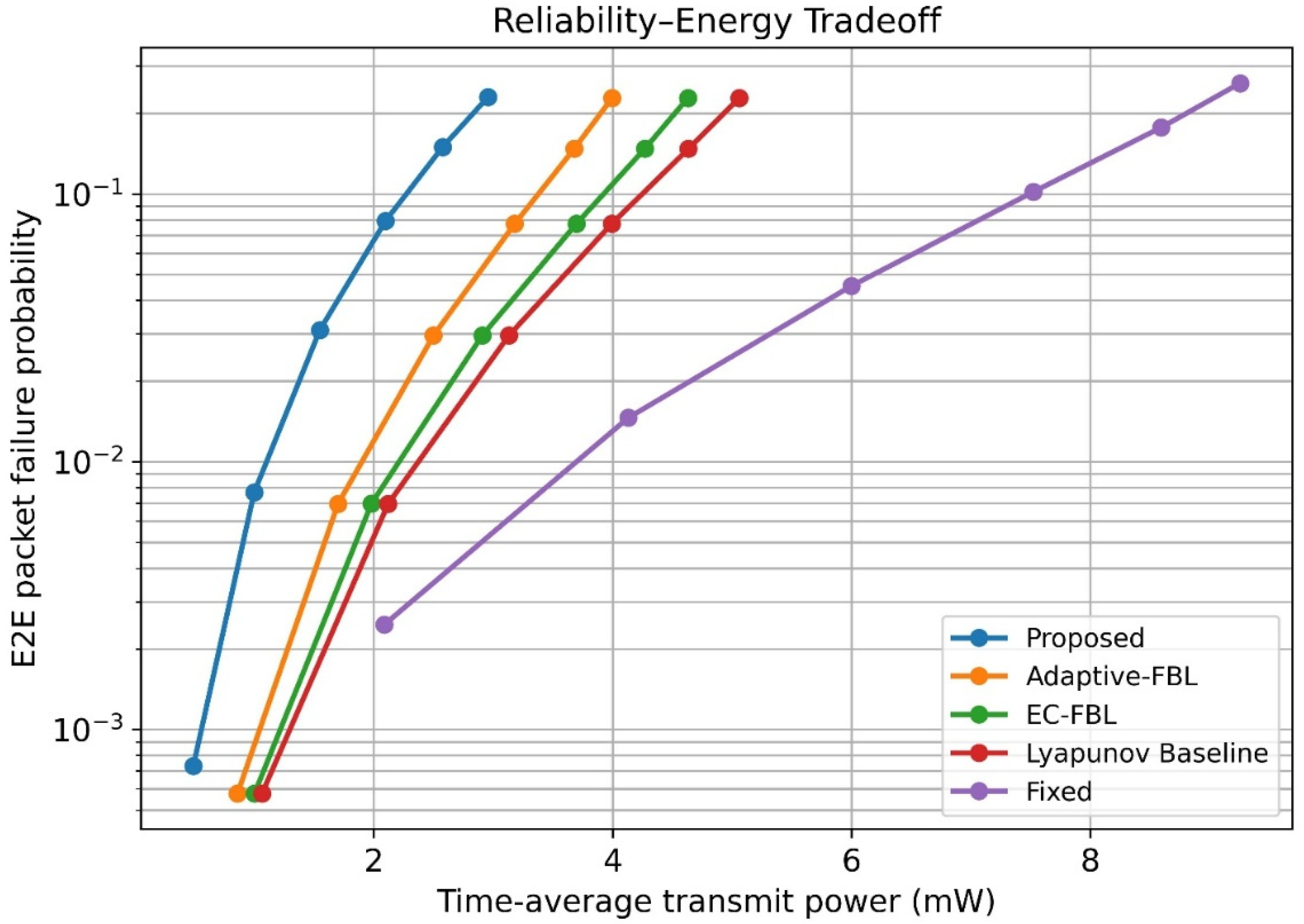
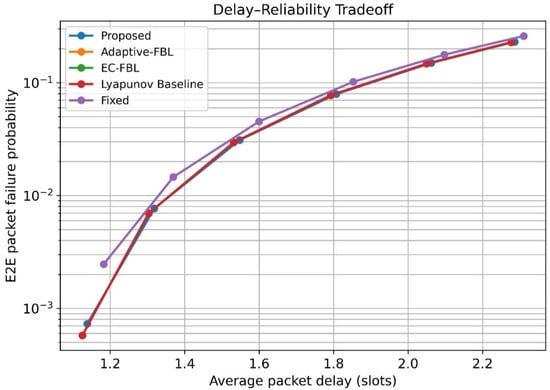
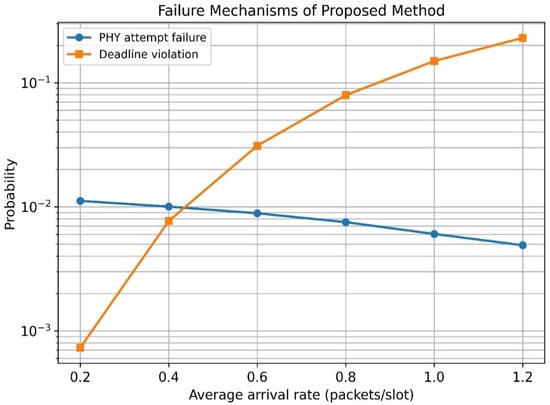
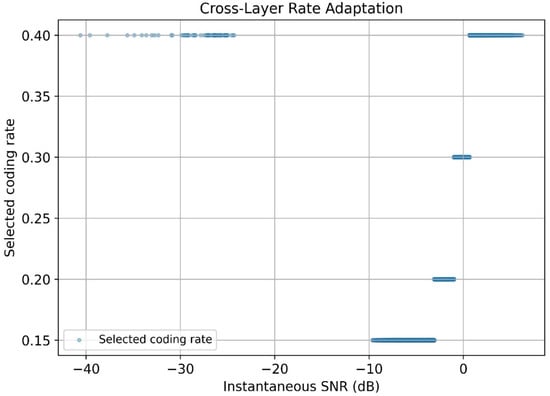
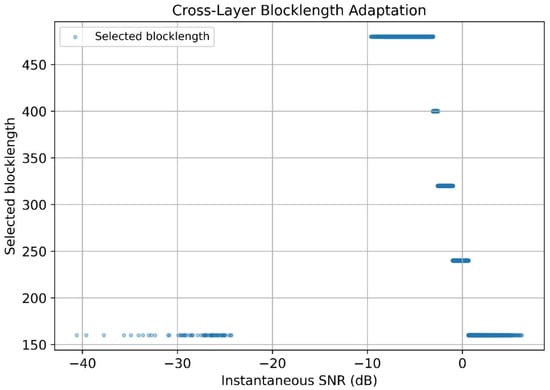

Disclaimer/Publisher’s Note: The statements, opinions and data contained in all publications are solely those of the individual author(s) and contributor(s) and not of MDPI and/or the editor(s). MDPI and/or the editor(s) disclaim responsibility for any injury to people or property resulting from any ideas, methods, instructions or products referred to in the content. |
© 2026 by the authors. Licensee MDPI, Basel, Switzerland. This article is an open access article distributed under the terms and conditions of the Creative Commons Attribution (CC BY) license.