


Abstract
This paper investigates adaptive power splitting (PS) for amplify-and-forward (AF) simultaneous wireless information and power transfer (SWIPT) relay systems operating over independent Rayleigh fading channels. Unlike conventional PS schemes optimized according to average channel statistics or a specific long-term performance metric, the proposed method selects the PS ratio using the instantaneous end-to-end signal-to-noise ratio (SNR). By adopting a high-SNR approximation for the source-to-relay link, we uncover a crucial structural insight where the derived optimal PS factor depends exclusively on the instantaneous relay-to-destination (RD) channel state. This offers clear analytical transparency compared to existing complex full-channel state information (CSI) approaches. Leveraging this insightful closed-form expression, we then derive an exact integral representation of the moment-generating function (MGF) of the optimized SNR. Because this representation does not generally reduce to a simple closed form, two tractable upper bounds are developed for symbol error rate (SER) evaluation. Monte Carlo simulations validate the analytical results under independent Rayleigh fading and show that instantaneous SNR-based PS achieves lower SER than the considered fixed and average-statistics-based policies over the simulated operating range.
1. Introduction
Simultaneous wireless information and power transfer (SWIPT) enables wireless devices to extract energy and information from the same radio-frequency (RF) signal. This capability is particularly attractive for cooperative networks in which relay nodes may operate without a continuously available external power source [1,2,3]. By integrating SWIPT with cooperative relaying, a source can transmit information to a destination through an energy-constrained relay while allowing the relay to harvest part of the received signal energy [4,5,6,7,8,9,10].
Among the receiver architectures developed for SWIPT, power splitting (PS) provides a practical mechanism for dividing the received signal between energy harvesting (EH) and information processing (IP). Nevertheless, the PS ratio introduces a fundamental trade-off, which complicates the performance analysis of amplify-and-forward (AF) relaying systems. A larger EH fraction increases the energy available for relay transmission but reduces the signal power used for information detection. Conversely, a smaller EH fraction improves the IP branch while limiting the relay transmit power. The appropriate PS ratio therefore depends on the channel conditions and on the performance metric used for optimization.
Recent works have explored SWIPT AF relays in terms of power allocation, relay selection, and EH-IP optimization [11,12,13,14,15,16,17,18,19,20]. Beyond standard linear models, advanced aspects of energy harvesting have also been actively studied. For instance, the non-linearity of rectifiers in energy harvesting circuits and multi-antenna or multi-carrier waveform design have been rigorously modeled to capture realistic power transfer limits [21]. In addition, signal-shaping techniques exploiting higher-order signal statistics have been proposed to boost WPT efficiency in low-altitude wireless networks [22]. Furthermore, Zanella et al. [23] investigated a dense 6G IoT relaying network with non-linear SWIPT relays and explicit signaling mechanisms, wherein the PS ratio was chosen based on average channel statistics to achieve a target rate over the source-to-destination (SD) link.
Despite these developments in advanced WPT and non-linear EH modeling, most existing PS designs for SWIPT relay systems have mainly been developed from an average-performance perspective [11,12,18,23]. For example, the PS ratio is typically selected to minimize outage probability, minimize an asymptotic error rate, or maximize average channel capacity [2,15,19]. While these approaches are suitable for long-term network planning, they do not dynamically adapt the EH–IP trade-off to instantaneous channel realizations. Although instantaneous SNR-maximizing PS optimization with full channel state information (CSI) was considered in [24], the derived solution was complicated and did not yield explicit analytical insights into end-to-end performance metrics such as moment-generating functions (MGFs) or symbol error rates (SERs). Furthermore, applying an instantaneous SNR-based PS policy to advanced dense relay networks (e.g., [23]) remains an open direction for future work.
This paper addresses this gap by developing an instantaneous SNR-based PS policy for a SWIPT AF relay system with a direct SD link over independent Rayleigh fading channels. The proposed policy maximizes the relay-assisted instantaneous SNR with respect to the PS ratio. Under a high-SNR approximation for the source-to-relay (SR) link, the resulting optimization problem is concave and admits a closed-form solution that explicitly reflects the relay-to-destination (RD) channel state. We then characterize the statistical distribution of the optimized SNR through its exact MGF integral representation and derive two upper-bounded MGF expressions that enable tractable, closed-form SER evaluation.
The primary contributions of this work are summarized as follows:
- Instantaneous SNR-based PS optimization: We formulate the PS-factor optimization problem using the instantaneous end-to-end SNR of a SWIPT AF relay link and derive its closed-form solution under the adopted high-SNR approximation.
- MGF characterization of the optimized SNR: We obtain an exact integral representation for the MGF of the optimized relay-assisted SNR. This representation reveals the statistical structure of the proposed adaptive scheme but is not directly convenient for closed-form SER evaluation.
- Tractable MGF upper bounds and SER analysis: We derive two upper bounds for the exact MGF and use them to obtain computable SER bounds for M-ary phase-shift keying (M-PSK) signaling.
- Numerical validation and comparison: We compare the proposed policy with fixed-PS and average-statistics-based PS policies under different relay positions and SNR conditions. The analytical expressions are validated by Monte Carlo simulations.
The remainder of this paper is organized as follows. Section 2 introduces the system model and reviews the average-statistics-based PS policies. The proposed instantaneous SNR-based optimization is then derived. Section 3 develops the exact MGF representation and its upper bounds, followed by the corresponding SER expressions. Section 4 presents the numerical results and discusses the effects of relay position and link quality.
2. System Model and Power-Splitting Optimization Criteria
Consider a single-input single-output (SISO) AF relaying system consisting of a source (S), an energy-constrained relay (R), and a destination (D). The relay operates under the SWIPT protocol using PS receiver architecture, where a fraction of the received power is used for EH, and the remaining portion is used for IP [1,2,15].
2.1. Signal Model and Combining Assumptions
Let , , and denote the channel gains of the SD, SR, and relay-to-destination (RD) links, respectively, modeled as independent Rayleigh random variables. Communication occurs over two time slots. In the first slot, the source transmits with and is the stochastic average. The received signals at the relay and destination are
where are independent additive white Gaussian noise (AWGN) terms. The SD link instantaneous SNR is , where and .
At the relay, the received signal is split as
where and denote the EH and IP components, respectively, represents conversion noise, and the equivalent IP noise variance is . The harvested energy is , yielding transmit power .
In the second slot, the relay amplifies with an amplification gain and transmits . Under the high-SNR regime (), the gain is approximated as
The relay gain in (3) is derived using a high-SNR approximation, which has been demonstrated to yield highly accurate results in the previous literature [1,2,15].
The destination receives the signal given by
where is the AWGN of the RD link. The instantaneous source–relay–destination (SRD) end-to-end SNR is given by [2]
where , , , and . Their respective averages are defined as and , with , , , and .
2.2. Conventional Average-Statistics-Based Power-Splitting Policies
Conventional PS optimization schemes typically rely on average performance metrics. Specifically, the PS ratio is optimized by minimizing the outage probability [2] or the asymptotic average bit error rate (BER) [15], or by maximizing the ergodic channel capacity [17].
2.2.1. Asymptotic-BER-Based Optimization
As proposed in ref. [15], the PS factor can be optimized with respect to the average error rate as
where represents the asymptotic BER expressed in (A3) of Appendix A.1.
2.2.2. Outage-Probability-Based Optimization
The authors in [2] formulated the PS policy as
where the outage probability is expressed as
where , , and being the modified Bessel function of the second kind of order one [2,16].
2.2.3. Ergodic-Capacity-Based Optimization
Based on the average channel capacity, the PS factor can be optimized as
where the ergodic channel capacity is defined as [17]
This can be expressed in closed form as given in (A8) of Appendix A.2.
From an average-performance perspective, the optimal PS ratio inherently depends on the chosen metric. Therefore, the following subsection develops an adaptive policy based on the instantaneous received SNR.
2.3. Instantaneous-SNR-Based Power-Splitting Optimization
In this paper, we propose an adaptive PS optimization scheme based on the instantaneous SNR. From (5), the end-to-end SRD link SNR can be explicitly rewritten as
Since holds for , the objective function is strictly concave, and the optimal PS factor is derived in closed form as
Since the conditional error rate for standard digital modulation schemes is a monotonically decreasing function of the instantaneous SNR, maximizing the instantaneous SNR consistently provides a lower bound on the conditional error rate [25].
It is worth noting that, under the high-SNR approximation for the SR link (), the optimal PS factor depends exclusively on the RD link channel gain. Equation (12) provides a vital analytical insight: for a small corresponding to a poor RD link, a larger PS ratio increases the harvested relay energy, thereby enhancing overall performance; conversely, for a large corresponding to a good RD link, a smaller maximizes the instantaneous SNR by prioritizing the information processing fraction over energy harvesting.
The proposed policy requires the instantaneous RD channel gain, or an accurate estimate thereof, prior to selecting the PS ratio. Such CSI can be acquired via channel estimation at the relay or through limited feedback from the destination. Furthermore, exploiting the quasi-static nature of wireless fading channels allows the RD link CSI to be acquired during the initial call setup phase, thereby minimizing training overhead [17]. The signaling overhead associated with this feedback mechanism is beyond the scope of this work and is delegated to future research.
3. MGF Characterization and SER Bounds
We investigate an adaptive PS policy that maximizes the end-to-end instantaneous SNR. Based on the resulting optimal PS factor, we derive the exact MGF representation and its upper bounds for SER analysis.
3.1. Exact Integral Representation of the MGF
With given in (12), the optimal instantaneous SNR reduces to
where is an exponentially distributed random variable (RV) with probability density function (PDF) , denotes the unit step function, and is a Rayleigh distributed RV with PDF . It should be noted that, due to the adaptive PS optimization, the expression for the instantaneous SNR is structurally transformed from (5) to (13). Consequently, the MGF formulation derived in [15] is no longer directly applicable.
Let , so that . An exact integral representation of the MGF is obtained as
where , is the PDF of Y, and the expectation term can be written as
with
Finally, the exact MGF of (14) is compactly expressed as
The exact representation in (17) contains a nontrivial integral over an unbounded interval. Although analytically exact, it is not directly convenient for numerical interpretation or closed-form evaluation. Therefore, we derive tractable MGF upper bounds in the following subsection and use them to obtain SER upper bounds.
3.2. Tractable MGF Upper Bounds
To simplify the exact MGF in (17), we first derive an upper bound of in (16) by neglecting the term in the denominator:
where , is the exponential integral [26], and
By applying Mills-type inequalities to the relevant terms, a looser upper bound is obtained as
Note that the detailed derivation is provided in Appendix B.
Finally, the exact MGF in (17) is bounded as
3.3. MGF-Based SER and Performance Bounds
From (17), the average SER of the indirect link is expressed as
where , , and M denotes the modulation order for M-PSK [25]. Upper bounds of (22) can be obtained by replacing with and , respectively, as
and
We assume coherent maximal-ratio combining (MRC) of the direct and relay-assisted branches at the destination. Under the independence assumption for the SD and SRD branches, the combined instantaneous SNR is , and its MGF is given by , where .
4. Numerical and Simulation Results
The analytical results are evaluated numerically and compared with Monte Carlo simulations. All simulations were implemented in MATLAB R2024a. Unless otherwise stated, binary phase-shift keying (BPSK) is used, the SR, RD, and SD channels are statistically independent Rayleigh fading channels, and the energy-conversion efficiency is set to [27]. The average received powers are determined according to the path-loss model in Table 1 with reference distance and path-loss exponent [28]. The relay is placed within from the source. The average SNR is defined as . For each SNR value, independent channel realizations are generated for the SD, SR, and RD links. The noise samples , , , and are mutually independent and follow . For each operating point, independent transmitted symbol, channel, and noise trials are generated. The proposed scheme uses the instantaneous PS factor obtained from (12). For comparison, we consider fixed PS, randomly selected PS, asymptotic-BER-based PS in (6), outage-based PS in (7), and channel-capacity-based PS in (9). The same channel realizations and modulation parameters are used across the compared schemes whenever possible to reduce the variance of the performance comparison.
Table 1.
Channel Models for SWIPT AF Relaying System. (, reference distance: , path-loss exponent: [28]).
In the plots, blue and red curves represent the indirect and combined links, respectively. Theoretical curves are labeled as ‘Theory, Ex’, ‘Theory, Up’, and ‘Theory, Up2’, corresponding to , , and .
4.1. Performance Evaluation of Average-Statistics-Based Policies
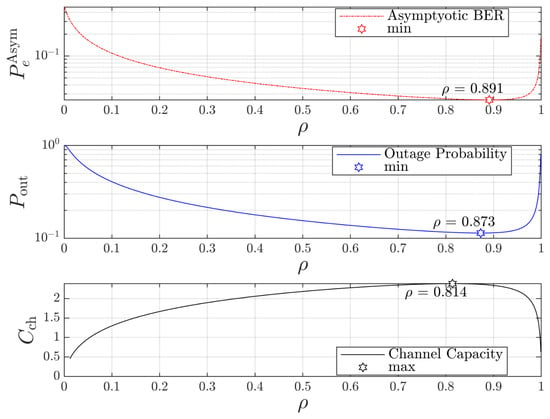
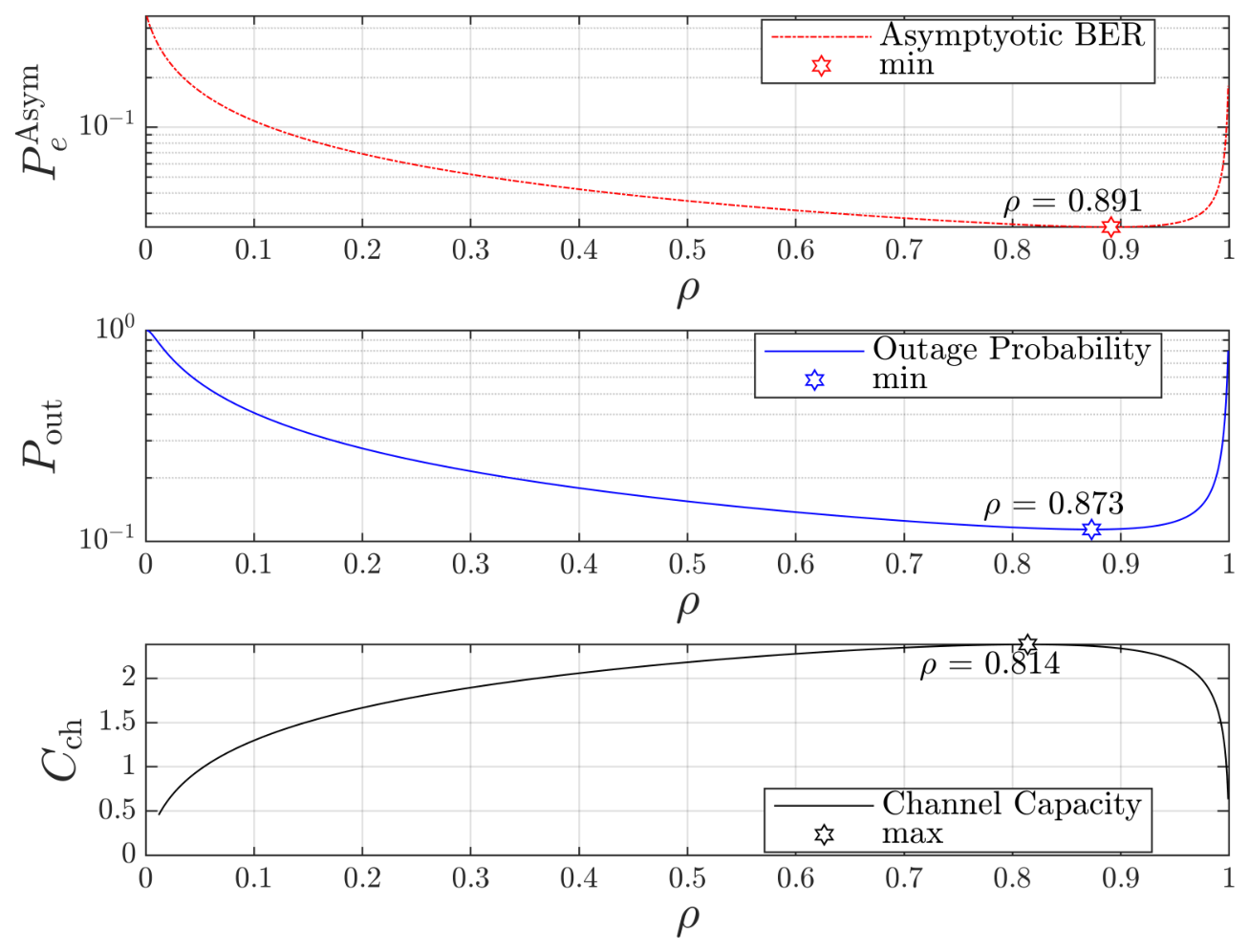
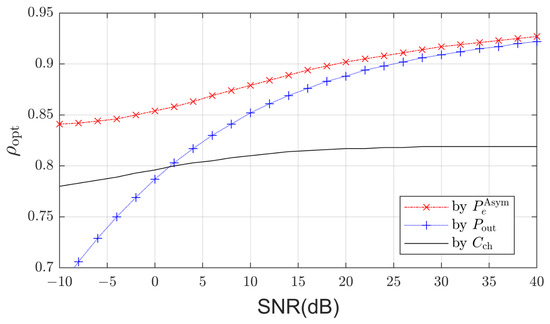
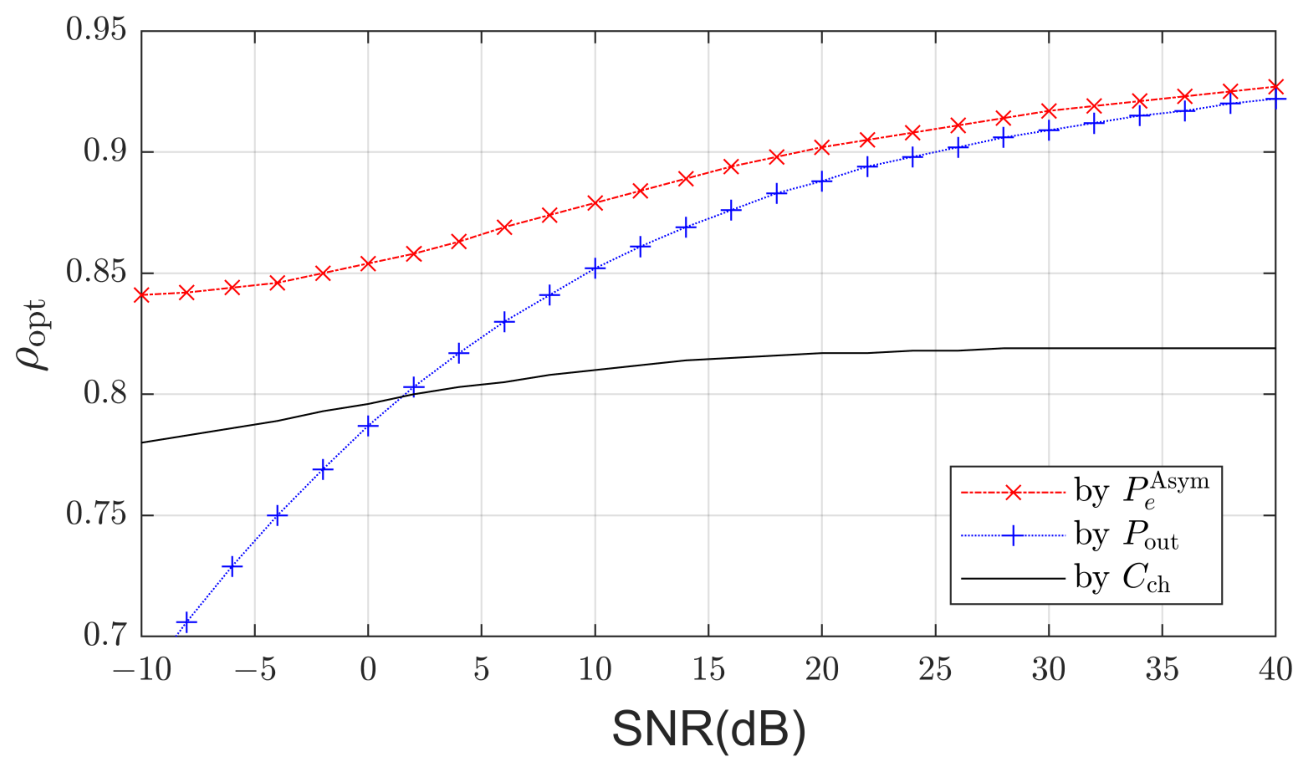
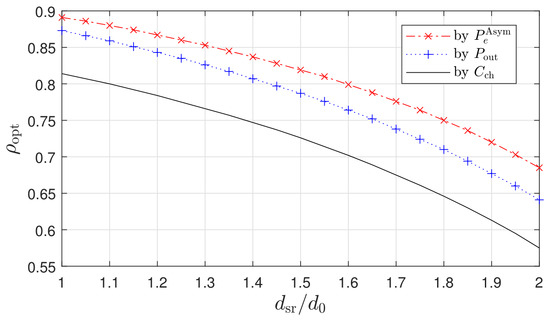
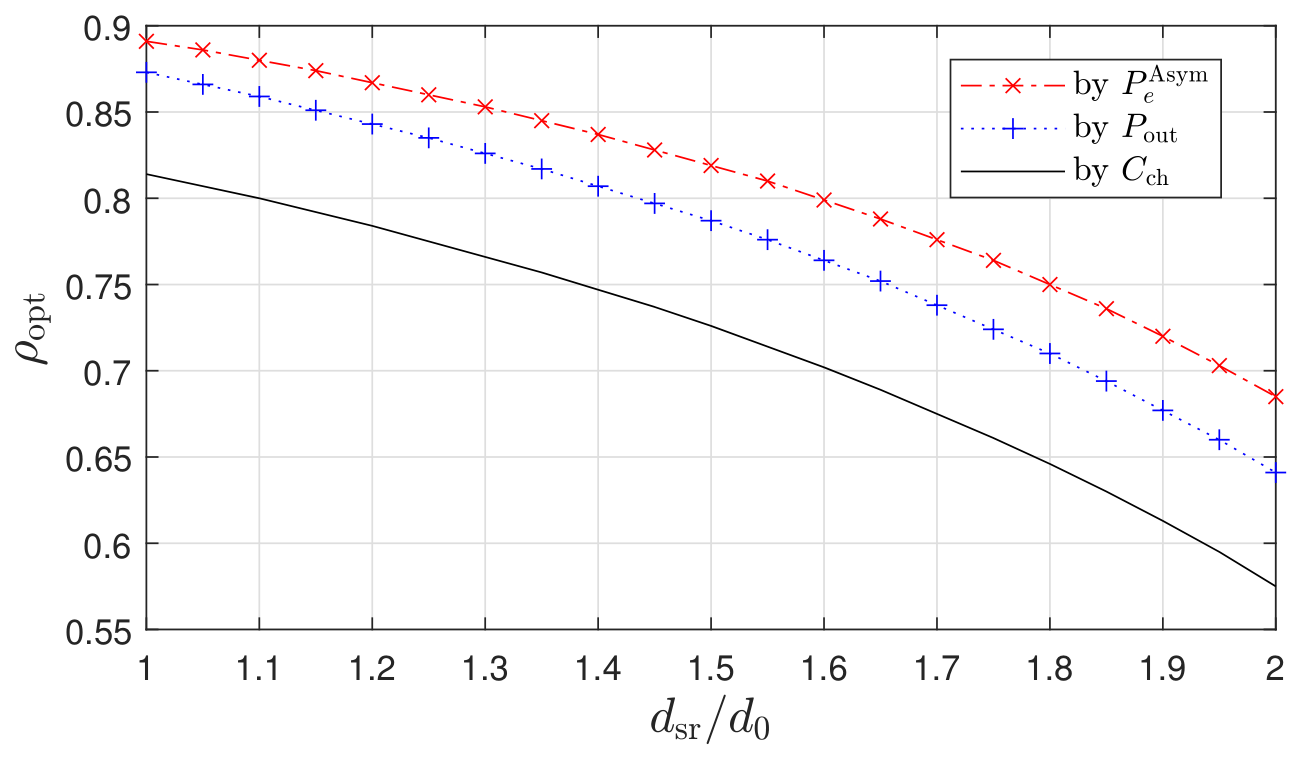
Figure 1 shows the performance metrics with respect to , along with the optimum PS factors obtained from (6), (7), and (9). Figure 2 and Figure 3 present the optimum versus SNR and relay position specified in Table 1, respectively.
Figure 1.
Performance comparison with respect to when (M = 2 (BPSK), [27], dB).
Figure 2.
Optimum PS factor comparison with respect to SNR and cost functions when (M = 2 (BPSK), [27]).
Figure 3.
Optimum PS factor comparison with respect to and cost functions (M = 2 (BPSK), [27], dB).
These results indicate that the optimum varies depending on the chosen performance metric. For higher SNR and smaller (better SR link), the optimum increases, implying that stronger SR links enhance system performance via a higher EH ratio. In contrast, (12) demonstrates that when the RD link is favorable, the PS optimization reduces the EH ratio, whereas a poor RD link leads to an increase in .
4.2. Impact of High-SNR Approximations on AF Gain and Optimal Power-Splitting Factor
Note that in this paper, we assume the high-SNR condition for the SR link (i.e., ). This high-SNR approximation can affect both the received instantaneous SNR (i.e., AF gain) and the derived optimum PS factor. Without this approximation, the exact AF gain is expressed as
and the corresponding full-CSI PS optimization is formulated as
where depends on both and (i.e., requiring full CSI). Furthermore, is explicitly a function of . Then, using in (12), the mean-squared error (MSE) between the full-CSI and proposed PS factors is defined as
Figure 4 illustrates the MSE in (27) as a function of the SNR. To evaluate the MSE in (27), in (26) is obtained via a heuristic full search in simulations. Figure 4 confirms that the proposed in (12) maintains high accuracy across all SNR regimes. Furthermore, the proposed in (12) results in negligible BER mismatch, as depicted in Figure 5. Table 2 summarizes the simulation conditions used to investigate the effect of the high-SNR approximation. Figure 5 compares the BER performance across the four cases listed in Table 2. The fact that both in (26) and in (12) yield virtually identical BERs even in the low-SNR region—regardless of the high-SNR approximation used for the AF gain—validates the proposed analytical in (12). Consequently, the high-SNR approximation for the AF gain primarily impacts the baseline level of the received SNR, leading to tight lower bounds on the BER. Moreover, the derived BER expressions match the simulation results obtained under the high-SNR approximation closely.
Figure 4.
MSE comparison with respect to SNR (dB) (M = 2 (BPSK), [27], ).
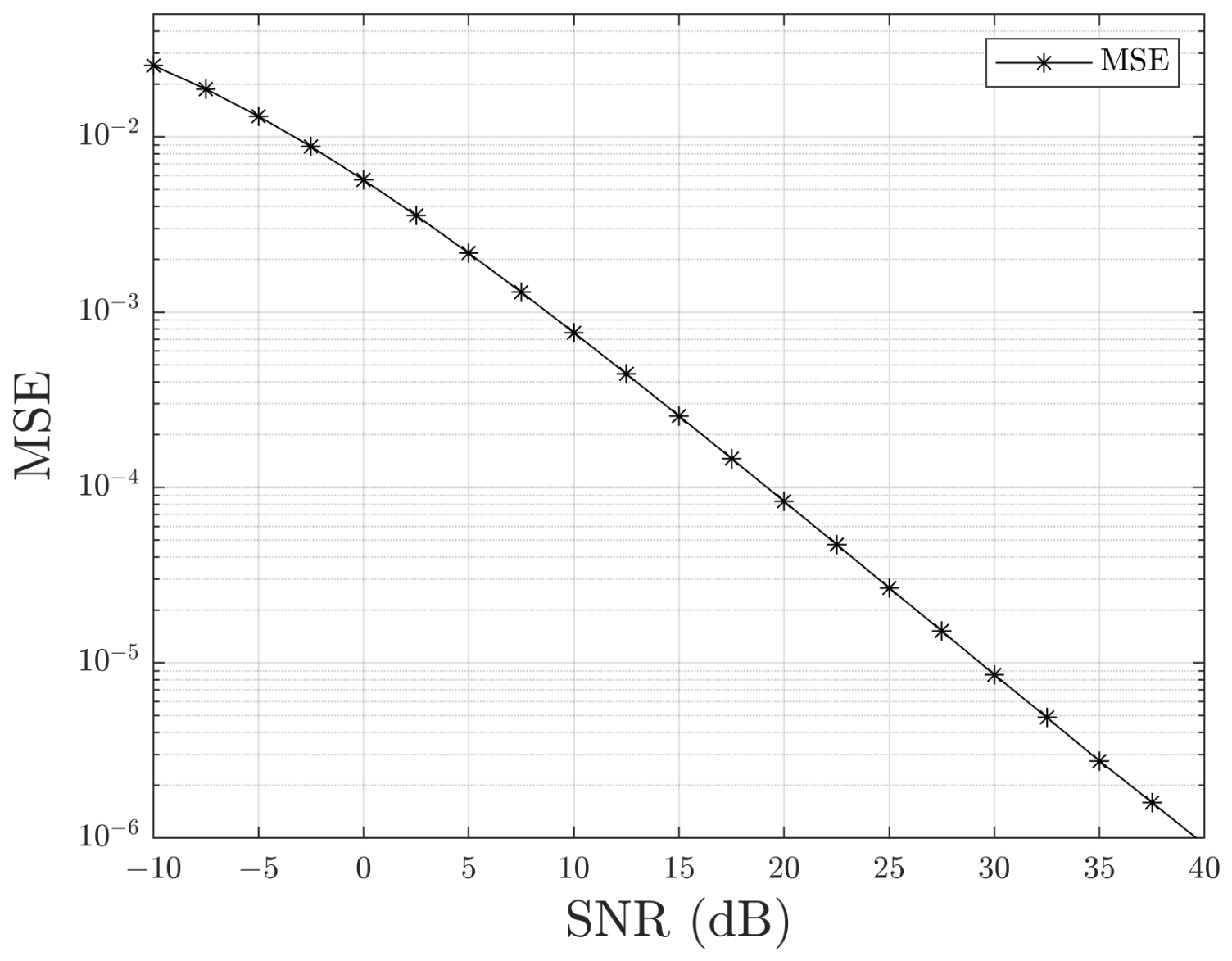
Figure 5.
BER performance comparison with regarding to four cases in Table 2 and SNR (dB) (M = 2 (BPSK), [27], ): (a) both links, and (b) separate links.
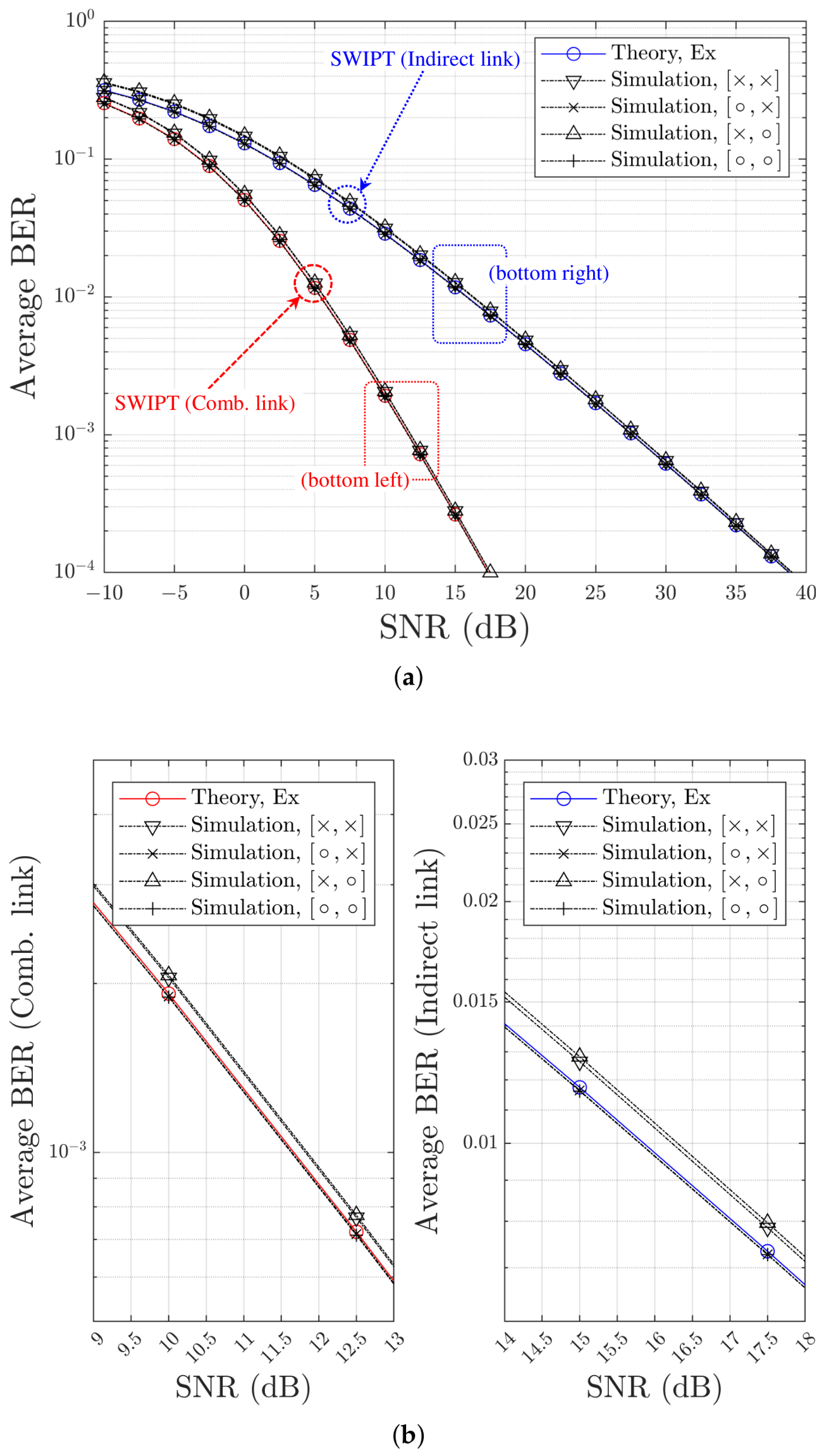
Table 2.
Simulation Condition for High SNR Approximation.
Figure 6.
BER performance comparison with respect to SNR (dB) (M = 2 (BPSK), [27], ): (a) both links, and (b) separate links.
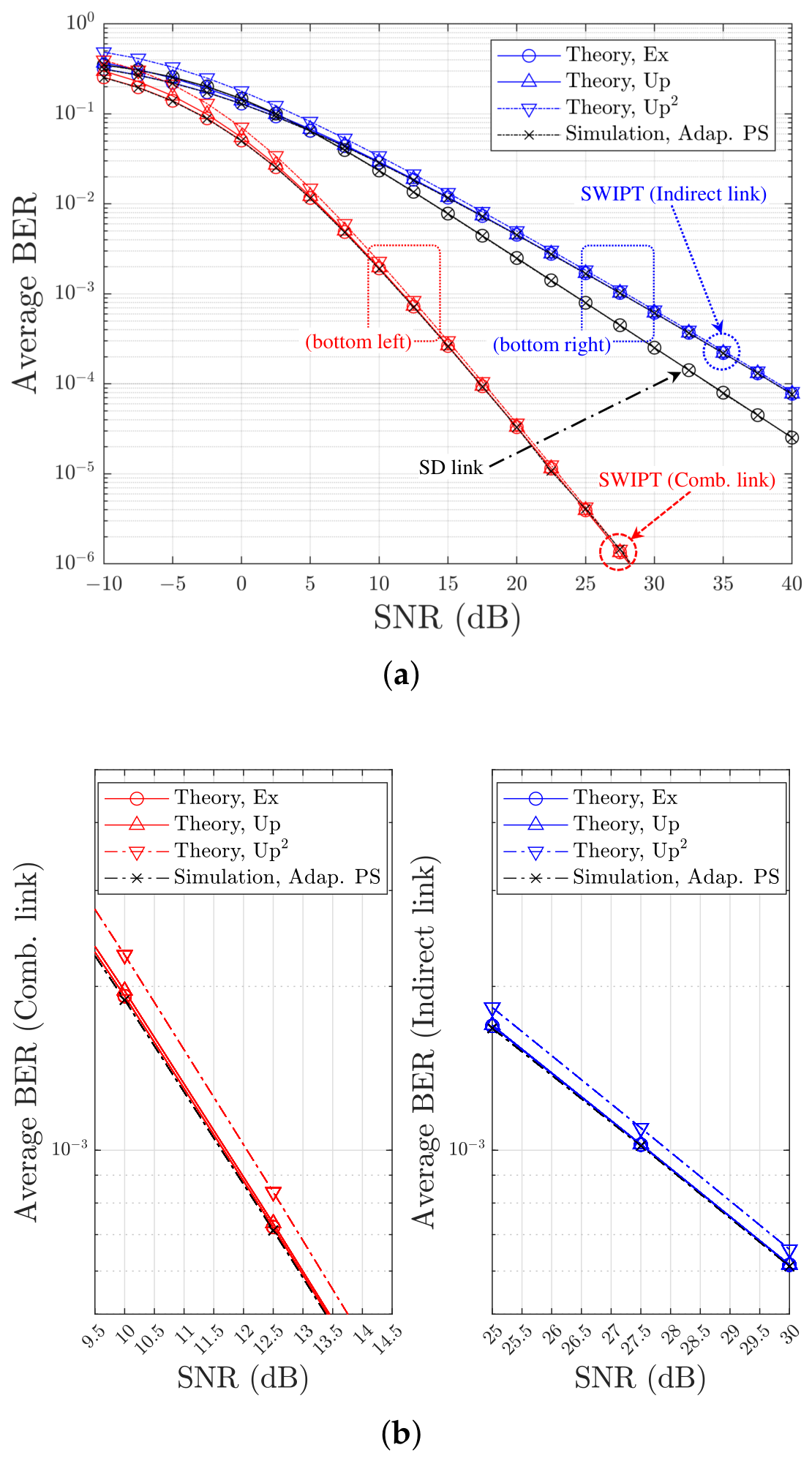
Figure 7.
BER comparison with respect to SNR (dB) and PS optimization methods (M = 2 (BPSK), [27], ).
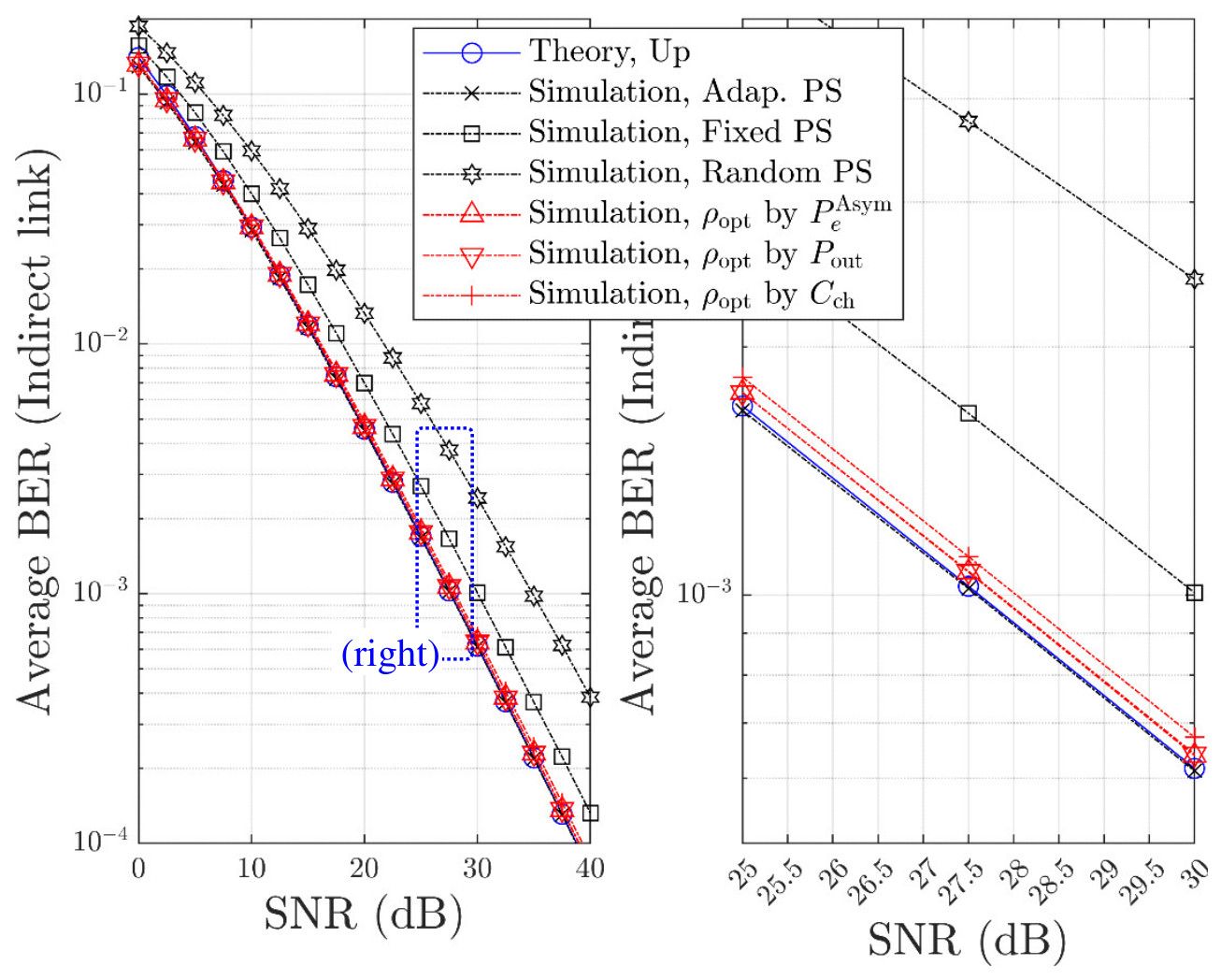
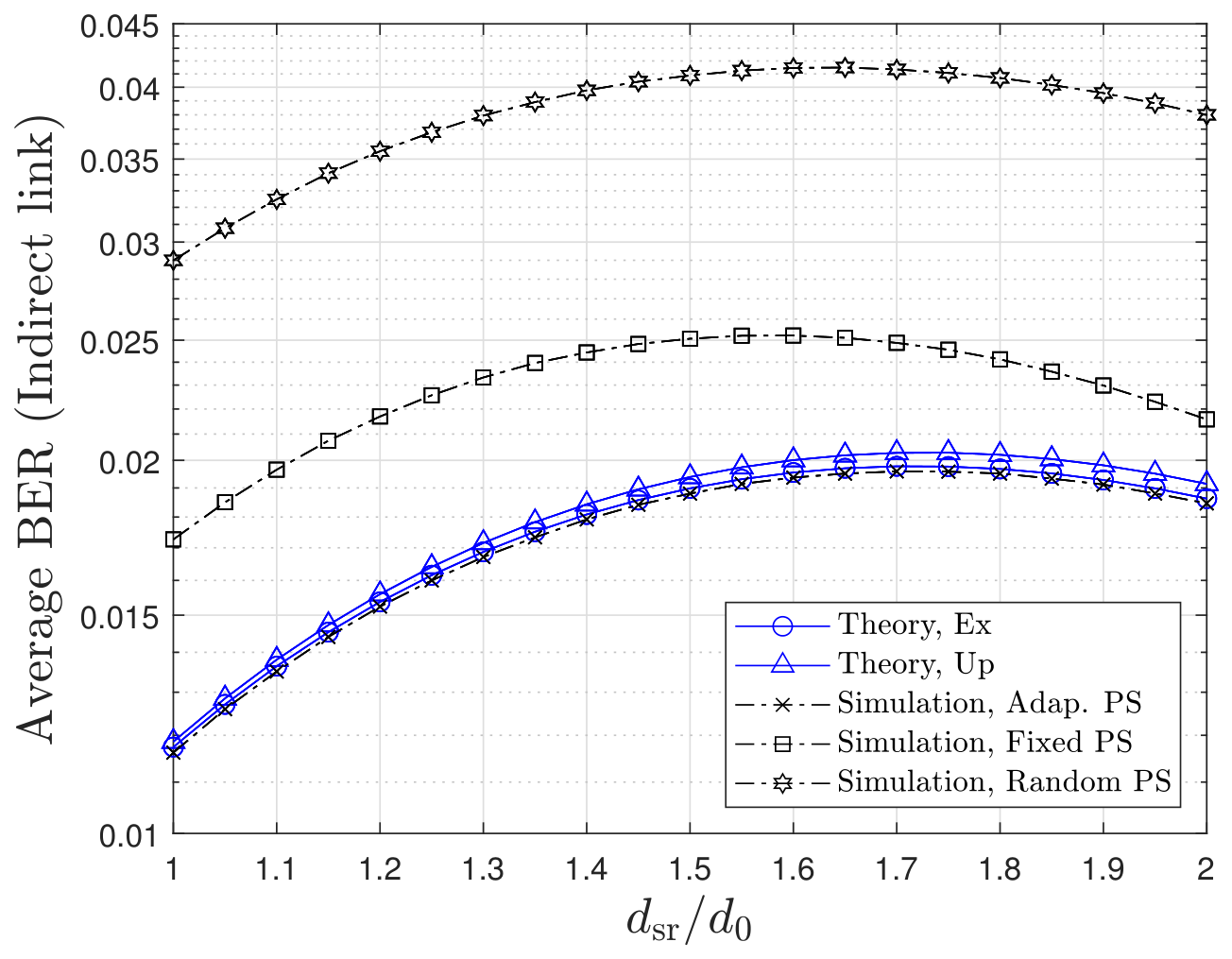
Figure 8.
BER comparison with respect to and PS optimization methods (M = 2 (BPSK), [27], dB).
4.3. Comparison of Derived Error Rate Expressions and System Gains
Figure 6 shows the BER as a function of the SNR. The indirect path exhibits inferior performance due to the limited energy harvested at the relay, whereas the combined path consistently outperforms the direct link. The theoretical curves closely match the simulation results, and the ‘Theory, Up2’ curve accurately captures the upper-bound behavior.
Figure 7 demonstrates that the proposed PS optimization achieves an SNR gain of approximately dB at compared with the asymptotic-BER-based and outage-probability-based PS schemes. The gain increases to approximately dB when compared with the channel-capacity-based PS scheme. In addition, a significant SNR gain exceeding dB is achieved over the fixed and random PS schemes. Note that, as mentioned in Section 2.3, in (12) is inversely proportional to the RD link channel gain. Thus, when the RD link channel is weaker, a larger (i.e., allocating more energy for harvesting) is appropriate. Nevertheless, the conventional fixed and random PS schemes fail to adaptively respond to varying RD link conditions.
Figure 8 compares the BER with respect to the relay position. Simulation curves labeled ‘Simulation, Fixed PS’ and ‘Simulation, Random PS’ correspond to a fixed PS ratio of and a randomly chosen PS ratio uniformly distributed over , respectively. Because , increasing shifts the relay toward the destination, strengthening the RD link while weakening the SR link. In this region, the proposed adaptive policy reduces the EH fraction because less harvested energy is required when the RD link is strong. Conversely, when the relay is located close to the source, the RD link becomes the bottleneck, and the optimal policy allocates a larger fraction of received power to EH.
5. Conclusions
This paper proposed an instantaneous SNR-based PS policy for a SWIPT AF relay system over independent Rayleigh fading channels. Under a high-SNR approximation for the SR link, we derived a closed-form PS factor that depends exclusively on the RD channel state, offering clear structural insights over conventional average-statistics-based schemes. Based on this optimal policy, an exact MGF integral representation and two tractable upper bounds were developed to enable efficient SER evaluation. Numerical and simulation results confirmed the analytical expressions and demonstrated that the proposed adaptive PS scheme consistently achieves superior SER performance across various SNR regimes and relay positions.
Future work will focus on extending the proposed instantaneous PS framework to practical non-linear energy harvesting models [27], advanced signal-shaping designs, and multi-relay dense 6G IoT networks under imperfect CSI and finite-rate feedback constraints.
Author Contributions
Conceptualization, K.K.; methodology, S.S.; software, K.K.; validation, K.K.; formal analysis, K.K.; investigation, K.K.; resources, S.S.; data curation, K.K.; writing—original draft preparation, K.K.; writing—review and editing, S.S.; visualization, K.K.; supervision, S.S.; project administration, S.S.; funding acquisition, S.S. All authors have read and agreed to the published version of the manuscript.
Funding
This work was supported by Innovative Human Resource Development for Local Intellectualization program through the Institute of Information & Communications Technology Planning & Evaluation (IITP) grant funded by the Korea government (MSIT) (IITP-2026-RS-2020-II201462).
Data Availability Statement
The original contributions presented in this study are included in the article. Further inquiries can be directed to the corresponding author.
Conflicts of Interest
The authors declare no conflicts of interest.
Abbreviations
The following abbreviations are used in this manuscript:
| AF | amplify-and-forward |
| AWGN | additive white Gaussian noise |
| BER | bit error rate |
| CSI | channel state information |
| EH | energy harvesting |
| IP | information processing |
| MGF | moment-generating function |
| M-PSK | M-ary phase-shift keying |
| probability density function | |
| PS | power splitting |
| RD | relay-to-destination |
| RF | radio frequency |
| RV | random variable |
| SD | source-to-destination |
| SISO | single-input single-output |
| SRD | source-relay-destination |
| SER | symbol error rate |
| SNR | signal-to-noise ratio |
| SR | source-to-relay |
| SWIPT | simultaneous wireless information and power transfer |
Appendix A. Asymptotic Bit Error Rate and Channel Capacity
Appendix A.1. Asymptotic Bit Error Rate in [15]
For in (5), the MGF is derived (same as (29) in [15]) as
where , , and is the exponential integral [26].
The MGF in (A1) is further upper-bounded by
For an arbitrary MGF, the asymptotic BER can be expressed using (9.27) in [25] as
and
Appendix A.2. Ergodic Channel Capacity in [17]
For the indirect link with in (5), the joint PDF of and is given by
where is the unit step function.
Appendix B. Detailed MGF Derivations
Appendix B.1. Derivation of Exact Moment-Generating Function
Appendix B.2. Derivation of Upper-Bounded Moment-Generating Function
From (A12) and (16), neglecting the term in the denominator yields an upper bound given by
where the first integral is evaluated as in (A14), and the second integral is evaluated as with .
For the first integral term in (A13), let us consider the integral
Using the substitution along with standard integral representations involving the incomplete gamma function, one obtains the closed-form expression
Applying the relation and , an equivalent real-valued form is given in (19) as
With and the Mills-type inequalities
one obtains the simple bounds
References
- Nasir, A.; Zhou, X.; Durrani, S.; Kennedy, R. Relaying Protocols for Wireless Energy Harvesting and Information Processing. IEEE Trans. Wirel. Commun. 2013, 7, 3622–3636. [Google Scholar] [CrossRef] [Scilit]
- Lee, H.; Song, C.; Choi, S.; Lee, I. Outage Probability Analysis and Power Splitter Designs for SWIPT Relaying Systems with Direct Link. IEEE Commun. Lett. 2017, 3, 648–651. [Google Scholar] [CrossRef] [Scilit]
- Song, C.; Jeon, Y. Weighted MMSE Precoder Designs for Sum-Utility Maximization in Multi-User SWIPT Network-MIMO with Per-BS Power Constraints. IEEE Trans. Veh. Technol. 2018, 3, 2809–2813. [Google Scholar] [CrossRef] [Scilit]
- Chen, H.; Zhou, X.; Li, Y.; Wang, P.; Vucetic, B. Harvest-Then-Cooperate: Wireless-Powered Cooperative Communications. IEEE Trans. Signal Process. 2015, 7, 1700–1711. [Google Scholar] [CrossRef] [Scilit]
- Mahama, S.; Asiedu, D.K.P.; Lee, K.-J. Simultaneous wireless information and power transfer for cooperative relay networks with battery. IEEE Access 2017, 5, 13171–13178. [Google Scholar] [CrossRef] [Scilit]
- Lee, H.; Lee, K.-J.; Kim, H.; Lee, I. Wireless information and power exchange for energy-constrained device-to-device communications. IEEE Internet Things J. 2018, 5, 3175–3185. [Google Scholar] [CrossRef] [Scilit]
- Asiedu, D.K.P.; Lee, H.; Lee, K.-J. Simultaneous wireless information and power transfer for decode-and-forward Multi-hop Relay systems in energy-constrained IoT networks. IEEE Internet Things J. 2019, 6, 9413–9426. [Google Scholar] [CrossRef] [Scilit]
- Liu, Z.; Ye, Y.; Lu, G.; Hu, R.Q. System Outage Performance of SWIPT Enabled Full-Duplex Two-Way Relaying with Residual Hardware Impairments and Self-Interference. IEEE Syst. J. 2023, 1, 337–348. [Google Scholar] [CrossRef] [Scilit]
- He, S.; Xie, K.; Chen, W.; Zhang, D.; Wen, J. Energy-aware routing for SWIPT in multi-hop energy-constrained wireless network. IEEE Access 2018, 6, 17996–18008. [Google Scholar] [CrossRef] [Scilit]
- Zhang, Z.; Pang, H.; Georgiadis, A.; Cecati, C. Wireless power transfer—An overview. IEEE Trans. Ind. Elect. 2018, 66, 1044–1058. [Google Scholar] [CrossRef] [Scilit]
- Ghosh, S.; Acharya, T.; Maity, S.P. Outage Analysis in SWIPT Enabled Cooperative AF/DF Relay Assisted Two-Way Spectrum Sharing Communication. IEEE Trans. Cogn. Commun. Netw. 2022, 3, 1434–1443. [Google Scholar] [CrossRef] [Scilit]
- Babaei, M.; Durak-Ata, L.; Aygolu, U. Performance analysis of dual-hop AF relaying with non-linear/linear energy harvesting. Sensors 2022, 22, 5987. [Google Scholar] [CrossRef] [Scilit] [PubMed]
- Kim, K.; Asiedu, D.K.P.; Anokye, P.; Kim, E.; Lee, K.-J. Transmit Power Optimization in Multihop Amplify-and-Forward Relay Systems with Simultaneous Wireless Information and Power Transfer. Electronics 2024, 13, 4232. [Google Scholar] [CrossRef] [Scilit]
- Ashraf, N.; Sheihkh, S.A.; Khan, S.A.; Shayea, I.; Jalal, M. Simultaneous Wireless Information and Power Transfer with Cooperative Relaying for Next-Generation Wireless Networks: A Review. IEEE Access 2021, 9, 71482–71504. [Google Scholar] [CrossRef] [Scilit]
- Ko, K.; Song, C. Error Performance Analysis and PS factor Optimization for SWIPT AF Relaying Systems over Rayleigh Fading Channels: Interpretation SWIPT AF relay as non-SWIPT AF relay. Electronics 2025, 14, 2597. [Google Scholar] [CrossRef] [Scilit]
- Ko, K.; Park, G. Exact and Approximate Outage Analysis of Partial-CSI SWIPT Opportunistic AF Relay Networks over Rayleigh Fading. Int. J. Contents 2025, 21, 20–33. [Google Scholar] [CrossRef] [Scilit]
- Ko, K.; Song, S. Channel Capacity Analysis of Partial-CSI SWIPT Opportunistic Amplify-and-Forward (OAF) Relaying over Rayleigh Fading. Electronics 2025, 14, 3791. [Google Scholar] [CrossRef] [Scilit]
- Kumar, P.; Dhaka, K. Performance of wireless powered DF relay system under Nakagami-m fading: Relay assists energy-constrained source. IEEE Syst. J. 2020, 2, 2497–2507. [Google Scholar] [CrossRef] [Scilit]
- Wang, D.; Zhang, R.; Cheng, X.; Yang, L. Capacity-Enhancing Full Duplex Relay Networks based on Power-Splitting (PS-)SWIPT. Trans. Veh. Technol. 2017, 66, 5445–5450. [Google Scholar] [CrossRef] [Scilit]
- Ghadi, F.R.; Lopez-Martinez, F.J. Performance Analysis of SWIPT Relay Networks Over Arbitrary Dependent Fading Channels. IEEE Trans. Commun. 2024, 6, 3651–3663. [Google Scholar] [CrossRef] [Scilit]
- Clerckx, B. Wireless Information and Power Transfer: Nonlinearity, Waveform Design, and Rate-Energy Tradeoff. IEEE Trans. Signal Process. 2018, 66, 847–862. [Google Scholar] [CrossRef] [Scilit]
- Yang, J.; Wang, Q.; Song, L.; Ai, B.; Ma, X. Signal Shaping for Efficient Wireless Power Transfer in Low-Altitude Wireless Networks. IEEE Commun. Mag. 2026, early access. [Google Scholar] [CrossRef] [Scilit]
- Zanella, A.; Guidi, F.; Decarli, N.; Guerra, A.; Bazzi, A.; Masini, B.M. A General Connectivity Model for Non-Linear SWIPT Systems with Spatially Randomly Distributed Relays. IEEE Trans. Commun. 2025, 73, 2088–2102. [Google Scholar] [CrossRef] [Scilit]
- Hu, L.; Zhang, C.; Ding, Z. Dynamic power splitting policies for AF relay networks with wireless energy harvesting. In Proceedings of the 2015 IEEE International Conference on Communication Workshop (ICCW), London, UK, 8–12 June 2015; pp. 2035–2039. [Google Scholar]
- Simon, M.; Alouini, M. Digital Communication over Fading Channels; John Wiley & Sons: New York, NY, UAS, 2000. [Google Scholar]
- Gradshteyn, I.; Ryzhik, I. Table of Integrals, Series and Products, 7th ed.; Academic Press: San Diego, CA, USA, 2007. [Google Scholar]
- Khalaf, Q.; Sali, A.; Ismail, A.; Ahmad, M.; Hussein, Y.; Shah, J. Advanced Nonlinear Optimization Techniques in SWIPT: A Review. IEEE Access 2024, 12, 192743–192766. [Google Scholar] [CrossRef] [Scilit]
- Lim, S.; Ko, K. Approximation of Multi-hop Relay to Dual-hop Relay and Its Error Performance Analysis. IEEE Commun. Lett. 2017, 2, 342–345. [Google Scholar] [CrossRef] [Scilit]

Disclaimer/Publisher’s Note: The statements, opinions and data contained in all publications are solely those of the individual author(s) and contributor(s) and not of MDPI and/or the editor(s). MDPI and/or the editor(s) disclaim responsibility for any injury to people or property resulting from any ideas, methods, instructions or products referred to in the content. |
© 2026 by the authors. Licensee MDPI, Basel, Switzerland. This article is an open access article distributed under the terms and conditions of the Creative Commons Attribution (CC BY) license.