


Abstract
Free-space optical (FSO) communication offers high-capacity wireless connectivity but is highly susceptible to atmospheric impairments in arid and dust-prone environments. This paper presents a closed-form outage analysis for FSO links subject to Beta-distributed random dust fading, Málaga- atmospheric turbulence, pointing errors, and visibility-dependent deterministic dust attenuation. The cumulative distribution function (CDF) of the received electrical signal-to-noise ratio (SNR) is obtained by averaging the existing Málaga-/pointing-error CDF over the Beta-distributed dust gain and is expressed in terms of the Meijer-G function for both heterodyne and intensity-modulation/direct-detection (IM/DD) receivers. For fixed visibility and propagation distance, the deterministic dust attenuation is incorporated through an SNR scaling. The analysis is validated by direct numerical evaluation and Monte Carlo simulations. Results show that reduced visibility, stronger turbulence, increased pointing errors, and longer propagation distances degrade link reliability, with IM/DD being more sensitive than heterodyne detection. A visibility-aware transmit-power-control scheme reduces outage by compensating deterministic dust attenuation within the available power margin; its benefit depends on visibility, link distance, and operating SNR, while random fading remains present.
1. Introduction
Free-space optical (FSO) communication has emerged as a promising wireless technology for supporting high-capacity links by transmitting information through modulated optical carriers over unguided propagation media. Compared with conventional radio-frequency (RF) systems, FSO links offer access to a very large optical bandwidth, operation in largely unlicensed spectra, immunity to electromagnetic interference, high spatial confinement, and the potential for secure and rapidly deployable connectivity. These characteristics have motivated the use of FSO technology in terrestrial backhaul, last-mile access, inter-building links, ground-to-satellite communication, and optical inter-satellite links [1,2]. The practical deployment of optical inter-satellite links in data-relay systems further demonstrates the growing importance of laser-based communication for high-capacity satellite networks [3].
Despite these attractive features, the performance and reliability of FSO links are strongly influenced by propagation impairments in the optical channel. Atmospheric turbulence produces random refractive-index fluctuations that lead to irradiance scintillation, while mechanical vibrations, platform motion, and tracking inaccuracies give rise to pointing errors and associated geometric losses [4,5]. In addition, atmospheric absorption and scattering can introduce substantial attenuation under adverse weather and reduced-visibility conditions. In arid and desert environments, airborne dust and sand particles can further reduce the received optical power and significantly degrade link availability [6,7]. Consequently, accurate statistical characterization of turbulence, pointing errors, and dust-induced attenuation is essential for reliable performance analysis and design of practical FSO systems.
Dust and sand storms represent a particularly important propagation challenge for FSO systems deployed in arid and desert regions, where suspended particles can cause strong scattering and substantial attenuation of the transmitted optical signal. Experimental studies have demonstrated that laser attenuation under dust and sand conditions depends strongly on the prevailing visibility, particle characteristics, and operating wavelength, and can severely restrict the achievable FSO link range [6,8,9]. In addition to the average attenuation associated with reduced visibility, variations in dust concentration and atmospheric conditions can produce temporal fluctuations in the received optical power. Consequently, probabilistic models of dust-induced attenuation have also been investigated to characterize its random behavior and quantify its impact on outage and error performance [7,10].
These observations indicate that dust-induced impairment can be represented through two complementary components. The first is a deterministic attenuation component associated with the prevailing visibility and propagation distance, which characterizes the average optical loss under a given dust condition. The second is a random fading component that captures temporal fluctuations in the received optical power arising from variations in dust concentration and atmospheric conditions. Modeling only the deterministic component neglects these random fluctuations, whereas considering only random dust fading does not explicitly account for the visibility-dependent average attenuation. Accordingly, this work jointly considers both components in the statistical characterization of dust-impaired FSO links.
Research on dust-impaired FSO communication has evolved from experimental attenuation characterization to increasingly comprehensive statistical and system-level performance models. Early experimental studies investigated FSO transmission under controlled sandstorm conditions and demonstrated substantial degradation in received power, Q-factor, and bit error rate (BER) as the concentration of suspended particles increased [6,11]. Subsequent measurements examined the joint influence of aerosol scattering and atmospheric turbulence [12], while controlled laboratory studies established the dependence of dust-induced attenuation on visibility, optical wavelength, and particle size [8]. Physical propagation models based on multiple-scattering and small-angle approximations have also been used to characterize pulse broadening and attenuation under sand–dust conditions [9].
At the system level, several mitigation approaches have been investigated, including hybrid FSO/RF operation under dusty weather [13], transmit-power and link-length adaptation for on–off keying (OOK) transmission [14], advanced modulation formats in desert environments [15], and wavelength-diversified unmanned aerial vehicle (UAV) relaying [16].
More recently, the literature has moved beyond purely deterministic dust attenuation. Mohamed et al. developed a data-driven random dust-attenuation model and combined it with Gamma–Gamma atmospheric turbulence, obtaining closed-form expressions for communication-performance metrics [10,17]. Probabilistic dust models based on controlled measurements have also been proposed [7,18], and Beta-distributed dust fading has subsequently been used to derive unified performance expressions for both IM/DD and coherent detection [19]. Of particular relevance, Gismalla et al. jointly considered visibility-dependent sandstorm attenuation, Gamma–Gamma turbulence, angle-of-arrival fluctuations, and pointing errors in a multi-hop UAV-FSO system, deriving closed-form outage and ergodic-capacity expressions with Monte Carlo validation [20]. Compared with the Beta dust-fading analyses in [7,19], the present work incorporates Málaga- turbulence and pointing errors into the composite random channel. Specifically, the existing Málaga-/pointing-error CDF in [5] is averaged over the Beta-distributed dust gain, leading to the closed-form expression derived in (13)–(20). The visibility-dependent deterministic attenuation enters through the SNR scaling in (11) and does not constitute a separate distributional contribution. Table 1 summarizes representative dust-affected FSO studies in terms of their dust models, joint effects, and analysis and mitigation approaches.
Table 1.
Comparison of Representative Dust-Affected FSO Studies.
Beyond FSO systems, outage probability also supports wireless-network design. Fan et al. evaluated multihop outage using the cumulative distribution functions of per-hop signal-to-noise ratios and used this analysis for link selection and joint radar–communication power allocation in MIMO vehicle-to-vehicle networks [21]. This illustrates the broader use of outage analysis as a design tool, while the present study addresses the specific propagation impairments of terrestrial FSO links in arid environments.
This paper develops a closed-form outage analysis for the composite channel comprising Beta-distributed dust fading, Málaga- turbulence, and pointing errors, with visibility-dependent deterministic attenuation incorporated through the electrical SNR parameter. Specifically, the random dust component is modeled by a Beta distribution, while the deterministic component is related to the prevailing visibility and propagation distance. Based on a unified detection formulation, a closed-form expression for the cumulative distribution function (CDF) of the received electrical signal-to-noise ratio (SNR) is derived in terms of the Meijer-G function for both heterodyne and IM/DD detection, from which the outage probability follows directly. The analytical framework is then used to quantify the effects of turbulence severity, pointing accuracy, dust visibility, and link distance, as well as their combined impact, on system reliability. The derived closed-form expression is validated against direct numerical evaluation and Monte Carlo simulations. In addition, a visibility-aware transmit-power-control scheme is introduced to partially compensate for deterministic dust attenuation subject to a maximum allowable power margin, and its effectiveness in reducing the outage probability under dust-impaired conditions is investigated.
The remainder of this paper is organized as follows. Section 2 presents the composite FSO channel model, including Málaga- turbulence, pointing errors, and deterministic and random dust effects. Section 3 derives the closed-form CDF and the corresponding outage probability for both heterodyne and IM/DD detection. Section 4 presents the numerical results, including the impact of turbulence, pointing errors, dust visibility, link distance, combined channel conditions, and the proposed visibility-aware transmit-power-control scheme. Finally, Section 5 concludes the paper.
2. Channel Model
Consider a slow-fading FSO channel in which the channel gains remain approximately constant over many symbol intervals [5]. Let denote the random dust-induced fading, the pointing (misalignment) loss, and the turbulence-induced scintillation. For a given visibility condition, the random factors , , and are assumed to be statistically independent as a modeling approximation. The physical motivation is that dust fading represents particle-induced attenuation fluctuations, scintillation arises from atmospheric refractive-index fluctuations, and pointing loss results from terminal misalignment and jitter [4,5]. The separate treatment of turbulence and pointing errors follows the formulation in [5], while treating random dust fading as independent of these components is an additional assumption. Although the modeled mechanisms differ, shared meteorological influences may introduce dependence among them. The available dust-fading measurements do not establish their joint independence; therefore, the analytical and numerical results are conditional on this approximation and apply when dependence among the components can be neglected. Accordingly, the composite irradiance gain is expressed as
The two dust-related factors and represent different physical effects. The deterministic factor captures the average attenuation associated with the prevailing visibility and propagation distance, whereas the random factor captures additional fluctuations around this average dust condition. Thus, the two components are complementary rather than interchangeable and are jointly included to represent both deterministic and stochastic dust effects on the received optical signal.
The deterministic dust-induced attenuation is modeled using the Beer–Lambert law [22,23] as
Here, L (km) is the path length and (km−1) is the attenuation coefficient, which depends on the signal wavelength and the prevailing dust conditions. For the numerical results at 1550 nm, the dust-specific experimental relationship in [6] is adopted; its explicit form and conversion to are given in Section 4.1, (24)–(26).
The random dust-induced fading coefficient is modeled as a normalized multiplicative gain satisfying and following a Beta distribution with shape parameters and . Its probability density function (PDF) is given by
where is the Beta function. The specific values and , obtained by fitting measured dust-fading data [7], are adopted in the numerical results. Since the deterministic and random dust components enter multiplicatively, the mean combined dust gain is .
Pointing errors (misalignment) arise from terminal vibrations, wind- and building-induced sway, thermo-mechanical drift, and finite-precision tracking, which produce random lateral displacement of the beam footprint at the receiver and a time-varying coupling loss. These impairments can significantly affect outage probability and link capacity, even under clear-sky conditions. A common statistical model assumes zero boresight bias and isotropic Gaussian jitter along orthogonal axes. Under this assumption, the horizontal and vertical displacement errors are modeled as independent zero-mean Gaussian random variables with common standard deviation . Consequently, the radial displacement follows a Rayleigh distribution with scale parameter . Using the Gaussian approximation for the fraction of optical power collected by the receiver aperture proposed in [4], the pointing-error loss admits the truncated power-law density given in [4,24] as
where is the jitter parameter, is the equivalent beam radius at the receiver, and is the pointing-loss constant with . Here, a and denote the receiver aperture radius and beam radius at range L, respectively, and .
Atmospheric turbulence introduces refractive-index fluctuations over multiple spatial scales, producing irradiance scintillation at the receiver. A widely adopted, experimentally supported model is the Málaga- distribution. Under Málaga- turbulence, the random atmospheric gain has the probability density defined in [5,25,26] as
with coefficients
where the shape parameter captures large-scale turbulence, while controls small-scale fluctuations. For the finite-sum Málaga- representation adopted in (5), is restricted to positive integer values, i.e., . Here, denotes the modified Bessel function of the second kind and the Gamma function.
Following the Málaga- model in [25,26], the physical parameters appearing in (5) and the corresponding coefficients in (6) are defined through the decomposition of the scattered optical field into phase-coupled and non-coupled components. Letting denote the total average scattered power, the non-coupled average power is , while the coupled component has average power , where and is the coupling factor. The coherent (line-of-sight (LOS) + coupled) mean power is
where denotes the LOS mean power, and and are the deterministic phases of the LOS and coupled components, respectively. With these definitions, the mean atmospheric gain satisfies . The expressions in (5) and (6) are written for ; cases with , including , are interpreted through the corresponding limiting or special-case forms of the Málaga- model rather than by direct substitution. By appropriate parameter choices and limiting values, the Málaga- family includes several classical FSO turbulence models as special or limiting cases, including the Gamma–Gamma, K, and negative-exponential distributions [25].
3. CDF Derivation and Outage Probability
Under the unified electrical SNR model, let denote the instantaneous SNR of the complete composite FSO channel defined in Section 2, and let denote the detection-dependent electrical SNR parameter, where corresponds to heterodyne () and IM/DD () detection. Conditioned on a fixed realization of the random dust-induced fading coefficient , its effect is a fixed multiplicative scaling of the electrical SNR by . Accordingly, the Málaga-/pointing-error CDF in Equation (11) in [5] can be applied with the effective conditional SNR parameter , yielding
where , , , and are the Meijer-G indices, and
The electrical SNR parameter in (7) incorporates the deterministic dust-induced attenuation and is defined according to the detection technique as
and
Here, denotes the effective photoelectric conversion ratio, while denotes the additive white Gaussian noise (AWGN) power parameter. Consistent with the unified formulation in [5], is the average electrical SNR parameter for the underlying heterodyne model, whereas denotes the corresponding IM/DD SNR parameter. For later use, let denote the corresponding reference SNR parameter before deterministic dust attenuation, i.e., with . Thus,
Using the statistical independence assumed in Section 2, the unconditional CDF of the complete instantaneous SNR is obtained by averaging the conditional CDF in (7) over the distribution of as
To derive a closed-form expression, the Mellin–Barnes representation of the Meijer-G function Equation (16.17.1), p. 415 in [27], is applied to (13). For , upon choosing an admissible Mellin–Barnes contour for which the integrals are absolutely convergent, the order of integration may be interchanged, yielding
Here, denotes the Mellin–Barnes kernel, and the vertical contour is taken as , , where c is chosen within the common convergence strip such that the poles of are separated from those of , . Moreover, convergence of the inner integral requires and . Hence, a sufficient choice of the contour is
Using the Meijer-G indices , together with the upper parameter list and the lower parameter list , the Mellin–Barnes kernel is
Applying Euler’s Beta integral Equation (5.12.1), p. 142 in [27], to the inner integral in (14), with parameters and , gives
Using
(14) simplifies to
To simplify the remaining Gamma-function ratio in (18), Gauss’s multiplication identity Equation (5.5.6) in [27] is applied with multiplication order r separately to the numerator and denominator, using the arguments and , respectively. This yields
Substituting (15) and (19) into (18), collecting the Gamma-function factors, and matching the resulting Mellin–Barnes kernel with the Meijer-G definition Equation (16.17.1), p. 415 in [27] yields the closed-form CDF
where
and
At , the CDF follows by continuity as . Equation (20) therefore characterizes the electrical SNR distribution of the complete FSO channel under the joint effects of deterministic dust-induced attenuation, random Beta-distributed dust fading, pointing errors, and Málaga- atmospheric turbulence for both heterodyne and IM/DD detection.
For a prescribed SNR threshold , the outage probability is obtained directly from (20) as
4. Numerical Results
This section evaluates the outage performance of the considered FSO system under Málaga- atmospheric turbulence, pointing errors, deterministic dust attenuation, and random dust-induced fading. Both heterodyne () and IM/DD () detection are considered.
4.1. Numerical Setup
Representative Málaga- turbulence parameters reported in [5] are adopted as , , and for strong, moderate, and weak turbulence, respectively. The remaining parameters are fixed at , , , and , which yield and . The pointing-error parameter is set to and for strong and weak pointing-error conditions, respectively. The random dust-induced fading is modeled using the Beta distribution introduced in Section 2 with and . Except for the sensitivity analysis below, these parameters are retained in all numerical results as an explicit modeling assumption. In the visibility comparison, this assumption isolates the effect of visibility-dependent deterministic attenuation. The available experimental data do not establish calibrated functions and ; consequently, the adopted parameter pair is not claimed to represent measured fading statistics at every visibility.
The effect of the fixed-Beta assumption can be bounded conditionally. Let denote the CDF of the adopted distribution and an alternative dust-fading CDF at visibility V, where is the normalized dust gain. Define , where sup denotes the supremum, so that gives the greatest separation between the two CDFs. With visibility, reference SNR, and all remaining channel statistics fixed, the adopted independence assumption gives for both detection methods, where the superscripts B and identify the baseline Beta and alternative distributions. Quantifying the discrepancy from actual visibility-specific dust statistics requires measurements; illustrative alternatives can nevertheless be evaluated numerically.
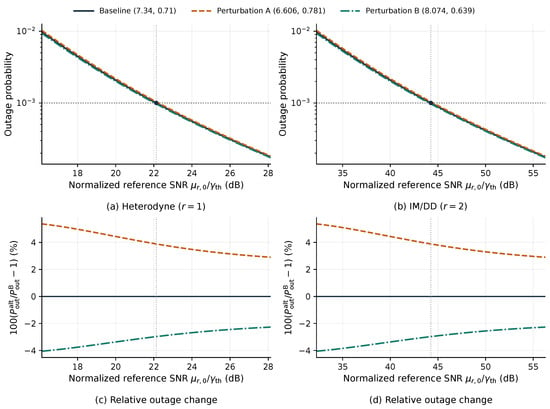
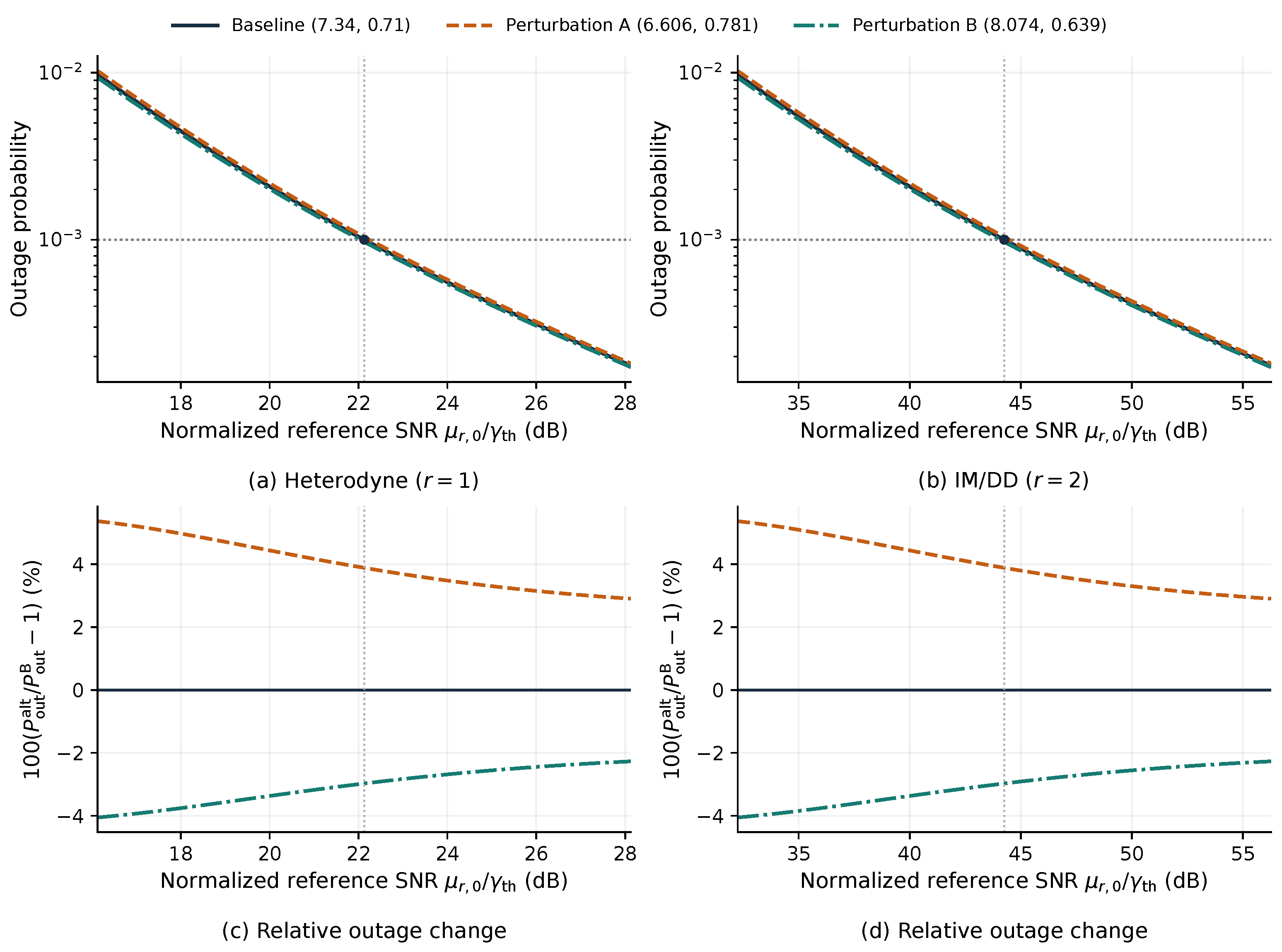
Figure 1 considers km, m, , and . Opposing perturbations of the fitted dust parameters give and , with CDF distances and , respectively. These are analyst-selected sensitivity cases, not measured visibility-dependent parameters or confidence limits. Figure 1a,b compare the baseline and perturbed outage curves for heterodyne and IM/DD detection, respectively. At normalized reference SNRs of approximately dB for heterodyne and dB for IM/DD detection, the baseline outage is . Numerical integration at these respective operating points gives perturbed outages of and for both detection methods, corresponding to signed changes of and . Figure 1c,d show the percentage changes relative to the baseline at the same reference SNR for heterodyne and IM/DD detection, respectively; at the marked operating points, these changes are and for the two perturbations. Thus, the CDF bound is loose, while the computed outage changes quantify sensitivity near for these cases. This illustration does not validate fixed Beta parameters across visibility conditions.
Figure 1.
Illustrative sensitivity to the Beta dust-fading parameters for km, m, , and : (a) heterodyne outage probability; (b) IM/DD outage probability; (c) relative outage change for heterodyne detection; and (d) relative outage change for IM/DD detection. The baseline pair is compared with the perturbed pairs and . Relative changes are evaluated at the same reference SNR.
The deterministic dust attenuation is modeled using the visibility-dependent experimental relationship reported in [6]. The visibility-based classification in Table I in [6] comprises severe dust storms (dense dust, ), dust storms (moderate dust, –), blowing dust (light dust, 1–), and dust haze (light dust, ). At 1550 nm,
and the corresponding deterministic irradiance gain over a distance L is
where V and L are expressed in kilometers. Equivalently,
such that . Representative visibility values of km and km are used for light and moderate dust conditions, respectively.
4.2. Effect of Atmospheric Turbulence
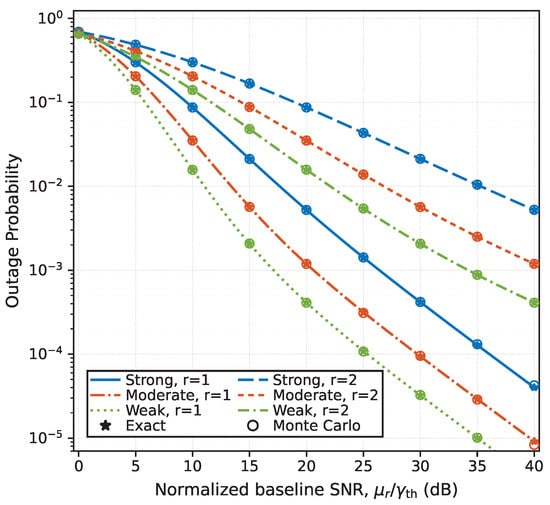
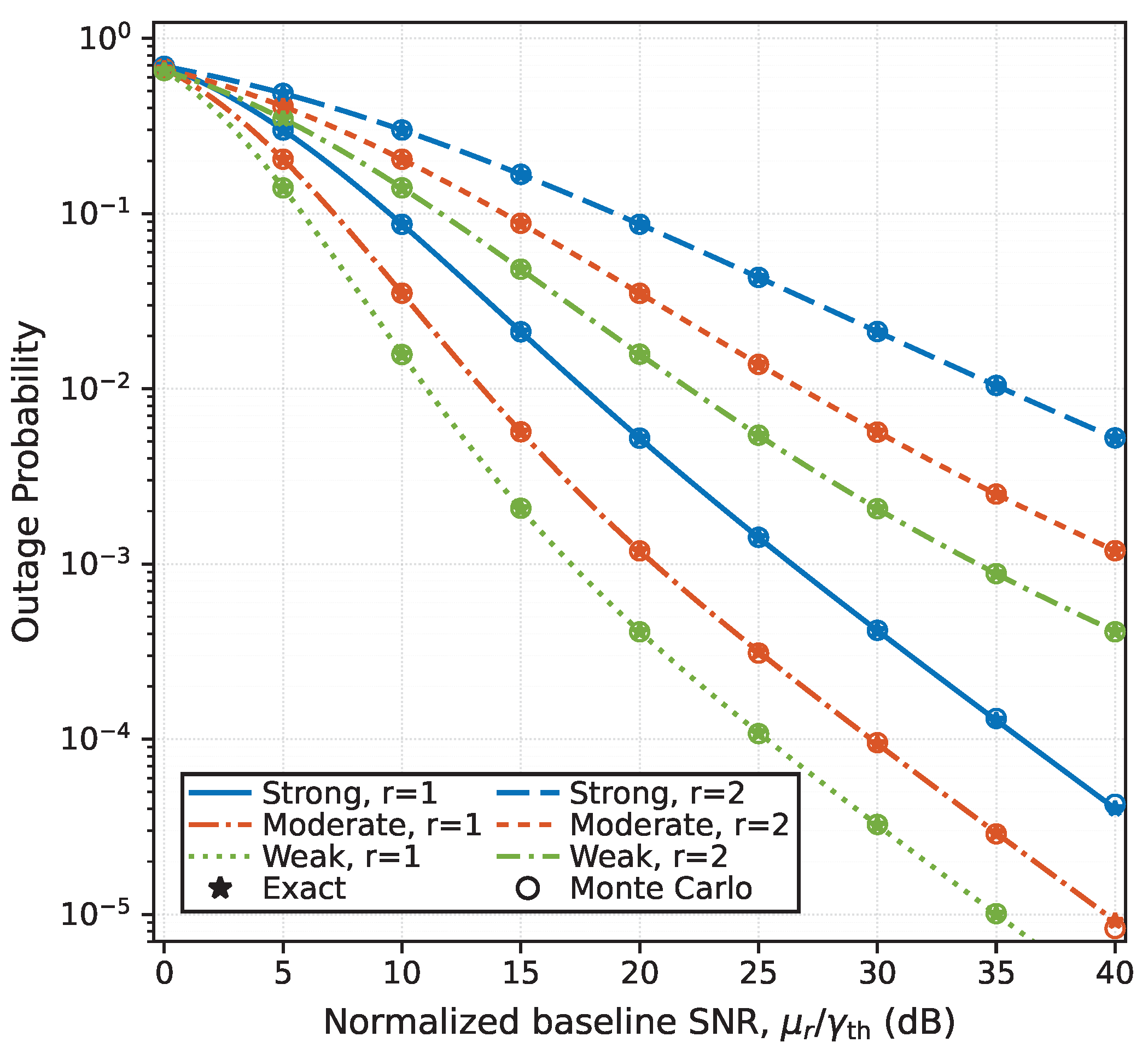
Figure 2 illustrates the effect of Málaga- turbulence severity on the outage probability for both heterodyne () and IM/DD () detection. The pointing-error parameter is fixed at , while the random Beta-distributed dust fading is retained and the deterministic dust attenuation is disabled by setting , such that . In all cases, the outage probability decreases monotonically as the normalized SNR increases.
Figure 2.
Outage probability versus normalized SNR under different Málaga- turbulence conditions for heterodyne () and IM/DD () detection with , , , and .
The turbulence severity has a pronounced impact on the outage performance. The strong-turbulence case, characterized by , consistently exhibits the highest outage probability, followed by the moderate case , whereas the weak-turbulence case provides the lowest outage probability. For example, at dB, the outage probabilities for heterodyne detection are approximately , , and for strong, moderate, and weak turbulence, respectively. Under IM/DD detection at the same normalized SNR, the corresponding values are approximately , , and . These results demonstrate the substantial degradation caused by increasingly severe turbulence-induced irradiance fluctuations.
The influence of the detection technique is also clearly observed. For a given turbulence condition and normalized SNR, heterodyne detection consistently achieves a lower outage probability than IM/DD detection. For an outage probability of approximately , the required normalized SNR values are about , , and dB for heterodyne detection under strong, moderate, and weak turbulence, respectively, compared with approximately , , and dB for IM/DD. This reflects the stronger dependence of the IM/DD electrical SNR on the composite irradiance gain through .
4.3. Effect of Pointing Errors
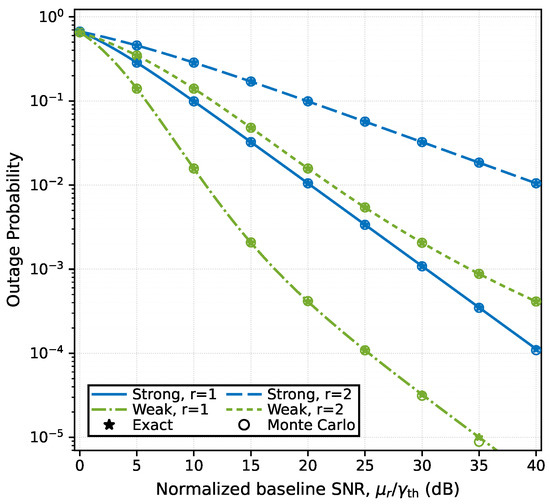
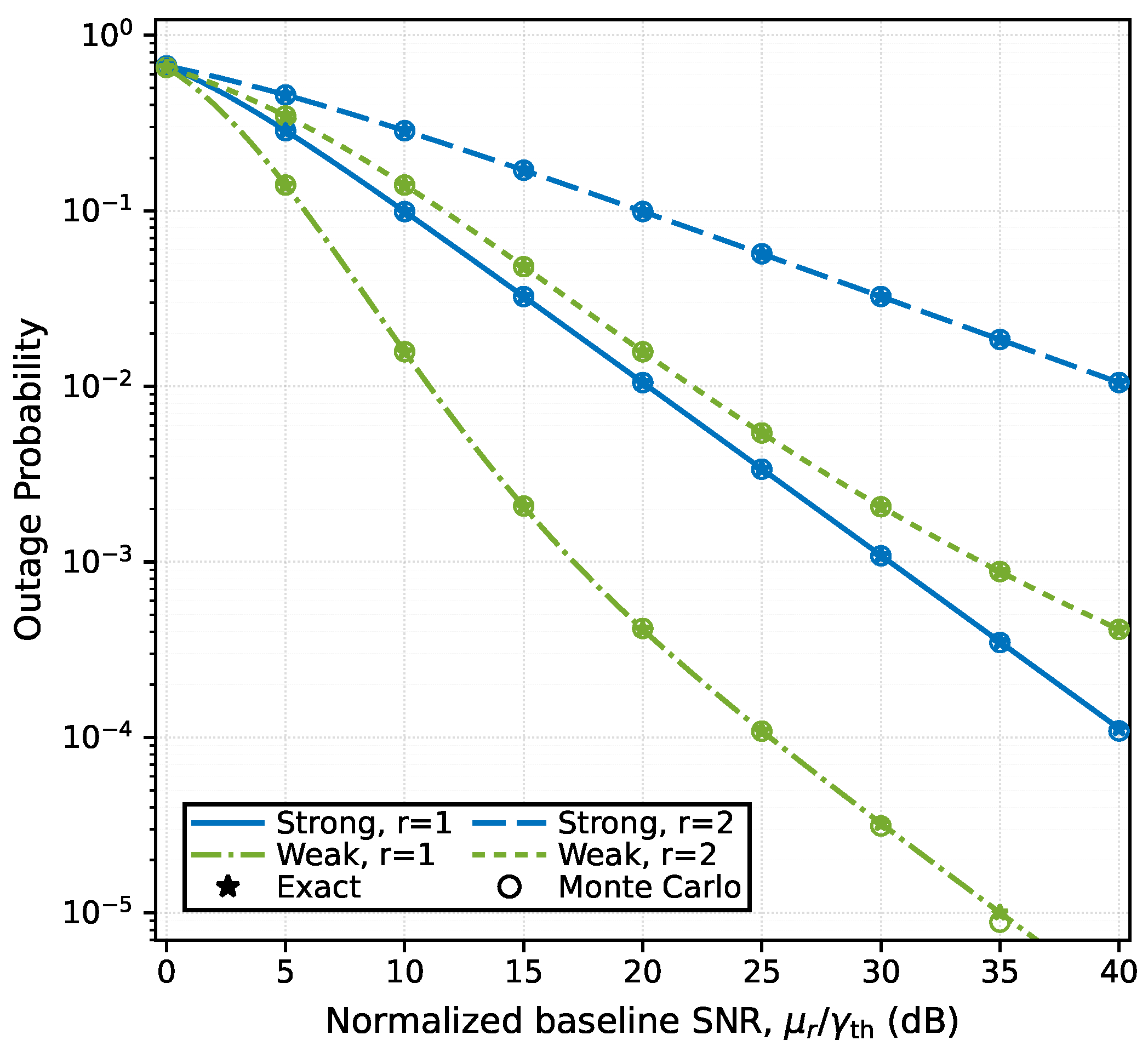
Figure 3 illustrates the effect of pointing errors on the outage probability for strong () and weak () pointing-error conditions. The Málaga- turbulence parameters are fixed at the weak-turbulence condition , while the random Beta-distributed dust fading is retained with and . As in Figure 2, the deterministic dust attenuation is disabled by setting . The outage probability decreases monotonically with increasing normalized SNR for both heterodyne () and IM/DD () detection.
Figure 3.
Outage probability versus normalized SNR for strong () and weak () pointing-error conditions under weak Málaga- turbulence with , , , for heterodyne (), and IM/DD () detection.
A significant performance degradation is observed as the pointing error becomes stronger. At dB, for example, the outage probability for heterodyne detection increases from approximately at to at . For IM/DD detection, the corresponding outage probability increases from approximately to . These results confirm that stronger beam misalignment substantially degrades the outage performance.
For the same pointing-error condition and normalized SNR, heterodyne detection consistently achieves a lower outage probability than IM/DD detection, confirming the greater sensitivity of IM/DD reception to variations in the composite irradiance gain.
4.4. Effect of Dust Visibility
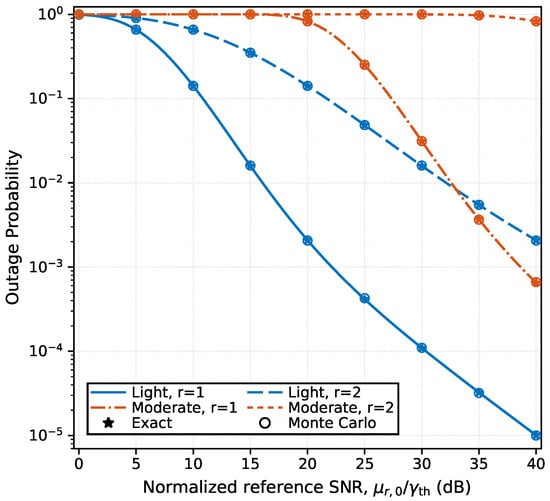
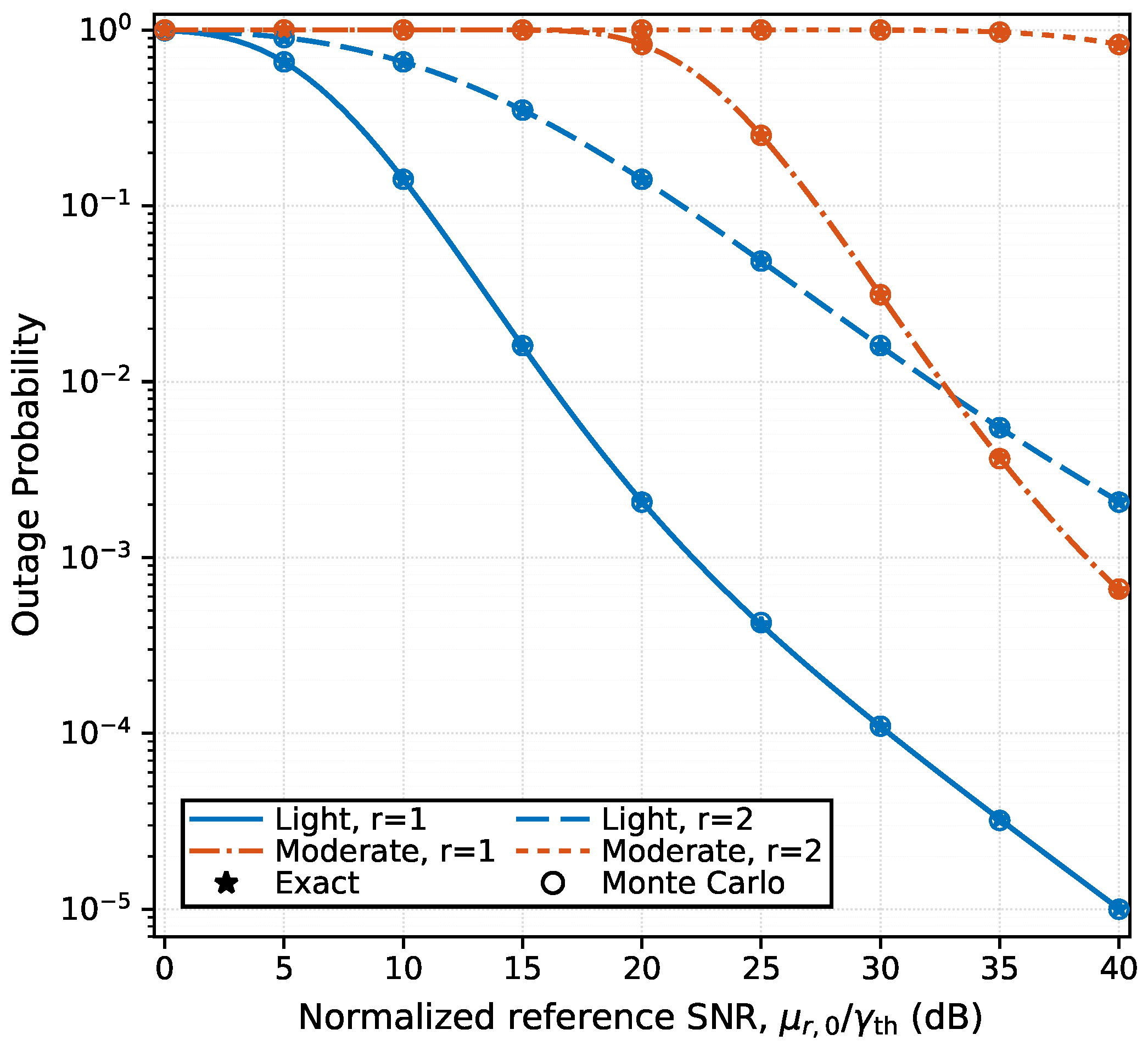
Figure 4 illustrates the effect of dust visibility on the outage performance for light () and moderate () dust conditions at a link distance of . The Málaga- turbulence parameters and pointing-error parameter are fixed at and , respectively. The random Beta-distributed dust fading is retained with and , while the deterministic dust attenuation is varied through the visibility-dependent factor . Accordingly, the horizontal axis is expressed in terms of the normalized reference SNR, . Both heterodyne () and IM/DD () detection are considered. This comparison quantifies the effect of deterministic attenuation under the fixed-Beta assumption stated in Section 4.1; visibility-dependent changes in the random dust-fading statistics are outside the scope of these curves.
Figure 4.
Outage probability versus normalized reference SNR for light () and moderate () dust conditions with , , (,) = (7.34, 0.71), and , for heterodyne () and IM/DD () detection.
The apparent SNR “cutoff” is a smooth transition from an outage probability close to unity. At low reference SNR, dust attenuation keeps the received SNR below for most channel realizations. Increasing the reference SNR allows more realizations to exceed this threshold, reducing outage. Greater deterministic attenuation shifts the transition toward higher reference SNR, while random fading affects its location and slope. Thus, no additional fixed cutoff SNR is implied.
As expected, lower visibility significantly degrades the outage performance because of the increased deterministic dust attenuation. For heterodyne detection, the light-dust case exhibits a much faster reduction in outage probability with increasing normalized reference SNR, whereas the moderate-dust curve is shifted considerably toward higher SNR values. For example, at dB, the outage probability increases from approximately for light dust to for moderate dust. A similar trend is observed for IM/DD detection, although the degradation is more severe because the deterministic dust loss affects the electrical SNR through the factor .
The results also show that moderate dust has a particularly strong impact on IM/DD detection. At dB, the outage probability remains approximately for under moderate dust, compared with approximately under light dust. This highlights the strong sensitivity of IM/DD reception to dust-induced attenuation and confirms that moderate dust alone can severely limit the achievable outage performance even under weak turbulence and weak pointing-error conditions.
Dense-dust results are omitted from Figure 4 because, at km and m, the adopted model predicts approximately dB of deterministic attenuation, keeping the outage probability close to unity over the considered 0–40 dB normalized reference SNR range. The empirical relationship in [6] was derived from measurements covering light, moderate, and dense dust, including km, supporting its applicability to dense dust under the tested conditions. At km and a normalized reference SNR of 40 dB, combining (24) with the outage model gives limiting link lengths of approximately m for heterodyne detection and m for IM/DD detection at . Shorter links achieve lower outage. These limits assume that the channel parameters specified above remain fixed and no transmit-power compensation is applied.
4.5. Effect of Link Length
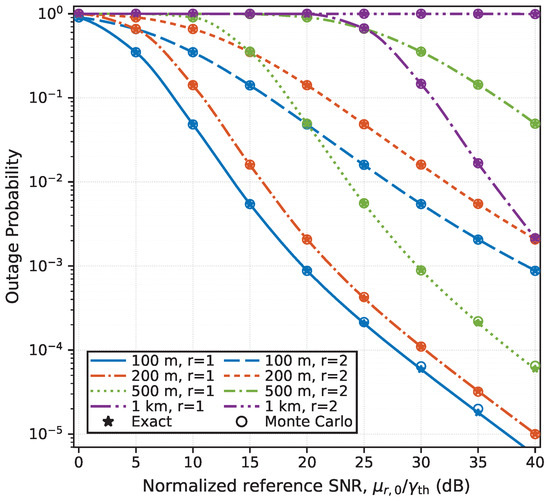
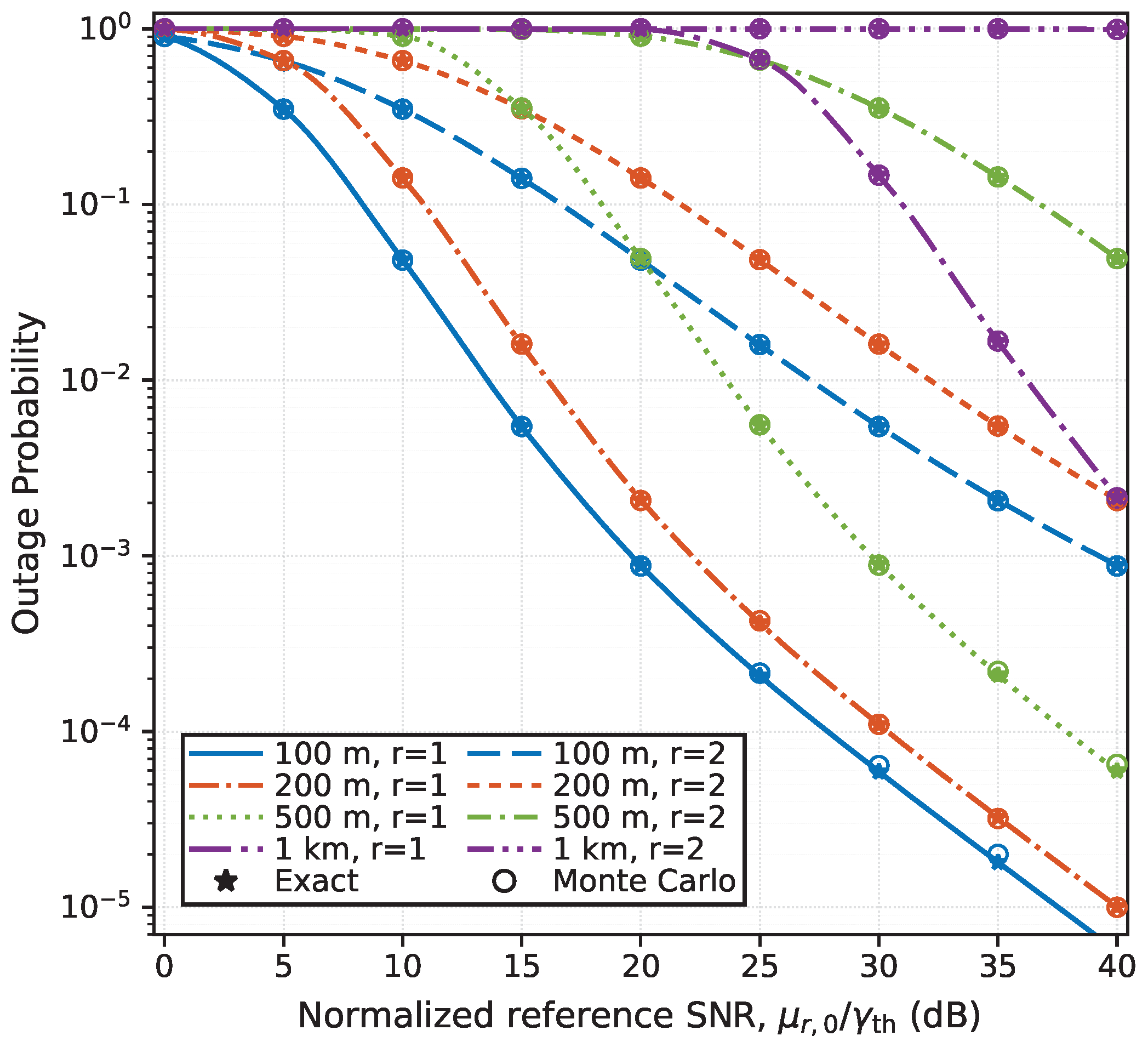
Figure 5 investigates the impact of link length on the outage performance for m, 200 m, 500 m, and 1 km. The visibility is fixed at km, corresponding to light dust, while the Málaga- turbulence and pointing-error parameters are fixed at and , respectively. The random Beta-distributed dust fading is retained with and , while the deterministic dust gain varies with the propagation distance. The horizontal axis therefore represents the normalized reference SNR, . Both heterodyne () and IM/DD () detection are considered.
Figure 5.
Outage probability versus normalized reference SNR for different link lengths under light dust (), weak Málaga- turbulence , and weak pointing error , for heterodyne () and IM/DD () detection. Random Beta-distributed dust fading is retained for all link lengths.
As expected, increasing the link length significantly degrades the outage performance because the accumulated deterministic dust attenuation increases with propagation distance. For heterodyne detection, at dB, the outage probability increases from approximately at m to , , and for m, 500 m, and 1 km, respectively. This demonstrates the substantial performance penalty introduced by increasing the optical path length under dust-affected conditions.
The degradation is more pronounced for IM/DD detection. At dB, the outage probability is approximately , , , and for m, 200 m, 500 m, and 1 km, respectively. In particular, the 1 km IM/DD link remains almost completely in outage over the investigated SNR range. This behavior results from the stronger dependence of the IM/DD electrical SNR on the deterministic irradiance gain through the factor with .
Overall, the results confirm that propagation distance is a critical design parameter in dust-affected FSO links and that heterodyne detection provides substantially greater robustness than IM/DD as the accumulated deterministic dust loss increases.
4.6. Outage Performance Under Representative Channel Conditions
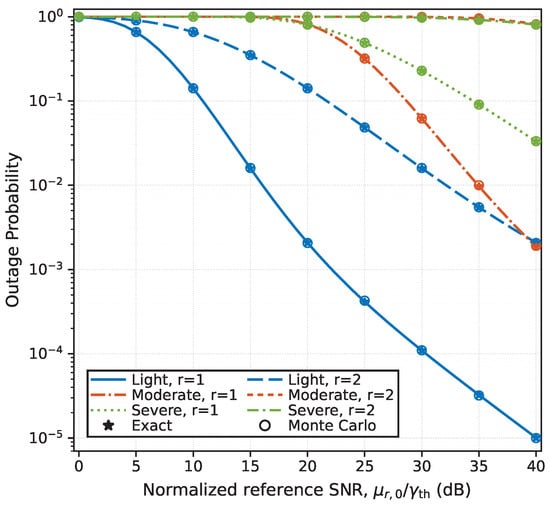
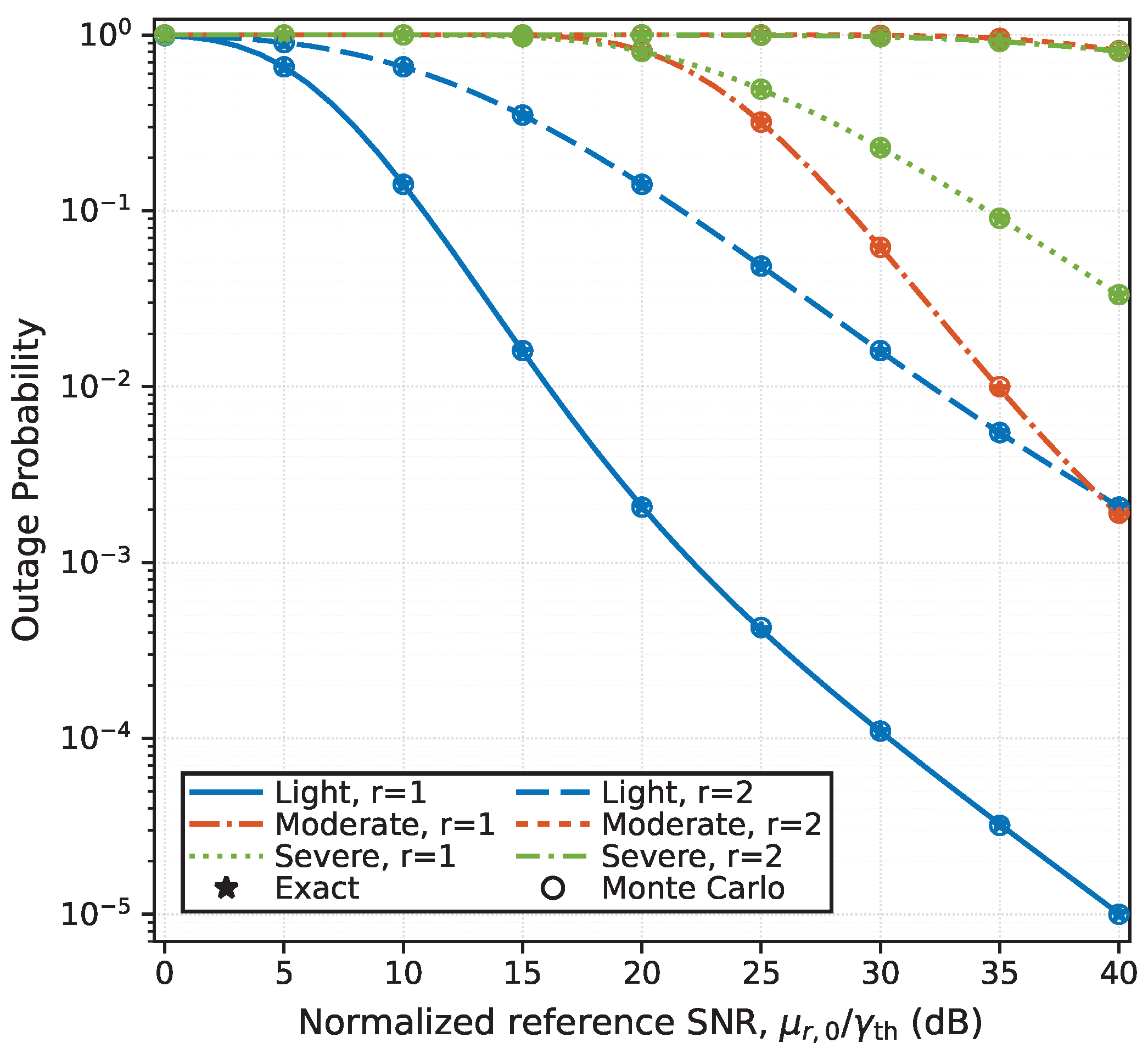
Figure 6 illustrates the combined impact of atmospheric turbulence, pointing errors, and dust on the outage performance. Three representative propagation conditions are considered. The light condition corresponds to weak Málaga- turbulence , weak pointing error , and light dust with . The moderate condition considers moderate turbulence , weak pointing error , and moderate dust with . The severe condition combines strong turbulence , strong pointing error , and moderate dust with . In all three cases, the random Beta-distributed dust fading is retained with and , and the link distance is fixed at . The horizontal axis therefore represents the normalized reference SNR, .
Figure 6.
Outage probability versus normalized reference SNR under light, moderate, and severe combined channel conditions for heterodyne () and IM/DD () detection. The link distance is fixed at .
The combined channel conditions significantly affect the outage performance, with the differences becoming more pronounced as the normalized reference SNR increases. For heterodyne detection (), at dB, the outage probability increases from approximately under the light condition to under the moderate condition and under the severe condition. At 40 dB, these values decrease to approximately , , and , respectively. These results show that the simultaneous presence of stronger turbulence, beam misalignment, and dust attenuation can cause considerable performance degradation even at relatively high normalized reference SNR.
The degradation is more pronounced for IM/DD detection (). At dB, the outage probabilities are approximately , , and for the light, moderate, and severe conditions, respectively. Even at 40 dB, the corresponding outage probabilities remain approximately , , and . This confirms the strong sensitivity of IM/DD reception to the combined effects of deterministic dust attenuation and random channel impairments.
For heterodyne detection (), the moderate and severe cases exhibit high outage probabilities before the apparent crossing. In this low-SNR region, the received SNR remains below the required threshold for most channel realizations. After this point, the moderate case achieves a faster reduction in outage as more realizations exceed the threshold, whereas the severe case remains more affected by deep fades associated with stronger turbulence and pointing errors. Both cases experience the same dust impairment; therefore, their separation reflects the different turbulence and pointing conditions under the adopted SNR normalization.
4.7. Outage Mitigation Using Visibility-Aware Power Control
The preceding results demonstrate that deterministic dust attenuation can impose a substantial performance limitation, particularly under reduced visibility and longer propagation distances. To mitigate this degradation, a visibility-aware transmit-power-control strategy is considered in which the transmitted optical power is increased according to the estimated deterministic dust loss, subject to a prescribed maximum compensation margin.
In a practical implementation, visibility can be obtained from a calibrated sensor near the link, provided that its measurements represent the propagation path, and supplied to the transmitter at each update. An illustrative sensor configuration provides one-minute averaged visibility estimates every 30 s [28]. The averaging period, update interval, and control delay must be short relative to the timescale over which visibility changes appreciably. The present analysis assumes accurate, quasi-static visibility and neglects estimation and tracking errors.
Let denote the maximum available optical transmit-power compensation margin in decibels. In an implementation, , where is the nominal optical transmit power and is the maximum power permitted by the hardware and applicable eye-safety and regulatory requirements at 1550 nm, including the relevant provisions of IEC 60825-12 [29]. The margins of 3, 6, and 10 dB considered below represent illustrative values of this available power headroom. For a given visibility V and link distance L, the deterministic dust loss is dB, and the applied compensation is defined as
The corresponding linear transmit-power-control factor is
Accordingly, the effective deterministic dust gain becomes
The compensation is capped by the actual deterministic dust loss so that the controller compensates only for dust-induced attenuation and does not introduce an artificial channel gain when exceeds the required compensation.
Using (29), the detection-dependent SNR parameters in (9) and (10) become
for heterodyne detection, and
for IM/DD detection.
Since the power-control mechanism modifies only the deterministic dust component, the statistical distributions of the Málaga- turbulence, pointing errors, and random Beta-distributed dust fading remain unchanged. Consequently, the closed-form CDF in (20) remains applicable by replacing with , and the corresponding outage probability is
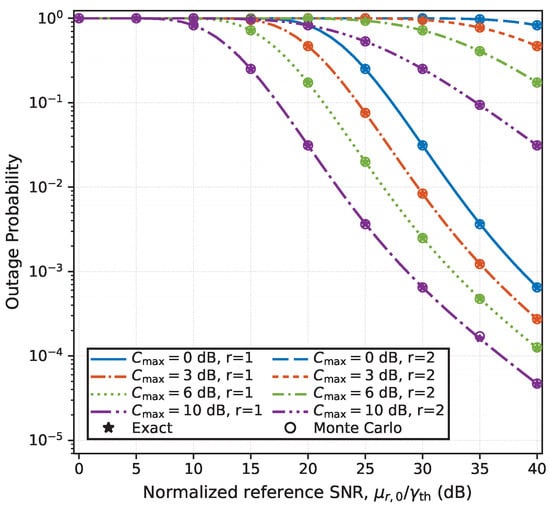
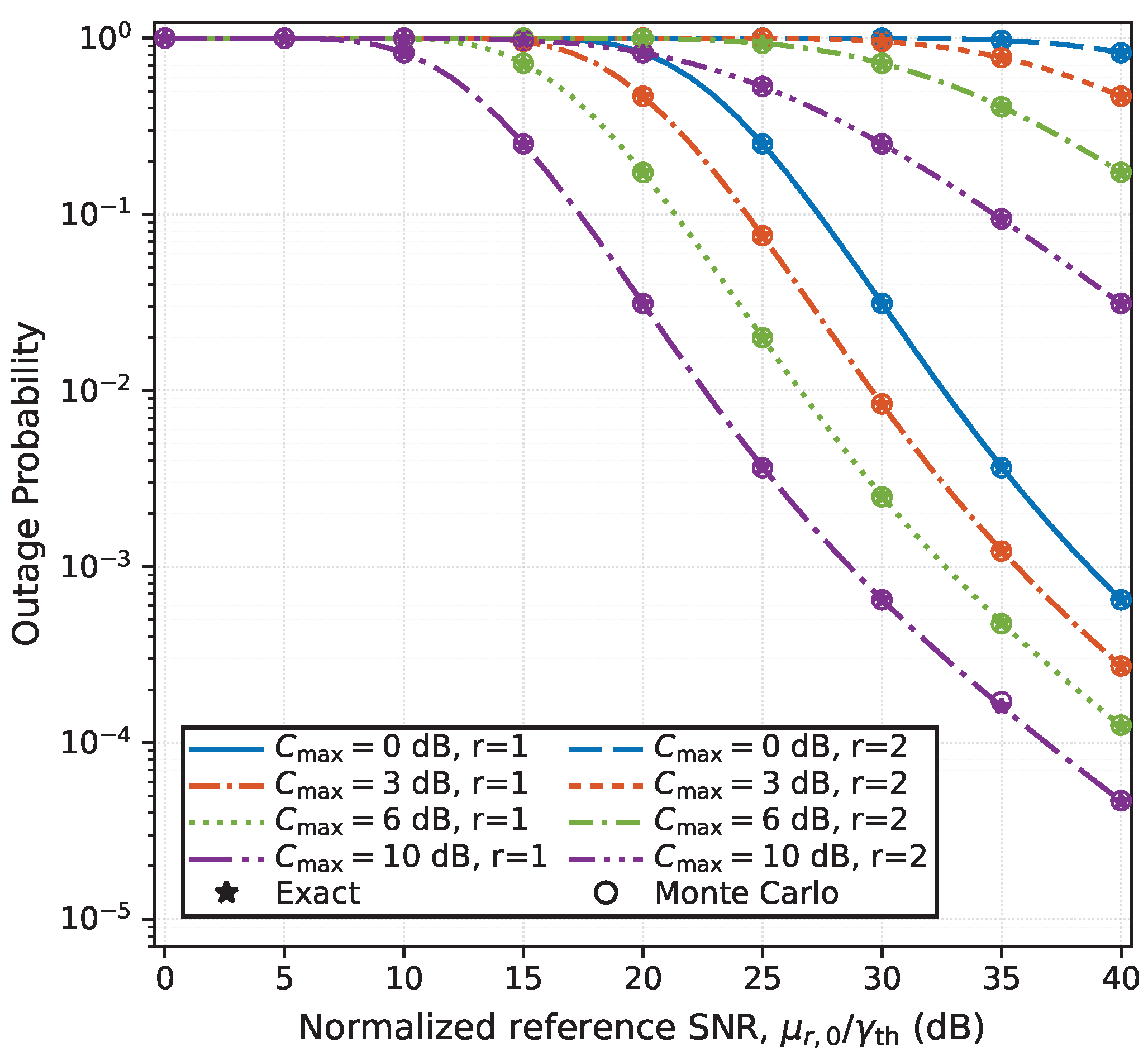
To evaluate the effectiveness of the proposed strategy, moderate dust conditions with and are considered, corresponding to approximately dB of deterministic optical attenuation. The turbulence and pointing-error parameters are fixed at and , respectively, while the random dust fading is retained with and . Power-control margins of , 3, 6, and 10 dB are considered for both heterodyne () and IM/DD () detection, where dB represents the uncompensated case.
Figure 7 shows that increasing the available compensation margin progressively improves the outage performance for both detection techniques by reducing the residual deterministic dust loss. For heterodyne detection, at dB, the outage probability decreases from approximately for dB to , , and for , 6, and 10 dB, respectively. At 40 dB, the corresponding values are approximately , , , and .
Figure 7.
Outage probability versus normalized reference SNR under visibility-aware transmit-power control for moderate dust conditions () and , with and . Random Beta-distributed dust fading is retained for all cases. Power-control margins of , 3, 6, and 10 dB are considered for heterodyne () and IM/DD () detection.
A similar improvement is observed for IM/DD detection, although considerably larger residual outage probabilities remain. At dB, the outage probability decreases from approximately without compensation to , , and for compensation margins of 3, 6, and 10 dB, respectively. The stronger residual degradation for IM/DD is consistent with the quadratic dependence of its electrical SNR on the deterministic irradiance gain.
Under accurate visibility tracking, deterministic attenuation is fully compensated when ; otherwise, the residual loss is dB. Random dust fading, turbulence, and pointing errors remain present in both cases. For m and dB, the residual loss at km is approximately dB, yet substantial outage reduction is achieved as shown in Figure 7. At km, approximately dB remains, keeping the predicted outage probability essentially unity over the considered 0–40 dB normalized reference SNR range. Thus, effectiveness depends on visibility, distance, available power margin, and operating SNR; power control alone may be insufficient when residual attenuation remains severe.
5. Conclusions
This paper investigated the outage performance of FSO links under the joint effects of visibility-dependent deterministic dust attenuation, Beta-distributed random dust fading, Málaga- turbulence, and pointing errors. The two dust components represent complementary effects: the deterministic component captures the average loss under a given visibility condition, while the random component accounts for fluctuations around that condition. A closed-form expression for the electrical-SNR CDF was derived for both heterodyne and IM/DD detection, from which the outage probability was obtained.
The numerical results showed that reduced visibility, longer link distances, stronger turbulence, and more severe pointing errors significantly degrade outage performance. IM/DD detection was found to be more sensitive than heterodyne detection to the combined channel impairments. The analytical results were verified by direct numerical evaluation and Monte Carlo simulations using independent channel realizations, confirming the accuracy of the proposed framework.
A visibility-aware transmit-power-control strategy was also considered to compensate for deterministic dust loss subject to a maximum power margin. The results showed that power control can substantially improve outage performance under moderate dust conditions, although its effectiveness decreases when the residual attenuation remains large. These findings highlight the importance of jointly accounting for deterministic and random dust effects in the design and reliability assessment of terrestrial FSO links in arid environments.
Future work will extend this framework to aerial FSO links in low-altitude intelligent networks through measurement-informed channel modeling [30]. This requires aerosol attenuation models suited to aerial conditions [31] and slant-path geometry [32], together with aerial measurements to test the Beta distribution and, if suitable, refit its parameters. Existing UAV–FSO models [33] provide a basis for assessing turbulence, pointing errors, and angle-of-arrival fluctuations under platform motion and tracking imperfections. The present closed-form result remains applicable only if its statistical and independence assumptions remain appropriate.
Funding
This work was supported by the Research, Development, and Innovation Authority (RDIA), Saudi Arabia [grant number 13292-PSU-2023-PSNUR-3-1-EF]. The author was also supported by Prince Sultan University, Riyadh, Saudi Arabia.
Institutional Review Board Statement
Not applicable.
Informed Consent Statement
Not applicable.
Data Availability Statement
The original contributions presented in this study are included in the article material. Further inquiries can be directed to the corresponding author.
Acknowledgments
The author would like to acknowledge the support of Prince Sultan University for paying the Article Processing Charges (APCs) for this publication.
Conflicts of Interest
The author declares no conflicts of interest.
References
- Khalighi, M.A.; Uysal, M. Survey on Free Space Optical Communication: A Communication Theory Perspective. IEEE Commun. Surv. Tutor. 2014, 16, 2231–2258. [Google Scholar] [CrossRef] [Scilit]
- Kaushal, H.; Kaddoum, G. Optical Communication in Space: Challenges and Mitigation Techniques. IEEE Commun. Surv. Tutor. 2017, 19, 57–96. [Google Scholar] [CrossRef] [Scilit]
- Zech, H.; Heine, F.F.; Motzigemba, M. Laser Communication Terminals for Data Relay Applications: Today’s Status and Future Developments. In Proceedings of the 2017 IEEE International Conference on Space Optical Systems and Applications (ICSOS), Naha, Japan, 14–16 November 2017; pp. 193–198. [Google Scholar] [CrossRef] [Scilit]
- Farid, A.A.; Hranilovic, S. Outage Capacity Optimization for Free-Space Optical Links with Pointing Errors. J. Light. Technol. 2007, 25, 1702–1710. [Google Scholar] [CrossRef] [Scilit]
- Ansari, I.S.; Yilmaz, F.; Alouini, M.S. Performance Analysis of Free-Space Optical Links Over Málaga (M) Turbulence Channels with Pointing Errors. IEEE Trans. Wirel. Commun. 2016, 15, 91–102. [Google Scholar] [CrossRef] [Scilit]
- Esmail, M.A.; Fathallah, H.; Alouini, M.S. An Experimental Study of FSO Link Performance in Desert Environment. IEEE Commun. Lett. 2016, 20, 1888–1891. [Google Scholar] [CrossRef] [Scilit]
- Esmail, M.A. Performance Evaluation of IM/DD FSO Communication System Under Dust Storm Conditions. Technologies 2025, 13, 288. [Google Scholar] [CrossRef] [Scilit]
- Zhong, H.; Zhou, J.; Du, Z.; Xie, L. A Laboratory Experimental Study on Laser Attenuations by Dust/Sand Storms. J. Aerosol Sci. 2018, 121, 31–37. [Google Scholar] [CrossRef] [Scilit]
- Cao, M.; Wang, H.; Yao, Y.; Hou, S. Performance Evaluation of FSO Communications under Sand-Dust Conditions. Int. J. Antennas Propag. 2019, 2019, 2046896. [Google Scholar] [CrossRef] [Scilit]
- Mohamed, P.H.; El-Shimy, M.A.; Shalaby, H.M.H.; Kheirallah, H.N. Hybrid FSO/RF System over Proposed Random Dust Attenuation Model Based on Real-Time Data Combined with G-G Atmospheric Turbulence. Opt. Commun. 2023, 549, 129891. [Google Scholar] [CrossRef] [Scilit]
- Ghassemlooy, Z.; Perez, J.; Leitgeb, E. On the Performance of FSO Communications Links under Sandstorm Conditions. In Proceedings of the 12th International Conference on Telecommunications (ConTEL), Zagreb, Croatia, 26–28 June 2013; pp. 53–58. [Google Scholar]
- Libich, J.; Perez, J.; Zvanovec, S.; Ghassemlooy, Z.; Nebuloni, R.; Capsoni, C. Combined Effect of Turbulence and Aerosol on Free-Space Optical Links. Appl. Opt. 2017, 56, 336–341. [Google Scholar] [CrossRef] [Scilit]
- Esmail, M.A.; Ragheb, A.M.; Fathallah, H.A.; Altamimi, M.; Alshebeili, S.A. 5G-28 GHz Signal Transmission Over Hybrid All-Optical FSO/RF Link in Dusty Weather Conditions. IEEE Access 2019, 7, 24404–24410. [Google Scholar] [CrossRef] [Scilit]
- Rasied, T.S.M.; Zailani, N.F.H.; Sepian, F.S.M.; Almeslati, A.M.; Habaebi, M.H.; Basahel, A. Performance Evaluation of Free Space Optical Link Using OOK Modulation Schemes Under Dust-Storm Turbulence. In Proceedings of the 2021 8th International Conference on Computer and Communication Engineering (ICCCE), Kuala Lumpur, Malaysia, 22–23 June 2021; pp. 379–384. [Google Scholar] [CrossRef] [Scilit]
- Mrabet, M.; Sliti, M. Performance Analysis of FSO Communications in Desert Environments. Opt. Quantum Electron. 2024, 56, 659. [Google Scholar] [CrossRef] [Scilit]
- Gismalla, M.S.M.; Al-Dharrab, S.I.; Alawsh, S.A.; Muqaibel, A.H. Outage Performance of Dual-Hop with Wavelength Diversified UAV-Based FSO Links Under Sandstorms. In Proceedings of the 2024 IEEE 99th Vehicular Technology Conference (VTC2024-Spring), Singapore, 24–27 June 2024; pp. 1–6. [Google Scholar] [CrossRef] [Scilit]
- Mohamed, P.H.; El-Shimy, M.A.; Shalaby, H.M.H.; Kheirallah, H.N. FSO Channel Modelling and Performance Evaluation Over Dust Combined With G-G Atmospheric Turbulence. In Proceedings of the 2023 40th National Radio Science Conference (NRSC), Giza, Egypt, 30 May–1 June 2023; pp. 121–130. [Google Scholar] [CrossRef] [Scilit]
- Esmail, M.A. Probabilistic Modeling of Dust-Induced FSO Attenuation for 5G/6G Backhaul in Arid Regions. Appl. Sci. 2025, 15, 6775. [Google Scholar] [CrossRef] [Scilit]
- Esmail, M.A. Unified Performance Analysis of Free-Space Optical Systems over Dust-Induced Fading Channels. Electronics 2025, 14, 4637. [Google Scholar] [CrossRef] [Scilit]
- Gismalla, M.S.M.; Al-Dharrab, S.I.; Alawsh, S.A.; Muqaibel, A.H. Performance Analysis of Multi-Hop UAVs Using FSO Communications Under Humidity and Sandstorms Conditions. IEEE Open J. Commun. Soc. 2024, 5, 6987–7001. [Google Scholar] [CrossRef] [Scilit]
- Fan, Y.; Gao, S.; Duan, D.; Cheng, X.; Yang, L. Radar Integrated MIMO Communications for Multi-Hop V2V Networking. IEEE Wirel. Commun. Lett. 2023, 12, 307–311. [Google Scholar] [CrossRef] [Scilit]
- Liang, J.; Chaudhry, A.U.; Erdogan, E.; Yanikomeroglu, H. Link Budget Analysis for Free-Space Optical Satellite Networks. In Proceedings of the 2022 IEEE 23rd International Symposium on a World of Wireless, Mobile and Multimedia Networks (WoWMoM), Belfast, UK, 14–17 June 2022; pp. 471–476. [Google Scholar] [CrossRef] [Scilit]
- Djordjevic, G.T.; Petkovic, M.I.; Spasic, M.; Antic, D.S. Outage capacity of FSO link with pointing errors and link blockage. Opt. Express 2016, 24, 219–230. [Google Scholar] [CrossRef] [Scilit]
- Jurado-Navas, A.; Garrido-Balsells, J.M.; Paris, J.F.; Castillo-Vázquez, M.; Puerta-Notario, A. Impact of pointing errors on the performance of generalized atmospheric optical channels. Opt. Express 2012, 20, 12550–12562. [Google Scholar] [CrossRef] [Scilit]
- Jurado-Navas, A.; Garrido-Balsells, J.M.; Paris, J.F.; Puerta-Notario, A. A Unifying Statistical Model for Atmospheric Optical Scintillation. In Numerical Simulations of Physical and Engineering Processes; Awrejcewicz, J., Ed.; IntechOpen: Rijeka, Croatia, 2011; Chapter 8; pp. 181–206. [Google Scholar] [CrossRef] [Scilit]
- Jurado-Navas, A.; Garrido-Balsells, J.M.; Castillo-Vázquez, M.; Puerta-Notario, A.; Tafur Monroy, I.; Vegas Olmos, J.J. Fade Statistics of M-Turbulent Optical Links. Eurasip J. Wirel. Commun. Netw. 2017, 2017, 112. [Google Scholar] [CrossRef] [Scilit]
- Olver, F.W.J.; Lozier, D.W.; Boisvert, R.F.; Clark, C.W. NIST Handbook of Mathematical Functions; Cambridge University Press: New York, NY, USA, 2010. [Google Scholar]
- Campbell Scientific, Inc. CS120A Visibility Sensor: Instruction Manual; Revision 10/15, Section 13.3; Campbell Scientific, Inc.: Logan, UT, USA, 2015. [Google Scholar]
- IEC 60825-12:2022; Safety of Laser Products—Part 12: Safety of Free Space Optical Communication Systems Used for Transmission of Information, 3rd ed. International Electrotechnical Commission: Geneva, Switzerland, 2022.
- Ma, Z.; Lin, Y.; Hua, B.; Mao, K.; Zeng, L.; Lian, Z.; Zhu, Q.; Wu, Q. SIM-Empowered LAINs: A Unified Channel Model-Driven Optimization Framework. IEEE Wirel. Commun. 2026, 33, 73–81. [Google Scholar] [CrossRef] [Scilit]
- Elamassie, M.; Uysal, M. Aerosol Attenuation Model for High Altitude UAV-Based FSO Links. In Proceedings of the 2022 13th International Symposium on Communication Systems, Networks and Digital Signal Processing (CSNDSP), Porto, Portugal, 20–22 July 2022; pp. 71–75. [Google Scholar] [CrossRef] [Scilit]
- Erdogan, E.; Elamassie, M.; Altunbas, I.; Kurt, G.K.; Uysal, M.; Yanikomeroglu, H. A Novel Piecewise Atmospheric Attenuation Model for Free Space Optical Links in Vertical Heterogeneous Networks. arXiv 2026, arXiv:2604.18207. [Google Scholar] [CrossRef] [Scilit]
- Singh, D.; Swaminathan, R. Comprehensive Performance Analysis of Hovering UAV-Based FSO Communication System. IEEE Photonics J. 2022, 14, 7352013. [Google Scholar] [CrossRef] [Scilit]

Disclaimer/Publisher’s Note: The statements, opinions and data contained in all publications are solely those of the individual author(s) and contributor(s) and not of MDPI and/or the editor(s). MDPI and/or the editor(s) disclaim responsibility for any injury to people or property resulting from any ideas, methods, instructions or products referred to in the content. |
© 2026 by the author. Licensee MDPI, Basel, Switzerland. This article is an open access article distributed under the terms and conditions of the Creative Commons Attribution (CC BY) license.