


Abstract
The increasing penetration of wind power has made coordinated support from wind generation and battery energy storage systems (BESSs) increasingly important for maintaining frequency stability in low-inertia power systems. However, existing wind–BESS primary-frequency-regulation methods often rely on fixed participation factors or frequency-deviation-based power sharing, without considering different support requirements during rapid frequency decline and recovery. This may underutilize the rapid response capability of the BESS during high-RoCoF periods and lead to poorly coordinated wind-storage support, thereby limiting RoCoF suppression and frequency-nadir improvement. To address this issue, this paper proposes a hierarchical coordinated control strategy considering a rate-of-change-of-frequency (RoCoF) triggering mechanism. The strategy consists of an upper-layer coordination controller and lower-layer wind- and BESS-side controllers. The upper layer determines the total regulation demand and temporarily increases the BESS share when the direction-aware RoCoF activation condition is satisfied. The lower layer tracks allocated commands through wind-side virtual inertia and droop control and BESS-side deadband, SOC correction, and power limiting. This coordinated allocation combines rapid BESS support with sustained wind-power support. Simulations under different wind-power penetration levels and load disturbances demonstrate improved RoCoF suppression, frequency nadir, and recovery performance. At 25% wind penetration and a 0.10 p.u. load disturbance, the nadir increases from 49.62 to 49.77 Hz and recovery time decreases from 5.0 to 2.1 s.
1. Introduction
The continued development of wind power contributes to power-sector decarbonization and sustainable energy supply. Reliable grid operation is essential to realize these benefits while meeting industrial and residential electricity demand. As converter-interfaced wind generation replaces synchronous generation, the available system inertia and frequency-response characteristics can change, increasing the challenge of arresting frequency deviations after a disturbance [1]. Coordinated control of wind power and battery energy storage systems (BESSs) is therefore an important means of strengthening primary frequency regulation in power systems with high wind-power penetration.
Relevant control approaches can be grouped into wind-turbine frequency control, energy-storage frequency control, and coordinated multi-resource control. Wind-turbine methods use droop response, reserved active power, or rotor kinetic energy to support system frequency [2,3]. Storage-based methods exploit rapid bidirectional power response while accounting for state of charge (SOC), power ratings, and energy limits [4]. Coordinated methods organize the combined response through supervisory control and operating-state feedback [5,6]. These categories provide the basis for the literature review in Section 2.1.
A central design question is how to coordinate the timing and magnitude of wind and BESS participation while respecting their different operating limits. Wind support depends on the turbine operating point, available reserve, and rotor-energy recovery, whereas sustained BESS support consumes a finite energy margin. State-dependent and optimization-based coordination approaches address different aspects of this problem [7,8]. For the control architecture considered here, an additional design objective is to link a common regulation request with rapid-frequency-change detection and feasible local execution.
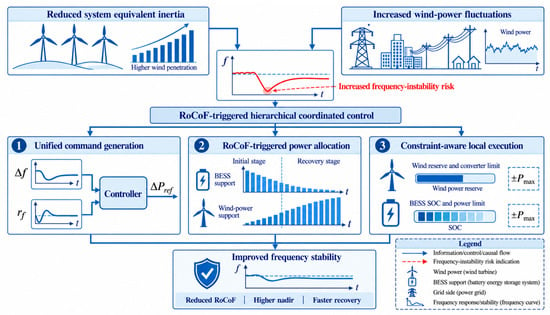
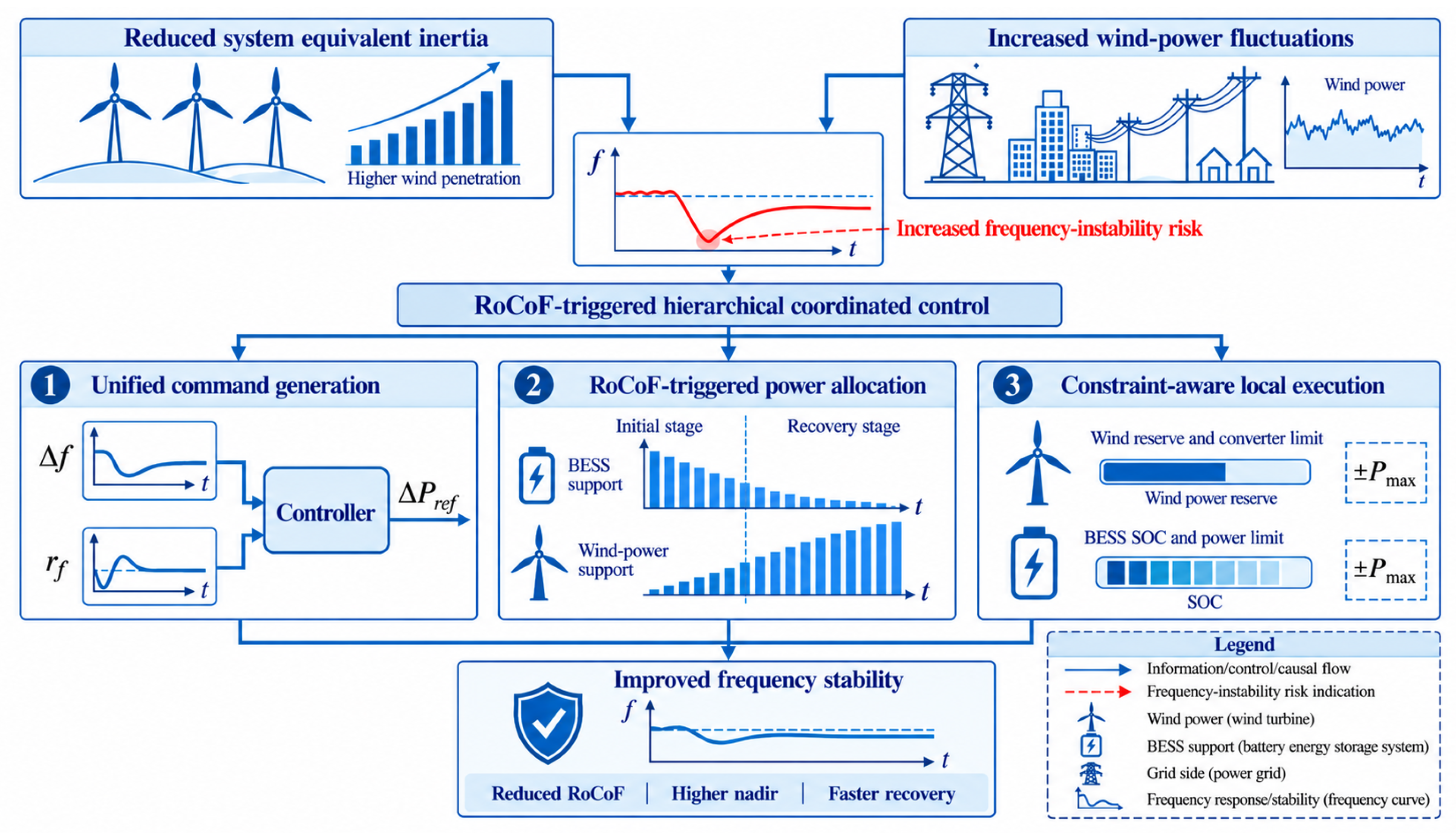
This paper develops a RoCoF-triggered hierarchical coordinated control strategy. The upper layer generates a unified regulation command from frequency deviation and filtered RoCoF, sets an SOC-dependent baseline allocation, and temporarily raises the BESS participation coefficient when the direction-aware RoCoF activation condition is satisfied. The lower layer tracks the assigned commands subject to wind-power reserve, converter capability, and BESS operating restrictions. Both resources may respond simultaneously, and their commanded shares vary with the triggering state and SOC. Figure 1 summarizes the motivation and the three control functions: unified command generation, RoCoF-triggered coordination, and constrained local execution.
Figure 1.
Research motivation and control framework of the proposed wind–BESS strategy.
The main contributions are summarized as follows:
- A hierarchical coordinated control framework is developed to connect a common wind–BESS regulation objective with resource-specific command execution.
- A RoCoF-triggered coordination mechanism combines temporary BESS priority with SOC-dependent baseline control to coordinate rapid battery support and sustained wind-power regulation.
- Wind-side reserve constraints and BESS operating limits are incorporated into command execution, and the control performance is evaluated under different wind-power penetration levels, load disturbances, and wind speeds.
2. Related Work and Proposed Control Strategy
2.1. Representative Frequency-Regulation Methods
Existing frequency-support methods can be broadly organized into wind-turbine control, energy-storage control, and coordinated multi-resource control. These approaches differ in their regulation resources, feedback signals, and treatment of operating constraints.
For wind-turbine control, Bonfiglio et al. investigated the design, realization, and testing of a synthetic-inertia controller in 2024 [9]. Cheng et al. developed consecutive power dispatch within wind farms to mitigate secondary frequency dips during the recovery process [10]. Song et al. established a frequency-response model incorporating renewable generation and examined the relationship between droop settings and system frequency characteristics [11]. More recently, Li et al. investigated coordinated short-term support from multiple wind turbines through the synchronous release of rotor kinetic energy [12]. These methods develop wind-side frequency-support capability, while the available reserve, releasable kinetic energy, and rotor-speed recovery remain important operating considerations.
For energy-storage control, Leon et al. proposed a frequency-support strategy for fast-response storage systems [13], while Huang et al. investigated an improved virtual-synchronous-generator strategy for wind-storage microgrid stabilization [14]. These studies demonstrate different ways of using storage and converter control to support system dynamics. The duration and magnitude of storage participation nevertheless remain subject to power and energy availability.
For coordinated wind–BESS control, Jiang et al. developed coordination according to system frequency-regulation demands [15]. Shu et al. considered variable control coefficients, SOC errors, and SOC recovery [7]. Yu et al. introduced a wind-turbine operating-state coefficient to characterize available frequency-support capability [16], and Kang et al. combined adaptive wind-side inertia control with storage droop control considering wind speed and SOC [17]. These developments improve the adaptability of coordinated responses to variations in resource operating conditions.
Related research extends coordination to renewable distributed energy resources through digital twins [18], virtual power plants through dynamic aggregation [19], and heterogeneous storage through distributed control [20,21]. Network-level studies also consider power-flow constraints [22] and switching-based coordination in islanded microgrids [23]. Table 1 summarizes the control characteristics and application scope of these representative approaches.
Table 1.
Comparison of representative control methods for coordinated frequency support from wind power, BESSs, and distributed energy resources.
The reviewed studies establish the importance of resource availability, coordinated response, and operating constraints. For the wind–BESS control architecture developed here, the design focus is the explicit connection between a unified regulation request, RoCoF-dependent resource participation, and feasible local execution. Insufficient responsiveness to rapid frequency changes can delay the deployment of BESS support, whereas prolonged battery participation can deplete the energy margin available for subsequent regulation. Furthermore, assigned commands may not be fully delivered when local operating limits become active. These considerations motivate the RoCoF-triggered hierarchical coordinated control framework presented in Section 2.2.
2.2. Proposed RoCoF-Triggered Hierarchical Coordinated Control Framework
Building on the control considerations discussed in Section 2.1, this study develops a RoCoF-triggered hierarchical coordinated control framework for wind–BESS primary frequency regulation. The framework adopts an upper-layer coordination and lower-layer execution architecture. The upper layer generates a unified regulation request and determines the commanded participation of the wind farm and BESS. The lower layer processes the assigned commands according to resource dynamics and operating constraints. The control strategy integrates unified command generation, RoCoF-triggered mode switching, and constrained local execution within a common feedback structure.
Let Δf(t) = f(t) − f0, where f(t) and f0 denote the measured and nominal system frequencies, respectively. Positive regulation power represents additional active-power injection into the grid. The filtered RoCoF and unified regulation command are defined as
Here, rf(t) is the filtered RoCoF, Tr is the filtering time constant, and Kf and Kr are the frequency-deviation and RoCoF regulation gains, respectively. Equation (1) combines the magnitude and rate of frequency deviation into a common regulation request for the wind–BESS system.
Under baseline operation, the BESS participation coefficient is adjusted according to SOC:
αb,base(t) = sat[α0 + KSOC(SOC(t) − SOCref), αb,min, αb,max]
Here, α0 is the baseline BESS participation coefficient at the reference SOC, KSOC is the SOC adjustment gain, and SOCref is the reference state of charge. The saturation operator sat[⋅] limits its first argument to the interval defined by its second and third arguments, where 0 ≤ αb,min ≤ αb,max ≤ 1.
The SOC-to-participation relationship in Equation (2) is designed for the discharge-support conditions considered in this study. A higher SOC permits a larger baseline BESS share, whereas a lower SOC reduces the assigned battery contribution to preserve the remaining energy margin. This upper-layer adjustment determines baseline resource participation; battery operating restrictions are additionally addressed during lower-layer execution.
For successive frequency disturbances, the measured SOC is continuously updated and directly used in Equation (2) rather than being reset to its initial value. Consequently, the baseline BESS participation coefficient automatically reflects the remaining battery energy margin after each regulation event. If the SOC decreases following an earlier disturbance, the BESS is assigned a smaller baseline share during the subsequent event, while the wind-side share of the unified regulation command correspondingly increases. Together with the lower-layer SOC and charging/discharging power constraints, this SOC-dependent allocation provides an energy-management function that limits cumulative BESS discharge and preserves regulation capability for subsequent frequency events.
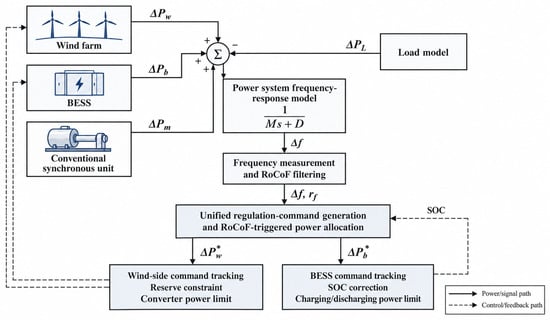
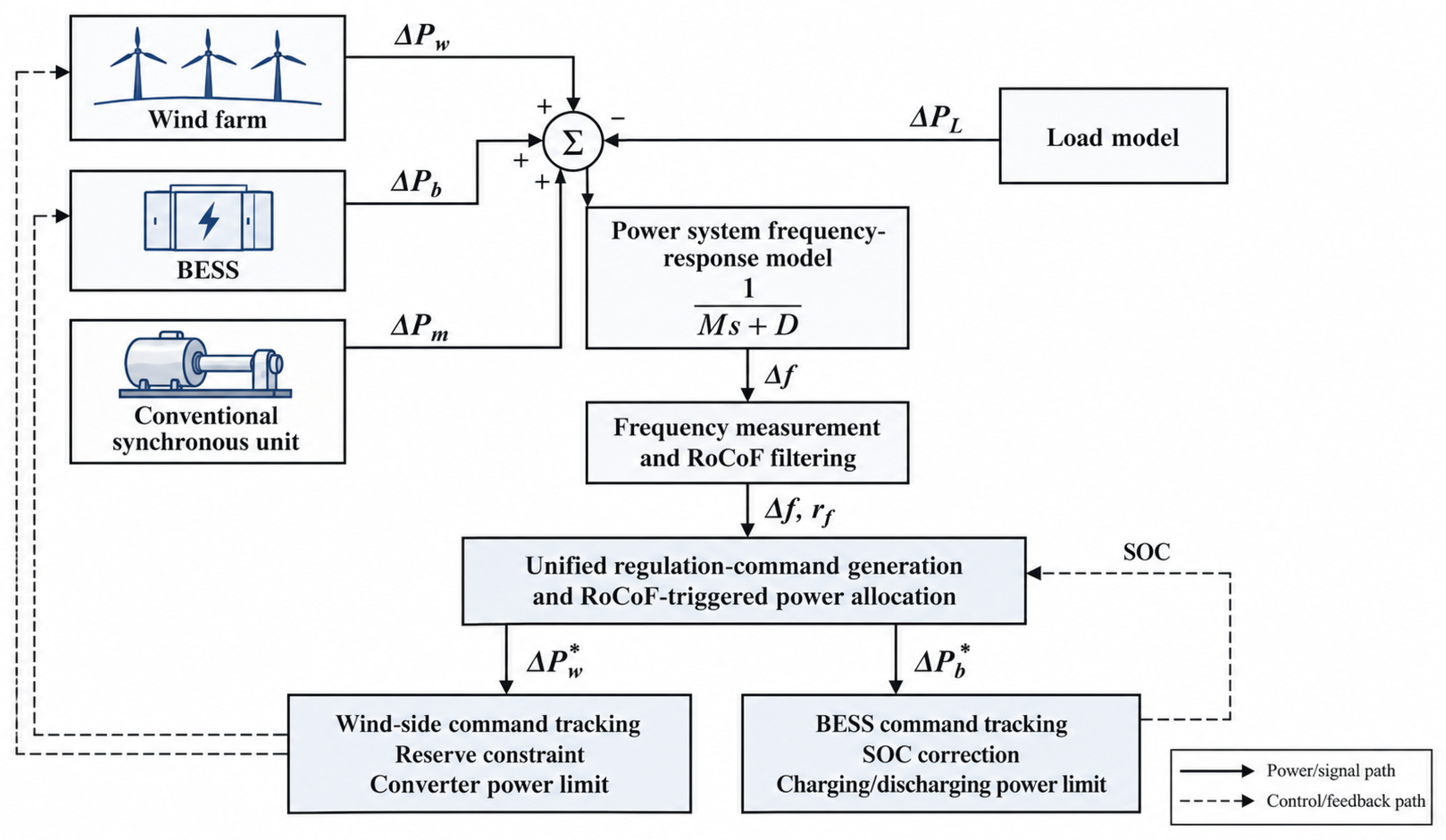
As illustrated in Figure 2, frequency information is fed back to the upper-layer controller, while SOC information supports baseline coordination and local BESS correction. To adjust resource participation during rapid frequency changes, a RoCoF-triggering state is defined as
Figure 2.
System configuration of wind-storage joint primary frequency regulation.
To improve the robustness of the mode-transition process and prevent unnecessary BESS-priority reactivation during frequency recovery, a direction-aware hysteresis mechanism is adopted. A transition from the baseline mode to the fast-support mode is permitted only when the filtered RoCoF magnitude reaches the activation threshold, |rf| ≥ ron, and Δfrf > 0, indicating that the frequency is still moving away from its nominal value. Once activated, the fast-support state is retained until |rf| ≤ roff. When neither the activation nor release condition is satisfied, the previous triggering state is retained.
In this study, ron = 0.15 Hz/s and roff = 0.10 Hz/s. For an under-frequency event, Δf < 0 and rf < 0 during the initial frequency decline, so that Δfrf > 0 and fast support can be activated. During frequency recovery, rf changes sign while Δf may remain negative, resulting in Δfrf < 0; therefore, a new fast-support event is not reactivated. The combination of RoCoF filtering, hysteresis, and the direction condition reduces switching chatter and improves recovery-stage discrimination.
In addition, the switching decision is based on the filtered RoCoF defined in Equation (1), which attenuates high-frequency components introduced by frequency differentiation. Together with hysteresis-based state retention and the direction condition, this improves the robustness of the mode-transition process.
αb(t) = γr(t)αb,max + [1 − γr(t)]αb,base(t)
Equations (3) and (4) implement a direction-aware hysteresis-based transition between the fast-support mode and the SOC-dependent baseline mode. A new fast-support event is activated only when |rf| ≥ ron and Δfrf > 0, after which the BESS participation coefficient is set to αb,max. Once activated, the fast-support state is retained until the filtered RoCoF decreases to or below the release threshold roff. When neither the activation nor release condition is satisfied, the previous triggering state is retained. It should be emphasized that αb,max specifies the commanded BESS priority at the upper coordination layer rather than a guaranteed physical output. The actual BESS power remains subject to the SOC-dependent correction and charging/discharging power limits at the lower execution layer.
Using the resulting participation coefficient, the assigned BESS-side and wind-side commands are calculated as
The assigned commands therefore satisfy
Equation (7) ensures consistency at the command-allocation level. During the fast-support mode, the BESS is assigned its maximum permitted participation coefficient. When the controller returns to baseline operation, the wind-side share increases if the baseline BESS coefficient is lower than αb,max. Both resources can participate simultaneously, with their commanded shares determined by the current triggering state and SOC-dependent baseline. Tracking dynamics and local constraints may cause the delivered powers to differ from these assigned commands.
At the lower layer, the wind-side command is processed through equivalent tracking dynamics and constrained by the available regulation capability:
where xW(t) is the wind-side power response before saturation, TW is the equivalent wind-side tracking time constant, and ΔPW,min(t) and ΔPW,max(t) are the regulation limits determined by available active-power reserve and converter capability. Wind conditions affect these operating limits through the turbine operating point, while wind speed is not used as an upper-layer control input.
For the BESS, frequency-deadband processing and SOC-dependent correction are applied before dynamic tracking and charging or discharging power limiting:
where is the assigned BESS command after frequency-deadband processing, κSOC(t) is the SOC-dependent execution correction factor, and xB(t) is the BESS power response before saturation. The parameters TB, PB,ch,max, and PB,dis,max denote the equivalent BESS tracking time constant and the charging and discharging power limits, respectively. The upper-layer coefficient αb(t) schedules the commanded BESS contribution, while the lower-layer correction and saturation account for the resource-level active-power operating limits considered in the system frequency model. It should be noted that the saturation operations in Equations (8) and (9) enforce resource-level active-power limits in the system frequency-regulation model rather than provide explicit guarantees on internal converter-state constraints. The corresponding wind-side and BESS-side outputs are limited according to the available regulation reserve, converter power capability, charging/discharging limits, and SOC-dependent correction. In more detailed converter-level control studies, internal electrical states such as inductor current and capacitor voltage can be incorporated directly into the controller design and constrained within prescribed admissible sets. For example, Dai et al. [24] considered discrete-time current-constrained voltage tracking for a DC-DC buck converter under multi-source disturbances, providing a representative example of explicit state-level constraint enforcement. Therefore, the saturation-based treatment adopted here should be interpreted as a system-level power-feasibility mechanism, while formal converter-state constraint guarantees remain outside the scope of the present wind–BESS frequency-regulation model.
The wind farm and BESS are represented by reduced-order dynamic models rather than ideal instantaneous power sources. This reduced-order representation is adopted because the objective of this study is to investigate system-level primary frequency regulation and coordinated wind–BESS power support rather than detailed electromagnetic transients or converter inner-loop dynamics. On the wind side, the allocated supplementary-power command is processed through the first-order tracking dynamics in Equation (8), and the delivered power response is constrained by the available active-power reserve and converter capability. Therefore, the wind-power output does not instantaneously follow the upper-layer command. On the BESS side, Equation (9) represents the finite power-response dynamics, while frequency-deadband processing, SOC-dependent correction, charging/discharging power limits, and SOC evolution are also considered. Consequently, the BESS output is likewise not treated as an ideal algebraic power injection. Detailed aerodynamic, generator electromagnetic, DC-link, switching-converter, and inner current-control dynamics are not included in the present model because they are beyond the scope of the system-level frequency-regulation analysis.
To avoid unnecessary BESS actions under small frequency deviations, a frequency deadband is applied before SOC-dependent correction. During the RoCoF-triggered fast-support mode, the deadband is bypassed to preserve the rapid response of the BESS. Therefore,
where Δfdb is the frequency-deadband threshold. The BESS command is subsequently corrected according to its SOC operating state:
where 0 ≤ κSOC ≤ 1. When the SOC remains within the normal operating range, κSOC = 1, and the BESS fully tracks the allocated command. When the SOC approaches its corresponding upper or lower operating boundary, κSOC is reduced to restrict further charging or discharging.
The BESS SOC is updated according to the actual exchanged energy. The per-unit BESS power is first converted into MW as
where Sbase = 100 MW is the system power base. With positive BESS power defined as discharge power injected into the grid, the discrete SOC update is
where EB = 5 MWh is the rated BESS energy capacity, ηdis = 1.00 is the ideal discharge efficiency adopted in this study, and Δt = 0.005 s is the simulation time step. The factor 3600 converts seconds to hours.
PB,MW(k) = PB,pu(k)Sbase
Although Equations (5)–(7) ensure consistency at the command-allocation level, the actual wind- and BESS-side outputs may differ from their assigned commands after lower-layer SOC correction, dynamic tracking, and power saturation. Therefore, a residual-power redistribution mechanism is introduced to maintain coordinated power delivery when one resource cannot fully satisfy its assigned command.
For the positive load-disturbance cases considered in this study, the residual regulation demand after lower-layer execution is defined as
where ΔPB and ΔPW denote the constrained BESS- and wind-side outputs, respectively. The available upward regulation reserve of the wind farm is expressed as
ΔPres = max[0, ΔPref − ΔPB − ΔPW]
ΔPW,ava = max[0, ΔPW,max − ΔPW]
The residual demand that can be transferred to the wind farm is then calculated as
and the final wind-side contribution becomes
ΔPred = min(ΔPres, ΔPW,ava)
ΔPW,f = ΔPW + ΔPred
The remaining unmet regulation demand is therefore
ΔPunmet = max[0, ΔPref − ΔPB − ΔPW,f]
Thus, the maximum BESS participation coefficient specified in the fast-support mode represents a commanded priority rather than a guaranteed physical BESS output. When low SOC or a binding BESS power limit prevents full delivery, the resulting residual demand is reassigned to the available wind-side reserve. If both resources reach their physical limits, the remaining imbalance is retained in the system power balance and is compensated by the conventional governor response and system frequency dynamics.
Parameter selection and tuning: The controller parameters are determined through a sequential offline tuning procedure based on the dynamic-response requirements and physical operating constraints of the wind–BESS system. First, the physical operating limits, including the allowable BESS SOC range, BESS power limit, and participation-coefficient bounds, are specified according to the rated capacities and permissible operating ranges of the corresponding devices. The wind- and BESS-side dynamic parameters are then selected according to their response characteristics, where the smaller BESS tracking time constant reflects the faster active-power response of the BESS.
The RoCoF filtering time constant Tr is selected to attenuate high-frequency components introduced by frequency differentiation while retaining a sufficiently fast response to frequency disturbances. With the dynamic parameters fixed, the frequency-deviation gain Kf is adjusted to provide adequate sustained primary frequency support without generating excessive regulation commands. The RoCoF gain Kr is subsequently adjusted to enhance the initial frequency response and improve RoCoF suppression while respecting the available regulation capability of the wind farm and BESS. Finally, the SOC-related allocation parameters are selected according to the allowable SOC range, BESS rated power, and desired wind–BESS power-sharing relationship. Once determined, the same controller parameters are retained for all simulation cases considered in this study, and no case-dependent retuning is performed.
The proposed framework connects the system regulation request with RoCoF-dependent resource coordination and constrained local power responses. The delivered wind and BESS powers jointly support system frequency, while frequency and SOC feedback continuously update the control actions. The corresponding operating sequence is presented in Section 2.3.
2.3. Control Logic of the Proposed RoCoF-Triggered Strategy
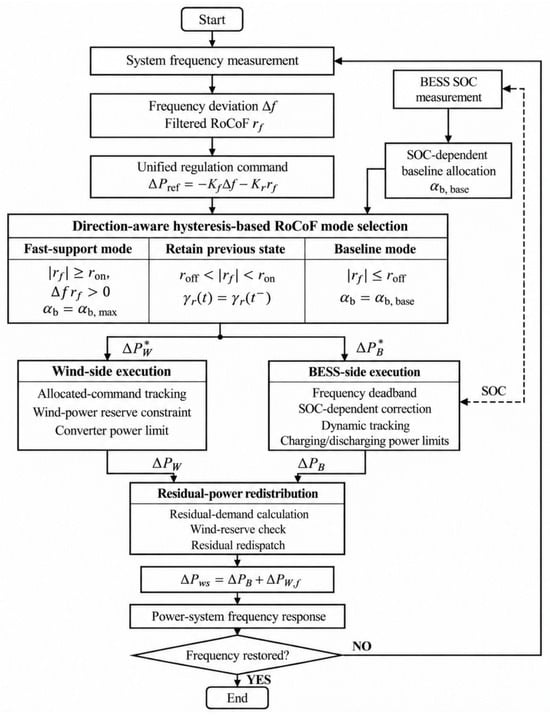
Based on the hierarchical framework established in Section 2.2, this subsection describes the online operation of the proposed control strategy, as illustrated in Figure 3. At each control instant, the measured system frequency is used to obtain the frequency deviation and filtered RoCoF. The upper-layer controller then calculates the unified regulation command according to Equation (1), while the measured BESS SOC updates the baseline participation coefficient according to Equation (2).
Figure 3.
Flowchart of the RoCoF-triggered hierarchical coordinated control strategy.
The controller determines the operating mode using the direction-aware hysteresis-based RoCoF-triggering logic defined in Equation (3). A new fast-support event is activated only when the filtered RoCoF satisfies |rf| ≥ ron and Δfrf > 0, indicating that the system frequency is still moving away from its nominal value. Once activated, the fast-support state is retained until |rf| ≤ roff. When neither the activation nor release condition is satisfied, the previous triggering state is maintained. During frequency recovery, rf changes sign while Δf may remain on the same side of the nominal frequency, resulting in Δfrf < 0; therefore, a new fast-support event is not reactivated. The combined use of RoCoF filtering, hysteresis-based state retention, and the direction condition reduces switching chatter and improves recovery-stage discrimination.
The selected participation coefficient is used to divide the unified command between the wind farm and the BESS according to Equations (5) and (6). Both resources can participate simultaneously, with their commanded shares determined by the current operating mode and SOC-dependent baseline.
At the lower layer, the wind-side controller tracks its allocated command through the equivalent dynamics in Equation (8), subject to the available regulation limits determined by wind-power reserve and converter capability. The BESS command undergoes frequency-deadband processing, SOC-dependent correction, dynamic tracking, and charging/discharging power limiting according to Equation (9). These local constraints remain active in both operating modes. Consequently, setting the BESS participation coefficient to its upper bound does not imply that the BESS necessarily delivers its maximum power. After the wind- and BESS-side constraints are applied, any residual regulation demand caused by insufficient BESS delivery is recalculated and reassigned to the available wind-side reserve according to Equations (14)–(18). If the available wind reserve is sufficient, the residual demand can be fully compensated. Otherwise, the remaining unmet demand is retained in the system power imbalance and is handled by the conventional governor response and system frequency dynamics.
The actual supplementary power delivered by the coordinated wind–BESS system is expressed as
ΔPws(t) = ΔPW(t) + ΔPB(t)
Equation (19) represents the combined delivered response. Its value may differ from the unified regulation command because of tracking dynamics, deadband processing, SOC-dependent correction, and power limits.
After a frequency event is suppressed, frequency and SOC monitoring remain active. If another significant disturbance occurs, the RoCoF-triggered fast-support mode can be reactivated. Importantly, the participation coefficient for the subsequent event is calculated using the updated SOC rather than the initial SOC. Therefore, the BESS contribution is automatically adjusted according to the energy margin remaining after previous regulation events. This repeated-event logic allows the controller to preserve BESS energy availability without requiring operating-condition-specific retuning.
It should be noted that the present strategy provides SOC-aware energy preservation rather than active post-event SOC restoration. An independent charging controller that restores the BESS to SOCref after each disturbance is not included in the present primary-frequency-regulation framework.
3. Results and Discussion
3.1. Simulation Platform and Operating Scenario Settings
To evaluate the effectiveness and adaptability of the proposed RoCoF-triggered hierarchical coordinated control strategy, a wind-storage joint primary-frequency-regulation model is developed in MATLAB/Simulink R2022a. The model consists of conventional synchronous generating units, a wind farm, a battery energy storage system (BESS), an aggregated load, the equivalent system frequency-response model, and the proposed hierarchical coordinated controller. The electrical subsystem is simulated using a fixed-step solver, whereas the control subsystem is implemented using discrete control logic. System frequency, RoCoF, wind-power output, BESS power, SOC, and load-disturbance signals are recorded for subsequent performance evaluation.
The system frequency response is represented by an aggregated electromechanical model. The instantaneous active-power imbalance is defined as
where ΔPG, ΔPW, ΔPB, and ΔPL denote the incremental active powers of the conventional synchronous generation, wind farm, BESS, and load disturbance, respectively. The corresponding aggregated swing equation is
where Heq(p) is the equivalent physical inertia constant at wind penetration p, D is the equivalent load-damping coefficient, and f0 is the nominal system frequency. Therefore, the system frequency-response transfer function is
ΔPimb = ΔPG + ΔPW + ΔPB − ΔPL
The conventional synchronous-generation response is represented by an aggregated governor–turbine model:
where Tg, Tt, and R denote the equivalent governor time constant, turbine time constant, and droop coefficient, respectively. The corresponding simulation parameters are summarized in Table 2.
Table 2.
Main system, operating-condition, and controller parameters used in the simulations.
The system power base and nominal frequency are 100 MW and 50 Hz, respectively. Wind-power penetration levels of 10%, 25%, and 40% are considered, corresponding to installed wind capacities of 10, 25, and 40 MW. In the penetration study, the total system base is kept fixed at 100 MW, and increasing wind penetration is implemented by replacing an equal amount of online synchronous-generation capacity with converter-interfaced wind generation, rather than by adding wind generation to an unchanged synchronous-generation fleet. Therefore, the online synchronous-generation capacity is
Ssyn(p) = (1 − p)Sbase
The equivalent physical inertia constant is calculated from the online synchronous capacity as
where Hi and Si denote the inertia constant and rated capacity of the i-th online synchronous generating unit, respectively.
Under the aggregated assumption that the displaced synchronous generation has the same equivalent inertia constant as the original synchronous fleet, Equation (26) becomes
where H0 is the equivalent inertia constant of the original synchronous-generation base case. Thus, the reduction in physical inertia in the penetration study results from the explicit displacement of synchronous-generation capacity rather than from the wind-capacity ratio alone. Converter-interfaced wind generation is not counted as physical synchronous inertia in Equation (27); its controller-induced frequency support is represented separately by the wind-side supplementary active-power response.
Heq(p) = (1 − p)H0
The BESS is rated at 10 MW and 5 MWh, with an initial SOC of 0.80. Positive load steps of 0.05, 0.075, 0.10, and 0.125 p.u. are applied at t = 4 s. Additional cases use wind speeds of 3, 6, 9, and 12 m/s to examine different turbine operating points. Wind speed affects the operating point and available reserve but is not a direct input to the upper-layer controller. Table 2 summarizes the stated capacity and operating-condition parameters.
The controller parameters determined according to the sequential offline tuning procedure described in Section 2.2 are also summarized in Table 2. The same parameter set is used throughout all simulation cases without operating-condition-specific retuning.
The BESS is assigned a fixed rating of 10 MW/5 MWh for all wind-penetration cases on the 100 MW system base. For installed wind capacities of 10, 25, and 40 MW, the corresponding BESS-to-wind rated-power ratios are 1.00, 0.40, and 0.25, respectively. The 5 MWh energy capacity together with the 10 MW power rating gives an energy-to-power ratio of 0.5 h. Since the present study focuses on short-duration primary frequency regulation, the BESS power rating mainly determines the available rapid active-power support, whereas the energy rating determines the SOC margin available during the regulation interval. It should be emphasized that the selected 10 MW/5 MWh configuration is not intended to represent an economically optimized BESS size. Instead, the same BESS rating is intentionally retained across all wind-penetration levels so that the influence of wind penetration and the proposed coordinated control strategy can be evaluated without introducing BESS resizing as an additional variable.
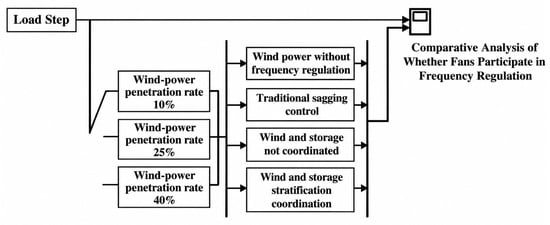
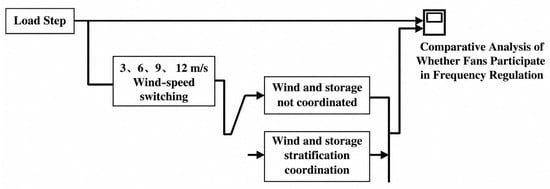
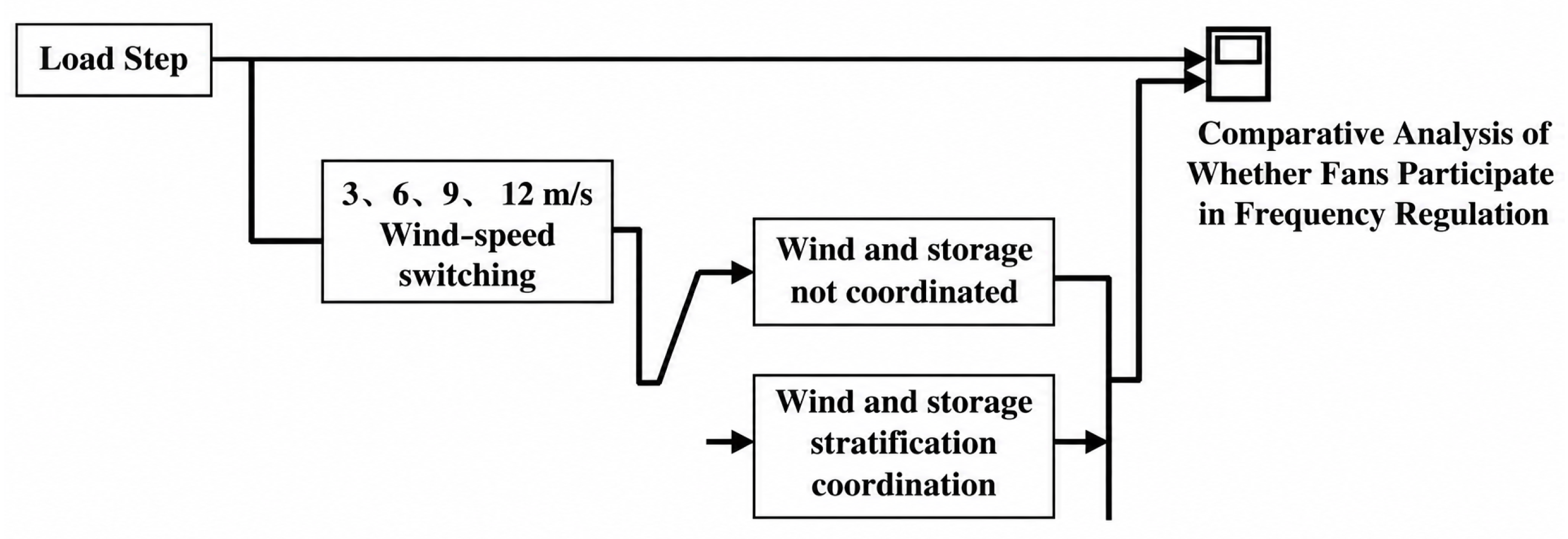
Four control strategies are compared under identical system parameters and disturbance conditions: wind power without frequency regulation, conventional wind-power droop control, uncoordinated wind-storage frequency regulation, and the proposed hierarchical coordinated control strategy. The first case mainly relies on the inertia and governor response of conventional synchronous units. The second introduces wind-power droop response according to frequency deviation. The third allows wind power and the BESS to respond independently, whereas the proposed strategy adopts unified regulation-command generation, RoCoF-triggered power allocation, and lower-layer constrained execution. The corresponding simulation configuration is shown in Figure 4.
Figure 4.
Simulation model for comparing different primary-frequency-regulation strategies.
To further evaluate operating-condition adaptability, additional simulations are conducted under different wind speeds while maintaining 25% wind-power penetration and a 0.10 p.u. load disturbance. As shown in Figure 5, the wind-speed variation only changes the wind-turbine operating state and available active-power reserve, allowing the robustness of the proposed upper-layer coordination mechanism to be evaluated without introducing wind speed as a direct control input.
Figure 5.
Simulation model under different wind-speed conditions.
The performance comparison considers the frequency nadir, frequency drop, nadir occurrence time, and maximum absolute RoCoF, together with the plotted power and SOC responses. Frequency drop is the difference between the nominal frequency and the nadir. Nadir occurrence time is expressed on the simulation time axis; elapsed time from the disturbance is obtained by subtracting 4 s. Maximum absolute RoCoF characterizes the largest frequency-change rate over the evaluation interval. Frequency trajectories are also examined in terms of damping characteristics and the post-disturbance operating point. The primary-control response may settle with a nonzero deviation from nominal frequency.
3.2. System Dynamic Responses Under Different Load Disturbances
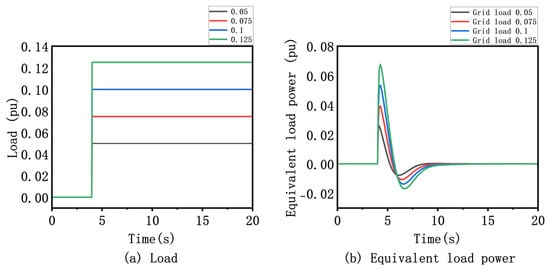
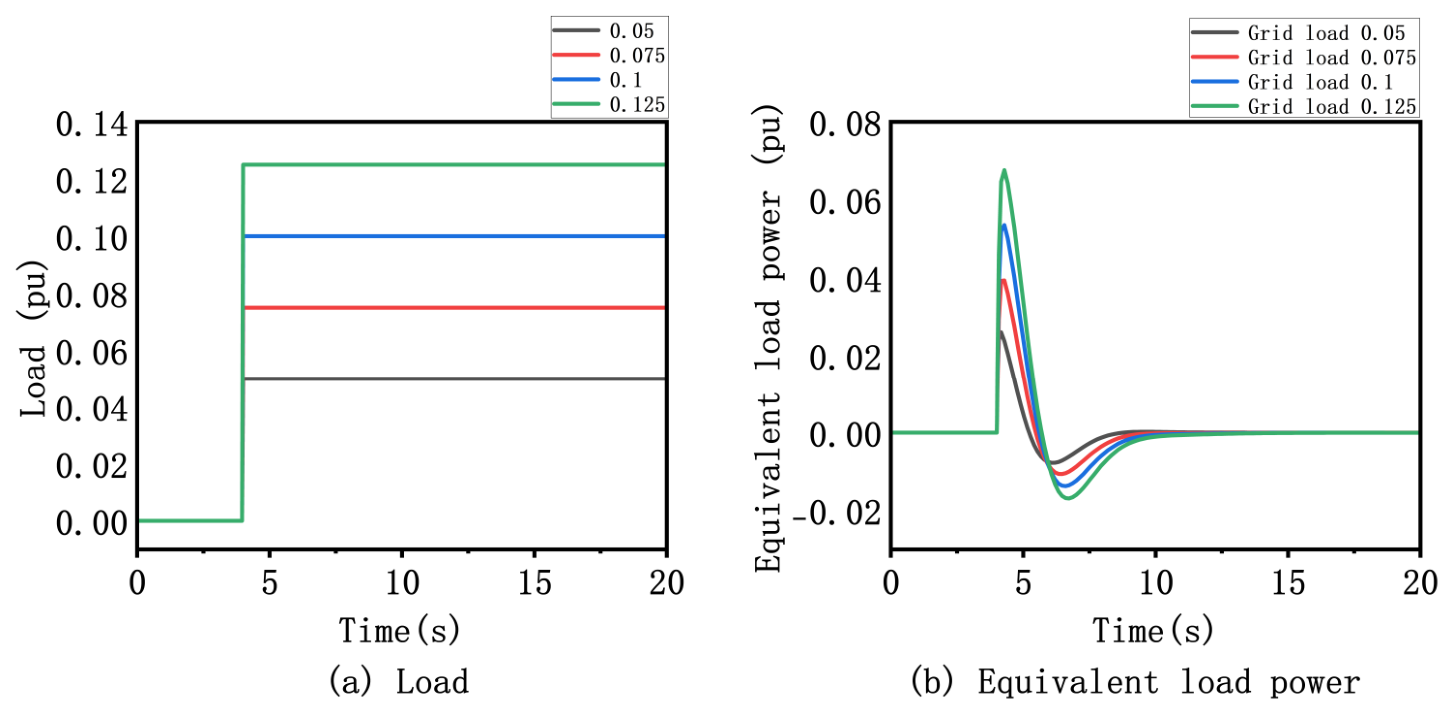
Figure 6 presents the four positive load steps and the associated model response signals. The steps of 0.05, 0.075, 0.10, and 0.125 p.u. are applied at t = 4 s and remain in place for the rest of the simulation. The signal labeled equivalent net-load power in Figure 6b exhibits a transient peak followed by a small undershoot and decay toward zero. It is therefore distinct from the persistent imposed load step. Its transient excursion becomes larger as the disturbance magnitude increases.
Figure 6.
Load step inputs and equivalent net-load power responses under different disturbance magnitudes.
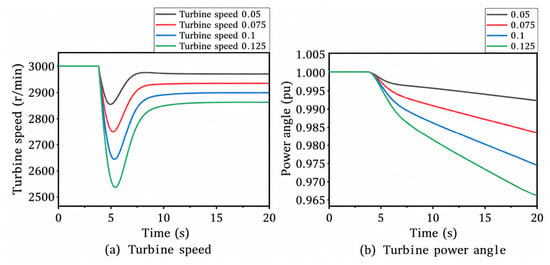
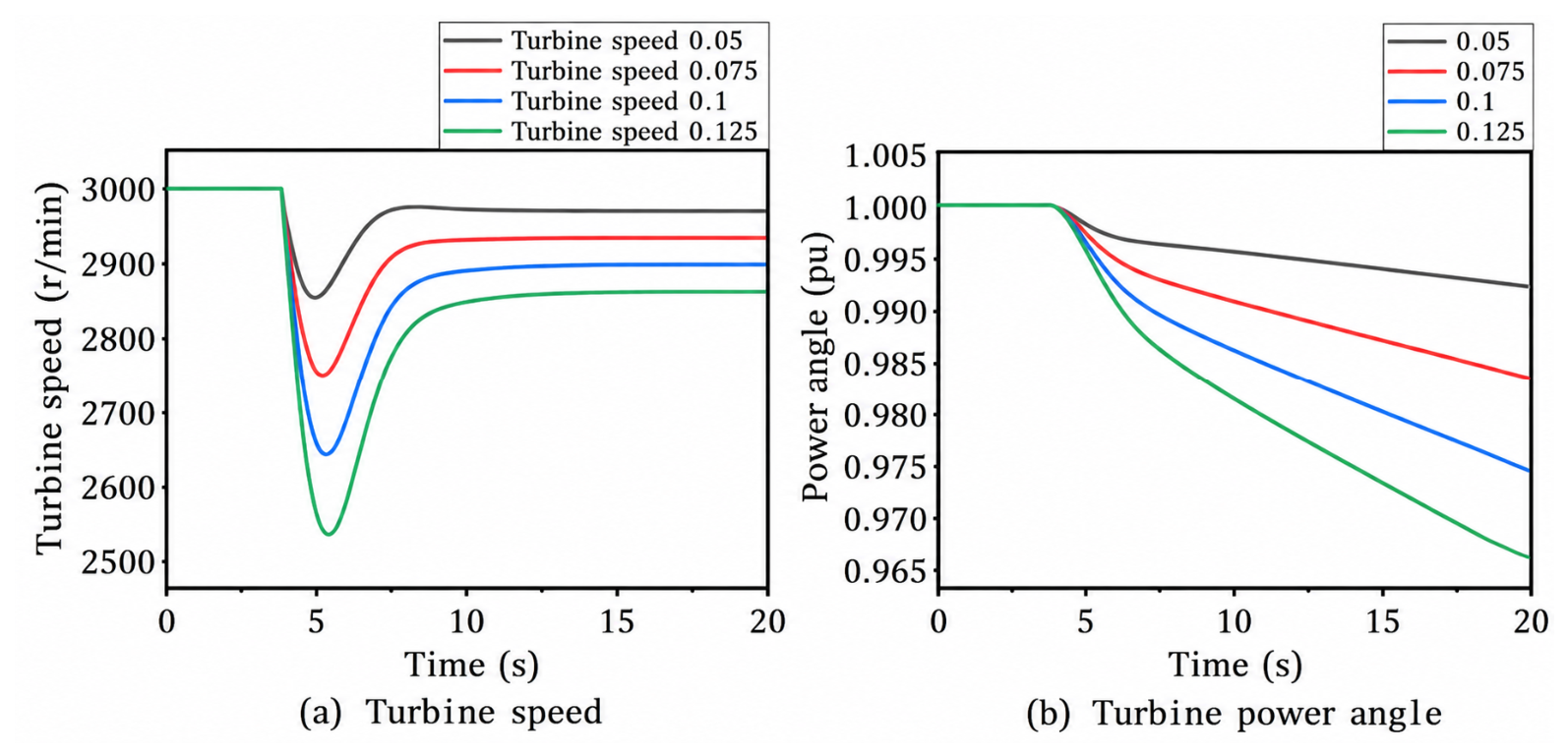
The increased power imbalance also imposes greater dynamic stress on the conventional synchronous generating units. Figure 7 shows the corresponding turbine-speed and rotor-angle responses under the same disturbance conditions. Following the load increase, the turbine speed decreases because the mechanical input power cannot immediately compensate for the increased electrical demand. The governor subsequently increases the mechanical power input, allowing the turbine speed to recover toward a new operating point. Meanwhile, the rotor angle varies in response to the transient power imbalance.
Figure 7.
Dynamic responses of turbine speed and rotor angle under different load disturbances.
As the disturbance magnitude increases, the turbine-speed deviation becomes larger and the rotor-angle variation becomes more pronounced. Together with the equivalent net-load responses in Figure 6, these results show that larger load disturbances intensify both the active-power imbalance and the electromechanical dynamic response of the system. Therefore, stronger and faster coordinated frequency support is required as the disturbance severity increases. These operating conditions provide the basis for evaluating the frequency-regulation performance of the proposed wind–BESS coordinated strategy in the following subsections.
3.3. Frequency-Response Comparison Under Different Control Strategies
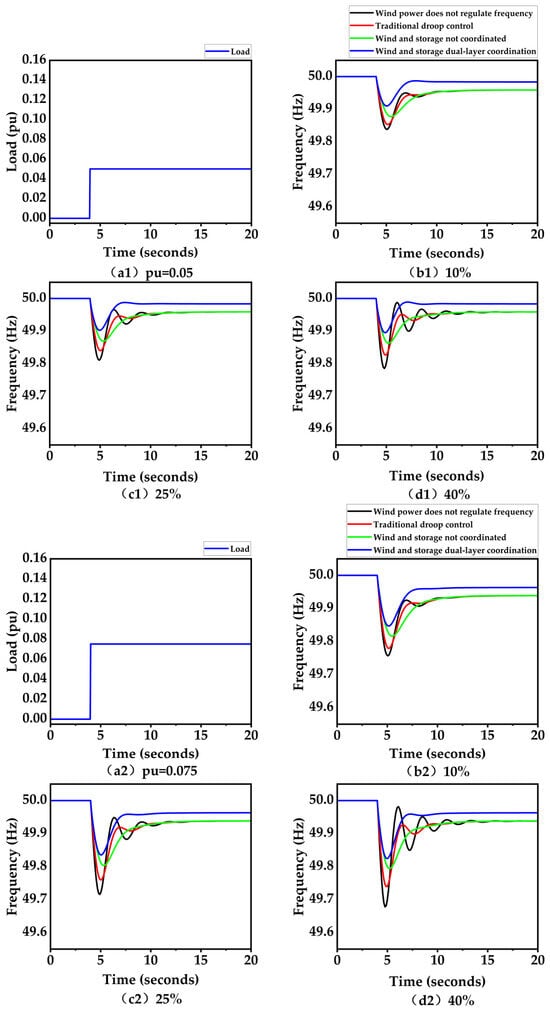
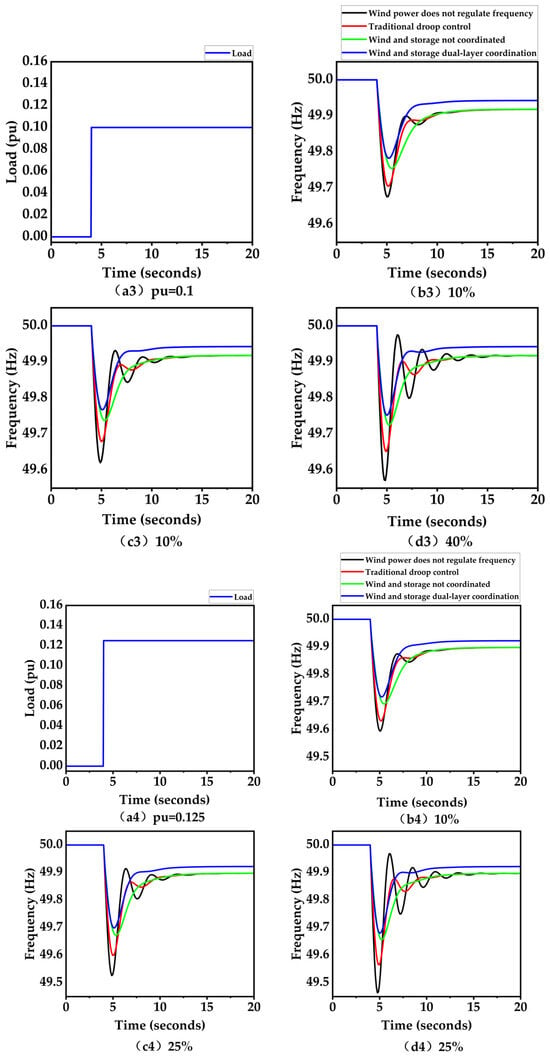
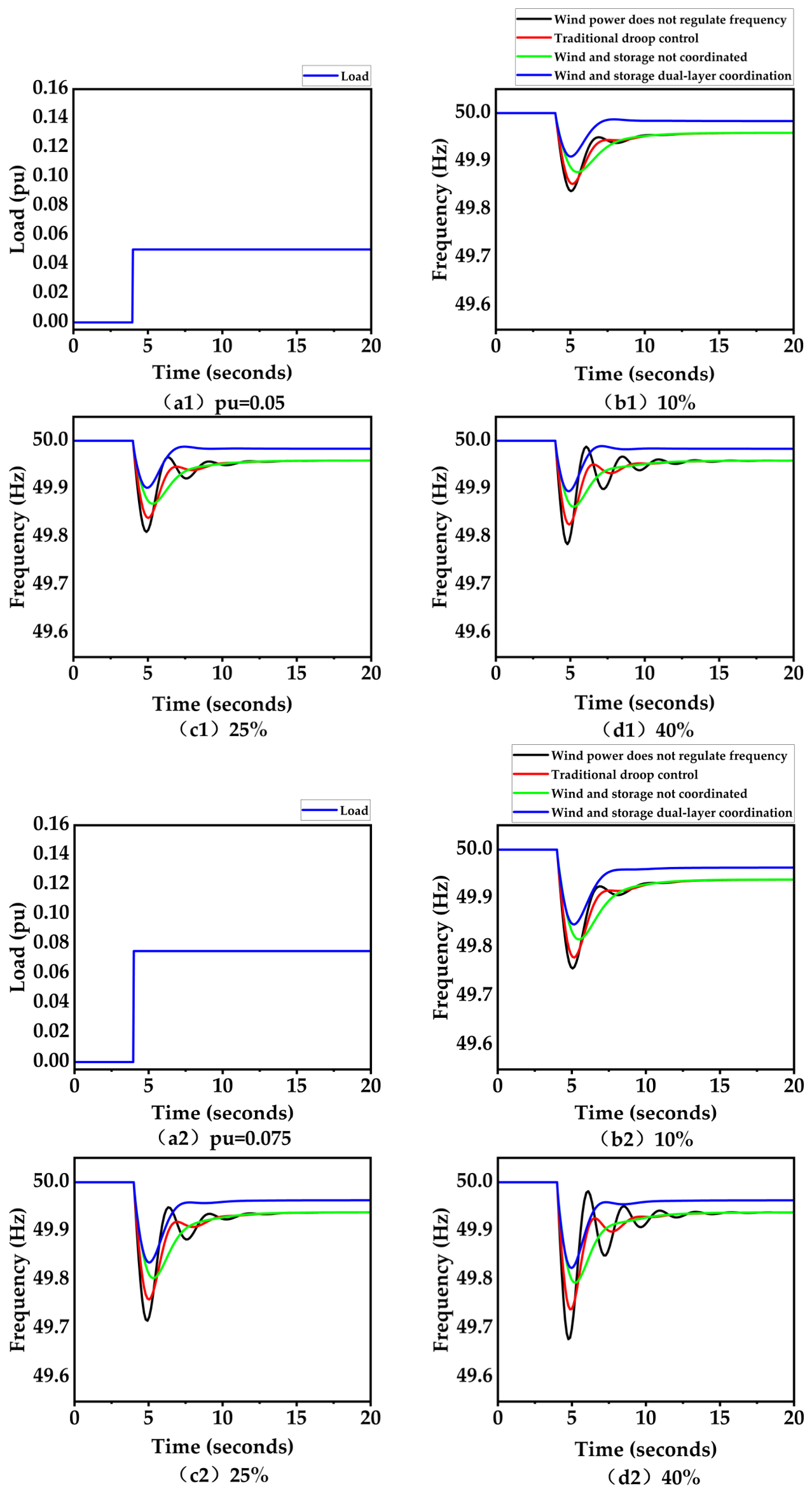
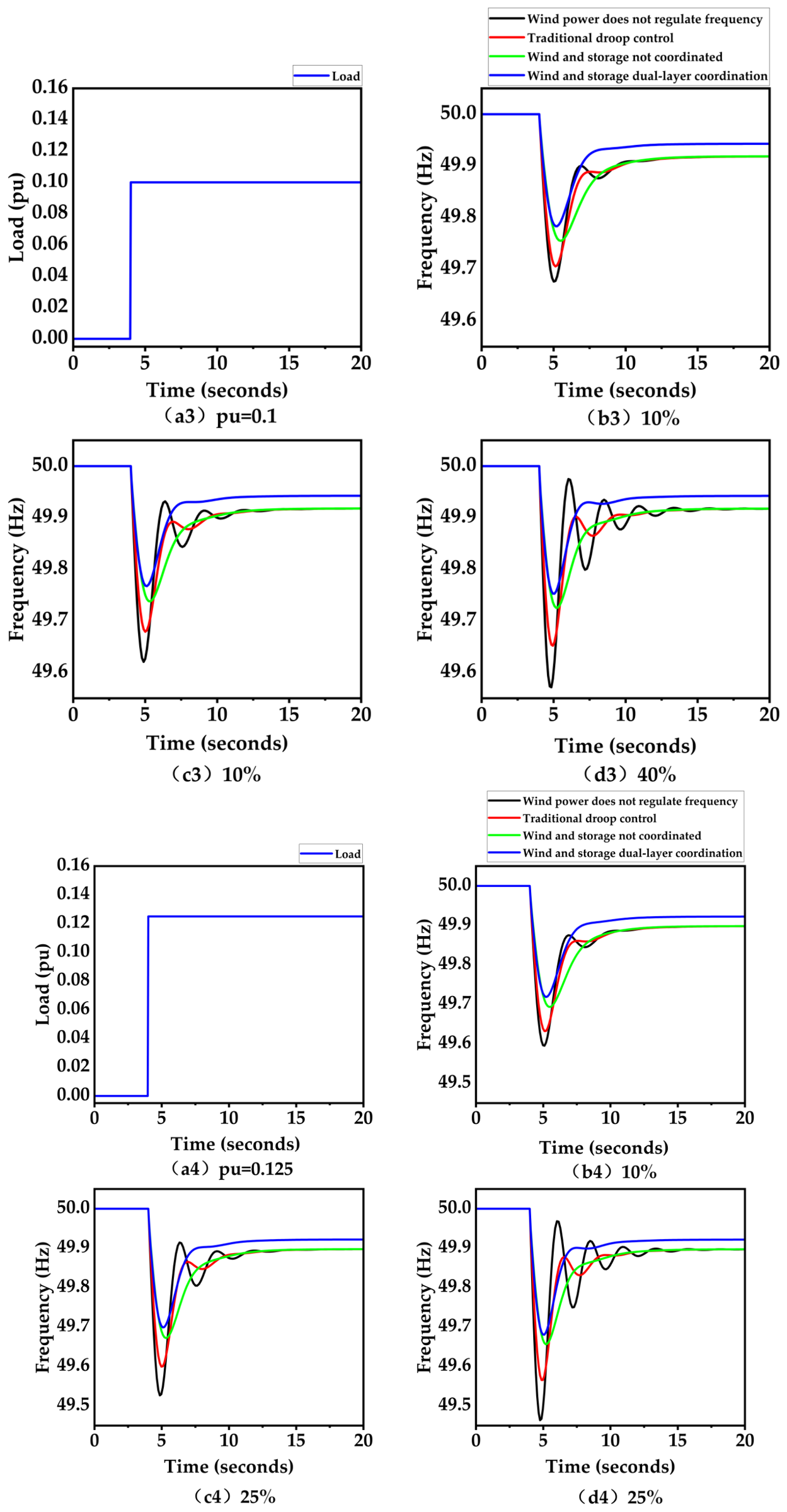
To evaluate the effectiveness of the proposed RoCoF-triggered hierarchical coordinated control strategy, four control schemes are compared under identical system parameters and disturbance conditions: wind power without frequency regulation, conventional wind-power droop control, uncoordinated wind-storage frequency regulation, and the proposed hierarchical coordinated control strategy. Figure 8 compares the corresponding system frequency responses under wind-power penetration levels of 10%, 25%, and 40%.
Figure 8.
Frequency responses for the four control schemes. Groups 1–4 correspond to load increases of 0.05, 0.075, 0.10, and 0.125 p.u.; panels (a1–a4) show the load steps and panels (b1–d4) compare wind-power penetration cases.
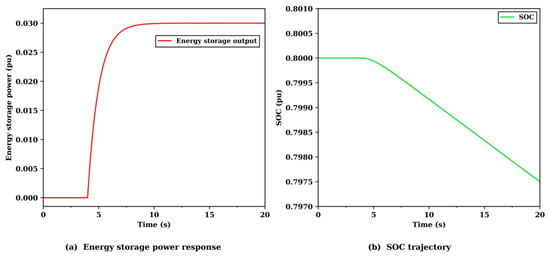
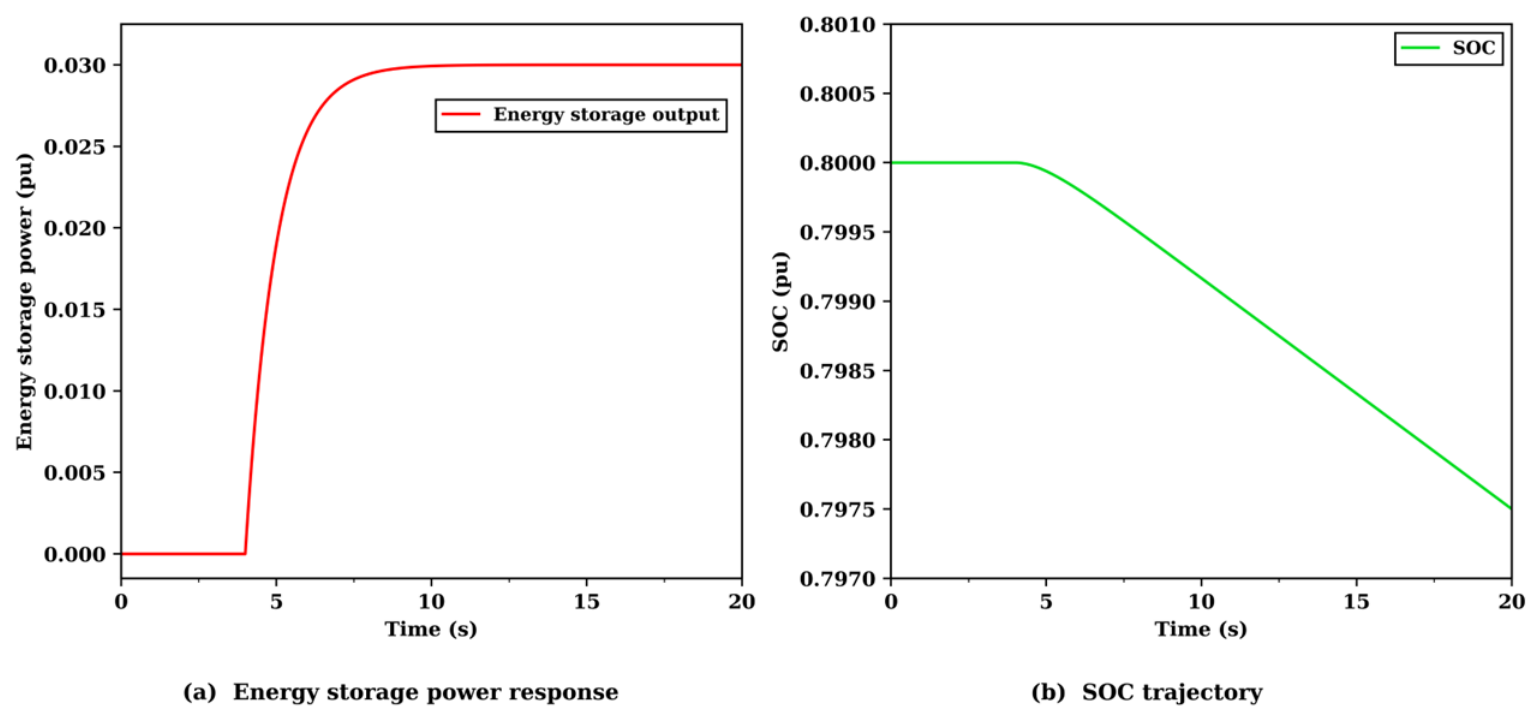
When wind power does not participate in frequency regulation, the system mainly relies on the physical inertia and governor response of conventional synchronous units, resulting in the largest frequency decline and the slowest recovery. As wind-power penetration increases, the equivalent system inertia decreases, leading to a larger RoCoF and a lower frequency nadir. Conventional droop control improves frequency support by increasing wind-power output according to frequency deviation, but its ability to suppress the initial rapid frequency decline remains limited because the disturbance stage is not explicitly identified. Uncoordinated wind-storage regulation introduces the fast active-power response of the BESS and therefore improves the frequency response compared with wind-only droop control; however, because the wind farm and BESS respond independently to the same frequency disturbance, their power contributions may overlap or exhibit mismatched timing. In contrast, the proposed strategy first generates a unified regulation command and allocates the regulation task according to BESS SOC and the RoCoF-triggering state. During the initial high-RoCoF stage, a larger share is assigned to the BESS for rapid compensation, while wind power assumes a larger share of sustained regulation as RoCoF decreases. Consequently, the proposed strategy achieves the best overall frequency-response performance among the compared schemes. Under 25% wind-power penetration and a 0.10 p.u. load disturbance, the frequency nadir improves from 49.62 Hz to 49.77 Hz, while the recovery time decreases from 5.0 s to 2.1 s. To further examine the role of the BESS, Figure 9 presents its active-power response and SOC trajectory under the representative operating condition. Following the load disturbance at t = 4 s, the BESS rapidly increases its active-power output to provide fast compensation during the initial frequency-decline stage, while the corresponding SOC decreases as energy is released for frequency support.
Figure 9.
BESS frequency-regulation power response and SOC trajectory.
The BESS response confirms the operating principle of the proposed strategy: the BESS provides rapid short-term support when the system experiences a large frequency disturbance, while its participation is subsequently reduced as wind power assumes a larger share of sustained regulation. This coordinated transition avoids unnecessary prolonged BESS support and better exploits the complementary dynamic characteristics of wind power and energy storage.
3.4. Same-Platform Comparison with Representative Wind–BESS Coordination Methods
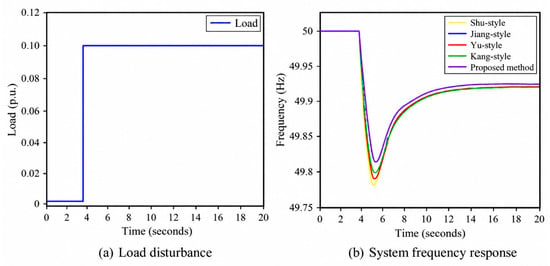
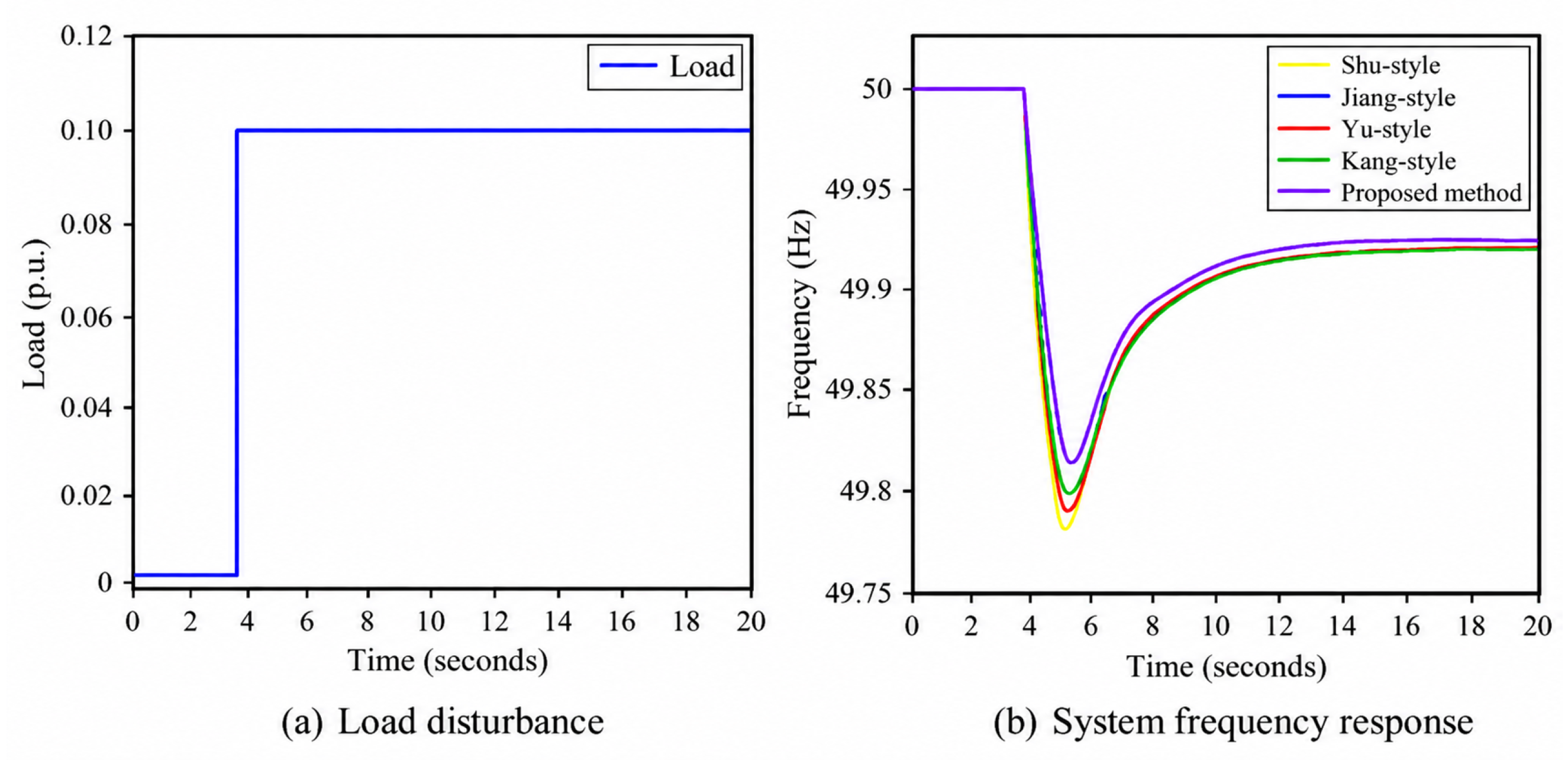
To further evaluate the proposed strategy against representative existing wind–BESS coordination approaches, a same-platform comparison was conducted based on the main control principles reported in Refs. [7,15,16,17]. The four reference-based schemes and the proposed strategy were evaluated using the same system model. To ensure consistency, all methods were evaluated under identical operating conditions, including 25% wind-power penetration, a 0.10 p.u. load disturbance applied at t = 4 s, an initial BESS SOC of 0.80, and the same wind- and BESS-side physical constraints.
The Shu-style scheme [7] represents variable wind-storage coordination according to wind-turbine operating conditions and BESS SOC; the Jiang-style scheme [15] coordinates wind power and energy storage according to system frequency-regulation demand; the Yu-style scheme [16] characterizes the available wind-side frequency-support capability according to the wind-turbine operating state; and the Kang-style scheme [17] combines adaptive wind-side frequency support with SOC-dependent BESS regulation. These implementations reproduce the representative coordination principles of the corresponding studies rather than all original model details and parameter settings.
As shown in Figure 10, the five coordination strategies exhibit relatively close overall frequency trajectories because they are subject to the same system dynamics, resource capacities, and physical operating constraints. Nevertheless, differences remain around the frequency nadir and during the early recovery stage. The proposed strategy maintains comparable frequency-support performance while adopting a different coordination mechanism based on unified regulation-command generation, RoCoF-triggered mode switching, and SOC-adaptive power allocation.
Figure 10.
Same-platform comparison of representative wind–BESS coordination methods under 25% wind-power penetration and a 0.10 p.u. load disturbance: (a) load disturbance; (b) system frequency response.
3.5. Frequency-Regulation Performance Under Different Wind Speeds
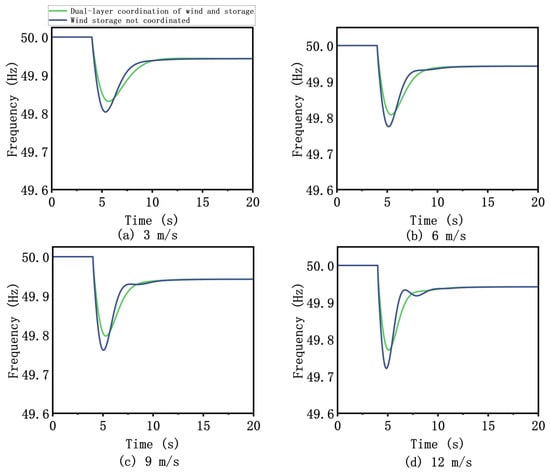
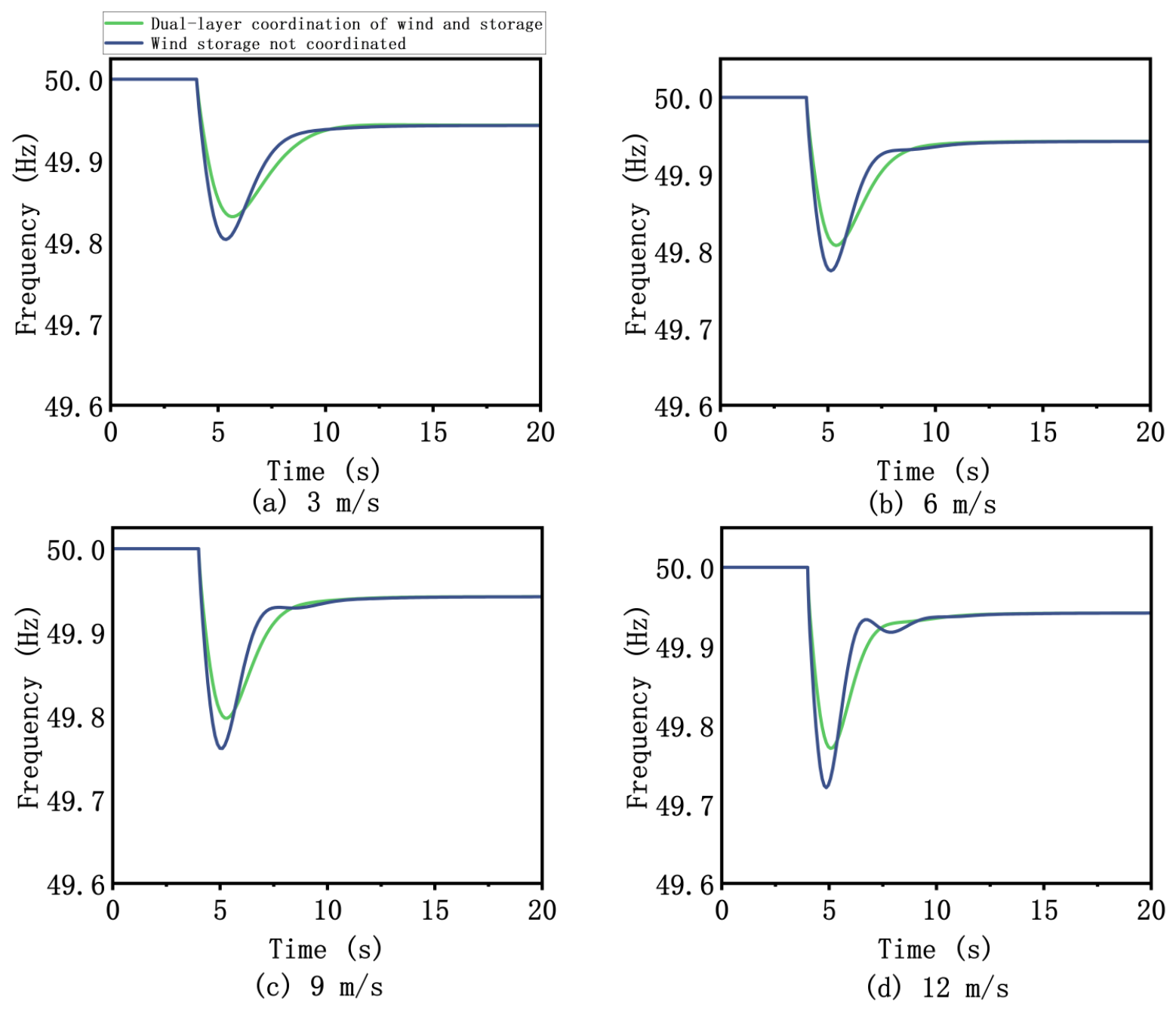
Wind speed affects the wind-turbine operating point, available aerodynamic power, and active-power regulation reserve. To evaluate the adaptability of the proposed strategy, simulations are conducted at wind speeds of 3, 6, 9, and 12 m/s under a wind-power penetration level of 25% and a load disturbance of 0.10 p.u. Wind speed is used only to determine the wind-turbine operating point and available active-power reserve and is not directly used as an input to the upper-layer coordinated controller.
Figure 11 compares the frequency responses of the uncoordinated wind-storage control and the proposed hierarchical coordinated control under different wind-speed conditions.
Figure 11.
Comparison of wind-storage frequency responses under different wind-speed conditions.
The simulation results show that the system frequency response varies with wind speed because the available wind-side regulation capability depends on the wind-turbine operating point and reserved active power. The relationship between wind speed and frequency-regulation capability is not strictly monotonic. At some operating points, an increase in wind speed raises the steady-state wind-power output but reduces the available upward regulation margin.
Despite these variations, the proposed hierarchical coordinated control consistently improves the frequency nadir and reduces the maximum RoCoF under all tested wind speeds. The corresponding quantitative results are presented in Table 3.
Table 3.
Primary-frequency-regulation performance under different wind-speed conditions.
At wind speeds of 3, 6, 9, and 12 m/s, the proposed strategy increases the frequency nadir by 0.028, 0.033, 0.036, and 0.050 Hz, respectively. The corresponding maximum RoCoF values are reduced from 0.397, 0.594, 0.724, and 1.386 Hz/s to 0.330, 0.525, 0.654, and 1.312 Hz/s.
The occurrence of the frequency nadir is slightly delayed under the proposed strategy, indicating that the initial frequency decline is slowed by rapid BESS support and that additional time is available for wind power and conventional generating units to increase their active-power contributions. When the available wind-power reserve is limited, the RoCoF-triggering mechanism allocates a larger share of rapid support to the BESS; when sufficient wind-side reserve is available, wind power assumes a larger share of sustained regulation during frequency recovery. These results demonstrate that the proposed strategy can adapt to variations in wind-turbine operating conditions without requiring wind speed as a direct upper-layer control input.
3.6. Ablation Analysis of the Proposed Control Strategy
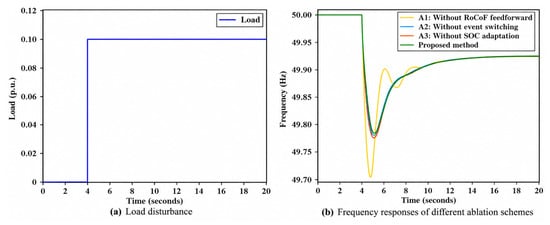
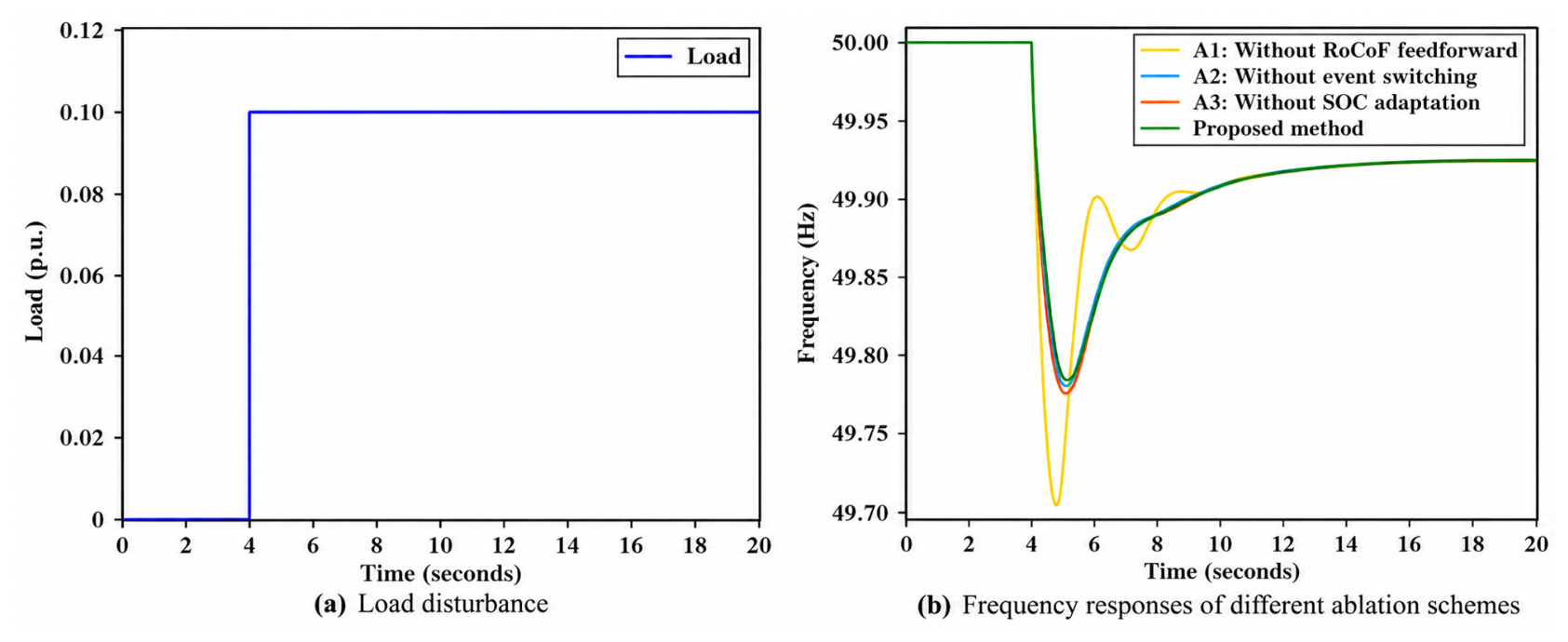
To clarify the contribution of each control component, an ablation study was conducted under a representative condition with 25% wind-power penetration, an initial BESS SOC of 0.80, and a 0.10 p.u. load disturbance applied at t = 4 s. Four cases were compared under identical system parameters and constraints: A1 without RoCoF feedforward, A2 without event switching, A3 without SOC adaptation, and the complete proposed method.
As shown in Figure 12, A1 exhibits the largest frequency drop, with a nadir of 49.7024 Hz, while A2, A3, and the proposed method reach 49.7764 Hz, 49.7745 Hz, and 49.7822 Hz, respectively. The ablation results indicate that the RoCoF feedforward term provides the dominant contribution to suppressing the initial frequency decline. In contrast, the no-switching configuration remains close to the complete controller under the nominal operating condition, indicating that event switching itself is not the dominant source of the frequency-nadir improvement. Its main role is to identify the rapid frequency-deviation stage and coordinate the temporal allocation of wind and BESS support. The robustness and specific contribution of the triggering mechanism are further examined in Section 3.8. Overall, the complete strategy achieves the highest frequency nadir and the most balanced dynamic response among the four cases.
Figure 12.
Ablation analysis of the proposed strategy under 25% wind-power penetration, a 0.10 p.u. load disturbance, and an initial BESS SOC of 0.80: (a) load disturbance; (b) frequency responses of different ablation schemes.
3.7. Verification Under BESS Constraint Conditions
To further verify the residual-power redistribution mechanism under active BESS constraints, two stress cases were considered under 25% wind-power penetration and a 0.10 p.u. load disturbance. The first case uses a low initial BESS SOC of 0.23, whereas the second imposes a binding BESS power limit of 3 MW. In each case, the revised controller with residual redistribution is compared with an otherwise identical configuration in which the redistribution mechanism is disabled.
As summarized in Table 4, under the low-SOC condition, disabling redistribution results in an accumulated unmet command of 0.044833 p.u.·s and a frequency nadir of 49.7073 Hz. With redistribution enabled, the unmet command is reduced to zero and the nadir increases to 49.7758 Hz. Under the 3 MW BESS power limit, the unmet command decreases from 0.014352 p.u.·s to zero, while the frequency nadir increases from 49.7503 Hz to 49.7753 Hz. These results confirm that the residual-power redistribution mechanism transfers the BESS-side delivery deficit to the available wind-side reserve when sufficient wind regulation capability remains.
Table 4.
Performance of residual-power redistribution under constrained BESS conditions.
3.8. Switching Robustness and Triggering-Mechanism Verification
The following tests were conducted using the final parameter set reported in Table 2 and were designed specifically to isolate switching robustness and triggering behavior. To evaluate the robustness of the triggering mechanism near the switching boundary, a dedicated near-threshold test was conducted. The filtered RoCoF test signal was defined as rf = 0.15 + 0.02sin(2π × 2t) + n(t), with a noise standard deviation of 0.005 Hz/s. Under the conventional single-threshold logic, 381 switching events were observed because the RoCoF repeatedly crossed the switching boundary. In contrast, the hysteresis logic produced no repeated switching after activation because the state was retained within the hysteresis band. It should be noted that the test signal remained above the release threshold throughout the test interval; therefore, this test specifically evaluates robustness against repeated near-threshold switching rather than post-release reactivation.
The switching robustness was further evaluated by injecting measurement noise into the frequency signal before RoCoF differentiation and filtering. At noise standard deviations of 0.001 and 0.002 Hz, the conventional single-threshold controller produced 16 and 32 switching events, respectively, whereas the proposed direction-aware hysteresis controller reduced these values to four and 12. More importantly, the corresponding post-disturbance recovery-stage reactivation counts were reduced from one and five to zero. Under the more severe 0.005 Hz noise condition, the total number of switching events decreased from 940 to 518, while the number of post-disturbance recovery-stage reactivations was reduced from 209 to zero. These results demonstrate improved switching robustness and recovery-stage discrimination. However, strong measurement noise can still induce frequent switching; therefore, switching is not claimed to be completely eliminated.
To isolate the contribution of event switching, the proposed controller was also compared with an otherwise identical controller using SOC-dependent baseline allocation without triggering. Under 25% wind-power penetration, a 0.10 p.u. load disturbance, and an initial BESS SOC of 0.80, the baseline-allocation controller produced a frequency nadir of 49.7735 Hz, an IAE of 1.622547 Hz·s, and a BESS energy throughput of 0.001972 MWh. The proposed direction-aware triggering controller produced a frequency nadir of 49.7707 Hz, an IAE of 1.622548 Hz·s, and a BESS energy throughput of 0.002418 MWh. The maximum physical RoCoF was 0.6667 Hz/s in both cases. Therefore, under this representative nominal condition, event switching is not the dominant source of frequency-nadir improvement. Its main contribution lies in disturbance-stage identification, coordinated temporary enhancement of BESS participation, and more robust mode transitions, with a corresponding increase in short-duration BESS energy use. The corresponding quantitative results are summarized in Table 5.
Table 5.
(a) Near-threshold switching behavior of the single-threshold and hysteresis-based triggering logics. (b) Closed-loop switching robustness and triggering contribution under measurement noise and nominal operating conditions.
3.9. Practical Standards and Grid-Code Considerations
The practical relevance of the proposed wind–BESS frequency-regulation strategy is further discussed with reference to relevant grid-interconnection and equipment-performance standards. IEEE Std 2800-2022 [25] addresses interconnection and performance requirements for inverter-based resources connected to transmission and sub-transmission systems, including active-power support under abnormal frequency conditions, whereas IEEE Std 1547-2018 [26] specifies interconnection and abnormal-condition response requirements for distributed energy resources. IEC 61400-21-1:2019 [27] provides measurement and assessment procedures for the electrical characteristics of grid-connected wind turbines, including frequency- and inertia-control responses, while IEC 61400-27-1:2020 [28] defines generic dynamic simulation models for wind turbines and wind-power plants. IEC 62933-2-1:2017 [29] specifies performance parameters and general testing methods for electrical energy storage systems.
In the proposed framework, the frequency-deviation component of the unified regulation command remains continuously active, whereas the RoCoF-triggered mechanism changes the allocation of the regulation task between the wind farm and the BESS rather than interrupting the underlying frequency-responsive control. Therefore, the proposed switching mechanism does not replace continuous frequency support but modifies the relative participation of the two resources according to the disturbance stage. The BESS is represented by finite response dynamics with a tracking time constant of 0.05 s and is constrained by its rated power, charging/discharging limits, and an SOC operating range of 0.20–0.90. In addition, the SOC is continuously updated according to the actual exchanged energy so that the remaining energy margin is reflected during successive frequency events. These characteristics are consistent with the general engineering principles of fast active-power support, continuous frequency response, and constrained energy-storage operation addressed by the above standards [25,26,27,28,29].
It should be emphasized, however, that the present study is based on system-level simulation and does not constitute formal standards-conformity or certification testing. In particular, the 0.05 s BESS tracking time constant used in the simulation represents the equivalent response dynamics adopted in the system-level model and should not be interpreted as a formally verified FFR response time under a prescribed standard test procedure. Similarly, the frequency-deviation control component provides continuous frequency-responsive behavior, but formal verification of plant-level droop characteristics would require the corresponding grid-code settings and measurement procedures. The present SOC and energy-throughput analyses characterize short-duration BESS operation during primary frequency regulation, whereas long-term cycling, degradation, and lifetime assessment are beyond the scope of this study. Therefore, formal verification of standard-specific FFR response-time requirements, plant-level frequency-droop performance, and long-term BESS cycling capability will require standard-specific test procedures, site-specific interconnection settings, and hardware or field validation.
4. Conclusions and Future Work
This paper proposes a RoCoF-triggered hierarchical coordinated control strategy for wind-storage joint primary frequency regulation. The proposed strategy adopts an upper-layer coordinated allocation and lower-layer constrained execution structure. The upper layer generates a unified wind-storage frequency-regulation command according to frequency deviation and filtered RoCoF, determines the baseline BESS power share based on SOC, and activates the rapid-support mode when the direction-aware RoCoF activation condition is satisfied. The lower layer executes the allocated wind-side and BESS-side commands while considering wind-power reserve, frequency deadband, SOC operating limits, and charging/discharging power constraints. Therefore, the BESS provides rapid active-power support during the initial disturbance stage, while wind power undertakes more sustained regulation during the recovery stage.
Simulation results under different wind-power penetration levels, load disturbances, and wind speeds show that the proposed strategy can improve the frequency nadir, reduce the maximum RoCoF, shorten the recovery time, and decrease the steady-state frequency deviation. Under 25% wind-power penetration and a 0.10 p.u. load disturbance, the frequency nadir increases from 49.62 Hz to 49.77 Hz, and the recovery time decreases from 5.0 s to 2.1 s. These results verify the effectiveness of the unified command generation, RoCoF-triggered mode switching, SOC-based allocation, and lower-layer constraint correction mechanisms.
Future work will focus on adaptive tuning of the hysteresis thresholds under time-varying operating conditions, coordinated SOC-restoration scheduling under repeated disturbances, stochastic wind-power variations, communication delays, battery-degradation-aware energy management, and standards-oriented hardware-in-the-loop validation of frequency-response and BESS operating performance.
Author Contributions
Conceptualization, P.Z. and J.W.; methodology, P.Z.; software, P.Z.; validation, P.Z. and H.Z.; formal analysis, P.Z.; investigation, P.Z.; data curation, P.Z.; writing—original draft preparation, P.Z.; writing—review and editing, J.W., H.Z. and Y.A.; visualization, P.Z.; supervision, J.W. and Y.A.; project administration, J.W.; funding acquisition, J.W. and Y.A. All authors have read and agreed to the published version of the manuscript.
Funding
This research was funded by the Major Science and Technology Special Project of Xinjiang Uygur Autonomous Region, grant number 2023A01005-1; the Natural Science Foundation of Xinjiang Uygur Autonomous Region, grant number 2024D01C14; and the Heavenly Lake Talent Program for Young Doctoral Researchers, grant number 51052601546.
Data Availability Statement
The data presented in this study are available from the corresponding author upon reasonable request. The data are not publicly available because the raw simulation data and model-related files are currently being used for ongoing research and further analyses.
Acknowledgments
The authors gratefully acknowledge this support.
Conflicts of Interest
The authors declare no conflict of interest.
References
- Njoka, G.M.; Mogaka, L.; Wangai, A. Impact of variable renewable energy sources on the power system frequency stability and system inertia. Energy Rep. 2024, 12, 4983–4997. [Google Scholar] [CrossRef] [Scilit]
- Morren, J.; de Haan, S.W.H.; Kling, W.L.; Ferreira, J.A. Wind turbines emulating inertia and supporting primary frequency control. IEEE Trans. Power Syst. 2006, 21, 433–434. [Google Scholar] [CrossRef] [Scilit]
- Vidyanandan, K.V.; Senroy, N. Primary frequency regulation by deloaded wind turbines using variable droop. IEEE Trans. Power Syst. 2013, 28, 837–846. [Google Scholar] [CrossRef] [Scilit]
- Choi, W.Y.; Kook, K.S.; Yu, G.R. Control Strategy of BESS for Providing Both Virtual Inertia and Primary Frequency Response in the Korean Power System. Energies 2019, 12, 4060. [Google Scholar] [CrossRef] [Scilit]
- Tan, J.; Zhang, Y. Coordinated Control Strategy of a Battery Energy Storage System to Support a Wind Power Plant Providing Multi-Timescale Frequency Ancillary Services. IEEE Trans. Sustain. Energy 2017, 8, 1140–1153. [Google Scholar] [CrossRef] [Scilit]
- Tang, Y.; Yang, C.; Yan, Z.; Xue, Y.; He, Y. Coordinated Control of a Wind Turbine and Battery Storage System in Providing Fast-Frequency Regulation and Extending the Cycle Life of Battery. Front. Energy Res. 2022, 10, 927453. [Google Scholar] [CrossRef] [Scilit]
- Shu, H.; Wang, G.; Chen, J.; Ma, H.; He, T. Coordinated control of wind-storage combined with primary frequency regulation and variable coefficient based on wind speed and SOC. J. Energy Storage 2024, 87, 111356. [Google Scholar] [CrossRef] [Scilit]
- Zhu, Y.; Shi, Q.; Yao, S.; Wei, Z. Adaptive MPC and power dispersion index based improved hierarchical frequency regulation for wind-storage integrated system. J. Energy Storage 2025, 107, 115006. [Google Scholar] [CrossRef] [Scilit]
- Bonfiglio, A.; Lodi, M.; Rosini, A.; Oliveri, A.; Procopio, R. Design, realization and testing of a synthetic inertia controller for wind turbine power generators. Sustain. Energy Grids Netw. 2024, 38, 101234. [Google Scholar] [CrossRef] [Scilit]
- Cheng, Y.; Sun, H.; Zhang, Y.; Xu, S.; Zhao, B.; Vorobev, P.; Terzija, V. A consecutive power dispatch in wind farms to mitigate secondary frequency dips. Int. J. Electr. Power Energy Syst. 2024, 158, 109939. [Google Scholar] [CrossRef] [Scilit]
- Song, Y.; Zhang, Y.; Zhang, S.; Liu, F.; Su, Y.; Liu, Y. System frequency response model and droop coefficient setting considering renewable energy participation in frequency regulation. Front. Energy Res. 2024, 12, 1521209. [Google Scholar] [CrossRef] [Scilit]
- Li, Y.; Chen, Z.; Yin, M.; Li, Q.; Li, Q.; Zou, Y. Optimal Short-Term Frequency Support Strategy for Multiple Wind Turbines Based on Synchronous Release of Rotor Kinetic Energy. IEEE Trans. Ind. Electron. 2026, 73, 658–669. [Google Scholar] [CrossRef] [Scilit]
- Leon, A.E.; del Nozal, Á.R.; Mauricio, J.M. Frequency Support Strategy for Fast Response Energy Storage Systems. IEEE Trans. Power Syst. 2024, 39, 5439–5442. [Google Scholar] [CrossRef] [Scilit]
- Huang, J.; Lin, X.; Sun, J.; Xu, H. A Stabilization Control Strategy for Wind Energy Storage Microgrid Based on Improved Virtual Synchronous Generator. Energies 2024, 17, 2567. [Google Scholar] [CrossRef] [Scilit]
- Jiang, Y.; Wang, C.; Xiao, L.; Yu, D.; Zhang, X. Wind/storage coordinated control strategy based on system frequency regulation demands. Energy Rep. 2024, 11, 1551–1559. [Google Scholar] [CrossRef] [Scilit]
- Yu, L.; Wu, J.; Cheng, Y.; Meng, G.; Chen, S.; Lu, Y.; Xu, K. Control Strategy for Wind Farms-Energy Storage Participation in Primary Frequency Regulation Considering Wind Turbine Operation State. Energies 2024, 17, 3547. [Google Scholar] [CrossRef] [Scilit]
- Kang, H.; Sun, Y.; Liu, J.; Chen, Z.; Shi, X.; Zhang, X.; Shi, Y.; Yang, P. Research on the Primary Frequency-Regulation Strategy of Wind-Storage Collaborative Participation Systems Considering the State of Charge of Energy Storage. Energies 2024, 17, 6333. [Google Scholar] [CrossRef] [Scilit]
- Chang, X.; Guo, X.; Wang, J.; Zhi, H.; Hao, L.; Ji, L. Frequency Support Coordinated Control Strategy of Renewable Distributed Energy Resource Based on Digital Twins. Electronics 2024, 13, 3403. [Google Scholar] [CrossRef] [Scilit]
- Liu, X.; Li, Y.; Wang, L.; Tang, J.; Qiu, H.; Berizzi, A.; Valentin, I.; Gao, C. Dynamic aggregation strategy for a virtual power plant to improve flexible regulation ability. Energy 2024, 297, 131261. [Google Scholar] [CrossRef] [Scilit]
- He, L.; Tan, Z.; Li, Y.; Cao, Y.; Chen, C. A Coordinated Consensus Control Strategy for Distributed Battery Energy Storages Considering Different Frequency Control Demands. IEEE Trans. Sustain. Energy 2024, 15, 304–315. [Google Scholar] [CrossRef] [Scilit]
- Liu, R.; Hui, H.; Chen, X.; Song, Y. Distributed Frequency Control of Heterogeneous Energy Storage Systems Considering Short-Term Ability and Long-Term Flexibility. IEEE Trans. Smart Grid 2024, 15, 5693–5705. [Google Scholar] [CrossRef] [Scilit]
- Zhai, J.; Guo, L.; Wang, Z.; Li, X.; Liu, Y.; Wang, C. Coordinated Frequency Regulation of Active Distribution Networks Considering Dimension-Augmented Power Flow Constraints. IEEE Trans. Sustain. Energy 2025, 16, 138–148. [Google Scholar] [CrossRef] [Scilit]
- Zhao, T.; Liu, H.; Su, J.; Wang, N.; Luo, Z. Coordinated control for distributed energy resources in islanded microgrids with improved frequency regulation capability. Renew. Energy 2025, 244, 122690. [Google Scholar] [CrossRef] [Scilit]
- Dai, B.; Wang, Z.; Sun, J.; Tan, Y.; Yang, J. Discrete-time robust current-constrained voltage tracking control of DC-DC buck converters with multi-source disturbances. Control Eng. Pract. 2026, 175, 107085. [Google Scholar] [CrossRef] [Scilit]
- IEEE. IEEE Std 2800-2022; IEEE Standard for Interconnection and Interoperability of Inverter-Based Resources (IBRs) Interconnecting with Associated Transmission Electric Power Systems. IEEE: New York, NY, USA, 2022.
- IEEE. IEEE Std 1547-2018; IEEE Standard for Interconnection and Interoperability of Distributed Energy Resources with Associated Electric Power Systems Interfaces. IEEE: New York, NY, USA, 2018.
- IEC. IEC 61400-21-1:2019; Wind Energy Generation Systems—Part 21-1: Measurement and Assessment of Electrical Characteristics—Wind Turbines. International Electrotechnical Commission: Geneva, Switzerland, 2019.
- IEC. IEC 61400-27-1:2020; Wind Energy Generation Systems—Part 27-1: Electrical Simulation Models—Generic Models. International Electrotechnical Commission: Geneva, Switzerland, 2020.
- IEC. IEC 62933-2-1:2017; Electrical Energy Storage (EES) Systems—Part 2-1: Unit Parameters and Testing Methods—General Specification. International Electrotechnical Commission: Geneva, Switzerland, 2017.

Disclaimer/Publisher’s Note: The statements, opinions and data contained in all publications are solely those of the individual author(s) and contributor(s) and not of MDPI and/or the editor(s). MDPI and/or the editor(s) disclaim responsibility for any injury to people or property resulting from any ideas, methods, instructions or products referred to in the content. |
© 2026 by the authors. Licensee MDPI, Basel, Switzerland. This article is an open access article distributed under the terms and conditions of the Creative Commons Attribution (CC BY) license.