


Abstract
As brain–computer interfaces (BCIs) move toward training, rehabilitation, and consumer use, users must judge both whether a system is technically reliable and whether it credibly represents their own neural or attentional state. This study tests whether trust after an initial EEG attention-training session is better represented by two related yet distinguishable targets: Neuro-Trust (NT), trust in the system’s representation of one’s internal state, and System Trust (ST), trust in the overall device–algorithm–training system. Candidate antecedents were generated from interviews with 18 users and comments from five platforms; survey data from 300 young adults yielded 274 valid cases. A nine-factor confirmatory factor analysis fit better than an eight-factor model merging NT and ST (Δχ2(8) = 327.155, p < 0.001; HTMT = 0.411). Structural equation modeling showed that perceived feedback explainability (PFE) related positively to both NT and ST, whereas perceived attention-regulation value (PARV) related to NT only (Δχ2(1) = 21.655, p < 0.001; bootstrap Δβ = 0.388, 95% CI [0.168, 0.607]). Out-of-fold SHAP analysis under repeated nested cross-validation reproduced this pattern: PARV ranked first for NT but fifth for ST, whereas PFE ranked second and first. BCI trust may thus comprise related but distinguishable dimensions with shared and limited track-specific antecedents.
1. Introduction
Brain–computer interfaces (BCIs) are transitioning from laboratory systems evaluated primarily by decoding accuracy, information transfer rate, and signal quality toward training, rehabilitation, and wearable applications that require sustained engagement by real users. With this transition, criteria for practical BCI evaluation have expanded from technical performance to user-level outcomes. Even when a system functions as intended, users may reduce adoption or discontinue use because of wearing burden, difficulty interpreting feedback, discrepancies between system judgments and subjective experience, concerns about data monitoring, or insufficient perceived training value. Accordingly, human factors and user-centered BCI research have increasingly incorporated usability, satisfaction, mental workload, acceptability, and overall user experience into evaluation frameworks [1,2,3,4].
Unlike many conventional intelligent systems, BCIs involve a dual object of evaluation. The system is evaluated as an external technological artifact while simultaneously inferring the user’s own neural or attentional state and returning that inference to the user as feedback. Trust in the reliability of the device, algorithm, and training system is therefore conceptually distinct from trust in whether the system accurately represents one’s internal state. Collapsing these two evaluations into a single global trust score may obscure whether a negative experience primarily undermines reliance on the technological system or acceptance of the validity of neural-state representation.
Accordingly, this study distinguishes two related but target-specific trust constructs: Neuro-Trust (NT) and System Trust (ST). NT refers to the user’s subjective judgment that BCI feedback credibly, synchronously, and meaningfully reflects the user’s own neural or attentional state. It does not denote a neurophysiological trust response; rather, it is a self-reported evaluation directed toward the specific target of “how the system represents my internal state.” ST, by contrast, refers to trust in the reliability and technical competence of the device, algorithm, and overall training system as an external technological system. Because both forms of trust arise from the same BCI interaction, they may be correlated, but the targets of trust are conceptually distinct.
Existing research provides a foundation for this distinction but leaves three important gaps. First, user-centered BCI studies have shown that technical performance alone is insufficient to explain user satisfaction and technology acceptance [5], with wearing experience, feedback design, usability, and risk perception also playing important roles [1,2,3,4,6]. Second, although the human–computer interaction and artificial-intelligence studies have developed mature frameworks for trust in automated systems [7], these frameworks typically define the trust target as the technological system as a whole and rarely test whether trust in the BCI-generated representation of one’s neural state can be distinguished from trust in the broader technical system. Third, although BCI and neurofeedback research has emphasized closed-loop feedback, perceived control, and training value, few studies have compared how the same set of experiential factors relates differently to these two forms of trust within the same sample; evidence combining structural modeling with rigorous out-of-sample interpretable prediction is even more limited. The classical automation-trust frameworks of Lee and See and Hoff and Bashir further ground this distinction [8,9].
This study therefore addresses a central question: after young users complete an initial EEG attention-training session, can BCI trust be represented by two related but distinguishable latent variables—NT and ST—and do the two dimensions exhibit both shared antecedents and limited track-specific association patterns? To build a sequential evidence chain, the study combines qualitative construct generation, competing CFA models, a dual-track SEM, and out-of-fold SHAP analysis under repeated nested cross-validation. The qualitative phase was used to generate six candidate antecedents; CFA tested whether NT and ST should be modeled separately; SEM compared the structural associations of each candidate antecedent with NT and ST and directly tested path differences; and the predictive stage examined whether the core structural pattern recurred in held-out test folds. This design separates construct discrimination at the measurement level, differential associations at the structural level, and convergent evidence at the predictive level while avoiding causal interpretation of cross-sectional associations. Based on 274 young first-time users, the findings support the empirical distinction between NT and ST, identify feedback explainability as a shared antecedent, and identify perceived attention-regulation value as an NT-oriented factor. These results suggest that BCI research should avoid treating user trust as a single global construct and instead distinguish trust in internal-state representation from trust in the external technological system.
2. Materials and Methods
2.1. Study Design and Qualitative Construct Generation
A sequential multi-method design was used to examine the distinction between NT and ST and to identify shared and differential candidate antecedent patterns. The qualitative phase comprised in-depth interviews with 18 young BCI users and online comments collected from five platforms—Bilibili, Weibo, Xiaohongshu, Douyin, and Zhihu—yielding 24 qualitative analysis files. NVivo coding was consolidated into six first-level themes and 34 subtheme nodes, with 918 coded references. The interview material covered NT, ST, the relationship between the two, candidate influencing factors, and behavioral intentions. Frequently occurring themes included feedback stability, feedback explainability, wearing and calibration experience, privacy and surveillance concerns, and perceived attention-regulation value. Integrating these themes with prior work on perceived control and technology acceptance produced six candidate antecedents: perceived control (PC), feedback stability (FS), perceived feedback explainability (PFE), wear and calibration experience (WCE), privacy and surveillance concern (PSC), and perceived attention-regulation value (PARV). Reuse intention (RI) was included as a behavioral outcome to examine whether both forms of trust were associated with future use tendency, but it was not treated as an independent theoretical contribution. Importantly, the label “Neuro-Trust” used during open qualitative coding functioned only as an organizing theme for users’ real-time perceptions of feedback, state attribution, and related internal subjective experiences. The precise construct boundary and operational definition of NT were subsequently narrowed during scale development in accordance with the research hypotheses. In the present study, Neuro-Trust therefore refers to a subjective user judgment rather than an unconscious neurophysiological response. The qualitative phase served construct generation and content-domain identification and did not constitute direct validation of the final NT definition.
2.2. Participants, Experimental Procedure, and Data Quality Control
The quantitative sample comprised young adults aged 18–24 years. All participants first completed the same EEG-headband attention-training experience and then completed the questionnaire, ensuring that responses were based on actual interaction rather than a hypothetical scenario. A total of 300 questionnaires were collected. Two a priori quality-control rules were applied: responses were excluded if completion time was less than 60 s or if the same response option was selected for all 36 core Likert items. In total, 26 questionnaires triggered at least one exclusion rule, leaving a final analytic sample of n = 274. All subsequent CFA, SEM, and machine-learning analyses were conducted on this valid sample.
As shown in Table 1, participants aged 20–21 years accounted for 52.9% of the sample. The gender distribution was broadly balanced, with 53.3% male and 46.0% female participants, and undergraduate students represented 80.3% of the sample. Notably, 79.9% of participants had no prior hands-on experience with brain rings, EEG headbands, or BCI attention-training products; 59.1% had only heard of such products, and 20.8% had been completely unfamiliar with them. The sample therefore primarily reflects trust judgments formed after an initial BCI attention-training experience rather than stable evaluations based on long-term use.
Table 1.
Characteristics of the final analytic sample (n = 274).
2.3. Measures
The final questionnaire comprised nine constructs and 36 core five-point Likert items, with four items per construct and no reverse-scored items in the final version. NT measured whether participants perceived the system feedback as credible, synchronous, and meaningful in representing their own attentional state; ST assessed trust in the reliability and technical capability of the device, algorithm, and overall training system. PC, FS, PFE, WCE, PSC, and PARV respectively measured perceived control, feedback stability and continuity, clarity of result interpretation, smoothness of wearing and calibration, privacy and surveillance concerns, and the perceived value of training for recognizing and regulating attentional states. RI measured intention to use the system again in the future. Background variables and the Q42 ranking item were not included in the 36-item measurement model; Q42 was also excluded from the machine-learning feature set to avoid conceptual overlap with the six candidate antecedents.
2.4. Statistical Analysis and Predictive Validation
At the measurement level, a nine-factor CFA model was estimated and compared with an eight-factor model in which NT and ST were merged into a single General BCI Trust factor. Internal consistency and convergent validity were assessed using Cronbach’s α, composite reliability (CR), average variance extracted (AVE), and standardized factor loadings; discriminant validity was evaluated using the heterotrait–monotrait ratio (HTMT) [10,11].
At the structural level, the six candidate antecedents were entered simultaneously as predictors of both NT and ST, and NT and ST were specified as predictors of RI; covariances among the exogenous antecedents were freely estimated. Structural paths were evaluated using 5000 bootstrap resamples (random seed 2026) to obtain bias-corrected 95% confidence intervals, and R2 values were reported for NT, ST, and RI. Because significance for one path and non-significance for another does not by itself establish a significant difference between paths, equality constraints of X→NT = X→ST were imposed separately for each candidate antecedent and evaluated using Δχ2 tests. Standardized path differences, Δβ = β(NT)−β(ST), and their 95% confidence intervals were also estimated from 5000 bootstrap resamples.
Predictive analysis was used to assess whether the core association pattern recurred in held-out test folds, thereby providing multi-method convergent evidence; no independent external-sample validation was performed. Mean scores for the six candidate antecedent constructs were used as input features, with NT and ST modeled as separate prediction targets. Repeated nested five-fold cross-validation was implemented, with the outer five-fold procedure repeated 10 times to estimate generalization performance and an inner five-fold procedure used for hyperparameter selection. Elastic Net served as the linear baseline model, and XGBoost served as the nonlinear comparator [12]. Out-of-fold R2, root mean squared error (RMSE), and mean absolute error (MAE) were reported. SHAP values were calculated only on observations in the held-out outer test folds and were summarized using out-of-fold mean |SHAP|, average rank, and top 2 frequency [13]. To maintain a consistent interpretive basis across the NT and ST prediction tasks, the SHAP values reported in the predictive analyses below were derived from XGBoost models fitted within each outer training fold and calculated only on the corresponding held-out test fold before aggregation; Elastic Net was retained solely as a linear predictive baseline and was not used to generate the main-text SHAP ranking. To avoid conflating in-sample explanations with evidence of generalization, the main text reports only out-of-fold SHAP results, and SHAP values from full-sample fits are not treated as primary results. The repeated outer test folds therefore represent repeated assessments of predictive performance rather than independent external replications.
Because every construct was measured with the same self-report instrument, common method bias was assessed using Harman’s single-factor test on the 36 core items. An unrotated principal-component analysis produced nine components with eigenvalues greater than one, and the first component accounted for 27.30% of the total variance, well below the 50% threshold commonly used to indicate a dominant common method factor. The measurement, structural, and predictive results were therefore not driven by a single pervasive method factor, although the reliance on self-report data is acknowledged as a limitation.
3. Results
3.1. Measurement Quality and Discriminant Validity of NT and ST
In the nine-factor measurement model, standardized factor loadings ranged from 0.609 to 0.872, Cronbach’s α ranged from 0.791 to 0.859, and CR ranged from 0.794 to 0.861. All constructs except PARV achieved an AVE of at least 0.50. PARV had an AVE of 0.491, slightly below the conventional 0.50 reference value; however, its Cronbach’s α = 0.791, CR = 0.794, and all standardized loadings exceeded 0.60. PARV was therefore retained, with conclusions involving this construct interpreted in light of this measurement limitation. The latent correlation between NT and ST was φ = 0.425, with HTMT = 0.411; the maximum HTMT value in the full matrix was 0.713. These results indicate that the two trust dimensions share a common basis but do not exhibit severe construct overlap, supporting their discriminant validity. The nine-factor model yielded χ2/df = 2.122, RMSEA = 0.064, RMR = 0.046, CFI = 0.875, and TLI = 0.859. Overall, absolute fit was acceptable, although CFI and TLI remained below the commonly used 0.90 reference threshold and should therefore be interpreted cautiously [14,15].
Table 2 shows that internal consistency was acceptable across constructs and that most constructs met the conventional AVE criterion. The principal measurement limitation concerned PARV, whose AVE was slightly below 0.50. Because the items had been specified a priori, all four items were retained, and this measurement limitation is acknowledged in Section 4.
Table 2.
Reliability and convergent validity of the final nine-factor CFA measurement model.
Competing CFA models were then used to test directly whether NT and ST should be collapsed into a single global trust construct. When NT and ST were merged into General BCI Trust, model fit deteriorated substantially: χ2 increased from 1184.161 to 1511.316, Δχ2(8) = 327.155, p < 0.001; CFI decreased from 0.875 to 0.812; TLI decreased from 0.859 to 0.790; RMSEA increased from 0.064 to 0.078; and both AIC and BIC increased markedly. Together with HTMT(NT, ST) = 0.411, these findings support modeling NT and ST as distinguishable latent dimensions in the present sample. Notably, when NT and ST were forced into a single trust factor, the standardized loadings of Q20 and Q22 declined to 0.387 and 0.460, respectively, further indicating that a single global trust factor did not adequately account for the shared variance across the two sets of trust items.
As shown in Table 3, the model in which NT and ST were estimated separately outperformed the merged model on relative fit indices and information criteria. This comparison establishes empirical discriminability between the two forms of trust at the measurement level, but it does not by itself demonstrate a complete dual-track antecedent mechanism. Structural modeling was therefore used to test whether NT and ST also exhibited differential antecedent patterns.
Table 3.
Competing CFA models testing the distinction between Neuro-Trust and System Trust. Δχ2(8) = 327.155, p < 0.001.
3.2. Structural Evidence for Shared and Track-Specific Antecedent Patterns
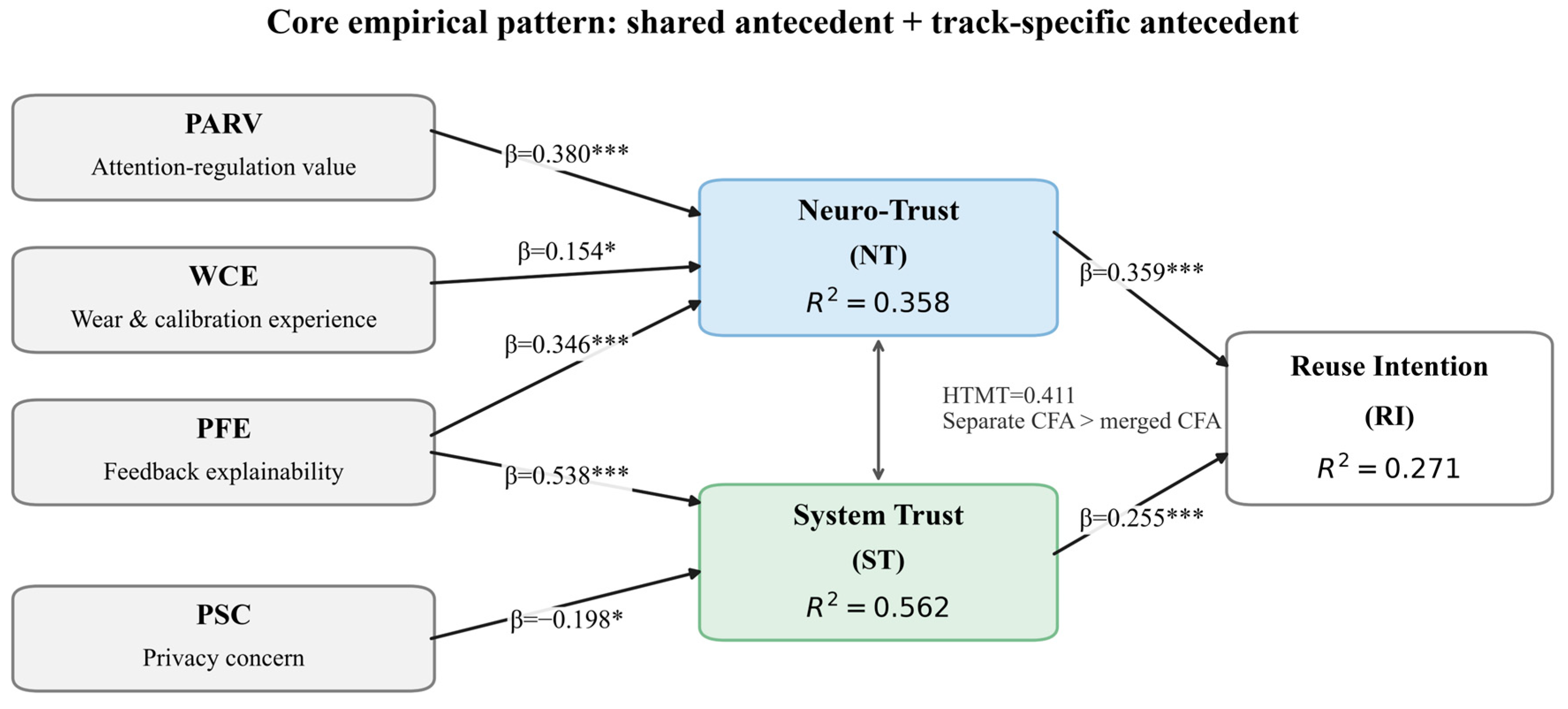
The structural model yielded χ2/df = 2.227, RMSEA = 0.067, CFI = 0.862, and TLI = 0.846. Consistent with the CFA results, absolute fit was acceptable, whereas the incremental fit indices remained below ideal levels. The six candidate antecedents jointly explained 35.8% of the variance in NT and 56.2% of the variance in ST; NT and ST together explained 27.1% of the variance in RI. In the NT equation, PFE (β = 0.346, BC 95% CI [0.149, 0.579]), WCE (β = 0.154, [0.008, 0.303]), and PARV (β = 0.380, [0.209, 0.550]) showed significant positive associations, whereas PC, FS, and PSC were not significant. In the ST equation, PFE showed a significant positive association (β = 0.538, [0.283, 0.809]) and PSC showed a significant negative association (β = −0.198, [−0.380, −0.031]); the remaining paths did not reach p < 0.05.
Direct path-difference tests were then used to evaluate track specificity. Although PFE was positively associated with both NT and ST, the two paths did not differ significantly (Δχ2 = 0.337, p = 0.562), supporting its classification as a shared antecedent. PARV showed the clearest differential pattern: the PARV→NT path was significant, whereas the PARV→ST path was close to zero. Imposing an equality constraint on these two paths significantly worsened model fit (Δχ2(1) = 21.655, p < 0.001), and the bootstrap standardized path difference was Δβ = 0.388, 95% CI [0.168, 0.607], excluding zero. No other candidate antecedent produced comparable evidence of track specificity.
Table 4 further shows that significance for a single path should not be treated as evidence of track specificity. WCE was significantly associated with NT and PSC was significantly associated with ST, yet the corresponding NT–ST path differences were not significant. PARV, in contrast, satisfied both criteria: a significant path to NT and a significant between-track path difference. The overall pattern therefore supports a structure characterized by shared associations together with limited track-specificity rather than two completely independent antecedent systems.
Table 4.
Structural paths and pairwise NT–ST path-difference tests. ns, not statistically significant (p > 0.05).
Both trust dimensions were positively associated with reuse intention. The standardized NT→RI path was β = 0.359 (BC 95% CI [0.127, 0.578]), and the ST→RI path was β = 0.255 (BC 95% CI [0.006, 0.502]). Thus, NT and ST were not only distinguishable at the measurement level but also retained independent associations with future use intention within the same structural model.
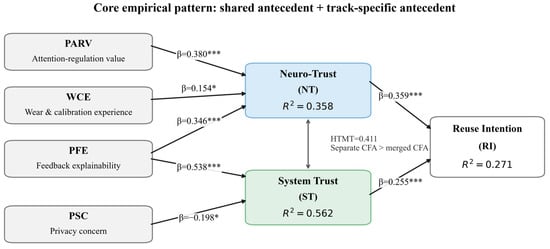
Figure 1 integrates the principal measurement and structural findings. The HTMT value and superior fit of the CFA model in which NT and ST were estimated separately indicate that the two trust dimensions are empirically distinguishable. PFE points to both NT and ST, consistent with a shared-antecedent pattern, whereas PARV forms a significant path only to NT and is supported by the NT–ST path-difference test. Although PSC is negatively associated with ST, it does not satisfy the criterion for ST-specificity based on the direct path-difference test. Both NT and ST point to RI, indicating behavioral relevance for each trust dimension. WCE also retained a significant positive path to NT (β = 0.154, BC 95% CI [0.008, 0.303]) and is therefore included among the paths in Figure 1.
Figure 1.
Core empirical pattern of the dual-track trust model. All six candidate antecedents were entered simultaneously in the SEM; only statistically supported paths are shown. The figure summarizes the measurement distinction between NT and ST, evidence for shared and limited track-specific antecedents, and the behavioral relevance of both trust dimensions. * p < 0.05; *** p < 0.001.
3.3. Predictive Convergence in Held-Out Observations
Predictive analysis provided complementary evidence to the SEM. For NT, Elastic Net outperformed XGBoost (R2CV = 0.202 vs. 0.156; RMSE = 0.623 vs. 0.640; MAE = 0.439 vs. 0.453), indicating that, under the current feature set and sample size, the nonlinear model did not provide additional predictive advantage. For ST, XGBoost only marginally outperformed Elastic Net (R2CV = 0.376 vs. 0.353; RMSE = 0.458 vs. 0.467; MAE = 0.333 vs. 0.343), indicating limited incremental predictive gain from nonlinear modeling; this comparison alone does not identify specific nonlinear or interaction mechanisms. The purpose of the analysis was therefore not algorithm selection per se, but to assess whether the core patterns identified by the structural model recurred in held-out observations. Although Elastic Net attained a slightly higher cross-validated R2 than XGBoost for NT, the out-of-fold XGBoost SHAP ranking still placed PARV first; the NT-oriented role of PARV is therefore not contingent on a single modeling choice and is robust to the use of either the linear or the nonlinear model.
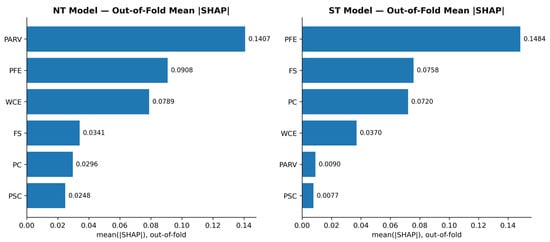
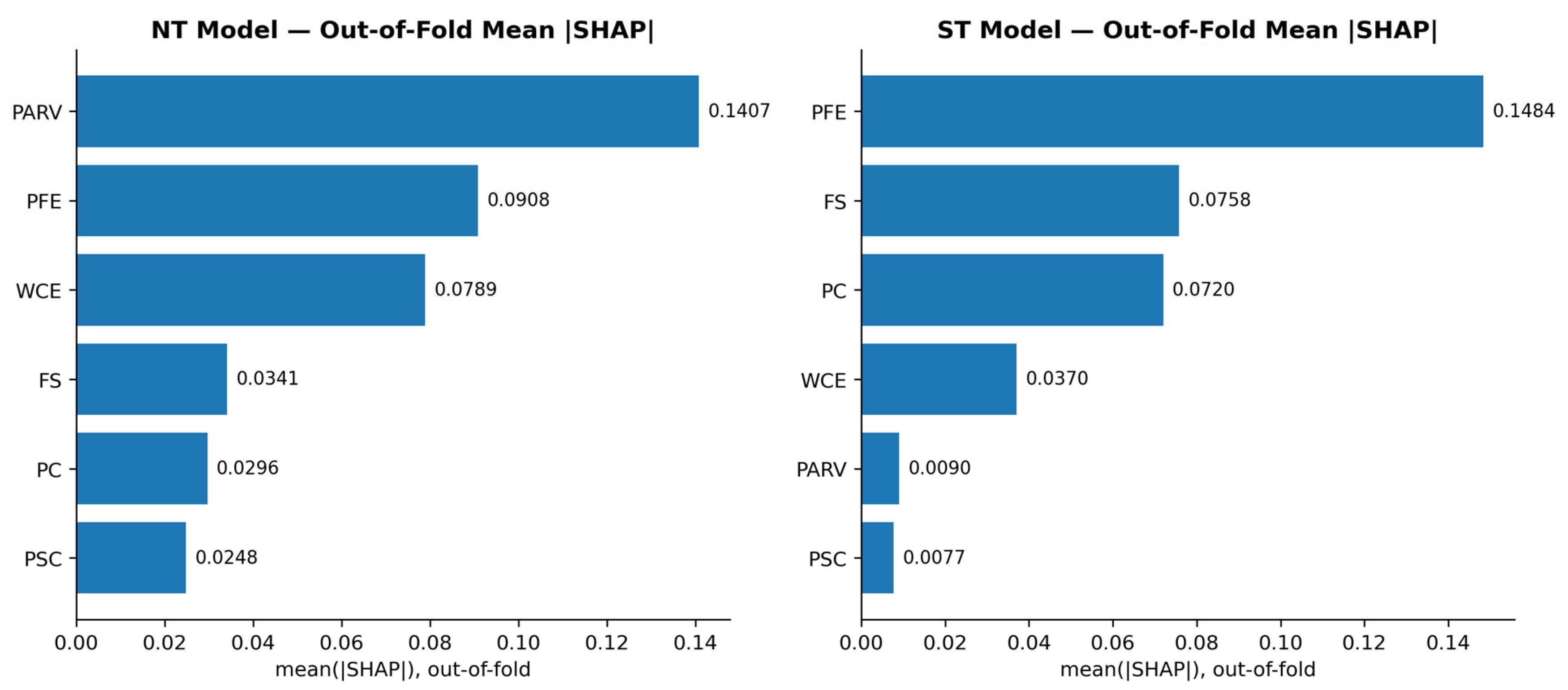
As shown in Figure 2, PARV had the highest out-of-fold mean |SHAP| in the NT model (0.1407), followed by PFE (0.0908) and WCE (0.0789). In the ST model, PFE ranked first (0.1484), followed by FS (0.0758) and PC (0.0720), whereas PARV fell to fifth (0.0090). This ranking reproduces the central contrast observed in the structural model: PFE retained substantial importance for both trust targets, whereas PARV contributed primarily to NT and had little predictive contribution to ST. Because mean |SHAP| reflects the absolute magnitude of predictive contribution, it should not be interpreted as indicating effect direction.
Figure 2.
Out-of-fold mean |SHAP| contributions for predicting NT and ST. Importance values were calculated only on held-out observations in the outer test folds and aggregated across repeated nested cross-validation. The side-by-side rankings highlight the shared predictive importance of PFE across both trust targets and the concentrated contribution of PARV to NT.
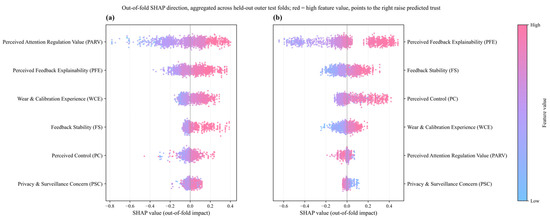
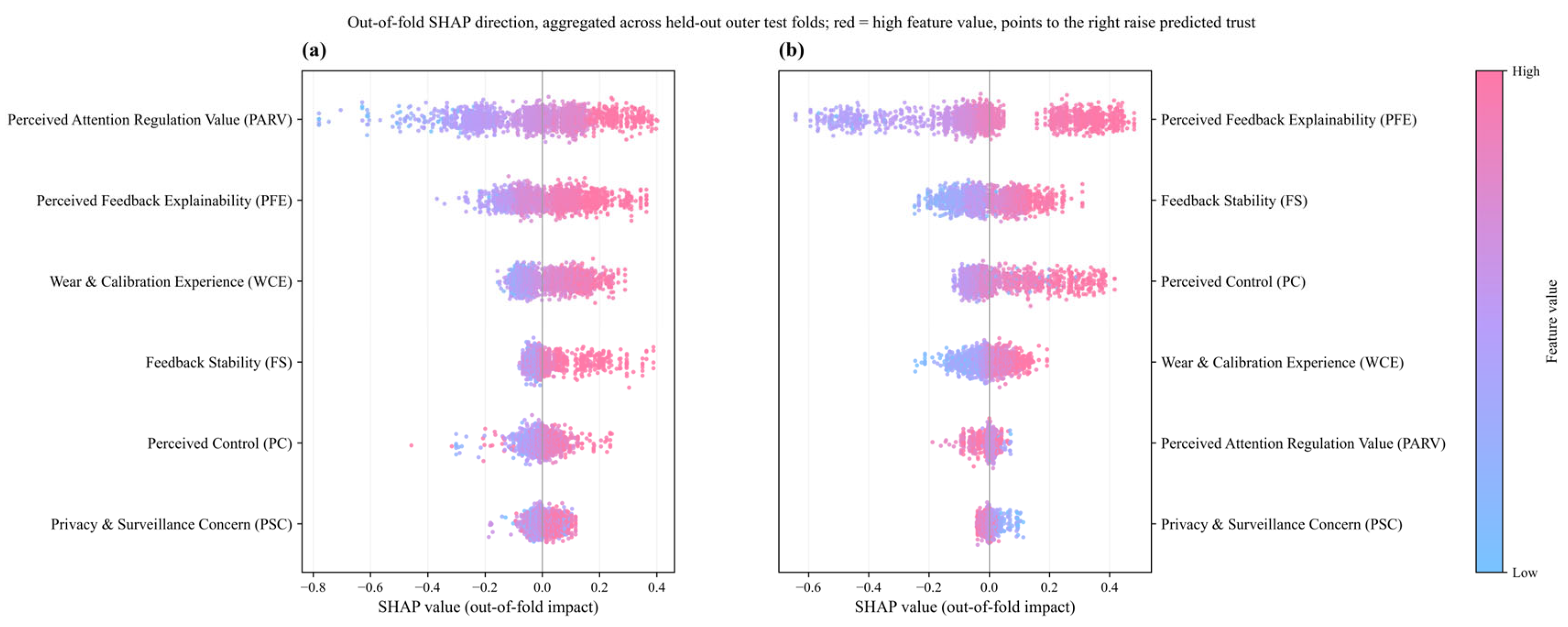
Figure 3 further illustrates contribution direction in the XGBoost ST model. High PFE values were concentrated primarily in the positive SHAP region, whereas lower values were more often associated with negative SHAP values, indicating that greater feedback explainability generally corresponded to higher predicted ST. FS and PC showed weaker tendencies for higher feature values to shift toward positive SHAP values. By contrast, most PARV and PSC contributions were concentrated near zero, indicating limited incremental contribution to ST prediction. Notably, PSC showed a significant negative association with ST in the SEM but low predictive importance in the machine-learning model, indicating incomplete convergence across modeling approaches and further limiting any interpretation of PSC as an ST-specific antecedent. More generally, the SEM tests whether a specific path coefficient differs from zero, whereas out-of-fold mean |SHAP| quantifies relative predictive contribution; a small but statistically significant path (such as PSC→ST) can therefore rank low in predictive importance without contradicting the structural evidence. The NT panel (Figure 3a) shows the corresponding pattern for Neuro-Trust: high PARV and PFE values cluster on the positive side, confirming their positive association with NT, while PSC remains concentrated near zero.
Figure 3.
Out-of-fold SHAP summary beeswarm for (a) Neuro-Trust (NT) and (b) System Trust (ST). Points are aggregated across repeated held-out outer test folds; red denotes higher feature values, and points to the right increase the predicted trust. Adding directional information to the importance ranking in Figure 2, the dual panels show a clear positive contribution of PARV concentrated on NT, strong positive contributions of PFE to both NT and ST, and a downward shift in predicted ST at high PSC values.
Table 5 summarizes the degree of convergence between the structural and predictive evidence. PFE ranked among the most important predictors in both the NT and ST tasks, entering the top 2 in 27/50 and 50/50 outer test folds, respectively. PARV ranked first for NT and entered the top 2 in 48/50 folds, whereas it ranked only fifth for ST and never entered the top 2. By comparison, FS, PC, WCE, and PSC received only partial or method-dependent support. The predictive results therefore further strengthen the interpretation of PFE as a shared factor and PARV as an NT-oriented factor, but they do not justify additional track-specific classifications.
Table 5.
Predictive convergence of the six candidate antecedents based on out-of-fold SHAP. Top 2 frequency was calculated across the 50 outer test folds generated by repeated cross-validation.
4. Discussion
4.1. BCI Trust as Two Related but Distinguishable Trust Targets
The measurement, structural, and predictive analyses converge on a cautious but theoretically meaningful conclusion: trust formed after an initial EEG-BCI attention-training experience among young users need not be treated as a single global evaluation. NT and ST were empirically distinguishable and showed different association patterns with selected experiential factors. NT concerns the credibility of the system’s representation of the user’s own neural or attentional state, whereas ST concerns the reliability and technical capability of the external device–algorithm–training system. Competing CFA models and HTMT first established measurement-level discriminability, while path comparisons and predictive rankings provided additional statistical evidence that the distinction is more than a terminological separation.
The theoretical contribution of the dual-track perspective lies in distinguishing the target of trust rather than positing two completely independent trust systems. A user may consider a BCI system technically reliable while still doubting whether its feedback accurately represents the user’s internal state; conversely, feedback may feel personally meaningful without producing strong confidence in the overall technical system. The present findings support this distinction in the context of an initial attention-training experience, but they do not establish that the same structure generalizes unconditionally to other BCI paradigms.
4.2. Shared Feedback Explainability and the NT-Oriented Role of Attention-Regulation Value
PFE exhibited the clearest shared pattern. Feedback explainability serves a dual function in BCI interaction. First, it helps users understand why the system produces a particular score or state, thereby strengthening semantic coherence between system feedback and subjective experience. Second, explainability contributes to the transparency and comprehensibility of the technological system itself. These dual functions are consistent with the significant PFE paths to both NT and ST, the non-significant difference between the two paths, and the high predictive importance of PFE in both tasks. The directional SHAP distribution for ST further showed that higher PFE values generally corresponded to higher predicted ST.
PARV showed a different pattern. When users perceive that training helps them recognize fluctuations in attention, refocus, or understand how to regulate attention, that experience is directly relevant to whether system feedback is consistent with their own internal state; it need not translate into broader trust in the reliability of the entire technical system. Consistent with this interpretation, PARV was positively associated with NT but showed a path near zero to ST; the NT–ST path difference was significant; and, at the predictive level, PARV made the largest contribution to NT but little contribution to ST. Among the six candidate antecedents, PARV therefore provided the strongest evidence of an NT-oriented association pattern in the present sample.
These findings both align with and extend prior work. Consistent with earlier BCI usability and acceptance studies [1,2,4,6] and with neurofeedback acceptance research based on technology-acceptance models [16], user-centered factors—especially feedback-related transparency—were positively associated with trust and acceptance, and explainability has been shown to strengthen user trust in intelligent systems [17]. The present study extends this literature by treating trust as two target-specific constructs rather than a single overall acceptance rating: whereas prior work largely predicts a general satisfaction or acceptance outcome, the NT-specific role of PARV and the shared role of PFE across NT and ST provide a more fine-grained account of which experiential factors matter for which trust target.
4.3. Limitations and Boundary Conditions
This study has several limitations. First, all constructs were measured once immediately after the initial training experience. The structural paths therefore represent theoretically directed associations and should not be interpreted as causal effects established through experimental manipulation or longitudinal observation. Future work should examine whether NT and ST develop along different trajectories across repeated training sessions and should test experimentally or longitudinally whether changes in explainability or perceived attention-regulation value produce corresponding changes in trust. Second, CFI and TLI were below 0.90 in both the CFA and SEM, indicating that the dual-track framework has not yet achieved ideal fit and requires further replication and measurement refinement. Third, PARV had an AVE of 0.491, slightly below the conventional reference value; although CR, Cronbach’s α, and the factor loadings were acceptable, its measurement should be further optimized in independent samples. Fourth, the SEM and machine-learning analyses used the same 274 participants. Out-of-fold SHAP provides predictive evidence for observations held out within repeated cross-validation, but it cannot substitute for validation in a genuinely independent external sample. Fifth, although Harman’s single-factor test found no dominant common method factor (27.30%), all constructs come from the same post-session self-report questionnaire, so common method variance cannot be fully ruled out and may somewhat inflate shared variance, particularly the apparent shared role of PFE; multi-source or longitudinal measurement would be needed to address this fully.
In addition, the empirical scope of the study is restricted to young adults aged 18–24 years undergoing an initial EEG attention-training experience. The present framework should not be directly generalized to motor-imagery BCI control, clinical rehabilitation systems, or other neurotechnology applications. The degree of differentiation between NT and ST, as well as the relative roles of PFE, PARV, and other experiential variables, may vary across interaction paradigms, task goals, usage durations, usage settings (e.g., supervised group sessions versus independent home or clinical environments), and user populations. In particular, the sample was concentrated in age (all 18–24 years; 52.9% aged 20–21), educational background (80.3% undergraduates), and BCI familiarity (79.9% with no prior hands-on experience). It therefore captures trust judgments formed after a brief initial encounter rather than stable trust built through repeated long-term use; whether trust after extensive practice follows the same NT–ST structure, and whether the present findings extend to ordinary consumers, clinical rehabilitation users, or long-term BCI users, remains to be tested.
5. Conclusions
This study examined whether trust in EEG-based BCI attention training comprises distinguishable trust targets and whether candidate experiential antecedents show shared or differential patterns across those targets. Based on data from 274 young first-time users, the measurement model that estimated NT and ST separately clearly outperformed the merged model. PFE showed a stable shared relationship with both trust dimensions at the structural and predictive levels, whereas PARV was the only NT-oriented candidate antecedent supported by both a direct path-difference test and out-of-fold predictive ranking. Taken together, the results suggest that BCI trust assessment may gain diagnostic value by distinguishing trust in the system’s representation of one’s internal state from trust in the external technological system, thereby providing a more fine-grained basis for user-centered BCI evaluation and feedback design. As the evidence is cross-sectional and derives from young first-time users, the patterns should be read as convergent rather than causal and require replication in independent and more diverse samples.
Author Contributions
Conceptualization, X.Z. and H.F.; methodology, X.Z. and M.H.; software, H.C.; formal analysis, X.Z. and H.C.; investigation, M.H.; data curation, H.C. and Q.D.; visualization, H.C.; writing—original draft preparation, X.Z.; writing—review and editing, H.C. and H.F.; supervision, H.F.; resources, H.F.; project administration, X.Z. All authors have read and agreed to the published version of the manuscript.
Funding
This research was funded by the General Program of the China Postdoctoral Science Foundation (Project No. 2025M783666) and the Scientific Research Foundation of Wuhan Institute of Technology (Project No. 2026YB09).
Institutional Review Board Statement
The study was conducted in accordance with the Declaration of Helsinki and approved by the Academic Ethics Committee of Wuhan Institute of Technology (Approval No. WIT-1-2026-6, approved on 30 May 2026).
Informed Consent Statement
Verbal informed consent was obtained from all participants prior to data collection, in line with the protocol approved by the Academic Ethics Committee of Wuhan Institute of Technology (Approval No. WIT-1-2026-6). Participation was voluntary and anonymous, and completion and return of the questionnaire were taken as evidence of consent. Verbal rather than written consent was used because data were collected in group sessions immediately after a standardized training task and the protocol was designed to preserve anonymity; this procedure was specified and approved in advance by the Academic Ethics Committee.
Data Availability Statement
The raw interview transcripts and survey data are not publicly available because they contain sensitive information related to participants’ personal perceptions and experiences of a first-time EEG-BCI attention-training session, together with demographic information. To protect participant confidentiality and privacy, all data were anonymized before analysis, and no personally identifiable information is reported in the manuscript. The de-identified construct scores for all 274 participants, the reproducible analysis scripts (CFA/SEM, the Harman common-method-bias test, Elastic Net, XGBoost, and SHAP), the aggregated statistical results, the measurement items, and step-by-step reproduction notes are publicly available at https://github.com/caohancheng786-a11y/NeuroTrust-Dual-Track (accessed on 10 October 2026). The item-level raw data needed to rebuild the scores are available from the corresponding author upon reasonable request, subject to participant confidentiality requirements and institutional ethical approval.
Acknowledgments
During the preparation of this work, the authors used generative AI tools only to improve language readability and formatting. After using these tools, the authors reviewed and edited the content as needed and take full responsibility for the content of the publication.
Conflicts of Interest
The authors declare no conflicts of interest.
Abbreviations
The following abbreviations are used in this manuscript:
| AIC | Akaike information criterion |
| AVE | average variance extracted |
| BC | bias-corrected (bootstrap) |
| BCI | brain–computer interface |
| BIC | Bayesian information criterion |
| CFA | confirmatory factor analysis |
| CFI | comparative fit index |
| CI | confidence interval |
| CR | composite reliability |
| EEG | electroencephalography |
| FS | feedback stability |
| GenAI | generative artificial intelligence |
| HTMT | heterotrait–monotrait ratio |
| MAE | mean absolute error |
| NT | Neuro-Trust |
| OOF | out-of-fold |
| PARV | perceived attention-regulation value |
| PC | perceived control |
| PFE | perceived feedback explainability |
| PSC | privacy and surveillance concern |
| R2CV | cross-validated coefficient of determination |
| RI | reuse intention |
| RMR | root mean residual |
| RMSEA | root mean square error of approximation |
| RMSE | root mean squared error |
| SEM | structural equation modeling |
| SHAP | SHapley Additive exPlanations |
| ST | System Trust |
| TLI | Tucker–Lewis index |
| WCE | wear and calibration experience |
| XGBoost | extreme gradient boosting |
References
- Lyu, X.; Ding, P.; Li, S.; Dong, Y.; Su, L.; Zhao, L.; Gong, A.; Fu, Y. Human factors engineering of BCI: An evaluation for satisfaction of BCI based on motor imagery. Cogn. Neurodyn. 2023, 17, 105–118. [Google Scholar] [CrossRef] [Scilit]
- Pan, H.; Ding, P.; Wang, F.; Li, T.; Zhao, L.; Nan, W.; Fu, Y.; Gong, A. Comprehensive evaluation methods for translating BCI into practical applications: Usability, user satisfaction and usage of online BCI systems. Front. Hum. Neurosci. 2024, 18, 1429130. [Google Scholar] [CrossRef] [Scilit]
- Bellos, C.; Stefanou, K.; Tzallas, A.; Stergios, G.; Tsipouras, M. Methods and approaches for user engagement and user experience analysis based on electroencephalography recordings: A systematic review. Electronics 2025, 14, 251. [Google Scholar] [CrossRef] [Scilit]
- Lombardi, I.; Buono, M.; Giugliano, G.; Senese, V.P.; Capece, S. Usability and acceptance analysis of wearable BCI devices. Appl. Sci. 2025, 15, 3512. [Google Scholar] [CrossRef] [Scilit]
- Davis, F.D. Perceived usefulness, perceived ease of use, and user acceptance of information technology. MIS Q. 1989, 13, 319–340. [Google Scholar] [CrossRef] [Scilit]
- Xia, R.; Yang, S. Factors influencing the social acceptance of brain-computer interface technology among Chinese general public: An exploratory study. Front. Hum. Neurosci. 2024, 18, 1423382. [Google Scholar] [CrossRef] [Scilit]
- Beltrão, G.; Sousa, S.; Lamas, D. Assessing the measurement invariance of the Human–Computer Trust Scale. Electronics 2025, 14, 1806. [Google Scholar] [CrossRef] [Scilit]
- Lee, J.D.; See, K.A. Trust in automation: Designing for appropriate reliance. Hum. Factors 2004, 46, 50–80. [Google Scholar] [CrossRef] [Scilit]
- Hoff, K.A.; Bashir, M. Trust in automation: Integrating empirical evidence on factors that influence trust. Hum. Factors 2015, 57, 407–434. [Google Scholar] [CrossRef] [Scilit]
- Fornell, C.; Larcker, D.F. Evaluating structural equation models with unobservable variables and measurement error. J. Mark. Res. 1981, 18, 39–50. [Google Scholar] [CrossRef] [Scilit]
- Henseler, J.; Ringle, C.M.; Sarstedt, M. A new criterion for assessing discriminant validity in variance-based structural equation modeling. J. Acad. Mark. Sci. 2015, 43, 115–135. [Google Scholar] [CrossRef] [Scilit]
- Chen, T.; Guestrin, C. XGBoost: A scalable tree boosting system. In Proceedings of the 22nd ACM SIGKDD International Conference on Knowledge Discovery and Data Mining, San Francisco, CA, USA, 13–17 August 2016; pp. 785–794. [Google Scholar] [CrossRef] [Scilit]
- Lundberg, S.M.; Lee, S.-I. A unified approach to interpreting model predictions. In Advances in Neural Information Processing Systems 30; Curran Associates, Inc.: Red Hook, NY, USA, 2017. [Google Scholar]
- Hair, J.F.; Black, W.C.; Babin, B.J.; Anderson, R.E. Multivariate Data Analysis, 8th ed.; Cengage: Andover, UK, 2019. [Google Scholar]
- Kline, R.B. Principles and Practice of Structural Equation Modeling, 4th ed.; Guilford Press: New York, NY, USA, 2016. [Google Scholar]
- Dias, S.B.; Jelinek, H.F.; Hadjileontiadis, L.J. Wearable neurofeedback acceptance model for students’ stress and anxiety management in academic settings. PLoS ONE 2024, 19, e0304932. [Google Scholar] [CrossRef] [Scilit]
- Shin, D. The effects of explainability and causability on perception, trust, and acceptance: Implications for explainable AI. Int. J. Hum.-Comput. Stud. 2021, 146, 102551. [Google Scholar] [CrossRef] [Scilit]

Disclaimer/Publisher’s Note: The statements, opinions and data contained in all publications are solely those of the individual author(s) and contributor(s) and not of MDPI and/or the editor(s). MDPI and/or the editor(s) disclaim responsibility for any injury to people or property resulting from any ideas, methods, instructions or products referred to in the content. |
© 2026 by the authors. Licensee MDPI, Basel, Switzerland. This article is an open access article distributed under the terms and conditions of the Creative Commons Attribution (CC BY) license.