


Abstract
Federated Graph Neural Networks (FedGNNs) have emerged as a promising paradigm for decentralized graph learning across distributed data silos. However, the influence of underlying communication topologies on model accuracy and efficiency remains underexplored. This study presents a topology-aware benchmarking framework for federated GNNs, systematically evaluating the impact of network structure and aggregation strategy on performance and communication overhead. The proposed framework functions as a synthetic, communication-level digital twin that emulates Federated Learning interactions and topology-dependent dynamics under controlled conditions. Four learning schemes—Centralized, Local, FedAvg, and FedAvg-Fedadam—were assessed across three representative topologies: Barabási–Albert (BA), Watts–Strogatz (WS), and Erdős–Rényi (ER). Results demonstrate that centralized training achieved the highest mean ROC-AUC (0.63), while FedAvg-Fedadam attained the best F1-score (0.038), balancing local adaptation and global convergence. Among topologies, BA and WS yielded higher average AUC values (approximately 0.57 and 0.56, respectively) than ER (approximately 0.39). Communication analysis revealed FedAvg as the most efficient strategy, requiring only approximately 3.8 × 105 bytes cumulatively. These findings highlight key trade-offs between accuracy, robustness, and communication efficiency in federated graph learning and provide empirical guidance for topology-aware optimization of distributed GNNs. While the experiments rely on representative synthetic topologies, the insights offer indicative relevance and potential applicability to Internet-of-Things (IoT), vehicular, and cyber-physical networks, where communication structure and bandwidth constraints critically influence collaborative intelligence. By modeling canonical connectivity patterns and releasing our code and data, the proposed benchmarking framework offers a reproducible basis for comparing emerging federated graph architectures under constrained communication conditions.
1. Introduction
Graph Neural Networks (GNNs) have become a cornerstone in modern graph analytics, enabling deep representation learning for non-Euclidean data such as social, biological, and sensor networks. By combining message passing and node aggregation, GNNs can effectively capture both local connectivity and high-order relational patterns. Their success in centralized settings, however, raises major challenges in privacy, communication cost, and data heterogeneity when graph data are distributed across multiple devices or institutions [1].
Federated Learning (FL) provides a natural paradigm for decentralized model training, where local nodes collaboratively update shared model parameters without revealing raw data [2]. Recent works have extended FL to graph domains, resulting in Federated Graph Neural Networks (FedGNNs) that allow learning over distributed graph partitions [1,3]. Despite the promise of privacy preservation and scalability, FedGNNs face persistent difficulties: (i) model degradation under non-IID data, (ii) high communication overhead due to large message exchanges, and (iii) limited understanding of how network topology influences model behavior and convergence. Recent studies have started to address these challenges by incorporating graph-topological priors into federated optimization, showing that structural awareness can significantly enhance convergence under heterogeneous connectivity [4,5,6].
This work is intended as a topology-aware benchmarking and empirical analysis study of federated graph neural networks, rather than as a proposal of a new federated optimization algorithm.
While communication efficiency has been addressed through various compression and aggregation schemes [7], the topology of the underlying communication network itself remains largely overlooked. In practical deployments—such as IoT sensor graphs, vehicular networks, and smart-city infrastructures—communication links rarely follow idealized uniform or fully connected structures. Instead, they exhibit structural patterns resembling Barabási–Albert (BA) scale-free networks, Watts–Strogatz (WS) small-world networks, or Erdős–Rényi (ER) random graphs, each with distinct degree distributions and clustering coefficients [8]. This structural diversity has recently been linked to stability and fairness in FL over dynamic and resource-constrained systems [9,10,11]. Understanding how these topologies affect convergence, robustness, and performance of federated GNNs is therefore essential for both algorithmic design and deployment optimization.
In this work, we instantiate the benchmark on a node-level binary classification task that reflects edge-based anomaly detection: labels distinguish between normal and anomalous behavior at the client level. This setting mirrors common monitoring use cases in IoT and vehicular networks, where anomalies correspond to rare but critical deviations from nominal operation. In this work, edge-based anomaly detection is formulated as a node-level binary classification task performed at the network edge, where each client is labeled as normal or anomalous based on its local behavioral features.
In practical IoT and vehicular environments, anomaly detection typically involves identifying abnormal communication patterns, malfunctioning devices, or compromised nodes whose behavior diverges from nominal operation. In our benchmark, each client corresponds to a node whose local features summarize its activity, and anomalies are modeled as rare events that reflect misconfigurations, sensor failures, or unexpected communication bursts. This formulation aligns with common edge-based monitoring pipelines, where decentralized devices must detect irregularities locally while still contributing to a global model. By adopting a node-level binary classification task, the framework captures the essential characteristics of edge-centric anomaly detection while remaining compatible with synthetic graph topologies used to isolate and analyze the effects of communication structure.
To address this gap, we empirically evaluate a topology-aware benchmarking framework that systematically evaluates federated GNNs across multiple topological and algorithmic dimensions. Four representative training strategies are considered: (1) Centralized learning, used as the upper-bound reference; (2) Local learning, representing independent client training; (3) FedAvg, the classical aggregation baseline; and (4) FedAvg-Fedadam, an adaptive federated optimizer combining FedAdam’s dynamic learning rates with FedAvg’s aggregation efficiency [12]. Each approach is evaluated across BA, WS, and ER topologies under identical hyper-parameters and random seeds to ensure methodological consistency.
In this context, the term ‘synthetic digital twin’ is used to denote a software-based emulation of the federated communication and learning process, capturing topology-dependent interactions, aggregation dynamics, and message exchanges, rather than a physical or cyber-physical replica of a deployed IoT system.
The framework enables fine-grained comparison in terms of (i) ROC-AUC, (ii) F1-score, and (iii) cumulative communication cost, all computed from per-round and final-round statistics. Quantitative results indicate that centralized training achieves the highest AUC (0.63), while FedAvg-Fedadam yields the best F1 (0.038), highlighting the trade-off between accuracy and communication efficiency. Moreover, BA and WS topologies consistently outperform ER, suggesting that higher connectivity and clustering positively influence federated convergence.
The main contributions of this study are as follows:
- A reproducible benchmarking framework for federated GNNs that jointly considers communication topology, training strategy, and evaluation metrics.
- A quantitative analysis of topology effects on convergence and communication efficiency across BA, WS, and ER structures.
- Empirical insights into trade-offs between performance and communication cost, revealing that adaptive strategies such as FedAvg-Fedadam balance accuracy and efficiency better than baseline federated schemes.
- Publicly available datasets and scripts, ensuring transparency and enabling further comparative research on topology-aware federated learning.
Rather than aiming for exhaustive coverage of all existing federated graph learning algorithms, this study adopts a focused benchmarking approach. The selected learning strategies represent widely used baselines that span centralized, local, and federated optimization paradigms, allowing the impact of communication topology to be isolated and analyzed under controlled conditions.
To isolate the impact of communication topology, we focus on widely adopted federated optimization baselines rather than on architecture-specific or topology-aware FedGNN variants, whose additional design choices could confound the analysis. By focusing on topology-induced heterogeneity rather than on explicit non-IID modeling, the benchmark isolates the structural dimension of FL dynamics.
The remainder of this paper is organized as follows: Section 2 reviews related work on federated GNNs and communication-efficient FL methods. Section 3 details the experimental setup, topologies, and metrics. Section 4 presents the results and statistical analysis. Section 5 discusses the implications of the findings, and Section 6 concludes the paper with future research directions.
2. Related Work
2.1. Federated Learning and Communication Efficiency
Federated Learning was first formalized by [2] as a distributed optimization framework that allows collaborative model training without centralizing data. Subsequent efforts have sought to reduce communication overhead, which is a major bottleneck in large-scale federated systems.
Gradient compression, adaptive learning rates, and server-side aggregation schemes such as FedAdam and FedYogi were proposed to accelerate convergence [12,13]. Comprehensive surveys [7,8] further classify techniques according to communication cost, privacy, and heterogeneity tolerance. Recent works have begun to challenge this assumption by exploring communication-aware scheduling and topology-adaptive aggregation [5,9], demonstrating that even small deviations from full connectivity can markedly alter convergence dynamics.
Moreover, decentralized coordination strategies such as graph-based gossip FL [14] highlight the importance of structural resilience and load balancing across communication layers. However, most of these studies assume ideal or fully connected communication graphs, overlooking the topological structure of participating nodes.
Recent studies have also explored complementary dimensions of federated learning beyond communication topology. For instance, ConfShield [15] introduces a dual-stage fusion framework to enhance robustness and privacy in cloud-based federated learning environments, while Fluke [16] provides a general-purpose utility framework for systematic experimentation and evaluation of federated learning algorithms. Other works have focused on domain-specific applications, such as weakly supervised medical image segmentation using federated learning combined with style perturbation and clustering [17]. While these approaches address important challenges related to privacy, robustness, or application-specific modeling, they are largely orthogonal to the topology-aware benchmarking perspective adopted in this work, which focuses on isolating the impact of communication structure under controlled conditions.
2.2. Federated Graph Neural Networks (FedGNNs)
The emergence of GNNs motivated their integration into the FL paradigm, giving rise to FedGNNs—models that jointly exploit graph connectivity and data decentralization. Initial formulations such as SpreadGNN [3] introduced serverless multi-task learning for distributed graphs, while ESA-FedGNN [1] enhanced privacy through secure aggregation. More recently, Ref. [18] proposed a privacy-preserving FedGNN for supply-chain prediction, demonstrating that collaborative graph training can outperform isolated local models even under strict privacy constraints.
Despite these advances, empirical evaluation of topology effects—for example, how small-world or scale-free structures influence convergence and performance—remains scarce. Emerging studies such as FedAWT [6] and Structural Entropy Federated Graph Learning (SEFGL) [19] have started to investigate structural heterogeneity in federated graph scenarios, but they typically rely on fixed or synthetic topologies without cross-topology benchmarking.
Our work expands this perspective by systematically contrasting canonical topologies (BA, WS, ER) under multiple federated optimizers, bridging an important gap in reproducible FedGNN evaluation.
2.3. Topology-Aware and Structural Perspectives in Federated Learning
Only a handful of recent works have explicitly examined topology-aware federated learning. In [20], the authors investigated dynamic communication graphs and showed that network centrality significantly impacts gradient staleness.
Similarly, the authors in [21] proposed a dynamic topology optimization framework for decentralized federated learning, where client-to-client neighbor selection is adaptively updated to minimize communication latency and improve convergence efficiency. Nonetheless, these studies primarily focus on node connectivity among clients rather than evaluating statistical performance across different topology classes such as Barabási–Albert (BA), Watts–Strogatz (WS), and Erdős–Rényi (ER).
Recent IEEE and ACM contributions emphasize that topology-aware aggregation can enhance resilience to straggler effects and link failures [5,8,22], while dynamic graph regularization improves global fairness and energy efficiency [23]. However, no existing benchmark provides a unified, reproducible evaluation across multiple network models and federated optimization schemes—an explicit focus of this work.
2.4. Summary and Research Gap
Existing literature on FL and FedGNNs has established solid foundations in optimization and communication reduction. Several recent works have proposed topology-aware or architecture-specific federated graph learning methods. While these approaches are highly relevant, they are not directly comparable within the scope of a controlled topology-focused benchmark, as they introduce additional architectural assumptions.
However, the structural characteristics of communication topologies—which in real-world IoT and cyber-physical networks are far from uniform—remain underexplored. To bridge this gap, the present study introduces a unified benchmarking framework that quantifies the influence of topology on federated GNN convergence, efficiency, and robustness.
By incorporating topology-specific simulations (BA, WS, ER) and multiple aggregation schemes, it provides novel empirical evidence and design insights for the deployment of topology-aware federated graph systems. Furthermore, the framework aligns with emerging benchmark initiatives such as FedScale [24] and FedGraphNN [25], while uniquely extending them toward structural and communication-topology realism.
3. Methods
3.1. Data and Topology Generation
In this benchmark, data heterogeneity is not explicitly controlled through a tunable non-IID parameter. Instead, heterogeneity arises implicitly from the decentralized graph structure and the topology-driven assignment of node features and anomaly labels.
To analyze how communication structure influences the performance of federated graph learning, we adopt three canonical synthetic communication topologies: Barabási–Albert (BA), Watts–Strogatz (WS), and Erdős–Rényi (ER). These graph models reflect structural patterns frequently observed in Internet-of-Things (IoT), vehicular, and cyber-physical networks, including hub-dominated connectivity (BA), small-world clustering (WS), and uniform random linking (ER) [8].
All topologies are generated with the same number of nodes and edges—500 nodes and 1250 edges—ensuring comparability across strategies. Graph density and rewiring parameters are adjusted to preserve each model’s characteristic properties while maintaining a similar mean degree.
Each node is associated with a 12-dimensional feature vector capturing aggregated activity indicators (e.g., traffic intensity and communication statistics). The anomaly-detection task is formulated as a binary node-classification problem where labels denote normal (0) or anomalous (1) behavior. Anomalies correspond to rare deviations from typical operation and account for 5% of all nodes, reflecting realistic class imbalance in edge-based monitoring scenarios. After topology generation, nodes are partitioned across clients following the connectivity structure imposed by each graph. Each node represents an edge device participating in federated learning, and anomalies correspond to abnormal node behavior rather than to individual communication links or packet-level events.
3.2. Federated Learning Strategies
We evaluate four representative learning schemes:
- Centralized training, used as an upper performance bound where all data are globally accessible. It offers an upper performance bound but assumes full data availability and high communication cost.
- Local training, in which clients train models independently without parameter sharing. This eliminates communication overhead, but suffers from limited generalization and high variance.
- FedAvg [2], the classical synchronous aggregation method that averages local model updates at each round. FedAvg provides communication-efficient aggregation but may converge slowly under heterogeneity.
- FedAvg-Fedadam [12], which incorporates adaptive moment estimation into the aggregation step to stabilize convergence under heterogeneous data. It improves convergence stability via adaptive optimization at the cost of increased computation.
All strategies are run under identical hyperparameters to ensure methodological consistency. Each simulation executes 8 global communication rounds, and clients perform 1 local epoch per round using a mini-batch size of 32. The learning rate is fixed at 10−3, and early stopping is applied consistently across all methods. Performance metrics are averaged over repeated runs using independent graph partitions and random seeds.
3.3. Graph Neural Network Architecture
The local learner consists of a lightweight Graph Convolutional Network (GCN) composed of two graph-convolutional layers with hidden dimensions of 16 and 16, respectively, followed by a dense classification head. Each GCN layer uses ReLU activation and a dropout rate of 0.2 to mitigate overfitting.
Training employs the Adam optimizer with a learning rate of 10−3. Early stopping is applied based on validation loss using a patience of 5 rounds, with a maximum horizon of 8 communication rounds. All architectural and optimization parameters are kept identical across topologies and federated strategies to isolate the effect of the communication graph.
3.4. Evaluation Metrics
Model performance is assessed using the following:
- ROC-AUC, capturing discriminative ability under class imbalance;
- F1-score, reflecting precision–recall trade-offs critical for anomaly detection;
- Cumulative communication cost, measured as the total number of bytes exchanged between clients and the server during training.
Metrics are computed at every communication round and for the final global model. Numerical results and comparative analyses are reported separately in Section 4. Given the highly imbalanced nature of the anomaly detection task, absolute F1 values are expected to be low; accordingly, F1 is primarily used here as a comparative metric to assess relative differences across strategies and topologies.
3.5. Experimental Setup
Experiments are conducted using Python 3.10 and PyTorch 2.8 within the FedTwinGNN v3.2 framework, which functions as a synthetic digital twin of the federated communication system. FedTwinGNN emulates client interactions, message exchanges, and model updates without requiring deployment on physical devices.
Simulations run on a workstation equipped with an Intel i7 CPU and 8 GB RAM. Reproducibility is ensured through fixed seeds, and each configuration (strategy × topology) is repeated across five independent random seeds, generating fresh graph partitions and weight initializations. Statistical variability is quantified using 95% confidence intervals, estimated via non-parametric bootstrap resampling with 1000 replicates.
The use of synthetic communication topologies is a deliberate design choice that enables controlled analysis of topology-dependent effects, rather than an attempt to replicate a specific real-world IoT or vehicular deployment. By emulating client participation, communication rounds, and aggregation behavior, the proposed framework operates as a synthetic communication-level digital twin of the FL system. The three considered communication topologies—Barabási–Albert, Watts–Strogatz, and Erdős–Rényi—were selected as canonical models that capture distinct and widely studied structural properties, including hub-dominated connectivity, small-world clustering, and random linking. The communication analysis considers raw model aggregation without compression, as the focus of this benchmark is on topology-dependent effects rather than on communication optimization techniques. Hyperparameters were chosen based on standard practice in prior federated learning and GNN studies and were kept identical across all experimental configurations to ensure comparability.
All scripts, configuration files, and per-round outputs are publicly available at https://osf.io/jegr4/ (accessed on 11 December 2025). The repository contains raw simulation outputs, analysis notebooks, and plotting scripts to ensure full experimental reproducibility.
4. Results
4.1. Overall Performance Trends
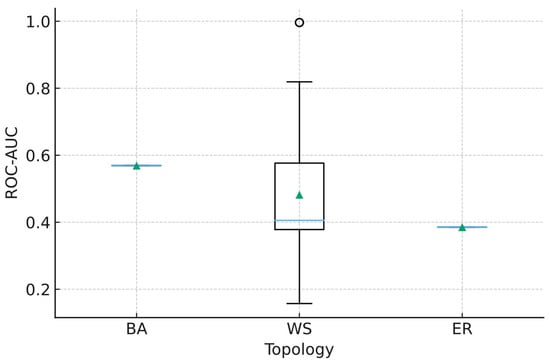
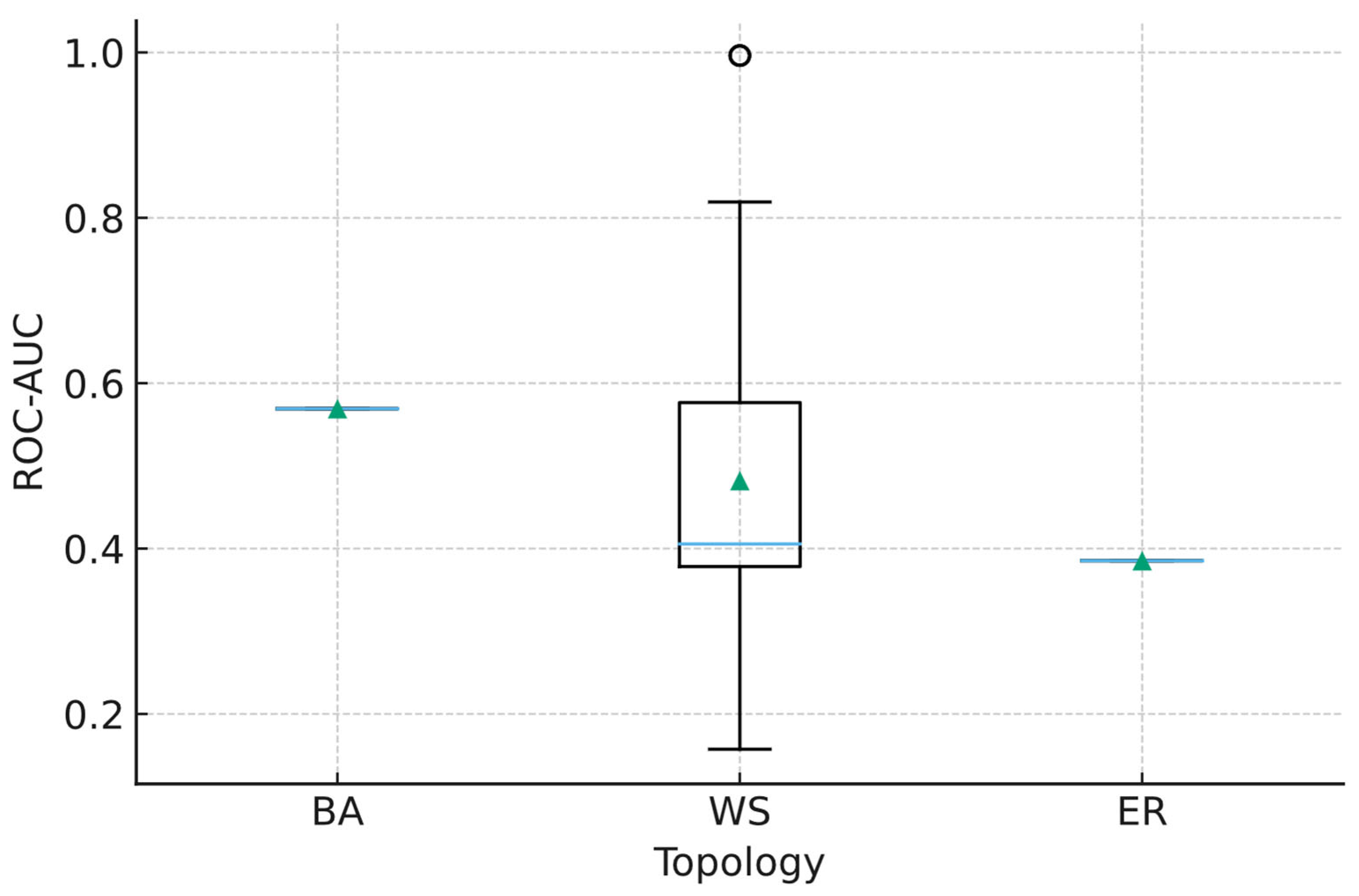
Figure 1 summarizes the distribution of ROC-AUC scores across the three network topologies. Centralized training achieved the highest discriminative performance with a mean AUC of 0.63, establishing the upper performance bound. Among the federated schemes, FedAvg-Fedadam approached this performance while maintaining stability across topologies, whereas Local and FedAvg exhibited greater variability.
Figure 1.
Distribution of ROC-AUC across Barabási–Albert (BA), Watts–Strogatz (WS), and Erdős–Rényi (ER) communication topologies. Boxplots summarize the median and interquartile range across 5 independent runs, with whiskers indicating the minimum and maximum values and markers denoting the run-wise means. Centralized training provides the upper performance bound, while FedAvg-Fedadam demonstrates robust behavior across heterogeneous topologies.
Both Barabási–Albert (BA) and Watts–Strogatz (WS) graphs produced higher mean AUCs (approximately 0.57 and 0.56, respectively) compared with the Erdős–Rényi (ER) baseline (approximately 0.39), indicating that structured connectivity and higher clustering coefficients enhance global convergence.
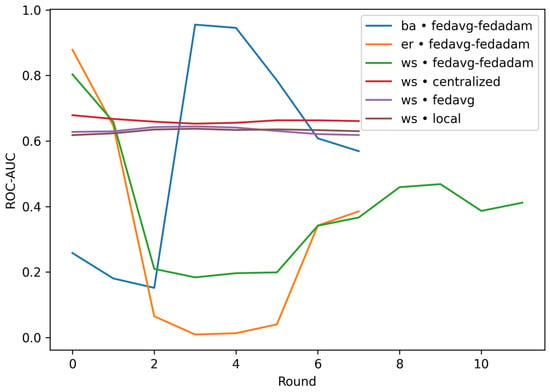
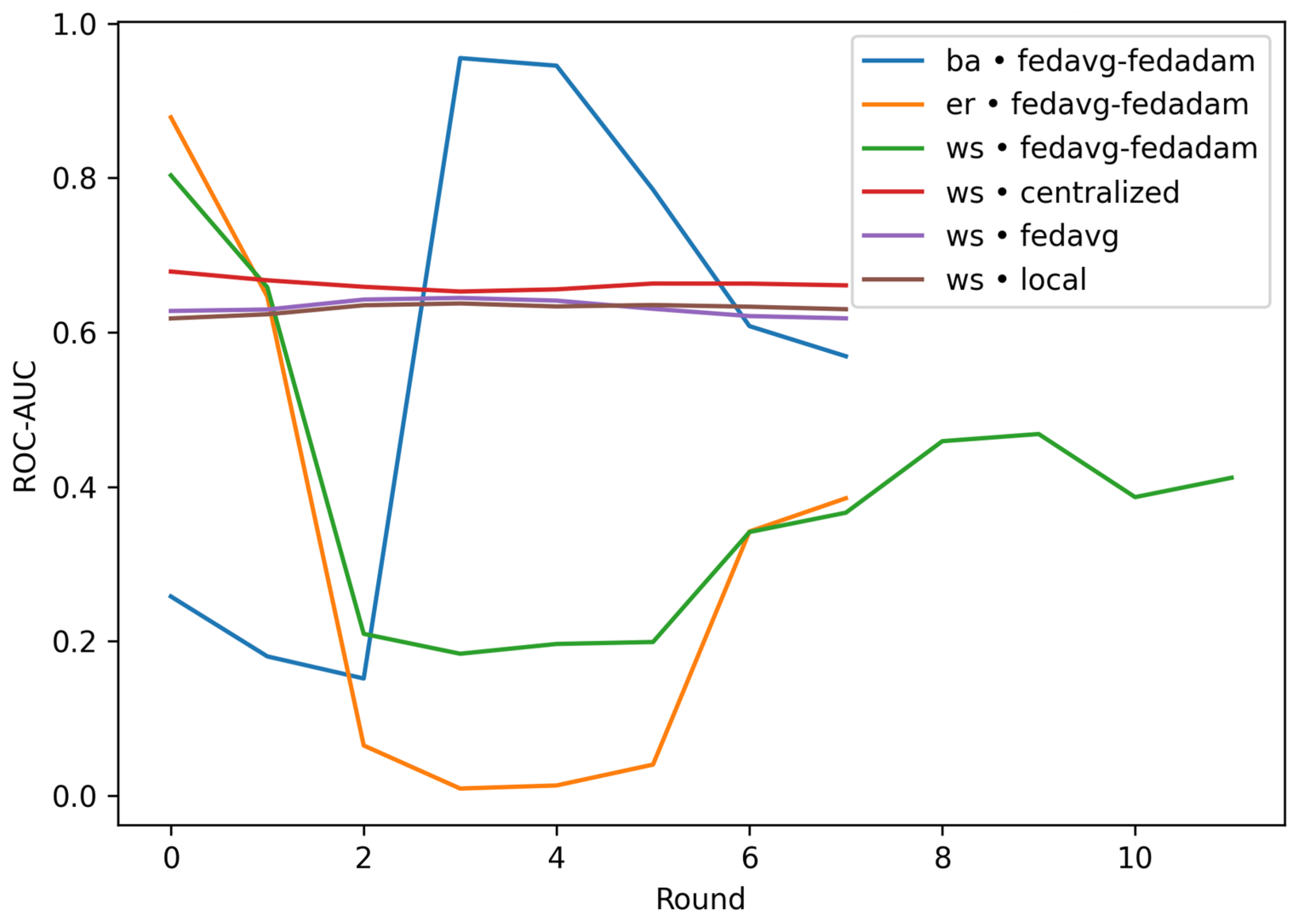
Figure 2 illustrates the evolution of ROC-AUC over communication rounds for the three representative topologies (BA, WS, ER) under the main federated schemes. The trajectories highlight distinct convergence dynamics, with scale-free and small-world networks achieving faster stabilization than random graphs.
Figure 2.
Evolution of ROC-AUC across training rounds for BA, WS, and ER topologies under Centralized, FedAvg, and FedAvg-Fedadam strategies. Curves show the mean performance across 5 independent seeds, and shaded regions (if enabled) correspond to ±1 standard deviation. BA and WS topologies display faster recovery and higher final AUC values, highlighting the stabilizing effect of hub connectivity and small-world clustering.
Table 1 details the mean ± standard-deviation AUC values per strategy and topology.
Table 1.
Mean ± standard deviation of ROC-AUC values across strategies and topologies, computed over 5 independent runs for each (strategy, topology) configuration.
4.2. Communication–Performance Trade-Off
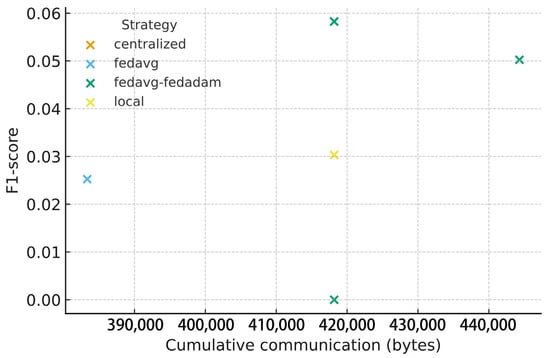
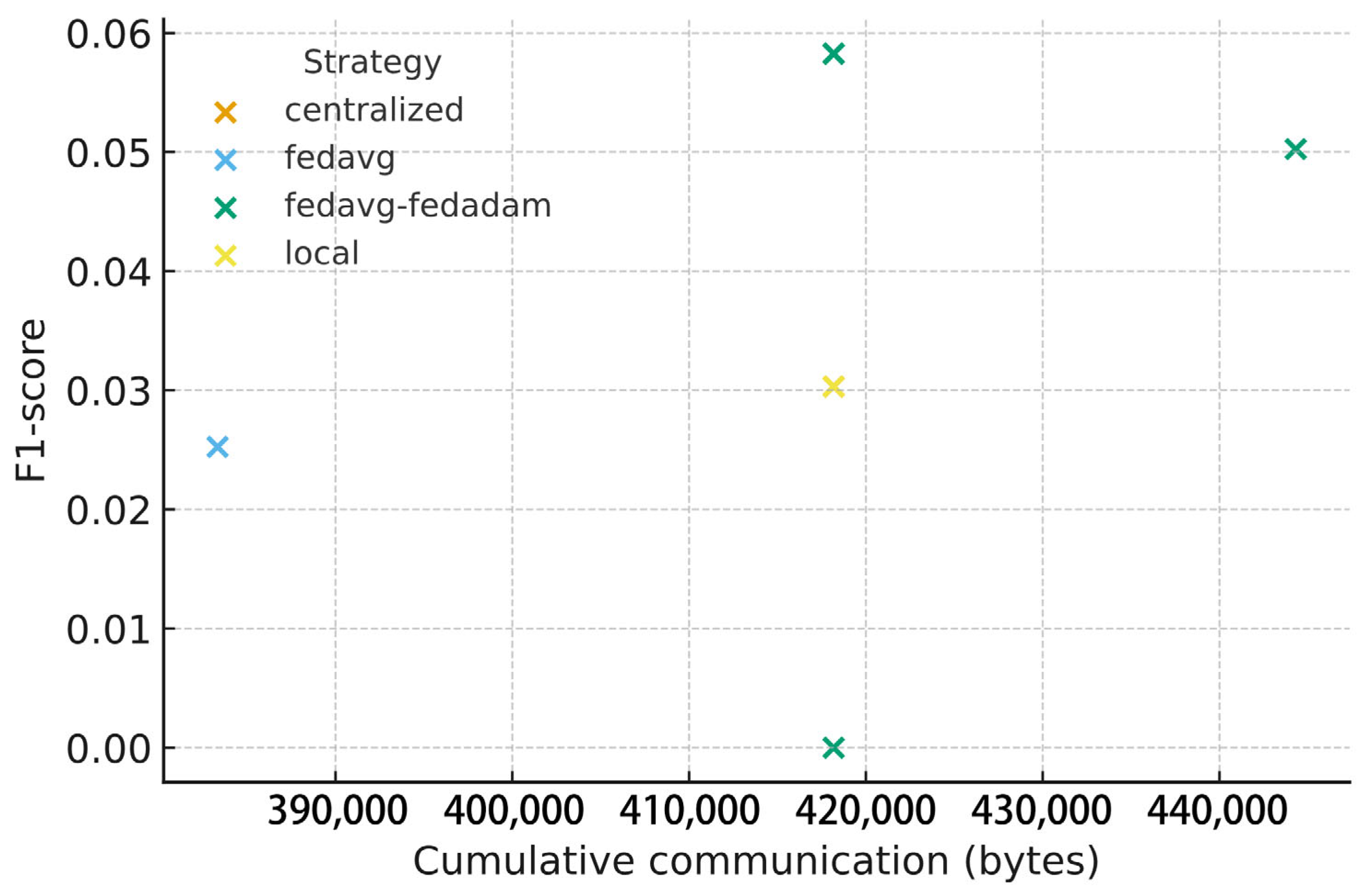
Figure 3 illustrates the F1-score versus cumulative communication cost.
Figure 3.
Final-round F1-score versus cumulative communication cost for all strategies. Points represent mean values across 5 independent runs; vertical bars (if shown) correspond to ±1 standard deviation. FedAvg-Fedadam attains the best accuracy–efficiency trade-off, while FedAvg minimizes bandwidth usage.
The trade-off curve highlights that FedAvg requires the least bandwidth (approximately 3.8 × 105 bytes cumulative), but achieves moderate F1 performance, while FedAvg-Fedadam attains higher F1 (0.038) at slightly greater cost, representing the best efficiency–accuracy compromise. Local models display high dispersion and unstable convergence, underscoring the necessity of federated aggregation for consistency. Centralized training unsurprisingly achieves the highest accuracy but incurs the greatest communication overhead. Table 2 reports the corresponding mean ± standard-deviation F1-scores per strategy and topology.
Table 2.
Mean ± standard deviation of F1-scores across strategies and topologies, computed over 5 independent runs for each (strategy, topology) configuration.
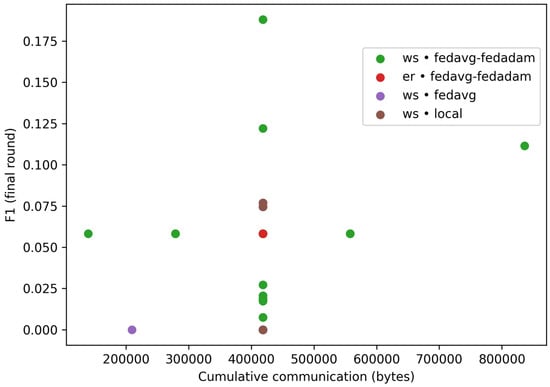
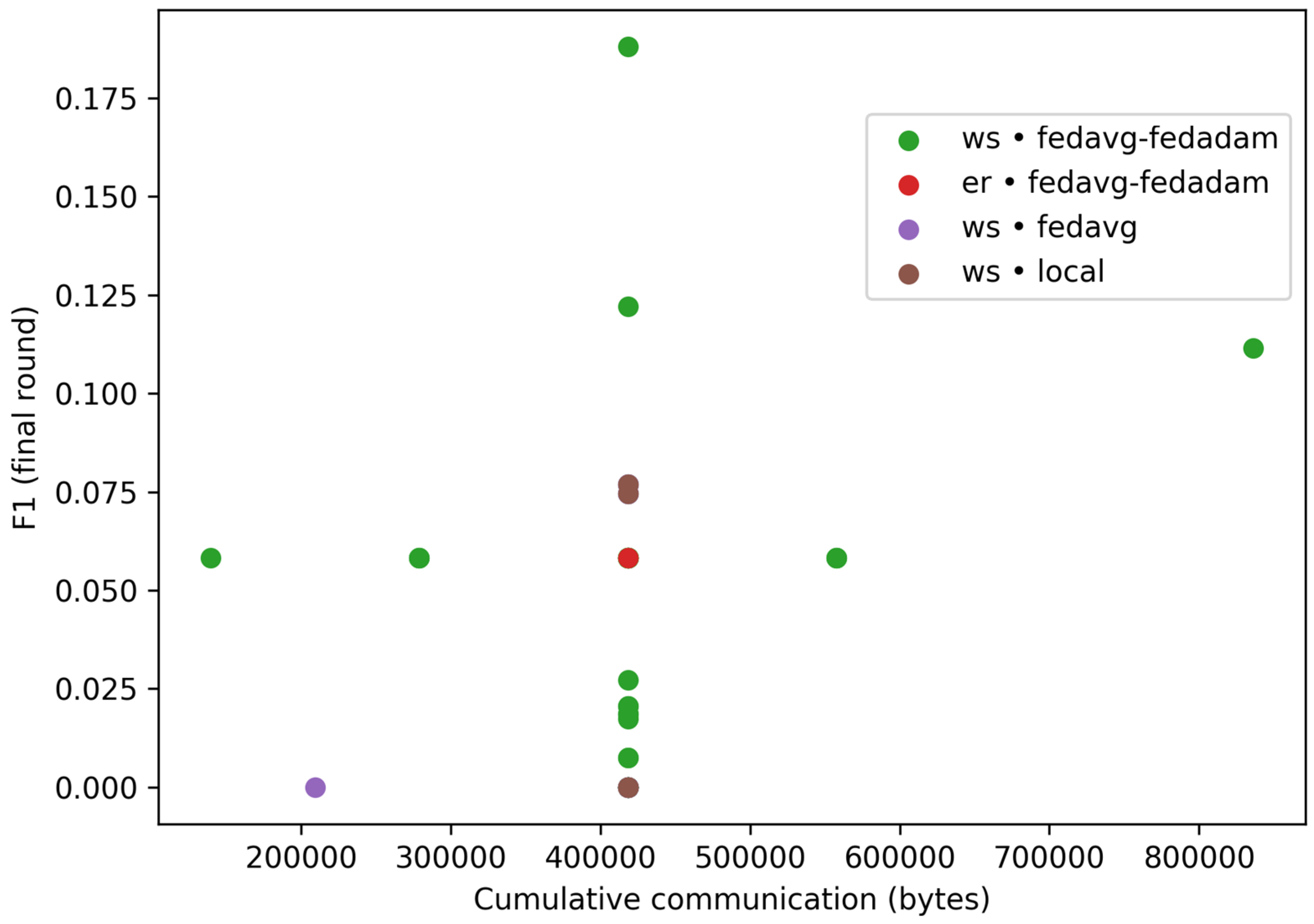
To visualize the efficiency frontier among different schemes, Figure 4 plots model accuracy against cumulative communication volume. The figure highlights the trade-off between predictive performance and bandwidth consumption.
Figure 4.
Scatter plot of final F1-score versus cumulative communication cost for all federated strategies and topologies. Each marker corresponds to a single run among the 5 repetitions performed per configuration. FedAvg achieves minimal bandwidth use, whereas FedAvg-Fedadam reaches higher accuracy at moderate cost, offering the best balance for decentralized IoT or vehicular deployments.
4.3. Comparative Ranking and Statistical Significance
To assess global differences among strategies, we applied a Friedman test to the per-configuration rankings of ROC-AUC and F1 across communication topologies and random seeds. Given the exploratory nature of the benchmark and the limited number of strategies, we focus on global rank trends rather than on exhaustive post hoc testing.
Average rank analysis confirmed that Centralized ranked first in AUC, while FedAvg-Fedadam consistently topped F1 rankings. To determine whether the four training strategies exhibit statistically significant performance differences, we applied the Friedman test to the per-run rankings of ROC-AUC and F1-score. For each of the three communication topologies (BA, WS, ER) and each of the five independent random seeds, the four strategies were ranked according to their final-round performance, yielding a total of 15 paired observations per metric. The Friedman test did not detect a statistically significant deviation from equal median ranks for ROC-AUC (χ2_F = 5.40, p = 0.1447), indicating that the observed performance hierarchy among strategies, while consistent across runs, cannot be attributed to statistically significant differences at the 0.05 level.
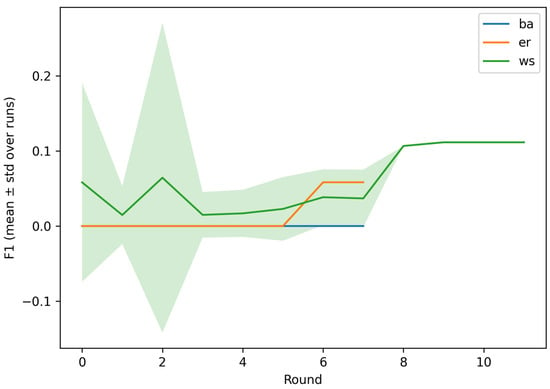
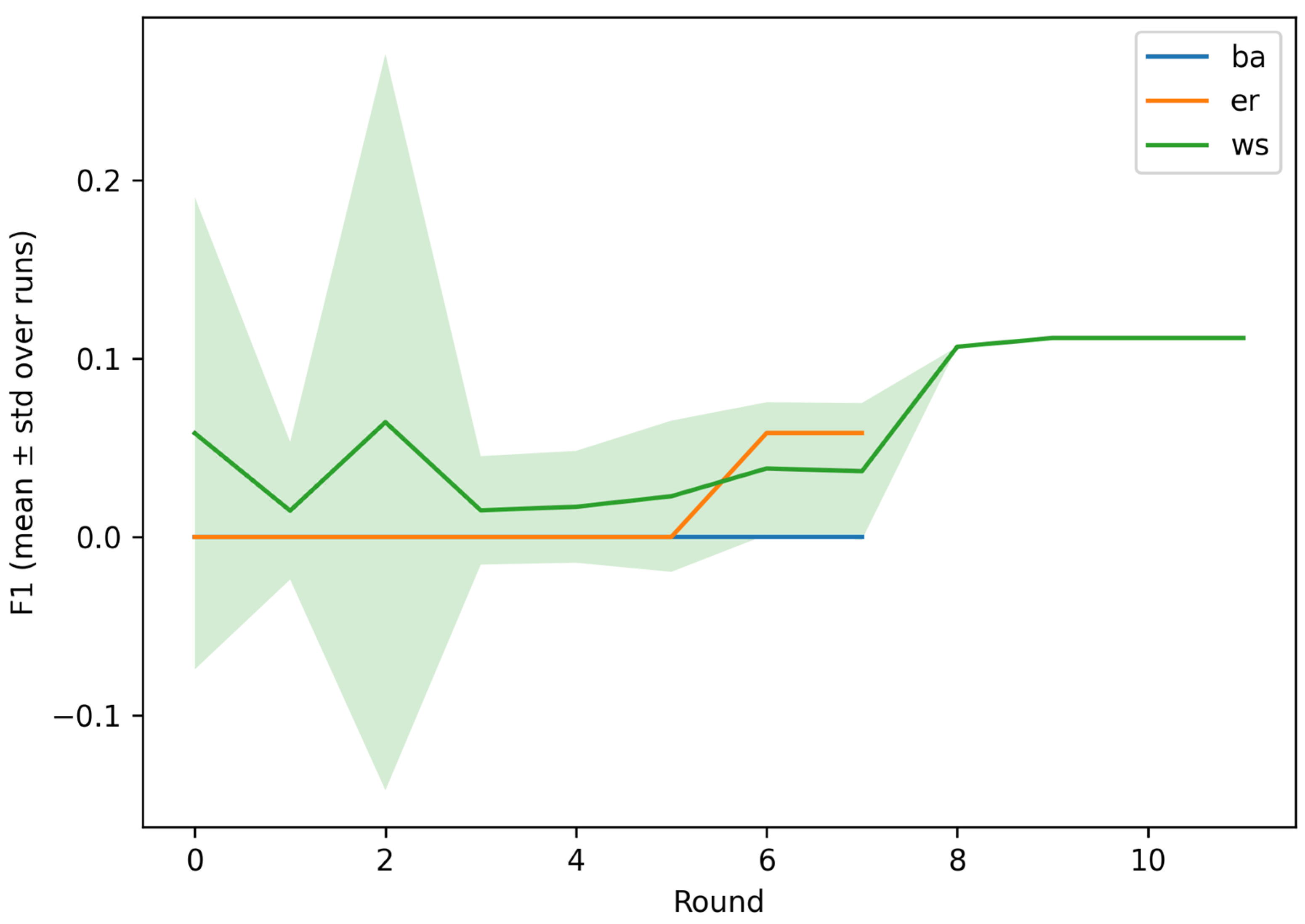
The BA and WS topologies displayed narrower confidence intervals, implying more stable training dynamics than ER under identical parameter settings. Beyond mean accuracy, Figure 5 depicts the variance envelopes of performance metrics across random seeds, illustrating topology-dependent stability.
Figure 5.
Variation in F1-score across five independent random seeds for the three communication topologies (BA, WS, ER). Solid lines represent the mean performance across runs, while shaded regions denote ±1 standard deviation around the mean. BA and WS graphs exhibit narrower dispersion than ER across seeds, indicating that structured connectivity—such as hub dominance and small-world clustering—enhances convergence stability in federated optimization.
4.4. Discussion of Observed Patterns
The results collectively demonstrate that topological structure profoundly affects federated convergence. Although the absolute F1 scores are low, this behavior is consistent with the rarity of anomalous nodes in the considered setting. Importantly, the relative ordering and performance gaps between strategies remain stable across runs, supporting the validity of the comparative analysis.
Scale-free (BA) and small-world (WS) graphs facilitate faster and more stable learning by shortening effective communication paths and enhancing redundancy, which mitigates gradient staleness. Conversely, the random connectivity of ER networks limits information flow, leading to reduced overall performance. Among algorithms, FedAvg-Fedadam consistently balanced adaptability and communication cost, validating the efficacy of adaptive moment estimation in heterogeneous graph learning environments.
The observed performance differences across BA, WS, and ER topologies can be directly related to their structural properties. BA networks exhibit high degree heterogeneity and hub dominance, which facilitate faster dissemination of model updates and stabilizes aggregation, leading to higher ROC-AUC and F1 scores. WS networks combine short path lengths with high clustering, which similarly supports stable convergence. In contrast, ER graphs lack both hub structure and strong clustering, resulting in less efficient information propagation and lower overall performance.
5. Discussion
The experimental findings presented in Section 4 reveal that communication topology plays a decisive role in the convergence dynamics and stability of FedGNNs. While broader benchmarks incorporating additional algorithms and real-world topologies are valuable, such extensions are beyond the scope of this focused study and are left for future work.
Although centralized training provides the highest overall performance (mean ROC-AUC = 0.63), the adaptive federated optimizer FedAvg-Fedadam delivers competitive accuracy with substantially reduced communication cost, confirming its effectiveness for decentralized environments [12].
The notion of a synthetic digital twin complements existing physical and cyber-physical twins by enabling controlled, repeatable analysis of learning and communication dynamics that are difficult to isolate in real deployments. While this formulation focuses on node-level anomalies, the proposed benchmarking framework could be extended to communication-level or link-level anomaly detection in future work.
5.1. Influence of Network Topology
Across all strategies, Barabási–Albert (BA) and Watts–Strogatz (WS) networks yielded superior AUC values (approximately 0.57 and 0.56) compared with the Erdős–Rényi (ER) random graph (approximately 0.39). These differences can be explained by connectivity heterogeneity and clustering, which influence information propagation between clients. In BA-like settings, central nodes (hubs) can accelerate the diffusion of model updates and reduce synchronization delays, shaping convergence behavior in decentralized learning [20,26]. Similarly, WS networks’ small-world property ensures shorter path lengths and higher local redundancy, enhancing robustness to intermittent communication failures [8]. In contrast, the homogeneous structure of ER graphs lacks such redundancy, leading to slower convergence and less consistent model updates.
5.2. Communication Efficiency and Optimization Trade-Offs
The results in Figure 3 and Figure 4 demonstrate a clear trade-off between F1 performance and cumulative communication cost. FedAvg achieved the lowest bandwidth usage (approximately 3.8 × 105 bytes) but at the expense of reduced F1 accuracy, while FedAvg-Fedadam improved F1 to approximately 0.038 with moderate communication overhead. Although the absolute F1 values are low, they reflect the difficulty and class imbalance of the underlying detection task; consequently, our analysis focuses on relative differences between strategies rather than on the raw magnitude of F1. This observation supports earlier findings that adaptive moment estimation enhances global model aggregation under non-IID conditions [1]. In practical deployments—such as smart-city IoT networks or autonomous vehicular communication systems—this balance becomes critical, as communication budgets are constrained by limited energy and bandwidth. Hence, the results recommend adaptive aggregation methods for mid-scale networks where both accuracy and efficiency are prioritized, whereas simpler FedAvg remains suitable for resource-restricted or latency-sensitive settings.
5.3. Robustness and Stability Across Topologies
Beyond mean performance, BA and WS topologies displayed narrower confidence intervals and more stable convergence profiles across rounds, suggesting inherent robustness to client dropouts or delayed updates. This aligns with theoretical analyses of network resilience, which show that small-world and scale-free networks maintain connectivity under random link losses [21].
The consistent ranking of FedAvg-Fedadam across topologies further indicates that optimizer adaptivity can mitigate the adverse effects of heterogeneous connectivity, offering a promising pathway for dynamic topology-aware federated systems.
5.4. Practical Implications
The observed patterns have several practical consequences. First, network designers can leverage topology-aware optimization by tailoring aggregation frequency or learning-rate schedules to structural properties such as degree distribution or clustering coefficient. Second, incorporating dynamic topology control mechanisms—as proposed by [21]—could further enhance performance by adjusting communication paths in real time. Finally, the proposed benchmarking framework provides a reproducible baseline for evaluating novel federated strategies across arbitrary network structures, promoting transparent comparison among future works. Because our analysis is based on synthetic communication graphs, these practical recommendations should be interpreted as guidance for designing and evaluating federated graph learning strategies under controlled, topology-aware conditions, and validated on real-world deployments in future work.
In comparison with existing FL benchmarks such as FedGraphNN [25], FedScale [24], and LEAF [27], the proposed framework introduces a complementary perspective by explicitly isolating the effects of network topology on convergence, stability, and communication cost. While earlier platforms primarily emphasized data partitioning or task diversity, they largely assumed fully connected or idealized communication settings. Our topology-aware benchmark bridges this gap by integrating graph-structural heterogeneity directly into the evaluation loop, enabling more realistic assessment of decentralized GNN training. This positions the framework as a lightweight yet reproducible alternative for controlled experiments where topological realism and communication constraints are of primary interest.
5.5. Limitations and Future Work
While the current analysis relies on synthetic graph models to isolate topological effects, real-world networks often exhibit mixed or evolving connectivity patterns. Explicit control of statistical heterogeneity through non-IID sampling schemes (e.g., Dirichlet-based partitioning) is beyond the scope of this work and represents a complementary axis for future investigation.
Future extensions will consider dynamic and hierarchical topologies, larger client populations, and energy-aware metrics to simulate more realistic IoT and vehicular contexts. Additionally, extending the proposed benchmark to include topology-aware FedGNN architectures and structure-adaptive aggregation schemes constitutes an important direction for future work.
Future extensions of the benchmark may incorporate complementary metrics, such as precision–recall AUC or recall at fixed false-positive rates, to further characterize performance under extreme class imbalance. Additionally, integrating communication compression mechanisms, such as quantization or sparsification, constitutes an important extension of the benchmark and will also be explored in future work. Future extensions of the benchmark may additionally incorporate post hoc statistical tests and explicit effect-size measures to further quantify performance differences across strategies. Given the strong class imbalance, effect-size reporting may be particularly informative in future analyses, complementing absolute performance metrics.
Integrating privacy-preserving mechanisms (e.g., differential privacy or secure multiparty computation) into the topology-aware framework is another natural direction, enabling deployment in sensitive domains such as healthcare and critical infrastructure.
The present analysis focuses on a lightweight GCN architecture in order to isolate topology-dependent effects under controlled conditions. For deeper or attention-based GNNs, such as graph attention networks or transformer-style architectures, the interaction with communication topology may differ. Attention mechanisms and larger receptive fields could partially mitigate structural bottlenecks or, conversely, amplify the influence of hub nodes and clustering. Investigating how topology-aware effects evolve with model depth and attention remains an important direction for future work.
6. Conclusions
This study empirically evaluates a topology-aware benchmarking framework for Federated Graph Neural Networks, systematically assessing how network structure and aggregation strategy affect performance and communication efficiency.
Importantly, the contribution of this work lies in controlled benchmarking and empirical analysis, offering insights into topology-dependent behavior rather than introducing new FL mechanisms.
Results across Barabási–Albert, Watts–Strogatz, and Erdős–Rényi topologies revealed that structured connectivity—especially hub-based and small-world patterns—enhances convergence stability, while random graphs hinder performance.
Importantly, these conclusions stem from controlled experiments on synthetic communication topologies and simulated anomaly labels. As such, the contribution of this work lies in topology-aware benchmarking, and the reported findings should be interpreted as indicative insights rather than as direct validation on real-world IoT or vehicular deployments.
Among training schemes, FedAvg-Fedadam provided the best balance between accuracy and communication cost, achieving F1 approximately 0.038 with moderate bandwidth use.
These findings highlight that federated optimization should be co-designed with network topology to maximize robustness and efficiency in decentralized environments.
Future work will extend this framework to dynamic and real-world communication graphs, incorporating privacy-preserving mechanisms and energy-aware modeling to guide the deployment of scalable, topology-adaptive federated graph systems.
Author Contributions
Conceptualization, M.J.C.S.R. and C.S.; methodology, F.B.; software, F.B. and C.S.; validation, M.J.C.S.R., C.S. and F.B.; investigation, M.J.C.S.R.; resources, M.J.C.S.R. and F.B.; data curation, F.B.; writing—original draft preparation, M.J.C.S.R.; writing—review and editing, C.S. and F.B. All authors have read and agreed to the published version of the manuscript.
Funding
This research received no external funding.
Data Availability Statement
The datasets, trained models, and source scripts that support the findings of this study are publicly available in the Open Science Framework (OSF) repository at https://osf.io/jegr4/ (accessed on 11 December 2025). This repository contains raw metrics, processed CSV summaries, and visualization scripts used for all analyses presented in this manuscript.
Conflicts of Interest
The authors declare no conflicts of interest.
References
- Liu, Y.; Li, H.; Qian, X.; Hao, M. ESA-FedGNN: Efficient Secure Aggregation for Federated Graph Neural Networks. Peer-to-Peer Netw. Appl. 2023, 16, 1257–1269. [Google Scholar] [CrossRef] [Scilit]
- McMahan, H.B.; Moore, E.; Ramage, D.; Hampson, S.; Arcas, B.A.Y. Communication-Efficient Learning of Deep Networks from Decentralized Data. In Proceedings of the 20th International Conference on Artificial Intelligence and Statistics (AISTATS 2017), Fort Lauderdale, FL, USA, 20–22 April 2017. [Google Scholar]
- He, C.; Ceyani, E.; Balasubramanian, K.; Annavaram, M.; Avestimehr, S. SpreadGNN: Serverless Multi-Task Federated Learning for Graph Neural Networks. arXiv 2021, arXiv:2106.02743. [Google Scholar]
- Wang, J.; Wang, X.; Hao, R.; Yin, H.; Huang, B.; Xu, X.; Liu, J. Incremental Template Neighborhood Matching for 3D Anomaly Detection. Neurocomputing 2024, 581, 127483. [Google Scholar] [CrossRef] [Scilit]
- Wu, J.; Dong, F.; Leung, H.; Zhu, Z.; Zhou, J.; Drew, S. Topology-Aware Federated Learning in Edge Computing: A Comprehensive Survey. ACM Comput. Surv. 2024, 56, 1–41. [Google Scholar] [CrossRef] [Scilit]
- Kim, G.; Park, S.; Park, H. FedAWT: Adaptive Federated Learning via Dynamic Epoch Adjustment for Heterogeneous Clients in Ad-Hoc Networks. Internet Things 2025, 34, 101771. [Google Scholar] [CrossRef] [Scilit]
- Asad, M.; Shaukat, S.; Hu, D.; Wang, Z.; Javanmardi, E.; Nakazato, J.; Tsukada, M. Limitations and Future Aspects of Communication Costs in Federated Learning: A Survey. Sensors 2023, 23, 7358. [Google Scholar] [CrossRef] [Scilit]
- Martínez Beltrán, E.T.; Pérez, M.Q.; Sánchez, P.M.S.; Bernal, S.L.; Bovet, G.; Pérez, M.G.; Pérez, G.M.; Celdrán, A.H. Decentralized Federated Learning: Fundamentals, State of the Art, Frameworks, Trends, and Challenges. IEEE Commun. Surv. Tutor. 2023, 25, 2983–3013. [Google Scholar] [CrossRef] [Scilit]
- Chen, H.; Li, H. TCS-FEEL: Topology-Optimized Federated Edge Learning with Client Selection. Sensors 2025, 25, 6534. [Google Scholar] [CrossRef] [Scilit] [PubMed]
- Wen, J.; Zhang, Z.; Lan, Y.; Cui, Z.; Cai, J.; Zhang, W. A Survey on Federated Learning: Challenges and Applications. Int. J. Mach. Learn. Cybern. 2023, 14, 513–535. [Google Scholar] [CrossRef] [Scilit]
- Li, J.; Zhang, Y.; Li, Y.; Gong, X.; Wang, W. FedSparse: A Communication-Efficient Federated Learning Framework Based on Sparse Updates. Electronics 2024, 13, 5042. [Google Scholar] [CrossRef] [Scilit]
- Reddi, S.; Charles, Z.; Zaheer, M.; Garrett, Z.; Rush, K.; Konečný, J.; Kumar, S.; McMahan, H.B. Adaptive Federated Optimization. arXiv 2020, arXiv:2003.00295. [Google Scholar]
- Karimireddy, S.P.; Kale, S.; Mohri, M.; Reddi, S.J.; Stich, S.U.; Suresh, A.T. SCAFFOLD: Stochastic Controlled Averaging for Federated Learning. arXiv 2019, arXiv:1910.06378. [Google Scholar]
- Nguyen, H.; Nguyen, H.-T.; Donta, P.K.; Pirttikangas, S.; Lovén, L. Graph-Based Gossiping for Communication Efficiency in Decentralized Federated Learning. arXiv 2025, arXiv:2506.10607. [Google Scholar] [CrossRef] [Scilit]
- Cao, Y.; Zhang, J.; Zhao, Y.; Liu, D.; Han, Y.; Jiang, W.; Ye, T. ConfShield: A Dual-Stage Fusion Framework for Robust and Privacy-Enhancing Federated Learning in Cloud Environments. Inf. Fusion 2026, 129, 104037. [Google Scholar] [CrossRef] [Scilit]
- Polato, M. Fluke: Federated Learning Utility Framework for Experimentation and Research. Future Gener. Comput. Syst. 2026, 177, 108241. [Google Scholar] [CrossRef] [Scilit]
- Qian, Y.; Pan, X.; Wen, Y.; Bian, X.; Qin, C. Federated Learning for Weakly Supervised Nuclei Segmentation via Style Perturbation and Clustering. Tsinghua Sci. Technol. 2025. [Google Scholar] [CrossRef] [Scilit]
- Tang, X.; Wang, Y.; Liu, X.; Yuan, X.; Fan, C.; Hu, Y.; Miao, Q. Federated Graph Neural Network for Privacy-Preserved Supply Chain Data Sharing. Appl. Soft Comput. 2025, 168, 112475. [Google Scholar] [CrossRef] [Scilit]
- Dai, Z.; Shen, G.; Yuan, H.; Zheng, S.; Hu, Y.; Du, J.; Kong, X.; Xia, F. Towards Heterogeneous Federated Graph Learning via Structural Entropy and Prototype Aggregation. Inf. Sci. 2025, 718, 122338. [Google Scholar] [CrossRef] [Scilit]
- Li, X.; Wu, Z.; Zhang, W.; Zhu, Y.; Li, R.-H.; Wang, G. FedGTA: Topology-Aware Averaging for Federated Graph Learning. Proc. VLDB Endow. 2023, 17, 41–50. [Google Scholar] [CrossRef] [Scilit]
- Menegatti, D.; Giuseppi, A.; Poli, C.; Pietrabissa, A. Dynamic Topology Optimization for Efficient and Decentralised Federated Learning. In Proceedings of the 2024 IEEE International Conference on Big Data (BigData), Washington, DC, USA, 15–18 December 2024; pp. 7939–7945. [Google Scholar]
- Schoinas, I.; Triantafyllou, A.; Ioannidis, D.; Tzovaras, D.; Drosou, A.; Votis, K.; Lagkas, T.; Argyriou, V.; Sarigiannidis, P. Federated Learning: Challenges, SoTA, Performance Improvements and Application Domains. IEEE Open J. Commun. Soc. 2024, 5, 5933–6017. [Google Scholar] [CrossRef] [Scilit]
- Zhang, A.; Zhao, P.; Lu, W.; Zhang, G. Decentralized Federated Learning towards Communication Efficiency, Robustness, and Personalization. ACM Trans. Sen. Netw. 2025, 21, 1–20. [Google Scholar] [CrossRef] [Scilit]
- Lai, F.; Dai, Y.; Singapuram, S.S.; Liu, J.; Zhu, X.; Madhyastha, H.V.; Chowdhury, M. FedScale: Benchmarking Model and System Performance of Federated Learning at Scale. arXiv 2022, arXiv:2105.11367. [Google Scholar] [CrossRef] [Scilit]
- He, C.; Balasubramanian, K.; Ceyani, E.; Yang, C.; Xie, H.; Sun, L.; He, L.; Yang, L.; Yu, P.S.; Rong, Y.; et al. FedGraphNN: A Federated Learning System and Benchmark for Graph Neural Networks. arXiv 2021, arXiv:2104.07145. [Google Scholar]
- Palmieri, L.; Valerio, L.; Boldrini, C.; Passarella, A. The Effect of Network Topologies on Fully Decentralized Learning: A Preliminary Investigation. In Proceedings of the 1st International Workshop on Networked AI Systems, Helsinki, Finland, 18 June 2023; ACM: Helsinki, Finland; pp. 1–6. [Google Scholar]
- Caldas, S.; Duddu, S.M.K.; Wu, P.; Li, T.; Konečný, J.; McMahan, H.B.; Smith, V.; Talwalkar, A. LEAF: A Benchmark for Federated Settings. arXiv 2021, arXiv:1812.10197. [Google Scholar]

Disclaimer/Publisher’s Note: The statements, opinions and data contained in all publications are solely those of the individual author(s) and contributor(s) and not of MDPI and/or the editor(s). MDPI and/or the editor(s) disclaim responsibility for any injury to people or property resulting from any ideas, methods, instructions or products referred to in the content. |
© 2026 by the authors. Licensee MDPI, Basel, Switzerland. This article is an open access article distributed under the terms and conditions of the Creative Commons Attribution (CC BY) license.