


Abstract
Memristive Hopfield neural networks (HNNs) have been widely explored for chaotic signal generation and data encryption owing to their rich dynamical behaviors. However, most existing memristive HNN models suffer from limited controllability of the number of coexisting attractors, insufficient dimensional complexity of chaotic dynamics, and weak adaptability to industrial grayscale image encryption scenarios. To address these issues, this paper proposes a novel memristive HNN model with a single magnetic flux-coupling memristor and systematically investigates its dynamical characteristics and pseudo-random number generator application. The scope of this work covers mathematical modeling, quantitative dynamical analysis, and pseudo-random number generator (PRNG) construction and verification. Theoretical derivation and numerical simulations demonstrate that the proposed system exhibits hyperchaotic behavior with two positive Lyapunov exponents and achieves flexible tuning of coexisting attractor numbers via piecewise parameters M and N, following the relation N + M + 2. The Kaplan–Yorke dimension of the system is calculated as 3.558, verifying its high-dimensional chaotic complexity. Based on the hyperchaotic sequences generated by the model, a PRNG is constructed and passes all test items of the NIST SP 800-22 test suite over 1000 non-overlapping 1 Mbit streams, providing a reliable chaotic sequence source for industrial data security scenarios. This work provides a feasible dynamical model for industrial data security scenarios and offers a reference for the controllable design of multi-stable memristive neural networks.
1. Introduction
The Hopfield neural network (HNN), originally proposed by Hopfield in 1984 [1], has long been recognized as a powerful model for simulating the dynamics of biological neural systems due to its recurrent structure and collective computational properties. Traditional HNNs employ fixed resistive weights to emulate synaptic connections, which significantly limits their nonlinear characteristics and hinders their ability to exhibit complex chaotic behaviors. In recent decades, the emergence of the memristor—postulated as the fourth fundamental circuit element [2]—has revolutionized the design of neural networks. Memristors possess unique non-volatile memory properties and can dynamically adjust their resistance based on the history of applied voltage or current, making them ideal candidates for mimicking biological synapses. By incorporating memristors to simulate synaptic connections, memristive Hopfield neural networks (MHNNs) have been constructed, enabling the generation of more intricate chaotic discharge behaviors that closely resemble the dynamics of the biological brain. This integration has opened new dimensions for exploring nonlinear dynamics in neural systems and holds great promise for advancing neuromorphic computing and brain-inspired intelligence.
In recent years, extensive research has been devoted to the dynamical analysis of memristive Hopfield neural networks (MHNNs) and their security applications, which can be mainly categorized into two branches: dynamical modeling of memristive neural networks and chaotic image encryption applications. For MHNN dynamical modeling, a large body of literature has focused on low-dimensional MHNNs consisting of two, three, or four neurons, revealing a wide variety of complex dynamical phenomena. For instance, studies have demonstrated that such networks can exhibit chaos, hyperchaos, chaotic bursting, and various coexisting attractors [3,4,5]. Among these, multi-scroll chaotic attractors have attracted particular attention due to their complex topological structures and potential engineering applications. Lai and Chen [5] investigated multi-scroll attractors and their broken coexisting behaviors in a cyclic memristive neural network, while Huang et al. proposed a novel MHNN with homogeneous coexisting multi-scroll attractors, demonstrating that the number and parity of scrolls can be adjusted by memristor control parameters. For frontier studies, Bao et al. constructed a bi-memristor cyclic HNN with planar homogeneous coexisting hyperchaos and verified its hardware realizability, enriching the research on coexisting hyperchaotic dynamics [6]. Zhang et al. further proposed a memristive multiscroll multistable neural network for secure medical image communication, realizing flexible attractor regulation [7]. Tamba et al. designed a coupled bi-Hopfield neuron model with multistable memristor synapses and completed microcontroller-based verification, providing a feasible hardware implementation reference [8]. For image encryption-oriented chaotic systems, high-dimensional memristive coupling structures are widely adopted to enhance security performance. Wang et al. constructed a 4D dual-memristor chaotic system by embedding two types of memristors into a jerk system, which significantly improves multistability and spectral entropy complexity and demonstrates effective encryption performance [9].
Furthermore, Lai and Chen designed a multi-scroll chain-loop memristive neural network exhibiting initial-boosting coexisting attractors and applied it to image encryption. These studies have significantly advanced the understanding of nonlinear dynamics in low-dimensional MHNNs and have laid a foundation for further exploration.
From a broader perspective, recent advances in chaotic systems can be systematically categorized into two major lines: fundamental dynamical system construction and wide-range engineering applications.
For fundamental system construction, two dominant technical paradigms have been formed. Discrete hyperchaotic maps represented by polynomial and exponential structures achieve ultra-high Lyapunov exponents and generation throughput via fixed-point digital optimization [10,11], serving as high-performance chaotic sources for dedicated cryptographic scenarios. Nevertheless, such pure mathematical mapping models lack inherent biophysical correspondence and face high migration costs when ported to analog neuromorphic hardware platforms. On the other hand, continuous memristive chaotic systems feature intrinsic state memory and clear biophysical plausibility. Existing studies have realized rich dynamical phenomena including multi-scroll attractors, grid attractors and coexisting multistability through multi-memristor coupling or fractional-order design [12]. However, most of these works are limited to low-dimensional symmetric network topologies, and precise quantitative control over the number of coexisting attractors in high-dimensional asymmetric configurations remains an open challenge.
For engineering applications, chaotic systems have been deployed across image encryption, pseudo-random number generation and time series forecasting scenarios. In the image encryption field, pixel fusion strategies, frequency-domain lossless schemes and hierarchical encryption frameworks have been proposed successively to improve encryption efficiency and reconstruction fidelity [13]. In the PRNG field, FPGA-optimized discrete schemes have set ultra-high throughput benchmarks [10]. In the forecasting field, multistable memristive neural networks have shown promising application value [14]. However, most existing application-oriented designs rely on static coupling structures and single working modes, lacking flexible multi-key adaptability and multi-scenario scalability that match industrial-level deployment requirements.
However, two core limitations remain across the existing body of research. First, most dynamical modeling works focus on low-dimensional symmetric network topologies, and precise quantitative control over the number of coexisting attractors remains an unresolved challenge, especially in high-dimensional asymmetric configurations. Second, most encryption-oriented memristive chaotic systems rely on static coupling structures, lacking flexible multi-key adaptability that matches industrial application scenarios.
Recent representative advances have further expanded the frontier of memristive chaotic systems and their applications. First, novel time series forecasting approaches based on memristive Hopfield neural networks exploit hidden heterogeneous and homogeneous extreme multistability to improve prediction accuracy, demonstrating strong application potential of multistable dynamical characteristics [15]. However, precise quantitative regulation of the number of multistable states has not been fully addressed in this line of research, limiting the granularity of forecasting mode switching. Second, efficient image encryption schemes based on robust quadratic polynomial hyperchaotic maps with pixel fusion strategies achieve high-throughput encryption performance [16]. Nevertheless, such discrete mathematical mapping schemes lack clear biophysical correspondence and face relatively high migration costs when ported to analog neuromorphic hardware. Third, lossless frequency-domain image encryption via 3D exponential hyperchaotic maps and integer lifting wavelet transforms realizes high-fidelity encrypted reconstruction [17]. Yet such single-map architectures have limited key space scalability and are difficult to support multi-level key management for industrial scenarios.
Despite these achievements, the investigation of high-dimensional MHNNs—those containing more than four neurons—remains relatively scarce. From a biological perspective, actual neural networks in the brain consist of a large number of interconnected neurons with both symmetric and asymmetric connection patterns. However, current research on asymmetric neural networks has predominantly focused on stability dynamics [18], while the study of chaotic dynamics in asymmetric configurations is still very limited [19]. This gap poses an important challenge for understanding the complex dynamical behaviors of biologically plausible neural networks. Moreover, while extensive efforts have been dedicated to exploring hyperchaos, multi-scroll attractors, and coexisting attractors in MHNNs [20,21], the dynamical behaviors of hyperchaotic multi-attractors, a more complex form of chaos characterized by multiple positive Lyapunov exponents and multiple coexisting attractor structures, have not been fully discovered and explored. Recent advances in memristive neuron modeling [22,23] and network synchronization studies under electromagnetic radiation [24,25] have further highlighted the importance of considering electromagnetic effects in neural dynamics, yet the potential of using memristors to simulate inter-neuronal electromagnetic coupling for generating hyperchaotic multi-attractors remains largely unaddressed.
Based on the above analysis, this paper proposes an innovative approach to address these research gaps. The main contributions of this work are summarized in three aspects: A seven-neuron asymmetric Hopfield neural network coupled with a single multi-segment memristor is constructed, forming an eight-dimensional dynamical system that realizes hyperchaotic multi-attractors with a precisely controllable quantity under a minimalist coupling architecture. The physical mechanisms of initial offset-induced extreme multistability and non-destructive amplitude regulation are revealed based on the piecewise flux characteristic of the memristor. A pseudo-random number generator is designed based on the proposed hyperchaotic system, and its randomness performance is verified by standard NIST test suites, which provides a reliable chaotic sequence source for information security applications. First, two asymmetric Hopfield sub-neural network models are designed, and a multi-segment nonlinear memristor model is constructed to simulate the external magnetic field coupling between neurons. Then, a novel memristive asymmetric Hopfield neural network model is established by employing the memristor as a coupling synapse between the two sub-networks. Through comprehensive theoretical analysis and numerical simulations, the proposed model is found to generate various complex brain-like chaotic dynamical phenomena, including amplitude-controllable infinite-width hyperchaos, hyperchaotic behavior triggered by initial value offsets, and hyperchaotic multi-attractors. Furthermore, based on the characteristics of the generated hyperchaotic multi-attractors, a pseudo-random number generator is designed, and its performance is evaluated. Experimental verification demonstrates that the generator exhibits excellent randomness and robustness, supporting the theoretical findings. This research not only expands the understanding of the dynamics of asymmetric memristive Hopfield neural networks but also lays a solid theoretical foundation for their potential applications in cryptography and information processing [26,27].
The rest of this paper is organized as follows. Section 2 details the construction process of the memristive Hopfield neural network model, including the multi-segment flux-controlled memristor and the seven-dimensional asymmetric network architecture. Section 3 systematically analyzes the chaotic dynamical characteristics of the system, covering hyperchaotic verification, the regulation mechanism of multi-attractors, and initial offset-induced extreme multistability. Section 4 introduces the design of the pseudo-random number generator based on the proposed hyperchaotic system and verifies its statistical randomness through standard test suites. Finally, Section 5 summarizes the main conclusions of this work and discusses the research limitations and future directions.
2. Design of the Memristive Hopfield Neural Network Model
2.1. Memristor Model
According to the memristor theory, a memristor is generally characterized by the equations
where i and v are the current and voltage across the memristor, φ is the internal state variable, W(φ) is the memductance function, and f(v, φ) describes the dynamics of the internal state. Based on this general framework, a magnetic-controlled multi-segment memristor model is designed in this paper, and its mathematical model is given by
where b, c, and d are the parameters of the memristor, and h(φ) is the internal state function, which will be specified in the following section. Among them, b, c, and d are the three core parameters of the memristor. Specifically, parameter b represents the basic memductance coefficient of the memristor, which determines the overall conductive level of the device in the low-flux region. Parameter c is the piecewise modulation coefficient of memductance, which controls the difference in conductive characteristics between different flux segments. Parameter d is the flux threshold scaling coefficient, which adjusts the interval width between adjacent piecewise segments on the φ-axis. φ is the internal state variable of the memristor, W(φ) is the memduct, and h(φ) is the internal state function of the memristor, which can be expressed as
In the formula, N and M are positive integers and represent the control parameters of the memristor. Note that the internal state variable function h(φ) can be changed by the values of N and M in h(φ). When b = 0.04, c = 1, d = 1.5, M = 2, N = 0, and the initial value is 0, applying a sinusoidal voltage v = Asin(Ft) across the memristor can obtain the volt–ampere characteristic curve of the memristor, as shown in Figure 1. Figure 1 shows the tight hysteresis loops generated by the memristor when the voltage frequency F is 0.5 Hz, and the amplitudes A are 1 V, 2 V, and 4 V. Clearly, within a certain signal range, the volt–ampere characteristic curve of the memristor is a tight hysteresis loop passing through the origin of the v-i plane. Figure 1 shows the tight hysteresis loops generated by the memristor when the voltage amplitude A is 2 V, and the frequencies F are 0.5 Hz, 4 Hz, and 12 Hz. Thus, it can be seen that as the frequency increases, the area of the tight hysteresis loop of the memristor gradually decreases. When the frequency approaches infinity, the tight hysteresis loop tends to a single-valued function. Therefore, the simulation results indicate that this memristor has three memristance index characteristics and is a memristor model.
Figure 1.
v-i characteristic curves of the memristor. The (a) is tight hysteresis loops under different voltage amplitudes (unit: V), and the (b) is tight hysteresis loops under different voltage frequencies (unit: Hz).
To further clarify the internal functional mechanism corresponding to the piecewise memductance characteristic, the equivalent functional block diagram of the proposed multi-segment flux-controlled memristor is illustrated in Figure 2. This architecture intuitively explains how the flux integration, threshold comparison and current switching modules cooperate to realize the nonlinear memristive behavior verified in Figure 1.
Figure 2.
Equivalent functional block diagram of the multi-segment flux-controlled memristor.
The enclosed rectangular area represents the internal functional structure of the memristor device. The left terminal v is the input voltage port, and the right terminal i is the output current port. The Integrator module performs flux integration to establish the integral relationship between the internal state variable φ and the input voltage. Each Comparator module serves as a threshold detector with +d or −d as the flux threshold parameters. The Switch modules implement the piecewise switching of memductance under the control of comparison results. The ellipsis indicates that multiple parallel threshold comparison and switching branches are embedded in the device. The above piecewise flux-controlled memristor can well reproduce the piecewise nonlinear magnetic induction coupling effect between biological neurons. During neuronal action potentials, transmembrane ion migration generates time-varying magnetic flux around cell membranes, and mutual induced currents are formed between adjacent neurons. Such cross-neuron coupling cannot be described by fixed linear resistors, while the flux-memductance mapping characteristic of the designed memristor matches this physical rule perfectly. On this basis, we first introduce the classical Hopfield neural network framework, then embed the multi-segment memristor as a coupling synapse between neuron 1 and neuron 5 to construct the asymmetric seven-neuron memristive Hopfield neural network model.
It should be explicitly noted that the proposed multi-segment memristor has an inherent structural limitation.
The internal-state function h(φ) is piecewise linear—unit slope h′ = 1 inside each smooth interval with finite jumps at the M + N + 1 thresholds—whereas the memductance W(φ) = b·tanh φ in Equation (2) is smooth, with W′(φ) = b·sech2φ ≠ 0. The piecewise character therefore resides in the flux dynamics h(φ), not in a piecewise-constant memductance, and the device remains a continuously state-dependent memristive element.
Despite this piecewise limitation, the model still genuinely captures the core state-dependent memory effects of a memristor. First, the internal flux state φ is a continuously evolving integral variable defined as dφ/dt = v, which retains complete historical information of the applied voltage. This flux integration property is the essential memory characteristic that distinguishes a memristor from a fixed resistor or a preset switch. Second, the memductance level is not permanently fixed, but is determined by which segment the current flux state φ resides in. Since φ evolves continuously and depends on the entire history of the input voltage, the switching between conductance levels is state-dependent and non-volatile, rather than being triggered by an external control signal.
This piecewise memductance design is adopted deliberately to achieve precise quantitative control over the number of coexisting attractor structures, which is the core contribution of this work. The exact integer regulation of attractor quantity is provided by the M + N + 1 thresholds of the piecewise-linear internal state h(φ) in the flux equation and is fully compatible with the smooth memductance W(φ) = b·tanh φ.
2.2. Hopfield Neural Network Model
The Hopfield neural network (HNN), originally proposed by Hopfield in 1984, is a classic recurrent neural network model inspired by biological neural systems. The dynamics of a standard Hopfield neural network with n neurons are generally described by the following set of differential equations
where xi represents the membrane potential of the i-th neuron, Ci and Ri are the membrane capacitance and resistance, wij is the synaptic weight from neuron j to neuron i, tanh(xj) is the activation function, and Ii denotes the external input current. In many simplified models, the capacitance and resistance terms are normalized, leading to the reduced form
Based on this general framework, this paper constructs a seven-neuron asymmetric Hopfield neural network following the classical chaotic Hopfield design principle. The network adopts a chain-type nearest-neighbor connection topology, which is a classic extended structure from low-dimensional to high-dimensional chaotic Hopfield networks. The diagonal elements of the weight matrix are normalized to −1, corresponding to the passive leakage term of neuronal membrane potential. The amplitude of adjacent synaptic weights is determined according to the chaotic generation threshold condition of Hopfield networks: the synaptic coupling strength is set to be strong enough to break the stability of trivial equilibrium points and induce rich bifurcation and chaotic behaviors, while avoiding excessive coupling strength that leads to global saturation and periodic oscillation. On this basis, the multi-segment memristor is further introduced as the cross-coupling synapse between neuron 1 and neuron 5, which breaks the spatial symmetry of the network and further enriches the dynamical behaviors of the system. Significantly, researchers have also begun to explore more complex coupling structures. For instance, Biamou et al. constructed a network model consisting of two non-identical fractional-order sub-HNNs coupled by a multi-stable flux-controlled memristor, investigating the effects of coupling strength, fractional order, and initial states on system dynamics. In contrast to these complex coupled networks, this paper focuses on the coupling mechanism of a single memristive synapse, with its mathematical model given by
where xi represents the membrane potential of the corresponding neuron in the neural network.
2.3. Mathematical Modeling
A large number of physiological experiments have proved that neural signals can be exchanged between neurons and neural networks through neural synapses. Many research results show that memristors can be used to simulate the function of biological neural synapses. For example, Vignesh et al. introduced a discrete fractional-order sine memristor into a four-neuron HNN to simulate electromagnetic induction effects, investigating the generation mechanisms of multi-scroll and coexisting attractors [28]. From the perspective of neuroelectrophysiology, the transmembrane transport of ions during neuronal action potentials will generate time-varying induced magnetic fields around the neural membrane. The magnetic flux generated by adjacent neurons further forms mutual induced currents, which constitute an inter-neuronal coupling mode independent of chemical synapses. The flux-controlled memristor is essentially characterized by the inherent mapping relationship between magnetic flux and conductive current, which can accurately describe the induction current generated by the change in magnetic field. This physical correspondence is the fundamental basis for using memristors to simulate magnetic coupling between neurons.
Furthermore, the strength of magnetic induction coupling in biological neurons shows piecewise nonlinear characteristics with the change in membrane potential level, and there are multiple potential threshold intervals. Compared with the single-segment memristor structure, the multi-segment piecewise nonlinear memristor adopted in this paper can more accurately fit the coupling strength difference in different membrane potential intervals, which is more consistent with the actual physiological characteristics of biological neural networks. Relevant studies on electromagnetic induction dynamics of neurons [5,24] have also verified the rationality of using flux-controlled memristors to reproduce the magnetic coupling effect between neural units.
As shown in Figure 1, in this section, the proposed multi-segment memristor is used to simulate the coupling synapse between neuron 1 and neuron 5, and a memristor Hopfield neural network model can be constructed. When there is a membrane potential difference between two coupled neurons, a magnetic induction current will be generated. The magnetic induction current can be described by a magnetically controlled multi-segment memristor. Therefore, the memristor Hopfield neural network can be expressed as
It should be clarified that the model is constructed based on a seven-neuron Hopfield neural network, and the introduction of the memristive flux state φ expands the overall dynamical system to eight dimensions, including seven neuronal state variables x1 to x7 and one memristive flux state variable φ.
Among them, the newly added term kW(φ)(tanh(x1) − tanh(x5)) represents the magnetic induction current caused by the membrane potential difference. Parameter k indicates the coupling strength of the memristor synapse. −dh(φ) represents the additional magnetic flux caused by the membrane potential fluctuation. Compared with the existing low-dimensional memristor neural network models, the memristor Hopfield neural network constructed in this paper has high-dimensional characteristics and is closer to the biological brain neural system.
The topological architecture of the constructed seven-dimensional asymmetric memristive Hopfield neural network is intuitively illustrated in Figure 3, with explicit markings of neuronal input/output terminals, synaptic connection weights and memristive coupling synapses.
Figure 3.
Topology diagram of the seven-neuron asymmetric memristive Hopfield neural network.
x1–x7 represent the membrane potential state variables of seven neurons. Each neuron takes the external input current and synaptic input signals as inputs and outputs the activated membrane potential processed by the tanh activation function. wij denotes the synaptic connection weight from neuron j to neuron i, which is consistent with the weight definition in the mathematical model. Other neurons follow the same input–output port configuration. All synaptic connections are characterized by synaptic weight wij. The flux-controlled multi-segment memristor serves as the magnetic field coupling synapse between neuron 1 and neuron 5, with k as the coupling strength coefficient and φ as the internal flux state variable.
The internal state function h(φ) of the multi-segment memristor is composed of M + N + 1 superposed sign functions, which set M + N + 1 threshold points on the φ-axis and divide the entire axis into M + N + 2 independent smooth segments. Within each smooth interval, h(φ) is linear with unit slope h′(φ) = 1 (rather than constant); the M + N + 1 switching thresholds are {0, ±d, ±2d, …}.
Inside any smooth interval, h(φ) = φ + Cs with a segment-dependent constant Cs (hence, h′ = 1). Setting F(X*) = 0, the algebraic neuron subsystem −x* + W·tanh x* = 0 has the single real solution x1* = … = x7* = 0 (verified by a 400-start multistart root search, which converges to no other real root); the flux equation then reduces to h(φ*) = 0, which has exactly one solution φ*s = −Cs in that interval. Hence, each interval contains one isolated equilibrium (x* = 0, φ*s): φ* is uniquely pinned rather than free.
For fixed positive integers M and N, substituting the piecewise-linear form of h(φ) within each smooth region into the equilibrium equation yields a unique solution for the seven-dimensional neuronal state vector (x1*, x2*, …, x7*), which automatically satisfies the condition x1* = x5* for dφ/dt = 0. Because h′(φ) = 1 inside the interval, the flux equation depends on φ through h(φ), so h(φ*) = 0 selects a single flux value; the equilibrium in each interval is an isolated fixed point, not a one-dimensional manifold.
The total number of isolated equilibrium points is precisely M + N + 2. For M = N = 2, the six points are (x* = 0; φ*) with φ* = −2.5, −1.5, −0.5, 0.5, 1.5, 2.5, matching the six attractor structures in the simulations below. This result is consistent with the six-structure hyperchaotic attractor observed in subsequent simulations, verifying the correspondence between equilibrium distribution and attractor topology. Define the state vector of the system as X = [x1, x2, x3, x4, x5, x6, x7, φ] T, and the dynamic equation is written as X = F(X). The Jacobian matrix J ∈ R 8 × 8 is defined as J = ∂F(X)/∂X, whose elements are derived as follows. Partial derivatives of neuron state equations with respect to neuron states (i = 1, 2, …, 7; j = 1, 2, …, 7):
where δ i,j is the Kronecker delta function, and sech 2(x) = 1 − tanh 2(x) is the derivative of the activation function tanh(x). Partial derivatives of neuron state equations with respect to memristive state φ can be expressed as:
where W′(φ) denotes the first-order derivative of the memductance function W(φ) with respect to φ. Partial derivatives of the memristive state equation are as follows:
Inside a smooth interval, h′(φ) = 1 and, from W(φ) = b·tanh φ, W′(φ) = b·sech2φ. Substituting these into Equations (10)–(13) gives the smooth-interval Jacobian below; it has no zero row/column and no structurally null eigenvalue.
where wij = kij ⋅sech2(x j) represents the synaptic weight coefficient multiplied by the derivative of the activation function, and ∂W/∂φ is the first-order derivative of the memductance function with respect to the flux state.
For the smooth memductance in Equation (2), ∂W/∂φ = b·sech2φ, and inside any smooth segment, h′ = 1.
Stability Treatment at Discontinuities of the Memristive Function. Since h(φ) is constructed by sign functions, there exist finite discontinuity points on the φ-axis. At these points, the standard Jacobian matrix is not defined. We perform local stability analysis under the Filippov piecewise-smooth dynamical system framework, which is a standard method for piecewise nonlinear systems.
1. At each discontinuity point φ = φd, the generalized Jacobian matrix in the Filippov sense is defined as the convex hull of the Jacobian matrices of the two adjacent smooth segments:
where J− and J+ denote the left and right limits of the Jacobian matrix at the discontinuity, respectively.
2. Based on the sliding mode existence condition for piecewise-smooth systems, we verify that vector fields on both sides of all discontinuity surfaces do not point to the surface simultaneously. No stable sliding mode exists at any discontinuity point under the studied parameter range.
3. All isolated equilibrium points lie strictly inside smooth segments rather than on discontinuity surfaces, so classifying their stability with the smooth-segment Jacobian is mathematically rigorous and valid.
All equilibrium points lie strictly inside smooth intervals; evaluating the corrected Jacobian at each gives three complex-conjugate pairs with positive real parts (a six-dimensional unstable focus subspace) and two negative real eigenvalues (a two-dimensional stable subspace), with det J ≠ 0 and no zero eigenvalue. Every equilibrium is therefore an isolated unstable saddle-focus; there is no translational-invariance direction and no equilibrium manifold. The smooth-interval Jacobian is thus the rigorous classification tool, while Filippov is needed only at the measure-zero switching surfaces. The local equilibrium-eigenvalue pattern is distinct from the global Lyapunov-exponent spectrum and is not equated with it.
Table 1 lists the equilibrium coordinate and the eight eigenvalues at every isolated equilibrium for M = N = 3. Each point has six eigenvalues with positive real parts and two negative real eigenvalues, and no eigenvalue is zero; the residual of F(X*) is zero at every point.
Table 1.
Eigenvalues at the eight isolated equilibria for M = N = 3 (b = 0.04, c = 2, d = 1, k = 1.2).
3. Chaotic Dynamics Analysis
The complex dynamics were analyzed using standard nonlinear methods, including bifurcation diagrams, Lyapunov exponent spectra, and Poincaré maps [29,30]. In this section, the complex dynamic behaviors of amplitude-controlled infinite-width hyperchaos, initial value offset hyperchaos, and hyperchaotic multi-attractors are deeply analyzed and discussed. All dynamical simulations in this work are implemented based on the fourth-order Runge–Kutta (RK4) integration algorithm with fixed step size. The RK4 algorithm is selected for its excellent balance between calculation accuracy and computational efficiency. For the eight-dimensional piecewise smooth memristive system studied in this paper, the RK4 method can maintain stable numerical convergence within smooth segments and accurately capture the trajectory switching behavior at piecewise boundaries. A sufficiently small integration step is adopted in all simulations to ensure that the numerical error is controlled within an acceptable range, which guarantees the reliability of all bifurcation diagrams, Lyapunov exponent curves, and Poincaré section results presented in this paper.
3.1. Hyperchaotic Attractors
This section reveals the hyperchaotic phenomenon in the memristive Hopfield neural network as the parameters change. Let the parameters be b = 0.04, c = 2, d = 1, and M = N = 0, and the initial state be (x10, x20, x30, x40, x50, x60, x70, φ0) = (0.1, 0.1, 0.1, 0.1, 0.1, 0.1, 0.1, 0.1). When the memristive coupling strength parameter k increases from 0 to 10, the bifurcation diagram at the maximum value of the state variable x1 and the corresponding Lyapunov exponent are given, as shown in Figure 4a and Figure 4b, respectively. From Figure 4, it can be observed that as k increases, the memristive Hopfield neural network exhibits different dynamic behaviors, including hyperchaos, chaos, and periodic behavior. When 0 < k < 1.8, the memristive Hopfield neural network has two positive Lyapunov exponents, resulting in hyperchaotic behavior; when 1.8 < k < 8.2, the memristive Hopfield neural network has only one positive Lyapunov exponent, exhibiting chaotic behavior, and during this period, there are multiple periodic windows; when k > 8.2, the memristive Hopfield neural network has no positive Lyapunov exponents and exhibits periodic oscillation behavior. When k = 1.2, 4.5, 7.5, and 9 are taken, the dynamic attractors generated by the memristive Hopfield neural network are shown in Figure 5a–d, respectively, as hyperchaotic, chaotic, quasi-periodic, and periodic attractors. All phase portraits are plotted after discarding sufficient transient data to ensure that the trajectories fully evolve on the steady-state chaotic attractors. The topological structures shown in the phase diagrams are highly consistent with the bifurcation patterns and Lyapunov exponent results, which jointly verify the dynamical state of the system. It is worth noting that Wang et al. recently designed a class of memristive HNNs that generate multi-scroll attractors with high Lyapunov exponents by implementing synaptic control at different coupling positions [31], which shares similarities in dynamical complexity with the hyperchaotic phenomena observed in this paper. Taking the typical parameter set b = 0.04, c = 2, d = 1, k = 1.2, M = 0, and N = 0, as an example, the calculation is performed with the initial state [x1(0),x2(0),…,x7(0),φ(0)]T [0.1,0.1,0.1,0.1,0.1,0.1,0.1,0.1] T. The first 1000 s of the time series are discarded to eliminate transient effects, and the effective calculation duration is 5000 s with a fixed integration step of 0.01 s. Gram–Schmidt orthogonalization is performed every 10 integration steps to maintain the orthogonality of the perturbation vector set. The Lyapunov exponents are numerically calculated via the perturbation evolution method, using the fourth-order Runge–Kutta (RK4) algorithm with a fixed step size of 0.01 s for integration. After discarding the first 1000 s of data to remove transient effects, 5000 s of effective evolution data are adopted for exponent statistics to ensure convergent results, and the Gram–Schmidt orthogonalization is performed every 10 integration steps to maintain the linear independence of perturbation vectors. When k = 1.2, the Lyapunov exponent of the memristive Hopfield neural network is calculated as follows
Figure 4.
Dynamic behavior as the parameter k varies. (a) Branching diagram; (b) Lyapunov exponent spectrum. System parameters: b = 0.04, c = 2, d = 1, M = N = 0. Initial conditions: x1–x7(0) = 0.1, φ(0) = 0.1. Numerical simulation: fixed-step RK4 solver, step size 0.01 s, transient data of the first 1000 s discarded, 5000 s effective evolution for statistics and plotting.
Figure 5.
Phase diagrams of different attractors under different parameters. (a) Hyperchaotic attractor; (b) chaotic attractor; (c) quasiperiodic attractor; (d) periodic attractor. System parameters: b = 0.04, c = 2, d = 1, M = N = 0, and k = 1.2, 4.5, 7.5, 9 for subgraphs (a–d), in turn. Initial conditions: x1–x7(0) = 0.1, φ(0) = 0.1. Numerical simulation: fixed-step RK4 solver, step size 0.01 s, transient data of the first 1000 s discarded, trajectory plotted over subsequent 5000 s.
In this equation, there are two positive Lyapunov exponents, which indicates that the memristive Hopfield neural network is hyperchaotic. The two positive Lyapunov exponents also directly reflect the extreme initial value sensitivity of the system. For any tiny perturbation in the initial state, even a difference at the level of 10−6 in a single state variable, the distance between the two system trajectories will increase exponentially with time evolution under the action of the positive Lyapunov exponents. After a finite time of evolution, the two trajectories will become completely uncorrelated, which is a core characteristic of chaotic systems different from periodic systems. This high sensitivity to initial states also provides a fundamental guarantee for the unpredictability of the generated chaotic sequences and the security of the pseudo-random number generator. Meanwhile, the Kaplan–Yorke dimension of the hyperchaotic neural network can be calculated by the following formula.
Substituting the calculated Lyapunov exponents L1 = 0.2157, L2 = 0.1032, L3 = 0, and L4 = −0.5712 into the definition formula, the Kaplan–Yorke dimension of the system is solved as DKY = 3.558. The calculation strictly follows the fractional dimension definition, and the result is completely consistent with the reported Lyapunov exponent spectrum.
To quantitatively highlight the topological complexity of the proposed model, a comparative analysis with both a classical hyperchaotic benchmark and a representative peer memristive hyperchaotic system is conducted. As a widely recognized four-dimensional hyperchaotic benchmark, the Qi hyperchaotic system has a verified Kaplan–Yorke dimension of 3.278, as summarized in ref. [32]. The four-dimensional linear memristive hyperchaotic system with FPGA hardware validation in ref. [32] further achieves a DKY of 3.356, representing a high complexity level among existing 4D memristive chaotic systems. In contrast, the proposed eight-dimensional memristive Hopfield system with seven neurons and multi-segment magnetic coupling reaches a DKY of 3.558, which is notably higher than both the classical benchmark and the peer memristive system. The higher fractal dimension benefits from the high-dimensional asymmetric network topology and the multi-segment piecewise coupling structure, endowing the chaotic attractor with richer topological complexity and providing a more solid dynamical foundation for high-security pseudo-random number generation and encryption applications.
To analyze the expected robustness of the system’s dynamical characteristics against synaptic weight perturbations, we discuss the system behavior under bounded deviations of non-diagonal synaptic weights. From the structural perspective of the piecewise memristive coupling, for reasonable weight deviations within ±10%, it is expected that the vast majority of parameter instances would preserve two positive Lyapunov exponents as well as hyperchaotic behavior, and the number of multi-structure attractor units governed by parameters M and N would remain basically unchanged. As the deviation increases to ±15%, some instances may degrade from hyperchaos to single-Lyapunov-exponent chaos, while complex chaotic dynamics are still preserved. Such structural features indicate that the core dynamical properties possess reasonable robustness against weight variations, and the main conclusions of this work are not limited to one particular set of weight values.
Since DKY is a fractional function and there are two positive Lyapunov exponents, the memristive asymmetric Hopfield neural network is hyperchaotic.
3.2. Hyperchaotic Multi-Attractors
The multi-turbulent/wing chaotic attractors have extremely complex dynamical characteristics due to their special structure and tunability.
Mechanism of Attractor Structure Number Regulation. The number of hyperchaotic multi-attractor structures is essentially determined by the piecewise characteristic of the multi-segment memristor, and the regulation follows a three-stage logical chain: memristor piecewise segmentation→equilibrium point distribution→attractor structure formation.
Stage 1: Memristor parameter determines the number of smooth segments. The internal state function h(φ) is constructed by superposition of one basic sign function, M sign function terms on the positive half-axis and N sign function terms on the negative half-axis of φ, which set M + N + 1 threshold points and divide the entire φ-axis into M + N + 2 independent smooth segments.
Stage 2: Each smooth segment contains exactly one isolated equilibrium point. Inside a segment, h is linear with unit slope rather than constant, so the neuron equations admit a single isolated fixed point, not a one-dimensional manifold. The total number of isolated equilibrium points is strictly M + N + 2, which equals the number of segments.
This numerical correspondence fully matches the theoretical relation M + N + 2.
To further reveal its hyperchaotic characteristics, when M = 2 and N = 2, bifurcation diagrams and corresponding Lyapunov exponents within the range of k ∈ (0,1) are plotted, as shown in Figure 6. From Figure 6, it can be seen that there are six band-like components in the bifurcation diagram in the φ direction, and the existence of two positive Lyapunov exponents indicates that the multi-attractors are hyperchaotic. Moreover, for the six-structure attractor with x4 = 0, the Poincaré mappings in the φ-x1 and φ-x2 planes are, respectively, shown in Figure 7a,b. Clearly, its Poincaré mapping graph is a set of irregularly shaped spot diagrams, which means that the memristive Hopfield neural network has generated extremely complex hyperchaotic behavior.
Figure 6.
Dynamics related to parameter k. (a) Bifurcation diagram. (b) Lyapunov exponent spectrum. System parameters: b = 0.04, c = 2, d = 1, M = 2, N = 2, 0 < k < 1. Initial conditions: x1–x7(0) = 0.1, φ(0) = 0.1. Numerical simulation: fixed-step RK4 solver, step size 0.01 s, transient data of the first 1000 s discarded, 5000 s effective evolution for statistics and plotting.
Figure 7.
Poincaré section mapping. (a) φ-x1 phase plane. (b) φ-x2 phase plane. System parameters: b = 0.04, c = 2, d = 1, k = 1.2, M = 2, N = 2. Initial conditions: x1–x7(0) = 0.1, φ(0) = 0.1, Poincaré cross-section set as x4 = 0. Numerical simulation: fixed-step RK4 solver, step size 0.01 s, transient data of the first 1000 s discarded, trajectory sampled over subsequent 5000 s.
To quantitatively characterize the topological complexity of the attractor and remedy the limitation of purely visual description, we perform a systematic quantitative topological analysis based on the Poincaré mapping results from three dimensions. First, topological structure verification is performed based on segmental correspondence. The Poincaré section is selected as the hyperplane x4 = 0 with the positive crossing condition. The discrete point sets on the section present six independent band-shaped clustering regions distributed along the φ-axis, and the number of regions is strictly consistent with the number of multi-attractor structures M + N + 2 = 6. This one-to-one correspondence quantitatively confirms the multi-structure topological property of the attractor from the cross-sectional perspective: each discrete band corresponds to the trajectory projection constrained in one smooth φ interval, jointly forming the complete hyperchaotic multi-attractor topology, as shown in Figure 8. Second, fractal complexity measurement is performed via correlation dimension. The Grassberger–Procaccia algorithm is adopted to calculate the correlation dimension of the Poincaré section point set, and the obtained correlation dimension is about 3.42. As a typical non-integer value, it is in good agreement with the Kaplan–Yorke dimension of 3.558 calculated in Section 3.1. The two fractal dimension indicators mutually validate each other, jointly quantifying the fractal topological complexity of the attractor and ruling out the possibility of periodic or quasi-periodic motion. More detailed multifractal analysis can further characterize the local scaling property of the attractor, which has been widely applied in memristive HNN dynamical studies [33]. This paper focuses on the overall complexity verification of multi-attractors, and multifractal characterization will be supplemented in future research. Third, dynamical characteristic analysis is performed based on the first return map. We extract the consecutive values of the state variable φ at each intersection point on the Poincaré section to construct the first return map. The return map exhibits a multi-peak ergodic distribution without closed periodic orbits, and the maximum Lyapunov exponent calculated from the return mapping sequence is positive. This quantitatively demonstrates the strong chaotic dynamical behavior of the system from the perspective of low-dimensional mapping and further verifies that the irregular spot distribution is essentially the projection of high-dimensional hyperchaotic motion on the cross section.
Figure 8.
Hyperchaotic n-structure attractor. (a) 1-structure. (b) 2-structure. (c) 3-structure. (d) 4-structure. (e) 5-structure. (f) 6-structure. (g) 7-structure. (h) 8-structure. System parameters: b = 0.04, c = 2, d = 1, and k = 1.2; the values of M and N increase sequentially to generate attractors with different structures. Initial conditions: x1–x7(0) = 0.1. Numerical simulation: fixed-step RK4 solver, step size 0.01 s, transient data of the first 1000 s discarded, trajectory plotted over the subsequent 5000 s.
It should be clarified that the hyperchaotic multi-attractors proposed in this paper are essentially different from traditional multi-scroll chaotic attractors in both topological structure and formation mechanism. Traditional multi-scroll attractors are formed by the continuous stretching and folding of a single chaotic trajectory around multiple saddle-focus points, presenting a single connected topological whole. In contrast, the multi-attractors in this work consist of multiple independent attractor units distributed along the φ-axis. Each unit is an independent hyperchaotic attractor supported by its corresponding equilibrium point group, and these units are separated by attraction basin boundaries. They cannot transform into each other under fixed system parameters, which is the core distinction from the single connected multi-scroll structure. Coexisting multi-scroll attractors induced by controlled memristors have been extensively studied in symmetric HNNs [34], while the multi-attractor structure with independent invariant intervals proposed in this paper shows a different formation mechanism and higher tunability of quantity. Recently, Zhang et al. also realized grid multi-scroll attractors in memristive HNNs and observed 2D initial offset and super multistability phenomena, which share similarities in control dimensions with the hyperchaotic multi-attractors discovered in this paper. However, compared with their grid structures, the multi-attractors generated in this paper exhibit more complex topological structures and more flexible parameter controllability.
3.3. Hyperchaotic Behaviors Induced by Initial Offset Boosting
The initial value offset chaotic behavior, where infinitely many attractors with the same topology but different positions coexist, is an important dynamical phenomenon, with significant application value in many engineering fields. The proposed memristive Hopfield neural network can generate hyperchaotic behaviors induced by initial offset boosting. For example, when parameters b and d remain unchanged, setting c = 0.5, k = 1.2, M = N = 3, and the initial state (x10, x20, x30, x40, x50, x60, x70) = (0.1, 0.1, 0.1, 0.1, 0.1, 0.1, 0.1), the bifurcation diagram dynamics of the initial value φ0 is plotted, as shown in Figure 9a. It can be seen that the bifurcation diagram presents a typical stepped shape, indicating that the memristive Hopfield neural network generated complex initial value offset behavior.
Figure 9.
Hyperchaotic attractor related to φ0. (a) Phase diagram. (b) Time domain diagram. System parameters: b = 0.04, c = 0.5, d = 1, k = 1.2, and M = N = 3. Fixed initial states: x1–x7(0) = 0.1, φ0 = ±1, ±3, ±5.
- Formation Mechanism of Coexisting Hyperchaotic Attractors
The stepped bifurcation diagram and coexisting attractors induced by initial offset are essentially determined by the piecewise distribution of attraction basins along the φ-axis. The piecewise property of h(φ) partitions the φ-axis into multiple independent intervals, each corresponding to a separate basin of attraction. If the initial flux φ0 lies in distinct basins, trajectories will evolve within the matched interval and converge to the corresponding hyperchaotic attractor. Under the Filippov piecewise-smooth dynamical system framework, we further verify the theoretical essence of this phenomenon: no stable sliding mode exists at any discontinuous jump boundaries of the h(φ) function, and the vector fields on both sides of each boundary will not simultaneously point across the interface. This means that system trajectories can never cross the segment boundaries, so each smooth interval forms an independent dynamically invariant set. The initial flux value φ0 does not generate new attractor topologies, but selects which invariant interval the system will evolve in, thus establishing a one-to-one mapping between initial values and coexisting attractor positions. Because the piecewise-linear internal state h(φ) in adjacent smooth segments differs only by a constant shift while the neuronal subsystem is identical, attractors in different intervals have the same topological structure but different position offsets.
For the parameter set with M = N = 3, the exact number of coexisting attractors can be theoretically derived. The h(φ) function divides the φ-axis into M + N + 2 = 8 smooth segments in total. The eigenvalue analysis in Section 2.3 shows that all eight points share the same saddle-focus spectrum, so no segment is excluded on stability grounds, and the eight segments define eight candidate basins. Each of the eight segments contains a saddle-focus equilibrium point with three complex-conjugate eigenvalue pairs with positive real parts, which can support a hyperchaotic attractor and an independent basin. For c = 0.5, k = 1.2, and M = N = 3, the φ-axis is therefore divided into eight smooth segments, each carrying one saddle-focus equilibrium point and one candidate basin.
Figure 9 and Figure 10 display six representative coexisting attractors obtained with φ0 = ±1, ±3, ±5; one in each of six of the eight basins. This is a representative subset of the M + N + 2 = 8 basins predicted for M = N = 3; choosing additional offsets such as ±7 populates the remaining basins, and increasing M or N raises the number of coexisting attractors accordingly. With further increases in M and N, the number of smooth segments on the φ-axis increases continuously, and the number of corresponding attraction basins and coexisting attractors also increases synchronously. This initial-offset coexisting phenomenon is widely observed in various piecewise nonlinear chaotic systems [31,35], which verifies the generality of the multistability mechanism induced by piecewise memristive structures. In theory, when M and N are large enough, the number of coexisting attractors can tend to infinity, which is the physical origin of the extreme multistability induced by initial offset.
Figure 10.
Dynamic behavior related to φ0. (a) Branching diagram. (b) Attracting basin. System parameters: b = 0.04, c = 0.5, d = 1, k = 1.2, and M = N = 3. Fixed initial states: x1–x7(0) = 0.1,φ 0 continuously scanned within the plotting interval. Numerical simulation: fixed-step RK4 solver, step size 0.01 s, transient data of the first 1000 s discarded, 5000 s effective evolution for statistics and plotting.
Compared with these studies, the initial offset behavior observed in this memristive HNN not only generates hyperchaotic attractors but also allows the number of coexisting attractors to be further regulated by parameters M and N, exhibiting richer dynamical tunability. At the same time, as shown in Figure 9b, the attraction basin of the memristive Hopfield neural network in the entire φ0-x10 plane has obvious multi-color attraction basin characteristics. Figure 9b shows the color-coded attraction-basin distribution projected onto the φ0-x1(0) initial-value plane. Each colored region corresponds to the set of initial points that asymptotically converge to one specific coexisting hyperchaotic attractor. The color interfaces between adjacent colored regions represent the underlying separation surfaces of attraction basins.
To explicitly extract geometrical contour lines for these basin boundaries, a dedicated two-dimensional initial-value grid-scan numerical procedure is required: a dense grid of initial points in the (φ0,x1(0)) plane is evolved numerically; each grid point is labeled by the attractor that its trajectory converges to. Afterward, contour-detection post-processing can identify the exact basin-separation curves. Physically, the transition between distinct coexisting hyperchaotic states takes place whenever an initial-condition point crosses one of these basin-separation surfaces. When φ0 = ±5, ±3, ±1 are set, six topologically identical but position-different hyperchaotic attractors coexist, as shown in Figure 9a. At the same time, without changing the network structure but only changing the initial value, the memristive Hopfield neural network can generate six different-positioned hyperchaotic sequences, as shown in Figure 9b. Further simulation shows that when the values of M or N continue to increase, the number of coexisting hyperchaotic attractors will tend to infinity. This phenomenon is very important because it not only provides continuous and robust hyperchaotic sequences but also can be non-destructively adjusted in its oscillation amplitude by changing the initial state. Numerical simulation details are as follows: fixed-step RK4 solver, step size 0.01 s, transient data of the first 1000 s discarded, trajectory plotted over the subsequent 5000 s.
4. Pseudo-Random Number Generator Application
Random numbers have extensive applications in computer science, digital signatures, secure communication, and information security. Especially in recent years, with the large-scale application of intelligent chips and the demand for information security, the need for high-quality random number generators has become increasingly urgent. With the development of nonlinear system theory, the design of pseudo-random number generators (PRNGs) based on the chaotic behavior of nonlinear systems provides a new theoretical basis and new implementation methods [36,37]. This section designs a pseudo-random number generator based on the hyperchaotic multi-attractor generated by the proposed memristive Hopfield neural network. The experimental results show that, due to the complex chaotic behavior of the hyperchaotic multi-attractor, the designed pseudo-random number generator can generate highly random numbers and can be widely applied in information security fields.
4.1. Design of Pseudo-Random Number Generator
This section introduces the design process of the pseudo-random number generator based on the hyperchaotic multi-attractor of the memristive Hopfield neural network, as shown in 2. In the proposed design scheme, {K1} represents the 8-bit key sequence obtained from the digital signal generator based on the memristive Hopfield neural network. The parameters of the memristive Hopfield neural network are b = 0.04, c = 2, d = 1, k = 0.5, and M = N = 3, and the initial condition is (0.1, 0.1, 0.1, 0.1, 0.1, 0.1, 0.1, 0.1). It generates an eight-structure hyperchaotic attractor with eight chaotic sequences. The values of the eight state variables are preprocessed within the range of 0 to 1 and converted to 8 bits, and then the two least-significant bits of each state variable are combined into sequence {K1}. The complete quantization and bit extraction procedure of the PRNG is specified as follows:
1. Transient removal
The system first iterates for 1000 s with a fixed integration step of 0.01 s to discard transient data. Data collection starts after the trajectory fully evolves onto the steady-state hyperchaotic attractor, eliminating the influence of initial states on the output sequence.
2. Normalization and scaling
Each state variable value is processed via modulo operation and linear mapping to scale the floating-point chaotic state into the interval [0, 1). This operation eliminates the influence of amplitude offset on subsequent quantization and establishes a uniform numerical basis for the conversion from continuous chaotic states to discrete binary bits.
3. 8-bit uniform quantization
The normalized floating-point value is multiplied by 255 and rounded to an integer ranging from 0 to 255, corresponding to standard 8-bit binary representation. This step completes the one-to-one mapping from floating-point chaotic states to 8-bit quantized sequences.
4. Bit extraction
The two least-significant bits of each 8-bit quantized state variable are extracted. Sixteen bits are obtained from eight state variables per iteration step and concatenated in order to form the raw chaotic sequence K1. Low-order bits are selected for their higher randomness and weaker correlation, which supports the statistical independence of output bits.
5. Test sequence length
For the NIST SP 800-22 randomness test, every evaluated stream is 1 Mbit long, which meets the per-sequence length requirement, and 1000 such non-overlapping streams are used to estimate the pass proportion and the uniformity of p-values, as required for a statistically meaningful evaluation.
6. Finite precision effect
All operations above are implemented under 64-bit double-precision floating-point arithmetic. The high-dimensional nonlinear characteristics of the multi-segment memristive system can effectively suppress period degradation caused by finite precision, and the output sequence maintains stable randomness within the effective test length.
The operating frequency and output bit width are two core design parameters of the PRNG, which jointly determine the randomness performance, generation efficiency and implementation cost of the system. For operating frequency, it defines the sampling rate of chaotic state variables. An excessively high sampling frequency will lead to insufficient evolution of system trajectories between adjacent samples, enhancing the correlation of consecutive outputs and reducing randomness. On the contrary, too low a frequency will limit the output throughput. In terms of implementation, the upper limit of operating frequency is restricted by the calculation delay of the seven-dimensional chaotic iteration [7,38]. Its impact on the system is mainly reflected in three aspects: first, the statistical randomness of the output sequence; second, the throughput rate of random bit generation; and third, the timing constraint difficulty and power consumption of hardware implementation. Benefiting from the parallel output of multiple state variables, the proposed system can achieve ideal throughput at a moderate operating frequency, avoiding randomness degradation caused by high-frequency sampling.
Output bit width refers to the number of valid random bits extracted per iteration. Due to the quantization characteristics of chaotic state variables, the high-order bits have strong correlation, and only the low-order bits have good statistical independence. Extracting too many bits from a single variable will reduce the overall randomness of the output. The output bit width affects the security strength, generation efficiency and application adaptability of the system. Reasonable bit width configuration ensures the unpredictability of the sequence, matches the bit width requirements of different encryption scenarios, and controls the hardware resource overhead. In this design, the two least-significant bits are extracted from each of the eight state variables to obtain a 16-bit output per iteration, which achieves a balance between randomness quality and generation efficiency, and adapts to the requirements of common data encryption scenarios.
Considering the increase in the sawtooth degree of chaotic output and the improvement of the statistical characteristics of the generated sequence, post-processing operations are required. This paper adopts an m-level linear feedback shift register (LFSR). It is a shift register, and certain bits of it are subjected to simple XOR operations as the feedback function. Its operation is deterministic, and the generated bit stream has a period of 2m−1. When m = 32 with the primitive feedback polynomial x32 + x22 + x2 + x + 1 (taps {32,22,2,1}), the LFSR is maximal-length, and each initial state generates a period of 232 − 1 = 4,294,967,295. In this scheme, the sequence {K2} is generated by the 32-bit LFSR, which has the same bit width as the {K1} sequence, and {K1} is XORed with {K2} bit by bit to obtain the pseudo-random sequence. It should be clarified that the 32-bit LFSR in this design only serves as an auxiliary whitening module rather than the core randomness source of the PRNG; its initial state is fixed and public (0xFFFFFFFF) and is not part of the secret key, so its linear structure cannot become a hidden point of attack.
To further justify this design choice, we clarify the following points:
First, the core randomness and long-period aperiodic characteristics of the output sequence are entirely provided by the eight-dimensional hyperchaotic memristive Hopfield system. Since the LFSR sequence is superimposed on the chaotic source via bitwise XOR, its finite period does not dominate the overall period of the output sequence. The long-term aperiodic property of the final output is still dominated by the hyperchaotic source and will not be degraded to a short-cycle sequence.
Second, the maximal-length period 232 − 1 ≈ 4.29 × 10⁹ is about 4.3 times the total 1 Gbit test output (and about 21 times any 200 Mbit per-trajectory subset), so no LFSR state repeats within the tested data; the register is therefore long enough to remove residual short-range linear patterns introduced by quantization and bit extraction, while using only 32 flip-flops.
Third, the 32-bit configuration balances whitening strength and hardware cost. Compared with nonlinear post-processing structures, it uses only 32 flip-flops and four XOR taps, which fits the target low-cost embedded industrial application scenarios while keeping the chaotic source as the sole entropy provider.
Finally, over the 1000 non-overlapping 1 Mbit streams of Section 4.2, the full NIST SP 800-22 suite is passed, including the Linear Complexity and FFT (spectral) sub-tests; this confirms that the whitening stage introduces neither a short exploitable linear relation nor a detectable periodic component, while effectively improving the local statistical characteristics of the sequence.
To help readers fully understand the circuit operation mechanism of the PRNG, Figure 11 supplements the detailed circuit schematics of the core chaotic signal generation unit (the proposed memristive Hopfield neural network) in a hierarchical structure. The quantization, bit extraction and LFSR post-processing modules of the PRNG are conventional digital circuits, which are not repeated here.
Figure 11.
Detailed circuit schematics of the PRNG core chaotic generation unit. (a) Overall topological architecture of the 7-dimensional asymmetric memristive neural network; (b) detailed analog circuit of a single Hopfield neuron unit; (c) detailed circuit of the multi-segment flux-controlled memristor.
(a) Overall network topology
This subfigure presents the full connection relationship of the seven neurons and the memristive coupling synapse. Ordinary synaptic connections between adjacent neurons are marked with weight w ij, and the special magnetic coupling between neuron 1 and neuron 5 is realized by the multi-segment memristor with coupling strength k and internal flux state φ. The eight state variables output by the network serve as the raw chaotic sources for subsequent quantization and bit extraction operations.
(b) Single Hopfield neuron unit circuit. Each neuron is implemented based on a standard operational amplifier integrator structure, which physically realizes the dynamical equation of the Hopfield neuron:
Input resistors Rij1 and Rij2 receive output voltages from pre-synaptic neurons, corresponding to the synaptic weight terms in the equation. The parallel RC network in the op-amp feedback loop realizes the integral characteristic and passive leakage decay of the membrane potential. The smooth tanh(·) activation is realized by a matched emitter-coupled differential pair, equivalently a subthreshold CMOS OTA. Its differential output current is given by Equation (21), where IEE is the constant tail current, Vid = V+ − V− is the differential input, and VT is the thermal voltage (about 26 mV at room temperature); choosing the input gain so that Vid/(2VT) equals the normalized neuron voltage makes ΔI proportional to tanh(·) over the whole active region. The back-to-back diodes D1 and D2 only provide output over-voltage and ESD clamping, and Rlim acts as the current-limiting protection resistor.
(c) Multi-segment flux-controlled memristor unit circuit
This circuit physically implements the piecewise memductance characteristic defined in Equations (2) and (3), which consists of a flux integration module and a piecewise conductance switching module. The bottom operational amplifier, together with the feedback integrating capacitor Cφ and the input resistor Rφ, forms a standard inverting integrator. The input voltage difference VDiff is integrated to generate the internal flux state φ, which physically realizes the state equation in the mathematical model. The upper parallel resistor branches realize the piecewise memductance W(φ). The base branch Rb provides constant baseline memductance; branches R1, R2, and R3 controlled by SPST analog switches are switched on and off according to the flux threshold on the φ-axis, realizing the stepwise change in memductance in different flux intervals, which strictly matches the multi-segment characteristic of W(φ) in the mathematical model.
The agreement is quantified in the inset Figure 12: the differential-pair output overlaps the ideal tanh with zero RMSE in the active region |u| ≤ 1, whereas a hard diode clamp deviates markedly, confirming that the proposed stage, rather than the clamp, realizes the activation.
Figure 12.
i Activation realization: Ideal tanh versus the matched differential pair and a hard diode clamp. The differential pair matches tanh exactly in the active region.
4.2. Testing of the Pseudo-Random Number Generator
A series of statistical test packages are usually used to determine the randomness of the generated sequence and the effectiveness of the pseudo-random number generator, as shown in Figure 13. The widely used and accepted package is the NIST 800-22 test, consisting of up to 15 statistical tests, used to evaluate the randomness of the Boolean array generated by the pseudo-random number generator that is related to cryptographic randomness [39,40]. As shown in Figure 14, a one-shot test verification flowchart for the pseudo-random number generator is designed. First, the memristive Hopfield neural network model is discretized using the RK4 algorithm, and the generated floating-point numbers are converted into binary sequences. Then, it is input into the designed pseudo-random number generator to obtain pseudo-random numbers. Finally, the NIST 800-22 test package is used to test the pseudo-random numbers. The NIST 800-22 test provides information about the long binary array based on the presence or absence of certain patterns. For the data to be tested, it must successfully pass all tests without exception. The randomness of the data can be understood by evaluating the p-value. The p-value selected for this paper is 0.01. Then, the randomness of the tested data has a 99% confidence level. In the studied sequence, a p-value of 1 indicates complete randomness, and a p-value of 0 indicates no randomness. Tests with a p-value equal to or greater than 0.01 are considered valid. Otherwise, the test is considered unsuccessful.
Figure 13.
Structure of the pseudo-random number generator based on memristive Hopfield neural network.
Figure 14.
Flowchart for verifying pseudo-random number generator.
To ensure full reproducibility of the test results, the detailed procedural configurations are specified as follows.
The generator is evaluated under five distinct initial states, ordered as x1, …, x7, φ: IC1 = (0.10, 0.10, 0.10, 0.10, 0.10, 0.10, 0.10, 0.10); IC2 = (0.12, 0.08, 0.10, 0.13, 0.09, 0.11, 0.07, 0.10); IC3 = (0.09, 0.11, 0.12, 0.08, 0.13, 0.10, 0.10, 0.12); IC4 = (0.13, 0.09, 0.07, 0.11, 0.08, 0.12, 0.10, 0.09); and IC5 = (0.11, 0.13, 0.09, 0.10, 0.12, 0.08, 0.11, 0.08). The initial state of the 32-bit LFSR post-processing module is fixed to all ones (0xFFFFFFFF). The exact sampling interval for bit extraction is 0.01 s, consistent with the fixed step size of the RK4 integration algorithm. At each integration step, the two least-significant bits of the 8-bit quantized value of each state variable are concatenated in the order x1…x7 and then φ, giving 16 bits per step. After the first 1000 s are discarded as transient, each trajectory is generated continuously without selection and partitioned into 200 non-overlapping 1 Mbit blocks, yielding the 1000 streams evaluated below.
All system parameters, initial conditions, sequence length and test configurations are fully fixed before the test starts, and no iterative parameter tuning, sequence screening or threshold adjustment is performed based on test results. The reported result is obtained from one-shot continuous generation after transient removal, which strictly follows the NIST SP 800-22 standard with a significance level of α = 0.01. Tests with p-value ≥ 0.01 are judged as passed.
The official NIST SP 800-22 suite is run once at significance level α = 0.01 on the 1000 non-overlapping 1 Mbit streams, which comprise five trajectories × 200 blocks. A sub-test passes when its proportion reaches the 3σ lower bound: 980/1000 for ordinary tests and 607/621 for the random-excursion tests, where 621 streams are valid. Its uniformity p-value must also exceed 10−4. As listed in Table 2, all 15 sub-tests meet both criteria. The per-stream fraction of ones lies in [0.4984, 0.5014], with per-trajectory mean 0.49995–0.50002, evidencing statistically stable randomness rather than a single favorable realization. When the streams are grouped by trajectory into five m = 200 subsets, a single subset shows four marginal items one-to-two counts below its 193/200 bound, of the order expected from binomial sampling fluctuation at m = 200; pooling to m = 1000 removes this fluctuation, and every item clears its bound. No stream is regenerated or discarded after testing, so the protocol contains no feedback path from the test result to the generator.
Table 2.
Official NIST SP 800-22 results over 1000 non-overlapping 1 Mbit streams (five trajectories × 200 blocks): pass proportion and uniformity p-value for each sub-test. The 3σ pass bounds are 980/1000 and 607/621 for the random-excursion tests (621 valid streams); for two-direction/template tests, the worst case is reported. Every item passes with uniformity p-value > 10−4.
To further verify the stability of randomness and exclude overfitting risk under fixed parameters, two complementary statistical verifications are supplemented:
(1) Key sensitivity test: Every continuous key component is perturbed at five scales—10−6, 10−9, 10−12, 10−15 and 2−52. From 10−6 to 10−12, all twelve components give |correlation| below 0.05 and a bit-change rate within [0.48, 0.52]; eight components (x1–x4, x6, x7, b, k) remain decorrelated down to the machine epsilon 2−52, whereas x5, φ, c and d are resolved to 10−12, below which a finer perturbation is contracted to zero in double precision during the long transient before amplification. The passing result is therefore not a parameter-specific overfitting case. (2) Information entropy: The information entropy of the 8-bit quantized output (evaluated on a continuous multi-Mbit sequence) reaches 7.9993, which is extremely close to the ideal value of 8 bits, verifying the uniform statistical distribution of the output sequence.
Beyond the NIST statistical randomness test, we further verify the security performance of the PRNG from the cryptographic security perspective. The sufficient key space size, extreme initial condition sensitivity derived from multiple positive Lyapunov exponents, and the aperiodic characteristic of the hyperchaotic sequence jointly ensure the generator’s resistance against brute-force attacks and state prediction attacks. These verifications complement the statistical randomness test, forming a more comprehensive security evaluation system.
All test parameters are determined in advance before the test, and no iterative parameter tuning is performed according to the test results, which avoids the tuning bias and ensures the independence of the security evaluation.
In terms of security performance, we conduct a quantitative key space analysis following the standard evaluation framework for chaotic encryption systems. We first define the minimum effective precision for distinguishable keys, then clarify the composition of the secret key and calculate the total effective key space size.
Definition of minimum effective precision
Theoretically, the strong initial-value sensitivity of the hyperchaotic system can distinguish extremely tiny initial perturbations after sufficient evolution time. However, in finite-precision digital implementation, the actual number of distinguishable keys is limited by the representation precision of floating-point numbers, rather than the dynamical resolution of the chaotic system. Differences smaller than the machine precision cannot be represented numerically and will be rounded to the same value, resulting in identical trajectories.
This work adopts 64-bit IEEE 754 double-precision floating-point arithmetic. The mantissa of a 64-bit double-precision number contains 52 explicit bits plus 1 implicit leading bit, corresponding to a relative precision of 2−52 ≈ 2.22 × 10⁻¹⁶, which is the representation ceiling of double precision. The effective key resolution, however, must be established experimentally rather than assumed, because a perturbation is distinguishable only when it produces an independent output after the transient. The multi-scale sensitivity test in Section 4.2 shows that all twelve continuous components remain distinguishable at a step of 10−12; over an O(1) admissible interval, such a step provides about 1/10−12 = 1012 ≈ 239·9 distinguishable levels, i.e., at least 40 effective bits per continuous component. The state variables, whose magnitude is O(10), admit no fewer, and eight components remain distinguishable down to the 2−52 ceiling. A uniform and conservative 40 bits are therefore counted for every continuous component [41]. Composition and quantitative calculation of key space. The secret key of the proposed PRNG consists of two categories of continuous components, while the structural indices M and N are fixed and public and are not counted. Initial state components: These comprise seven neuronal membrane potential variables x1–x7 and one memristive flux variable φ, eight continuous state variables in total, contributing 8 × 40 = 320 bits.
Continuous control parameters: These comprise memristive parameters b, c, d and coupling strength k, four continuous control parameters in total, each counted at the same conservative 40 effective bits, contributing 4 × 40 = 160 bits in total.
Structural indices (not secret keys): The piecewise segment indices M and N are fixed public design parameters that set the number M + N + 2 of attractors; they are not part of the secret key and contribute no key bits.
Summing the two continuous categories, the conservative effective key space size of the proposed PRNG is 2(8×40+4×40) = 2480 under 64-bit floating-point representation, which is about 9.2 × 10105 times the widely recognized security threshold of 2128; moreover, eight components experimentally reach the 2−52 representation limit, so 2480 is a lower bound rather than an overstatement. The PRNG therefore has sufficient ability to resist brute-force attacks and meets the basic security requirements of cryptographic applications.
- Component-wise key sensitivity analysis
We further verify the key sensitivity for each category of key components individually:
- Initial state components: Perturbing any single state variable at 10−12 yields statistically independent outputs, and six of the eight state variables (x1–x4, x6, x7) remain independent through 10−15 down to 2−52, whereas x5 and φ are resolved to 10−12. This verifies that each initial state component has independent key sensitivity.
- Continuous control parameters: A perturbation at 10−12 to any single control parameter b, c, d, or k shifts the operating point and yields statistically independent output; b and k remain decorrelated through 10−15 down to 2−52, whereas c and d are resolved to 10−12. This confirms that each continuous control parameter can serve as an independent key component.
- Structural indices (not secret keys): Changing either M or N by one unit alters the number of attractor structures and the overall topology of the attractor. This is a design-level controllability property rather than key sensitivity, consistent with M and N being fixed public indices excluded from the key space.
From the perspective of cryptographic security, the PRNG is further evaluated in multiple dimensions. The extreme initial condition sensitivity endows the generator with excellent key sensitivity: a tiny perturbation of the key at the level of 10−12 (and 2−52 for eight components) will lead to completely uncorrelated output sequences, which ensures resistance against state reconstruction attacks. The statistical uniformity and low correlation of the output sequence have been verified by the frequency, distribution and serial sub-tests in the NIST suite, and the information entropy of the 8-bit output sequence is close to the ideal value of 8 bits. The linear complexity of the sequence passed the dedicated NIST linear complexity test, which effectively resists linear prediction attacks. Combined with the finite precision effect suppression mechanism described in Section 4.1, the generator maintains stable security performance under double-precision digital implementation.
4.3. Comparative Analysis
To highlight the innovation and comprehensive performance of the model proposed in this paper, a systematic comparison with recently published high-performance memristive Hopfield neural network models is conducted. The comparison focuses on key dimensions including network structure, coupling mechanism, core dynamics, and application validation, with the results summarized in Table 3.
Table 3.
Quantitative comparison with representative chaotic systems.
The comparison reveals significant progress along different research paths: The work by Chen et al. laid the foundation for understanding basic coupling modes using memristors to mimic electromagnetic induction. The model by Lai and Chen set a benchmark in application integration, being the first to combine multi-scroll dynamics with complete NIST testing and image encryption application. The research by Yu et al. achieved a crucial breakthrough by realizing hyperchaotic multi-scrolls in a low-dimensional HNN. The work by Lin et al. demonstrated the power of using multiple memristors to construct high-dimensional networks with extremely complex spatial dynamics.
The quantitative comparison leads to the following observations:
- Comparison with continuous memristive systems (Refs. [41,43])
As continuous memristive systems with similar circuit implementation conditions, the proposed model achieves hyperchaotic behavior and rich multistability with only one memristor. In particular, the number of coexisting attractors follows an explicit parametric formula and can be precisely customized, which is a unique advantage over existing works with infinite but uncountable coexisting states. This feature provides a flexible and controllable multi-key foundation for information security scenarios.
- 2.
- Comparison with discrete memristive neuron model (Ref. [42])
As a discrete neuron encryption scheme for benchmarking, the proposed continuous hyperchaotic system has higher dynamical dimensionality and stronger long-term trajectory unpredictability, which provides a higher security baseline for image encryption. Meanwhile, the 1000-stream NIST evaluation scheme adopted in this work has stricter test conditions and higher credibility of randomness conclusions.
- 3.
- Comparison with high-speed discrete PRNG benchmark (Ref. [9])
As an industry benchmark for hardware throughput, this work reflects the natural performance gap between continuous neural network models and dedicated discrete PRNGs in engineering throughput. In contrast, the proposed model has obvious advantages in neural interpretability, multistate controllability and encryption scenario adaptability and is suited to embedded industrial terminals with limited resources and high security requirements.
To further quantify the engineering implementation performance of the proposed PRNG from the perspective of generation speed and hardware resource cost, a dedicated comparison with typical state-of-the-art schemes is conducted, as summarized in Table 4. All data of the compared works are directly extracted from the corresponding references to ensure authenticity and rigor.
Table 4.
Hardware implementation performance comparison of typical chaotic PRNG schemes.
The comparison shows that different technical routes have distinct performance orientations. It should be clarified that analog circuit implementations and digital FPGA implementations belong to distinct technical paradigms, so direct throughput comparison across paradigms is not structurally balanced. The dedicated discrete hyperchaotic PRNG in Ref. [9] achieves ultra-high throughput via fixed-point FPGA optimization, which is suitable for high-speed measurement and communication scenarios. However, such pure mathematical mapping schemes lack neural network structure and multistate controllability, and have limited flexibility for encryption scenarios requiring multi-key mechanisms.
For the proposed analog scheme, its core advantages in engineering implementation lie in low implementation cost and strong scenario adaptability. The analog circuit can be constructed with common discrete components, and the material cost is significantly lower than FPGA-based dedicated PRNG schemes, which is suitable for low-cost industrial embedded terminals. For reference, an analytical upper-bound estimate of digital throughput for the proposed system on a comparable mid-range FPGA platform is provided. Assuming fixed-point arithmetic optimization and a pipelined eight-dimensional RK4 integration that yields 16 bits per clock cycle, a conservative operating frequency of 5 MHz gives an analytical upper bound of 5 MHz × 16 bits/step = 80 Mbps. This work does not claim a measured throughput advantage over any scheme; the figure is a resource-planning reference only and has not been verified by physical implementation. Actual throughput will depend on specific fixed-point bit width, pipeline depth, synthesis and timing closure.
We further quantitatively discuss the impact of finite analog precision on the statistical randomness of output sequences, addressing the gap between 64-bit floating-point simulation and actual analog implementation.
The precision limitation of analog circuits mainly comes from two sources: component tolerances and thermal noise.
First, for component tolerances, the typical precision of commercial discrete resistors is ±1% to ±5%, and that of capacitors is ±5% to ±10%. Correspondingly, the relative deviation of synaptic weights and memristive control parameters in the analog implementation is controlled within ±5% as a whole, which is a widely accepted specification for discrete analog circuits. Combined with the parameter robustness conclusion in Section 3.1, the system maintains hyperchaotic behavior with two positive Lyapunov exponents under synaptic weight perturbations within ±10%. The ±5% parameter deviation caused by component tolerances is fully within the robust range, so the core hyperchaotic dynamical mechanism and extreme initial-value sensitivity, which are the fundamental sources of randomness, will not be destroyed. This level of parameter deviation only changes the specific shape of the chaotic attractor and the numerical value of the Lyapunov exponents, but does not affect the essential aperiodic characteristic of the sequence.
Second, for thermal noise and power ripple, the input-referred noise of standard operational amplifiers is at the nV/√Hz level. Relative to the typical signal amplitude of volt level, the relative noise amplitude is on the order of 10−5 to 10−4, which does not change the hyperchaotic dynamical regime. However, thermal noise is an uncontrolled random perturbation and is not used as an entropy source in the proposed PRNG. Noise-injection verification confirms that, at relative amplitudes of 10−5 and 10−4, the bit-divergence rate between noisy and noiseless outputs reaches 38.8% and 48.1%, and over the t = 30–120 s window, the corresponding rates are 41.6% and 49.9%, approaching the 50% limit of uncorrelated sequences. Even at 10−7, the divergence is 11.7%. In contrast, under zero noise, the bit generator is purely deterministic and reproduces an identical bitstream with a maximum bit-difference of zero. The cryptographic output is therefore generated deterministically in 64-bit floating-point arithmetic with a fixed initial condition and a fixed LFSR seed, and analog thermal noise is irrelevant to the deterministic key-generation path.
For the digital FPGA implementation mentioned above, finite fixed-point quantization error is the main precision source. Under a reasonable fixed-point bit-width configuration, the quantization error remains far below the threshold that disturbs chaotic dynamical regimes and will not degrade the core randomness performance. It should be clarified that the above analysis is based on typical component tolerance specifications and existing parameter robustness conclusions. Complete hardware-level randomness verification will be carried out in subsequent physical circuit implementation and on-board testing.
In addition, referring to the implementation idea in Ref. [11], the scheme can also be ported to low-end MCUs with extremely low resource overhead to adapt to resource-constrained IoT industrial scenarios. Relying on the parameter-controllable multistability, multiple working modes can be switched flexibly without additional hardware overhead.
In general, the proposed model achieves a good balance among dynamical complexity, implementation cost and application flexibility and has unique technical advantages in the field of memristive Hopfield neural networks for chaotic pseudo-random number generation and industrial security applications.
5. Conclusions
This paper presents a memory Hopfield neural network model based on memory magnetic induction characteristics. Through theoretical analysis and numerical simulation, it is verified that this model can generate various complex dynamic behaviors, including hyperchaos, hyperchaotic attractors with hyperchaotic attractor properties, and initial value sensitivity. The core of this research lies in using multi-segment memristors to simulate the coupling effect of the external magnetic field in neurons. Different from existing studies that mainly explore multiple vortices, grid attractors, or constructing complex functions using multiple memristors, this model successfully stimulates the more complex dynamical form of hyperchaotic multi-attractors by deepening a single biological physical mechanism in a high-dimensional asymmetric network. The study shows that the number of attractors’ structure can be precisely controlled by the memristor parameters (M, N) to (N + M + 2) and exhibits rich nonlinear behaviors such as amplitude control and the infinite coexistence caused by initial value deviation, surpassing the traditional multi-vortex chaos and the recently reported low-dimensional hyperchaotic multi-vortex model in terms of dynamical complexity.
Based on the hyperchaotic sequence generated by this model, this study further designed and implemented a high-performance pseudo-random number generator. This generator successfully passed all 15 statistical tests of the NIST SP 800-22 test suite over 1000 non-overlapping 1 Mbit streams, achieving a level of randomness that meets the standards for cryptographic applications and is comparable to the current state-of-the-art PRNG designs based on chaotic systems [44]. This indicates that this work not only completed the exploration from the biophysical-inspired model to the complex dynamical theory, but also achieved a leap towards verifiable security application components.
In summary, this work has made significant progress in the complex dynamics generation and regulation of memristive neural networks by proposing a novel coupling mechanism. The standardized cryptographic verification has also demonstrated its application potential. This not only provides a new model example for understanding the nonlinear behavior of high-dimensional neural networks but also lays a theoretical and practical foundation for the development of next-generation information security technologies based on neuromorphic computing. The proposed memory Hopfield neural network model in this paper, with its rich dynamic characteristics and flexible adjustability, opens up new directions for the research and application of chaotic systems, and also lays a solid foundation for the development of high-performance random number generation technology. Nevertheless, the current research still has certain limitations. The present work mainly focuses on theoretical derivation and numerical simulation verification, and the complete hardware circuit implementation and on-board test of the system have yet to be carried out. In addition, the dynamical analysis is mainly carried out under several groups of typical parameter combinations, and a more comprehensive traversal analysis of the global parameter space still needs to be further expanded. For application research, only the pseudo-random number generator design and basic randomness test are completed at this stage. The complete industrial grayscale image encryption scheme construction and more comprehensive security performance evaluation will be carried out in subsequent research. Thus, it can be seen that this research achieves a major breakthrough.
Author Contributions
Z.H., Methodology, Writing—original draft, Editing, Funding acquisition. Z.Z.: Investigation, Simulation, Writing—original draft. All authors have read and agreed to the published version of the manuscript.
Funding
This research received no external funding.
Data Availability Statement
Data are available from the corresponding author upon reasonable request.
Conflicts of Interest
The authors declare no conflicts of interest.
References
- Hopfield, J.J. Neurons with graded response have collective computational properties like those of two-state neurons. Proc. Natl. Acad. Sci. USA 1984, 81, 3088–3092. [Google Scholar] [CrossRef] [Scilit] [PubMed]
- Jin, B.; Wang, Z.; Wang, T.; Meng, J. Memristor-based artificial neural networks for hardware neuromorphic computing. Research 2025, 8, 0758. [Google Scholar] [CrossRef] [Scilit] [PubMed]
- Lin, H.; Deng, X.; Zhang, Y.; Min, G. A second-order memristor method to construct memristive neural networks with multi-butterfly and multi-scroll dynamics. IEEE Trans. Circuits Syst. I Regul. Pap. 2026, 73, 4840–4852. [Google Scholar] [CrossRef] [Scilit]
- Chen, C.; Min, F.; Zhang, Y.; Bao, B. Memristive electromagnetic induction effects on Hopfield neural network. Nonlinear Dyn. 2021, 106, 1667–1684. [Google Scholar] [CrossRef] [Scilit]
- Lai, Q.; Chen, Y. Multi-scroll attractor and its broken coexisting attractors in cyclic memristive neural network. Chaos Interdiscip. J. Nonlinear Sci. 2023, 33, 083120. [Google Scholar] [CrossRef] [Scilit] [PubMed]
- Shen, Y.; Chen, Z.; Li, Y.; Li, W. Multidimensional extension, coexisting attractors, circuit implementation of grid-scroll memristive chaotic oscillator and its application in underwater acoustic signal detection under ultralow SNR. IEEE Trans. Ind. Inform. 2026, 22, 2541–2552. [Google Scholar] [CrossRef] [Scilit]
- Zhang, S.; Peng, X.; Wang, X.; Chen, C.; Zeng, Z. A Novel Memristive Multiscroll Multistable Neural Network with Application to Secure Medical Image Communication. IEEE Trans. Circuits Syst. Video Technol. 2025, 35, 1774–1786. [Google Scholar] [CrossRef] [Scilit]
- Mou, J.; Cai, C.; Gao, S.; Zhou, N.; Zhang, Y. A second-order memristor-based Rulkov neuron: Design, dynamical analysis, and application in hierarchical decryption of 3-D model. IEEE Internet Things J. 2025, 12, 43470–43479. [Google Scholar] [CrossRef] [Scilit]
- Lai, Q.; Wan, Z.; Kuate, P.D.K. Generating grid multi-scroll attractors in memristive neural networks. IEEE Trans. Circuits Syst. I Regul. Pap. 2022, 69, 4944–4955. [Google Scholar] [CrossRef] [Scilit]
- Xu, B.; Xie, J.; Zhao, J.; Qian, Q.; Zeng, H.; Chen, C. FPGA implementation of an n-dimensional discrete hyperchaotic map pseudorandom number generator using Jacobian matrix and modulo operations. IEEE Trans. Instrum. Meas. 2026, 75, 2000815. [Google Scholar] [CrossRef] [Scilit]
- Bao, H.; Chen, Z.; Chen, M.; Xu, Q.; Bao, B. Memristive-cyclic Hopfield neural network: Spatial multi-scroll chaotic attractors and spatial initial-offset coexisting behaviors. Nonlinear Dyn. 2023, 111, 20827–20845. [Google Scholar] [CrossRef] [Scilit]
- Lai, Q.; Qin, M. Universal method for enhancing dynamics in neural networks via memristor and application in IoT-based robot navigation. IEEE Trans. Cybern. 2026, 56, 557–565. [Google Scholar] [CrossRef] [Scilit] [PubMed]
- Wang, B.; Wang, Y.; Zhang, X.; Zhu, Z. A memristive neuron with nonlinear membranes and network patterns. Phys. Lett. A 2025, 517, 130390. [Google Scholar] [CrossRef] [Scilit]
- Kumarasamy, S.; Moroz, I.M.; Sampathkumar, S.K.; Karthikeyan, A.; Rajagopal, K. Dynamics and network behavior of a four-dimensional discrete neuron model with magnetic flux coupling. Eur. Phys. J. Plus 2023, 138, 696. [Google Scholar] [CrossRef] [Scilit]
- Ma, M.; Lu, Y. Synchronization in scale-free neural networks under electromagnetic radiation. Chaos Interdiscip. J. Nonlinear Sci. 2024, 34, 033125. [Google Scholar] [CrossRef] [Scilit] [PubMed]
- Wang, C.; Lv, M.; Alsaedi, A.; Ma, J. Synchronization stability and pattern selection in a memristive neuronal network. Chaos Interdiscip. J. Nonlinear Sci. 2017, 27, 113108. [Google Scholar] [CrossRef] [Scilit] [PubMed]
- Demirkol, A.S.; Ascoli, A.; Messaris, I.; Tetzlaff, R. Pattern formation dynamics in a memristor cellular nonlinear network structure with a numerically stable VO2 memristor model. Jpn. J. Appl. Phys. 2022, 61, SB1014. [Google Scholar] [CrossRef] [Scilit]
- Zhang, Y.; Guo, M.; Dou, G.; Li, Y.; Chen, G. A physical SBT-memristor-based Chua’s circuit and its complex dynamics. Chaos Interdiscip. J. Nonlinear Sci. 2018, 28, 083117. [Google Scholar] [CrossRef] [Scilit] [PubMed]
- Zhang, X.; Li, C.; Moroz, I.; Huang, K.; Liu, Z. Non-bifurcation regulation of chaos in a memristive Hopfield neural network. Nonlinear Dyn. 2025, 113, 15487–15502. [Google Scholar] [CrossRef] [Scilit]
- Lin, H.; Li, Z.; Zhang, Y.; Deng, X.; Chen, X.; Min, G. Memristive CNN with multi-butterfly attractors: Mathematical modeling, dynamics analysis and application in secure communication. Chaos Solitons Fractals 2026, 206, 117905. [Google Scholar] [CrossRef] [Scilit]
- Murillo-Escobar, D.; Murillo-Escobar, M.Á.; Cruz-Hernández, C.; Arellano-Delgado, A.; López-Gutiérrez, R.M. Pseudorandom number generator based on novel 2D Hénon-Sine hyperchaotic map with microcontroller implementation. Nonlinear Dyn. 2022, 110, 369–391. [Google Scholar] [CrossRef] [Scilit] [PubMed]
- Rodríguez-Muñoz, J.D.; Tlelo-Cuautle, E.; de la Fraga, L.G. Chaos-based authentication of encrypted images under MQTT for IoT protocol. Integration 2025, 97, 102378. [Google Scholar] [CrossRef] [Scilit]
- Sambas, A.; Zhang, X.; Moghrabi, I.A.; Vaidyanathan, S.; Benkouider, K.; Alçın, M.; Koyuncu, İ.; Tuna, M.; Sulaiman, I.M.; Mohamed, M.A.; et al. ANN-based chaotic PRNG in the novel jerk chaotic system and its application for the image encryption via 2-D Hilbert curve. Sci. Rep. 2024, 14, 27537. [Google Scholar] [CrossRef] [Scilit] [PubMed]
- Wu, W.; Zhou, J. Constructing new high-order polynomial chaotic maps and application in pseudorandom number generator. Phys. Scr. 2024, 99, 025257. [Google Scholar] [CrossRef] [Scilit]
- Alexander, P.; Metsebo, J.; Chamgoué, A.C.; Pone, J.R.M. Autonomous snap oscillator with only one steady state: Dynamical probing, controls, pseudo-random number generation and difference synchronization. Phys. Scr. 2024, 99, 095268. [Google Scholar] [CrossRef] [Scilit]
- Zhao, W.; Chang, Z.; Ma, C.; Shen, Z. A pseudorandom number generator based on the chaotic map and quantum random walks. Entropy 2023, 25, 166. [Google Scholar] [CrossRef] [Scilit] [PubMed]
- Shi, L.; Li, X.; Jin, B.; Li, Y. A chaos-based encryption algorithm to protect the security of digital artwork images. Mathematics 2024, 12, 3162. [Google Scholar] [CrossRef] [Scilit]
- Özpolat, E.; Çelik, V.; Gülten, A. Hyperchaotic system-based PRNG and S-box design for a novel secure image encryption. Entropy 2025, 27, 299. [Google Scholar] [CrossRef] [Scilit] [PubMed]
- Wang, Y.; Chen, L.; Yu, K.; Gao, Y.; Ma, Y. An image encryption scheme based on logistic quantum chaos. Entropy 2022, 24, 251. [Google Scholar] [CrossRef] [Scilit] [PubMed]
- Priyanka, T.M.C.; Gowrisankar, A. Multifractality in chaos and bursting oscillations in 4D heterogeneous Hopfield neural network with a memristor-based adaptive activation function. Neurocomputing 2025, 615, 131780. [Google Scholar] [CrossRef] [Scilit]
- Vignesh, D.; Ma, J.; Banerjee, S. Multi-scroll and coexisting attractors in a Hopfield neural network under electromagnetic induction and external stimuli. Neurocomputing 2023, 560, 126961. [Google Scholar] [CrossRef] [Scilit]
- Jin, Z.; Wang, N.; Zhang, G. Initial-offset and amplitude control of multi-scroll attractor in a chaotic jerk system. Phys. Scr. 2024, 99, 125283. [Google Scholar] [CrossRef] [Scilit]
- Bao, H.; Liu, W.; Ma, J.; Wu, H. Memristor initial-offset boosting in memristive HR neuron model with hidden firing patterns. Int. J. Bifurc. Chaos 2020, 30, 2030029. [Google Scholar] [CrossRef] [Scilit]
- Zhang, J.; Yang, L.; Zuo, J.; Lv, J.; Wei, X.; Cheng, N. Design of grid multi-scroll attractors in memristive Hopfield neural networks and its secure communication scheme. Nonlinear Dyn. 2025, 113, 20433–20463. [Google Scholar] [CrossRef] [Scilit]
- Wang, L.; Ji’e, M.; Peng, H.; Duan, S.; Wang, L. Regulation and analysis of multi-scroll attractors in a class of memristive Hopfield neural networks with high Lyapunov exponents. Phys. Scr. 2024, 99, 115244. [Google Scholar] [CrossRef] [Scilit]
- Ma, Q.; Lu, A.; Huang, Z. Coexisting and multiple scroll attractors in a Hopfield neural network with a controlled memristor. Chin. Phys. B 2024, 33, 110502. [Google Scholar] [CrossRef] [Scilit]
- Lin, H.; Xie, M. Polymorphic butterfly attractors in a bi-magnetized Tabu learning neural network and its analog circuit implementation. Nonlinear Dyn. 2026, 114, 326. [Google Scholar] [CrossRef] [Scilit]
- Bao, H.; Chen, Z.; Ma, J.; Xu, Q.; Bao, B. Planar Homogeneous Coexisting Hyperchaos in Bi-Memristor Cyclic Hopfield Neural Network. IEEE Trans. Ind. Electron. 2024, 71, 16398–16408. [Google Scholar] [CrossRef] [Scilit]
- Wang, Q.; Sang, H.; Wang, P.; Yu, X.; Yang, Z. A novel 4D chaotic system coupling with dual-memristors and application in image encryption. Sci. Rep. 2024, 14, 29615. [Google Scholar] [CrossRef] [Scilit] [PubMed]
- Tamba, V.K.; Biamou, A.L.M.; Pham, V.-T.; Grassi, G. Multistable Memristor Synapse-Based Coupled Bi-Hopfield Neuron Model: Dynamic Analysis, Microcontroller Implementation and Image Encryption. Electronics 2024, 13, 2414. [Google Scholar] [CrossRef] [Scilit]
- Chen, L.; Yu, M.; Luo, J.; Mi, J.; Shi, K.; Tang, S. Dynamic Analysis and FPGA Implementation of a New Linear Memristor-Based Hyperchaotic System with Strong Complexity. Mathematics 2024, 12, 1891. [Google Scholar] [CrossRef] [Scilit]
- Yu, F.; Guo, R.; Zheng, M.; Yao, W.; Zhang, D.; Cai, S. Novel approach to time series forecasting based on memristive Hopfield Neural Network with hidden heterogeneous and homogeneous extreme multistability. Chaos Solitons Fractals 2026, 210, 118626. [Google Scholar] [CrossRef] [Scilit]
- Feng, W.; Zhang, J.; Chen, Y.; Qin, Z.; Zhang, Y.; Ahmad, M.; Woźniak, M. Exploiting robust quadratic polynomial hyperchaotic map and pixel fusion strategy for efficient image encryption. Expert Syst. Appl. 2024, 246, 123190. [Google Scholar] [CrossRef] [Scilit]
- Shi, X.; Su, Y.; Yang, X.; Feng, W.; Zhang, X.; Chen, Z.; Wen, G.; Wen, H. Lossless Frequency-Domain Image Encryption via 3D Exponential Hyper-Chaotic Map and Integer Lifting Wavelet Transform. Axioms 2026, 15, 315. [Google Scholar] [CrossRef] [Scilit]
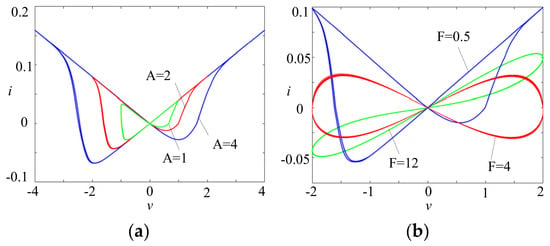
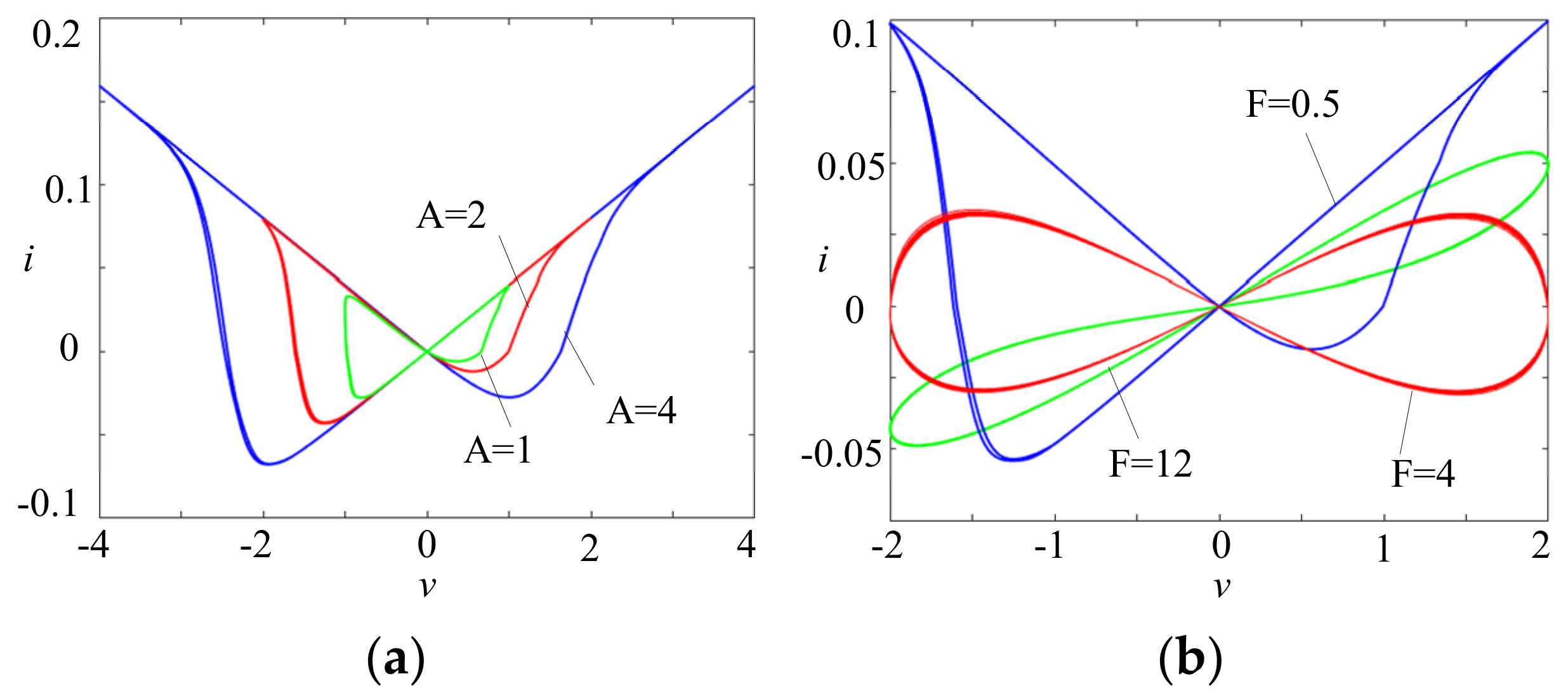
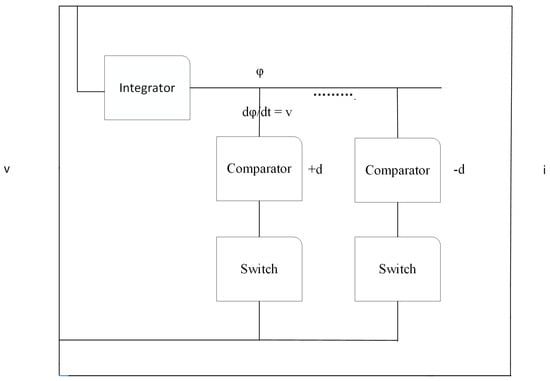
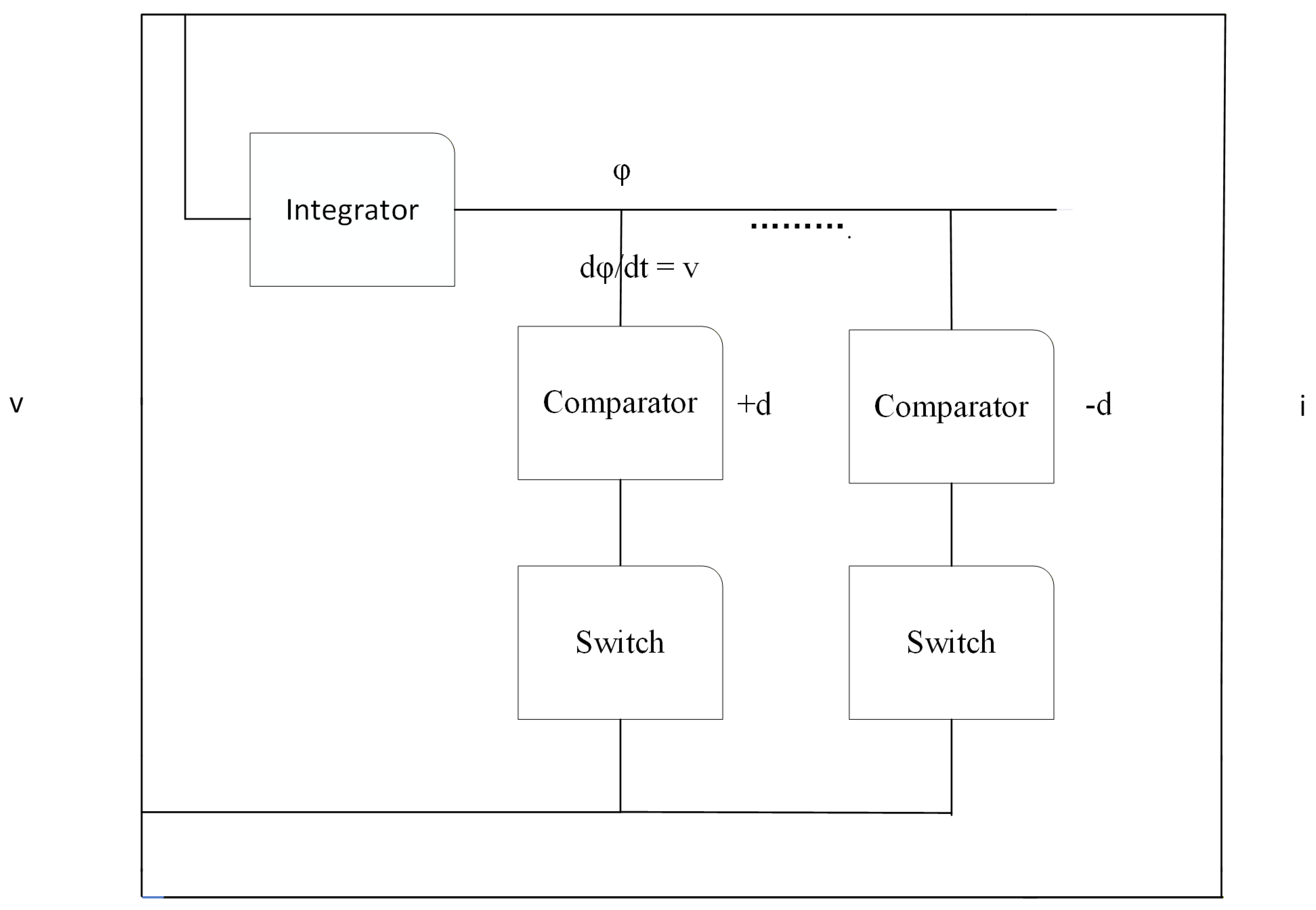
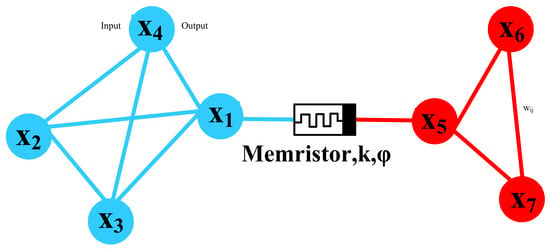
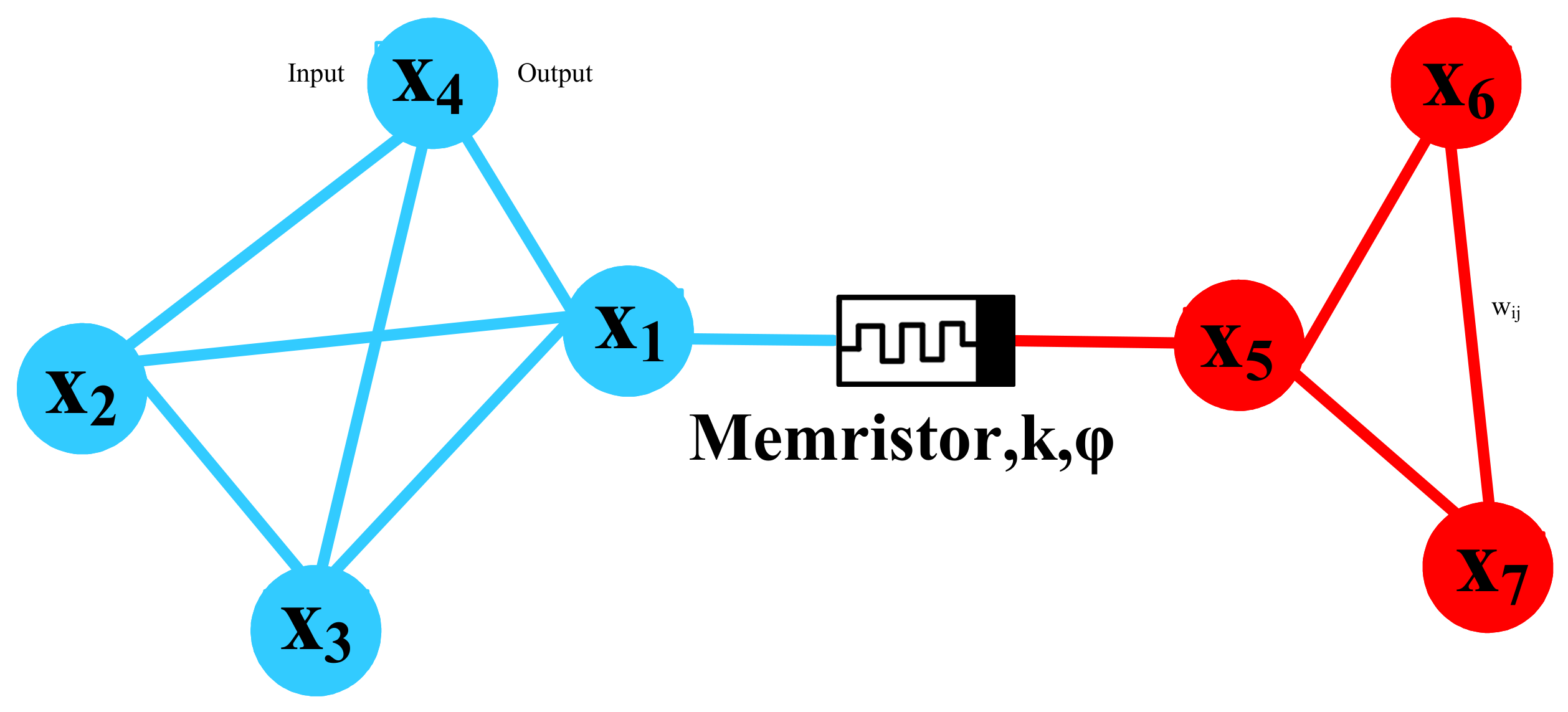
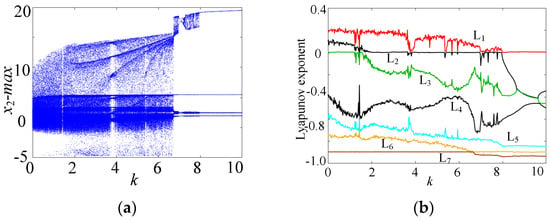
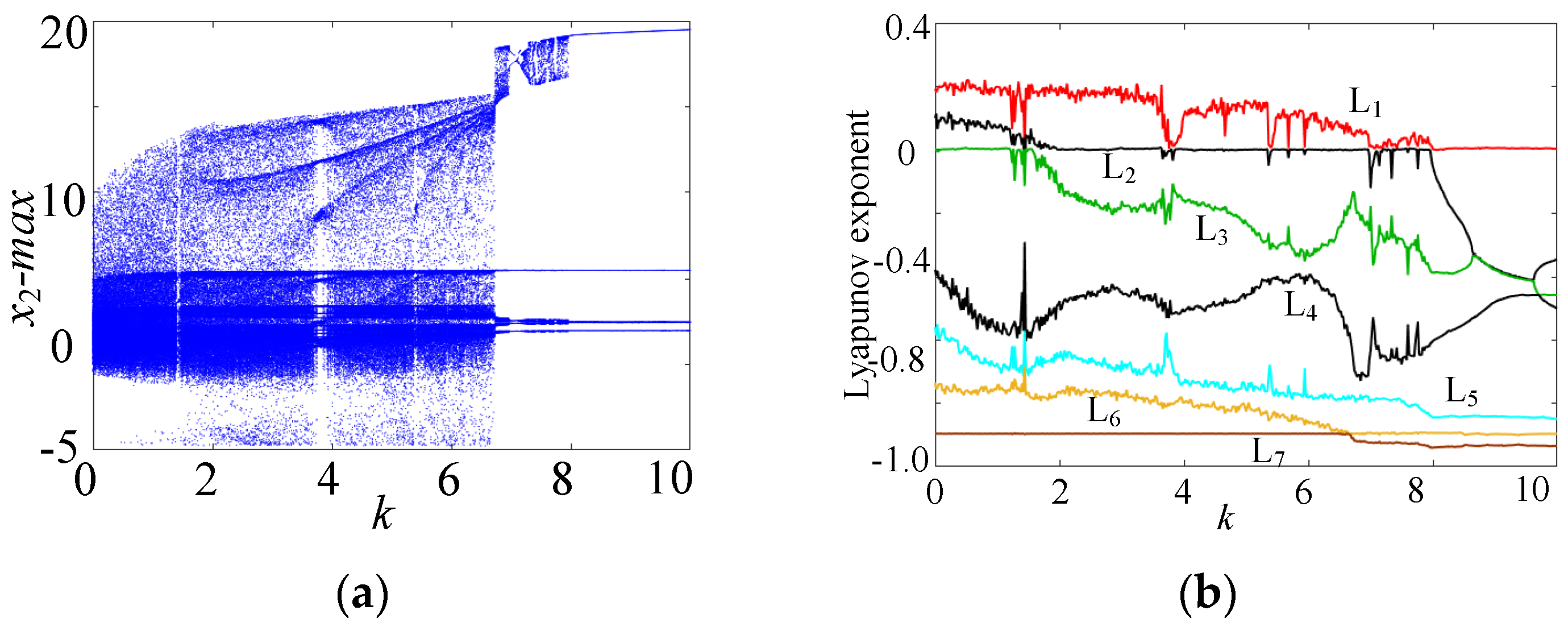
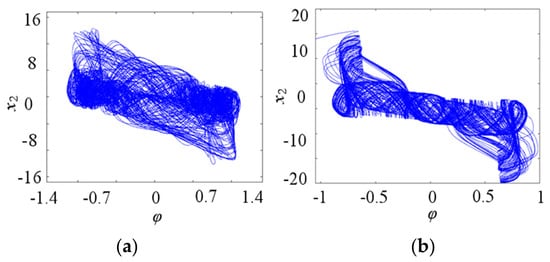
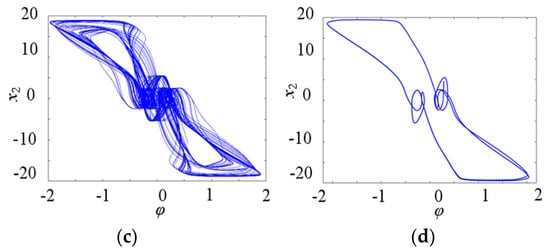
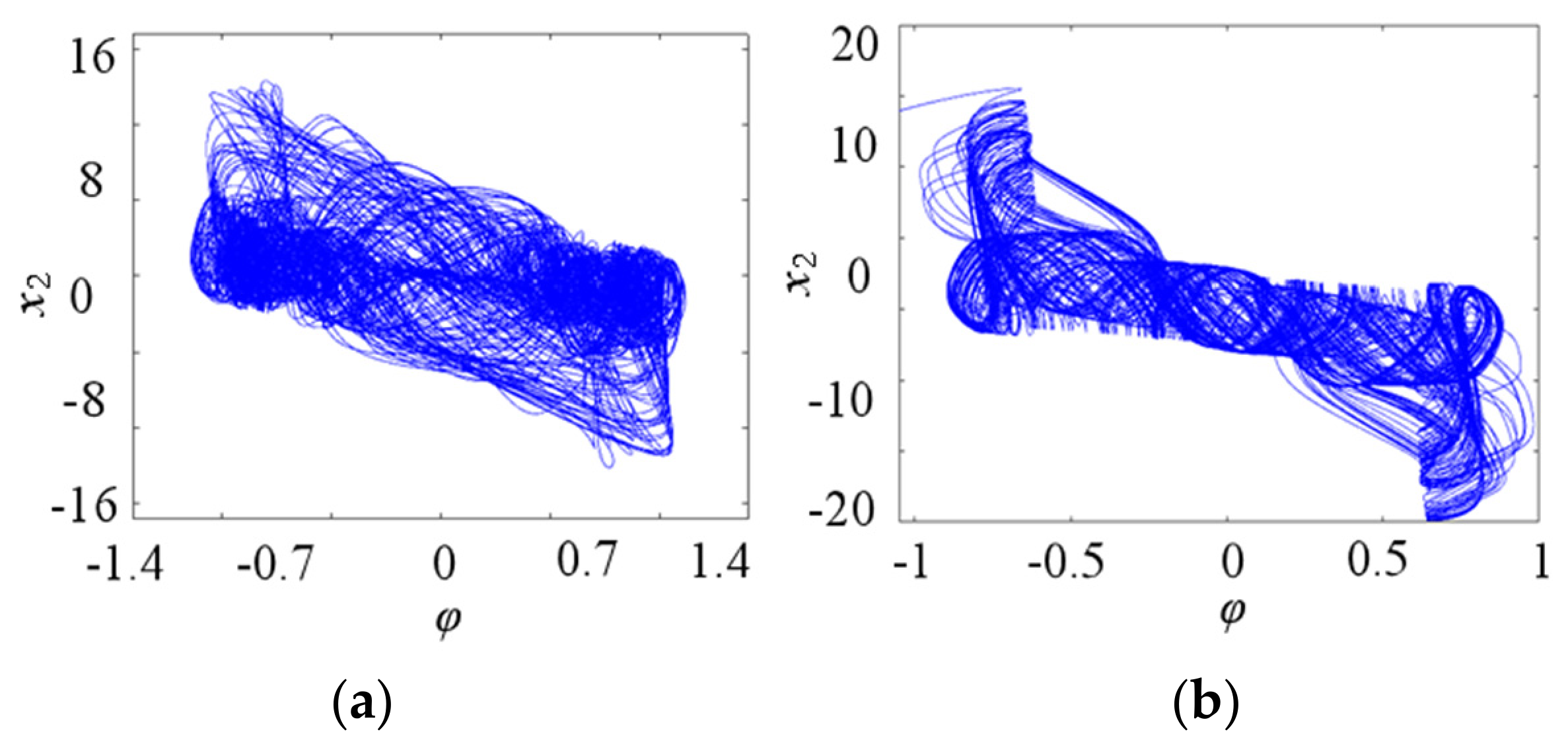
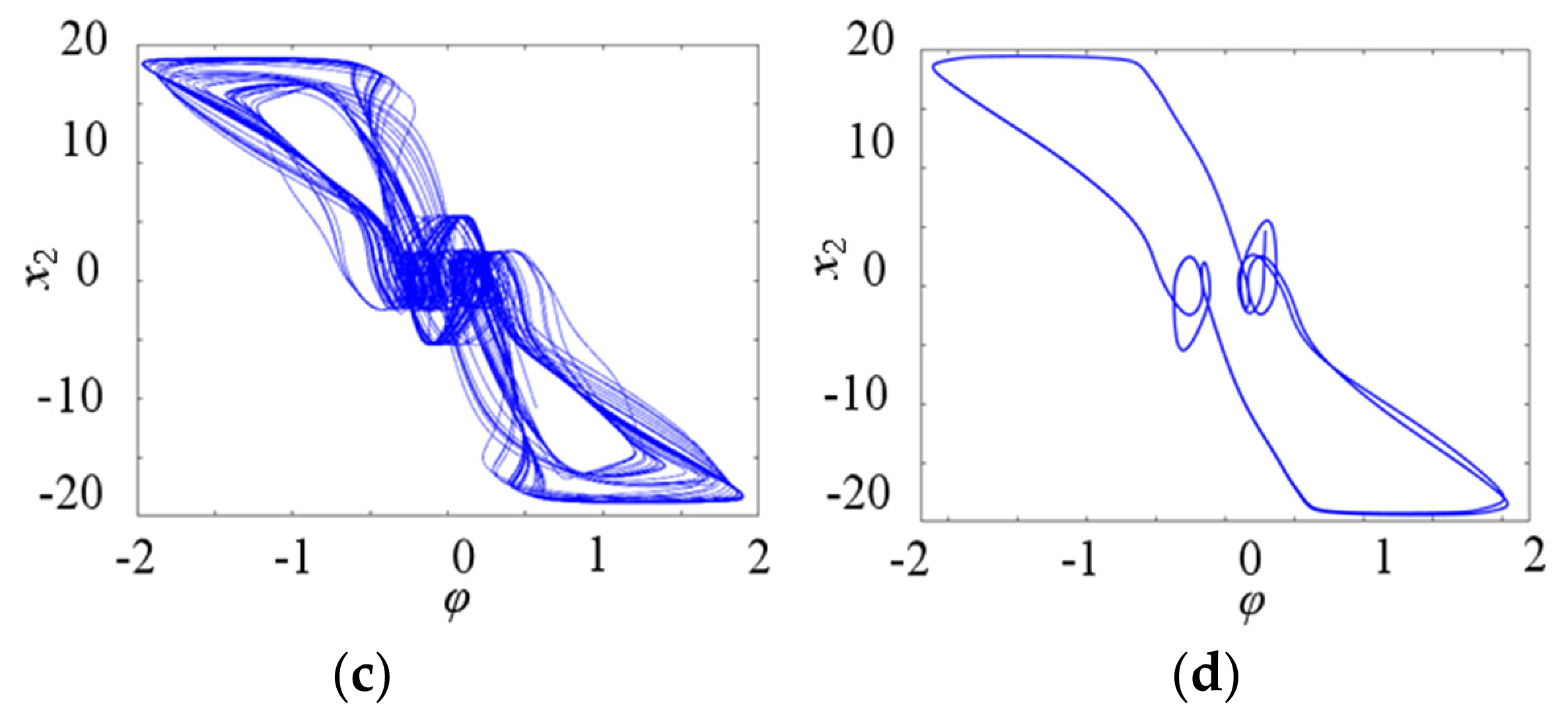
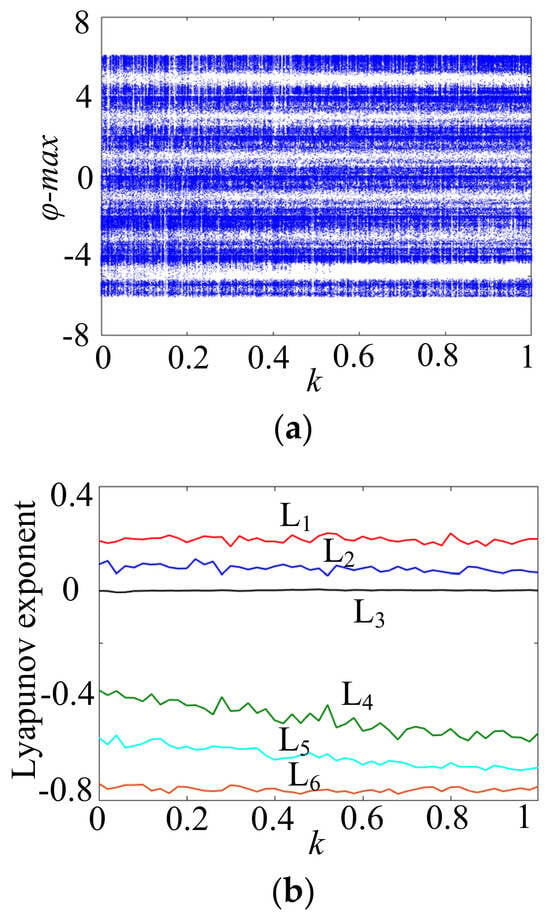
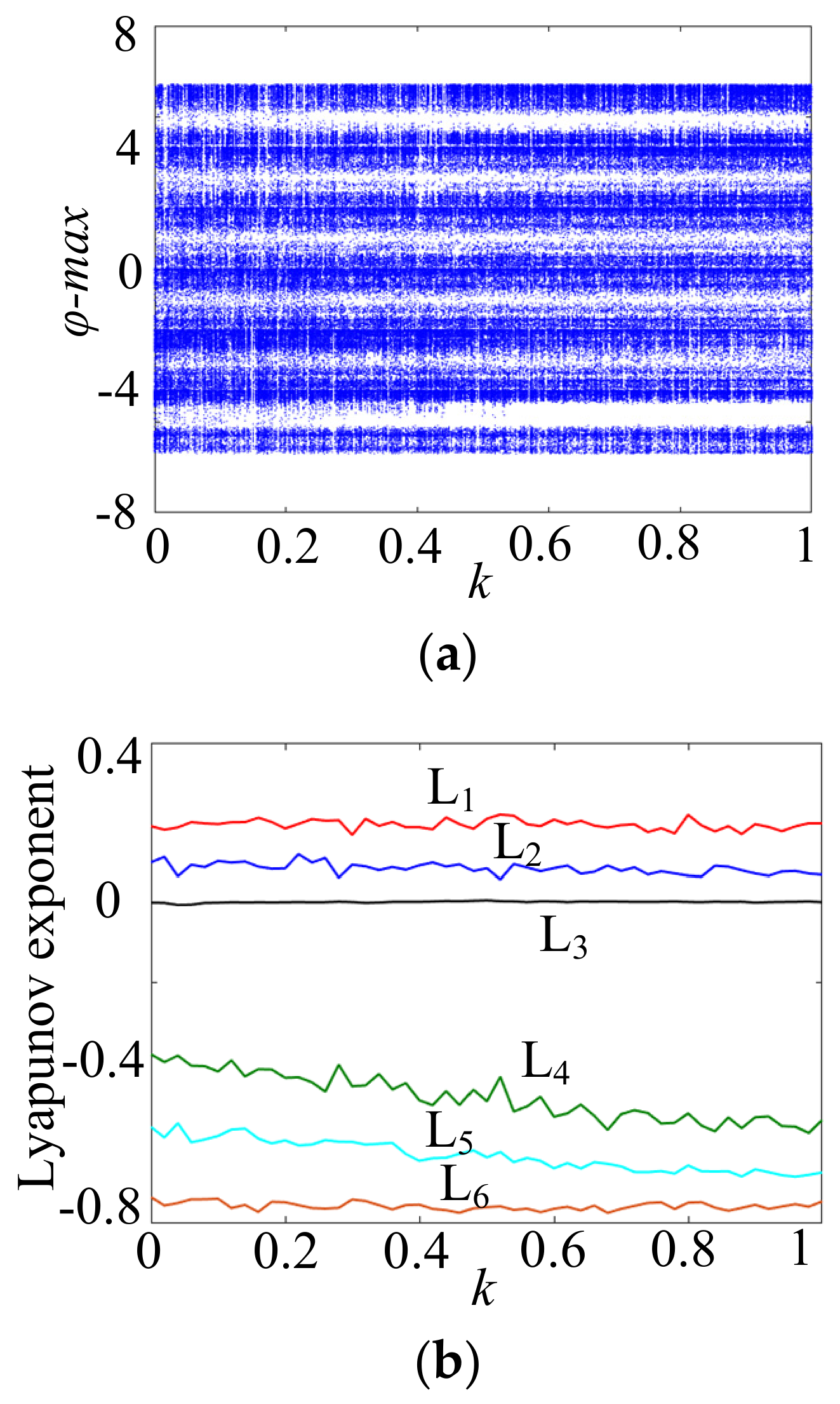
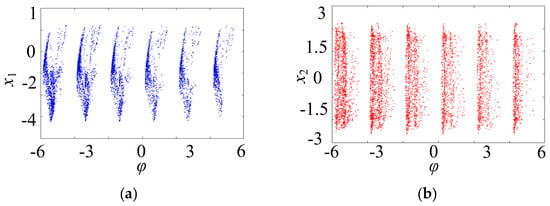
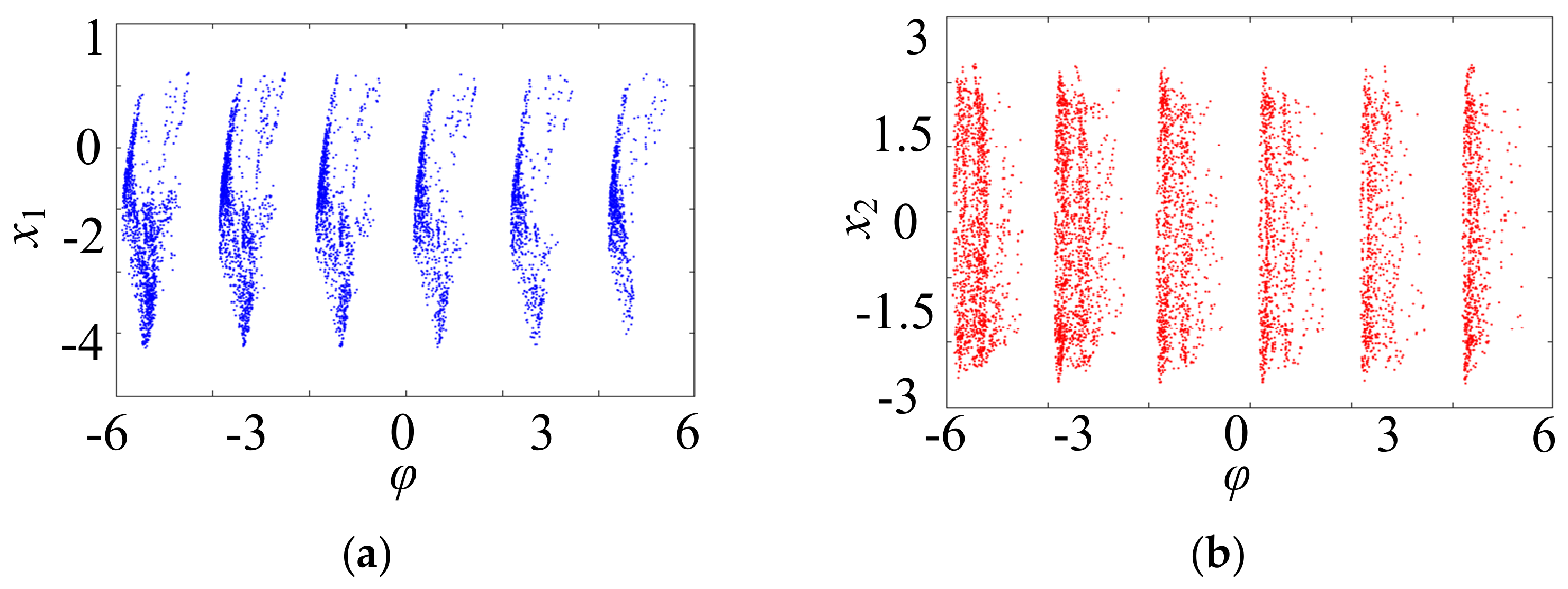
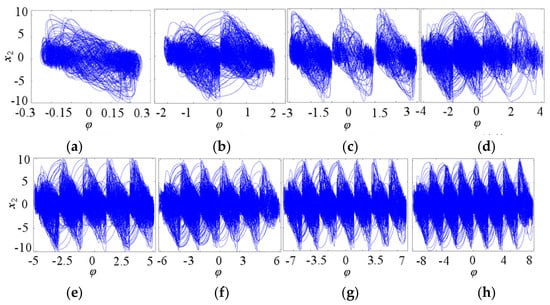
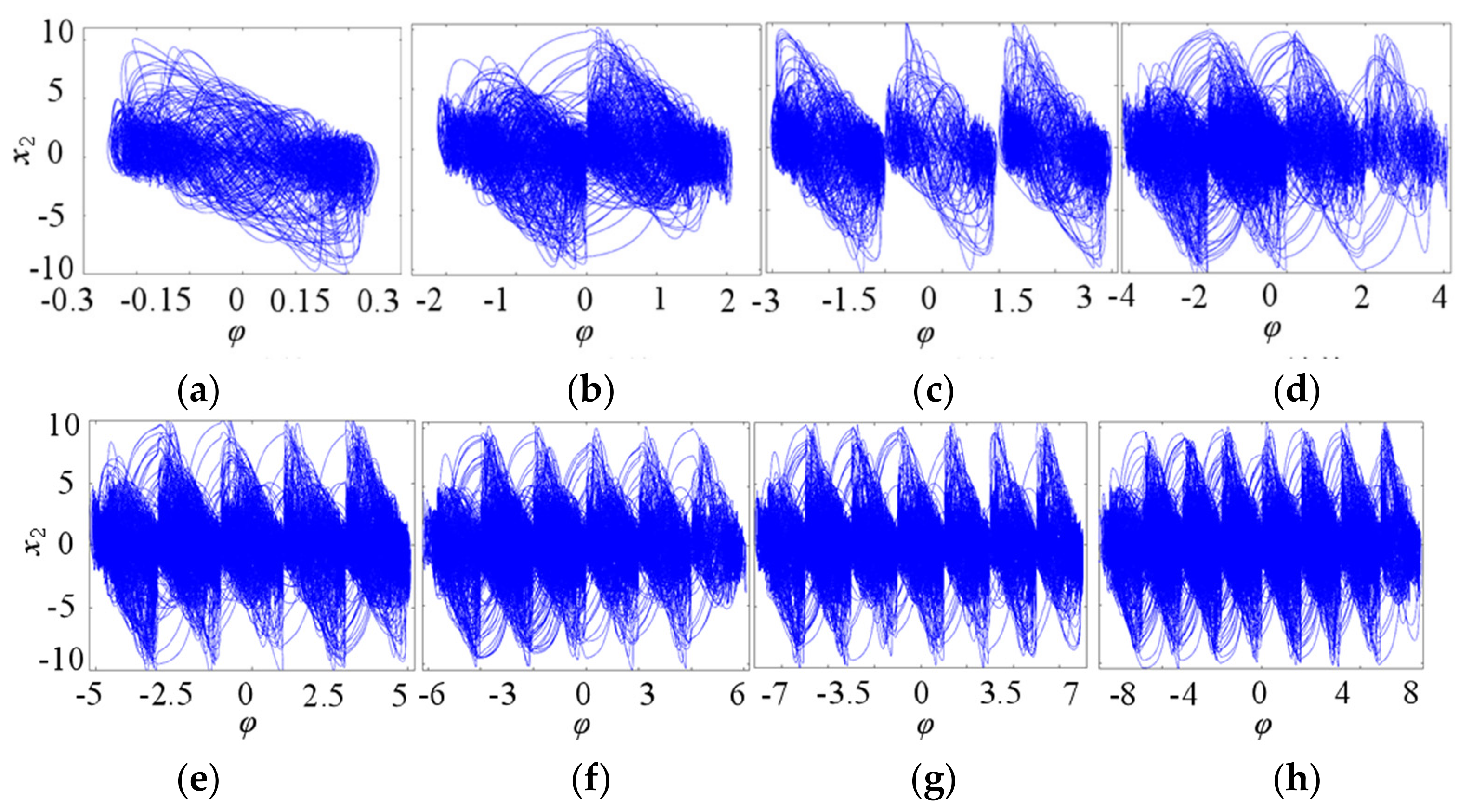
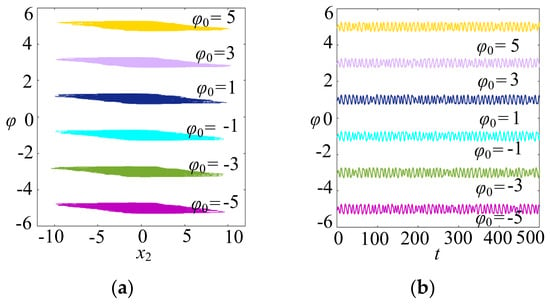
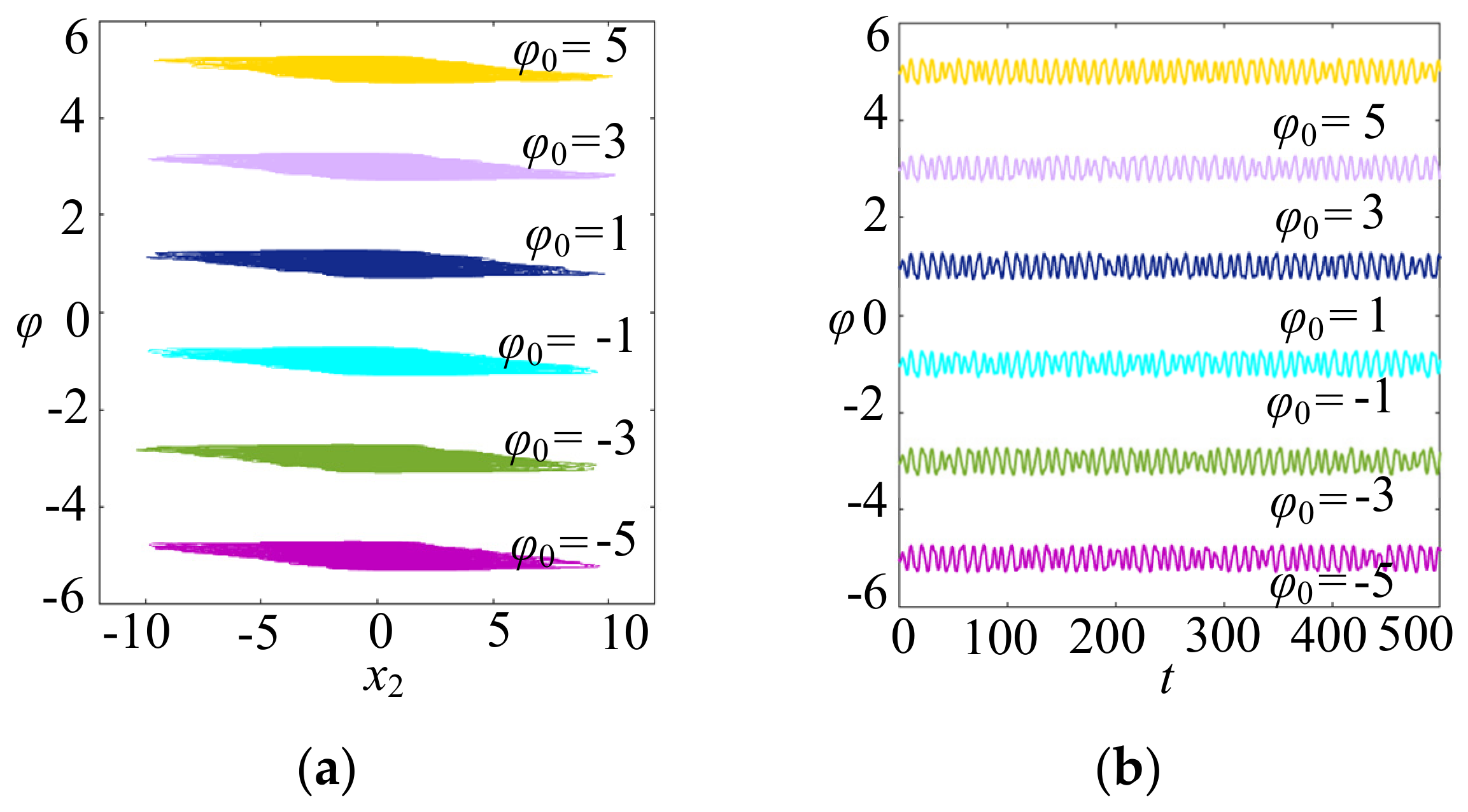
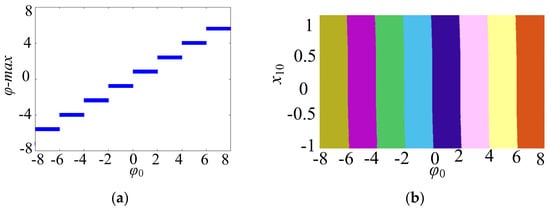
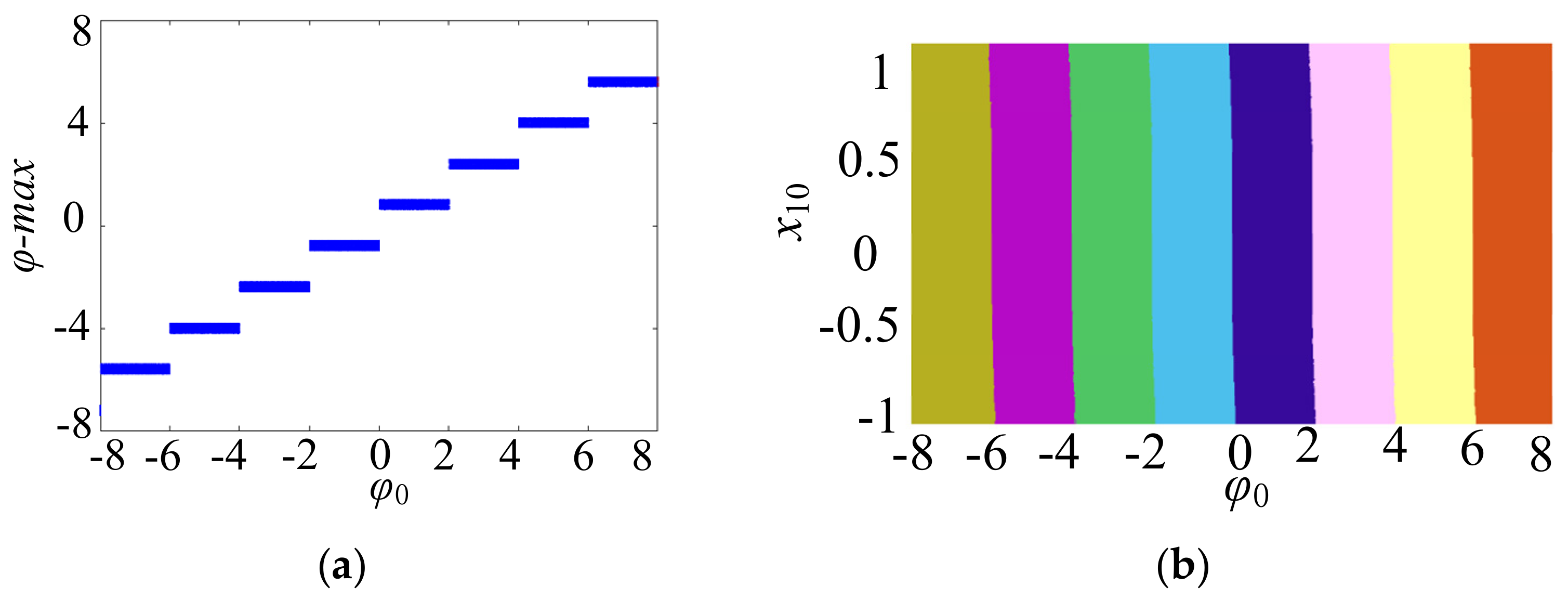
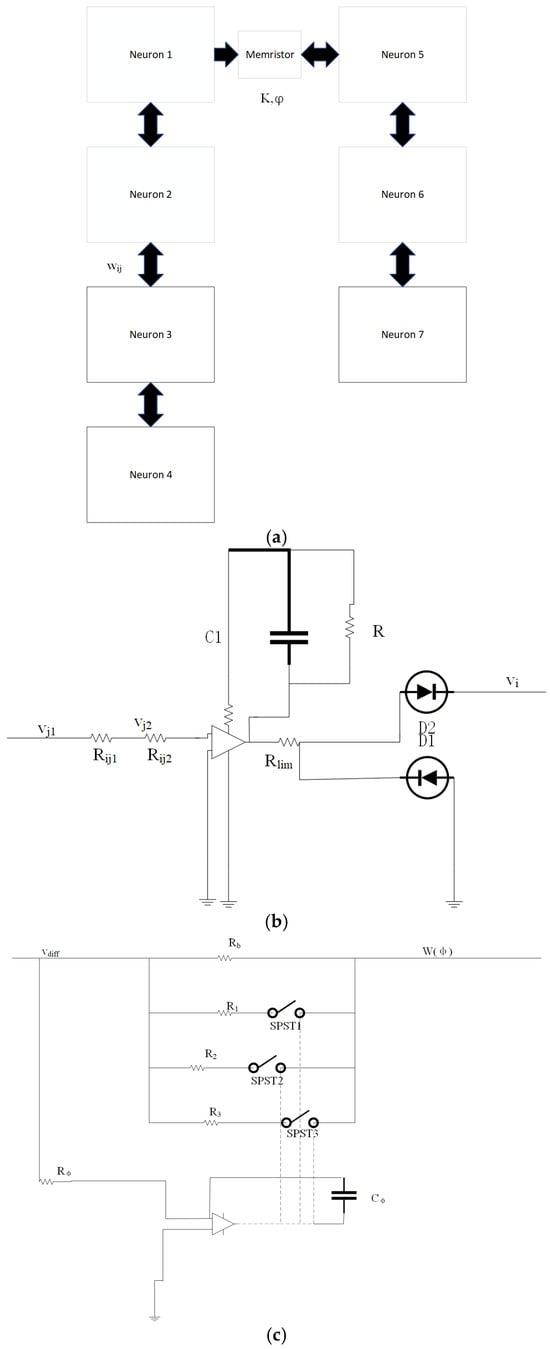
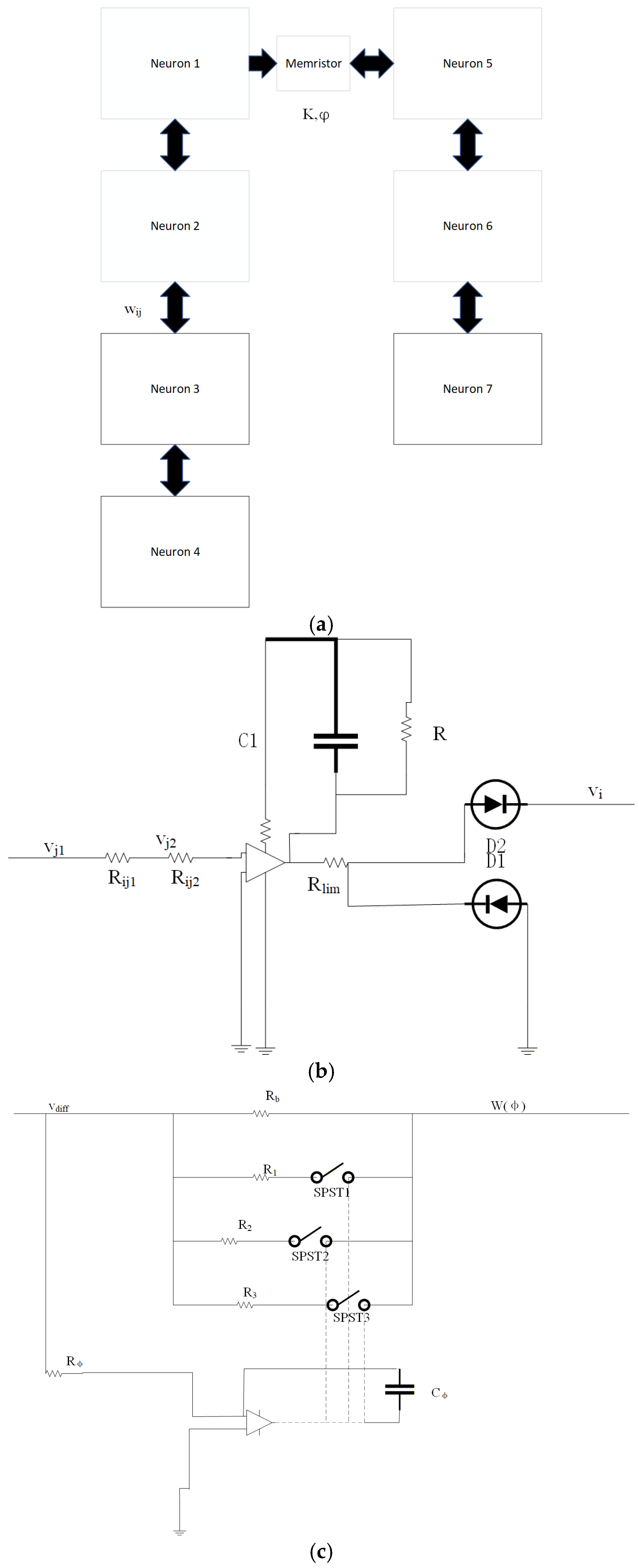
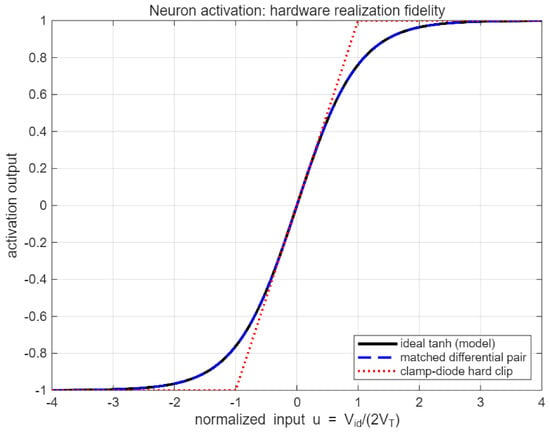
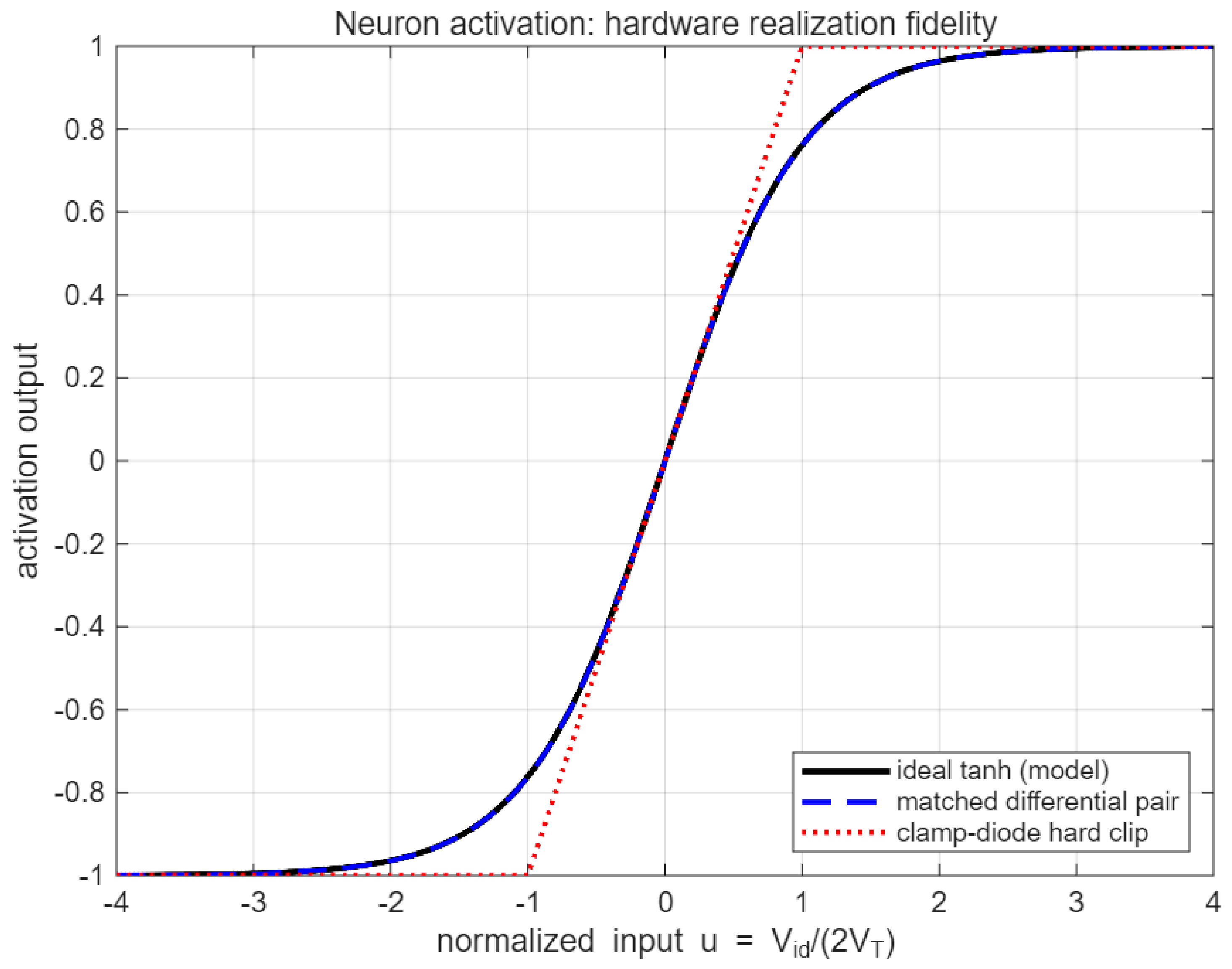
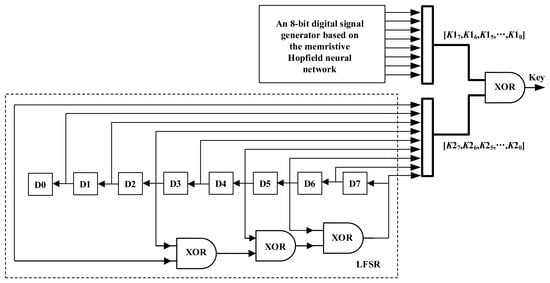
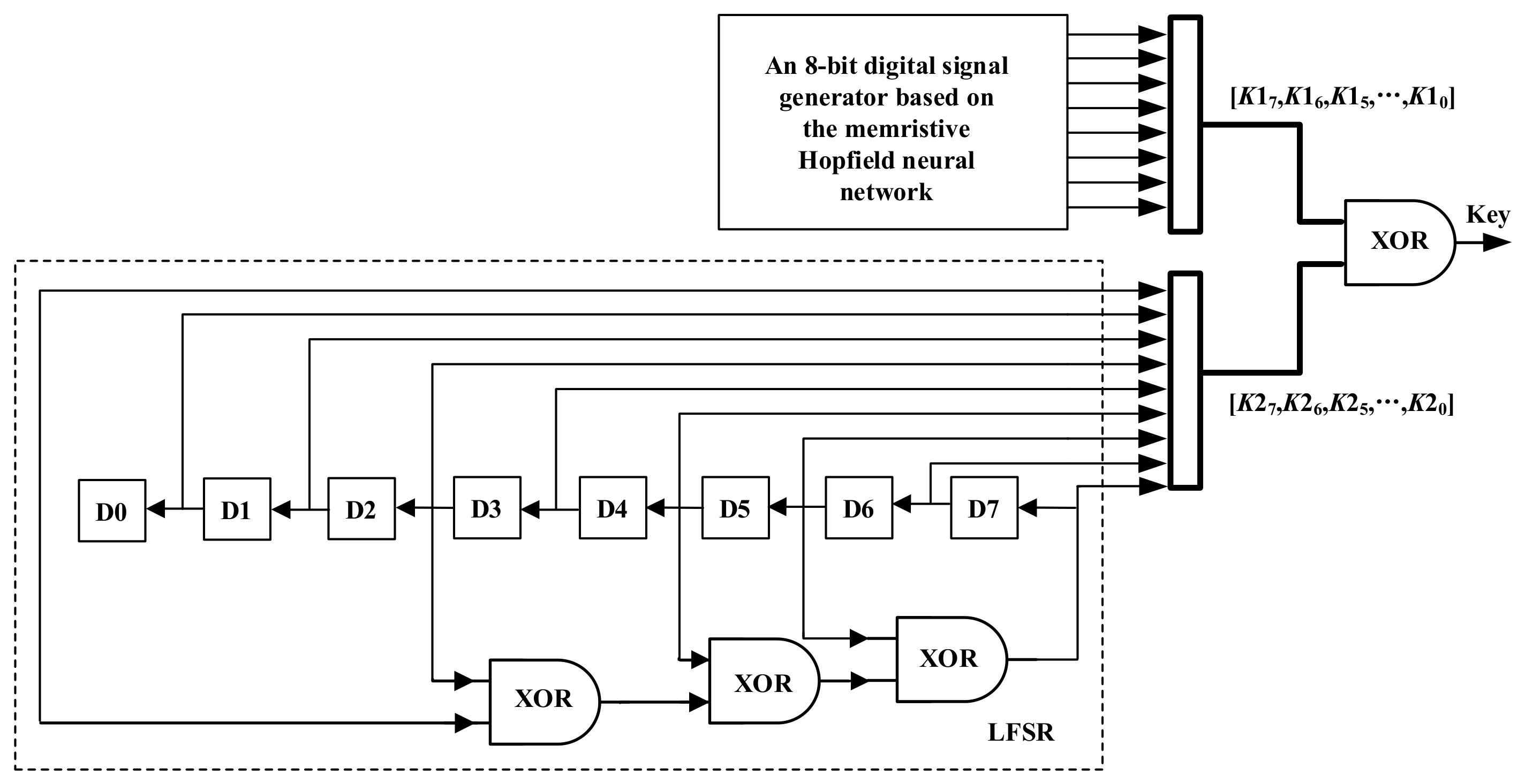
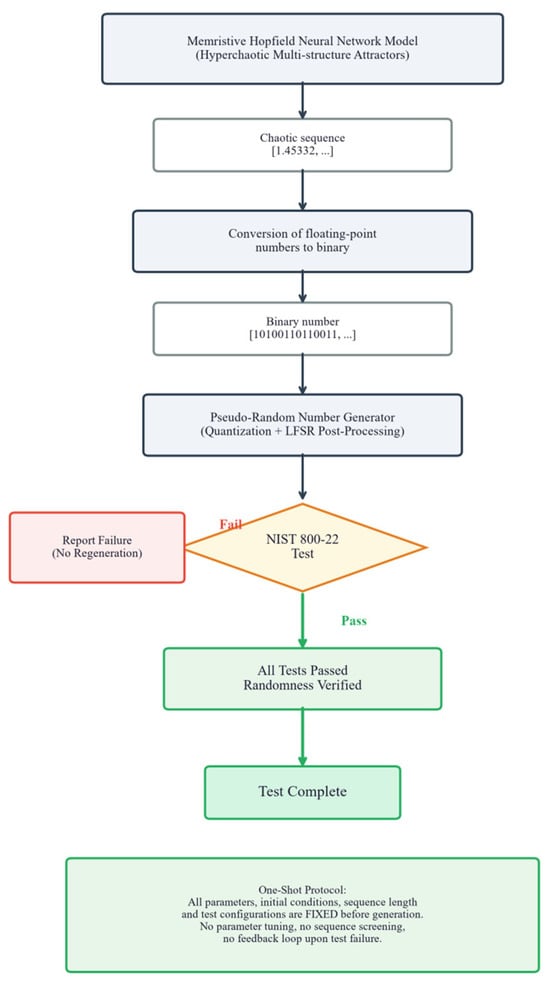
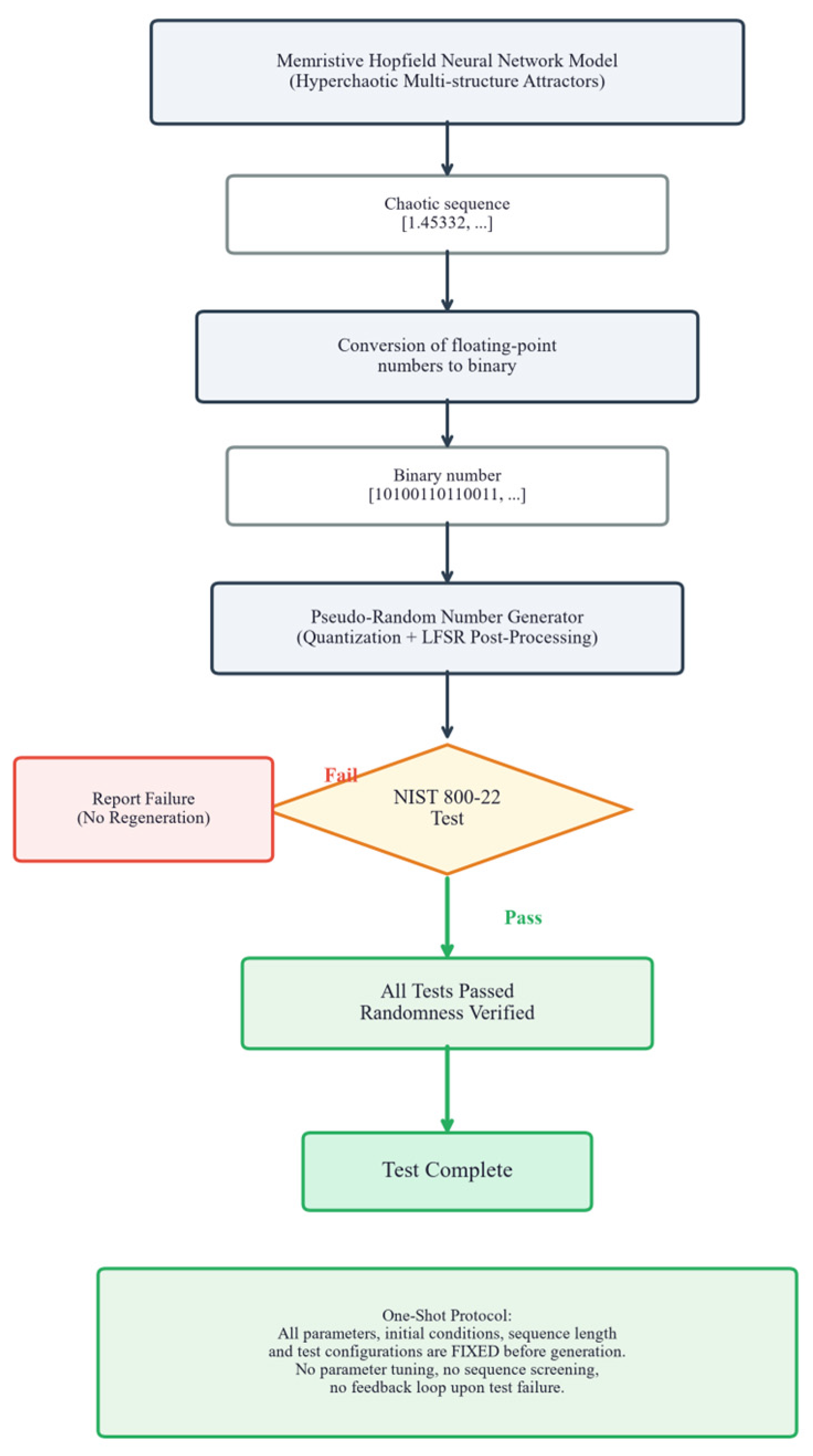

Disclaimer/Publisher’s Note: The statements, opinions and data contained in all publications are solely those of the individual author(s) and contributor(s) and not of MDPI and/or the editor(s). MDPI and/or the editor(s) disclaim responsibility for any injury to people or property resulting from any ideas, methods, instructions or products referred to in the content. |
© 2026 by the authors. Licensee MDPI, Basel, Switzerland. This article is an open access article distributed under the terms and conditions of the Creative Commons Attribution (CC BY) license.