


Abstract
A back-to-back time transfer system based on two integrated microcombs and linear optical sampling is demonstrated, establishing the feasibility of chip-scale microcomb sources for precision time–frequency metrology. Two microcombs with repetition rates near 20 GHz are built and repetition-rate locked before asynchronous heterodyne sampling. By tuning the initial optical-frequency offset between the two combs, the linear–optical–sampling signal is shifted into the bandwidth of low-frequency balanced photodetection and oscilloscope acquisition. In a dual-channel balanced-detection configuration, a time deviation of approximately 11 fs at an averaging time of 1 s is obtained. The results demonstrate coherent mapping of a microwave reference onto microcomb pulse trains and femtosecond-level readout of their relative timing, establishing the feasibility of integrated microcombs for precision time–frequency transfer.
1. Introduction
High-precision time–frequency synchronization serves as the foundation for navigation, precision metrology, and the synchronous operation of distributed scientific facilities [1,2,3]. The advent of optical frequency combs (OFCs) has revolutionized precision time–frequency metrology. Featuring evenly spaced broadband comb lines and ultrashort temporal pulse characteristics, OFCs act as an accurate bridge between optical and microwave frequencies, becoming a core technology for high-precision time–frequency distribution [4]. Optical frequency transfer over a long-distance fiber link with a short-term instability of 4 × 10⁻¹⁹ has been realized previously using a single femtosecond mode-locked OFC, significantly accelerating the development of optical atomic clock networking [5].
Dual-comb coherent detection techniques have evolved from spectroscopic tools into a versatile platform for precision optical metrology, while also revolutionizing the fields of time–frequency synchronization. Early dual-comb spectroscopy employed two OFCs with slightly different repetition rates to map a broadband optical spectrum into the radio-frequency domain, enabling rapid, high-resolution measurements without a mechanically scanned delay line [6]. The same asynchronous-sampling principle was subsequently extended to absolute distance measurement, where it combines time-of-flight information with interferometric precision [7]. In optical time–frequency transfer, two-way exchange and linear optical sampling (LOS) have enabled femtosecond-level synchronization across turbulent free-space links [8]. These advances have broadened dual-comb technology toward molecular sensing, dimensional metrology, coherent communications, and distributed clock networks [9,10,11].
Progress in comb-based timing metrology has followed a parallel path from laboratory measurement toward long-distance clock networks. Optical cross-correlation of femtosecond pulses enabled nanometer-scale time-of-flight metrology over a 0.7 km path [12]. Frequency-comb links using LOS subsequently supported time–frequency dissemination over 113 km of turbulent free space [13], while near-quantum-limited optical time transfer extended operation to a 300 km folded link at extremely low received optical power [14]. At the subsystem level, LOS has also been used to map electrical time intervals into the optical domain, achieving 82-fs precision in a single scan and 3.05 fs after 100-fold averaging [15]. Fiber implementations have advanced in parallel: dual-comb-enhanced optical two-way time transfer synchronized microwave clocks over 205.86 km of deployed commercial fiber with a residual time deviation of 6.23 fs at 1 s [16]. Recent reviews summarize the progression of fiber-based optical time–frequency transfer from laboratory stability measurements toward field-deployed and large-scale clock-network architectures [17].
Conventional dual-comb systems typically rely on bulky mode-locked lasers and discrete optical devices, featuring large volume, high power consumption, low integrability, and poor environmental adaptability, failing to satisfy the practical requirements of miniaturized time–frequency nodes. Integrated Kerr microresonator OFCs generate broadband coherent comb lines via on-chip nonlinear optical effects. Benefiting from miniature size, tunable repetition rate, low power consumption, and monolithic integrability, microcombs achieve a favorable trade-off between high precision and miniaturization, becoming a crucial technical solution for chip-scale precision time–frequency dissemination and synchronization [18,19]. However, the high repetition rate of a microcomb poses a challenge for direct electronic processing, while its pulse energy is generally lower than that of a fiber frequency comb.
In this work, we build a back-to-back time transfer experimental platform based on silicon nitride integrated microcombs to verify the feasibility of implementing optical-to-microwave phase mapping, asynchronous sampling, and femtosecond timing readout via microcomb sources. Compared with previous time–frequency transfer demonstrations that rely on bulky mode-locked lasers and discrete optical components, the work presented here provides, to the best of our knowledge, the first feasibility demonstration of back-to-back time transfer using two integrated Si3N4 Kerr microcombs as the signal and local oscillator sources. Firstly, we establish that integrated microcombs with repetition rates near 20 GHz—despite their inherently high repetition rates and low pulse energies—can serve as viable sources for linear-optical-sampling-based timing readout, achieving a dual-channel differential time deviation of approximately 11 fs at an averaging time of 1 s. Secondly, by tuning the initial optical-frequency offset between the two combs, we shift the multiheterodyne signal directly into the low-frequency detection bandwidth, eliminating the need for additional high-frequency down-conversion stages and simplifying the electrical acquisition chain. Thirdly, we provide a comprehensive quantitative characterization of the repetition-rate stability and phase noise of the two sources, establishing a rigorous noise model that separates common-mode from differential contributions and reveals the intrinsic measurement background of the apparatus. These results lay the experimental foundation and theoretical support for future chip-scale, low-power, and field-deployable time–frequency dissemination systems, and provide a baseline for separating terminal noise from link-induced noise in subsequent long-distance fiber or free-space time-transfer experiments.
2. Experimental Principle and Setup
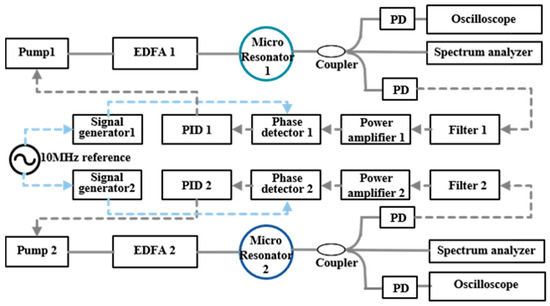
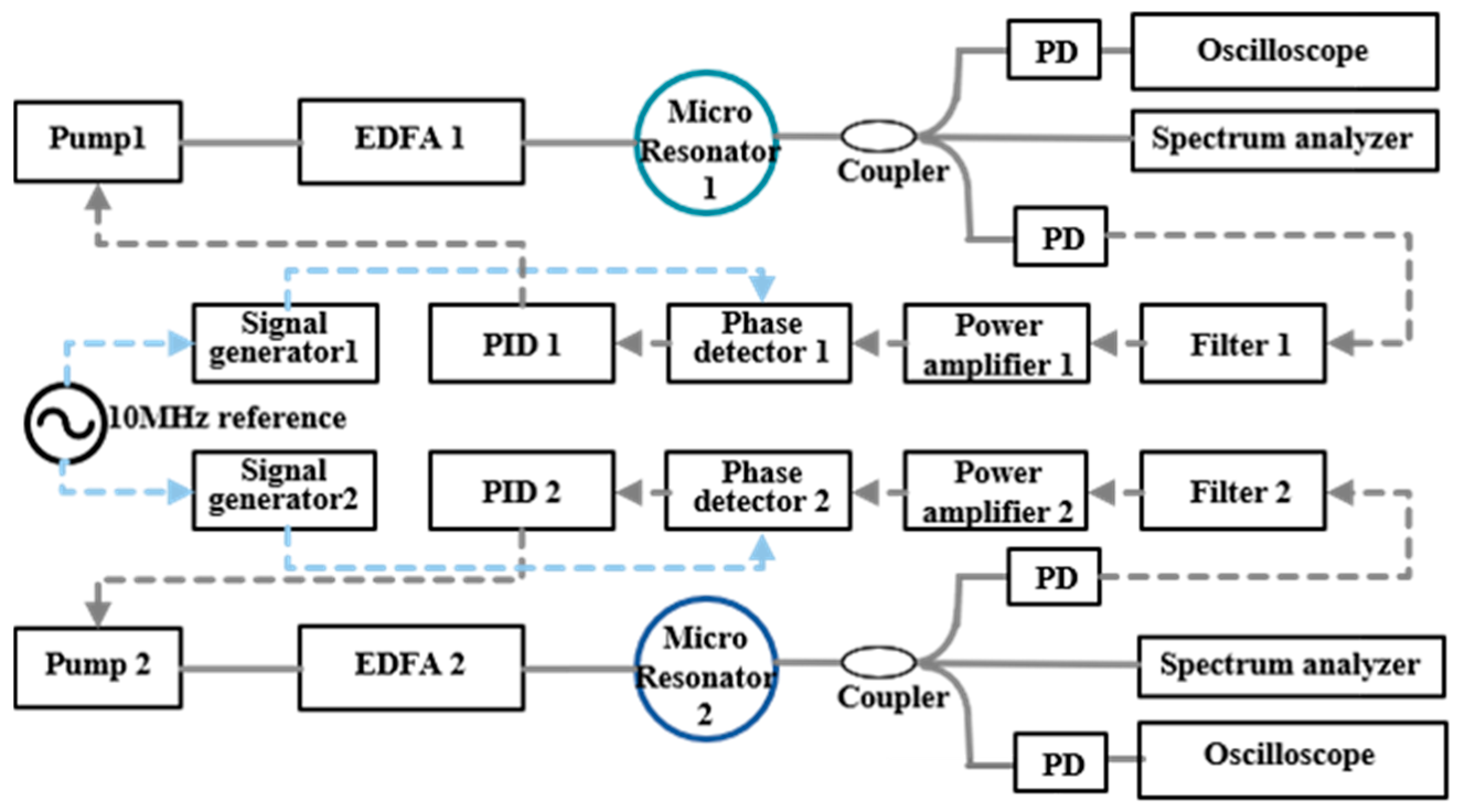
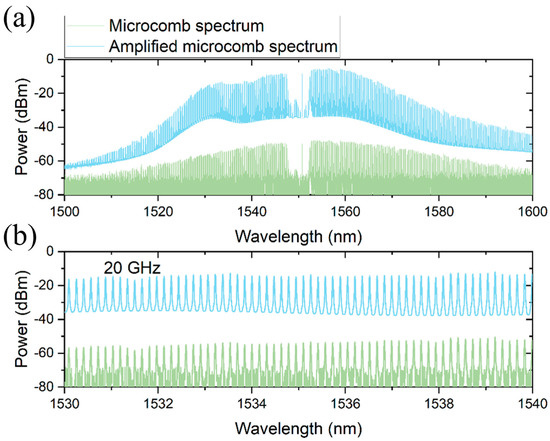
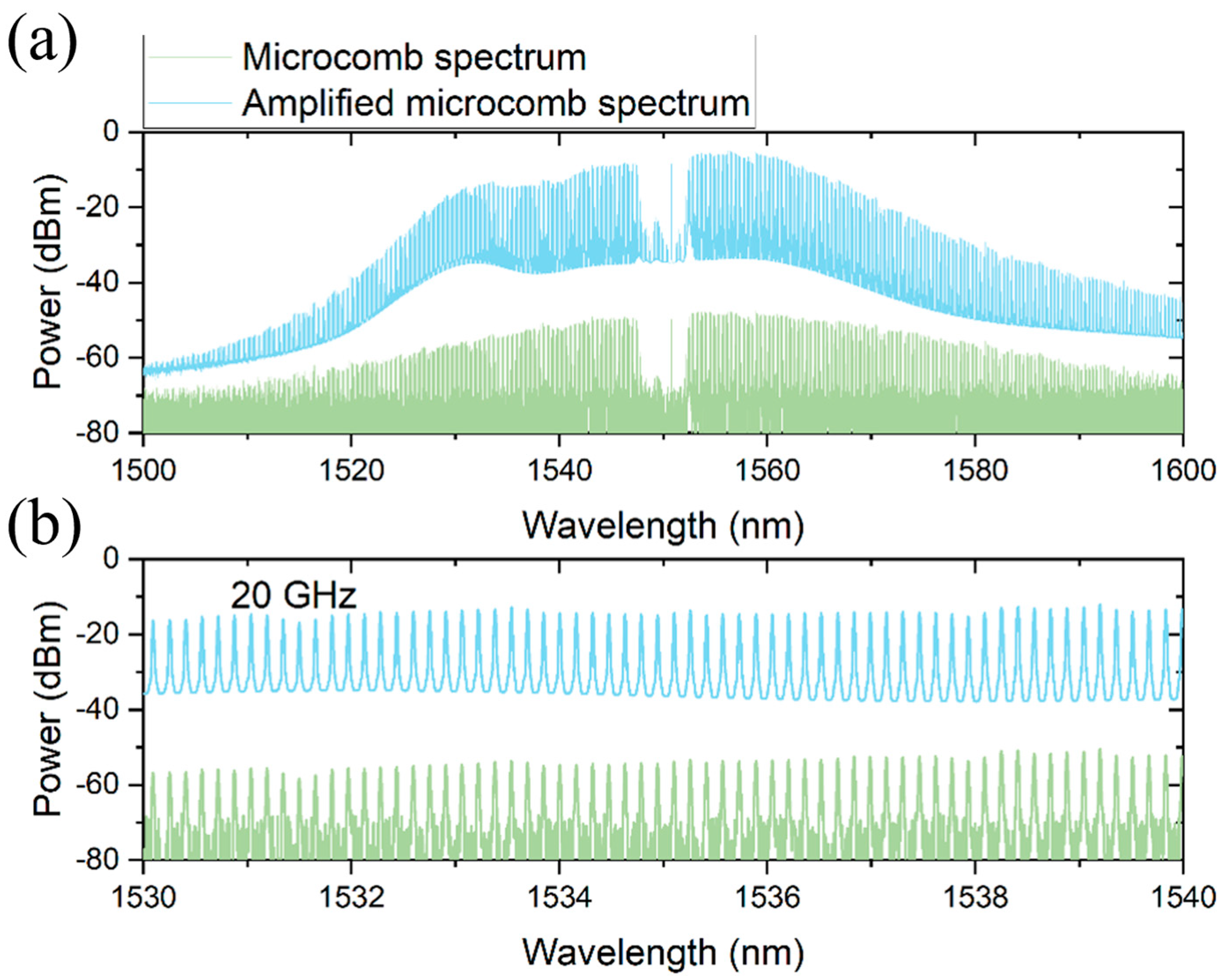
Two integrated dissipative Kerr soliton microcombs based on silicon nitride (Si3N4) microresonators are built as the light sources, as shown in Figure 1. The commercial Si3N4 microresonator used in this work was from Qaleido Photonics (Hangzhou, China). The chip has dimensions of 5 × 5 mm2 and, the waveguide width is 2 μm, and the waveguide thickness is 850 nm. The resonator is side-coupled to a bus waveguide. The measured free spectral range (FSR) is approximately 20 GHz, and the quality factor is up to 5 × 10⁶. The ultra-high-Q and low-loss characteristics significantly reduce the intracavity lasing threshold, enabling low-power and highly stable soliton mode-locking operation. A narrow-linewidth continuous-wave laser is employed as the pump source. An in-line optical amplifier is utilized to precisely optimize the incident pump power to satisfy the optimal operating parameters for stable single-soliton excitation. To suppress the resonant frequency drift and thermal noise caused by ambient temperature fluctuations, the microresonator chip is fixedly mounted on a high-precision thermal stabilization module. The temperature accuracy is maintained at ±0.01 °C throughout the experiment, which eliminates thermal disturbance and guarantees the long-term continuous operation stability of the optical comb system. A deterministic soliton generation scheme based on fast pump wavelength scanning is adopted in this work. The pump laser was tuned to a resonance at λp = 1550.2 nm, and the pump laser was amplified to 1500 mW with the on-chip pump power set to approximately 750 mW. The pump detuning relative to the cold-cavity resonance was maintained at approximately 1.2 GHz to ensure stable single-soliton generation. With refined iterative tuning of optical path parameters, non-ideal operating states, including chaotic states and multi-soliton states, are effectively suppressed, and stable single-soliton Kerr comb output is efficiently realized. Single-soliton operation was confirmed by the characteristic sech2 spectral envelope and by the step-like feature in the transmitted pump power during the wavelength scan. The measured optical spectrum covers 1500–1600 nm with uniform, flat comb lines, as shown in Figure 2, providing highly stable and coherent optical input for back-to-back time–frequency transmission experiments.
Figure 1.
Dual-comb experimental configuration for back-to-back time transfer. Two integrated Si3N4 Kerr microcombs are pumped by two narrow-linewidth continuous-wave lasers (Pump 1 and Pump 2). The repetition rates of both combs are detected by fast photodetectors (PD), phase-detected with two signal generators referenced to a common 10 MHz rubidium frequency standard, and locked via independent PID servo loops that feed back to the pump laser drive currents. PD, photodetector; PID, proportional–integral–derivative controller; EDFA, erbium-doped fiber amplifier.
Figure 2.
Optical spectra of the Si3N4 microcombs measured before and after amplification by an erbium-doped fiber amplifier (EDFA). (a) Broadband spectra covering the wavelength range from 1500 nm to 1600 nm. The green trace shows the direct output of the microcomb (before amplification), and the blue trace shows the spectrum after EDFA amplification. (b) Magnified view of the comb lines before (green) and after (blue) amplification, showing the 20-GHz free spectral range (FSR) corresponding to a line spacing of approximately 0.16 nm. The spectral shape and line spacing are preserved after amplification, indicating that the EDFA does not introduce significant distortion to the comb structure.
The two integrated dissipative Kerr soliton microcombs are used as the signal comb and local comb, respectively. Their line spacing is approximately 0.16 nm, corresponding to a repetition rate near 20 GHz. Since the direct output power is limited, each microcomb is amplified with an erbium-doped fiber amplifier before detection. Amplification preserves the comb-line spacing while introducing wavelength-dependent gain. Figure 2 shows the broadband spectrum and a magnified view of the comb lines. Autocorrelation measurements give a pulse duration of approximately 15 ps.
The repetition rates of the two microcombs are locked to a common microwave reference. A 10 MHz rubidium frequency standard is distributed to two independent synthesizers (R&S SMB100A, Munich, Germany), each generating a 19.97 GHz local oscillator (LO) signal for down-conversion of the respective microcomb’s repetition rate beat note. The two synthesizers share the same 10 MHz reference to ensure coherence between the two locking loops. For each microcomb, the 20 GHz repetition rate signal is detected at the resonator drop port by a fast photodetector. The detected signal is electrically amplified and mixed with the synthesizer LO to produce an intermediate-frequency error signal. This error signal is sent to a PID servo controller, whose output is applied to the current modulation input of the pump laser driver. Both microcombs are locked to the same microwave reference using two independent but nominally identical locking loops. The pump laser current serves as the primary actuator for repetition rate control, which tunes the pump wavelength rather than directly altering the intracavity power. This wavelength shift modifies the pump-to-resonance detuning, changing the coupling efficiency and the circulating power. The detuning-dependent power induces thermal effects through the thermo-optic coefficient, shifting the cavity resonances and establishing a thermal optical feedback loop. Nonlinear effects, including Kerr and Raman processes, secondarily contribute to the repetition rate change. All coupled processes converge to modify the effective group index of the soliton, which determines the round-trip time and hence the repetition rate. The net tuning coefficient is measured to be approximately 190 kHz/mA.
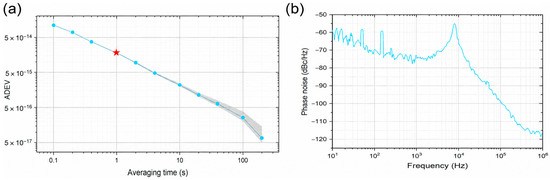
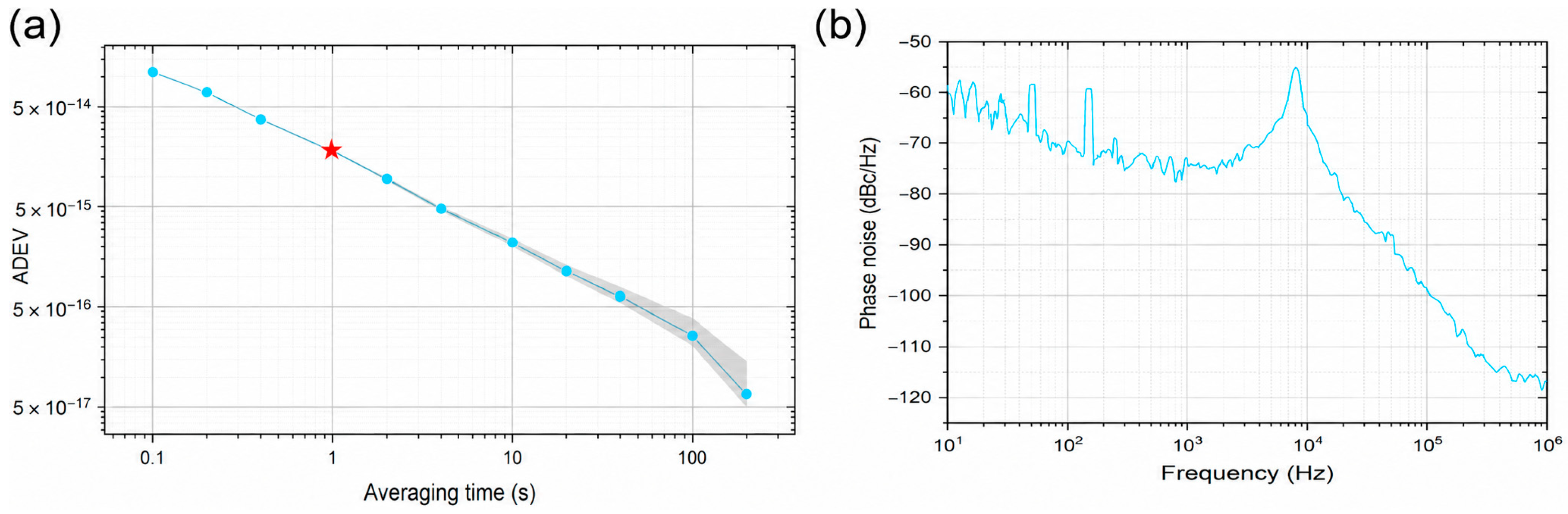
As shown in Figure 3, The locking performance was characterized by measuring both the Allan deviation and the phase noise of the locked repetition rate. The blue dots represent the measured Allan deviation of the locked repetition rate at different averaging times. The Allan deviation of the locked repetition rate reaches 3.6 × 10⁻¹⁵ at an averaging time of 1 s, as indicated by the red star. The gray shaded area indicates the measurement uncertainty interval of the Allan deviation data. The single-sideband phase noise of the locked repetition rate beat note is −85 dBc/Hz at 1 kHz offset, −75 dBc/Hz at 10 kHz offset, and −100 dBc/Hz at 100 kHz offset. The servo bandwidth can be estimated from the phase noise to be 10 kHz. These values confirm that the microwave reference stability is faithfully transferred to the microcomb repetition rate within the servo bandwidth, and that the residual phase noise contributes to the single-channel LOS detection results. The second microcomb, which uses an identical resonator and an independent but nominally identical phase-locked loop, exhibits essentially the same locked repetition-rate stability and phase-noise characteristics.
Figure 3.
Characterization of the locked repetition-rate stability of one representative microcomb. (a) Allan deviation of the locked 20-GHz repetition rate as a function of averaging time τ. The deviation reaches 3.6 × 10⁻¹⁵ at τ = 1 s, demonstrating that the microwave reference stability is faithfully transferred to the microcomb repetition rate within the servo bandwidth. (b) Single-sideband phase noise power spectral density of the locked repetition rate beat note.
The repetition rates of the signal and local microcombs are set with a small offset. The asynchronous pulse trains interfere on a balanced photodetector and generate a linear–optical–sampling interferogram. For repetition rates and , the optical time scale is mapped onto the laboratory time scale with an approximate stretch factor . Temperature tuning controls the initial optical-frequency offset between the combs and shifts the multiheterodyne signal into the 1.6-GHz detection bandwidth, enabling direct time-domain acquisition without an additional high-frequency down-conversion stage.
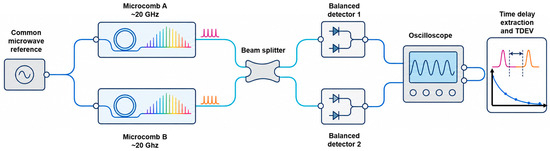
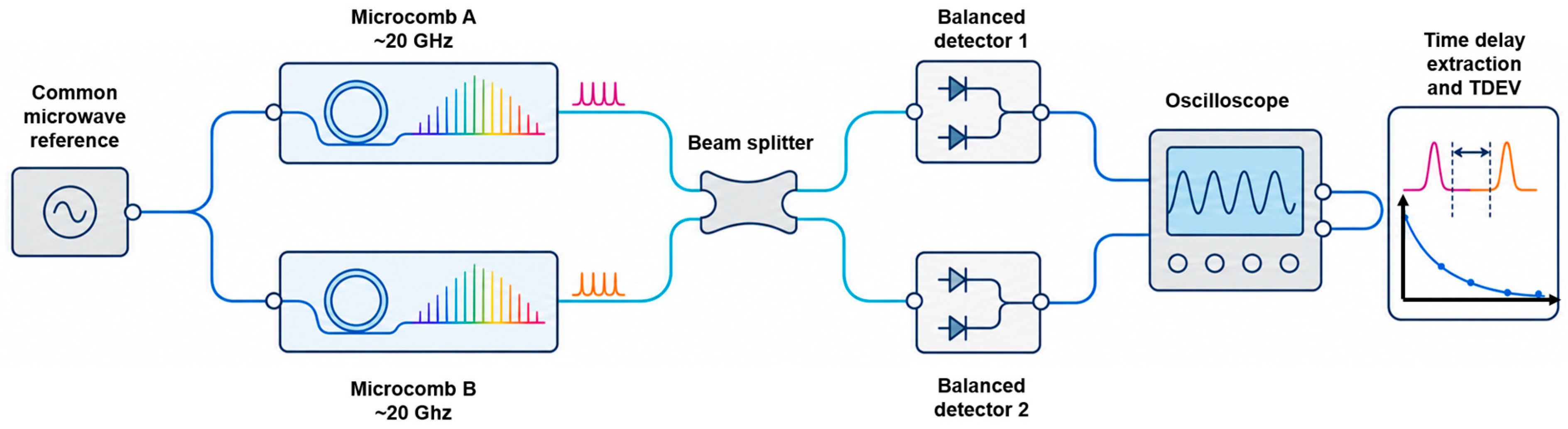
As shown in Figure 4, no transmission path is inserted in the back-to-back configuration. Two nominally identical balanced-detection channels simultaneously receive the linear–optical–sampling signal generated by the same microcomb pair. Their outputs are recorded by an oscilloscope, and the relative arrival time of the two interferograms is extracted. Differential detection suppresses common-mode fluctuations from the optical sources, microwave reference, and acquisition clock, so the measured time difference represents the combined background of the two detection channels, data acquisition, and timing estimator.
Figure 4.
Simplified experimental configuration for back-to-back time–frequency transfer using two microcombs. The two combs are locked to a common 10 MHz rubidium frequency standard. The locked pulse trains are combined and detected by two balanced photodetectors in a dual-channel configuration, and the outputs are digitized by an oscilloscope.
3. Results and Discussion
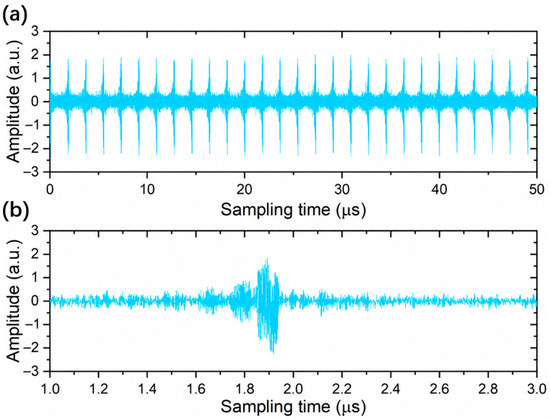
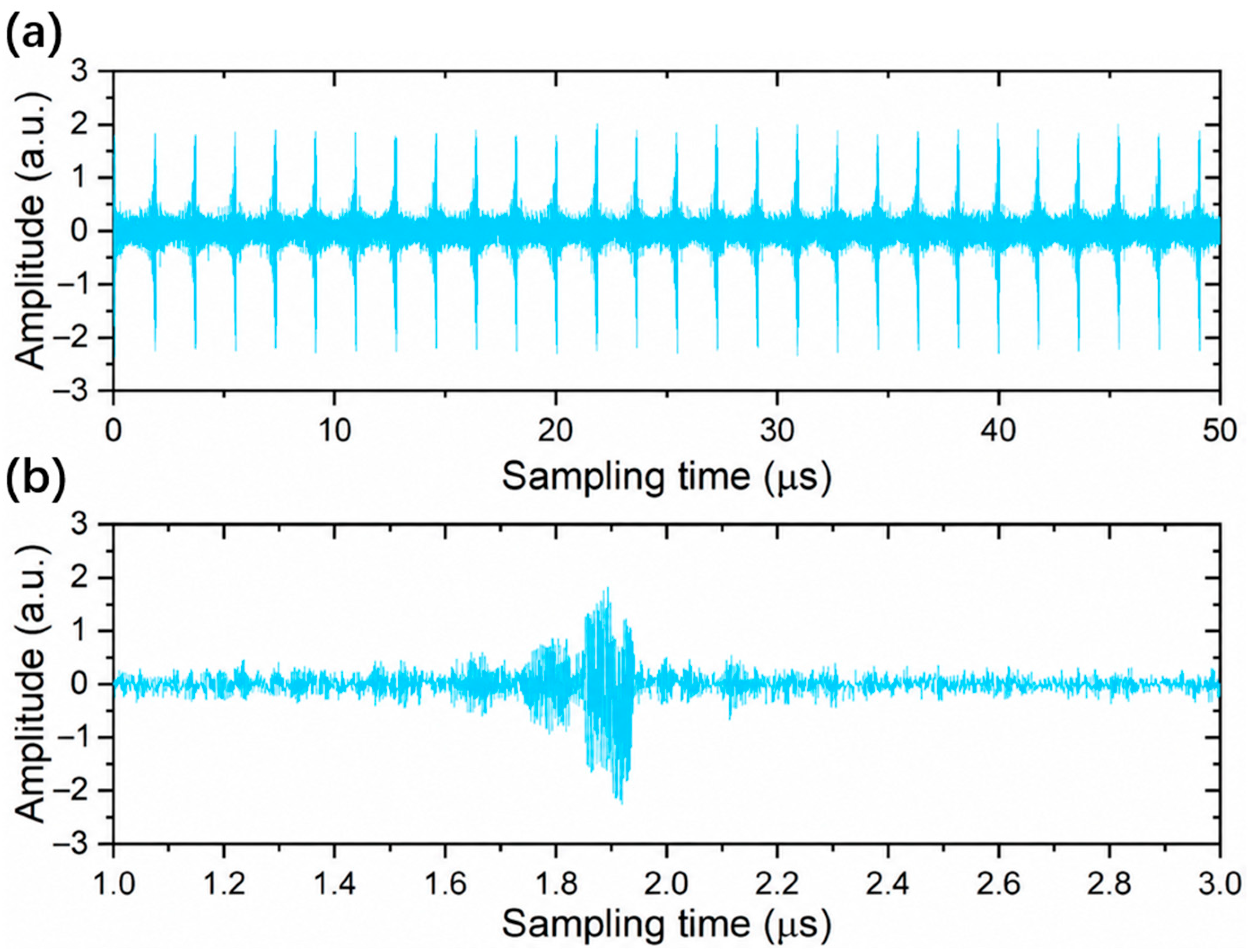
With stabilized repetition rates, periodic linear–optical–sampling interferograms are recorded continuously in both channels. Under a representative operating condition, the interferogram period is approximately 2 μs, corresponding to an update rate near 500 kHz, as shown in Figure 5. This recurrence rate agrees with the expected value of , confirming that the relative delay between the two pulse trains is scanned in a stable and repeatable manner. For a repetition rate near 20 GHz and a repetition-rate difference near 500 kHz, the temporal magnification factor is on the order of 4 × 10⁴. The measured envelope width of approximately 250 ns therefore corresponds to an equivalent optical pulse width of approximately 6.25 ps. The observation verifies the central operating principle: picosecond-scale timing information from the 20-GHz pulse trains is expanded into a waveform that can be acquired directly with conventional electronic instruments.
Figure 5.
Linear–optical–sampling (LOS) pulse train and an individual interferogram. (a) Representative time-domain waveform of the LOS signal recorded by the balanced photodetector. The interferogram repeats with a period of approximately 2 μs, corresponding to a differential repetition rate Δfr ≈ 500 kHz and an update rate of approximately 500 kHz. (b) Zoom-in view of a single interferogram envelope.
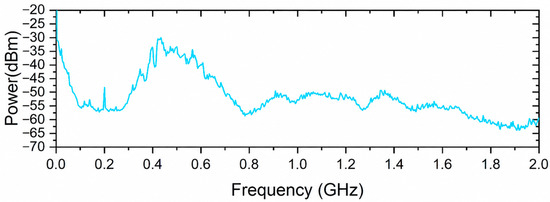
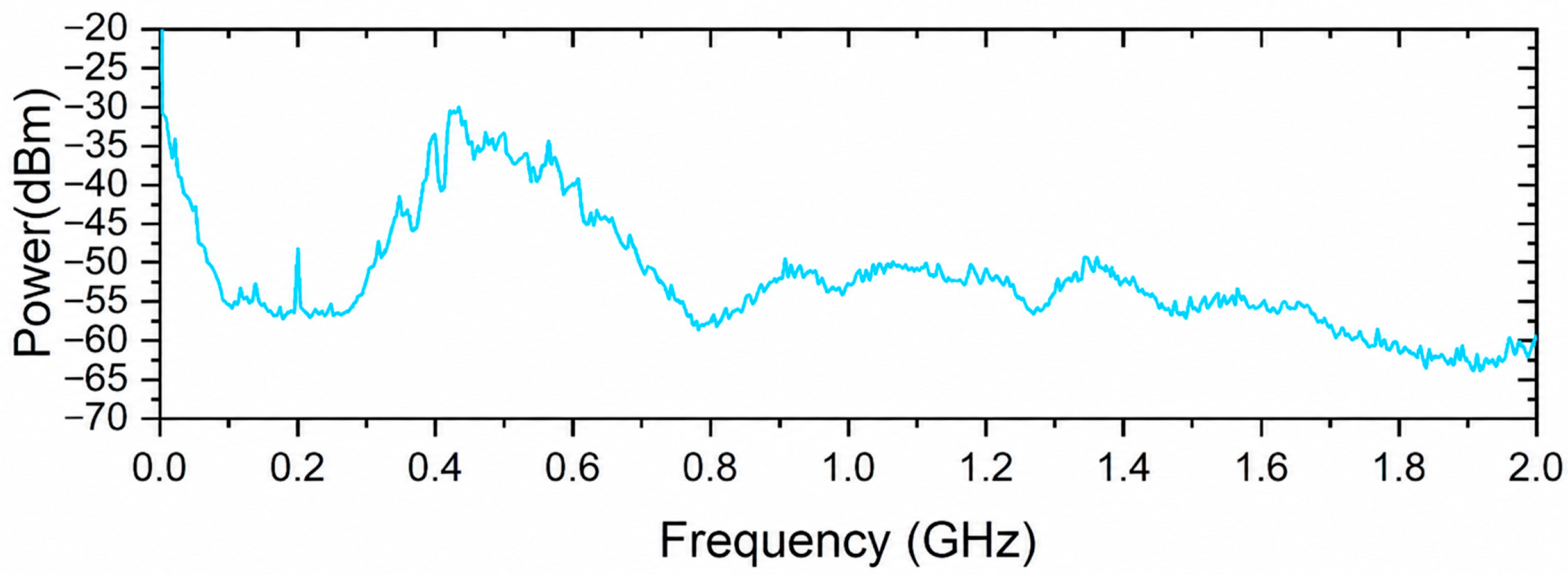
The radio-frequency spectrum provides a complementary check of the linear–optical–sampling process, as shown in Figure 6. Before the initial optical-frequency offset is adjusted, prominent heterodyne components appear near 9.43 and 10.57 GHz, outside the 1.6-GHz bandwidth of the balanced detector used for direct acquisition. Temperature tuning of the second microcomb shifts the useful multiheterodyne components into the detector bandwidth, and a strong beat component is observed at approximately 500 MHz.
Figure 6.
Linear–optical–sampling spectrum after tuning the initial optical-frequency offset.
To clarify the physical origin of this 500 MHz component, we derive the general dual-comb heterodyne beat-note relation. The optical frequencies of the signal comb (Comb 1) and local comb (Comb 2) are given by the following:
where and are the carrier–envelope–offset frequencies, and are the repetition rates, and and are large integers (mode indices) of order . When the signal and local comb lines overlap in the optical domain, the detected beat frequency between the -th line of Comb 1 and the -th line of Comb 2 is as follows:
Writing (where is a small integer, typically of order ), the beat frequency becomes
where . Since and kHz, the term GHz. Thus, the beat frequencies form a comb of RF tones separated by , with an overall offset determined by and the integer .
By temperature tuning one microcomb, we vary (via thermal shifts in the cavity resonances and the pump-to-resonance detuning), which shifts the entire multiheterodyne spectrum relative to the fixed detection bandwidth. The observed 500 MHz component corresponds to a particular beat order for which the combined quantity falls within the 1.6-GHz detector bandwidth after tuning. This component is a down-converted multiheterodyne beat that allows direct time-domain acquisition of the linear–optical–sampling interferogram. The presence of this 500 MHz component confirms that the desired heterodyne products have been successfully shifted into the detection bandwidth, enabling the timing extraction reported in the following section. This behavior is consistent with the intended down-conversion of the optical-comb overlap. It also removes the need for an additional high-frequency mixer, thereby simplifying the electrical chain and avoiding extra conversion stages that could introduce amplitude-to-phase coupling or additional timing fluctuations. The nonuniform spectral envelope mainly reflects the optical spectral overlap, amplification profile, and detector response; it does not prevent extraction of the interferogram position in the time domain.
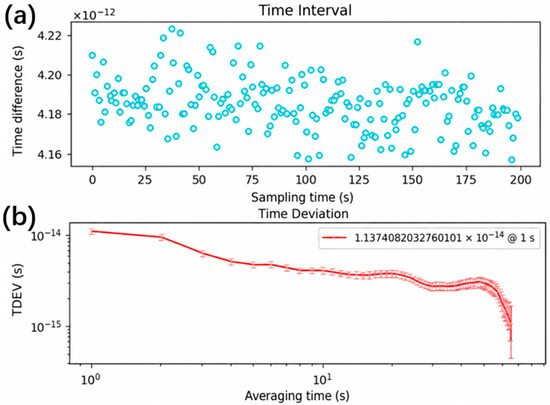
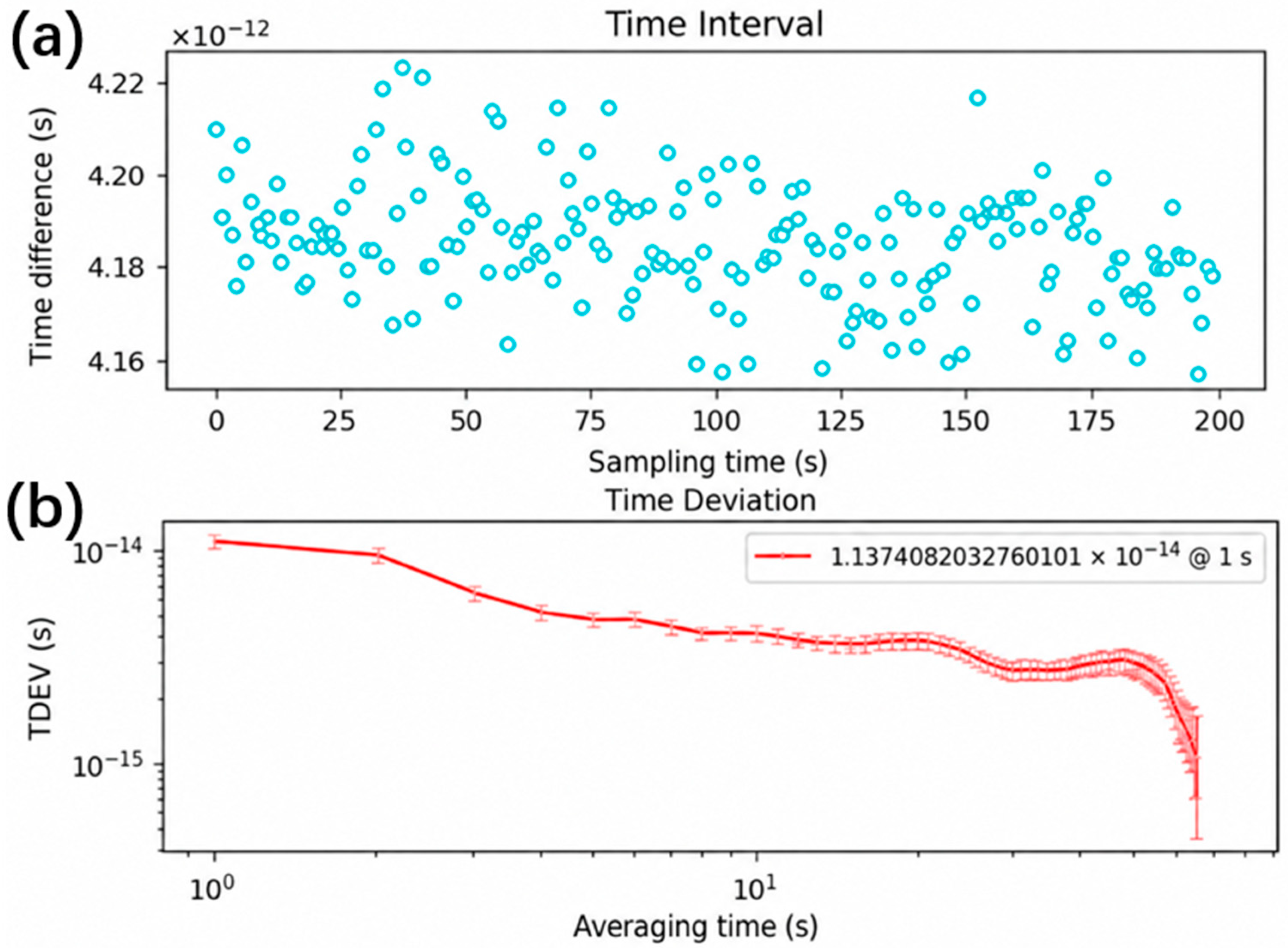
Figure 7 shows the back-to-back results obtained with dual balanced detection. The measured time interval fluctuates around 4.19 ps. This mean value represents the fixed differential delay of the two detection and acquisition channels, including differences in optical path length, detector response, cable length, and channel calibration; it should not be interpreted as a synchronization error. The relevant quantity for stability is the variation around this mean. The time deviation reaches 1.14 × 10⁻¹⁴ s at an averaging time of 1 s, corresponding to approximately 11 fs. Over the displayed record, the samples remain distributed around the mean without an evident monotonic drift, indicating that the short-term result is dominated by fluctuations that can be averaged rather than by a rapidly changing channel offset. The 11-fs value therefore represents the short-term back-to-back noise floor under the reported locking, detection, acquisition, and signal-processing conditions.
Figure 7.
Back-to-back timing measurement results obtained with dual balanced detection. (a) Time interval between the two interferograms recorded by the two detection channels. (b) Time deviation of the differential time interval as a function of averaging time τ.
The dual-channel differential signal yielded a timing fluctuation of 78.1 fs before Kalman filtering and approximately 11 fs after filtering. The nearly sevenfold reduction is physically significant. A single channel contains not only noncommon detection noise but also timing fluctuations that are correlated between successive measurements, including residual repetition-rate fluctuations of the combs, microwave-reference noise, oscilloscope time-base fluctuations, and common acquisition drift. Subtracting two simultaneously acquired channels suppresses a large fraction of these correlated contributions. The residual differential instability is consequently governed more strongly by unequal optical and electrical paths, independent detector noise, channel-specific amplitude-to-timing conversion, and the uncertainty of locating the interferogram peak. This comparison shows that dual-channel common-mode rejection is essential for revealing the intrinsic measurement background of the apparatus.
The back-to-back result also defines how the instrument should be interpreted when a transmission path is introduced. In a link measurement, the observed instability will contain both the approximately 11-fs instrumental background and additional contributions from the link, such as path-length fluctuations, nonreciprocity, received-power variation, dispersion, polarization changes, and unequal terminal delays. If a link-induced contribution is comparable to or smaller than the back-to-back floor, it will be difficult to distinguish without further suppression or calibration; if it is larger, the present system should be able to resolve it. Thus, the back-to-back measurement is not merely a zero-distance demonstration, but a quantitative reference for separating terminal noise from propagation-induced noise in later experiments.
We also note that the approximately 11-fs result represents the short-term, Kalman-filtered back-to-back timing measurement noise floor under the reported experimental conditions. It provides a baseline characterization of the measurement system intended for subsequent time–frequency transfer experiments, rather than a demonstration of timing accuracy or time-transfer performance over a physical link. Future experiments will incorporate a transmission channel and an independent reference or calibrated timing perturbation to quantitatively evaluate the transfer performance.
The achieved stability is also consistent with the broader development of dual-comb timing. LOS with conventional frequency combs has demonstrated femtosecond-level interval measurements, including an 82-fs single-scan precision and a 3.05-fs precision after averaging 100 measurements [16]. Dual-comb-assisted clock synchronization over commercial fiber has further reached a time deviation of 6.23 fs at 1 s [17]. These values should not be treated as a direct ranking because the comb sources, repetition rates, averaging procedures, detection bandwidths, and link configurations differ. Nevertheless, placing the present approximately 11-fs back-to-back result in the same femtosecond regime indicates that the much higher repetition rate and lower pulse energy of integrated microcombs do not prevent precise timing readout. Together with direct low-frequency detection and stable interferogram acquisition, the result establishes the practical feasibility of integrated-microcomb-based time transfer.
TDEV provides a statistical characterization of timing fluctuations over different averaging times using the accumulated measurement record. As shown in Figure 7, as the measurement record becomes longer, the short-term TDEV estimates converge, and their error bars stabilize, indicating that sufficient data have been accumulated for a reliable assessment of short-term stability. Together with the consistency across repeated measurements, these observations support stable operation of the system under the present experimental conditions and are consistent with a stationary measurement process.
To place our results in the broader context of integrated comb technologies, we compare our back-to-back time-transfer performance with other representative integrated comb systems reported in the literature. In terms of intrinsic comb timing jitter, several recent studies have characterized the fundamental timing jitter of microcombs across different material platforms. Silica microcombs at 22 GHz have demonstrated an integrated RMS timing jitter of 2.6 fs (integration bandwidth: 10 kHz–3 MHz) [20]. Dispersion-managed Si3N4 microcombs operating at 89 GHz have achieved an integrated timing jitter of 1.7 fs ± 0.07 fs from 10 kHz to 1 MHz [21]. These results demonstrate that integrated microcombs, despite their compact footprint and high repetition rates, are capable of femtosecond and even sub-femtosecond intrinsic timing stability. At the system level, electro-optic combs, which have a direct path to full chip-scale integration, have demonstrated two-way time and frequency transfer with instabilities as low as 15 fs at 1 s of averaging time) [22]. Dual-microcomb linear optical sampling has been applied to fiber propagation delay measurements, achieving a femtosecond-level accuracy of 8.04 fs per single LOS measurement and a sub-femtosecond accuracy of 0.744 fs with an averaging time of 0.1 ms [23]. These results highlight the capability of microcomb-based systems for high-precision timing measurements in practical configurations. Our measured time deviation of approximately 11 fs at 1 s—representing the complete back-to-back noise floor of a dual-channel differential time-transfer system—is comparable to or better than several of these integrated comb demonstrations. The results confirmed that 20-GHz Si3N4 microcombs, despite their relatively high repetition rates and lower pulse energies, are viable sources for precision time–frequency transfer.
4. Conclusions
In this work, we have demonstrated, to the best of our knowledge, a back-to-back time-transfer experiment using two integrated Si3N4 Kerr microcombs as the signal and local-oscillator sources for linear–optical–sampling (LOS) based timing readout. Unlike conventional dual-comb systems that rely on bulky mode-locked lasers and discrete optics, our approach leverages chip-scale microresonators with repetition rates near 20 GHz, achieving a favorable trade-off between high precision and miniaturization. By independently phase-locking both microcombs to a common 10 MHz rubidium frequency standard, we faithfully transfer the microwave reference stability to the optical pulse trains, with a measured Allan deviation of 3.6 × 10⁻¹⁵ at 1 s for the locked repetition. Furthermore, by tuning the initial optical-frequency offset between the two combs, we shift the multiheterodyne spectrum directly into the 1.6-GHz detection bandwidth, eliminating the need for high-frequency down-conversion stages and simplifying the electrical chain—a practical advantage for compact, low-power systems. The core timing measurement is performed in a dual-channel balanced-detection configuration, which yields a time deviation of approximately 11 fs at an averaging time of 1 s after Kalman filtering. This value represents the intrinsic back-to-back noise floor of the apparatus.
Our results establish the feasibility of integrated microcombs as viable sources for precision time–frequency transfer, providing a quantitative baseline for separating terminal noise from link-induced disturbances in future long-distance fiber or free-space experiments. The demonstrated techniques—direct low-frequency LOS detection, dual-channel common-mode rejection, and robust repetition-rate locking—offer a practical framework for chip-scale, low-power, and field-deployable photonic timing systems. Ongoing work will focus on incorporating a physical transmission channel and further suppressing residual uncorrelated noise to approach the fundamental limits of the comb sources and detection electronics.
Author Contributions
Z.Z., Z.F., and Z.C. performed the experiment and overall data analysis. S.Z. and X.Z. performed the theoretical analysis. R.Y. processed the data. Z.Z. and L.X. supervised the project. All of the authors were involved in the discussion and interpretation of the results. Z.Z. wrote the paper, and Z.F. and Z.C. provided revisions. All authors have read and agreed to the published version of the manuscript.
Funding
This research received no external funding.
Data Availability Statement
Data supporting the results presented in this paper are available from the authors upon reasonable request.
Conflicts of Interest
The authors declare no conflicts of interest.
References
- Chou, C.W.; Hume, D.B.; Rosenband, T.; Wineland, D.J. Optical clocks and relativity. Science 2010, 329, 1630–1633. [Google Scholar] [CrossRef] [Scilit] [PubMed]
- Schiller, S.; Tino, G.M.; Gill, P.; Salomon, C.; Sterr, U.; Peik, E.; Nevsky, A.; Görlitz, A.; Svehla, D.; Ferrari, G.; et al. Einstein gravity explorer—A medium-class fundamental physics mission. Exp. Astron. 2009, 23, 573–610. [Google Scholar] [CrossRef] [Scilit]
- Uzan, J.-P. The fundamental constants and their variation: Observational and theoretical status. Rev. Mod. Phys. 2003, 75, 403–455. [Google Scholar] [CrossRef] [Scilit]
- Diddams, S.A.; Vahala, K.; Udem, T. Optical frequency combs: Coherently uniting the electromagnetic spectrum. Science 2020, 369, eaay3676. [Google Scholar] [CrossRef] [Scilit] [PubMed]
- Droste, S.; Ozimek, F.; Udem, T.; Predehl, K.; Hänsch, T.W.; Schnatz, H.; Grosche, G.; Holzwarth, R. Optical-frequency transfer over a single-span 1840 km fiber link. Phys. Rev. Lett. 2013, 111, 110801. [Google Scholar] [CrossRef] [Scilit] [PubMed]
- Keilmann, F.; Gohle, C.; Holzwarth, R. Time-domain mid-infrared frequency-comb spectrometer. Opt. Lett. 2004, 29, 1542–1544. [Google Scholar] [CrossRef] [Scilit] [PubMed]
- Coddington, I.; Swann, W.C.; Nenadovic, L.; Newbury, N.R. Rapid and precise absolute distance measurements at long range. Nat. Photonics 2009, 3, 351–356. [Google Scholar] [CrossRef] [Scilit]
- Deschenes, J.-D.; Sinclair, L.C.; Giorgetta, F.R.; Swann, W.C.; Baumann, E.; Bergeron, H.; Cermak, M.; Coddington, I.; Newbury, N.R. Synchronization of distant optical clocks at the femtosecond level. Phys. Rev. X 2016, 6, 021016. [Google Scholar] [CrossRef] [Scilit]
- Han, J.J.; Zhong, W.; Zhao, R.C.; Zeng, T.; Li, M.; Lu, J.; Peng, X.X.; Shi, X.P.; Yin, Q.; Wang, Y.; et al. Dual-comb spectroscopy over a 100 km open-air path. Nat. Photonics 2024, 18, 1195–1202. [Google Scholar] [CrossRef] [Scilit]
- Wang, J.; He, H.; Yan, Y.; Lu, L.; Wang, L.; Zhao, Z.; Tam, H.Y.; Lau, A.P.T.; Lu, C. Dual comb enabled simultaneously multi-path sensing and communication over fiber access network. In ECOC 2024; 50th European Conference on Optical Communication; VDE: Offenbach am Main, Germany, 2024; pp. 1651–1654. [Google Scholar]
- Giorgetta, F.R.; Swann, W.C.; Sinclair, L.C.; Baumann, E.; Coddington, I.; Newbury, N.R. Optical two-way time and frequency transfer over free space. Nat. Photonics 2013, 7, 434–438. [Google Scholar] [CrossRef] [Scilit]
- Lee, J.; Kim, Y.-J.; Lee, K.; Lee, S.; Kim, S.-W. Time-of-flight measurement with femtosecond light pulses. Nat. Photonics 2010, 4, 716–720. [Google Scholar] [CrossRef] [Scilit]
- Shen, Q.; Guan, J.-Y.; Ren, J.-G.; Zeng, T.; Hou, L.; Li, M.; Cao, Y.; Han, J.-J.; Lian, M.-Z.; Chen, Y.-W.; et al. Free-space dissemination of time and frequency with 10−19 instability over 113 km. Nature 2022, 610, 661–666. [Google Scholar] [CrossRef] [Scilit] [PubMed]
- Caldwell, E.D.; Deschenes, J.-D.; Ellis, J.; Swann, W.C.; Stuhl, B.K.; Bergeron, H.; Newbury, N.R.; Sinclair, L.C. Quantum-limited optical time transfer for future geosynchronous links. Nature 2023, 618, 721–726. [Google Scholar] [CrossRef] [Scilit] [PubMed]
- Yu, D.; Chen, Z.; Yang, X.; Xu, Y.; Jin, Z.; Ma, P.; Zhang, Y.; Yu, S.; Luo, B.; Guo, H. Time interval measurement with linear optical sampling at the femtosecond level. Photonics Res. 2023, 11, 2222–2230. [Google Scholar] [CrossRef] [Scilit]
- Chen, Z.; Yu, D.; Lu, G.; Zhang, Y.; Yu, S.; Luo, B.; Guo, H. Dual-comb-enhanced microwave clock synchronization over commercial fiber. Optica 2024, 11, 1268–1276. [Google Scholar] [CrossRef] [Scilit]
- Chen, Z.; Zhang, Y.; Luo, B.; Guo, H. Time-frequency transfer over optical fiber. Natl. Sci. Rev. 2025, 12, nwaf236. [Google Scholar] [CrossRef] [Scilit] [PubMed]
- Yu, M.; Okawachi, Y.; Griffith, A.G.; Picque, N.; Lipson, M.; Gaeta, A.L. Silicon-chip-based mid-infrared dual-comb spectroscopy. Nat. Commun. 2018, 9, 1869. [Google Scholar] [CrossRef] [Scilit] [PubMed]
- Chang, L.; Liu, S.; Bowers, J.E. Integrated optical frequency comb technologies. Nat. Photonics 2022, 16, 95–108. [Google Scholar] [CrossRef] [Scilit]
- Jeong, D.; Kwon, D.; Jeon, I.; Do, I.H.; Kim, J.; Lee, H. Ultralow jitter silica microcomb. Optica 2020, 7, 1108–1111. [Google Scholar] [CrossRef] [Scilit]
- Wang, W.; Liu, W.; Liu, H.; Melton, T.; Aldhafeeri, A.; Lee, D.-I.; Yang, J.; Vinod, A.K.; Lim, J.; Jang, Y.-S.; et al. Mapping ultrafast timing jitter in dispersion-managed 89 GHz frequency microcombs via self-heterodyne linear interferometry. Adv. Photonics Nexus 2025, 4, 036011. [Google Scholar] [CrossRef] [Scilit]
- Olson, J.; Rockmore, R.; Lemke, N.D.; Krzyzewski, S.; Kasch, B. Electro-optic time transfer with femtosecond stability. Appl. Phys. Lett. 2025, 126, 111103. [Google Scholar] [CrossRef] [Scilit]
- Yan, E.; Wang, G.; Meng, Z.; Liu, S.; Zhu, L.; Yang, J. Measurement of propagation delay in fiber with dual microcombs at the sub-femtosecond level. In AOPC 2024: AI in Optics and Photonics; SPIE: Cergy-Pontoise, France, 2024; Volume 13502. [Google Scholar] [CrossRef] [Scilit]
Disclaimer/Publisher’s Note: The statements, opinions and data contained in all publications are solely those of the individual author(s) and contributor(s) and not of MDPI and/or the editor(s). MDPI and/or the editor(s) disclaim responsibility for any injury to people or property resulting from any ideas, methods, instructions or products referred to in the content. |
© 2026 by the authors. Licensee MDPI, Basel, Switzerland. This article is an open access article distributed under the terms and conditions of the Creative Commons Attribution (CC BY) license.