


Abstract
Tracking-by-detection (TBD) frameworks for multi-object tracking (MOT) commonly employ fixed confidence thresholds for data association, making them sensitive to frame-level variations caused by camera motion, illumination changes, and object occlusions. To address this limitation, this paper proposes an Adaptive Confidence Thresholding (ACT) mechanism that dynamically adjusts high-confidence and low-confidence thresholds according to the statistical distribution of detection confidence scores, without introducing additional neural network modules. The proposed method uses the first quartile of confidence scores as a proxy for frame-level detection reliability and the candidate detection count as an indicator of candidate detection load, enabling adaptive threshold selection for robust data association. As a result, degraded true targets are more effectively preserved under challenging conditions while unnecessary background noise is suppressed in stable scenes. Experiments using two representative TBD trackers compared ACT against fixed-threshold and sequence-tuned baselines. The results demonstrate that ACT achieves performance comparable to the sequence-tuned baselines while maintaining real-time processing speed, without requiring sequence-specific threshold tuning.
1. Introduction
Multi-object tracking (MOT) is one of the core research topics in computer vision, playing a pivotal role in various real-world applications such as video surveillance systems, autonomous driving, and robotics [1,2]. Driven by recent rapid advancements in object detectors, the tracking-by-detection (TBD) paradigm—which performs tracking based on detection outputs—has established itself as the dominant approach in MOT [3]. The TBD paradigm associates object detections from each frame across time to construct continuous trajectories. By decoupling the detection and tracking stages, this architecture provides the advantage of flexibly integrating state-of-the-art high-performance object detectors.
ByteTrack, a landmark work in the TBD paradigm, departed from traditional methods that relied solely on high-confidence detection results and proposed a two-stage data association scheme that incorporates low-confidence detections caused by occlusions or image degradation into matching [4]. Specifically, ByteTrack performs preliminary filtering on all detections to prevent extreme background noise from entering the match pool, and then splits the remaining valid bounding boxes into high-confidence and low-confidence groups. Next, it carries out first-stage data association using the Hungarian algorithm [5] between the high-confidence group and existing trajectories predicted by a Kalman filter [6], followed by second-stage data association between the unmatched trajectories and the low-confidence group. In this process, pre-defined static constants are used for both the low-confidence threshold (the baseline for removing background noise) and the high-confidence threshold (the baseline for splitting confidence groups). Through this two-stage association structure, ByteTrack successfully recovers object IDs robustly even during temporary occlusions, becoming a standard baseline for numerous state-of-the-art (SOTA) tracking algorithms such as BoT-SORT [7] and OC-SORT [8].
However, conventional TBD algorithms including ByteTrack suffer from extreme sensitivity to threshold settings and share a fundamental limitation in that these thresholds are set to fixed constants beforehand. In fact, the top-tier performance reported for ByteTrack on the standard benchmarks (MOT17 [9] and MOT20 [10]) was obtained using sequence-specific high-confidence thresholds determined through offline grid search. The necessity for sequence-specific threshold tuning stems from the fact that physical environments and domain characteristics—such as camera angle, presence of camera motion, object density, and illumination changes—vary drastically across video sequences. Related work has also shown that feature-distance distributions vary across sequences, making a single association threshold suboptimal [11]. Consequently, when a single static threshold set is globally applied in real-world applications without prior sequence information, the tracker fails to bridge domain gaps across video sequences, leading to significant tracking degradation. This limitation of static thresholds appears not only across different video sequences but also during frame-level real-time quality fluctuations within a single video sequence. In actual videos, object detection quality varies heavily from frame to frame due to sudden camera motion, temporary defocus blur, or simultaneous occlusions of multiple objects. Particularly during object intersections and occlusions, adjacent objects or background noise intrude into bounding boxes, corrupting detection box information [12]. Under such conditions, object detectors substantially lower the confidence scores of true tracking targets, preventing them from obtaining sufficient scores. If the high-confidence threshold is fixed at a high value, degraded true objects fail to pass the threshold, becoming excluded from the high-confidence group and relegated to the low-confidence group. As a result, they fail to participate in the critical first-stage data association process, ultimately leading to broken trajectories or mis-associations. Furthermore, if the lower-bound noise filtering threshold is also statically fixed (typically at 0.1), extremely low-confidence background noise escapes filtering and indiscriminately enters the match pool during second-stage data association. This induces confusion between degraded true targets and noise, causing severe mis-associations and compromising tracking consistency [13]. Therefore, to flexibly cope with sudden frame-level confidence fluctuations, an adaptive threshold-control mechanism is essential. Such a mechanism must analyze the current frame’s detection confidence distribution before data association to indirectly sense frame quality, and dynamically tune both the high-confidence threshold and the low-confidence threshold in real time.
In this paper, we propose an Adaptive Confidence Thresholding (ACT) mechanism for data association in multi-object tracking. ACT operates without introducing additional convolutional neural network (CNN)-based feature extractors or Transformer-based architectures, relying purely on the statistical properties of detection scores output in each frame. The proposed algorithm uses the first quartile () of confidence scores to evaluate frame-level detection reliability and the candidate detection count as a proxy for detection load. Specifically, in frames with high detection reliability, the high-confidence threshold is raised to prevent false-positive detections from entering the high-confidence group during the first association stage. Conversely, when quality degrades due to camera motion or motion blur, causing an overall drop in target confidence, the high-confidence threshold is adaptively lowered so that degraded true detections can be included in the high-confidence group during first-stage data association. Simultaneously, the lower-bound threshold controlling severe background noise in the low-confidence region is dynamically tuned in conjunction with frame-level detection conditions. When frame-level detection reliability is high, the lower-bound threshold is dynamically raised to suppress low-confidence background detections before entering data association. When detection confidence decreases across the frame, the lower-bound threshold is maintained at its base level to preserve degraded true objects within the low-confidence group for matching. Without complex and heavy feature extraction processes, this mechanism maximizes matching stability during data association and improves overall multi-object tracking performance. The main contributions of this paper are summarized as follows:
- Analysis of Static Threshold Limitations: We analyze the limitations of fixed confidence thresholds in existing tracking-by-detection frameworks under frame-level confidence variations and identify their impact on data association performance.
- Adaptive Confidence Thresholding Mechanism: We propose a lightweight Adaptive Confidence Thresholding (ACT) mechanism that jointly adjusts both high-confidence and low-confidence thresholds according to the first quartile of detection confidence scores and candidate detection count, without introducing additional neural network modules.
- Real-Time and Plug-and-Play Design: The proposed mechanism operates solely on detection score statistics, introducing negligible computational overhead while being directly applicable to existing TBD trackers.
- Comprehensive Experimental Validation: Extensive experiments on MOT17 and MOT20 demonstrate that ACT achieves performance comparable to sequence-tuned static thresholds while eliminating the need for sequence-specific threshold tuning.
The remainder of this paper is organized as follows: Section 2 reviews related work on data association, two-stage association algorithms, appearance models, and adaptive threshold control in MOT. Section 3 details the system architecture and threshold control mechanisms of the proposed Adaptive Confidence Thresholding (ACT) method. Section 4 presents quantitative performance evaluations and comparative experiments on the MOT17 and MOT20 benchmarks, along with an analysis of compatibility with another TBD tracker. Finally, Section 5 concludes the paper and discusses future research directions.
2. Related Work
2.1. Object Detection in Tracking-by-Detection Frameworks
In the tracking-by-detection (TBD) paradigm, object detection quality strongly influences the upper bound of tracking performance. Consequently, research has continuously shifted from past-generation detectors such as the deformable part model (DPM) [14] and the scale-dependent pooling (SDP) detector [15] toward integrating high-performance deep-learning detectors—including Faster R-CNN [16], SSD [17], and YOLOX [18]—into tracking pipelines. For instance, SMILEtrack [19] incorporated a parallel residual bi-fusion feature pyramid network (PRB-FPN) [20] alongside tracker enhancements to achieve additional performance gains. Multiple studies have empirically confirmed that technical advances in object detectors contribute substantially to improvements in multiple object tracking accuracy (MOTA), primarily by reducing false positives (FP) and false negatives (FN).
While advancing detector backbones delivers highly accurate bounding boxes and significantly improves localization accuracy, detection alone cannot solve identity switches (IDSW) caused by frequent object intersections and occlusions [21]. That is, even with accurate detections, tracking consistency easily deteriorates without a sophisticated data association process that maintains trajectory continuity across time. Therefore, despite detector standardization, data association techniques that correctly connect detected objects based on physical and visual consistency remain a core challenge in MOT.
2.2. ByteTrack and Two-Stage Data Association Research
Departing from conventional methods like SORT [22] and DeepSORT [23] that relied primarily on high-confidence detections, ByteTrack demonstrated the potential value of low-confidence detections by proposing an innovative two-stage data association strategy that retains low-confidence detections within the tracking pipeline. By performing primary matching with high-confidence boxes and secondary matching between unmatched tracks and the low-confidence pool, this dual structure effectively recovered trajectories of occluded targets. Thanks to its structural simplicity and strong performance, ByteTrack became a dominant baseline for modern TBD trackers [24] and inspired numerous subsequent variants. Subsequent TBD trackers introduced complementary improvements in motion modeling and data association. For example, OC-SORT mitigated Kalman filter error accumulation through observation-centric updates, whereas DeconfuseTrack [25] and BoostTrack (BoostTrack++) [26,27] explored refined association strategies to improve tracking robustness. Specifically, DeconfuseTrack applied a pair-exchange mechanism between high-confidence and low-confidence groups to bypass temporary association confusion, while BoostTrack increased the confidence scores of selected low-confidence detections satisfying specific matching conditions before its single-stage association.
However, many of these methods still rely on fixed detection or matching thresholds rather than adapting them to frame-level variations in detection quality. As a result, they retained the limitation of applying static hyperparameter thresholds to split high and low confidence groups, inherited directly from baseline models.
2.3. Adoption of High-Performance Appearance Models and Auxiliary Modules
Following the widespread adoption of ByteTrack, many studies integrated advanced person re-identification (ReID) models and auxiliary modules to enhance data association discriminability. Notably, BoT-SORT combined a CNN-based ReID model with a global motion compensation (GMC) module to boost tracking precision. StrongSORT integrated a high-performance ReID backbone (FastReID [28]), a feature bank for past appearance features, and enhanced correlation coefficient (ECC)-based camera motion compensation. StrongSORT++ further incorporated an appearance-free link model (AFLink) [29]. SolidTrack substituted occlusion-vulnerable CNN ReID models with a Transformer-based self-supervised model trained on human semantic priors (SOLIDER-ReID [30]) to prevent appearance feature corruption [31]. Alongside heavy ReID models, other research focused on efficient feature management; for example, the hierarchical multi-prototype appearance memory (HMP) module organized appearance memory into short-term and long-term hierarchical structures, improving trajectory recovery after long-term occlusions without adding additional large-scale networks [32].
Nevertheless, stacking high-performance ReID models or additional deep networks incurs severe computational overhead. This compromises the primary advantage of the TBD paradigm—real-time execution—making deployment in online real-time tracking environments challenging.
2.4. Adaptive Parameter Control for Data Association
To overcome the environmental sensitivity of manual parameter tuning, several studies have explored dynamic parameter adjustments. One method addressed sudden confidence shifts by determining dynamic thresholds through simple sorting and difference operations on single-frame confidence distributions [33]. Although it does not require prior video information, it shows minor performance drops compared with carefully tuned ByteTrack configurations and may be less reliable when confidence distributions are relatively flat. Another approach, AdapTrack, analyzes association-cost distributions and applies clustering to adapt matching-distance thresholds before the final assignment [34]. Unlike ACT, it adapts association thresholds rather than the detection-confidence thresholds used to partition high- and low-confidence candidates.
Therefore, this study proposes dynamically adjusting the high-confidence threshold (which divides high- and low-confidence groups) and the low-confidence threshold (which filters background noise) according to the statistical distributions of raw detection confidence scores, without requiring extra training. This approach preserves real-time processing speed while achieving tracking accuracy on par with sequence-tuned baselines across MOT17 and MOT20 without per-sequence threshold tuning and with negligible computational overhead.
3. Method
3.1. Preliminary Analysis
ByteTrack, a representative TBD multi-object tracker, follows a two-stage data association pipeline utilizing low-confidence detections. In this architecture, detections above a low-confidence threshold are pre-filtered to remove background noise, and then split into high-confidence and low-confidence groups based on a high-confidence threshold. First-stage data association is performed between the high-confidence group and existing trajectories, followed by second-stage data association between unmatched trajectories and the low-confidence group to robustly restore final trajectories. However, despite this two-stage structure, conventional TBD algorithms suffer from two fundamental thresholding limitations.
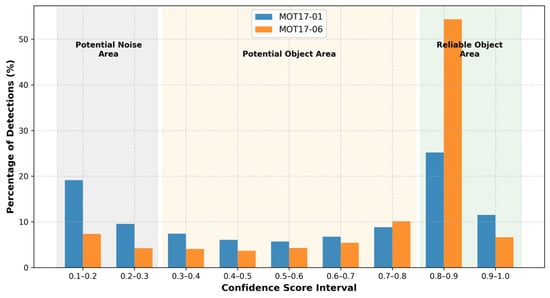
First, environmental characteristics and domain properties differ substantially across video sequences. Differences in camera angles, camera motion, object density, illumination, and brightness yield distinctly different confidence score distributions across videos. Figure 1 compares the confidence score distributions of two video sequences (MOT17-01 and MOT17-06) with different environmental characteristics from the MOT17 test set. The distribution plot clearly shows these differences in detection confidence distributions.
Figure 1.
Comparison of detection confidence score distributions between MOT17-01 and MOT17-06 video sequences. The score range is categorized into three functional areas: (1) Reliable Object Area (0.8–1.0), containing high-confidence true targets; (2) Potential Object Area (0.3–0.8), where actual target scores drop due to environmental variations such as illumination changes, camera motion, or occlusions; and (3) Potential Noise Area (0.1–0.3), consisting of low-confidence targets and background noise.
In the Reliable Object Area (0.8–1.0) containing high-confidence true targets, over 50% of detections in MOT17-06 fall in this range, whereas the corresponding proportion for MOT17-01 is only around 35%. Furthermore, the proportions of the Potential Object Area (0.3–0.8)—where target scores drop due to occlusions, lighting changes, or motion blur—and the Potential Noise Area (0.1–0.3)—containing low-confidence targets and background noise—also vary substantially between sequences. Addressing these distribution differences requires independent threshold control across regions. In the Potential Object Area, adaptively controlling the high-confidence threshold determines which detections are included in the high-confidence group for the primary first-stage association. Simultaneously, in the Potential Noise Area, controlling the low-confidence threshold determines the cutoff for background noise suppression.
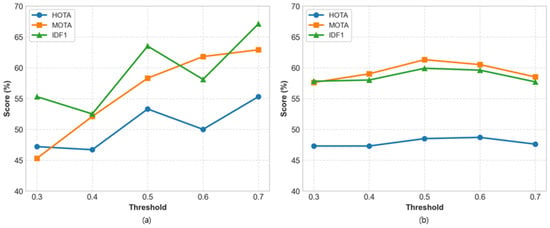
Figure 2 measures tracking performance (HOTA, MOTA, IDF1) on MOT17-01 and MOT17-06 while sweeping the high-confidence threshold from 0.3 to 0.7 in steps of 0.1. For MOT17-01 in Figure 2a, peak performance (HOTA 55.3%, MOTA 62.9%, IDF1 67.1%) is achieved at a high-confidence threshold of 0.7. Conversely, for MOT17-06 in Figure 2b, HOTA (48.5%) reached its highest value at a high-confidence threshold of 0.6, whereas MOTA (61.3%) and IDF1 (59.9%) achieved their best performance at a threshold of 0.5. This demonstrates that optimal tracking thresholds differ across sequences, highlighting the inherent limitation of applying a single static threshold to all video sequences. Due to these domain shifts, existing TBD algorithms like ByteTrack rely on offline grid searches for sequence-specific hyperparameter tuning—a strategy valid only in benchmark settings and impractical for real-world applications lacking prior sequence information.
Figure 2.
Tracking performance (HOTA, MOTA, IDF1) of ByteTrack across different high-confidence thresholds on video sequences with distinct environmental characteristics: (a) MOT17-01 and (b) MOT17-06.
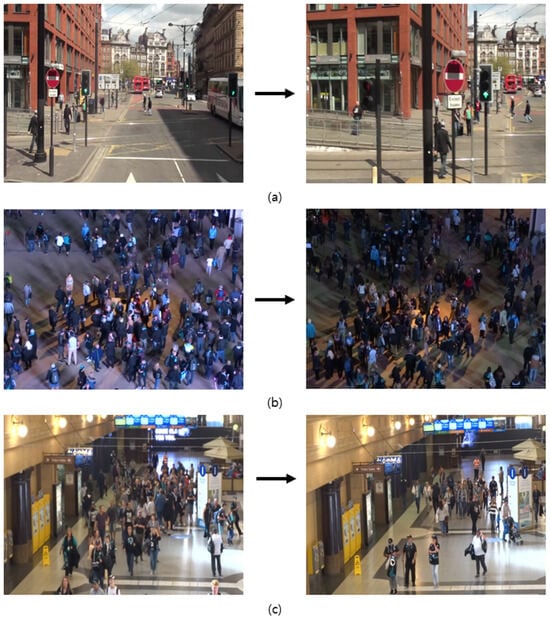
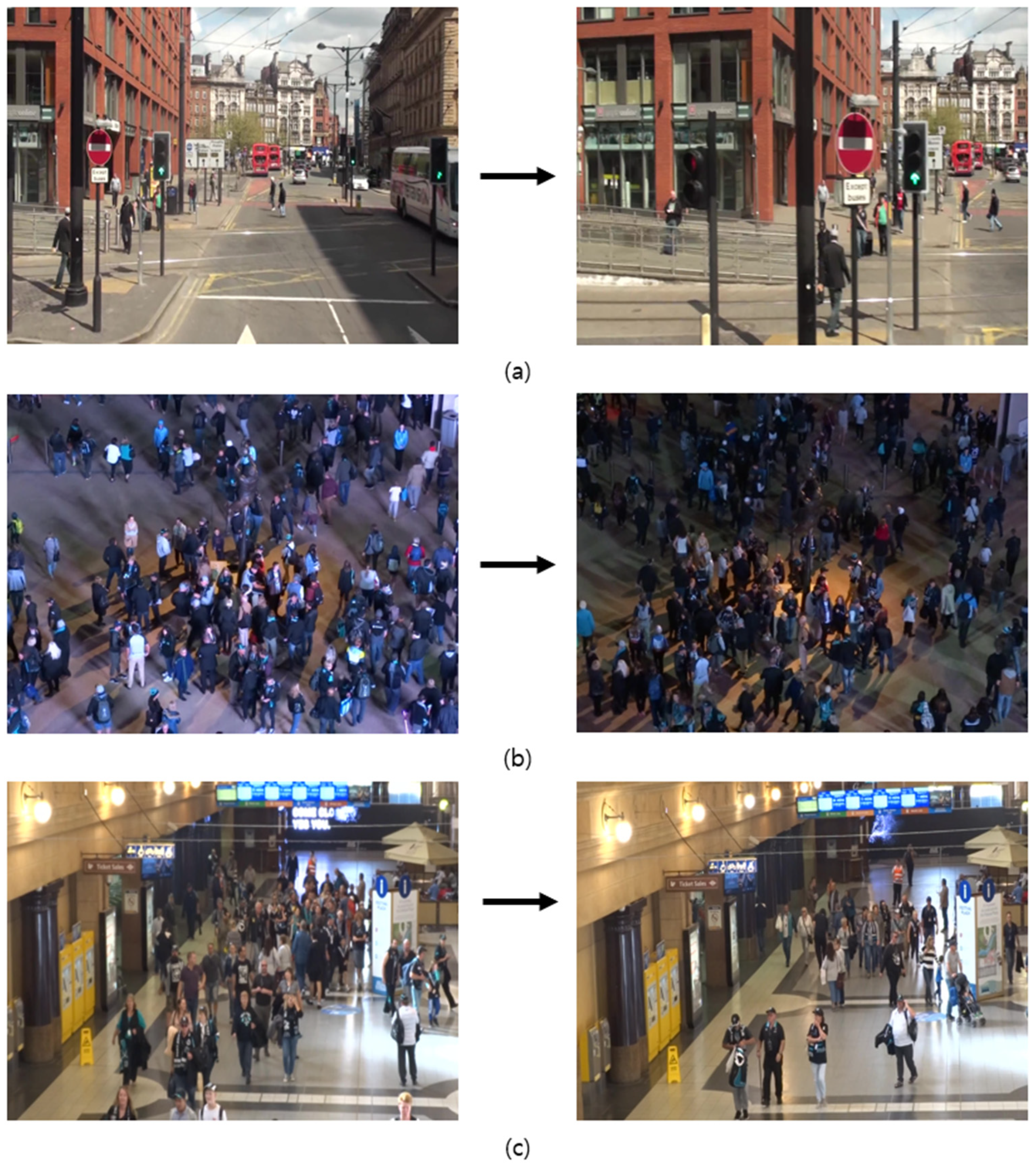
Second, a more fundamental limitation is that offline tuning cannot address frame-level dynamic environment changes within a single video sequence. Frame states continuously fluctuate within the same video due to varying conditions. Figure 3a illustrates frame changes caused by abrupt camera motion, Figure 3b shows temporary illumination shifts, and Figure 3c demonstrates object density variations. Additionally, defocus blur and temporary occlusions cause dynamic frame-wise confidence score variations within the same video. If data association thresholds remain fixed under these dynamics, degraded true targets are lost from match pools or unfiltered background noise intrudes, causing severe identity switches (IDSW). A single static threshold cannot guarantee optimal tracking across all frames: excessively high thresholds drop valid detections and fragment tracks, while excessively low thresholds introduce false positives and mis-associations.
Figure 3.
Examples of challenging and dynamically changing environments in multi-object tracking (MOT) benchmarks: (a) An example of camera motion from the MOT17-14 sequence. (b) An example of illumination changes from the MOT20-04 sequence. (c) An example of varying object density and severe crowding from the MOT20-07 sequence. The example frames are taken from the publicly available MOTChallenge datasets (MOT17 and MOT20).
To resolve these issues, this paper proposes an Adaptive Confidence Thresholding (ACT) mechanism that analyzes frame-wise detection confidence score distributions to dynamically adjust both high-confidence and low-confidence thresholds. The proposed method automatically determines both thresholds using current frame confidence distributions and seamlessly integrates into ByteTrack’s data association pipeline.
3.2. Adaptive Confidence Thresholding (ACT) Mechanism
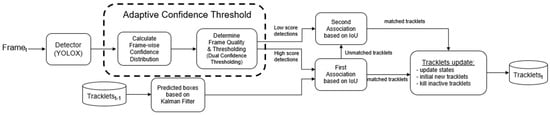
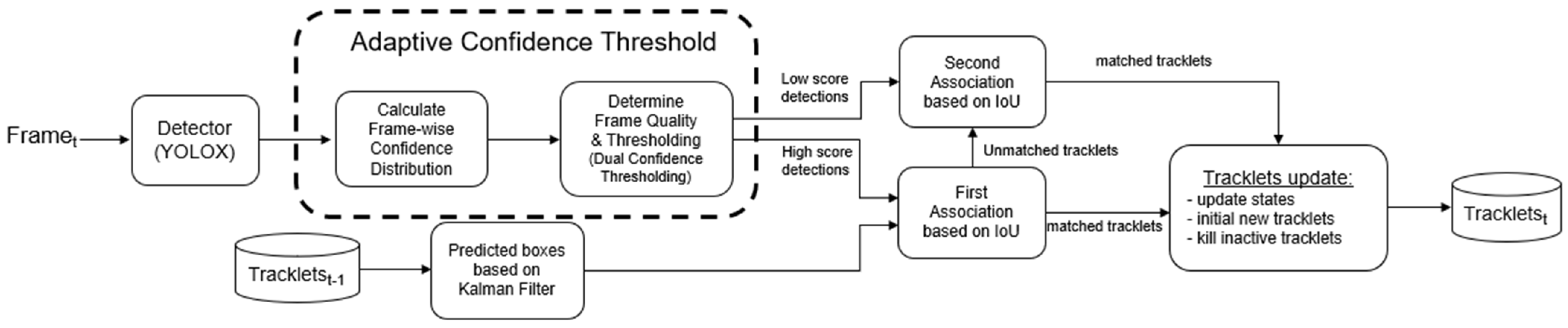
The overall system architecture and execution flow of the proposed framework are illustrated in Figure 4. When the object detector outputs detections for the current frame, candidate boxes with excessively low confidence are filtered out prior to data association. This pre-filtering excludes detections with confidence scores at or below 0.1, preventing extreme background noise from distorting the confidence score distribution. Next, statistical measures are computed from the confidence score distribution of the filtered valid bounding boxes to evaluate frame-level detection reliability and candidate detection count, determining dynamic thresholds accordingly. The detections are then partitioned using the dynamically adjusted high-confidence and low-confidence thresholds. Using these dynamic thresholds, the proposed method constructs high-confidence and low-confidence groups, which are then sequentially used in the first and second association stages to maintain target continuity and generate robust trajectories under dynamic environments. The detailed algorithmic steps are formalized in Algorithm 1.
| Algorithm 1: Adaptive Confidence Thresholding Mechanism |
| Input: Detection scores S; detection boxes B; high-confidence thresholds and ; low-confidence thresholds , , and ; quartile score threshold ; detection count threshold Output: High-confidence detections ; low-confidence detections ; /* Pre-filtering: Exclude extreme background noise at or below */ 1 {s ∈ S | s > }; 2 if > 0 then /* Metric Extraction: Compute frame-wise detection reliability indicator () and candidate detection count (N) */ 3 Compute the first quartile of ; 4 N ||; /* Adaptive Thresholding: Adjust and based on and N */ 5 if then 6 ; 7 if then 8 ; 9 else 10 ; 11 end 12 else 13 ; 14 ; 15 end 16 else 17 ; 18 ; 19 end /* Group Partitioning: Split detections using adaptive thresholds for association */ 20 ← { d ∈ B | score(d) ≥ }; 21 ← { d ∈ B | < score(d) < }; 22 return , ; |
Figure 4.
The pipeline of the proposed multi-object tracking framework based on the Adaptive Confidence Thresholding (ACT) mechanism.
Algorithm 1 takes as input the current frame’s detection score set S, bounding boxes B, quartile score threshold , detection count threshold , high-confidence thresholds , , and low-confidence thresholds , , . It outputs the high-confidence detection group and low-confidence detection group . First, the raw detection score set S output by the detector contains numerous low-confidence detections with extremely low confidence corresponding to background noise or false positives.
These low-confidence detections distort percentile estimation. Therefore, in this study, the score set S is pre-filtered using a minimum low-confidence threshold to build a valid confidence score set (line 1 in Algorithm 1), as expressed in Equation (1):
To evaluate the statistical distribution of , the scores are sorted in ascending order to extract the first quartile (), representing the 25th percentile boundary (line 3 in Algorithm 1), as shown in Equation (2):
Here, the first quartile denotes the score at the 25th percentile of and serves as a statistical indicator for evaluating frame-level detection reliability. A high indicates that most bounding boxes in the frame possess high confidence scores, signaling high detection reliability across candidate bounding boxes. Conversely, a low indicates that confidence scores are globally depressed, indicating degraded detection reliability due to challenging conditions. The proposed method utilizes to dynamically select thresholds suited to the current frame’s detection-confidence condition.
When exceeds the quartile score threshold , most bounding boxes exhibit high confidence, indicating high detection reliability. In this scenario, the high-confidence threshold is set to a strict value to prevent false-positive detections from entering the high-confidence group (lines 5–6 in Algorithm 1). Simultaneously, because low-confidence detections in high-reliability frames are more likely to be spurious detections, the low-confidence filtering threshold is adjusted based on the candidate detection load N to regulate candidate clutter. Under higher candidate load conditions (N > )—regardless of whether the surge in candidate detections is driven by detector characteristics, severe object occlusions, camera perspectives, or degraded image quality—the presence of numerous ambiguous bounding boxes substantially elevates the risk of candidate confusion and mis-association. Consequently, is raised to to more aggressively filter spurious background noise (lines 7–8 in Algorithm 1). Conversely, under lower candidate load conditions (N ≤ ) where candidate interference is minimal, a relaxed threshold ( < ) is applied to balance noise suppression and degraded target preservation (line 10 in Algorithm 1).
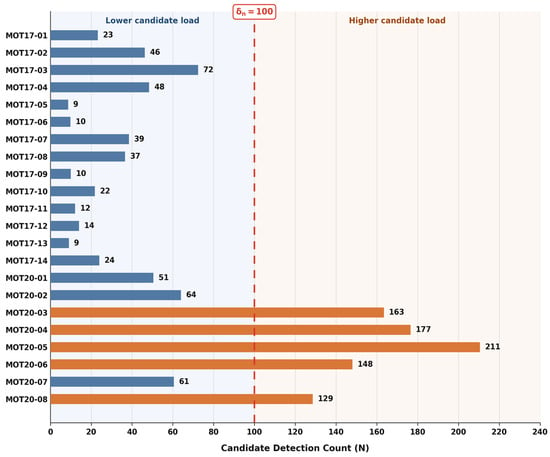
When ≤ , frame-wide confidence scores suffer an overall decline due to occlusions, sudden camera motion, or motion blur. If high thresholds were maintained under such conditions, true targets with degraded scores would be excluded from and pushed into secondary association, fragmenting trajectories and causing identity switches (IDSW). To recover these degraded true targets, the high-confidence threshold is lowered to , allowing degraded detections to participate in first-stage data association and preventing track fragmentation (line 13 in Algorithm 1). Simultaneously, considering that true targets may exist at low confidence levels, is reset to the minimum threshold to minimize information loss (line 14 in Algorithm 1). It is important to clarify the parameter configuration of the proposed ACT framework: three baseline threshold constants (, , ) are directly inherited from established baseline implementation settings, while four parameters (, , , ) are newly introduced and systematically determined through empirical evaluations. Specifically, = 0.6 and = 0.1 represent the default operational thresholds established in ByteTrack [4], whereas = 0.3 corresponds to the lower-bound high-confidence threshold utilized by ByteTrack for sequence-specific offline tuning on challenging, dense sequences (e.g., MOT20-06 and MOT20-08). To enable dynamic low-confidence filtering and scene-adaptive threshold control, ACT introduces four refined parameters (, , , ), each supported by systematic empirical validation. The low-confidence suppression thresholds = 0.2 and = 0.15 are newly proposed based on the systematic sensitivity sweeps presented in Section 4.2.1, demonstrating that moderately raising effectively suppresses background false positives without discarding degraded valid targets. In addition, the quartile score threshold = 0.7 is determined through parameter sensitivity sweeps across in [0.4, 0.8] in Section 4.2.2. Lastly, the candidate detection count threshold = 100 is adopted as a lightweight auxiliary proxy with negligible computational overhead to capture the overall frame-level candidate detection load. It serves as an empirical operational boundary that distinguishes moderate candidate load regimes (e.g., typical surveillance frames in MOT17 where candidate counts remain below 80) from high candidate load and heavily cluttered conditions (e.g., dense frames in MOT20 where candidate counts frequently exceed 120–200).
Figure 5 illustrates the sequence-level average candidate detection count (N) across all video sequences in the MOT17 and MOT20 benchmarks, categorized by the operational threshold = 100. As shown in Figure 5, all sequences in MOT17 alongside moderate sequences in MOT20 (MOT20-01, MOT20-02, and MOT20-07) fall into the lower candidate load regime (N ≤ 100, blue bars), whereas dense sequences in MOT20 (e.g., MOT20-03, MOT20-04, MOT20-05, MOT20-06, and MOT20-08) operate in the higher candidate load regime (N > 100, orange bars). This empirical boundary naturally aligns with the environmental conditions illustrated in Figure 3. For instance, in MOT17-14 (Figure 3a, average N = 24), the candidate load remains low despite rapid camera motion, allowing ACT to apply the relaxed threshold = (0.15) to balance noise suppression and target recall. Conversely, in heavily congested sequences such as MOT20-04 (Figure 3b, average N = 177), the substantial volume of candidate detections increases the risk of candidate confusion and mis-associations. Importantly, an elevated candidate load is not solely a product of physical crowd size; it can also be compounded by wide camera perspectives, severe mutual occlusions, degraded image quality, or detector false alarms. Regardless of the underlying cause, when the candidate load exceeds = 100, ACT proactively raises to (0.2) to suppress spurious background clutter. Additionally, cases such as MOT20-07 (Figure 3c, average N = 61) illustrate that candidate load naturally varies across different sequences even within the same benchmark. Furthermore, the largest sequence-level mean candidate count in the lower candidate load group is 72 (MOT17-03), whereas the smallest value in the higher candidate load group is 129 (MOT20-08). Therefore, = 100, which lies near the empirical midpoint of this naturally observed interval (72 to 129), was selected as a representative operational boundary. The tracking performance sensitivity across various values is quantitatively evaluated in Section 4.2.2.
Figure 5.
Sequence-level average candidate detection count (N) across all video sequences in the MOT17 and MOT20 benchmarks. The threshold = 100 (red dashed line) serves as an empirical operational boundary separating the lower candidate load regime (N ≤ 100, blue bars) from the higher candidate load regime (N > 100, orange bars).
Finally, the dynamically determined thresholds partition the bounding boxes B into and prior to data association (lines 20–22 in Algorithm 1), as defined in Equations (3) and (4):
This dynamic partitioning based on Equations (3) and (4) adapts flexibly to time-varying tracking environments. It effectively blocks unnecessary background noise from entering data association while preserving valid target detections associated with low detection reliability or occlusions, enabling robust real-time data association.
3.3. Comparative Analysis of Confidence Metrics
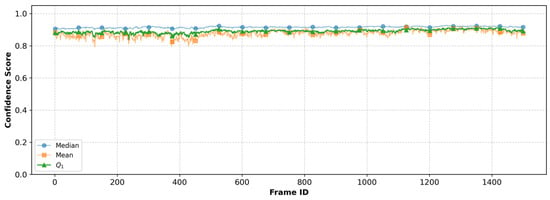
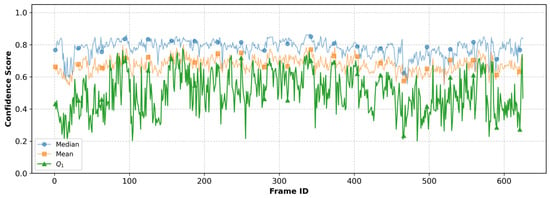
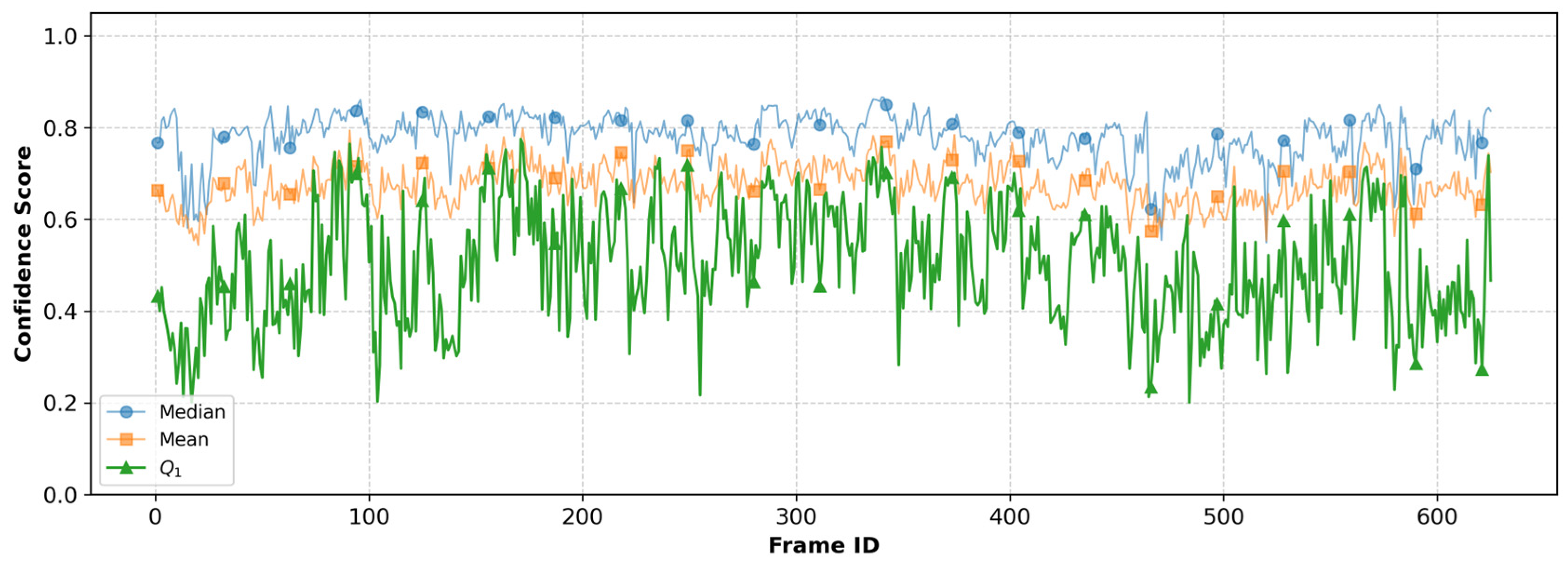
The first quartile () was selected over the mean or median as a proxy metric for frame-level detection reliability due to its statistical sensitivity to frame-level quality degradation. Figure 6 and Figure 7 illustrate the frame-wise variations in mean, median, and in a high-quality sequence (MOT17-03) and an environment with severe illumination changes and occlusions (MOT17-08), respectively. In high-quality sequences like MOT17-03 (Figure 6), all three metrics remain stably high. However, in challenging environments like MOT17-08 (Figure 7), both the mean and median remain relatively insensitive to frame-level quality drops because high-confidence detections continue to dominate the overall score distribution. In contrast, drops sharply and distinctly during frames where occlusions or motion blur reduce true target scores. Therefore, was chosen as the final quality metric because it responds more sensitively to detection-confidence degradation than the mean or median. A detailed quantitative ablation comparing tracking performance across these statistical indicators is provided in Section 4.2.2.
Figure 6.
Comparison of frame-wise mean, median, and confidence scores in a high-quality video sequence (MOT17-03).
Figure 7.
Comparison of frame-wise mean, median, and confidence scores in a challenging video sequence with severe environmental fluctuations (MOT17-08).
4. Experiments and Results
4.1. Implementation Details
To quantitatively evaluate the proposed multi-object tracking framework based on adaptive confidence thresholding, experiments were conducted on the standard MOT17 and MOT20 benchmark datasets. MOT17 features standard surveillance scenarios containing camera motions, varying lighting conditions, and pedestrian crossings. MOT20 contains extremely crowded scenes with up to hundreds of pedestrians per frame, serving as an ideal benchmark for testing algorithm robustness under high clutter. Final results were evaluated using the official MOTChallenge evaluation server. To establish a fair comparison, all experiments were reproduced in our local experimental environment using the original ByteTrack implementation. The YOLOX-X detector backbone and the officially released pretrained weights were kept unchanged throughout all experiments, consistent with the original ByteTrack configuration. To strictly isolate the performance impact of the proposed confidence thresholding mechanism without interference from heavy appearance models or auxiliary modules, evaluations were conducted through controlled comparative experiments on representative TBD frameworks. Multiple fixed-threshold baseline configurations were constructed by varying only the high-confidence and low-confidence detection thresholds, while all other implementation details, model weights, and hyperparameter settings remained identical. Evaluations followed the “private detection” protocol. All tracking runtime and frame rate evaluations were conducted on a single workstation equipped with an AMD Ryzen Threadripper PRO 7965WX CPU and an NVIDIA RTX A6000 GPU (NVIDIA, Santa Clara, CA, USA) using Python 3.8.20, PyTorch 2.4.1, and CUDA 12.1. Frame rates were measured for the complete detection-and-tracking pipeline (detector and tracker), using an identical input resolution across all static and adaptive configurations for each sequence. For the baseline ByteTrack model, tracking performance was evaluated under multiple globally fixed threshold configurations without sequence-specific offline threshold tuning. Each configuration was applied consistently across all sequences to ensure a fair comparison with the proposed adaptive thresholding method. For our proposed ACT mechanism, a single global parameter set ( = 0.7, = 100, = 0.6, = 0.3, = 0.1, = 0.2, = 0.15) was applied uniformly across all sequences and benchmark datasets without any per-sequence parameter adjustment. Performance metrics include MOTA, FP, FN, and IDSW [35], IDF1 [36], HOTA [37], association accuracy (AssA), detection accuracy (DetA), and frames per second (FPS).
4.2. Experimental Results
4.2.1. Effect of the Low-Confidence Threshold
To evaluate the impact of filtering low-confidence false positives, the tracking performance of the ByteTrack baseline was measured by varying the low-confidence threshold from 0.05 to 0.3 in steps of 0.05 while fixing the high-confidence threshold at 0.6. Table 1 and Table 2 present the results for the MOT17 and MOT20 test sets, respectively, under different fixed settings. The results highlight an inevitable trade-off between preserving target information and filtering noise when using a static threshold. On MOT17, increasing from 0.05 to 0.15 improved IDF1 by 0.5 percentage points (pp) and HOTA by 0.3 pp, indicating that an appropriately increased low-confidence threshold can improve tracking performance by reducing the influence of low-confidence detections. However, further increasing to 0.25–0.30 did not produce consistent improvements across datasets and metrics, suggesting that no single fixed threshold is optimal. These observations motivate the proposed adaptive threshold control, which dynamically adjusts according to the confidence distribution of each frame.
Table 1.
Tracking performance of the baseline ByteTrack under various static low-confidence thresholds on the MOT17 test set.
Table 2.
Tracking performance of the baseline ByteTrack under various static low-confidence thresholds on the MOT20 test set.
4.2.2. Ablation Study of Quality Indicators and Parameter Sensitivity Analysis
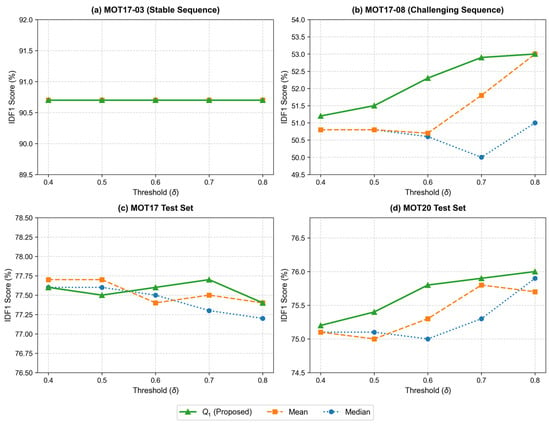
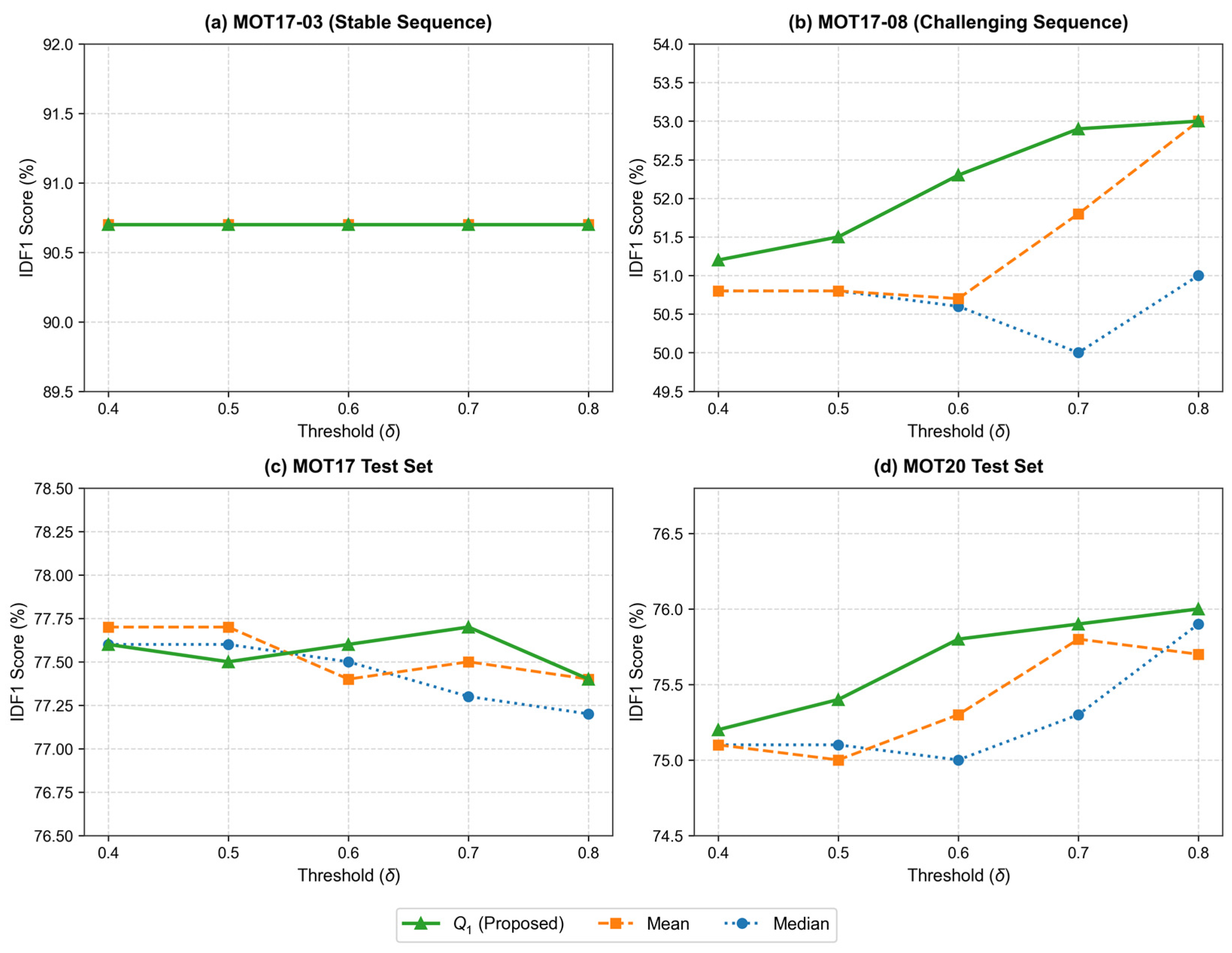
To quantitatively validate the statistical suitability of the first quartile () against alternative central tendency measures (median and mean), an ablation study was conducted across both individual sequences with distinct environmental characteristics and full benchmark datasets. Figure 8 illustrates the IDF1 tracking performance trends of ByteTrack-ACT over varying threshold values in [0.4, 0.8] using , median, and mean as the frame-level quality indicator. As shown in Figure 8a, all three indicators exhibit identical tracking performance (IDF1 90.7%) across all sweeping ranges of in [0.4, 0.8] on the stable sequence (MOT17-03). As analyzed in Section 3.3 (Figure 6), MOT17-03 represents a high-quality video sequence where the mean, median, and confidence scores all remain stably high without severe degradation. Consequently, utilizing maintains consistent tracking accuracy without degrading identity preservation in clean, high-reliability environments. In contrast, distinct performance disparities emerge in the challenging sequence (MOT17-08, Figure 8b). As illustrated in Figure 7, MOT17-08 features severe environmental fluctuations such as frequent occlusions and illumination shifts, which induce substantial drops in detection confidence scores. When sweeping from 0.4 to 0.8 on this challenging sequence, the median exhibits the smallest performance variation (IDF1 varying only slightly between 50.0% and 50.8%), indicating that the median fails to capture frame-level detection degradation because dominant high-confidence detections continue to govern the 50th percentile. While the mean eventually reaches a peak IDF1 of 53.0% at = 0.8, it remains largely unresponsive at 50.7–50.8% across in [0.4, 0.6] and exhibits an abrupt performance jump only after reaching = 0.7, confirming that the mean is dominated by the large proportion of high-confidence detections. Conversely, displays a progressive and steady performance improvement throughout the sweep from = 0.4 to 0.8 (IDF1 51.2% to 53.0%), demonstrating that sensitively captures the degradation of true targets whose confidence scores drop due to severe occlusions or motion blur. While all indicators perform identically under stable, high-quality conditions (Figure 8a), sensitively captures frame-level degradation in challenging environments (Figure 8b), exhibiting a steady, progressive performance gain over median and mean. Across full benchmark datasets (Figure 8c,d), attained a peak IDF1 of 77.7% on MOT17, matching the best result obtained with the mean, and achieved the highest peak IDF1 of 76.0% on the crowded MOT20 benchmark, demonstrating robust identity preservation under diverse tracking conditions.
Figure 8.
Comparison of IDF1 tracking performance across different frame-level quality indicators (, mean, median) under varying threshold values in [0.4, 0.8]: (a) MOT17-03 (a high-quality sequence with stable confidence score variations as analyzed in Figure 6), (b) MOT17-08 (a challenging sequence with severe environmental fluctuations as analyzed in Figure 7), (c) full MOT17 test set, and (d) full MOT20 test set.
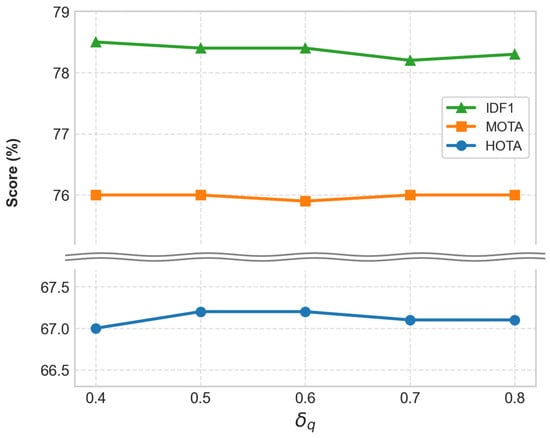
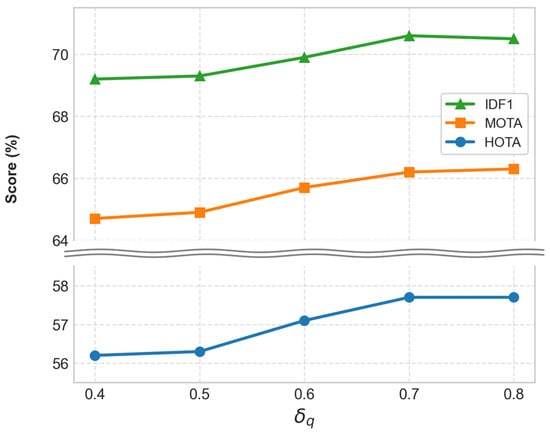
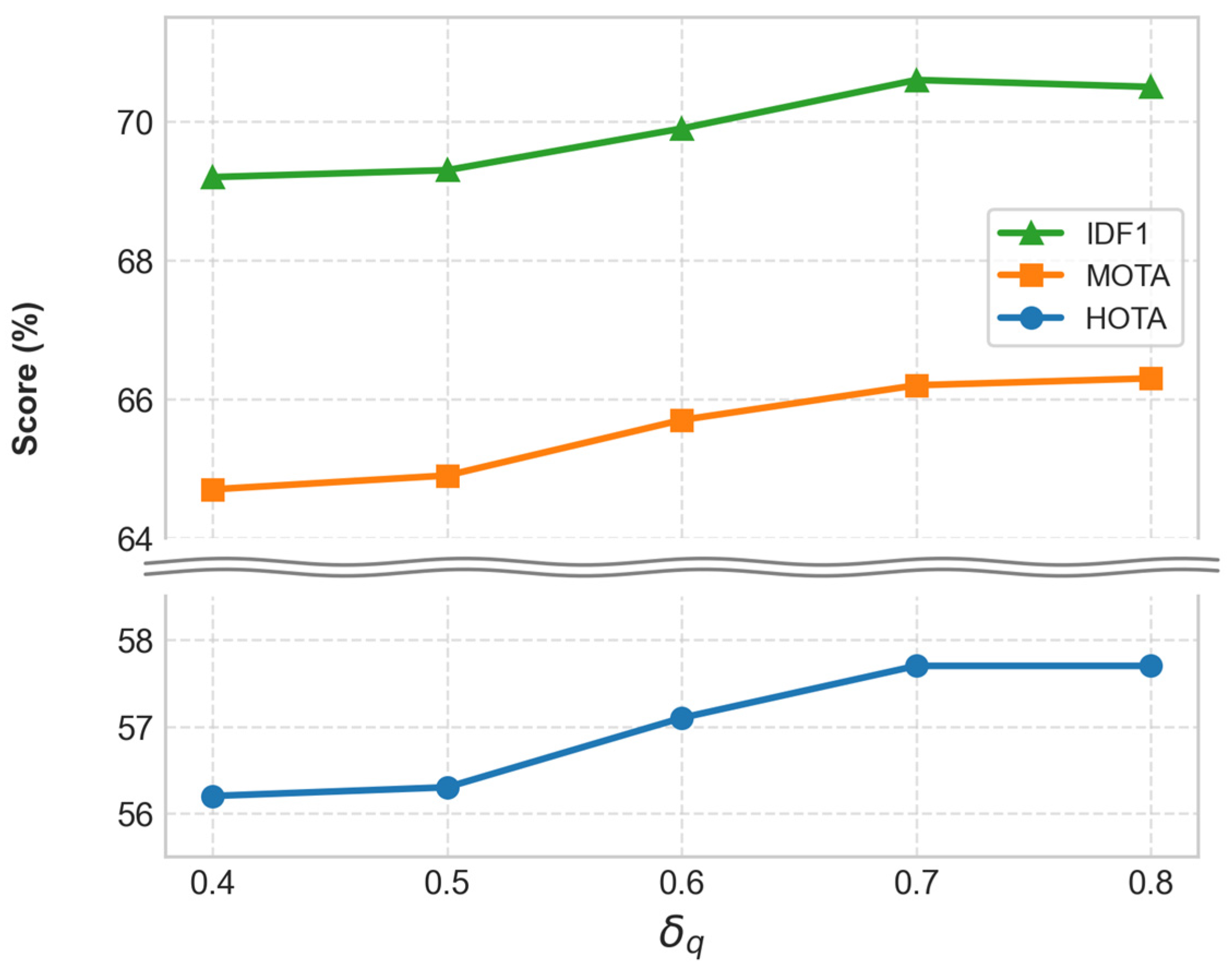
Furthermore, parameter sensitivity experiments for the quartile score threshold were conducted on the MOT17 and MOT20 validation sets across in [0.4, 0.8] to establish the optimal operating threshold. On the MOT17 validation set (Figure 9), where visual variations are moderate, performance sensitivity to was minimal: IDF1 varied by at most 0.3 pp, while MOTA and HOTA varied by only 0.1 pp and 0.2 pp, respectively. In contrast, on the highly crowded MOT20 validation set (Figure 10)—characterized by dense crowds and frequent occlusions— sensitivity was pronounced. At low thresholds ( = 0.4–0.5), degraded frames were misclassified as high-quality, maintaining strict thresholds that failed to recover degraded targets during primary association. However, setting = 0.7 yielded substantial gains over the ( = 0.4) setting: IDF1 increased by 1.4 pp (69.2% to 70.6%), MOTA by 1.5 pp (64.7% to 66.2%), and HOTA by 1.5 pp (56.2% to 57.7%). These results indicate that = 0.7 serves as an effective threshold for distinguishing high-quality frames from degraded ones across diverse scenarios. Consequently, = 0.7 was adopted as the default parameter for the main benchmark evaluations.
Figure 9.
vs. IDF1, MOTA and HOTA on the MOT17 validation set.
Figure 10.
vs. IDF1, MOTA and HOTA on the MOT20 validation set.
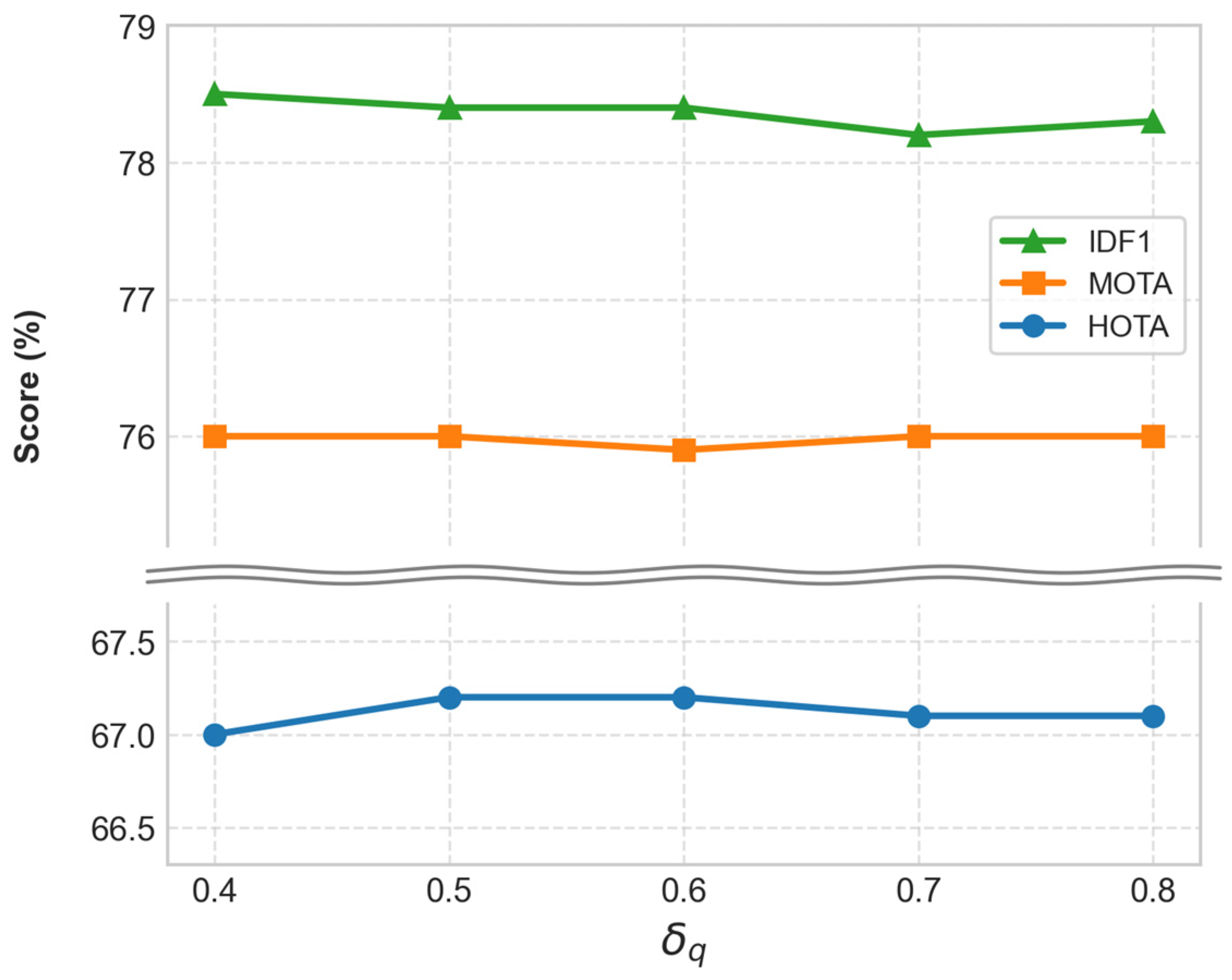
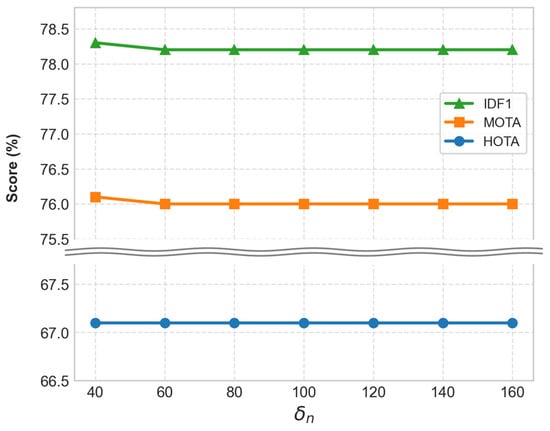
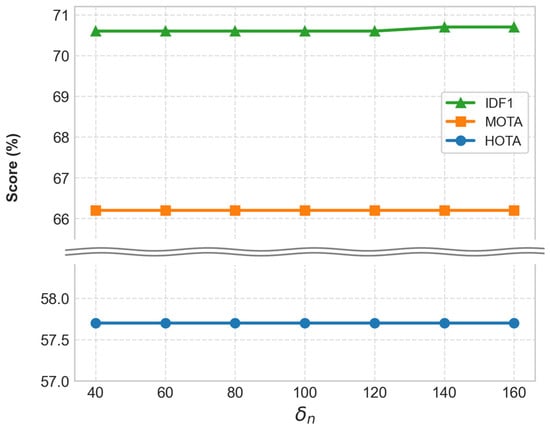
Similarly, parameter sensitivity experiments for the candidate detection load threshold were conducted on the MOT17 and MOT20 validation sets using in [40, 160], with = 0.7 and all other parameters fixed, as shown in Figure 11 and Figure 12. On the MOT17 validation set (Figure 11), performance remained stable across the tested values: IDF1 ranged from 78.2% to 78.3%, MOTA from 76.0% to 76.1%, and HOTA remained at 67.1% at the reported precision. Similarly, on the MOT20 validation set (Figure 12), IDF1 ranged from 70.6% to 70.7%, while MOTA and HOTA remained at 66.2% and 57.7%, respectively, at the reported precision. These results indicate that tracking performance is insensitive to the precise choice of within the tested range. Combined with the sequence-level distribution in Figure 5, where 100 lies near the midpoint of the observed gap between sequence-level means of 72 and 129 candidate detections per frame, these results support the use of = 100 as a representative operational boundary without requiring fine-grained parameter tuning.
Figure 11.
vs. IDF1, MOTA and HOTA on the MOT17 validation set.
Figure 12.
vs. IDF1, MOTA and HOTA on the MOT20 validation set.
4.2.3. Overall Performance Comparison
The proposed Adaptive Confidence Thresholding (ACT) mechanism was evaluated against static threshold baselines (, ) and sequence-tuned configurations on the MOT17 and MOT20 test sets (Table 3 and Table 4). Static baselines were evaluated by setting = 0.1 and sweeping from 0.3 to 0.7. Using the optimal setting as a baseline, was then swept from 0.1 to 0.25 in steps of 0.05. For all ACT evaluations, a single global parameter set ( = 0.7, = 100, = 0.6, = 0.3, = 0.1, = 0.2, and = 0.15) was applied uniformly across all sequences without any sequence-specific parameter adjustment.
Table 3.
Comparison of tracking performance between the baseline ByteTrack with various static thresholds and our proposed adaptive approach on the MOT17 test set.
Table 4.
Comparison of tracking performance between the baseline ByteTrack with various static thresholds and our proposed adaptive approach on the MOT20 test set.
As presented in the top rows of Table 3 and Table 4, we first evaluated the baseline ByteTrack by sweeping the high-confidence threshold from 0.3 to 0.7 with a fixed low-confidence threshold = 0.1. On the MOT17 test set (Table 3), tracking performance improved progressively with increasing , peaking at = 0.6 (MOTA 79.7%, IDF1 77.3%, and HOTA 63.1%). A higher threshold ( = 0.7) resulted in a sharp increase in False Negatives (FN from 83,610 to 102,666), which degraded overall tracking continuity. In contrast, on the crowded MOT20 test set (Table 4), lower thresholds were favored due to severe inter-object occlusions, achieving peak performance at = 0.4 (MOTA 76.4%, IDF1 75.5%, and HOTA 61.4%).
Next, using the optimal setting as a fixed baseline (0.6 for MOT17 and 0.4 for MOT20), was swept from 0.10 to 0.25 in steps of 0.05 to analyze the effect of noise filtering. On MOT17, moderately raising to 0.15–0.20 successfully filtered out low-confidence background detections, reducing FP (from 28,902 to 27,477) and elevating the best static performance to 77.7% IDF1, 79.8% MOTA, and 63.3% HOTA. On MOT20, however, increasing beyond 0.1 did not yield notable benefits due to the critical need to retain occluded target candidates. Comparing the peak static configuration against our full adaptive approach (Dyn/Dyn), ByteTrack-ACT achieved an IDF1 of 77.7% on MOT17, matching the best static setup without requiring sequence-specific offline grid searches. On the crowded MOT20 test set, ByteTrack-ACT clearly surpassed the best static baseline ( = 0.4, = 0.1), improving MOTA from 76.4% to 77.5% (+1.1 pp), HOTA from 61.4% to 61.7% (+0.3 pp), and IDF1 from 75.5% to 76.0% (+0.5 pp). Furthermore, ByteTrack-ACT maintained execution frame rates of 44.9 FPS on MOT17 and 32.5 FPS on MOT20, confirming that the dynamic thresholding introduces negligible computational overhead.
To assess performance against the sequence-specific settings used in the original ByteTrack implementation [4], we compared ACT with a sequence-tuned baseline using the original sequence-specific high-confidence threshold values and a fixed low-confidence threshold of 0.1 for all sequences. The applied values were as follows:
- MOT17: 0.65 (MOT17-01), 0.6 (MOT17-03), 0.65 (MOT17-06), 0.6 (MOT17-07), 0.6 (MOT17-08), 0.7 (MOT17-12), and 0.67 (MOT17-14).
- MOT20: 0.6 (MOT20-04), 0.3 (MOT20-06), 0.6 (MOT20-07), and 0.3 (MOT20-08).
As shown in Table 3 and Table 4, ByteTrack-ACT achieves performance comparable to the sequence-tuned baseline without requiring sequence-specific threshold optimization. ByteTrack-ACT improved IDF1 from 77.2% to 77.7% (+0.5 pp), while maintaining comparable HOTA (63.0% vs. 63.1%), despite a slight decrease in MOTA from 79.5% to 79.1% (−0.4 pp). On the MOT20 benchmark, ByteTrack-ACT achieved identical MOTA (77.5%) while further improving HOTA (61.6% vs. 61.7%) and IDF1 (75.7% vs. 76.0%). Crucially, while sequence-tuned models rely on offline grid searches that require sequence-specific prior configuration—a condition impractical for real-world deployments—our proposed ACT mechanism operates in a fully dynamic, online manner without any prior sequence information.
Finally, we conducted an ablation study to isolate the individual contributions of each adaptive component relative to the sequence-tuned baseline (Seq-tuned/0.1). Applying dynamic control alone (Dyn/0.1) primarily enhanced trajectory recovery during degraded frames, improving IDF1 from 77.2% to 77.4% (+0.2 pp) on MOT17 while maintaining competitive performance across all metrics on both benchmarks (MOTA 79.2% on MOT17; MOTA 77.5% and IDF1 75.7% on MOT20). Incorporating dynamic control alone (Seq-tuned/Dyn) contributed to higher association accuracy by filtering background clutter, elevating AssA from 62.1% to 62.4% on MOT17 and from 60.2% to 60.4% on MOT20, which improved IDF1 (77.5% on MOT17, 76.0% on MOT20) and HOTA (63.1% and 61.7%, respectively). When both adaptive mechanisms operated concurrently (Dyn/Dyn), they complemented each other to achieve superior identity preservation and overall tracking accuracy across both benchmarks without requiring sequence-specific manual tuning. On the MOT17 benchmark, adaptively lowering admits more degraded detections into primary association, which substantially reduces False Negatives (FN by 10,707 detections) and promotes trajectory continuity. Although this inclusion inevitably introduces some ambiguous candidate noise that leads to detection-level trade-offs (increased FP and IDSW) and a minor decrease in MOTA (79.1% vs. 79.5%), it markedly strengthens long-term trajectory and association consistency, outperforming the sequence-tuned baseline in IDF1 (77.7% vs. 77.2%), AssA (62.3% vs. 62.1%), and HOTA (63.1% vs. 63.0%). Furthermore, on the crowded MOT20 benchmark, ACT effectively regulates candidate clutter, reducing False Positives (FP by 1157 detections) while maintaining identical MOTA (77.5%) and achieving superior IDF1 (76.0% vs. 75.7%), AssA (60.4% vs. 60.2%), and HOTA (61.7% vs. 61.6%).
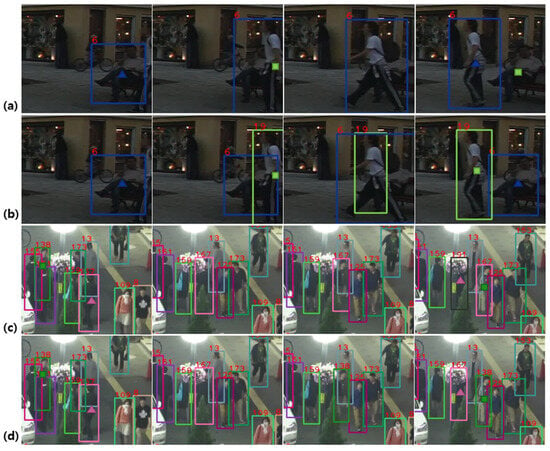
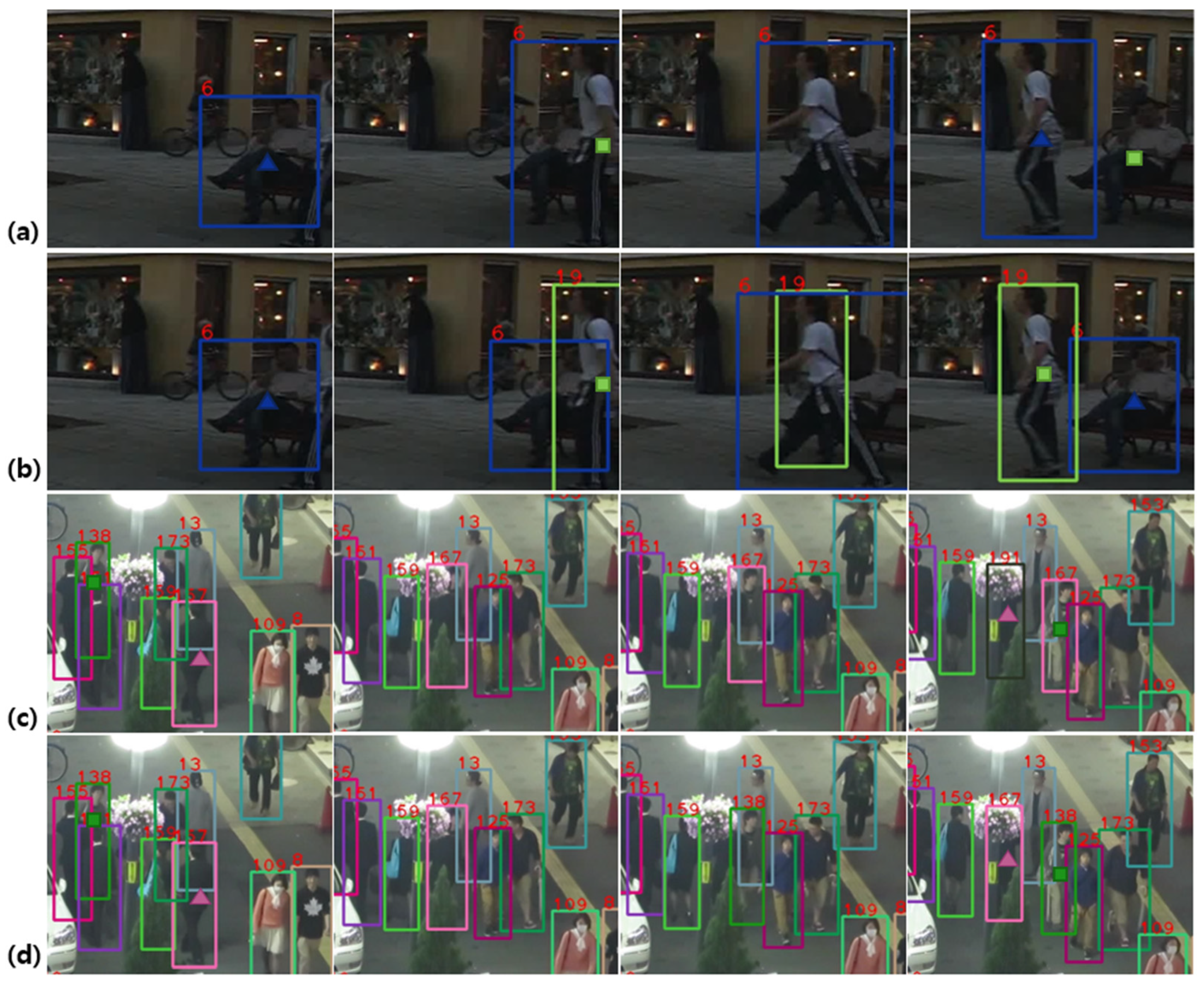
Figure 13 illustrates representative qualitative tracking examples comparing baseline ByteTrack (Figure 13a,c) and ByteTrack-ACT (Figure 13b,d). As shown in Figure 13a, under inter-object occlusion, baseline ByteTrack loses the target in primary association, leading to track fragmentation. In contrast, ByteTrack-ACT with dynamic high-confidence thresholding (Dyn/0.1, Figure 13b) adaptively lowers during low-score frames, maintaining track continuity without identity switches. Conversely, under high candidate loads, baseline ByteTrack admits low-confidence background clutter into secondary association (Figure 13c), causing spurious track associations and identity switches that prevent the true target from recovering its original ID. In contrast, ByteTrack-ACT with dynamic low-confidence thresholding (Seq-tuned/Dyn, Figure 13d) effectively raises to purge background clutter, eliminating false track interference and successfully recovering the target’s original identity across consecutive frames.
Figure 13.
Qualitative tracking comparison under two challenging conditions: (a) ByteTrack (Seq-tuned/0.1) and (b) ByteTrack-ACT (Dyn/0.1) under inter-object occlusion; (c) ByteTrack (Seq-tuned/0.1) and (d) ByteTrack-ACT (Seq-tuned/Dyn) under background candidate clutter. Bounding box colors and numbers denote tracked target identities. The example frames are taken from the publicly available MOT17 dataset.
4.2.4. Compatibility with an Alternative TBD Tracker
To evaluate the compatibility of the proposed ACT mechanism, it was integrated into BoT-SORT (without the ReID module), which incorporates camera motion compensation (GMC), and evaluated on the MOT17 test set (Table 5). ByteTrack was used as the primary framework for evaluations on both MOT17 and MOT20, whereas BoT-SORT was evaluated on MOT17 to examine whether ACT can be extended to another TBD tracker. Accordingly, the BoT-SORT evaluation was limited to MOT17 because the objective was cross-tracker validation rather than cross-dataset generalization. All BoT-SORT experiments were conducted under the same experimental protocol, using the original implementation, the same detector backbone, pretrained weights, and evaluation settings as those used for ByteTrack. Compared with the fixed-threshold BoT-SORT baseline configuration ( = 0.6, = 0.1) evaluated under the same experimental setting, BoT-SORT-ACT (Dyn/Dyn) achieved an IDF1 of 79.6% (+0.4 pp), an AssA of 64.3% (+0.4 pp), and a HOTA of 64.5% (+0.2 pp), while maintaining a comparable MOTA of 80.3% (vs. 80.6%). The fixed baseline configuration ( = 0.6, = 0.1) was selected because it achieved the highest MOTA among the globally fixed-threshold baselines while retaining competitive IDF1 and HOTA. Furthermore, using the same sequence-specific threshold settings as those adopted for ByteTrack in Section 4.2.3, BoT-SORT-ACT also achieved competitive performance against the sequence-tuned baseline (Seq-tuned/0.1). Specifically, evaluating the adaptive variants independently demonstrated consistent robustness, where dynamic (Dyn/0.1) and dynamic (Seq-tuned/Dyn) yielded IDF1 scores of 79.4% and 79.6%, and MOTA of 80.5% and 80.7%, respectively. Operating jointly, BoT-SORT-ACT (Dyn/Dyn) improved IDF1 from 79.3% to 79.6%, AssA from 64.0% to 64.3% and HOTA from 64.4% to 64.5%, while maintaining comparable MOTA (80.3% vs. 80.6%). These results further indicate that the proposed ACT mechanism is not limited to the original ByteTrack implementation and can be effectively generalized to related TBD tracking frameworks. Even when integrated with BoT-SORT, which incorporates camera motion compensation, ACT improved the balance between target preservation and noise suppression through frame-level threshold adaptation in our experiments. This demonstrates that ACT can be integrated with another TBD tracker without modifying the detector or appearance-network architecture. Furthermore, the integration did not materially affect computational efficiency.
Table 5.
Comparison of tracking performance between the baseline BoT-SORT with various static thresholds and our proposed adaptive approach on the MOT17 test set.
Furthermore, to investigate how deep appearance features interact with score-level threshold adaptation, we integrated ACT into BoT-SORT equipped with its default deep ReID appearance extractor on the MOT17 and MOT20 test sets, as summarized in Table 6.
Table 6.
Comparison of tracking performance between the baseline BoT-SORT with ReID and our proposed adaptive approach on the MOT17 and MOT20 test sets.
As presented in Table 6, ACT remains compatible with BoT-SORT when deep ReID appearance features are incorporated. Across both the MOT17 and MOT20 benchmarks, adaptively modulating the low-confidence threshold () based on the candidate detection load (Seq-tuned/Dyn) produced small but consistent improvements in IDF1 (80.2% on MOT17 and 77.4% on MOT20) and HOTA (65.0% and 63.2%, respectively) while maintaining MOTA. In contrast, dynamic thresholding (Dyn/0.1 and Dyn/Dyn) slightly reduced IDF1 on MOT17 (79.6% and 79.7% vs. 80.1%), suggesting that the benefit of adaptively lowering the high-confidence threshold may be attenuated when appearance cues assist data association. Overall throughput remained comparable across all configurations (12.3–13.7 FPS on MOT17 and 4.3–4.4 FPS on MOT20). These results support the compatibility of ACT with an appearance-assisted tracker, rather than a consistent improvement in execution speed.
5. Conclusions
This paper proposed an Adaptive Confidence Thresholding (ACT) mechanism based on the statistical distribution of detection scores to overcome the limitations of static thresholds in TBD multi-object tracking. ACT dynamically adjusts high-confidence and low-confidence thresholds according to frame-level detection reliability and the candidate detection load, which serves as a proxy for association clutter risk. Benchmark evaluations showed that ACT achieved performance comparable to the best fixed-threshold configuration on MOT17 and improved tracking performance on MOT20. Relative to the sequence-tuned ByteTrack baseline, ACT improved IDF1 and HOTA on both datasets while maintaining comparable MOTA, without additional neural network overhead or per-sequence manual threshold tuning. Despite these practical advantages, the proposed method has certain limitations. First, although provides a relative summary of each frame’s confidence distribution, ACT still utilizes predefined decision thresholds ( = 0.7); thus, its effectiveness partly depends on the confidence calibration quality of the underlying object detector. Second, while the candidate detection count N provides a computationally lightweight proxy for candidate load and clutter risk, it directly reflects the raw output volume of the detector rather than the exact physical number of targets. Consequently, candidate volume can be influenced by detector false positive rates, object scale, camera viewpoints, and image resolution across diverse environments. An inflated candidate count may stem from detector noise rather than physical density, while a drop in candidate detections may occasionally result from detector dropouts. Although setting = 100 provides an effective operational threshold separating moderate candidate loads from heavily cluttered frames, future work will investigate normalized candidate-load measures, such as bounding-box area coverage relative to frame area, and alternative indicators such as Kalman filter-predicted active-track counts. In addition, temporal smoothing using running averages across consecutive frames will be explored to reduce frame-to-frame threshold variation. Future work will also evaluate ACT across diverse detection backbones with different confidence calibrations, on low-power edge computing platforms, and across broader vehicle and multi-class tracking benchmarks.
Author Contributions
Conceptualization, D.U.G. and W.I.L.; methodology, D.U.G. and W.I.L.; software, D.U.G.; validation, D.U.G. and W.I.L.; formal analysis, D.U.G.; investigation, D.U.G.; data curation, D.U.G.; writing—original draft preparation, D.U.G.; writing—review and editing, W.I.L.; visualization, D.U.G.; supervision, W.I.L.; funding acquisition, W.I.L. All authors have read and agreed to the published version of the manuscript.
Funding
This research was supported by the Basic Science Research Program through the National Research Foundation of Korea (NRF), funded by the Ministry of Education (NRF-2021R1I1A3060657) and the Gyeongbuk ANCHOR system-(Idea Start-up Valley) program through the Gyeongbuk ANCHOR Center, funded by the Ministry of Education (MOE) and the Gyeongsangbuk-do, Republic of Korea. (2026-anchor-15-105).
Data Availability Statement
Publicly available datasets were analyzed in this study. The MOT17 and MOT20 datasets can be found at the MOTChallenge benchmark repository (https://motchallenge.net/).
Conflicts of Interest
The authors declare no conflicts of interest.
References
- Gautam, A.; Singh, S. Trends in Video Object Tracking in Surveillance: A Survey. In Proceedings of the 2019 Third International Conference on I-SMAC (IoT in Social, Mobile, Analytics and Cloud) (I-SMAC), Palladam, India, 12–14 December 2019; IEEE: Piscataway, NJ, USA, 2020; pp. 729–733. [Google Scholar] [CrossRef] [Scilit]
- Jiménez-Bravo, D.M.; Lozano Murciego, Á.; Mendes, A.S.; Sánchez San Blás, H.; Bajo, J. Multi-Object Tracking in Traffic En-vironments: A Systematic Literature Review. Neurocomputing 2022, 494, 43–55. [Google Scholar] [CrossRef] [Scilit]
- Luo, W.; Xing, J.; Milan, A.; Zhang, X.; Liu, W.; Kim, T.-K. Multiple Object Tracking: A Literature Review. Artif. Intell. 2021, 293, 103448. [Google Scholar] [CrossRef] [Scilit]
- Zhang, Y.; Sun, P.; Jiang, Y.; Yu, D.; Weng, F.; Yuan, Z.; Luo, P.; Liu, W.; Wang, X. ByteTrack: Multi-Object Tracking by Associating Every Detection Box. In Computer Vision—ECCV 2022; Lecture Notes in Computer Science; Avidan, S., Brostow, G., Cissé, M., Farinella, G.M., Hassner, T., Eds.; Springer: Cham, Switzerland, 2022; Volume 13682. [Google Scholar] [CrossRef] [Scilit]
- Kuhn, H.W. The Hungarian Method for the Assignment Problem. Nav. Res. Logist. Q. 1955, 2, 83–97. [Google Scholar] [CrossRef] [Scilit]
- Kalman, R.E. A New Approach to Linear Filtering and Prediction Problems. J. Basic Eng. 1960, 82, 35–45. [Google Scholar] [CrossRef] [Scilit]
- Aharon, N.; Orfaig, R.; Bobrovsky, B.-Z. BoT-SORT: Robust Associations Multi-Pedestrian Tracking. arXiv 2022, arXiv:2206.14651. [Google Scholar] [CrossRef] [Scilit]
- Cao, J.; Pang, J.; Weng, X.; Khirodkar, R.; Kitani, K. Observation-Centric SORT: Rethinking SORT for Robust Multi-Object Tracking. In Proceedings of the IEEE/CVF Conference on Computer Vision and Pattern Recognition (CVPR), Vancouver, BC, Canada, 17–24 June 2023; IEEE: Piscataway, NJ, USA, 2023; pp. 9686–9696. [Google Scholar] [CrossRef] [Scilit]
- Dendorfer, P.; Ošep, A.; Milan, A.; Schindler, K.; Cremers, D.; Reid, I.; Roth, S.; Leal-Taixé, L. MOTChallenge: A Benchmark for Single-Camera Multiple Target Tracking. Int. J. Comput. Vis. 2021, 129, 845–881. [Google Scholar] [CrossRef] [Scilit]
- Dendorfer, P.; Rezatofighi, H.; Milan, A.; Shi, J.; Cremers, D.; Reid, I.; Roth, S.; Schindler, K.; Leal-Taixé, L. MOT20: A Benchmark for Multi-Object Tracking in Crowded Scenes. arXiv 2020, arXiv:2003.09003. [Google Scholar] [CrossRef] [Scilit]
- Zhang, Y.; Wang, C.; Wang, X.; Zeng, W.; Liu, W. Robust Multi-Object Tracking by Marginal Inference. In Computer Vision—ECCV 2022; Lecture Notes in Computer Science; Avidan, S., Brostow, G., Cissé, M., Farinella, G.M., Hassner, T., Eds.; Springer: Cham, Switzerland, 2022; Volume 13682. [Google Scholar] [CrossRef] [Scilit]
- Liu, Z.; Wang, X.; Wang, C.; Liu, W.; Bai, X. SparseTrack: Multi-Object Tracking by Performing Scene Decomposition Based on Pseudo-Depth. IEEE Trans. Circuits Syst. Video Technol. 2025, 35, 4870–4882. [Google Scholar] [CrossRef] [Scilit]
- Li, S.; Ren, H.; Xie, X.; Cao, Y. A Review of Multi-Object Tracking in Recent Times. IET Comput. Vis. 2025, 19, e70010. [Google Scholar] [CrossRef] [Scilit]
- Felzenszwalb, P.F.; Girshick, R.B.; McAllester, D.; Ramanan, D. Object Detection with Discriminatively Trained Part-Based Models. IEEE Trans. Pattern Anal. Mach. Intell. 2010, 32, 1627–1645. [Google Scholar] [CrossRef] [Scilit] [PubMed]
- Yang, F.; Choi, W.; Lin, Y. Exploit All the Layers: Fast and Accurate CNN Object Detector with Scale Dependent Pooling and Cascaded Rejection Classifiers. In Proceedings of the IEEE Conference on Computer Vision and Pattern Recognition (CVPR), Las Vegas, NV, USA, 27–30 June 2016; IEEE: Piscataway, NJ, USA, 2016; pp. 2129–2137. [Google Scholar] [CrossRef] [Scilit]
- Ren, S.; He, K.; Girshick, R.; Sun, J. Faster R-CNN: Towards Real-Time Object Detection with Region Proposal Networks. IEEE Trans. Pattern Anal. Mach. Intell. 2017, 39, 1137–1149. [Google Scholar] [CrossRef] [Scilit] [PubMed]
- Liu, W.; Anguelov, D.; Erhan, D.; Szegedy, C.; Reed, S.; Fu, C.Y.; Berg, A.C. SSD: Single Shot MultiBox Detector. In Computer Vision—ECCV 2016; Lecture Notes in Computer Science; Leibe, B., Matas, J., Sebe, N., Welling, M., Eds.; Springer: Cham, Switzerland, 2016; Volume 9905, pp. 21–37. [Google Scholar] [CrossRef] [Scilit]
- Ge, Z.; Liu, S.; Wang, F.; Li, Z.; Sun, J. YOLOX: Exceeding YOLO Series in 2021. arXiv 2021, arXiv:2107.08430. [Google Scholar] [CrossRef] [Scilit]
- Wang, Y.-H.; Hsieh, J.-W.; Chen, P.-Y.; Chang, M.-C.; So, H.-H.; Li, X. SMILEtrack: SiMIlarity LEarning for Occlusion-Aware Multiple Object Tracking. Proc. AAAI Conf. Artif. Intell. 2024, 38, 5740–5748. [Google Scholar] [CrossRef] [Scilit]
- Chen, P.-Y.; Chang, M.-C.; Hsieh, J.-W.; Chen, Y.-S. Parallel Residual Bi-Fusion Feature Pyramid Network for Accurate Single-Shot Object Detection. IEEE Trans. Image Process. 2021, 30, 9099–9111. [Google Scholar] [CrossRef] [Scilit] [PubMed]
- Sun, Z.; Wei, G.; Fu, W.; Ye, M.; Jiang, K.; Liang, C.; Zhu, T.; He, T.; Mukherjee, M. Multiple Pedestrian Tracking Under Occlusion: A Survey and Outlook. IEEE Trans. Circuits Syst. Video Technol. 2025, 35, 1009–1027. [Google Scholar] [CrossRef] [Scilit]
- Bewley, A.; Ge, Z.; Ott, L.; Ramos, F.; Upcroft, B. Simple Online and Realtime Tracking. In Proceedings of the IEEE International Conference on Image Processing (ICIP), Phoenix, AZ, USA, 25–28 September 2016; IEEE: Piscataway, NJ, USA, 2016; pp. 3464–3468. [Google Scholar] [CrossRef] [Scilit]
- Wojke, N.; Bewley, A.; Paulus, D. Simple Online and Realtime Tracking with a Deep Association Metric. In Proceedings of the IEEE International Conference on Image Processing (ICIP), Beijing, China, 17–20 September 2017; IEEE: Piscataway, NJ, USA, 2017; pp. 3645–3649. [Google Scholar] [CrossRef] [Scilit]
- Adžemović, M. Deep Learning-Based Multi-Object Tracking: A Comprehensive Survey from Foundations to State-of-the-Art. Vis. Comput. 2026, 42, 368. [Google Scholar] [CrossRef] [Scilit]
- Huang, C.; Han, S.; He, M.; Zheng, W.; Wei, Y. DeconfuseTrack: Dealing with Confusion for Multi-Object Tracking. In Proceedings of the IEEE/CVF Conference on Computer Vision and Pattern Recognition (CVPR), Seattle, WA, USA, 16–22 June 2024; IEEE: Piscataway, NJ, USA, 2024; pp. 19290–19299. [Google Scholar] [CrossRef] [Scilit]
- Stanojević, V.D.; Todorović, B.T. BoostTrack: Boosting the Similarity Measure and Detection Confidence for Improved Multiple Object Tracking. Mach. Vis. Appl. 2024, 35, 53. [Google Scholar] [CrossRef] [Scilit]
- Stanojević, V.; Todorović, B. BoostTrack++: Using Tracklet Information to Detect More Objects in Multiple Object Tracking. Filomat 2025, 39, 5685–5702. [Google Scholar] [CrossRef] [Scilit]
- He, L.; Liao, X.; Liu, W.; Liu, X.; Cheng, P.; Mei, T. FastReID: A PyTorch Toolbox for General Instance Re-Identification. In Proceedings of the 31st ACM International Conference on Multimedia (MM ’23), Ottawa, ON, Canada, 29 October–3 November 2023; Association for Computing Machinery: New York, NY, USA, 2023; pp. 9664–9667. [Google Scholar] [CrossRef] [Scilit]
- Du, Y.; Zhao, Z.; Song, Y.; Zhao, Y.; Su, F.; Gong, T.; Meng, H. StrongSORT: Make DeepSORT Great Again. IEEE Trans. Multimed. 2023, 25, 8725–8737. [Google Scholar] [CrossRef] [Scilit]
- Chen, W.; Xu, X.; Jia, J.; Luo, H.; Wang, Y.; Wang, F.; Jin, R.; Sun, X. Beyond Appearance: A Semantic Controllable Self-Supervised Learning Framework for Human-Centric Visual Tasks. In Proceedings of the IEEE/CVF Conference on Computer Vision and Pattern Recognition (CVPR), Vancouver, BC, Canada, 18–22 June 2023; IEEE: Piscataway, NJ, USA, 2023; pp. 15050–15061. [Google Scholar] [CrossRef] [Scilit]
- Wu, D.; Huang, Z.; Zhang, Y. SolidTrack: A Novel Method for Robust and Reliable Multi-Pedestrian Tracking. Electronics 2025, 14, 1370. [Google Scholar] [CrossRef] [Scilit]
- Zhang, W.; Liu, M.; Cao, Y.; Cai, J.; Wang, C.; Xia, H.; Xu, K. Hierarchical Multi-Prototype Appearance Memory: A Plug-and-Play Module for Identity-Stable Online Multi-Object Tracking. Electronics 2026, 15, 2357. [Google Scholar] [CrossRef] [Scilit]
- Ma, L.V.; Hussain, M.I.; Park, J.; Kim, J.; Jeon, M. Adaptive Confidence Threshold for ByteTrack in Multi-Object Tracking. In Proceedings of the 12th International Conference on Control, Automation and Information Sciences (ICCAIS), Hanoi, Vietnam, 27–29 November 2023; IEEE: Piscataway, NJ, USA, 2023; pp. 370–374. [Google Scholar] [CrossRef] [Scilit]
- Shim, K.; Ko, K.; Hwang, J.; Kim, C. Adaptrack: Adaptive Thresholding-Based Matching for Multi-Object Tracking. In Proceedings of the IEEE International Conference on Image Processing (ICIP), Abu Dhabi, United Arab Emirates, 27–30 October 2024; IEEE: Piscataway, NJ, USA, 2024; pp. 2222–2228. [Google Scholar] [CrossRef] [Scilit]
- Bernardin, K.; Stiefelhagen, R. Evaluating Multiple Object Tracking Performance: The CLEAR MOT Metrics. EURASIP J. Image Video Process. 2008, 2008, 246309. [Google Scholar] [CrossRef] [Scilit]
- Ristani, E.; Solera, F.; Zou, R.; Cucchiara, R.; Tomasi, C. Performance Measures and a Data Set for Multi-Target, Multi-Camera Tracking. In Computer Vision—ECCV 2016 Workshops; Lecture Notes in Computer Science; Hua, G., Jégou, H., Eds.; Springer: Cham, Switzerland, 2016; Volume 9914, pp. 17–35. [Google Scholar] [CrossRef] [Scilit]
- Luiten, J.; Ošep, A.; Dendorfer, P.; Torr, P.H.S.; Geiger, A.; Leal-Taixé, L.; Leibe, B. HOTA: A Higher Order Metric for Evaluating Multi-Object Tracking. Int. J. Comput. Vis. 2021, 129, 548–578. [Google Scholar] [CrossRef] [Scilit] [PubMed]

Disclaimer/Publisher’s Note: The statements, opinions and data contained in all publications are solely those of the individual author(s) and contributor(s) and not of MDPI and/or the editor(s). MDPI and/or the editor(s) disclaim responsibility for any injury to people or property resulting from any ideas, methods, instructions or products referred to in the content. |
© 2026 by the authors. Licensee MDPI, Basel, Switzerland. This article is an open access article distributed under the terms and conditions of the Creative Commons Attribution (CC BY) license.