


Abstract
Suitable speech data is crucial for the development of Mispronunciation Detection and Diagnosis (MDD) systems, which rely on examples of correct pronunciations and mispronunciations. This paper describes the creation of a novel dataset for British English MDD systems, with a focus on developing an accent-specific approach using deep learning methods. The dataset consists of over 7000 utterances from 29 speakers who were identified as using the ‘Modern Received Pronunciation’ (MRP) accent, and includes orthographic transcripts and automatically generated phone sequences. The MRP dataset aims to contribute to the development of both single-accent MDD systems and broader British English MDD. To observe the impact of single-accent training data, two identical CNN–LSTM models with Connectionist Temporal Classification (CTC) loss were trained to perform MDD. One model was trained on TIMIT, the other on our MRP data. When evaluated on L2 Arctic speech, which is annotated from an American English perspective, the TIMIT-trained model would normally be expected to perform better due to accent alignment. However, the MRP-trained model produced a lower Phoneme Error Rate (PER) and a higher rate of Correct Diagnosis. These exploratory results show that MRP can support MDD modelling, even when evaluated against an American English pronunciation target. The MRP dataset therefore offers an immediate resource for developing RP-focused pronunciation tools, a template for constructing comparable corpora across other UK accents, and an openly accessible dataset for future MDD and ASR research.
1. Introduction
The rapid advancement of Artificial Intelligence (AI), particularly in its sub-divisions machine learning (ML) and deep learning (DL), has led to an abundance of Automatic Speech Recognition (ASR) research output, focused on developing algorithms and achieving State-of-the-Art (SOTA) results. For these systems to function effectively, appropriate training data is essential for ML and DL networks. Consequently, numerous datasets have been created for ASR applications, containing speech samples in the target language along with word-level transcriptions. However, these corpora often lack the necessary information for specialised use cases. Mispronunciation Detection and Diagnosis (MDD) within ASR typically focuses on identifying and diagnosing phonetic errors such as unexpected substitutions, deletions, or insertions of sounds at the segmental level. This level concerns the pronunciation of individual phonemes, which combine into syllables and then into words. Phonetic transcripts are required to perform such analyses.
While English is well-resourced in speech data, most of these datasets are US-focused. TIMIT [1] and Librispeech [2] are widely used US English ASR corpora. TIMIT includes phone-level annotations, whereas LibriSpeech provides large-scale read speech with orthographic transcripts. TIMIT in particular is commonly used to benchmark MDD systems [3].
British English speech corpora are relatively sparse compared to their US counterparts. Although some specialised corpora have been developed recently, such as The Voice Bank [4] for speech synthesis, they lack phoneme sequences. WSJCAM0 [5], however, shares similar characteristics with TIMIT and Librispeech, containing accent-diverse speech from the UK with word- and phoneme-level transcripts. Despite these advantages, this corpus presents some challenges that encapsulate the current landscape of British speech data, such as limited availability due to cost, and questions about its reliability in representing modern speech styles in the UK [6].
This is supported by the decision to update the British National Corpus (BNC) (Consortium, 2007) with BNC2014 [7]. The corpus captures linguistic characteristics across the UK, suggesting that the original version was no longer representative of how people speak today. Similarly, The Diachronic Electronic Corpus of Tyneside English (DECTE) [8] aims to represent speech in Tyneside. While both BNC and DECTE support linguistic research and are not suitable for ASR tasks, they indicate that many speakers of a given dialect will share speech characteristics, like pronunciation, allowing the dialect to be identified and categorised.
A dialect-specific approach has been applied to ASR previously, such as combining a corpus of Medina dialect with existing Arabic corpora to improve ASR performance amongst Medina speakers [9]. These approaches demonstrate an advantage in collecting speech data with a deliberate focus on a specific linguistic variety. Since MDD systems should benefit users by providing consistency in pronunciation and clear communication, it is evident that combining accent-specific data with existing data can enhance ASR performance for users with specific accents.
Current MDD speech data often contain multiple accents, allowing many systems to be trained using various accents, which can widen the scope of acceptable pronunciations. Although this can serve as a learning tool, it may allow learners to use different accents and still be considered correct, potentially not fully meeting their goal of improving clear communication.
The presented dataset consists of over 7000 utterances from 29 speakers who identify as using the ‘MRP’ accent. This represents an opportunity to develop MDD systems tailored to a widely spoken accent in the UK. Furthermore, this corpus has been constructed with word and phoneme sequences available for each speaker. This dataset aims to contribute towards the development of both single-accent MDD systems and broader British English MDD.
To our knowledge, there is no contemporary, openly licensed dataset containing canonical phoneme sequences for speakers of Modern Received Pronunciation. This gap limits research into UK-focused pronunciation modelling and accent-specific MDD.
The remainder of this paper outlines the steps taken to construct the dataset: accent selection, prompt selection, participant recruitment, recording sessions, audio post-processing, word and phoneme sequence generation, data structure, and naming convention. The following sections explore preliminary results and further work before concluding.
2. Dialect Background
2.1. UK Dialect Overview
The United Kingdom has more than thirty commonly recognised English dialects [10]. Recent corpus-linguistic projects such as the British National Corpus 2014 [7] and the Speech Accent Archive [11] provide large, publicly available recordings that catalogue these regional varieties. We adopt the supra-regional groupings outlined by [7] in Table 1 to summarise the English districts and provide some examples of regional accents in that region.
Table 1.
Regional districts in England.
Single-dialect datasets have been developed to provide linguists with a repository of spoken material for tracking dialect and language changes [8]. Despite this, few such datasets have been published by institutions in the last 15 years, including the British National Corpus 2014 (BNC2014) [7]. These publications underscore first that collecting data for a single dialect enhances understanding of that dialect, and second, as language and speech styles evolve over time, it is crucial to capture these changes to ensure the data remain relevant.
2.2. Received Pronunciation
Received Pronunciation (RP) is an accent of British English predominantly spoken in the south of England. Historically, it has been associated with and taught to the upper classes, including members of the royal family, as an indicator of wealth and high social class. RP underwent significant evolution throughout the twentieth century, leading to confusion regarding its classification. Researchers introduced terms such as ‘modern RP’ and ‘advanced RP’ toward the end of the 20th century to distinguish between current and older interpretations of the accent. This period also coincided with increased media consumption from radio and television. Broadcasting companies sought RP speakers for roles due to their perceived neutrality and national comprehensibility, leading to RP being known as ‘BBC English’ [10]. In the 21st century, RP is recognised as the standard British accent, often targeted by second-language learners. While still linked with the royal family, the accent has modernised and evolved, with many self-identified RP speakers not belonging to high social classes and possessing an informal speaking style. To differentiate from late 20th century RP and some of its connotations, linguists suggest using the term ‘Standard Southern British’ (SSB) [12].
2.3. Accent Parameters
Table 2, Table 3 and Table 4 demonstrate vowel and consonant pronunciation differences between Traditional RP and Modern RP. Yorkshire and Cockney are also included as examples of Northern and alternative London English accents to provide broader context for the variation found across English accents. For example, the ‘bath’ vowel is a long /ɑː/ in RP and Modern RP, but short /a/ in Yorkshire, while the glottal stop in ‘bottle’ is a well-known feature of Cockney speech, but not characteristic of RP, and only occasionally present in MRP. These examples highlight some of the key phonological features of MRP that differentiate it from both its traditional form and other regional accents.
Table 2.
Vowel pronunciation variations (RP: Received Pronunciation).
Table 3.
Consonant pronunciation variations.
Table 4.
Pronunciation variations among accents.
2.4. Related Works
Several earlier corpora include speech close to RP or SSB English, but each presents practical limitations. The Accents of the British Isles (ABI) corpus [13], recorded in the early 2000s, covers multiple regional varieties but does not specify how many speakers represent RP or SSB, and its distribution is now limited. Later work referencing ABI provides a broken download link [14], and the available annotations stop at the word- or phrase-level without the inclusion of phoneme sequences. WSJCAM0 [5], recorded in the 1990s, contains Southern English material and includes automatically generated phone sequences, but it is not openly available and lacks explicit accent metadata. A more recent dataset, Crowdsourced High-Quality UK and Ireland English Dialect Speech Data Set [15], includes several Southern English speakers, yet the authors note that no sociolinguistic profiles are available to position these accents reliably within the British accent landscape.
Together, these constraints highlight the absence of a contemporary, openly licensed RP resource with canonical phone sequences. None of these corpora allow RP or SSB speakers to be identified with certainty, nor do they provide consistent phone-level resources for this accent. The MRP corpus was therefore designed to address this gap and to provide a controlled, contemporary reference for speech and pronunciation research.
3. Materials and Methods
In order to address the scarcity of L1 British English speech data for MDD, and measure the effectiveness of single-accent datasets, this section introduces the MRP corpus [16].
3.1. Accent Selection
One reason for Modern RP being used as the accent of focus is its status as the national standard [17], with around 10% of the population using it. It is most prevalent in London and its surrounding areas, which is where most recordings took place. In order to increase the pool of potential participants, Modern RP was selected, making participant recruitment easier and providing greater consistency in accent representation.
While ‘Standard Southern British’ (SSB) or ‘Advanced RP’ might be technically more accurate terms for the accent, the label ‘Modern RP’ is used here as ‘RP’ is the more widely recognised term, and the ‘Modern’ prefix more accurately reflects the scope of this dataset.
Modern RP was also selected because the BEEP pronunciation dictionary [5] provides a large British English pronunciation lexicon, enabling canonical phone sequences to be generated from the orthographic transcripts without manual entry for every word.
3.2. Spoken Prompts
Spoken prompts include a section of short, phonetically rich sentences, another consisting of passages chosen for articulatory variety, and a final section of book reading. The sentences are phonemically dense with the goal of gaining a better understanding of phoneme-specific pronunciations for the training set. They also could be used to quickly gain an overview of phoneme pronunciations in training and mispronunciation detection in users.
The passages ‘The Rainbow Passage’ [18] and ‘Comma Gets a Cure’ [19] were chosen because they appear in both accent research and prior speech dataset collection. The International Dialects of English Archive (IDEA) use them as standard reading texts, as each covers every English phoneme, offers balanced phonemic distribution, and includes Wells’ lexical set [20]. ‘The Rainbow Passage’ is recorded in corpora such as [4,15], and ‘Comma Gets a Cure’ is utilised in [21,22].
Book chapters were selected by participants from a collection of public domain texts sourced from Project Gutenberg. Participants were free to browse the collection and choose a text whose vocabulary they felt confident in pronouncing; this was done to minimise the number of reading errors and mispronunciations.
3.3. Participant Speech Parameters
Participants were selected based on their identification with modern Received Pronunciation, modern London accent, or a general London/South England accent. Prospective participants completed a questionnaire on their native language, English proficiency, and the region in which they grew up. All participants included in the corpus had acquired English from childhood and reported a native level of proficiency. The questionnaire allowed participants to report multiple native languages without excluding bilingual speakers who otherwise met the corpus criteria.
Once the questionnaire was completed, participants’ speech was assessed using calibration sentences and one of the passages. Those meeting the pronunciation criteria for the target MRP accent were invited to a recording session. Sessions were terminated if participants struggled significantly with reading, understanding, or pronunciation, or if their speech did not match the required accent profile, and recordings were discarded. Effort was made to recruit as many speakers as possible within the available time and participant availability, resulting in 29 speakers. All 29 had acquired English from childhood and reported native-level English proficiency. Three reported simultaneous bilingualism, having acquired English and another language from an early age. No participant who had acquired English solely as an L2 was included in the corpus.
3.4. Recording Process
The recording setup was designed to be simple so that speakers could focus solely on reading. All recordings were taken using a studio-quality dynamic microphone and an audio interface. The recordings were captured as 44.1 kHz PCM WAVE files on a fanless MacBook Air, with a pop shield to minimise plosive distortion.
Text prompts and consent forms were loaded onto an E-reader, offering participants a quiet, backlit screen to read from. This setup also ensured that the microphone’s position would not obstruct their view of the text and maintained optimal positioning for recording quality. Before beginning, participants received an overview of the session and instructions on how to navigate texts and correct mistakes. All procedures received approval from the University of West London Ethics Committee (Ref. UWL/REC/SCT-01233) and were conducted in accordance with the University’s regulations for data collection and informed consent.
To streamline the process and maximise data collection, the entire session was recorded in one continuous track. An engineer monitored the recordings, requesting repeats if errors occurred; however, speakers were encouraged to self-correct. A piezoelectric sensor served as a trigger for the engineer to discreetly mark errors in real time on a separate but time-aligned track.
Each speaker was assigned a unique, randomly generated ID as shown in Table 5. Recorded tracks and session files were named using these IDs to ensure participant anonymity while also maintaining distinction between each speaker.
Table 5.
Modern Received Pronunciation (MRP) corpus information (GEN: gender; UTTS: number of utterances; ID: anonymised speaker identifier).
3.5. Post-Processing
After recording sessions, the long form recording was played back in full to manually remove any prolonged silences, and the piezoelectric channel was used as a guide to cut errors. Any sentences that had a poor recording quality (i.e., the speaker covering their mouth or moving away from the microphone) were also removed at this stage.
Once the recording was deemed errorless, it was copied into a master project file containing each participant’s recording per track. Some light audio processing was applied using Accusonus ERA 6 tools for noise reduction, the removal of high-frequency sibilance (de-essing), de-breathing, and loudness balancing.
3.6. Speech Segmentation
After post-processing the audio, the next stage involved breaking audio files down into segments. Speech corpora usually break audio data into 15 s or shorter utterances for model training [23]. Some researchers record one utterance at a time, eliminating the need for segmentation. Common automated methods include voice activity detection (VAD), transcription, and silence detection systems.
Initially, we aimed to automate this process using Python by writing scripts to locate speech pauses in 15 min sample WAVE files. However, automated methods, including our initial Python scripts, which incorporated VAD tools like WebRTC VAD, proved insufficiently accurate. Early tests resulted in unsatisfactory splits, with words being cut mid-utterance, resulting in a reduced number of viable words. Creating context-aware decision-making programs that could effectively segment long audio files was challenging, as it was difficult to programmatically assess the optimal cut points within silent periods to ensure natural and coherent utterance segmentation. Due to the difficulty in finding a suitable automatic method and the time constraint faced as a result of this corpus forming part of a larger body of work, we opted for a semi-automated approach using a Digital Audio Workstation (DAW) and a silence locator tool.
The tool automatically inserted a cut wherever the signal fell below approximately −30 dBFS for ≥300 ms. This threshold was selected empirically from tests performed inside the DAW, as it consistently distinguished natural pauses from brief hesitations. Some utterances required manual adjustment, particularly where noise or overlapping speech masked pauses and misled the locator. The combined use of automatic segmentation and targeted manual correction avoided the need for fully manual cutting.
The ability to audiovisually locate silences on a waveform within the DAW allowed for precise cuts on utterance boundaries, preventing mid-word splitting commonly found in fully automated systems. This also enabled us to make informed judgments on utterance sizing, for instance, preserving a longer utterance in full when an automated system might have forced an unnatural mid-utterance cut. Furthermore, it provided the flexibility to segment audio even when natural silences did not conform to strict programmatic thresholds, such as in the presence of higher-noise floors.
3.7. Transcription
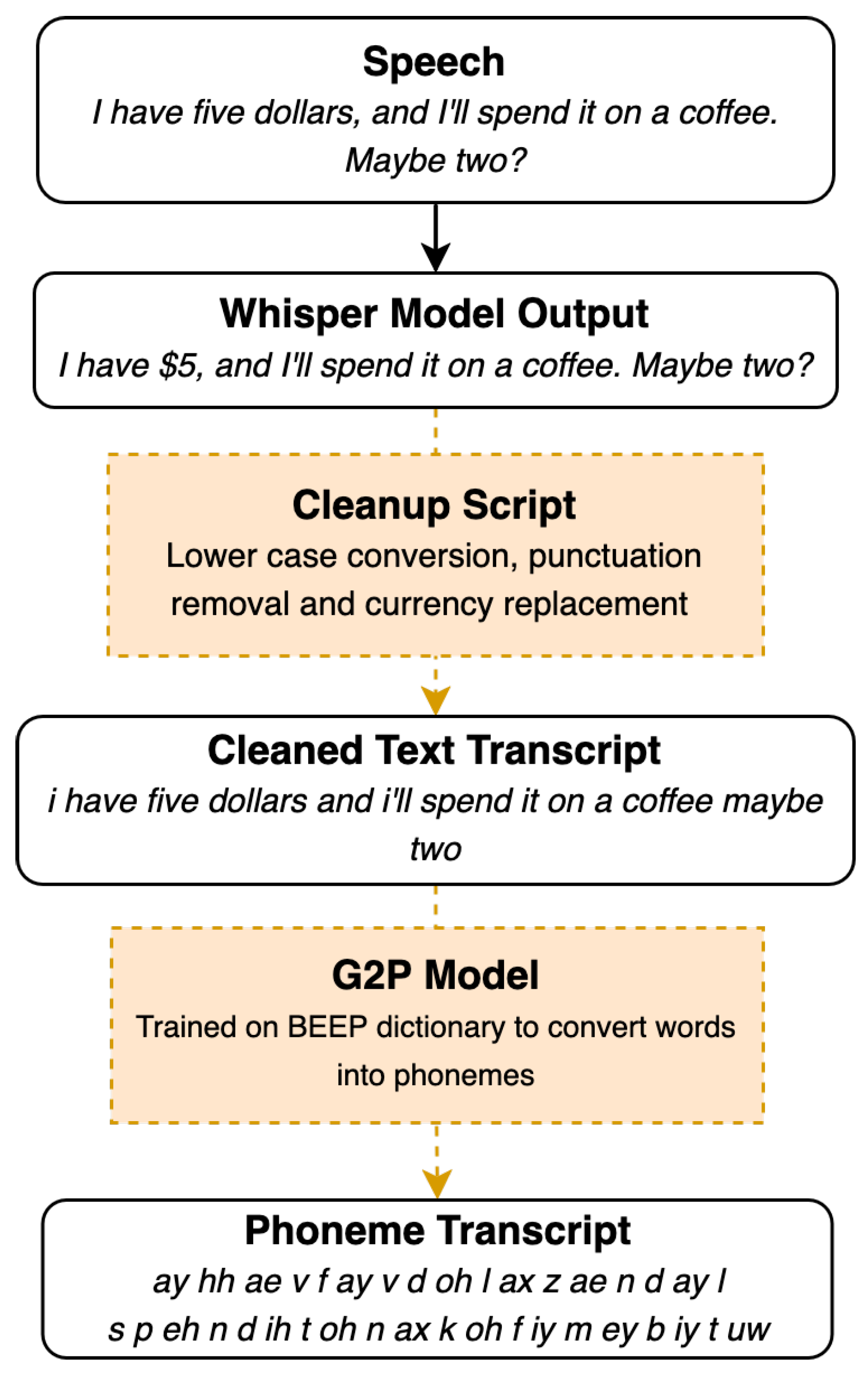
Word/orthographic transcripts were automatically generated using the Whisper large-v3 model. Ideally, speakers would read and record these transcriptions verbatim, requiring no further transcription. However, because participants occasionally deviated from the prompt scripts, and we lacked the resources to monitor verbatim adherence in real time, we relied on the Whisper large-v3 model for automatic transcription. Whisper’s default punctuation and symbol usage required careful handling. For example, removing apostrophes can create ambiguity (“can’t” vs. “cant”), while hyphens might differentiate between “re-sign” and “resign”. More significantly, symbols like currency signs could alter sentence structure: “one hundred dollars” becomes “$100”. This necessitated scripts to convert numbers to words and symbols to words. However, this resulted in outputs like “dollar(s) one hundred”. We addressed this by locating each instance of a currency symbol, separating the currency from the value, swapping their order, and handling plurality accordingly (e.g., “one dollar” vs. “twenty dollars”). Figure 1 demonstrates the post-processing undertaken, in Python 3.11.4, that used regular expressions to reorder “$ value” patterns and apply singular/plural rules.
Figure 1.
Text-processing diagram (G2P: grapheme-to-phoneme; BEEP: British English Example Pronunciation dictionary).
For word-to-phoneme conversion, resources for American English are abundant, including pre-trained grapheme-to-phoneme (G2P) models and pronunciation dictionaries like CMU [24]. However, few comprehensive resources exist for British English pronunciations. The British English Example Pronunciation (BEEP) dictionary, containing over 250,000 RP pronunciations, was first queried for each word. Where multiple pronunciations were available, the final listed variant was used. Words not found in BEEP were processed using a Phonetisaurus G2P model trained on the dictionary, enabling the prediction of pronunciations for out-of-vocabulary words based on its established pronunciation patterns. Words that could not be processed automatically were given manual phoneme labels, with all labels denoted using ASCII codes derived from ARPAbet [25]. The resulting sequences represent dictionary-based canonical pronunciations rather than phonetic transcriptions of the pronunciation observed in each recording. Therefore, alternative pronunciations, glottalisation, reduction, and other connected-speech phenomena may differ from the canonical sequence. Table 6 presents the phoneme classes used in the MRP corpus, grouped by category. While this set covers all major categories found in standard ARPAbet transcriptions, it has been adapted to reflect features of British English that are not represented in common US datasets. For example, the MRP inventory includes /ea/ (‘bear’), /ia/ (‘media’), /oh/ (‘box’), and /ua/ (‘mutual’), which are present in BEEP, but not TIMIT or L2 Arctic. In contrast, TIMIT includes the American English flap /dx/ (‘butter’), which does not occur in MRP. By aligning the phoneme set with the phonology of Modern Received Pronunciation, the MRP corpus provides canonical phoneme labels based on a British English inventory and supports the development of UK-focused speech technologies.
Table 6.
MRP corpus phoneme set.
3.8. Corpus Structure and Naming Convention
Utterances were exported using ‘SpeakerID_UtteranceNum’ as the naming convention. The utterance numbers are labelled sequentially as they are exported, ‘001’ being the first utterance. This convention means that each utterance in the corpus has a unique utterance ID and is consistent across audio files, word-level transcripts and phoneme labels.
4. Results and Discussion
4.1. Data Quality
4.1.1. Transcription Accuracy
Due to the method of prompt recording, utterance transcripts were generated automatically, ultimately introducing some word- and character-level error. As full-corpus validation is rarely feasible, transcript quality in speech datasets is typically assessed using a small, representative subset [26]. For MRP, five utterances per speaker were randomly selected and manually inspected for errors, giving a speaker-stratified sample of 145 utterances. Seven utterances required correction.
Word Error Rate (WER) and Character Error Rate (CER) were computed using Levenshtein distance [27] at both the word and character levels. Across the sample, 10 word edits were required over 2087 words, giving a WER of 0.48%, while 21 character edits were required over 9334 characters, giving a CER of 0.22%. Speaker-level WER ranged from 0 to 3.70% and CER from 0 to 1.73%, with 23 of the 29 speakers returning no errors. The speaker-stratified 95% confidence intervals were 0.15–0.87% for WER and 0.08–0.39% for CER. Table 7 summarises the total edits and resulting error rates, while Table 8 provides speaker-level WER and CER for speakers with one or more orthographic errors.
Table 7.
Error Rate measurements of word transcripts (WER: Word Error Rate; CER: Character Error Rate).
Table 8.
Speaker-level error rates of word transcripts (WER: Word Error Rate; CER: Character Error Rate).
These results indicate high orthographic transcript accuracy across the sample. As WER and CER do not measure phone-label accuracy, a separate manual check compared one utterance per speaker with the corresponding recording. Across the 29 utterances, there were 71 substitutions, 22 deletions and no insertions over 1535 reference phonemes, giving a phoneme disagreement rate of 6.1%. The remaining 1442 phones matched the manually annotated sequences.
4.1.2. Phoneme Distribution
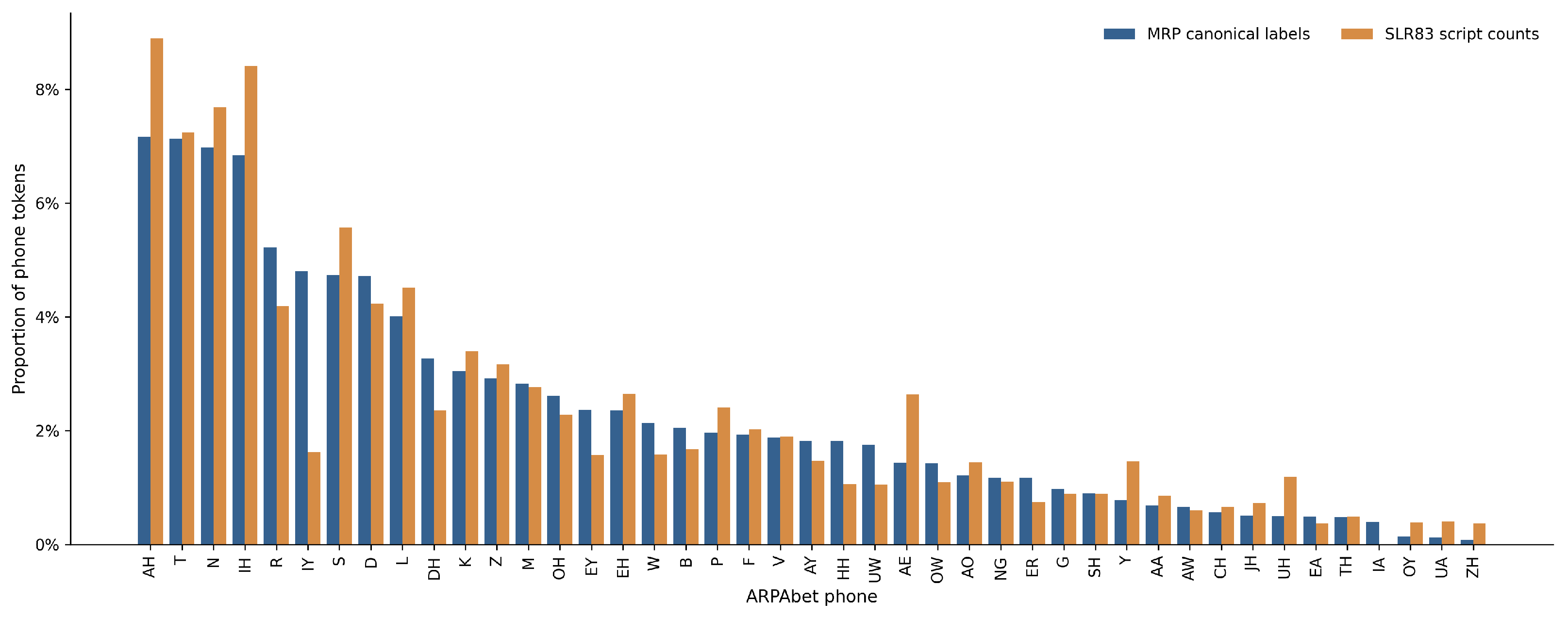
The MRP phoneme distribution is compared with a recent UK English corpus [15]. The published SLR83 phone counts were mapped to the 43 ARPAbet labels used for MRP, TIMIT and L2-Arctic, and each distribution was normalised by its total number of phone tokens. The SLR83 schwa and STRUT-vowel categories were combined as /ah/, while SLR83 did not use /ia/. The comparison included 374,458 MRP canonical phone labels from 7492 training utterances and 80,465 SLR83 script-phone tokens. Figure 2 shows that the distributions were strongly correlated (Pearson r = 0.939; Spearman = 0.933), with a Jensen–Shannon divergence of 0.019 bits. Similar results were obtained when /ah/ and /ia/ were excluded (Pearson r = 0.930; Spearman = 0.925; Jensen–Shannon divergence = 0.018 bits). This supports the similarity of the overall phone distributions, although the proportions of individual phones differ.
Figure 2.
Phone distribution comparison between MRP and SLR83.
To assess variation between speakers, each of the 29 speaker-level MRP distributions was compared with the pooled MRP distribution. Median Pearson and Spearman correlations were 0.989 and 0.983, with ranges of 0.974–0.998 and 0.965–0.993, respectively. Median Jensen–Shannon divergence was 0.0028 bits, with a range of 0.0008–0.0068 bits. This indicates limited between-speaker variation in the distribution of canonical phone labels.
4.1.3. Accent Detection
An accent detection system [28] was used to classify the global region of each speaker’s accent. Each speaker was classified as having an accent consistent with England. Since no UK regional accent detection system is widely available, this could not be investigated at a regional level. This limitation reinforces the need not only for accent-specific corpora, but for complete regional coverage of speech data across the UK. At present, ref. [15] could be leveraged for coarse regional grouping, but this approach would remain limited, as the groupings separate English accents into only three categories (Northern, Southern, and Midlands), while Welsh, Irish, and Scottish accents are not categorised beyond the country level.
4.2. Audio Quality
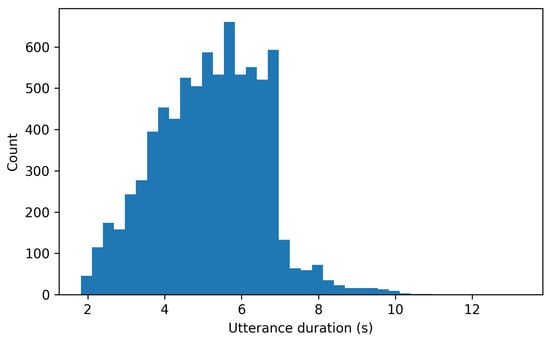
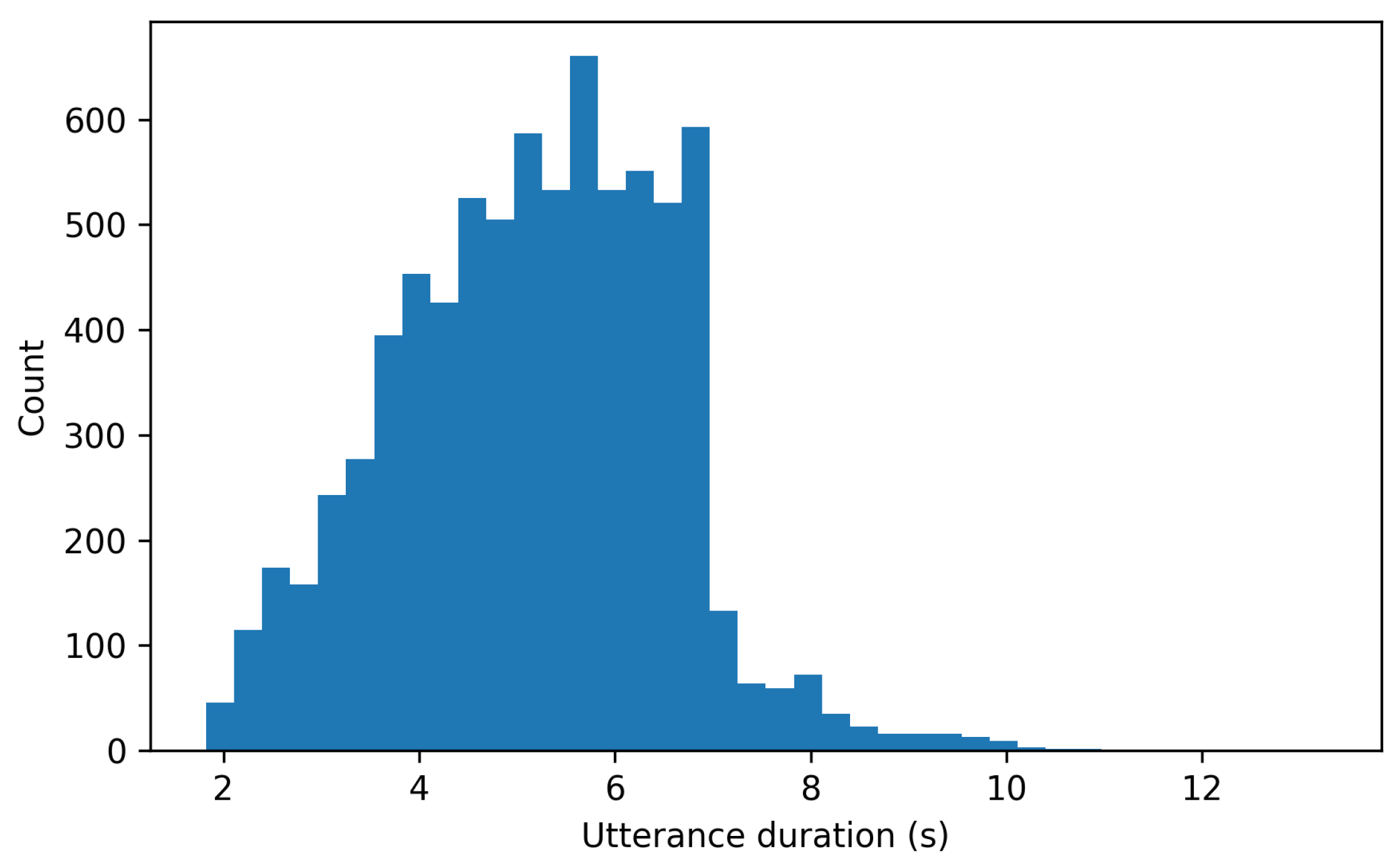
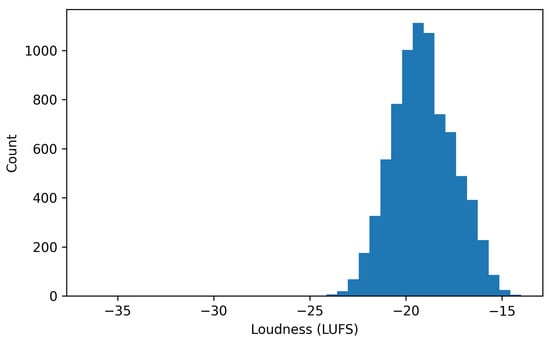
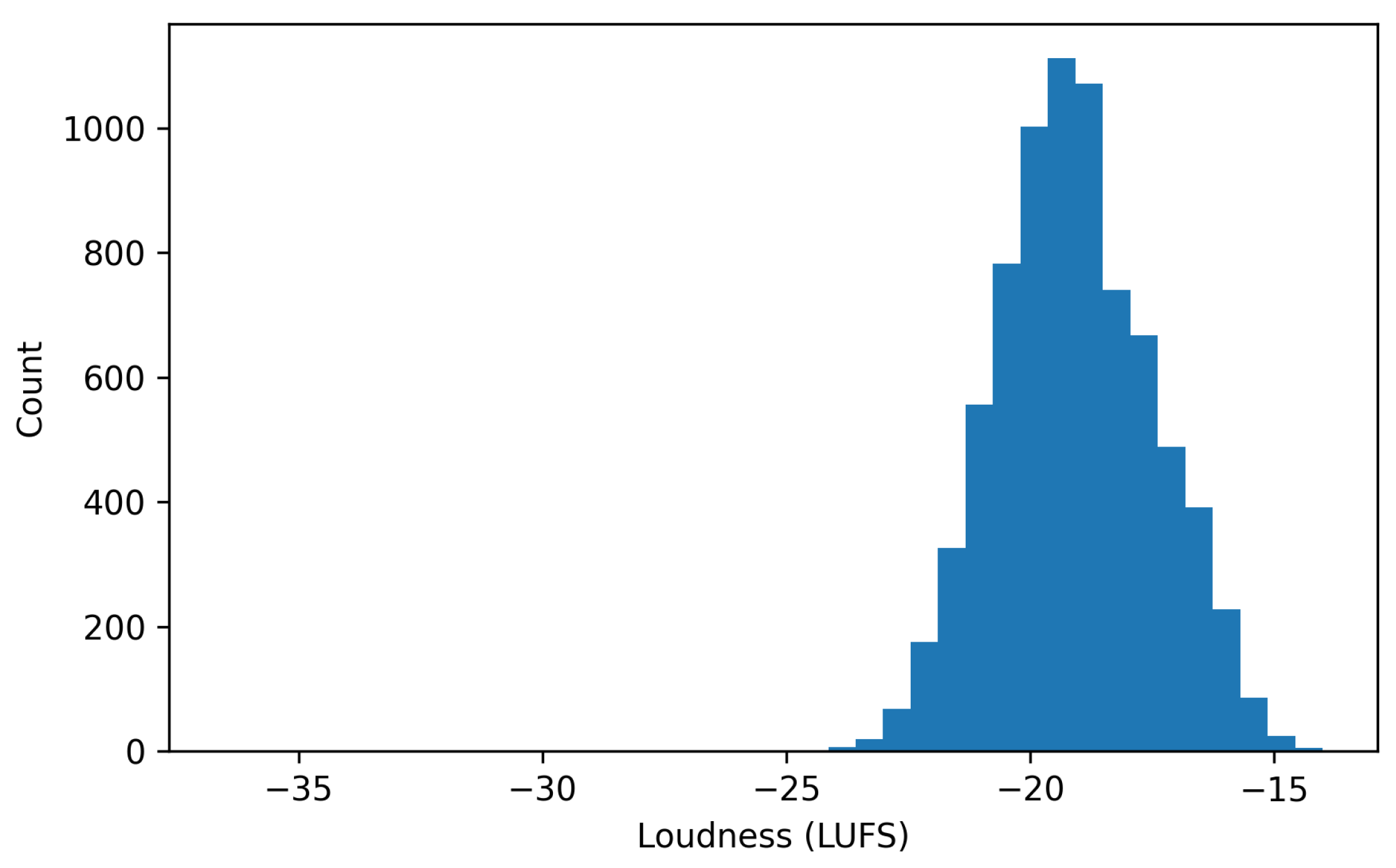
To evaluate recording consistency and signal quality across the MRP corpus, duration and integrated loudness (LUFS) were calculated. These metrics were computed in Python using standard audio-analysis libraries. Table 9 shows each metric’s minimum, maximum, mean, and median values.
Table 9.
Audio quality measurements for the MRP corpus (N denotes the number of utterances; LUFS: loudness units relative to full scale).
Across all utterances, the median duration (Figure 3) was 5.22 s, with a maximum of 10.71 s. This conforms to typical short utterance lengths expected for ASR-related tasks [2]. Integrated loudness (Figure 4) averaged −19.29 LUFS, and a maximum loudness of −14.25 LUFS. This shows that the corpus maintains a consistent and appropriate loudness.
Figure 3.
Utterance duration histogram.
Figure 4.
Utterance loudness histogram.
4.3. MDD Experiment Parameters
To assess the real-world applications of the MRP dataset, we trained a deep learning model as part of an MDD system using MRP data, and an identical model using the industry-standard TIMIT dataset. This allowed us to preliminarily compare the impact of using an accent-specific corpus versus a multi-accent corpus on MDD performance tested with L2 Arctic speech. As L2 Arctic is annotated using American English phonology, there is an inherent accent mismatch when evaluating models trained on MRP.
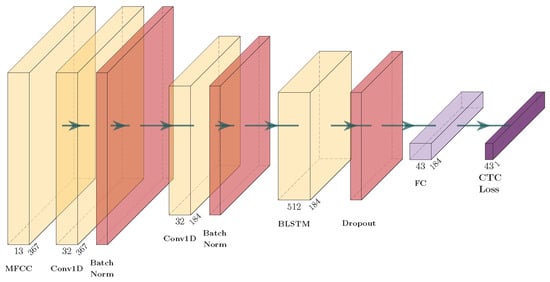
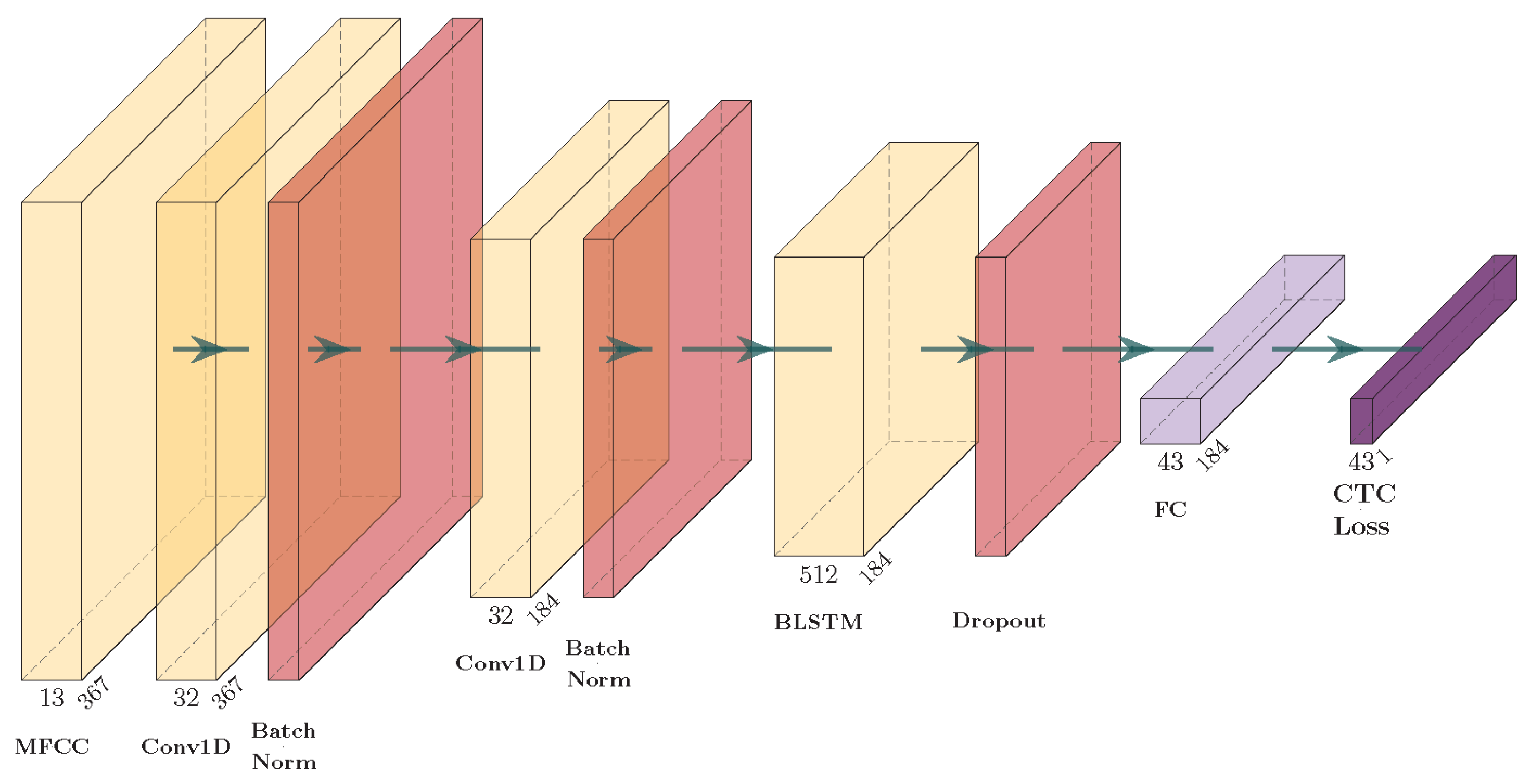
The model architecture (Figure 5) is based on a common configuration combining convolutional neural networks (CNNs), long short-term memory networks (LSTMs) and CTC, and adapts the baseline proposed in [29]. The model processes 13-dimensional Mel-frequency cepstral coefficients (MFCCs), following Kaldi’s default setting. These are extracted in a pre-processing stage and then fed to the network as fixed-size feature frames. The CNN layers extract high-level acoustic features, a bi-directional LSTM is employed to capture temporal dependencies in the speech signal, and the final fully connected layer maps these to phoneme classes. The CTC loss function enables the model to learn alignments between speech and phoneme sequences without requiring manual frame-level annotations. This makes CTC well-suited to our dataset, where manual alignment was not feasible. Table 10 reports the feature-extraction, network, optimisation, and variable-length batching configuration used for both experiments.
Figure 5.
Convolutional neural network (CNN), long short-term memory (LSTM), and connectionist temporal classification (CTC) model diagram.
Table 10.
Configuration of the CNN–LSTM–CTC baseline used in the MRP and TIMIT training conditions.
In both experiments, the training data consisted of native English speech, from either TIMIT or MRP, combined with a small portion of L2 Arctic speech, so the model encountered labelled non-native pronunciations, following the data-mixing strategy in [29]. The validation and test sets consisted only of L2 Arctic utterances not seen during training. The L2 Arctic speaker splits were fixed across both experiments, with each speaker assigned to only one of the training, validation, or test sets to avoid contamination. The splits contained 12, 6, and 6 speakers, respectively, and their IDs and available demographic and proficiency information are reported in Table 11. In total, the MRP training split contributed 7492 native utterances, the full TIMIT corpus contributed 6300 native utterances, and the L2 Arctic training, validation and test splits provided 1800, 897 and 900 utterances respectively (Table 12). All available usable MRP training utterances were included, and speaker-balanced sampling, per-speaker caps, and speaker-based loss weighting were not applied. Within the MRP training manifest, speaker contributions ranged from 47 to 408 unique utterances. The largest contributor represented 5.4% of the MRP training utterances, while the five largest contributors represented 25.8%.
Table 11.
L2-Arctic speaker splits and available demographic and proficiency information. NR indicates that a TOEFL iBT score was not reported in the cited L2-Arctic publications.
Table 12.
Utterance counts used in the Mispronunciation Detection and Diagnosis (MDD) experiments.
Minimum-edit alignment of the L2 Arctic canonical and realised phone sequences was used to count correct phones, substitutions, insertions and deletions. The training, validation and test sets contained 9157, 3923 and 4291 mispronunciations, respectively. As shown in Table 13, correctly pronounced phones are substantially more frequent than mispronunciations across the L2 Arctic splits, with insertion errors particularly limited. As the purpose of the experiment was to compare the effect of the native training corpora rather than optimise performance for individual error classes, additional balancing or error-type weighting was not applied. Future work could investigate targeted data collection, augmentation, or balancing methods for less frequent mispronunciation types.
Table 13.
Phone alignment counts for the L2-Arctic splits. Percentages show the distribution within all substitutions, insertions and deletions in each split.
Training parameters were identical: both models were trained over 50 epochs, with a batch size of 32, using Adam optimiser with a learning rate of 0.001. To evaluate training data performance, supplementary techniques such as language modelling or data augmentation were not applied to provide results pertaining to how the model is directly impacted by its training data. These experiments are exploratory and intended to evaluate the dataset.
4.4. Mispronunciation Detection and Diagnosis
After training, the models were evaluated on a test set of unseen L2 speech. The test dataset contains 30,005 phonemes in total. Table 14 shows the number of each mispronunciation type. Table 15 shows the mispronunciation results. TIMIT achieved slightly higher true-accept (TA = 0.65 vs. 0.64) and lower false-reject (FR = 0.35 vs. 0.36) rates. These differences were small and were measured against the American English reference labels used by L2 Arctic. The lower TA and higher FR for MRP may therefore partly reflect accent mismatch, although this experiment cannot separate this effect from other differences between the training corpora. Within this American-labelled evaluation, MRP reduced false accepts (FA) (0.17 vs. 0.29) and improved correct diagnosis (CD) (0.57 vs. 0.46), yielding a higher F1 (0.42 vs. 0.37) and a slightly lower phone error rate (PER = 39.43% vs. 40.56%). Correct diagnosis is also target-dependent because it is calculated from detected errors defined against the American English target. The label mismatch could therefore reward or penalise the MRP model, and its direction cannot be established without British-target judgements.
Table 14.
Pronunciation label counts in the L2 Arctic test set.
Table 15.
MDD results on the L2 Arctic test set.
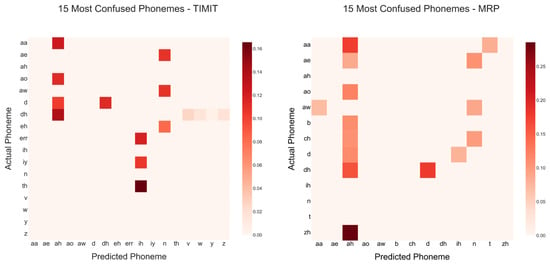
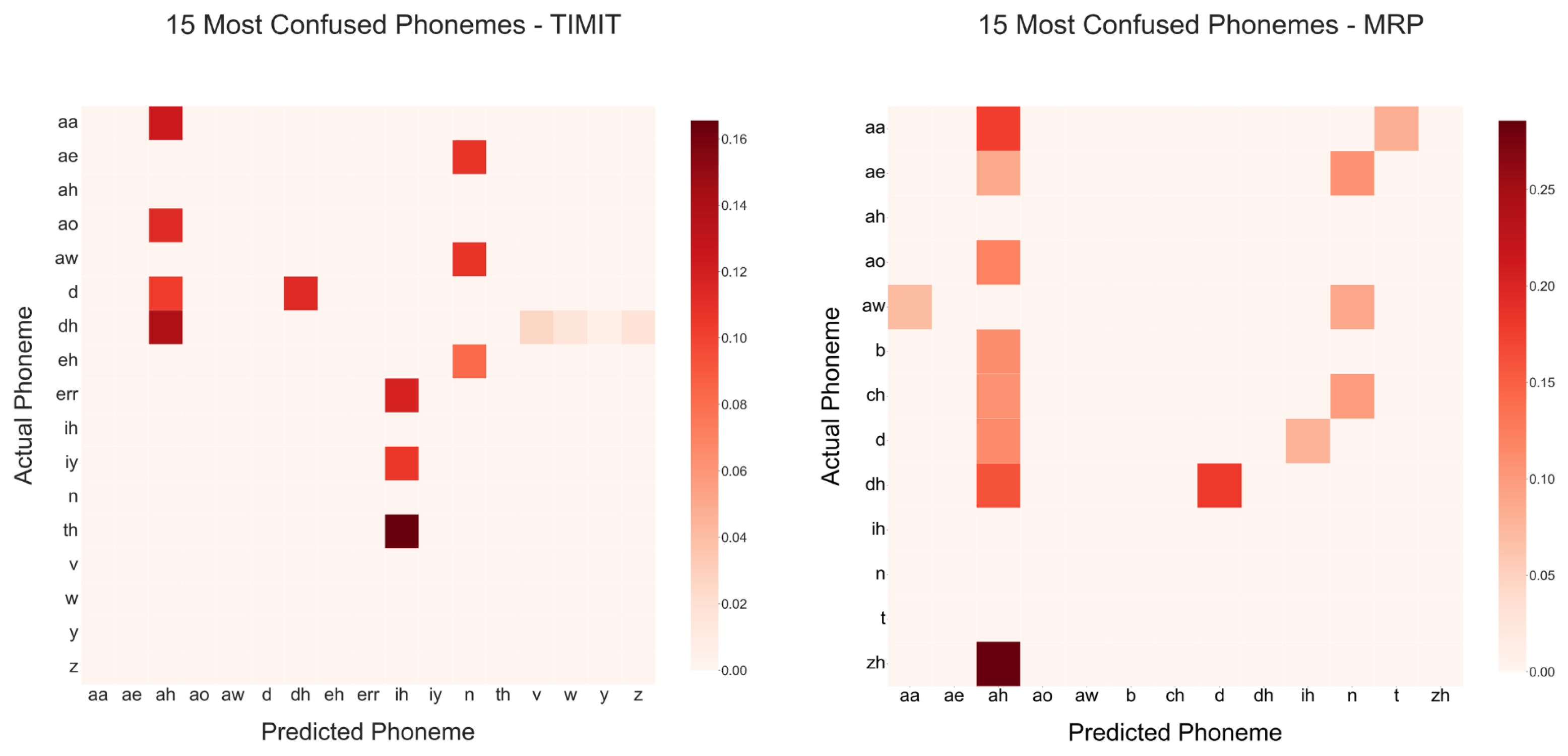
To gain a better understanding of model performance, the confusion matrices shown in Figure 6 were analysed. They show similarities in both datasets, with confusions where /ah/ is predicted but the actual phoneme is /dh/, /d/, /ao/, or /aa/. Confusions between /n/ and /ae/ or /aw/ are also part of both matrices. MRP generally shows a lower percentage of confusion per phoneme pair compared to TIMIT, but it relies more on predicting /ah/ for 8 out of the top 15 confusions. The MRP model produced more /ah/ predictions for all six test speakers. Of the 1245 incorrect or inserted MRP /ah/ predictions, 1178 were substitutions, including 889 from other vowels. Although /er/ was the largest individual source, accounting for 176 cases, the available outputs cannot separate accent effects from corpus labelling, acoustic variation, class frequency or model behaviour.
Figure 6.
Top 15 confusions for MRP- and TIMIT-trained models.
MRP produced stronger values on seven of the nine metrics in Table 15. These exploratory results demonstrate the potential of MRP for MDD research, but do not establish that the differences were caused by accent-specific training.
5. Conclusions
This paper detailed the creation of a novel dataset for British English MDD systems, with a focus on developing an accent-specific approach using deep learning methods. The study identified research gaps in existing accent-specific MDD corpora, particularly for British English. The development of the MRP dataset began by identifying phonetically rich sentences and passages, supplemented with larger public domain texts to increase the number of utterances. The recording process was optimised over time through a series of challenges that provided valuable lessons for future data collection projects.
The main challenges faced during recording included the substantial hours required for the chosen method, occasional microphone technique issues leading to data loss, and software glitches causing the loss of one participant’s contribution. These experiences informed the development of more efficient processes and tools for future collections, including plans for a similar dataset for L2 speakers and potential expansions of the MRP corpus.
A limitation of the current corpus is that its phone sequences represent canonical pronunciations generated from BEEP and G2P, rather than acoustic transcriptions of the pronunciations realised by each speaker. They may therefore omit pronunciation variation caused by glottalisation, reduction, coarticulation, and other connected-speech processes. Future work could apply a forced-alignment system such as Montreal Forced Aligner (MFA), using a lexicon containing multiple pronunciation variants, to generate time-aligned phone annotations and identify the variants most consistent with the acoustic signal. These alignments could then support targeted manual review and the development of more detailed annotations that better reflect the pronunciation variation present in the recordings.
The unequal number of utterances contributed by each MRP speaker is also a limitation of the MDD experiment. As speaker-balanced sampling was not used, speakers with more recordings may have had greater influence on the trained model. Previous work has shown that speaker composition and the quantity of speaker-specific data can affect speech model training, although these effects also depend on the total quantity of training data and phonetic coverage [30,31,32]. While this has been observed in ASR systems, the impact of unequal speaker contributions is not widely reported in MDD research, where imbalance concerns have instead focused on factors such as pronunciation error classes, phone labels and pronunciation score distributions [33,34]. The experimental aspect of this paper is intended to demonstrate MRP’s use in an MDD system rather than optimise its sampling strategy. Similar approaches are found in the previous literature [35], where baseline ASR experiments demonstrated the use of a released corpus without controlling speaker contributions. The effects was subsequently investigated separately [30]. Similarly, establishing the effect of MRP’s speaker-utterance imbalance on MDD applications would require controlled experiments specifically designed to separate speaker contribution from other training-data factors. Such an investigation warrants more detailed consideration than is appropriate for the introductory MDD experiments presented here.
The MRP dataset enabled experiments with CNN–LSTM–CTC models for British English speech, an area with limited prior work. The results showed promising performance compared with a traditional multi-accent approach, indicating its potential to impact pronunciation learning frameworks. It also highlights the potential to bridge the gap between deep learning methods for UK-based and US-based MDD systems. To our knowledge, this paper presents the first contemporary, openly licensed MRP corpus with canonical phone sequences, supported by baseline experiments demonstrating its suitability for MDD research.
6. Future Directions
Further development is being considered for the MRP dataset through a dedicated expansion project. With fewer time constraints and more resources, along with a refined method and additional researchers, this project has the potential to improve model performance further. This approach could be easily adapted to other accents throughout the UK and the rest of the world.
As well as testing potential L1 dataset improvements, future work should include an investigation of L2 speech data whose participants and annotators aim for a UK oriented accent. The ISLE corpus does seek to fulfil this, however, the recordings from this were published at the turn of the 21st century, and the corpus covers just two L1 languages, Italian and German. Because of this, the construction of an L2 dataset containing speech from non-native English speakers, in and around London, is imperative to complement the MRP corpus so that results can be collected on a set of data that is annotated for, and contains speakers attempting, the target accent.
It also presents an opportunity to create tailored L2 datasets for specific L1 speakers learning an L2 accent. For example, a dataset could be created from Italian L1 speakers attempting to produce the MRP accent. This bespoke dataset would capture relevant speech characteristics and mispronunciation patterns, potentially improving MDD system performance for other Italian L1 speakers learning MRP. By training the MDD system on both speech from native Italian speakers and native MRP speakers, it may enhance mispronunciation detection and provide more accurate diagnoses.
Author Contributions
Conceptualisation, D.T. and E.D.; methodology, D.T.; software, D.T.; validation, D.T.; formal analysis, D.T.; investigation, D.T. and E.D.; resources, D.T. and E.D.; data curation, D.T.; writing—original draft preparation, D.T.; writing—review and editing, D.T., E.D. and J.W.; visualisation, D.T., E.D. and J.W.; supervision, E.D. and J.W.; project administration, D.T., E.D. and J.W. All authors have read and agreed to the published version of the manuscript.
Funding
This research received no external funding.
Institutional Review Board Statement
The study was conducted in accordance with the University of West London’s regulations for data collection and informed consent and was approved by the University of West London Ethics Committee (protocol code UWL/REC/SCT-01233; approval date: 29 May 2023).
Informed Consent Statement
Informed consent was obtained from all subjects involved in the study.
Data Availability Statement
The MRP corpus presented in this study is openly available in Zenodo at https://doi.org/10.5281/zenodo.15773908.
Acknowledgments
The authors thank the participants who contributed speech recordings to the corpus.
Conflicts of Interest
The authors declare no conflicts of interest.
Abbreviations
The following abbreviations are used in this manuscript:
| AI | Artificial Intelligence |
| ARPAbet | Advanced Research Projects Agency phonetic alphabet |
| ASR | Automatic speech recognition |
| CER | Character Error Rate |
| CNN | Convolutional neural network |
| CTC | Connectionist temporal classification |
| DAW | Digital audio workstation |
| DL | Deep learning |
| LSTM | Long short-term memory |
| LUFS | Loudness units relative to full scale |
| MDD | Mispronunciation Detection and Diagnosis |
| MFCC | Mel-frequency cepstral coefficient |
| ML | Machine learning |
| MRP | Modern Received Pronunciation |
| PER | Phoneme error rate |
| RP | Received Pronunciation |
| SSB | Standard Southern British |
| VAD | Voice activity detection |
| WER | Word Error Rate |
References
- Garofolo, J.S.; Lamel, L.F.; Fisher, W.M.; Fiscus, J.G.; Pallett, D.S.; Dahlgren, N.L. DARPA TIMIT Acoustic Phonetic Continuous Speech Corpus CDROM; National Bureau of Standards: Gaithersburg, MD, USA, 1993. [Google Scholar]
- Panayotov, V.; Chen, G.; Povey, D.; Khudanpur, S. Librispeech: An ASR Corpus Based on Public Domain Audio Books. In Proceedings of the ICASSP 2015—2015 IEEE International Conference on Acoustics, Speech and Signal Processing (ICASSP), South Brisbane, QLD, Australia; IEEE: New York, NY, USA, 2015; pp. 5206–5210. [Google Scholar] [CrossRef] [Scilit]
- Lounis, M.; Dendani, B.; Bahi, H. Mispronunciation Detection and Diagnosis Using Deep Neural Networks: A Systematic Review. Multimed. Tools Appl. 2024, 83, 62793–62827. [Google Scholar] [CrossRef] [Scilit]
- Veaux, C.; Yamagishi, J.; King, S. The Voice Bank Corpus: Design, Collection and Data Analysis of a Large Regional Accent Speech Database. In Proceedings of the 2013 International Conference Oriental COCOSDA Held Jointly with 2013 Conference on Asian Spoken Language Research and Evaluation (O-COCOSDA/CASLRE); IEEE: New York, NY, USA, 2013; pp. 1–4. [Google Scholar] [CrossRef] [Scilit]
- Robinson, T.; Fransen, J.; Pye, D.; Foote, J.; Renals, S. WSJCAM0: A British English Speech Corpus for Large Vocabulary Continuous Speech Recognition. In Proceedings of the 1995 International Conference on Acoustics, Speech, and Signal Processing; IEEE: New York, NY, USA, 1995; Volume 1, pp. 81–84. [Google Scholar] [CrossRef] [Scilit]
- Lindsey, G. English After RP: Standard British Pronunciation Today; Springer International Publishing: Cham, Switzerland, 2019. [Google Scholar] [CrossRef] [Scilit]
- Love, R.; Dembry, C.; Hardie, A.; Brezina, V.; McEnery, T. The Spoken BNC2014: Designing and Building a Spoken Corpus of Everyday Conversations. Int. J. Corpus Linguist. 2017, 22, 319–344. [Google Scholar] [CrossRef] [Scilit]
- Corrigan, K.; Buchstaller, I.; Mearns, A.; Moisl, H. The Diachronic Electronic Corpus of Tyneside English. 2012. Available online: https://research.ncl.ac.uk/decte/index.htm (accessed on 6 March 2025).
- Khalafallah, H.B.; Fattah, M.A.; Abdulrahman, R. Speech Corpus for Medina Dialect. J. King Saud Univ.-Comput. Inf. Sci. 2024, 36, 101864. [Google Scholar] [CrossRef] [Scilit]
- Hughes, A.; Trudgill, P.; Watt, D. English Accents and Dialects: An Introduction to Social and Regional Varieties of English in the British Isles, 5th ed.; Hodder Education: London, UK, 2012. [Google Scholar]
- Weinberger, S.H.; Kunath, S.A. The Speech Accent Archive: Towards a Typology of English Accents. In Corpus-Based Studies in Language Use, Language Learning, and Language Documentation; Brill: Leiden, The Netherlands, 2011; pp. 265–281. [Google Scholar] [CrossRef] [Scilit] [PubMed]
- Knight, R.A.; Setter, J. (Eds.) The Cambridge Handbook of Phonetics; Cambridge Handbooks in Language and Linguistics; Cambridge University Press: Cambridge, UK, 2021. [Google Scholar] [CrossRef] [Scilit]
- D’Arcy, S.M.; Russell, M.J.; Browning, S.R.; Tomlinson, M.J. The Accents of the British Isles (ABI), Corpus. In Proceedings of the Modeli-Sations Pour l’Identification des Langues; MIDL: Paris, France, 2004. [Google Scholar]
- Najafian, M.; Russell, M. Automatic Accent Identification as an Analytical Tool for Accent Robust Automatic Speech Recognition. Speech Commun. 2020, 122, 44–55. [Google Scholar] [CrossRef] [Scilit]
- Demirsahin, I.; Kjartansson, O.; Gutkin, A.; Rivera, C. Open-Source Multi-speaker Corpora of the English Accents in the British Isles. In Proceedings of the LREC 2020; Calzolari, N., Béchet, F., Blache, P., Choukri, K., Cieri, C., Declerck, T., Goggi, S., Isahara, H., Maegaard, B., Mariani, J., et al., Eds.; European Language Resources Association: Marseille, France, 2020; pp. 6532–6541. [Google Scholar]
- Tweddle, D.; Donati, E. The MRP Speech Corpus, version 1; Zenodo: Geneva, Switzerland, 2025. [CrossRef]
- Levon, E.; Sharma, D.; Ilbury, C. Speaking Up: Accents and Social Mobility; Technical Report; Sutton Trust: London, UK, 2022. [Google Scholar]
- Fairbanks, G. The Rainbow Passage, Voice and Articulation Drillbook, 2nd ed.; Harper & Row: New York, NY, USA, 1960. [Google Scholar]
- Honorof, D.; McCullough, J.; Somerville, B. Comma Gets a Cure: A Diagnostic Passage for Accent Study; International Dialects of English Archive (IDEA): Lawrence, KS, USA, 2000. [Google Scholar]
- Wells, J.C. Accents of English; Cambridge University Press: Cambridge, UK, 1982; Volume 2. [Google Scholar] [CrossRef] [Scilit]
- Ji, A.; Berry, J.J.; Johnson, M.T. The Electromagnetic Articulography Mandarin Accented English (EMA-MAE) Corpus of Acoustic and 3D Articulatory Kinematic Data. In Proceedings of the ICASSP 2014—2014 IEEE International Conference on Acoustics, Speech and Signal Processing (ICASSP), Florence, Italy, 4–9 May 2014; IEEE: New York, NY, USA, 2014; pp. 7719–7723. [Google Scholar] [CrossRef] [Scilit]
- Mendel, L.L.; Lee, S.; Pousson, M.; Patro, C.; McSorley, S.; Banerjee, B.; Najnin, S.; Kapourchali, M.H. Corpus of Deaf Speech for Acoustic and Speech Production Research. J. Acoust. Soc. Am. 2017, 142, EL102–EL107. [Google Scholar] [CrossRef] [Scilit] [PubMed]
- Ming, Y.; Lyu, B.; Li, Z. CAST: Context-association Architecture with Simulated Long-Utterance Training for Mandarin Speech Recognition. Speech Commun. 2023, 155, 102985. [Google Scholar] [CrossRef] [Scilit]
- Kominek, J.; Black, A.W. The CMU Arctic Speech Databases. In Proceedings of the 5th ISCA Workshop on Speech Synthesis (SSW 5), Pittsburgh, PA, USA, 14–16 June 2004; pp. 223–224. [Google Scholar]
- Shoup, J.E. Phonological Aspects of Speech Recognition. In Trends in Speech Recognition; Lea, W.A., Ed.; Prentice-Hall: Englewood Cliffs, NJ, USA, 1980; pp. 125–138. [Google Scholar]
- Schiel, F.; Draxler, C.; Baumann, A.; Ellbogen, T.; Steffen, A. The Production of Speech Corpora; Universitätsbibliothek der Ludwig-Maximilians-Universität München: Munich, Germany, 2012. [Google Scholar] [CrossRef]
- Levenshtein, V.I. Binary codes capable of correcting deletions, insertions and reversals. Sov. Phys. Dokl. 1966, 10, 707–710. [Google Scholar]
- Zuluaga-Gomez, J.; Ahmed, S.; Visockas, D.; Subakan, C. CommonAccent: Exploring Large Acoustic Pretrained Models for Accent Classification Based on Common Voice. arXiv 2023, arXiv:2305.18283. [Google Scholar] [CrossRef] [Scilit]
- Fu, K.; Lin, J.; Ke, D.; Xie, Y.; Zhang, J.; Lin, B. A Full Text-Dependent End to End Mispronunciation Detection and Diagnosis with Easy Data Augmentation Techniques. arXiv 2021, arXiv:2104.08428. [Google Scholar] [CrossRef] [Scilit]
- Maison, L.; Estève, Y. Some Voices Are Too Common: Building Fair Speech Recognition Systems Using the Common Voice Dataset. In Proceedings of the INTERSPEECH 2023, Dublin, Ireland, 20–24 August 2023; pp. 4428–4432. [Google Scholar] [CrossRef] [Scilit]
- Badenhorst, J.A.C.; Davel, M.H. Data Requirements for Speaker Independent Acoustic Models. In Proceedings of the 19th Annual Symposium of the Pattern Recognition Association of South Africa, Cape Town, South Africa, 27–28 November 2008; pp. 147–152. [Google Scholar]
- Berrebbi, D.; Collobert, R.; Jaitly, N.; Likhomanenko, T. More Speaking or More Speakers? In Proceedings of the 2023 IEEE International Conference on Acoustics, Speech and Signal Processing (ICASSP); IEEE: New York, NY, USA, 2023; pp. 1–5. [Google Scholar] [CrossRef] [Scilit]
- Yang, X. Machine Learning Approaches to Improving Mispronunciation Detection on an Imbalanced Corpus. Master’s Thesis, University of Illinois at Urbana-Champaign, Urbana, IL, USA, 2015. [Google Scholar]
- Lin, M.S.; Wang, H.W.; Lo, T.H.; Chen, B.; Chao, W.C. Addressing the issue of Data Imbalance in Multi-granularity Pronunciation Assessment. In Proceedings of the 35th Conference on Computational Linguistics and Speech Processing (ROCLING 2023); Wu, J.L., Su, M.H., Eds.; The Association for Computational Linguistics and Chinese Language Processing (ACLCLP): Taipei City, Taiwan, 2023; pp. 134–140. [Google Scholar]
- Ardila, R.; Branson, M.; Davis, K.; Henretty, M.; Kohler, M.; Meyer, J.; Morais, R.; Saunders, L.; Tyers, F.M.; Weber, G. Common Voice: A Massively-Multilingual Speech Corpus. In Proceedings of the 12th Conference on Language Resources and Evaluation (LREC 2020), Marseille, France, 11–16 May 2020; pp. 4211–4215. [Google Scholar]

Disclaimer/Publisher’s Note: The statements, opinions and data contained in all publications are solely those of the individual author(s) and contributor(s) and not of MDPI and/or the editor(s). MDPI and/or the editor(s) disclaim responsibility for any injury to people or property resulting from any ideas, methods, instructions or products referred to in the content. |
© 2026 by the authors. Licensee MDPI, Basel, Switzerland. This article is an open access article distributed under the terms and conditions of the Creative Commons Attribution (CC BY) license.