


Abstract
Physical-domain adversarial attacks have been extensively studied in face recognition and object detection, yet the field of palmprint recognition remains largely unexplored. Existing methods generate grayscale patches constrained by the single-channel input of most palmprint models. When deployed on skin, these patches contrast sharply with the surrounding tissue and are readily noticeable to human observers, undermining the covertness required in practical attacks. To address this limitation, we propose a Color Adversarial Patch (CAP) generation algorithm that leverages style transfer principles to produce visually natural color patches while maintaining high attack success rates. The method initiates the patch with a style prior using a pre-trained Contrastive Arbitrary Style Transfer (CAST) model and jointly optimizes adversarial loss, style loss, and smoothness loss within a unified framework. A three-channel averaging strategy is adopted to ensure compatibility with single-channel recognition models during gradient backpropagation. Experiments on the Tongji palmprint dataset show that the generated color patches achieve average cosine similarity values above the decision threshold in physical-domain tests, with peak signal-to-noise ratio (PSNR) and structural similarity index (SSIM) values significantly higher than those for their grayscale counterparts. Ablation studies validate the indispensable role of each loss component. CAP offers a practical balance between attack effectiveness and visual camouflage, demonstrating the feasibility of concealed physical-domain attacks on palmprint recognition systems.
1. Introduction
1.1. Background
Palmprint recognition has gained widespread adoption as a biometric modality, owing to its high distinctiveness, stability, and user convenience [1]. The palm surface offers abundant discriminative textures—principal lines, wrinkles, ridges, and minutiae—that collectively provide a rich source of identity-related information. Compared with fingerprints, palmprints are less affected by daily wear; relative to facial traits, they exhibit fewer changes due to aging or cosmetics. Acquisition is contactless and hygienic, which facilitates user acceptance in public or high-throughput settings. Recent advances in deep learning [2,3] have further pushed CNN-based palmprint systems to extremely low equal error rates, enabling deployment in access control, financial authentication, and border management.
Nevertheless, deep neural networks are susceptible to adversarial examples—small, intentionally crafted perturbations that trigger misclassification [4]. This vulnerability extends from the digital domain, where pixel values can be precisely manipulated, to the physical world [5], where perturbations must survive illumination changes, viewing angle shifts, printing discrepancies, sensor noise, and geometric distortions—factors that substantially degrade the effectiveness of digitally optimized perturbations and make physical attacks considerably more difficult.
Physical-domain adversarial attacks have been extensively explored for face recognition [6,7], object detection [8,9], and autonomous driving [10,11], yet palmprint recognition remains largely underexplored in this context. Several distinctive characteristics of palmprint systems contribute to this gap. Most modern palmprint recognition models accept only grayscale inputs [12], as texture structures (ridges, wrinkles) are sufficiently discriminative without color information [13], which is often treated as redundant and computationally costly. This constraint forces any physically deployed adversarial patch to be grayscale when optimized through the model’s backpropagation. Meanwhile, the palm Region of Interest (ROI) is relatively small and situated within a region of fairly uniform skin texture, so a grayscale patch placed there appears conspicuously unnatural and easily catches the eye during visual inspection. Compounding these issues, the high-frequency texture features that enable accurate recognition are also the very carriers of adversarial perturbations—modifying them risks degrading attack effectiveness. Together, these factors make the design of effective yet stealthy physical adversarial patches for palmprint recognition a challenging and underinvestigated problem.
Existing physical adversarial patch schemes for palmprint recognition can generate printable grayscale patches that fool state-of-the-art palmprint recognition models after being placed on the palm. However, all of them have a serious flaw. As almost all palmprint recognition models are single-channel grayscale input models, the generated adversarial patches are limited to grayscale by default. These grayscale patches are far from natural human skin tones and can be easily identified by sight; therefore, they do not meet the stealth requirements of real-world adversarial attacks. In practical settings, an adversary with such an obvious patch on their palm will quickly draw attention, rendering the physical attack unconcealed. Why generate a color patch when the target model accepts only grayscale input? Because the patch must be physically printed and attached to the palm. A grayscale patch appears unnatural against human skin and is easily detected during visual inspection—compromising the covertness of the attack. Thus, color generation is a practical necessity for physical deployment.
A straightforward solution to this problem is to apply style transfer to grayscale patches to make them resemble skin texture. However, our preliminary experiments show that post hoc style transfer completely destroys the adversarial perturbations, causing the attack to fail. This is because the adversarial information heavily relies on high-frequency details and specific texture patterns, which are altered by style transfer operations that modify statistical feature distributions [14]. The fundamental conflict lies in the fact that style transfer changes the texture statistics globally, whereas adversarial perturbations are fragile and spatially localized. Simply concatenating a style transfer step after adversarial optimization inevitably washes out the delicate perturbation patterns.
1.2. Motivation and Contributions
To overcome this fundamental contradiction between single-channel model constraints and three-channel physical requirements, we propose a Color Adversarial Patch (CAP) generation algorithm that jointly optimizes attack effectiveness and visual naturalness within a single framework. Instead of separating generation and stylization, CAP integrates style constraints directly into the adversarial optimization process. This joint optimization ensures that the learned adversarial perturbations are compatible with the desired visual appearance from the very beginning, avoiding the destructive interference caused by post hoc processing.
For grayscale conversion, we adopt uniform averaging . This ensures equal gradient distribution across RGB channels during backpropagation, preventing color bias and preserving attack utility after physical printing.
This research differs from existing adversarial attack methods in three core dimensions. First, most adversarial patch algorithms are designed for RGB-based vision models, whereas our solution is specially customized to fit single-channel palmprint recognition networks. Second, previous research only applies style transformation as post-processing, which tends to erase effective adversarial disturbances; by contrast, our scheme embeds texture and color style restrictions into the whole optimization process from initialization. Third, to date, no published literature has systematically investigated visual camouflage for physical palmprint adversarial attacks, which makes our exploration pioneering in this field.
The key contributions of this paper are as follows:
- (1)
- We present a CAP generation framework that produces three-channel patches with skin-like appearance while preserving high attack success rates, overcoming the single-channel input limitation of existing palmprint models. To our knowledge, this is the first attempt at generating a Color Adversarial Patch specifically for grayscale input biometric systems.
- (2)
- A multi-task loss is designed that combines adversarial, style, and smoothness objectives. The adversarial term drives the patch to deceive the target model; the style term, based on Gram–matrix matching using a pre-trained VGG19 network, enforces texture and color similarity to a reference skin region; and the smoothness term suppresses high-frequency artifacts that would compromise visual naturalness. This joint formulation enables simultaneous optimization of attack performance and visual quality.
- (3)
- We adopt a style initialization strategy using a pre-trained Contrastive Arbitrary Style Transfer (CAST) model [15] to provide a reasonable visual prior. This guides the optimization toward natural texture evolution and prevents the adversarial loss from dominating the early stages. In our experiments, random initialization often converged to high-frequency local minima that the style loss could not later correct; CAST initialization effectively alleviates this issue.
- (4)
- Physical experiments on the Tongji dataset confirm that the generated patches exceed the 0.714 cosine similarity threshold, with peak signal-to-noise ratio (PSNR) and structural similarity index (SSIM) substantially improved over grayscale baselines. Ablation studies validate the role of each loss component, and a systematic analysis of loss weights and style reference choices offers practical guidance for balancing attack strength and concealment.
We also note several practical constraints—sensitivity to style reference selection, per-style training requirements, and the inherent trade-off between attack effectiveness and visual fidelity—which are further discussed in Section 4.
The rest of this paper is organized as follows: Section 2 reviews related work on adversarial attacks, physical-domain patches, and style transfer. Section 3 details the proposed CAP algorithm, including problem formulation, optimization framework, and loss functions. Section 4 presents experimental settings, results, and analysis with comprehensive figures and tables. Section 5 concludes the paper and discusses future directions.
2. Related Works
2.1. Adversarial Attacks in the Digital Domain
Szegedy et al. [4] first presented research on adversarial examples to show that deep neural networks are vulnerable to imperceptible perturbations. They formulated adversarial sample generation as a constrained optimization problem solved by the L-BFGS algorithm and confirmed that top models can be deceived with slight pixel alterations. This first study provided the foundation for research on adversarial learning.
Goodfellow et al. [16] proposed the Fast Gradient Sign Method (FGSM) to generate adversarial examples efficiently by performing a single gradient update. Using the local linear property of neural networks, FGSM calculates a perturbation direction that increases the classification loss and is a lightweight attack. Later, the Basic Iterative Method (BIM) [5] and Projected Gradient Descent (PGD) [17] achieved a higher attack success rate via multi-step optimization. BIM repeatedly applies FGSM with a small step size and clips pixel values to the valid range to find a stronger perturbation. PGD adds random initialization and restricts perturbations to an ℓ∞ ball based on BIM. It is now one of the most stable first-order attacks and a typical benchmark for evaluating adversarial defense methods.
Carlini and Wagner [18] developed the C&W attack; it produces a barely perceptible perturbation with a high success rate and evades multiple defense mechanisms. A well-designed loss function is used to induce misclassification and, at the same time, minimize the ℓp norm of the perturbation; thus, it has good stealth and attack capabilities. The C&W attack succeeded in defeating defensive distillation, once viewed as a promising defensive strategy.
To enhance transferability under black-box conditions, Dong et al. [19] proposed Momentum Iterative FGSM (MI-FGSM). It accumulates historical gradient information and stabilizes the update direction. The momentum term in gradient descent reduces oscillation and helps escape local optima to improve the cross-model transferability of adversarial examples. Moosavi-Dezfooli et al. [20] further revealed the existence of universal adversarial perturbations (UAP)—single input-agnostic patterns that fool most samples—implying that decision boundaries of different networks share geometrically vulnerable directions.
More recently, generative frameworks have emerged to improve attack efficiency and perceptual quality. AdvGAN [21] trains an adversarial generator to produce input-dependent perturbations in a single forward pass, while diffusion-based approaches [22] embed adversarial signals into the iterative denoising process, preserving the natural data distribution. Despite their sophistication, all digital-domain methods assume precise pixel-level manipulation—an assumption that fundamentally breaks down in physical environments due to camera noise, illumination shifts, and geometric distortions.
2.2. Physical-Domain Adversarial Attacks
Physical adversarial attacks face multiple obstacles, including varying illumination, perspective changes, printing color deviation, and sensor noise. Perturbations must be implemented on tangible carriers such as printed patches, stickers, or 3D objects, while remaining effective under diverse real-world conditions. Kurakin et al. [5] first confirmed that printed adversarial examples retain their attack effectivness after being photographed, proving the practical feasibility of physical attacks.
Sharif et al. [6] designed 3D-printable adversarial eyeglass frames for face recognition, incorporating non-printability and total variation constraints to ensure accurate color reproduction by ordinary printers. Brown et al. [23] introduced universal adversarial patches that, when placed anywhere within an image, can mislead classifiers; optimized over random rotation, scaling, and brightness variations, the patch can be printed and deployed in real scenes. Athalye et al. [10] constructed multi-view robust 3D physical adversarial objects by optimizing under diverse shooting conditions covering different viewing angles, producing a 3D-printed turtle model consistently misrecognized as a rifle from multiple perspectives. For traffic sign recognition, Eykholt et al. [8] proposed Robust Physical Perturbations (RP2) with masking constraints that localize perturbations to sign surfaces, making attacks more realistic and less conspicuous.
In pedestrian detection, Thys et al. [24] generated adversarial patches to conceal humans and reduce detection confidence, while Xu et al. [25] extended this paradigm to adversarial T-shirts, adopting thin-plate spline modeling to handle non-rigid deformation caused by fabric wrinkles and body movement. In face recognition, Komkov and Petiushko [7] presented AdvHat, attaching adversarial patches to hats and using parabolic transformations to simulate non-planar geometry under pose and lighting variations. Duan et al. [26] proposed AdvCam, which uses style transfer to embed perturbations into natural textures and reduce perceptibility. Wei et al. [27] put forward AdvSticker with learnable position and rotation, jointly optimizing patch texture and placement on faces for better concealment. Yang et al. [28] generated robust 3D adversarial patches using 3D morphable face models to support attacks under extreme pose variations. Physical attacks have also been explored for thermal infrared sensors, LiDAR, and electromagnetic injection systems, enriching the available attack vectors.
Nevertheless, most existing physical attack methods target face recognition or object detection, where models accept RGB inputs and offer relatively large surface areas for embedding perturbations. Moreover, when style transfer is employed (e.g., AdvCam), it is typically applied as a post-processing step, which inevitably washes out delicate high-frequency adversarial signals. Palmprint recognition, in contrast, operates on small, texture-dependent grayscale ROIs, requiring a different attack design. This gap motivates our CAP approach, where style constraints are integrated directly into adversarial optimization rather than applied afterward.
2.3. Attacks on Palmprint Recognition
Palmprint recognition has been extensively studied for its rich texture features, including principal lines, wrinkles, ridges, and minutiae [2]. However, security evaluations remain limited, and most existing attacks are confined to the digital domain without physical realization. Wang et al. [29] proposed a palmprint false acceptance attack using a generative adversarial network to synthesize highly natural images that resemble genuine samples, achieving a non-negligible false acceptance rate without requiring the target’s real images. Sun et al. [30] introduced reinforced palmprint reconstruction attacks with neighborhood modification constraints, improving both the visual quality and attack success rate of reconstructed palmprints.
Yang et al. [31] presented two style transfer palmprint reconstruction methods for cross-database attacks: one uses single-sample training for high-speed generation, while the other uses multi-sample training for higher quality images. Zhu et al. [32] proposed multi-view adversarial attacks on multi-spectral palmprint recognition, jointly perturbing features from different spectral bands to maximize damage. Yan et al. [33] developed a black-box palmprint template reconstruction method using improved progressive GANs, achieving high attack success across different algorithms. Yan et al. [34] also proposed an end-to-end palmprint ROI embedding attack via hand image composition, which realistically embeds a target ROI into a carrier hand image to bypass recognition systems. Beyond palmprints, similar generative threats have been explored in other biometric modalities, such as Rai et al.’s GAN-based open patch generator for fingerprint presentation attack detection [35].
Critically, all these prior works operate entirely in the digital domain—they manipulate pixel values in software but do not produce physically realizable attack media. None has addressed the challenge of generating a Color Adversarial Patch that can be printed, deployed on a palm surface, and effectively fool a grayscale input recognition model under real-world capture while maintaining visual camouflage. Our CAP method is the first to fill this gap, bridging digital adversarial optimization with physical deployment in palmprint security.
2.4. Style Transfer
Style transfer aims to render one image in the artistic style of another. Gatys et al. [14] pioneered neural style transfer by optimizing a new image to match content and style representations extracted from a pre-trained VGG network, using Gram matrices to capture texture statistics. Their method demonstrated that content and style can be separated and recombined through convolutional feature representations. Johnson et al. [36] accelerated the process with perceptual losses and feed-forward networks for real-time style transfer, achieving an orders-of-magnitude speedup. Huang and Belongie [37] introduced adaptive instance normalization (AdaIN) to enable arbitrary style transfer in real time by aligning the mean and variance of content and style features. More recently, Zhang et al. [15] developed Contrastive Arbitrary Style Transfer (CAST), which leverages contrastive learning to enhance style representation and fidelity.
In adversarial attacks, style transfer has been used for camouflage, such as AdvCam [26], which hides adversarial perturbations within natural textures. However, these methods typically operate on full images or large regions and treat style transfer as a post-processing step, which inevitably alters high-frequency perturbation patterns and degrades attack performance. Our CAP algorithm is the first to apply style transfer principles to generate camouflaged adversarial patches for palmprint recognition, where the patch is small and must blend locally with skin texture. Instead of post hoc stylization, we integrate style constraints directly into adversarial optimization, ensuring that the learned perturbations are inherently compatible with the desired visual style from the start—a crucial design choice for the small ROI and texture-sensitive nature of palmprint recognition.
3. Methodology
3.1. Problem Definition
Let denote a palmprint recognition model that extracts a feature vector from an input grayscale ROI image. Given a target identity with feature vector , where is the target palmprint ROI, and an attacker’s original ROI , the goal is to generate a CAP such that when it is placed on the attacker’s palm (at a predefined location) and captured as a grayscale ROI, the resulting feature vector has a cosine similarity with exceeding the decision threshold . Here, denotes the patch embedding operation that overlays (converted to grayscale) onto the ROI.
Additionally, the patch should be visually similar to natural palm skin texture to avoid detection. We formulate this as a multi-objective optimization problem:
where ensures attack effectiveness, enforces texture similarity to a style reference, and promotes spatial smoothness.
3.2. Overall Optimization Framework
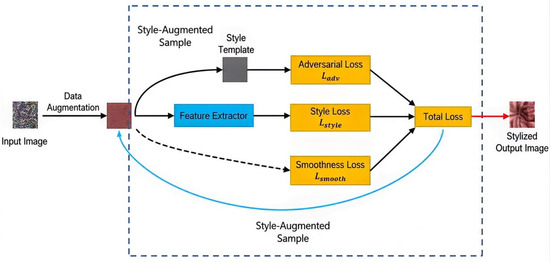
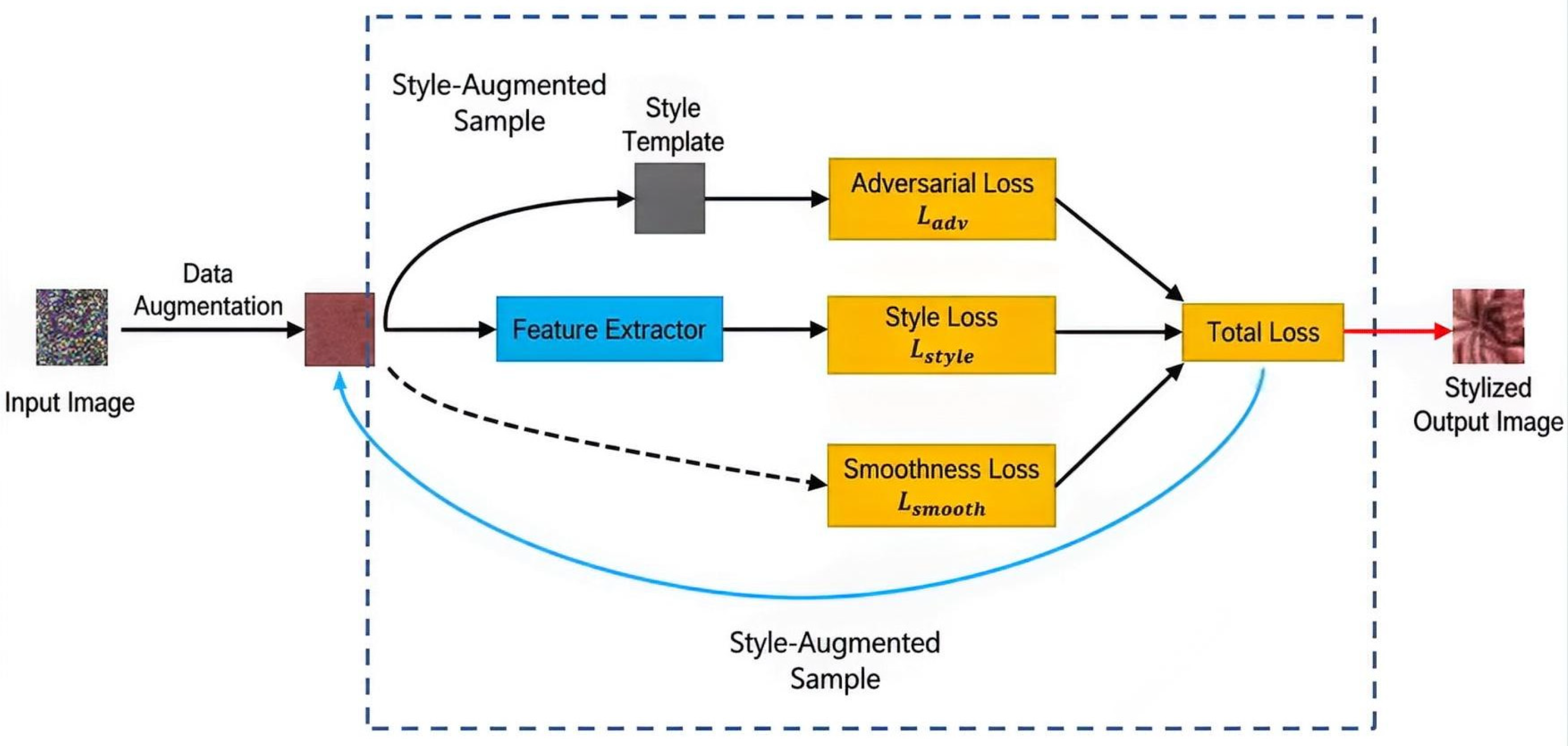
The optimization pipeline is illustrated in Figure 1 and consists of the following steps:
Figure 1.
Style patch optimization pipeline: CAST initialization → grayscale conversion → joint loss optimization → Adam update.
Step 1: Style initialization. Instead of starting from random noise, we initialize the color patch using a pre-trained style transfer model (CAST [15]) applied to a random noise image with a chosen style reference image (a cropped palm skin region from the attacker). This provides a reasonable visual prior:
where is the initialization style patch, is the CAST model, and is the initial patch filled with random noise.
In our preliminary experiments, we observed that random initialization often converged to local minima with obvious high-frequency artifacts, which the subsequent style loss struggled to remove. CAST initialization alleviates this issue by providing a reasonable visual prior, allowing the adversarial loss to refine rather than overwrite the texture structure.
Step 2: Grayscale conversion. At each iteration, the color patch is converted to grayscale to match the single-channel input requirement of the CCNet model. Instead of using standard luminance-weighted coefficients (e.g., ITU-R BT.601), we adopt a uniform averaging strategy across the three channels:
where is the patch red R-channel pixel matrix, is the patch green G-channel pixel matrix, is the patch blue B-channel pixel matrix, and is the converted single-channel grayscale adversarial patch.
The gradient with respect to each RGB channel is then given by:
where mathematical expressions take the same form for and . Thus, the single-channel gradient / is scaled by 1/3 and propagated identically to all three RGB channels, enabling joint optimization.
We adopt uniform averaging rather than luminance-weighted conversion (e.g., BT.601). With BT.601, the green channel receives ~59% of the gradient weight, and we found that Adam optimization tended to accumulate excessive perturbations in this channel, producing a greenish cast that interfered with Gram–matrix-based style matching. Uniform averaging distributes gradients equally across channels and avoids this color bias.
Step 3: Loss computation. The grayscale patch is embedded into the attacker’s ROI and fed into the palmprint model to compute the adversarial loss. The color patch is used to compute the style loss (against the style reference ) and the smoothness loss.
Step 4: Update. We use the Adam optimizer to update iteratively, as the loss landscape involves multiple objectives with different scales, and Adam adapts step sizes per parameter.
3.3. Loss Functions
Adversarial Loss. Maximizing the cosine similarity between the embedded patch ROI and the target feature:
where is the batch size, and denotes cosine similarity. This loss inherently encodes deep content information, and since the patch starts from random noise (style-initialized), we do not need an additional content loss.
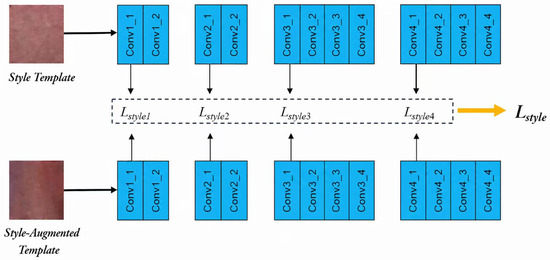
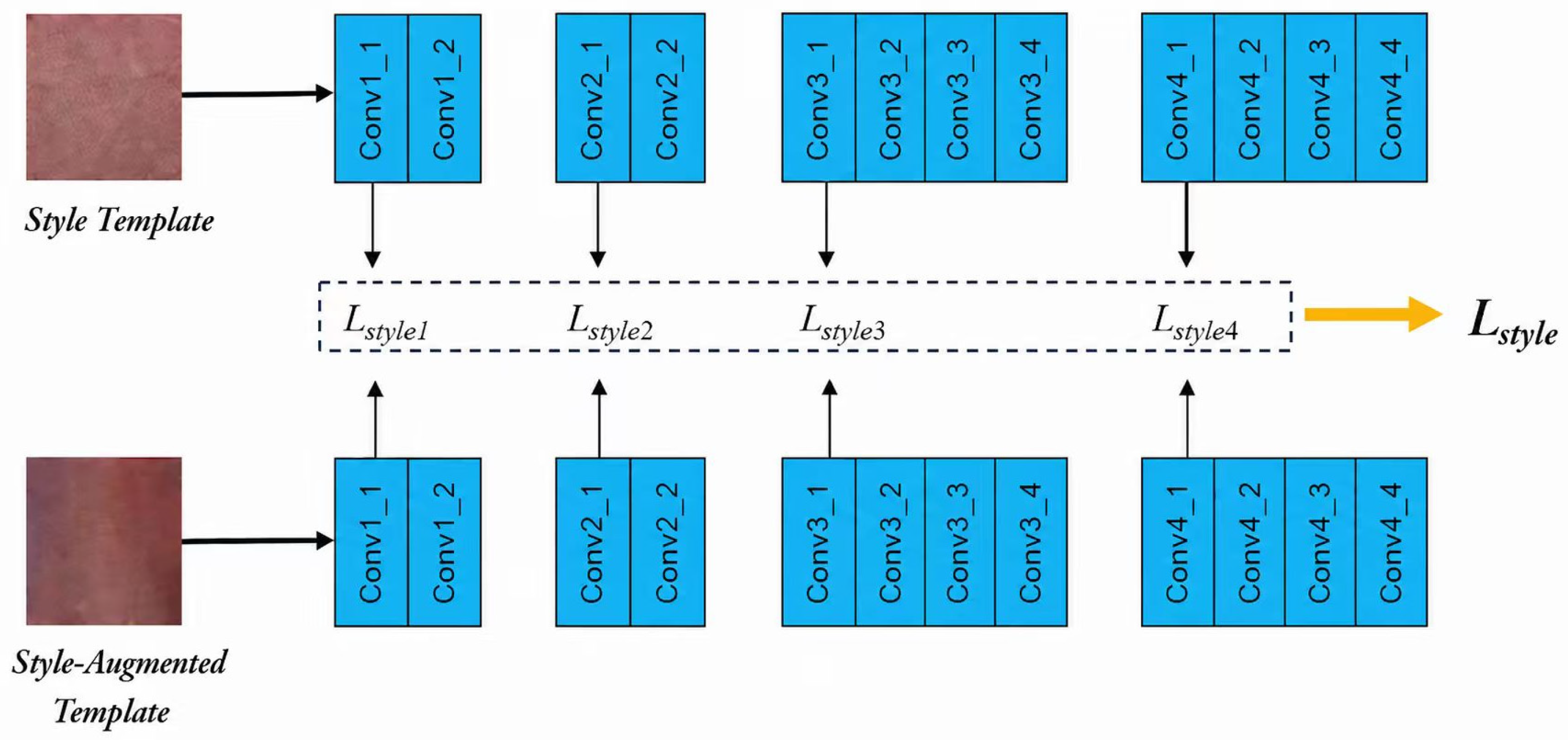
Style Loss. To make the patch’s texture and color to resemble the style reference , we use the Gram–matrix matching loss based on a pre-trained VGG19 network. Specifically, we extract feature maps from layers conv1_1, conv2_1, conv3_1, and conv4_1, as illustrated in Figure 2. The style loss is defined as:
where is the Gram–matrix of the feature map at layer , and is the flattened feature map.
Figure 2.
Style loss extraction layers. VGG19 layers (conv1_1, conv2_1, conv3_1, conv4_1) used for Gram–matrix style loss.
We deliberately do not normalize the Gram matrices. This is because the style-initialized patch is already highly similar to , so the style loss primarily anchors against adversarial drift. Normalization would compress the magnitude of , rendering it ineffective against the strong adversarial loss. Gram–matrix matching is parameter-free and stable for capturing texture statistics, avoiding domain bias introduced by learned style representations.
Smoothness Loss. To avoid high-frequency artifacts and ensure local continuity, we apply a total variation loss:
The complete algorithm follows the pipeline described above with iterative updates using Adam. The total loss is the weighted sum of the three components. The weights , , control the trade-off. We empirically set = 1 as the baseline adversarial strength, and explore ∈ {10, 100, 1000, 10,000} and ∈ {0.1, 0.01, 0.001}. Total variation loss is the standard and simplest choice for suppressing high-frequency artifacts, widely adopted in adversarial patch generation.
In summary, drives attack effectiveness, enforces visual camouflage, and ensures local continuity. Their joint optimization balances the attack visual trade-off.
4. Experiments and Results
4.1. Experimental Setup
Dataset and Model. We use the Tongji palmprint dataset [38], which contains 12,000 ROI images from 600 palms (20 samples per palm). We use session 1 for training and session 2 for testing. The target identity is set to ID 00001. The palmprint recognition model is the Comprehensive Competition Network (CCNet), which achieves an equal error rate of 0.00004 on Tongji. The decision threshold for cosine similarity is 0.714.
Physical Deployment. We print the optimized color patch on standard photo paper using an HP DeskJet 2130 printer (HP Inc., San Diego, CA, USA). The patch is affixed to the center of the attacker’s palm ROI, manually aligned using a transparent positioning guide matching the 3 × 3 grid reference defined in the patch embedding function. Images are captured using a Realme GT NEO 3 smartphone (50 MP rear camera) (realme Mobile Telecommunications (Shenzhen) Co., Ltd., Shenzhen, China) at a fixed distance of approximately 20 cm under normal indoor fluorescent lighting, with the patch oriented roughly perpendicular to the camera. For each test configuration, we capture 10 repeated images and report the average cosine similarity .
Evaluation Metrics. For attack effectiveness, we report ASR (digital) and (physical, threshold 0.714). For visual concealment, we compute PSNR and SSIM between the patch and the style reference (patch-level), and between the attacked ROI and the original clean ROI (image-level). Higher PSNR/SSIM indicate better visual similarity.
Implementation Details. The patch size is 42 × 42 pixels (1/9 of the ROI area). Optimization runs for 10 epochs with a batch size of 32 using Adam with a learning rate of 0.01. The style reference is cropped from the attacker’s own palm ROI to ensure color matching. For the CAST initialization, we use the official pre-trained weights.
4.2. Visual Concealment Assessment
We adopt PSNR and SSIM to evaluate visual concealment at two levels: (1) patch-to-style similarity between the optimized patch and its style reference, and (2) attacked ROI versus clean ROI for overall integration with the palm background. We focus the quantitative evaluation on CAP. Table 1 reports the metrics for configurations that maintain physical attack success.
Table 1.
Visual concealment metrics of CAP under different λ2 (style weight) configurations (digital domain). λ3 is fixed at 0.001 based on the finding that only λ3 = 0.001 preserves sufficient attack success (see Table 2 for the full ablation with varied λ3). Lower patch-level SSIM is expected due to the inherent adversarial–structural trade-off; image-level SSIM (~0.70) reflects overall visual integration within the full palm ROI. Bold values indicate the best-performing results in each group.
We first examine the effect of the style weight λ2 on visual concealment. Based on our ablation study (Table 2), we fix λ3 = 0.001, as this is the only smoothness weight setting that maintains sufficient attack effectiveness; higher λ3 values (0.01 or 0.1) oversmooth the patch and suppress adversarial information, leading to near-zero ASR. Under this setting, we vary λ2 from 10 to 10,000 and report the resulting PSNR and SSIM metrics in Table 1.
Table 2.
Effects of different weight combinations on attack success rate (digital domain). Configurations with ASR exceeding 60% (IDs 03, 06, 09, 12) were selected for physical testing. Bold values indicate the best-performing results in each group.
At the image level, all configurations achieve SSIM around 0.70, indicating good structural integration with the palm background. ID 09 yields the highest SSIM (0.7001), while ID 12 achieves the best PSNR (13.47 dB). At the patch level, higher style weight values consistently improve similarity to the reference, with ID 12 attaining the best patch PSNR (16.05 dB) and SSIM (0.09).
We note that patch-level SSIM is relatively low (0.03–0.09), which is consistent with the high-frequency nature of adversarial perturbations. These frequency components, while essential for manipulating the recognition model’s feature representations, tend to suppress SSIM when compared against the smoother texture of natural skin. In practice, we observed that enforcing higher patch-level SSIM through stronger regularization often attenuates these signals and reduces attack success. We therefore consider image-level SSIM (~0.70) as a complementary indicator of overall visual integration, suggesting that the patch does not introduce severe discontinuities within the full palm ROI.
Overall, CAP achieves a practical balance between visual naturalness and attack performance, substantially improving concealment over grayscale patches while maintaining physical-domain attack success.
4.3. Impact of Loss Weights
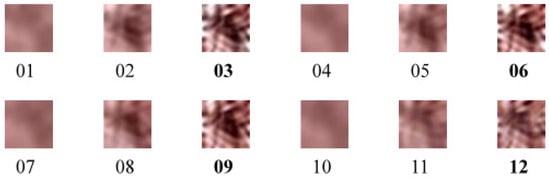
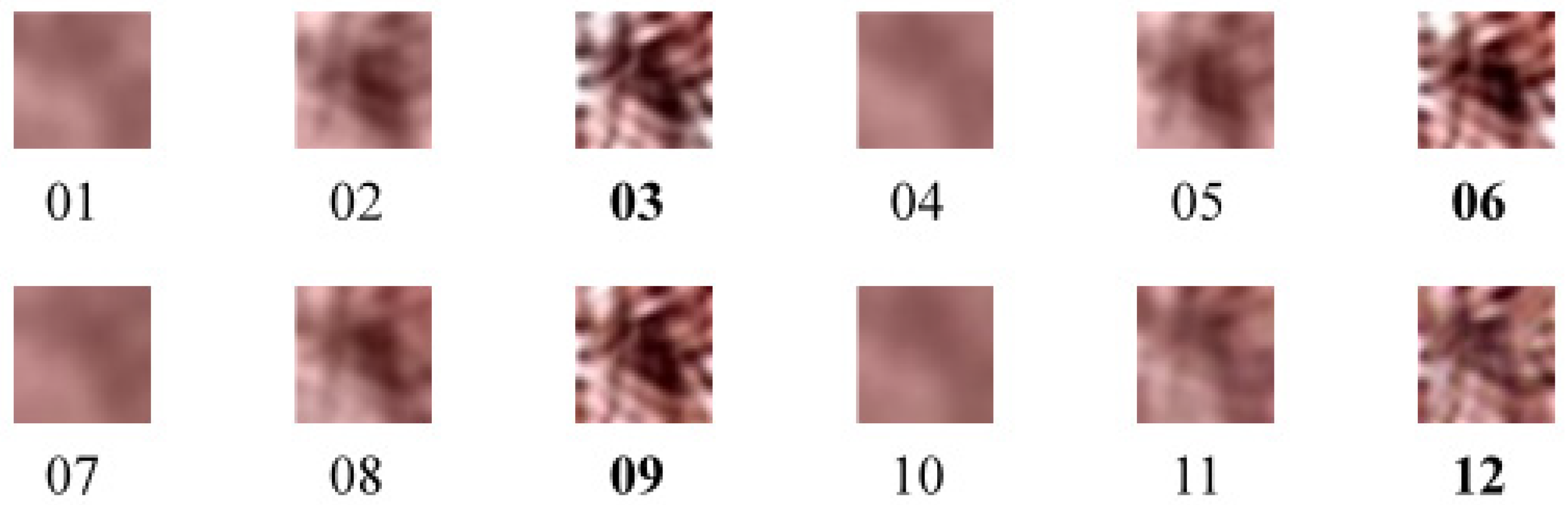
We systematically vary (style weight) and (smoothness weight) while fixing = 1. Figure 3 shows the visual comparison of patches generated with different weight combinations, and Table 2 reports the digital ASR and patch-level PSNR/SSIM.
Figure 3.
Visual effects of patches with different weight configurations. Visual comparison of patches with different weight configurations (IDs correspond to Table 2).
The smoothness weight has a decisive influence. When too high (0.1), high-frequency adversarial information is suppressed (ASR near 0%). When too low (0.001), adversarial textures are preserved, enabling high ASR. Higher style weights (e.g., 10,000) improve visual metrics but slightly reduce ASR due to constrained optimization freedom.
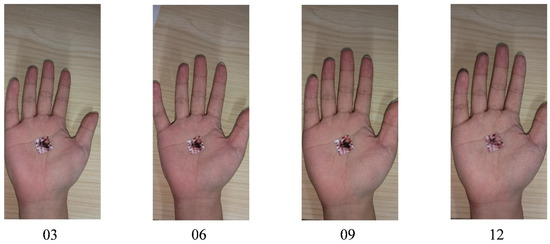
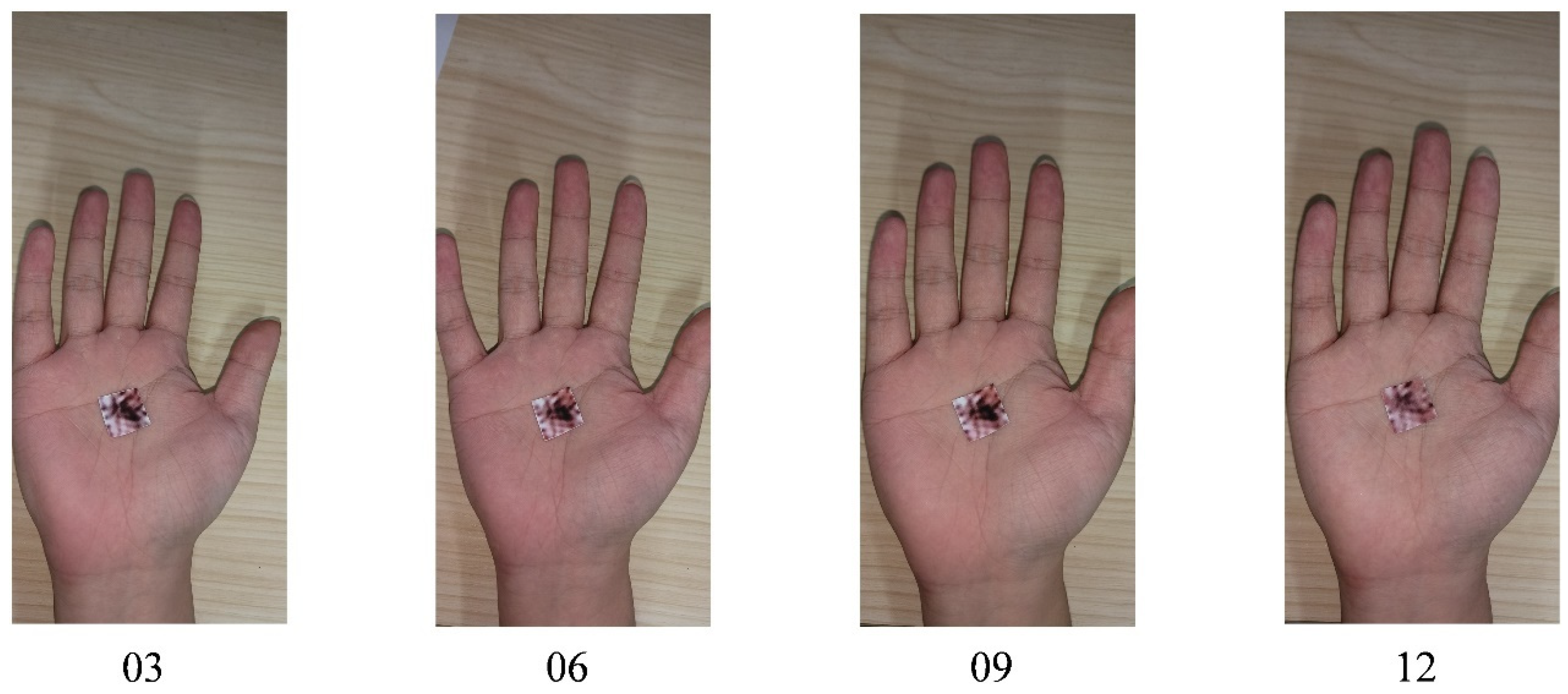
We select IDs 03, 06, 09, and 12 for physical-domain testing. Table 3 reports the attack similarity for configurations that maintain physical success. Corresponding image-level visual metrics for the same configurations are presented in Table 1 for direct reference, and Figure 4 shows visual results.
Table 3.
Physical-domain results for selected weight configurations (mean cosine similarity over 10 captures). All values exceed the 0.714 decision threshold. IDs correspond to Table 2.
Figure 4.
Physical attack visual results for different weight configurations. (All configurations show the patch attached to the palm surface with varying degrees of blending). Physical attack results for weight configurations IDs 03, 06, 09, 12 from Table 3.
All configurations exceed the threshold (0.714), confirming successful physical attacks. ID 06 gives the highest attack similarity (0.7443), while ID 12 yields the best visual quality.
4.4. Influence of Style Reference
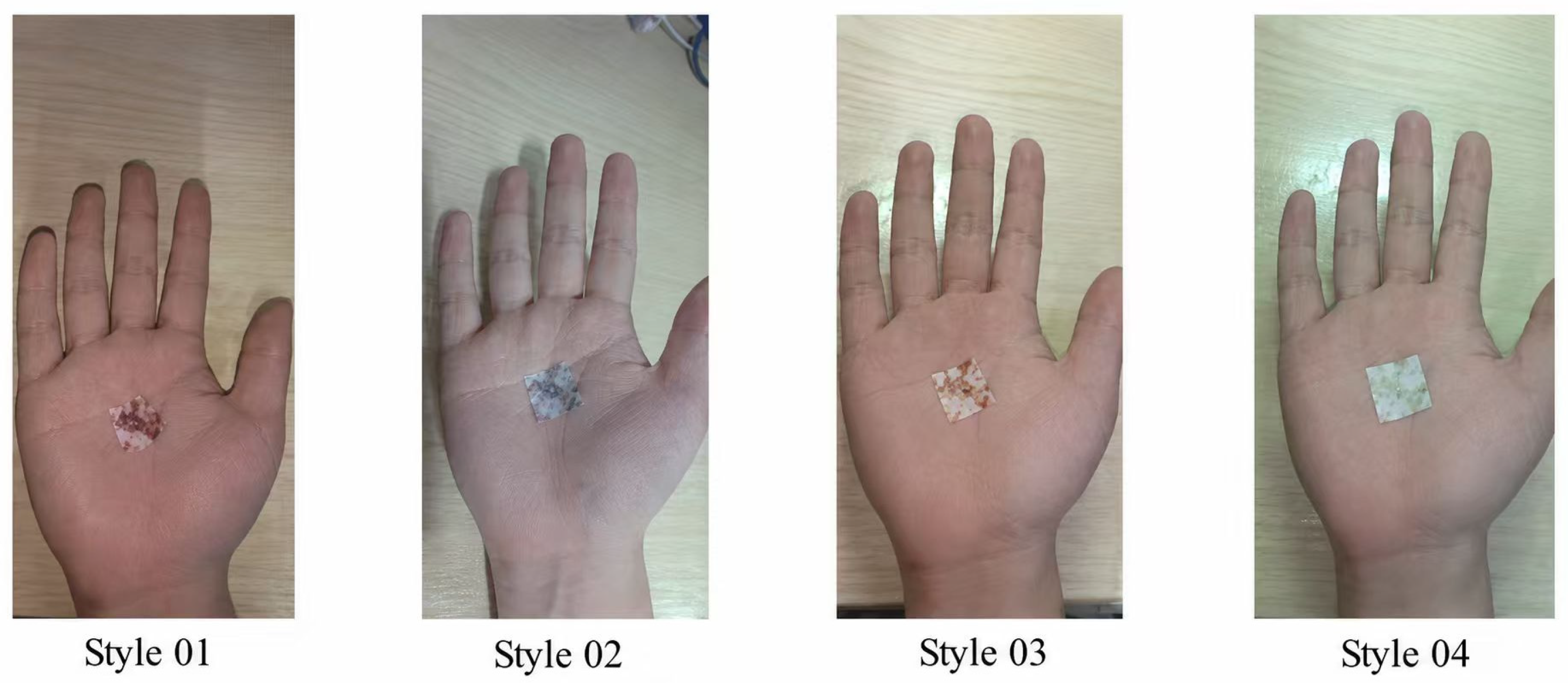
CAP requires a style reference specific to the attacker’s skin. We test four different style references with fixed weights ( = 1, = 10,000, = 0.001). Table 4 shows results, and Figure 5 shows visual comparisons.
Table 4.
Physical-domain results using four different style references (mean cosine similarity over 10 captures). All configurations exceed the 0.714 threshold.
Figure 5.
Physical attack visual results with different style templates. (Style 01 achieves the highest attack similarity, while Style 03 provides the best visual blending). Physical attack results using different style references (IDs 01–04 from Table 4).
All styles achieve successful attacks. Style 03 provides the best visual concealment (PSNR 17.04, SSIM 0.7453) while maintaining similarity above the threshold. Choosing a style reference with similar lighting and skin tone significantly improves stealth.
4.5. Ablation Study
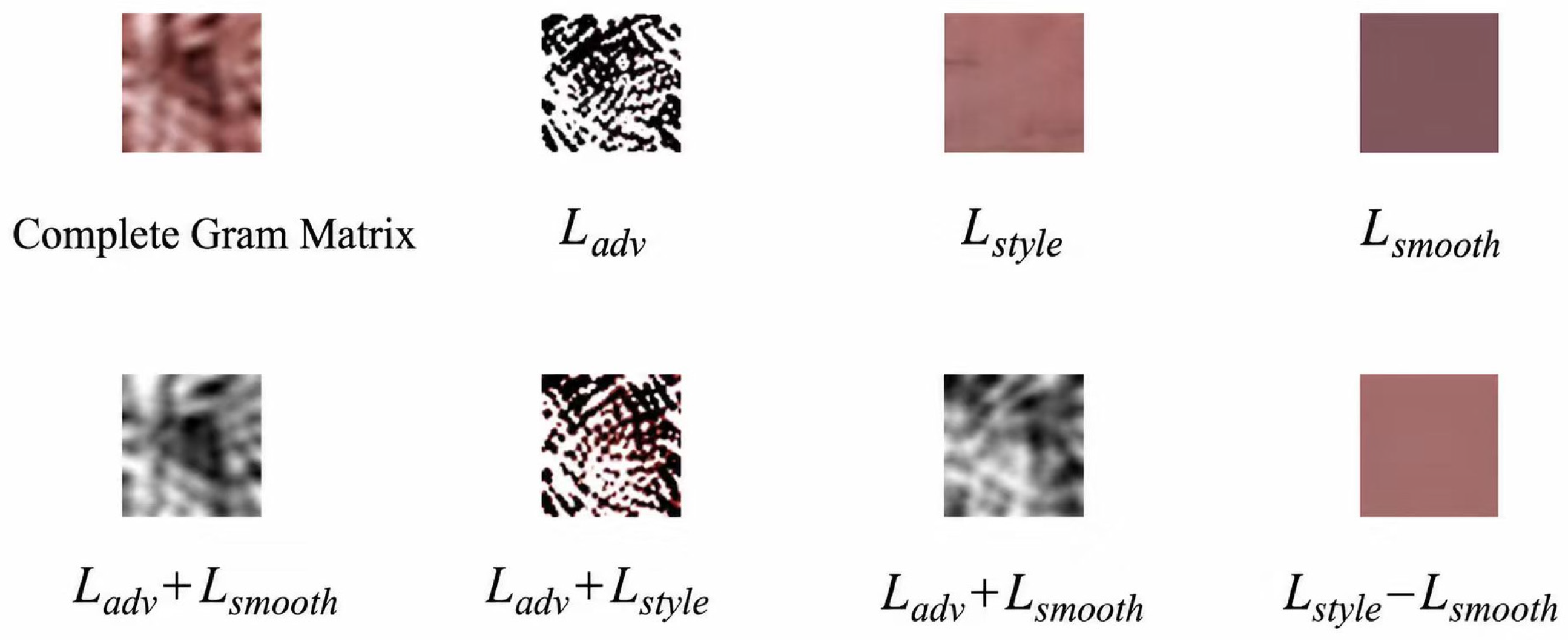
We evaluate each loss component by removing one at a time. Figure 6 shows visual results, and Table 5 reports ASR.
Figure 6.
Visual effects of different loss combinations. (From left to right: only adversarial (artifacts), only style (natural but no attack), only smooth (overly smoothed), adv + smooth (lacks color), adv + style (patchy), style + smooth (no attack), all three (balanced)). Ablation study visual comparison. Full model (all three losses) achieves the best balance.
Table 5.
Ablation study (digital domain ASR and visual quality).
The full model achieves the best trade-off. Quantitatively (Table 5), removing the adversarial loss reduces ASR from 81.8% to 0%, confirming it as the primary driver of attack effectiveness. Removing the style loss results in degraded visual quality (lower PSNR/SSIM), indicating its role in color and texture alignment. Removing the smoothness loss introduces visible high-frequency artifacts, corresponding to degraded SSIM. These quantitative comparisons confirm that each loss component contributes measurably and is necessary for joint optimization.
4.6. Discussion and Analysis
Our results demonstrate that CAP produces color patches that preserve both attack effectiveness and visual naturalness in physical deployments. The key design choice—jointly optimizing adversarial, style, and smoothness losses from the outset, rather than stylizing a pre-generated grayscale patch—proves essential for maintaining the delicate perturbation patterns that drive misclassification. The CAST-based initialization also plays a useful role: in our trials, it steers optimization away from high-frequency artifacts that would otherwise persist through the style loss.
We observe a clear trade-off governed by the style weight . Higher values improve patch-to-skin similarity (as measured by PSNR and SSIM) but moderately suppress attack success, since the style constraint competes with the adversarial objective for the limited degrees of freedom within a 42 × 42 patch. Depending on the application context, one can prioritize attack strength (lower ) or visual concealment (higher ).
Several caveats should be mentioned. The optimization outcome is sensitive to the choice of style reference—a mismatch in skin tone or lighting visibly degrades blending. Because the reference must be cropped from the specific attacker’s palm, our current framework requires per-style retraining and does not generalize across individuals without re-optimization. We have also not evaluated transferability to other models (e.g., ResNet-based palmprint networks) or datasets, leaving cross-domain robustness an open question. Physical layer factors add further variability: print resolution, color reproduction, and camera sensors all influence the patch’s observed effectiveness. From a defensive perspective, adaptive countermeasures—such as detecting style-consistent textures or applying spectral preprocessing—could potentially mitigate the attack, though we have not tested such defenses here. Finally, we acknowledge that PSNR and SSIM are imperfect proxies for human perceptual judgment; future work will incorporate LPIPS and user studies to better assess camouflage quality.
All experiments were carried out with informed consent. Our intent is to highlight system vulnerabilities and motivate the development of robust countermeasures, rather than to facilitate malicious use.
5. Conclusions
This paper presents CAP, a Color Adversarial Patch generation method tailored for physical-domain palmprint recognition attacks. By embedding style constraints directly into the adversarial optimization loop—rather than applying stylization as a post hoc step—CAP reconciles the inherent tension between the single-channel input requirement of palmprint models and the need for visually natural three-channel physical patches. On the Tongji dataset, CAP achieves cosine similarity above the 0.714 threshold in physical captures, with ablation experiments confirming that the adversarial, style, and smoothness losses each contribute to the overall performance. We also observe a trade-off: stronger style regularization improves visual blending but mildly reduces attack success, suggesting that the loss weights can be tuned according to operational priorities. Several limitations remain—style reference sensitivity, per-style training, and the lack of cross-model transferability evaluation—which we discuss in Section 4.6 as directions for further investigation.
Future Work. We plan to explore adaptive weight adjustment, more concealable media (transparent films or tattoo stickers), transferability to other models, and style-agnostic generation. Several extensions are worth pursuing. First, we plan to evaluate CAP across additional recognition models (e.g., ResNet-based palmprint networks) and datasets to assess transferability. Second, adaptive style selection—automatically choosing the most suitable skin reference for a given attacker—would reduce manual effort and improve robustness. Third, we aim to test more inconspicuous carriers, such as transparent adhesive films or temporary tattoo stickers, which may further reduce visual detectability. We also acknowledge that our current physical experiments were limited by equipment availability; more extensive captures across diverse skin tones, lighting conditions, and viewing angles are needed to fully validate generalization.
Author Contributions
Methodology, Y.L., Q.X. and L.L.; formal analysis, Y.L., Q.X. and C.K.; data curation, Q.X. and L.W.; writing—original draft preparation, Y.L., L.L. and J.M.; conceptualization, J.M., L.W. and C.K. All authors have read and agreed to the published version of the manuscript.
Funding
This work was supported by the National Natural Science Foundation of China (Nos. 62366032, 62466038), Jiangxi Provincial Key Laboratory of Image Processing and Pattern Recognition (No. 2024SSY03111), Jiangxi Provincial Natural Science Foundation (Key Program) (No. 20242BAB26015), Open Foundation of Jiangxi Provincial Key Laboratory of Image Processing and Pattern Recognition (Nos. ET202020416, ET202404437), and High Performance Computing Service of Information Center, Nanchang Hangkong University.
Institutional Review Board Statement
Not applicable.
Informed Consent Statement
Not applicable.
Data Availability Statement
Publicly available datasets were analyzed in this study. This data can be found here: https://cslinzhang.github.io/ContactlessPalm (accessed on 4 July 2026).
Conflicts of Interest
The authors declare no conflicts of interest.
Abbreviations
The following abbreviations are used in this manuscript:
| CAP | Color Adversarial Patch |
| CAST | Contrastive Arbitrary Style Transfer |
| PSNR | Peak Signal-to-Noise Ratio |
| SSIM | Structural Similarity Index Measure |
| FGSM | Fast Gradient Sign Method |
| CNN | Convolutional Neural Network |
| BIM | Basic Iterative Method |
| PGD | Projected Gradient Descent |
| MI-FGSM | Momentum Iterative FGSM |
| UAP | Universal Adversarial Perturbation |
| RP2 | Robust Physical Perturbation |
| ROI | Region of Interest |
| SGD | Stochastic Gradient Descent |
| CCNet | Comprehensive Competition Network |
| EER | Equal Error Rate |
| ASR | Attack Success Rate |
References
- Kong, A.; Zhang, D.; Kamel, M. A Survey of Palmprint Recognition. Pattern Recognit. 2009, 42, 1408–1418. [Google Scholar] [CrossRef] [Scilit]
- Shi, Q.Q.; Liu, J.; Wei, L.; Jiao, J.J.; Han, B.; Wu, Z.D. SegCoT: Dependable Intrusion Detection System Based on Segment-Wise CoTransformer for Ship Communication Networks. IEEE Trans. Netw. Serv. Manag. 2025, 22, 5062–5073. [Google Scholar] [CrossRef] [Scilit]
- Li, Y.M.; Liu, J.; Li, X.Y.; Zhang, X.L.; Wu, Z.D.; Han, B. A Lightweight Network for Ship Detection in SAR Images Based on Edge Feature Aware and Fusion. IEEE J. Sel. Top. Appl. Earth Obs. Remote Sens. 2025, 18, 3782–3796. [Google Scholar] [CrossRef] [Scilit]
- Szegedy, C.; Zaremba, W.; Sutskever, I. Intriguing Properties of Neural Networks. arXiv 2013, arXiv:1312.6199. [Google Scholar] [CrossRef] [Scilit]
- Kurakin, A.; Goodfellow, I.; Bengio, S. Adversarial Examples in the Physical World. arXiv 2016, arXiv:1607.02533. [Google Scholar] [CrossRef] [Scilit]
- Sharif, M.; Bhagavatula, S.; Bauer, L.; Reiter, M.K. Accessorize to a Crime: Realistic and Robust Adversarial Examples for Face Recognition. In Proceedings of the ACM Conference on Computer and Communications Security (CCS), Vienna, Austria, 24–28 October 2016; ACM: New York, NY, USA, 2016; pp. 1528–1540. [Google Scholar] [CrossRef] [Scilit]
- Komkov, S.; Petiushko, A. AdvHat: Real-World Adversarial Attack on ArcFace Face ID System. In Proceedings of the International Conference on Pattern Recognition (ICPR), Milan, Italy, 10–15 January 2021; IEEE Press: Piscataway, NJ, USA, 2021; pp. 819–826. [Google Scholar] [CrossRef] [Scilit]
- Eykholt, K.; Evtimov, I.; Fernandes, E.; Li, B.; Rahmati, A.; Xiao, C.; Prakash, A.; Kohno, T.; Song, D. Robust Physical-World Attacks on Deep Learning Visual Classification. In Proceedings of the IEEE/CVF Conference on Computer Vision and Pattern Recognition (CVPR), Salt Lake City, UT, USA, 18–22 June 2018; IEEE Press: Piscataway, NJ, USA, 2018; pp. 1625–1634. [Google Scholar] [CrossRef] [Scilit]
- Wang, J.; Liu, A.; Yin, Z.; Liu, S.; Tang, S.; Liu, X. Dual Attention Suppression Attack: Generate Adversarial Camouflage in Physical World. In Proceedings of the IEEE/CVF Conference on Computer Vision and Pattern Recognition (CVPR), Nashville, TN, USA, 20–25 June 2021; IEEE Press: Piscataway, NJ, USA, 2021; pp. 8561–8570. [Google Scholar] [CrossRef] [Scilit]
- Athalye, A.; Engstrom, L.; Ilyas, A.; Kwok, K. Synthesizing Robust Adversarial Examples. In Proceedings of the 35th International Conference on Machine Learning (ICML), Stockholm, Sweden, 10–15 July 2018; PMLR: Cambridge, MA, USA, 2018; pp. 284–293. [Google Scholar] [CrossRef] [Scilit]
- Zheng, J.; Lin, C.; Sun, J.; Zhao, Z.; Li, Q.; Shen, C. Physical 3D Adversarial Attacks against Monocular Depth Estimation in Autonomous Driving. In Proceedings of the IEEE/CVF Conference on Computer Vision and Pattern Recognition (CVPR), Seattle, WA, USA, 17–24 June 2024; IEEE Press: Piscataway, NJ, USA, 2024; pp. 24452–24461. [Google Scholar] [CrossRef] [Scilit]
- Gong, L.H.; Luo, H.X. Dual Color Images Watermarking Scheme with Geometric Correction Based on Quaternion FrOOFMMs and LS-SVR. Opt. Laser Technol. 2023, 167, 109665. [Google Scholar] [CrossRef] [Scilit]
- Zhou, N.R.; Hu, L.L.; Huang, Z.W.; Wang, M.M.; Luo, G.S. Novel Multiple Color Images Encryption and Decryption Scheme Based on a Bit-Level Extension Algorithm. Expert Syst. Appl. 2024, 238, 122052. [Google Scholar] [CrossRef] [Scilit]
- Gatys, L.A.; Ecker, A.S.; Bethge, M. Image Style Transfer Using Convolutional Neural Networks. In Proceedings of the IEEE Conference on Computer Vision and Pattern Recognition (CVPR), Las Vegas, NV, USA, 27–30 June 2016; IEEE Press: Piscataway, NJ, USA, 2016; pp. 2414–2423. [Google Scholar] [CrossRef] [Scilit]
- Zhang, Y.X.; Tang, F.; Dong, W.M.; Huang, H.B.; Ma, C.Y.; Lee, T.-Y.; Xu, C.S. Domain Enhanced Arbitrary Image Style Transfer via Contrastive Learning. In Proceedings of the ACM SIGGRAPH, Vancouver, BC, Canada, 8–11 August 2022; ACM: New York, NY, USA, 2022; pp. 1–8. [Google Scholar] [CrossRef] [Scilit]
- Goodfellow, I.J.; Shlens, J.; Szegedy, C. Explaining and Harnessing Adversarial Examples. arXiv 2014, arXiv:1412.6572. [Google Scholar] [CrossRef] [Scilit]
- Madry, A.; Makelov, A.; Schmidt, L.; Tsipras, D.; Vladu, A. Towards Deep Learning Models Resistant to Adversarial Attacks. arXiv 2017, arXiv:1706.06083. [Google Scholar] [CrossRef] [Scilit]
- Carlini, N.; Wagner, D. Towards Evaluating the Robustness of Neural Networks. In Proceedings of the IEEE Symposium on Security and Privacy (S&P), San Jose, CA, USA, 22–26 May 2017; IEEE Press: Piscataway, NJ, USA, 2017; pp. 39–57. [Google Scholar] [CrossRef] [Scilit]
- Dong, Y.P.; Liao, F.Z.; Pang, T.Y.; Su, H.; Zhu, J.; Hu, X.L.; Li, J.G. Boosting Adversarial Attacks with Momentum. In Proceedings of the IEEE/CVF Conference on Computer Vision and Pattern Recognition (CVPR), Salt Lake City, UT, USA, 18–22 June 2018; IEEE Press: Piscataway, NJ, USA, 2018; pp. 9185–9193. [Google Scholar] [CrossRef] [Scilit]
- Moosavi-Dezfooli, S.-M.; Fawzi, A.; Fawzi, O.; Frossard, P. Universal Adversarial Perturbations. In Proceedings of the IEEE/CVF Conference on Computer Vision and Pattern Recognition (CVPR), Honolulu, HI, USA, 21–26 July 2017; IEEE Press: Piscataway, NJ, USA, 2017; pp. 1765–1773. [Google Scholar] [CrossRef] [Scilit]
- Xiao, C.; Li, B.; Zhu, J.-Y.; He, W.; Liu, M.Y.; Song, D. Generating Adversarial Examples with Adversarial Networks. arXiv 2018, arXiv:1801.02610. [Google Scholar] [CrossRef] [Scilit]
- Xue, H.; Araujo, A.; Hu, B.; Chen, Y. Diffusion-Based Adversarial Sample Generation for Improved Stealthiness and Controllability. In Proceedings of the Neural Information Processing Systems (NeurIPS), Vancouver, BC, Canada, 9–15 December 2024; Curran Associates: Red Hook, NY, USA, 2024; pp. 2894–2921. Available online: https://arxiv.org/html/2305.16494v3 (accessed on 5 July 2026).
- Brown, T.B.; Mané, D.; Roy, A.; Abadi, M.; Gilmer, J. Adversarial Patch. arXiv 2017, arXiv:1712.09665. [Google Scholar] [CrossRef] [Scilit]
- Thys, S.; Van Ranst, W.; Goedemé, T. Fooling Automated Surveillance Cameras: Adversarial Patches to Attack Person Detection. In Proceedings of the IEEE/CVF Conference on Computer Vision and Pattern Recognition Workshops (CVPRW), Long Beach, CA, USA, 16–20 June 2019; IEEE Press: Piscataway, NJ, USA, 2019; pp. 49–55. [Google Scholar] [CrossRef] [Scilit]
- Xu, K.; Zhang, G.; Liu, S.; Fan, Q.; Sun, M.; Chen, H.; Chen, P.Y.; Wang, Y.; Lin, X. Adversarial T-Shirt! Evading Person Detectors in a Physical World. In Proceedings of the European Conference on Computer Vision (ECCV), Glasgow, UK, 23–28 August 2020; Springer: Cham, Switzerland, 2020; pp. 665–681. [Google Scholar] [CrossRef] [Scilit]
- Duan, R.; Ma, X.; Wang, Y.; Bailey, J.; Qin, A.K.; Yang, Y. Adversarial Camouflage: Hiding Physical-World Attacks With Natural Styles. In Proceedings of the IEEE/CVF Conference on Computer Vision and Pattern Recognition (CVPR), Seattle, WA, USA, 13–19 June 2020; IEEE Press: Piscataway, NJ, USA, 2020; pp. 997–1005. [Google Scholar] [CrossRef] [Scilit]
- Wei, X.; Guo, Y.; Yu, J. Adversarial Sticker: A Stealthy Attack Method in the Physical World. IEEE Trans. Pattern Anal. Mach. Intell. 2023, 45, 2711–2725. [Google Scholar] [CrossRef] [Scilit] [PubMed]
- Yang, X.; Xu, L.; Pang, T.; Dong, Y.; Wang, Y.; Su, H.; Zhu, J. Face3DAdv: Exploiting Robust Adversarial 3D Patches on Physical Face Recognition. Int. J. Comput. Vis. 2025, 133, 353–371. [Google Scholar] [CrossRef] [Scilit]
- Wang, F.; Leng, L.; Teoh, A.; Chu, J. Palmprint False Acceptance Attack with a Generative Adversarial Network (GAN). Appl. Sci. 2020, 10, 8547. [Google Scholar] [CrossRef] [Scilit]
- Sun, Y.; Leng, L.; Jin, Z.; Kim, B.-G. Reinforced Palmprint Reconstruction Attacks in Biometric Systems. Sensors 2022, 22, 591. [Google Scholar] [CrossRef] [Scilit] [PubMed]
- Yang, Z.; Leng, L.; Zhang, B.; Li, M.; Chu, J. Two Novel Style-Transfer Palmprint Reconstruction Attacks. Appl. Intell. 2023, 53, 6354–6371. [Google Scholar] [CrossRef] [Scilit]
- Zhu, Q.; Zhou, Y.; Fei, L.; Zhang, D.; Zhang, D. Multi-Spectral Palmprints Joint Attack and Defense With Adversarial Examples Learning. IEEE Trans. Inf. Forensics Secur. 2023, 18, 1789–1799. [Google Scholar] [CrossRef] [Scilit]
- Yan, L.; Wang, F.; Leng, L.; Teoh, A.B.J. Toward Comprehensive and Effective Palmprint Reconstruction Attack. Pattern Recognit. 2024, 155, 110655. [Google Scholar] [CrossRef] [Scilit]
- Yan, L.; Leng, L.; Teoh, A.B.J.; Kim, C. A Realistic Hand Image Composition Method for Palmprint ROI Embedding Attack. Appl. Sci. 2024, 14, 1369. [Google Scholar] [CrossRef] [Scilit]
- Rai, A.; Anshul, A.; Jha, A.; Jain, P.; Sharma, R.P.; Dey, S. An Open Patch Generator Based Fingerprint Presentation Attack Detection Using Generative Adversarial Network. Multimed. Tools Appl. 2024, 83, 27723–27746. [Google Scholar] [CrossRef] [Scilit]
- Johnson, J.; Alahi, A.; Li, F.-F. Perceptual Losses for Real-Time Style Transfer and Super-Resolution. In Proceedings of the European Conference on Computer Vision (ECCV), Amsterdam, The Netherlands, 8–16 October 2016; Springer: Cham, Switzerland, 2016; pp. 694–711. [Google Scholar] [CrossRef] [Scilit]
- Huang, X.; Belongie, S. Arbitrary Style Transfer in Real-Time with Adaptive Instance Normalization. In Proceedings of the IEEE/CVF International Conference on Computer Vision (ICCV), Venice, Italy, 22–29 October 2017; IEEE Press: Piscataway, NJ, USA, 2017; pp. 1501–1510. [Google Scholar] [CrossRef] [Scilit]
- Zhang, L.; Li, L.D.; Yang, A.Q.; Shen, Y.; Yang, M. Towards contactless palmprint recognition: A novel device, a new benchmark, and a collaborative representation based identification approach. Pattern Recognit. 2017, 69, 199–212. [Google Scholar] [CrossRef] [Scilit]

Disclaimer/Publisher’s Note: The statements, opinions and data contained in all publications are solely those of the individual author(s) and contributor(s) and not of MDPI and/or the editor(s). MDPI and/or the editor(s) disclaim responsibility for any injury to people or property resulting from any ideas, methods, instructions or products referred to in the content. |
© 2026 by the authors. Licensee MDPI, Basel, Switzerland. This article is an open access article distributed under the terms and conditions of the Creative Commons Attribution (CC BY) license.