


Abstract
This review traces Turkey’s mobile communication evolution from car phones to the commercial 5G phase launched on 1 April 2026. It combines a generation-based engineering matrix with an auditable framework covering spectrum, antenna/radio integration, RAN and core architecture, transport, performance objectives, trade-offs, costs, and evidence limits. Its quantitative synthesis uses 1990s ETSI standards, KPI targets, antenna parameters, regulatory comparisons, link budget illustrations, BTK 2026-Q1 indicators, and a deliberately limited single-point handset observation. At equal distance, free-space path loss at 3.5 GHz is 13.98 dB higher than at 700 MHz; for an illustrative path loss exponent of 3.5, the cell radius and coverage area ratios are about 0.40 and 0.159. The 2025 authorization comprises 60 MHz of paired 700 MHz spectrum and 340 MHz of 3.5 GHz TDD spectrum. The international comparison is limited to regulatory spectrum positioning and a common date fixed-broadband fiber proxy, not user-experienced performance or deployment maturity. BTK data demonstrate market and infrastructure scale, but nationwide province- and operator-level radio, latency, synchronization, energy, outage, and SA/NSA data remain unavailable. The evidence supports a pragmatic coverage-first low-/mid-band launch whose practical performance depends on site density, active antennas, fiber backhaul, synchronization, energy resilience, and legacy band refarming.
1. Introduction
Mobile network generations change more than the air interface: they also reshape antennas, spectrum strategy, site topology, transport, and core architecture. Turkey is a useful national case because its chronology spans car phones, GSM expansion, delayed but rapid 3G adoption, the 4.5G/LTE-Advanced transition, domestic base station initiatives, and 5G authorization.
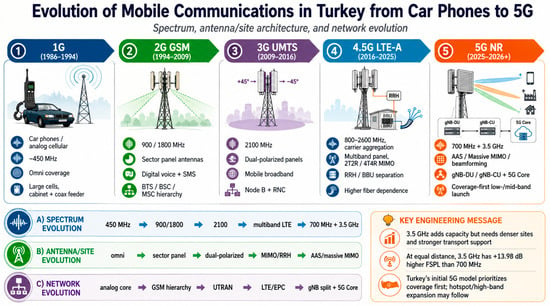
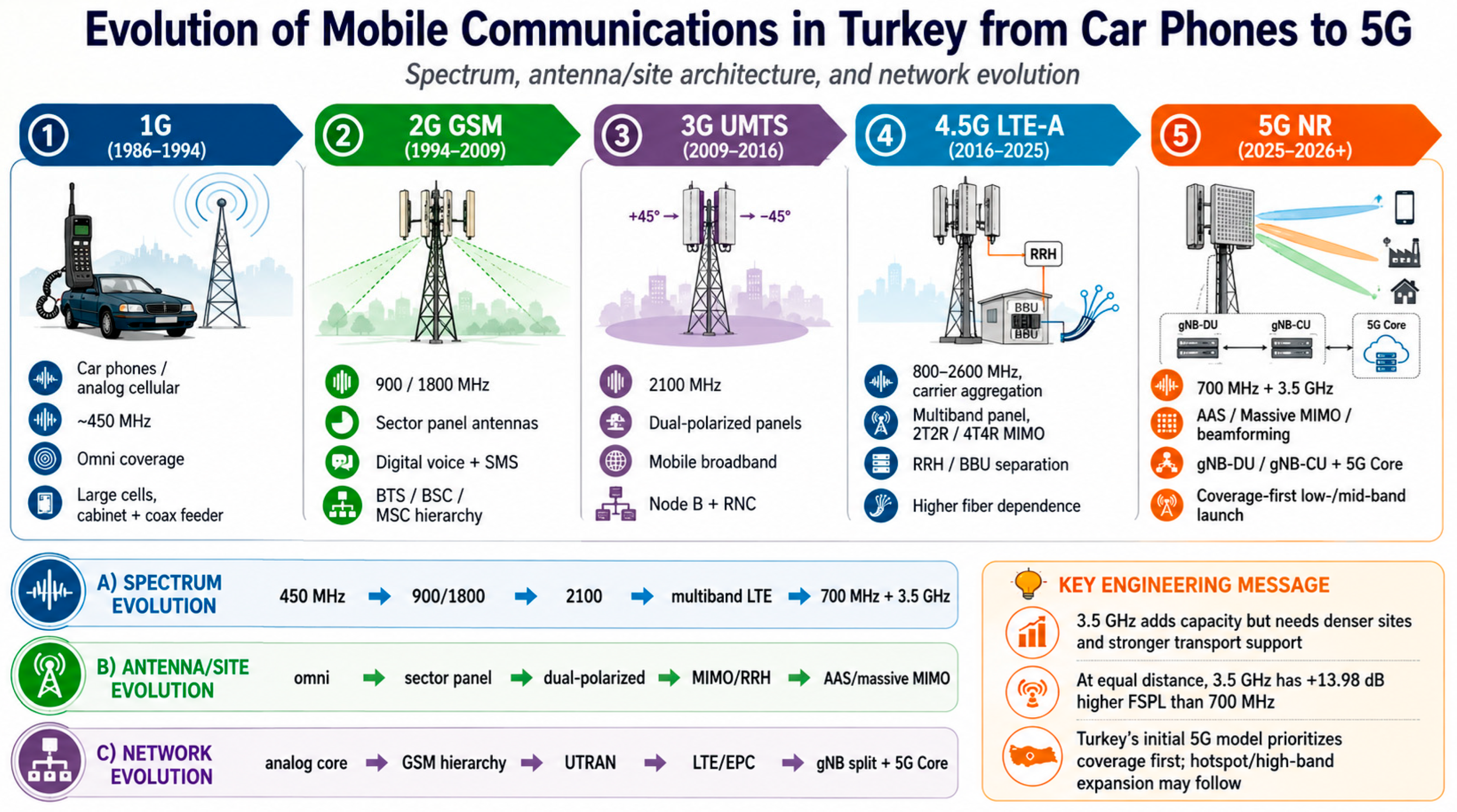
This review integrates these layers in a chronological technical narrative centered on base station antennas and sites, while linking them to spectrum allocation and RAN/core evolution. It is a technical review rather than an experimental study or policy-only chronology. Figure 1 summarizes the main antenna and site architecture transitions.
Figure 1.
Chronological evolution of mobile base station antennas and site architecture in Turkey. Note: The 1G antenna and site configuration is a representative reconstruction based on period engineering practice rather than a documented Turkey-specific equipment inventory.
The review is organized around three research questions (RQs): (RQ1) How do Turkey’s spectrum allocation decisions map onto antenna and site architecture changes? (RQ2) Which engineering bottlenecks determine whether each generational transition produces practical performance gains? (RQ3) How does the Turkish 5G spectrum model compare with international low-band, mid-band, and high-band deployment strategies?
The contribution is the combined technical interpretation of spectrum policy, antenna evolution, RAN/core architecture, transport requirements, performance bounds, and implementation costs, rather than chronology alone.
2. Materials and Methods
The evidence base has three layers. Official and institutional sources—including the Ministry of Transport and Infrastructure, HGM, BTK, and operator reports—provide Turkey-specific historical and regulatory information [1,2,3,4,5,6,7,8,9,10,11,12,13,14,15,16,17,18,19,20,21]. ETSI/3GPP standards and the antenna/RAN literature provide architectural and technical evidence [22,23,24,25,26,27,28,29,30,31,32,33,34,35,36,37], including the 1994 GSM network architecture standard and the 1996 radio transmission specification [31,32]. A supplementary Turkey-specific band compilation is used only for practical 2G/3G/4.5G band labels; regulatory claims remain based on official sources [38].
Public records identifying exact antenna brands and models at early Turkish analog sites are limited. The 1G account therefore triangulates national chronology, institutional statements, and documented period practice, labeling uncertain equipment details as representative. For 2G, contemporary ETSI documents directly support the GSM architecture, interfaces, channel arrangement, and radio requirements [31,32].
No unpublished nationwide operator dataset is introduced. Quantitative claims are classified as (i) standardized targets or limits, (ii) regulator/operator values, (iii) transparent calculations based on stated assumptions, or (iv) one author-collected, georeferenced handset attachment used only to show an LTE band, measurement coordinates, and serving cell identifiers. The propagation calculations are sensitivity analyses, not Turkish field measurements. The single-point serving-cell observation was collected using a Samsung Galaxy A70 smartphone (Samsung Electronics Co., Ltd., Suwon, Republic of Korea) running NetMonster version 3.4.1. The handset record is not treated as an operator, provincial, or national performance sample because it lacks RSRP, SINR, CQI, MIMO rank, throughput, latency, and jitter. Each generation is coded by spectrum, antenna and port configuration, radio location, RAN/core architecture, transport demand, performance objective, trade-off, hidden cost, evidence status, date, and limitation.
2.1. Review Protocol, Screening, and Source Quality Assessment
A structured narrative review protocol was applied for January 1990–4 August 2026. Searches covered IEEE Xplore, Scopus, Web of Science, Google Scholar, and official ETSI, 3GPP, ITU, European Commission, regulator, BTK/UAB, and operator repositories; earlier sources were retained only for pre-GSM context. Table 1 gives database-specific syntax. Queries combined Turkey/Türkiye and generation terms with spectrum, antenna, MIMO, RAN/core, fiber backhaul, synchronization, and site density concepts. Backward reference checking targeted standards, regulatory decisions, antenna history studies, and sources supporting major numerical claims.
Table 1.
Database-specific search strings and audit fields used for the revised review.
Inclusion required relevance to at least one research question, identifiable responsibility, a dated or versioned record, and retrievability. Duplicate or superseded records, unsourced commercial summaries where primary evidence existed, unsupported opinion pieces, and material outside terrestrial public mobile networks were excluded. Titles and summaries were screened before full-document coding; traceable conflicting dates were retained with the adopted interpretation and remaining uncertainty. The revised evidence base contains 60 cited items. Because the original searches were not prospectively exported, historical hit, duplicate, and item-level exclusion counts cannot be reconstructed; Table 2 reports them as NR rather than implying false precision. The protocol follows narrative review transparency principles but is not presented as a prospective PRISMA systematic review [39,40].
Table 2.
PRISMA-like retrospective audit of search and screening records.
Sources were assigned evidence roles and quality tiers (Table 3). Regulatory claims prioritize authorizations, regulators, and ministries; technical parameters prioritize ETSI/3GPP/ITU standards; performance evidence uses peer-reviewed work or clearly labeled operator trials; and institutional records provide historical context. Secondary compilations are used only where primary Turkey-specific records were unavailable and never alone for regulatory claims. For additional traceability, Appendix C provides a source-to-claim matrix linking the major claims in this review to their supporting evidence.
Table 3.
Review protocol and source-quality hierarchy used in the revised synthesis.
2.2. Analytical Framework and Comparative Method
The analytical method codes each generation by spectrum layer, antenna class, radio unit location, RAN/core architecture, transport requirement, performance objective, limiting factor, alternative decision, and hidden cost. Transitions are evaluated as coupled changes in spectrum, radio hardware, transport, and control plane architecture, not as air interface changes alone. This framework is applied in the engineering assessments for 1G through 5G and summarized in Table 4.
Table 4.
Analytical dimensions used to convert the chronology into an engineering analysis.
Table 5.
Summary chronology of mobile communication, antenna, and base station architecture in Turkey.
International benchmarking is restricted to regulatory spectrum variables unless definitions, dates, and denominators are comparable. A quantitative layer compares representative bandwidth, throughput, latency, antenna port, fiber, auction, subscription, traffic, and investment indicators while preserving evidence class. Population, geography, holdings, contiguity, obligations, site density, mobile site fiber, SA/NSA status, and user KPIs remain separate rather than being collapsed into a readiness score.
Table 6 places Turkey in an international regulatory spectrum benchmark, not a ranking of 5G readiness, user performance, or commercial maturity. It compares the first national mid-band award year, newly released mid-band spectrum in the cited cycle, initial mmWave position, and the OECD fiber share of fixed broadband at December 2024. Operator-specific SA/NSA migration, speed, mobile site fiber, site density, contiguity, and obligations are excluded because their definitions, dates, and units are not consistently comparable. Table 7 defines the required normalization and evidence boundary, whereas Table 8 summarizes the representative performance characteristics, advantages, challenges, and hidden costs across generations.
Table 6.
Regulatory spectrum benchmark: mid-band award, initial mmWave position, and common date fixed-broadband fiber proxy (not a 5G performance ranking) [31,32,41,42,43,44,45,46,47,48,49,50].
Table 7.
Normalization framework and evidence boundary for interpreting the international comparison.
Table 8.
Representative performance characteristics, advantages, challenges, and hidden costs across mobile generations.
Turkey entered the cited award set with a large national n78 release and no initial commercial mmWave layer. This describes regulatory spectrum positioning, not practical superiority. Realized outcomes depend on operator holdings, geographic and population normalization, obligations, AAS deployment, backhaul, synchronization, SA/NSA migration, load, and measured user KPIs. Accordingly, unlike regulatory, fixed-network, and operator indicators are not combined into one readiness claim.
2.3. Adjacent Intelligent and Fault-Tolerant Methods
The reviewer-requested intelligent methods originate outside mobile network deployment research and are treated as transferable research directions, not evidence of Turkish 5G performance. Wang et al.’s SCMGIDTL framework for cross-domain machinery diagnosis suggests a model for learning anomaly representations from heterogeneous province-, operator-, band-, or vendor-level RAN telemetry [54]. Yan et al.’s machine vision and physics-informed architecture suggests combining visual antenna, tower, cable, or thermal inspection with structural, electromagnetic, or heat transfer constraints [55].
Fault tolerance is likewise a transferable control principle. Zhao et al. developed fixed-time adaptive control for a UAV under interference and actuator faults [56]. Related concepts could be tested for remote electrical tilt, array calibration, cooling, backup power, and other site controllers. Such applications require RAN-specific models, telemetry, safety constraints, baselines, and field validation; the cited studies do not demonstrate mobile network gains.
3. Chronological Evolution of Mobile Base Station Antennas in Turkey
To address RQ1, this section traces the chronological evolution of mobile base station antennas in Turkey by distinguishing documented national milestones from standards-based architectural evidence and clearly identified engineering inferences.
3.1. Early Analog Period: 1G/Car Phone Sites
Public chronology identifies both 1986 and 1991 as the beginning of mobile communication in Turkey. Institutional sources support 1986, whereas a 2022 public compilation reports 1991 [1,2,11]. The car phone period is therefore treated as analog cellular access emerging from the late 1980s to the early 1990s.
The early objective was wide-area coverage rather than high subscriber density. The most defensible description is high towers or rooftops, large cells, omni or early directional passive antennas, base-mounted cabinet or shelter radios, and long coaxial feeders [22,23].
Engineering Assessment—1G
With low subscriber density and an immature site grid, high site coverage was rational but capacity-limited. Hidden costs included low spectral efficiency, large reuse distances, feeder loss, limited handover and data functions, weak privacy, and costly migration from analog equipment.
3.2. The 2G GSM Period (1994–2009): Passive Panel Sector Antennas
Turkey introduced 2G in 1994, with the first mobile phone call on 23 February [1]. Antenna design shifted from wide-area analog coverage to sector planning. ETSI documents and the antenna literature support 200 kHz GSM channels, standardized interfaces, flat-panel sectors, and later dual-polarized/multiband structures [22,31,32].
A GSM Base Station System contains a BSC and one or more BTSs; Abis carries traffic and control, while the MSC provides switching and mobility [24,31]. Thus, 2G paired passive sector panels with the hierarchical BTS-BSC-MSC architecture.
Typical 2G macro-sites used passive sector panels, base-mounted cabinets, rectifiers, batteries, and coaxial feeders. Coverage quality depended strongly on antenna height, downtilt, sector azimuth, mechanical alignment, and frequency planning [22].
Engineering Assessment—2G
Sectorization and GSM standardization efficiently scaled voice, SMS, roaming, and competition, but capacity remained tied to reuse, azimuth, downtilt, and circuit-switched transport. Hidden costs included long feeders, E1/TDM backhaul, repeated spectrum planning, passive intermodulation, and a persistent GSM/M2M layer that later constrained refarming.
3.3. The 3G UMTS Period (2009–2016): Dual-Polarized Antennas and the Data Age
Third-generation Universal Mobile Telecommunications System (3G UMTS) services in Turkey started on 30 July 2009. Operators were assigned a total of 105 MHz in the 2100 MHz band for 20 years from 30 April 2009, with phased coverage obligations extending from metropolitan cities to smaller settlements [3,4].
With 3G, antenna design increasingly addressed data rate, receiver diversity, and multicarrier operation. Dual-polarized panels and receiver diversity became common, while multiband and multipolarization antennas under one radome allowed 2G and 3G systems to share the same physical antenna [22].
In UTRAN, Node B provides the base station function and the RNC concentrates resource control through the Iub, Iu, and Iur interfaces [25]. This supported richer data services than 2G, but the centralized RNC could become a control and transport bottleneck compared with 4G’s flatter architecture.
In Turkey, 3G increased transport demand more than antenna complexity. Rising per-user data, energy needs, and site sharing prepared the shift toward tower-mounted radios and fiber-fed sites in 4.5G.
Engineering Assessment—3G
Turkey’s later 3G start benefited from a mature UMTS/HSPA ecosystem, but the 2100 MHz focus penalized coverage and indoor penetration. The 105 MHz award and phased obligations supported mobile broadband, while denser coverage, RNC concentration, backhaul, energy demand, and continued 2G operation added cost.
3.4. The 4.5G LTE Period (2016–2025): MIMO, RRH, and Fiberization
Turkey launched 4.5G on 1 April 2016 after the 2015 IMT-Advanced auction assigned 365.4 MHz across 800, 900, 1800, 2100, and 2600 MHz [5]. Technology-neutral licensing enabled refarming and layered coverage capacity planning instead of confining LTE to one band.
LTE sites used multiband, multiport passive panels with 2T2R or 4T4R MIMO. Electrical downtilt and multiple carrier arrays improved spectrum coordination but increased ports, connector complexity, passive intermodulation risk, and tower loading [23].
The major site change was separating the RRH/RRU from the BBU. Tower-top radios reduced feeder loss while the BBU remained at the base or a centralized location [23,26]. The trade-off was greater fiber, power, weatherproofing, maintenance, and synchronization complexity at the mast.
Operator reports show LTE site fiberization: Türk Telekom’s reported fiber-connected share rose from 50% in 2022 to 61% in 2025 [11,12]. BTK also reported about 56.4 million 4.5G subscribers after the first service year [16].
On the rural coverage side, domestic ULAK base stations play an important role. According to HGM, as of May 2020, ULAK base stations had been commissioned at 729 universal service sites and coverage had been provided to 976 settlements [9].
Engineering Assessment—4.5G
The technology-neutral multiband auction effectively combined low-band coverage, mid-band continuity, and 2600 MHz hotspot capacity while reusing sites. Costs included modernization, refarming conflicts, carrier aggregation optimization, fiber/RRH deployment, PIM, tower loading, and legacy device support. The reported 61% fiber-connected LTE site share also means 39% of that operator’s reported sites were not fiber-connected in 2025 [11,12].
3.5. The 5G Period (2025–2026+): Active Antennas, Beamforming, and gNB Architecture
Turkey’s 2025 auction assigned 400 MHz in 11 packages: 60 MHz paired at 700 MHz and 340 MHz TDD at 3.5 GHz [7,21]. The 700 MHz blocks went to Turkcell (723–733/778–788 MHz), Vodafone (713–723/768–778 MHz), and Türk Telekom (703–713/758–768 MHz). In n78, Turkcell received 140 MHz, Türk Telekom 120 MHz, and Vodafone 80 MHz [6,7,21].
The two-layer design uses 700 MHz FDD for coverage and indoor continuity and 3.5 GHz TDD for urban/suburban capacity. Mid-band AAS/AAU equipment supports beamforming and 16T16R-64T64R massive MIMO, while low-band FDD remains largely passive [23,35].
The 5G RAN separates upper-layer gNB-CU functions (RRC, SDAP, and PDCP) from time-critical gNB-DU functions (RLC, MAC, and PHY) [29]. The service-based 5G core includes AMF, SMF, UPF, AUSF, UDM, NSSF, and PCF functions [30].
Turkey also linked 5G deployment to domestic network component development. Ministry statements report development of core network, base station, and management software and field testing of domestic access/core elements at ULAK sites and the Hasdal-Istanbul Airport intelligent transport corridor [9,10].
Engineering Assessment—5G
A low-/mid-band launch is a pragmatic coverage-first choice for a large, topographically diverse market, but it is incomplete and costly. The 3.5 GHz layer requires denser sites, fiber, TDD synchronization, array calibration, more power and cooling, and structural assessment. Unequal 140/120/80 MHz holdings create different capacity headroom, while the absence of an initial 26 GHz layer postpones ultra-high-bandwidth hotspot, FWA, and industrial campus options. A later high-band/small-cell policy therefore remains relevant [34,35,36,37].
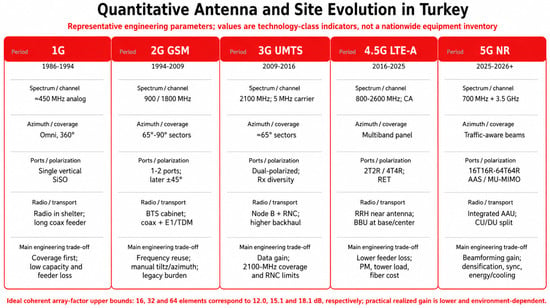
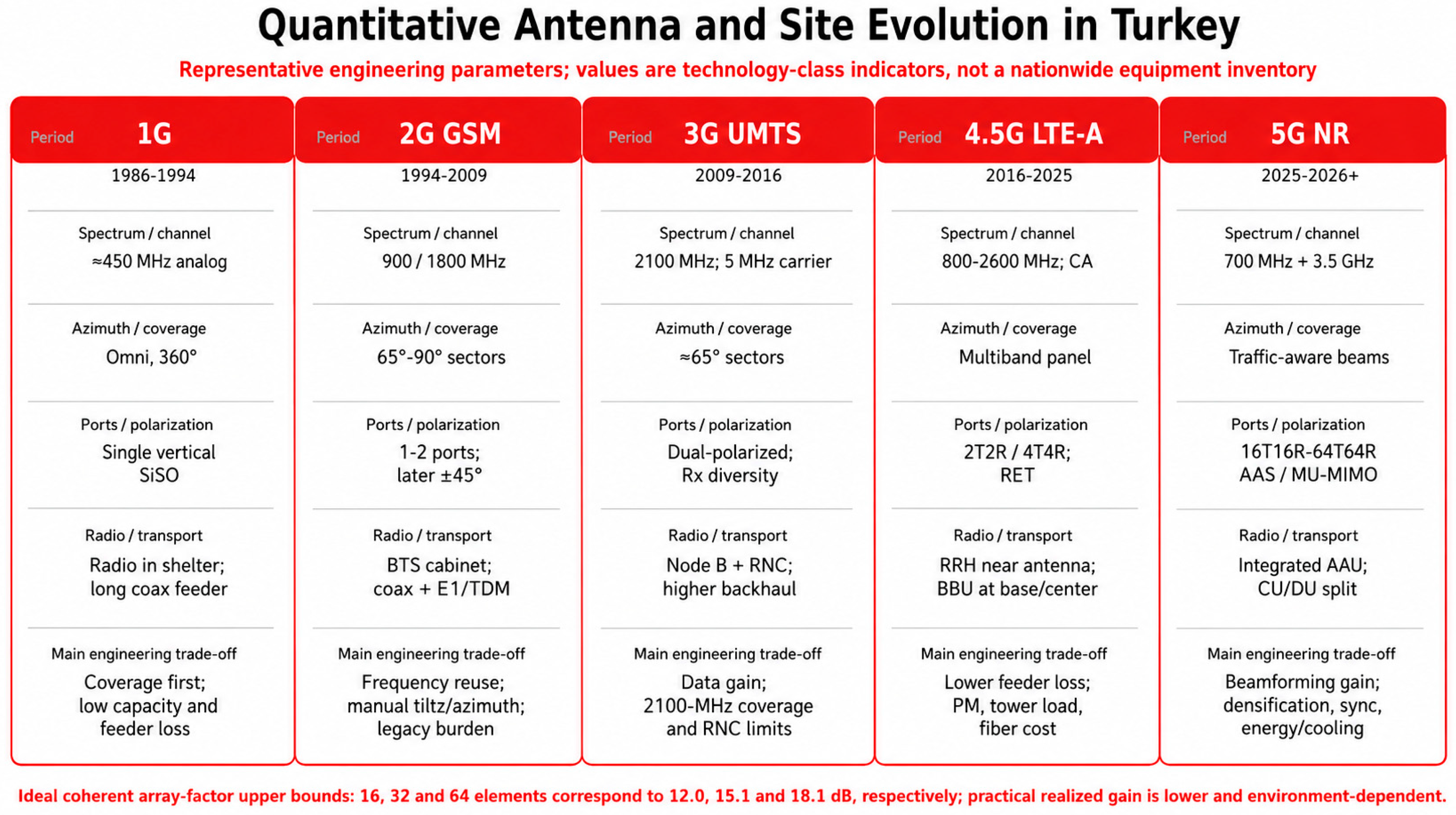
Figure 2 compares representative spectrum, antenna/array configuration, radio location, transport dependency, and trade-offs by generation. Array gain values are ideal coherent upper bounds, not guaranteed field gains.
Figure 2.
Quantitative antenna and site evolution in Turkey: representative parameters and principal engineering trade-offs. Note: The 1G configuration is representative and inferred from period engineering practice, whereas the later architecture classes are supported by standards-based evidence and documented Turkish milestones.
4. Frequency Allocations and Spectrum Logic
To address RQ1 and RQ3, this section links spectrum decisions to propagation, antennas, site requirements, capacity, and comparable regulatory metrics. Spectrum quantity must be interpreted with frequency, bandwidth, duplexing, antenna gain, and density: lower bands favor geographic and indoor coverage, whereas higher bands offer contiguous bandwidth and spatial reuse but require greater gain and denser infrastructure. Turkey’s structure is assessed from BTK/UAB authorizations, practical 3GPP bands, and reproducible calculations [4,5,7,13,33,38].
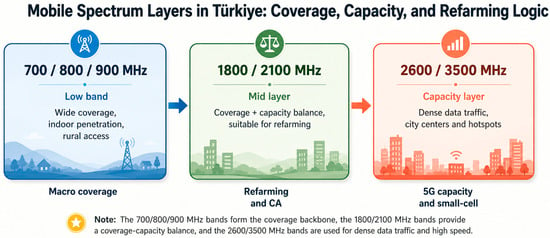
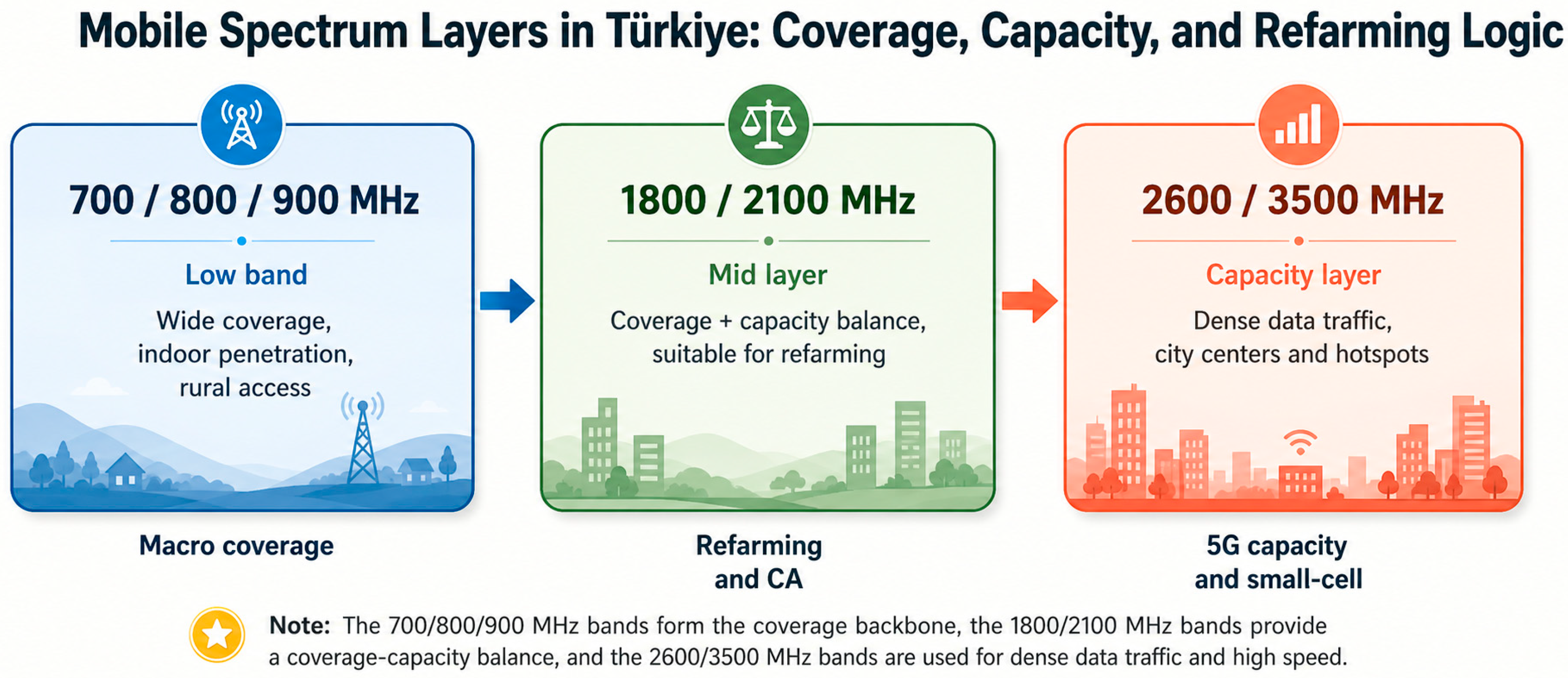
Table 9 compares the numerical authorization details for 3G, 4.5G, and 5G. Figure 3 shows the layered coverage capacity logic; Table 10 maps operator holdings, while Table A2 summarizes the technology layers. Table 11 quantifies the 700 MHz/3.5 GHz propagation contrast, while Table 12 presents the first-order capacity implications of unequal n78 bandwidth. The 700 MHz and 3.5 GHz layers illustrate the engineering trade-off quantitatively. At equal distance, the free-space frequency term alone adds at 3.5 GHz. This does not predict a complete cell radius because antenna gain, clutter, height, penetration, beamforming, interference, and receiver thresholds also matter; it does, however, establish the scale of the propagation burden that the 3.5 GHz capacity layer must recover through active antenna system (AAS) gain, densification, and link adaptation [33].
Table 9.
Numerical spectrum and regulatory comparison of Turkey’s 3G, 4.5G, and 5G authorizations.
Figure 3.
The prominent spectrum layers and the coverage capacity balance in Turkey during the 3G, 4.5G, and 5G periods.
Table 10.
Operator-level mobile spectrum allocation map in Turkey, including the unassigned 3400–3460 MHz segment.
Table 11.
Reproducible 700-MHz versus 3.5-GHz propagation and cell-size illustration.
Table 12.
First-order capacity implication of unequal n78 allocations.
4.1. Quantitative Link Budget Illustration: 700 MHz Versus 3.5 GHz
To provide a transparent first-order comparison, free-space path loss is calculated as . At a reference distance of 1 km, the resulting FSPL values are 89.34 dB at 700 MHz and 103.32 dB at 3.5 GHz. Thus, under otherwise identical conditions, the 3.5 GHz signal experiences an additional 13.98 dB of free-space path loss. To illustrate the corresponding first-order coverage implication, a simplified log-distance model is considered with an identical link budget and a path loss exponent of n = 3.5. The resulting cell radius ratio is while the corresponding idealized coverage area ratio is . Accordingly, a 3.5 GHz cell would cover approximately 15.9% of the area covered by a 700 MHz cell under the stated assumptions. This corresponds to an idealized site density multiplier of approximately 1/0.159 ≈ 6.29. These values are illustrative sensitivity estimates rather than deployment predictions because actual coverage also depends on antenna gain, AAS and beamforming performance, antenna height, clutter, building penetration, interference, receiver thresholds, and site topology.
4.2. Turkey-Specific Frequency Bands and Regulatory Chronology
Turkey’s frequency history is treated as an engineering-layer model rather than a band list. Technical notations are summarized in Table A1, while the detailed technology-level band map is provided in Table A2. Section 4.2 retains operator allocations because they support the 400 MHz accounting, the unassigned 3400–3460 MHz segment, and unequal n78 capacity implications.
Table 10 reorganizes spectrum by operator and by coverage/capacity role across low-, mid-, and 5G capacity layers [5,6,7,38].
As shown in Table 10, Turkey employs a layered mobile network spectrum strategy. Low-band FDD allocations at 700, 800, and 900 MHz primarily support wide-area coverage, indoor penetration, and rural service continuity. By contrast, the 1800, 2100, and 2600 MHz bands provide additional LTE/4.5G capacity and enable spectrum refarming and carrier aggregation [5,38].
Two different 400 MHz quantities must be distinguished. The 2025 auction total is 400 MHz: three paired 700 MHz licenses contribute 60 MHz and the n78 awards contribute 340 MHz, giving 60 + 340 = 400 MHz [7,21]. The 3400–3800 MHz interval also spans 400 MHz, but public operator assignments cover only 3460–3800 MHz; the 3400–3460 MHz segment is therefore reported as unassigned without speculating about its purpose. Under identical TDD configuration, MIMO rank, SINR, load, density, backhaul, and spectral efficiency, sector capacity scales approximately with bandwidth. Relative to Vodafone’s 80 MHz (1.00), the bandwidth indices are 1.75 for Turkcell and 1.50 for Türk Telekom. Thus, Turkcell has 75% more n78 bandwidth than Vodafone, Türk Telekom 50% more, and Turkcell about 16.7% more than Türk Telekom. These ratios indicate first-order capacity headroom only; user speed also depends on radio conditions, scheduling, load, density, refarming, and backhaul. Table 12 summarizes these first-order bandwidth and capacity implications.
For consistency, the 700 MHz n28 and 3500 MHz n78 assignments should be interpreted as part of the 2025–2026 5G authorization process rather than as part of the 2016–2029 IMT-Advanced/4.5G authorization interval [6,7].
Exact equipment records for the car phone period are limited, so it is described cautiously as wide-area analog access using high sites, large cells, passive antennas, coaxial feeders, and cabinet/shelter radios [1,2,11,22,23]. GSM marks the clearer technical break through sector panels, digital planning, and BTS-BSC-MSC architecture [1,24].
The 3G phase combined the 105 MHz 2100 MHz authorization, dual-polarized antennas, Node B/RNC architecture, and rising transport demand [3,4,25]. Band 1 was the primary layer, with Band 8 as a selective low-band/refarming layer [38]. The 4.5G phase then used 800–2600 MHz, technology-neutral refarming, carrier aggregation, 2T2R/4T4R MIMO, RRH/RRU, and site fiberization [5,16,23,26,38].
For 5G, 700 MHz is the rural/indoor coverage layer and 3.5 GHz the AAS, beamforming, and massive MIMO capacity layer [6,7,8,28,29,30]. Table 11 shows why n78 needs gain and density; Table 12 shows why bandwidth affects capacity but cannot replace deployment quality.
Four thresholds summarize the engineering chronology: 1994 for GSM and sectorized digital planning; 2009 for 2100 MHz UMTS; 2015–2016 for technology-neutral 4.5G across 800–2600 MHz; and 2025–2026 for 700 MHz and 3.5 GHz 5G. Each changed antennas, site topology, backhaul, and core architecture [4,5,6,7,38].
Spectrum refarming is central to Turkey’s transition. The 2015 authorization enabled older low- and mid-band layers to be reused for LTE-Advanced, directly linking regulation with multiband panels, MIMO, carrier aggregation, and later active antennas [5,23,38].
4.3. International Comparison: Turkey in Relation to European and U.S. 5G Spectrum Models
Turkey represents the broader three-layer 5G spectrum problem: low bands provide geographic and indoor coverage, mid-bands provide macro-cell capacity, and high bands/mmWave provide very large bandwidth at the cost of dense sites and small-cell engineering.
Turkey’s initial authorization uses low and mid-bands rather than all three layers. This supports nationwide/indoor reach and macro-site reuse but delays the large contiguous bandwidth needed for ultra-dense hotspots, very-high-throughput FWA, stadiums, airports, and industrial campuses. Omitting mmWave is defensible for a first coverage stage, but it would become a disadvantage without a later high-band and small-cell roadmap [36,57,58]. Table 13 compares the reference strategies.
Table 13.
Numerical comparison of Turkey’s initial 5G spectrum model with international reference strategies.
5. Site Components, Cell Types, and Output Power Classes
To address RQ2, Section 5, Section 6 and Section 7 examine whether spectrum and antenna capabilities translate into performance through transport, synchronization, energy, cooling, structural loading, maintenance, and resilience.
A base station site includes the support structure, antenna/radome, feeder or fiber, radio and baseband functions, power and batteries, optional generation, and transmission equipment. Generational change mainly concerns where these components are placed and how they interconnect [15,23,26].
Table 14 compares antenna ports, sectors, gains, and hidden costs. Site evolution moves the radio from a base shelter to a tower-top RRH/RRU and then into the active antenna. Feeder loss falls and beamforming becomes possible, but optical transport, remote power, weather exposure, calibration, cooling, loading, and maintenance shift toward the mast [23].
Table 14.
Quantitative intergenerational transformation of base station antennas, radio placement, and transport. Antenna parameters, ideal array bounds, and deployment implications.
Türk Telekom reported 535 thousand km of fiber in 2025, while BTK’s 2026-Q1 report gives 696.606 thousand km across operators: 249.741 thousand km backbone and 446.866 thousand km access fiber [10,51]. This regulator figure replaces the earlier national snapshot, but fiber length is not a mobile site fiber ratio and does not reveal redundancy, utilization, fronthaul suitability, latency, delay variation, or regional/operator distribution. The available site-level indicator remains Türk Telekom’s rise from 50% fiber-connected LTE sites in 2022 to 61% in 2025 [10,11].
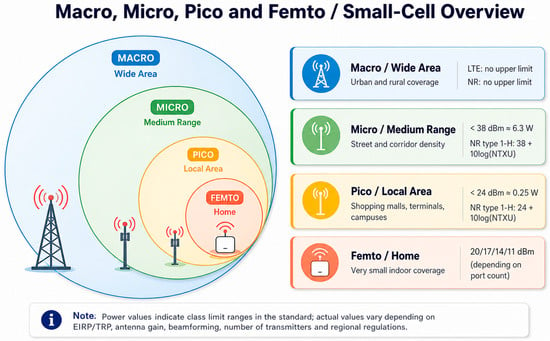
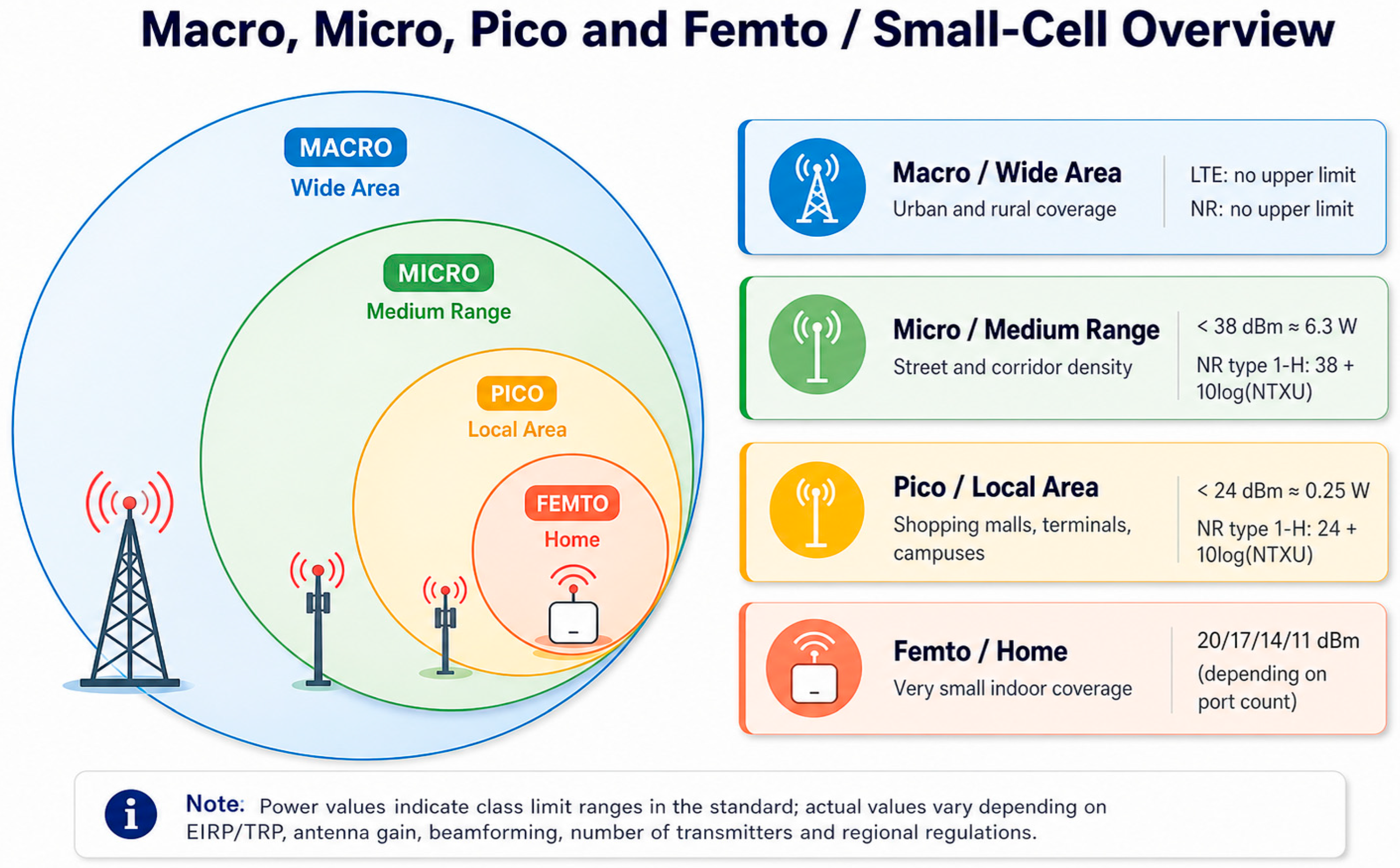
Energy and service continuity are also site-level requirements. Türk Telekom reports generators, batteries, and backup solutions at critical sites, while HGM can deploy satellite-connected portable base stations during disasters [9,15]. Figure 4 summarizes the coverage logic and rated power classes of macro, micro, pico, and femto/home cells.
Figure 4.
The coverage and usage logic of macro, micro, pico, and femto/home cells. The visual combines the small-cell descriptions in the two source articles.
5.1. MIMO, Massive MIMO, and Network Architecture Transformation
MIMO evolution is a system-level transition. 2G capacity depended mainly on SISO coverage, reuse, splitting, azimuth, and downtilt; 3G added dual polarization and receiver diversity with Node B/RNC control; and 4.5G coupled carrier aggregation, 2T2R/4T4R MIMO, higher-order modulation, multiband panels, RRH/RRU, and fiberized IP backhaul [24,25,26,27].
In Turkey, LTE-Advanced performance therefore depended on coordinated multiband use and modernization of existing macro-sites [5,23,26,27].
In 5G, static sector coverage is complemented by user- and traffic-aware beam management. For an ideal coherent array, the array factor upper bound equals 12.0 dB for 16 elements, 15.1 dB for 32, and 18.1 dB for 64. These are theoretical combining bounds, not guaranteed cell edge gains: element pattern, correlation, calibration, scan loss, polarization, scheduling, blockage, and interference reduce realized performance. Massive MIMO can therefore recover part but not automatically all of the 3.5 GHz propagation deficit [33,35].
Table 15 summarizes the antenna parameters that convert the historical narrative into a technical comparison. It also identifies the deployment variable that should be measured in Turkey for each generation.
Table 15.
Antenna parameters, ideal array bounds, and deployment implications.
5.2. Cell Types and Rated Output Power Classes
Cellular sites operate at different scales: macro cells serve wide and rural areas, while small cells address dense urban and indoor demand. ETSI TS 36.104 and TS 38.104 express these categories as Wide Area, Medium Range, Local Area, and Home BS [27,28].
These categories specify rated output power class limits, not operators’ definitive field EIRP. Actual performance also depends on antenna gain, sectorization, beamforming, bandwidth, and national limits [27,28].
Table 16 lists ETSI/3GPP output power classes for macro-, micro-, pico-, and home/femto-scale deployments. The dBm values are rated class limits; field TRP/EIRP varies with antenna gain, transmitter units, beamforming, and regulation [27,28].
Table 16.
Base station/cell classes and rated output power limits in ETSI/3GPP standards.
6. Active Antenna Systems, Core Architecture, and Turkey-Specific 5G Preparations
5G macro-sites integrate antenna and radio functions more tightly. AAS/AAU hardware places many RF paths and beamforming controls near the array, enabling spatial multiplexing and adaptive coverage at the cost of higher power, cooling, calibration, wind/weight loading, and maintenance [23,35].
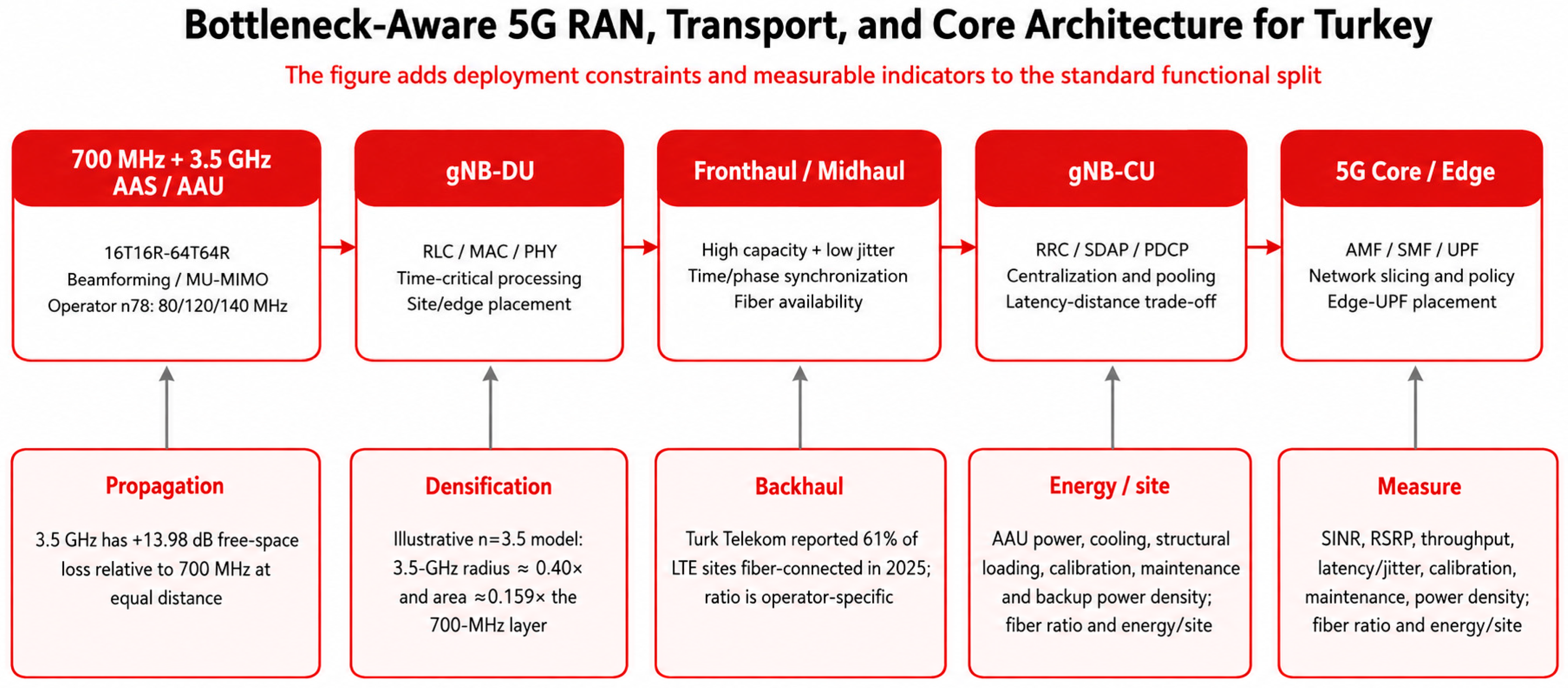
The gNB-CU/gNB-DU split trades centralization gains against transport latency: the DU hosts time-critical functions, while the CU hosts upper layers [29]; UPF placement similarly affects end-to-end latency and transport load [30]. Figure 5 links this architecture to n78 bandwidth, fiber, synchronization, propagation, density, energy, and measurable KPIs. Turkey’s preparations included public and operator trials: Istanbul Airport offered a public 5G experience in 2022, and later ministry reports described test areas and stadium trials [18,20]. A 2019 operator trial reached 2.283 Gbit/s on a commercial terminal using 100 MHz at 3.5 GHz [59]. Its 22.83-bit/s/Hz aggregate ratio reflects MIMO layers and favorable conditions and is not a nationwide or typical-user efficiency value.
Figure 5.
Bottleneck-aware 5G RAN, transport, and core architecture for the Turkish deployment context.
The domestic ecosystem includes ULAK and the end-to-end national 5G network initiative. Authorization included domestic content obligations, and HGM prioritized domestic base stations in rural and universal service projects [7,9,10]. Table 17 summarizes selected supporting indicators.
Table 17.
Public and limited empirical indicators relevant to Turkey’s 4.5G-to-5G transition.
BTK 2026-Q1 data quantify sector scale, adoption, traffic, investment, and fiber infrastructure but do not close the radio performance evidence gap. Although operator- and province-level radio performance data were requested from BTK and all three mobile network operators in Turkey, the requested data were not provided. Therefore, a single-point serving cell observation was collected using the NetMonster application on a mobile phone at 40°33′41″ N and 40°17′20″ E. The provider is anonymized as Operator X. As detailed in Table 18, the export confirms an LTE Band 20 serving cell attachment and reports frequency and cell identification parameters, but it does not contain RSRP, SINR, CQI, MIMO rank, throughput, latency, or jitter. The observation is consequently used only as a method demonstration and serving band record, not as a radio performance or user experience benchmark.
Table 18.
Single-point NetMonster handset attachment and recorded field data at the measurement coordinates (4 August 2026, 21:30).
7. Discussion
Turkey’s evolution shows three recurring patterns. Spectrum decisions rebalance coverage and capacity, illustrated by the 13.98 dB same-distance disadvantage of 3.5 GHz relative to 700 MHz. Radio functions move from passive feeders to RRH/RRU and AAS, reducing feeder loss but increasing energy, cooling, loading, calibration, and maintenance. Performance also becomes increasingly dependent on fiber, synchronization, core placement, and resilience [33,34,35,36,37].
The international benchmark permits comparison of award cycle variables but not practical network performance. Turkey’s 340 MHz national mid-band release and fixed-broadband fiber share exceed some cited values [31,32,42,43,44,45,46,47,48,49,50], yet national totals are not operator holdings and fixed fiber is not mobile site fiber. Population, geography, density, obligations, contiguity, SA/NSA status, load, and user KPIs also differ. The conclusion is therefore limited to regulatory spectrum positioning, not 5G readiness or superiority.
The technical findings have different evidence levels. Refarming enabled multiband 4.5G; low bands support continuity, while n78 bandwidth and spatial processing provide capacity headroom; and antenna evolution is coupled to transport and site engineering. BTK 2026-Q1 reports 696.606 thousand km of fiber, 92.612 million 4.5G subscriptions including M2M, 78.257 million mobile broadband subscriptions, 4.880 million TByte of quarterly mobile traffic, and 2025 sector investment [51]. These establish scale and demand, not nationwide radio, latency, synchronization, MIMO, energy, outage, or utilization performance. The 61% fiber-connected LTE site ratio and 2.283 Gbit/s trial are likewise operator-specific or favorable test indicators [10,11,60].
The article therefore extends beyond chronology by showing how spectrum policy becomes a site-level engineering constraint affecting antenna form, MIMO feasibility, transport, densification, and the gap between nominal capability and user performance.
The revised structure limits duplication: the detailed band inventory is in Table A2, abbreviations remain in the appendix, and main sections are linked to RQ1-RQ3. Core tables are retained only for distinct analytical functions.
7.1. Critical Engineering Challenges and Performance Implications
The 700 MHz layer improves rural and indoor continuity but offers less contiguous capacity than n78. The 3.5 GHz layer provides wide TDD channels and massive MIMO potential but has a 13.98 dB equal-distance free-space penalty. Under the stated n = 3.5 model, the radius and area ratios are 0.399 and 0.159. Actual cells depend on AAS gain, clutter, penetration, height, load, interference, thresholds, and topology [35]. Aggregate BTK data and one Band-20 attachment do not resolve these variables.
Transport and synchronization are equally important. Moving from RRH/RRU-based LTE to AAS and CU/DU splitting increases capacity, latency, jitter, and timing requirements. BTK’s 696.606 thousand km fiber total indicates national scale, and the reported 61% LTE site fiber ratio indicates operator-specific progress [10,11,51]. Neither reveals all-operator site coverage, redundancy, utilization, delay variation, synchronization, or DU-CU-UPF distance; these remain measurement requirements.
Energy and site engineering form a third bottleneck because massive MIMO shifts RF processing and heat to the antenna. Evaluation should combine radio KPIs and MIMO rank with site energy, thermal alarms, backup autonomy, structural load, and outages. No public all-operator provincial dataset was identified, so this is a measurement agenda rather than verified national performance. The methods in Section 2.3 offer testable anomaly diagnosis and resilient control directions but require mobile-specific validation [54,55,56]. Table 19 summarizes these engineering challenges and their measurable performance implications.
Table 19.
Engineering challenges and measurable performance implications of Turkey’s 4.5G-to-5G transition. Evidence currently available and priority data required for empirical validation.
7.2. Evidence Boundary and Priority Measurement Agenda
Public evidence supports national assignments, aggregate fiber, subscriptions, traffic, investment, selected operator fiberization, and isolated trials, but not province- and operator-level 5G coverage, cell edge quality, commercial latency, synchronization, massive MIMO realization, energy efficiency, resilience, or SA migration. Follow-up studies should stratify by province, operator, morphology, band, indoor/outdoor condition, geometry, time, and load. Timestamped records should include RSRP, RSRQ, SINR, CQI, channel and cell identifiers, MIMO rank, throughput percentiles, latency, jitter, packet loss, handovers/outages, and device model; site energy, synchronization, transport, and SA/NSA variables require network-side cooperation. Table 20 summarizes the evidence boundary and priority empirical variables.
Table 20.
Evidence currently available and priority data required for empirical validation.
8. Conclusions and Direct Answers to the Research Questions
Answer to RQ1—Spectrum decisions map directly onto antenna and site architecture. The 105 MHz 2100 MHz 3G award supported dual-polarized Node B/RNC sites; the 365.4 MHz technology-neutral 4.5G award enabled multiband panels, carrier aggregation, 2T2R/4T4R MIMO, RRH/RRU, and refarming; and the 2025 award created a passive 700 MHz coverage layer plus a 340 MHz 3.5 GHz AAS/massive MIMO capacity layer [4,5,7,21,23,25].
Answer to RQ2—Practical gains depend on coupled radio and infrastructure bottlenecks. At equal distance, 3.5 GHz has 13.98 dB more free-space loss than 700 MHz; the n = 3.5 illustration gives radius and area ratios of 0.399 and 0.159. Türk Telekom reported 61% fiber-connected LTE sites in 2025, while active arrays add synchronization, energy, cooling, structural, and maintenance demands [11,12,33,35]. Spectrum and peak rates alone therefore cannot prove national performance.
Answer to RQ3—Turkey chose a coverage-first low-/mid-band launch rather than an initial low-/mid-/mmWave sequence. The award includes 700 MHz and 340 MHz of n78 but no commercial 26 GHz layer, unlike Finland, Italy, and later Spain [31,42,47,50]. This prioritizes early coverage and macro-site reuse but does not establish superior user experience or maturity. A later high-band/small-cell roadmap may be needed for hotspots, FWA, and industrial campuses.
Overall conclusion—Turkey is neither simply late nor guaranteed faster 5G by spectrum quantity alone. Its initial low-/mid-band position is substantial, but operator bandwidth asymmetry, density, AAS realization, mobile site backhaul, synchronization, refarming, SA migration, energy resilience, and future mmWave policy determine outcomes. BTK indicators show infrastructure and market scale, not national radio performance. The review therefore provides numerical bounds, evidence tiers, and testable indicators while withholding claims that require unavailable provincial and operator data.
Future work should measure province- and operator-level 700 MHz/3.5 GHz coverage, inter-site distance, all-operator site fiberization, radio quality KPIs, throughput percentiles, latency, jitter, packet loss, synchronization, MIMO rank, energy, thermal and backup status, outages, and SA/NSA migration. Table 18′s single georeferenced handset record should become a timestamped, georeferenced, multi-device, multi-operator, multiband campaign with documented sampling and uncertainty. Further studies may test graph transfer learning for RAN fault diagnosis, physics-informed machine vision for site monitoring, and fault-tolerant control for infrastructure subsystems [54,55,56], followed by 6G topics such as integrated sensing, non-terrestrial networks, reconfigurable surfaces, and higher-frequency spectrum.
Author Contributions
Conceptualization, M.M. and M.K.; methodology, M.M.; software, M.M.; validation, M.K. and M.M.; formal analysis, M.M.; investigation, M.K.; resources, M.M.; data curation, M.K.; writing original draft preparation, M.M.; writing review and editing, M.M.; visualization, M.K.; supervision, M.M.; project administration, M.M. All authors have read and agreed to the published version of the manuscript.
Funding
This research received no external funding. The APC was funded by the authors.
Data Availability Statement
The original contributions presented in this study are included in the article. Further inquiries can be directed to the corresponding author.
Acknowledgments
During the preparation of this manuscript, the authors used ChatGPT (OpenAI, GPT-5.6 Sol) to assist with language refinement, structural editing, and the improvement of selected explanatory passages. The tool was not used to generate source data or make autonomous scientific conclusions. The authors independently verified all technical statements, calculations, and references, reviewed and edited the output, and take full responsibility for the content of this publication.
Conflicts of Interest
The authors declare no conflicts of interest.
Abbreviations
The following abbreviations are used in this manuscript.
| Abbreviation | English Expansion |
| 4.5G | LTE-Advanced/advanced 4G |
| 5GC | 5G Core |
| 5GS | 5G System |
| AA | Anadolu Agency |
| Abis | Abis Interface |
| CDP | Carbon Disclosure Project |
| CU | Central Unit |
| DAS | Distributed Antenna System |
| dBm | Decibel-Milliwatt |
| DU | Distributed Unit |
| EIRP | Equivalent Isotropically Radiated Power |
| IMT-2000 | International Mobile Telecommunications-2000 |
| IP | Internet Protocol |
| IP/MPLS | Internet Protocol/Multi-Protocol Label Switching |
| Iu | Iu Interface |
| WISP | Wireless Internet Service Provider |
| CA | Carrier Aggregation |
| NG-RAN | Next-Generation Radio Access Network |
| NR | New Radio |
| NSSF | Network Slice Selection Function |
| PIM | Passive Intermodulation |
| PtMP | Point-to-Multipoint |
| RLC | Radio Link Control |
| RET | Remote Electrical Tilt |
| S1 | S1 Interface |
| SDAP | Service Data Adaptation Protocol |
| SMF | Session Management Function |
| T.C. | Republic of Turkey |
| TRP | Total Radiated Power |
| TS | Technical Specification |
Appendix A. Antenna Models and Classification
| No | Company/Manufacturer | Antenna Name/Model | Antenna Type |
| 1 | Huawei | AQU4518R23v06 | Passive panel antenna (EasyRET, quad-band/2L2H, 8-port) |
| 2 | Huawei | ASI4518R31v06 | Passive panel antenna (EasyRET, 2L4H, 12-port) |
| 3 | Comba | GDI2-065R15M19JJ02-Q | Outdoor directional hexa-band panel antenna (65°) |
| 4 | Not specified | AAU536-(3500 MHz) | Active antenna unit—AAU (5G TDD 3500 MHz/Massive MIMO) |
| 5 | Kathrein | 742264v02 | Dual-band panel antenna (dual-polarized, 4-port) |
| 6 | Kathrein | 742264v1 | Dual-band panel antenna (dual-polarized) |
| 7 | Kathrein | 737003 | Omnidirectional antenna (VPol, 370–430 MHz) |
| 8 | Kathrein | K751121 | Omnidirectional antenna (VPol, 406–470 MHz) |
| 9 | Kathrein | 739504 | Panel antenna (VPol, 115°, 380–430 MHz) |
| 10 | Kathrein | 739622 | XPol A-Panel antenna (800/900 MHz, 65°, dual-polarized) |
| 11 | Kathrein | 739633/-A-Panel | XPol A-Panel antenna (806–960 MHz, 65°, 12°T) |
| 12 | Kathrein | 739684 | XPol A-Panel antenna (806–960 MHz, 65°, adjustable tilt) |
| 13 | Telewave | ANT425F10 | Fiberglass radome omnidirectional/collinear antenna |
| Note: Since the manufacturer information for the AAU536 entry is not clearly specified in the source list, the company field is retained as “Not specified”. Classification note: Antenna-type descriptions are based on the product class indicated in the model/datasheet definitions and on common technical terminology. | |||
Appendix B
Table A1.
Technical notations used in the manuscript.
Table A2.
Turkey-specific mobile frequency band map and engineering role.
Appendix C. Source-to-Claim Audit Matrix
Table A3 links the manuscript’s major claims to source class, observation date or version, analytical use, and principal limitation. It is a claim-level audit matrix, not a replacement for the complete reference list.
Table A3.
Major claim source-to-evidence coding matrix.
References
- Anadolu Ajansı. Türkiye’de Cepten İlk ‘Alo’nun Üzerinden 31 Yıl Geçti, Gözler 5G’de. 23 February 2025. Available online: https://www.aa.com.tr/tr/bilim-teknoloji/turkiyede-cepten-ilk-alonun-uzerinden-31-yil-gecti-gozler-5gde/3490379 (accessed on 28 July 2026).
- Anadolu Ajansı. Türkiye’nin 4,5G ile Tanışmasının Üzerinden 6 Yıl Geçti. 1 April 2022. Available online: https://www.aa.com.tr/tr/bilim-teknoloji/turkiyenin-4-5g-ile-tanismasinin-uzerinden-6-yil-gecti/2552182 (accessed on 28 July 2026).
- Invest in Türkiye. Türkiye 3G’ye Hazır. 29 July 2009. Available online: https://www.invest.gov.tr/tr/news/news-from-turkey/sayfalar/2907200918938.aspx (accessed on 28 July 2026).
- T.C. Ulaştırma ve Altyapı Bakanlığı. Haberleşme Genel Müdürlüğü. Ulusal Genişbant Stratejisi ve Eylem Planı (2017–2020). Available online: https://hgm.uab.gov.tr/uploads/pages/ulusal-genisbant-stratejisi/ulusal-genis-bant-stratejisi-ve-eylem-plani-2017-2020-b9d0c25d-328c-4eda-a2aa-d374ffacd91a.pdf (accessed on 28 July 2026).
- Anadolu Ajansı. 5G İhalesinde En Yüksek Tekliflerin Toplam Tutarı 3 Milyar 534 Milyon Dolar Oldu. 16 October 2025. Available online: https://www.aa.com.tr/tr/ekonomi/5g-ihalesinde-en-yuksek-tekliflerin-toplam-tutari-3-milyar-534-milyon-dolar-oldu/3718486 (accessed on 28 July 2026).
- T.C. Ulaştırma ve Altyapı Bakanlığı. 5G İhalesi Yarın Yapılacak. 15 October 2025. Available online: https://www.uab.gov.tr/haberler/5g-ihalesi-yarin-yapilacak/ (accessed on 28 July 2026).
- T.C. Ulaştırma ve Altyapı Bakanlığı. İletişimde Yeni Dönem Başlıyor. 30 March 2026. Available online: https://www.uab.gov.tr/haberler/iletisimde-yeni-doenem-basliyor/ (accessed on 28 July 2026).
- T.C. Ulaştırma ve Altyapı Bakanlığı. Haberleşme Genel Müdürlüğü. Ulak Projesi. Available online: https://hgm.uab.gov.tr/ulak-projesi (accessed on 28 July 2026).
- T.C. Ulaştırma ve Altyapı Bakanlığı. 5G, Kalkınmanın Altyapısı Olacak. 15 January 2026. Available online: https://www.uab.gov.tr/haberler/5g-kalkinmanin-altyapisi-olacak (accessed on 28 July 2026).
- Türk Telekom. Annual Report 2025. 2025. Available online: https://ttinvestorrelations.com/media/dqsjlvxo/2025-annual-report.pdf (accessed on 28 July 2026).
- Türk Telekom. Annual Report 2022. 2022. Available online: https://www.ttinvestorrelations.com/media/5kbd0x1g/2022-annual-report.pdf (accessed on 28 July 2026).
- Turkcell. Form 20-F/Annual Report 2024. 2024. Available online: https://s.turkcell.com.tr/SiteAssets/Hakkimizda/yatirimci-iliskileri/documents/pdf/20F2024.pdf (accessed on 28 July 2026).
- Turkcell. Form 20-F/Annual Report 2021. 2021. Available online: https://s.turkcell.com.tr/SiteAssets/Hakkimizda/yatirimci-iliskileri/documents/pdf/20F2021.pdf (accessed on 28 July 2026).
- Beckman, C.; Lindmark, B. The Evolution of Base Station Antennas for Mobile Communications. In Proceedings of the 2007 International Conference on Electromagnetics in Advanced Applications (ICEAA 2007), Turin, Italy, 17–21 September 2007; pp. 85–92. [Google Scholar] [CrossRef] [Scilit]
- Bilgi Teknolojileri ve İletişim Kurumu. Türkiye Elektronik Haberleşme Sektörü Üç Aylık Pazar Verileri Raporu: 2017 Yılı 1. Çeyrek; BTK: Ankara, Türkiye, 2017. Available online: https://www.btk.gov.tr/uploads/pages/slug/2017-q1.pdf (accessed on 28 July 2026).
- T.C. Ulaştırma ve Altyapı Bakanlığı. 5G Dönemi Başladı. 1 April 2026. Available online: https://www.uab.gov.tr/haberler/5g-doenemi-basladi/ (accessed on 28 July 2026).
- Anadolu Ajansı. Türkiye’nin 5G Yolculuğu İstanbul Havalimanı’ndan Başladı. 29 July 2022. Available online: https://www.aa.com.tr/tr/bilim-teknoloji/turkiyenin-5g-yolculugu-istanbul-havalimanindan-basladi/2648567 (accessed on 28 July 2026).
- T.C. Ulaştırma ve Altyapı Bakanlığı. Fiber Ağ, Dünya’nın Çevresini 16 Kez Dolaşacak Uzunluğa Erişti. 13 January 2026. Available online: https://www.uab.gov.tr/haberler/fiber-ag-duenya-nin-cevresini-16-kez-dolasacak-uzunluga-eristi/ (accessed on 28 July 2026).
- T.C. Ulaştırma ve Altyapı Bakanlığı. 4 Büyüklerin Stadyumlarına 5G Geliyor. 19 February 2025. Available online: https://www.uab.gov.tr/haberler/4-bueyueklerin-stadyumlarina-5g-geliyor/ (accessed on 28 July 2026).
- Nolto Teknoloji A.Ş. Türkiye’deki 4G ve GSM Frekansları. Available online: https://www.nolto.com/blog/turkiyedeki-4g-ve-gsm-frekanslari/ (accessed on 28 July 2026).
- Shafi, M.; Molisch, A.F.; Smith, P.J.; Haustein, T.; Zhu, P.; De Silva, P.; Tufvesson, F.; Benjebbour, A.; Wunder, G. 5G: A Tutorial Overview of Standards, Trials, Challenges, Deployment, and Practice. IEEE J. Sel. Areas Commun. 2017, 35, 1201–1221. [Google Scholar] [CrossRef] [Scilit]
- 5G Americas. Advanced Antenna Systems for 5G; 5G Americas: Bellevue, WA, USA, 2019; Available online: https://www.5gamericas.org/wp-content/uploads/2019/08/5G-Americas_Advanced-Antenna-Systems-for-5G-White-Paper.pdf (accessed on 28 July 2026).
- European Telecommunications Standards Institute (ETSI). GSM 03.02: Network Architecture (GSM 03.02 Version 5.1.0); ETSI GSM 03.02 V5.1.0. Available online: https://www.etsi.org/deliver/etsi_gts/03/0302/05.01.00_60/gsmts_0302v050100p.pdf (accessed on 28 July 2026).
- European Telecommunications Standards Institute (ETSI). UTRAN Overall Description; 3GPP TS 25.401 Version 3.8.0; ETSI TS 125 401 V3.8.0. Available online: https://www.etsi.org/deliver/etsi_ts/125400_125499/125401/03.08.00_60/ts_125401v030800p.pdf (accessed on 28 July 2026).
- European Telecommunications Standards Institute (ETSI). Feasibility Study for Further Advancements for E-UTRA (LTE-Advanced); 3GPP TR 36.912 Version 17.0.0, Release 17; ETSI TR 136 912 V17.0.0; ETSI: Sophia Antipolis, France, 2022; Available online: https://www.etsi.org/deliver/etsi_tr/136900_136999/136912/17.00.00_60/tr_136912v170000p.pdf (accessed on 28 July 2026).
- European Telecommunications Standards Institute (ETSI). E-UTRA Base Station (BS) Radio Transmission and Reception; 3GPP TS 36.104 Version 18.6.0; ETSI TS 136 104 V18.6.0. Available online: https://www.etsi.org/deliver/etsi_ts/136100_136199/136104/18.06.00_60/ts_136104v180600p.pdf (accessed on 28 July 2026).
- European Telecommunications Standards Institute (ETSI). NR; Base Station (BS) Radio Transmission and Reception; 3GPP TS 38.104 Version 18.8.0; ETSI TS 138 104 V18.8.0. Available online: https://www.etsi.org/deliver/etsi_ts/138100_138199/138104/18.08.00_60/ts_138104v180800p.pdf (accessed on 28 July 2026).
- European Telecommunications Standards Institute (ETSI). NG-RAN; Architecture Description; 3GPP TS 38.401 Version 18.6.0; ETSI TS 138 401 V18.6.0. Available online: https://www.etsi.org/deliver/etsi_ts/138400_138499/138401/18.06.00_60/ts_138401v180600p.pdf (accessed on 28 July 2026).
- European Telecommunications Standards Institute (ETSI). System Architecture for the 5G System (5GS); 3GPP TS 23.501 Version 16.6.0; ETSI TS 123 501 V16.6.0. Available online: https://www.etsi.org/deliver/etsi_ts/123500_123599/123501/16.06.00_60/ts_123501v160600p.pdf (accessed on 28 July 2026).
- Türk Telekom. 2024 CDP Corporate Questionnaire. Available online: https://www.ttinvestorrelations.com/media/16eyigll/cdp-2023.pdf (accessed on 28 July 2026).
- Ministerio de Asuntos Económicos y Transformación Digital. El Gobierno Adjudica la Subasta de 26 GHz a Cuatro Operadores por Importe de 36 Millones de Euros. 21 December 2022. Available online: https://portal.mineco.gob.es/ca-es/comunicacion/Pagines/subasta-de-26-GHz.aspx (accessed on 28 July 2026).
- Federal Office of Communications OFCOM. Mobile Radio Frequencies for 5G Awarded in Switzerland. 3 May 2019. Available online: https://www.bakom.admin.ch/en/mobile-radio-frequencies-for-5g-awarded-in-switzerland (accessed on 28 July 2026).
- European Telecommunications Standards Institute (ETSI). European Digital Cellular Telecommunications System (Phase 2); Network Architecture (GSM 03.02 Version 4.0.4); ETS 300 522; ETSI: Sophia Antipolis, France, 1994; Available online: https://www.etsi.org/deliver/etsi_i_ets/300500_300599/300522/01_60/ets_300522e01p.pdf (accessed on 28 July 2026).
- European Telecommunications Standards Institute (ETSI). Digital Cellular Telecommunications System (Phase 2+); Radio Transmission and Reception (GSM 05.05 Version 5.3.0); Draft prETS 300 910; ETSI: Sophia Antipolis, France, 1996; Available online: https://www.etsi.org/deliver/etsi_i_ets/300900_300999/300910/01_40_60/ets_300910e01o.pdf (accessed on 28 July 2026).
- European Telecommunications Standards Institute (ETSI). Study on Channel Model for Frequencies from 0.5 to 100 GHz; 3GPP TR 38.901 Version 18.0.0, Release 18; ETSI TR 138 901 V18.0.0; ETSI: Sophia Antipolis, France, 2024; Available online: https://www.etsi.org/deliver/etsi_tr/138900_138999/138901/18.00.00_60/tr_138901v180000p.pdf (accessed on 28 July 2026).
- Andrews, J.G.; Buzzi, S.; Choi, W.; Hanly, S.V.; Lozano, A.; Soong, A.C.K.; Zhang, J.C. What Will 5G Be? IEEE J. Sel. Areas Commun. 2014, 32, 1065–1082. [Google Scholar] [CrossRef] [Scilit]
- Larsson, E.G.; Edfors, O.; Tufvesson, F.; Marzetta, T.L. Massive MIMO for Next Generation Wireless Systems. IEEE Commun. Mag. 2014, 52, 186–195. [Google Scholar] [CrossRef] [Scilit]
- ITU-R. Minimum Requirements Related to Technical Performance for IMT-2020 Radio Interface(s). 2017. Available online: https://www.itu.int/pub/R-REP-M.2410-2017 (accessed on 28 July 2026).
- Page, M.J.; McKenzie, J.E.; Bossuyt, P.M.; Boutron, I.; Hoffmann, T.C.; Mulrow, C.D.; Shamseer, L.; Tetzlaff, J.M.; Akl, E.A.; Brennan, S.E.; et al. The PRISMA 2020 Statement: An Updated Guideline for Reporting Systematic Reviews. BMJ 2021, 372, n71. [Google Scholar] [CrossRef] [Scilit] [PubMed]
- Snyder, H. Literature Review as a Research Methodology: An Overview and Guidelines. J. Bus. Res. 2019, 104, 333–339. [Google Scholar] [CrossRef] [Scilit]
- Ministry of Transport and Communications (Finland). 5G Spectrum Auction Concluded. 8 June 2020. Available online: https://lvm.fi/en/-/5g-spectrum-auction-concluded-1206517 (accessed on 28 July 2026).
- Bundesnetzagentur. Mobile Broadband—Project 2018: 5G Auction and Allotment. Available online: https://www.bundesnetzagentur.de/EN/Areas/Telecommunications/FrequencyManagement/ElectronicCommunicationsServices/MobileBroadbandProject2018/project2018_node.html (accessed on 28 July 2026).
- Ofcom. 2.3 and 3.4 GHz Spectrum Award: Consultation on a 3.4 GHz Band Plan, Varying UK Broadband Limited’s Licence and a Call for Inputs on Other Aspects of the Award. Available online: https://www.ofcom.org.uk/spectrum/spectrum-awards/2.3-3.4-ghz?language=en (accessed on 28 July 2026).
- Ofcom. Award of the 2.3 and 3.4 GHz Spectrum Bands—Publication of Information at the End of Each Day of the Principal Stage. 4 April 2018. Available online: https://www.ofcom.org.uk/spectrum/spectrum-awards/daily-updates2 (accessed on 28 July 2026).
- Ofcom. Ofcom 700 MHz and 3.6–3.8 GHz Spectrum Auction: Final Results Announced. 27 April 2021. Available online: https://www.ofcom.org.uk/spectrum/spectrum-awards/final-spectrum-auction-results?language=en (accessed on 28 July 2026).
- ARCEP. Auction for the Award of 3.4–3.8 GHz Band Spectrum Is Closed. 1 October 2020. Available online: https://en.arcep.fr/news/press-releases/view/n/5g-011020.html (accessed on 28 July 2026).
- Ministero dello Sviluppo Economico. Procedura per l’Assegnazione di Diritti d’Uso delle Frequenze nelle Bande 694–790 MHz, 3600–3800 MHz e 26.5–27.5 GHz. 2018. Available online: https://www.mimit.gov.it/images/stories/normativa/Disciplinare_Gara_multibanda2018.pdf (accessed on 28 July 2026).
- Ministerio de Asuntos Económicos y Transformación Digital. El Próximo 20 de Julio Comienza la Licitación de Frecuencias de la Banda de 700 MHz, Prioritaria para Desplegar Redes y Servicios 5G. 15 July 2021. Available online: https://portal.mineco.gob.es/ca-es/comunicacion/Pagines/210716_np_5g.aspx (accessed on 28 July 2026).
- OECD. Broadband and Telecom Databases; Measure: Percentage of Fibre Connections in Total Broadband, December 2024. OECD Data Explorer. Available online: https://data-explorer.oecd.org/vis?df%5Bag%5D=OECD.STI.DEP&df%5Bds%5D=DisseminateFinalDMZ&df%5Bid%5D=DSD_BB_DATABASE%40DF_BB_TEL_DATABASE (accessed on 28 July 2026).
- Finnish Transport and Communications Agency (Traficom). Frequencies and License Holders of Public Mobile Networks. Available online: https://www.traficom.fi/en/radio-licences-and-frequencies/use-radio-frequencies/frequencies-and-license-holders-public-mobile-networks (accessed on 28 July 2026).
- Bilgi Teknolojileri ve İletişim Kurumu (BTK). Türkiye Elektronik Haberleşme Sektörü: Üç Aylık Pazar Verileri Raporu, 2026 Yılı 1. Çeyrek; BTK: Ankara, Türkiye, 2026. Available online: https://www.btk.gov.tr/elektronik-haberlesme-pazar-verileri (accessed on 4 August 2026).
- T.C. Ulaştırma ve Altyapı Bakanlığı. 5G’den Hazineye Dev Katkı. 16 October 2025. Available online: https://www.uab.gov.tr/haberler/5gden-hazineye-dev-katki/ (accessed on 28 July 2026).
- European Commission. European Commission to Harmonise the Last Pioneer Frequency Band Needed for 5G Deployment. 14 May 2019. Available online: https://digital-strategy.ec.europa.eu/en/news/european-commission-harmonise-last-pioneer-frequency-band-needed-5g-deployment (accessed on 28 July 2026).
- Wang, X.; Jiang, H.; Dong, Y.; Mu, M. Spatial-Channel Collaborative Multi-Scale Graph Interaction Deep Transfer Learning for Unsupervised Rotating Machinery Fault Diagnosis. Eng. Appl. Artif. Intell. 2026, 176, 114691. [Google Scholar] [CrossRef] [Scilit]
- Yan, J.; Zhou, N.; Cheng, Y.; Zhang, F.; Wang, H.; Wang, M.; Jin, B.; Li, M.; Lu, Q.; Zhang, W. Application of Machine-Vision-Driven Physics-Informed Neural Networks in Pantograph-Catenary System State Detection. Mech. Syst. Signal Process. 2026, 257, 114577. [Google Scholar] [CrossRef] [Scilit]
- Zhao, H.; Wang, B.; Fu, Y.; Zhou, M.; Li, N.; Gao, Z. Fixed-Time Adaptive Smooth Control with Relaxed Performance Constraints for a Canard Rotor/Wing UAV Subject to Aerodynamic Interferences and Actuator Faults. Aerosp. Sci. Technol. 2026, 178, 112959. [Google Scholar] [CrossRef] [Scilit]
- Federal Communications Commission. The FCC’s 5G FAST Plan. Available online: https://docs.fcc.gov/public/attachments/DOC-354326A1.pdf (accessed on 28 July 2026).
- Rochman, M.I.; Ye, W.; Zhang, Z.L.; Ghosh, M. A Comprehensive Real-World Evaluation of 5G Improvements over 4G in Low- and Mid-Bands. In Proceedings of the 2024 IEEE International Symposium on Dynamic Spectrum Access Networks (DySPAN), Washington, DC, USA, 13–16 May 2024; pp. 257–266. [Google Scholar] [CrossRef] [Scilit]
- Rappaport, T.S.; Sun, S.; Mayzus, R.; Zhao, H.; Azar, Y.; Wang, K.; Wong, G.N.; Schulz, J.K.; Samimi, M.; Gutierrez, F. Millimeter Wave Mobile Communications for 5G Cellular: It Will Work! IEEE Access 2013, 1, 335–349. [Google Scholar] [CrossRef] [Scilit]
- Turkcell. Turkcell’den 5G’de Dünya Rekoru. 6 August 2019. Available online: https://medya.turkcell.com.tr/bulletins/turkcellden-5gde-dunya-rekoru/ (accessed on 28 July 2026).

Disclaimer/Publisher’s Note: The statements, opinions and data contained in all publications are solely those of the individual author(s) and contributor(s) and not of MDPI and/or the editor(s). MDPI and/or the editor(s) disclaim responsibility for any injury to people or property resulting from any ideas, methods, instructions or products referred to in the content. |
© 2026 by the authors. Licensee MDPI, Basel, Switzerland. This article is an open access article distributed under the terms and conditions of the Creative Commons Attribution (CC BY) license.