


Abstract
Fake social media profiles increasingly resemble ordinary accounts, combining believable images, fluent biographies, copied posts, and selective engagement, which makes single signal detection unreliable. This study develops and evaluates a forensic natural language processing (NLP) framework that treats profile text as digital evidence rather than raw model input. Profiles were collected from Facebook, Instagram, X, Truth Social, and LinkedIn through network expansion and vocabulary guided scraping, then anonymized, merged, cleaned, and organized into structured text and profile records. Ground truth came from human eye annotation (referred to throughout as human eye review, human review, or manual review) supported by three LLM reviewers (referred to throughout as LLM assisted review), OpenAI GPT-4o, Anthropic Claude 3.5 Sonnet, and Google Gemini 1.5 Pro, with strict agreement logic producing confidence-tiered labels across platform-specific label spaces covering scam, fraud, harmful, and legitimate behavior. Each model received a defined set of label categories, was instructed to return a single label with a one sentence rationale, and worked independently with no cross-model communication. Multidimensional features, including TF-IDF representations, sentence embeddings, scam lexicon counts, sentiment and emotion scores, and behavioral indicators, were extracted through a pipeline built to keep links, hashtags, contact markers, and repeated phrasing as forensic signals rather than noise. Traditional classifiers, transformer models, and ensembles were trained on verified labels, and the best model per platform was applied to the full dataset of over 309,108 records under confidence filtered classification, with predictions below a 0.70 probability threshold flagged for human review. The framework links classification outputs to textual indicators through explainable AI, achieving weighted F1 scores between 0.86 and 0.96 across five platforms. These results show that profile text alone provides strong, production-relevant evidence for detecting fake and harmful accounts, even though the framework treats this as one evidence stream to be weighed alongside image and behavioral signals rather than as a final determination on its own. The accompanying evidence trail means an investigator or a trust and safety team can see why a profile was flagged rather than being handed a bare score, which is what turns a classifier into a tool that can be checked, challenged, and used directly in an investigation.
1. Introduction
Social media profiles are no longer spaces where users simply introduce themselves. They now function as trust signals. A few posts and some visible engagement can make an account appear genuine before anyone has checked it properly. Digital forensics now treats profile authenticity as a standing concern, since billions of active identities move across major platforms at any given moment [1]. Fraudulent actors exploit this openness to support impersonation and manipulation at scale [2]. Many such accounts are not obviously false. They combine convincing images, borrowed details, and selective activity to appear real, and some remain dormant before promoting fraudulent offers. Profile text is central to the problem because it reveals how an account constructs identity, builds trust, and directs user behavior through captions, hashtags, contact references, and repeated phrases. Suspicious language is rarely suspicious in isolation; the weight comes from the pattern across the whole profile, which makes simple keyword matching forensically inadequate. Generative AI has compounded this by producing polished, platform-appropriate content that no longer relies on poor grammar, so synthetic text becomes substantially harder to identify once paraphrased or mixed with human writing [3]. For a forensic system to be defensible, every classification must be traceable to the evidence that produced it rather than to an opaque score [4]. This study builds and tests such a system across five platforms, Facebook, Instagram, X, Truth Social, and LinkedIn, chosen for their scale, their distinct fraud patterns, and the practical reality of what can actually be collected from public profiles.
Five platforms were selected rather than a single site or a broader sweep of the social web, and the selection reflects four considerations. Facebook, Instagram, and X together account for a substantial share of global active social media use [1], so findings drawn from them speak to where the largest volume of both genuine and fraudulent activity occurs. Each platform also carries a documented and distinct fraud profile. Meta’s disclosed removal of 6.8 million accounts linked to scam centers demonstrates the scale of the problem on Facebook and its messaging ecosystem [5]. X and Truth Social represent fast moving, loosely moderated public discourse, where coordinated inauthentic behavior has been documented around major political events [6]. LinkedIn is different in kind: a professional identity platform where impersonation and financial solicitation exploit institutional trust rather than emotional appeal. This pattern is documented in recent work on fake and LLM-generated LinkedIn profiles built specifically to gain the credibility needed for phishing and scam activity [7]. Instagram was retained because its visual emphasis and short captions test whether a text only framework holds value when the primary evidentiary channel is image rather than language. Public accessibility mattered as well: all five permit collection of profile-level content without authentication, keeping the method consistent with open-source forensic practice. Practical data access was a fourth factor: these were the platforms on which sustained, policy-compliant collection over the study period was actually achievable, so the selection reflects demonstrated feasibility rather than an arbitrary shortlist. Taken together, scale of active use, documented fraud exposure, public accessibility, and collection feasibility are the four grounds on which the five platform scope was set, rather than a broader or narrower sweep of the social web.
1.1. Problem Statement
Existing studies treat profile text mainly as input for prediction: words are converted into features, passed into a model, and a label is returned. What is missing is a sustained forensic reading of the text itself. A suspicious label does not identify where the suspicion originates, and in forensic work that gap matters because every conclusion must be traceable to specific evidence. There is also a problem of uncertainty: not every suspicious account is deceptive, some are promotional, automated but benign, or simply inactive, and AI-generated or paraphrased text makes borderline cases harder to resolve because deceptive language can now appear natural and platform-appropriate.
1.2. Research Aim and Research Questions
This study develops and evaluates a forensic natural language processing framework for detecting fake social media profiles using multidimensional textual features and explainable machine learning. To achieve this aim, the following research questions guide the study:
- How can social media profile texts be collected, labeled, and structured for forensic fake profile detection?
- What textual features most effectively distinguish fake or suspicious profiles from genuine ones across multiple platforms?
- Which linguistic and behavioral patterns contribute most strongly to fake profile detection decisions?
- How can feature extraction, classification, and explainability be unified into a cohesive forensic framework?
1.3. Significance and Scope
This study fuses multiple textual indicator types rather than relying on any single method, and uses explainable AI to ensure every model output is checked against the evidence that produced it rather than treated as final proof. The scope covers publicly visible textual content at profile level: biographies, posts, captions, comments, hashtags, repeated phrases, and contact details. Text alone does not prove a profile is fake; ambiguous cases are referred to human review.
Prior work on fake profile and bot detection typically examines a single platform, treats profile text as generic model input rather than forensic evidence, offers no explainable trace from a label back to specific wording, relies on a lone human annotator or a single LLM rather than multiple independent LLM reviewers under agreement logic, and is rarely validated across more than one or two platforms with a unified framework. This study is distinguished from that body of work along five axes rather than by breadth of coverage alone. It is worth stating plainly that this paper reports an original empirical framework built and tested on newly collected data, not a review or survey of existing detection methods; the comparison to prior work below is offered only to place the contribution in context. Its research focus is profile text treated explicitly as forensic evidence rather than generic model input, so every extracted indicator remains traceable to the original wording. It establishes an explicit technique to problem mapping, tying each feature family, lexical, semantic, sentiment, scam lexicon, and behavioral, to a specific deceptive mechanism rather than treating features as interchangeable model input. It runs a controlled comparative analysis across five model families on the same platform-specific data, which makes the finding that boosting and tree-based models match or exceed transformer-only baselines a tested result rather than an assumption. It addresses the explainability gap directly by requiring every classification to carry a confidence tier and contributing indicators, with predictions below the 0.70 threshold routed to human review. Its practical value lies in a platform-agnostic design validated across professional, visual, and public-discourse environments.
The principal contributions of this study are:
- A unified forensic text analytics framework that integrates evidence preserving text processing, structured feature engineering, human and large language model assisted ground truth construction, explainable classification, and confidence based decision support into a single end to end workflow for fake social media profile detection.
- A research focus that treats profile text as forensic evidence rather than as generic input for a classifier, so every extracted indicator stays traceable back to the original wording.
- An explicit technique to problem mapping that ties each feature family, lexical, semantic, sentiment, scam lexicon, and behavioral, to a specific deceptive mechanism, so no feature group is treated as an interchangeable number fed into a model.
- A controlled comparison across several model families, linear, tree based, boosting, transformer, and ensemble, run on the same platform specific data, which turns the finding that boosting and tree based models match or beat transformer only baselines into a tested result rather than an assumption carried over from other text classification work.
- An explainability requirement built into the framework itself: every classification carries a confidence tier and a set of contributing indicators, and anything below the 0.70 threshold is routed to human review rather than forced into a label.
- A platform independent design tested across five distinct environments, professional, visual, fast moving public discourse, and mixed identity, along with an honest account of where text alone reaches its limit, most visibly on rare classes and on platforms where profile text is short.
- A curated, labelled dataset, collected and scraped specifically for this research, with anonymized feature level records available from the corresponding author on reasonable request to support reproducibility and future work.
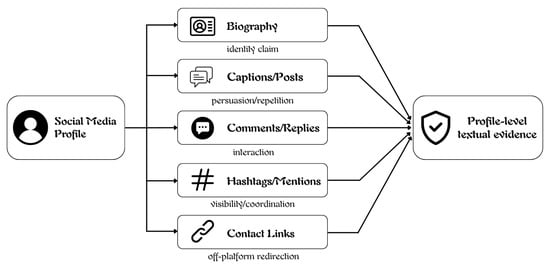
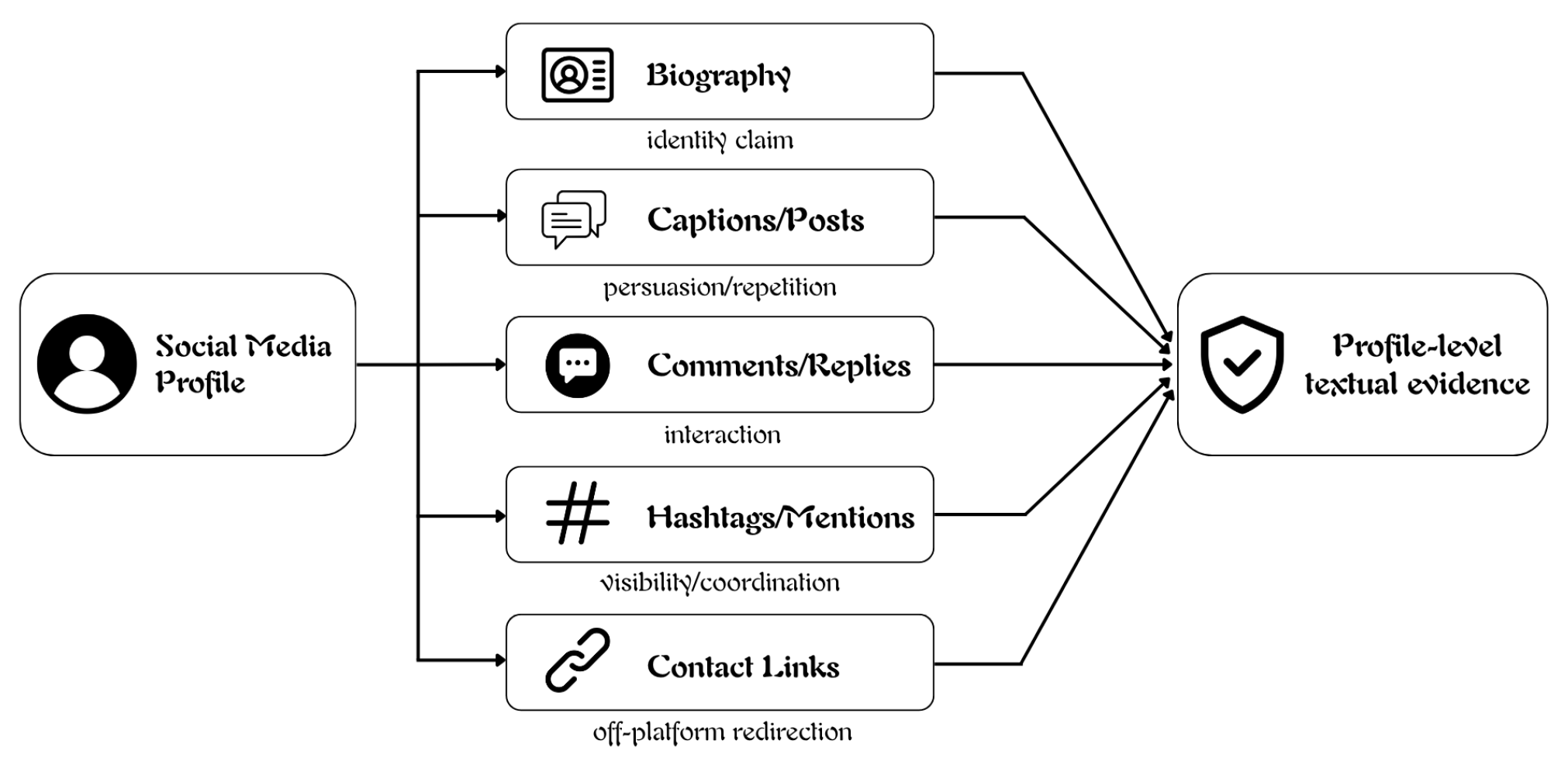
Figure 1 summarizes the profile level textual footprints examined throughout this study and their corresponding forensic roles.
Figure 1.
Profile level textual footprints and their forensic roles.
2. Related Work
2.1. Understanding Fake Social Media Profiles
Fake social media profiles span several overlapping forms: sockpuppets, sybil accounts, bots, and scam-operated personas [2]. What matters forensically is the misleading use of identity, not whether every profile detail is false. Bot detection typically relies on automation, timing, and network behavior [8,9], but manually operated scam accounts can evade those signals entirely, and coordinated accounts may be aged and activated well after creation [6,10]. Detection increasingly draws on signals beyond text and network timing: spatio temporal graph methods can recover group level coordination from trajectory data [11], and multimodal fusion of spatial-frequency and optical-flow features has been applied to detect AI-generated video content [12], both relevant as this program extends toward multimodal profile evidence. Proper collection and preservation of digital evidence is also essential, since poorly documented data produces results that cannot be reproduced or defended [13,14].
2.2. Textual Evidence and Deceptive Language
Profile text carries evidential weight unevenly across a profile. Each field, from biography to captions to external contact details, does distinct evidential work [15]. Suspicious language is rarely suspicious in isolation; the weight comes from how signals cluster across a profile. Off-platform contact references such as WhatsApp or Telegram numbers mark where accounts attempt to move users away from platform visibility, and Meta’s removal of 6.8 million accounts linked to scam centers confirms the scale of this behavior [5]. Forensic linguistics supports reading language as evidence of identity performance and deceptive intent [16], and measurable signals including repeated wording, urgency, financial bait, and trust-building language are most informative when read at profile level rather than phrase level [17,18].
2.3. Scam-Oriented Profiles: Romance, Investment, Crypto, Phishing, and Impersonation
Scam-oriented profiles are built to move someone toward a harmful decision. Reported social media scam losses reached $2.1 billion in FTC 2025 reporting [19], with $16.6 billion in total internet crime losses reported by the FBI in 2024 [20]. Romance scam profiles use staged affection and manufactured trust before any financial request [18]. Investment and cryptocurrency profiles frame risk as opportunity, with Chainalysis reporting over $2.17 billion stolen from crypto services by mid-2025 [21] and fraudulent operations relying on high-return narratives and professional presentation [22]. Phishing profiles borrow institutional authority; generative AI has made phishing content polished and personalized, making grammar-based detection unreliable [20,23].
2.4. Feature Engineering and Modeling
Semantic features capture meaning rather than surface words, which matters because scam profiles paraphrase intent: “guaranteed returns,” “safe profit,” and “earn daily without risk” share purpose while sharing no words. Sentence-BERT embeddings support within-profile repetition detection and cross-profile template matching [24], and paraphrasing and adversarial rewriting are identified as the central challenges that semantic similarity must address [3]. Category-based scam lexicons separating investment, romance, phishing, crypto, urgency, and contact-redirection terms keep both model and analyst informed about which type of suspicious language is present [21,23]. Sentiment and emotion features, supported by fine-grained resources such as GoEmotions [25], capture affective persuasion, and behavioral text features connect repeated language patterns to account level activity; multi source fusion has been shown to improve bot detection over single signal approaches [26], a pattern this study extends to linguistic, scam-lexicon, sentiment, and behavioral feature groups. Traditional classifiers provide interpretable baselines [27,28,29], while transformer architectures including BERT [30], RoBERTa [31], DistilBERT [32], and BERTweet [33] provide contextual representations suited to short, informal social media text, which downstream classifiers can use to help identify paraphrased or deceptive language. A hybrid combining transformer embeddings with engineered indicators supports both performance and explainability, and paraphrase resistance remains an open challenge [34].
2.5. NLP Methods, Annotation, and Explainability
Preprocessing must preserve evidence rather than simply remove noise. URLs, mentions, hashtags, emojis, and contact markers should be tokenized before any destructive normalization is applied. A two track approach works best here, with heavier normalization for TF IDF and lighter cleaning for transformers, so that forensic signals survive while the text is still prepared for each model [25,33]. Multilingual and code switched content is common on global platforms and should not be deleted during preprocessing [35]. Hate speech detection illustrates this generalization challenge particularly well. Multilingual shared task work first showed that systems trained on hate speech in one language and cultural context do not automatically work well on another [36]. Recent work on French language hate speech reports that detection performance depends heavily on training data drawn from that same language, which suggests results may not transfer cleanly from models built mainly around English [37]. This is why the present study treats ground truth specific to each platform and each language as a requirement rather than a convenience. Ground truth label quality is decisive: human annotation is essential but not neutral [38], and disagreement should be handled explicitly rather than discarded [39]; LLMs are useful secondary reviewers but imperfect, with ChatGPT reproducing human labels at an average accuracy of 0.609 [40], improved by rubric-conditioned labeling [41]. Explainability is integral to forensic use: a prediction must be traceable to specific textual evidence [4,42,43], and LIME [44], SHAP [45], and Integrated Gradients [46] support local attribution, while attention weights alone are not reliable explanations [47]. Table 1 summarizes five gaps in this body of work and the response this study adopts for each.
Table 1.
Identified research gaps and responses in this study.
3. Methodology
This study is one stream of a wider multimodal forensic investigation in which a social media profile is treated as a connected body of evidence: image provenance, text, behavior, and metadata. The paper reports the textual stream, where public profile language is treated as a behavioral trace of how an account constructs identity, builds trust, persuades, redirects, and repeats scam narratives. Text carries this weight because language provides direct evidence of intent, claims, solicitation, financial promotion, romance narratives, abuse, and off platform redirection, whereas images and activity counts speak to provenance and behavior more indirectly. In the companion image stream of this program, source attribution draws on platform induced transformations such as recompression and resizing, with JPEG quantization table statistics serving as a frequency domain fingerprint of an image’s compression history. The text stream produces a profile level content category and a confidence score that later feed the fusion model, but it is also interpretable on its own, which is the focus here.
3.1. Research Design and Workflow
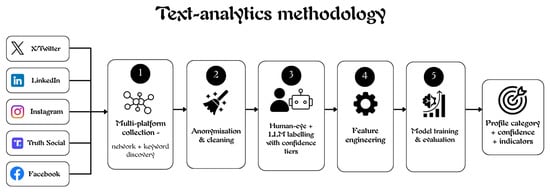
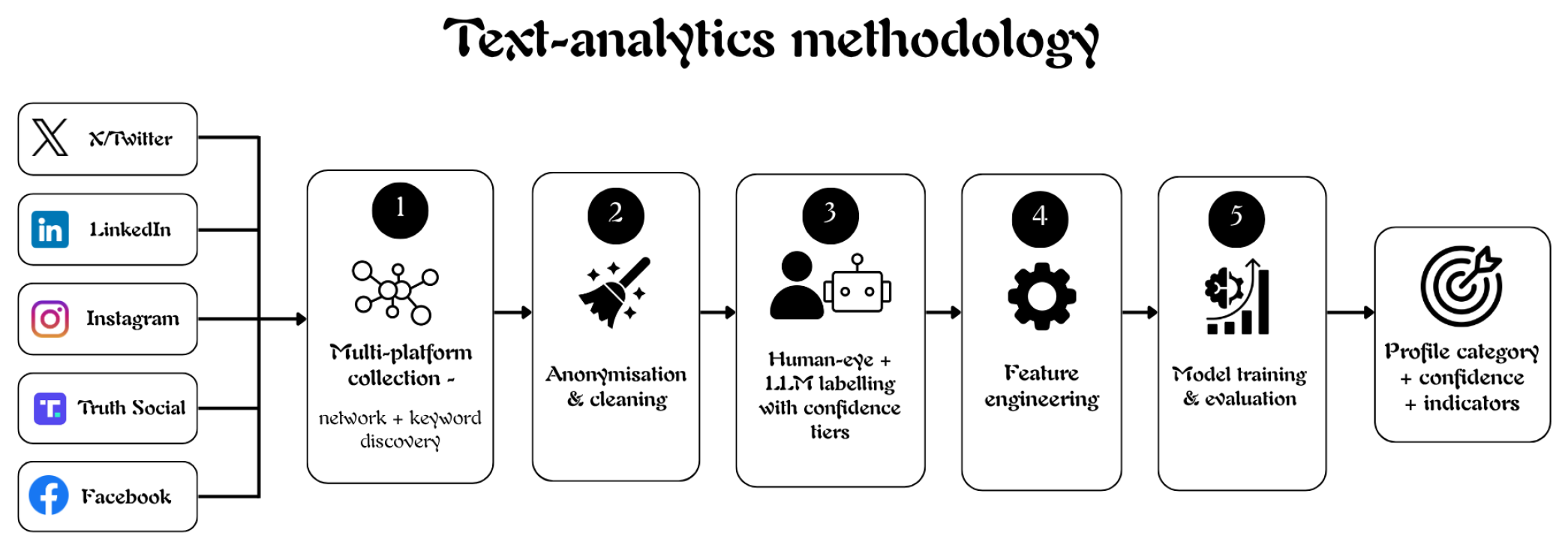
The work is a supervised, quantitative, multiclass classification study with a forensic orientation: every record stays traceable from collection to final label, confidence tier, reviewer source, and model prediction. The workflow ran in five stages. Public profiles were discovered and scraped from five platforms; text fields were extracted, anonymized, cleaned, and organized into structured text and profile records; ground truth was built from human eye review and LLM assisted agreement logic with confidence tiering; multidimensional textual features were engineered; and linear, tree-based, boosting, transformer, and ensemble models were trained and compared under a profile level evaluation protocol. The platforms differ in structure, label space, and data availability, so the study did not force a single shared label set. Each platform retained the label space supported by its evidence, and the same detection logic was tested across professional (LinkedIn), visual (Instagram), fast moving public-discourse (X/Twitter, Truth Social), and mixed-identity (Facebook) environments. Testing the same logic across these contexts supports the assessment that text based risk detection generalizes rather than fitting one platform. This workflow produces one evidentiary stream inside the larger multimodal system described above, so a text flag here is provisional, pending fusion with image and behavioral evidence, which lies outside the scope of this paper. Figure 2 summarizes the end to end text analytics methodology pipeline described in this section.
Figure 2.
End-to-end text-analytics methodology pipeline.
3.2. Data Collection
Collection was restricted to publicly visible profile content. The study did not use private messages, restricted accounts, password-protected pages, or backend registration data, which keeps the method realistic for open-source forensic analysis, where an investigator usually sees only public profile evidence. Two discovery modes were used. Network discovery began from seed accounts and expanded through visible public connections, followers, following lists, commenters, likers, and related accounts, producing naturally connected profiles rather than only keyword hits. Network expansion used a breadth first queue initialized from seed accounts, with crawl depth capped at two levels and per session limits on total profiles visited. Neighbor accounts were identified from @mention patterns in biography and caption text and from visible interaction links where available. Processed account logs were written to a checkpoint file after each profile so that interrupted collection sessions could resume without revisiting already-scraped accounts. Keyword-guided discovery used a structured vocabulary linked to the target categories to locate profiles and posts likely to contain relevant language, which improved coverage of less frequent categories such as cryptocurrency fraud and romance scam. Keyword presence was treated as a discovery aid only, never as a label: many legitimate users mention finance, relationships, or contact details, so each hit was a candidate trace requiring context.
The keyword taxonomy (Table 2) was also applied at extraction time, not only at discovery time. As each profile was scraped, its full text, name, biography, and captions were scanned against the same vocabulary, and the matched terms were recorded as both a keyword-hit string and a binary signal flag per category. This produced ten binary columns (has_crypto_signal, has_financial_signal, has_scam_signal, and several more) that later entered the Facebook and Truth Social feature sets directly as structured indicators alongside the text. The keyword presence at scrape time was therefore not discarded after discovery but preserved as a category level annotation linking each record back to the vocabulary that retrieved it.
Table 2.
Keyword categories and example search terms used during discovery.
The collected text covered identity fields (username, display name, biography, description), post and caption text, comments and replies, hashtags and mentions, and URL and contact references.
The categories in Table 2 draw directly on the risk patterns established in Section 2. The crypto and financial categories reflect the guaranteed return language and exchange impersonation patterns documented by Chainalysis [21] and by Muzammil et al. [22]. The romance category follows the staged affection and off platform redirection pattern that Wang’s scoping review identifies as the defining structure of romance fraud [18]. The scam category reflects the impersonation and cloning behaviors that Sarfraz et al. catalog across sockpuppet and scam operated accounts [2]. The hate and cyberbullying categories follow the protected characteristic and identifiable target distinctions used by Fortuna, Soler, and Wanner [48] and by Fulantelli et al. [49]. The spam category reflects the coordinated, low effort posting behavior that Mazza, Cola, and Tesconi describe in their account trafficking study [10]. Framing the vocabulary this way keeps each keyword category traceable to a documented deceptive mechanism rather than to an arbitrary word list.
A second collection pass focused specifically on behavior, retrieving recent post activity per account and computing engagement (likes, replies, reposts), structural elements (hashtags, mentions, embedded links), and, where reachable, the replies a user left elsewhere and the community responses they received. This two-sided capture gave both post-level and account-level context and supplied the structured profile features later combined with text.
3.3. Scraper Design and Anonymisation
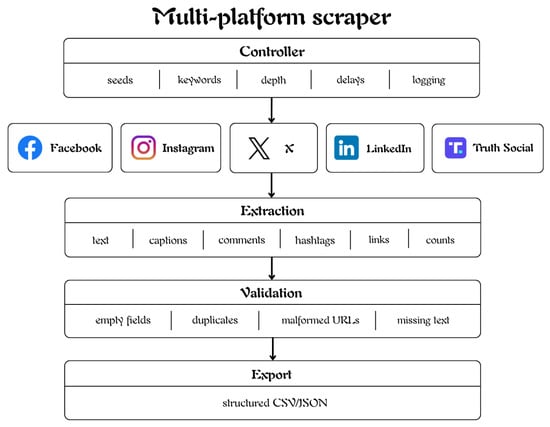
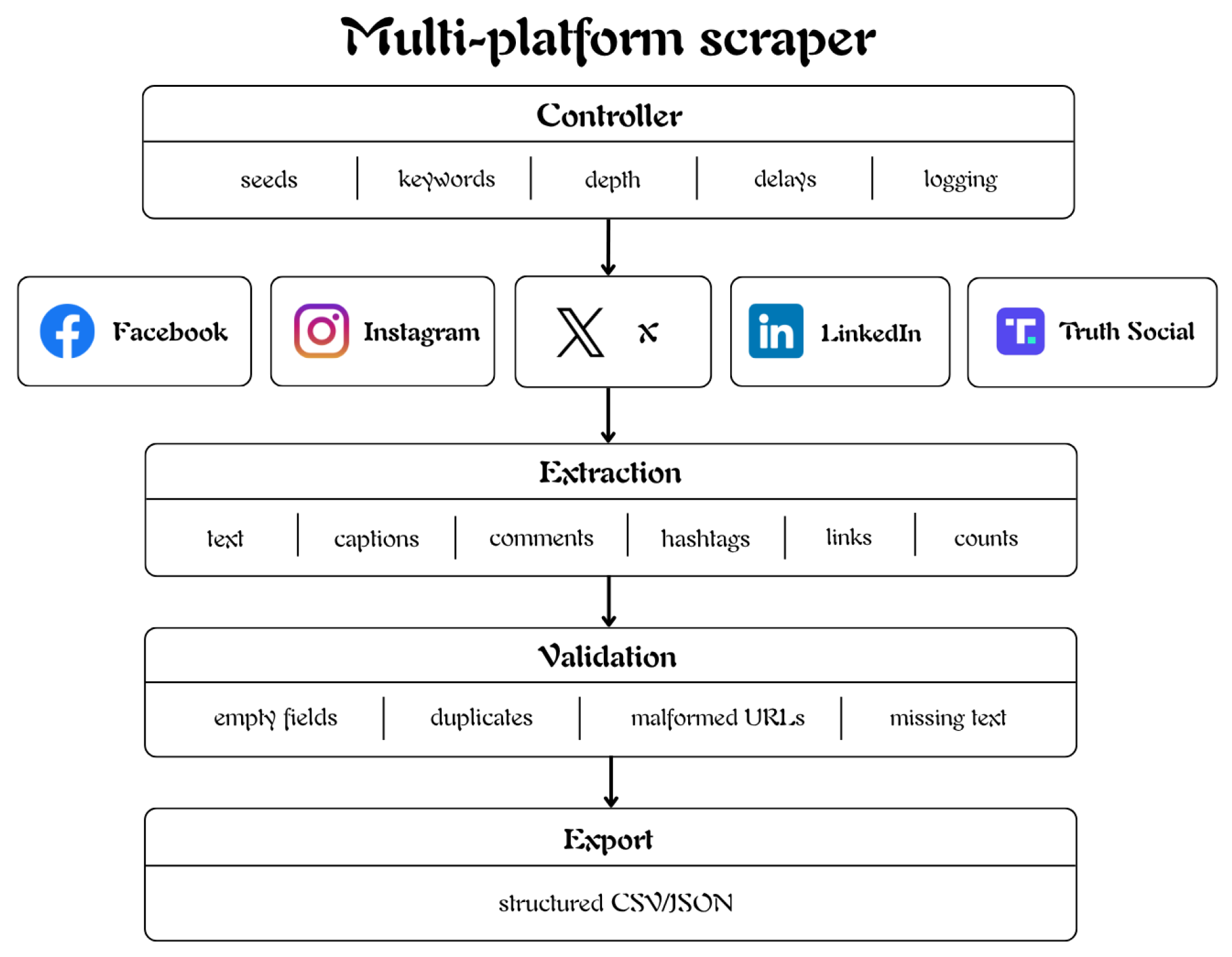
A modular scraper handled the five platforms through a shared schema with platform-specific extraction routines: a controller managed seeds, keywords, crawl depth, delays, and logging; platform modules handled navigation and field extraction; a validation layer checked empty fields, malformed URLs, and duplicates; and an export layer wrote structured records. For X and Truth Social, dedicated collection tools loaded public pages, intercepted structured responses, and exported profile and post data, using standard browser automation and request libraries with logging to reduce automated access detection, as depicted in Figure 3.
Figure 3.
Layered architecture of the multi-platform scraper.
After scraping, personally identifiable information was anonymized before analysis and reporting. Names and usernames were replaced with internal identifiers (for example profile_0001); profile URLs were kept internally for deduplication but hashed or excluded in reporting; phone, email, and wallet references were converted to category tokens; and any screenshots were blurred. The models classify on derived text and feature representations rather than on identity strings. A successful extraction did not imply suspicion, and an unavailable field did not imply deception; both were recorded so the dataset could show where evidence was missing.
3.4. Text Cleaning and Feature Construction
Cleaning was deliberately conservative, because social media language carries forensic signal that aggressive preprocessing destroys. Raw text was preserved in a separate field so that later interpretation could refer back to the original wording, punctuation, emoji use, and links. The model ready text was produced in five steps: available fields (biography, description, captions, posts, hashtags, URL text) were merged at record level; spacing, casing, and repeated separators were normalized while category relevant tokens were kept; URLs, mentions, hashtags, and platform markers were converted into explicit indicators rather than deleted; category signal variables were extracted for scam, crypto, romance, financial, hate, adult, cyberbullying, spam, and solicitation patterns; and the final inputs combined lexical features, structured indicators, and model specific representations. Empty fields were retained through missingness indicators rather than silently dropped, since a missing biography or absent captions can itself be informative.
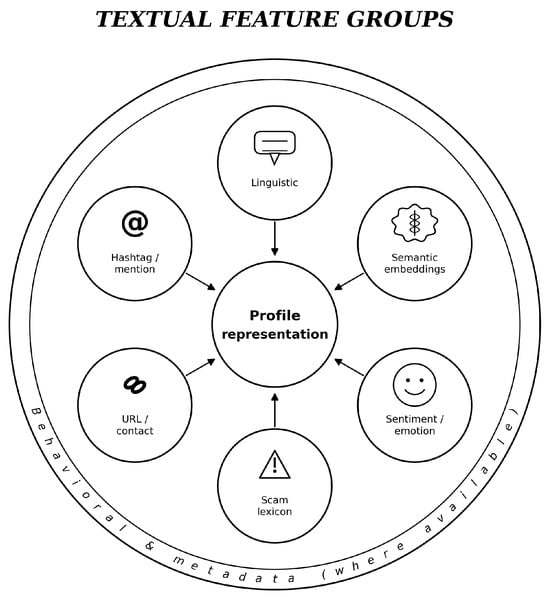
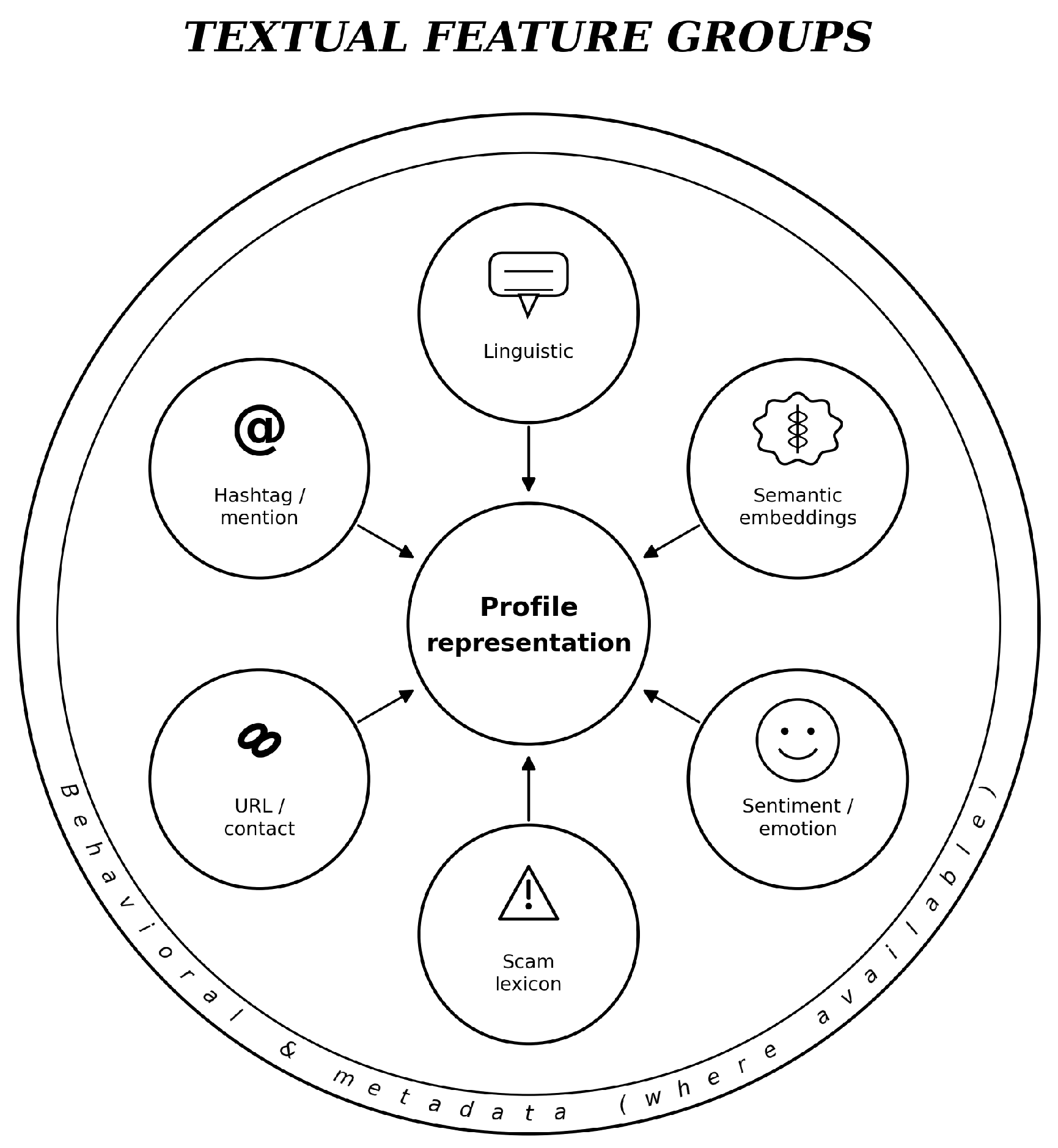
Cleaning was also model sensitive. Linear and count based models [50] used more normalized text because TF-IDF benefits from consistent tokens. Transformer models used lighter cleaning because subword tokenizers handle natural variation. Behavioral text features (URL count, hashtag count, mention count, contact references, repeated punctuation) were extracted before any destructive step so they were not lost. The resulting features were organized into the groups in Table 3, which keeps the representation interpretable: when a profile is flagged, the decision can be attributed to scam vocabulary, semantic similarity, redirection links, emotional framing, or profile level patterns rather than to an opaque score. Each group builds on work already discussed in Section 2: the semantic group follows the sentence embedding approach used for paraphrase detection [24], the sentiment and emotion group follows the fine grained emotion categories from GoEmotions [25], and the URL and contact group follows the off platform redirection pattern documented in the WhatsApp scam account removals [5]. Figure 4 illustrates how these feature groups combine into the profile representation.
Table 3.
Textual feature groups and their interpretive value.
Figure 4.
Textual feature groups combined into the profile representation.
Where platform datasets exposed structured profile signals, these were carried alongside the text. For Instagram this meant 14 numeric behavioral and engagement features (followers, following, post count, follower to following ratio, total likes, total comments, total engagement, average likes, comments and engagement per post, engagement rate, average and minimum posting gap, account completeness score) and 13 Boolean risk flags (verification, private status, zero post, high following and low followers, high crypto, solicitation, scam, romance, and financial ratios, low engagement, burst posting, incomplete profile, private account). Facebook added friendship, posting rate, image count, biography length, and account age fields. These structured signals are why boosting models, which exploit nonlinear interactions among mixed inputs, were expected to be competitive with or stronger than transformer-only models on the platforms that supplied them.
3.5. Ground Truth: Human Eye Labeling and LLM Agreement
Labeling required structured human judgment because social media text is frequently ambiguous: finance language without fraud, romance language without deception, or harmful words quoted in a non abusive context. The primary instrument was a systematic manual review process. The researcher opened each account and judged it on the combined weight of profile structure, image origin, textual content, and behavior, rather than any single cue. Over 10,000 profiles were reviewed, drawn from screening flags, keyword hits with unclear context, and each label category for balanced coverage. For a subset, a second independent pass was conducted after a time interval, without reference to the first decision, serving as an intra annotator consistency check. Disagreements between passes were re-examined and resolved conservatively, with preference for the less severe label where evidence remained genuinely ambiguous.
This two pass review design followed a documented consistency check approach used in manual social media annotation, with the resulting agreement verified quantitatively rather than assumed.
As part of the human review process, and as a methodological choice informed by, rather than prescribed by, general content-analysis and annotation practice [51], publicly available social media accounts associated with documented romance scams, cryptocurrency investment fraud, impersonation schemes, and other online scams were examined. Reviewing authentic scam profiles made it possible to observe recurring characteristics, including common vocabulary, posting patterns, profile presentation, engagement strategies, and deceptive narratives. These observations, combined with established human annotation practices reported in prior studies [52], provided practical context for developing consistent labeling criteria and improved the reliability of the manual classification process by helping distinguish suspicious profiles from legitimate ones.
Human reviewers judged the original, unmodified profile as it appeared on the platform, drawing on full visual and textual context. For LLM review and audit purposes, text fields were concatenated into a single Text column, URLs replaced with an explicit <URL> marker rather than deleted, and characters outside letters, digits, and common punctuation removed; the result was lowercased and whitespace normalized. Numeric columns were coerced to float and zero-filled. This cleaned representation was the basis for LLM review, and the versioned output file ensured every label decision was traceable to the exact text each reviewer saw.
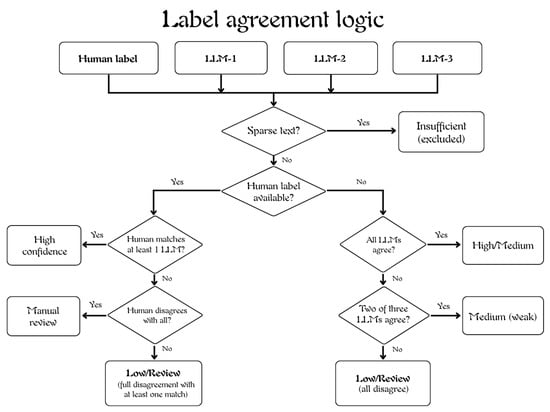
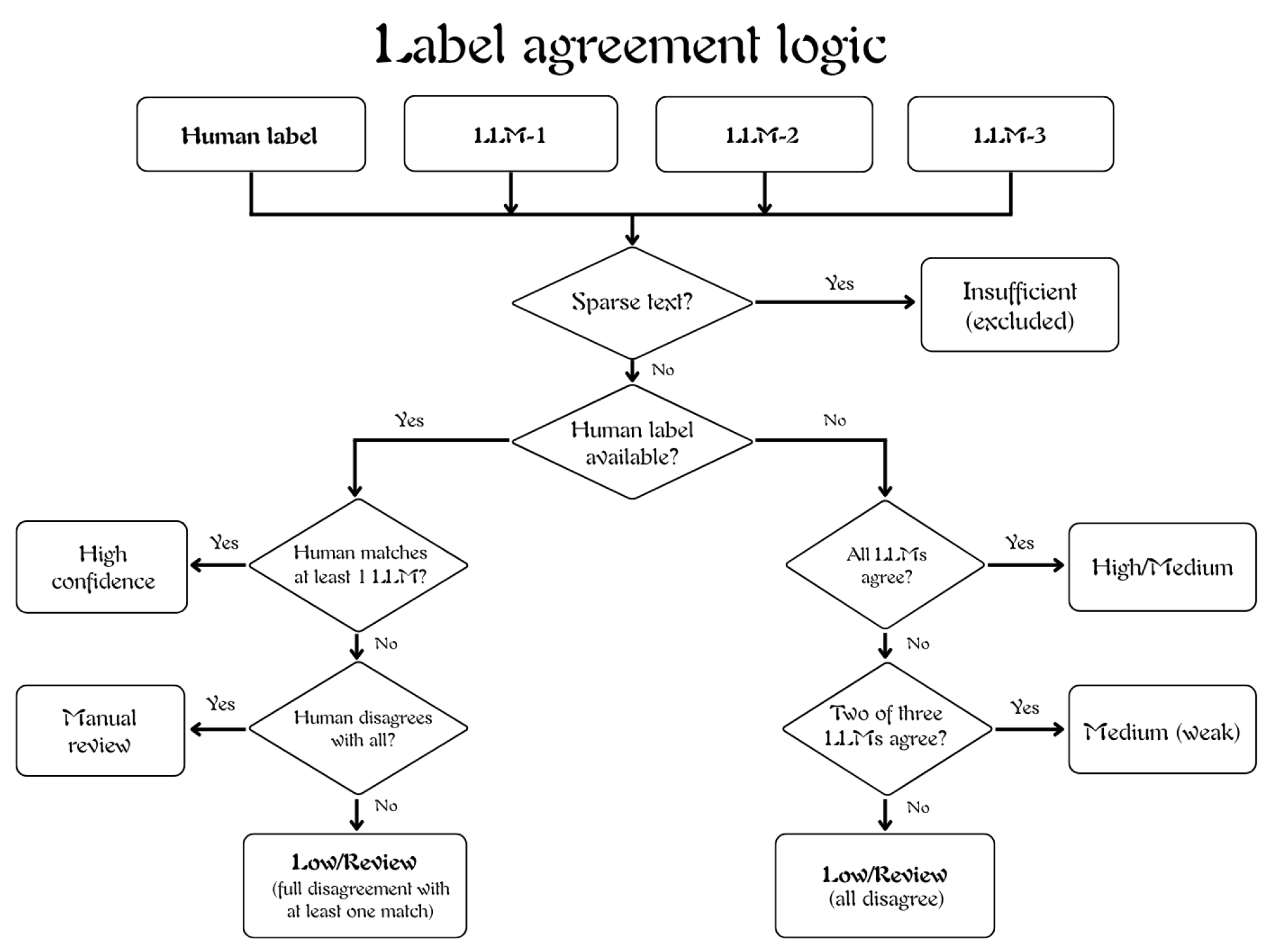
Three LLM reviewers provided secondary labels under an explicit agreement logic. A human label matching at least one LLM label was accepted as high confidence. Unanimous LLM agreement was accepted where the human label was missing. Two of three LLM agreement gave a medium confidence weak label. Human disagreement with all LLMs sent the record to manual review. Full disagreement marked the record low confidence and excluded it from high confidence interpretation. Records too sparse or contradictory to support any reliable label were marked insufficient and excluded from training, consistent with guidance to drop low-confidence labels rather than retain them with inflated certainty [53]. Intra-annotator agreement was tracked through majority consensus, confidence tier, and disagreement flags, and every record retained its initial label, assisted labels, final reconciled label, confidence tier, and review status as an audit trail.
Applied to a verification subset of 5,000 randomly sampled records, with passes separated by a minimum interval of 72 hours, the two pass review yielded Cohen’s [54,55], indicating substantial agreement across all label categories.
The label set (Table 4) reflects the deceptive, harmful, and ordinary behaviors actually encountered. Not every category appears on every platform; X/Twitter carried the widest space (including spam and fake engagement), while LinkedIn, Truth Social, and Facebook used seven-class spaces and Instagram a ten-class space that included an explicit insufficient-evidence label. Romance scam review specifically looked for affectionate outreach to strangers, claimed overseas occupations, requests to move to WhatsApp or Telegram, and rapid emotional escalation [56,57]; cryptocurrency-fraud review looked for guaranteed-return language, wallet links, fake testimonials, and exchange impersonation [58]; and AI-generated facial images on profiles making personal-identity claims were treated as a strong synthetic-identity signal [59]. This multimodal review reasoning, rejecting single-signal judgements, follows forensic social media practice [60,61]. Instagram was the only platform where translation was needed. A language scan carried out during collection found a meaningful share of non English captions only on Instagram, which fits its larger international creator base and its caption heavy format, while the other four platforms returned text that was almost entirely in English within the collected sample. Non English text on Instagram was identified using the langdetect library (v1.0.9) and translated to English prior to feature extraction using the Google Translate API via the deep-translator Python package (v1.9.x). Languages detected in the Instagram corpus included Portuguese, Spanish, Arabic, Hindi, and Tagalog, collectively accounting for approximately 18% of Instagram captions. All downstream features were computed on the translated English text; the original language text was retained in a separate column for audit purposes. Translation quality was not independently verified by a bilingual reviewer. A manual spot check was carried out instead: a sample of translated terms was checked against independent machine translations of the same source terms, and agreement across that sample fell in the range of ninety to ninety-nine percent depending on language pair. This check was not applied to every translated record, so the reported accuracy range describes the sampled subset rather than the full translated corpus, and it does not substitute for review by a bilingual annotator. Machine translation can flatten idiom and culturally specific phrasing that carry forensic weight in categories such as romance scam and solicitation, so scam lexicon matches and sentiment scores on translated Instagram captions should be read as a lower bound on precision relative to the English-language platforms.
Table 4.
Profile label categories used across platforms.
Figure 5 presents the human and LLM label agreement logic and confidence tiering process used to construct these labels.
Figure 5.
Human and LLM label agreement logic and confidence tiering.
3.6. Models and Ensembles
For each text sample a model produced a probability vector over the platform’s C classes, with the prediction . Five model families were compared (Table 5): interpretable linear baselines, a tree based model, gradient boosting models, transformer models, and ensembles. Citations attached to these families point to the paper that first introduced each technique, including work from 1992 on stacked generalization and from 2001 on random forests. These are cited deliberately rather than through an outdated literature search, since what is being referenced here is the original method itself, not the current state of research on fake profile detection, which is covered separately in Section 2 using recent work. Linear and boosting models used TF-IDF (10,000 to 20,000 terms, unigrams and bigrams, sublinear scaling) concatenated with the scaled structured features; transformers used contextual token representations with a maximum sequence length of 128, learning rate , training batch size 16, evaluation batch size 32, weight decay 0.01, warmup ratio 0.1, early stopping, up to 10 epochs, and a fixed seed of 42. For Instagram specifically, the TF-IDF vectorizer used max_features = 25,000, bigrams, min_df = 2, and max_df = 0.95 without sublinear scaling. This was embedded inside a ColumnTransformer pipeline that applied median imputation followed by StandardScaler to the 14 numeric behavioral features in a single fitted step, which is why structured-feature interactions were available to all linear and boosting models on that platform from the first training call. Tabular features were standardized before being combined with the sparse text features, so that the scale of engagement counts and ratios did not dominate the TF-IDF dimensions; Boolean flag features were cast to integers before scaling.
Table 5.
Text model families evaluated.
3.6.1. Weighted Loss
Class imbalance was addressed through a weighted cross-entropy loss applied to all model families:
where N is the total training records, is the count of class c, and C is the number of classes per platform. Predictions were subject to a confidence filter that routes low-certainty outputs to human review rather than forcing a label:
where across all five platforms. Profile-level scam-lexicon density, the feature group most strongly linked to classification decisions in the discussion, was computed per category as:
where is the indicator function, is the collection of tokens in profile p, and is the scam vocabulary for category k. Soft voting averaged base probabilities; weighted voting scaled each model’s contribution by its weighted F1 score on the held-out set; and stacking concatenated base probabilities into a meta-learner trained on out-of-fold predictions through 5-fold stratified cross-validation, with both Logistic Regression and Gradient Boosting compared as meta-learners. Ensembling reduces dependence on any single model family, which matters here because one model may recognize scam language well, another harmful content, and another ordinary behavior.
The hybrid ensemble combined the best-performing transformer’s probability outputs with CatBoost’s tabular-signal outputs at a fixed 0.6/0.4 ratio, weighted toward the transformer because text is the primary evidence stream and tabular features serve as a qualifying layer; the best transformer was selected per platform by weighted F1 on the held-out test set.
For scikit-learn models class_weight=‘balanced’ was applied; transformer models used per-class weights passed via a custom compute_loss function; and Facebook, with a majority-to-minority ratio exceeding 15:1, used tiered oversampling via sklearn.utils.resample to a maximum 5:1 ratio before training. No undersampling was applied.
3.6.2. Implementation and Training Configuration
All models were trained on a GPU workstation with dual NVIDIA RTX A6000 GPUs (96 GB total VRAM) using Python 3.11, PyTorch 2.5.1, scikit-learn 1.3.2, and HuggingFace Transformers 4.35.2. Random seeds were fixed at 42 for reproducibility.
3.7. Evaluation and Statistical Validation
Models were evaluated on accuracy, per-class precision, recall, and F1, summarized as weighted F1 to reflect class imbalance, with macro behavior read from class-level reports. One versus rest ROC-AUC was reported where probability outputs existed. Splits were stratified and, where profile linkage existed, applied at the profile level so text from one account never spanned train and test. Approximate 95% binomial confidence intervals were computed for accuracy; paired model comparisons on a shared test set used McNemar’s test; and calibration was checked with the Brier score where probabilities were available. These checks make the reported performance defensible beyond a single headline number.
LinkedIn, X/Twitter, Facebook, and Truth Social used a 70:10:20 stratified split with the validation set serving early stopping and meta-learner training. Instagram used an 80:20 stratified split with a fixed seed of 42.
4. Results
The central question was whether profile text alone could distinguish scam related, harmful, suspicious, and ordinary behavior across five platform environments. The evaluation covered five platforms with platform-specific label spaces, because the available evidence and class structure differed across them (Table 6). X/Twitter supplied the largest and widest dataset; LinkedIn gave the strongest overall classification; Facebook gave the strongest single result; Truth Social performed well with tree-based models; and Instagram produced the lowest text only performance, consistent with its emphasis on visual content and its characteristically short profile text.
Table 6.
Platform configuration for text-based detection.
4.1. Overall Platform-Level Performance
Approximate 95% confidence intervals for accuracy, computed as , are reported for all five platforms in Table 7: X/Twitter [0.9401, 0.9445], LinkedIn [0.9446, 0.9560], Instagram [0.8464, 0.8722], Truth Social [0.8937, 0.9085], and Facebook [0.9592, 0.9690]. The full model comparison (Table 8) shows text was a strong detection stream everywhere it was tested. Facebook produced the strongest single result (0.9641 accuracy, 0.9639 F1, 0.9981 ROC-AUC with XGBoost), followed closely by LinkedIn (0.9503 accuracy, 0.9518 F1, 0.9967 ROC-AUC). X/Twitter gave the strongest large-scale result, 0.9395 F1 on a 13-class task over more than 200,000 records. Truth Social reached 0.8998 F1 with 0.9898 ROC-AUC, and Instagram, the hardest case, still reached 0.8594 F1.
Table 7.
Approximate 95% confidence intervals for accuracy, by platform.
Table 8.
Text model performance per platform on the held-out test sets.
These intervals show how much the reported accuracy could plausibly shift if the evaluation were repeated on a different sample of the same size, so a narrow interval points to a stable estimate while a wide one is a signal to treat the accuracy figure with more caution. The interval is narrowest for X/Twitter given its large test set and widest for Instagram, whose smaller test set and lower accuracy combine to produce the least precise estimate.
4.2. X/Twitter
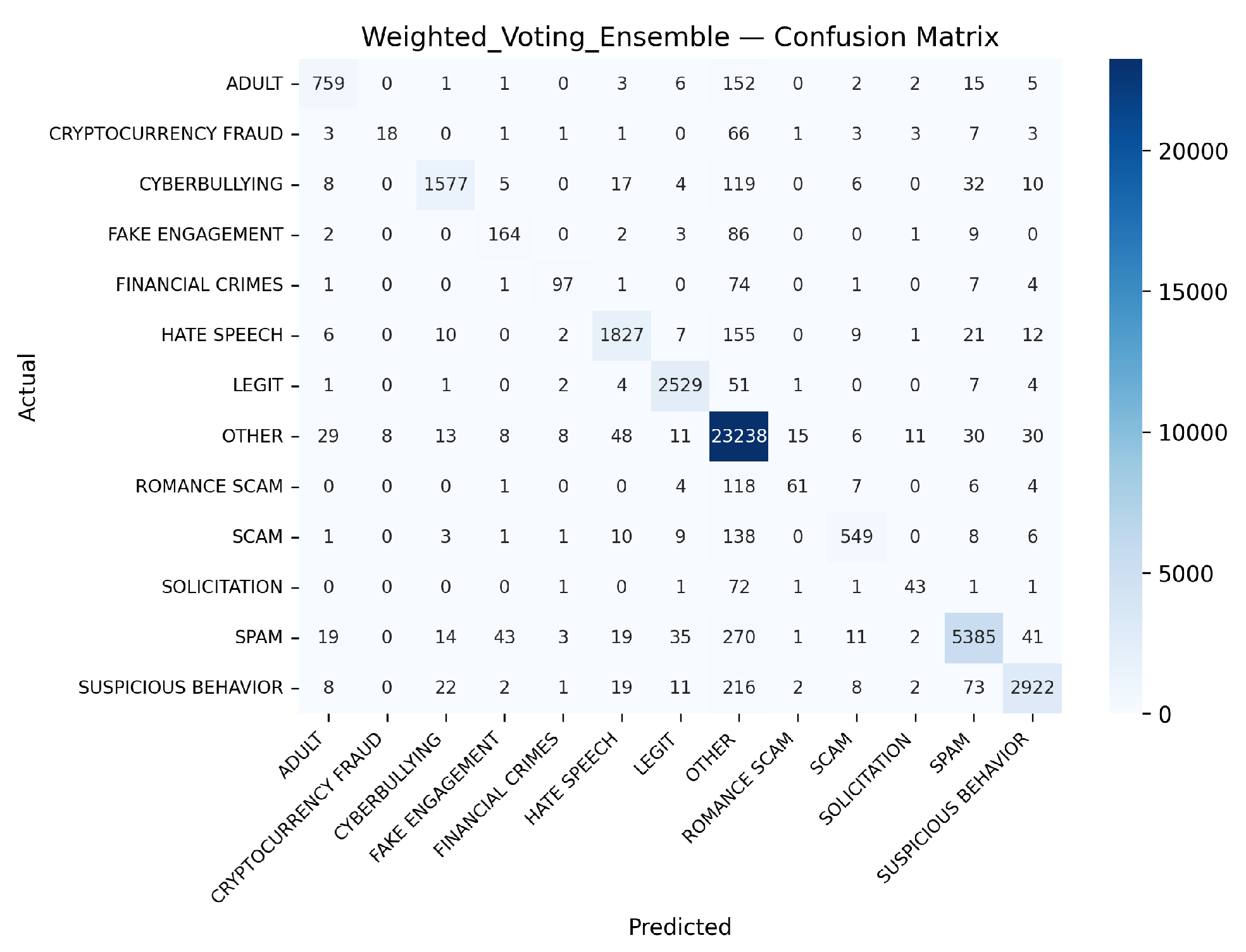
X/Twitter was the largest and most diverse experiment, covering 13 classes across more than 200,000 records. The Weighted Voting Ensemble led narrowly (Table 8), with near identical Soft Voting scores confirming that the strongest base models agreed on the dominant class boundaries. Well represented classes scored strongly while rare classes (Cryptocurrency Fraud, Romance Scam, Solicitation, Financial Crimes) suffered from small support and vocabulary overlap with broader suspicious or financial content (Table 9), which is exactly the failure mode addressed by fusing text with image provenance and behavioral evidence.
Table 9.
Consolidated class level performance of the best model on each platform.
4.3. LinkedIn
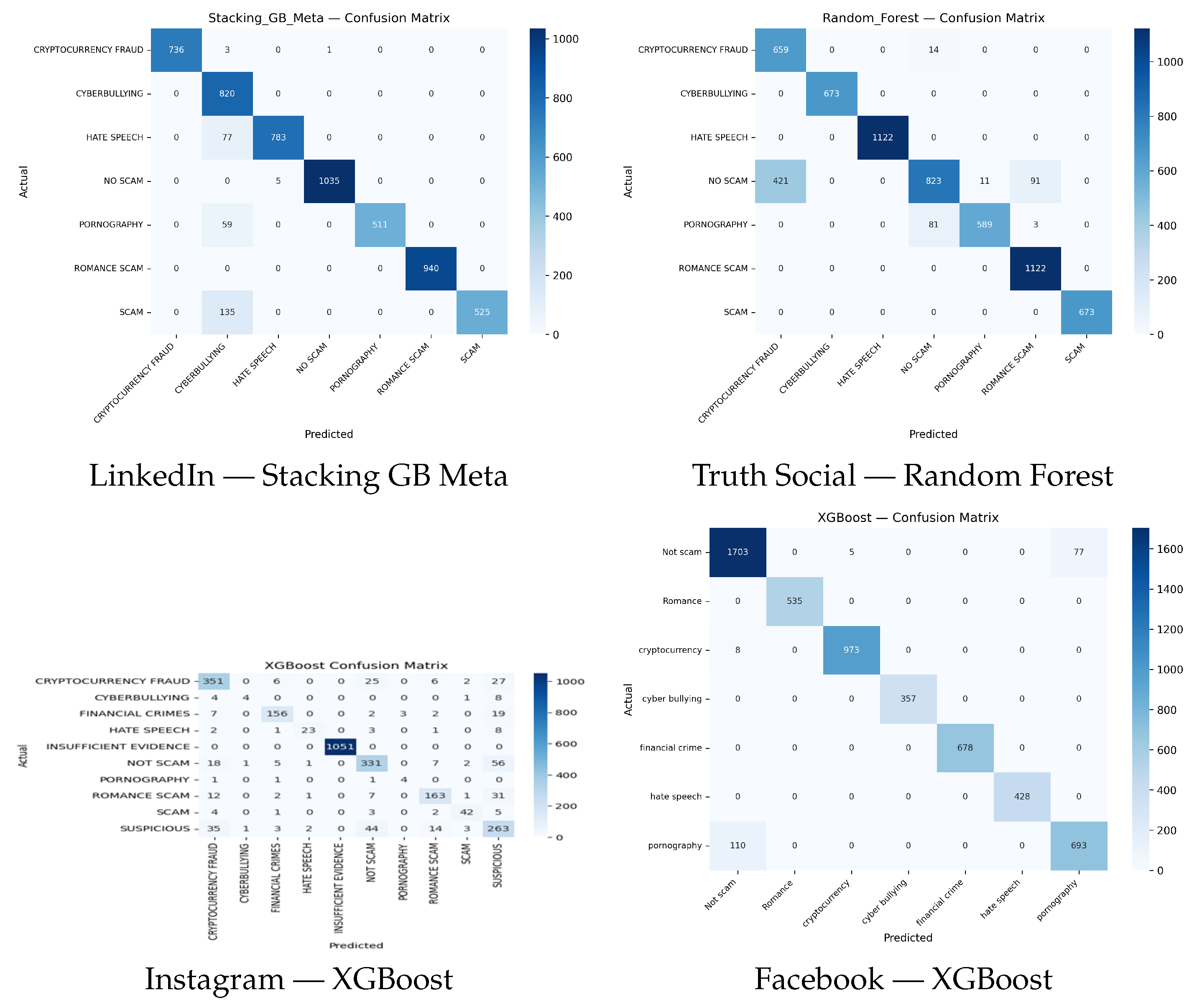
LinkedIn produced the strongest absolute result (Table 8), with five models clustered within a fraction of a point. Not Scam/Legit, Romance Scam, and Cryptocurrency Fraud were classified near-perfectly (Table 9). Cyberbullying reached perfect recall at lower precision, meaning all such records were recovered but some neighboring records were pulled into the class; Scam showed the reverse pattern, with reliable predictions but some records absorbed into adjacent categories. This is consistent with LinkedIn’s professional register, where scam signals surface through employment claims and institutional language rather than overt urgency or financial bait.
4.4. Instagram
Instagram (ten classes, 80:20 split) combined the translated-text field with 14 numeric and 13 Boolean structured features. XGBoost led at 0.8594 F1 ahead of Random Forest (0.8029) and DistilBERT (0.7893), confirming that structured indicators and nonlinear interactions outperform transformer-only representations when captions are short or hashtag-dominated. The model recovered scam-relevant classes well: Cryptocurrency Fraud (0.83 F1), Financial Crimes (0.86), Romance Scam (0.79), and Scam (0.78) (Table 9). Weak Cyberbullying (0.35) and Pornography (0.57) scores reflect test supports of 17 and 7 records, not a general failure. The main confusion ran among Not Scam/Legit, Suspicious, and the three scam categories because short profile text cannot always infer intent from language alone.
Consolidated class-level performance of the best model on each platform. A platform’s table block lists only the classes present in its own label space; a class is simply not shown for platforms where that category was never part of the label space, since the paper does not force a single shared label set across platforms, as seen in Table 9.
4.5. Truth Social
Truth Social (seven classes) favored tree-based models, with Random Forest strongest at 0.8998 F1 and 0.9898 ROC-AUC. Structured keyword signals were highly discriminative. Cyberbullying, Hate Speech, Scam, and Romance Scam were classified near-perfectly; Cryptocurrency Fraud showed high recall at lower precision because finance language is shared between legitimate discussion and fraud, pulling some ordinary financial posts into the fraud class (Table 9).
4.6. Facebook
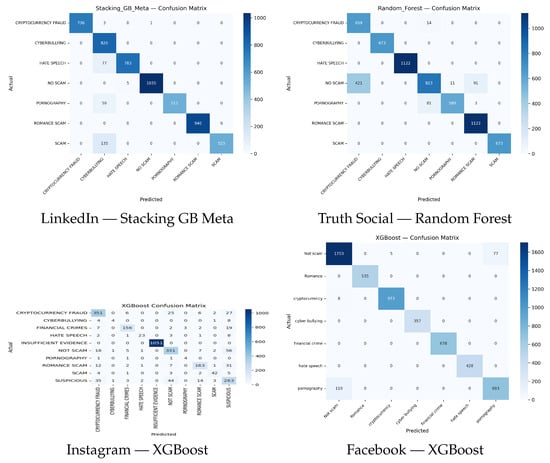
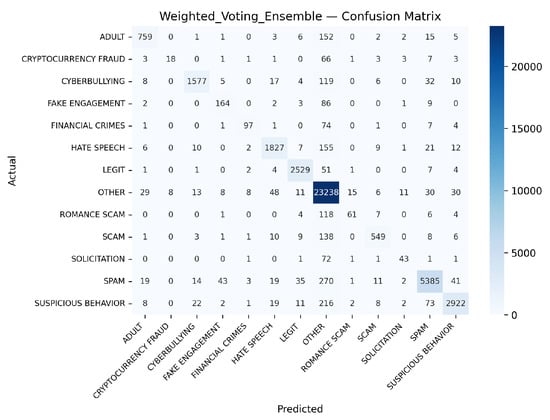
Facebook (seven classes, 70:10:20 split) combined text with 20 numeric profile, engagement, and image fields. XGBoost was strongest at 0.9641 accuracy, 0.9639 F1, and 0.9981 ROC-AUC. Boosting outperformed transformer-only baselines because the combination of language, engagement, account age, and image-count signals gave gradient boosting a richer nonlinear interaction surface. With the smallest class (Cyberbullying) still holding 1784 records, class boundaries were stable throughout. Romance Scam, Cyberbullying, Financial Crimes, Hate Speech, and Cryptocurrency Fraud were classified perfectly or near-perfectly; Pornography (0.88 F1) was the hardest class because adult content overlaps with ordinary entertainment (Table 9). Figure 6 presents the confusion matrices for the best model on LinkedIn, Truth Social, Instagram, and Facebook, and Figure 7 presents the confusion matrix for the Weighted Voting Ensemble on X/Twitter.
Figure 6.
Confusion matrices for LinkedIn Stacking GB Meta (top left), Truth Social Random Forest (top right), Instagram XGBoost (bottom left), and Facebook XGBoost (bottom right).
Figure 7.
Confusion matrix for the Weighted Voting Ensemble on X/Twitter (13 classes).
4.7. Cross-Platform Interpretation
The cross platform findings summarized in Table 10 demonstrate that classification performance depends more on the richness and structure of the available language than on model architecture alone. LinkedIn scored highest because professional profiles carry structured identity and risk cues; X/Twitter’s ensemble handled noisy public discourse at scale; Truth Social’s tree-based models exploited strong category signals; Facebook’s boosting models combined language with engagement, friendship, and image signals; and Instagram, the most visual platform, gave the weakest text-only result while still recovering the scam-relevant classes. The recurring mechanism is that boosting and tree based models matched or beat transformer-only models whenever structured profile features were present, while ensembling helped most where text was short and noisy. This result runs against a common default in text classification work, where transformer architectures are treated as the strongest available option regardless of the data at hand. That assumption holds when the evidence is long, continuous prose, but profile detection deals with short, fragmented text joined to engagement counts, account age, and completeness scores. Gradient boosting reads those mixed numeric and lexical signals directly, while a transformer’s advantage in tracking long range meaning has little to work with in a two line biography. The practical lesson is that model choice should follow the actual shape of the evidence rather than a general preference for the most complex architecture available.
Table 10.
Cross platform interpretation of text based detection results.
4.8. Limitations
Six limitations bound these results. First, rare class imbalance depressed recall on X/Twitter, in Cryptocurrency Fraud, Romance Scam, Solicitation, and Financial Crimes, and on Instagram, in Cyberbullying and Pornography, while Facebook’s larger per class support gave it more stable boundaries. Second, Instagram’s short captions and its reliance on machine translated text left it as the weakest text-only result of the five platforms. Third, semantic overlap between crypto fraud and ordinary finance on Truth Social, and between scam, suspicious, solicitation, and financial categories on X/Twitter, defines text as a strong but partial evidence stream rather than a complete one.
Fourth, collection was restricted to publicly visible profile content, so the framework has not been tested against private messages or closed group content. Fifth, the datasets analyzed here are static snapshots collected over a fixed period rather than a continuously monitored stream. Sixth, the human review stage relied on a single primary annotator, with a second independent pass serving as the main consistency check rather than a full multi reviewer protocol. Each of these points is picked up directly in the conclusion below.
5. Conclusions
This study built a reproducible and transparent analytical pipeline: public text collection across five platforms through network and keyword discovery, anonymization, cleaning adapted to each model family, two pass human eye labeling with LLM agreement logic and confidence tiering, multidimensional feature engineering, and comparative modeling across five model families. The contribution is not a single classifier but an evidence oriented framework operating at the profile level, in which every prediction carries a category, a confidence score, and the indicators that support it. Every model score should be treated as decision support rather than a final determination.
Each limitation named in Section 4.8 points to a specific direction for future work rather than a general call for more data or more models.
- Rare class imbalance on X/Twitter and Instagram calls for targeted data collection in the categories that suffered weak recall, cryptocurrency fraud, romance scam, and solicitation, rather than a general expansion of the corpus.
- Instagram’s dependence on machine translation calls for a proper multilingual evaluation, including review by bilingual annotators rather than the spot check used here.
- The semantic overlap between deceptive and ordinary language, most visible in crypto fraud against legitimate finance and adult content against entertainment, motivates validating model explanations against the human rationales already recorded during labeling.
- Restricting collection to publicly visible content leaves the framework untested against private messages and closed group content, so a natural extension is to pursue access to that material through platform partnership or lawful cooperation, and to see whether the same textual signals hold once that content is included.
- Working from a fixed snapshot leaves the framework untested against language that shifts over time, so future work should retrain and re evaluate the models on newly collected profiles at intervals rather than treating this dataset as a permanent baseline.
- Relying on a single primary annotator calls for a structured multi reviewer adjudication protocol, extending the two pass design in Section 3.5 to independent reviewers.
A further test worth pursuing is cross platform generalization, training on one platform and evaluating on another, which follows directly from the finding in Section 4.7 that performance tracked platform specific language structure rather than a single shared pattern. The aim throughout is a system that strengthens human forensic judgment rather than substituting for it.
Author Contributions
Conceptualization, B.G.B. and Q.L.; methodology, B.G.B.; software, B.G.B.; validation, B.G.B.; formal analysis, B.G.B.; investigation, B.G.B.; resources, B.G.B.; data curation, B.G.B.; writing, original draft preparation, B.G.B.; writing, review and editing, B.G.B.; visualization, B.G.B.; supervision, Q.L.; project administration, Q.L. All authors have read and agreed to the published version of the manuscript.
Funding
This research received no external funding.
Institutional Review Board Statement
All data collection was restricted to publicly visible profile content accessible without authentication on each platform which we scraped and collected ourselves. We curated our own data from the public available profiles on socialE media. No private messages, authenticated-only content, or registration data were accessed at any point. All scraped records were anonymized before analysis: usernames were replaced by internal numeric identifiers, and no personally identifiable information is reported in any table or figure. The study was conducted in accordance with the ethical guidelines of Sam Houston State University and in compliance with the publicly accessible content provisions of the terms of service applicable to each platform at the time of collection. This study was determined to be exempt from full institutional review board oversight, since it analyzed only publicly available social media content with no interaction with human subjects and no access to private or identifiable data. The study nonetheless followed the ethical principles of the ACM Code of Ethics and the GDPR principle of data minimization by retaining only profile level aggregate features and discarding raw text after feature extraction.
Informed Consent Statement
The model training scripts, feature extraction pipeline, ensemble configuration files, datasets, and data collection scripts developed for this study are available from the corresponding author upon reasonable request. Public release has not been adopted because unrestricted distribution could facilitate misuse of the data collection methodology and associated resources.
Data Availability Statement
The datasets generated, collected, and analysed during this study were created by the authors from publicly accessible social media profile content. All records were manually labelled and anonymised prior to analysis. To promote responsible research practices and minimise the potential for misuse, the datasets are available from the corresponding author upon reasonable request.
Conflicts of Interest
The authors declare no conflicts of interest.
Abbreviations
The following abbreviations are used in this manuscript:
| NLP | Natural Language Processing |
| LLM | Large Language Model |
| TF-IDF | Term Frequency–Inverse Document Frequency |
| XAI | Explainable Artificial Intelligence |
| MCC | Matthews Correlation Coefficient |
| AUC | Area Under the Curve |
References
- Kemp, S. Digital 2025: The State of Social Media in 2025. DataReportal. 2025. Available online: https://datareportal.com/reports/digital-2025-sub-section-state-of-social (accessed on 7 May 2026).
- Sarfraz, A.; Ahmad, A.; Zeshan, F.; Hamid, M.; Alshalali, T.A.N. Unmasking Deception: Detection of Fake Profiles in Online Social Ecosystems. J. Big Data 2025, 12, 154. [Google Scholar] [CrossRef] [Scilit]
- Xiang, L.; Li, N.; Liu, Y.; Hu, J. AI-Generated Text Detection: A Comprehensive Review of Active and Passive Approaches. Comput. Mater. Contin. 2026, 86, 5. [Google Scholar] [CrossRef] [Scilit]
- Arrieta, A.B.; Díaz-Rodríguez, N.; Del Ser, J.; Bennetot, A.; Tabik, S.; Barbado, A.; García, S.; Gil-López, S.; Molina, D.; Benjamins, R.; et al. Explainable Artificial Intelligence (XAI): Concepts, Taxonomies, Opportunities and Challenges Toward Responsible AI. Inf. Fusion 2020, 58, 82–115. [Google Scholar] [CrossRef] [Scilit]
- Associated Press. WhatsApp Takes Down 6.8 Million Accounts Linked to Criminal Scam Centers, Meta Says; Associated Press News: New York City, NY, USA, 2025. [Google Scholar]
- Cinus, F.; Minici, M.; Luceri, L.; Ferrara, E. Exposing Cross-Platform Coordinated Inauthentic Activity in the Run-Up to the 2024 U.S. Election. In Proceedings of the ACM Web Conference 2025; Association for Computing Machinery: New York City, NY, USA, 2025; pp. 541–559. [Google Scholar]
- Ayoobi, N.; Shahriar, S.; Mukherjee, A. The Looming Threat of Fake and LLM-generated LinkedIn Profiles: Challenges and Opportunities for Detection and Prevention. In Proceedings of the 34th ACM Conference on Hypertext and Social Media; Association for Computing Machinery: New York City, NY, USA, 2023; pp. 1–10. [Google Scholar] [CrossRef] [Scilit]
- Orabi, M.; Mouheb, D.; Al Aghbari, Z.; Kamel, I. Detection of Bots in Social Media: A Systematic Review. Inf. Process. Manag. 2020, 57, 102250. [Google Scholar] [CrossRef] [Scilit]
- Ellaky, Z.; Benabbou, F.; Ouahabi, S. Systematic Literature Review of Social Media Bots Detection Systems. J. King Saud Univ.-Comput. Inf. Sci. 2023, 35, 101551. [Google Scholar] [CrossRef] [Scilit]
- Mazza, M.; Cola, G.; Tesconi, M. Ready-to-(ab)use: From Fake Account Trafficking to Coordinated Inauthentic Behavior on Twitter. Online Soc. Netw. Media 2022, 31, 100224. [Google Scholar] [CrossRef] [Scilit]
- Dang, X.; Liu, W.; Zhong, X.; Wang, Z. SegTraj: A Segmented-Trajectory-Aware Spatio-Temporal Graph Convolutional Network for Social Group Detection. In Proceedings of the 33rd ACM International Conference on Multimedia (MM ’25); Association for Computing Machinery: New York City, NY, USA, 2025; pp. 4571–4579. [Google Scholar] [CrossRef] [Scilit]
- Hong, S.; Wang, X.; Zhang, C.; Wang, J.; Duan, P.; Wang, Y. AIGC Video Detection Based on the Fusion of Spatial-Frequency-Optical Flow Multimodal Features. J. Syst. Eng. Electron. 2026. early access. [Google Scholar] [CrossRef] [Scilit]
- ISO/IEC 27037:2012; Information Technology—Security Techniques—Guidelines for Identification, Collection, Acquisition and Preservation of Digital Evidence. ISO: Geneva, Switzerland, 2012.
- Guttman, B. Digital Evidence Preservation: Considerations for Evidence Handlers; Technical Report NIST IR 8387; National Institute of Standards and Technology: Gaithersburg, MD, USA, 2022. [Google Scholar] [CrossRef] [Scilit]
- Shukla, P.K.; Veerasamy, B.D.; Alduaiji, N.; Addula, S.R.; Pandey, A.; Shukla, P.K. Fraudulent Account Detection in Social Media Using Hybrid Deep Transformer Model and Hyperparameter Optimization. Sci. Rep. 2025, 15, 38447. [Google Scholar] [CrossRef] [Scilit] [PubMed]
- Sousa-Silva, R. Fighting Cyber-malice: A Forensic Linguistics Approach to Detecting AI-generated Malicious Texts. In Proceedings of the Workshop on Natural Language Processing for AI and Cybersecurity; Association for Computational Linguistics: Stroudsburg, PA, USA, 2024; pp. 165–175. [Google Scholar]
- Juned, A.M.; Aziz, A.; Sharif, N.A.M.; Shah, N.; Yatim, A.; Fakhruddin, W. The Language of Lies: An Analysis of Deceptive Linguistic Cues on Malaysian Investors’ Decision-Making. Int. J. Res. Innov. Soc. Sci. 2024, 8, 668–673. [Google Scholar]
- Wang, F. A Scoping Review of Online Romance Scams: Conceptual Construction and Comparative Analysis. Int. Rev. Vict. 2026. online first. [Google Scholar] [CrossRef] [Scilit]
- Federal Trade Commission. Reported Losses to Scams on Social Media Eight Times Higher Than in 2020; FTC Data Spotlight; Federal Trade Commission: Washington, DC, USA, 2026. [Google Scholar]
- Federal Bureau of Investigation. 2024 Internet Crime Report; Internet Crime Complaint Center Annual Report; Federal Bureau of Investigation: Washington, DC, USA, 2025. [Google Scholar]
- Chainalysis. 2025 Crypto Crime Mid-Year Update; Chainalysis Blog; Chainalysis: New York, NY, USA, 2025. [Google Scholar]
- Muzammil, M.; Pitumpe, A.; Li, X.; Rahmati, A.; Nikiforakis, N. The Poorest Man in Babylon: A Longitudinal Study of Cryptocurrency Investment Scams. In Proceedings of the ACM Web Conference 2025; ACM: New York, NY, USA, 2025; pp. 1034–1045. [Google Scholar] [CrossRef] [Scilit]
- Jabir, R.; Le, J.; Nguyen, C. Phishing Attacks in the Age of Generative Artificial Intelligence: A Comprehensive Survey. AI 2025, 6, 174. [Google Scholar] [CrossRef] [Scilit]
- Reimers, N.; Gurevych, I. Sentence-BERT: Sentence Embeddings Using Siamese BERT-Networks. In Proceedings of the 2019 Conference on Empirical Methods in Natural Language Processing; Association for Computational Linguistics: Stroudsburg, PA, USA, 2019; pp. 3982–3992. [Google Scholar] [CrossRef] [Scilit]
- Demszky, D.; Movshovitz-Attias, D.; Ko, J.; Cowen, A.; Nemade, G.; Ravi, S. GoEmotions: A Dataset of Fine-Grained Emotions. In Proceedings of the 58th Annual Meeting of the Association for Computational Linguistics; Association for Computational Linguistics: Stroudsburg, PA, USA, 2020; pp. 4040–4054. [Google Scholar] [CrossRef] [Scilit]
- Cheng, M.; Xiao, Y.; Huang, T.; Lei, C.; Zhang, C. CB-MTE: Social Bot Detection via Multi-Source Transformer Ensemble. Sensors 2025, 25, 3549. [Google Scholar] [CrossRef] [Scilit] [PubMed]
- Minaee, S.; Kalchbrenner, N.; Cambria, E.; Nikzad, N.; Chenaghlu, M.; Gao, J. Deep Learning Based Text Classification: A Comprehensive Review. ACM Comput. Surv. 2021, 54, 1–40. [Google Scholar] [CrossRef] [Scilit]
- Madhu, S.; Sreelakshmi, N.G.; Madhuri, G.R.; Shanmukha, P.; Rajesh, D.V.; Bhanu, Y.V.S. Profile Imposter Detection on Instagram Using XGBoost and SVM Algorithm. In Proceedings of the International Conference on Computational Innovations and Emerging Trends; Atlantis Press: Dordrecht, The Netherlands, 2024; pp. 1453–1461. [Google Scholar] [CrossRef] [Scilit] [PubMed]
- Goyal, B.; Gill, N.S.; Gulia, P.; Alduaiji, N.; Shukla, P.K.; J, S. Instagram Fake Profile Detection Using an Ensemble Learning Approach. Sci. Rep. 2025, 15, 26464. [Google Scholar] [CrossRef] [Scilit] [PubMed]
- Devlin, J.; Chang, M.W.; Lee, K.; Toutanova, K. BERT: Pre-training of Deep Bidirectional Transformers for Language Understanding. In Proceedings of the 2019 Conference of the North American Chapter of the Association for Computational Linguistics; Association for Computational Linguistics: Stroudsburg, PA, USA, 2019; pp. 4171–4186. [Google Scholar]
- Liu, Y.; Ott, M.; Goyal, N.; Du, J.; Joshi, M.; Chen, D.; Levy, O.; Lewis, M.; Zettlemoyer, L.; Stoyanov, V. RoBERTa: A Robustly Optimized BERT Pretraining Approach. arXiv 2019, arXiv:1907.11692. [Google Scholar]
- Sanh, V.; Debut, L.; Chaumond, J.; Wolf, T. DistilBERT, a Distilled Version of BERT: Smaller, Faster, Cheaper and Lighter. In Proceedings of the 5th Workshop on Energy Efficient Machine Learning and Cognitive Computing, Vancouver, BC, Canada, 13 December 2019. [Google Scholar]
- Nguyen, D.Q.; Vu, T.; Nguyen, A.T. BERTweet: A Pre-trained Language Model for English Tweets. In Proceedings of the 2020 Conference on Empirical Methods in Natural Language Processing: System Demonstrations; Association for Computational Linguistics: Stroudsburg, PA, USA, 2020; pp. 9–14. [Google Scholar] [CrossRef] [Scilit]
- Salles, I.; Vargas, F.; Benevenuto, F. HateBRXplain: A Benchmark Dataset with Human-Annotated Rationales for Explainable Hate Speech Detection in Brazilian Portuguese. In Proceedings of the 31st International Conference on Computational Linguistics; International Committee on Computational Linguistics: Abu Dhabi, United Arab Emirates, 2025; pp. 6659–6669. [Google Scholar]
- Sheth, R.; Sinha, S.R.; Patil, M.; Beniwal, H.; Singh, M. Beyond Monolingual Assumptions: A Survey of Code-Switched NLP in the Era of Large Language Models. arXiv 2025, arXiv:2510.07037. [Google Scholar]
- Basile, V.; Bosco, C.; Fersini, E.; Nozza, D.; Patti, V.; Rangel Pardo, F.M.; Rosso, P.; Sanguinetti, M. SemEval-2019 Task 5: Multilingual Detection of Hate Speech Against Immigrants and Women in Twitter. In Proceedings of the 13th International Workshop on Semantic Evaluation; Association for Computational Linguistics: Stroudsburg, PA, USA, 2019; pp. 54–63. [Google Scholar] [CrossRef] [Scilit]
- Chared, Z.; Jantet, C.; Ravix, C.; Salmi, R.; Hashmi, E.; Yildirim-Yayilgan, S. AI-driven detection of hate speech on social media: A case study in the French language. Clust. Comput. 2025, 28, 811. [Google Scholar] [CrossRef] [Scilit]
- Giorgi, T.; Cima, L.; Fagni, T.; Avvenuti, M.; Cresci, S. Human and LLM Biases in Hate Speech Annotations: A Socio-Demographic Analysis of Annotators and Targets. Int. AAAI Conf. Web Soc. Media 2025, 19, 653–670. [Google Scholar] [CrossRef] [Scilit]
- Dehghan, S.; Sen, M.U.; Yanikoglu, B. Dealing with Annotator Disagreement in Hate Speech Classification. arXiv 2025, arXiv:2502.08266. [Google Scholar]
- Zhu, Y.; Zhang, P.; Haq, E.U.; Hui, P.; Tyson, G. Can ChatGPT Reproduce Human-Generated Labels? A Study of Social Computing Tasks. arXiv 2023, arXiv:2304.10145. [Google Scholar]
- Liu, J. Rubric-Conditioned Large Language Model Labeling: Agreement, Uncertainty and Label Consistency in Subjective Text Annotation. Comput. Hum. Behav. 2026, 181, 108988. [Google Scholar] [CrossRef] [Scilit]
- Hermosilla, P.; Díaz, M.; Berríos, S.; Allende-Cid, H. Use of Explainable Artificial Intelligence for Analyzing and Interpreting Digital Evidence. Computers 2025, 14, 160. [Google Scholar] [CrossRef] [Scilit]
- Rudin, C. Stop Explaining Black Box Machine Learning Models for High Stakes Decisions and Use Interpretable Models Instead. Nat. Mach. Intell. 2019, 1, 206–215. [Google Scholar] [CrossRef] [Scilit] [PubMed]
- Ribeiro, M.T.; Singh, S.; Guestrin, C. “Why Should I Trust You?”: Explaining the Predictions of Any Classifier. In Proceedings of the 2016 Conference of the North American Chapter of the Association for Computational Linguistics: Demonstrations; Association for Computational Linguistics: Stroudsburg, PA, USA, 2016; pp. 97–101. [Google Scholar] [CrossRef] [Scilit]
- Lundberg, S.M.; Lee, S.I. A Unified Approach to Interpreting Model Predictions. In Proceedings of the Advances in Neural Information Processing Systems, Long Beach, CA, USA, 4–9 December 2017; Volume 30, pp. 4765–4774. [Google Scholar]
- Sundararajan, M.; Taly, A.; Yan, Q. Axiomatic Attribution for Deep Networks. In Proceedings of the 34th International Conference on Machine Learning; PMLR: Cambridge, MA, USA, 2017; pp. 3319–3328. [Google Scholar]
- Jain, S.; Wallace, B.C. Attention is not Explanation. In Proceedings of the 2019 Conference of the North American Chapter of the Association for Computational Linguistics: Human Language Technologies; Association for Computational Linguistics: Stroudsburg, PA, USA, 2019; pp. 3543–3556. [Google Scholar] [CrossRef] [Scilit]
- Fortuna, P.; Soler, J.; Wanner, L. Directions in Abusive Language Training Data: Garbage In, Garbage Out. PLoS ONE 2022, 17, e0243300. [Google Scholar]
- Fulantelli, G.; Taibi, D.; Scifo, L.; Schwarze, V.; Eimler, S.C. Cyberbullying and Cyberhate as Two Interlinked Instances of Cyber-Aggression in Adolescence: A Systematic Review. Front. Psychol. 2022, 13, 909299. [Google Scholar] [CrossRef] [Scilit] [PubMed]
- Hastie, T.; Tibshirani, R.; Friedman, J. The Elements of Statistical Learning, 2nd ed.; Springer: New York, NY, USA, 2009. [Google Scholar]
- Krippendorff, K. Content Analysis: An Introduction to Its Methodology, 4th ed.; SAGE Publications: Thousand Oaks, CA, USA, 2019. [Google Scholar]
- Fort, K.; Adda, G.; Cohen, K.B. Amazon Mechanical Turk: Gold Mine or Coal Mine? Comput. Linguist. 2011, 37, 413–420. [Google Scholar] [CrossRef] [Scilit]
- Aroyo, L.; Welty, C. Truth Is a Lie: Crowd Truth and the Seven Myths of Human Annotation. AI Mag. 2015, 36, 15–24. [Google Scholar] [CrossRef] [Scilit]
- Cohen, J. A Coefficient of Agreement for Nominal Scales. Educ. Psychol. Meas. 1960, 20, 37–46. [Google Scholar] [CrossRef] [Scilit]
- James, J. Counting on Consensus: Selecting the Right Inter Annotator Agreement Metric for NLP Annotation and Evaluation. arXiv 2026, arXiv:2603.06865. [Google Scholar]
- Whitty, M.T. Anatomy of the Online Dating Romance Scam. Secur. J. 2015, 28, 443–455. [Google Scholar] [CrossRef] [Scilit]
- Whitty, M.T. The Scammers Persuasive Techniques Model: Development of a Stage Model to Explain the Online Dating Romance Scam. Br. J. Criminol. 2013, 53, 665–684. [Google Scholar] [CrossRef] [Scilit]
- Chainalysis. The 2023 Crypto Crime Report; Technical report; Chainalysis Inc.: New York, NY, USA, 2023. [Google Scholar]
- Nightingale, S.J.; Farid, H. AI-synthesized Faces are Indistinguishable from Real Faces and More Trustworthy. Proc. Natl. Acad. Sci. USA 2022, 119, e2120481119. [Google Scholar] [CrossRef] [Scilit] [PubMed]
- Shu, K.; Sliva, A.; Wang, S.; Tang, J.; Liu, H. Fake News Detection on Social Media: A Data Mining Perspective. ACM SIGKDD Explor. Newsl. 2017, 19, 22–36. [Google Scholar] [CrossRef] [Scilit]
- Cresci, S. A Decade of Social Bot Detection. Commun. ACM 2020, 63, 72–83. [Google Scholar] [CrossRef] [Scilit]
- Platt, J.C. Probabilistic Outputs for Support Vector Machines and Comparisons to Regularized Likelihood Methods. In Proceedings of the Advances in Large Margin Classifiers; MIT Press: Cambridge, MA, USA, 1999; pp. 61–74. [Google Scholar]
- Le Coz, A.; Herbin, S.; Adjed, F. Confidence Calibration of Classifiers with Many Classes. In Proceedings of the Advances in Neural Information Processing Systems (NeurIPS), Vancouver, BC, Canada, 10–15 December 2024; Volume 37, pp. 77686–77725. [Google Scholar]
- Breiman, L. Random Forests. Mach. Learn. 2001, 45, 5–32. [Google Scholar] [CrossRef] [Scilit]
- Liu, Y.; Shen, X.; Zhang, Y.; Wang, Z.; Tian, Y.; Dai, J.; Cao, Y. A Systematic Review of Machine Learning Approaches for Detecting Deceptive Activities on Social Media: Methods, Challenges, and Biases. Int. J. Data Sci. Anal. 2025, 20, 6157–6182. [Google Scholar] [CrossRef] [Scilit]
- Chen, T.; Guestrin, C. XGBoost: A Scalable Tree Boosting System. In Proceedings of the 22nd ACM SIGKDD International Conference on Knowledge Discovery and Data Mining, San Francisco, CA, USA, 13–17 August 2016; pp. 785–794. [Google Scholar]
- Ke, G.; Meng, Q.; Finley, T.; Wang, T.; Chen, W.; Ma, W.; Ye, Q.; Liu, T.Y. LightGBM: A Highly Efficient Gradient Boosting Decision Tree. Adv. Neural Inf. Process. Syst. 2017, 30, 3149–3157. [Google Scholar]
- Prokhorenkova, L.; Gusev, G.; Vorobev, A.; Dorogush, A.V.; Gulin, A. CatBoost: Unbiased Boosting with Categorical Features. In Proceedings of the Advances in Neural Information Processing Systems, Montréal, QC, Canada, 3–8 December 2018; Volume 31. [Google Scholar]
- Clark, K.; Luong, M.T.; Le, Q.V.; Manning, C.D. ELECTRA: Pre-training Text Encoders as Discriminators Rather Than Generators. In Proceedings of the International Conference on Learning Representations, Addis Ababa, Ethiopia, 26–30 April 2020. [Google Scholar]
- He, P.; Gao, J.; Chen, W. DeBERTaV3: Improving DeBERTa using ELECTRA-Style Pre-Training with Gradient-Disentangled Embedding Sharing. arXiv 2021, arXiv:2111.09543. [Google Scholar]
- Warner, B.; Chaffin, A.; Clavié, B.; Weller, O.; Hallström, O.; Taghadouini, S.; Gallagher, A.; Biswas, R.; Ladhak, F.; Aarsen, T.; et al. Smarter, Better, Faster, Longer: A Modern Bidirectional Encoder for Fast, Memory Efficient, and Long Context Finetuning and Inference. arXiv 2024, arXiv:2412.13663. [Google Scholar]
- Wolpert, D.H. Stacked Generalization. Neural Netw. 1992, 5, 241–259. [Google Scholar] [CrossRef] [Scilit]
- Nguyen, D.; Naing, K.M.N.; Joshi, A. Stacking the Odds: Transformer-Based Ensemble for AI-Generated Text Detection. In Proceedings of the 21st Annual Workshop of the Australasian Language Technology Association; Association for Computational Linguistics: Stroudsburg, PA, USA, 2023; pp. 173–178. [Google Scholar]

Disclaimer/Publisher’s Note: The statements, opinions and data contained in all publications are solely those of the individual author(s) and contributor(s) and not of MDPI and/or the editor(s). MDPI and/or the editor(s) disclaim responsibility for any injury to people or property resulting from any ideas, methods, instructions or products referred to in the content. |
© 2026 by the authors. Licensee MDPI, Basel, Switzerland. This article is an open access article distributed under the terms and conditions of the Creative Commons Attribution (CC BY) license.